NCERT Solutions for Class 6 Science Chapter 2 Diversity in the Living World provide clear, step-by-step answers to every exercise and in-text question from the chapter Diversity in the Living World of the NCERT textbook Curiosity. Prepared by subject experts as per the latest NCERT (CBSE) syllabus for 2026-27, these NCERT Solutions for Class 6 Science help you understand each concept, write exam-ready answers, and check your own solutions. You can read them online below or download the free Class 6 Science Chapter 2 question-answer PDF.
NCERT Solutions for Class 6 Science Chapter 2 Diversity in the Living World
- Class: Class 6
- Subject: Science
- Chapter: Chapter 2 – Diversity in the Living World
- Textbook: Curiosity (NCERT)
- Study material: NCERT Solutions – questions with answers, free PDF
These solutions answer all the exercise questions of Chapter 2 Diversity in the Living World — including the in-text questions, short-answer and long-answer questions, and activities — with complete explanations so you can follow the method, not just the final answer. Read the full solutions below.
NCERT Solutions Class 6 Science Chapter 2 Diversity in the Living World View Download
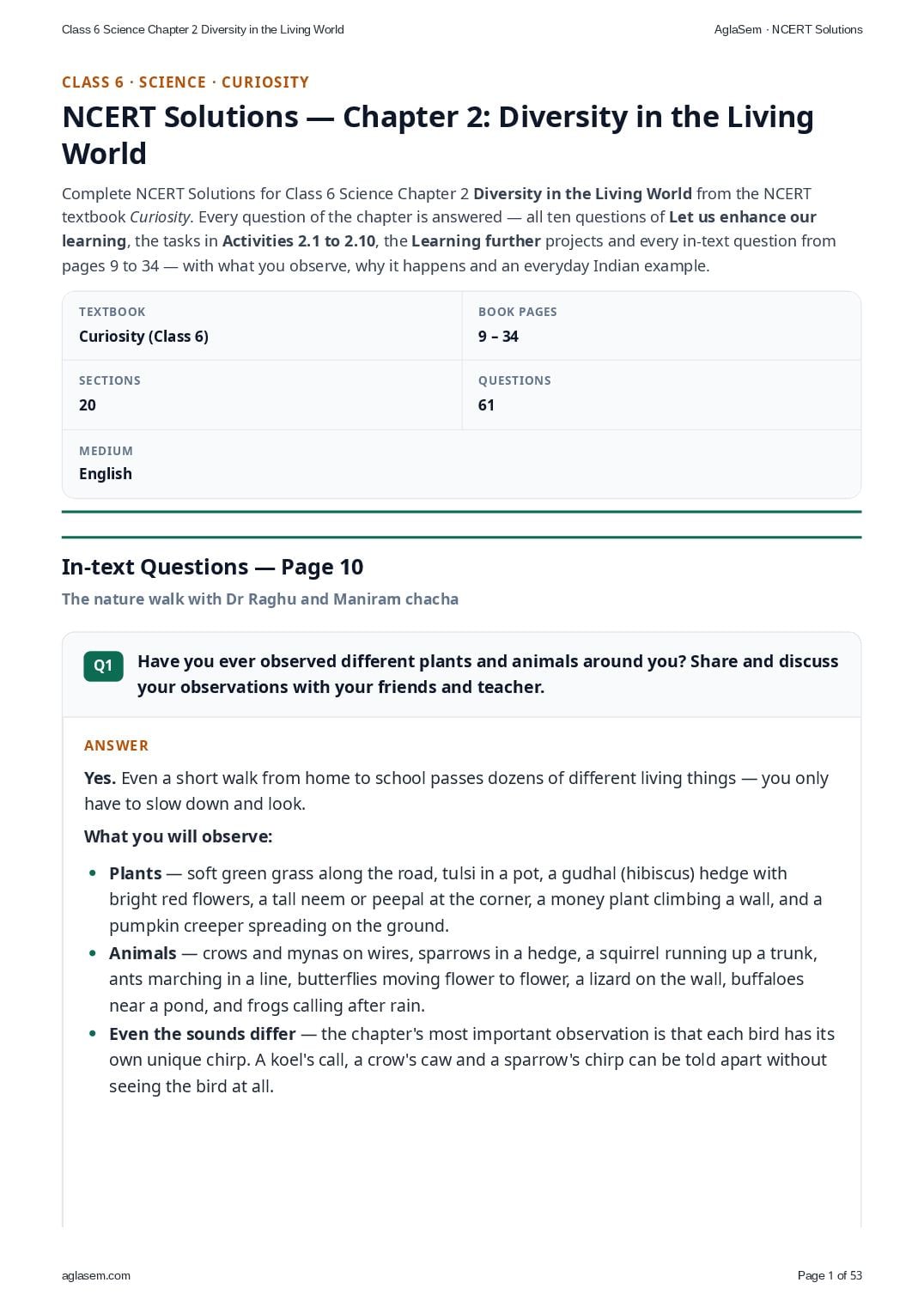
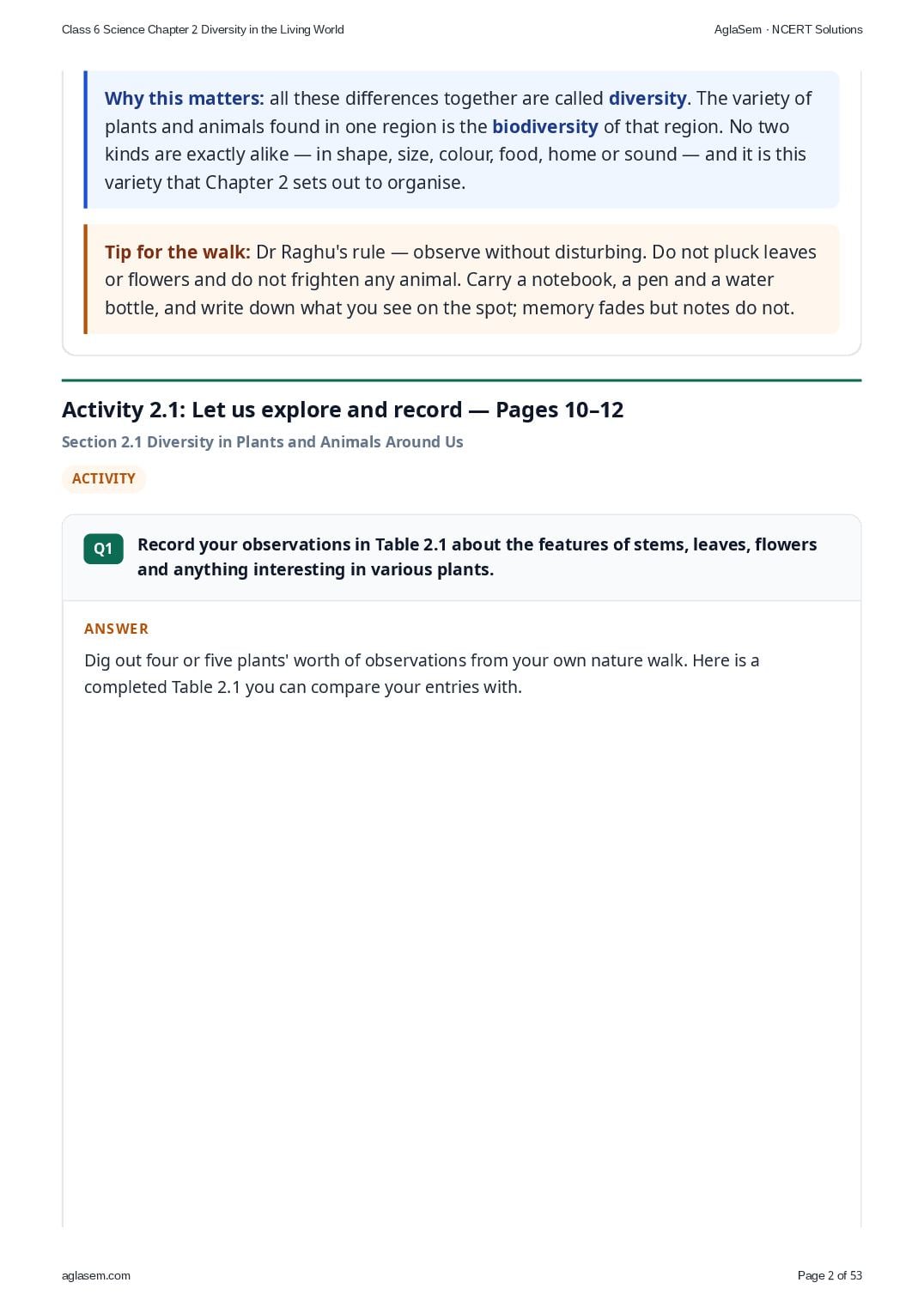
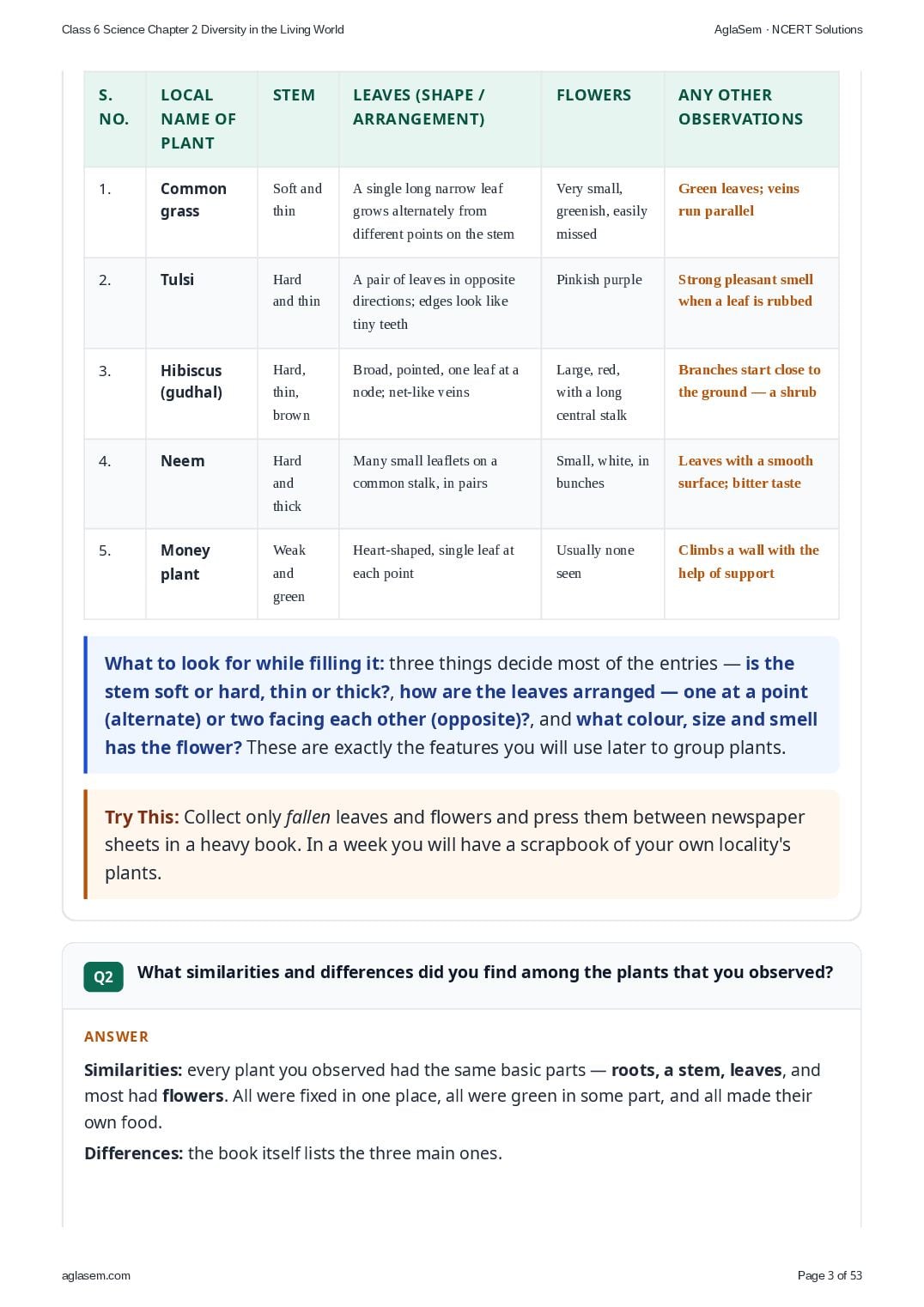
NCERT Solutions for Class 6 Science Chapter 2 PDF Download
You can read the NCERT Solutions for Class 6 Science Chapter 2 online above, or download the complete question-answer PDF to study Diversity in the Living World offline at any time.
NCERT Solutions for Class 6 Science Chapter 2 PDF Download Link – Click Here to Download Solutions PDF
Questions Covered in This Chapter
These NCERT Solutions answer all 61 questions of this chapter. The questions solved are:
- Have you ever observed different plants and animals around you? Share and discuss your observations with your friends and teacher.
- Record your observations in Table 2.1 about the features of stems, leaves, flowers and anything interesting in various plants.
- What similarities and differences did you find among the plants that you observed?
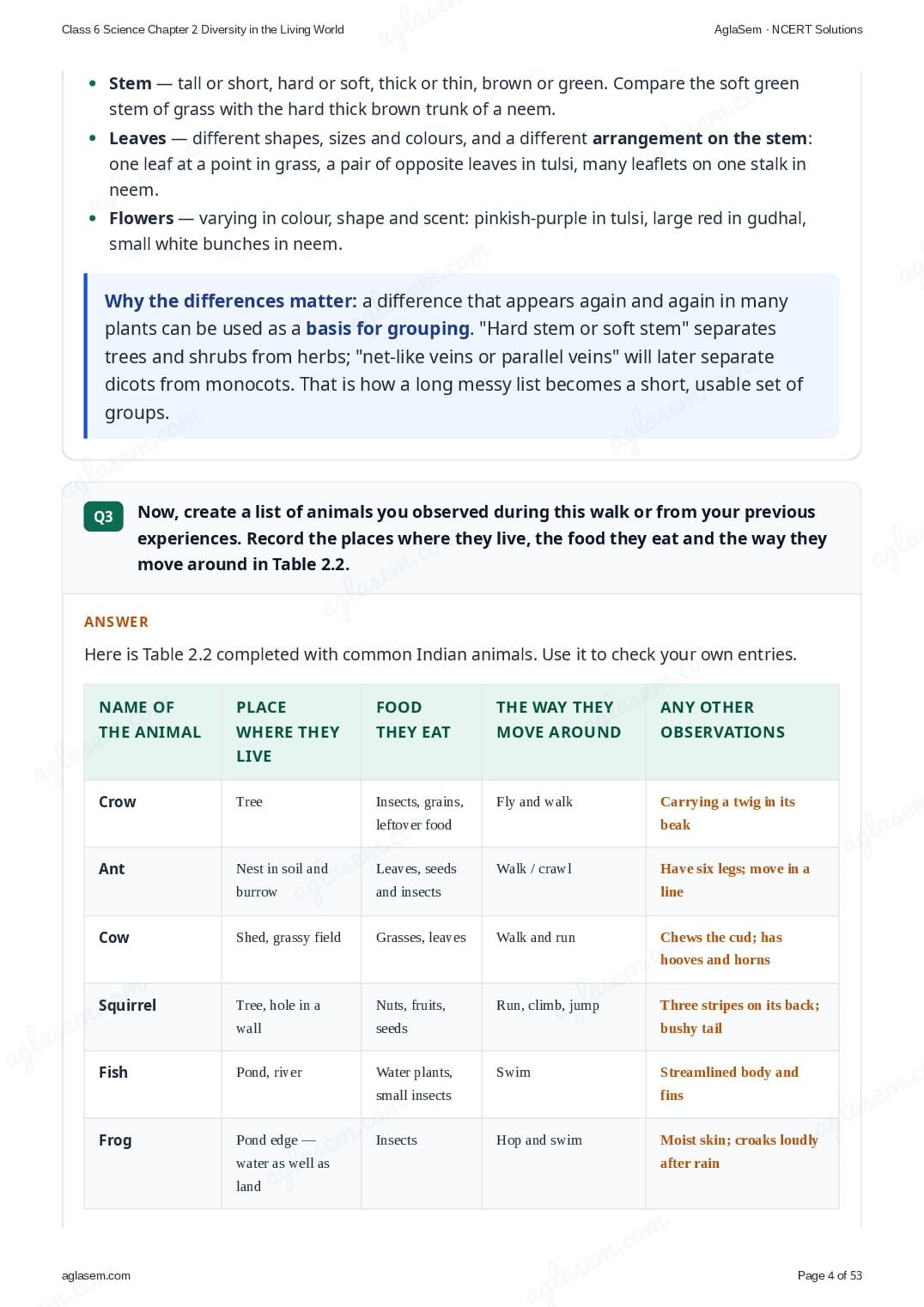
- Now, create a list of animals you observed during this walk or from your previous experiences. Record the places where they live, the food they eat and the way they move around in Table 2.2.
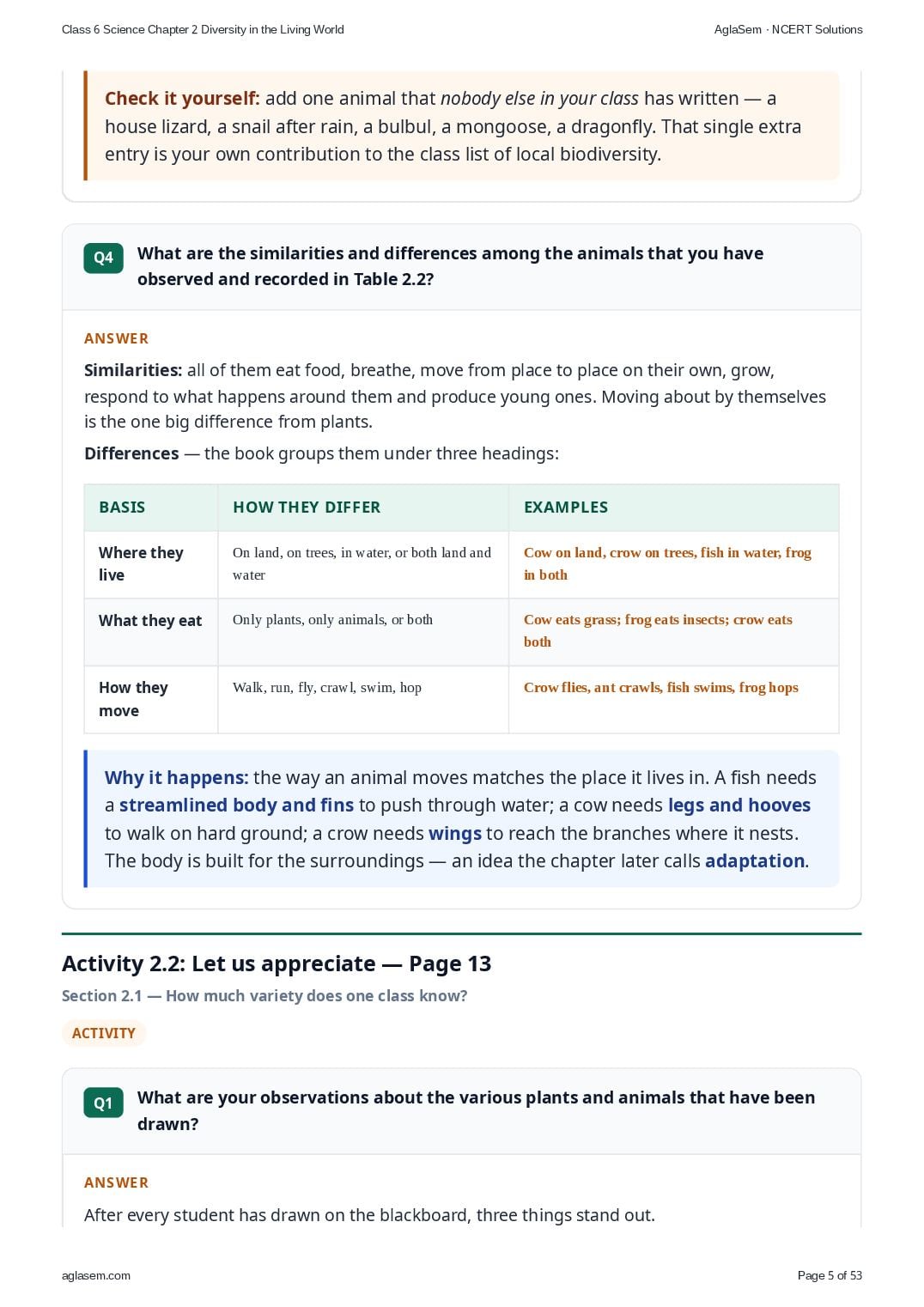
- What are the similarities and differences among the animals that you have observed and recorded in Table 2.2?
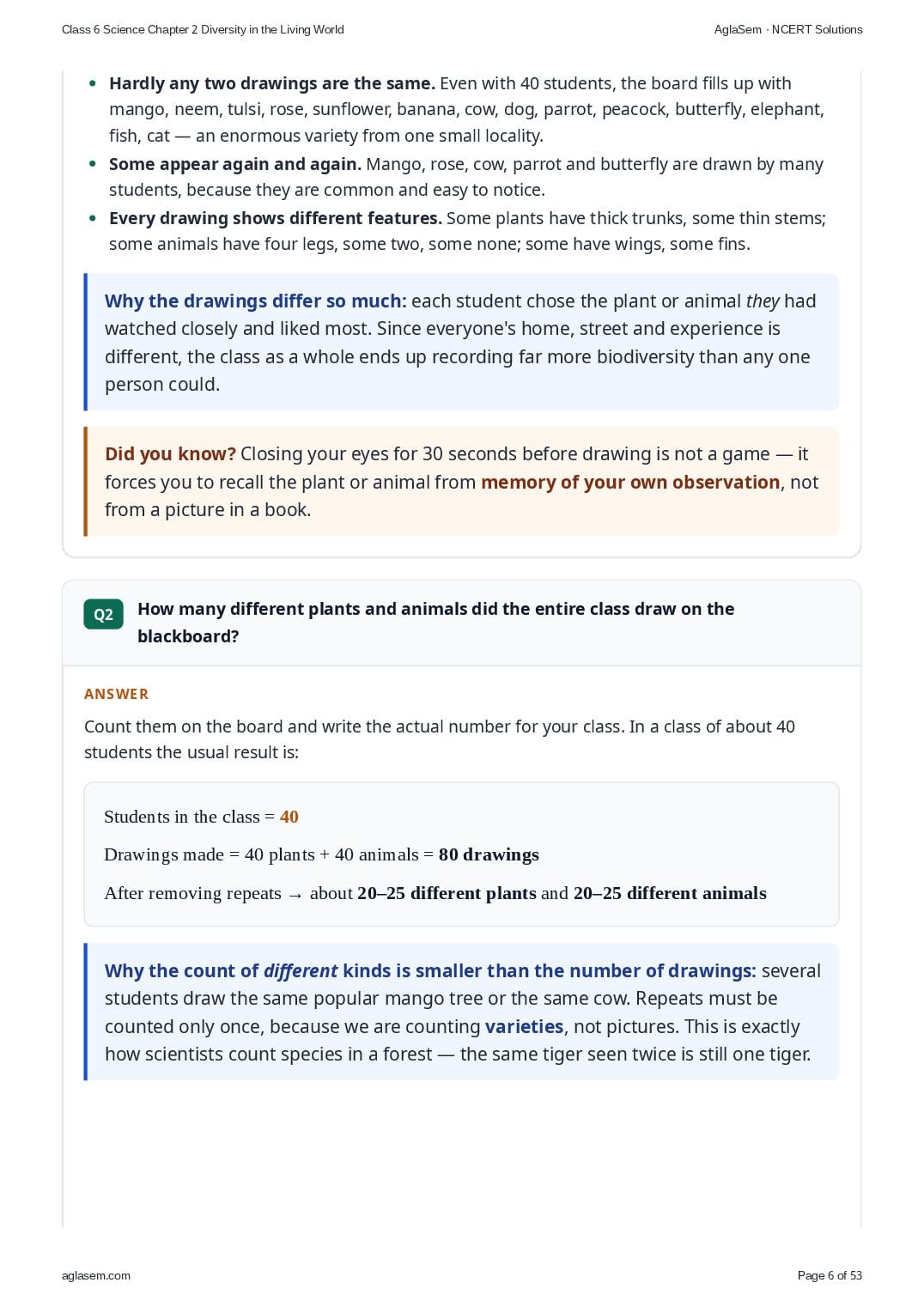
- What are your observations about the various plants and animals that have been drawn?
- How many different plants and animals did the entire class draw on the blackboard?
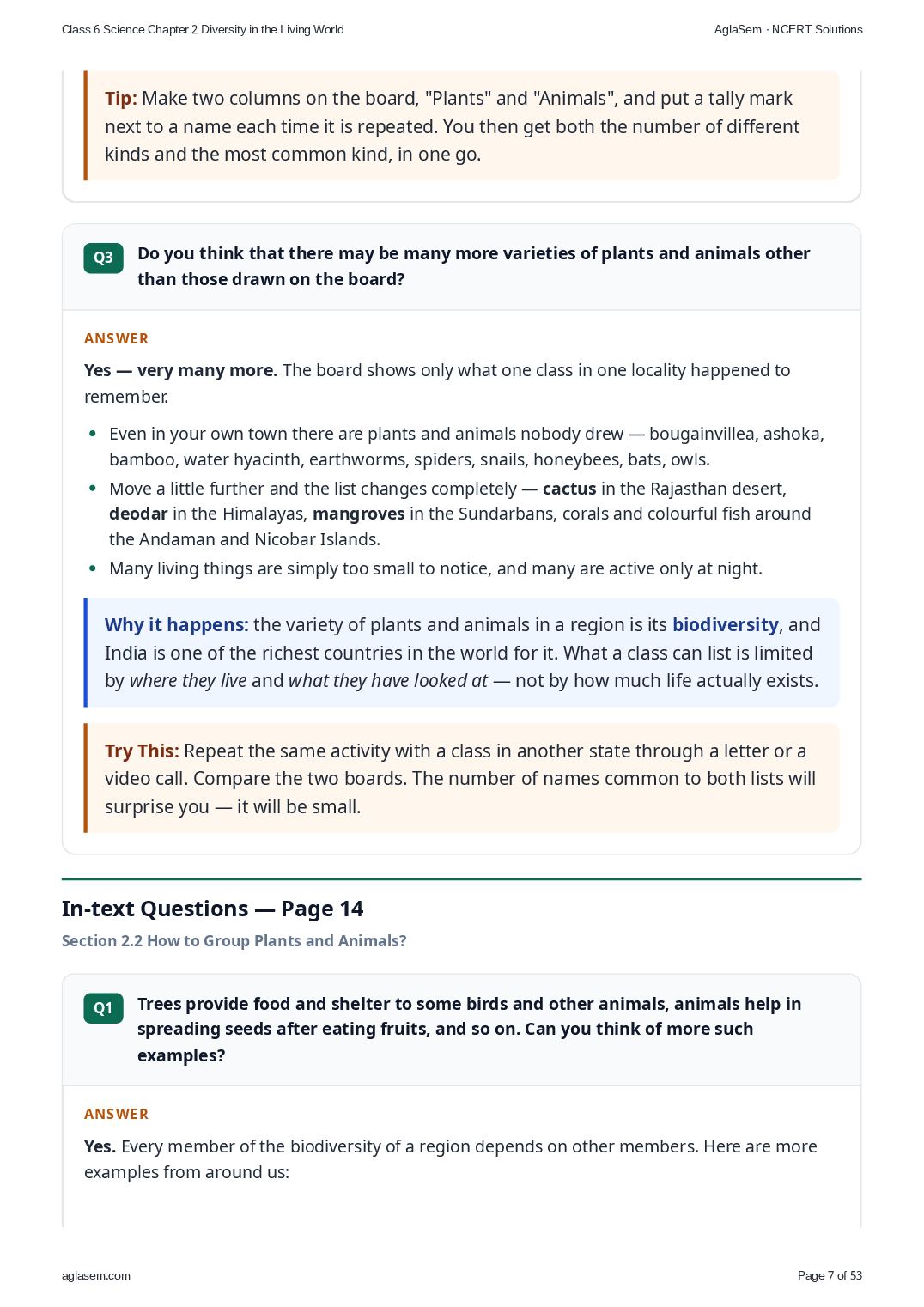
- Do you think that there may be many more varieties of plants and animals other than those drawn on the board?
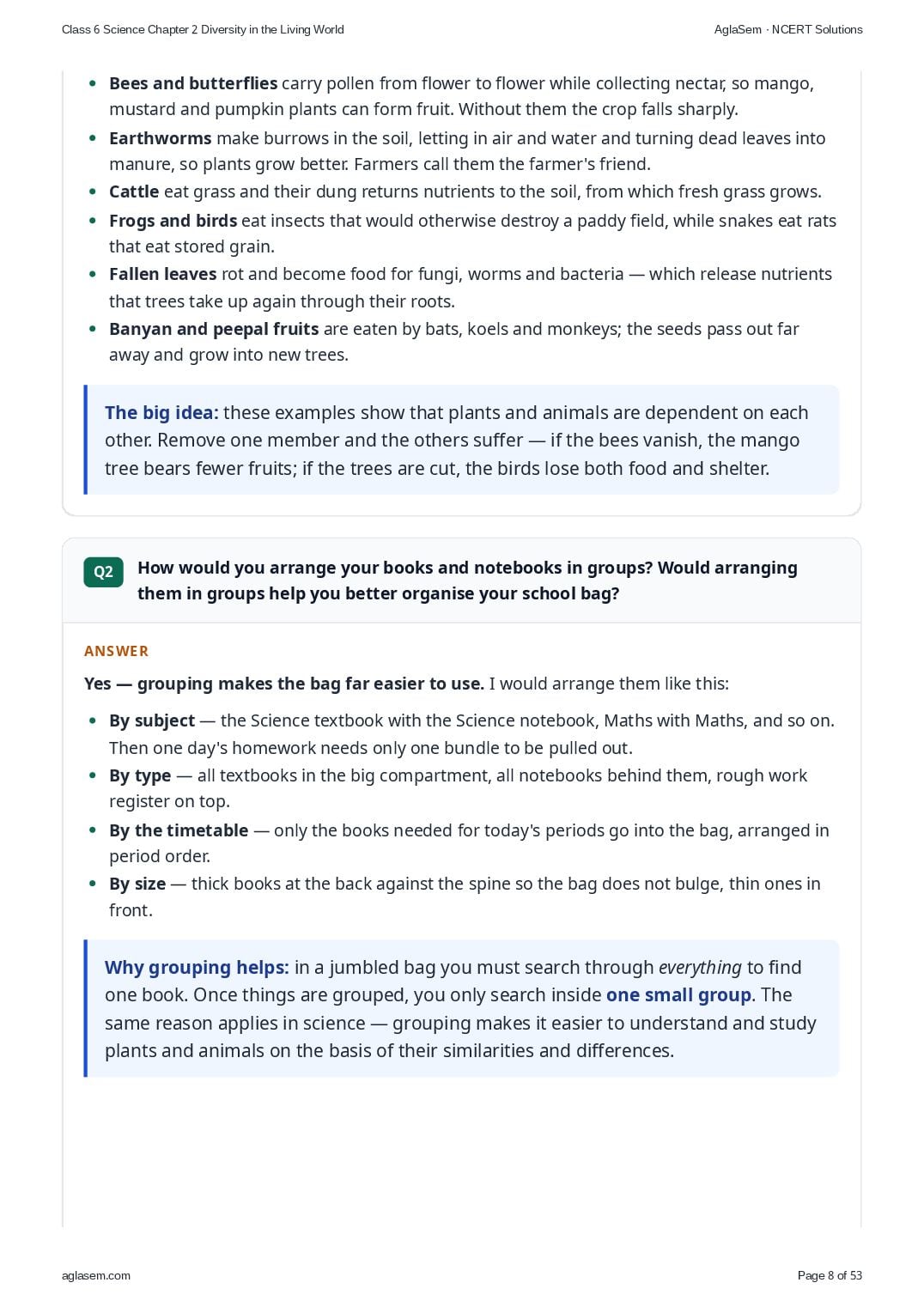
- Trees provide food and shelter to some birds and other animals, animals help in spreading seeds after eating fruits, and so on. Can you think of more such examples?
- How would you arrange your books and notebooks in groups? Would arranging them in groups help you better organise your school bag?
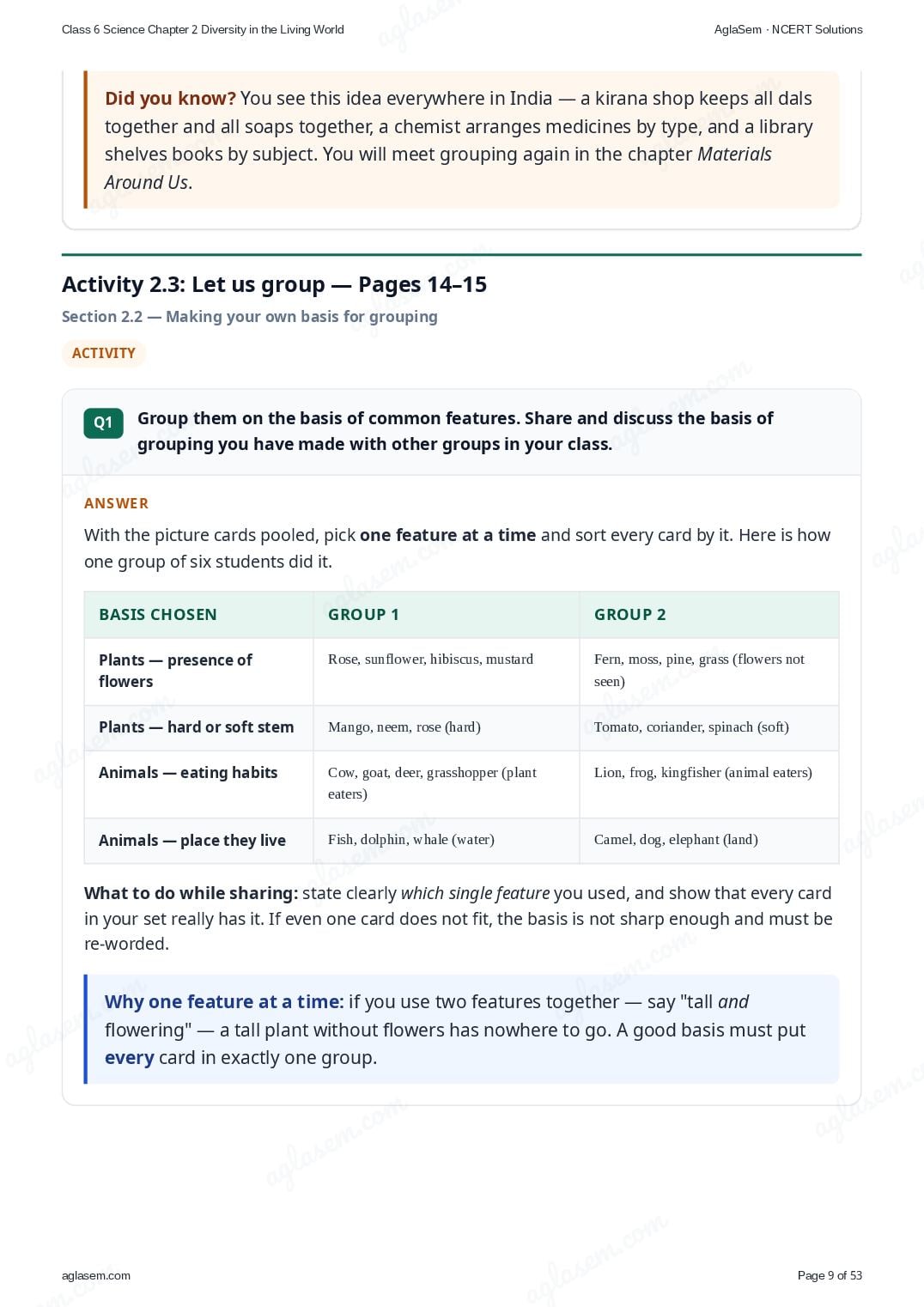
- Group them on the basis of common features. Share and discuss the basis of grouping you have made with other groups in your class.
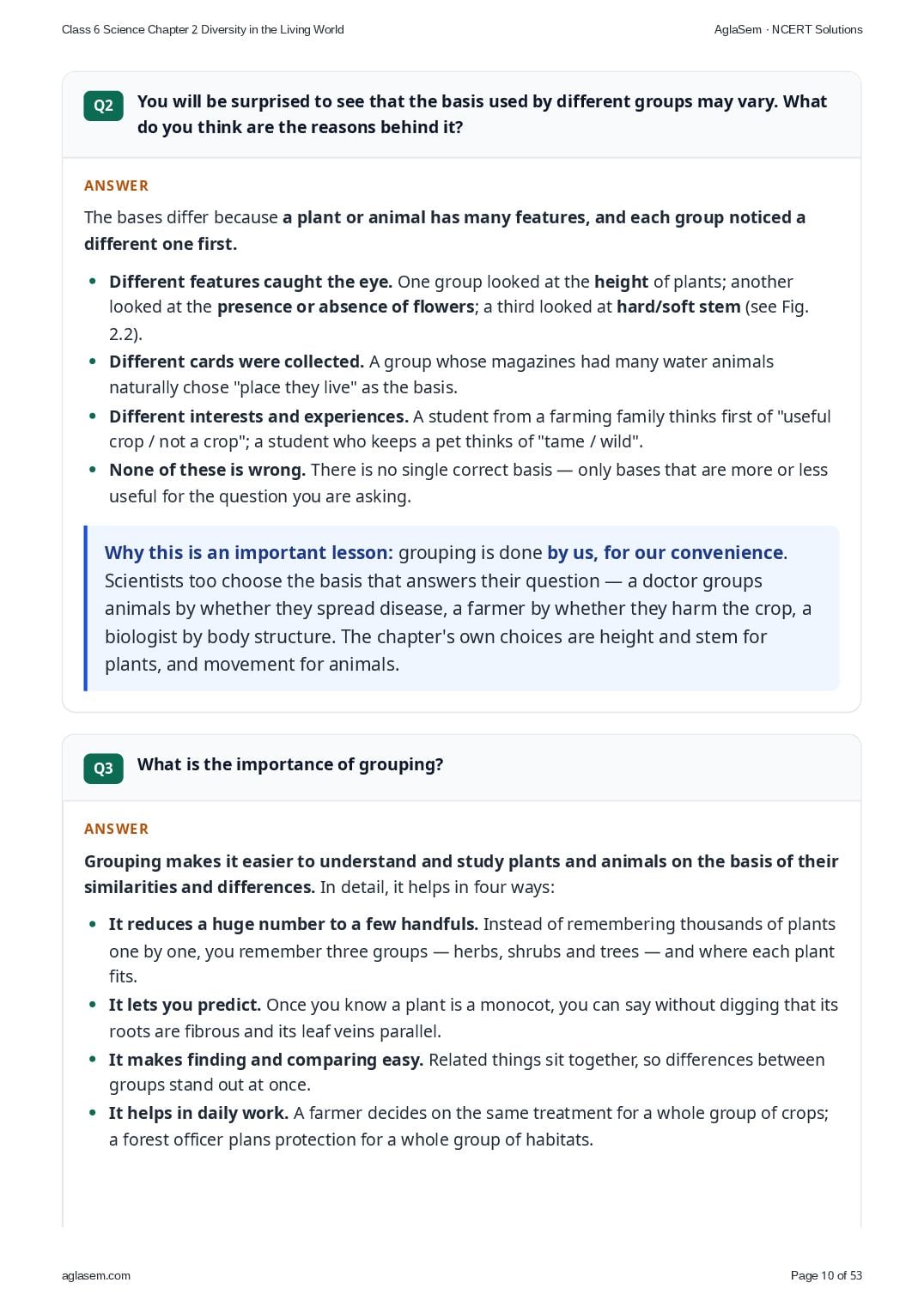
- You will be surprised to see that the basis used by different groups may vary. What do you think are the reasons behind it?
- What is the importance of grouping?
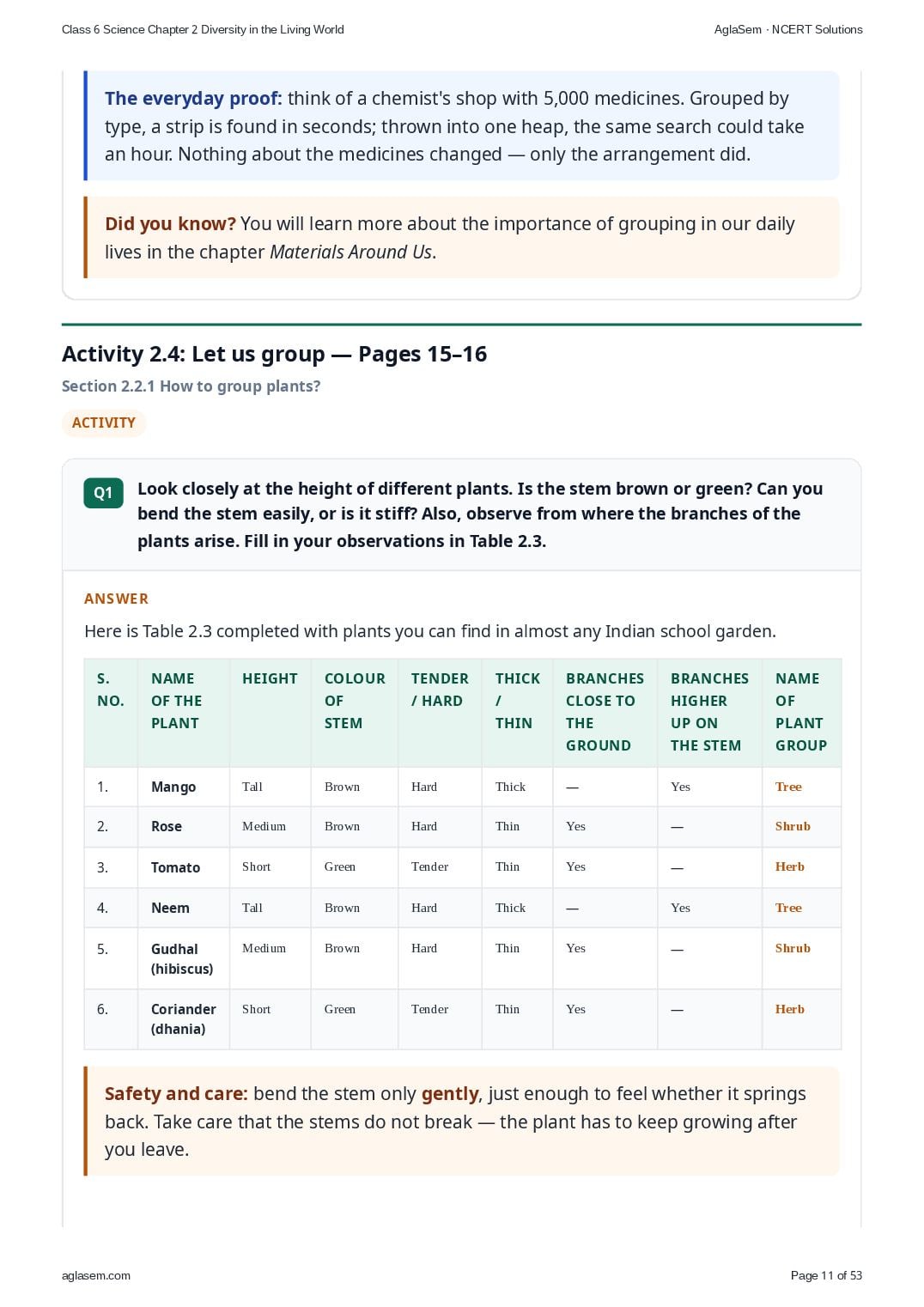
- Look closely at the height of different plants. Is the stem brown or green? Can you bend the stem easily, or is it stiff? Also, observe from where the branches of the plants arise. Fill in your observations in Table 2.3.
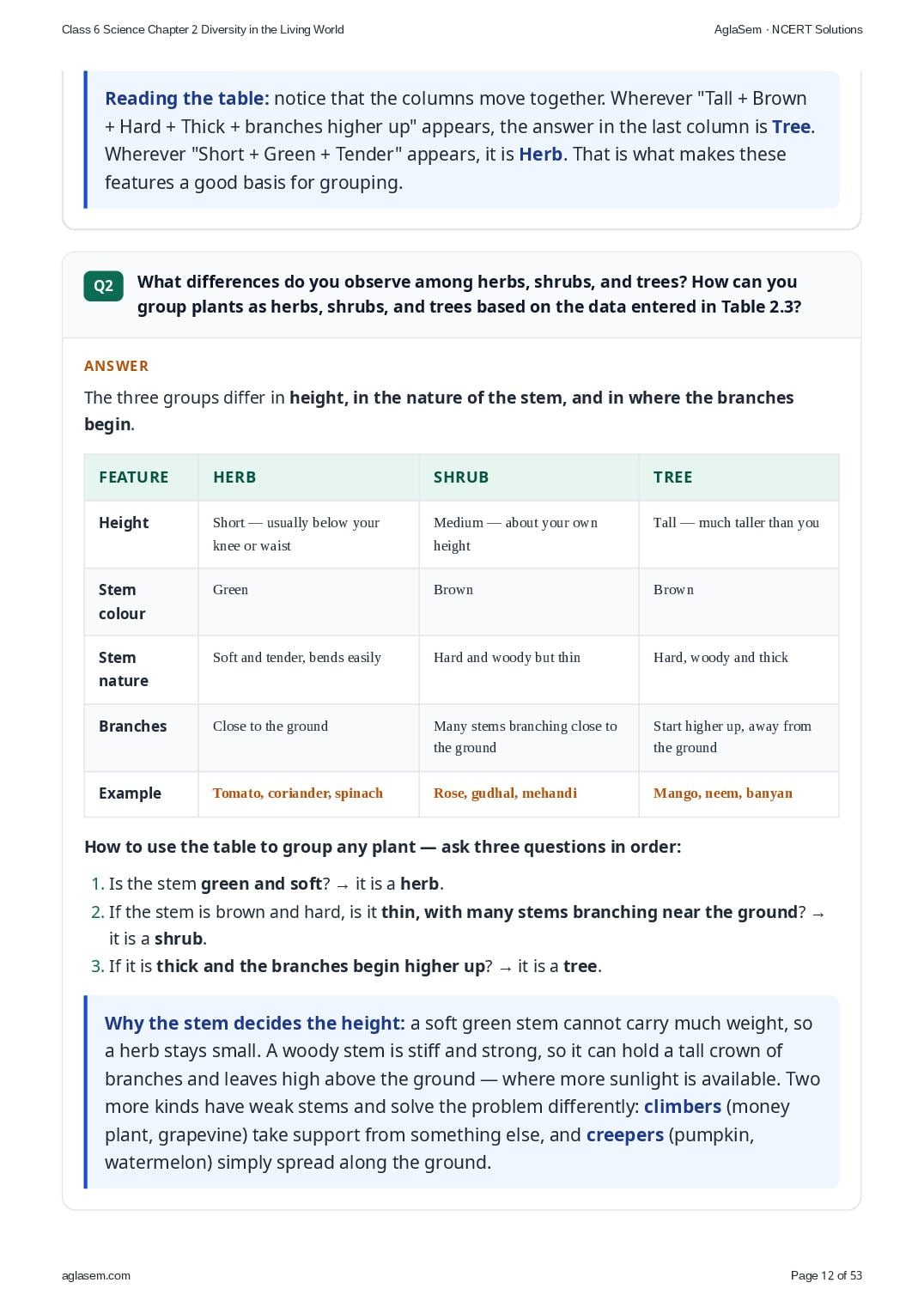
- What differences do you observe among herbs, shrubs, and trees? How can you group plants as herbs, shrubs, and trees based on the data entered in Table 2.3?
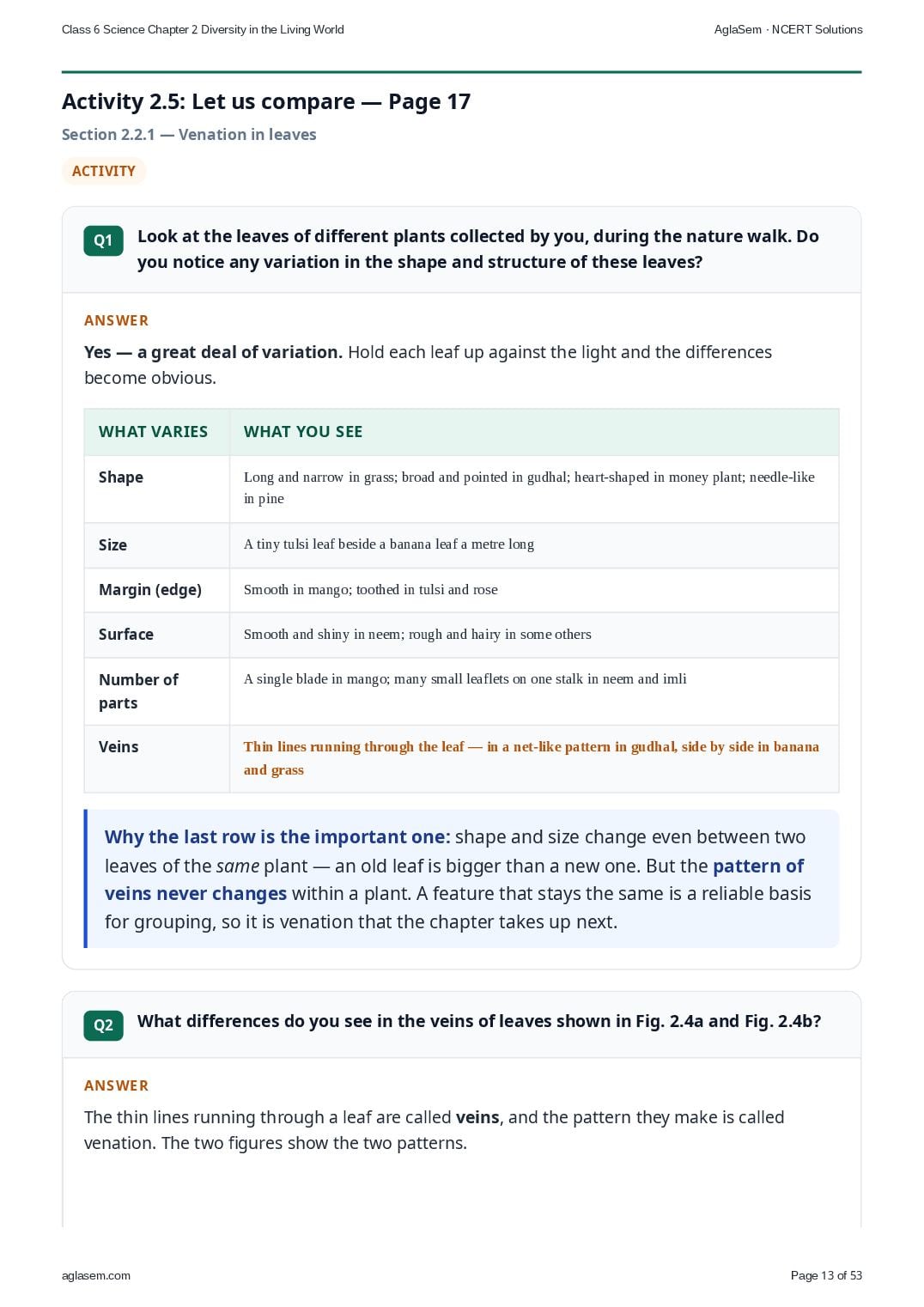
- Look at the leaves of different plants collected by you, during the nature walk. Do you notice any variation in the shape and structure of these leaves?
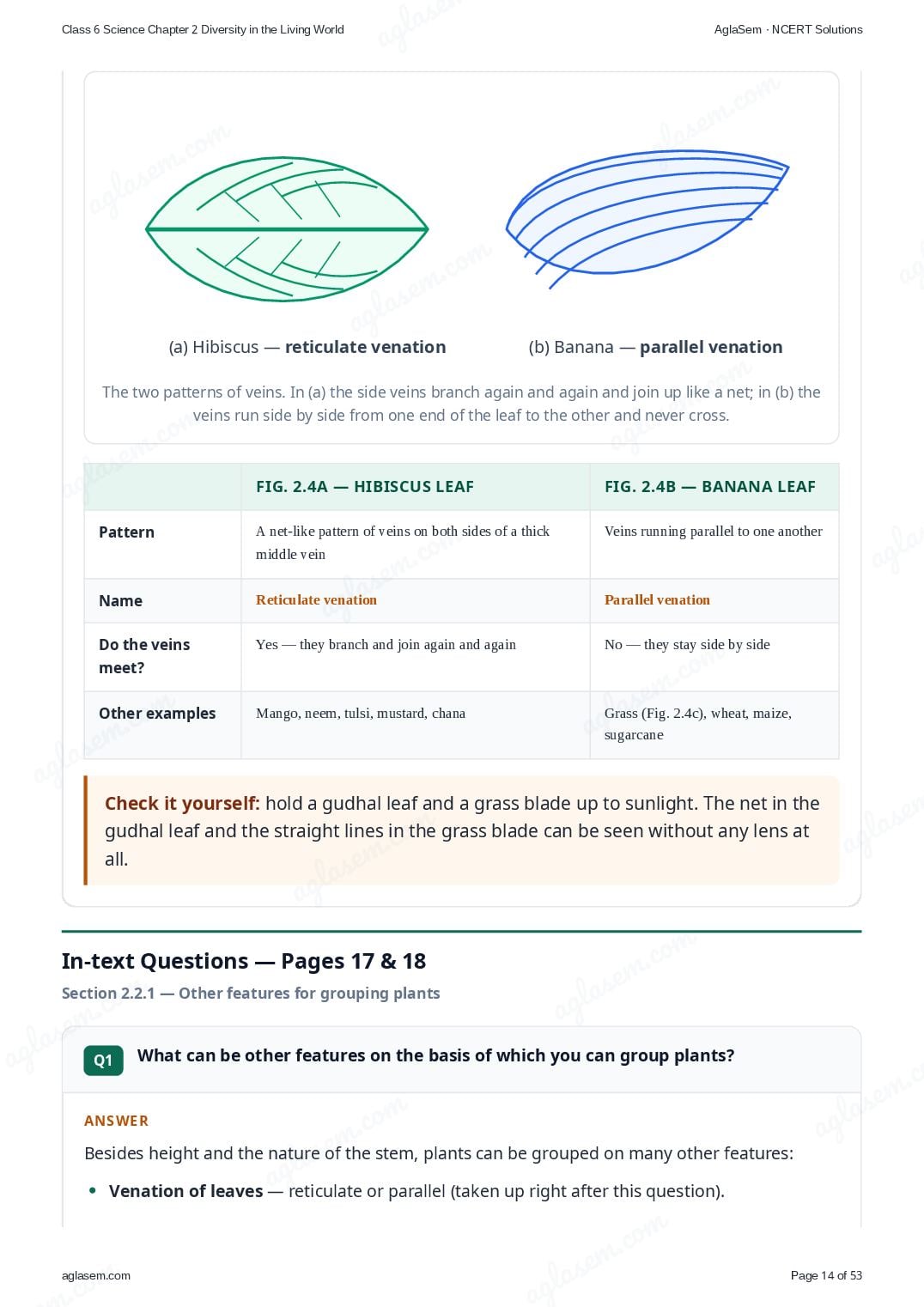
- What differences do you see in the veins of leaves shown in Fig. 2.4a and Fig. 2.4b?
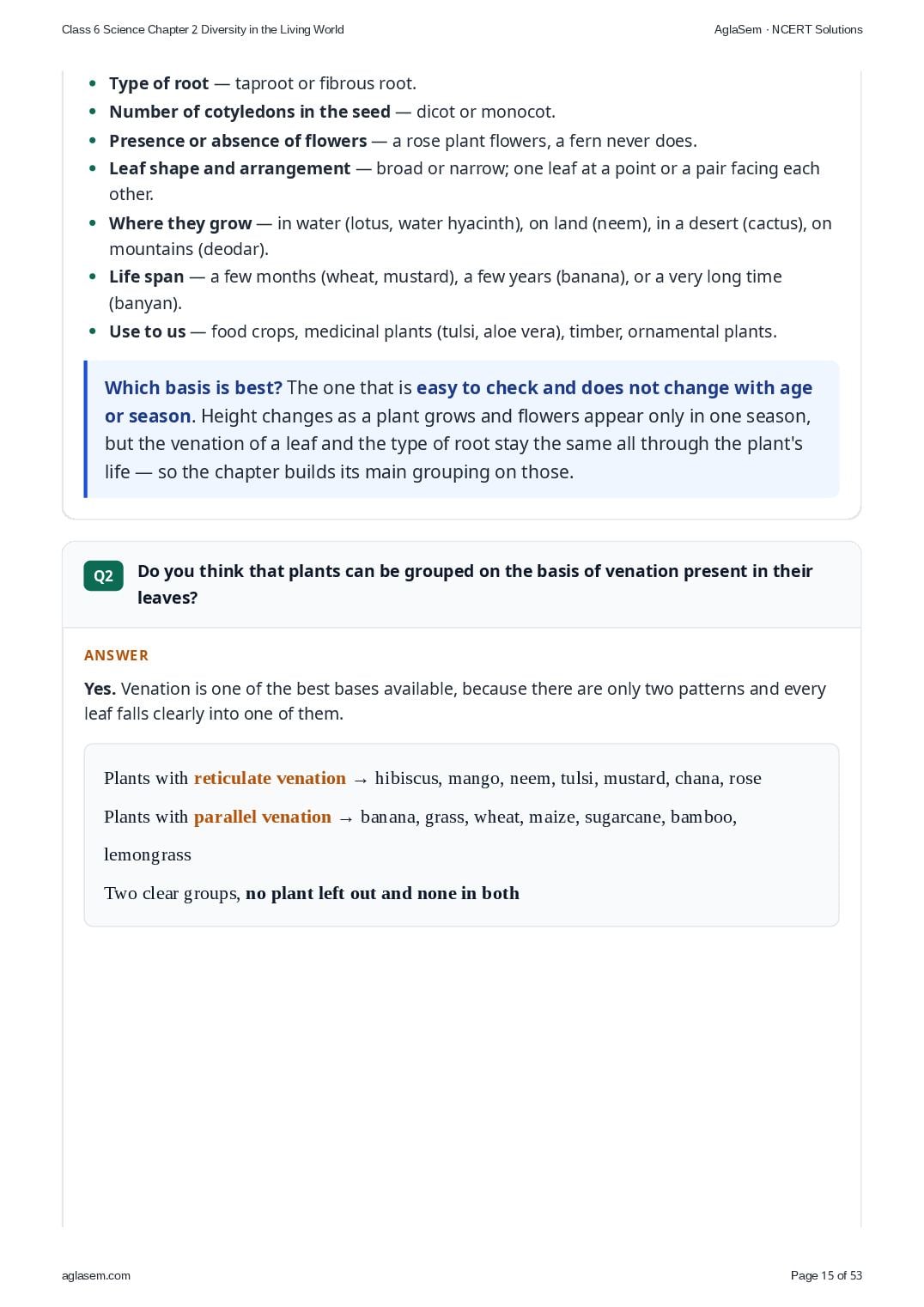
- What can be other features on the basis of which you can group plants?
- Do you think that plants can be grouped on the basis of venation present in their leaves?
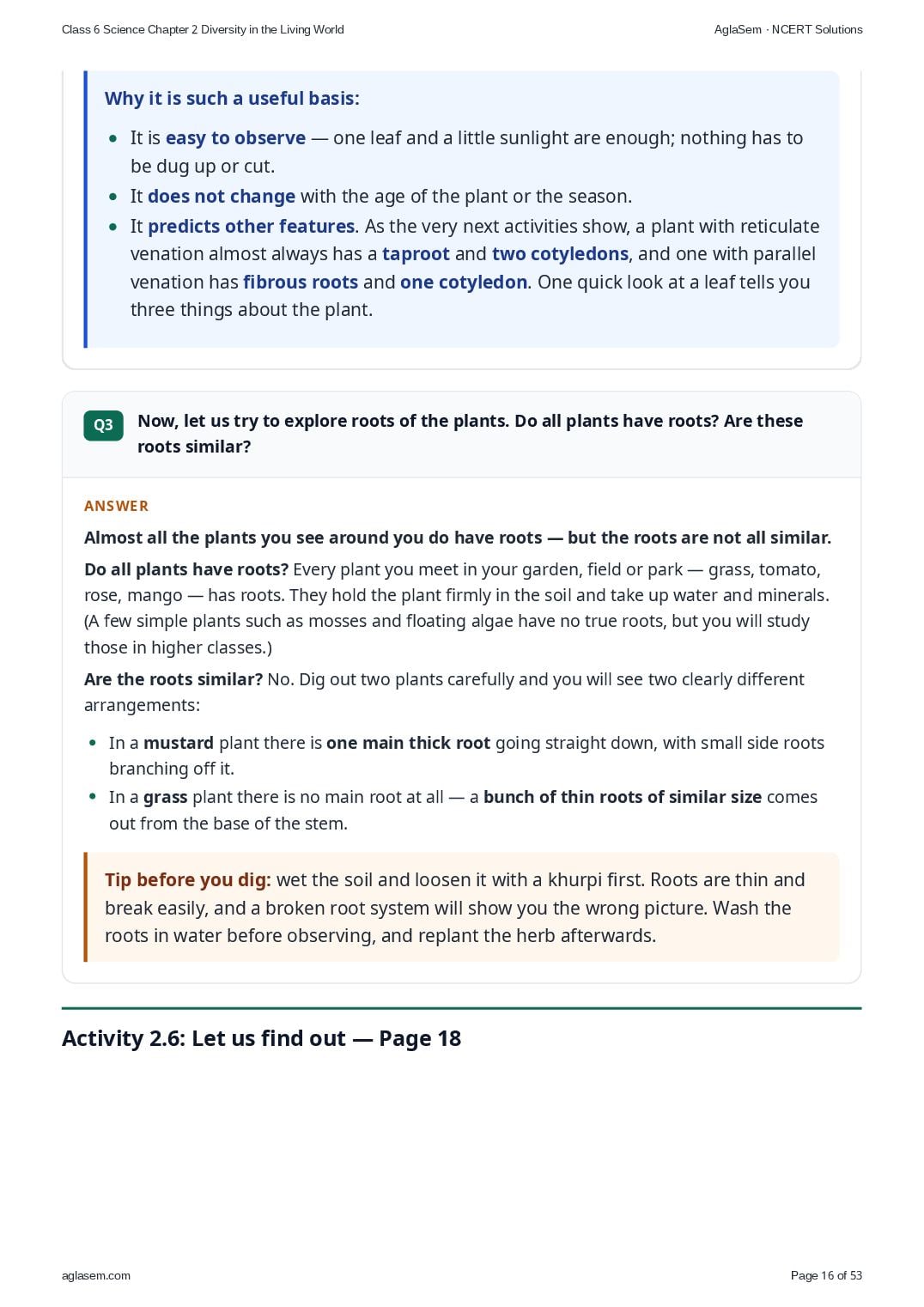
- Now, let us try to explore roots of the plants. Do all plants have roots? Are these roots similar?
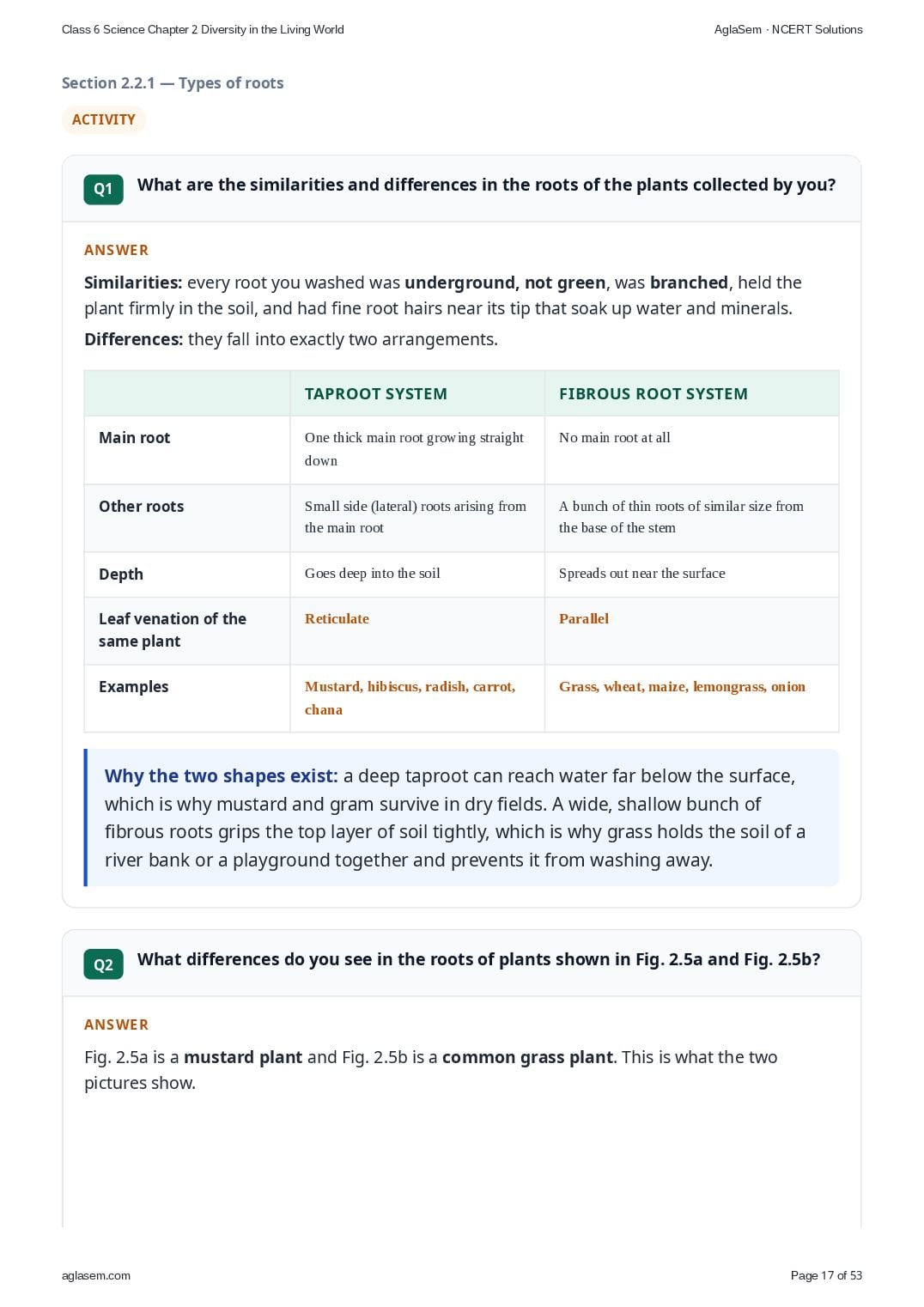
- What are the similarities and differences in the roots of the plants collected by you?
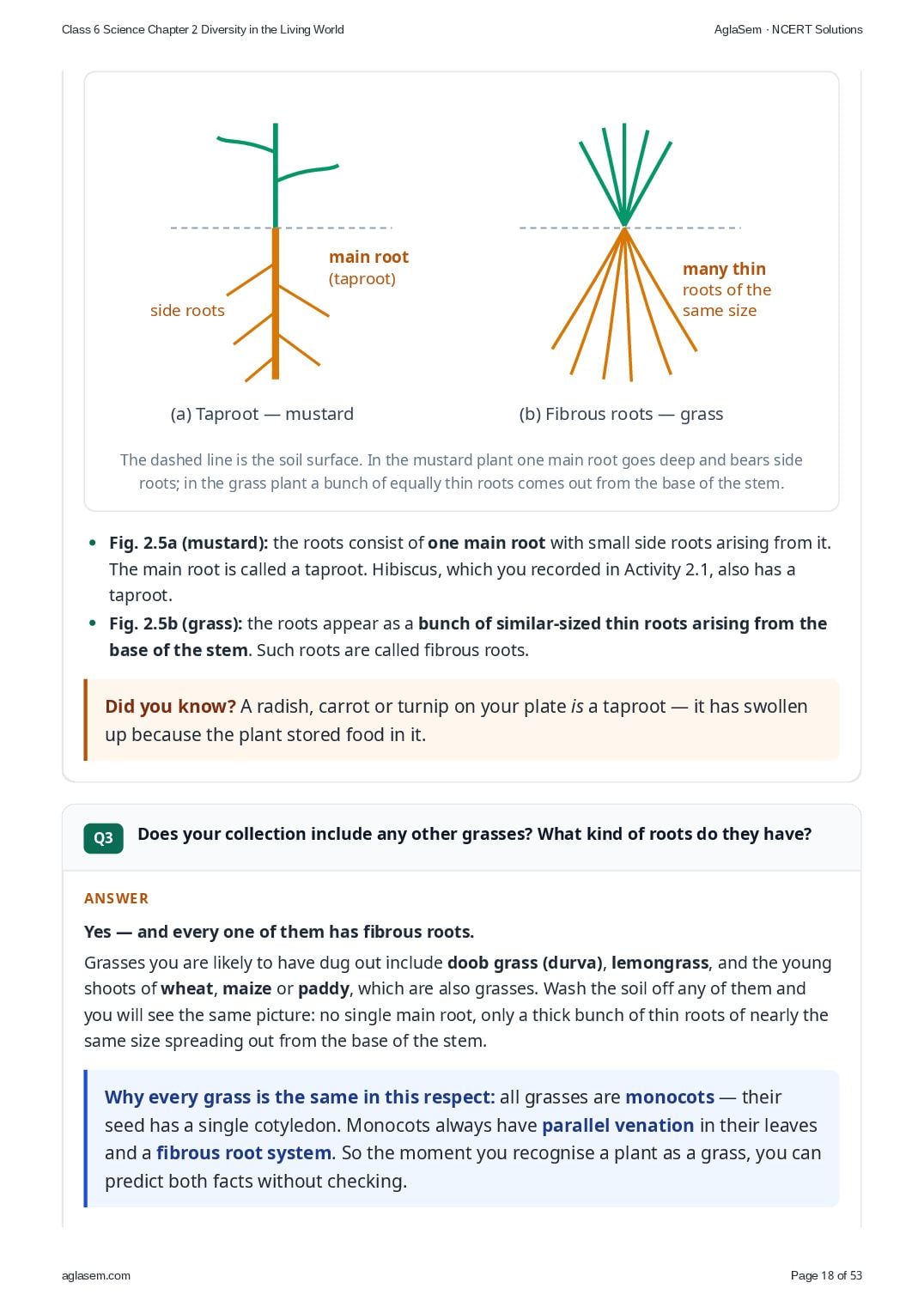
- What differences do you see in the roots of plants shown in Fig. 2.5a and Fig. 2.5b?
- Does your collection include any other grasses? What kind of roots do they have?
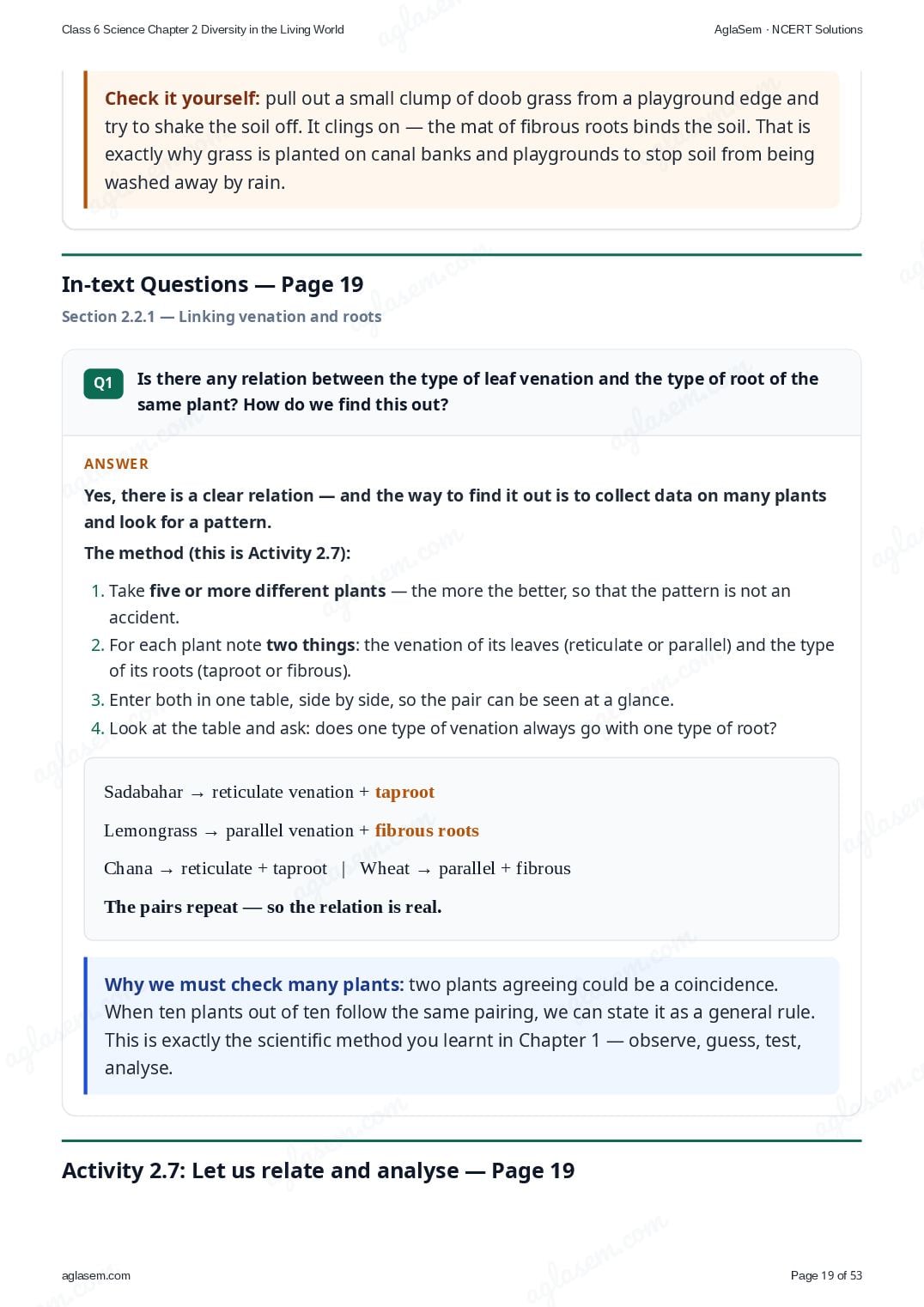
- Is there any relation between the type of leaf venation and the type of root of the same plant? How do we find this out?
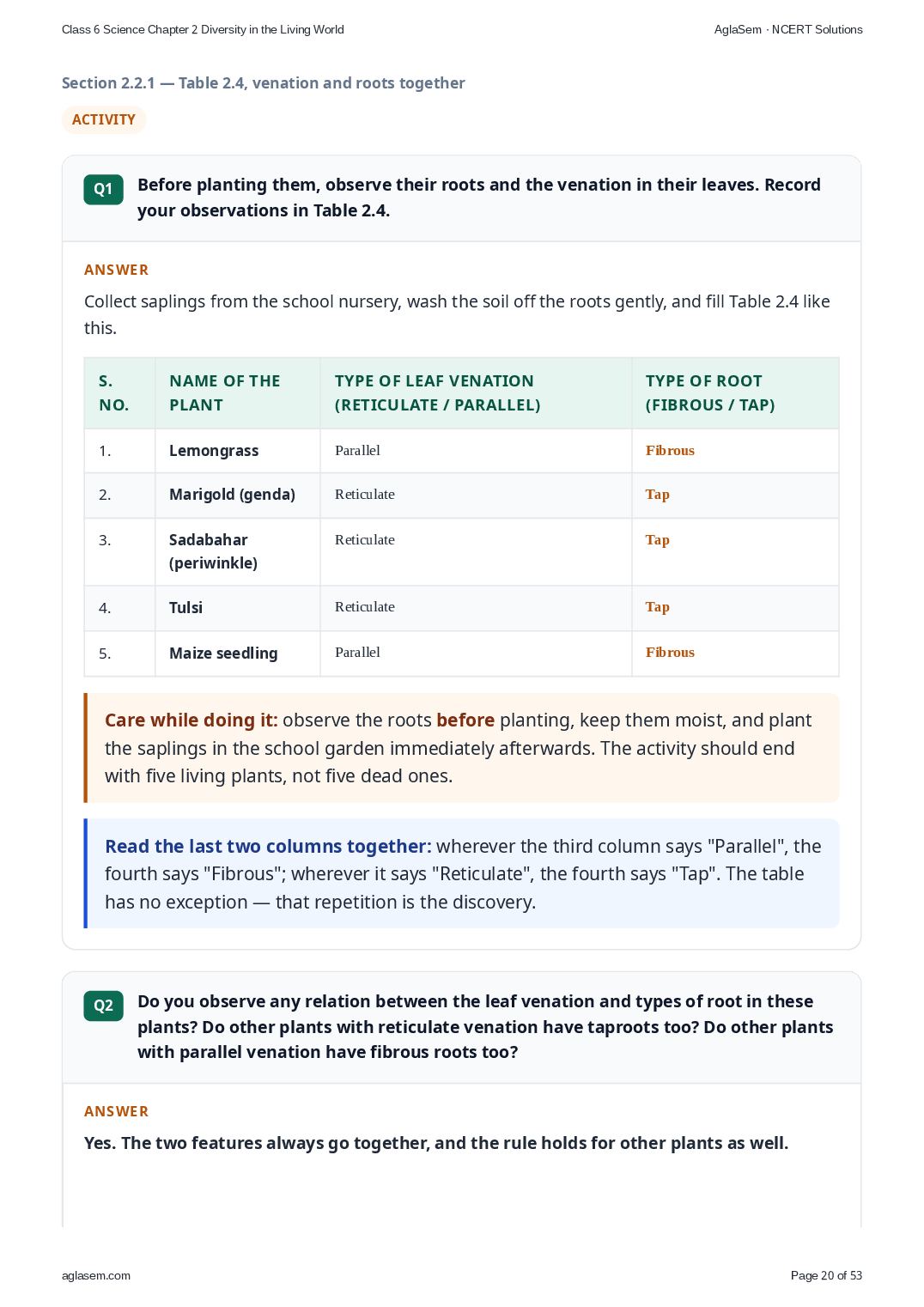
- Before planting them, observe their roots and the venation in their leaves. Record your observations in Table 2.4.
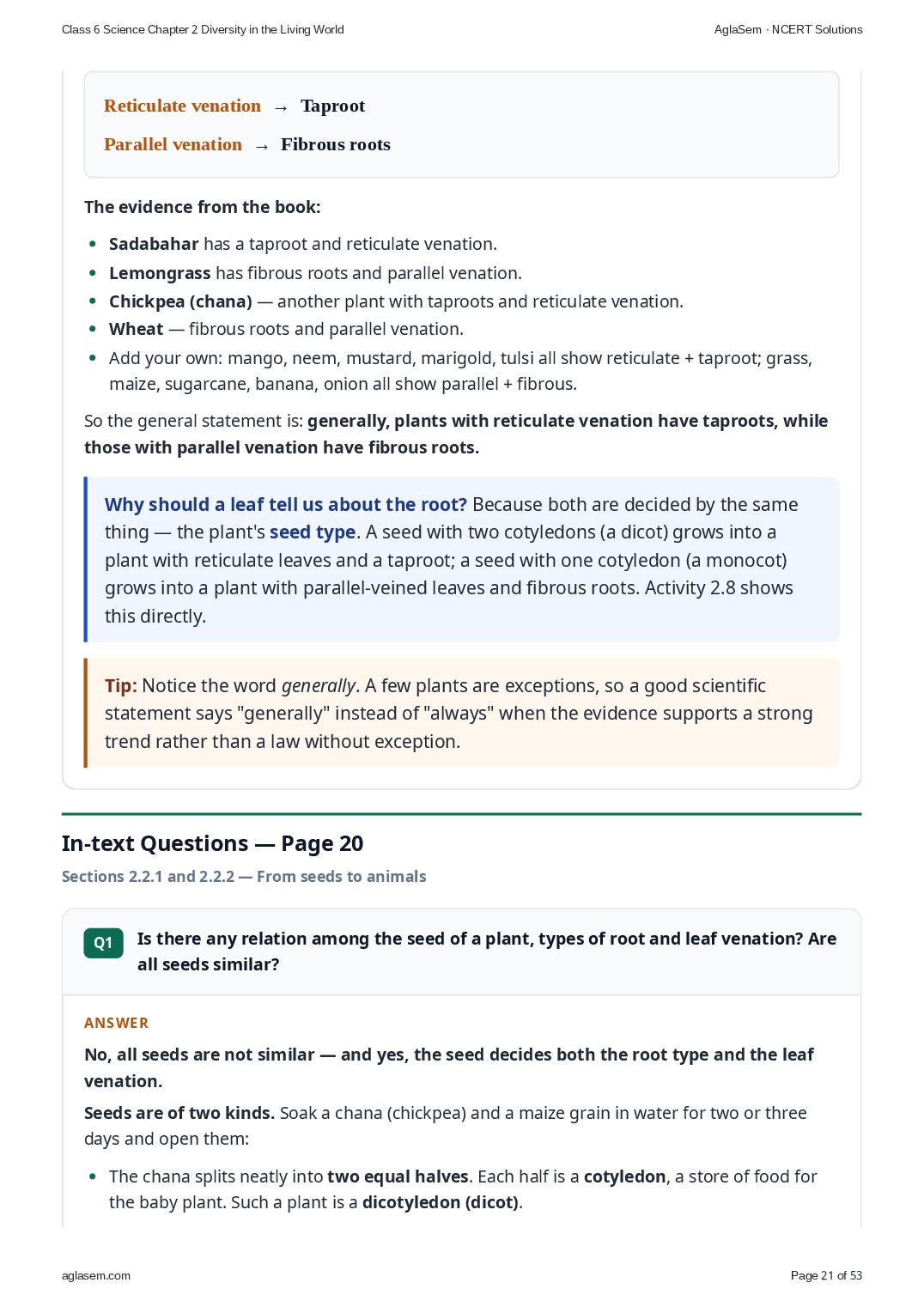
- Do you observe any relation between the leaf venation and types of root in these plants? Do other plants with reticulate venation have taproots too? Do other plants with parallel venation have fibrous roots too?
- Is there any relation among the seed of a plant, types of root and leaf venation? Are all seeds similar?
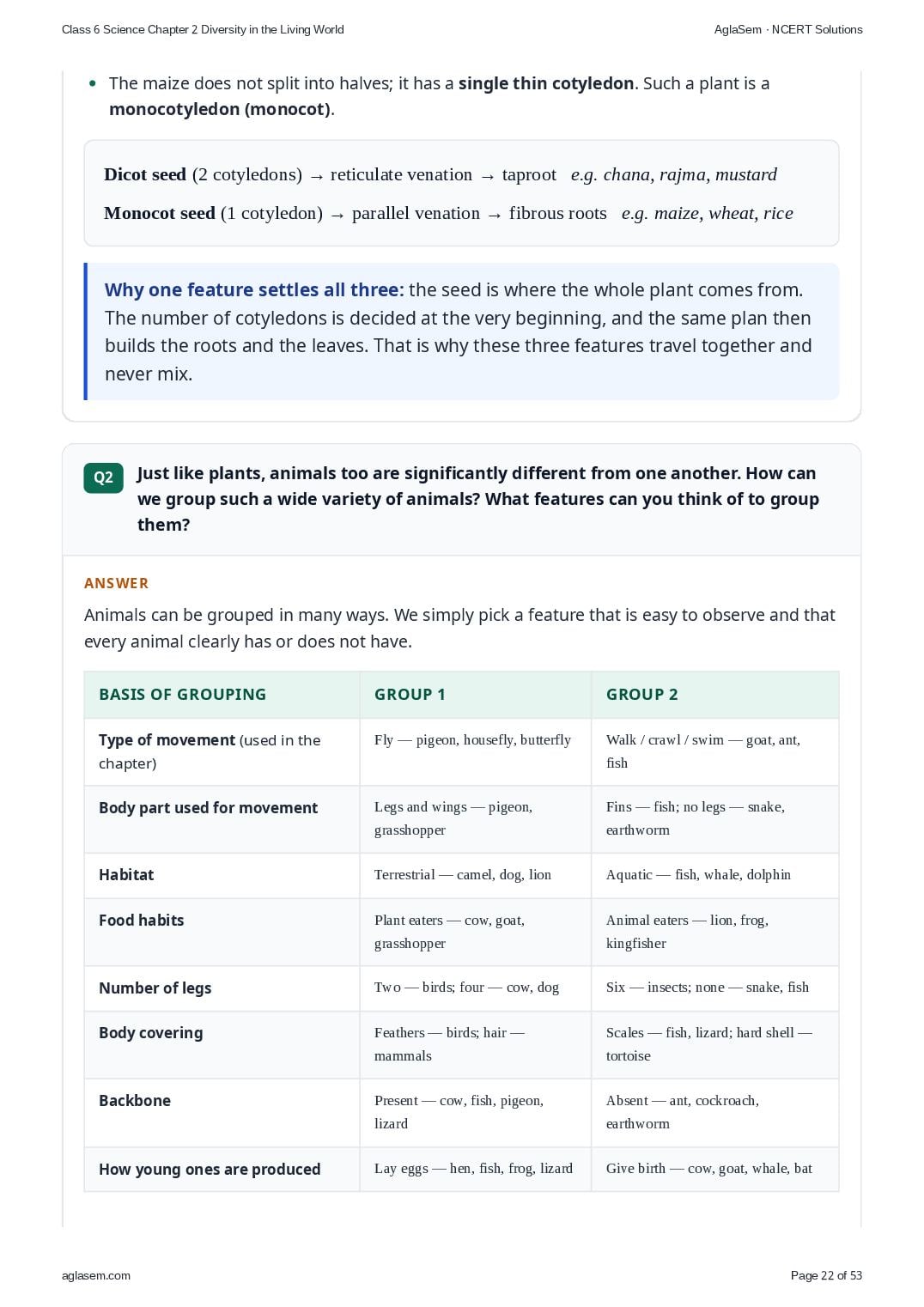
- Just like plants, animals too are significantly different from one another. How can we group such a wide variety of animals? What features can you think of to group them?
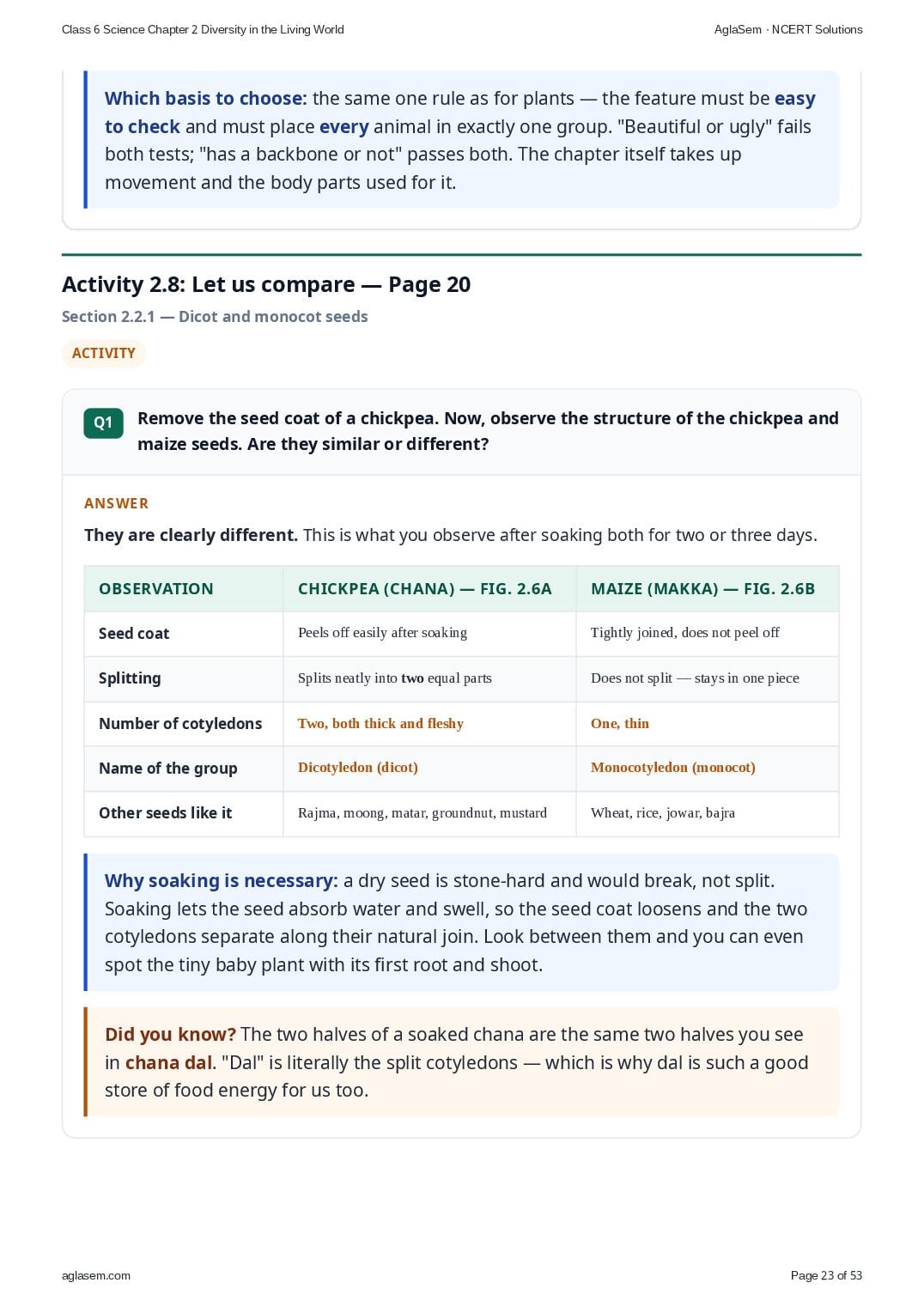
- Remove the seed coat of a chickpea. Now, observe the structure of the chickpea and maize seeds. Are they similar or different?
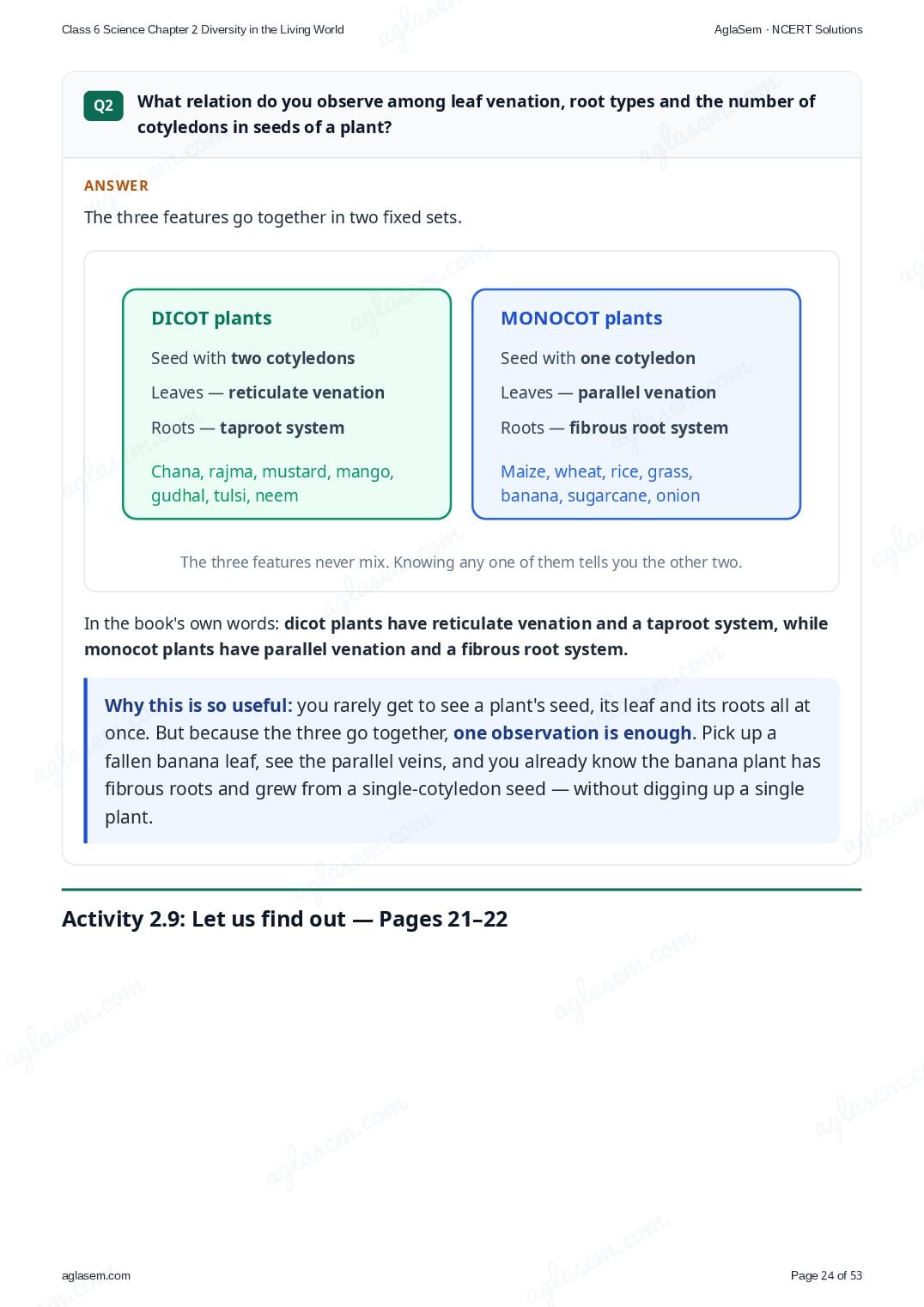
- What relation do you observe among leaf venation, root types and the number of cotyledons in seeds of a plant?
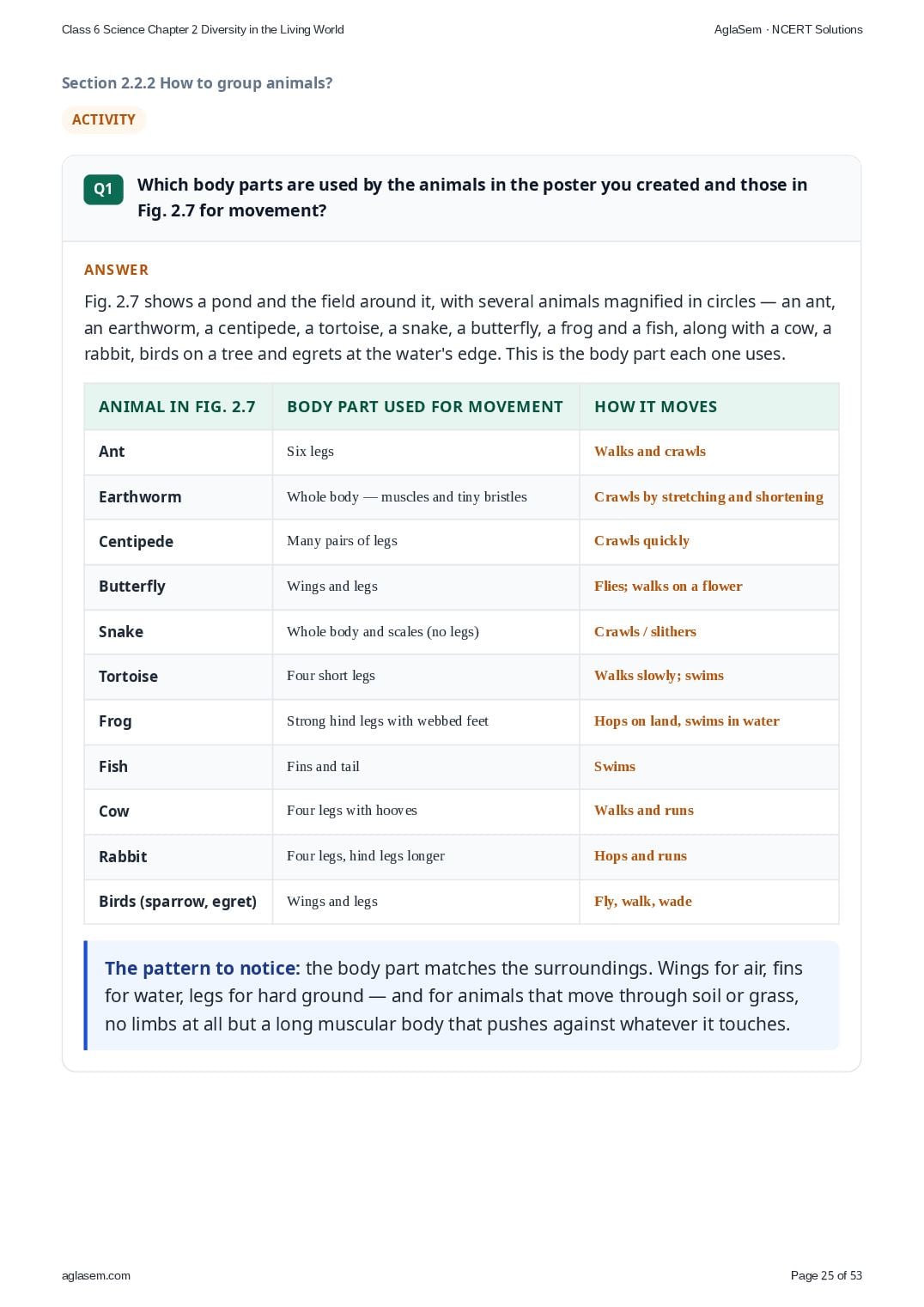
- Which body parts are used by the animals in the poster you created and those in Fig. 2.7 for movement?
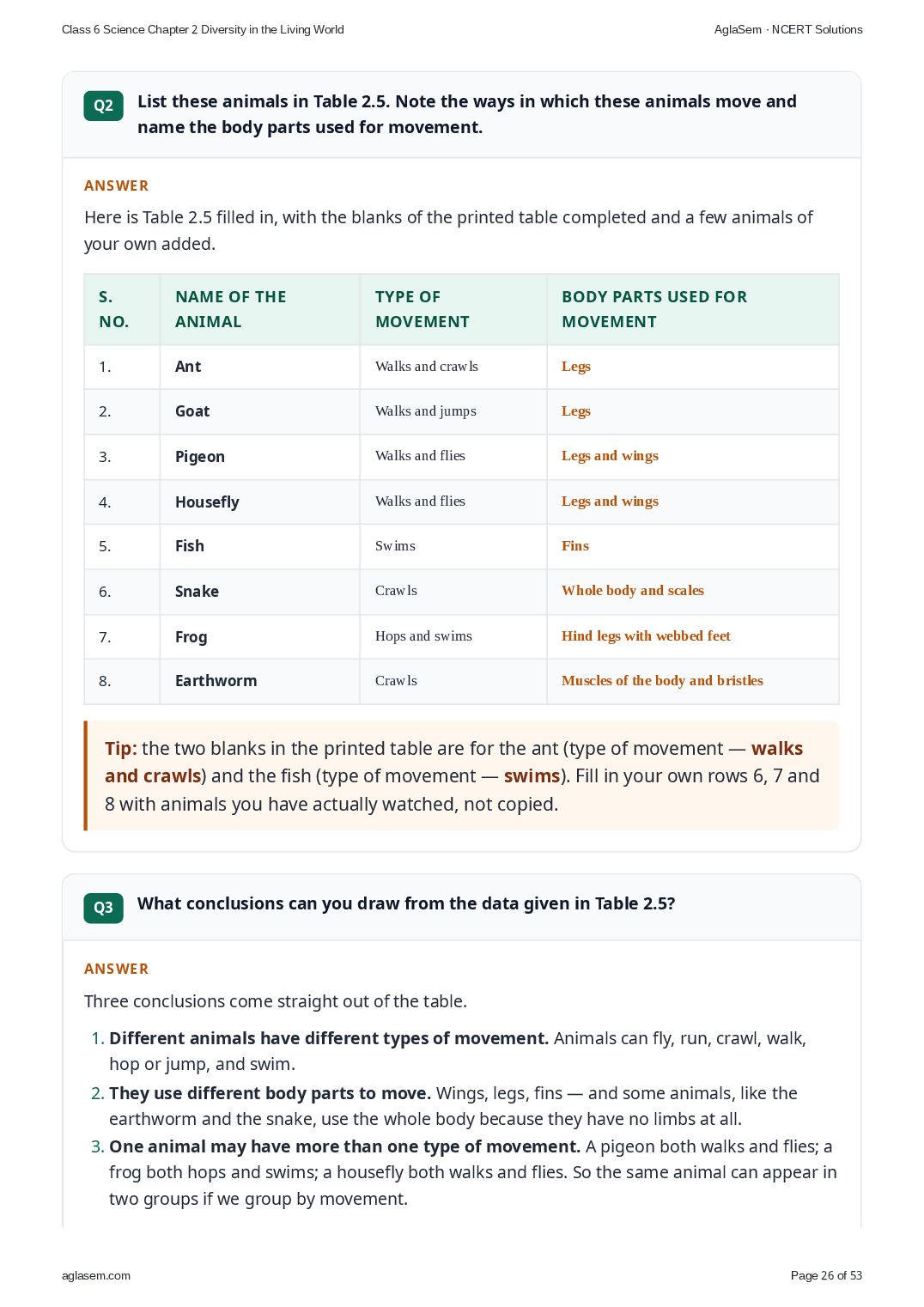
- List these animals in Table 2.5. Note the ways in which these animals move and name the body parts used for movement.
- What conclusions can you draw from the data given in Table 2.5?
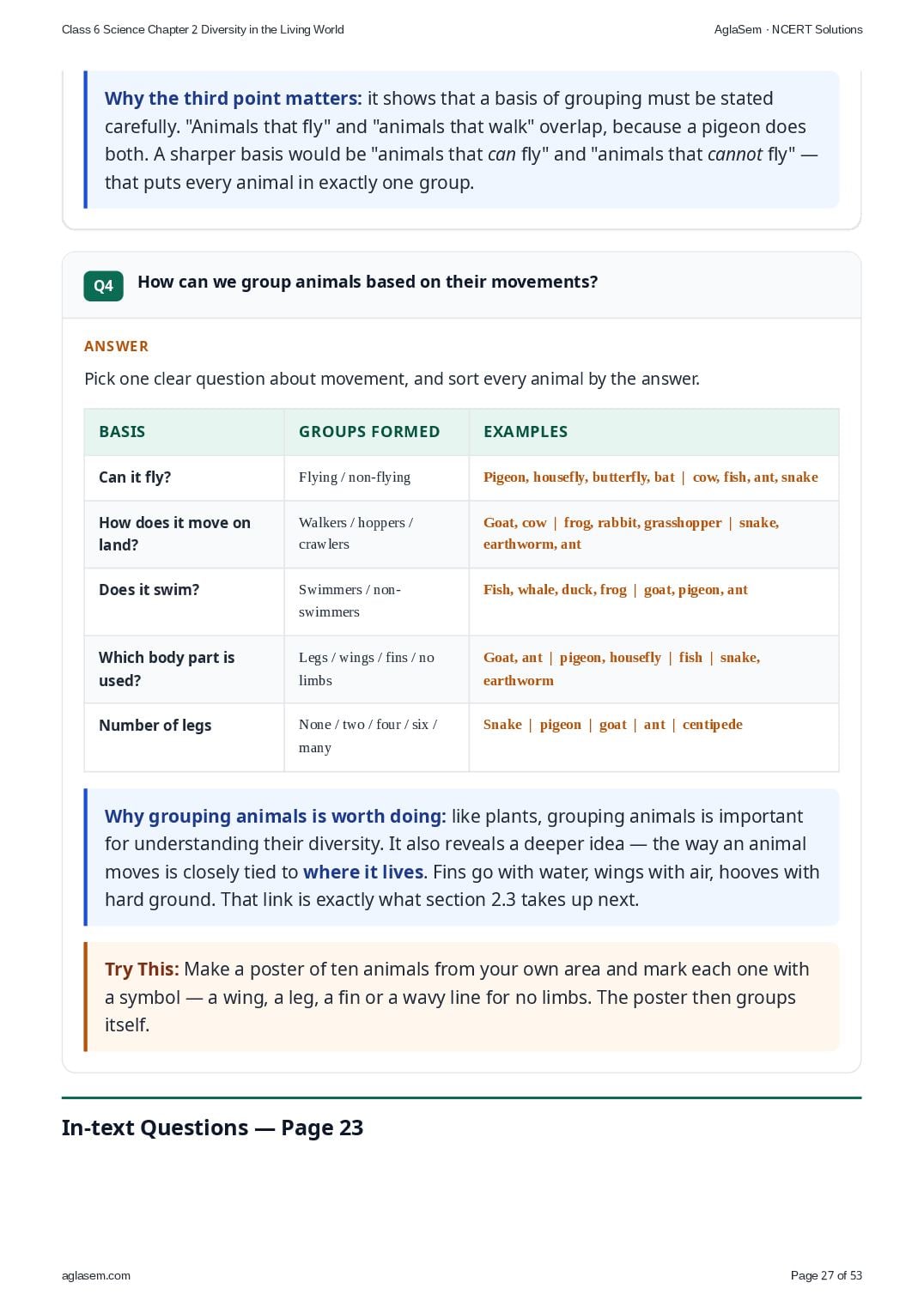
- How can we group animals based on their movements?
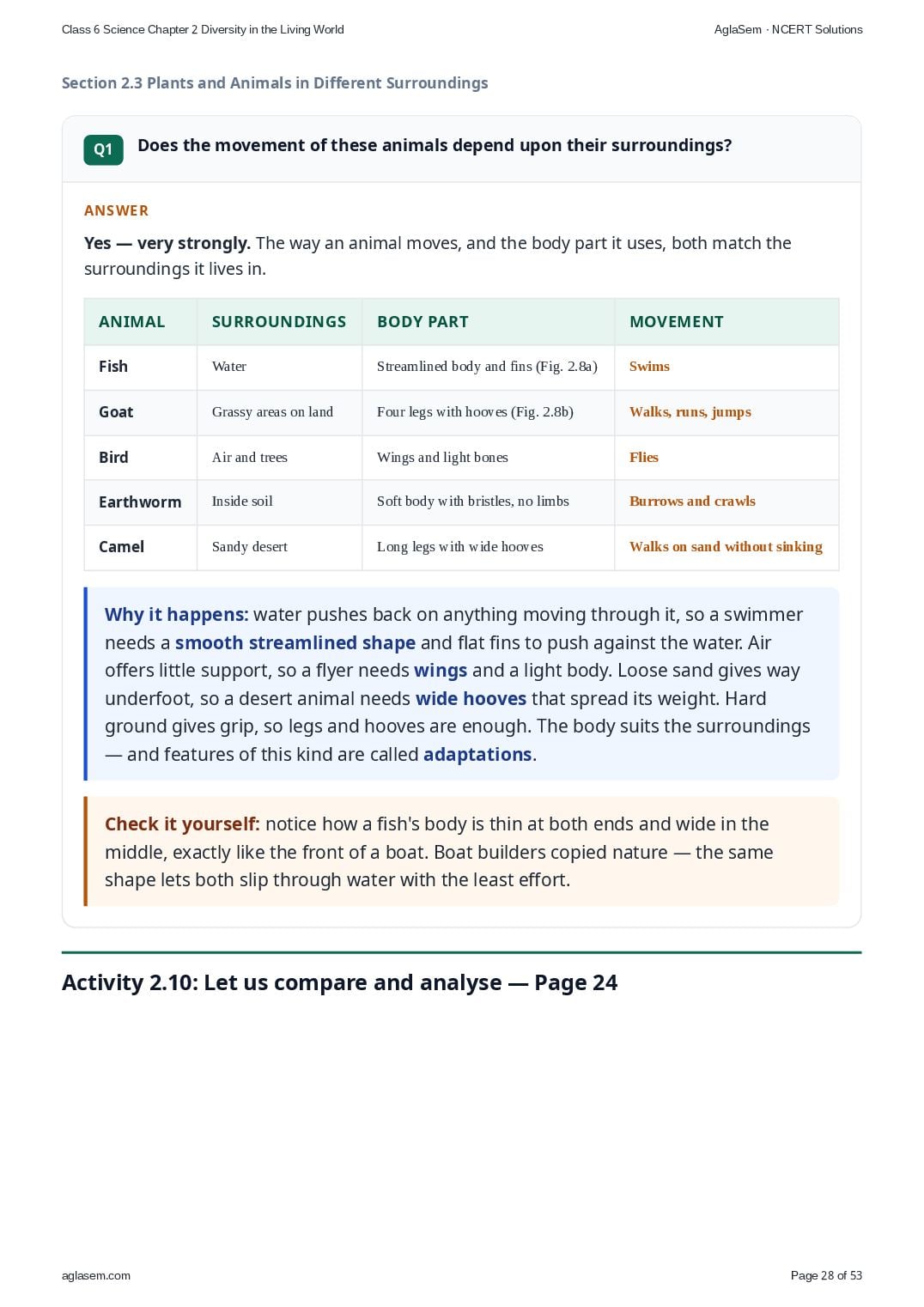
- Does the movement of these animals depend upon their surroundings?
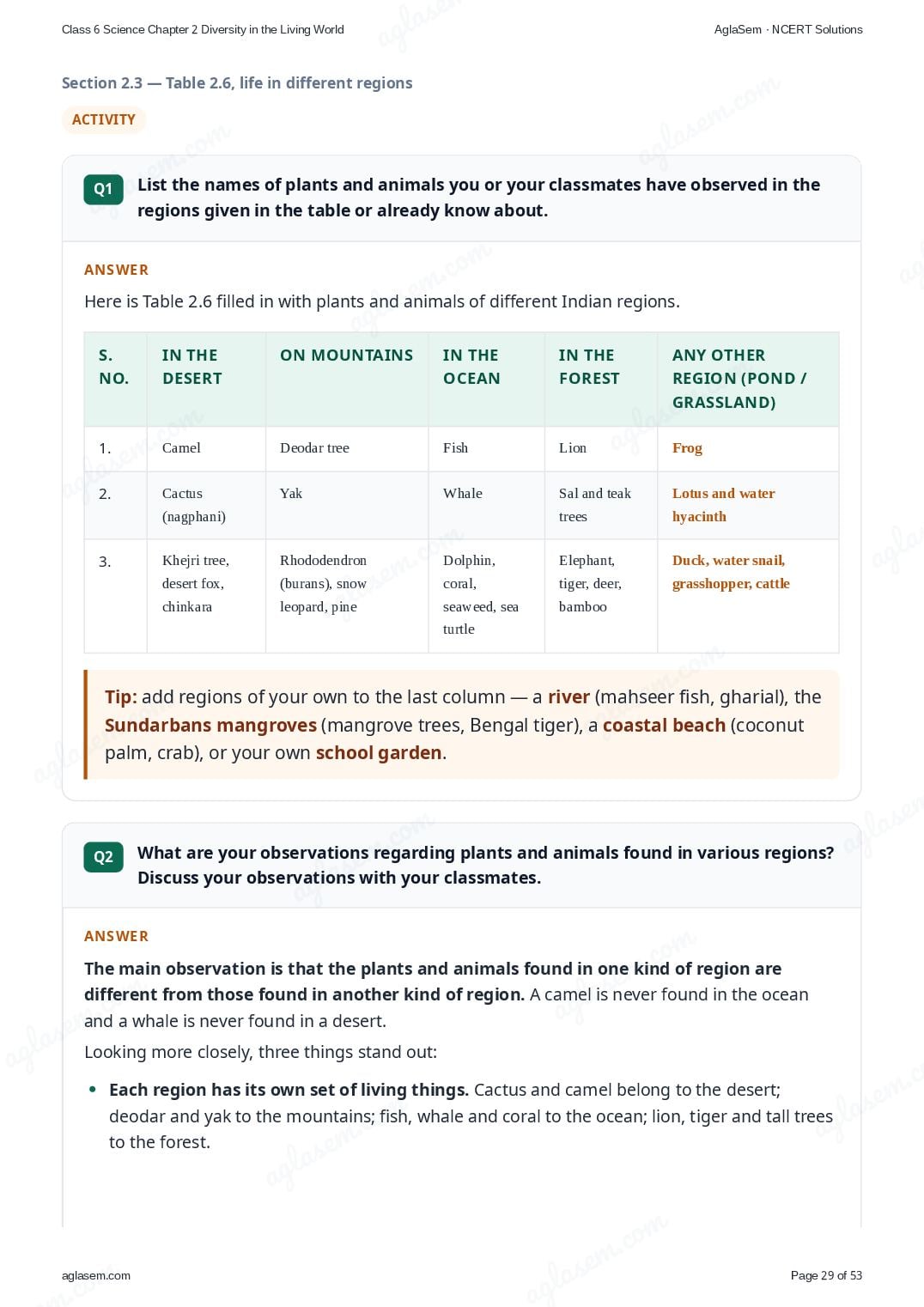
- List the names of plants and animals you or your classmates have observed in the regions given in the table or already know about.
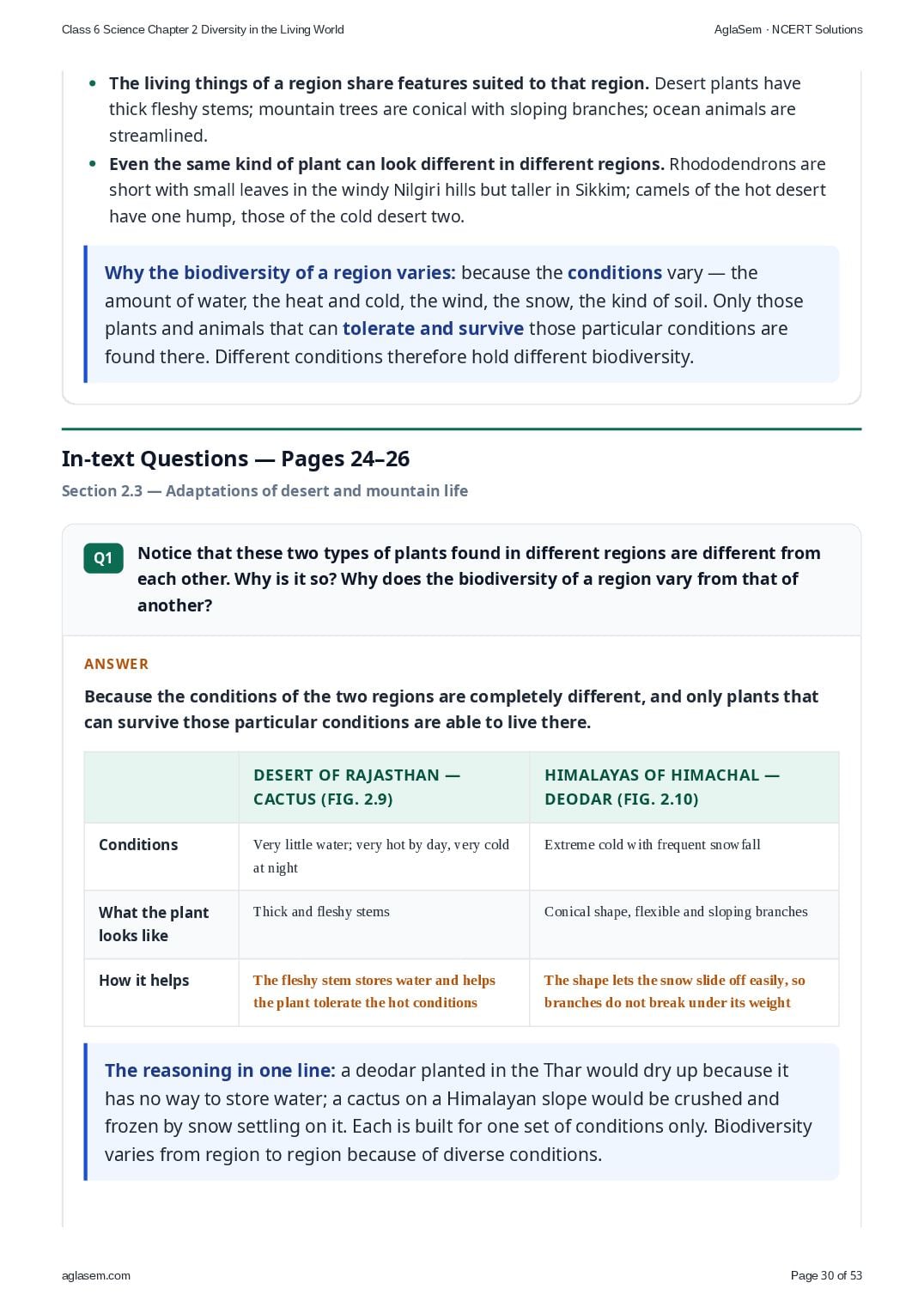
- What are your observations regarding plants and animals found in various regions? Discuss your observations with your classmates.
- Notice that these two types of plants found in different regions are different from each other. Why is it so? Why does the biodiversity of a region vary from that of another?
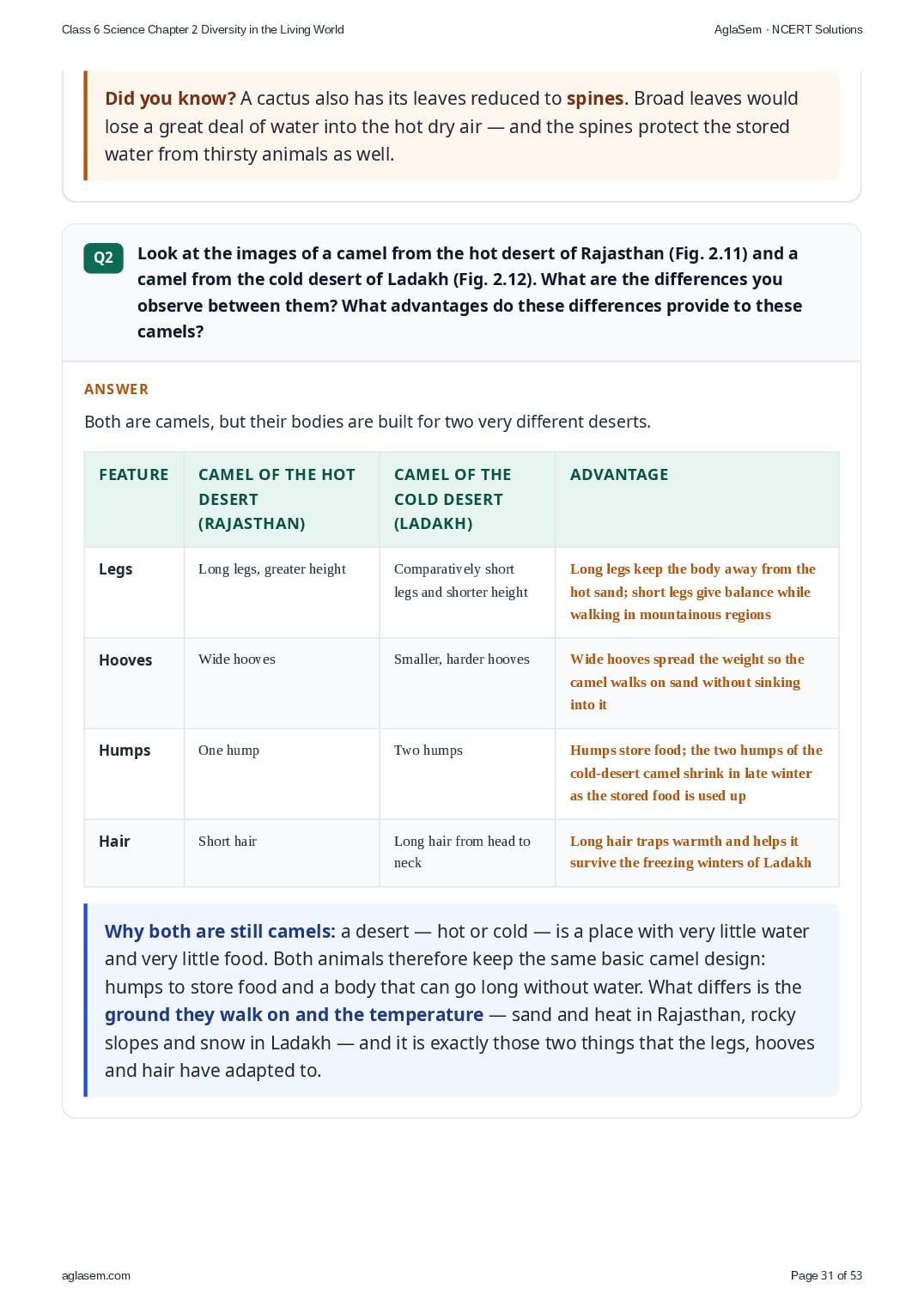
- Look at the images of a camel from the hot desert of Rajasthan (Fig. 2.11) and a camel from the cold desert of Ladakh (Fig. 2.12). What are the differences you observe between them? What advantages do these differences provide to these camels?
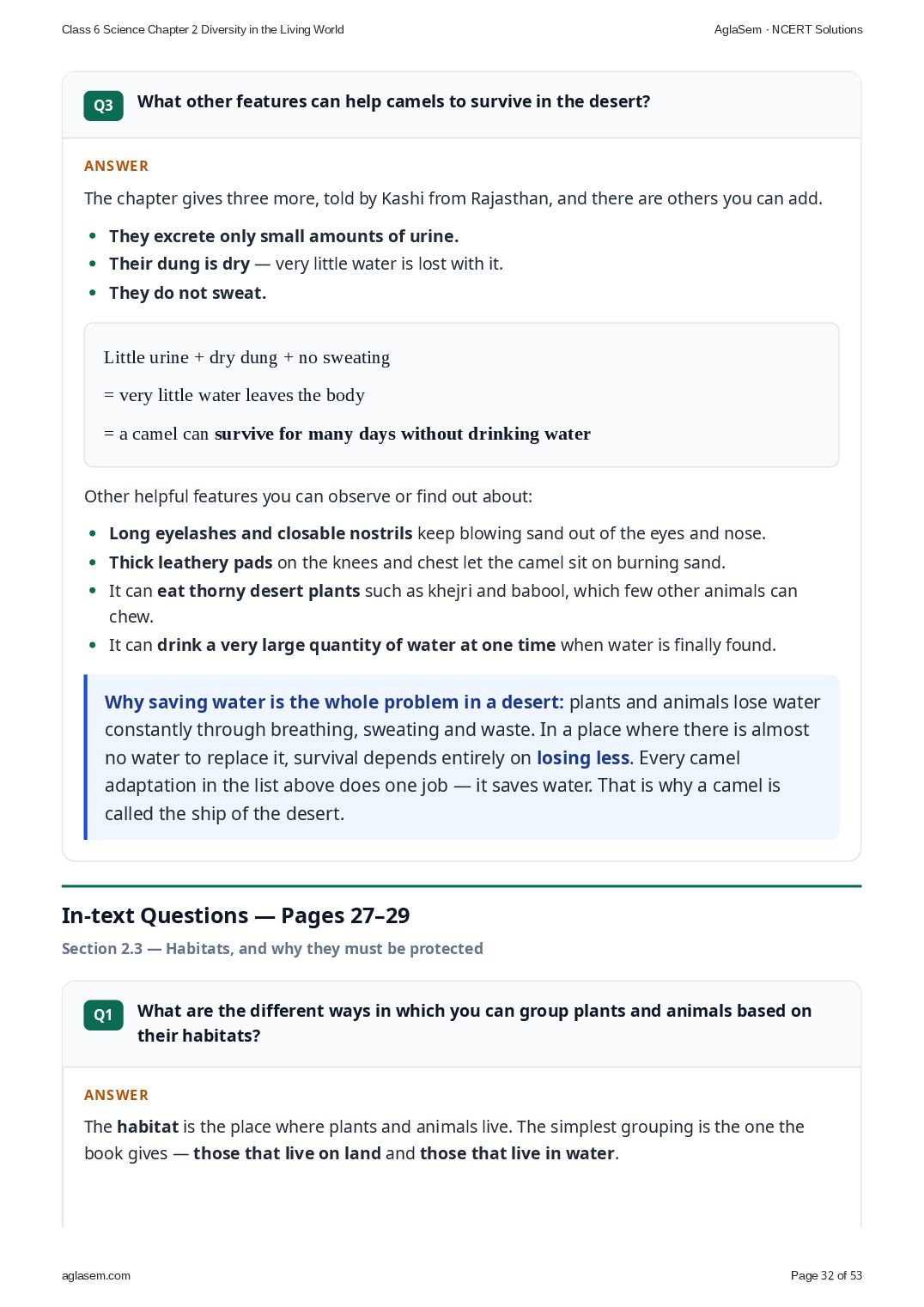
- What other features can help camels to survive in the desert?
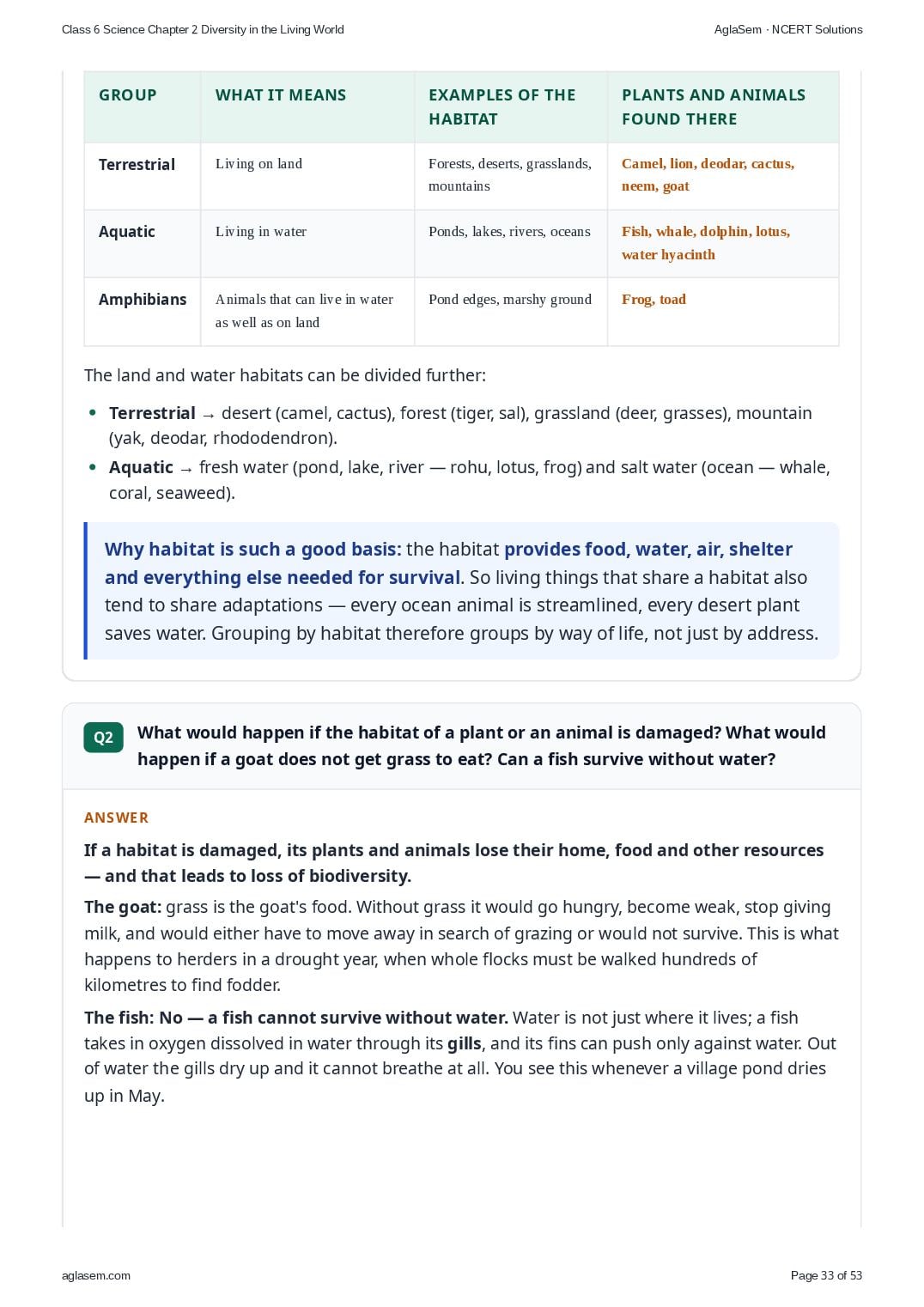
- What are the different ways in which you can group plants and animals based on their habitats?
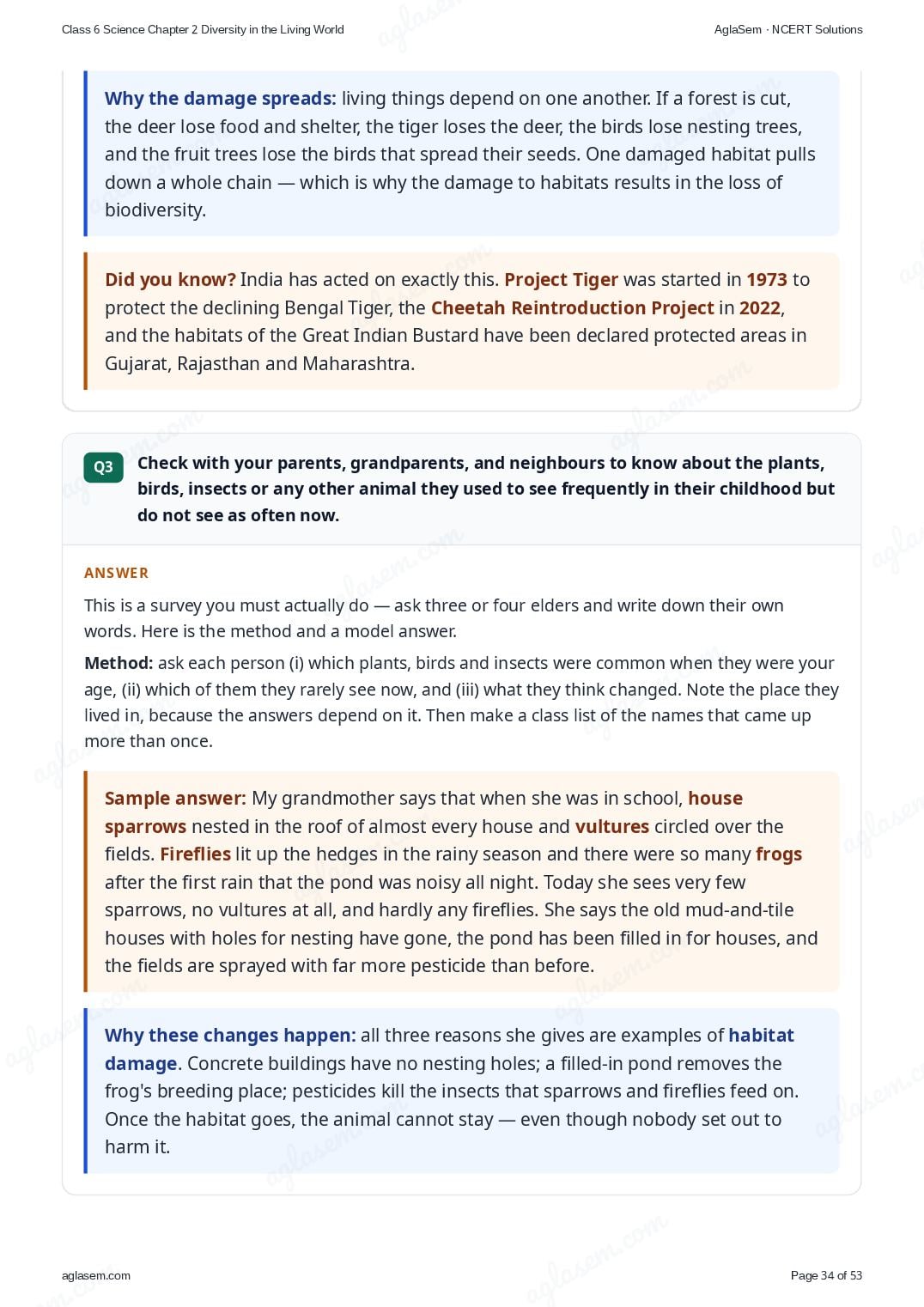
- What would happen if the habitat of a plant or an animal is damaged? What would happen if a goat does not get grass to eat? Can a fish survive without water?
- Check with your parents, grandparents, and neighbours to know about the plants, birds, insects or any other animal they used to see frequently in their childhood but do not see as often now.
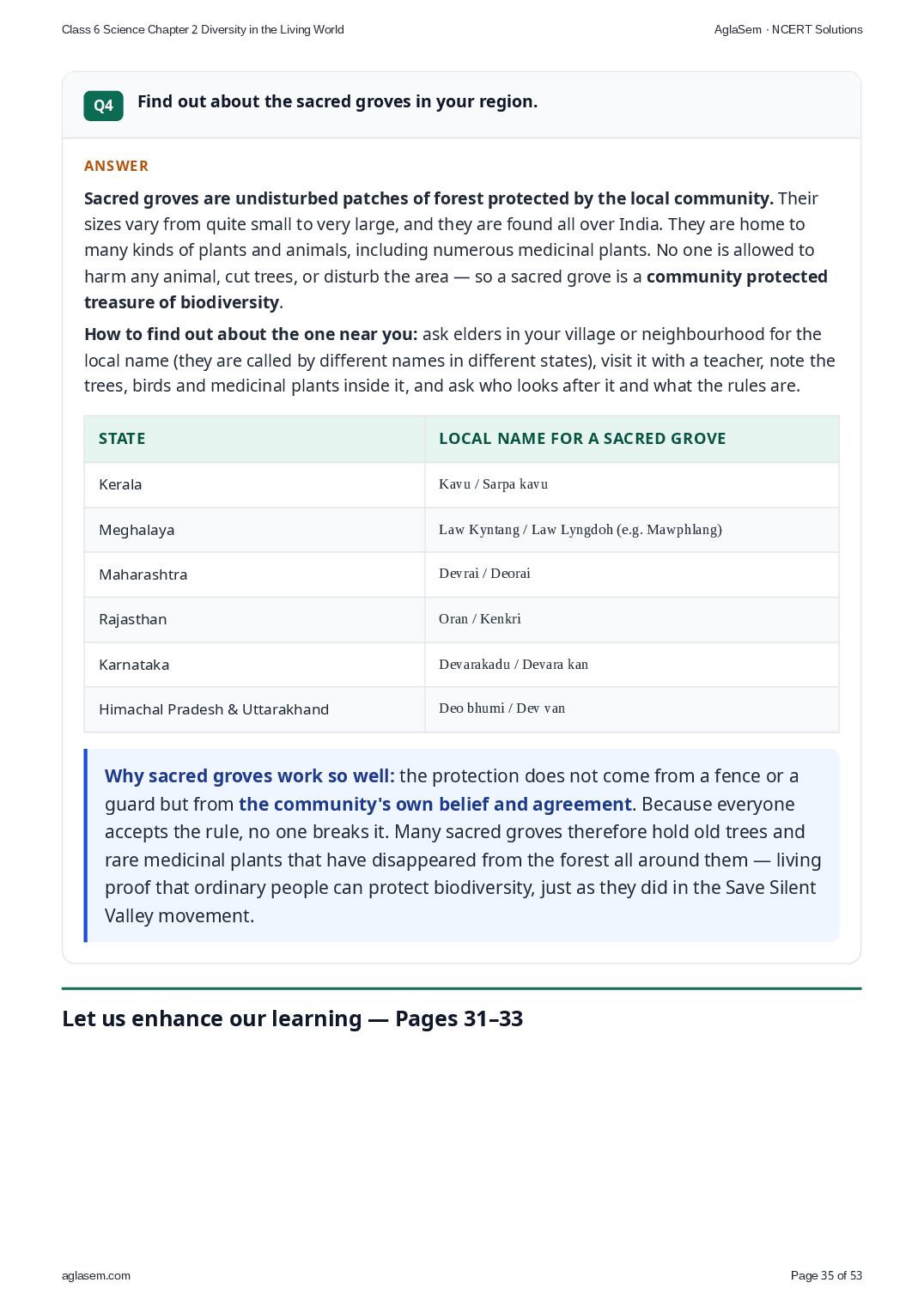
- Find out about the sacred groves in your region.
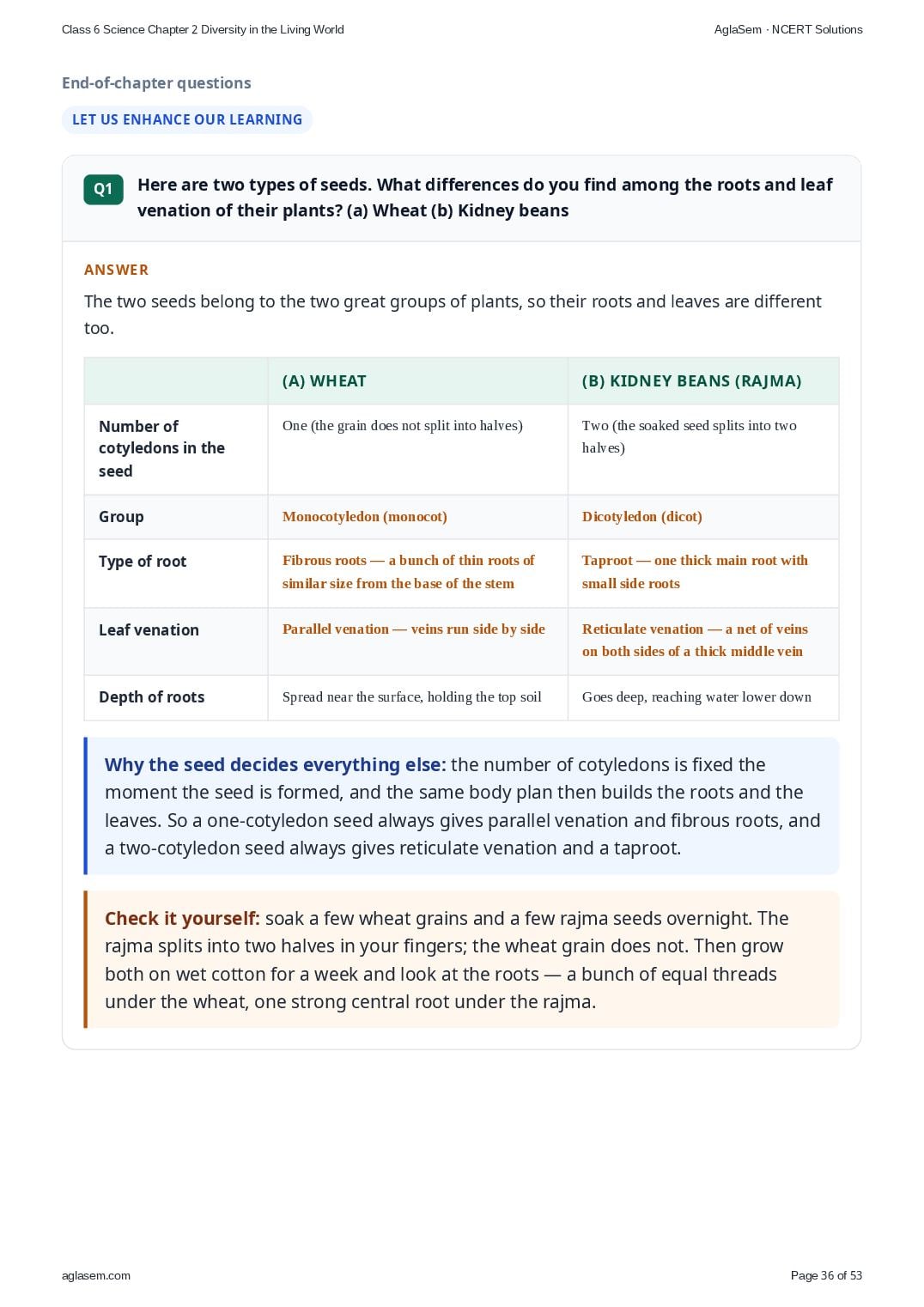
- Here are two types of seeds. What differences do you find among the roots and leaf venation of their plants? (a) Wheat (b) Kidney beans
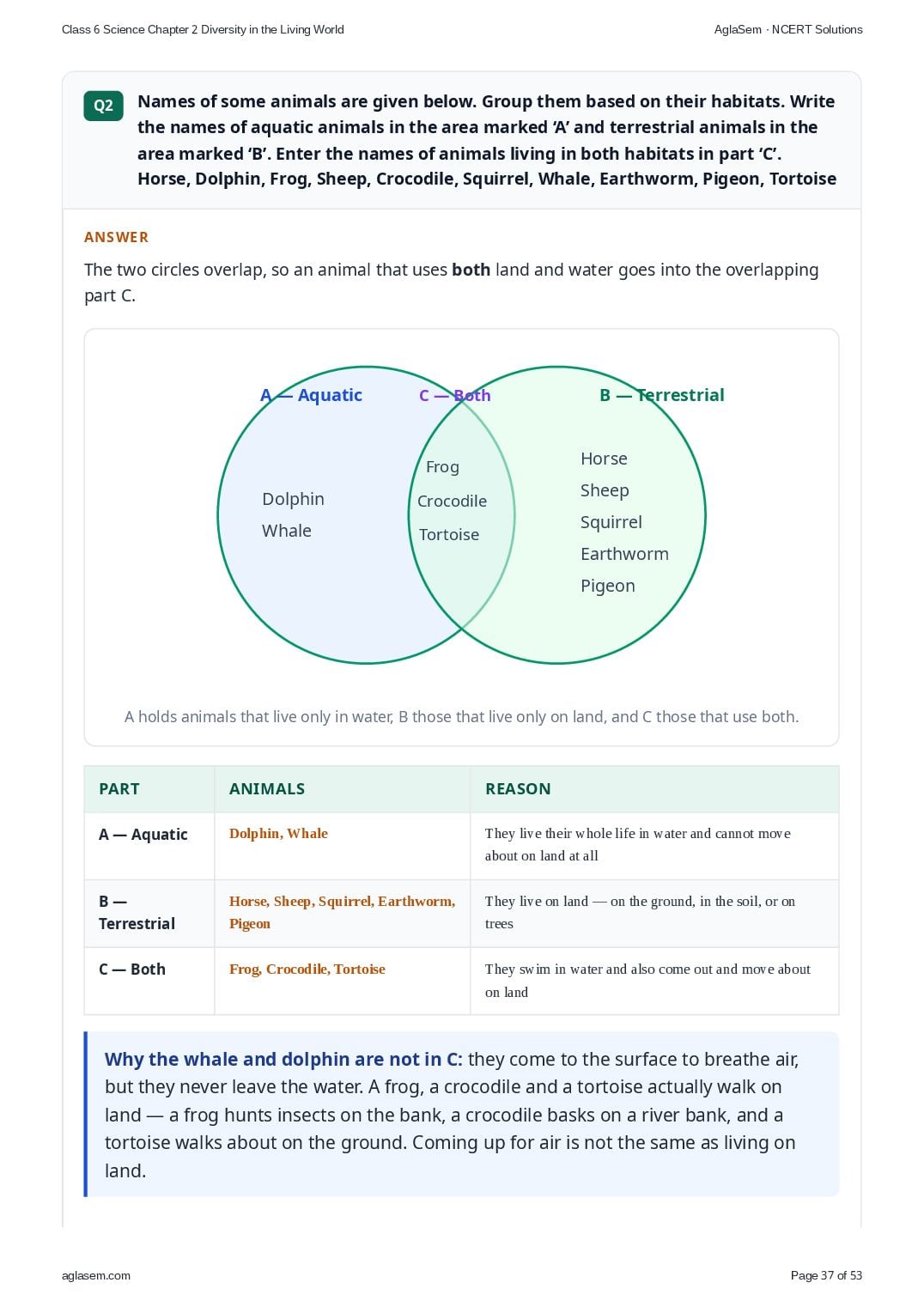
- Names of some animals are given below. Group them based on their habitats. Write the names of aquatic animals in the area marked ‘A’ and terrestrial animals in the area marked ‘B’. Enter the names of animals living in both habitats in part ‘C’. Horse, Dolphin, Frog, Sheep, Crocodile, Squirrel, Whale, Earthworm, Pigeon, Tortoise
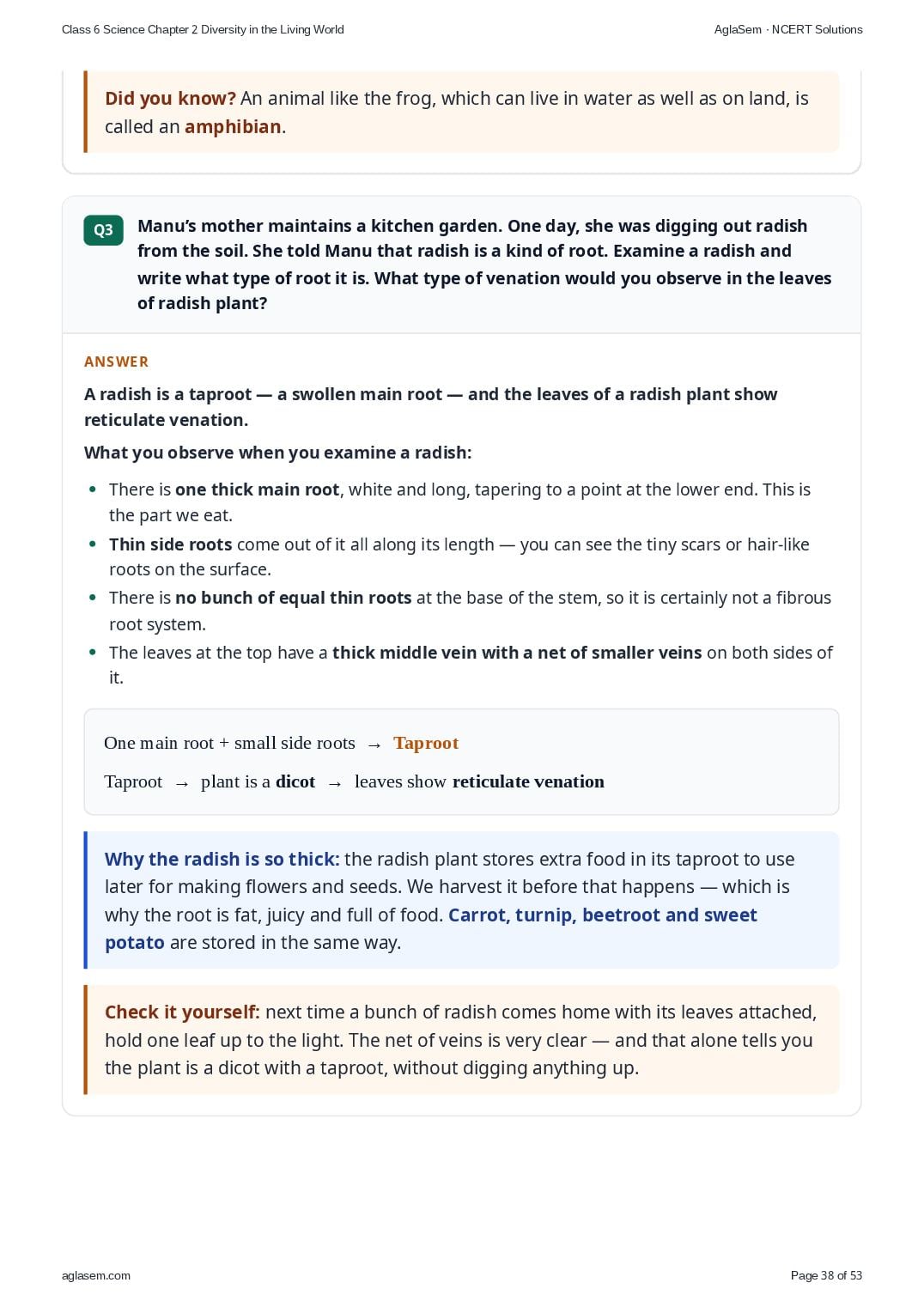
- Manu’s mother maintains a kitchen garden. One day, she was digging out radish from the soil. She told Manu that radish is a kind of root. Examine a radish and write what type of root it is. What type of venation would you observe in the leaves of radish plant?
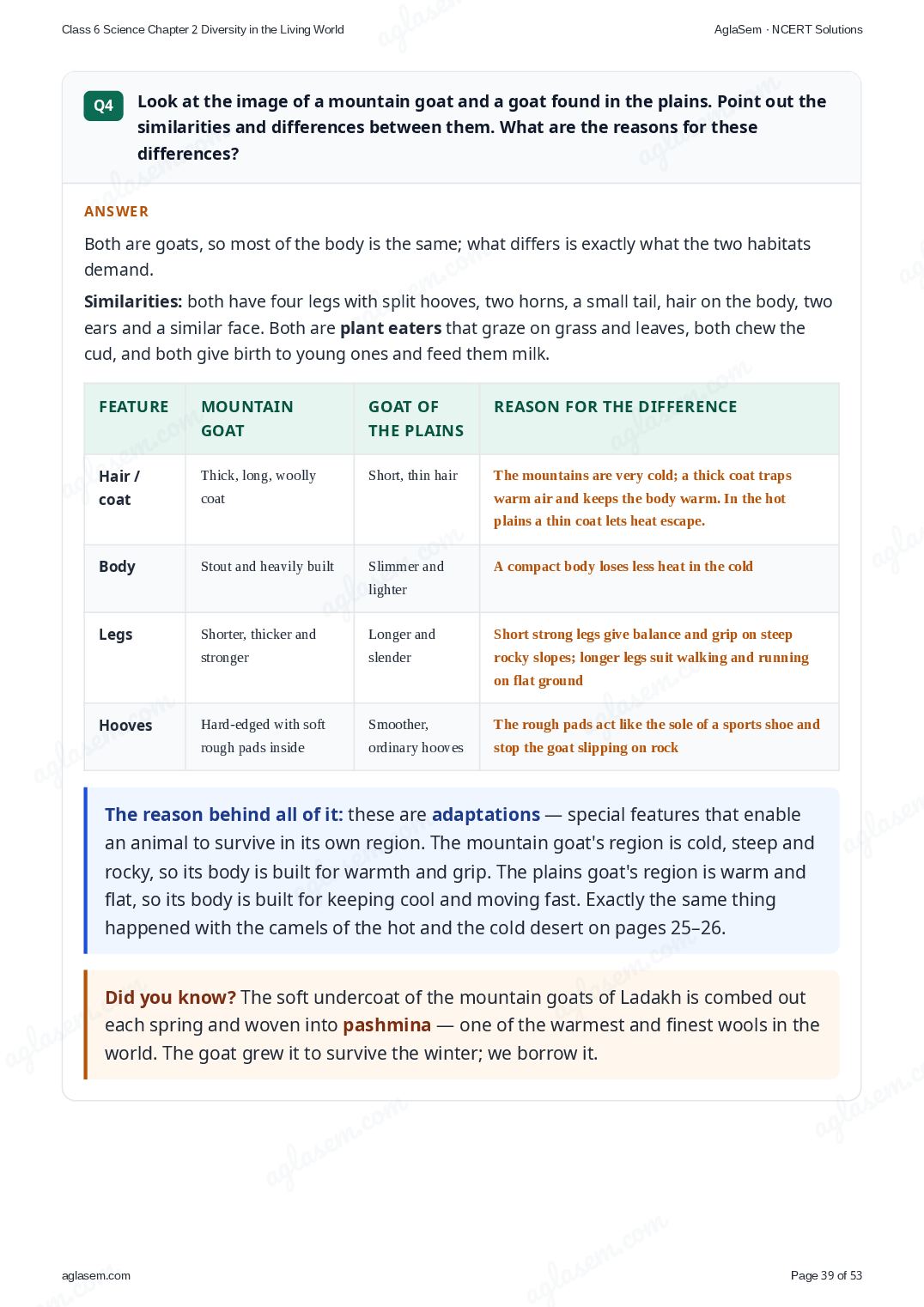
- Look at the image of a mountain goat and a goat found in the plains. Point out the similarities and differences between them. What are the reasons for these differences?
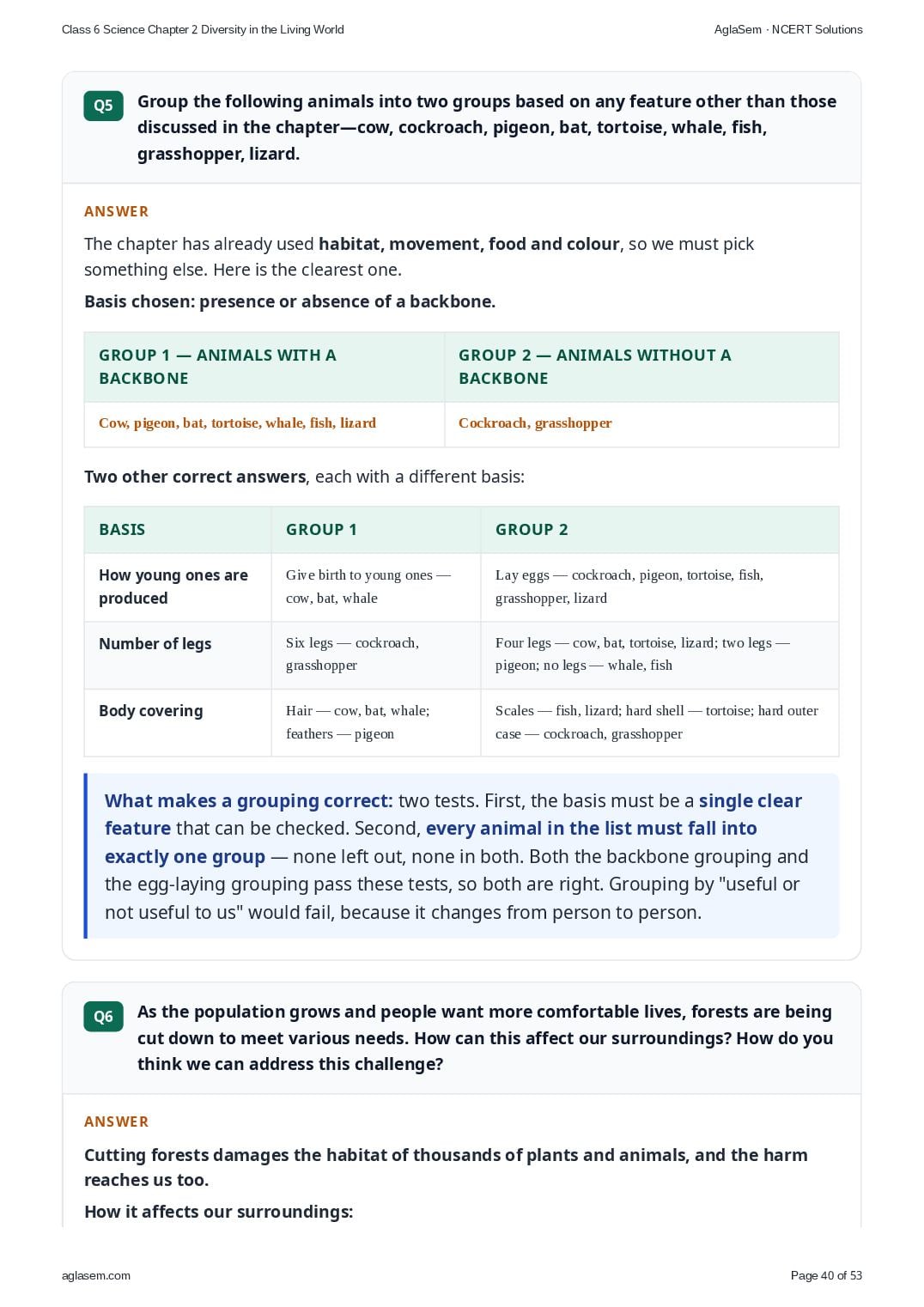
- Group the following animals into two groups based on any feature other than those discussed in the chapter—cow, cockroach, pigeon, bat, tortoise, whale, fish, grasshopper, lizard.
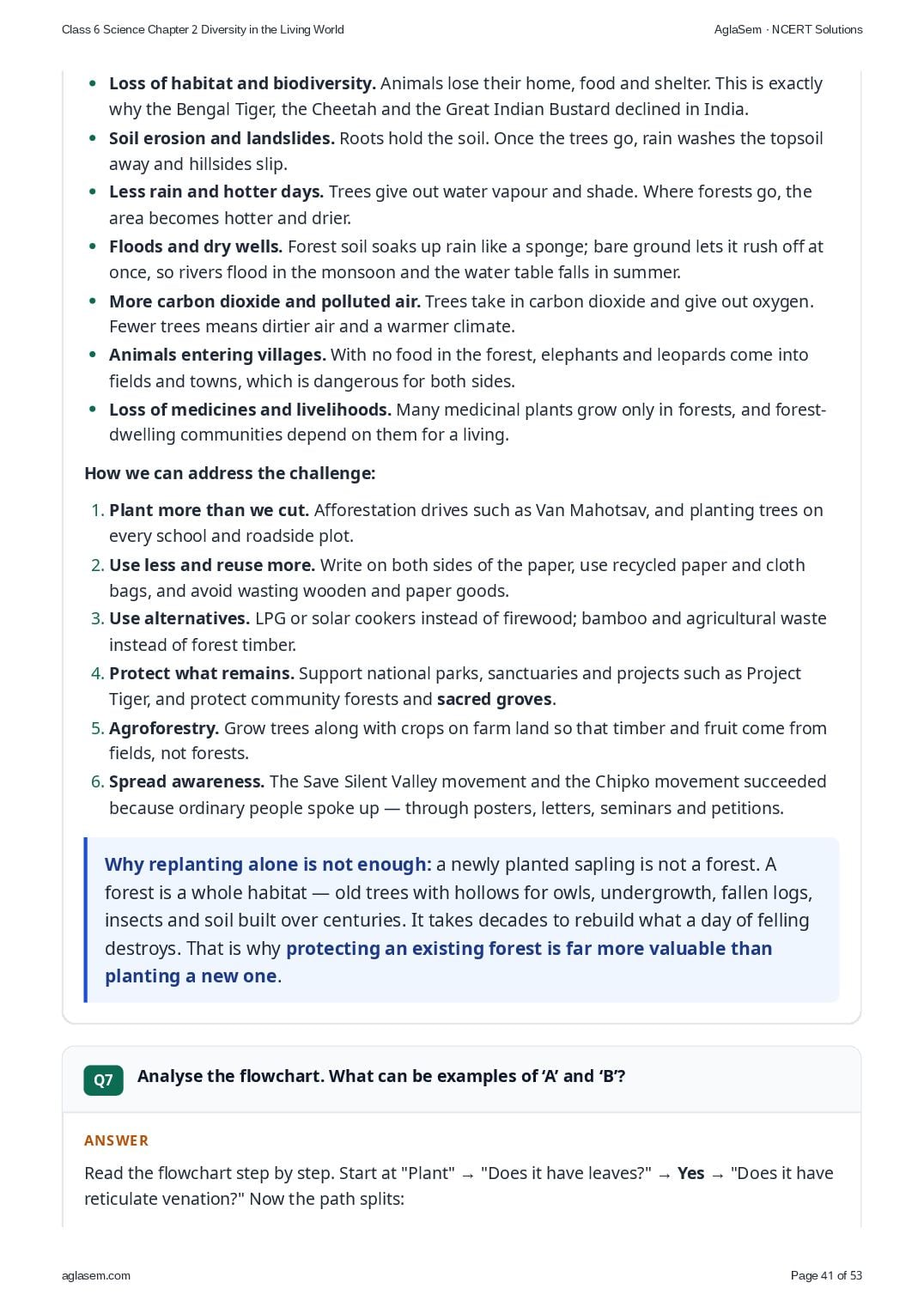
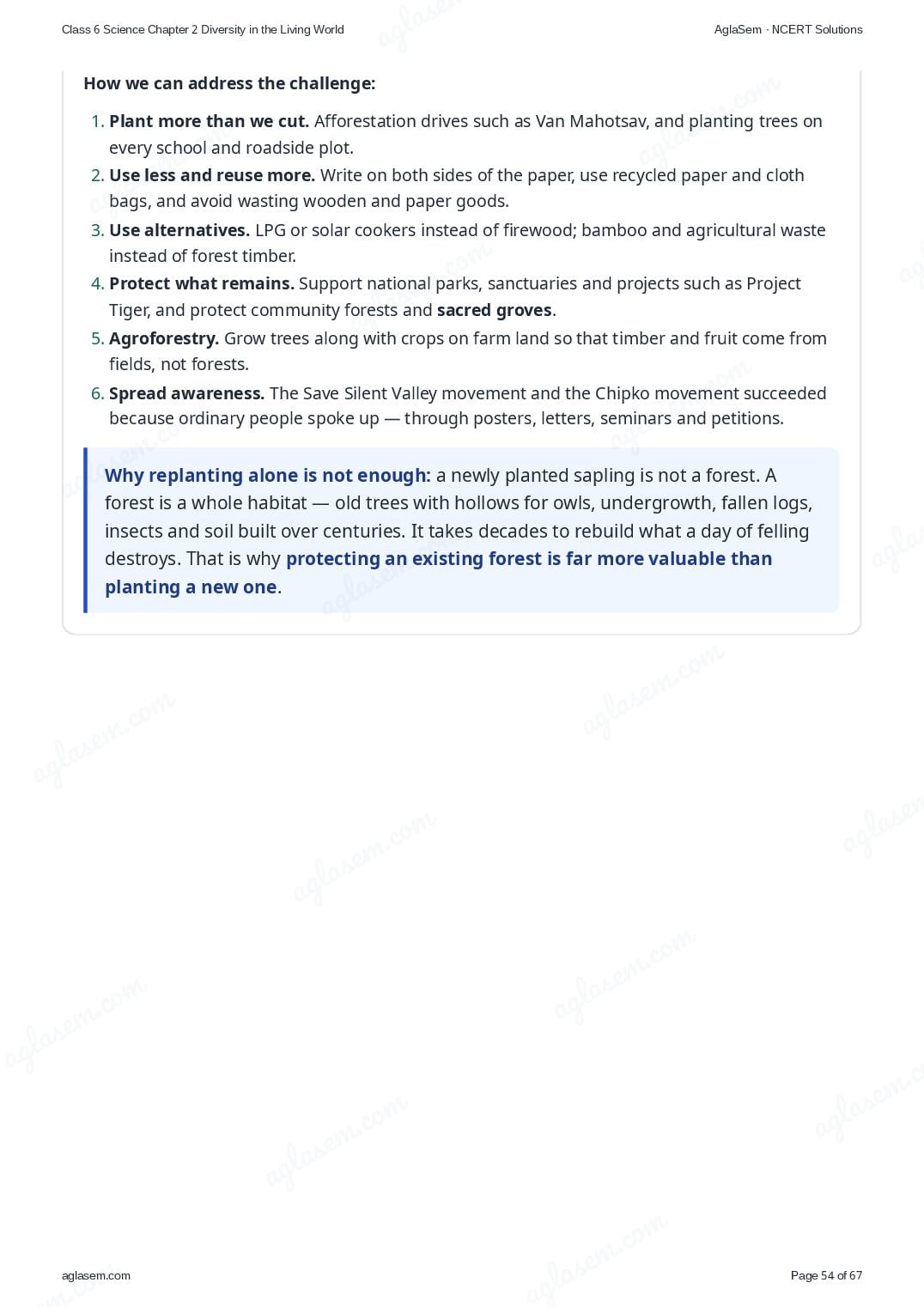
- As the population grows and people want more comfortable lives, forests are being cut down to meet various needs. How can this affect our surroundings? How do you think we can address this challenge?
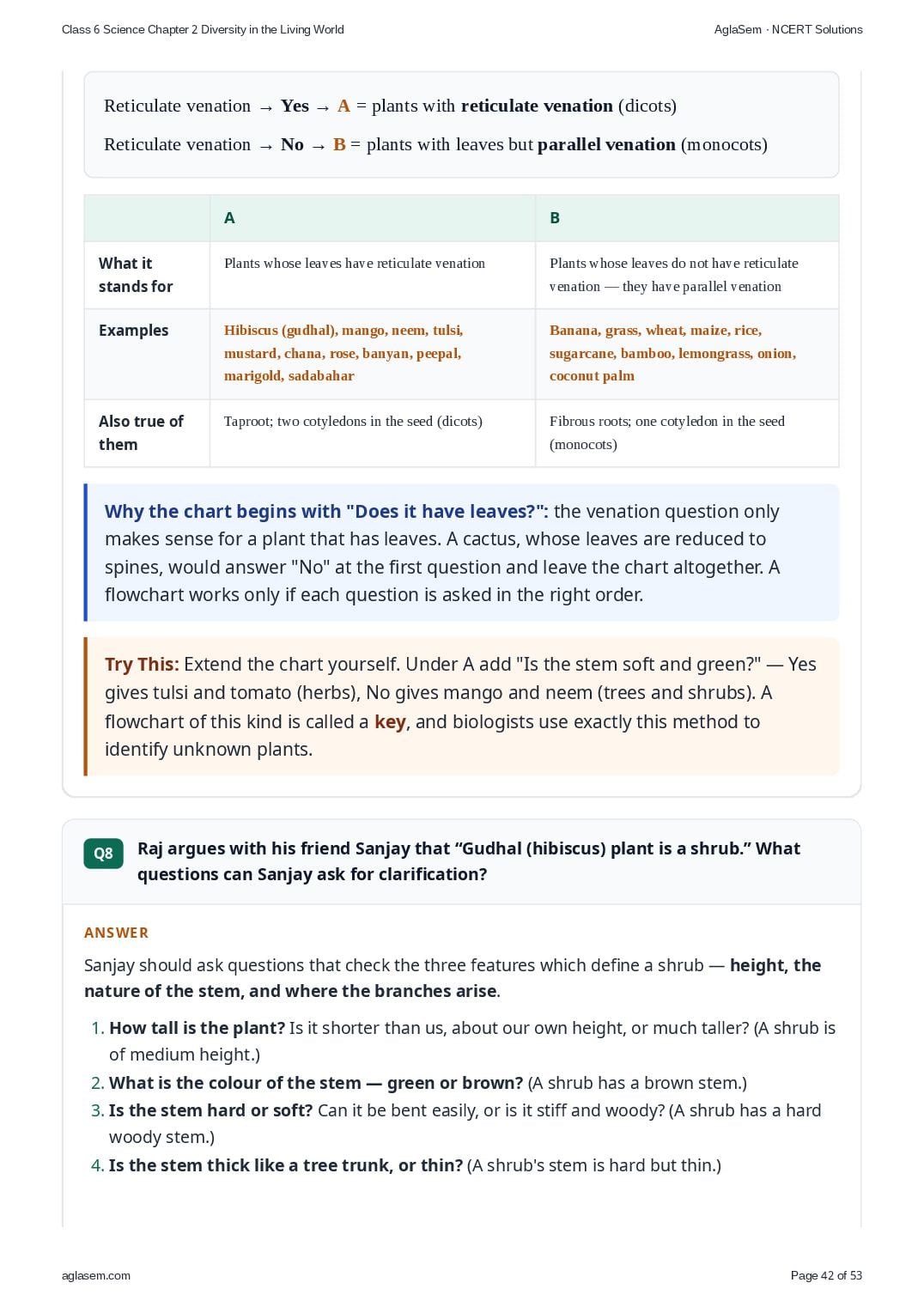
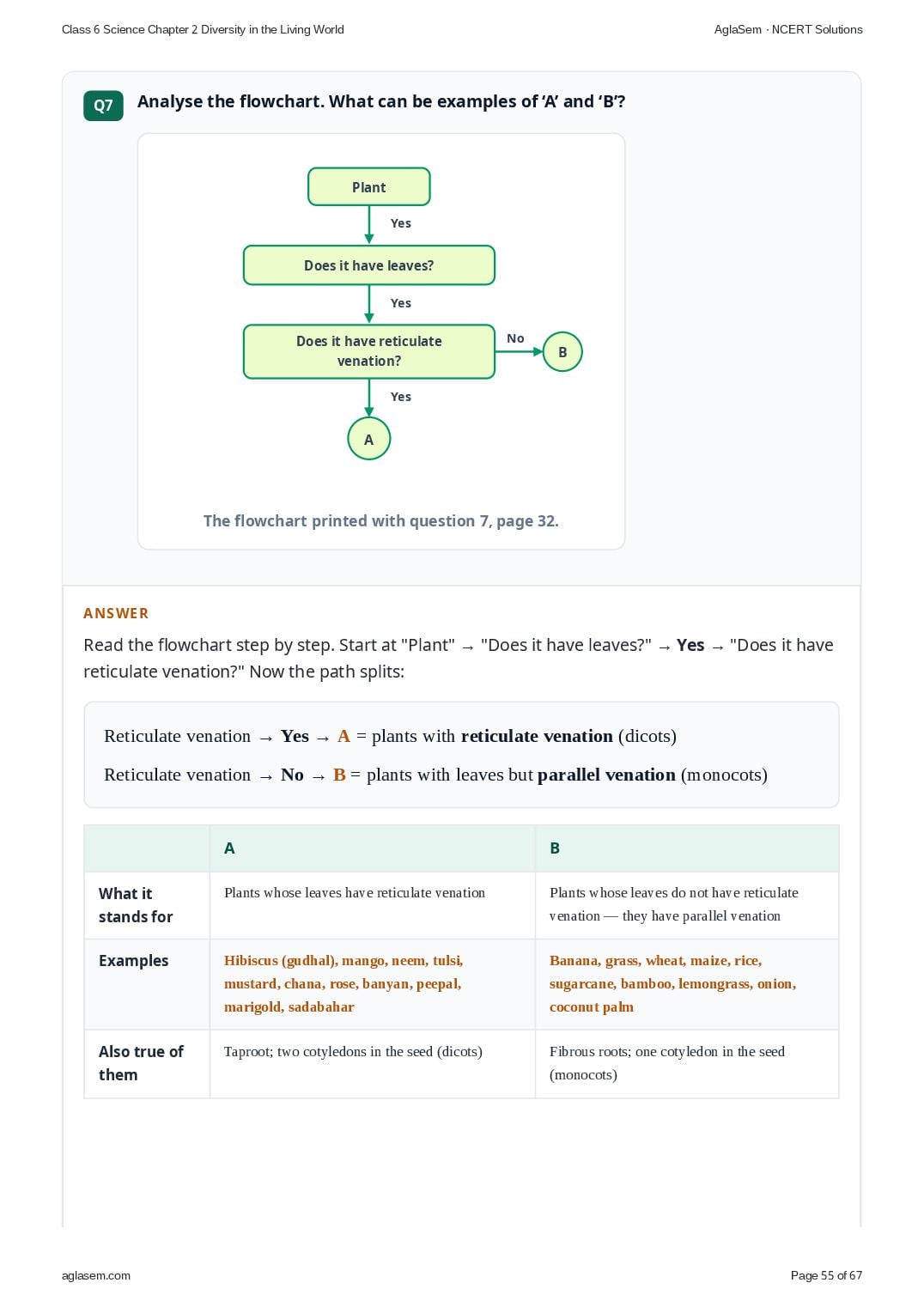
- Analyse the flowchart. What can be examples of ‘A’ and ‘B’?
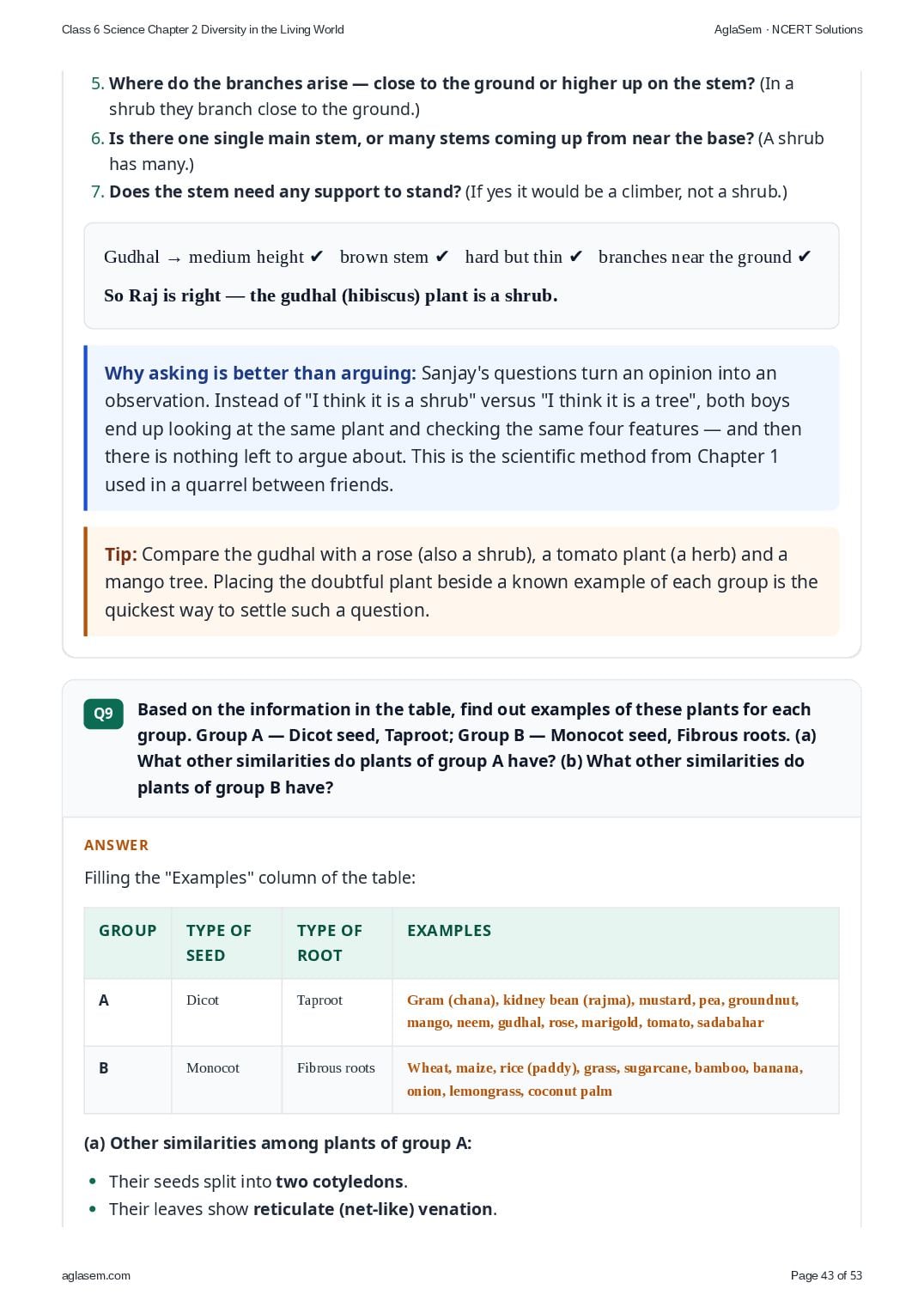
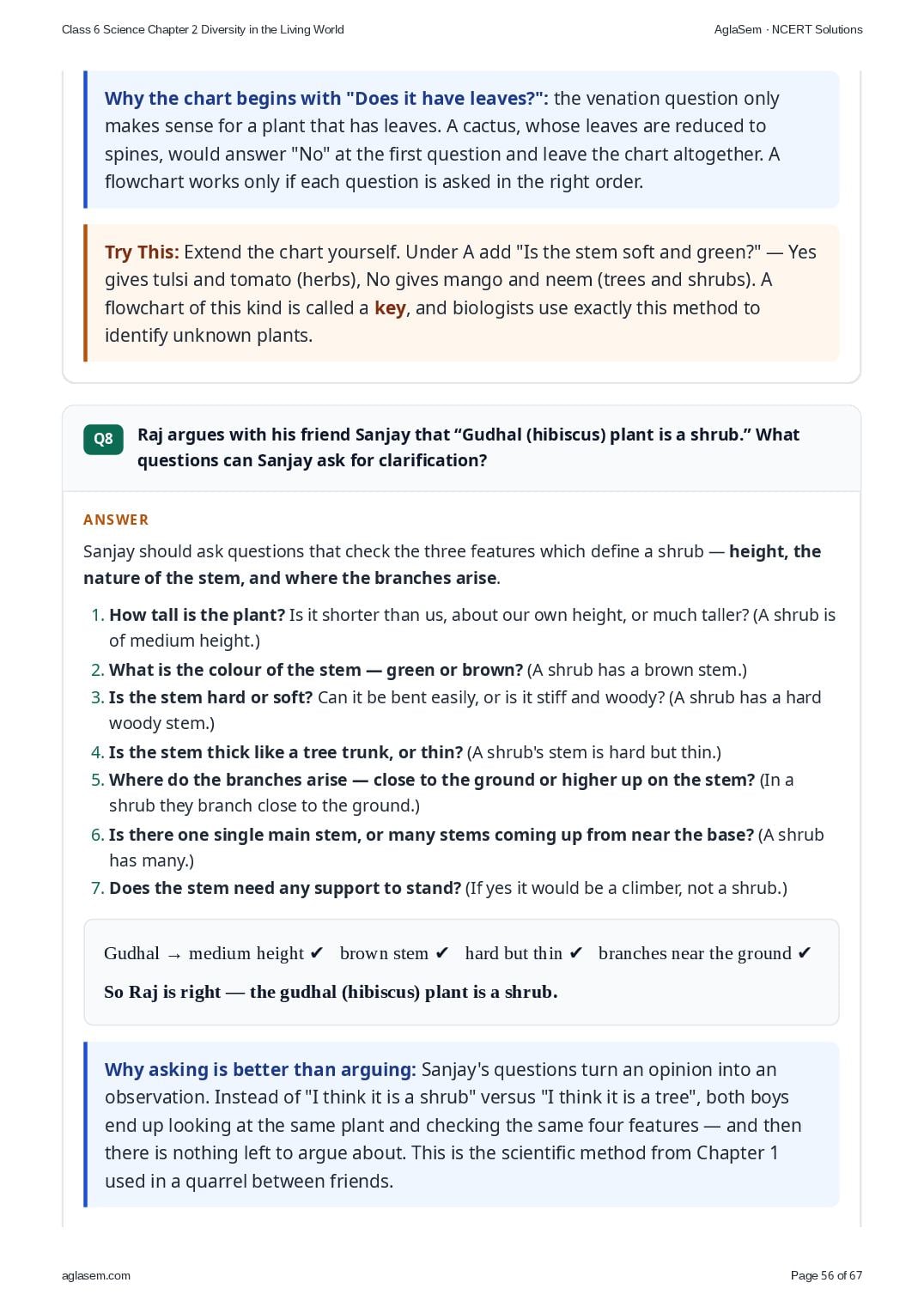
- Raj argues with his friend Sanjay that “Gudhal (hibiscus) plant is a shrub.” What questions can Sanjay ask for clarification?
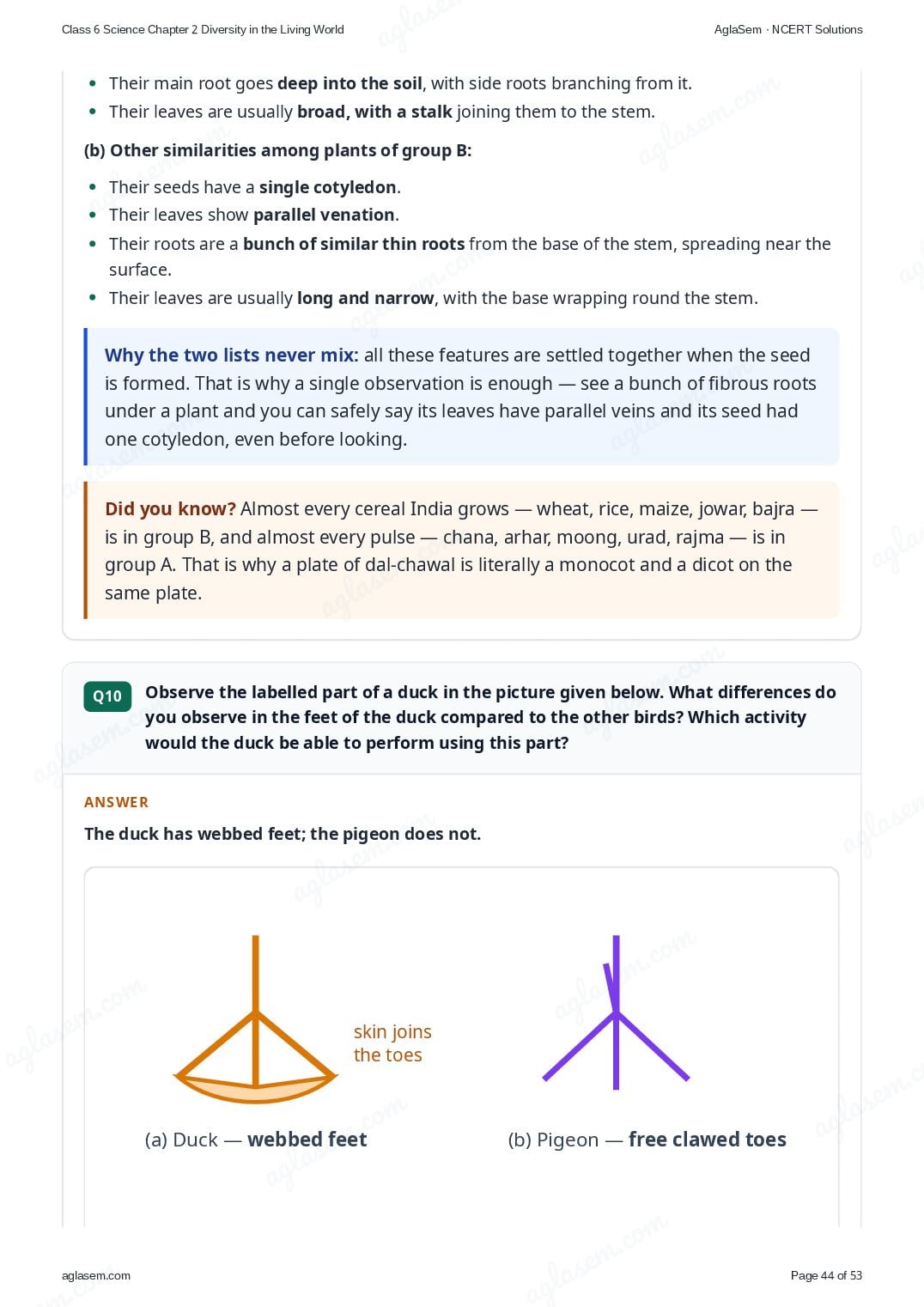
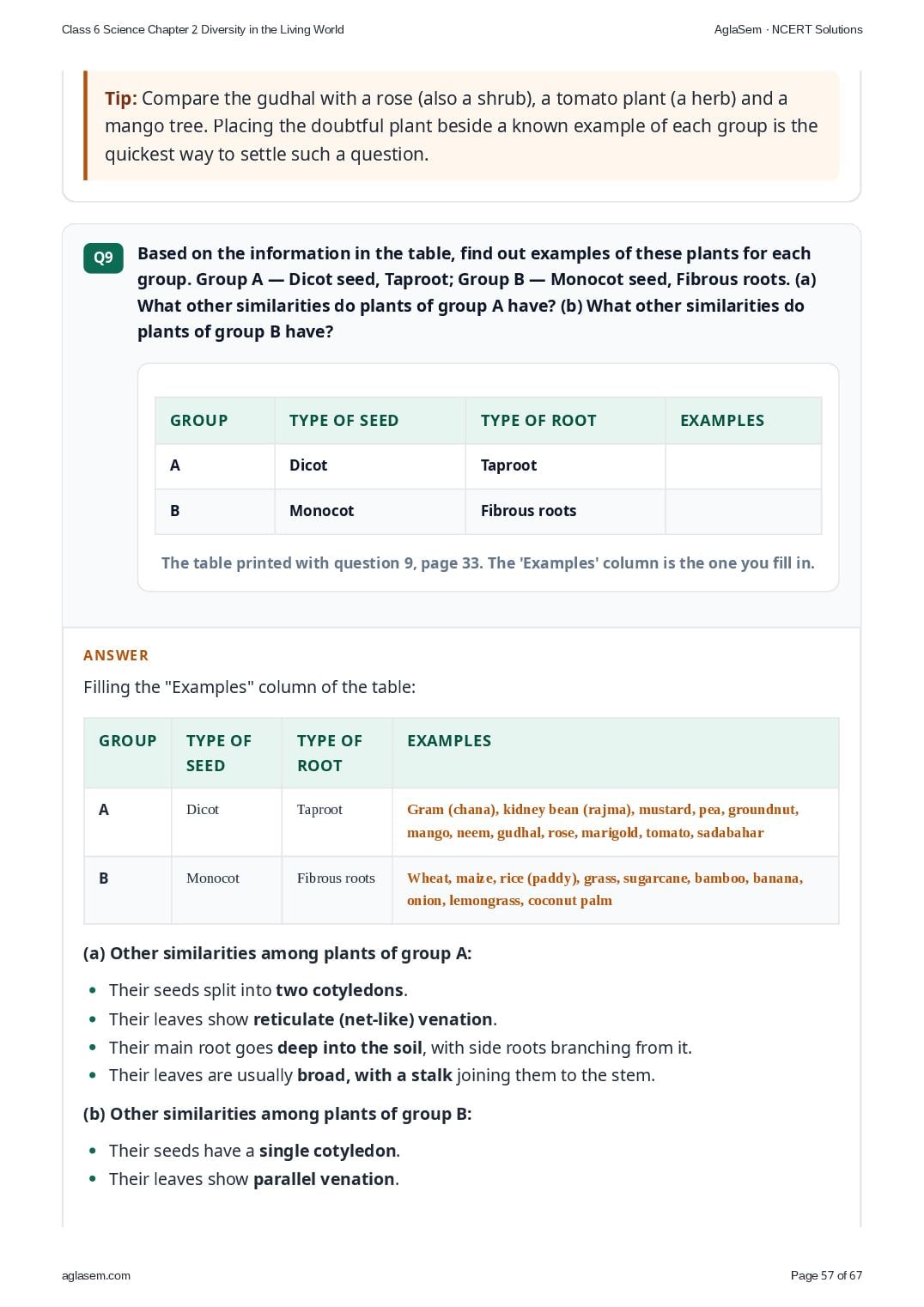
- Based on the information in the table, find out examples of these plants for each group. Group A — Dicot seed, Taproot; Group B — Monocot seed, Fibrous roots. (a) What other similarities do plants of group A have? (b) What other similarities do plants of group B have?
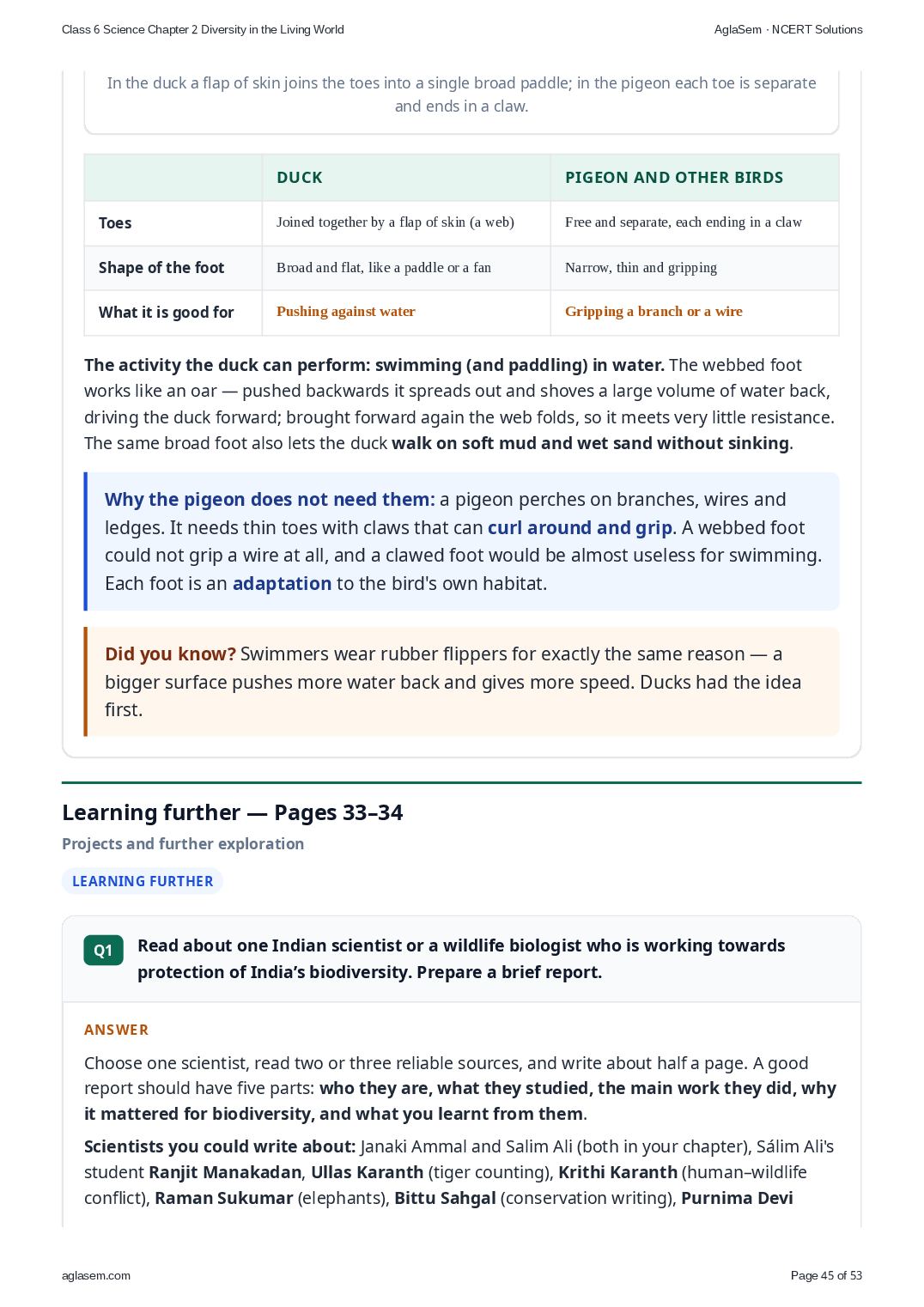
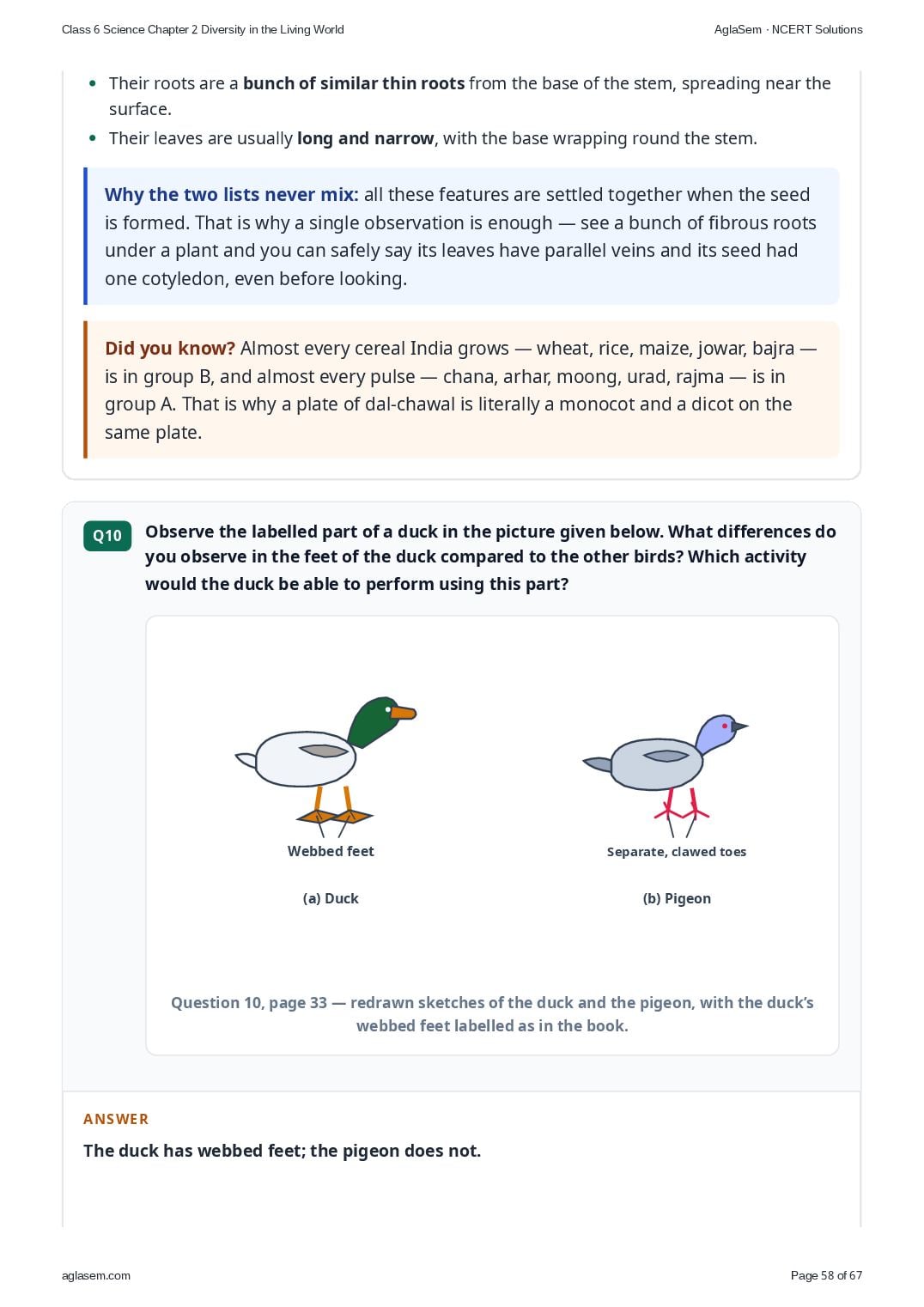
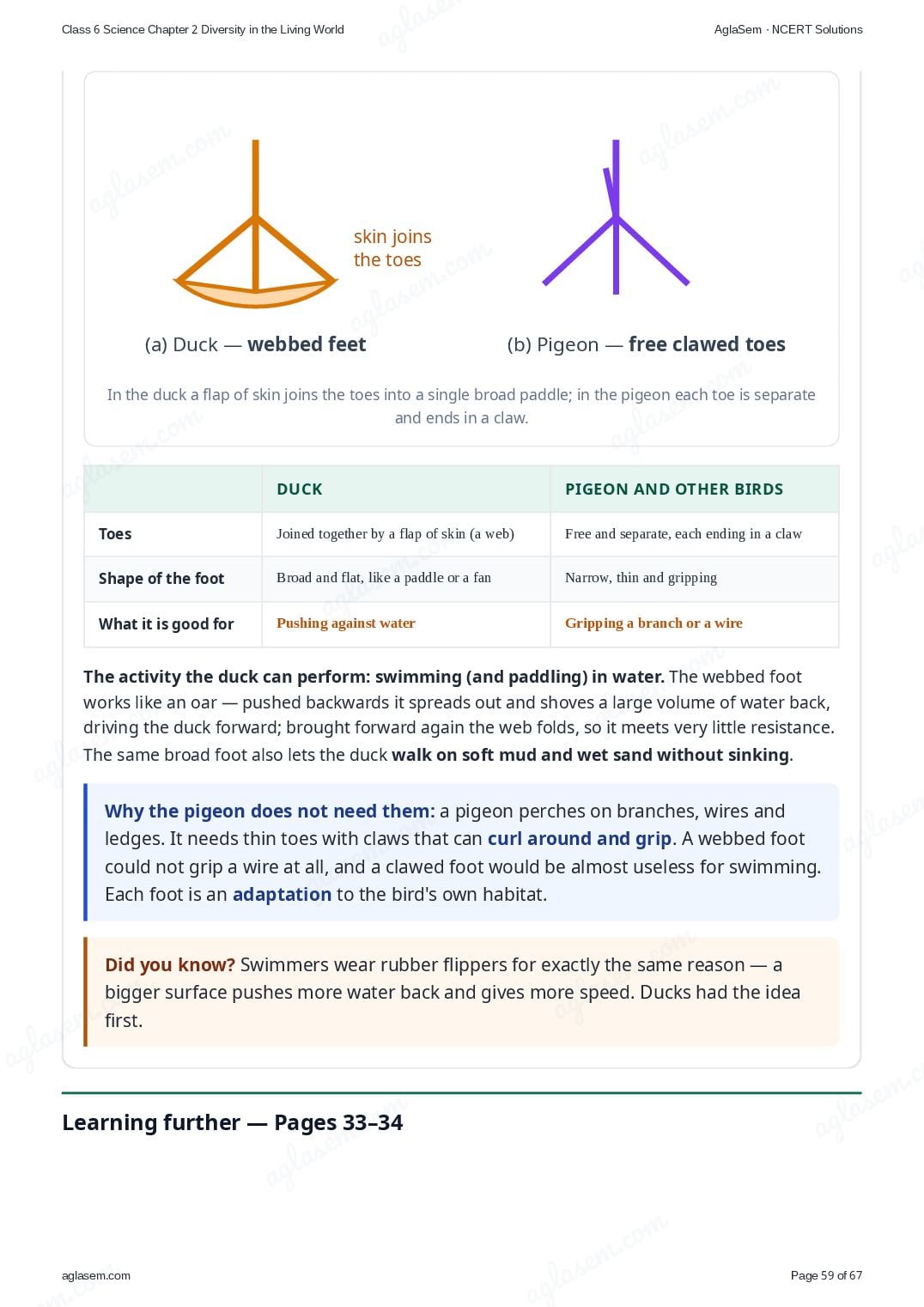
- Observe the labelled part of a duck in the picture given below. What differences do you observe in the feet of the duck compared to the other birds? Which activity would the duck be able to perform using this part?
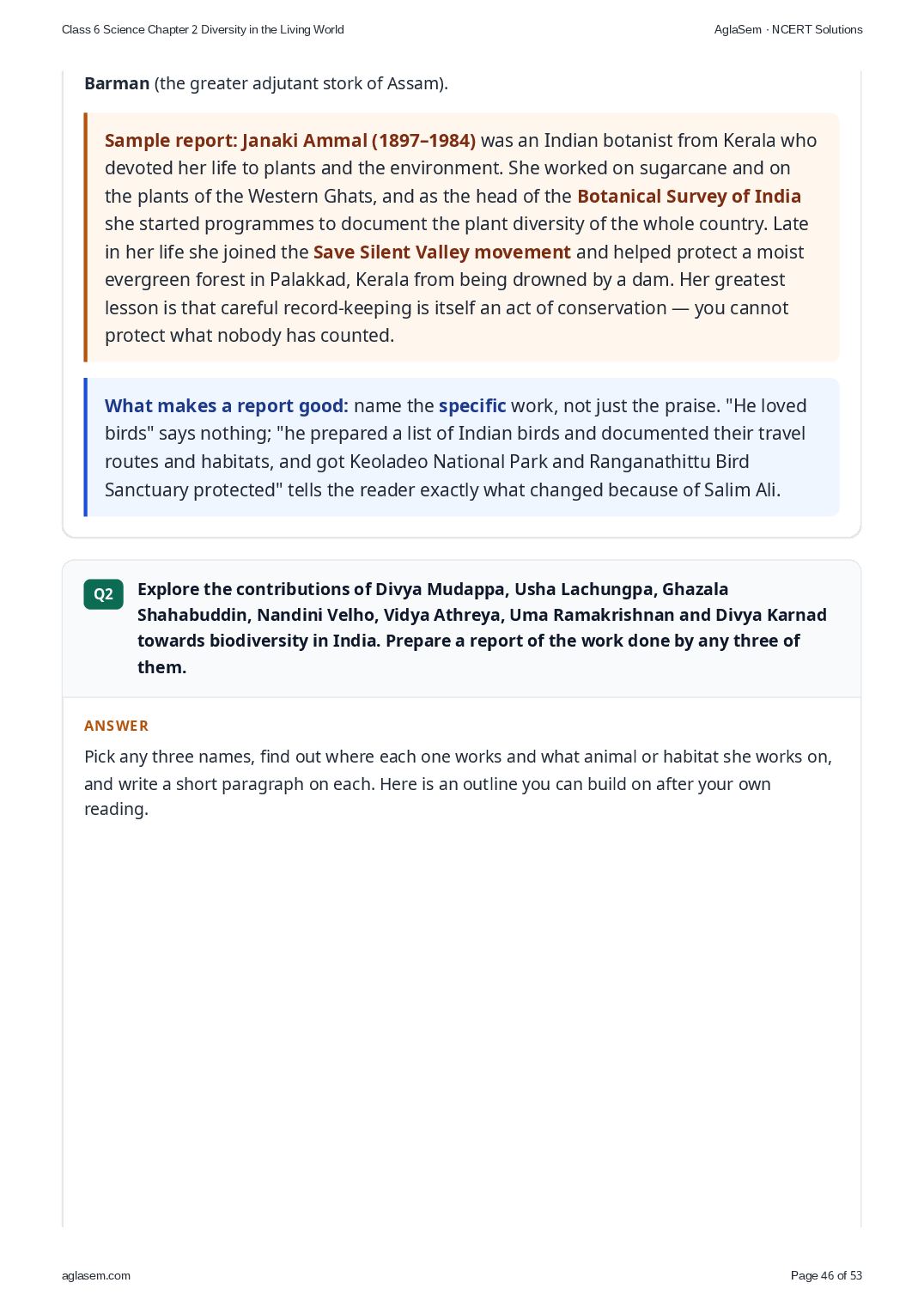
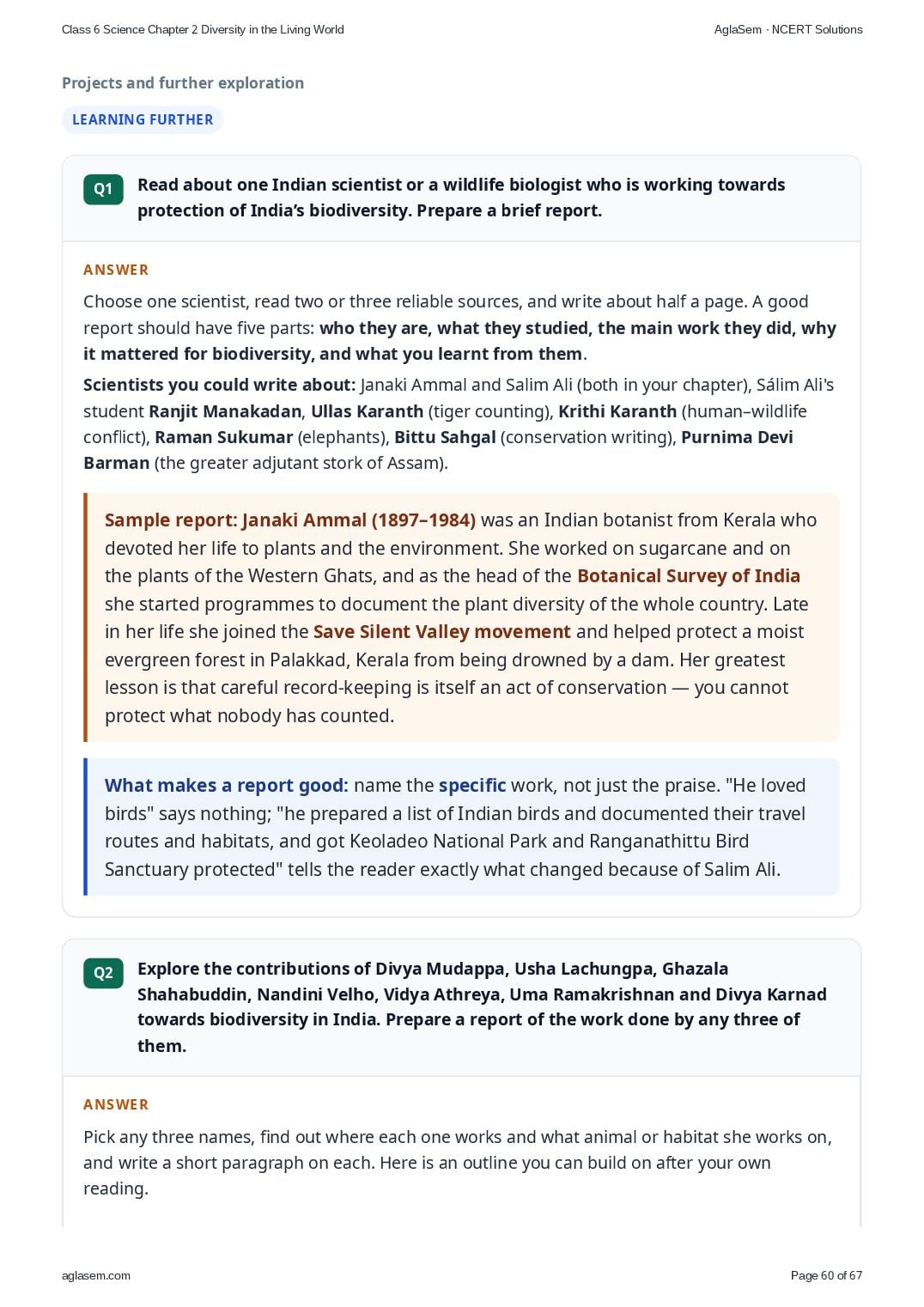
- Read about one Indian scientist or a wildlife biologist who is working towards protection of India’s biodiversity. Prepare a brief report.
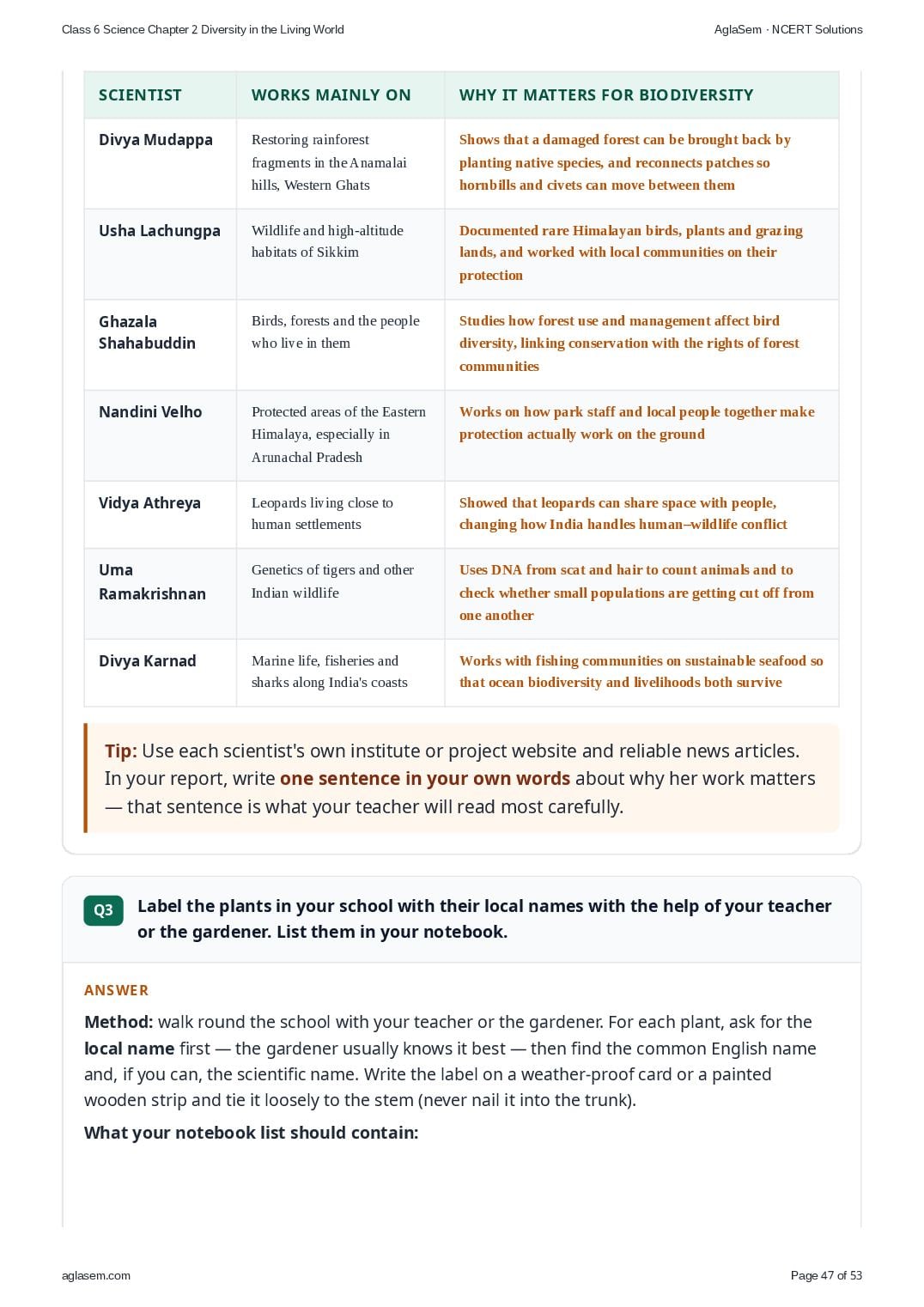
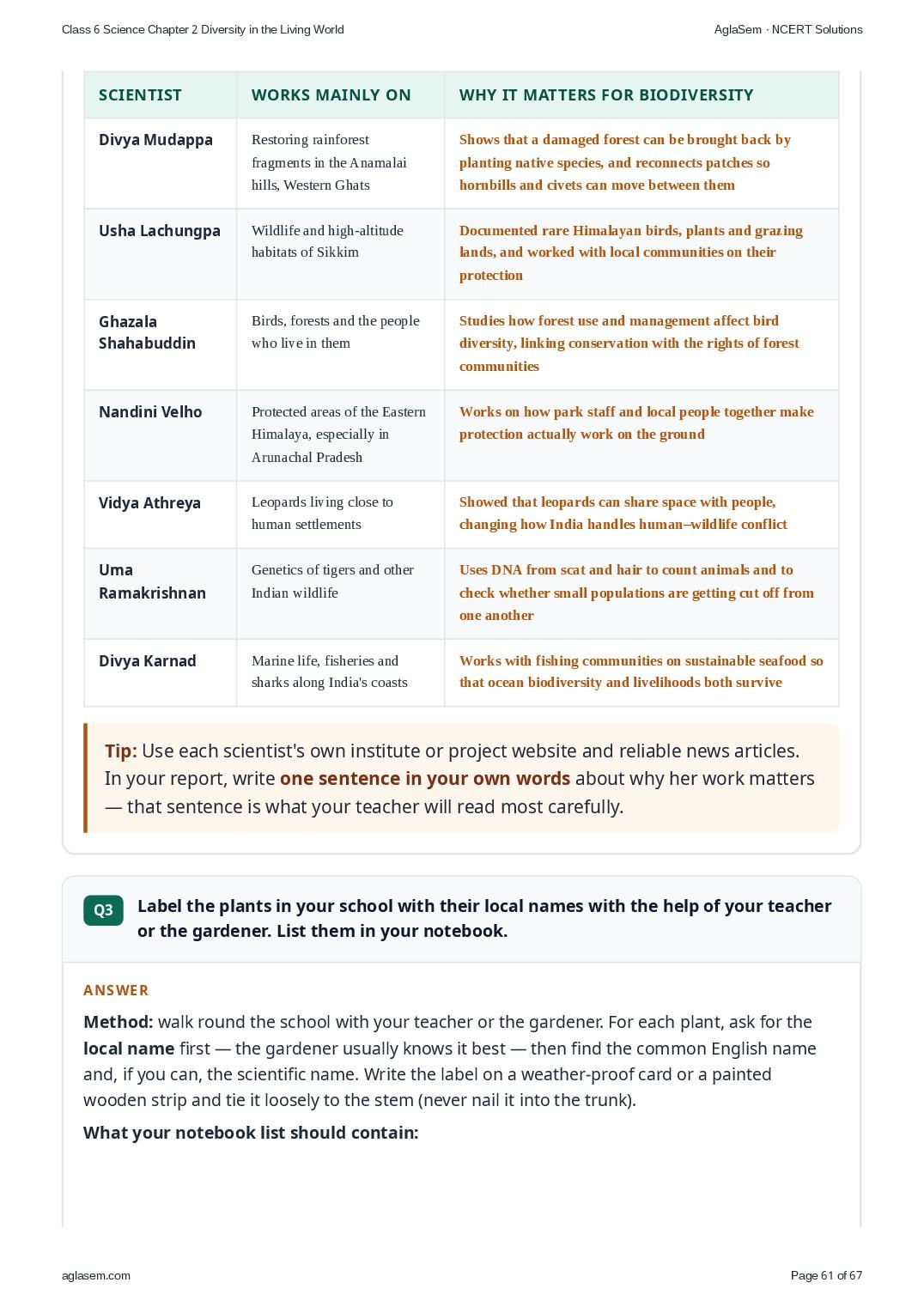
- Explore the contributions of Divya Mudappa, Usha Lachungpa, Ghazala Shahabuddin, Nandini Velho, Vidya Athreya, Uma Ramakrishnan and Divya Karnad towards biodiversity in India. Prepare a report of the work done by any three of them.
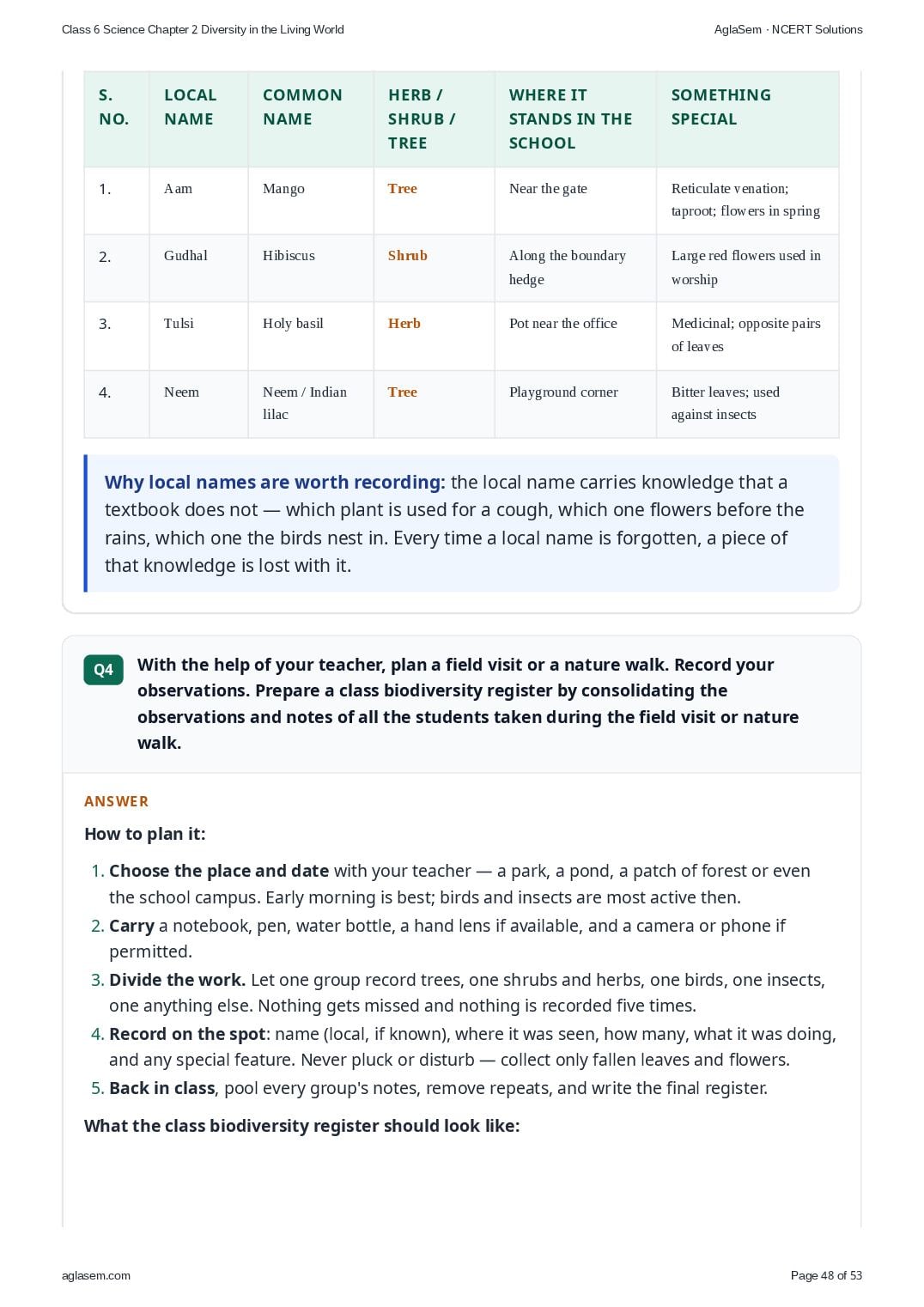
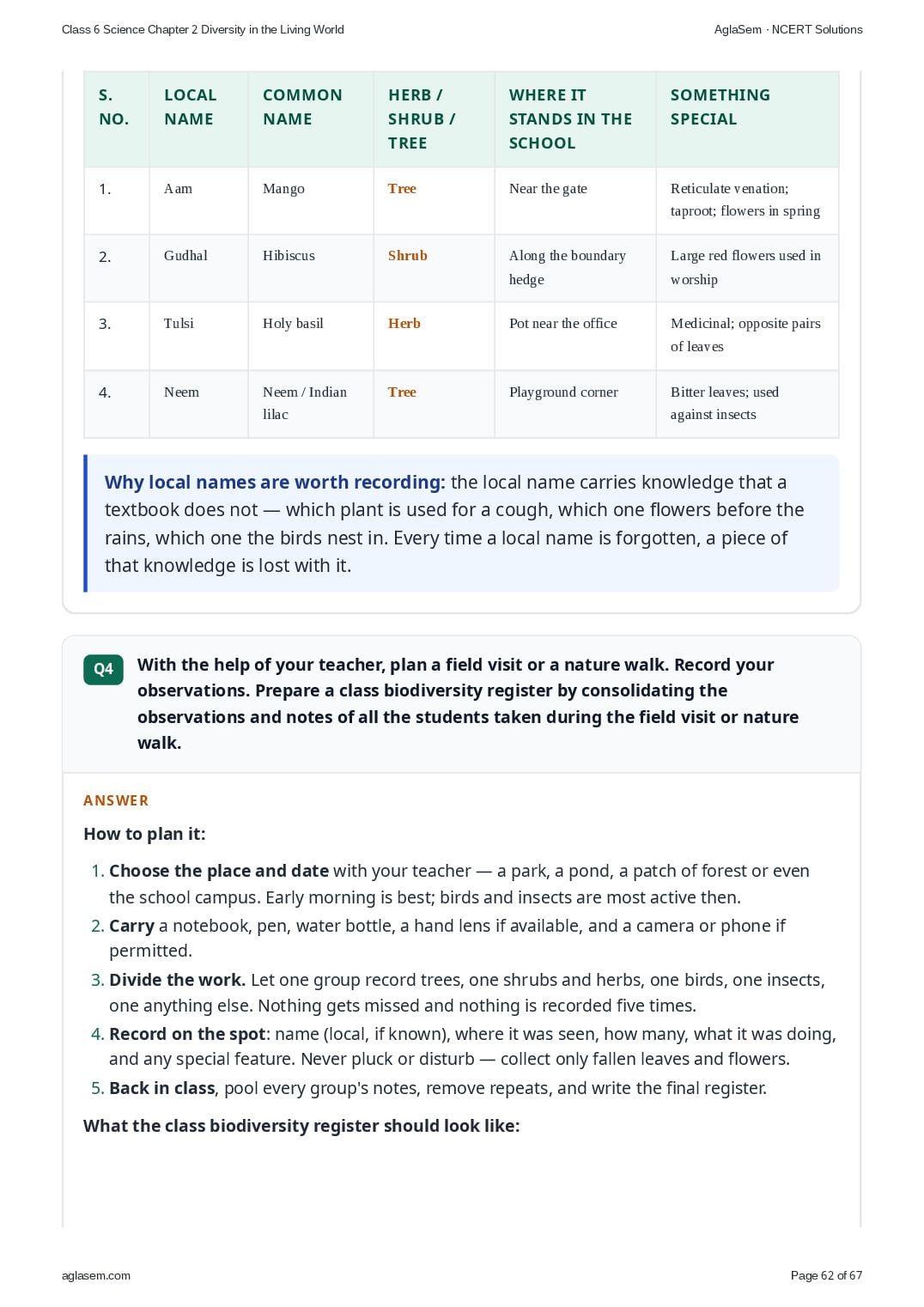
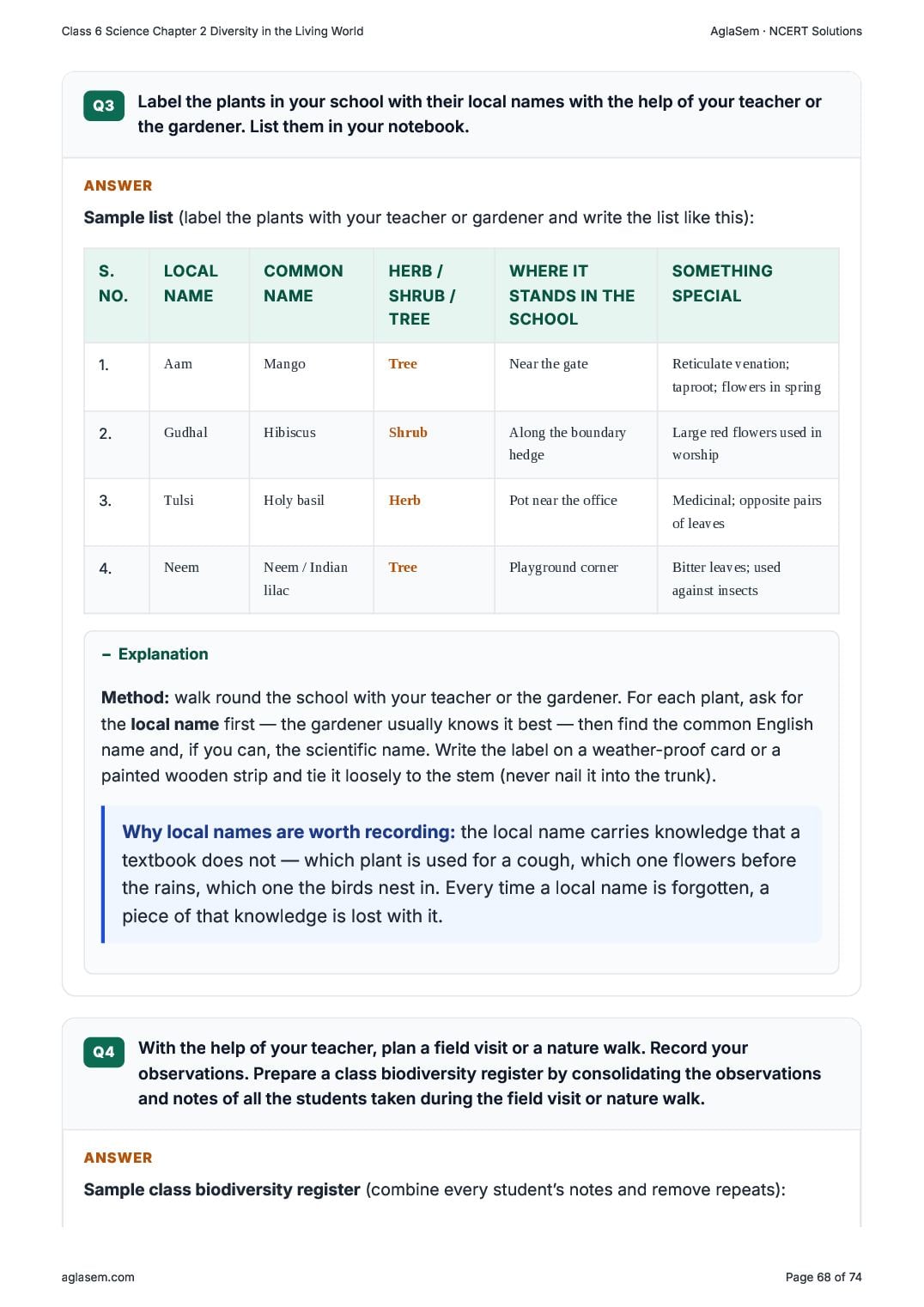
- Label the plants in your school with their local names with the help of your teacher or the gardener. List them in your notebook.
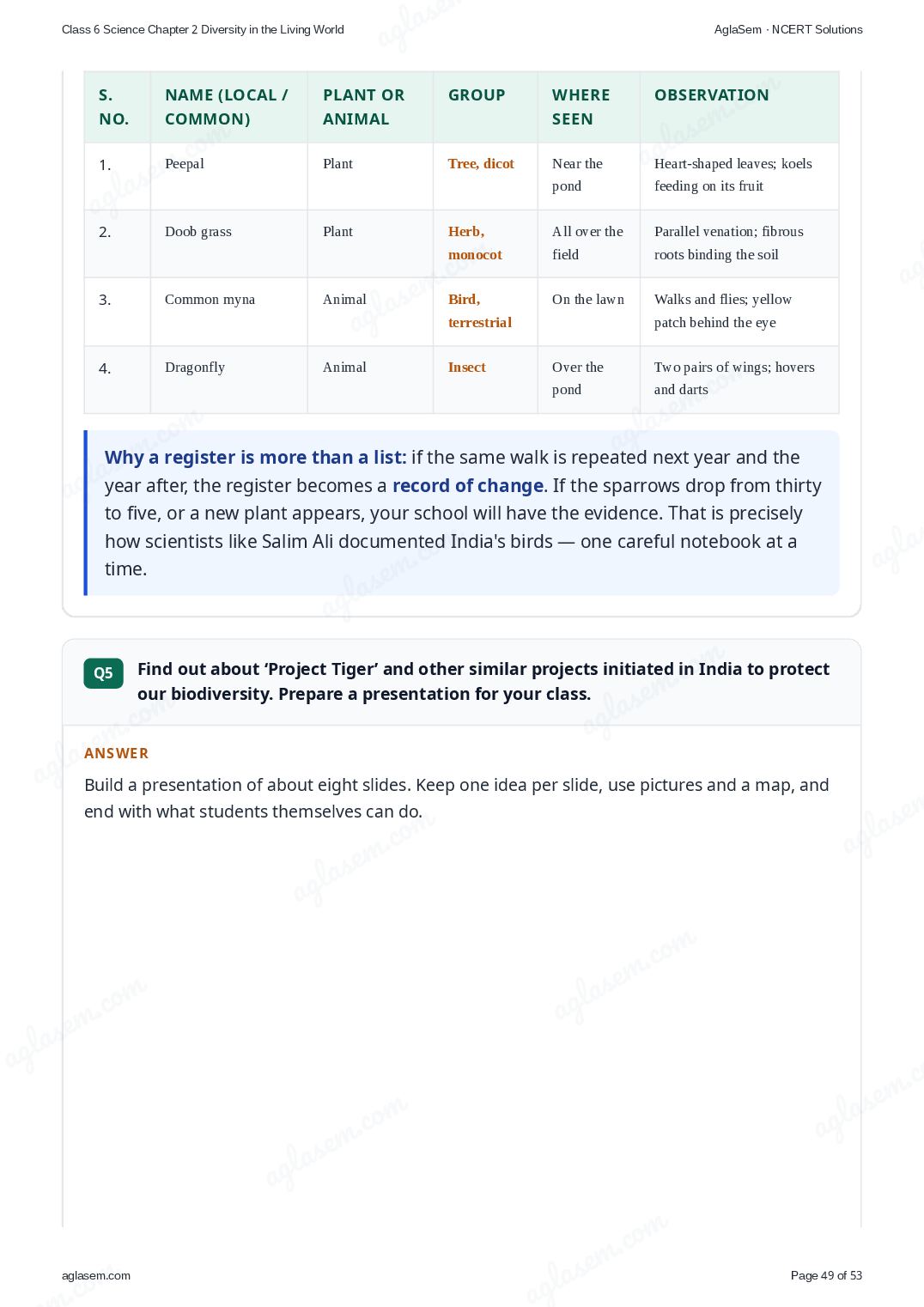
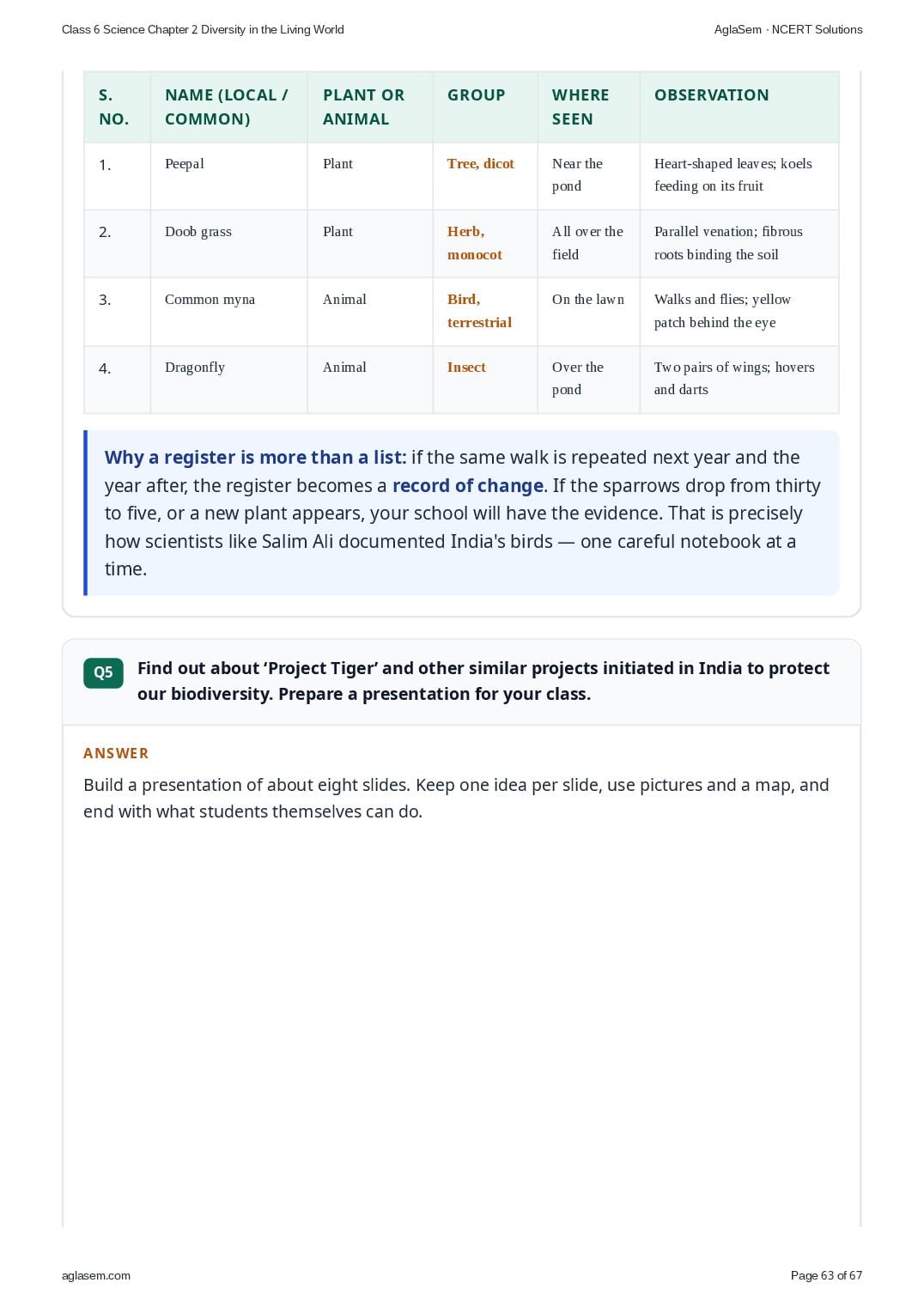
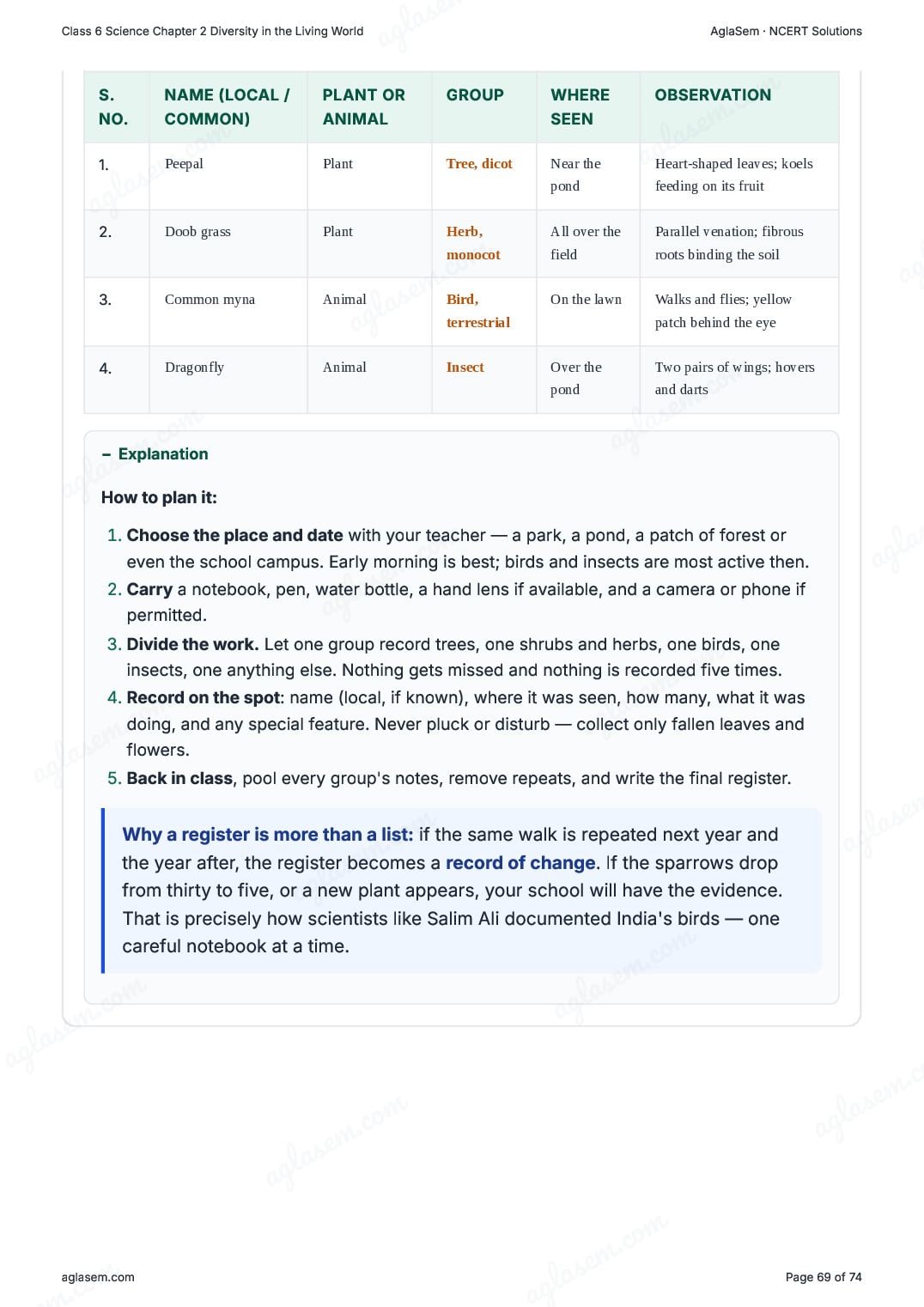
- With the help of your teacher, plan a field visit or a nature walk. Record your observations. Prepare a class biodiversity register by consolidating the observations and notes of all the students taken during the field visit or nature walk.
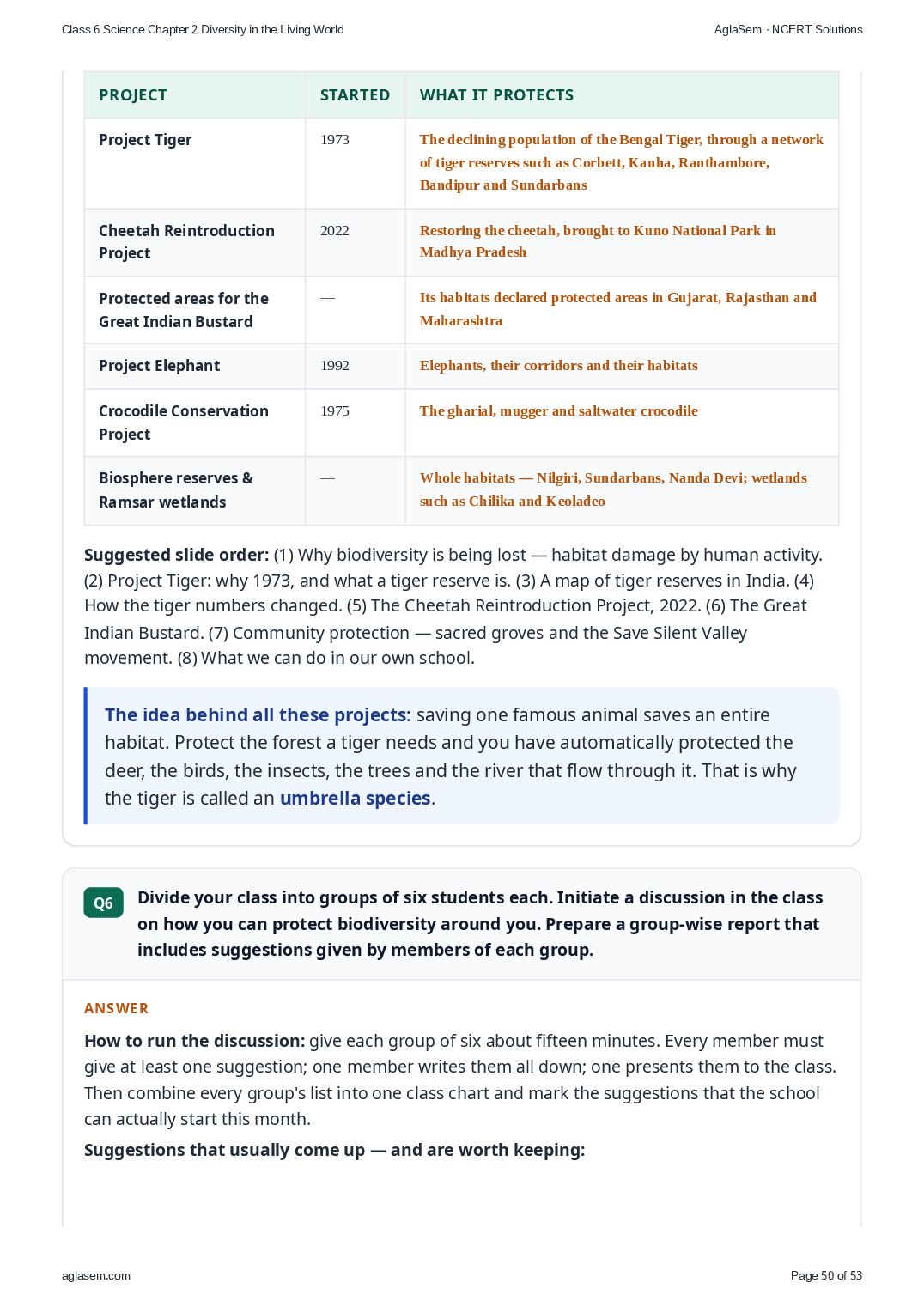
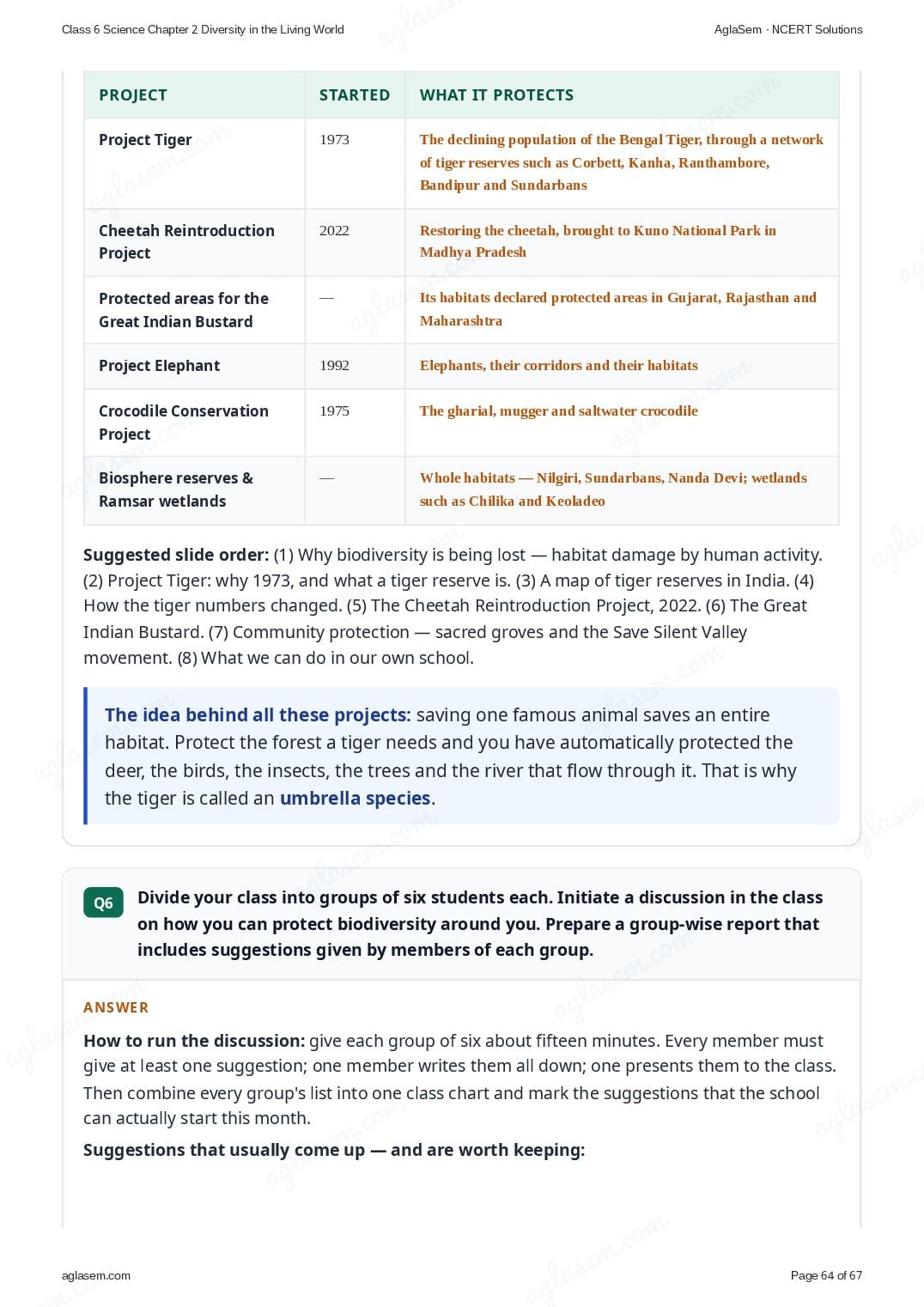
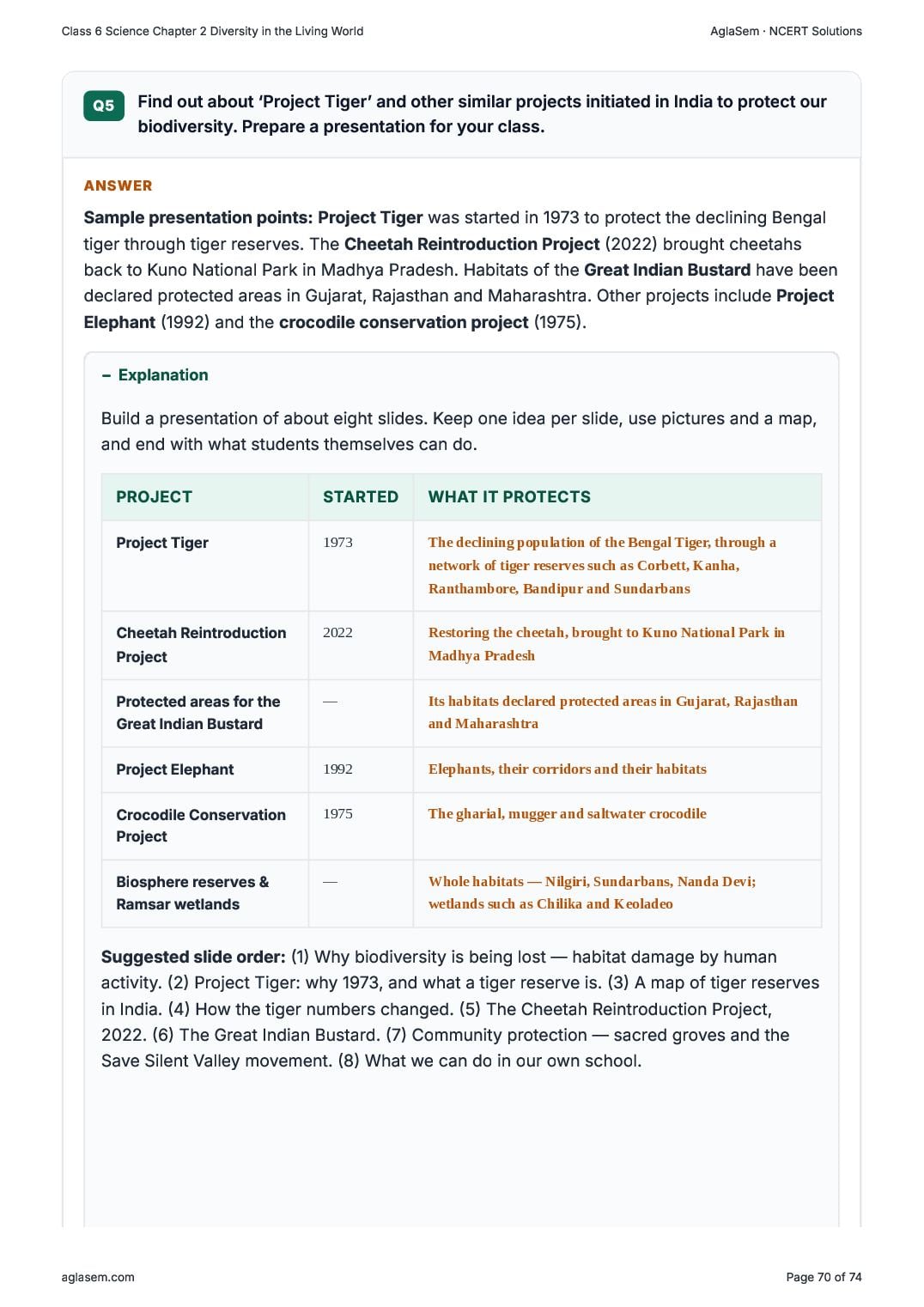
- Find out about ‘Project Tiger’ and other similar projects initiated in India to protect our biodiversity. Prepare a presentation for your class.
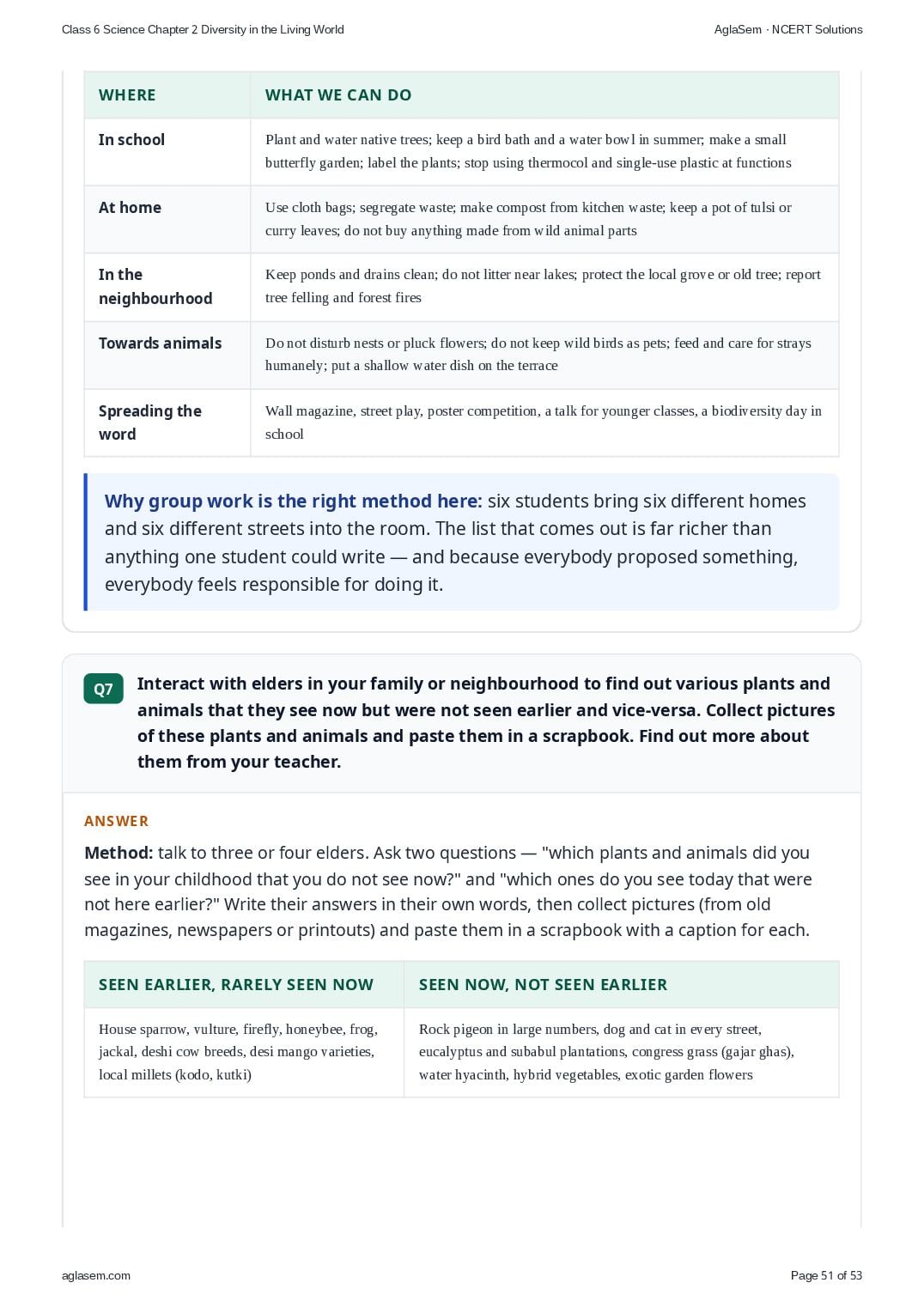
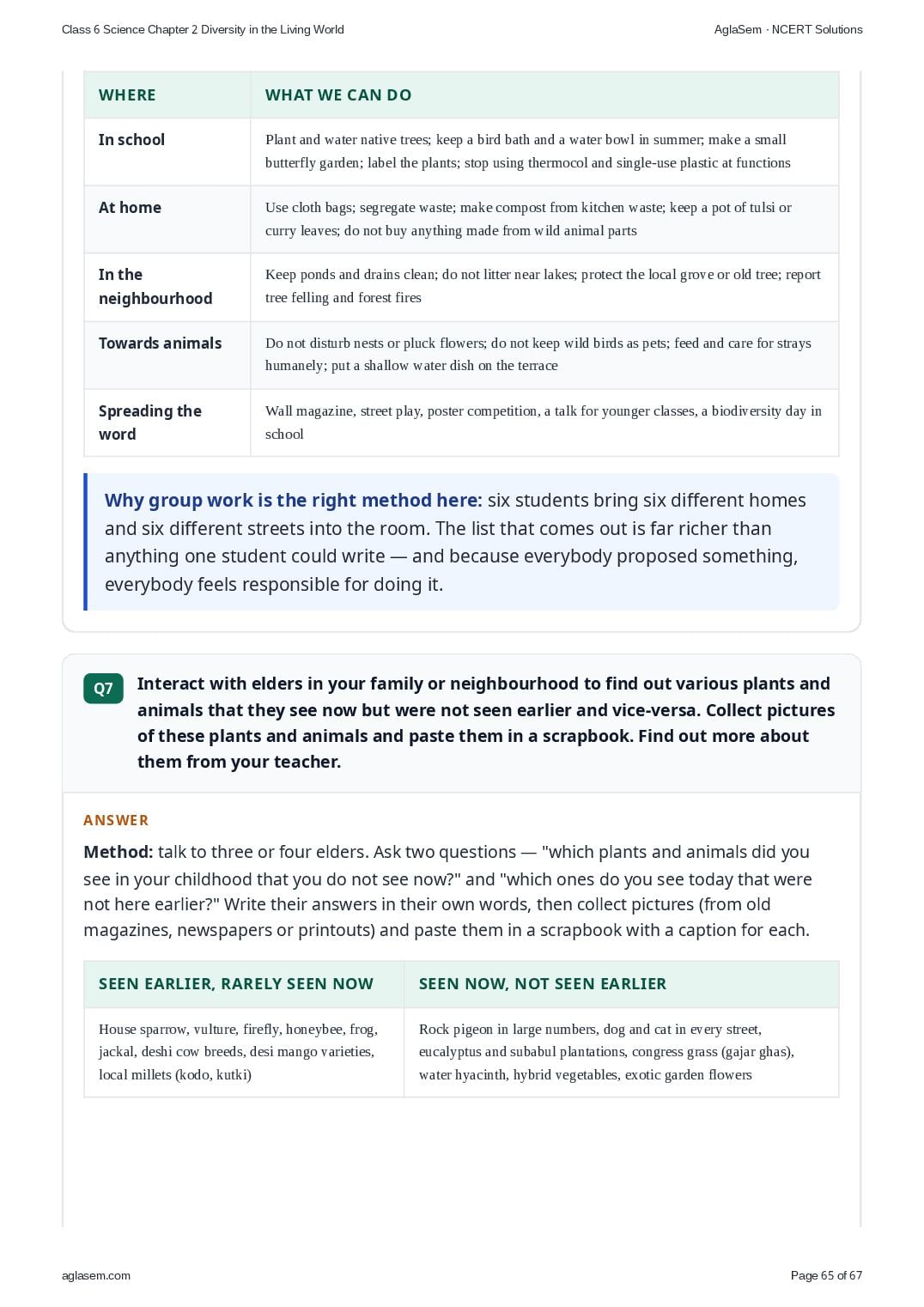
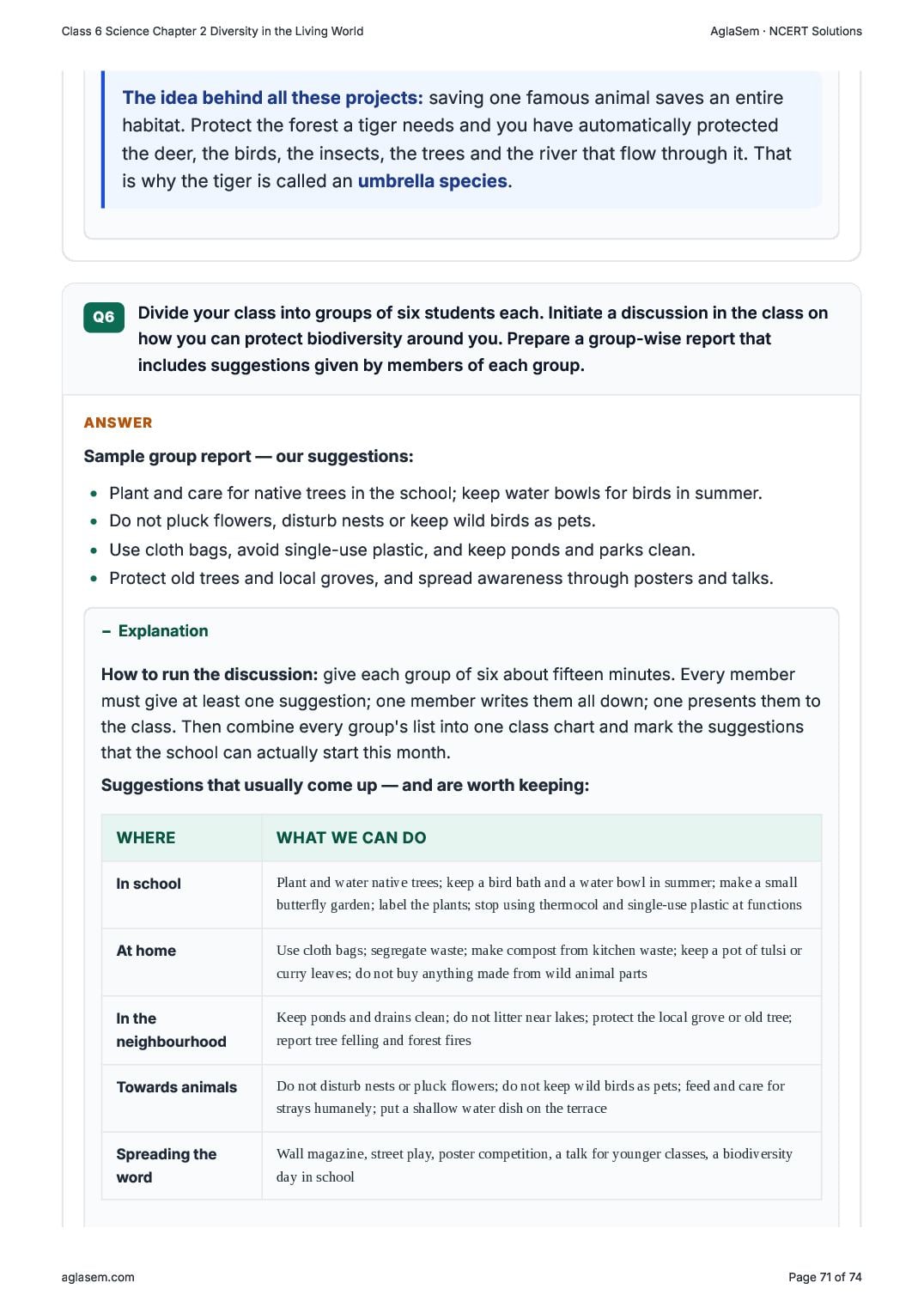
- Divide your class into groups of six students each. Initiate a discussion in the class on how you can protect biodiversity around you. Prepare a group-wise report that includes suggestions given by members of each group.
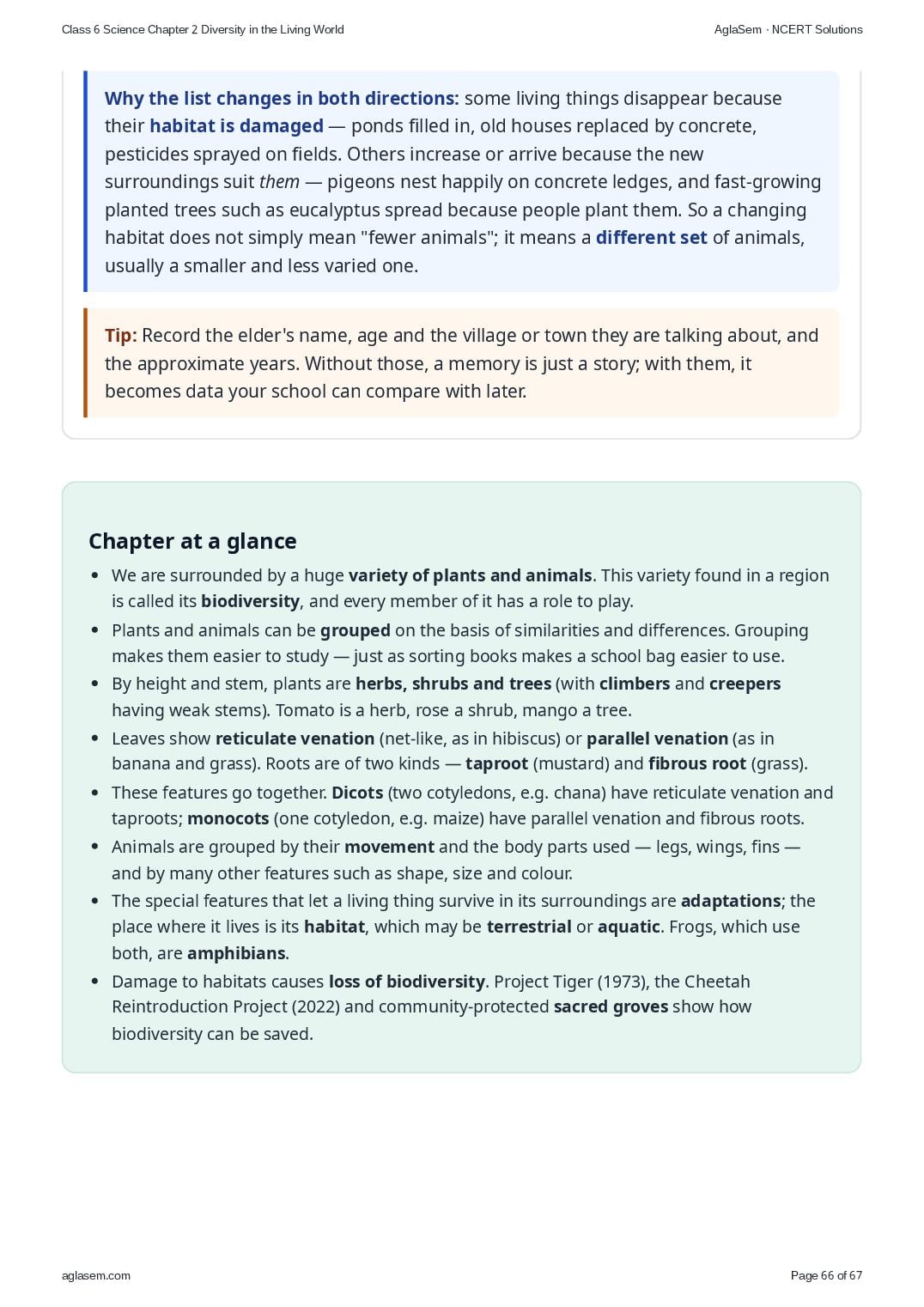
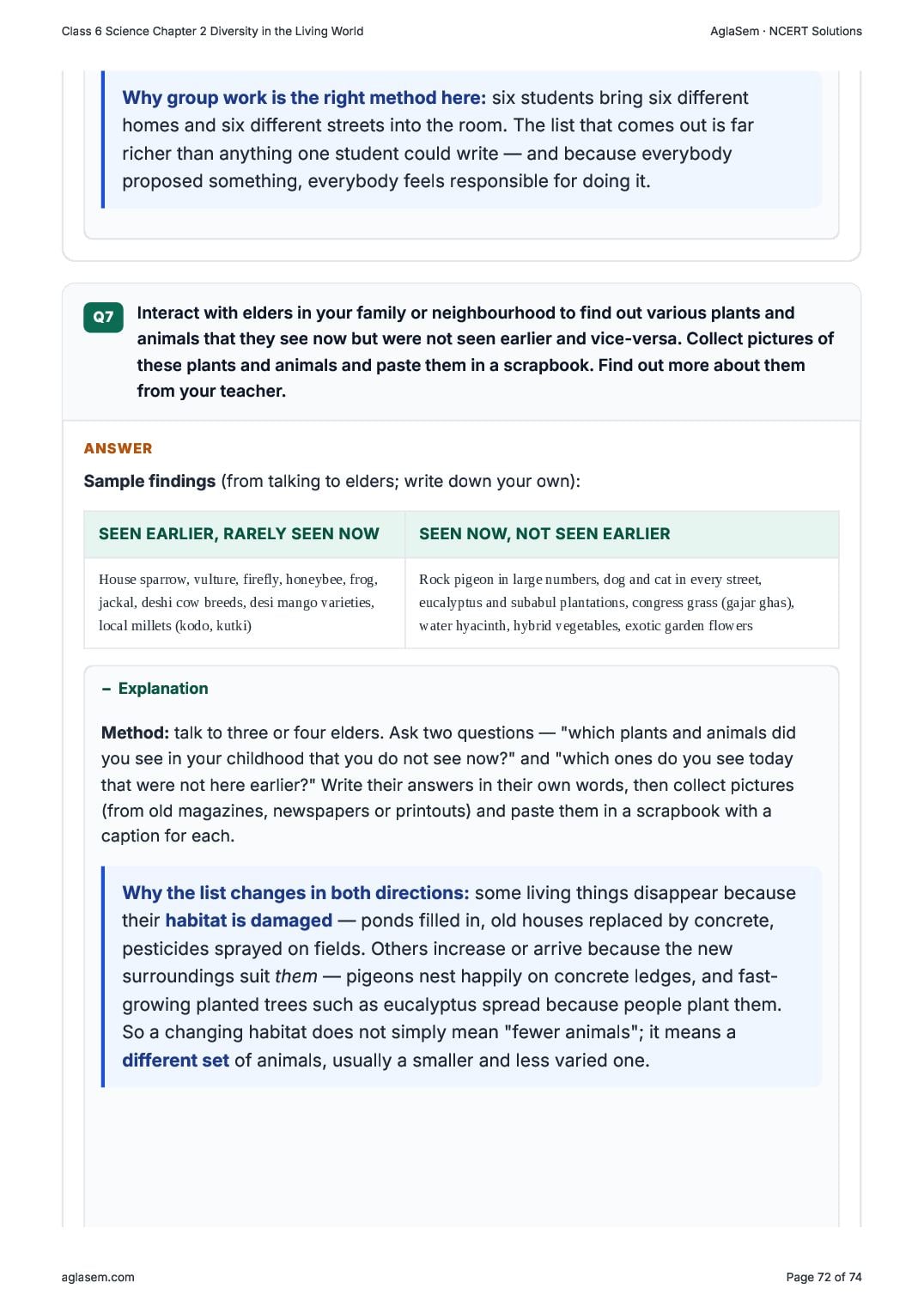
- Interact with elders in your family or neighbourhood to find out various plants and animals that they see now but were not seen earlier and vice-versa. Collect pictures of these plants and animals and paste them in a scrapbook. Find out more about them from your teacher.
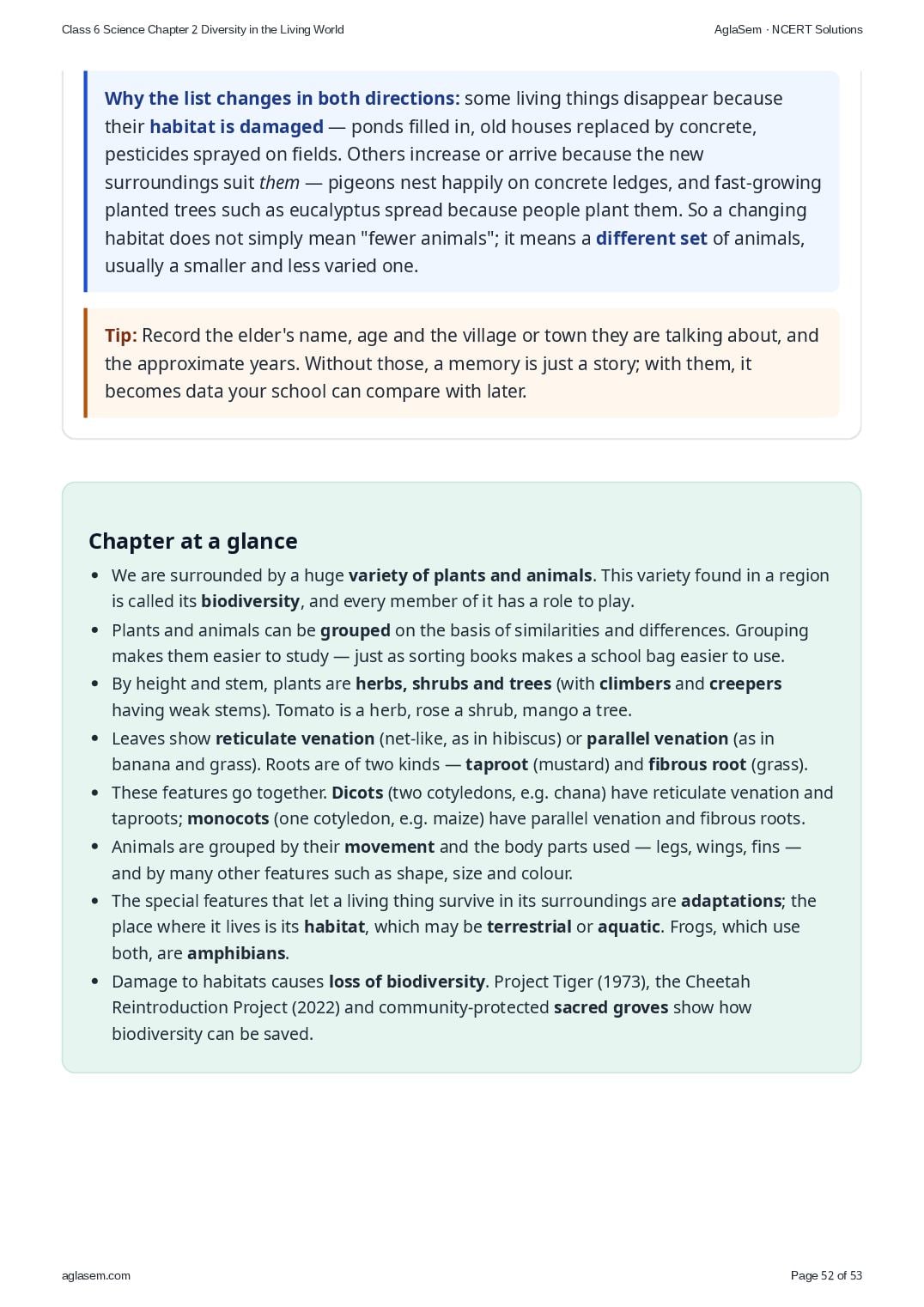
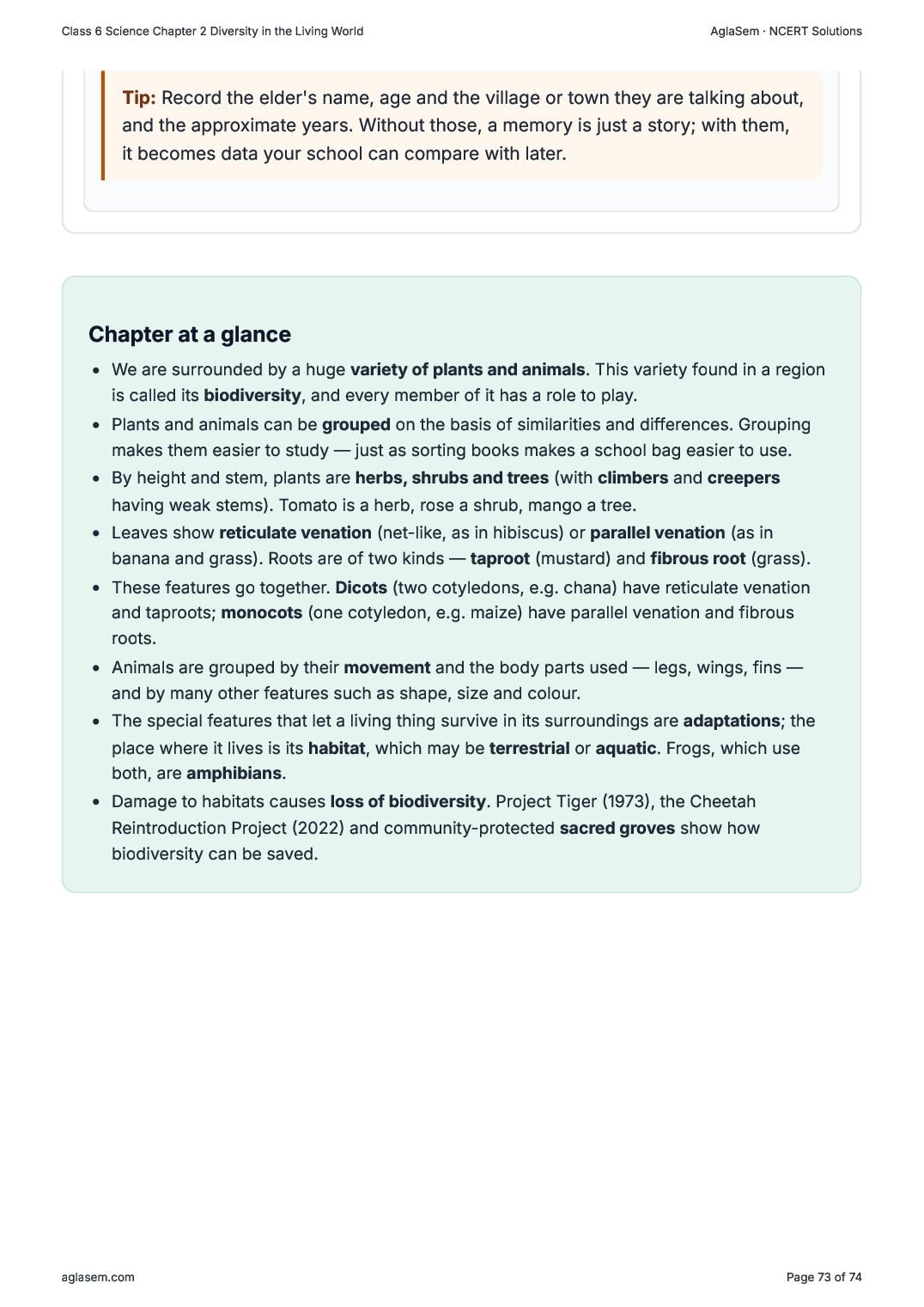
Chapter at a Glance
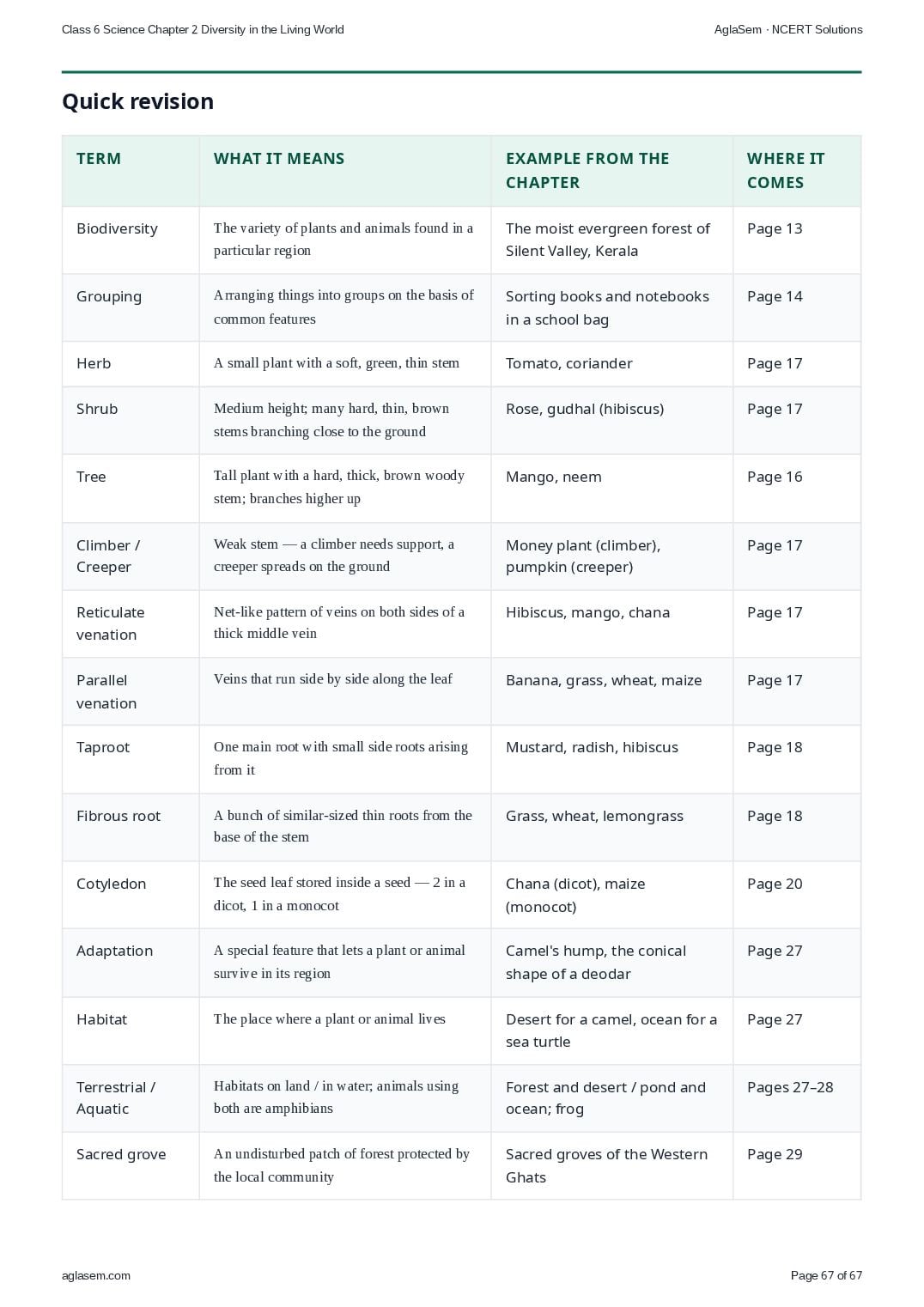
- We are surrounded by a huge variety of plants and animals . This variety found in a region is called its biodiversity , and every member of it has a role to play.
- Plants and animals can be grouped on the basis of similarities and differences. Grouping makes them easier to study — just as sorting books makes a school bag easier to use.
- By height and stem, plants are herbs, shrubs and trees (with climbers and creepers having weak stems). Tomato is a herb, rose a shrub, mango a tree.
- Leaves show reticulate venation (net-like, as in hibiscus) or parallel venation (as in banana and grass). Roots are of two kinds — taproot (mustard) and fibrous root (grass).
- These features go together. Dicots (two cotyledons, e.g. chana) have reticulate venation and taproots; monocots (one cotyledon, e.g. maize) have parallel venation and fibrous roots.
- Animals are grouped by their movement and the body parts used — legs, wings, fins — and by many other features such as shape, size and colour.
- The special features that let a living thing survive in its surroundings are adaptations ; the place where it lives is its habitat , which may be terrestrial or aquatic . Frogs, which use both, are amphibians .
- Damage to habitats causes loss of biodiversity . Project Tiger (1973), the Cheetah Reintroduction Project (2022) and community-protected sacred groves show how biodiversity can be saved.
How to Download NCERT Solutions for Class 6 Science Chapter 2 PDF
Follow these simple steps to get the Diversity in the Living World questions-and-answers PDF from Curiosity.
- Search NCERT Solutions for Class 6 Science Chapter 2 aglasem and open this page.
- Read the exercise questions with answers for Diversity in the Living World shown above.
- Click the Download PDF link to save the Diversity in the Living World solutions to your device.
NCERT Solutions for Class 6 Science – All Chapters
There are more chapters to study besides Diversity in the Living World in Science. Here are the NCERT Solutions for all chapters of Class 6 Science.
- Chapter 1 the Wonderful World of Science
- Chapter 2 Diversity in the Living World
- Chapter 3 Mindful Eating a Path to a Healthy Body
- Chapter 4 Exploring Magnets
- Chapter 5 Measurement of Length and Motion
- Chapter 6 Materials Around Us
- Chapter 7 Temperature and Its Measurement
- Chapter 8 a Journey Through States of Water
- Chapter 9 Methods of Separation in Everyday Life
- Chapter 10 Living Creatures Exploring Their Characteristics
- Chapter 11 Nature’s Treasures
- Chapter 12 Beyond Earth
NCERT Solutions for Class 6 – All Subjects
Just like Chapter 2 of Science, you can get the exercise questions with answers for every other subject of Class 6. Here are the NCERT Solutions for all subjects of Class 6.
NCERT Solutions for Class 6 Science Chapter 2 – An Overview
The key highlights of this study material are as follows.
| Aspects | Details |
|---|---|
| Class | Class 6 |
| Subject | Science |
| Chapter Number | Chapter 2 |
| Chapter Name | Diversity in the Living World |
| Book Name | Curiosity |
| Book By | NCERT (National Council of Educational Research and Training) |
| Educational Resource Here | NCERT Solutions of Class 6 Science Chapter 2 for all exercises |
| More Questions Answers of This Subject | NCERT Solutions for Class 6 Science |
| Download Book Chapter | NCERT Book Class 6 Science |
| All Questions Answers For This Class | NCERT Solutions for Class 6 |
| Complete Solutions | NCERT Solutions |
NCERT Solutions for Class 6 Science Chapter 2 Diversity in the Living World – FAQs
What are the NCERT Solutions for Class 6 Science Chapter 2 Diversity in the Living World?
They are the complete, step-by-step answers to all the exercise and in-text questions of Chapter 2 Diversity in the Living World from the NCERT Class 6 Science textbook Curiosity, written by experts as per the latest NCERT syllabus.
How can I download the Class 6 Science Chapter 2 solutions PDF for free?
Open this page on aglasem, read the Diversity in the Living World questions with answers, and click the “Download Solutions PDF” link. The Class 6 Science Chapter 2 NCERT Solutions PDF is completely free to download.
Are these NCERT Solutions as per the latest 2026-27 syllabus?
Yes. The NCERT Solutions for Class 6 Science Chapter 2 are based on the latest NCERT textbook Curiosity and the current 2026-27 CBSE syllabus, so the questions and answers match what you study in class.
Where can I get NCERT Solutions for the other chapters of Class 6 Science?
You can find the answers to every chapter on the NCERT Solutions for Class 6 Science page, and solutions for every subject on the NCERT Solutions for Class 6 page.
How do NCERT Solutions help in exam preparation?
They show the correct method to solve each question, help you write answers the way they are expected in exams, let you check and correct your own work, and save revision time — which together improve your marks in Class 6 Science.
If you have any queries on NCERT Solutions for Class 6 Science Chapter 2 Diversity in the Living World, then please ask in the comments below.