NCERT Solutions for Class 6 Science Chapter 3 Mindful Eating a Path to a Healthy Body provide clear, step-by-step answers to every exercise and in-text question from the chapter Mindful Eating a Path to a Healthy Body of the NCERT textbook Curiosity. Prepared by subject experts as per the latest NCERT (CBSE) syllabus for 2026-27, these NCERT Solutions for Class 6 Science help you understand each concept, write exam-ready answers, and check your own solutions. You can read them online below or download the free Class 6 Science Chapter 3 question-answer PDF.
NCERT Solutions for Class 6 Science Chapter 3 Mindful Eating a Path to a Healthy Body
- Class: Class 6
- Subject: Science
- Chapter: Chapter 3 – Mindful Eating a Path to a Healthy Body
- Textbook: Curiosity (NCERT)
- Study material: NCERT Solutions – questions with answers, free PDF
These solutions answer all the exercise questions of Chapter 3 Mindful Eating a Path to a Healthy Body — including the in-text questions, short-answer and long-answer questions, and activities — with complete explanations so you can follow the method, not just the final answer. Read the full solutions below.
NCERT Solutions Class 6 Science Chapter 3 Mindful Eating a Path to a Healthy Body View Download

NCERT Solutions for Class 6 Science Chapter 3 PDF Download
You can read the NCERT Solutions for Class 6 Science Chapter 3 online above, or download the complete question-answer PDF to study Mindful Eating a Path to a Healthy Body offline at any time.
NCERT Solutions for Class 6 Science Chapter 3 PDF Download Link – Click Here to Download Solutions PDF
Questions Covered in This Chapter
These NCERT Solutions answer all 70 questions of this chapter. The questions solved are:
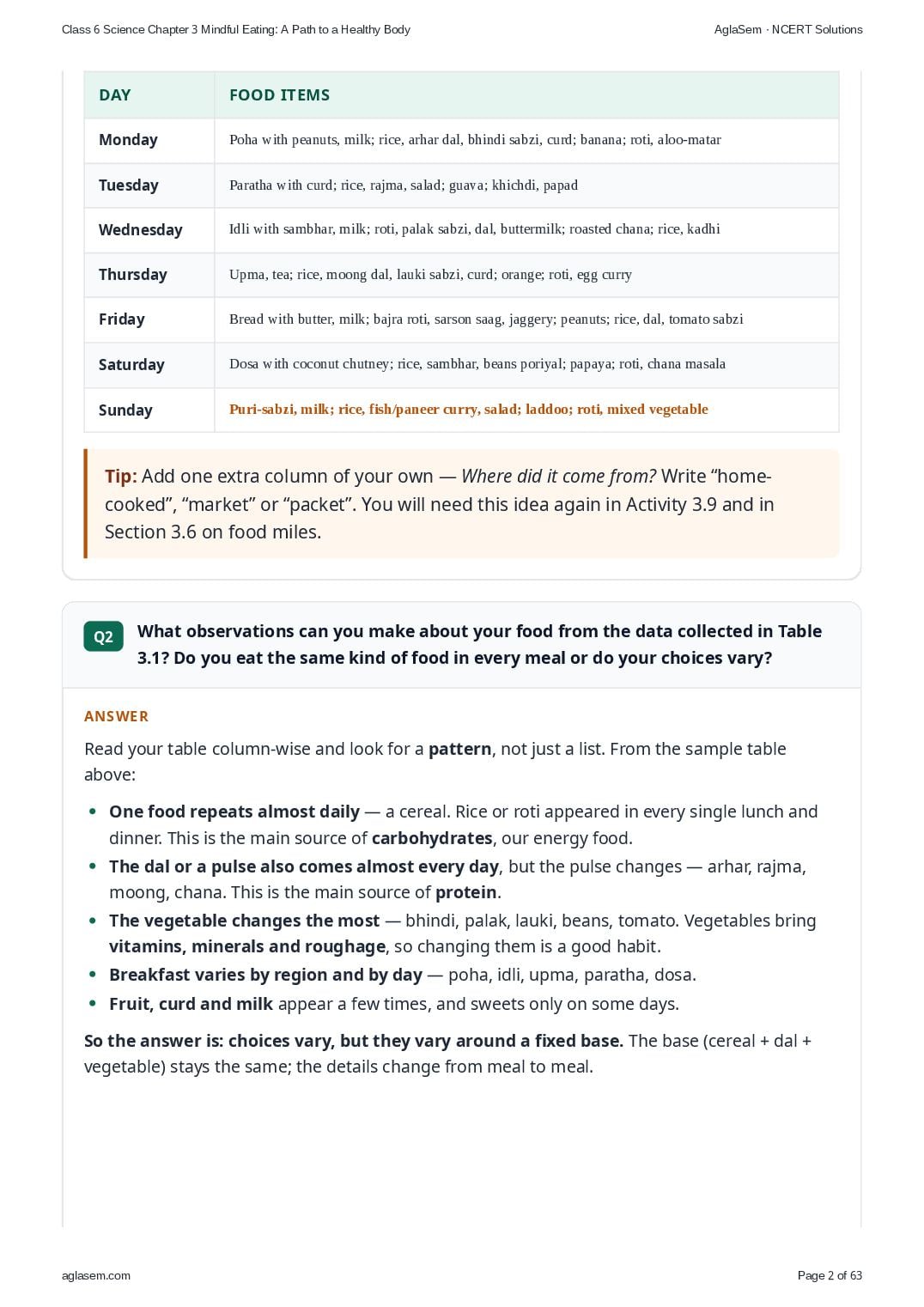
- All of us eat food every day. Food is an essential component of our daily life. List the food items you have consumed over the week in Table 3.1.
- What observations can you make about your food from the data collected in Table 3.1? Do you eat the same kind of food in every meal or do your choices vary?
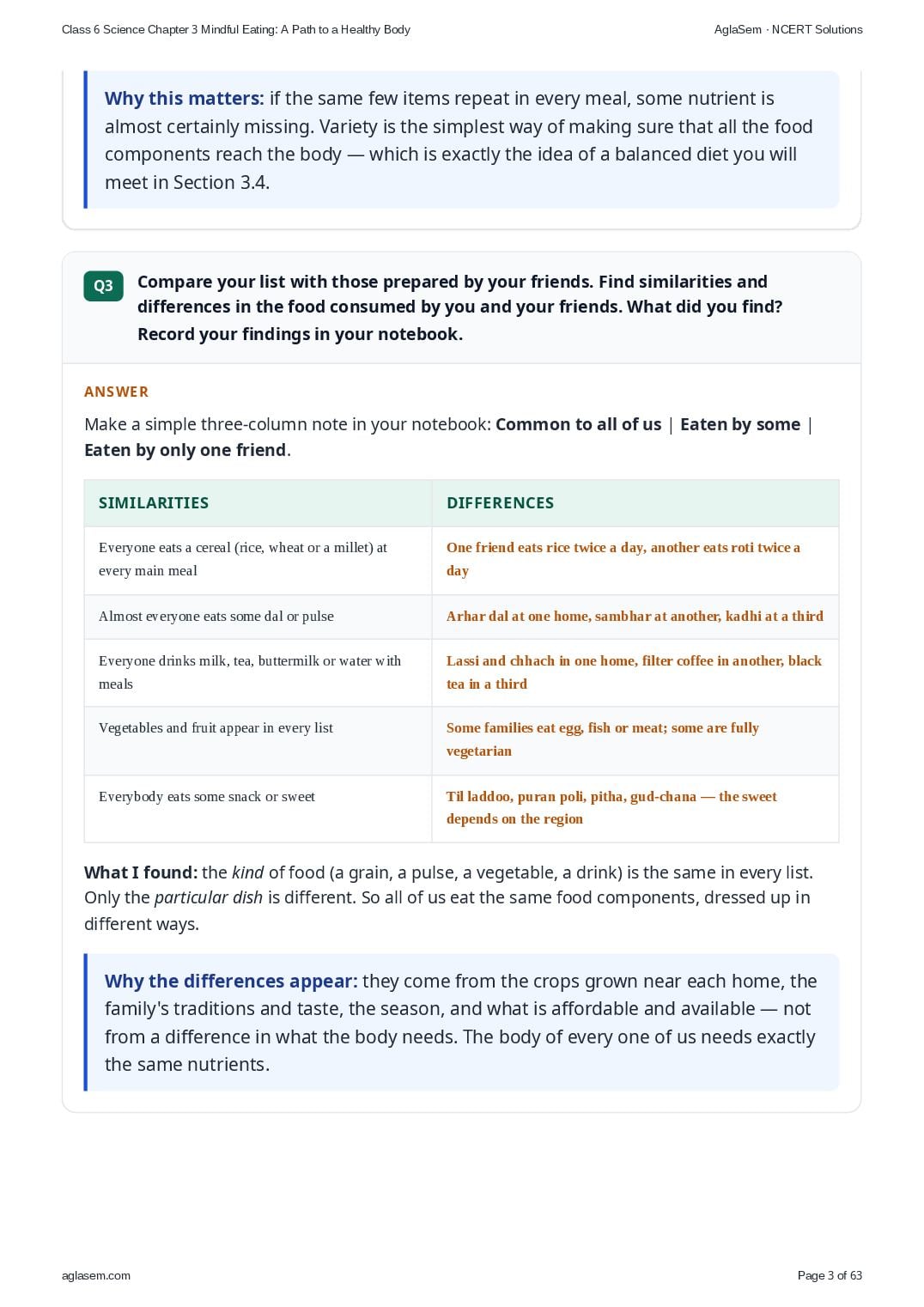
- Compare your list with those prepared by your friends. Find similarities and differences in the food consumed by you and your friends. What did you find? Record your findings in your notebook.
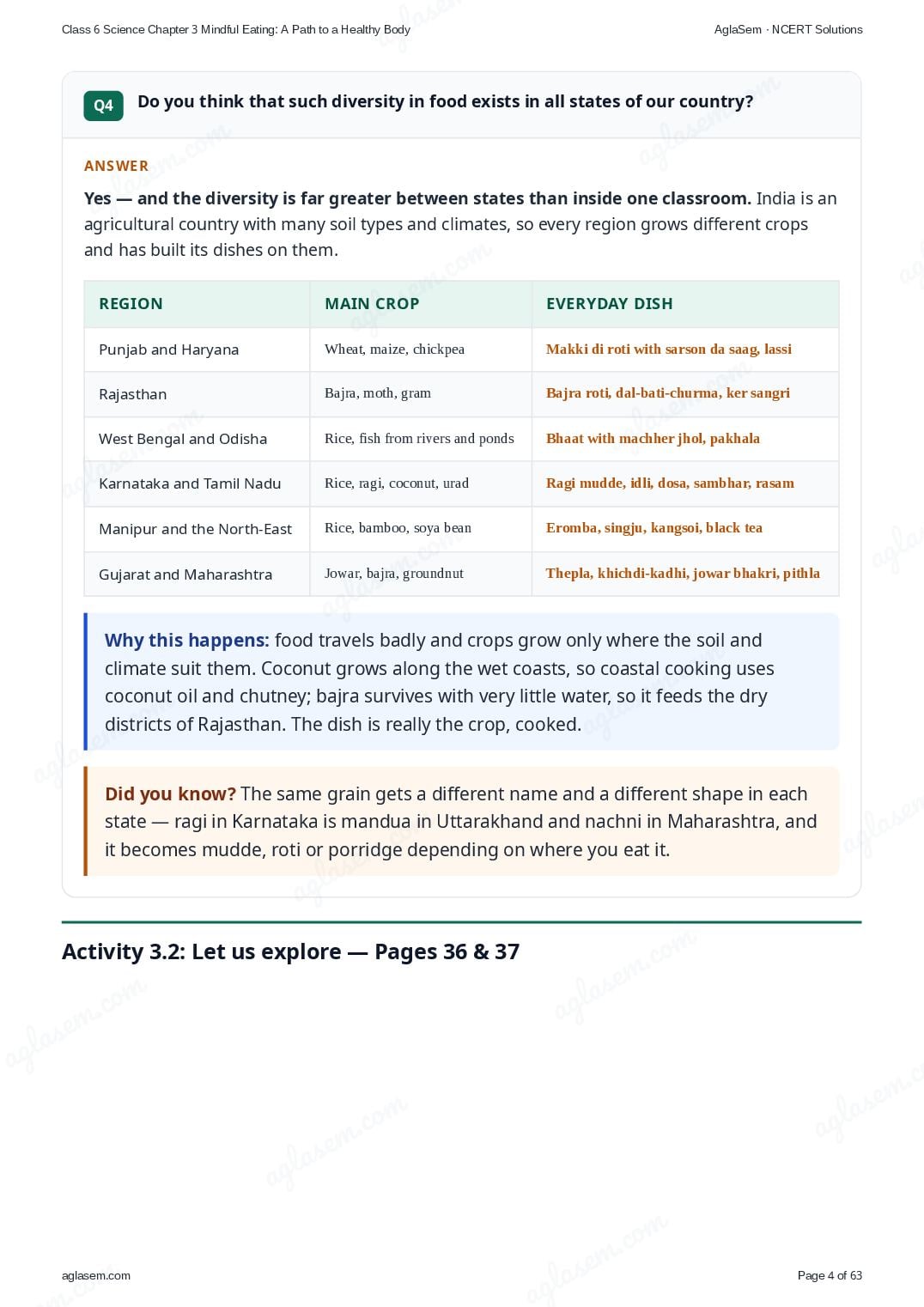
- Do you think that such diversity in food exists in all states of our country?
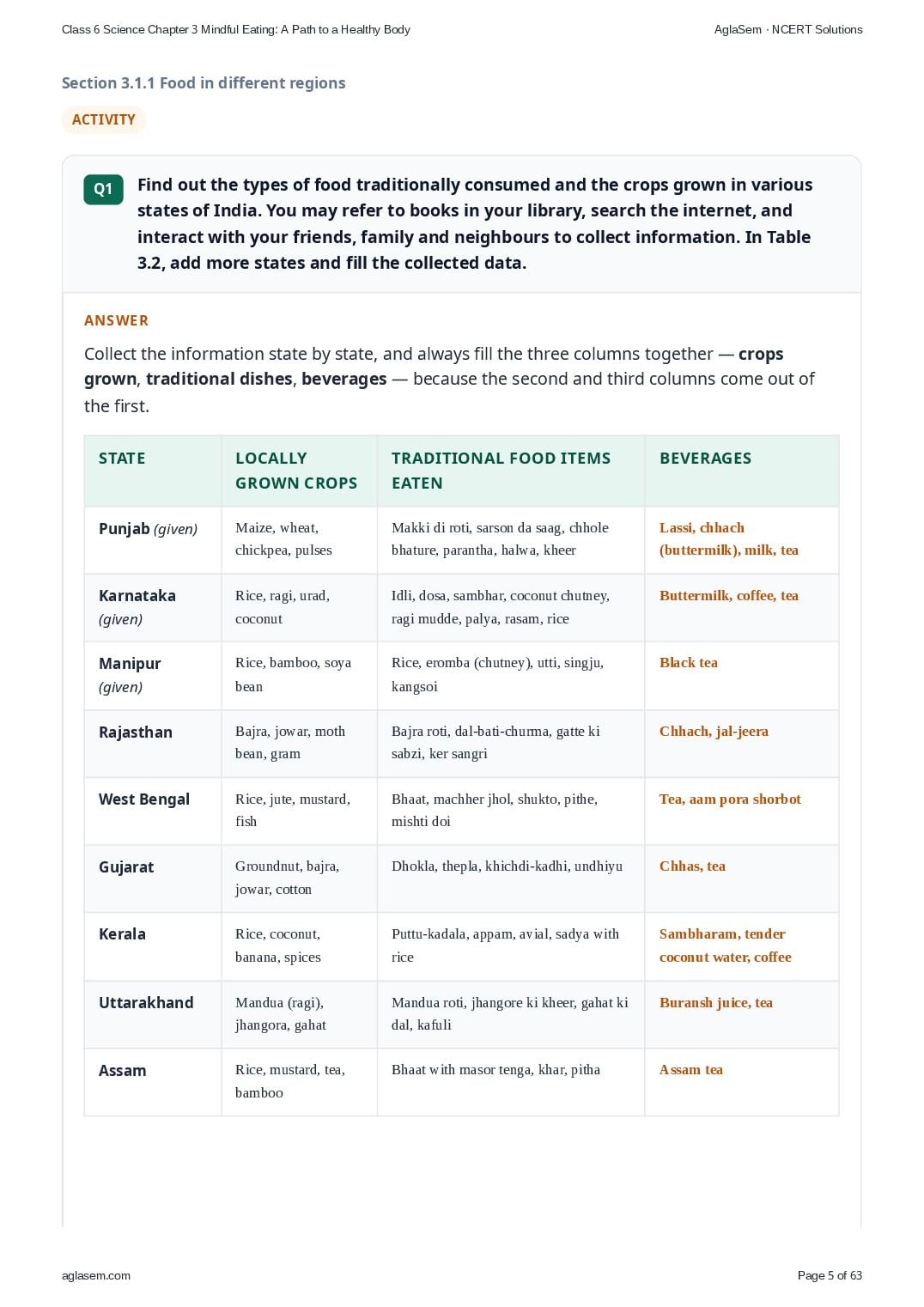
- Find out the types of food traditionally consumed and the crops grown in various states of India. You may refer to books in your library, search the internet, and interact with your friends, family and neighbours to collect information. In Table 3.2, add more states and fill the collected data.
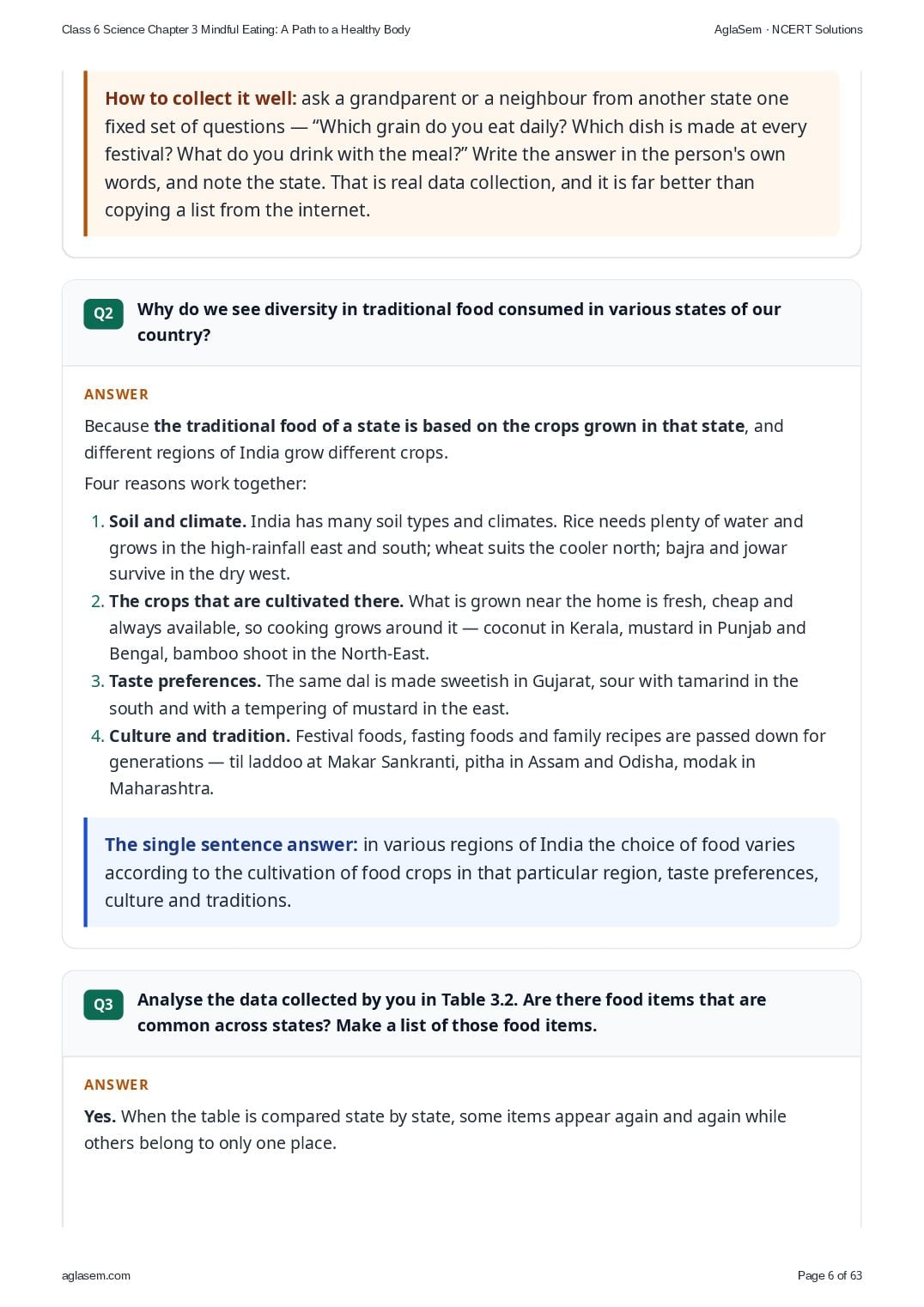
- Why do we see diversity in traditional food consumed in various states of our country?
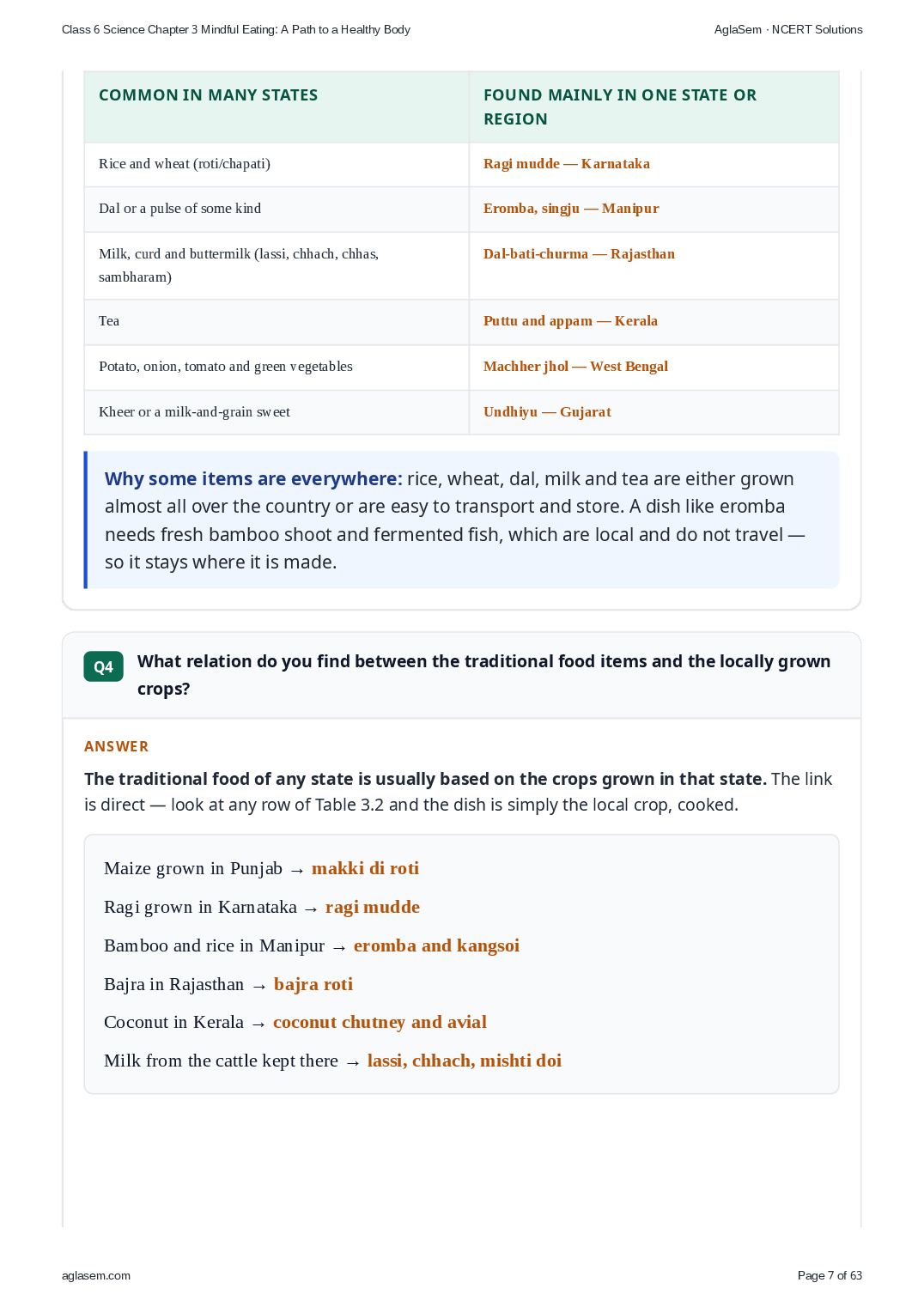
- Analyse the data collected by you in Table 3.2. Are there food items that are common across states? Make a list of those food items.
- What relation do you find between the traditional food items and the locally grown crops?
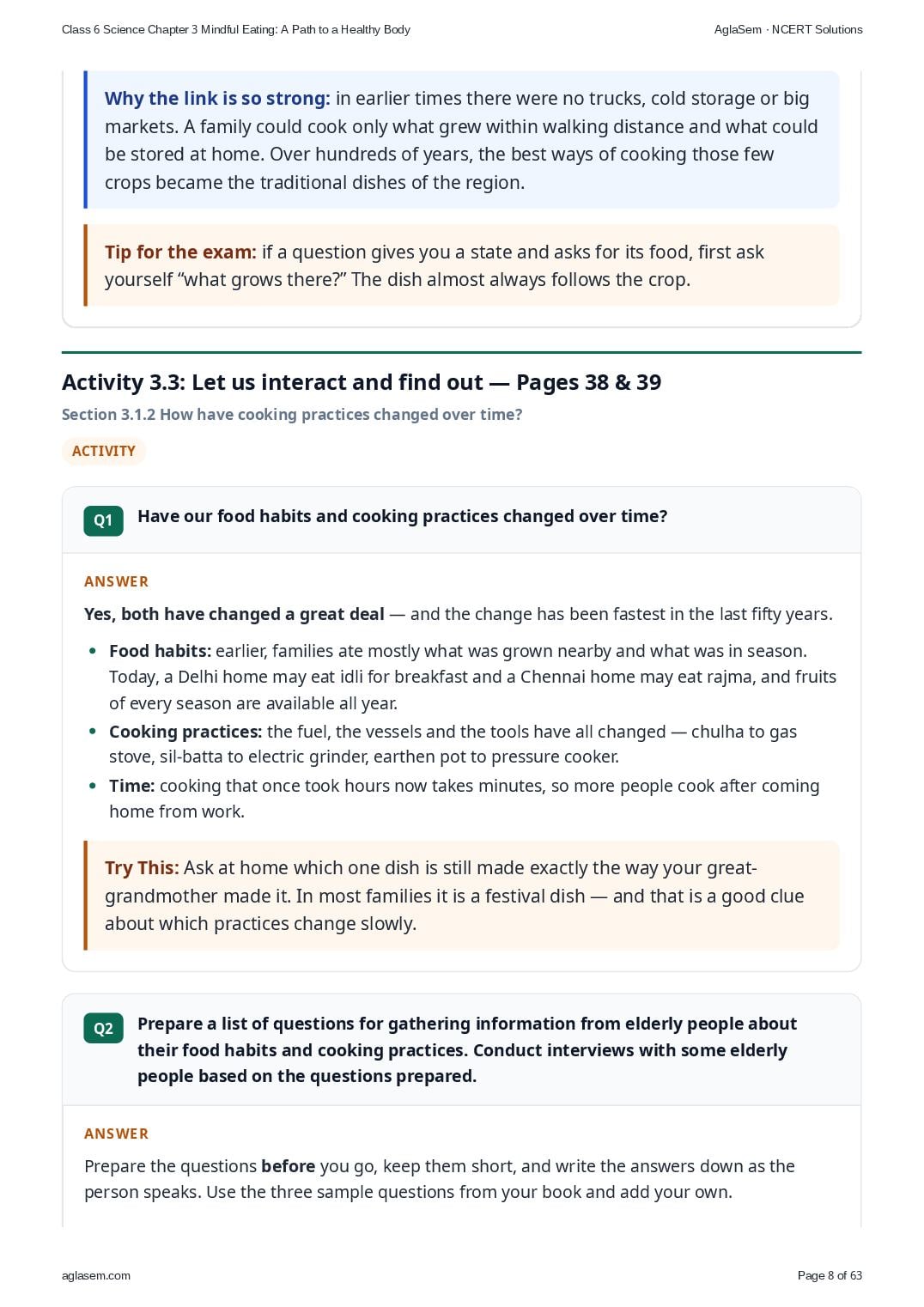
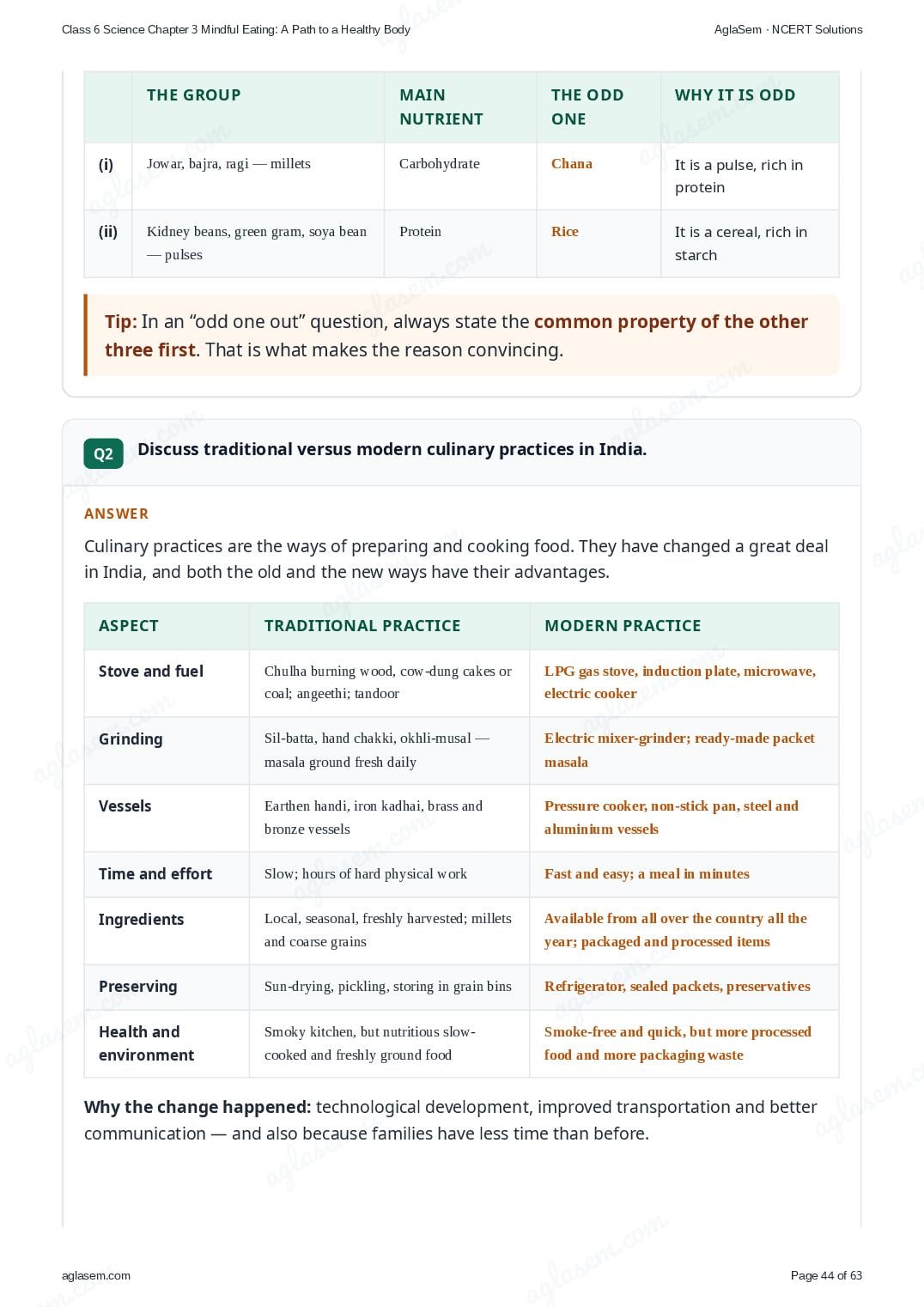
- Have our food habits and cooking practices changed over time?
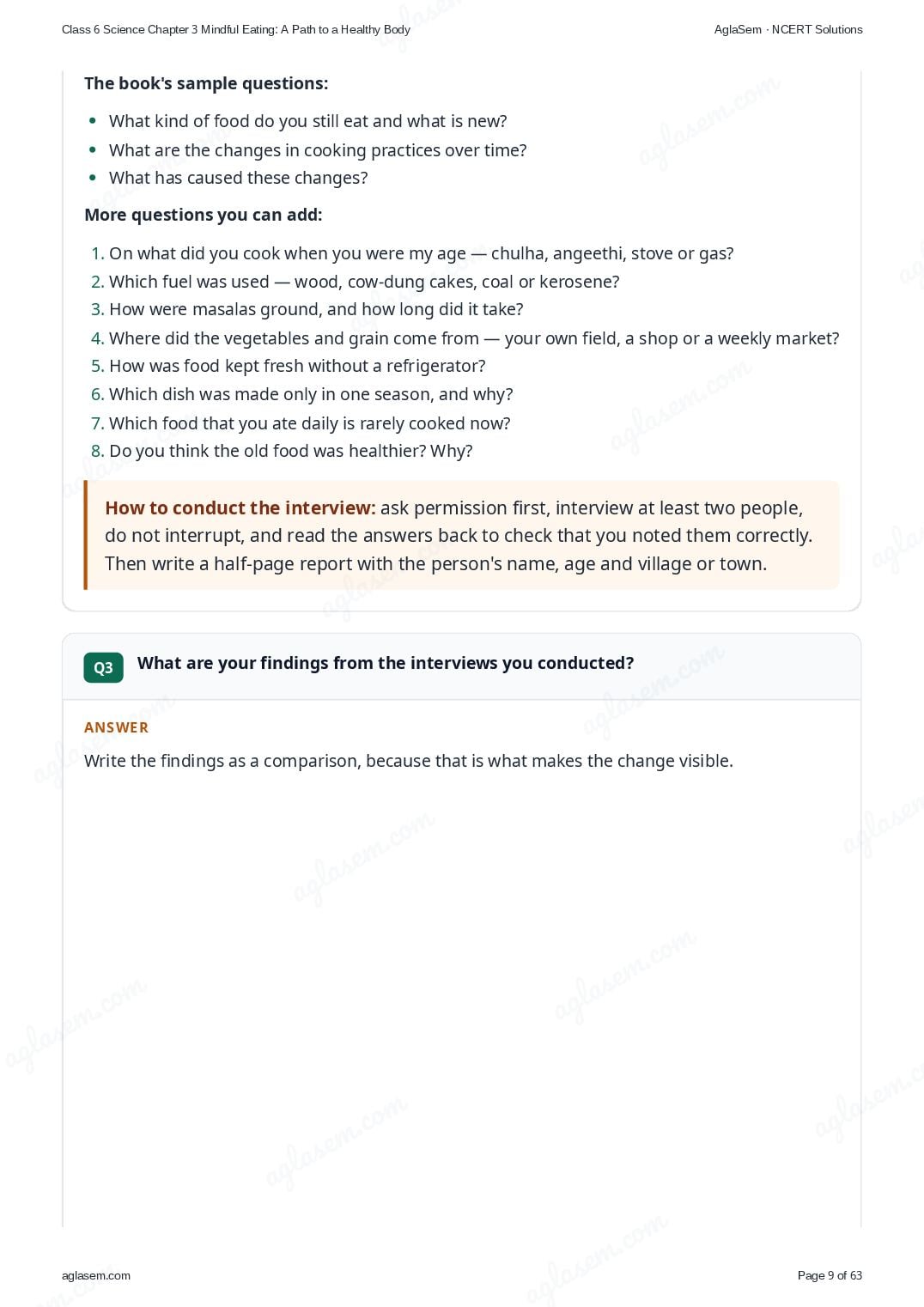
- Prepare a list of questions for gathering information from elderly people about their food habits and cooking practices. Conduct interviews with some elderly people based on the questions prepared.
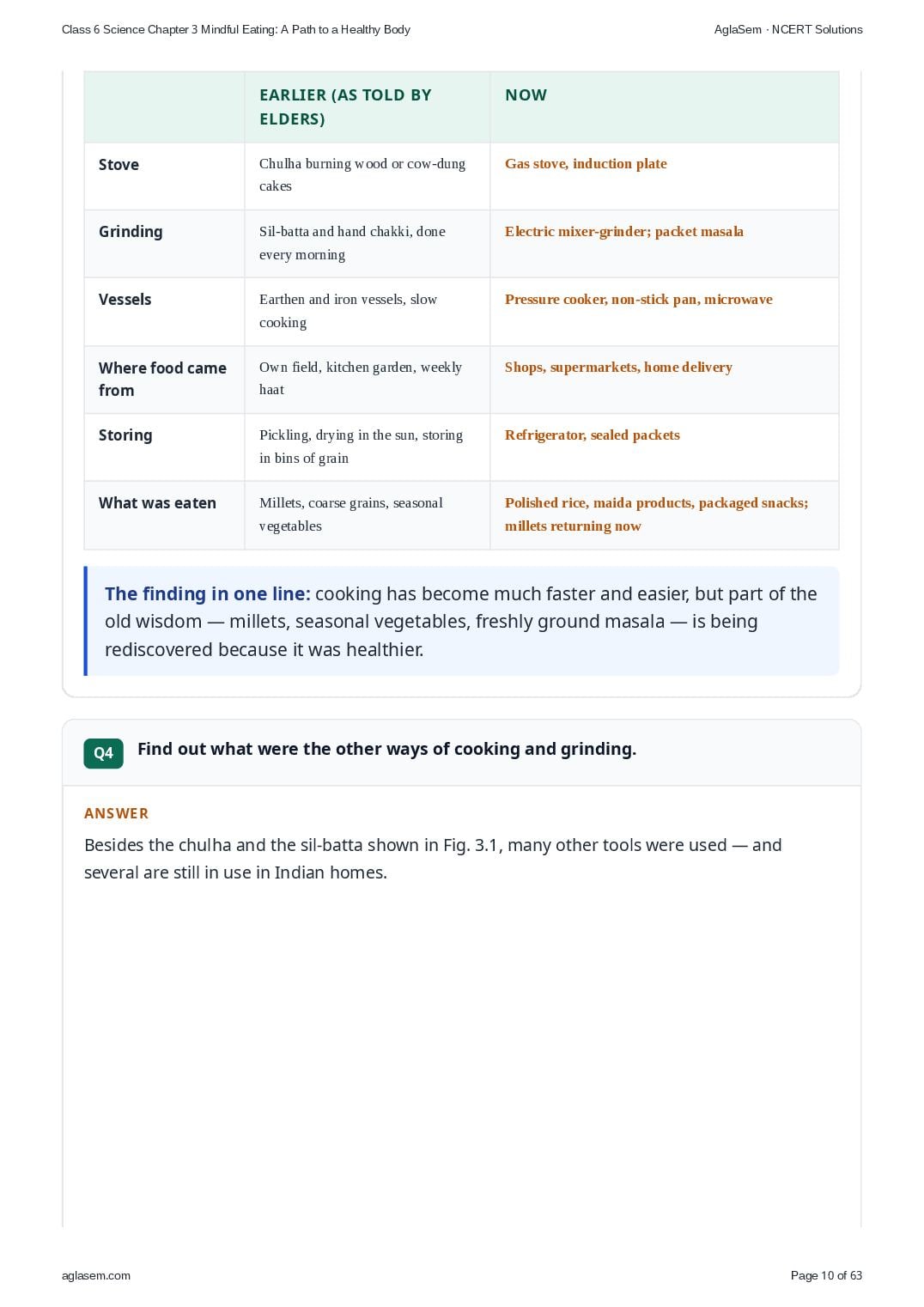
- What are your findings from the interviews you conducted?
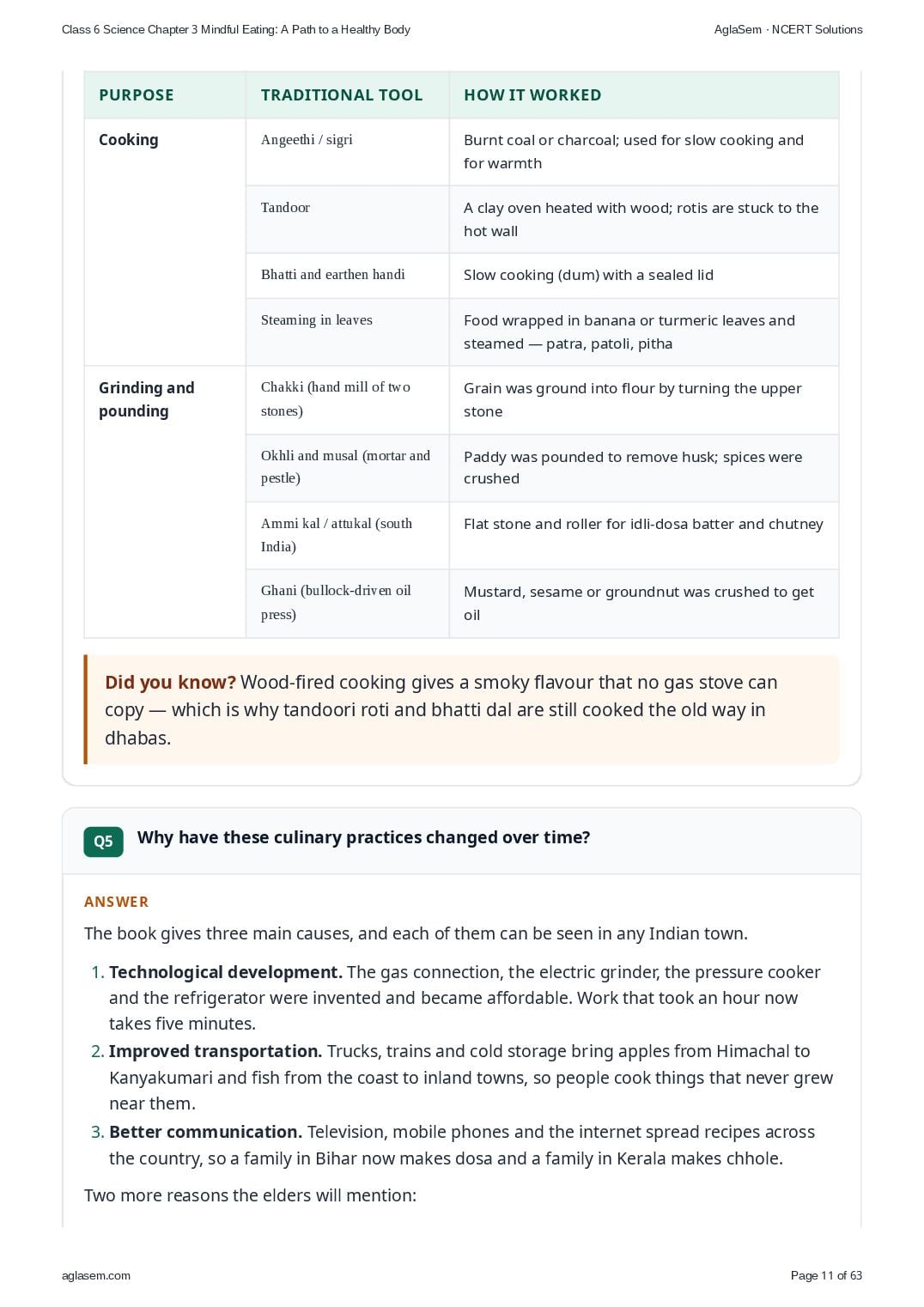
- Find out what were the other ways of cooking and grinding.
- Why have these culinary practices changed over time?
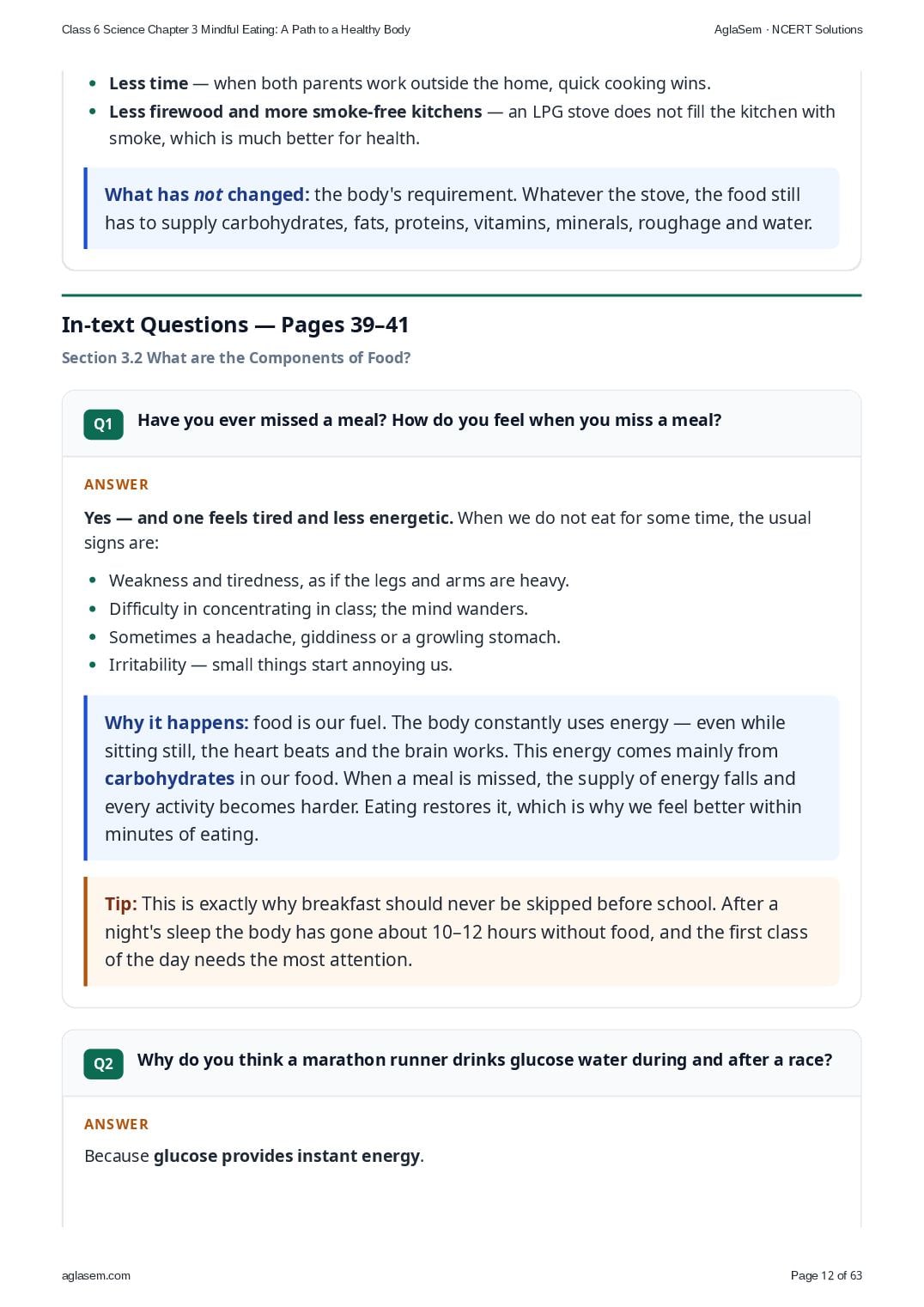
- Have you ever missed a meal? How do you feel when you miss a meal?
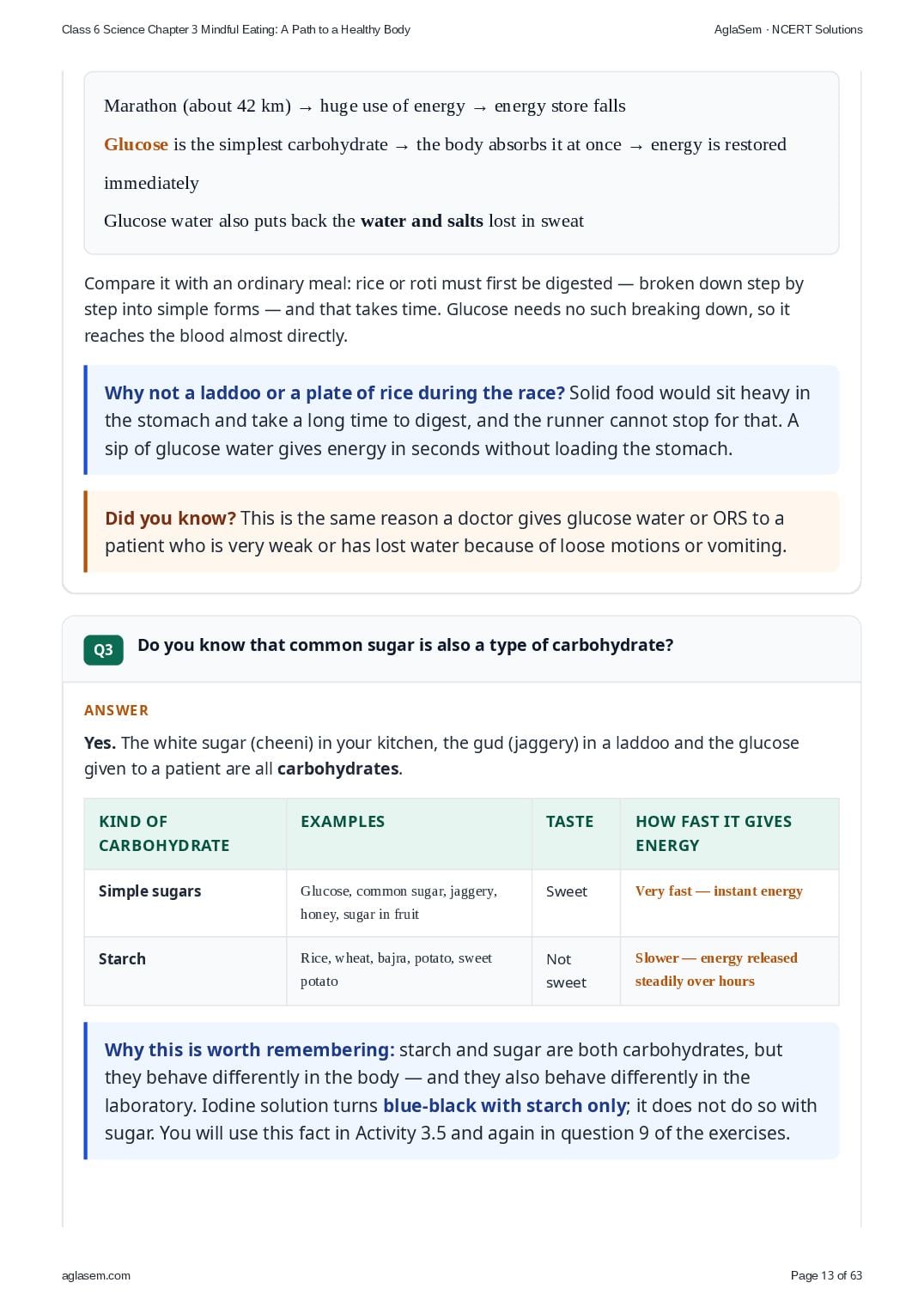
- Why do you think a marathon runner drinks glucose water during and after a race?
- Do you know that common sugar is also a type of carbohydrate?
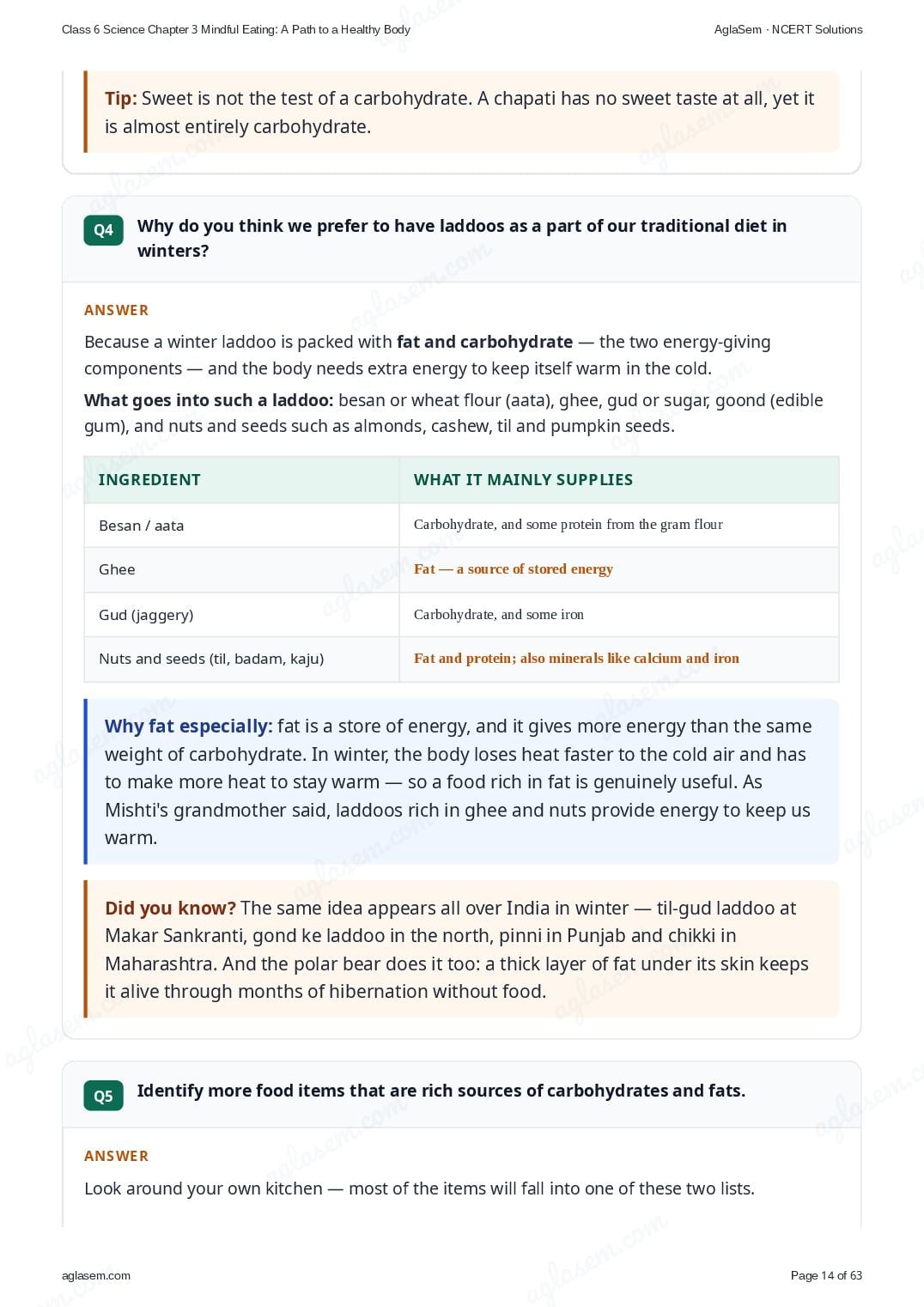
- Why do you think we prefer to have laddoos as a part of our traditional diet in winters?
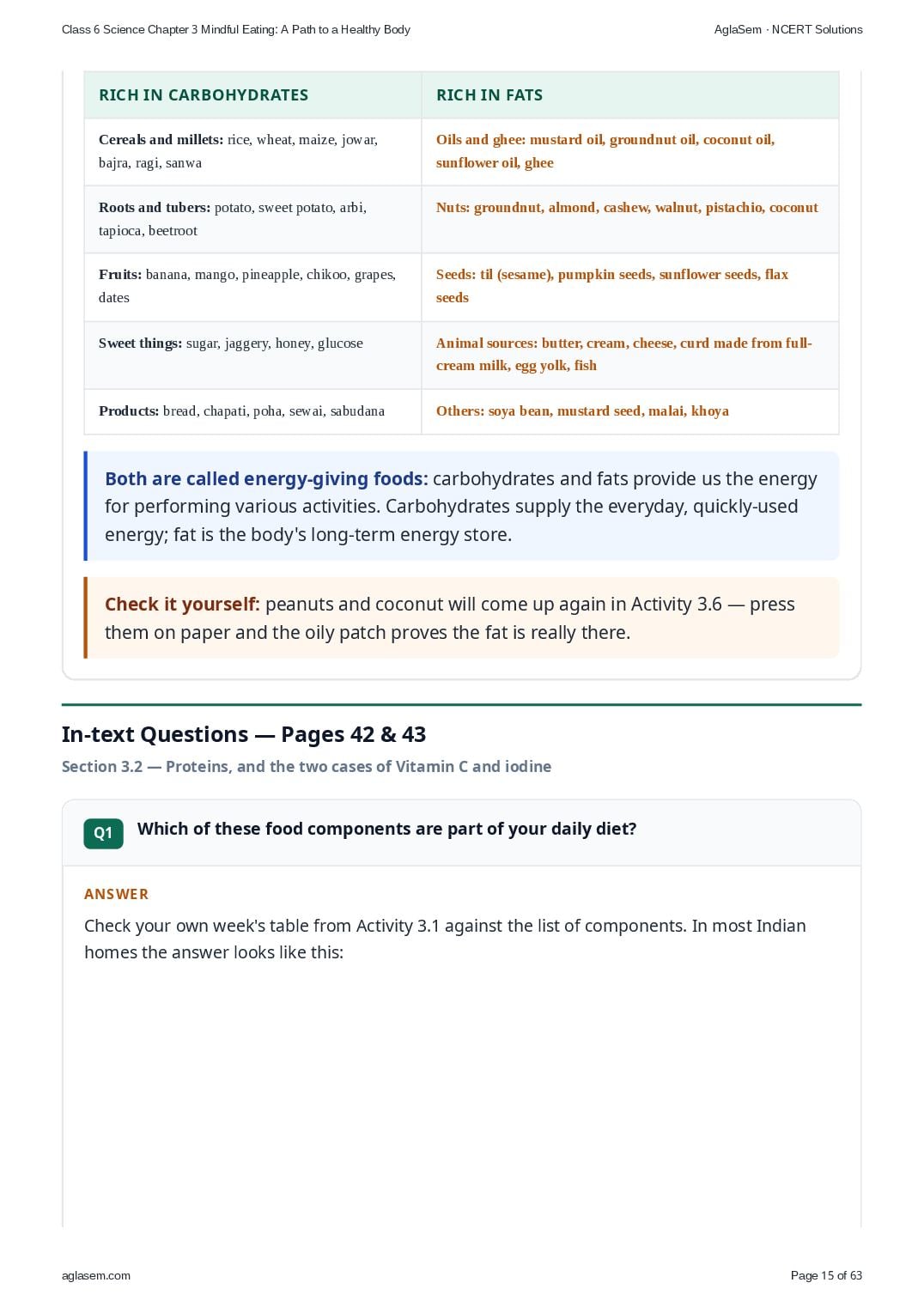
- Identify more food items that are rich sources of carbohydrates and fats.
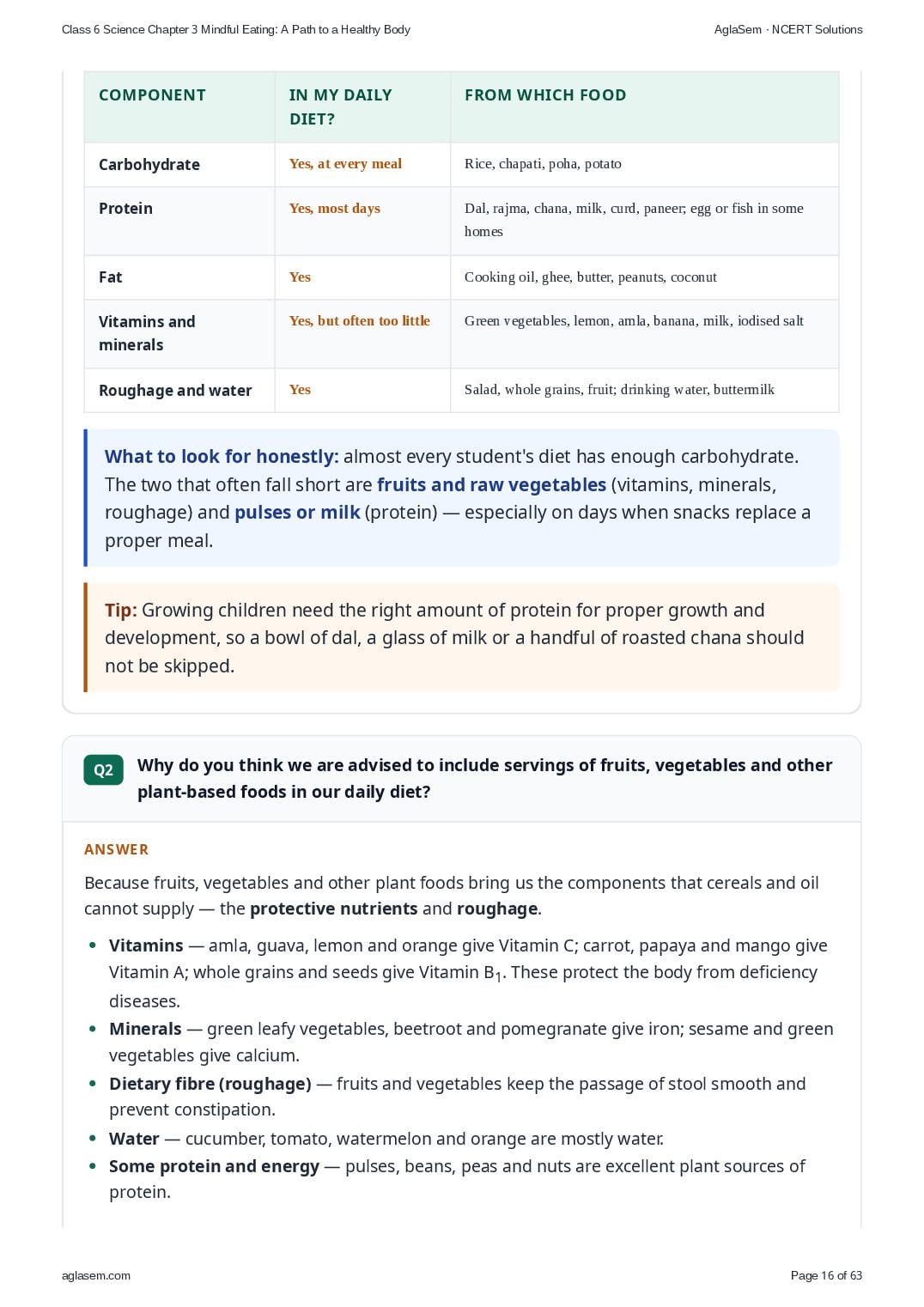
- Which of these food components are part of your daily diet?
- Why do you think we are advised to include servings of fruits, vegetables and other plant-based foods in our daily diet?
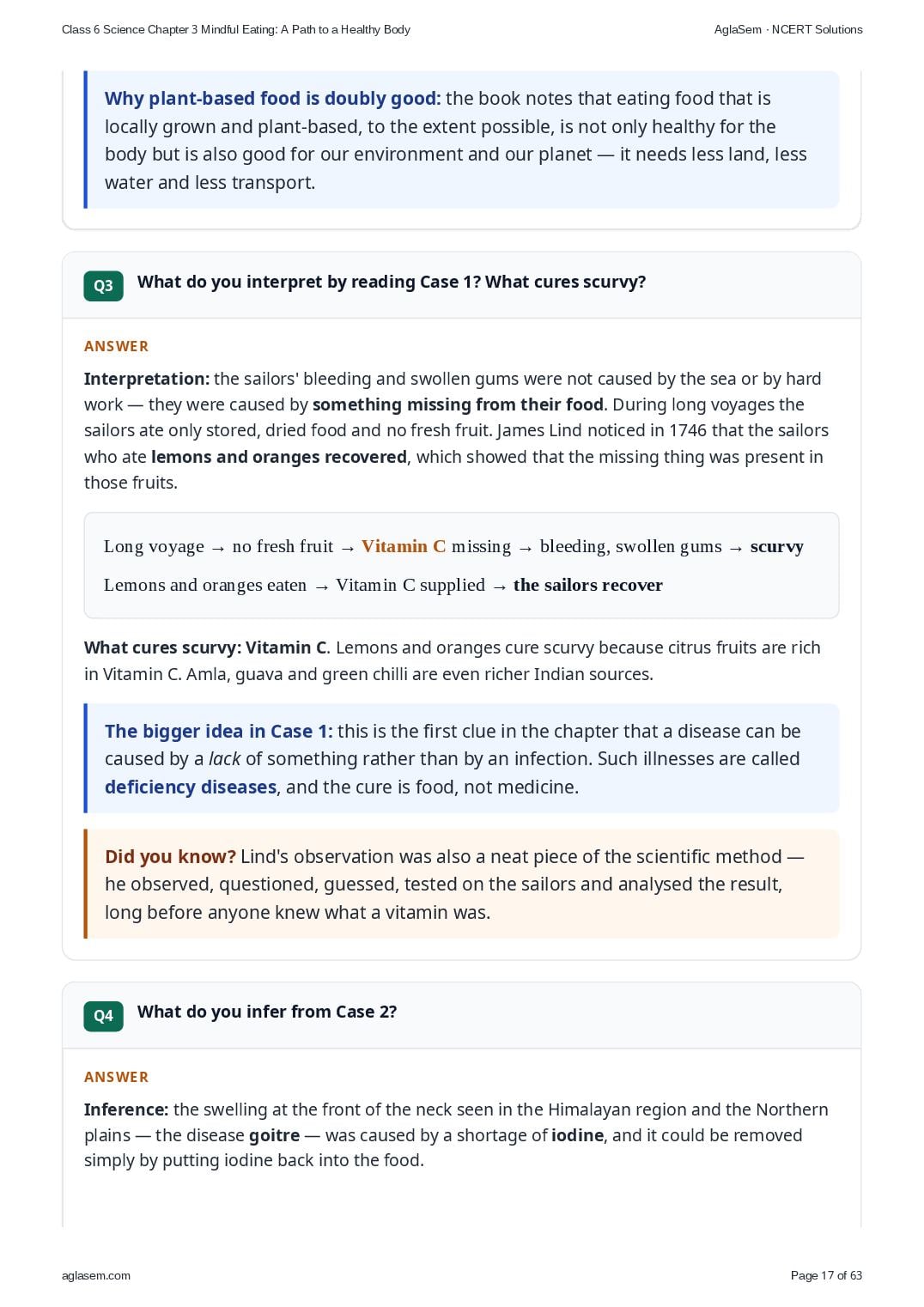
- What do you interpret by reading Case 1? What cures scurvy?
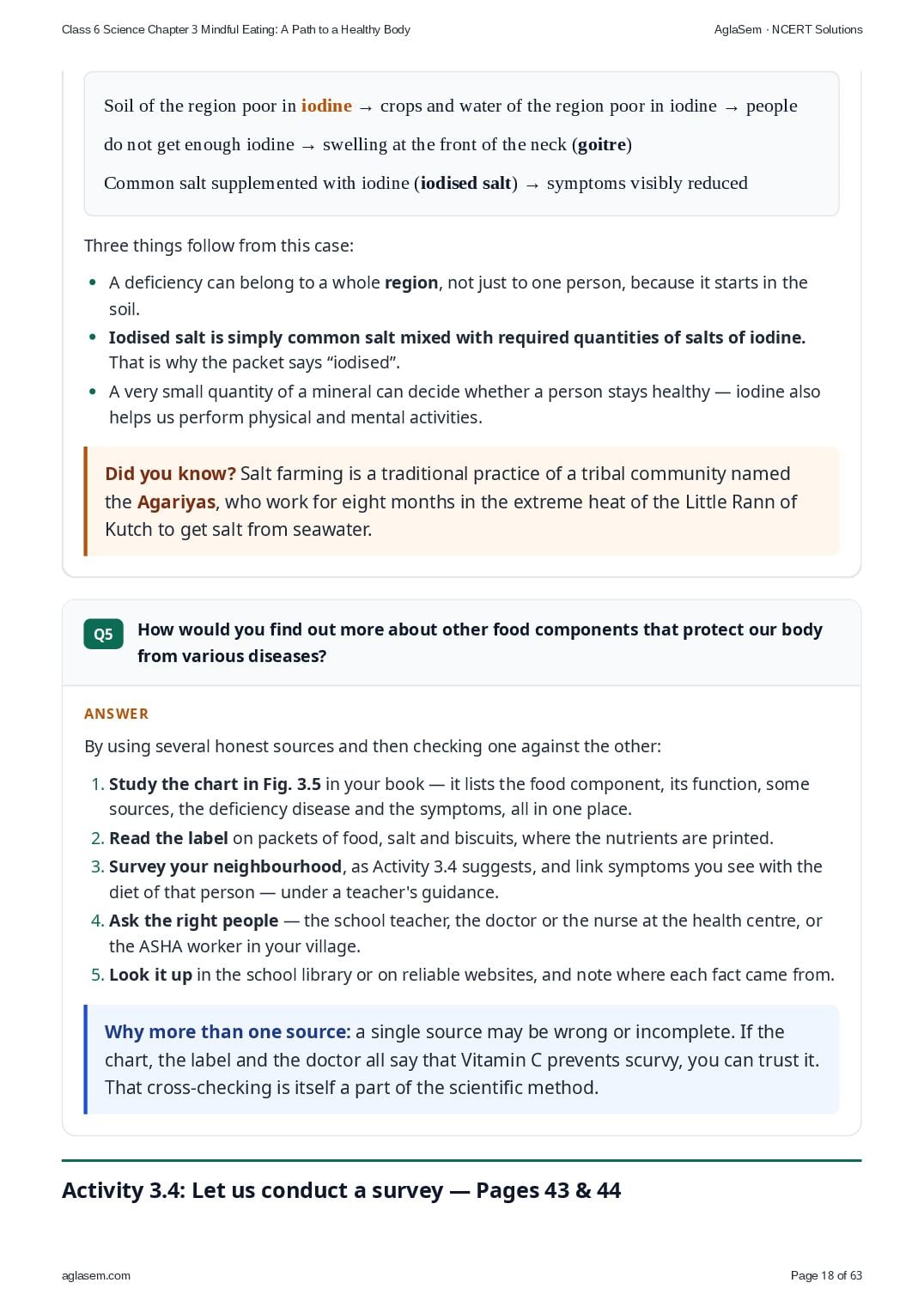
- What do you infer from Case 2?
- How would you find out more about other food components that protect our body from various diseases?
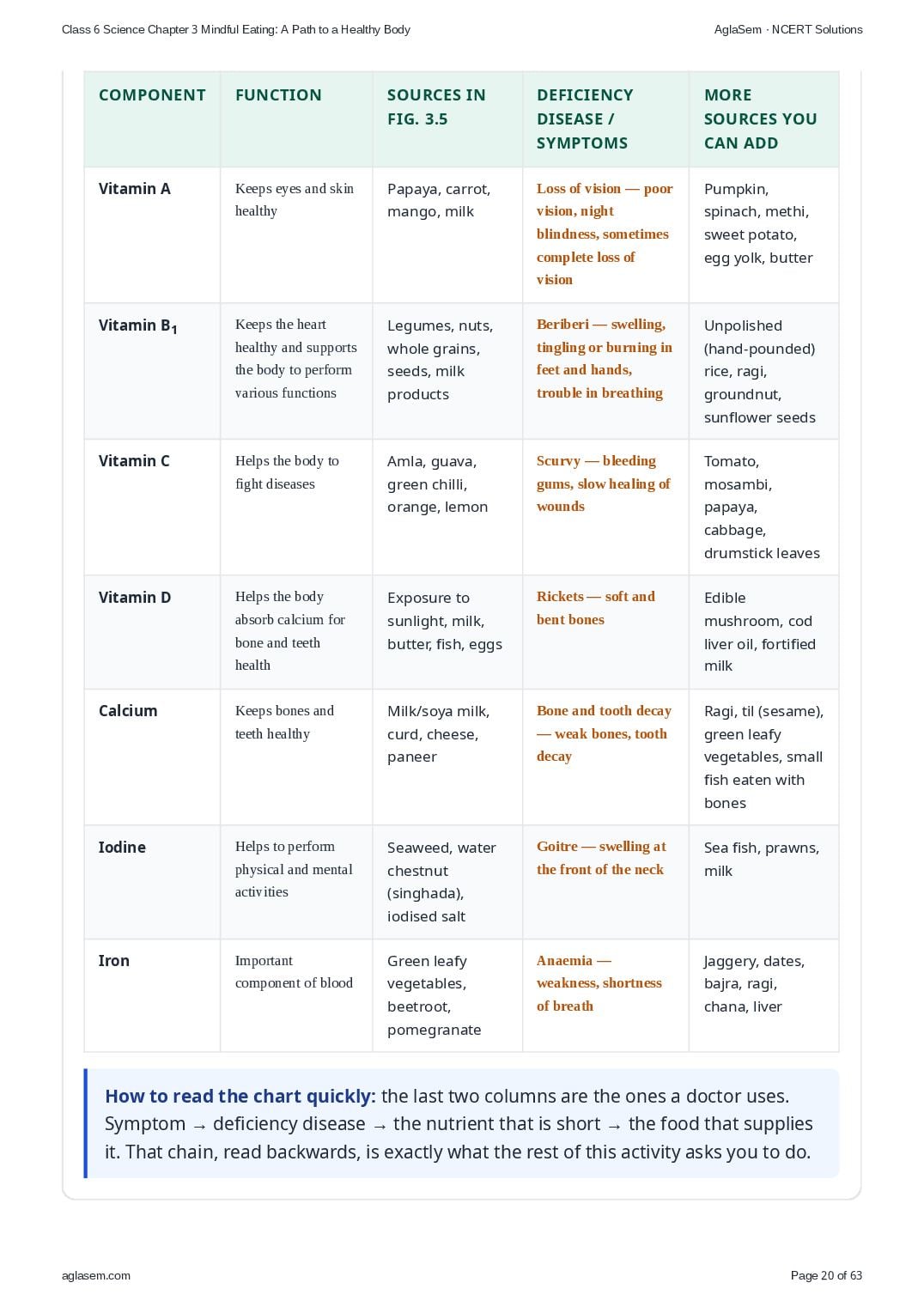
- Study the chart given in Fig. 3.5 to explore the functions and sources of various food components. Find out more sources of vitamins and minerals. Also, understand the symptoms of the diseases caused by the lack of these food components.
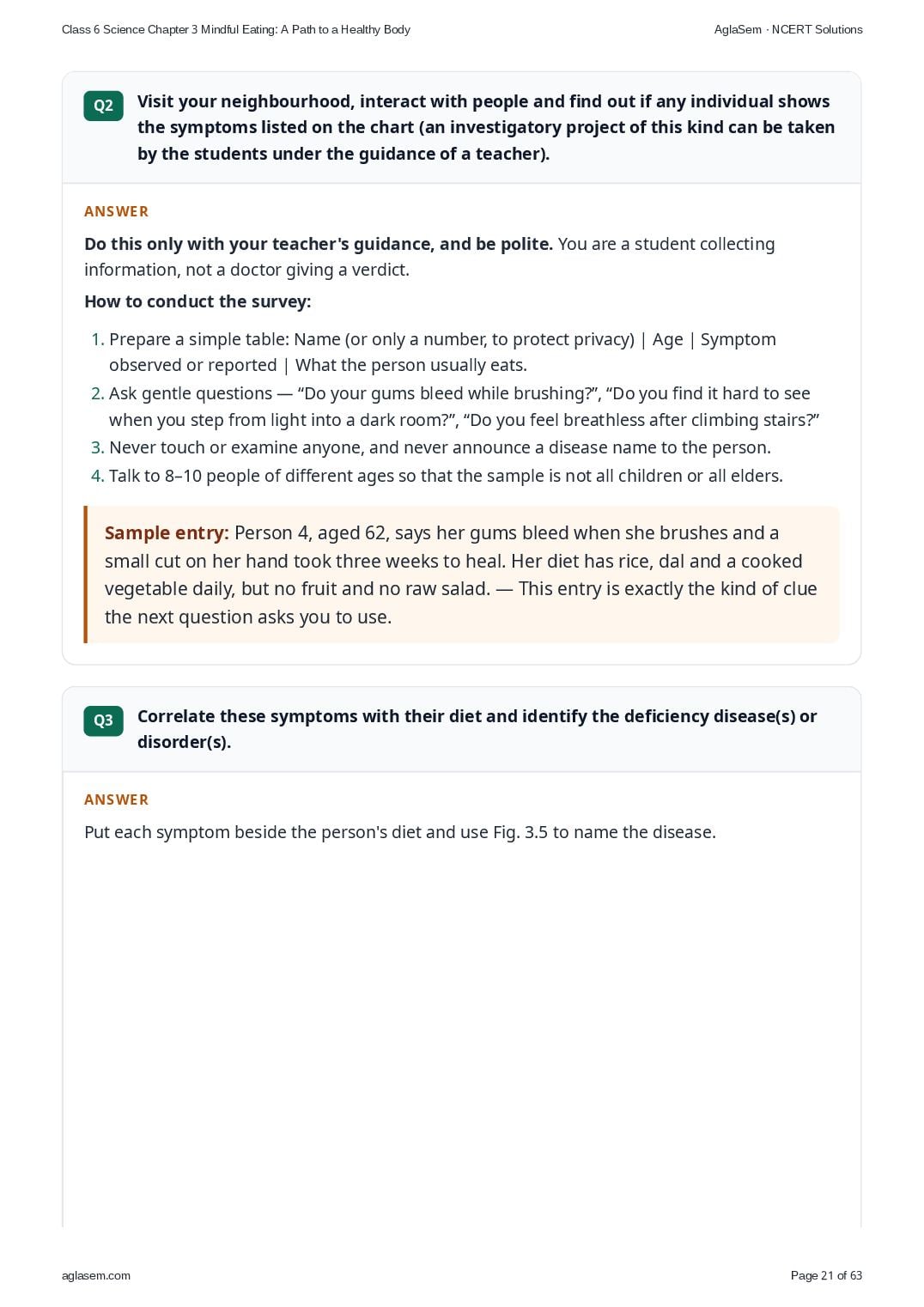
- Visit your neighbourhood, interact with people and find out if any individual shows the symptoms listed on the chart (an investigatory project of this kind can be taken by the students under the guidance of a teacher).
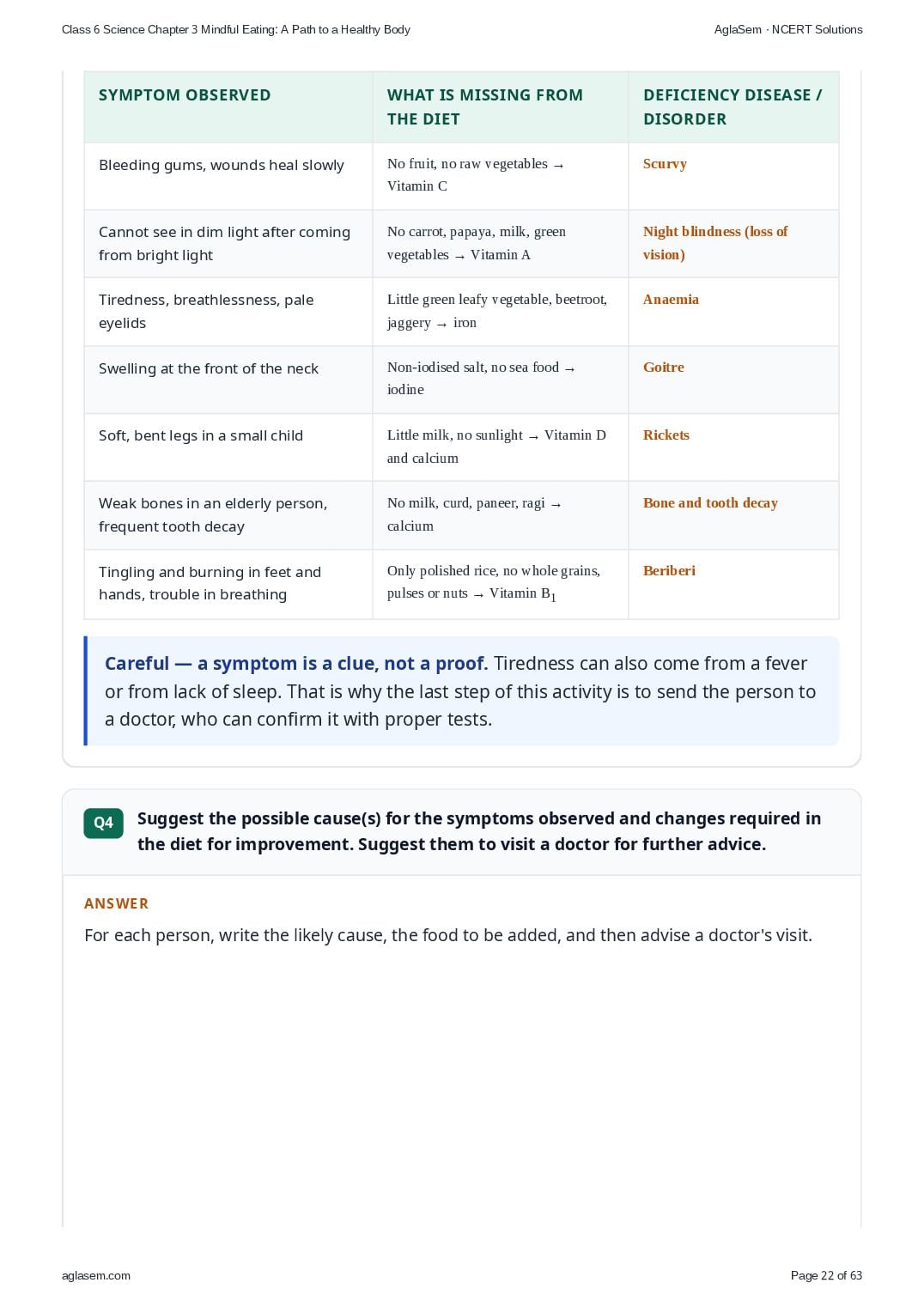
- Correlate these symptoms with their diet and identify the deficiency disease(s) or disorder(s).
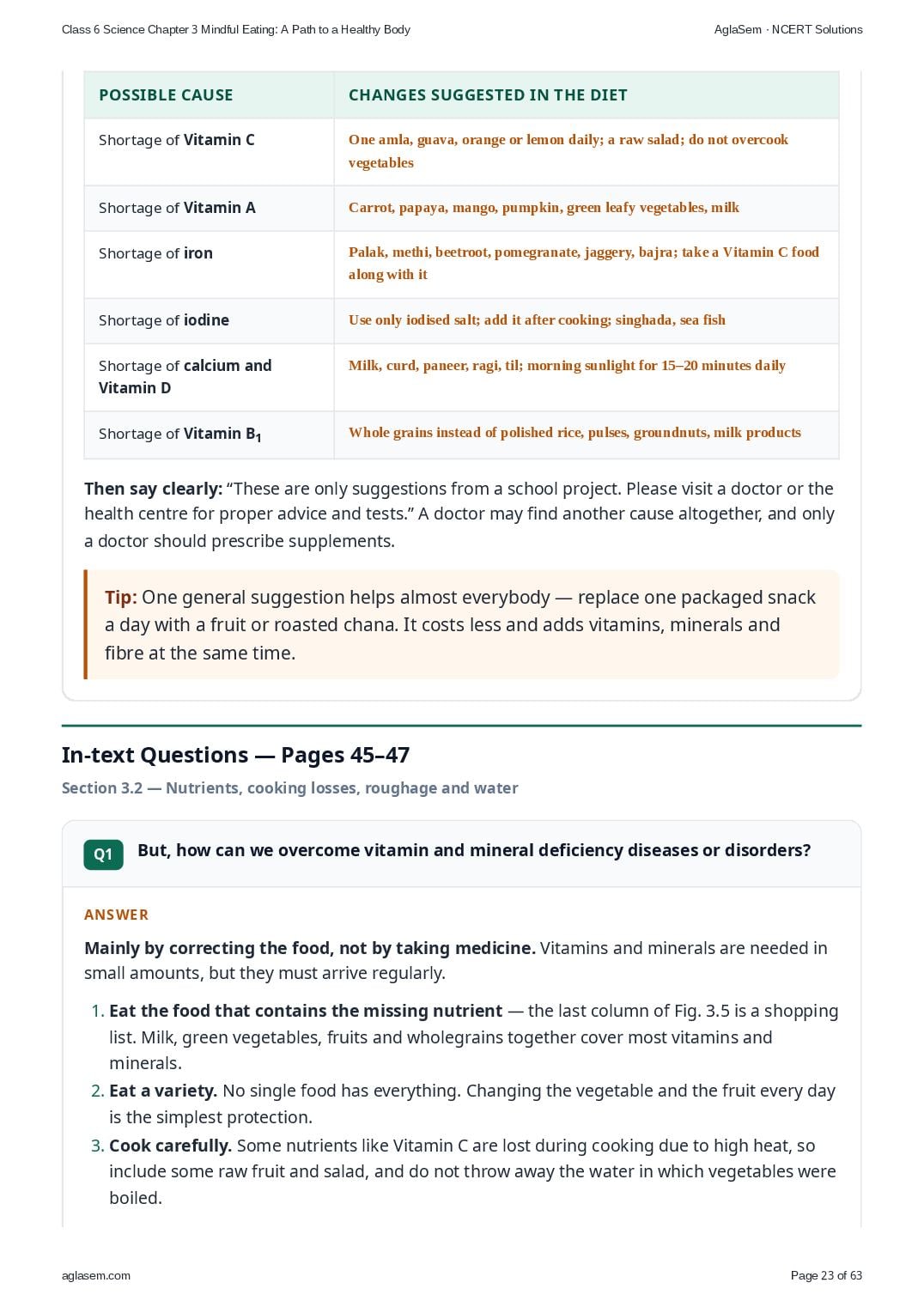
- Suggest the possible cause(s) for the symptoms observed and changes required in the diet for improvement. Suggest them to visit a doctor for further advice.
- But, how can we overcome vitamin and mineral deficiency diseases or disorders?
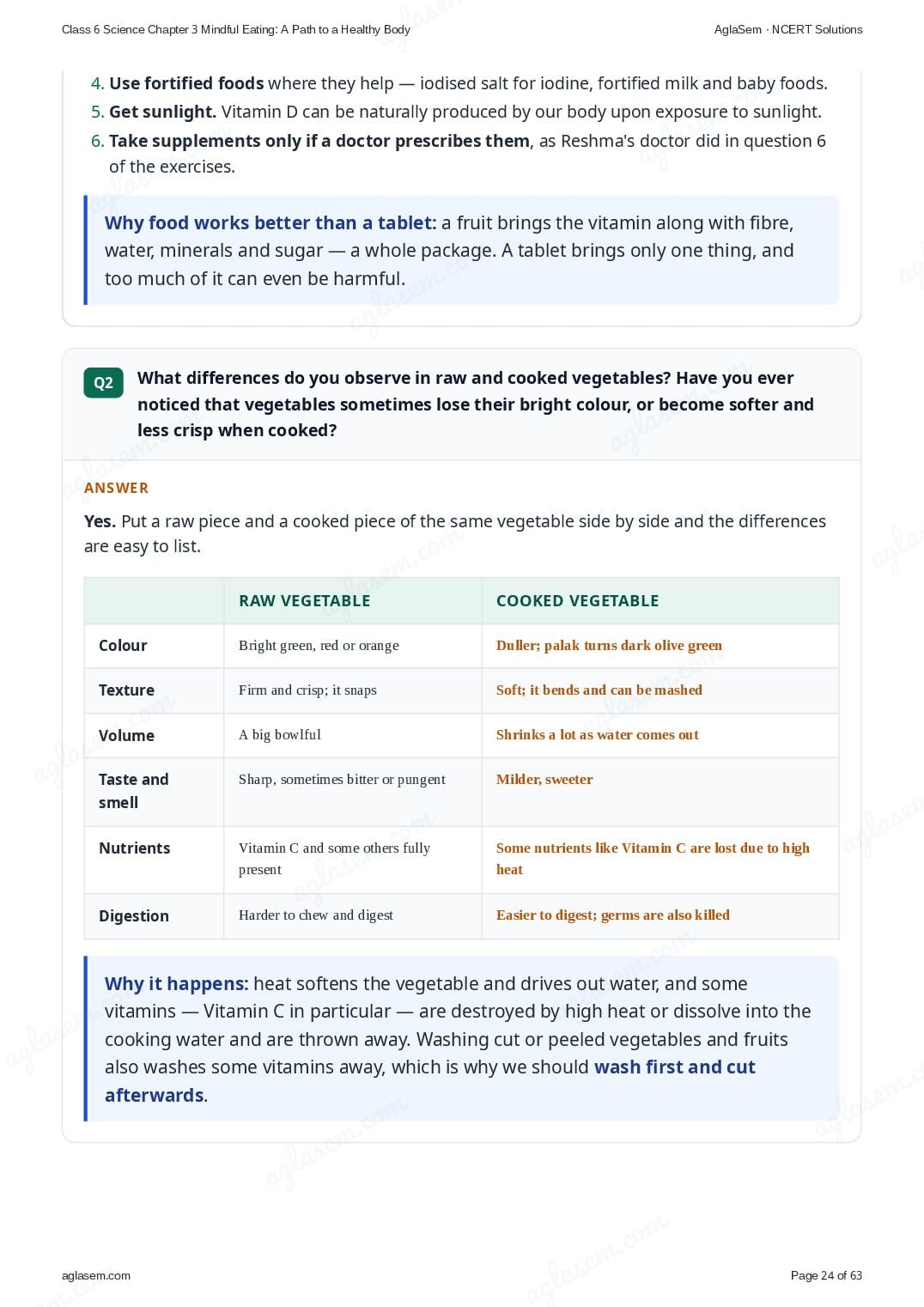
- What differences do you observe in raw and cooked vegetables? Have you ever noticed that vegetables sometimes lose their bright colour, or become softer and less crisp when cooked?
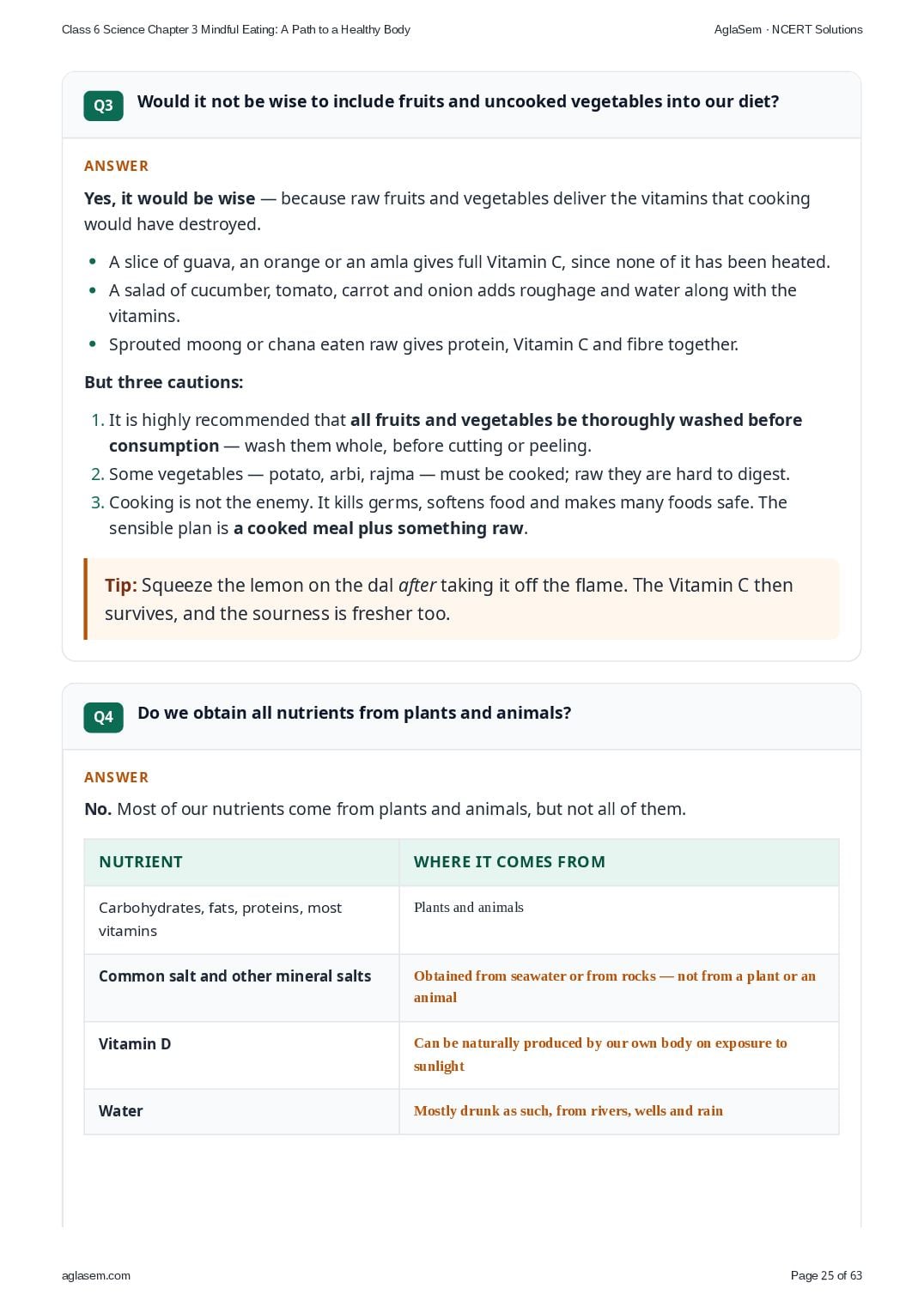
- Would it not be wise to include fruits and uncooked vegetables into our diet?
- Do we obtain all nutrients from plants and animals?
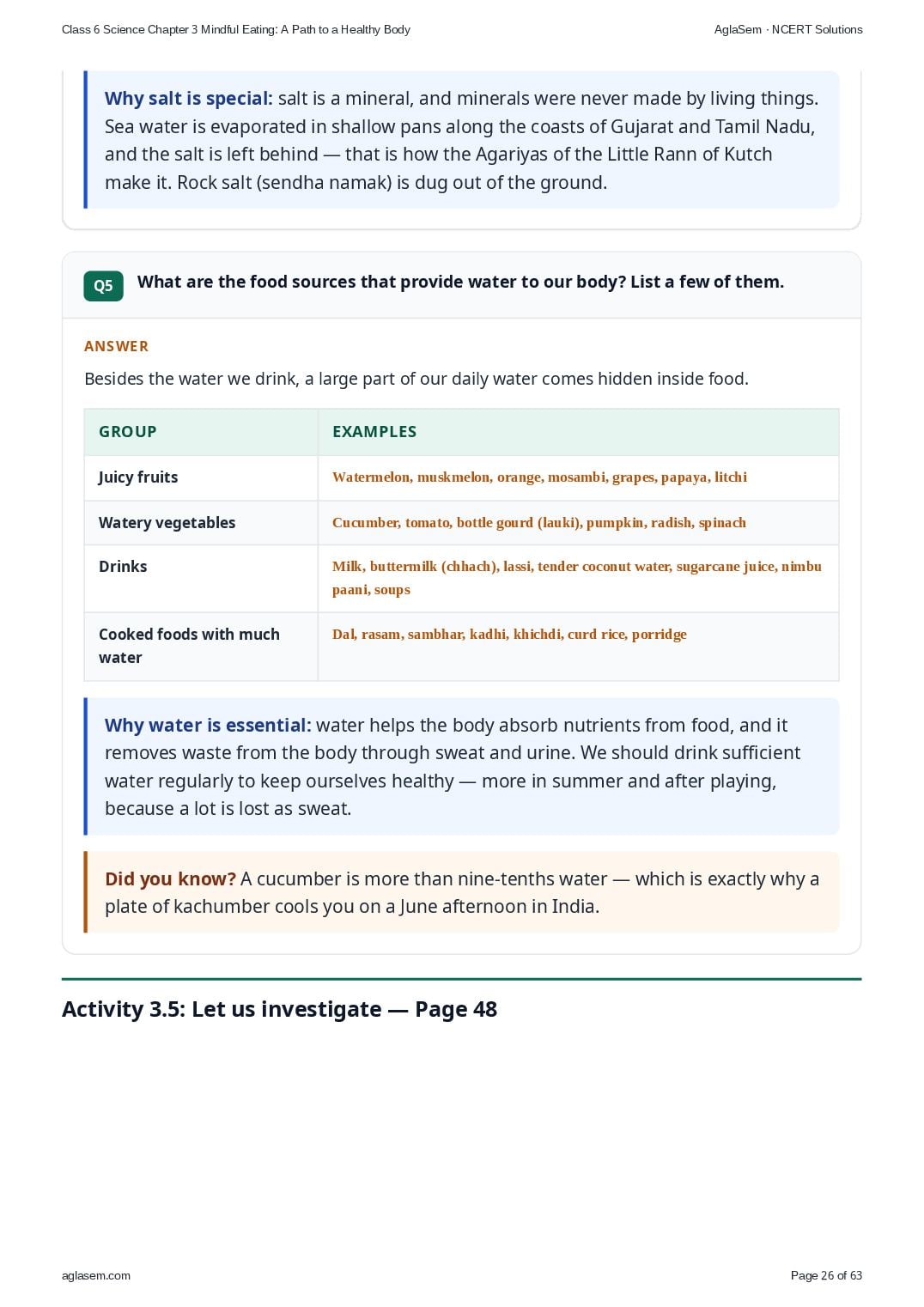
- What are the food sources that provide water to our body? List a few of them.
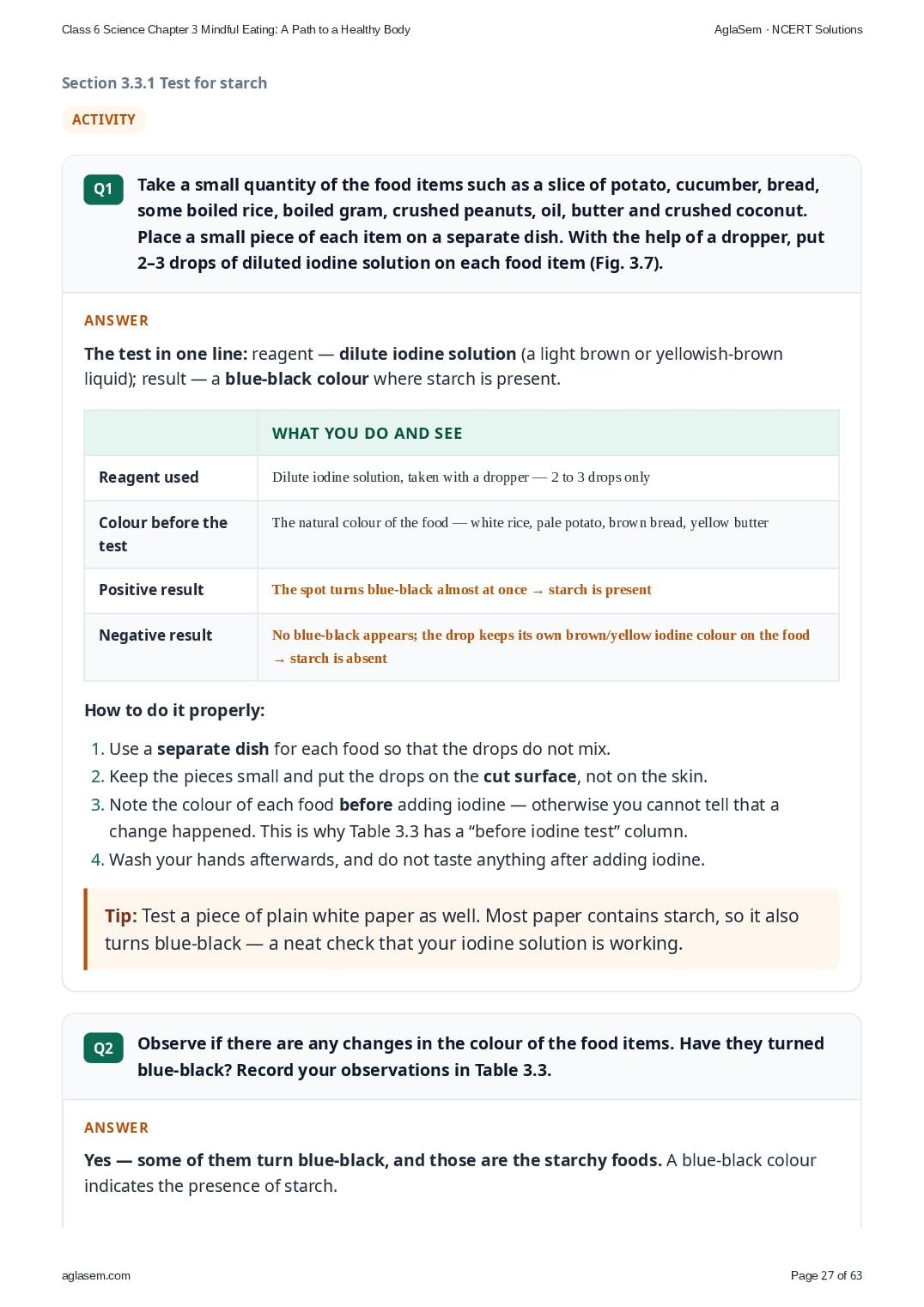
- Take a small quantity of the food items such as a slice of potato, cucumber, bread, some boiled rice, boiled gram, crushed peanuts, oil, butter and crushed coconut. Place a small piece of each item on a separate dish. With the help of a dropper, put 2–3 drops of diluted iodine solution on each food item (Fig. 3.7).
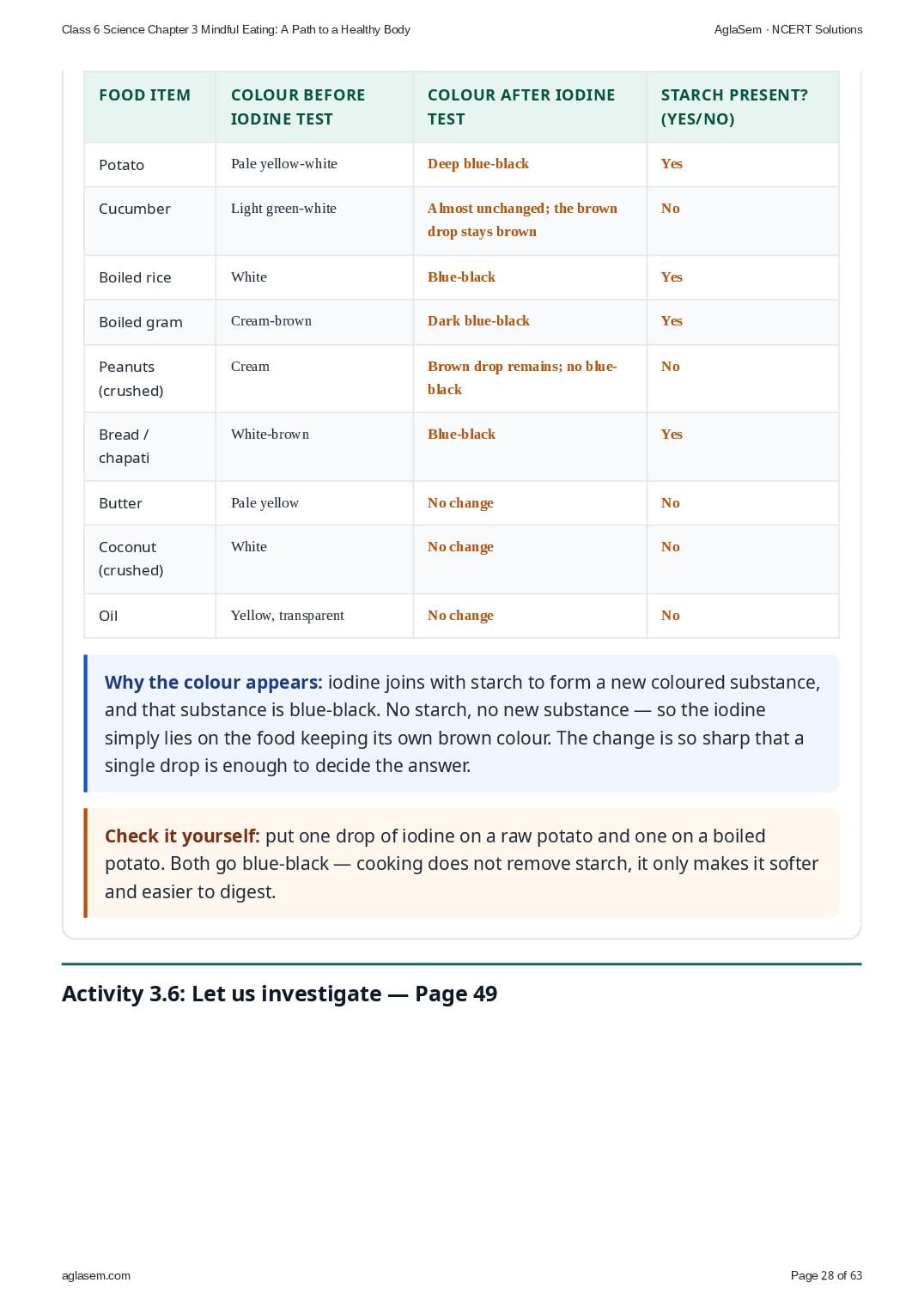
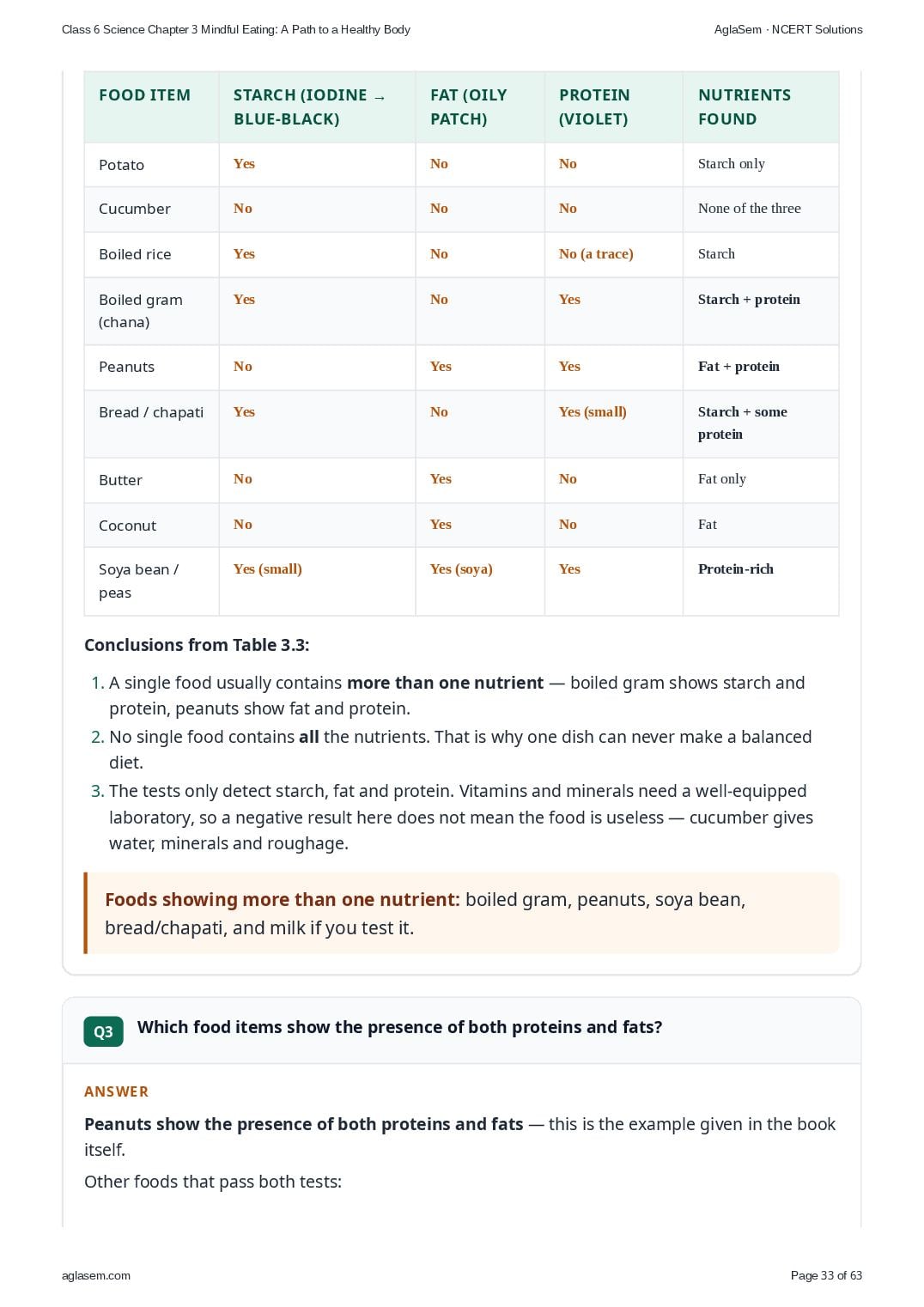
- Observe if there are any changes in the colour of the food items. Have they turned blue-black? Record your observations in Table 3.3.
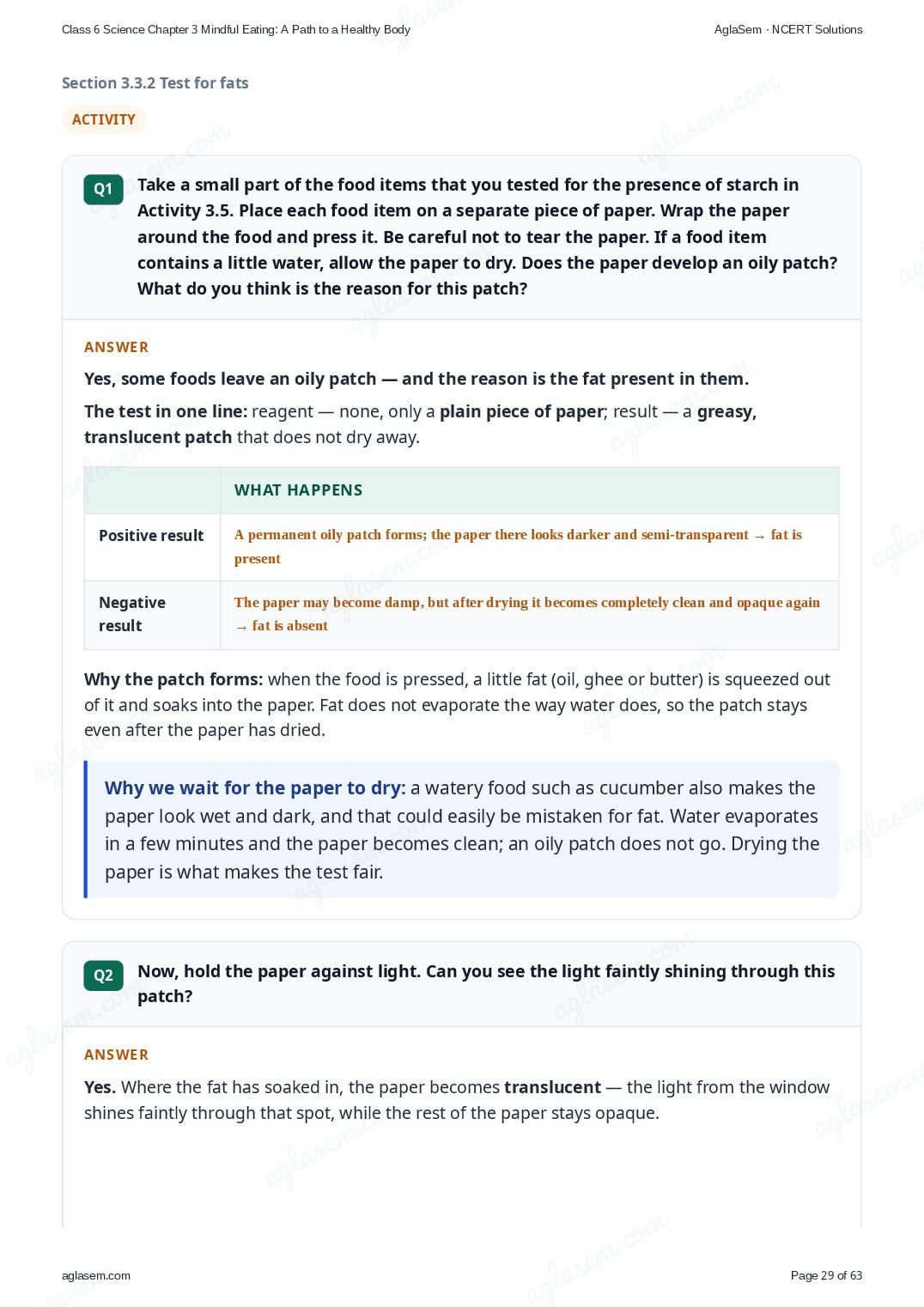
- Take a small part of the food items that you tested for the presence of starch in Activity 3.5. Place each food item on a separate piece of paper. Wrap the paper around the food and press it. Be careful not to tear the paper. If a food item contains a little water, allow the paper to dry. Does the paper develop an oily patch? What do you think is the reason for this patch?
- Now, hold the paper against light. Can you see the light faintly shining through this patch?
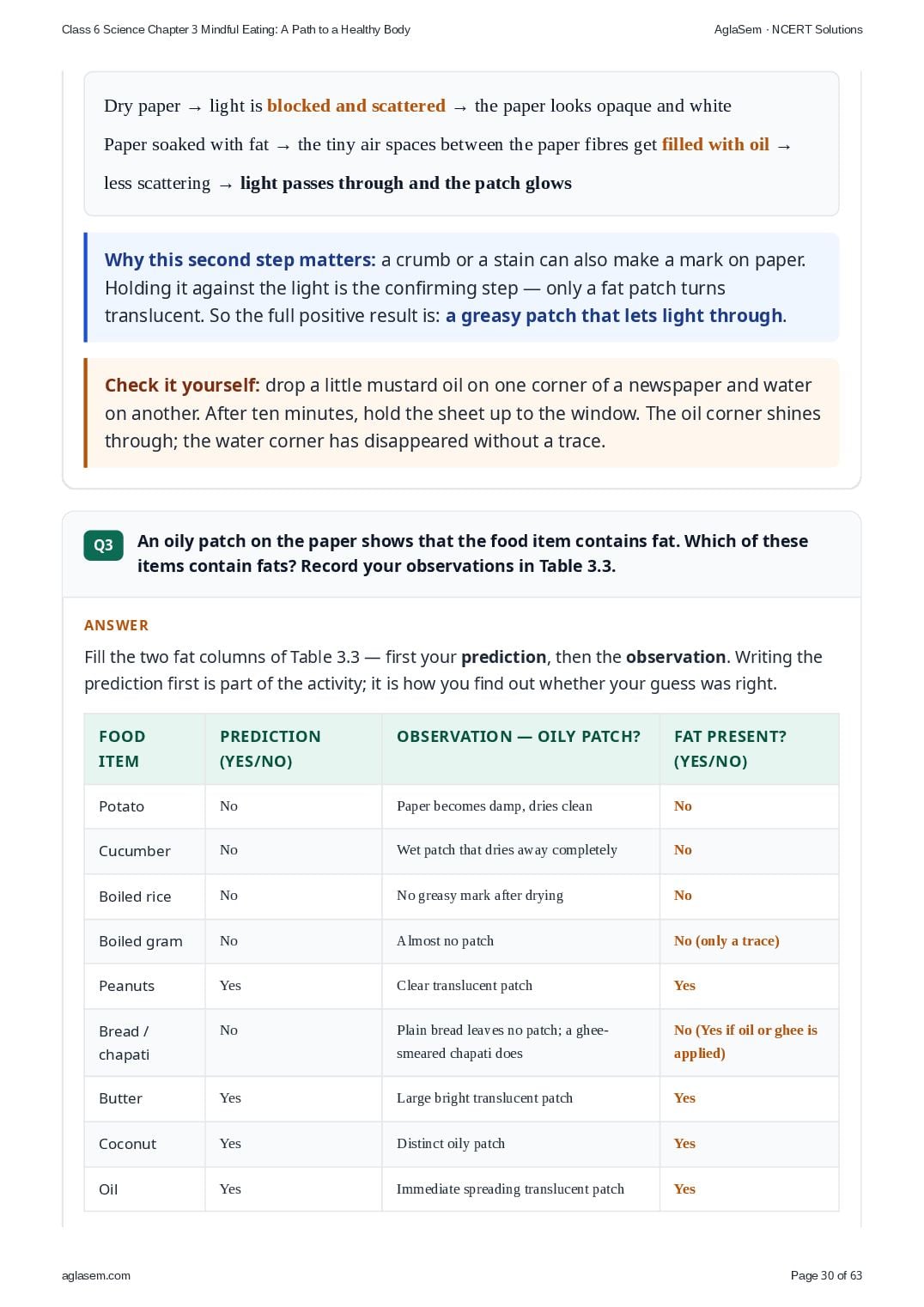
- An oily patch on the paper shows that the food item contains fat. Which of these items contain fats? Record your observations in Table 3.3.
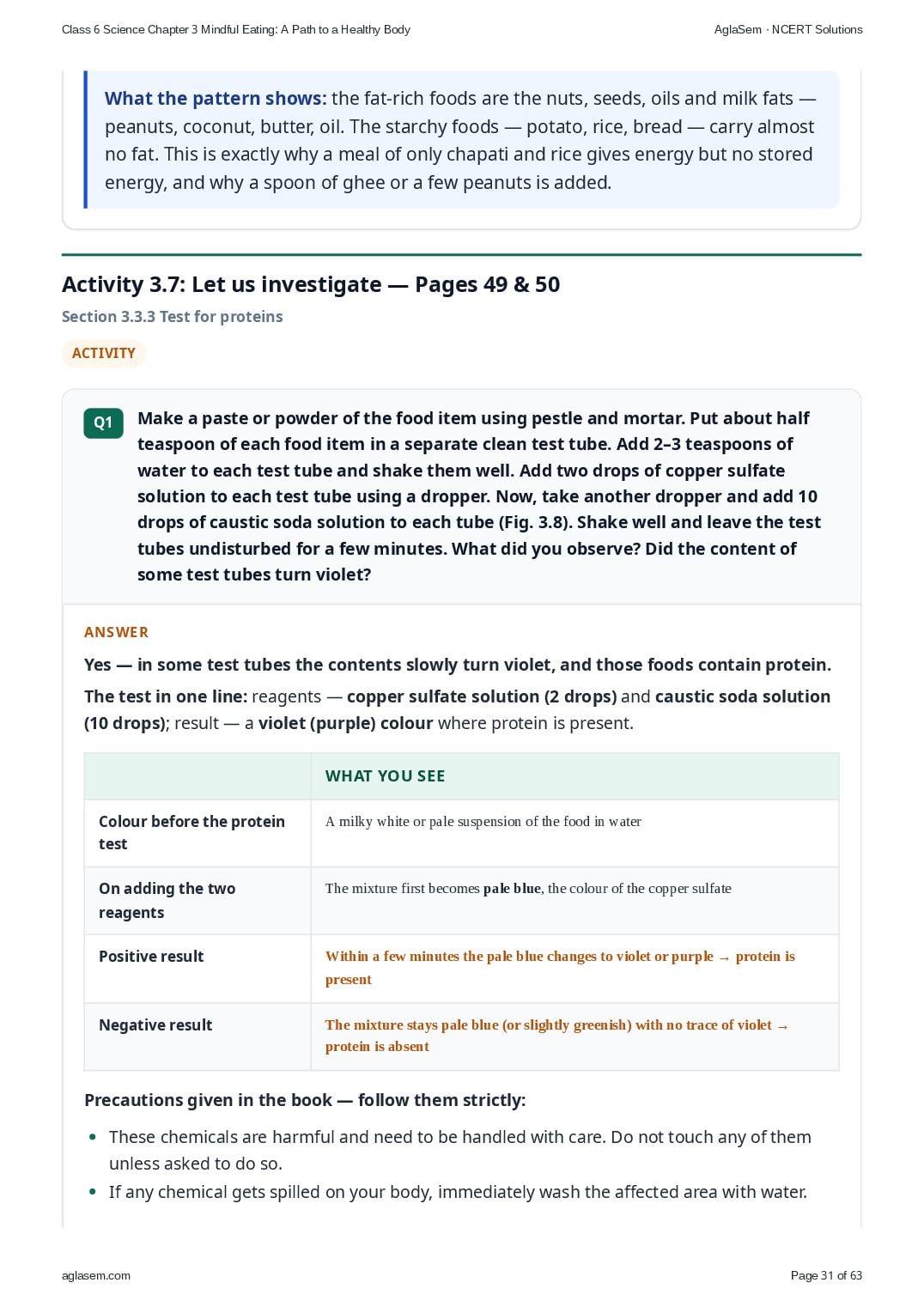
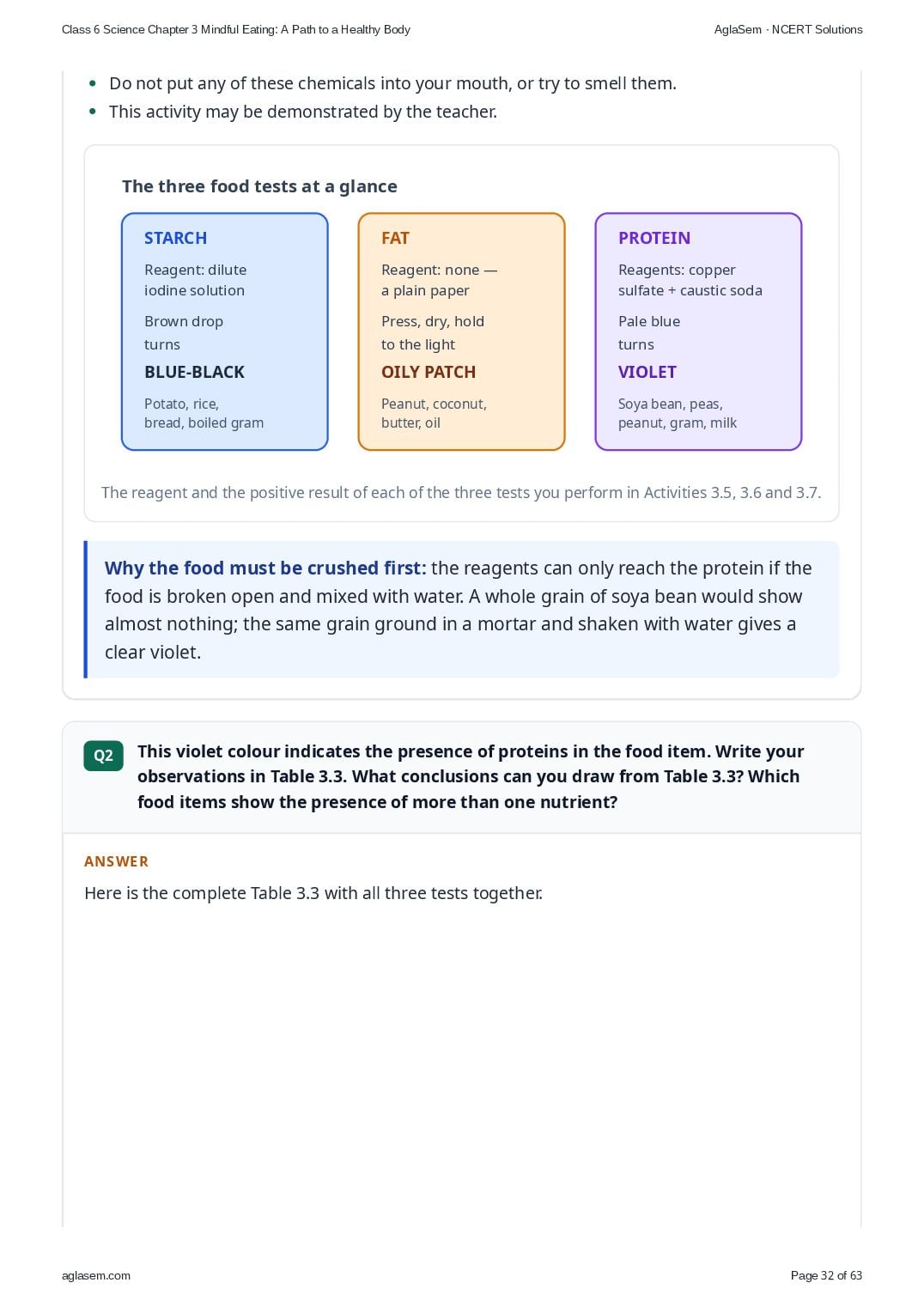
- Make a paste or powder of the food item using pestle and mortar. Put about half teaspoon of each food item in a separate clean test tube. Add 2–3 teaspoons of water to each test tube and shake them well. Add two drops of copper sulfate solution to each test tube using a dropper. Now, take another dropper and add 10 drops of caustic soda solution to each tube (Fig. 3.8). Shake well and leave the test tubes undisturbed for a few minutes. What did you observe? Did the content of some test tubes turn violet?
- This violet colour indicates the presence of proteins in the food item. Write your observations in Table 3.3. What conclusions can you draw from Table 3.3? Which food items show the presence of more than one nutrient?
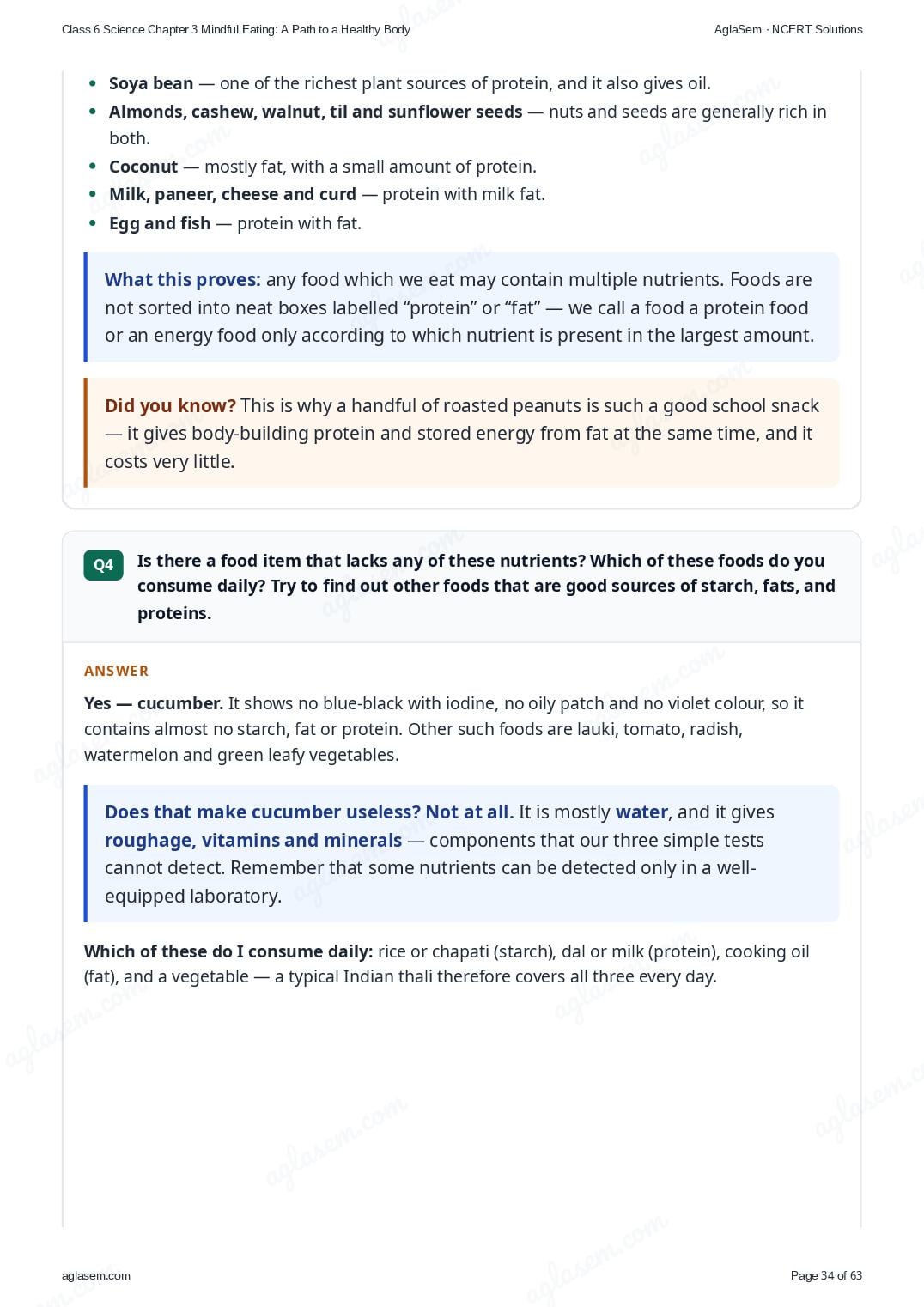
- Which food items show the presence of both proteins and fats?
- Is there a food item that lacks any of these nutrients? Which of these foods do you consume daily? Try to find out other foods that are good sources of starch, fats, and proteins.
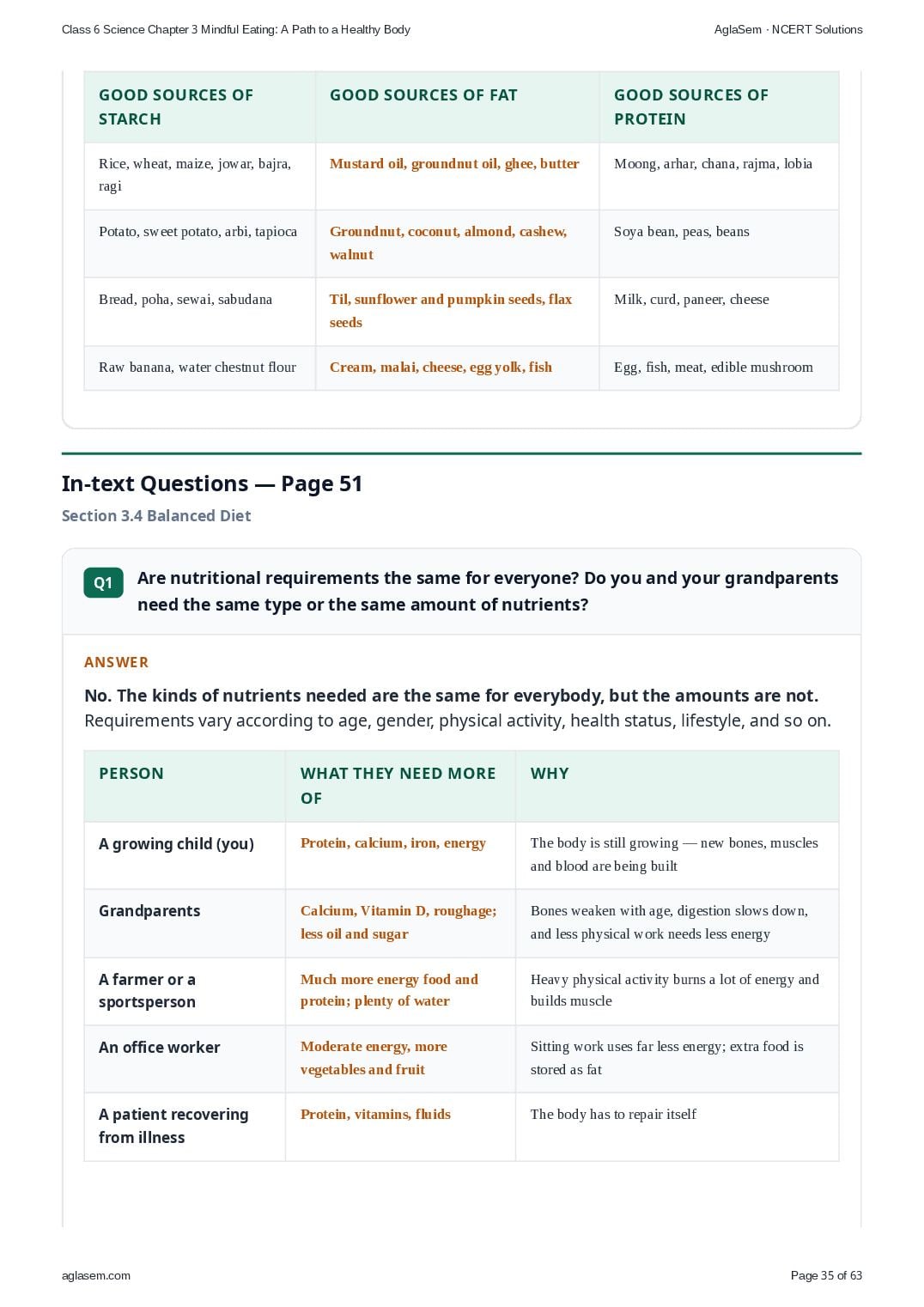
- Are nutritional requirements the same for everyone? Do you and your grandparents need the same type or the same amount of nutrients?
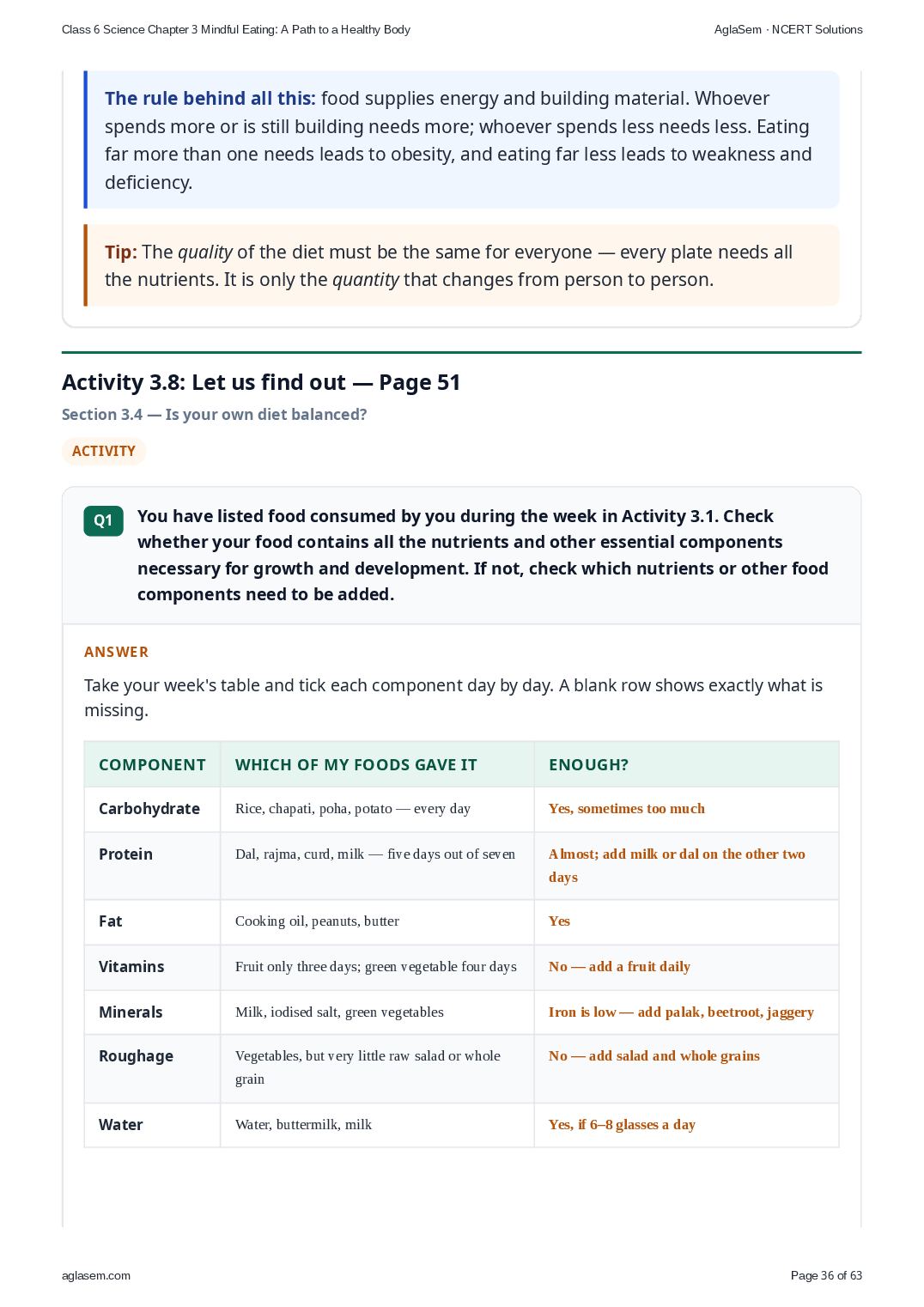
- You have listed food consumed by you during the week in Activity 3.1. Check whether your food contains all the nutrients and other essential components necessary for growth and development. If not, check which nutrients or other food components need to be added.
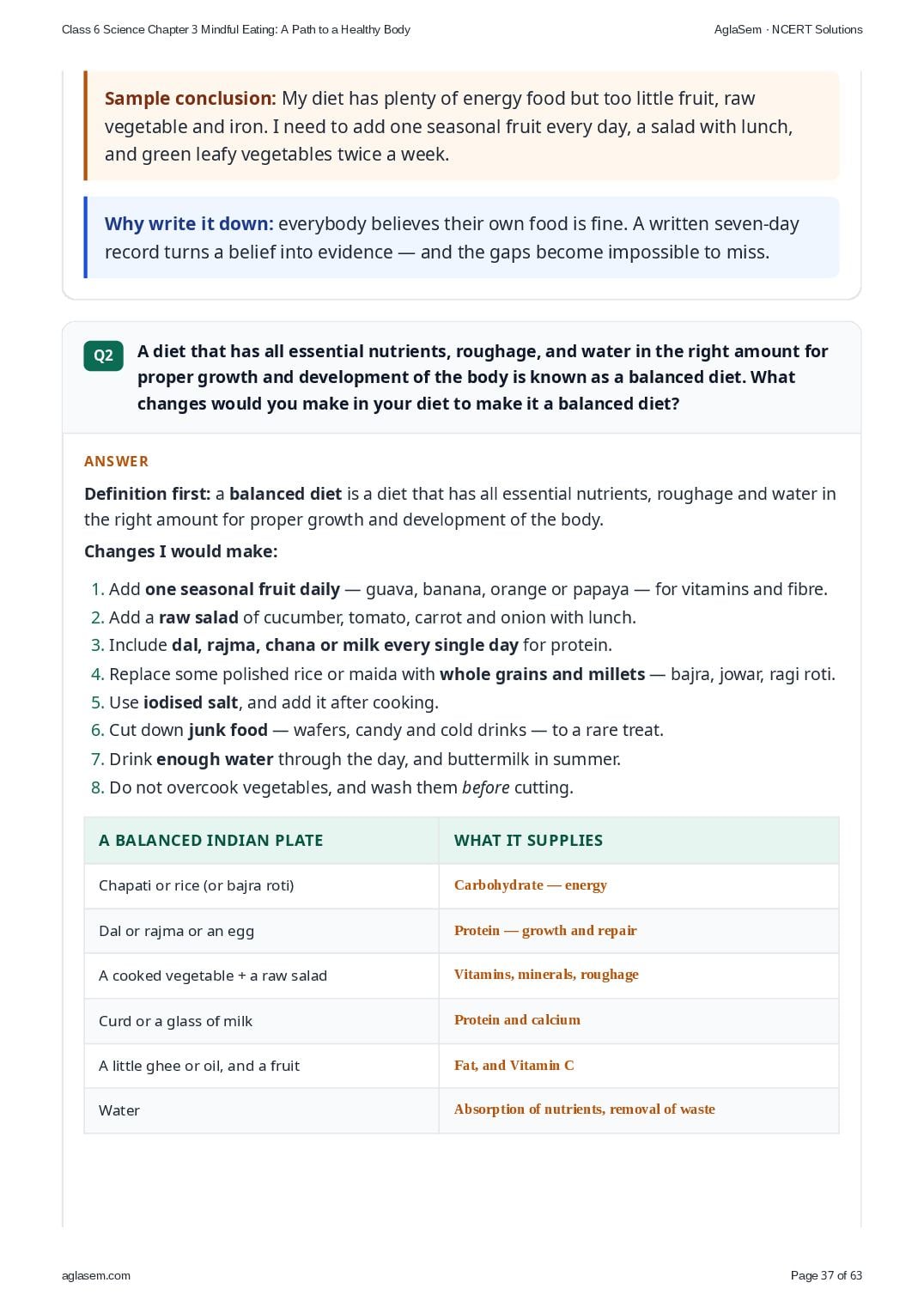
- A diet that has all essential nutrients, roughage, and water in the right amount for proper growth and development of the body is known as a balanced diet. What changes would you make in your diet to make it a balanced diet?
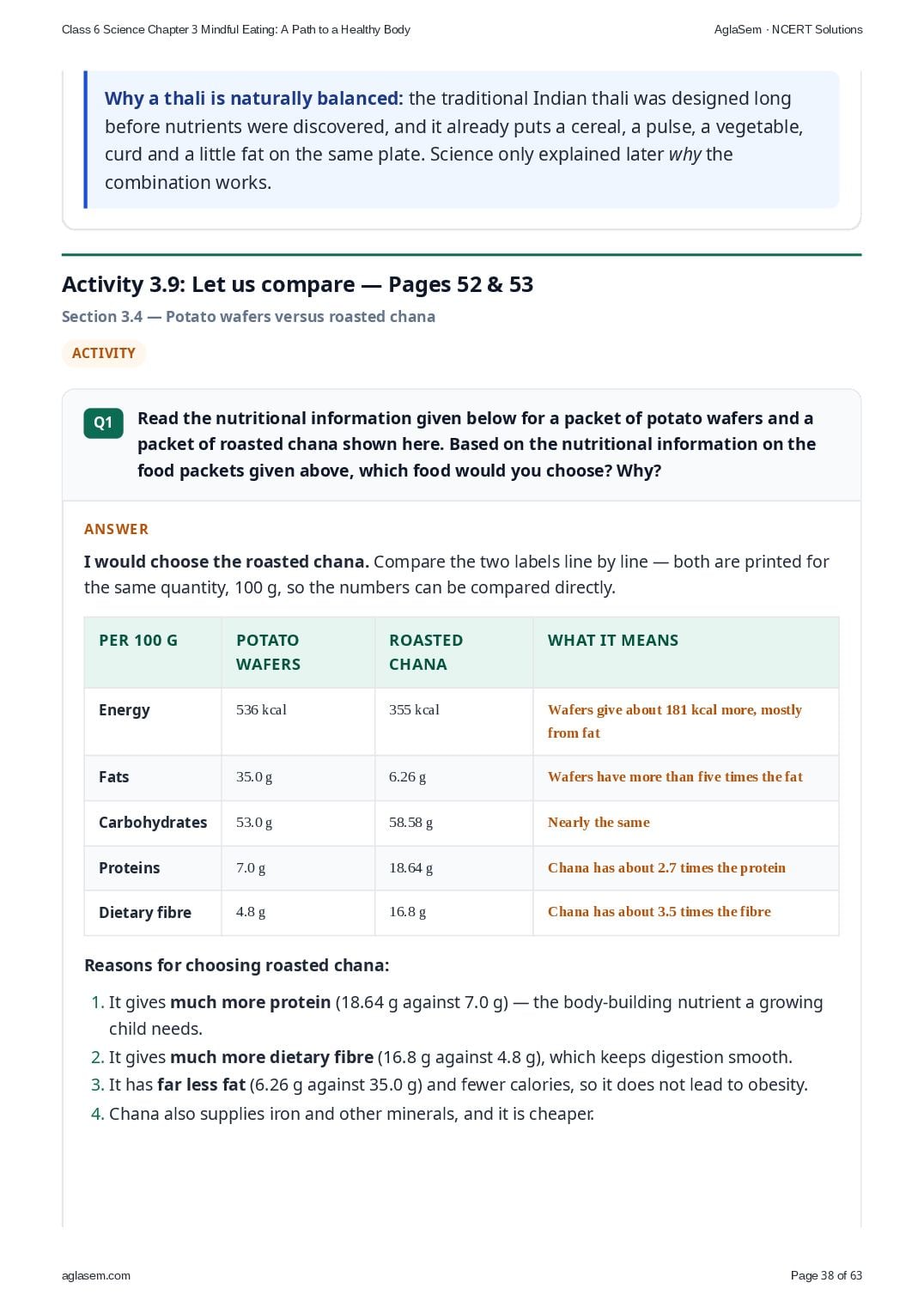
- Read the nutritional information given below for a packet of potato wafers and a packet of roasted chana shown here. Based on the nutritional information on the food packets given above, which food would you choose? Why?
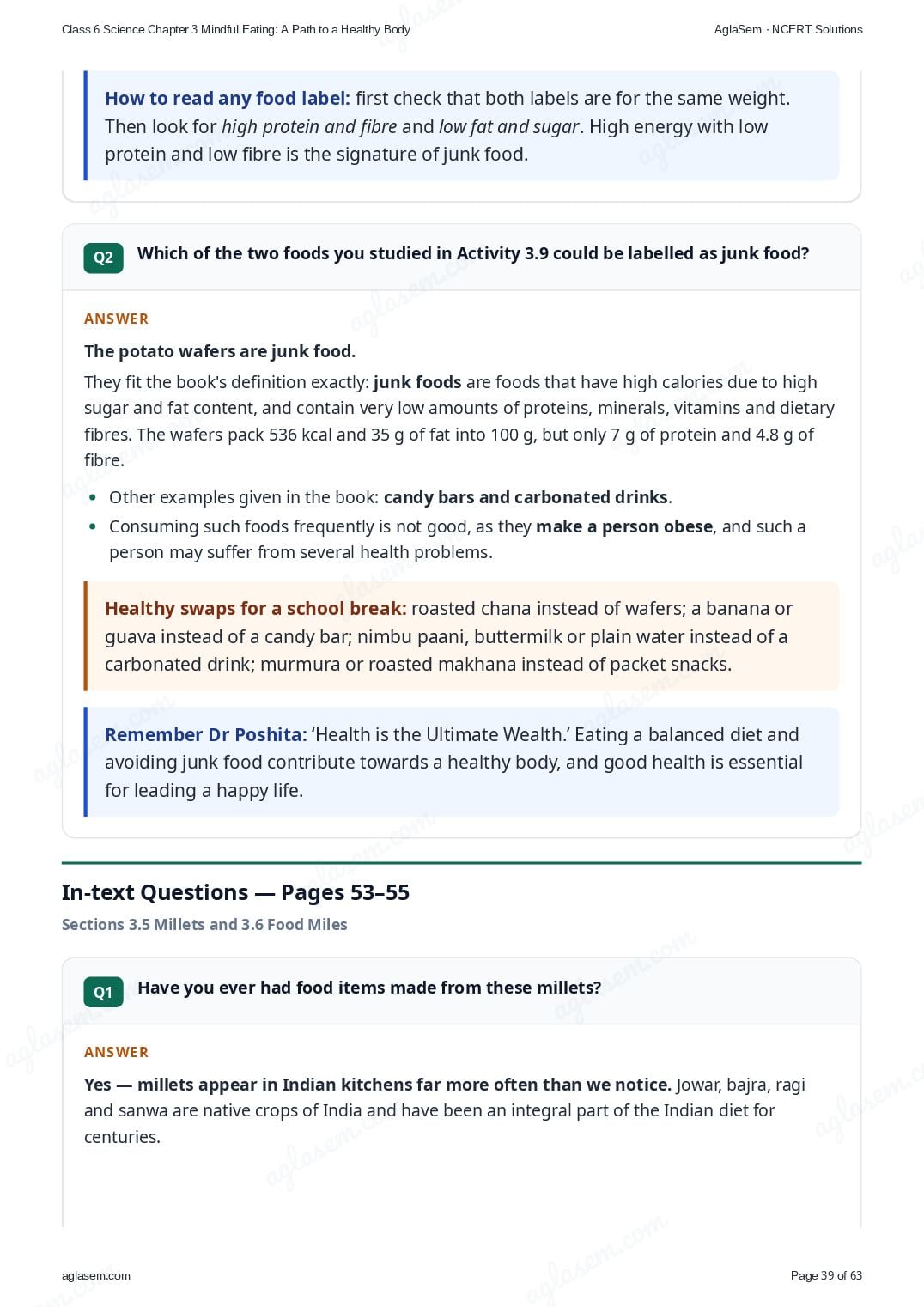
- Which of the two foods you studied in Activity 3.9 could be labelled as junk food?
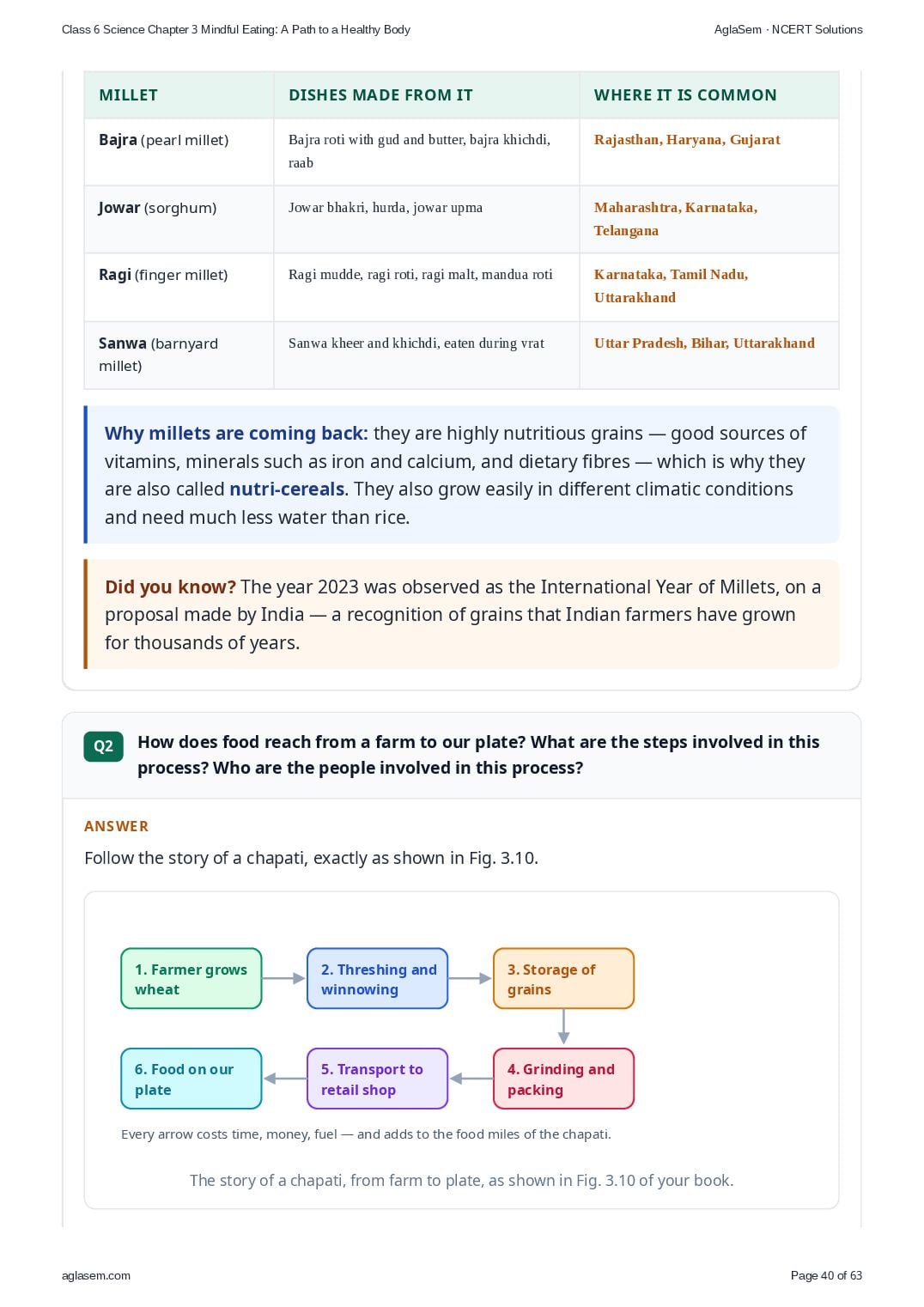
- Have you ever had food items made from these millets?
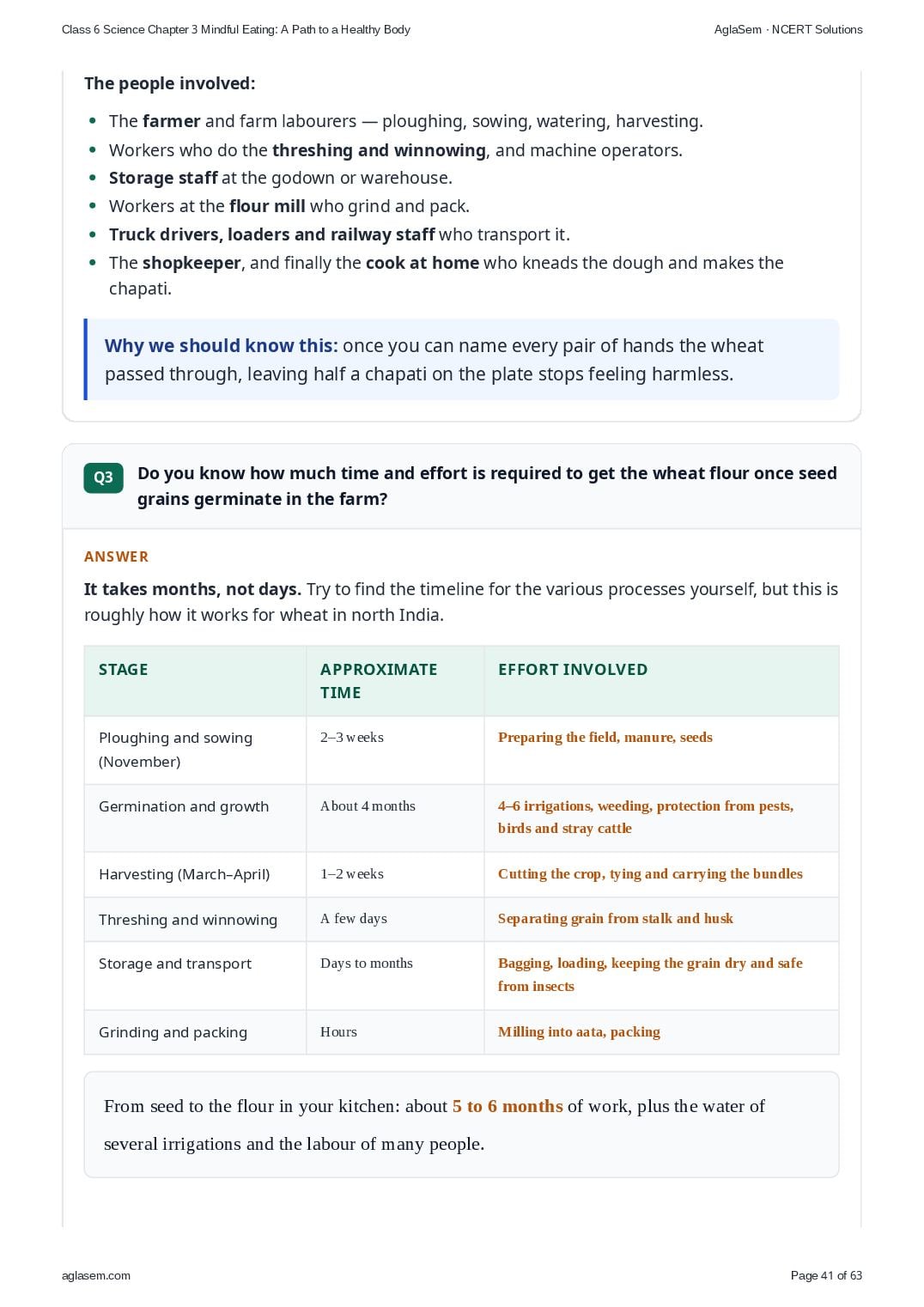
- How does food reach from a farm to our plate? What are the steps involved in this process? Who are the people involved in this process?
- Do you know how much time and effort is required to get the wheat flour once seed grains germinate in the farm?
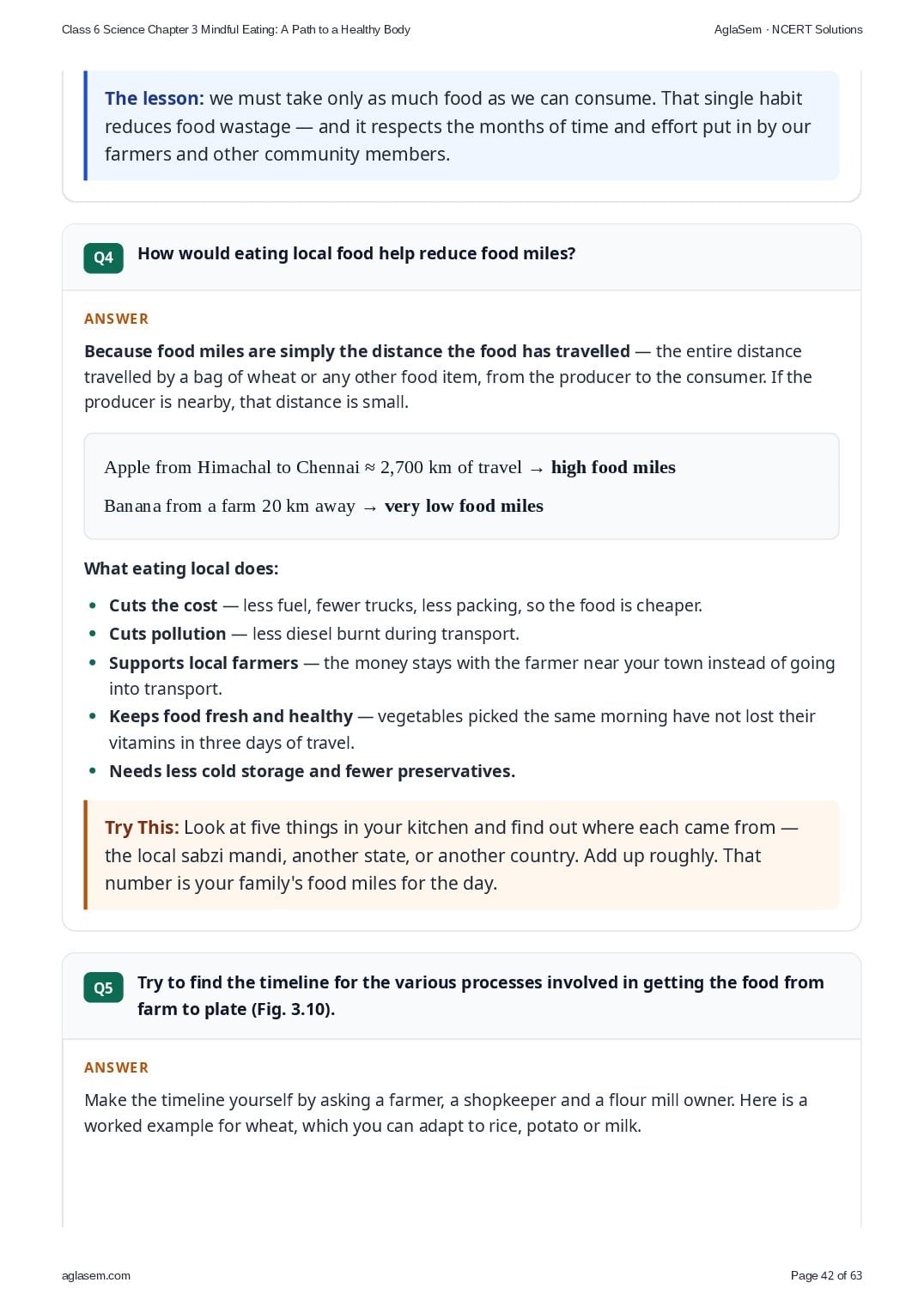
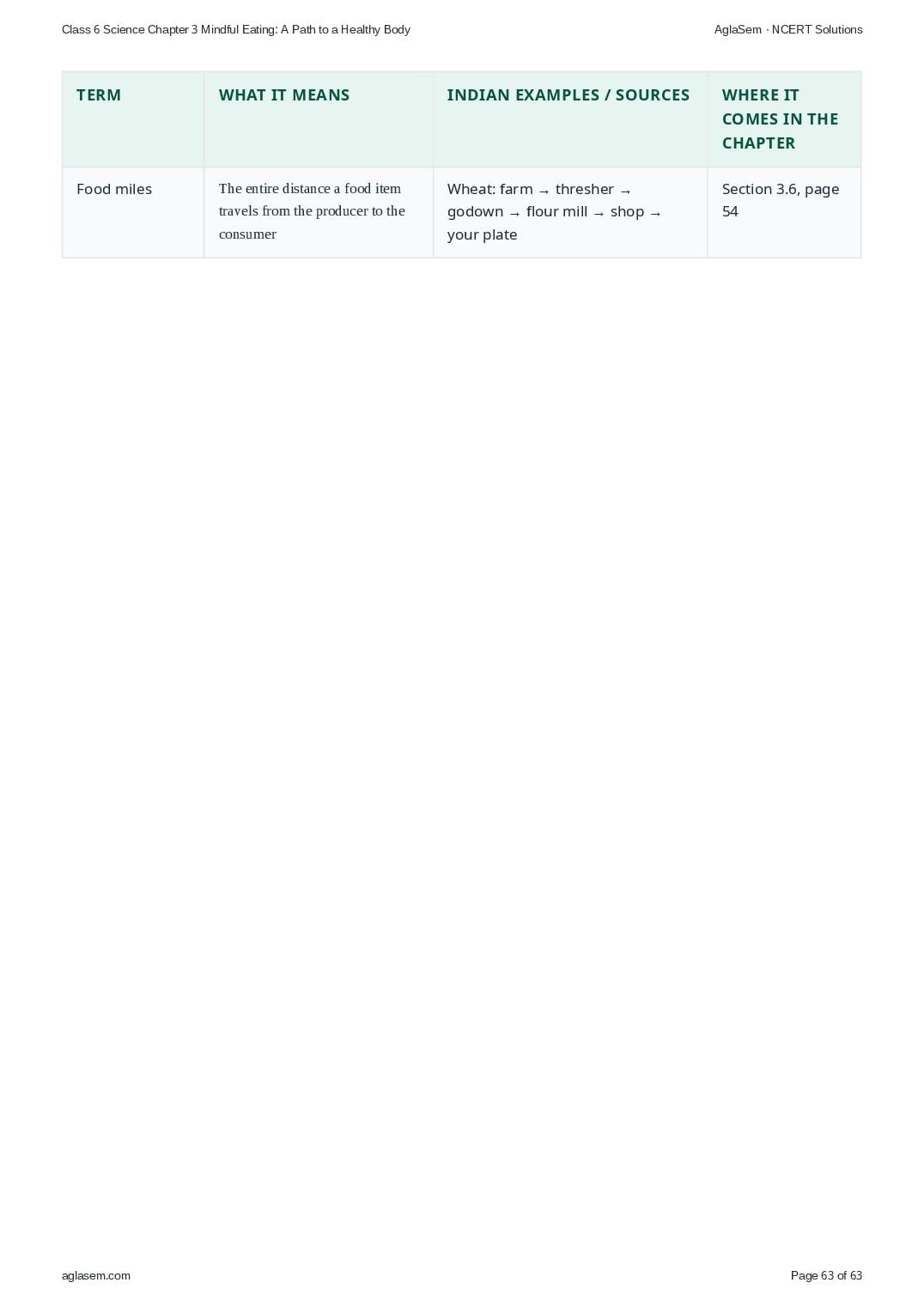
- How would eating local food help reduce food miles?
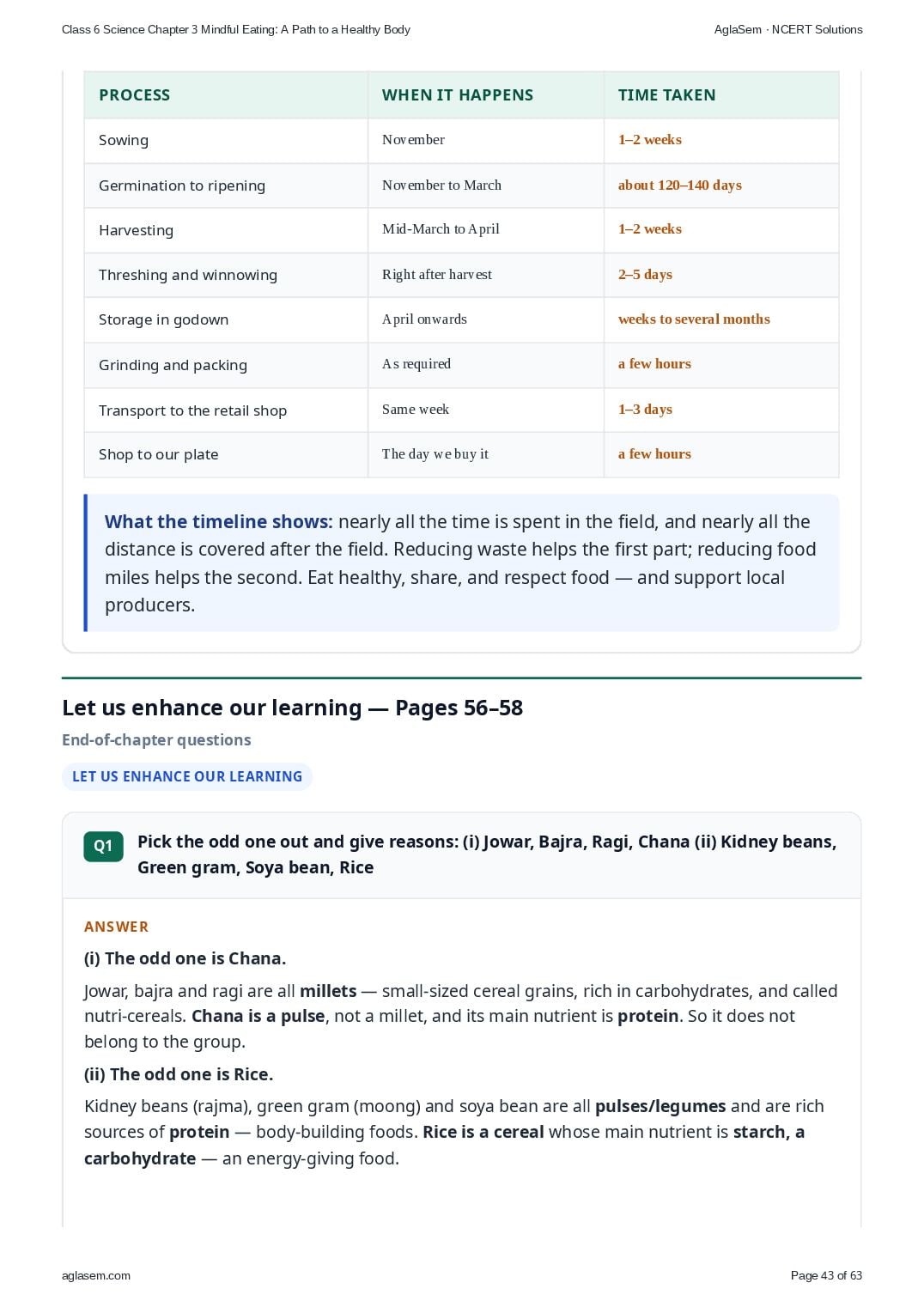
- Try to find the timeline for the various processes involved in getting the food from farm to plate (Fig. 3.10).
- Pick the odd one out and give reasons: (i) Jowar, Bajra, Ragi, Chana (ii) Kidney beans, Green gram, Soya bean, Rice
- Discuss traditional versus modern culinary practices in India.
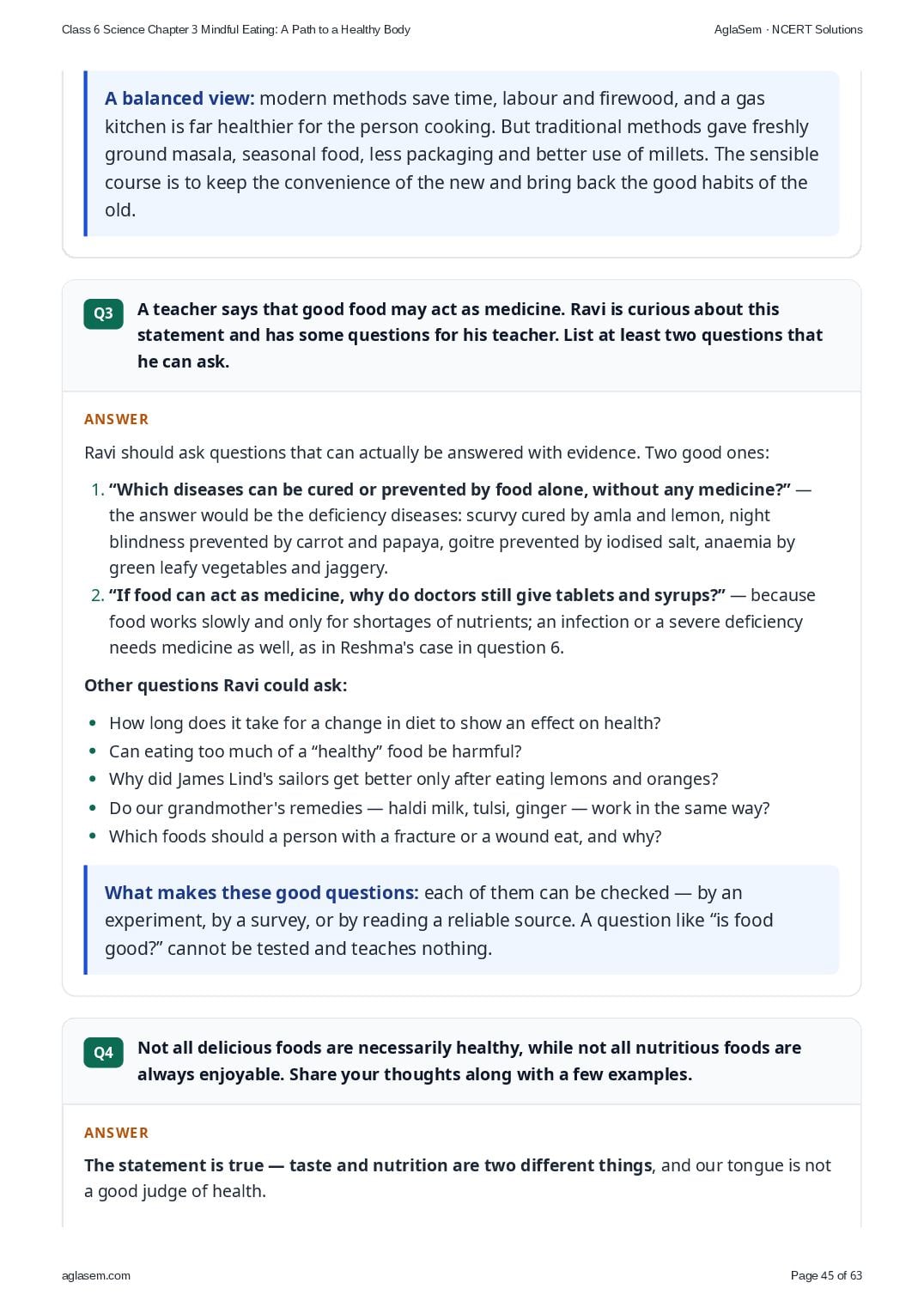
- A teacher says that good food may act as medicine. Ravi is curious about this statement and has some questions for his teacher. List at least two questions that he can ask.
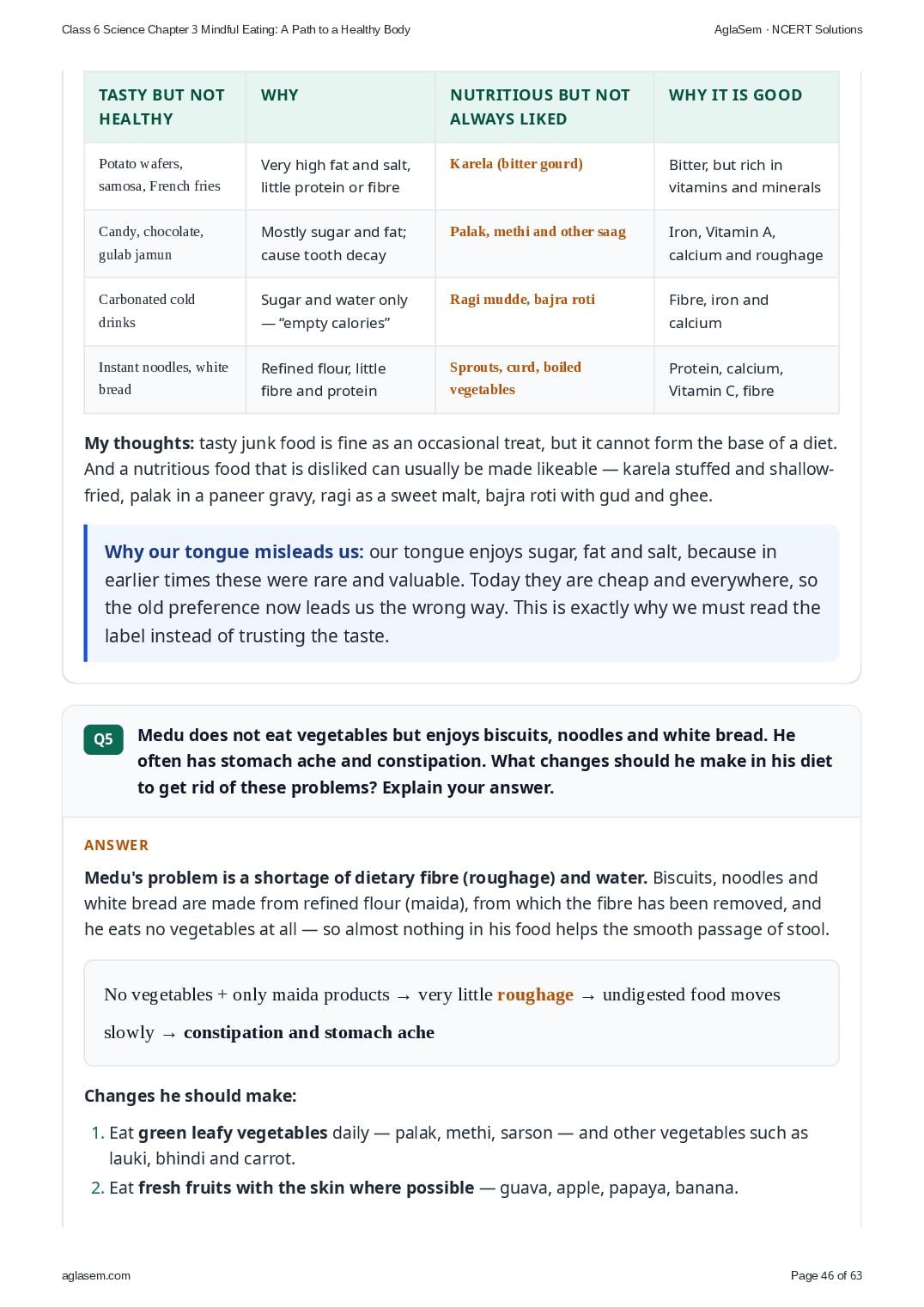
- Not all delicious foods are necessarily healthy, while not all nutritious foods are always enjoyable. Share your thoughts along with a few examples.
- Medu does not eat vegetables but enjoys biscuits, noodles and white bread. He often has stomach ache and constipation. What changes should he make in his diet to get rid of these problems? Explain your answer.
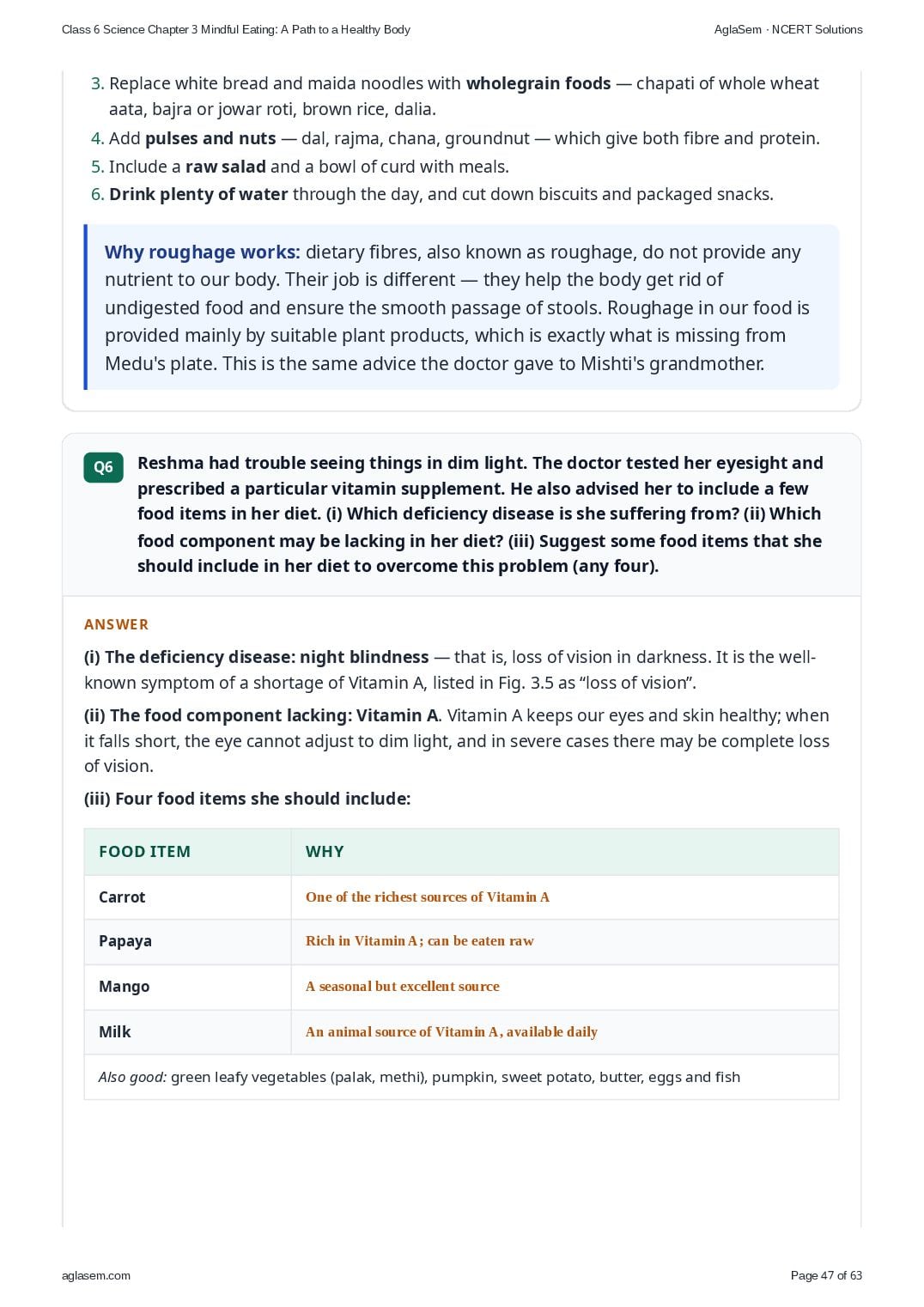
- Reshma had trouble seeing things in dim light. The doctor tested her eyesight and prescribed a particular vitamin supplement. He also advised her to include a few food items in her diet. (i) Which deficiency disease is she suffering from? (ii) Which food component may be lacking in her diet? (iii) Suggest some food items that she should include in her diet to overcome this problem (any four).
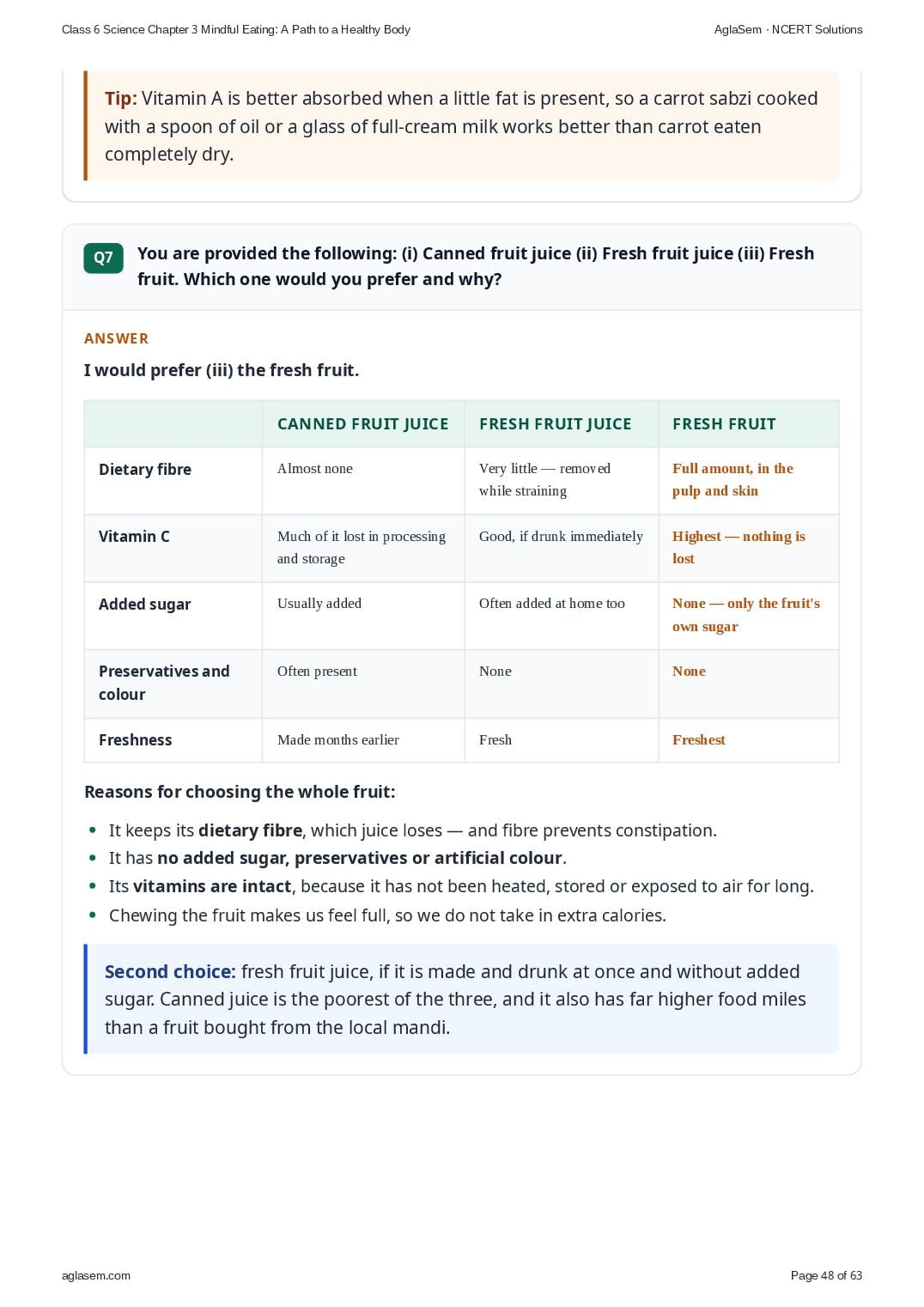
- You are provided the following: (i) Canned fruit juice (ii) Fresh fruit juice (iii) Fresh fruit. Which one would you prefer and why?
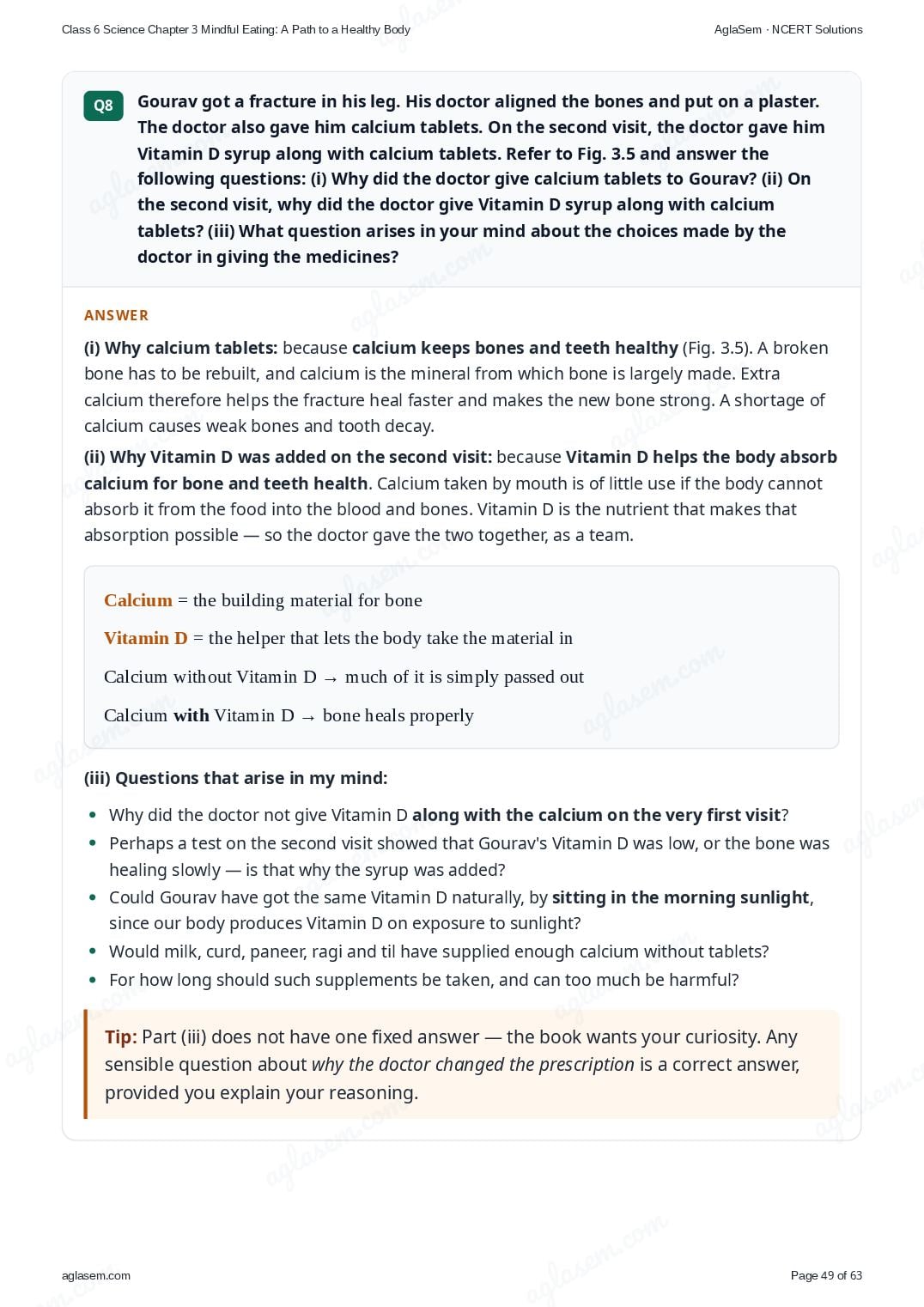
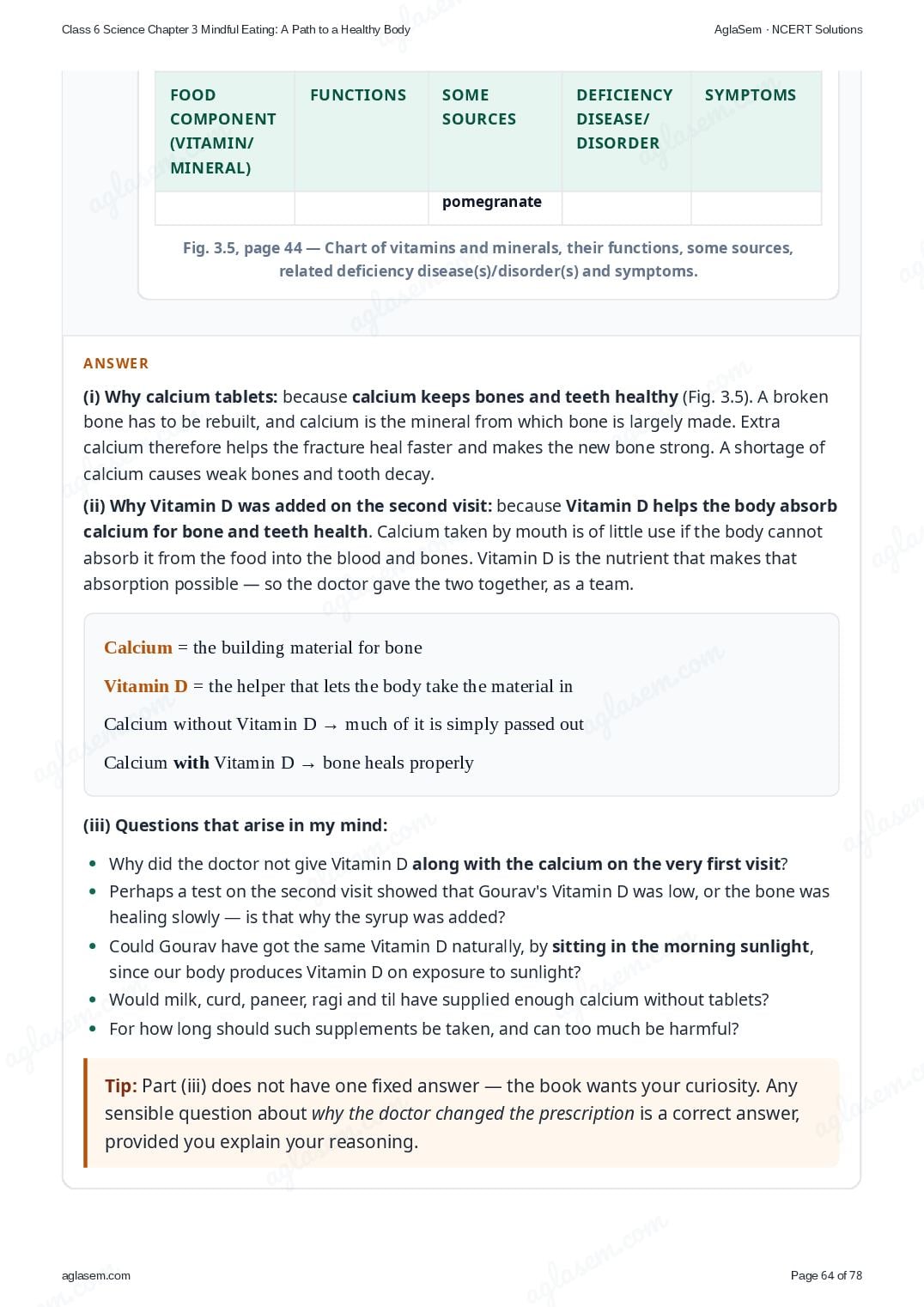
- Gourav got a fracture in his leg. His doctor aligned the bones and put on a plaster. The doctor also gave him calcium tablets. On the second visit, the doctor gave him Vitamin D syrup along with calcium tablets. Refer to Fig. 3.5 and answer the following questions: (i) Why did the doctor give calcium tablets to Gourav? (ii) On the second visit, why did the doctor give Vitamin D syrup along with calcium tablets? (iii) What question arises in your mind about the choices made by the doctor in giving the medicines?
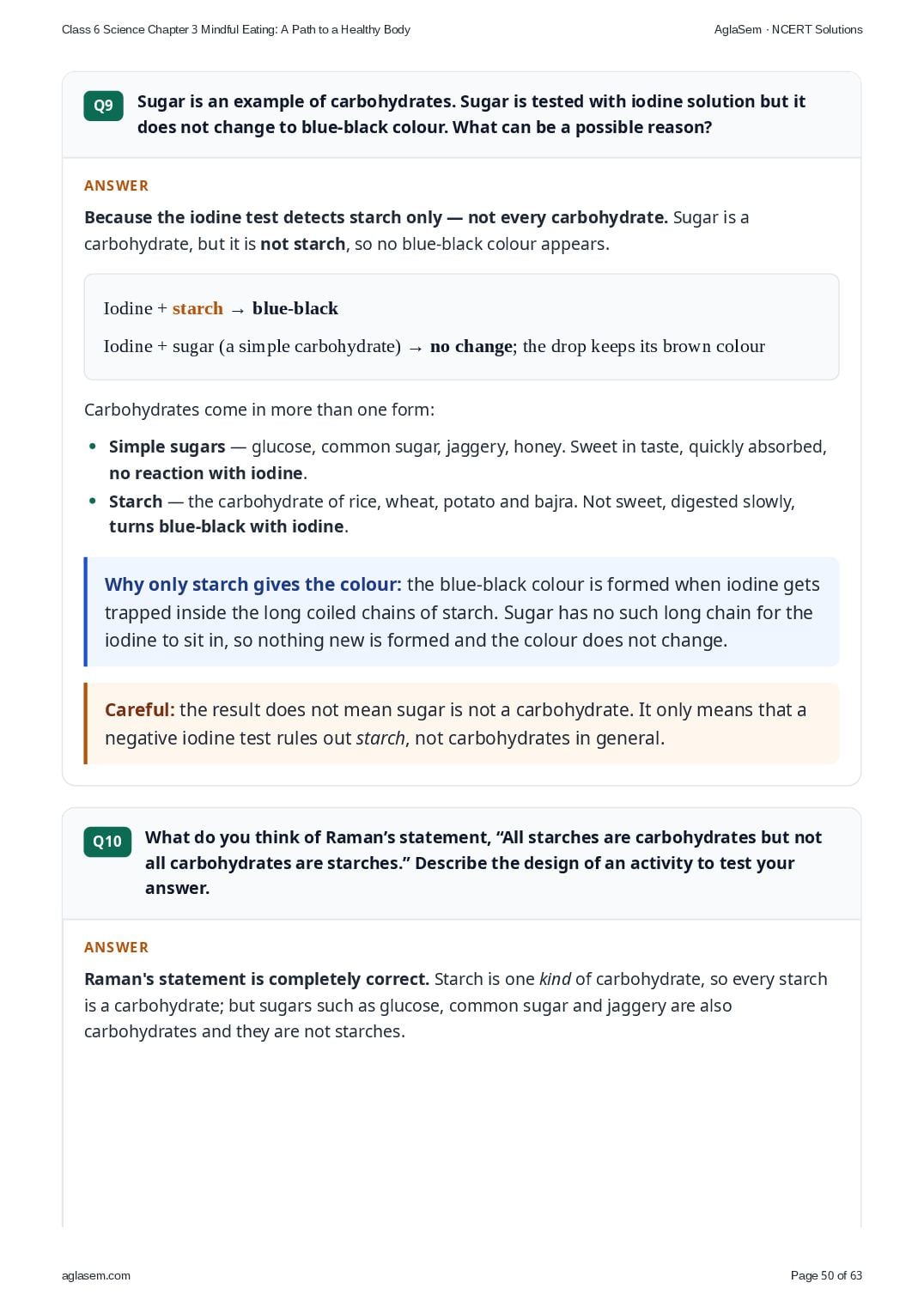
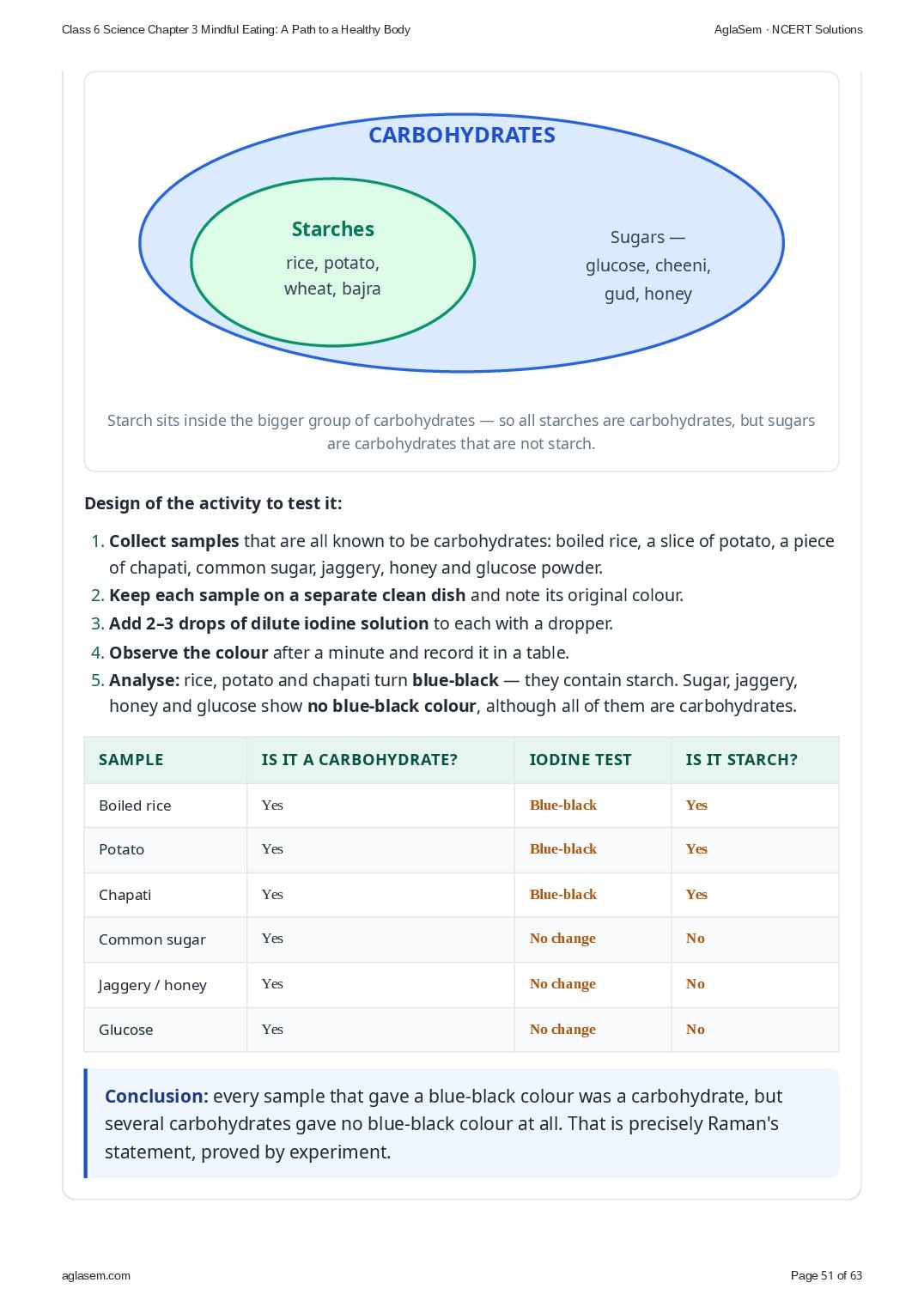
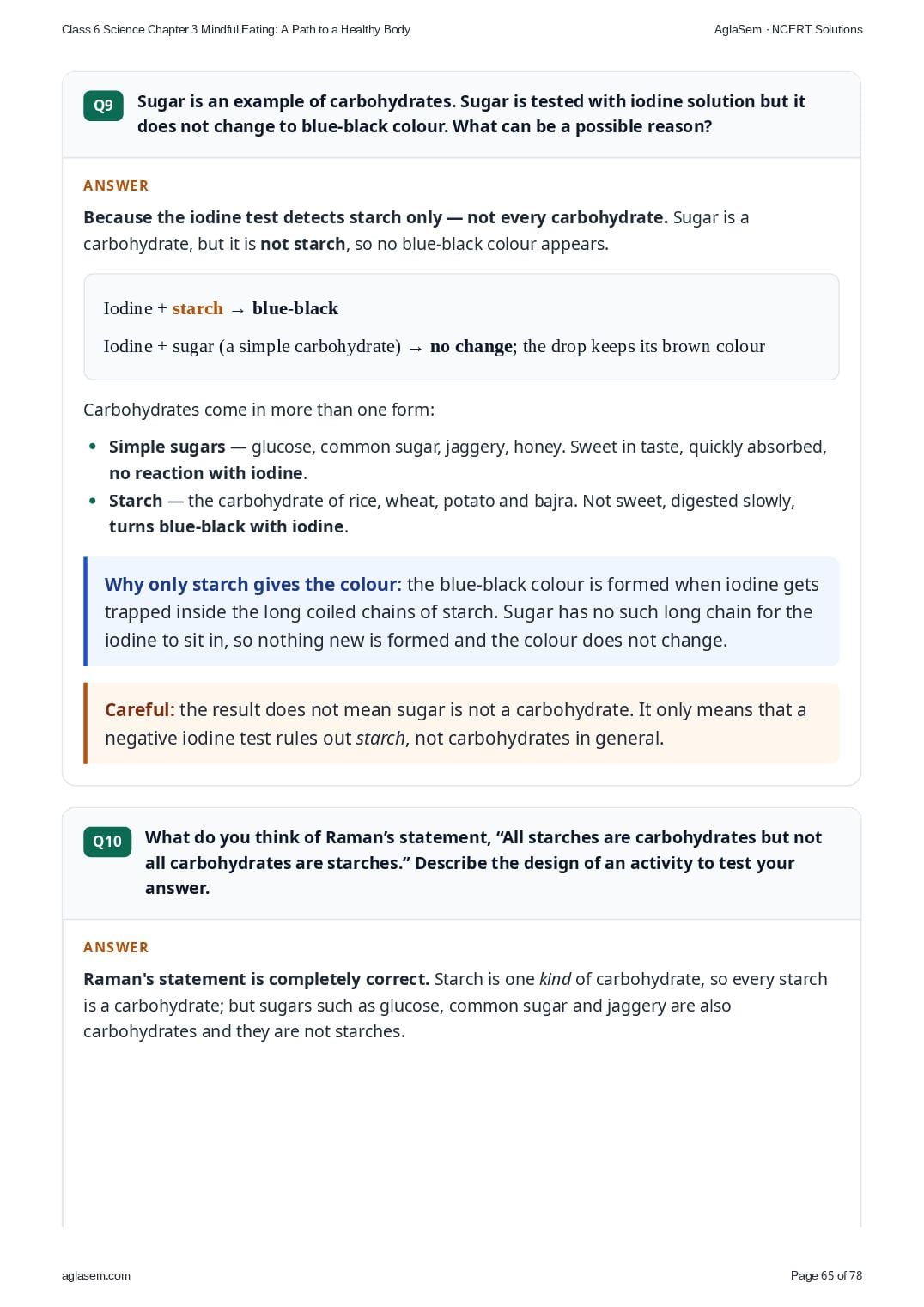
- Sugar is an example of carbohydrates. Sugar is tested with iodine solution but it does not change to blue-black colour. What can be a possible reason?
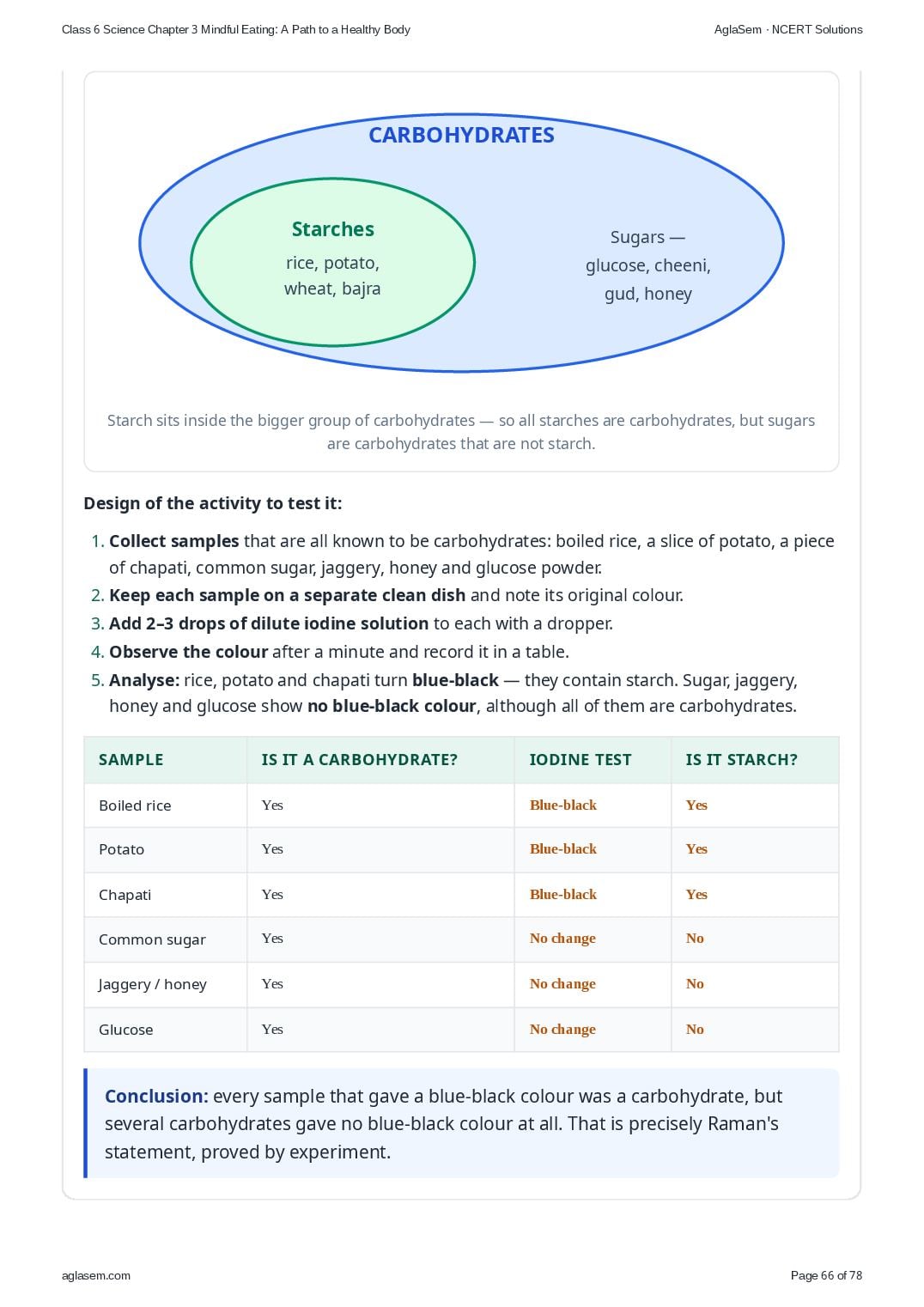
- What do you think of Raman’s statement, “All starches are carbohydrates but not all carbohydrates are starches.” Describe the design of an activity to test your answer.
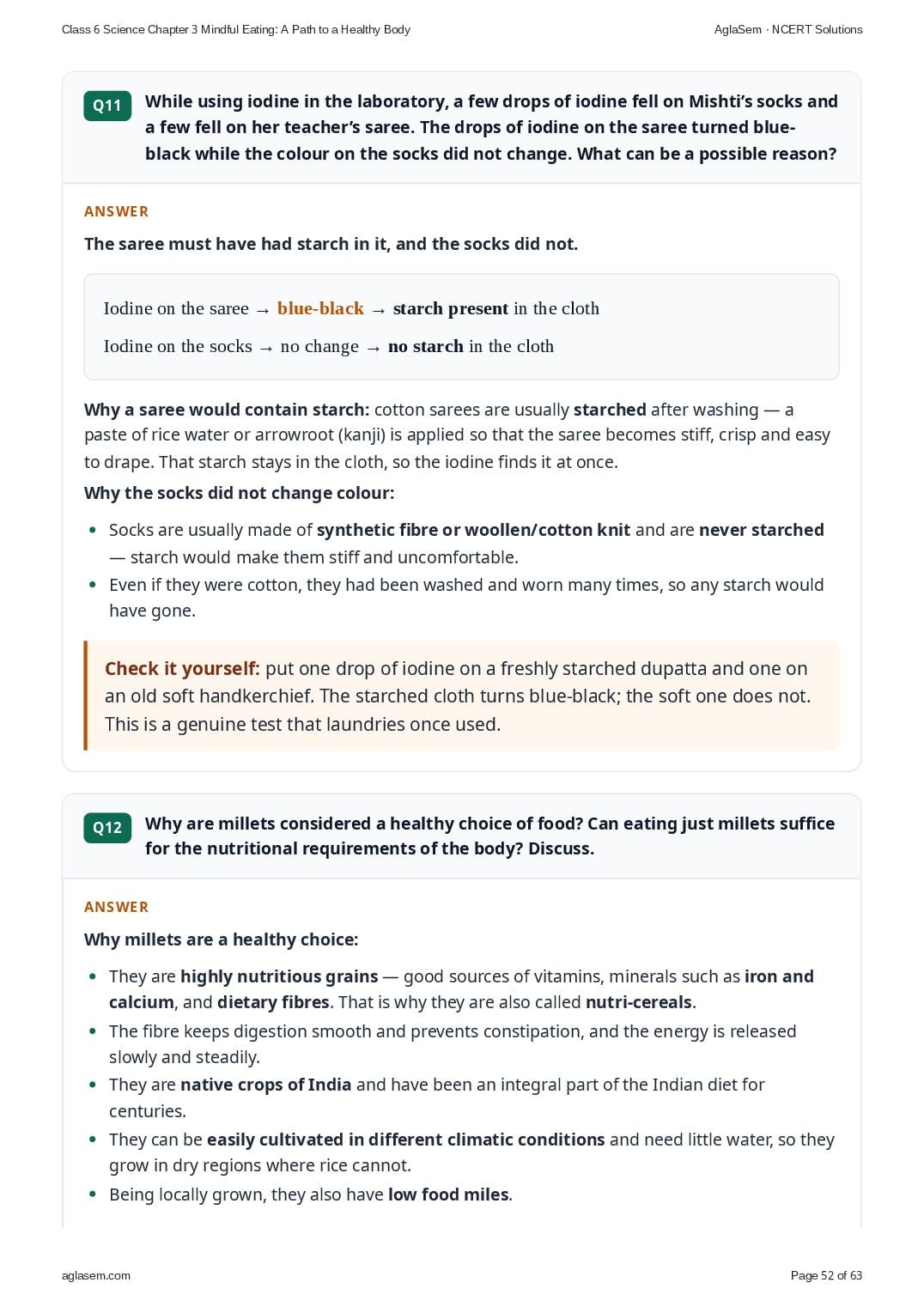
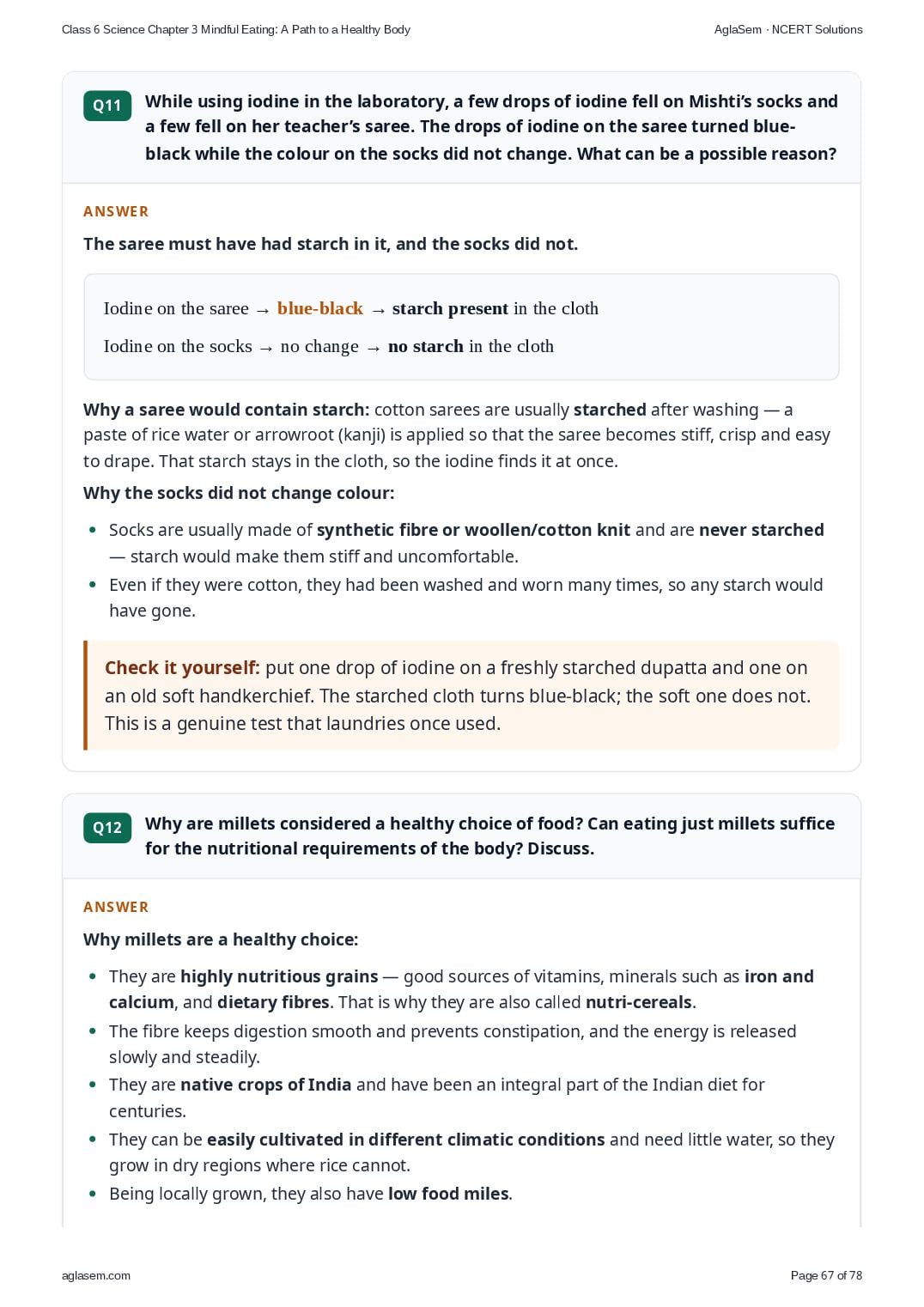
- While using iodine in the laboratory, a few drops of iodine fell on Mishti’s socks and a few fell on her teacher’s saree. The drops of iodine on the saree turned blue-black while the colour on the socks did not change. What can be a possible reason?
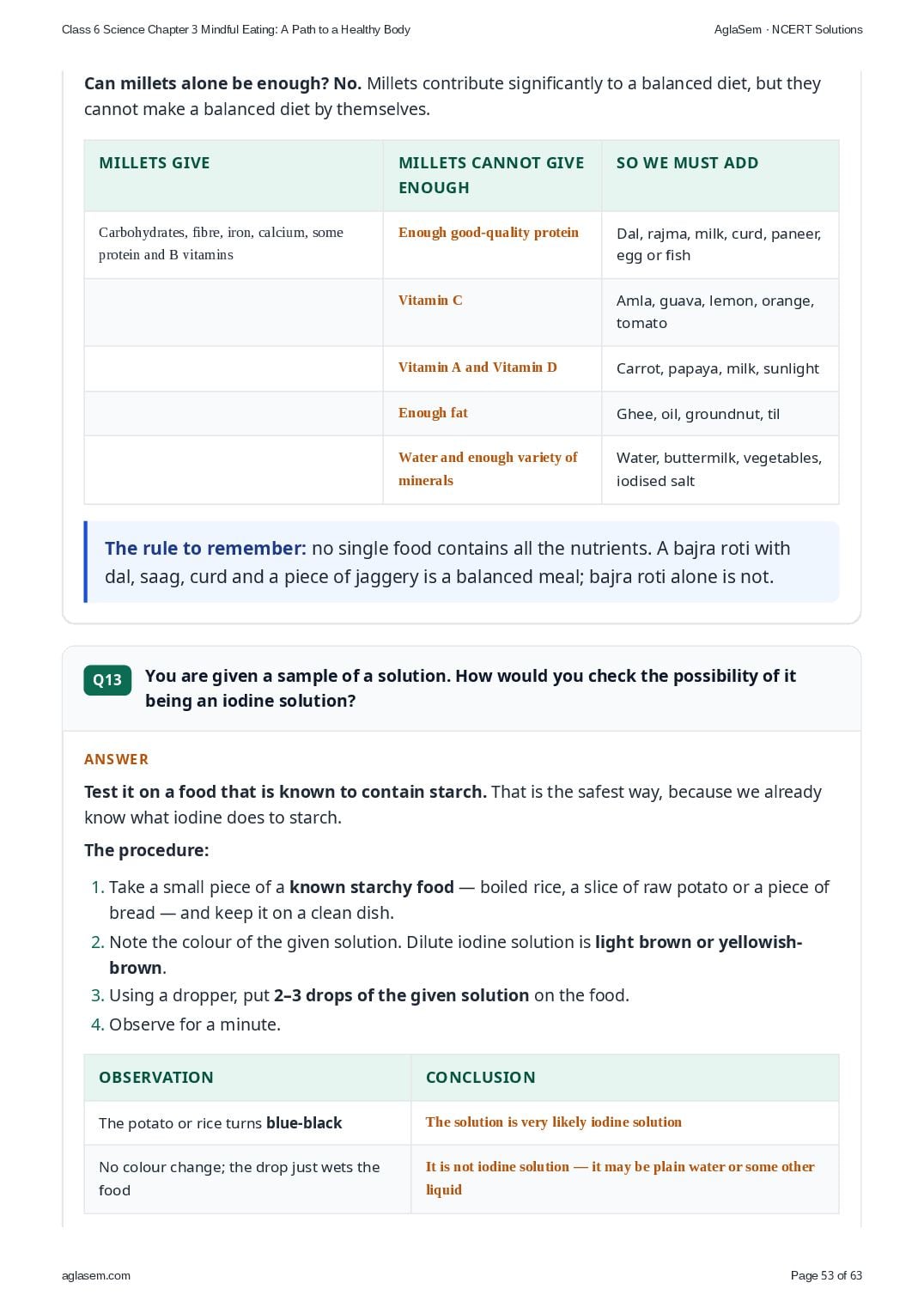
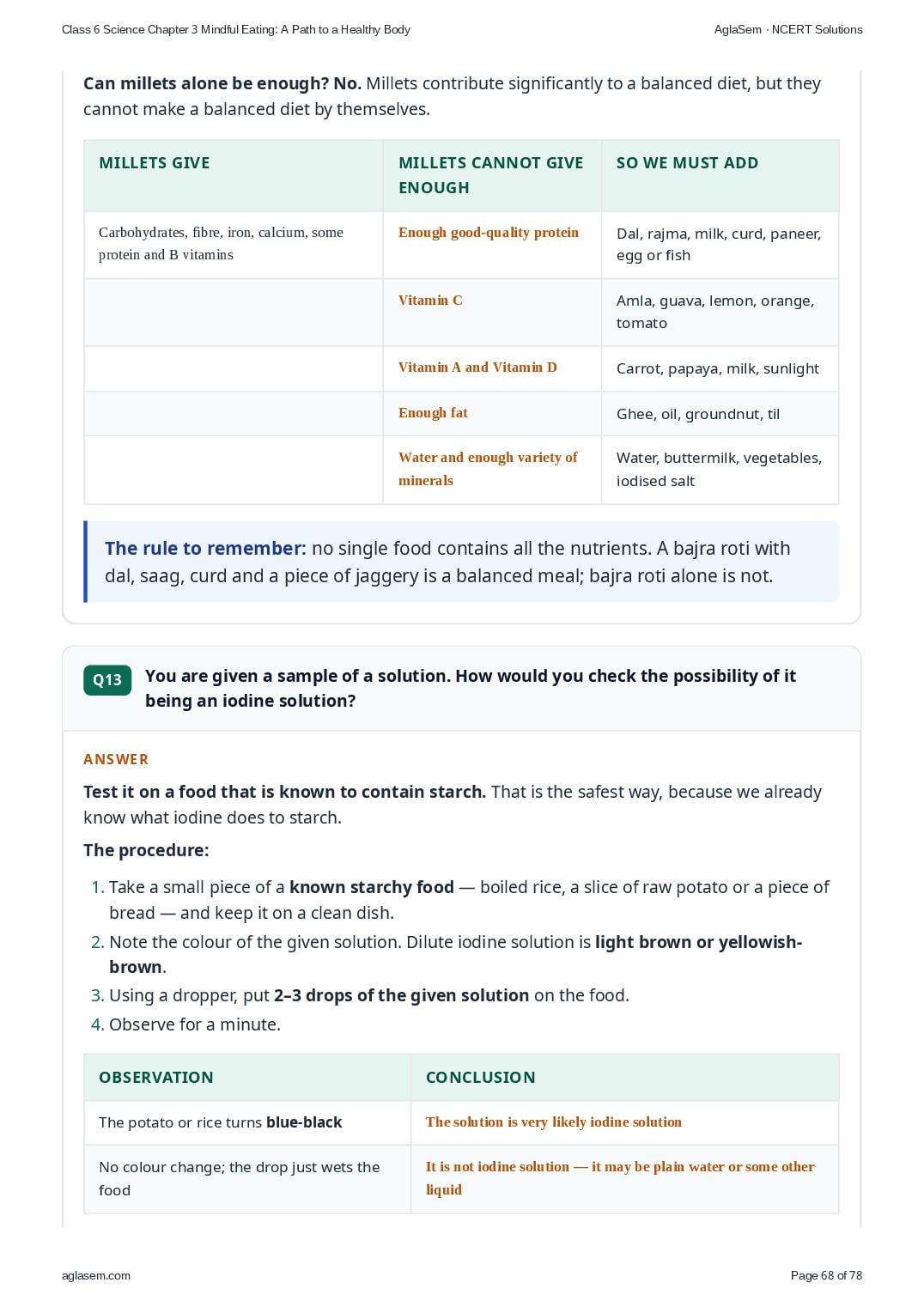
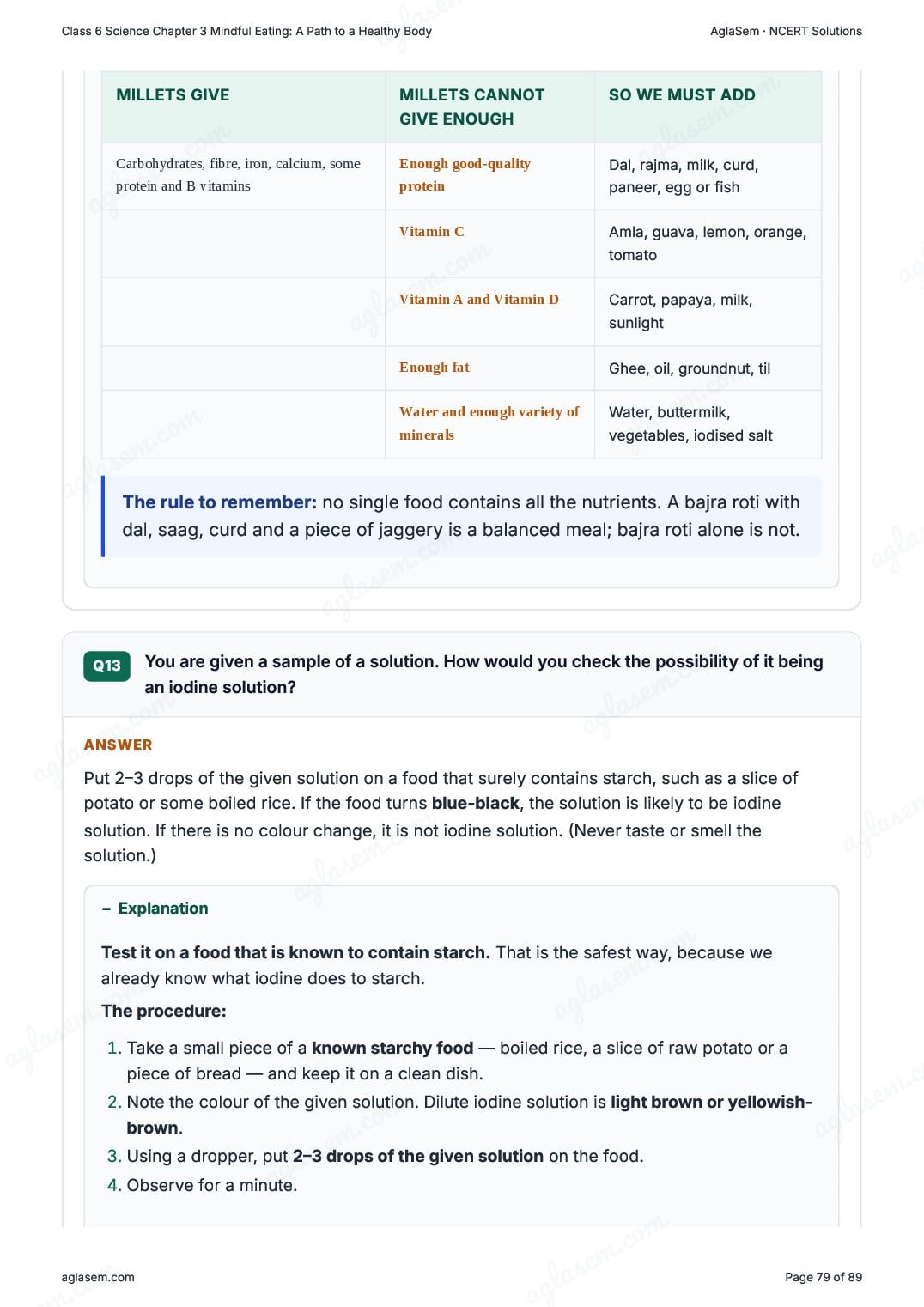
- Why are millets considered a healthy choice of food? Can eating just millets suffice for the nutritional requirements of the body? Discuss.
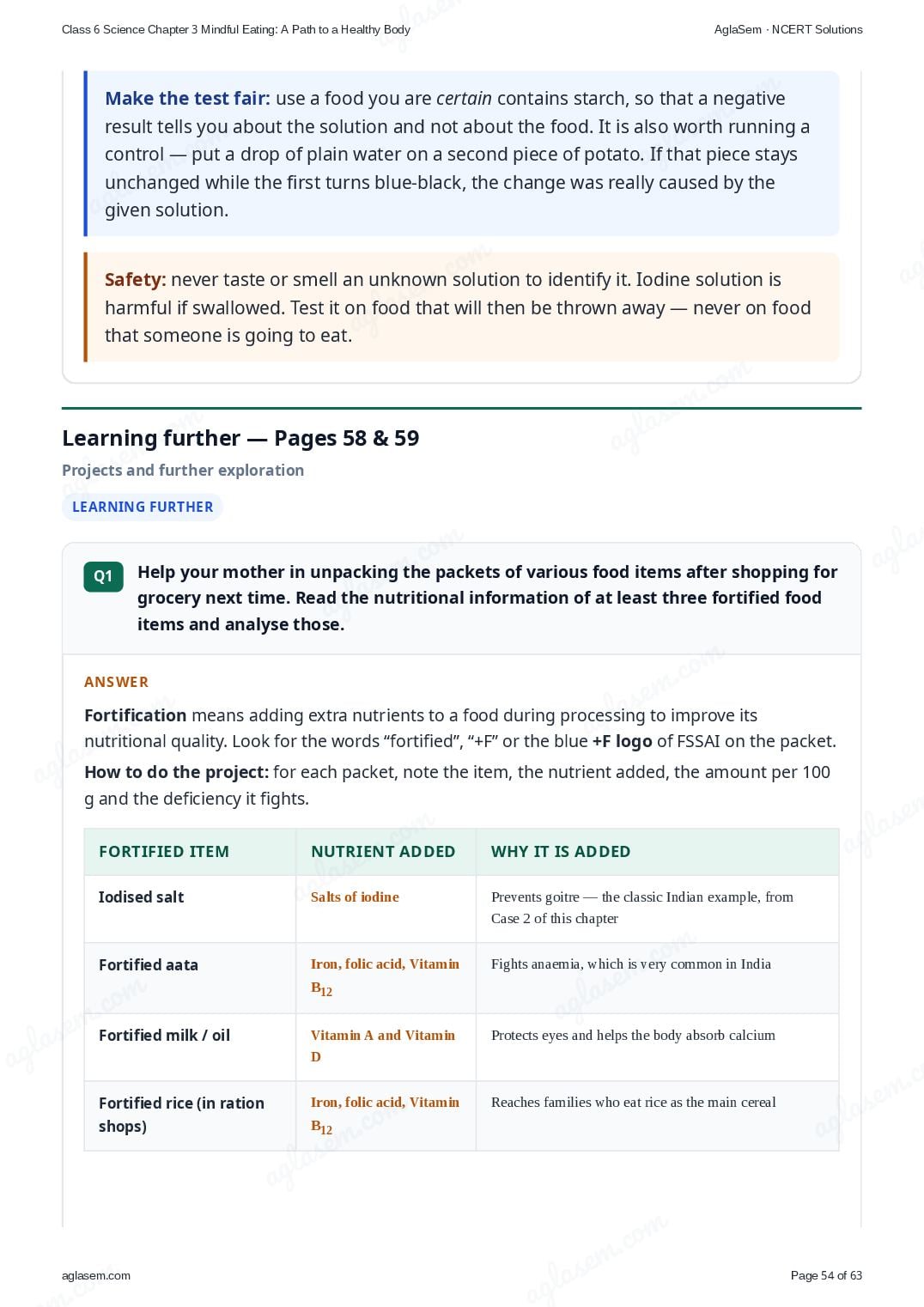
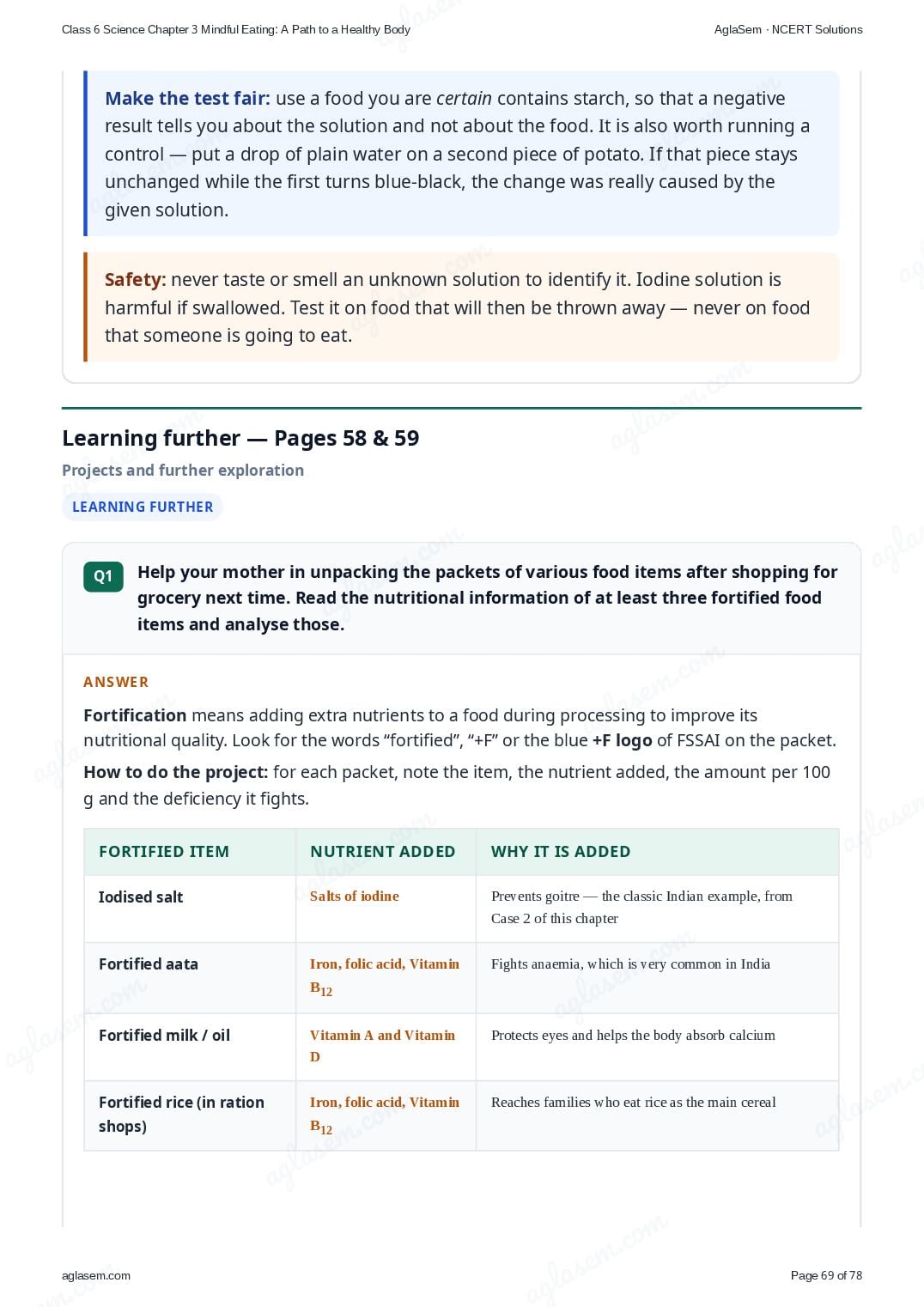
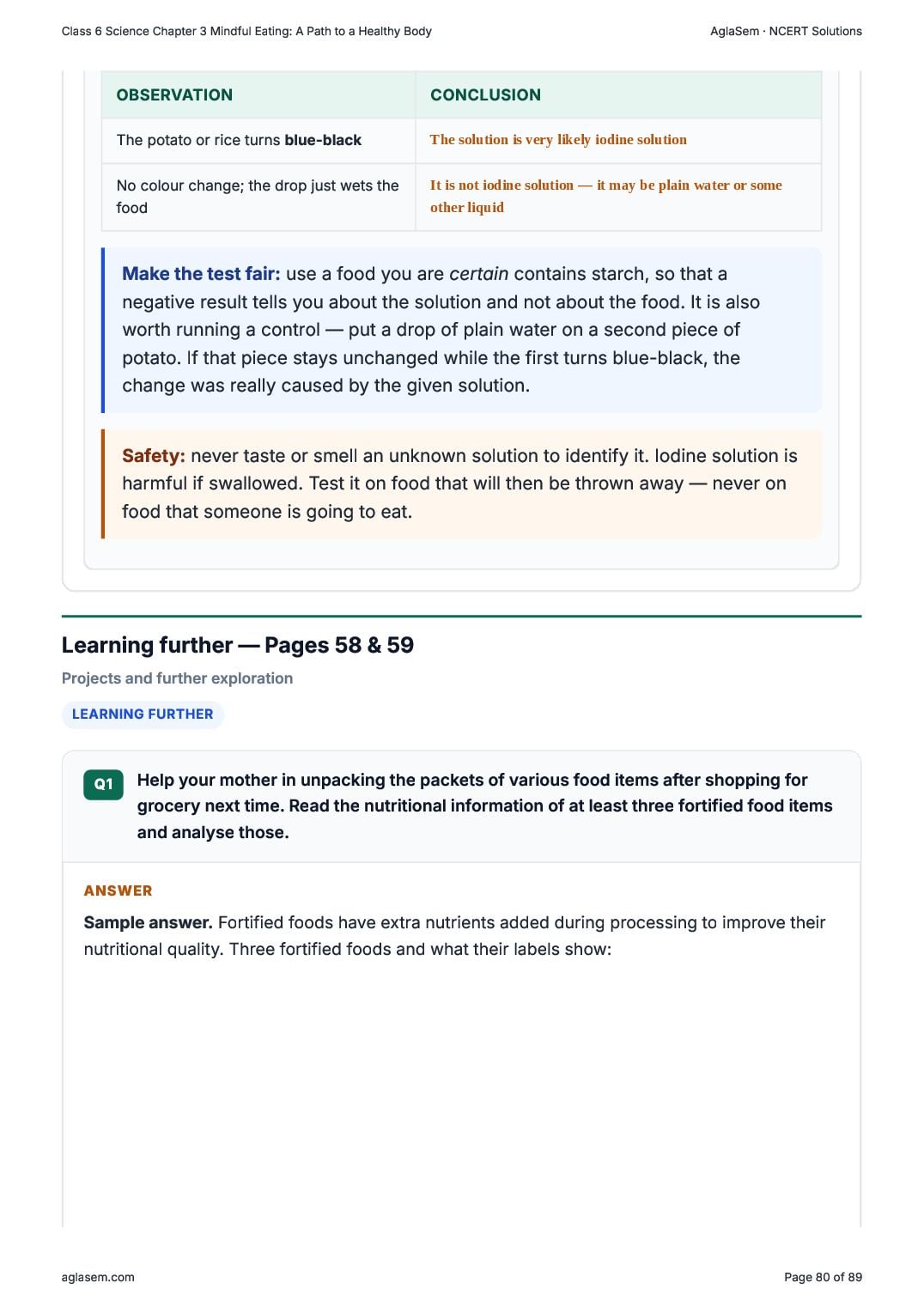
- You are given a sample of a solution. How would you check the possibility of it being an iodine solution?
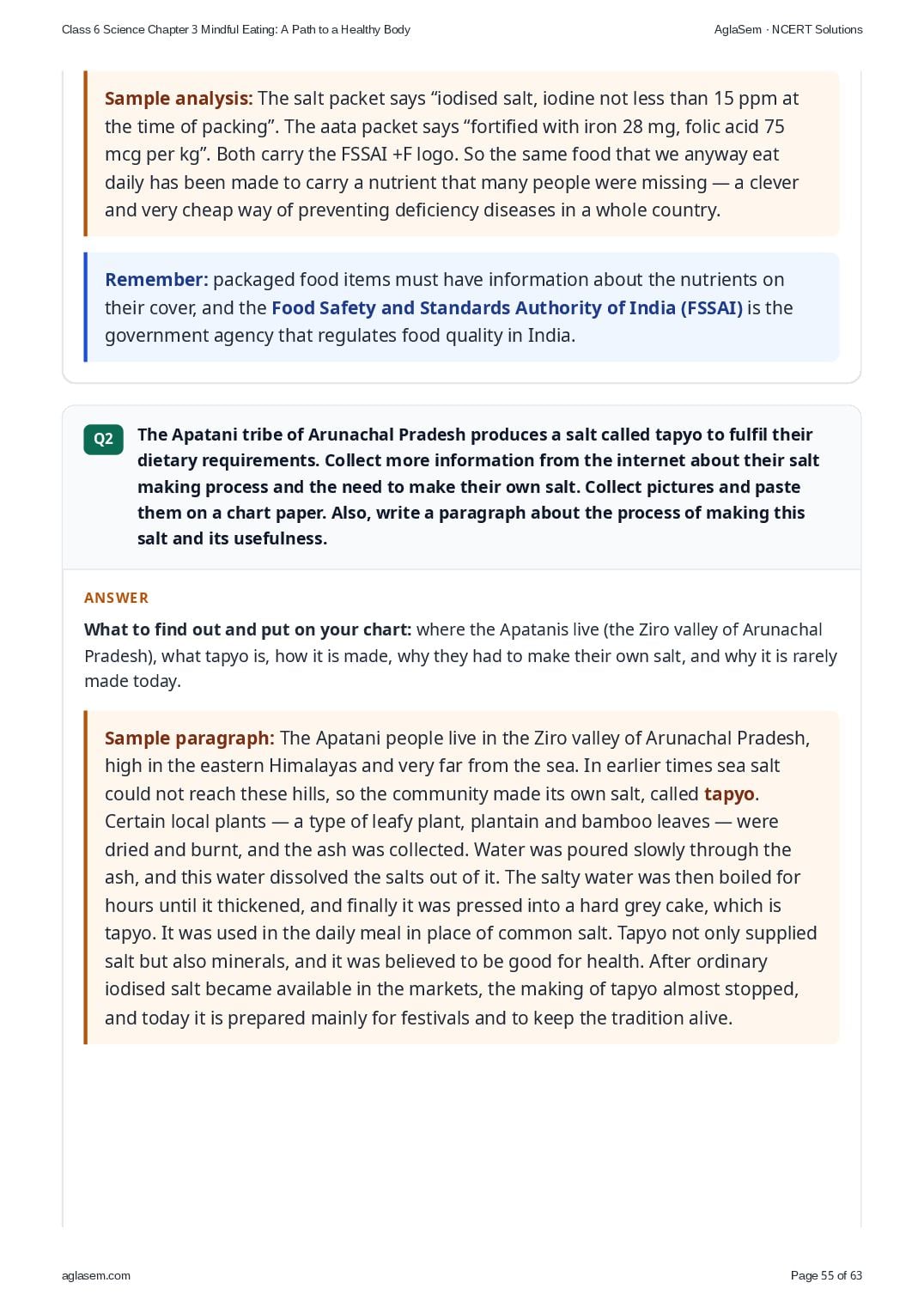
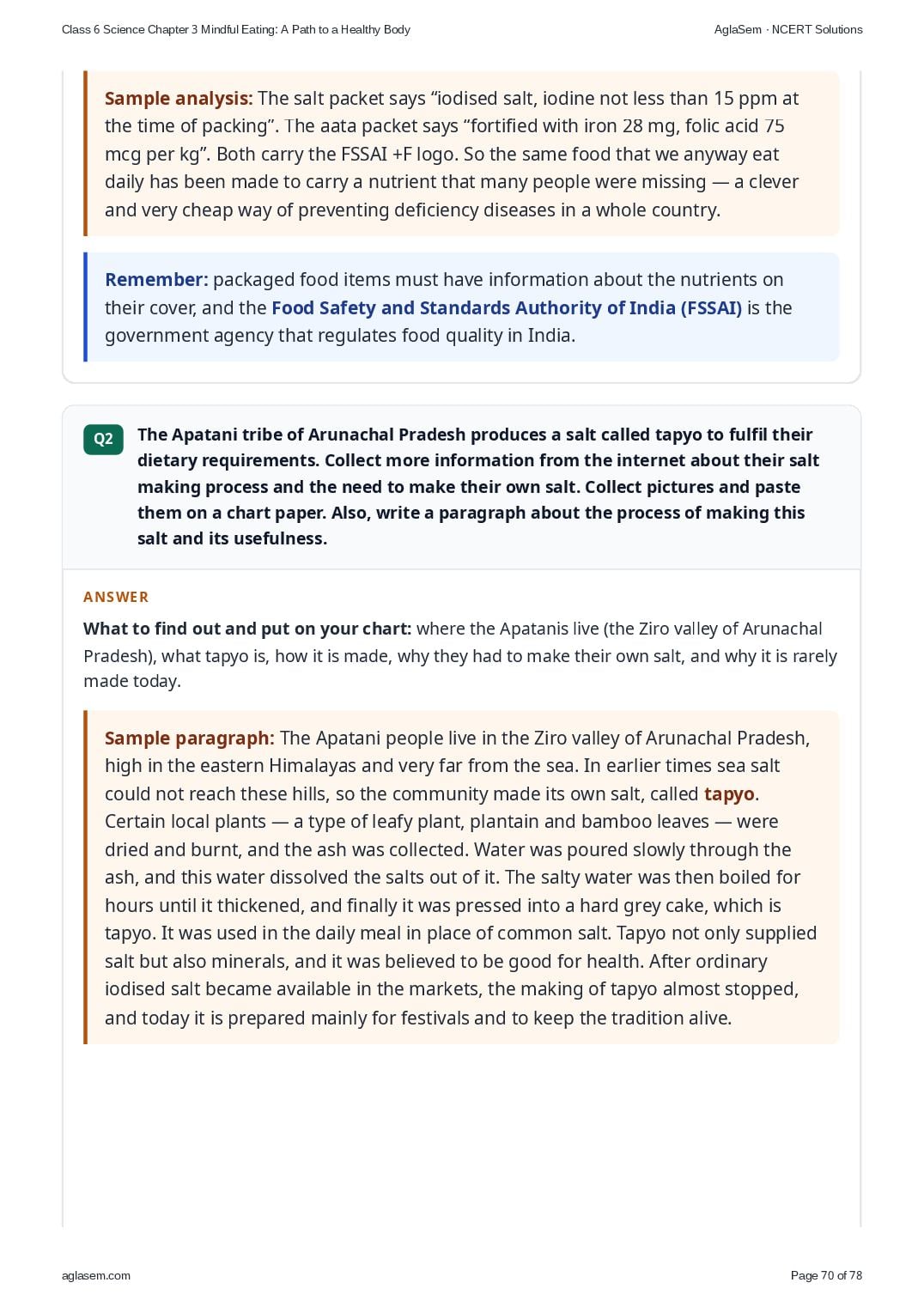
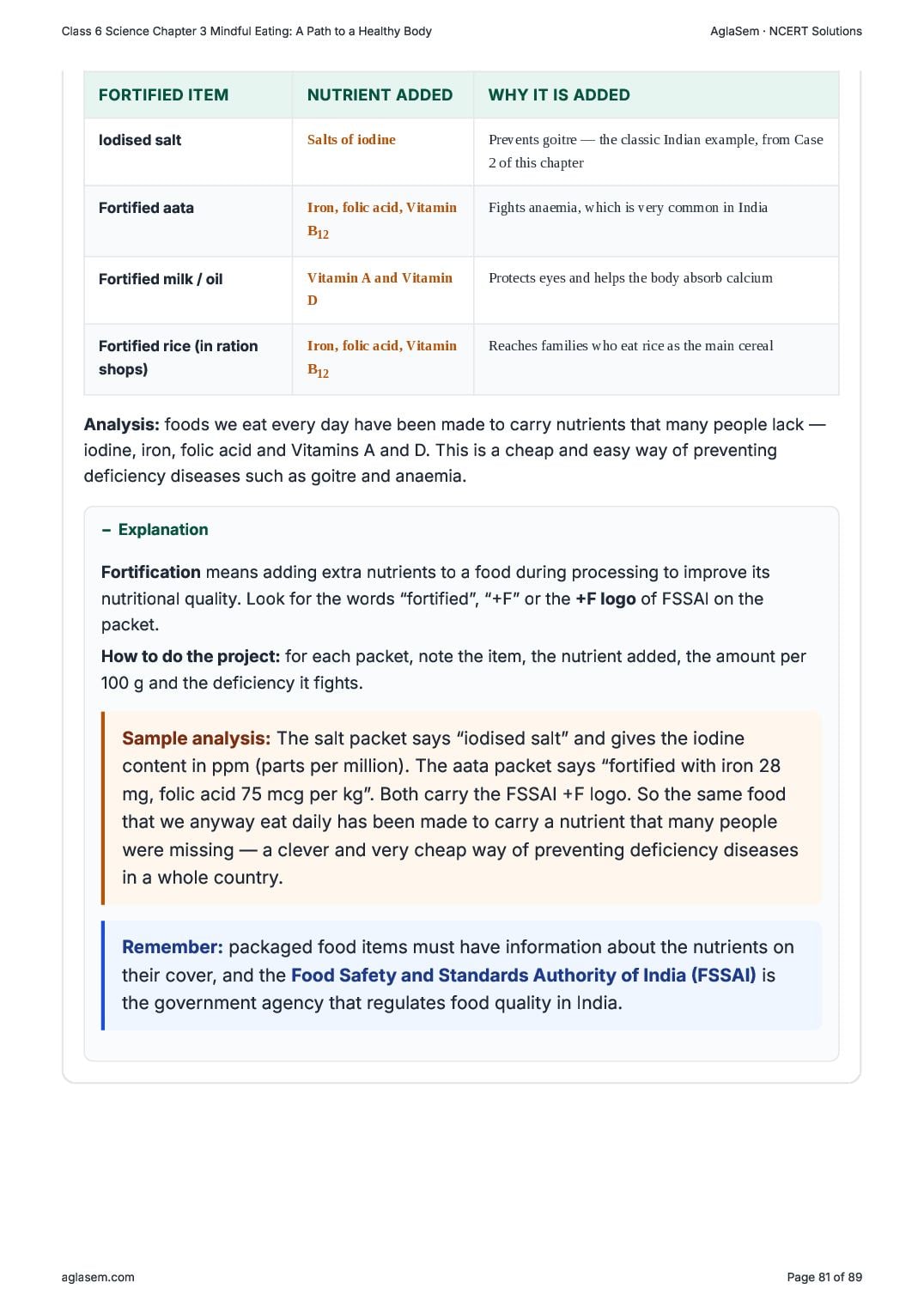
- Help your mother in unpacking the packets of various food items after shopping for grocery next time. Read the nutritional information of at least three fortified food items and analyse those.
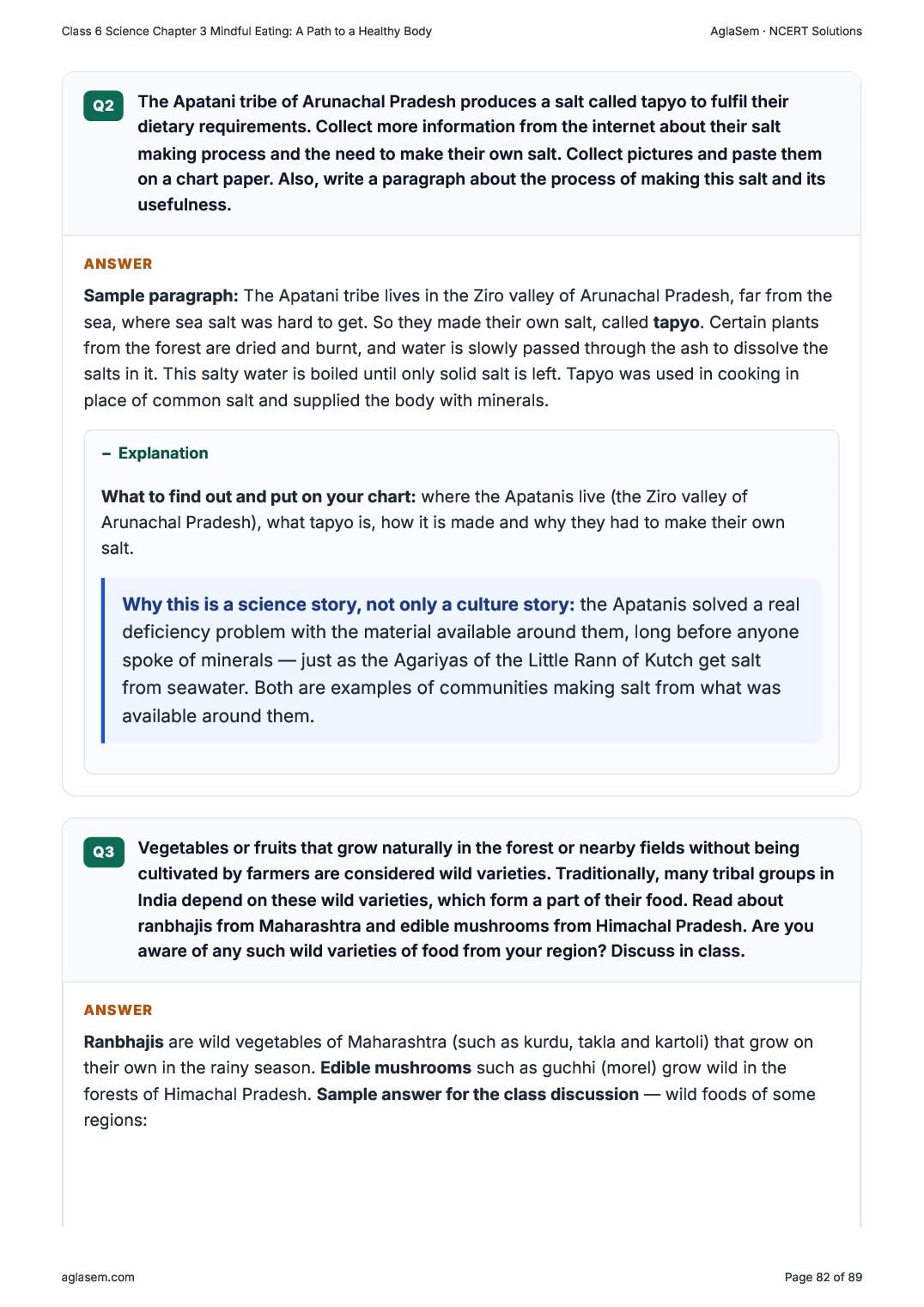
- The Apatani tribe of Arunachal Pradesh produces a salt called tapyo to fulfil their dietary requirements. Collect more information from the internet about their salt making process and the need to make their own salt. Collect pictures and paste them on a chart paper. Also, write a paragraph about the process of making this salt and its usefulness.
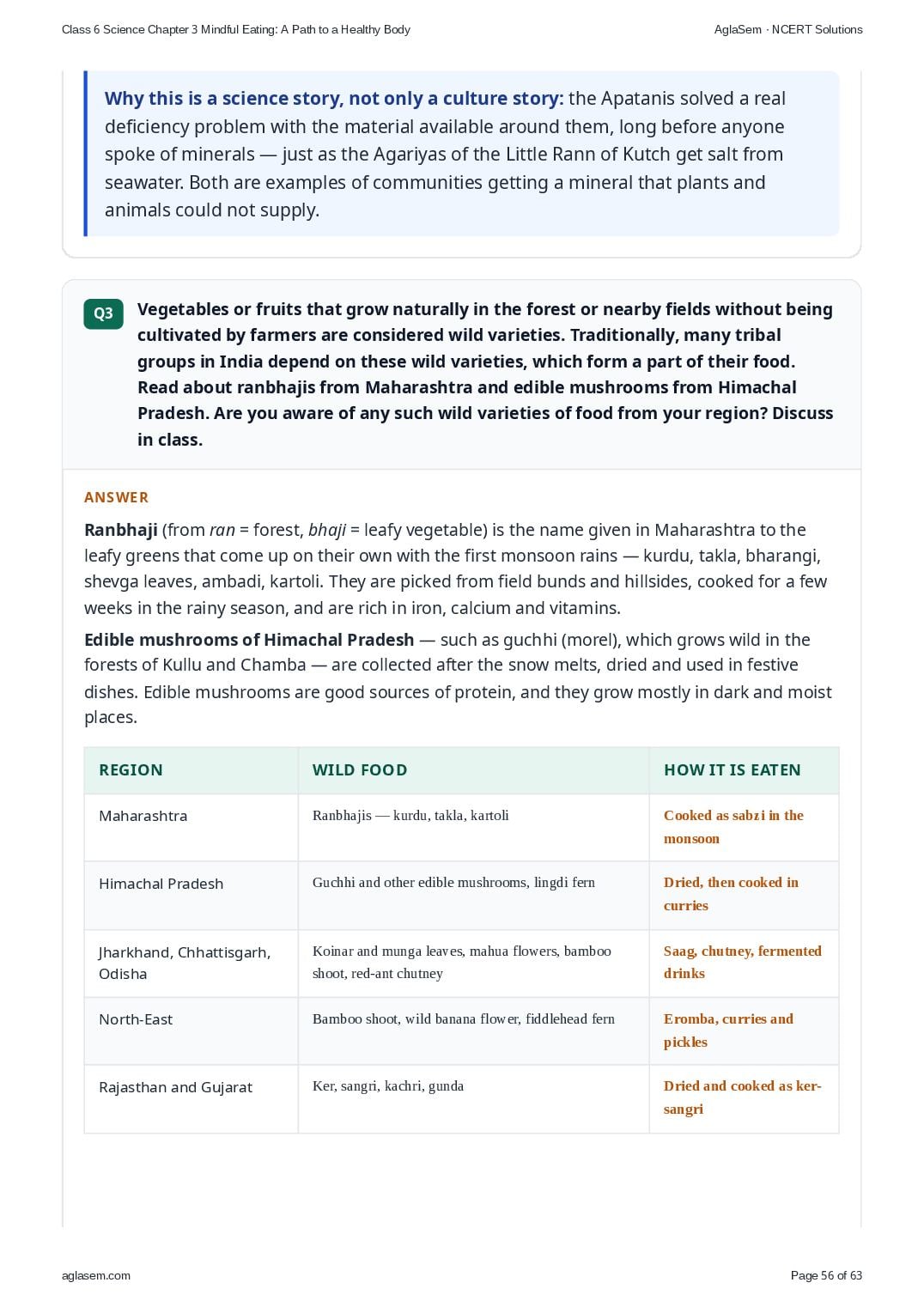
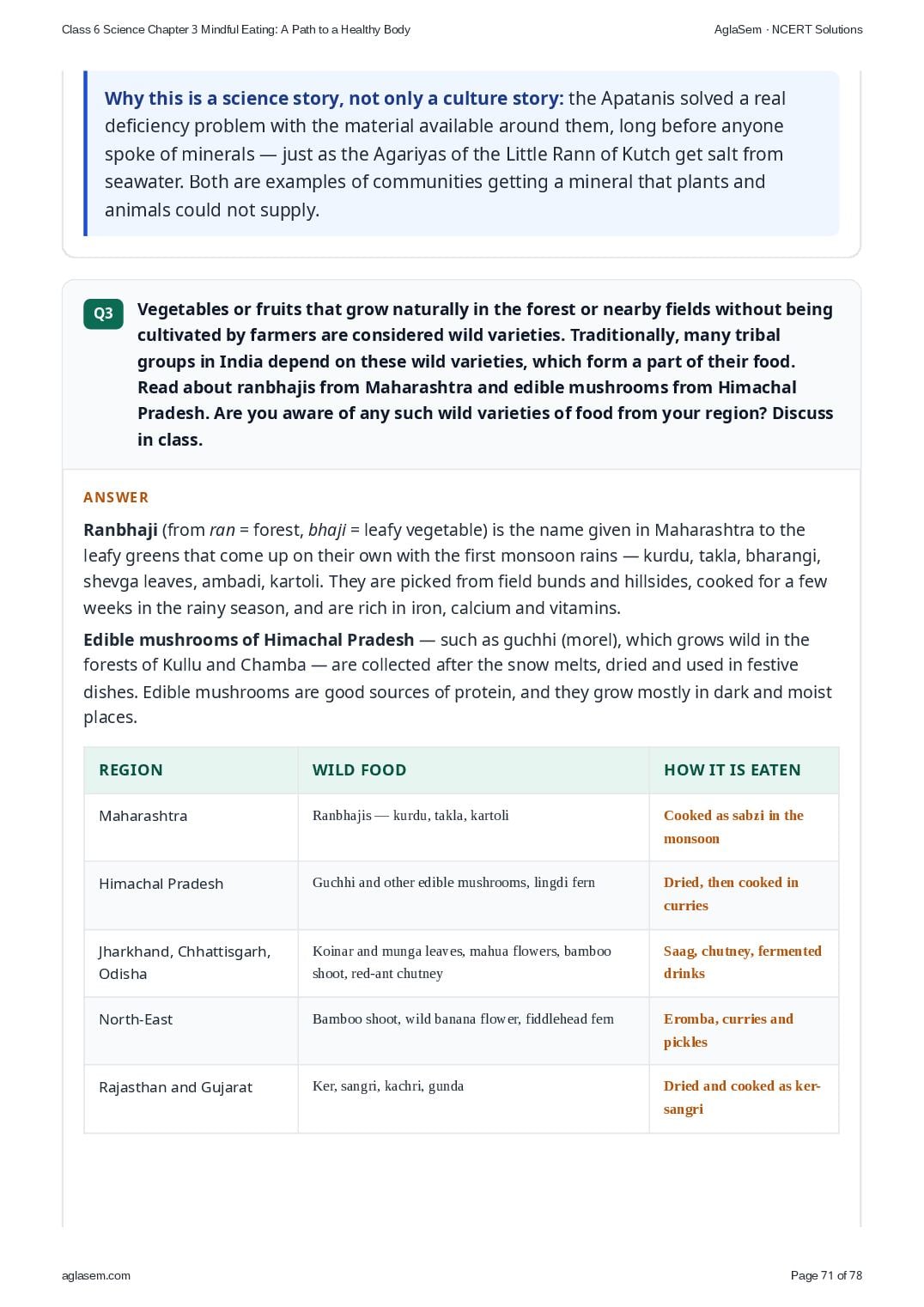
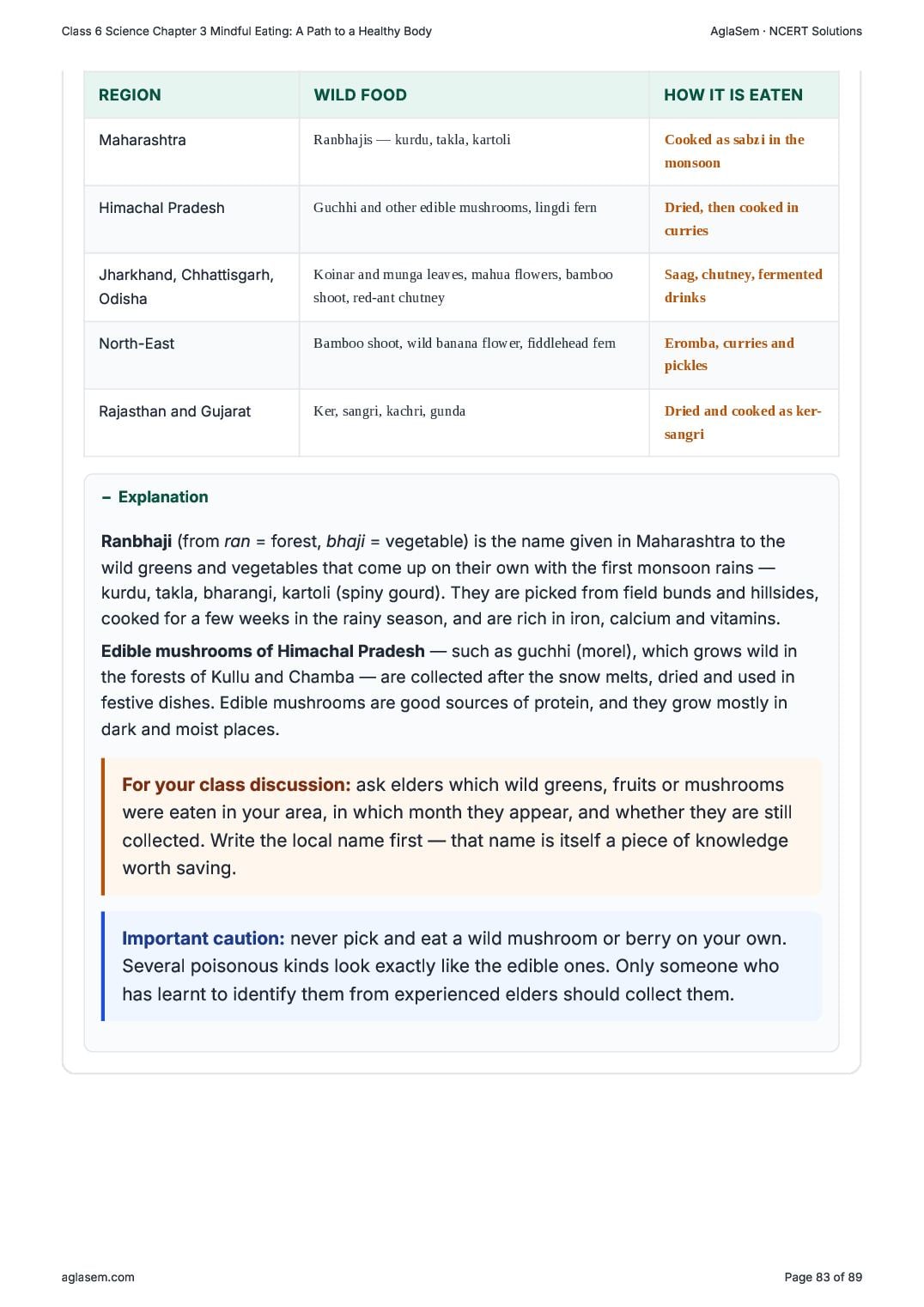
- Vegetables or fruits that grow naturally in the forest or nearby fields without being cultivated by farmers are considered wild varieties. Traditionally, many tribal groups in India depend on these wild varieties, which form a part of their food. Read about ranbhajis from Maharashtra and edible mushrooms from Himachal Pradesh. Are you aware of any such wild varieties of food from your region? Discuss in class.
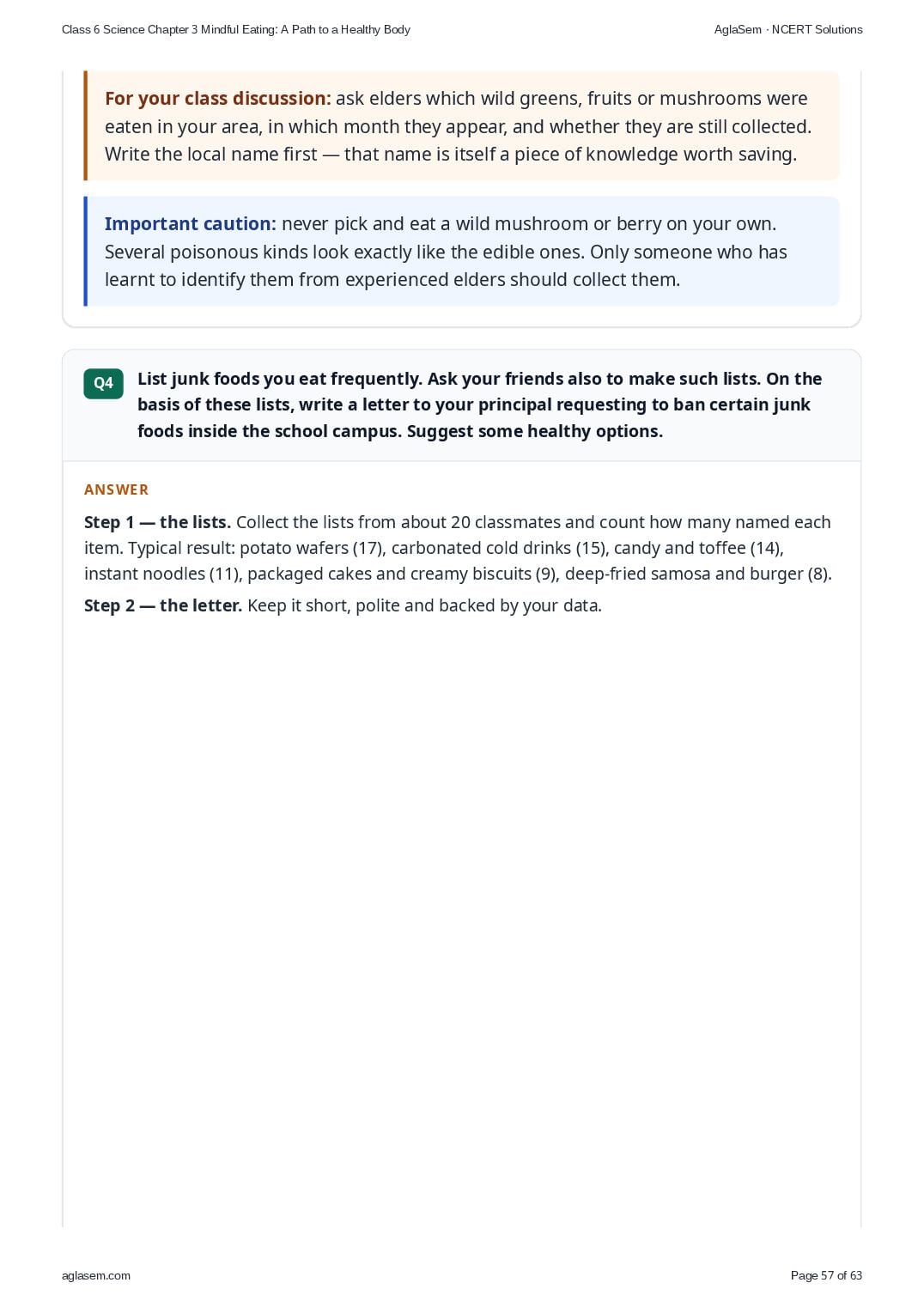
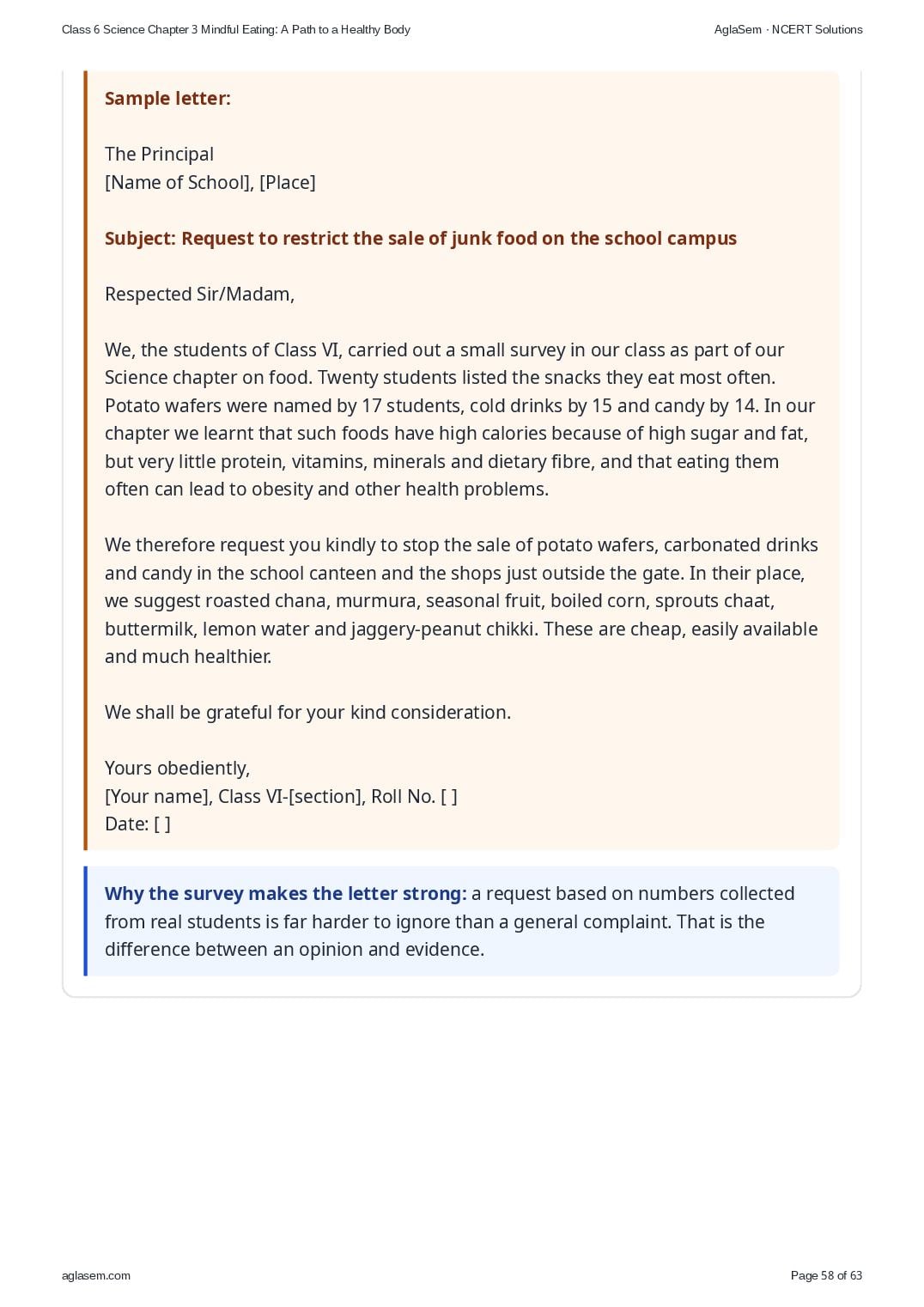
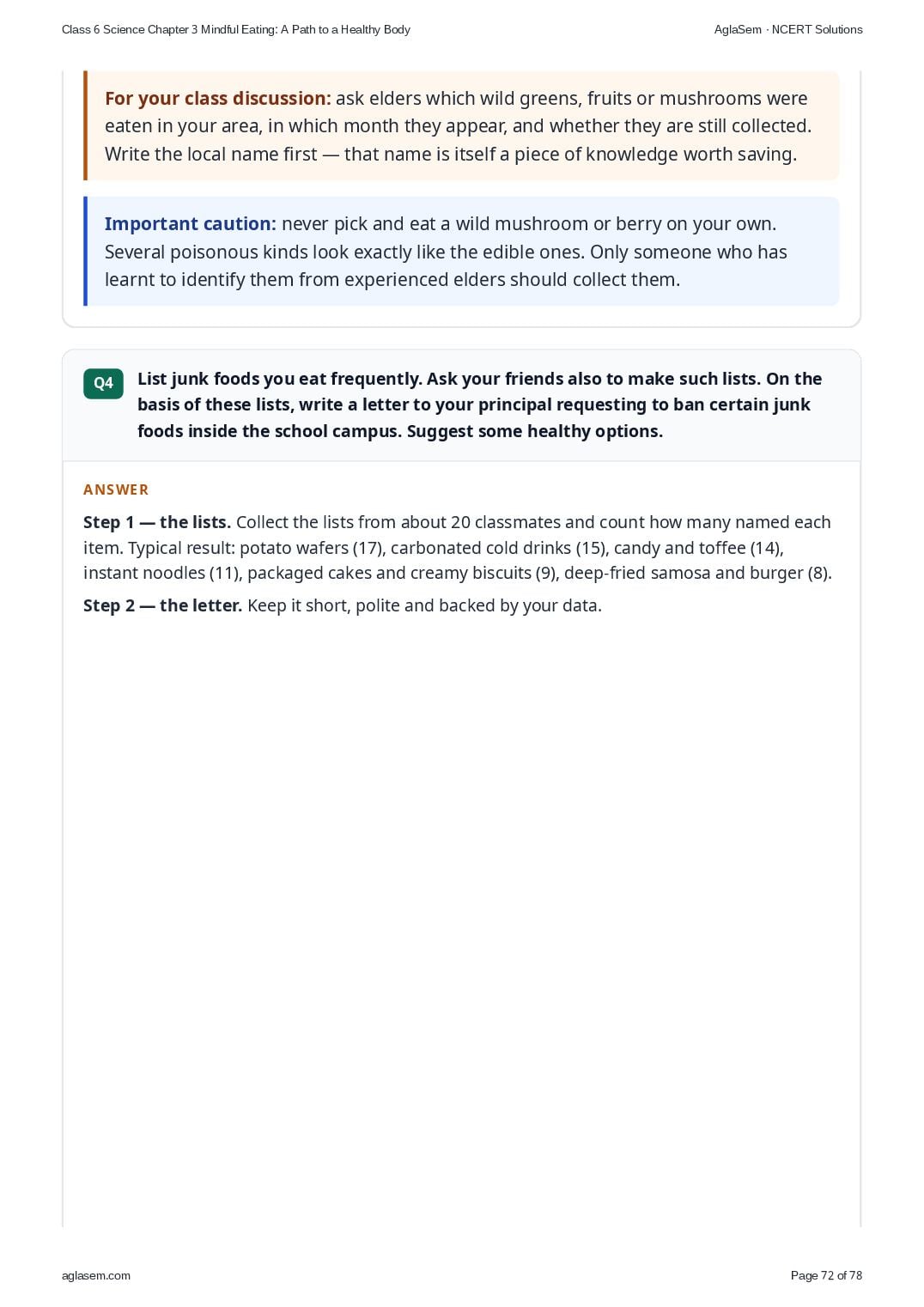
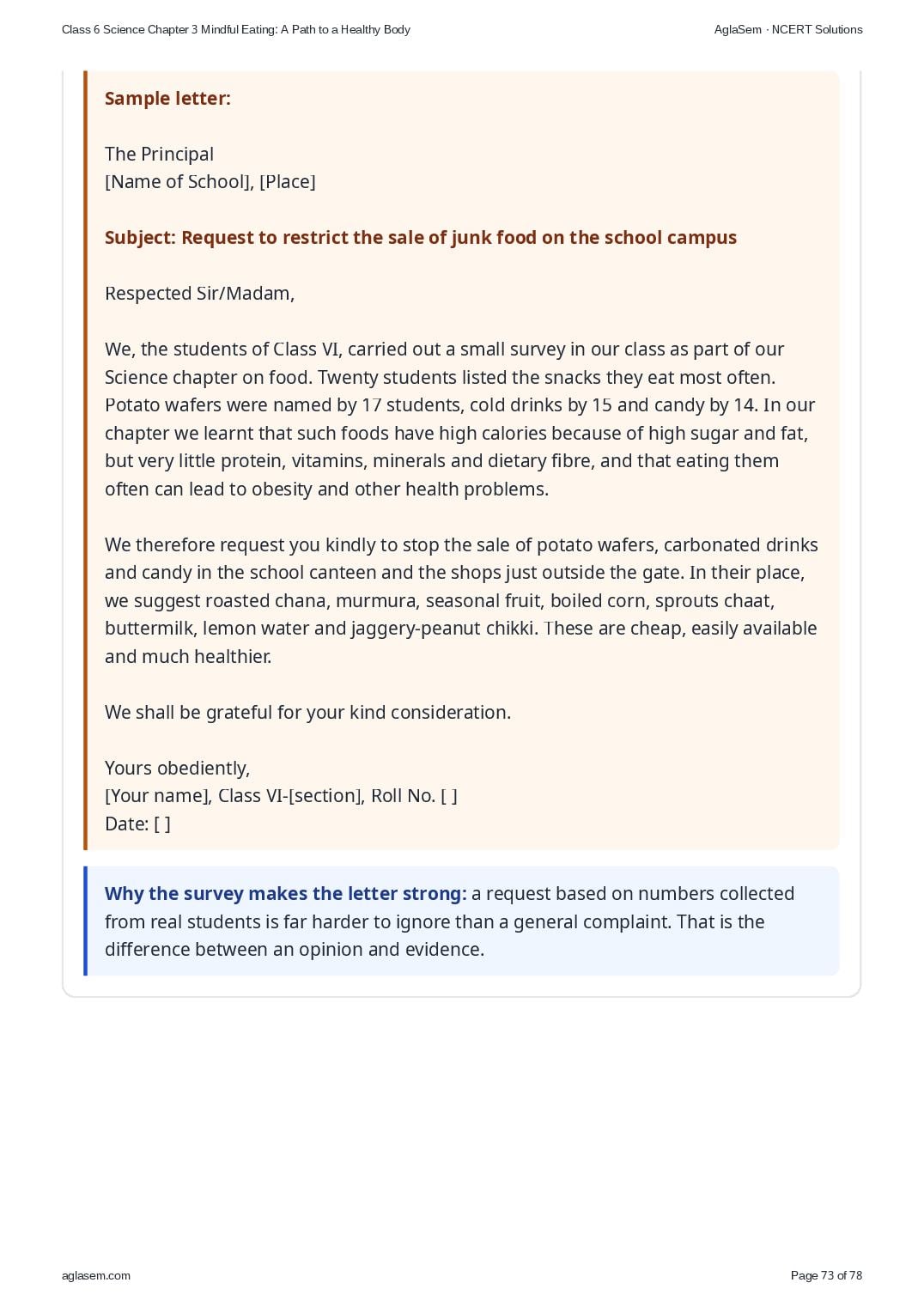
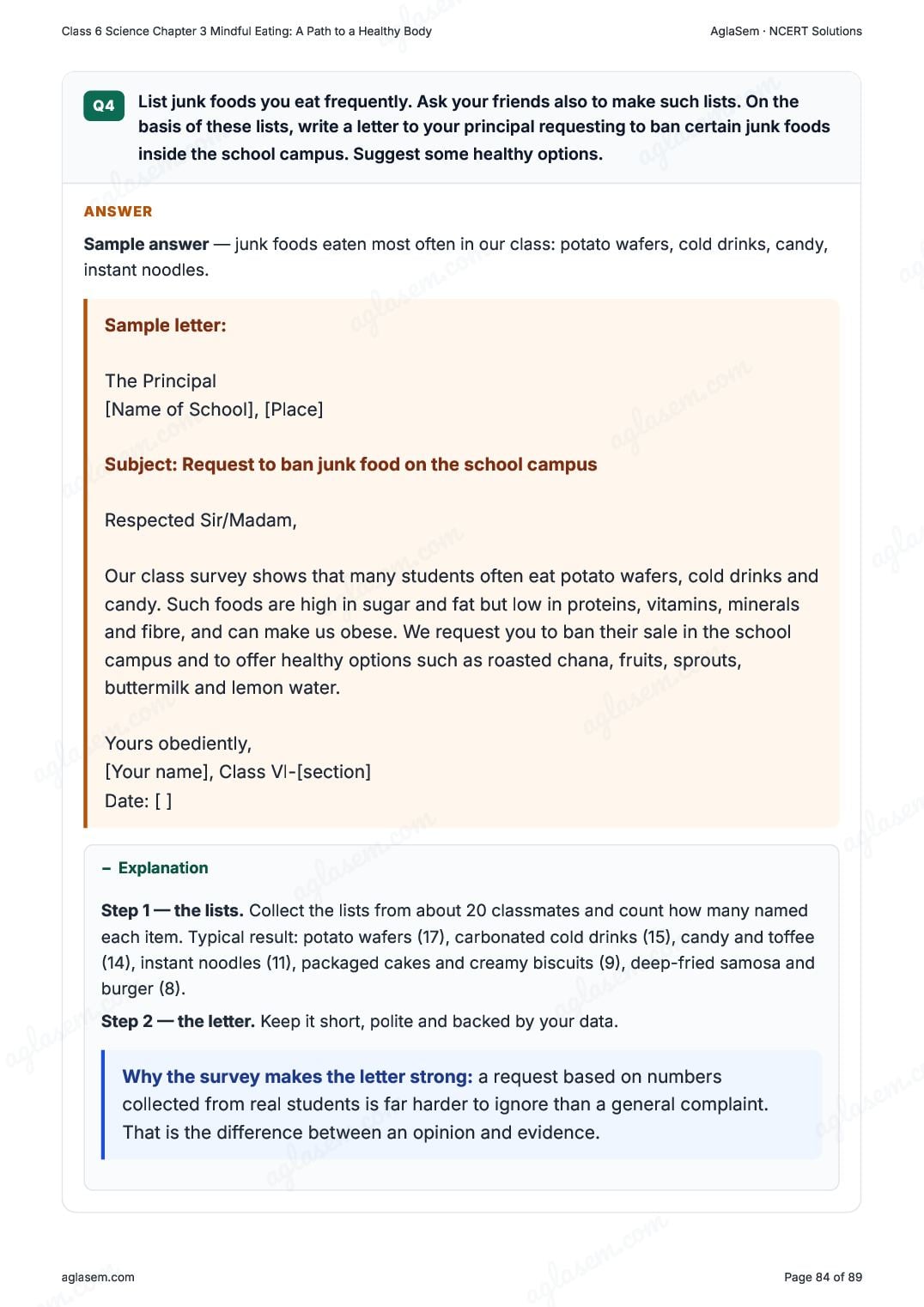
- List junk foods you eat frequently. Ask your friends also to make such lists. On the basis of these lists, write a letter to your principal requesting to ban certain junk foods inside the school campus. Suggest some healthy options.
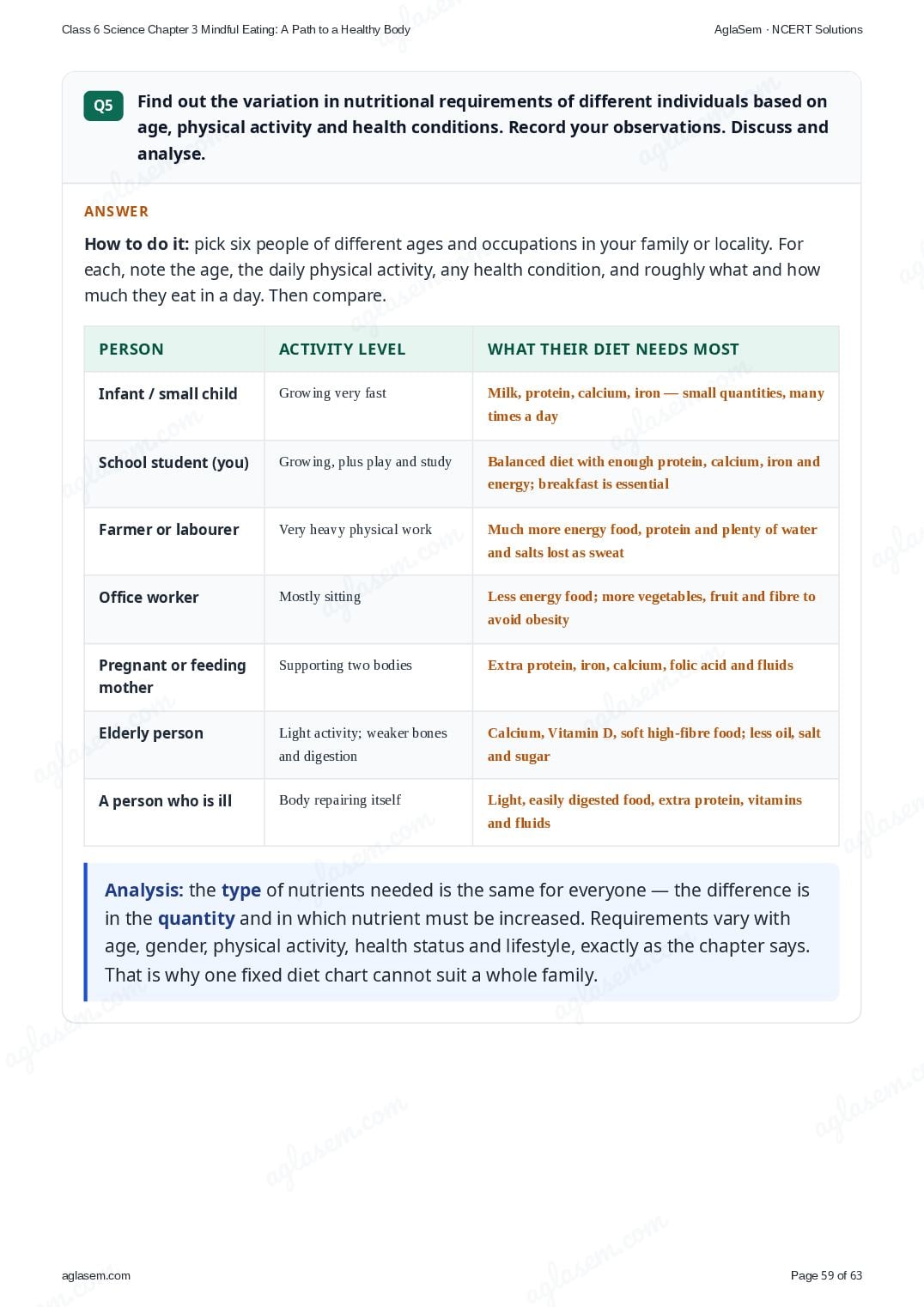
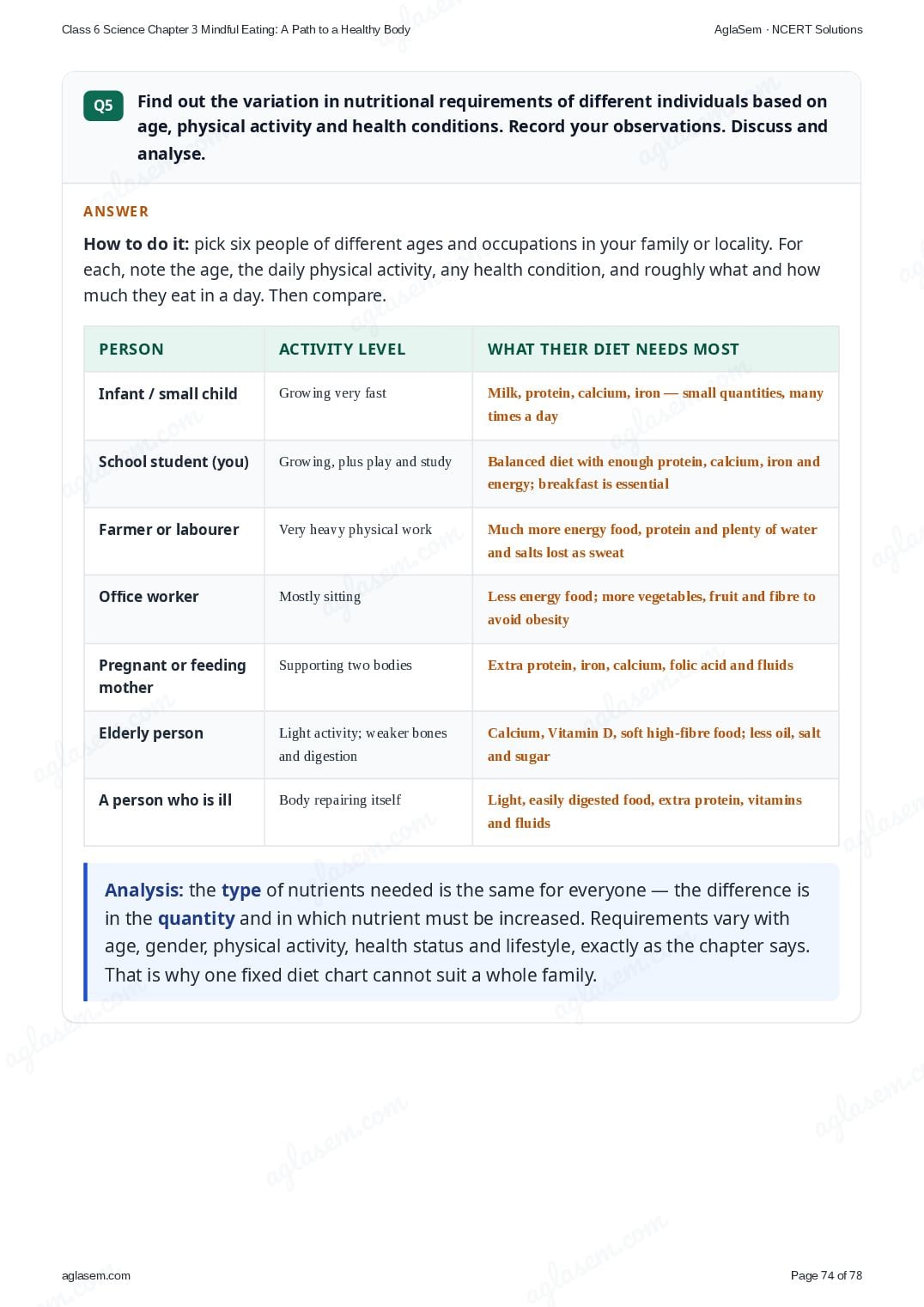
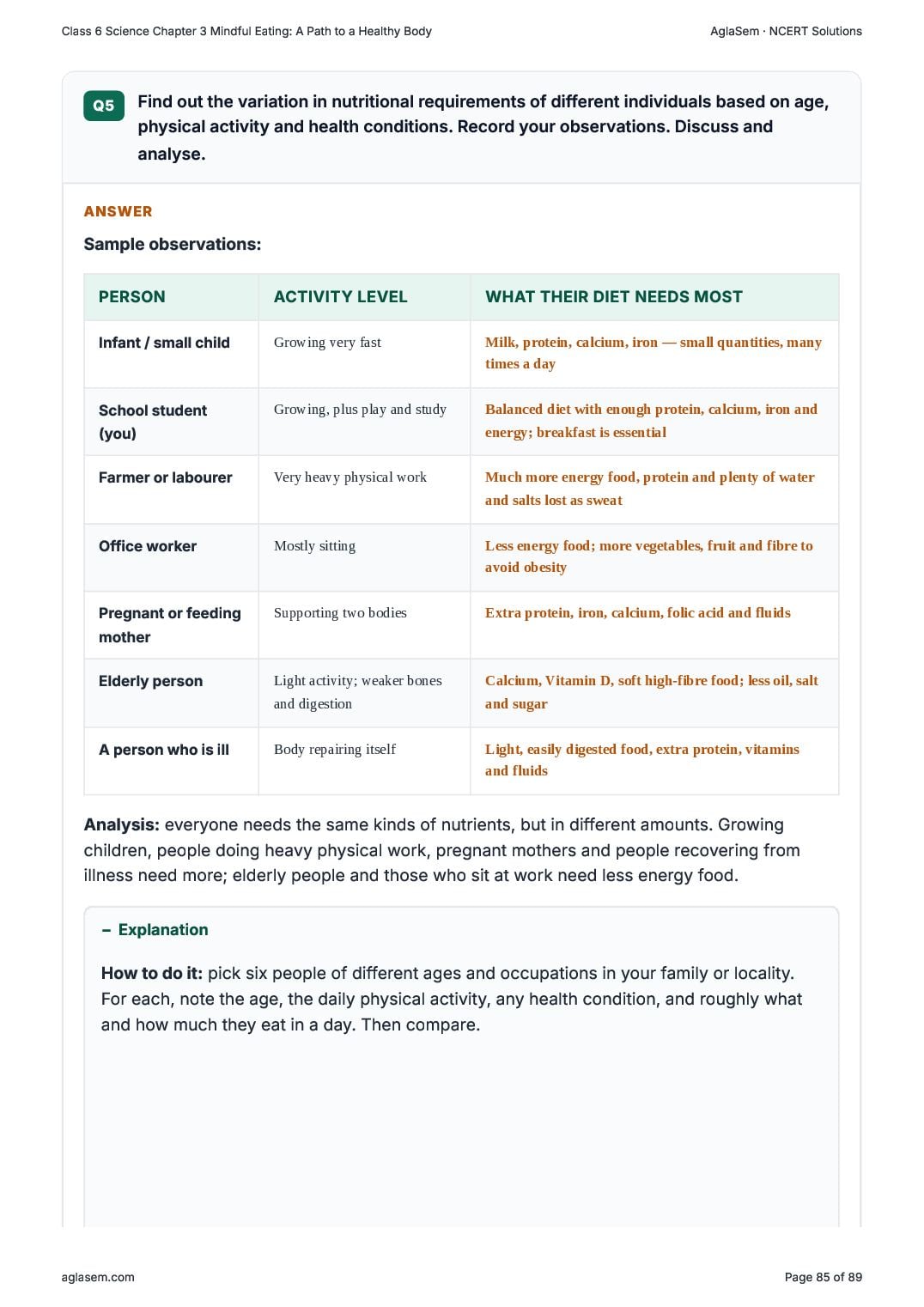
- Find out the variation in nutritional requirements of different individuals based on age, physical activity and health conditions. Record your observations. Discuss and analyse.
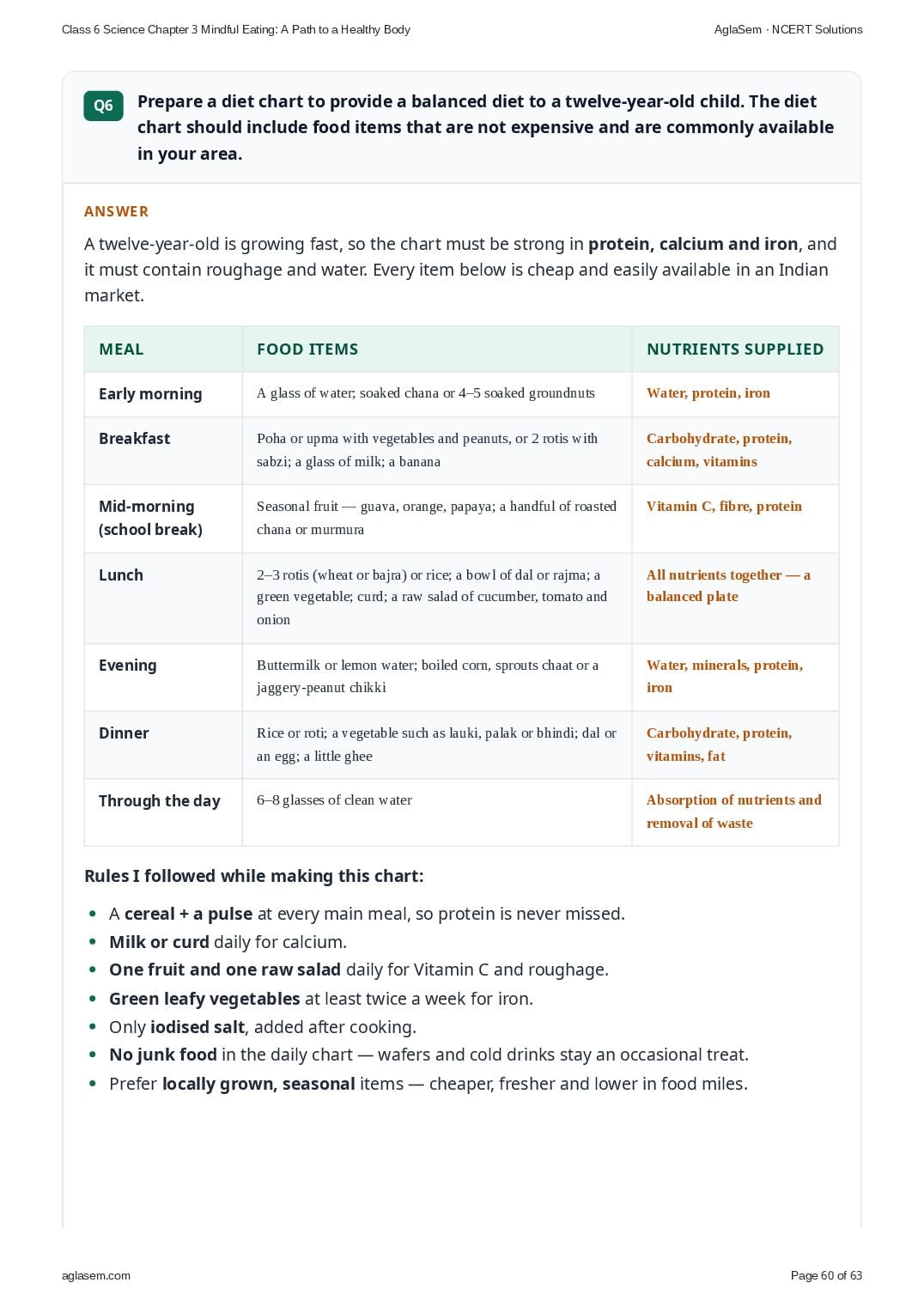
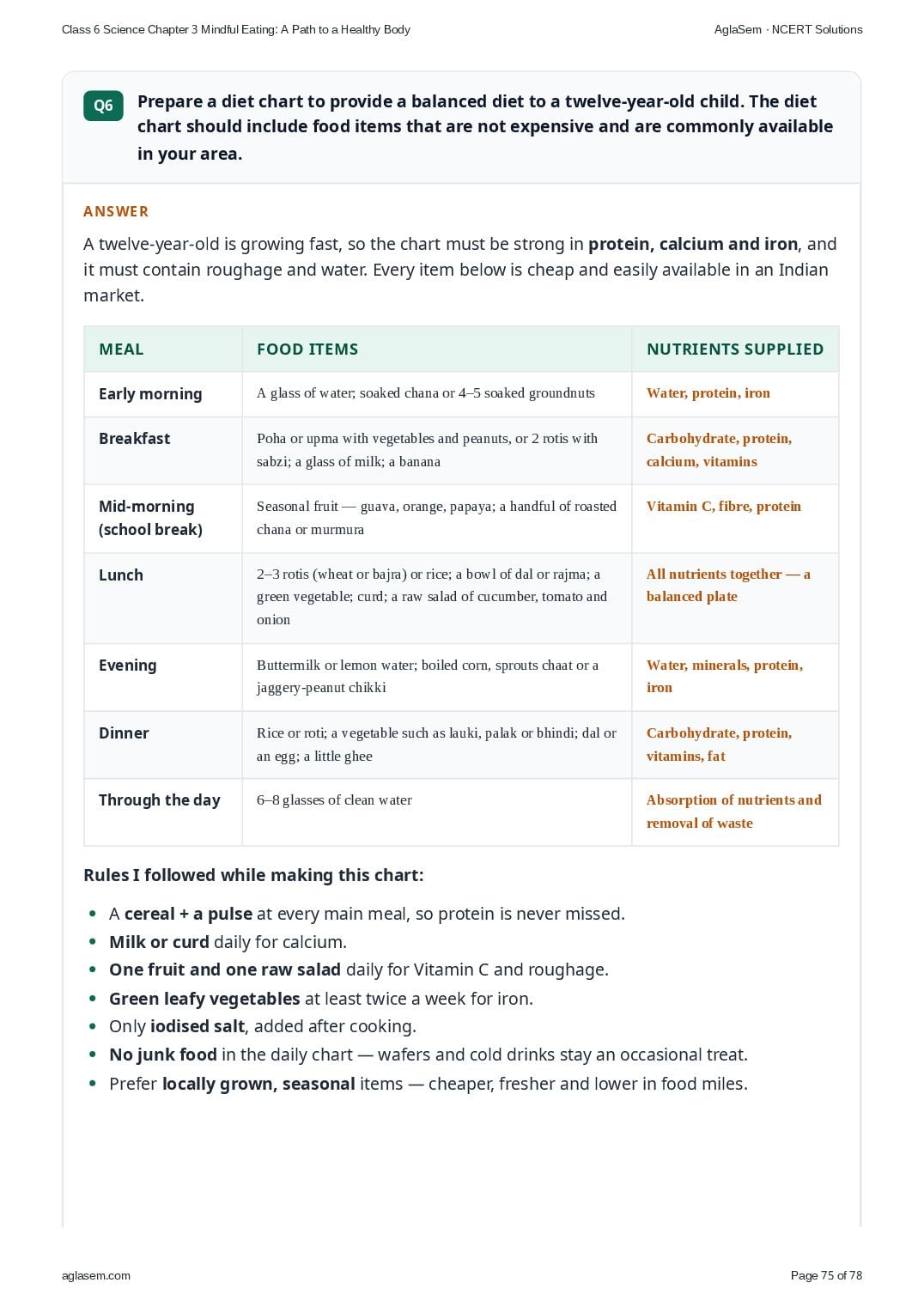
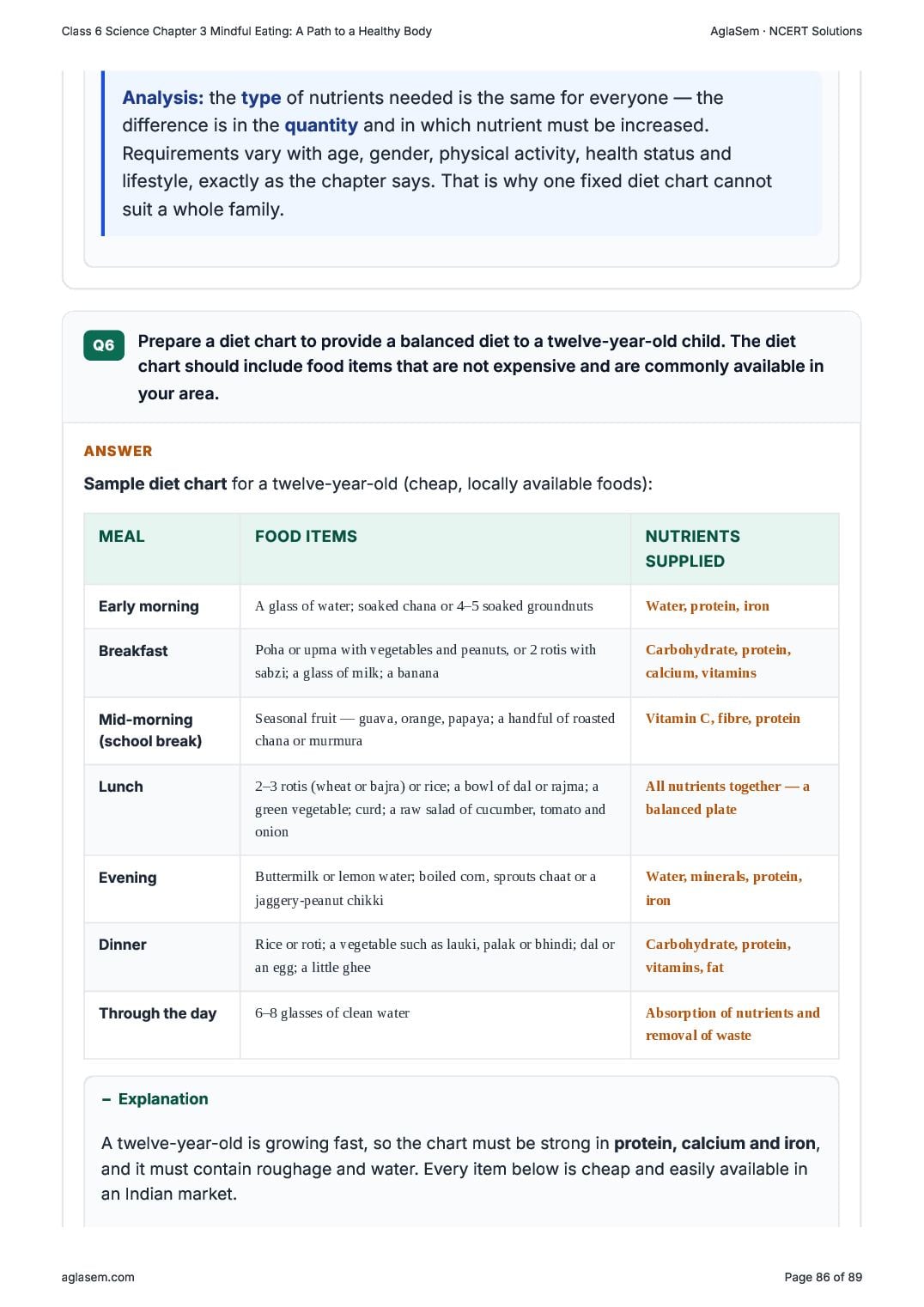
- Prepare a diet chart to provide a balanced diet to a twelve-year-old child. The diet chart should include food items that are not expensive and are commonly available in your area.
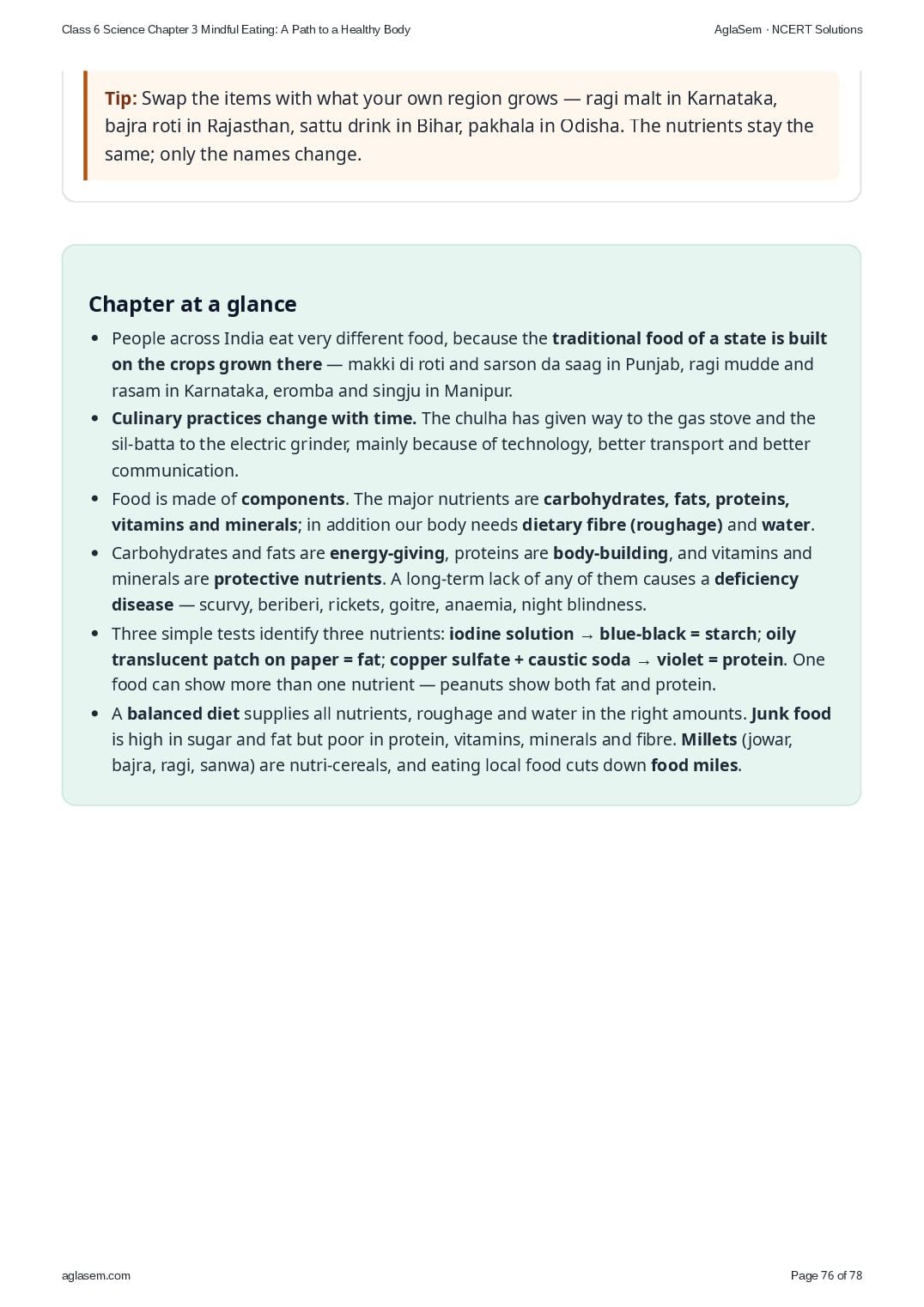
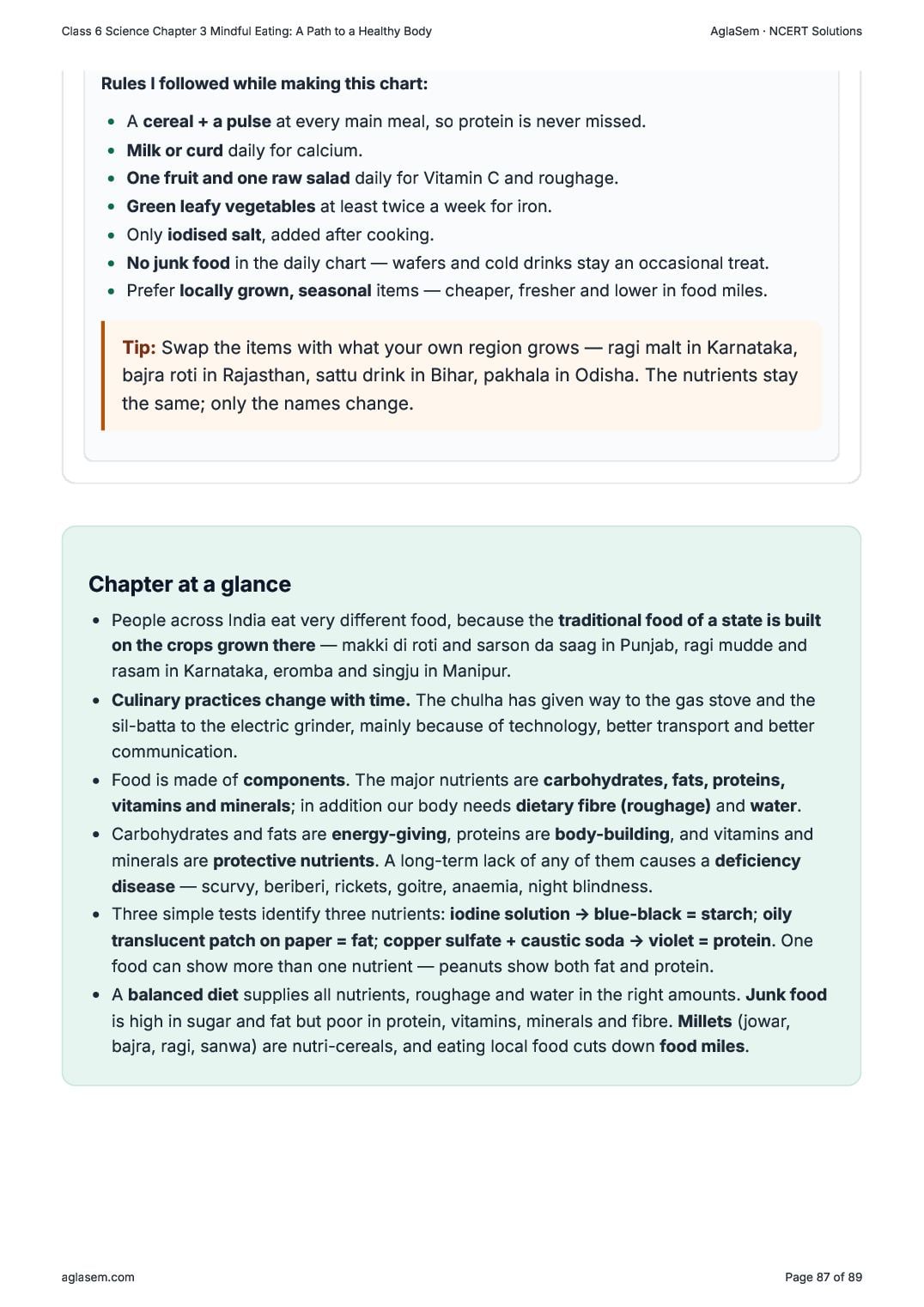
Chapter at a Glance
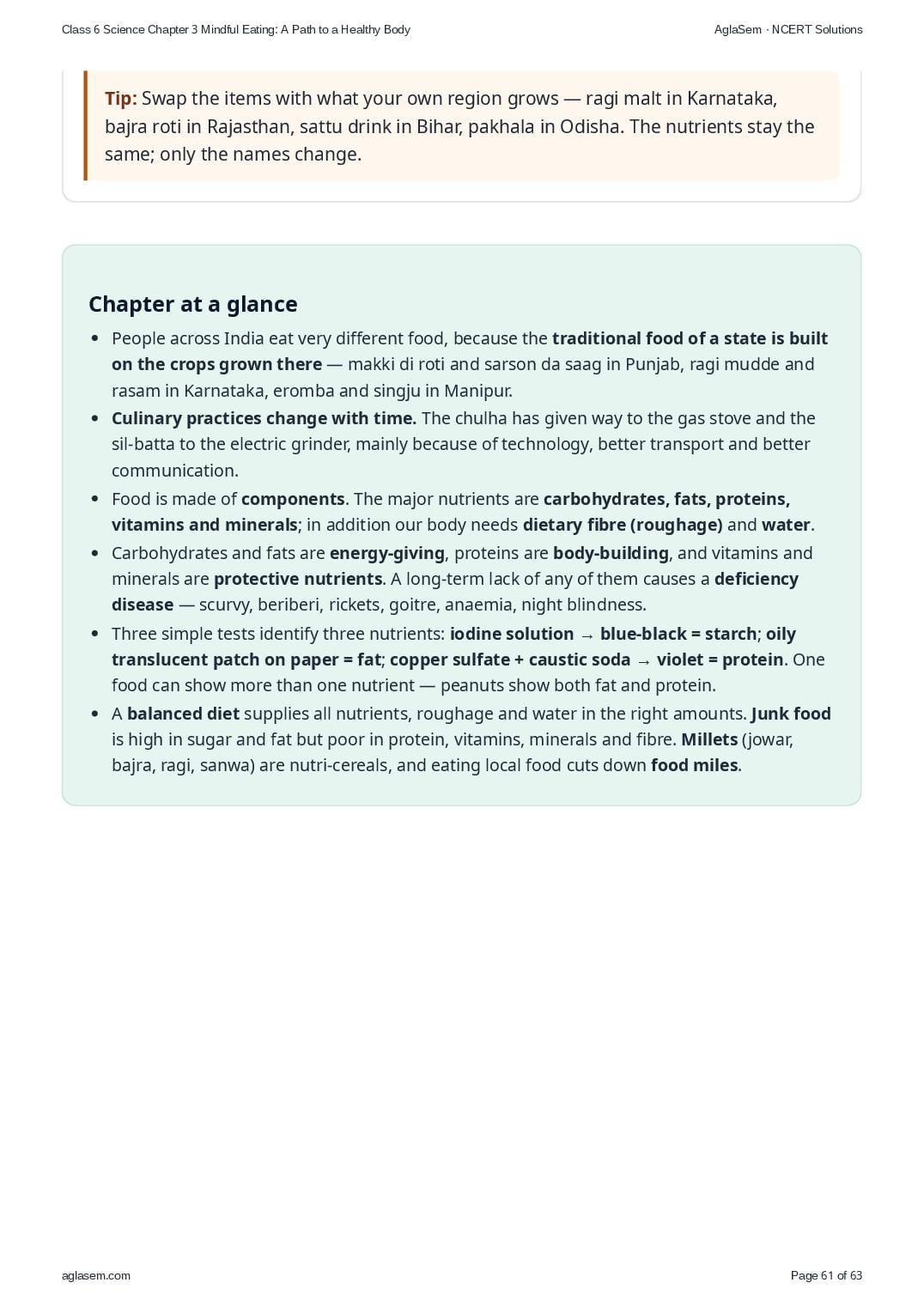
- People across India eat very different food, because the traditional food of a state is built on the crops grown there — makki di roti and sarson da saag in Punjab, ragi mudde and rasam in Karnataka, eromba and singju in Manipur.
- Culinary practices change with time. The chulha has given way to the gas stove and the sil-batta to the electric grinder, mainly because of technology, better transport and better communication.
- Food is made of components . The major nutrients are carbohydrates, fats, proteins, vitamins and minerals ; in addition our body needs dietary fibre (roughage) and water .
- Carbohydrates and fats are energy-giving , proteins are body-building , and vitamins and minerals are protective nutrients . A long-term lack of any of them causes a deficiency disease — scurvy, beriberi, rickets, goitre, anaemia, night blindness.
- Three simple tests identify three nutrients: iodine solution → blue-black = starch ; oily translucent patch on paper = fat ; copper sulfate + caustic soda → violet = protein . One food can show more than one nutrient — peanuts show both fat and protein.
- A balanced diet supplies all nutrients, roughage and water in the right amounts. Junk food is high in sugar and fat but poor in protein, vitamins, minerals and fibre. Millets (jowar, bajra, ragi, sanwa) are nutri-cereals, and eating local food cuts down food miles .
How to Download NCERT Solutions for Class 6 Science Chapter 3 PDF
Follow these simple steps to get the Mindful Eating a Path to a Healthy Body questions-and-answers PDF from Curiosity.
- Search NCERT Solutions for Class 6 Science Chapter 3 aglasem and open this page.
- Read the exercise questions with answers for Mindful Eating a Path to a Healthy Body shown above.
- Click the Download PDF link to save the Mindful Eating a Path to a Healthy Body solutions to your device.
NCERT Solutions for Class 6 Science – All Chapters
There are more chapters to study besides Mindful Eating a Path to a Healthy Body in Science. Here are the NCERT Solutions for all chapters of Class 6 Science.
- Chapter 1 the Wonderful World of Science
- Chapter 2 Diversity in the Living World
- Chapter 3 Mindful Eating a Path to a Healthy Body
- Chapter 4 Exploring Magnets
- Chapter 5 Measurement of Length and Motion
- Chapter 6 Materials Around Us
- Chapter 7 Temperature and Its Measurement
- Chapter 8 a Journey Through States of Water
- Chapter 9 Methods of Separation in Everyday Life
- Chapter 10 Living Creatures Exploring Their Characteristics
- Chapter 11 Nature’s Treasures
- Chapter 12 Beyond Earth
NCERT Solutions for Class 6 – All Subjects
Just like Chapter 3 of Science, you can get the exercise questions with answers for every other subject of Class 6. Here are the NCERT Solutions for all subjects of Class 6.
NCERT Solutions for Class 6 Science Chapter 3 – An Overview
The key highlights of this study material are as follows.
| Aspects | Details |
|---|---|
| Class | Class 6 |
| Subject | Science |
| Chapter Number | Chapter 3 |
| Chapter Name | Mindful Eating a Path to a Healthy Body |
| Book Name | Curiosity |
| Book By | NCERT (National Council of Educational Research and Training) |
| Educational Resource Here | NCERT Solutions of Class 6 Science Chapter 3 for all exercises |
| More Questions Answers of This Subject | NCERT Solutions for Class 6 Science |
| Download Book Chapter | NCERT Book Class 6 Science |
| All Questions Answers For This Class | NCERT Solutions for Class 6 |
| Complete Solutions | NCERT Solutions |
NCERT Solutions for Class 6 Science Chapter 3 Mindful Eating a Path to a Healthy Body – FAQs
What are the NCERT Solutions for Class 6 Science Chapter 3 Mindful Eating a Path to a Healthy Body?
They are the complete, step-by-step answers to all the exercise and in-text questions of Chapter 3 Mindful Eating a Path to a Healthy Body from the NCERT Class 6 Science textbook Curiosity, written by experts as per the latest NCERT syllabus.
How can I download the Class 6 Science Chapter 3 solutions PDF for free?
Open this page on aglasem, read the Mindful Eating a Path to a Healthy Body questions with answers, and click the “Download Solutions PDF” link. The Class 6 Science Chapter 3 NCERT Solutions PDF is completely free to download.
Are these NCERT Solutions as per the latest 2026-27 syllabus?
Yes. The NCERT Solutions for Class 6 Science Chapter 3 are based on the latest NCERT textbook Curiosity and the current 2026-27 CBSE syllabus, so the questions and answers match what you study in class.
Where can I get NCERT Solutions for the other chapters of Class 6 Science?
You can find the answers to every chapter on the NCERT Solutions for Class 6 Science page, and solutions for every subject on the NCERT Solutions for Class 6 page.
How do NCERT Solutions help in exam preparation?
They show the correct method to solve each question, help you write answers the way they are expected in exams, let you check and correct your own work, and save revision time — which together improve your marks in Class 6 Science.
If you have any queries on NCERT Solutions for Class 6 Science Chapter 3 Mindful Eating a Path to a Healthy Body, then please ask in the comments below.