NCERT Solutions for Class 6 Science Chapter 6 Materials Around Us provide clear, step-by-step answers to every exercise and in-text question from the chapter Materials Around Us of the NCERT textbook Curiosity. Prepared by subject experts as per the latest NCERT (CBSE) syllabus for 2026-27, these NCERT Solutions for Class 6 Science help you understand each concept, write exam-ready answers, and check your own solutions. You can read them online below or download the free Class 6 Science Chapter 6 question-answer PDF.
NCERT Solutions for Class 6 Science Chapter 6 Materials Around Us
- Class: Class 6
- Subject: Science
- Chapter: Chapter 6 – Materials Around Us
- Textbook: Curiosity (NCERT)
- Study material: NCERT Solutions – questions with answers, free PDF
These solutions answer all the exercise questions of Chapter 6 Materials Around Us — including the in-text questions, short-answer and long-answer questions, and activities — with complete explanations so you can follow the method, not just the final answer. Read the full solutions below.
NCERT Solutions Class 6 Science Chapter 6 Materials Around Us View Download
NCERT Solutions for Class 6 Science Chapter 6 PDF Download
You can read the NCERT Solutions for Class 6 Science Chapter 6 online above, or download the complete question-answer PDF to study Materials Around Us offline at any time.
NCERT Solutions for Class 6 Science Chapter 6 PDF Download Link – Click Here to Download Solutions PDF
Questions Covered in This Chapter
These NCERT Solutions answer all 51 questions of this chapter. The questions solved are:
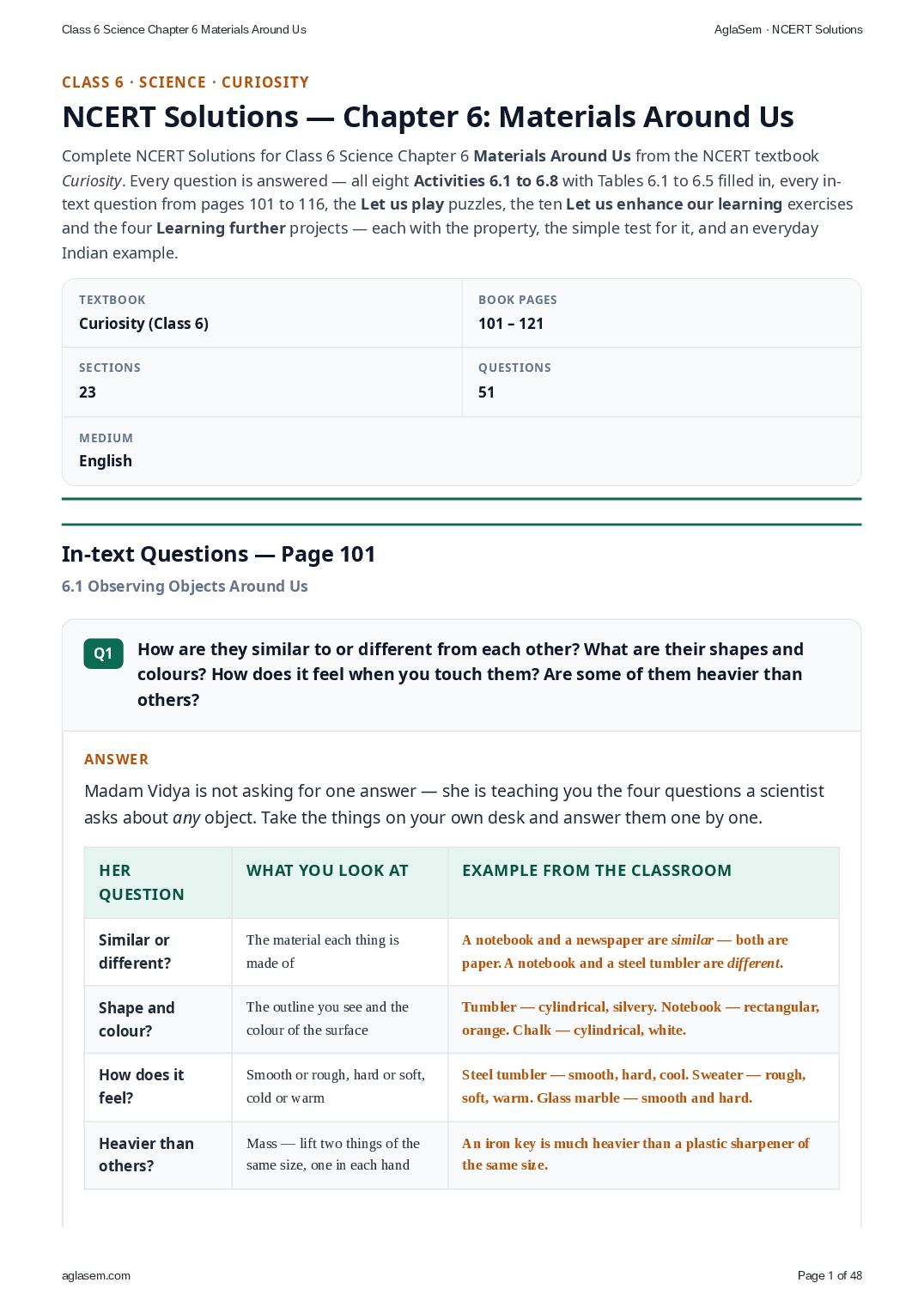
- How are they similar to or different from each other? What are their shapes and colours? How does it feel when you touch them? Are some of them heavier than others?
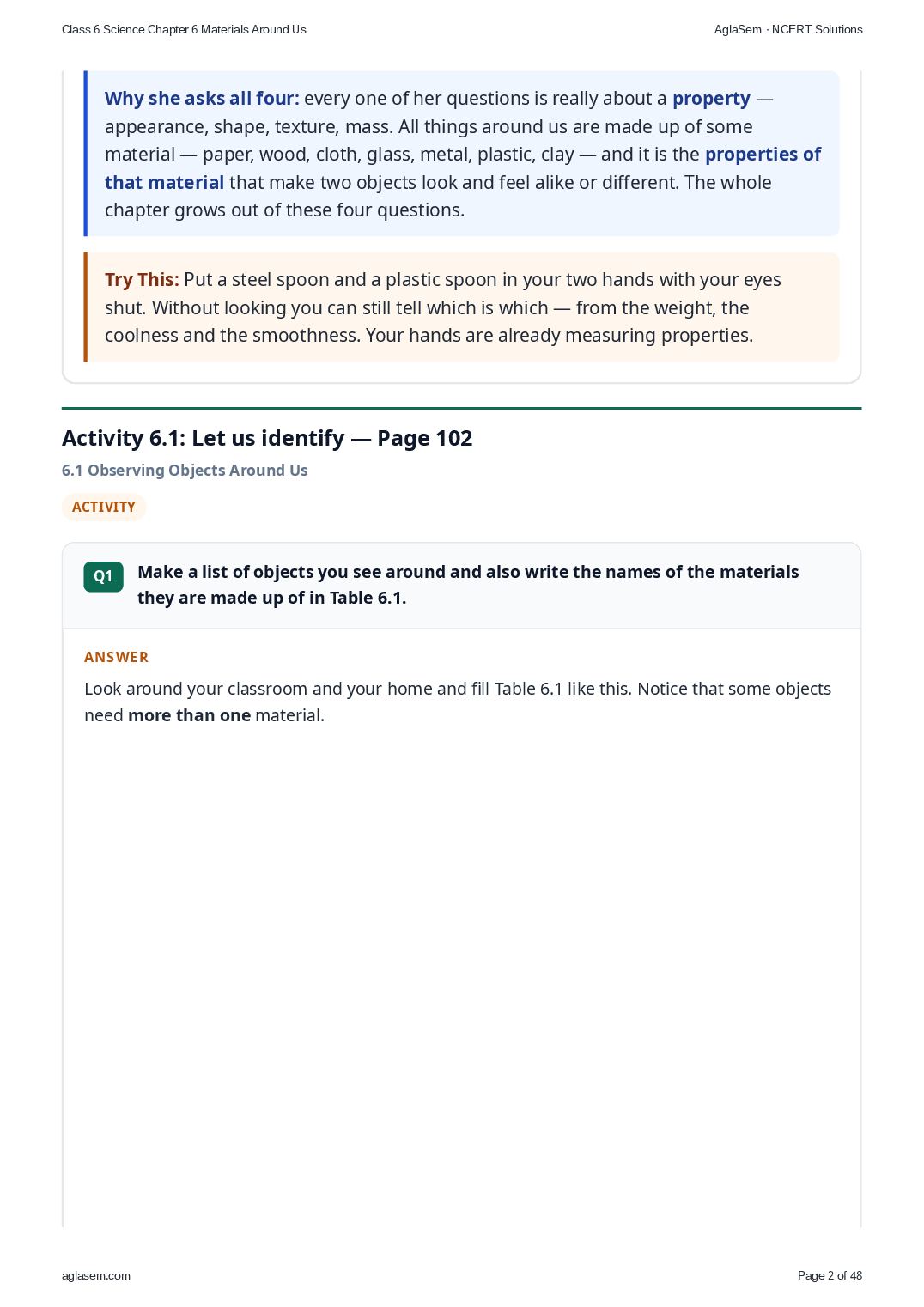
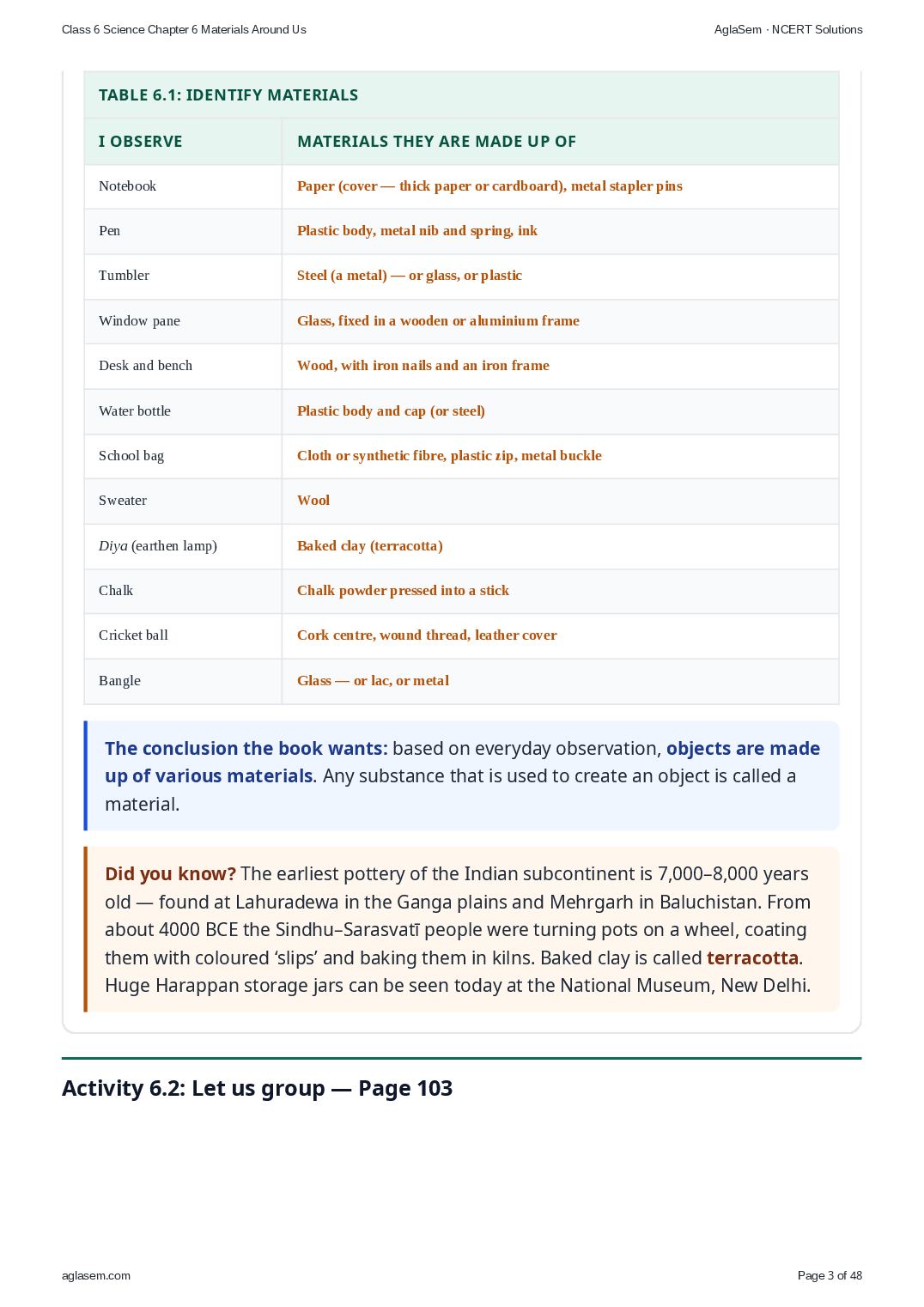
- Make a list of objects you see around and also write the names of the materials they are made up of in Table 6.1.
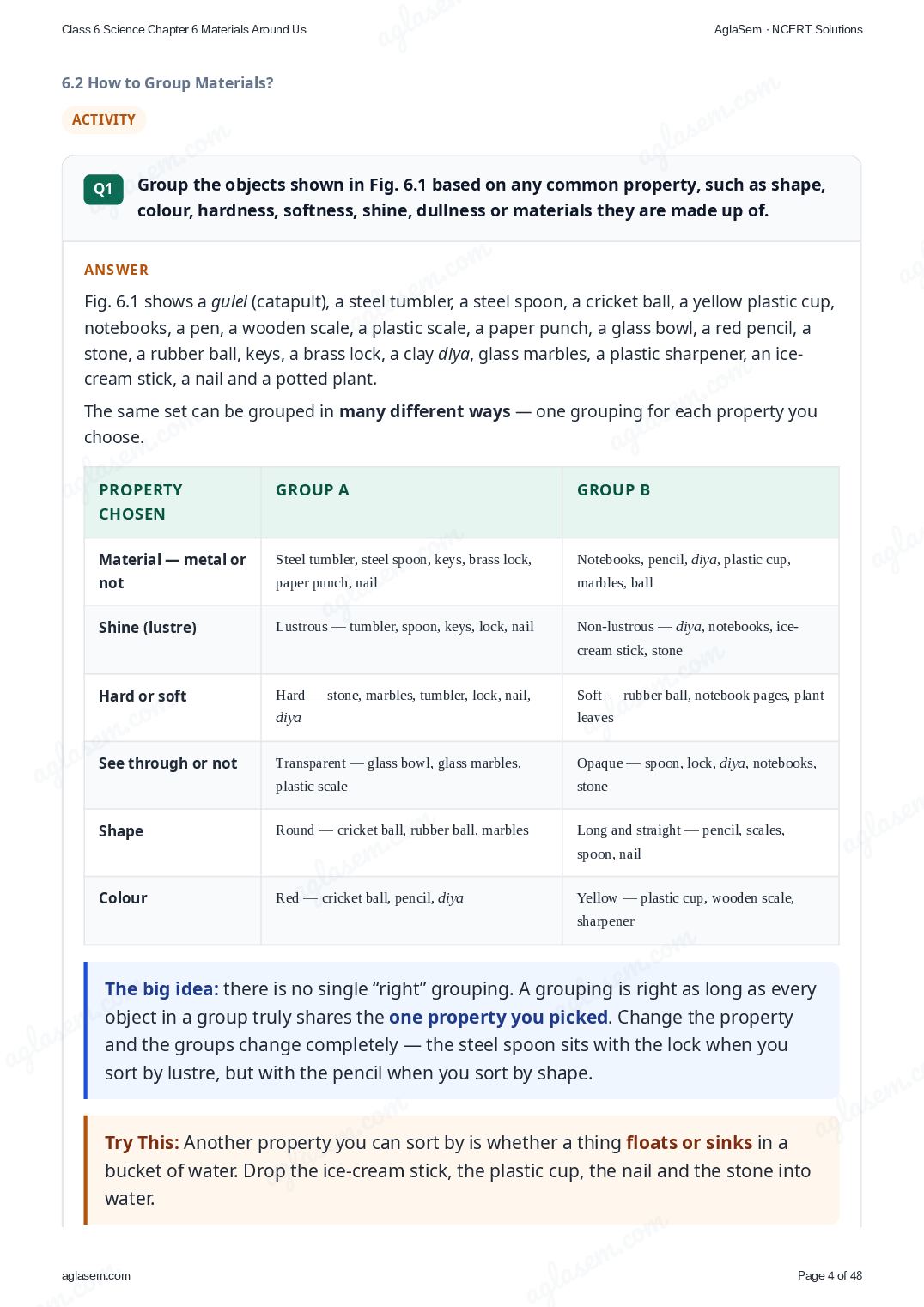
- Group the objects shown in Fig. 6.1 based on any common property, such as shape, colour, hardness, softness, shine, dullness or materials they are made up of.
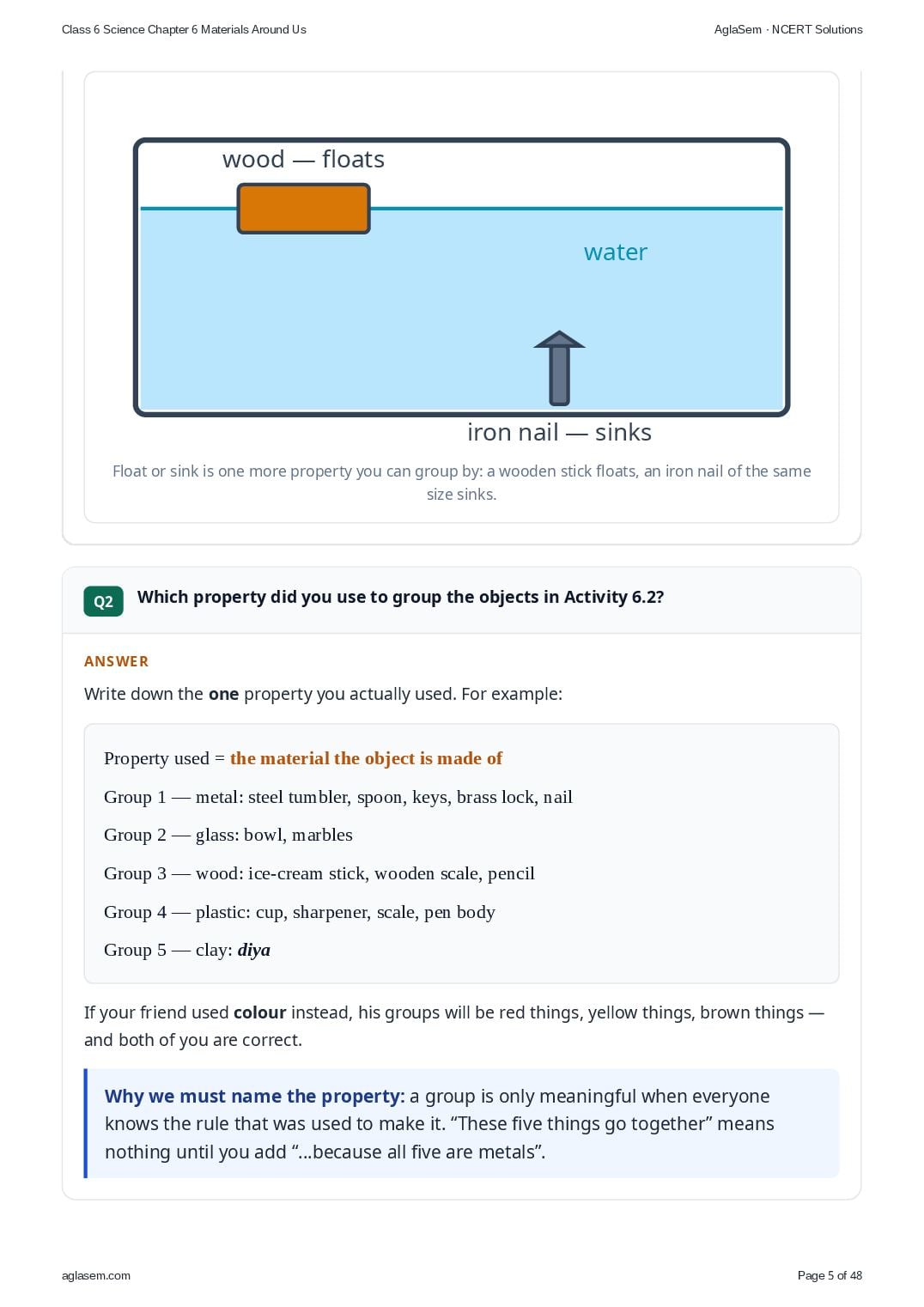
- Which property did you use to group the objects in Activity 6.2?
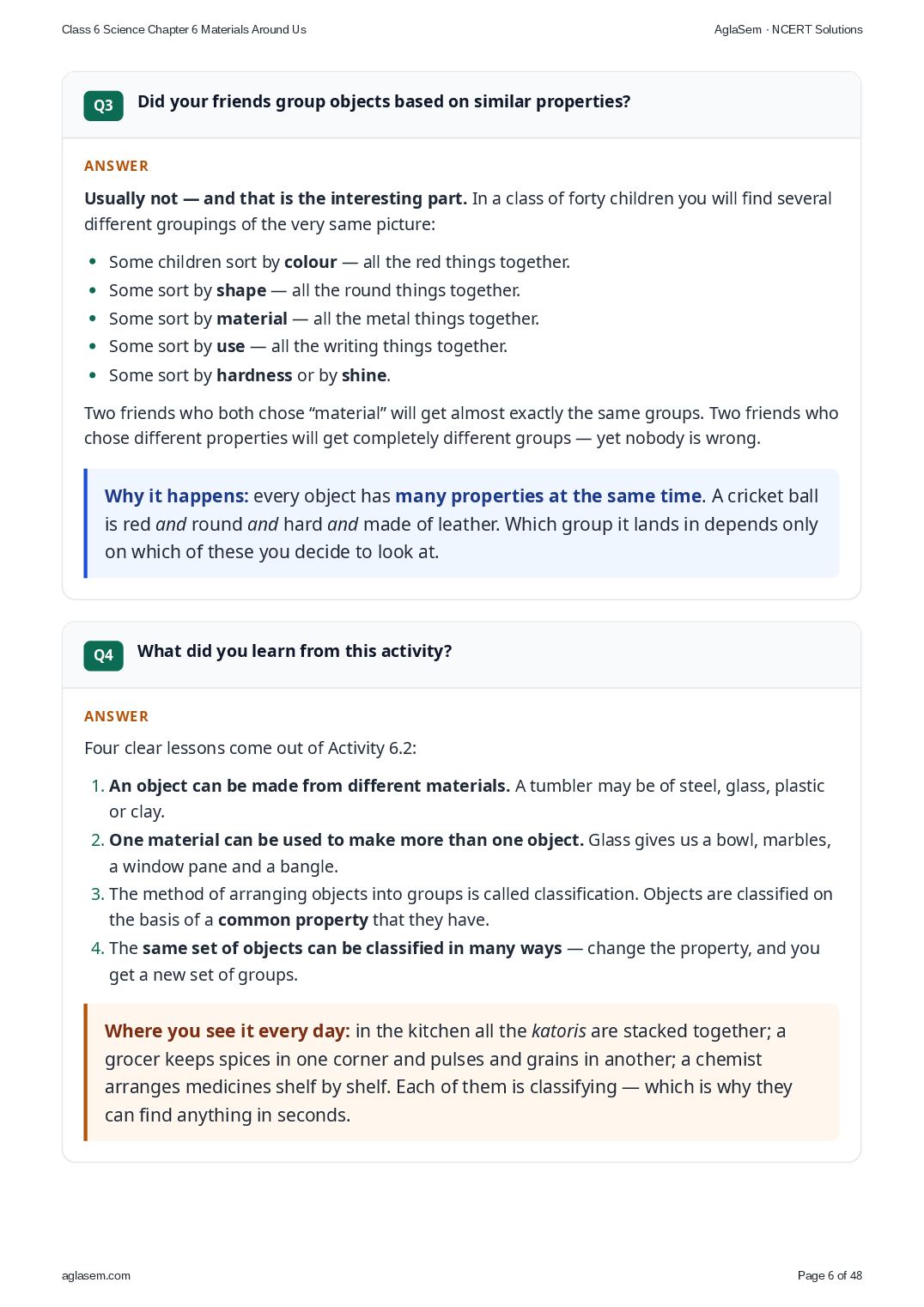
- Did your friends group objects based on similar properties?
- What did you learn from this activity?
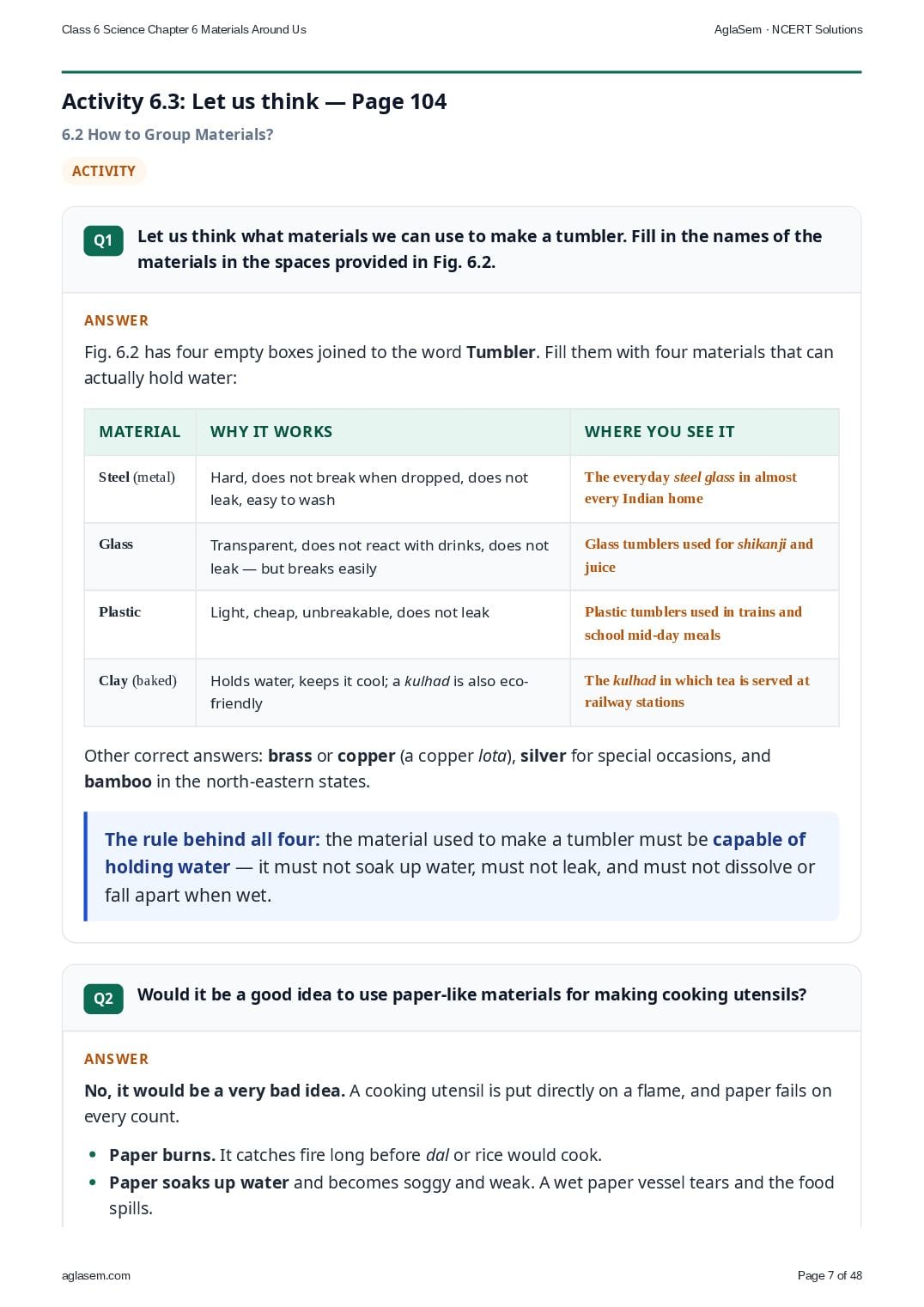
- Let us think what materials we can use to make a tumbler. Fill in the names of the materials in the spaces provided in Fig. 6.2.
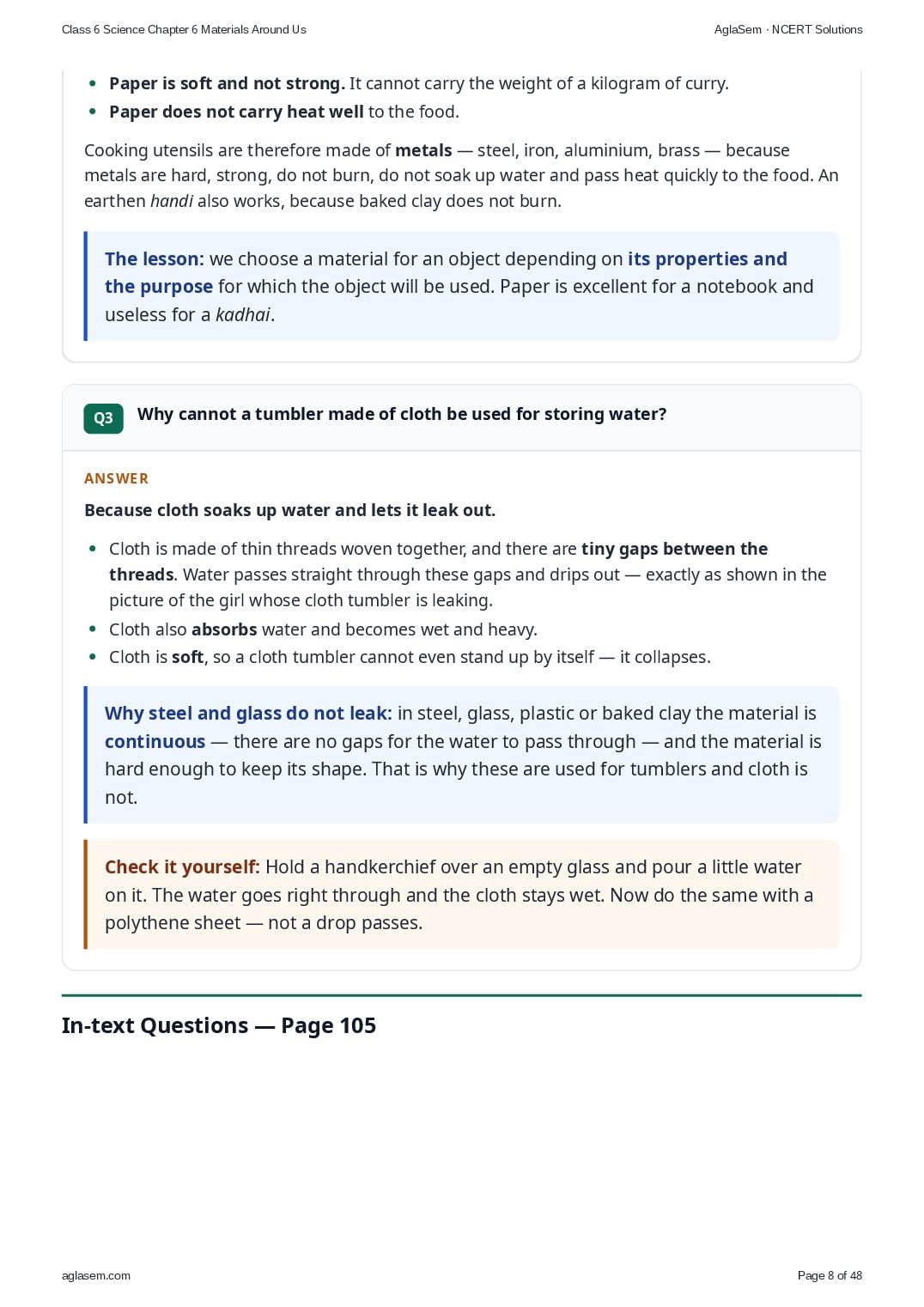
- Would it be a good idea to use paper-like materials for making cooking utensils?
- Why cannot a tumbler made of cloth be used for storing water?
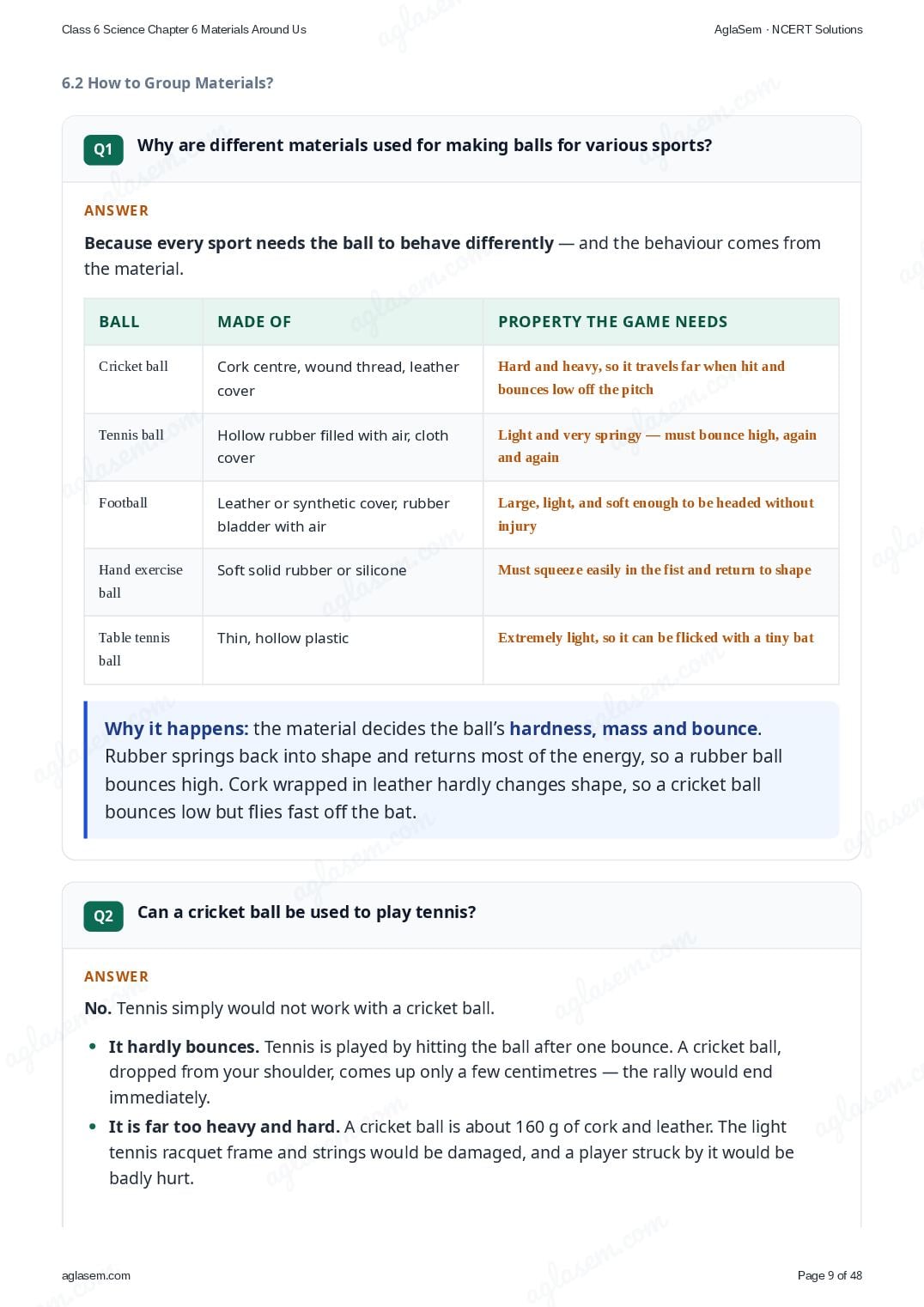
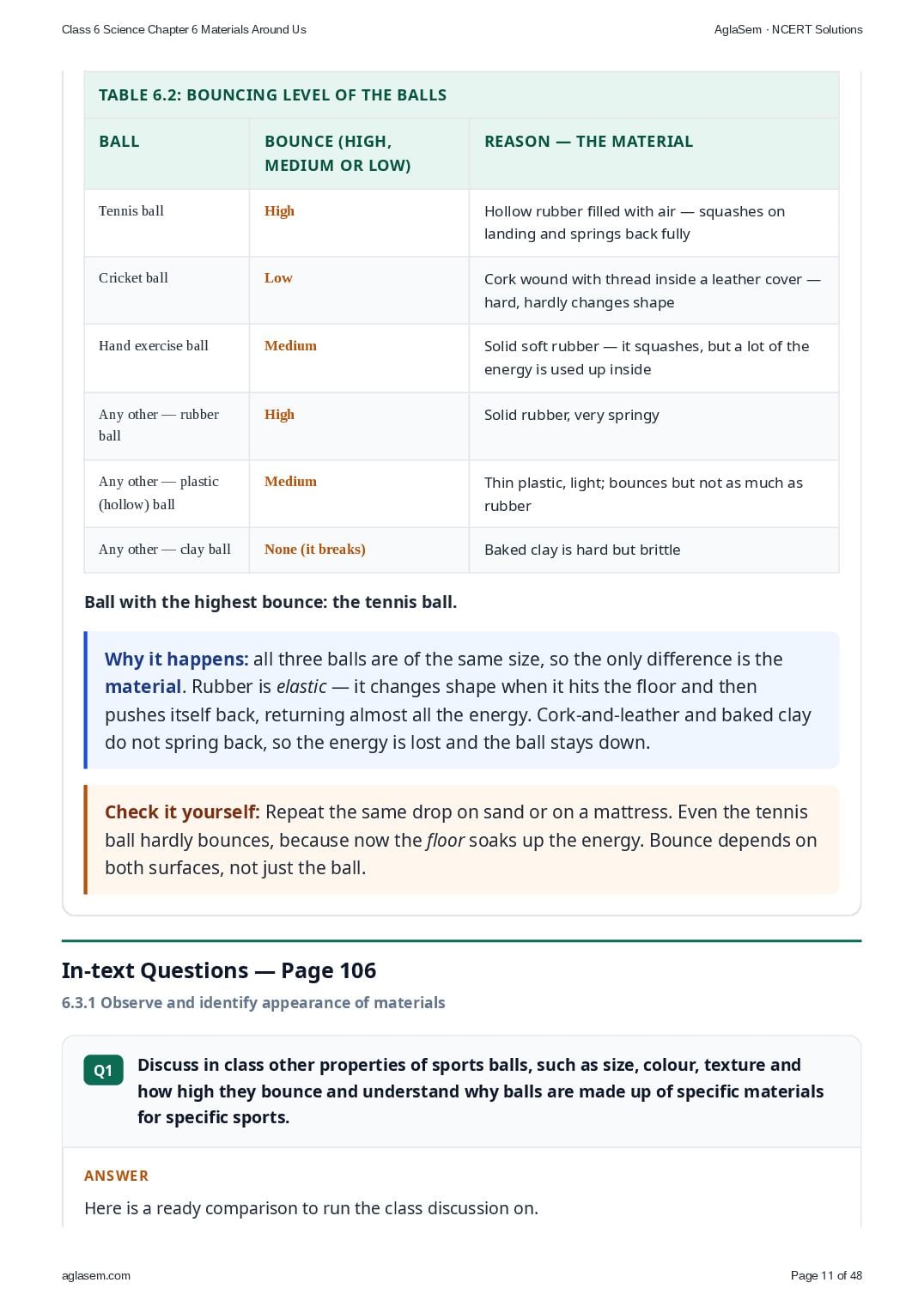
- Why are different materials used for making balls for various sports?
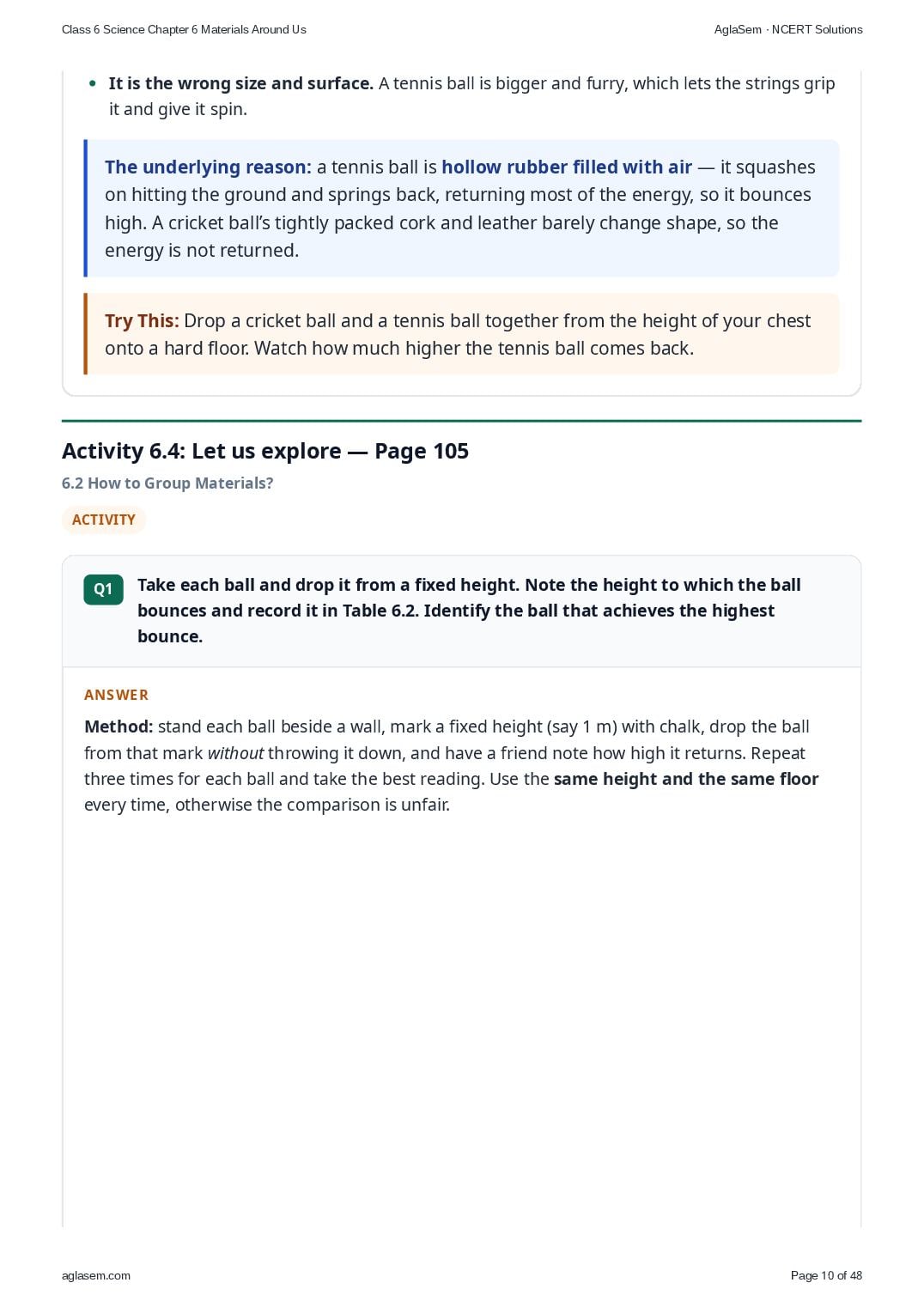
- Can a cricket ball be used to play tennis?
- Take each ball and drop it from a fixed height. Note the height to which the ball bounces and record it in Table 6.2. Identify the ball that achieves the highest bounce.
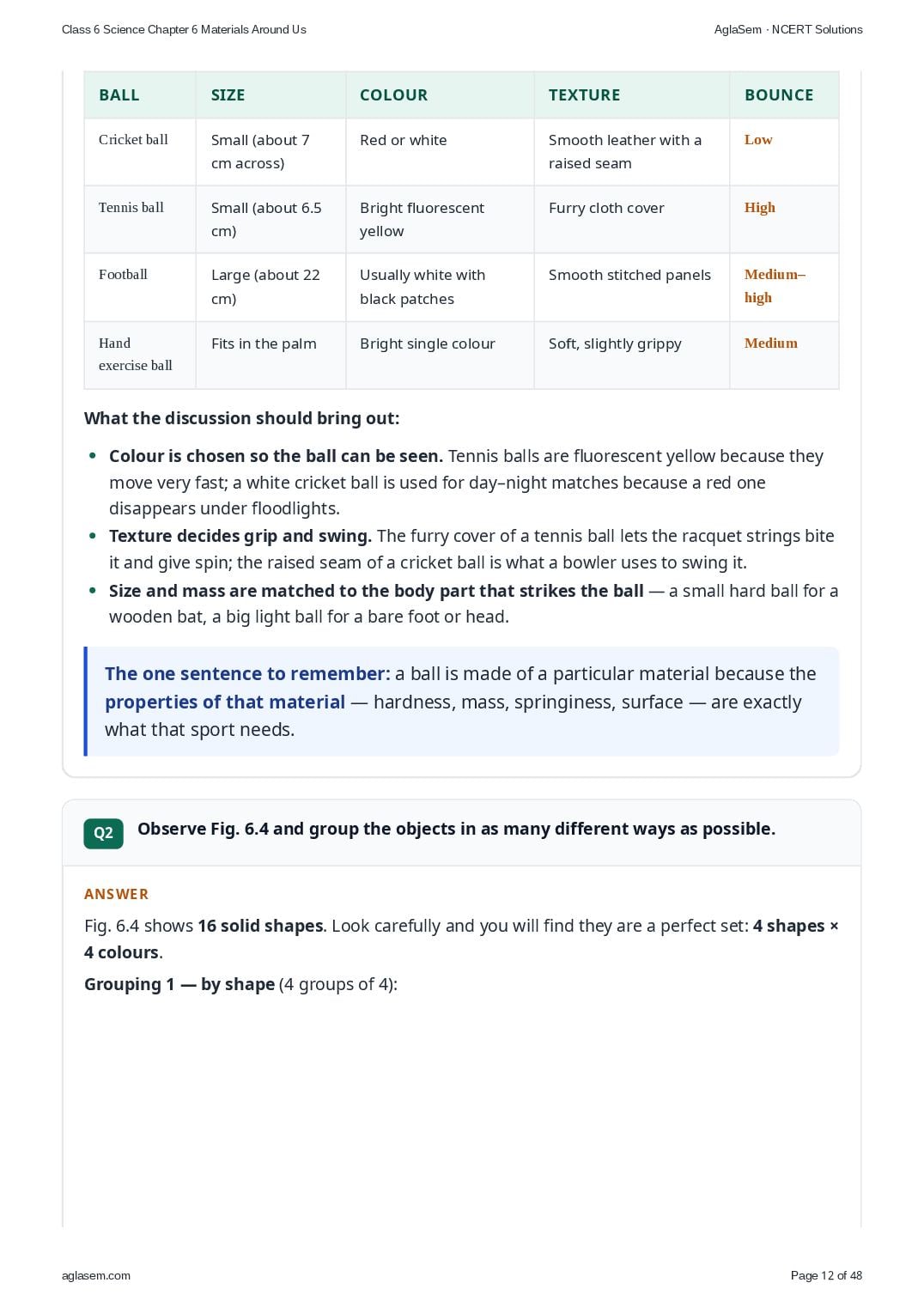
- Discuss in class other properties of sports balls, such as size, colour, texture and how high they bounce and understand why balls are made up of specific materials for specific sports.
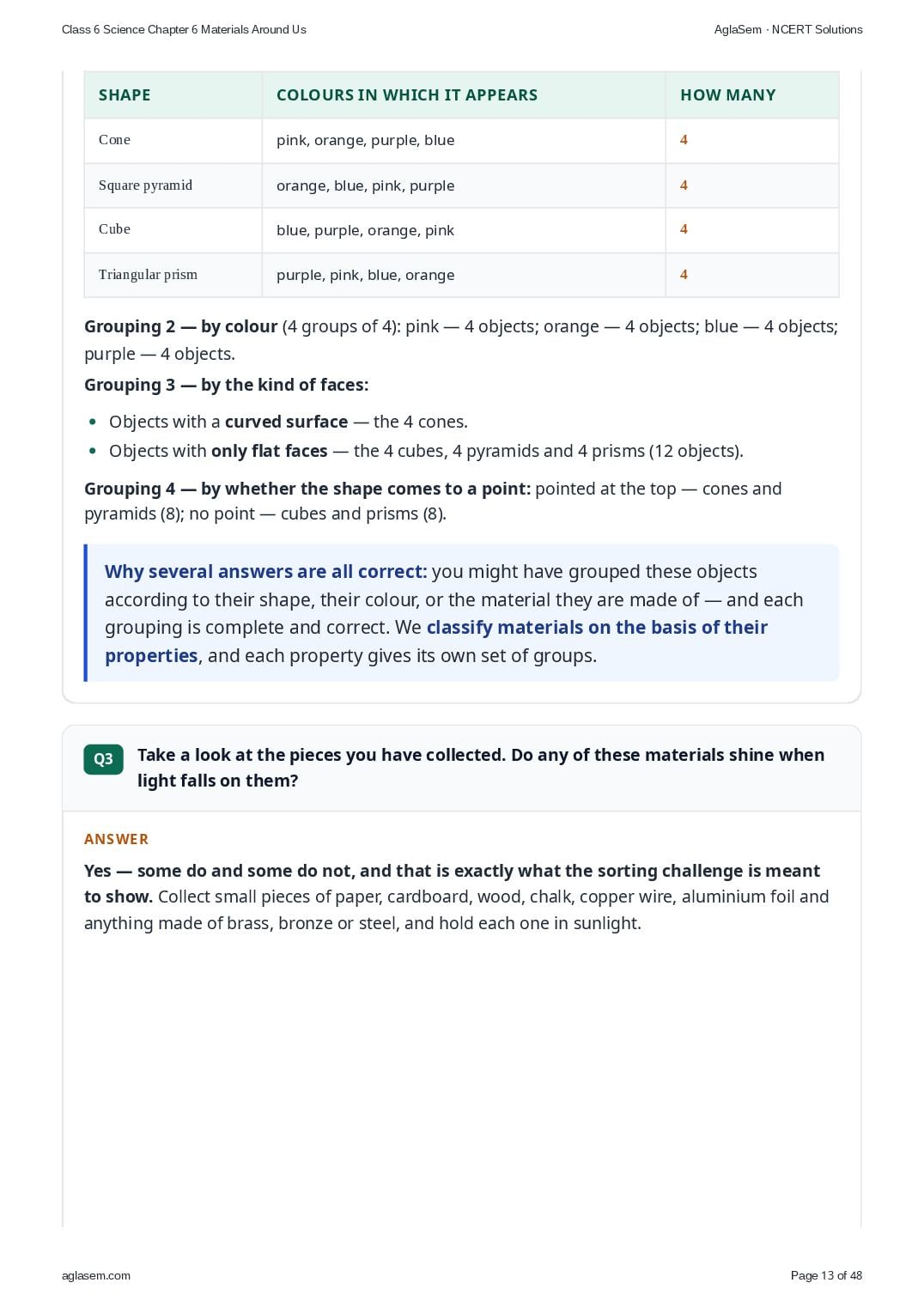
- Observe Fig. 6.4 and group the objects in as many different ways as possible.
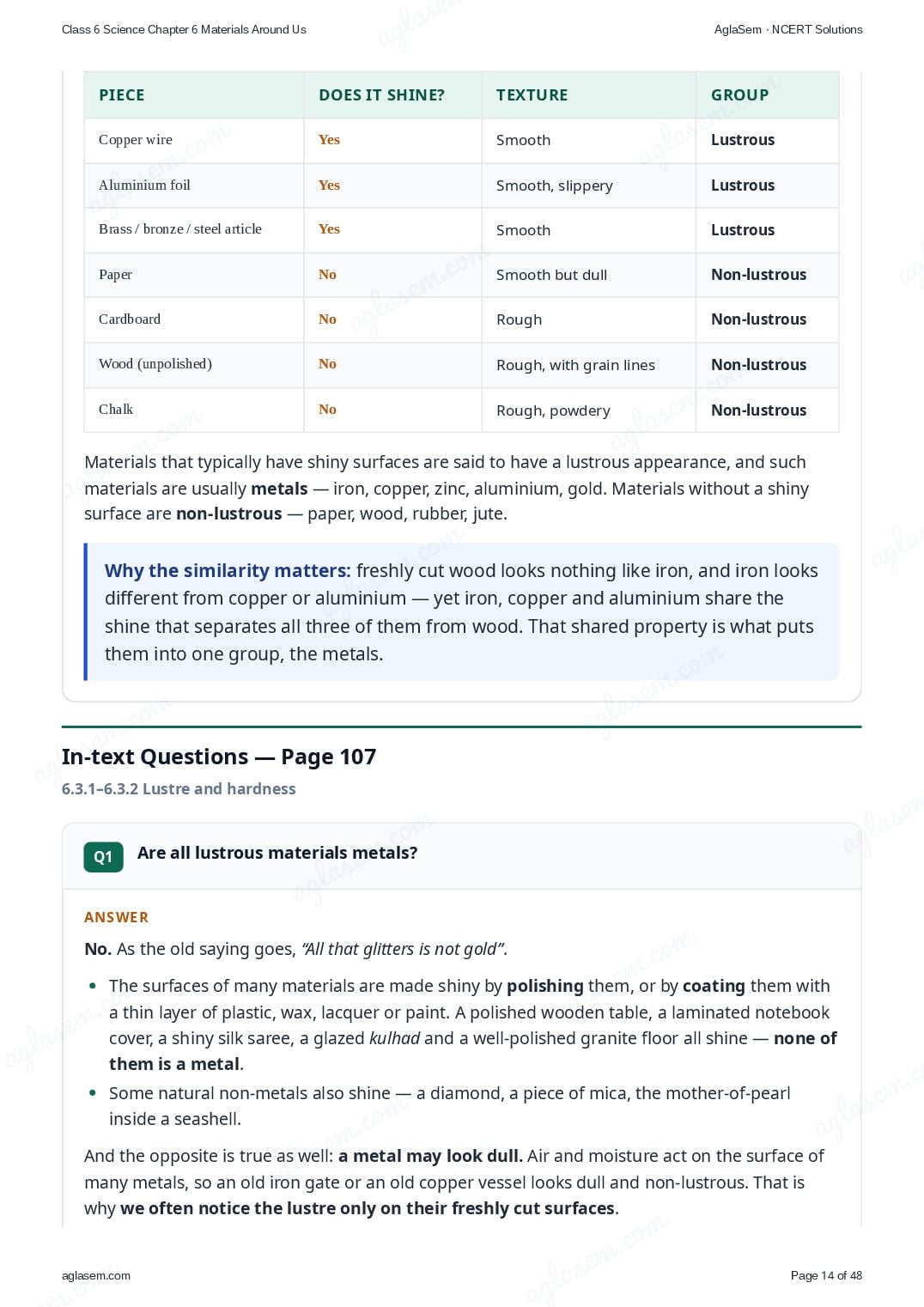
- Take a look at the pieces you have collected. Do any of these materials shine when light falls on them?
- Are all lustrous materials metals?
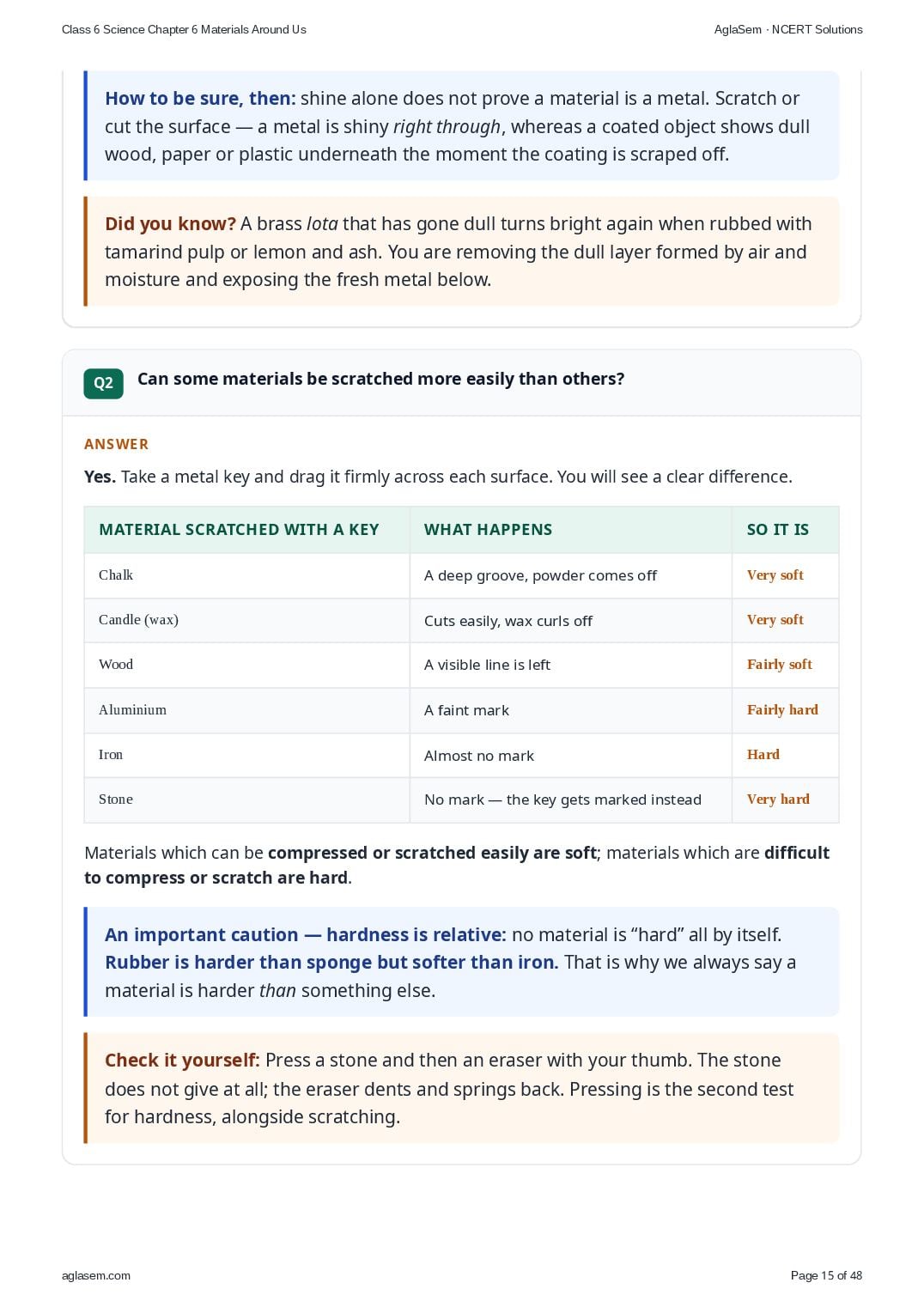
- Can some materials be scratched more easily than others?
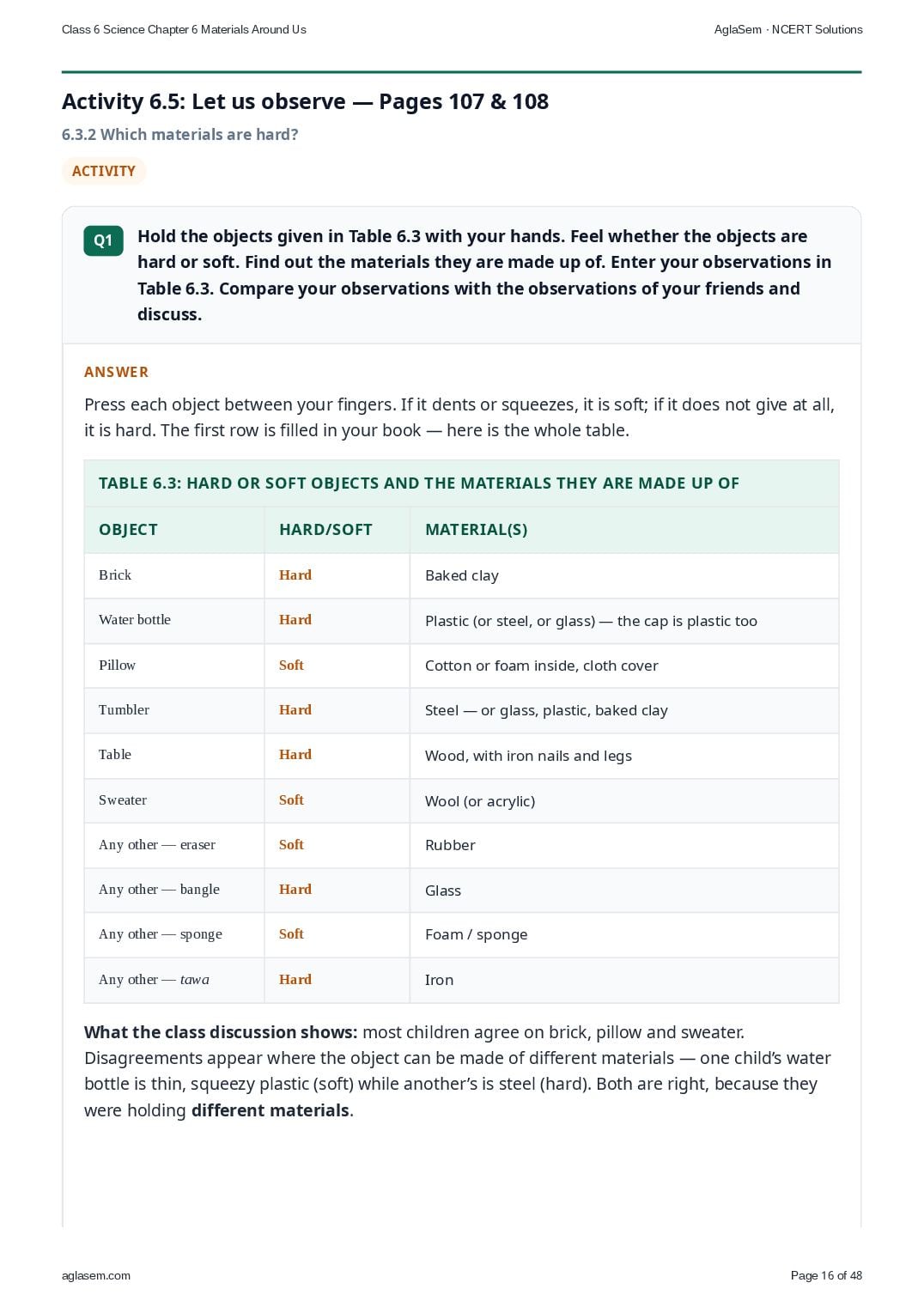
- Hold the objects given in Table 6.3 with your hands. Feel whether the objects are hard or soft. Find out the materials they are made up of. Enter your observations in Table 6.3. Compare your observations with the observations of your friends and discuss.
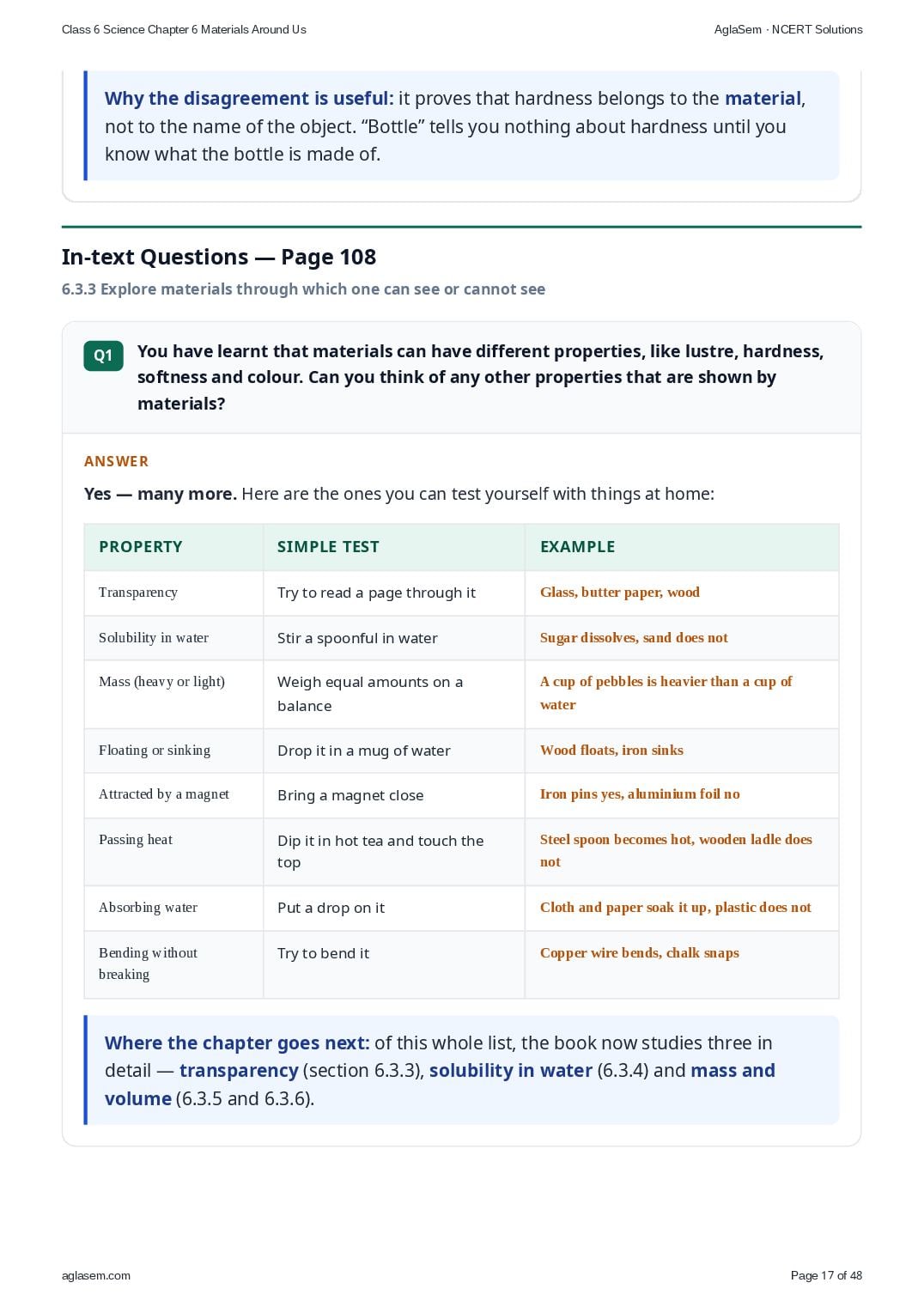
- You have learnt that materials can have different properties, like lustre, hardness, softness and colour. Can you think of any other properties that are shown by materials?
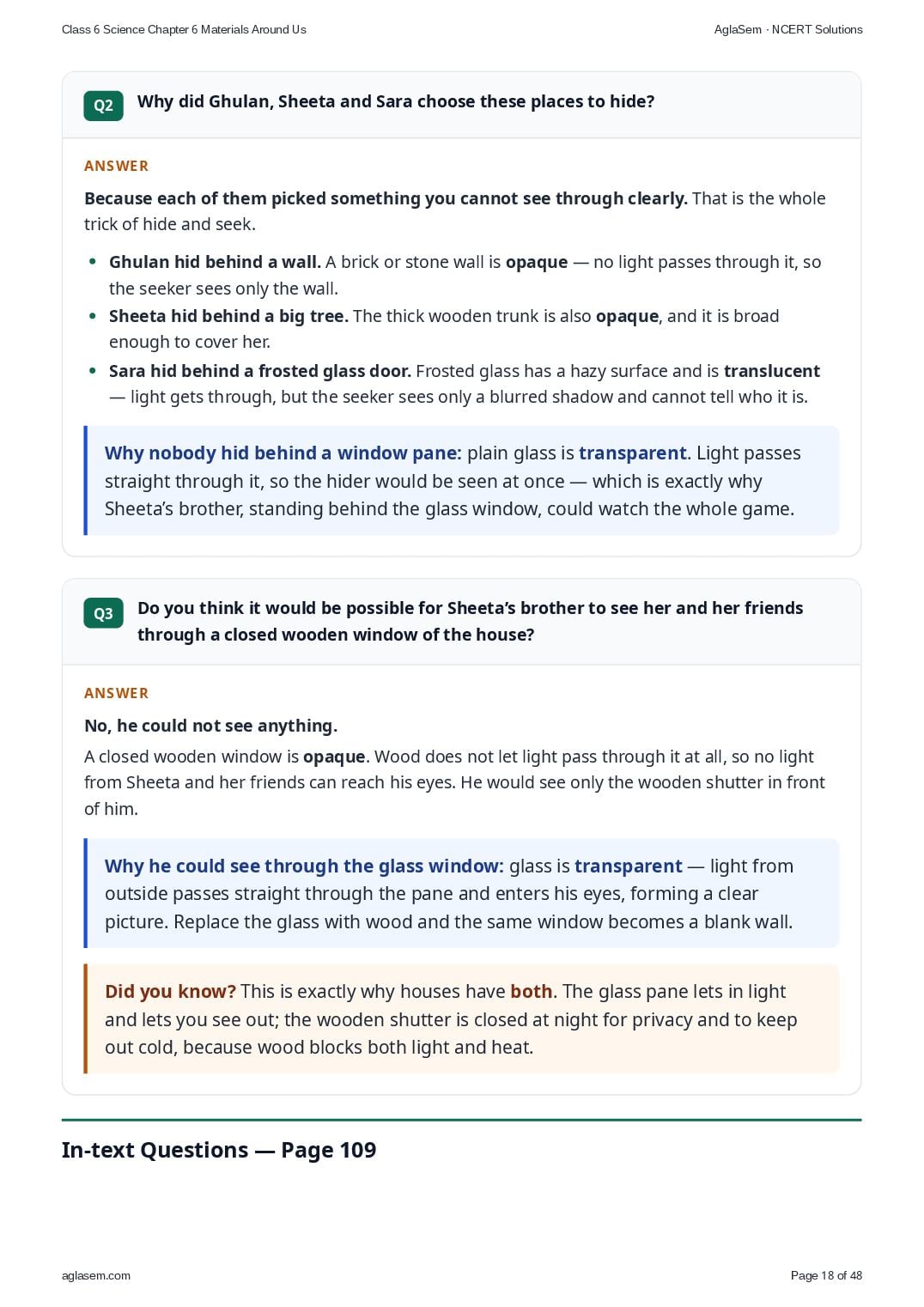
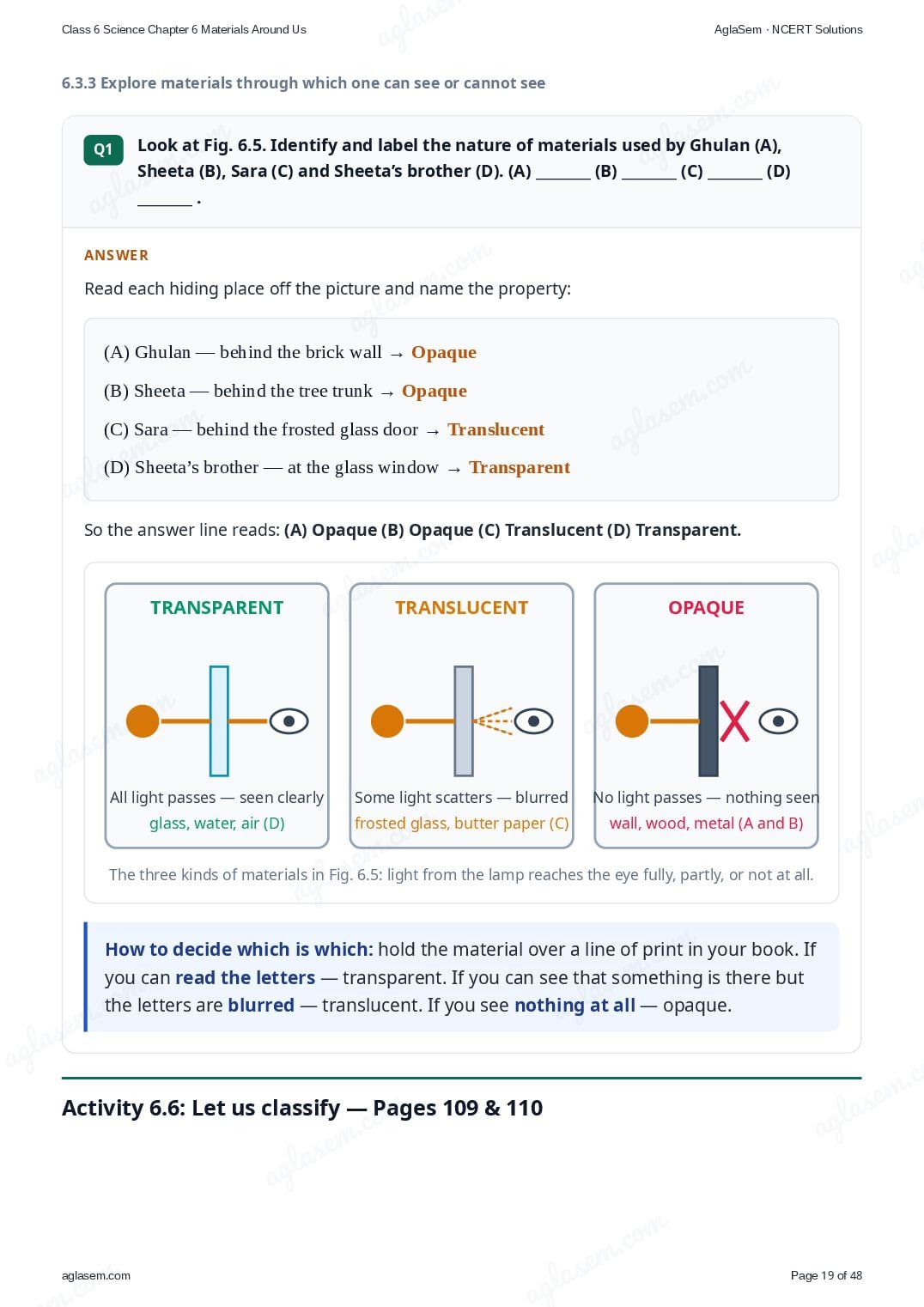
- Why did Ghulan, Sheeta and Sara choose these places to hide?
- Do you think it would be possible for Sheeta’s brother to see her and her friends through a closed wooden window of the house?
- Look at Fig. 6.5. Identify and label the nature of materials used by Ghulan (A), Sheeta (B), Sara (C) and Sheeta’s brother (D). (A) ________ (B) ________ (C) ________ (D) ________ .
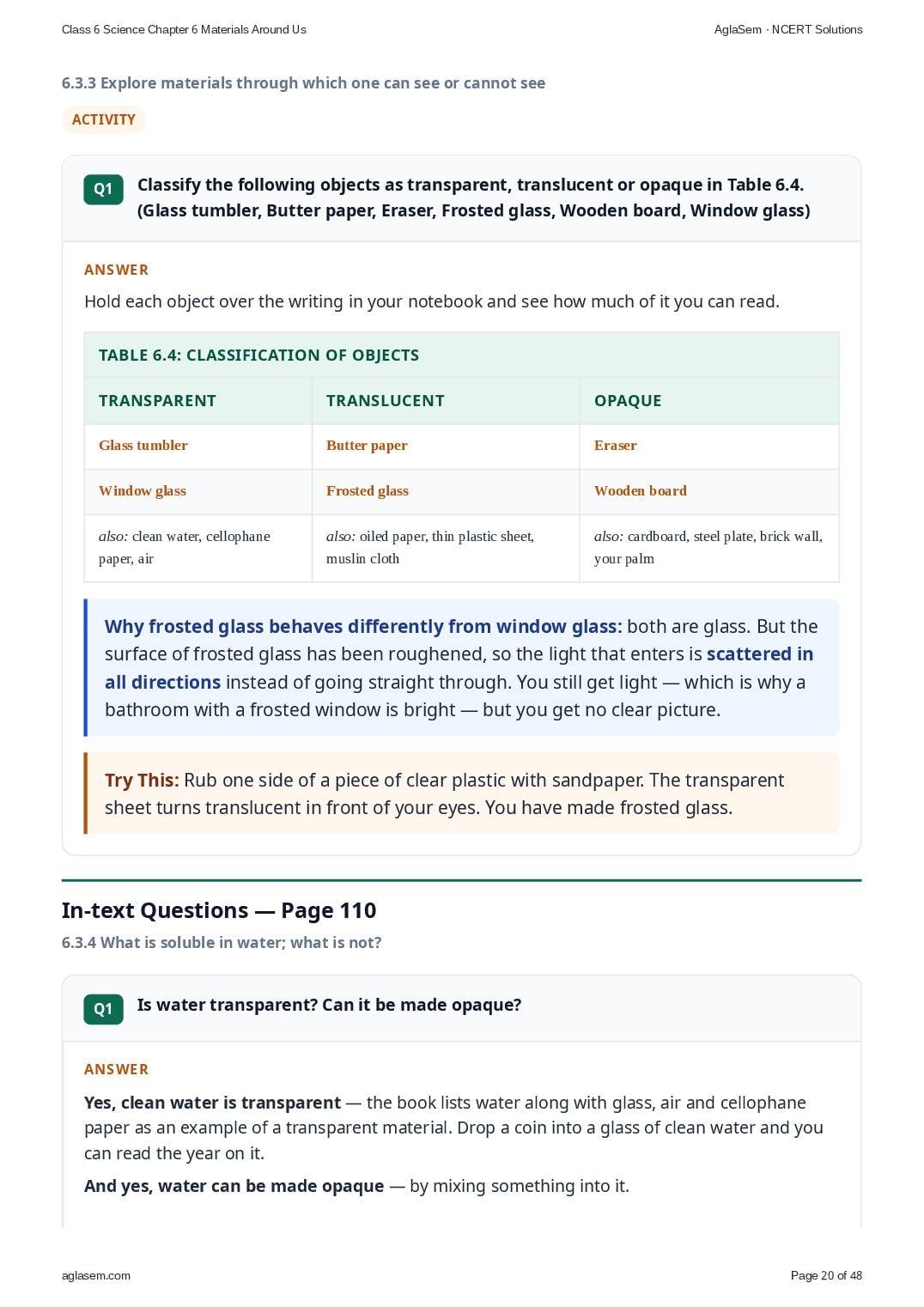
- Classify the following objects as transparent, translucent or opaque in Table 6.4. (Glass tumbler, Butter paper, Eraser, Frosted glass, Wooden board, Window glass)
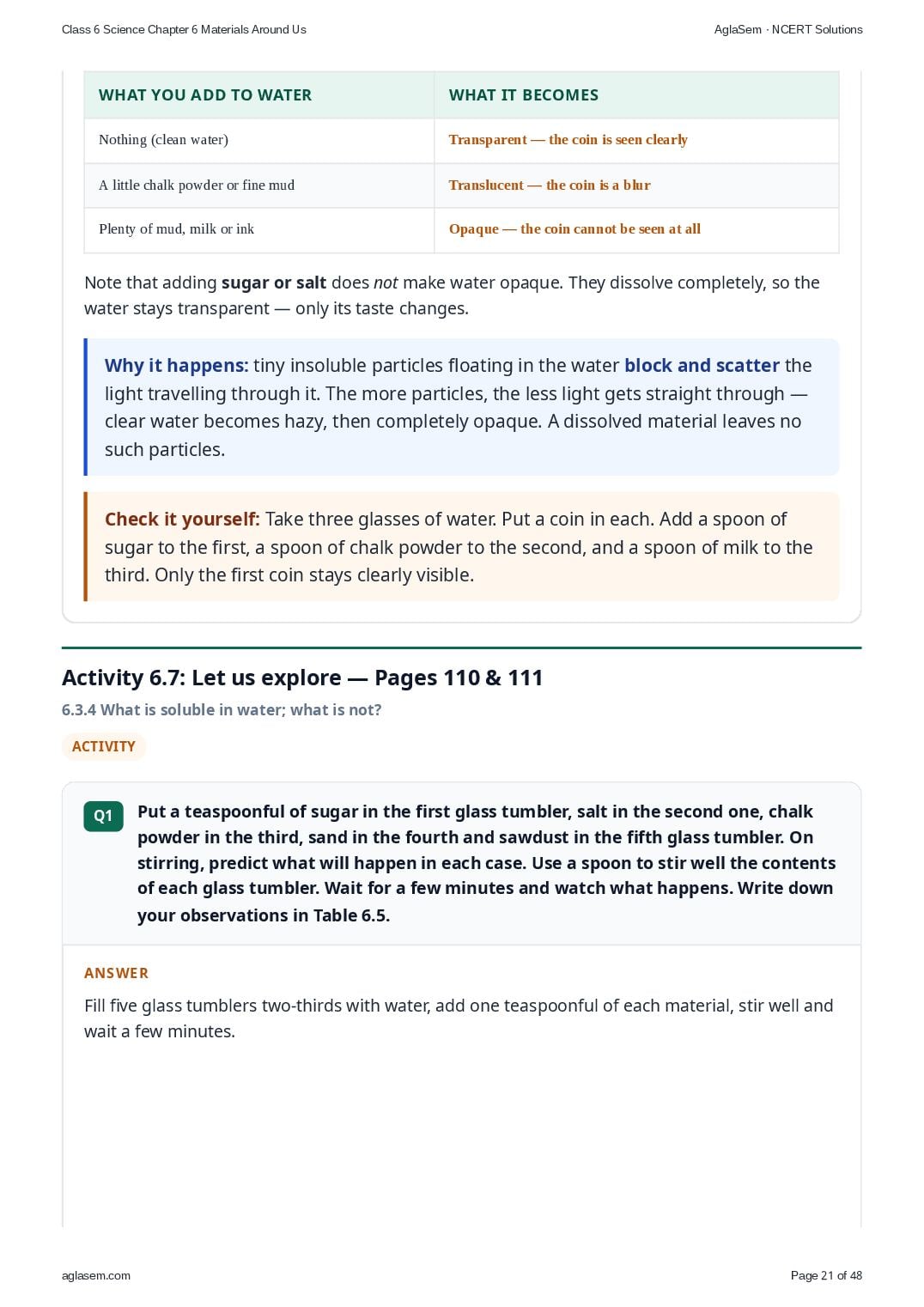
- Is water transparent? Can it be made opaque?
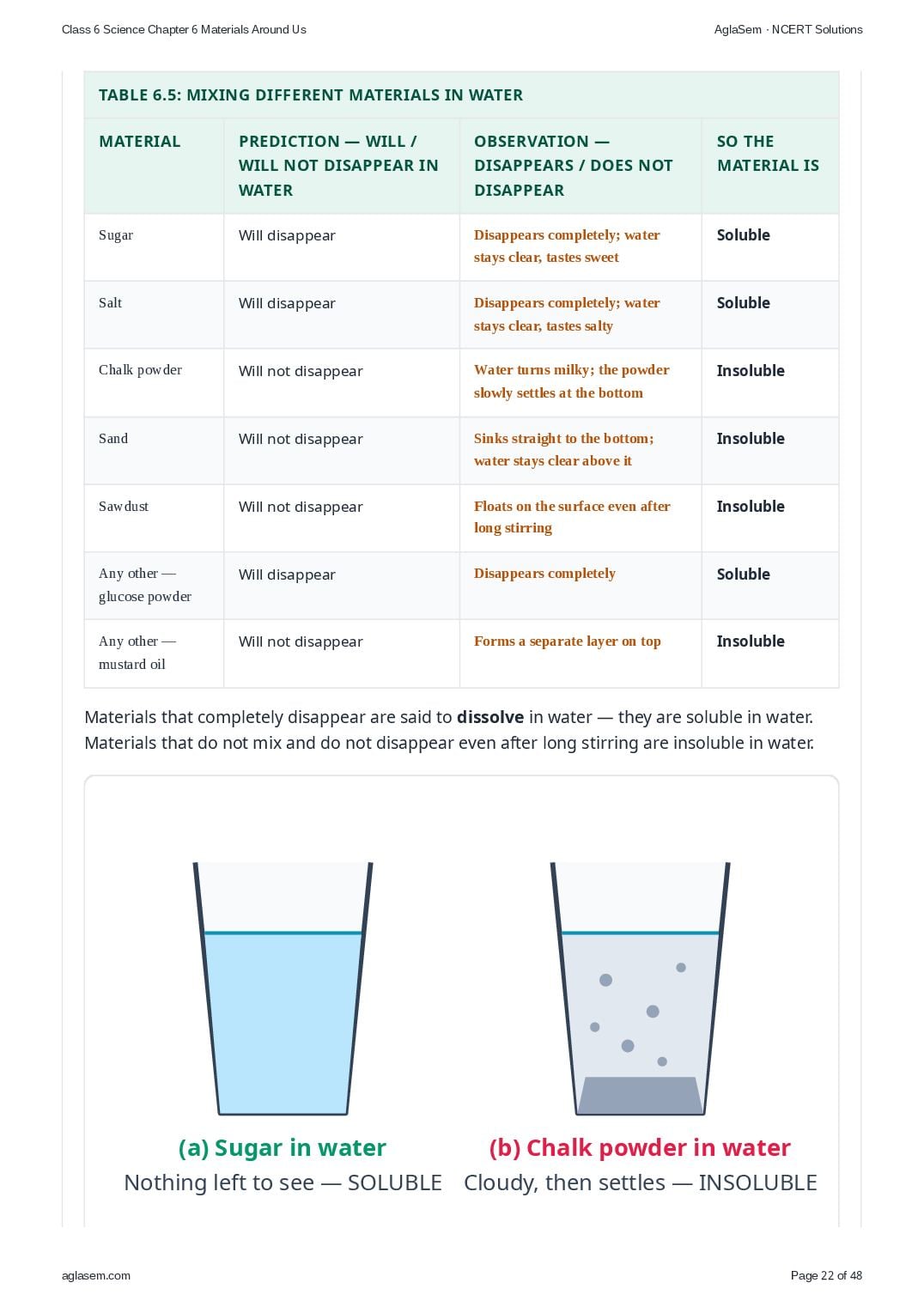
- Put a teaspoonful of sugar in the first glass tumbler, salt in the second one, chalk powder in the third, sand in the fourth and sawdust in the fifth glass tumbler. On stirring, predict what will happen in each case. Use a spoon to stir well the contents of each glass tumbler. Wait for a few minutes and watch what happens. Write down your observations in Table 6.5.
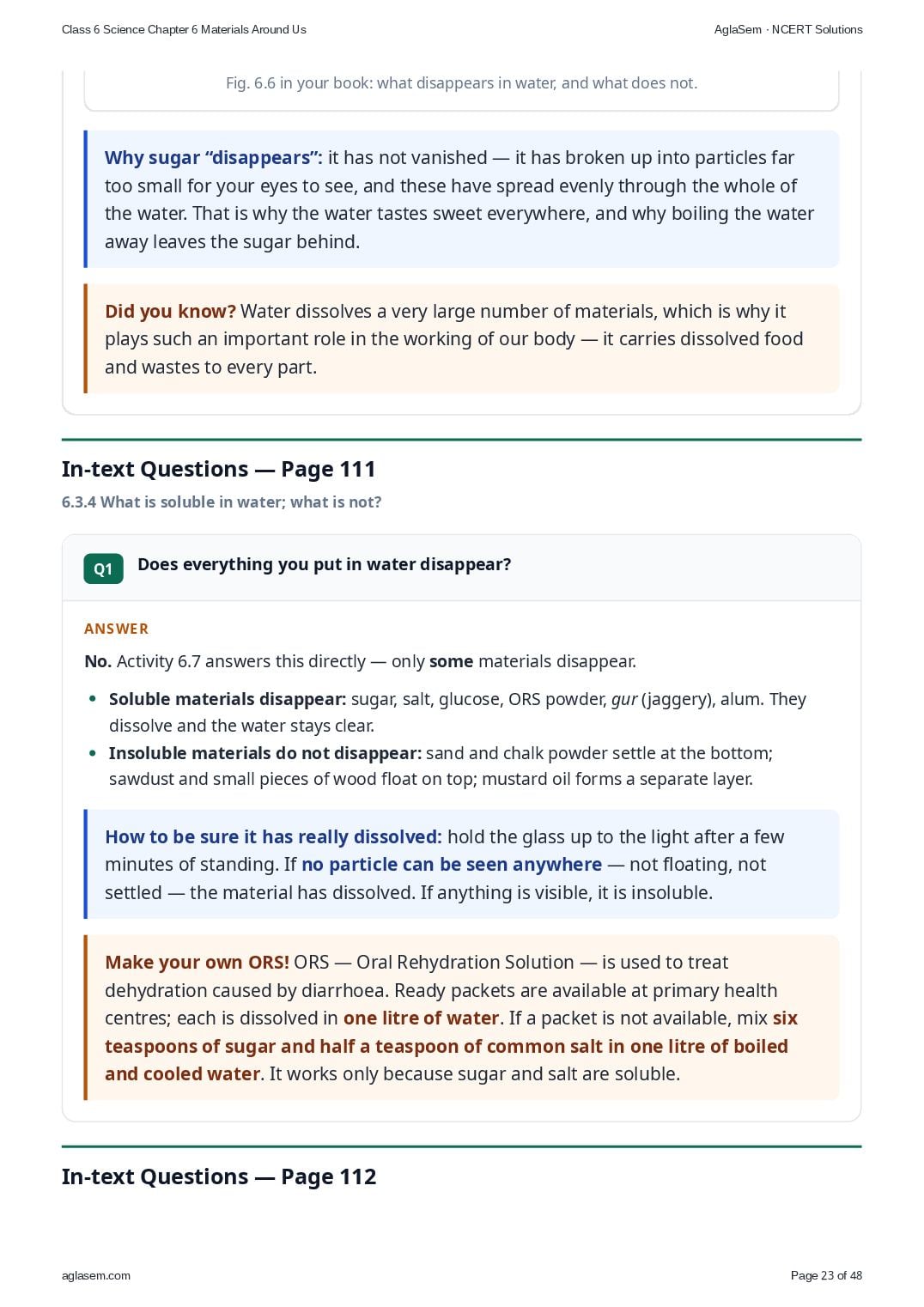
- Does everything you put in water disappear?
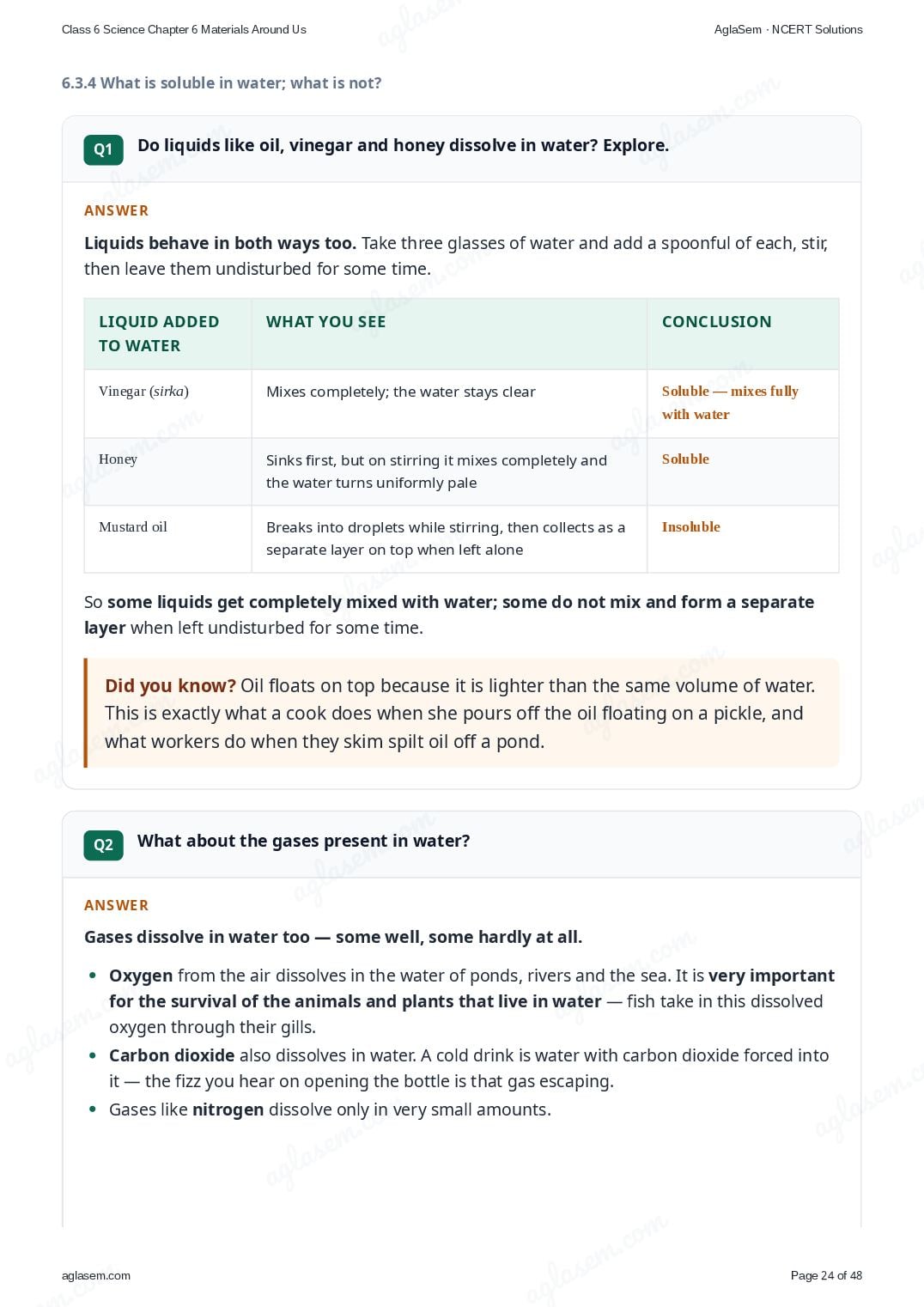
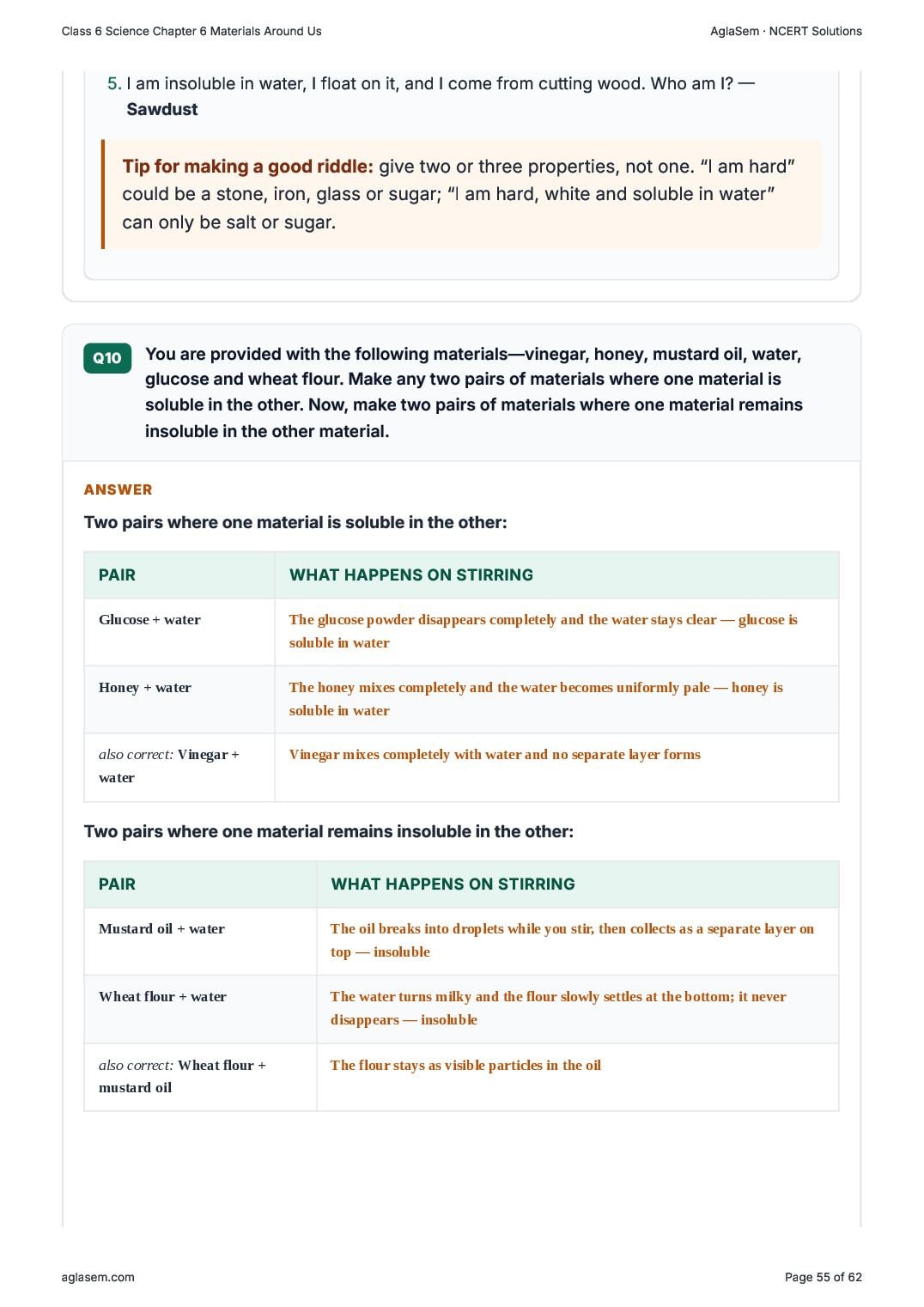
- Do liquids like oil, vinegar and honey dissolve in water? Explore.
- What about the gases present in water?
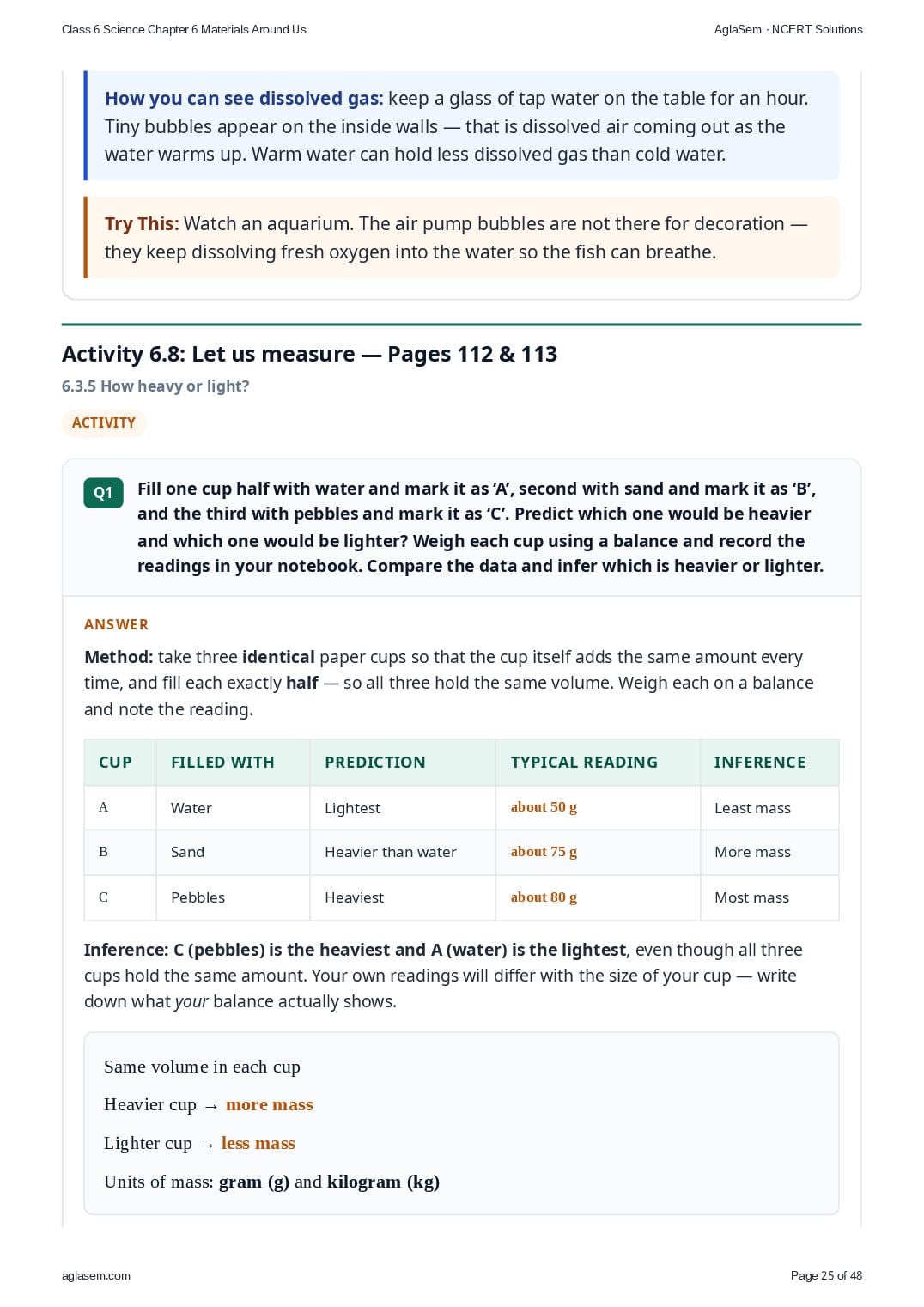
- Fill one cup half with water and mark it as ‘A’, second with sand and mark it as ‘B’, and the third with pebbles and mark it as ‘C’. Predict which one would be heavier and which one would be lighter? Weigh each cup using a balance and record the readings in your notebook. Compare the data and infer which is heavier or lighter.
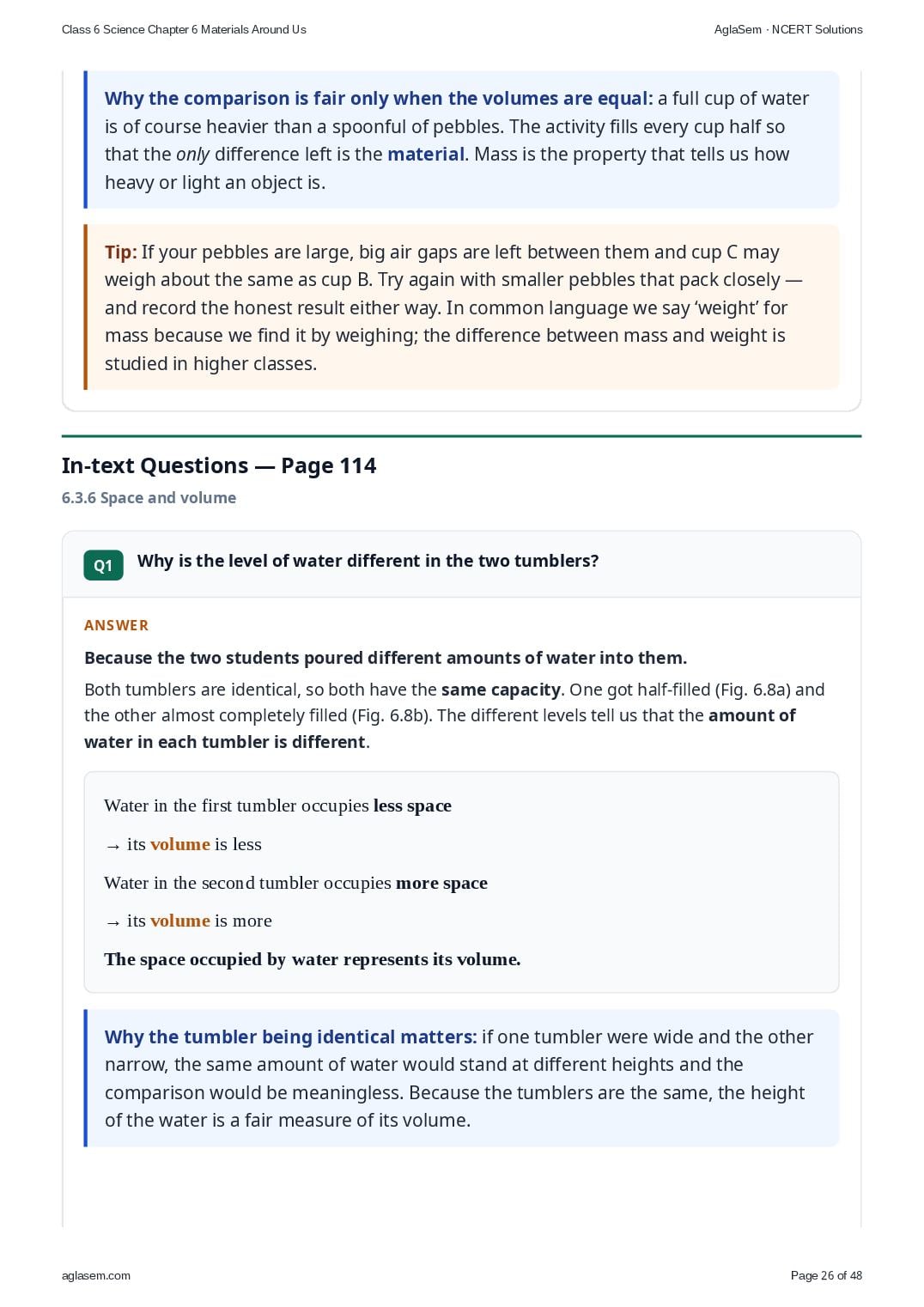
- Why is the level of water different in the two tumblers?
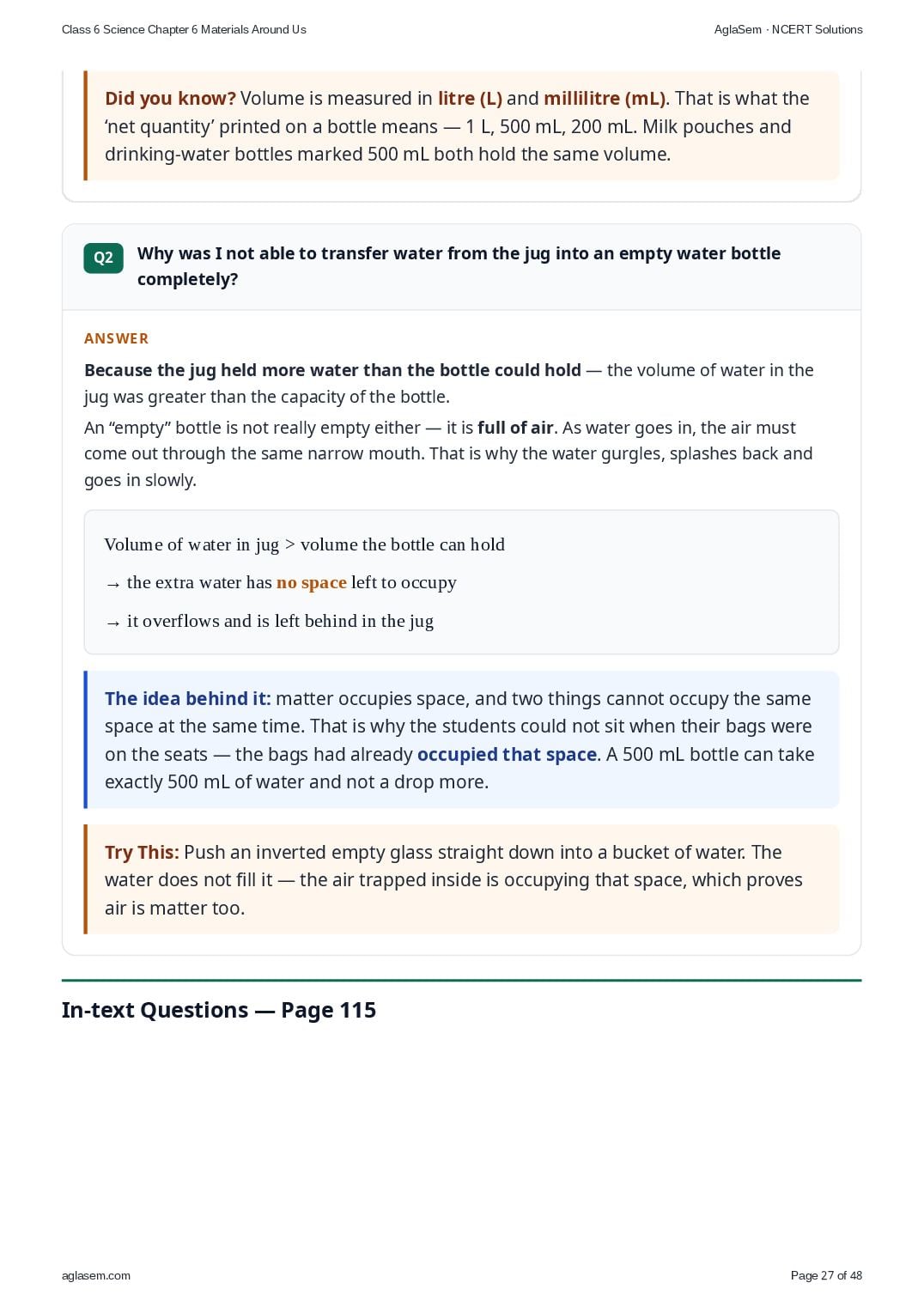
- Why was I not able to transfer water from the jug into an empty water bottle completely?
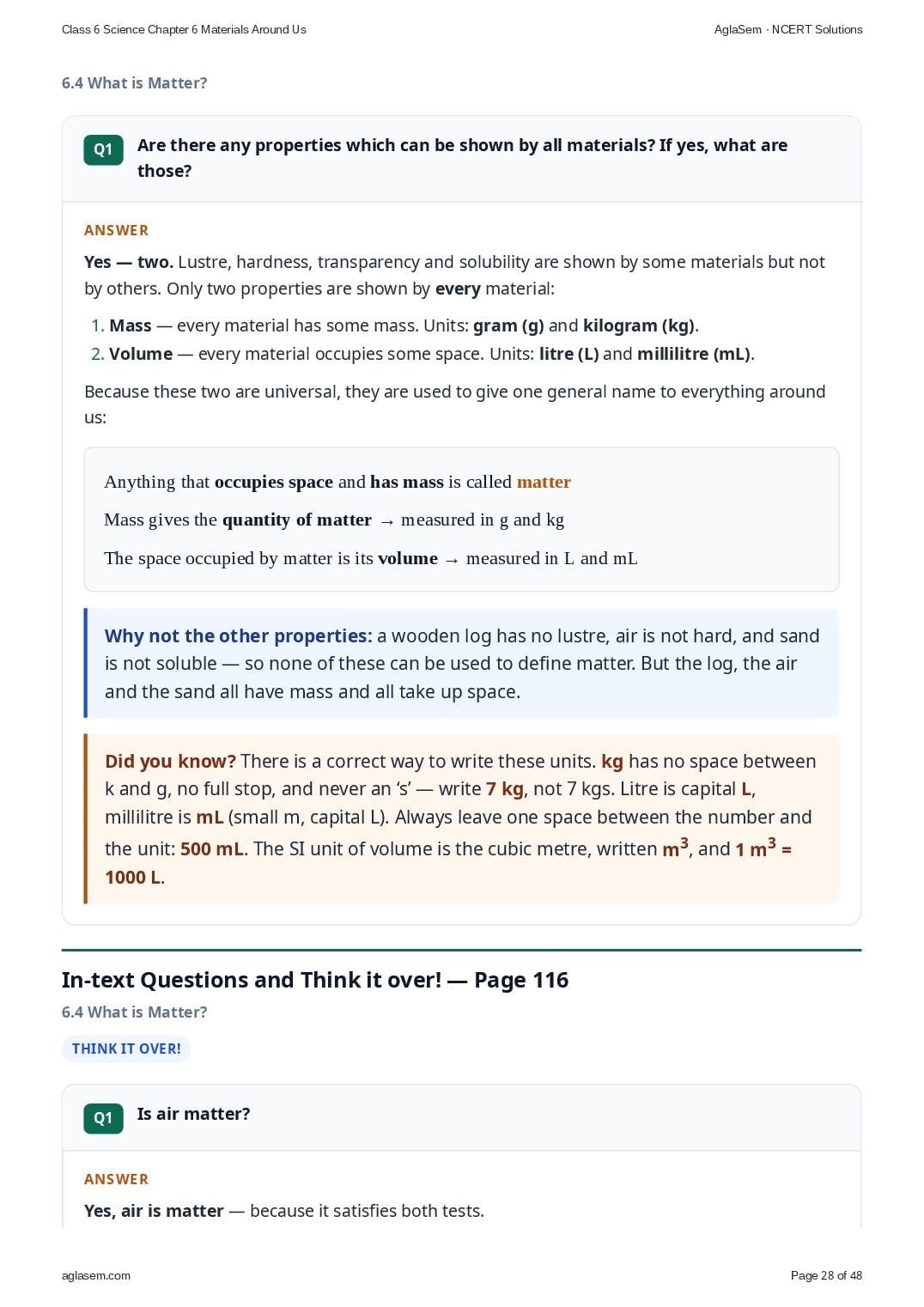
- Are there any properties which can be shown by all materials? If yes, what are those?
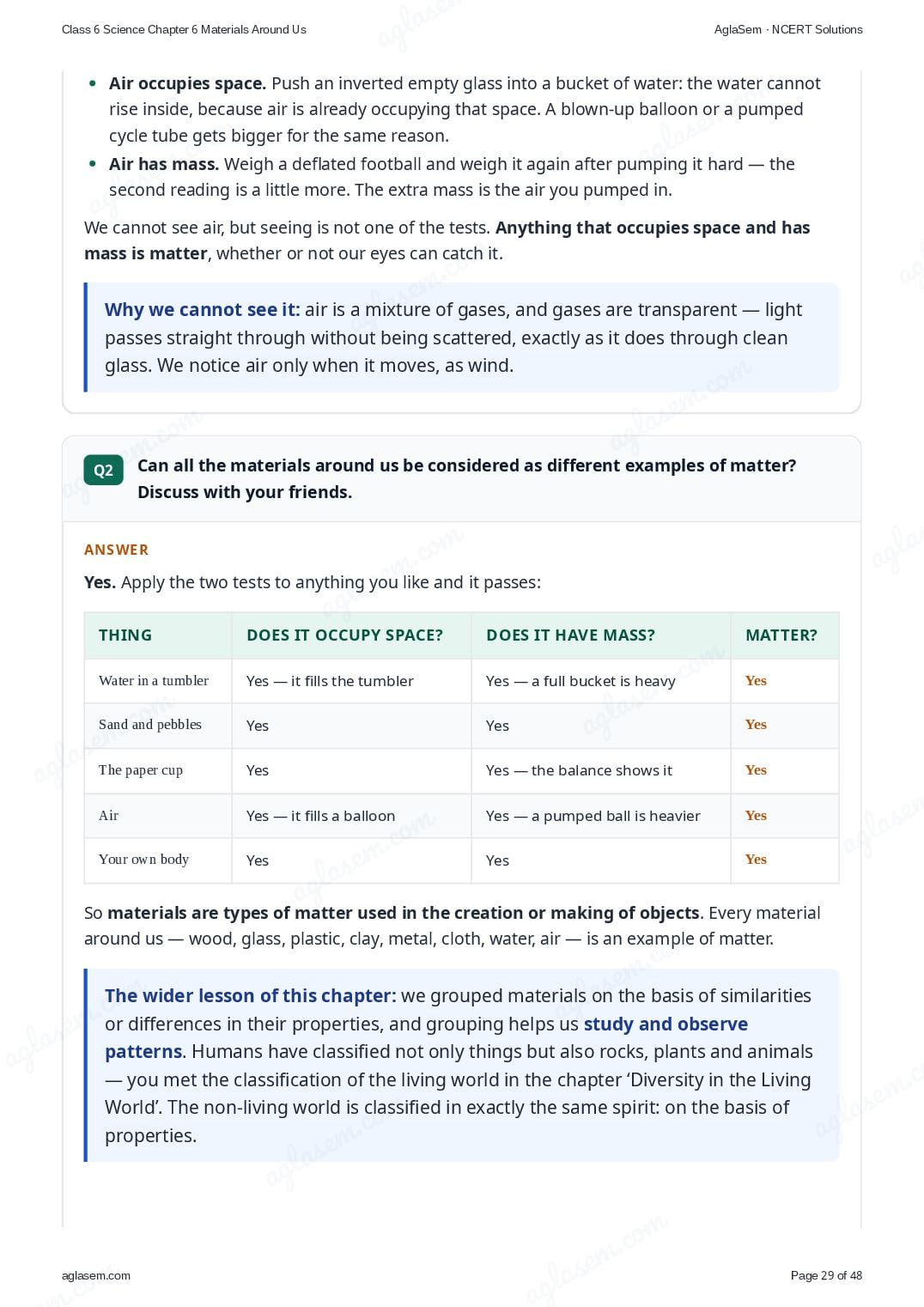
- Is air matter?
- Can all the materials around us be considered as different examples of matter? Discuss with your friends.
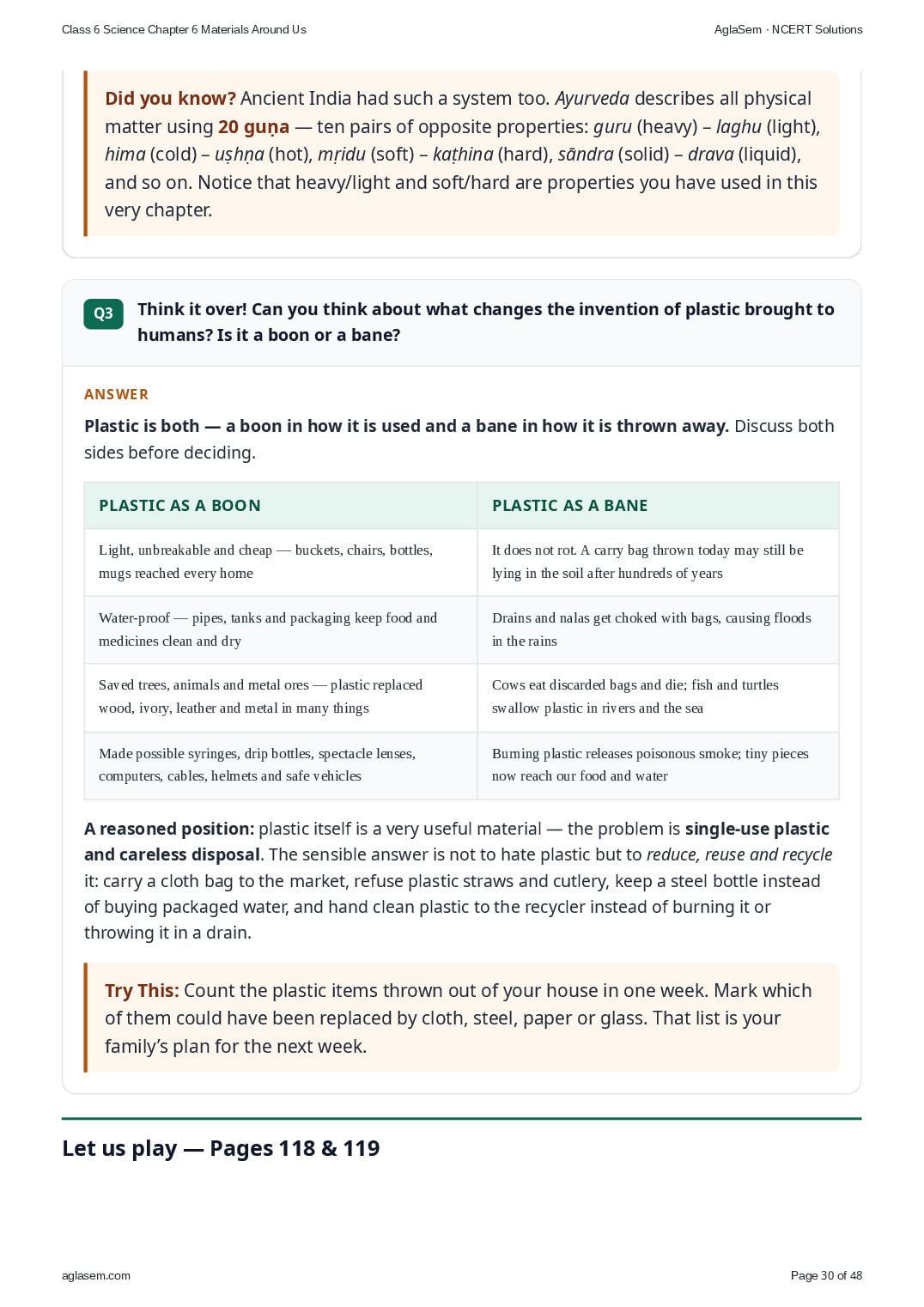
- Think it over! Can you think about what changes the invention of plastic brought to humans? Is it a boon or a bane?
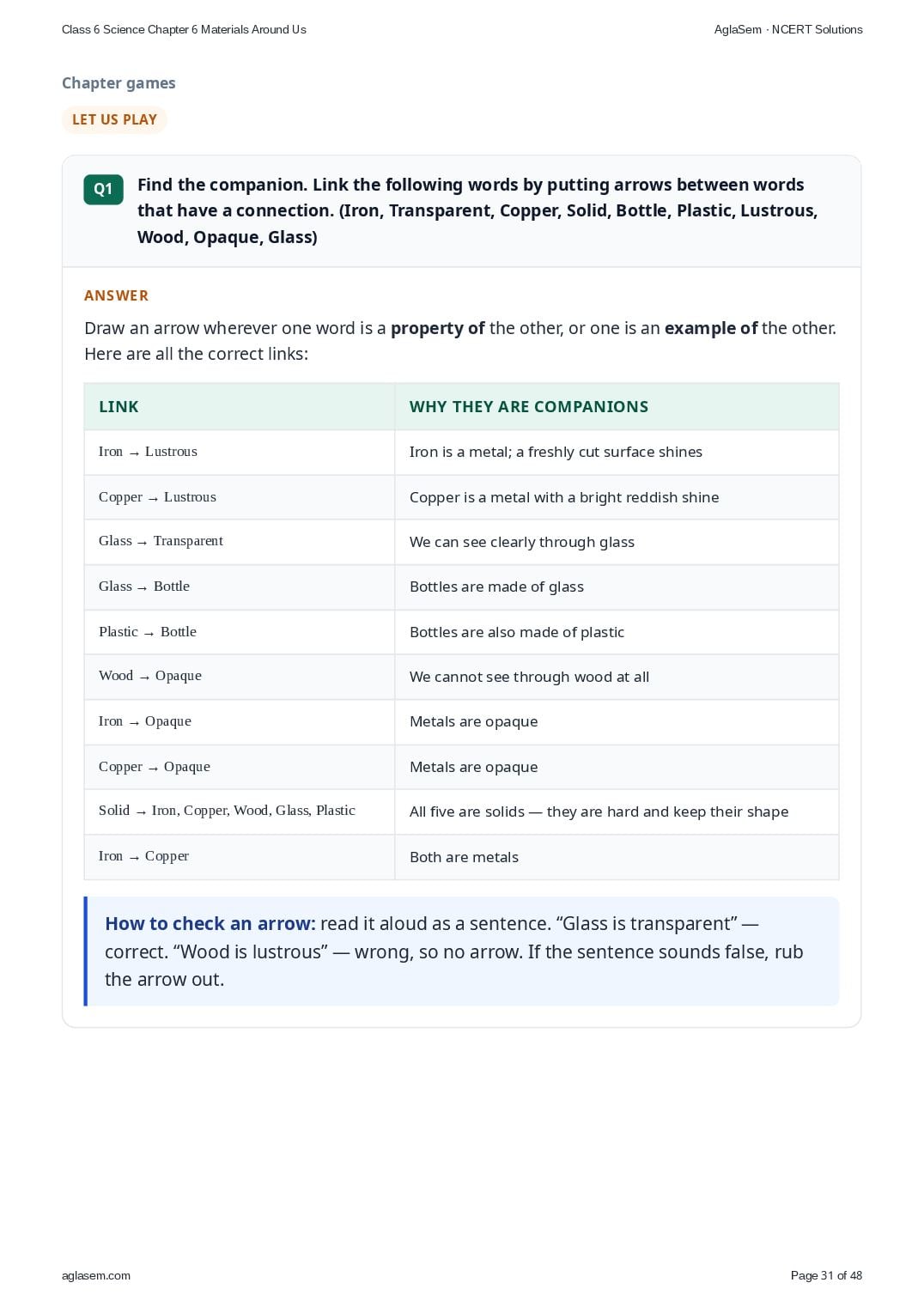
- Find the companion. Link the following words by putting arrows between words that have a connection. (Iron, Transparent, Copper, Solid, Bottle, Plastic, Lustrous, Wood, Opaque, Glass)
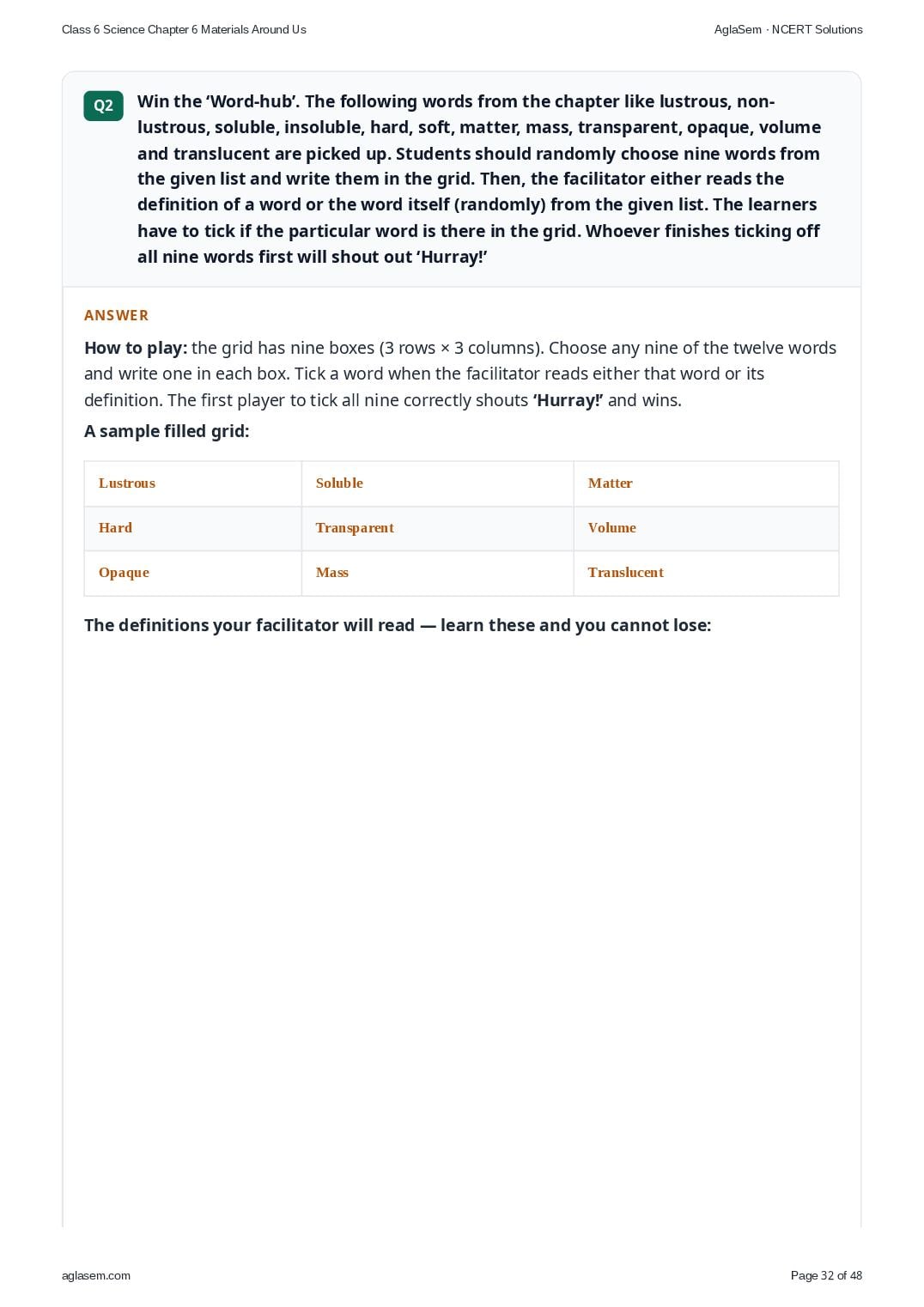
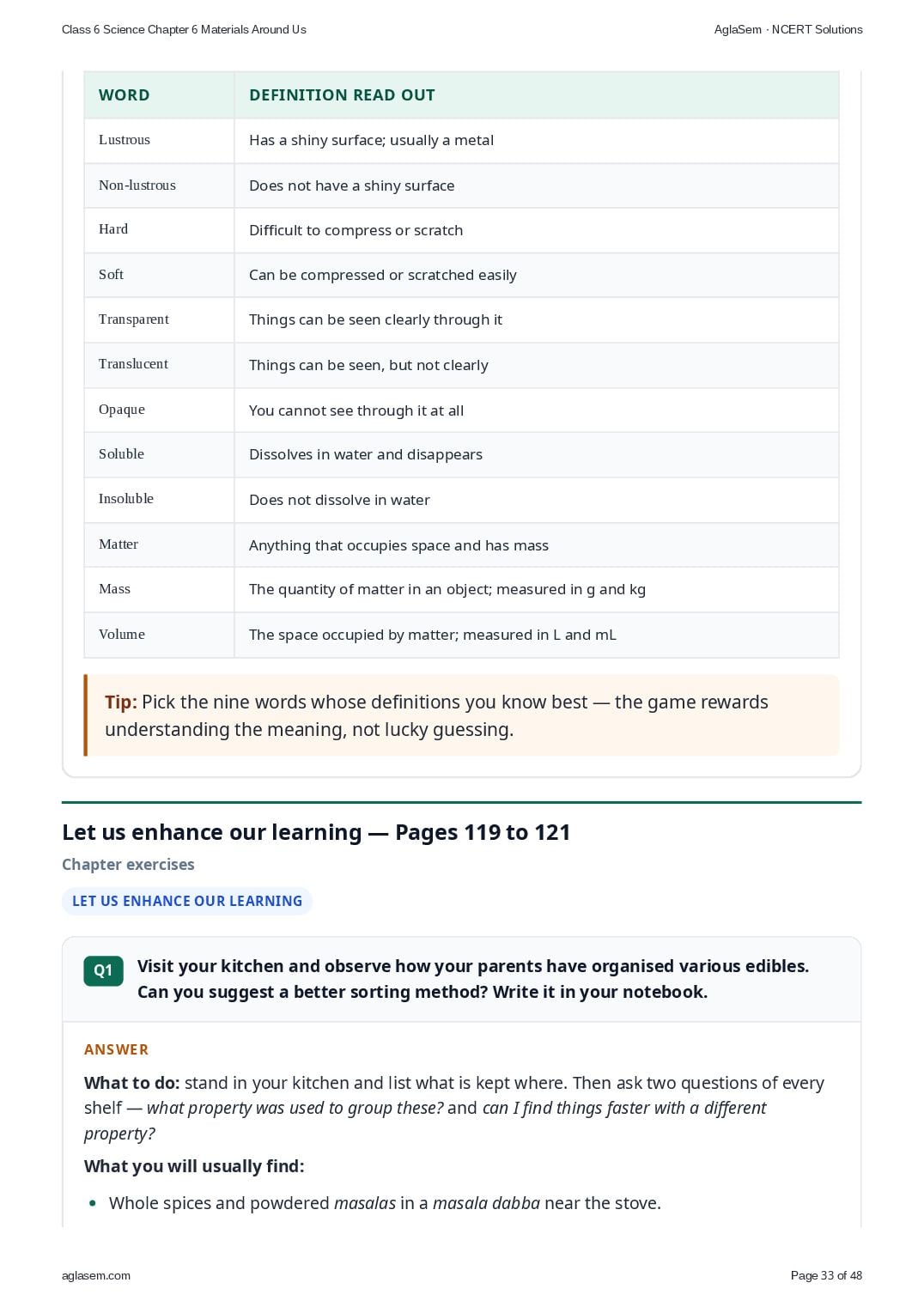
- Win the ‘Word-hub’. The following words from the chapter like lustrous, non-lustrous, soluble, insoluble, hard, soft, matter, mass, transparent, opaque, volume and translucent are picked up. Students should randomly choose nine words from the given list and write them in the grid. Then, the facilitator either reads the definition of a word or the word itself (randomly) from the given list. The learners have to tick if the particular word is there in the grid. Whoever finishes ticking off all nine words first will shout out ‘Hurray!’
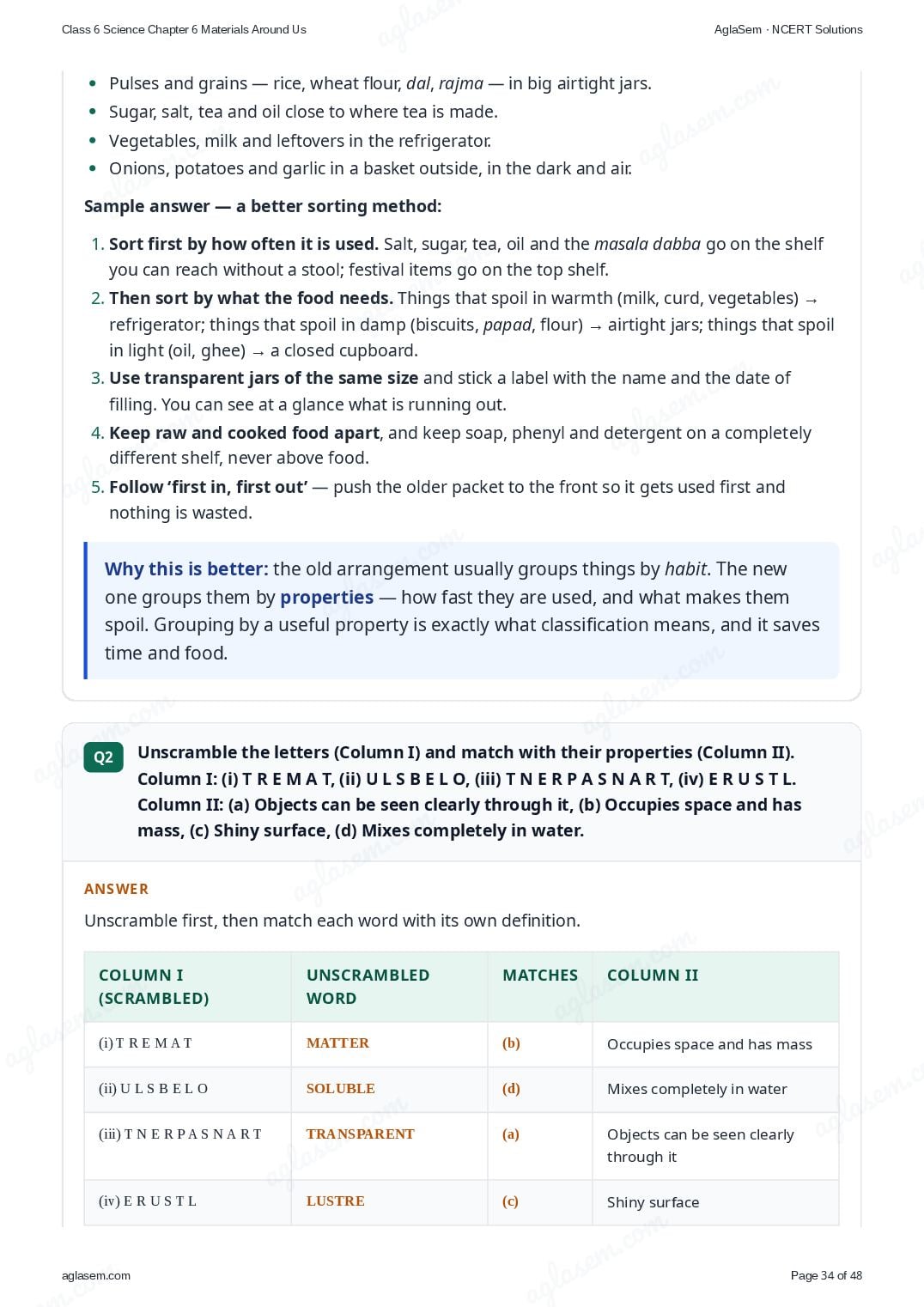
- Visit your kitchen and observe how your parents have organised various edibles. Can you suggest a better sorting method? Write it in your notebook.
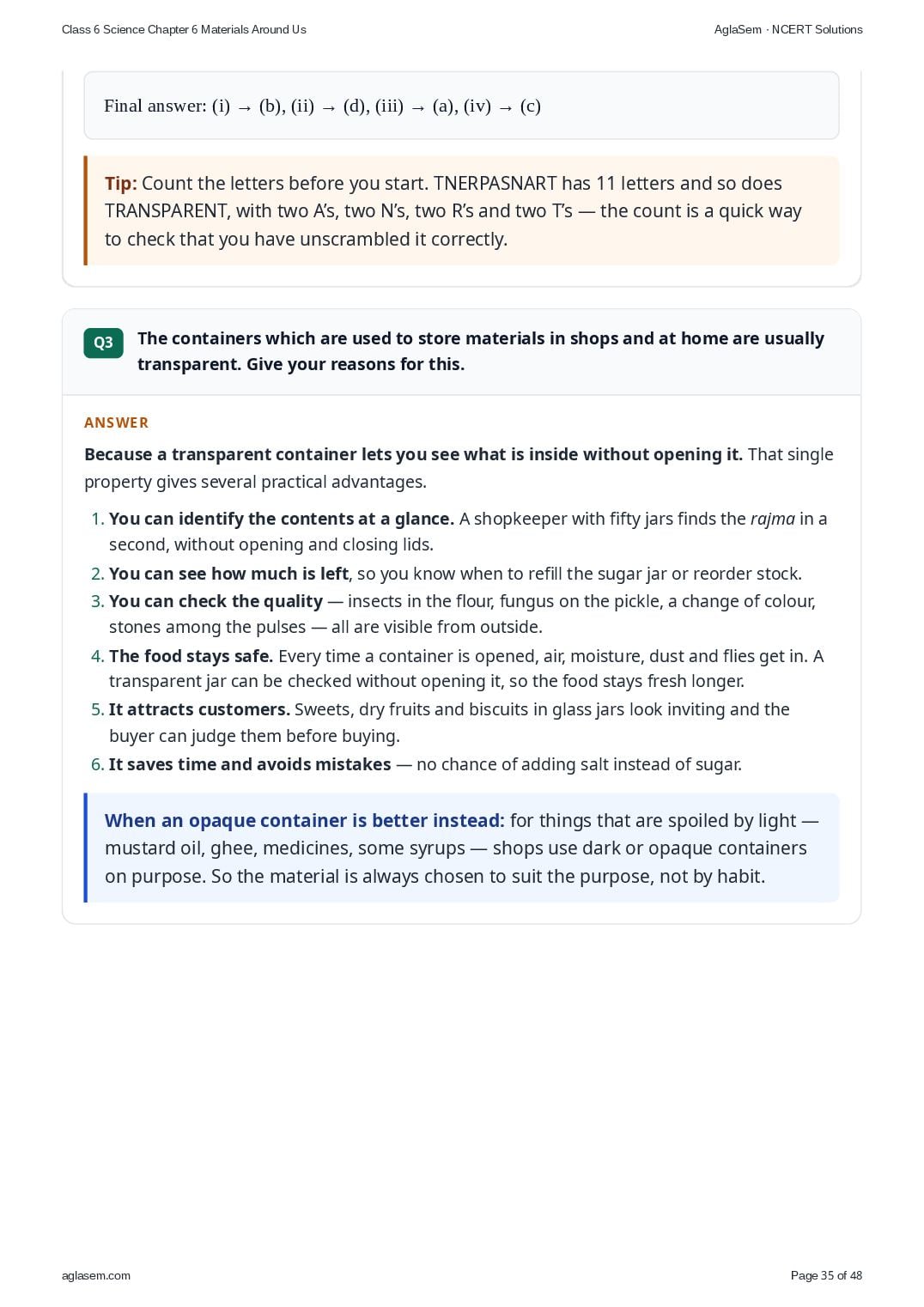
- Unscramble the letters (Column I) and match with their properties (Column II). Column I: (i) T R E M A T, (ii) U L S B E L O, (iii) T N E R P A S N A R T, (iv) E R U S T L. Column II: (a) Objects can be seen clearly through it, (b) Occupies space and has mass, (c) Shiny surface, (d) Mixes completely in water.
- The containers which are used to store materials in shops and at home are usually transparent. Give your reasons for this.
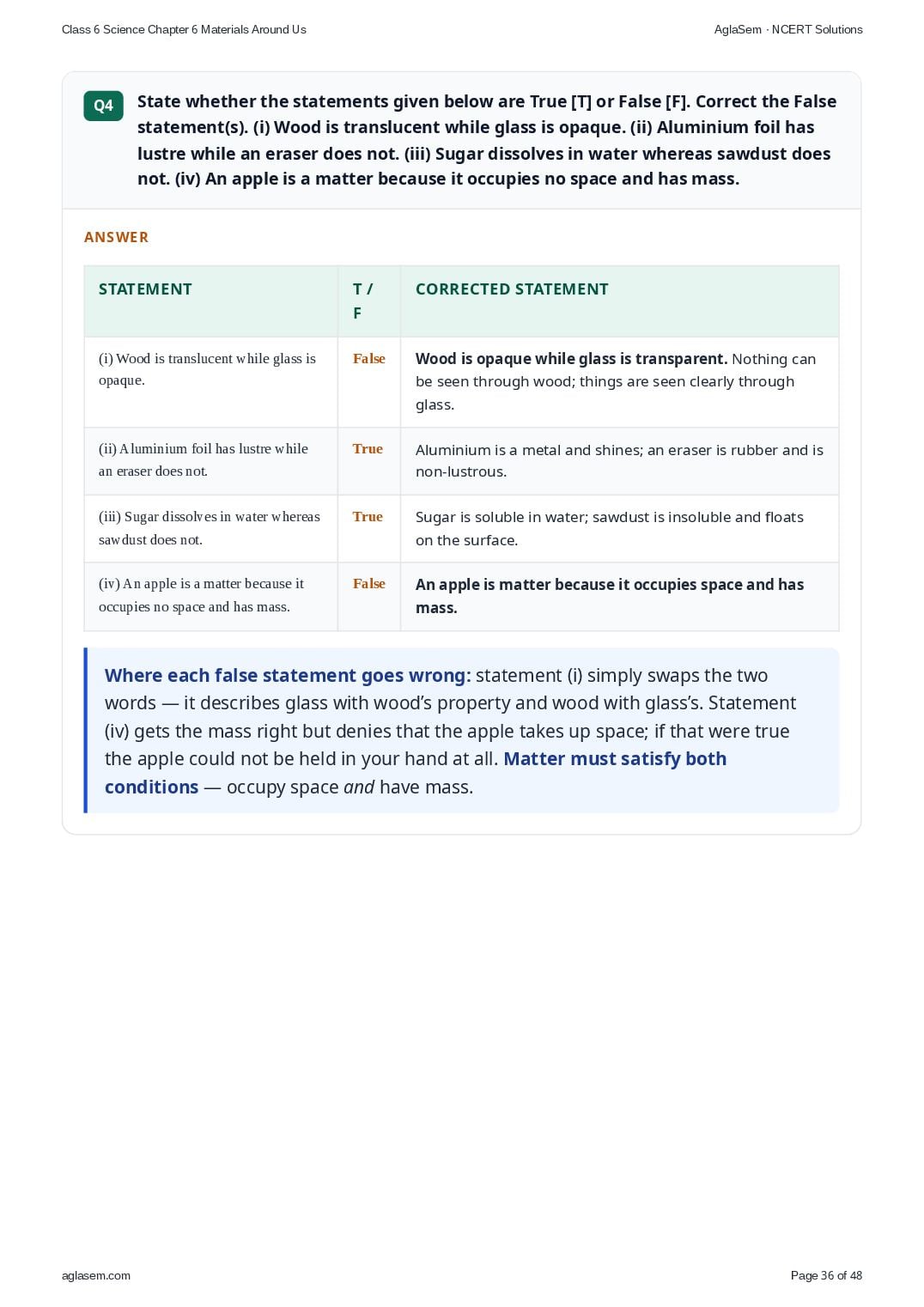
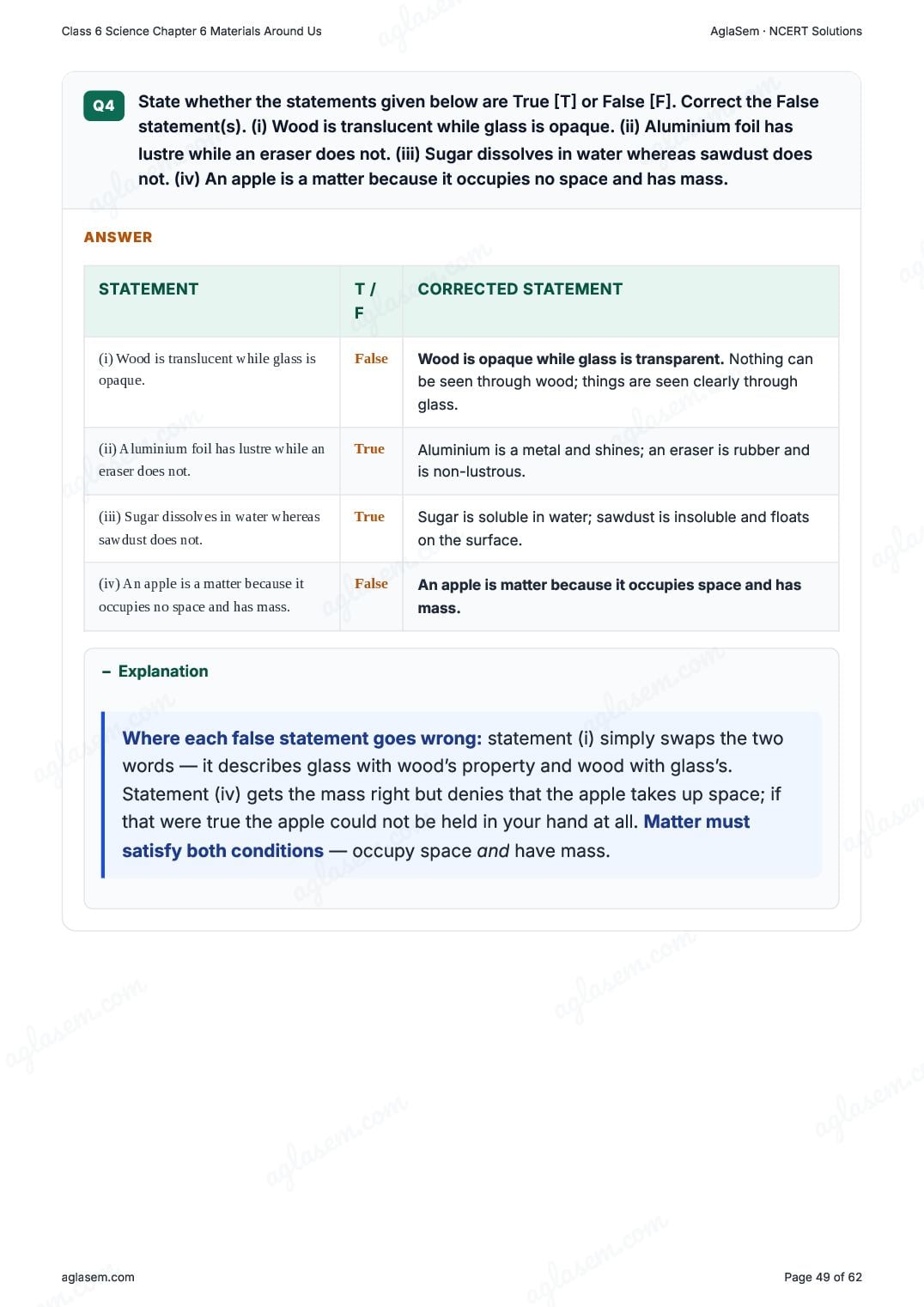
- State whether the statements given below are True [T] or False [F]. Correct the False statement(s). (i) Wood is translucent while glass is opaque. (ii) Aluminium foil has lustre while an eraser does not. (iii) Sugar dissolves in water whereas sawdust does not. (iv) An apple is a matter because it occupies no space and has mass.
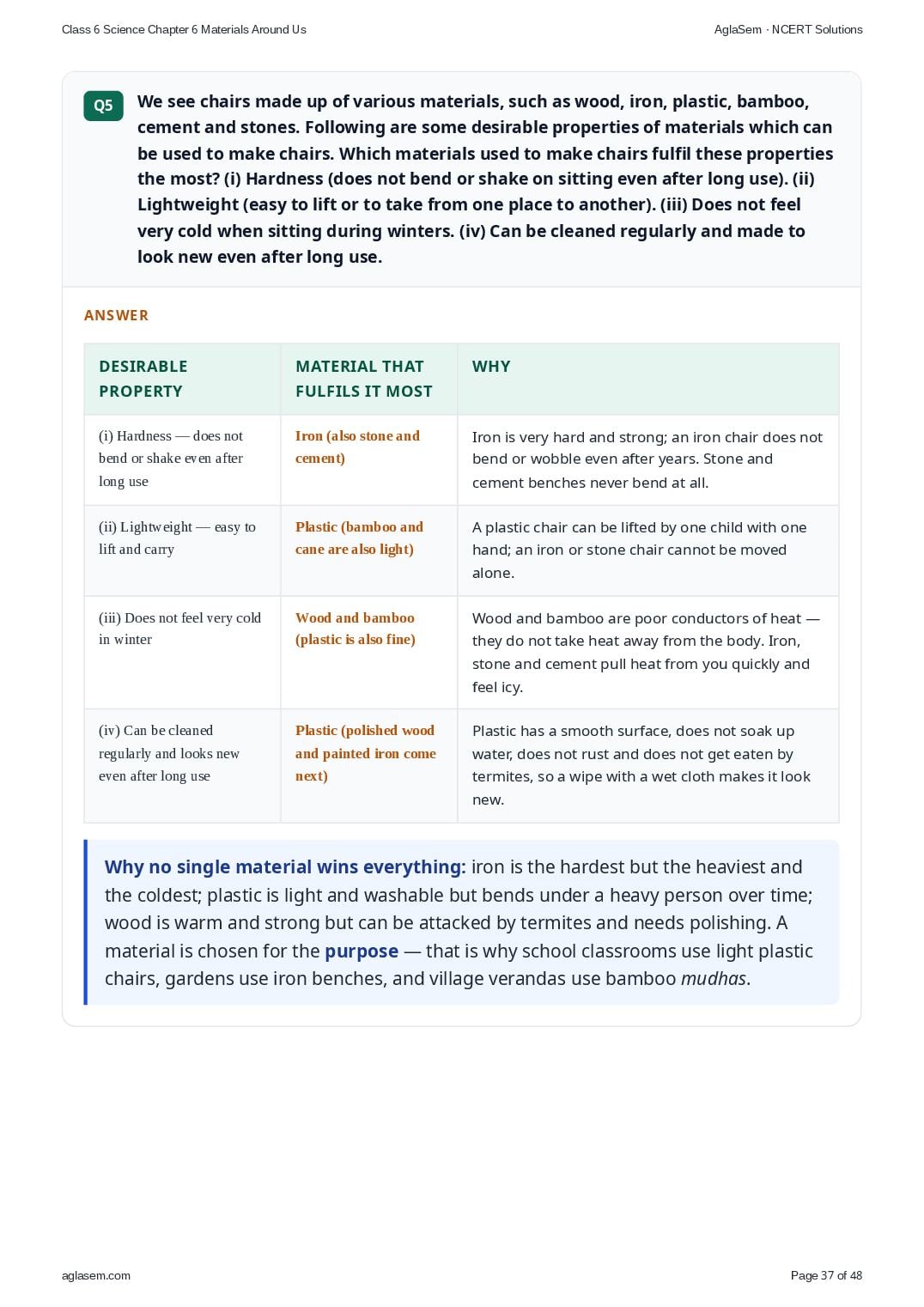
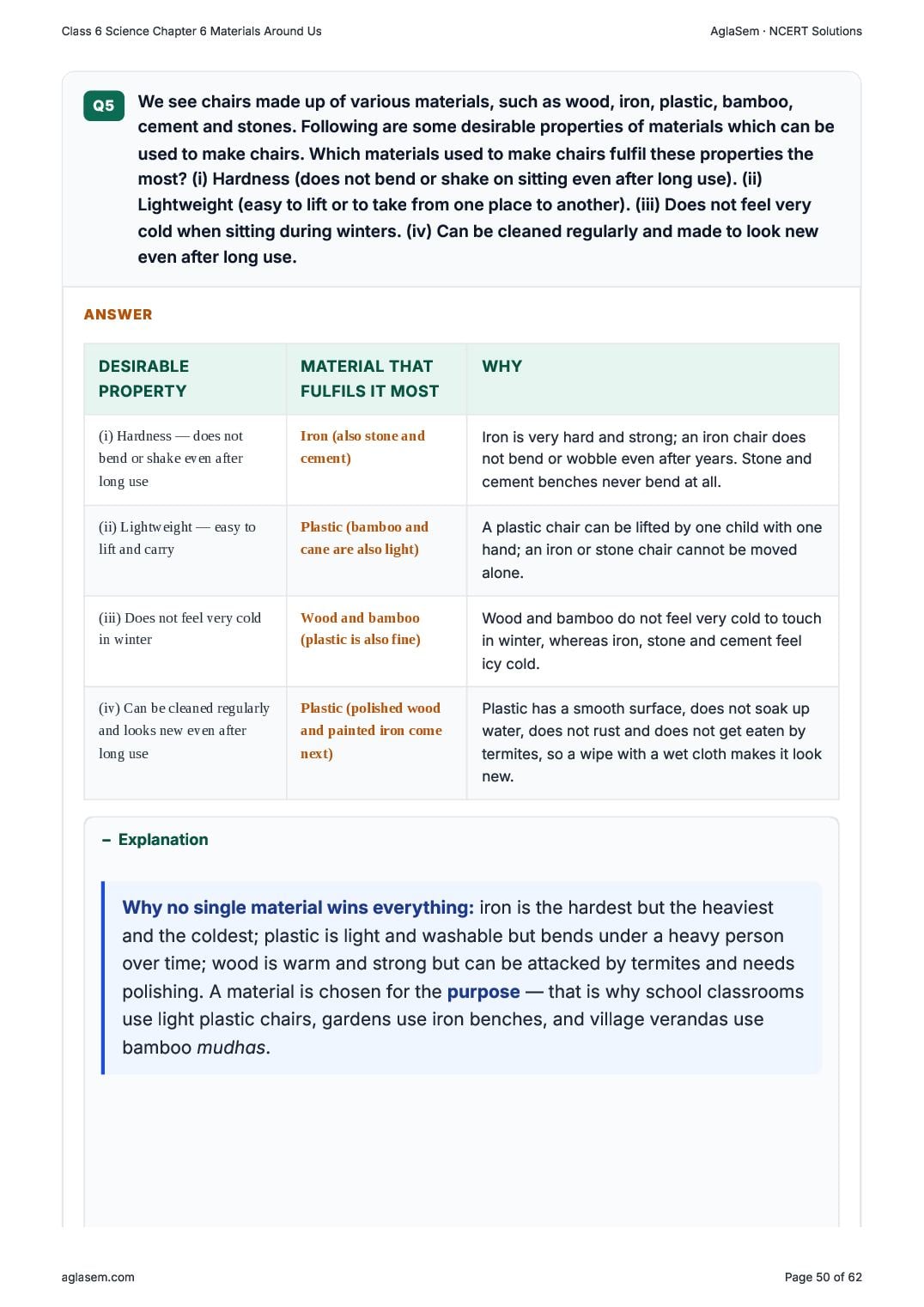
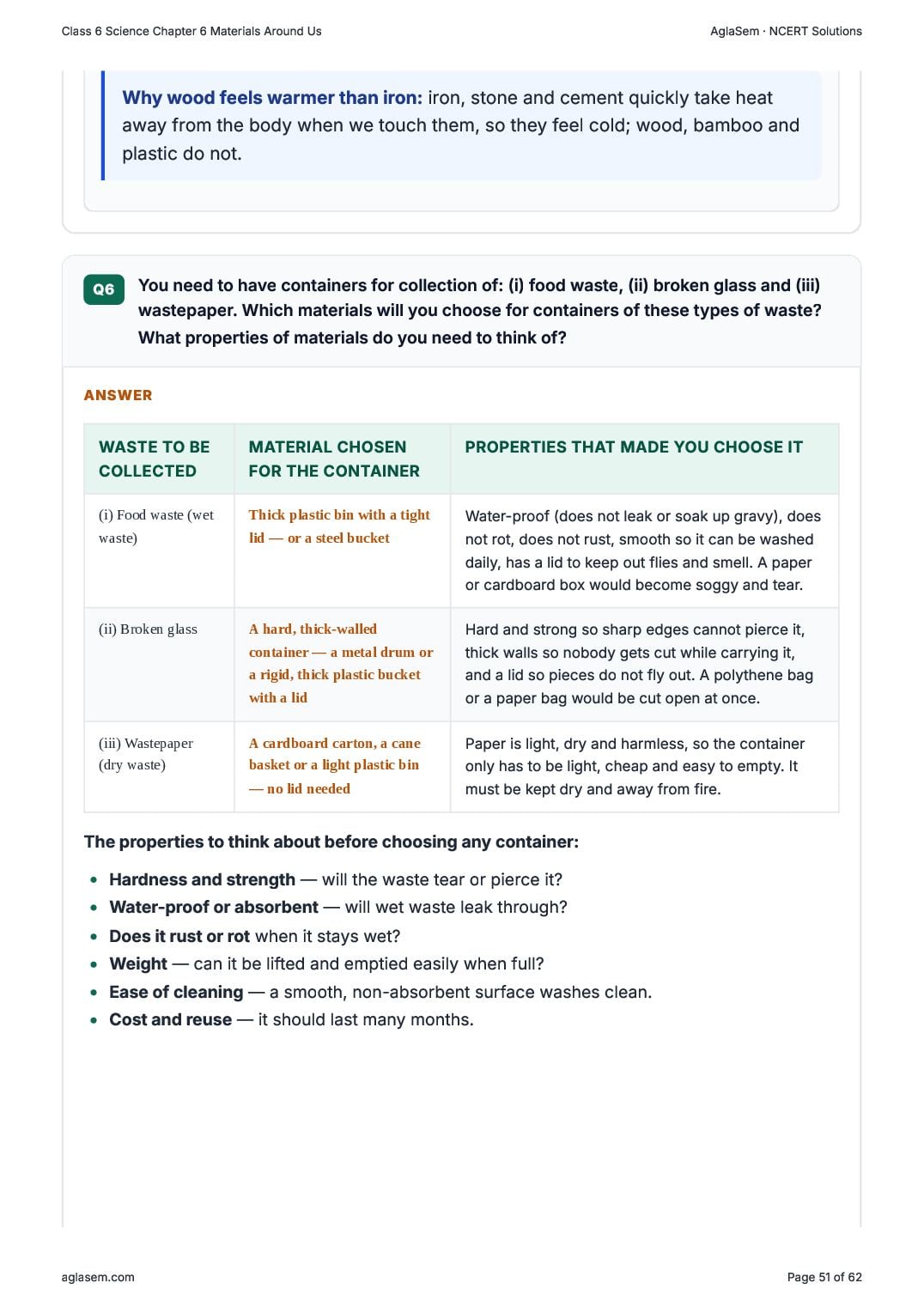
- We see chairs made up of various materials, such as wood, iron, plastic, bamboo, cement and stones. Following are some desirable properties of materials which can be used to make chairs. Which materials used to make chairs fulfil these properties the most? (i) Hardness (does not bend or shake on sitting even after long use). (ii) Lightweight (easy to lift or to take from one place to another). (iii) Does not feel very cold when sitting during winters. (iv) Can be cleaned regularly and made to look new even after long use.
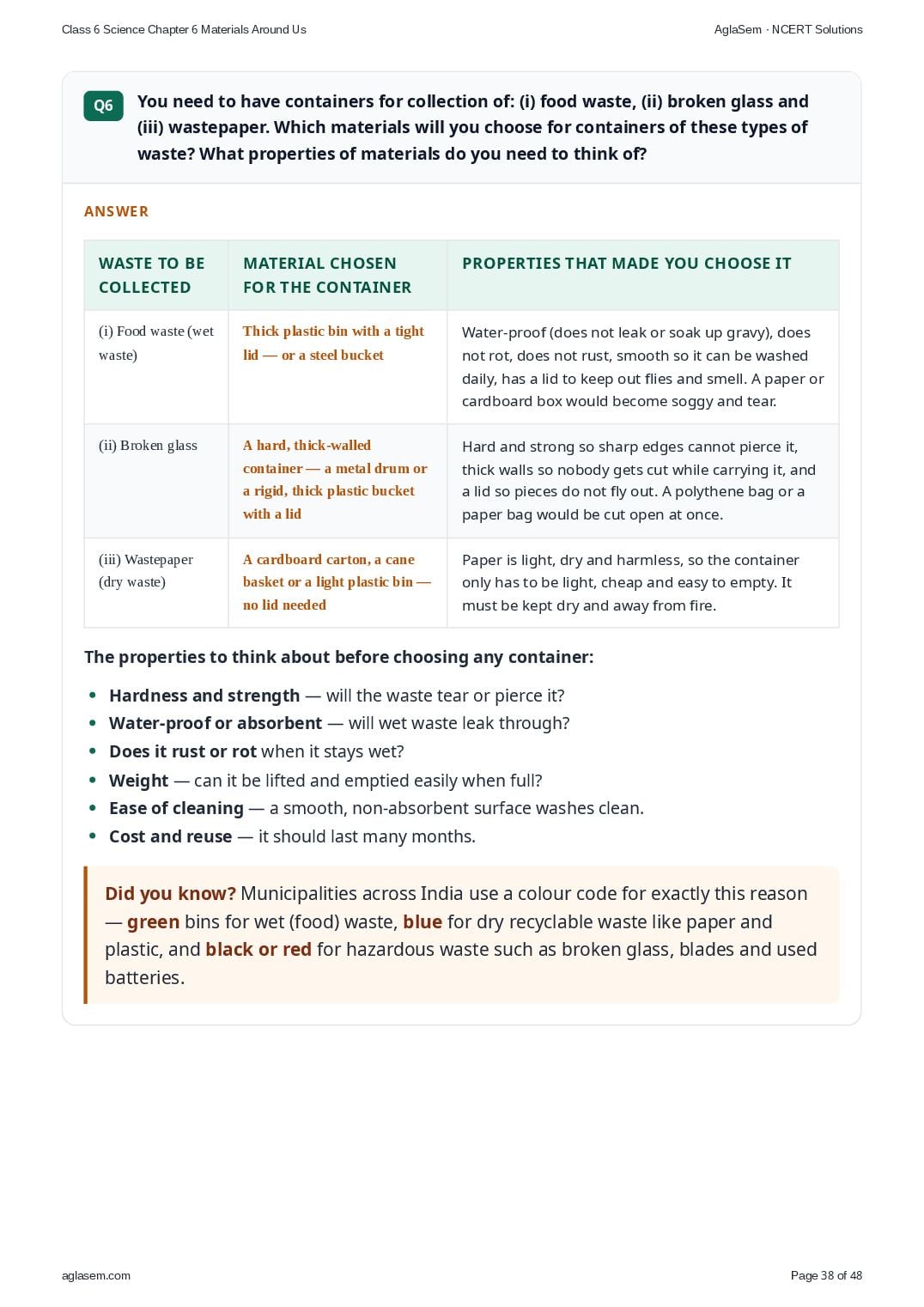
- You need to have containers for collection of: (i) food waste, (ii) broken glass and (iii) wastepaper. Which materials will you choose for containers of these types of waste? What properties of materials do you need to think of?
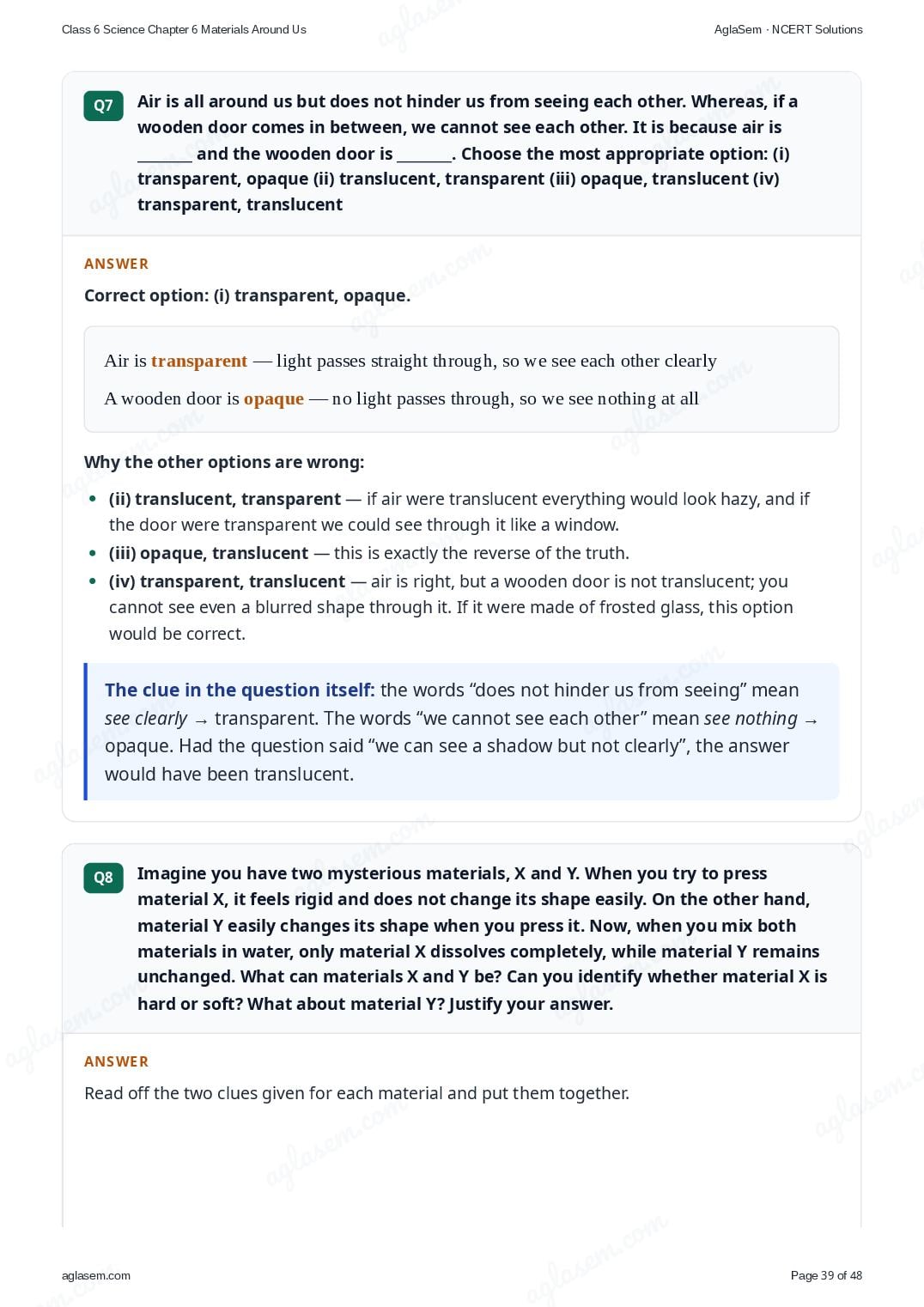
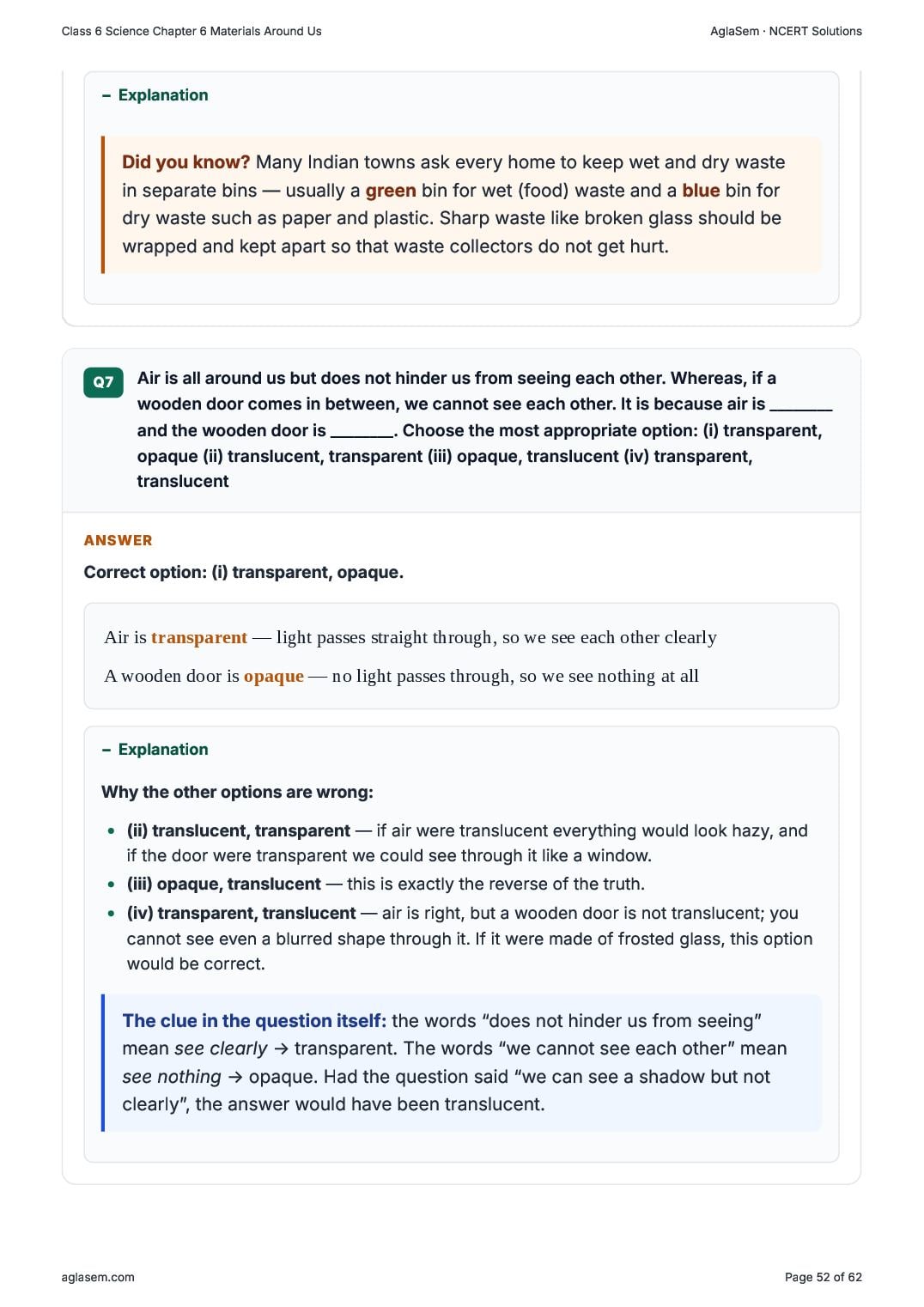
- Air is all around us but does not hinder us from seeing each other. Whereas, if a wooden door comes in between, we cannot see each other. It is because air is ________ and the wooden door is ________. Choose the most appropriate option: (i) transparent, opaque (ii) translucent, transparent (iii) opaque, translucent (iv) transparent, translucent
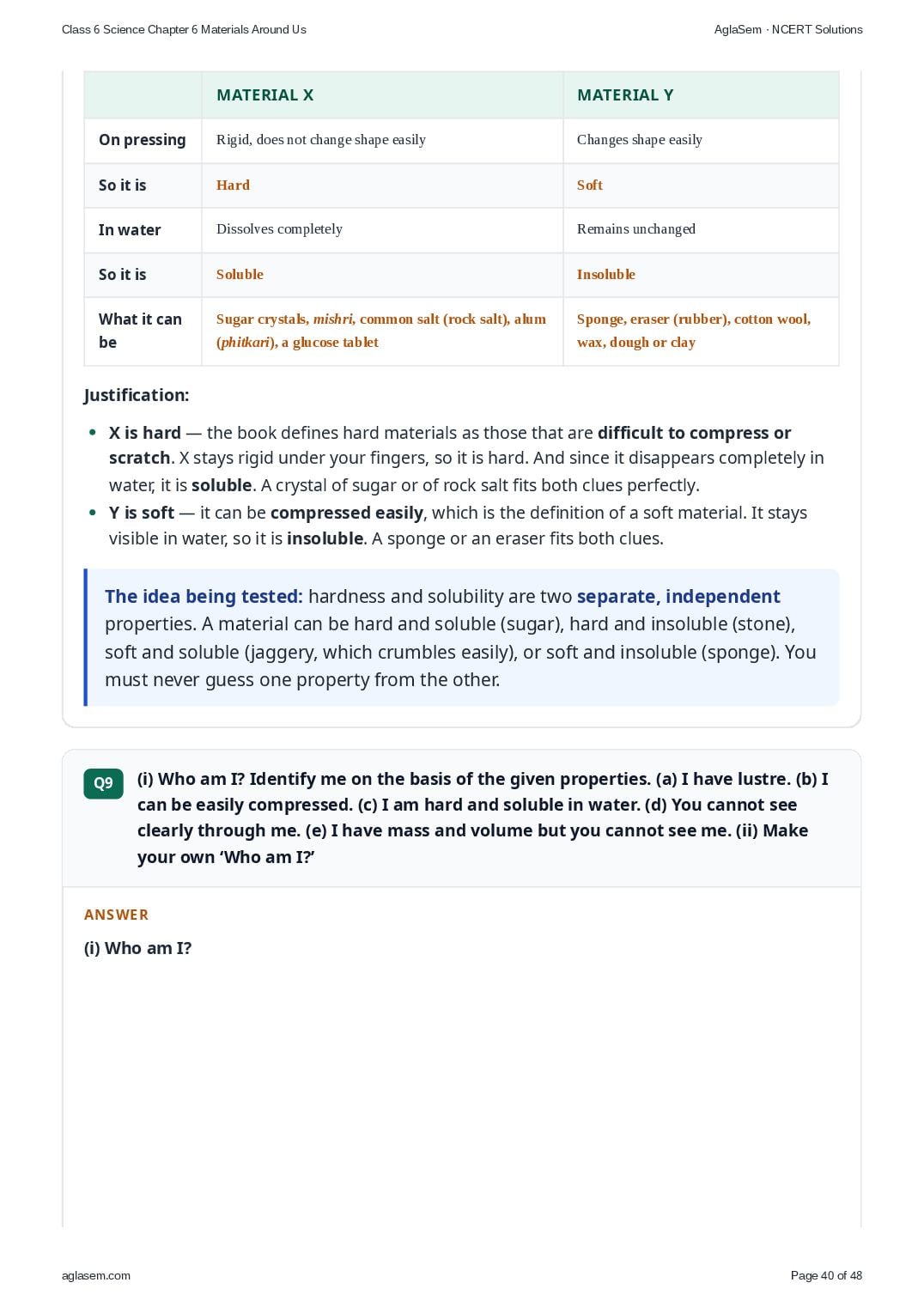
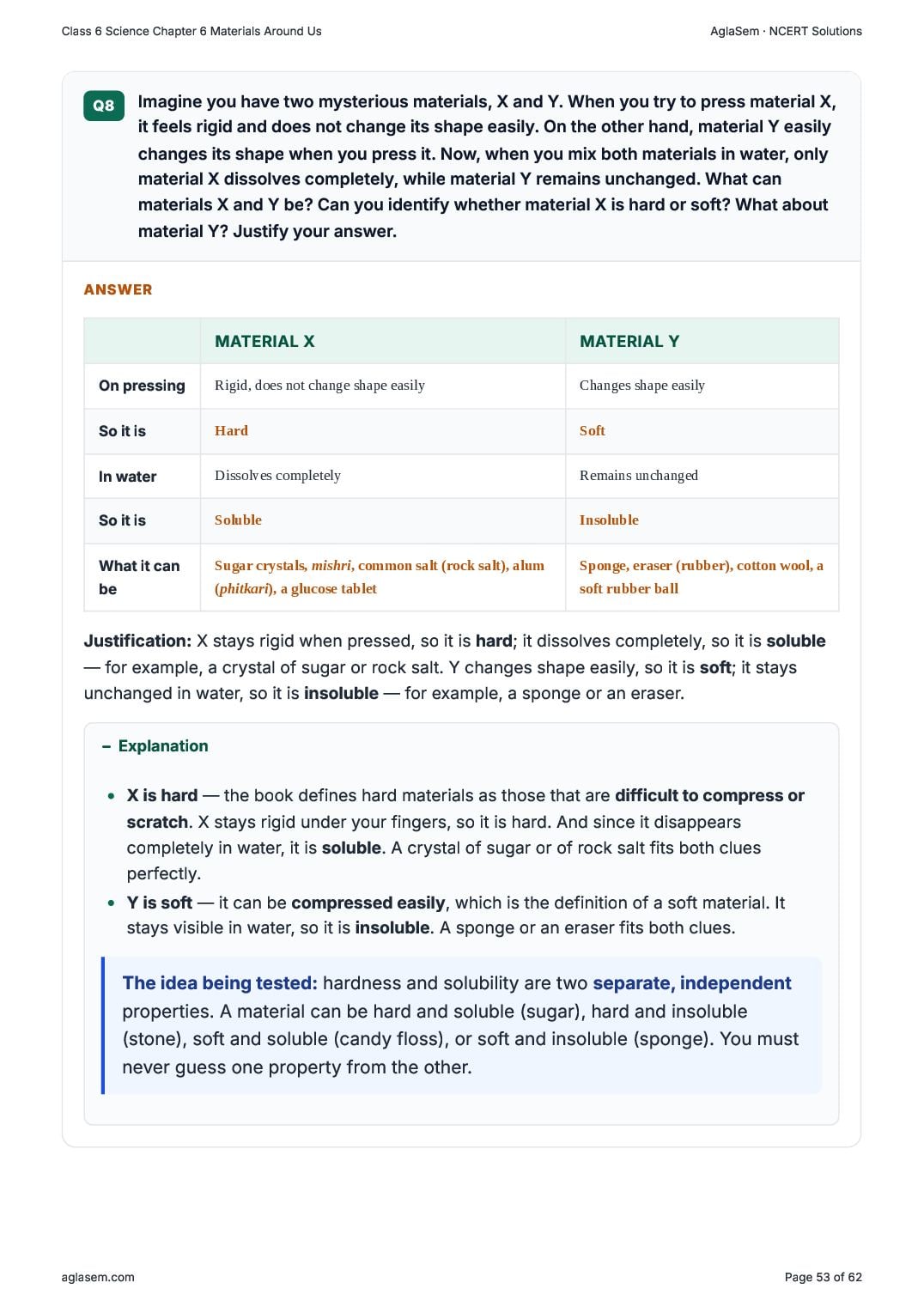
- Imagine you have two mysterious materials, X and Y. When you try to press material X, it feels rigid and does not change its shape easily. On the other hand, material Y easily changes its shape when you press it. Now, when you mix both materials in water, only material X dissolves completely, while material Y remains unchanged. What can materials X and Y be? Can you identify whether material X is hard or soft? What about material Y? Justify your answer.
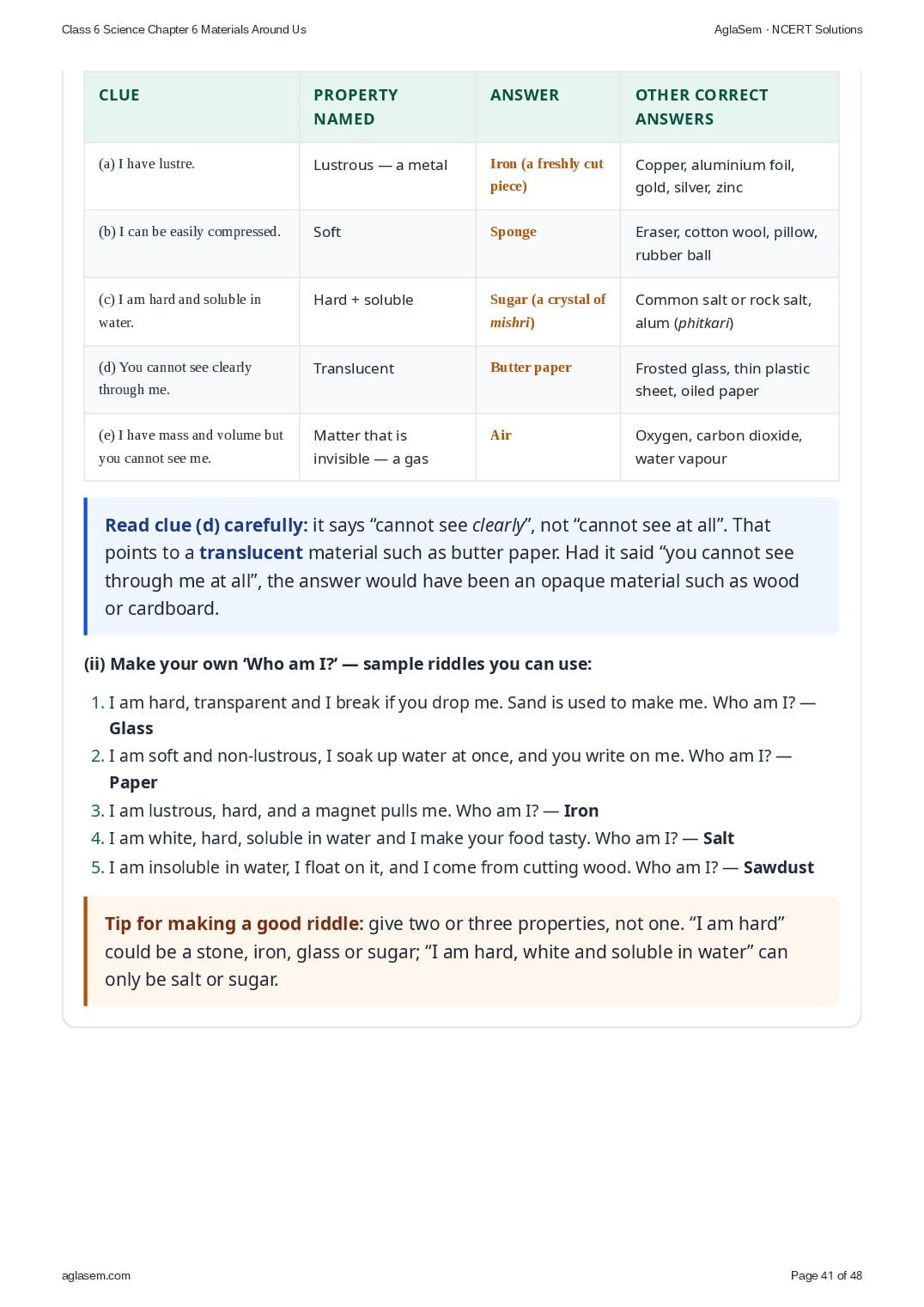
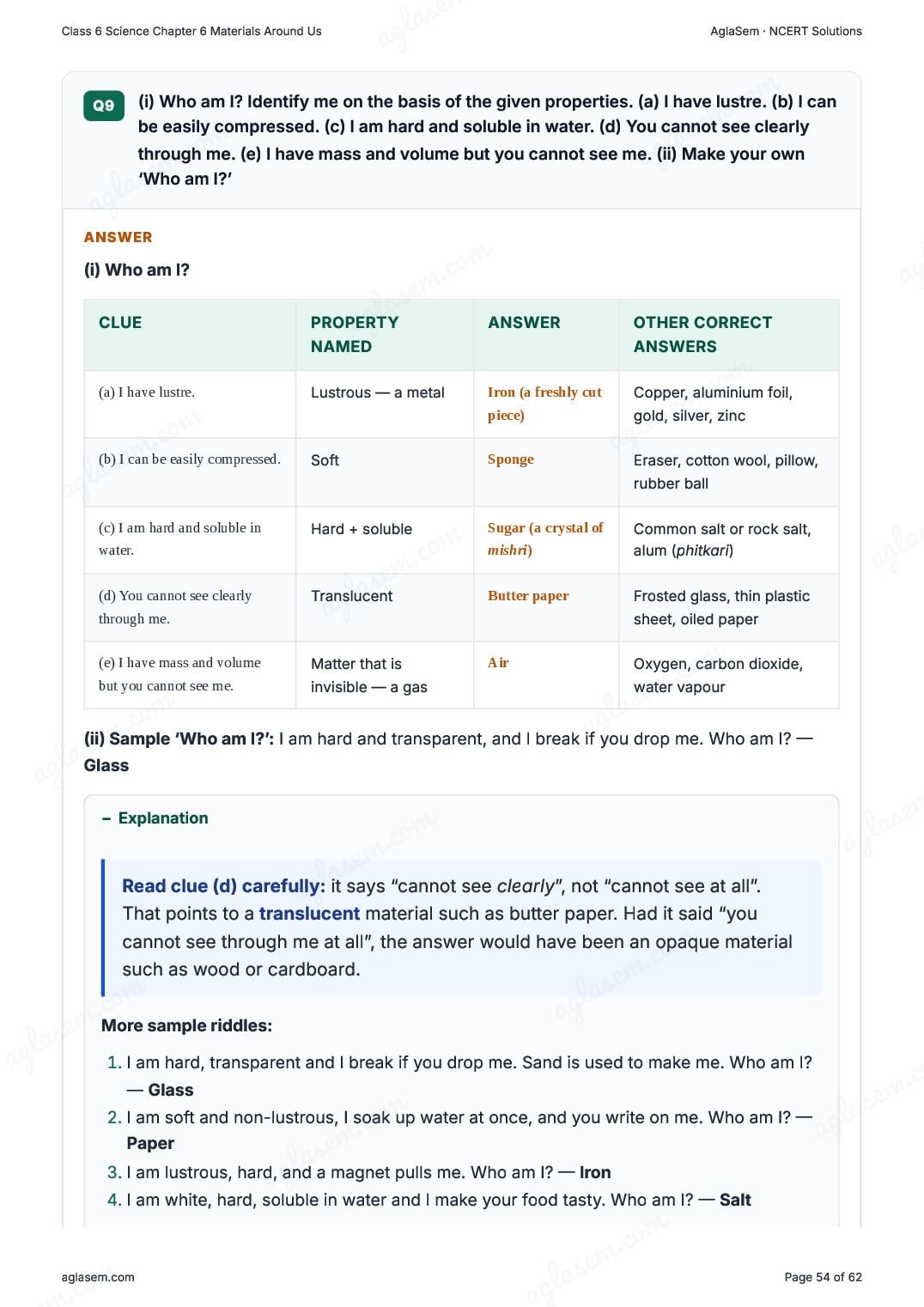
- (i) Who am I? Identify me on the basis of the given properties. (a) I have lustre. (b) I can be easily compressed. (c) I am hard and soluble in water. (d) You cannot see clearly through me. (e) I have mass and volume but you cannot see me. (ii) Make your own ‘Who am I?’
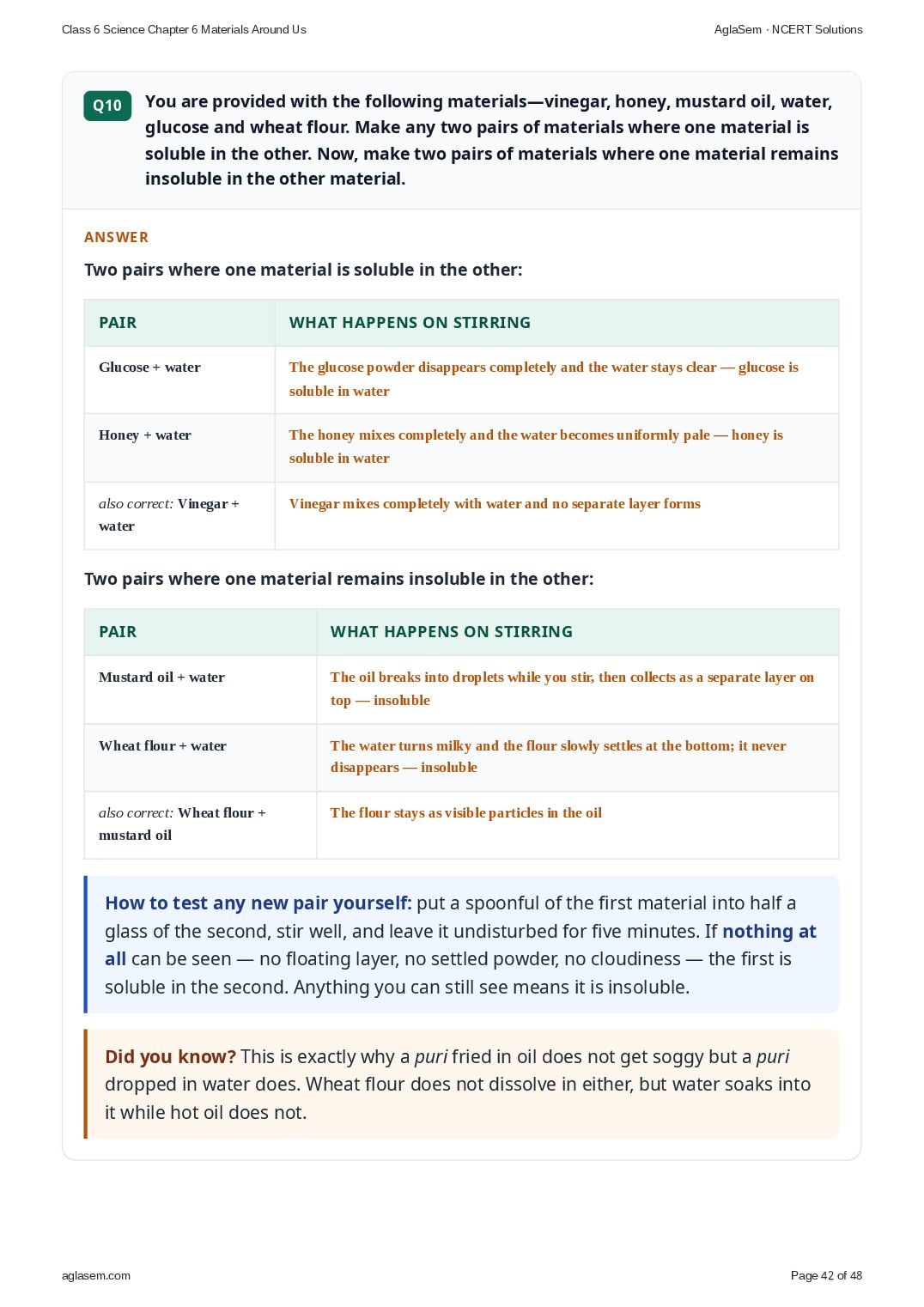
- You are provided with the following materials—vinegar, honey, mustard oil, water, glucose and wheat flour. Make any two pairs of materials where one material is soluble in the other. Now, make two pairs of materials where one material remains insoluble in the other material.
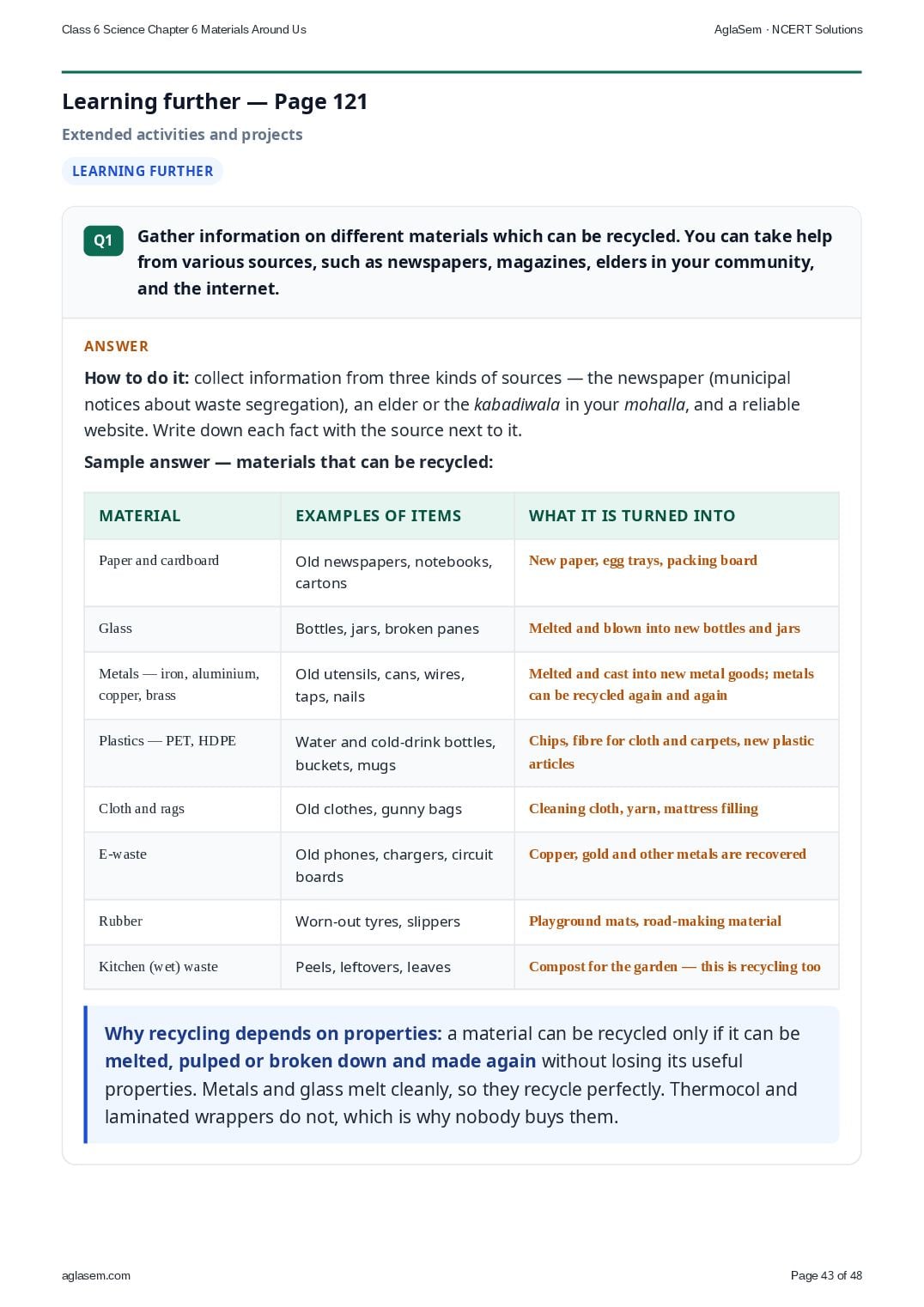
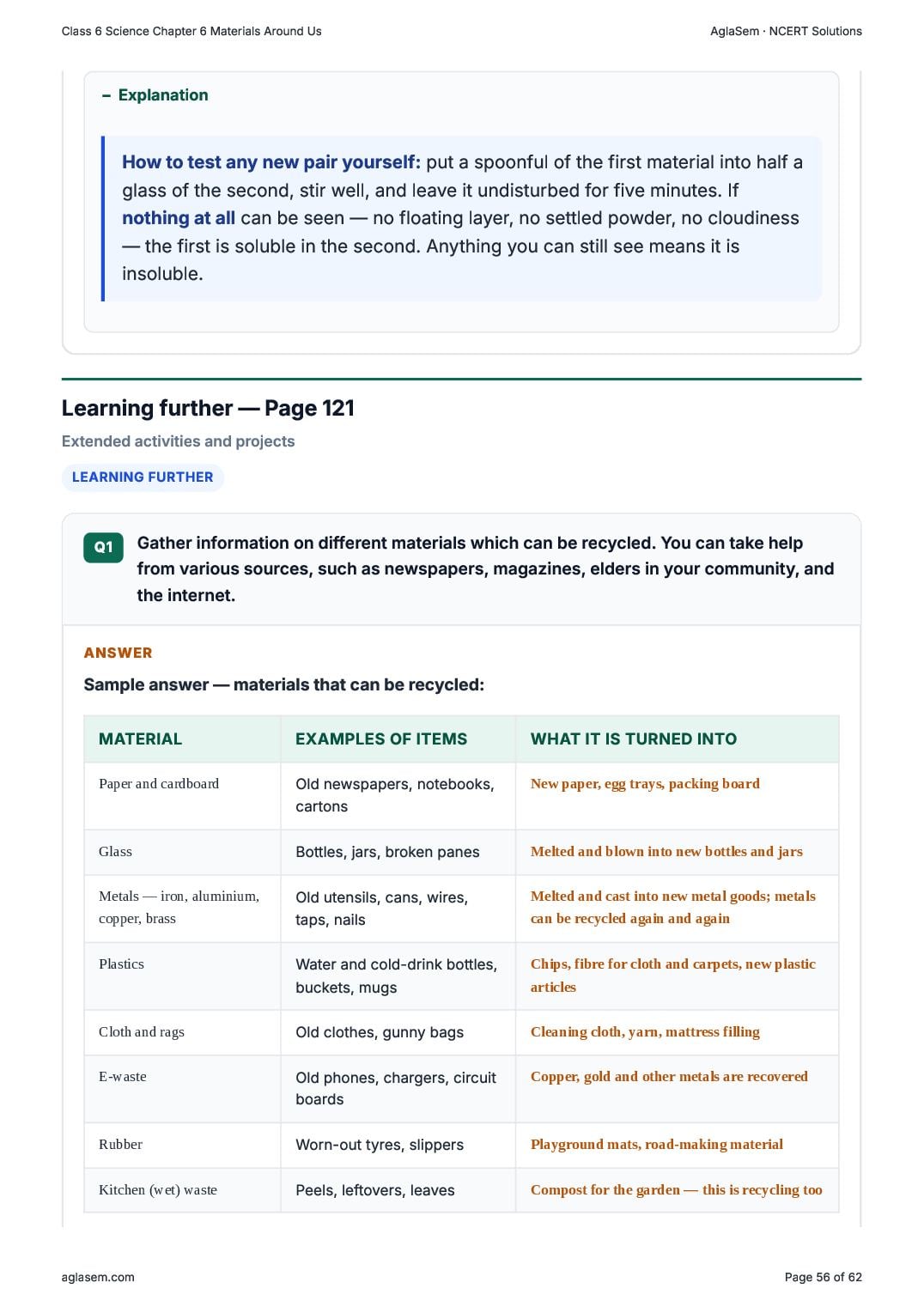
- Gather information on different materials which can be recycled. You can take help from various sources, such as newspapers, magazines, elders in your community, and the internet.
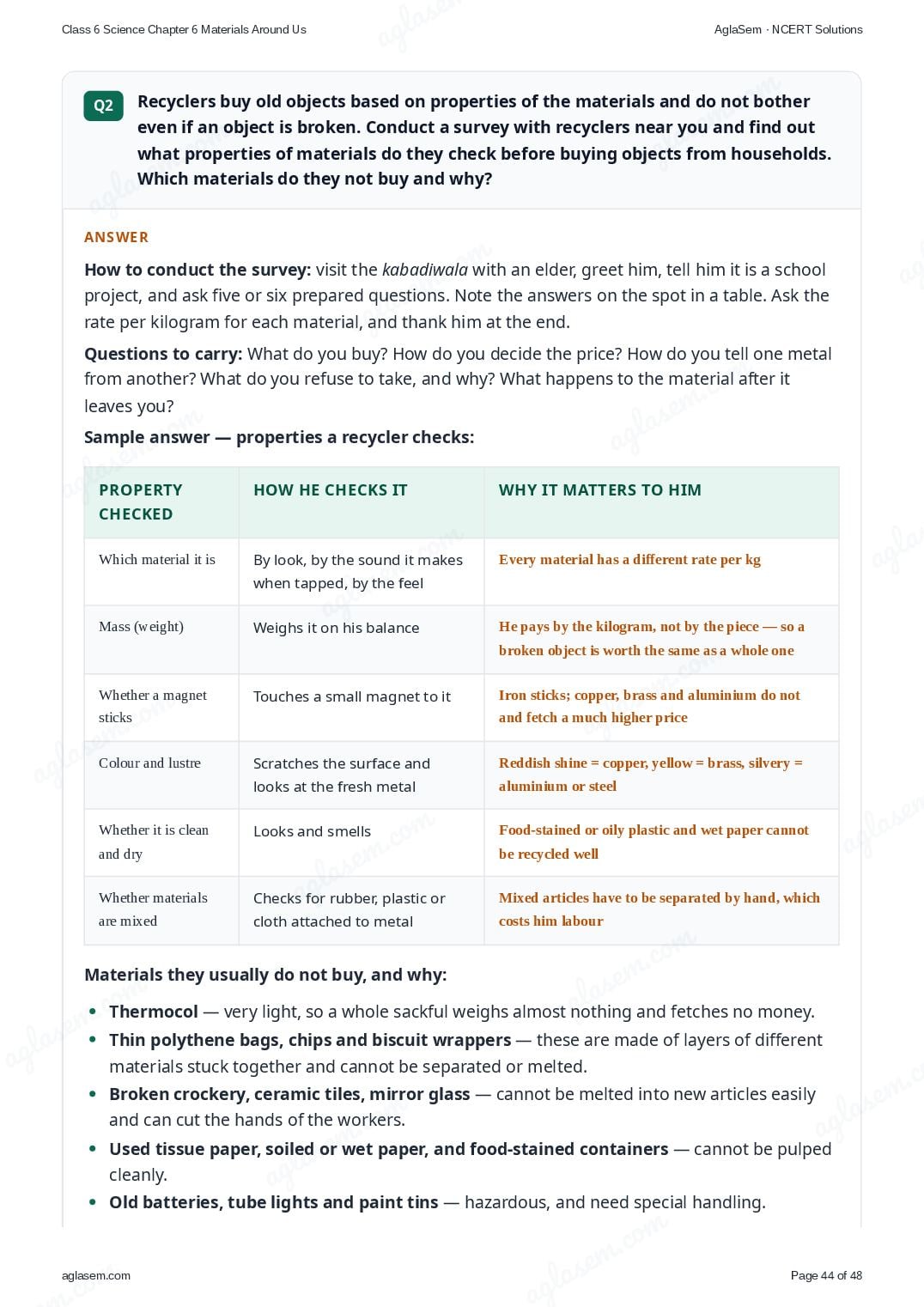
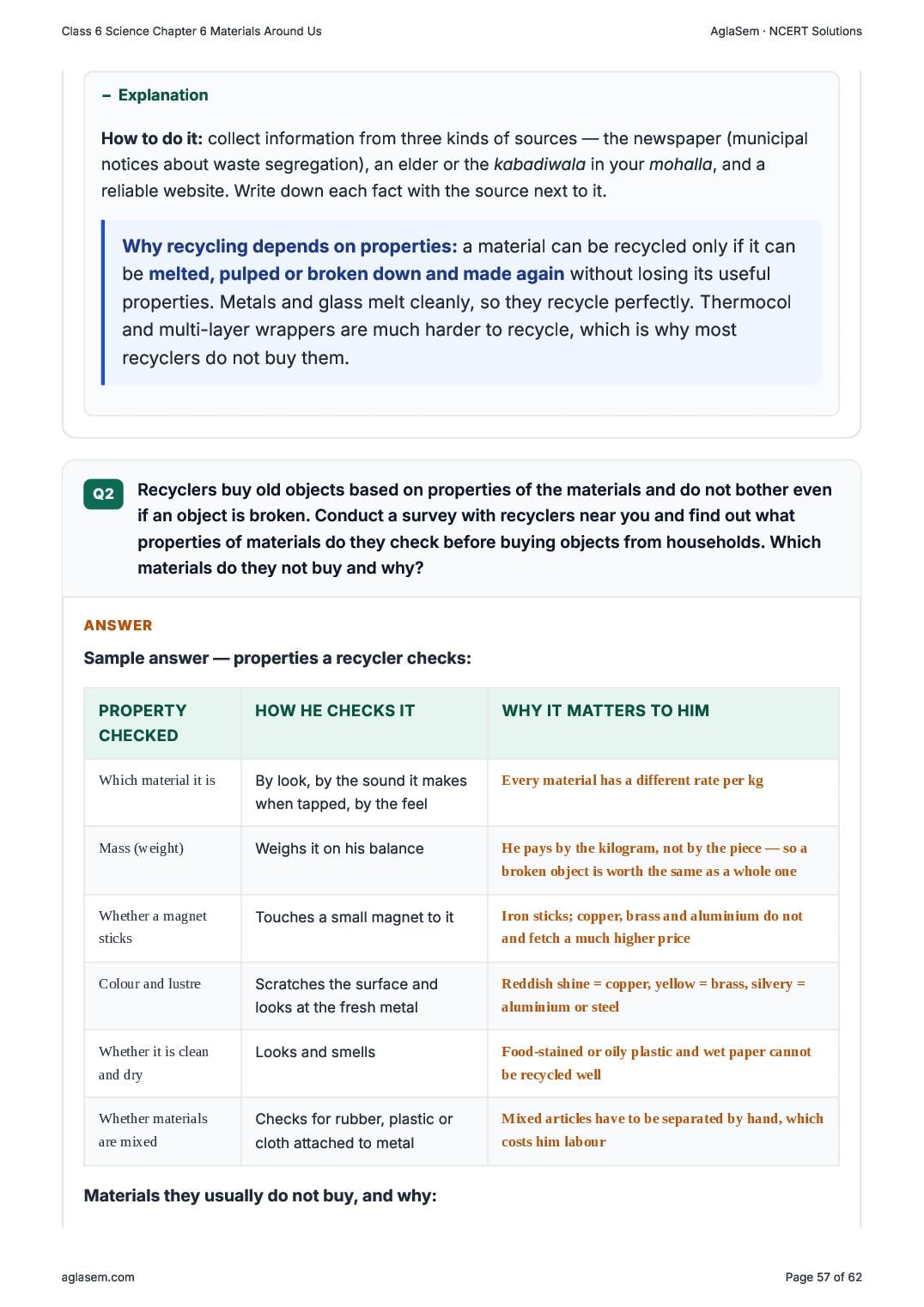
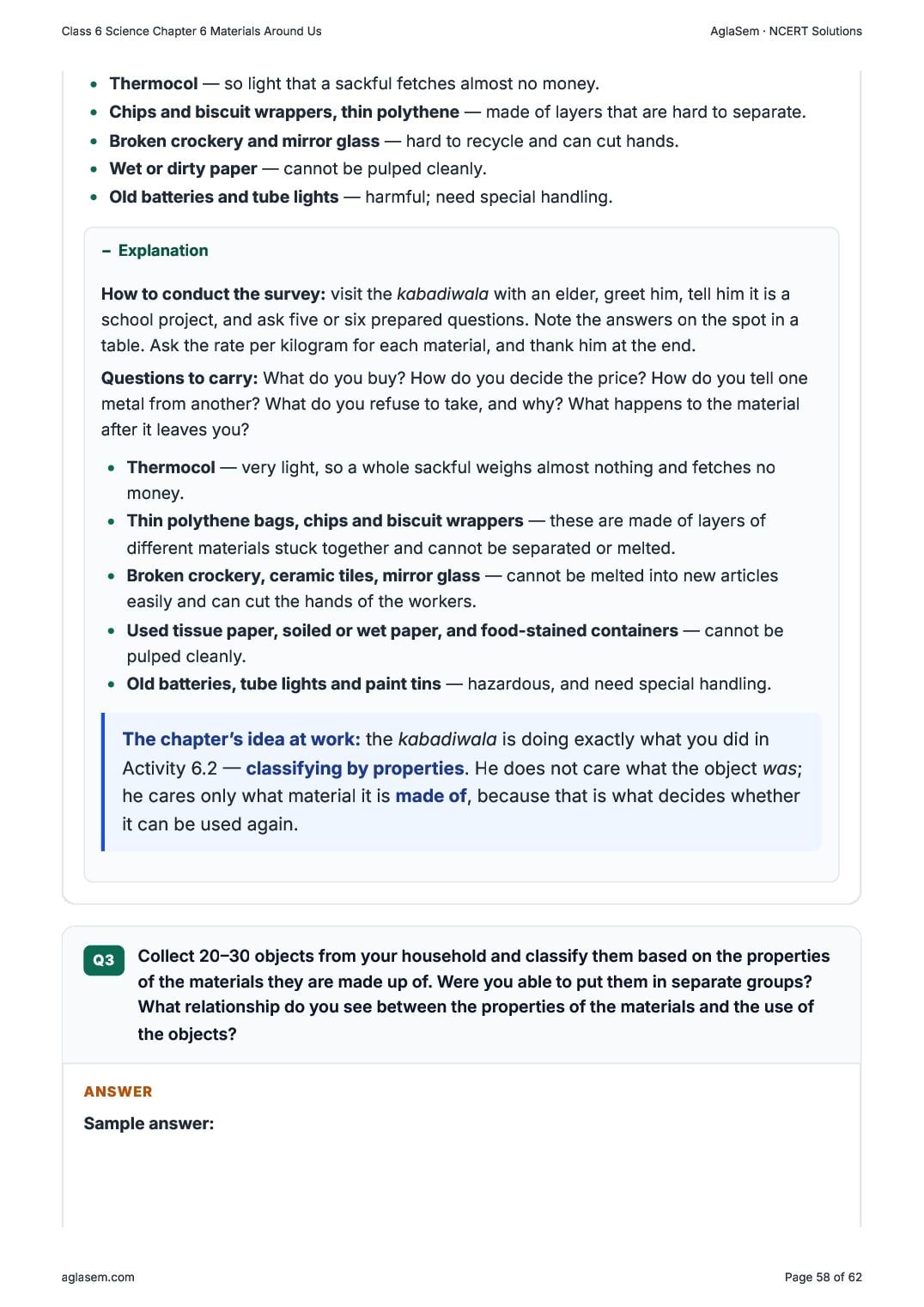
- Recyclers buy old objects based on properties of the materials and do not bother even if an object is broken. Conduct a survey with recyclers near you and find out what properties of materials do they check before buying objects from households. Which materials do they not buy and why?
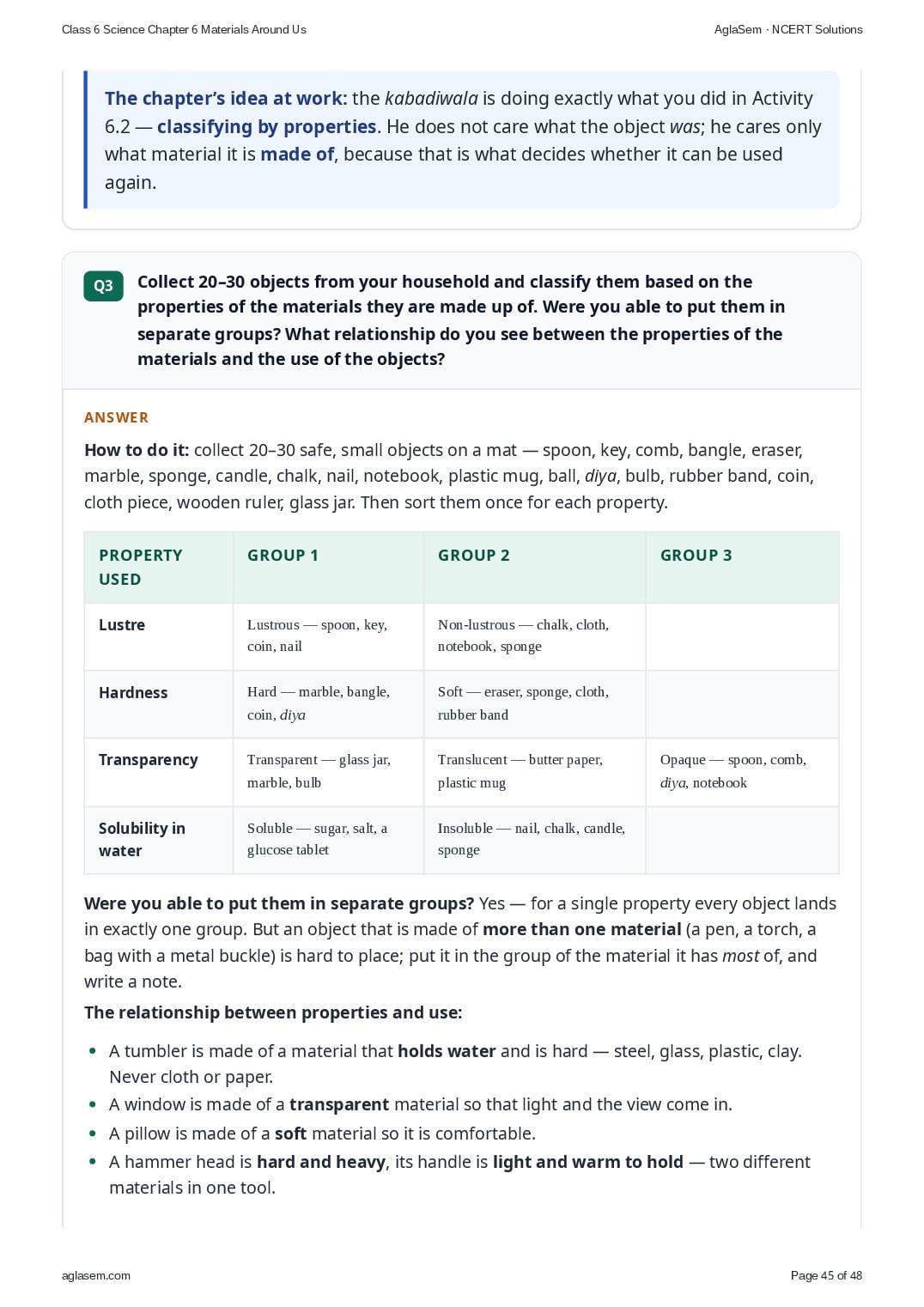
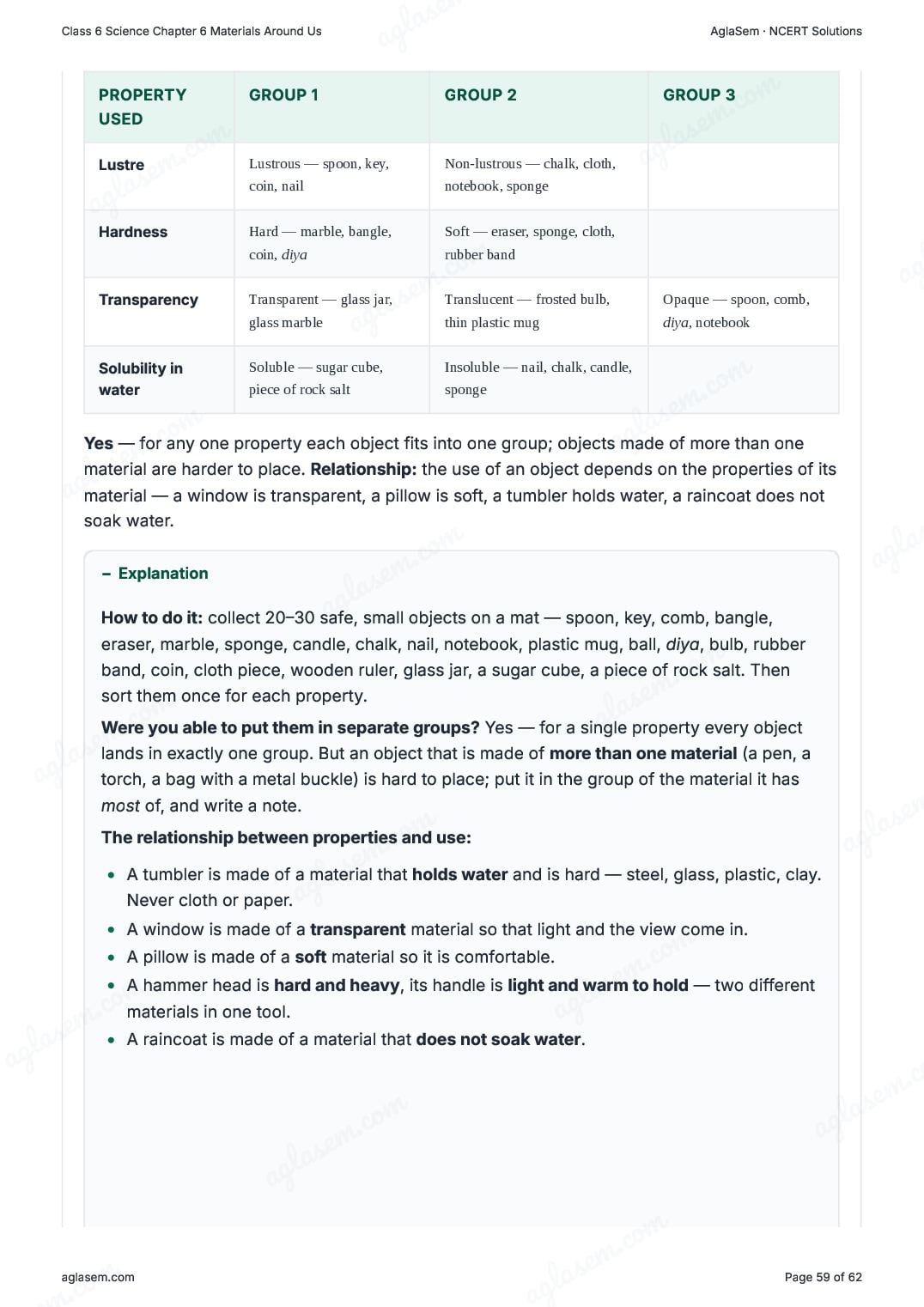
- Collect 20–30 objects from your household and classify them based on the properties of the materials they are made up of. Were you able to put them in separate groups? What relationship do you see between the properties of the materials and the use of the objects?
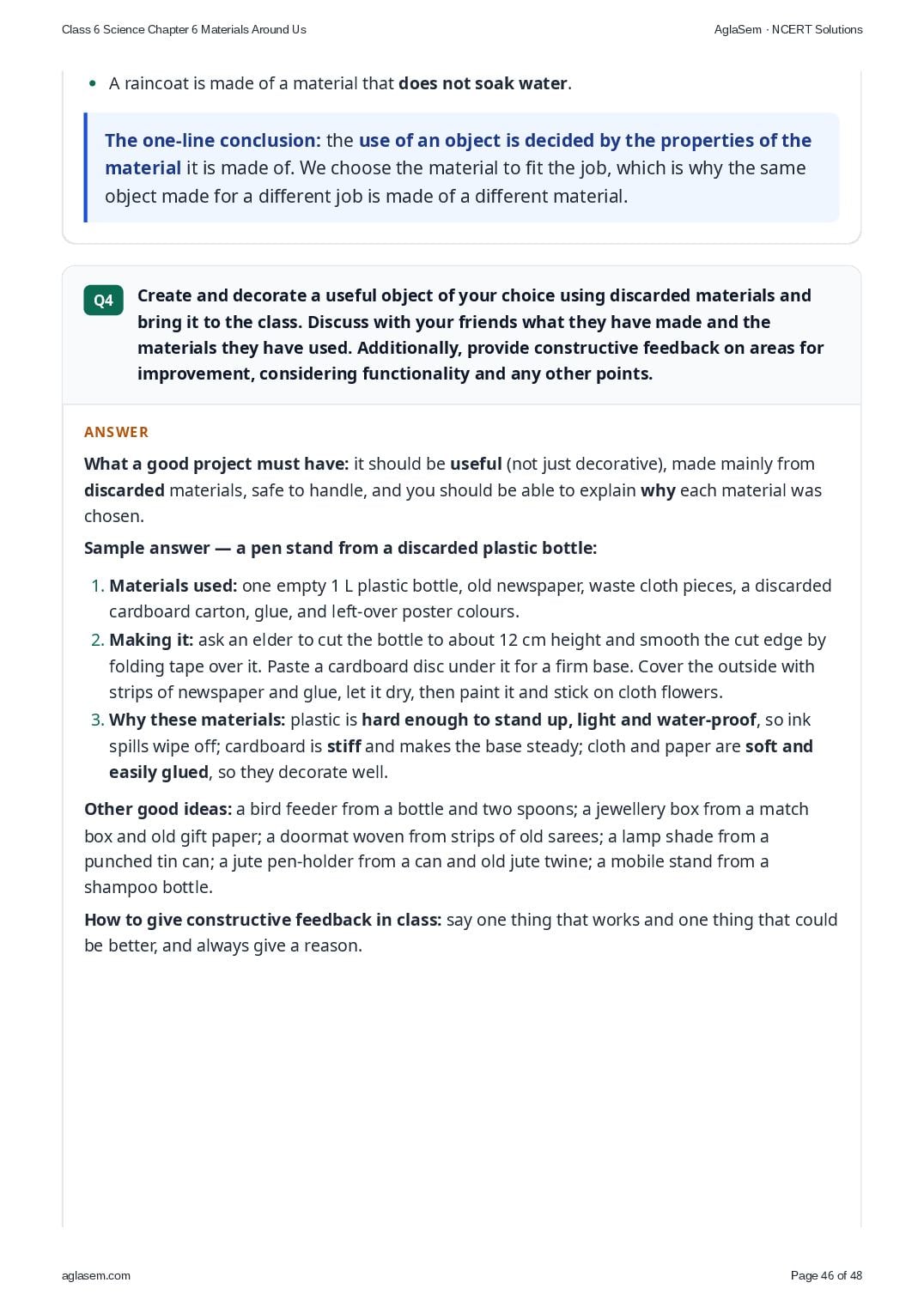
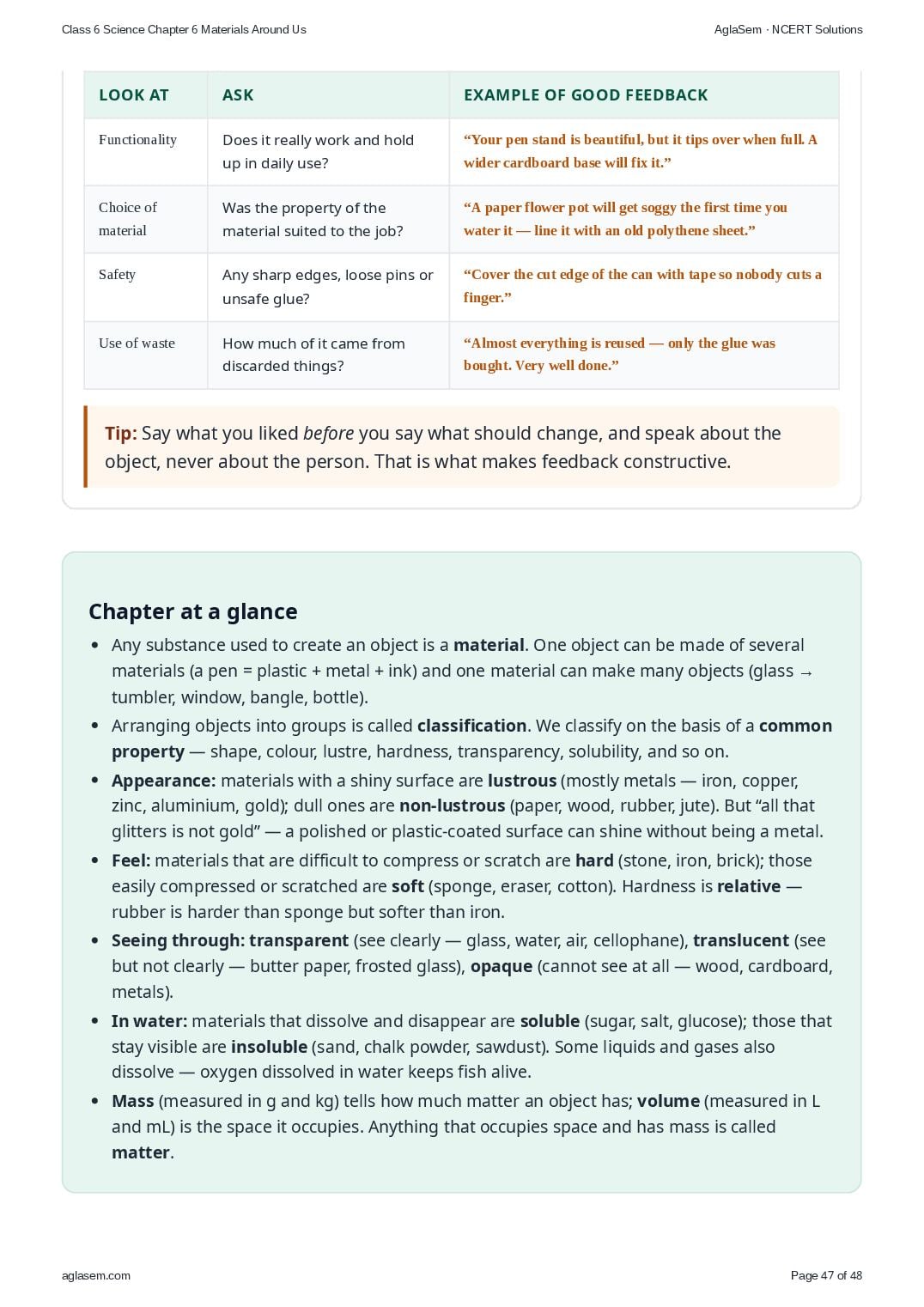
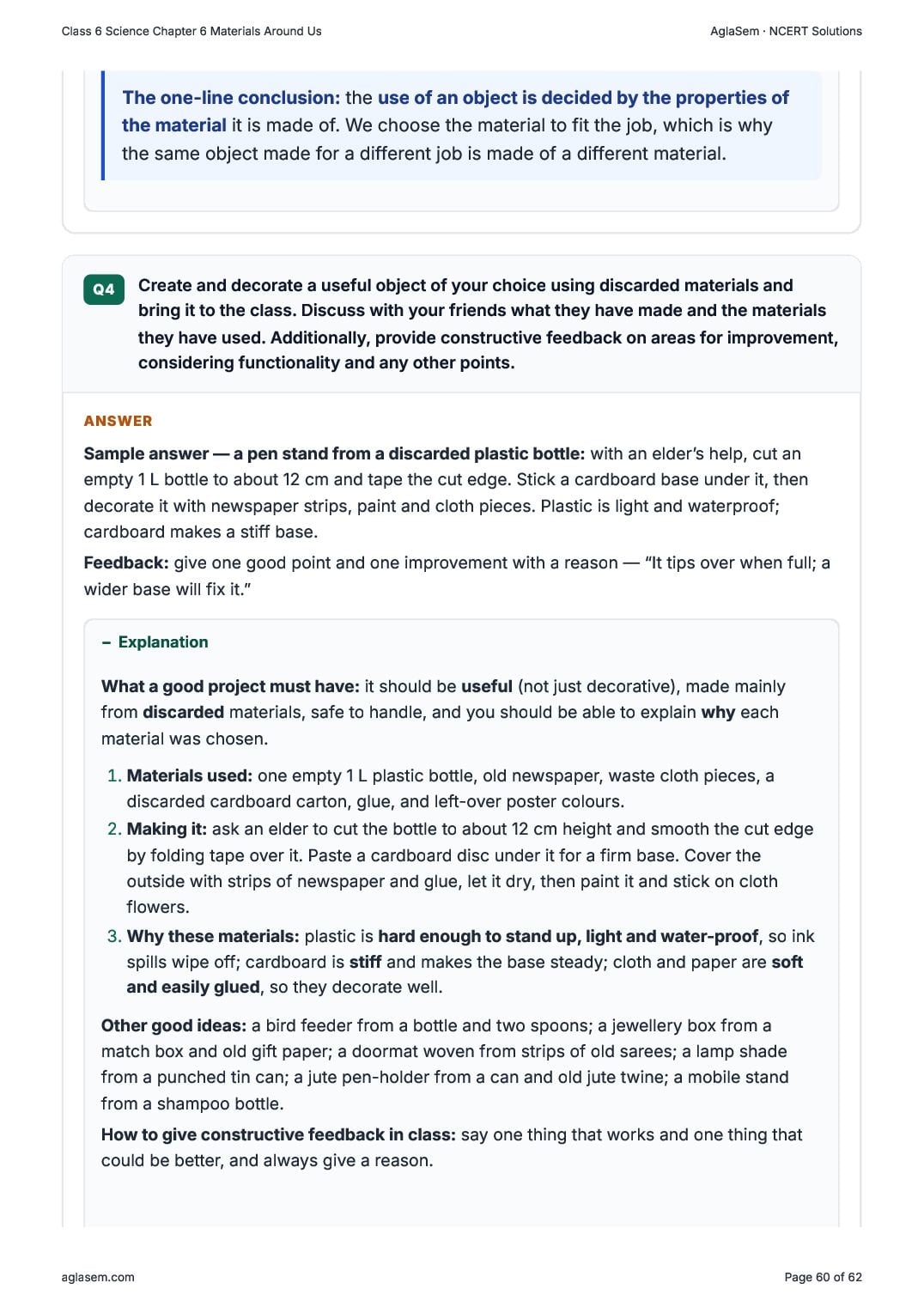
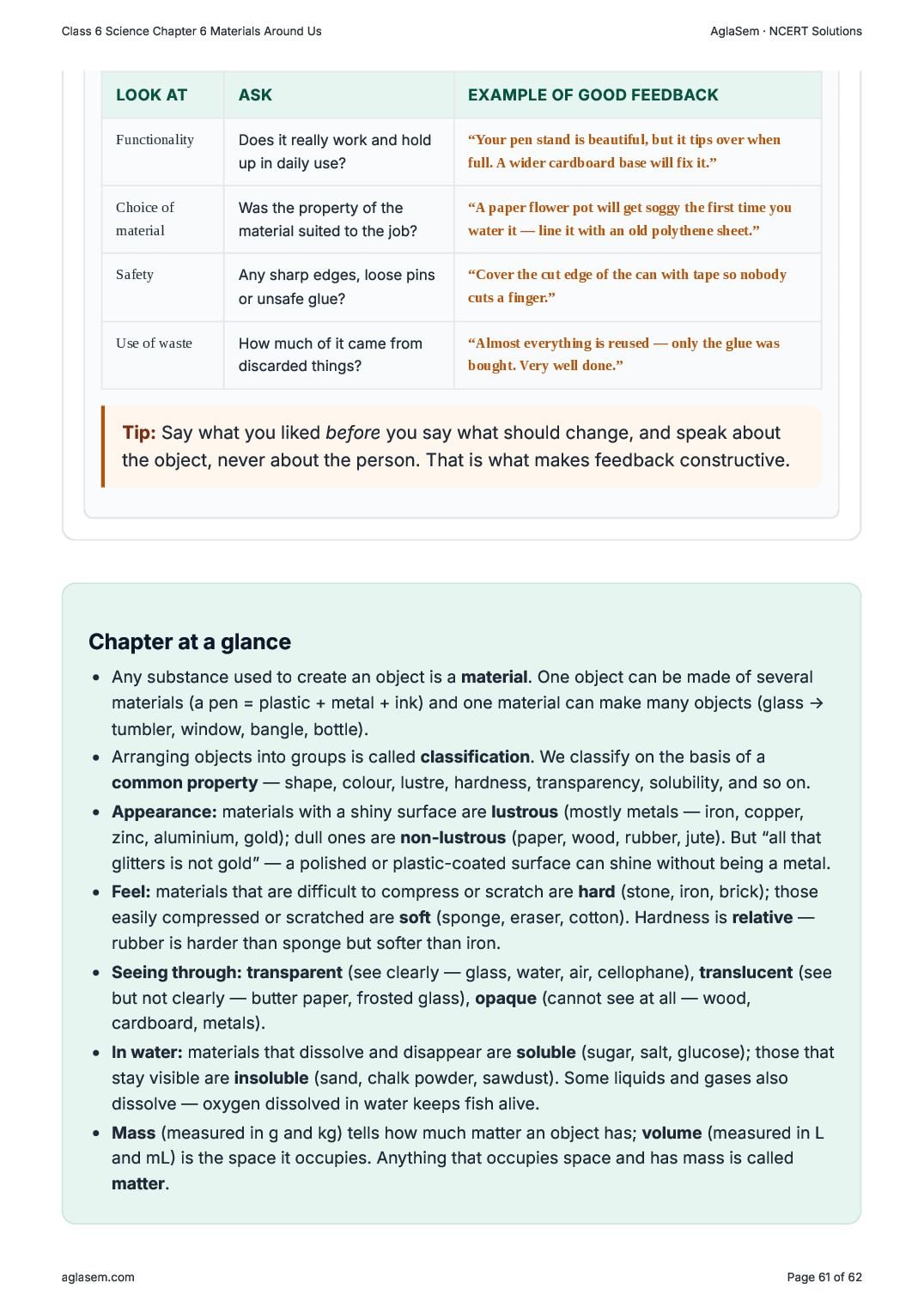
- Create and decorate a useful object of your choice using discarded materials and bring it to the class. Discuss with your friends what they have made and the materials they have used. Additionally, provide constructive feedback on areas for improvement, considering functionality and any other points.
Chapter at a Glance
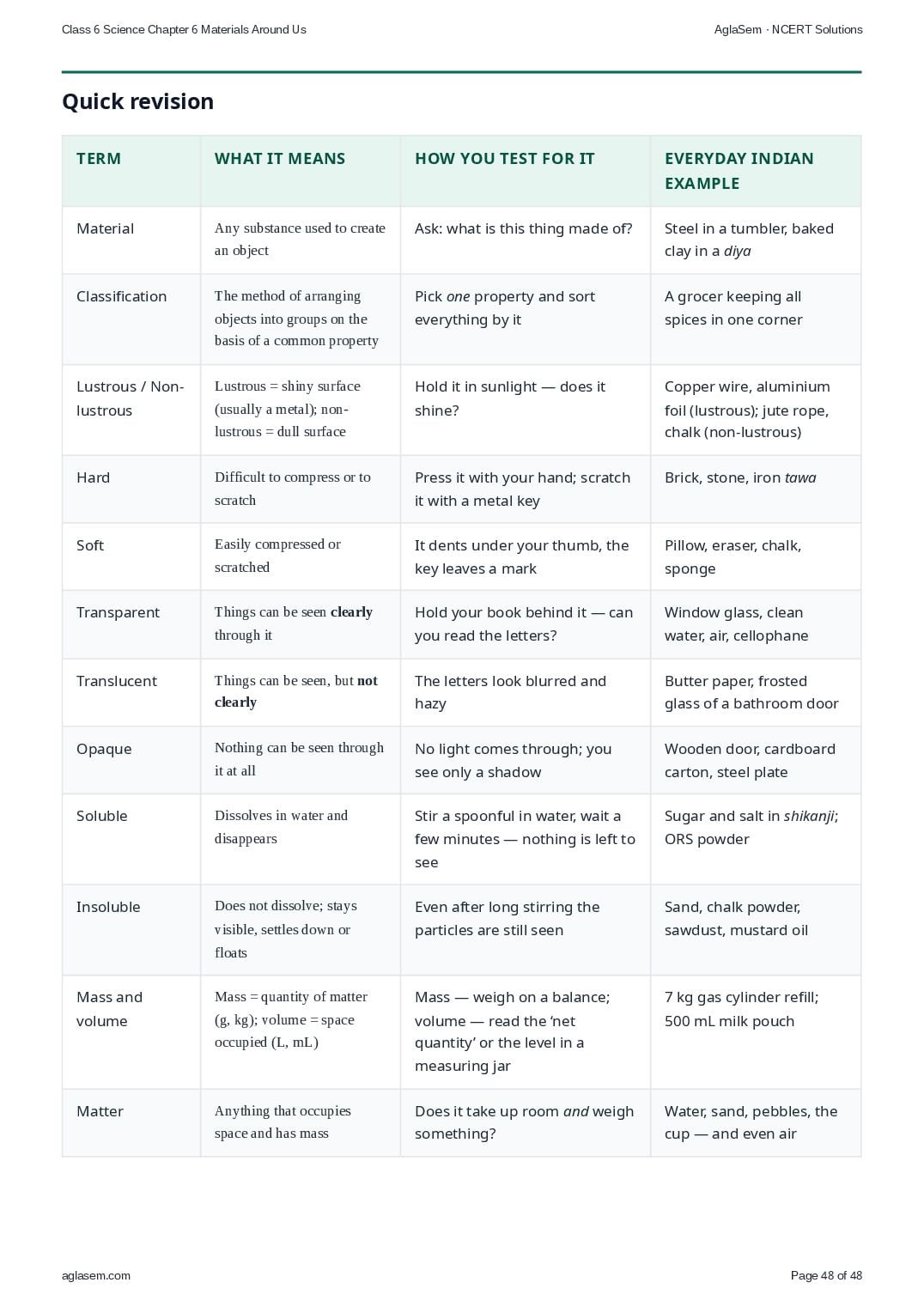
- Any substance used to create an object is a material . One object can be made of several materials (a pen = plastic + metal + ink) and one material can make many objects (glass → tumbler, window, bangle, bottle).
- Arranging objects into groups is called classification . We classify on the basis of a common property — shape, colour, lustre, hardness, transparency, solubility, and so on.
- Appearance: materials with a shiny surface are lustrous (mostly metals — iron, copper, zinc, aluminium, gold); dull ones are non-lustrous (paper, wood, rubber, jute). But “all that glitters is not gold” — a polished or plastic-coated surface can shine without being a metal.
- Feel: materials that are difficult to compress or scratch are hard (stone, iron, brick); those easily compressed or scratched are soft (sponge, eraser, cotton). Hardness is relative — rubber is harder than sponge but softer than iron.
- Seeing through: transparent (see clearly — glass, water, air, cellophane), translucent (see but not clearly — butter paper, frosted glass), opaque (cannot see at all — wood, cardboard, metals).
- In water: materials that dissolve and disappear are soluble (sugar, salt, glucose); those that stay visible are insoluble (sand, chalk powder, sawdust). Some liquids and gases also dissolve — oxygen dissolved in water keeps fish alive.
- Mass (measured in g and kg) tells how much matter an object has; volume (measured in L and mL) is the space it occupies. Anything that occupies space and has mass is called matter .
How to Download NCERT Solutions for Class 6 Science Chapter 6 PDF
Follow these simple steps to get the Materials Around Us questions-and-answers PDF from Curiosity.
- Search NCERT Solutions for Class 6 Science Chapter 6 aglasem and open this page.
- Read the exercise questions with answers for Materials Around Us shown above.
- Click the Download PDF link to save the Materials Around Us solutions to your device.
NCERT Solutions for Class 6 Science – All Chapters
There are more chapters to study besides Materials Around Us in Science. Here are the NCERT Solutions for all chapters of Class 6 Science.
- Chapter 1 the Wonderful World of Science
- Chapter 2 Diversity in the Living World
- Chapter 3 Mindful Eating a Path to a Healthy Body
- Chapter 4 Exploring Magnets
- Chapter 5 Measurement of Length and Motion
- Chapter 6 Materials Around Us
- Chapter 7 Temperature and Its Measurement
- Chapter 8 a Journey Through States of Water
- Chapter 9 Methods of Separation in Everyday Life
- Chapter 10 Living Creatures Exploring Their Characteristics
- Chapter 11 Nature’s Treasures
- Chapter 12 Beyond Earth
NCERT Solutions for Class 6 – All Subjects
Just like Chapter 6 of Science, you can get the exercise questions with answers for every other subject of Class 6. Here are the NCERT Solutions for all subjects of Class 6.
NCERT Solutions for Class 6 Science Chapter 6 – An Overview
The key highlights of this study material are as follows.
| Aspects | Details |
|---|---|
| Class | Class 6 |
| Subject | Science |
| Chapter Number | Chapter 6 |
| Chapter Name | Materials Around Us |
| Book Name | Curiosity |
| Book By | NCERT (National Council of Educational Research and Training) |
| Educational Resource Here | NCERT Solutions of Class 6 Science Chapter 6 for all exercises |
| More Questions Answers of This Subject | NCERT Solutions for Class 6 Science |
| Download Book Chapter | NCERT Book Class 6 Science |
| All Questions Answers For This Class | NCERT Solutions for Class 6 |
| Complete Solutions | NCERT Solutions |
NCERT Solutions for Class 6 Science Chapter 6 Materials Around Us – FAQs
What are the NCERT Solutions for Class 6 Science Chapter 6 Materials Around Us?
They are the complete, step-by-step answers to all the exercise and in-text questions of Chapter 6 Materials Around Us from the NCERT Class 6 Science textbook Curiosity, written by experts as per the latest NCERT syllabus.
How can I download the Class 6 Science Chapter 6 solutions PDF for free?
Open this page on aglasem, read the Materials Around Us questions with answers, and click the “Download Solutions PDF” link. The Class 6 Science Chapter 6 NCERT Solutions PDF is completely free to download.
Are these NCERT Solutions as per the latest 2026-27 syllabus?
Yes. The NCERT Solutions for Class 6 Science Chapter 6 are based on the latest NCERT textbook Curiosity and the current 2026-27 CBSE syllabus, so the questions and answers match what you study in class.
Where can I get NCERT Solutions for the other chapters of Class 6 Science?
You can find the answers to every chapter on the NCERT Solutions for Class 6 Science page, and solutions for every subject on the NCERT Solutions for Class 6 page.
How do NCERT Solutions help in exam preparation?
They show the correct method to solve each question, help you write answers the way they are expected in exams, let you check and correct your own work, and save revision time — which together improve your marks in Class 6 Science.
If you have any queries on NCERT Solutions for Class 6 Science Chapter 6 Materials Around Us, then please ask in the comments below.