NCERT Solutions for Class 6 Science Chapter 12 Beyond Earth provide clear, step-by-step answers to every exercise and in-text question from the chapter Beyond Earth of the NCERT textbook Curiosity. Prepared by subject experts as per the latest NCERT (CBSE) syllabus for 2026-27, these NCERT Solutions for Class 6 Science help you understand each concept, write exam-ready answers, and check your own solutions. You can read them online below or download the free Class 6 Science Chapter 12 question-answer PDF.
NCERT Solutions for Class 6 Science Chapter 12 Beyond Earth
- Class: Class 6
- Subject: Science
- Chapter: Chapter 12 – Beyond Earth
- Textbook: Curiosity (NCERT)
- Study material: NCERT Solutions – questions with answers, free PDF
These solutions answer all the exercise questions of Chapter 12 Beyond Earth — including the in-text questions, short-answer and long-answer questions, and activities — with complete explanations so you can follow the method, not just the final answer. Read the full solutions below.
NCERT Solutions Class 6 Science Chapter 12 Beyond Earth View Download
NCERT Solutions for Class 6 Science Chapter 12 PDF Download
You can read the NCERT Solutions for Class 6 Science Chapter 12 online above, or download the complete question-answer PDF to study Beyond Earth offline at any time.
NCERT Solutions for Class 6 Science Chapter 12 PDF Download Link – Click Here to Download Solutions PDF
Questions Covered in This Chapter
These NCERT Solutions answer all 36 questions of this chapter. The questions solved are:
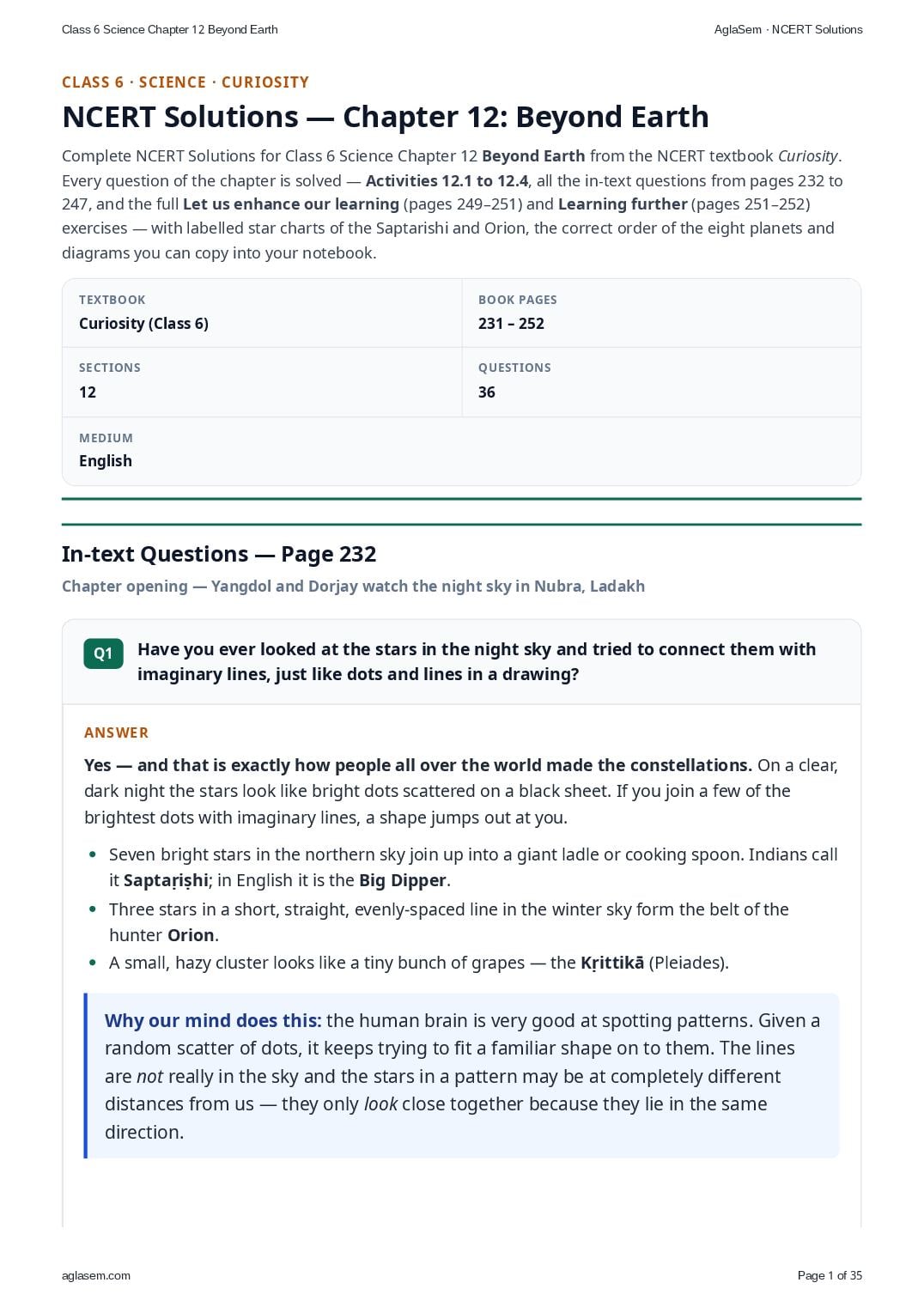
- Have you ever looked at the stars in the night sky and tried to connect them with imaginary lines, just like dots and lines in a drawing?
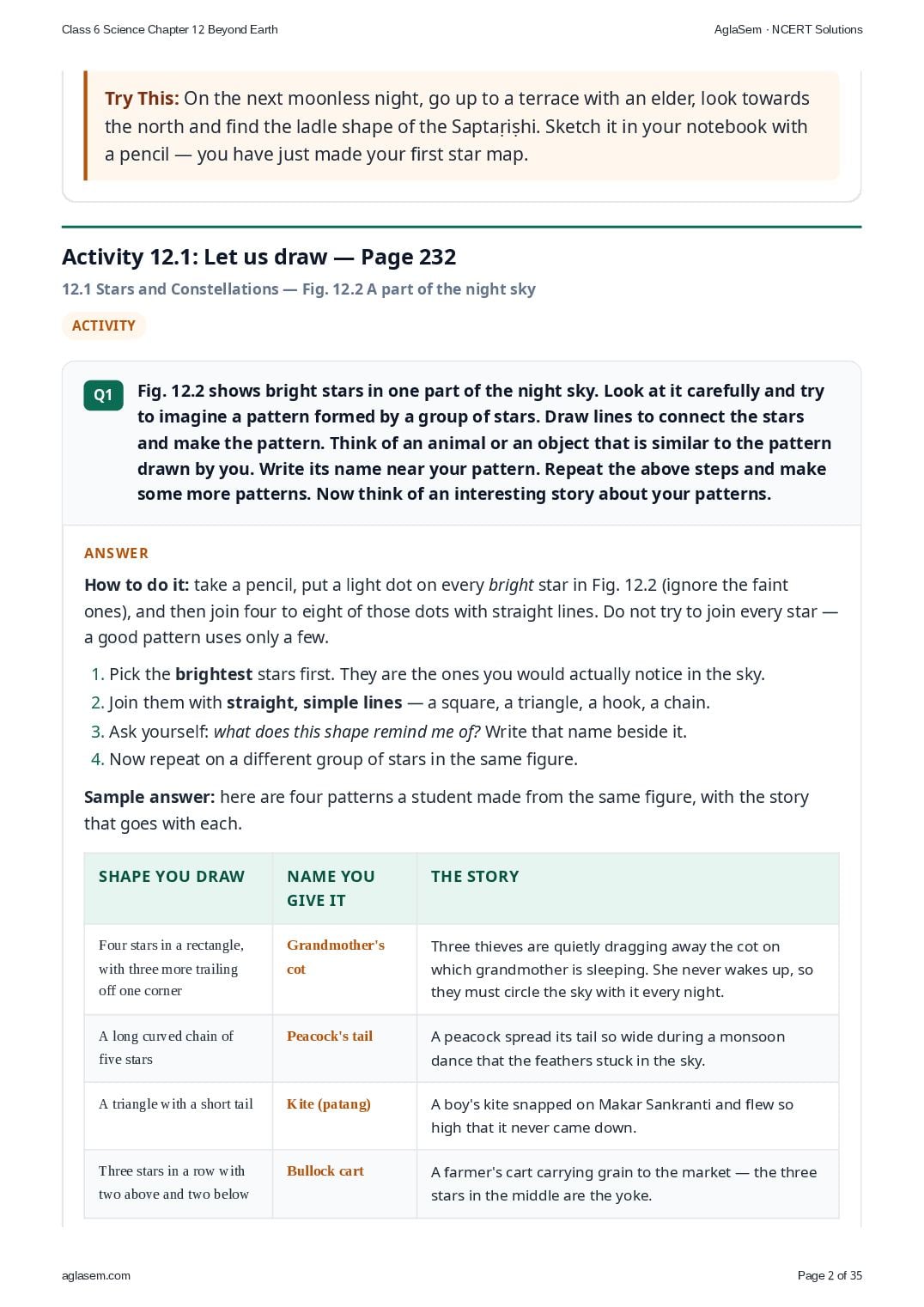
- Fig. 12.2 shows bright stars in one part of the night sky. Look at it carefully and try to imagine a pattern formed by a group of stars. Draw lines to connect the stars and make the pattern. Think of an animal or an object that is similar to the pattern drawn by you. Write its name near your pattern. Repeat the above steps and make some more patterns. Now think of an interesting story about your patterns.
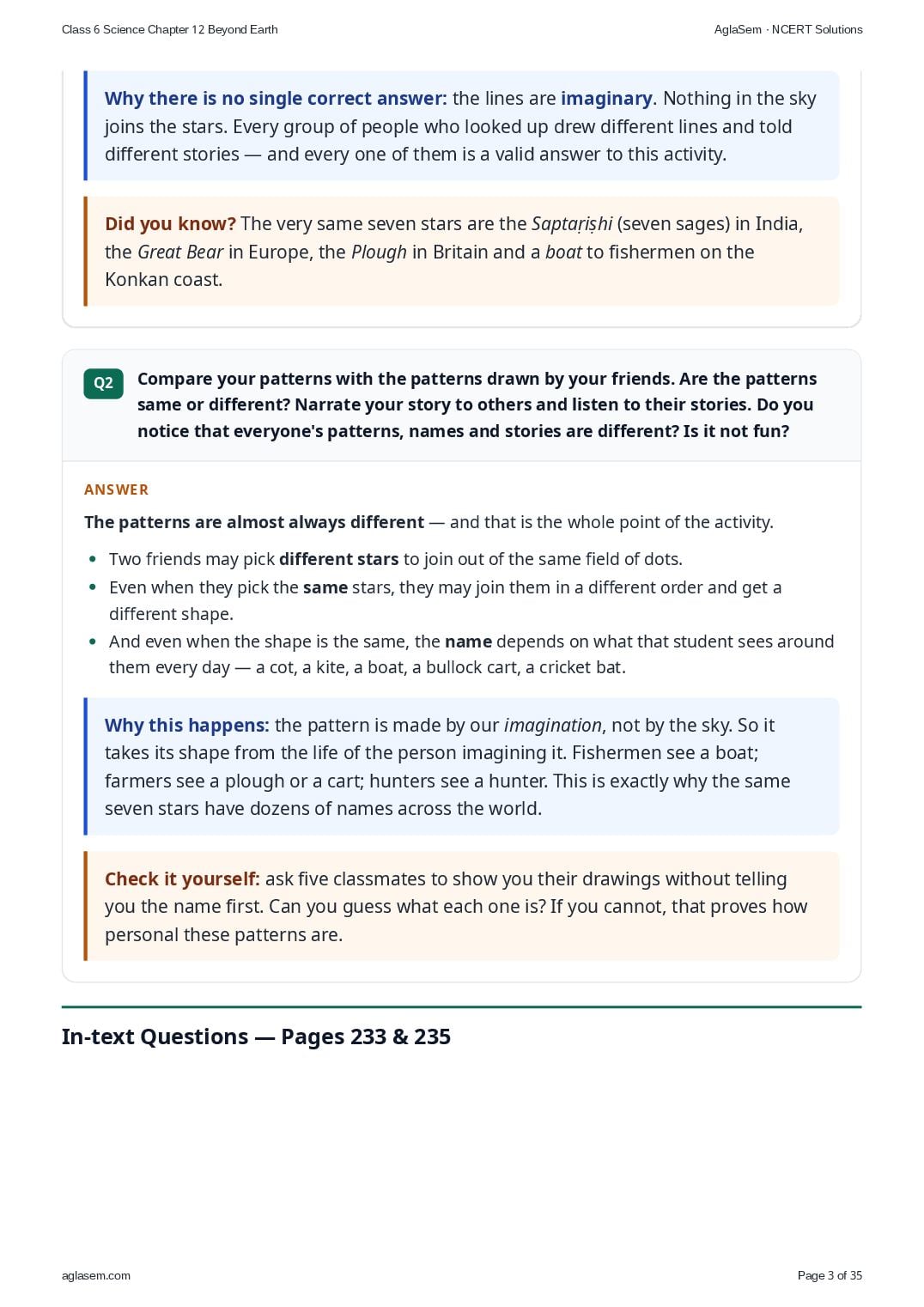
- Compare your patterns with the patterns drawn by your friends. Are the patterns same or different? Narrate your story to others and listen to their stories. Do you notice that everyone's patterns, names and stories are different? Is it not fun?
- Do we find patterns among the stars just for fun or is there some use of these patterns?
- How can we identify some of these constellations in the night sky?
- Can we try to find any constellation or star of our choice on any night from our location?
- Look for the Big Dipper during summer time in the early part of the night, say, around 9 p.m. View the sky towards the northern part of the sky and identify the Big Dipper.
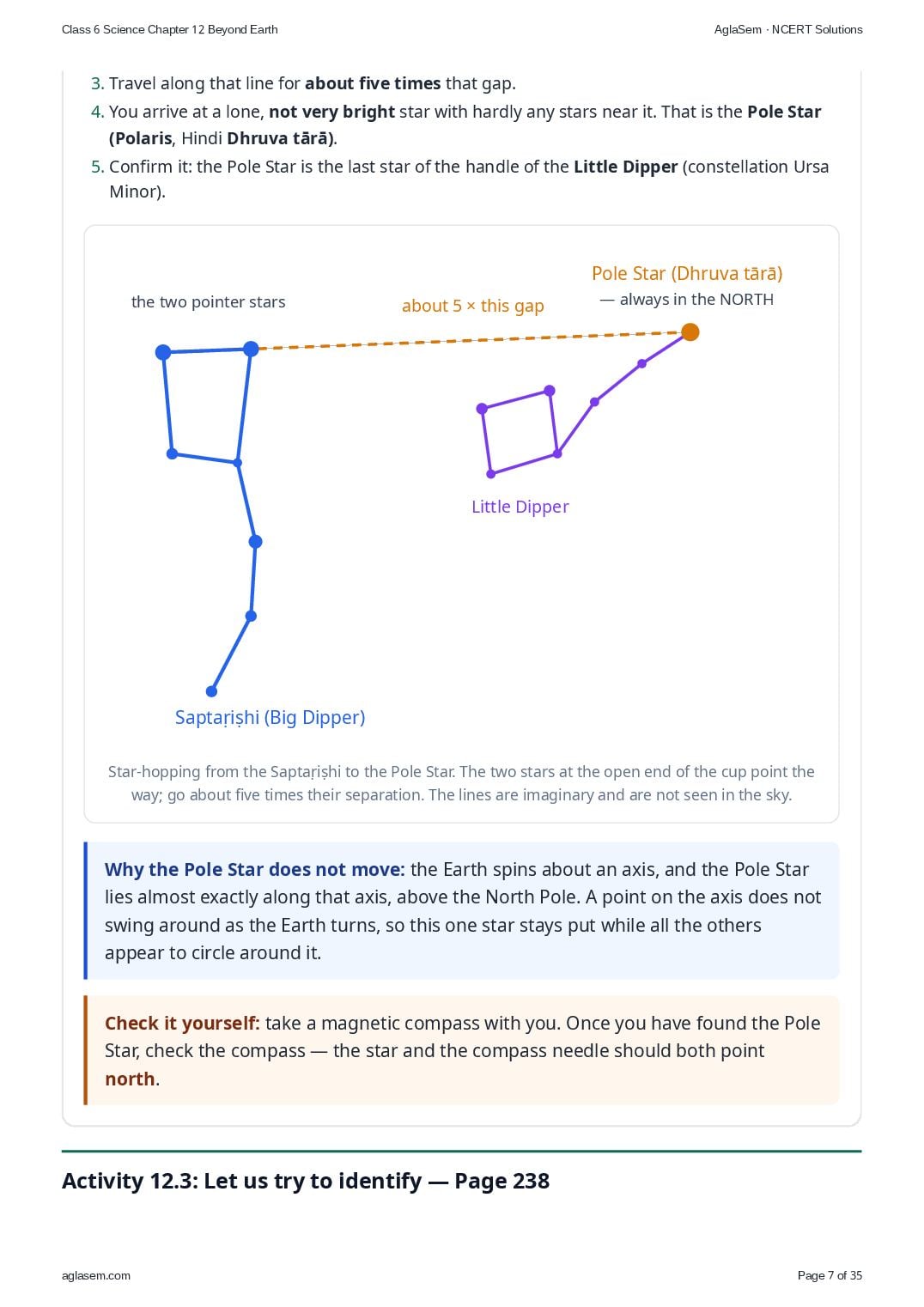
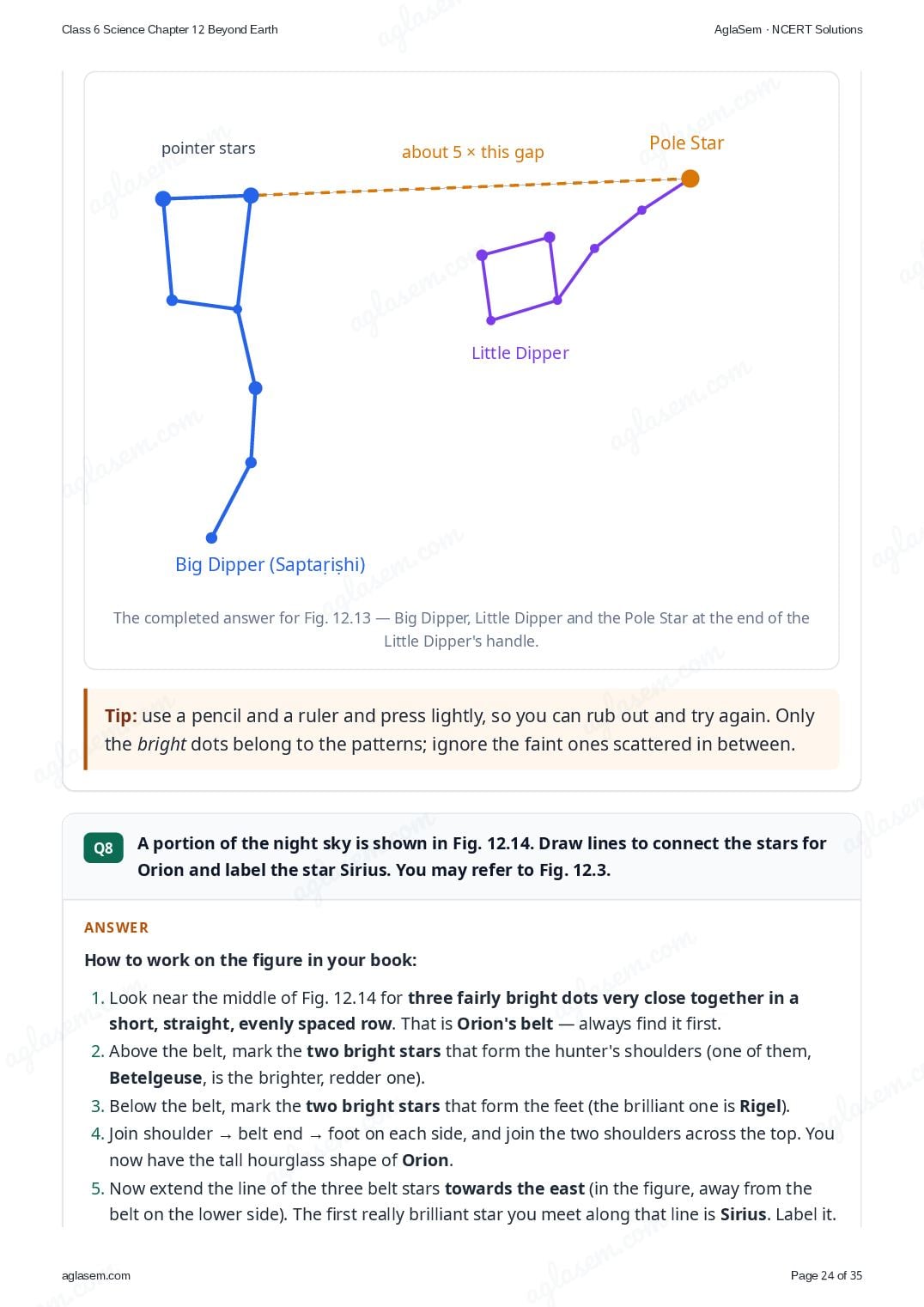
- Once you identify the Big Dipper, try to locate the Pole Star. Look at the two stars present at the end of the Big Dipper's cup and imagine a straight line passing through these towards the north. At about five times the distance between these two stars, the imaginary line will lead to another star which is not very bright. This star is the Pole Star.
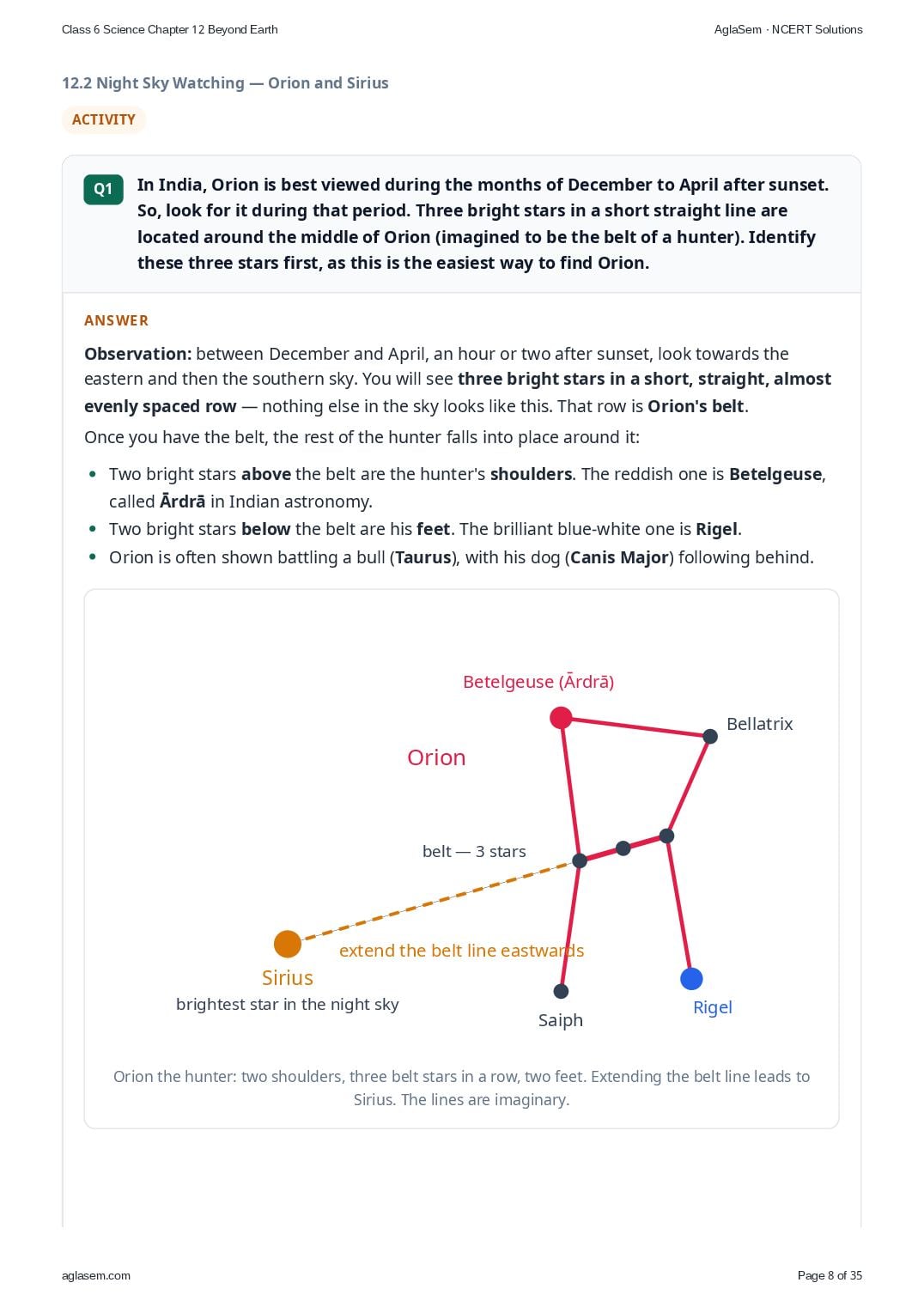
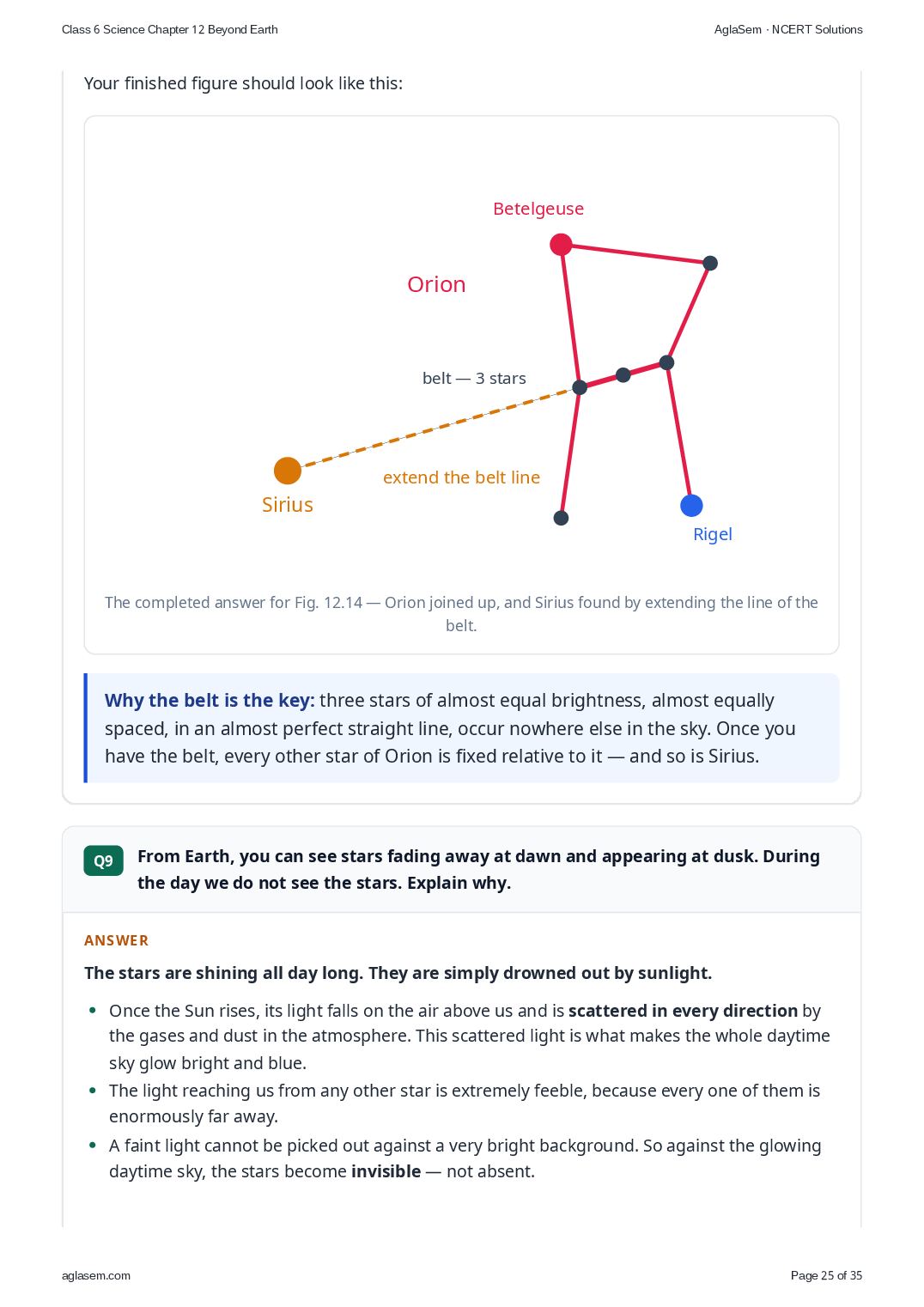
- In India, Orion is best viewed during the months of December to April after sunset. So, look for it during that period. Three bright stars in a short straight line are located around the middle of Orion (imagined to be the belt of a hunter). Identify these three stars first, as this is the easiest way to find Orion.
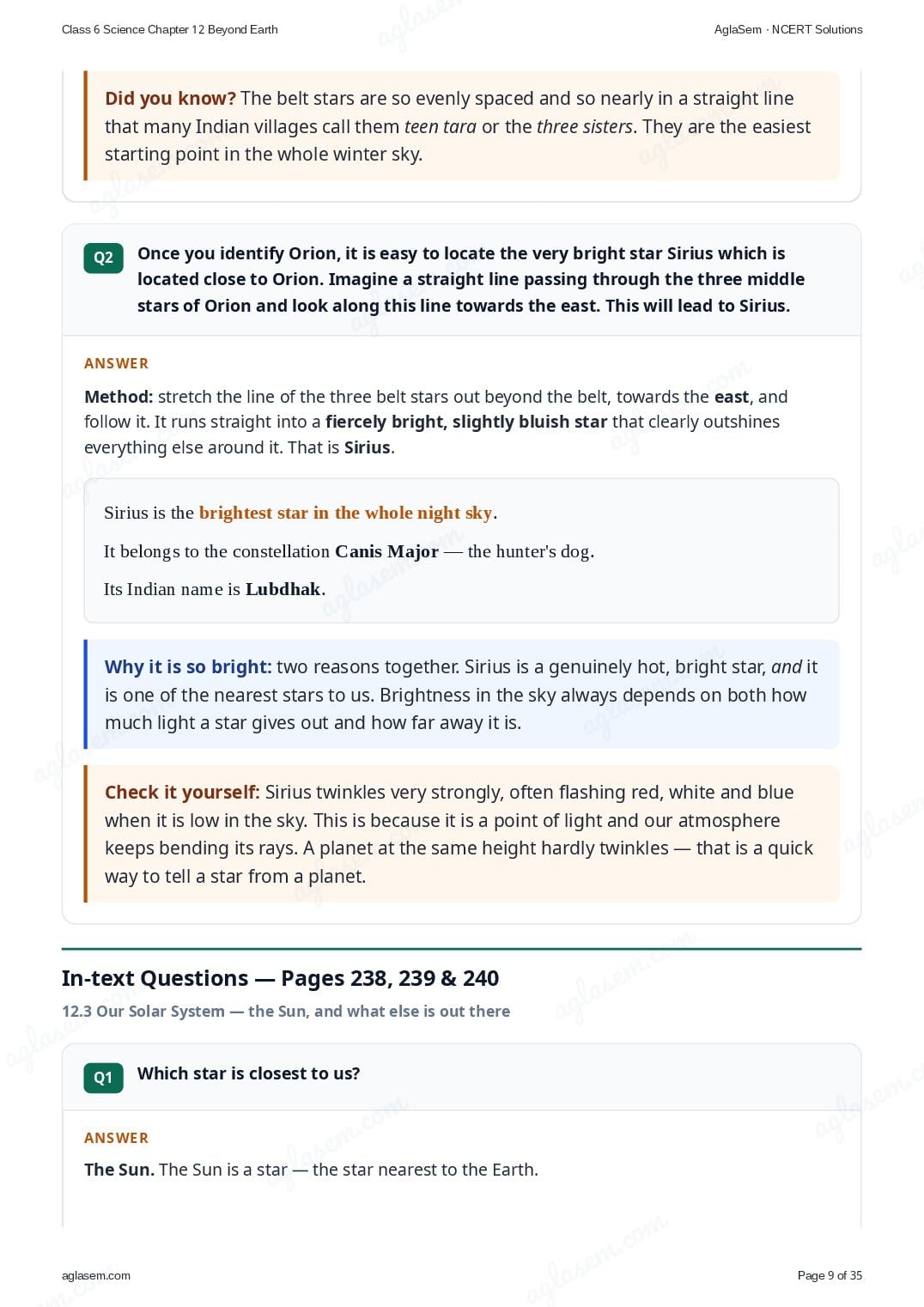
- Once you identify Orion, it is easy to locate the very bright star Sirius which is located close to Orion. Imagine a straight line passing through the three middle stars of Orion and look along this line towards the east. This will lead to Sirius.
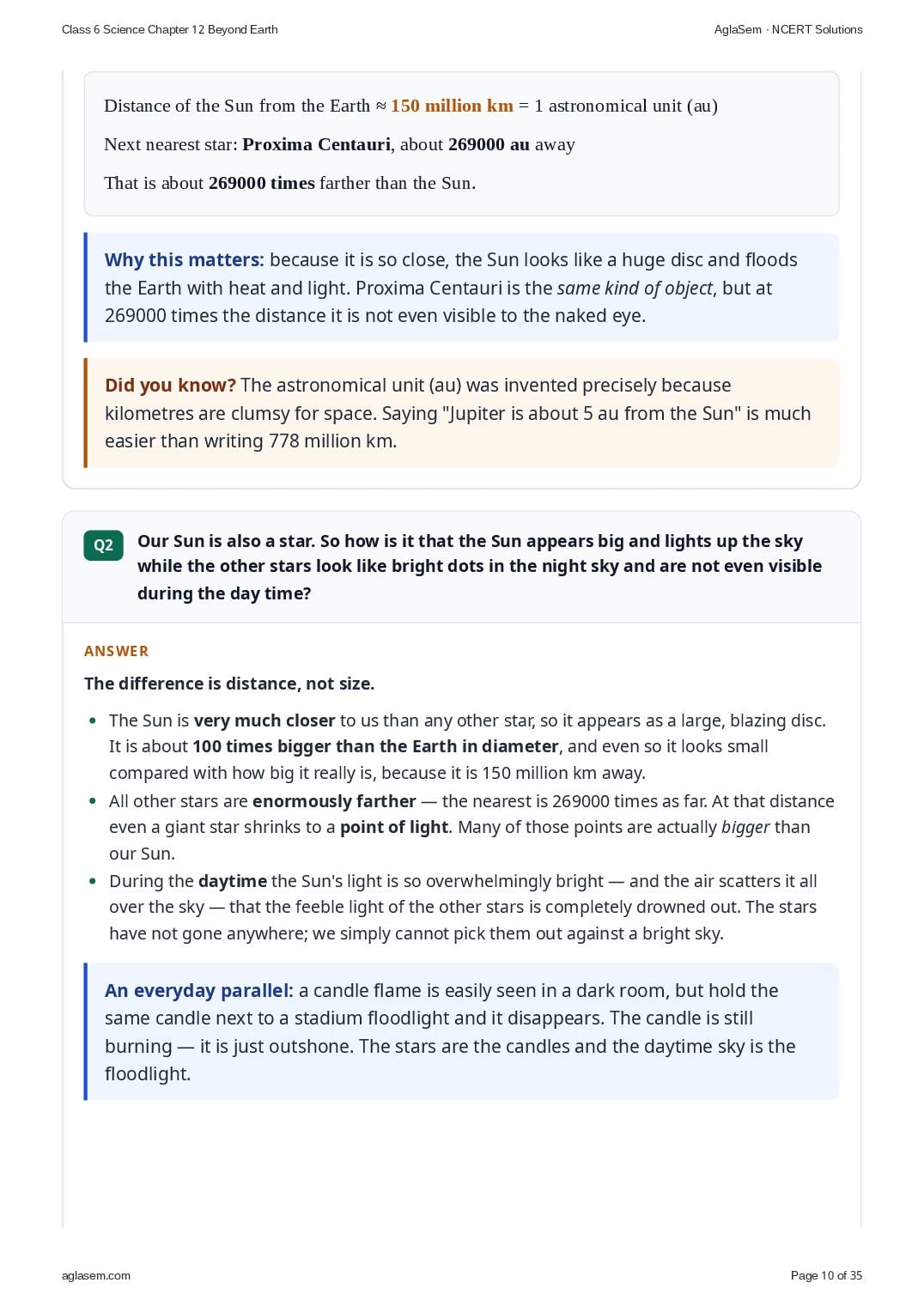
- Which star is closest to us?
- Our Sun is also a star. So how is it that the Sun appears big and lights up the sky while the other stars look like bright dots in the night sky and are not even visible during the day time?
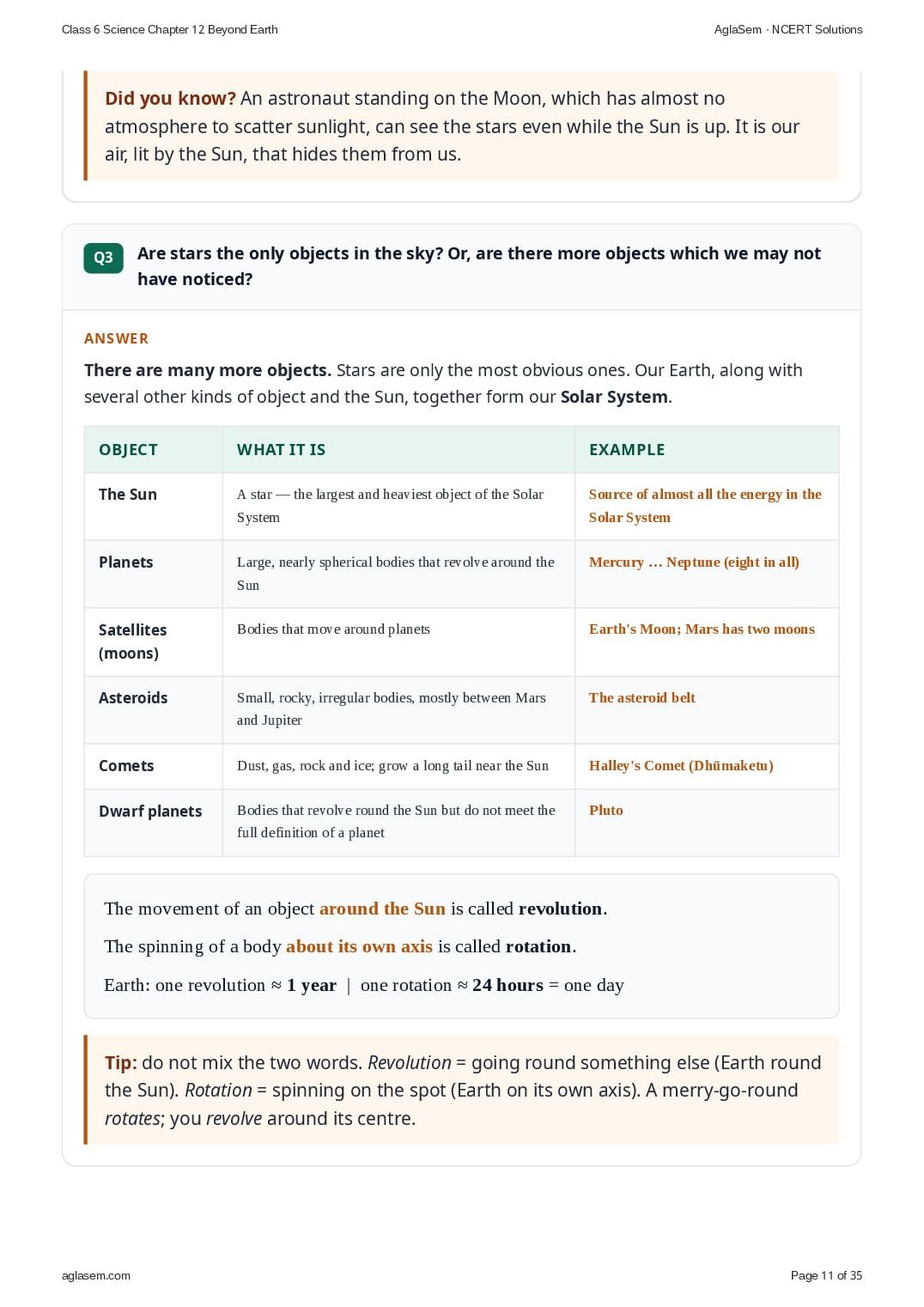
- Are stars the only objects in the sky? Or, are there more objects which we may not have noticed?
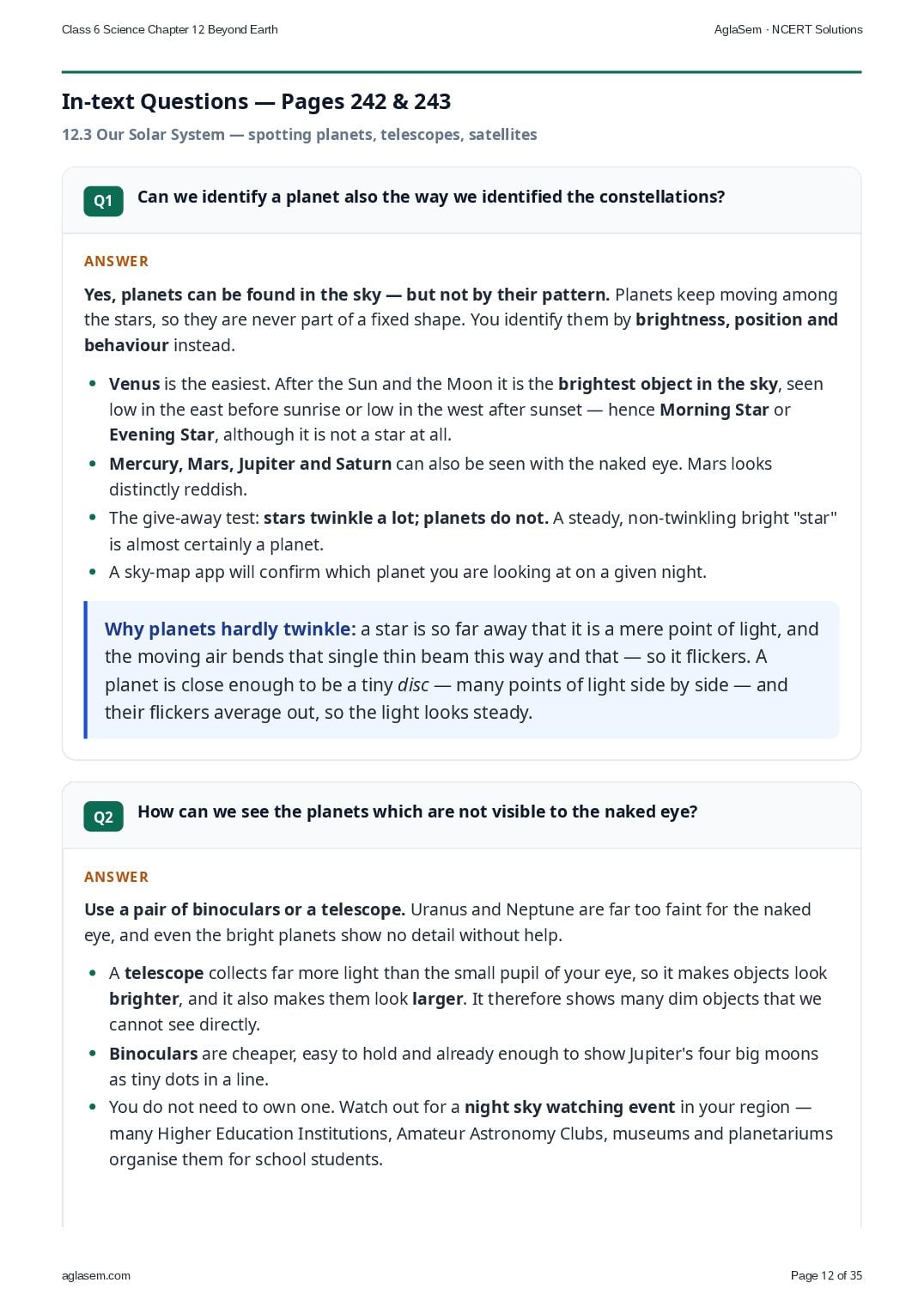
- Can we identify a planet also the way we identified the constellations?
- How can we see the planets which are not visible to the naked eye?
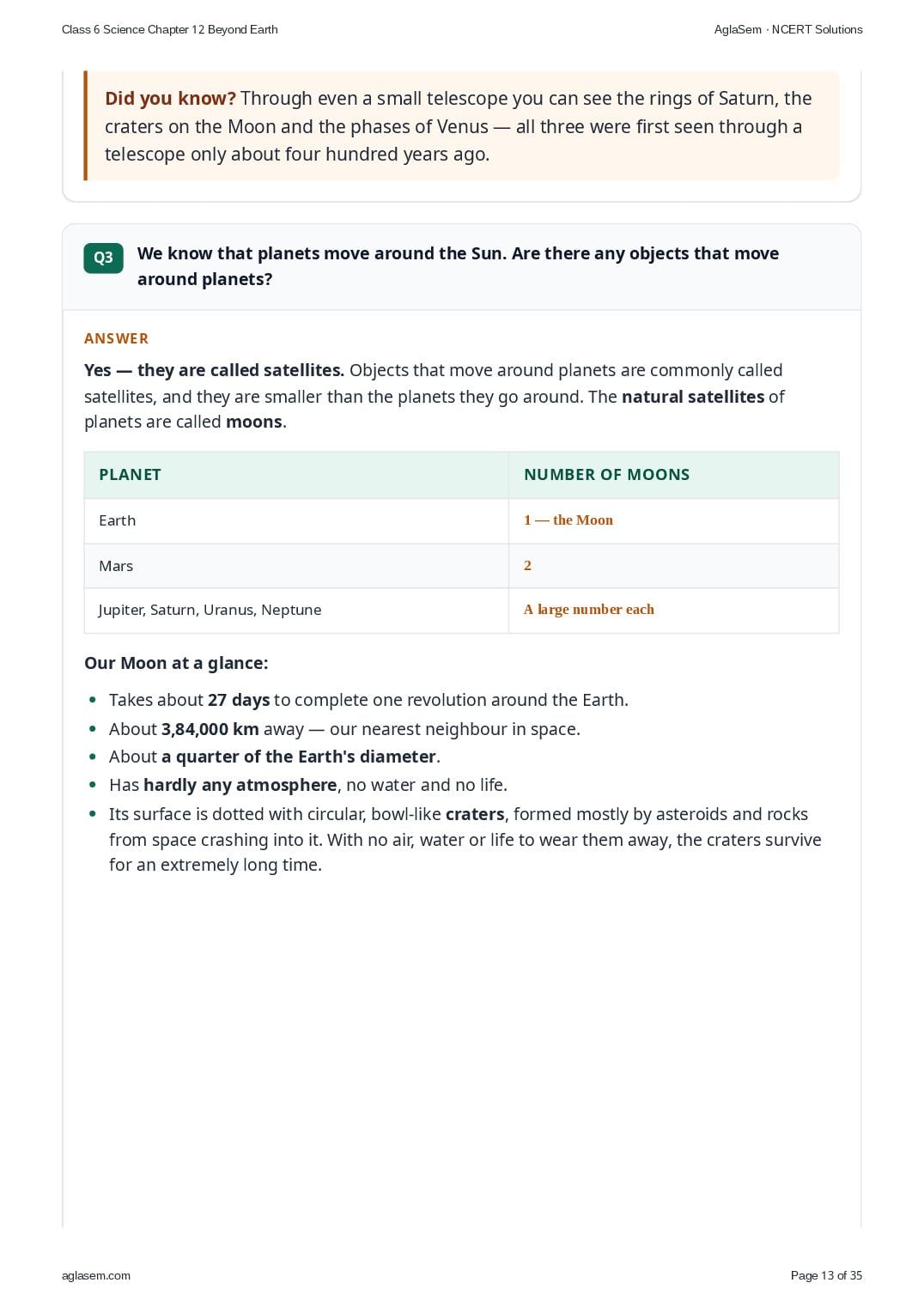
- We know that planets move around the Sun. Are there any objects that move around planets?
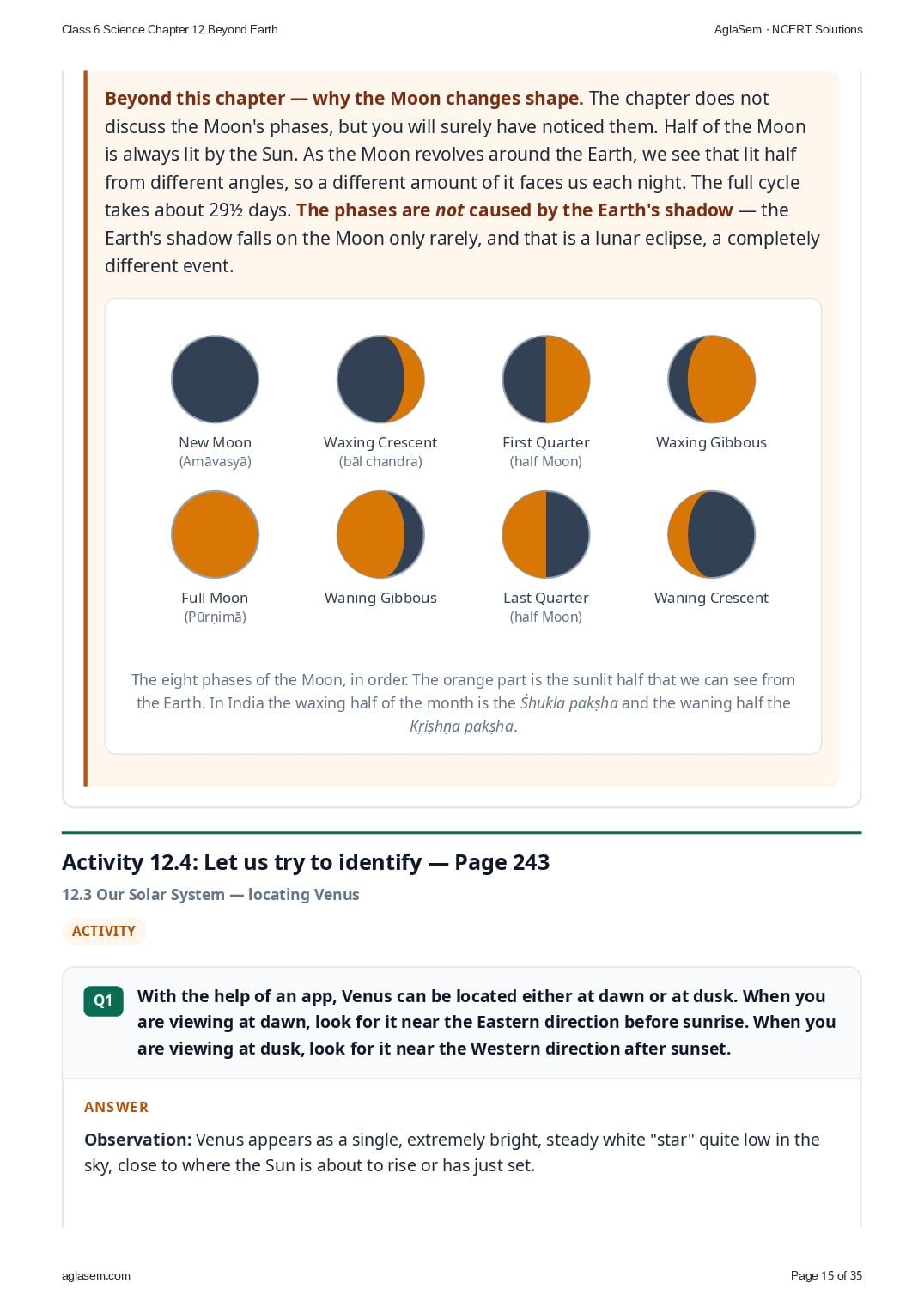
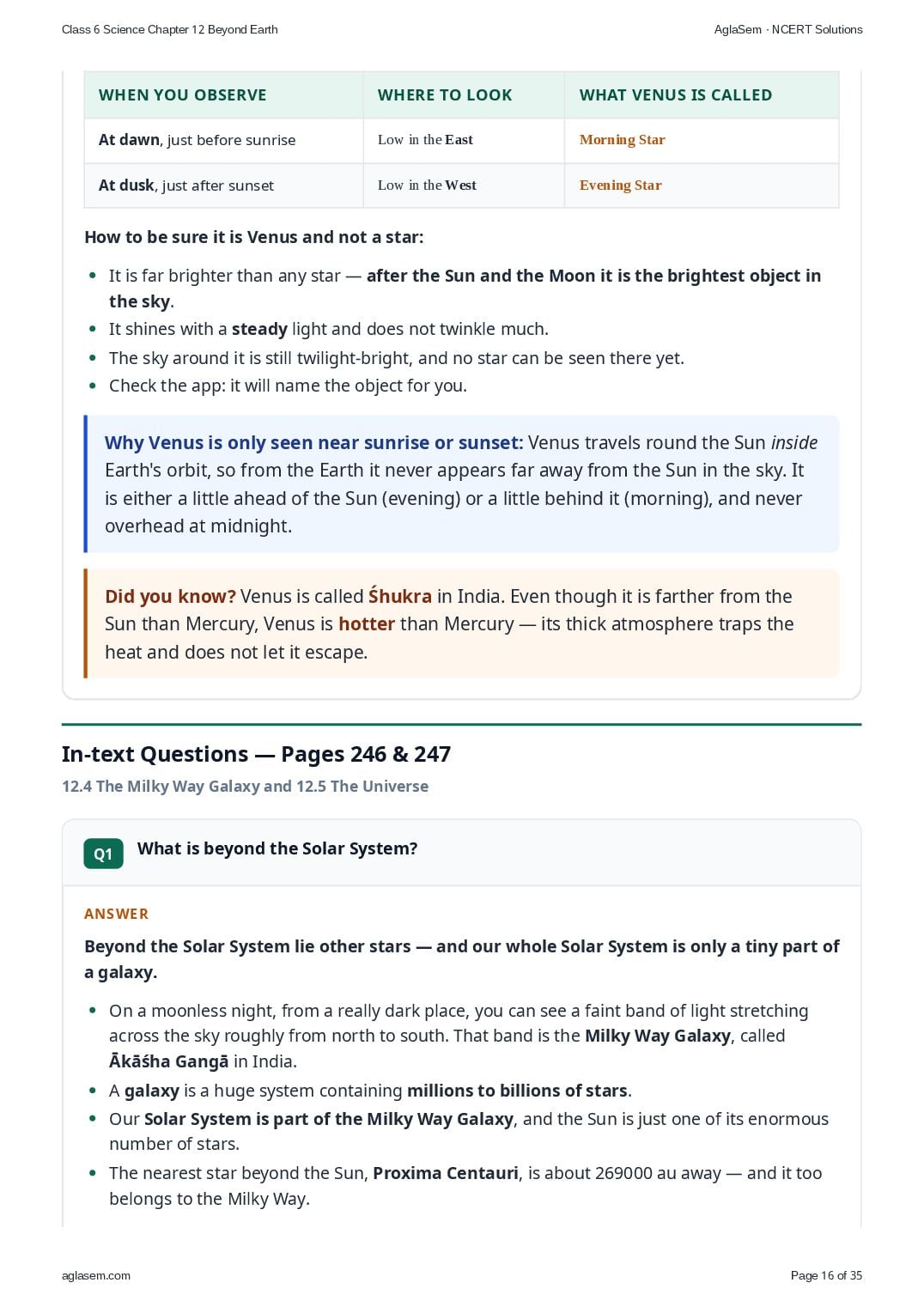
- With the help of an app, Venus can be located either at dawn or at dusk. When you are viewing at dawn, look for it near the Eastern direction before sunrise. When you are viewing at dusk, look for it near the Western direction after sunset.
- What is beyond the Solar System?
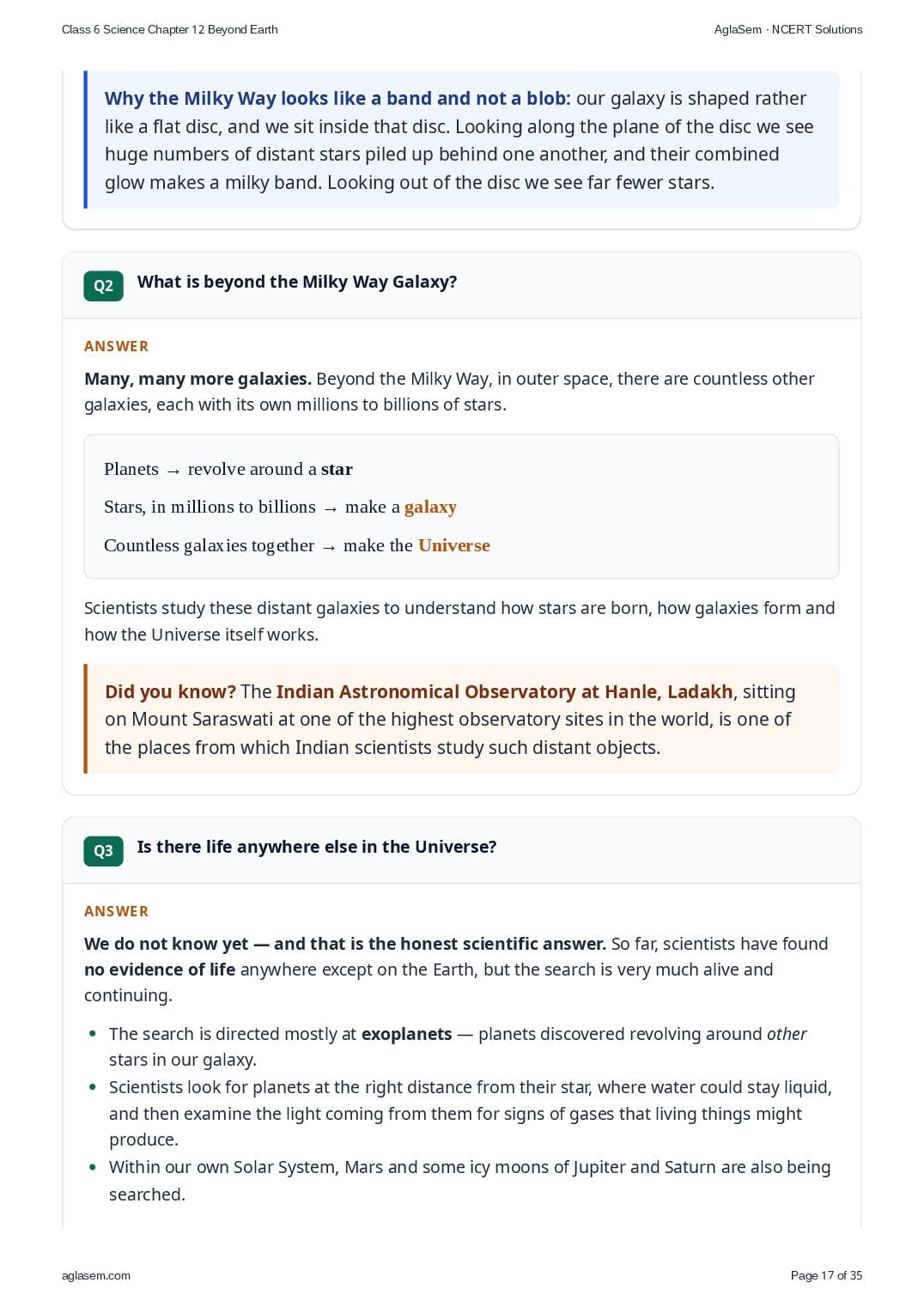
- What is beyond the Milky Way Galaxy?
- Is there life anywhere else in the Universe?
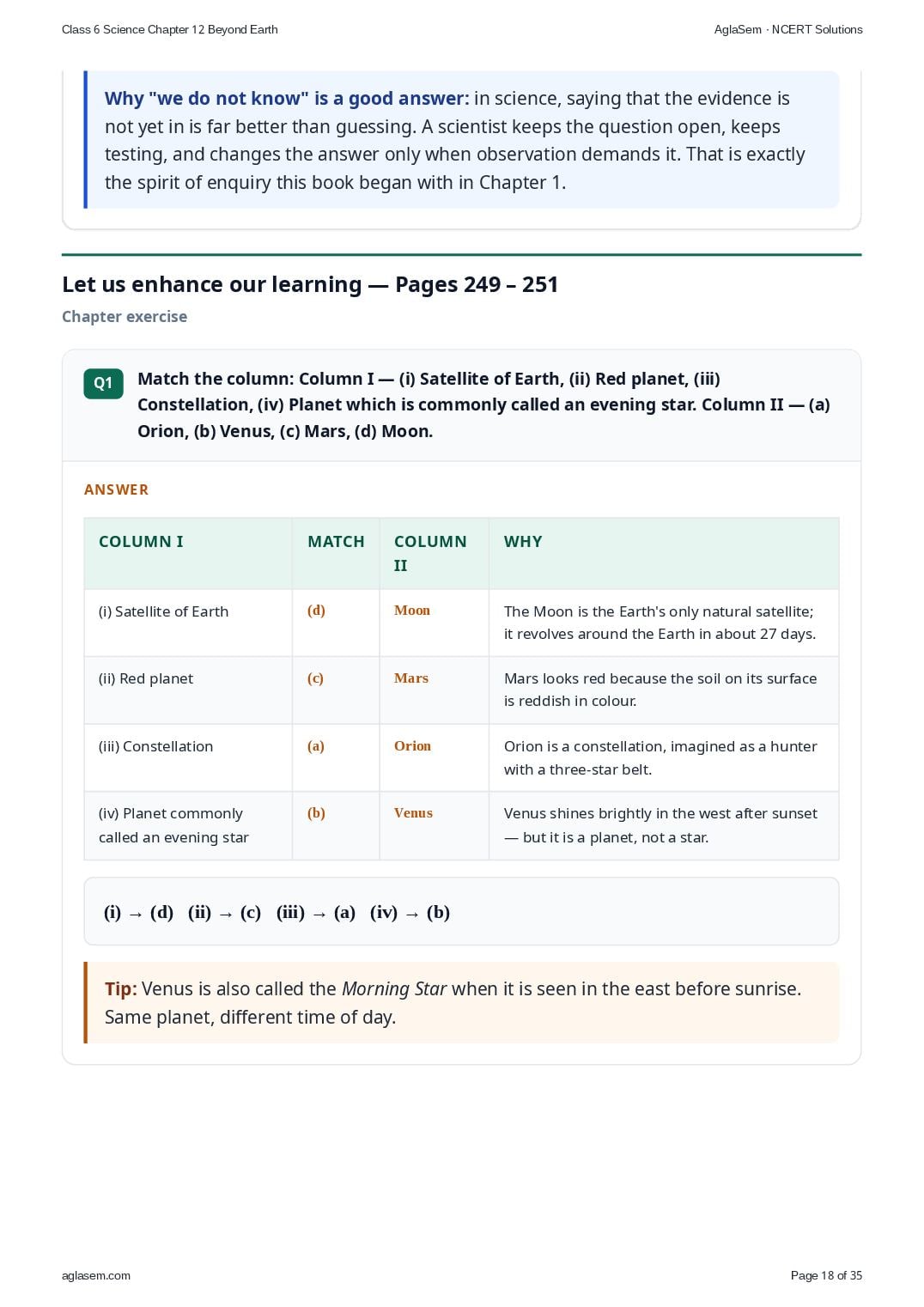
- Match the column: Column I — (i) Satellite of Earth, (ii) Red planet, (iii) Constellation, (iv) Planet which is commonly called an evening star. Column II — (a) Orion, (b) Venus, (c) Mars, (d) Moon.
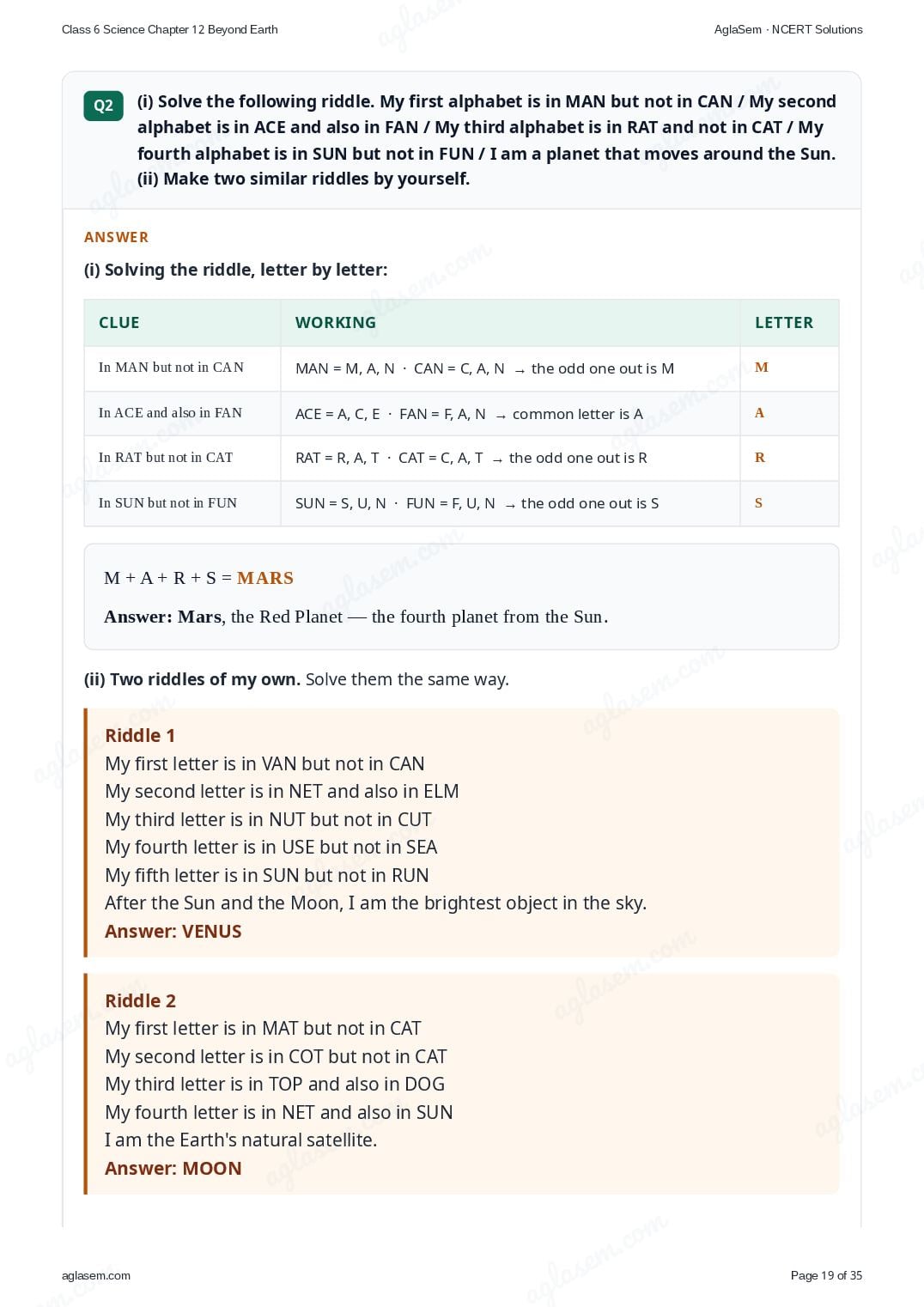
- (i) Solve the following riddle. My first alphabet is in MAN but not in CAN / My second alphabet is in ACE and also in FAN / My third alphabet is in RAT and not in CAT / My fourth alphabet is in SUN but not in FUN / I am a planet that moves around the Sun. (ii) Make two similar riddles by yourself.
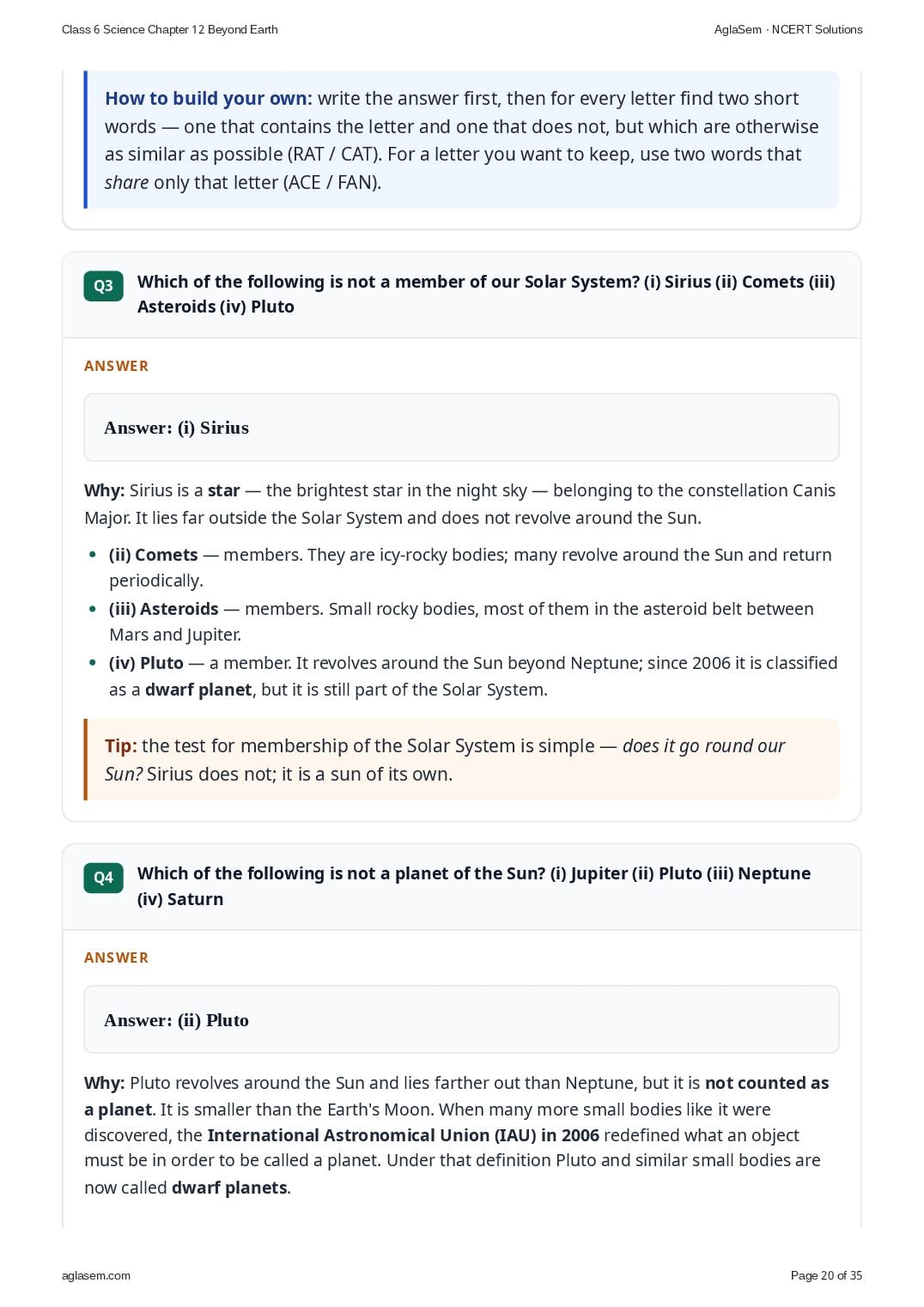
- Which of the following is not a member of our Solar System? (i) Sirius (ii) Comets (iii) Asteroids (iv) Pluto
- Which of the following is not a planet of the Sun? (i) Jupiter (ii) Pluto (iii) Neptune (iv) Saturn
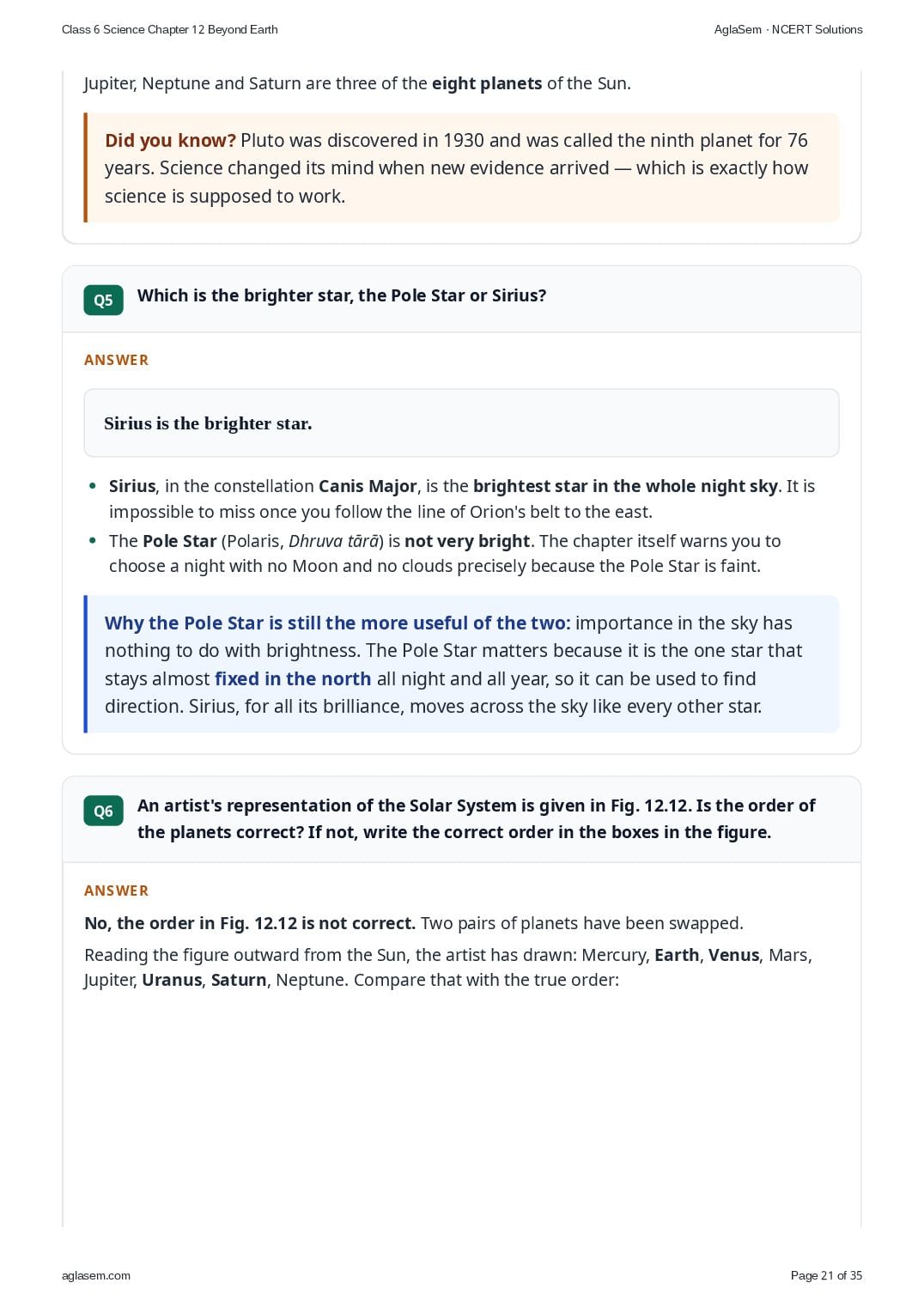
- Which is the brighter star, the Pole Star or Sirius?
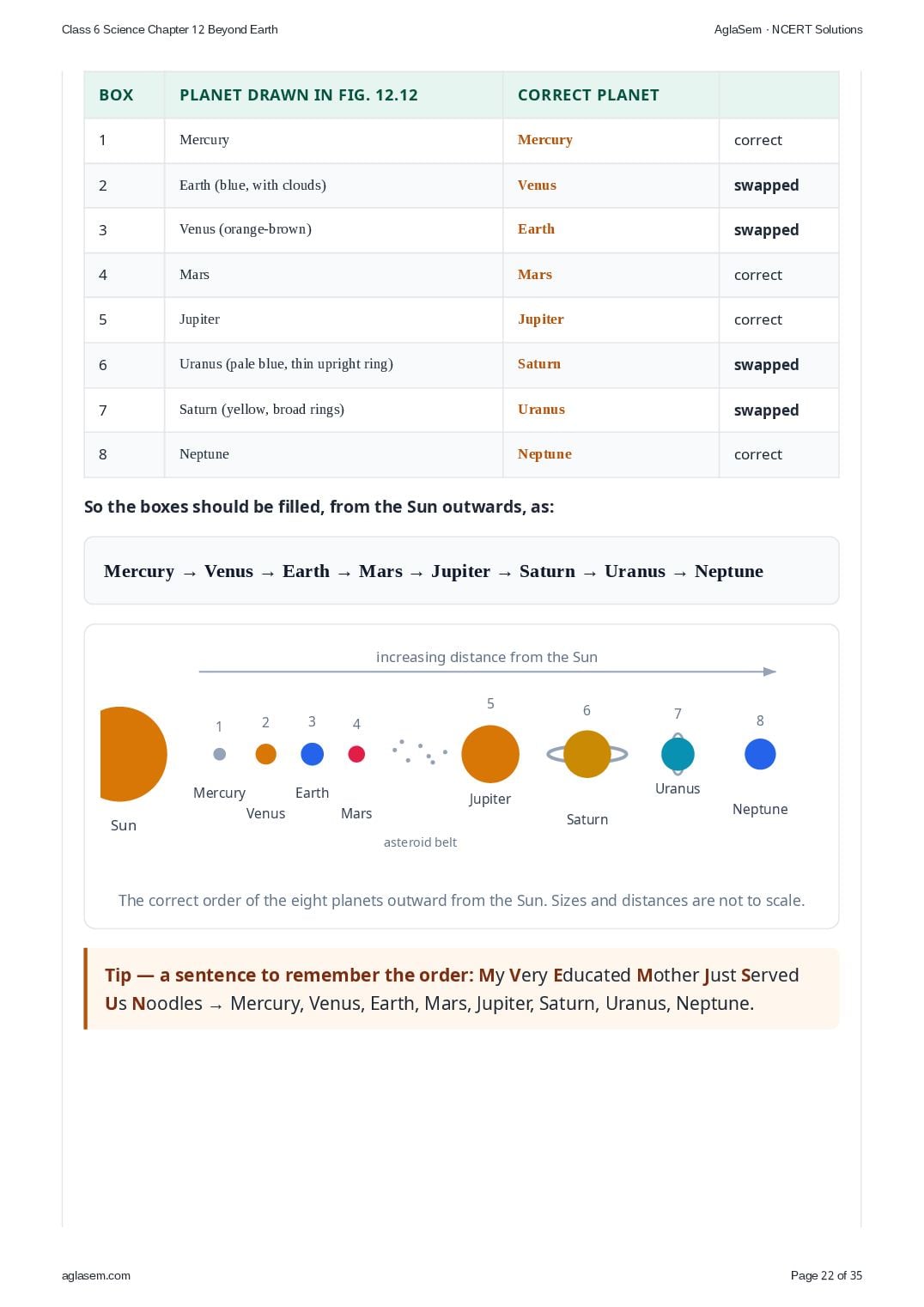
- An artist's representation of the Solar System is given in Fig. 12.12. Is the order of the planets correct? If not, write the correct order in the boxes in the figure.
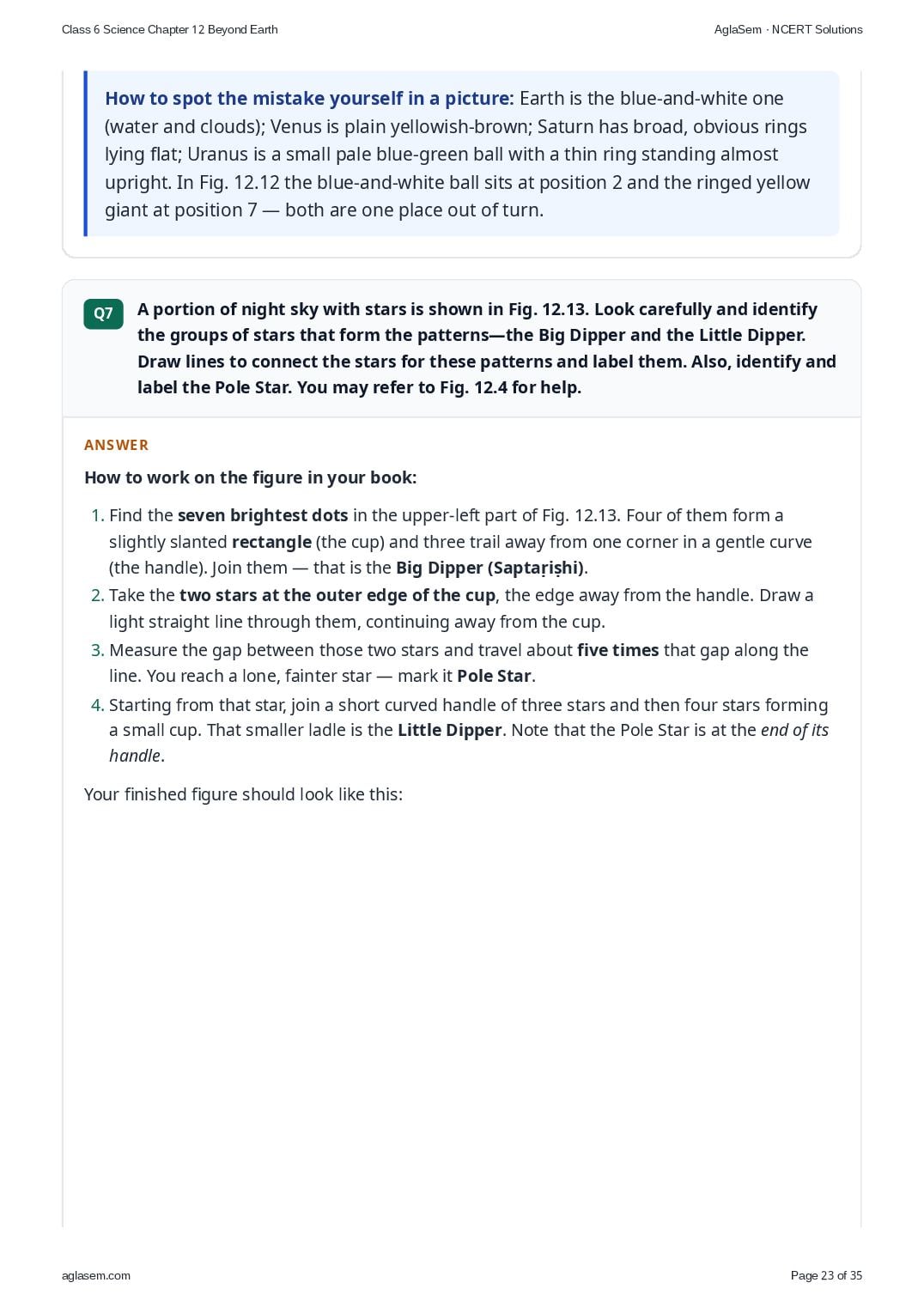
- A portion of night sky with stars is shown in Fig. 12.13. Look carefully and identify the groups of stars that form the patterns—the Big Dipper and the Little Dipper. Draw lines to connect the stars for these patterns and label them. Also, identify and label the Pole Star. You may refer to Fig. 12.4 for help.
- A portion of the night sky is shown in Fig. 12.14. Draw lines to connect the stars for Orion and label the star Sirius. You may refer to Fig. 12.3.
- From Earth, you can see stars fading away at dawn and appearing at dusk. During the day we do not see the stars. Explain why.
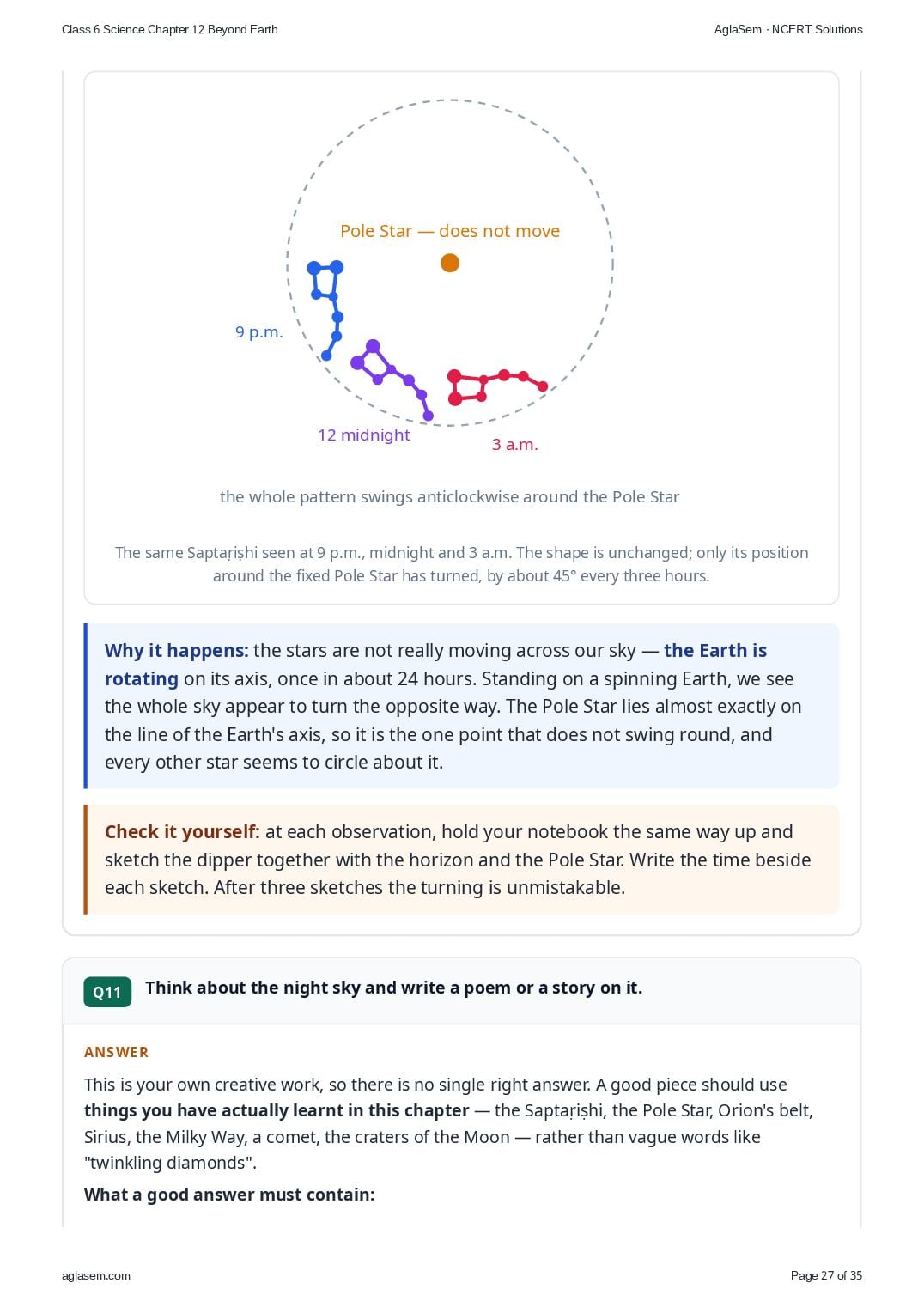
- During a clear night, try to observe the Big Dipper 3–4 times at an interval of 2 to 3 hours. Also try to locate the Pole Star each time. Does the Big Dipper appear to move? Draw a rough sketch to illustrate this, mentioning the time in each case.
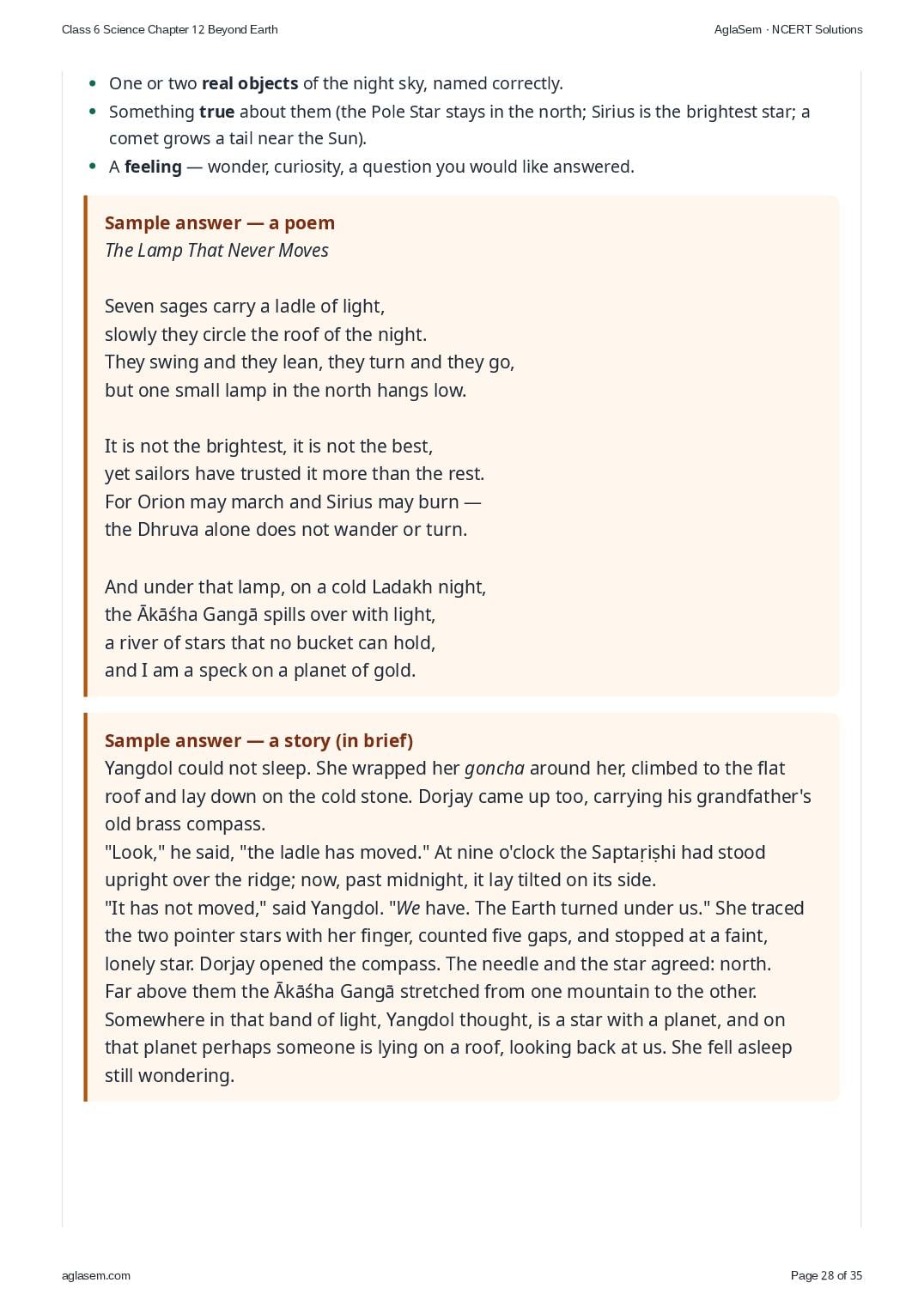
- Think about the night sky and write a poem or a story on it.
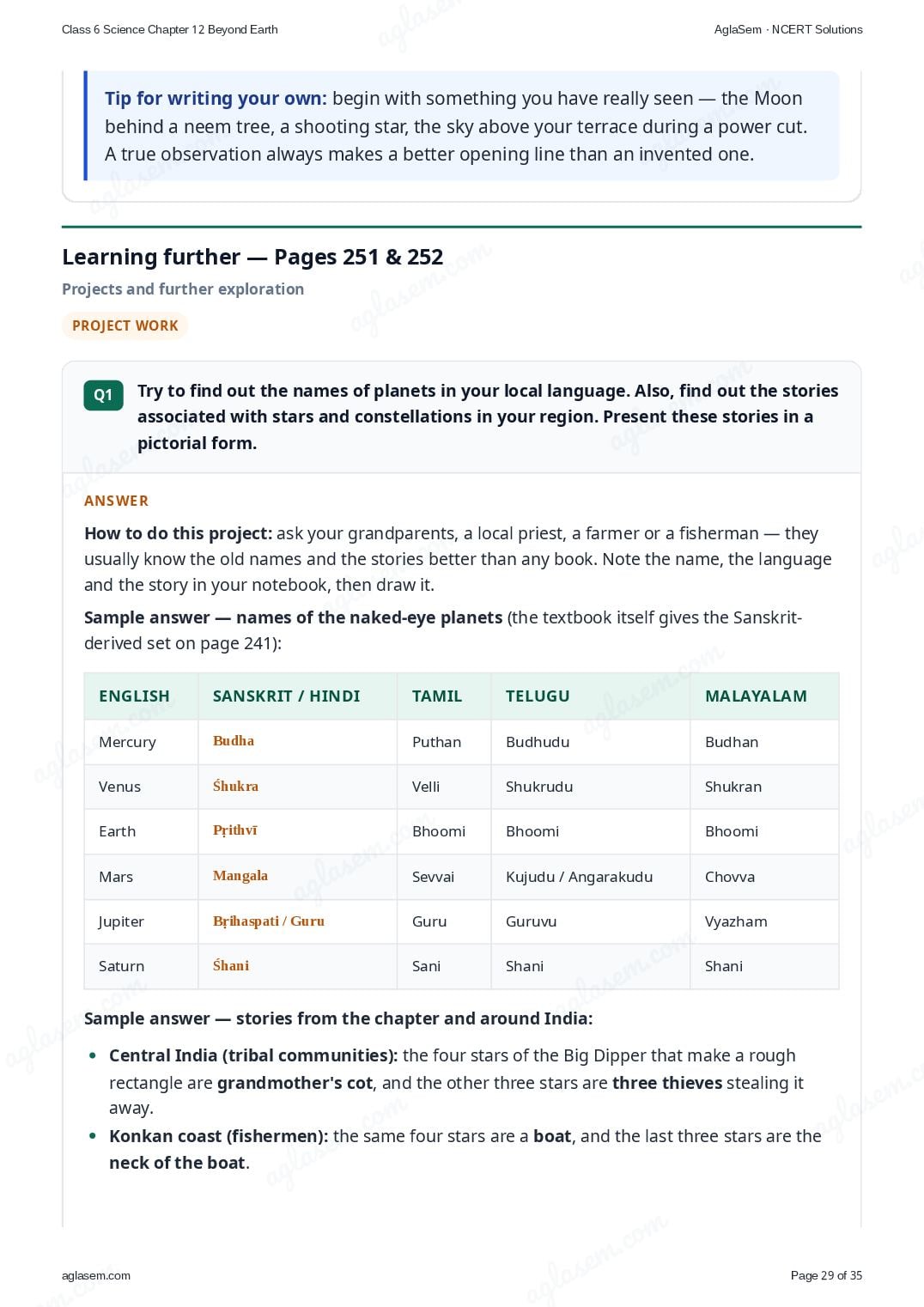
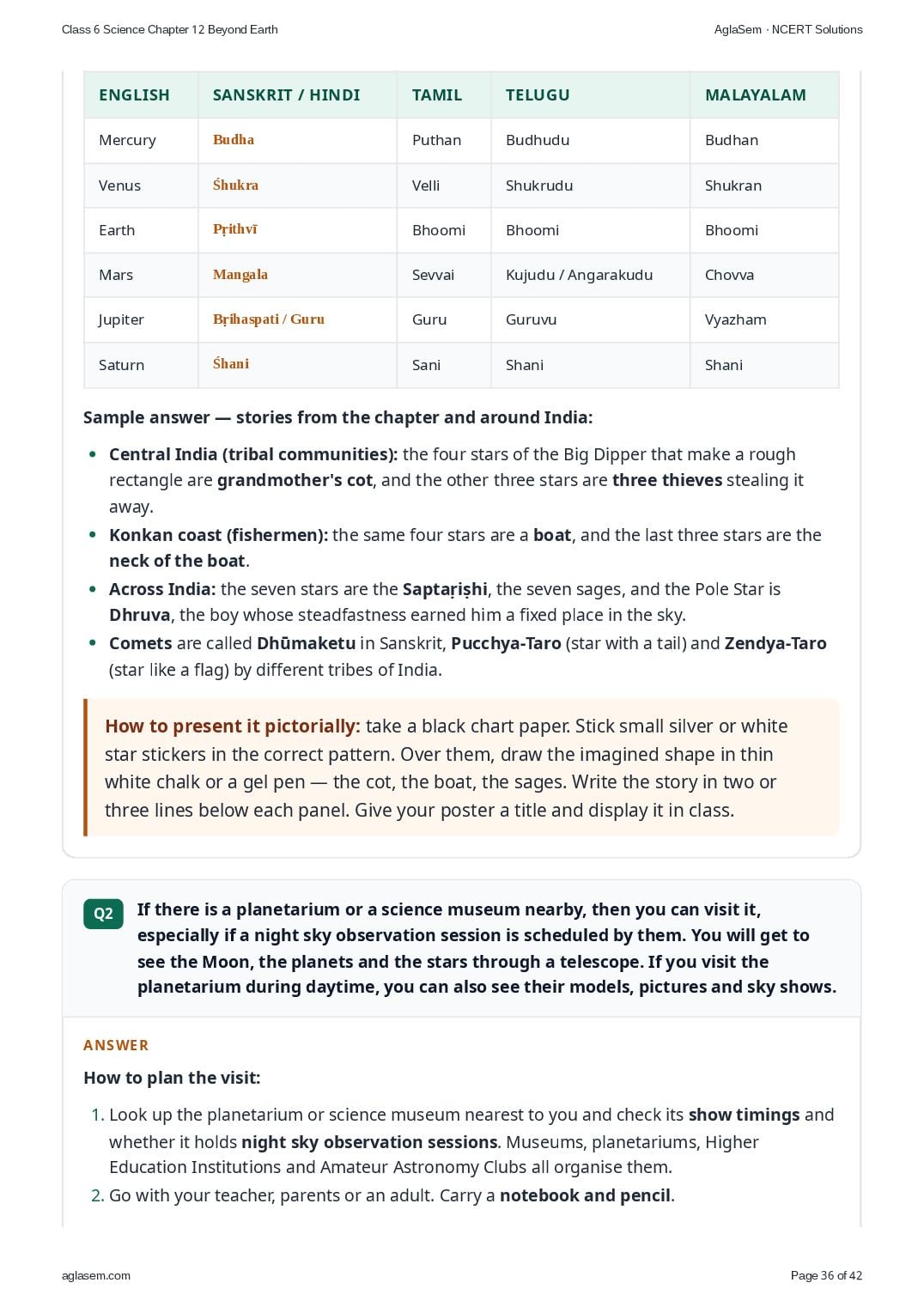
- Try to find out the names of planets in your local language. Also, find out the stories associated with stars and constellations in your region. Present these stories in a pictorial form.
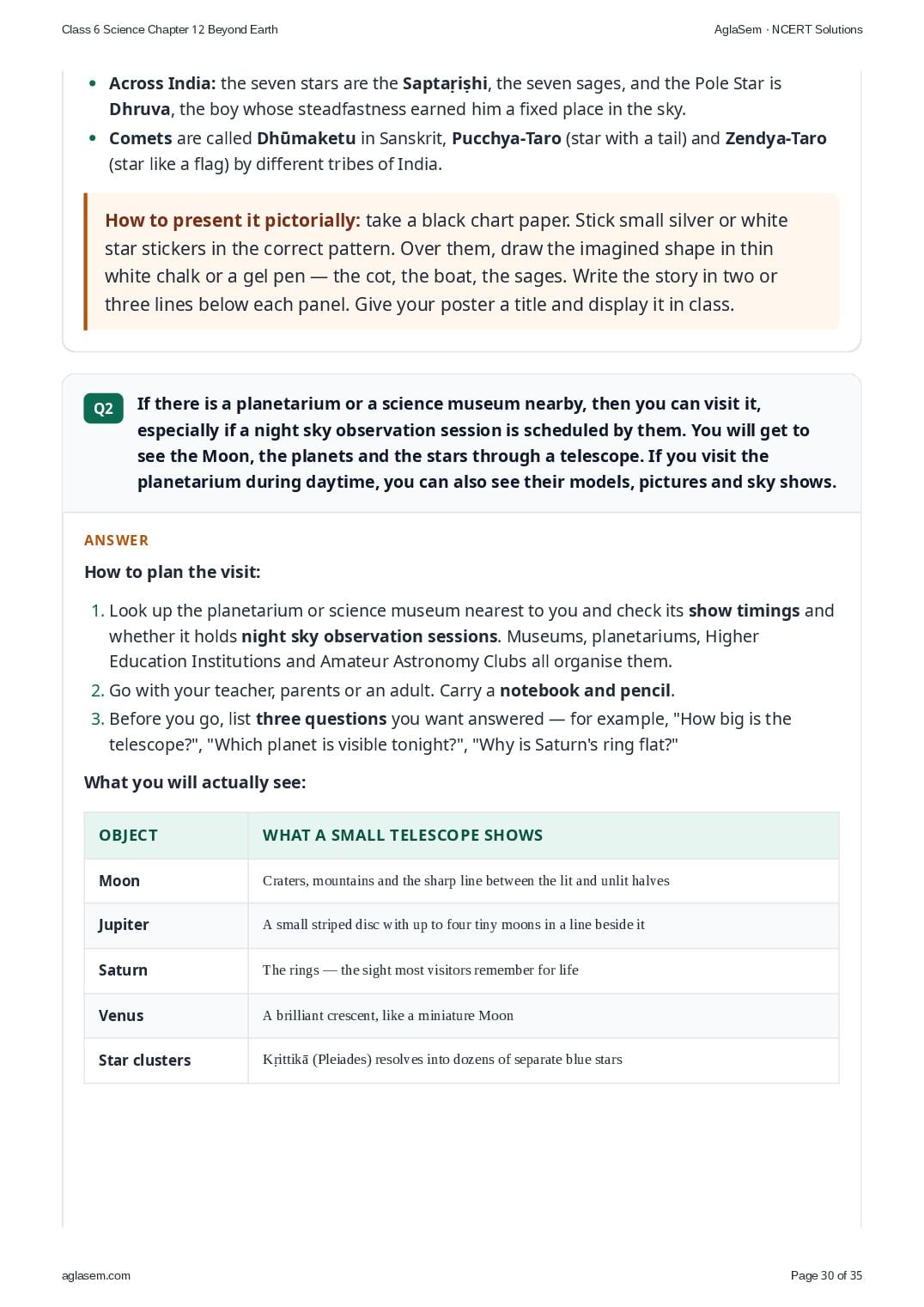
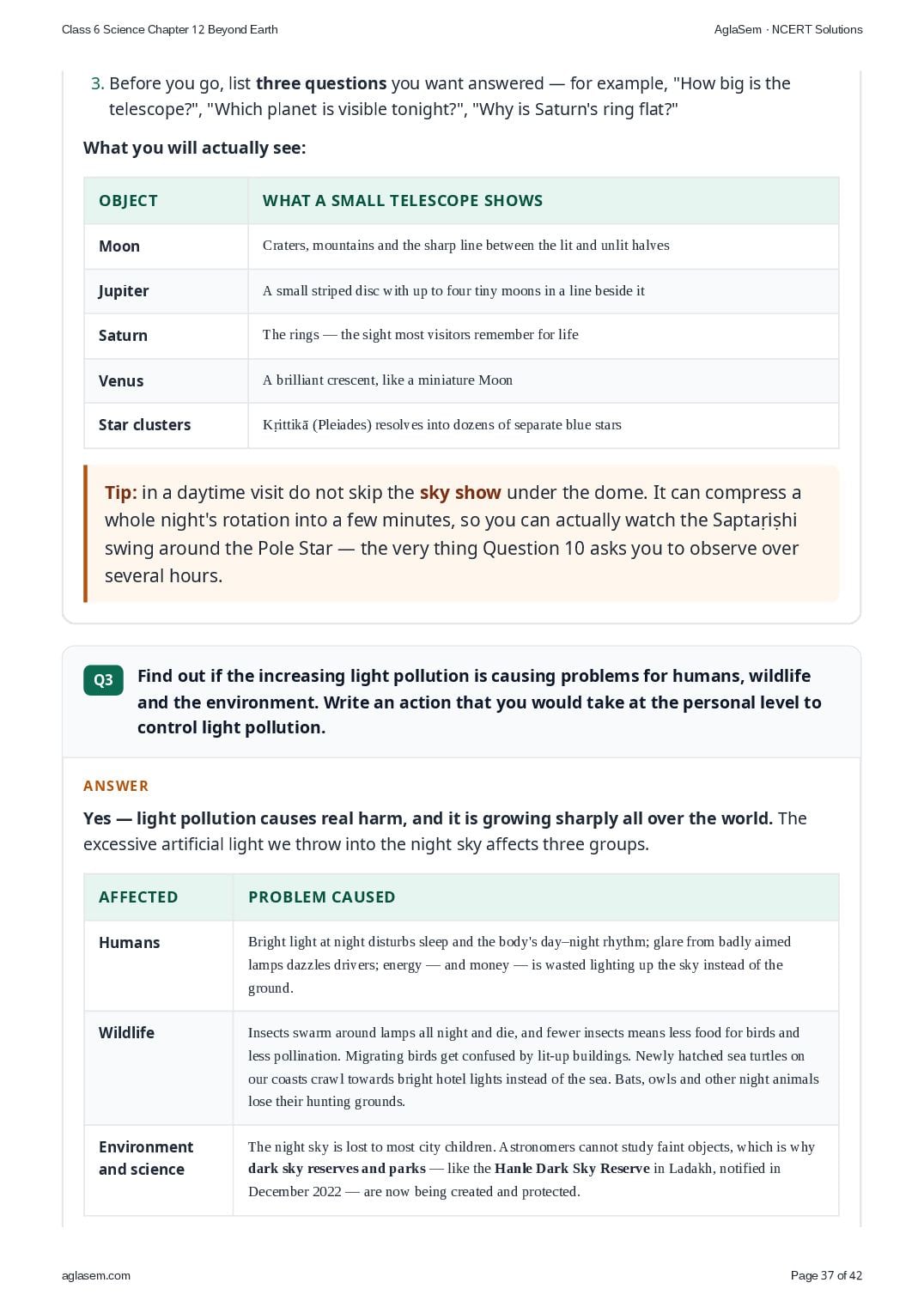
- If there is a planetarium or a science museum nearby, then you can visit it, especially if a night sky observation session is scheduled by them. You will get to see the Moon, the planets and the stars through a telescope. If you visit the planetarium during daytime, you can also see their models, pictures and sky shows.
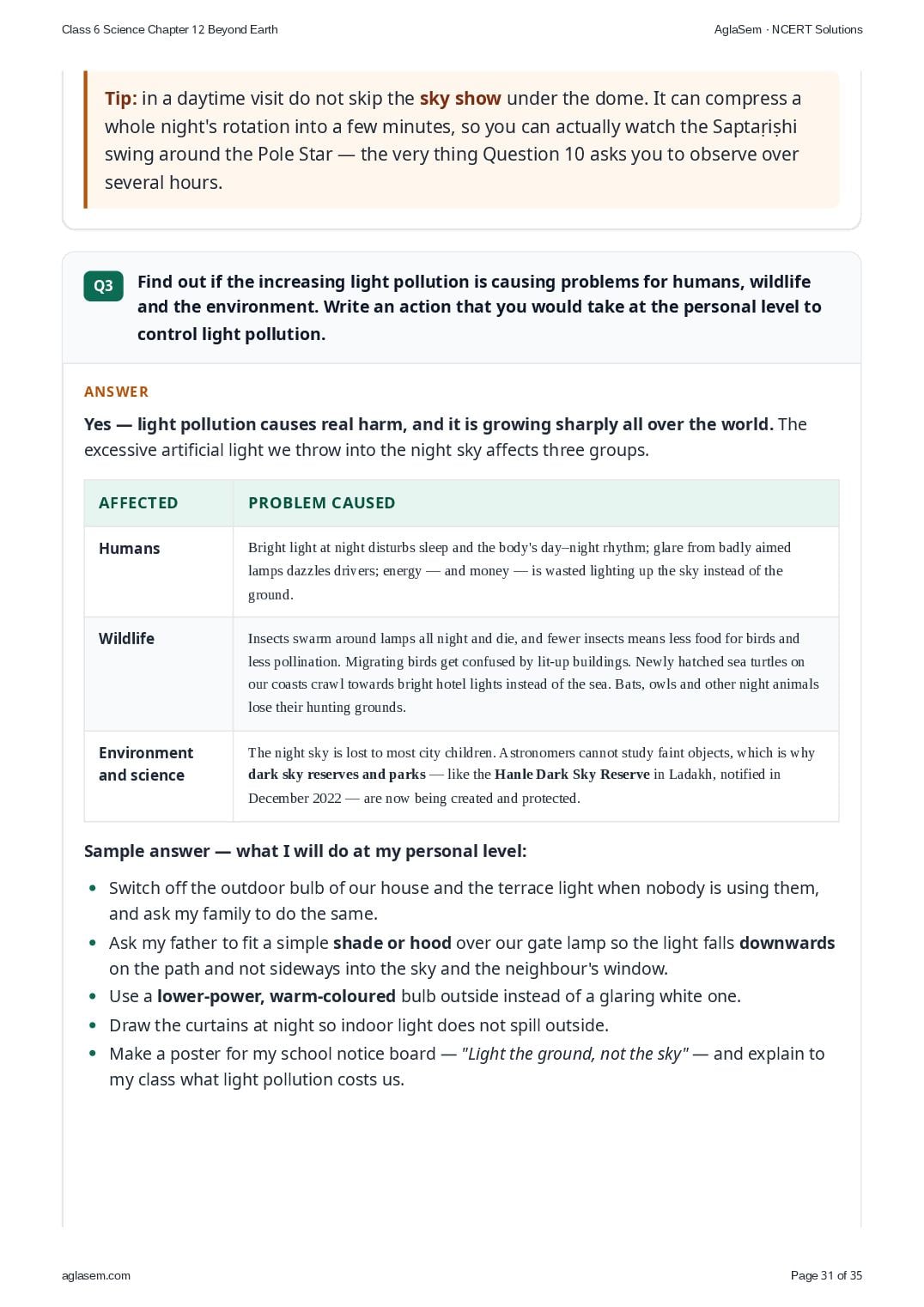
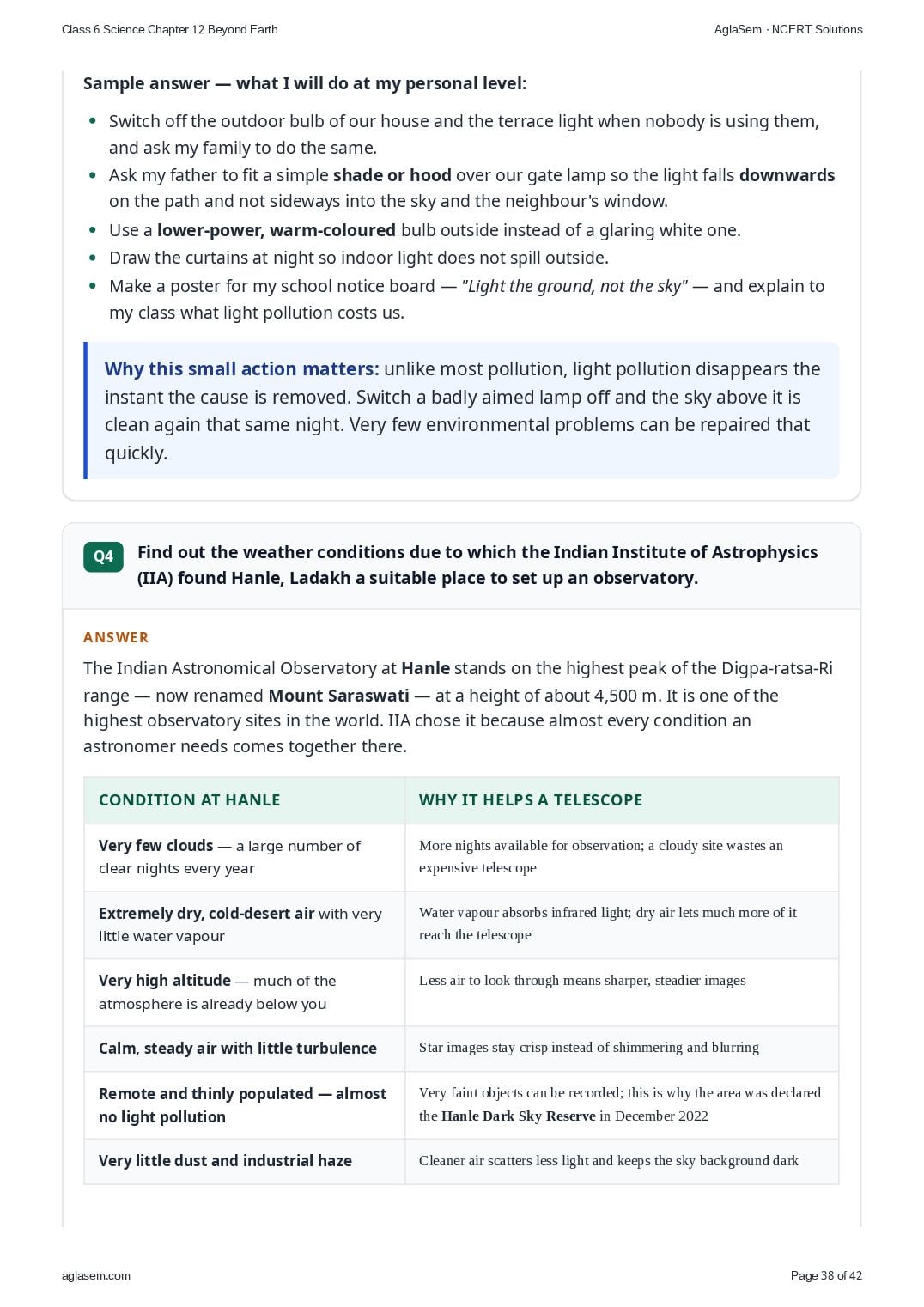
- Find out if the increasing light pollution is causing problems for humans, wildlife and the environment. Write an action that you would take at the personal level to control light pollution.
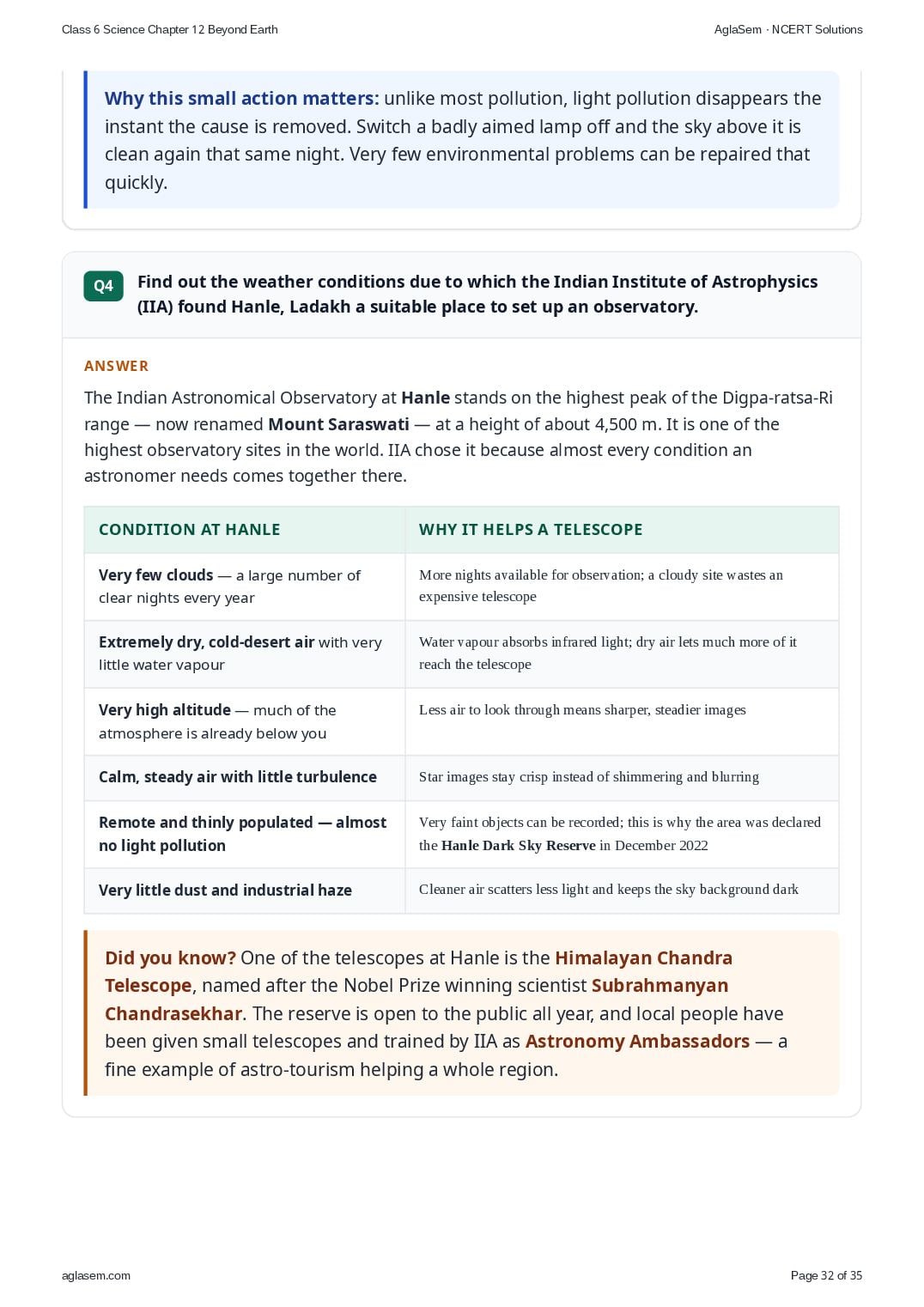
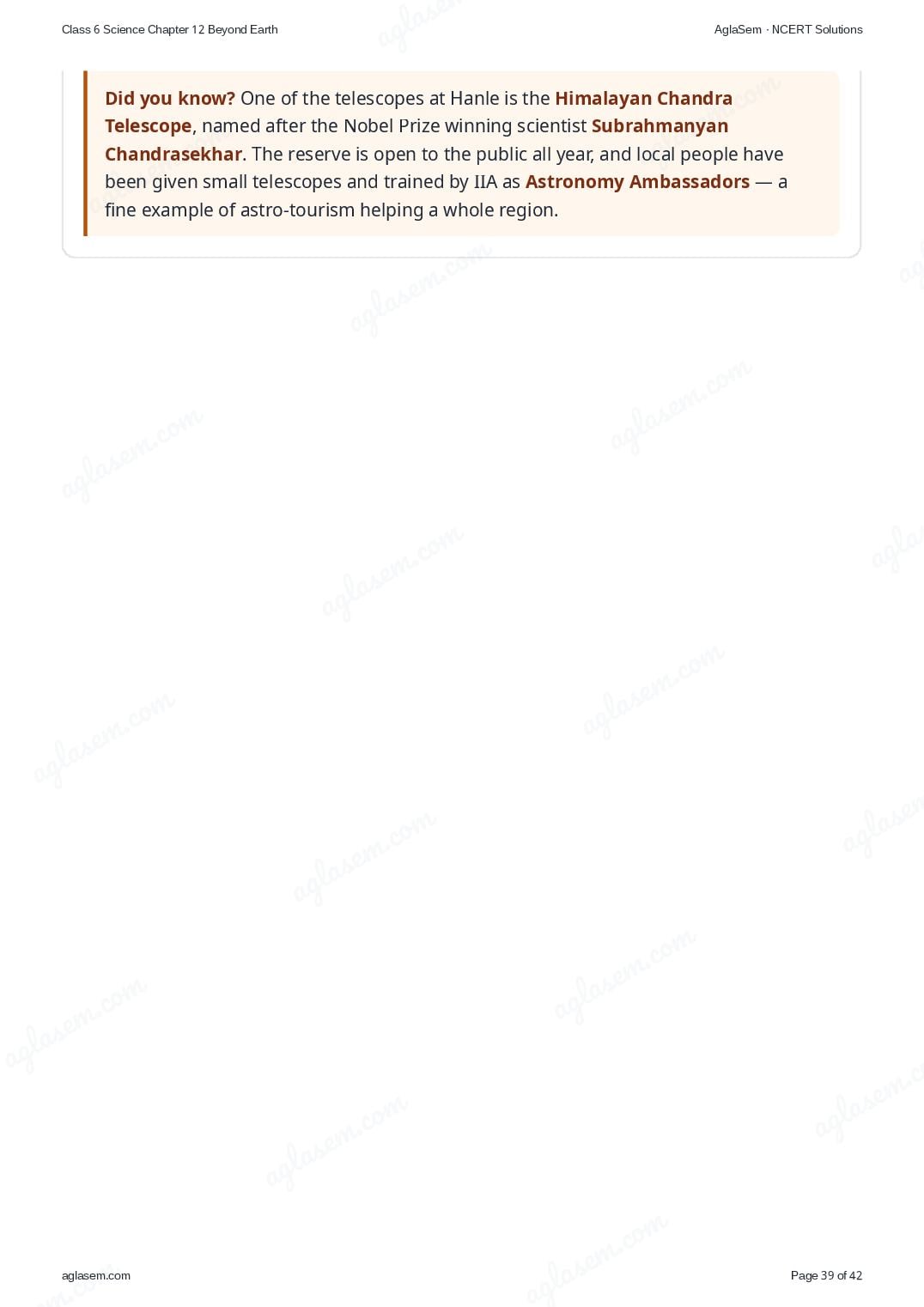
- Find out the weather conditions due to which the Indian Institute of Astrophysics (IIA) found Hanle, Ladakh a suitable place to set up an observatory.
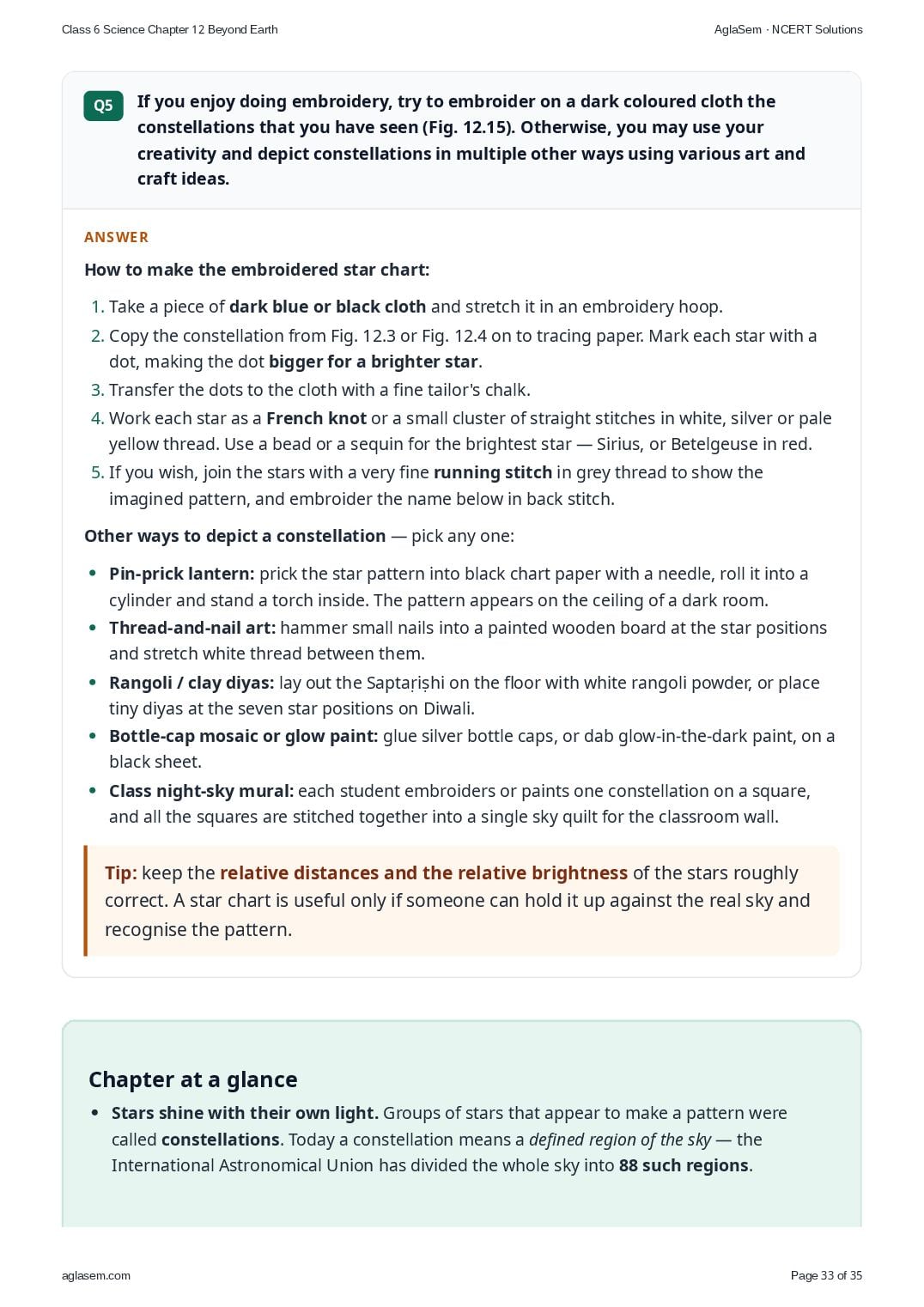
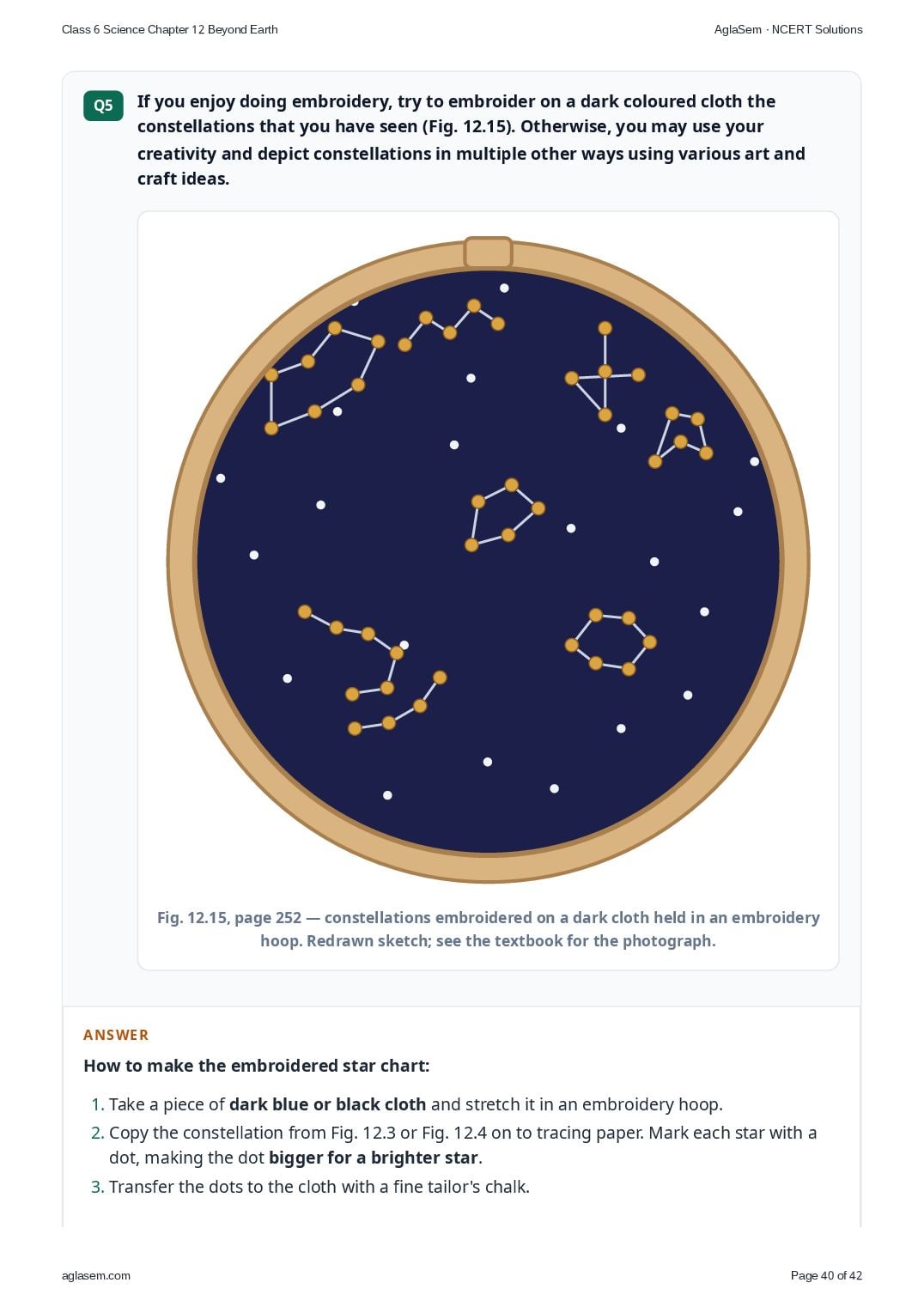
- If you enjoy doing embroidery, try to embroider on a dark coloured cloth the constellations that you have seen (Fig. 12.15). Otherwise, you may use your creativity and depict constellations in multiple other ways using various art and craft ideas.
Chapter at a Glance
- Stars shine with their own light. Groups of stars that appear to make a pattern were called constellations . Today a constellation means a defined region of the sky — the International Astronomical Union has divided the whole sky into 88 such regions .
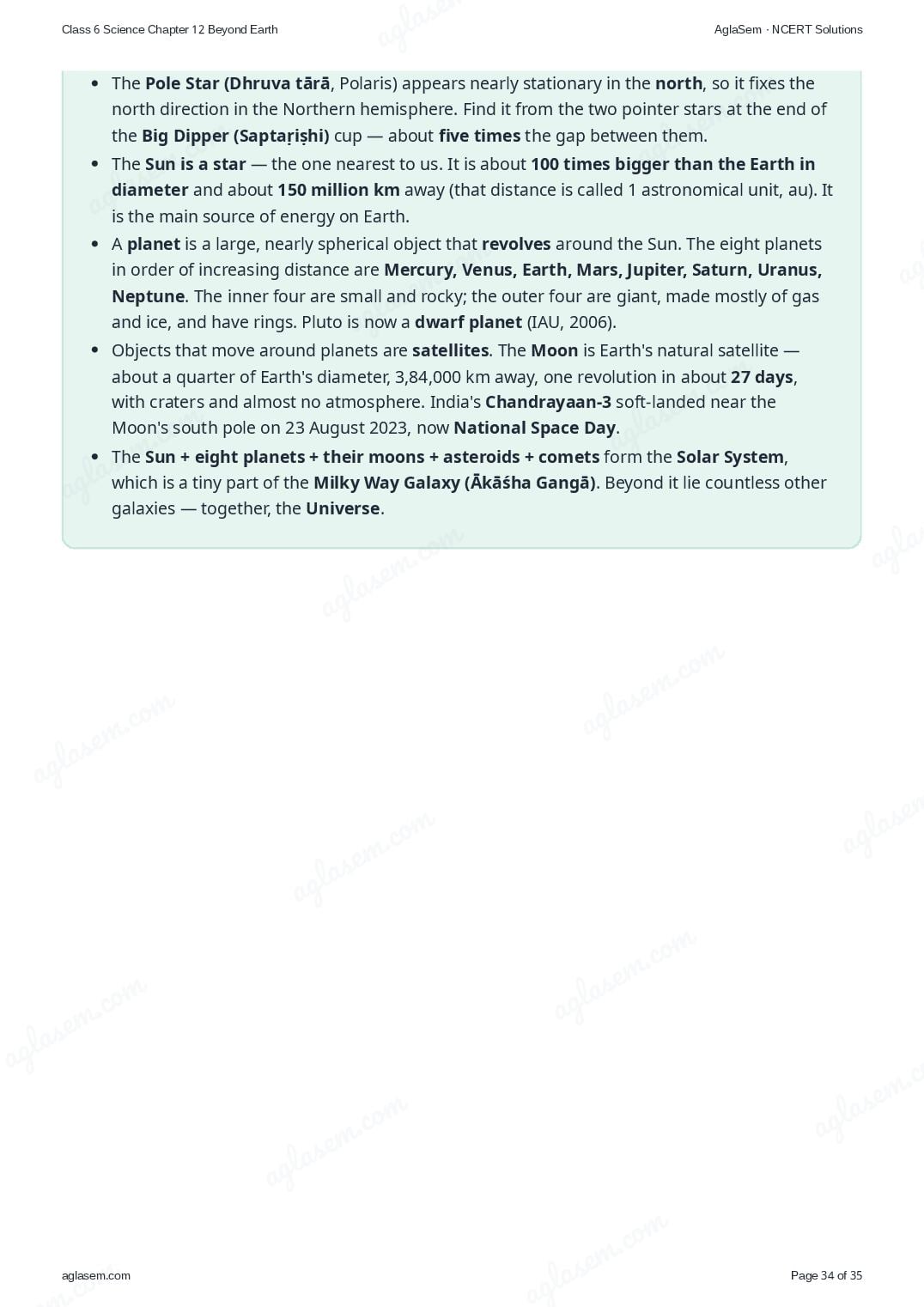
- The Pole Star (Dhruva tārā , Polaris) appears nearly stationary in the north , so it fixes the north direction in the Northern hemisphere. Find it from the two pointer stars at the end of the Big Dipper (Saptaṛiṣhi) cup — about five times the gap between them.
- The Sun is a star — the one nearest to us. It is about 100 times bigger than the Earth in diameter and about 150 million km away (that distance is called 1 astronomical unit, au). It is the main source of energy on Earth.
- A planet is a large, nearly spherical object that revolves around the Sun. The eight planets in order of increasing distance are Mercury, Venus, Earth, Mars, Jupiter, Saturn, Uranus, Neptune . The inner four are small and rocky; the outer four are giant, made mostly of gas and ice, and have rings. Pluto is now a dwarf planet (IAU, 2006).
- Objects that move around planets are satellites . The Moon is Earth's natural satellite — about a quarter of Earth's diameter, 3,84,000 km away, one revolution in about 27 days , with craters and almost no atmosphere. India's Chandrayaan-3 soft-landed near the Moon's south pole on 23 August 2023, now National Space Day .
- The Sun + eight planets + their moons + asteroids + comets form the Solar System , which is a tiny part of the Milky Way Galaxy (Ākāśha Gangā) . Beyond it lie countless other galaxies — together, the Universe .
How to Download NCERT Solutions for Class 6 Science Chapter 12 PDF
Follow these simple steps to get the Beyond Earth questions-and-answers PDF from Curiosity.
- Search NCERT Solutions for Class 6 Science Chapter 12 aglasem and open this page.
- Read the exercise questions with answers for Beyond Earth shown above.
- Click the Download PDF link to save the Beyond Earth solutions to your device.
NCERT Solutions for Class 6 Science – All Chapters
There are more chapters to study besides Beyond Earth in Science. Here are the NCERT Solutions for all chapters of Class 6 Science.
- Chapter 1 the Wonderful World of Science
- Chapter 2 Diversity in the Living World
- Chapter 3 Mindful Eating a Path to a Healthy Body
- Chapter 4 Exploring Magnets
- Chapter 5 Measurement of Length and Motion
- Chapter 6 Materials Around Us
- Chapter 7 Temperature and Its Measurement
- Chapter 8 a Journey Through States of Water
- Chapter 9 Methods of Separation in Everyday Life
- Chapter 10 Living Creatures Exploring Their Characteristics
- Chapter 11 Nature’s Treasures
- Chapter 12 Beyond Earth
NCERT Solutions for Class 6 – All Subjects
Just like Chapter 12 of Science, you can get the exercise questions with answers for every other subject of Class 6. Here are the NCERT Solutions for all subjects of Class 6.
NCERT Solutions for Class 6 Science Chapter 12 – An Overview
The key highlights of this study material are as follows.
| Aspects | Details |
|---|---|
| Class | Class 6 |
| Subject | Science |
| Chapter Number | Chapter 12 |
| Chapter Name | Beyond Earth |
| Book Name | Curiosity |
| Book By | NCERT (National Council of Educational Research and Training) |
| Educational Resource Here | NCERT Solutions of Class 6 Science Chapter 12 for all exercises |
| More Questions Answers of This Subject | NCERT Solutions for Class 6 Science |
| Download Book Chapter | NCERT Book Class 6 Science |
| All Questions Answers For This Class | NCERT Solutions for Class 6 |
| Complete Solutions | NCERT Solutions |
NCERT Solutions for Class 6 Science Chapter 12 Beyond Earth – FAQs
What are the NCERT Solutions for Class 6 Science Chapter 12 Beyond Earth?
They are the complete, step-by-step answers to all the exercise and in-text questions of Chapter 12 Beyond Earth from the NCERT Class 6 Science textbook Curiosity, written by experts as per the latest NCERT syllabus.
How can I download the Class 6 Science Chapter 12 solutions PDF for free?
Open this page on aglasem, read the Beyond Earth questions with answers, and click the “Download Solutions PDF” link. The Class 6 Science Chapter 12 NCERT Solutions PDF is completely free to download.
Are these NCERT Solutions as per the latest 2026-27 syllabus?
Yes. The NCERT Solutions for Class 6 Science Chapter 12 are based on the latest NCERT textbook Curiosity and the current 2026-27 CBSE syllabus, so the questions and answers match what you study in class.
Where can I get NCERT Solutions for the other chapters of Class 6 Science?
You can find the answers to every chapter on the NCERT Solutions for Class 6 Science page, and solutions for every subject on the NCERT Solutions for Class 6 page.
How do NCERT Solutions help in exam preparation?
They show the correct method to solve each question, help you write answers the way they are expected in exams, let you check and correct your own work, and save revision time — which together improve your marks in Class 6 Science.
If you have any queries on NCERT Solutions for Class 6 Science Chapter 12 Beyond Earth, then please ask in the comments below.