Download Methods of Separation in Everyday Life – NCERT Class 6 Science Chapter 9 PDF from the new NCERT Class 6 Science book Curiosity (2026-27). Read the chapter online or download the free PDF. The chapter travels with Malli and Valli across India — Haryana, Ahmedabad, Puducherry, Bhopal and Shillong — and at every halt they meet one more way of separating a mixture (two or more substances mixed together).
Methods of Separation in Everyday Life PDF – Chapter 9 of Curiosity
Read the chapter online or download the PDF.
| Chapter | Download | |
|---|---|---|
| Chapter 9 PDF | Methods of Separation in Everyday Life | View PDF |
| Full book | NCERT Class 6 Science – Curiosity | View Book |
Read Online
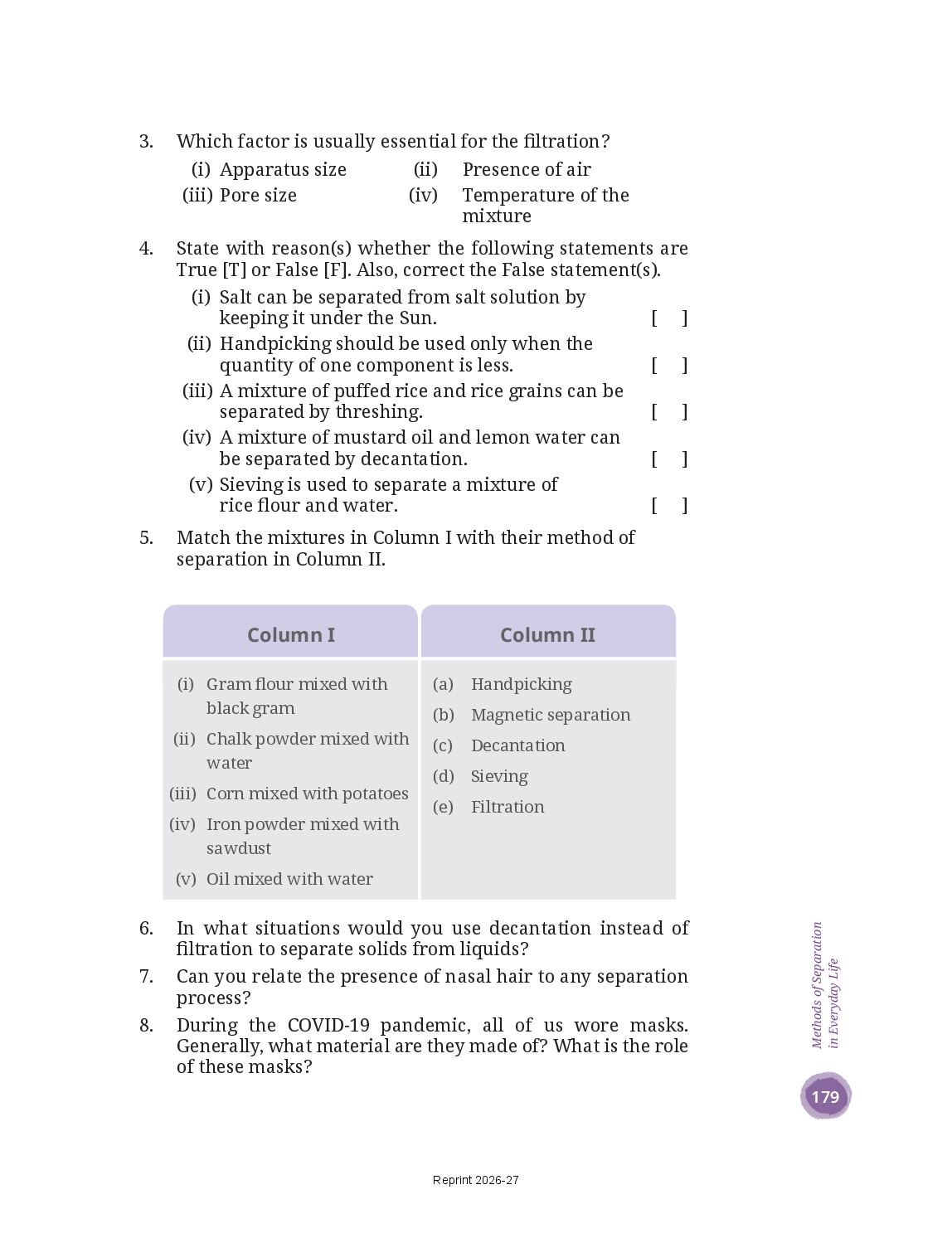
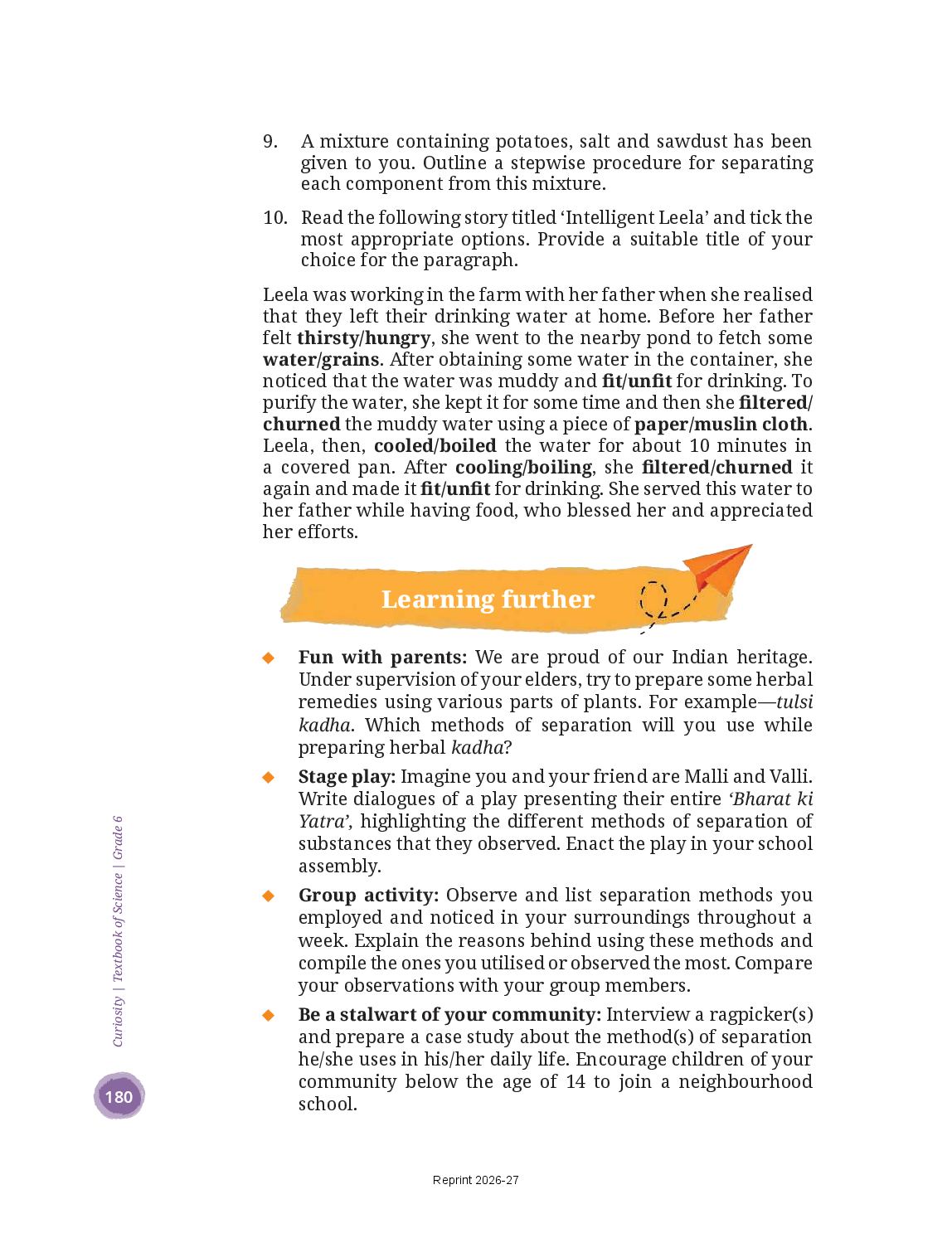
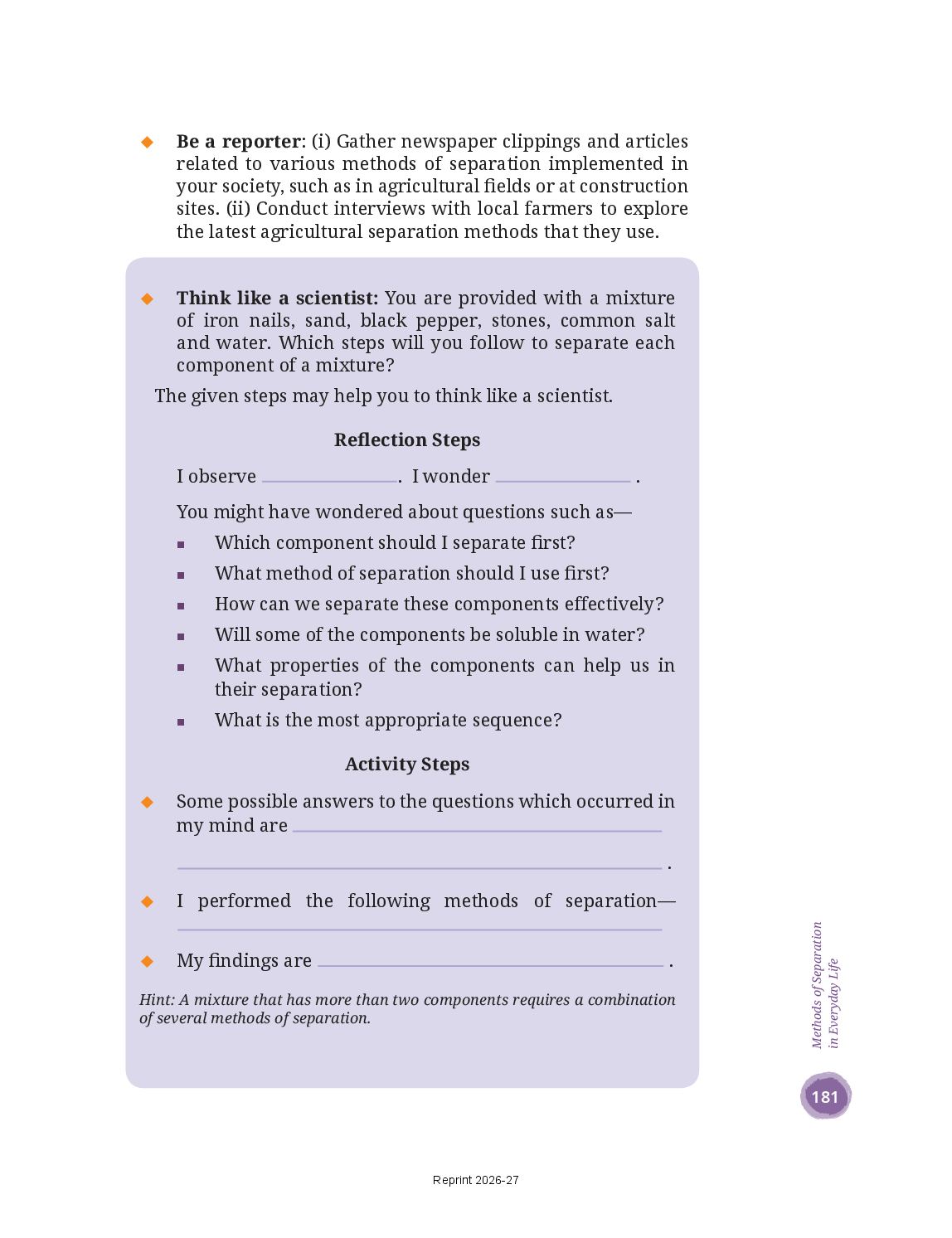
What Is in Methods of Separation in Everyday Life? (Class 6 Science Chapter 9)
- The chapter travels with Malli and Valli across India — Haryana, Ahmedabad, Puducherry, Bhopal and Shillong — and at every halt they meet one more way of separating a mixture (two or more substances mixed together).
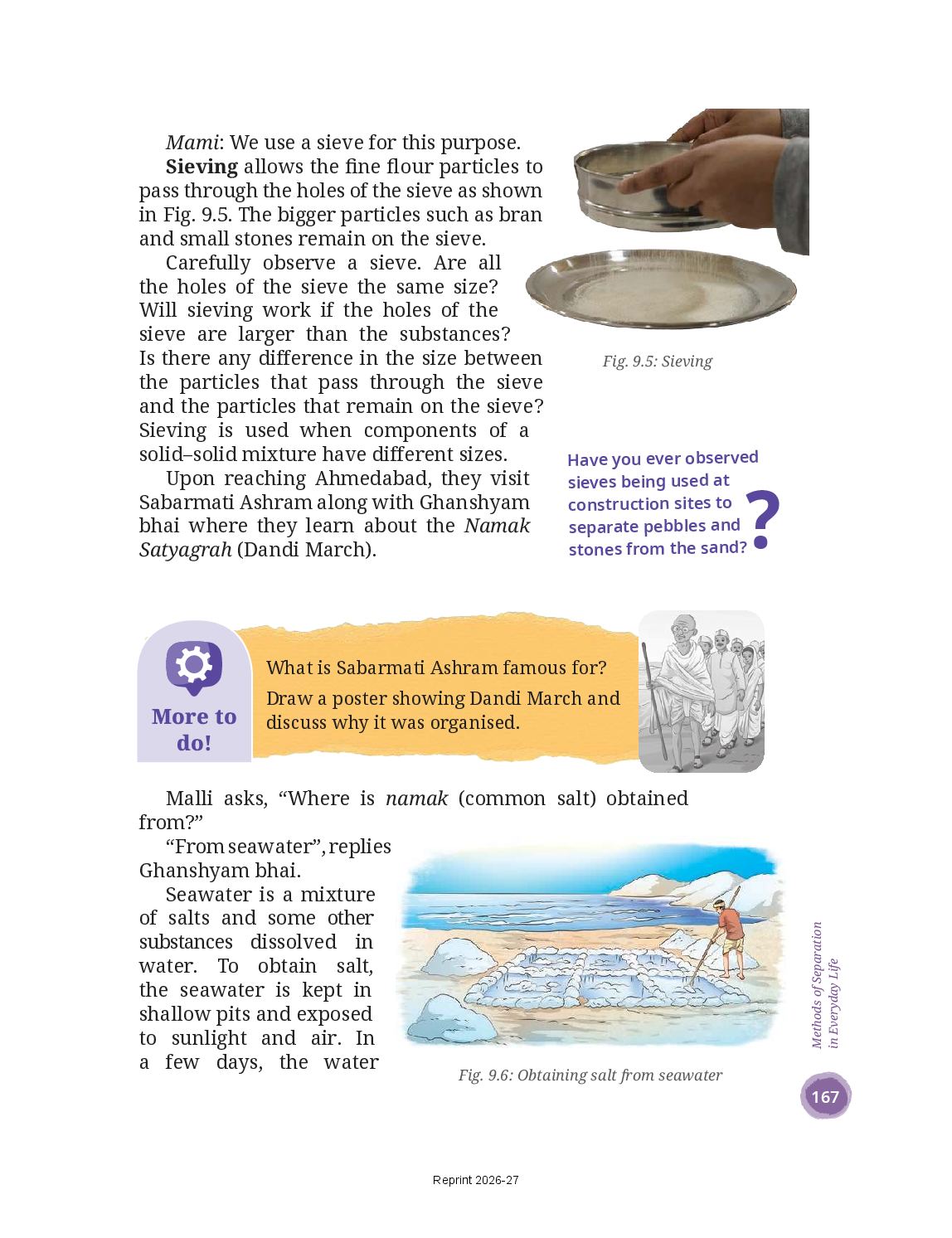
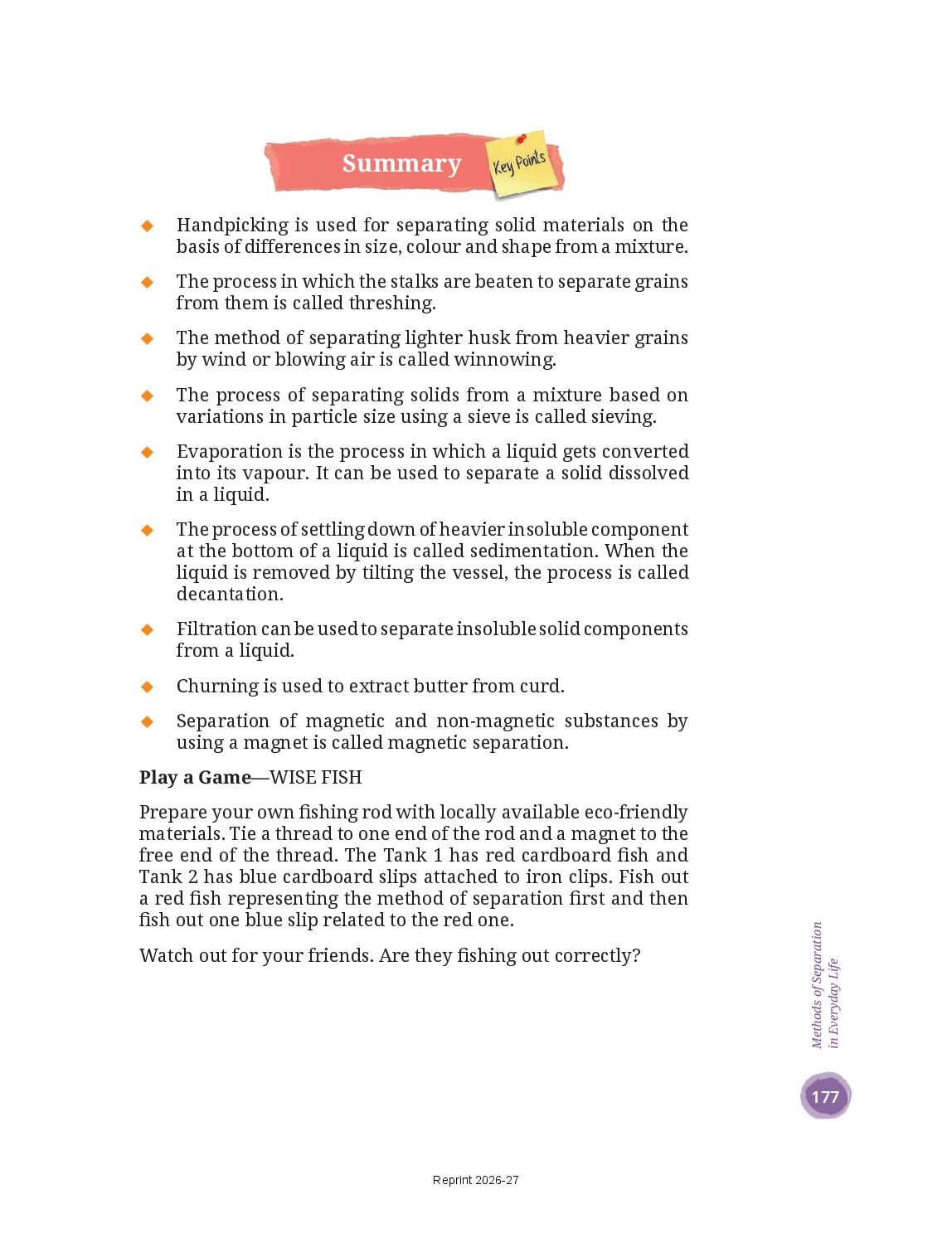
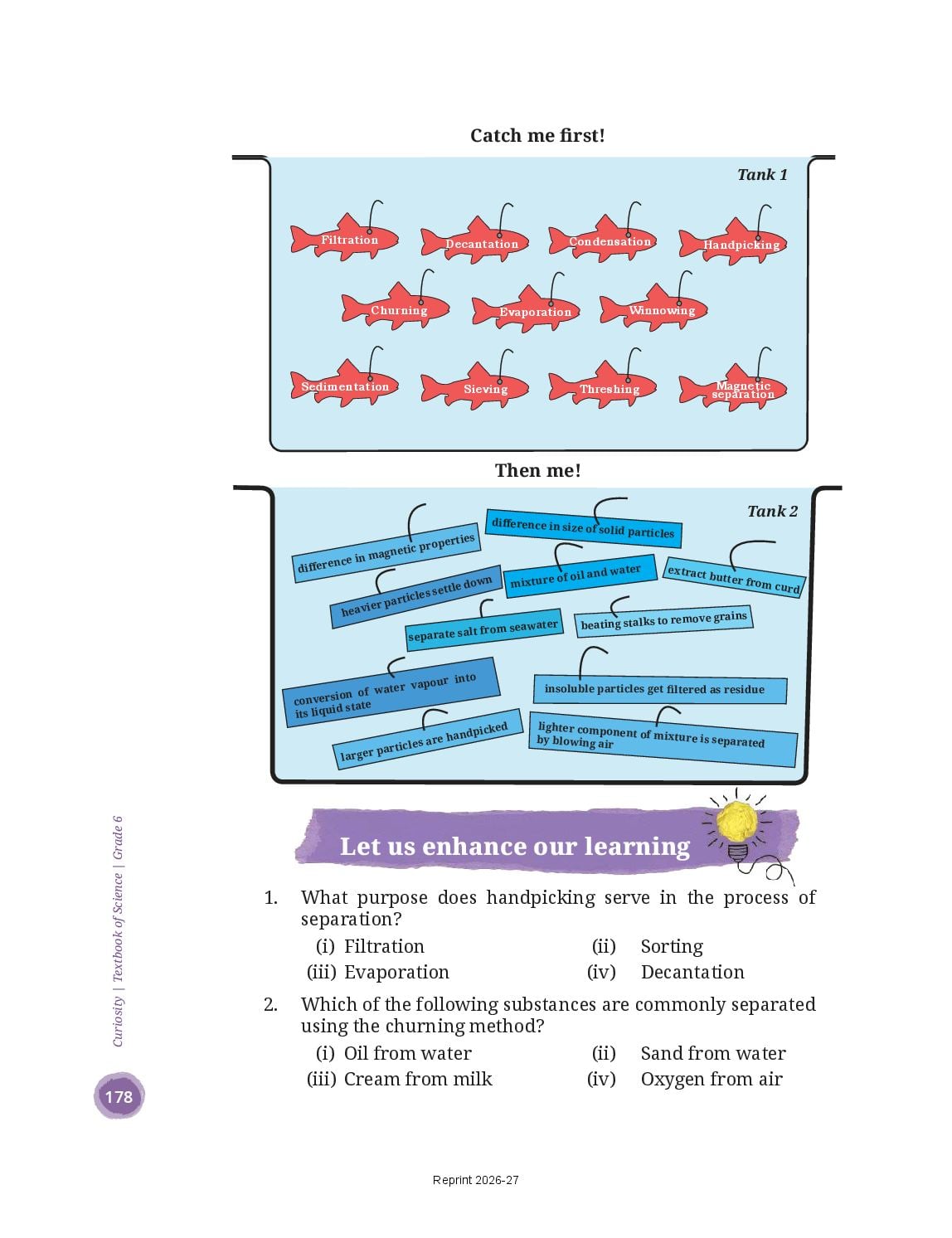
- Solid–solid mixtures are separated by handpicking (difference in size, colour and shape), threshing (beating stalks to free the grain), winnowing (difference in weight, using wind) and sieving (difference in particle size).
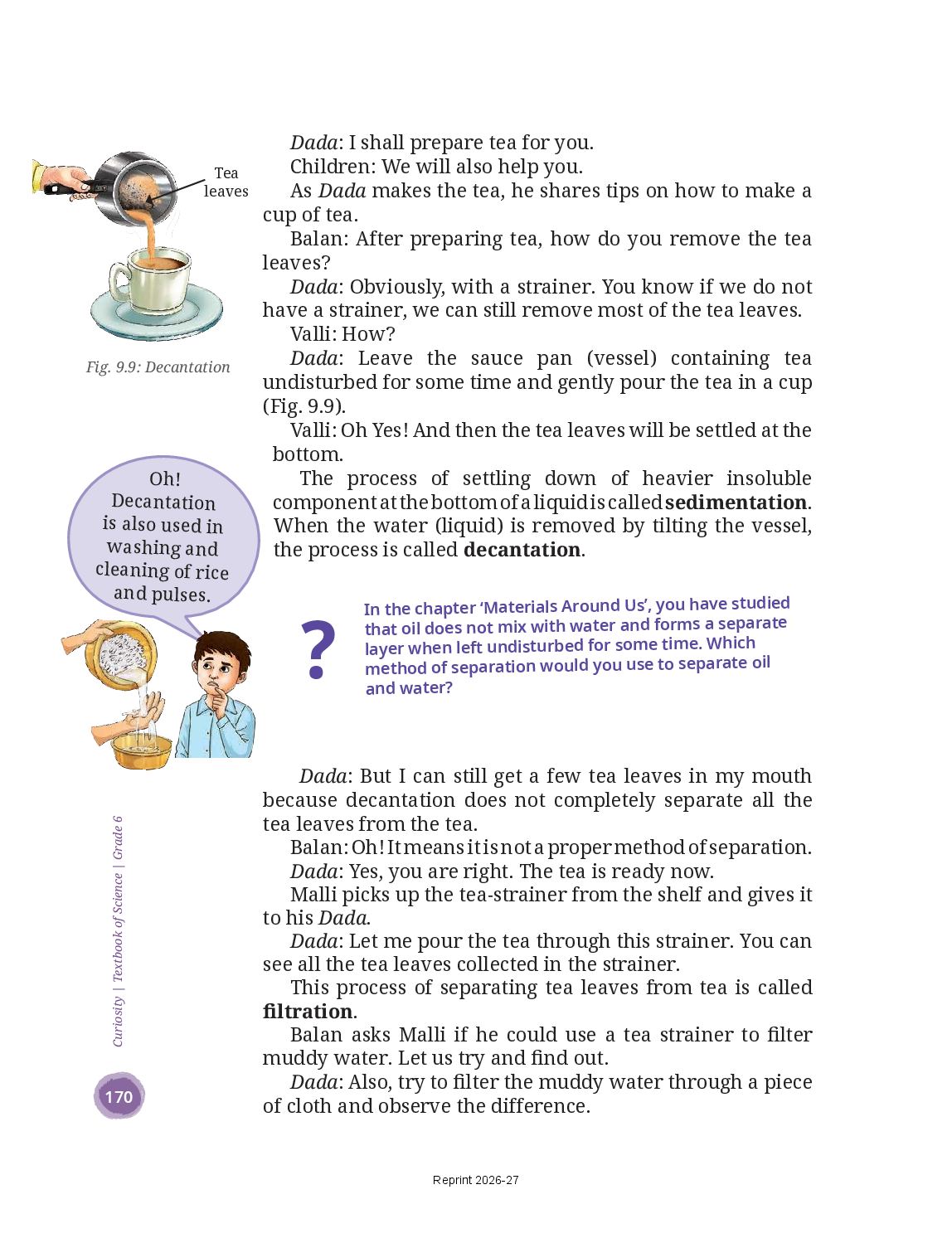
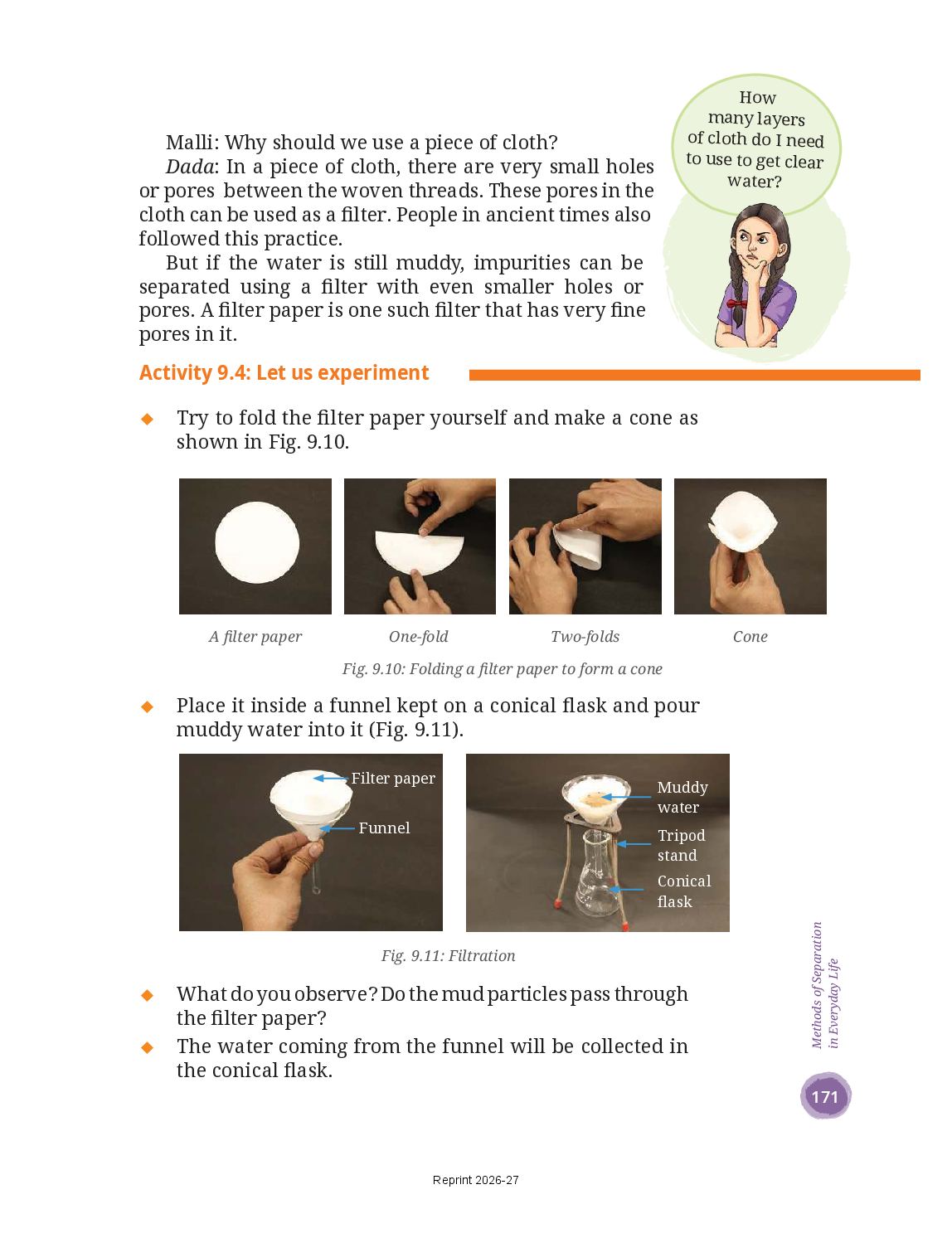
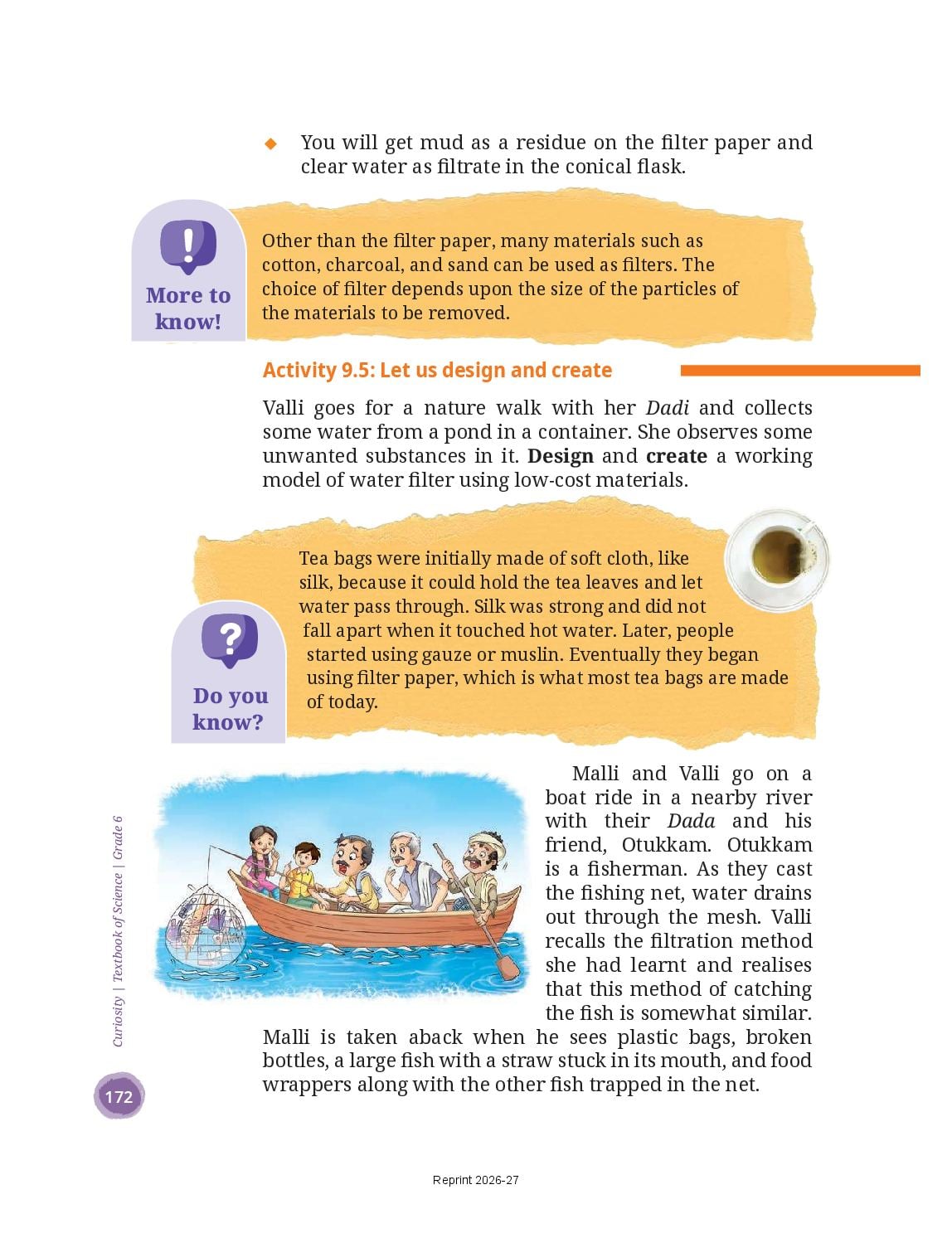
- Solid–liquid mixtures are separated by sedimentation (heavier insoluble particles settle), decantation (the liquid is gently poured off) and filtration (the liquid passes through fine pores, the solid stays back as residue and the liquid collected is the filtrate).
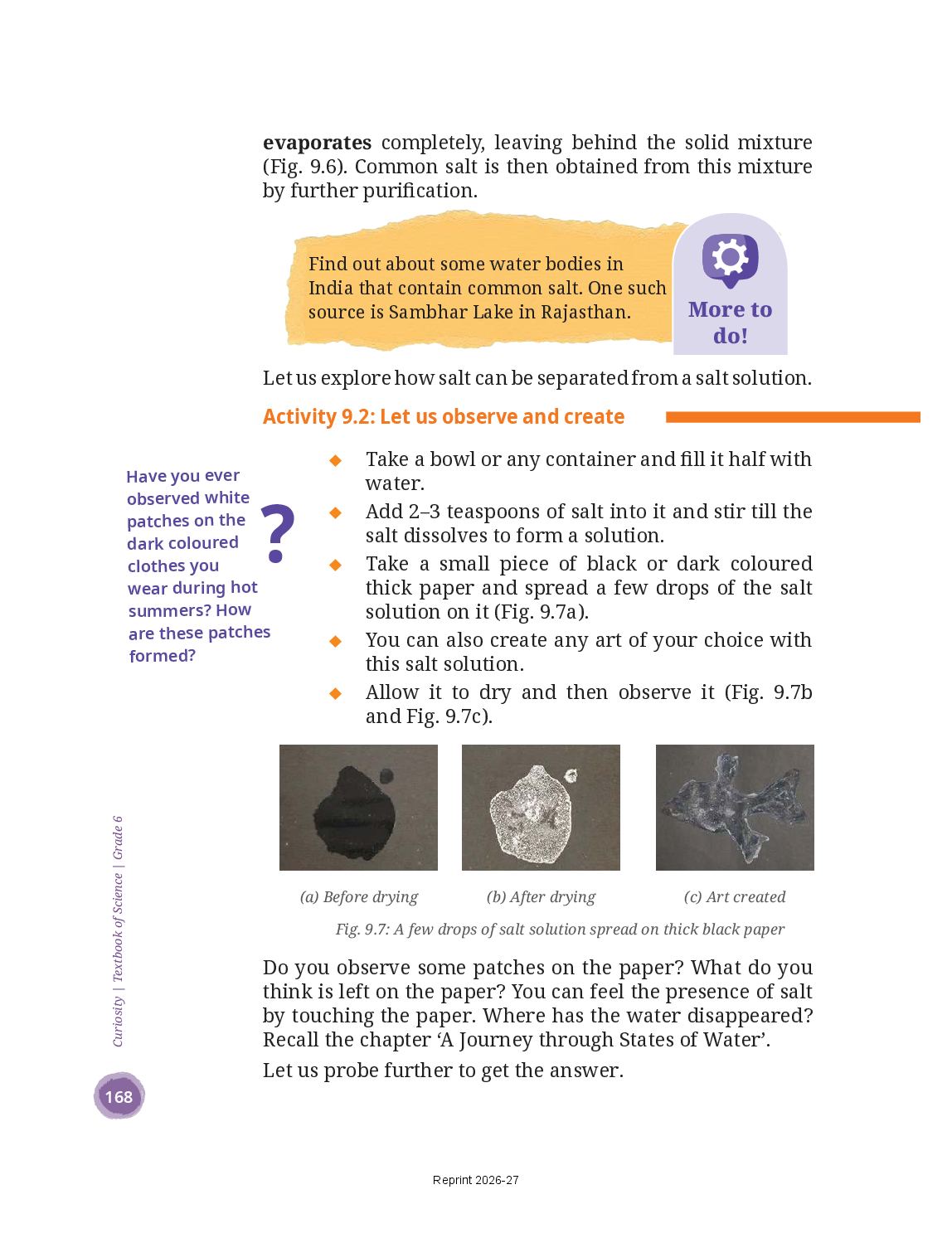
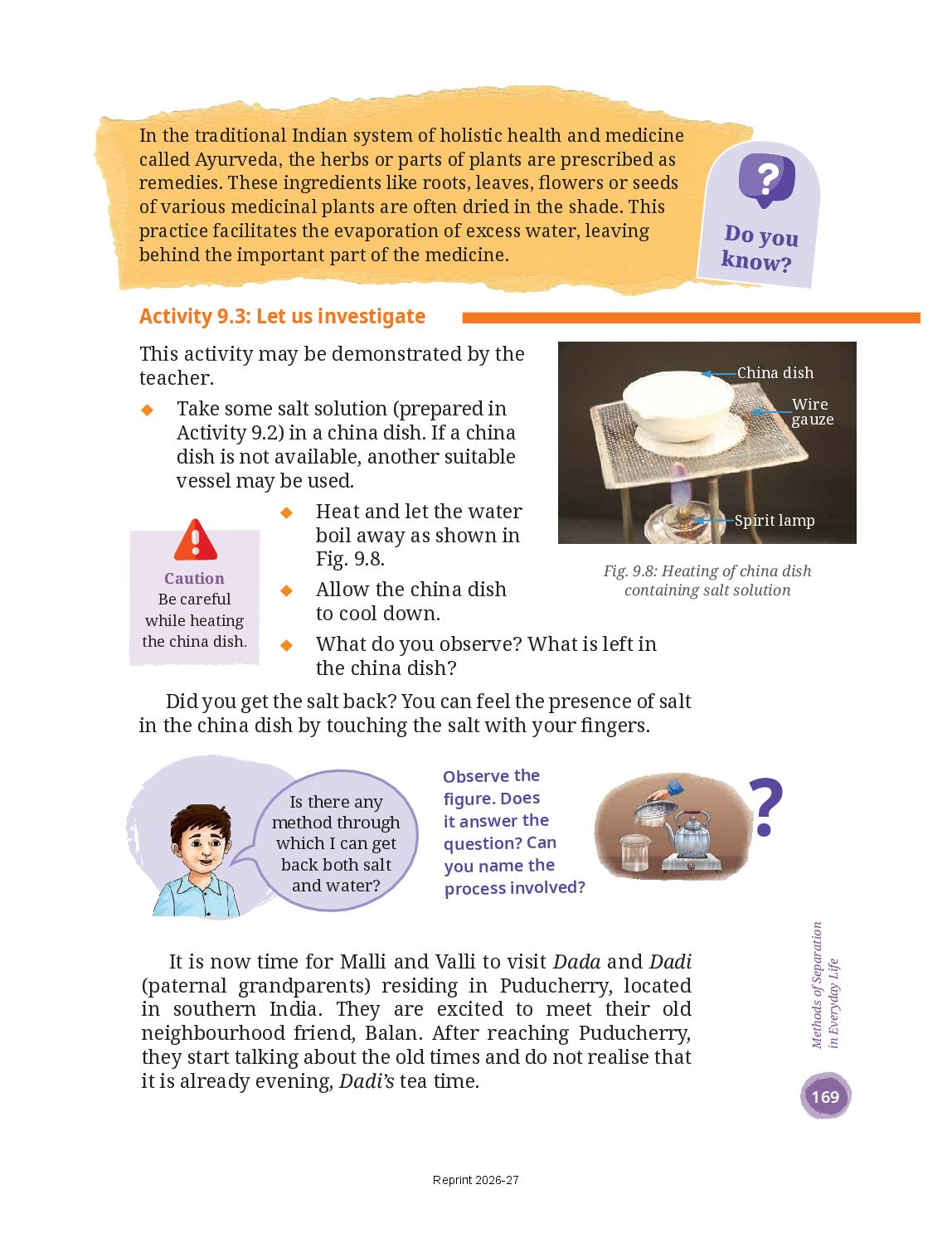
- A dissolved solid cannot be filtered out. It is recovered by evaporation — as in the salt pans by the sea. If the vapour is cooled it turns back to liquid; this is condensation, and evaporation followed by condensation gives back both the salt and the water.
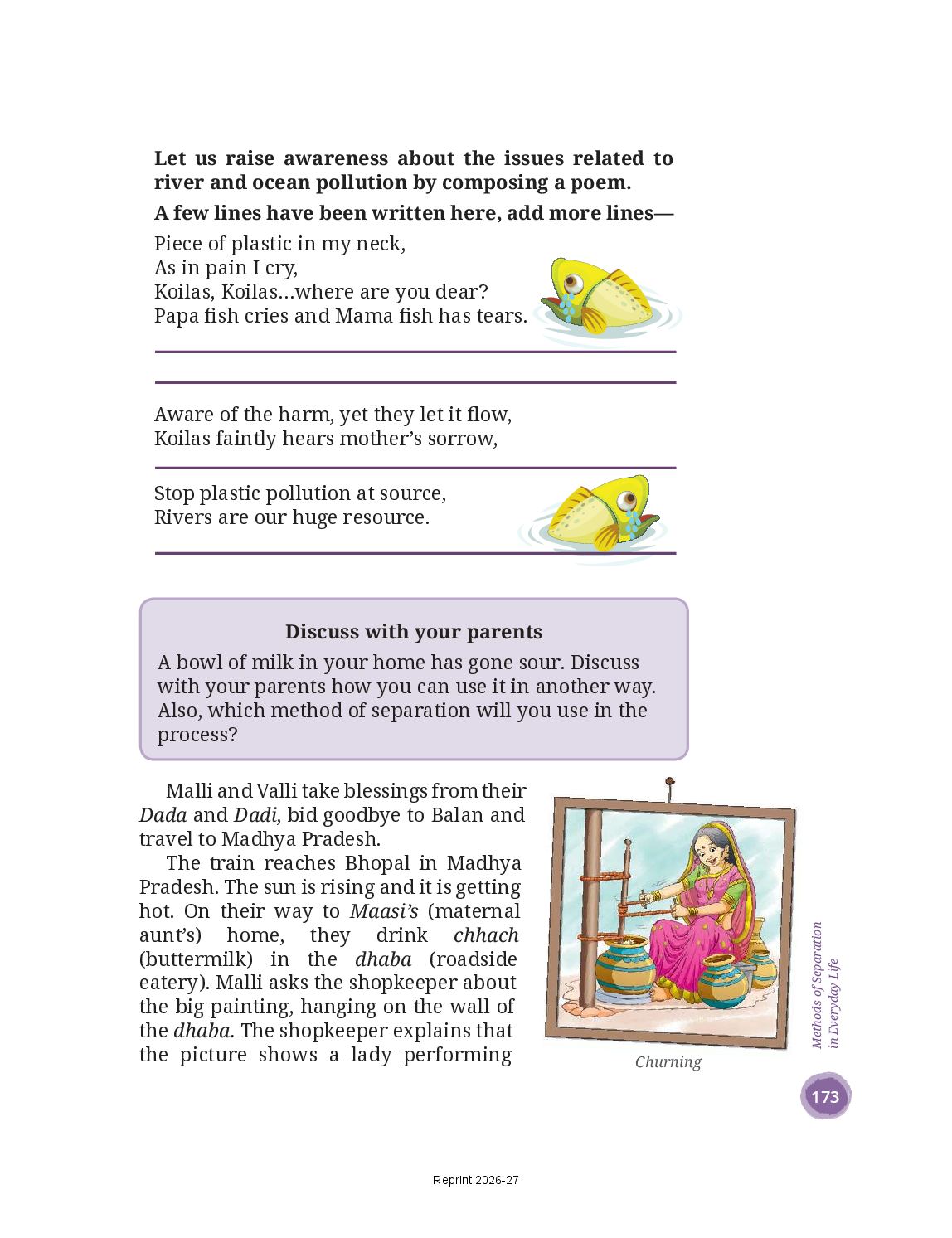
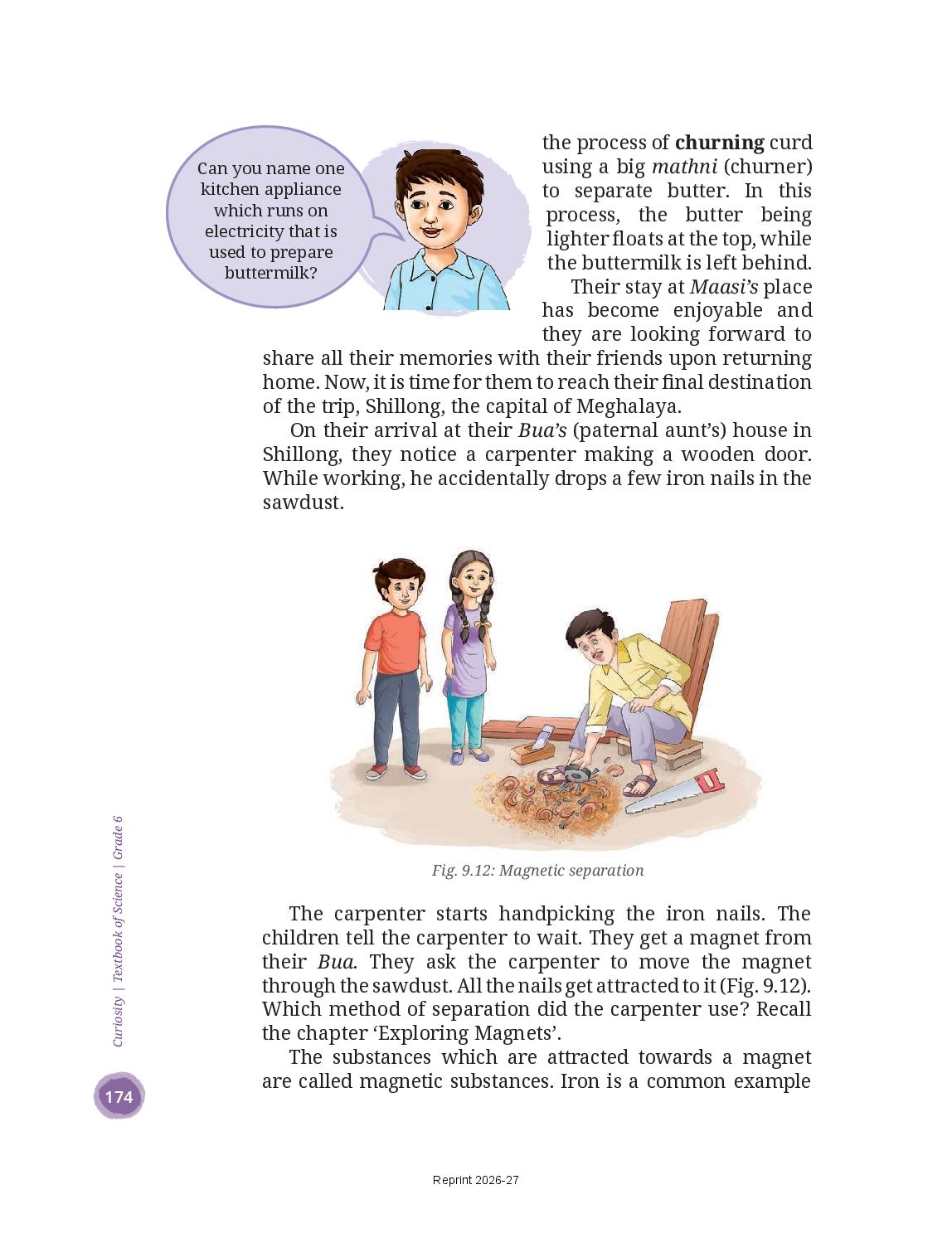
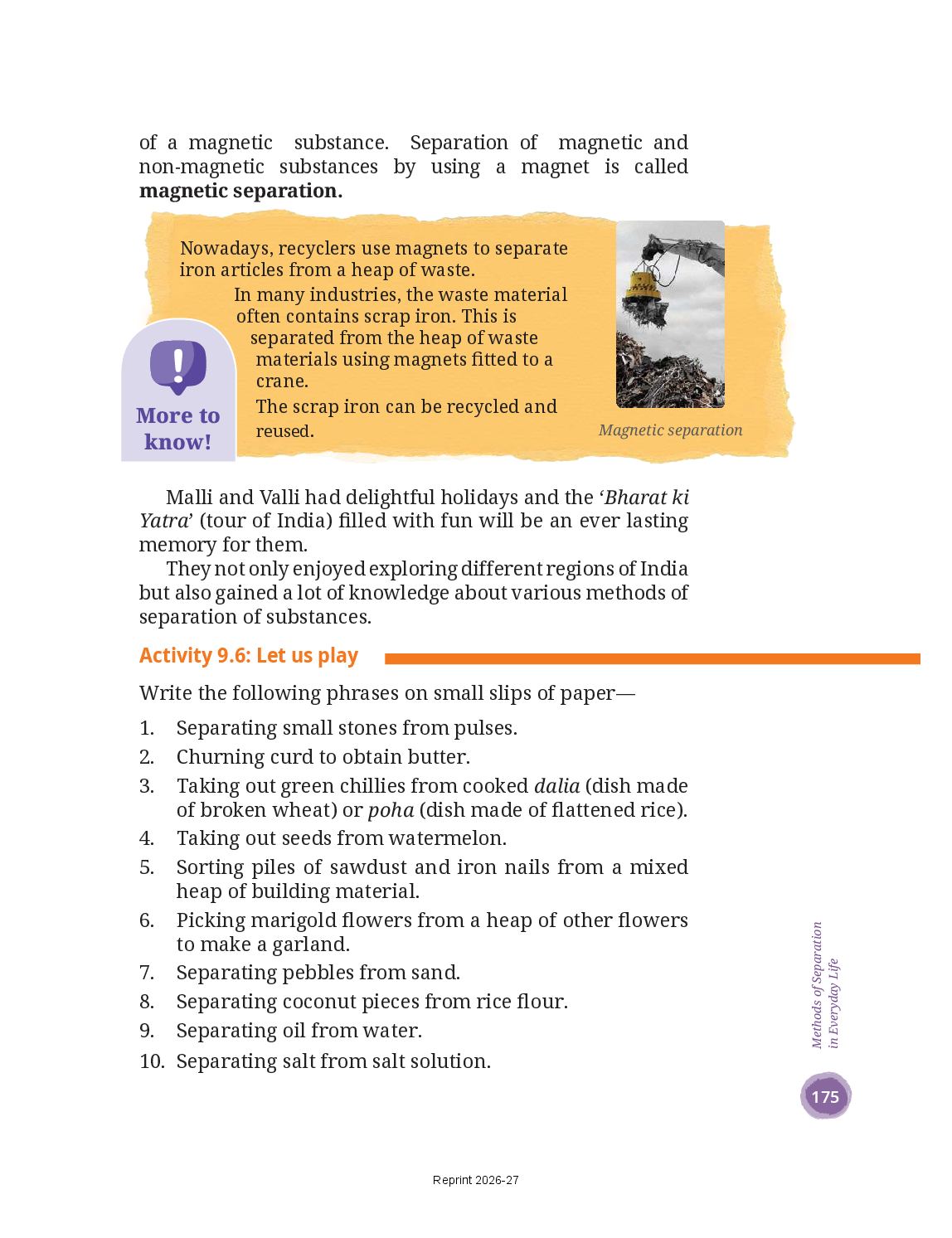
- Two more methods appear at the end: churning, which separates lighter butter from curd, and magnetic separation, which pulls iron out of a heap using a magnet.
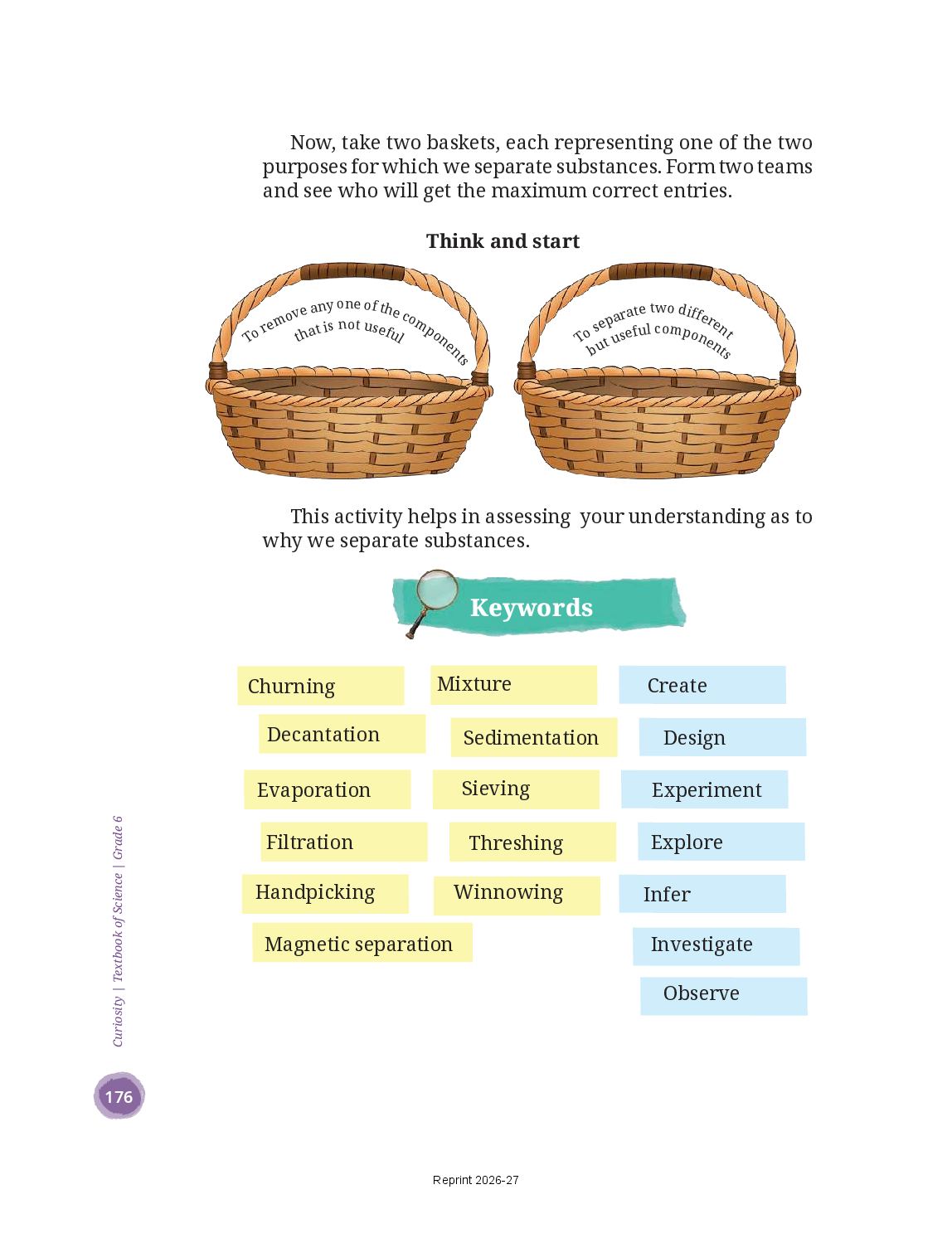
- We separate substances for exactly two reasons — to remove a component that is not useful (stones from dal, husk from grain) or to obtain two different but useful components (butter and buttermilk, salt and water).
Quick revision – Methods of Separation in Everyday Life
| Method | What it separates | Property it uses | Everyday Indian example |
|---|---|---|---|
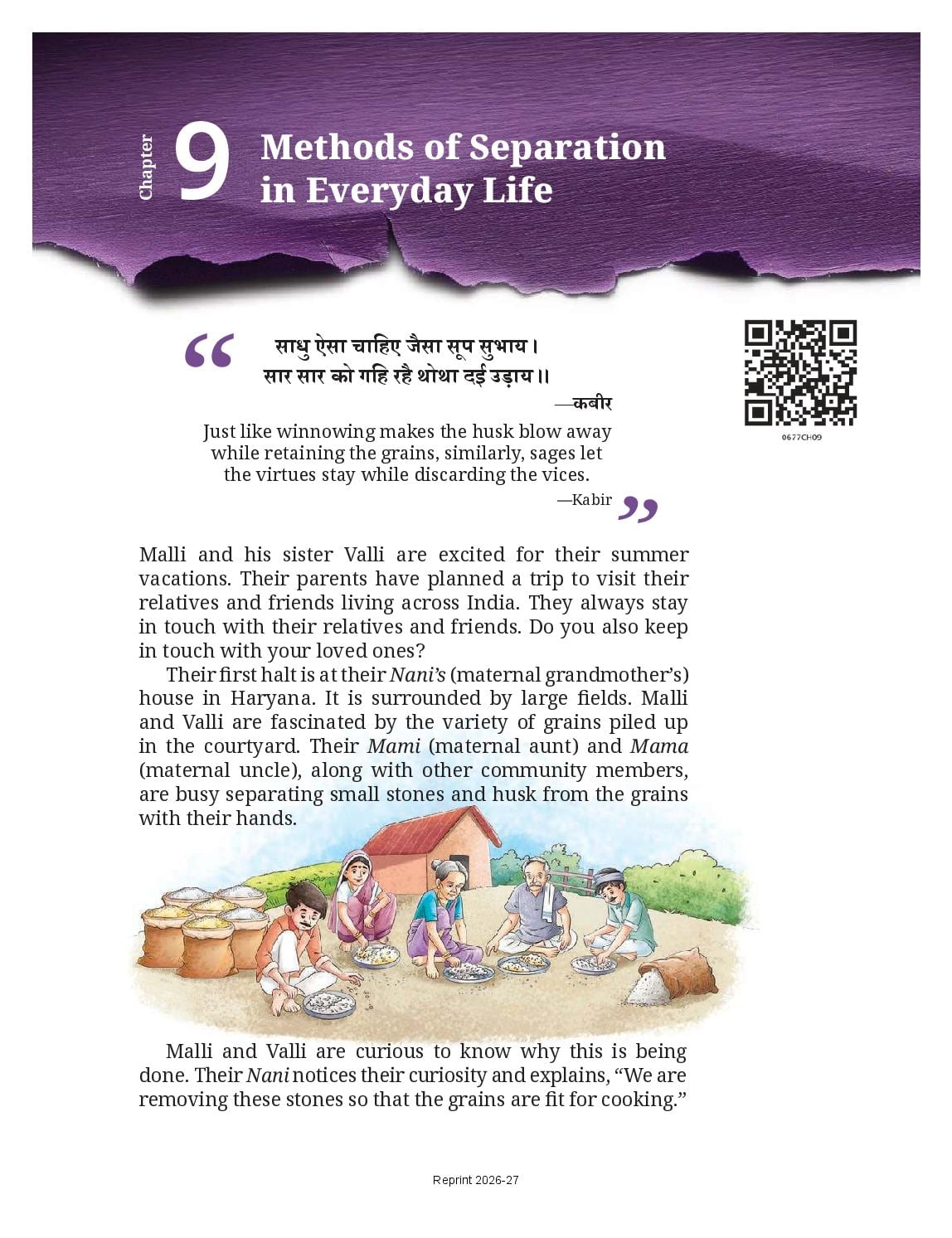
| Handpicking | Solid from solid, when one is present in a small quantity | Difference in size, colour and shape | Picking small stones out of rice or dal; taking whole black pepper out of pulao |
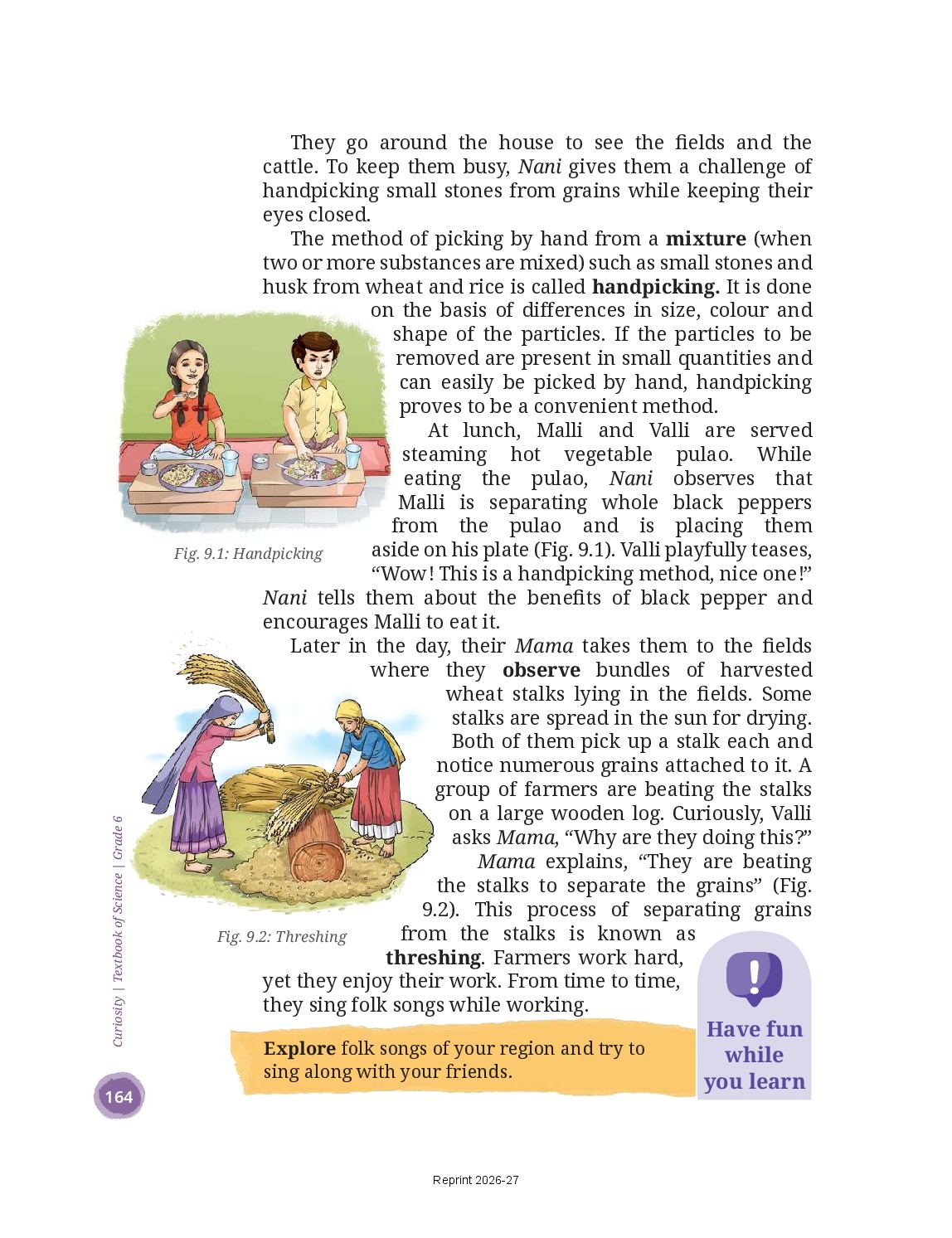
| Threshing | Grain from the stalks of the harvested crop | The grain is loosely attached and is knocked free by beating | Farmers beating wheat stalks on a wooden log; a thresher machine |
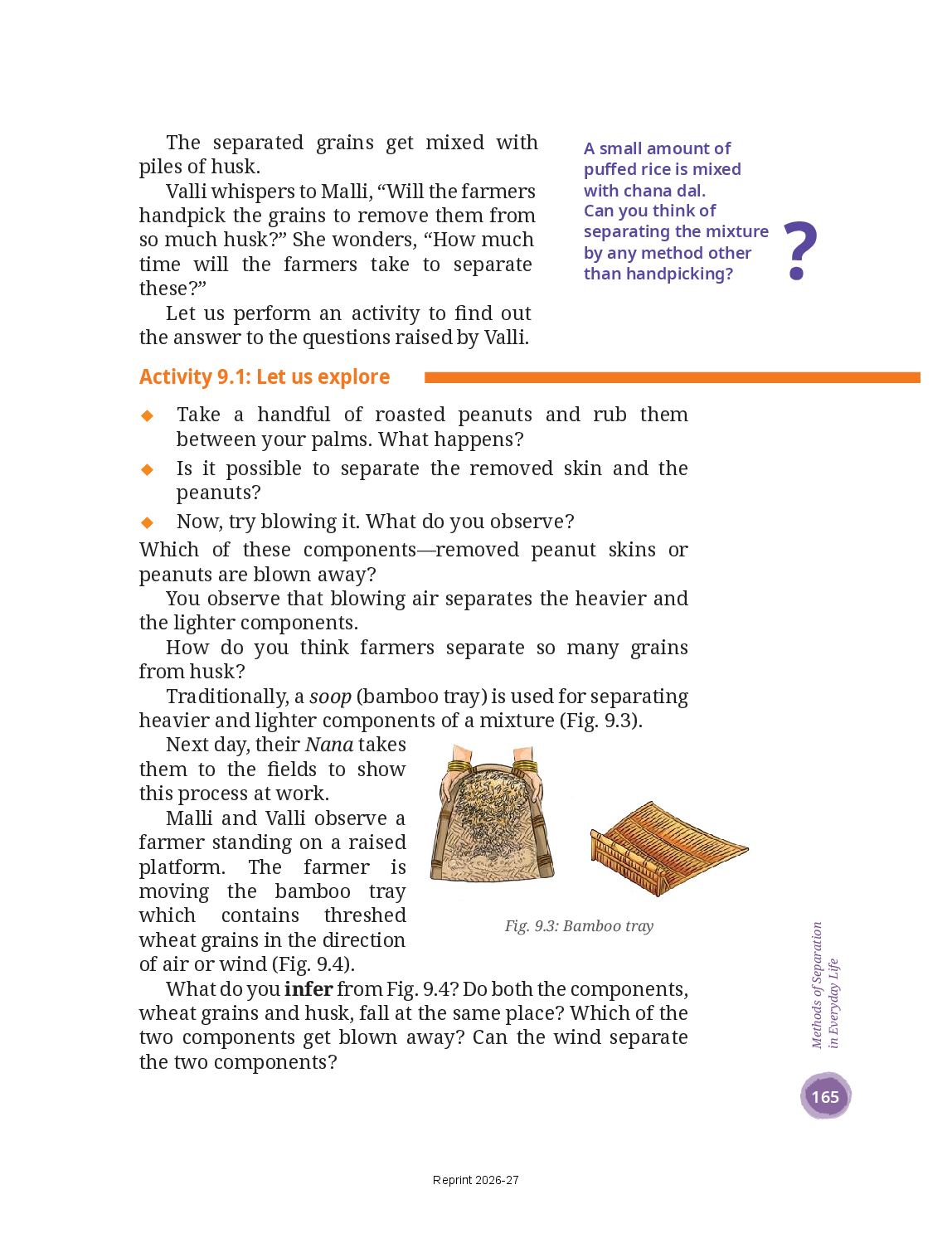
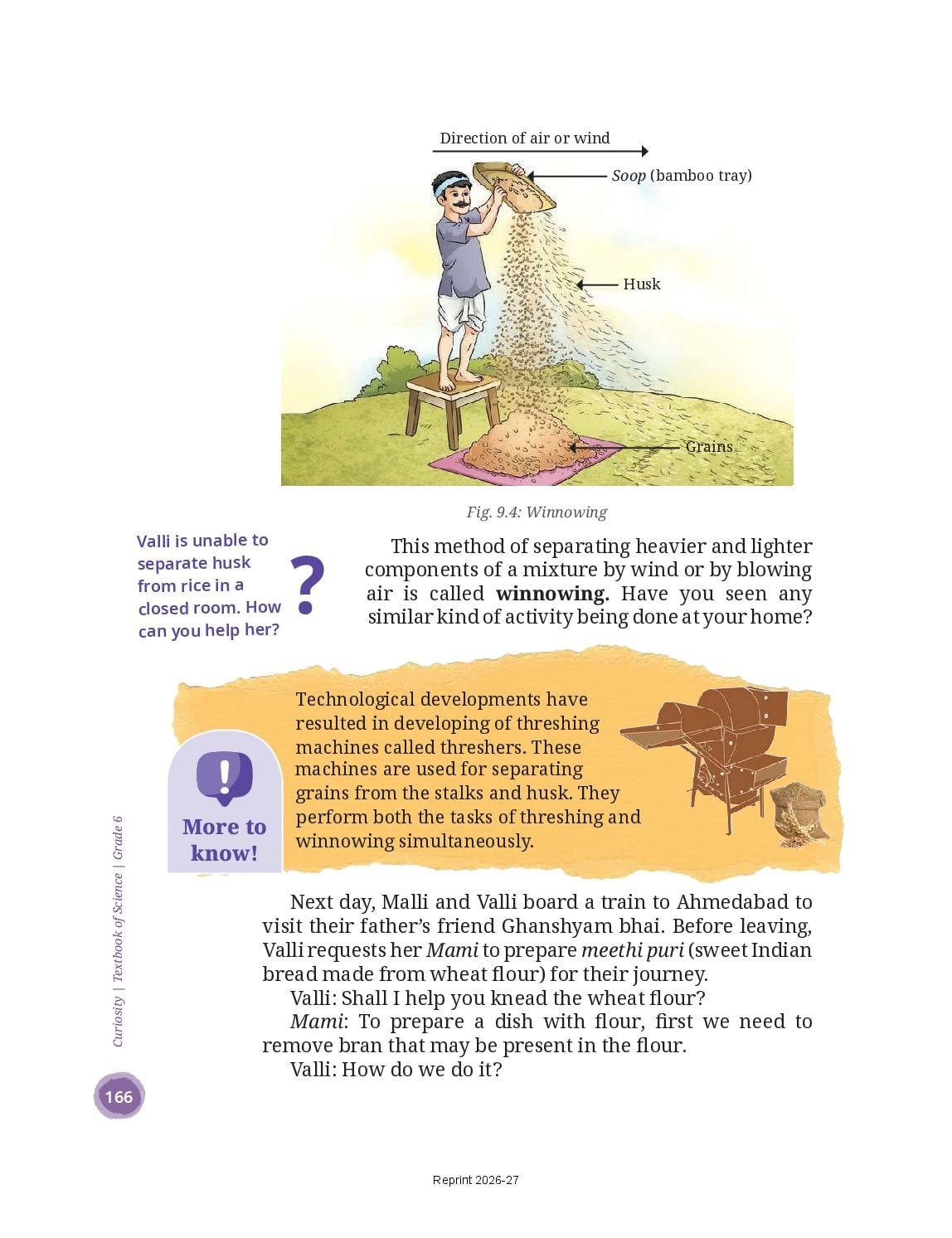
| Winnowing | Lighter husk from heavier grain | Difference in weight — wind carries the light part away | Dropping threshed wheat from a soop (bamboo tray) in the wind |
| Sieving | Two solids whose particles are of different sizes | Difference in particle size versus the pore size of the sieve | Sifting chokar (bran) out of atta; sieving pebbles from sand at a building site |
| Sedimentation | A heavy insoluble solid from a liquid (first step) | Heavier insoluble particles sink to the bottom | Tea leaves settling at the bottom of the pan; mud settling in a pot of pond water |
| Decantation | The clear liquid from the settled solid, or two liquids that do not mix | The solid has settled (or the liquids form layers); tilting leaves it behind | Pouring off tea without a strainer; washing rice and dal; oil floating over water |
| Filtration | An insoluble solid from a liquid, completely | Difference in size — the solid is bigger than the pores of the filter | A tea strainer; a muslin cloth over a pot; a filter paper in a funnel |
| Evaporation | A dissolved solid from its solution | The liquid changes to vapour; the dissolved solid does not | Salt from seawater in shallow salt pans; drying herbs in the shade for kadha |
| Condensation | Water back from the water vapour | Cooling turns vapour into liquid | Water droplets on a lid held over a boiling kettle |
| Churning | Butter (lighter) from curd | Butter is lighter — it collects and floats on top | Beating curd with a mathni; a mixer or an electric churner making chhach |
| Magnetic separation | Magnetic substances from non-magnetic ones | Difference in magnetic property | Lifting iron nails out of sawdust with a magnet; recyclers pulling scrap iron from waste |
Old NCERT vs New – Class 6 Science
This chapter is from Curiosity, the new NCERT Class 6 Science book (NCF-SE 2023, used from 2024-25). It replaced the old book “Science”, so chapter numbers and names differ from older PDFs.
Solutions and All Chapters
Answers to the exercises and the full chapter list of Curiosity:
Methods of Separation in Everyday Life – Overview
| Class | Class 6 |
| Subject | Science |
| Book | Curiosity – new NCERT book |
| Chapter | 9 of 12 – Methods of Separation in Everyday Life |
| Book pages | 163 – 181 |
| Edition | NCERT Reprint 2026-27 |
| Session | 2026-27 |
| Free – read online or download |
Class 6 Science Chapter 9 – FAQs
Where can I download Methods of Separation in Everyday Life Class 6 PDF?
From the download table on this page – the chapter PDF is free, and the full book is linked too.
What is Class 6 Science Chapter 9 about?
The chapter travels with Malli and Valli across India — Haryana, Ahmedabad, Puducherry, Bhopal and Shillong — and at every halt they meet one more way of separating a mixture (two or more substances mixed together).
Is Methods of Separation in Everyday Life from the new NCERT Class 6 Science book?
Yes. It is chapter 9 of curiosity, the new NCERT Class 6 Science book for 2026-27.
Is this the latest NCERT edition for 2026-27?
Yes – the PDF is NCERT’s latest edition for the 2026-27 session.
Where are the NCERT Solutions for Class 6 Science Chapter 9?
Open the NCERT Solutions link above for answers to the exercise questions.