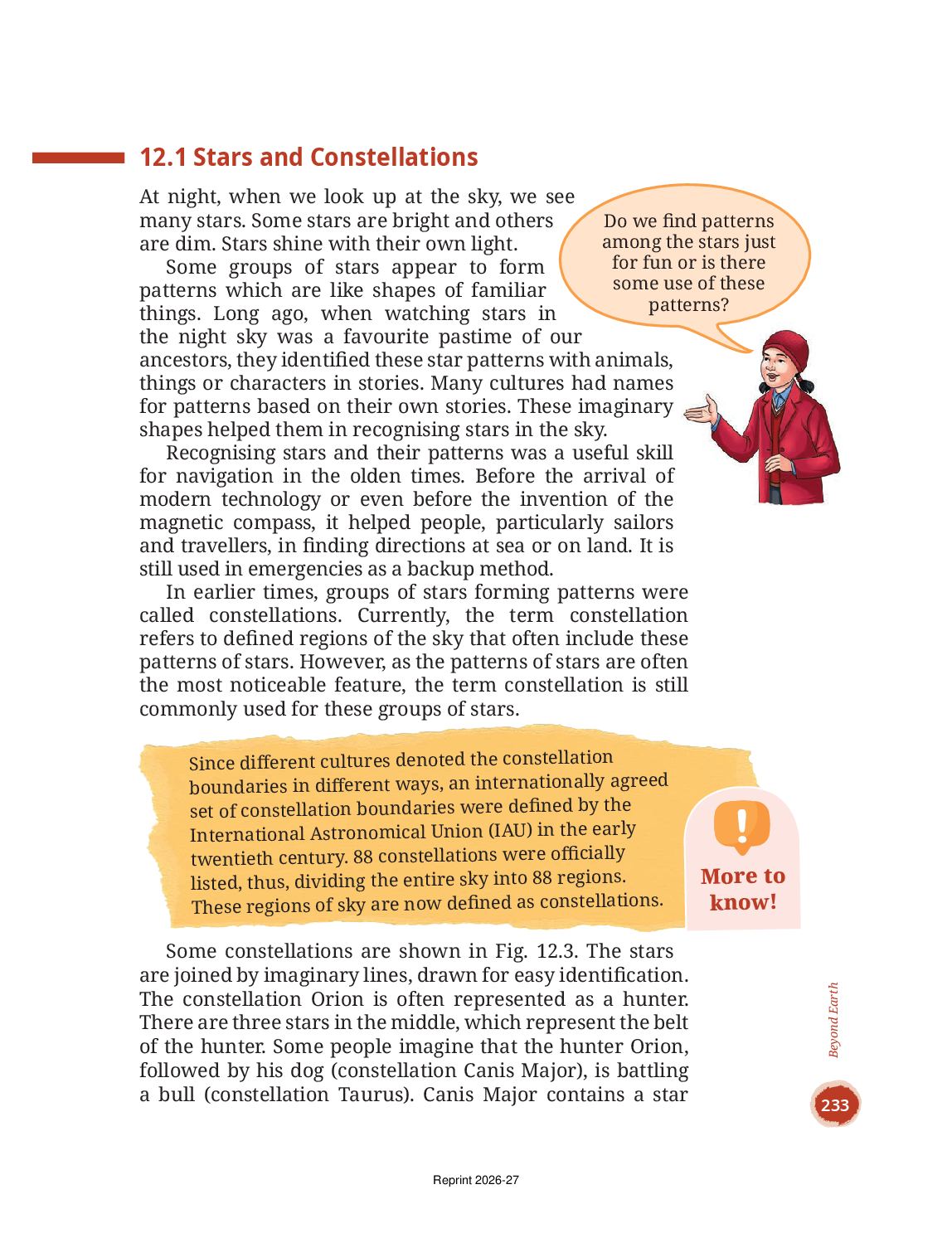
Download Beyond Earth – NCERT Class 6 Science Chapter 12 PDF from the new NCERT Class 6 Science book Curiosity (2026-27). Read the chapter online or download the free PDF. Stars shine with their own light. Groups of stars that appear to make a pattern were called constellations. Today a constellation means a defined region of the sky — the International Astronomical Union has divided the whole sky into 88 such regions.
Beyond Earth PDF – Chapter 12 of Curiosity
Read the chapter online or download the PDF.
| Chapter | Download | |
|---|---|---|
| Chapter 12 PDF | Beyond Earth | View PDF |
| Full book | NCERT Class 6 Science – Curiosity | View Book |
Read Online
What Is in Beyond Earth? (Class 6 Science Chapter 12)
- Stars shine with their own light. Groups of stars that appear to make a pattern were called constellations. Today a constellation means a defined region of the sky — the International Astronomical Union has divided the whole sky into 88 such regions.
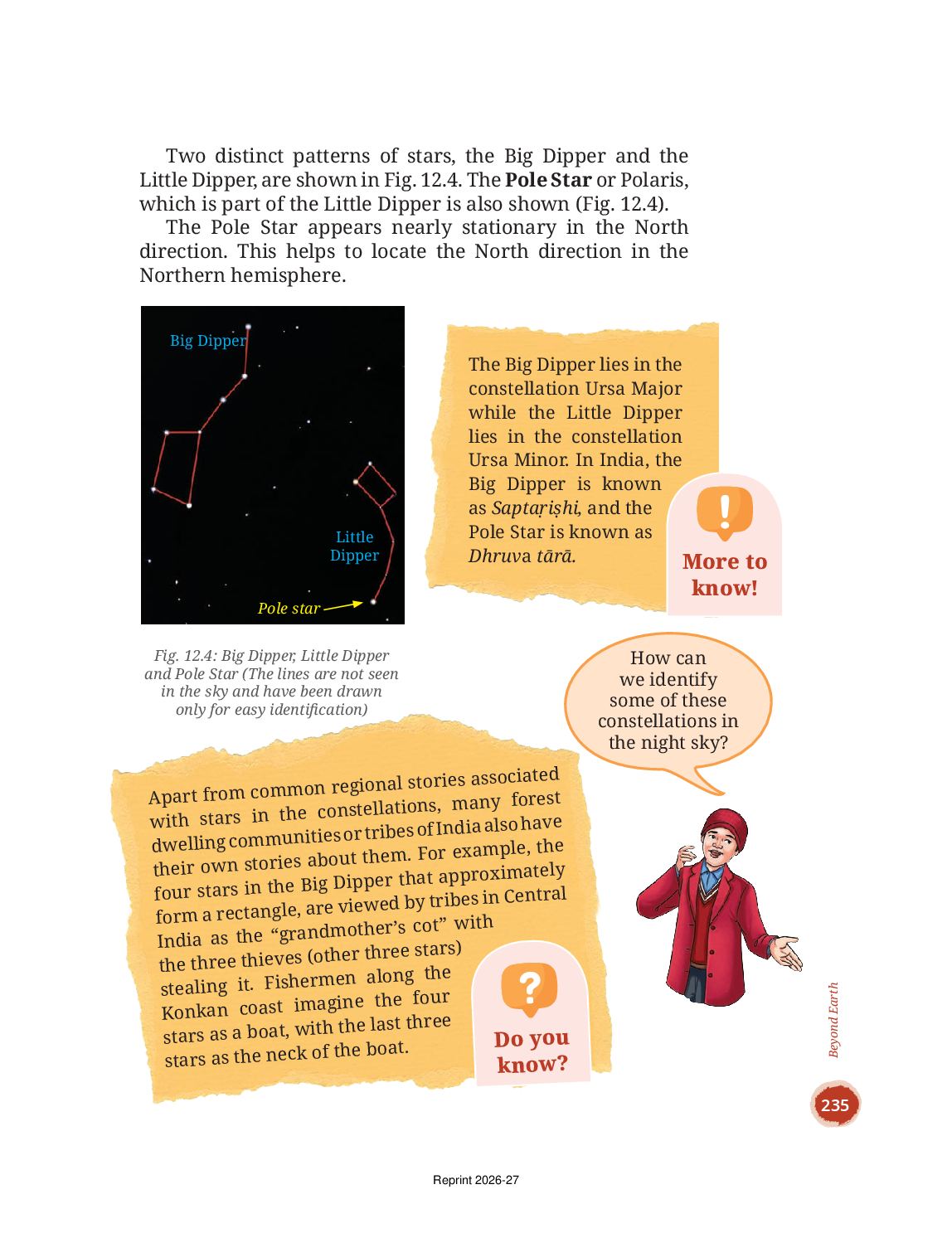
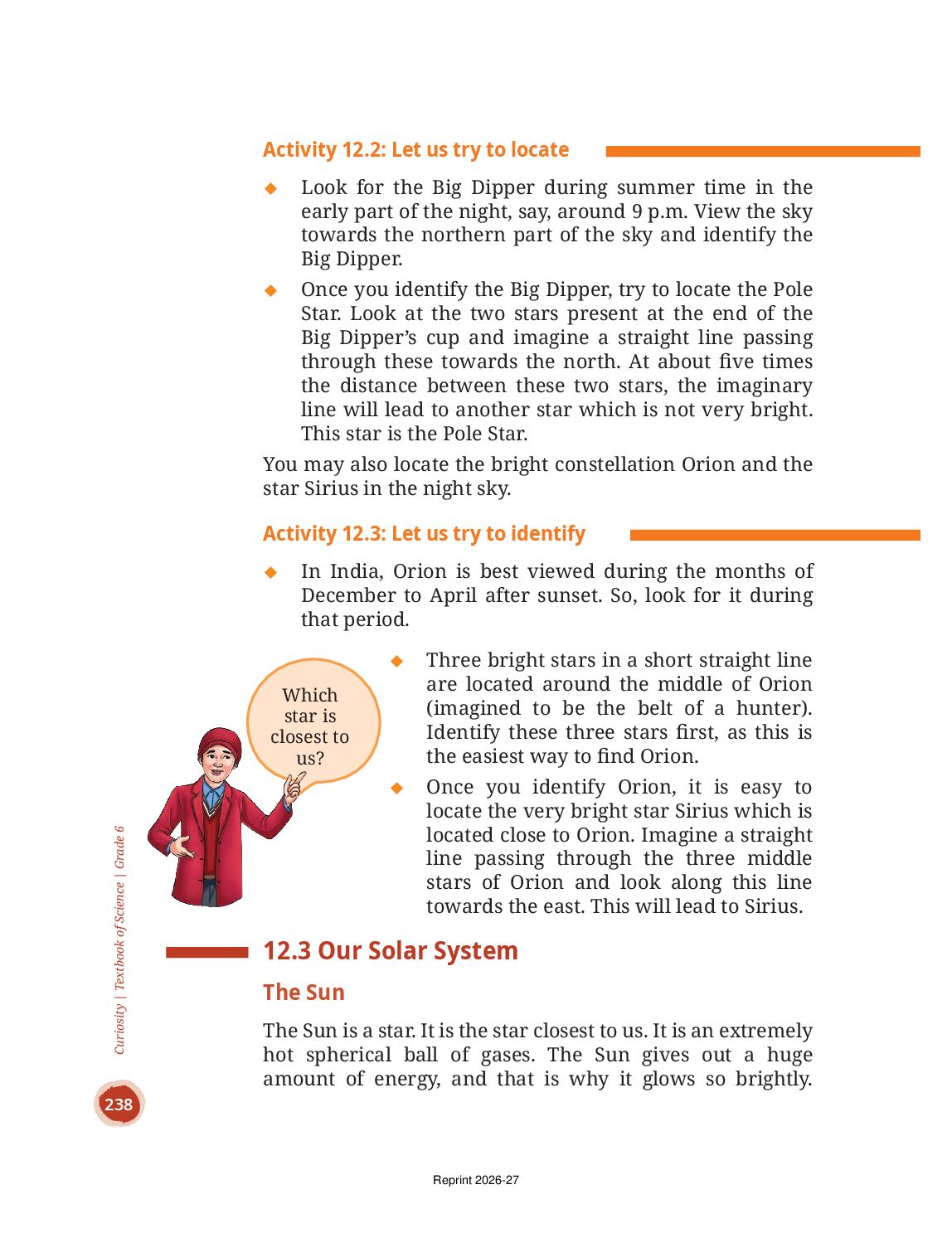
- The Pole Star (Dhruva tārā, Polaris) appears nearly stationary in the north, so it fixes the north direction in the Northern hemisphere. Find it from the two pointer stars at the end of the Big Dipper (Saptaṛiṣhi) cup — about five times the gap between them.
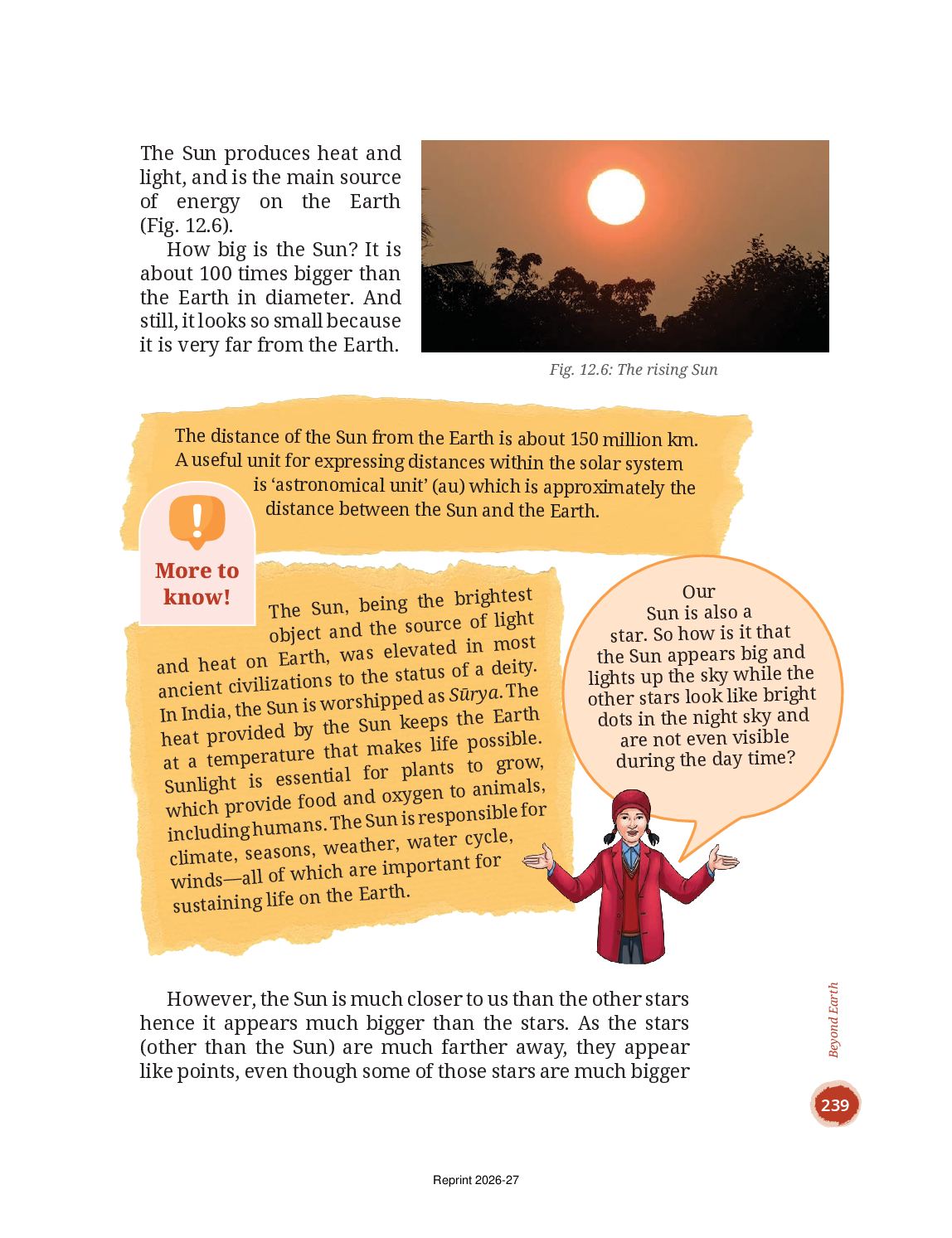
- The Sun is a star — the one nearest to us. It is about 100 times bigger than the Earth in diameter and about 150 million km away (that distance is called 1 astronomical unit, au). It is the main source of energy on Earth.
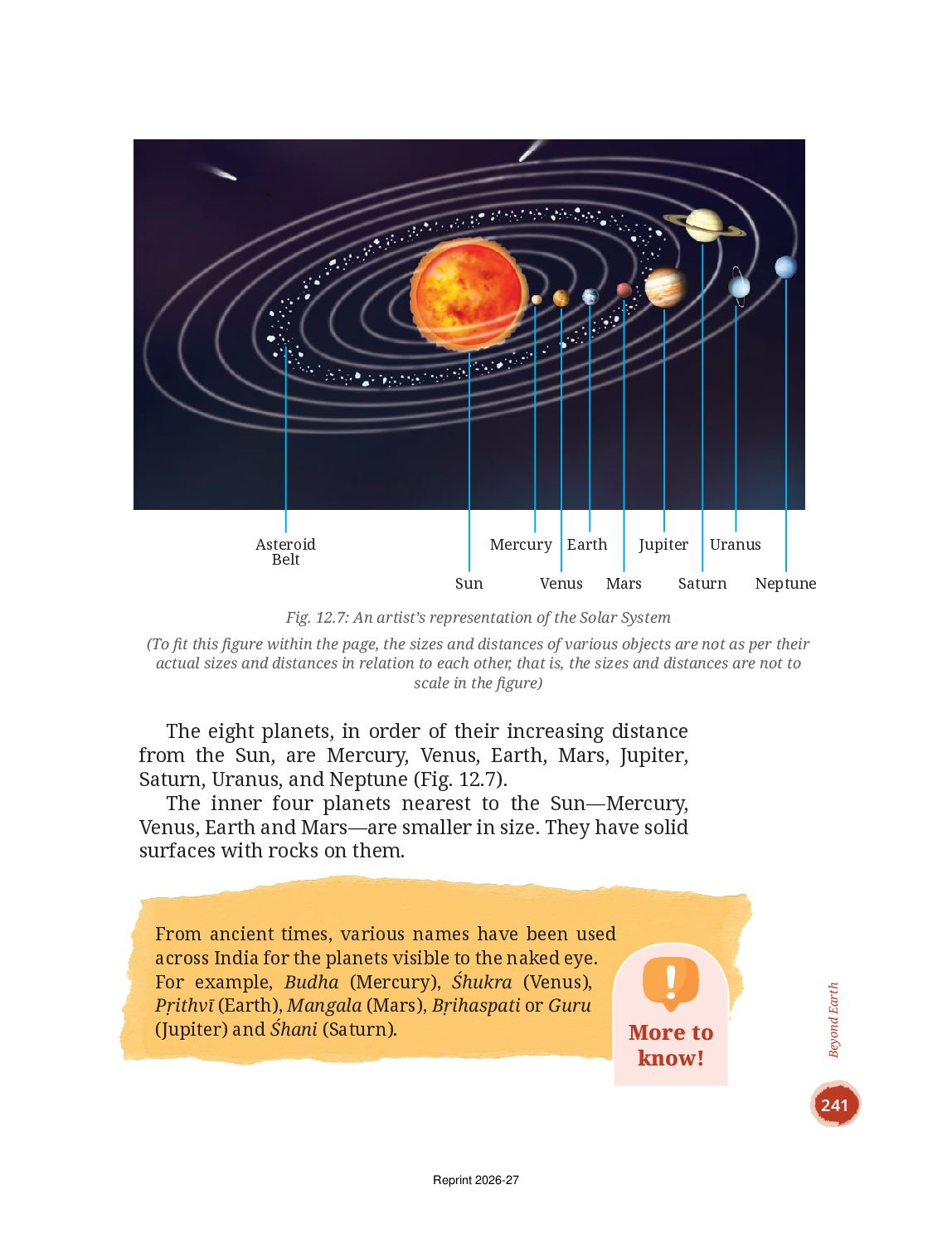
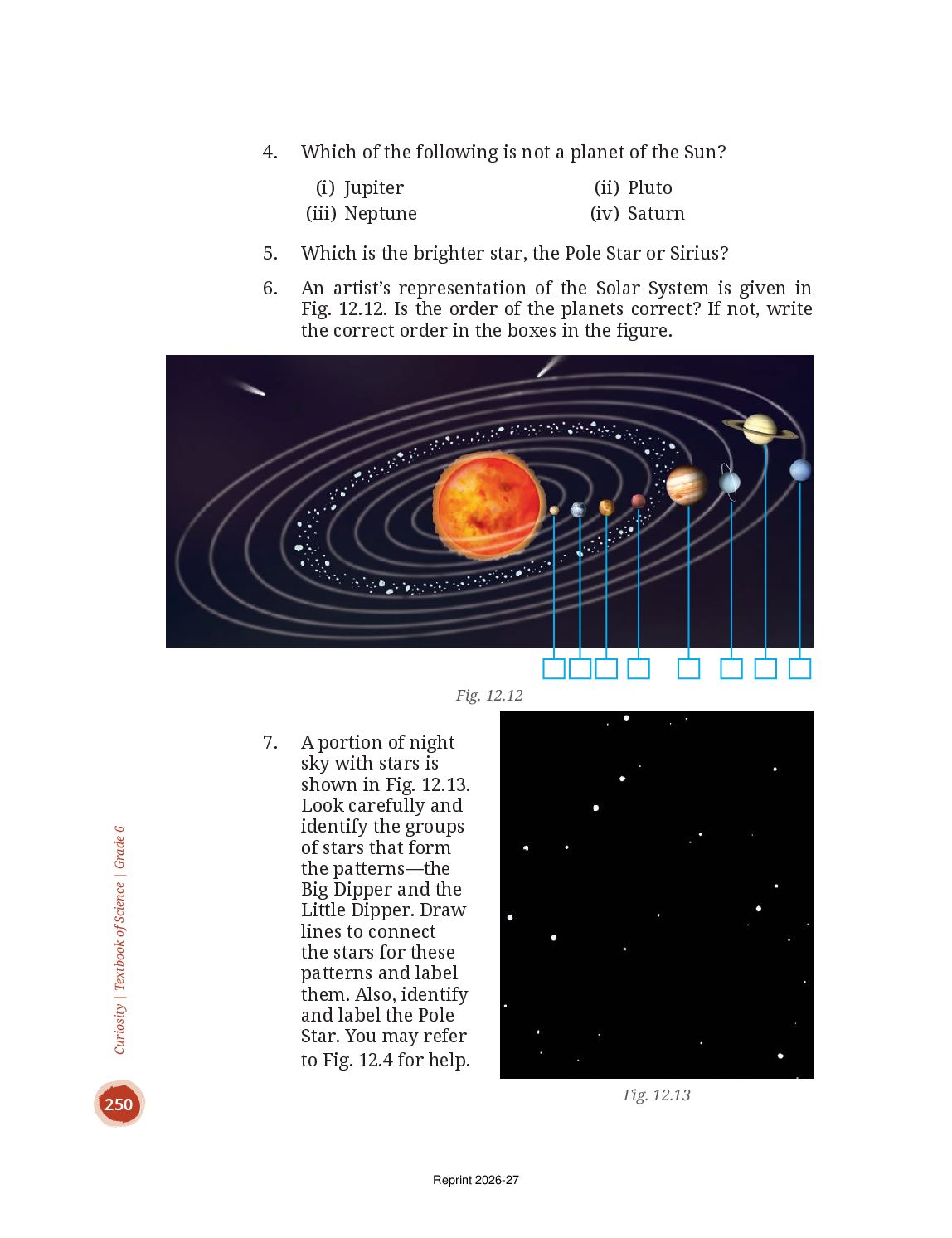
- A planet is a large, nearly spherical object that revolves around the Sun. The eight planets in order of increasing distance are Mercury, Venus, Earth, Mars, Jupiter, Saturn, Uranus, Neptune. The inner four are small and rocky; the outer four are giant, made mostly of gas and ice, and have rings. Pluto is now a dwarf planet (IAU, 2006).
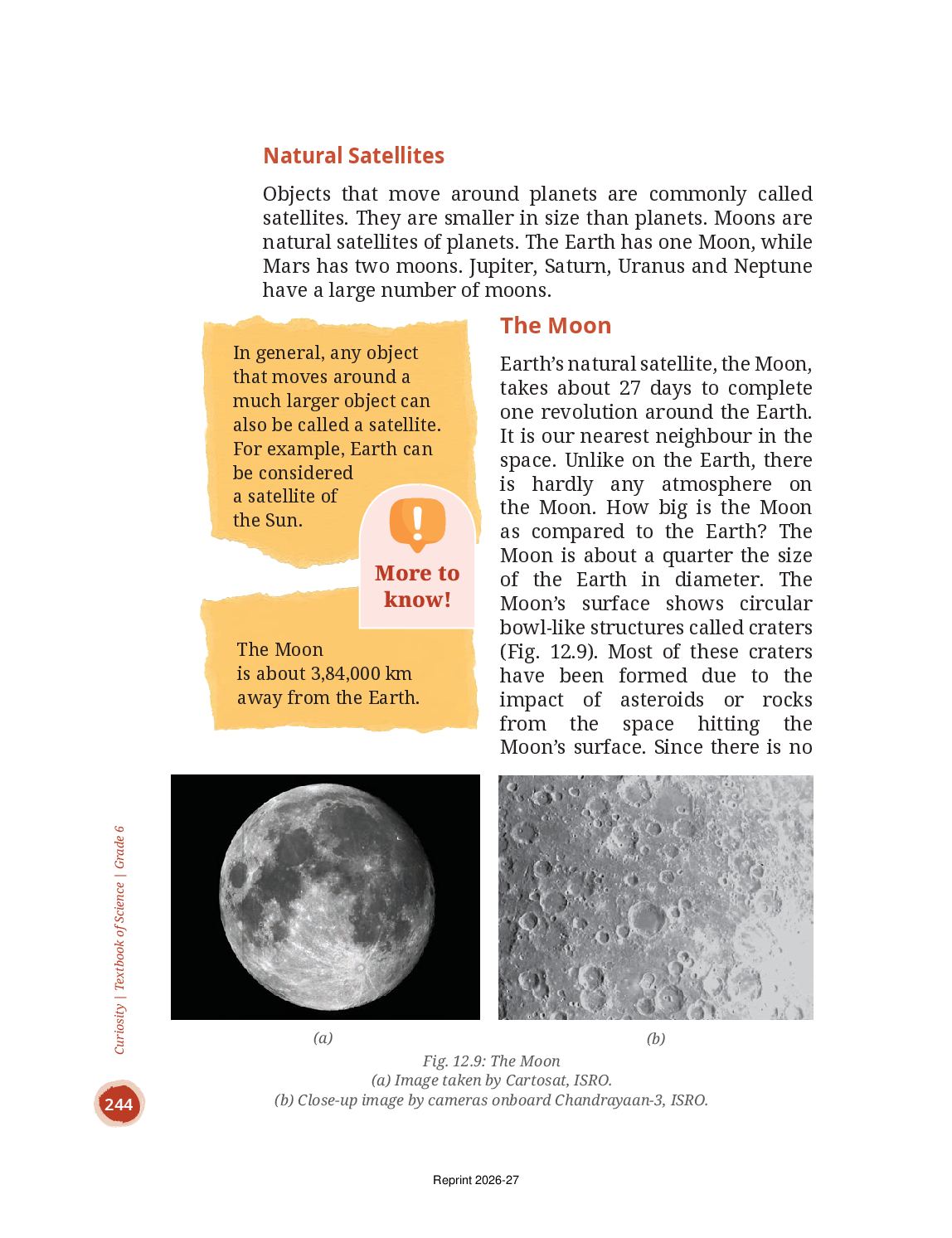
- Objects that move around planets are satellites. The Moon is Earth’s natural satellite — about a quarter of Earth’s diameter, 3,84,000 km away, one revolution in about 27 days, with craters and almost no atmosphere. India’s Chandrayaan-3 soft-landed near the Moon’s south pole on 23 August 2023, now National Space Day.
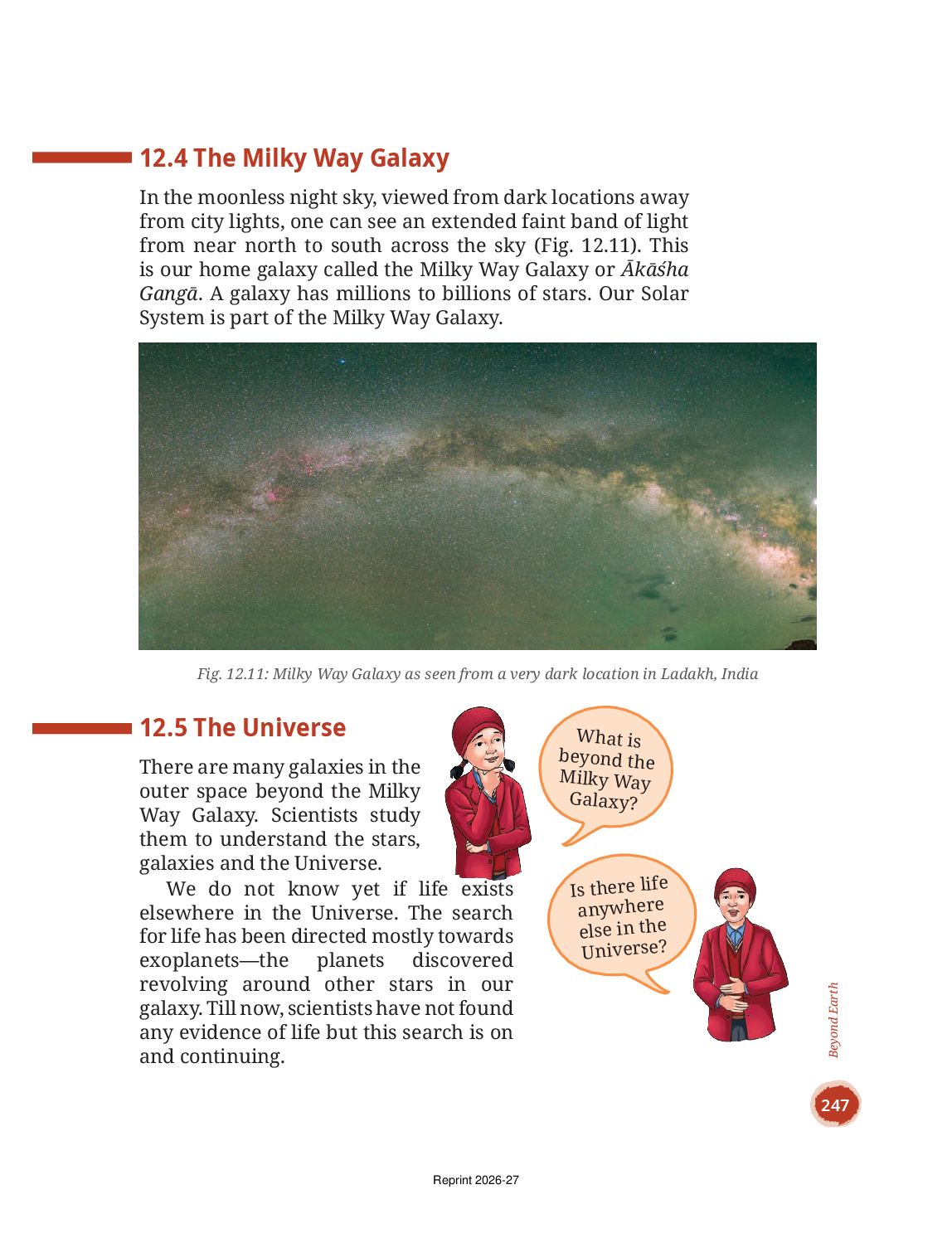
- The Sun + eight planets + their moons + asteroids + comets form the Solar System, which is a tiny part of the Milky Way Galaxy (Ākāśha Gangā). Beyond it lie countless other galaxies — together, the Universe.
Quick revision – Beyond Earth
| Term | What it means | Example from the chapter | Page |
|---|---|---|---|
| Star | A huge, extremely hot ball of gases that shines with its own light | The Sun, Sirius, Proxima Centauri | 233, 238 |
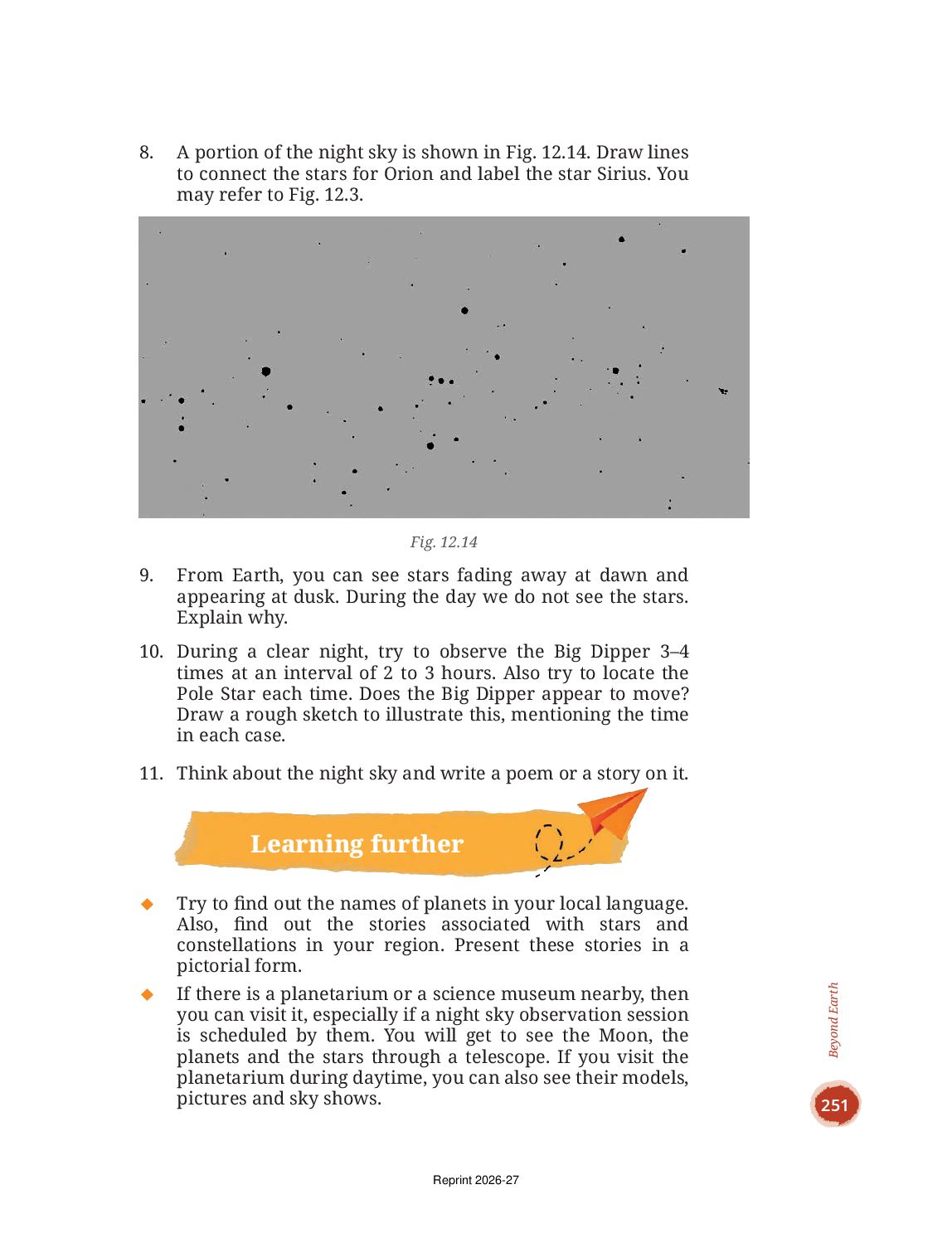
| Constellation | A defined region of the sky, usually containing a familiar pattern of stars | Orion, Taurus, Canis Major, Ursa Major | 233 |
| Pole Star / Dhruva tārā | The star that appears nearly fixed in the north; part of the Little Dipper | Located at about 5× the gap between the two pointer stars | 235 |
| Saptaṛiṣhi / Big Dipper | The seven-star pattern lying in the constellation Ursa Major | Seen as a grandmother’s cot, or a boat, in Indian folk stories | 235 |
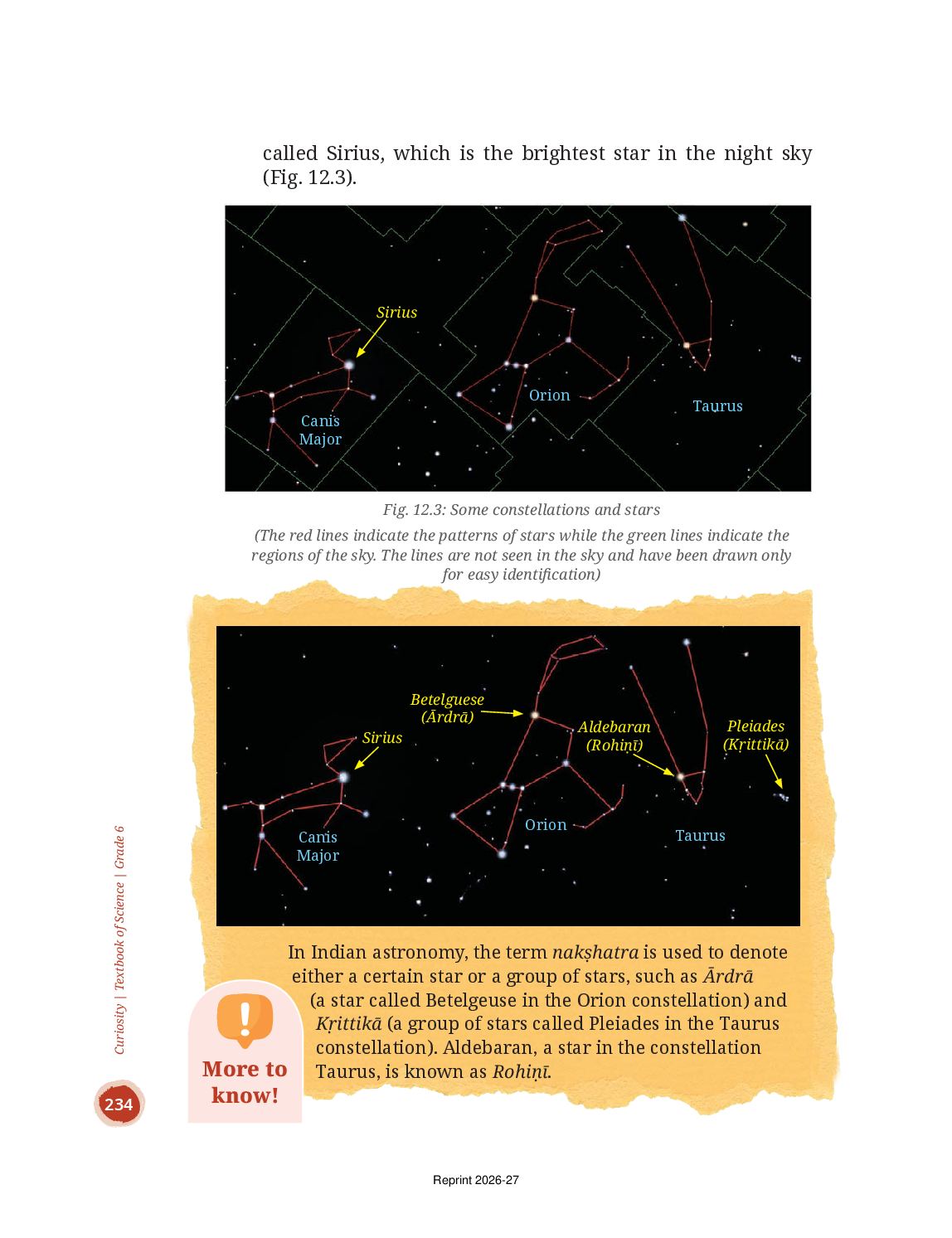
| Nakṣhatra | Indian term for a star or a group of stars | Ārdrā = Betelgeuse, Kṛittikā = Pleiades, Rohiṇī = Aldebaran | 234 |
| Light pollution | Excessive artificial light at night | Only a few stars are seen from a big city | 236 |
| Revolution | The movement of one object around another | Earth around the Sun: about 1 year; Moon around Earth: about 27 days | 240, 244 |
| Rotation | The spinning of a body about its own axis | Earth takes about 24 hours for one rotation — that is a day | 240 |
| Planet | A large, nearly spherical object that revolves around the Sun | Mercury, Venus, Earth, Mars, Jupiter, Saturn, Uranus, Neptune | 240–241 |
| Satellite | An object that moves around a planet | The Moon; Mars has two moons; Jupiter has many | 244 |
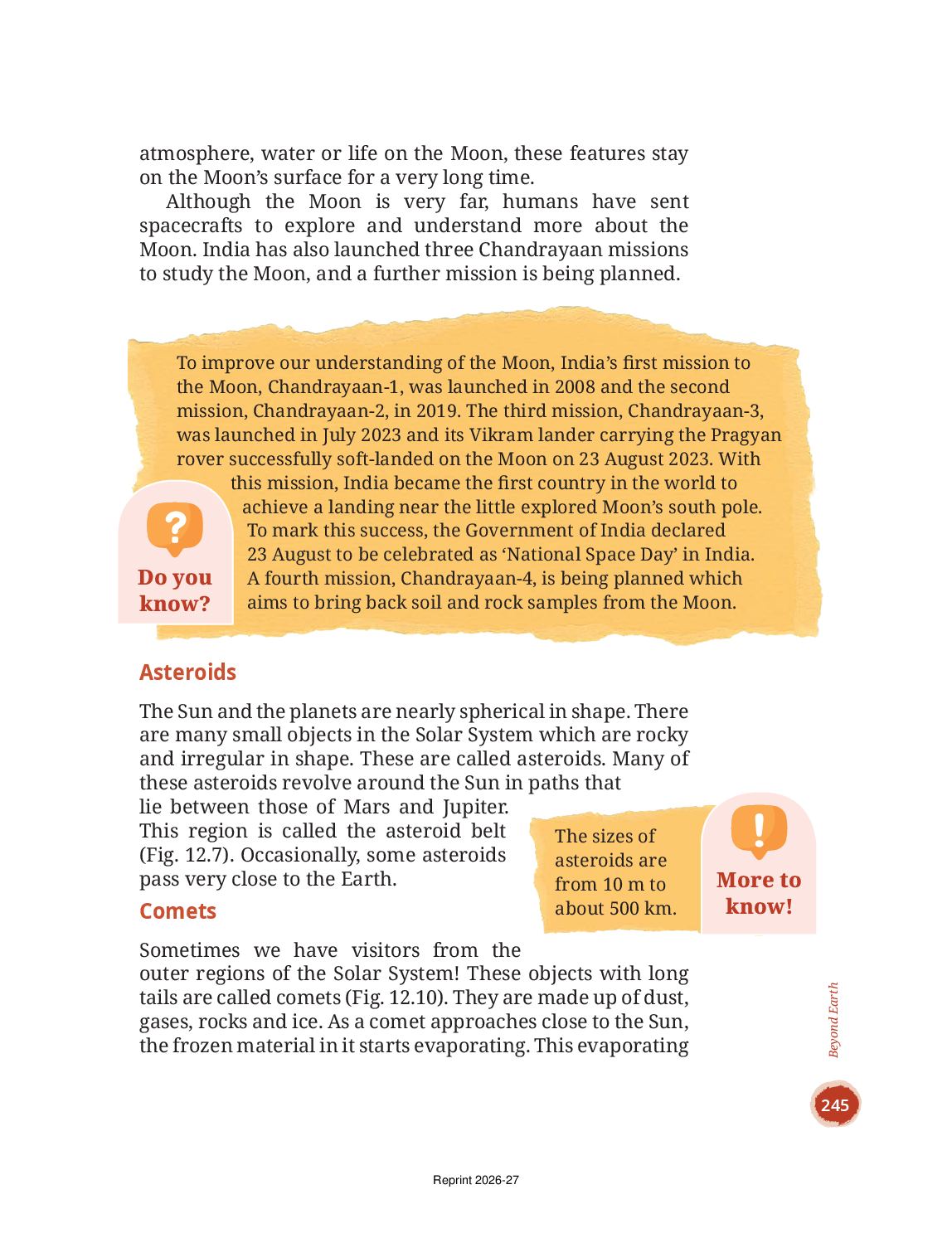
| Asteroid | A small, rocky, irregularly shaped object; most lie between Mars and Jupiter | The asteroid belt; sizes from 10 m to about 500 km | 245 |
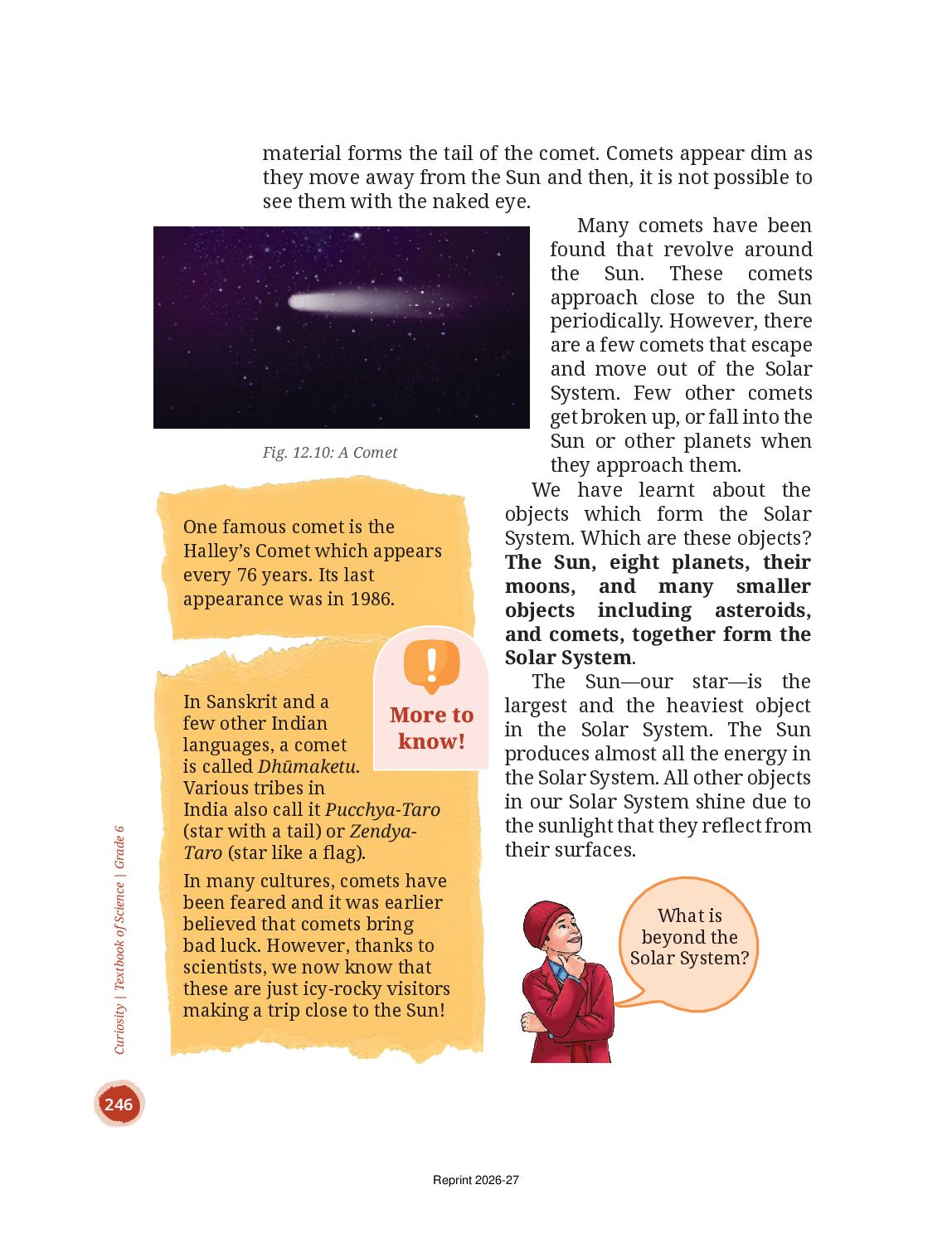
| Comet | A body of dust, gas, rock and ice that grows a long tail near the Sun | Halley’s Comet, seen every 76 years; called Dhūmaketu | 245–246 |
Old NCERT vs New – Class 6 Science
This chapter is from Curiosity, the new NCERT Class 6 Science book (NCF-SE 2023, used from 2024-25). It replaced the old book “Science”, so chapter numbers and names differ from older PDFs.
Solutions and All Chapters
Answers to the exercises and the full chapter list of Curiosity:
Beyond Earth – Overview
| Class | Class 6 |
| Subject | Science |
| Book | Curiosity – new NCERT book |
| Chapter | 12 of 12 – Beyond Earth |
| Book pages | 231 – 252 |
| Edition | NCERT Reprint 2026-27 |
| Session | 2026-27 |
| Free – read online or download |
Class 6 Science Chapter 12 – FAQs
Where can I download Beyond Earth Class 6 PDF?
From the download table on this page – the chapter PDF is free, and the full book is linked too.
What is Class 6 Science Chapter 12 about?
Stars shine with their own light. Groups of stars that appear to make a pattern were called constellations. Today a constellation means a defined region of the sky — the International Astronomical Union has divided the whole sky into 88 such regions.
Is Beyond Earth from the new NCERT Class 6 Science book?
Yes. It is chapter 12 of curiosity, the new NCERT Class 6 Science book for 2026-27.
Is this the latest NCERT edition for 2026-27?
Yes – the PDF is NCERT’s latest edition for the 2026-27 session.
Where are the NCERT Solutions for Class 6 Science Chapter 12?
Open the NCERT Solutions link above for answers to the exercise questions.