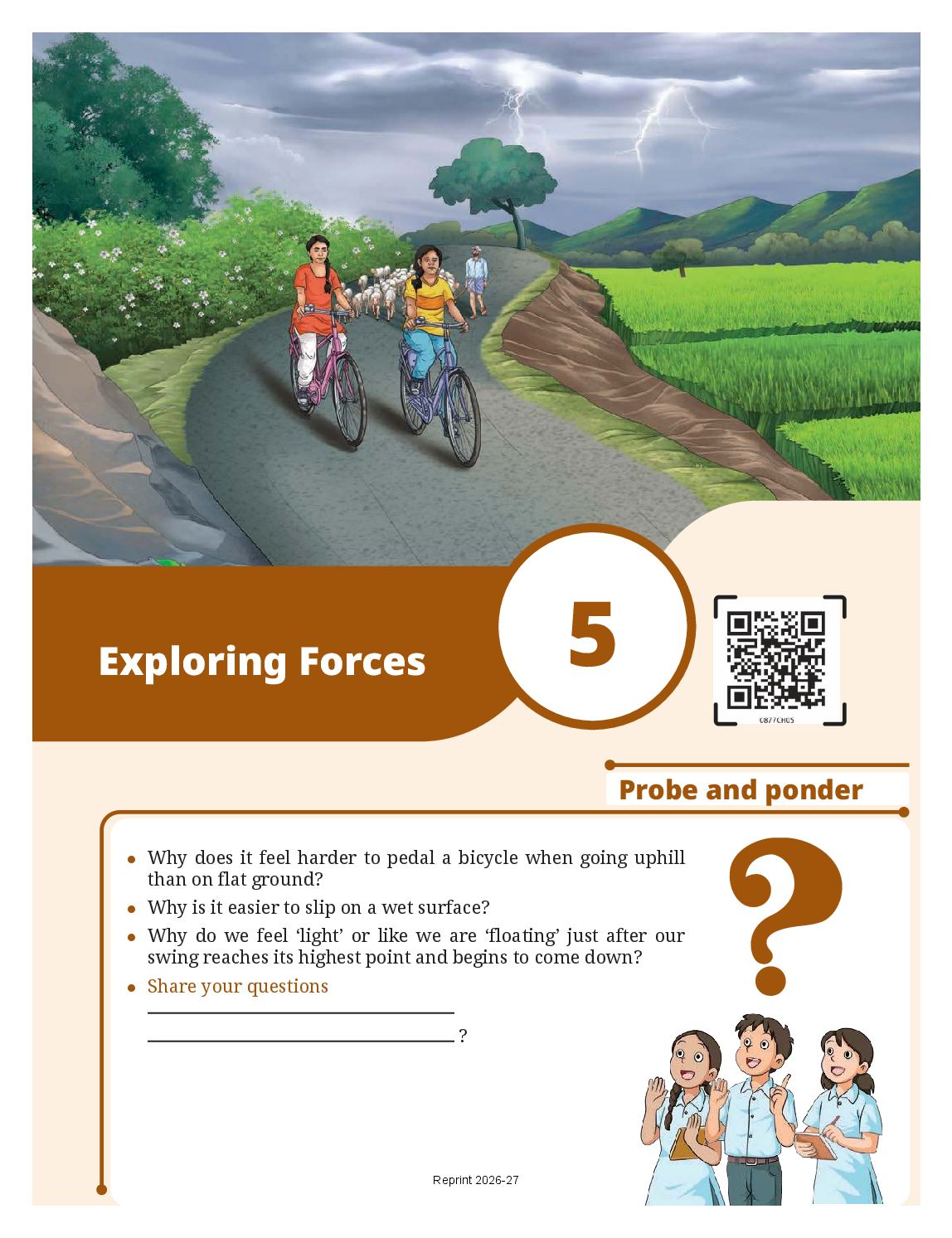
Download Exploring Forces – NCERT Class 8 Science Chapter 5 PDF from the new NCERT Class 8 Science book Curiosity (2026-27). Read the chapter online or download the free PDF. A force is a push or a pull on an object that comes out of the object’s interaction with another object. At least two objects must interact for a force to come into play. The SI unit of force is the newton, symbol N.
Exploring Forces PDF – Chapter 5 of Curiosity
Read the chapter online or download the PDF.
| Chapter | Download | |
|---|---|---|
| Chapter 5 PDF | Exploring Forces | View PDF |
| Full book | NCERT Class 8 Science – Curiosity | View Book |
Read Online
What Is in Exploring Forces? (Class 8 Science Chapter 5)
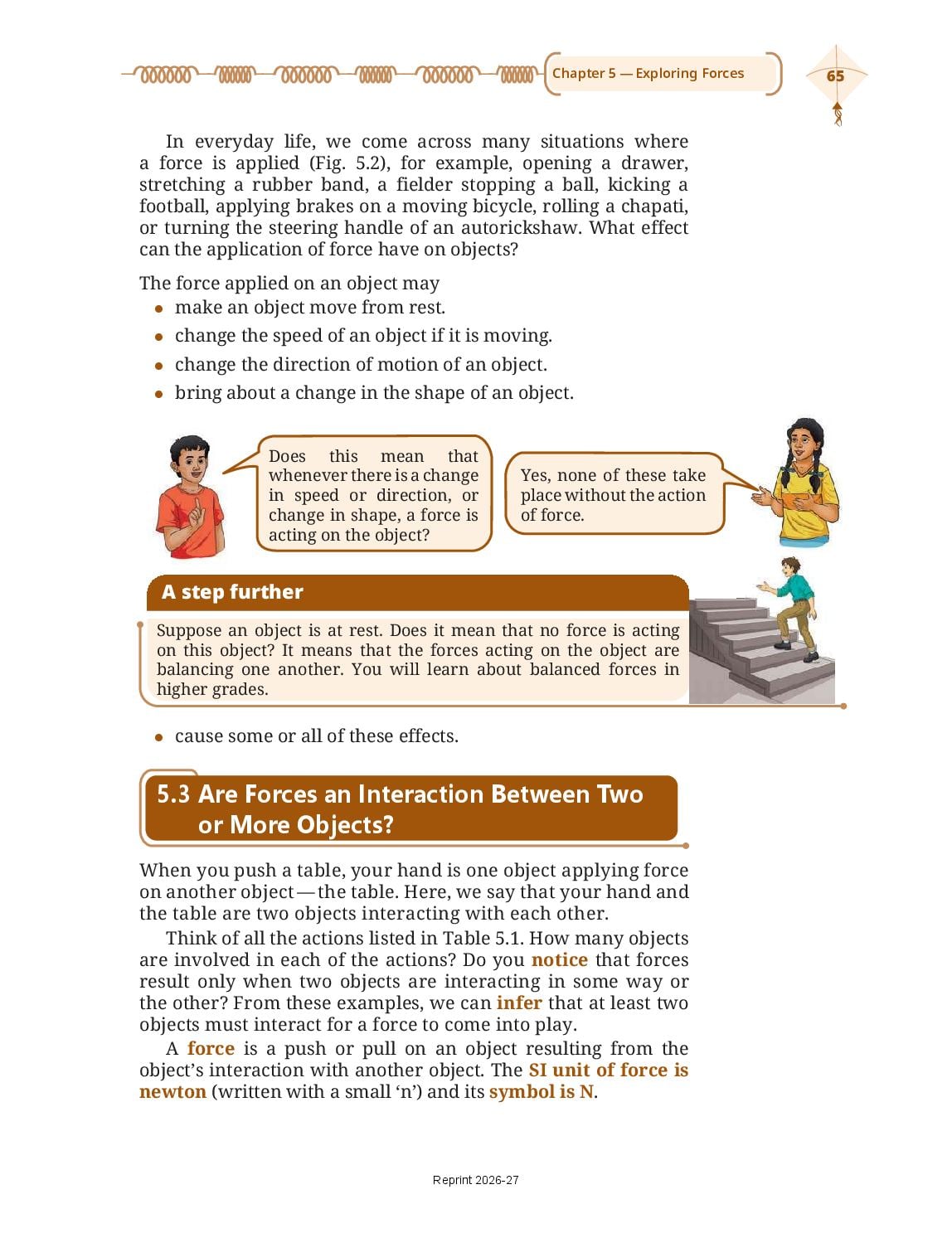
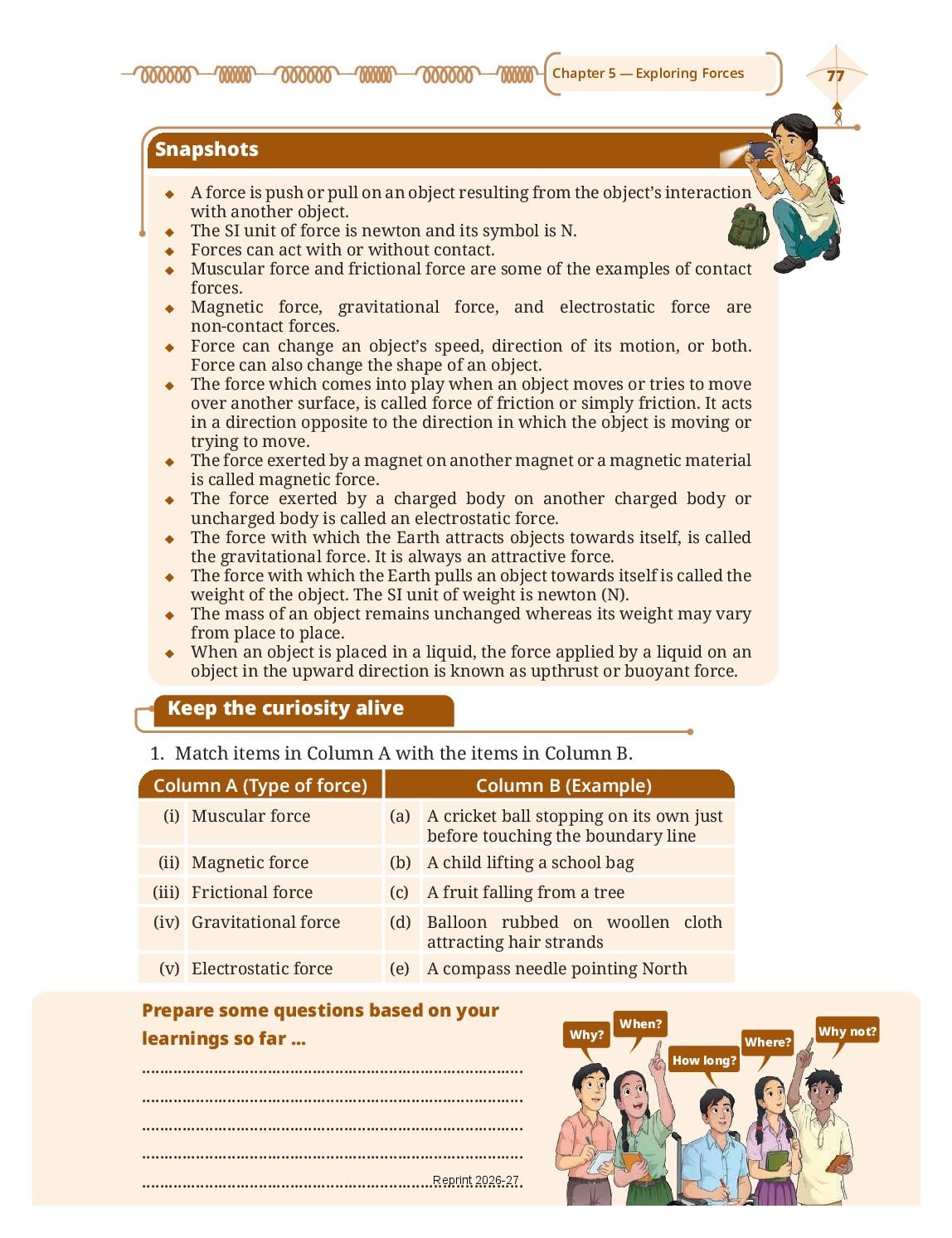
- A force is a push or a pull on an object that comes out of the object’s interaction with another object. At least two objects must interact for a force to come into play. The SI unit of force is the newton, symbol N.
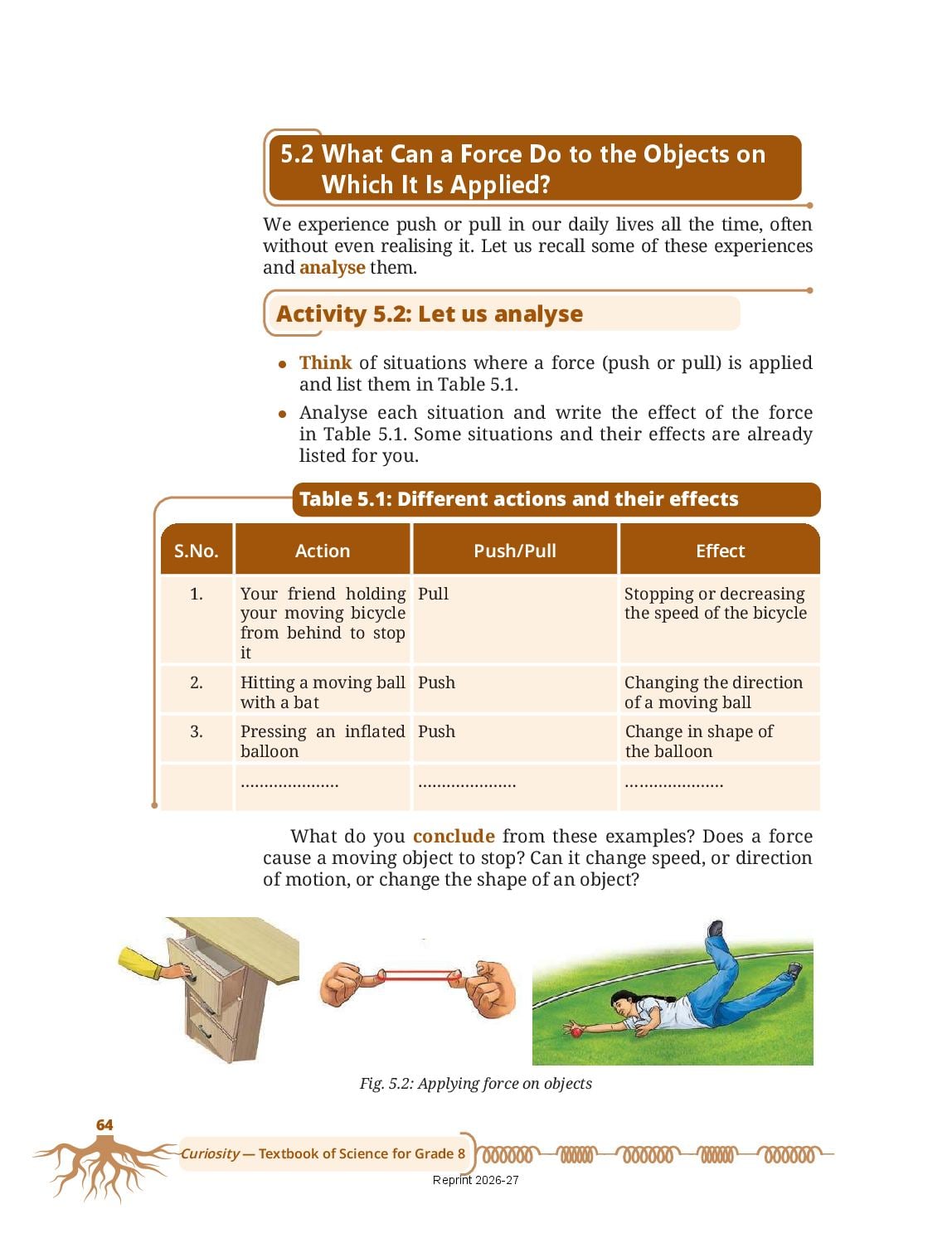
- A force can make a resting object move, change the speed of a moving object, change its direction of motion, change its shape, or produce several of these effects together. None of these changes happens without a force.
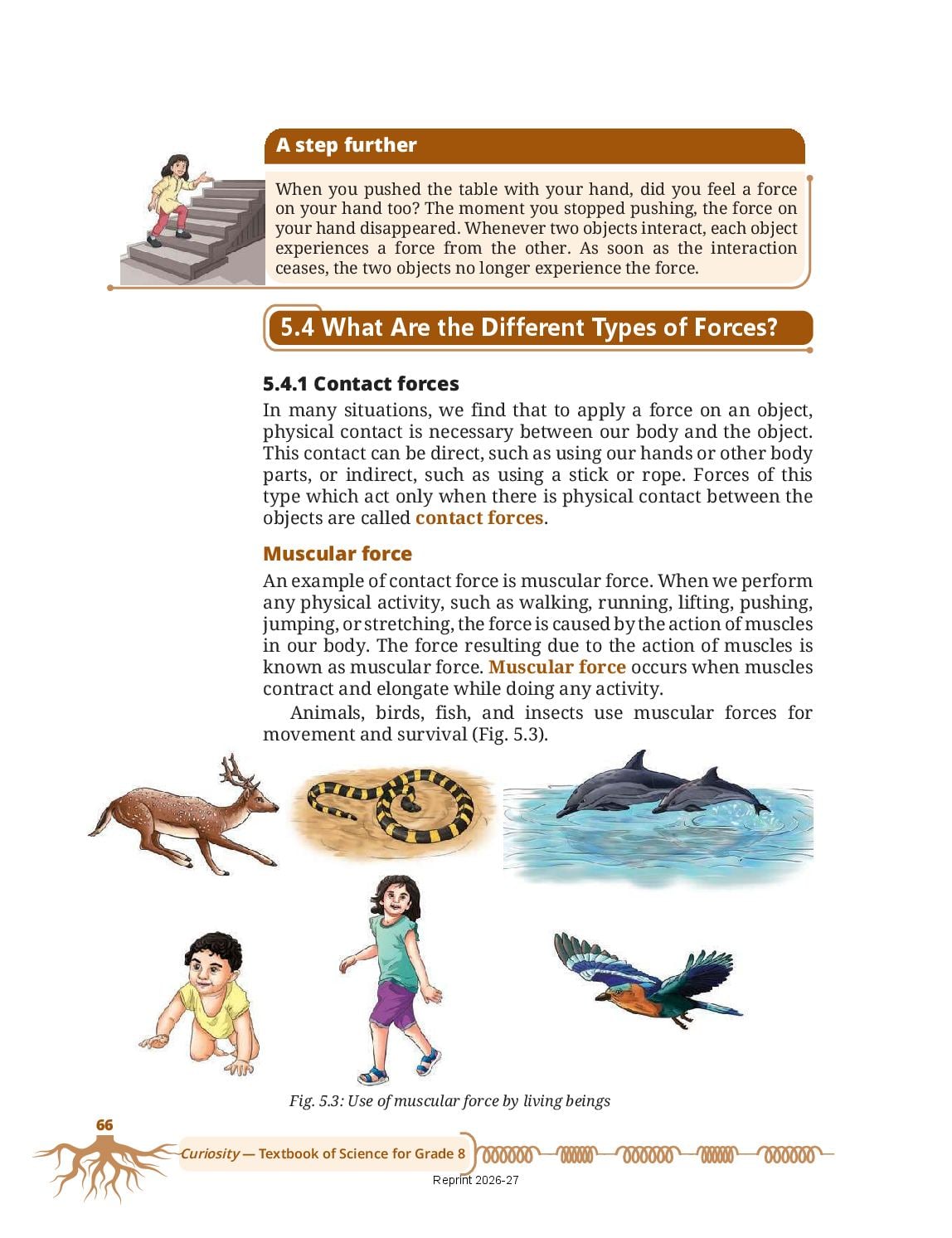
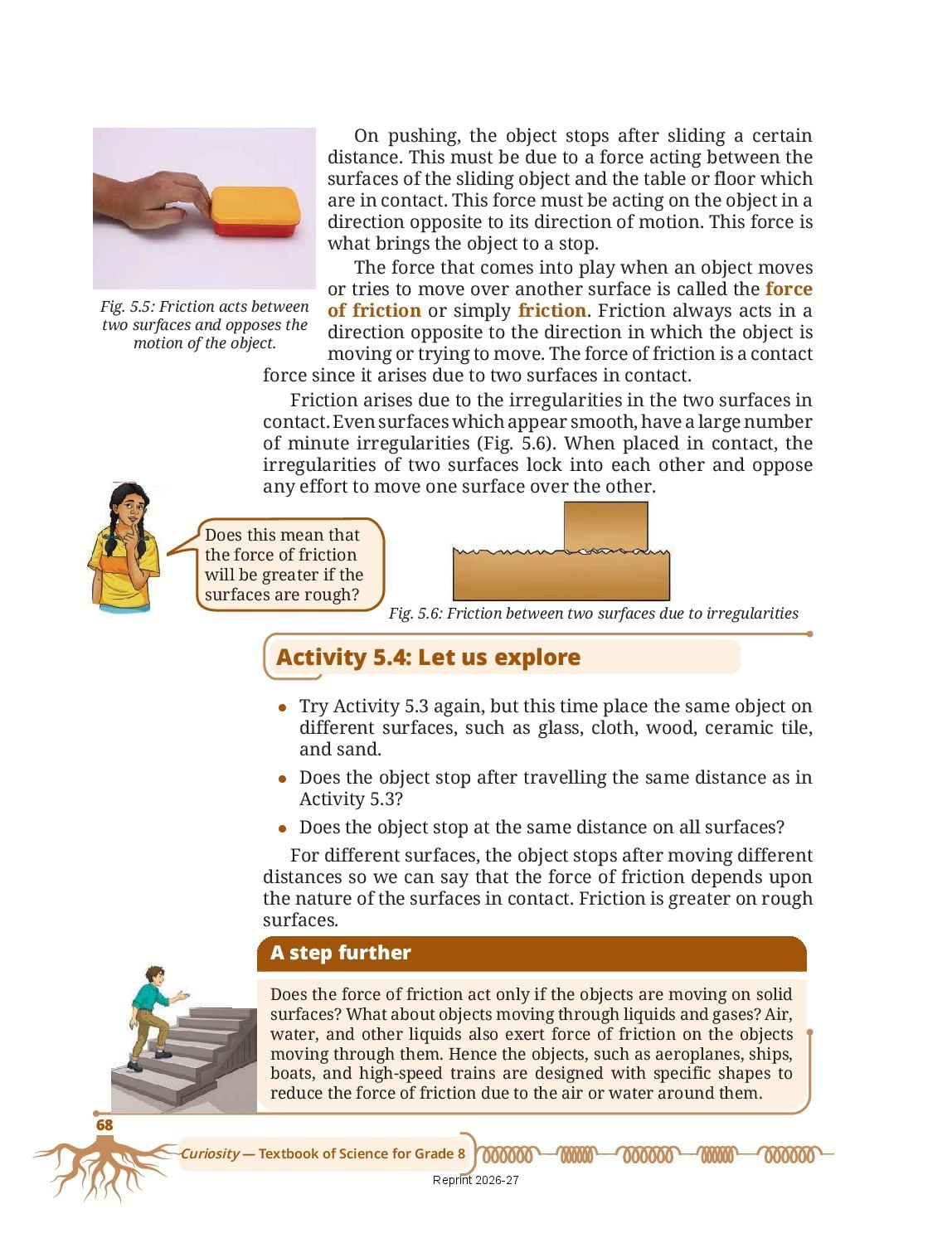
- Contact forces act only when the surfaces touch — muscular force and the force of friction. Friction arises from the irregularities of the two surfaces locking into each other, always acts opposite to the motion (or attempted motion), and is greater on rough surfaces.
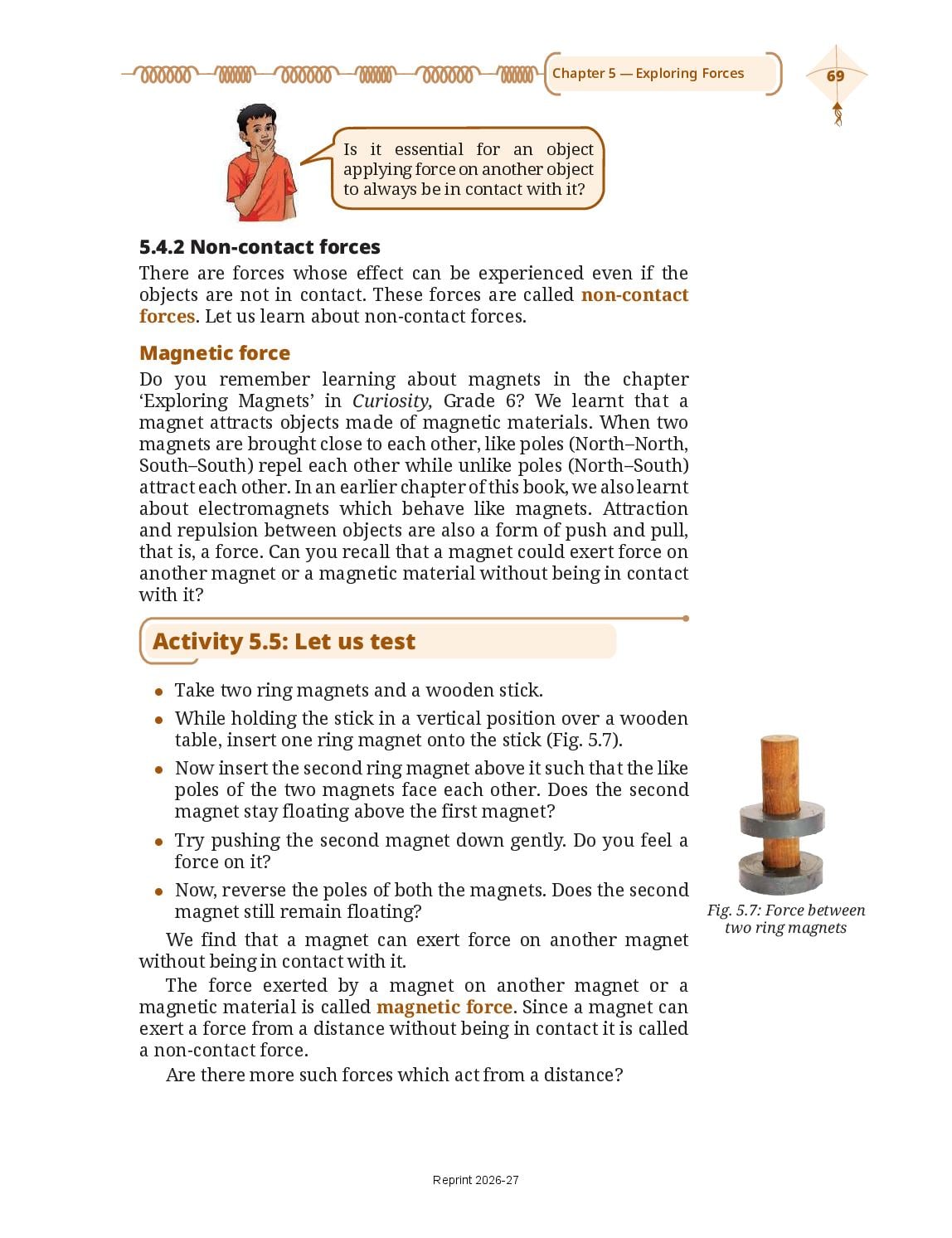
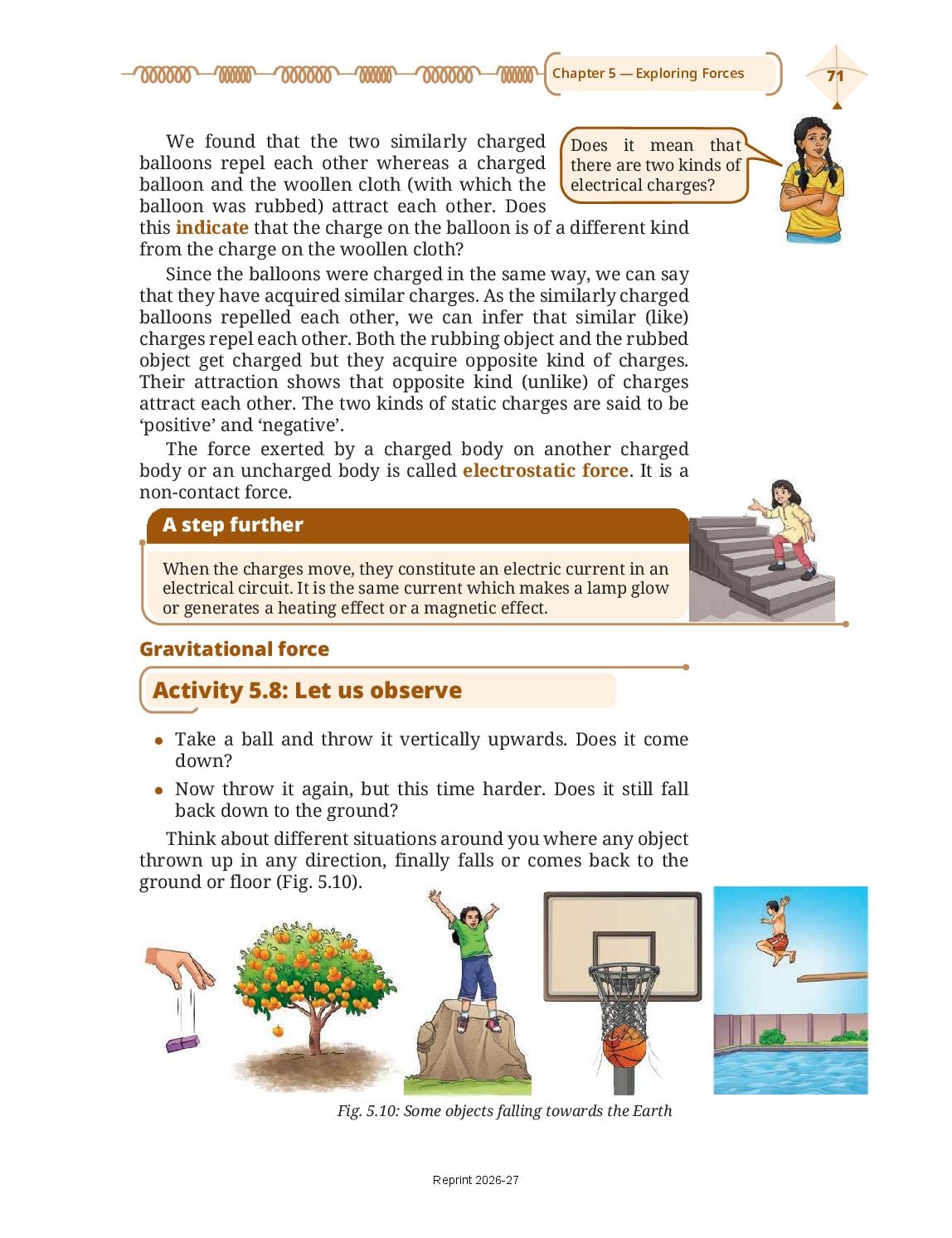
- Non-contact forces act across a gap — magnetic force, electrostatic force and gravitational force. Like poles and like charges repel, unlike ones attract; gravitational force is always attractive.
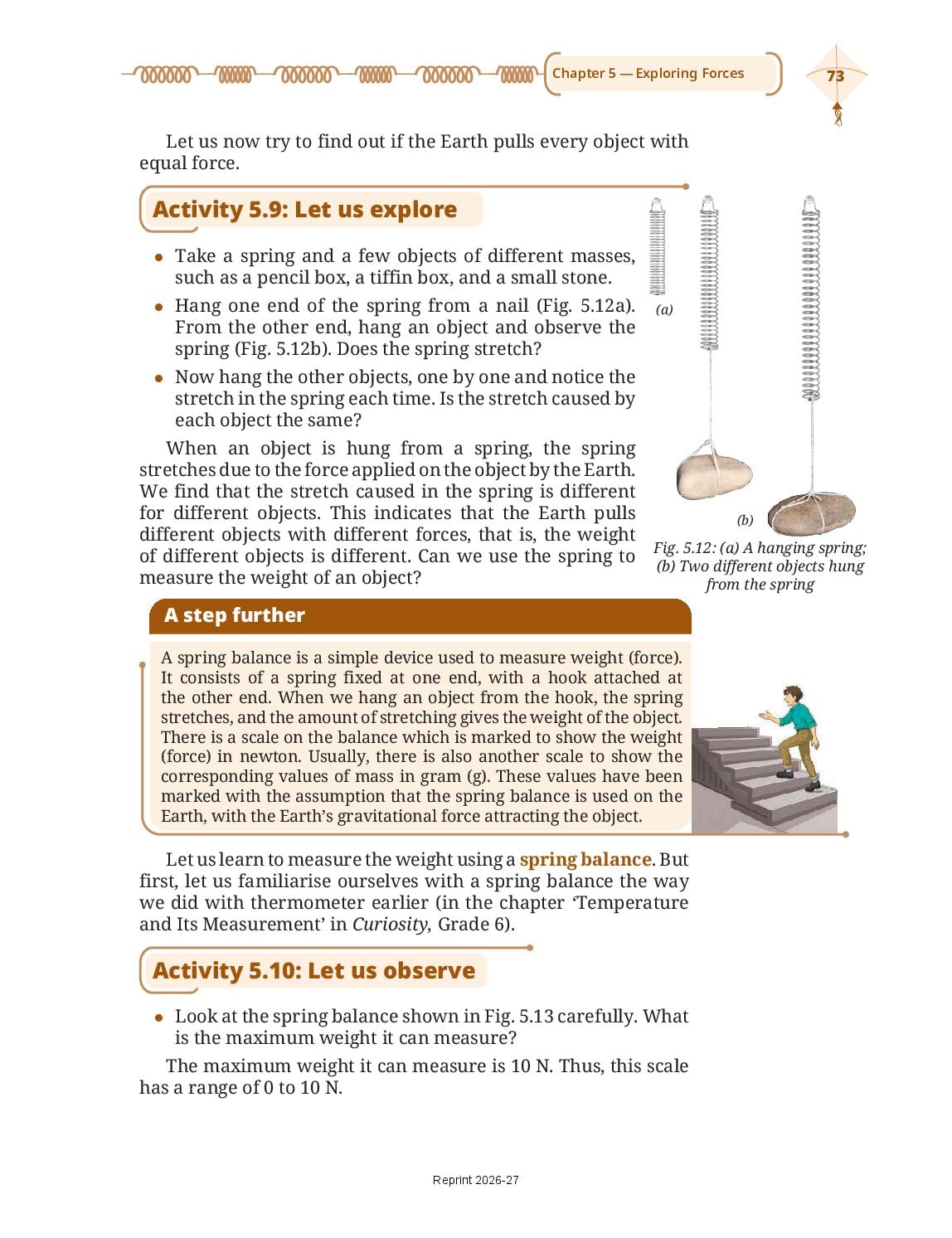
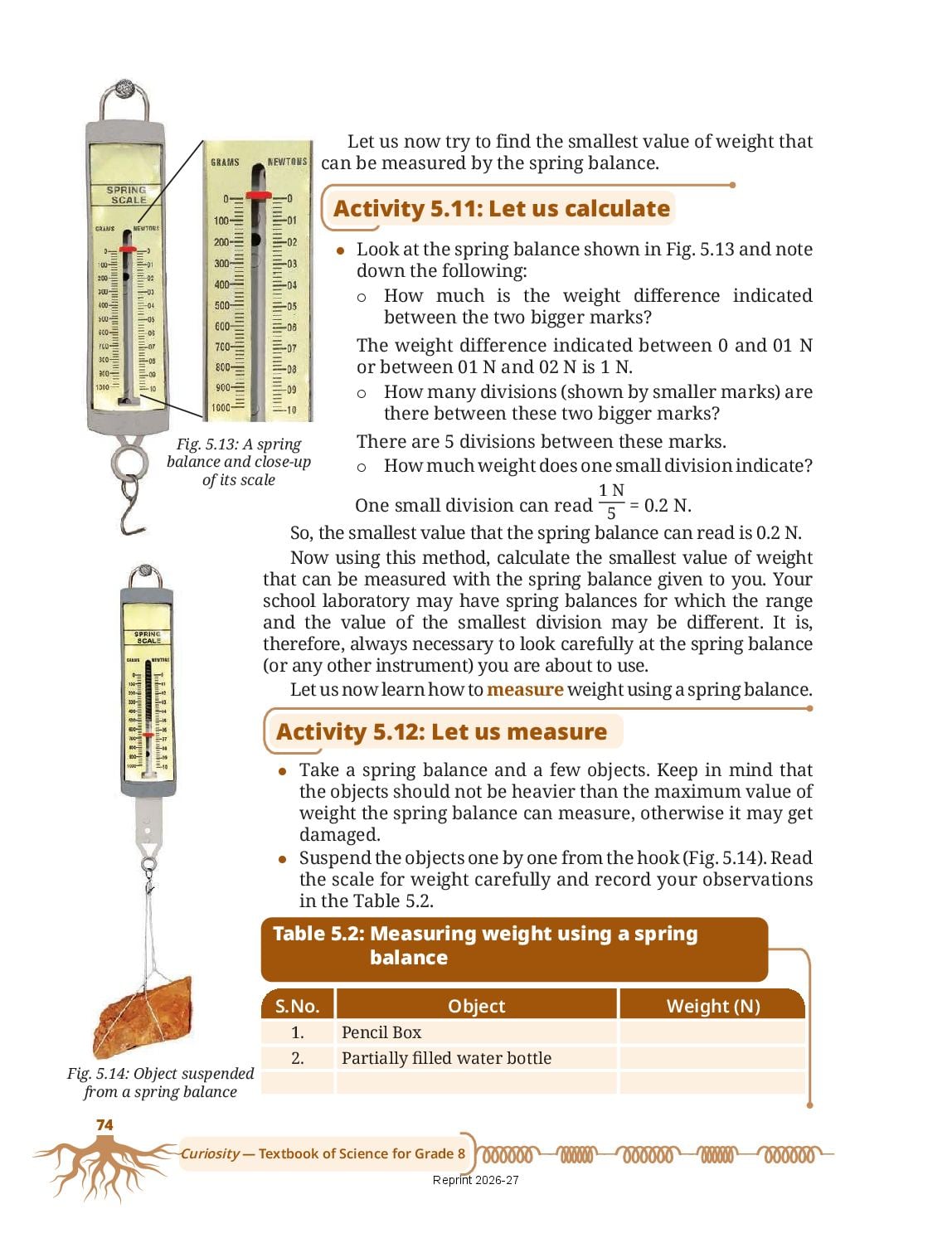
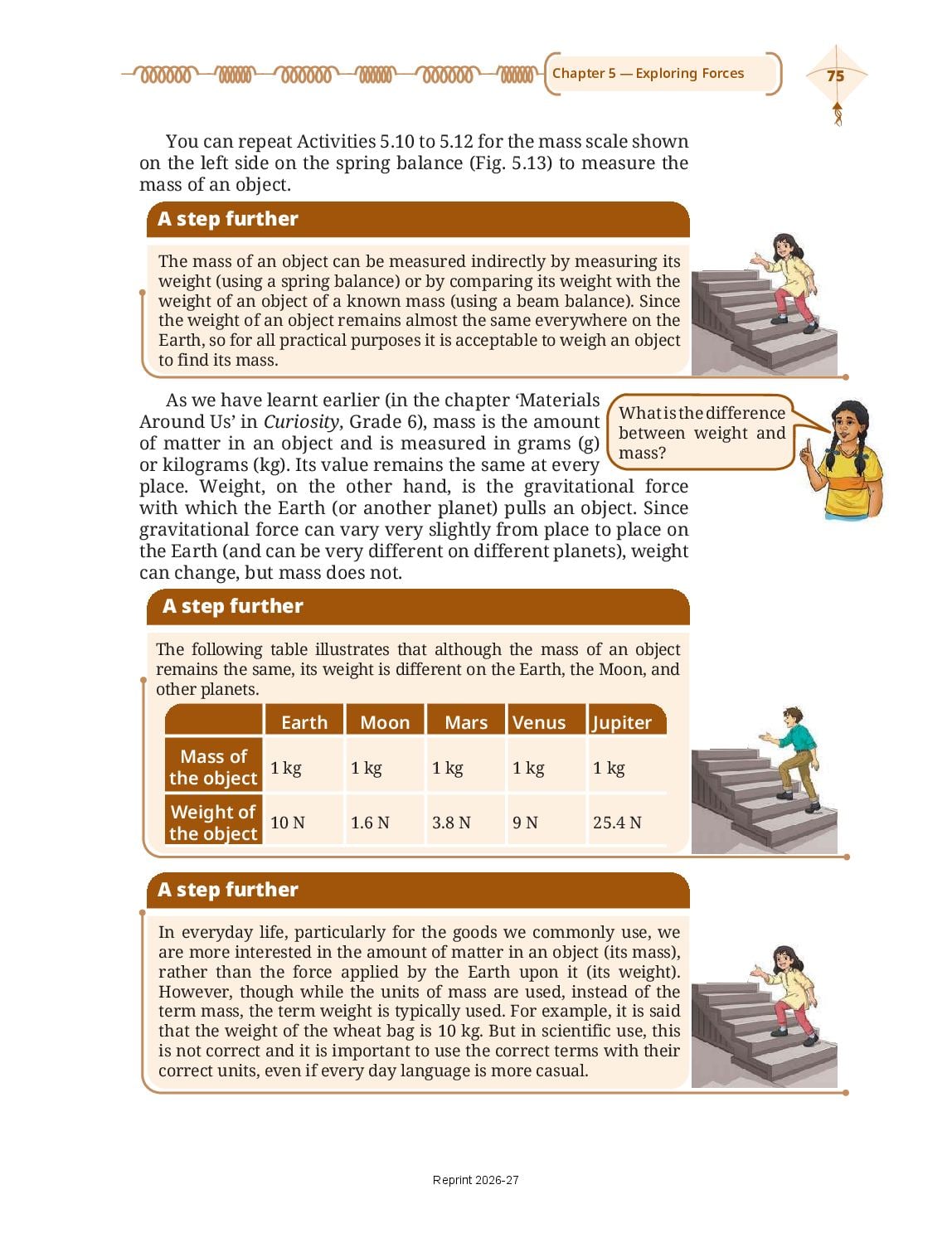
- The weight of an object is the gravitational force with which the Earth pulls it. It is a force, so it is measured in newton — with a spring balance. Mass is the amount of matter in the object, measured in g or kg. Mass never changes; weight can change from place to place.
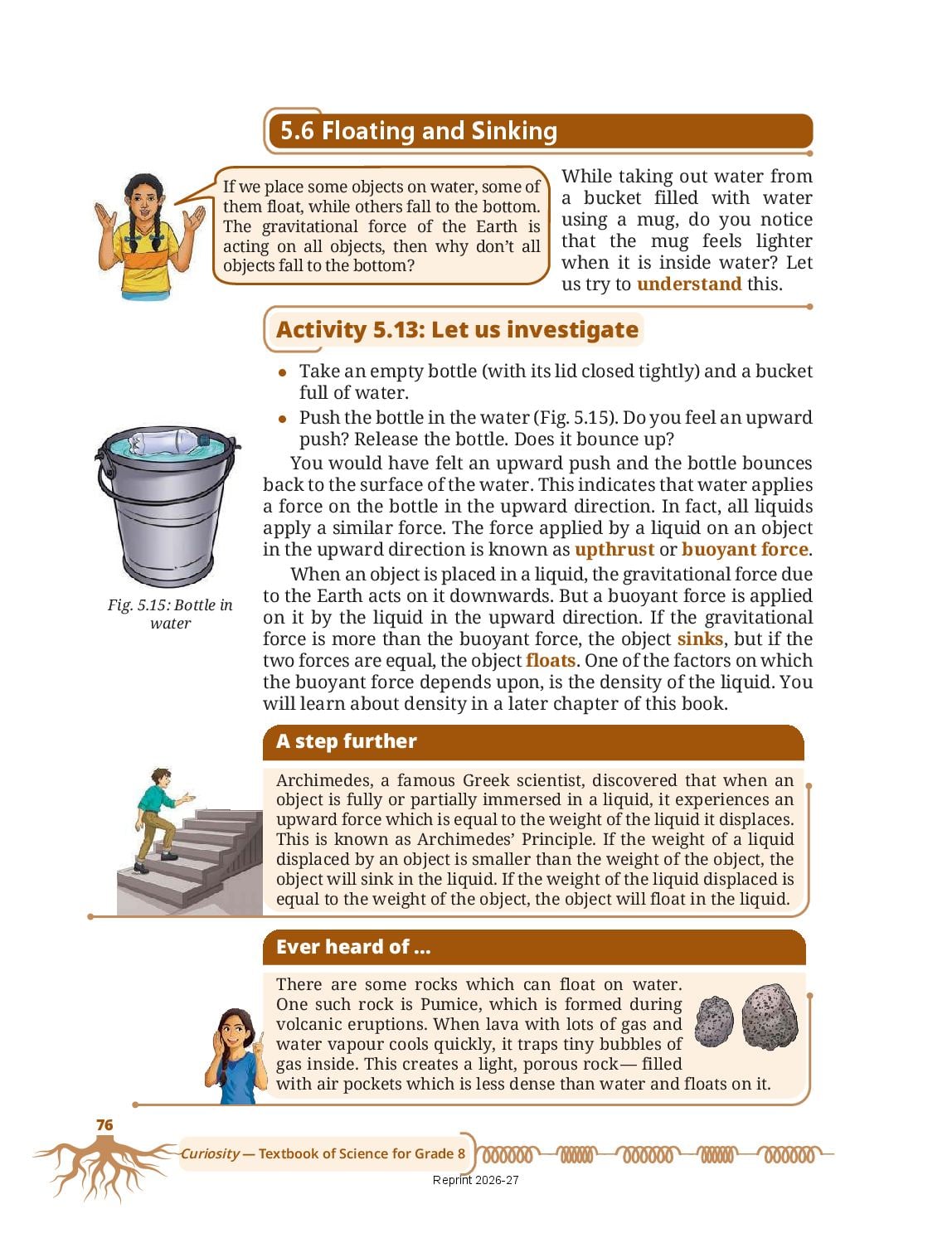
- A liquid pushes up on whatever is placed in it — the upthrust or buoyant force. If the gravitational force on the object is greater than the buoyant force the object sinks; if the two are equal it floats.
Quick revision – Exploring Forces
| Term | What it means | Where it comes in the chapter | Example from the book |
|---|---|---|---|
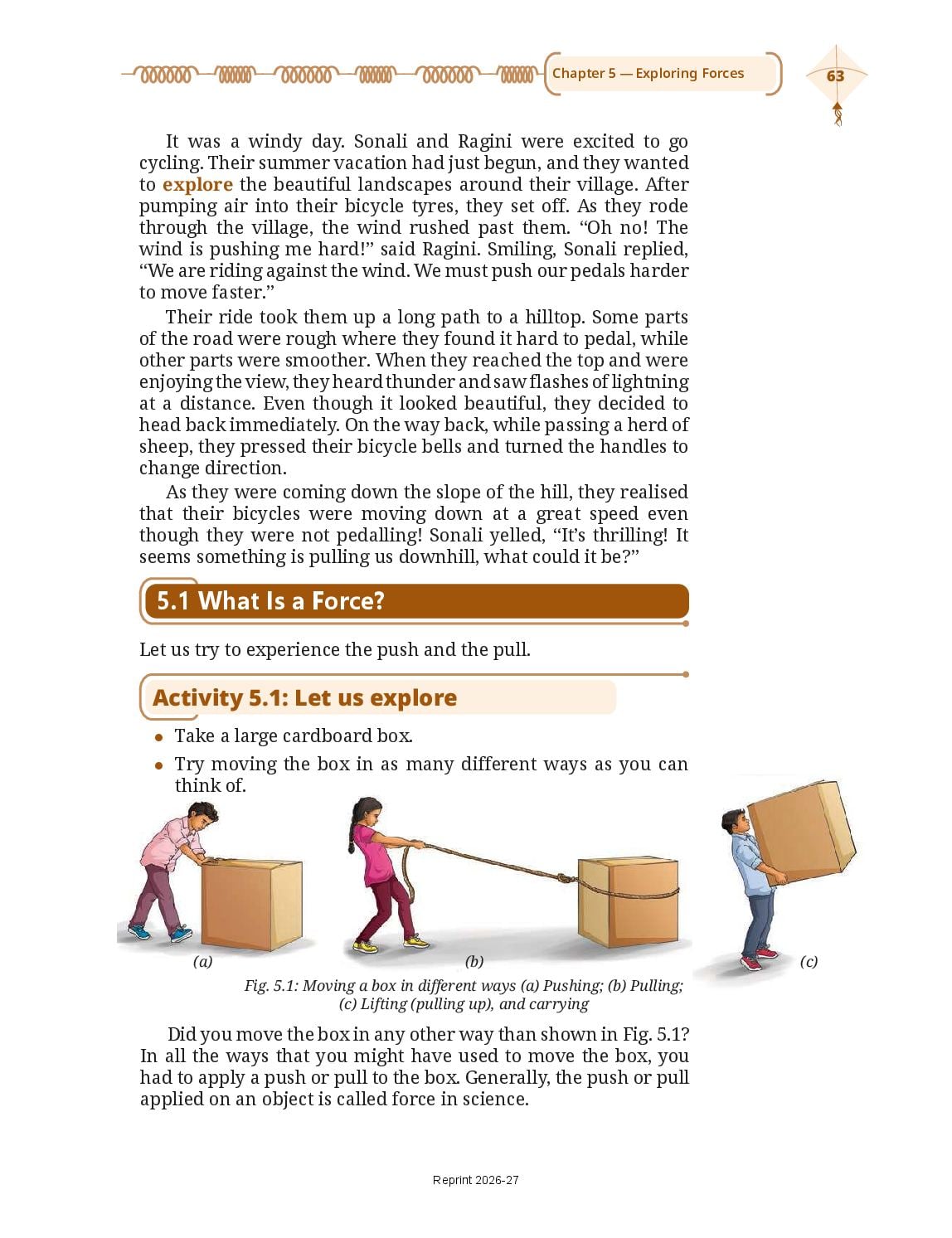
| Force | A push or a pull on an object, resulting from its interaction with another object | Sections 5.1 and 5.3, pages 63–65 | Pushing, pulling or lifting a cardboard box (Activity 5.1, Fig. 5.1) |
| Newton (N) | The SI unit of force, and therefore also of weight | Section 5.3, page 65 | The spring balance of Fig. 5.13 reads up to 10 N |
| Contact force | A force that acts only when the two objects are physically in contact | Section 5.4.1, page 66 | Muscular force and the force of friction |
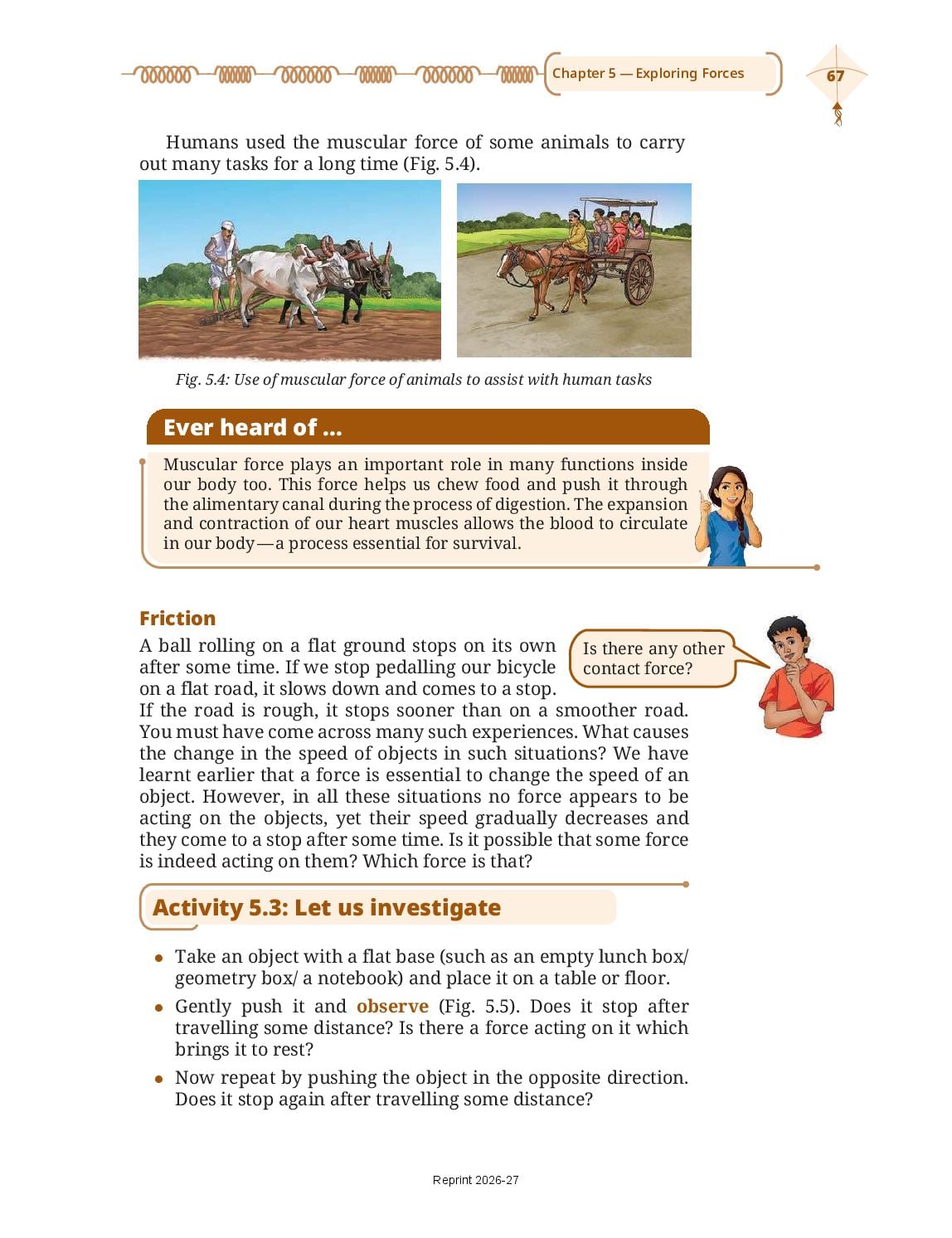
| Muscular force | The force produced when muscles contract and elongate | Section 5.4.1, page 66 | Bullocks pulling a cart; heart muscle circulating blood |
| Friction | The force that comes into play when an object moves or tries to move over another surface; always opposite to that motion | Section 5.4.1, pages 67–68 | A pushed lunch box slides some distance and stops (Activity 5.3) |
| Non-contact force | A force whose effect is felt even when the objects are not in contact | Section 5.4.2, page 69 | Magnetic, electrostatic and gravitational force |
| Magnetic force | The force a magnet exerts on another magnet or on a magnetic material | Section 5.4.2, page 69 | A ring magnet floating above another with like poles facing (Activity 5.5) |
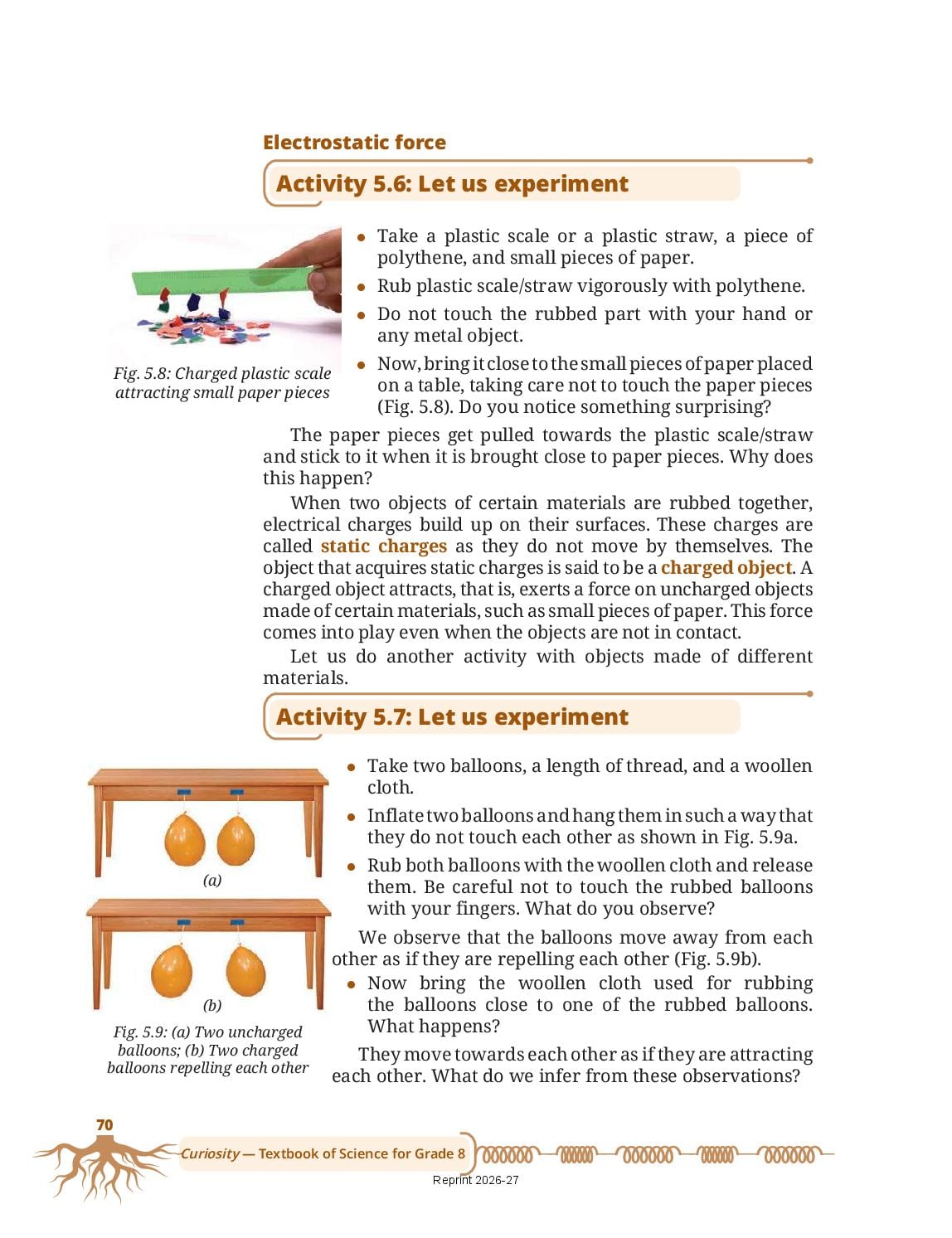
| Electrostatic force | The force a charged body exerts on another charged or uncharged body | Section 5.4.2, pages 70–71 | A rubbed plastic scale picking up small pieces of paper (Activity 5.6) |
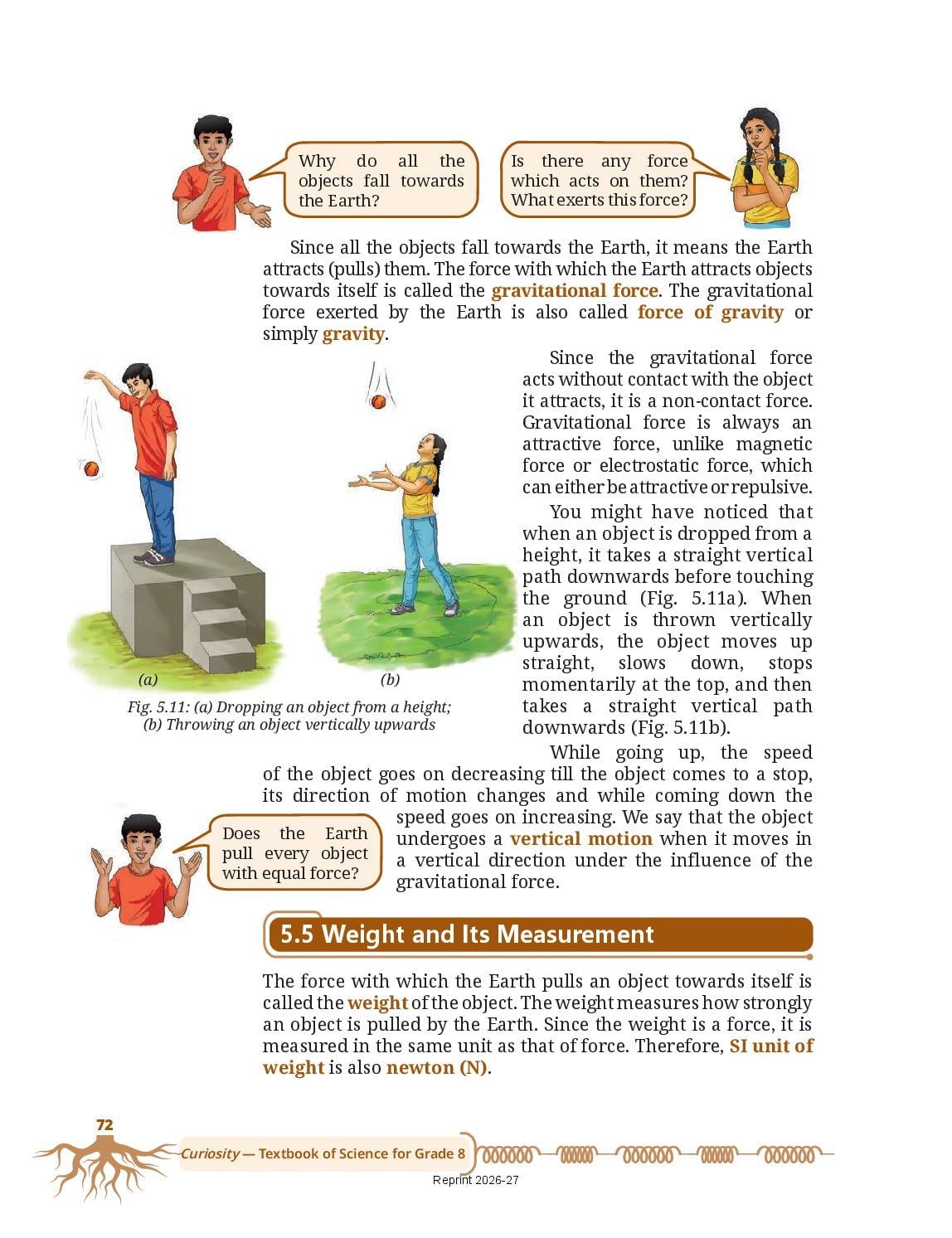
| Gravitational force (gravity) | The force with which the Earth attracts objects towards itself; it is always attractive | Section 5.4.2, page 72 | Every object thrown up comes back to the ground (Activity 5.8, Fig. 5.10) |
| Weight | The gravitational force with which the Earth pulls an object; measured in newton | Section 5.5, pages 72–75 | A 1 kg object weighs 10 N on the Earth but only 1.6 N on the Moon |
| Mass | The amount of matter in an object; measured in g or kg and the same at every place | Section 5.5, page 75 | The same object is 1 kg on the Earth, the Moon, Mars, Venus and Jupiter |
| Upthrust / buoyant force | The upward force a liquid applies on an object placed in it | Section 5.6, page 76 | A closed empty bottle pushed into water bounces back up (Activity 5.13) |
Old NCERT vs New – Class 8 Science
This chapter is from Curiosity, the new NCERT Class 8 Science book (NCF-SE 2023, used from 2025-26). It replaced the old book “Science”, so chapter numbers and names differ from older PDFs.
Solutions and All Chapters
Answers to the exercises and the full chapter list of Curiosity:
Exploring Forces – Overview
| Class | Class 8 |
| Subject | Science |
| Book | Curiosity – new NCERT book |
| Chapter | 5 of 13 – Exploring Forces |
| Book pages | 62 – 79 |
| Edition | NCERT Reprint 2026-27 |
| Session | 2026-27 |
| Free – read online or download |
Class 8 Science Chapter 5 – FAQs
Where can I download Exploring Forces Class 8 PDF?
From the download table on this page – the chapter PDF is free, and the full book is linked too.
What is Class 8 Science Chapter 5 about?
A force is a push or a pull on an object that comes out of the object’s interaction with another object. At least two objects must interact for a force to come into play. The SI unit of force is the newton, symbol N.
Is Exploring Forces from the new NCERT Class 8 Science book?
Yes. It is chapter 5 of curiosity, the new NCERT Class 8 Science book for 2026-27.
Is this the latest NCERT edition for 2026-27?
Yes – the PDF is NCERT’s latest edition for the 2026-27 session.
Where are the NCERT Solutions for Class 8 Science Chapter 5?
Open the NCERT Solutions link above for answers to the exercise questions.