Download Universal Franchise and India’s Electoral System – NCERT Class 8 Social Science Chapter 5 PDF from the new NCERT Class 8 Social Science book Exploring Society: India and Beyond (2026-27). Read the chapter online or download the free PDF. Universal adult franchise means one adult, one vote, and every vote of equal value. Every Indian citizen aged 18 and above may vote — irrespective of caste, creed, race, religion, gender, education or income. That is what the word ‘universal’…
Universal Franchise and India’s Electoral System PDF – Chapter 5 of Exploring Society: India and Beyond (Part I)
Read the chapter online or download the PDF.
| Chapter | Download | |
|---|---|---|
| Chapter 5 PDF | Universal Franchise and India’s Electoral System | View PDF |
| Full book | NCERT Class 8 Social Science – Exploring Society: India and Beyond | View Book |
Read Online
What Is in Universal Franchise and India’s Electoral System? (Class 8 Social Science Chapter 5)
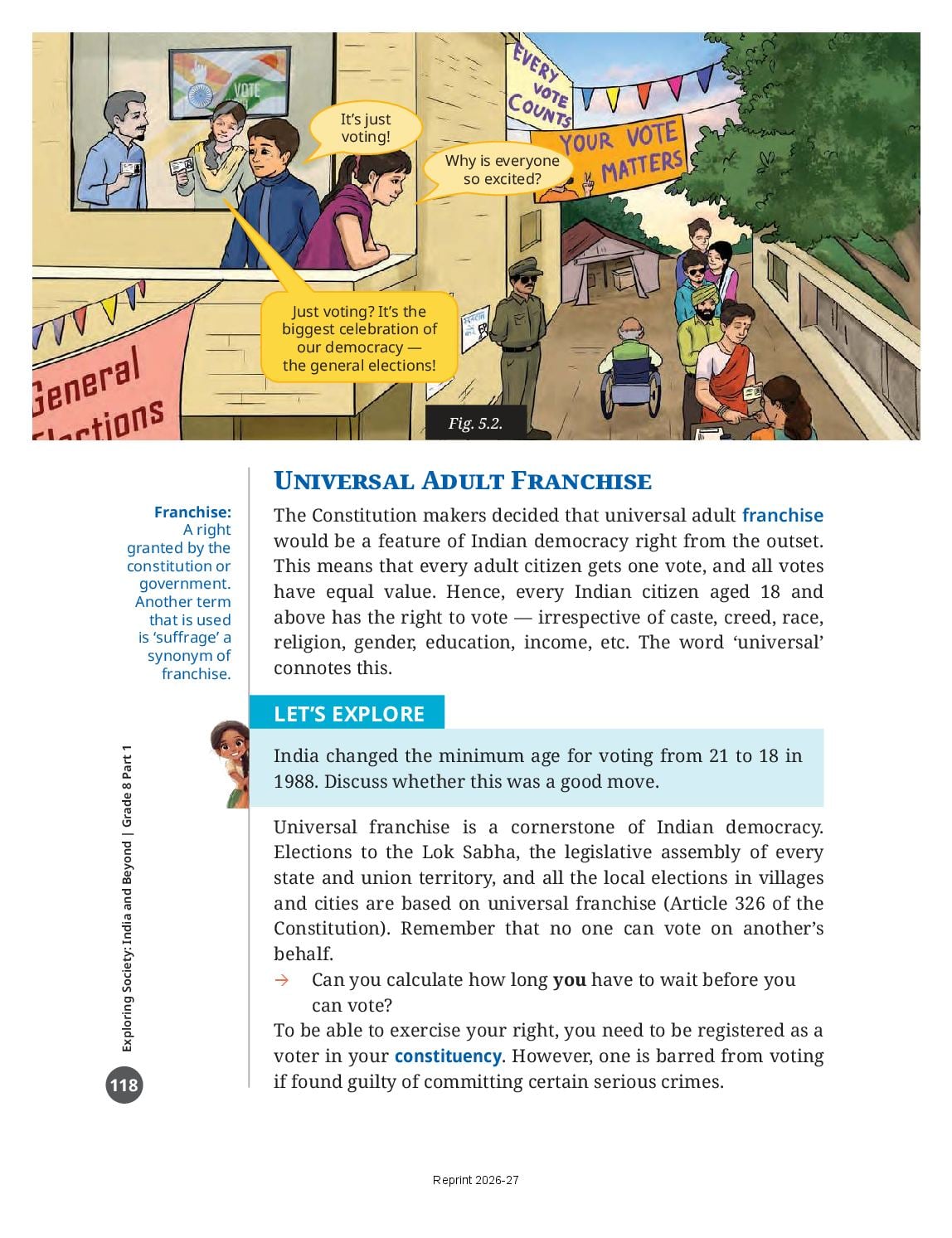
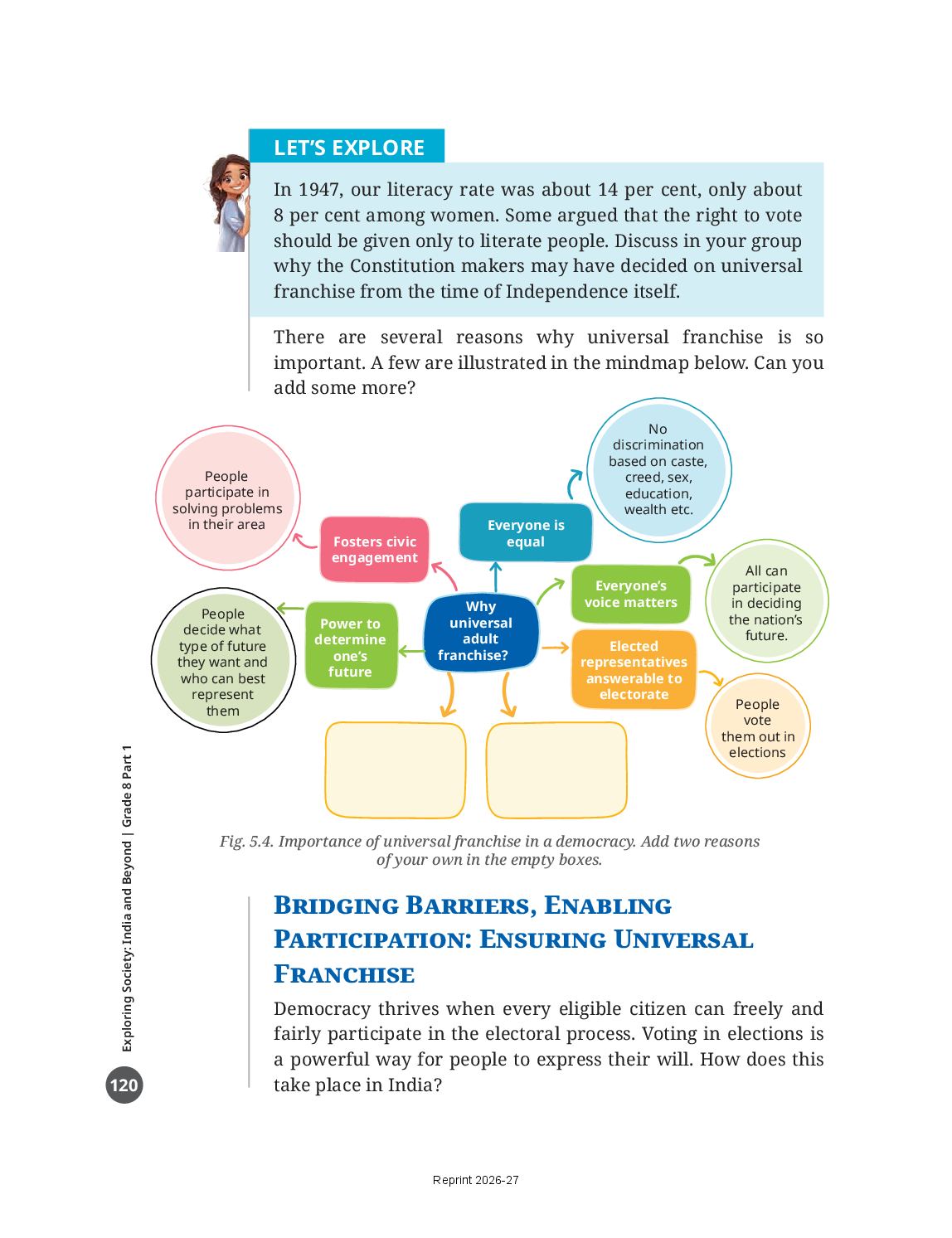
- Universal adult franchise means one adult, one vote, and every vote of equal value. Every Indian citizen aged 18 and above may vote — irrespective of caste, creed, race, religion, gender, education or income. That is what the word ‘universal’ carries. It rests on Article 326 of the Constitution and applies to the Lok Sabha, to every state and union territory assembly, and to all local elections in villages and cities. No one may vote on another’s behalf, and a person convicted of certain serious crimes is barred from voting.
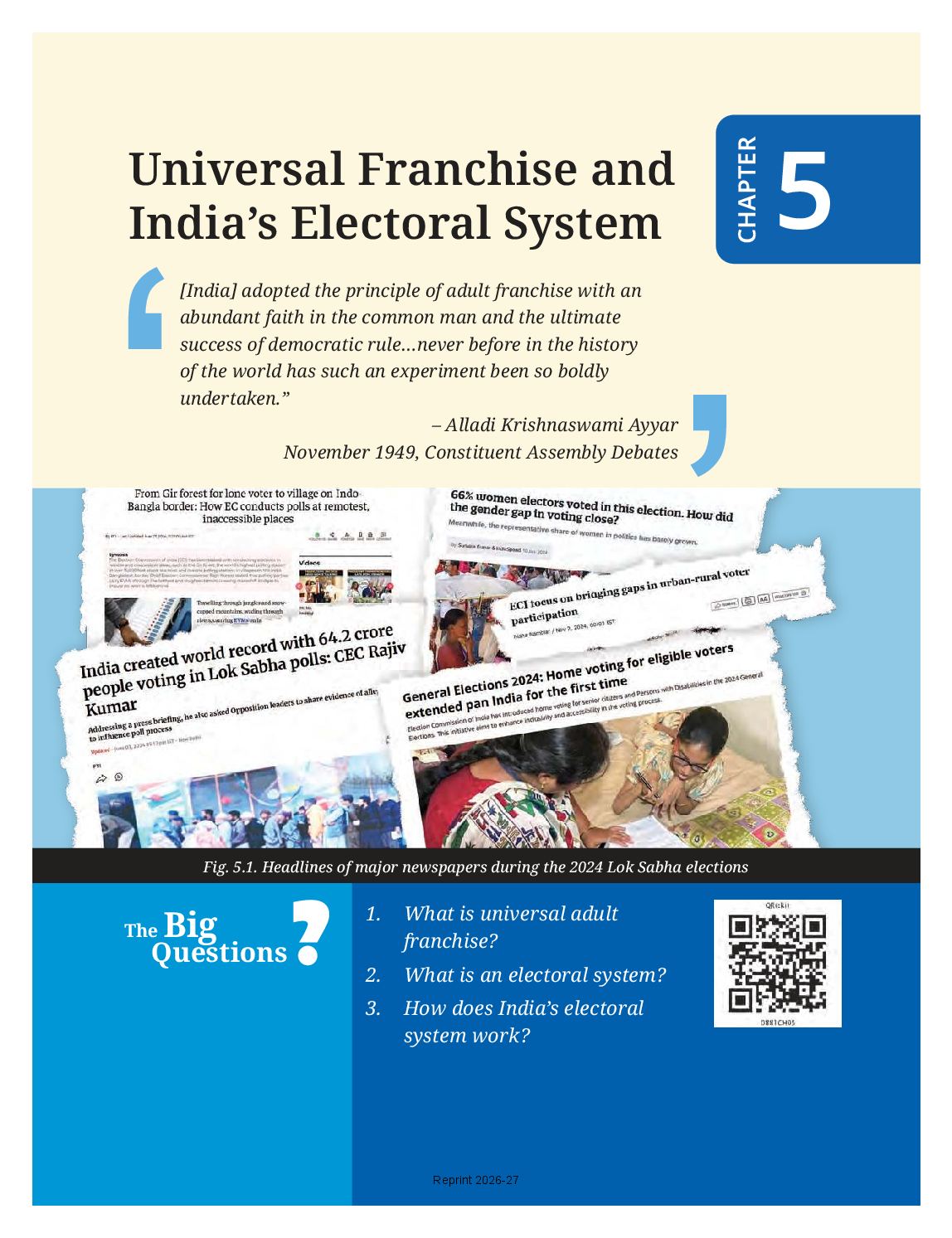
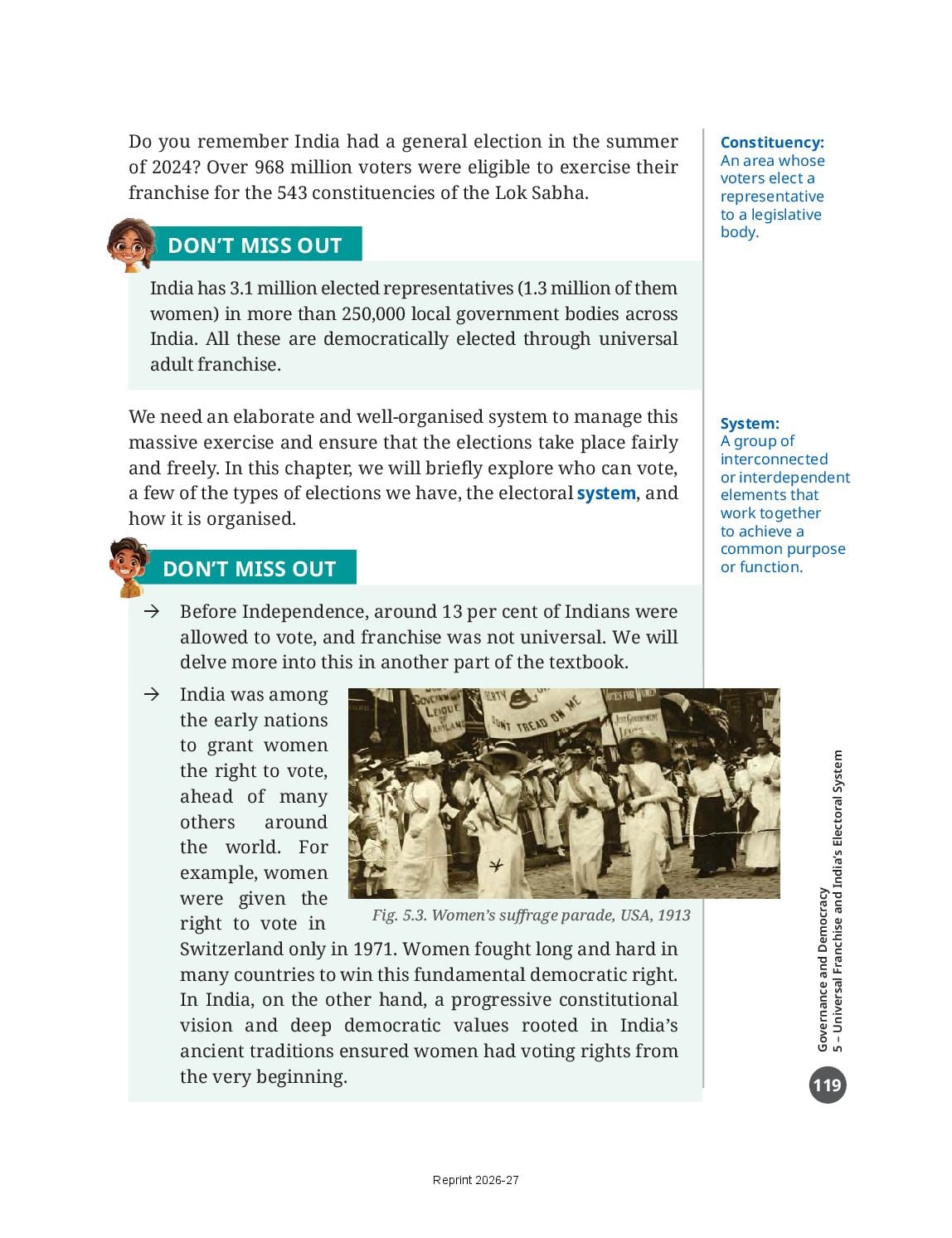
- The Constitution makers took this decision at the outset, and it was a bold one. In 1947 India’s literacy rate was about 14 per cent — only about 8 per cent among women — and some argued the vote should go only to literate people. Before Independence roughly 13 per cent of Indians could vote. India nevertheless gave women the vote from the very beginning, ahead of many countries: Swiss women got it only in 1971. Alladi Krishnaswami Ayyar’s words open the chapter: “never before in the history of the world has such an experiment been so boldly undertaken.”
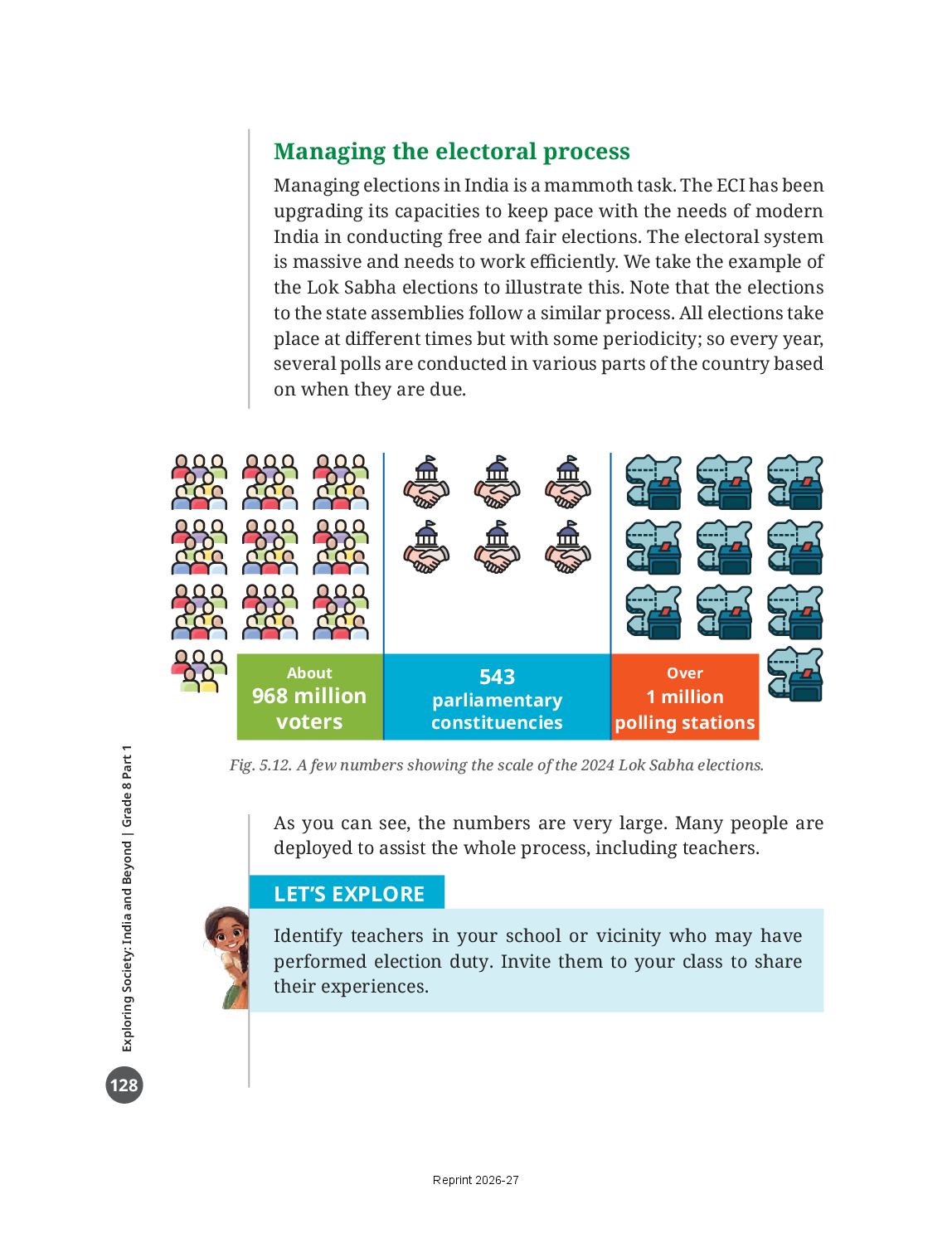
- The scale is the reason the machinery has to be so elaborate. In the 2024 general election about 968 million voters were eligible across 543 parliamentary constituencies, with over 1 million polling stations. India’s eligible-voter population is fifteen times that of the United Kingdom, and India is six times larger than France in area. Beyond that, 3.1 million elected representatives (1.3 million of them women) sit in more than 250,000 local government bodies — all chosen by universal adult franchise.
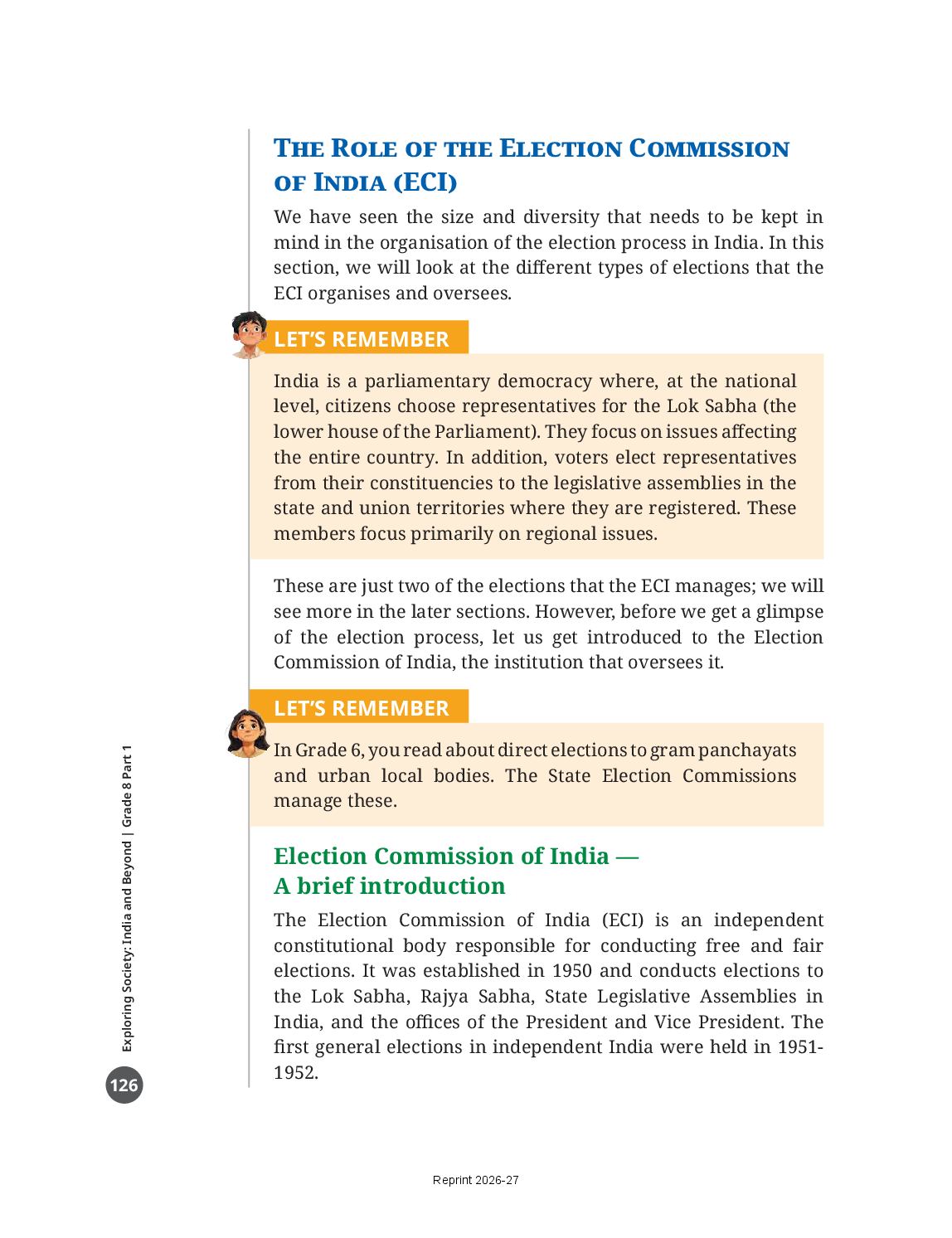
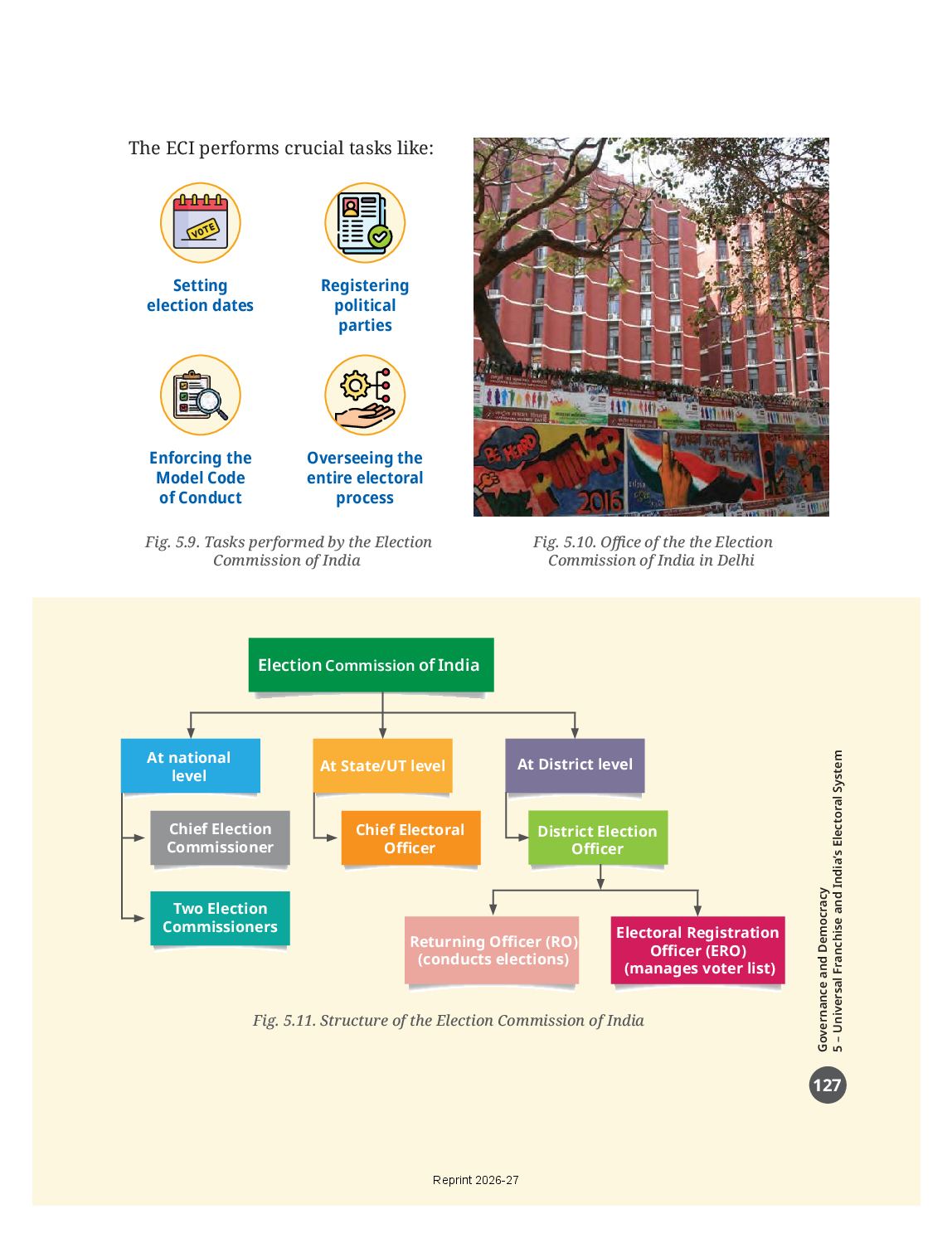
- The Election Commission of India is an independent constitutional body, set up in 1950. It conducts elections to the Lok Sabha, the Rajya Sabha, the state legislative assemblies and the offices of the President and Vice President; the first general elections were held in 1951–1952. It sets election dates, registers political parties, enforces the Model Code of Conduct and oversees the whole electoral process. Its structure runs from the Chief Election Commissioner and two Election Commissioners at the national level, to the Chief Electoral Officer in each state/UT, to the District Election Officer, and below this officer the Returning Officer (conducts elections) and the Electoral Registration Officer (manages the voter list). Local body elections are run by the State Election Commissions.
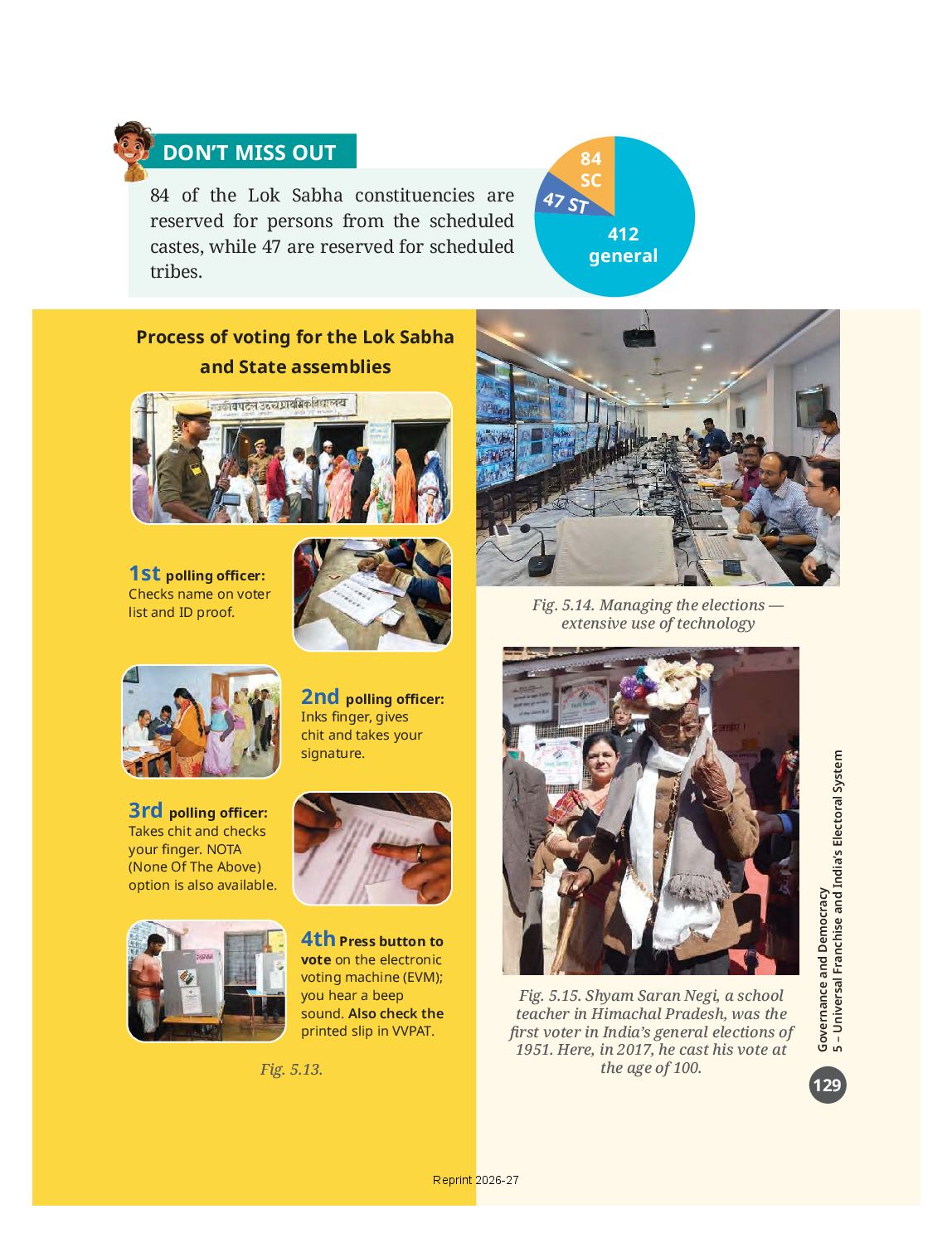
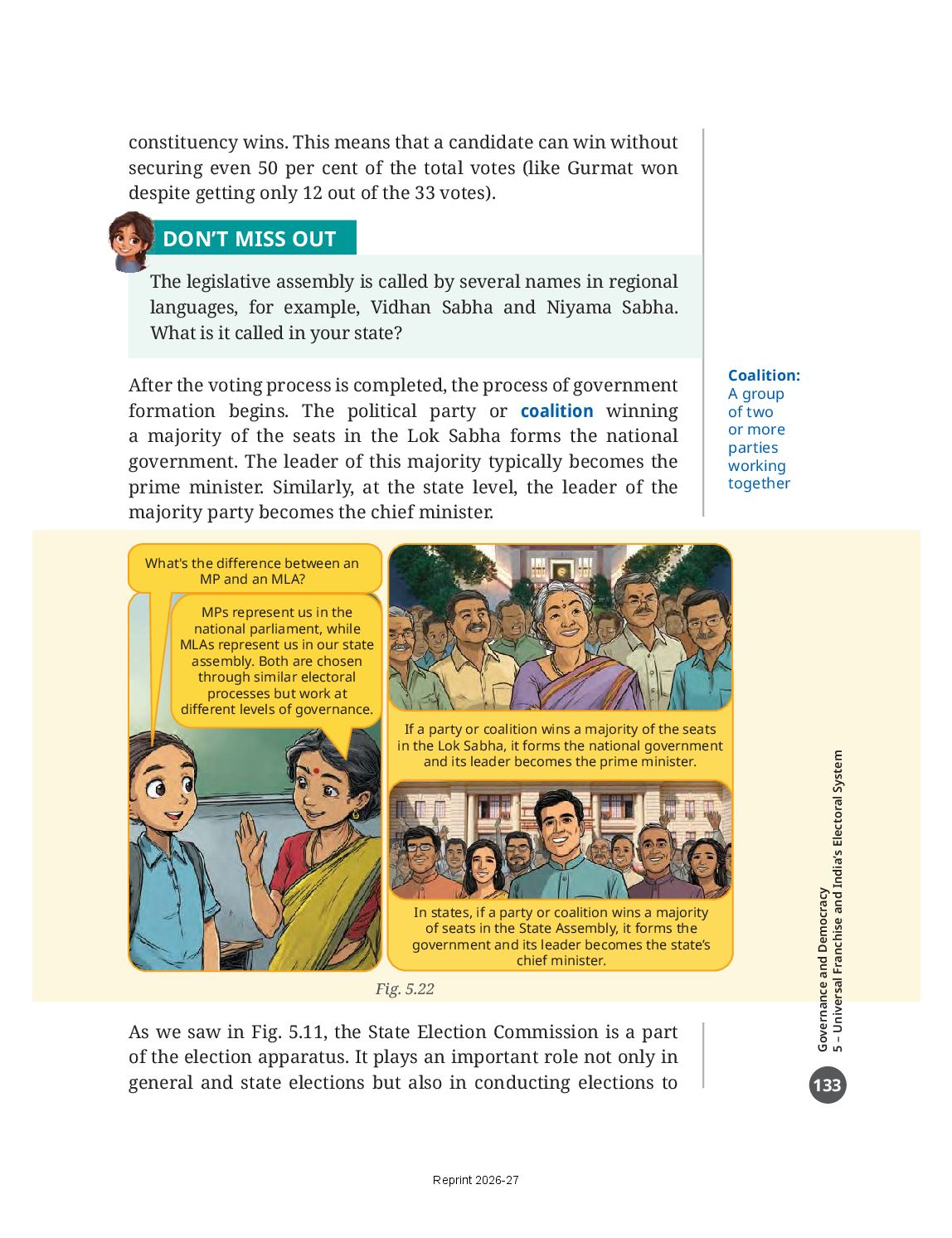
- India uses ‘First-Past-the-Post’ for the Lok Sabha and the assemblies. The candidate with the most votes in a constituency wins, even without 50 per cent of the votes — exactly as Gurmat won the class election with 12 of 33 votes. Members elected to the Lok Sabha are MPs, those elected to state assemblies are MLAs. 84 Lok Sabha seats are reserved for the scheduled castes and 47 for the scheduled tribes, leaving 412 general seats. The party or coalition with a majority forms the government, and its leader becomes prime minister (or chief minister in a state).
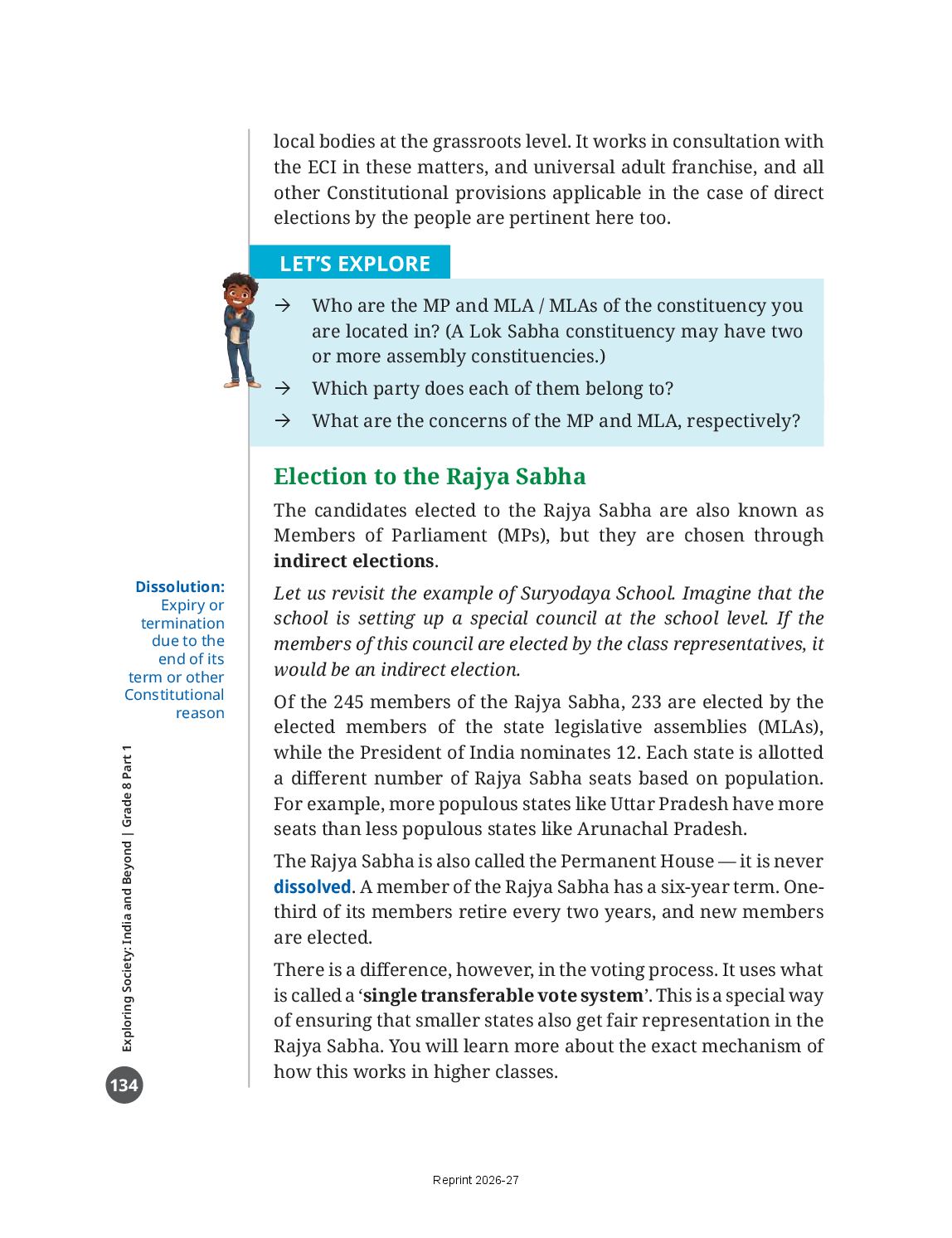
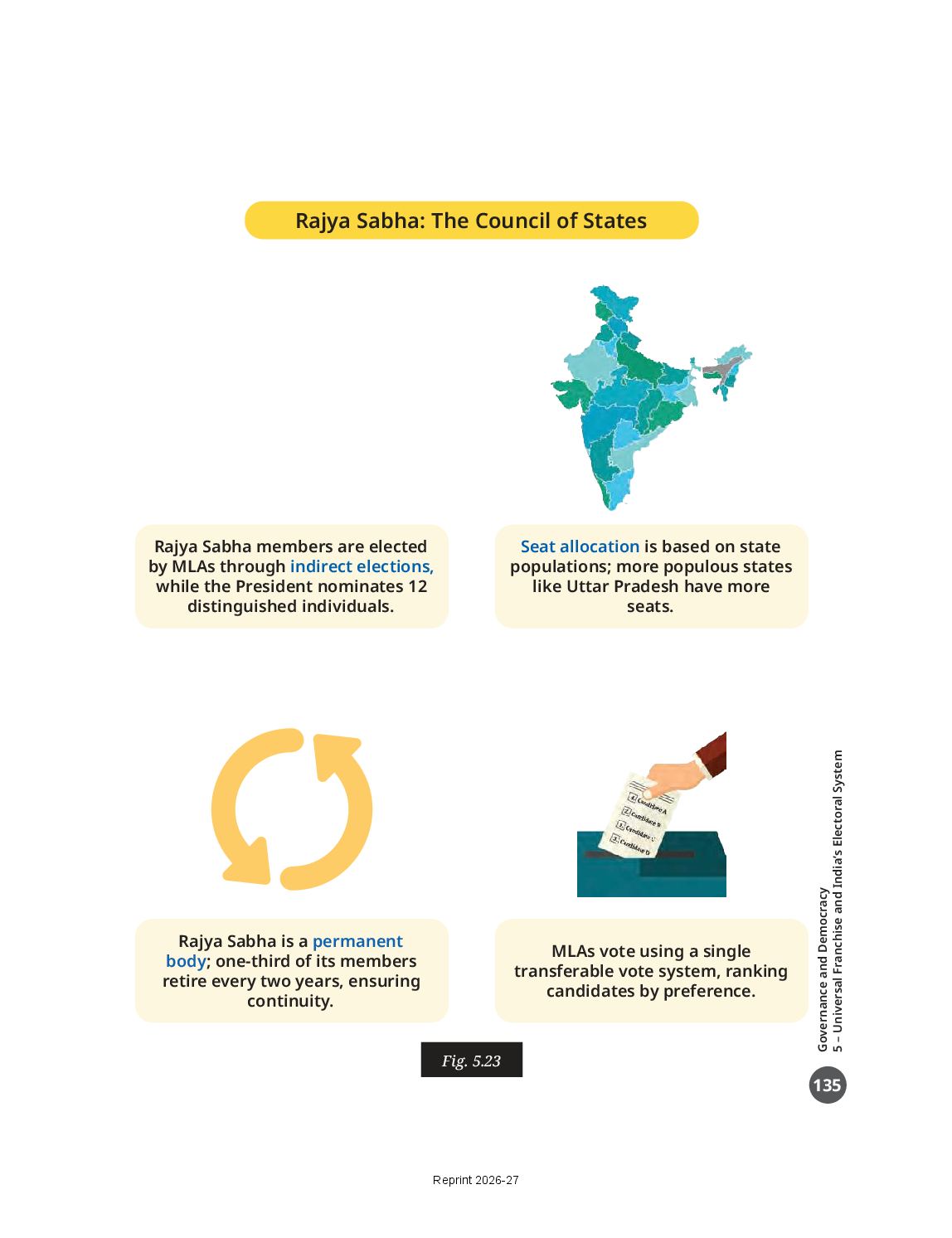
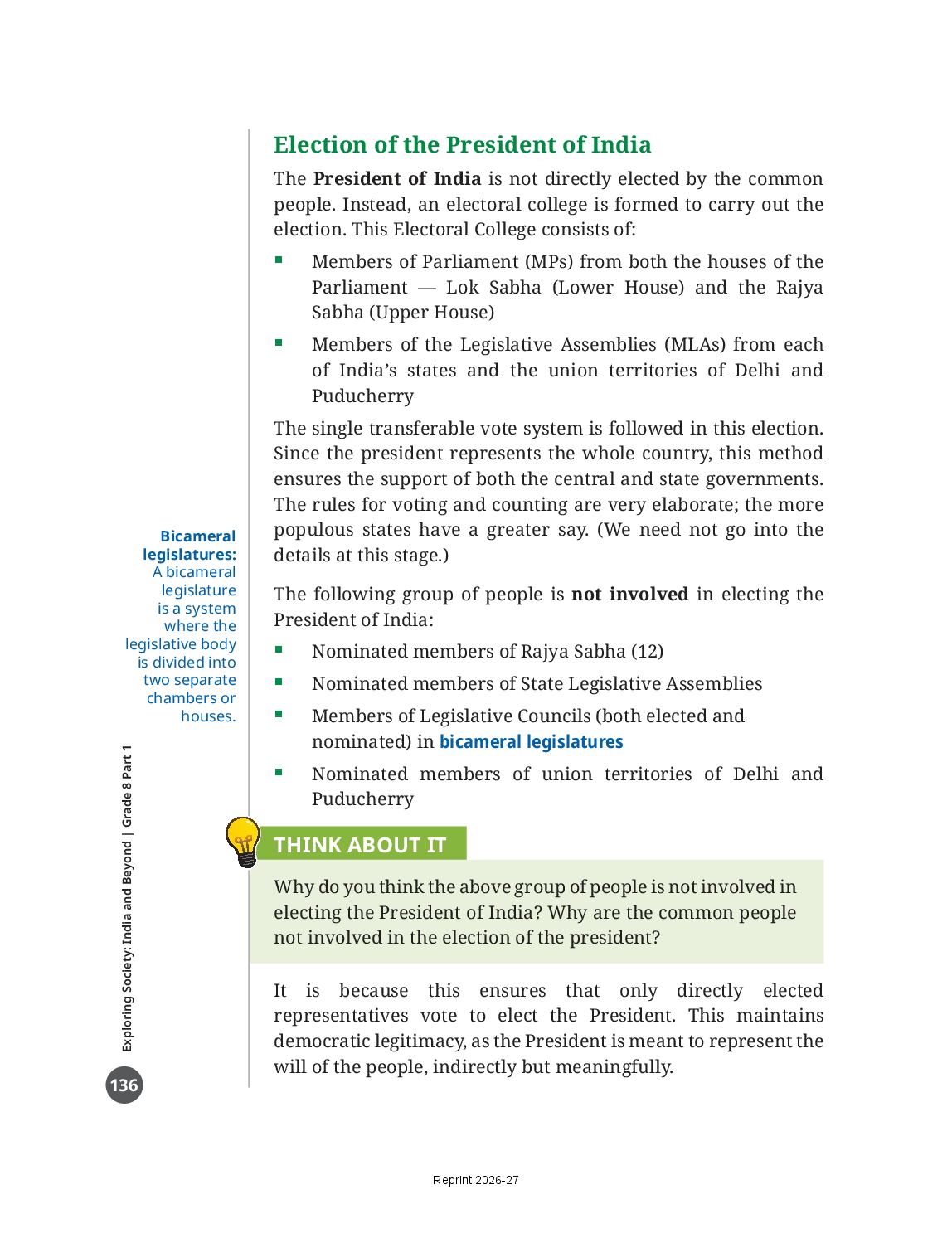
- Not every election is direct. Of the Rajya Sabha’s 245 members, 233 are elected by the elected MLAs of the state assemblies and 12 are nominated by the President; it is a permanent house that is never dissolved, a member serves six years, and one-third retire every two years. The President is chosen by an electoral college of MPs of both Houses plus MLAs of the states and of Delhi and Puducherry; the Vice President by an electoral college of the elected and nominated members of both Houses. All three use the single transferable vote system.
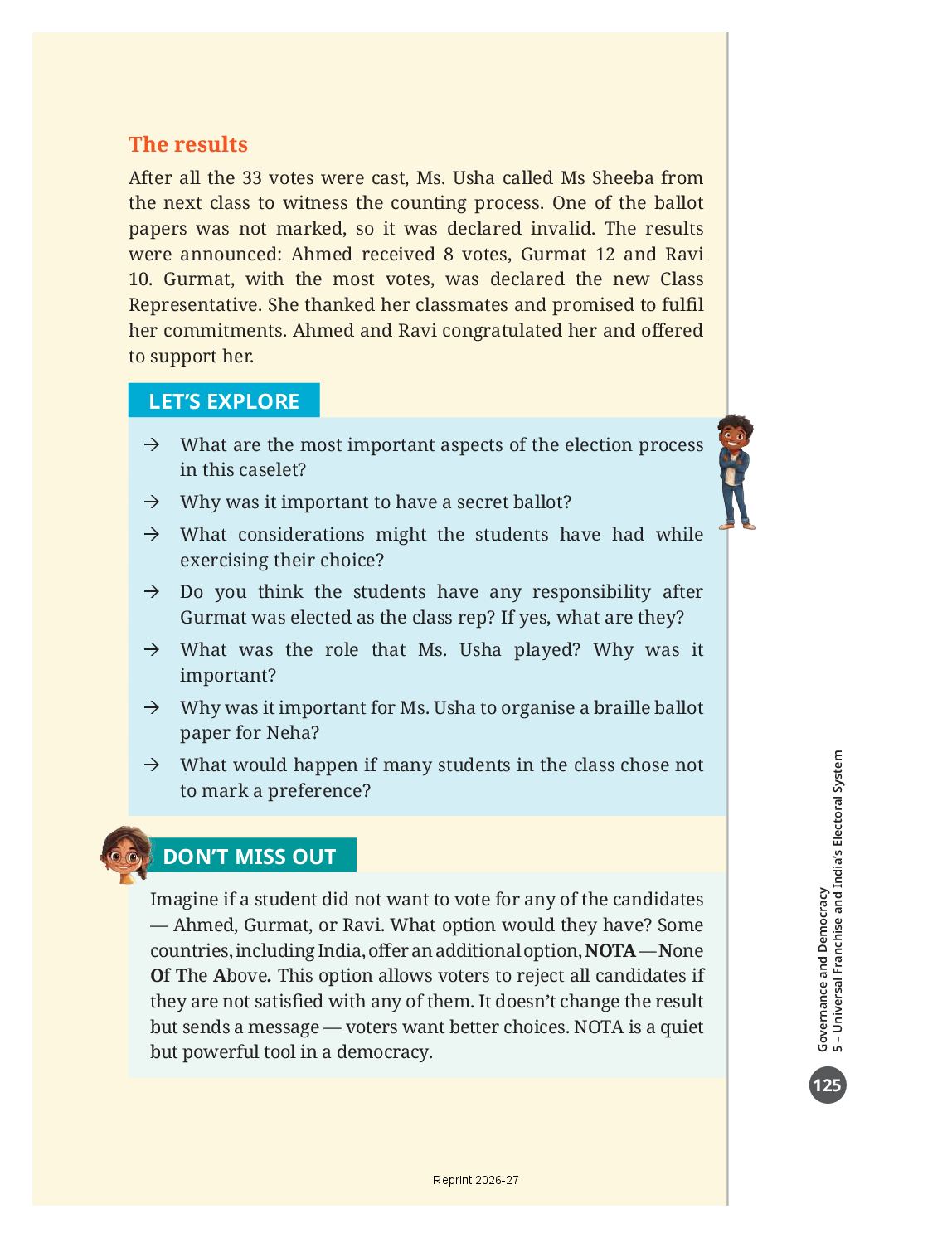
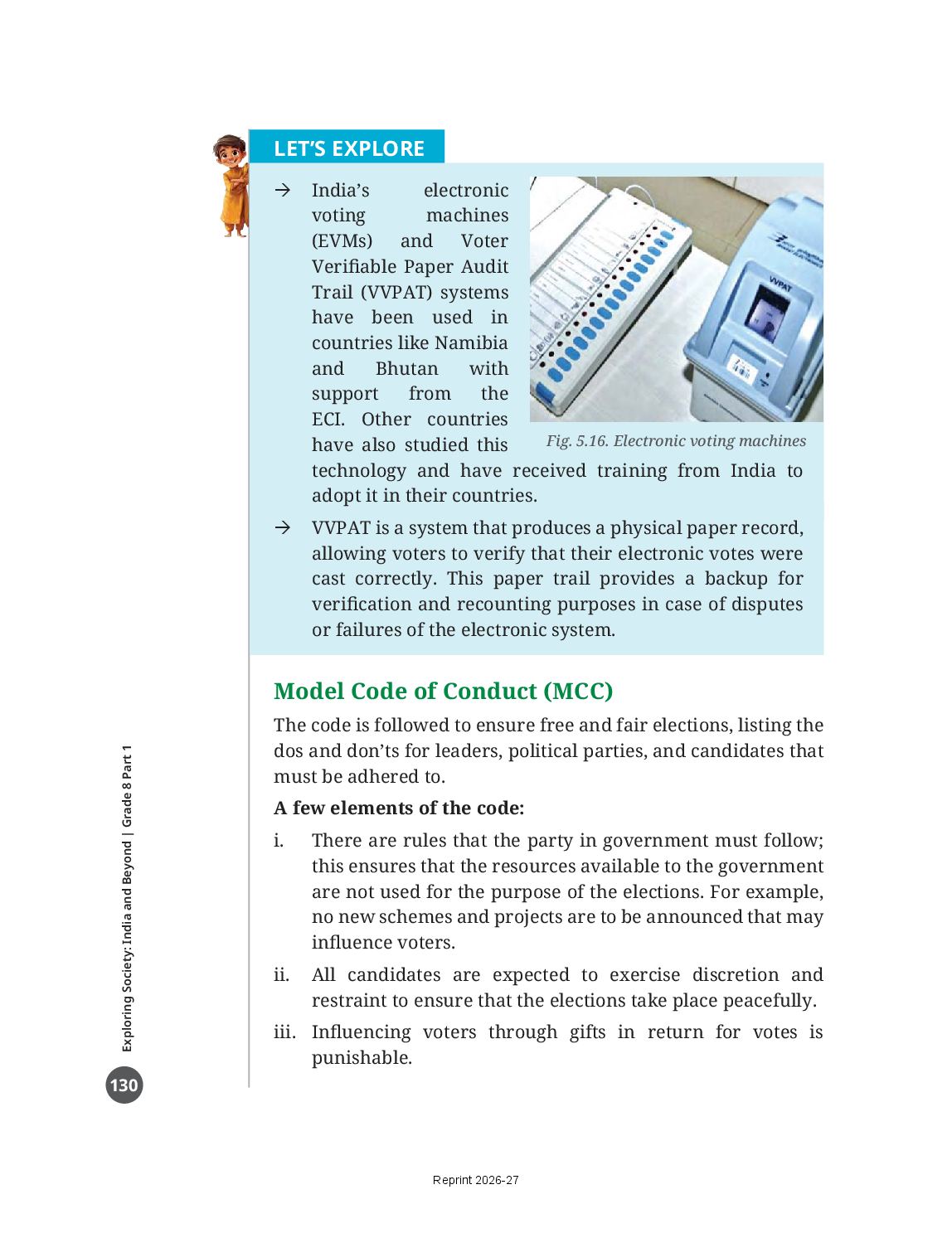
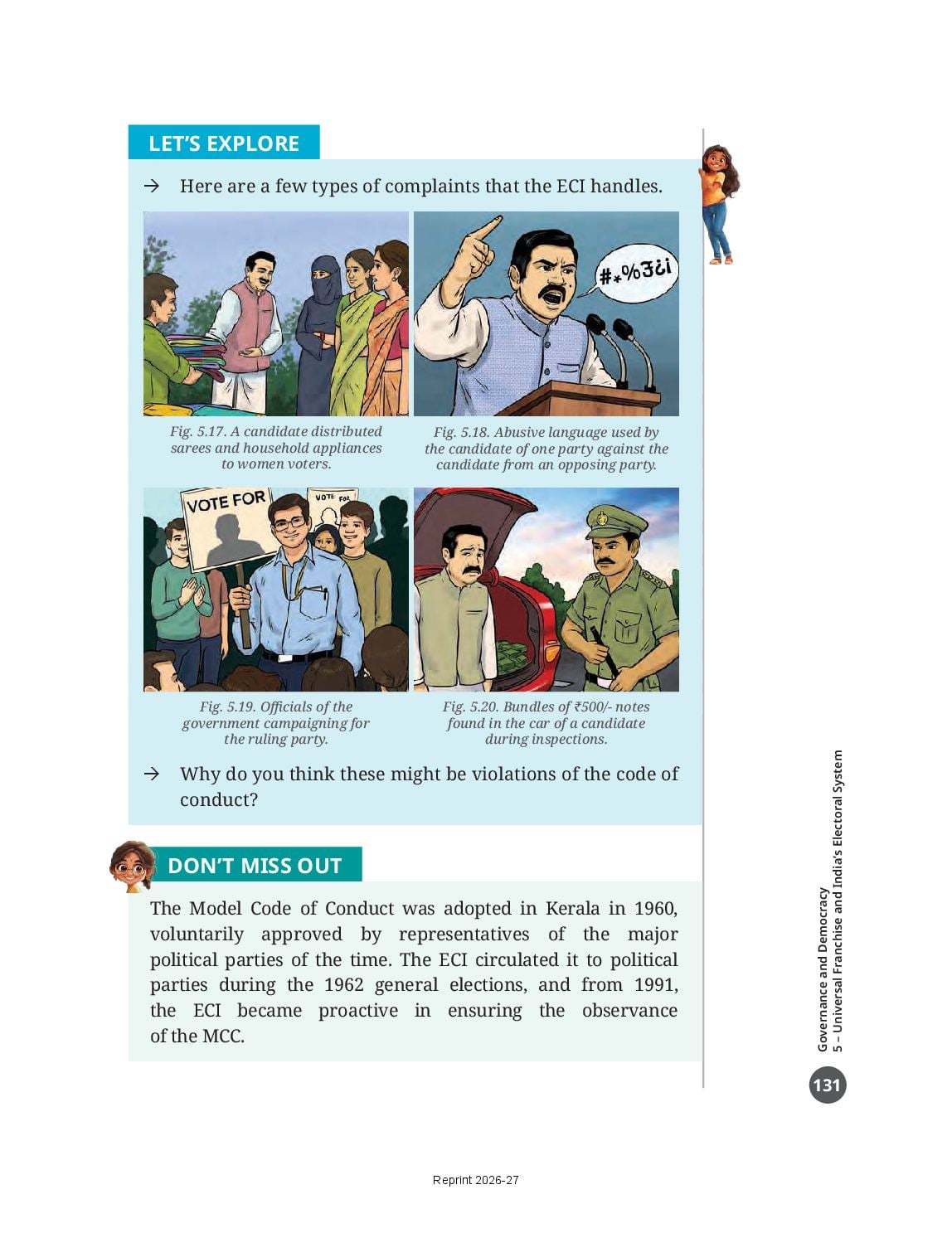
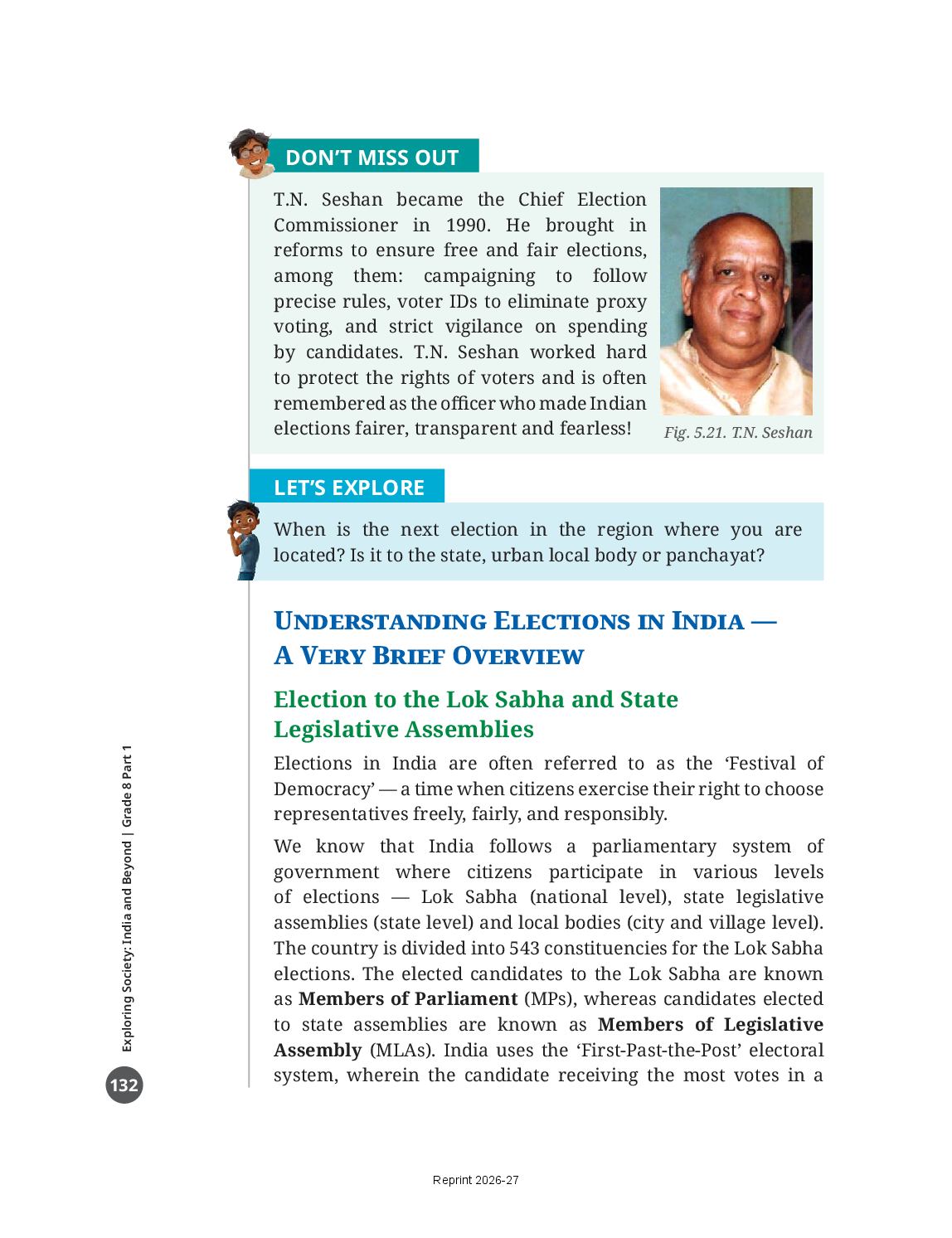
- Safeguards, and the challenges that remain. The secret ballot, the indelible ink, the NOTA option, the EVM with its VVPAT paper slip, and the Model Code of Conduct (adopted in Kerala in 1960, circulated by the ECI in 1962, actively enforced from 1991) all exist to keep elections free and fair; T.N. Seshan, CEC from 1990, added voter IDs and strict checks on campaign spending. Even so the chapter names three live problems — the growing influence of money, a significant proportion of candidates with criminal records, and voter apathy, particularly in urban areas. About 34 per cent of eligible voters did not vote in 2024. The chapter’s answer is an informed and vigilant voter.
Quick revision – Universal Franchise and India’s Electoral System
| Term | What it means | Where it appears in the chapter | What the book says about it |
|---|---|---|---|
| Franchise | A right granted by the constitution or government | Margin note, page 118 | ‘Suffrage’ is a synonym of franchise |
| Universal adult franchise | Every adult citizen gets one vote, and all votes have equal value | ‘Universal Adult Franchise’, page 118 | Age 18 and above, irrespective of caste, creed, race, religion, gender, education, income; Article 326 |
| Constituency | An area whose voters elect a representative to a legislative body | Margin note, page 119 | 543 constituencies for the Lok Sabha; a Lok Sabha constituency may contain two or more assembly constituencies |
| System | A group of interconnected or interdependent elements that work together to achieve a common purpose or function | Margin note, page 119 | Used to explain what an ‘electoral system’ is |
| Election Commission of India (ECI) | The independent constitutional body responsible for conducting free and fair elections | ‘Election Commission of India — A brief introduction’, page 126 | Established 1950; conducts Lok Sabha, Rajya Sabha, state assembly, President and Vice President elections |
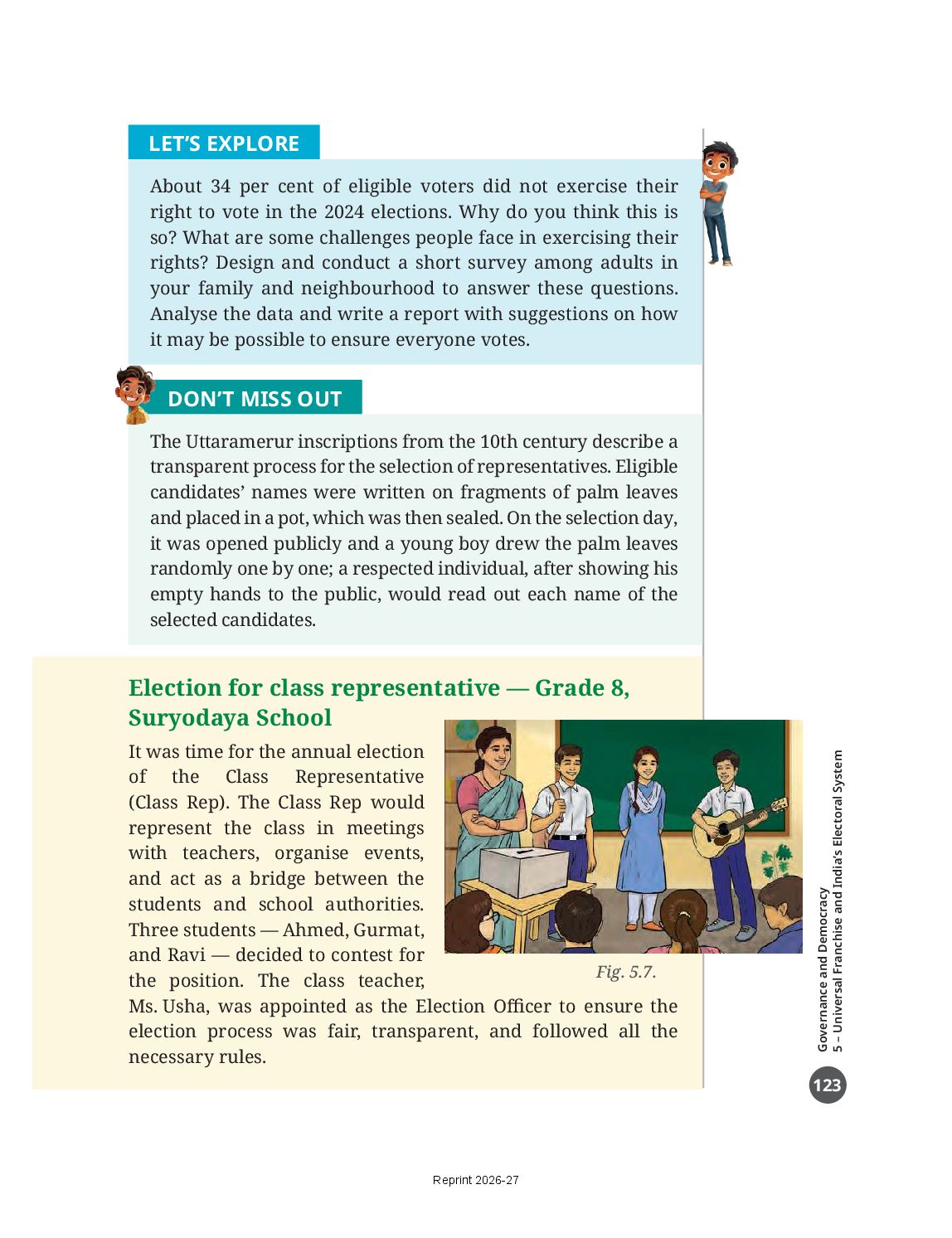
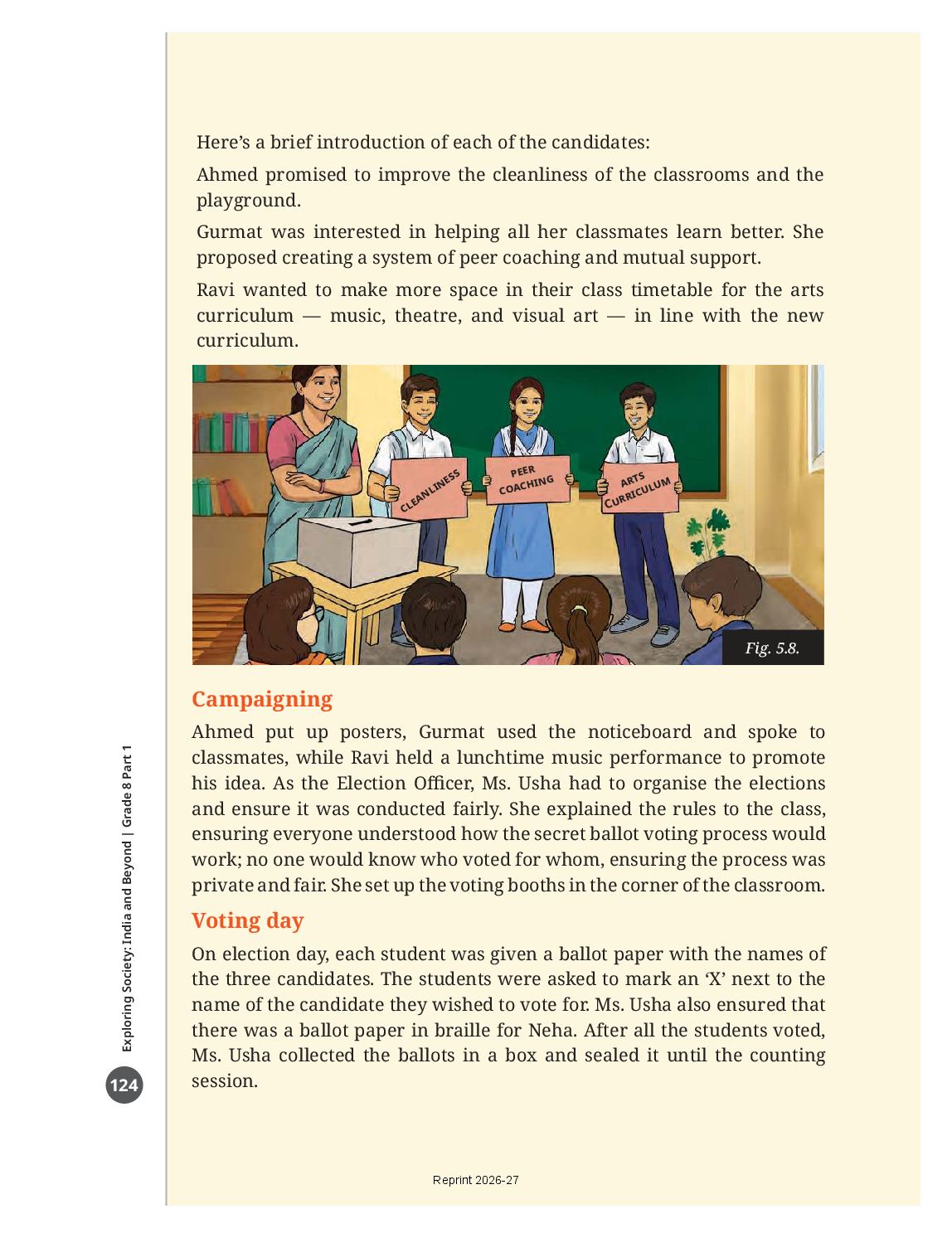
| Secret ballot | A vote cast so that no one knows who voted for whom | The Suryodaya School caselet, page 124 | Ms. Usha explained the rules “ensuring the process was private and fair” |
| NOTA | ‘None Of The Above’ — the option to reject all candidates | DON’T MISS OUT, page 125 | It doesn’t change the result but sends a message — voters want better choices |
| EVM | Electronic voting machine; the voter presses a button and hears a beep | Fig. 5.13, page 129; Fig. 5.16, page 130 | Used with ECI support in Namibia and Bhutan; other countries have received training from India |
| VVPAT | Voter Verifiable Paper Audit Trail — a printed slip that lets the voter verify the vote was cast correctly | LET’S EXPLORE, page 130 | A backup for verification and recounting in case of disputes or failures of the electronic system |
| Model Code of Conduct (MCC) | The dos and don’ts for leaders, parties and candidates during an election | ‘Model Code of Conduct (MCC)’, page 130 | Adopted in Kerala 1960; circulated by the ECI in 1962; the ECI proactive from 1991 |
| First-Past-the-Post | The candidate receiving the most votes in a constituency wins | Page 132–133 | A candidate can win without securing even 50 per cent of the total votes |
| Coalition | A group of two or more parties working together | Margin note, page 133 | A party or coalition with a majority in the Lok Sabha forms the national government |
| Indirect election | Voters elect representatives, who in turn elect someone else | ‘Election to the Rajya Sabha’, page 134 | 233 of the 245 Rajya Sabha members are elected by MLAs; 12 are nominated by the President |
| Single transferable vote | A special voting method in which voters rank candidates by preference | Pages 134–137 | Used for the Rajya Sabha, the President and the Vice President; ensures smaller states get fair representation |
Old NCERT vs New – Class 8 Social Science
This chapter is from Exploring Society: India and Beyond, the new NCERT Class 8 Social Science book (NCF-SE 2023, used from 2025-26). It replaced the old book “Our Pasts, Resources and Development and Social and Political Life”, so chapter numbers and names differ from older PDFs.
Solutions and All Chapters
Answers to the exercises and the full chapter list of Exploring Society: India and Beyond:
Universal Franchise and India’s Electoral System – Overview
| Class | Class 8 |
| Subject | Social Science |
| Book | Exploring Society: India and Beyond – new NCERT book |
| Part | Part I |
| Chapter | 5 of 15 – Universal Franchise and India’s Electoral System |
| Book pages | 117 – 138 |
| Edition | NCERT Reprint 2026-27 |
| Session | 2026-27 |
| Free – read online or download |
Class 8 Social Science Chapter 5 – FAQs
Where can I download Universal Franchise and India’s Electoral System Class 8 PDF?
From the download table on this page – the chapter PDF is free, and the full book is linked too.
What is Class 8 Social Science Chapter 5 about?
Universal adult franchise means one adult, one vote, and every vote of equal value. Every Indian citizen aged 18 and above may vote — irrespective of caste, creed, race, religion, gender, education or income. That is what the word ‘universal’ carries. It rests on Article 326 of the Constitution and applies to the Lok Sabha, to every state and union territory assembly, and to all local elections in villages and cities. No one may vote on another’s behalf, and a person convicted of certain serious crimes is barred from voting.
Is Universal Franchise and India’s Electoral System from the new NCERT Class 8 Social Science book?
Yes. It is chapter 5 of exploring society: india and beyond (part i), the new NCERT Class 8 Social Science book for 2026-27.
Is this the latest NCERT edition for 2026-27?
Yes – the PDF is NCERT’s latest edition for the 2026-27 session.
Where are the NCERT Solutions for Class 8 Social Science Chapter 5?
Open the NCERT Solutions link above for answers to the exercise questions.