Download The Role of the Judiciary in Our Society – NCERT Class 8 Social Science Chapter 11 PDF from the new NCERT Class 8 Social Science book Exploring Society: India and Beyond (2026-27). Read the chapter online or download the free PDF. Justice is what keeps a society peaceful and lets people live with equality and dignity. The Judiciary is the institution which ensures fair adjudication of disputes in accordance with the law. It is one of the three pillars of the government,…
The Role of the Judiciary in Our Society PDF – Chapter 11 of Exploring Society: India and Beyond (Part II)
Read the chapter online or download the PDF.
| Chapter | Download | |
|---|---|---|
| Chapter 11 PDF | The Role of the Judiciary in Our Society | View PDF |
| Full book | NCERT Class 8 Social Science – Exploring Society: India and Beyond | View Book |
Read Online
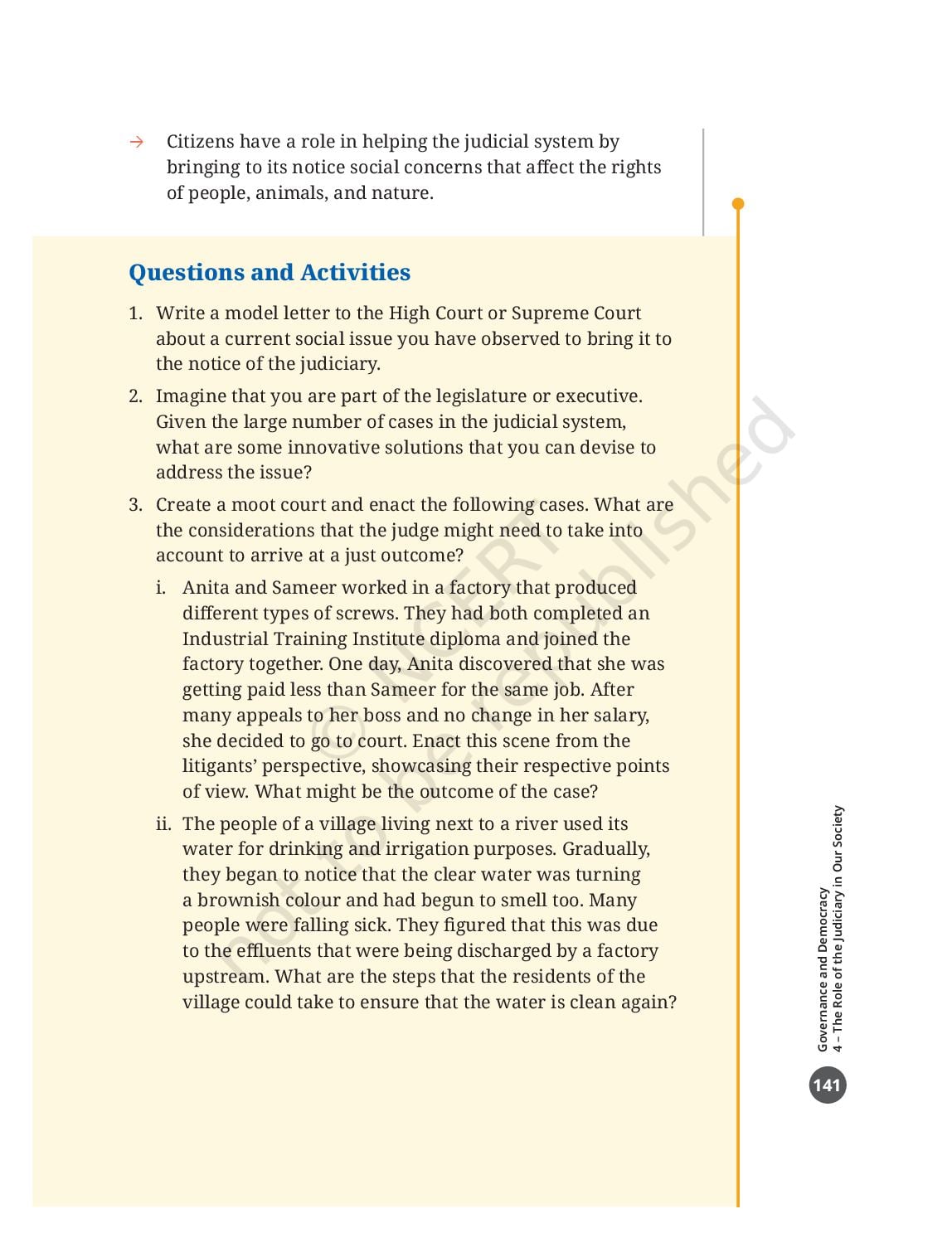
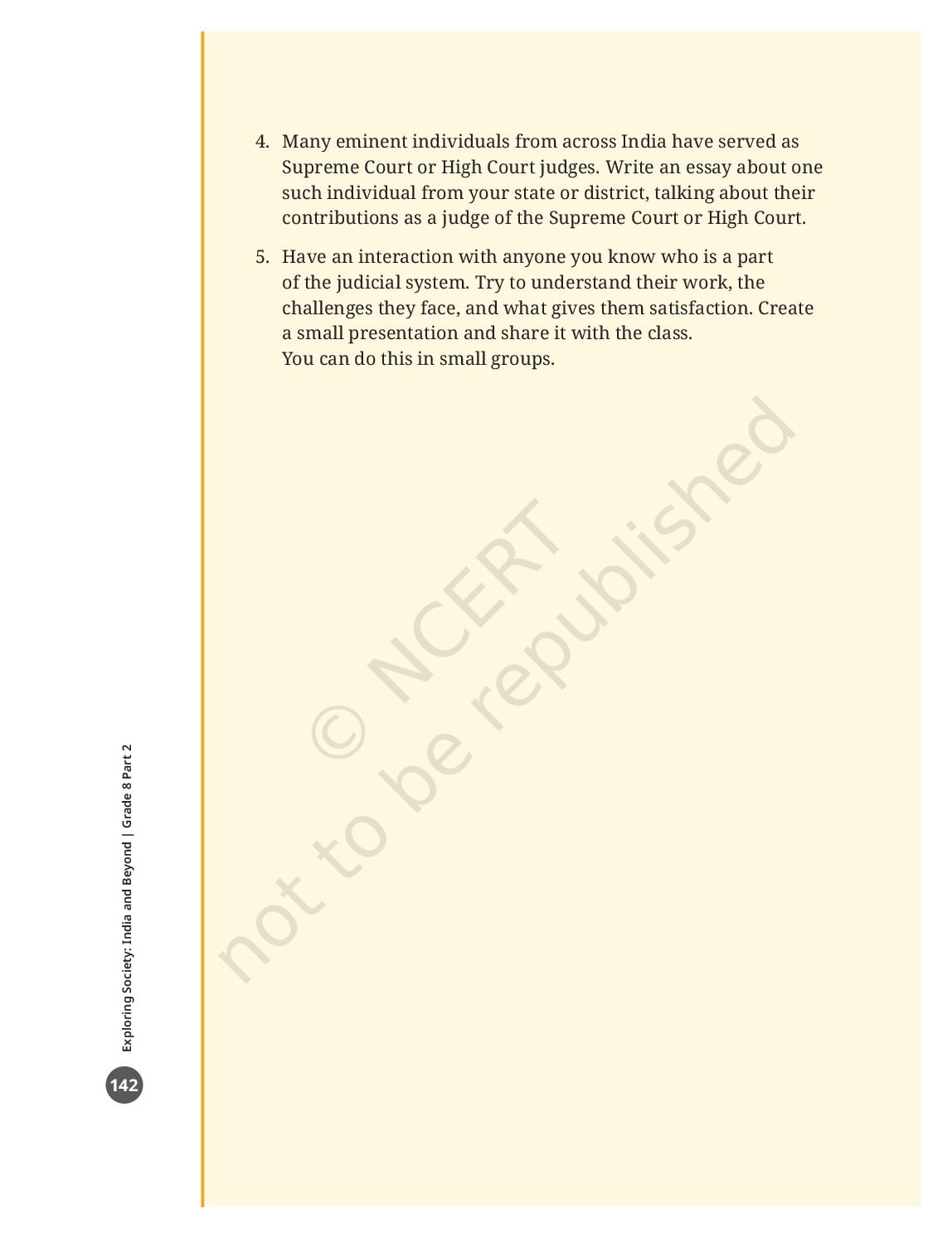
What Is in The Role of the Judiciary in Our Society? (Class 8 Social Science Chapter 11)
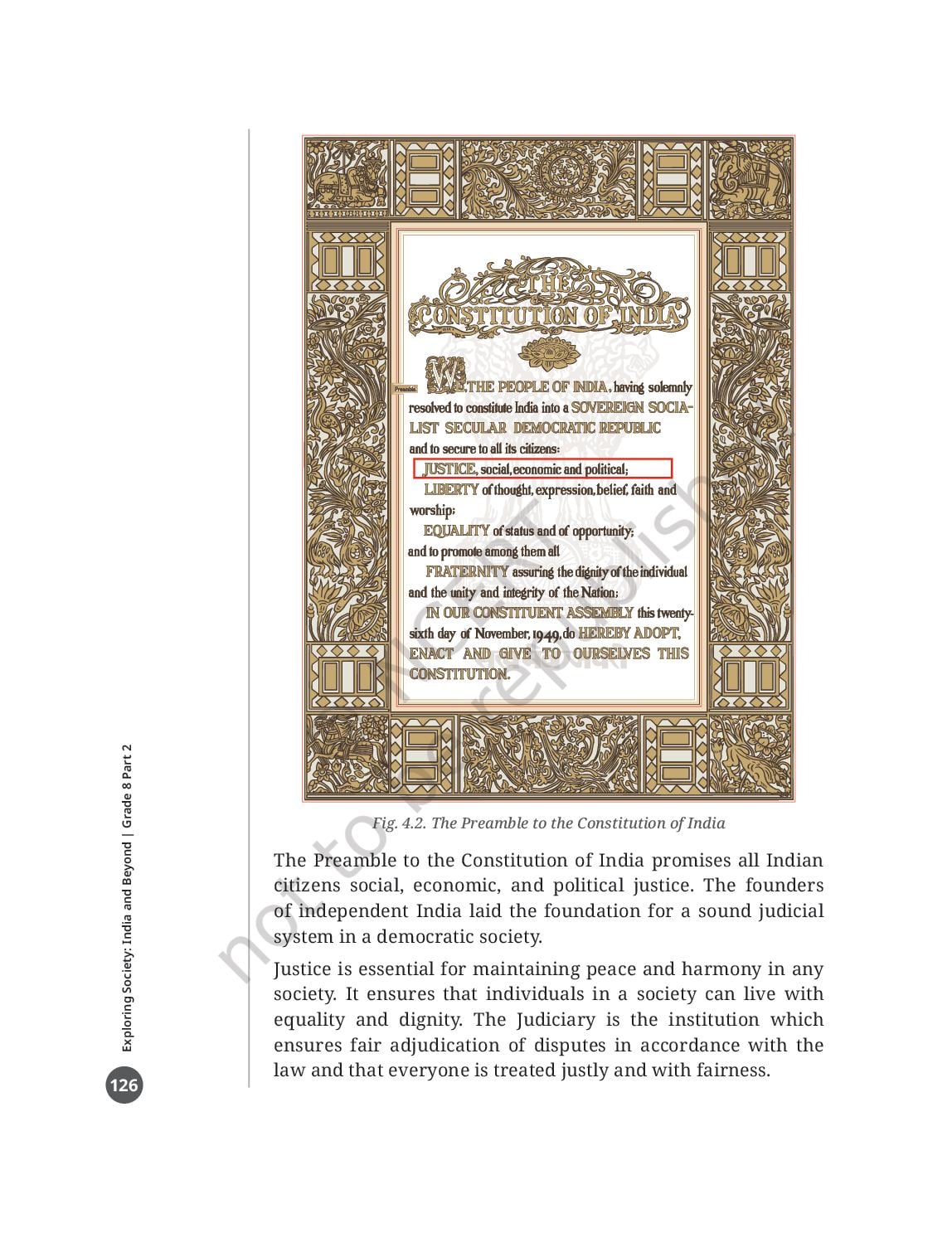
- Justice is what keeps a society peaceful and lets people live with equality and dignity. The Judiciary is the institution which ensures fair adjudication of disputes in accordance with the law. It is one of the three pillars of the government, independent of the legislature and the executive.
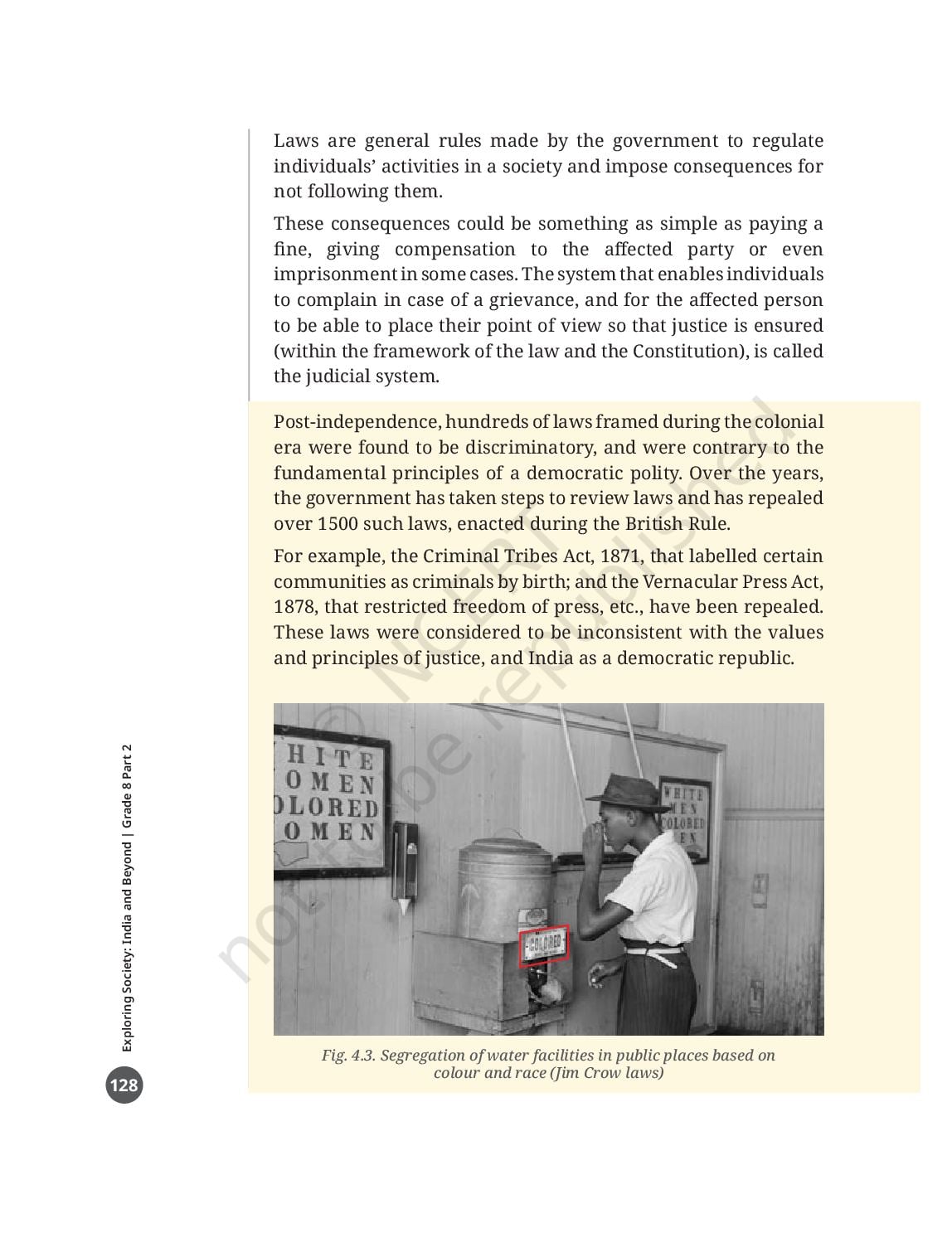
- The government’s way to ensure justice is by framing laws — but a law can itself be unjust. India has repealed over 1500 laws enacted under British rule, such as the Criminal Tribes Act, 1871 and the Vernacular Press Act, 1878. Elsewhere, the Jim Crow laws in parts of the United States were repealed in the 1960s and apartheid laws in South Africa in 1991.
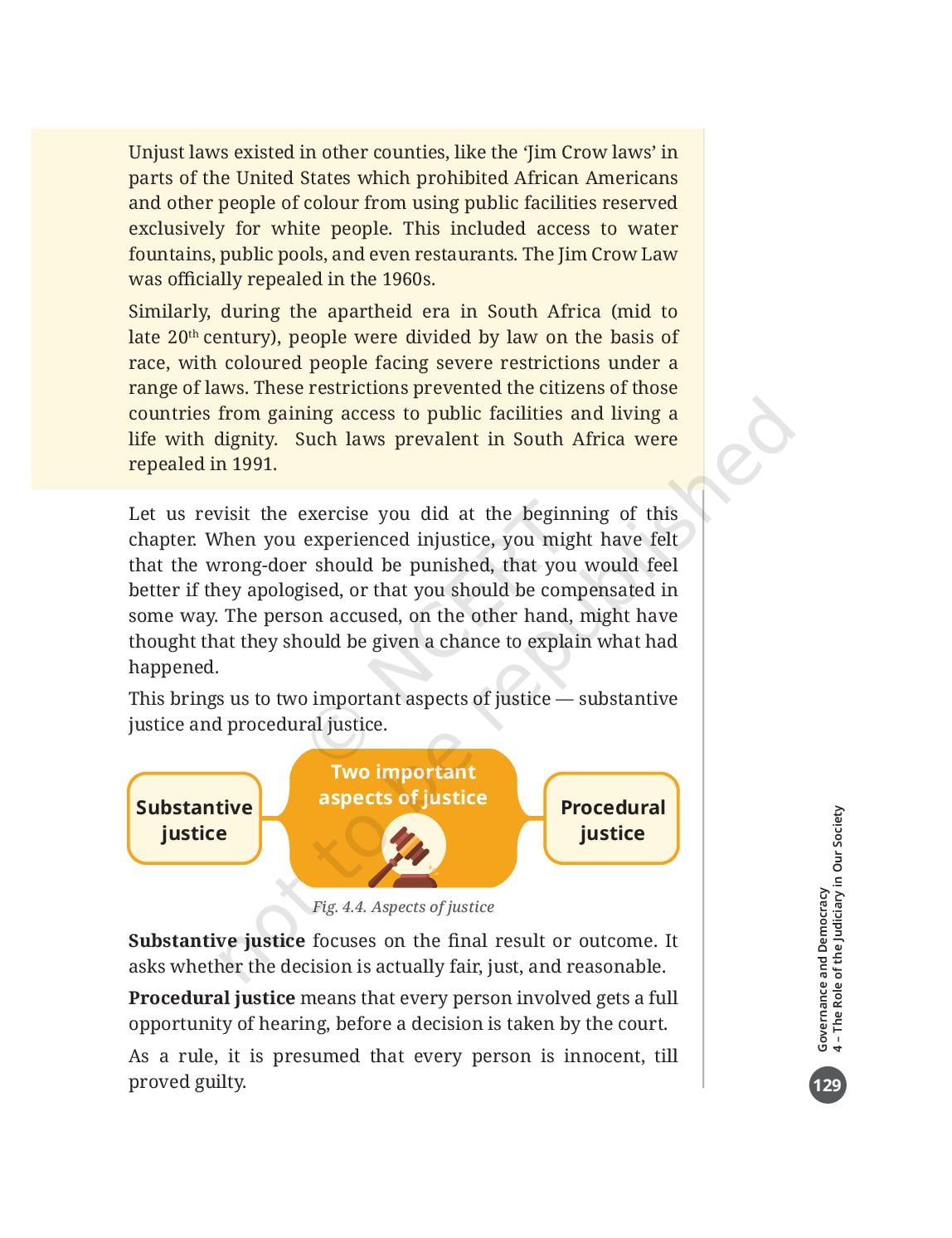
- Justice has two aspects. Substantive justice asks whether the final outcome is fair, just and reasonable. Procedural justice asks whether every person involved got a full opportunity of hearing — and, as a rule, every person is presumed innocent till proved guilty.
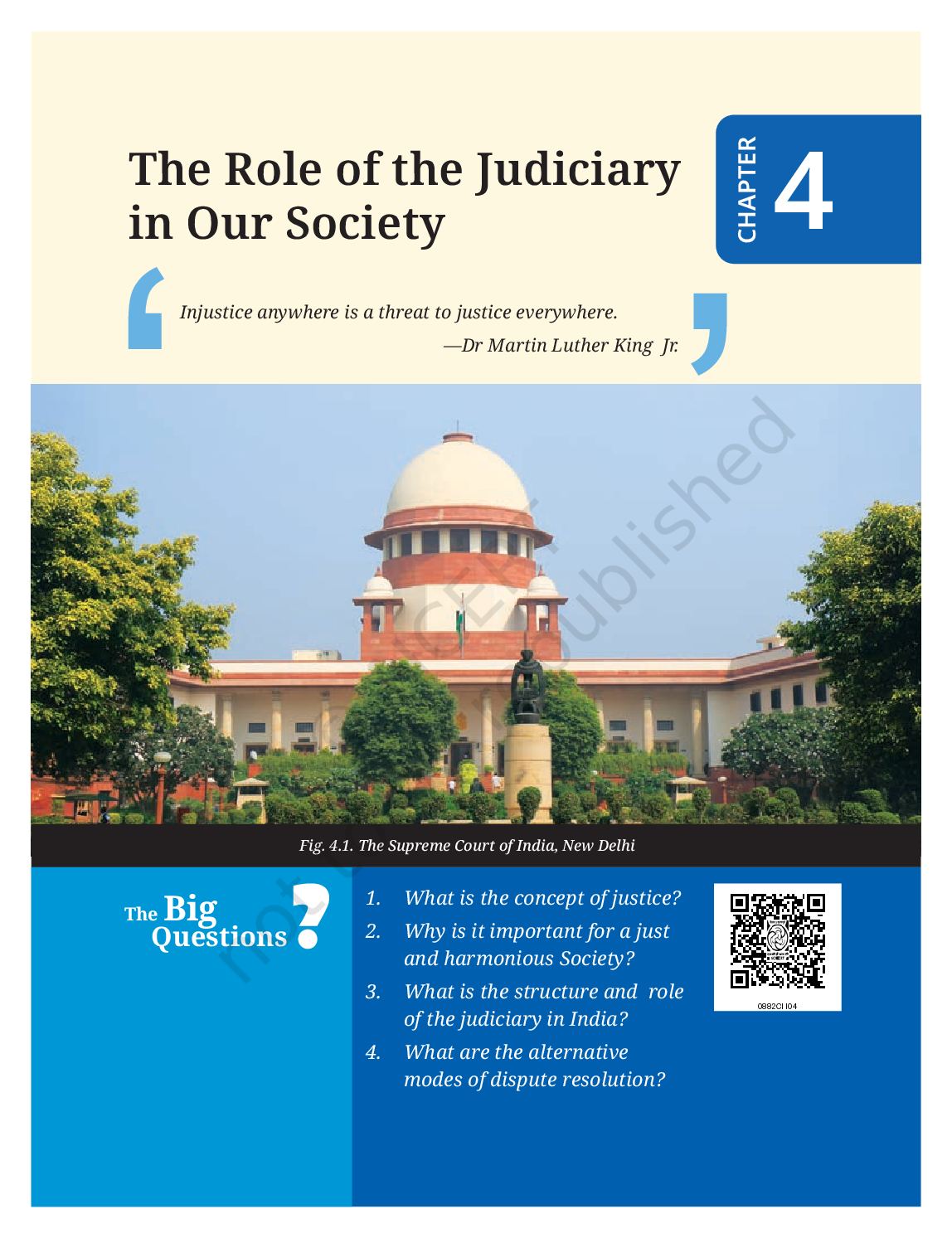
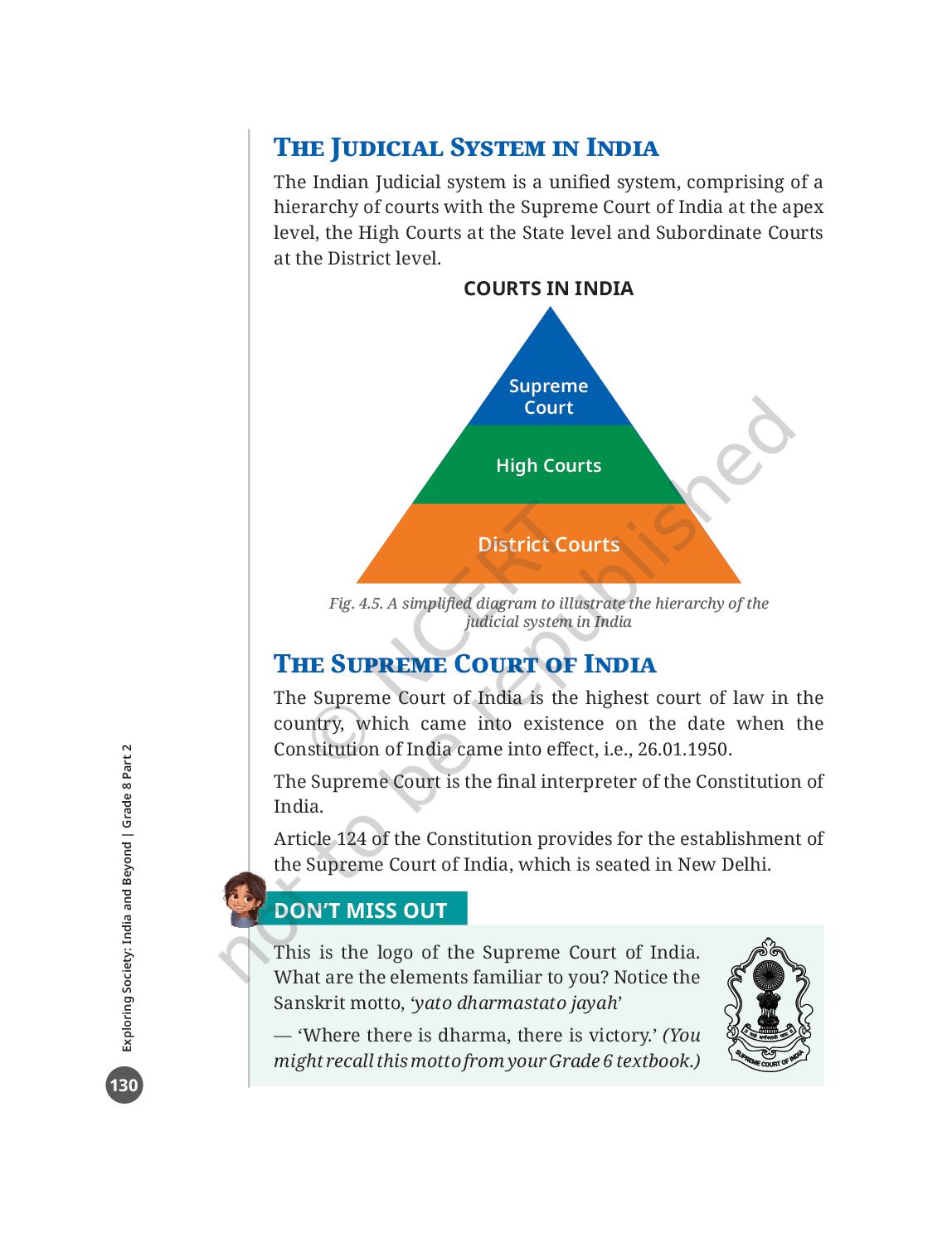
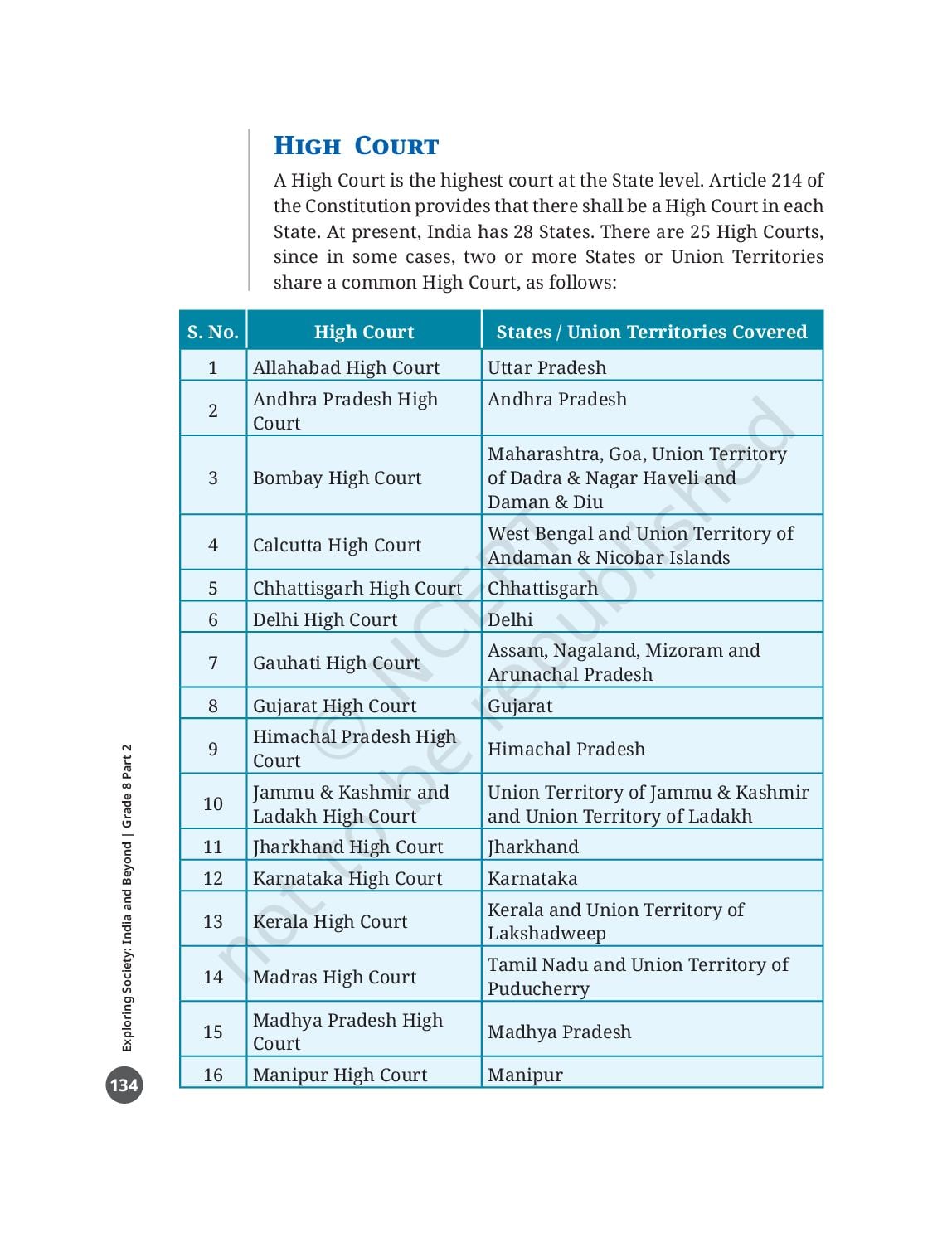
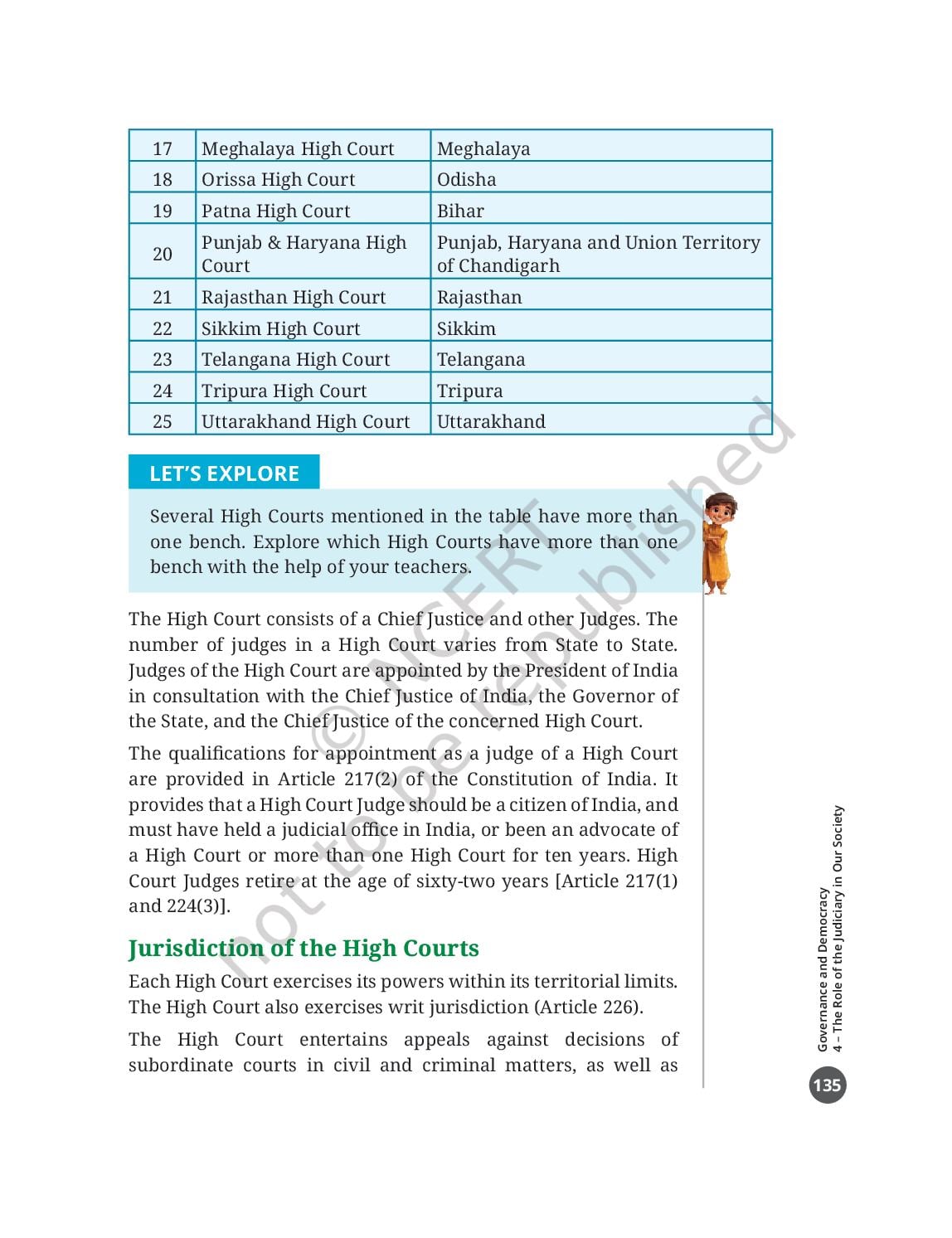
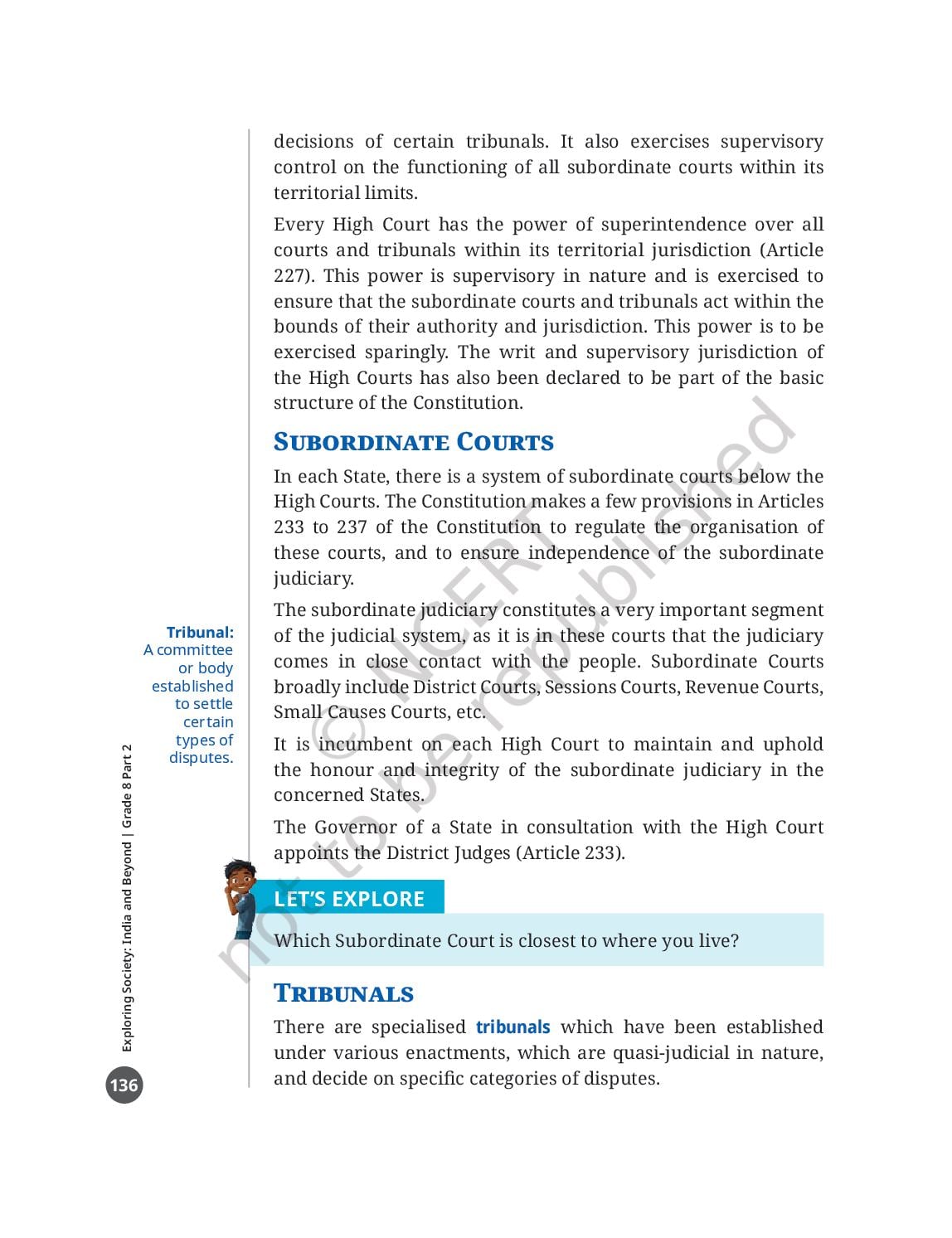
- India’s judicial system is unified and arranged in a hierarchy: the Supreme Court at the apex (Article 124, New Delhi, in existence since 26.01.1950), 25 High Courts at the State level (Article 214), and subordinate courts at the district level (Articles 233–237). Specialised tribunals decide particular kinds of dispute.
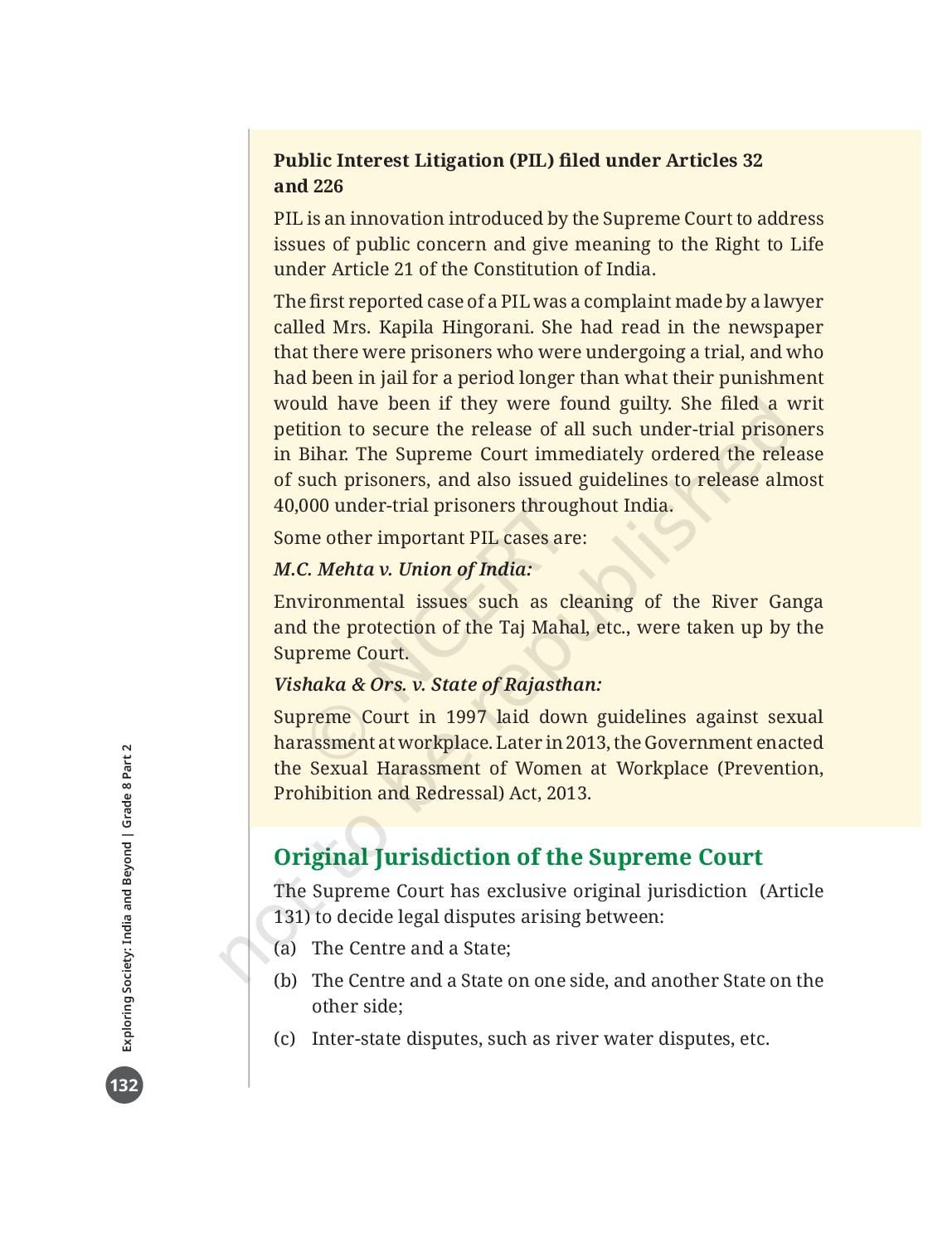
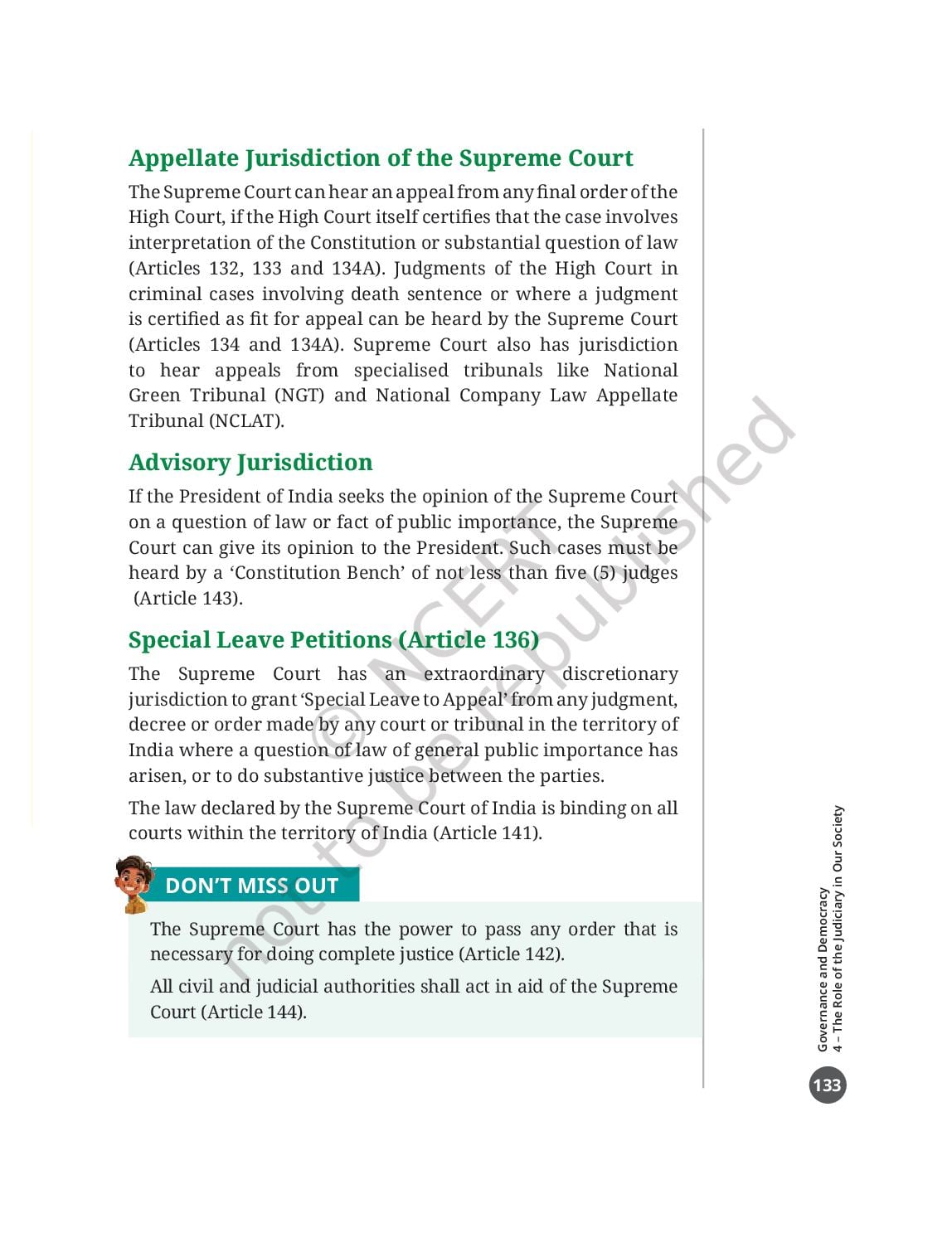
- The Supreme Court is the final interpreter of the Constitution. It exercises writ (Article 32), original (131), appellate (132, 133, 134, 134A), advisory (143) and special leave (136) jurisdiction; it can pass any order needed for complete justice (142); and the law it declares binds every court in India (141). Public Interest Litigation, filed under Articles 32 and 226, was its own innovation to give meaning to the Right to Life under Article 21 — from Mrs Kapila Hingorani’s petition for under-trial prisoners to M.C. Mehta v. Union of India and Vishaka & Ors. v. State of Rajasthan.
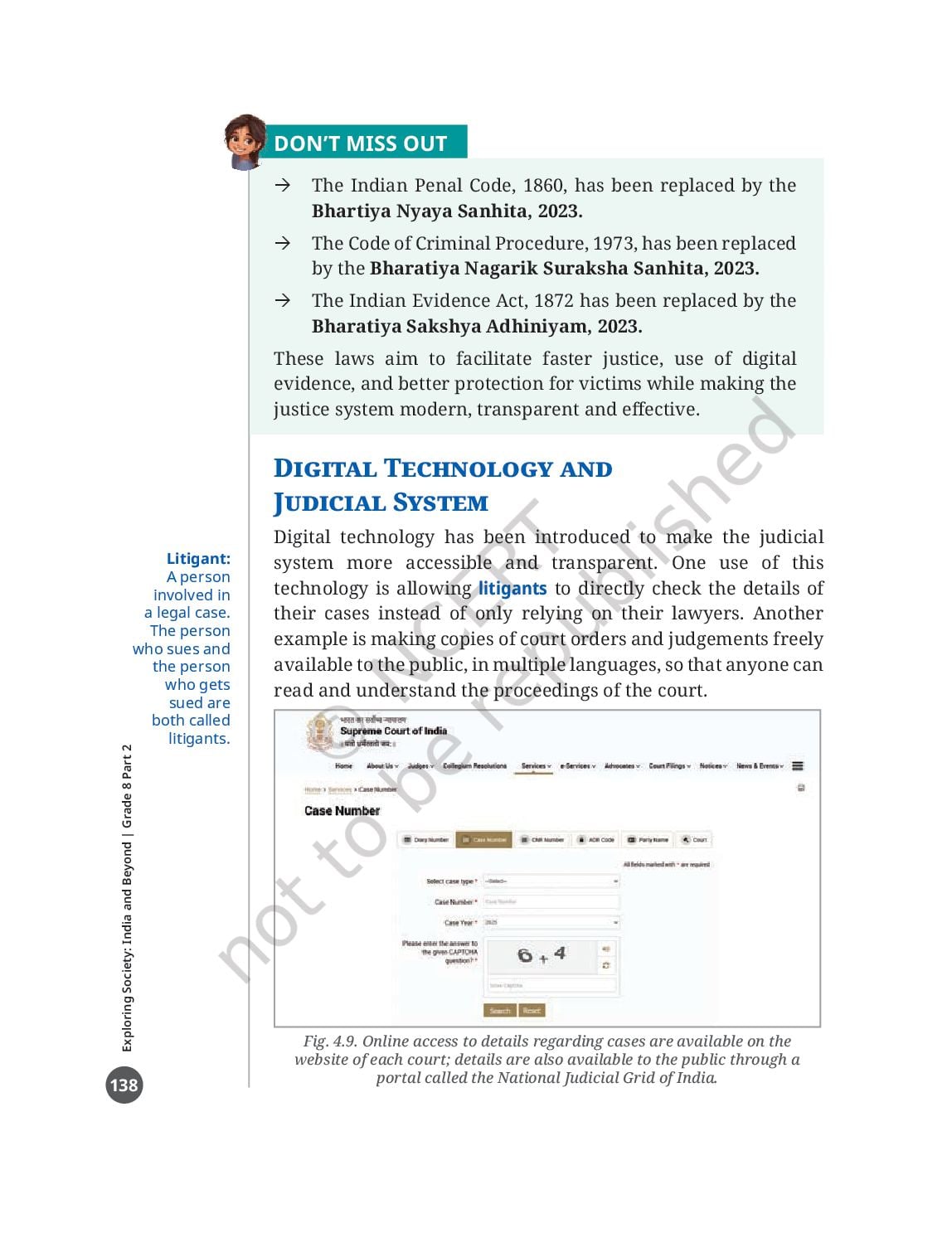
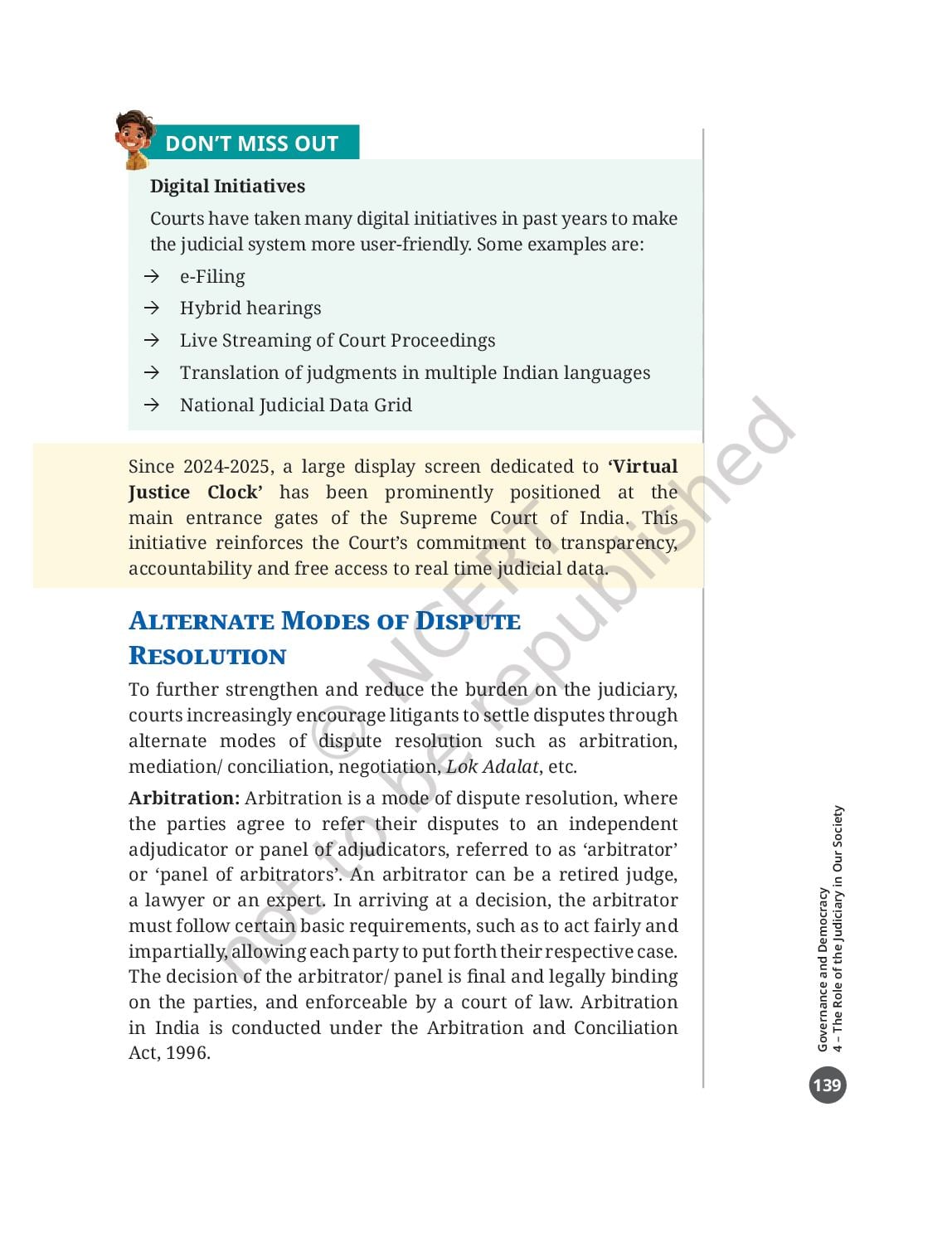
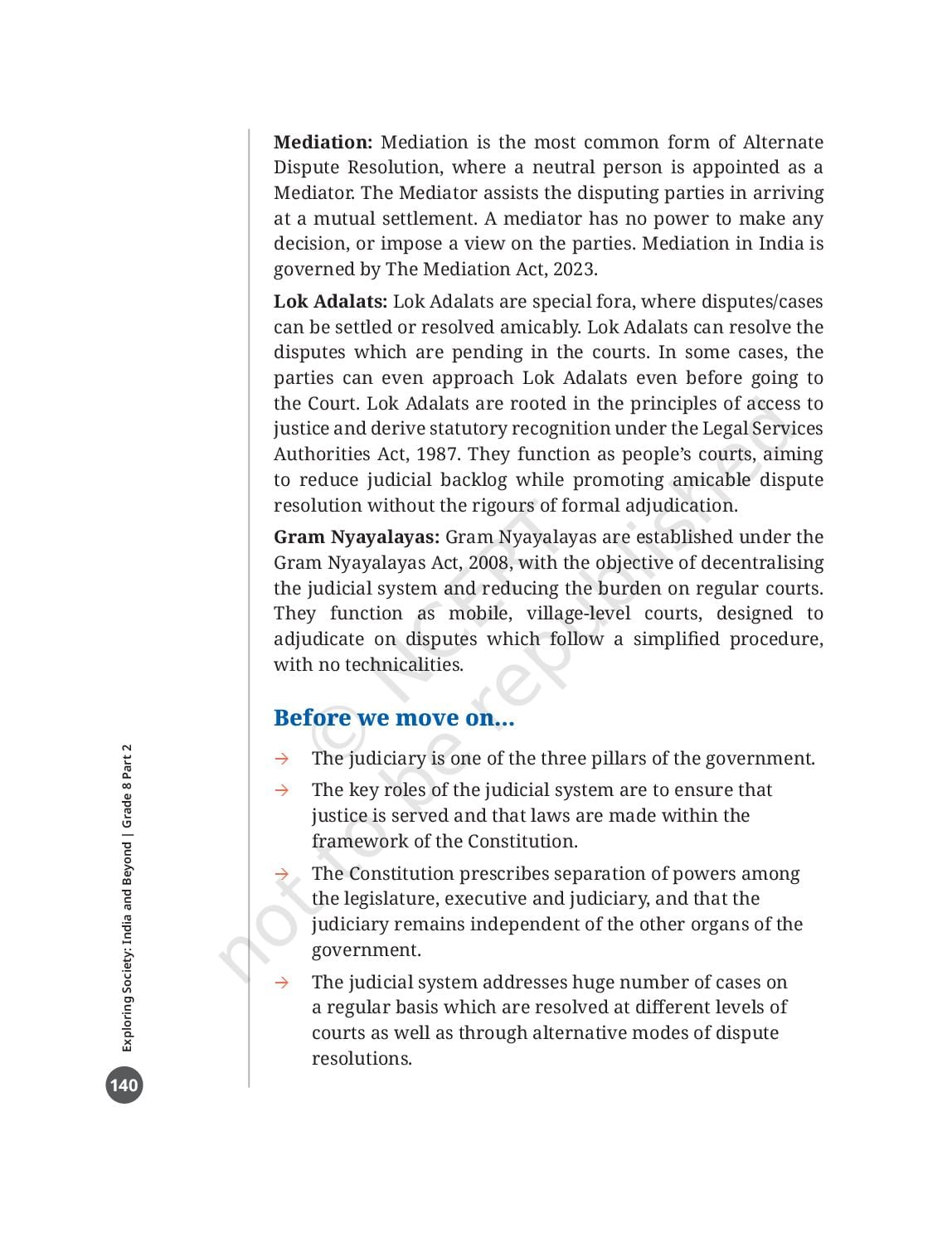
- To lighten the load on the courts and widen access, the system now uses digital tools (e-Filing, hybrid hearings, live streaming, translated judgments, the National Judicial Data Grid) and alternate modes of dispute resolution — arbitration, mediation/conciliation, negotiation, Lok Adalats and Gram Nyayalayas.
Quick revision – The Role of the Judiciary in Our Society
| Term | What it means | Where the chapter uses it | Fact to remember |
|---|---|---|---|
| Judiciary | The branch of the State that decides disputes in accordance with the law, independent of the legislature and the executive | LET’S REMEMBER, p. 127 | One of the three pillars of the government |
| Substantive justice | Justice judged by the final result — is the decision actually fair, just and reasonable? | Aspects of justice (Fig. 4.4), p. 129 | It looks at the outcome |
| Procedural justice | Every person involved gets a full opportunity of hearing before the court decides | P. 129 | Every person is presumed innocent till proved guilty |
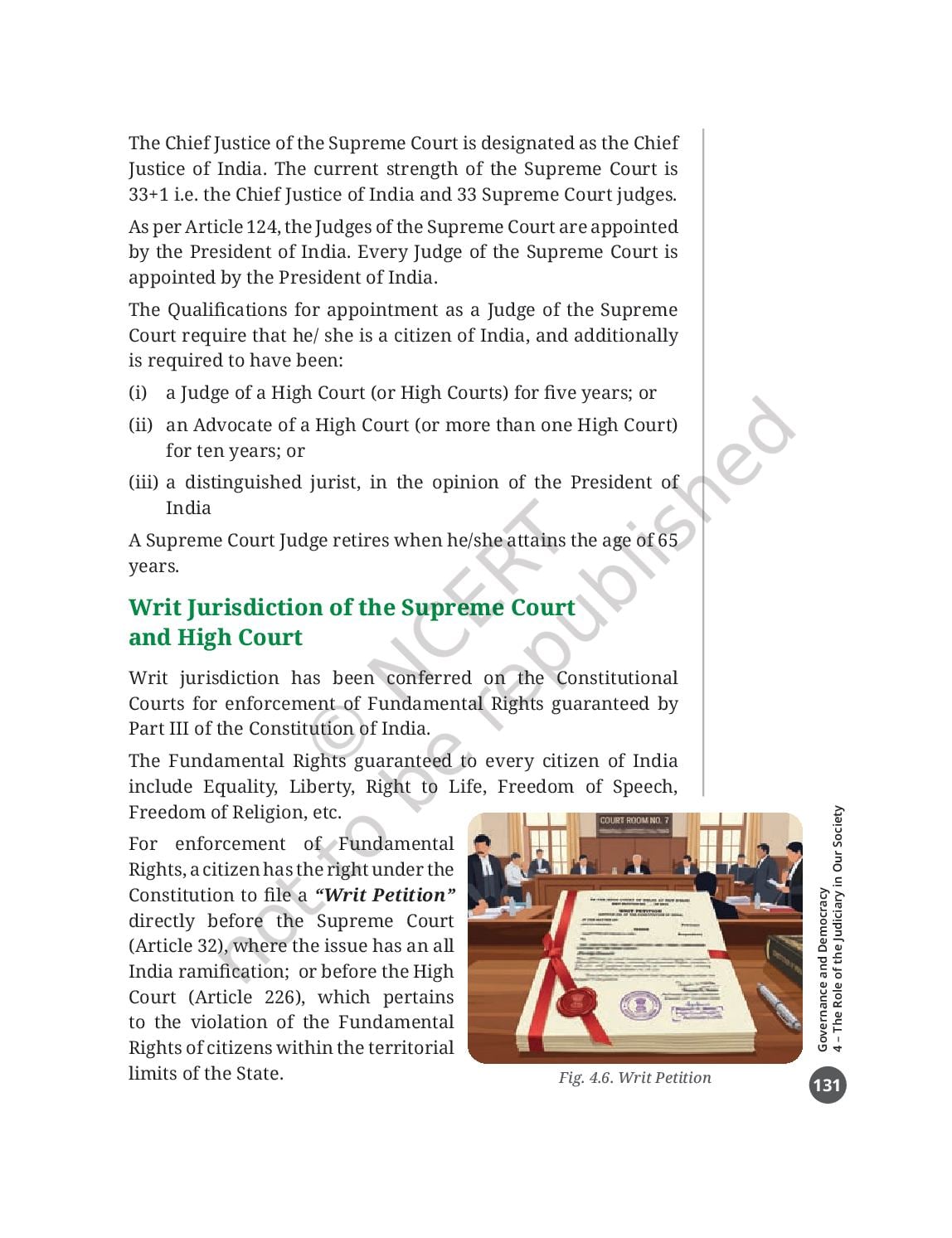
| Writ petition | An application filed directly in a Constitutional Court to enforce a Fundamental Right | Writ Jurisdiction, p. 131 | Article 32 → Supreme Court; Article 226 → High Court |
| Public Interest Litigation (PIL) | A case filed to place an issue of public concern before the court, not a purely private grievance | PIL, p. 132 | An innovation of the Supreme Court, giving meaning to the Right to Life (Article 21) |
| Original jurisdiction | The power to hear a dispute first, not as an appeal | P. 132 | Article 131 — Centre v. State, and inter-State disputes such as river water disputes |
| Appellate jurisdiction | The power to hear an appeal against the decision of a lower court or tribunal | P. 133 | Articles 132, 133, 134 and 134A; appeals also lie from the NGT and NCLAT |
| Advisory jurisdiction | Giving the President the Court’s opinion on a question of law or fact of public importance | P. 133 | Article 143 — heard by a Constitution Bench of not less than five judges |
| Special Leave Petition | The Supreme Court’s extraordinary discretionary power to allow an appeal from any court or tribunal in India | P. 133 | Article 136 |
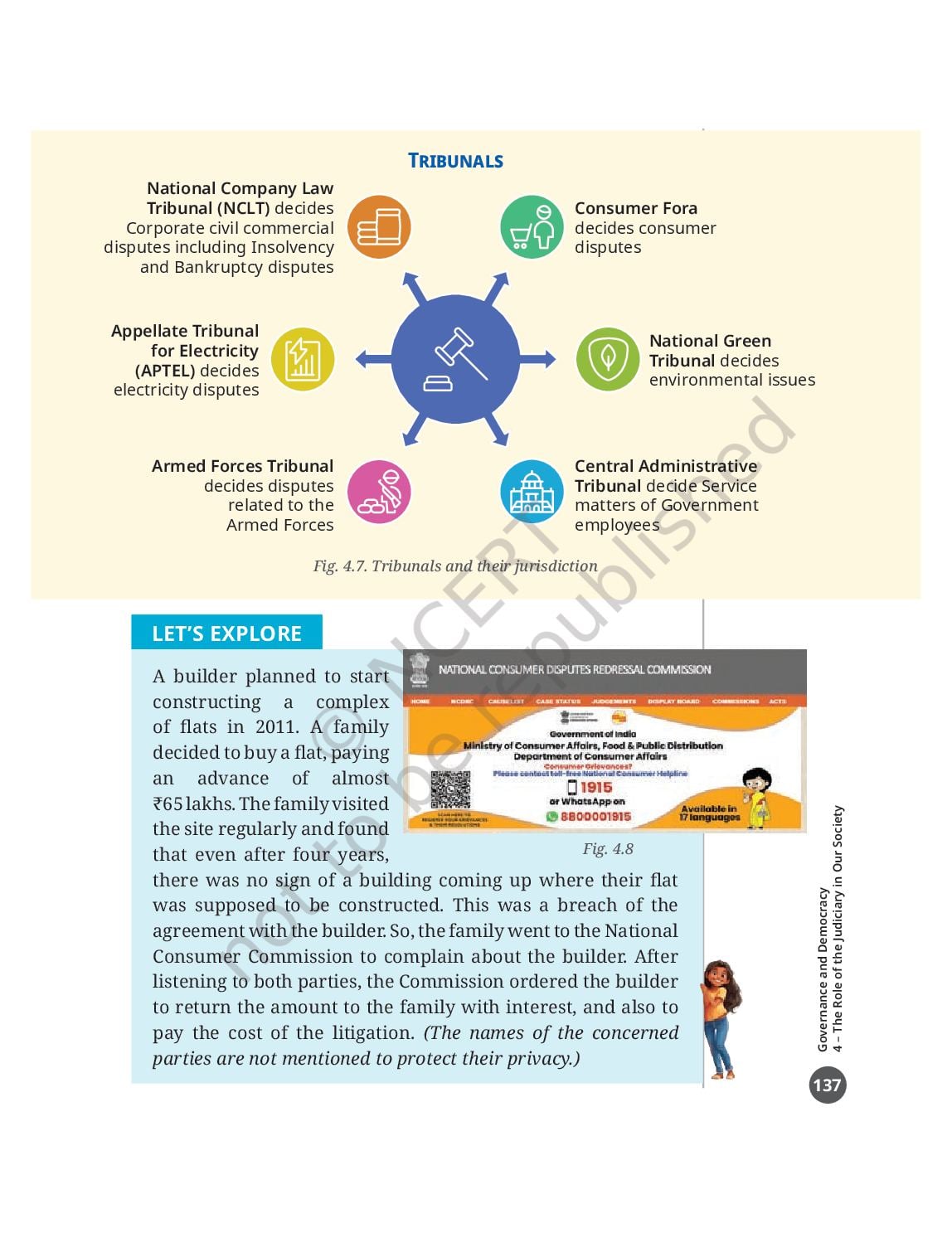
| Tribunal | A committee or body established to settle certain types of disputes | Tribunals, p. 136 | Quasi-judicial — NCLT, NGT, CAT, APTEL, Armed Forces Tribunal, Consumer Fora |
| Litigant | A person involved in a legal case — both the person who sues and the person who gets sued | P. 138 | Digital access now lets a litigant check the case directly, not only through a lawyer |
| Alternate dispute resolution | Settling a dispute without a full court trial | P. 139–140 | Arbitration, mediation/conciliation, negotiation, Lok Adalat, Gram Nyayalaya |
Old NCERT vs New – Class 8 Social Science
This chapter is from Exploring Society: India and Beyond, the new NCERT Class 8 Social Science book (NCF-SE 2023, used from 2025-26). It replaced the old book “Our Pasts, Resources and Development and Social and Political Life”, so chapter numbers and names differ from older PDFs.
Solutions and All Chapters
Answers to the exercises and the full chapter list of Exploring Society: India and Beyond:
The Role of the Judiciary in Our Society – Overview
| Class | Class 8 |
| Subject | Social Science |
| Book | Exploring Society: India and Beyond – new NCERT book |
| Part | Part II |
| Chapter | 11 of 15 – The Role of the Judiciary in Our Society |
| Book pages | Part II, 125 – 142 |
| Edition | NCERT Reprint 2026-27 |
| Session | 2026-27 |
| Free – read online or download |
Class 8 Social Science Chapter 11 – FAQs
Where can I download The Role of the Judiciary in Our Society Class 8 PDF?
From the download table on this page – the chapter PDF is free, and the full book is linked too.
What is Class 8 Social Science Chapter 11 about?
Justice is what keeps a society peaceful and lets people live with equality and dignity. The Judiciary is the institution which ensures fair adjudication of disputes in accordance with the law. It is one of the three pillars of the government, independent of the legislature and the executive.
Is The Role of the Judiciary in Our Society from the new NCERT Class 8 Social Science book?
Yes. It is chapter 11 of exploring society: india and beyond (part ii), the new NCERT Class 8 Social Science book for 2026-27.
Is this the latest NCERT edition for 2026-27?
Yes – the PDF is NCERT’s latest edition for the 2026-27 session.
Where are the NCERT Solutions for Class 8 Social Science Chapter 11?
Open the NCERT Solutions link above for answers to the exercise questions.