Download The Rise of the Marathas – NCERT Class 8 Social Science Chapter 3 PDF from the new NCERT Class 8 Social Science book Exploring Society: India and Beyond (2026-27). Read the chapter online or download the free PDF. The Marathas are a people of the Deccan plateau, in present-day Maharashtra, identified with Marathi, a language with a continuous literary history since the 12th century. Their political rise was prepared by the bhakti saints — Dnyaneshwar, Namdev,…
The Rise of the Marathas PDF – Chapter 3 of Exploring Society: India and Beyond (Part I)
Read the chapter online or download the PDF.
| Chapter | Download | |
|---|---|---|
| Chapter 3 PDF | The Rise of the Marathas | View PDF |
| Full book | NCERT Class 8 Social Science – Exploring Society: India and Beyond | View Book |
Read Online
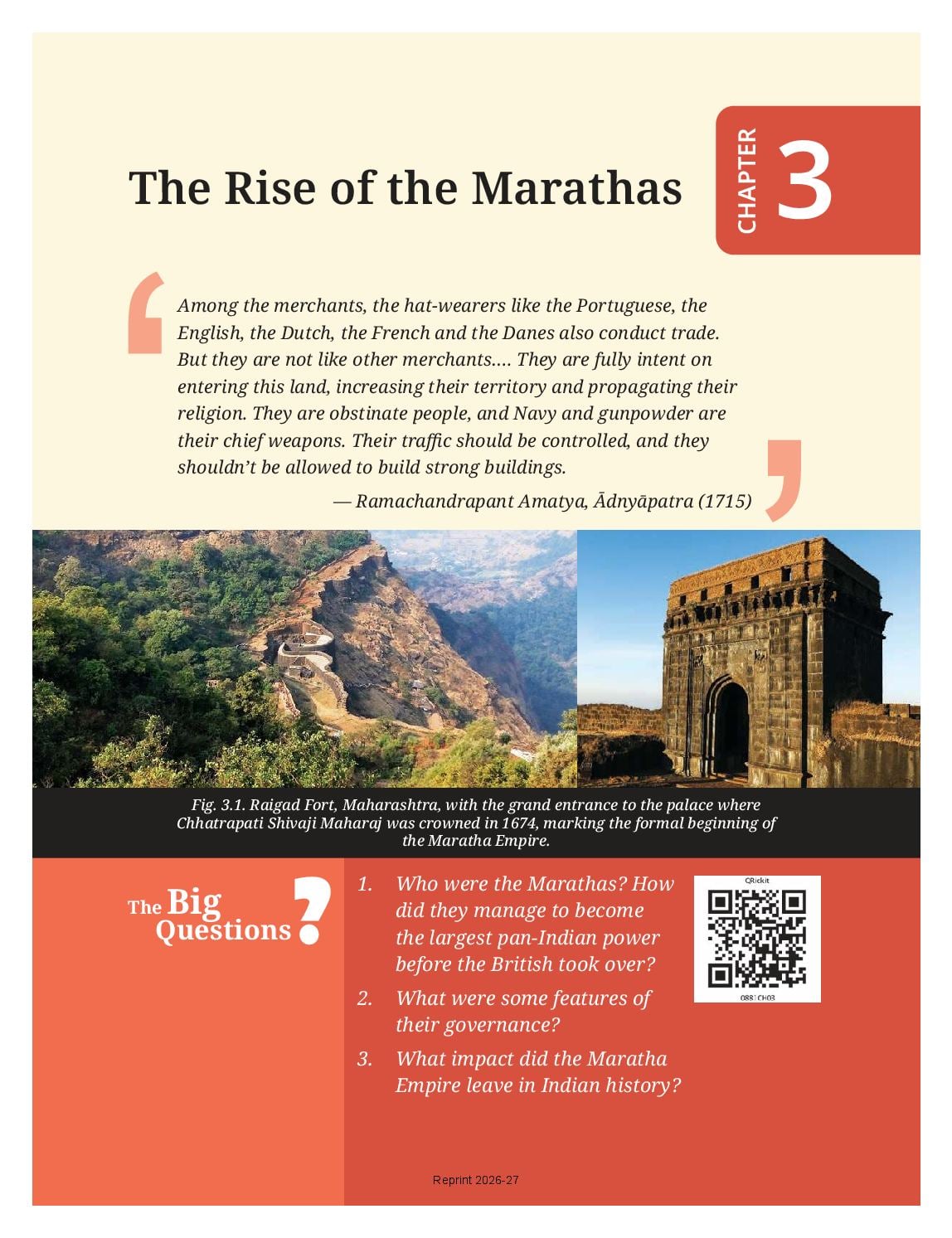
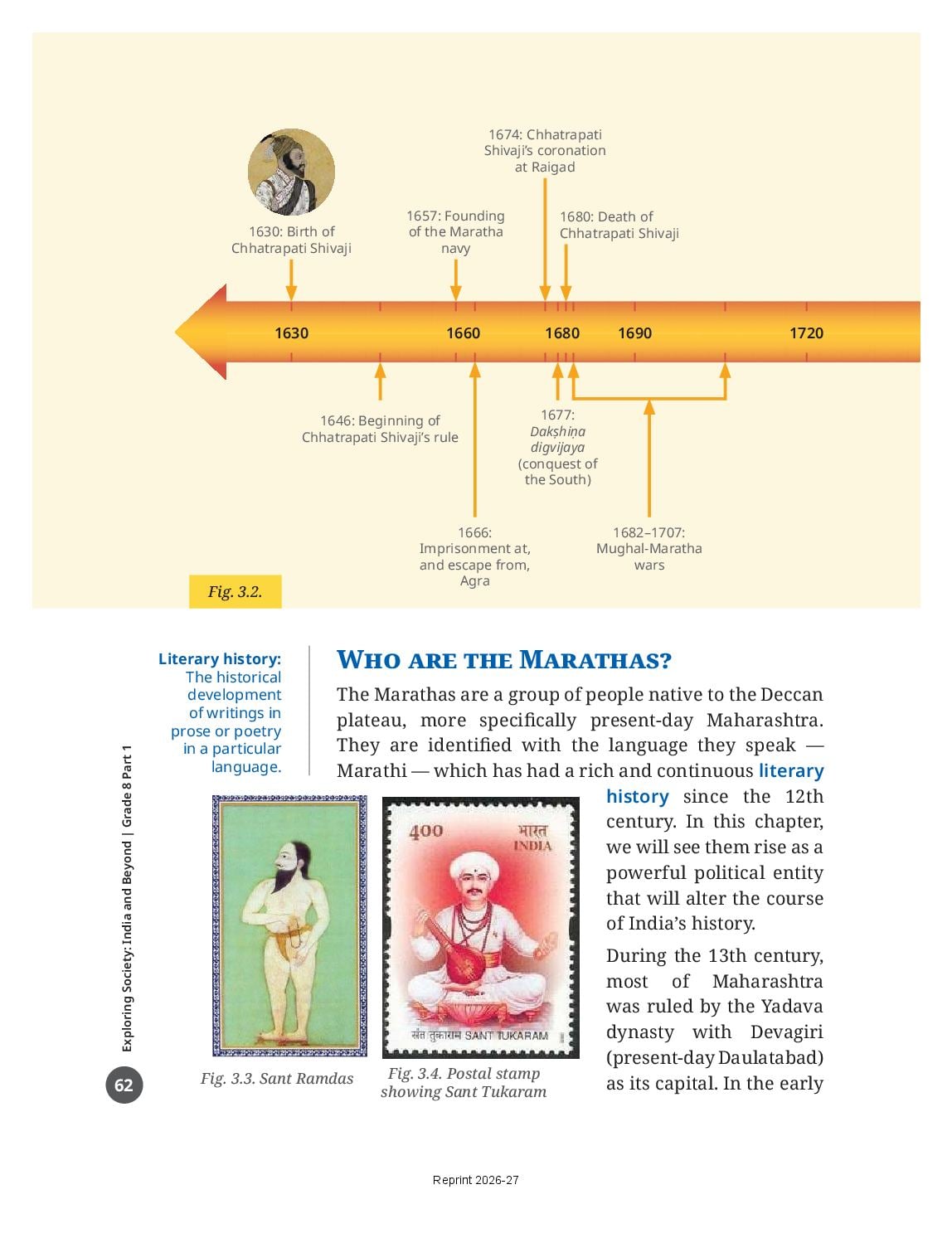
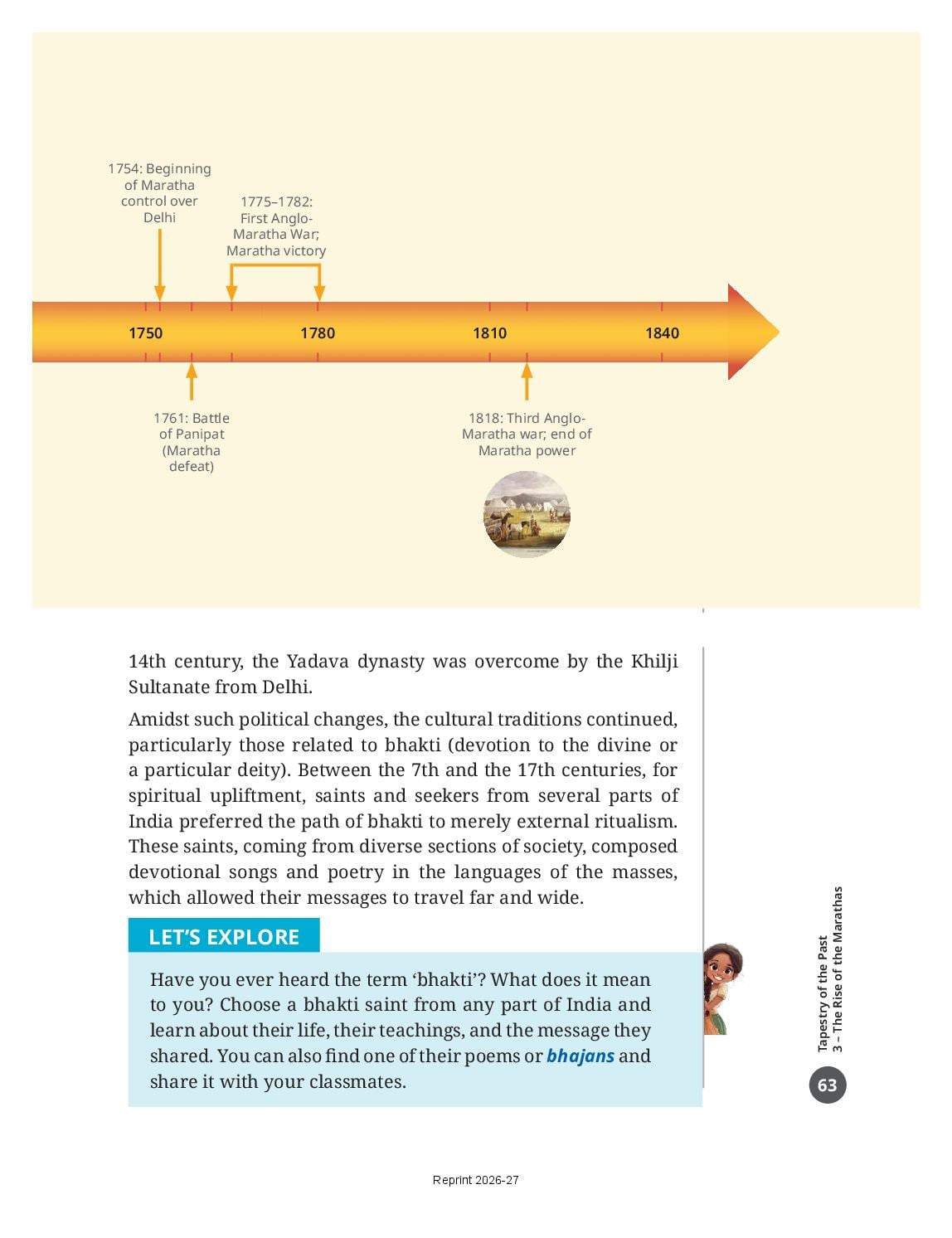
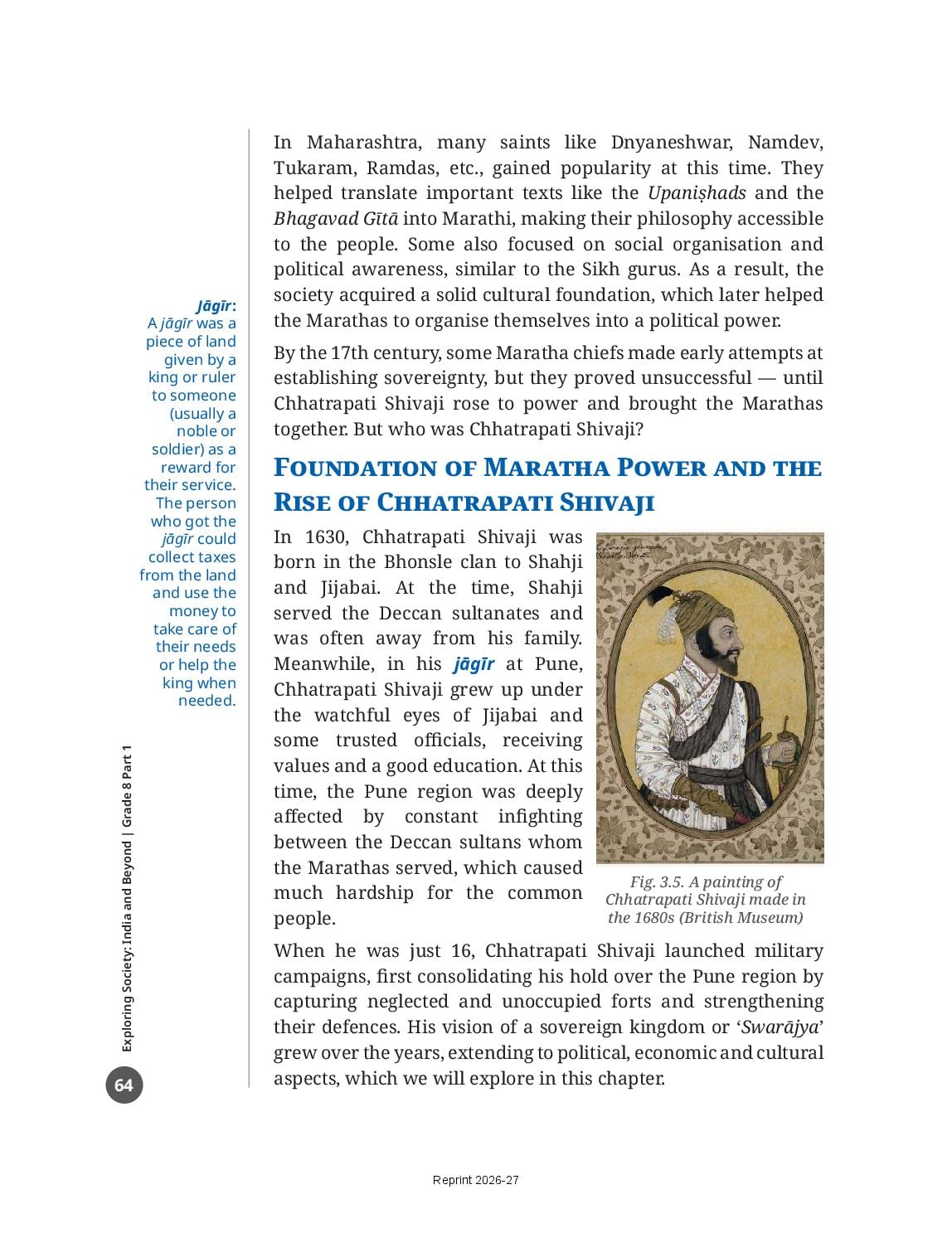
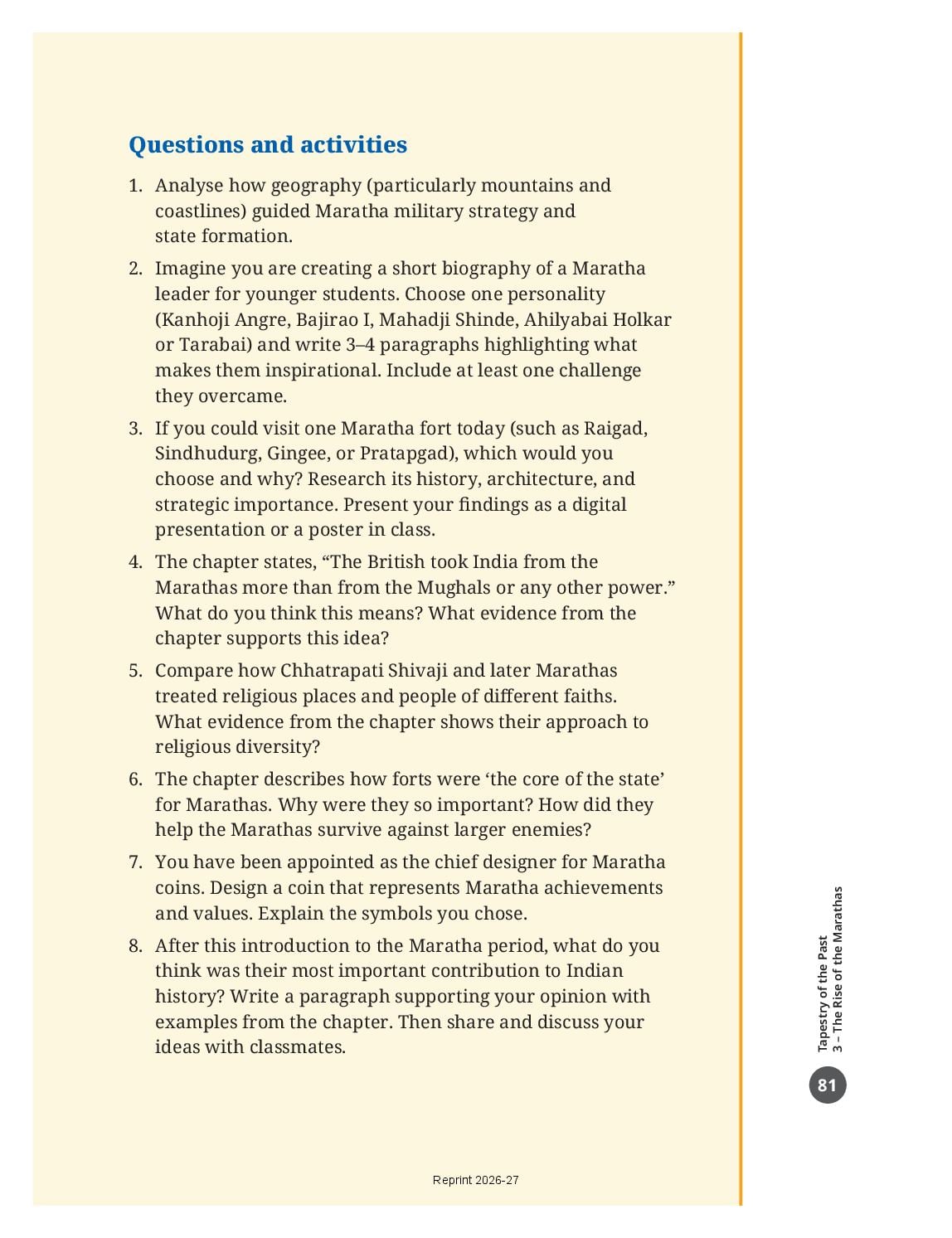
What Is in The Rise of the Marathas? (Class 8 Social Science Chapter 3)
- The Marathas are a people of the Deccan plateau, in present-day Maharashtra, identified with Marathi, a language with a continuous literary history since the 12th century. Their political rise was prepared by the bhakti saints — Dnyaneshwar, Namdev, Tukaram, Ramdas — who put the Upaniṣhads and the Bhagavad Gītā into Marathi and gave society a common cultural foundation.
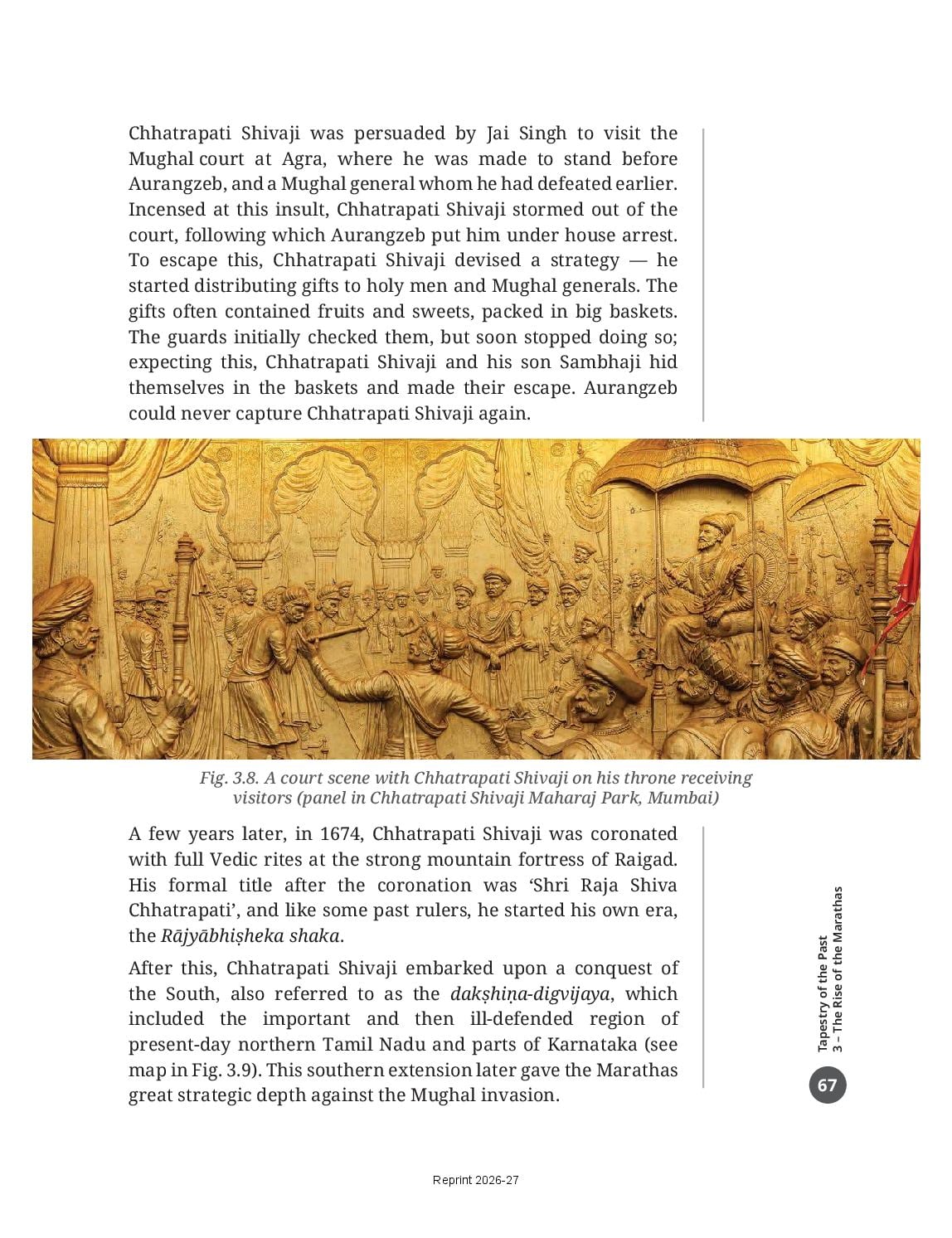
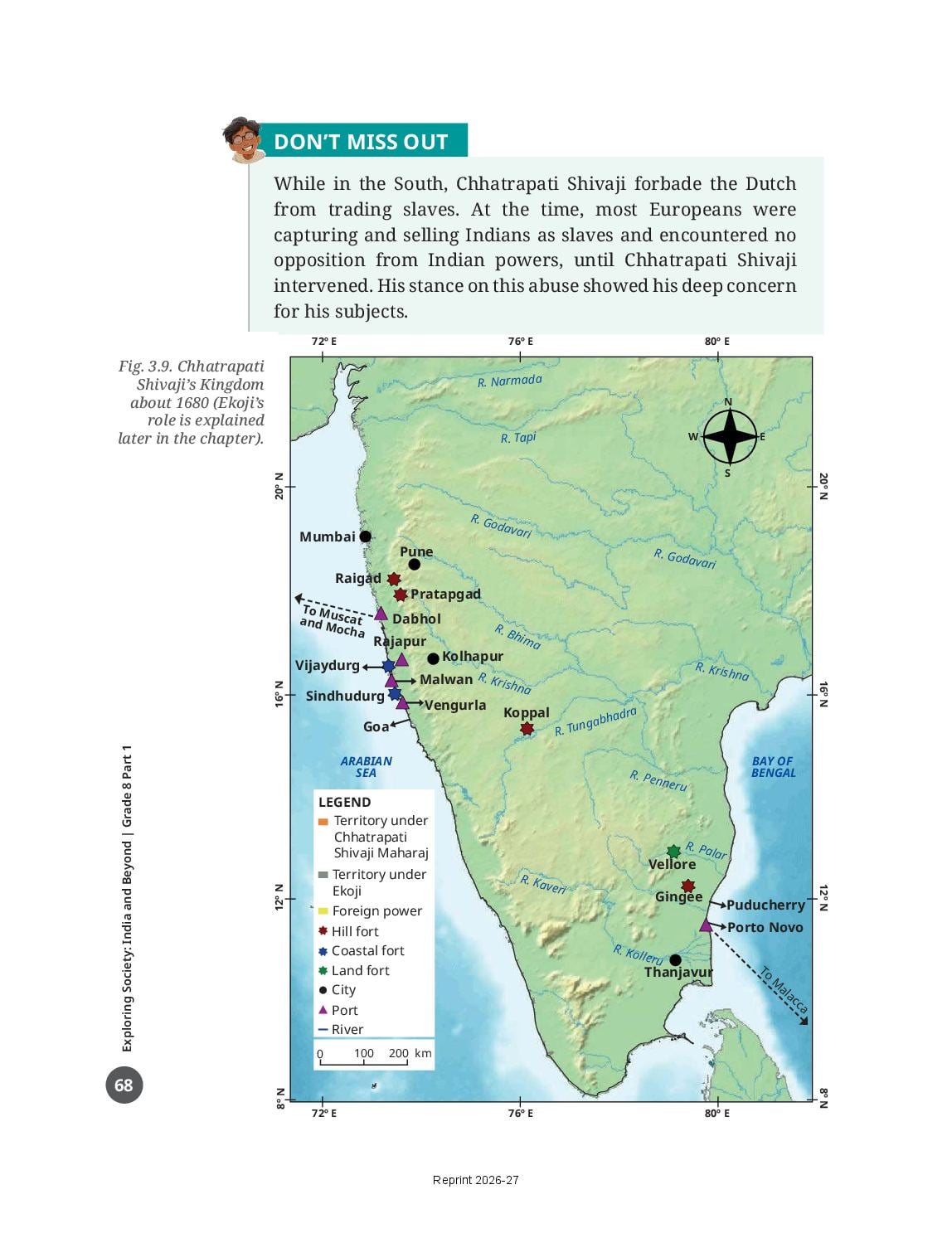
- Chhatrapati Shivaji (born 1630, Bhonsle clan, son of Shahji and Jijabai) began capturing forts at sixteen, ruled from 1646, founded the Maratha navy in 1657, was crowned at Raigad in 1674 with the title Shri Raja Shiva Chhatrapati, and carried out the dakṣhiṇa-digvijaya in 1677. He died in 1680, aged fifty.
- His method was forts plus guerrilla warfare — small groups using speed, surprise and knowledge of the terrain. Ramachandrapant Amatya wrote in the Ādnyāpatra that ‘forts are the core of the state’, and it was the forts that kept the state alive through Aurangzeb’s onslaught of 1682–1707.
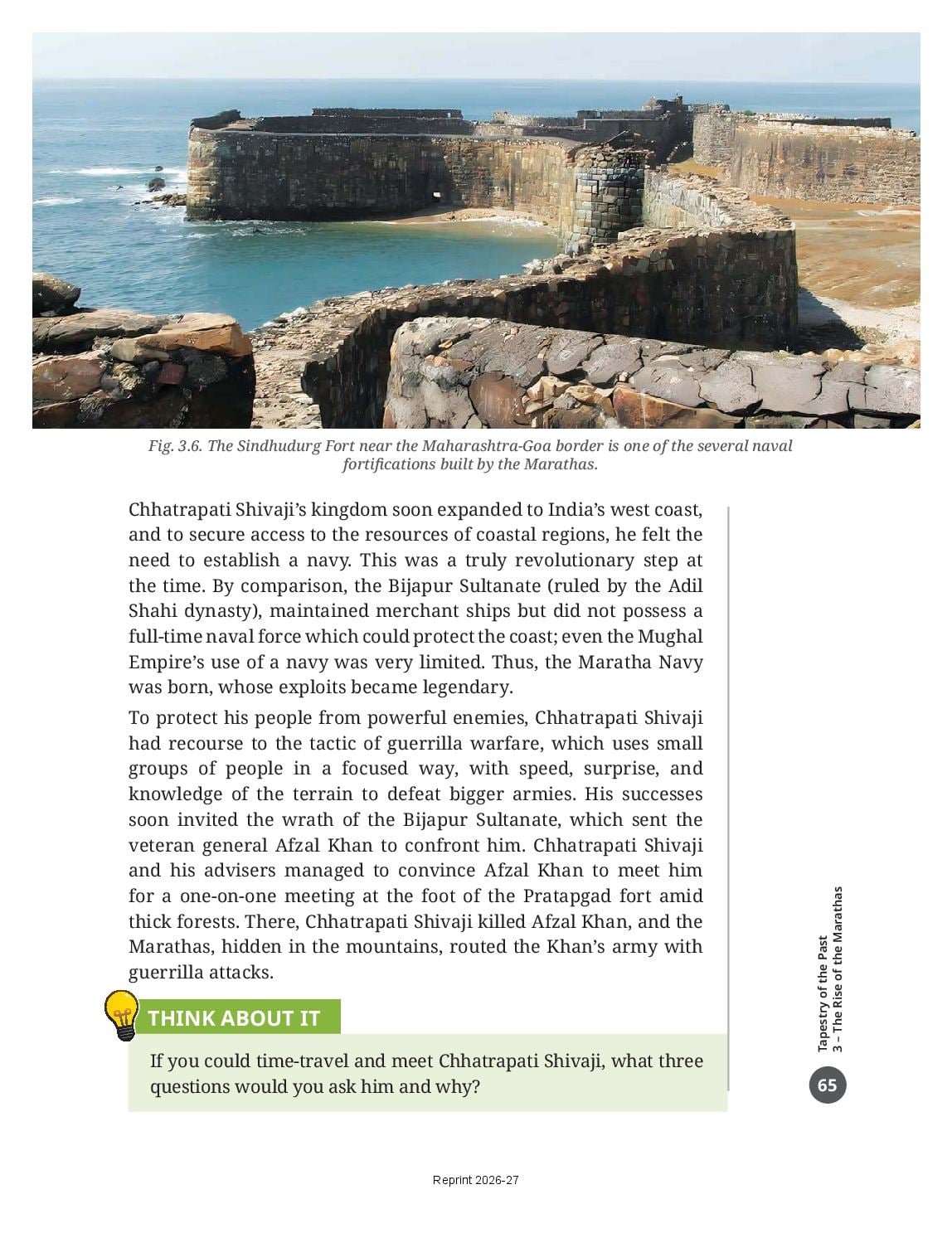
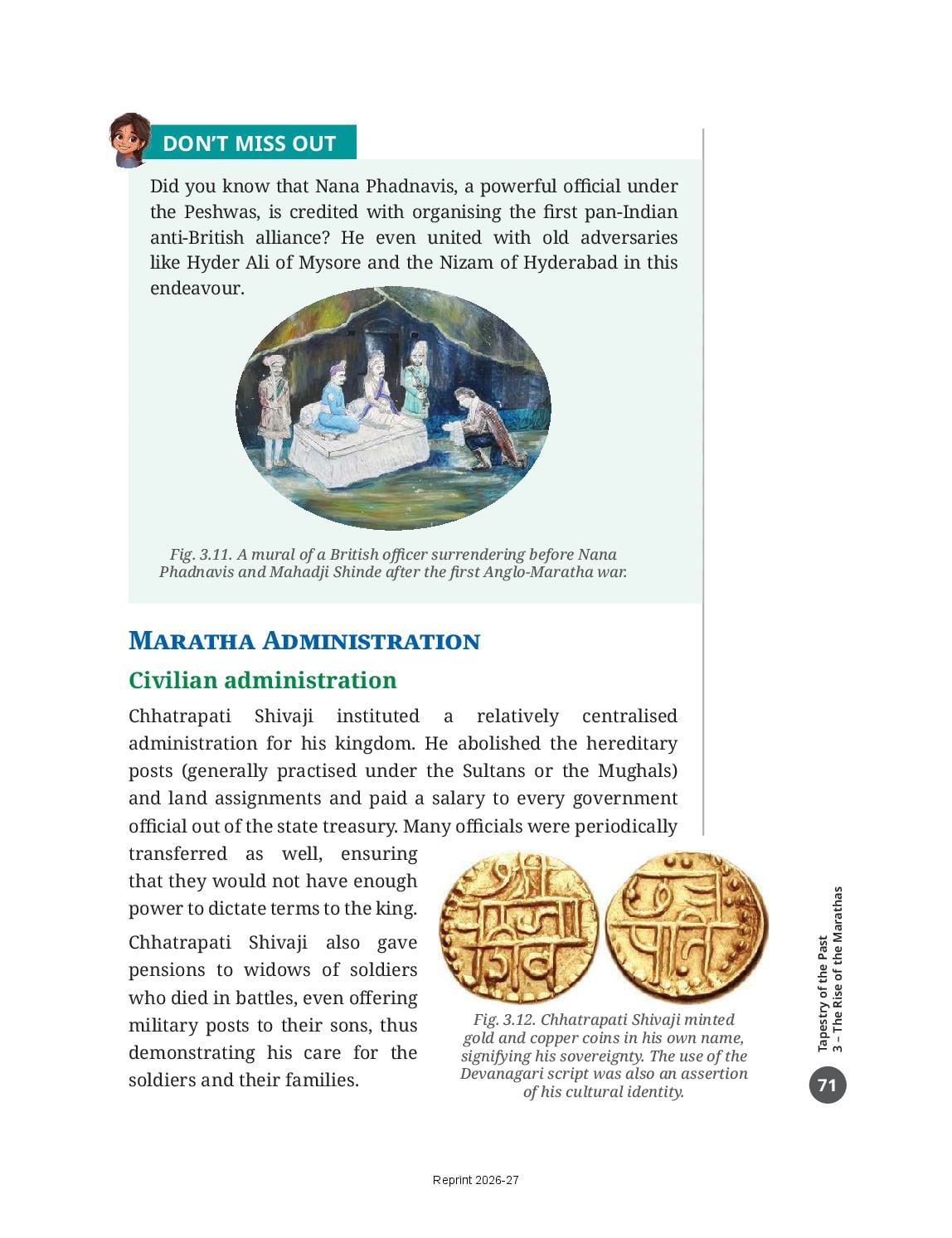
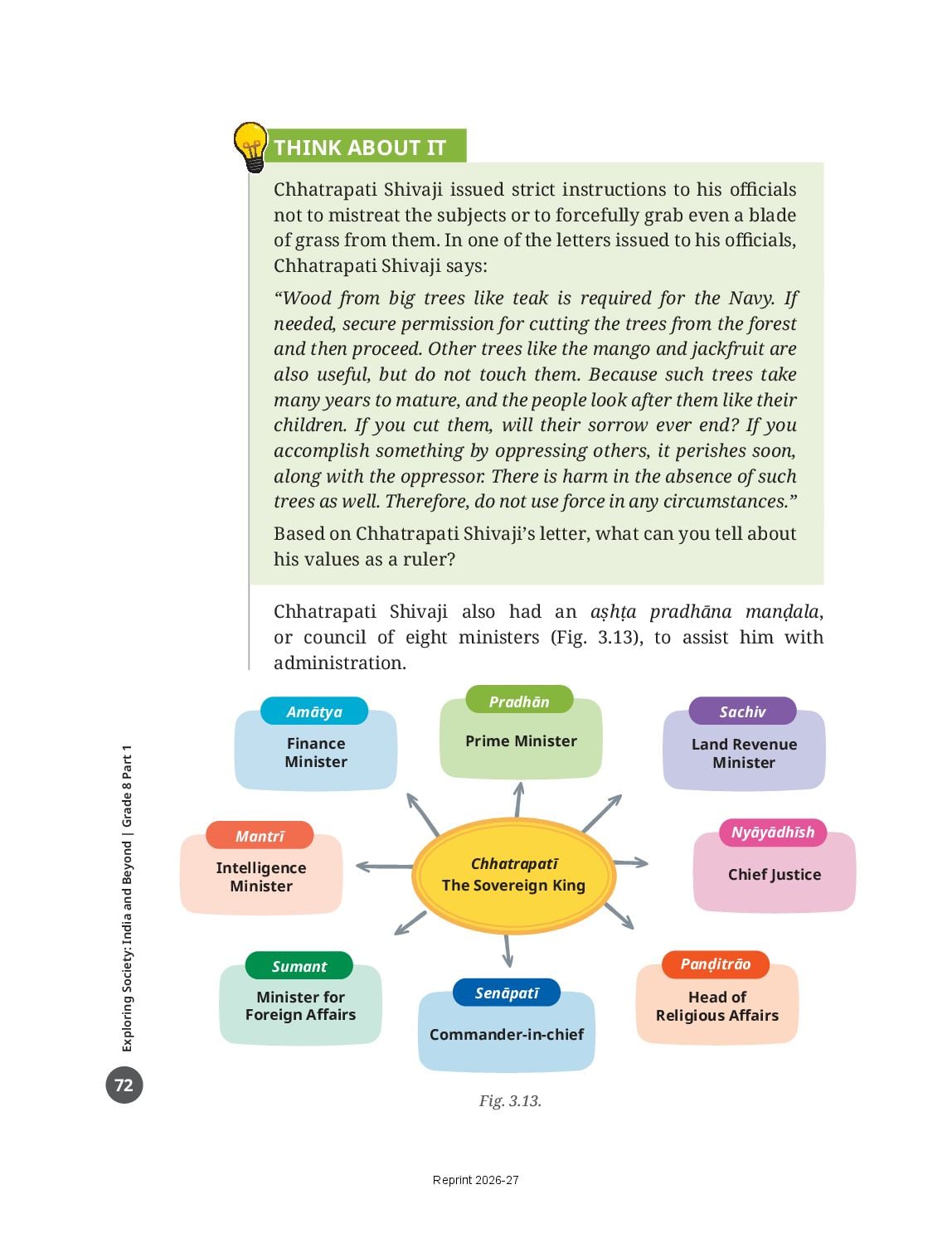
- Governance rested on a salaried, transferable administration with no hereditary posts or land assignments, an aṣhṭa pradhāna manḍala of eight ministers, the chauth (25%) and sardeshmukhi (a further 10%) levied on provinces outside direct rule, panchāyat justice with sparing use of the death penalty, and a navy that challenged the European pass system by demanding passes from the Europeans themselves.
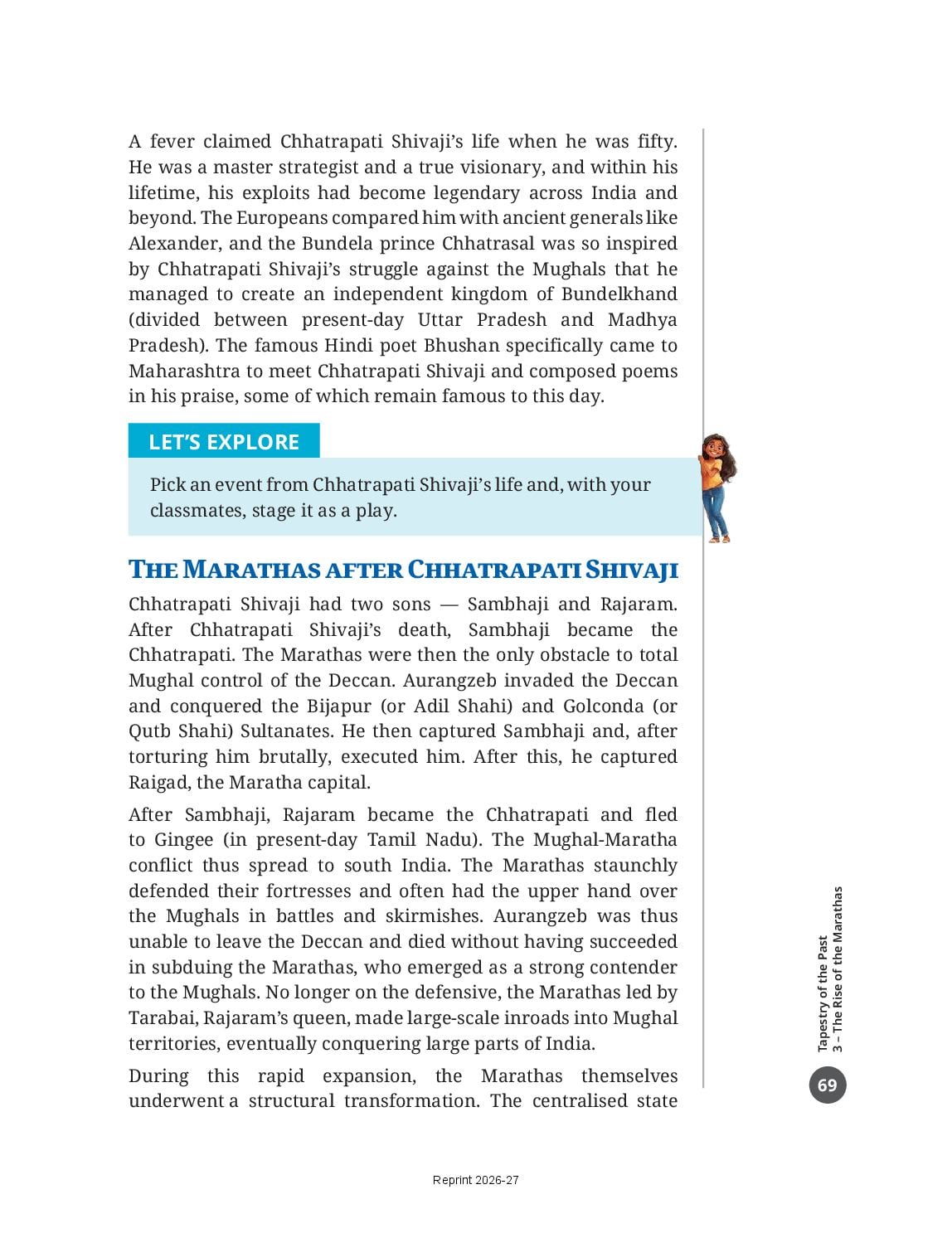
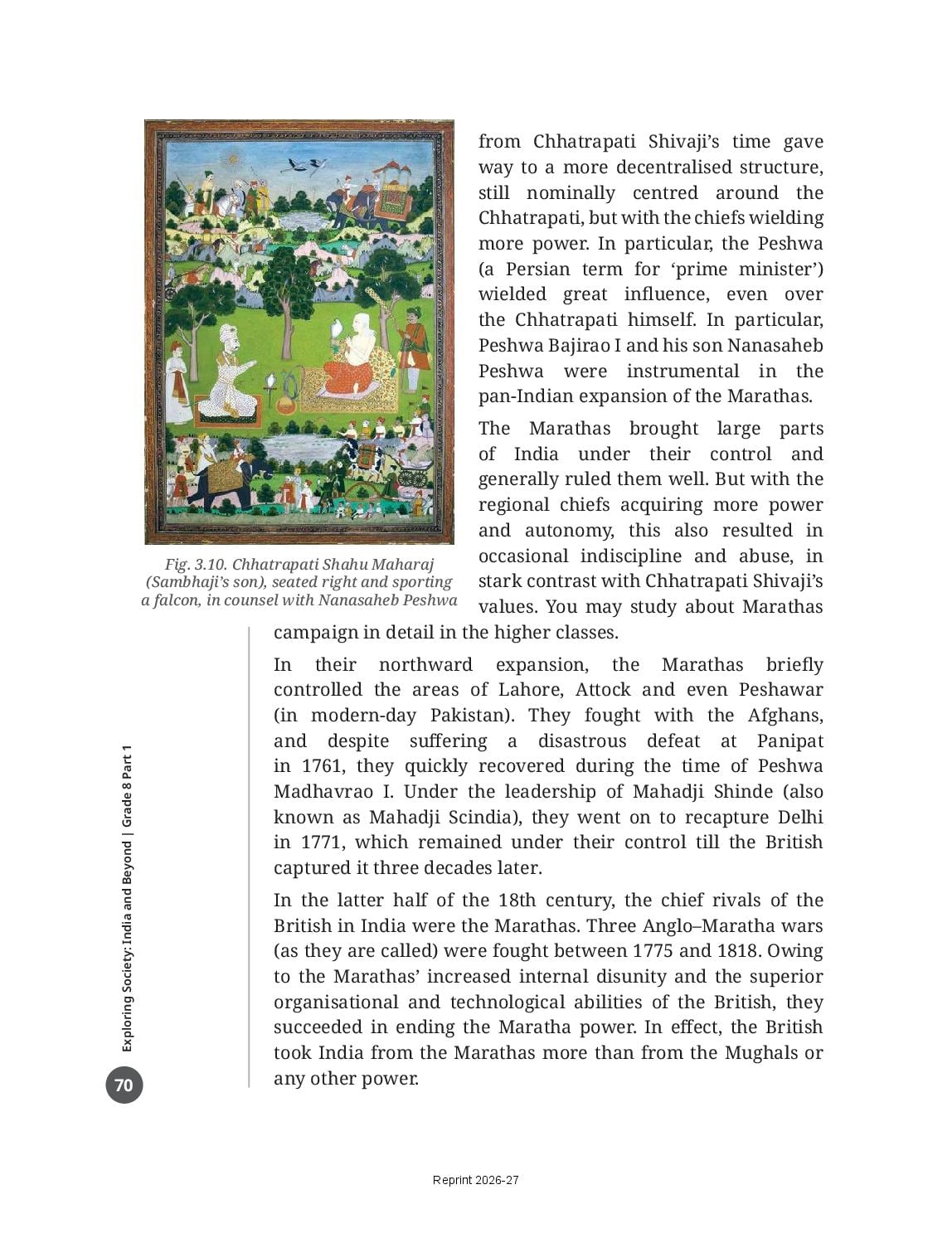
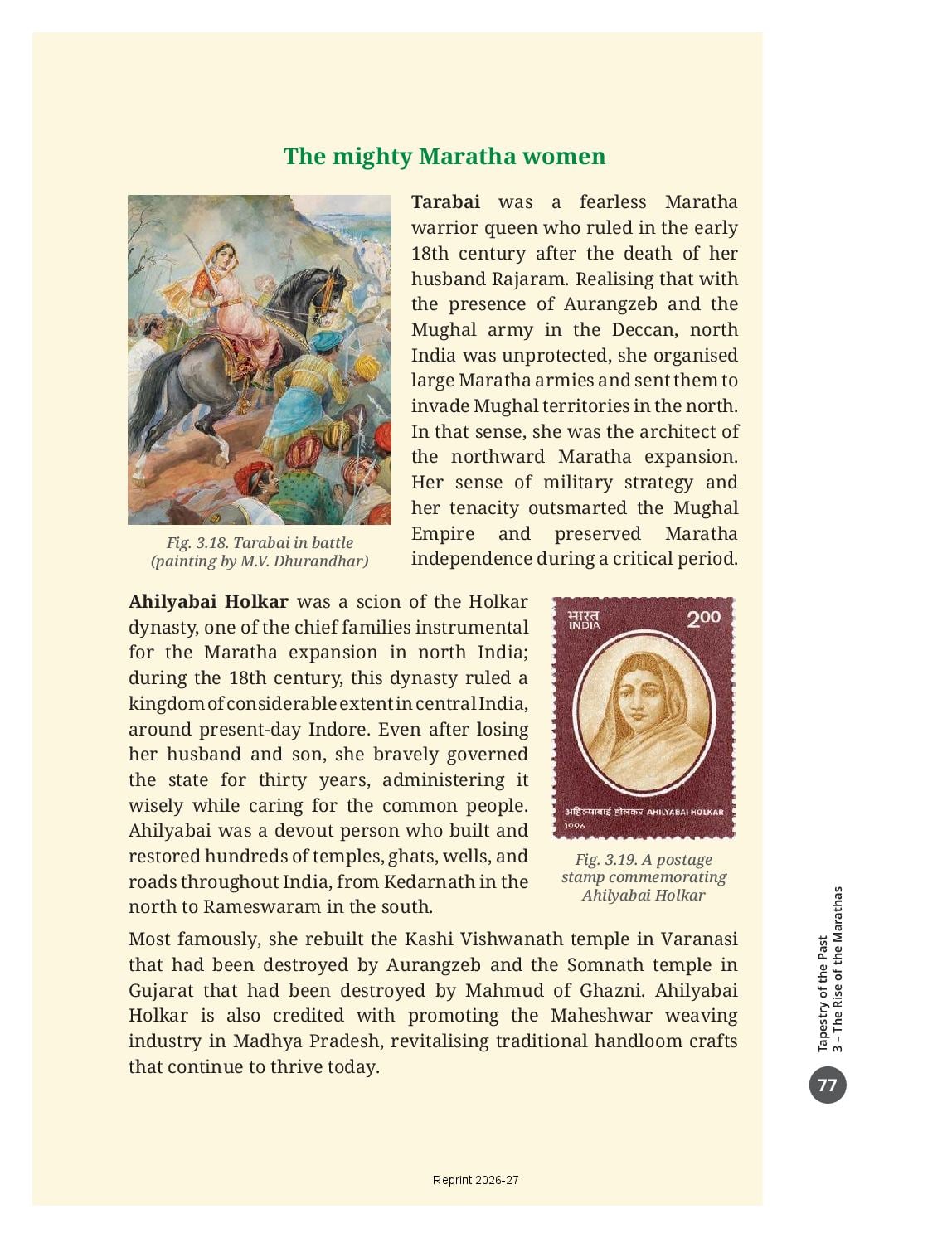
- After Shivaji the state grew but decentralised: the Peshwa came to overshadow the Chhatrapati, Tarabai launched the northward expansion, and Bajirao I, Nanasaheb and Mahadji Shinde carried Maratha power to Delhi (1754, again 1771), Lahore, Attock and Peshawar — the largest Indian empire before the British.
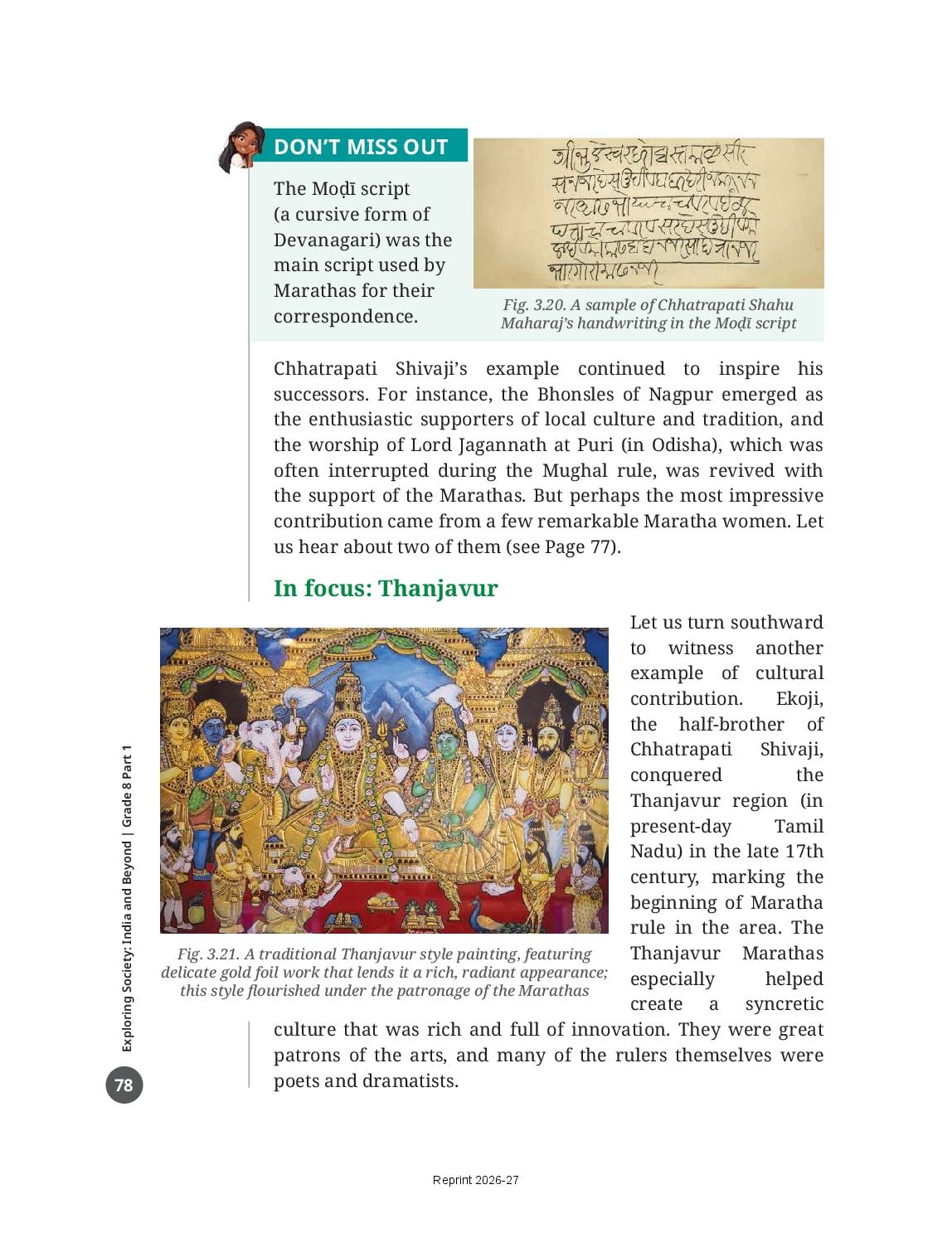
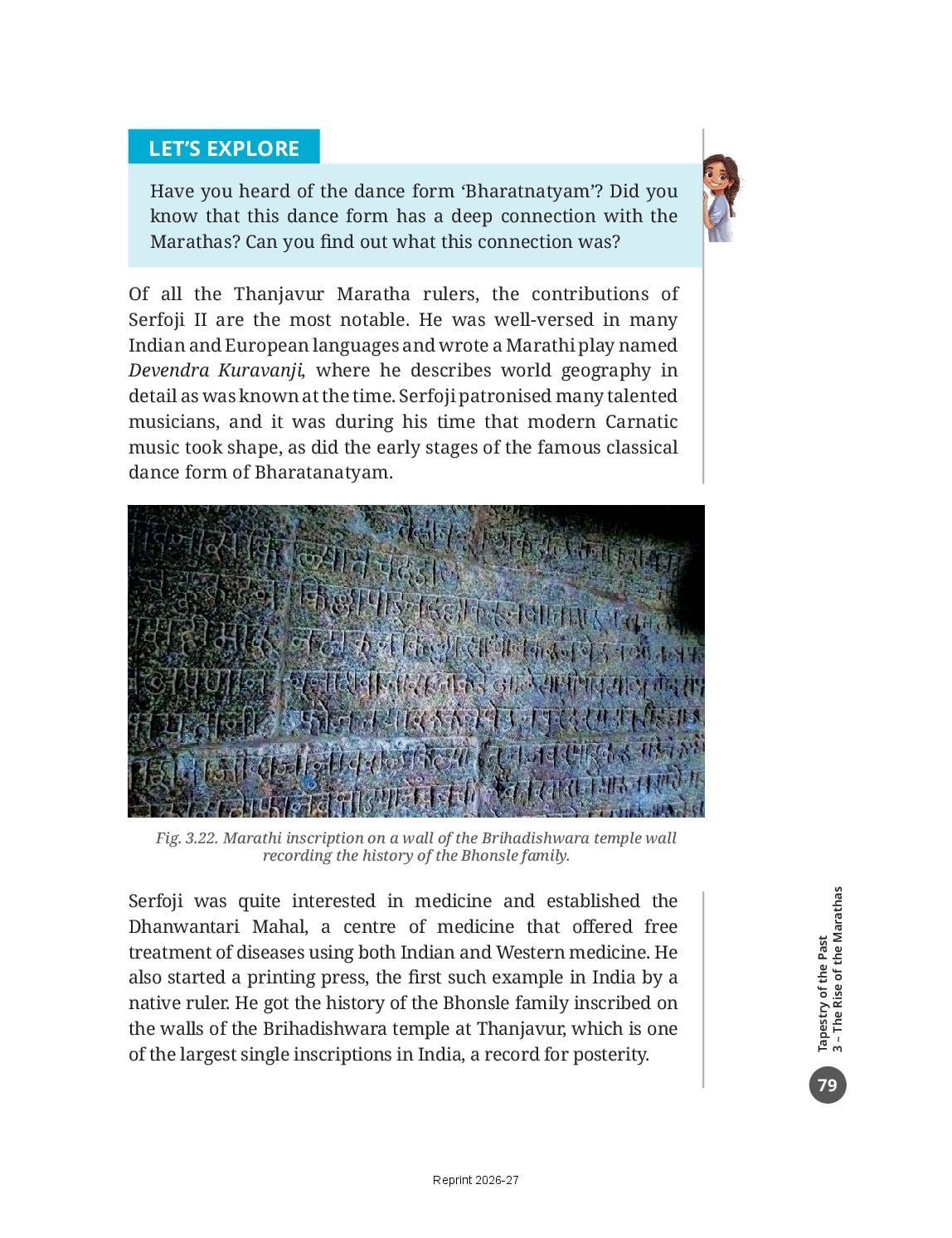
- The legacy is threefold: an empire that challenged Mughal dominance; an efficient way of governing; and a cultural revival — the Sanskrit seal, the Rājya-Vyavahāra-Koṣha, the Moḍī script, Ahilyabai Holkar’s temples and ghats, and the syncretic Thanjavur court of Serfoji II. The ideal of Swarājya later helped plant the seeds of India’s freedom movement.
Quick revision – The Rise of the Marathas
| Term | What it means | Where it appears | Why it matters |
|---|---|---|---|
| Swarājya | Self-rule — a sovereign kingdom of one’s own, not a governorship held under a sultan | Pages 64, 80 | The idea that drove Shivaji from age sixteen, and later ‘planted the early seeds for India’s freedom movement’ |
| Jāgīr | Land given by a ruler to a noble or soldier as a reward for service; the holder could collect its taxes | Page 64 | Shahji held a jāgīr at Pune — Shivaji grew up there; Shivaji later abolished such land assignments in his own state |
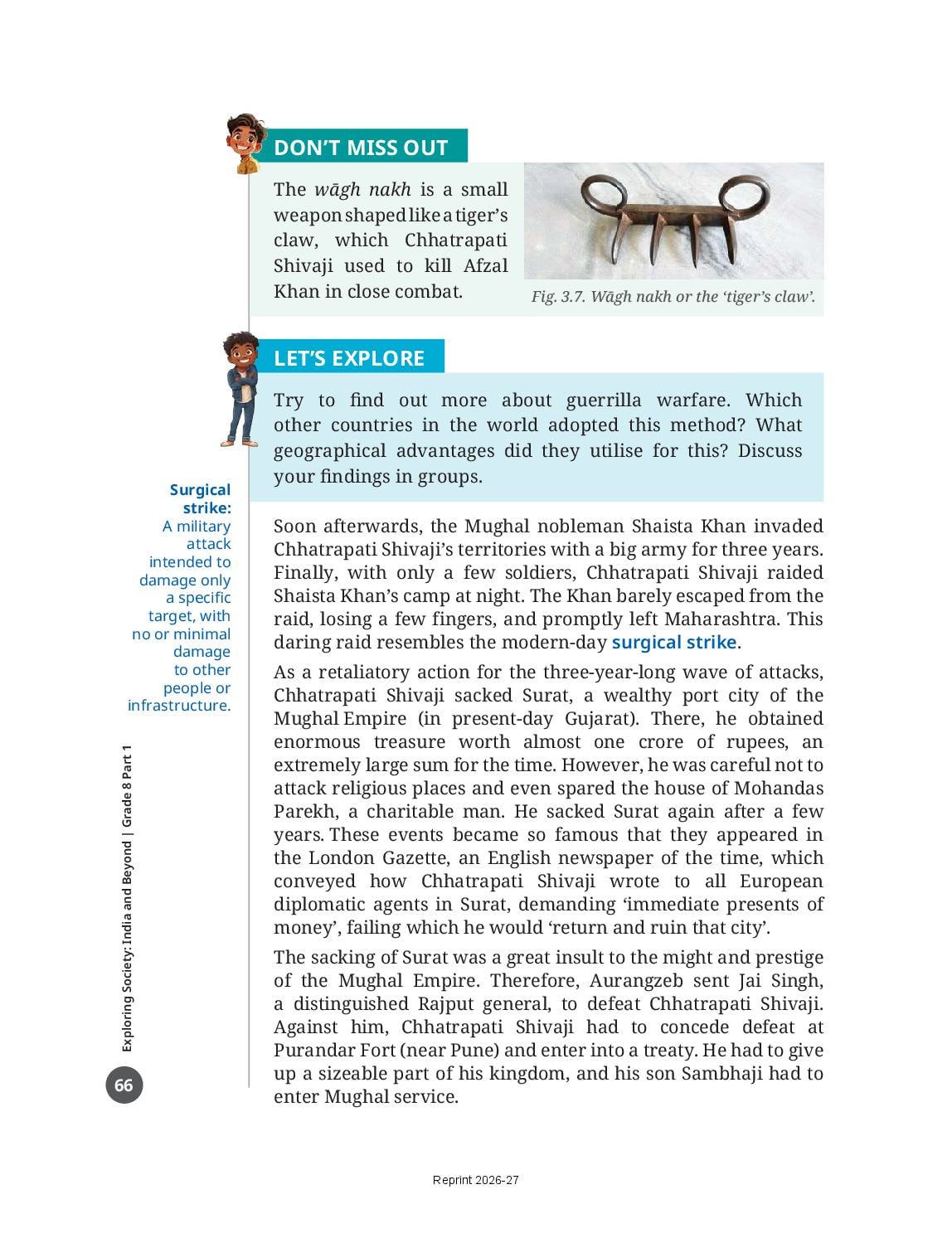
| Guerrilla warfare | Small groups using speed, surprise and knowledge of the terrain to defeat far bigger armies | Page 65 | How a Deccan chief beat the armies of Bijapur and the Mughals; it works only because the Sahyadri terrain is known to the defender |
| Aṣhṭa pradhāna manḍala | The council of eight ministers — Pradhān, Amātya, Sachiv, Mantrī, Sumant, Senāpatī, Nyāyādhīsh, Panḍitrāo | Page 72, Fig. 3.13 | Shows government split into named departments under the Chhatrapatī, not run through personal favourites |
| Chauth and sardeshmukhi | Taxes of 25 per cent, and a further 10 per cent, levied on provinces not directly ruled by the Marathas | Page 73 | Protection in return for revenue, without interfering in internal administration — over time such provinces joined the empire |
| Bārgīr and shiledār | Cavalrymen whose horse and equipment were paid for by the state (bārgīr) or by themselves (shiledār) | Page 73 | Two ways of raising cavalry: state-funded loyalty and self-funded numbers |
| Cartaz | A naval trade pass the Portuguese forced Indian ships to buy; a ship without one was confiscated | Page 74 | The Marathas reversed it — they demanded passes from the Europeans, who then called Kanhoji Angre a ‘pirate’ |
| Ādnyāpatra | ‘The Royal Edict’, written in 1715 by Ramachandrapant Amatya, Shivaji’s finance minister | Pages 61, 74 | The chapter’s main written source: it warns about the European ‘hat-wearers’ and explains why forts are the core of the state |
| Peshwa | Persian for ‘prime minister’; from the 18th century the real centre of Maratha power | Page 70 | Bajirao I and Nanasaheb drove the pan-Indian expansion — but the Chhatrapati became nominal, and chiefs grew autonomous |
| Panchāyat and kotwāl | A local gathering of officials and prominent men that delivered justice; the kotwāl was the city police | Pages 75–76 | Justice was local and appealable to a Maratha chief, and the death penalty was used with notable moderation |
| Moḍī script | A cursive form of Devanagari | Page 78 | The main script of Maratha correspondence — Fig. 3.20 shows Chhatrapati Shahu Maharaj’s own handwriting in it |
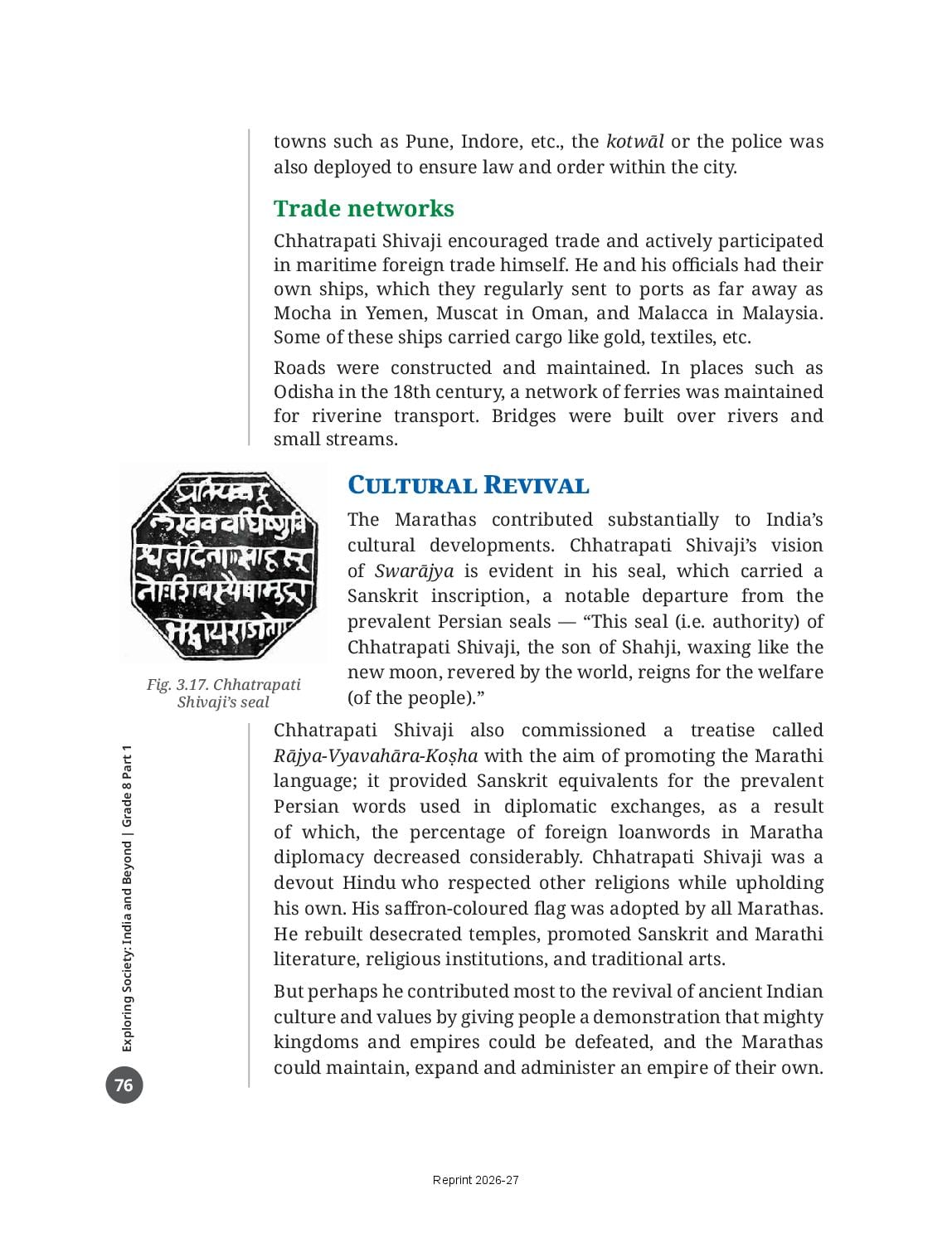
| Rājya-Vyavahāra-Koṣha | A treatise Shivaji commissioned giving Sanskrit equivalents for Persian words used in diplomacy | Page 76 | A language policy with a measurable result: foreign loanwords in Maratha diplomacy fell considerably |
Old NCERT vs New – Class 8 Social Science
This chapter is from Exploring Society: India and Beyond, the new NCERT Class 8 Social Science book (NCF-SE 2023, used from 2025-26). It replaced the old book “Our Pasts, Resources and Development and Social and Political Life”, so chapter numbers and names differ from older PDFs.
Solutions and All Chapters
Answers to the exercises and the full chapter list of Exploring Society: India and Beyond:
The Rise of the Marathas – Overview
| Class | Class 8 |
| Subject | Social Science |
| Book | Exploring Society: India and Beyond – new NCERT book |
| Part | Part I |
| Chapter | 3 of 15 – The Rise of the Marathas |
| Book pages | 61 – 82 |
| Edition | NCERT Reprint 2026-27 |
| Session | 2026-27 |
| Free – read online or download |
Class 8 Social Science Chapter 3 – FAQs
Where can I download The Rise of the Marathas Class 8 PDF?
From the download table on this page – the chapter PDF is free, and the full book is linked too.
What is Class 8 Social Science Chapter 3 about?
The Marathas are a people of the Deccan plateau, in present-day Maharashtra, identified with Marathi, a language with a continuous literary history since the 12th century. Their political rise was prepared by the bhakti saints — Dnyaneshwar, Namdev, Tukaram, Ramdas — who put the Upaniṣhads and the Bhagavad Gītā into Marathi and gave society a common cultural foundation.
Is The Rise of the Marathas from the new NCERT Class 8 Social Science book?
Yes. It is chapter 3 of exploring society: india and beyond (part i), the new NCERT Class 8 Social Science book for 2026-27.
Is this the latest NCERT edition for 2026-27?
Yes – the PDF is NCERT’s latest edition for the 2026-27 session.
Where are the NCERT Solutions for Class 8 Social Science Chapter 3?
Open the NCERT Solutions link above for answers to the exercise questions.