Download India’s Urban Landscape – NCERT Class 8 Social Science Chapter 14 PDF from the new NCERT Class 8 Social Science book Exploring Society: India and Beyond (2026-27). Read the chapter online or download the free PDF. A city is an area with a concentration of population, many kinds of businesses and occupations, government institutions and elaborate transport and communication systems, run by elected local bodies; a village has fewer people, more…
India’s Urban Landscape PDF – Chapter 14 of Exploring Society: India and Beyond (Part II)
Read the chapter online or download the PDF.
| Chapter | Download | |
|---|---|---|
| Chapter 14 PDF | India's Urban Landscape | View PDF |
| Full book | NCERT Class 8 Social Science – Exploring Society: India and Beyond | View Book |
Read Online
What Is in India’s Urban Landscape? (Class 8 Social Science Chapter 14)
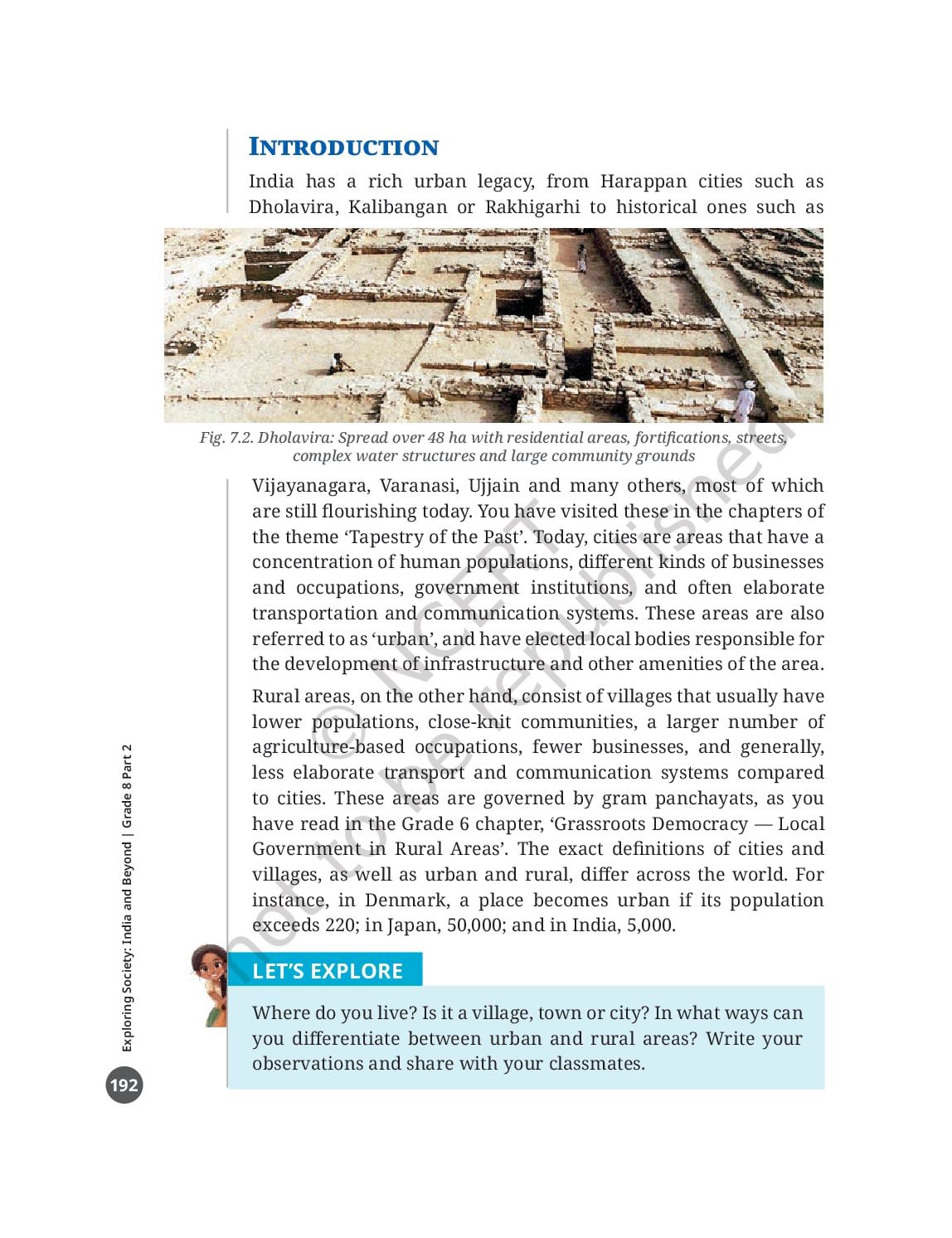
- A city is an area with a concentration of population, many kinds of businesses and occupations, government institutions and elaborate transport and communication systems, run by elected local bodies; a village has fewer people, more agriculture-based work and is governed by a gram panchayat. Where the line is drawn differs everywhere: a place is urban above 220 people in Denmark, 5,000 in India and 50,000 in Japan.
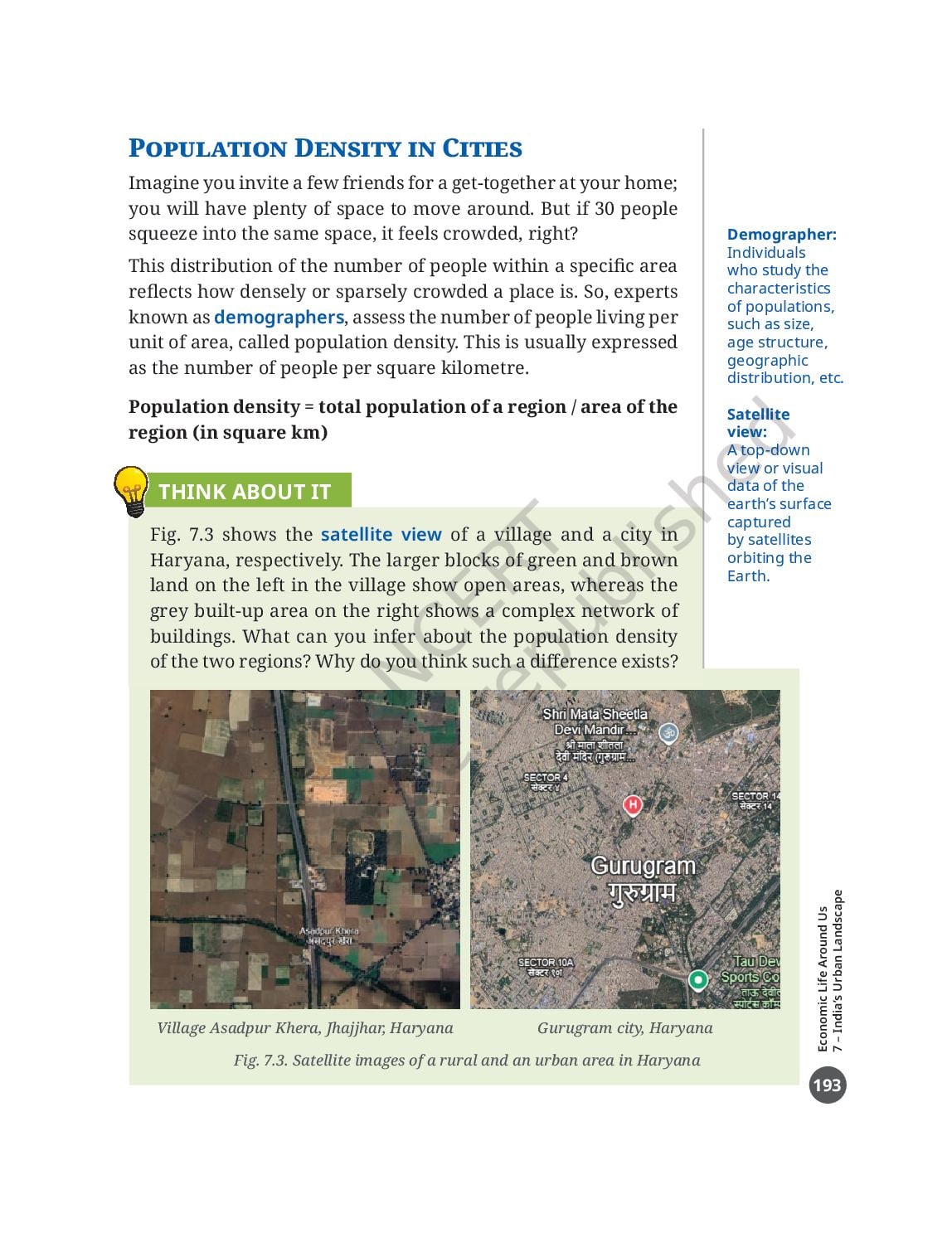
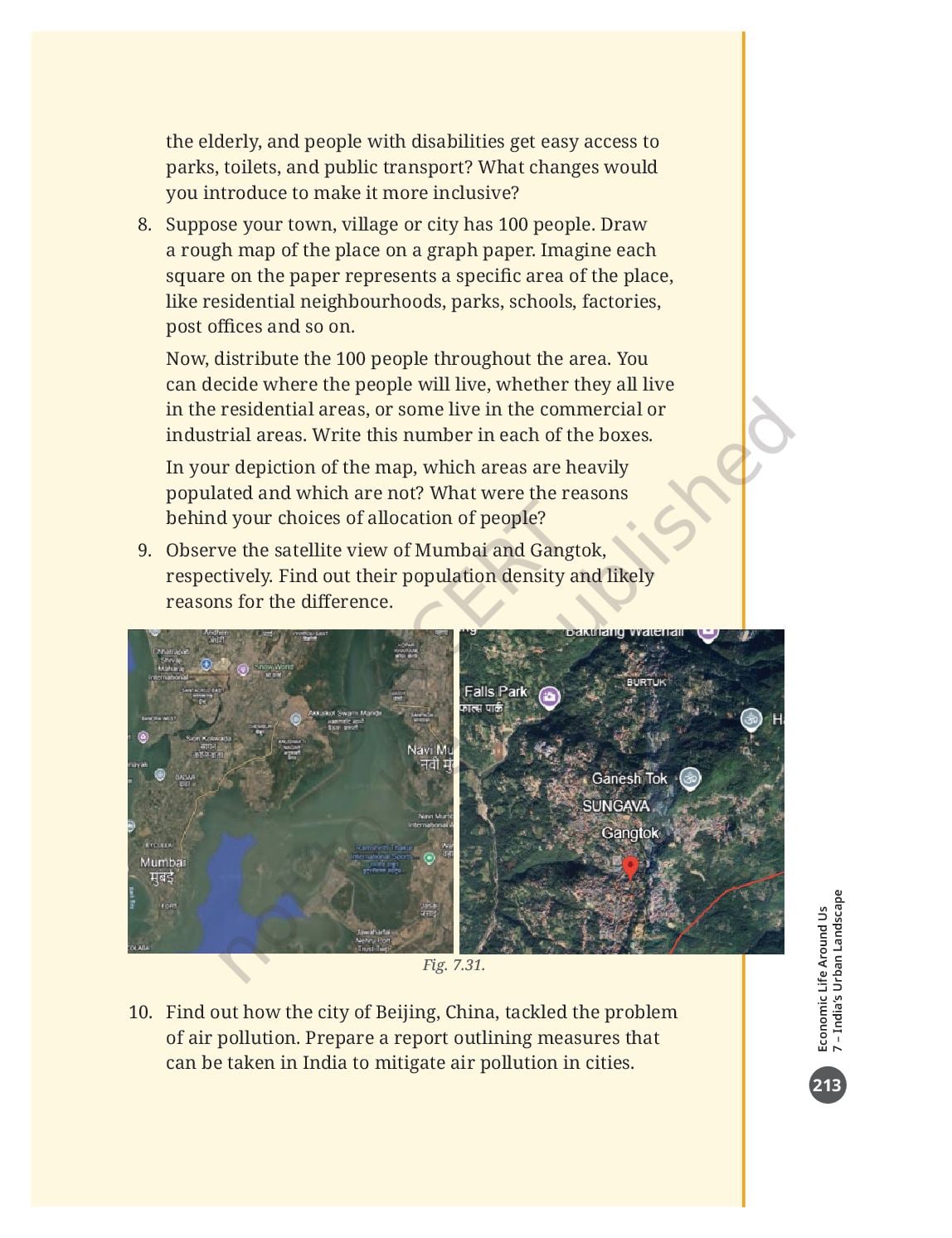
- Population density = total population of a region ÷ area of the region (in sq km). It is what separates the satellite image of Asadpur Khera village from that of Gurugram city (Fig. 7.3) — same state, same land, very different number of people on each square kilometre.
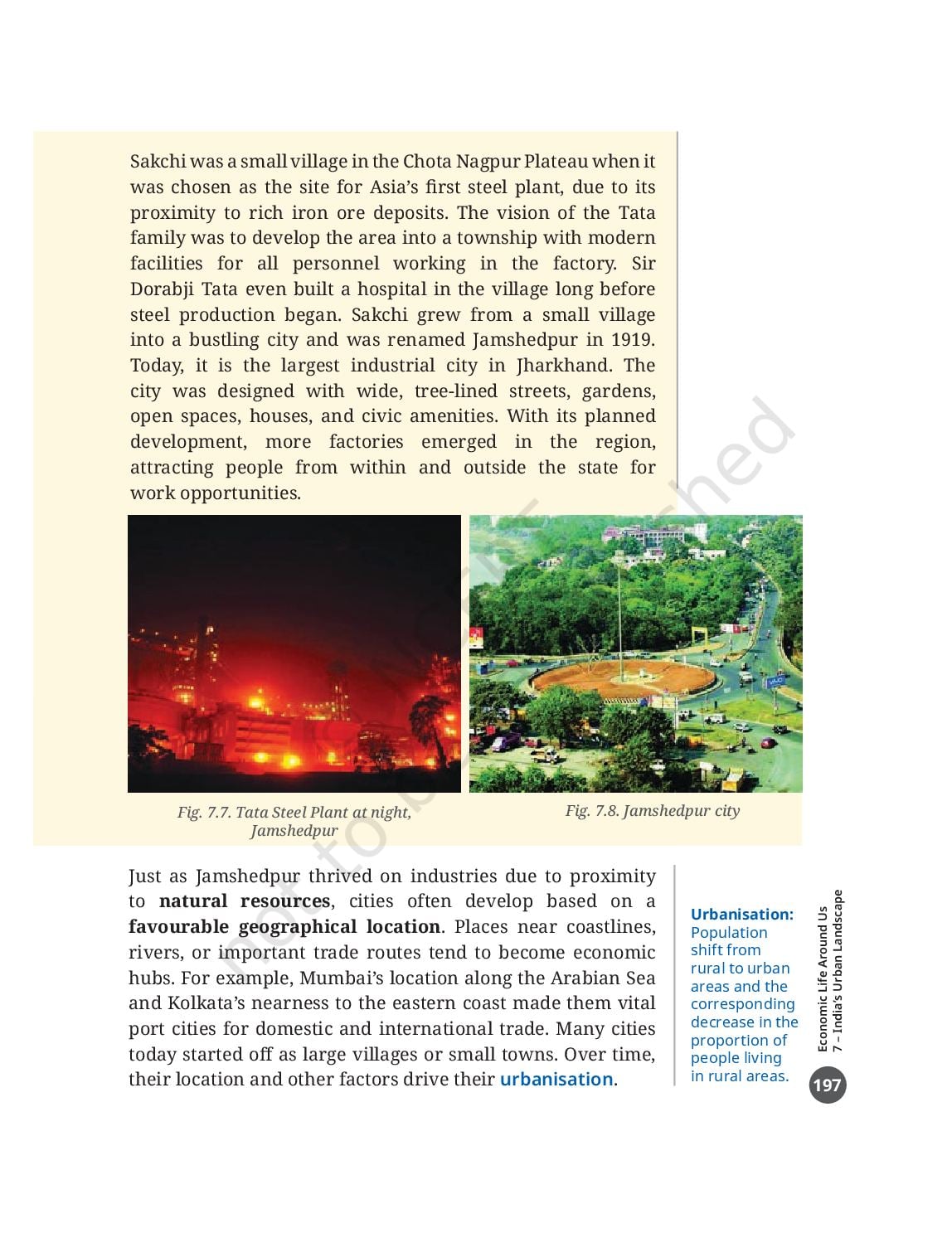
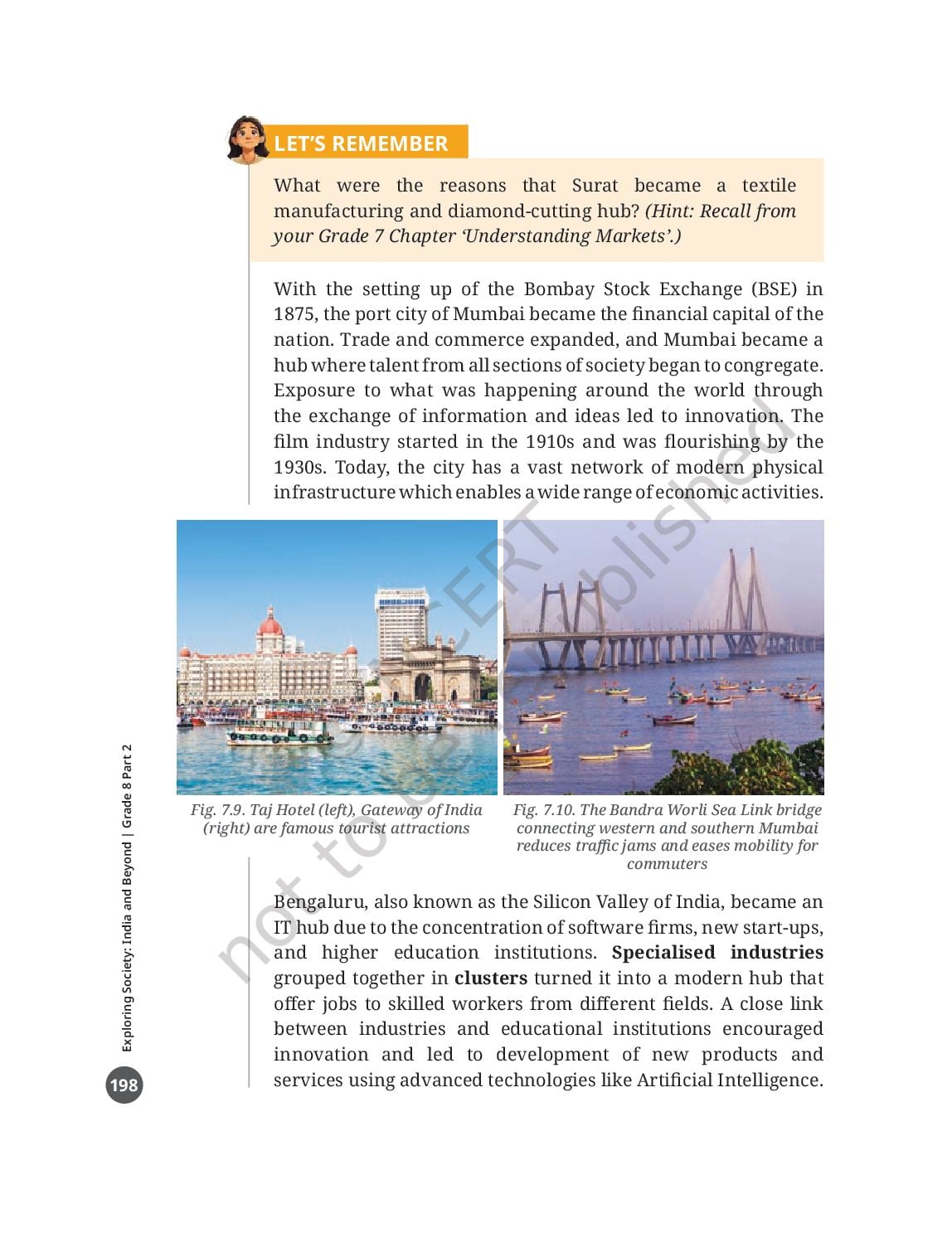
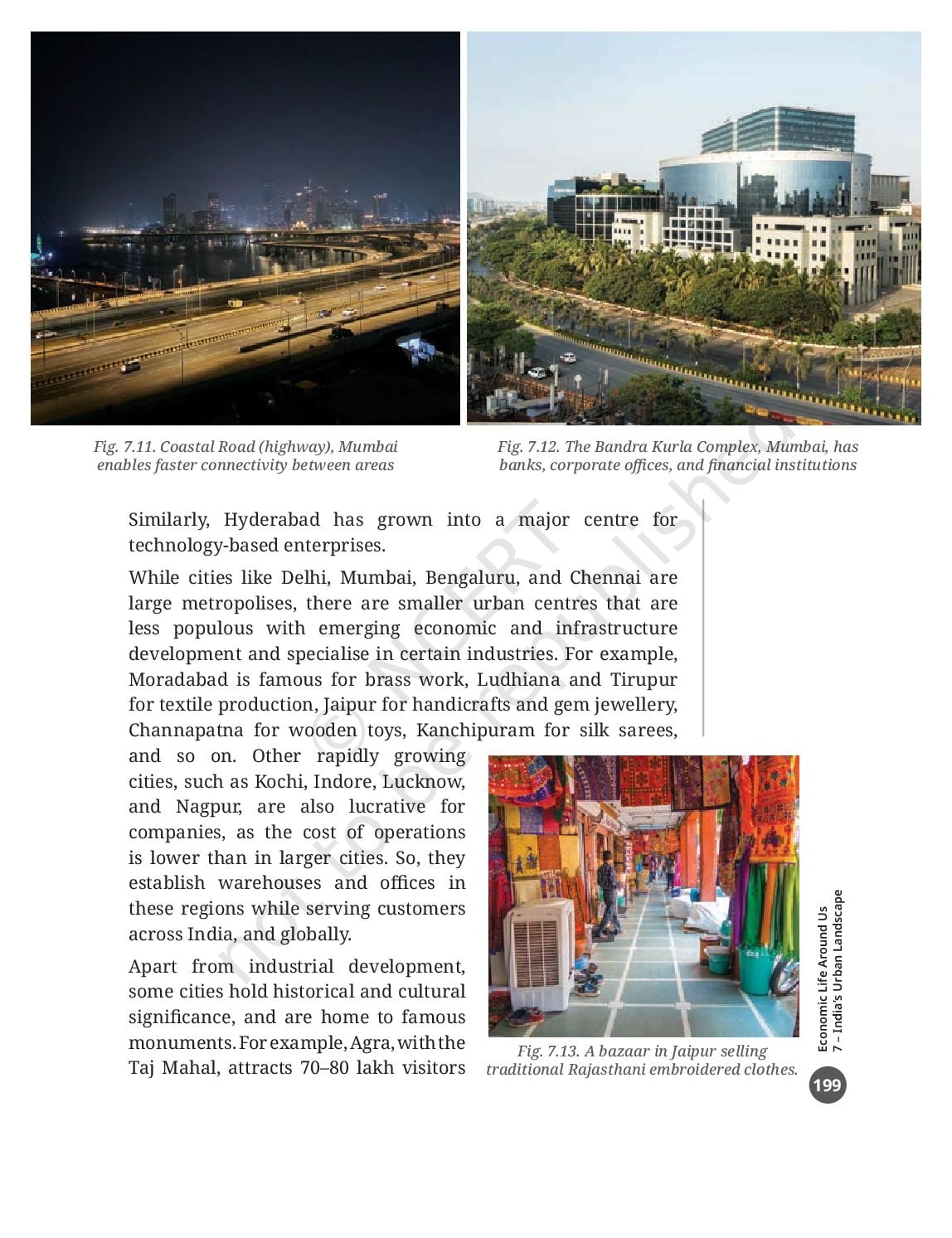
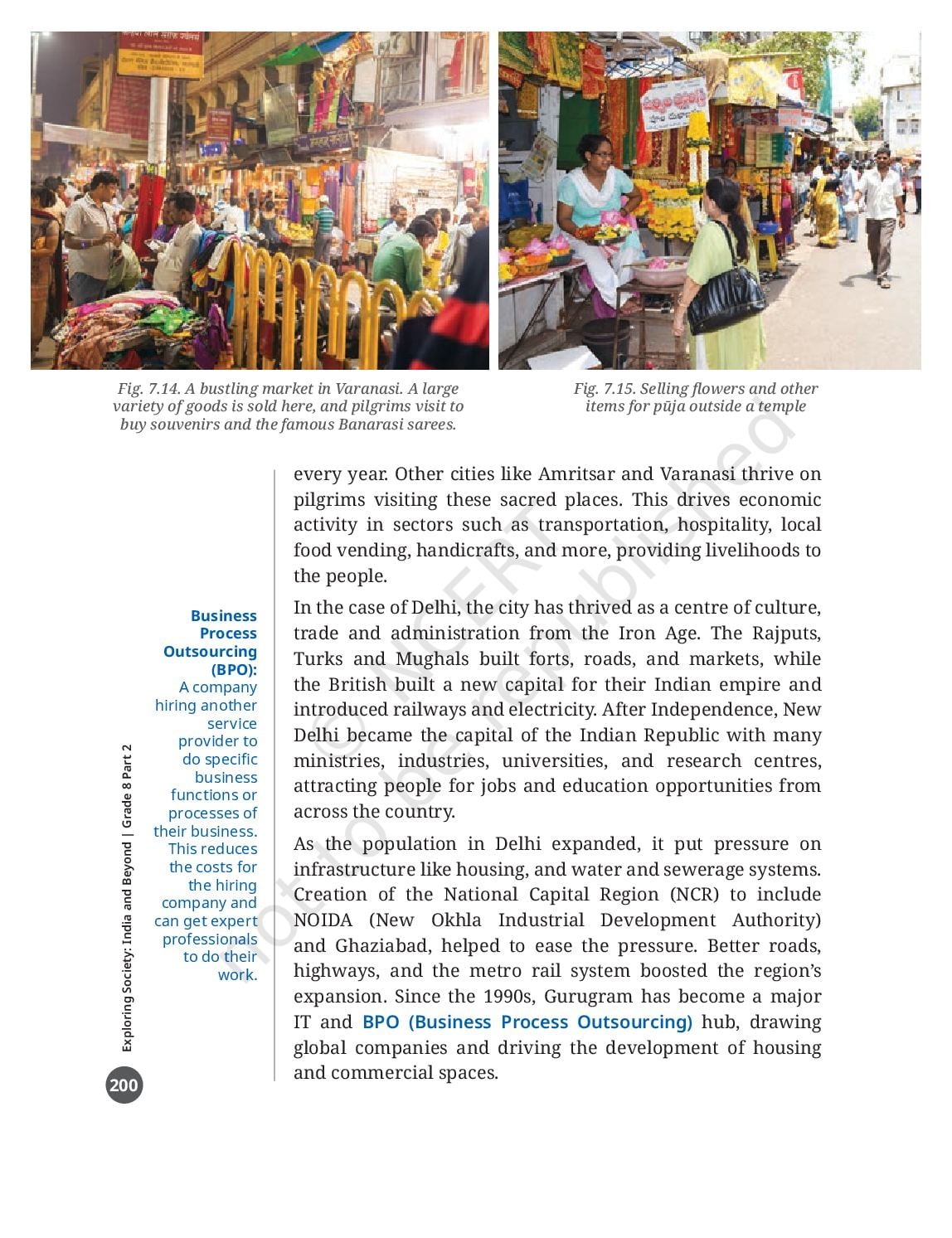
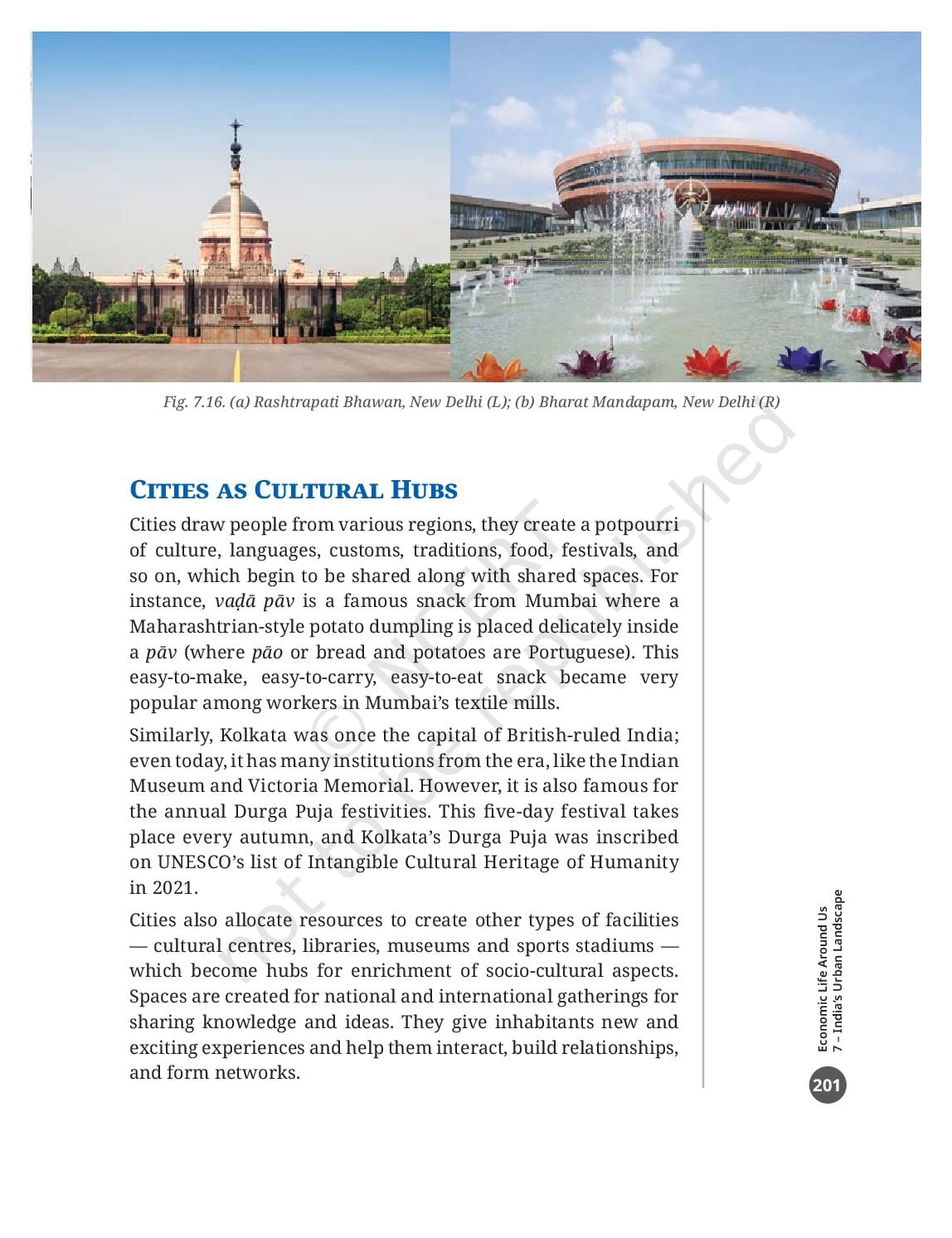
- Cities become economic centres through location (rivers, coasts, trade routes), raw materials (Sakchi’s iron ore), clusters of specialised firms and colleges (Bengaluru, Hyderabad), finance and information (the BSE, 1875, and Mumbai’s film industry from the 1910s), administration (Delhi), and tourism and pilgrimage (Agra’s 70–80 lakh visitors a year; Amritsar and Varanasi).
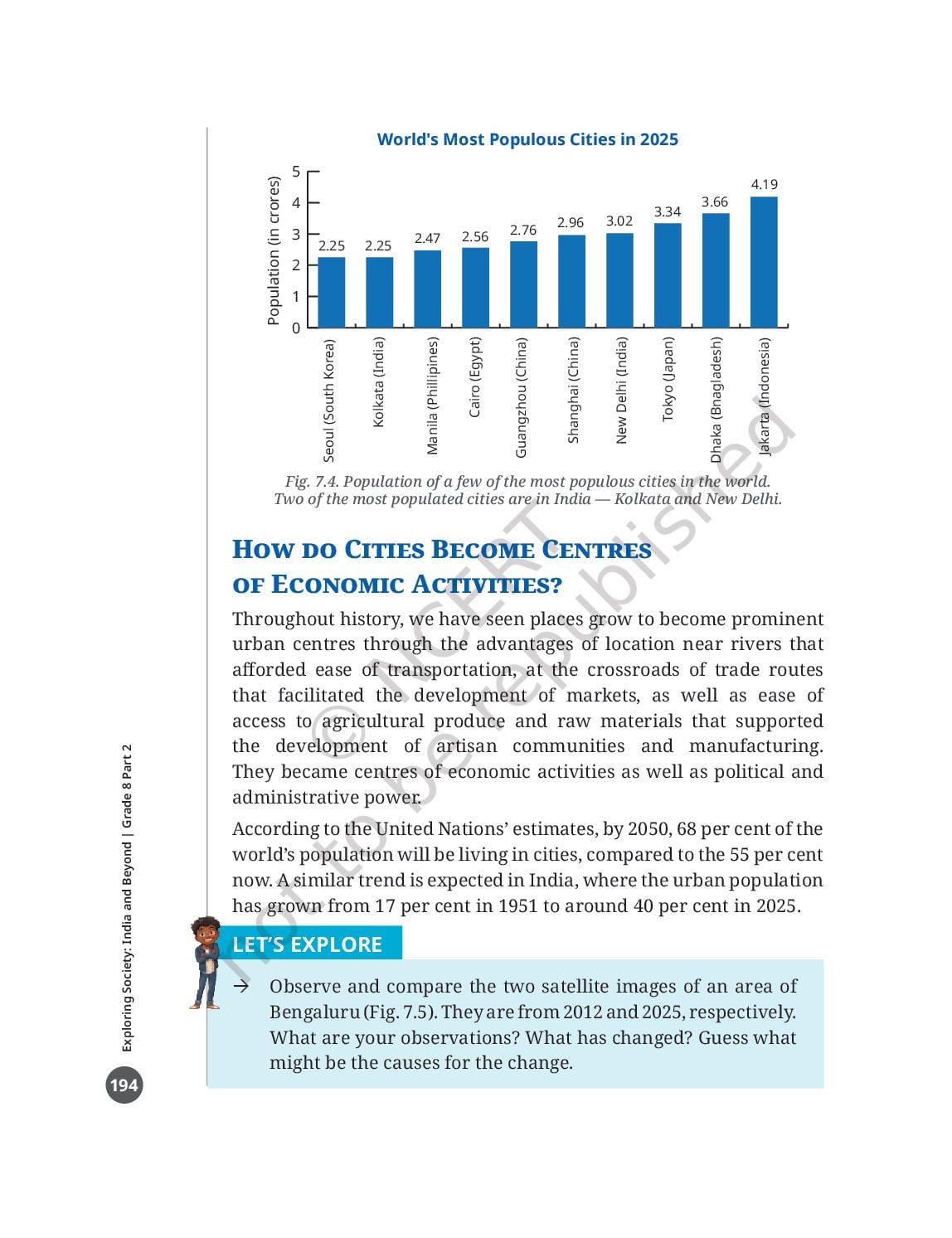
- Urbanisation is the shift of population from rural to urban areas and the matching fall in the rural share. India’s urban share rose from 17 per cent in 1951 to about 40 per cent in 2025; the United Nations expects 68 per cent of the world to be urban by 2050, against 55 per cent now.
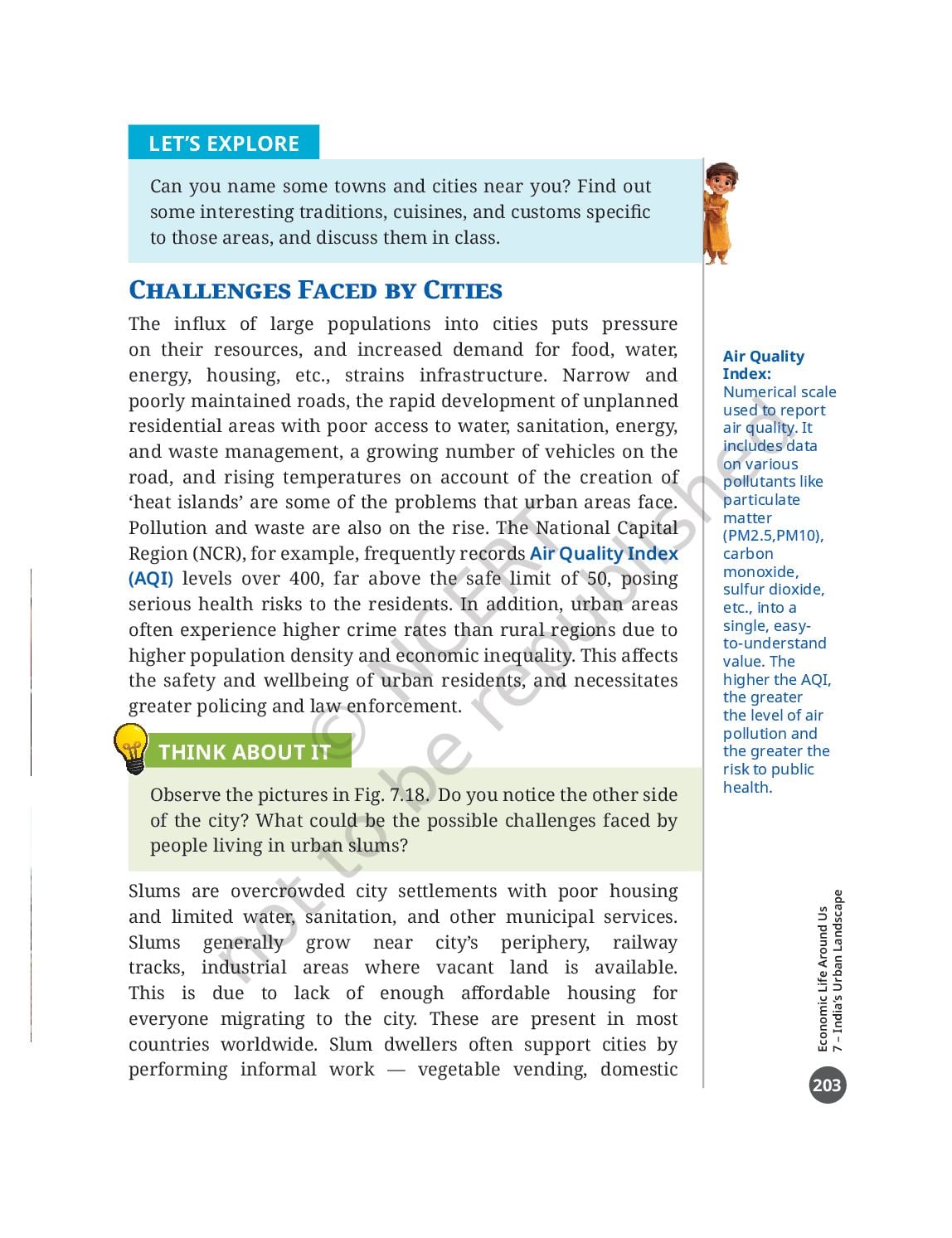
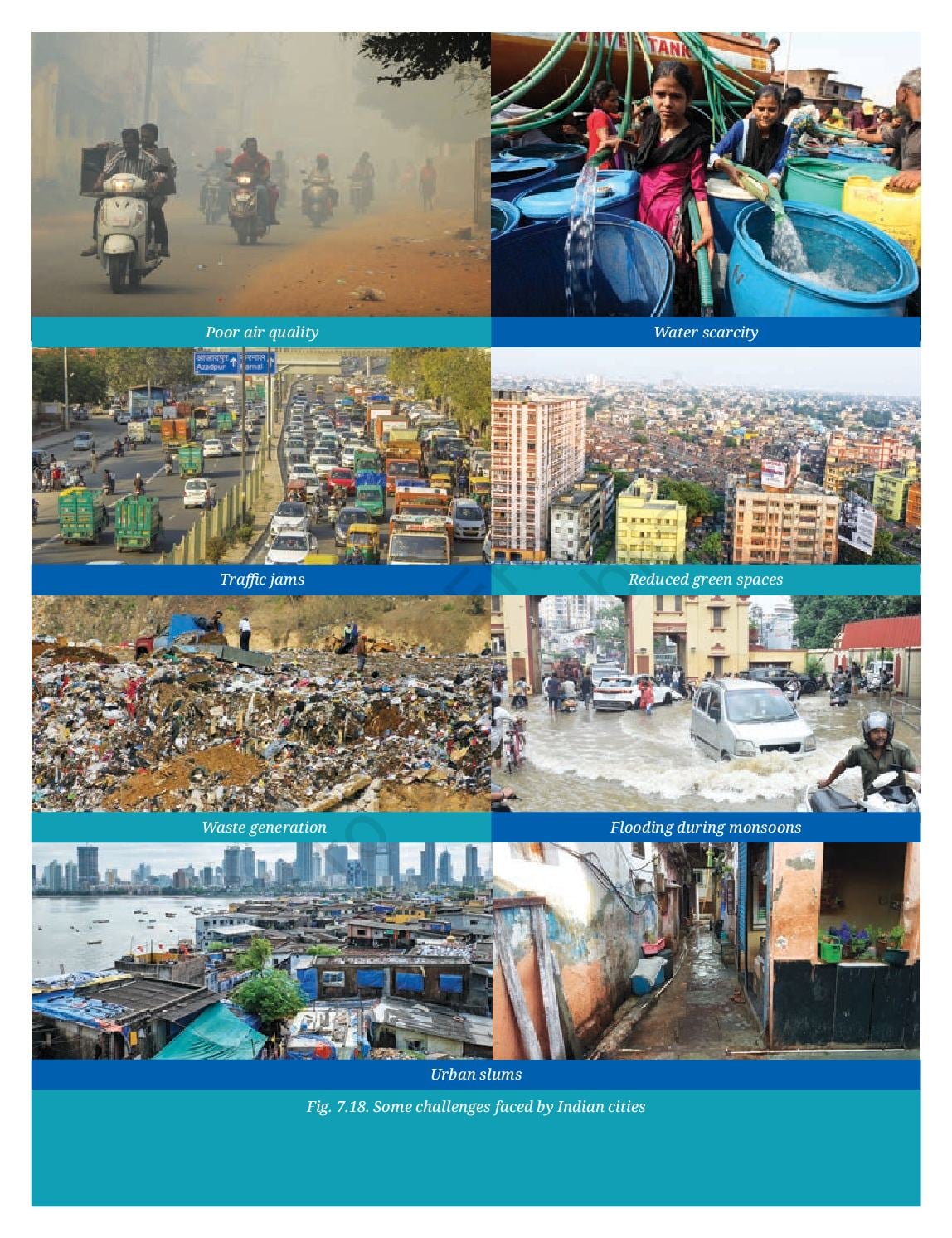
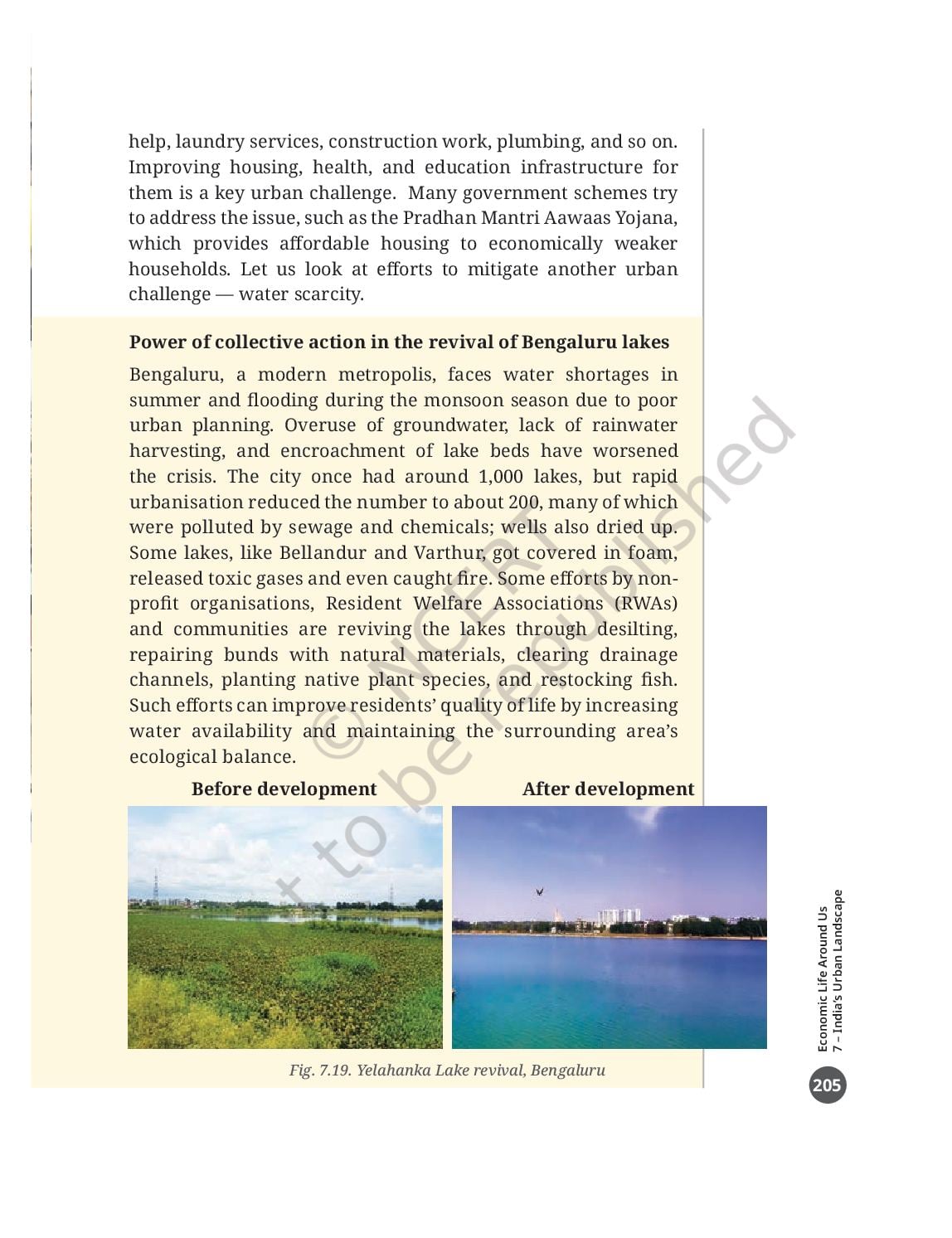
- Growth strains the city. Fig. 7.18 names seven pressures — poor air quality, water scarcity, traffic jams, reduced green spaces, waste generation, monsoon flooding and urban slums. The NCR frequently records an AQI over 400 against a safe limit of 50, and Bengaluru’s lakes fell from about 1,000 to about 200.
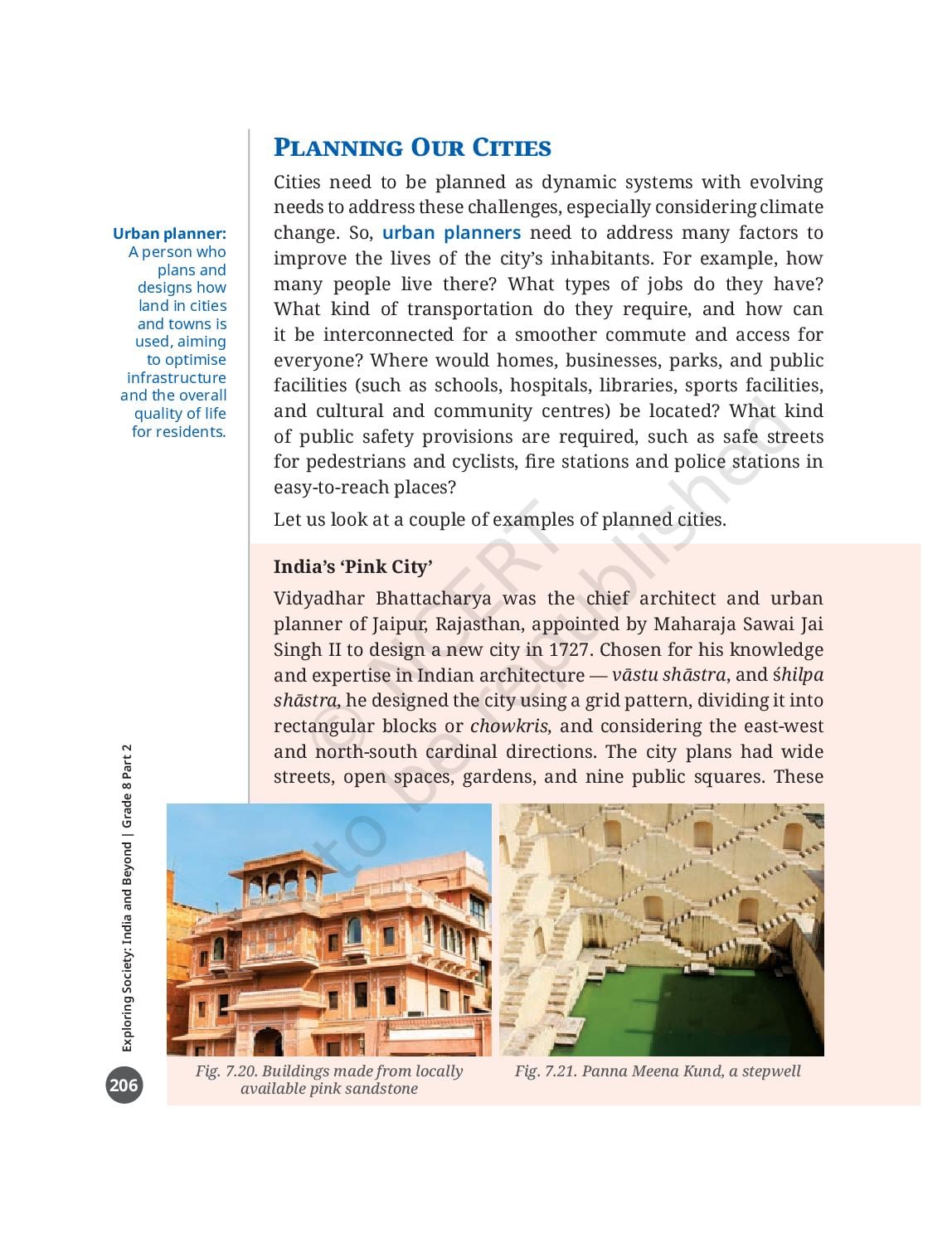
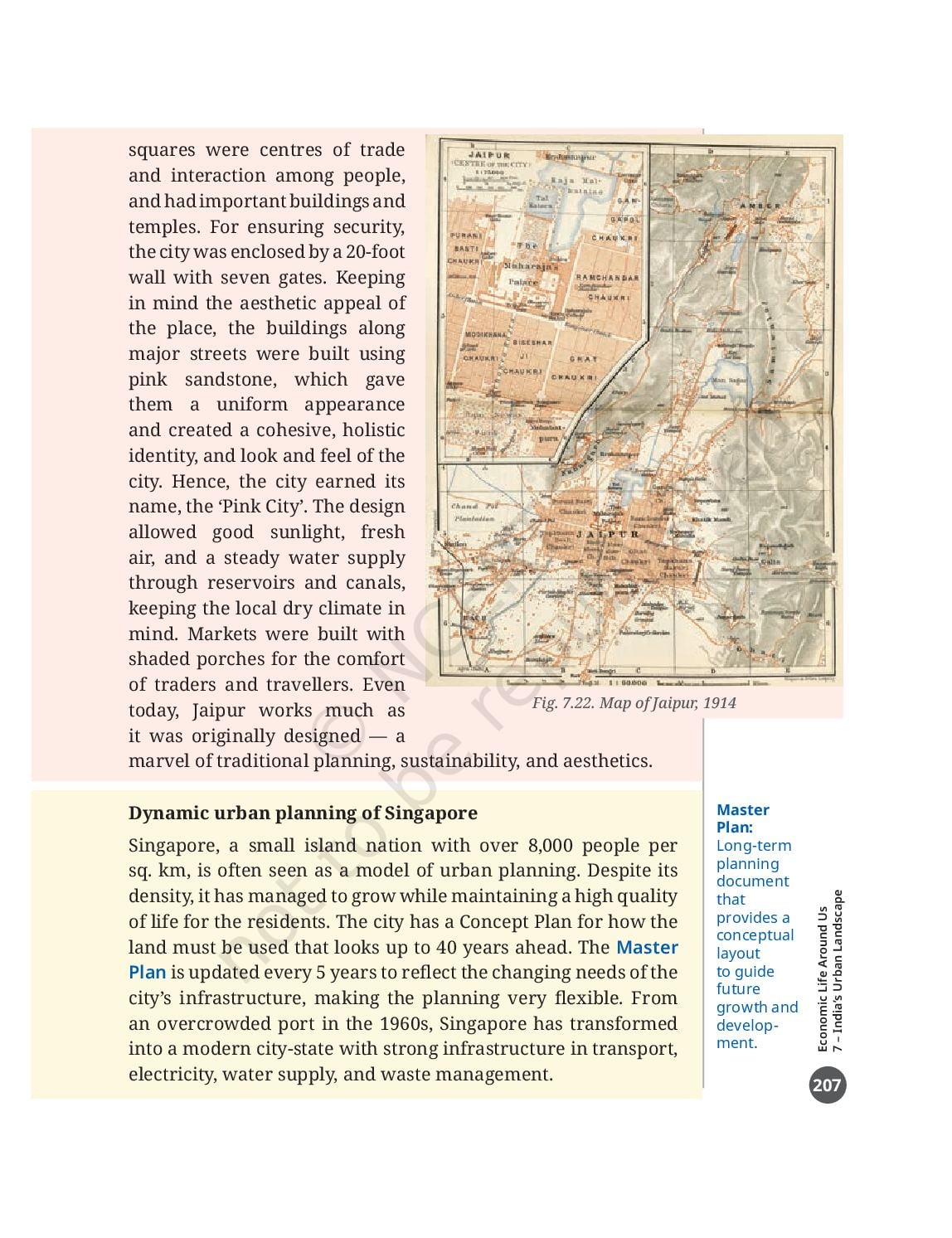
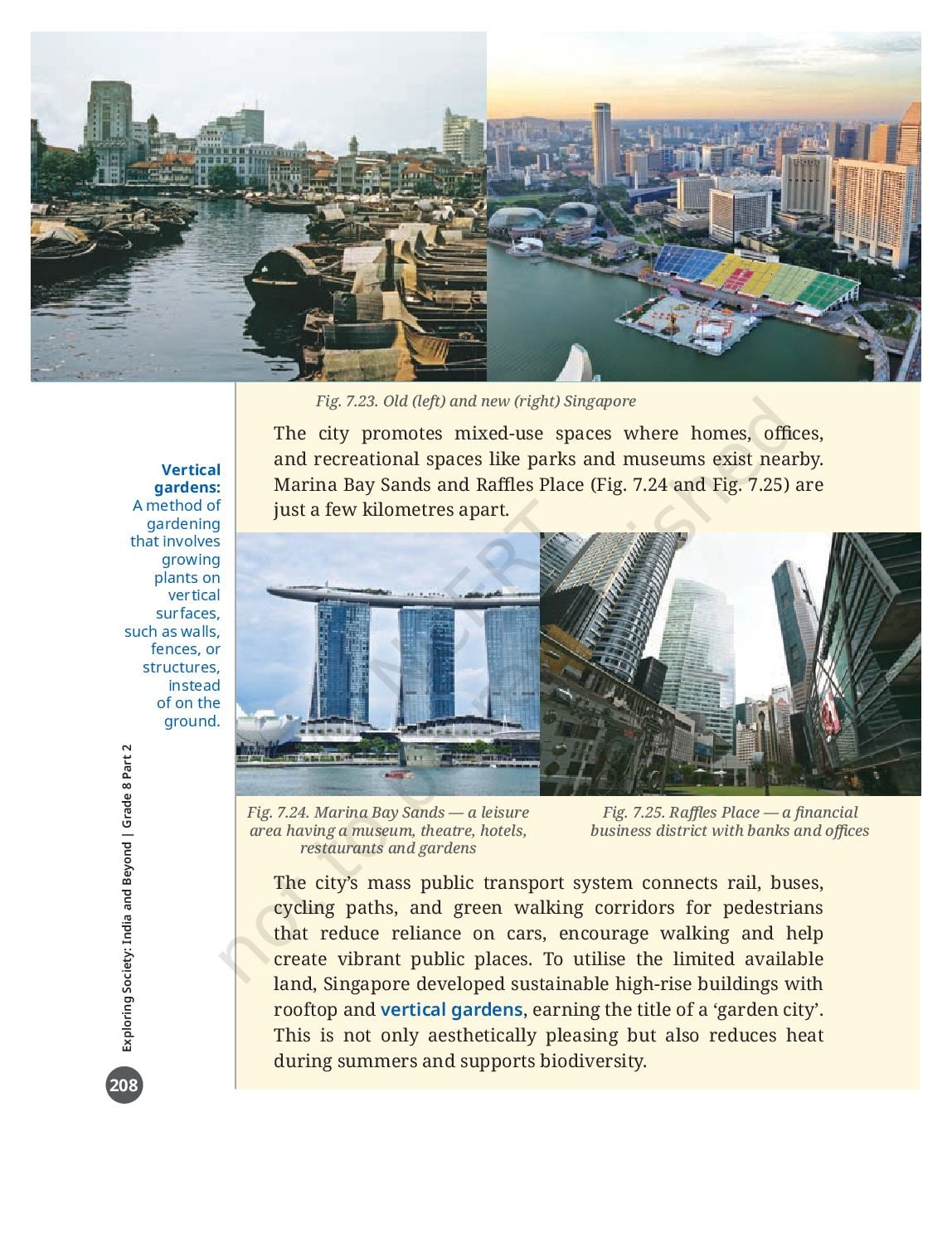
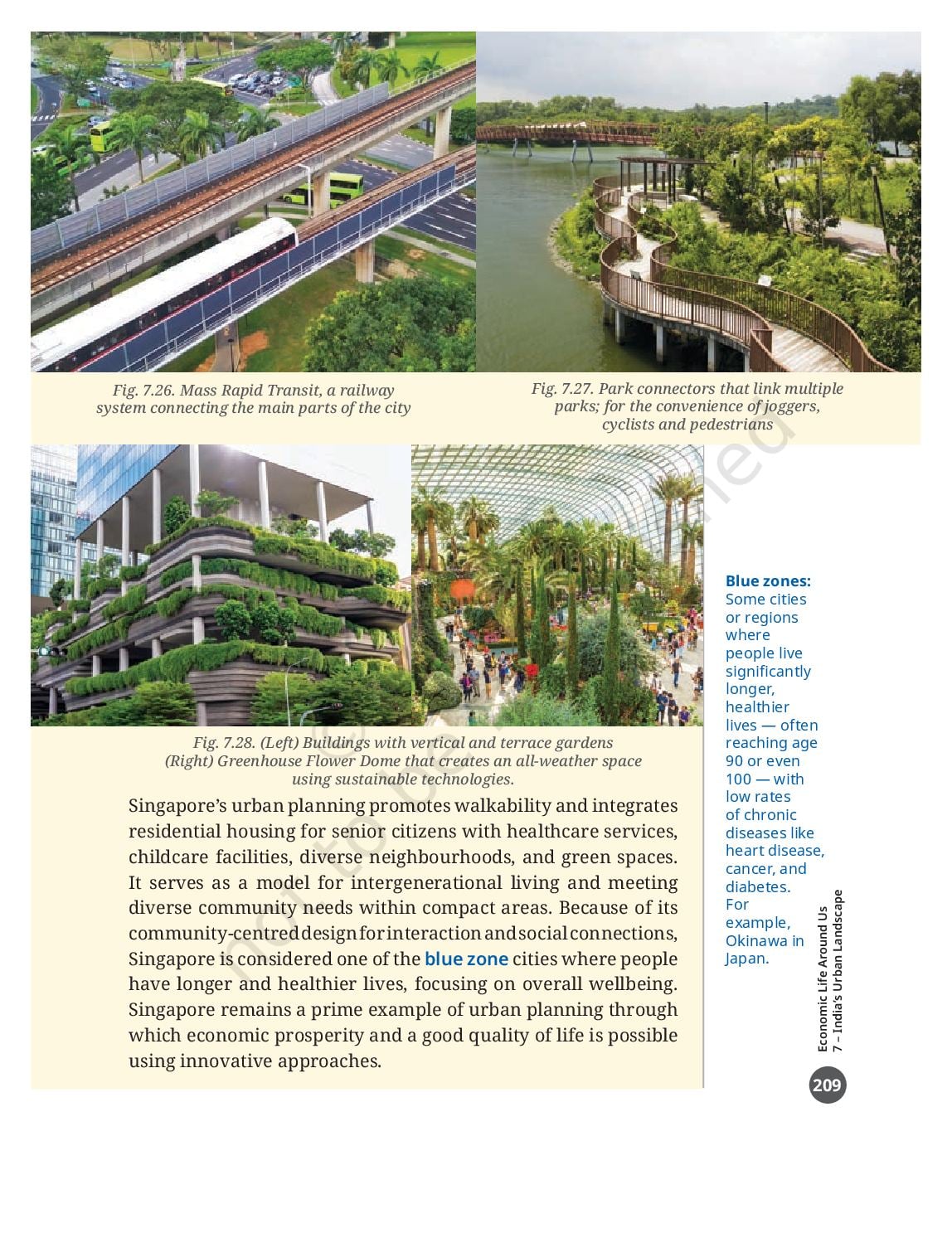
- Urban planning is the answer the chapter offers, in two examples: Jaipur (1727), laid out by Vidyadhar Bhattacharya on a grid of chowkris with nine public squares and a 20-foot wall with seven gates, still working today; and Singapore, with over 8,000 people per sq km, a Concept Plan looking 40 years ahead and a Master Plan revised every 5 years.
Quick revision – India’s Urban Landscape
| Term | What it means | Where it appears in the chapter | The chapter’s own example |
|---|---|---|---|
| Population density | Total population of a region divided by its area in square kilometres | Population Density in Cities, p. 193 | Singapore has over 8,000 people per sq km (p. 207) |
| Demographer | People who study the characteristics of populations — size, age structure, geographic distribution and so on | Margin note, p. 193 | Demographers are the experts who work out density figures |
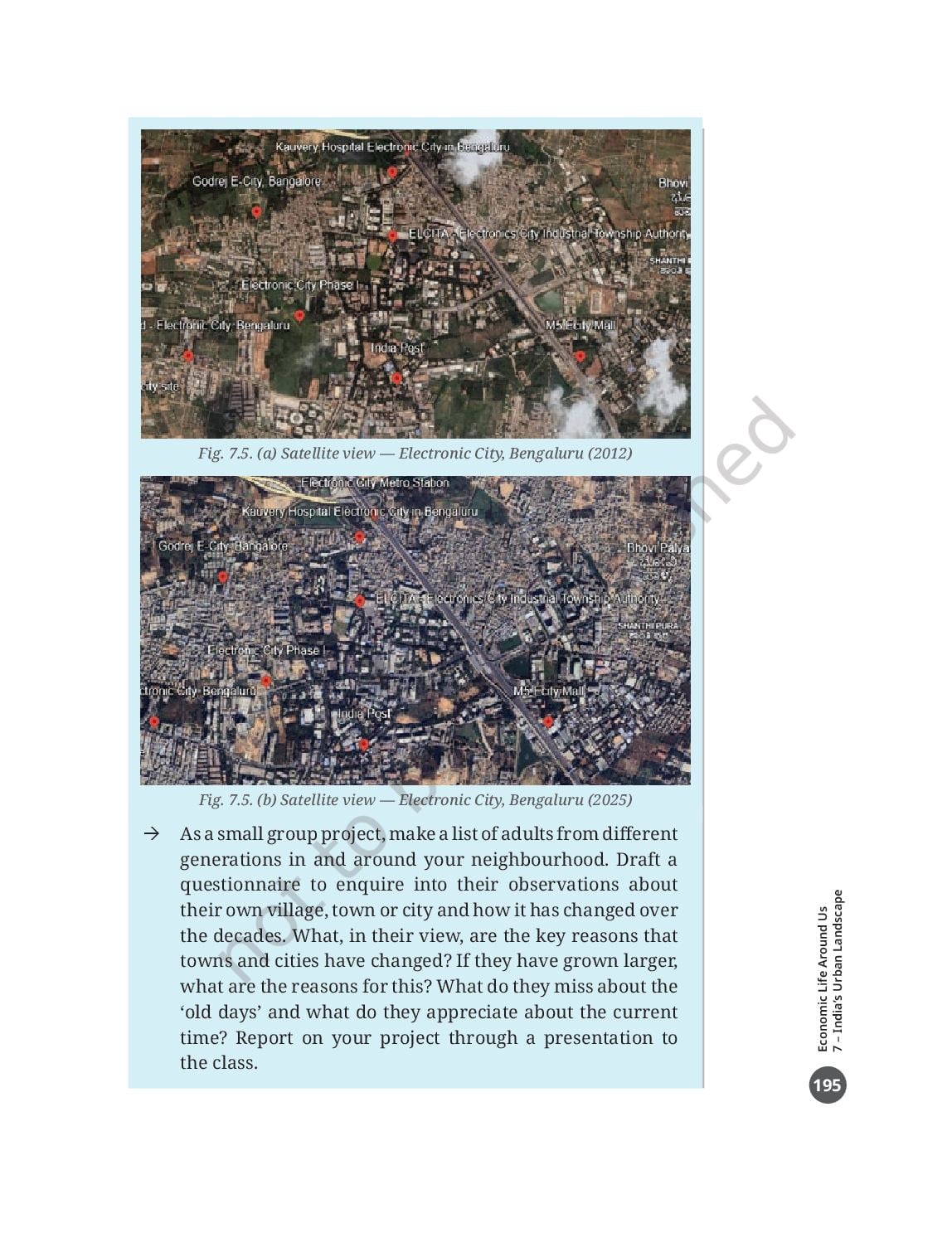
| Satellite view | A top-down view or visual data of the earth’s surface captured by satellites orbiting the Earth | Margin note, p. 193 | Fig. 7.3 — Asadpur Khera village beside Gurugram city |
| Urbanisation | Population shift from rural to urban areas and the corresponding decrease in the proportion of people living in rural areas | Margin note, p. 197 | India: 17% urban in 1951 to about 40% in 2025 (p. 194) |
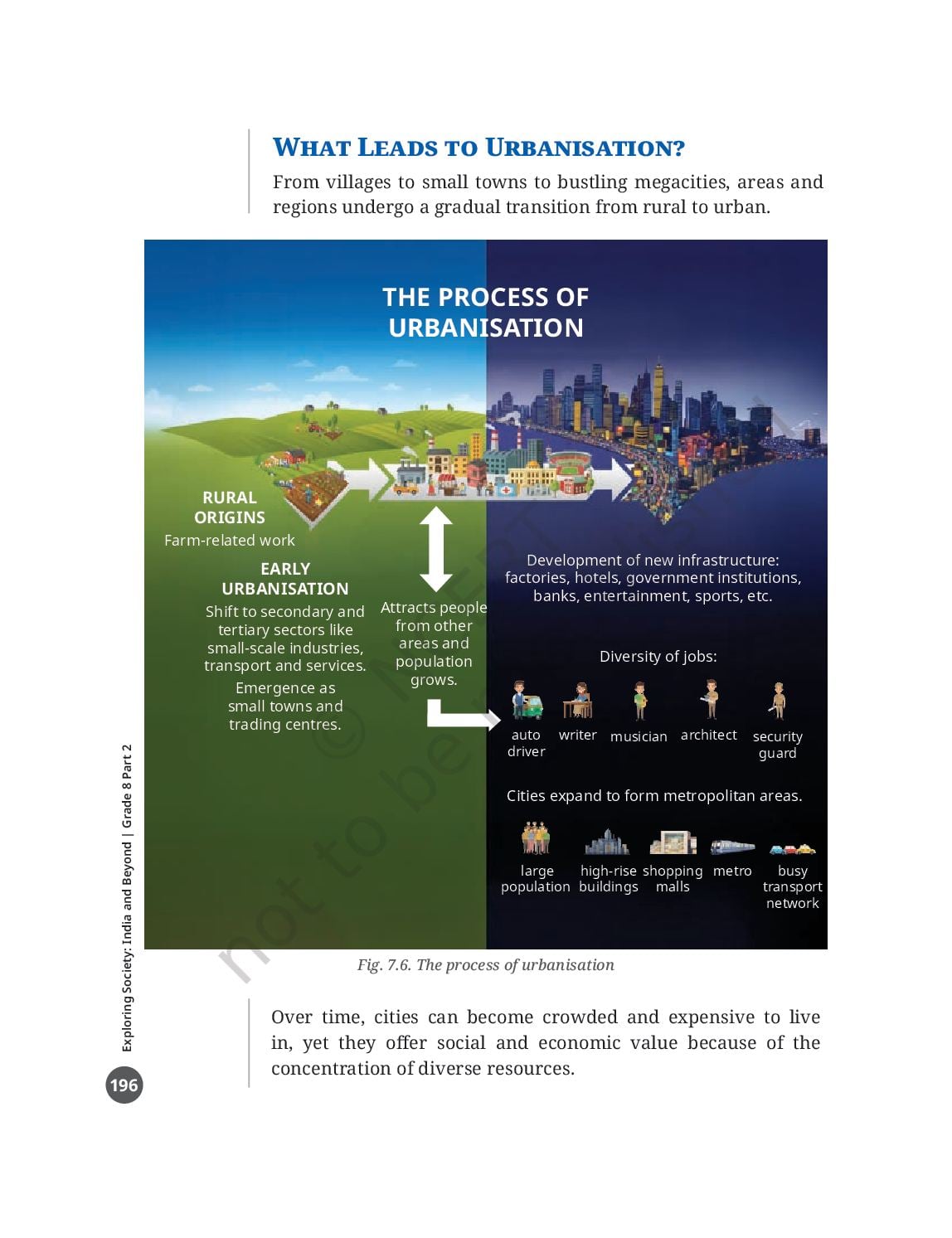
| Metropolitan area | What a city expands into as it grows outwards and absorbs the settlements around it | Fig. 7.6, p. 196; Delhi, p. 200 | The NCR was created to include NOIDA and Ghaziabad; Gurugram grew from the 1990s |
| Business Process Outsourcing (BPO) | A company hiring another service provider to do specific business functions or processes for it, cutting costs and bringing in expert professionals | Margin note, p. 200 | Gurugram became a major IT and BPO hub, drawing global companies |
| Air Quality Index (AQI) | A numerical scale that folds data on pollutants such as PM2.5, PM10, carbon monoxide and sulfur dioxide into one easy-to-understand value | Margin note, p. 203 | The NCR frequently records levels over 400, against a safe limit of 50 |
| Slum | An overcrowded city settlement with poor housing and limited water, sanitation and other municipal services | Challenges Faced by Cities, p. 203 | They grow on vacant land near a city’s periphery, railway tracks and industrial areas |
| Heat island | The rise in temperature a built-up area creates within itself | Challenges Faced by Cities, p. 203 | Listed with narrow roads, unplanned colonies and more vehicles as urban problems |
| Urban planner | A person who plans and designs how land in cities and towns is used, to optimise infrastructure and the overall quality of life for residents | Margin note, p. 206 | Vidyadhar Bhattacharya, chief architect and planner of Jaipur, 1727 |
| Master Plan | A long-term planning document that provides a conceptual layout to guide future growth and development | Margin note, p. 207 | Singapore updates its Master Plan every 5 years; its Concept Plan looks 40 years ahead |
| Blue zone | A city or region where people live significantly longer, healthier lives — often reaching 90 or 100 — with low rates of chronic disease | Margin note, p. 209 | Singapore; and Okinawa in Japan |
Old NCERT vs New – Class 8 Social Science
This chapter is from Exploring Society: India and Beyond, the new NCERT Class 8 Social Science book (NCF-SE 2023, used from 2025-26). It replaced the old book “Our Pasts, Resources and Development and Social and Political Life”, so chapter numbers and names differ from older PDFs.
Solutions and All Chapters
Answers to the exercises and the full chapter list of Exploring Society: India and Beyond:
India’s Urban Landscape – Overview
| Class | Class 8 |
| Subject | Social Science |
| Book | Exploring Society: India and Beyond – new NCERT book |
| Part | Part II |
| Chapter | 14 of 15 – India’s Urban Landscape |
| Book pages | Part II, 191 – 214 |
| Edition | NCERT Reprint 2026-27 |
| Session | 2026-27 |
| Free – read online or download |
Class 8 Social Science Chapter 14 – FAQs
Where can I download India’s Urban Landscape Class 8 PDF?
From the download table on this page – the chapter PDF is free, and the full book is linked too.
What is Class 8 Social Science Chapter 14 about?
A city is an area with a concentration of population, many kinds of businesses and occupations, government institutions and elaborate transport and communication systems, run by elected local bodies; a village has fewer people, more agriculture-based work and is governed by a gram panchayat. Where the line is drawn differs everywhere: a place is urban above 220 people in Denmark, 5,000 in India and 50,000 in Japan.
Is India’s Urban Landscape from the new NCERT Class 8 Social Science book?
Yes. It is chapter 14 of exploring society: india and beyond (part ii), the new NCERT Class 8 Social Science book for 2026-27.
Is this the latest NCERT edition for 2026-27?
Yes – the PDF is NCERT’s latest edition for the 2026-27 session.
Where are the NCERT Solutions for Class 8 Social Science Chapter 14?
Open the NCERT Solutions link above for answers to the exercise questions.