Download Citizenship: Rights and Duties – NCERT Class 8 Social Science Chapter 12 PDF from the new NCERT Class 8 Social Science book Exploring Society: India and Beyond (2026-27). Read the chapter online or download the free PDF. A citizen is someone who legally belongs to a country and is a member of its political community — that is, they can participate in the decision-making of the country. In India the Citizenship Act of 1955 and the Citizenship (Amendment) Act of 2019…
Citizenship: Rights and Duties PDF – Chapter 12 of Exploring Society: India and Beyond (Part II)
Read the chapter online or download the PDF.
| Chapter | Download | |
|---|---|---|
| Chapter 12 PDF | Citizenship: Rights and Duties | View PDF |
| Full book | NCERT Class 8 Social Science – Exploring Society: India and Beyond | View Book |
Read Online

What Is in Citizenship: Rights and Duties? (Class 8 Social Science Chapter 12)
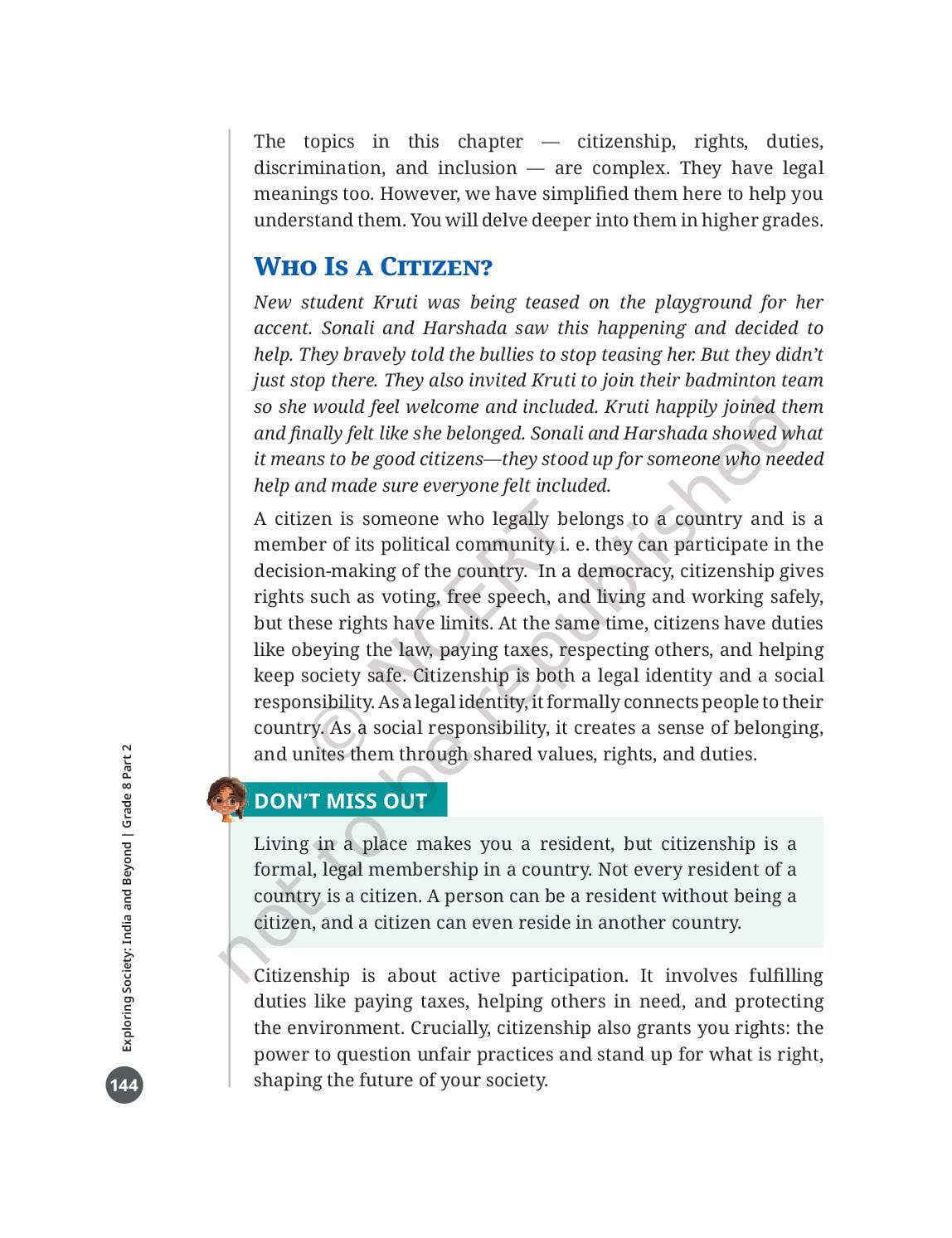
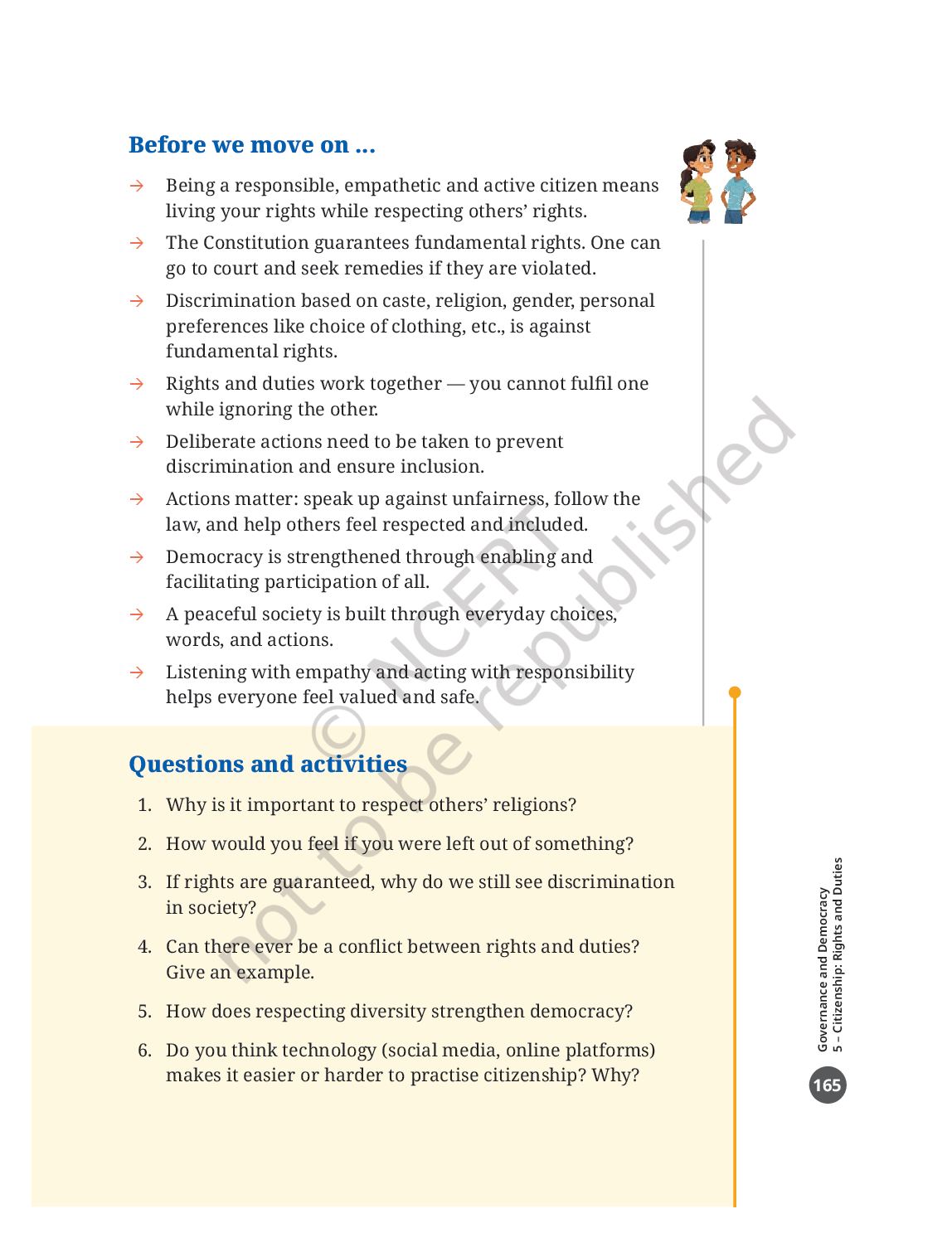
- A citizen is someone who legally belongs to a country and is a member of its political community — that is, they can participate in the decision-making of the country. In India the Citizenship Act of 1955 and the Citizenship (Amendment) Act of 2019 set the rules for gaining or losing citizenship. Citizenship is both a legal identity and a social responsibility; living in a place makes you a resident, but citizenship is a formal, legal membership.
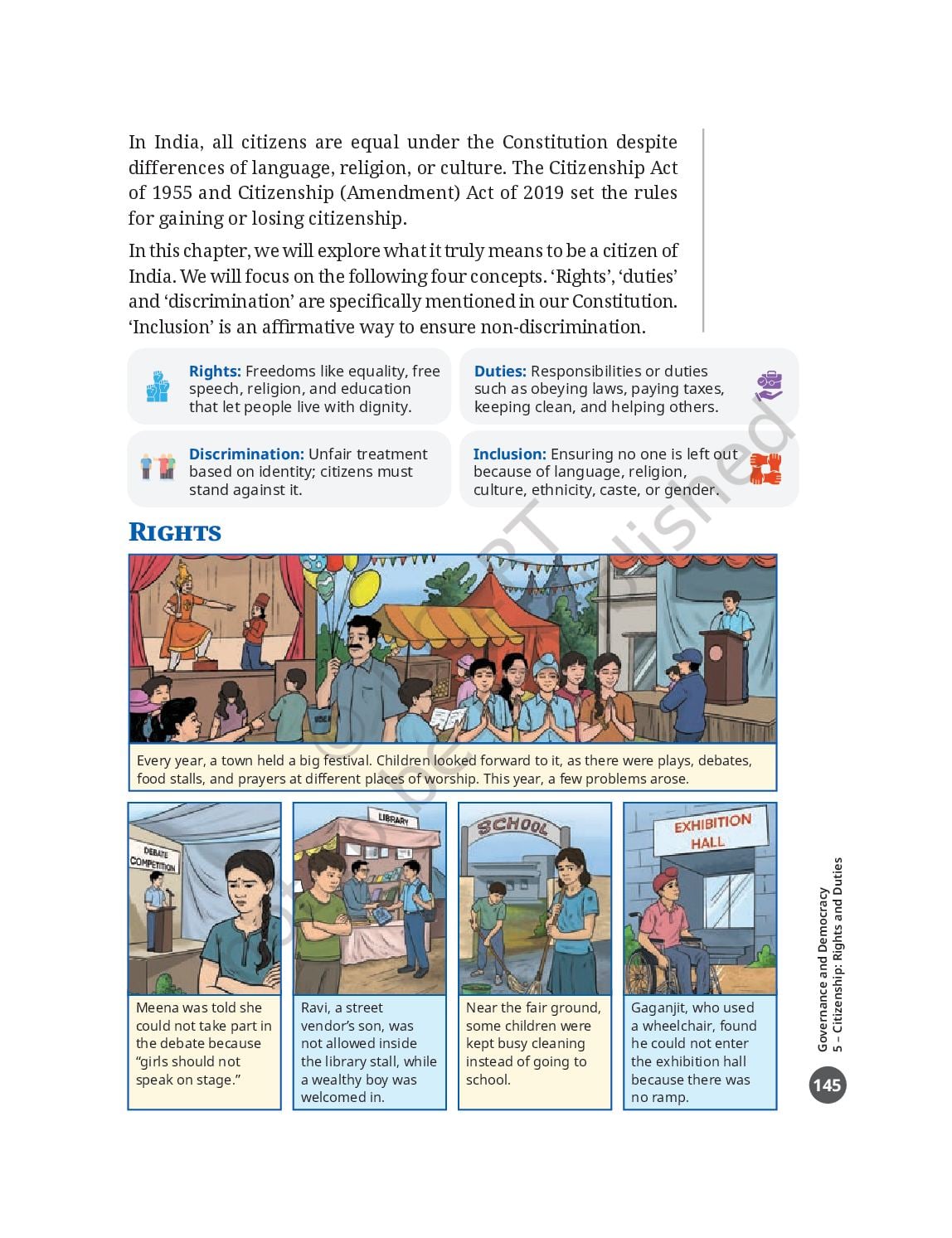
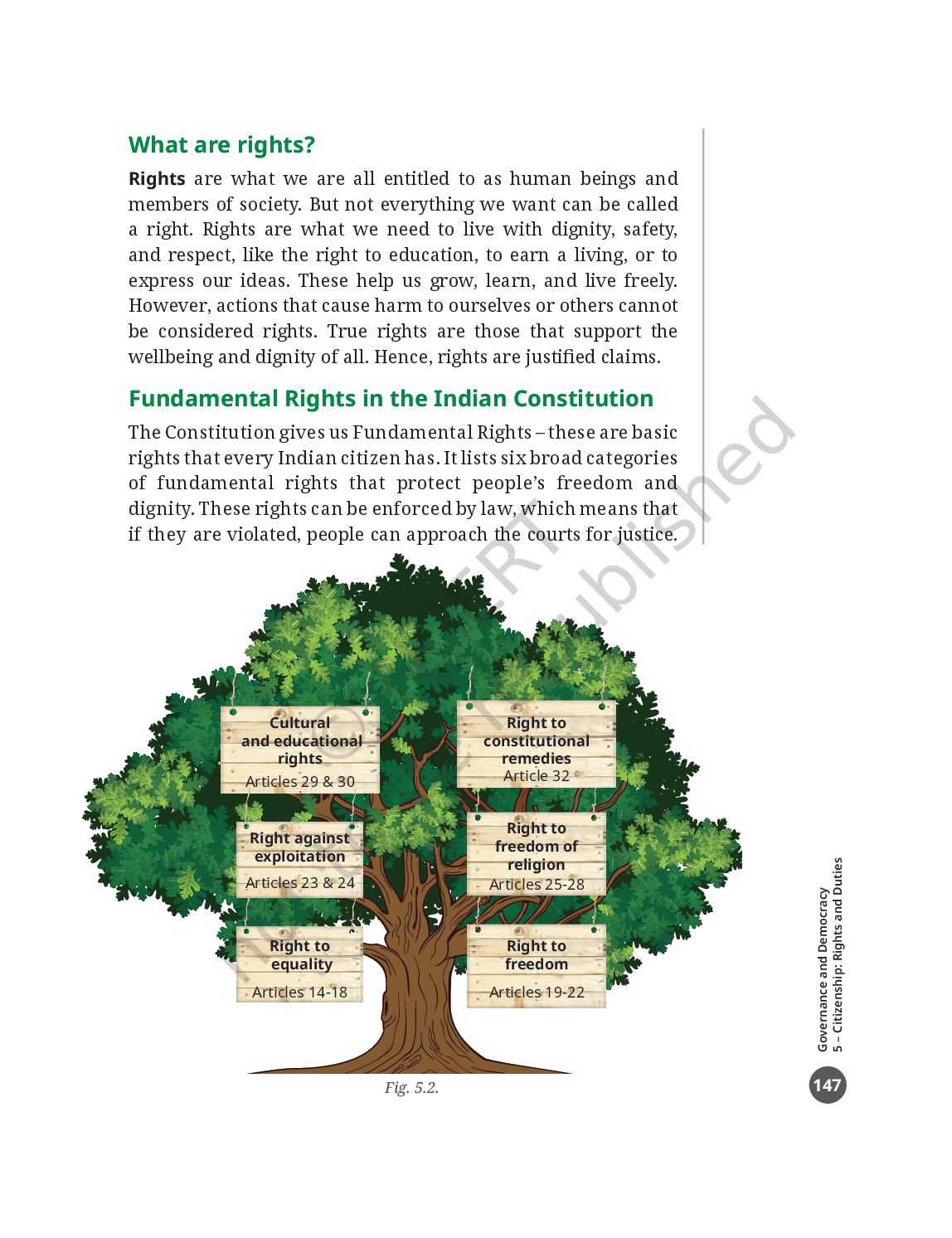
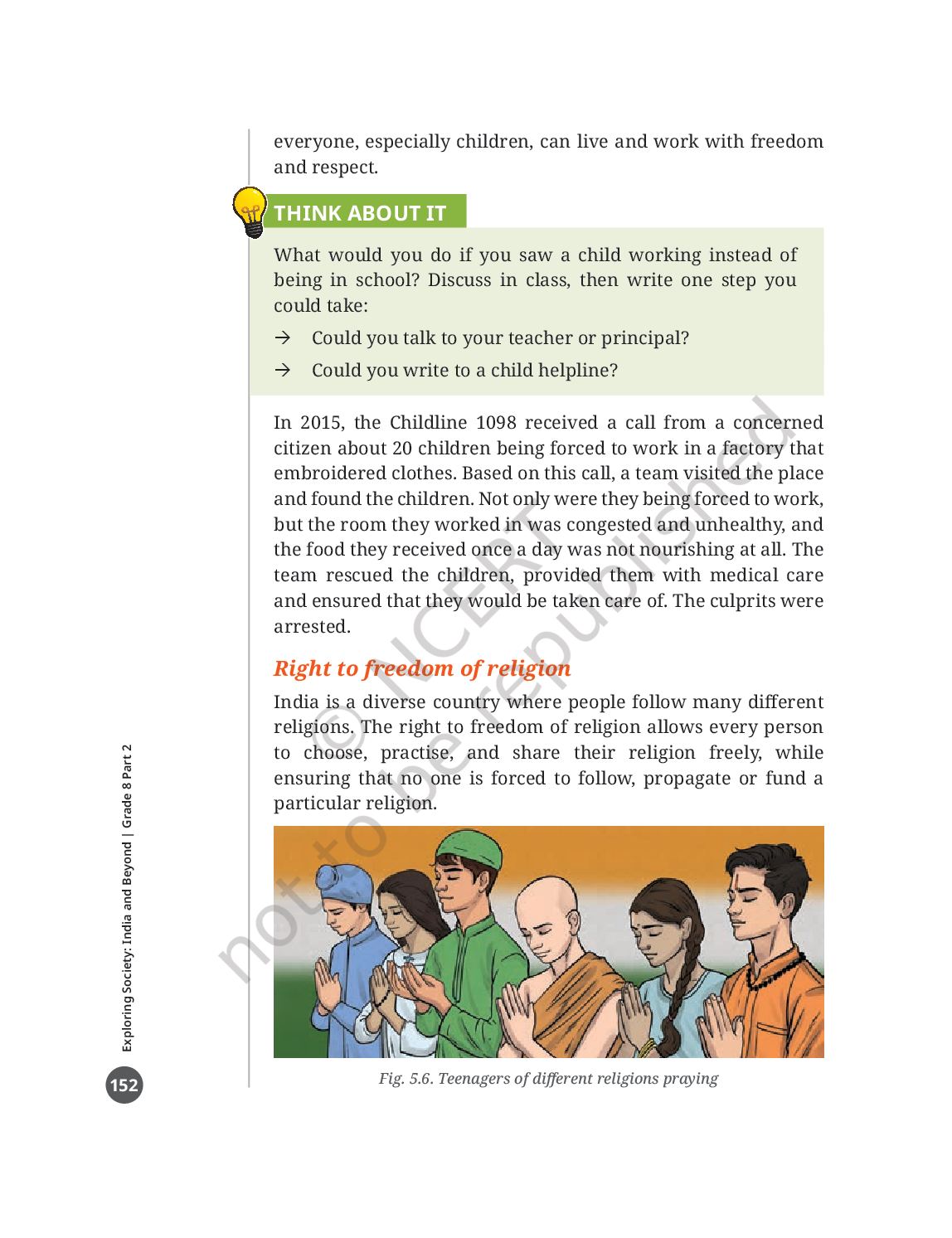
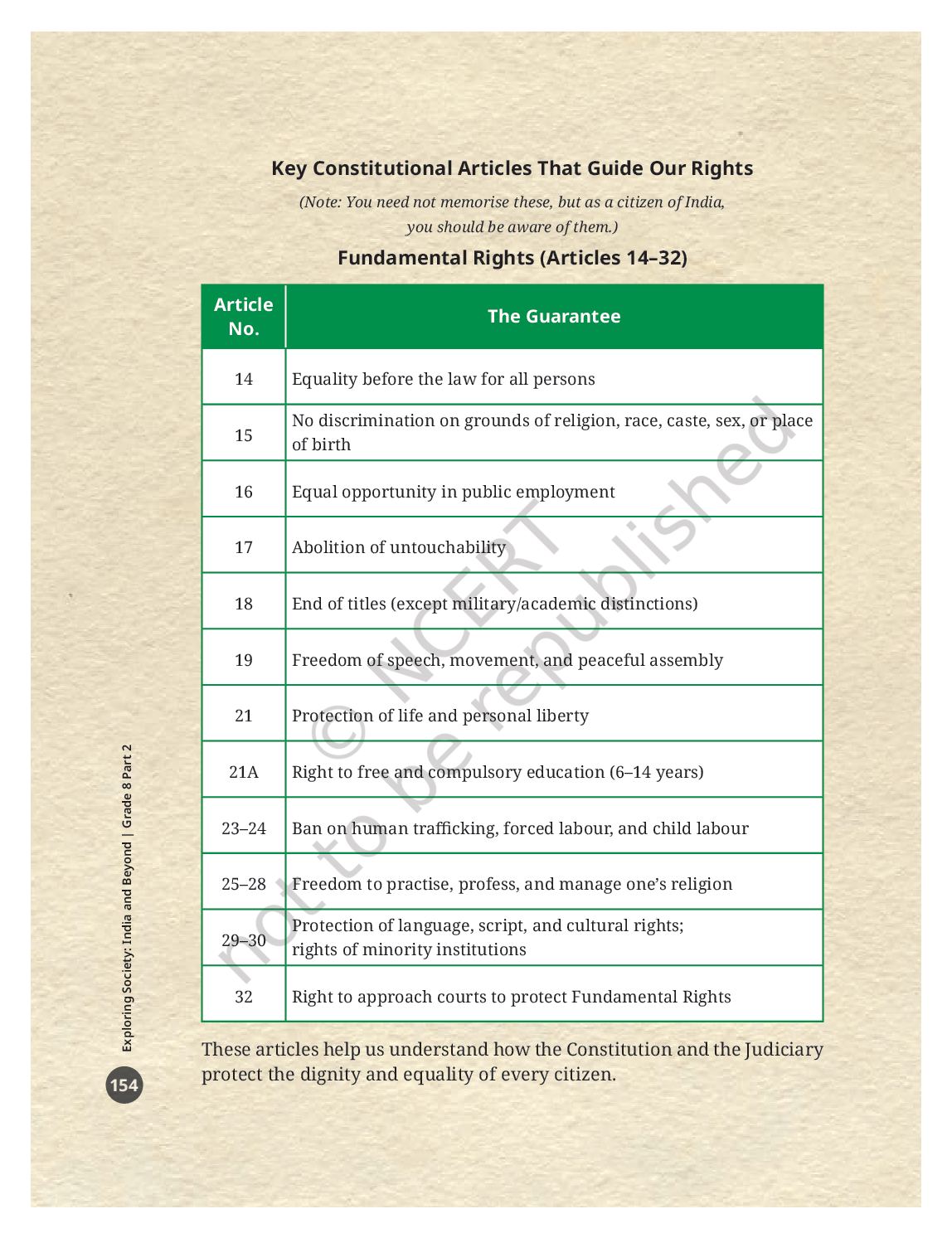
- Rights are justified claims — what we need to live with dignity, safety and respect. Not everything we want is a right: actions that cause harm to ourselves or others cannot be considered rights. The Constitution lists six broad categories of Fundamental Rights (Articles 14–32): the right to equality (14–18), freedom (19–22), against exploitation (23 & 24), freedom of religion (25–28), cultural and educational rights (29 & 30), and constitutional remedies (32).
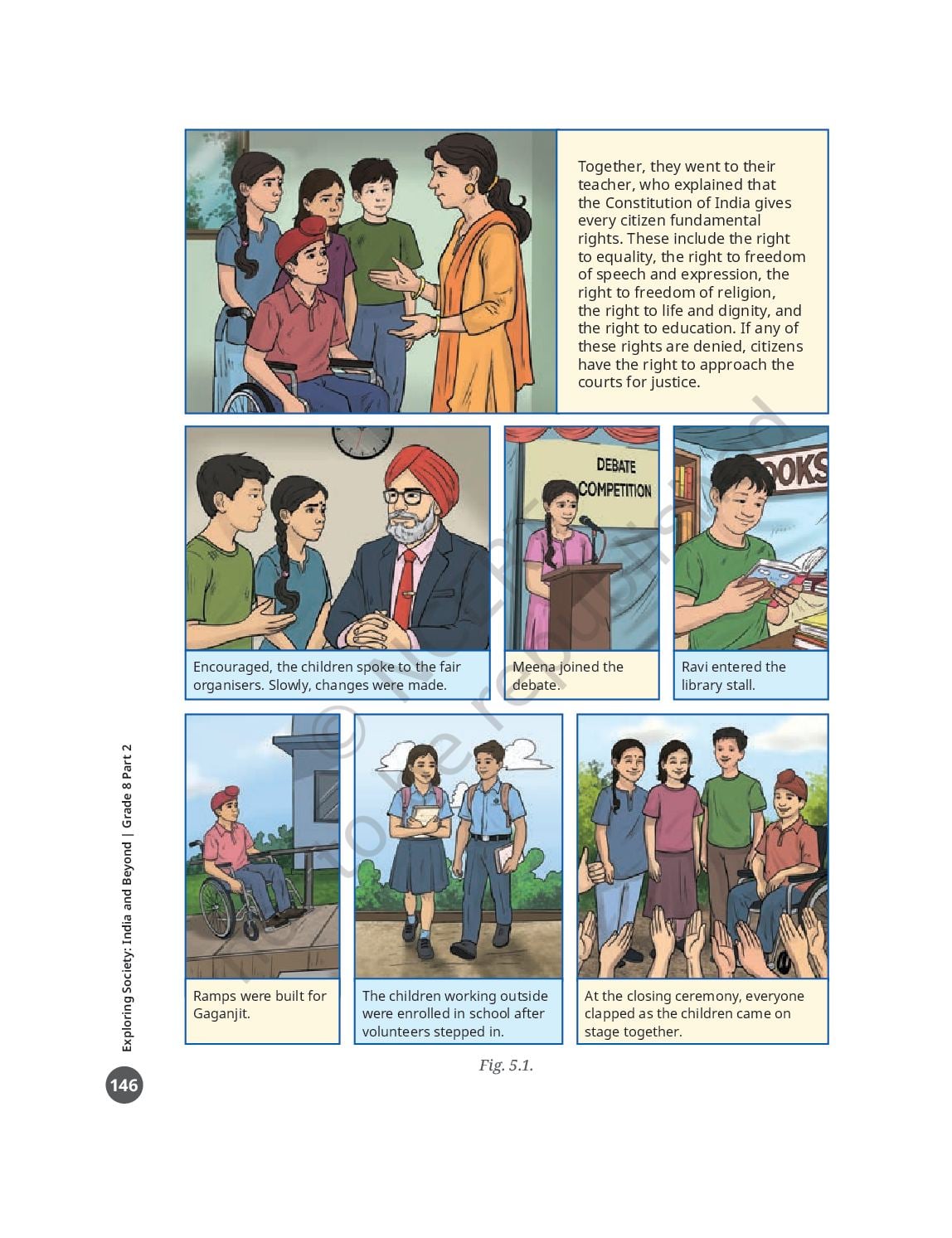
- Rights are enforceable. If they are violated — even by the government — a person can approach the courts. That is what Article 32, the right to constitutional remedies, is for; Dr B.R. Ambedkar called it “the very soul of the Constitution and the very heart of it”.
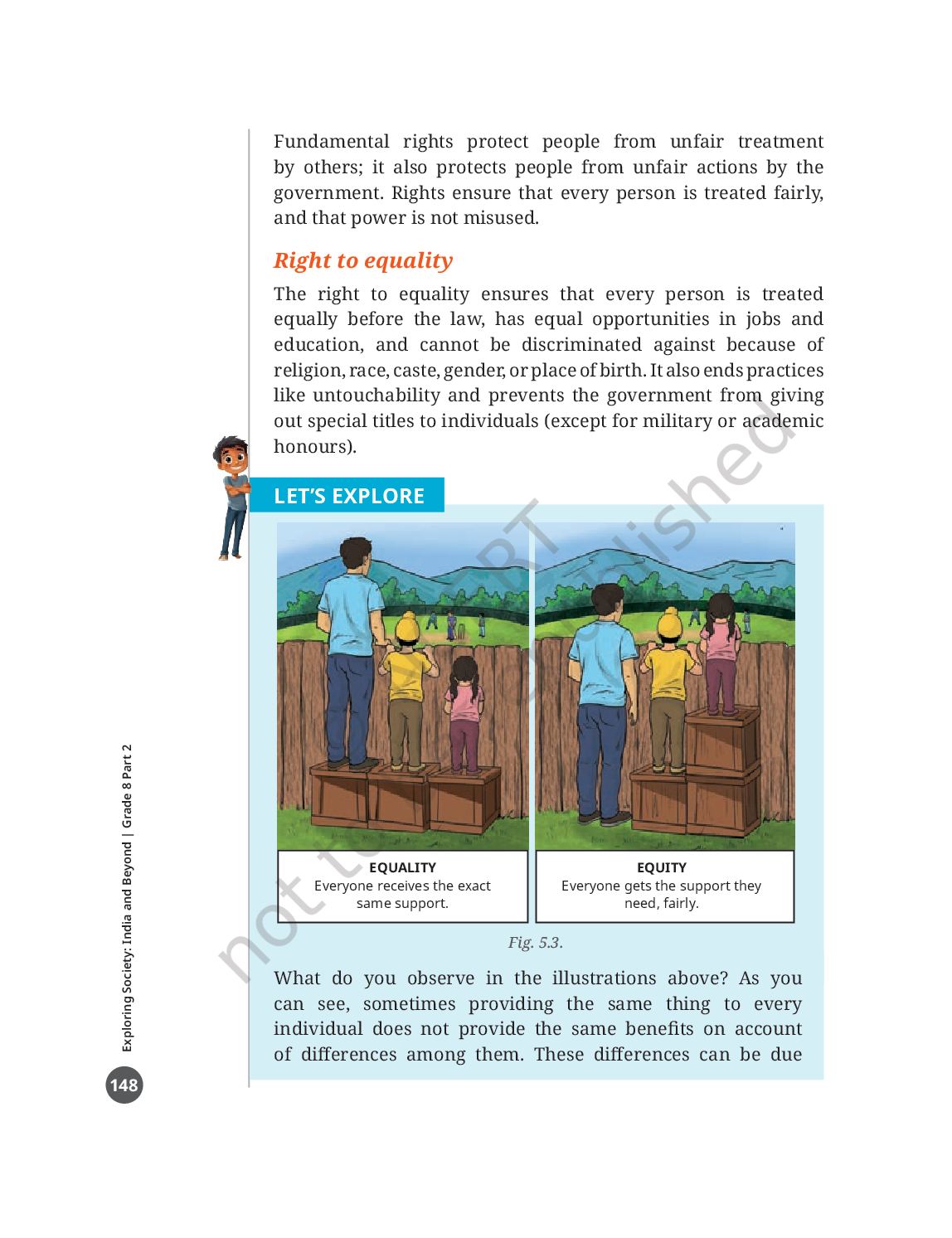
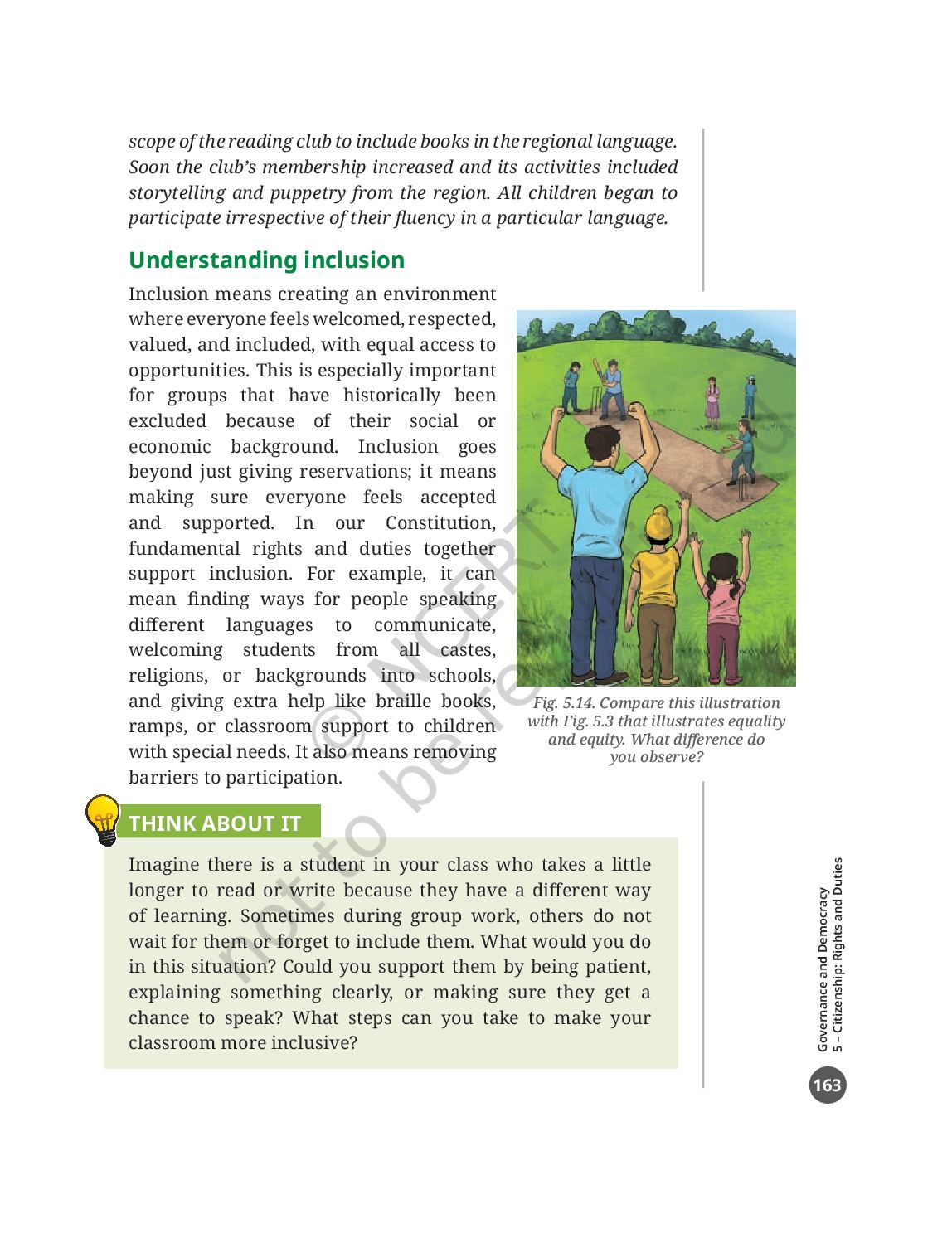
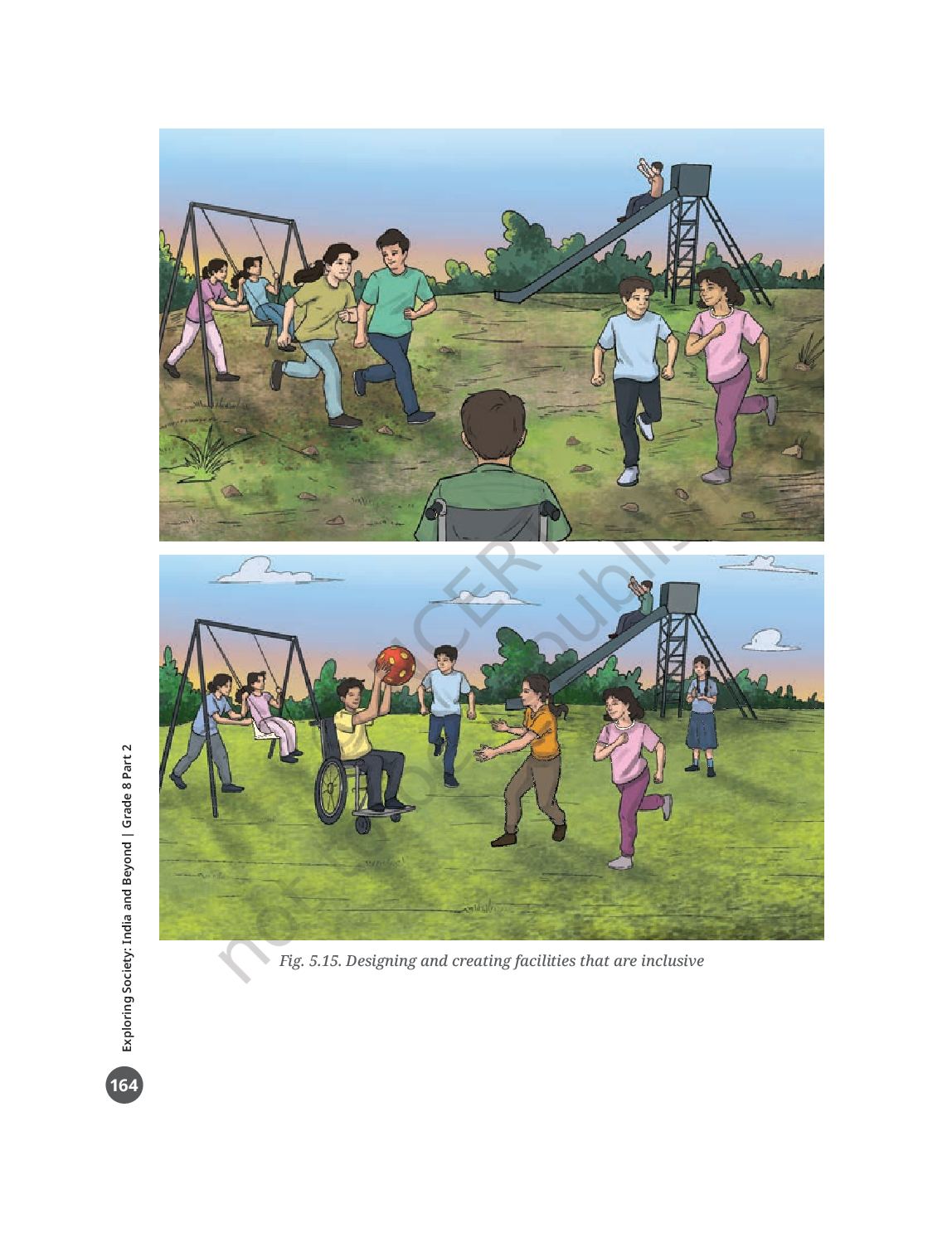
- Giving everyone exactly the same support is equality; giving each the support they actually need is equity (Fig. 5.3). Inclusion goes further still — it removes the barrier itself so that no extra support is needed (Fig. 5.14, Fig. 5.15).
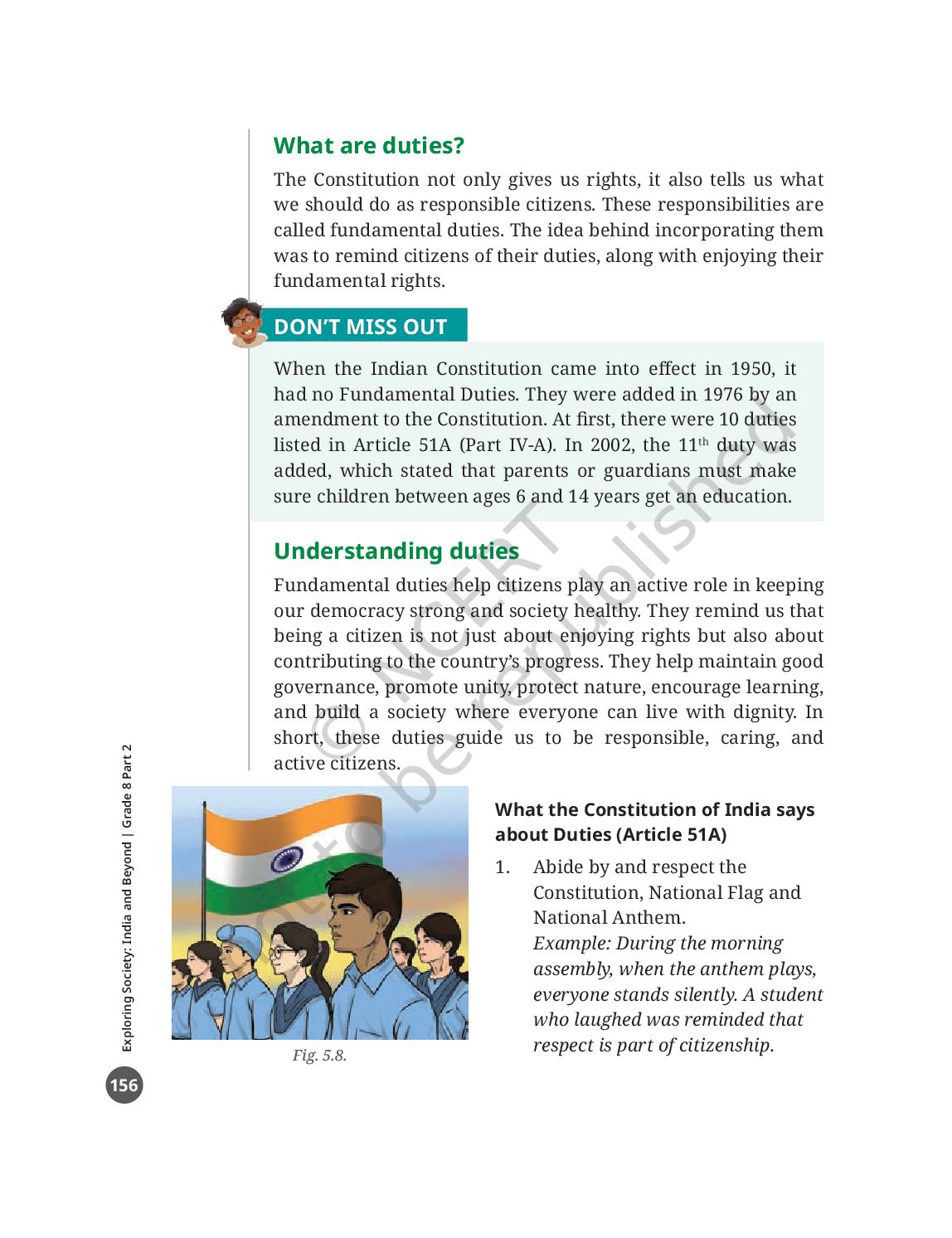
- Fundamental Duties were not in the Constitution of 1950. They were added in 1976 as Article 51A (Part IV-A) — ten at first, with an eleventh added in 2002 requiring parents or guardians to see that children aged 6–14 get an education.
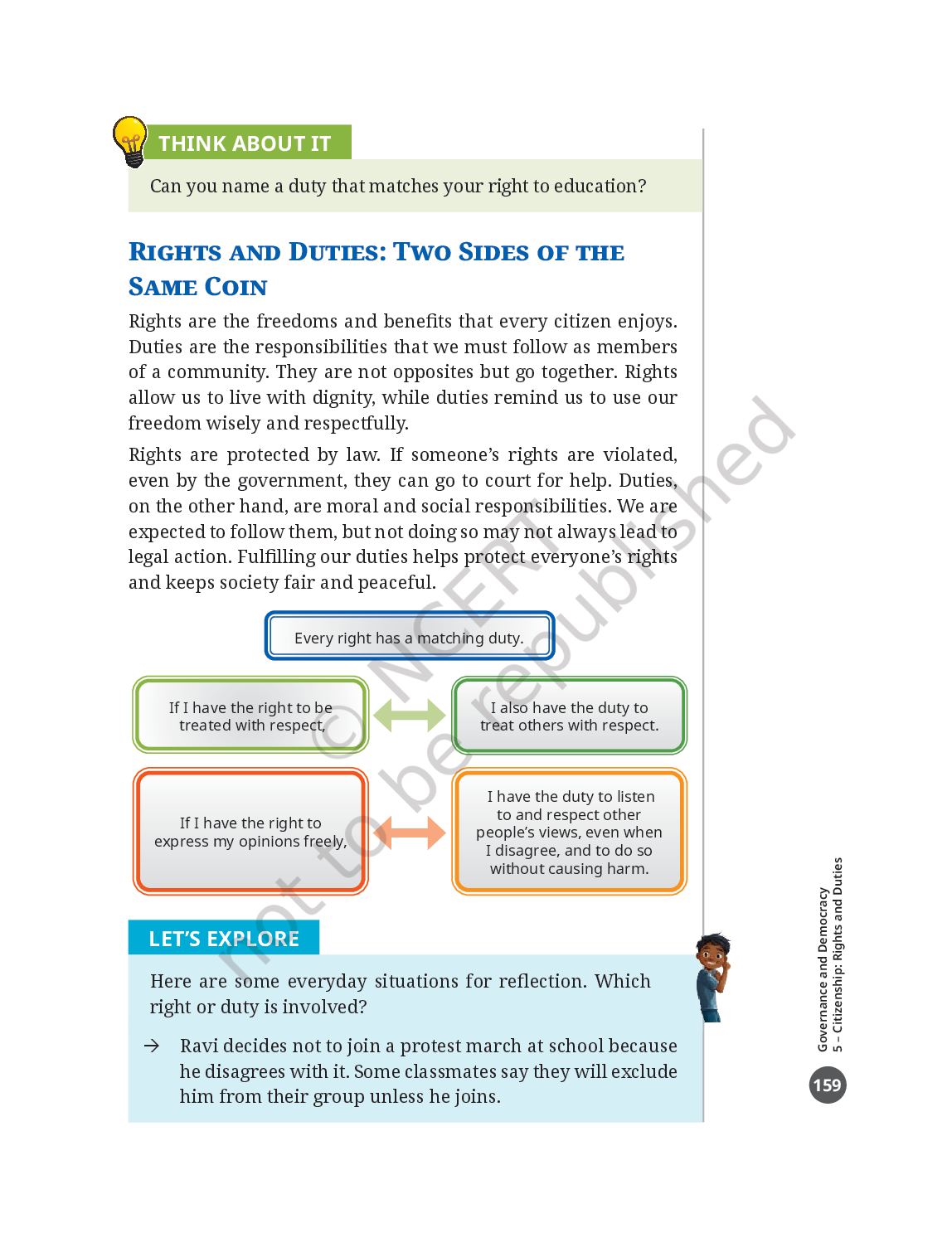
- Rights and duties are two sides of the same coin: every right has a matching duty. Rights are protected by law; duties are moral and social responsibilities, and not doing them may not always lead to legal action — but ignoring them empties the rights of other people. Discrimination, including the invisible kind that is hard to prove and therefore hard to penalise, is what breaks that balance.
Quick revision – Citizenship: Rights and Duties
| Term | What it means | Where the chapter uses it | Fact to remember |
|---|---|---|---|
| Citizen | Someone who legally belongs to a country and is a member of its political community, i.e. they can participate in the decision-making of the country | Who Is a Citizen?, p. 144 | A person can be a resident without being a citizen, and a citizen can even reside in another country |
| Rights | Freedoms like equality, free speech, religion and education that let people live with dignity — justified claims, not simply whatever we want | Rights, p. 145; What are rights?, p. 147 | Actions that cause harm to ourselves or others cannot be considered rights |
| Fundamental Rights | The six broad categories of basic rights the Constitution gives every Indian citizen, which can be enforced by law | Fundamental Rights in the Indian Constitution, p. 147 (Fig. 5.2) | Articles 14–32; the table on p. 154 lists them article by article |
| Equity | The quality of being fair and just, especially in a way that takes account of and seeks to address existing inequalities | Margin note, p. 149, with Fig. 5.3 | The Beti Bachao Beti Padhao campaign is the chapter’s example of an equity initiative |
| Right to constitutional remedies | The right to approach the Supreme Court if fundamental rights are violated | P. 153, with the Ambedkar quotation | Article 32 — it makes rights “not just promises on paper” |
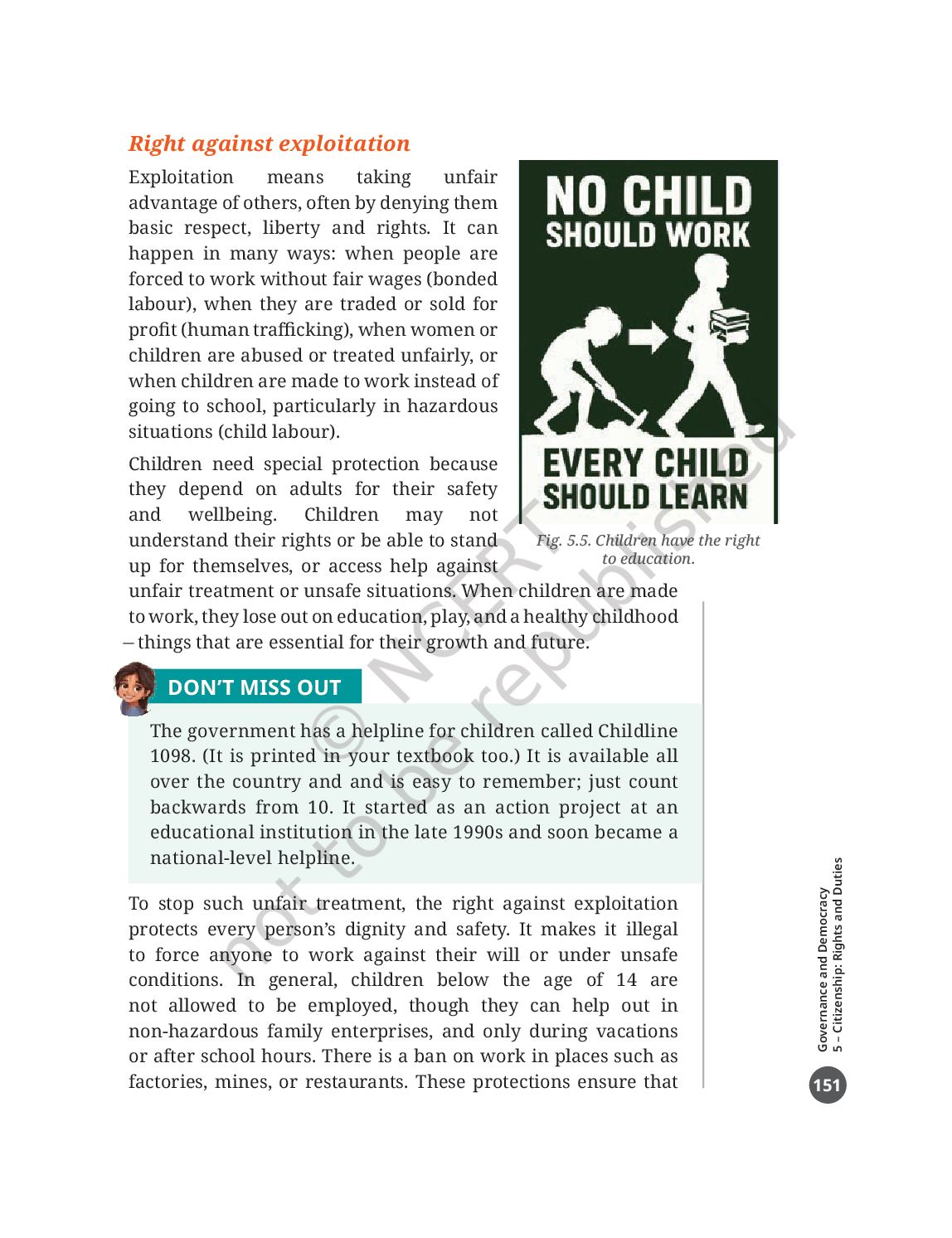
| Exploitation | Taking unfair advantage of others, often by denying them basic respect, liberty and rights | Right against exploitation, p. 151 | Articles 23–24 ban human trafficking, forced labour and child labour |
| Child labour | Making children work instead of going to school, particularly in hazardous situations | P. 151 | Below 14, children are generally not allowed to be employed; they may help in non-hazardous family enterprises only during vacations or after school hours |
| Childline 1098 | The government’s national helpline for children | DON’T MISS OUT, p. 151 | Easy to remember — count backwards from 10. In 2015 one call rescued 20 children from an embroidery factory |
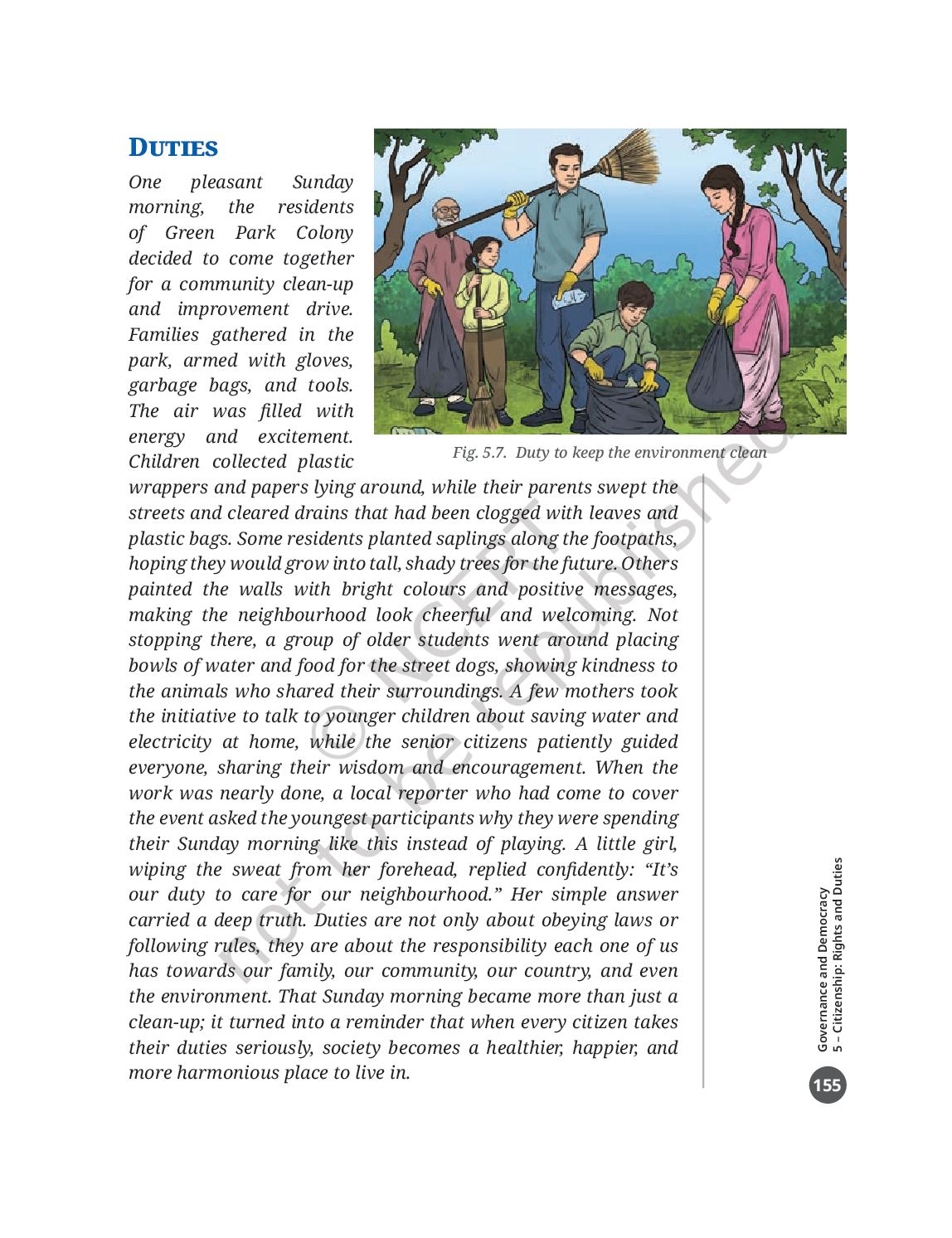
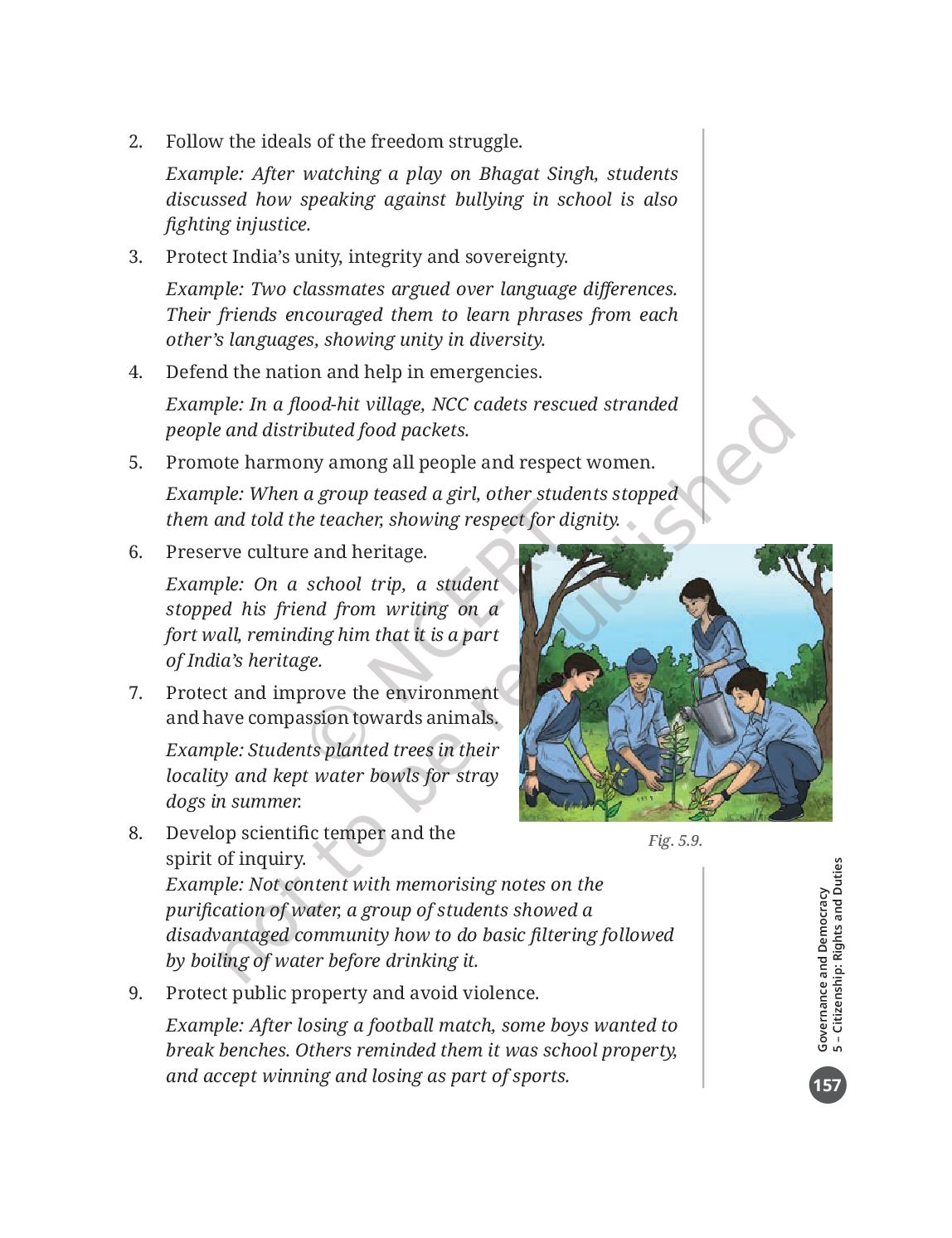
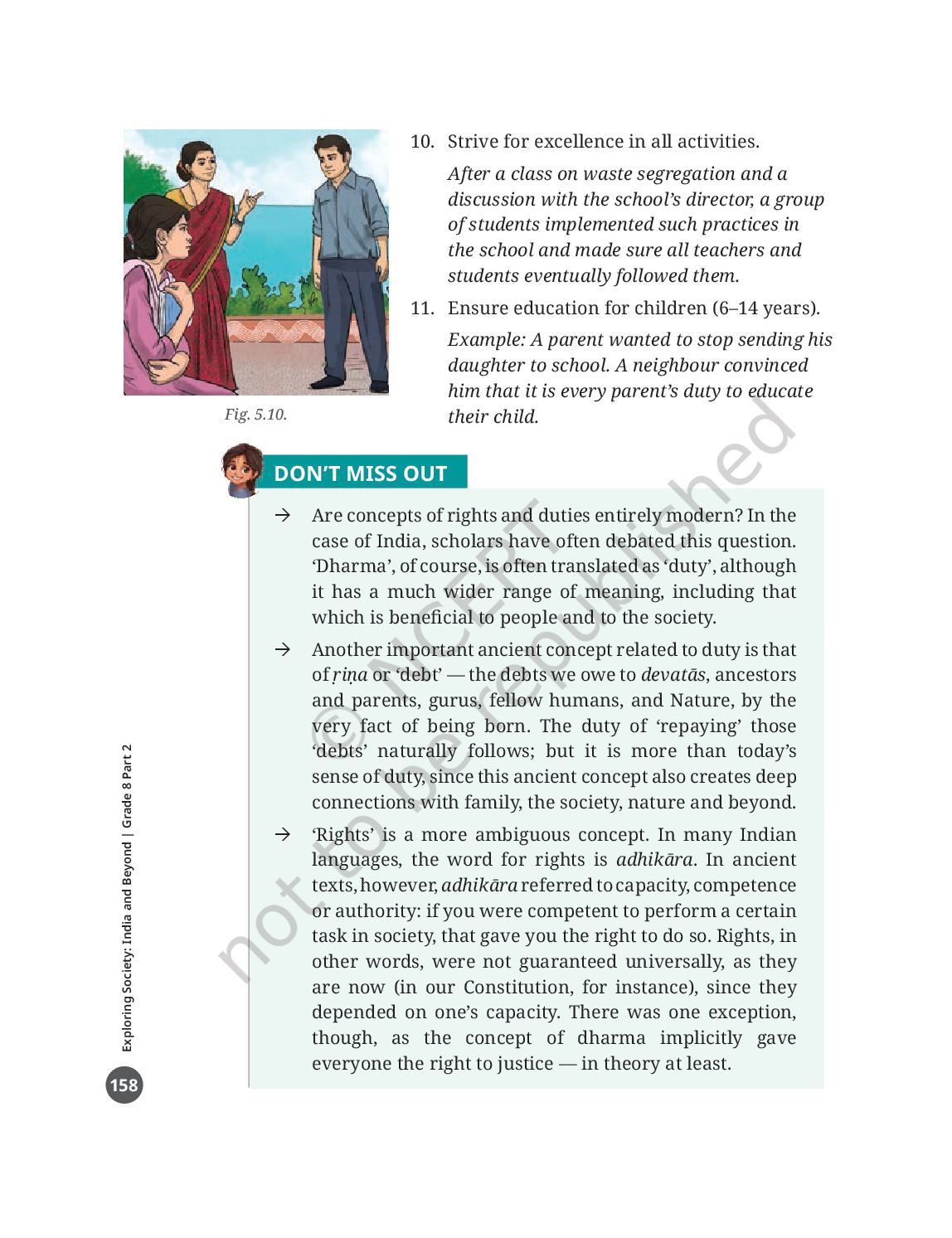
| Fundamental Duties | The responsibilities the Constitution lists for citizens, alongside their rights | What are duties?, p. 156; Fig. 5.8–5.10, pp. 156–158 | Added in 1976 as Article 51A (Part IV-A); 10 at first, an 11th added in 2002 |
| Dharma · ṛiṇa · adhikāra | Older Indian ideas: dharma, often translated as ‘duty’ but far wider; ṛiṇa, the debts we owe by the very fact of being born; adhikāra, which in ancient texts meant capacity, competence or authority | DON’T MISS OUT, p. 158 | Rights then depended on one’s capacity; dharma implicitly gave everyone the right to justice — in theory at least |
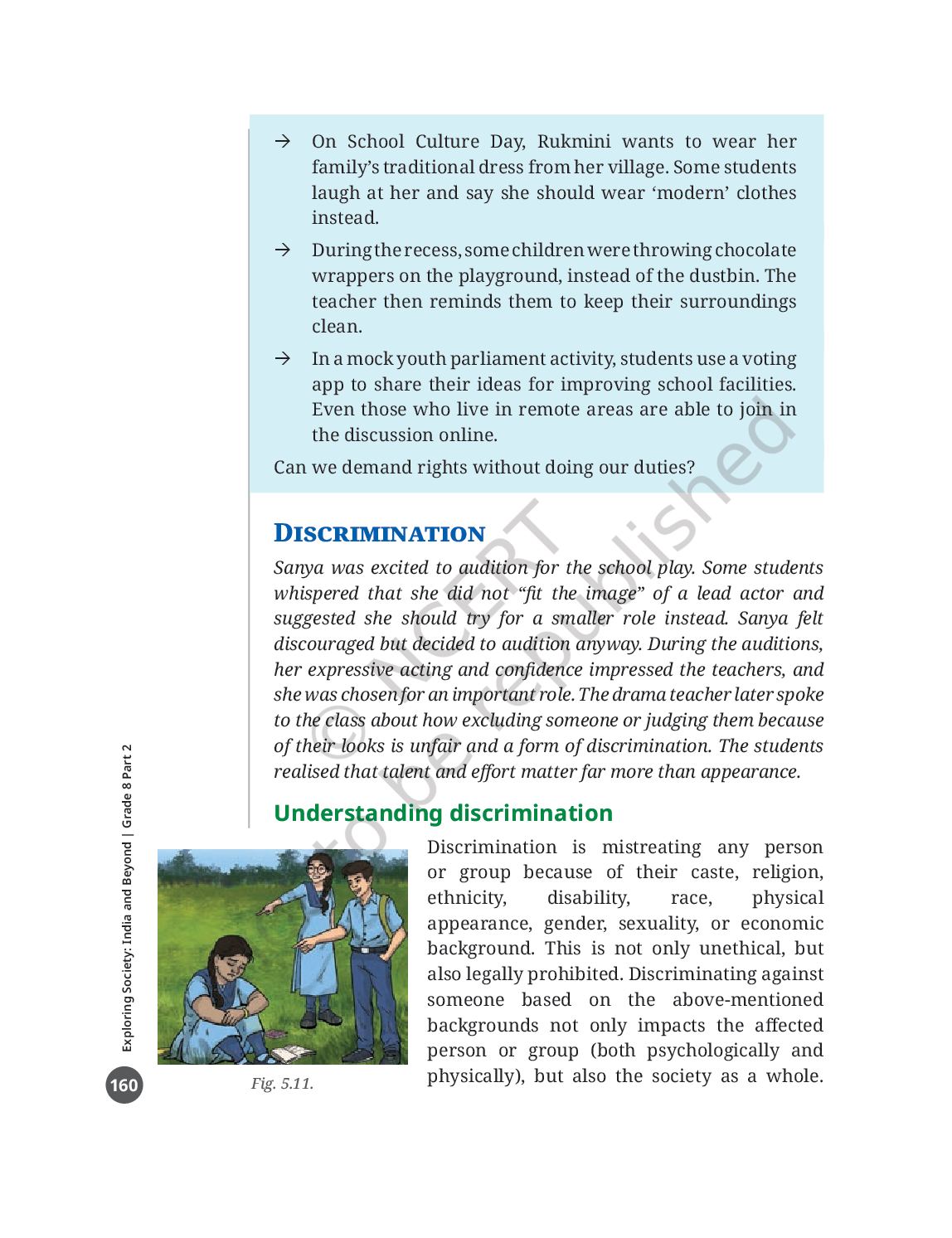
| Discrimination | Mistreating any person or group because of their caste, religion, ethnicity, disability, race, physical appearance, gender, sexuality or economic background | Understanding discrimination, p. 160 | Invisible discrimination is difficult to prove, and hence difficult to penalise |
| Inclusion | Creating an environment where everyone feels welcomed, respected, valued and included, with equal access to opportunities | Understanding inclusion, p. 163 | It goes beyond just giving reservations — it means removing barriers to participation |
Old NCERT vs New – Class 8 Social Science
This chapter is from Exploring Society: India and Beyond, the new NCERT Class 8 Social Science book (NCF-SE 2023, used from 2025-26). It replaced the old book “Our Pasts, Resources and Development and Social and Political Life”, so chapter numbers and names differ from older PDFs.
Solutions and All Chapters
Answers to the exercises and the full chapter list of Exploring Society: India and Beyond:
Citizenship: Rights and Duties – Overview
| Class | Class 8 |
| Subject | Social Science |
| Book | Exploring Society: India and Beyond – new NCERT book |
| Part | Part II |
| Chapter | 12 of 15 – Citizenship: Rights and Duties |
| Book pages | Part II, 143 – 166 |
| Edition | NCERT Reprint 2026-27 |
| Session | 2026-27 |
| Free – read online or download |
Class 8 Social Science Chapter 12 – FAQs
Where can I download Citizenship: Rights and Duties Class 8 PDF?
From the download table on this page – the chapter PDF is free, and the full book is linked too.
What is Class 8 Social Science Chapter 12 about?
A citizen is someone who legally belongs to a country and is a member of its political community — that is, they can participate in the decision-making of the country. In India the Citizenship Act of 1955 and the Citizenship (Amendment) Act of 2019 set the rules for gaining or losing citizenship. Citizenship is both a legal identity and a social responsibility; living in a place makes you a resident, but citizenship is a formal, legal membership.
Is Citizenship: Rights and Duties from the new NCERT Class 8 Social Science book?
Yes. It is chapter 12 of exploring society: india and beyond (part ii), the new NCERT Class 8 Social Science book for 2026-27.
Is this the latest NCERT edition for 2026-27?
Yes – the PDF is NCERT’s latest edition for the 2026-27 session.
Where are the NCERT Solutions for Class 8 Social Science Chapter 12?
Open the NCERT Solutions link above for answers to the exercise questions.