NCERT Solutions for Class 8 Social Science Chapter 12 Citizenship Rights and Duties provide clear, step-by-step answers to every exercise and in-text question from the chapter Citizenship Rights and Duties of the NCERT textbook Exploring Society: India and Beyond. Prepared by subject experts as per the latest NCERT (CBSE) syllabus for 2026-27, these NCERT Solutions for Class 8 Social Science help you understand each concept, write exam-ready answers, and check your own solutions. You can read them online below or download the free Class 8 Social Science Chapter 12 question-answer PDF.
NCERT Solutions for Class 8 Social Science Chapter 12 Citizenship Rights and Duties
- Class: Class 8
- Subject: Social Science
- Chapter: Chapter 12 – Citizenship Rights and Duties
- Textbook: Exploring Society: India and Beyond (NCERT)
- Study material: NCERT Solutions – questions with answers, free PDF
These solutions answer all the exercise questions of Chapter 12 Citizenship Rights and Duties — including the in-text questions, short-answer and long-answer questions, and activities — with complete explanations so you can follow the method, not just the final answer. Read the full solutions below.
NCERT Solutions Class 8 Social Science Chapter 12 Citizenship Rights and Duties View Download
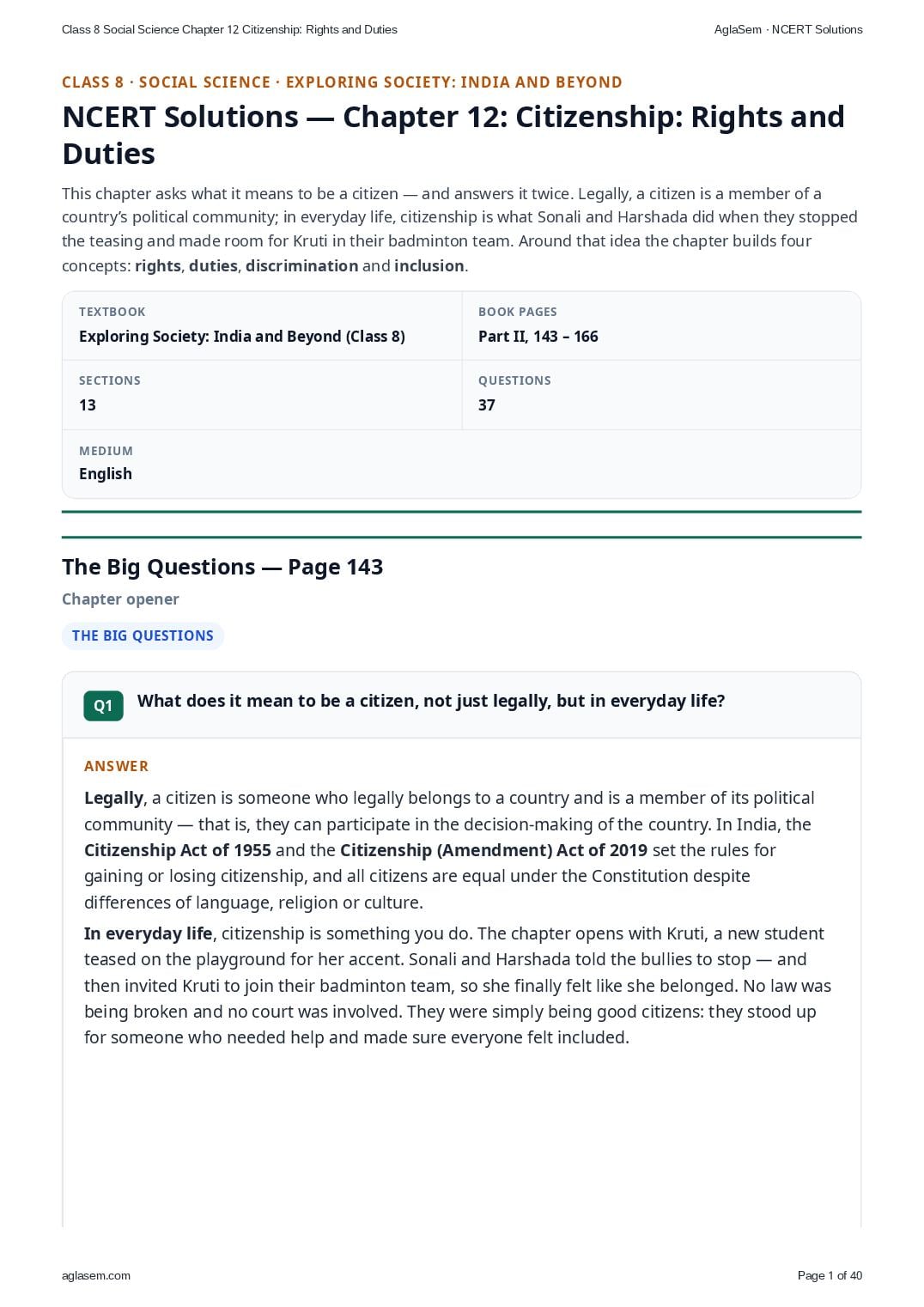
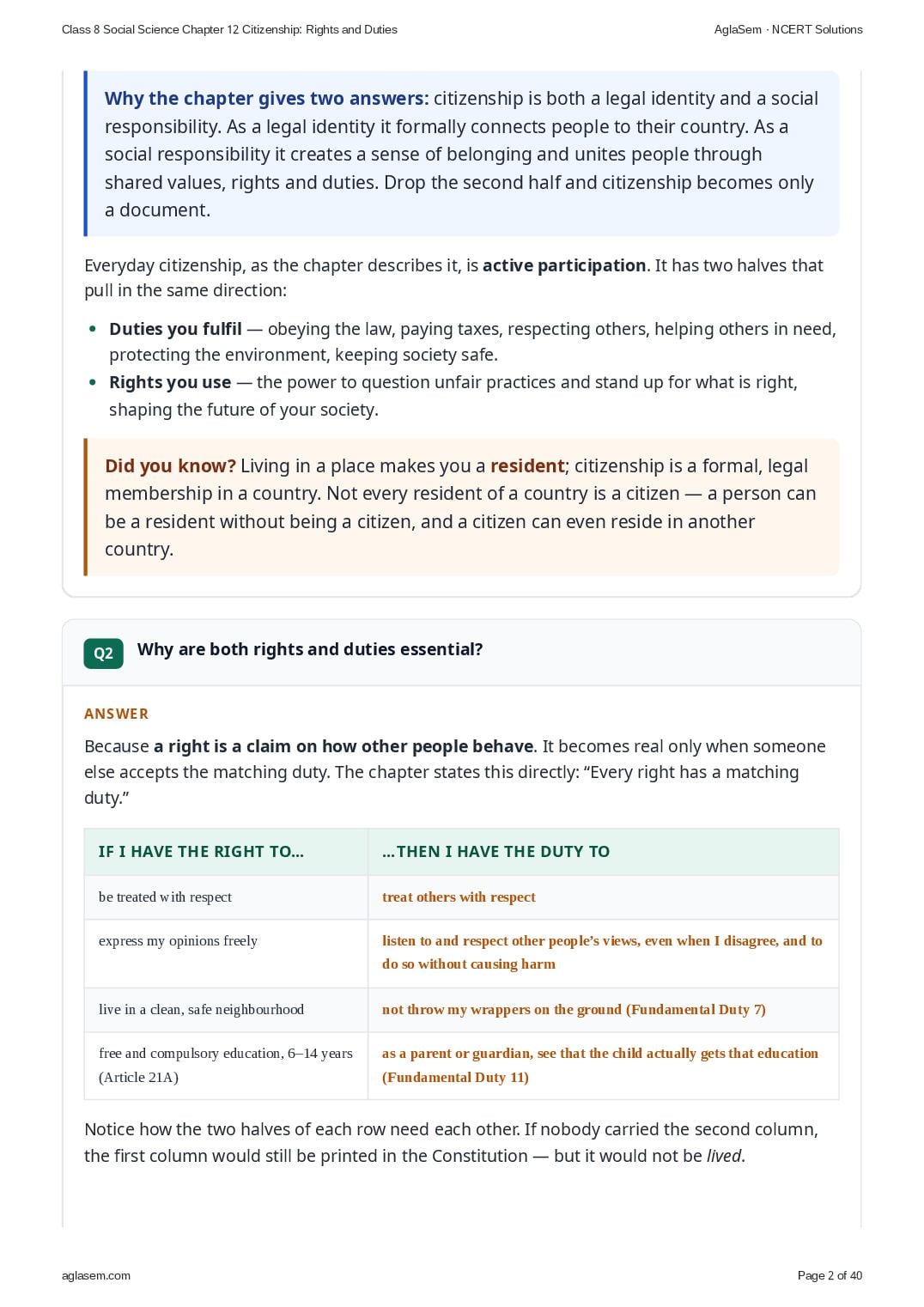
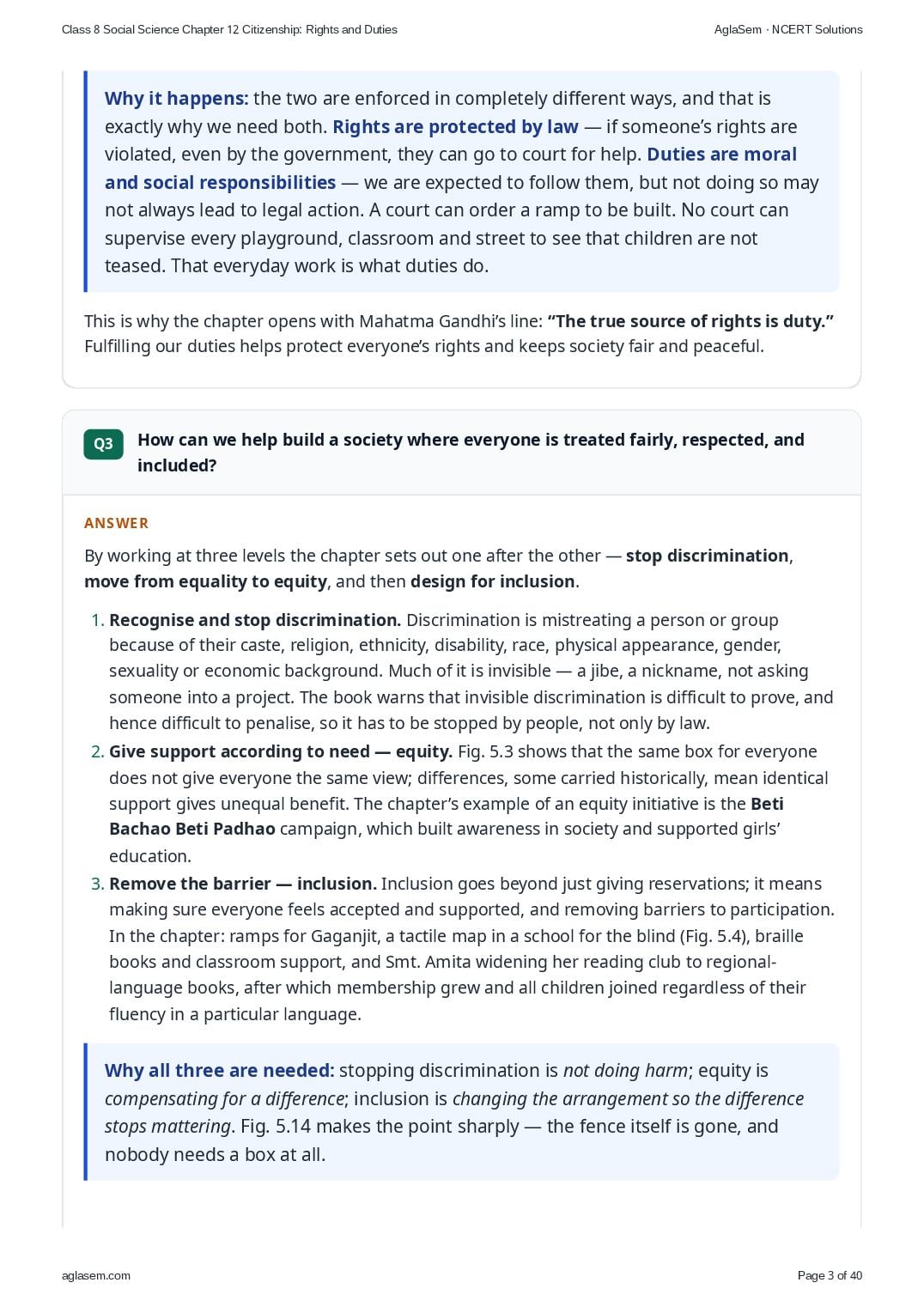
NCERT Solutions for Class 8 Social Science Chapter 12 PDF Download
You can read the NCERT Solutions for Class 8 Social Science Chapter 12 online above, or download the complete question-answer PDF to study Citizenship Rights and Duties offline at any time.
NCERT Solutions for Class 8 Social Science Chapter 12 PDF Download Link – Click Here to Download Solutions PDF
Questions Covered in This Chapter
These NCERT Solutions answer all 37 questions of this chapter. The questions solved are:
- What does it mean to be a citizen, not just legally, but in everyday life?
- Why are both rights and duties essential?
- How can we help build a society where everyone is treated fairly, respected, and included?
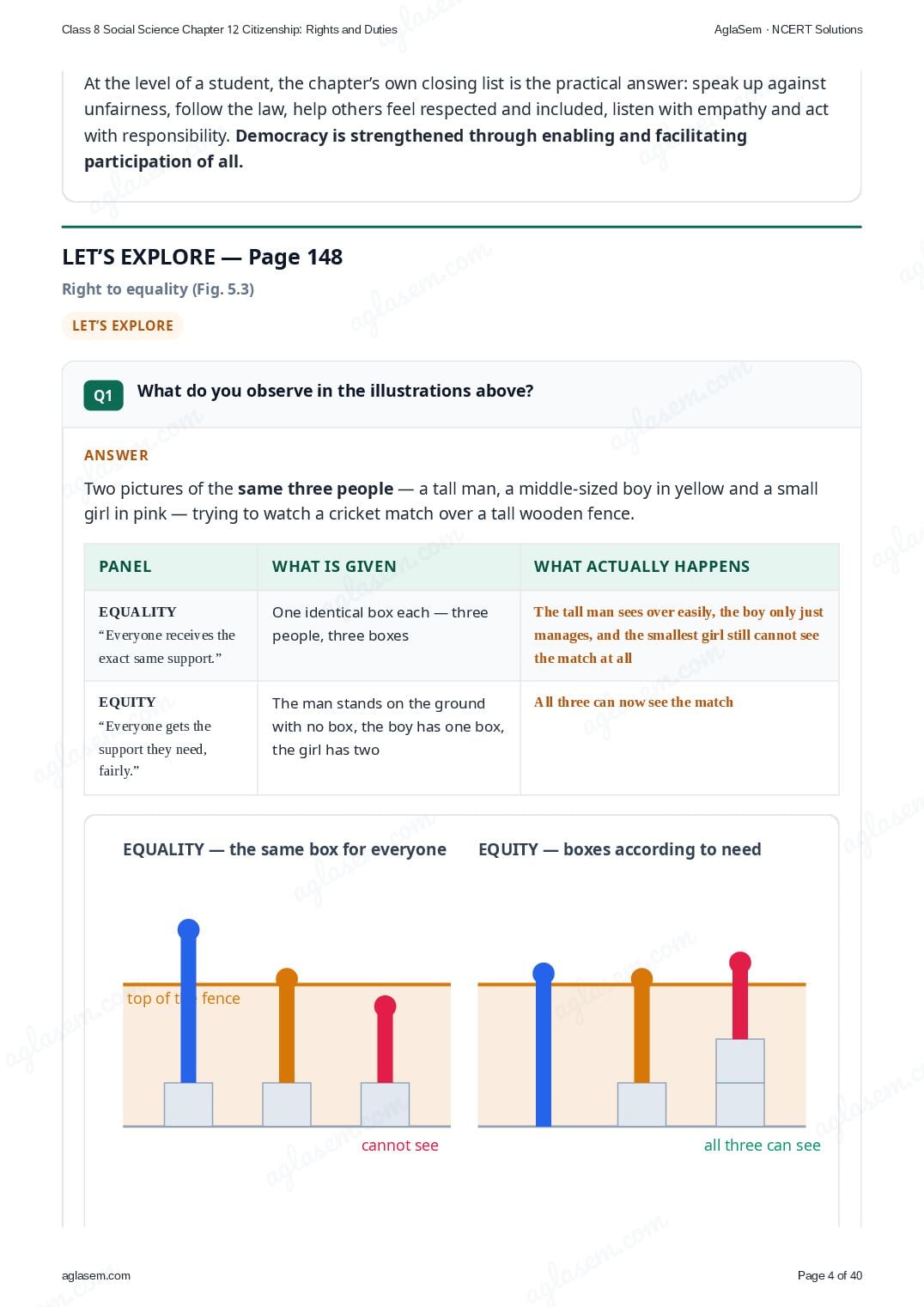
- What do you observe in the illustrations above?
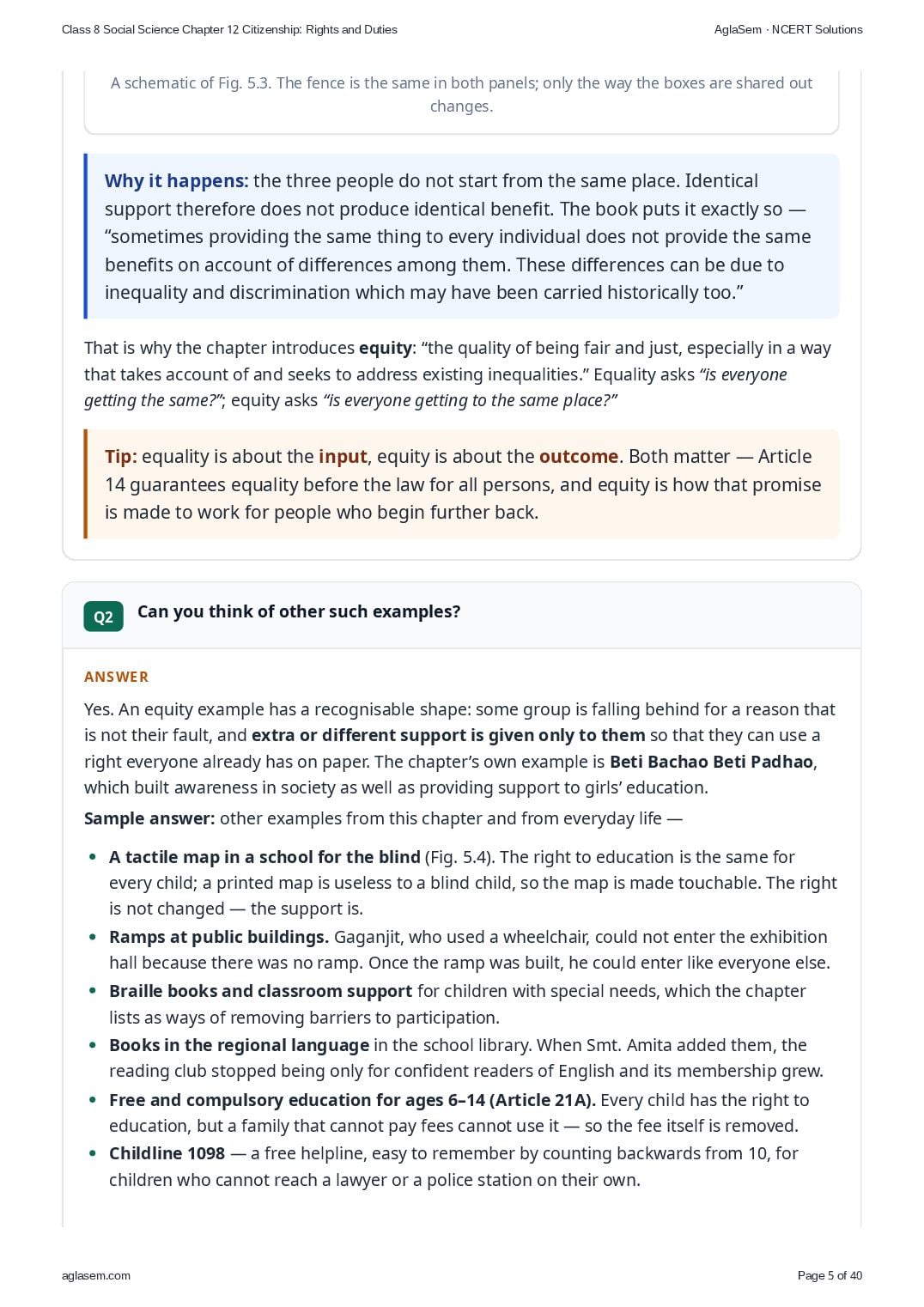
- Can you think of other such examples?
- It’s Sports Day at school. The weather is very hot. Some students are told to wear full school uniforms with shoes, even though they will be running, playing games, and spending time outdoors. A few students feel uncomfortable and wonder why they can’t wear lighter clothes like T-shirts and sports shoes for such activities. One student starts a discussion at break time. “Shouldn’t we be allowed to wear comfortable sports clothes on Sports Day?” Some classmates agree, saying that comfort and safety are important while playing sports. Others feel that wearing the school uniform shows discipline and equality among all students. A couple of teachers overhear the conversation and remind everyone that school rules about uniforms must be followed. Was the student exercising freedom of speech?
- Could they have raised their concern differently?
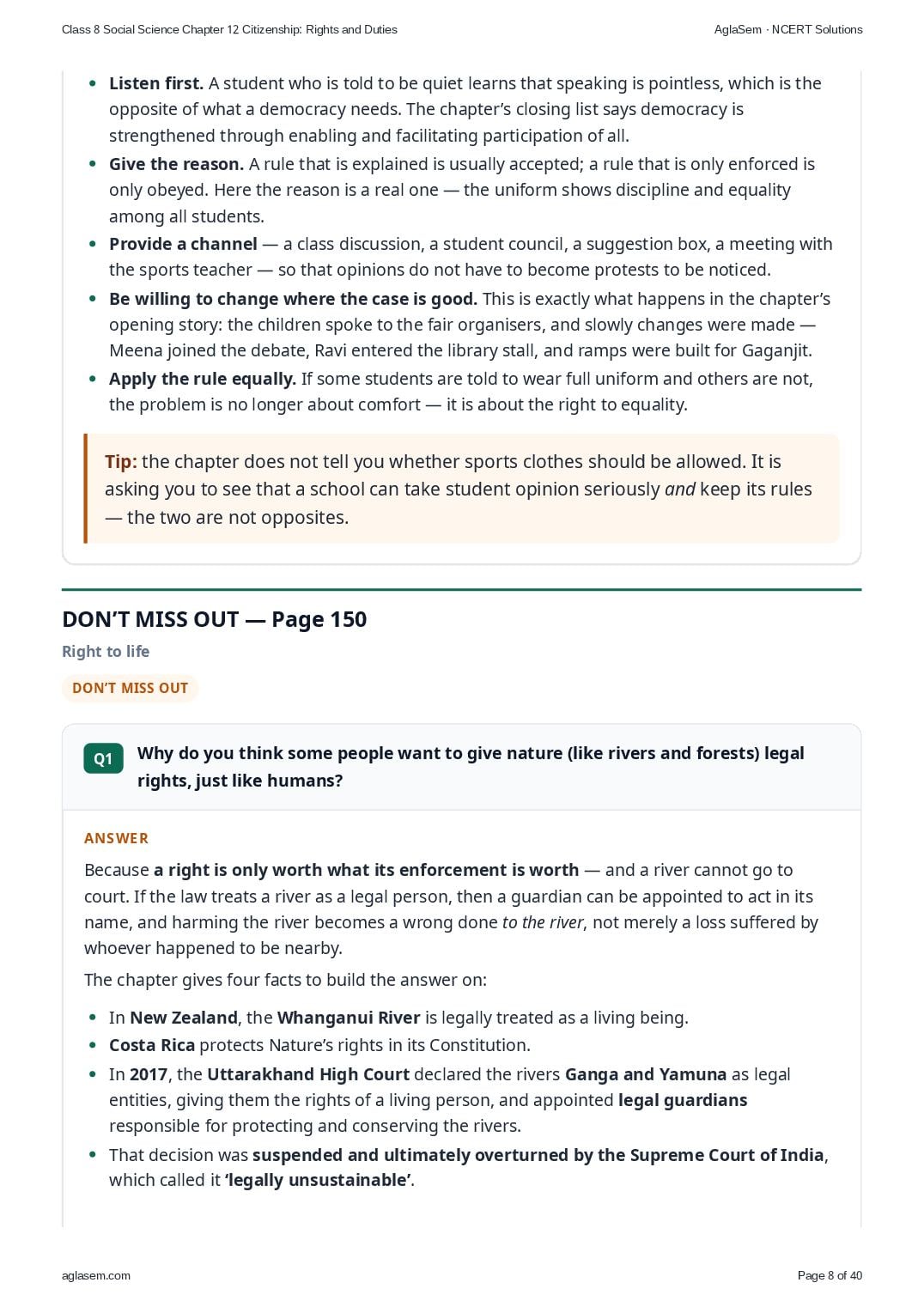
- How should schools handle student opinions?
- Why do you think some people want to give nature (like rivers and forests) legal rights, just like humans?
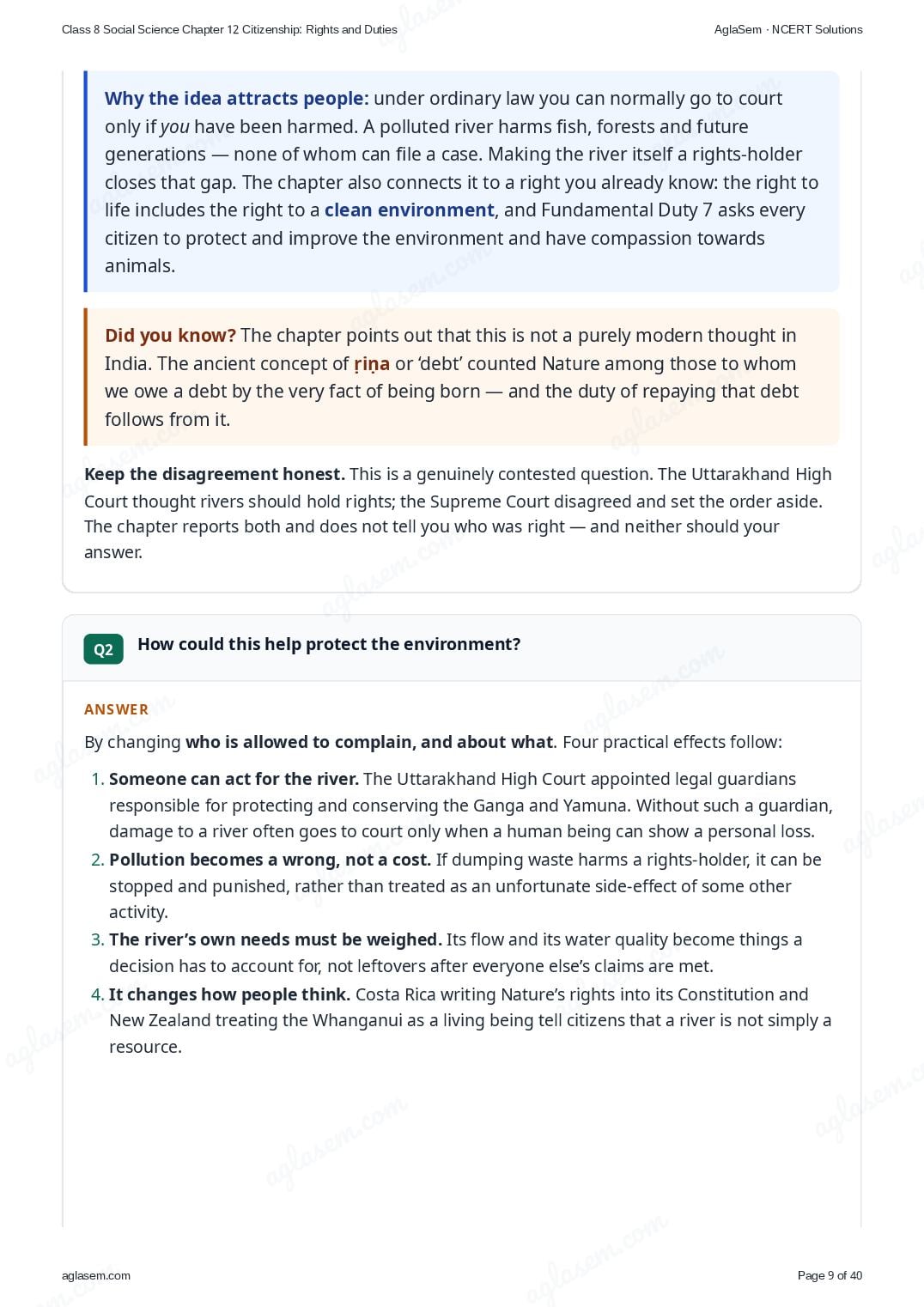
- How could this help protect the environment?
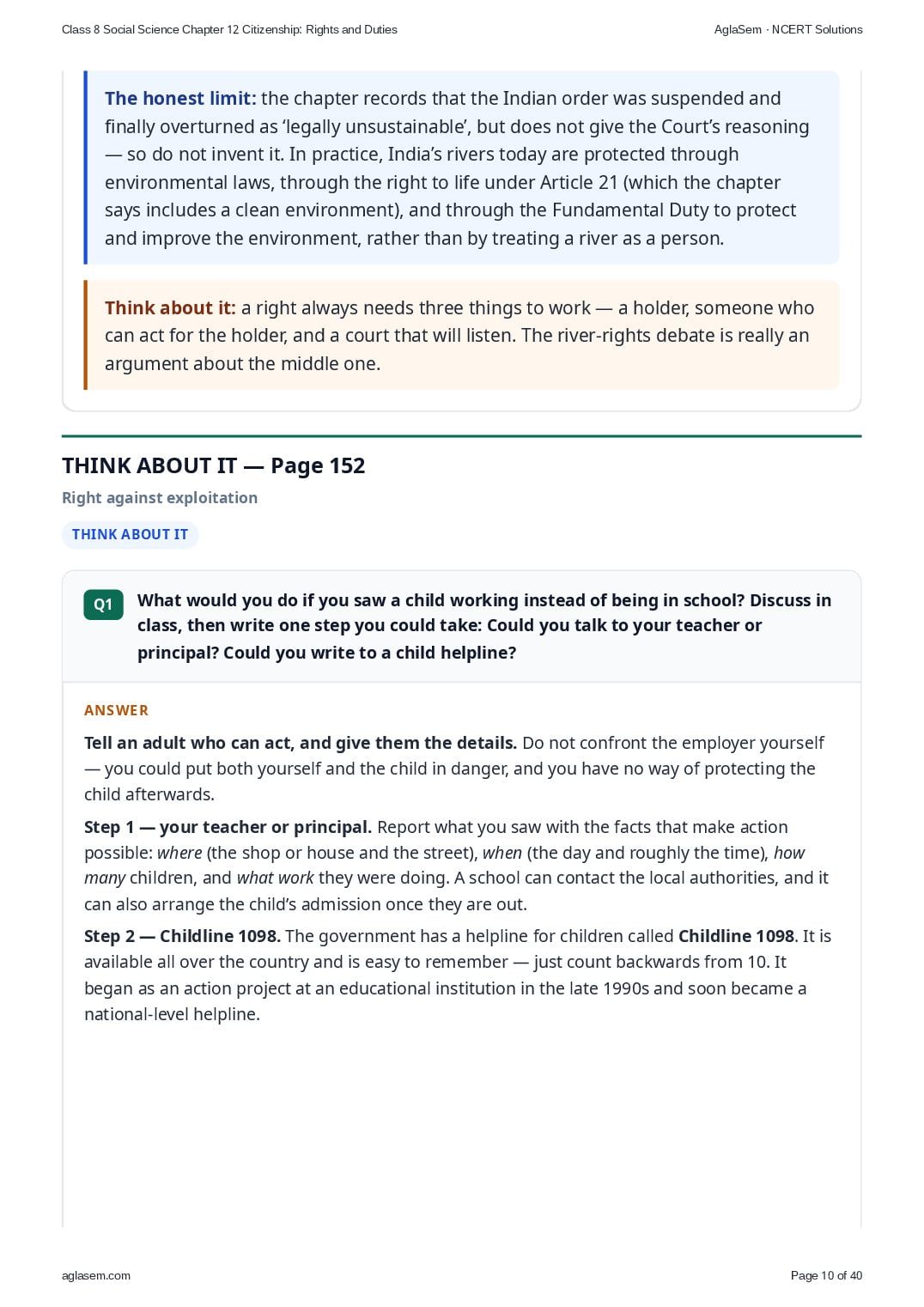
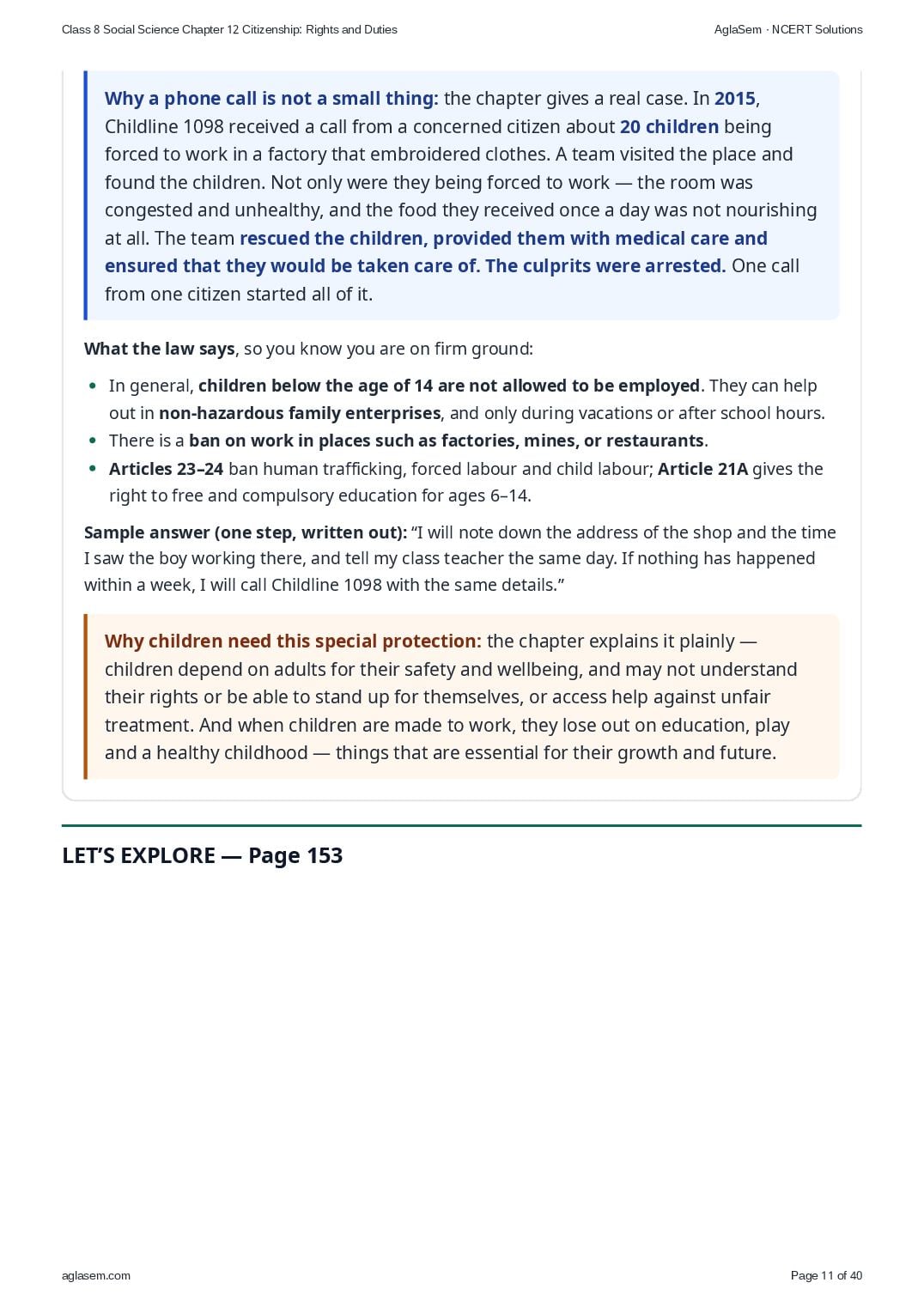
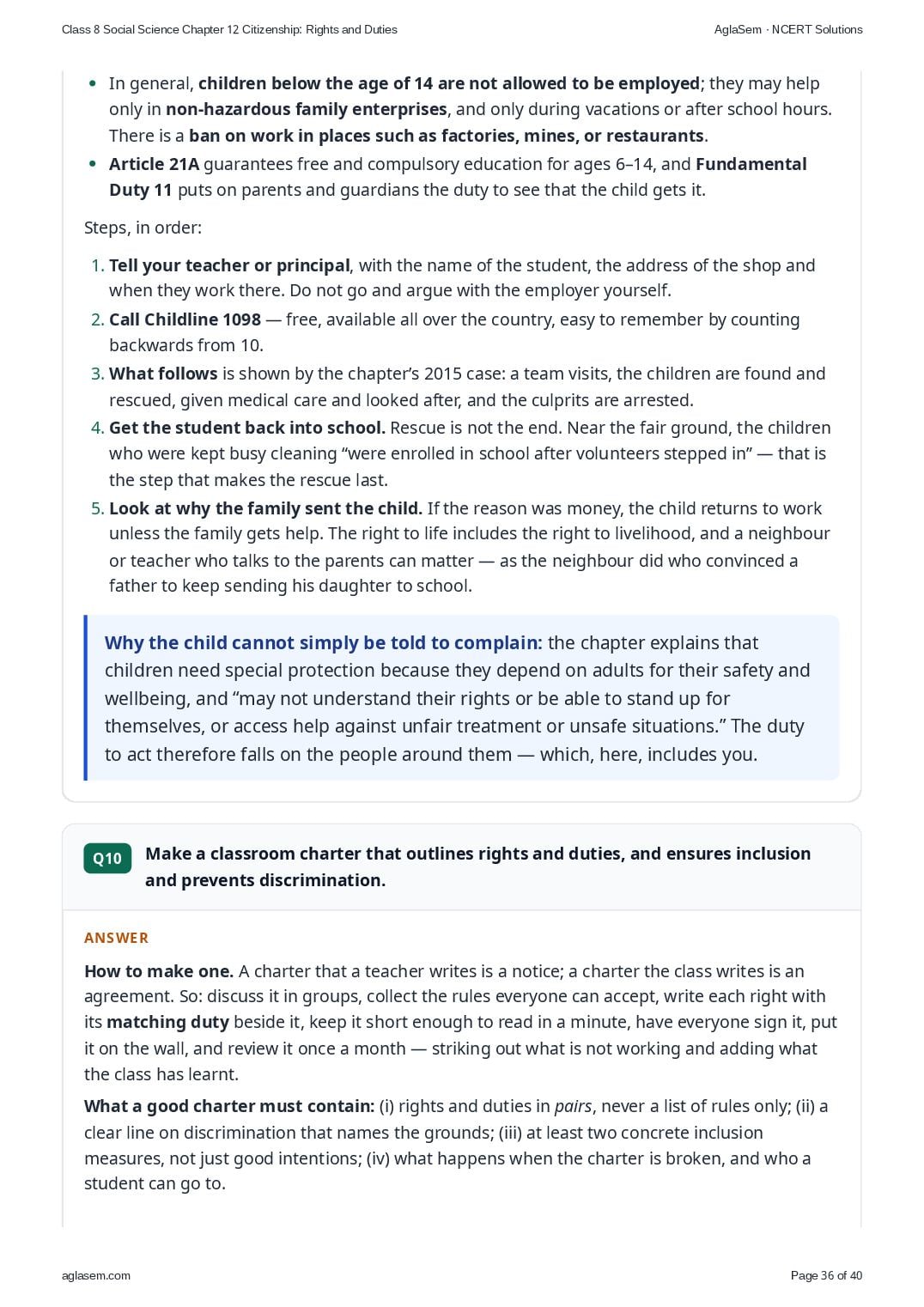
- What would you do if you saw a child working instead of being in school? Discuss in class, then write one step you could take: Could you talk to your teacher or principal? Could you write to a child helpline?
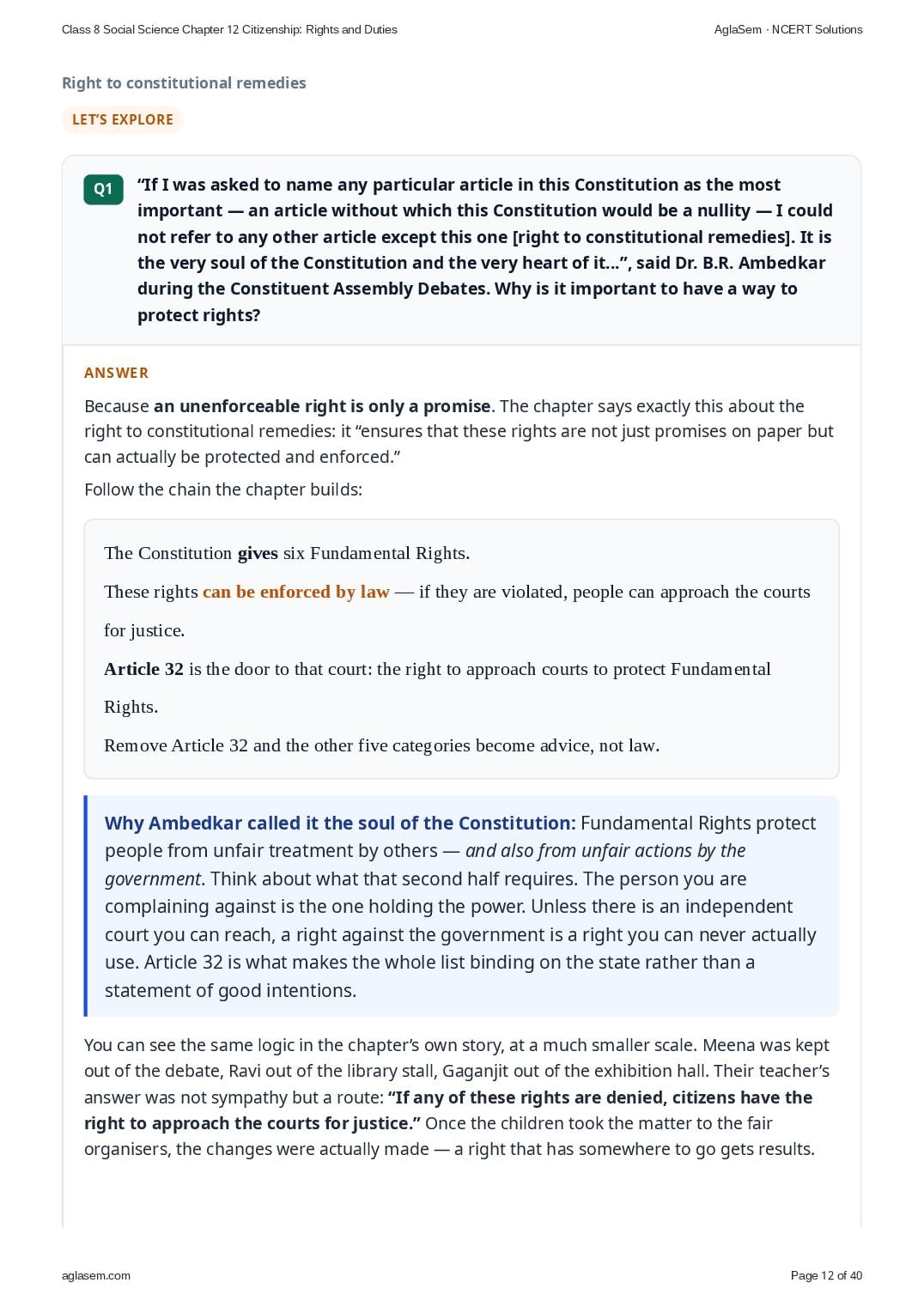
- “If I was asked to name any particular article in this Constitution as the most important — an article without which this Constitution would be a nullity — I could not refer to any other article except this one [right to constitutional remedies]. It is the very soul of the Constitution and the very heart of it…”, said Dr. B.R. Ambedkar during the Constituent Assembly Debates. Why is it important to have a way to protect rights?
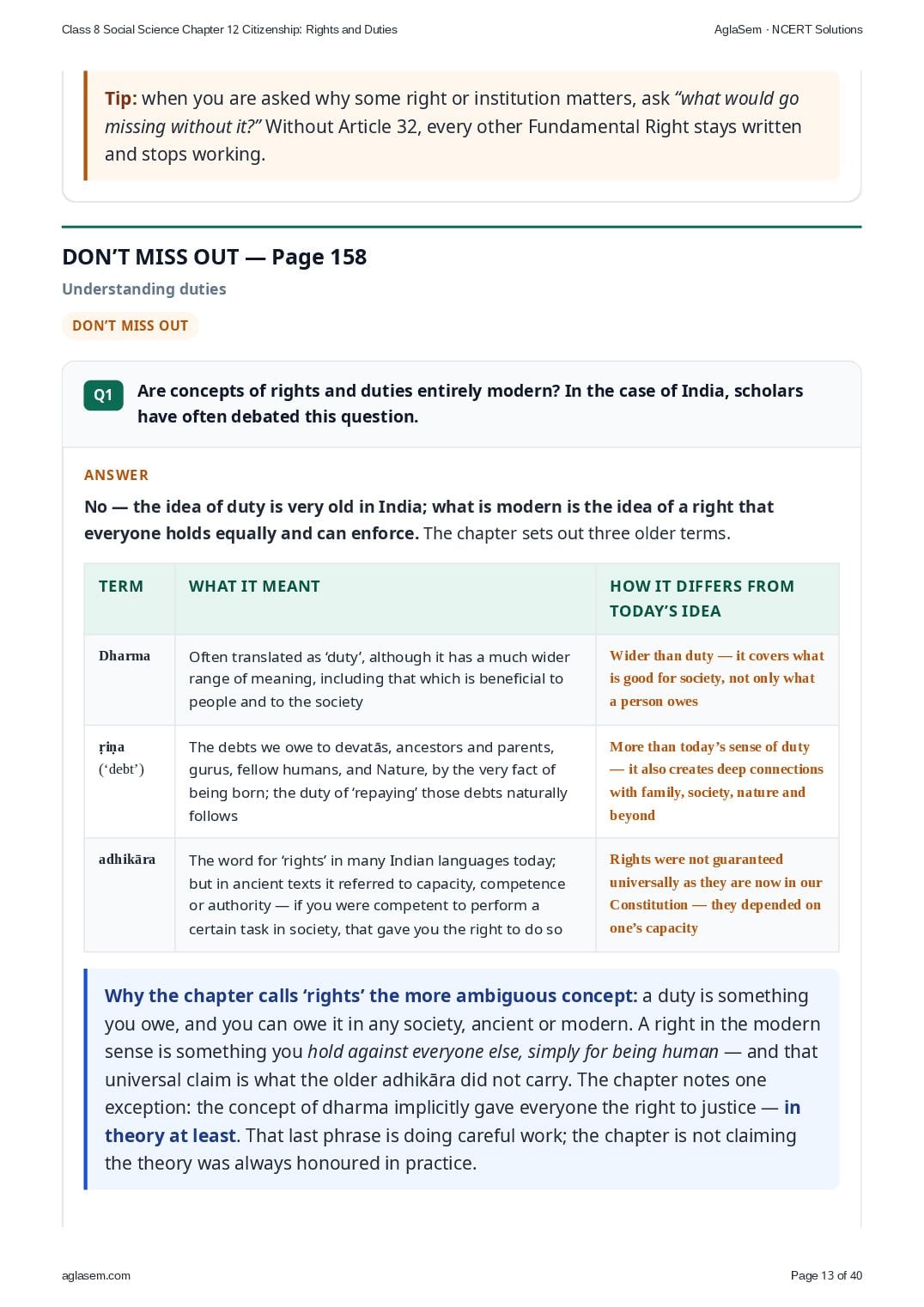
- Are concepts of rights and duties entirely modern? In the case of India, scholars have often debated this question.
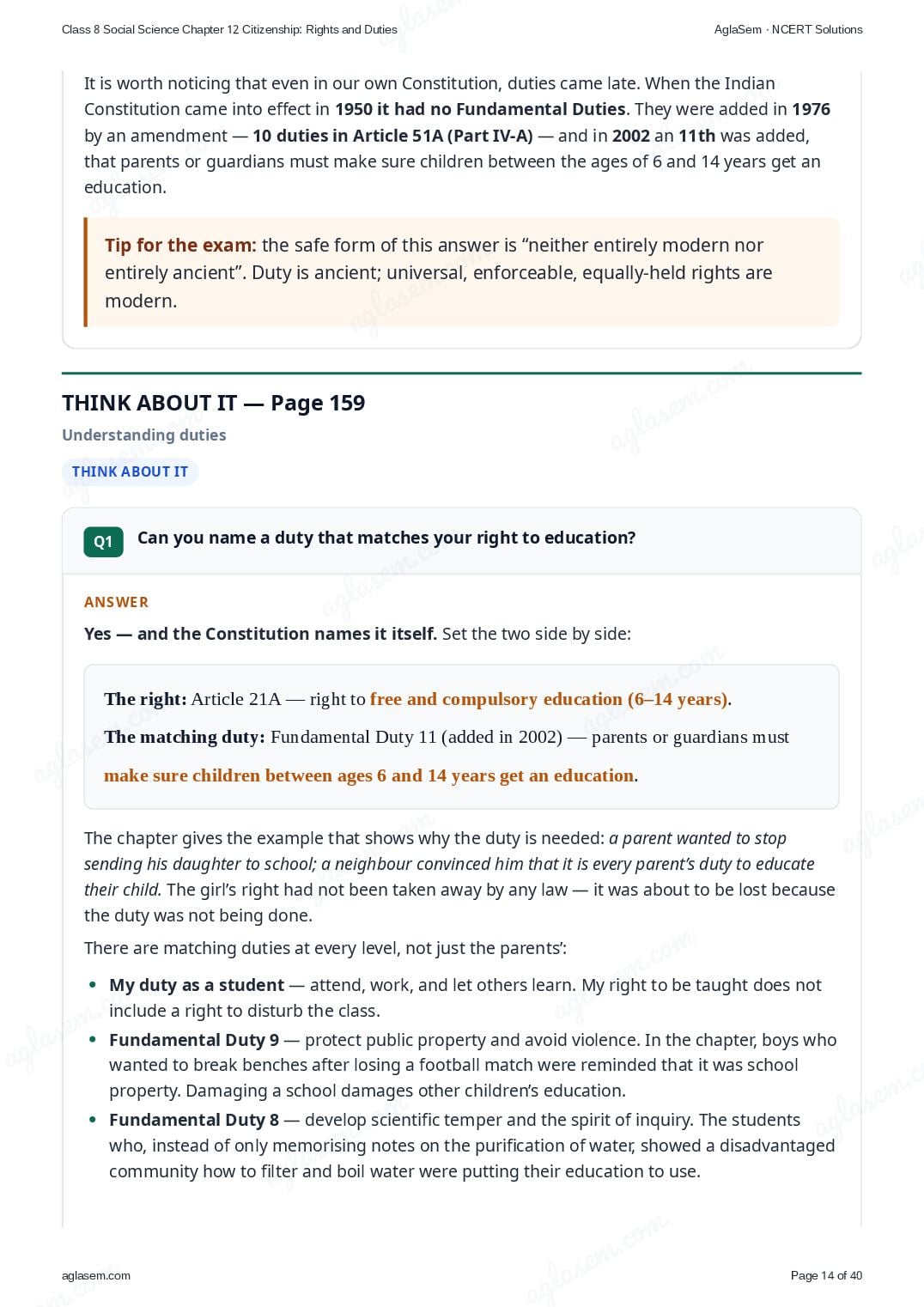
- Can you name a duty that matches your right to education?
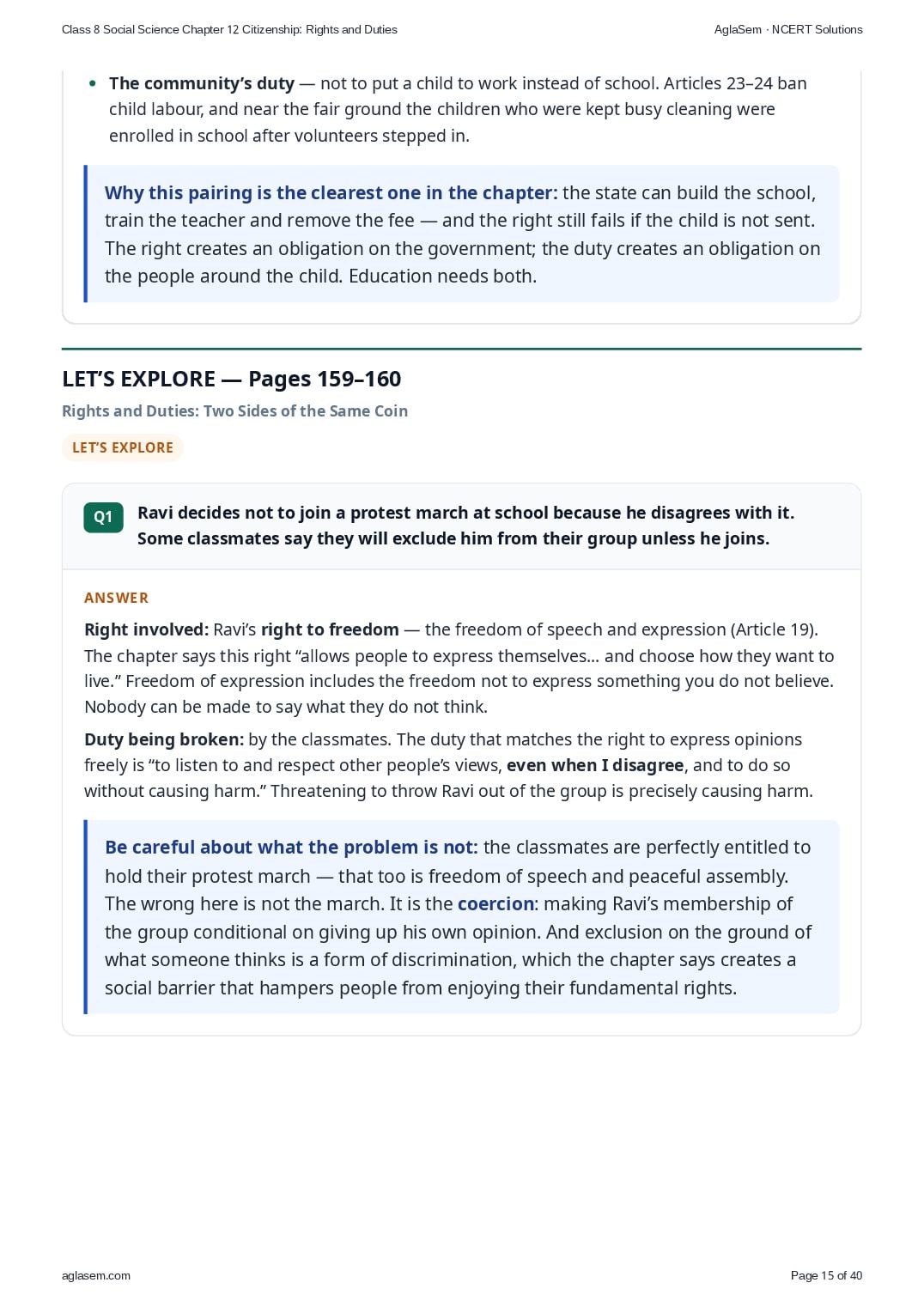
- Ravi decides not to join a protest march at school because he disagrees with it. Some classmates say they will exclude him from their group unless he joins.
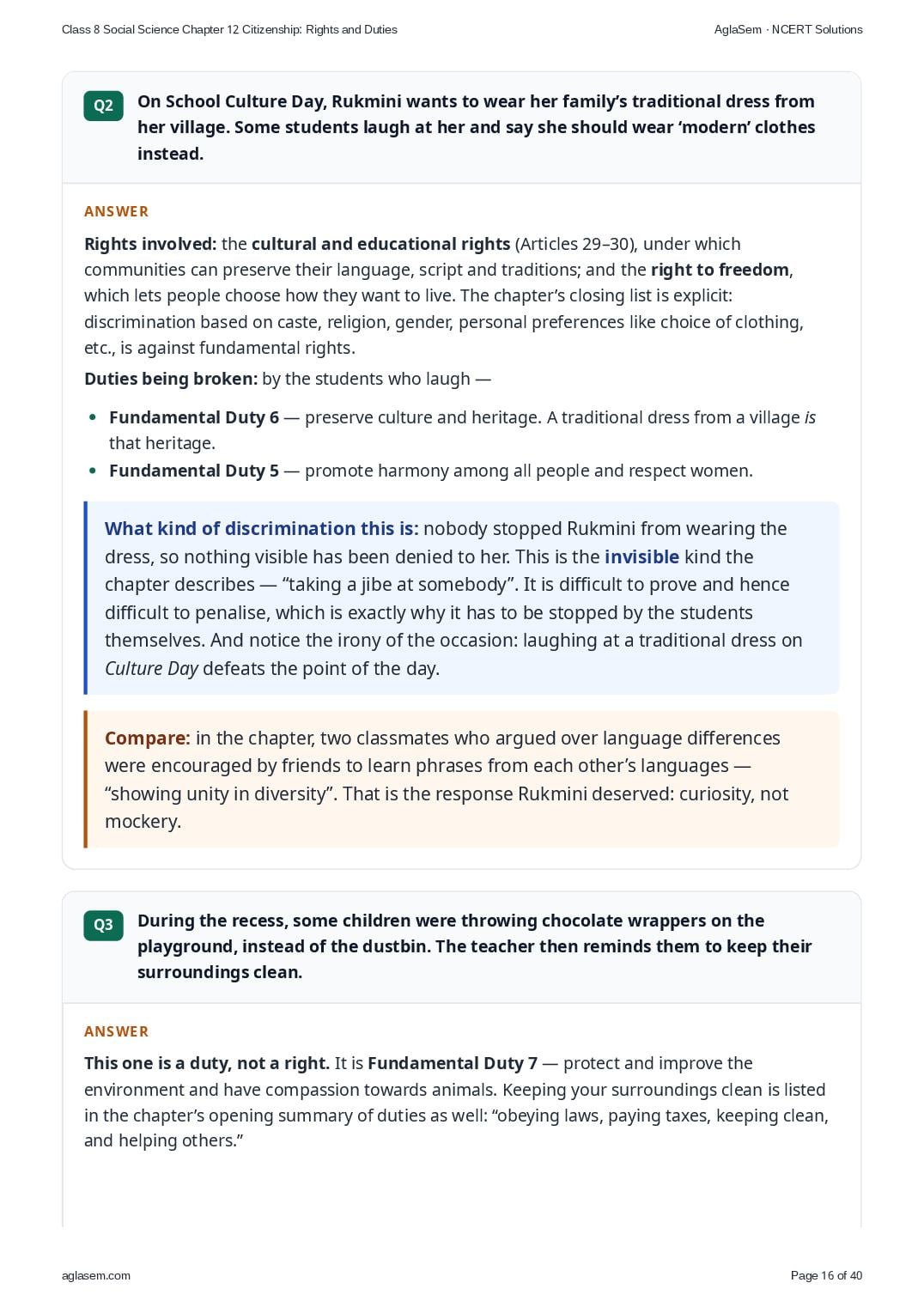
- On School Culture Day, Rukmini wants to wear her family’s traditional dress from her village. Some students laugh at her and say she should wear ‘modern’ clothes instead.
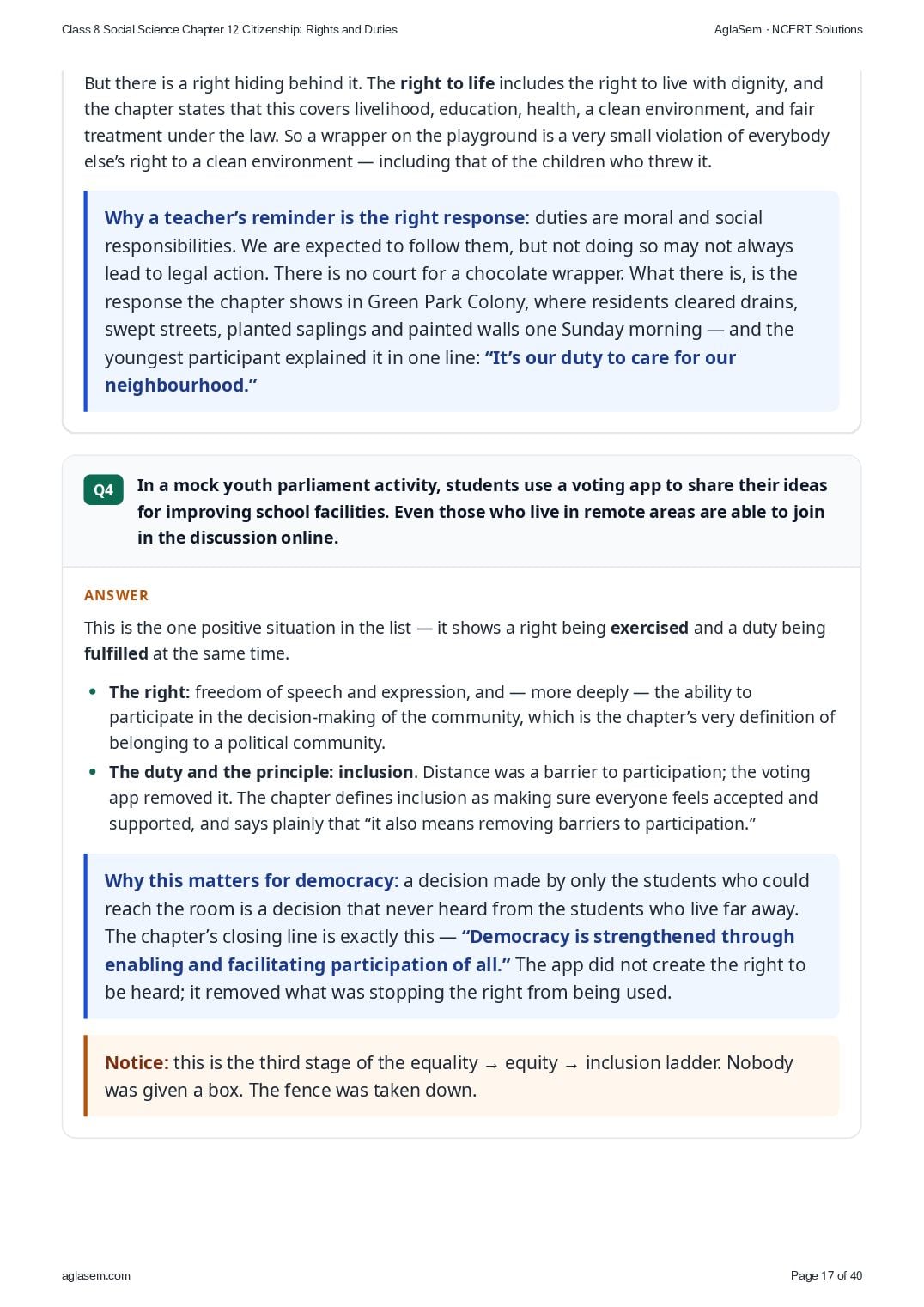
- During the recess, some children were throwing chocolate wrappers on the playground, instead of the dustbin. The teacher then reminds them to keep their surroundings clean.
- In a mock youth parliament activity, students use a voting app to share their ideas for improving school facilities. Even those who live in remote areas are able to join in the discussion online.
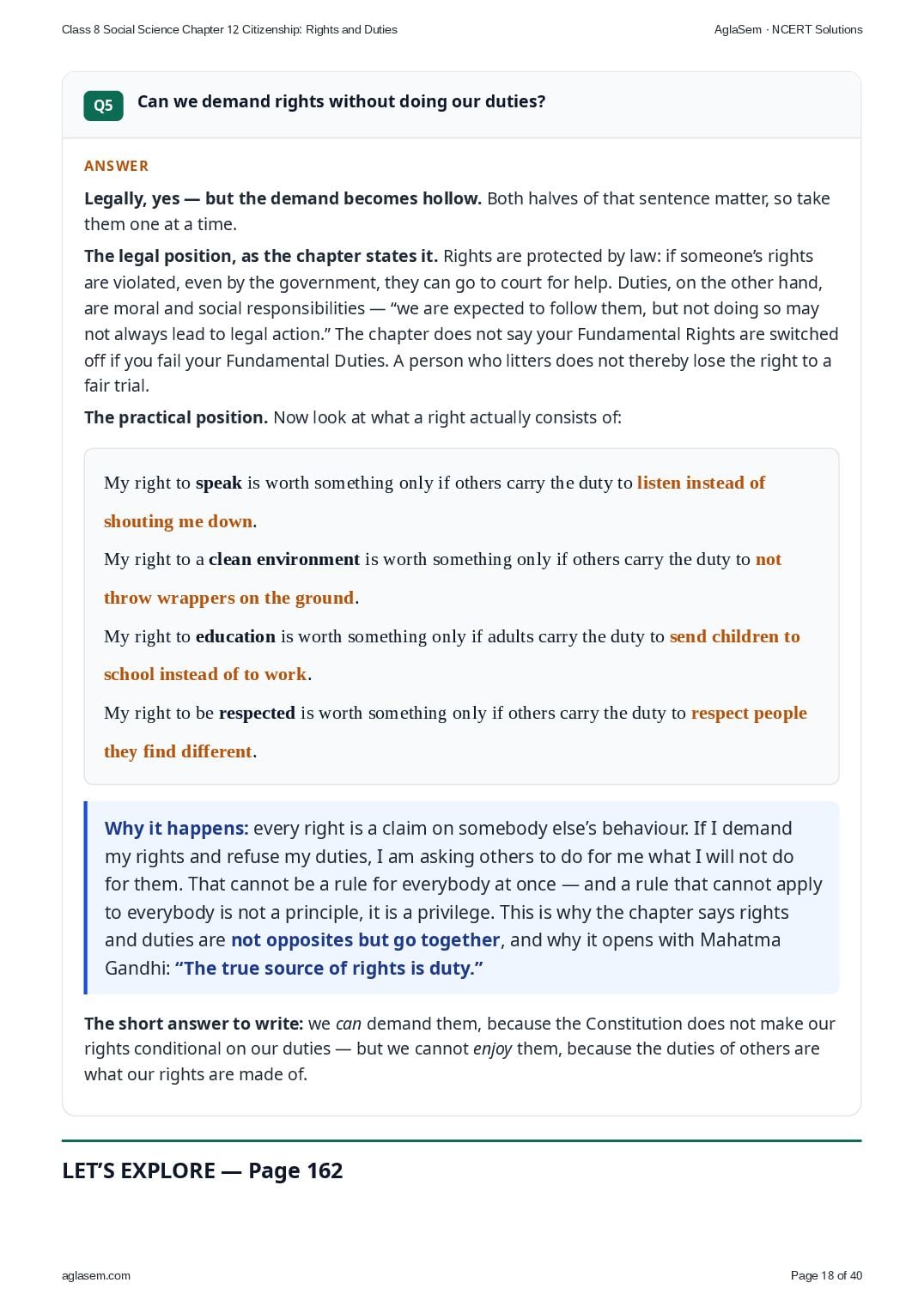
- Can we demand rights without doing our duties?
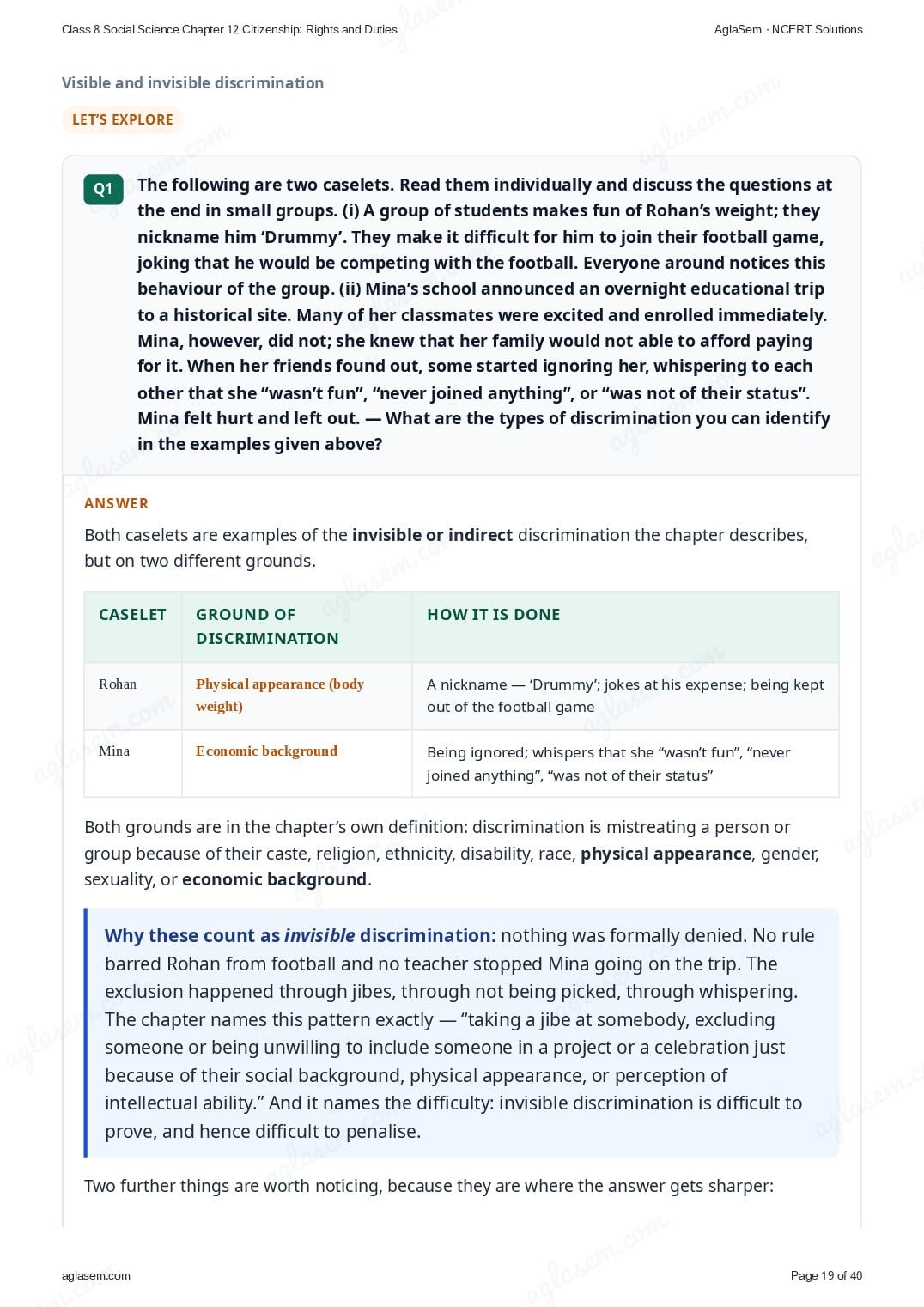
- The following are two caselets. Read them individually and discuss the questions at the end in small groups. (i) A group of students makes fun of Rohan’s weight; they nickname him ‘Drummy’. They make it difficult for him to join their football game, joking that he would be competing with the football. Everyone around notices this behaviour of the group. (ii) Mina’s school announced an overnight educational trip to a historical site. Many of her classmates were excited and enrolled immediately. Mina, however, did not; she knew that her family would not able to afford paying for it. When her friends found out, some started ignoring her, whispering to each other that she “wasn’t fun”, “never joined anything”, or “was not of their status”. Mina felt hurt and left out. — What are the types of discrimination you can identify in the examples given above?
- What would you do if you were part of the groups?
- Have you faced discrimination yourself?
- What did you do about it?
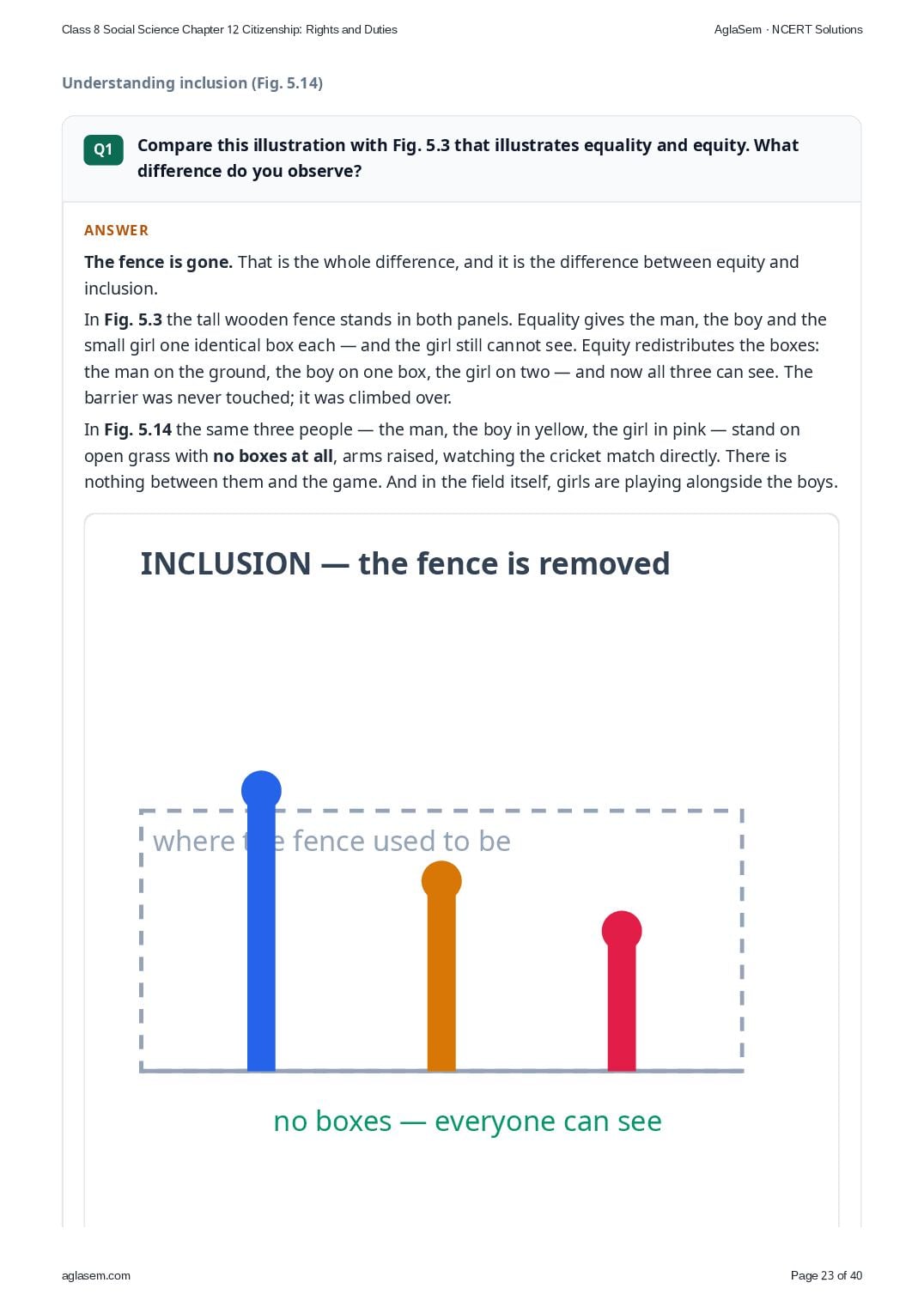
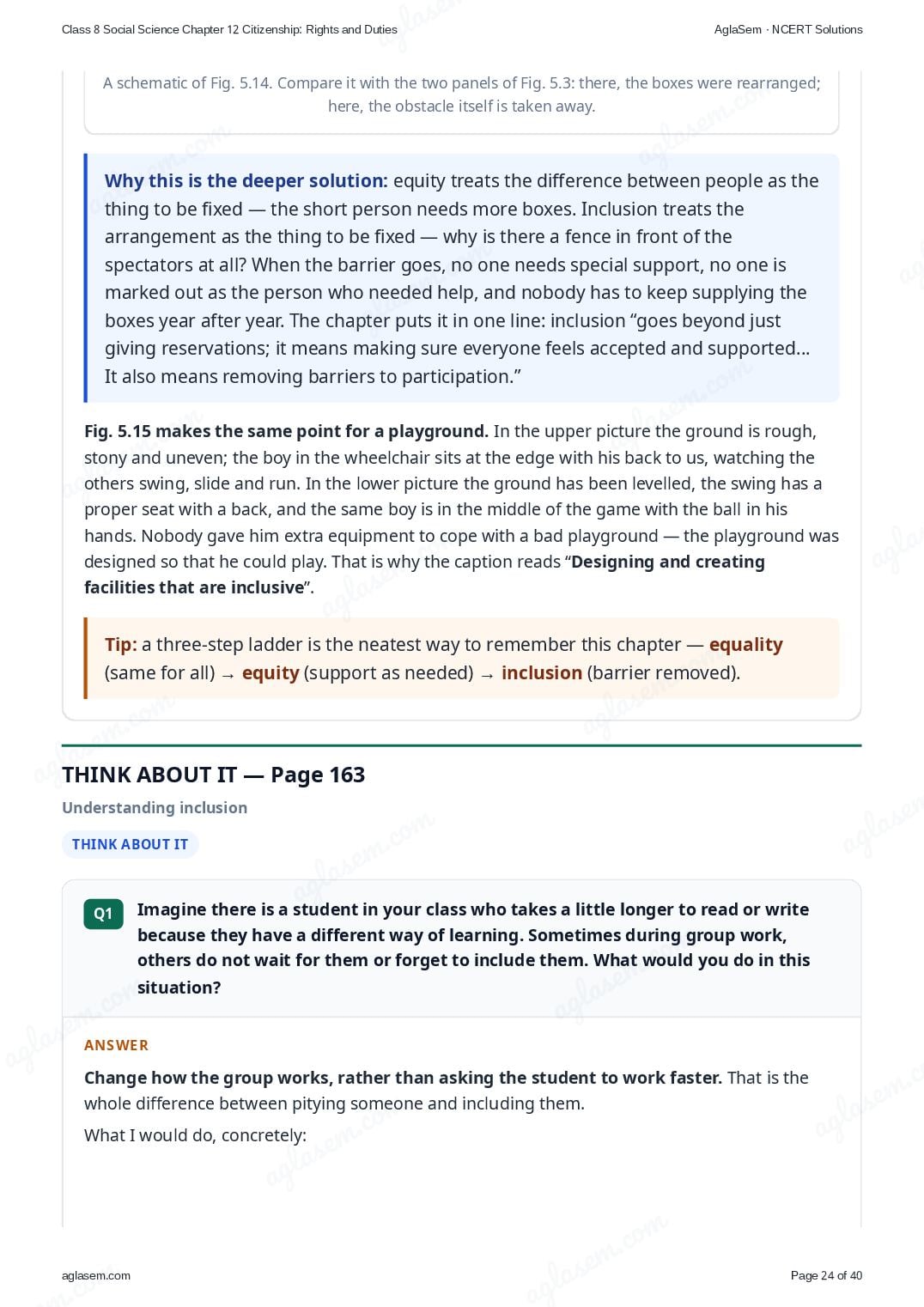
- Compare this illustration with Fig. 5.3 that illustrates equality and equity. What difference do you observe?
- Imagine there is a student in your class who takes a little longer to read or write because they have a different way of learning. Sometimes during group work, others do not wait for them or forget to include them. What would you do in this situation?
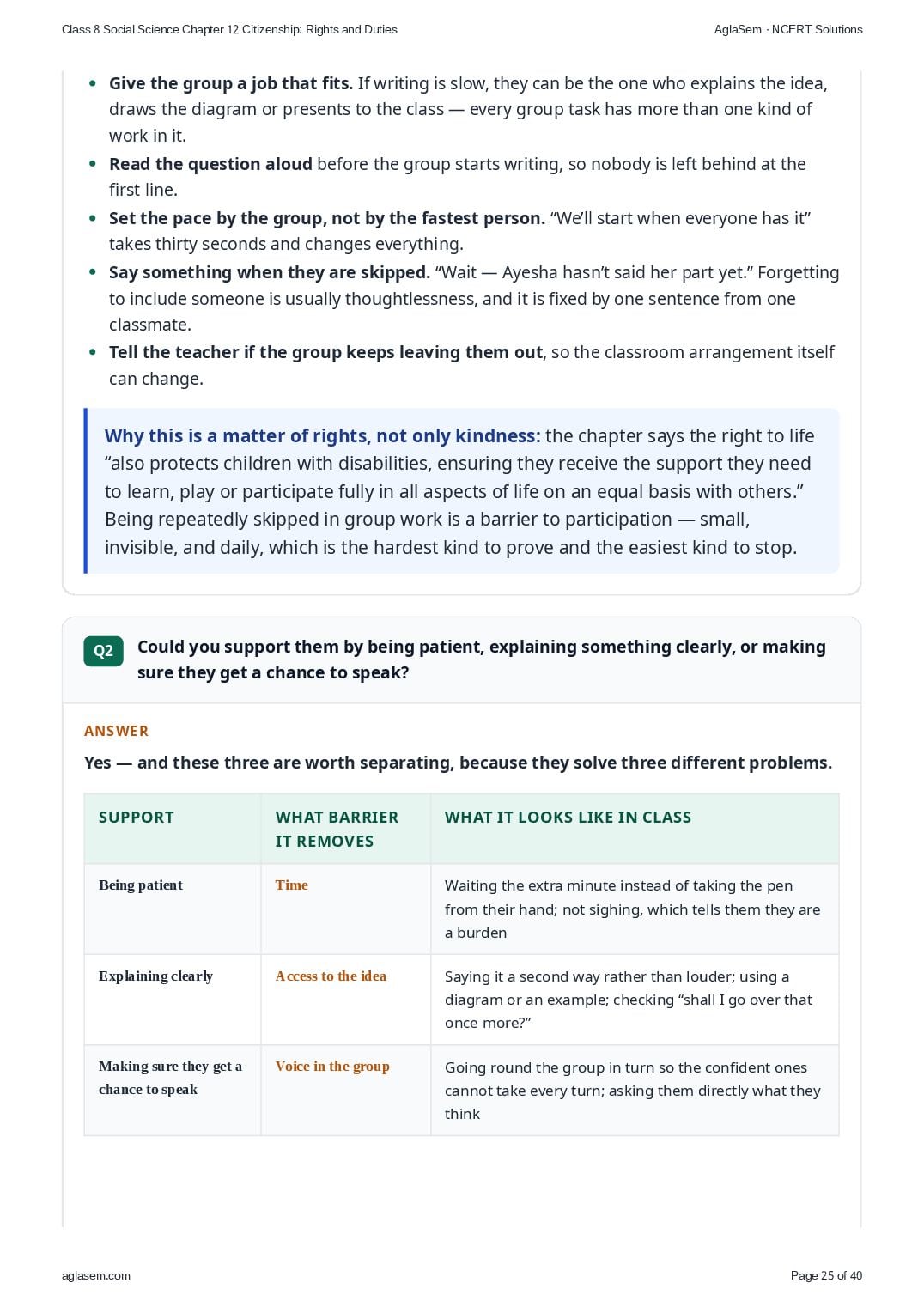
- Could you support them by being patient, explaining something clearly, or making sure they get a chance to speak?
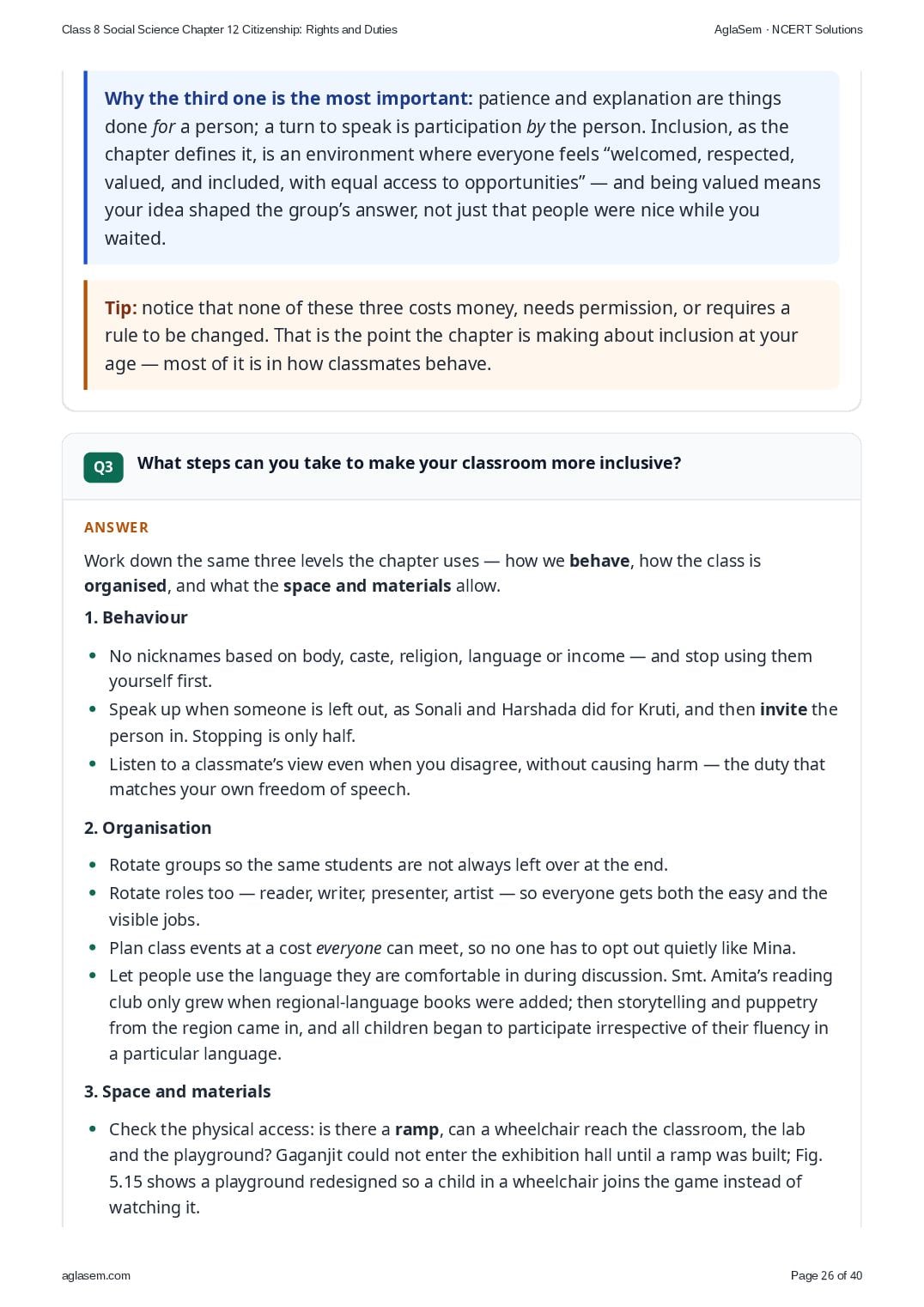
- What steps can you take to make your classroom more inclusive?
- Why is it important to respect others’ religions?
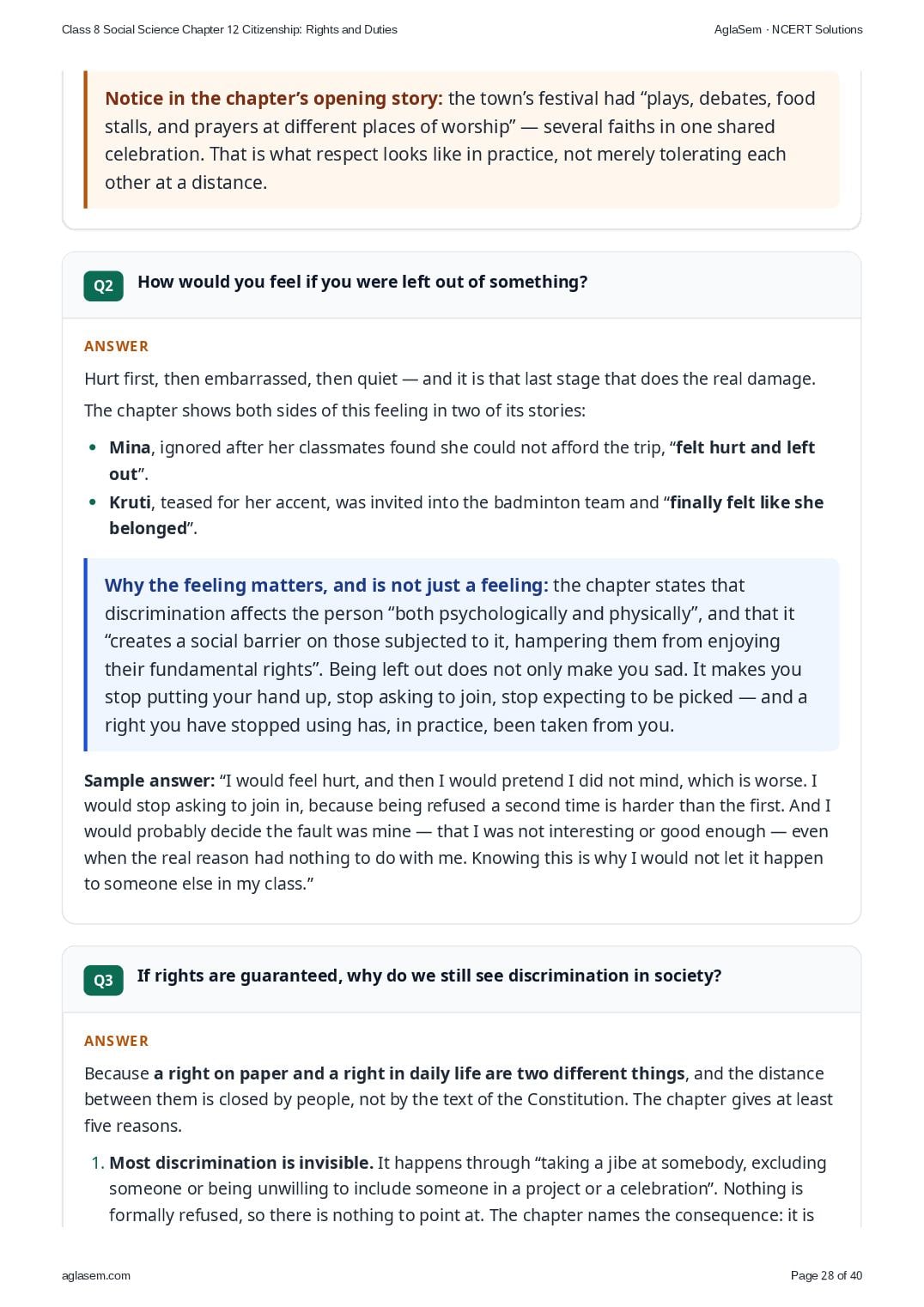
- How would you feel if you were left out of something?
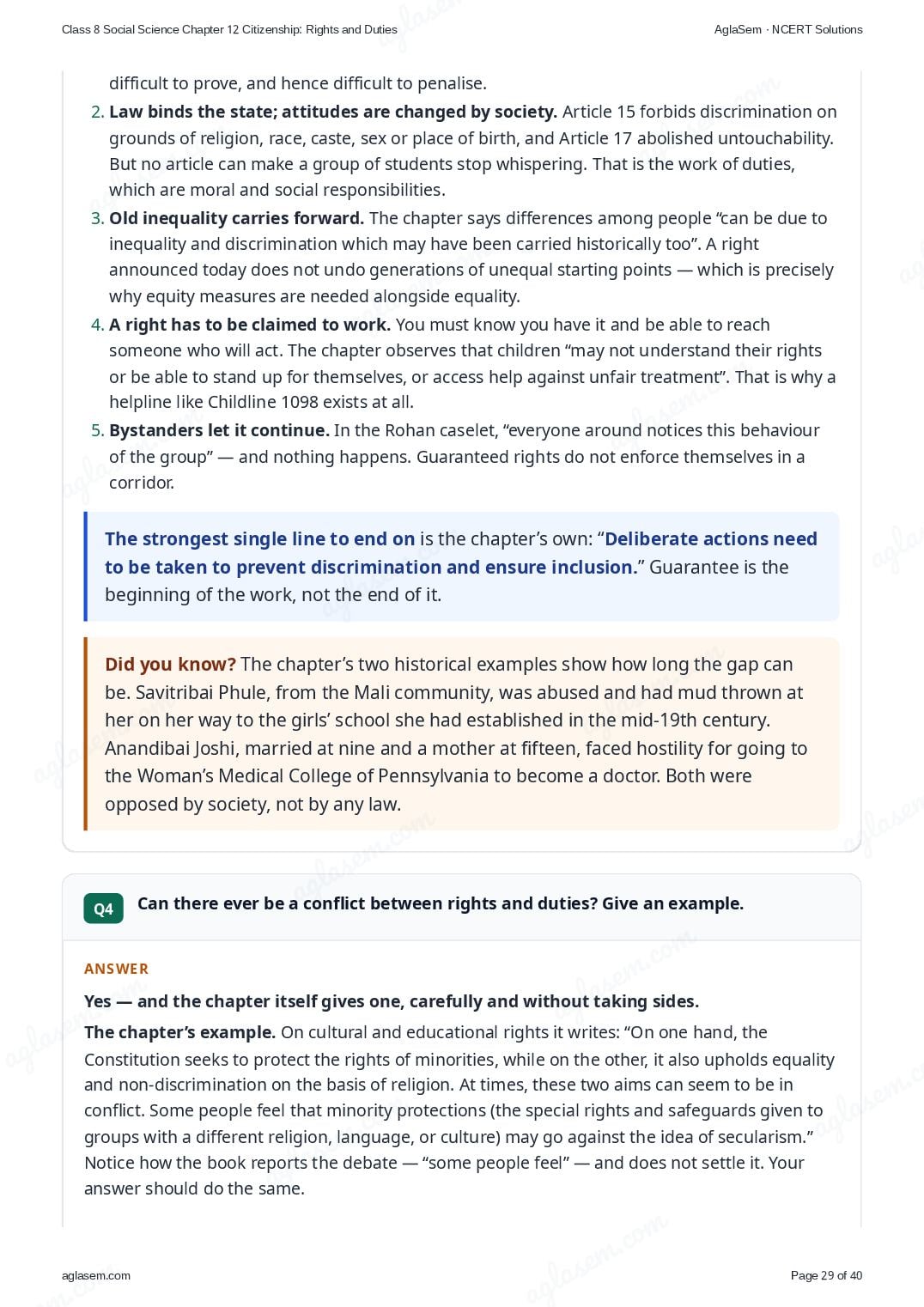
- If rights are guaranteed, why do we still see discrimination in society?
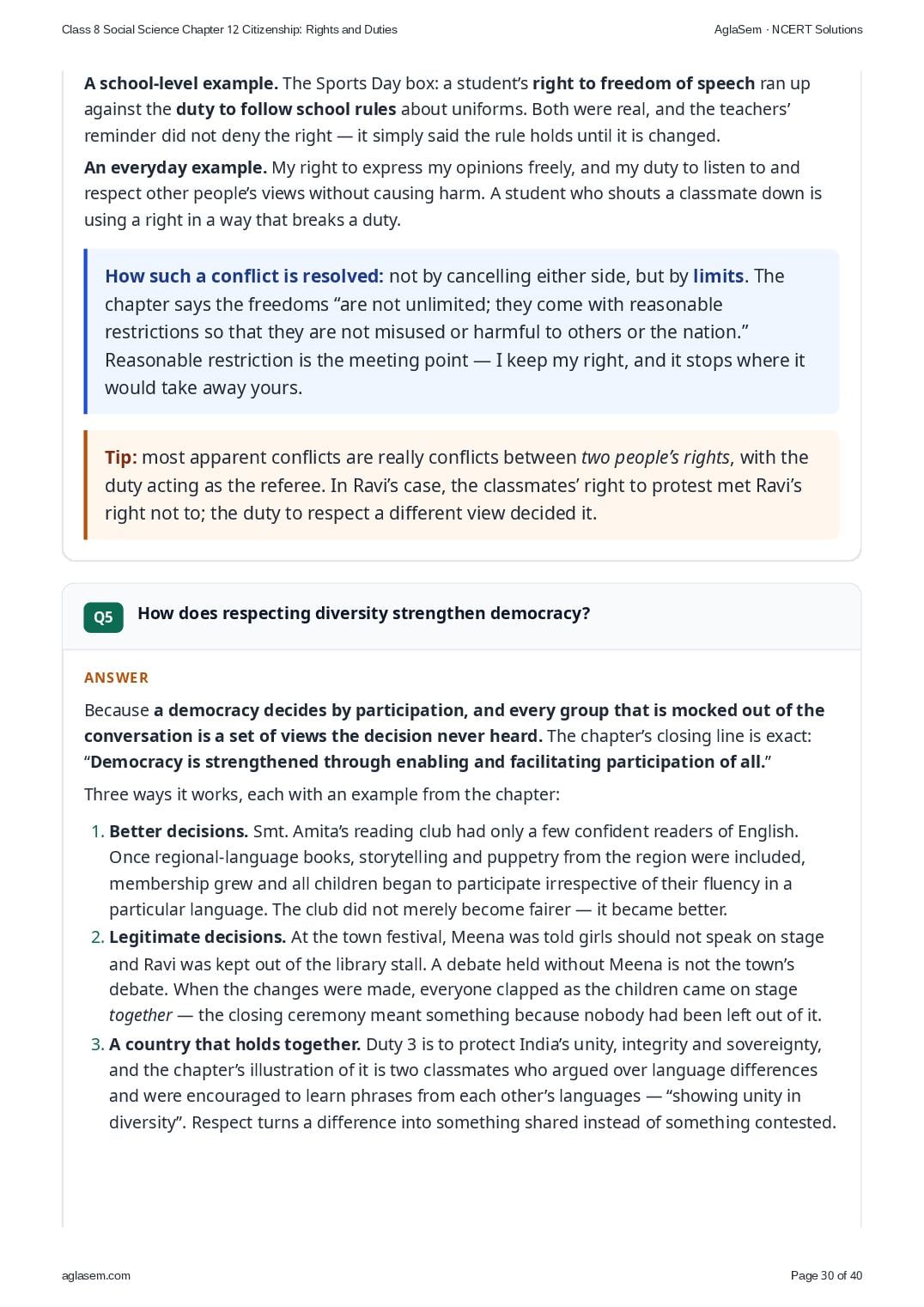
- Can there ever be a conflict between rights and duties? Give an example.
- How does respecting diversity strengthen democracy?
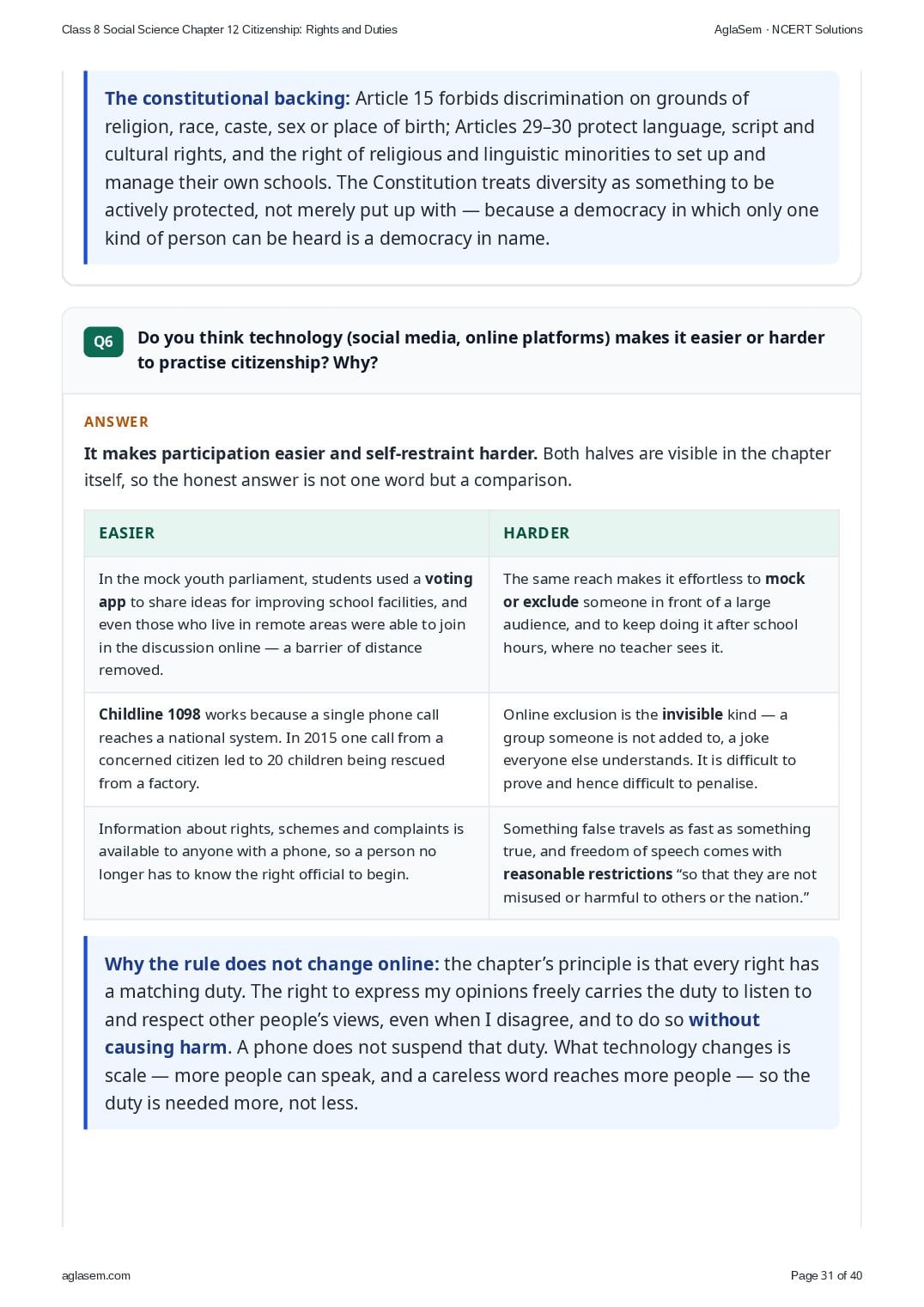
- Do you think technology (social media, online platforms) makes it easier or harder to practise citizenship? Why?
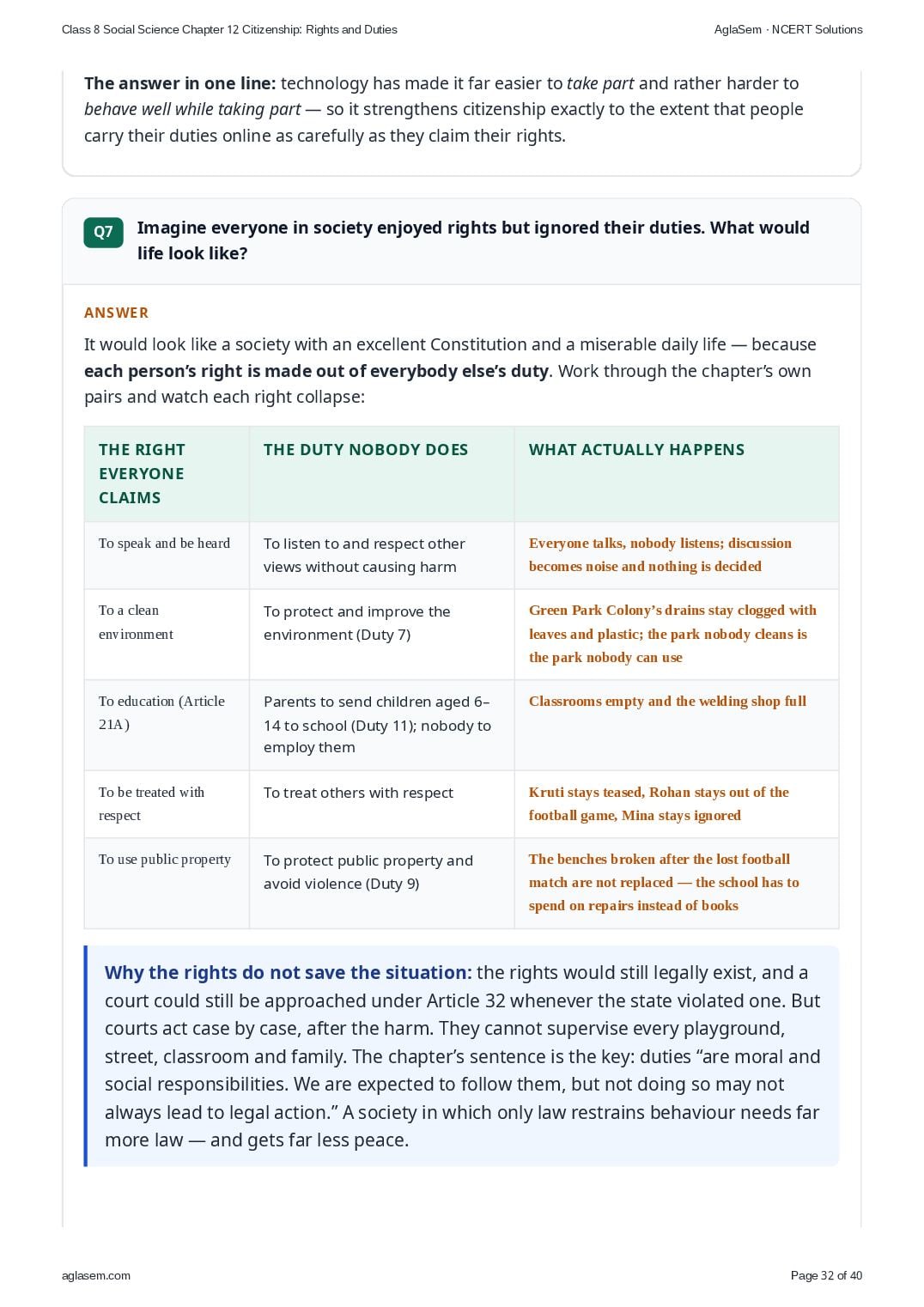
- Imagine everyone in society enjoyed rights but ignored their duties. What would life look like?
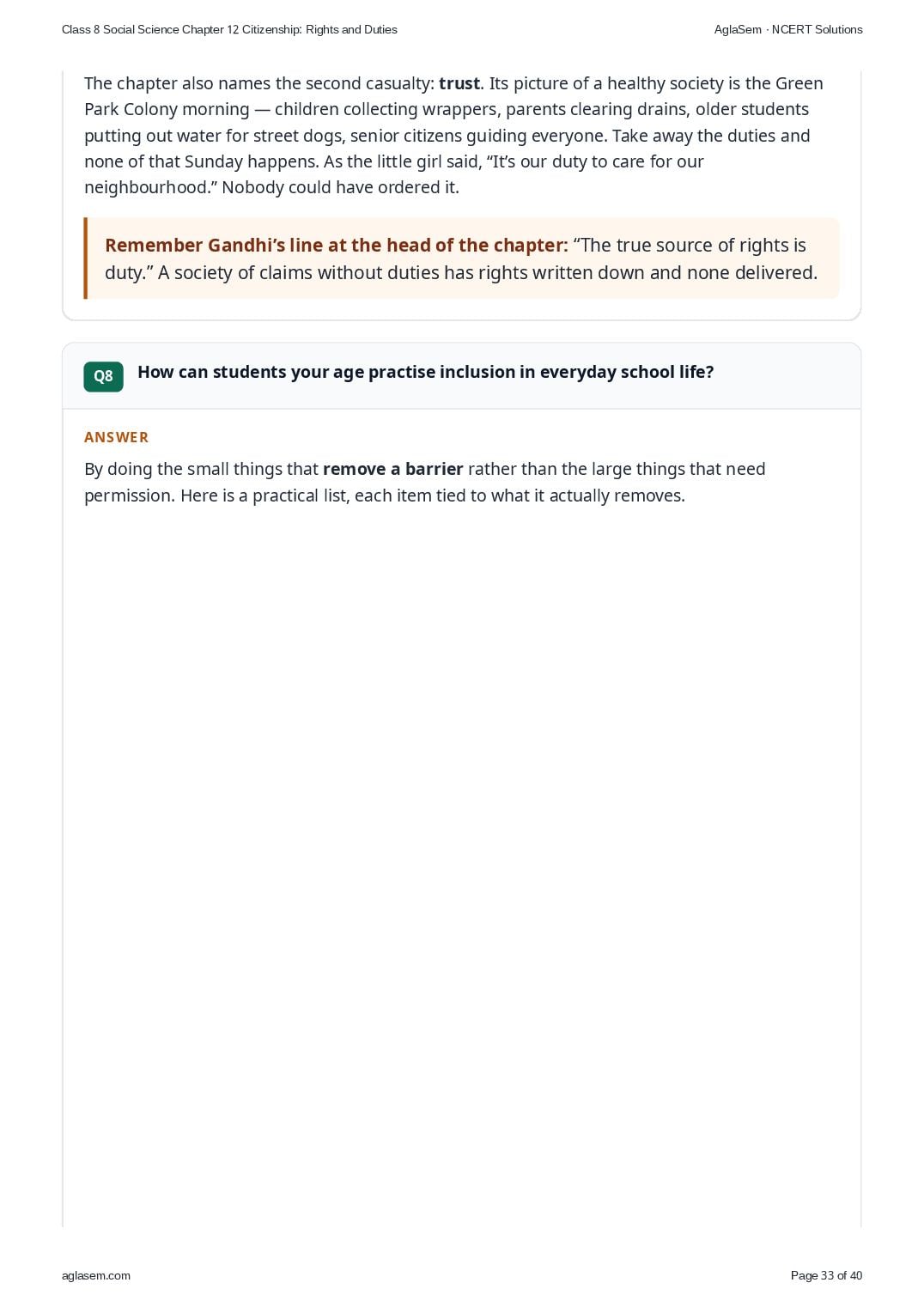
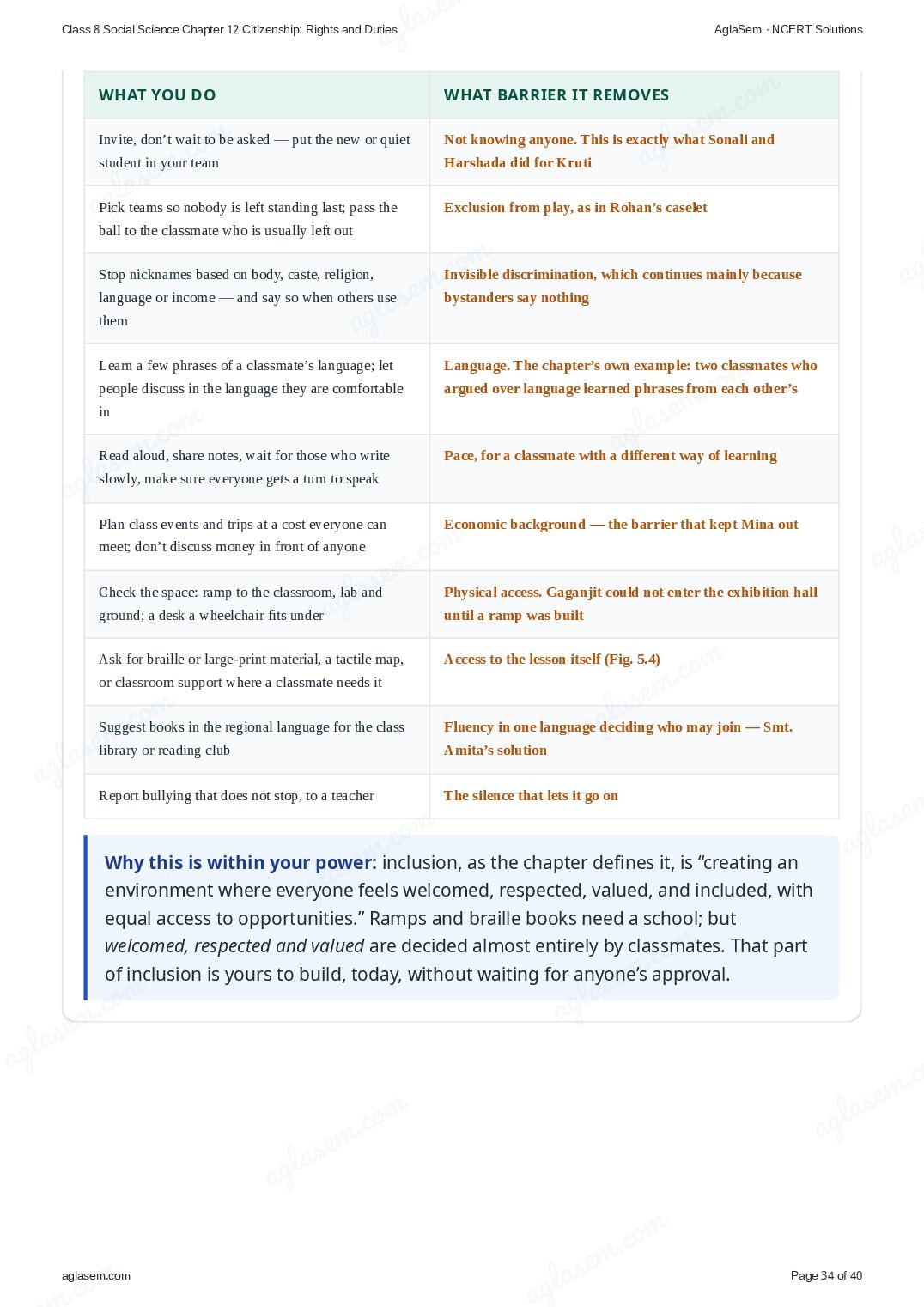
- How can students your age practise inclusion in everyday school life?
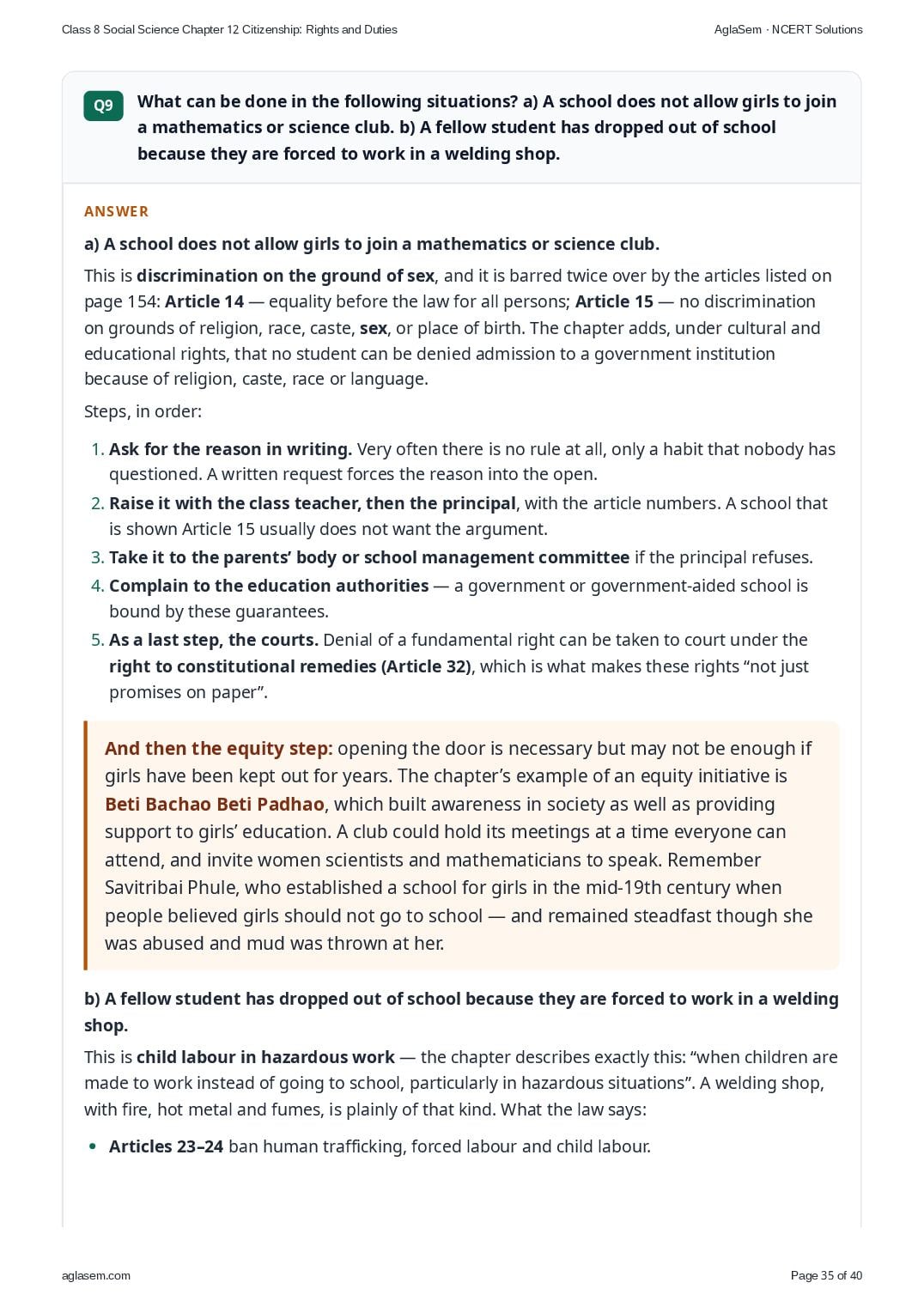
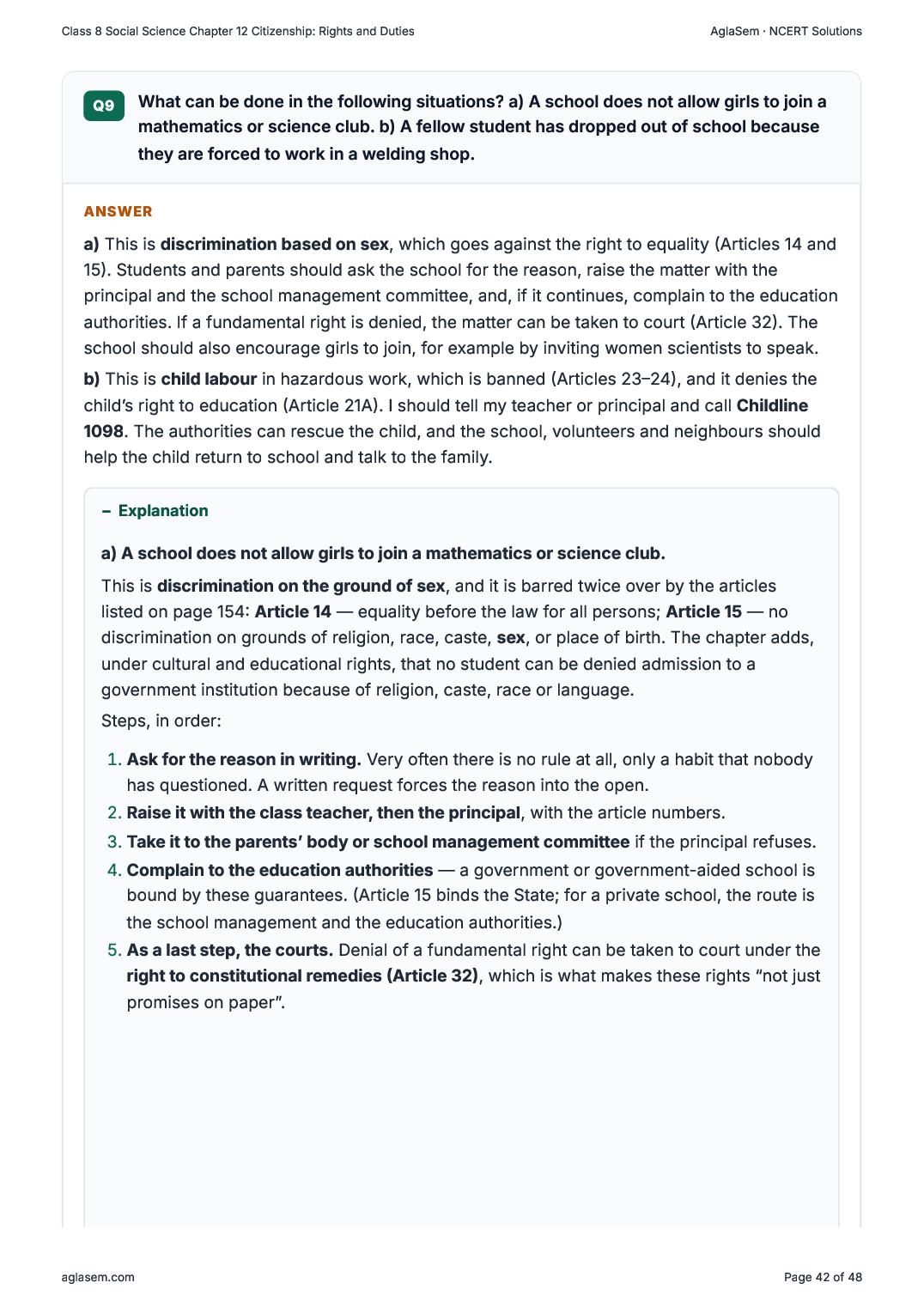
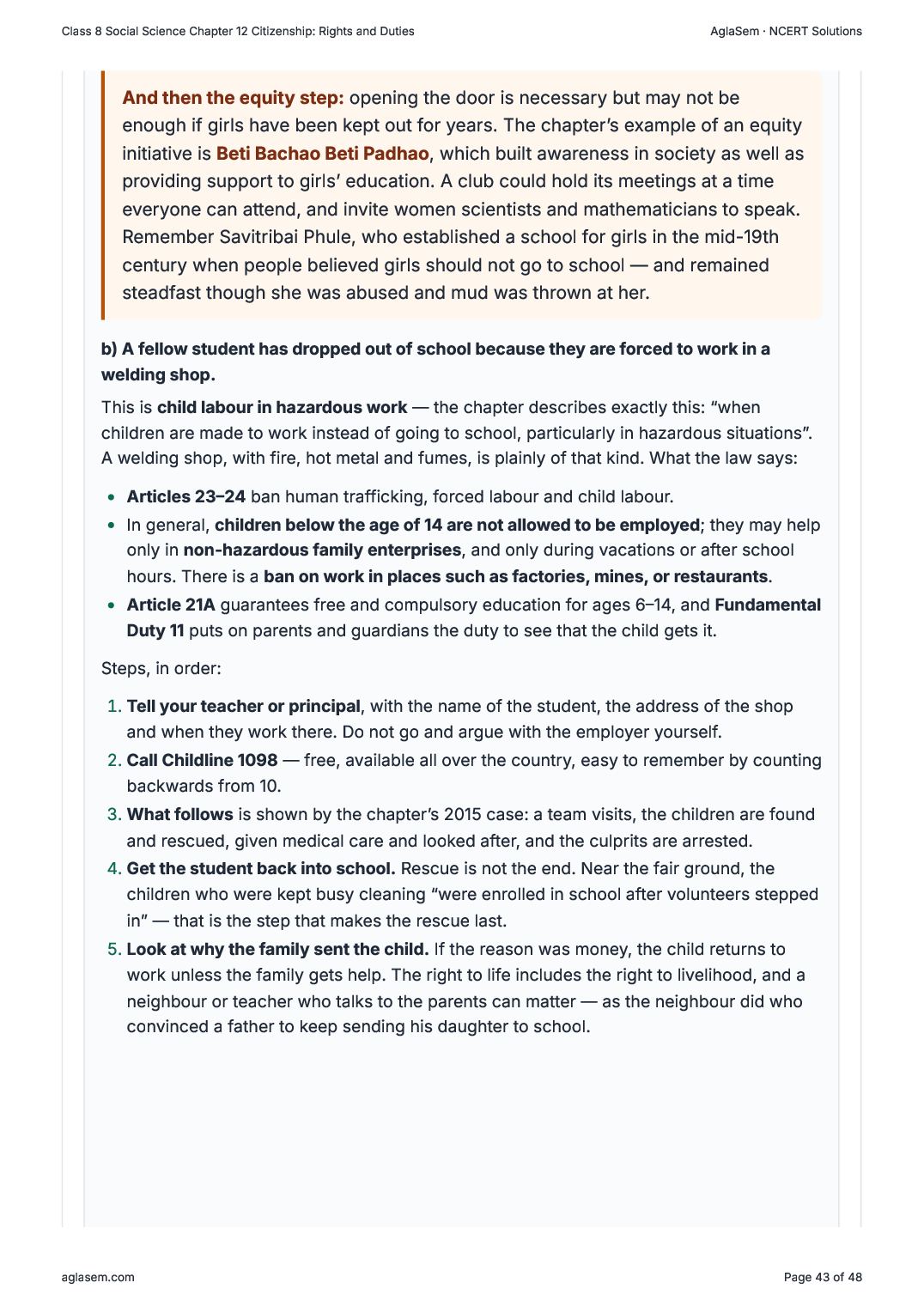
- What can be done in the following situations? a) A school does not allow girls to join a mathematics or science club. b) A fellow student has dropped out of school because they are forced to work in a welding shop.
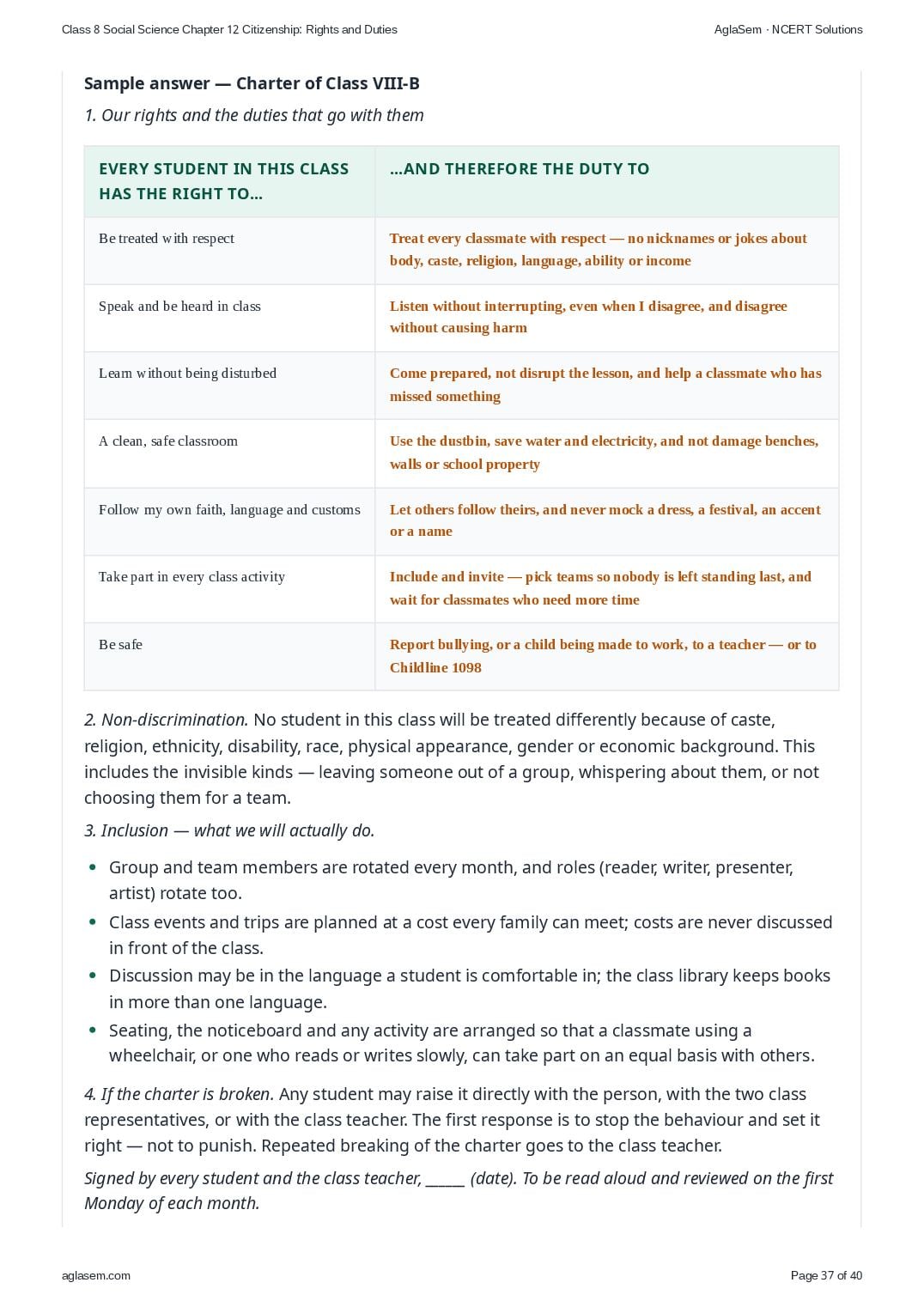
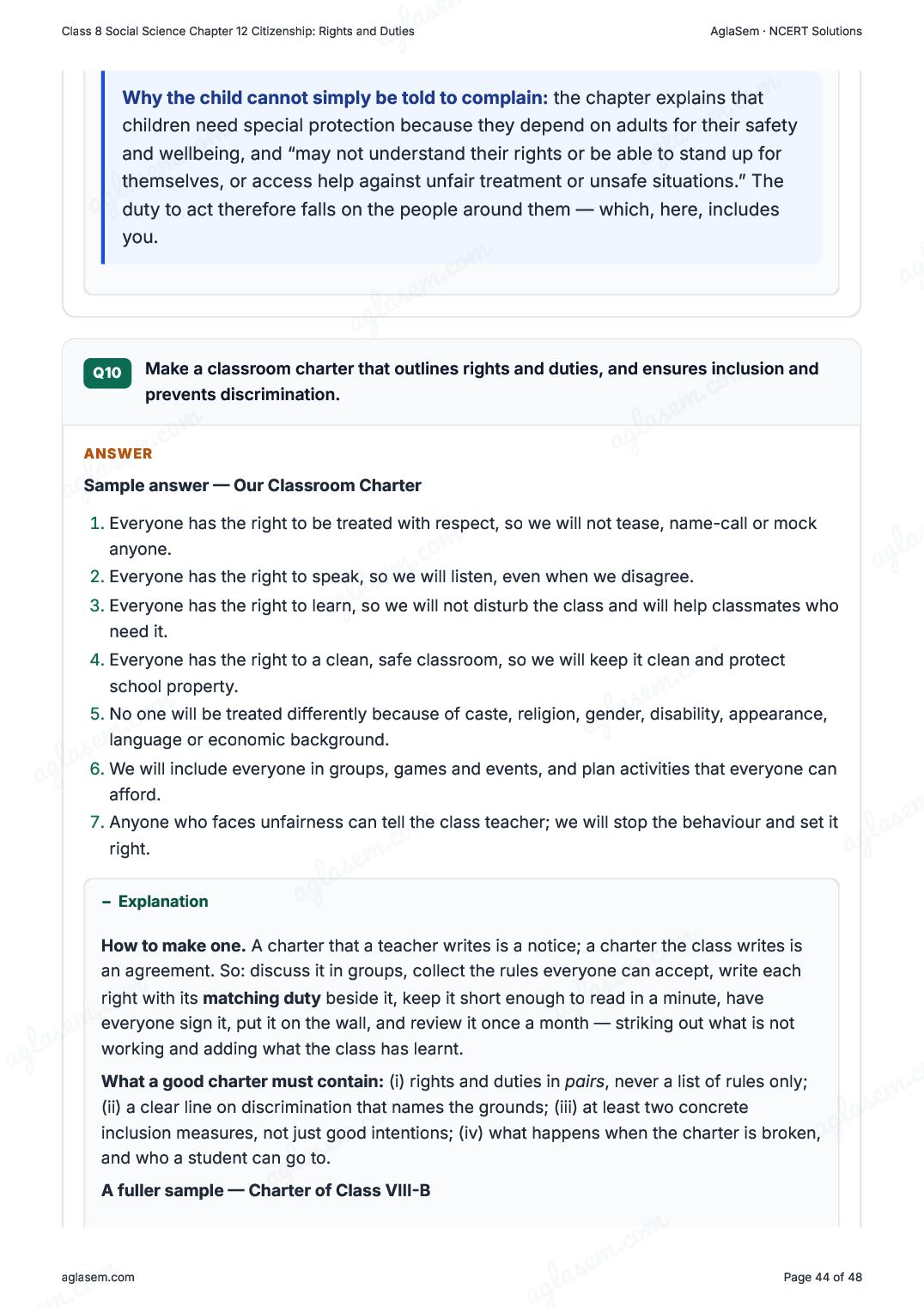
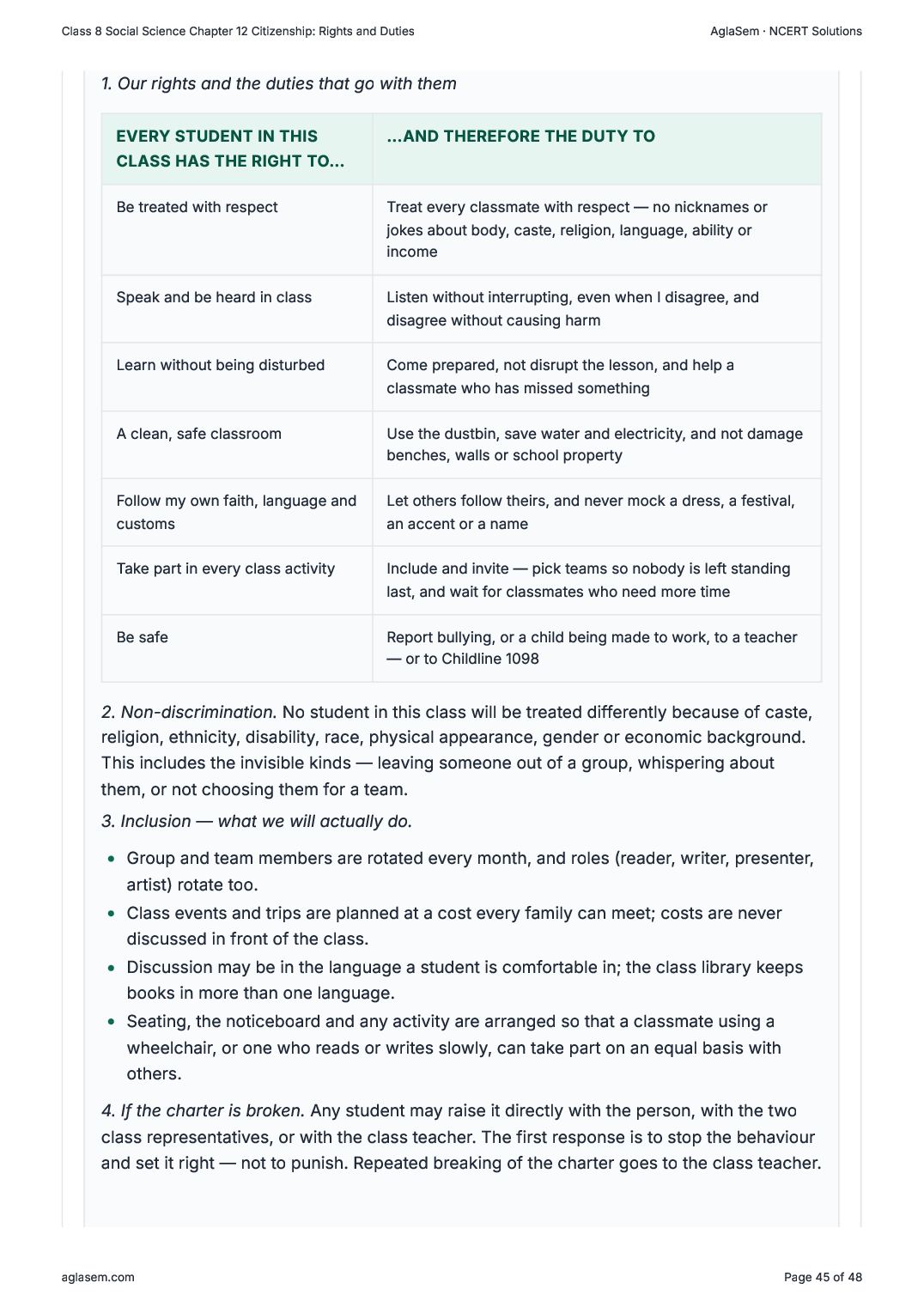
- Make a classroom charter that outlines rights and duties, and ensures inclusion and prevents discrimination.
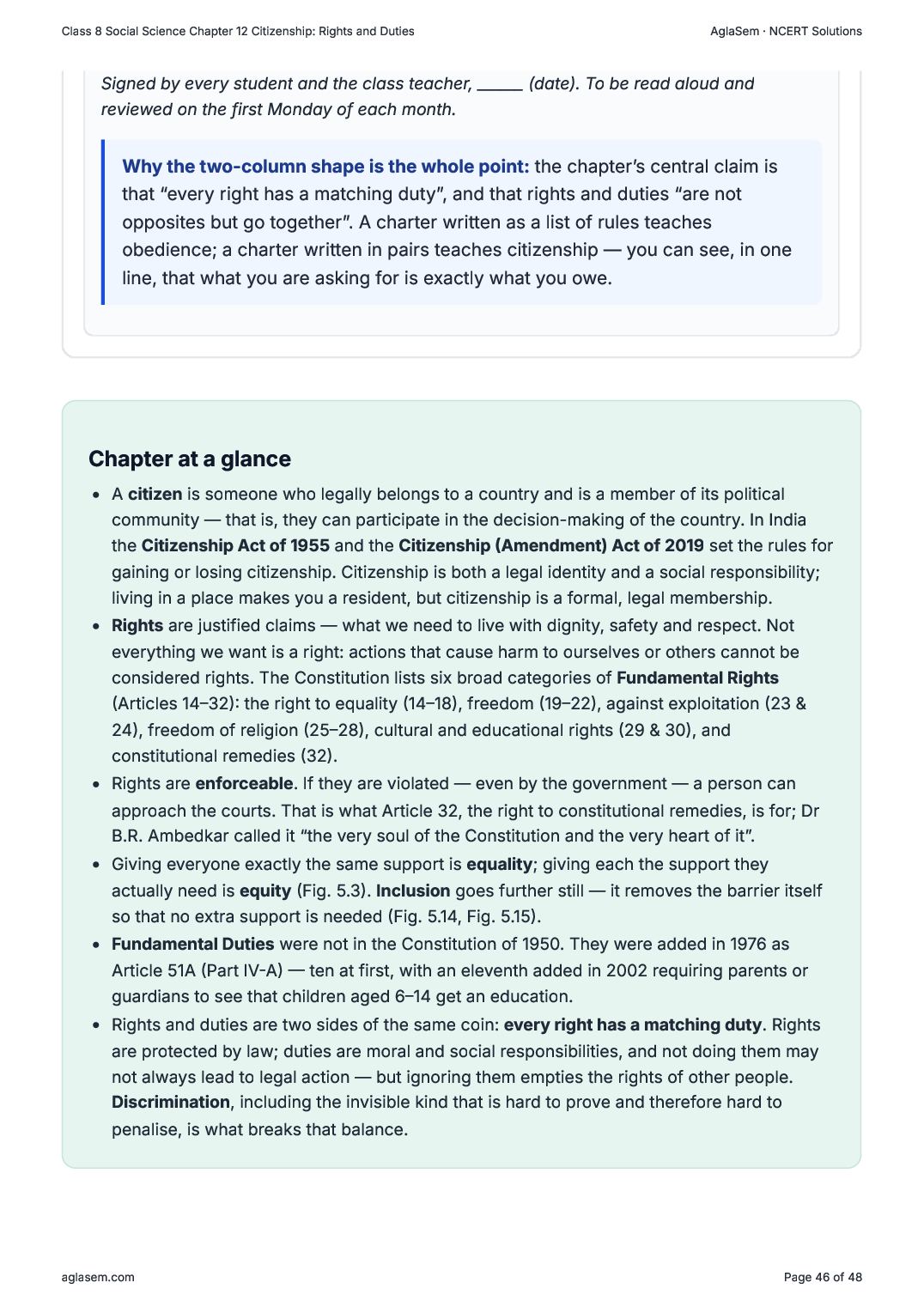
Chapter at a Glance
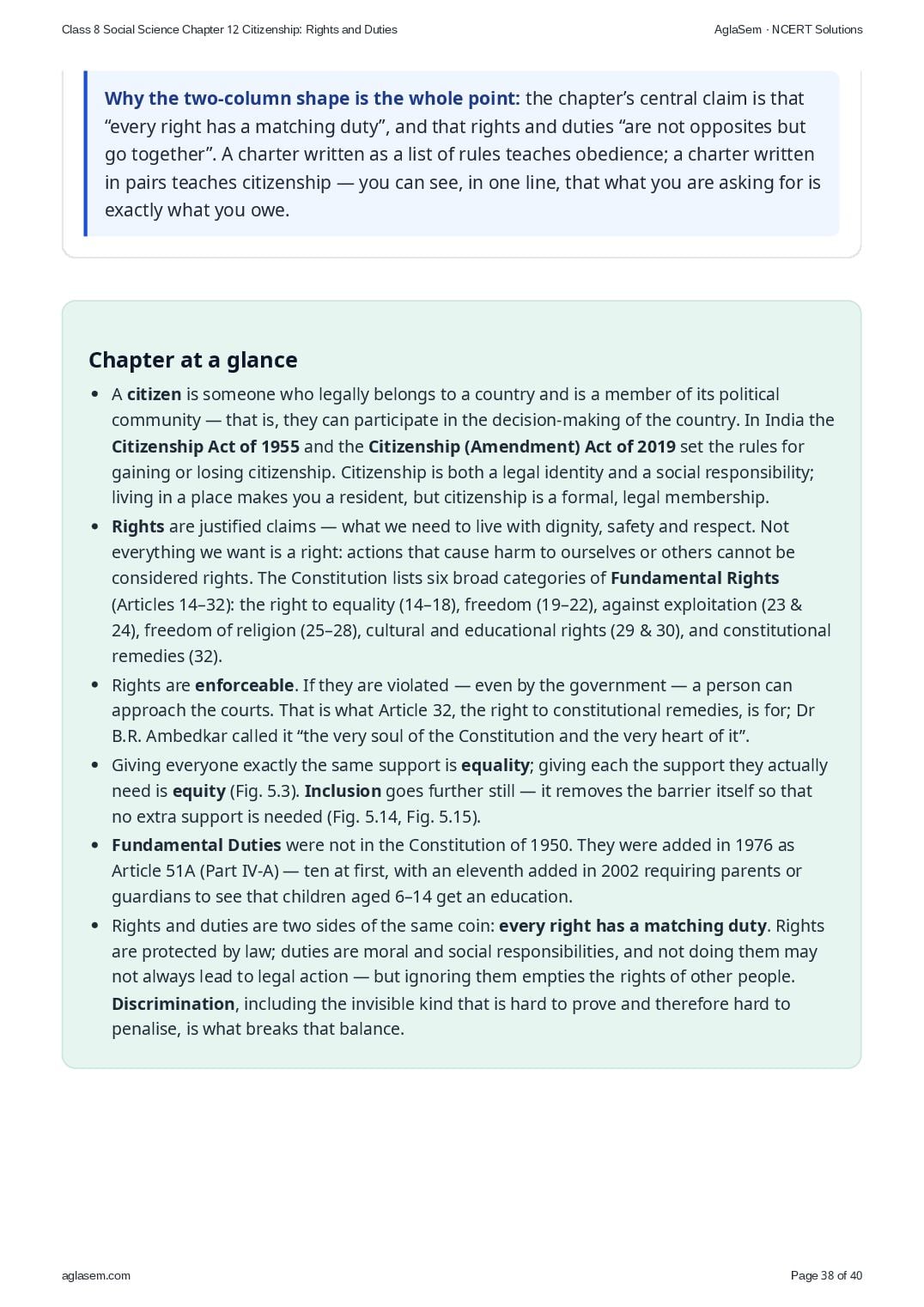
- A citizen is someone who legally belongs to a country and is a member of its political community — that is, they can participate in the decision-making of the country. In India the Citizenship Act of 1955 and the Citizenship (Amendment) Act of 2019 set the rules for gaining or losing citizenship. Citizenship is both a legal identity and a social responsibility; living in a place makes you a resident, but citizenship is a formal, legal membership.
- Rights are justified claims — what we need to live with dignity, safety and respect. Not everything we want is a right: actions that cause harm to ourselves or others cannot be considered rights. The Constitution lists six broad categories of Fundamental Rights (Articles 14–32): the right to equality (14–18), freedom (19–22), against exploitation (23 & 24), freedom of religion (25–28), cultural and educational rights (29 & 30), and constitutional remedies (32).
- Rights are enforceable . If they are violated — even by the government — a person can approach the courts. That is what Article 32, the right to constitutional remedies, is for; Dr B.R. Ambedkar called it “the very soul of the Constitution and the very heart of it”.
- Giving everyone exactly the same support is equality ; giving each the support they actually need is equity (Fig. 5.3). Inclusion goes further still — it removes the barrier itself so that no extra support is needed (Fig. 5.14, Fig. 5.15).
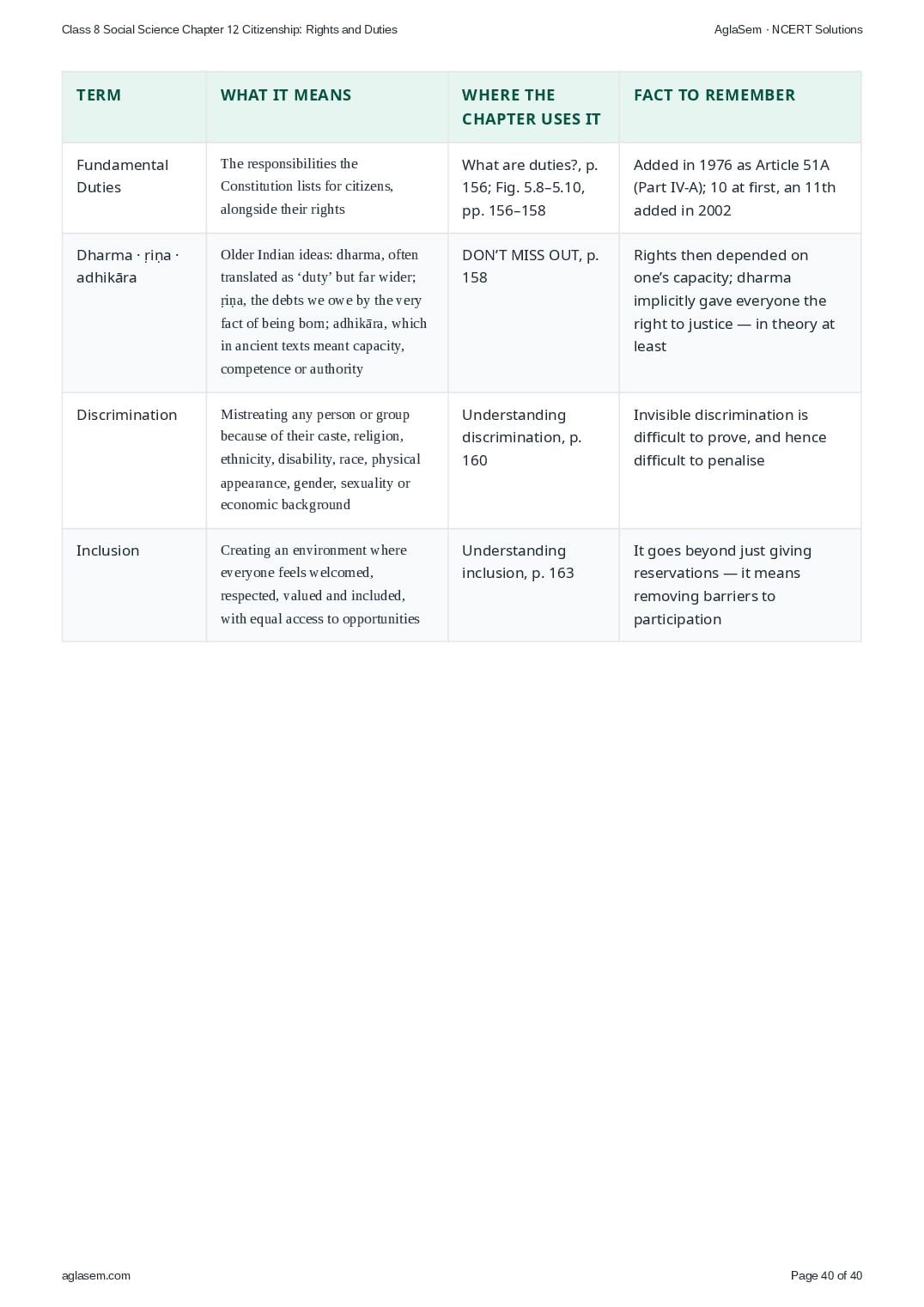
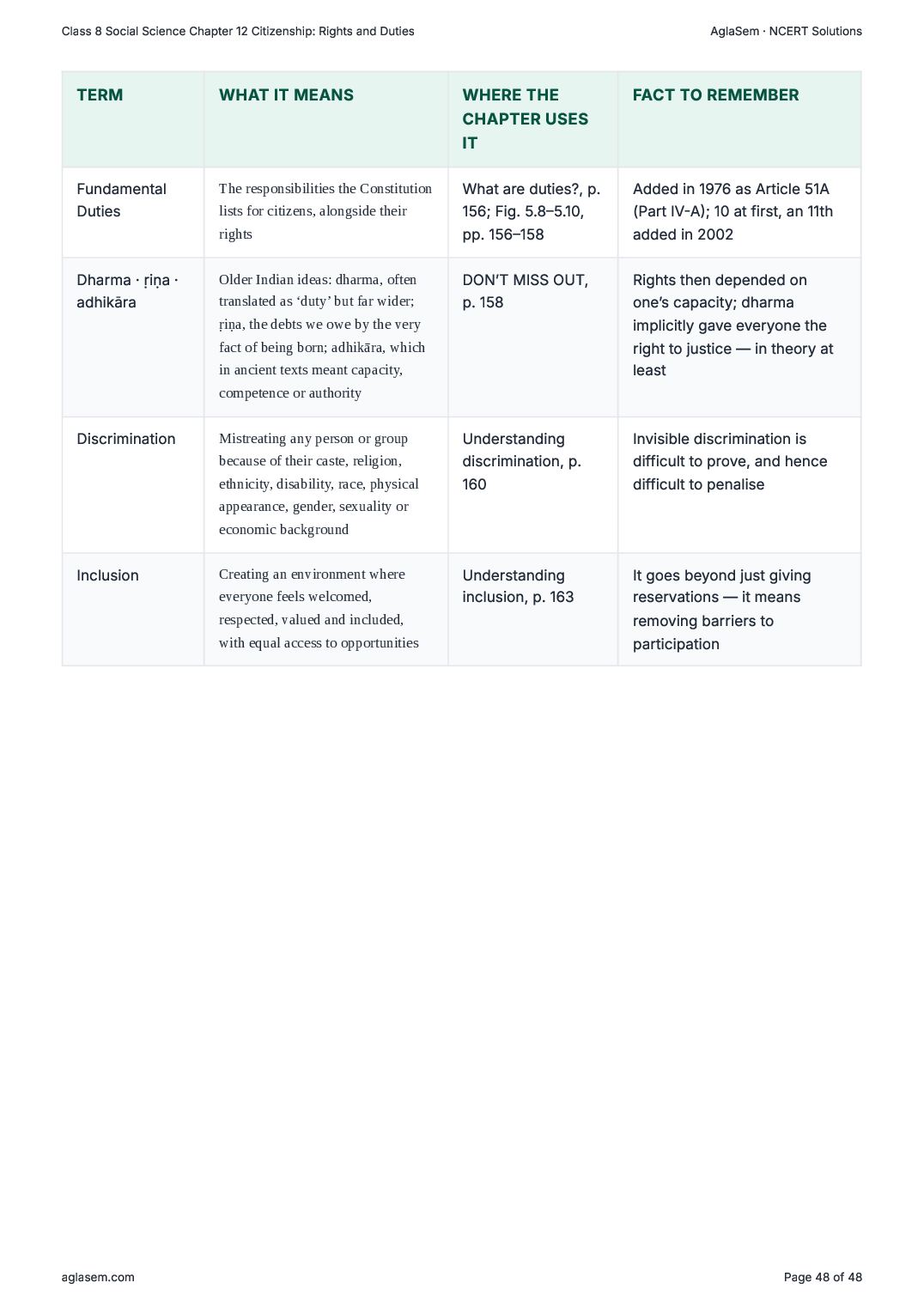
- Fundamental Duties were not in the Constitution of 1950. They were added in 1976 as Article 51A (Part IV-A) — ten at first, with an eleventh added in 2002 requiring parents or guardians to see that children aged 6–14 get an education.
- Rights and duties are two sides of the same coin: every right has a matching duty . Rights are protected by law; duties are moral and social responsibilities, and not doing them may not always lead to legal action — but ignoring them empties the rights of other people. Discrimination , including the invisible kind that is hard to prove and therefore hard to penalise, is what breaks that balance.
How to Download NCERT Solutions for Class 8 Social Science Chapter 12 PDF
Follow these simple steps to get the Citizenship Rights and Duties questions-and-answers PDF from Exploring Society: India and Beyond.
- Search NCERT Solutions for Class 8 Social Science Chapter 12 aglasem and open this page.
- Read the exercise questions with answers for Citizenship Rights and Duties shown above.
- Click the Download PDF link to save the Citizenship Rights and Duties solutions to your device.
NCERT Solutions for Class 8 Social Science – All Chapters
There are more chapters to study besides Citizenship Rights and Duties in Social Science. Here are the NCERT Solutions for all chapters of Class 8 Social Science.
- Chapter 1 Natural Resources and Their Use
- Chapter 2 Reshaping India’s Political Map
- Chapter 3 The Rise of the Marathas
- Chapter 4 The Colonial Era in India
- Chapter 5 Universal Franchise and India’s Electoral System
- Chapter 6 The Parliamentary System Legislature and Executive
- Chapter 7 Factors of Production
- Chapter 8 World Geography Some Glimpses
- Chapter 9 India’s Long Road to Independence
- Chapter 10 A Journey Through Indian Architecture
- Chapter 11 The Role of the Judiciary in Our Society
- Chapter 12 Citizenship Rights and Duties
- Chapter 13 Dynamics of Population
- Chapter 14 India’s Urban Landscape
- Chapter 15 Cultural Currents 13th to 17th Centuries
NCERT Solutions for Class 8 – All Subjects
Just like Chapter 12 of Social Science, you can get the exercise questions with answers for every other subject of Class 8. Here are the NCERT Solutions for all subjects of Class 8.
NCERT Solutions for Class 8 Social Science Chapter 12 – An Overview
The key highlights of this study material are as follows.
| Aspects | Details |
|---|---|
| Class | Class 8 |
| Subject | Social Science |
| Chapter Number | Chapter 12 |
| Chapter Name | Citizenship Rights and Duties |
| Book Name | Exploring Society: India and Beyond |
| Book By | NCERT (National Council of Educational Research and Training) |
| Educational Resource Here | NCERT Solutions of Class 8 Social Science Chapter 12 for all exercises |
| More Questions Answers of This Subject | NCERT Solutions for Class 8 Social Science |
| Download Book Chapter | NCERT Book Class 8 Social Science |
| All Questions Answers For This Class | NCERT Solutions for Class 8 |
| Complete Solutions | NCERT Solutions |
NCERT Solutions for Class 8 Social Science Chapter 12 Citizenship Rights and Duties – FAQs
What are the NCERT Solutions for Class 8 Social Science Chapter 12 Citizenship Rights and Duties?
They are the complete, step-by-step answers to all the exercise and in-text questions of Chapter 12 Citizenship Rights and Duties from the NCERT Class 8 Social Science textbook Exploring Society: India and Beyond, written by experts as per the latest NCERT syllabus.
How can I download the Class 8 Social Science Chapter 12 solutions PDF for free?
Open this page on aglasem, read the Citizenship Rights and Duties questions with answers, and click the “Download Solutions PDF” link. The Class 8 Social Science Chapter 12 NCERT Solutions PDF is completely free to download.
Are these NCERT Solutions as per the latest 2026-27 syllabus?
Yes. The NCERT Solutions for Class 8 Social Science Chapter 12 are based on the latest NCERT textbook Exploring Society: India and Beyond and the current 2026-27 CBSE syllabus, so the questions and answers match what you study in class.
Where can I get NCERT Solutions for the other chapters of Class 8 Social Science?
You can find the answers to every chapter on the NCERT Solutions for Class 8 Social Science page, and solutions for every subject on the NCERT Solutions for Class 8 page.
How do NCERT Solutions help in exam preparation?
They show the correct method to solve each question, help you write answers the way they are expected in exams, let you check and correct your own work, and save revision time — which together improve your marks in Class 8 Social Science.
If you have any queries on NCERT Solutions for Class 8 Social Science Chapter 12 Citizenship Rights and Duties, then please ask in the comments below.
