NCERT Solutions for Class 8 Social Science Chapter 7 Factors of Production provide clear, step-by-step answers to every exercise and in-text question from the chapter Factors of Production of the NCERT textbook Exploring Society: India and Beyond. Prepared by subject experts as per the latest NCERT (CBSE) syllabus for 2026-27, these NCERT Solutions for Class 8 Social Science help you understand each concept, write exam-ready answers, and check your own solutions. You can read them online below or download the free Class 8 Social Science Chapter 7 question-answer PDF.
NCERT Solutions for Class 8 Social Science Chapter 7 Factors of Production
- Class: Class 8
- Subject: Social Science
- Chapter: Chapter 7 – Factors of Production
- Textbook: Exploring Society: India and Beyond (NCERT)
- Study material: NCERT Solutions – questions with answers, free PDF
These solutions answer all the exercise questions of Chapter 7 Factors of Production — including the in-text questions, short-answer and long-answer questions, and activities — with complete explanations so you can follow the method, not just the final answer. Read the full solutions below.
NCERT Solutions Class 8 Social Science Chapter 7 Factors of Production View Download



NCERT Solutions for Class 8 Social Science Chapter 7 PDF Download
You can read the NCERT Solutions for Class 8 Social Science Chapter 7 online above, or download the complete question-answer PDF to study Factors of Production offline at any time.
NCERT Solutions for Class 8 Social Science Chapter 7 PDF Download Link – Click Here to Download Solutions PDF
Questions Covered in This Chapter
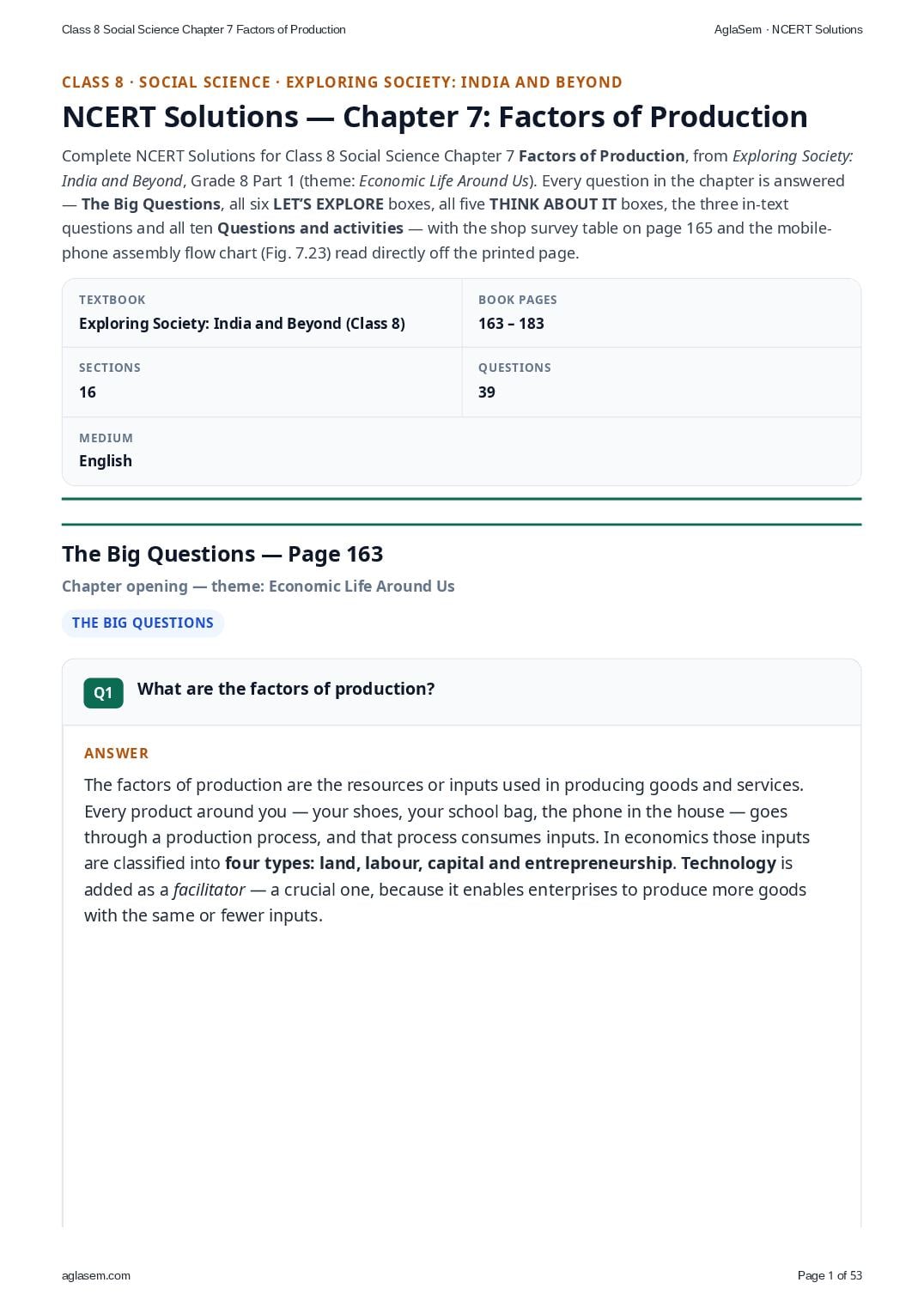
These NCERT Solutions answer all 39 questions of this chapter. The questions solved are:
- What are the factors of production?
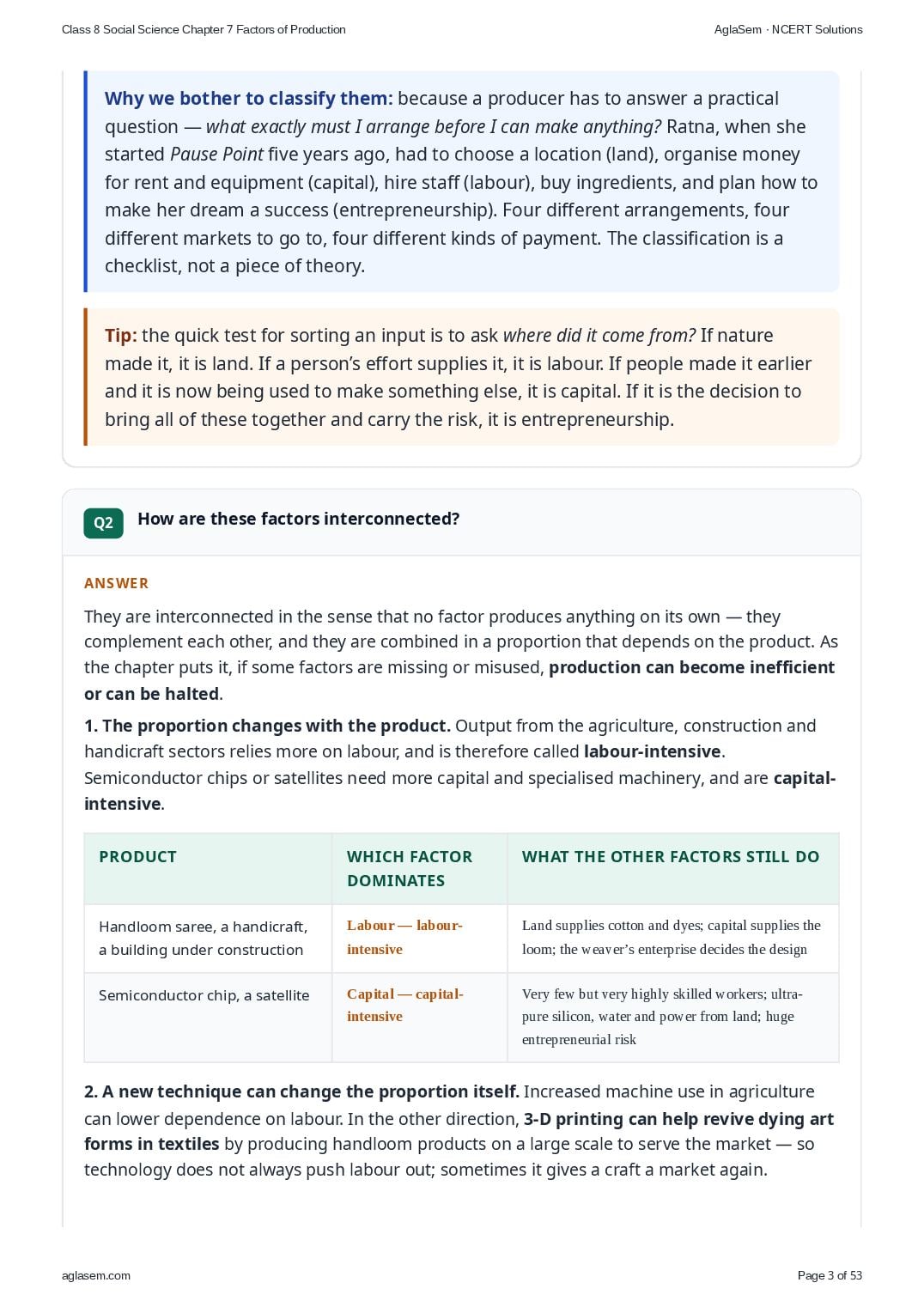
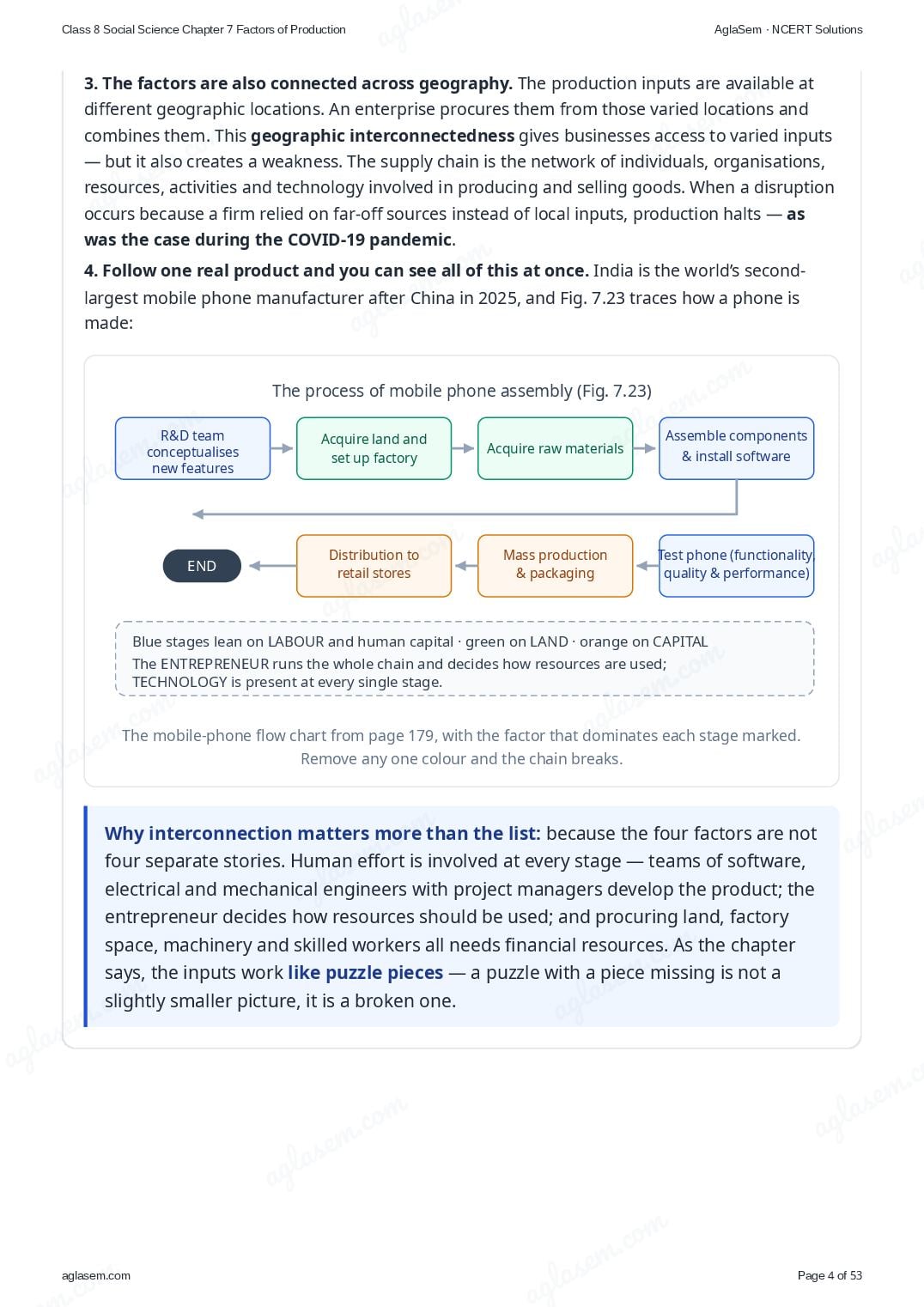
- How are these factors interconnected?
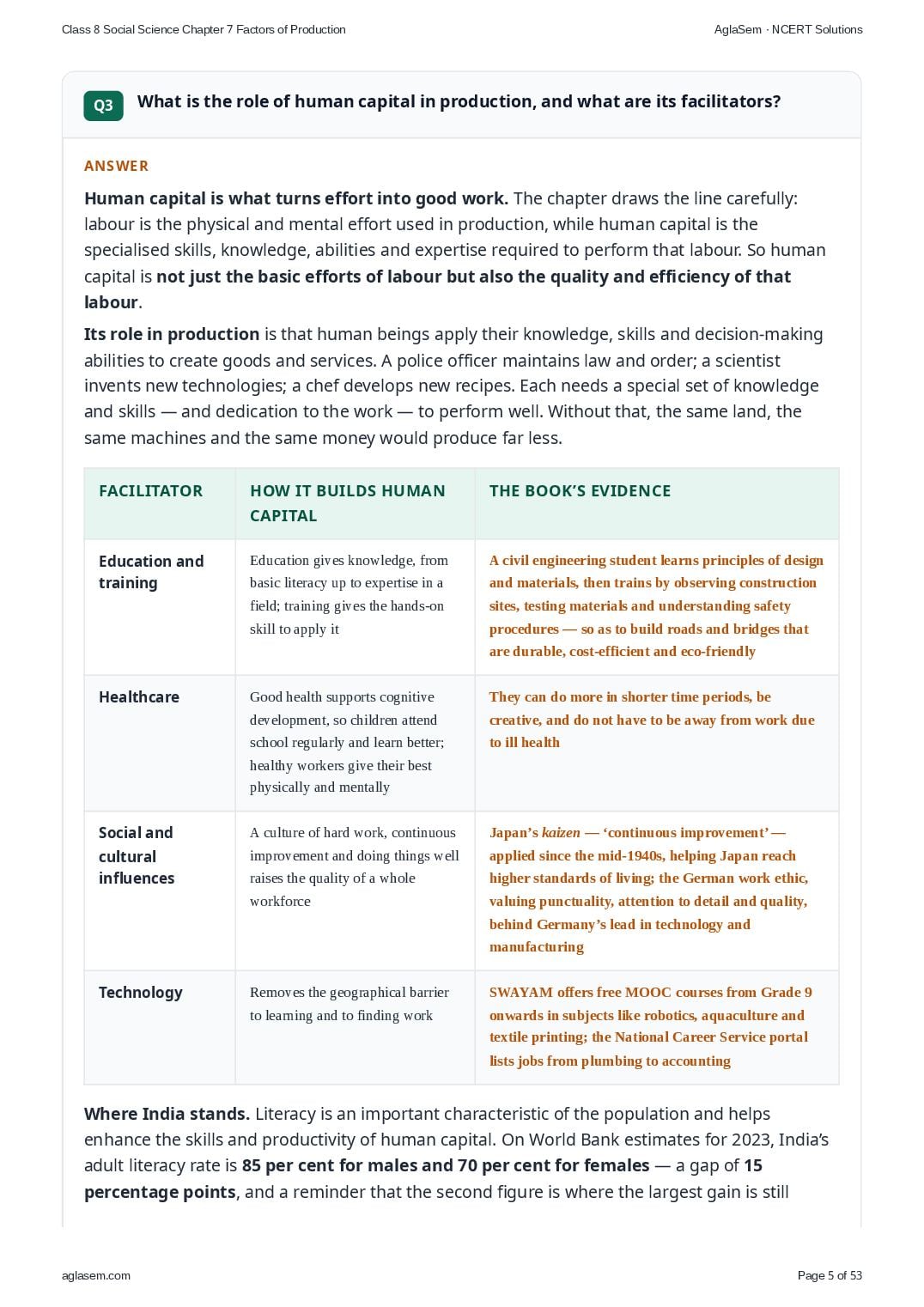
- What is the role of human capital in production, and what are its facilitators?
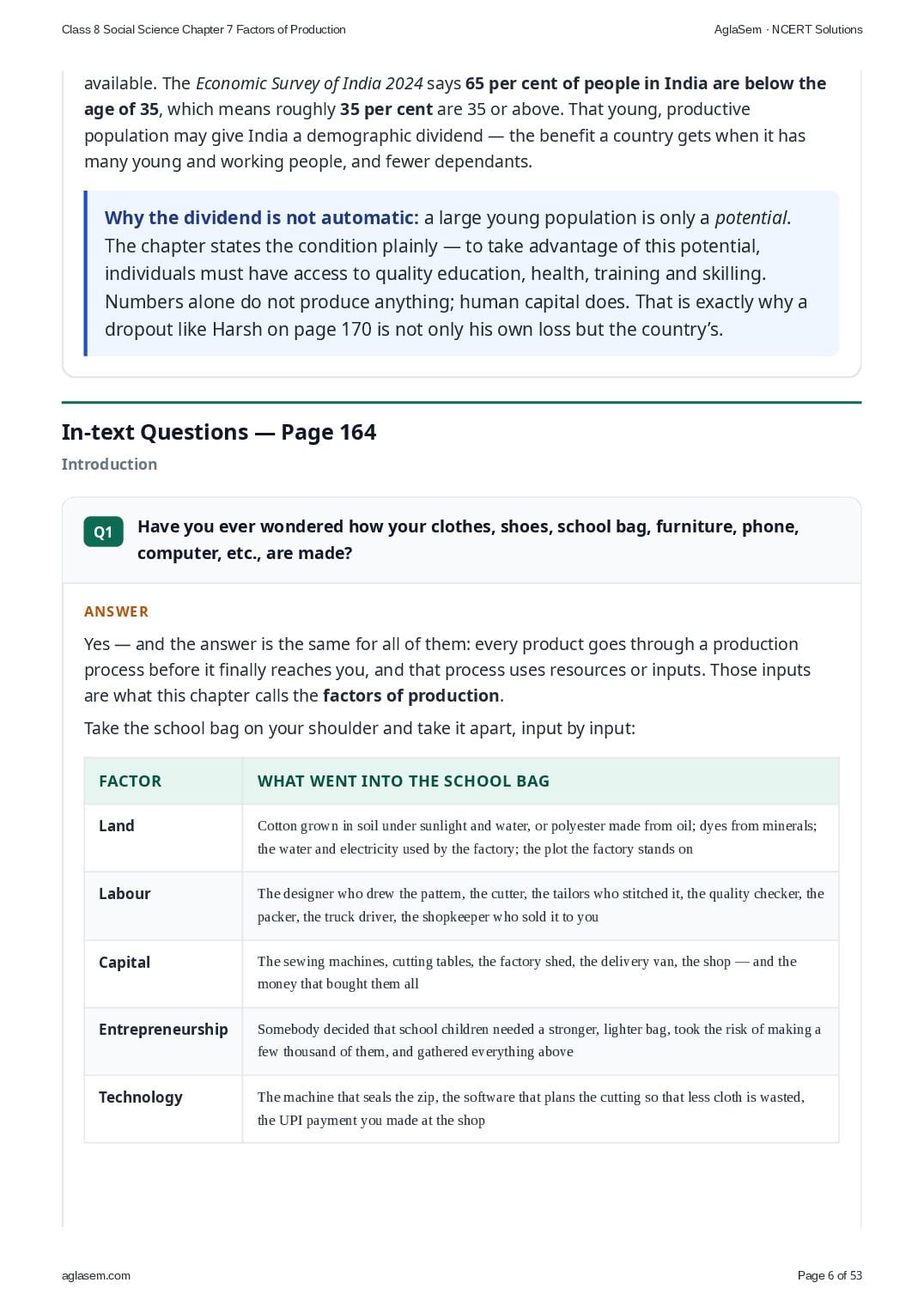
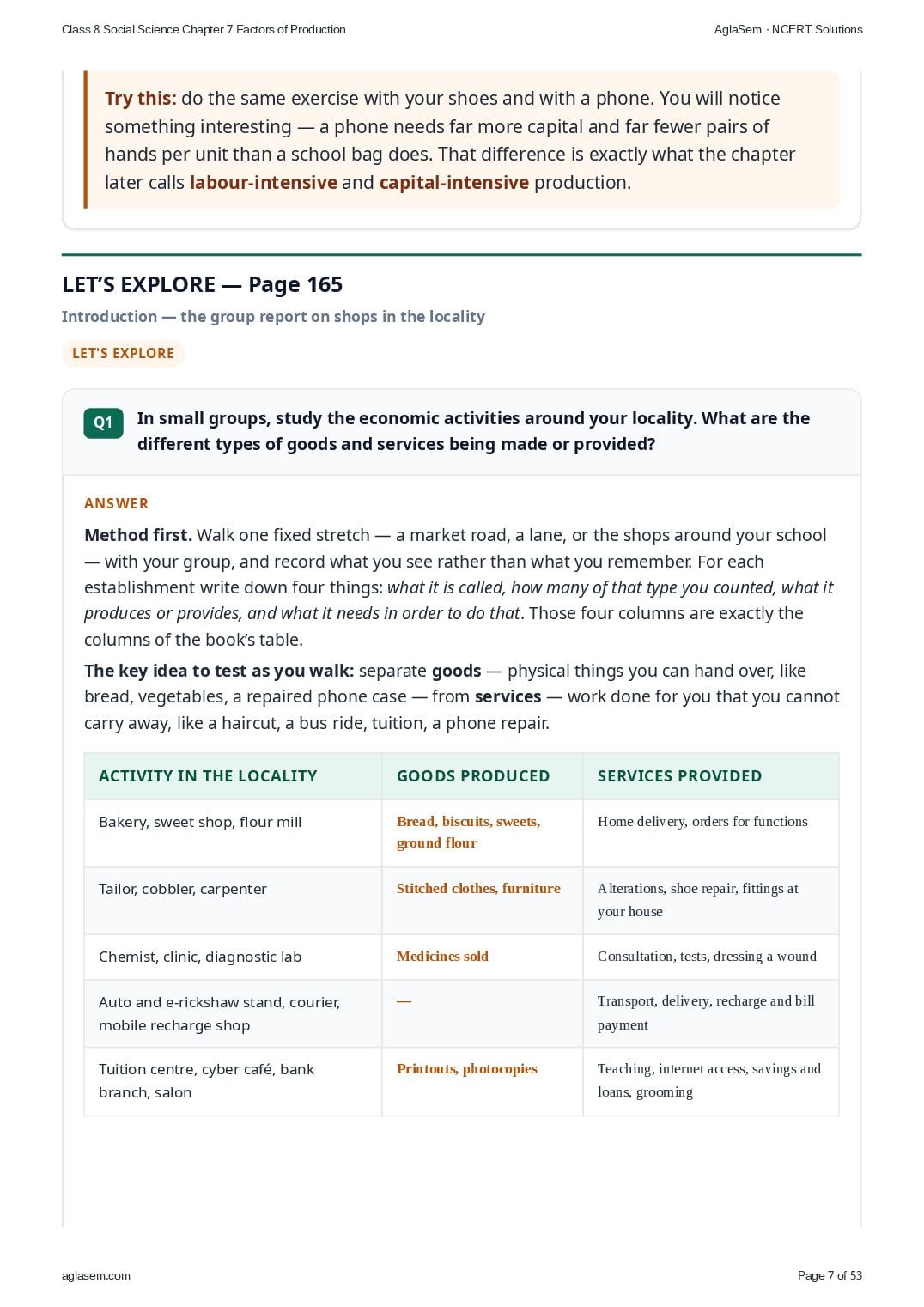
- Have you ever wondered how your clothes, shoes, school bag, furniture, phone, computer, etc., are made?
- In small groups, study the economic activities around your locality. What are the different types of goods and services being made or provided?
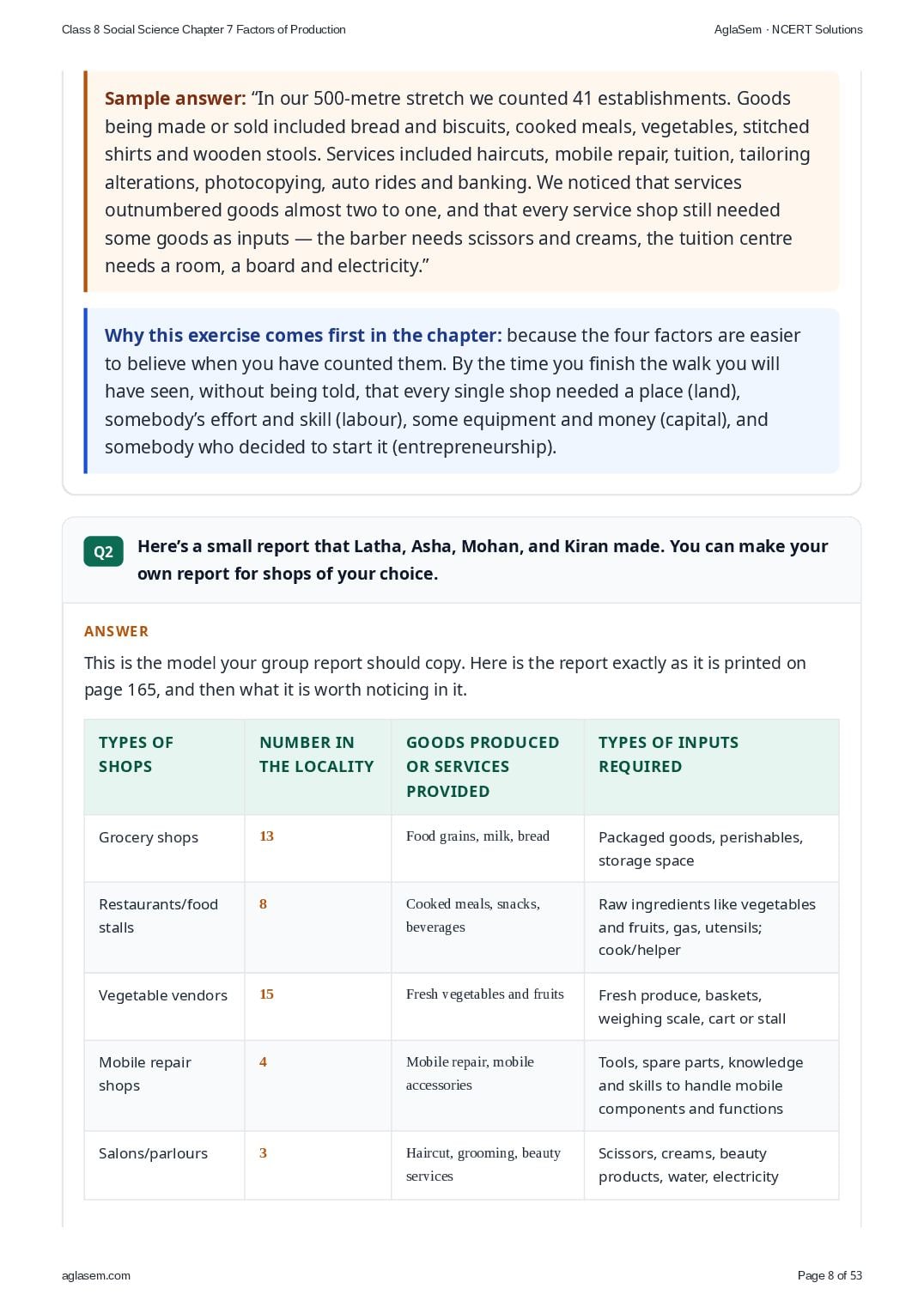
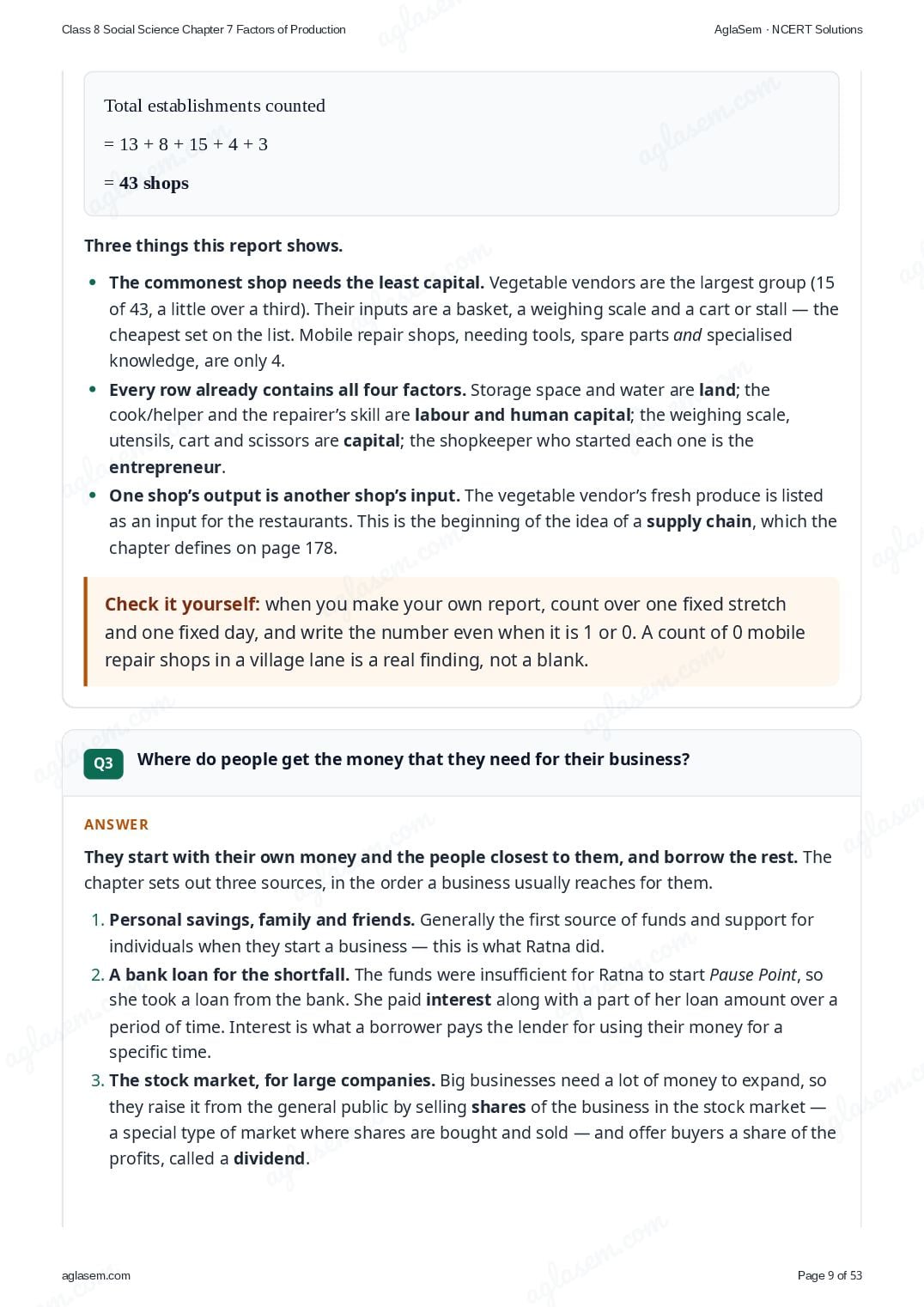
- Here’s a small report that Latha, Asha, Mohan, and Kiran made. You can make your own report for shops of your choice.
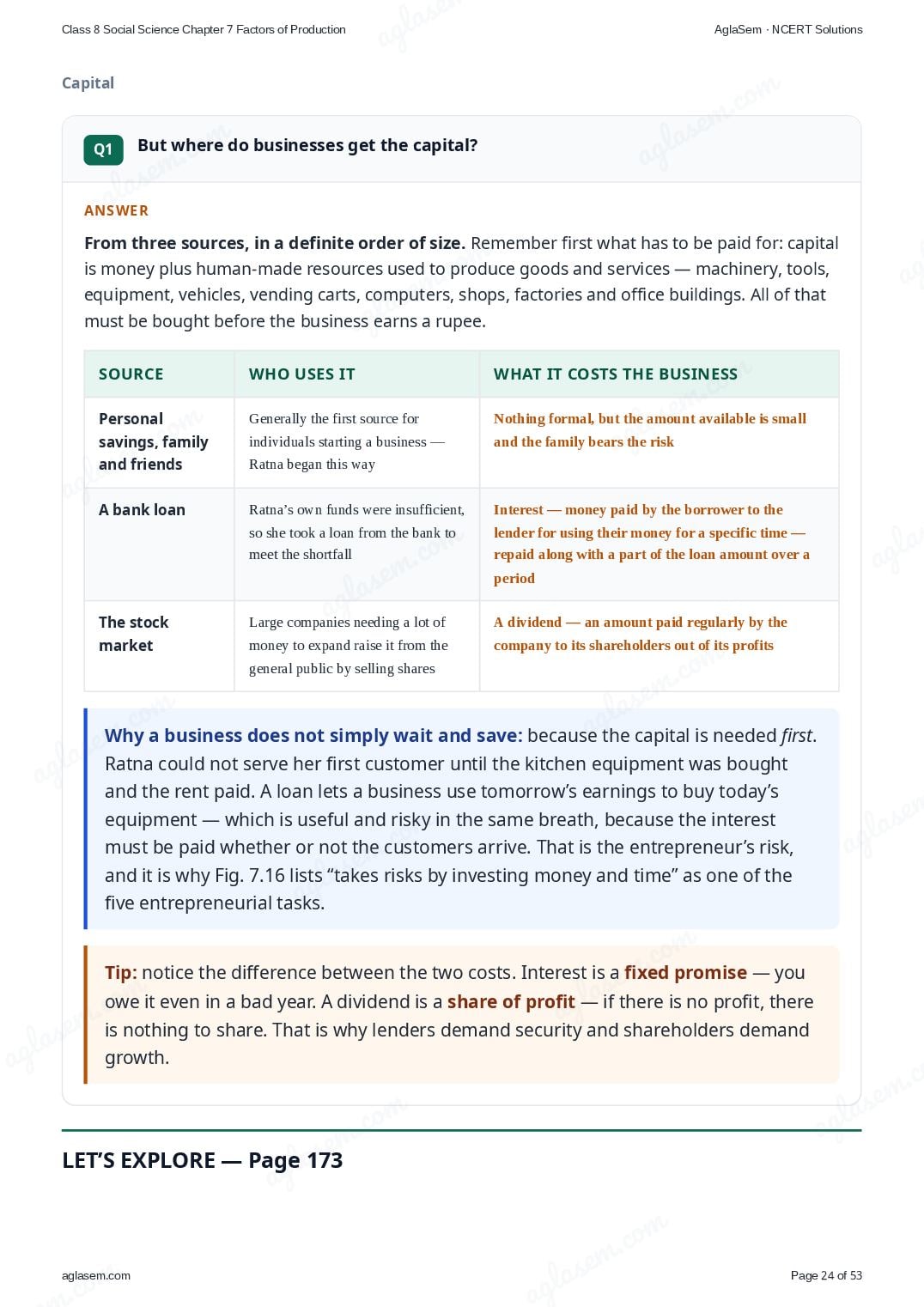
- Where do people get the money that they need for their business?
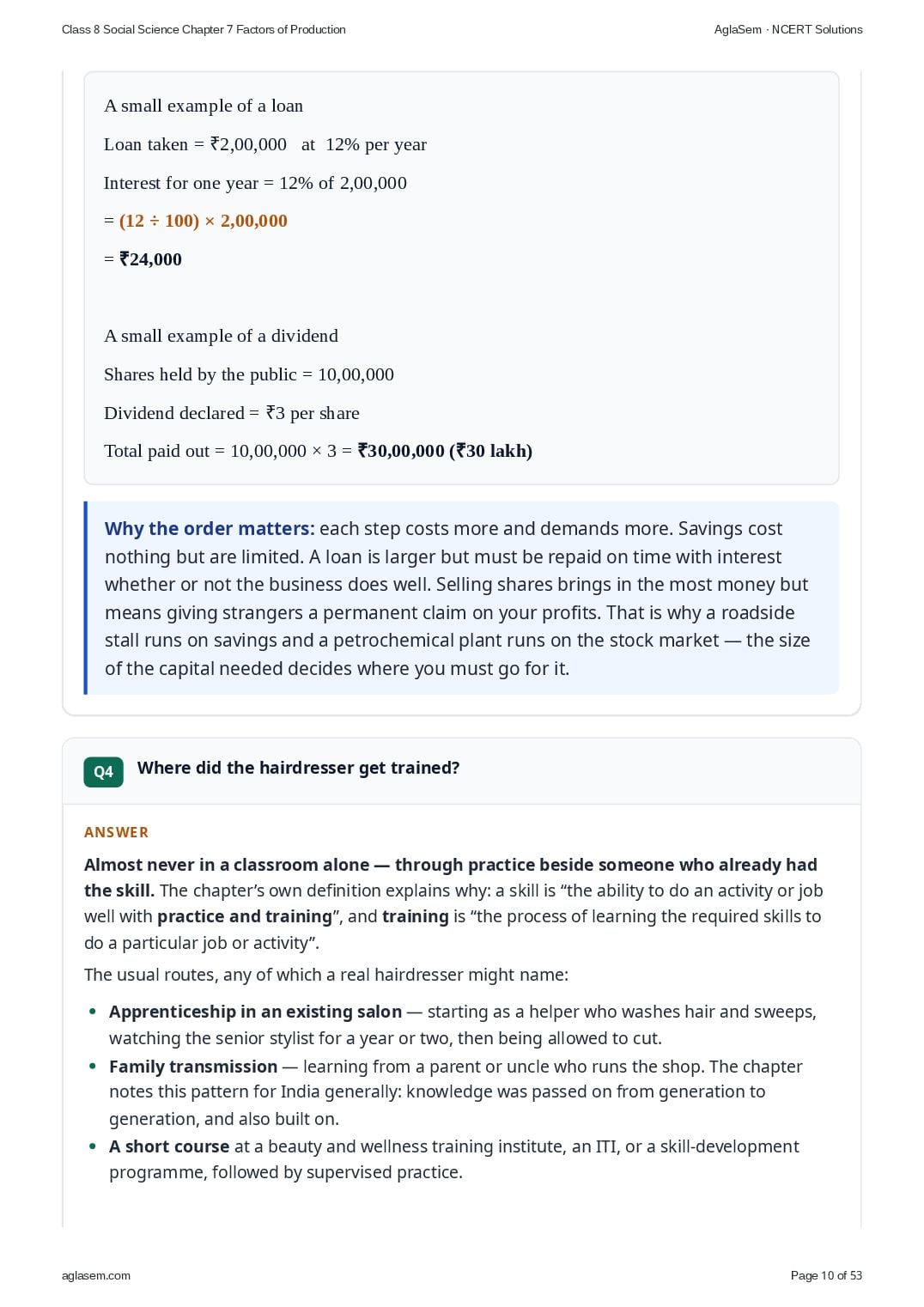
- Where did the hairdresser get trained?
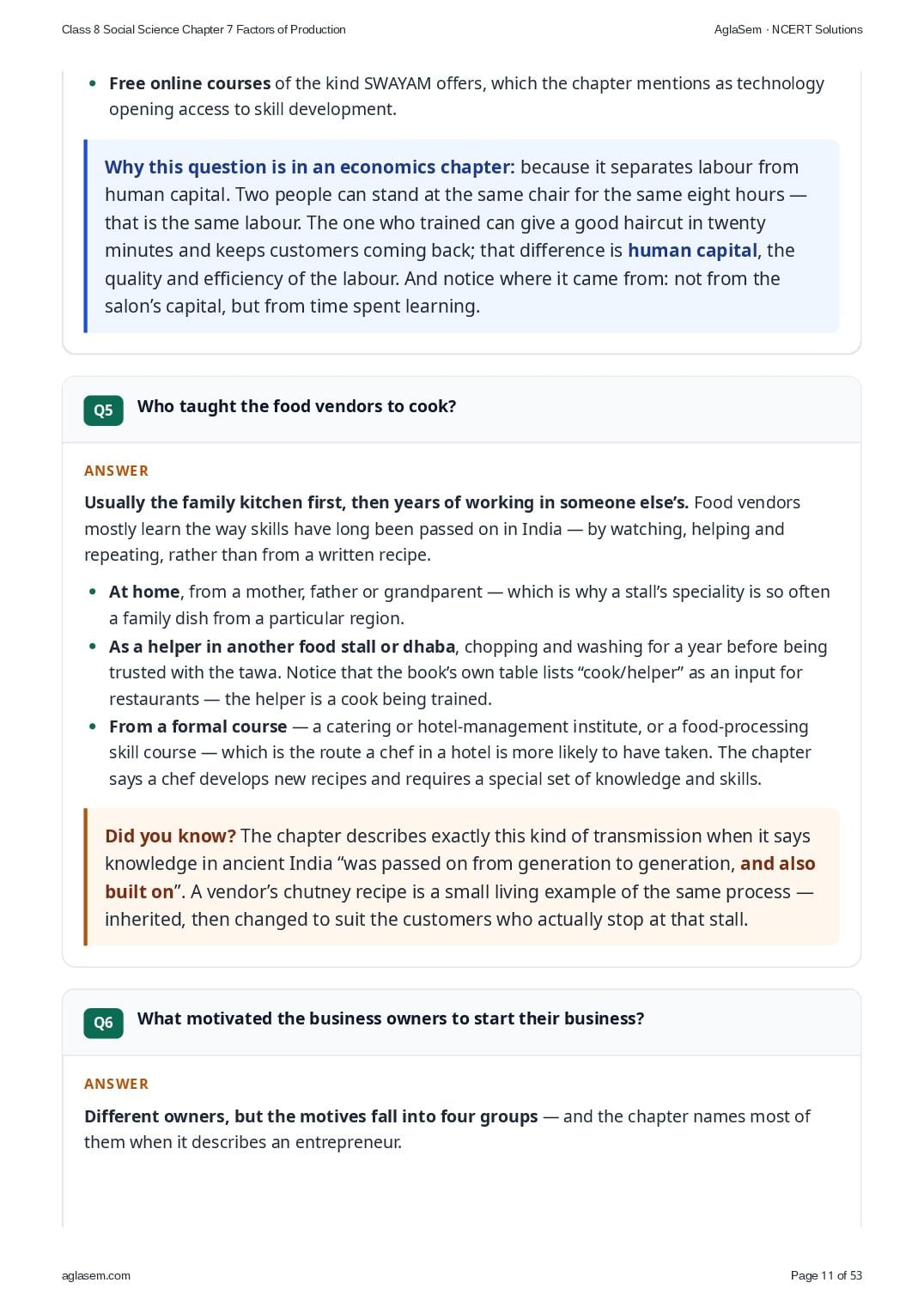
- Who taught the food vendors to cook?
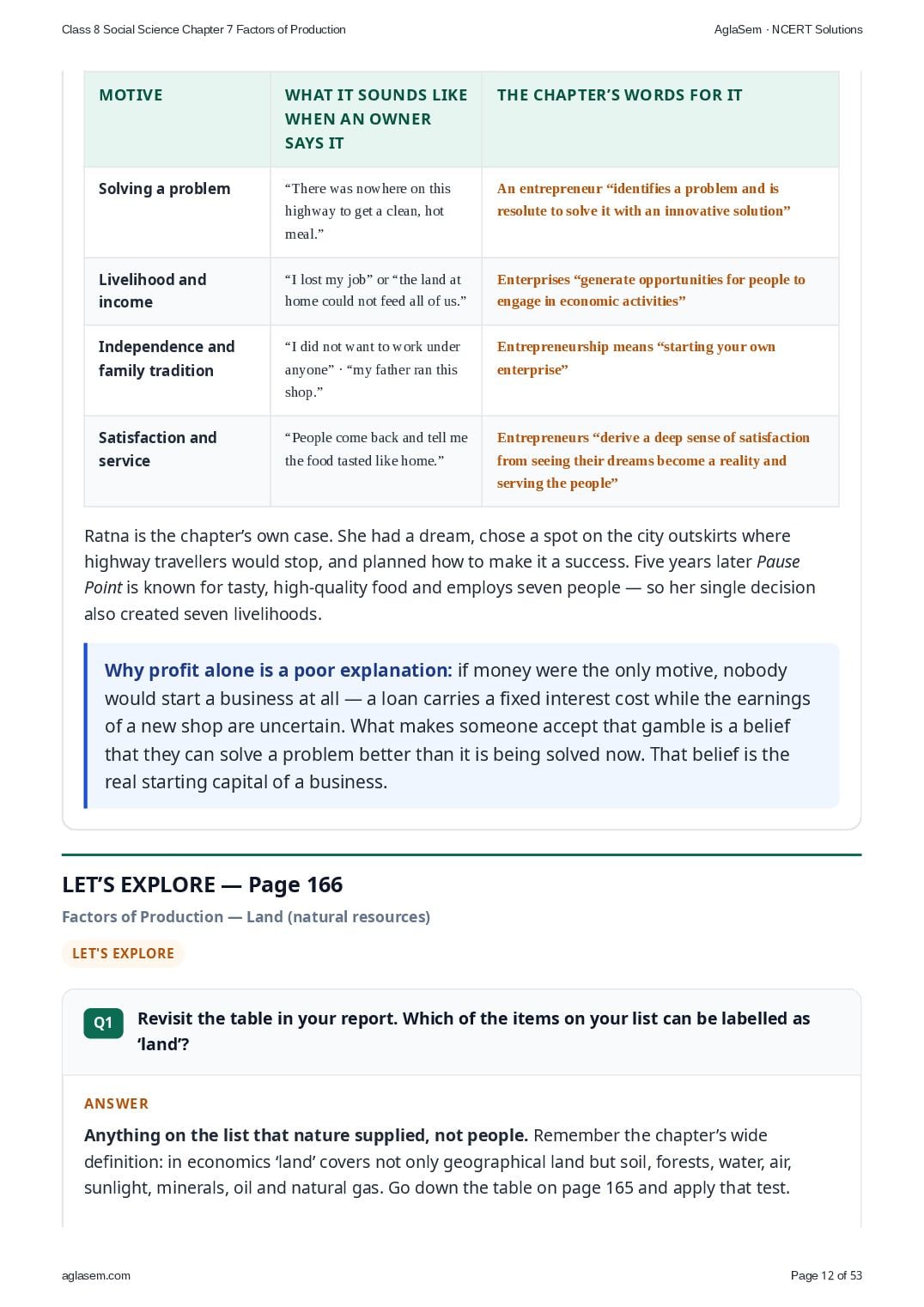
- What motivated the business owners to start their business?
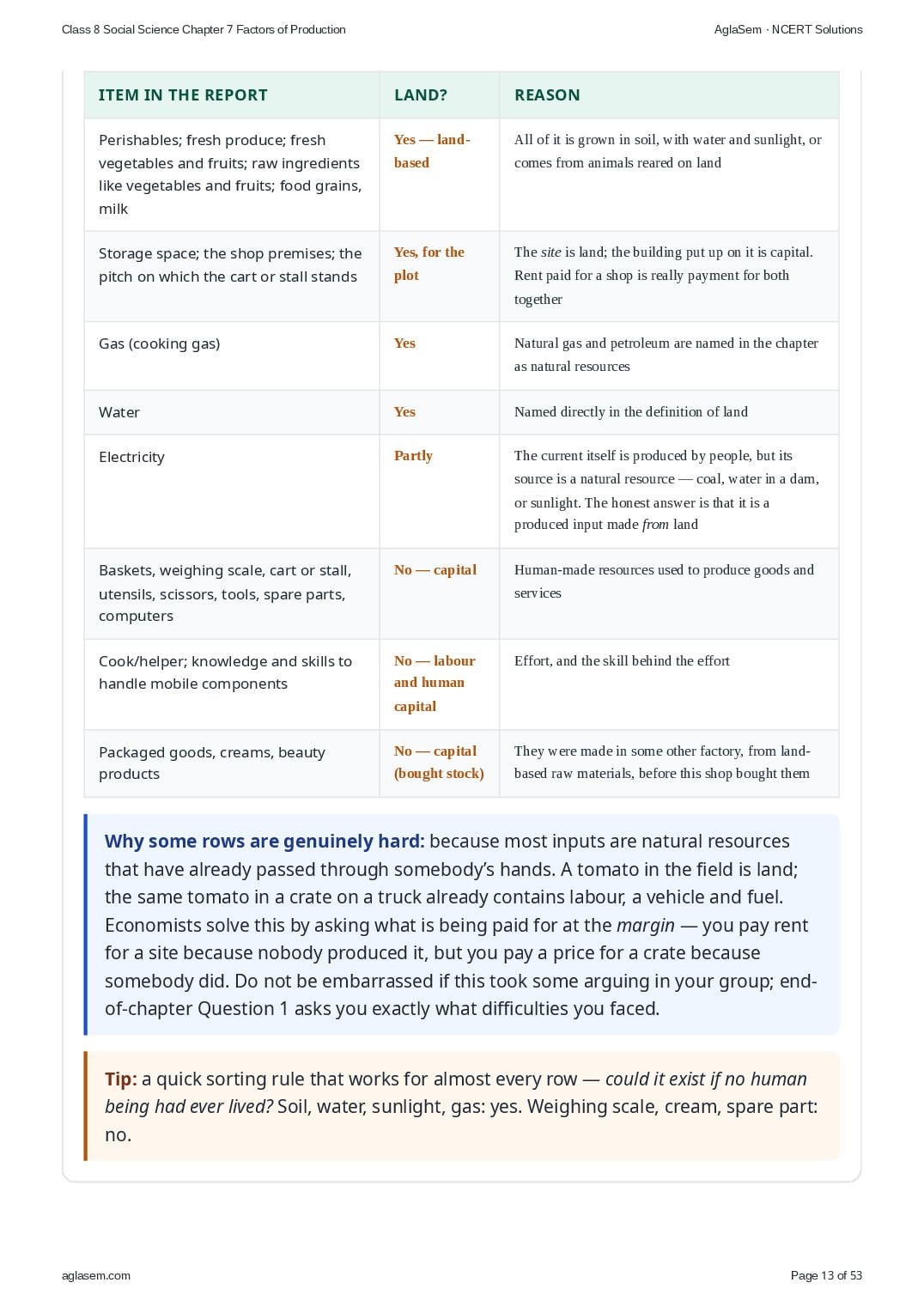
- Revisit the table in your report. Which of the items on your list can be labelled as ‘land’?
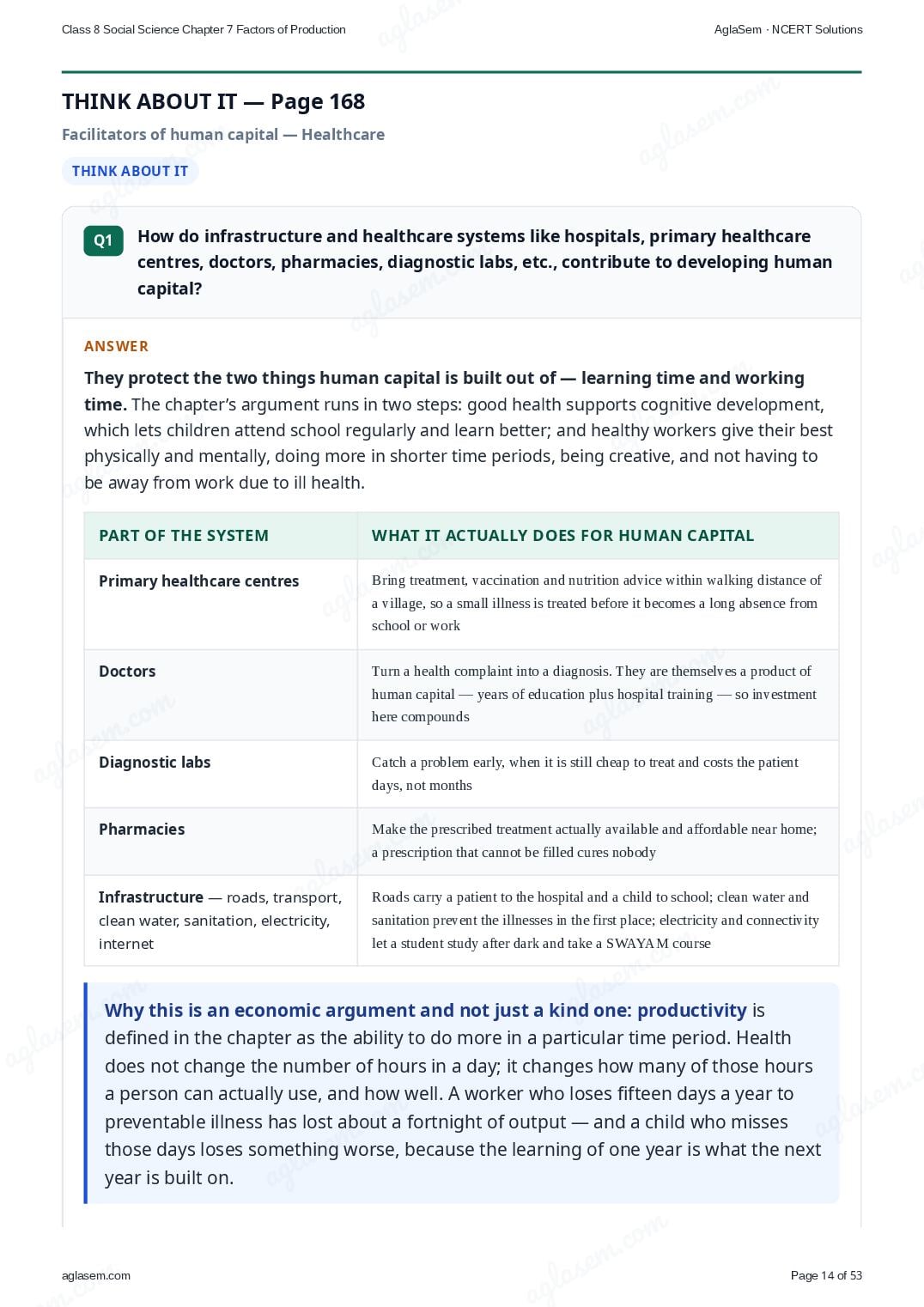
- How do infrastructure and healthcare systems like hospitals, primary healthcare centres, doctors, pharmacies, diagnostic labs, etc., contribute to developing human capital?
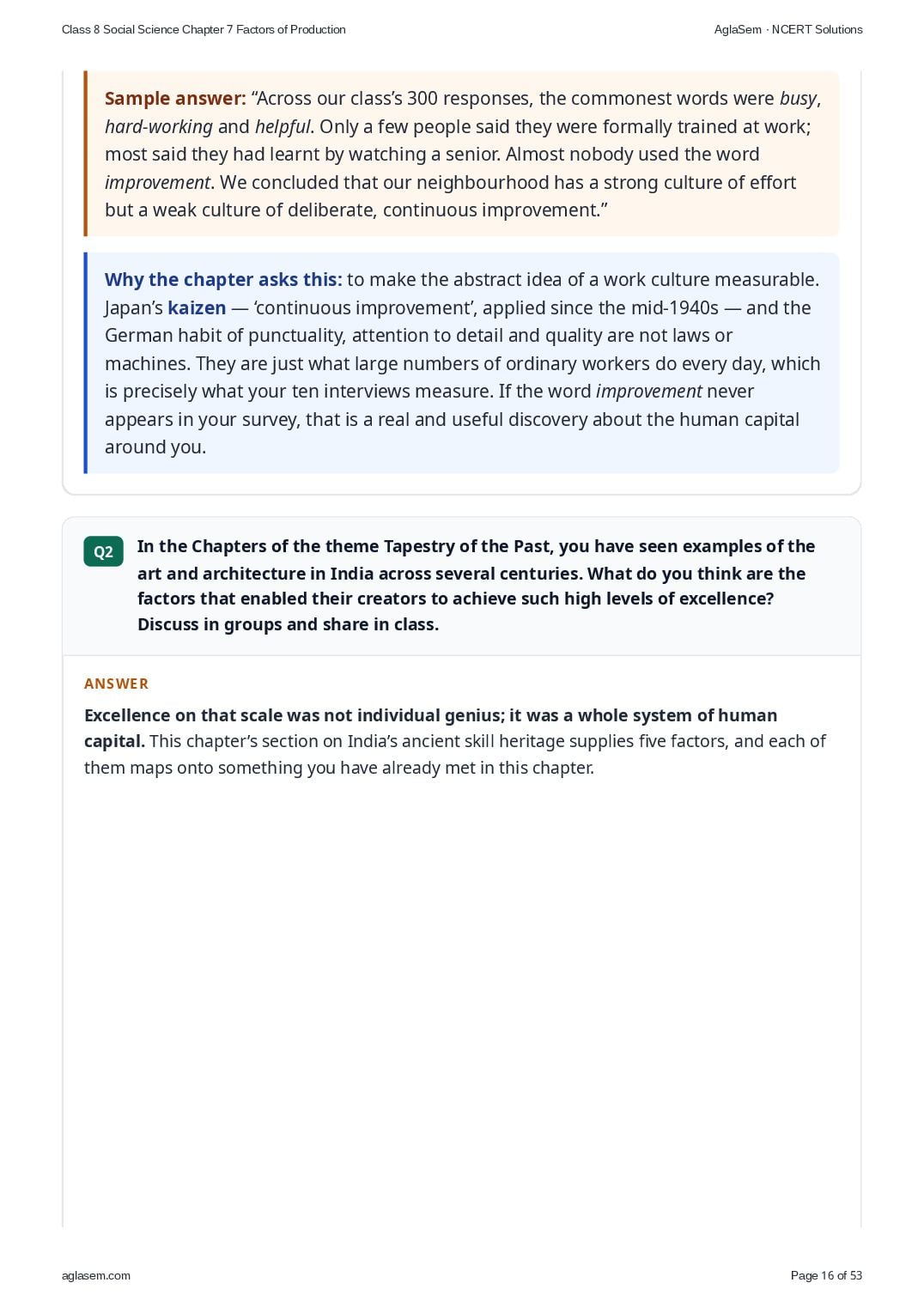
- Let’s do a small experiment. Make a list of 10 working adults in your family and neighbourhood. Ask them to describe the culture at their workplace. Share notes with your classmates. What did you discover? What are some adjectives that occur more frequently?
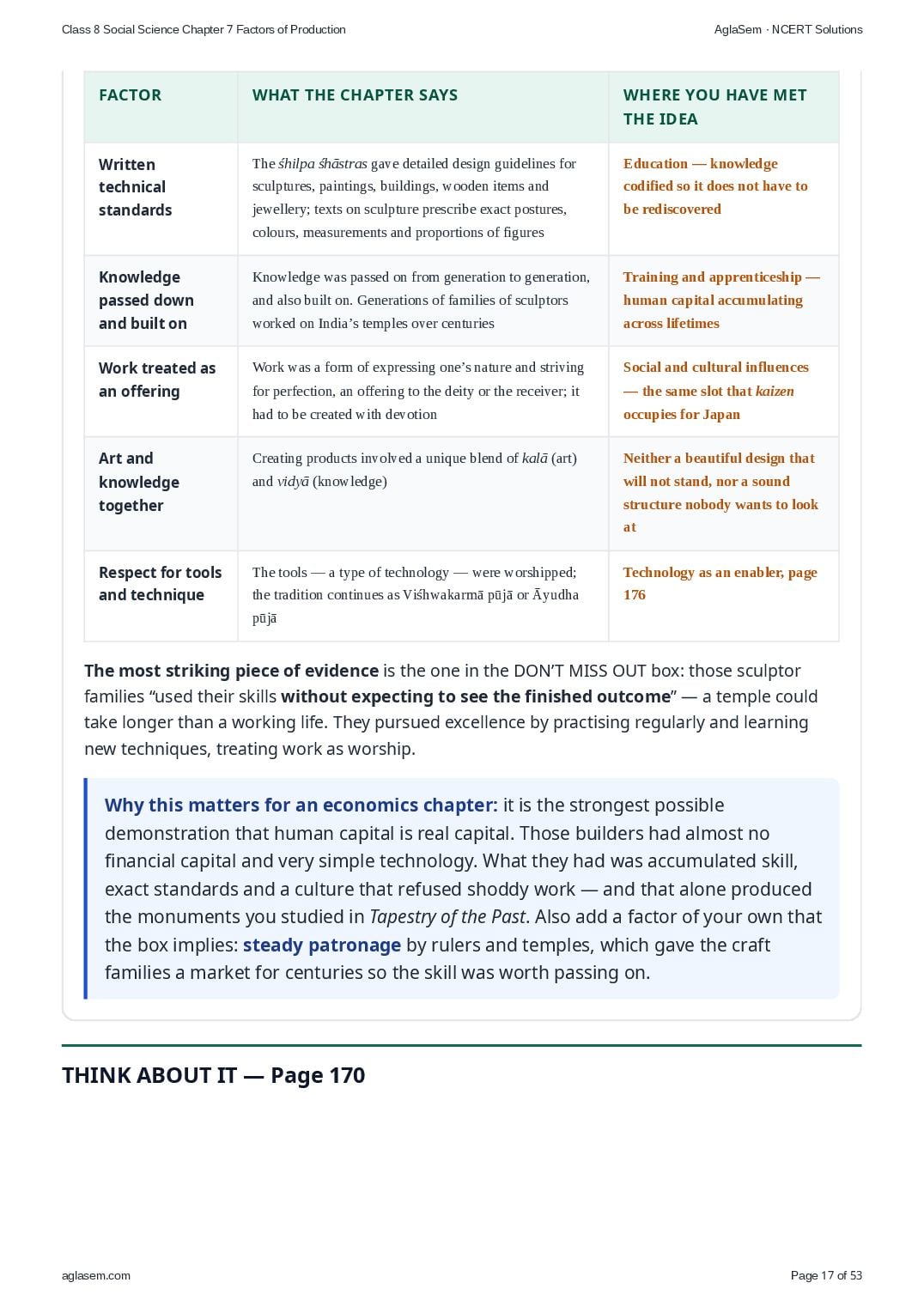
- In the Chapters of the theme Tapestry of the Past, you have seen examples of the art and architecture in India across several centuries. What do you think are the factors that enabled their creators to achieve such high levels of excellence? Discuss in groups and share in class.
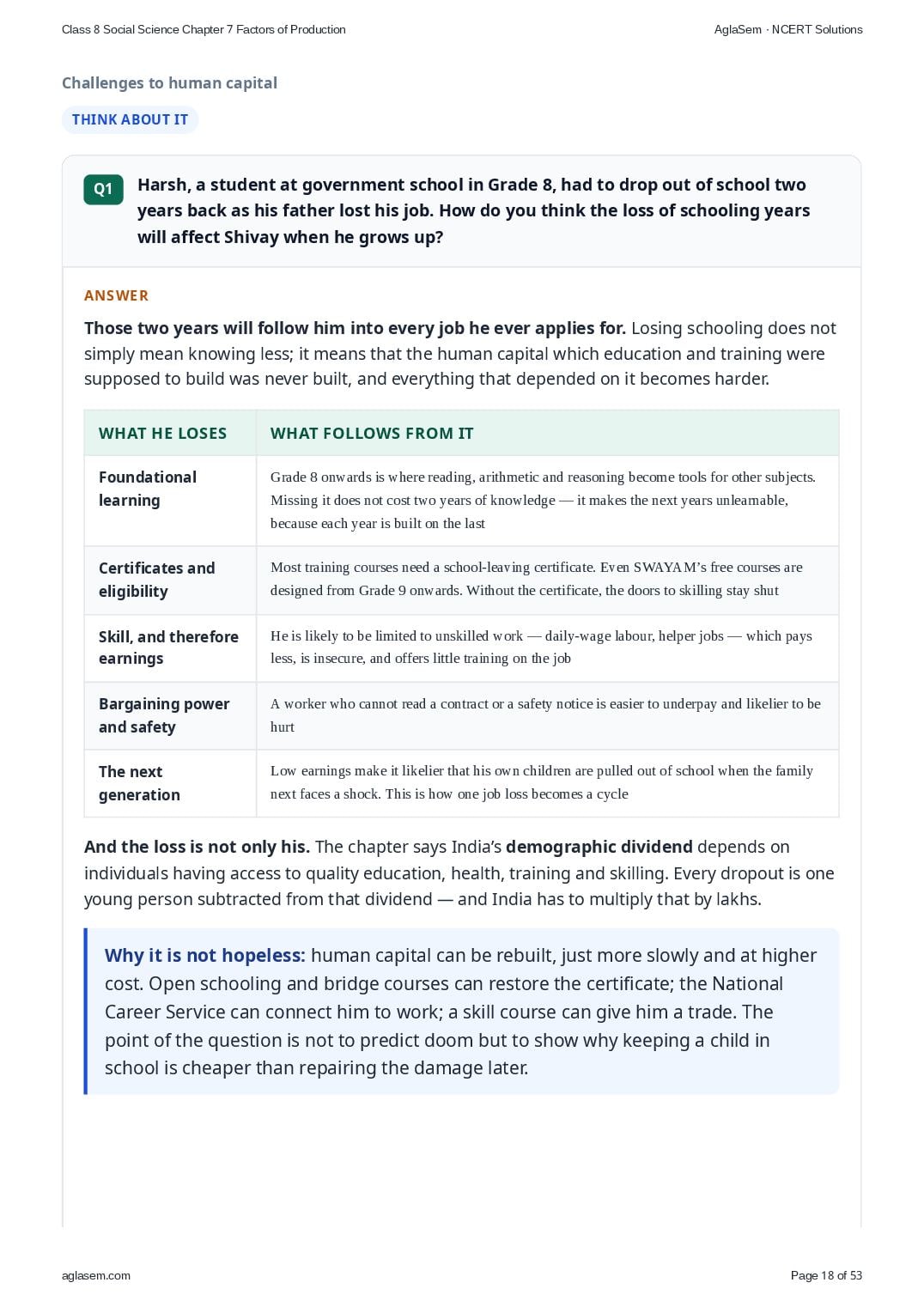
- Harsh, a student at government school in Grade 8, had to drop out of school two years back as his father lost his job. How do you think the loss of schooling years will affect Shivay when he grows up?
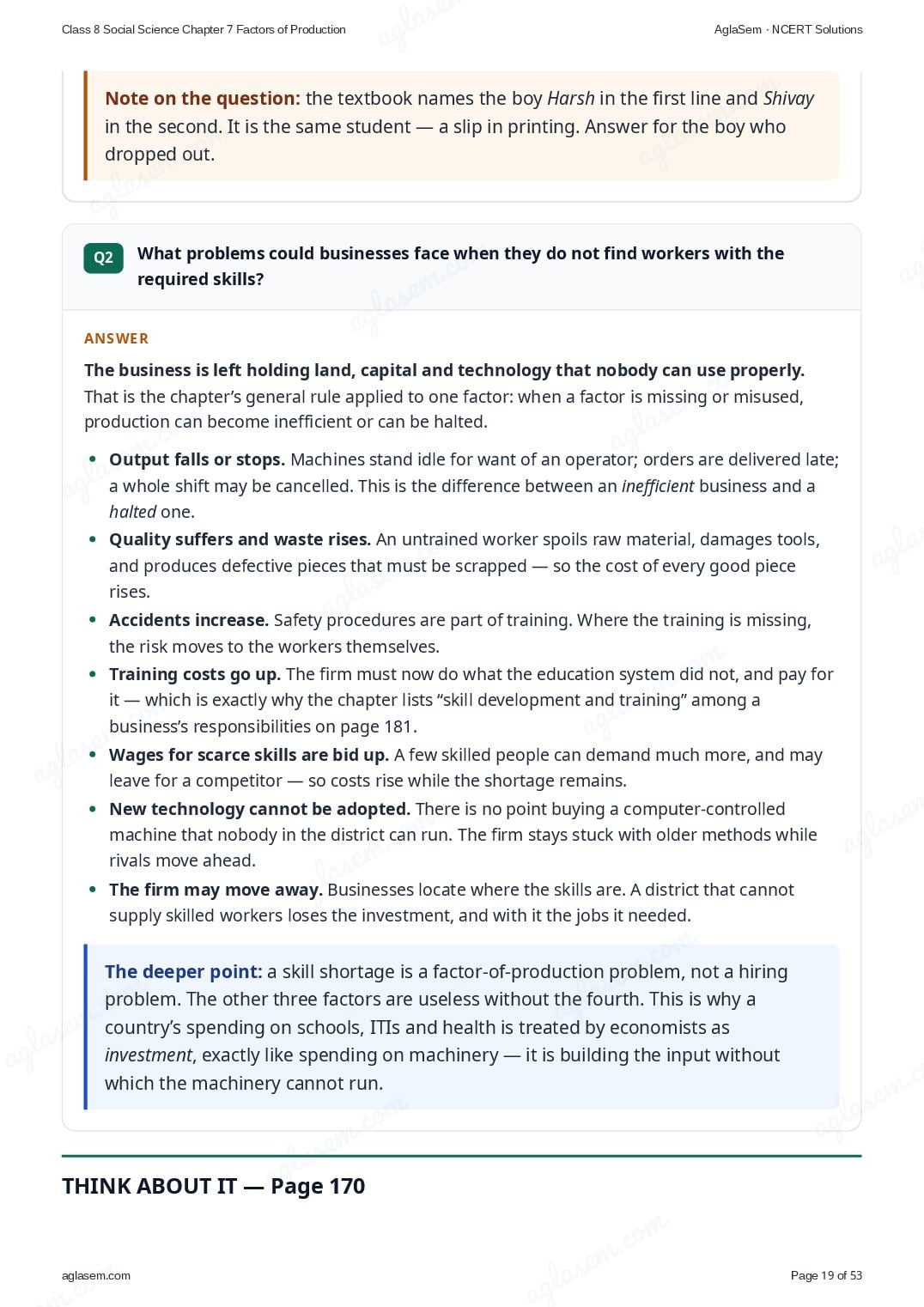
- What problems could businesses face when they do not find workers with the required skills?
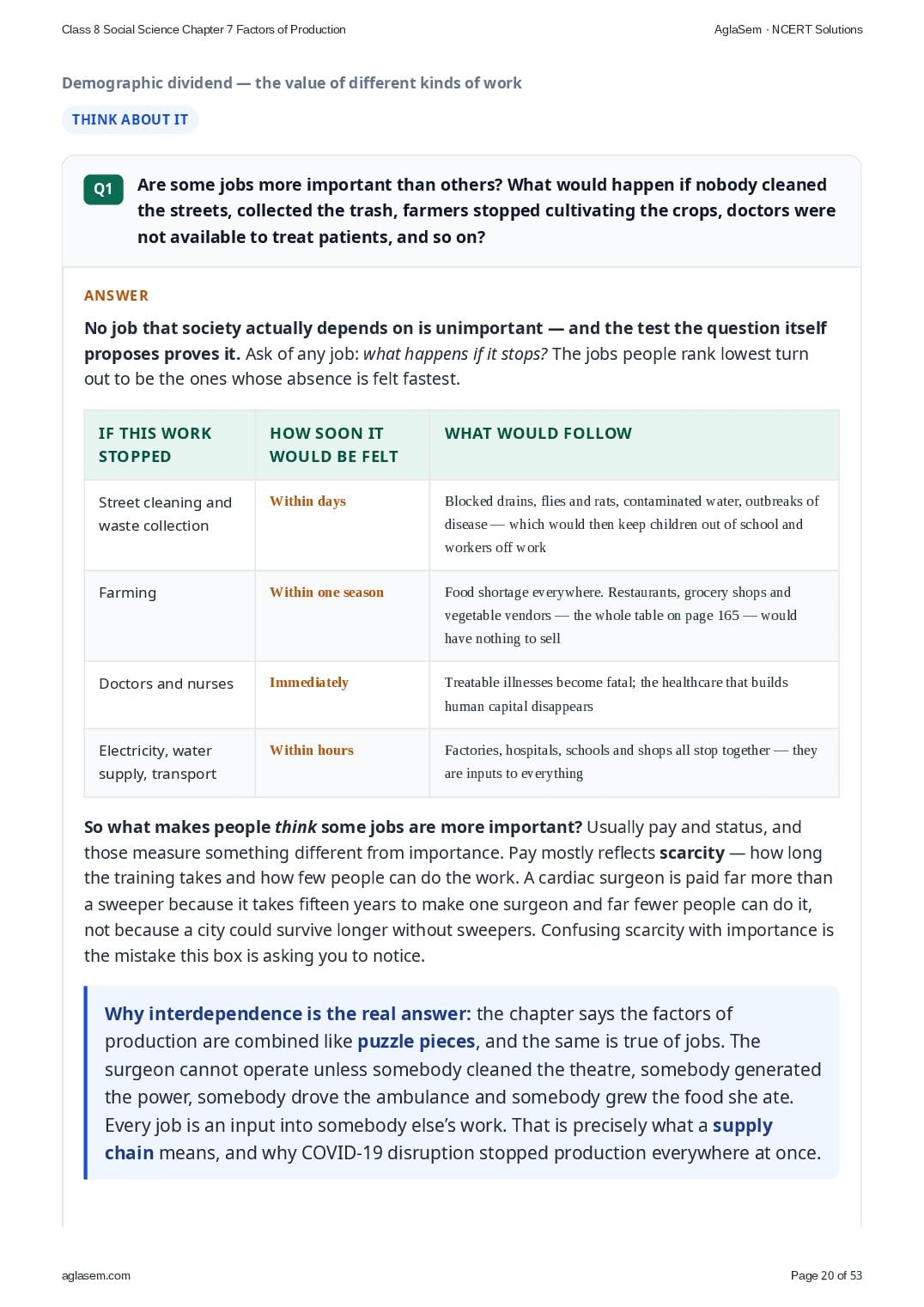
- Are some jobs more important than others? What would happen if nobody cleaned the streets, collected the trash, farmers stopped cultivating the crops, doctors were not available to treat patients, and so on?
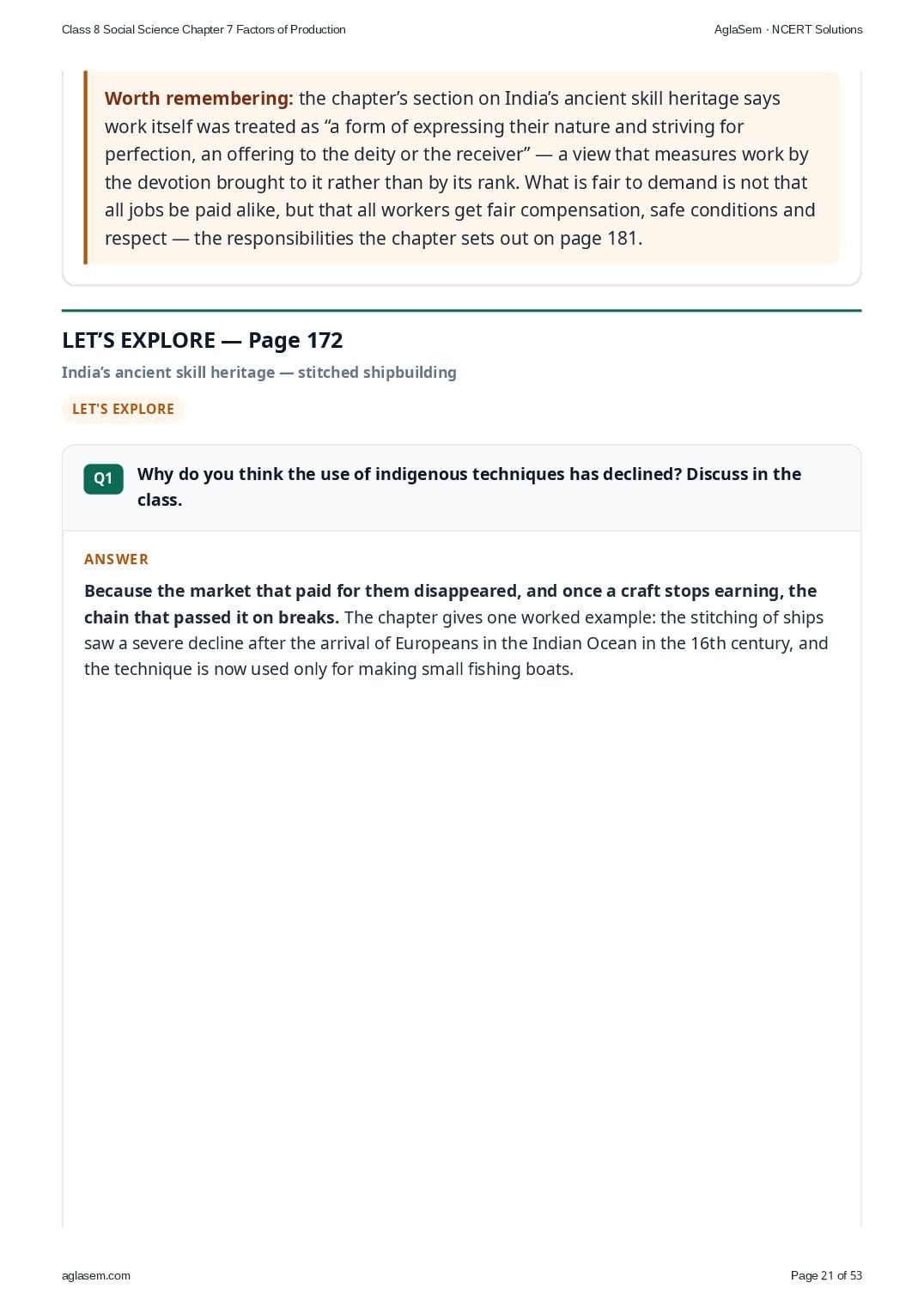
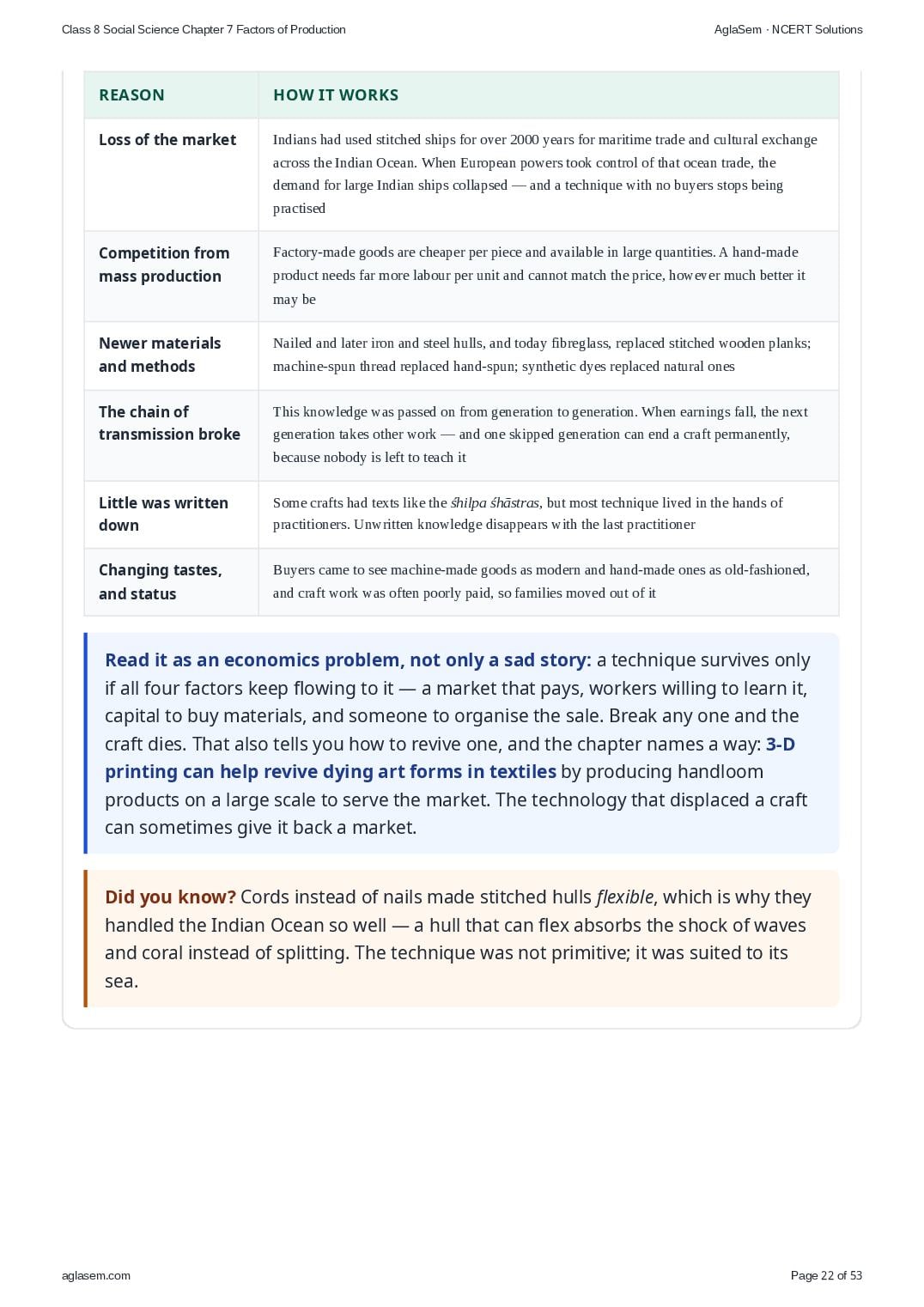
- Why do you think the use of indigenous techniques has declined? Discuss in the class.
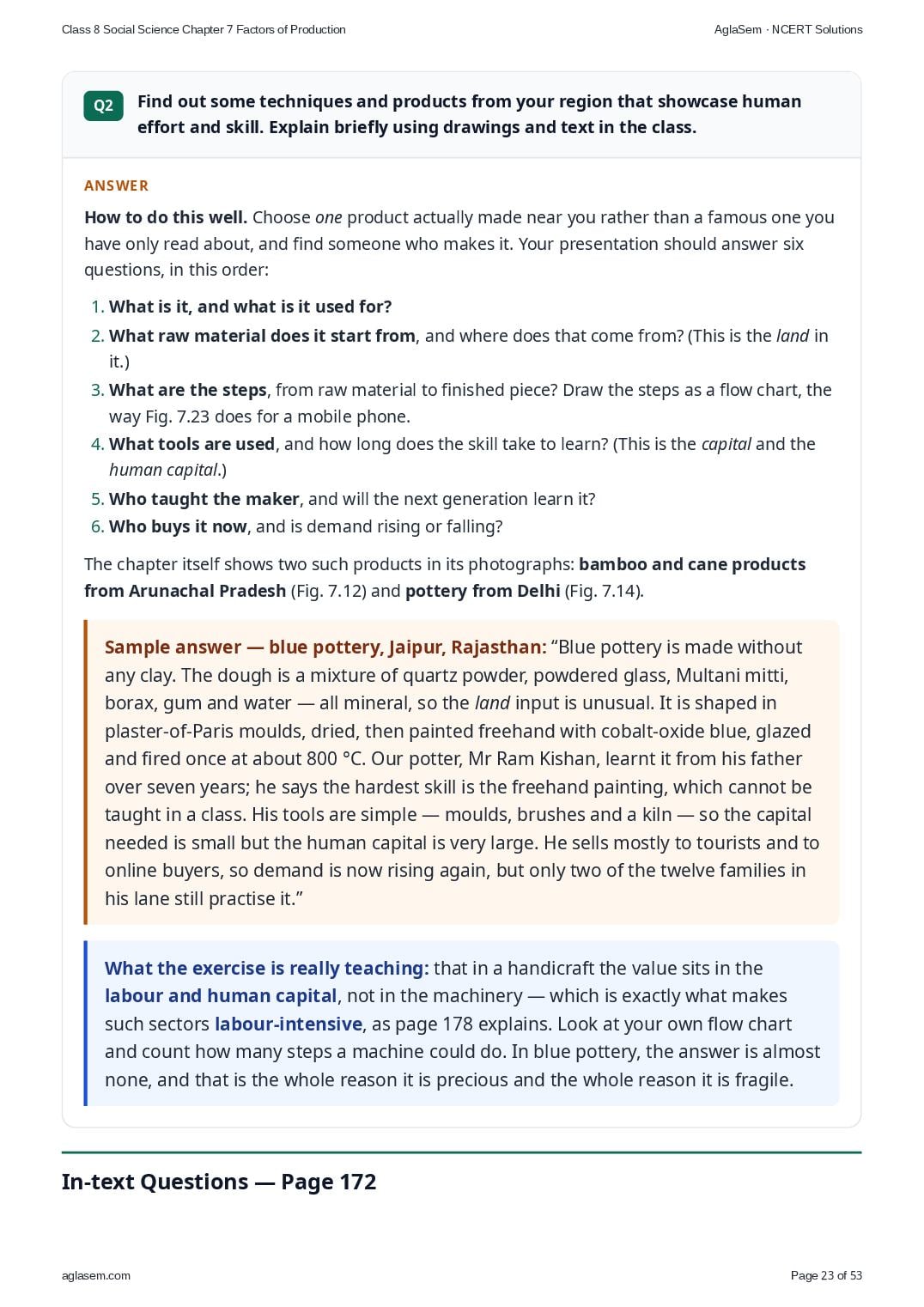
- Find out some techniques and products from your region that showcase human effort and skill. Explain briefly using drawings and text in the class.
- But where do businesses get the capital?
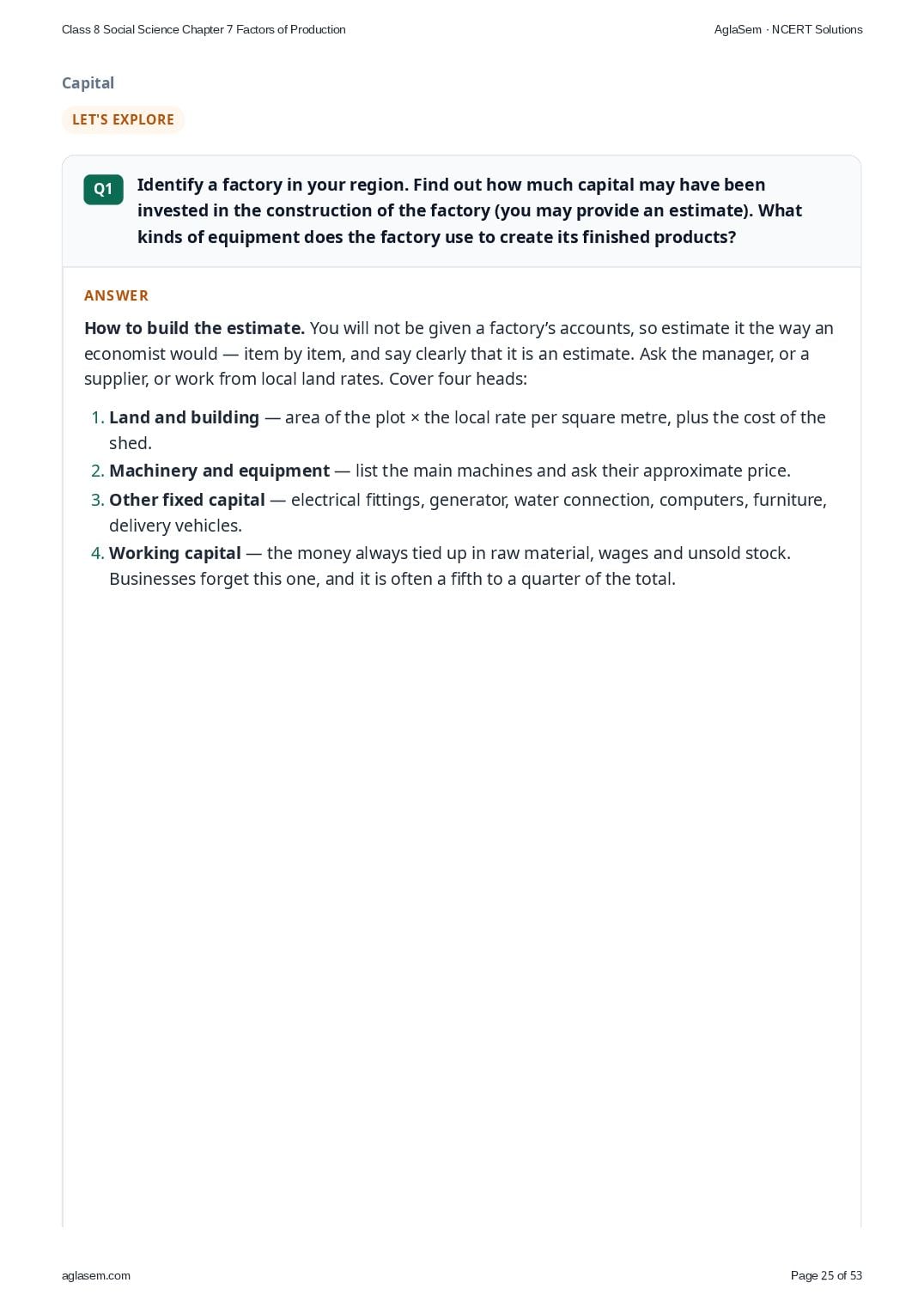
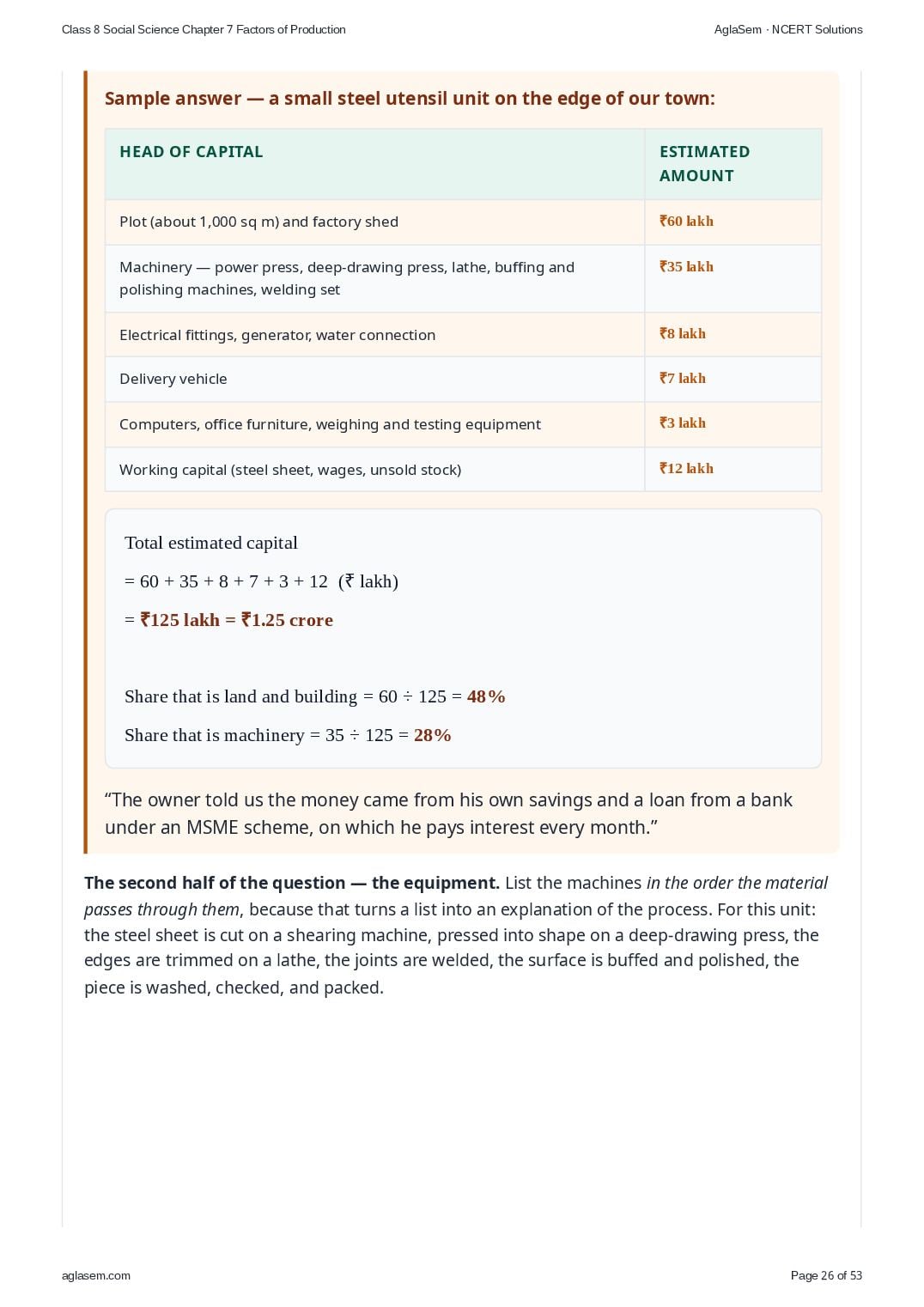
- Identify a factory in your region. Find out how much capital may have been invested in the construction of the factory (you may provide an estimate). What kinds of equipment does the factory use to create its finished products?
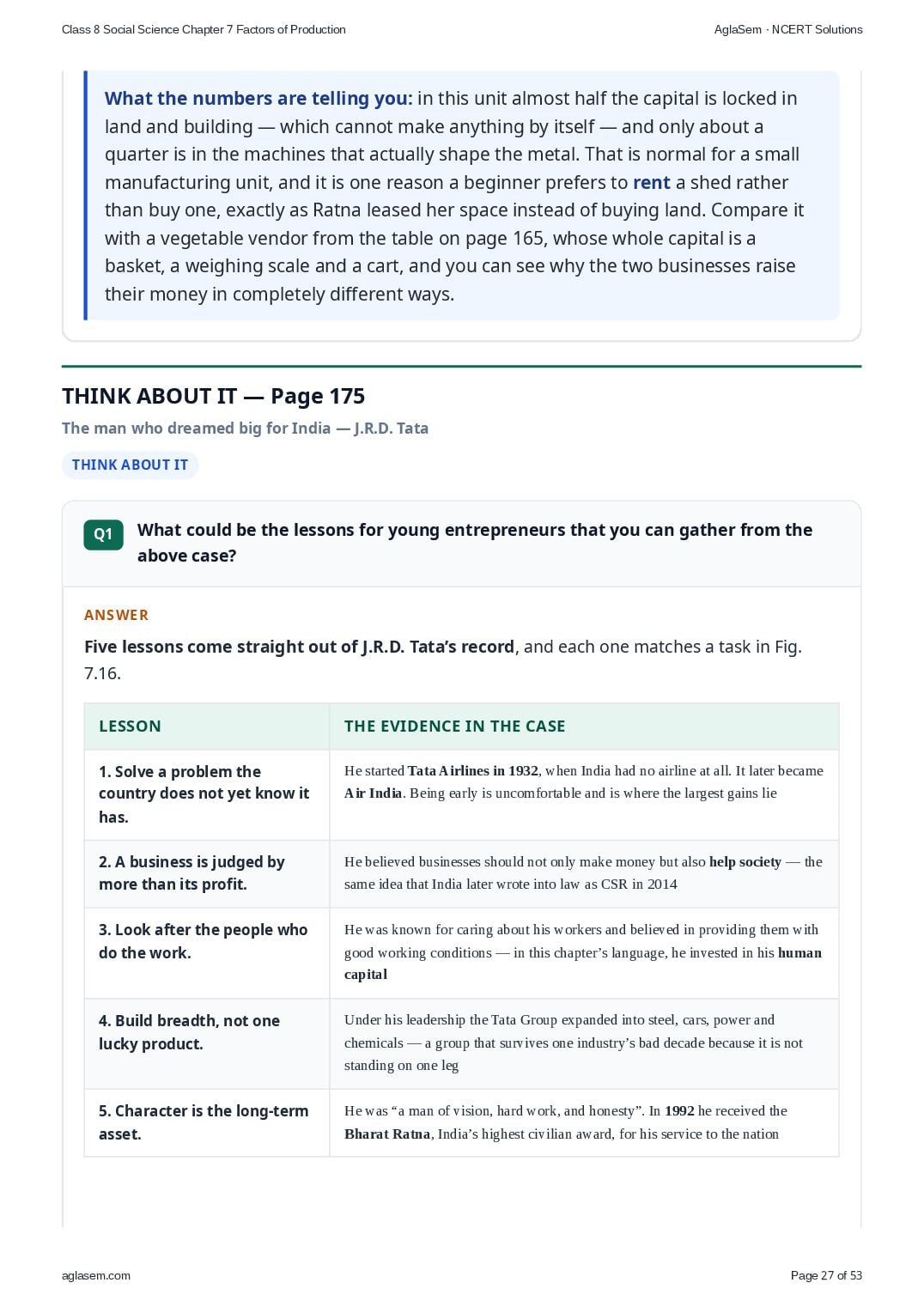
- What could be the lessons for young entrepreneurs that you can gather from the above case?
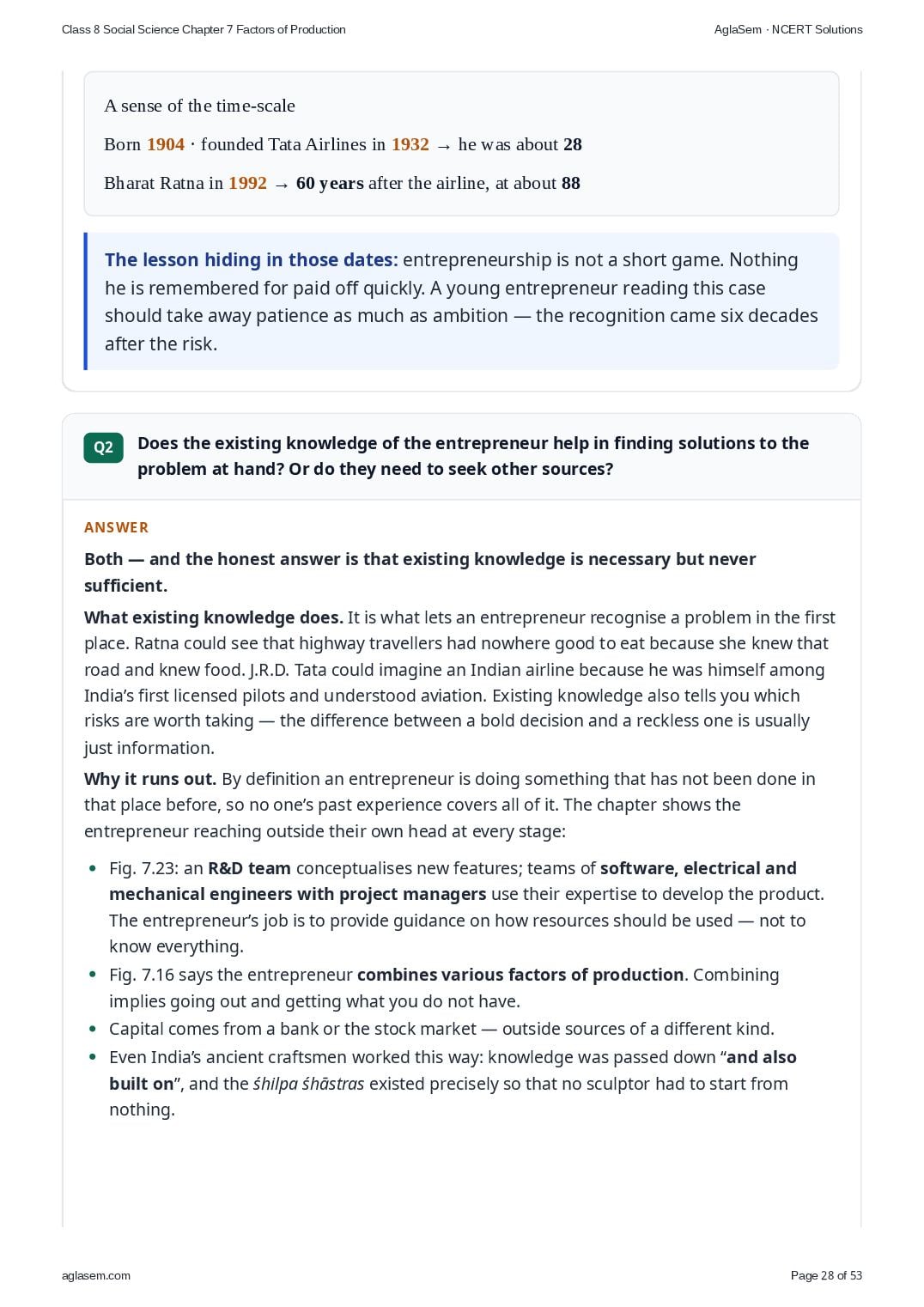
- Does the existing knowledge of the entrepreneur help in finding solutions to the problem at hand? Or do they need to seek other sources?
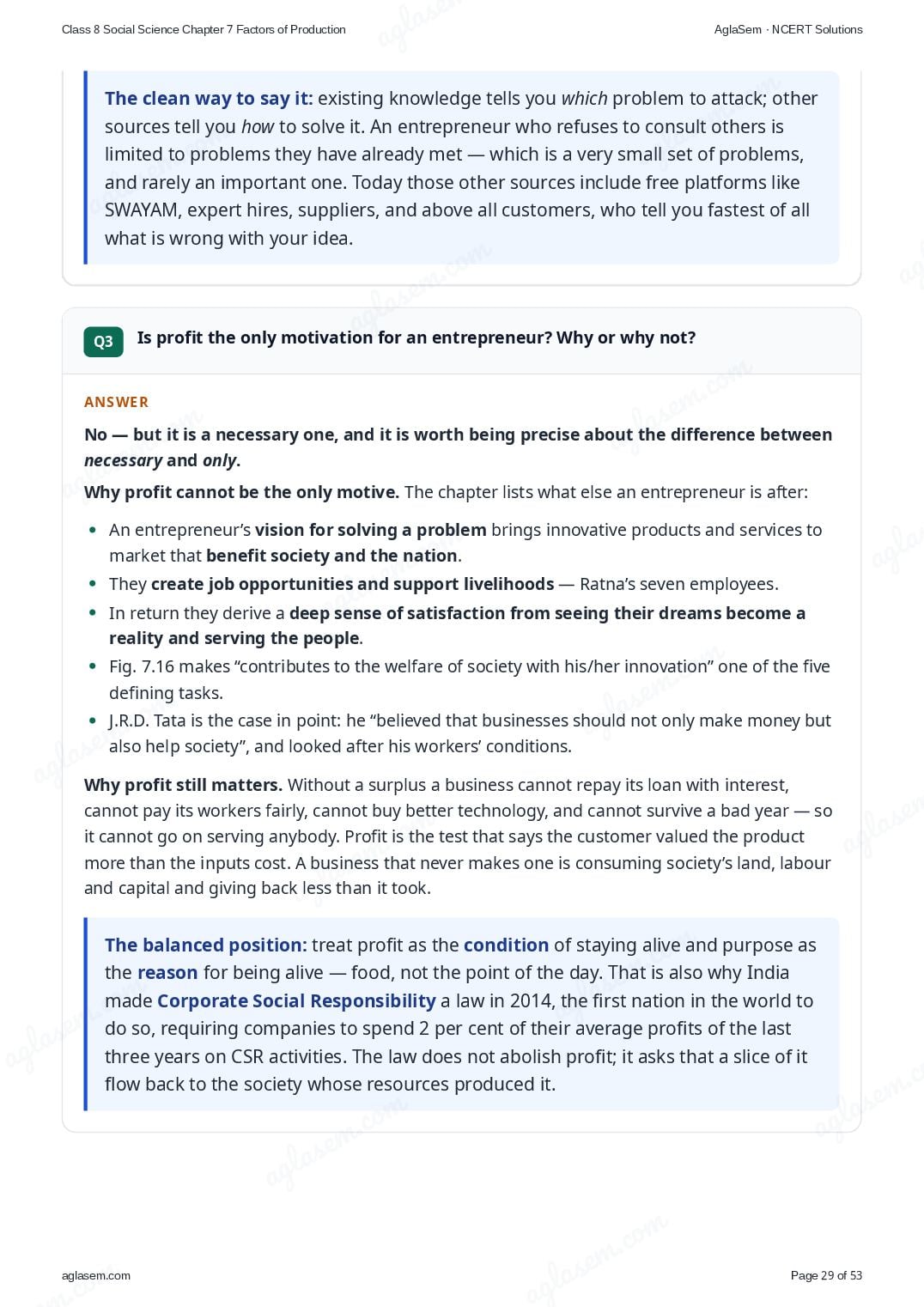
- Is profit the only motivation for an entrepreneur? Why or why not?
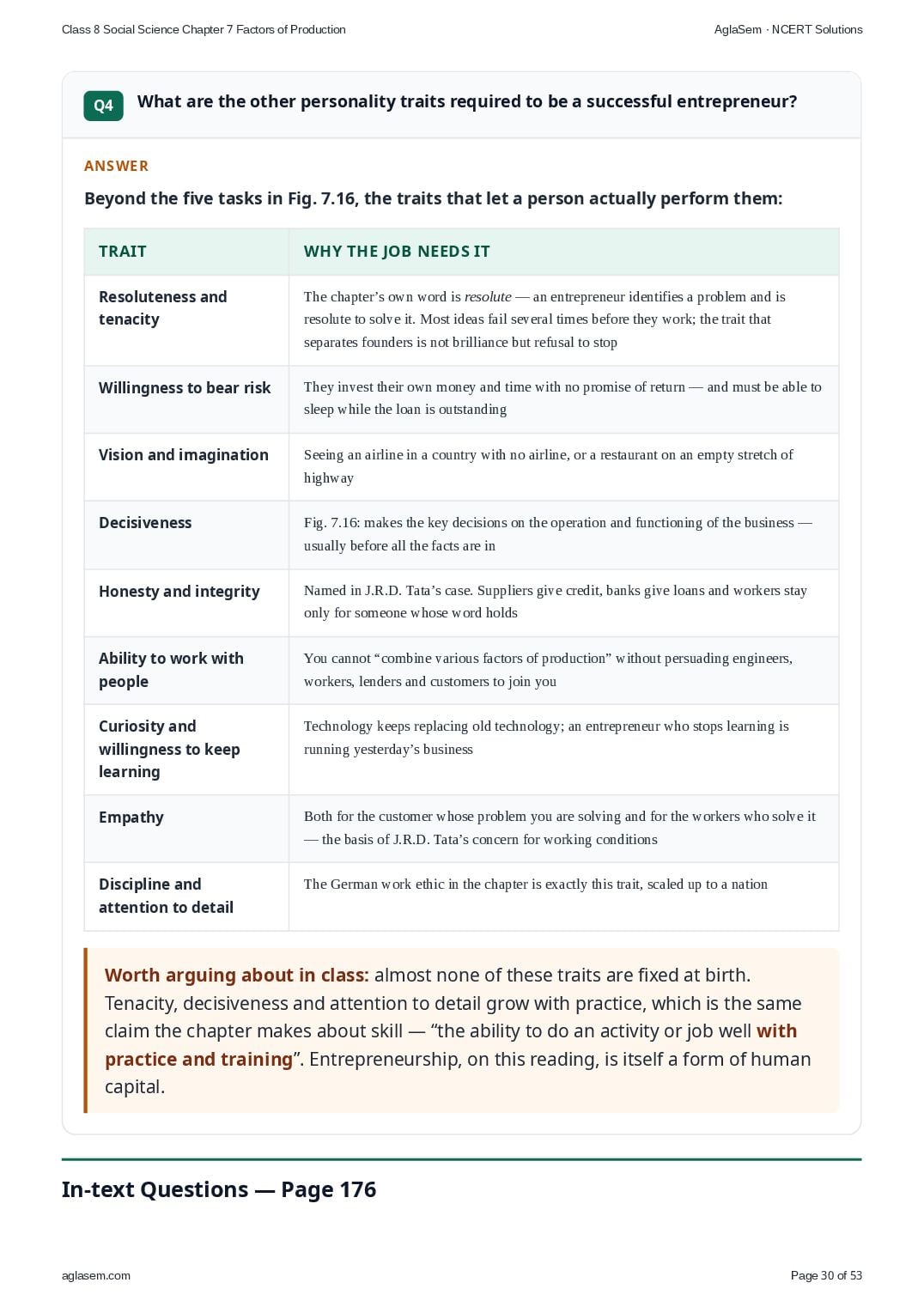
- What are the other personality traits required to be a successful entrepreneur?
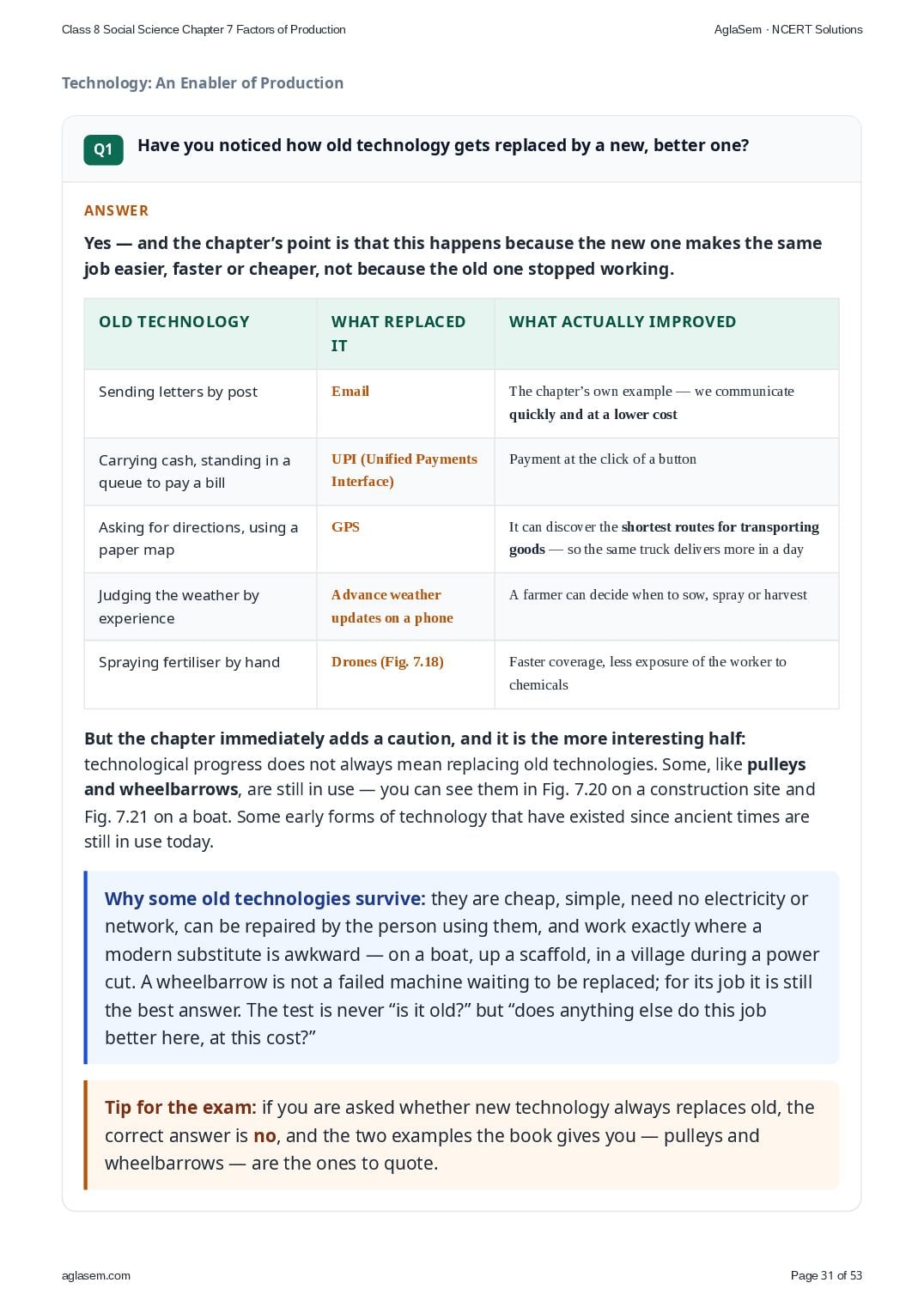
- Have you noticed how old technology gets replaced by a new, better one?
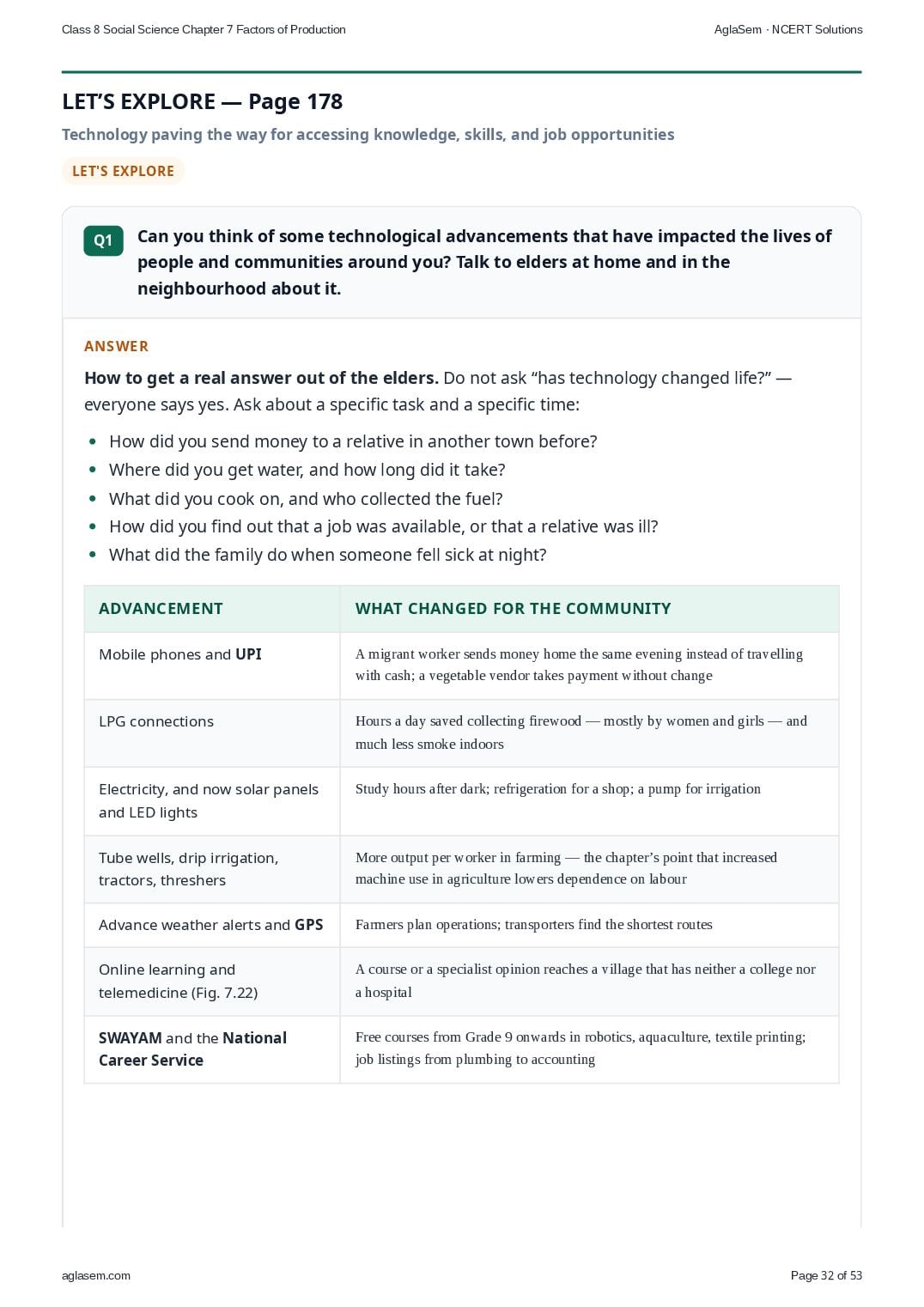
- Can you think of some technological advancements that have impacted the lives of people and communities around you? Talk to elders at home and in the neighbourhood about it.
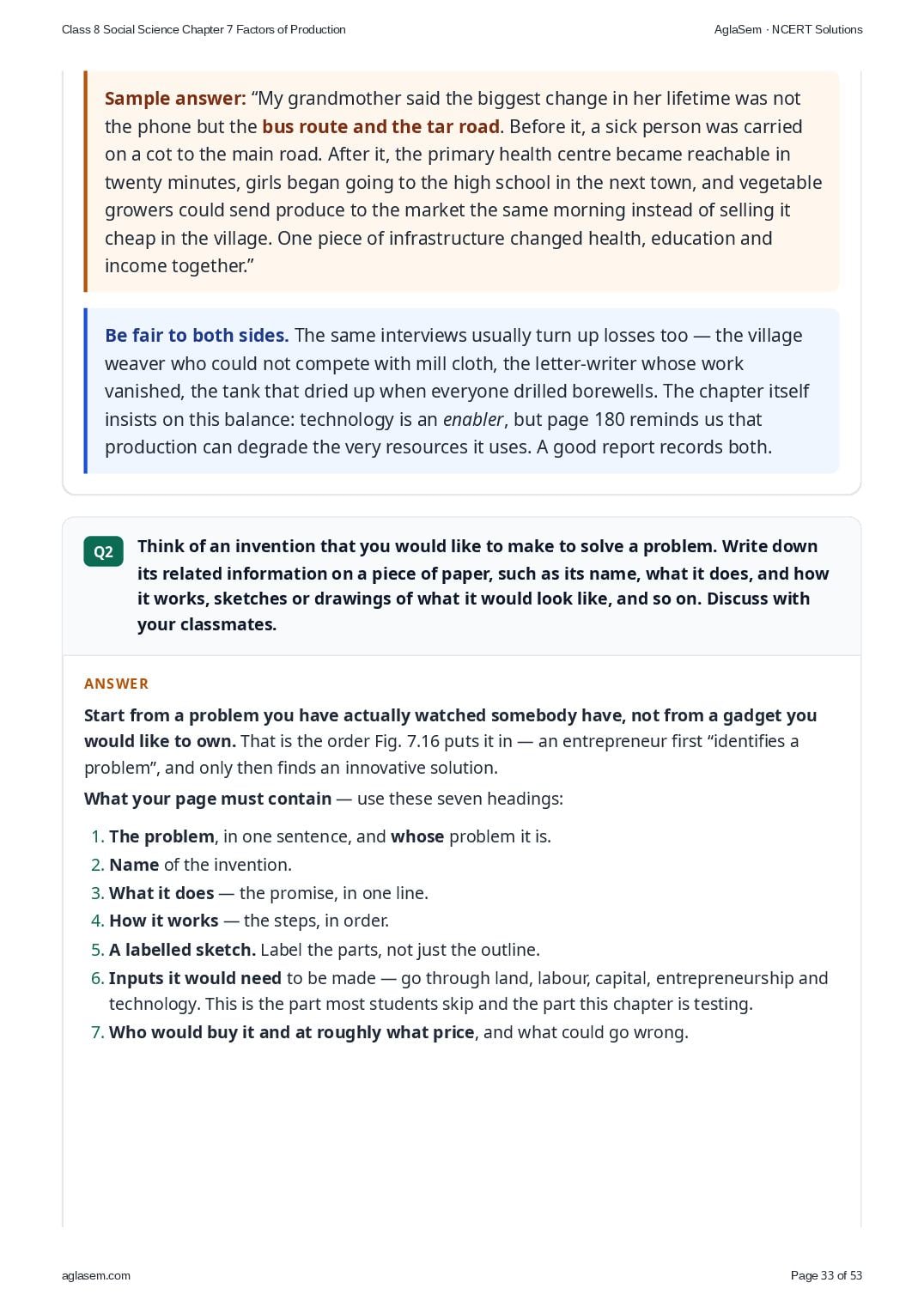
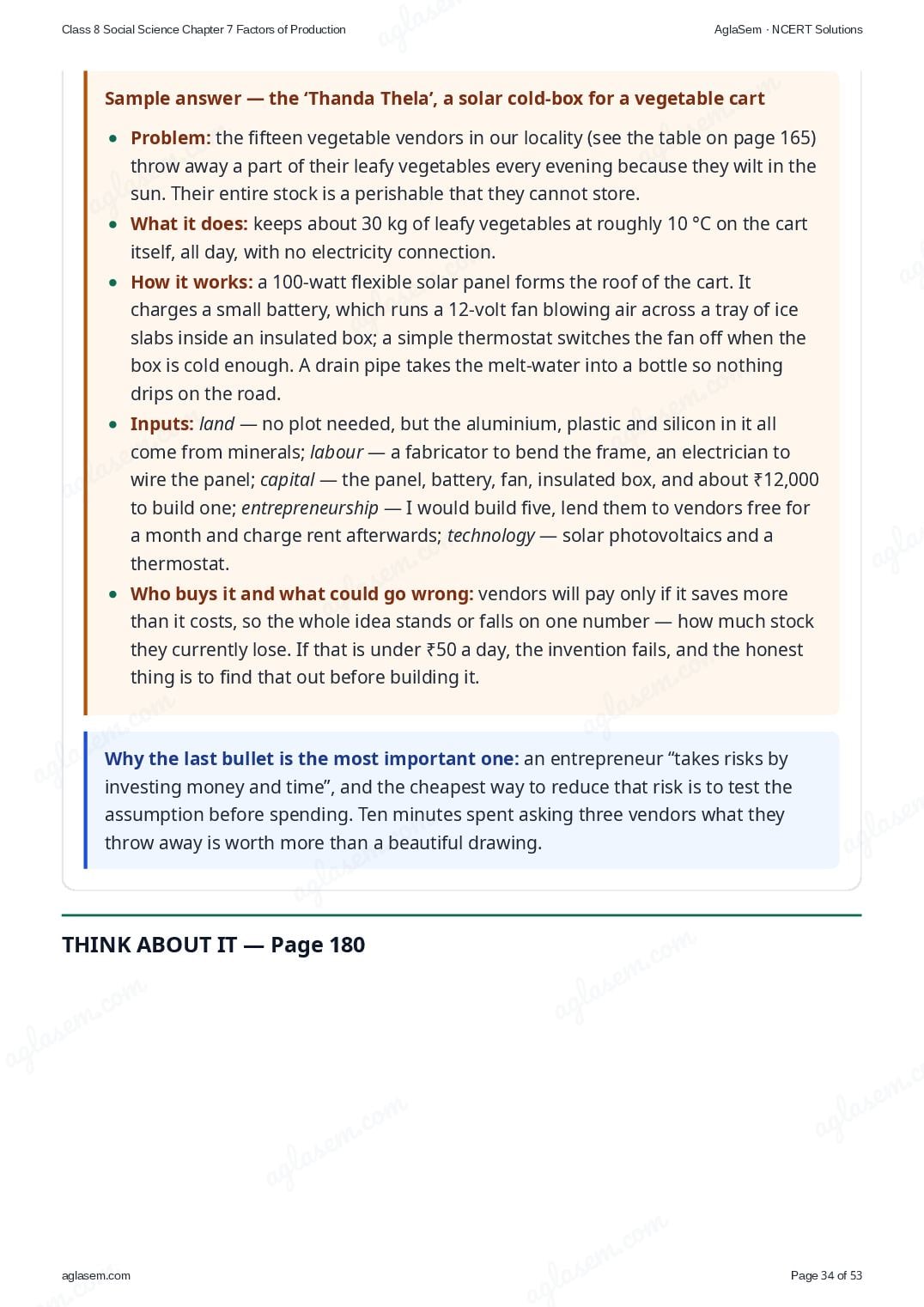
- Think of an invention that you would like to make to solve a problem. Write down its related information on a piece of paper, such as its name, what it does, and how it works, sketches or drawings of what it would look like, and so on. Discuss with your classmates.
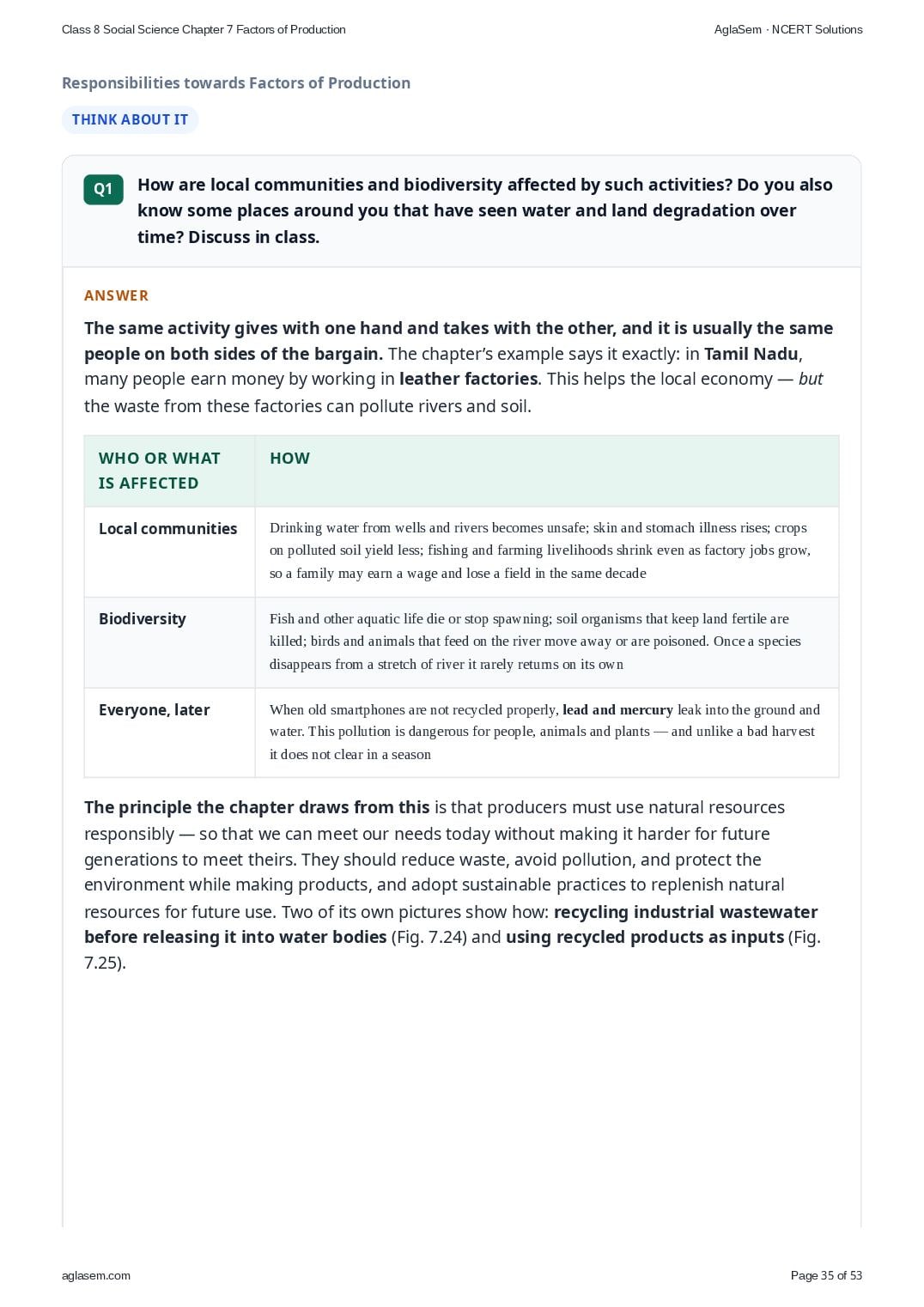
- How are local communities and biodiversity affected by such activities? Do you also know some places around you that have seen water and land degradation over time? Discuss in class.
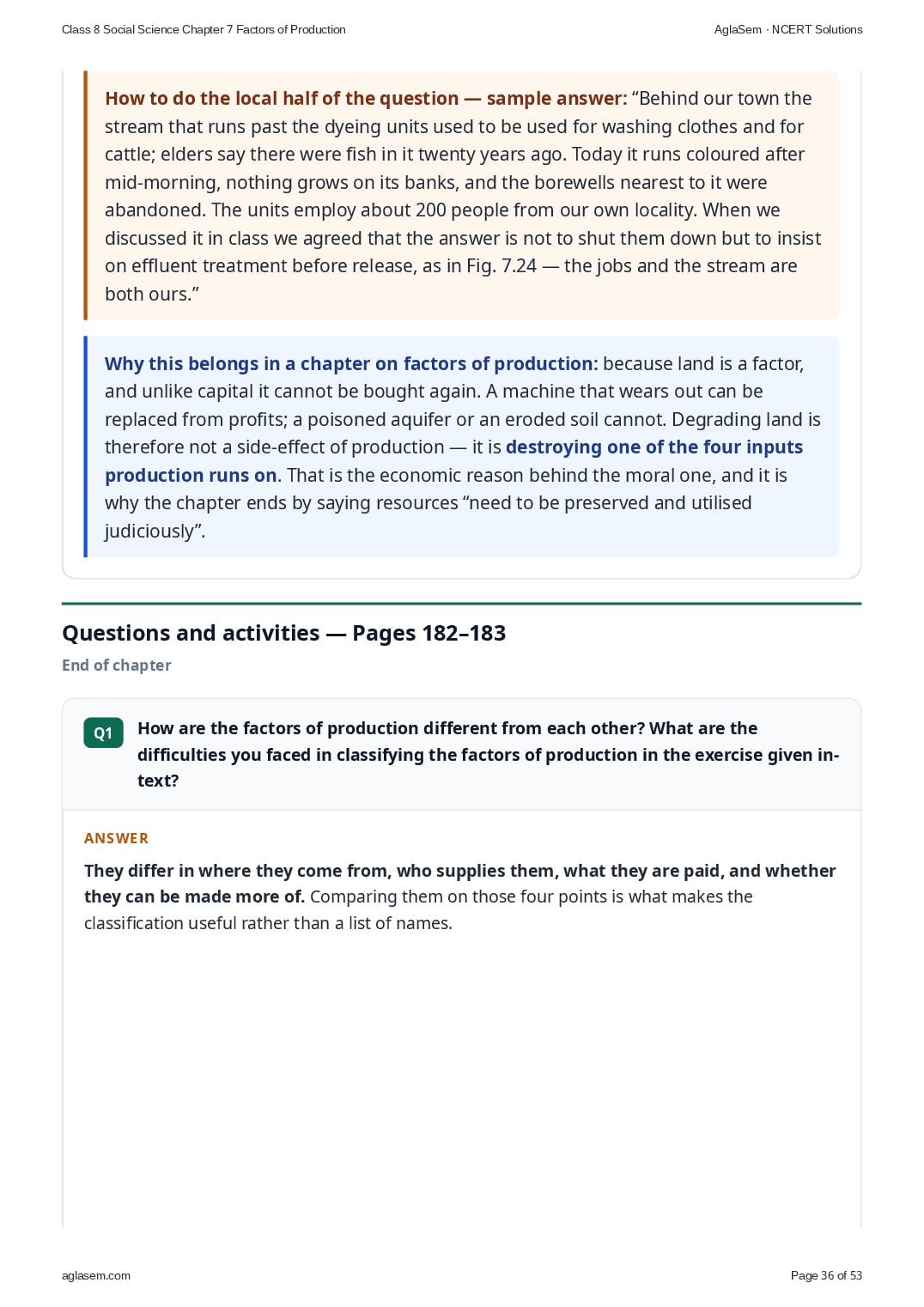
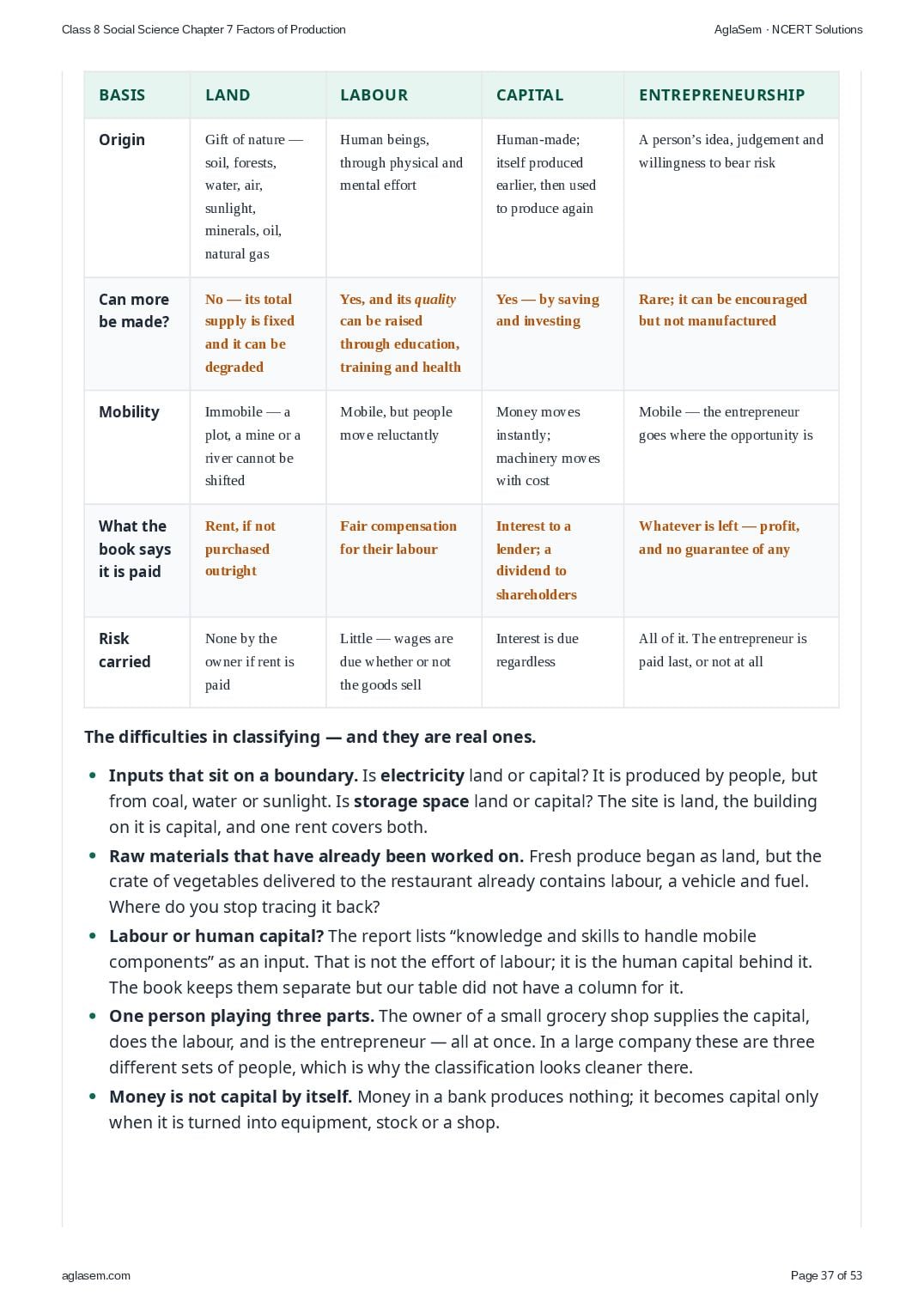
- How are the factors of production different from each other? What are the difficulties you faced in classifying the factors of production in the exercise given in-text?
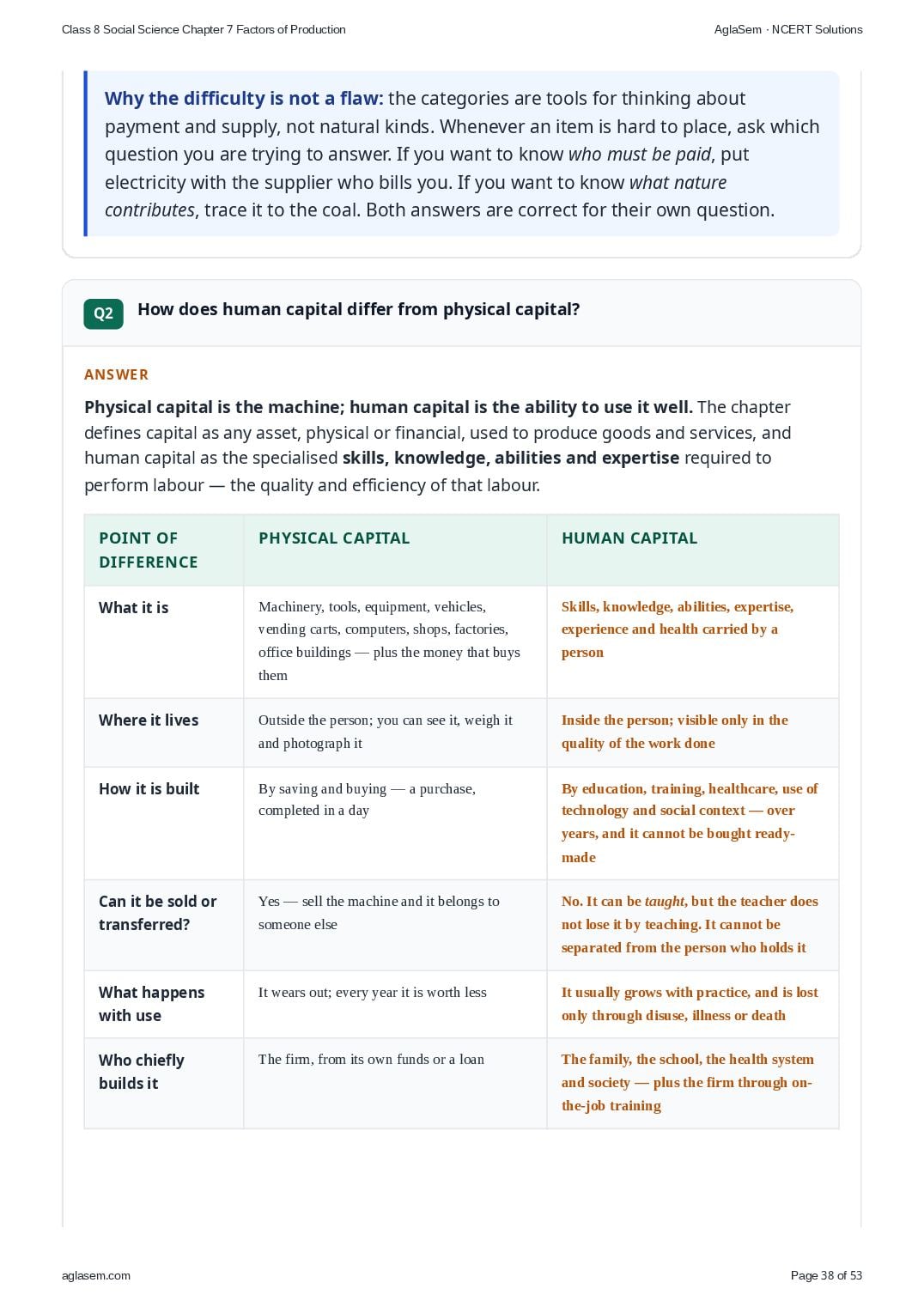
- How does human capital differ from physical capital?
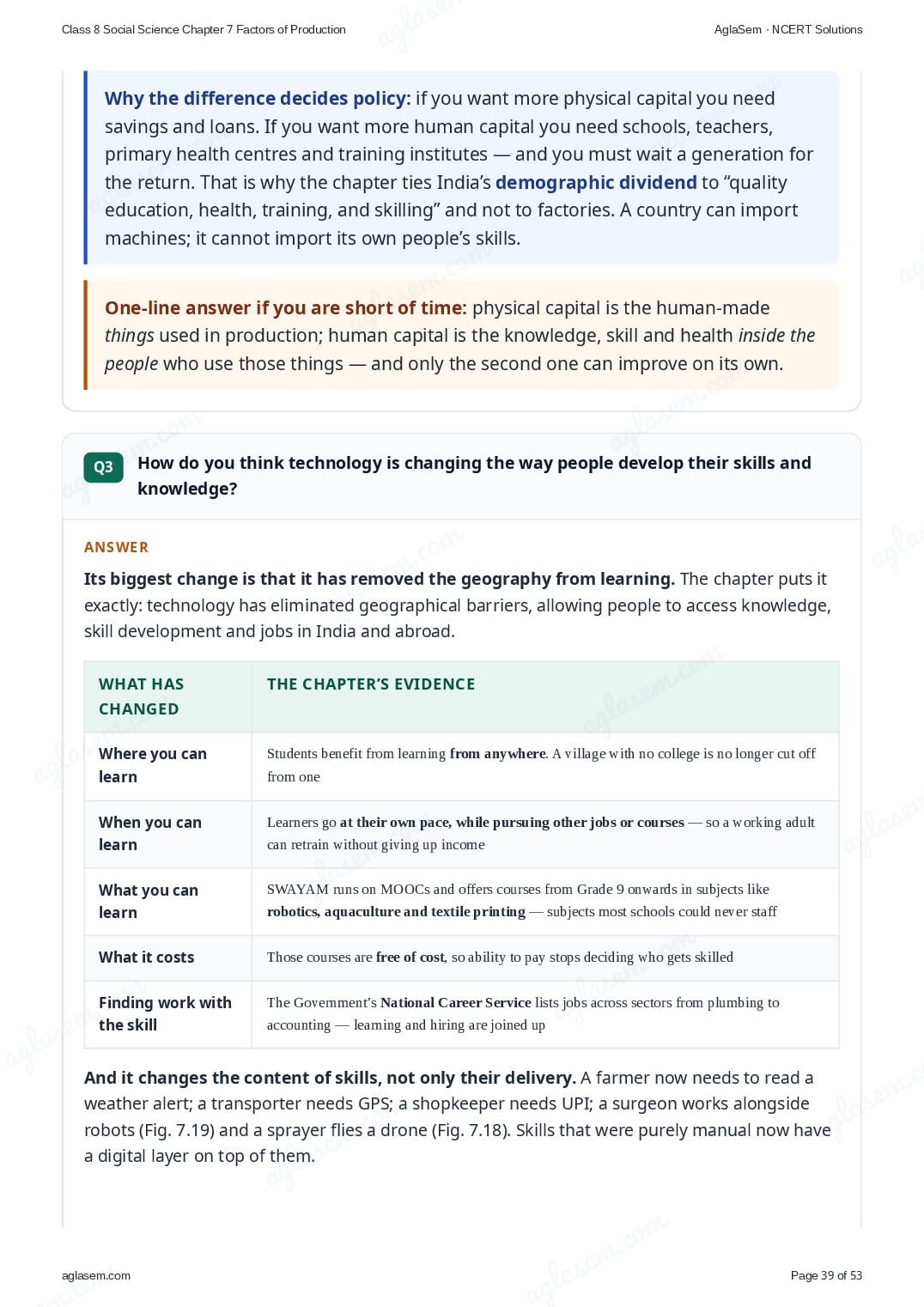
- How do you think technology is changing the way people develop their skills and knowledge?
- A skill is something you learn and practice to get better. It helps you do things well, like playing a sport, creative writing, solving math problems, cooking, or even communicating well with people. If you could learn one skill today, what would it be and why?
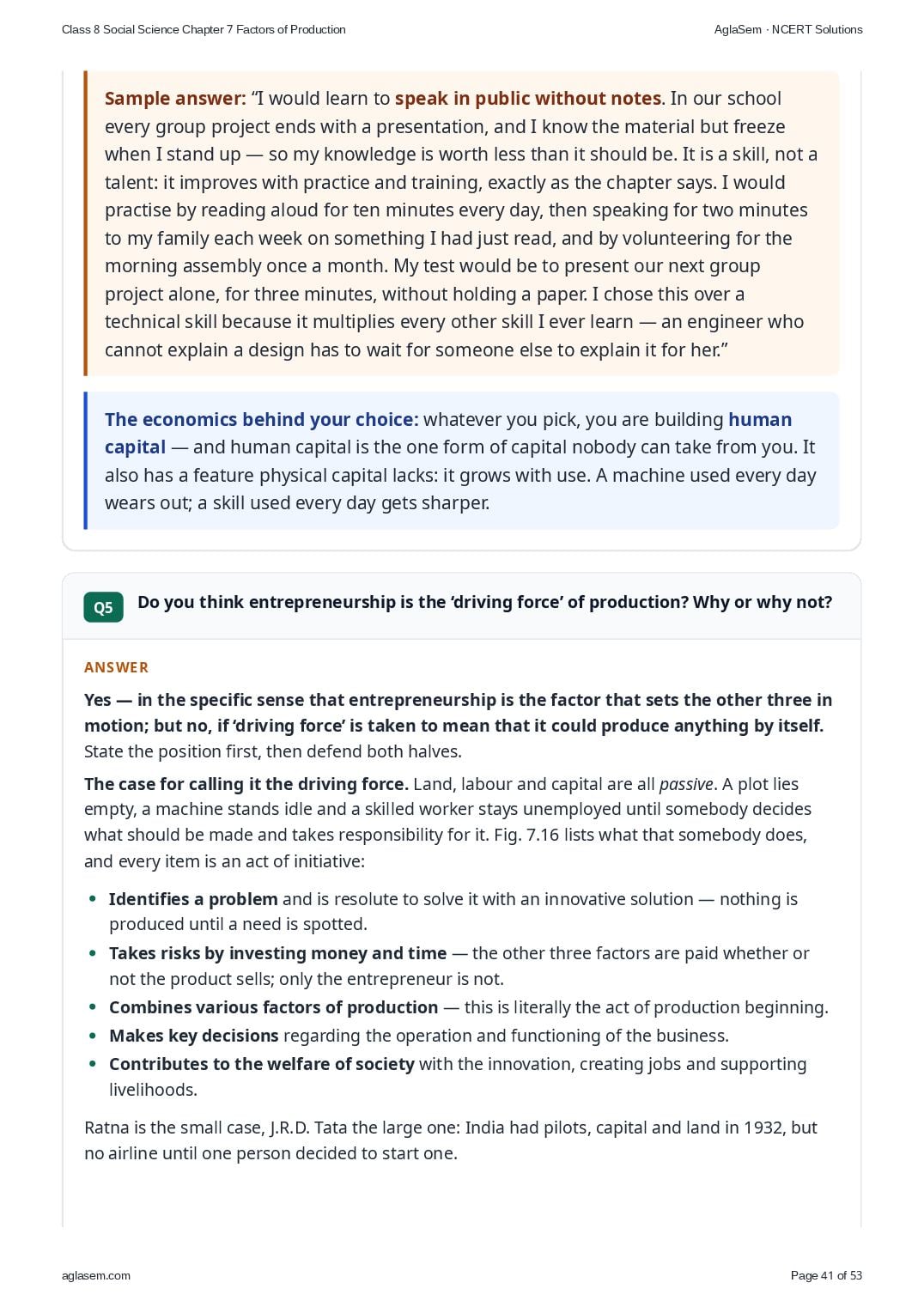
- Do you think entrepreneurship is the ‘driving force’ of production? Why or why not?
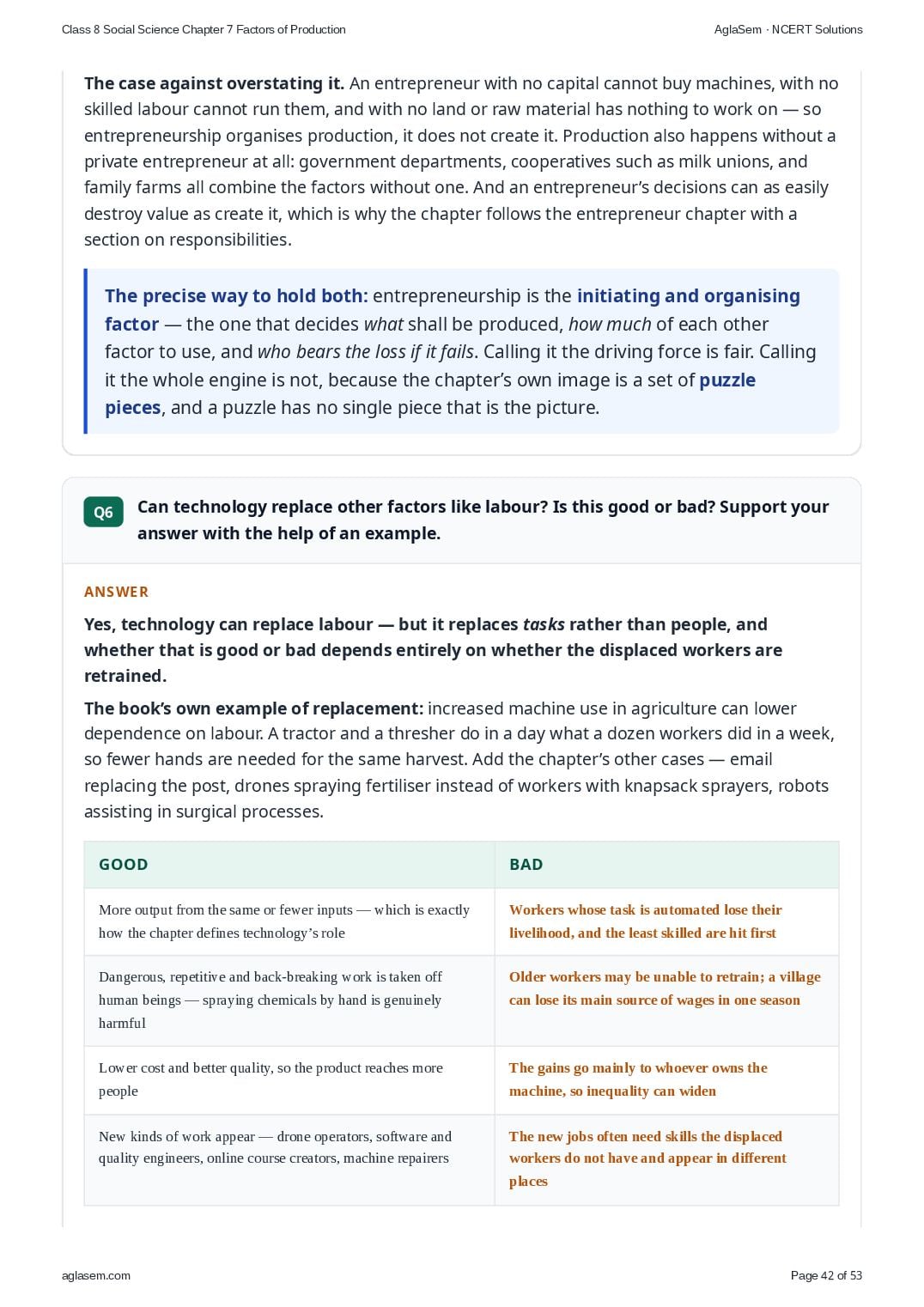
- Can technology replace other factors like labour? Is this good or bad? Support your answer with the help of an example.
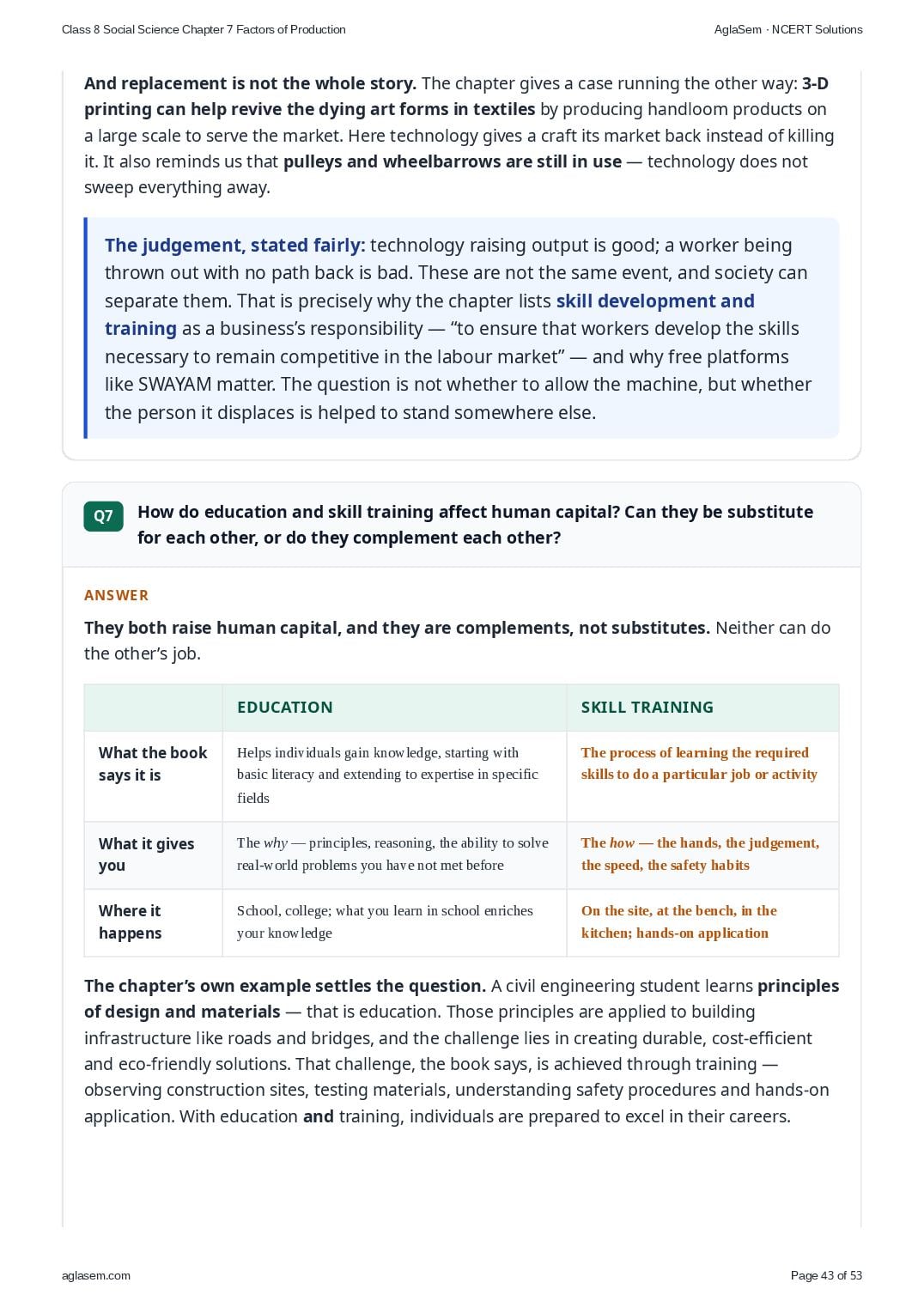
- How do education and skill training affect human capital? Can they be substitute for each other, or do they complement each other?
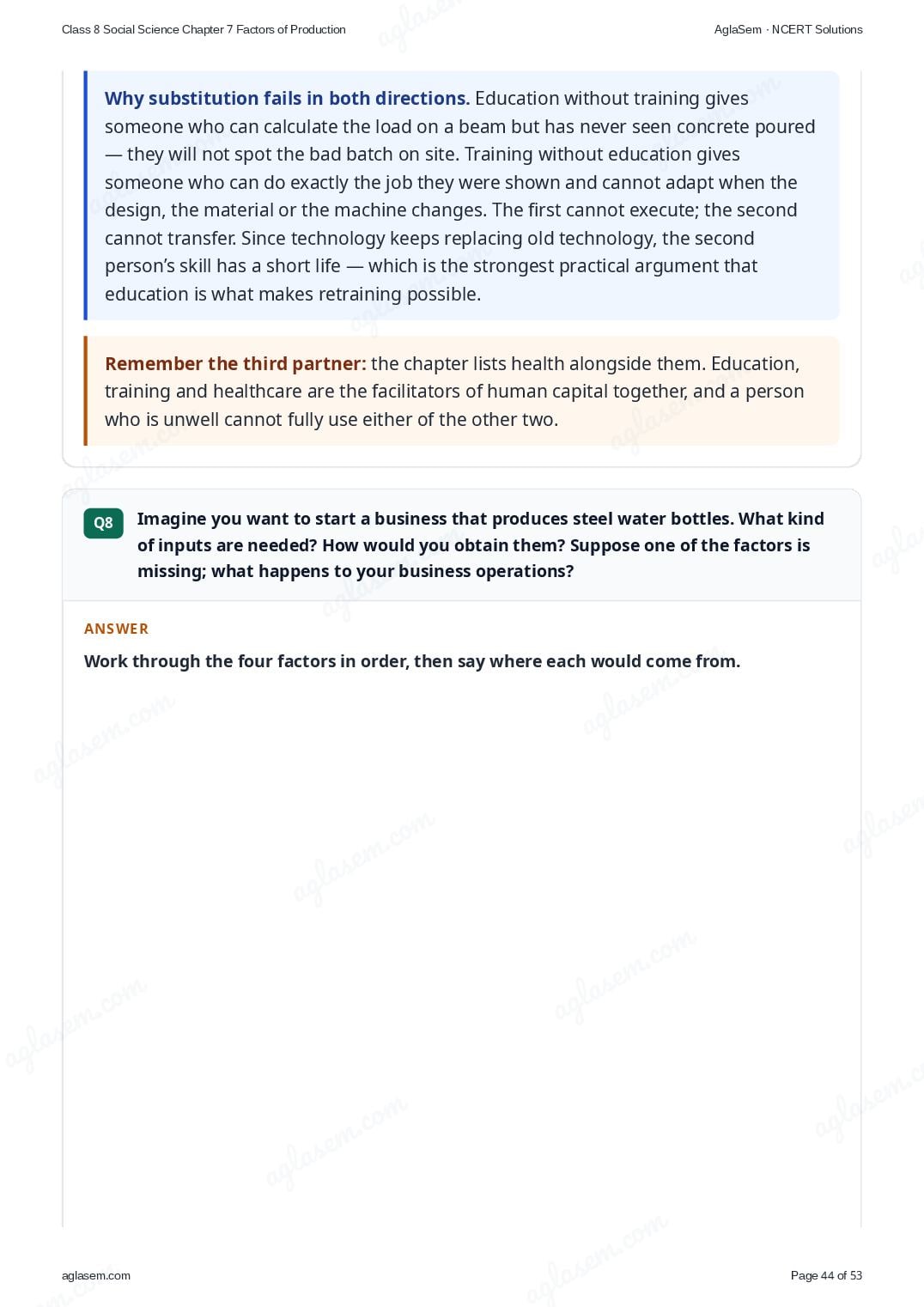
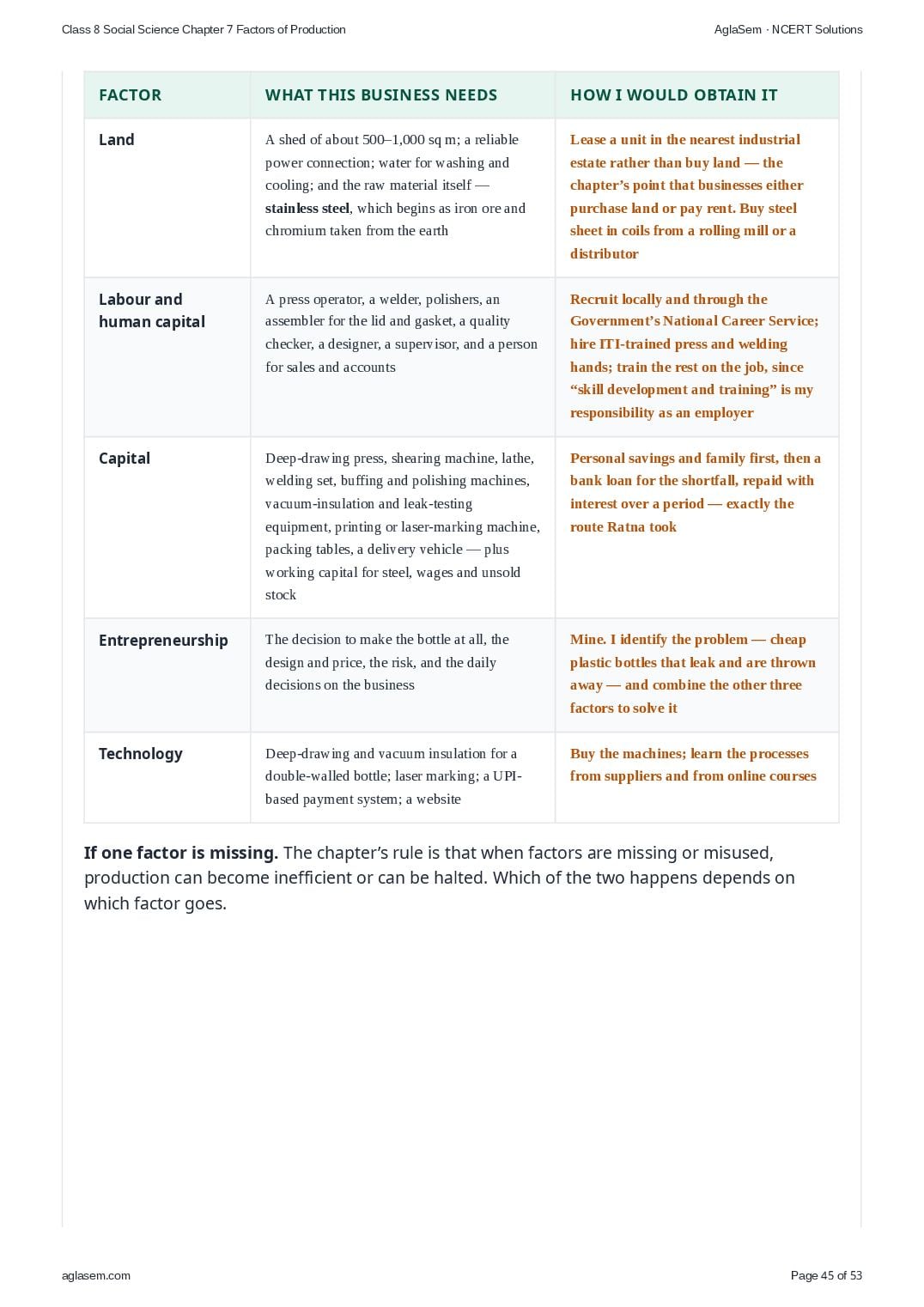
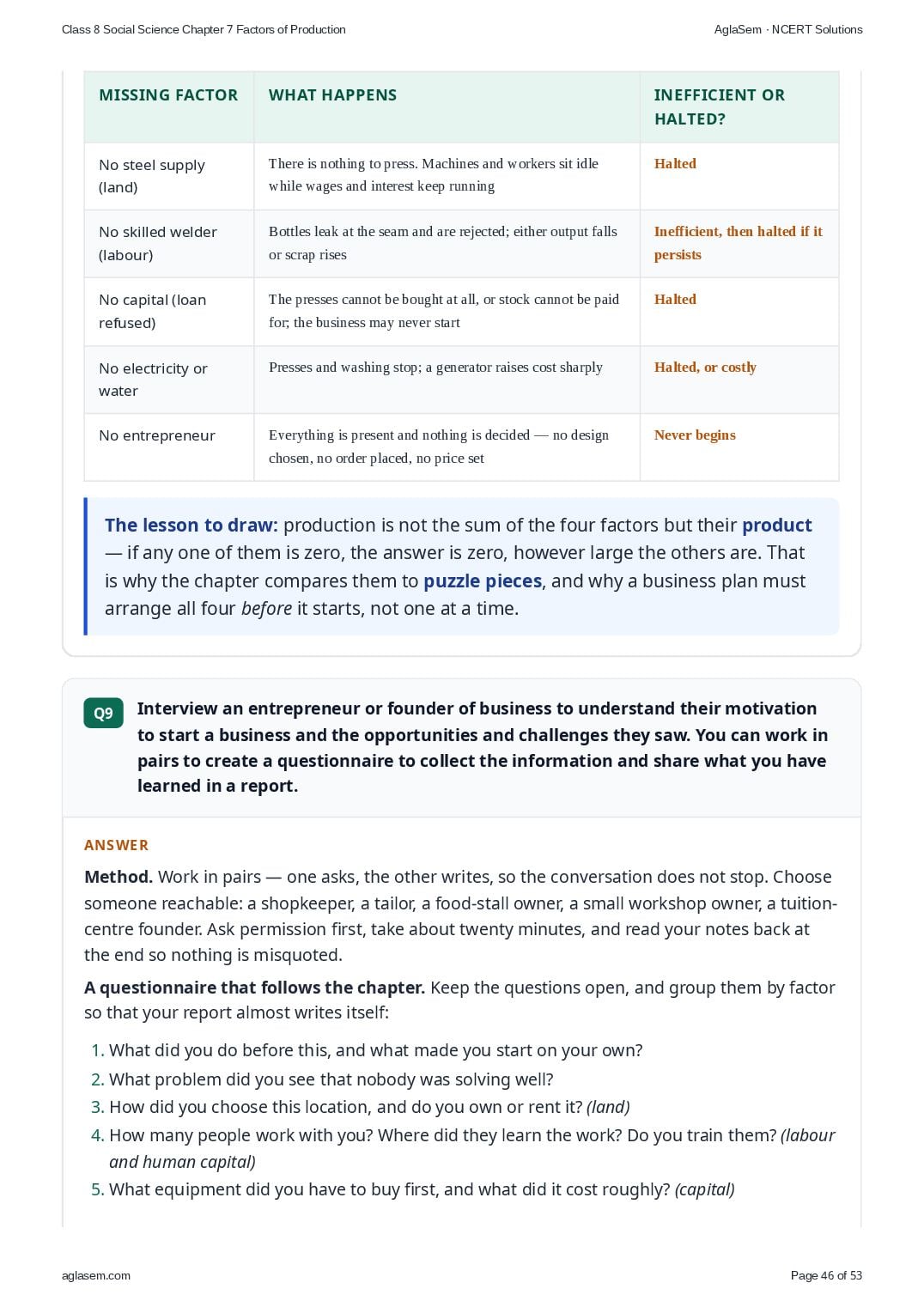
- Imagine you want to start a business that produces steel water bottles. What kind of inputs are needed? How would you obtain them? Suppose one of the factors is missing; what happens to your business operations?
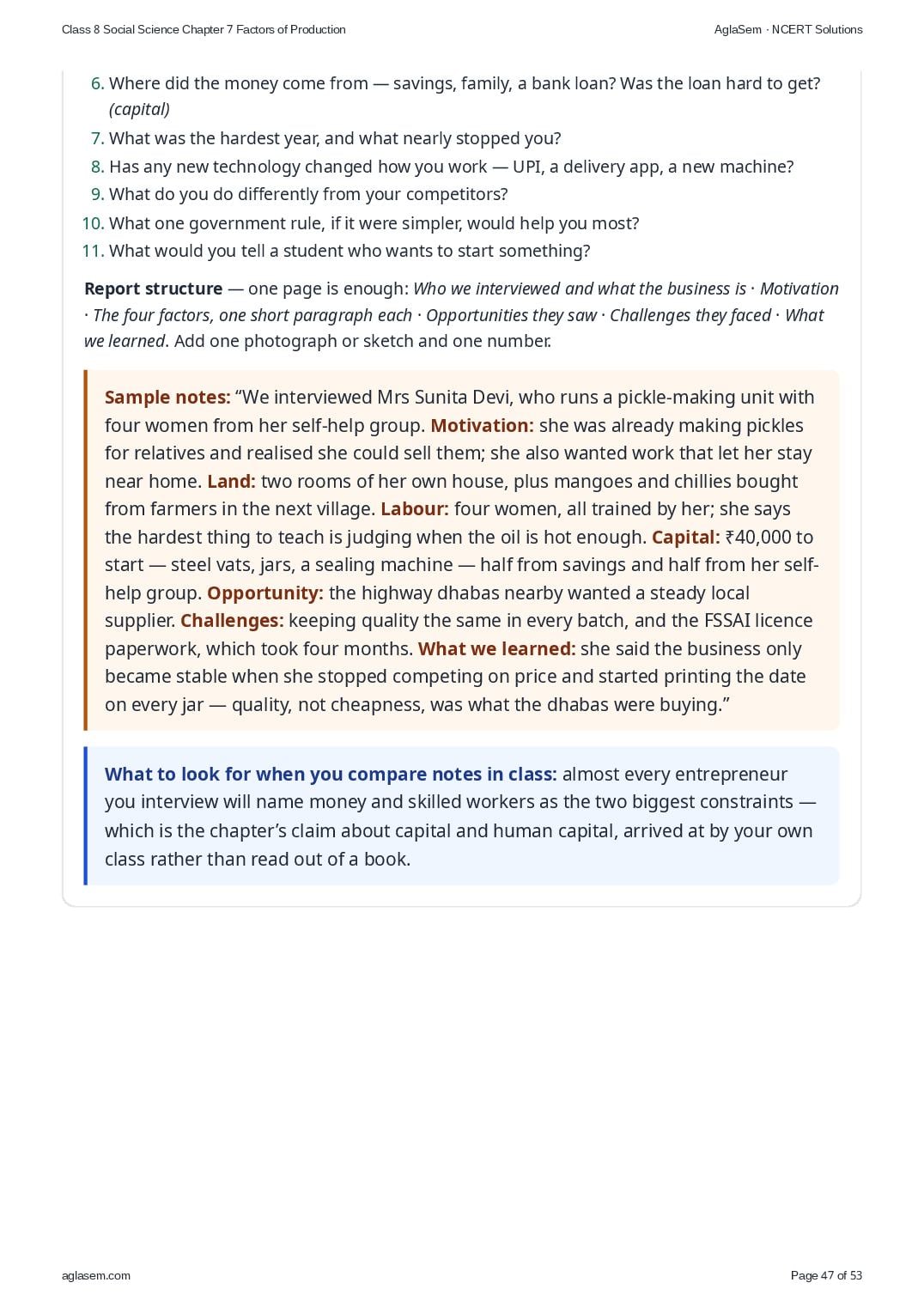
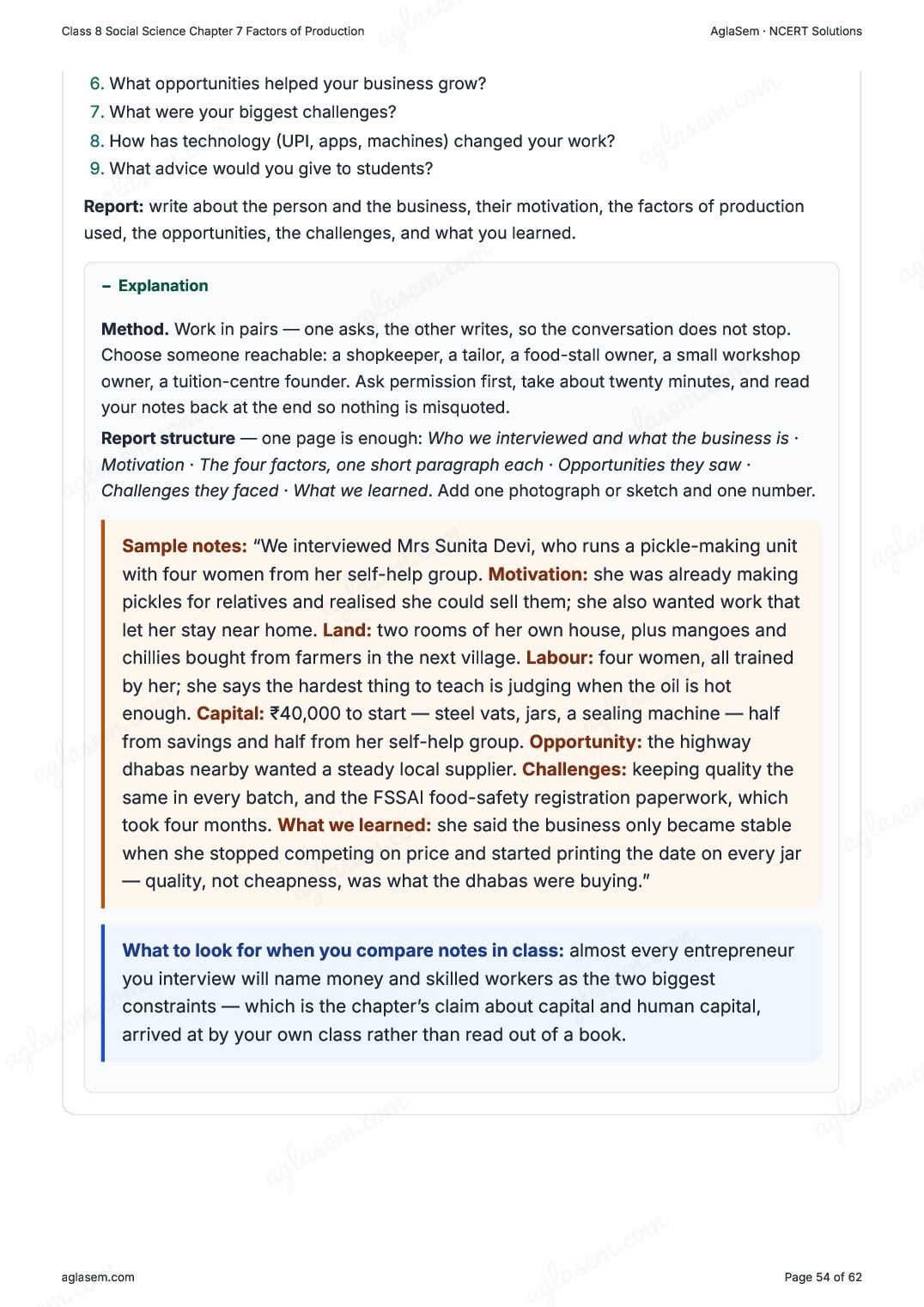
- Interview an entrepreneur or founder of business to understand their motivation to start a business and the opportunities and challenges they saw. You can work in pairs to create a questionnaire to collect the information and share what you have learned in a report.
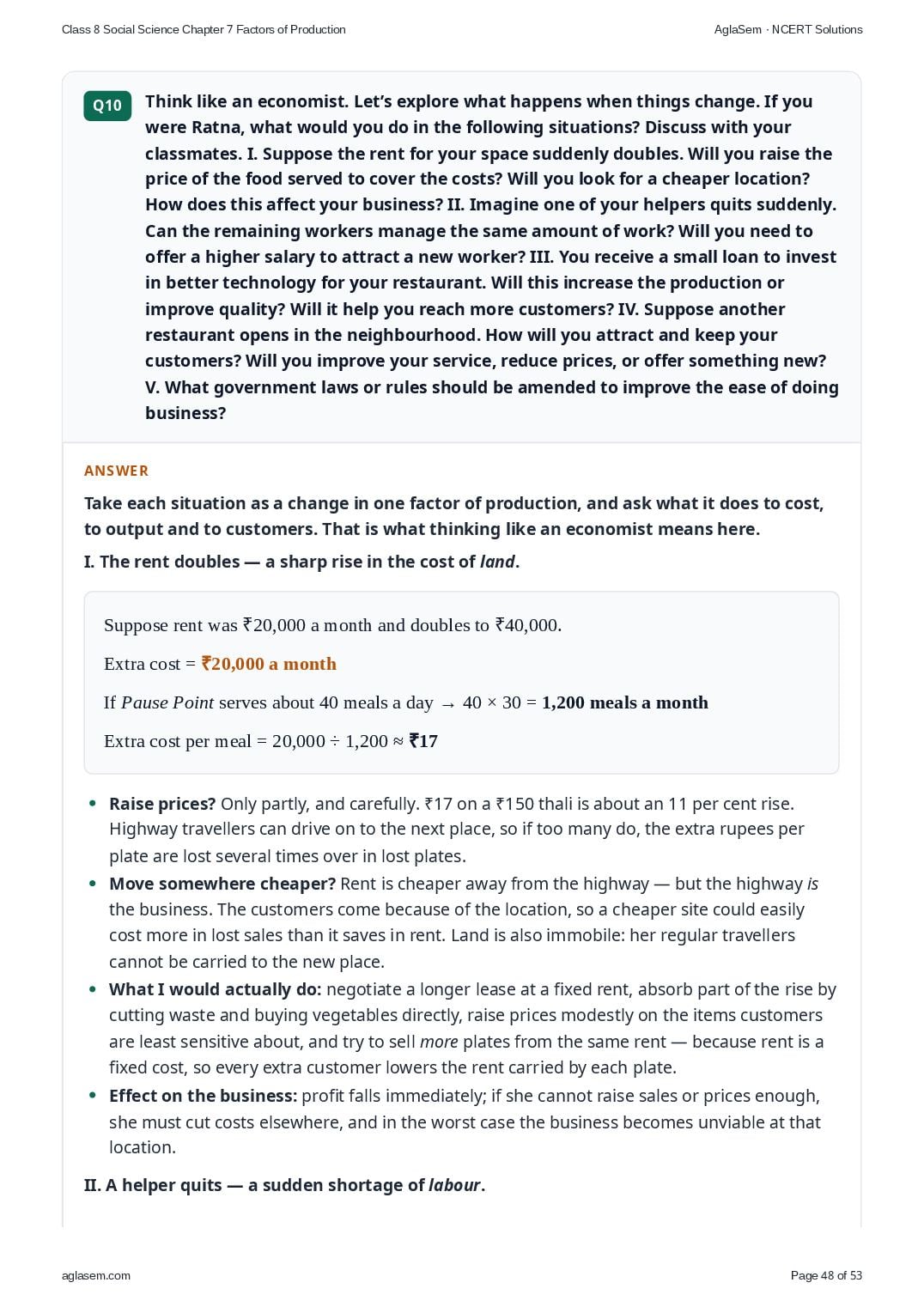
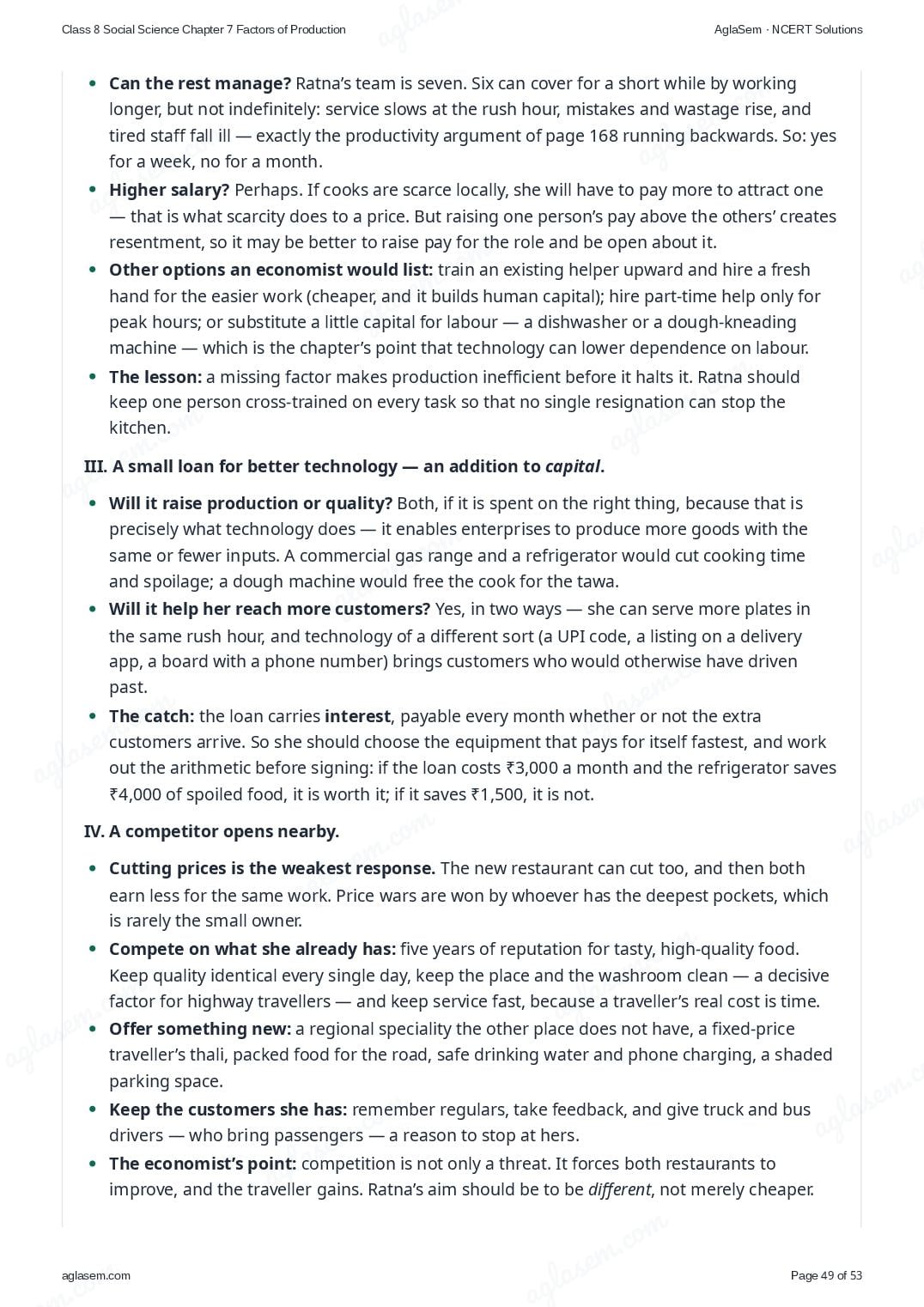
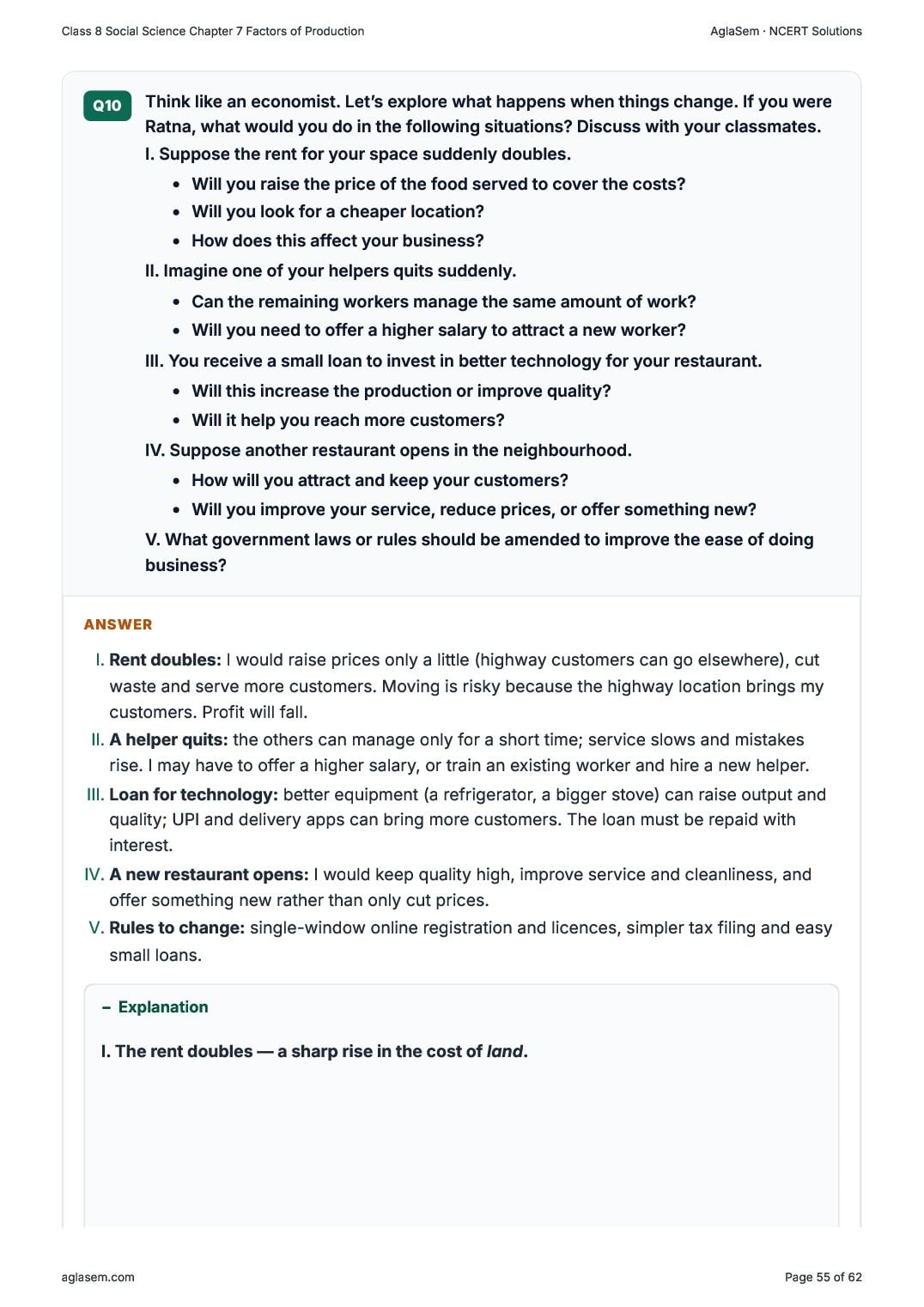
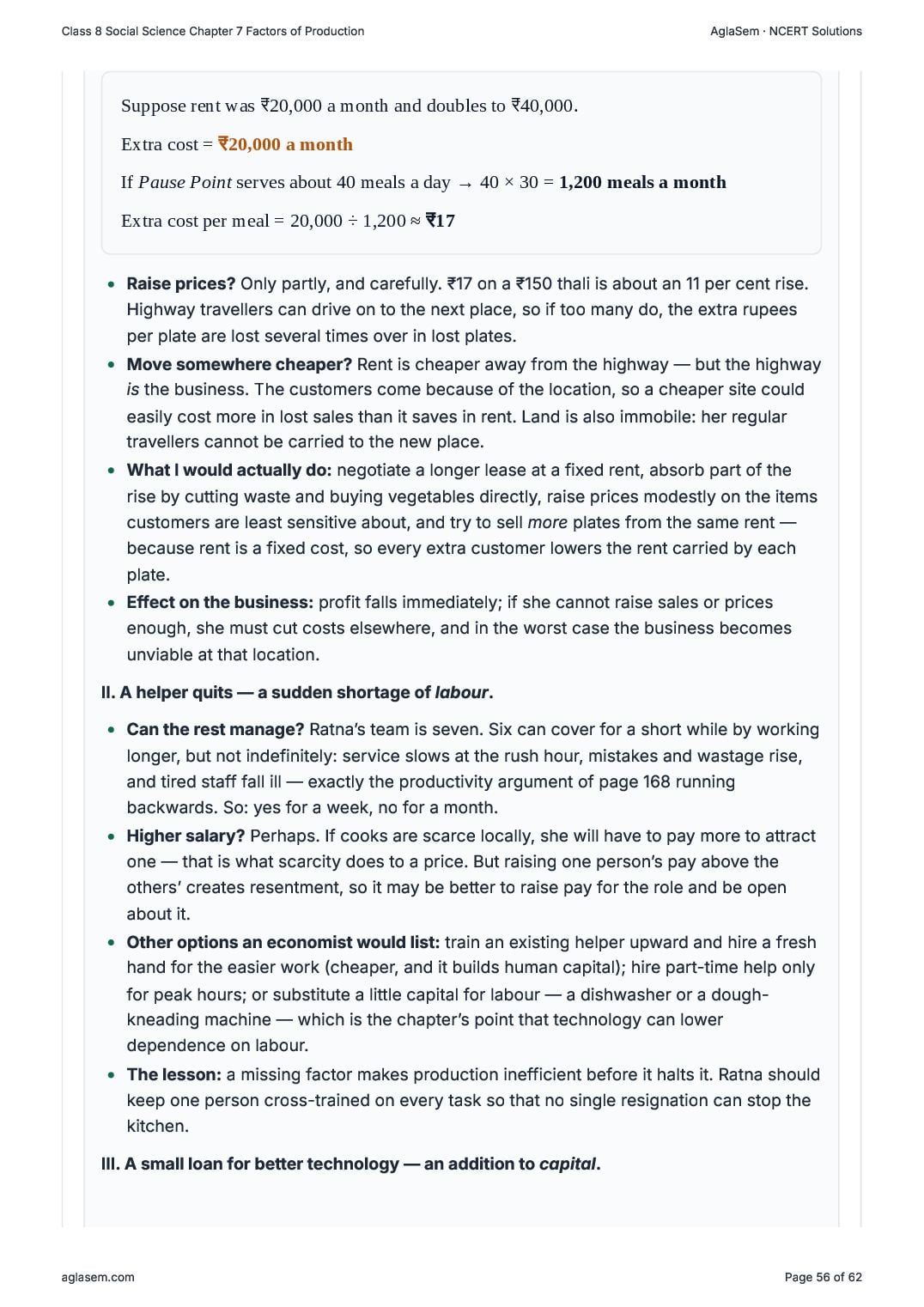
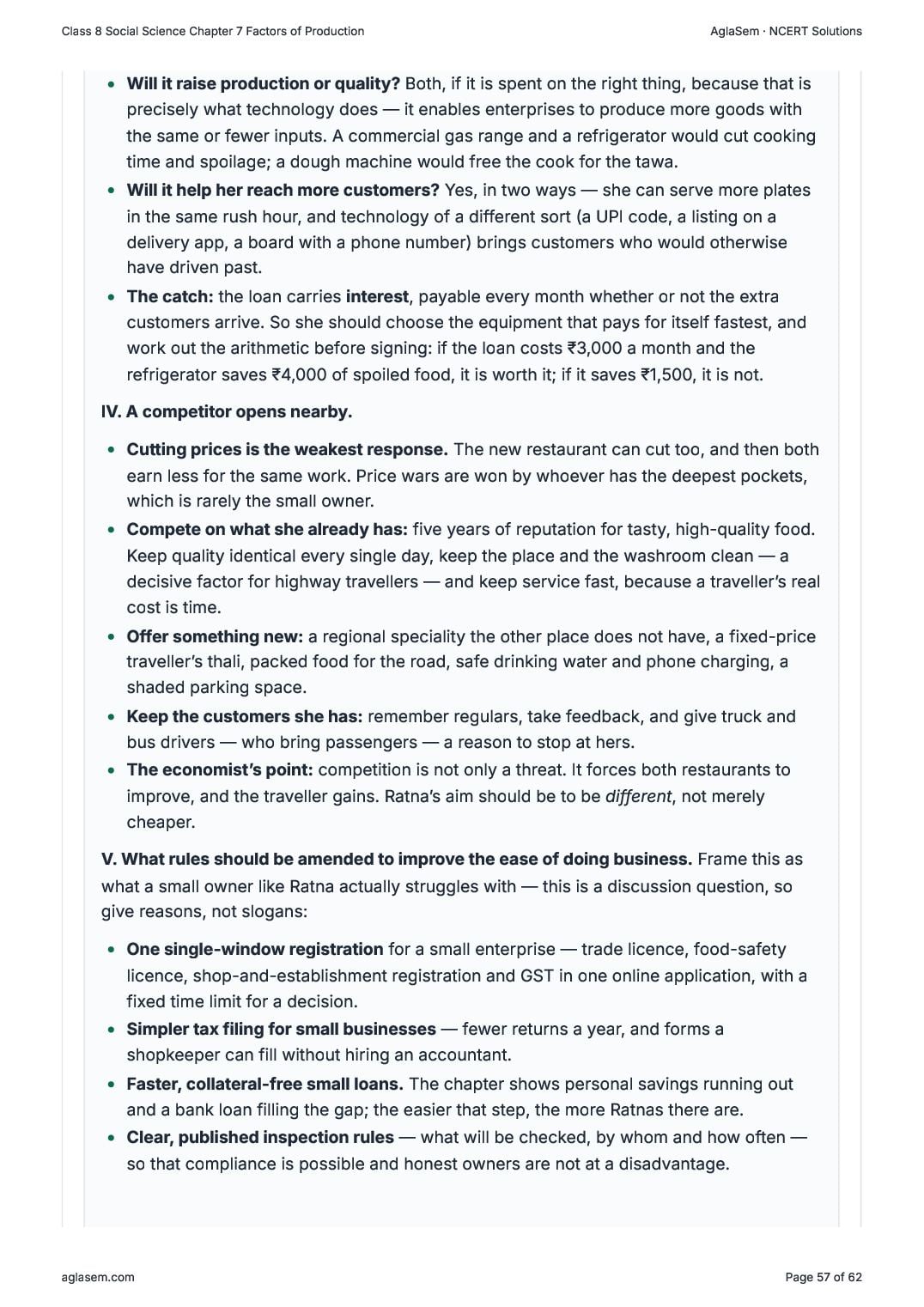
- Think like an economist. Let’s explore what happens when things change. If you were Ratna, what would you do in the following situations? Discuss with your classmates. I. Suppose the rent for your space suddenly doubles. Will you raise the price of the food served to cover the costs? Will you look for a cheaper location? How does this affect your business? II. Imagine one of your helpers quits suddenly. Can the remaining workers manage the same amount of work? Will you need to offer a higher salary to attract a new worker? III. You receive a small loan to invest in better technology for your restaurant. Will this increase the production or improve quality? Will it help you reach more customers? IV. Suppose another restaurant opens in the neighbourhood. How will you attract and keep your customers? Will you improve your service, reduce prices, or offer something new? V. What government laws or rules should be amended to improve the ease of doing business?
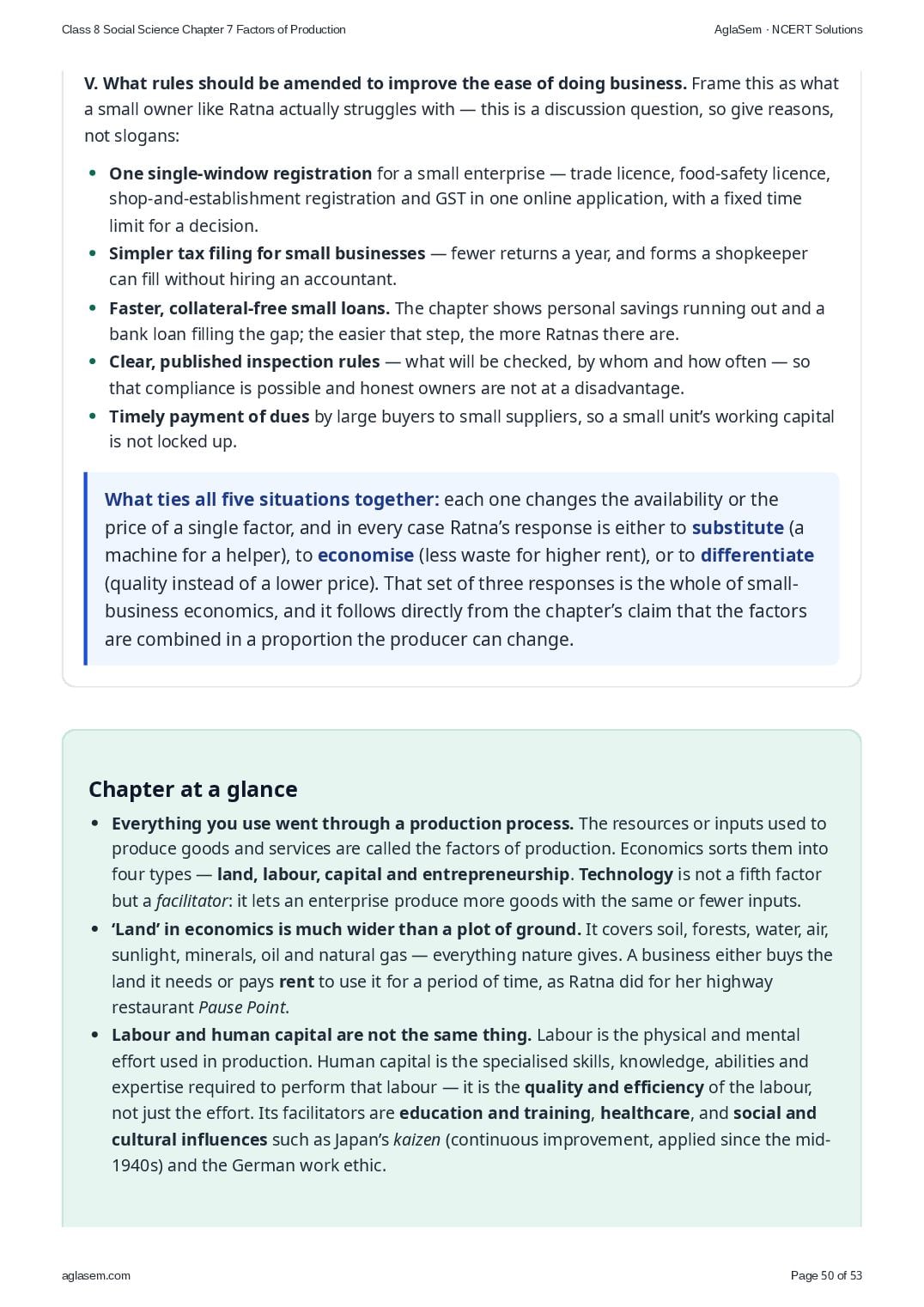
Chapter at a Glance
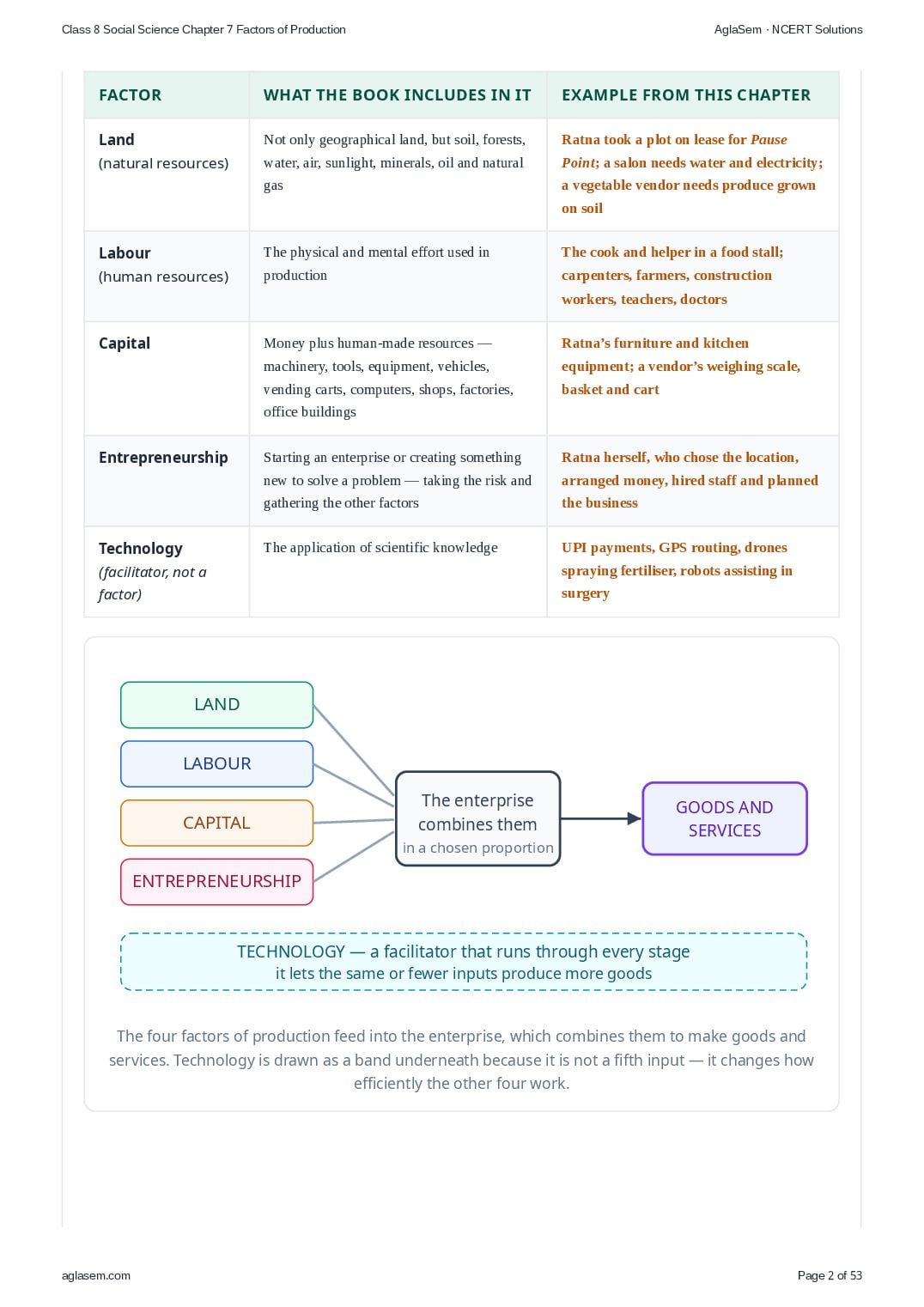
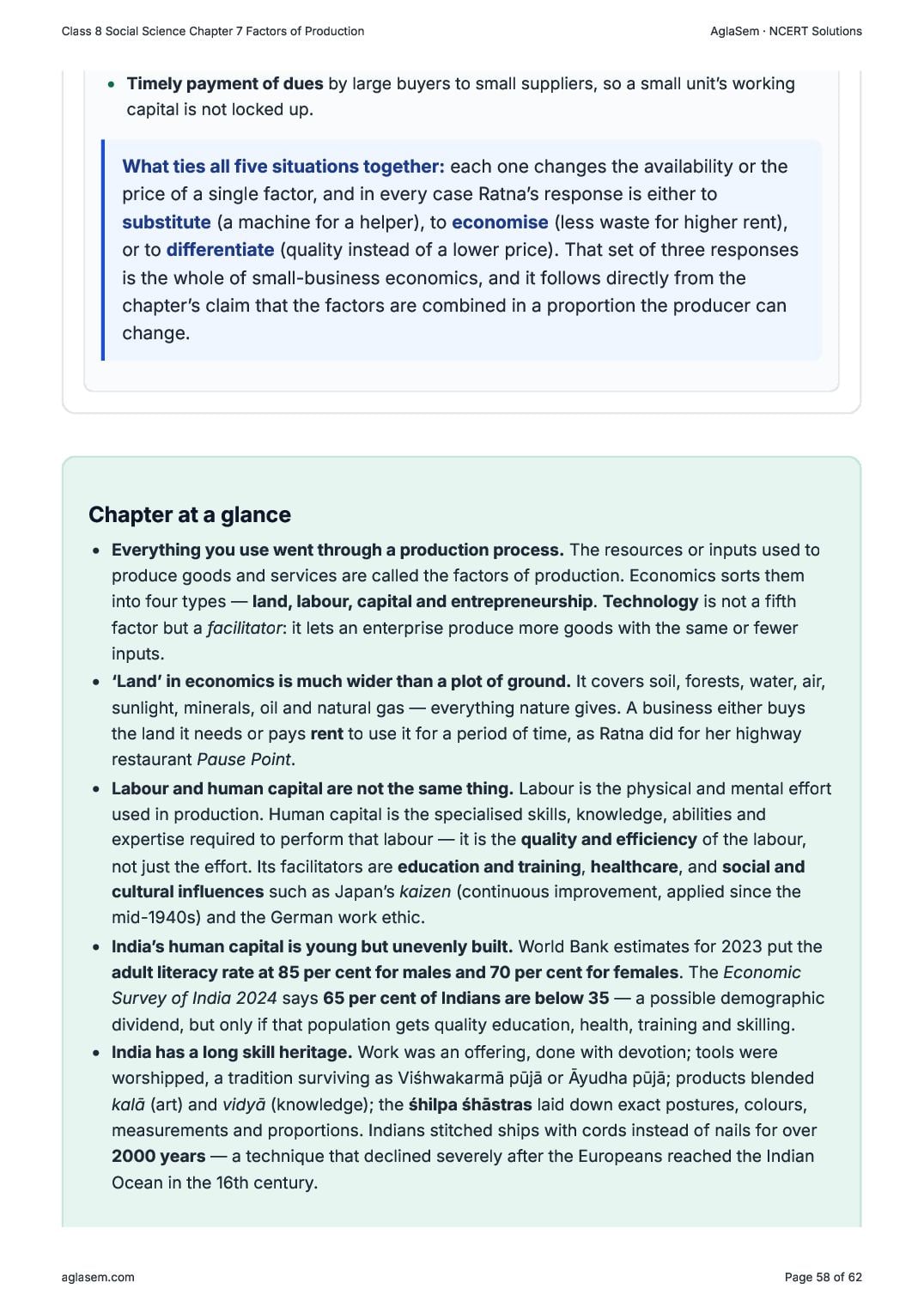
- Everything you use went through a production process. The resources or inputs used to produce goods and services are called the factors of production . Economics sorts them into four types — land, labour, capital and entrepreneurship . Technology is not a fifth factor but a facilitator : it lets an enterprise produce more goods with the same or fewer inputs.
- ‘Land’ in economics is much wider than a plot of ground. It covers soil, forests, water, air, sunlight, minerals, oil and natural gas — everything nature gives. A business either buys the land it needs or pays rent to use it for a period of time, as Ratna did for her highway restaurant Pause Point .
- Labour and human capital are not the same thing. Labour is the physical and mental effort used in production. Human capital is the specialised skills, knowledge, abilities and expertise required to perform that labour — it is the quality and efficiency of the labour, not just the effort. Its facilitators are education and training , healthcare , and social and cultural influences such as Japan’s kaizen (continuous improvement, applied since the mid-1940s) and the German work ethic.
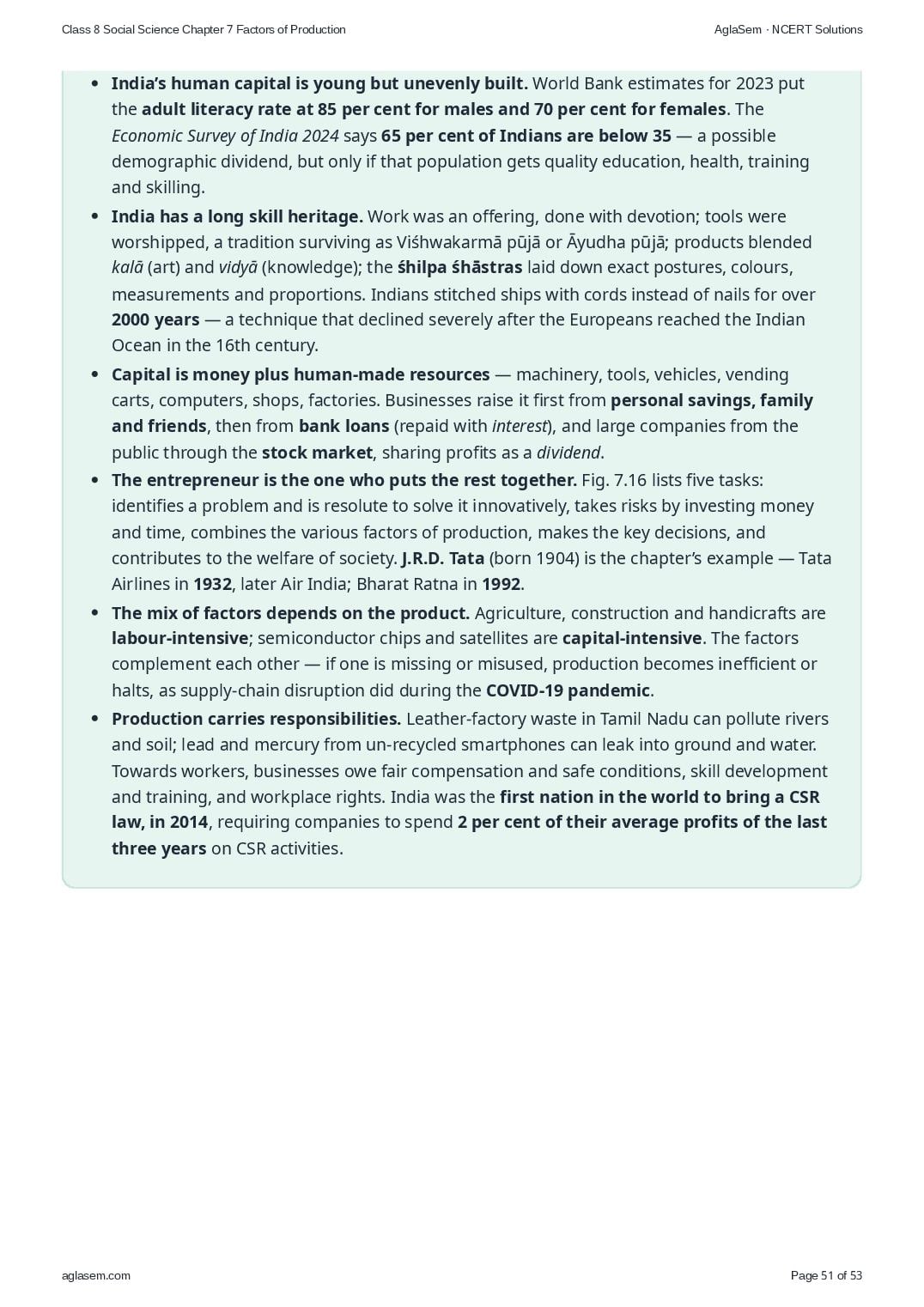
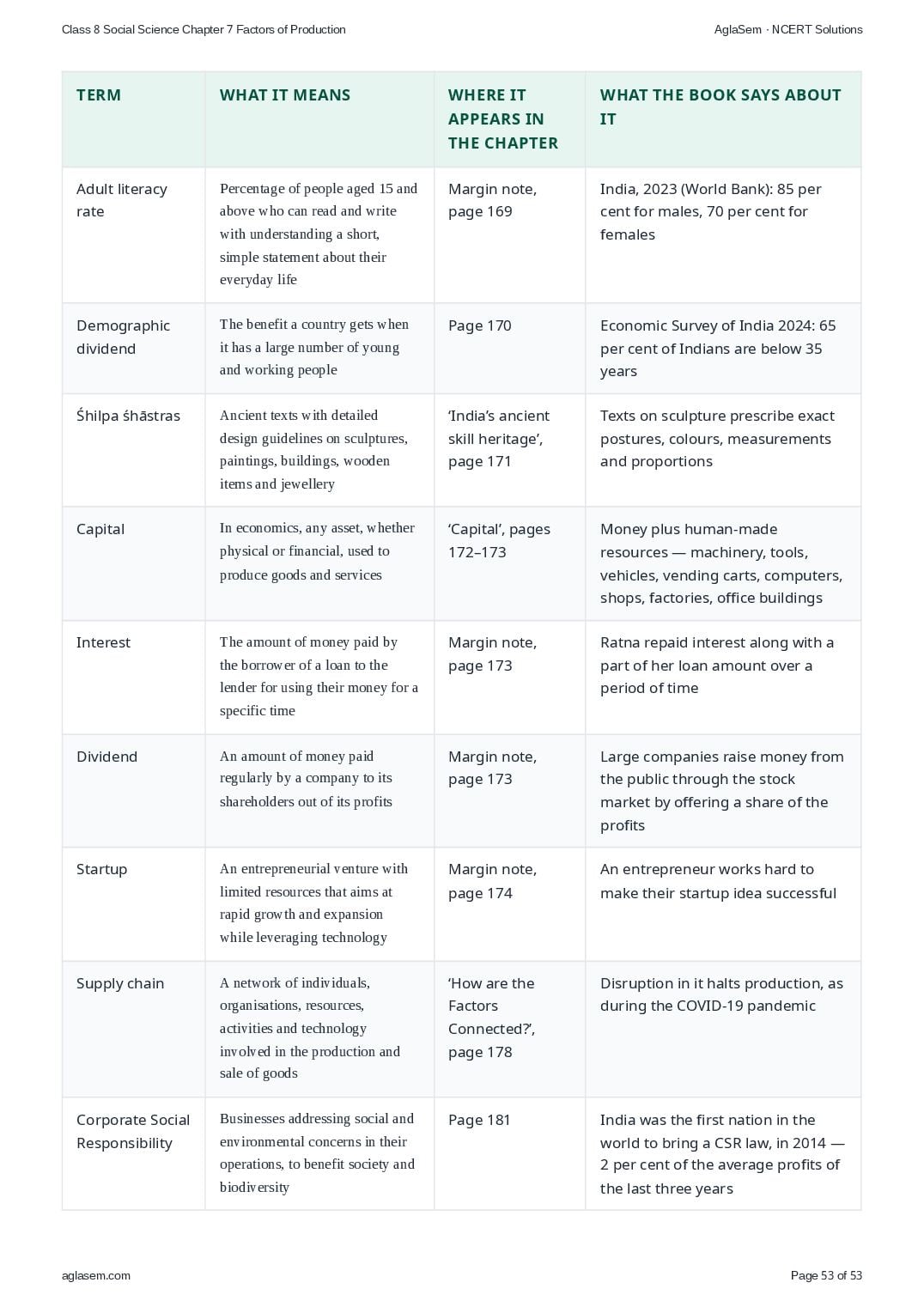
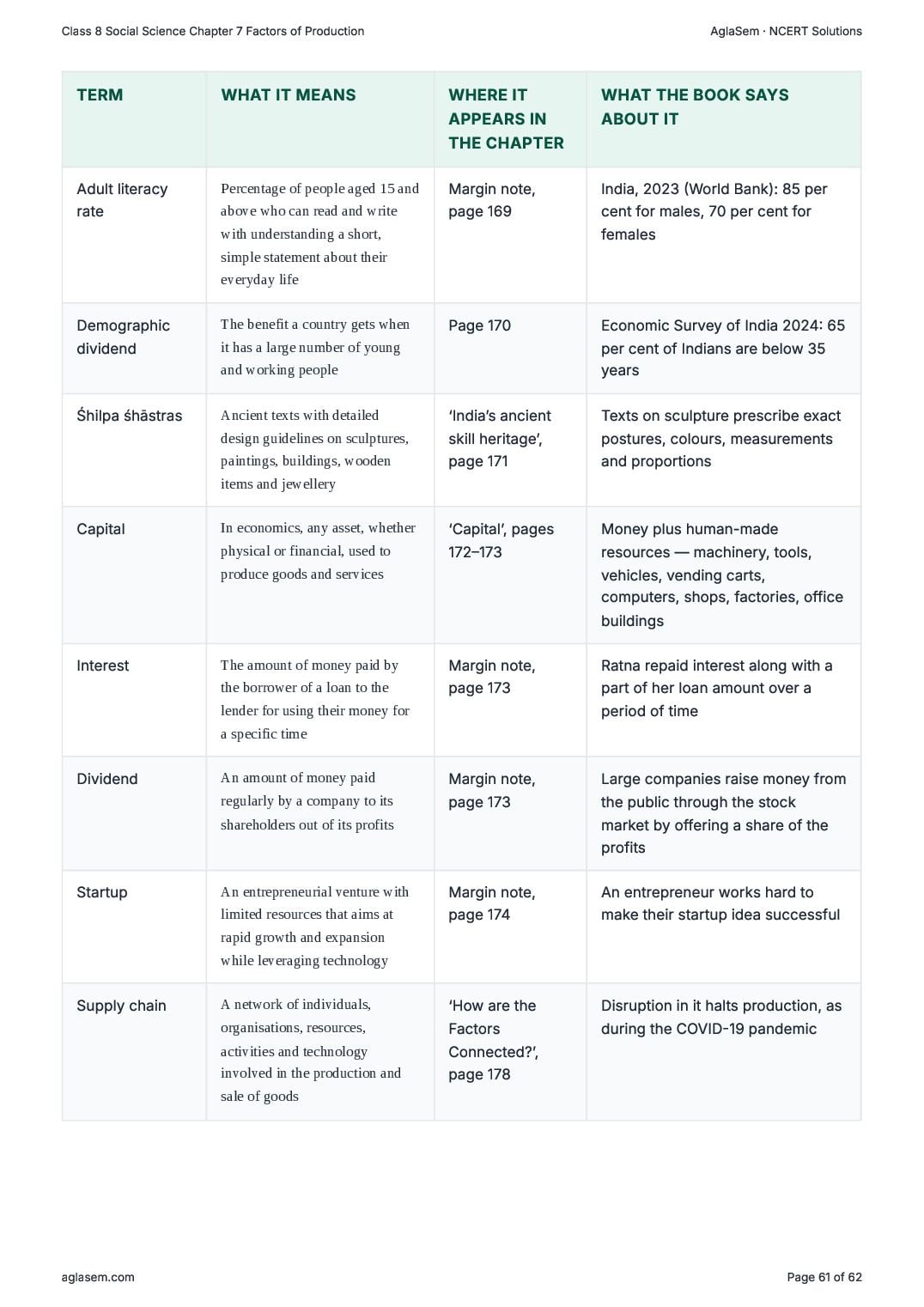
- India’s human capital is young but unevenly built. World Bank estimates for 2023 put the adult literacy rate at 85 per cent for males and 70 per cent for females . The Economic Survey of India 2024 says 65 per cent of Indians are below 35 — a possible demographic dividend , but only if that population gets quality education, health, training and skilling.
- India has a long skill heritage. Work was an offering, done with devotion; tools were worshipped, a tradition surviving as Viśhwakarmā pūjā or Āyudha pūjā; products blended kalā (art) and vidyā (knowledge); the śhilpa śhāstras laid down exact postures, colours, measurements and proportions. Indians stitched ships with cords instead of nails for over 2000 years — a technique that declined severely after the Europeans reached the Indian Ocean in the 16th century.
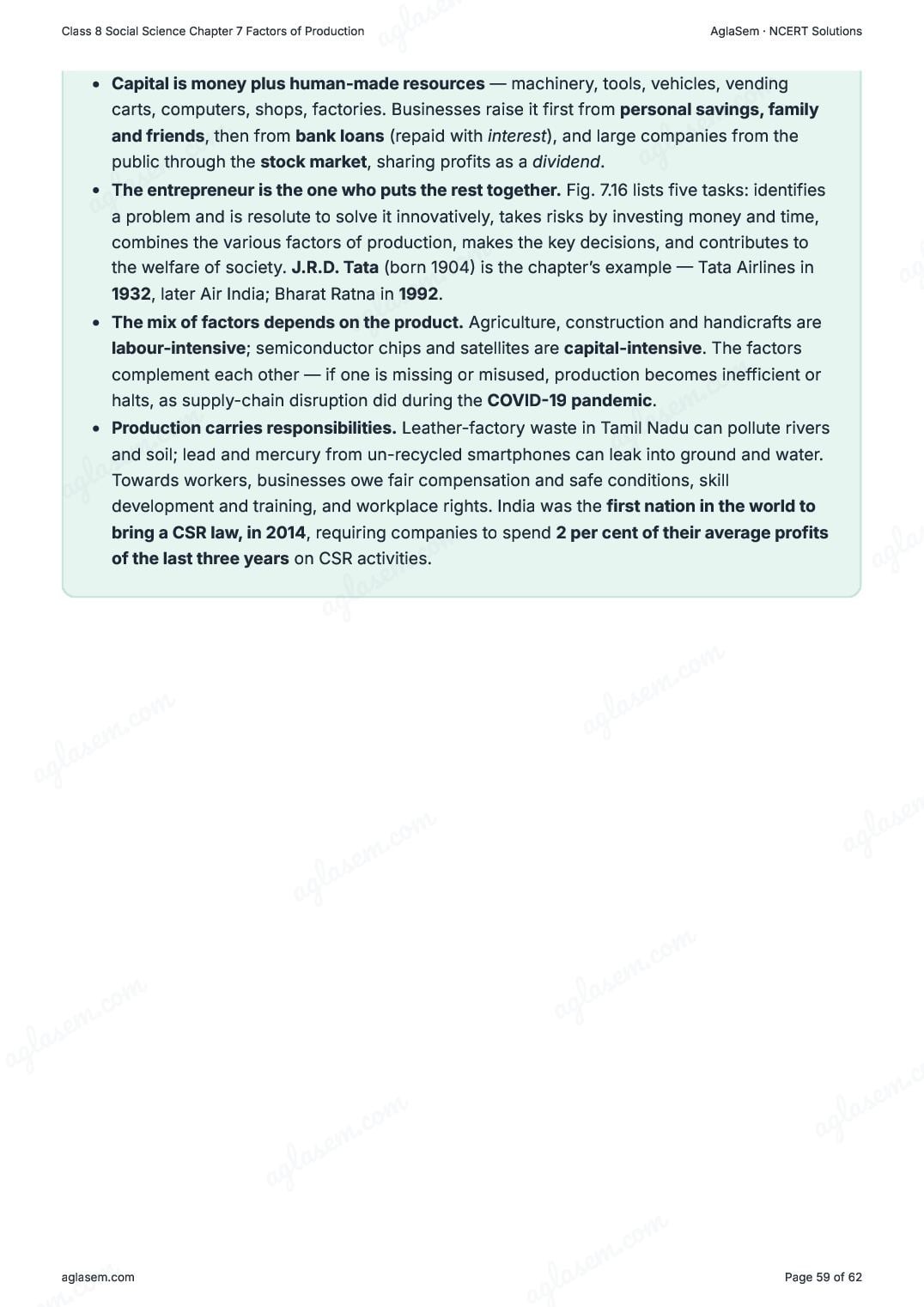
- Capital is money plus human-made resources — machinery, tools, vehicles, vending carts, computers, shops, factories. Businesses raise it first from personal savings, family and friends , then from bank loans (repaid with interest ), and large companies from the public through the stock market , sharing profits as a dividend .
- The entrepreneur is the one who puts the rest together. Fig. 7.16 lists five tasks: identifies a problem and is resolute to solve it innovatively, takes risks by investing money and time, combines the various factors of production, makes the key decisions, and contributes to the welfare of society. J.R.D. Tata (born 1904) is the chapter’s example — Tata Airlines in 1932 , later Air India; Bharat Ratna in 1992 .
- The mix of factors depends on the product. Agriculture, construction and handicrafts are labour-intensive ; semiconductor chips and satellites are capital-intensive . The factors complement each other — if one is missing or misused, production becomes inefficient or halts, as supply-chain disruption did during the COVID-19 pandemic .
- Production carries responsibilities. Leather-factory waste in Tamil Nadu can pollute rivers and soil; lead and mercury from un-recycled smartphones can leak into ground and water. Towards workers, businesses owe fair compensation and safe conditions, skill development and training, and workplace rights. India was the first nation in the world to bring a CSR law, in 2014 , requiring companies to spend 2 per cent of their average profits of the last three years on CSR activities.
How to Download NCERT Solutions for Class 8 Social Science Chapter 7 PDF
Follow these simple steps to get the Factors of Production questions-and-answers PDF from Exploring Society: India and Beyond.
- Search NCERT Solutions for Class 8 Social Science Chapter 7 aglasem and open this page.
- Read the exercise questions with answers for Factors of Production shown above.
- Click the Download PDF link to save the Factors of Production solutions to your device.
NCERT Solutions for Class 8 Social Science – All Chapters
There are more chapters to study besides Factors of Production in Social Science. Here are the NCERT Solutions for all chapters of Class 8 Social Science.
- Chapter 1 Natural Resources and Their Use
- Chapter 2 Reshaping India’s Political Map
- Chapter 3 The Rise of the Marathas
- Chapter 4 The Colonial Era in India
- Chapter 5 Universal Franchise and India’s Electoral System
- Chapter 6 The Parliamentary System Legislature and Executive
- Chapter 7 Factors of Production
- Chapter 8 World Geography Some Glimpses
- Chapter 9 India’s Long Road to Independence
- Chapter 10 A Journey Through Indian Architecture
- Chapter 11 The Role of the Judiciary in Our Society
- Chapter 12 Citizenship Rights and Duties
- Chapter 13 Dynamics of Population
- Chapter 14 India’s Urban Landscape
- Chapter 15 Cultural Currents 13th to 17th Centuries
NCERT Solutions for Class 8 – All Subjects
Just like Chapter 7 of Social Science, you can get the exercise questions with answers for every other subject of Class 8. Here are the NCERT Solutions for all subjects of Class 8.
NCERT Solutions for Class 8 Social Science Chapter 7 – An Overview
The key highlights of this study material are as follows.
| Aspects | Details |
|---|---|
| Class | Class 8 |
| Subject | Social Science |
| Chapter Number | Chapter 7 |
| Chapter Name | Factors of Production |
| Book Name | Exploring Society: India and Beyond |
| Book By | NCERT (National Council of Educational Research and Training) |
| Educational Resource Here | NCERT Solutions of Class 8 Social Science Chapter 7 for all exercises |
| More Questions Answers of This Subject | NCERT Solutions for Class 8 Social Science |
| Download Book Chapter | NCERT Book Class 8 Social Science |
| All Questions Answers For This Class | NCERT Solutions for Class 8 |
| Complete Solutions | NCERT Solutions |
NCERT Solutions for Class 8 Social Science Chapter 7 Factors of Production – FAQs
What are the NCERT Solutions for Class 8 Social Science Chapter 7 Factors of Production?
They are the complete, step-by-step answers to all the exercise and in-text questions of Chapter 7 Factors of Production from the NCERT Class 8 Social Science textbook Exploring Society: India and Beyond, written by experts as per the latest NCERT syllabus.
How can I download the Class 8 Social Science Chapter 7 solutions PDF for free?
Open this page on aglasem, read the Factors of Production questions with answers, and click the “Download Solutions PDF” link. The Class 8 Social Science Chapter 7 NCERT Solutions PDF is completely free to download.
Are these NCERT Solutions as per the latest 2026-27 syllabus?
Yes. The NCERT Solutions for Class 8 Social Science Chapter 7 are based on the latest NCERT textbook Exploring Society: India and Beyond and the current 2026-27 CBSE syllabus, so the questions and answers match what you study in class.
Where can I get NCERT Solutions for the other chapters of Class 8 Social Science?
You can find the answers to every chapter on the NCERT Solutions for Class 8 Social Science page, and solutions for every subject on the NCERT Solutions for Class 8 page.
How do NCERT Solutions help in exam preparation?
They show the correct method to solve each question, help you write answers the way they are expected in exams, let you check and correct your own work, and save revision time — which together improve your marks in Class 8 Social Science.
If you have any queries on NCERT Solutions for Class 8 Social Science Chapter 7 Factors of Production, then please ask in the comments below.