NCERT Solutions for Class 8 Social Science Chapter 8 World Geography Some Glimpses provide clear, step-by-step answers to every exercise and in-text question from the chapter World Geography Some Glimpses of the NCERT textbook Exploring Society: India and Beyond. Prepared by subject experts as per the latest NCERT (CBSE) syllabus for 2026-27, these NCERT Solutions for Class 8 Social Science help you understand each concept, write exam-ready answers, and check your own solutions. You can read them online below or download the free Class 8 Social Science Chapter 8 question-answer PDF.
NCERT Solutions for Class 8 Social Science Chapter 8 World Geography Some Glimpses
- Class: Class 8
- Subject: Social Science
- Chapter: Chapter 8 – World Geography Some Glimpses
- Textbook: Exploring Society: India and Beyond (NCERT)
- Study material: NCERT Solutions – questions with answers, free PDF
These solutions answer all the exercise questions of Chapter 8 World Geography Some Glimpses — including the in-text questions, short-answer and long-answer questions, and activities — with complete explanations so you can follow the method, not just the final answer. Read the full solutions below.
NCERT Solutions Class 8 Social Science Chapter 8 World Geography Some Glimpses View Download
NCERT Solutions for Class 8 Social Science Chapter 8 PDF Download
You can read the NCERT Solutions for Class 8 Social Science Chapter 8 online above, or download the complete question-answer PDF to study World Geography Some Glimpses offline at any time.
NCERT Solutions for Class 8 Social Science Chapter 8 PDF Download Link – Click Here to Download Solutions PDF
Questions Covered in This Chapter
These NCERT Solutions answer all 24 questions of this chapter. The questions solved are:
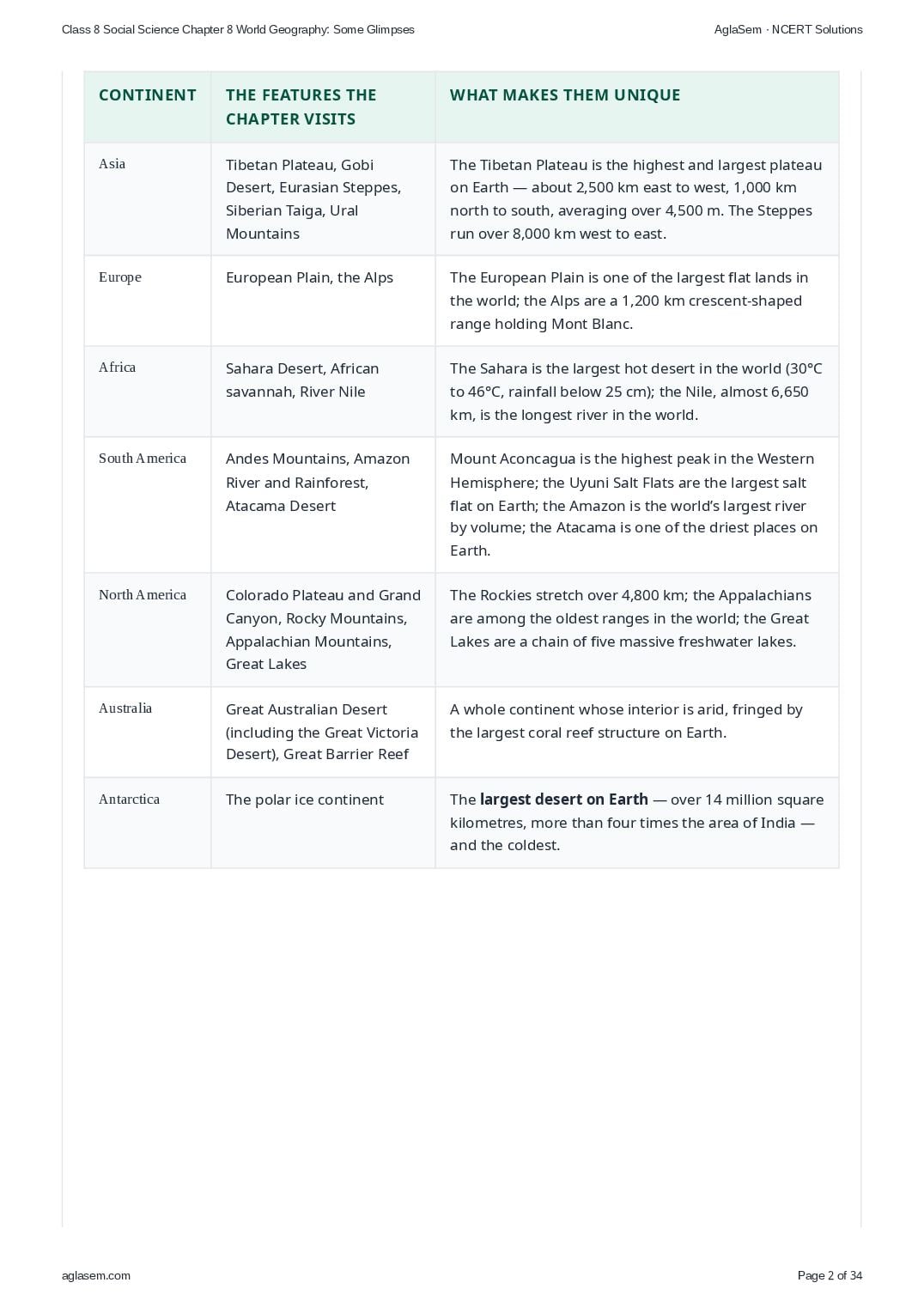
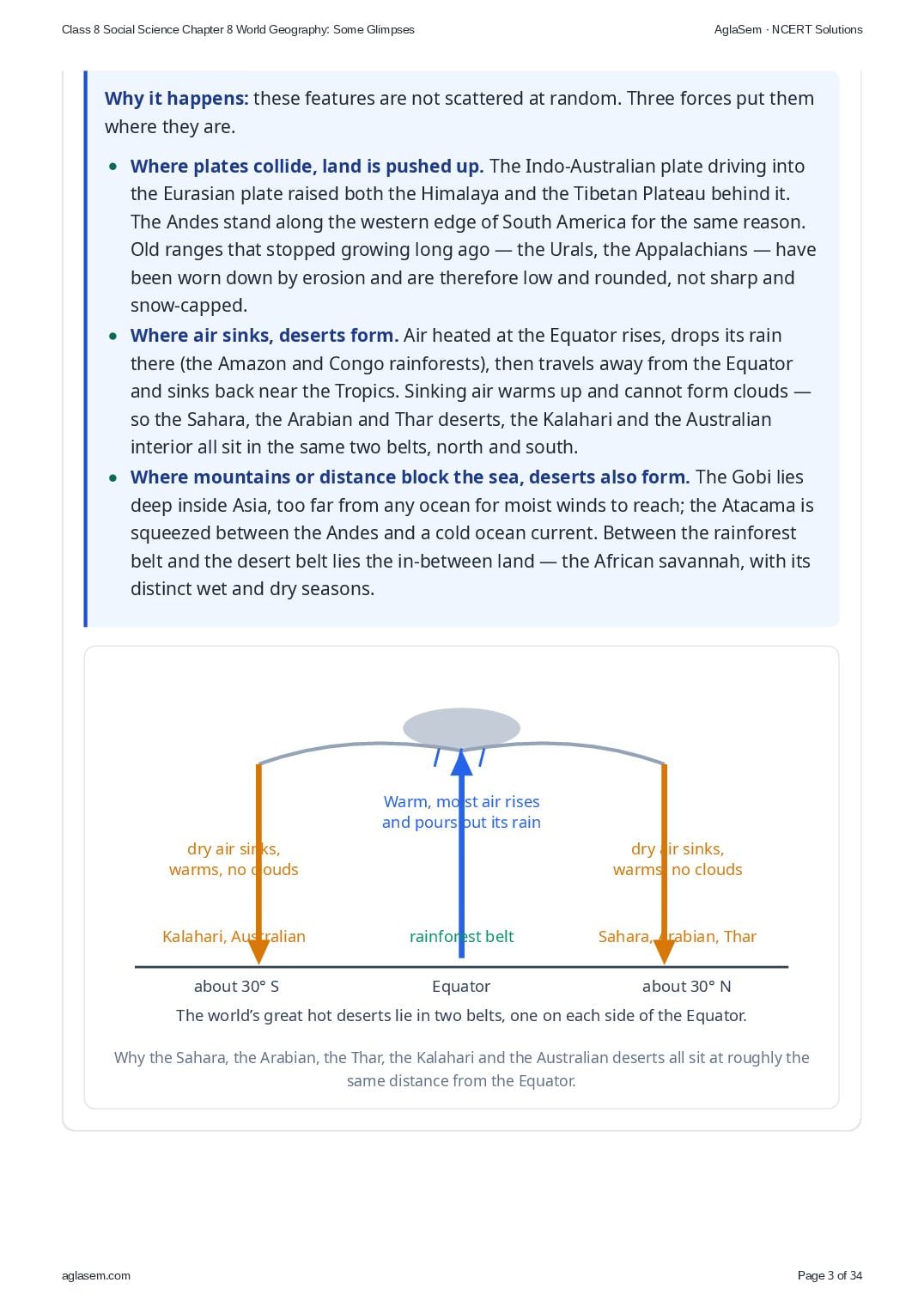
- What are the unique physical features of the continents?
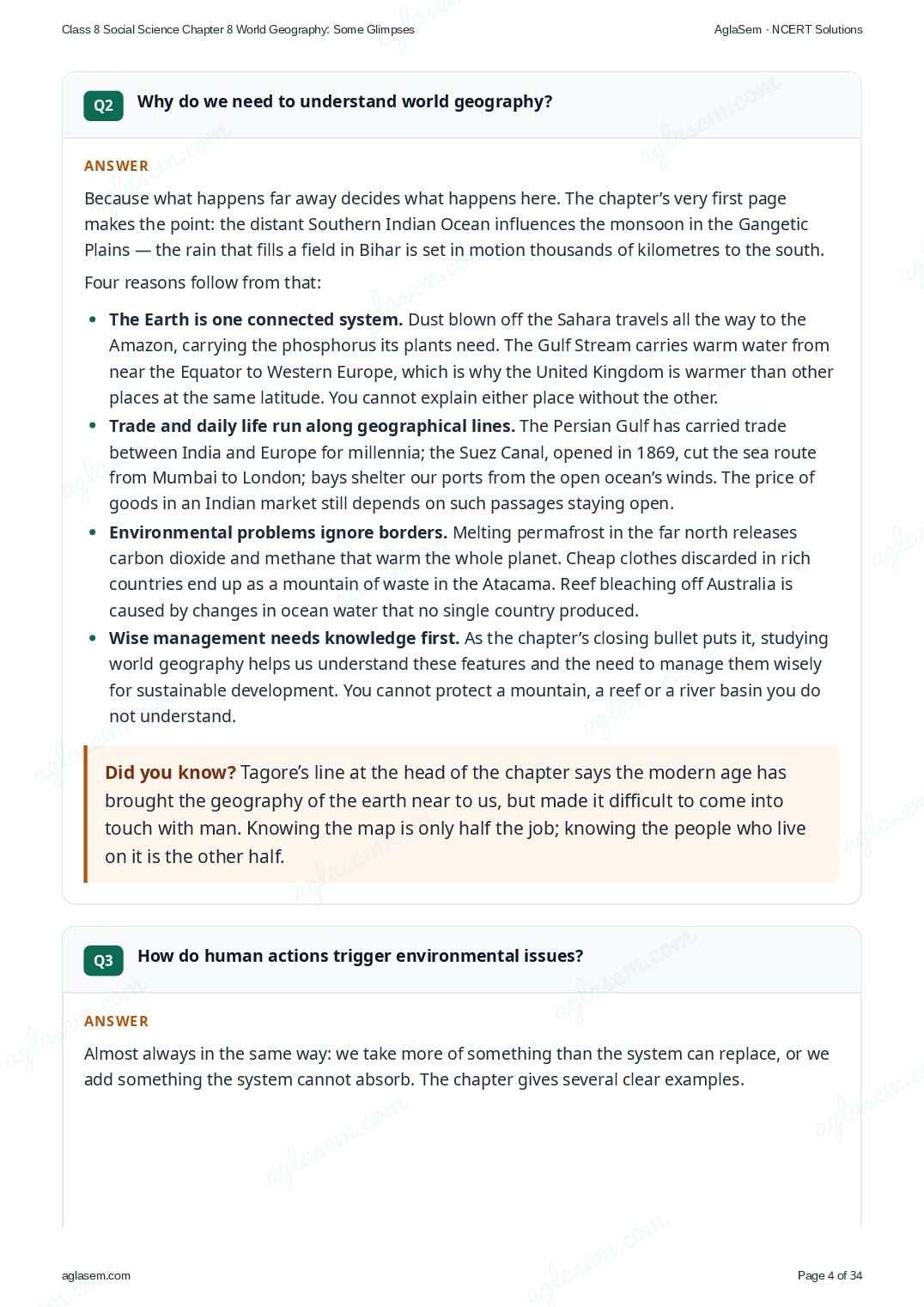
- Why do we need to understand world geography?
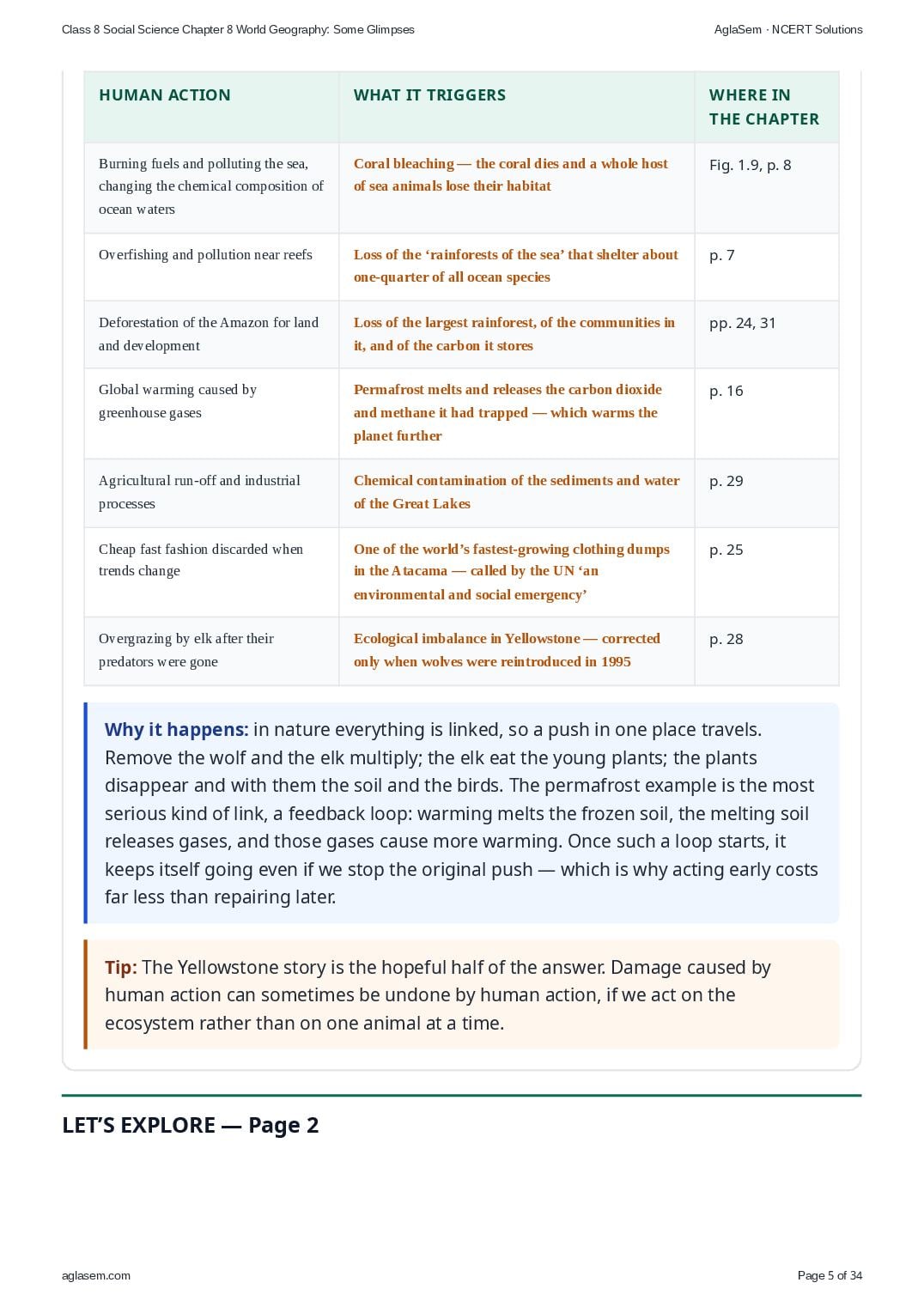
- How do human actions trigger environmental issues?
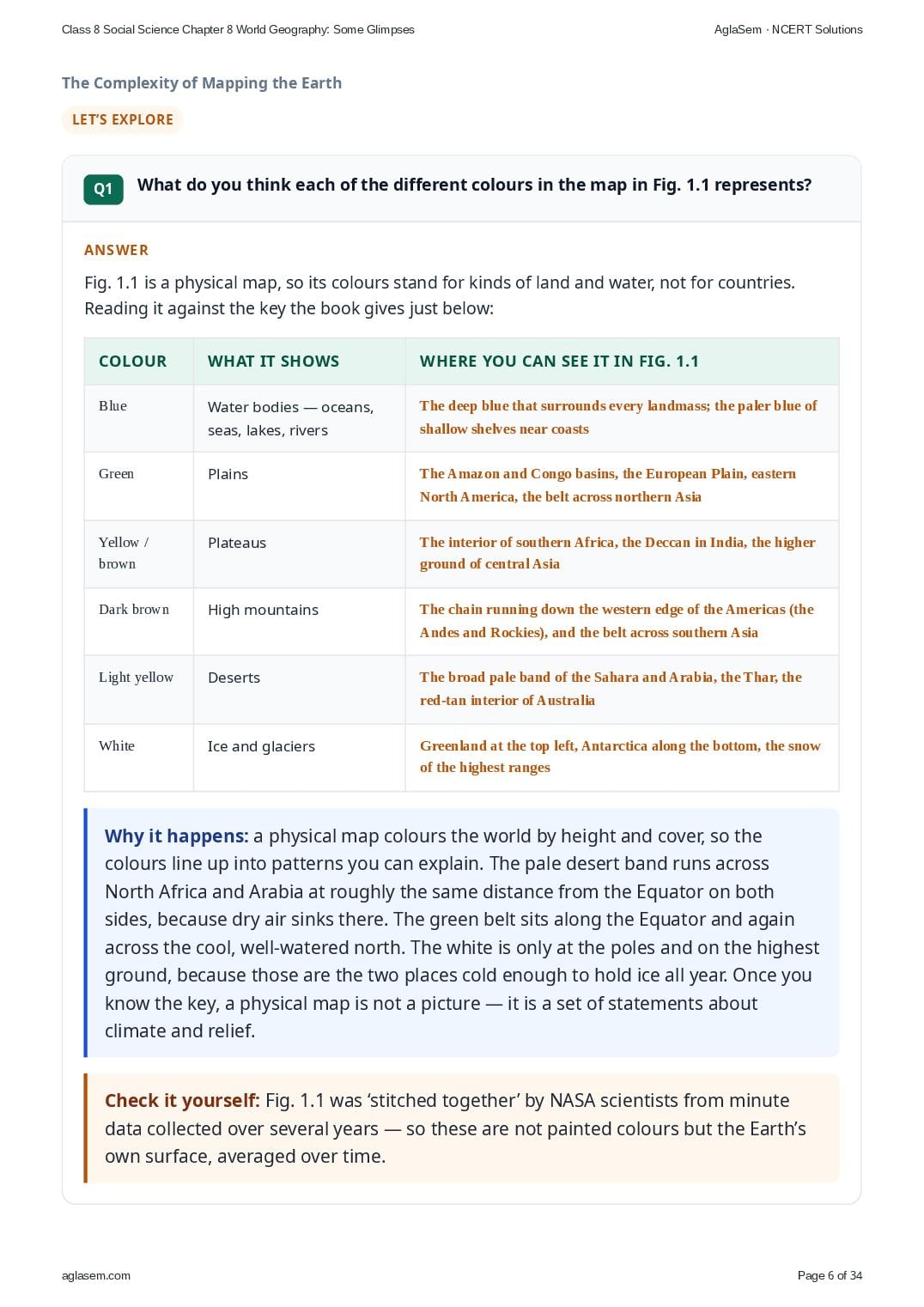
- What do you think each of the different colours in the map in Fig. 1.1 represents?
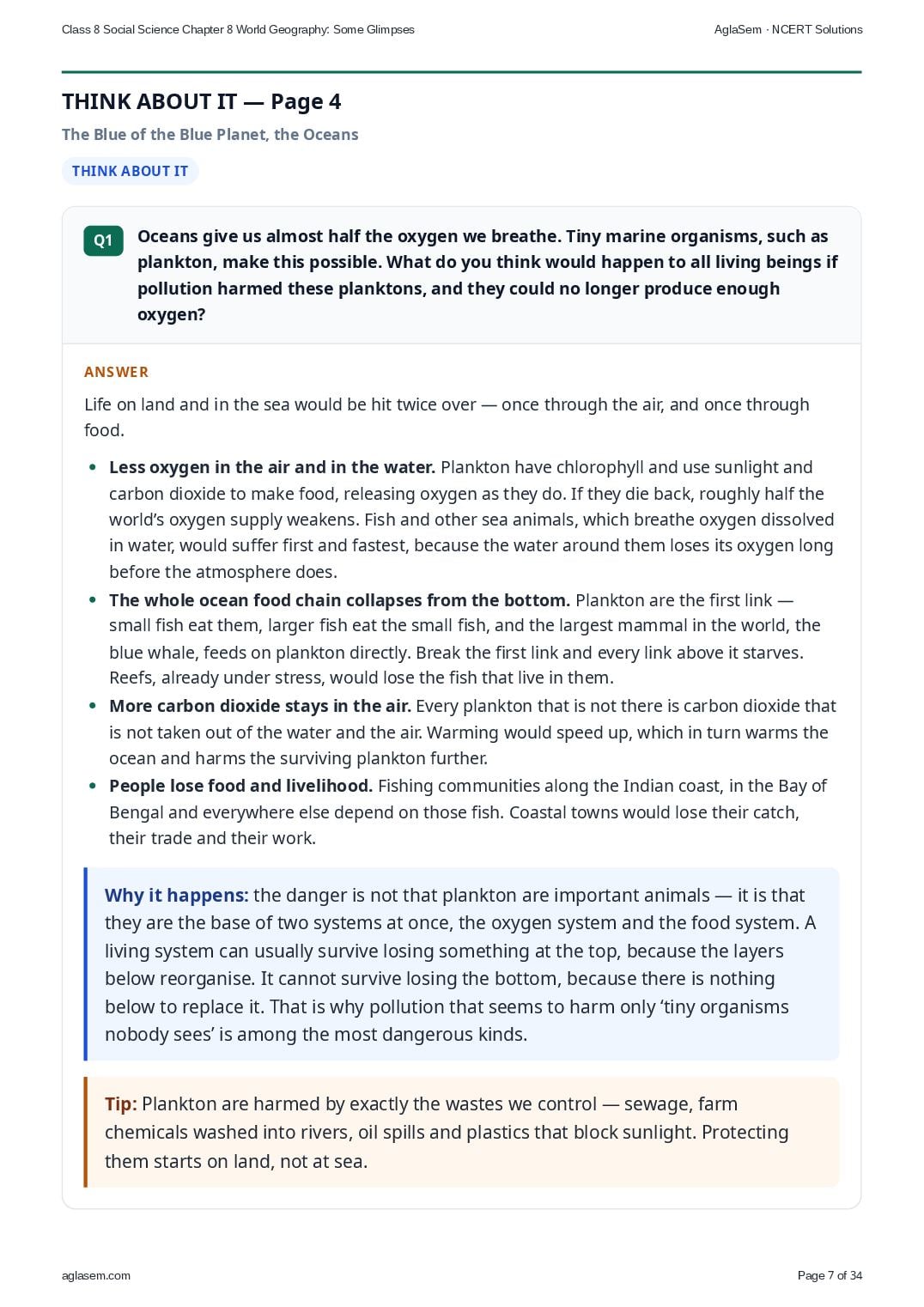
- Oceans give us almost half the oxygen we breathe. Tiny marine organisms, such as plankton, make this possible. What do you think would happen to all living beings if pollution harmed these planktons, and they could no longer produce enough oxygen?
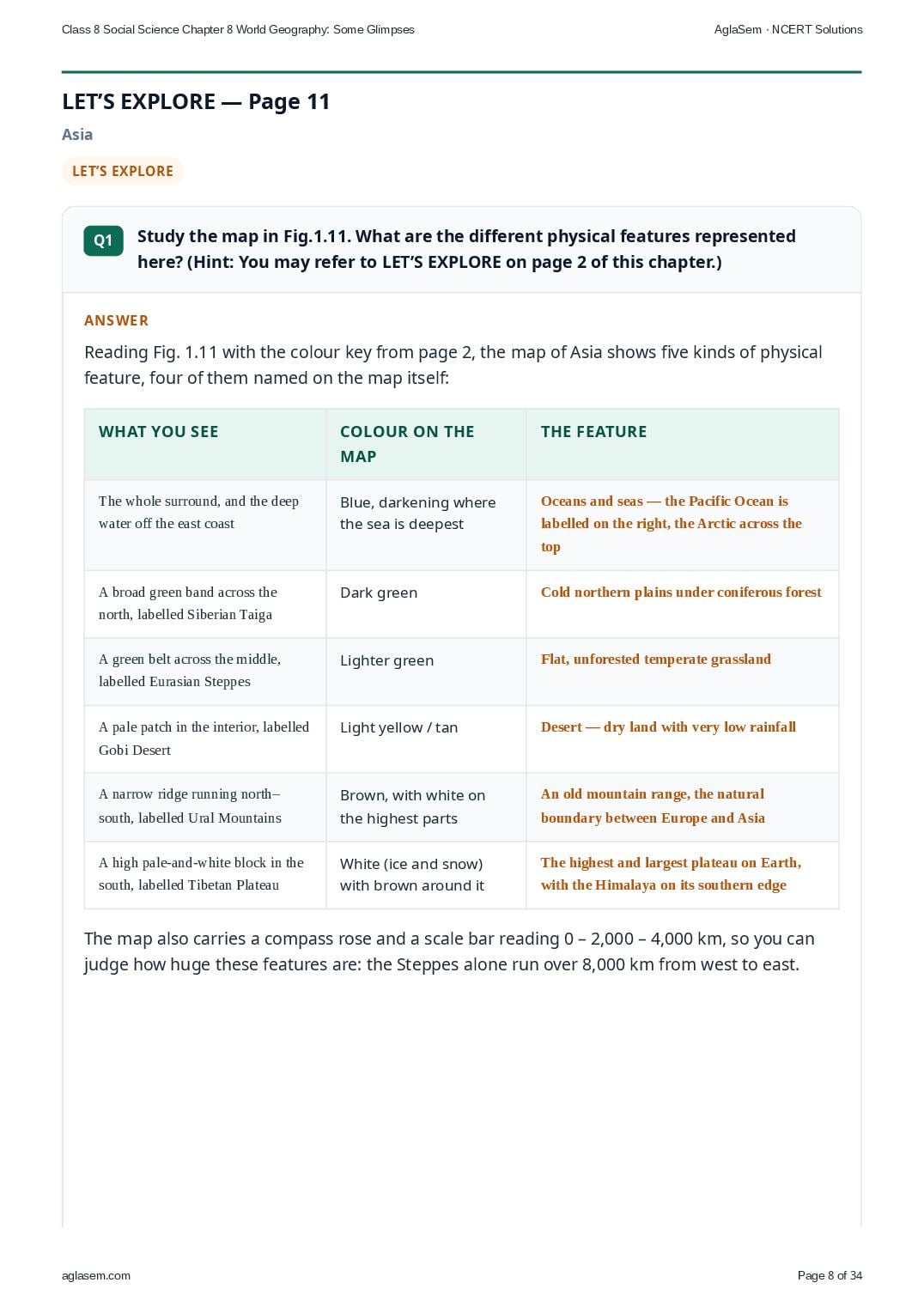
- Study the map in Fig.1.11. What are the different physical features represented here? (Hint: You may refer to LET’S EXPLORE on page 2 of this chapter.)
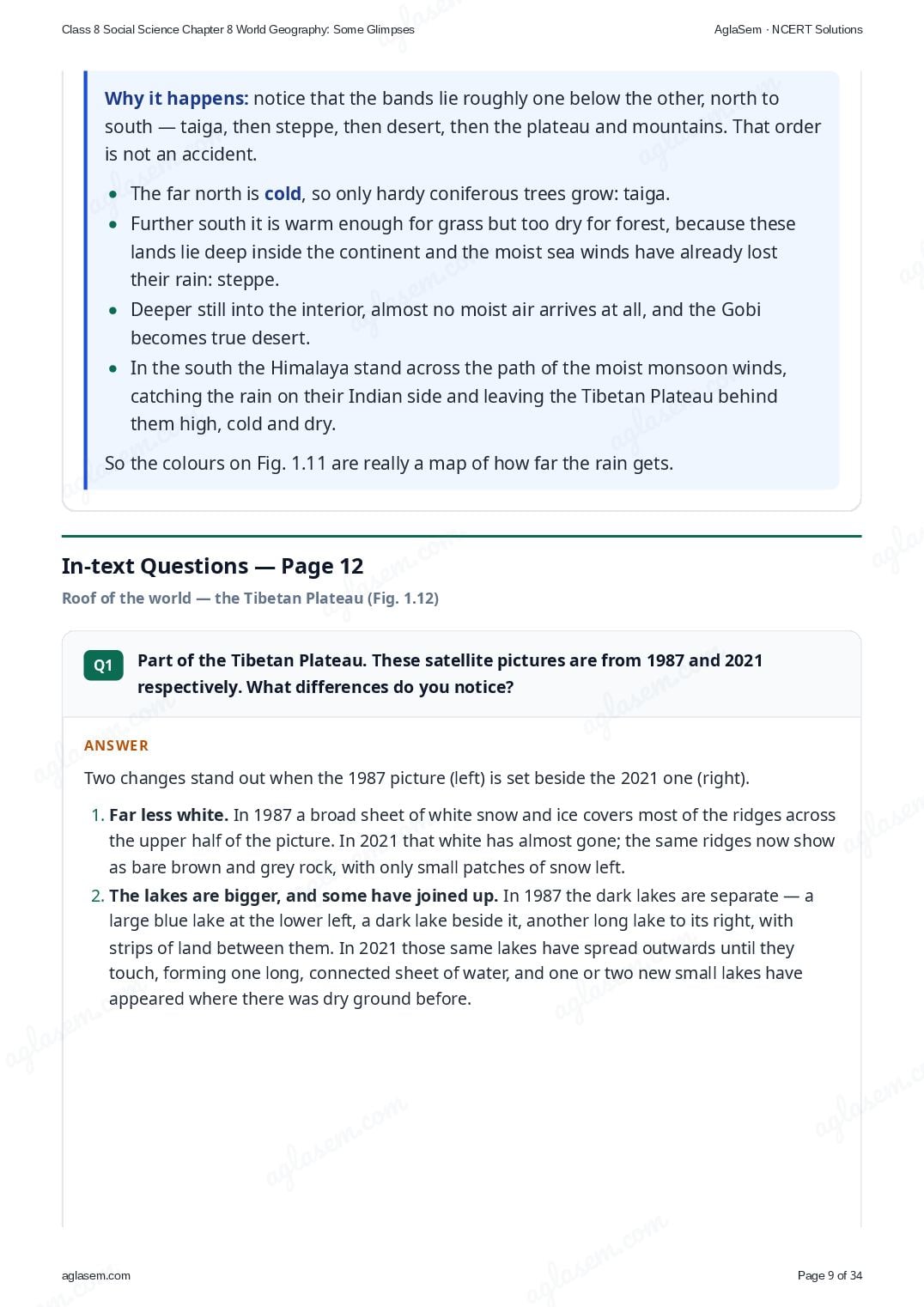
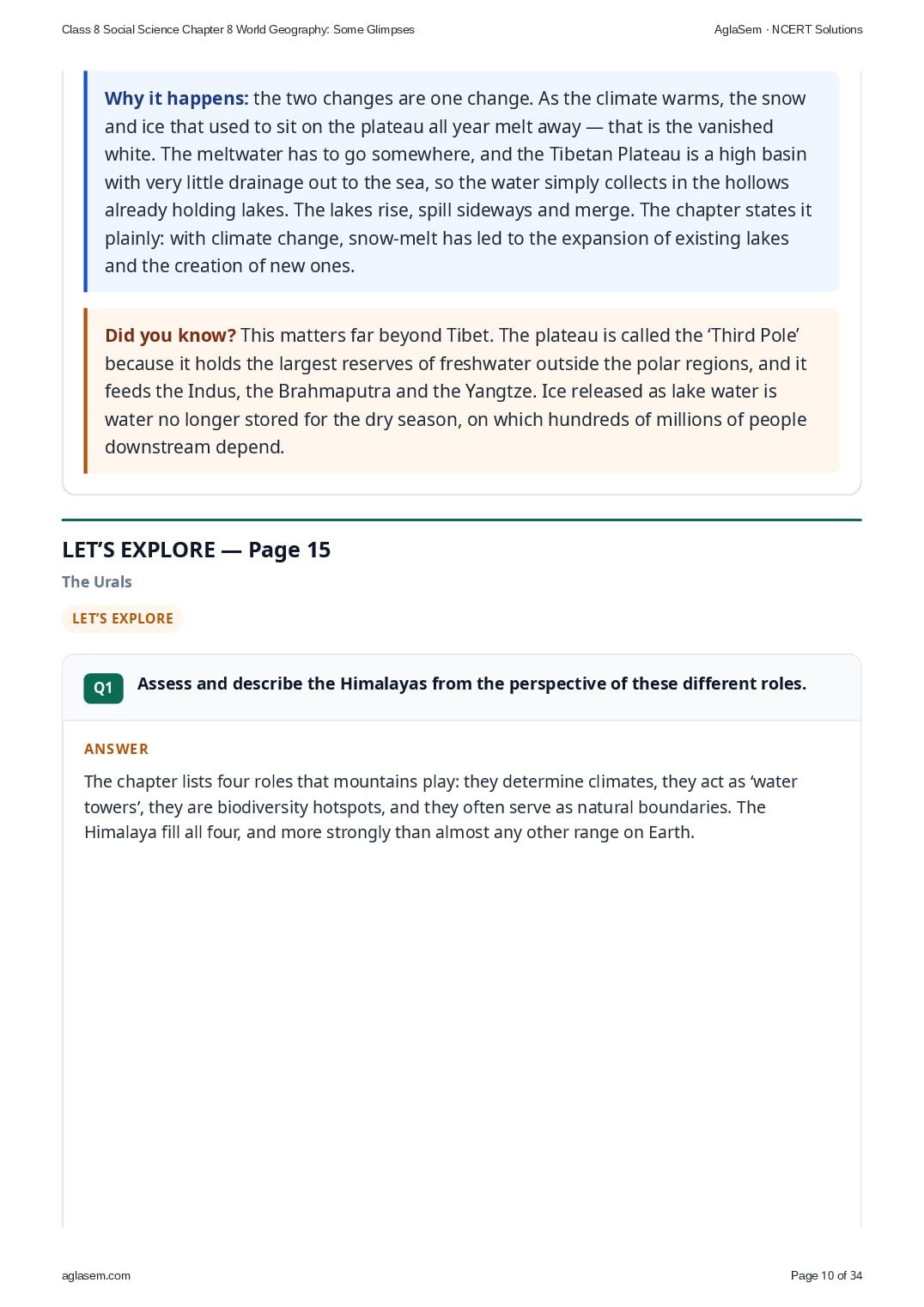
- Part of the Tibetan Plateau. These satellite pictures are from 1987 and 2021 respectively. What differences do you notice?
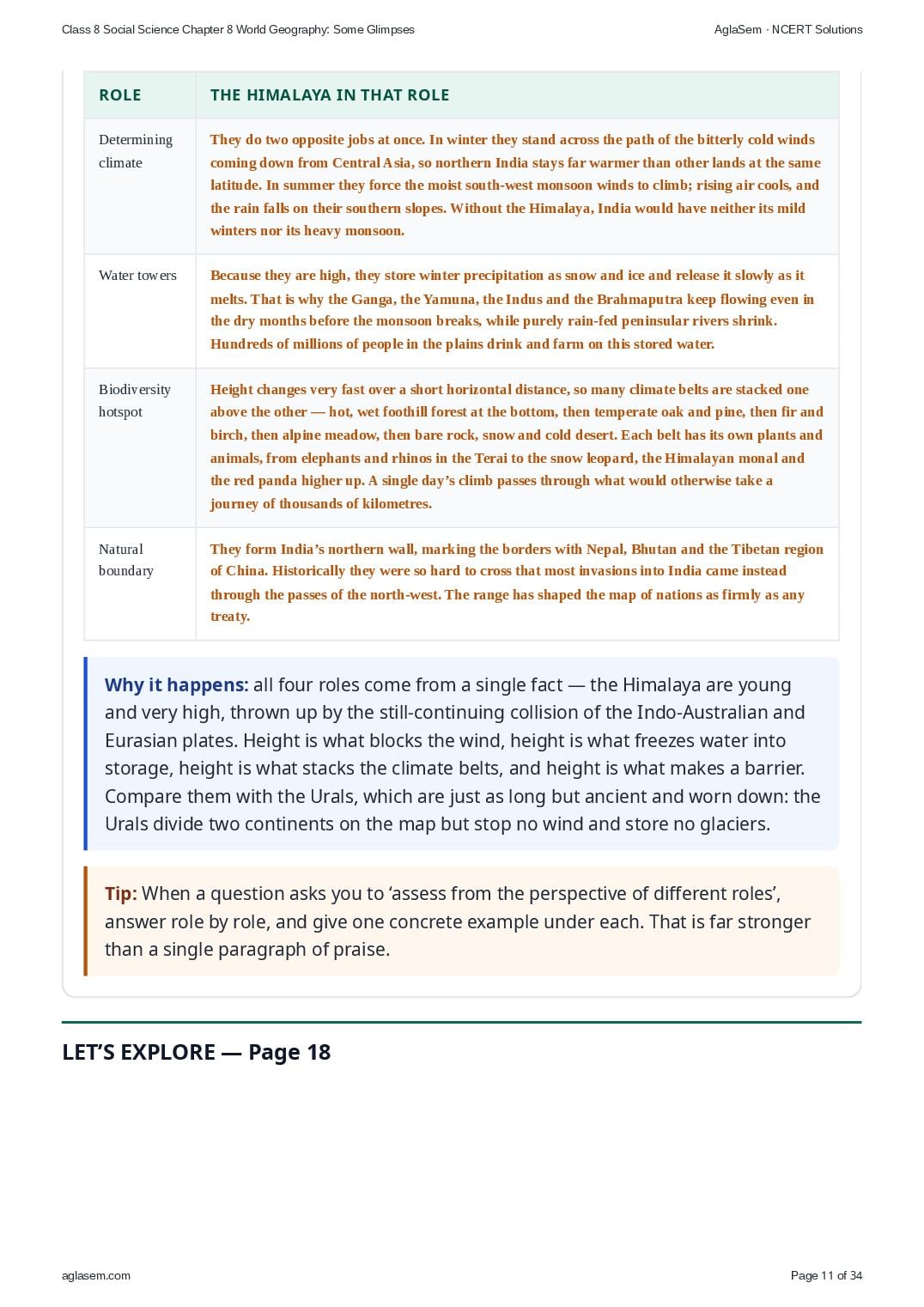
- Assess and describe the Himalayas from the perspective of these different roles.
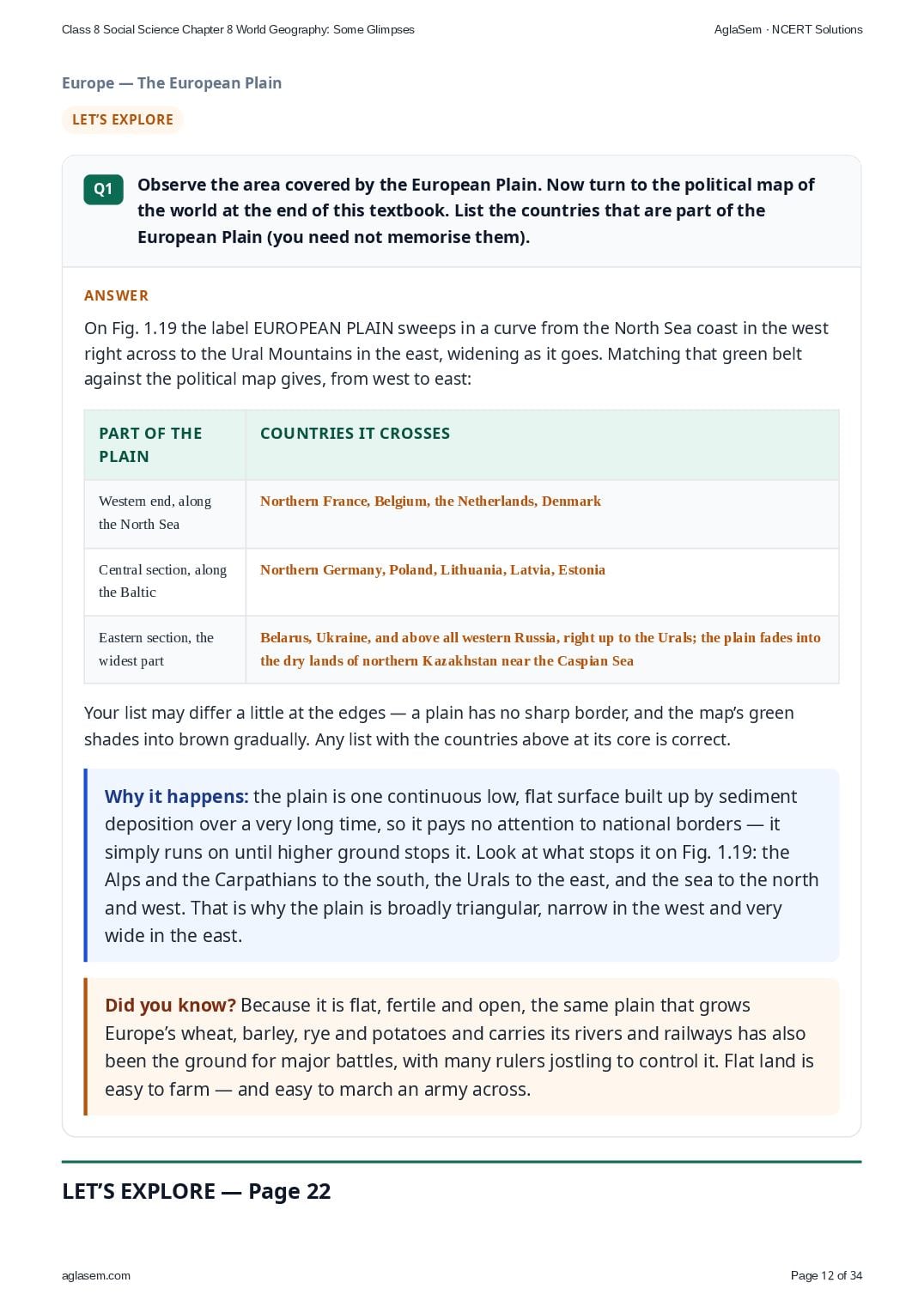
- Observe the area covered by the European Plain. Now turn to the political map of the world at the end of this textbook. List the countries that are part of the European Plain (you need not memorise them).
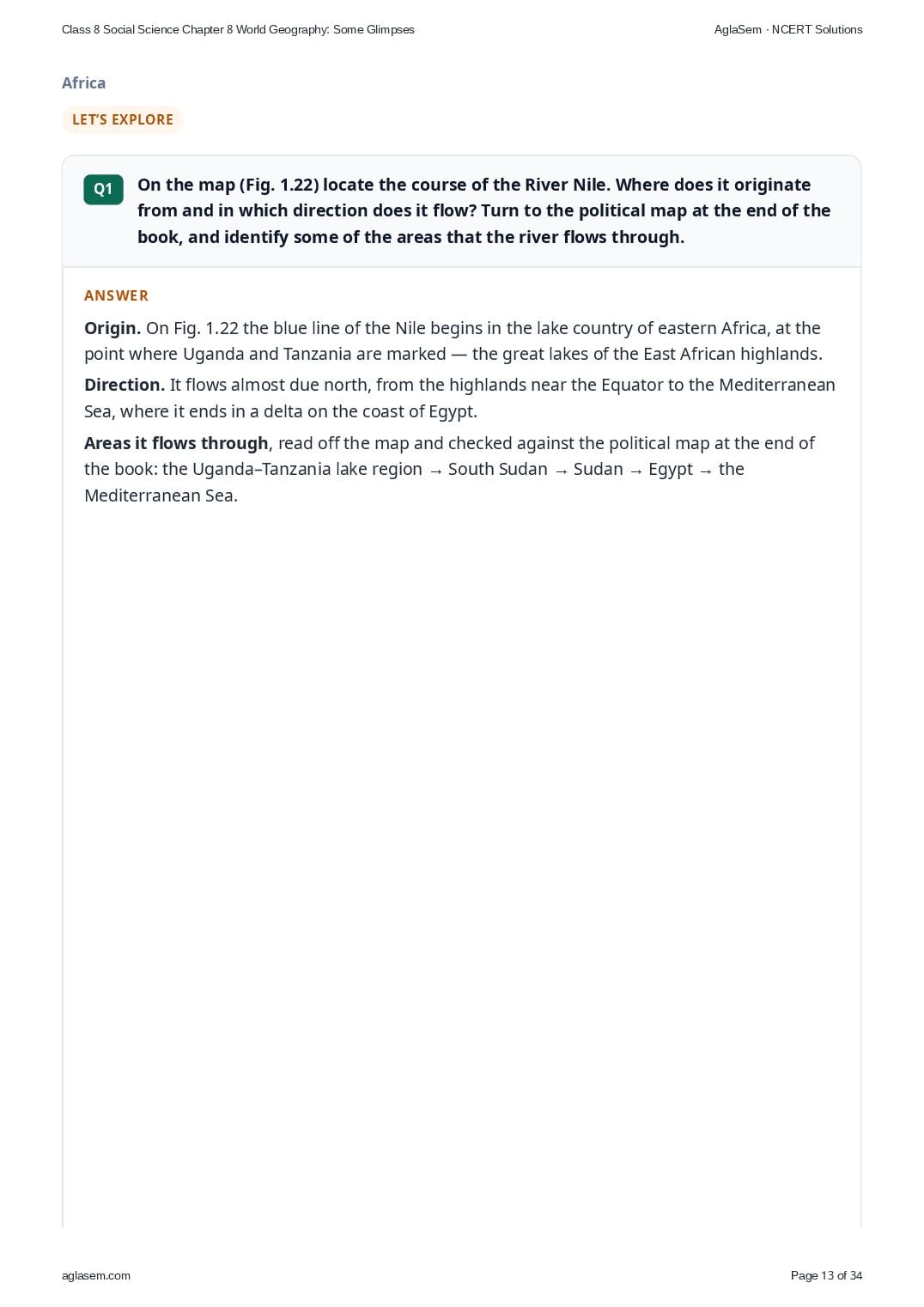
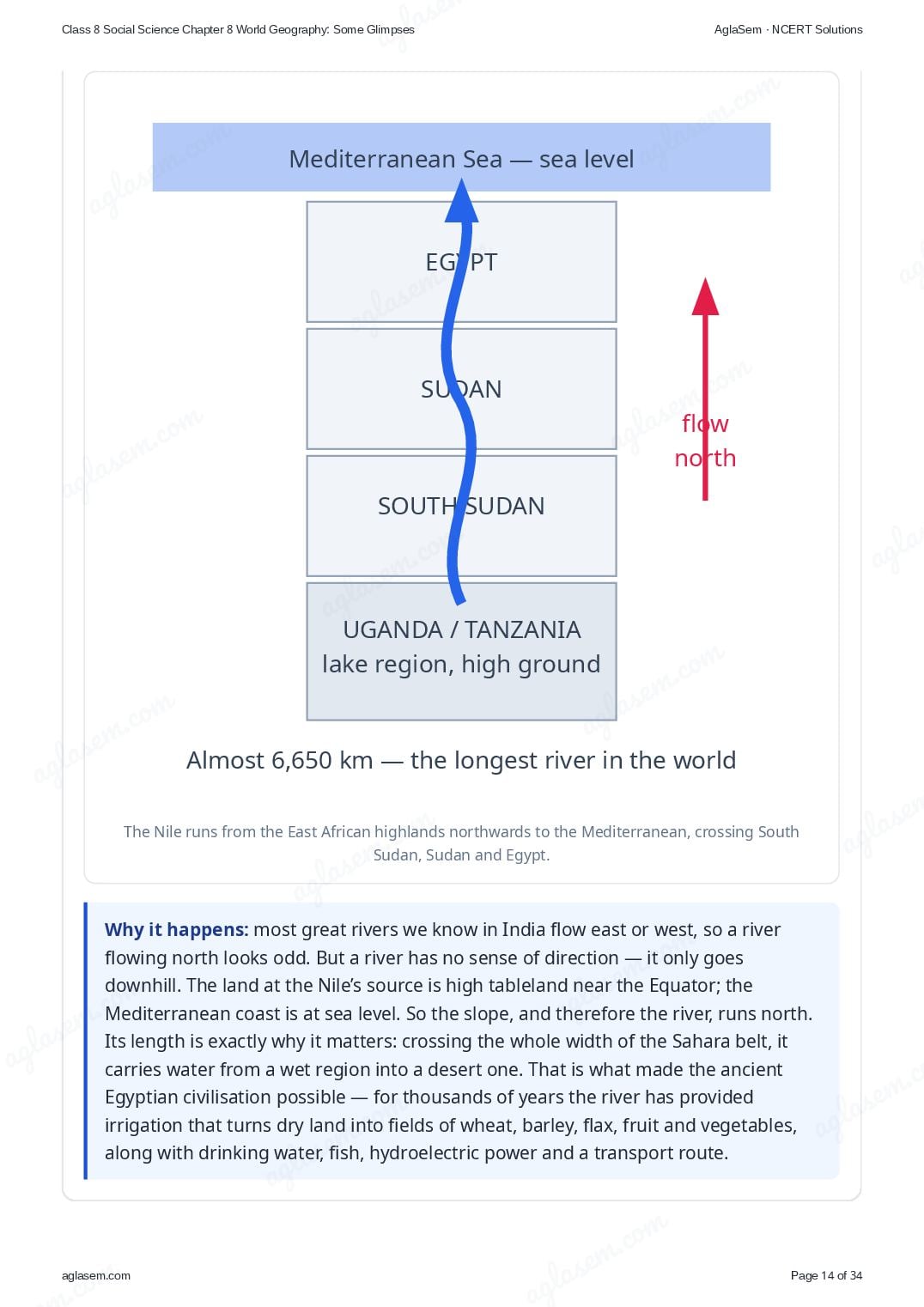
- On the map (Fig. 1.22) locate the course of the River Nile. Where does it originate from and in which direction does it flow? Turn to the political map at the end of the book, and identify some of the areas that the river flows through.
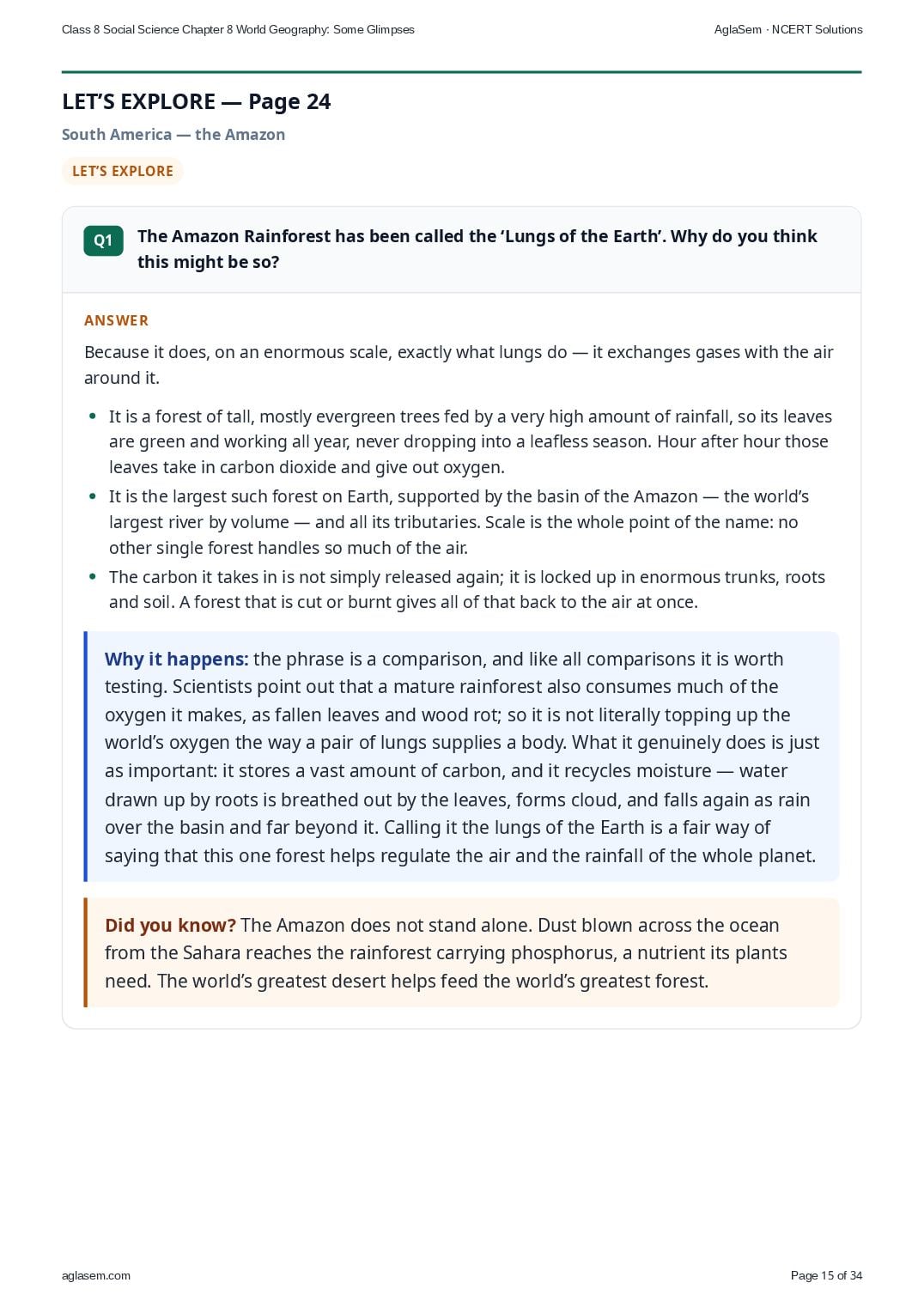
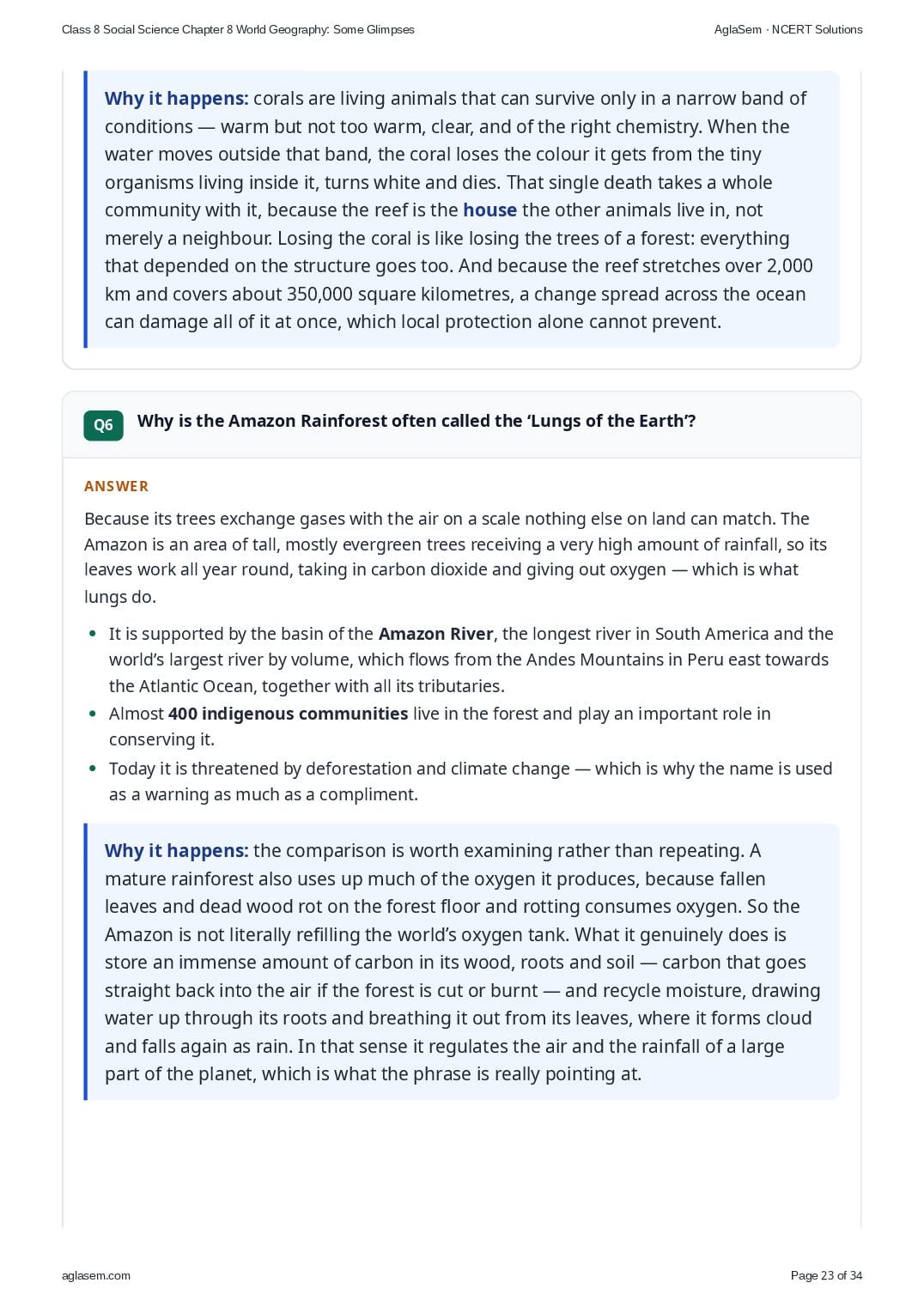
- The Amazon Rainforest has been called the ‘Lungs of the Earth’. Why do you think this might be so?
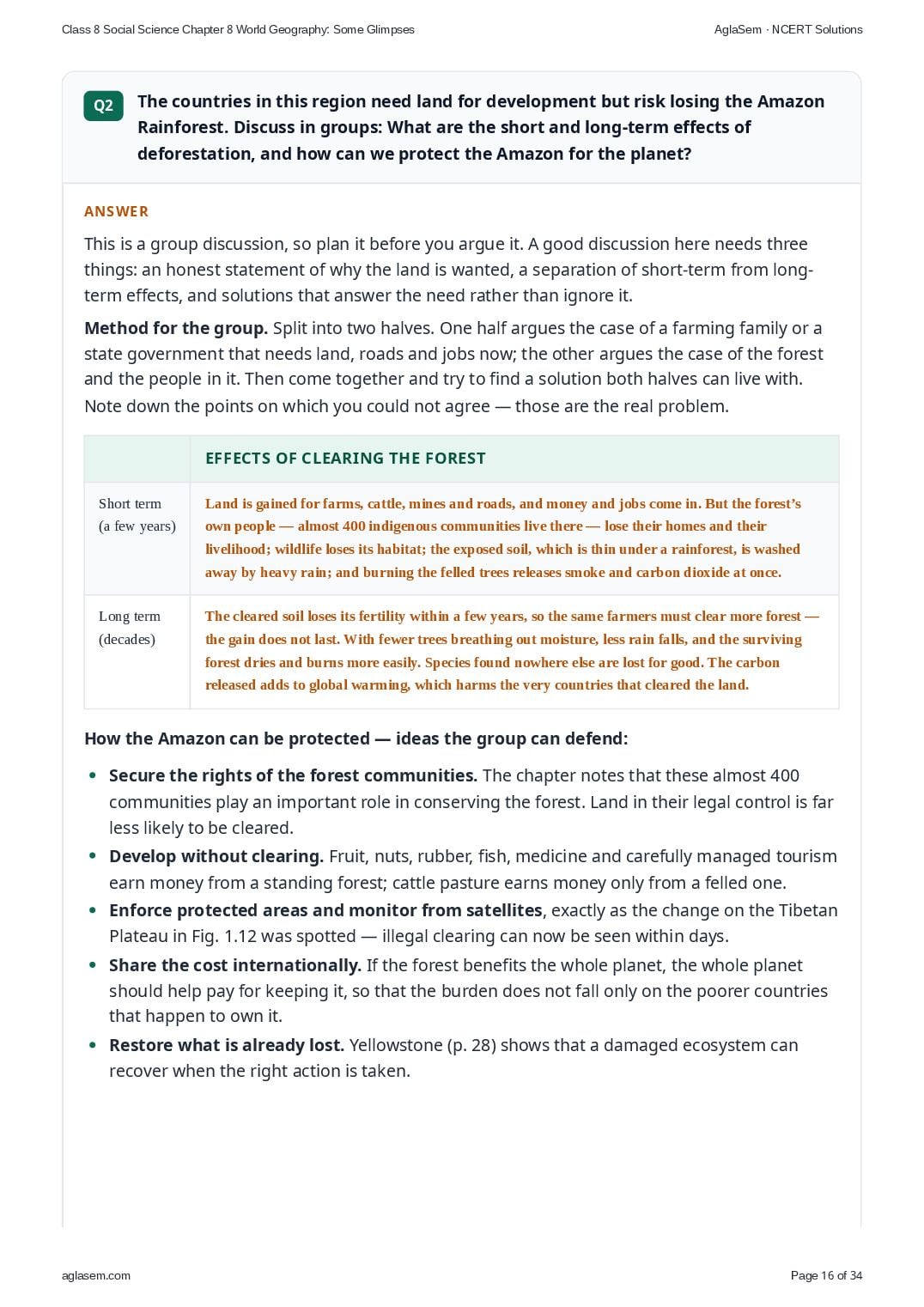
- The countries in this region need land for development but risk losing the Amazon Rainforest. Discuss in groups: What are the short and long-term effects of deforestation, and how can we protect the Amazon for the planet?
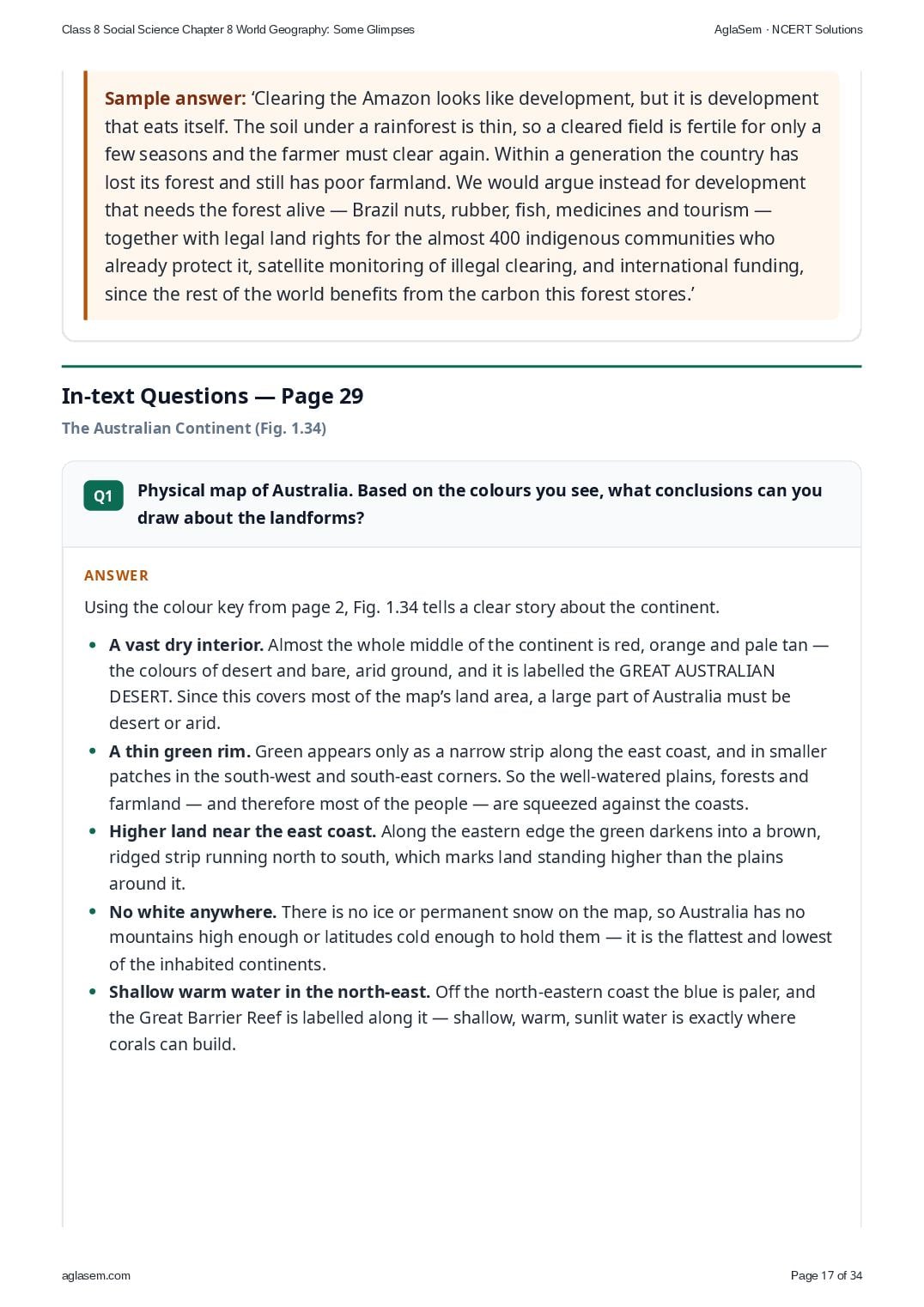
- Physical map of Australia. Based on the colours you see, what conclusions can you draw about the landforms?
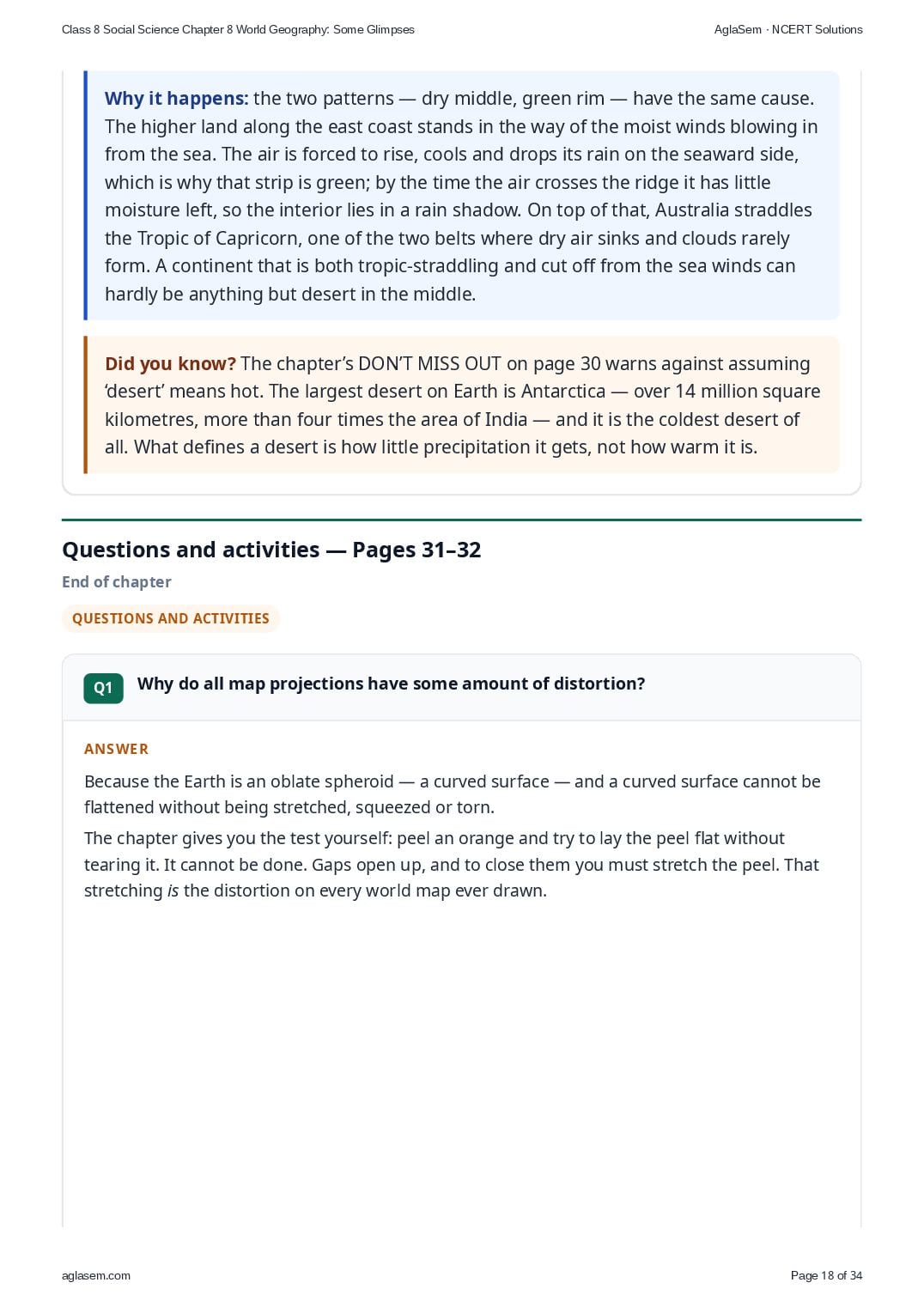
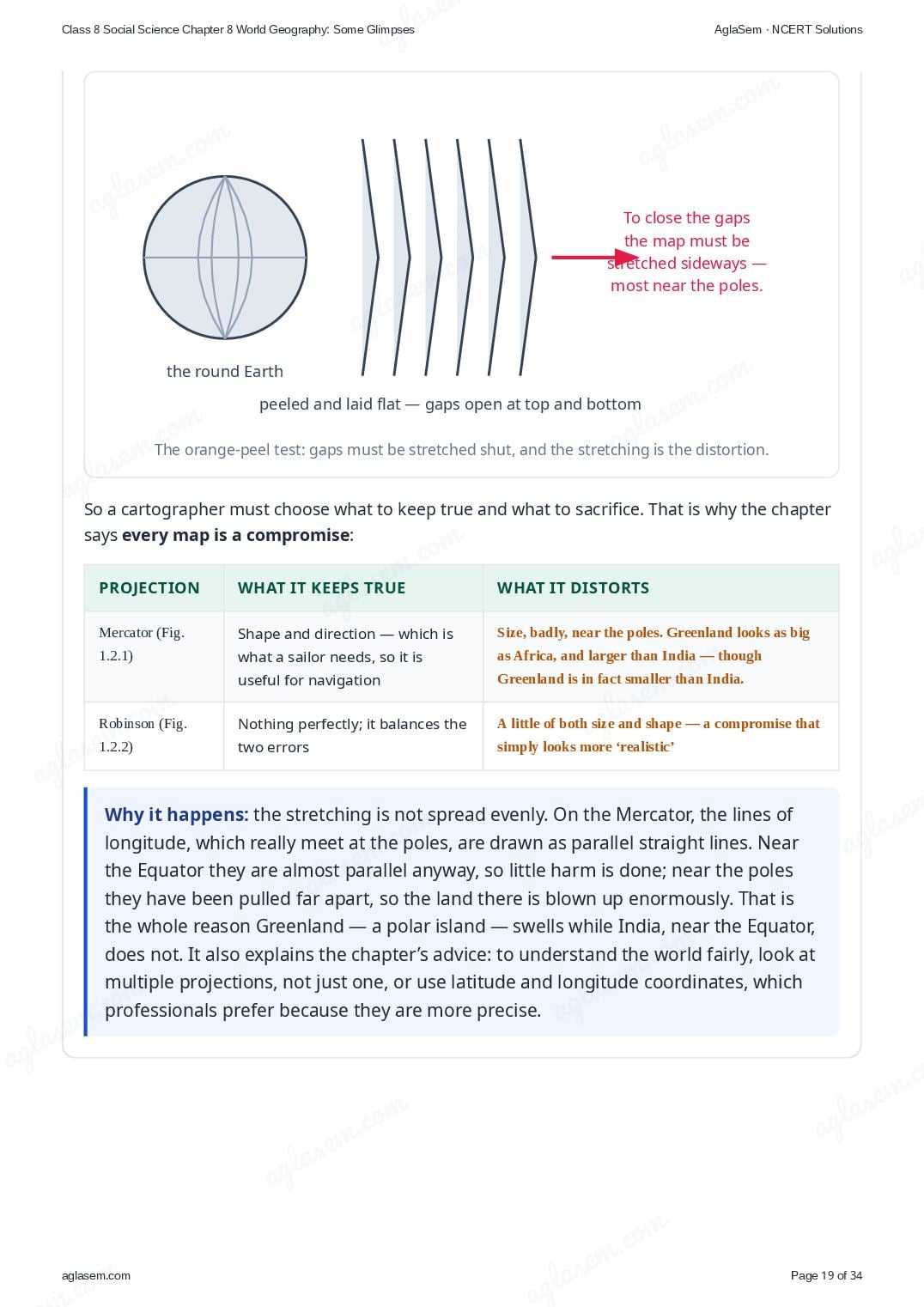
- Why do all map projections have some amount of distortion?
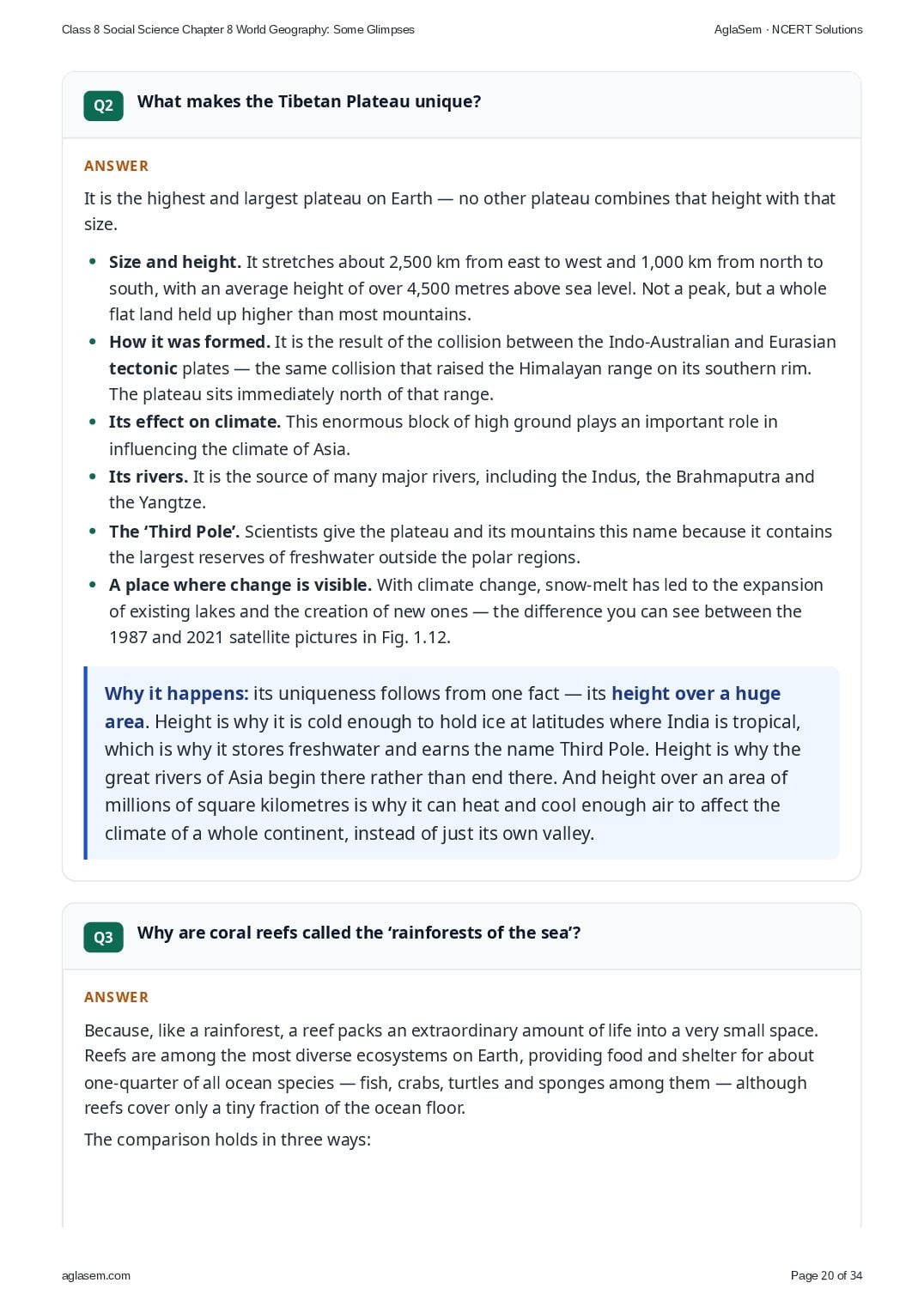
- What makes the Tibetan Plateau unique?
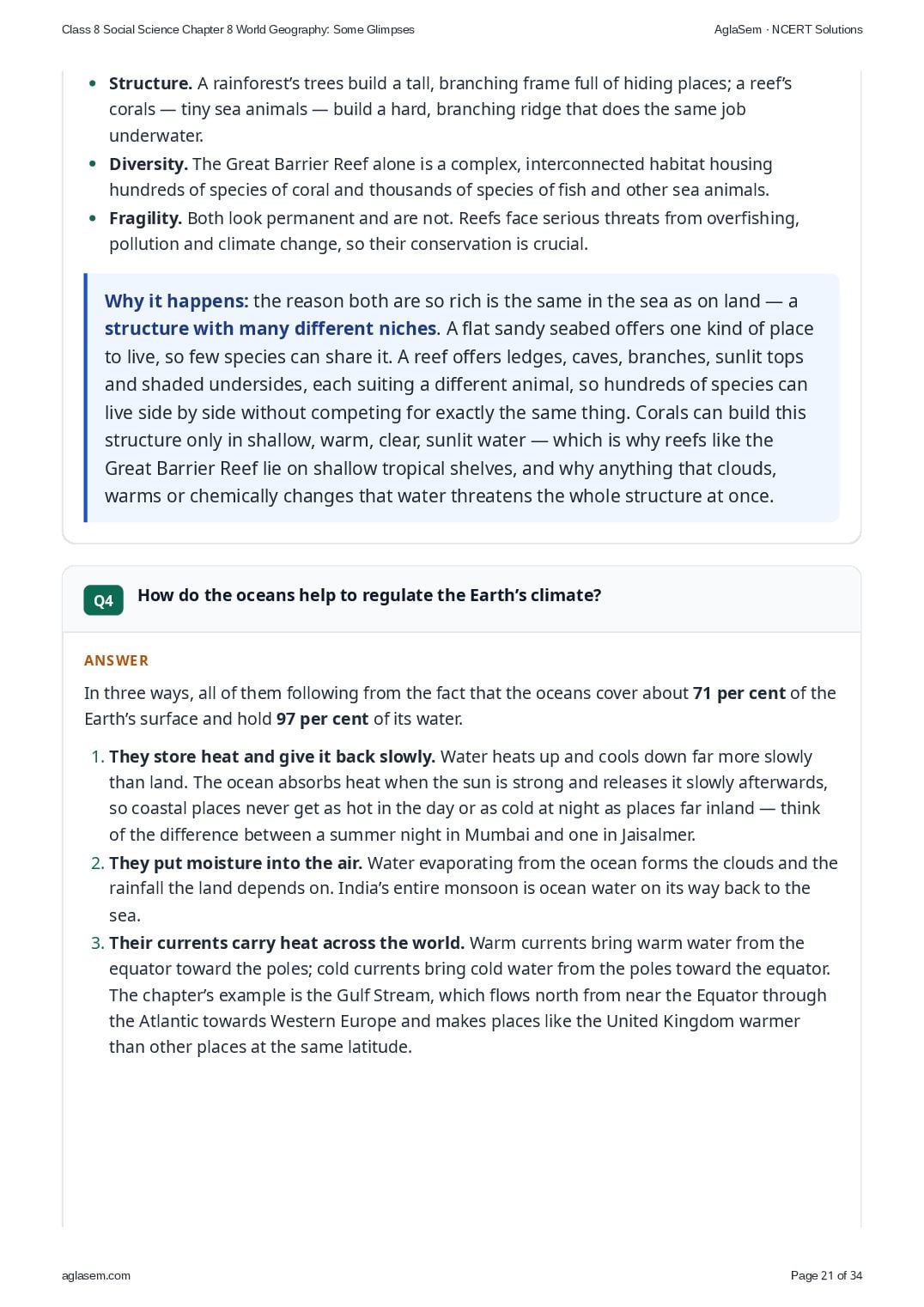
- Why are coral reefs called the ‘rainforests of the sea’?
- How do the oceans help to regulate the Earth’s climate?
- What is the main reason for the Great Barrier Reef facing threats today?
- Why is the Amazon Rainforest often called the ‘Lungs of the Earth’?
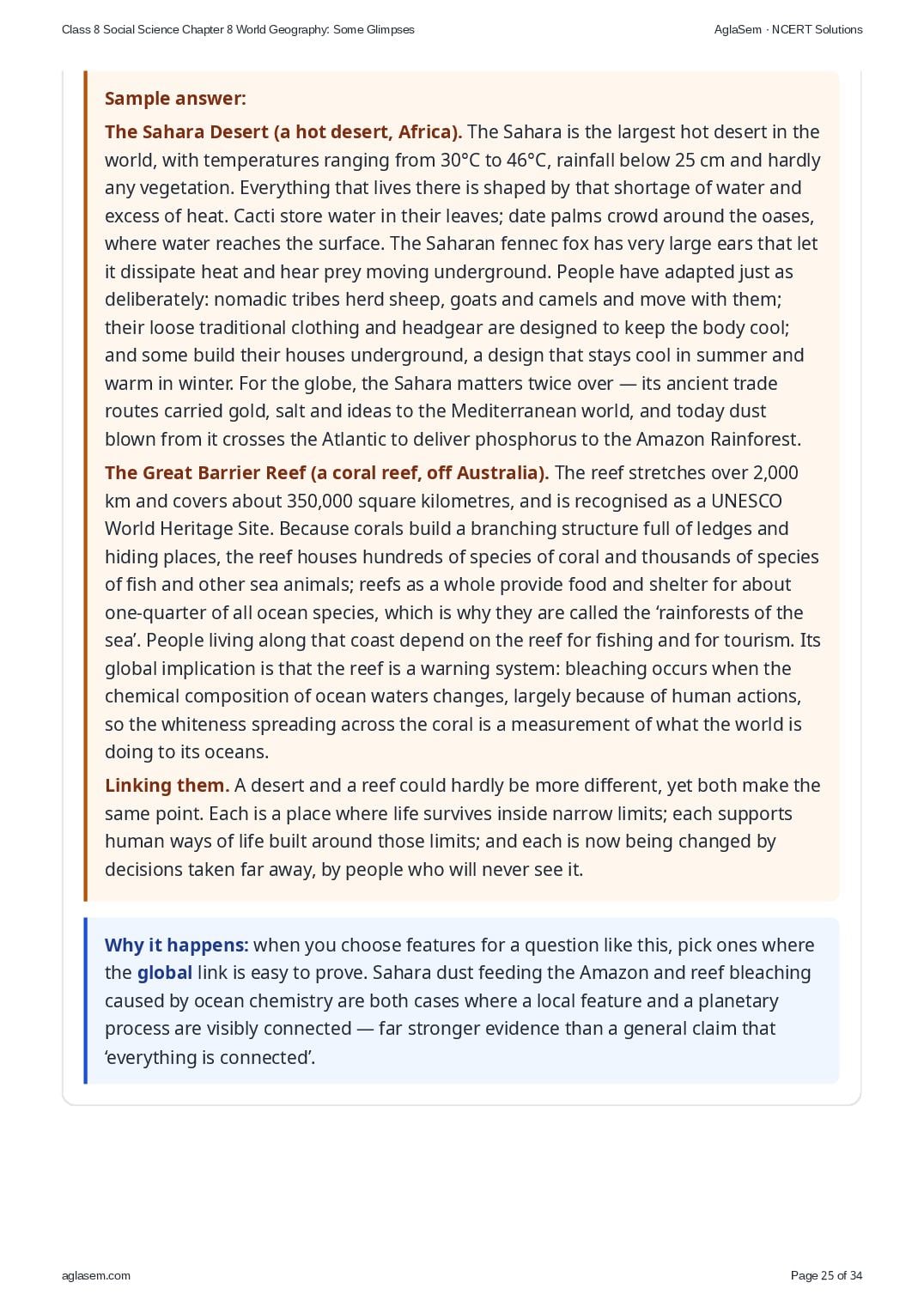
- Choose two different types of geographical features you have explored in this chapter. Write short paragraphs on how they influence the flora and fauna or human lives in that area. Do they also have an implication for the whole globe?
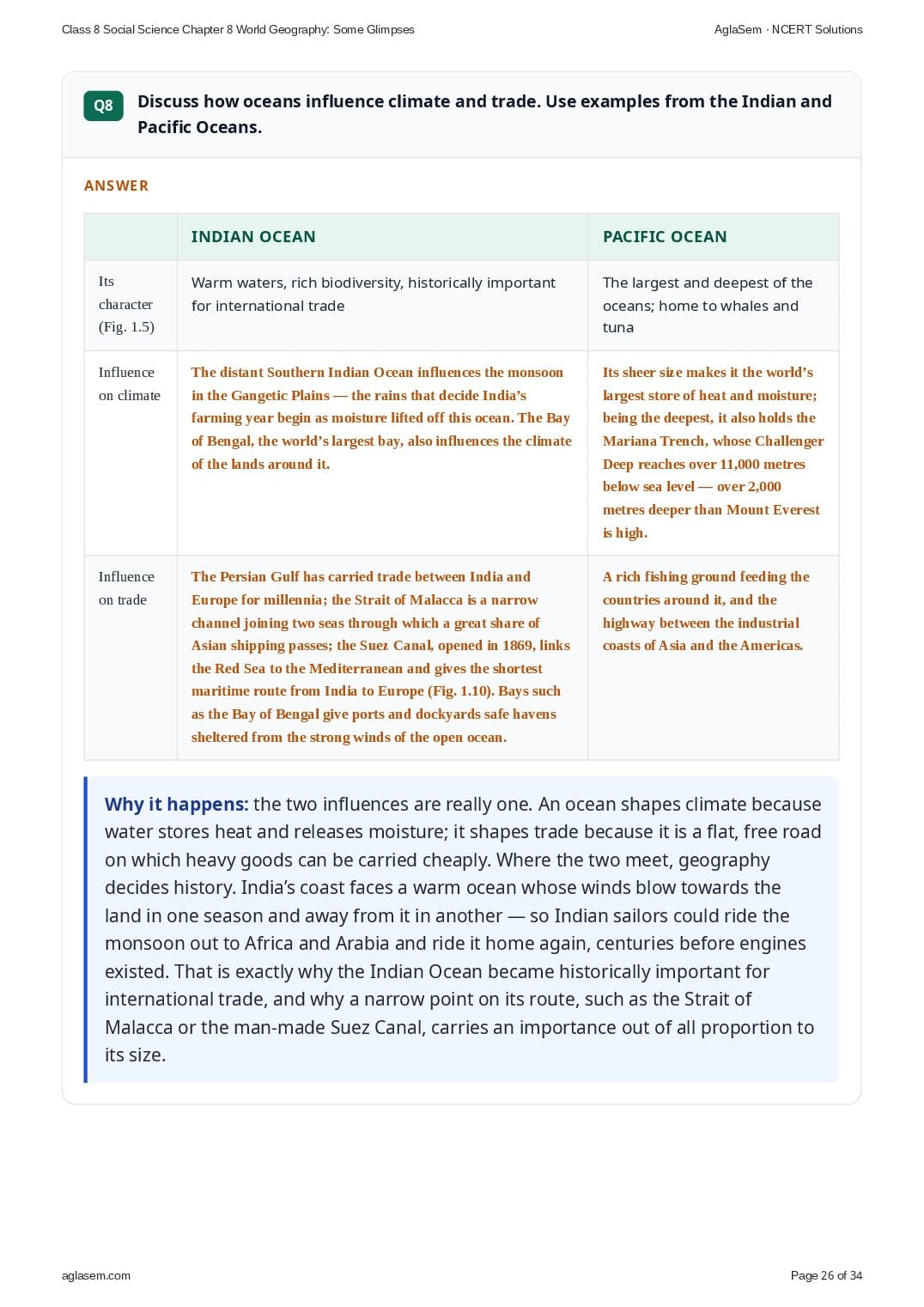
- Discuss how oceans influence climate and trade. Use examples from the Indian and Pacific Oceans.
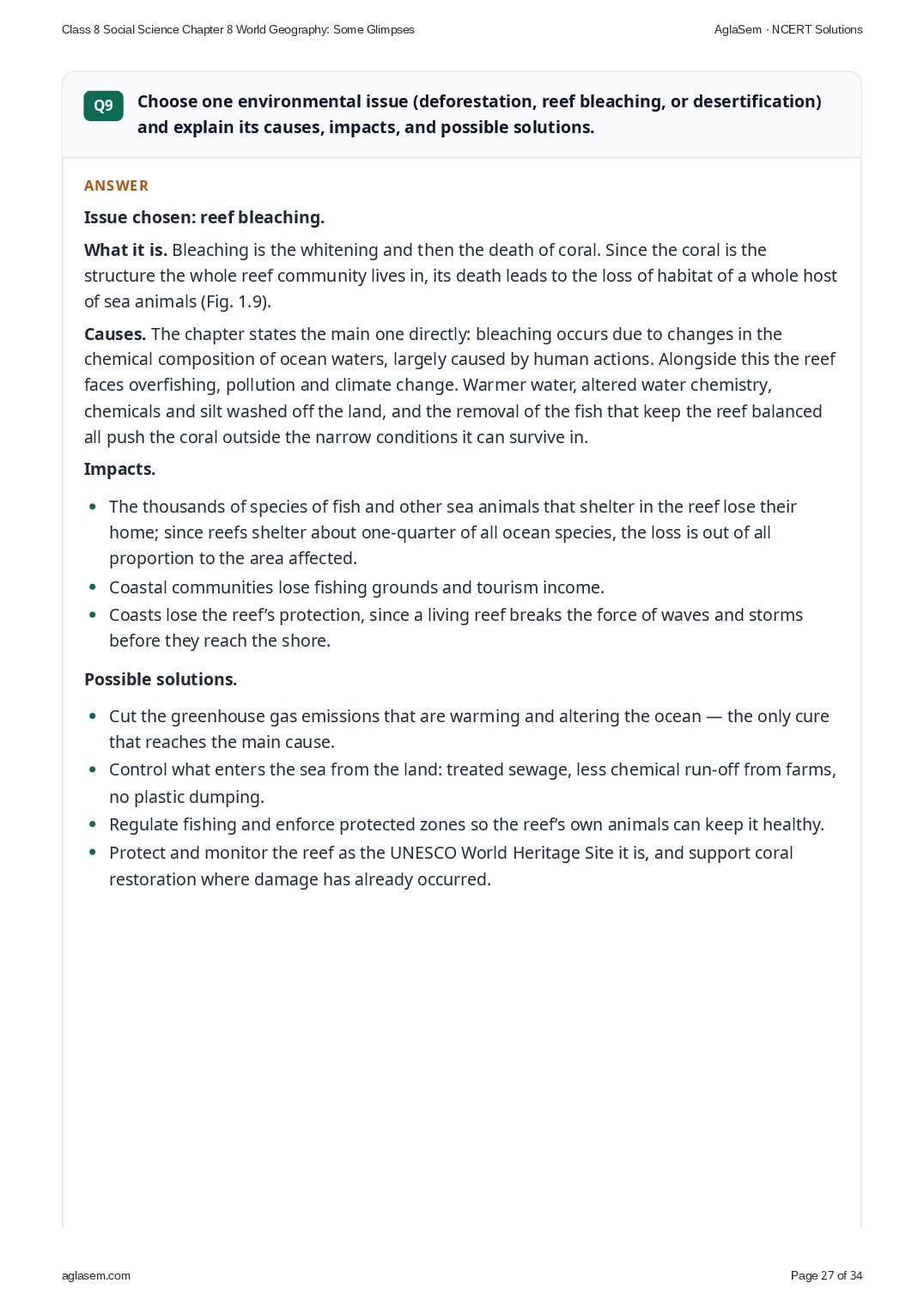
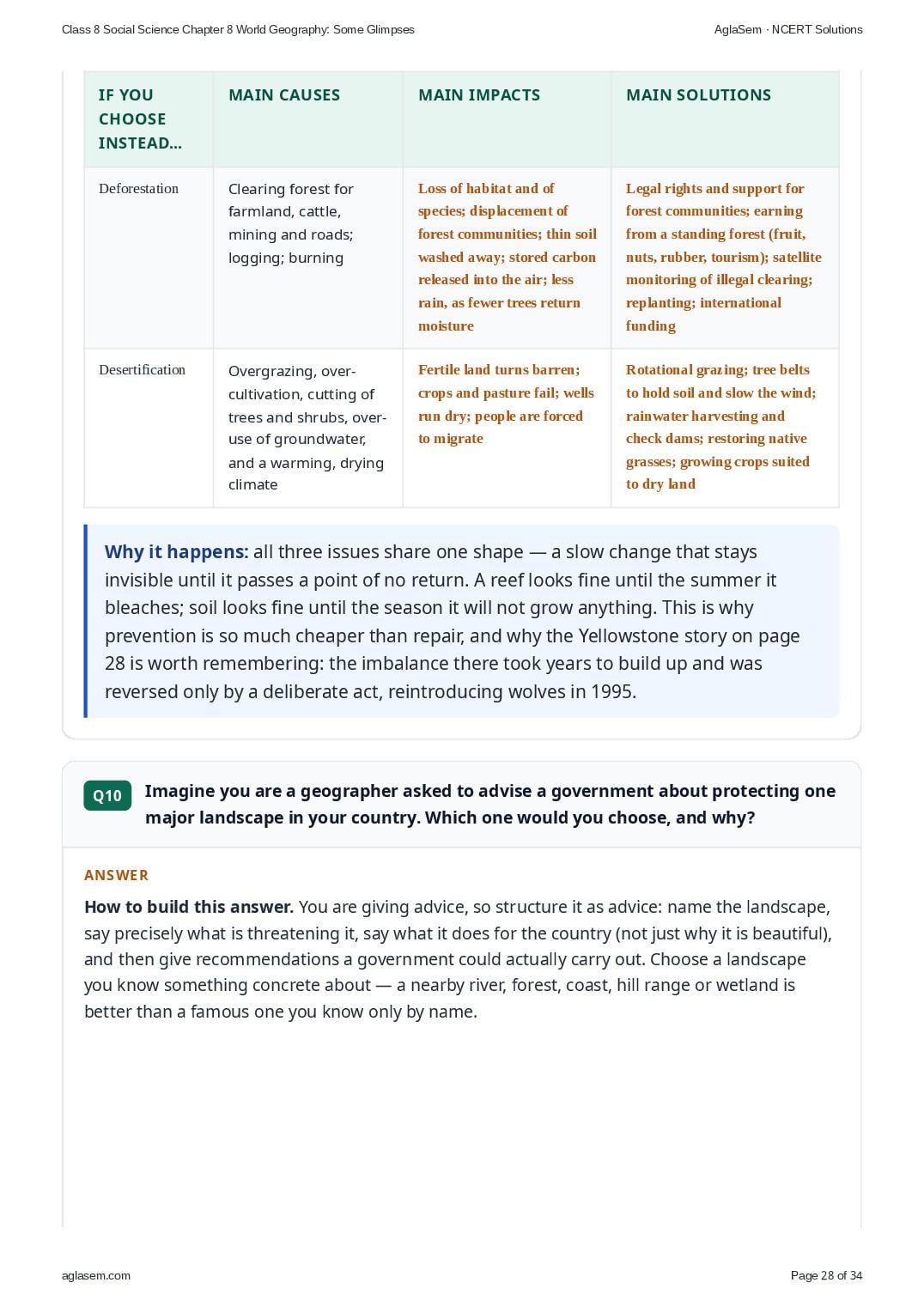
- Choose one environmental issue (deforestation, reef bleaching, or desertification) and explain its causes, impacts, and possible solutions.
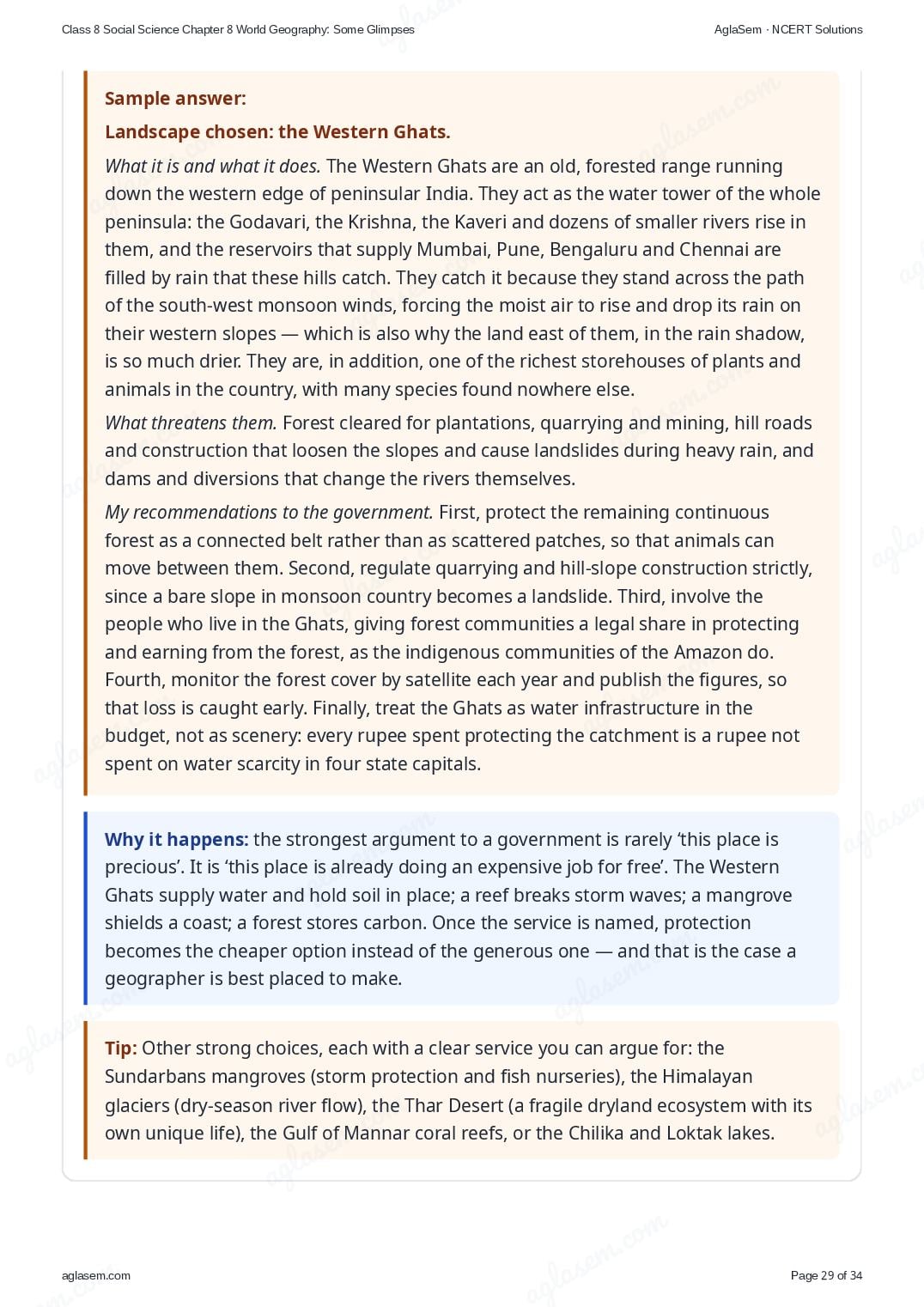
- Imagine you are a geographer asked to advise a government about protecting one major landscape in your country. Which one would you choose, and why?
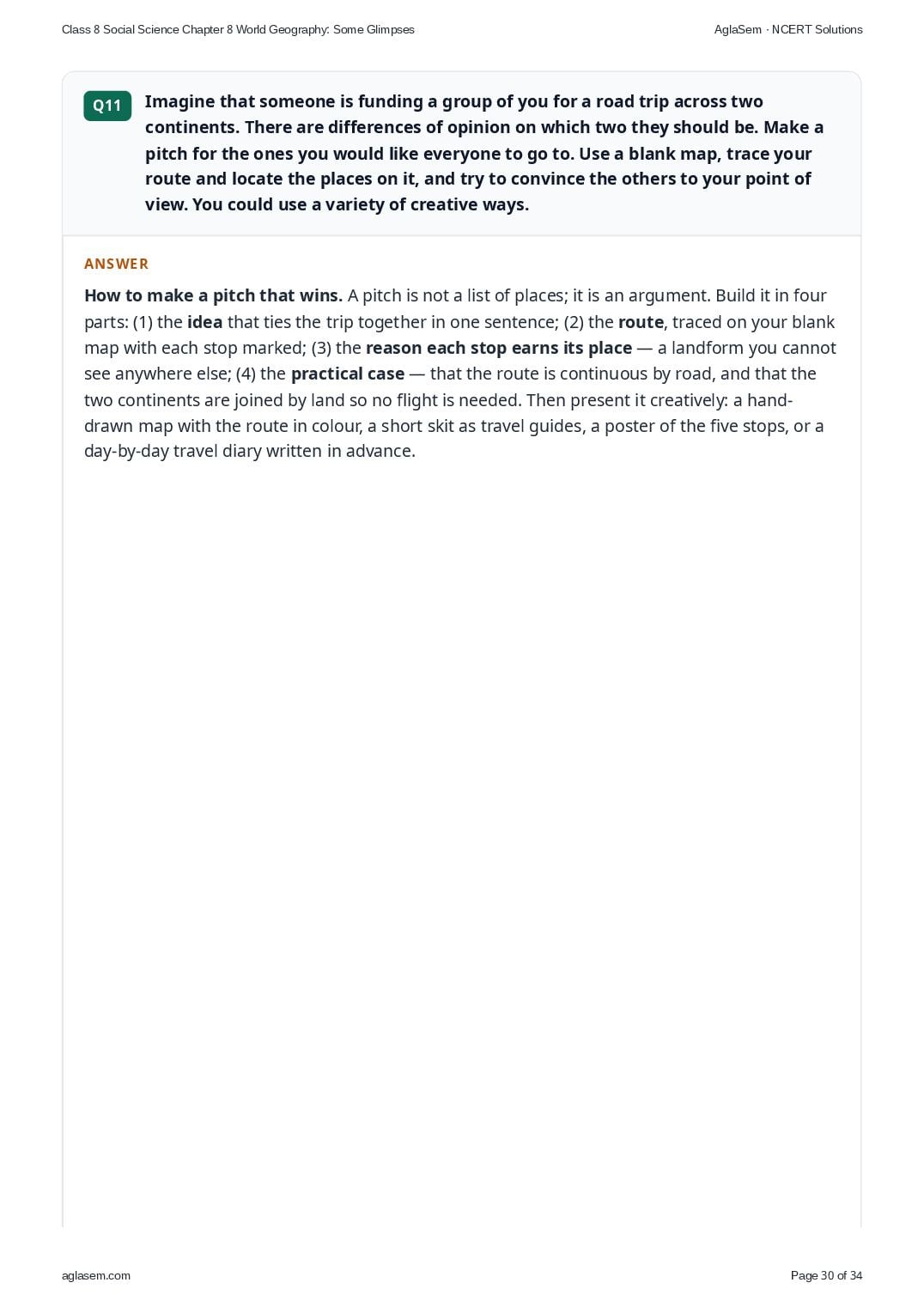
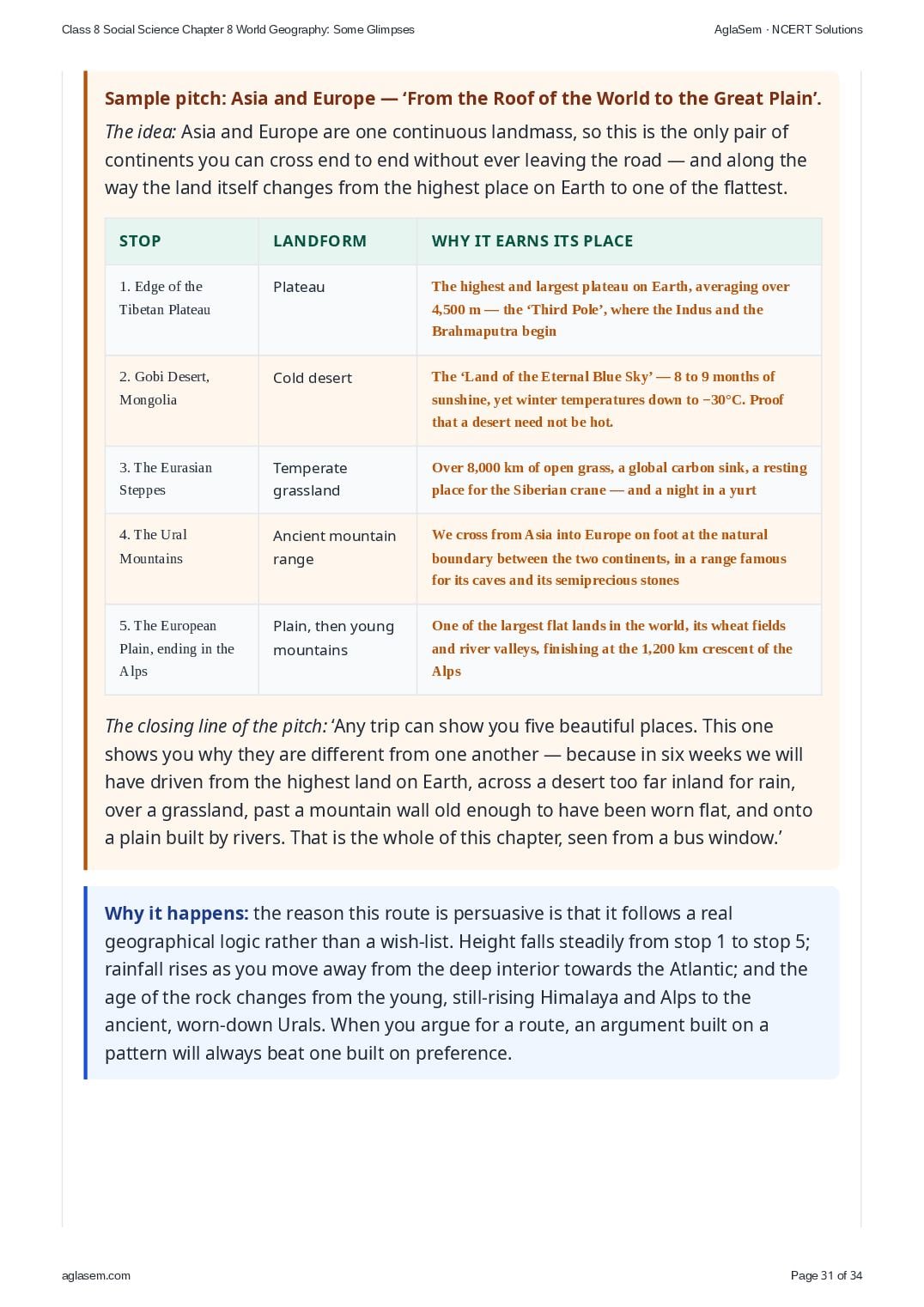
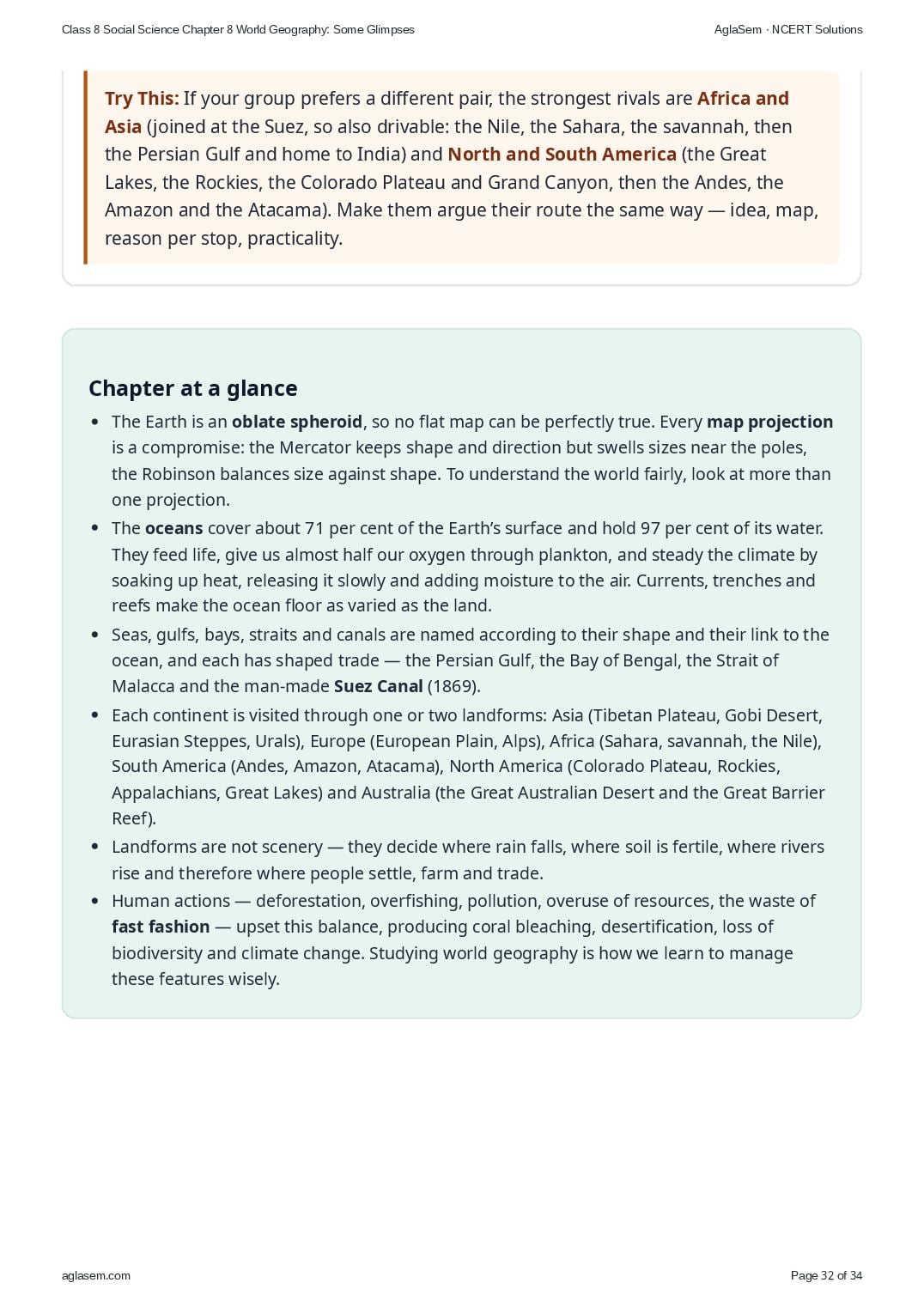
- Imagine that someone is funding a group of you for a road trip across two continents. There are differences of opinion on which two they should be. Make a pitch for the ones you would like everyone to go to. Use a blank map, trace your route and locate the places on it, and try to convince the others to your point of view. You could use a variety of creative ways.
Chapter at a Glance
- The Earth is an oblate spheroid , so no flat map can be perfectly true. Every map projection is a compromise: the Mercator keeps shape and direction but swells sizes near the poles, the Robinson balances size against shape. To understand the world fairly, look at more than one projection.
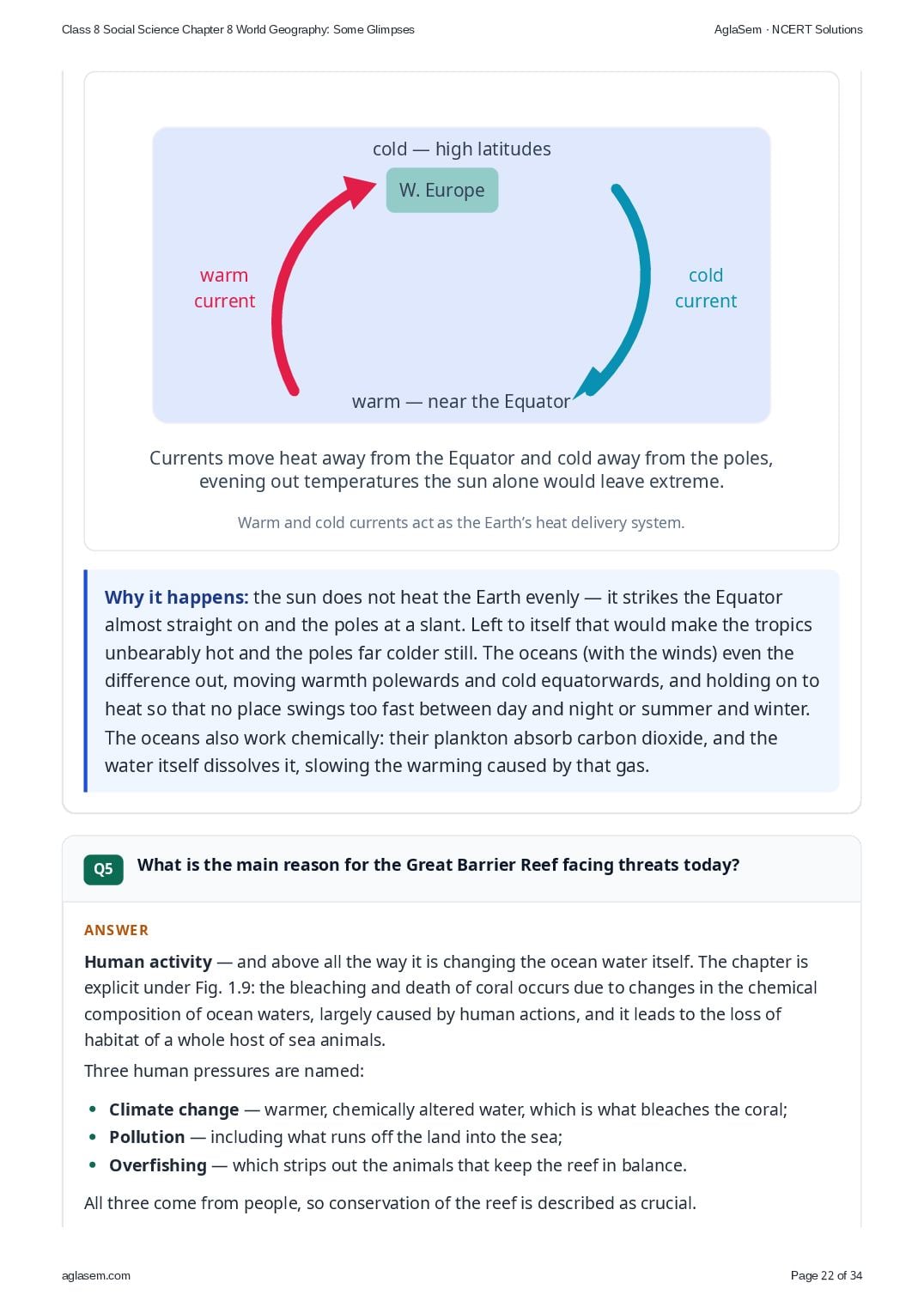
- The oceans cover about 71 per cent of the Earth’s surface and hold 97 per cent of its water. They feed life, give us almost half our oxygen through plankton, and steady the climate by soaking up heat, releasing it slowly and adding moisture to the air. Currents, trenches and reefs make the ocean floor as varied as the land.
- Seas, gulfs, bays, straits and canals are named according to their shape and their link to the ocean, and each has shaped trade — the Persian Gulf, the Bay of Bengal, the Strait of Malacca and the man-made Suez Canal (1869).
- Each continent is visited through one or two landforms: Asia (Tibetan Plateau, Gobi Desert, Eurasian Steppes, Urals), Europe (European Plain, Alps), Africa (Sahara, savannah, the Nile), South America (Andes, Amazon, Atacama), North America (Colorado Plateau, Rockies, Appalachians, Great Lakes) and Australia (the Great Australian Desert and the Great Barrier Reef).
- Landforms are not scenery — they decide where rain falls, where soil is fertile, where rivers rise and therefore where people settle, farm and trade.
- Human actions — deforestation, overfishing, pollution, overuse of resources, the waste of fast fashion — upset this balance, producing coral bleaching, desertification, loss of biodiversity and climate change. Studying world geography is how we learn to manage these features wisely.
How to Download NCERT Solutions for Class 8 Social Science Chapter 8 PDF
Follow these simple steps to get the World Geography Some Glimpses questions-and-answers PDF from Exploring Society: India and Beyond.
- Search NCERT Solutions for Class 8 Social Science Chapter 8 aglasem and open this page.
- Read the exercise questions with answers for World Geography Some Glimpses shown above.
- Click the Download PDF link to save the World Geography Some Glimpses solutions to your device.
NCERT Solutions for Class 8 Social Science – All Chapters
There are more chapters to study besides World Geography Some Glimpses in Social Science. Here are the NCERT Solutions for all chapters of Class 8 Social Science.
- Chapter 1 Natural Resources and Their Use
- Chapter 2 Reshaping India’s Political Map
- Chapter 3 The Rise of the Marathas
- Chapter 4 The Colonial Era in India
- Chapter 5 Universal Franchise and India’s Electoral System
- Chapter 6 The Parliamentary System Legislature and Executive
- Chapter 7 Factors of Production
- Chapter 8 World Geography Some Glimpses
- Chapter 9 India’s Long Road to Independence
- Chapter 10 A Journey Through Indian Architecture
- Chapter 11 The Role of the Judiciary in Our Society
- Chapter 12 Citizenship Rights and Duties
- Chapter 13 Dynamics of Population
- Chapter 14 India’s Urban Landscape
- Chapter 15 Cultural Currents 13th to 17th Centuries
NCERT Solutions for Class 8 – All Subjects
Just like Chapter 8 of Social Science, you can get the exercise questions with answers for every other subject of Class 8. Here are the NCERT Solutions for all subjects of Class 8.
NCERT Solutions for Class 8 Social Science Chapter 8 – An Overview
The key highlights of this study material are as follows.
| Aspects | Details |
|---|---|
| Class | Class 8 |
| Subject | Social Science |
| Chapter Number | Chapter 8 |
| Chapter Name | World Geography Some Glimpses |
| Book Name | Exploring Society: India and Beyond |
| Book By | NCERT (National Council of Educational Research and Training) |
| Educational Resource Here | NCERT Solutions of Class 8 Social Science Chapter 8 for all exercises |
| More Questions Answers of This Subject | NCERT Solutions for Class 8 Social Science |
| Download Book Chapter | NCERT Book Class 8 Social Science |
| All Questions Answers For This Class | NCERT Solutions for Class 8 |
| Complete Solutions | NCERT Solutions |
NCERT Solutions for Class 8 Social Science Chapter 8 World Geography Some Glimpses – FAQs
What are the NCERT Solutions for Class 8 Social Science Chapter 8 World Geography Some Glimpses?
They are the complete, step-by-step answers to all the exercise and in-text questions of Chapter 8 World Geography Some Glimpses from the NCERT Class 8 Social Science textbook Exploring Society: India and Beyond, written by experts as per the latest NCERT syllabus.
How can I download the Class 8 Social Science Chapter 8 solutions PDF for free?
Open this page on aglasem, read the World Geography Some Glimpses questions with answers, and click the “Download Solutions PDF” link. The Class 8 Social Science Chapter 8 NCERT Solutions PDF is completely free to download.
Are these NCERT Solutions as per the latest 2026-27 syllabus?
Yes. The NCERT Solutions for Class 8 Social Science Chapter 8 are based on the latest NCERT textbook Exploring Society: India and Beyond and the current 2026-27 CBSE syllabus, so the questions and answers match what you study in class.
Where can I get NCERT Solutions for the other chapters of Class 8 Social Science?
You can find the answers to every chapter on the NCERT Solutions for Class 8 Social Science page, and solutions for every subject on the NCERT Solutions for Class 8 page.
How do NCERT Solutions help in exam preparation?
They show the correct method to solve each question, help you write answers the way they are expected in exams, let you check and correct your own work, and save revision time — which together improve your marks in Class 8 Social Science.
If you have any queries on NCERT Solutions for Class 8 Social Science Chapter 8 World Geography Some Glimpses, then please ask in the comments below.