NCERT Solutions for Class 8 Social Science Chapter 6 The Parliamentary System Legislature and Executive provide clear, step-by-step answers to every exercise and in-text question from the chapter The Parliamentary System Legislature and Executive of the NCERT textbook Exploring Society: India and Beyond. Prepared by subject experts as per the latest NCERT (CBSE) syllabus for 2026-27, these NCERT Solutions for Class 8 Social Science help you understand each concept, write exam-ready answers, and check your own solutions. You can read them online below or download the free Class 8 Social Science Chapter 6 question-answer PDF.
NCERT Solutions for Class 8 Social Science Chapter 6 The Parliamentary System Legislature and Executive
- Class: Class 8
- Subject: Social Science
- Chapter: Chapter 6 – The Parliamentary System Legislature and Executive
- Textbook: Exploring Society: India and Beyond (NCERT)
- Study material: NCERT Solutions – questions with answers, free PDF
These solutions answer all the exercise questions of Chapter 6 The Parliamentary System Legislature and Executive — including the in-text questions, short-answer and long-answer questions, and activities — with complete explanations so you can follow the method, not just the final answer. Read the full solutions below.
NCERT Solutions Class 8 Social Science Chapter 6 the Parliamentary System Legislature and Executive View Download
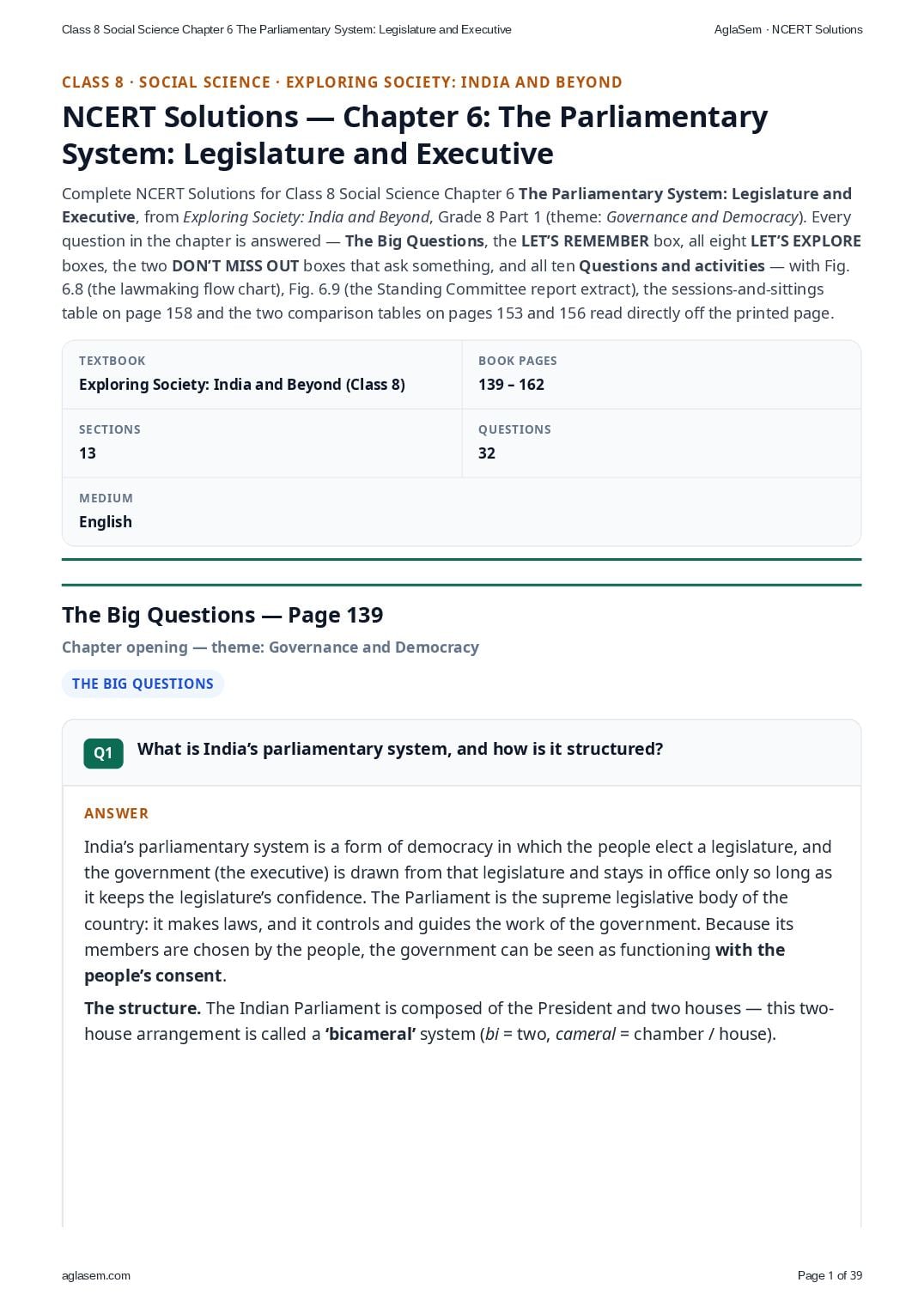
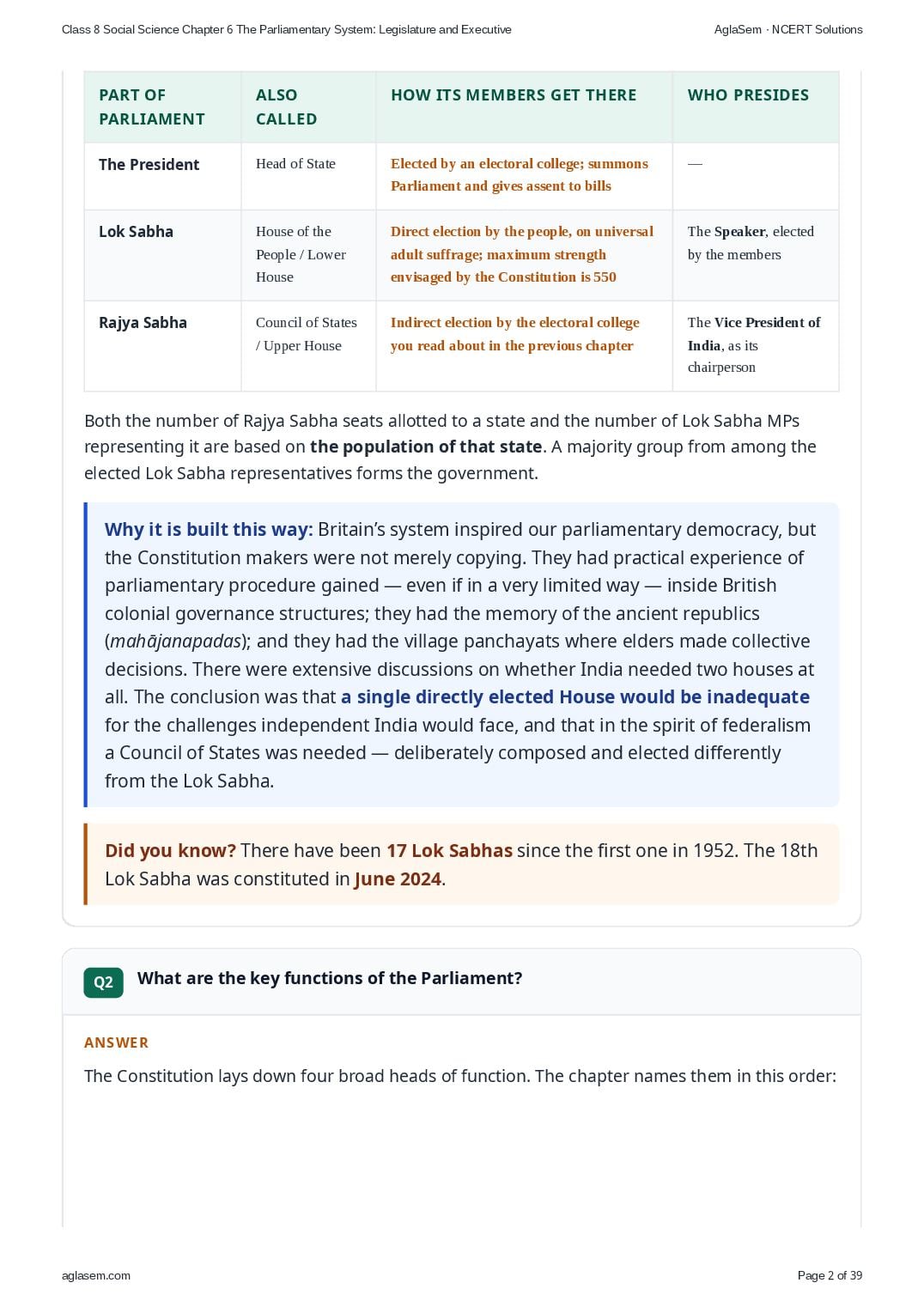
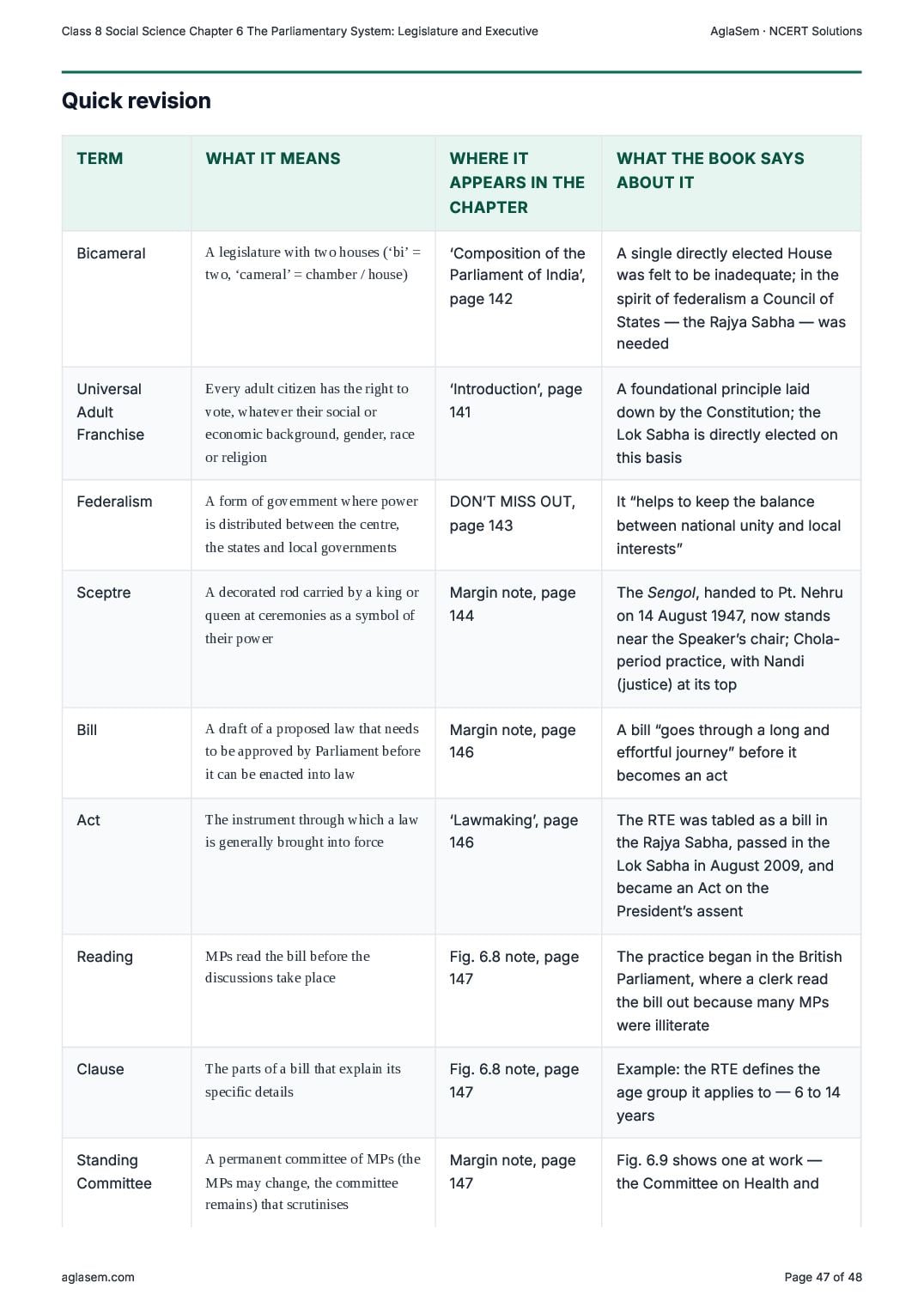
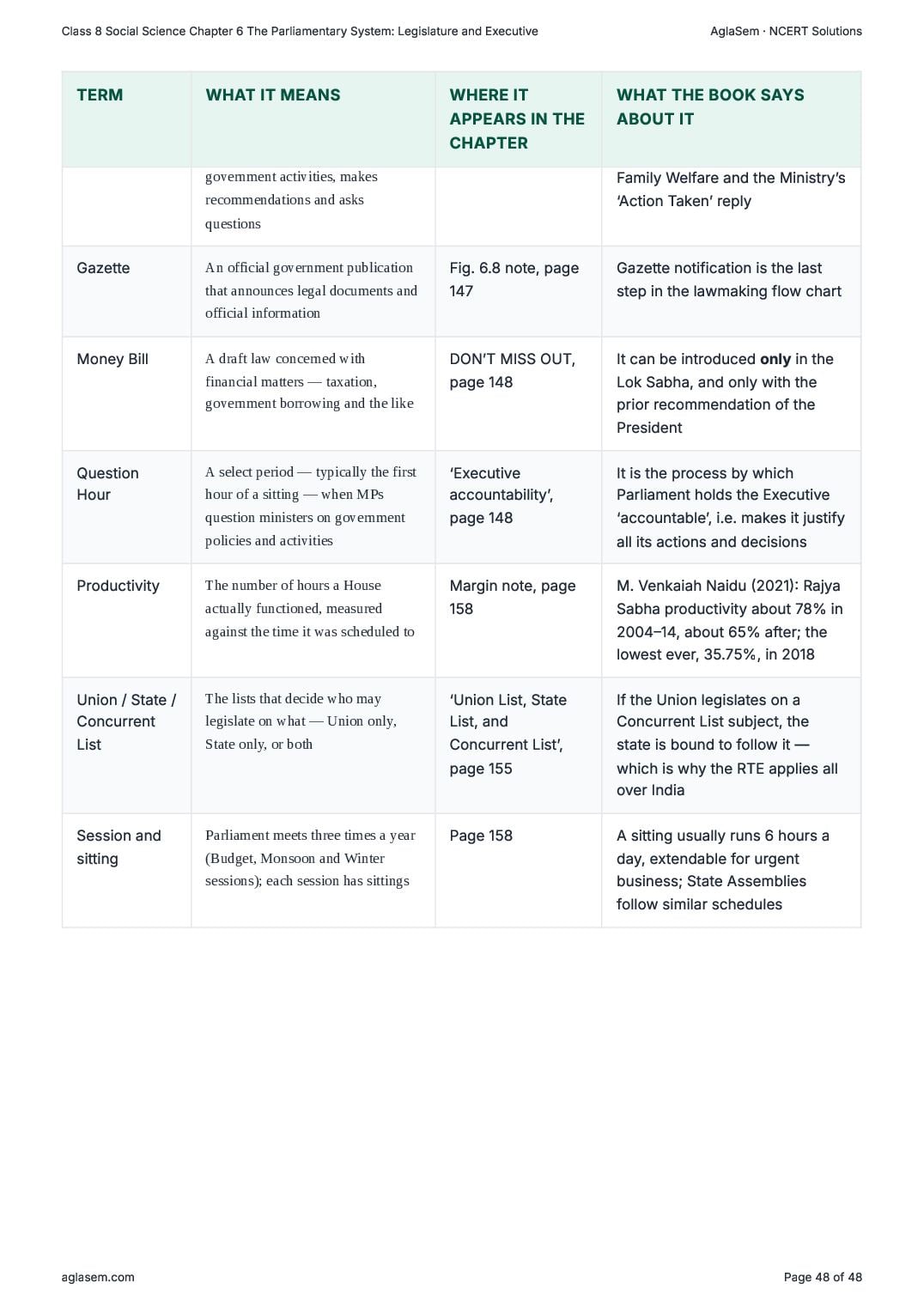
NCERT Solutions for Class 8 Social Science Chapter 6 PDF Download
You can read the NCERT Solutions for Class 8 Social Science Chapter 6 online above, or download the complete question-answer PDF to study The Parliamentary System Legislature and Executive offline at any time.
NCERT Solutions for Class 8 Social Science Chapter 6 PDF Download Link – Click Here to Download Solutions PDF
Questions Covered in This Chapter
These NCERT Solutions answer all 32 questions of this chapter. The questions solved are:
- What is India’s parliamentary system, and how is it structured?
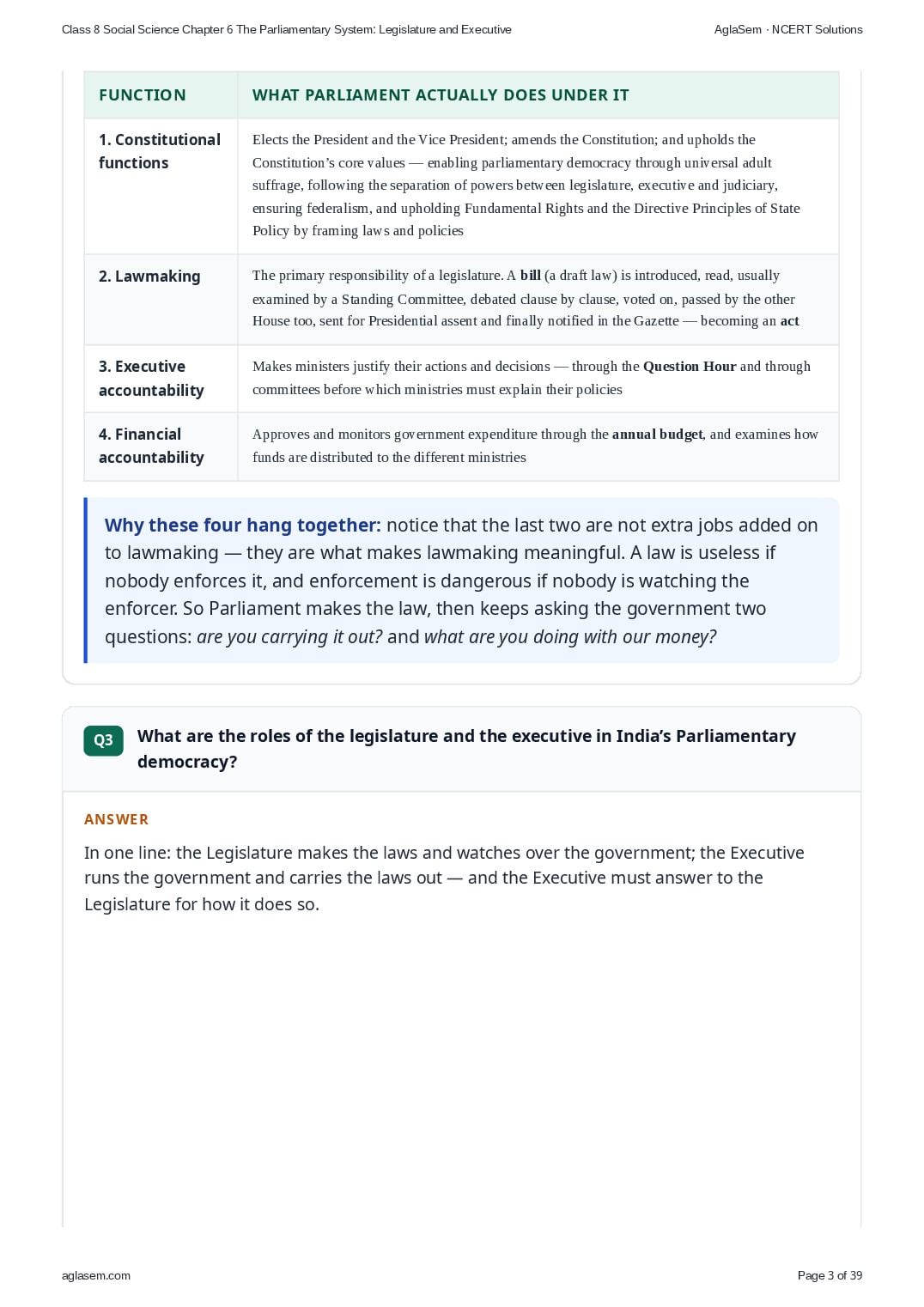
- What are the key functions of the Parliament?
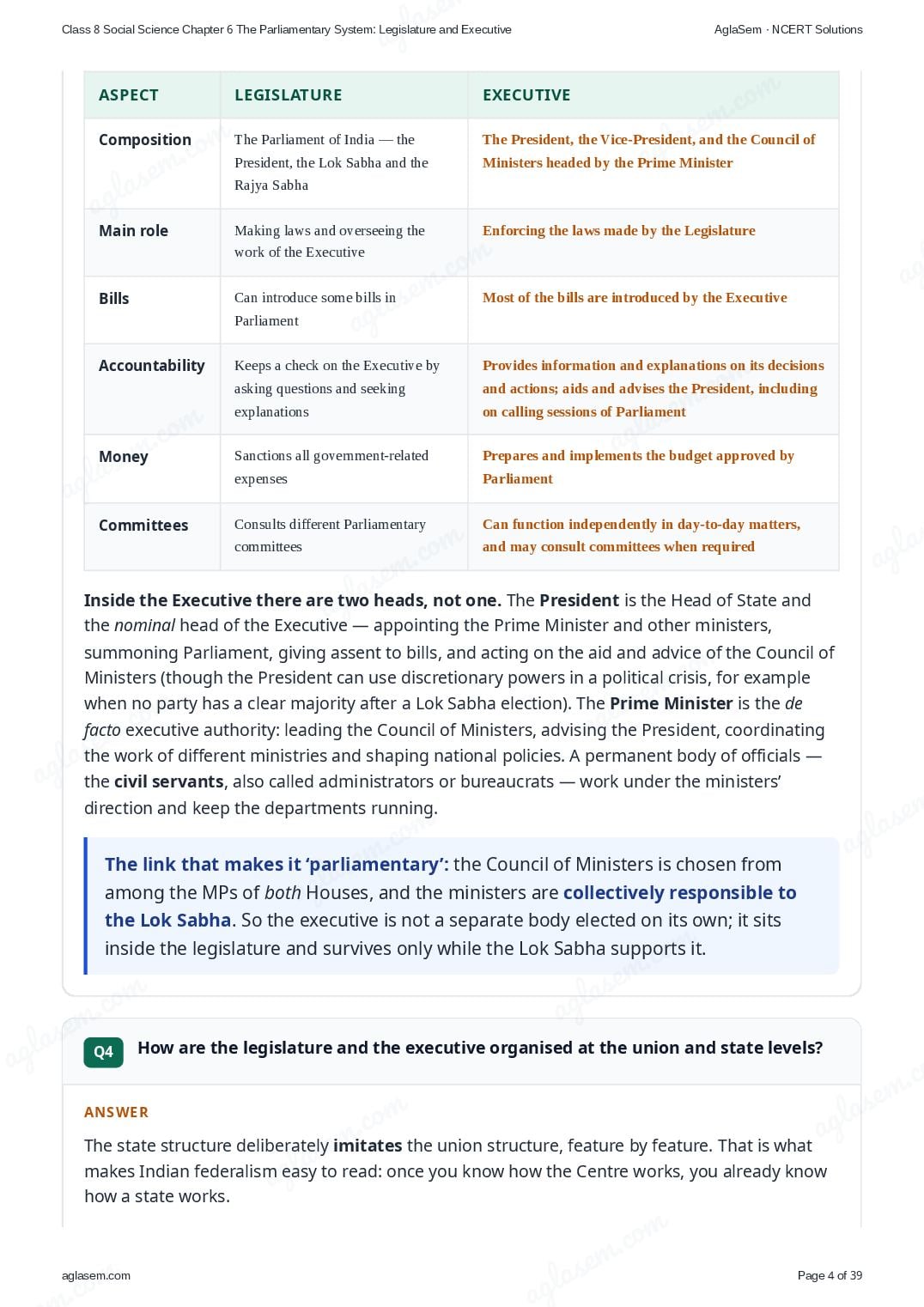
- What are the roles of the legislature and the executive in India’s Parliamentary democracy?
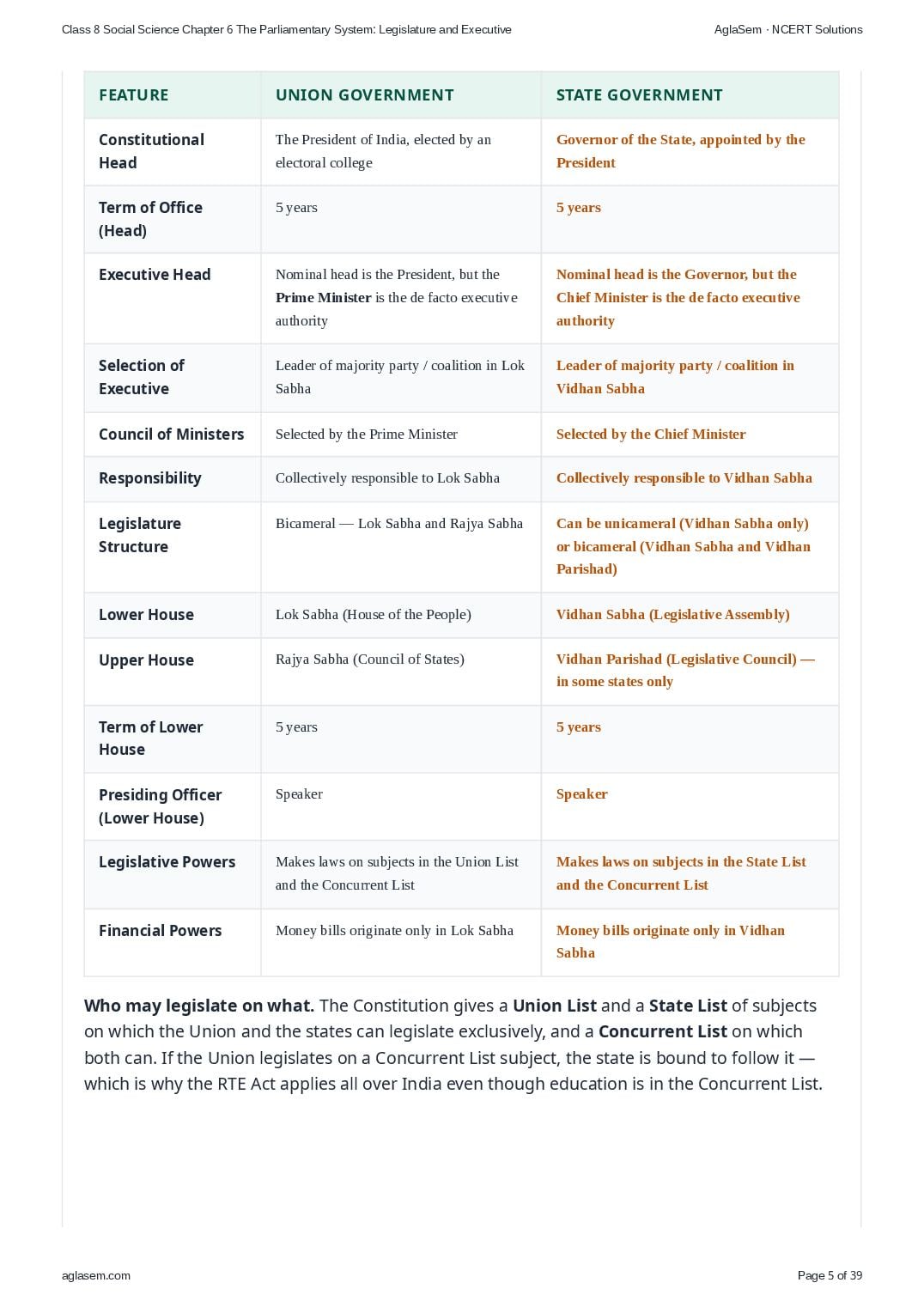
- How are the legislature and the executive organised at the union and state levels?
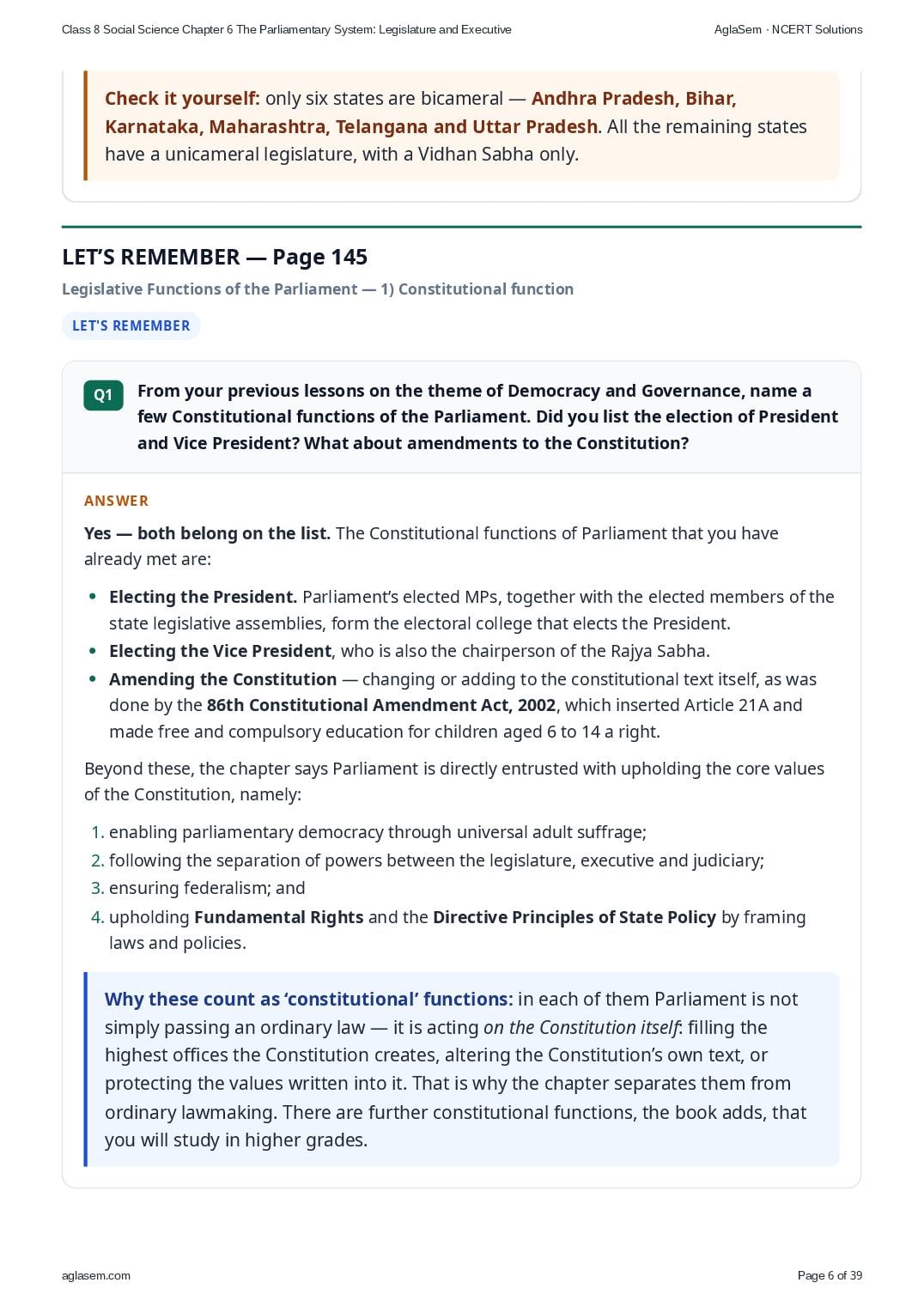
- From your previous lessons on the theme of Democracy and Governance, name a few Constitutional functions of the Parliament. Did you list the election of President and Vice President? What about amendments to the Constitution?
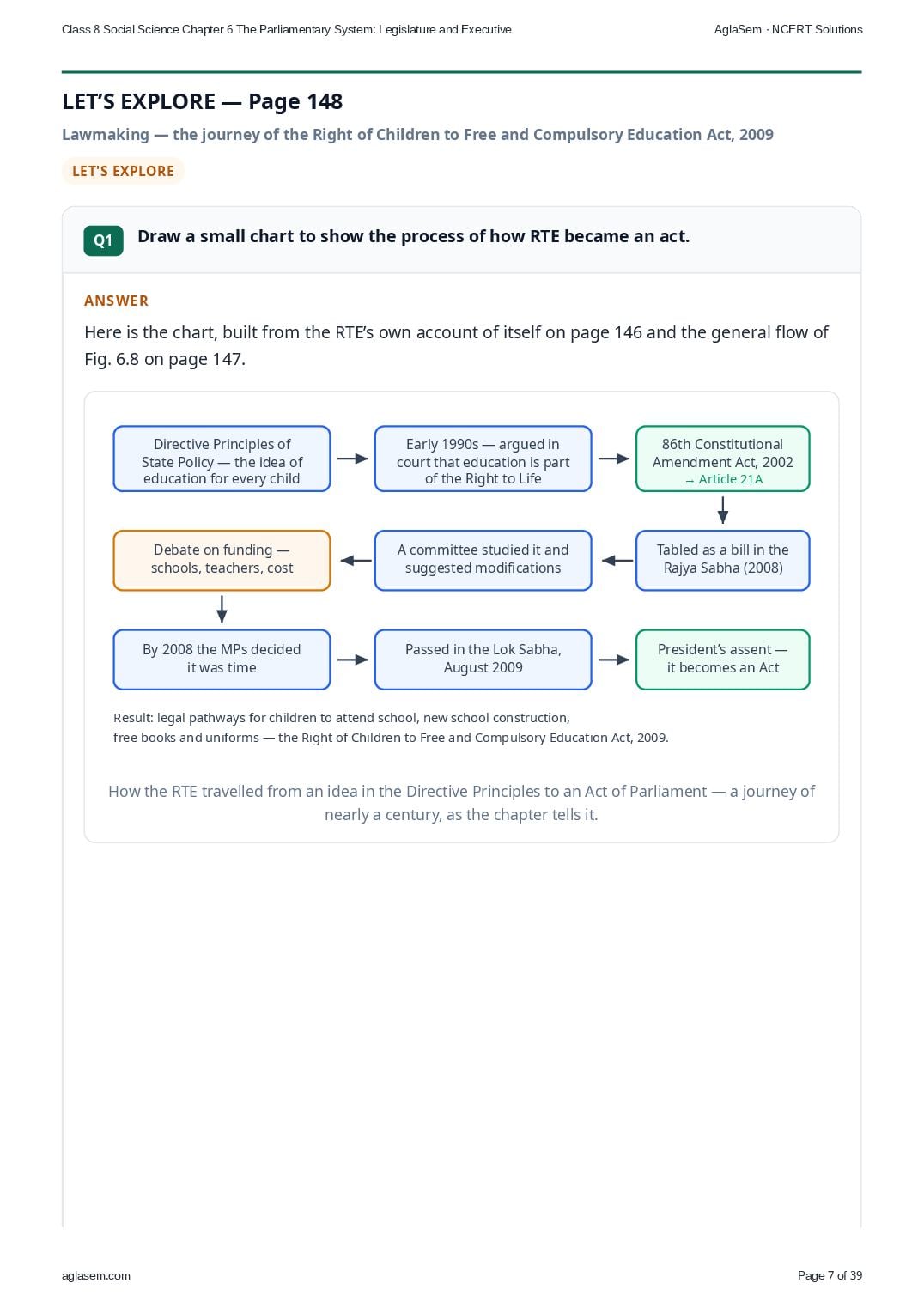
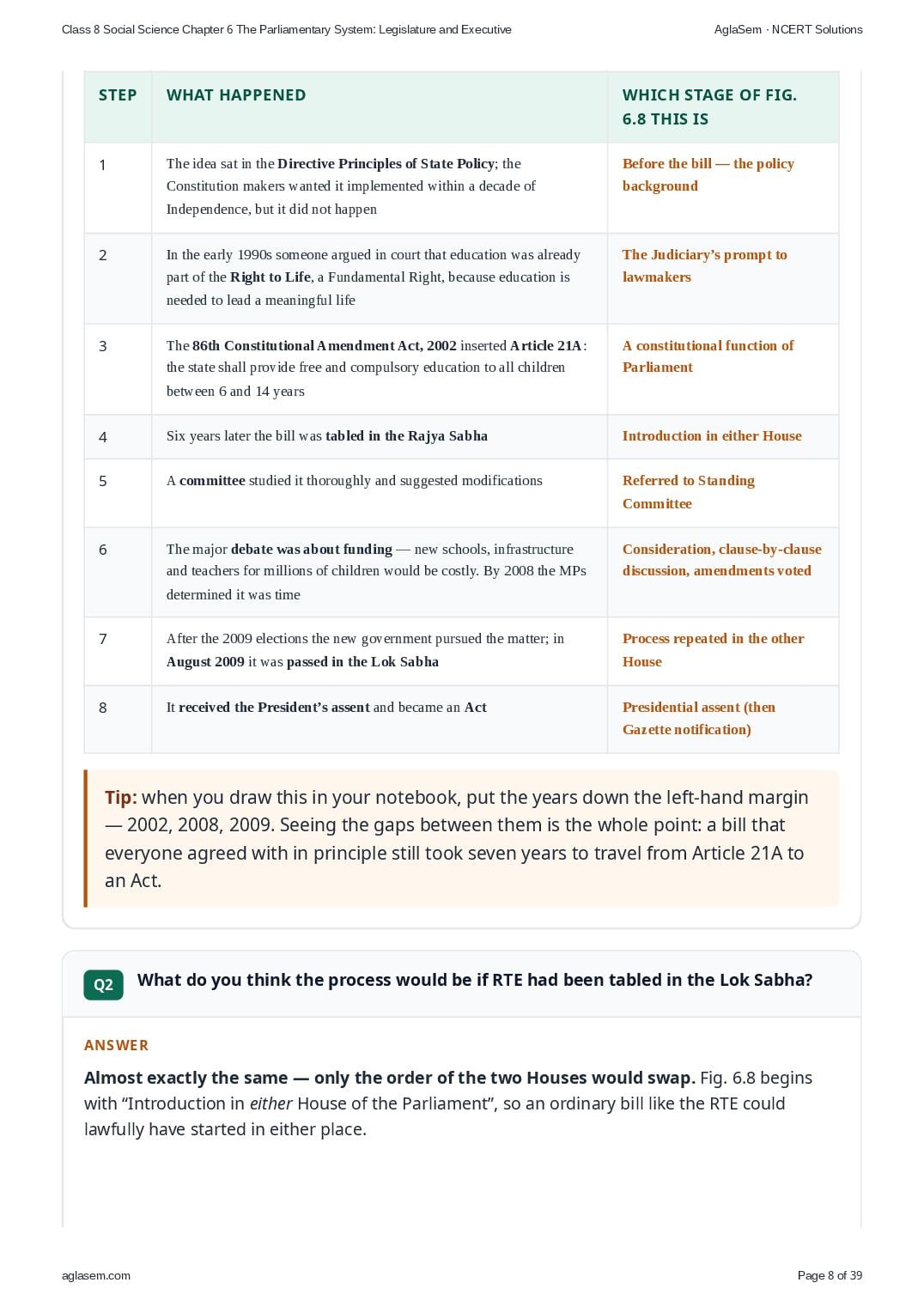
- Draw a small chart to show the process of how RTE became an act.
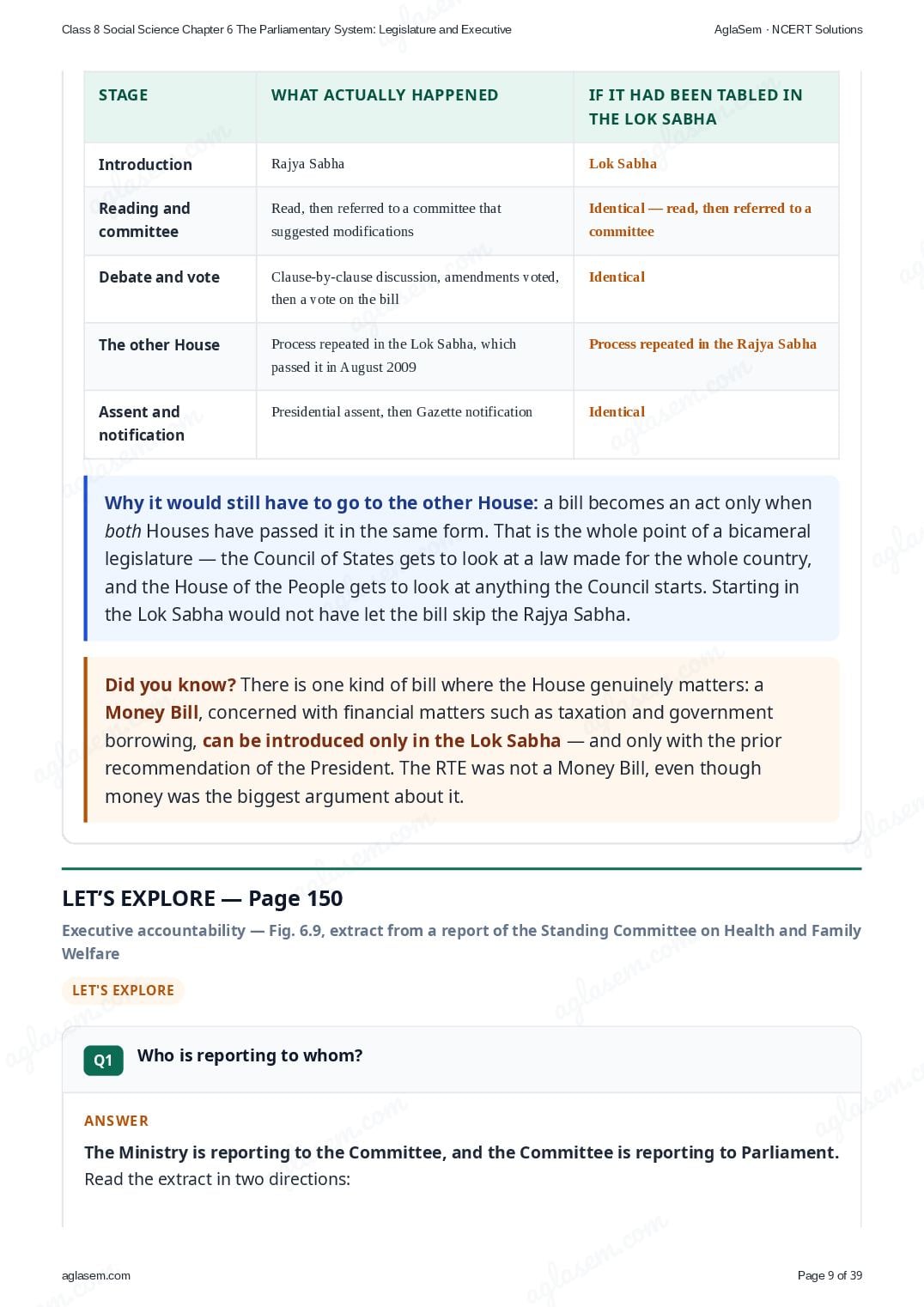
- What do you think the process would be if RTE had been tabled in the Lok Sabha?
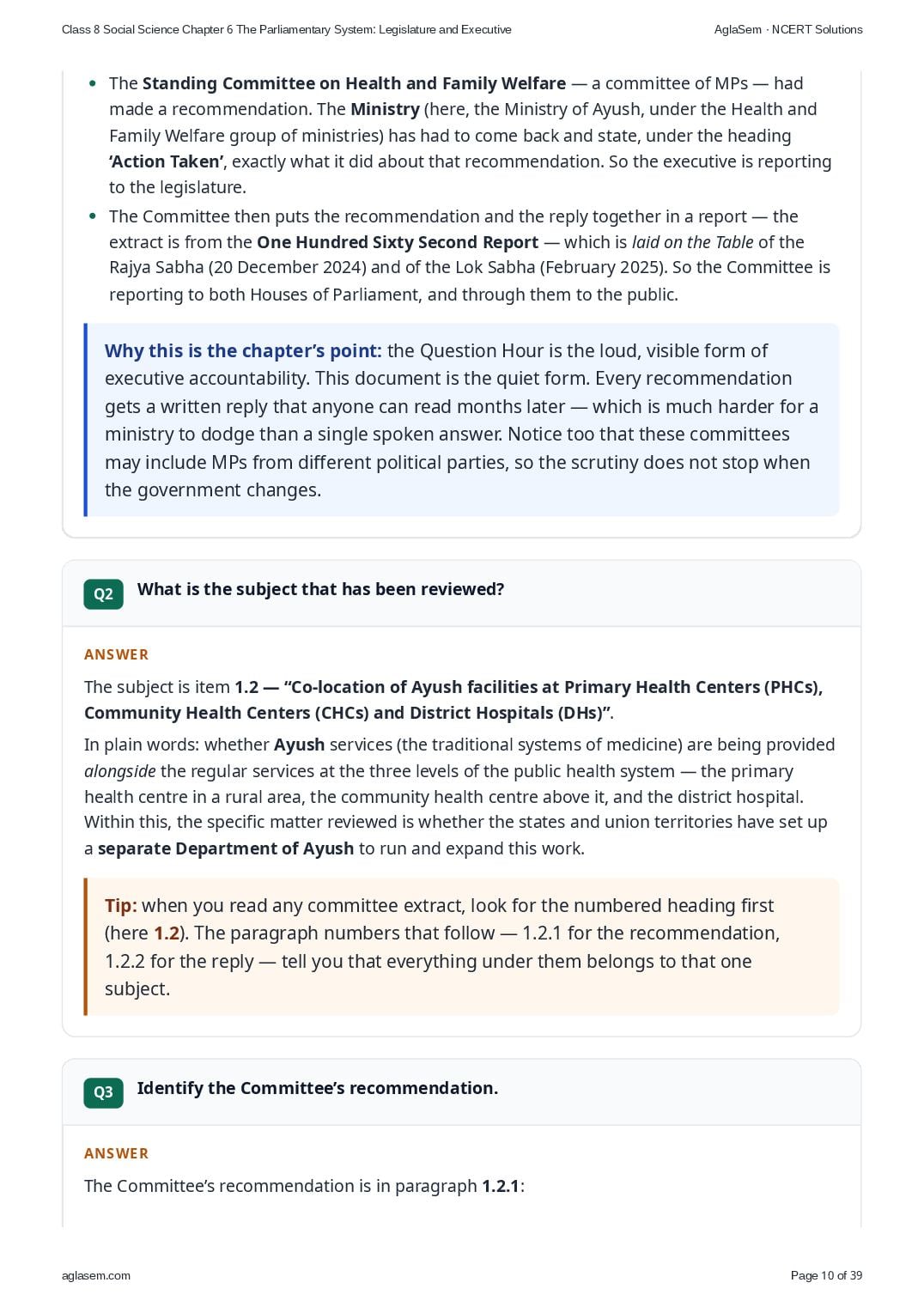
- Who is reporting to whom?
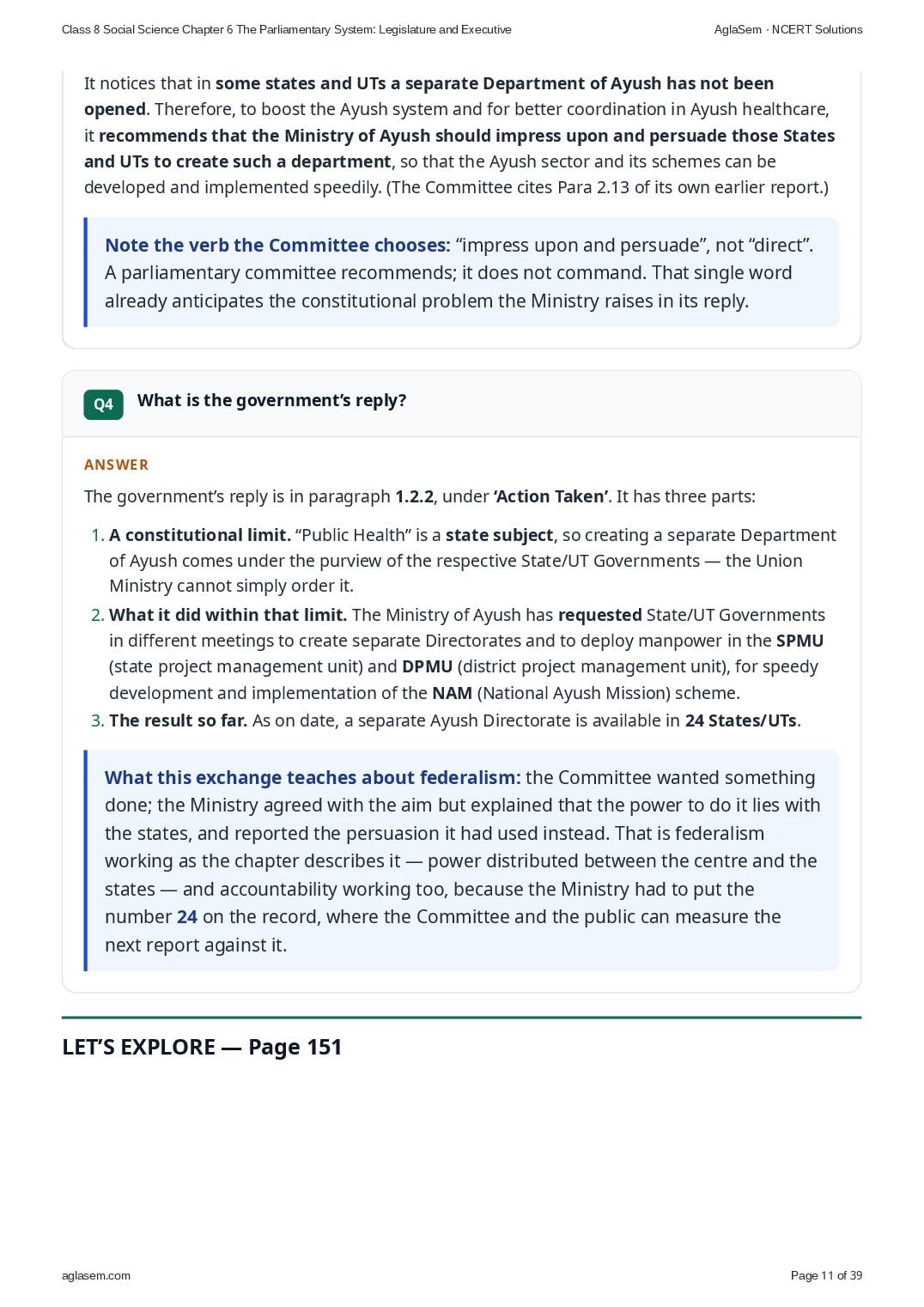
- What is the subject that has been reviewed?
- Identify the Committee’s recommendation.
- What is the government’s reply?
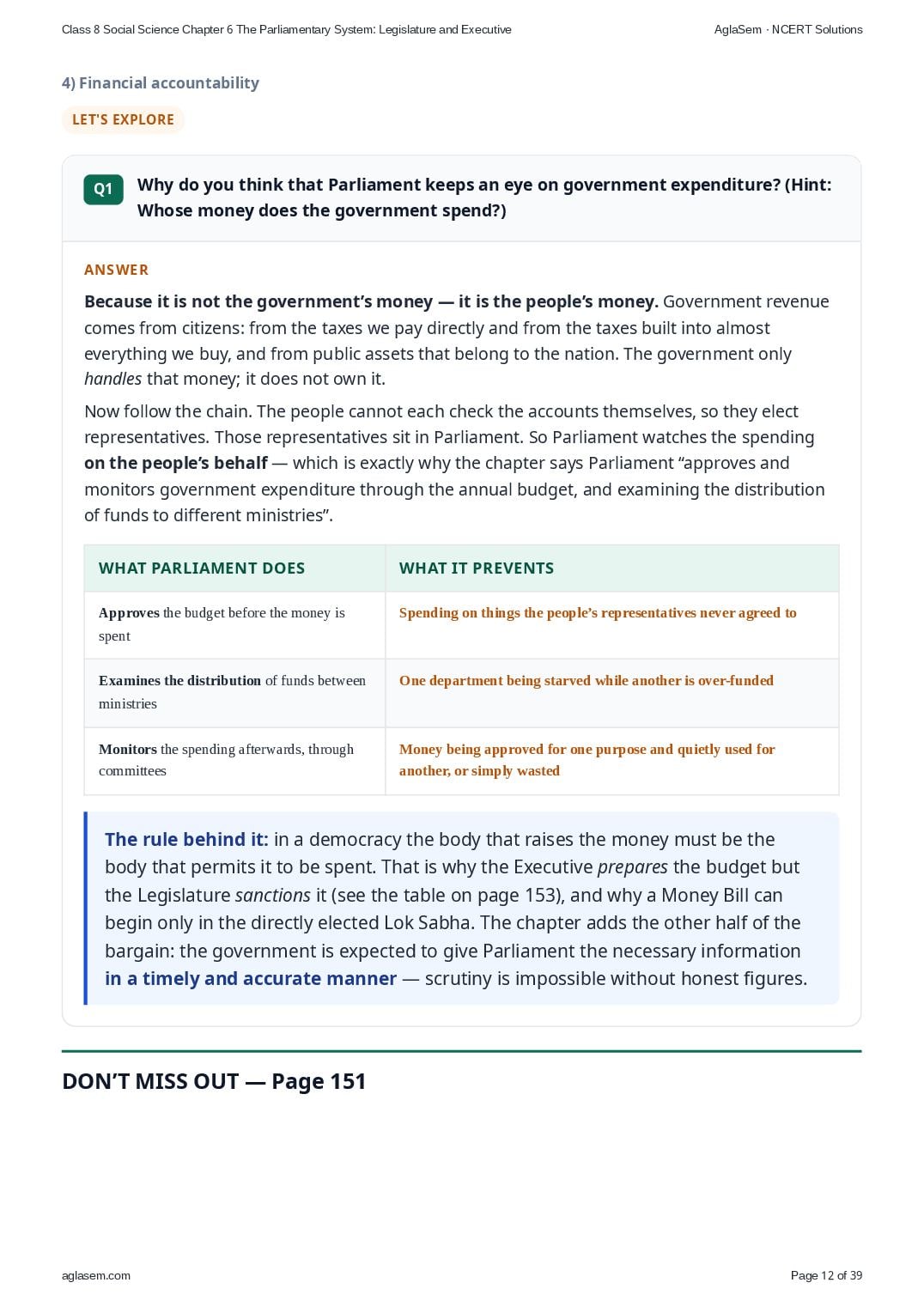
- Why do you think that Parliament keeps an eye on government expenditure? (Hint: Whose money does the government spend?)
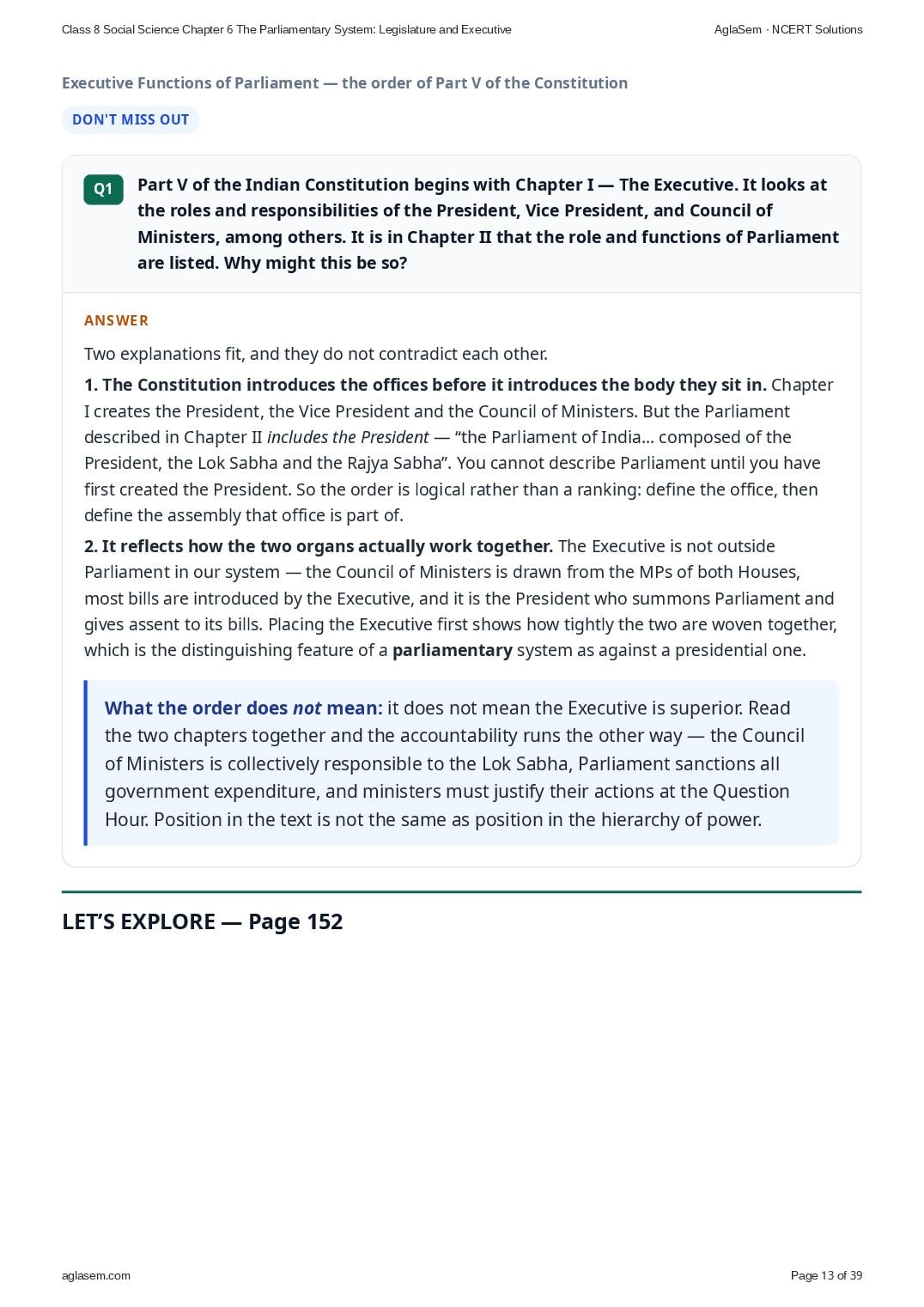
- Part V of the Indian Constitution begins with Chapter I — The Executive. It looks at the roles and responsibilities of the President, Vice President, and Council of Ministers, among others. It is in Chapter II that the role and functions of Parliament are listed. Why might this be so?
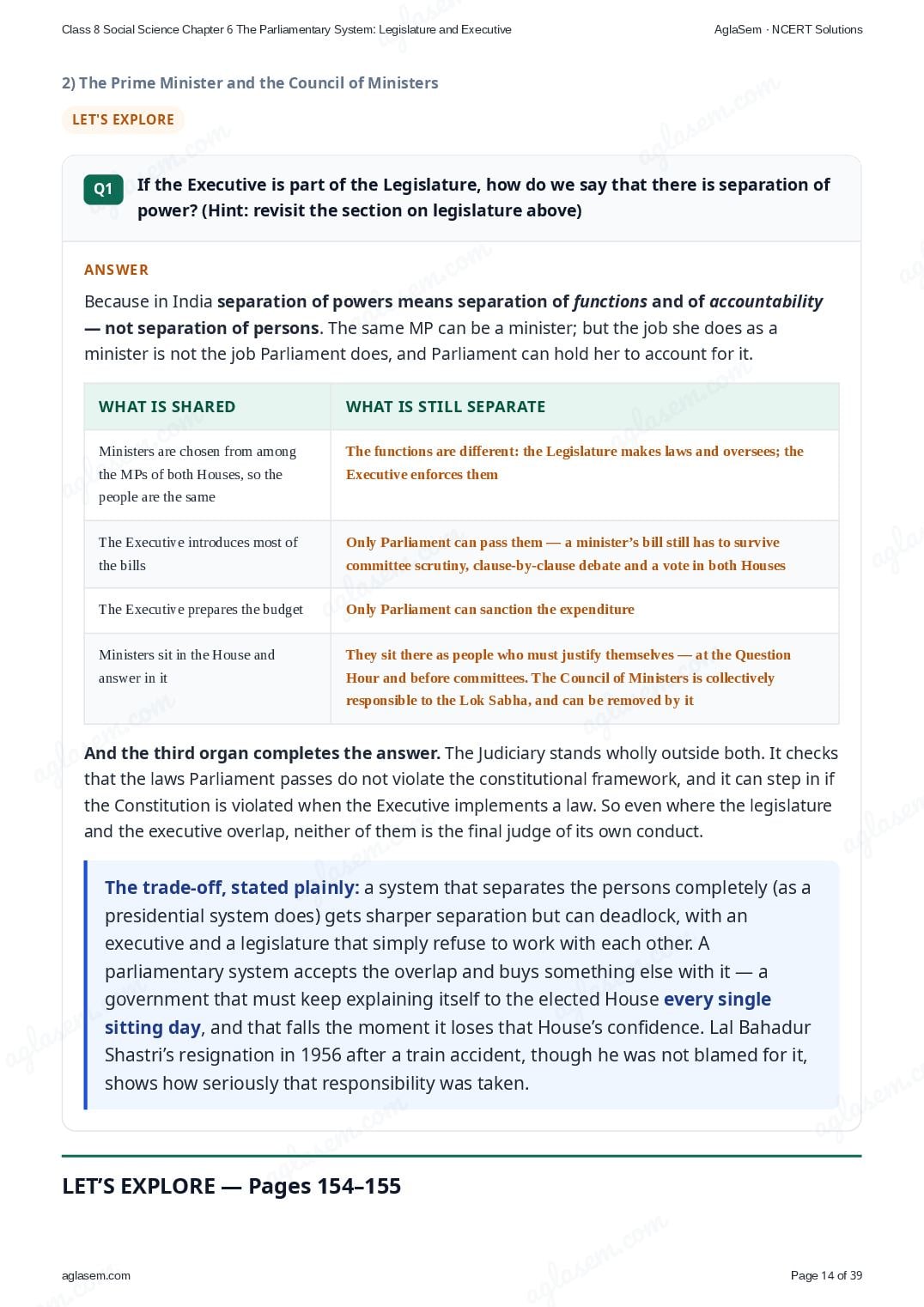
- If the Executive is part of the Legislature, how do we say that there is separation of power? (Hint: revisit the section on legislature above)
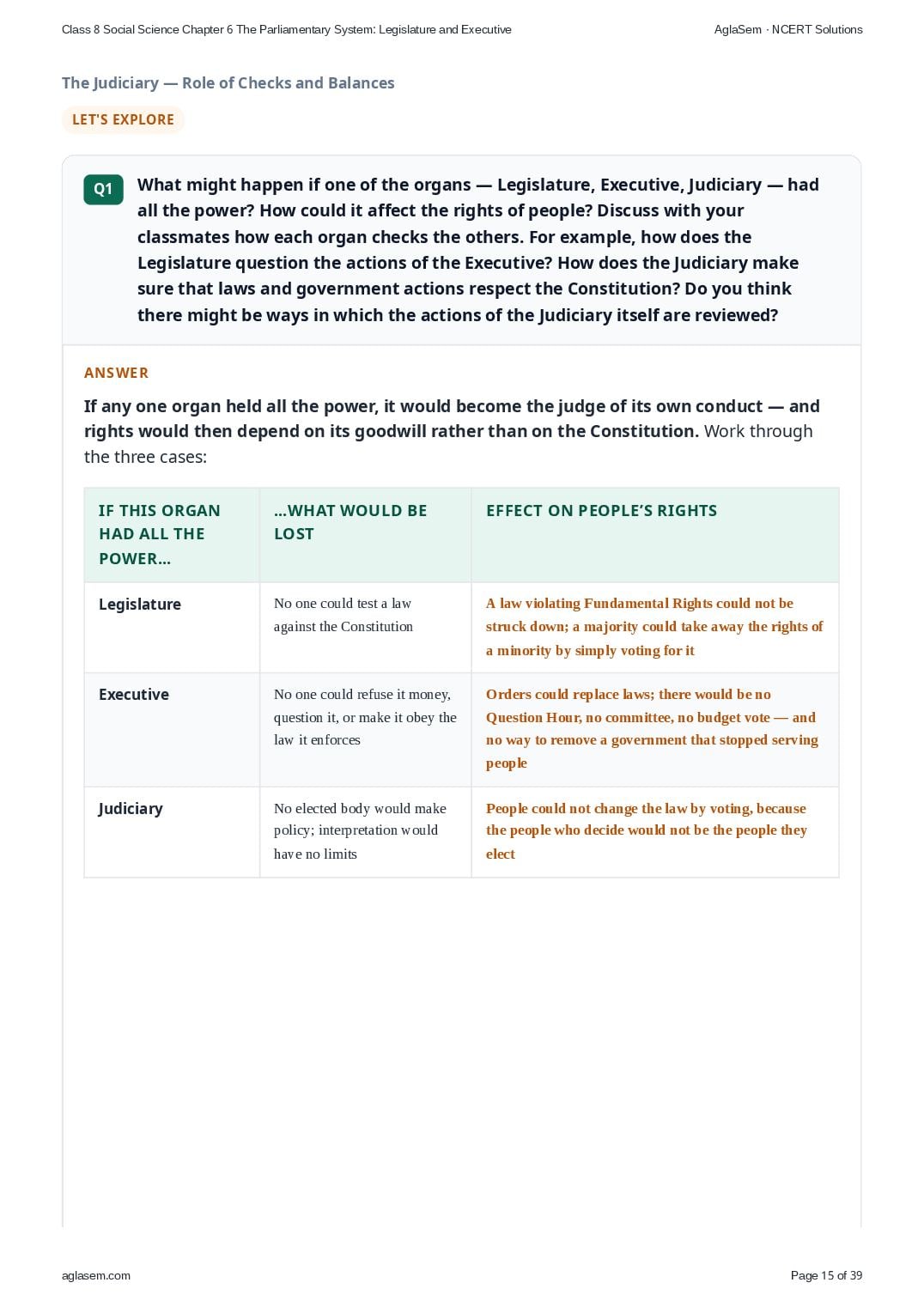
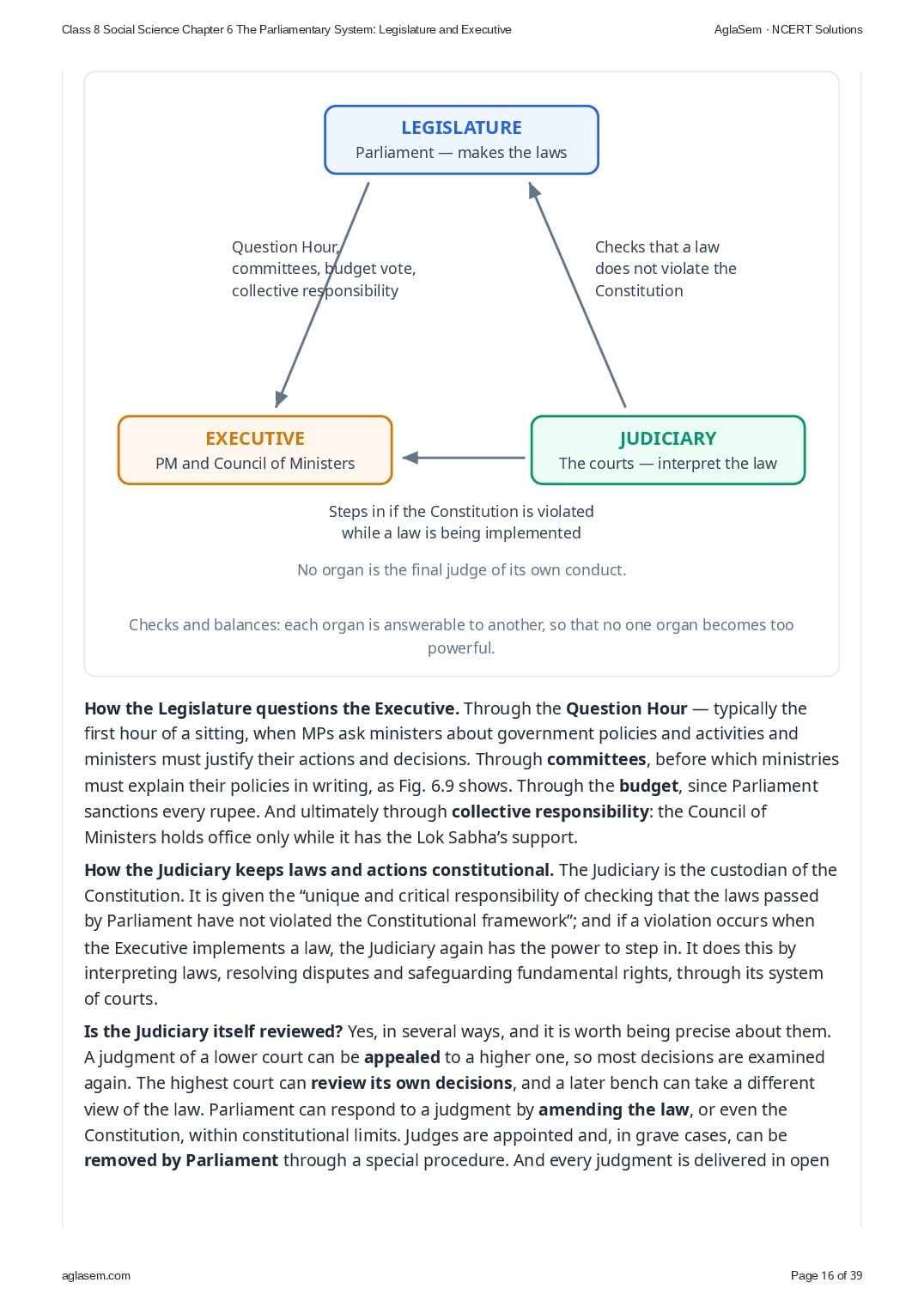
- What might happen if one of the organs — Legislature, Executive, Judiciary — had all the power? How could it affect the rights of people? Discuss with your classmates how each organ checks the others. For example, how does the Legislature question the actions of the Executive? How does the Judiciary make sure that laws and government actions respect the Constitution? Do you think there might be ways in which the actions of the Judiciary itself are reviewed?
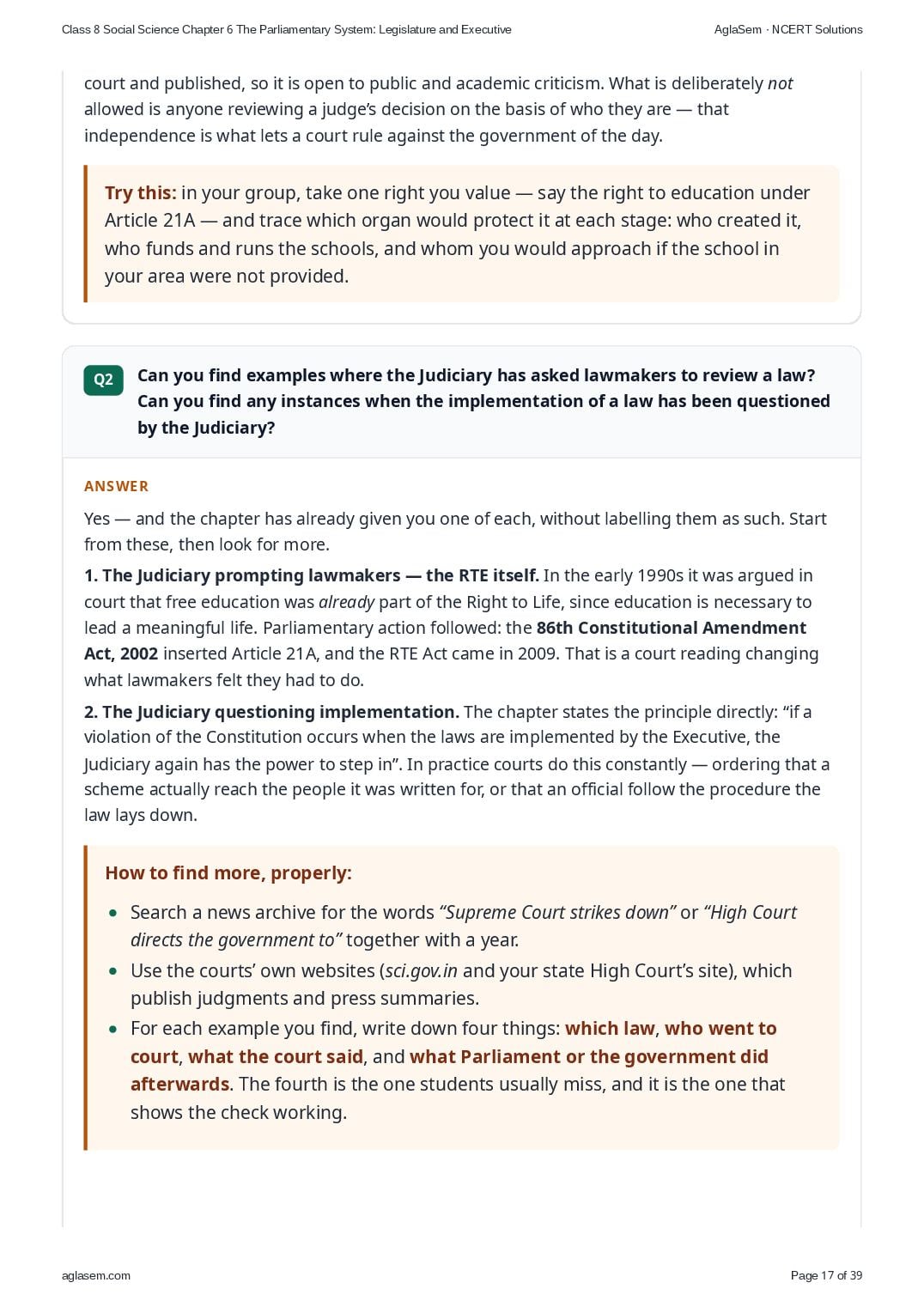
- Can you find examples where the Judiciary has asked lawmakers to review a law? Can you find any instances when the implementation of a law has been questioned by the Judiciary?
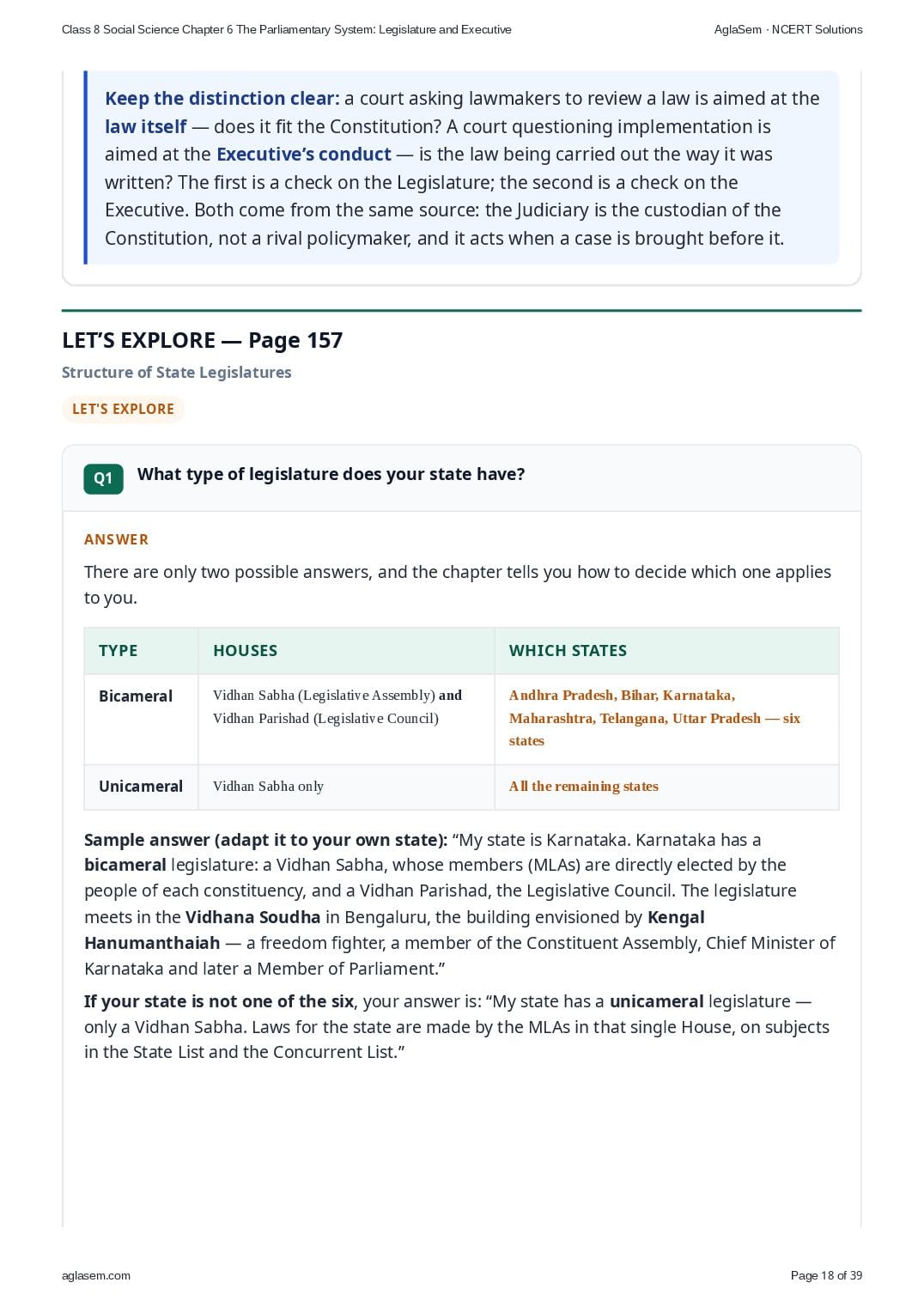
- What type of legislature does your state have?
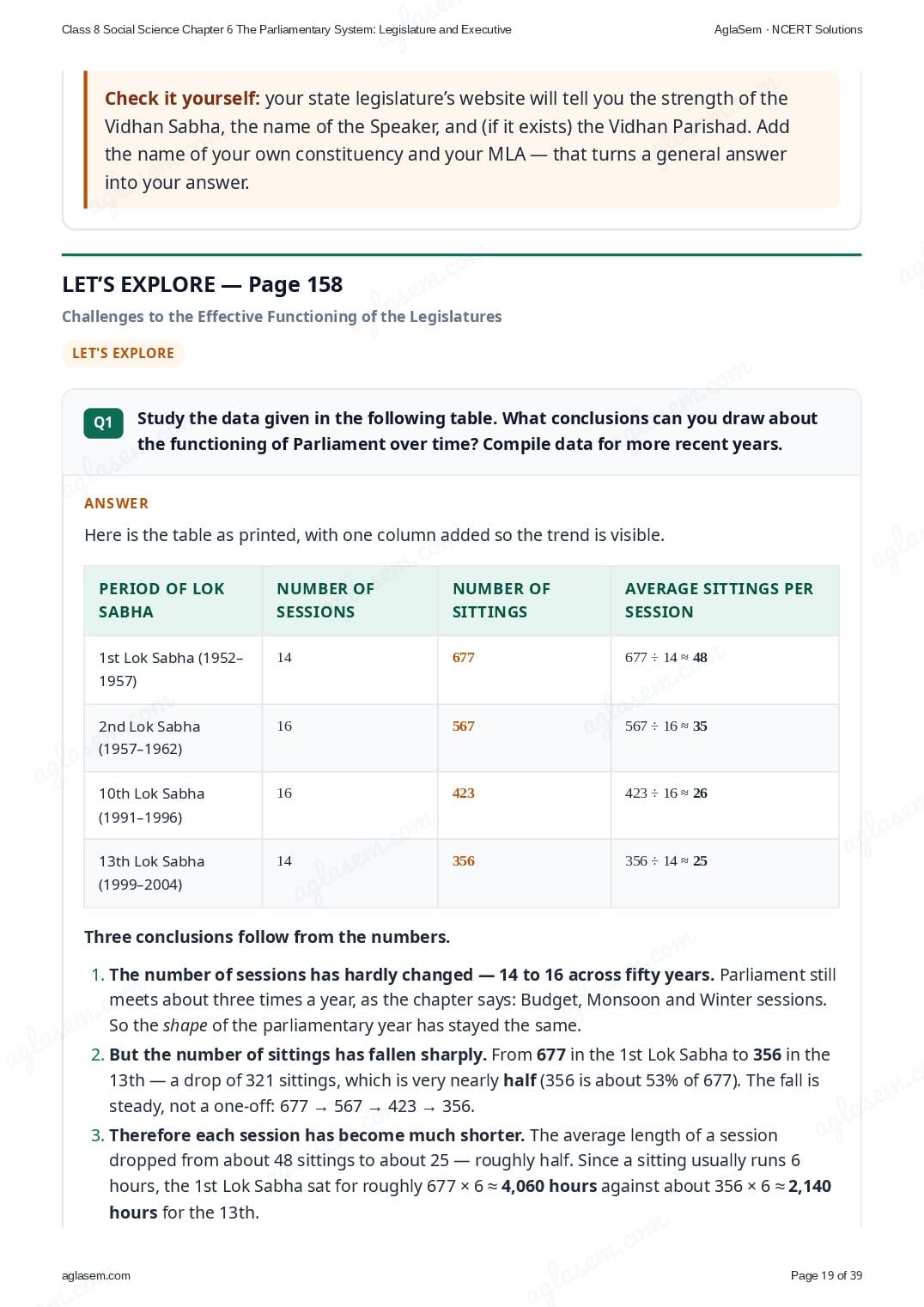
- Study the data given in the following table. What conclusions can you draw about the functioning of Parliament over time? Compile data for more recent years.
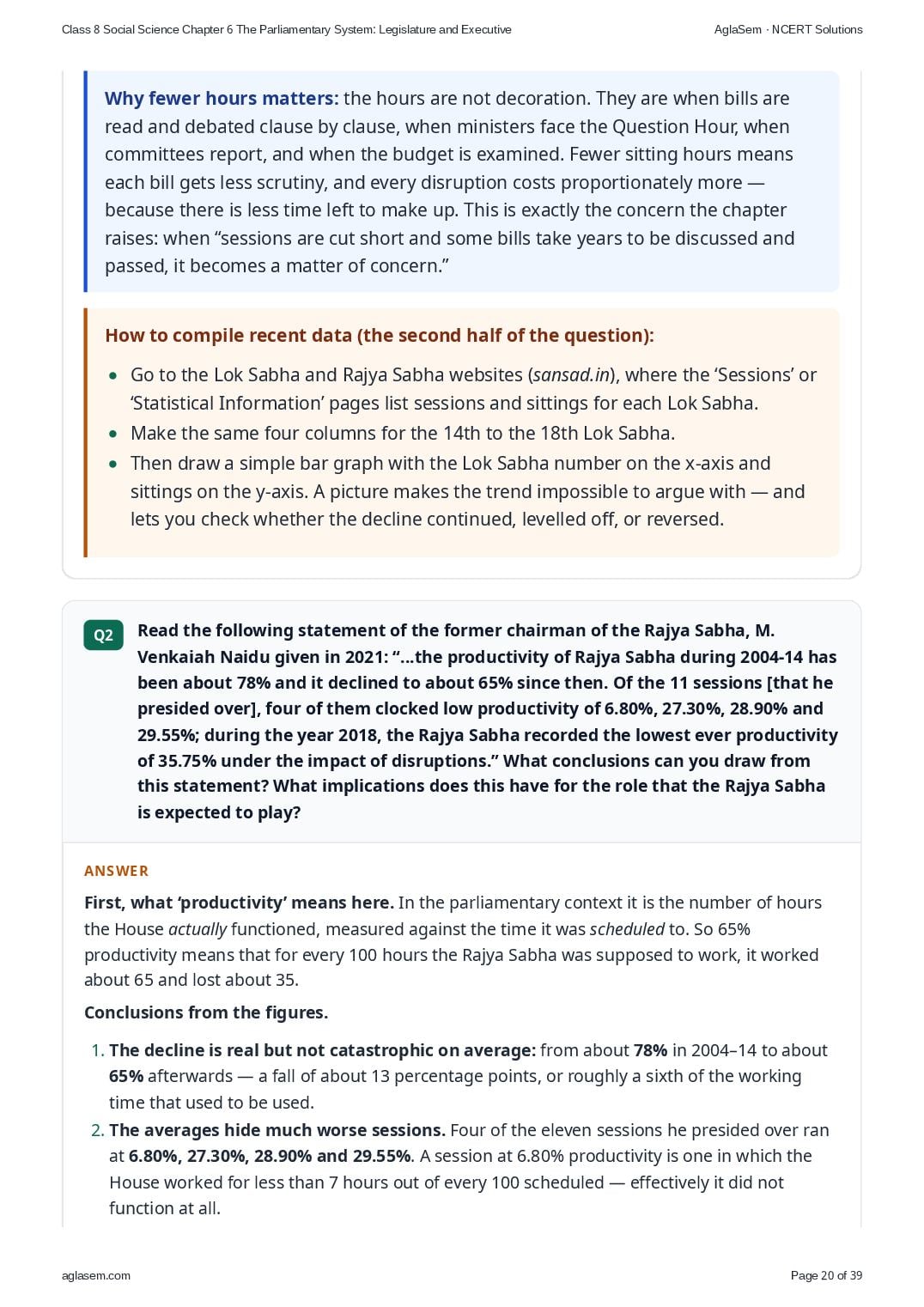
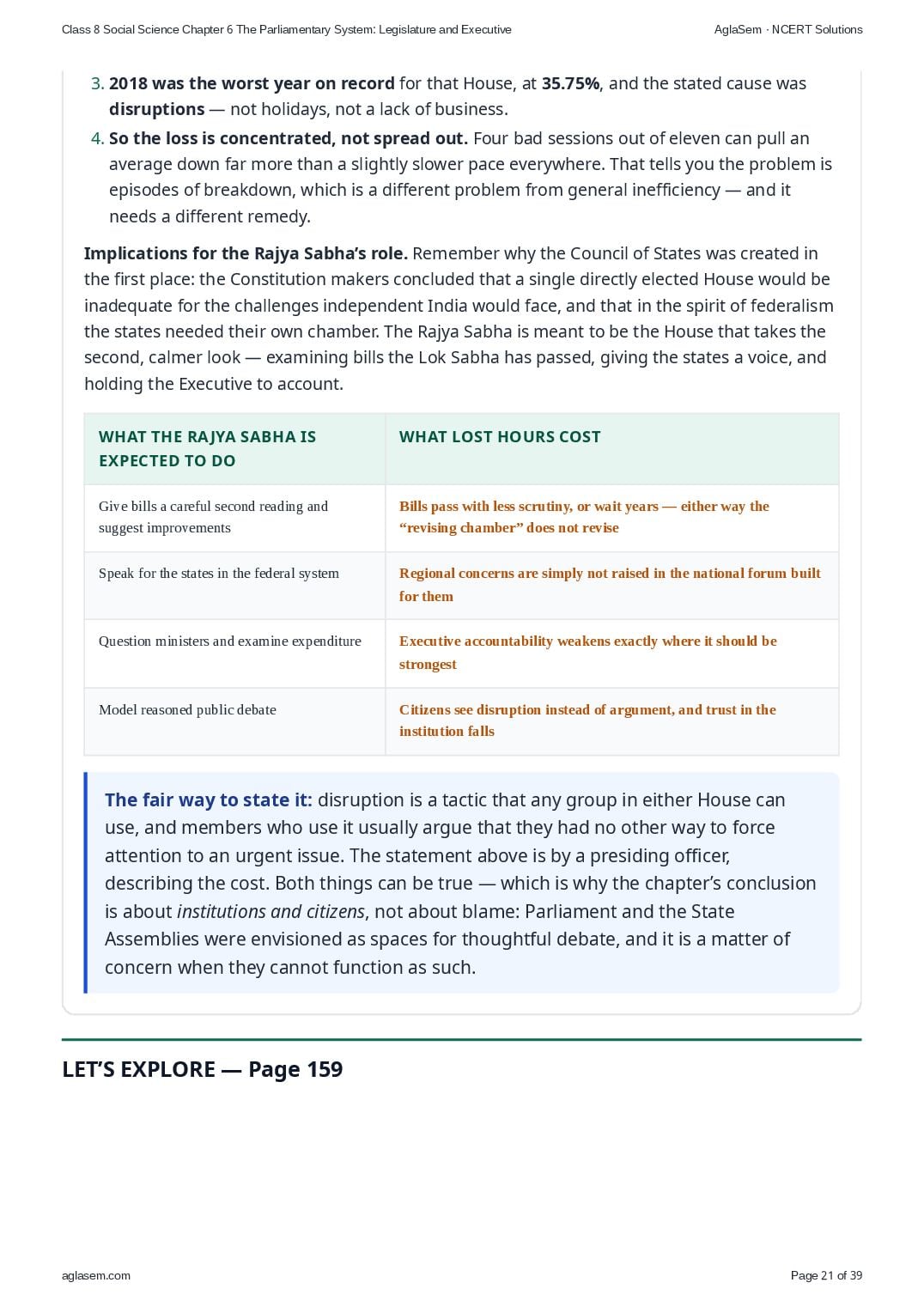
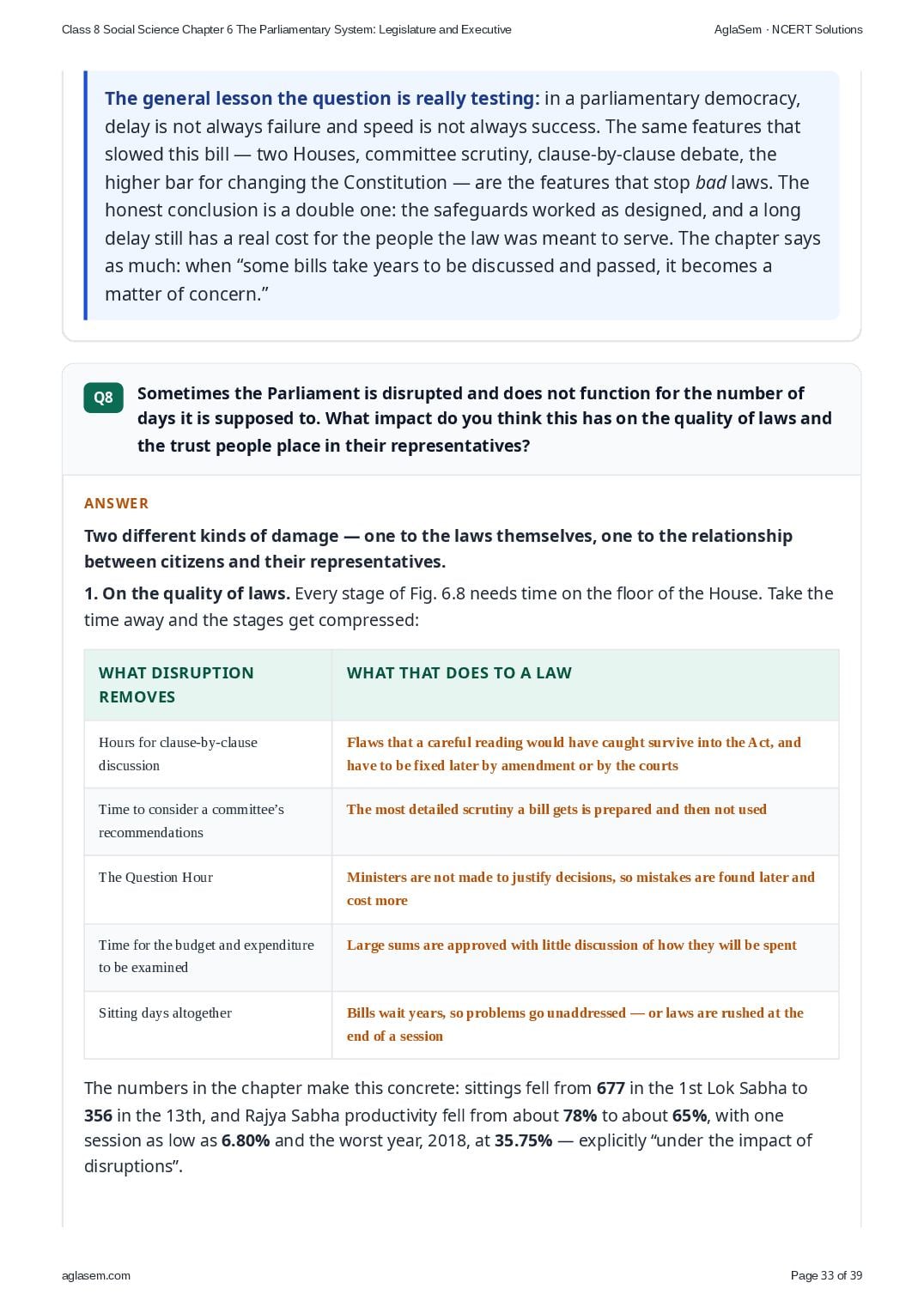
- Read the following statement of the former chairman of the Rajya Sabha, M. Venkaiah Naidu given in 2021: “…the productivity of Rajya Sabha during 2004-14 has been about 78% and it declined to about 65% since then. Of the 11 sessions [that he presided over], four of them clocked low productivity of 6.80%, 27.30%, 28.90% and 29.55%; during the year 2018, the Rajya Sabha recorded the lowest ever productivity of 35.75% under the impact of disruptions.” What conclusions can you draw from this statement? What implications does this have for the role that the Rajya Sabha is expected to play?
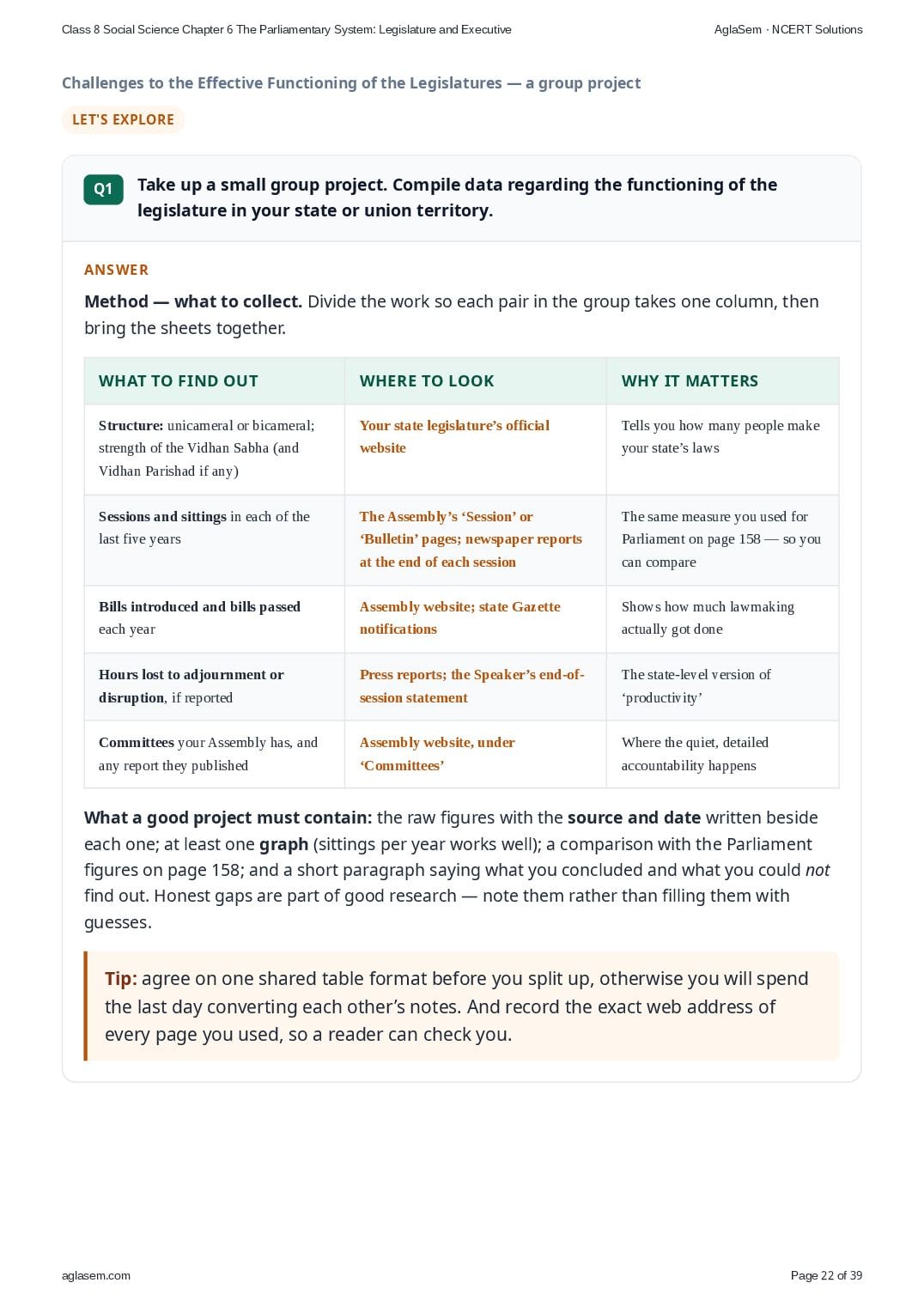
- Take up a small group project. Compile data regarding the functioning of the legislature in your state or union territory.
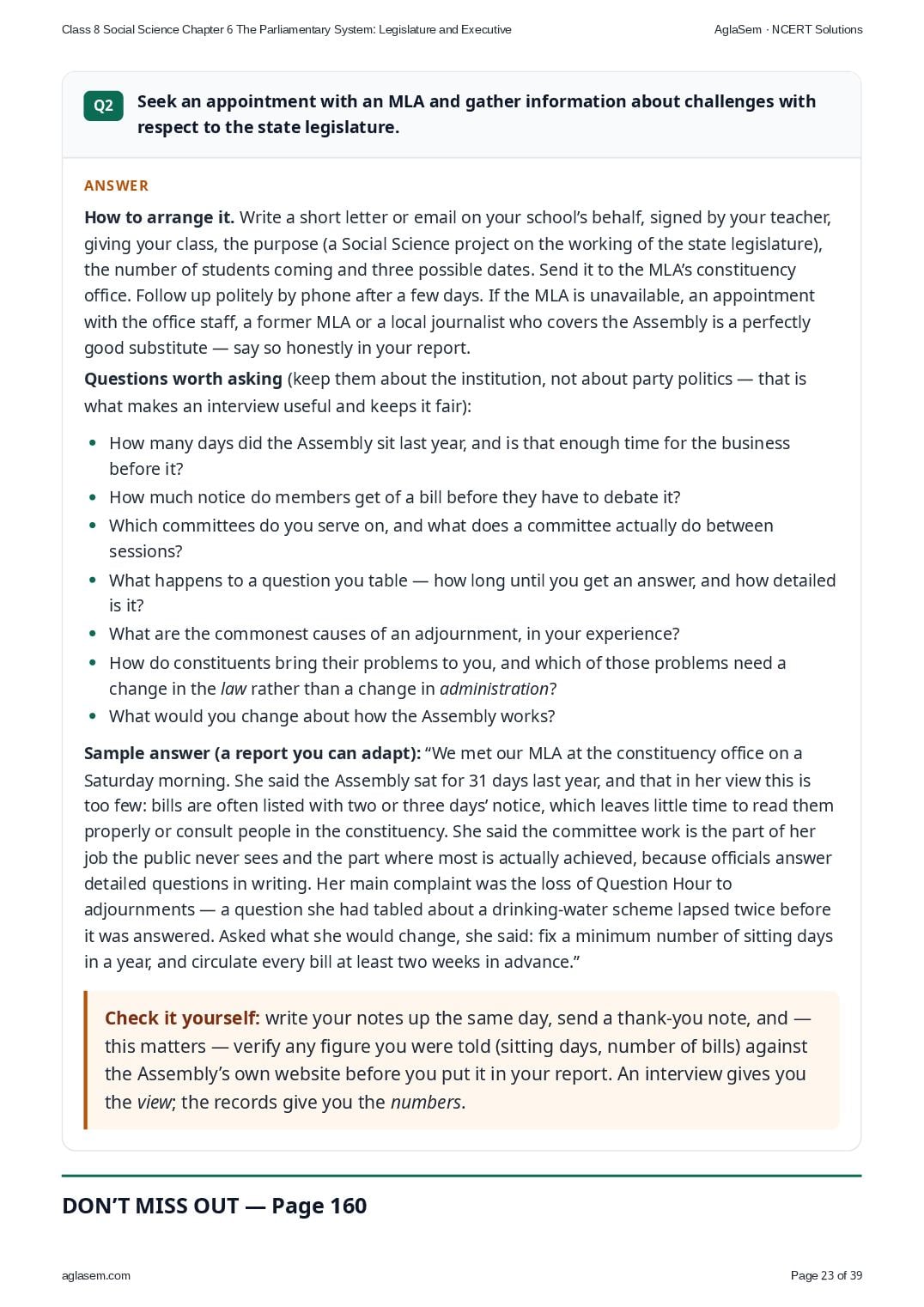
- Seek an appointment with an MLA and gather information about challenges with respect to the state legislature.
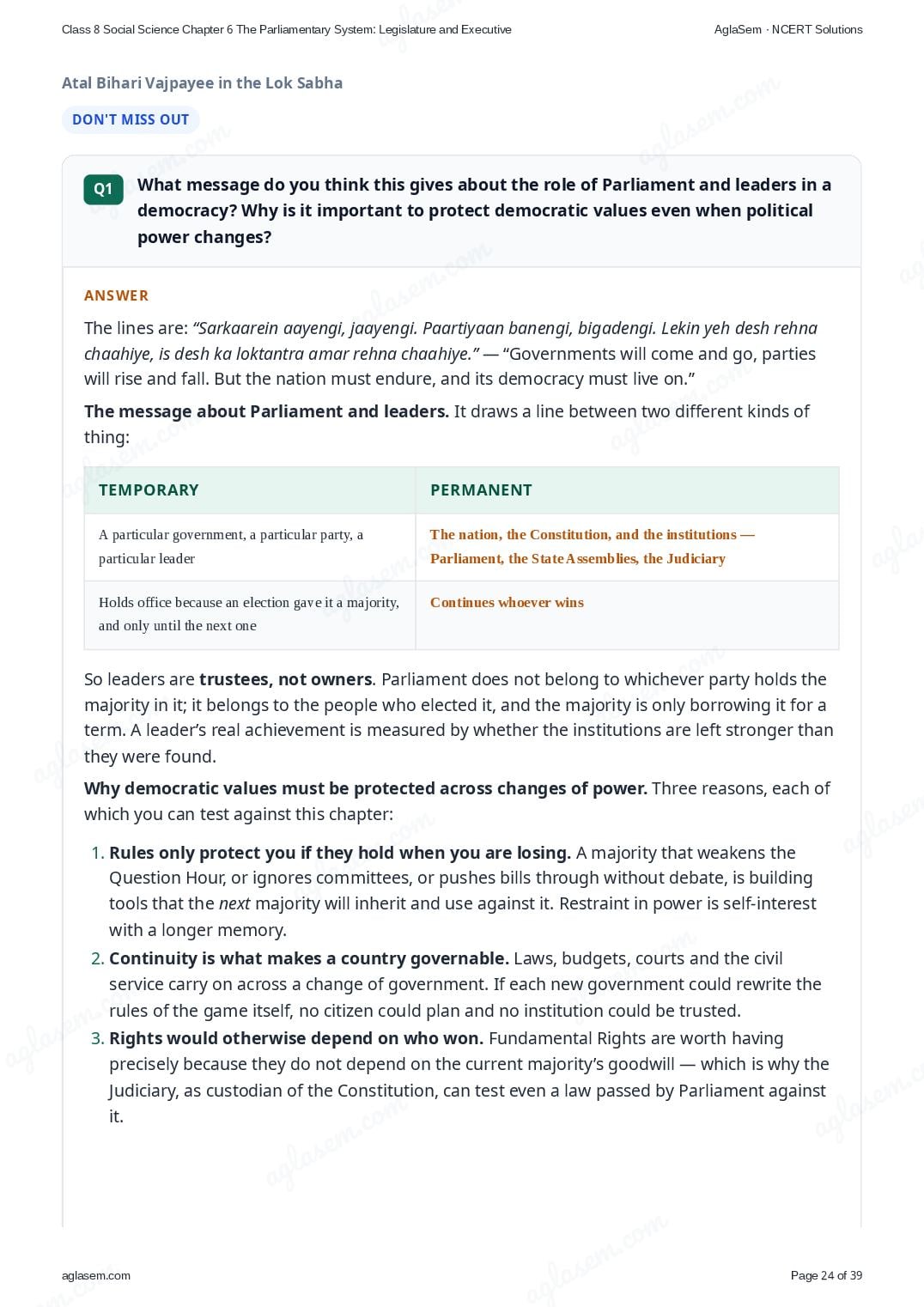
- What message do you think this gives about the role of Parliament and leaders in a democracy? Why is it important to protect democratic values even when political power changes?
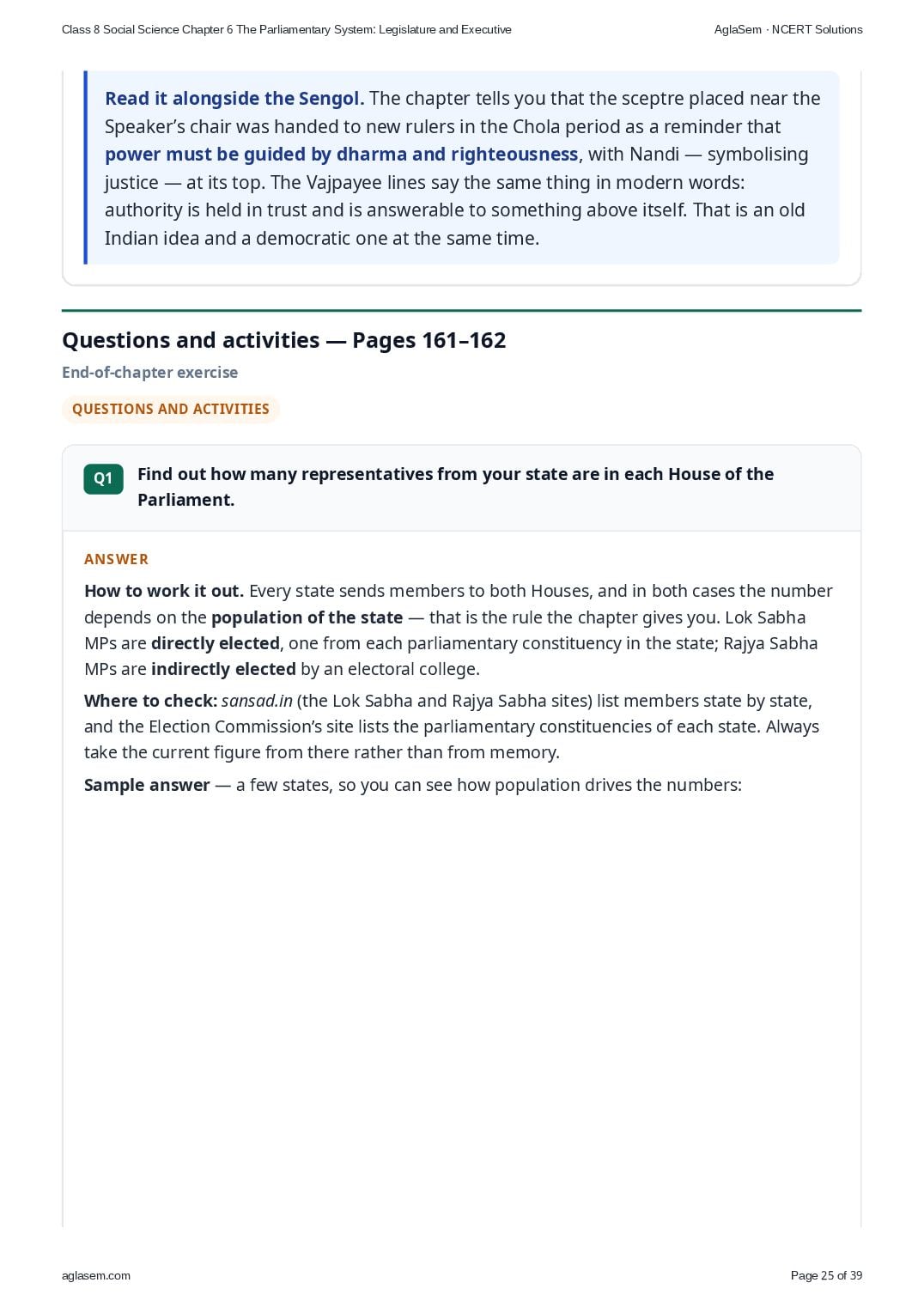
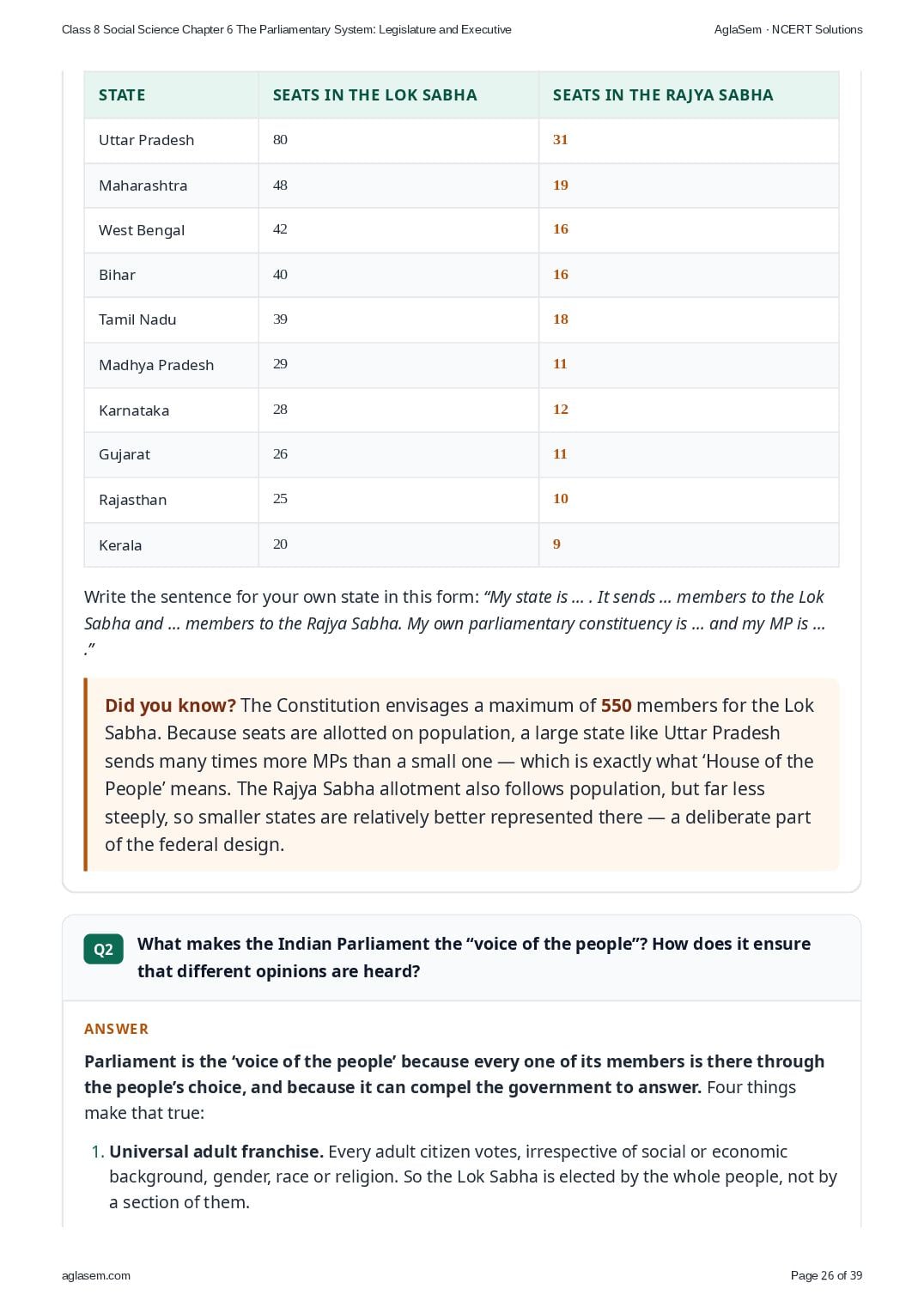
- Find out how many representatives from your state are in each House of the Parliament.
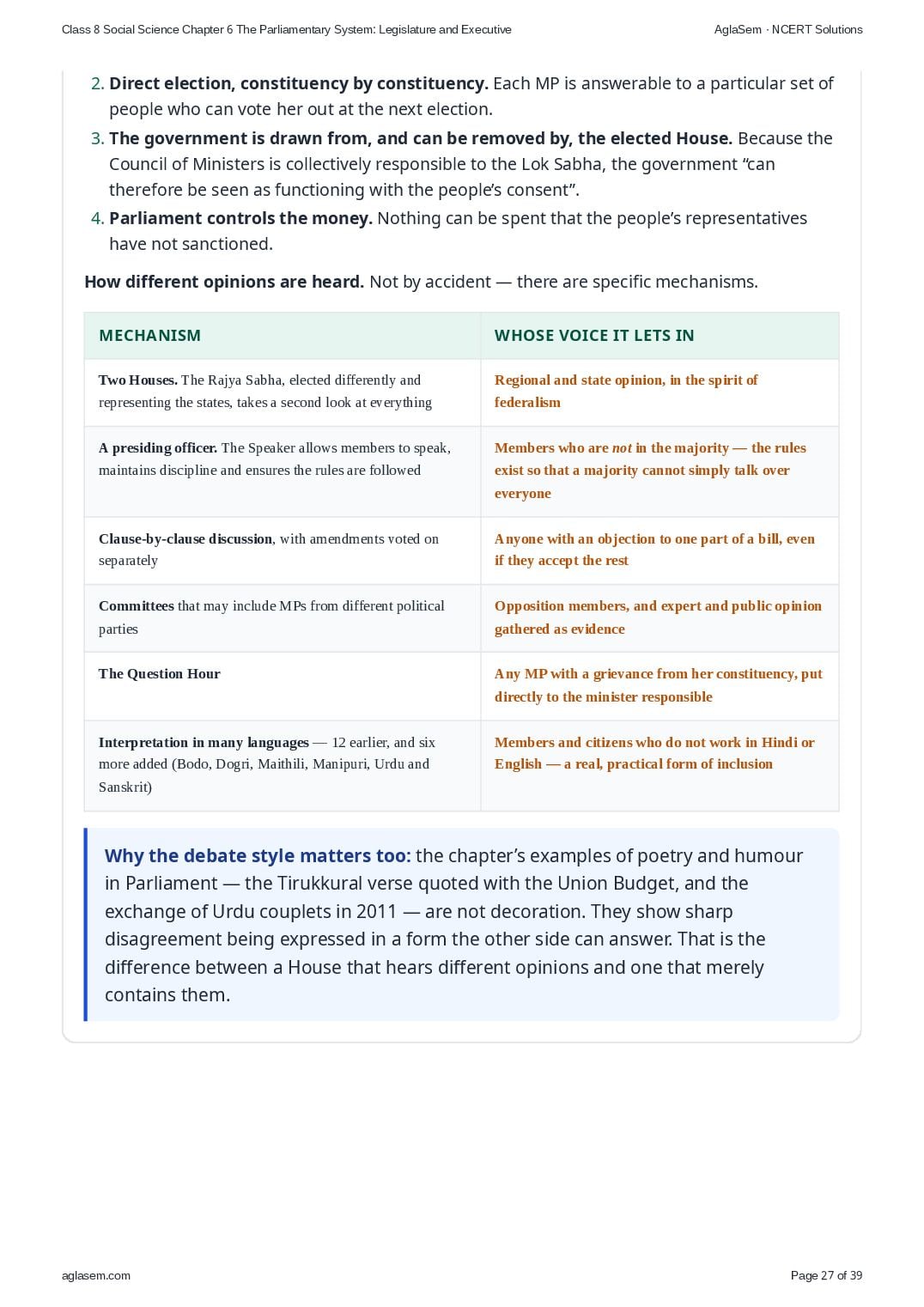
- What makes the Indian Parliament the “voice of the people”? How does it ensure that different opinions are heard?
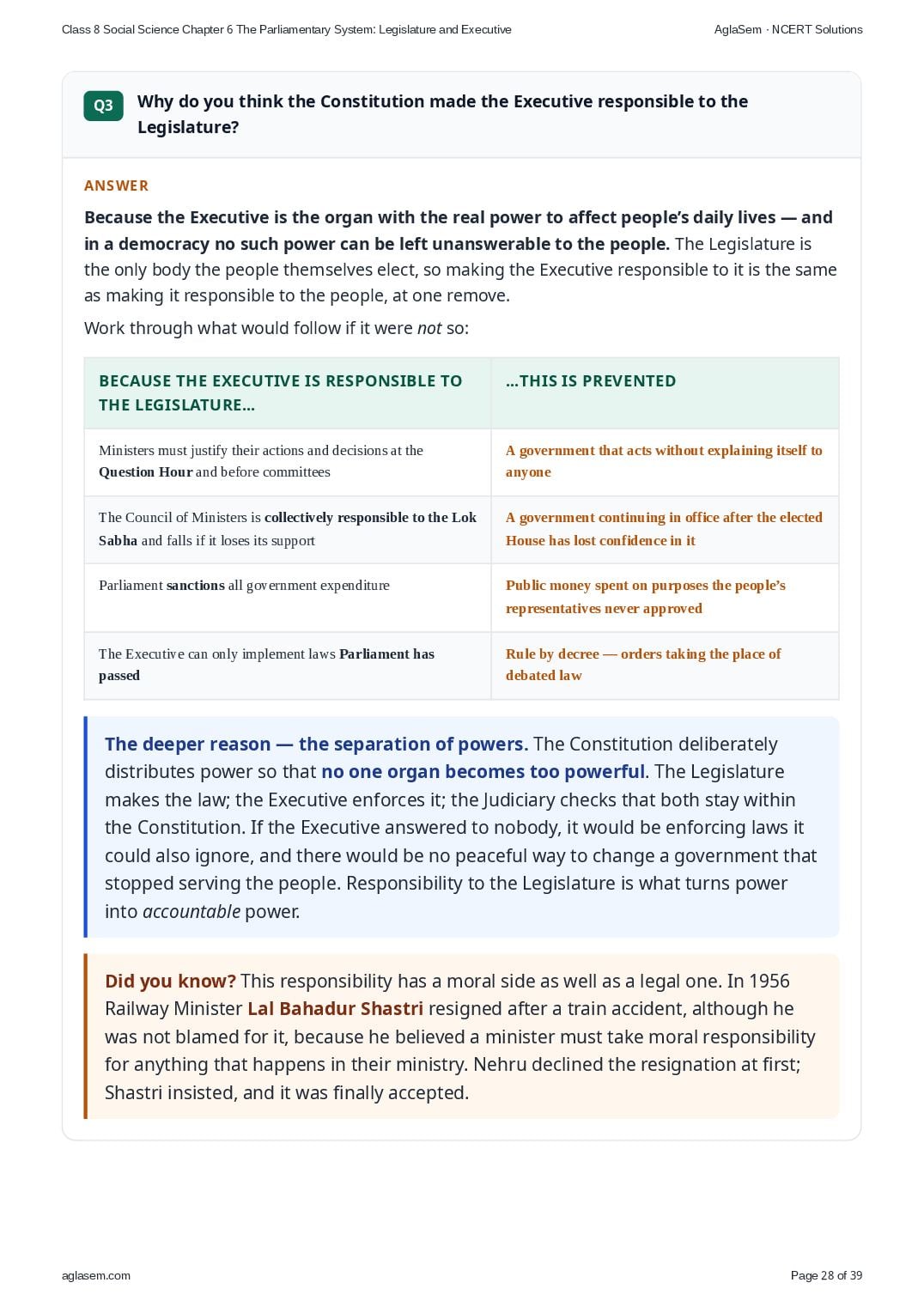
- Why do you think the Constitution made the Executive responsible to the Legislature?
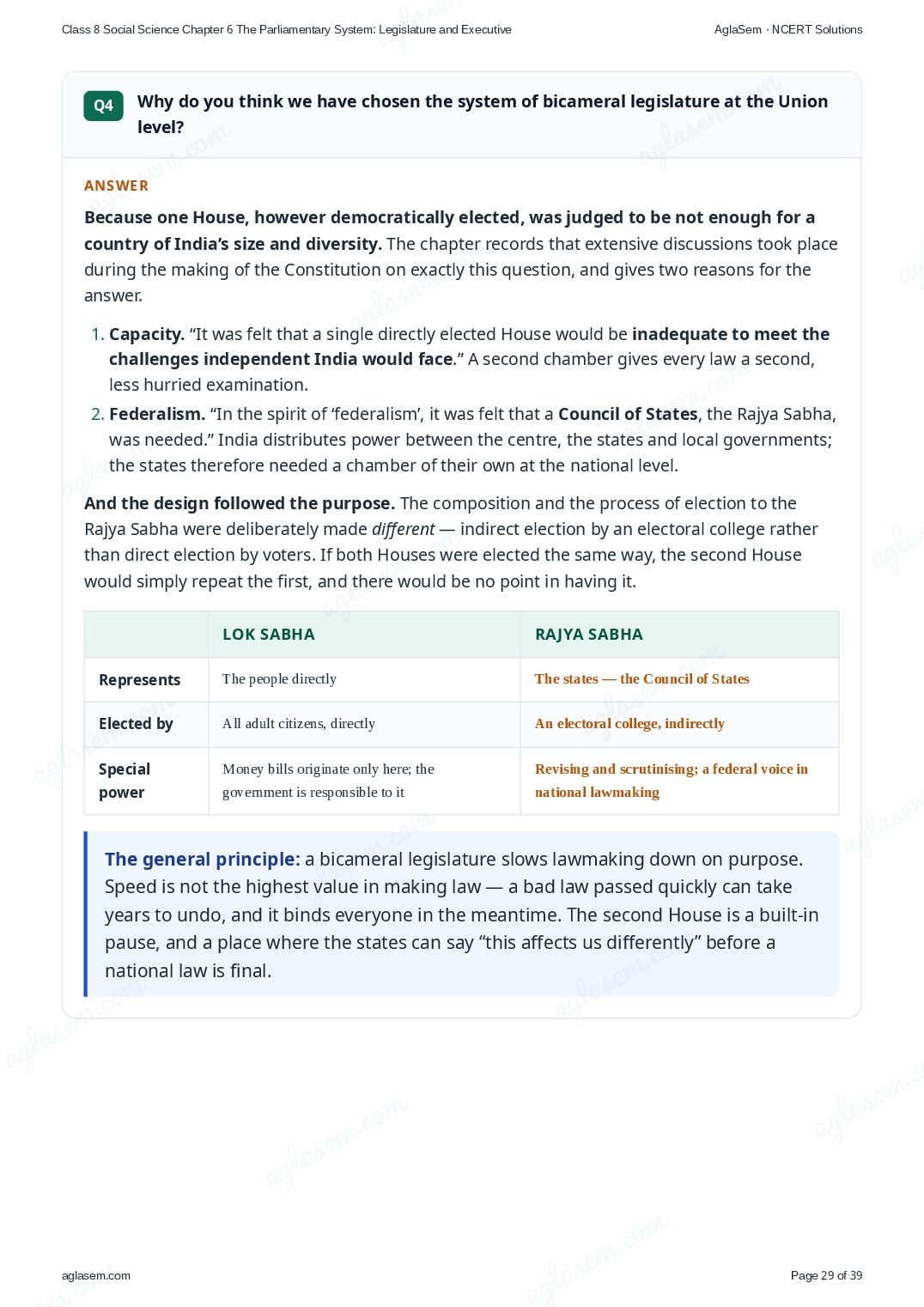
- Why do you think we have chosen the system of bicameral legislature at the Union level?
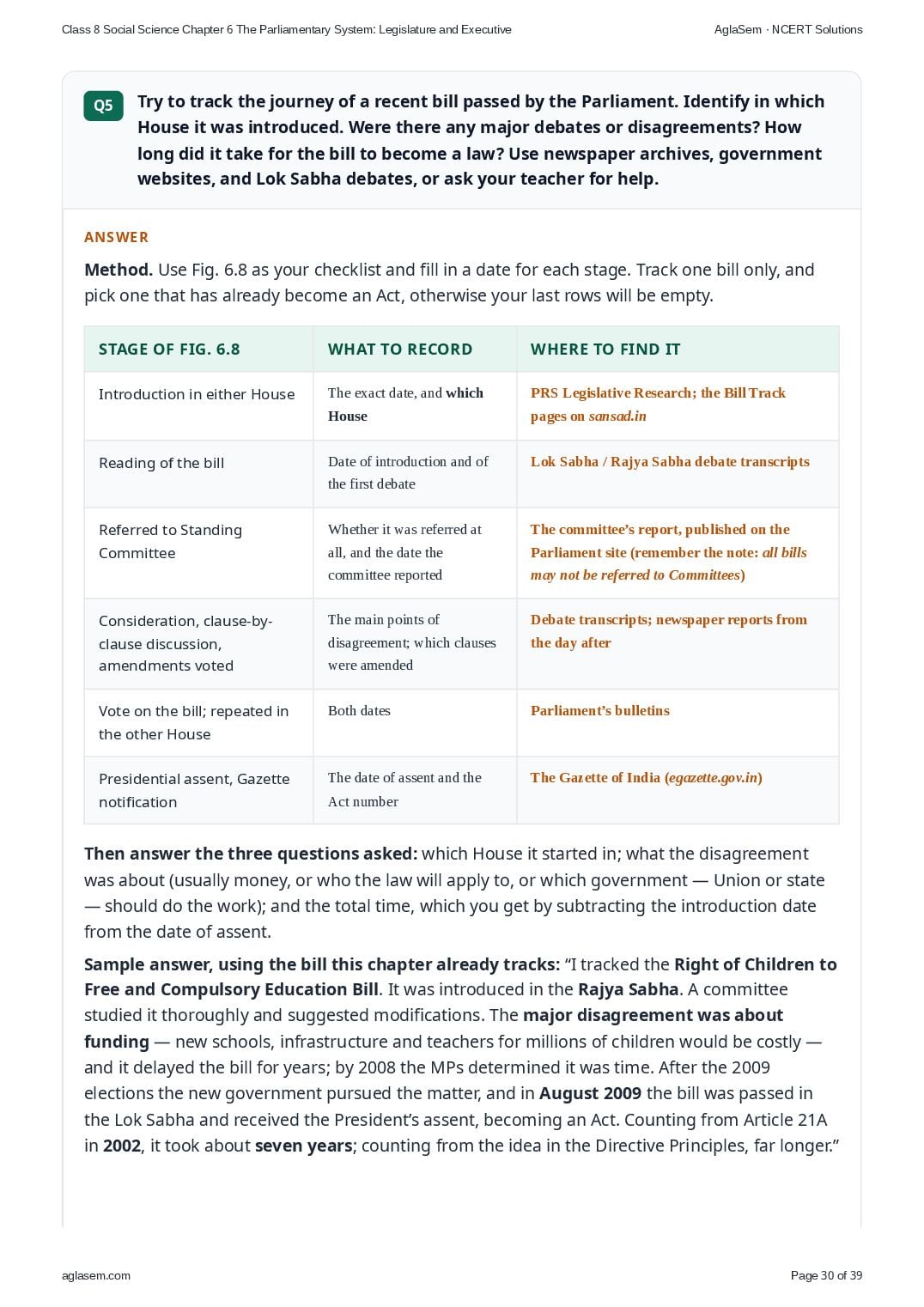
- Try to track the journey of a recent bill passed by the Parliament. Identify in which House it was introduced. Were there any major debates or disagreements? How long did it take for the bill to become a law? Use newspaper archives, government websites, and Lok Sabha debates, or ask your teacher for help.
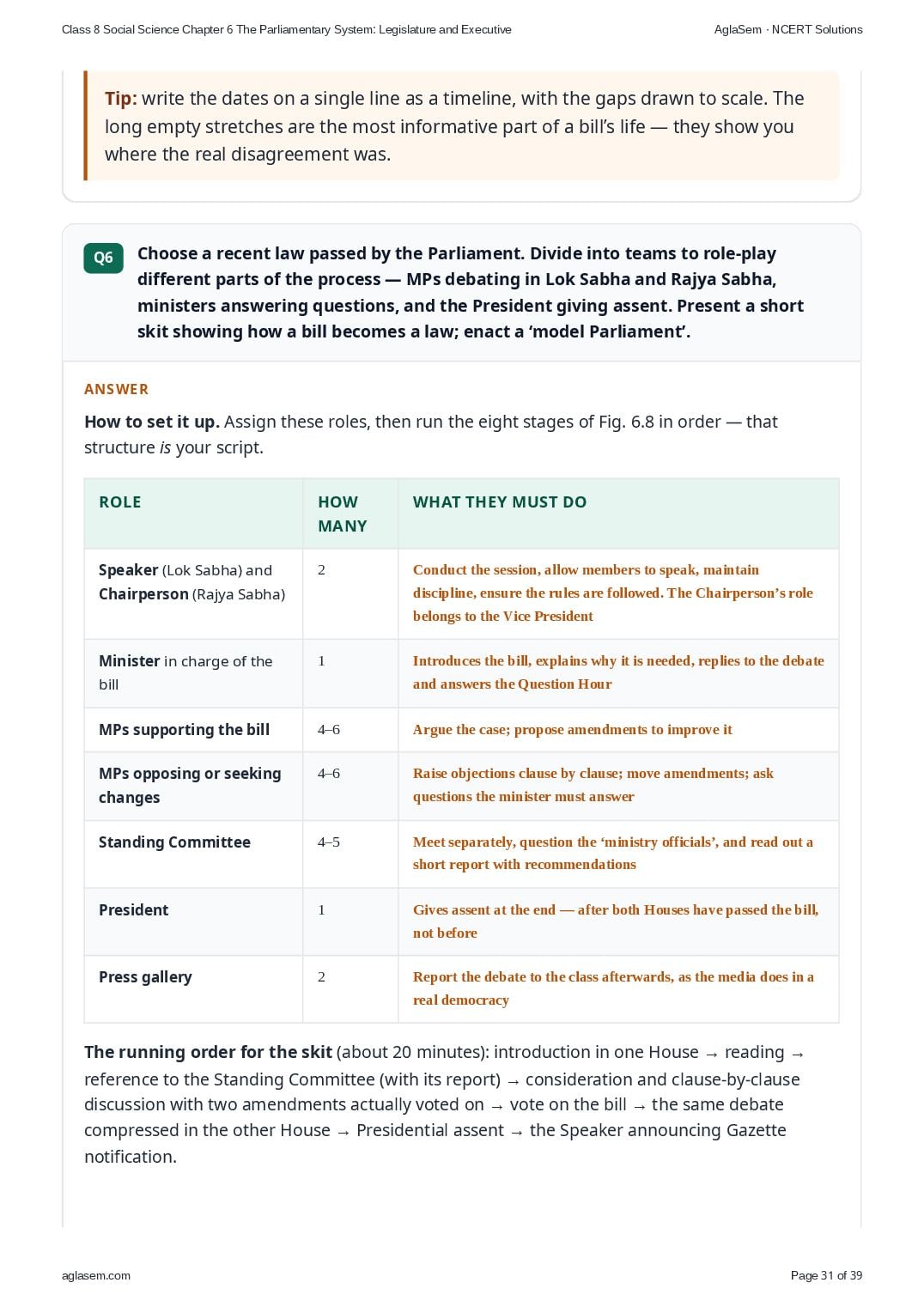
- Choose a recent law passed by the Parliament. Divide into teams to role-play different parts of the process — MPs debating in Lok Sabha and Rajya Sabha, ministers answering questions, and the President giving assent. Present a short skit showing how a bill becomes a law; enact a ‘model Parliament’.
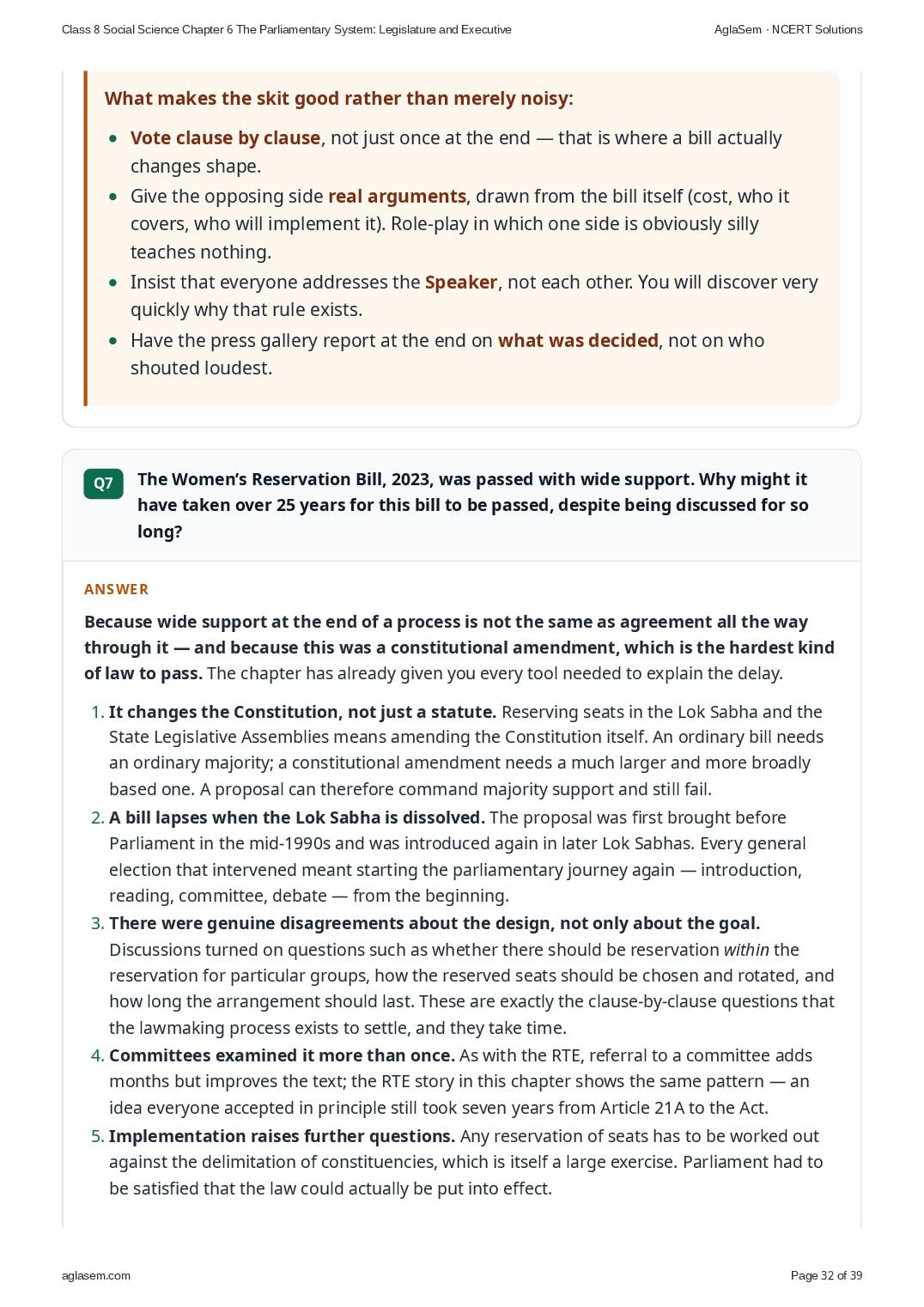
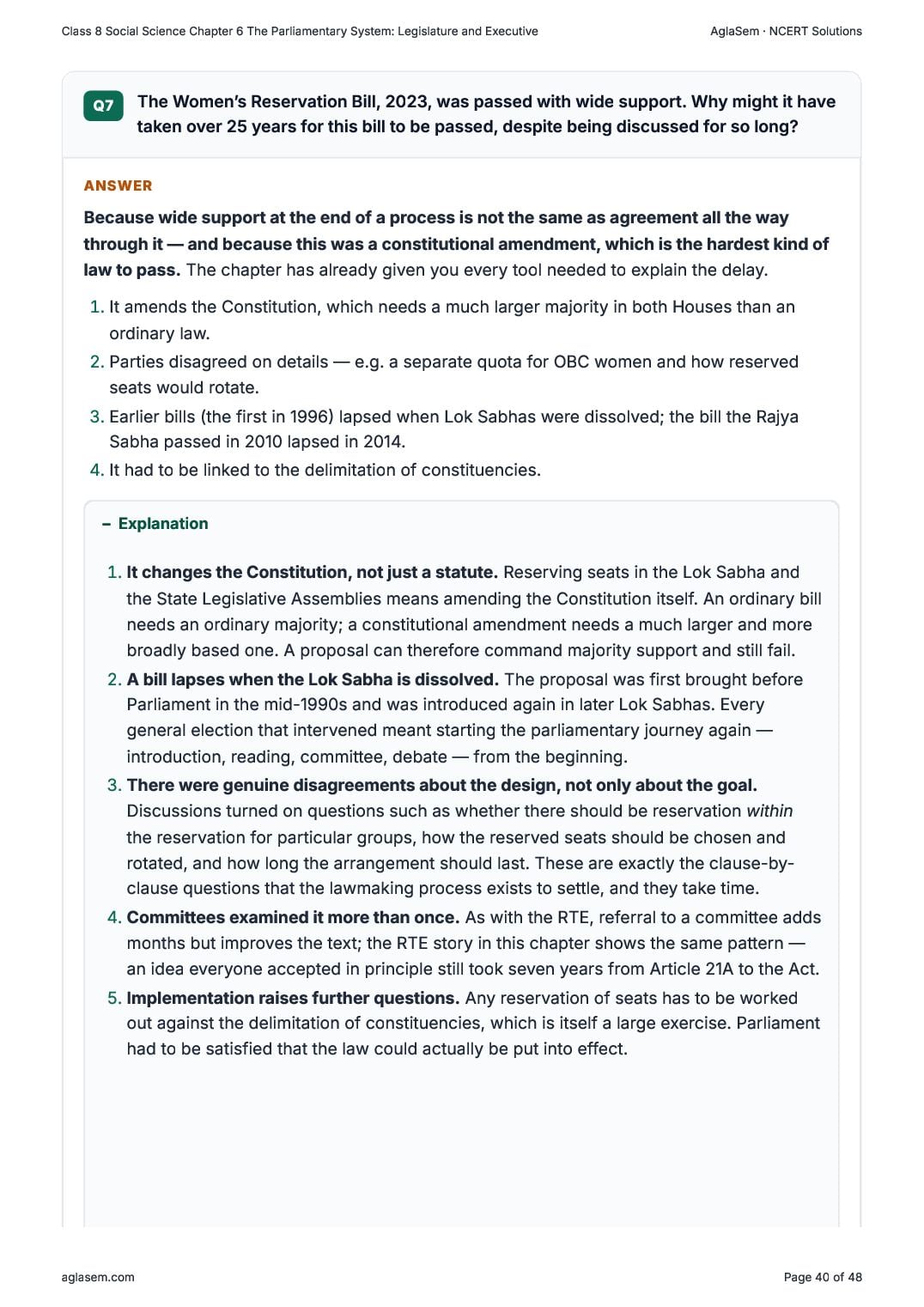
- The Women’s Reservation Bill, 2023, was passed with wide support. Why might it have taken over 25 years for this bill to be passed, despite being discussed for so long?
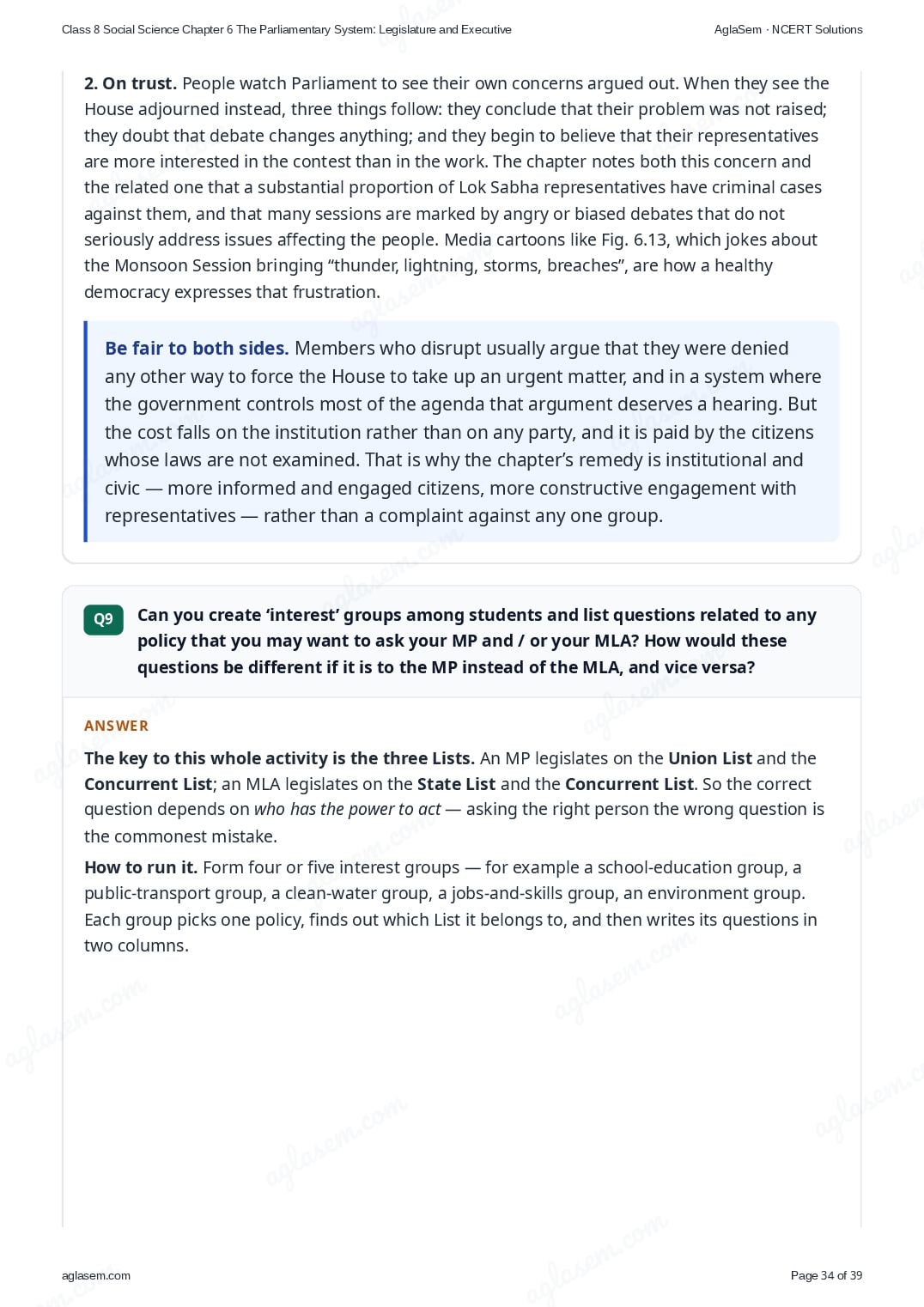
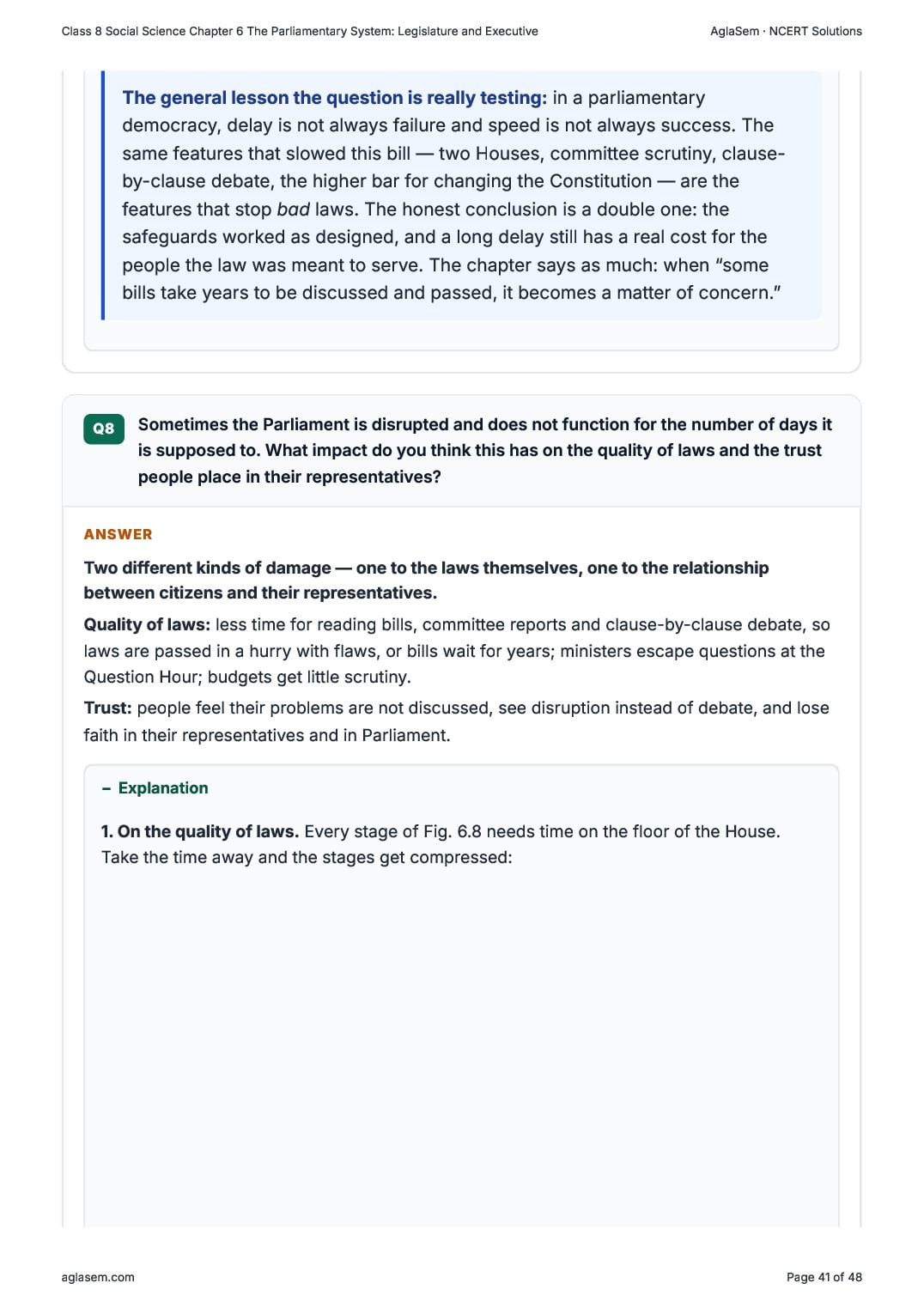
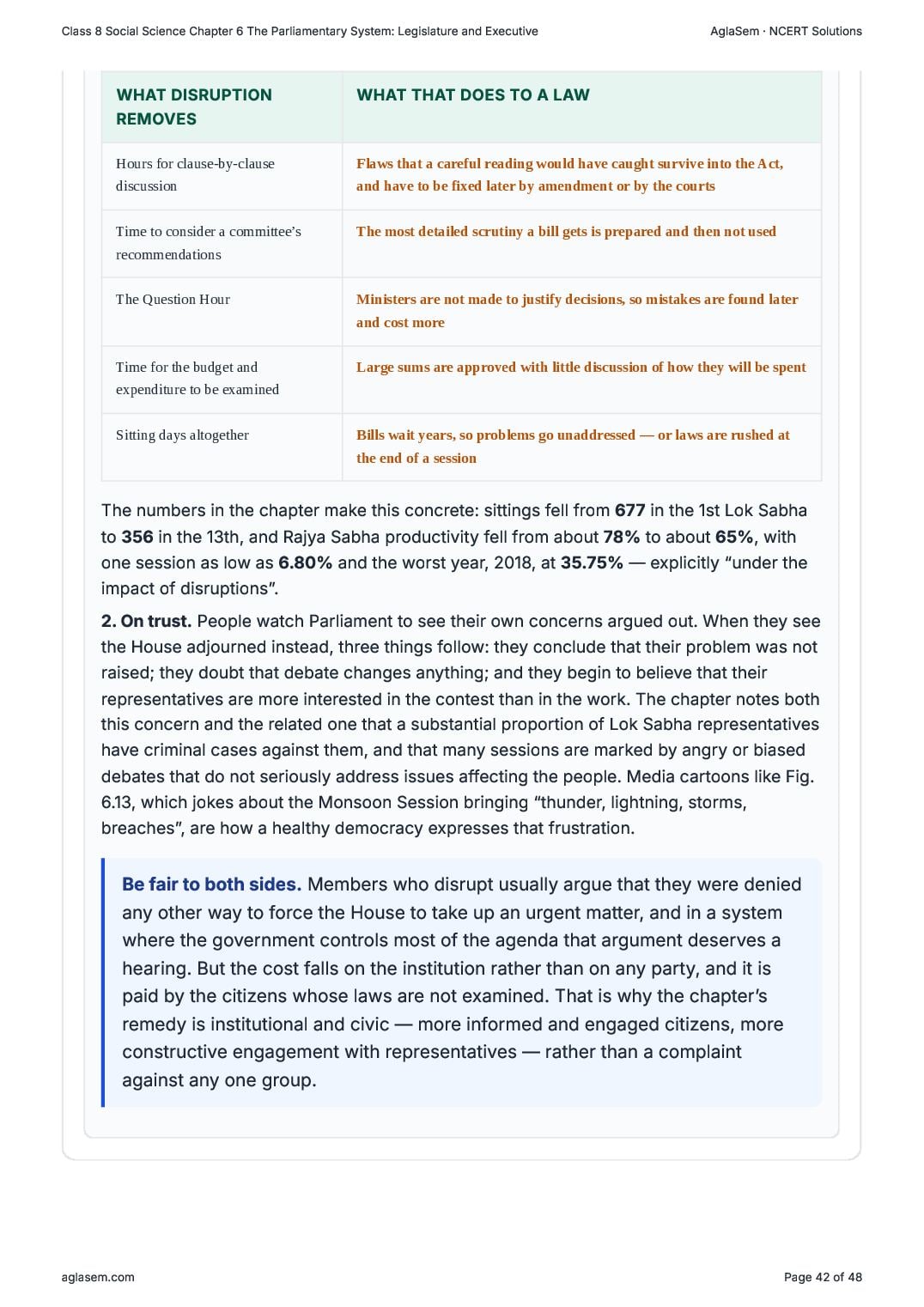
- Sometimes the Parliament is disrupted and does not function for the number of days it is supposed to. What impact do you think this has on the quality of laws and the trust people place in their representatives?
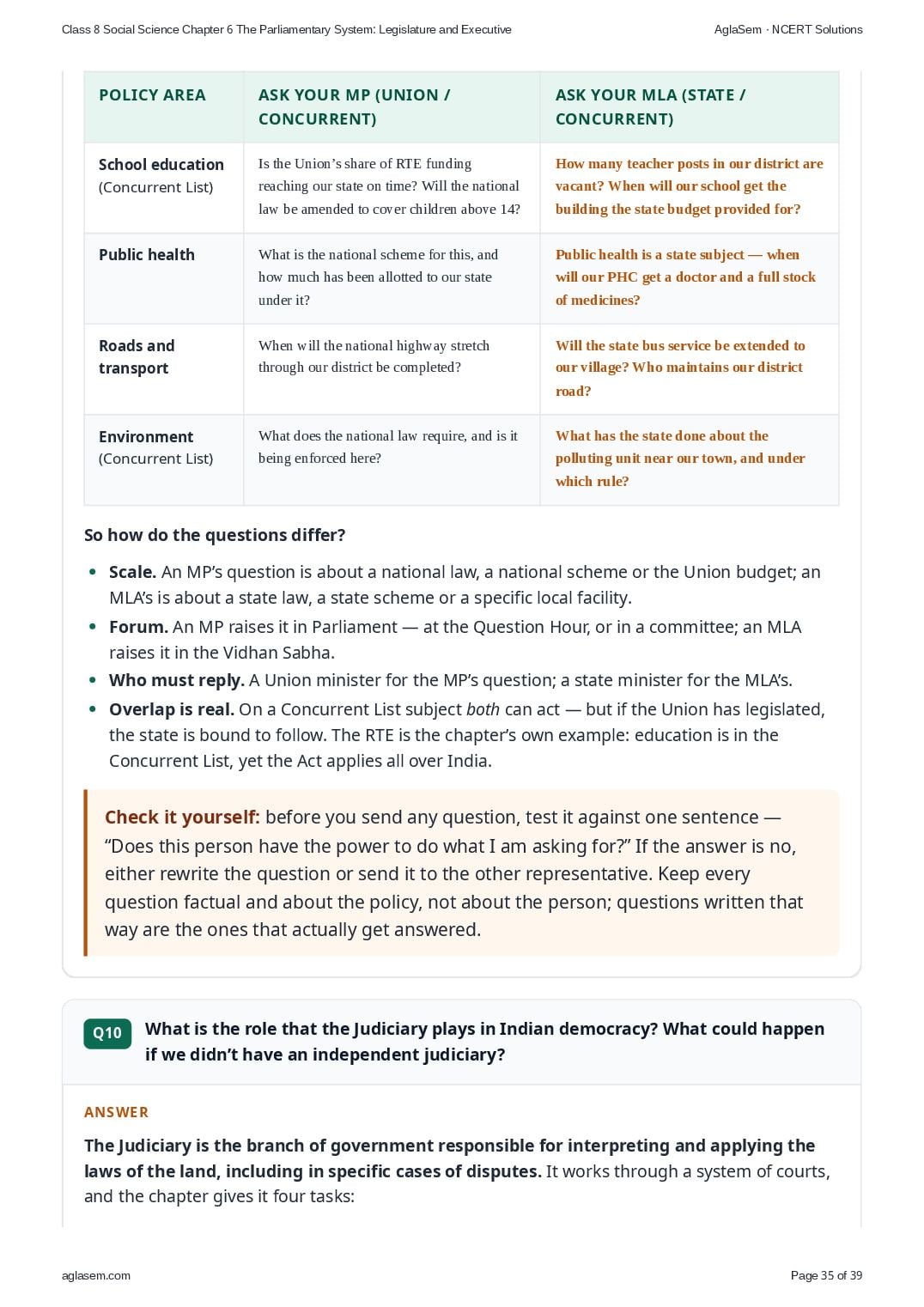
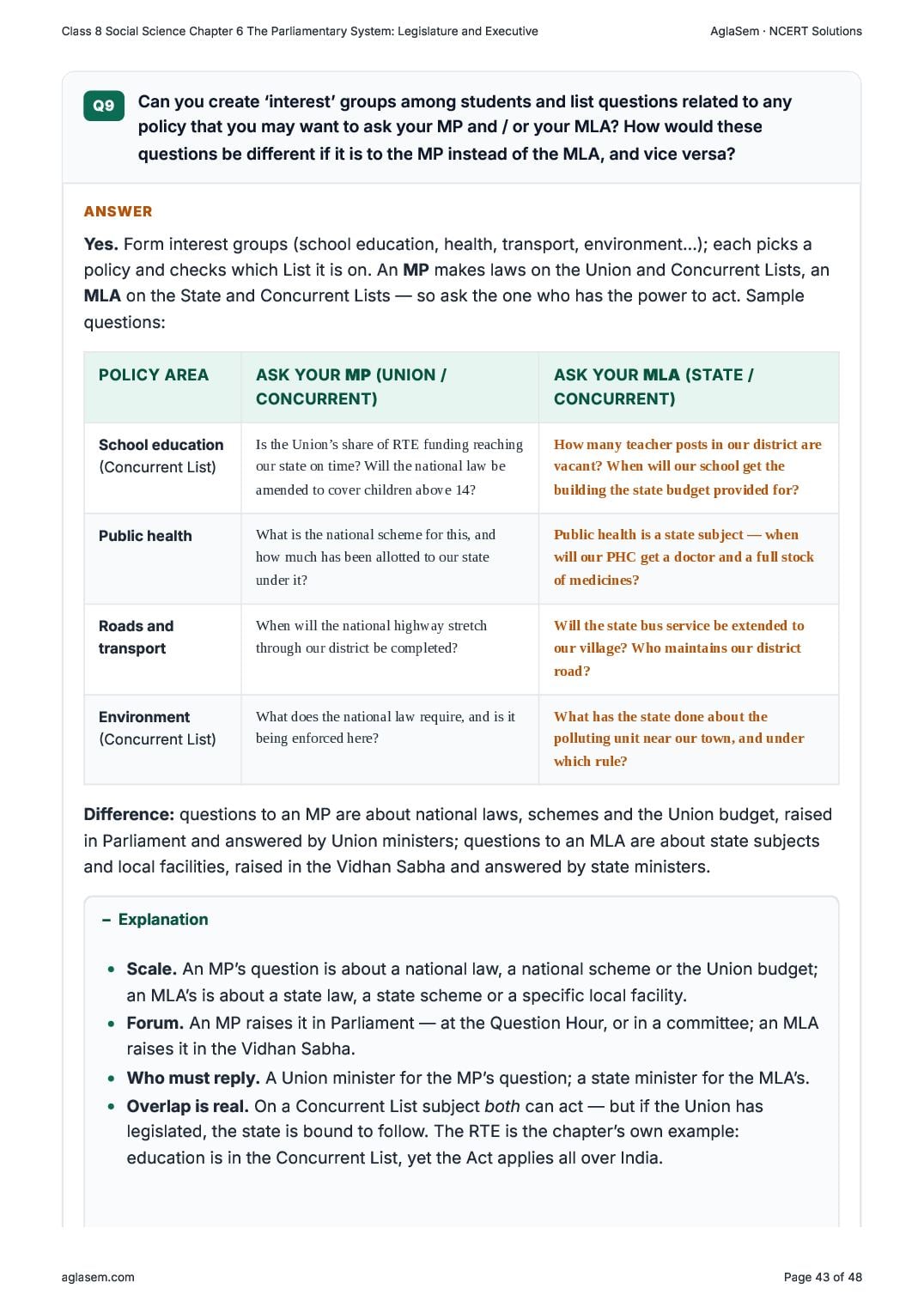
- Can you create ‘interest’ groups among students and list questions related to any policy that you may want to ask your MP and / or your MLA? How would these questions be different if it is to the MP instead of the MLA, and vice versa?
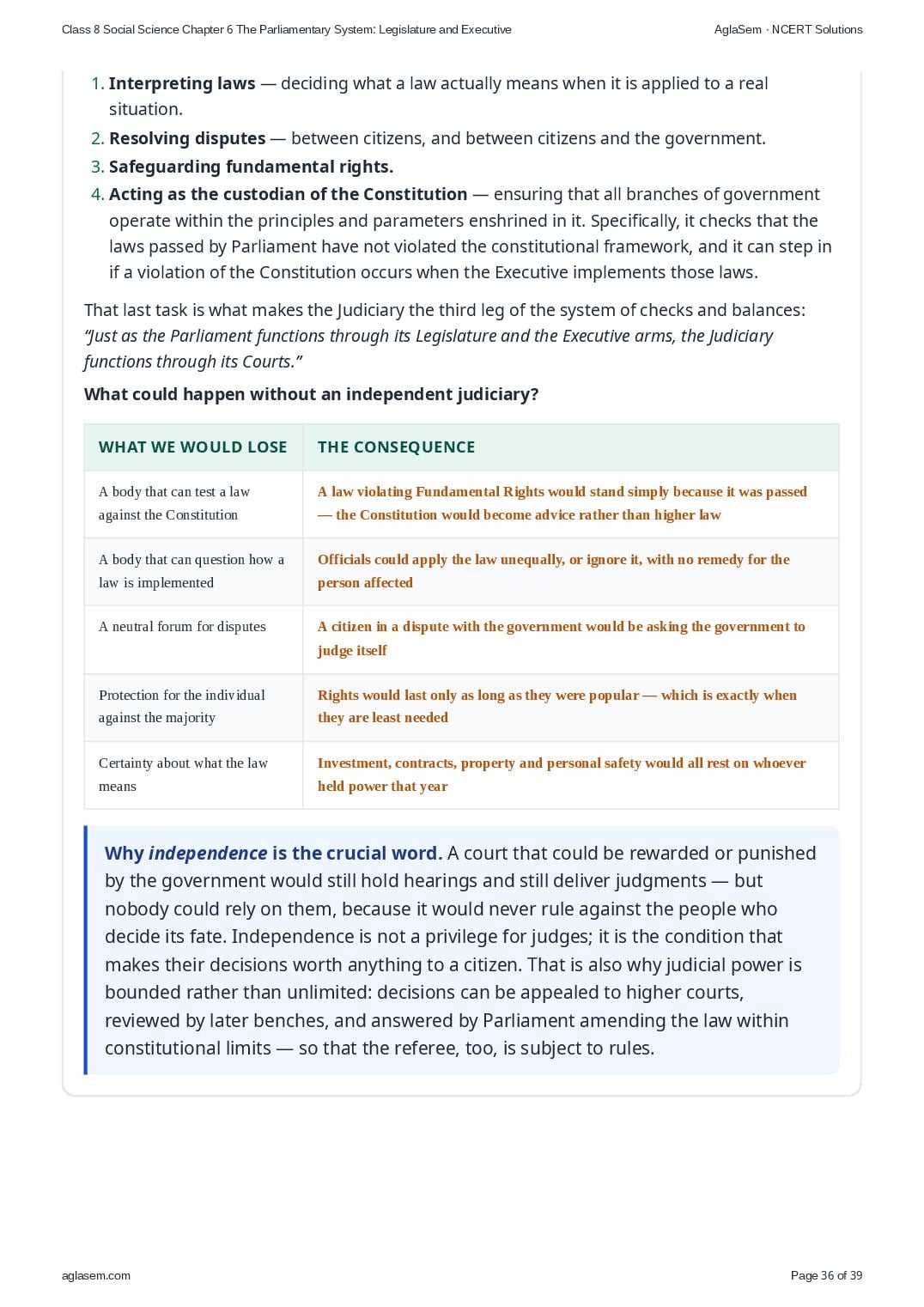
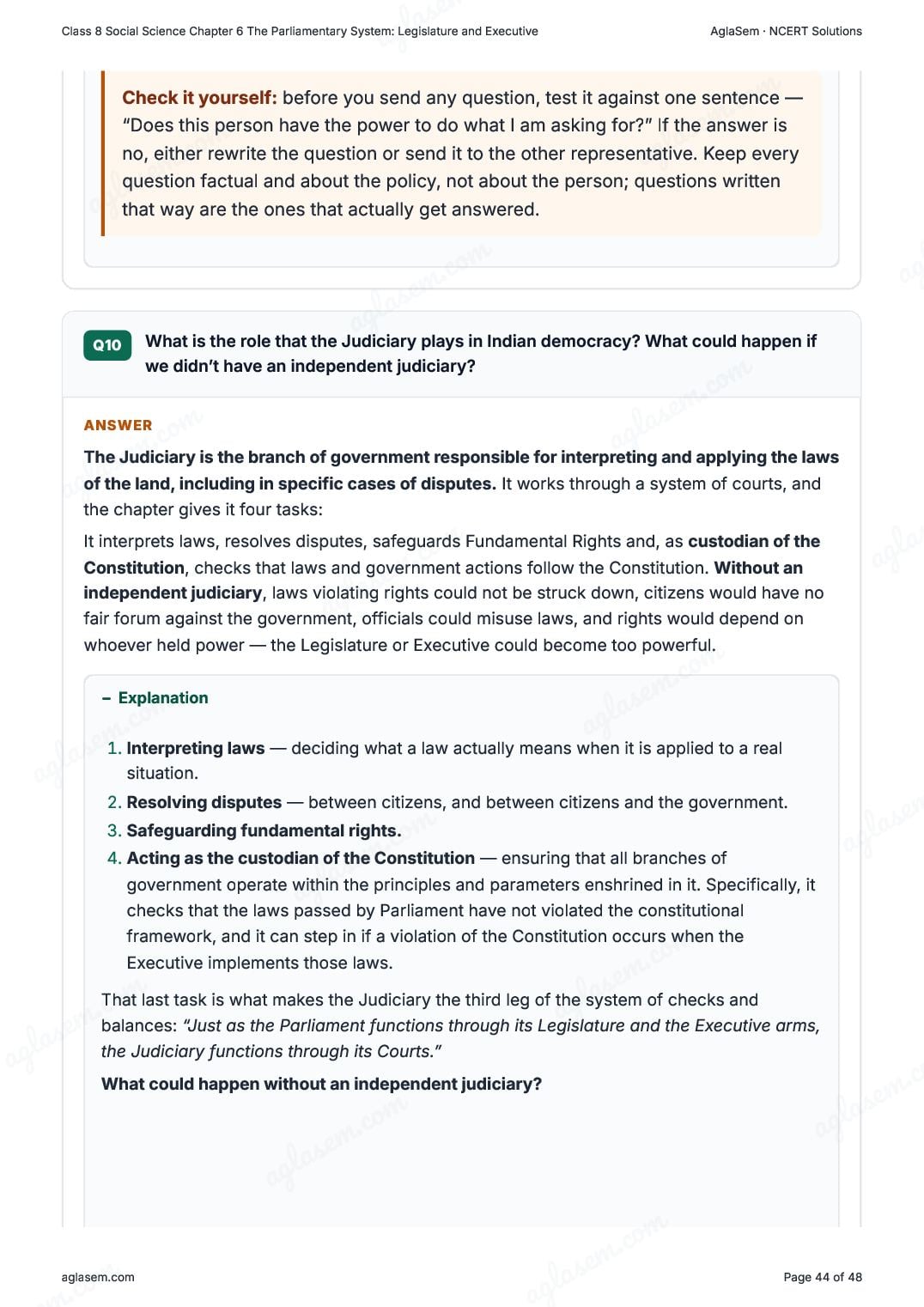
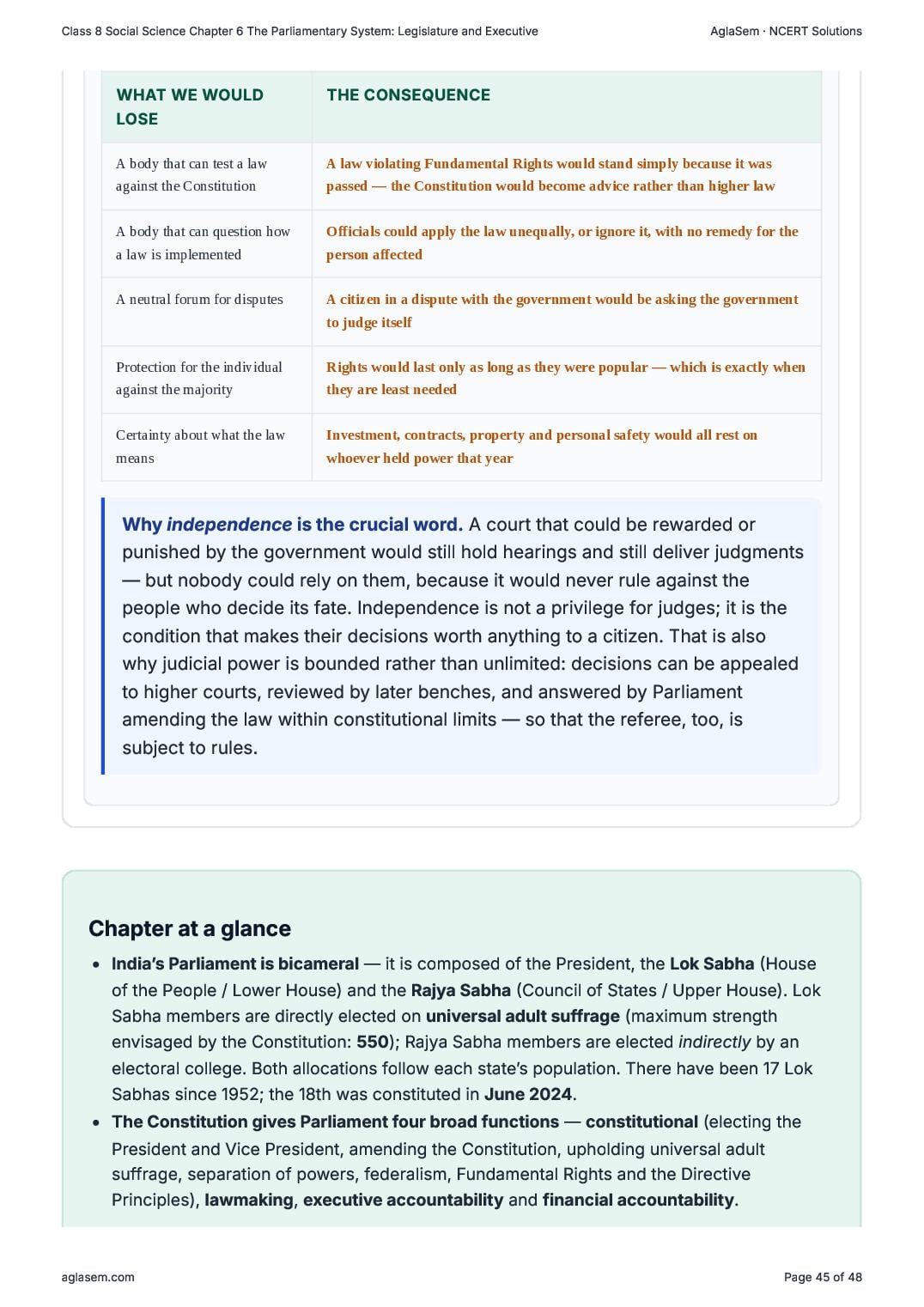
- What is the role that the Judiciary plays in Indian democracy? What could happen if we didn’t have an independent judiciary?
Chapter at a Glance
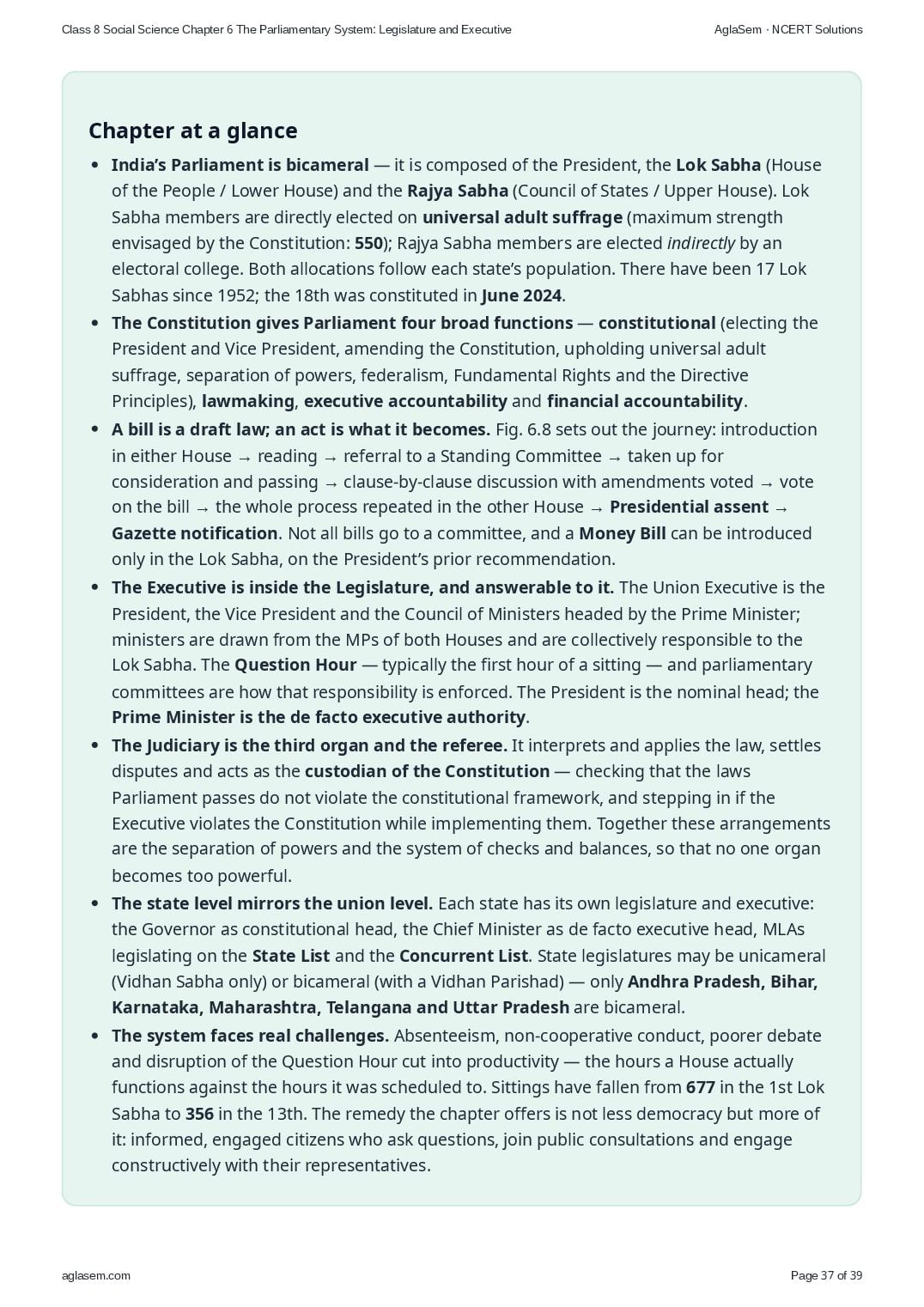
- India’s Parliament is bicameral — it is composed of the President , the Lok Sabha (House of the People / Lower House) and the Rajya Sabha (Council of States / Upper House). Lok Sabha members are directly elected on universal adult suffrage (maximum strength envisaged by the Constitution: 550 ); Rajya Sabha members are elected indirectly by an electoral college. Both allocations follow each state’s population. There have been 17 Lok Sabhas since 1952; the 18th was constituted in June 2024 .
- The Constitution gives Parliament four broad functions — constitutional (electing the President and Vice President, amending the Constitution, upholding universal adult suffrage, separation of powers, federalism, Fundamental Rights and the Directive Principles), lawmaking , executive accountability and financial accountability .
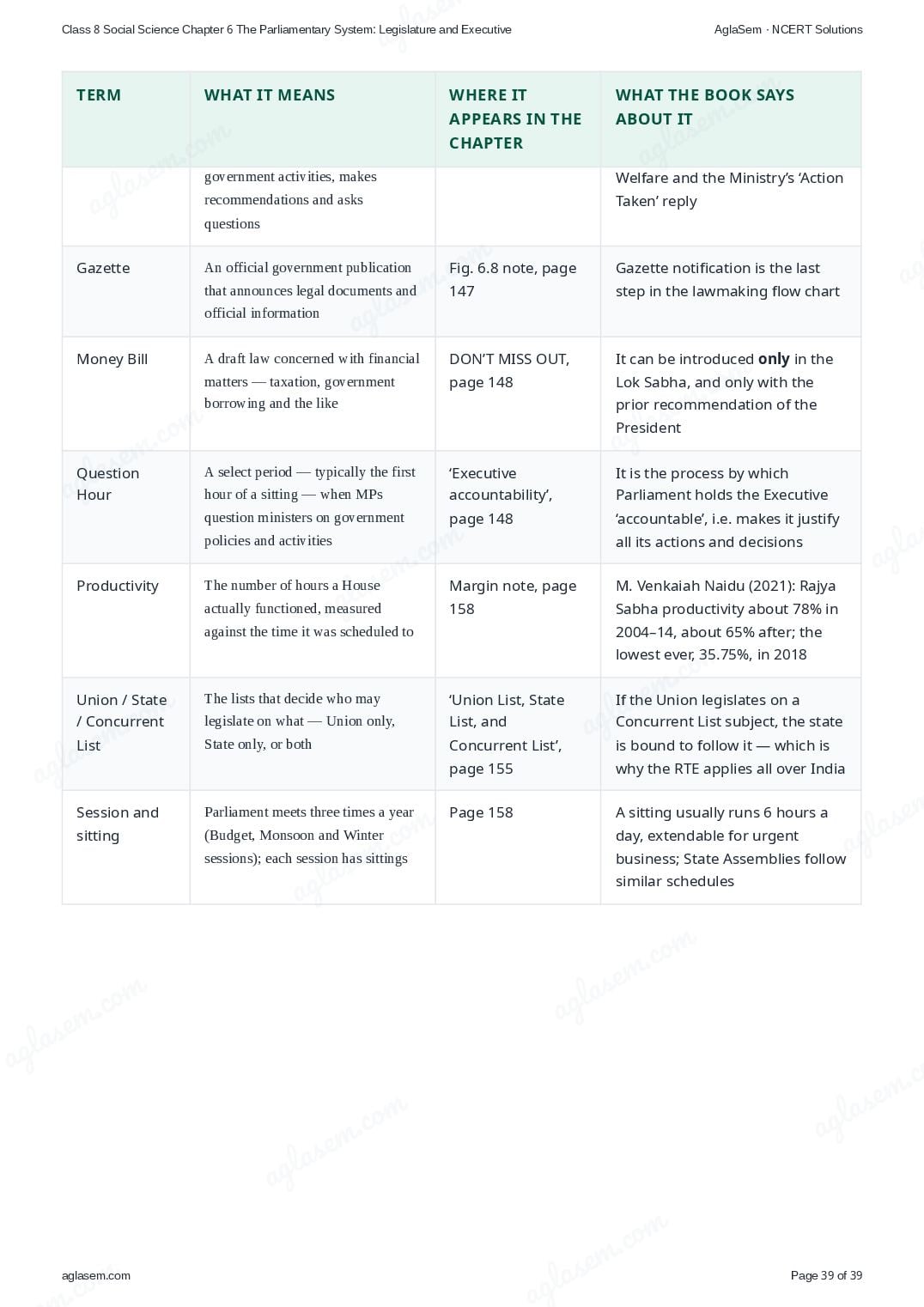
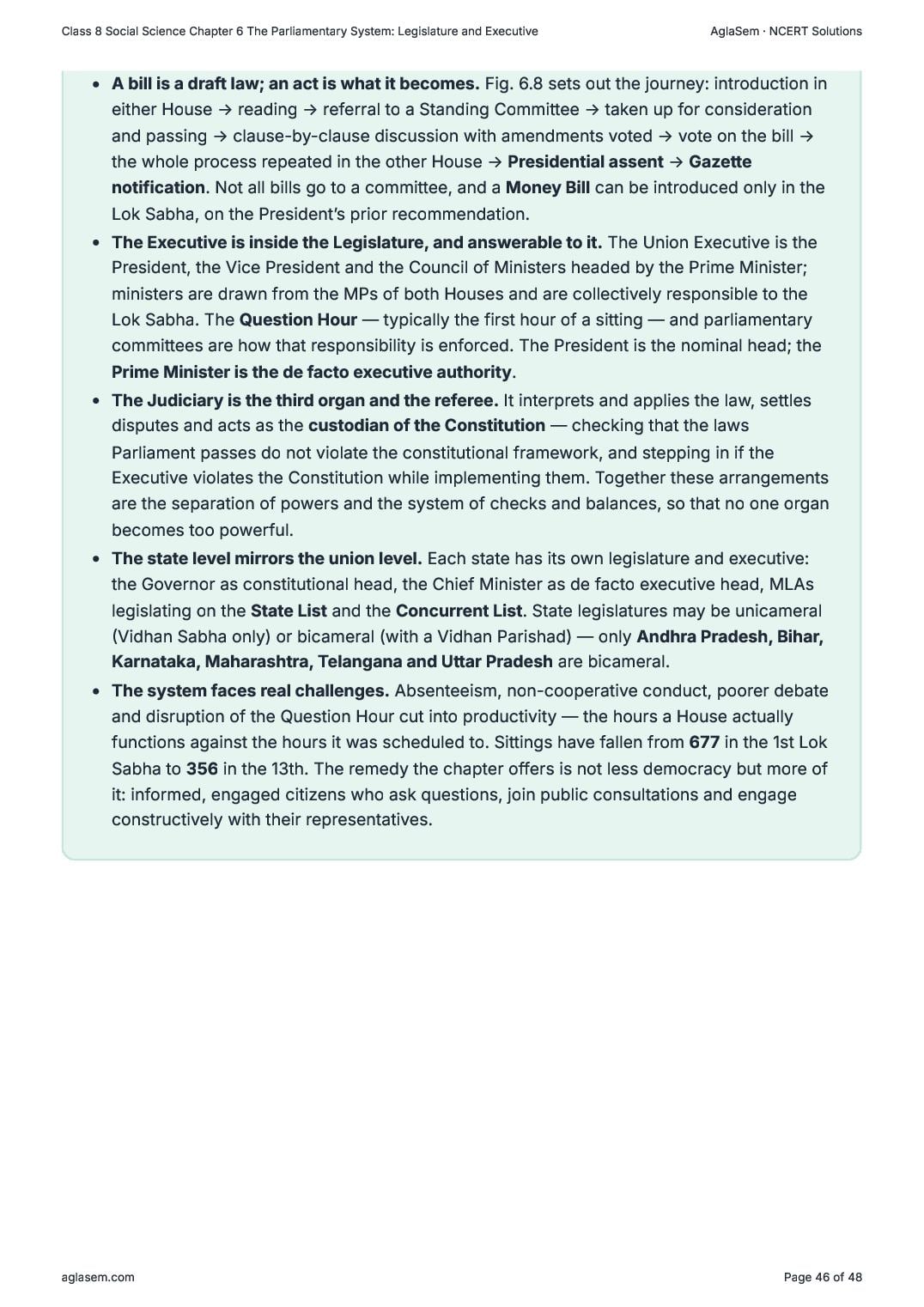
- A bill is a draft law; an act is what it becomes. Fig. 6.8 sets out the journey: introduction in either House → reading → referral to a Standing Committee → taken up for consideration and passing → clause-by-clause discussion with amendments voted → vote on the bill → the whole process repeated in the other House → Presidential assent → Gazette notification . Not all bills go to a committee, and a Money Bill can be introduced only in the Lok Sabha, on the President’s prior recommendation.
- The Executive is inside the Legislature, and answerable to it. The Union Executive is the President, the Vice President and the Council of Ministers headed by the Prime Minister; ministers are drawn from the MPs of both Houses and are collectively responsible to the Lok Sabha . The Question Hour — typically the first hour of a sitting — and parliamentary committees are how that responsibility is enforced. The President is the nominal head; the Prime Minister is the de facto executive authority .
- The Judiciary is the third organ and the referee. It interprets and applies the law, settles disputes and acts as the custodian of the Constitution — checking that the laws Parliament passes do not violate the constitutional framework, and stepping in if the Executive violates the Constitution while implementing them. Together these arrangements are the separation of powers and the system of checks and balances , so that no one organ becomes too powerful.
- The state level mirrors the union level. Each state has its own legislature and executive: the Governor as constitutional head, the Chief Minister as de facto executive head, MLAs legislating on the State List and the Concurrent List . State legislatures may be unicameral (Vidhan Sabha only) or bicameral (with a Vidhan Parishad) — only Andhra Pradesh, Bihar, Karnataka, Maharashtra, Telangana and Uttar Pradesh are bicameral.
- The system faces real challenges. Absenteeism, non-cooperative conduct, poorer debate and disruption of the Question Hour cut into productivity — the hours a House actually functions against the hours it was scheduled to. Sittings have fallen from 677 in the 1st Lok Sabha to 356 in the 13th. The remedy the chapter offers is not less democracy but more of it: informed, engaged citizens who ask questions, join public consultations and engage constructively with their representatives.
How to Download NCERT Solutions for Class 8 Social Science Chapter 6 PDF
Follow these simple steps to get the The Parliamentary System Legislature and Executive questions-and-answers PDF from Exploring Society: India and Beyond.
- Search NCERT Solutions for Class 8 Social Science Chapter 6 aglasem and open this page.
- Read the exercise questions with answers for The Parliamentary System Legislature and Executive shown above.
- Click the Download PDF link to save the The Parliamentary System Legislature and Executive solutions to your device.
NCERT Solutions for Class 8 Social Science – All Chapters
There are more chapters to study besides The Parliamentary System Legislature and Executive in Social Science. Here are the NCERT Solutions for all chapters of Class 8 Social Science.
- Chapter 1 Natural Resources and Their Use
- Chapter 2 Reshaping India’s Political Map
- Chapter 3 The Rise of the Marathas
- Chapter 4 The Colonial Era in India
- Chapter 5 Universal Franchise and India’s Electoral System
- Chapter 6 The Parliamentary System Legislature and Executive
- Chapter 7 Factors of Production
- Chapter 8 World Geography Some Glimpses
- Chapter 9 India’s Long Road to Independence
- Chapter 10 A Journey Through Indian Architecture
- Chapter 11 The Role of the Judiciary in Our Society
- Chapter 12 Citizenship Rights and Duties
- Chapter 13 Dynamics of Population
- Chapter 14 India’s Urban Landscape
- Chapter 15 Cultural Currents 13th to 17th Centuries
NCERT Solutions for Class 8 – All Subjects
Just like Chapter 6 of Social Science, you can get the exercise questions with answers for every other subject of Class 8. Here are the NCERT Solutions for all subjects of Class 8.
NCERT Solutions for Class 8 Social Science Chapter 6 – An Overview
The key highlights of this study material are as follows.
| Aspects | Details |
|---|---|
| Class | Class 8 |
| Subject | Social Science |
| Chapter Number | Chapter 6 |
| Chapter Name | The Parliamentary System Legislature and Executive |
| Book Name | Exploring Society: India and Beyond |
| Book By | NCERT (National Council of Educational Research and Training) |
| Educational Resource Here | NCERT Solutions of Class 8 Social Science Chapter 6 for all exercises |
| More Questions Answers of This Subject | NCERT Solutions for Class 8 Social Science |
| Download Book Chapter | NCERT Book Class 8 Social Science |
| All Questions Answers For This Class | NCERT Solutions for Class 8 |
| Complete Solutions | NCERT Solutions |
NCERT Solutions for Class 8 Social Science Chapter 6 The Parliamentary System Legislature and Executive – FAQs
What are the NCERT Solutions for Class 8 Social Science Chapter 6 The Parliamentary System Legislature and Executive?
They are the complete, step-by-step answers to all the exercise and in-text questions of Chapter 6 The Parliamentary System Legislature and Executive from the NCERT Class 8 Social Science textbook Exploring Society: India and Beyond, written by experts as per the latest NCERT syllabus.
How can I download the Class 8 Social Science Chapter 6 solutions PDF for free?
Open this page on aglasem, read the The Parliamentary System Legislature and Executive questions with answers, and click the “Download Solutions PDF” link. The Class 8 Social Science Chapter 6 NCERT Solutions PDF is completely free to download.
Are these NCERT Solutions as per the latest 2026-27 syllabus?
Yes. The NCERT Solutions for Class 8 Social Science Chapter 6 are based on the latest NCERT textbook Exploring Society: India and Beyond and the current 2026-27 CBSE syllabus, so the questions and answers match what you study in class.
Where can I get NCERT Solutions for the other chapters of Class 8 Social Science?
You can find the answers to every chapter on the NCERT Solutions for Class 8 Social Science page, and solutions for every subject on the NCERT Solutions for Class 8 page.
How do NCERT Solutions help in exam preparation?
They show the correct method to solve each question, help you write answers the way they are expected in exams, let you check and correct your own work, and save revision time — which together improve your marks in Class 8 Social Science.
If you have any queries on NCERT Solutions for Class 8 Social Science Chapter 6 The Parliamentary System Legislature and Executive, then please ask in the comments below.