NCERT Solutions for Class 8 Social Science Chapter 13 Dynamics of Population provide clear, step-by-step answers to every exercise and in-text question from the chapter Dynamics of Population of the NCERT textbook Exploring Society: India and Beyond. Prepared by subject experts as per the latest NCERT (CBSE) syllabus for 2026-27, these NCERT Solutions for Class 8 Social Science help you understand each concept, write exam-ready answers, and check your own solutions. You can read them online below or download the free Class 8 Social Science Chapter 13 question-answer PDF.
NCERT Solutions for Class 8 Social Science Chapter 13 Dynamics of Population
- Class: Class 8
- Subject: Social Science
- Chapter: Chapter 13 – Dynamics of Population
- Textbook: Exploring Society: India and Beyond (NCERT)
- Study material: NCERT Solutions – questions with answers, free PDF
These solutions answer all the exercise questions of Chapter 13 Dynamics of Population — including the in-text questions, short-answer and long-answer questions, and activities — with complete explanations so you can follow the method, not just the final answer. Read the full solutions below.
NCERT Solutions Class 8 Social Science Chapter 13 Dynamics of Population View Download


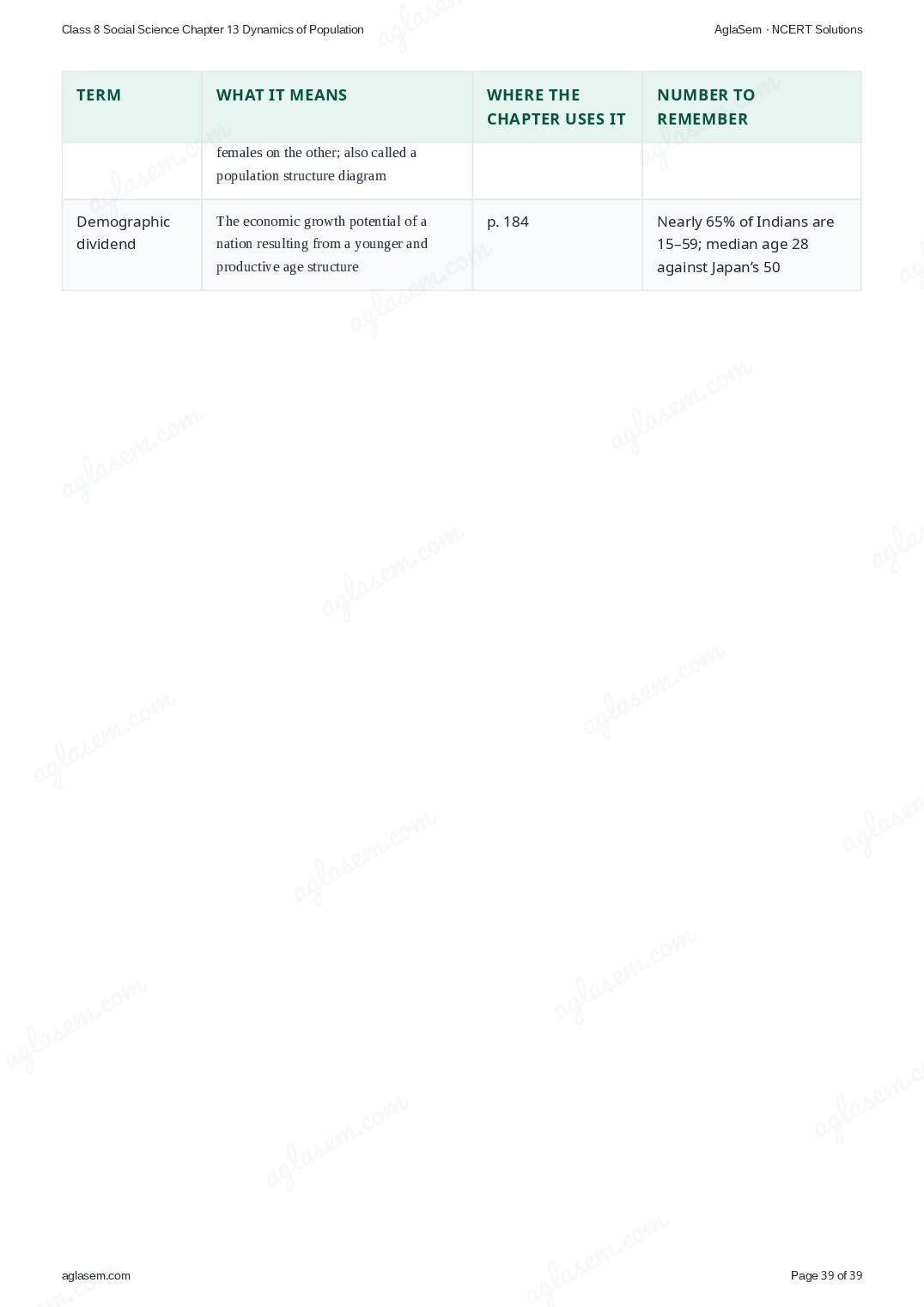
NCERT Solutions for Class 8 Social Science Chapter 13 PDF Download
You can read the NCERT Solutions for Class 8 Social Science Chapter 13 online above, or download the complete question-answer PDF to study Dynamics of Population offline at any time.
NCERT Solutions for Class 8 Social Science Chapter 13 PDF Download Link – Click Here to Download Solutions PDF
Questions Covered in This Chapter
These NCERT Solutions answer all 24 questions of this chapter. The questions solved are:
- What is demography?
- What are some important concepts of demography?
- How has the population of India and the world changed over time?
- How do population trends shape societies and economies?
- Have you ever wondered how many people live in the world?
- Ask your family members if they have observed any of the following changes around them over the years: farmland or green spaces being turned into new buildings for housing; more crowded streets; more cars and buses; and traffic congestion in public spaces; changing types of homes (e.g., smaller apartments, more single-family homes). What could be the possible reasons behind these changes?
- Why is the replacement rate 2.1 and not 2 (parents get replaced by children)? What are the situations in which the replacement rate can be higher?
- Observe fertility and literacy rates in select Indian states in Fig. 6.11. Do you find a relationship between the two indicators? Prepare a report on your observations and possible reasons for the same.
- If many young people migrate from villages or smaller towns to cities, what changes could take place in their native villages?
- Census figures of 2001 as well as 2011 show the overall number of females per 1,000 males being much less than 1,000. Some states, however, had over 1,000 or near 1,000 (Kerala, Puducherry, Tamil Nadu). What might be the reasons for this?
- If the replacement rate is less than 2, what will the population pyramid look like? Will there ever be a situation where the number of children is less than the number of aged people? What is likely to happen to the population of such a country over time?
- Indian society has had the concept of āshrama dharma where life is divided into four phases — brahmacharya, gṛihastāshrama, vānaprasta and sanyāsa. Though older people begin to withdraw from economic activities, they continue to play other important roles — share their knowledge and wisdom with family and society as needed. Cultural continuity becomes possible through their guidance in rituals, storytelling, etc. They hold knowledge that may not necessarily be in books. Can you think of all the ways in which older people in your neighbourhood contribute to their family and society?
- Why is it important for a country to study its population through demography?
- How can a low fertility rate affect a country’s future economy and workforce?
- Do you think a high birth rate is always good for a country? Why or why not?
- Do you think it’s better to have more people or fewer people in a country? What are the challenges countries face in the case of a fast-growing or shrinking population?
- How does the age structure of a country affect the kind of jobs and services it needs? Explain with examples.
- Why do you think families are generally getting smaller? Does having fewer children ensure better education and health for them? How does it affect families and society?
- Observe the graph below showing changes in life expectancy across gender in India and answer the questions given below: a) Has the life expectancy in India increased? If yes, what could be the reasons? b) What was the life expectancy of males and females in 2010?
- What is a demographic dividend, and how does it benefit a country? What do you think India needs to do today to make the most of its demographic dividend before 2050?
- Choose two countries (for example: India and Japan, or Nigeria and Italy). Find out their: Population size, Fertility rate, Life expectancy, Age distribution. How are they different? What might be the reasons behind these differences? For instance, find out how countries with ageing populations are managing this.
- Imagine you are a researcher who intends to study migration patterns in your locality. Make a questionnaire to collect data on the following questions: Name of the person; Age of the person; Occupation of the person; Place of residence; Number of years lived in the place; List the factors contributing to migration, such as lack of facilities, poor infrastructure, limited job opportunities and so on.
- Draw a population pyramid on graph paper for India using the data given in the following table. Age-group-wise percentage distribution of population (estimated for 2021).
- Observe the population pyramid for Japan in 2023 below. What can you infer from this? Write your observations and share in the class.
Chapter at a Glance
- Demography is the study of the composition of a human population — age, sex, education, occupation, religion — and of how it changes over time through births, deaths and the movement of people. Governments use it to plan schools, hospitals, roads, housing, water, energy and waste services; businesses use it to work out who their customers are. India’s census , held about every 10 years, is the official count.
- Four indicators drive everything else (Fig. 6.7): the birth rate (live births per 1,000 people in a year), the fertility rate (average number of children a woman would have in her lifetime), the death or mortality rate (deaths per 1,000 people in a year) and migration . A fertility rate of 2.1 is the replacement level: above it a population grows, below it it eventually shrinks.
- World population grew from 2.5 billion in 1950 to 8.2 billion in 2025 and is expected to reach 9.7 billion by 2050, peak at 10.3 billion in the mid-2080s and then decline. India’s population went from 361 million in 1951 to 1,460 million in 2025 ; in 2023 India passed China to become the most populous country, holding around 17 per cent of the world’s people.
- Countries pass through a demographic transition in three stages (Fig. 6.12): both rates high and growth slow; death rates fall first while births stay high, so growth is rapid; then births fall too and growth slows again. India was in Stage 1 from 1901–1921, grew rapidly after 1951, and since the mid-1980s its fertility has been falling — it is now below replacement level.
- India’s own indicators have improved sharply: child mortality fell from 271 per 1,000 in 1950 to 28 in 2023 , life expectancy at birth rose from 30 years at Independence to 70 years in 2024 , fertility fell from 5.7 in 1950 to 1.9 in 2025 , and the sex ratio improved from 933 females per 1,000 males in 2001 to 943 in 2011 .
- About 27 per cent of Indians are under 15 and nearly 65 per cent are in the working-age group of 15–59; India’s median age is 28 against Japan’s 50. This young age structure is India’s demographic dividend — but it is a limited window. The under-5 population peaked in 2007 and the under-15 population in 2011, and after 2050 India begins to move towards an older population.
How to Download NCERT Solutions for Class 8 Social Science Chapter 13 PDF
Follow these simple steps to get the Dynamics of Population questions-and-answers PDF from Exploring Society: India and Beyond.
- Search NCERT Solutions for Class 8 Social Science Chapter 13 aglasem and open this page.
- Read the exercise questions with answers for Dynamics of Population shown above.
- Click the Download PDF link to save the Dynamics of Population solutions to your device.
NCERT Solutions for Class 8 Social Science – All Chapters
There are more chapters to study besides Dynamics of Population in Social Science. Here are the NCERT Solutions for all chapters of Class 8 Social Science.
- Chapter 1 Natural Resources and Their Use
- Chapter 2 Reshaping India’s Political Map
- Chapter 3 The Rise of the Marathas
- Chapter 4 The Colonial Era in India
- Chapter 5 Universal Franchise and India’s Electoral System
- Chapter 6 The Parliamentary System Legislature and Executive
- Chapter 7 Factors of Production
- Chapter 8 World Geography Some Glimpses
- Chapter 9 India’s Long Road to Independence
- Chapter 10 A Journey Through Indian Architecture
- Chapter 11 The Role of the Judiciary in Our Society
- Chapter 12 Citizenship Rights and Duties
- Chapter 13 Dynamics of Population
- Chapter 14 India’s Urban Landscape
- Chapter 15 Cultural Currents 13th to 17th Centuries
NCERT Solutions for Class 8 – All Subjects
Just like Chapter 13 of Social Science, you can get the exercise questions with answers for every other subject of Class 8. Here are the NCERT Solutions for all subjects of Class 8.
NCERT Solutions for Class 8 Social Science Chapter 13 – An Overview
The key highlights of this study material are as follows.
| Aspects | Details |
|---|---|
| Class | Class 8 |
| Subject | Social Science |
| Chapter Number | Chapter 13 |
| Chapter Name | Dynamics of Population |
| Book Name | Exploring Society: India and Beyond |
| Book By | NCERT (National Council of Educational Research and Training) |
| Educational Resource Here | NCERT Solutions of Class 8 Social Science Chapter 13 for all exercises |
| More Questions Answers of This Subject | NCERT Solutions for Class 8 Social Science |
| Download Book Chapter | NCERT Book Class 8 Social Science |
| All Questions Answers For This Class | NCERT Solutions for Class 8 |
| Complete Solutions | NCERT Solutions |
NCERT Solutions for Class 8 Social Science Chapter 13 Dynamics of Population – FAQs
What are the NCERT Solutions for Class 8 Social Science Chapter 13 Dynamics of Population?
They are the complete, step-by-step answers to all the exercise and in-text questions of Chapter 13 Dynamics of Population from the NCERT Class 8 Social Science textbook Exploring Society: India and Beyond, written by experts as per the latest NCERT syllabus.
How can I download the Class 8 Social Science Chapter 13 solutions PDF for free?
Open this page on aglasem, read the Dynamics of Population questions with answers, and click the “Download Solutions PDF” link. The Class 8 Social Science Chapter 13 NCERT Solutions PDF is completely free to download.
Are these NCERT Solutions as per the latest 2026-27 syllabus?
Yes. The NCERT Solutions for Class 8 Social Science Chapter 13 are based on the latest NCERT textbook Exploring Society: India and Beyond and the current 2026-27 CBSE syllabus, so the questions and answers match what you study in class.
Where can I get NCERT Solutions for the other chapters of Class 8 Social Science?
You can find the answers to every chapter on the NCERT Solutions for Class 8 Social Science page, and solutions for every subject on the NCERT Solutions for Class 8 page.
How do NCERT Solutions help in exam preparation?
They show the correct method to solve each question, help you write answers the way they are expected in exams, let you check and correct your own work, and save revision time — which together improve your marks in Class 8 Social Science.
If you have any queries on NCERT Solutions for Class 8 Social Science Chapter 13 Dynamics of Population, then please ask in the comments below.