NCERT Solutions for Class 8 Social Science Chapter 9 India’s Long Road to Independence – step-by-step answers to every exercise and in-text question of the chapter, as per the latest NCERT syllabus for 2027. Read them online or download the free question-answer PDF.
From the royal proclamation of 1858 to the midnight of 15 August 1947, this chapter follows ninety years in which a land of many languages, faiths and regions learnt to act as one nation — through reform and writing, through Swadeshi and boycott, through revolutionary daring and Gandhian satyagraha — and it does not hide the cost: the jails, the massacres, and the Partition that shadowed the victory.
NCERT Solutions for Class 8 Social Science Chapter 9 India’s Long Road to Independence PDF
All the answers are on this page below. The PDF also explains every answer – why it is right and how to check it – so download it for revision.
| Chapter | Download | |
|---|---|---|
| Solutions PDF | India's Long Road to Independence | View PDF |
NCERT Solutions for Class 8 Social Science Chapter 9 India’s Long Road to Independence – Questions and Answers
All 31 questions of the chapter (textbook pages Part II, 35 – 84) are answered below, in the order of the book – in-text questions, activities and the end-of-chapter exercises. Each answer is written the way you would write it in the exam.
The Big Questions — Pages 36–37Chapter opener
India came together because British rule hurt people everywhere in the same ways, and because Indians slowly built the tools of a common struggle.
- Common grievances: heavy land taxes and famines, ruined local industries, and racial humiliation — lower pay for Indians, the Arms Act and the Vernacular Press Act (1878).
- Common organisations and newspapers: the Indian National Congress (1885) met in a different city every year; papers such as Kesari and Bande Mataram spread the same ideas.
- Common symbols: Vande Mataram, Bharat Mata, rakhis tied in Bengal in 1905.
- Methods anyone could join: Swadeshi, boycott, khadi, satyagraha, the Salt March.
- Shocks such as the Partition of Bengal, Jallianwala Bagh and the Simon Commission united people further.
Finally, Quit India, the mutinies of 1946 and Britain’s weakness after World War II made British rule impossible to continue.
The struggle moved through five broad phases:
- 1858–1900: the Crown takes direct control; reform movements (Brahmo Samaj, Arya Samaj); the Indian National Congress founded in 1885 (A.O. Hume, Dadabhai Naoroji, W.C. Bonnerjee).
- 1905–1915: Partition of Bengal; Swadeshi and boycott; Surat split (1907); the revolutionaries — Tilak, Lala Lajpat Rai, Bipin Chandra Pal, Aurobindo Ghose, Khudiram Bose, Bagha Jatin.
- 1915–1922: Gandhi’s satyagraha; Home Rule (Tilak, Annie Besant); Jallianwala Bagh (1919); Khilafat and Non-Cooperation.
- 1925–1935: Simon Commission; Purna Swaraj (1929); Salt March (1930); Bhagat Singh; Sardar Patel; Sarojini Naidu; B.R. Ambedkar.
- 1939–1947: Quit India (1942); Subhas Chandra Bose’s INA; the naval mutiny; Independence and Partition (Nehru, Patel, Jinnah).
All of them agreed that British rule was unjust and exploitative and that Indians must govern themselves. They disagreed about how:
- How much to demand: Moderates wanted self-government within the Empire; Nationalists wanted full independence — hence the Surat split (1907).
- Nonviolence or force: Gandhi’s satyagraha versus revolutionaries such as Bhagat Singh, and Subhas Chandra Bose’s armed INA.
- Calling off Non-Cooperation after Chauri Chaura (1922): the Nehrus, C.R. Das and Bose disapproved.
- Religion in politics: the Khilafat alliance was criticised; Jinnah left the Congress in 1920.
- Separate electorates: Ambedkar for, Gandhi against — settled by the Poona Pact.
- One nation or two: most Congress leaders rejected the Two-Nation idea; Jinnah backed Pakistan.
LET’S EXPLORE — Page 38Introduction to the chapter
“I spoke to my grandmother, Kamla Devi (84), whose family lived near Ballia in eastern Uttar Pradesh. Her father told her that during Quit India (1942) young men of the village cut down telegraph poles and the police came and beat people. Her father supported the Congress and kept a charkha; her uncle admired Subhas Chandra Bose and said ‘spinning will not send them home’. On 15 August 1947 sweets were given out at school.”
Class discussion: families supported different leaders and methods — Gandhi’s nonviolence, Bose’s armed struggle, local leaders — yet all wanted freedom. Differing on the method did not mean differing on the goal.
LET’S REMEMBER — Page 39A Royal Proclamation
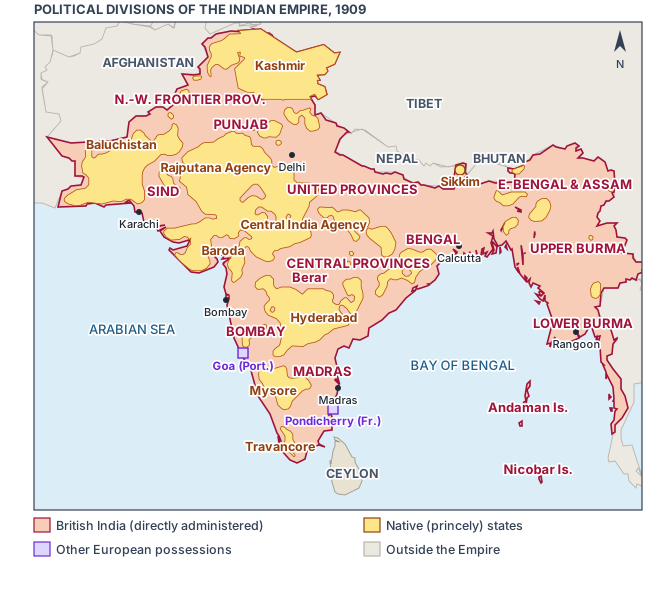
The map shows two kinds of territory under one empire:
- Red and pink — British India: the presidencies and provinces ruled directly by the Crown, through the Secretary of State in London and the Viceroy in India.
- Yellow — the princely states (about 560, e.g. Kashmir, Hyderabad, Mysore, the Rajputana states): ruled by Indian princes under British ‘paramountcy’, with a British Resident or Political Agent who often interfered.
British India holds most of the coasts, ports and fertile river plains; the princely states lie mainly in the interior.
LET’S EXPLORE — Page 42Other Influences (Bankim Chandra Chattopadhyay and Bande Mataram)
Vande mātaram!
sujalām suphalām malayajaśhītalām
śhasyaśhyāmalām, mātaram!
Vande mātaram!
Śubhrajyotsnām pulakitayāminīm
phullakusumita drumadalaśhobhinīm
suhāsinīm sumadhura bhāṣhiṇīm
sukhadām varadām, mātaram!
Vande mātaram!
Yes. The song praises the motherland as a mother. Its meaning is roughly:
“I bow to you, Mother! You are rich in water and in fruit, cooled by the southern breeze, dark green with crops. Your nights are bright with moonlight and full of joy; you are beautiful with flowering trees; you smile sweetly and speak sweetly; you give happiness and blessings. I bow to you, Mother!”
Every image — rivers, fruit, crops, trees, moonlight — is of the land itself, which is why the song became a rallying cry for loving and defending the country.
LET’S EXPLORE — Page 43Other Influences (Swami Vivekananda)
Swami Vivekananda’s values are still relevant today because they are about the kind of person one must become:
- “Arise, awake, and stop not till the goal is reached” — persistence; do not give up halfway.
- Inner strength — overcome fear, weakness and self-doubt.
- Science and research — he advised Jamsetji Tata to found what became the Indian Institute of Science.
- Pride in one’s roots without blind imitation — learn from the past, then “march forward”.
- Service to others — the Ramakrishna Mission joined spiritual practice with social service.
Sample answer (my goal): “Self-confidence and persistence can help me: when a subject feels hard, I can keep practising instead of deciding that it is not for me.”
LET’S EXPLORE — Page 50The Nationalist Agenda (the Bande Mataram daily)
The daily avoided the word ‘independence’ for two main reasons:
- Fear of sedition charges. Writing openly for independence could be punished as sedition. Tilak was jailed for his articles, and Bande Mataram itself was later suppressed. Milder words helped the paper survive and keep spreading its ideas.
- Wider appeal. Words such as ‘Swaraj’ or ‘absolute national autonomy’ could be accepted both by Moderates, who wanted self-rule within the Empire, and by Nationalists, who wanted full freedom.
Its words still meant complete freedom from British control.
The quotation (from a Bande Mataram article of 4th September 1906): “We objected so strongly to this measure [Bengal’s Partition, because] it was professedly wanted by the Government to create a Mahomedan province with Dacca as its capital, and the evident object of it was to sow discord between the Hindus and the Mahomedans in a Province that had never known it in the whole history of the present British connection. … This agitation is not an agitation merely against Partition … The attainment of absolute national autonomy—it is this alone that will settle down this movement.”
‘Absolute national autonomy’ means complete self-rule for India as a nation, with no British control at all.
- Autonomy — self-government.
- National — for the whole Indian nation, not just one province such as Bengal.
- Absolute — total; not partial reforms, not self-rule within the British Empire.
The article says that cancelling the Partition of Bengal would not end the agitation; only complete autonomy would. So the phrase shows that the Nationalists’ real goal was freedom, put in careful words.
The two boxes announce the paper’s politics right beside its name:
- Left box — “Swadeshi PAPER of India.” The paper calls itself a Swadeshi (Indian-made, Indian-run) product, so it practises the boycott it preaches.
- Right box — “Our Policy: INDIA for Indians.” Its aim is that India should belong to, and be ruled by, Indians — that is, Swaraj.
Together they show Swadeshi and Swaraj, the Nationalist programme of 1906. The line under the title, “A Daily Organ of Indian Nationalism”, confirms that the paper openly stood for the Nationalist cause.
LET’S EXPLORE — Page 52India as the ‘Mother’ (Fig. 2.14 and Fig. 2.15)
Similarities: both show India as a mother-goddess (Bharat Mata); both were made in the Swadeshi years; both come from the idea of India as a divine motherland, inspired by Bankim’s Anandamath; and both call on Indians to love and serve the nation.
Differences:
- Fig. 2.14 is a soft, coloured painting; Fig. 2.15 is a black-and-white printed magazine cover, made to reach many readers.
- In Fig. 2.14 she is calm and gentle, holding gifts (cloth, paddy, a book, a rosary); in Fig. 2.15 she is drawn over the map of India, with people and flags below her.
- Fig. 2.14 has no words; Fig. 2.15 carries ‘Bharat Mata’ and ‘Vande Mataram’.
(Fig. 2.15 is the black-and-white printed front cover of Subramania Bharati’s Tamil magazine Vijaya; see the textbook, p. 51.)
Details on the cover of Vijaya:
- The title விஜயா (Vijaya, ‘victory’) in large Tamil letters, with a palm-like ornament above it and a Tamil line below saying that it is published every day.
- A framed picture with a banner at the top reading भारतमाता (Bharat Mata).
- Mother India, with flowing hair, drawn over an outline map of India, with Sri Lanka at the bottom.
- The words वन्देमातरम् (Vande Mataram) beside her.
- Two small groups of people under flags in the bottom corners, and two large birds facing each other at the foot of the picture.
- Lines of small Tamil print below the picture and down its side.
LET’S EXPLORE — Page 55DON’T MISS OUT: Freedom Struggle in the North-East
The North-East took part in the freedom struggle from very early on:
- Tirot Sing led the Khasi Revolt (1829–1833) in present-day Meghalaya.
- The Singpho Rebellion (1830s–1840s) was a tribal revolt in eastern Assam.
- Maniram Dewan and Piyali Baruah were publicly hanged in Assam during the 1857 revolt.
- Kanaklata Barua (17) was shot while leading a flag procession at Gohpur in 1942; Kushal Konwar was also martyred during Quit India.
- Rani Gaidinliu of Manipur began resisting the British at 13, urging people not to pay taxes or work for them.
More names to explore: Bhogesvari Phukanani and Gopinath Bordoloi of Assam.
LET’S EXPLORE — Page 56The Revolutionaries (Tilak’s sedition trial)
Tilak meant that his punishment would help the freedom movement more than his writing and speeches had done.
- He did not beg for mercy; he calmly accepted the sentence.
- He stood for a cause — Swaraj — which could not be jailed along with him.
- His unjust imprisonment would anger people and inspire them to join the struggle, so his suffering would spread the message further than his “pen and tongue”.
It shows his faith in a higher power, his courage, and his belief that sacrifice strengthens a cause.
The statement shows that Tilak was bold, self-confident and determined.
- Self-respect: by calling Swaraj a “birthright”, he refused to beg the British for freedom as a favour.
- Determination: “I shall have it” is a firm promise, not a hope.
- Courage: he said it even after being jailed for sedition, so he was not afraid of punishment.
- A leader of the people: the short, simple slogan could be understood and repeated by everyone.
LET’S EXPLORE — Page 63The Jallianwala Bagh Massacre and its Aftermath
Tagore means that the British rulers did not feel sorry for the massacre. Instead they were pleased with themselves, believing they had taught Indians a “salutary” (useful) lesson that would frighten them into obedience.
He bitterly criticises them for ignoring the grief and anger of the whole country. Dyer’s proud defence of his action, and O’Dwyer’s support for it, show that Tagore was right. In protest, Tagore returned his knighthood.
LET’S EXPLORE — Page 69Purna Swaraj and Civil Disobedience (the Lahore resolution, December 1929)
The main elements of the Lahore resolution:
- Freedom is a right: Indians, like any other people, have an “inalienable right” to freedom.
- Economic needs: people must enjoy the fruits of their toil, have the necessities of life and full opportunities of growth.
- Right to change an oppressive government: people may alter or abolish a government that denies these rights.
- Charges against British rule: it exploited the masses and ruined India economically, politically, culturally and spiritually.
- The demand: India must cut the British connection and attain Purna Swaraj (complete independence).
Comparison: earlier demands — reforms (1885), undefined Swaraj (1906), Home Rule (1916), dominion status (1928) — asked for less. This was the first time the whole Congress demanded complete independence.
THINK ABOUT IT — Page 76The Quit India Movement
The figures show that India’s freedom was won through a huge collective sacrifice:
- Over two lakh people (40,000 + 60,000 + 40,000 + 1,00,000) were jailed in these four movements alone, and nearly 10,000 were killed during Quit India.
- The numbers grew with each movement: more and more ordinary people joined despite the risk.
- Each arrest meant suffering for a family — lost earnings, lost schooling, police beatings.
- Mass arrests could not stop the movement; people’s willingness to suffer made British rule unworkable.
THINK ABOUT IT — Page 80Partition, Turmoil, and Independence
Yes. Some freedom fighters who can be added (all of them appear in this chapter):
- Birsa Munda — led the Ulgulaan (1899–1900) against the British.
- Khudiram Bose — hanged at 18 after the 1908 attack meant for Judge Kingsford.
- Bagha Jatin — Anushilan Samiti leader, killed at Balasore in 1915.
- Bhagat Singh and Chandrashekhar Azad — HSRA revolutionaries.
- Aruna Asaf Ali — hoisted the national flag at Gowalia Tank Maidan in 1942.
- Sarojini Naidu — first Indian woman president of the Congress (1925).
- Kanaklata Barua — shot at 17 at Gohpur in 1942.
The women of freedom fighters’ families also sacrificed a great deal: they ran the homes, raised the children and faced the police while the men were in jail.
In-text Questions — Page 80Partition, Turmoil, and Independence (closing paragraph)
Free India chose to build a sovereign, democratic republic:
- a democracy in which every adult has the vote and the people choose their government;
- a republic with an Indian head of state;
- a united country — Sardar Patel integrated over 560 princely states;
- a nation for all its people, whatever their religion, caste, language or region, after the pain of Partition;
- a country that would rebuild itself and fight poverty, untouchability and inequality.
These choices were written into the Constitution of India.
Questions and activities — Pages 81–84End of chapter
1. Right from its inception, the Indian National Congress called for India’s independence.
2. Bal Gangadhar Tilak turned a Shivaji festival into a popular event.
3. The Ghadar Movement of 1914–15 aimed to start a mutiny within the British Indian Army while British troops were busy with World War I.
4. Vallabhbhai Patel earned the title ‘Sardar’ for his leadership during the Satyagraha agitation in Gujarat.
5. The Kakori train robbery of 1925 was carried out to fund the activities of the Hindustan Republican Association.
6. The ‘Do or Die’ call was given by Mahatma Gandhi during the Non-Cooperation Movement in 1920.
7. B.R. Ambedkar and Gandhi were in total agreement regarding the issue of ‘separate electorates’ for Dalits.
8. Sir Stafford Cripps was sent to India in 1942 because Winston Churchill supported immediate independence for India.
9. Subhas Chandra Bose raised an army during his stay in Germany.
10. The Radcliffe Line, which divided India and Pakistan, was announced a few weeks before Independence Day.
Answers:
| # | Answer | Reason |
|---|---|---|
| 1 | False | It began by declaring loyalty to the British Crown and asked only for reforms; complete independence was demanded in 1929. |
| 2 | True | Tilak made the Shivaji festival and Ganesh Chaturthi popular public events to awaken people. |
| 3 | True | It planned a mutiny in the British Indian Army during World War I. |
| 4 | True | He led the Bardoli satyagraha (1928) in Gujarat, and Gandhi gave him the title ‘Sardar’. |
| 5 | True | HRA revolutionaries robbed a train carrying government money near Lucknow to fund their activities. |
| 6 | False | ‘Do or Die’ was Gandhi’s call at the launch of the Quit India Movement, August 1942. |
| 7 | False | Ambedkar wanted separate electorates for the Depressed Classes; Gandhi opposed them. The Poona Pact was a compromise. |
| 8 | False | Churchill sent Cripps under wartime pressure; he offered only dominion status after the war. |
| 9 | False | In Germany Bose only sought support; he formed the INA in Singapore in 1943 with Japan’s help. |
| 10 | False | The Radcliffe Line was announced only after Independence (17 August 1947). |
1. Known as the ‘Lion of Punjab’, I was severely injured during a brutal lathi charge while protesting against the Simon Commission.
2. I famously declared, ‘Swaraj is my birthright, and I shall have it!’ I used the Kesari newspaper and festivals like Ganesh Chaturthi to unite people against British rule.
3. I was a leader of the Nationalist faction of the Congress. In the daily Bande Mataram, I wrote on the need for India to attain absolute autonomy.
4. I earned my nickname ‘Bagha’ after wrestling a tiger with my bare hands. I was a revolutionary leader who died in a gunfight at while waiting for a shipment of German arms to start an uprising.
5. I organised the daring attempt to throw a bomb at the Viceroy in 1912. I later escaped to Japan, where I spent years working to organise a movement from there.
6. I was martyred at a young age after an attempt on the life of a British judge.
7. I was martyred at a young age after throwing non-lethal bombs in Delhi’s Central Legislative Assembly.
8. I turned the freedom struggle into a mass movement through the principles of ahimsa and satyagraha, leading campaigns such as the Dandi March.
9. I sought help from the Axis powers during World War II to organise the Indian National Army.
10. A British lawyer, I was given just five weeks to draw the boundary line that would partition the Indian subcontinent into two separate nations.
| # | Who am I? | Key clue |
|---|---|---|
| 1 | Lala Lajpat Rai | Lathi-charged at Lahore in 1928 during the protest against the Simon Commission; died two weeks later. |
| 2 | Bal Gangadhar Tilak | ‘Lokmanya’; editor of the Marathi paper Kesari. |
| 3 | Aurobindo Ghose (Sri Aurobindo) | Took charge of the Bande Mataram daily. |
| 4 | Jatin Mukherjee (Bagha Jatin) | Died after the gunfight at Balasore, 1915. |
| 5 | Rash Behari Bose | Escaped to Japan, where he laid the foundation of the INA. |
| 6 | Khudiram Bose | Hanged at 18 after the 1908 bomb attack meant for Judge Kingsford. |
| 7 | Bhagat Singh | Hanged in 1931, aged 23, with Sukhdev and Rajguru. |
| 8 | Mahatma Gandhi | Led the Dandi (Salt) March in 1930. |
| 9 | Subhas Chandra Bose | Formed the INA in Singapore in 1943 with Japan’s help. |
| 10 | Cyril Radcliffe | Drew the Radcliffe Line in 1947. |
Freedom needed many kinds of sacrifice:
- Life — Khudiram Bose, Bhagat Singh, Kanaklata Barua; the dead of Jallianwala Bagh and Quit India.
- Liberty — over two lakh people jailed; prisoners in the Cellular Jail.
- Careers and comfort — lawyers, students and officials gave up jobs, studies and honours (Tagore returned his knighthood).
- Home and family — exile, life underground, and the millions uprooted by Partition.
- War and famine — Indian soldiers killed in World War II and the victims of the Bengal famine of 1943.
Sample answer (personal): “Yes, I would have joined, mainly in peaceful ways — boycotting foreign cloth, wearing khadi and joining processions. I would have given up comforts and even time at school, though I admit that facing jail or violence would have been very hard.”
Values reflected:
- Self-respect and dignity — freedom is a birthright, not a favour from rulers.
- Equality — it belongs to every Indian.
- Determination and courage — “I shall have it”, even at the cost of jail.
- Responsibility — each person must act to win and protect freedom.
Yes, these values are meaningful for young people today. We too have rights — education, equality, free speech and, later, the vote — and we must value them, use them responsibly and stand up for them. Determination and self-confidence also help us reach our own goals, while respecting the rights of others.
Political leaders gave the movement its demands, organisation and negotiations; these groups gave it mass strength:
- Peasants — the Champaran, Kheda and Bardoli satyagrahas; refusing to pay taxes hit the government’s revenue.
- Workers — the Ahmedabad mill workers’ satyagraha; strikes during Quit India; the Royal Indian Navy mutiny (1946) showed that the British could no longer rely on Indian forces.
- Tribals — Birsa Munda’s Ulgulaan, the Singpho rebellion, Rani Gaidinliu; they fought early and directly for land, forests and dignity.
- Students — joined the processions of 1905, left government schools during the boycotts and in 1942; some, like Bina Das, took up arms.
They acted on their own local grievances and kept movements alive even when the leaders were jailed, as in Quit India.
“Redeem our pledge” means to keep the promise India had made — the Congress’s pledge of Purna Swaraj (complete independence), taken at Lahore in 1929. On 15 August 1947 that promise was being fulfilled, though “not wholly” — Partition and poverty remained.
The ‘soul of a nation’ is what a people share beyond its government and borders — its languages, culture, memories, values and hopes. India’s soul survived long foreign rule; at independence it could at last express itself freely.
a) Explain the method you support to achieve freedom.
b) Discuss with your classmates any other method they would support. Be respectful in your debate.
c) What does this debate teach us about unity and disagreement?
a) Sample answer: “I support Gandhi’s method of nonviolent satyagraha. Anyone could join it without weapons or education, as in the Salt Satyagraha of 1930, when over 60,000 people were jailed for breaking the salt law. Mass nonviolent action made British rule look unjust and unworkable. Its weakness was that it was slow and needed strict discipline — Gandhi called off Non-Cooperation after Chauri Chaura.”
b) Classmates may support the Moderate, the Nationalist (Swadeshi and boycott) or the revolutionary method. Listen, and state their strongest point fairly before disagreeing.
c) The debate teaches that people can share one goal and still disagree about methods. Respectful disagreement keeps unity; the freedom movement drew strength from many methods.
a) Write a headline.
b) Include one interview or public reaction.
c) Explain why this event was important.
a) Headline: GANDHI BREAKS SALT LAW AT DANDI
Dandi, 6 April 1930: After a 380-km march from Sabarmati, Mahatma Gandhi this morning picked up a handful of salt on the shore, breaking the British salt law. The government holds a monopoly on salt and taxes it heavily.
b) Public reaction: A salt-maker from a nearby village said, “Salt is needed in every poor man’s kitchen. If Gandhiji can break this law, so can we.”
c) Why it was important: The Salt March began the Civil Disobedience Movement for Purna Swaraj. Salt marches, boycotts and refusal to pay taxes spread across India; thousands, including many women, joined and were arrested.
a) Choose a title for your exhibit.
b) Select three objects (for example: a letter, a photograph, a newspaper, a prison diary — you can add to these examples) and explain what each object represents.
c) Write a short note on what visitors should learn or feel after seeing this exhibit.
a) Title: Ordinary Things, Extraordinary Choices
b) Three objects:
- A charkha with khadi cloth — Swadeshi and self-reliance; work for poor villagers and a challenge to British cloth.
- A copy of the Bande Mataram daily — the Nationalist press that spread the idea of freedom, and whose editors were prosecuted for it.
- A lump of salt — Gandhi’s Salt March (1930), when an everyday item became a symbol of defiance.
c) Note for visitors: Freedom was won not only by famous leaders but by millions of ordinary people who used ordinary things to resist, and who accepted jail and suffering. Visitors should feel grateful and ask how they can protect that freedom.
Sample plan — “A Village Breaks the Salt Law” (1930), about 10 minutes:
- Characters: a farmer and his wife, their son Ramesh (18), their daughter Kamla (15), a police constable, a narrator.
- Scene 1: News comes that Gandhi’s salt marchers are near. Ramesh wants to join; his father worries about jail and the harvest.
- Scene 2: The mother counts the cost of a jail term but decides that the salt tax hurts every family; Kamla plans to picket the foreign-cloth shop.
- Scene 3: Villagers make salt on the shore; the constable arrests Ramesh; the family stands firm. The narrator ends: over 60,000 people were jailed in 1930.
Use simple props (a charkha, a newspaper, a bench) and do not put made-up words into the mouths of real leaders.
India’s freedom was won through the sacrifice of lakhs of people, so every citizen must protect it. We should respect the Constitution and obey just laws. We should vote wisely when we become adults, because democracy depends on informed voters. We must protect the rights of others, including people we disagree with, and refuse discrimination based on caste, religion, language or gender. We should question wrongs peacefully, through debate, the press and lawful means. We must keep unity and harmony and never spread rumours or hatred. Students can study well, help others and take care of public property. Freedom was won together, and it can only be kept together.
Chapter 9 of 15 – Social Science
- Previous: Chapter 8 World Geography Some Glimpses
- Next: Chapter 10 A Journey Through Indian Architecture
- All chapters: NCERT Solutions Class 8 Social Science
Also for This Chapter
NCERT Solutions Class 8 Social Science Chapter 9 India’s Long Road to Independence – Overview
| Class | Class 8 |
| Subject | Social Science |
| Chapter | 9 – India’s Long Road to Independence |
| Textbook pages | Part II, 35 – 84 |
| Questions solved | 31 |
| Session | 2027 |
| Format | Full answers on this page + PDF |
NCERT Solutions Class 8 Social Science Chapter 9 – FAQs
Where can I download NCERT Solutions Class 8 Social Science Chapter 9 India’s Long Road to Independence PDF?
Read every answer on this page, or download the free PDF from the table at the top.
Is this for the 2027 session?
Yes, it follows the latest NCERT Class 8 Social Science book for 2027.
How many questions are solved in NCERT Class 8 Social Science Chapter 9?
All 31 questions of the chapter (textbook pages Part II, 35 – 84) – the in-text questions, activities and the end-of-chapter exercises.
How should I use these solutions?
Read the chapter in the NCERT book first, attempt the questions yourself, then check your answers here.