NCERT Solutions for Class 8 Social Science Chapter 5 Universal Franchise and India’s Electoral System provide clear, step-by-step answers to every exercise and in-text question from the chapter Universal Franchise and India’s Electoral System of the NCERT textbook Exploring Society: India and Beyond. Prepared by subject experts as per the latest NCERT (CBSE) syllabus for 2026-27, these NCERT Solutions for Class 8 Social Science help you understand each concept, write exam-ready answers, and check your own solutions. You can read them online below or download the free Class 8 Social Science Chapter 5 question-answer PDF.
NCERT Solutions for Class 8 Social Science Chapter 5 Universal Franchise and India’s Electoral System
- Class: Class 8
- Subject: Social Science
- Chapter: Chapter 5 – Universal Franchise and India’s Electoral System
- Textbook: Exploring Society: India and Beyond (NCERT)
- Study material: NCERT Solutions – questions with answers, free PDF
These solutions answer all the exercise questions of Chapter 5 Universal Franchise and India’s Electoral System — including the in-text questions, short-answer and long-answer questions, and activities — with complete explanations so you can follow the method, not just the final answer. Read the full solutions below.
NCERT Solutions Class 8 Social Science Chapter 5 Universal Franchise and India s Electoral System View Download
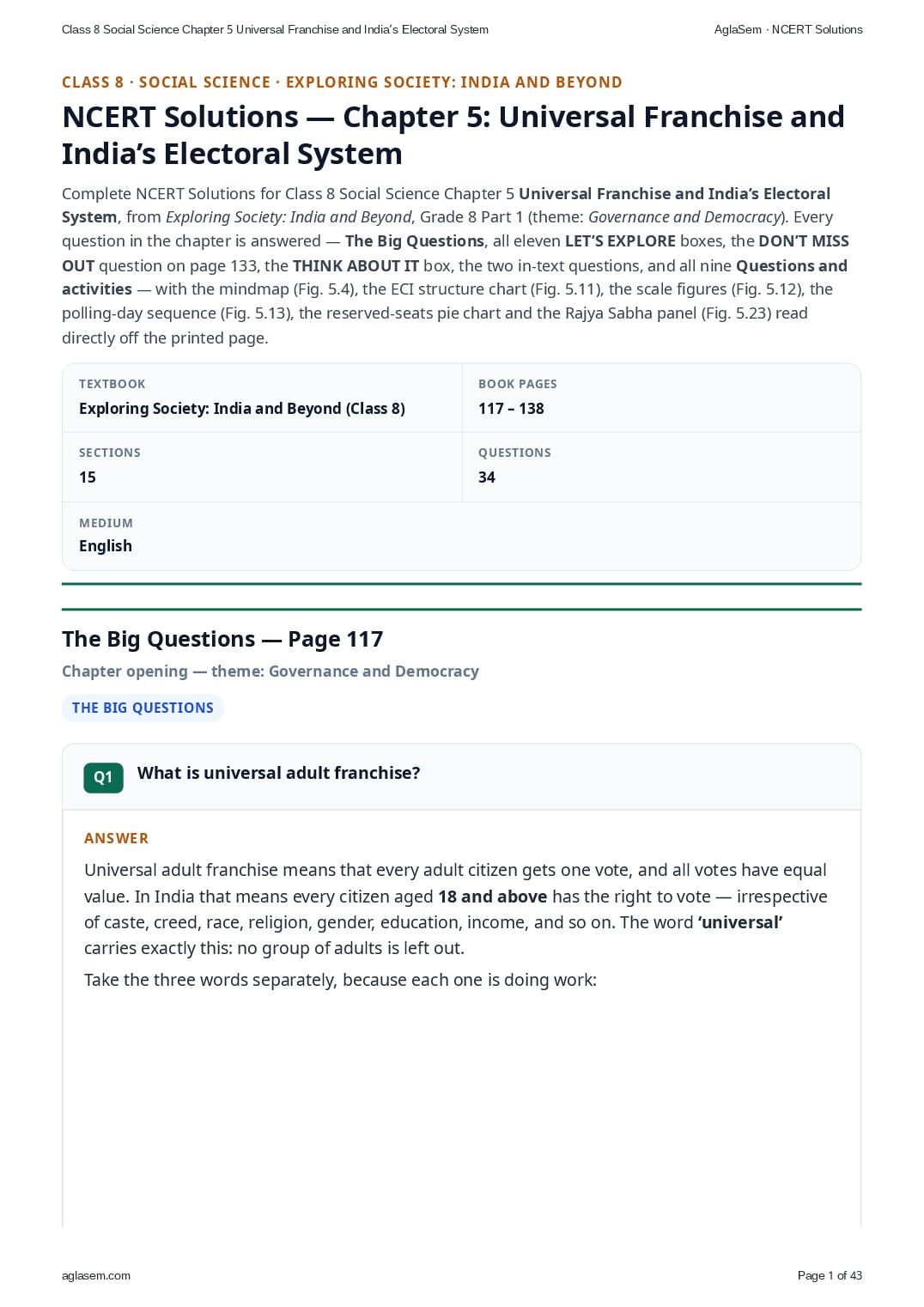
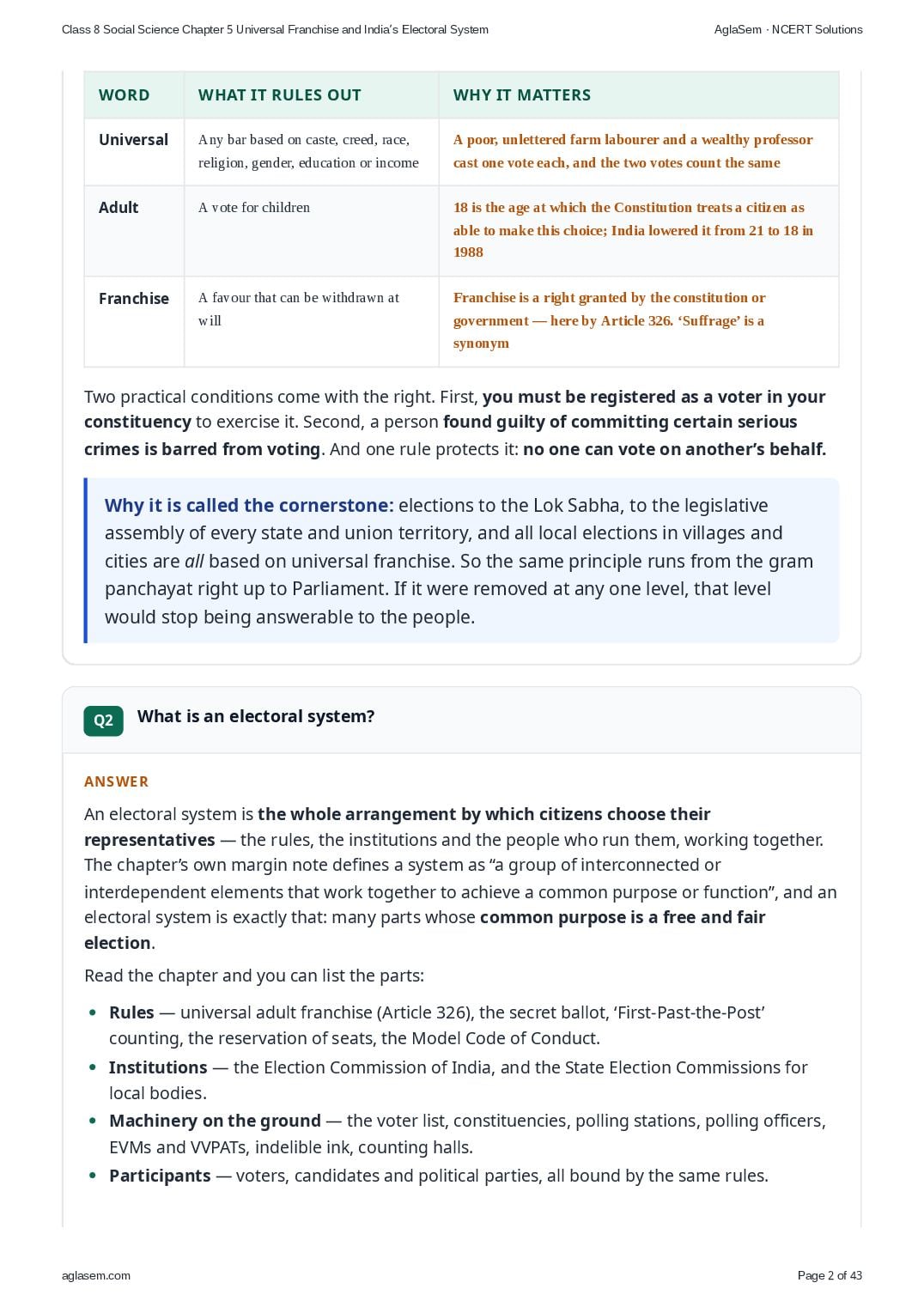
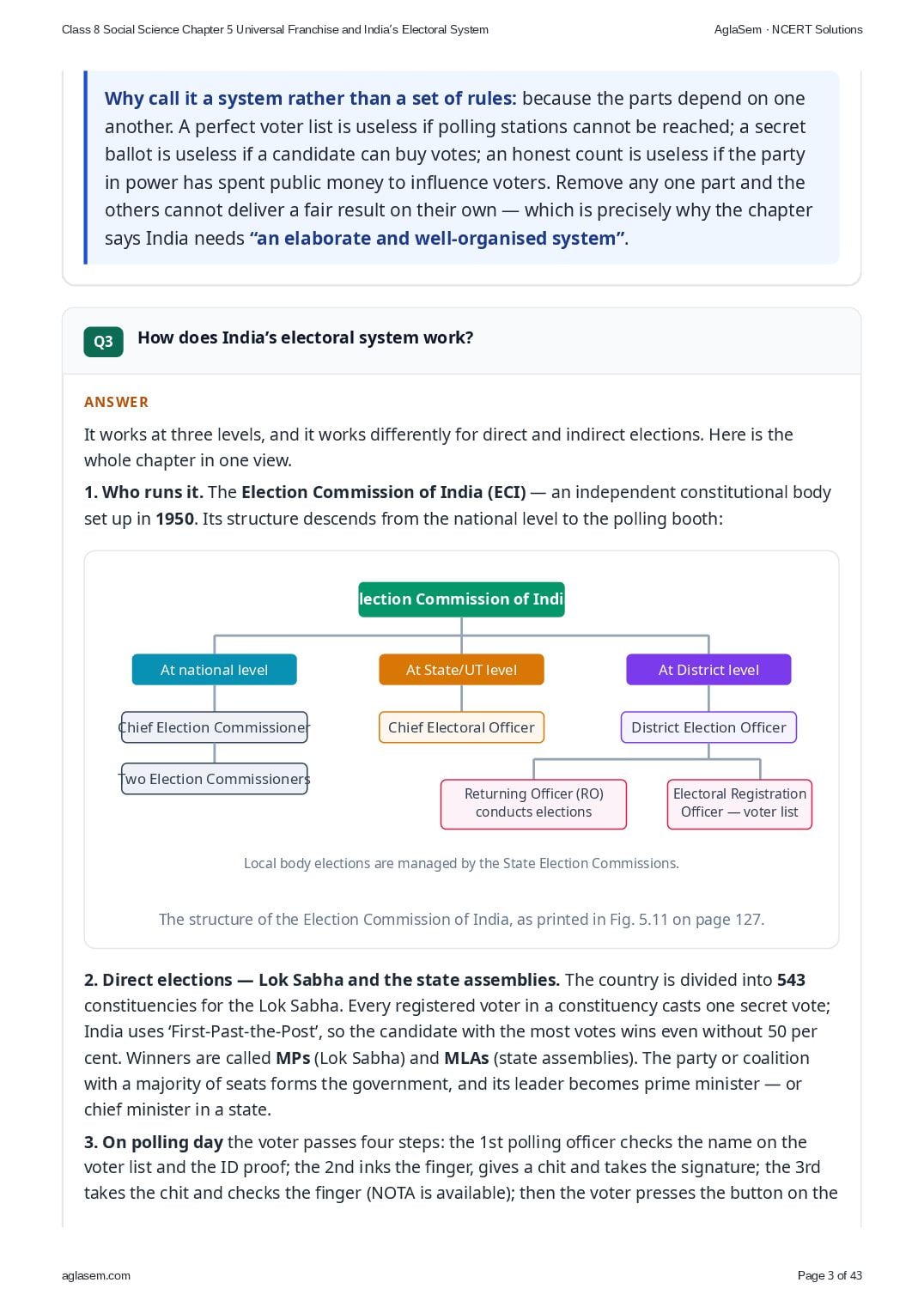

NCERT Solutions for Class 8 Social Science Chapter 5 PDF Download
You can read the NCERT Solutions for Class 8 Social Science Chapter 5 online above, or download the complete question-answer PDF to study Universal Franchise and India’s Electoral System offline at any time.
NCERT Solutions for Class 8 Social Science Chapter 5 PDF Download Link – Click Here to Download Solutions PDF
Questions Covered in This Chapter
These NCERT Solutions answer all 34 questions of this chapter. The questions solved are:
- What is universal adult franchise?
- What is an electoral system?
- How does India’s electoral system work?
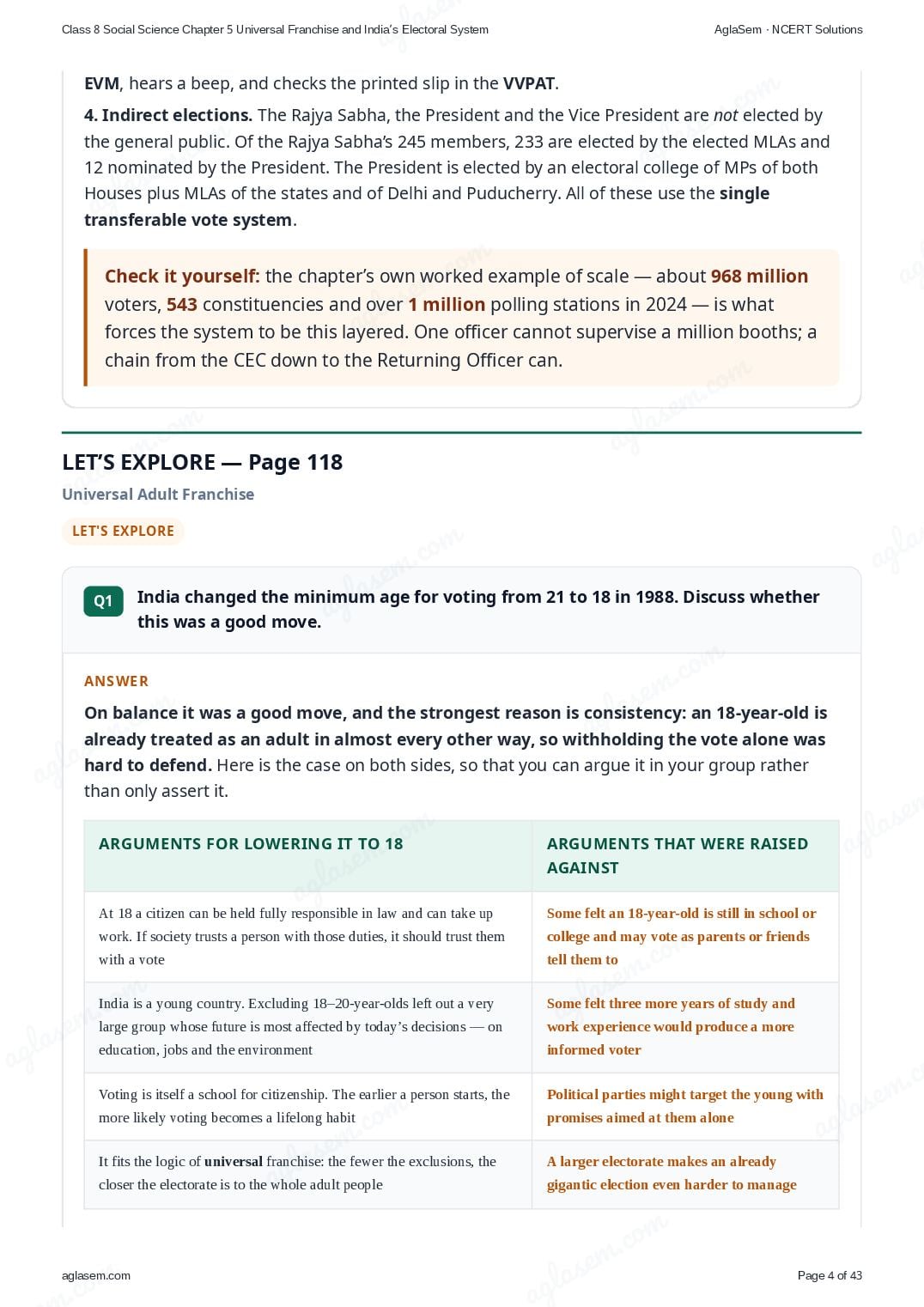
- India changed the minimum age for voting from 21 to 18 in 1988. Discuss whether this was a good move.
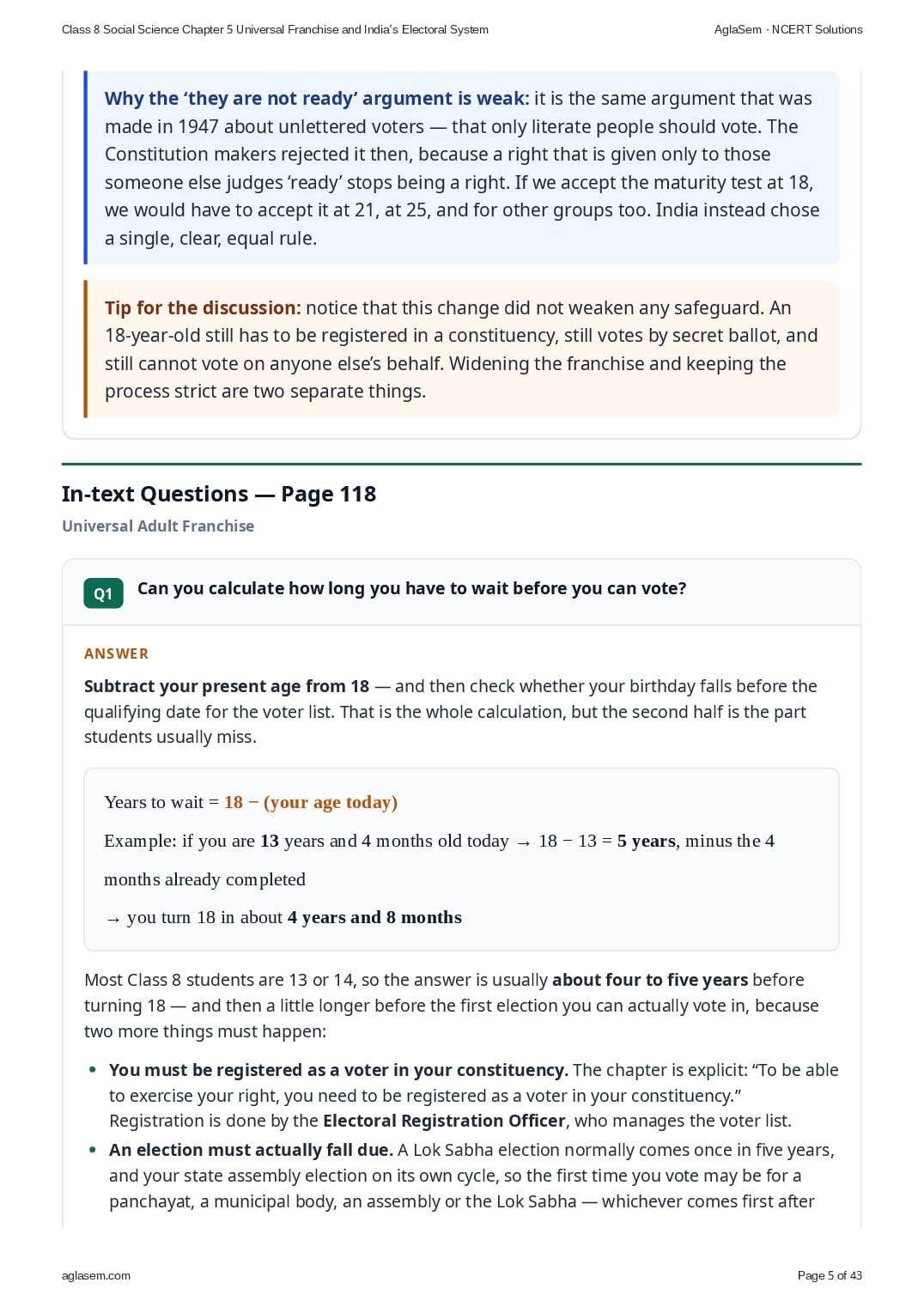
- Can you calculate how long you have to wait before you can vote?
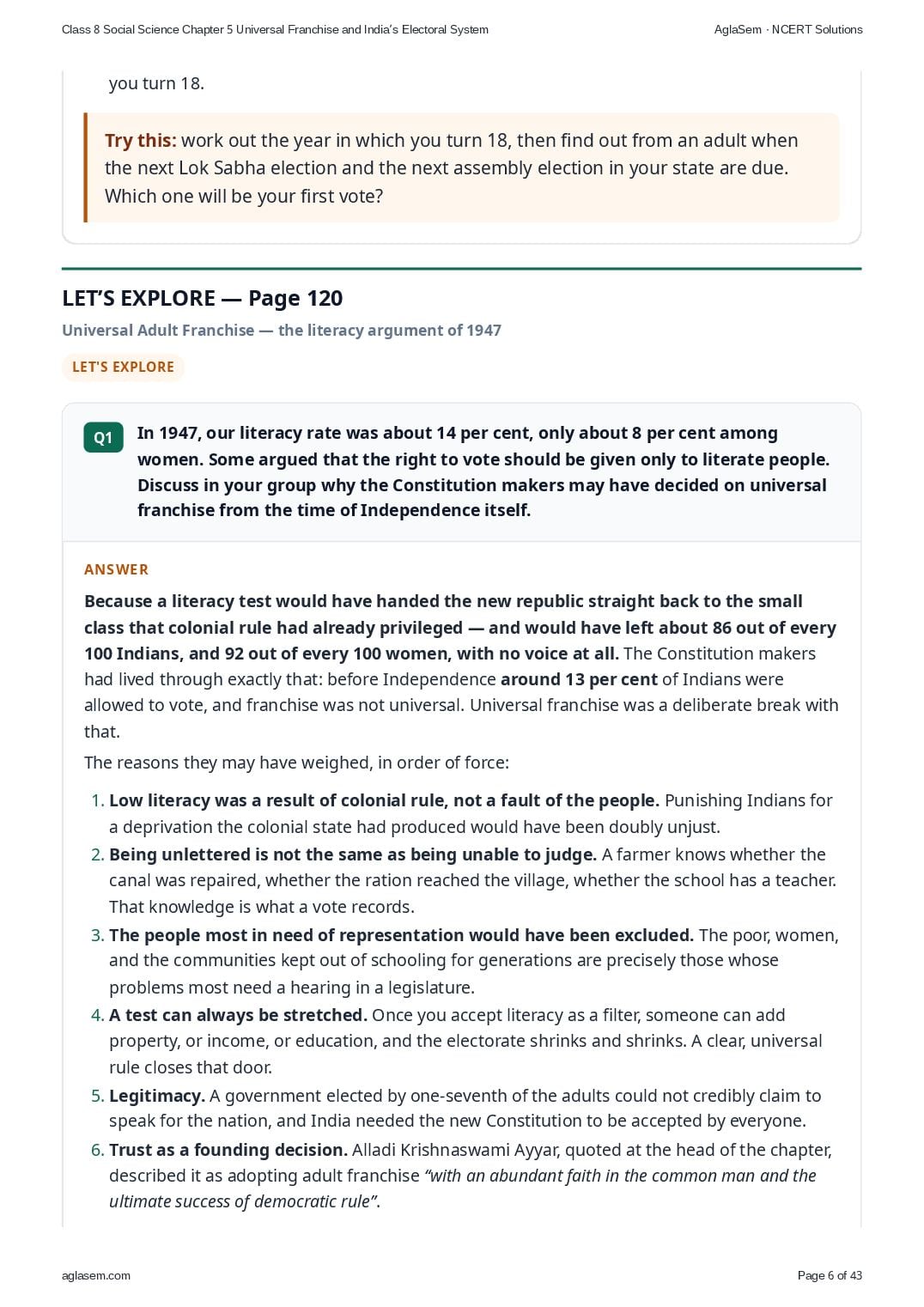
- In 1947, our literacy rate was about 14 per cent, only about 8 per cent among women. Some argued that the right to vote should be given only to literate people. Discuss in your group why the Constitution makers may have decided on universal franchise from the time of Independence itself.
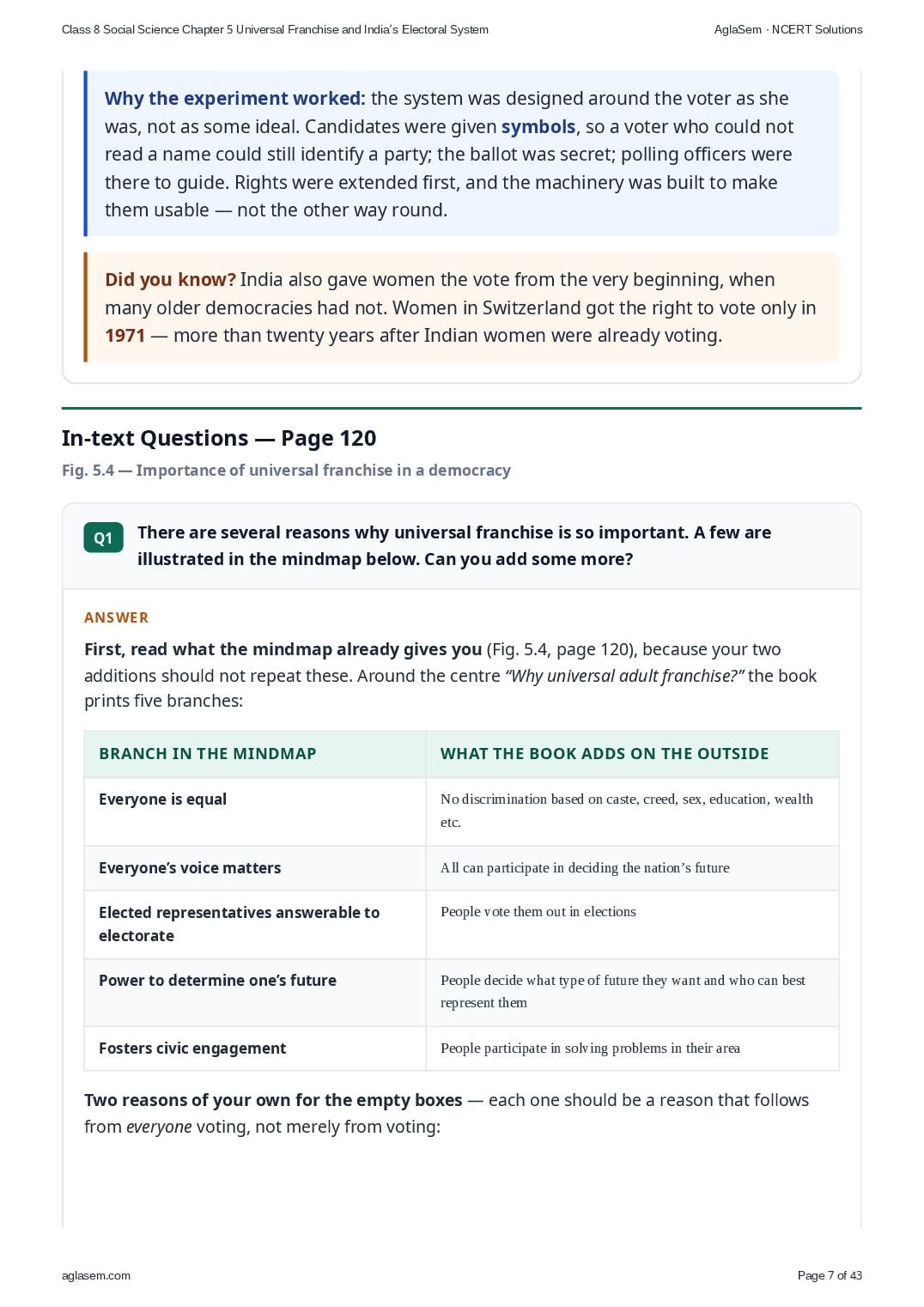
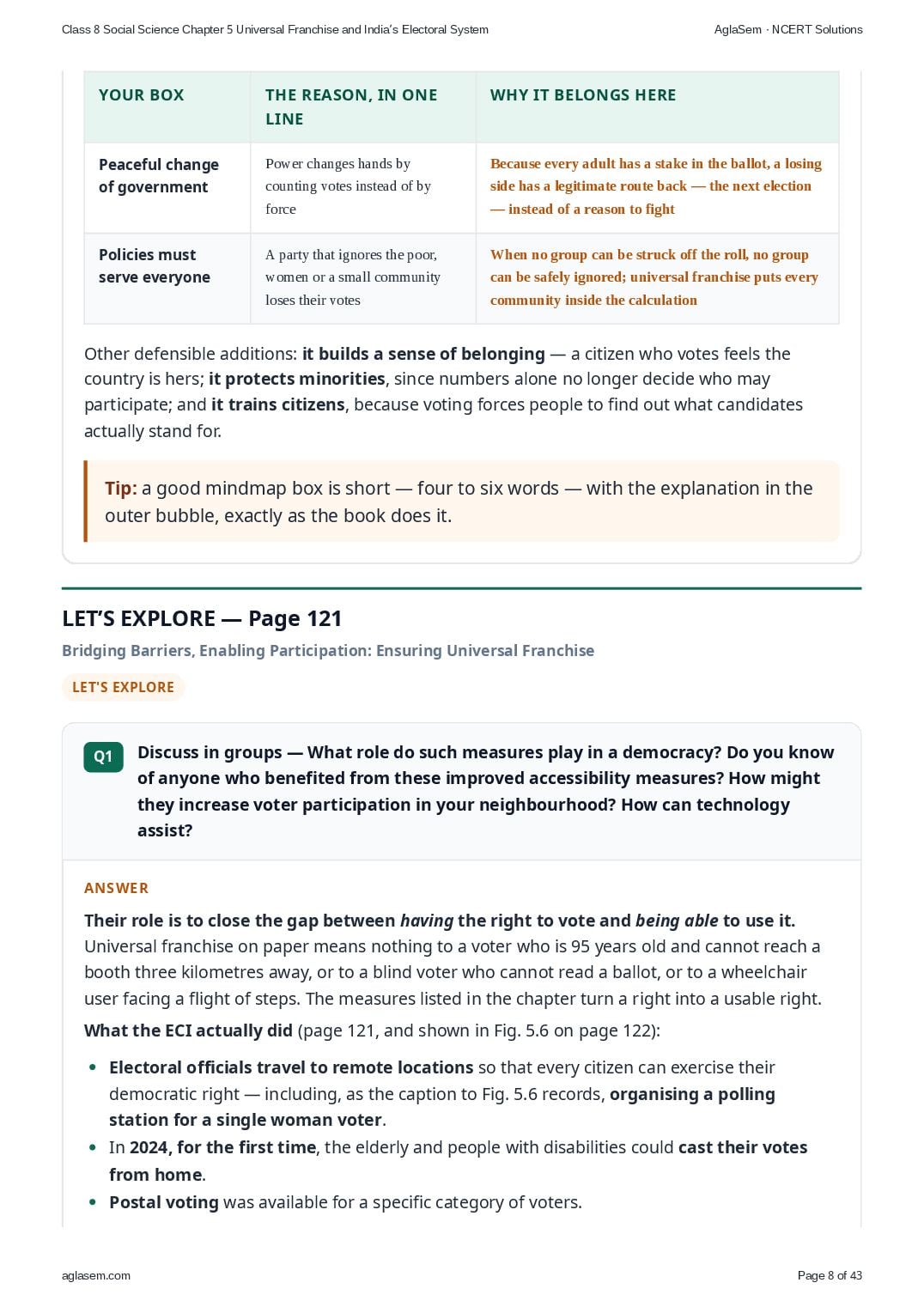
- There are several reasons why universal franchise is so important. A few are illustrated in the mindmap below. Can you add some more?
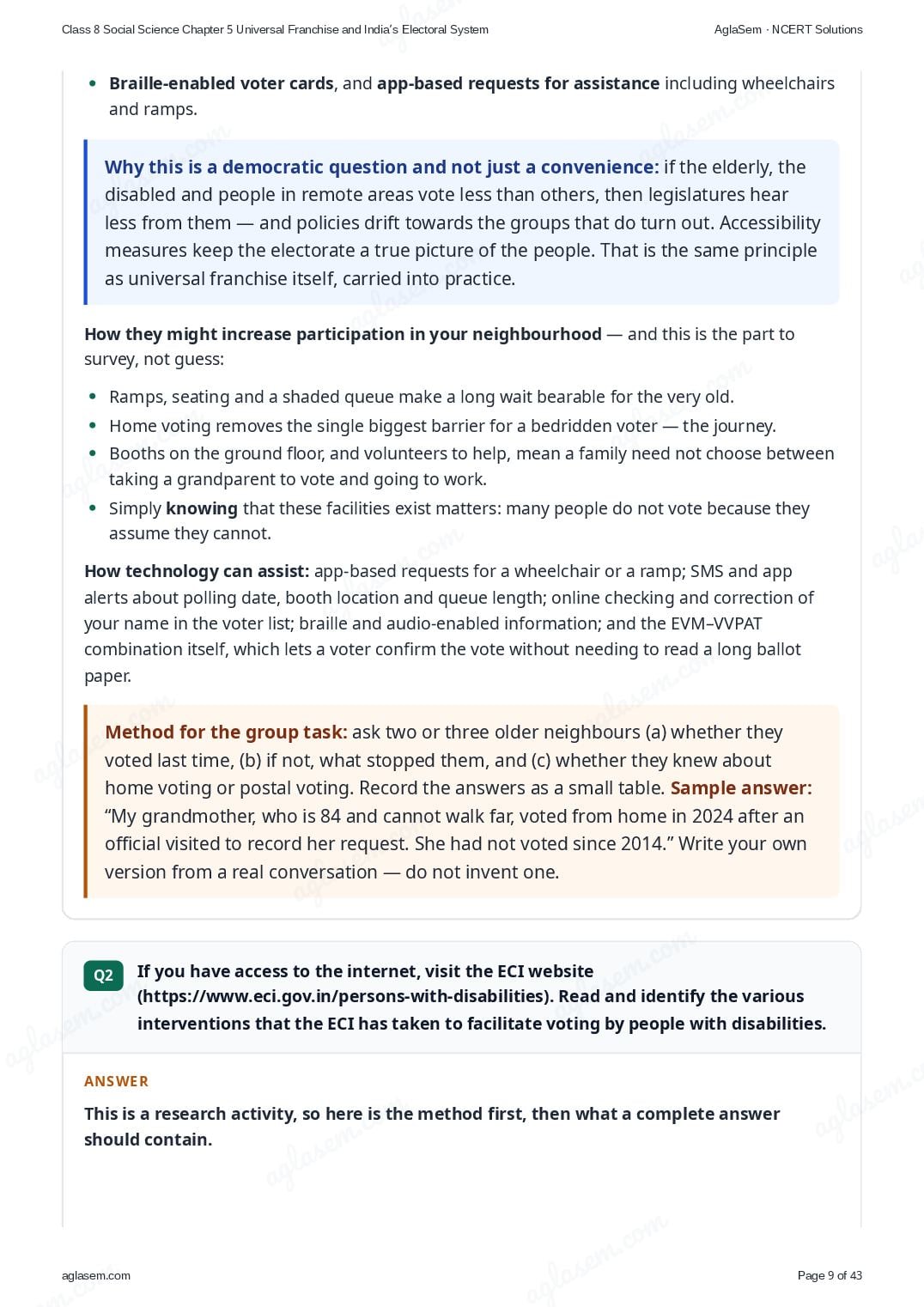
- Discuss in groups — What role do such measures play in a democracy? Do you know of anyone who benefited from these improved accessibility measures? How might they increase voter participation in your neighbourhood? How can technology assist?
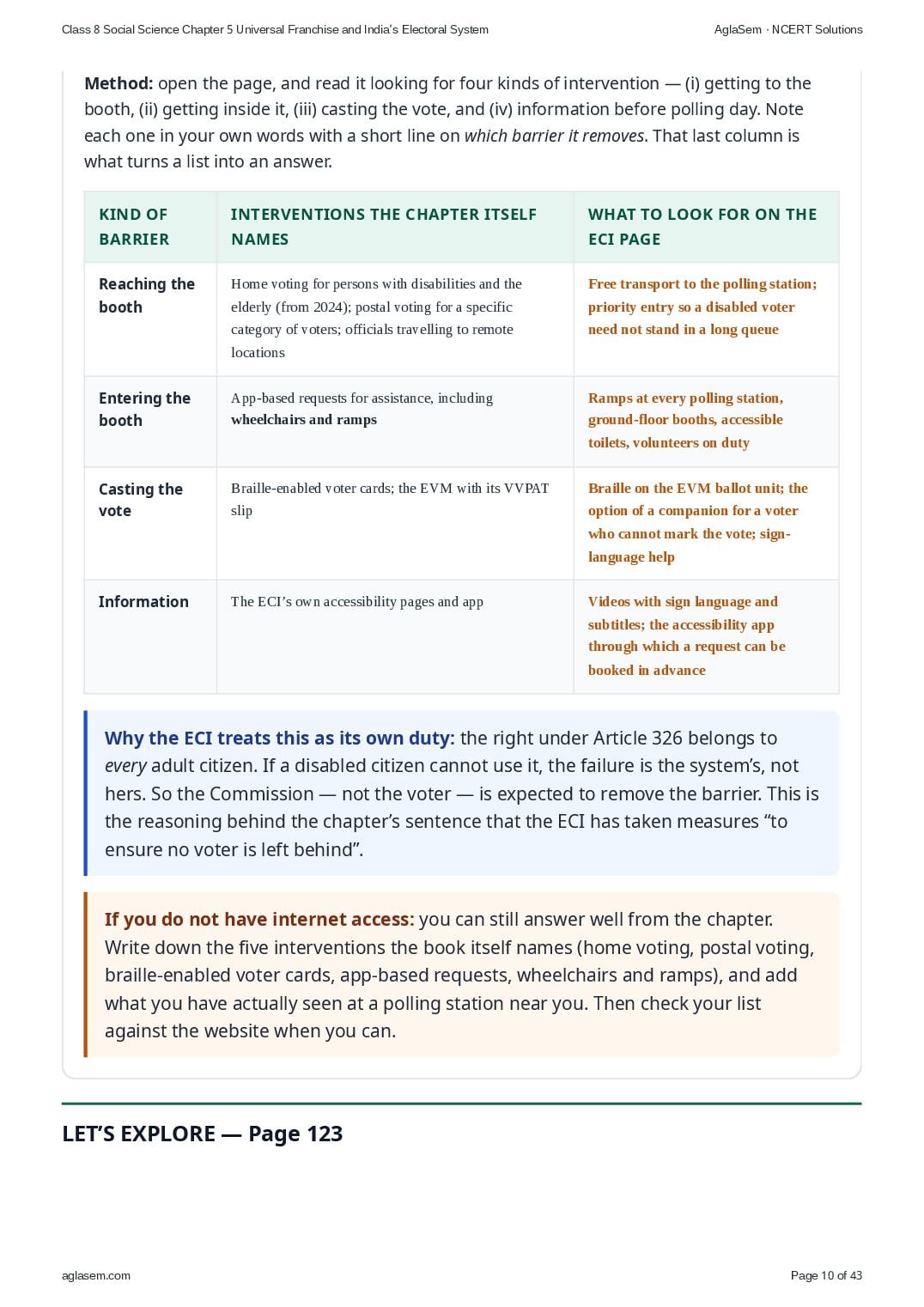
- If you have access to the internet, visit the ECI website (https://www.eci.gov.in/persons-with-disabilities). Read and identify the various interventions that the ECI has taken to facilitate voting by people with disabilities.
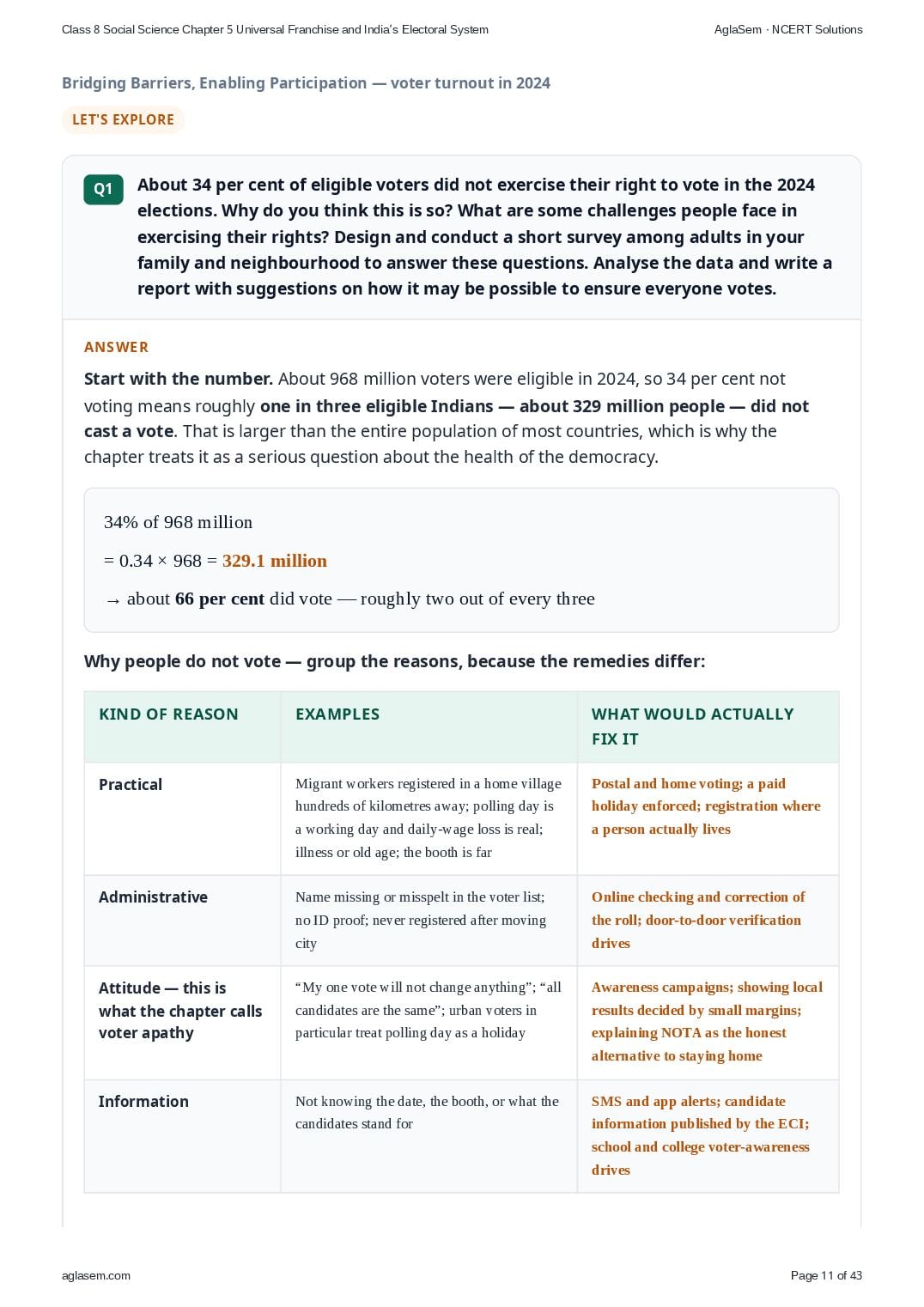
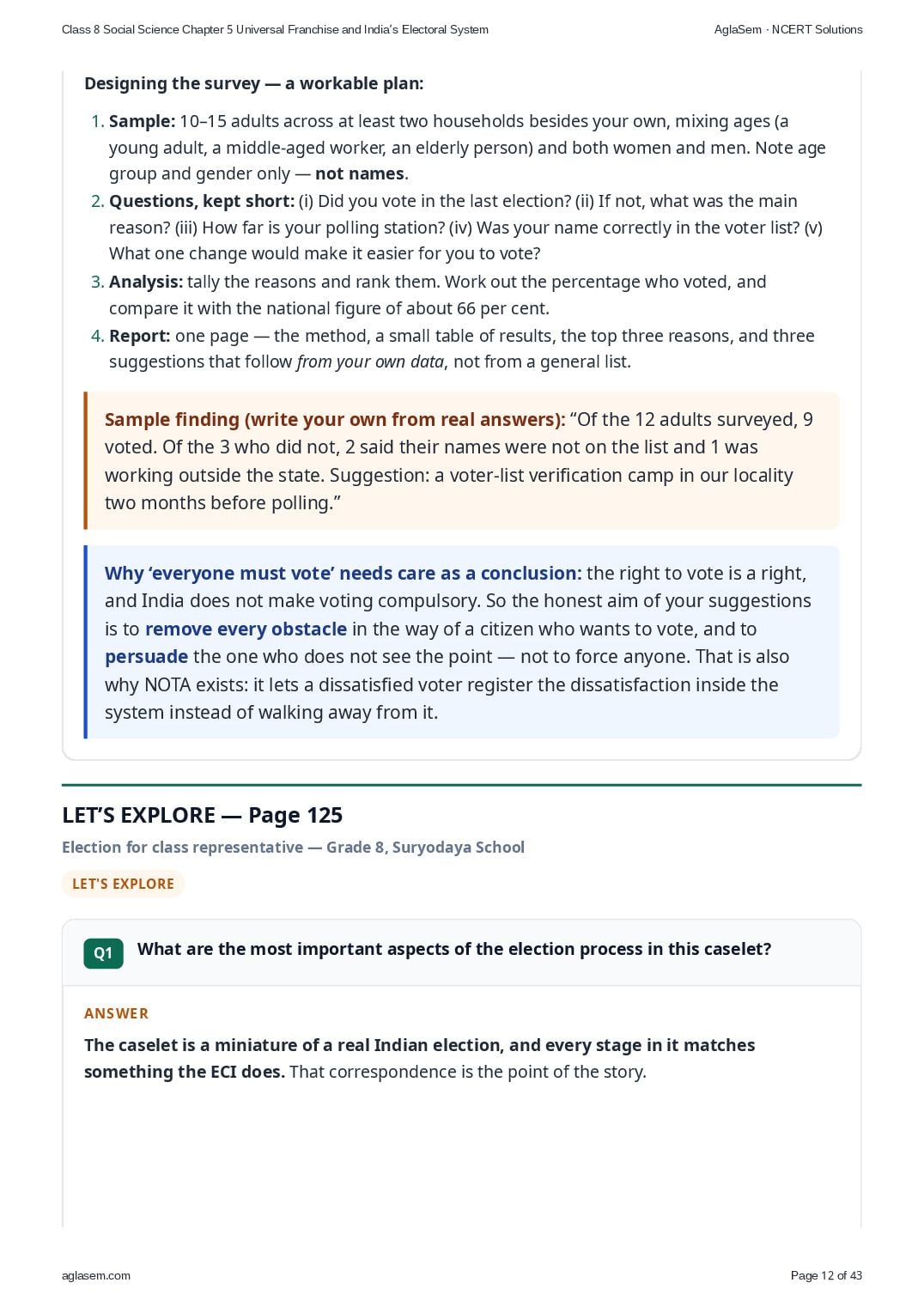
- About 34 per cent of eligible voters did not exercise their right to vote in the 2024 elections. Why do you think this is so? What are some challenges people face in exercising their rights? Design and conduct a short survey among adults in your family and neighbourhood to answer these questions. Analyse the data and write a report with suggestions on how it may be possible to ensure everyone votes.
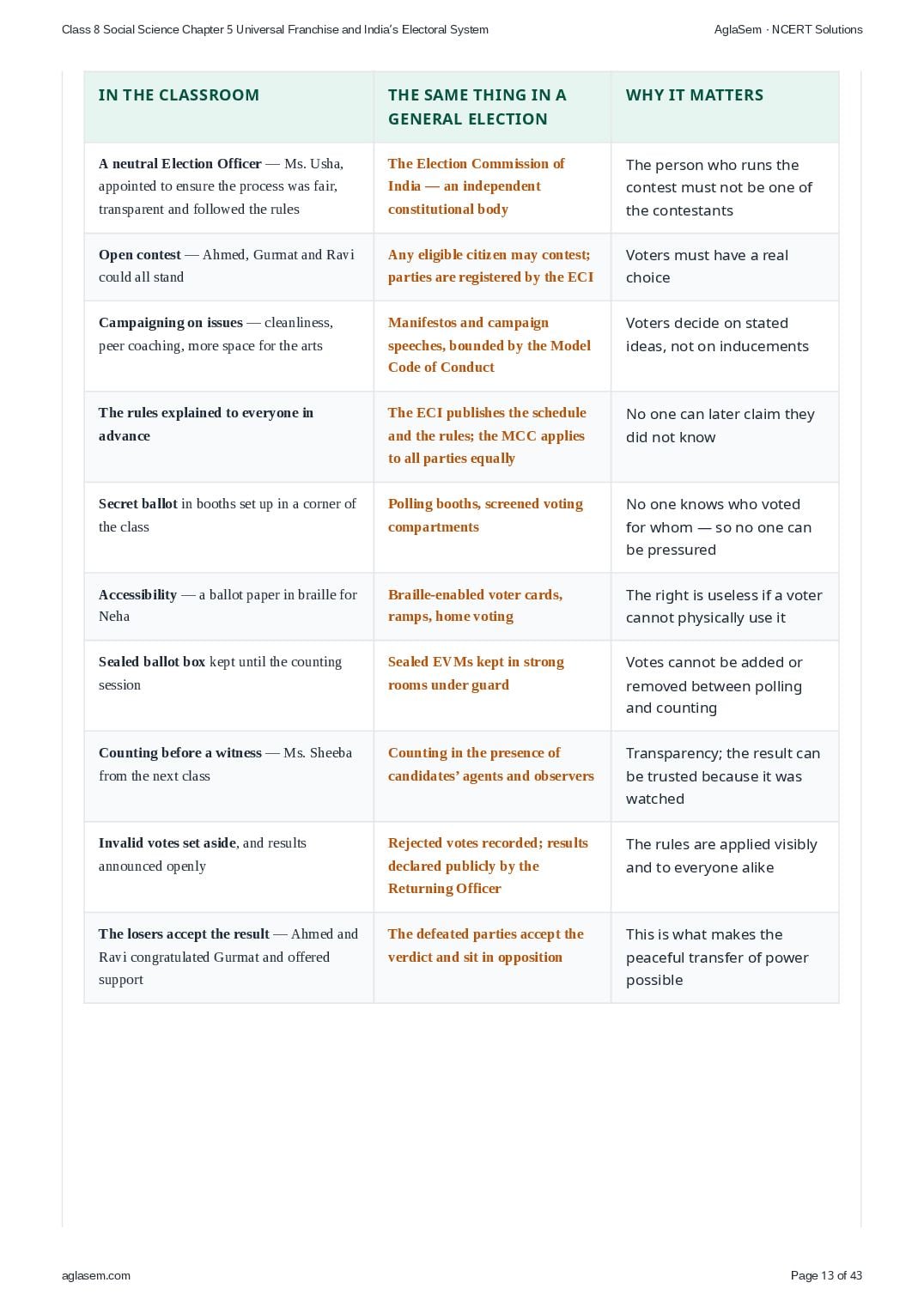
- What are the most important aspects of the election process in this caselet?
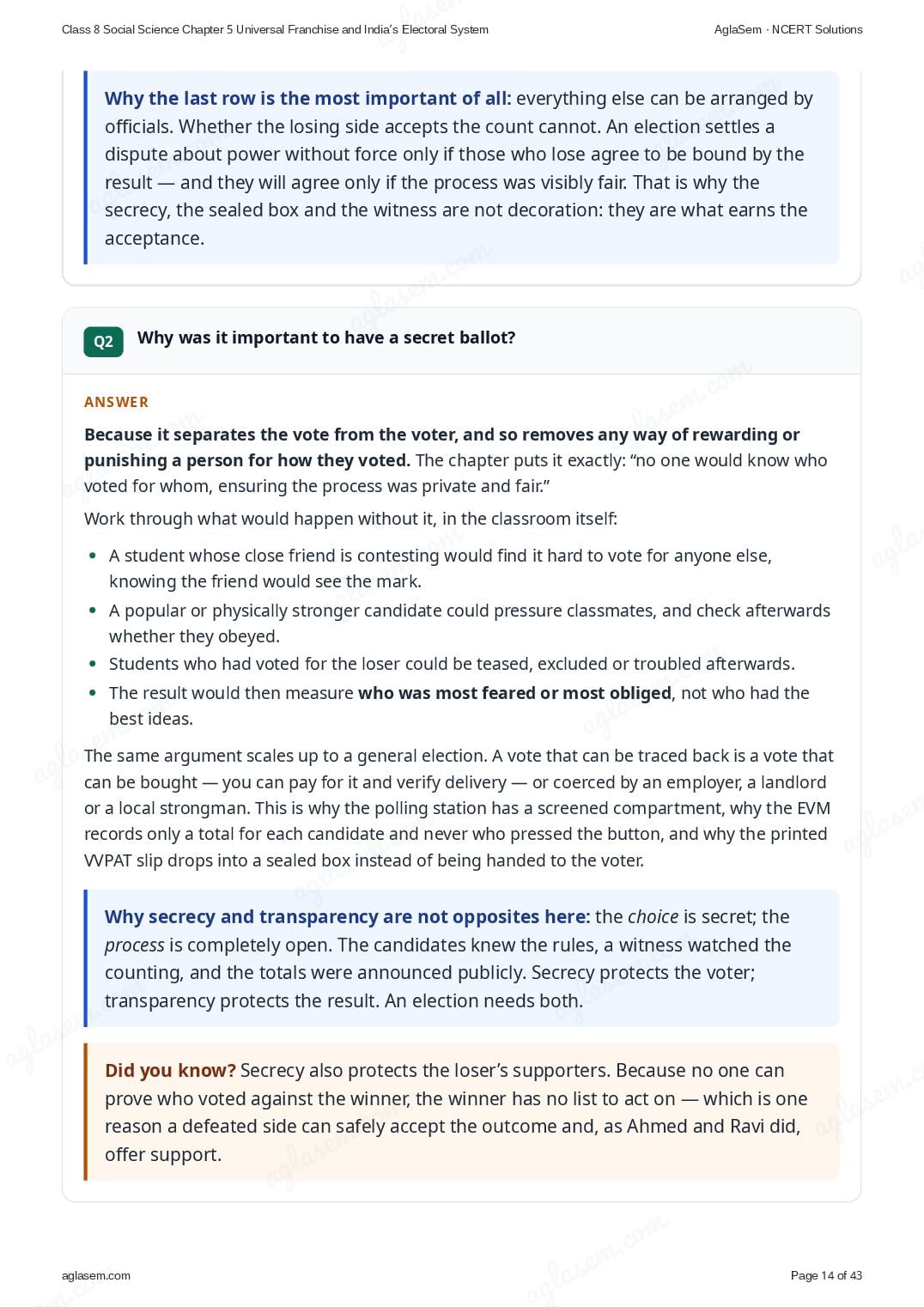
- Why was it important to have a secret ballot?
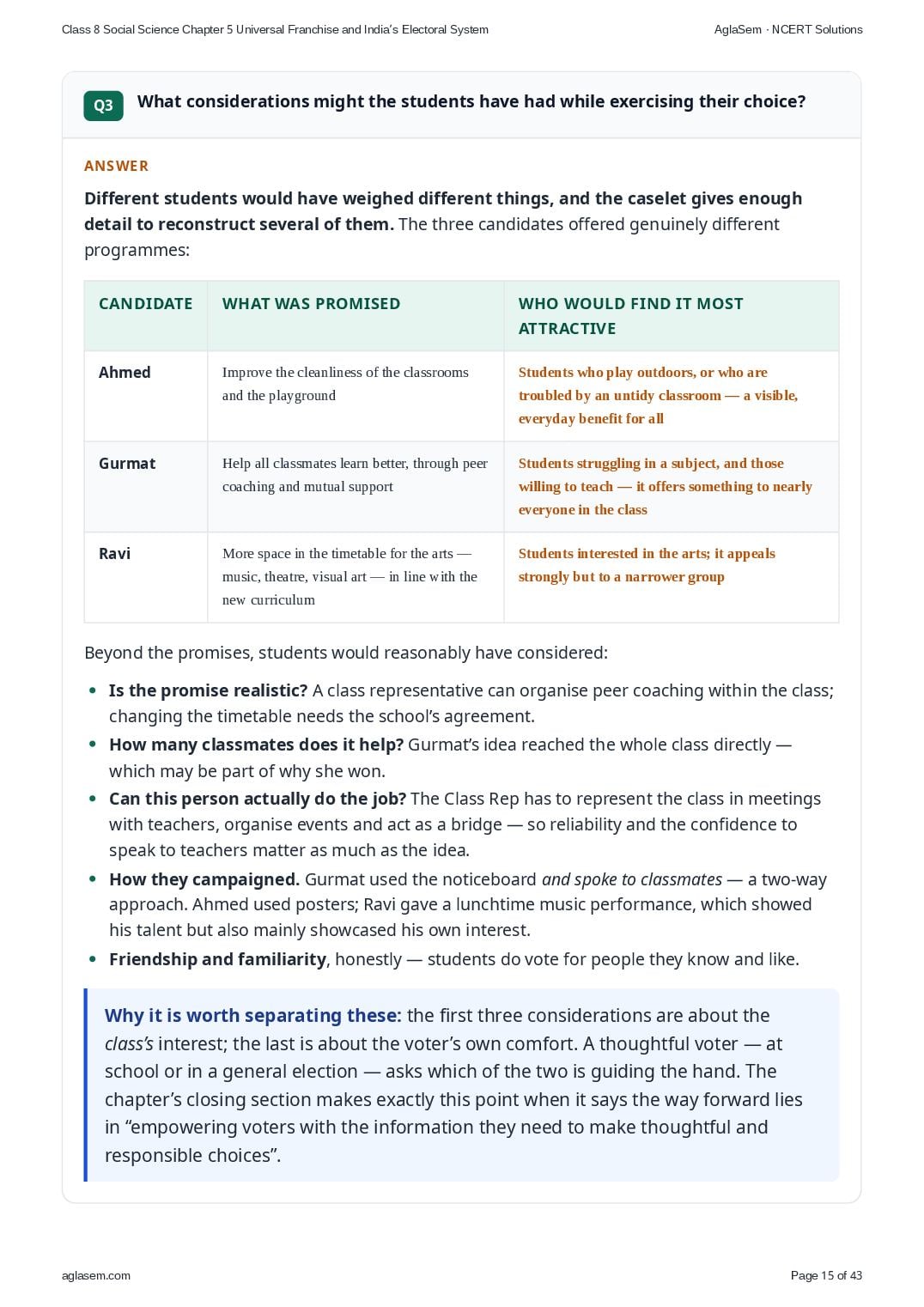
- What considerations might the students have had while exercising their choice?
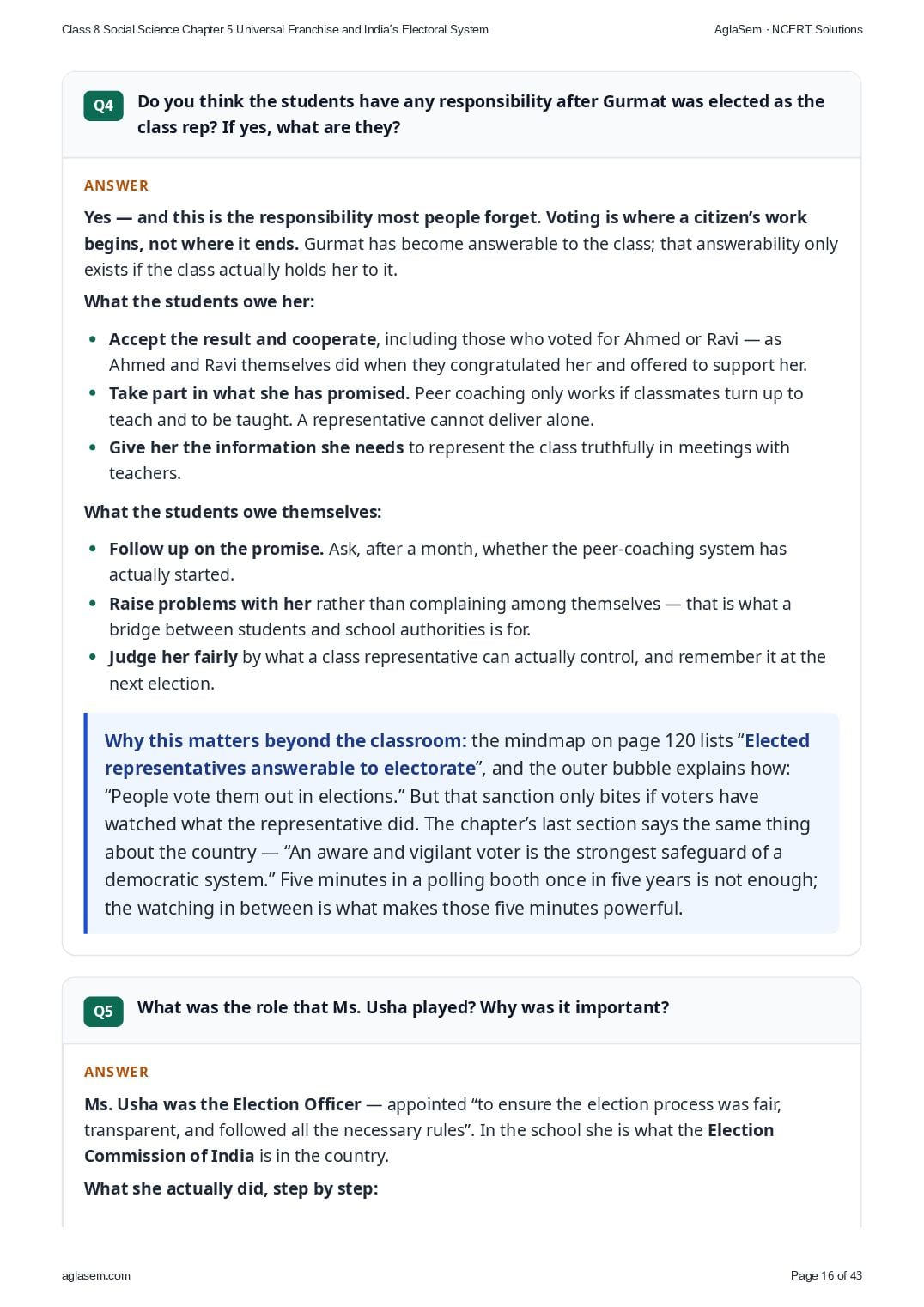
- Do you think the students have any responsibility after Gurmat was elected as the class rep? If yes, what are they?
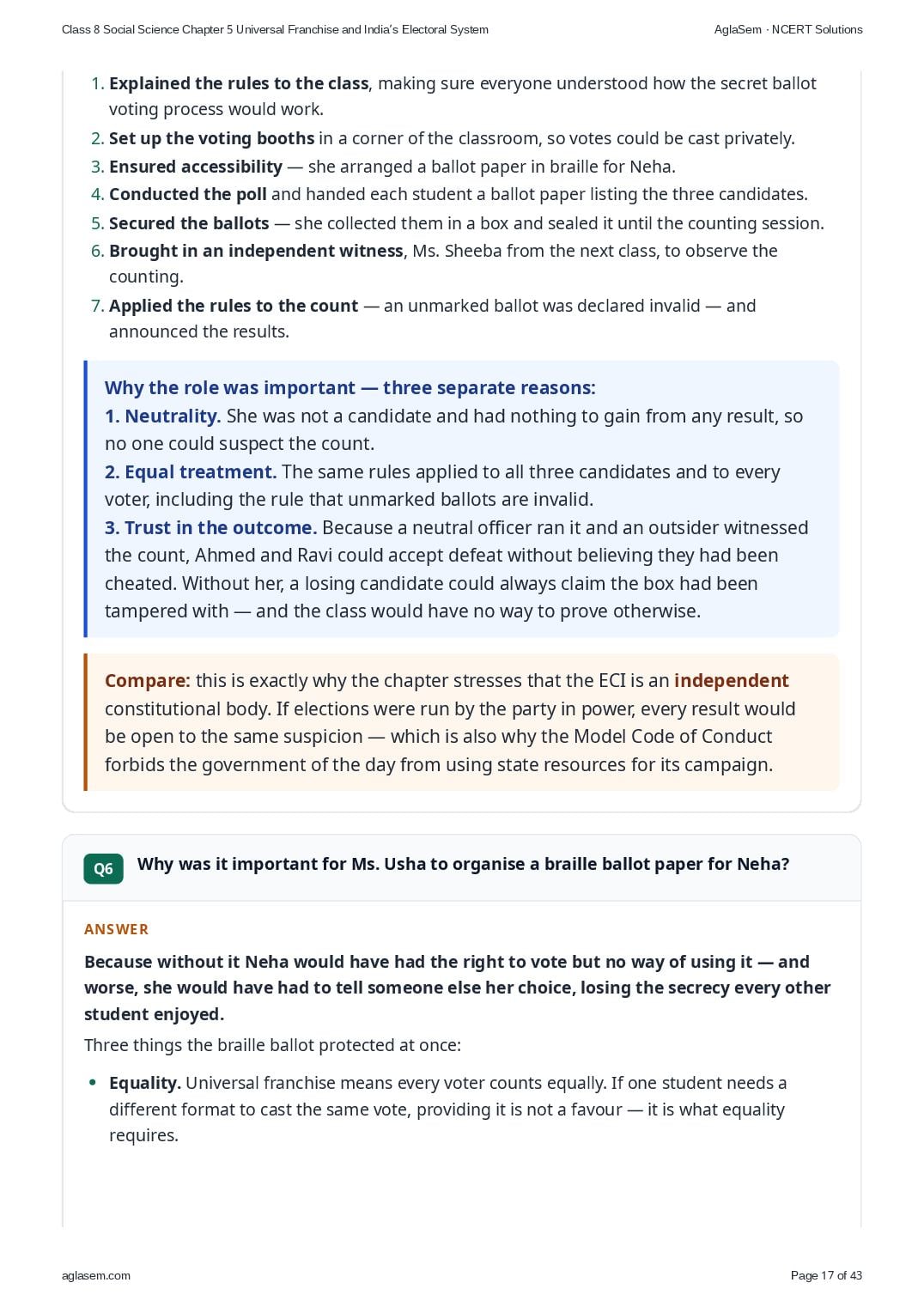
- What was the role that Ms. Usha played? Why was it important?
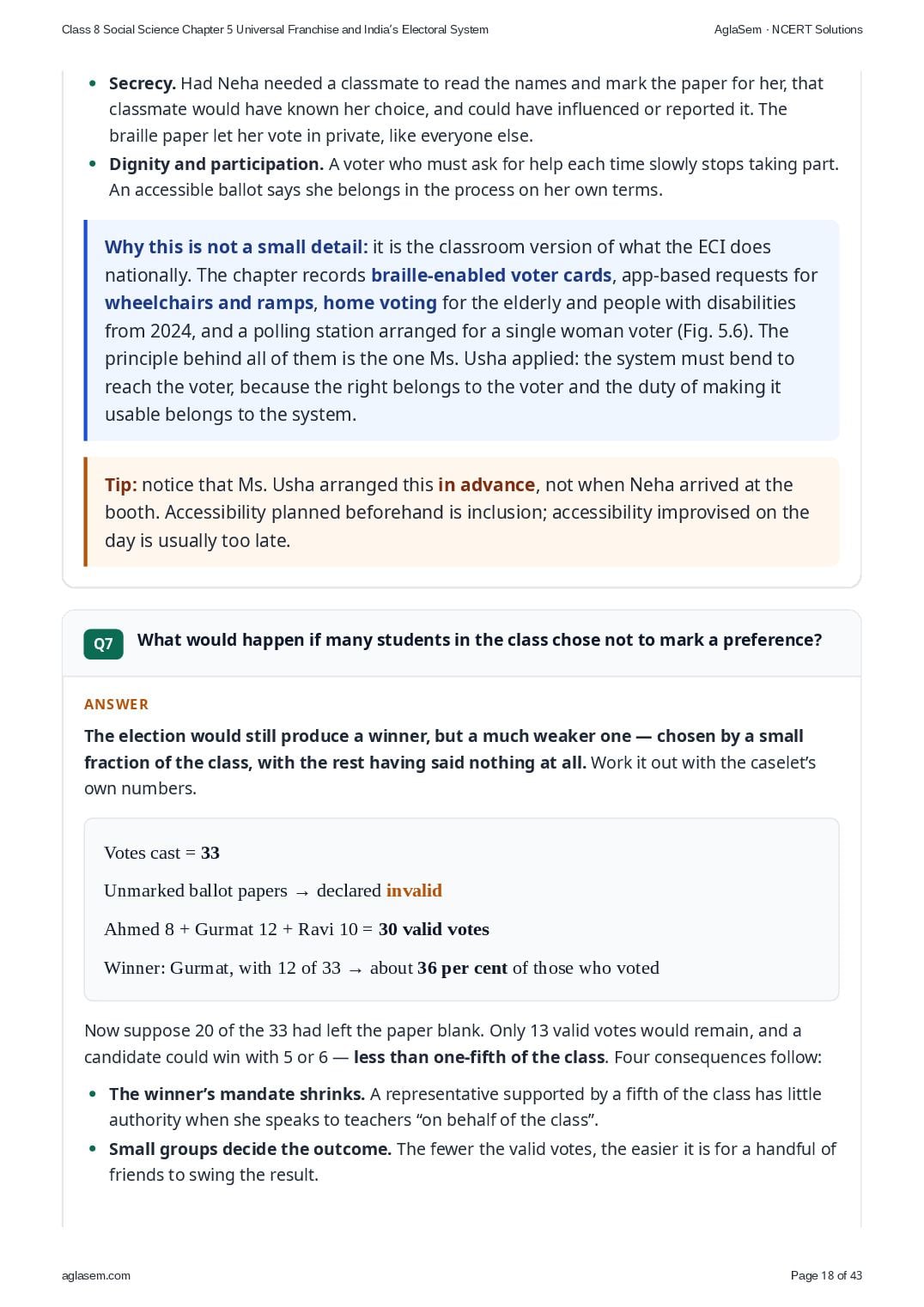
- Why was it important for Ms. Usha to organise a braille ballot paper for Neha?
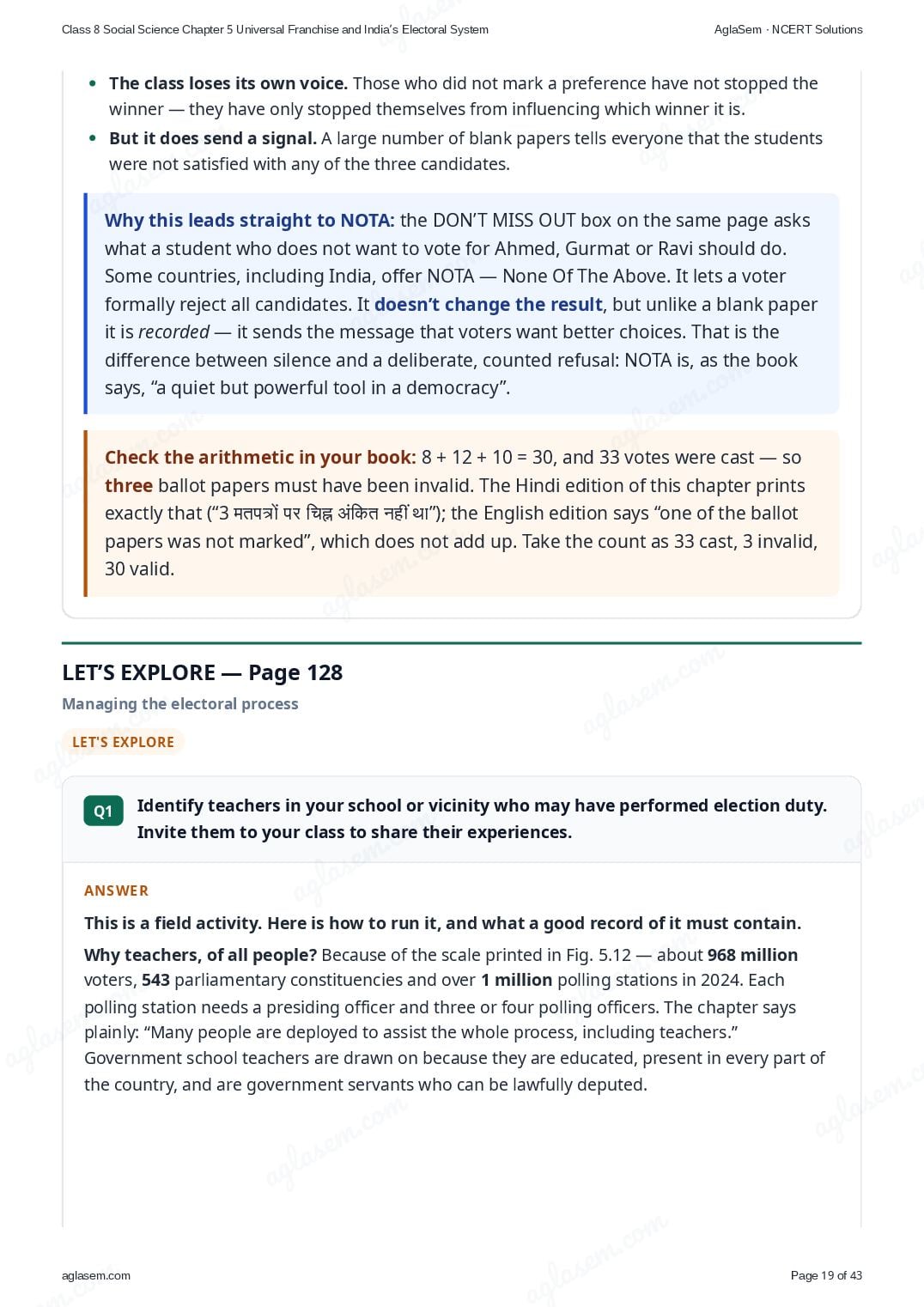
- What would happen if many students in the class chose not to mark a preference?
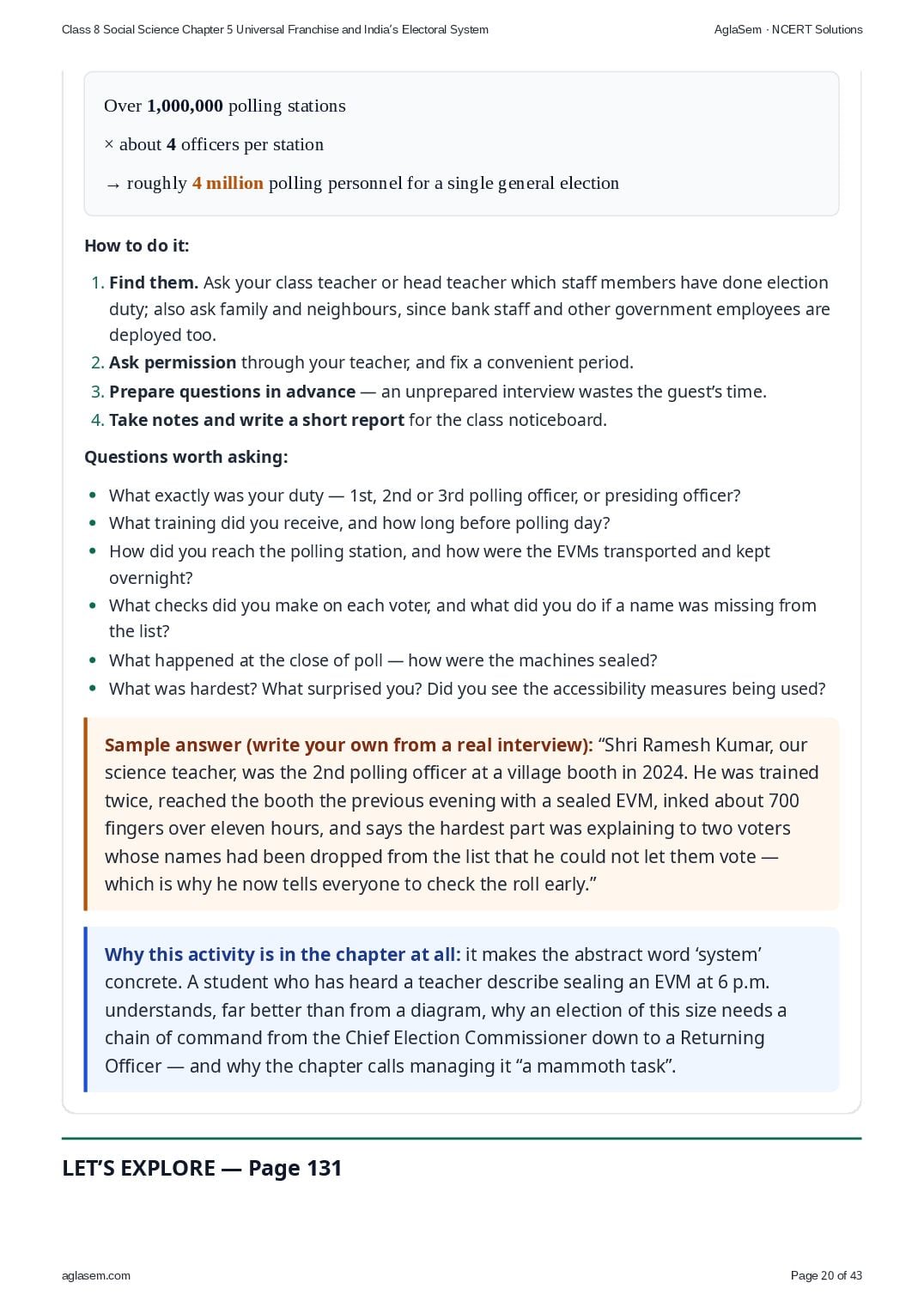
- Identify teachers in your school or vicinity who may have performed election duty. Invite them to your class to share their experiences.
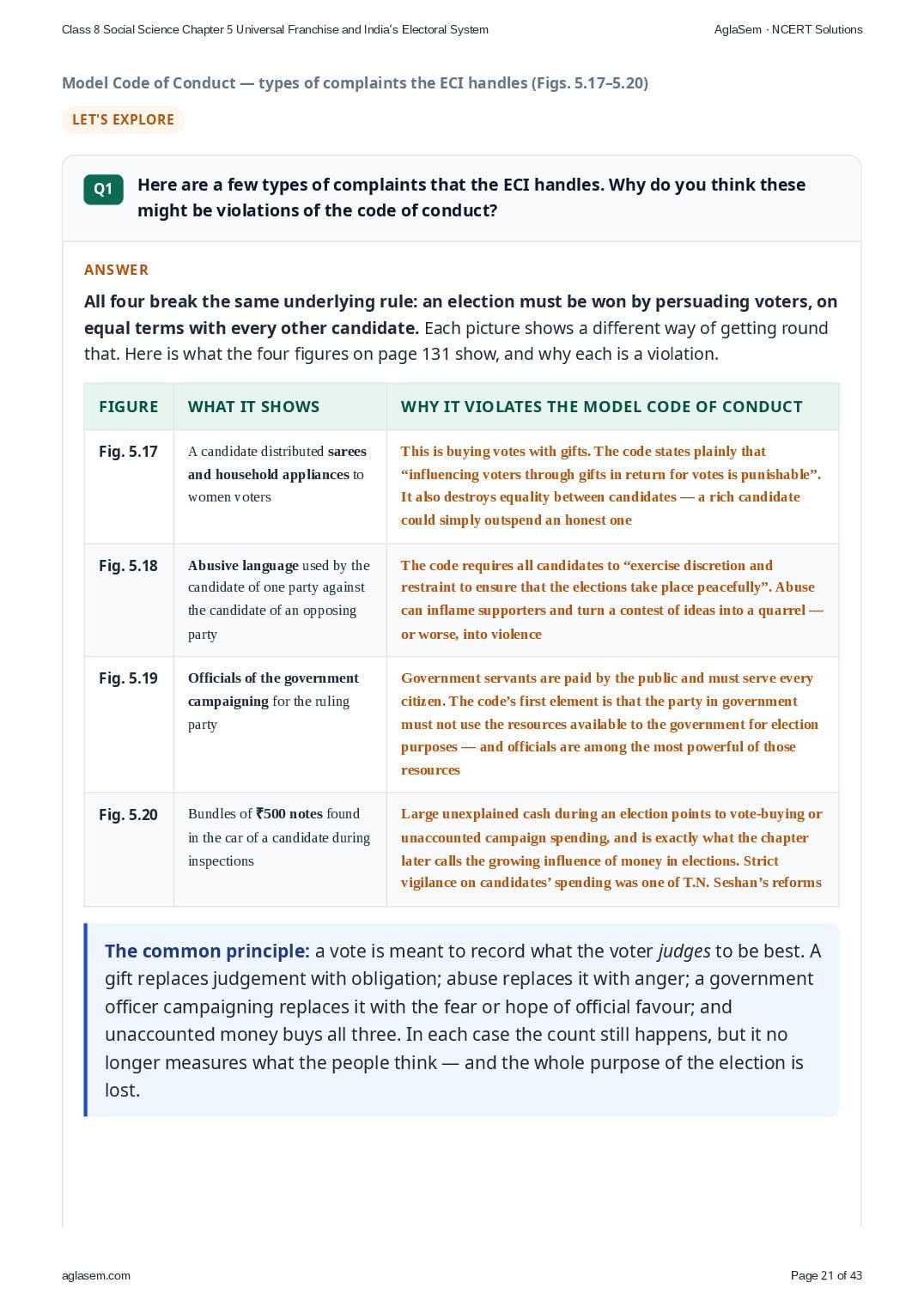
- Here are a few types of complaints that the ECI handles. Why do you think these might be violations of the code of conduct?
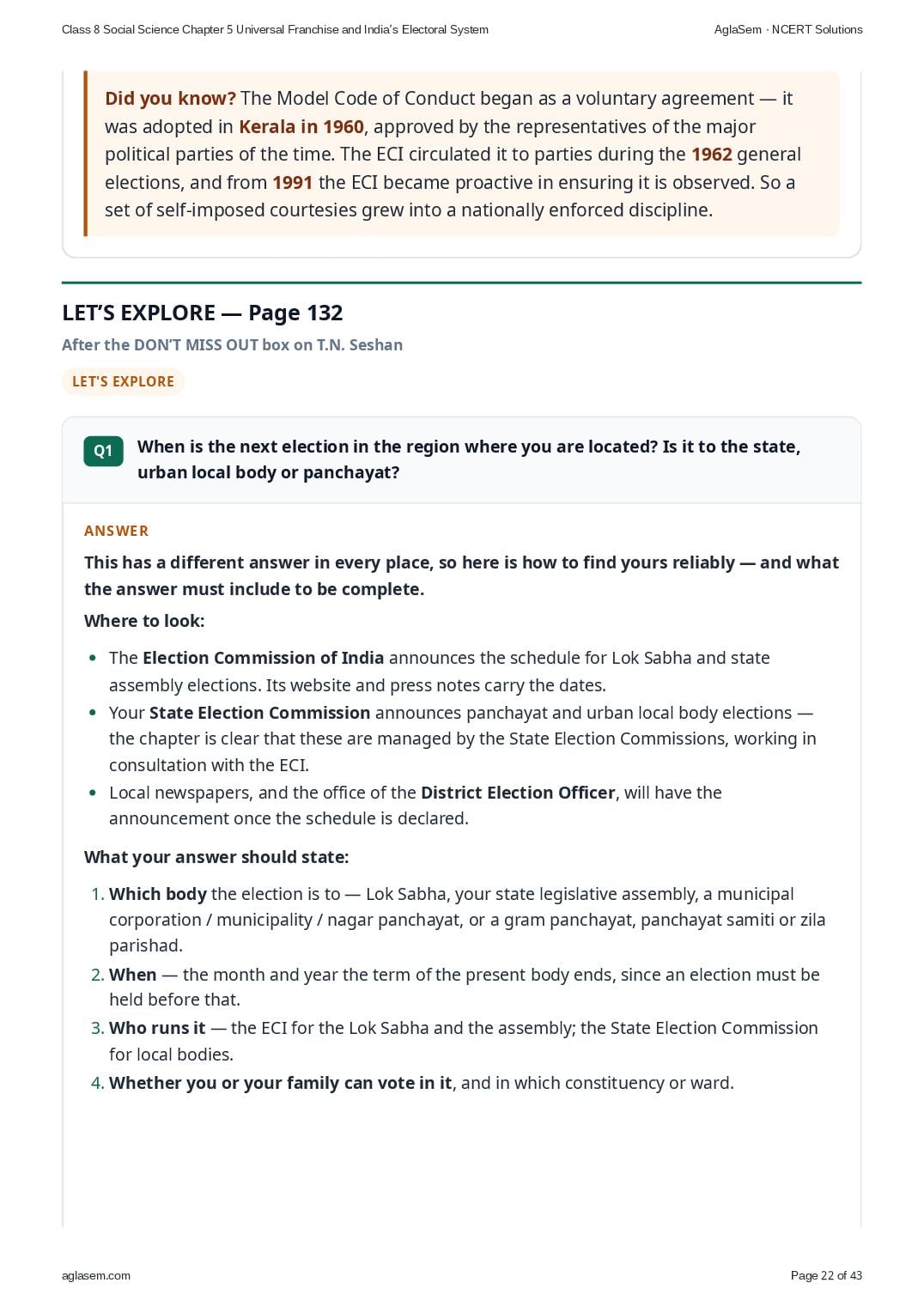
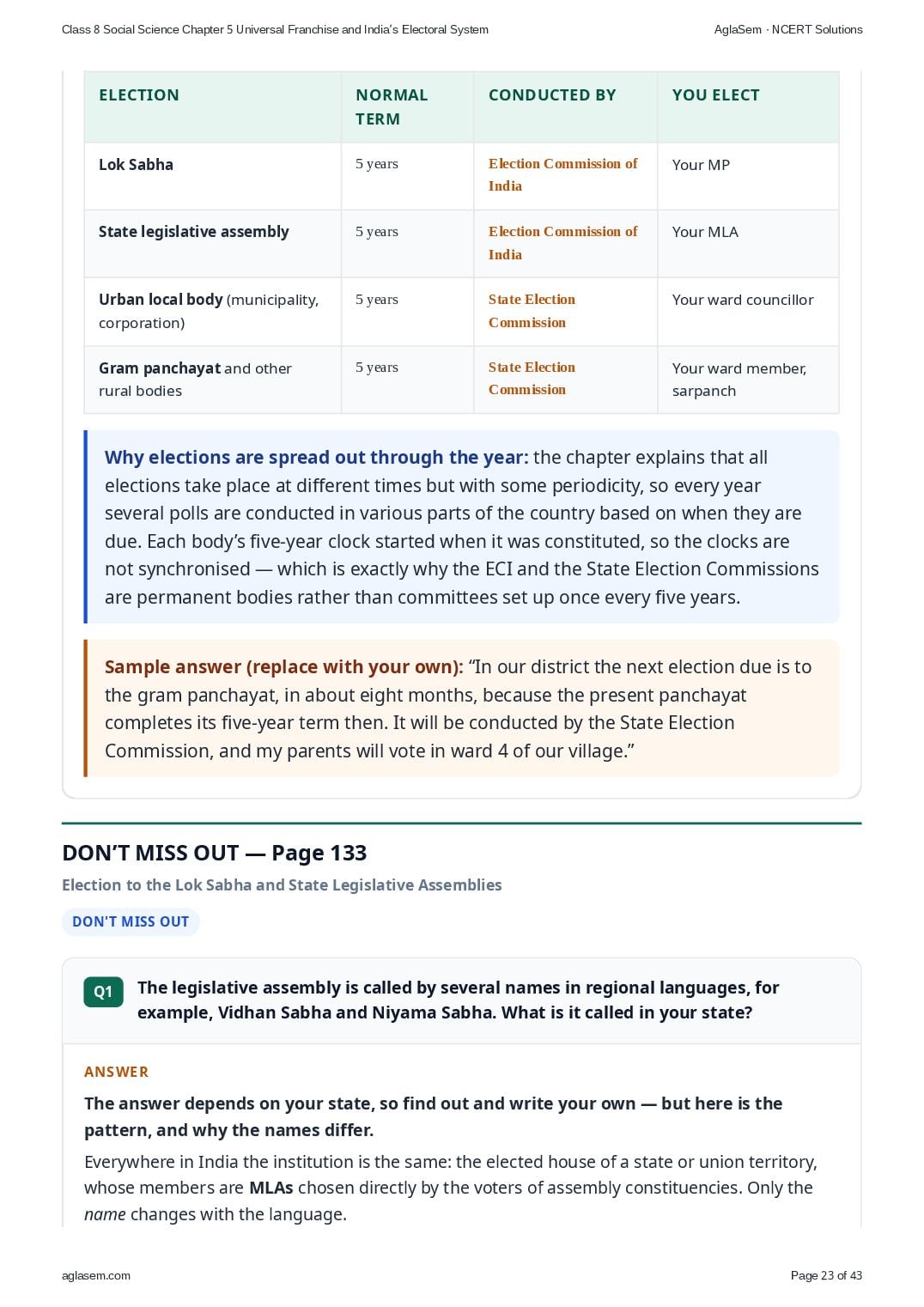
- When is the next election in the region where you are located? Is it to the state, urban local body or panchayat?
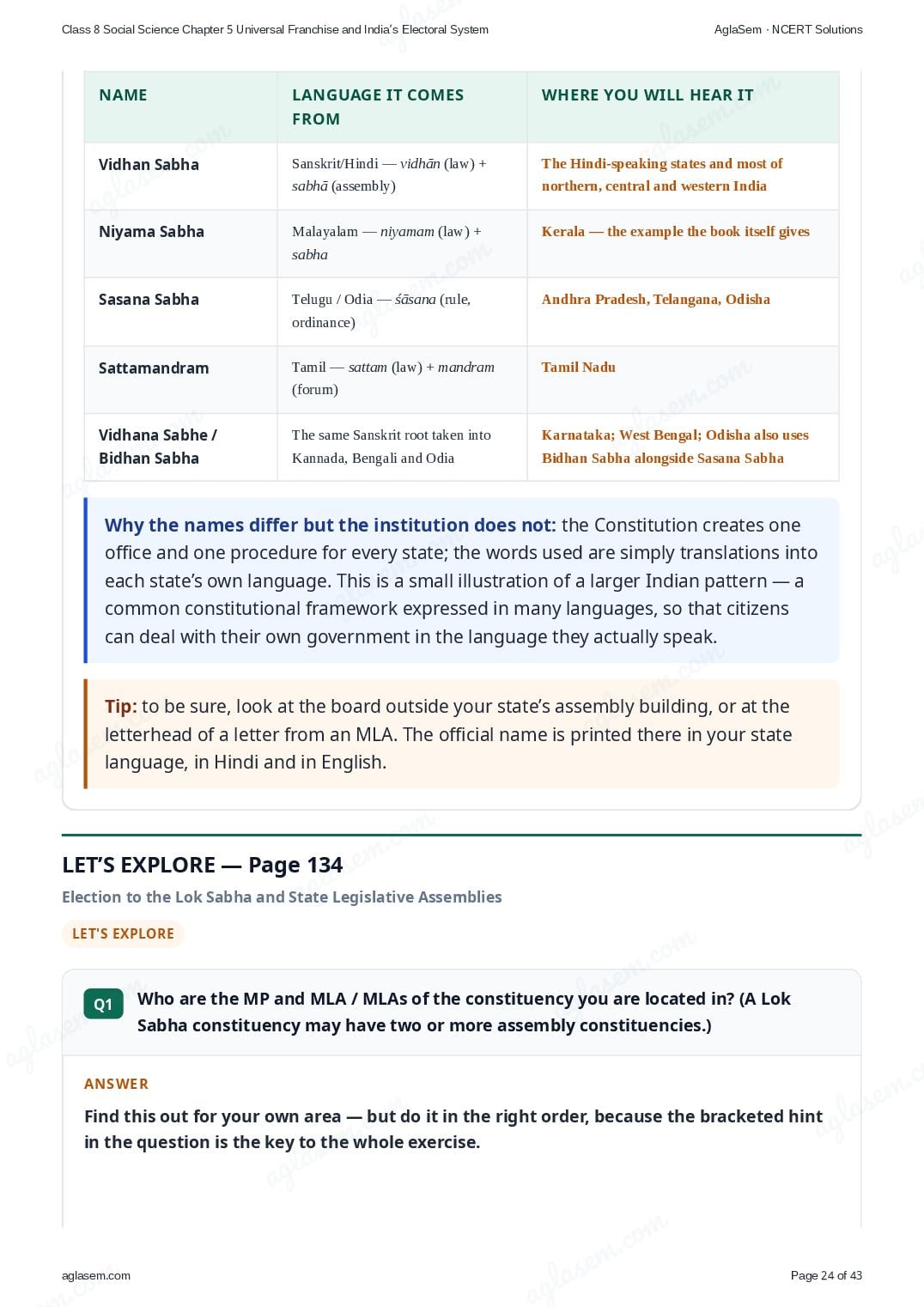
- The legislative assembly is called by several names in regional languages, for example, Vidhan Sabha and Niyama Sabha. What is it called in your state?
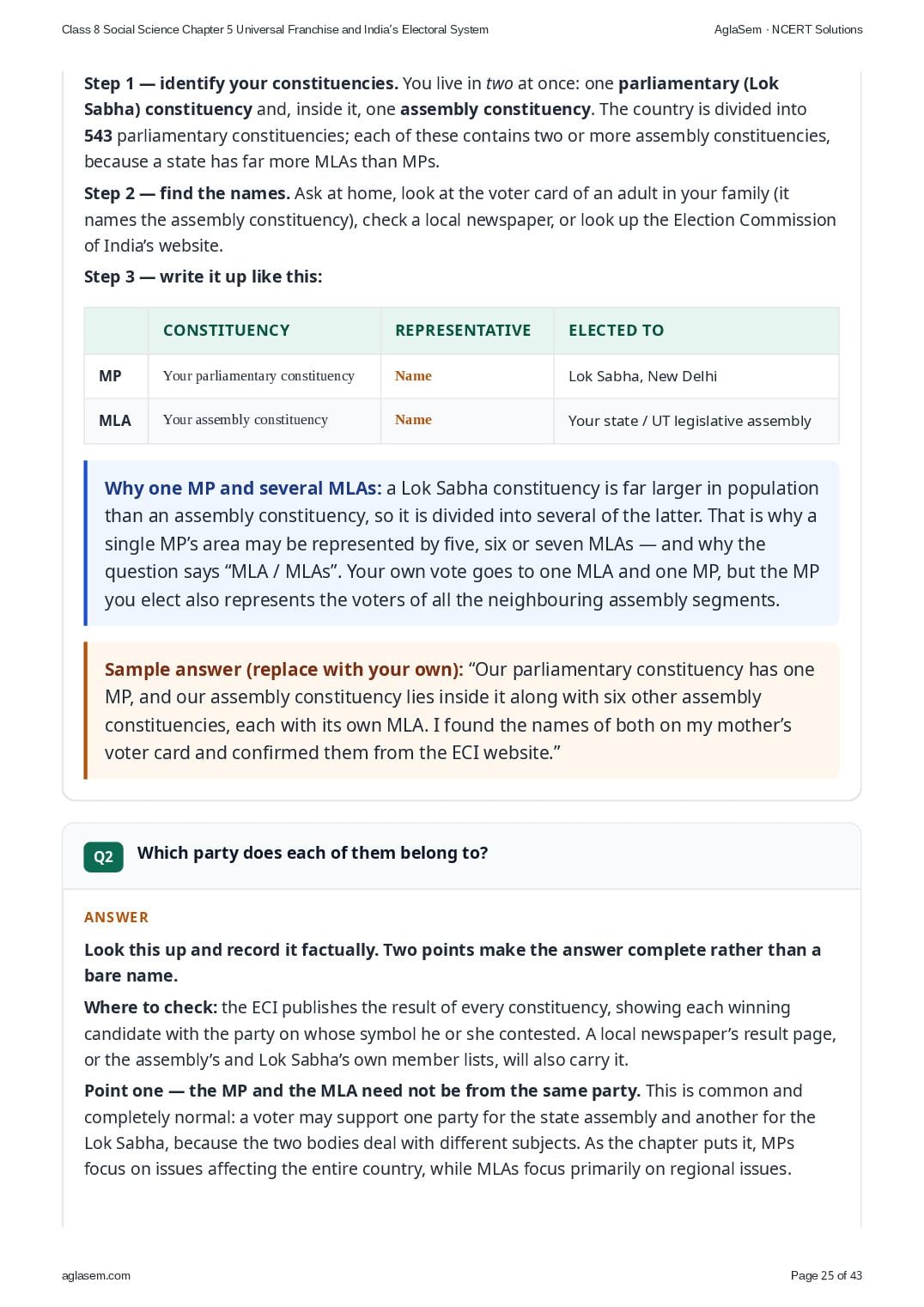
- Who are the MP and MLA / MLAs of the constituency you are located in? (A Lok Sabha constituency may have two or more assembly constituencies.)
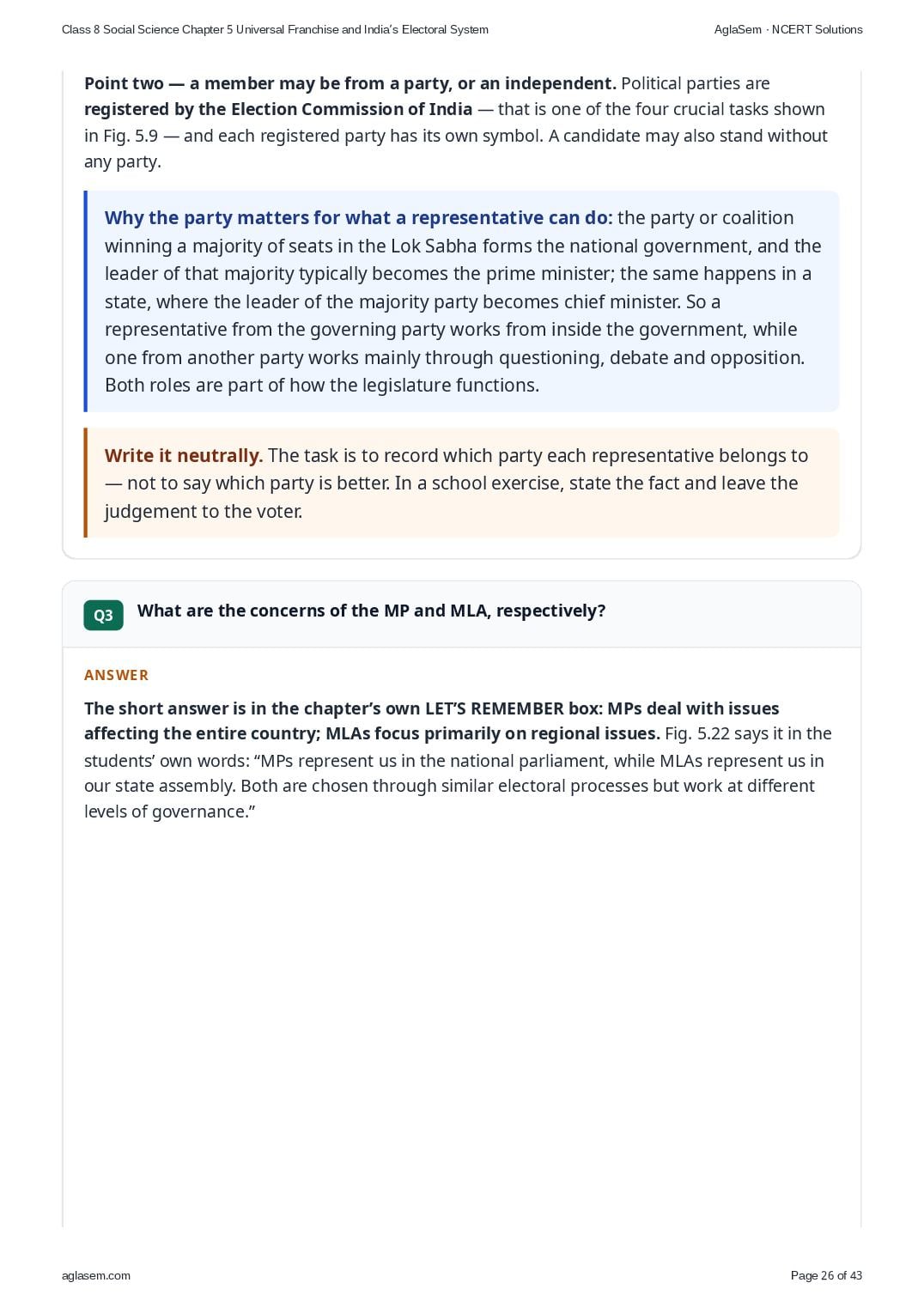
- Which party does each of them belong to?
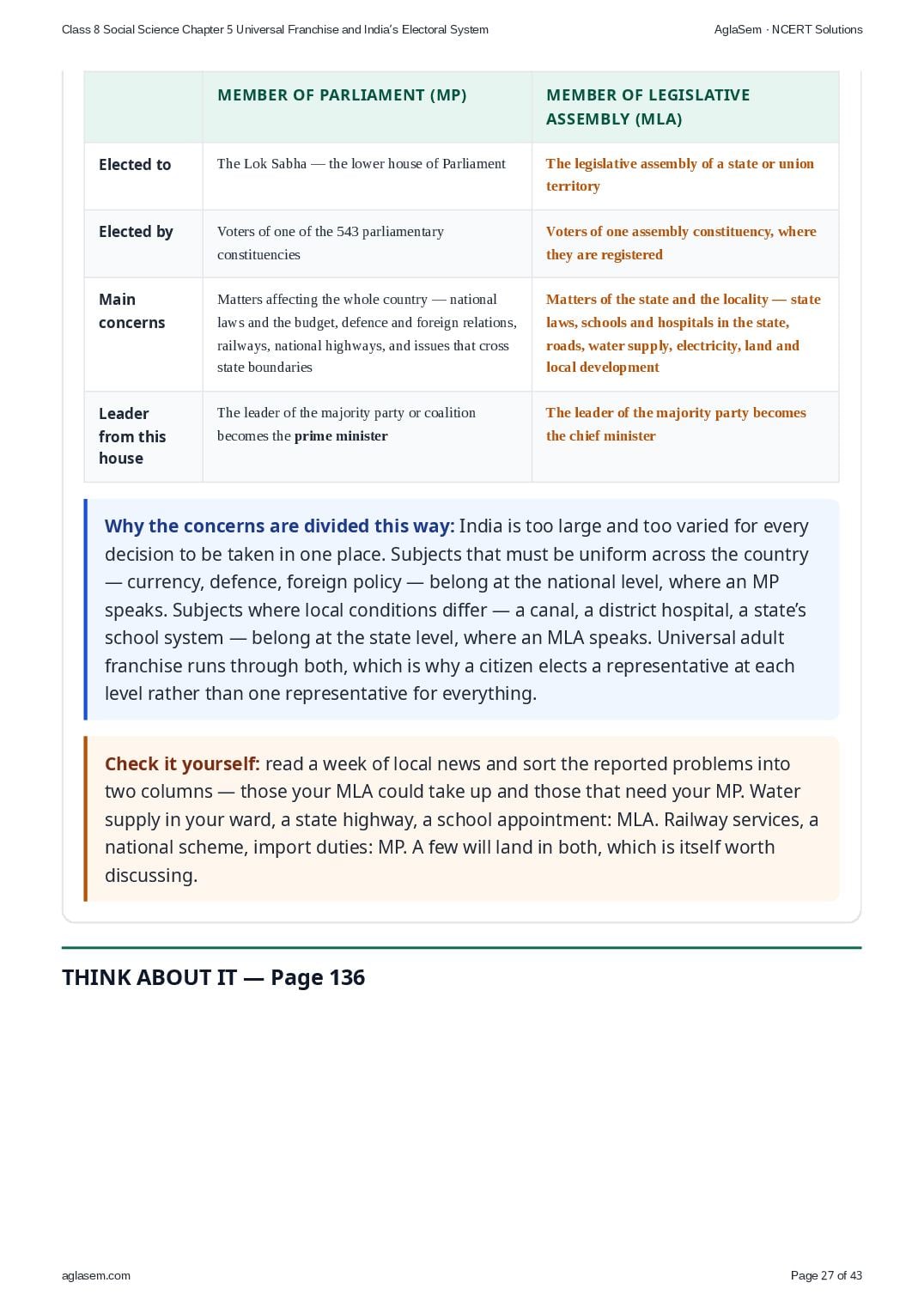
- What are the concerns of the MP and MLA, respectively?
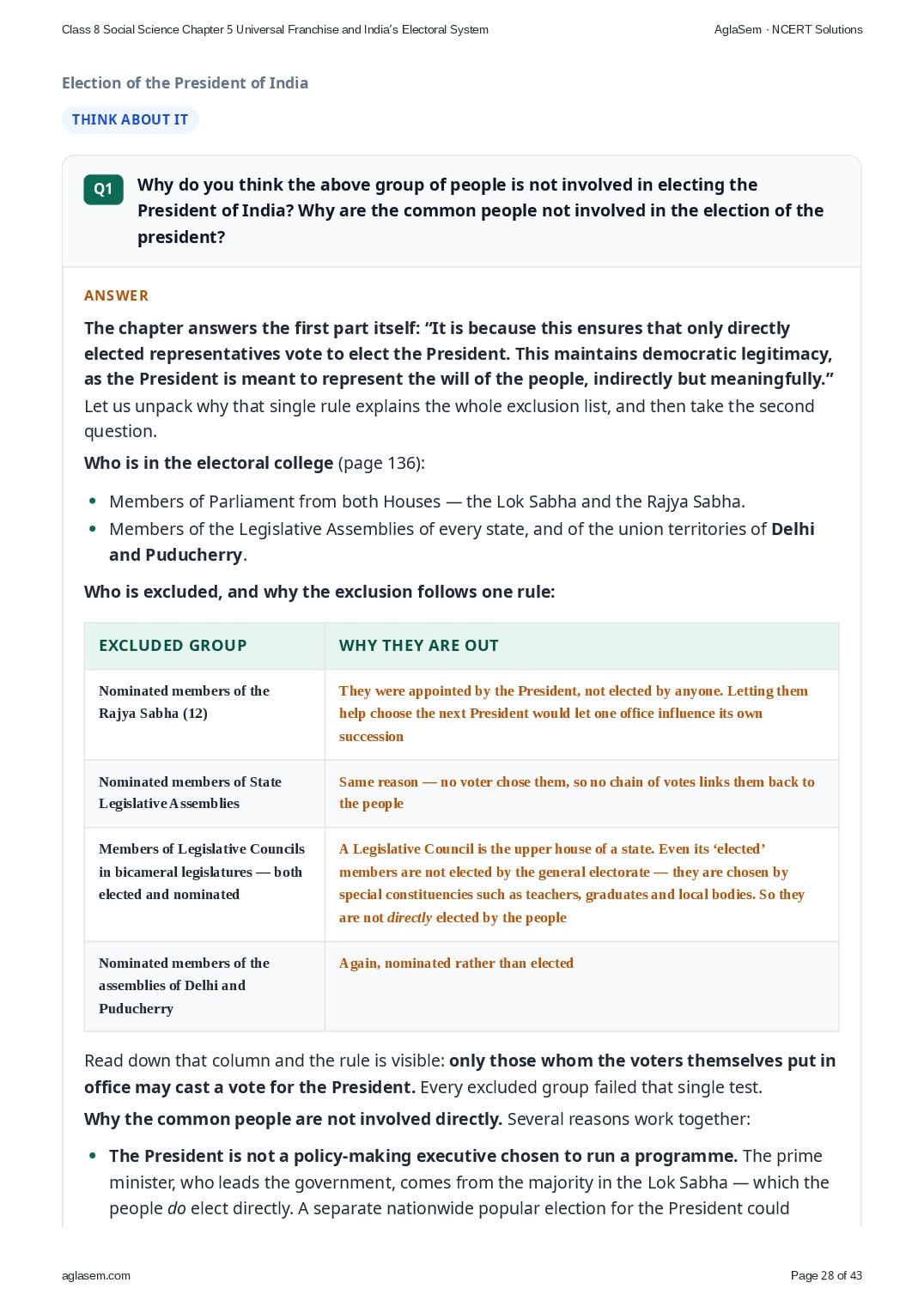
- Why do you think the above group of people is not involved in electing the President of India? Why are the common people not involved in the election of the president?
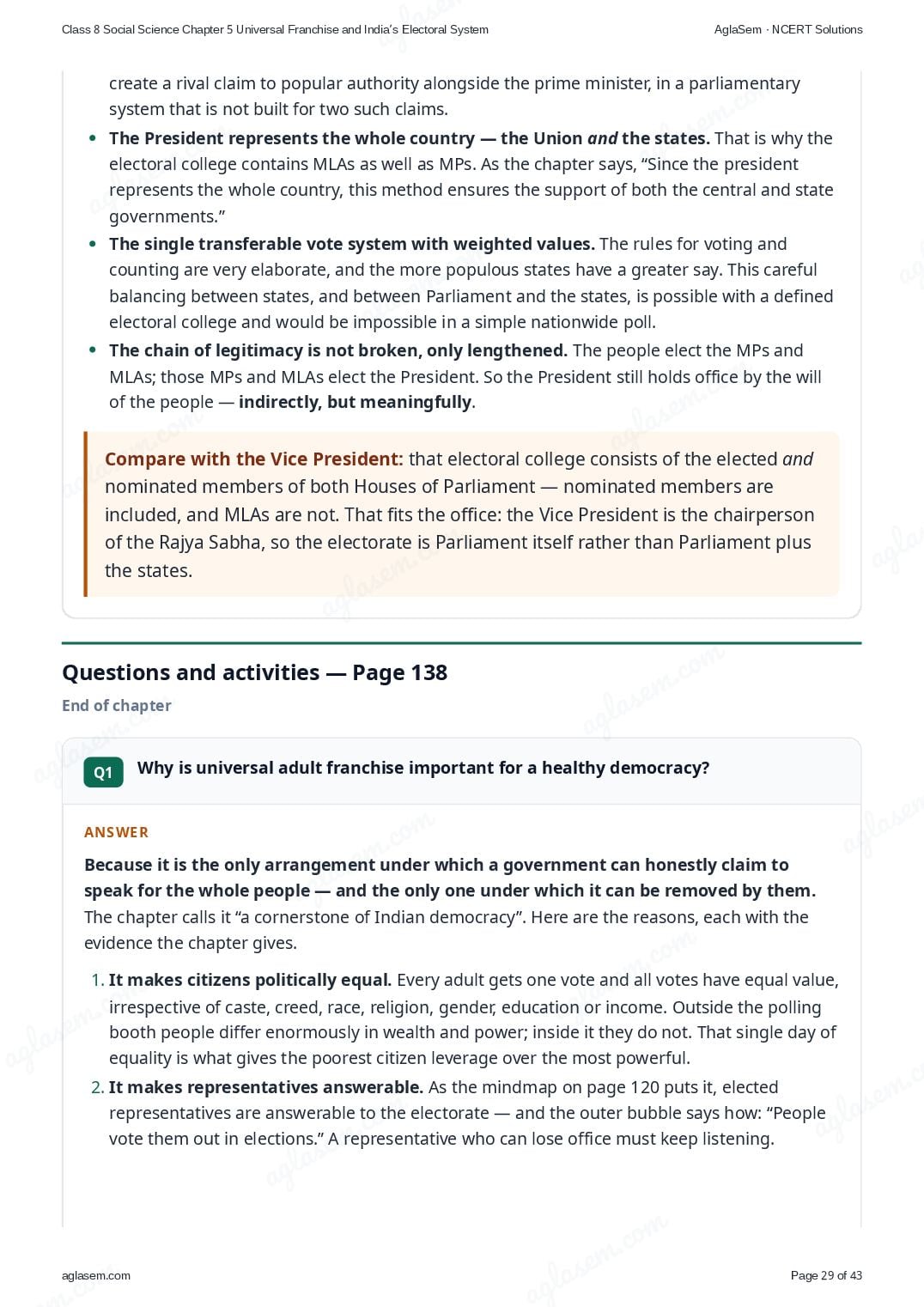
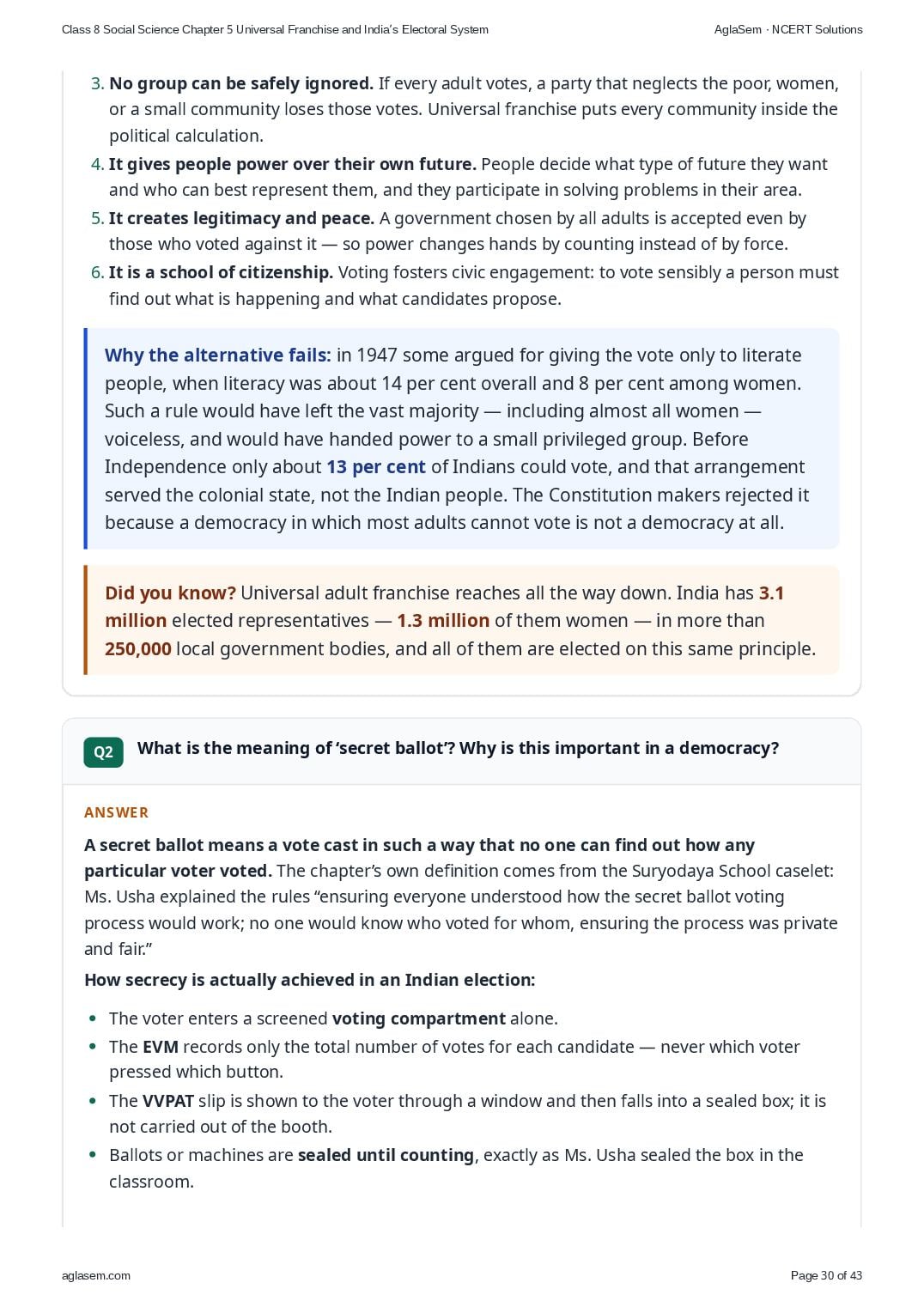
- Why is universal adult franchise important for a healthy democracy?
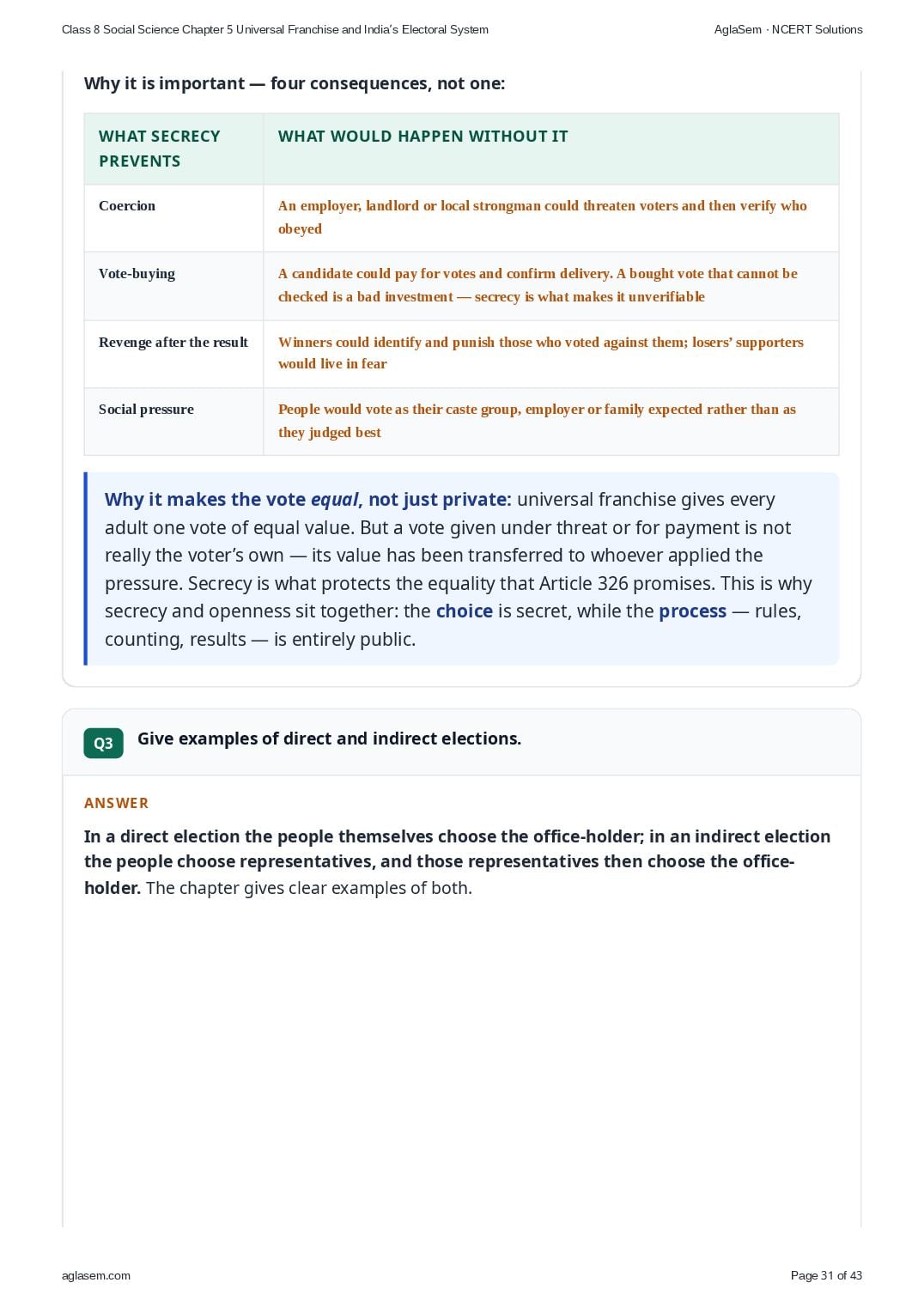
- What is the meaning of ‘secret ballot’? Why is this important in a democracy?
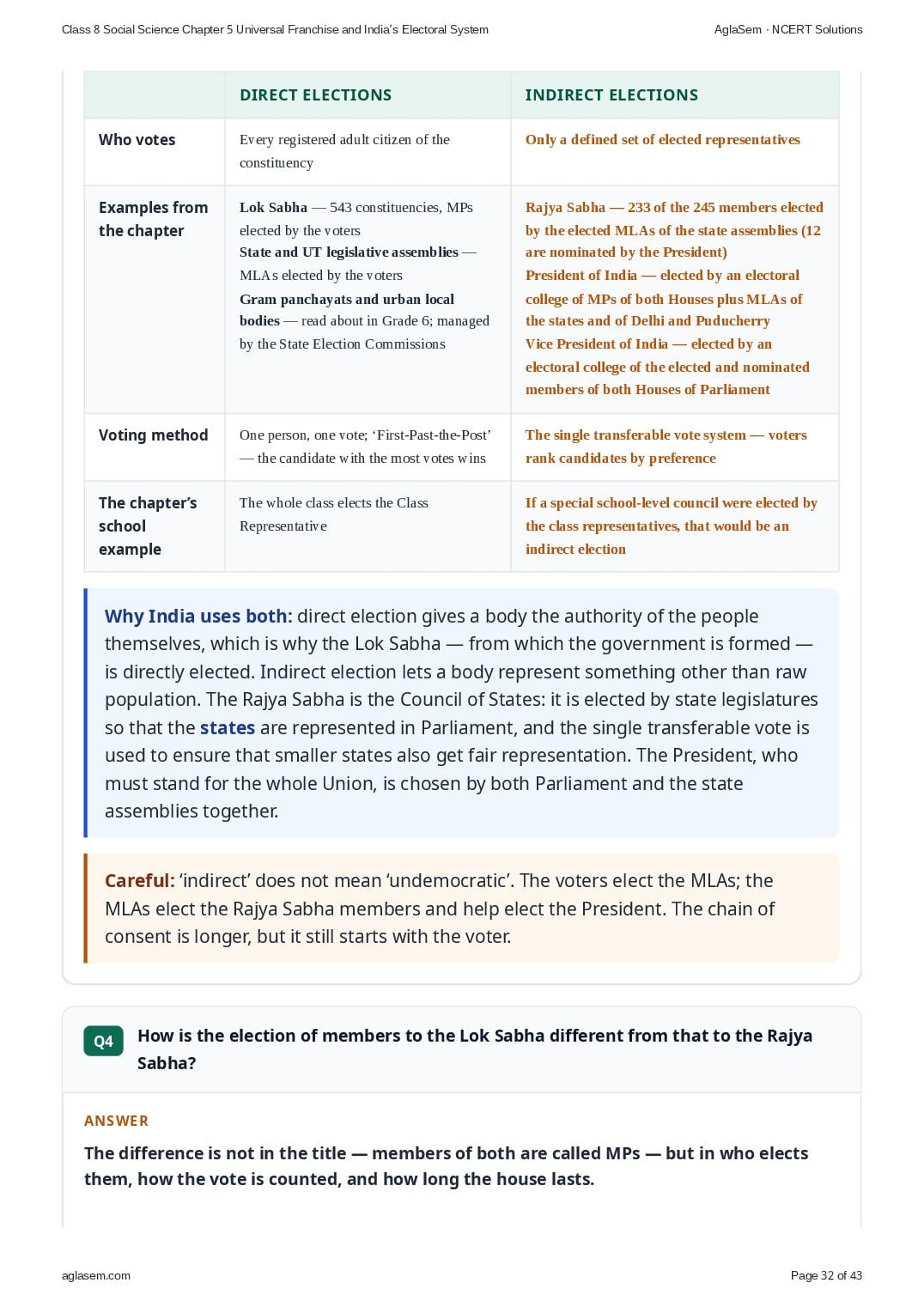
- Give examples of direct and indirect elections.
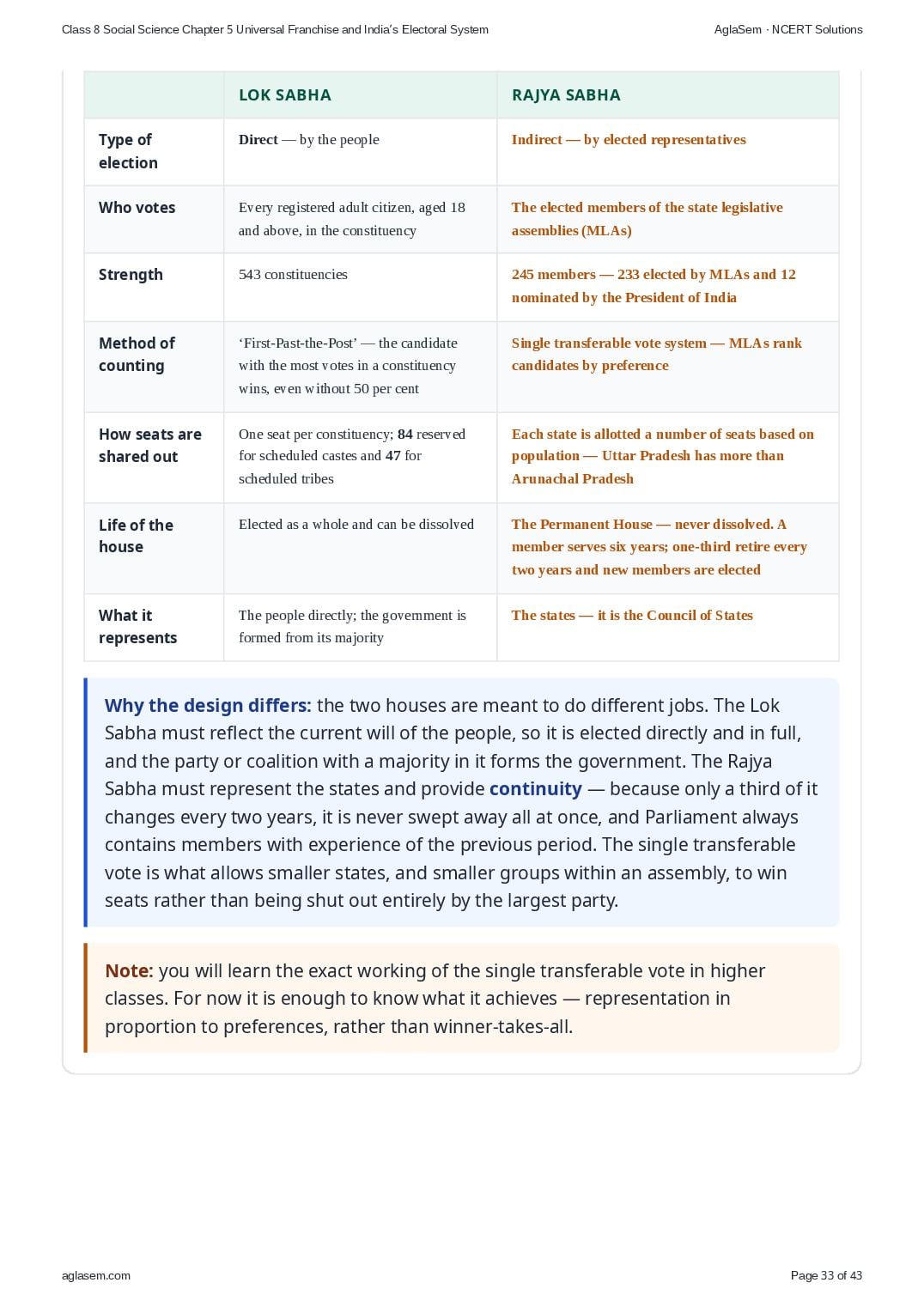
- How is the election of members to the Lok Sabha different from that to the Rajya Sabha?
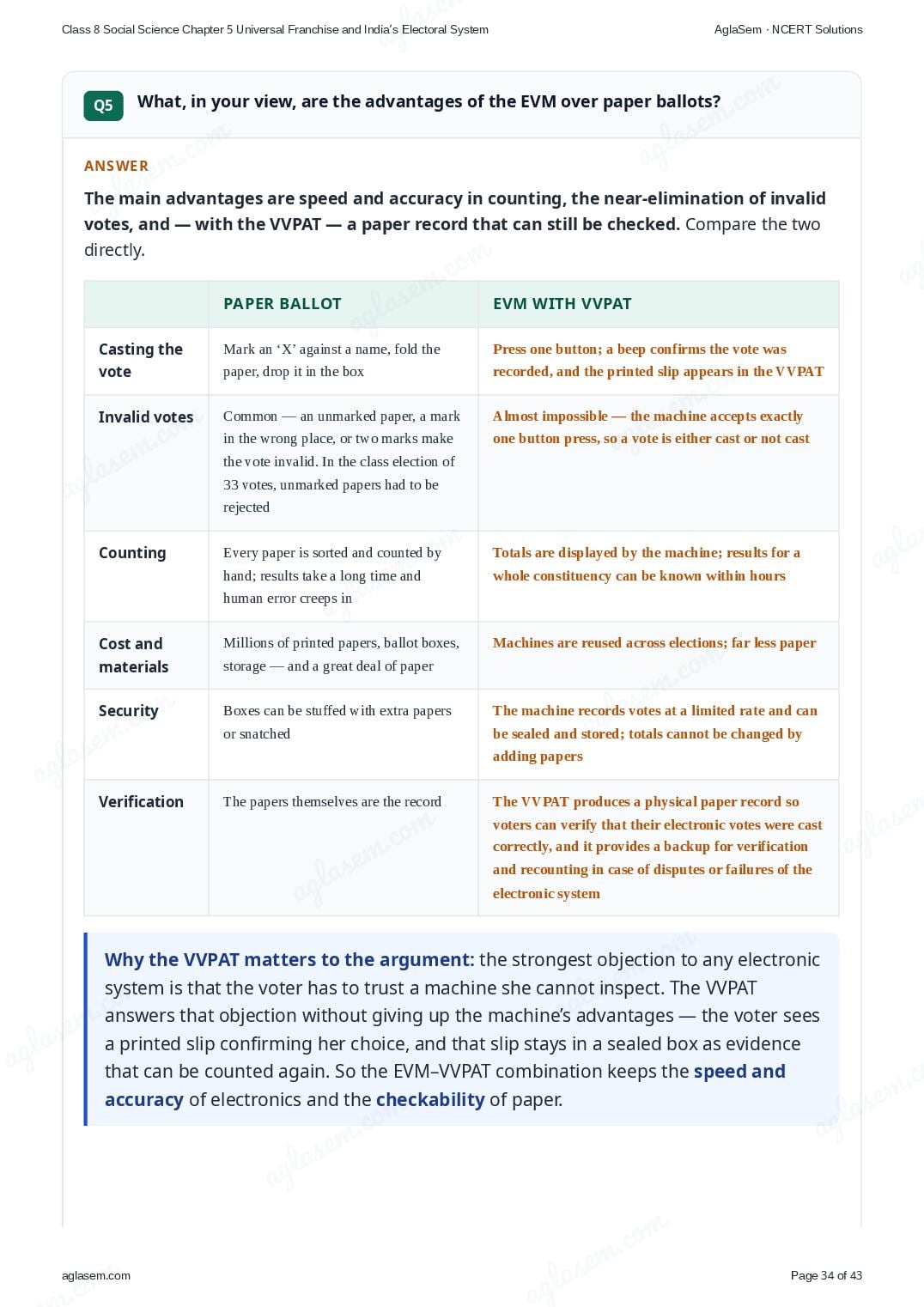
- What, in your view, are the advantages of the EVM over paper ballots?
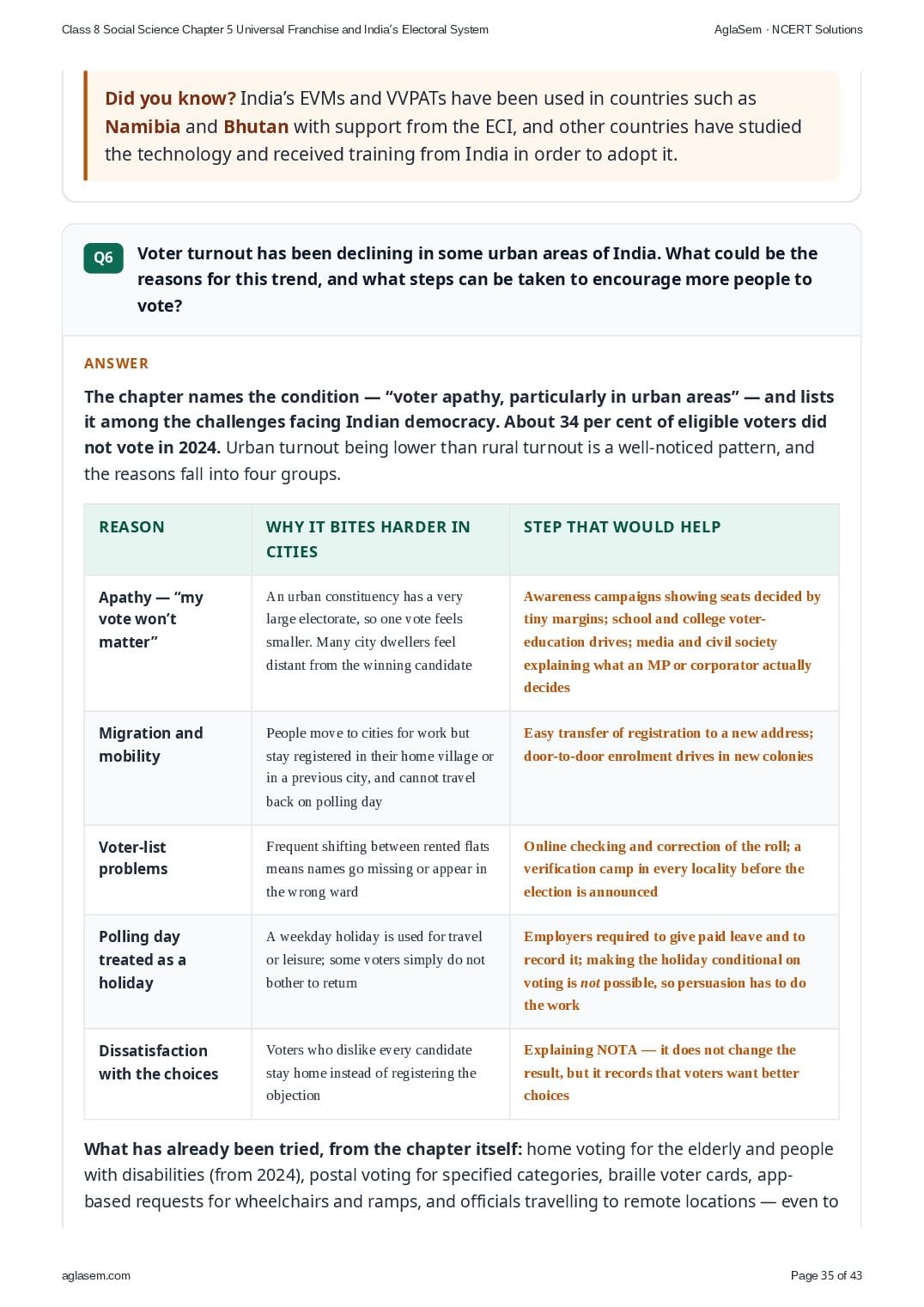
- Voter turnout has been declining in some urban areas of India. What could be the reasons for this trend, and what steps can be taken to encourage more people to vote?
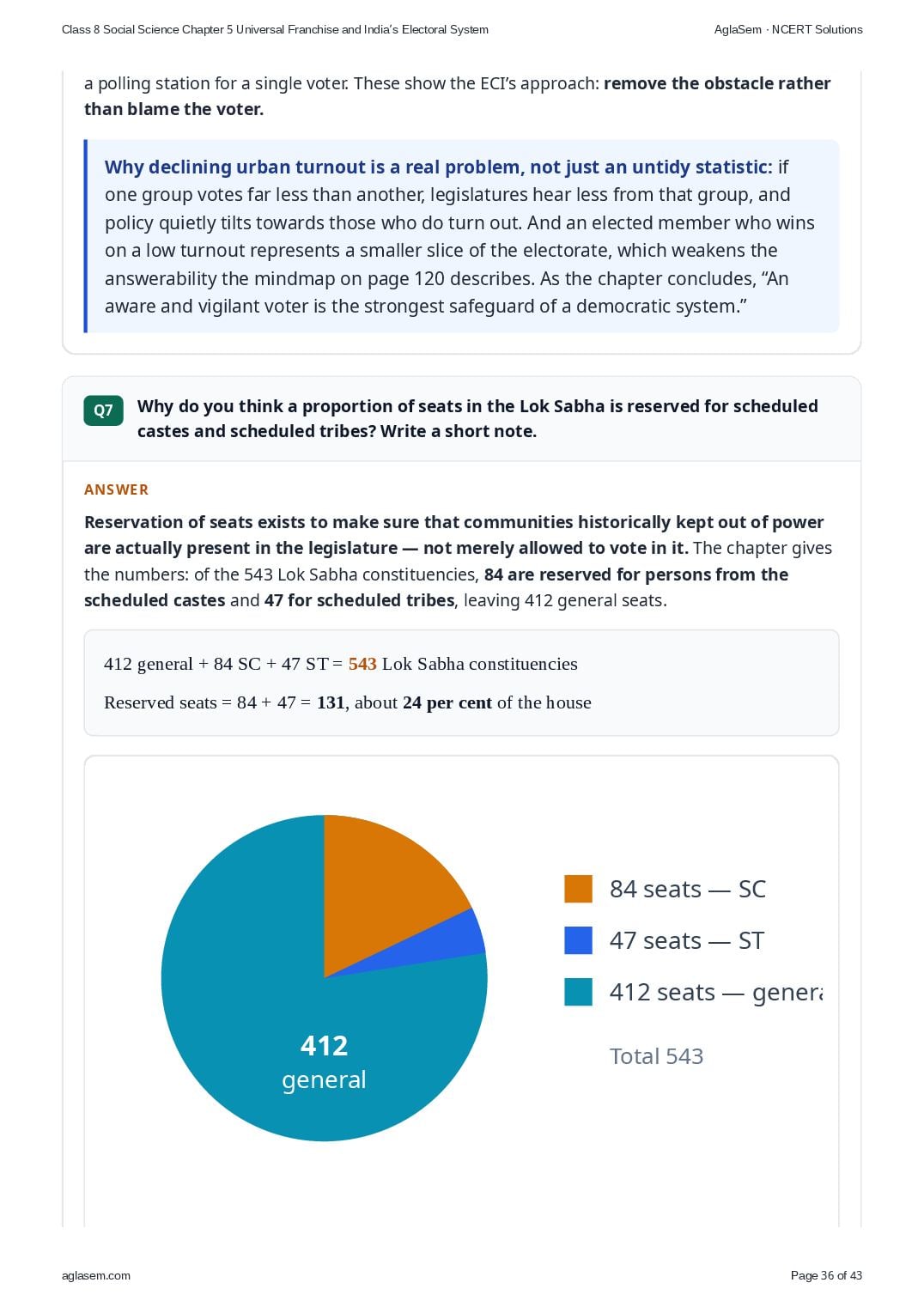
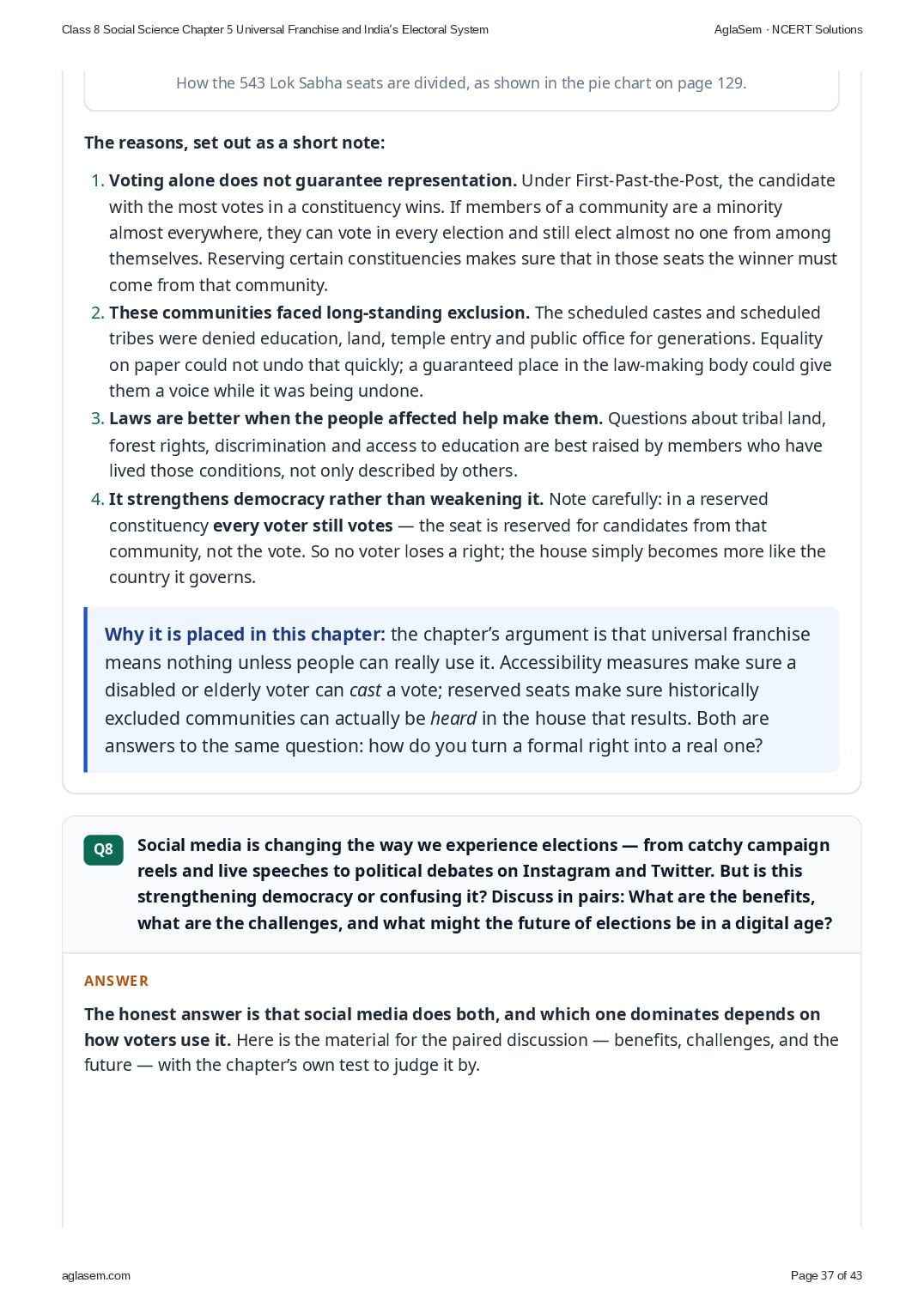
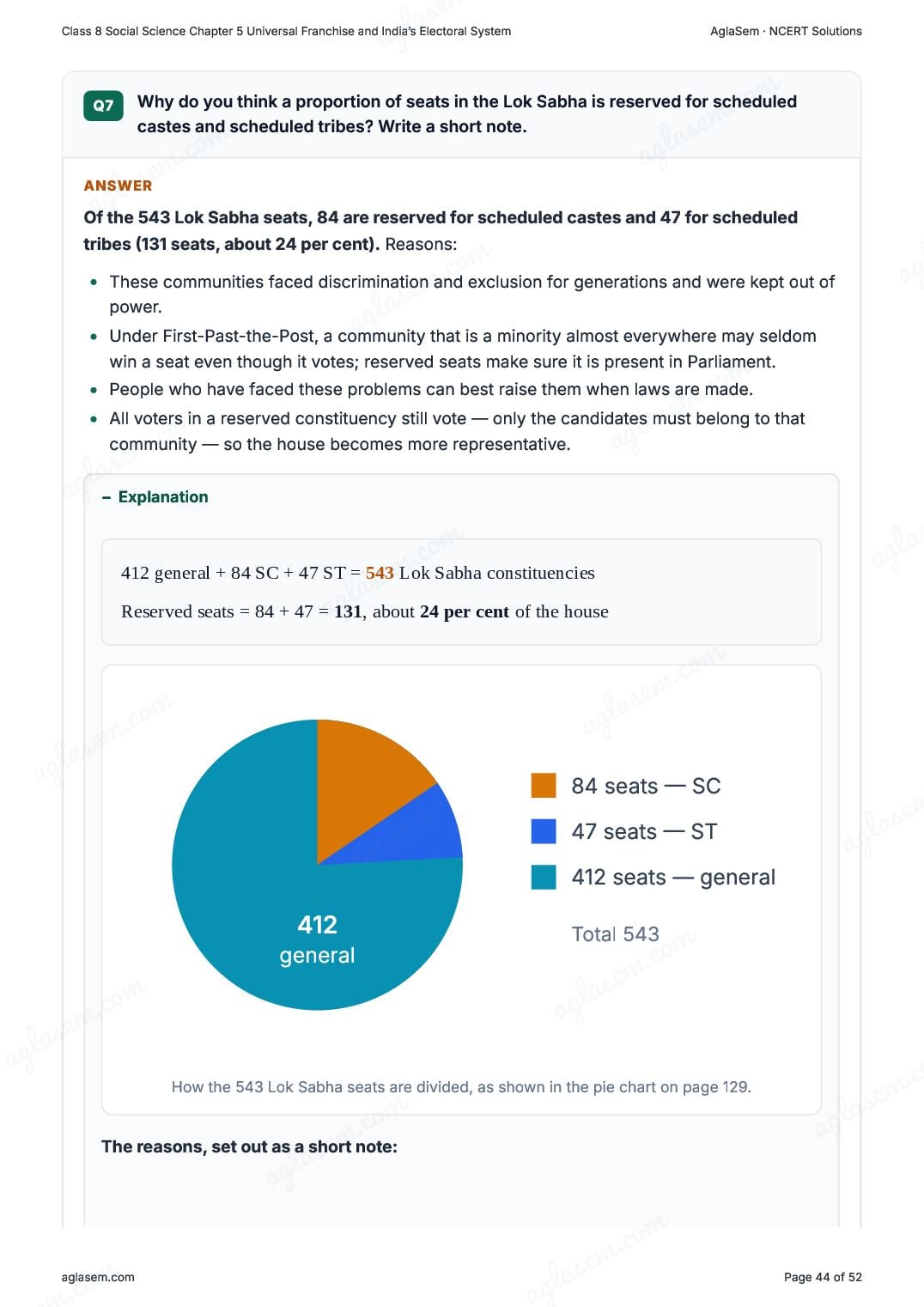
- Why do you think a proportion of seats in the Lok Sabha is reserved for scheduled castes and scheduled tribes? Write a short note.
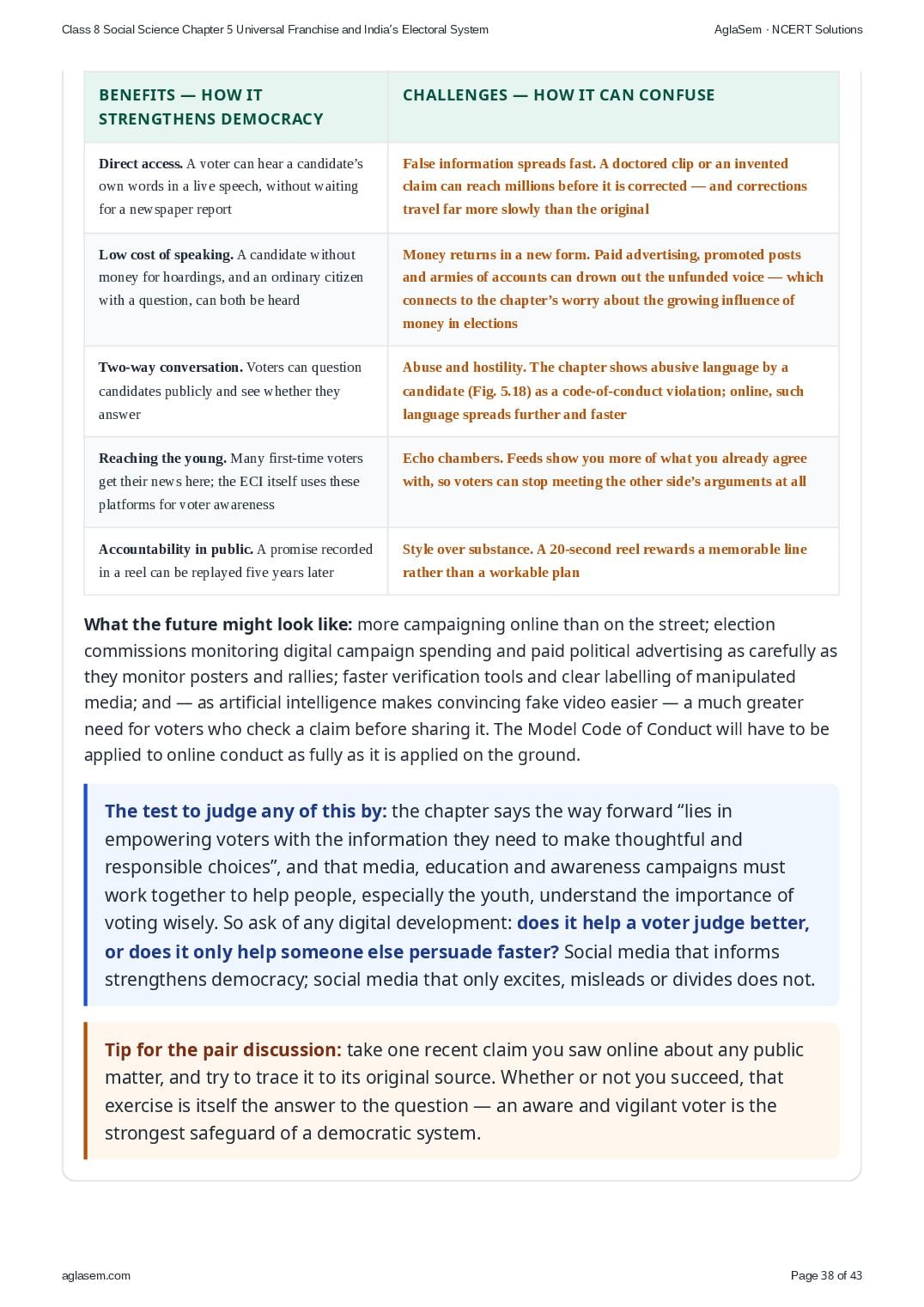
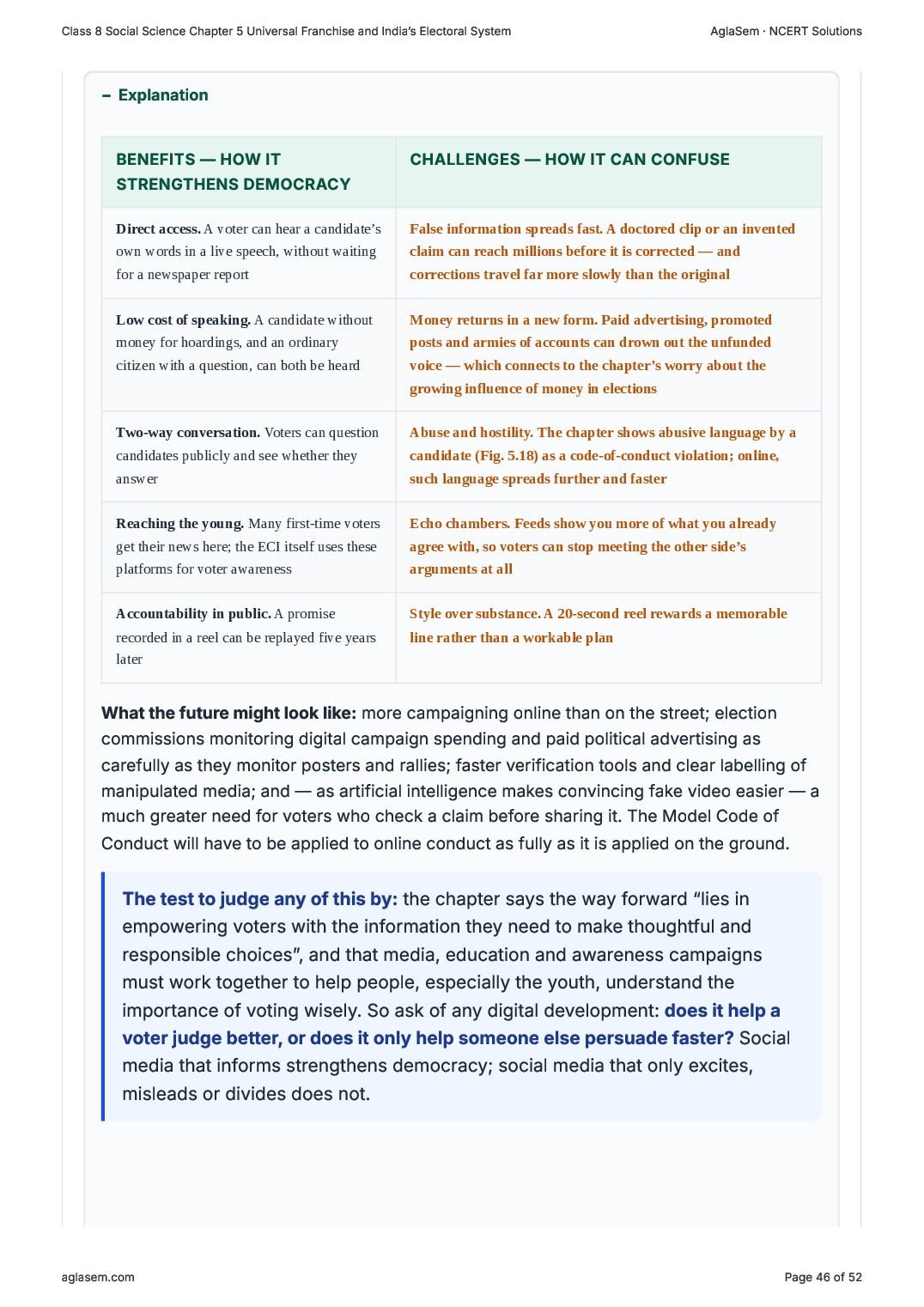
- Social media is changing the way we experience elections — from catchy campaign reels and live speeches to political debates on Instagram and Twitter. But is this strengthening democracy or confusing it? Discuss in pairs: What are the benefits, what are the challenges, and what might the future of elections be in a digital age?
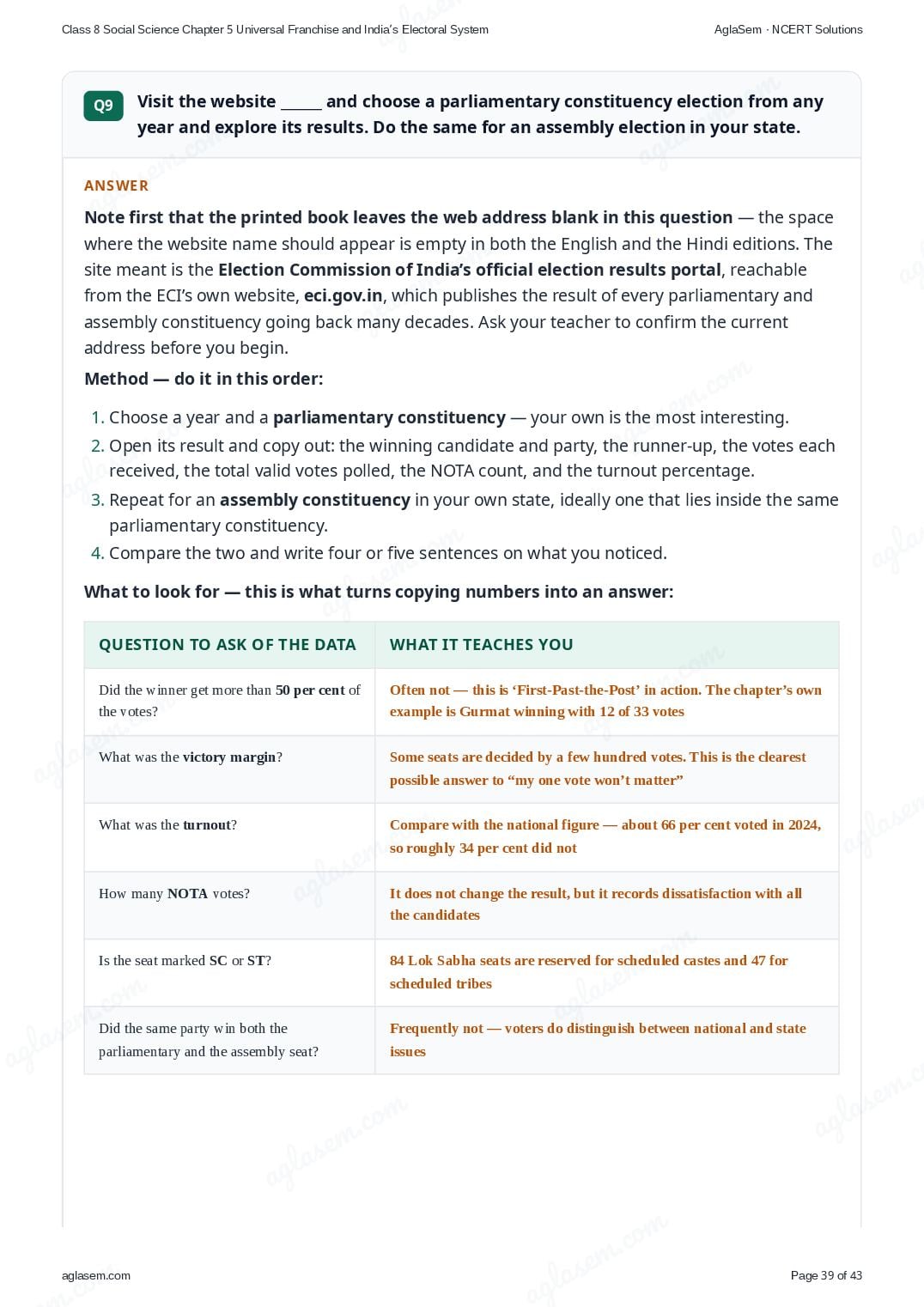
- Visit the website ______ and choose a parliamentary constituency election from any year and explore its results. Do the same for an assembly election in your state.
Chapter at a Glance
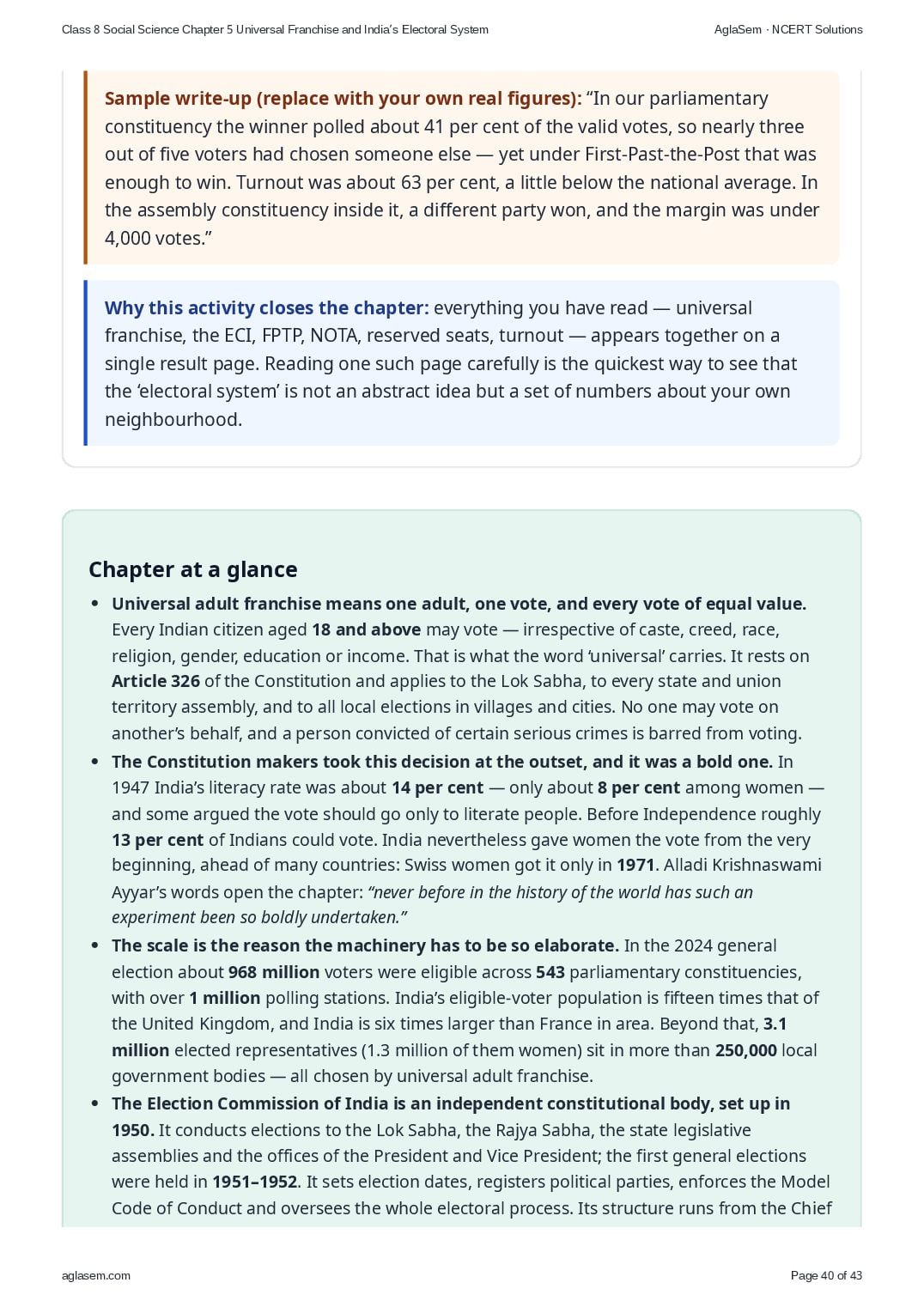
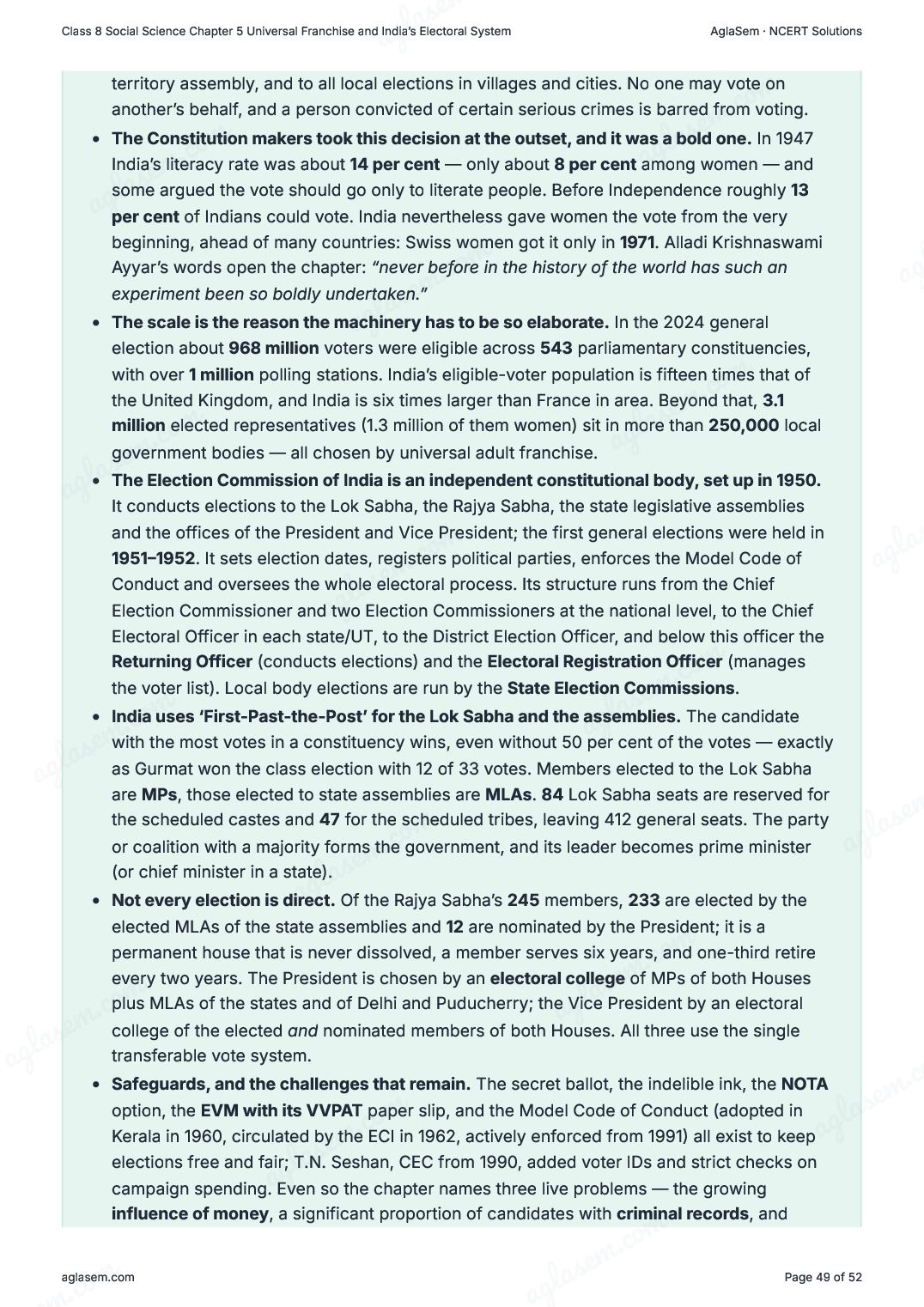
- Universal adult franchise means one adult, one vote, and every vote of equal value. Every Indian citizen aged 18 and above may vote — irrespective of caste, creed, race, religion, gender, education or income. That is what the word ‘universal’ carries. It rests on Article 326 of the Constitution and applies to the Lok Sabha, to every state and union territory assembly, and to all local elections in villages and cities. No one may vote on another’s behalf, and a person convicted of certain serious crimes is barred from voting.
- The Constitution makers took this decision at the outset, and it was a bold one. In 1947 India’s literacy rate was about 14 per cent — only about 8 per cent among women — and some argued the vote should go only to literate people. Before Independence roughly 13 per cent of Indians could vote. India nevertheless gave women the vote from the very beginning, ahead of many countries: Swiss women got it only in 1971 . Alladi Krishnaswami Ayyar’s words open the chapter: “never before in the history of the world has such an experiment been so boldly undertaken.”
- The scale is the reason the machinery has to be so elaborate. In the 2024 general election about 968 million voters were eligible across 543 parliamentary constituencies, with over 1 million polling stations. India’s eligible-voter population is fifteen times that of the United Kingdom, and India is six times larger than France in area. Beyond that, 3.1 million elected representatives (1.3 million of them women) sit in more than 250,000 local government bodies — all chosen by universal adult franchise.
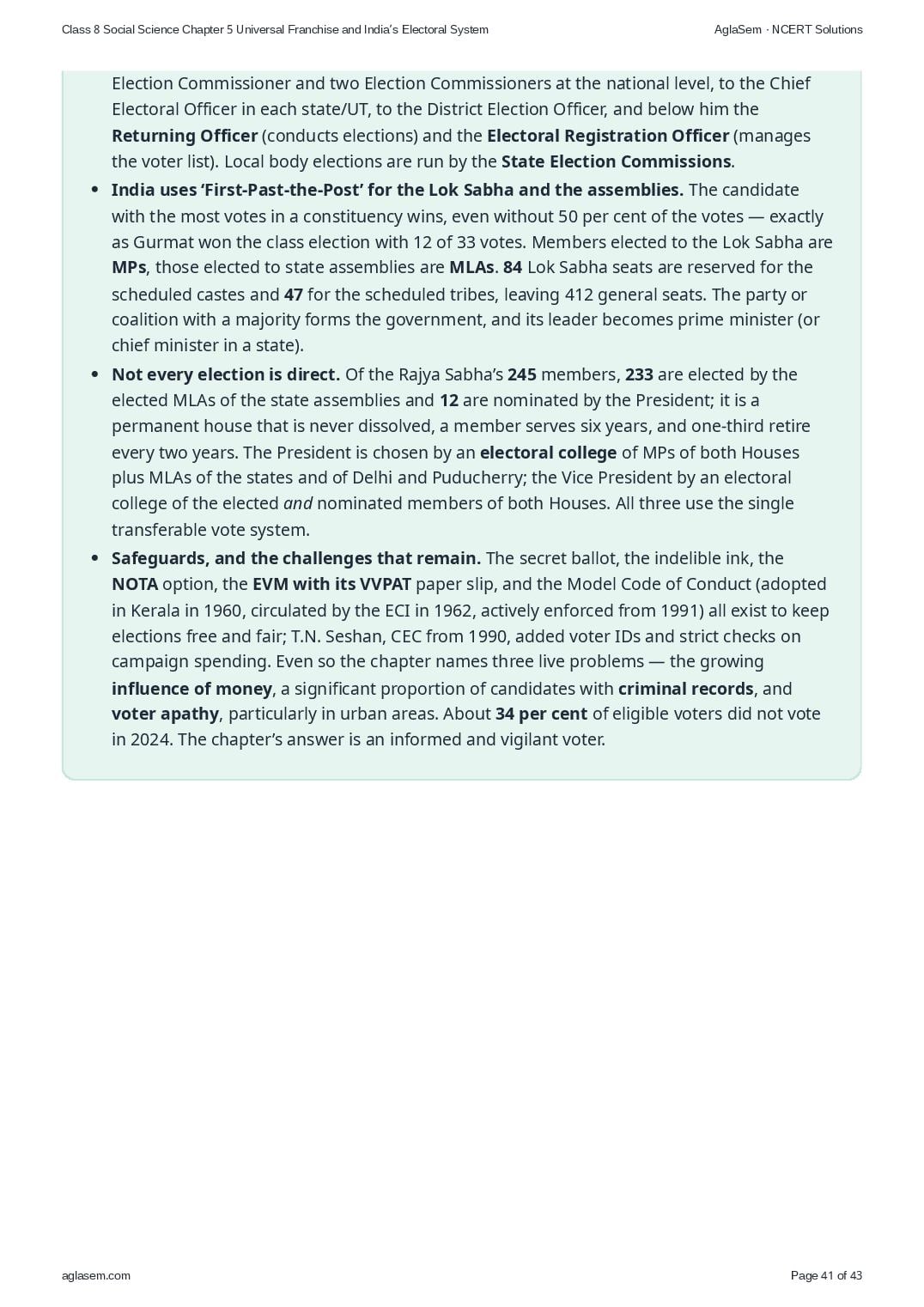
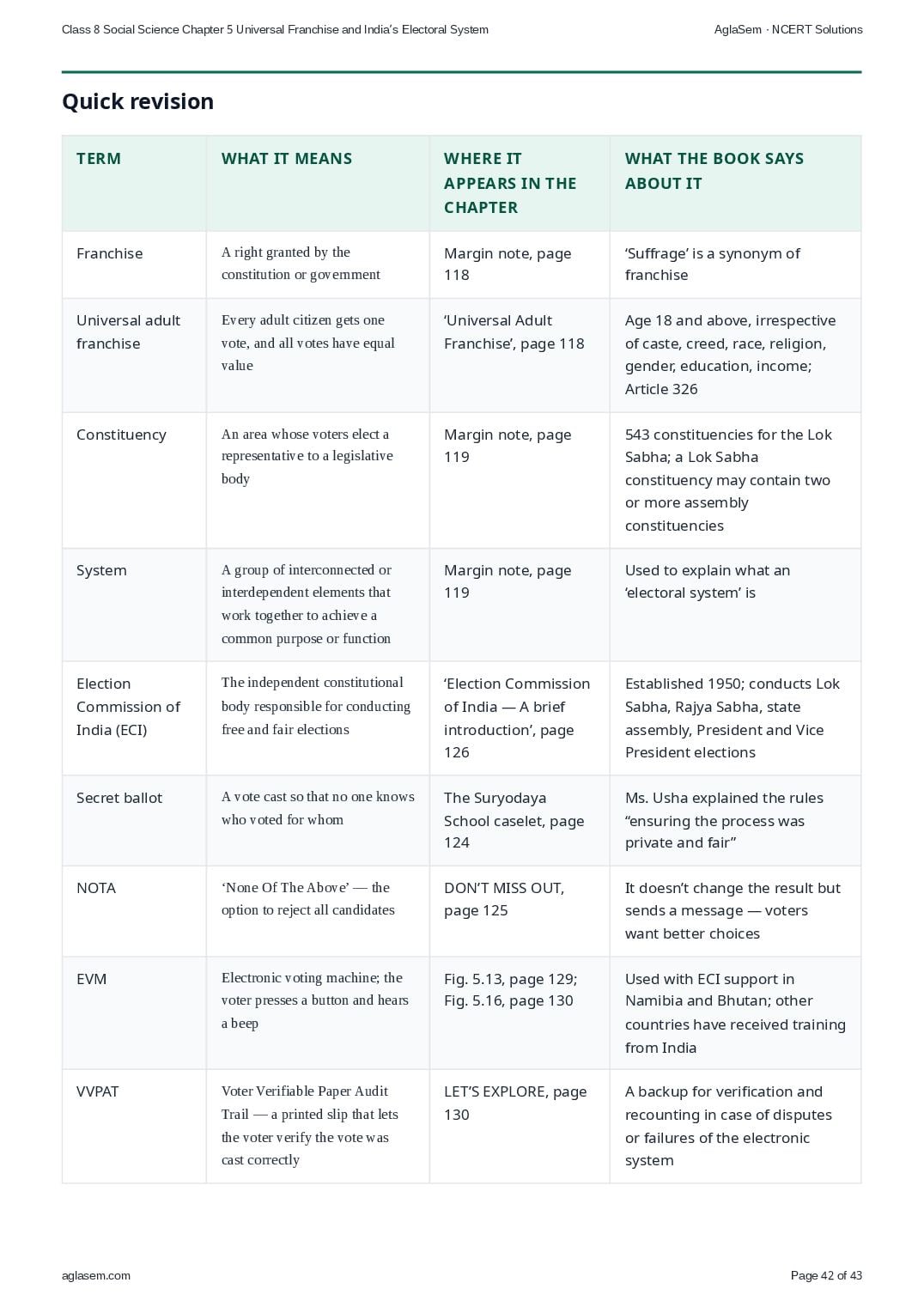
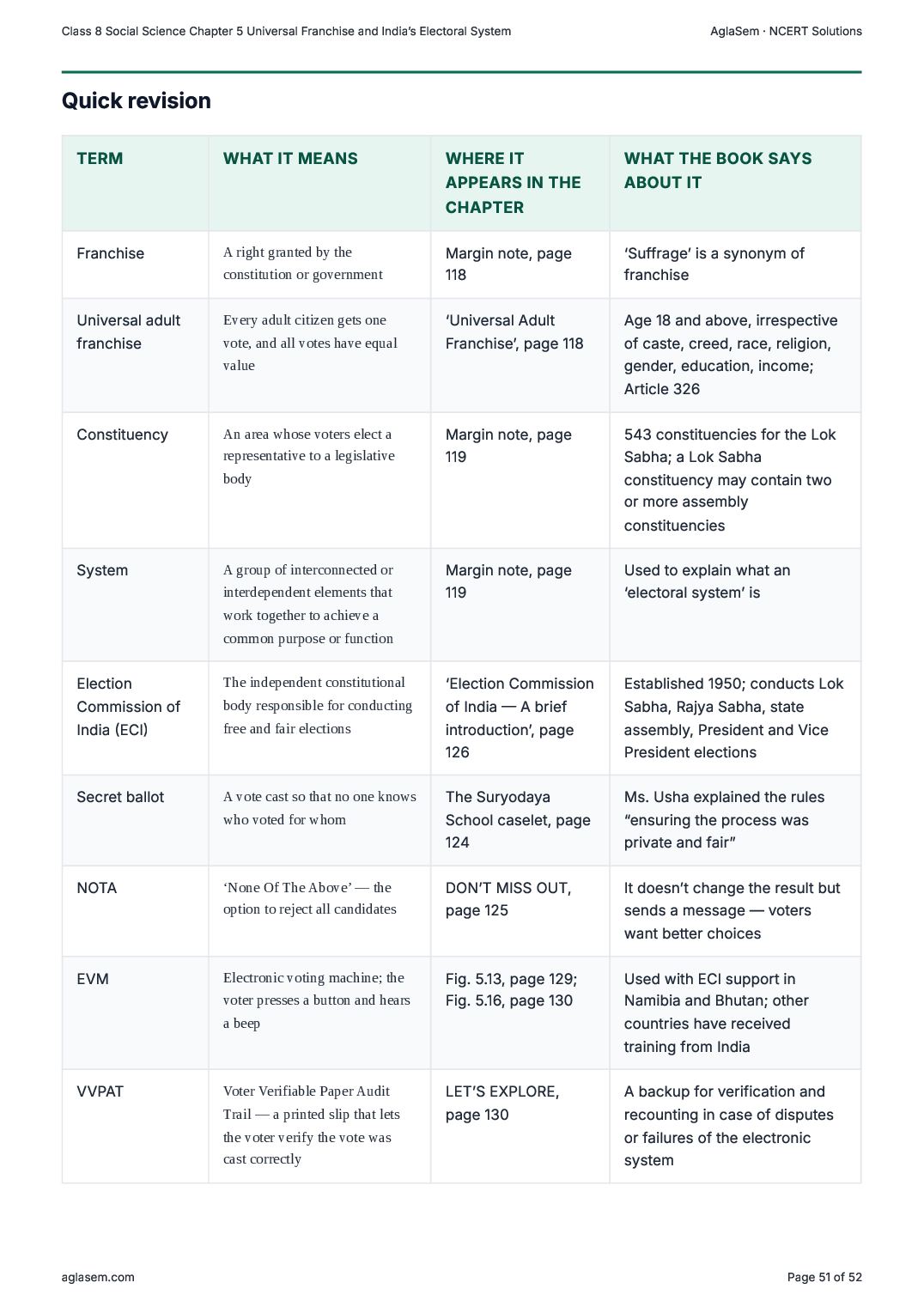
- The Election Commission of India is an independent constitutional body, set up in 1950. It conducts elections to the Lok Sabha, the Rajya Sabha, the state legislative assemblies and the offices of the President and Vice President; the first general elections were held in 1951–1952 . It sets election dates, registers political parties, enforces the Model Code of Conduct and oversees the whole electoral process. Its structure runs from the Chief Election Commissioner and two Election Commissioners at the national level, to the Chief Electoral Officer in each state/UT, to the District Election Officer, and below him the Returning Officer (conducts elections) and the Electoral Registration Officer (manages the voter list). Local body elections are run by the State Election Commissions .
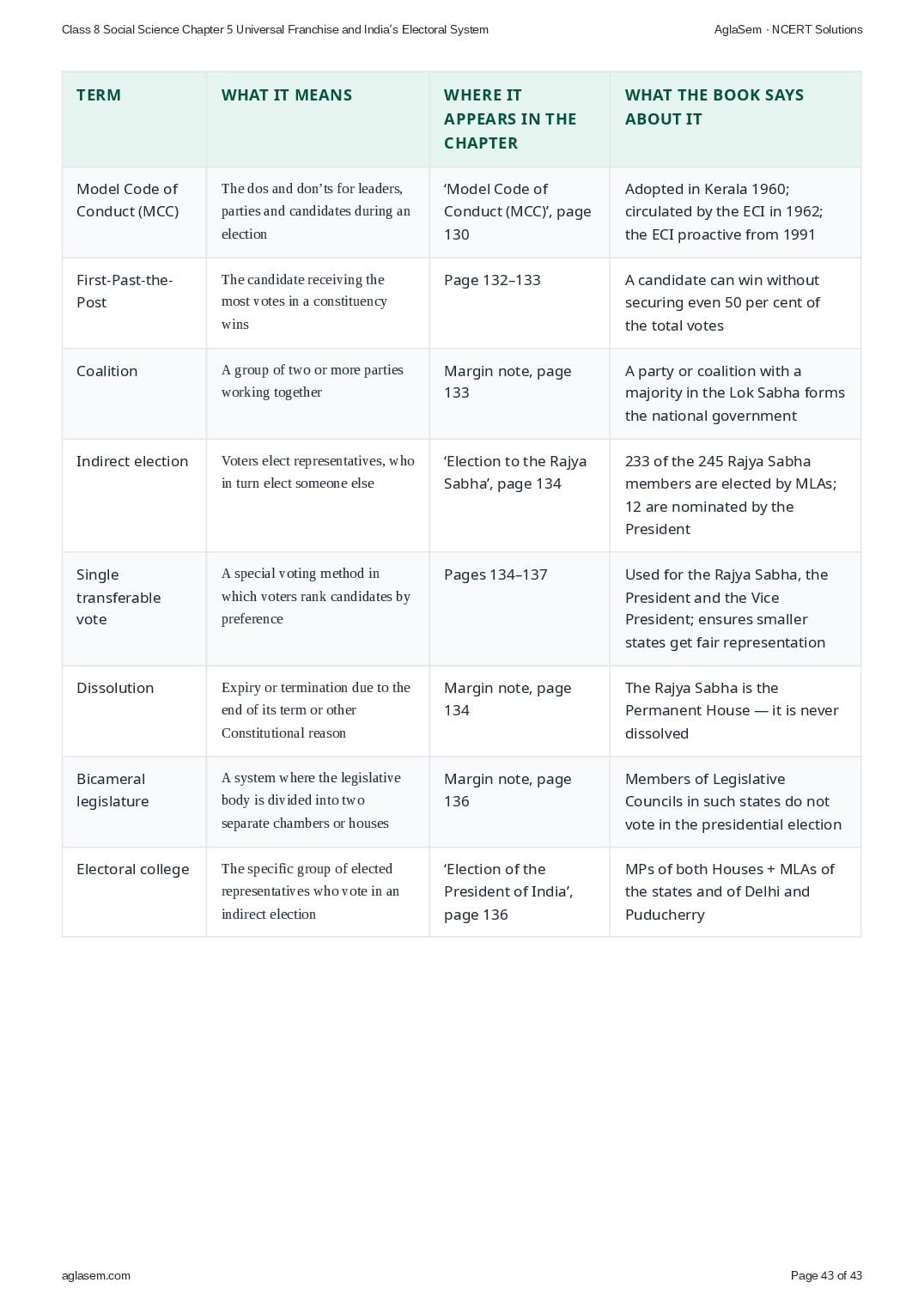
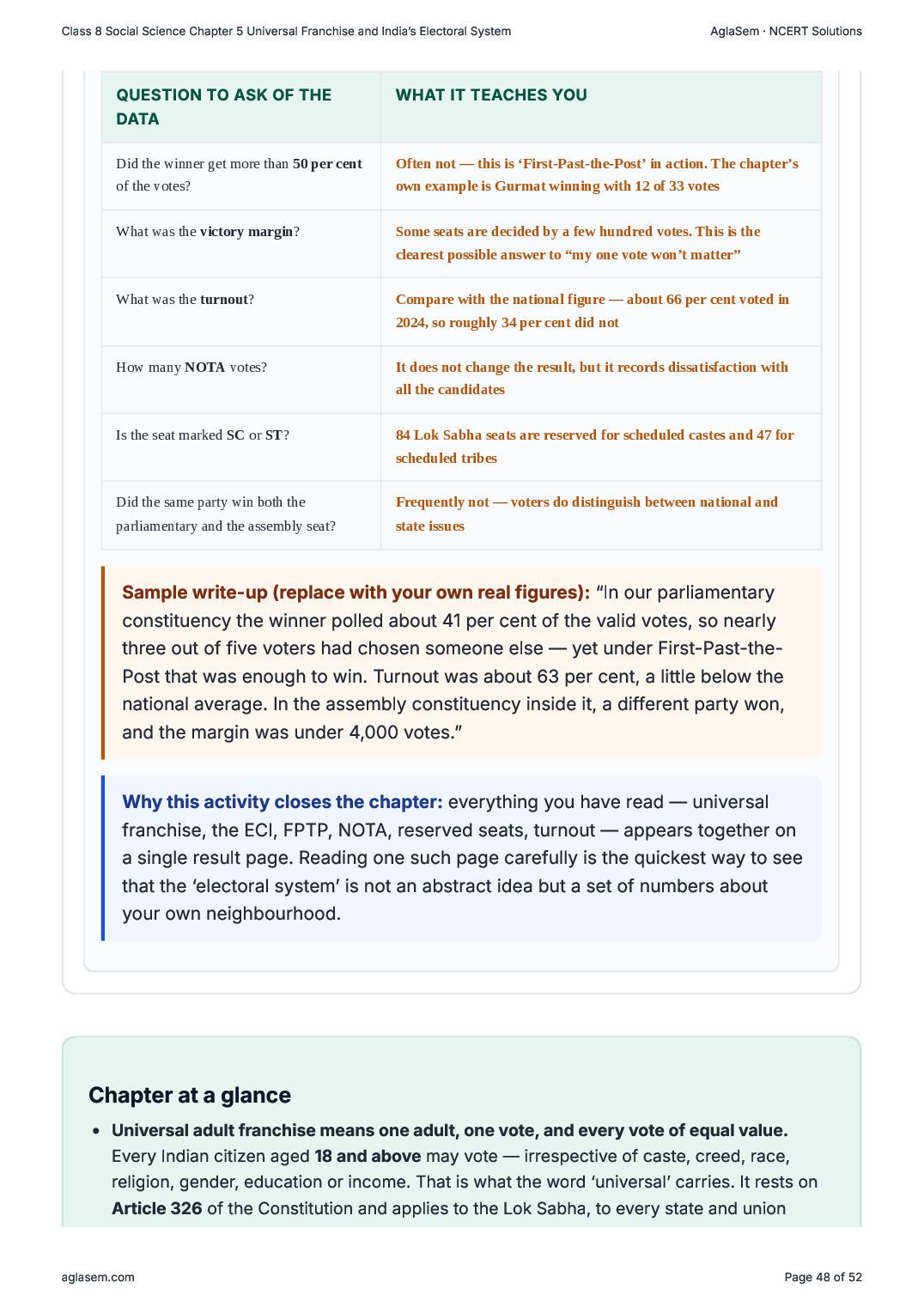
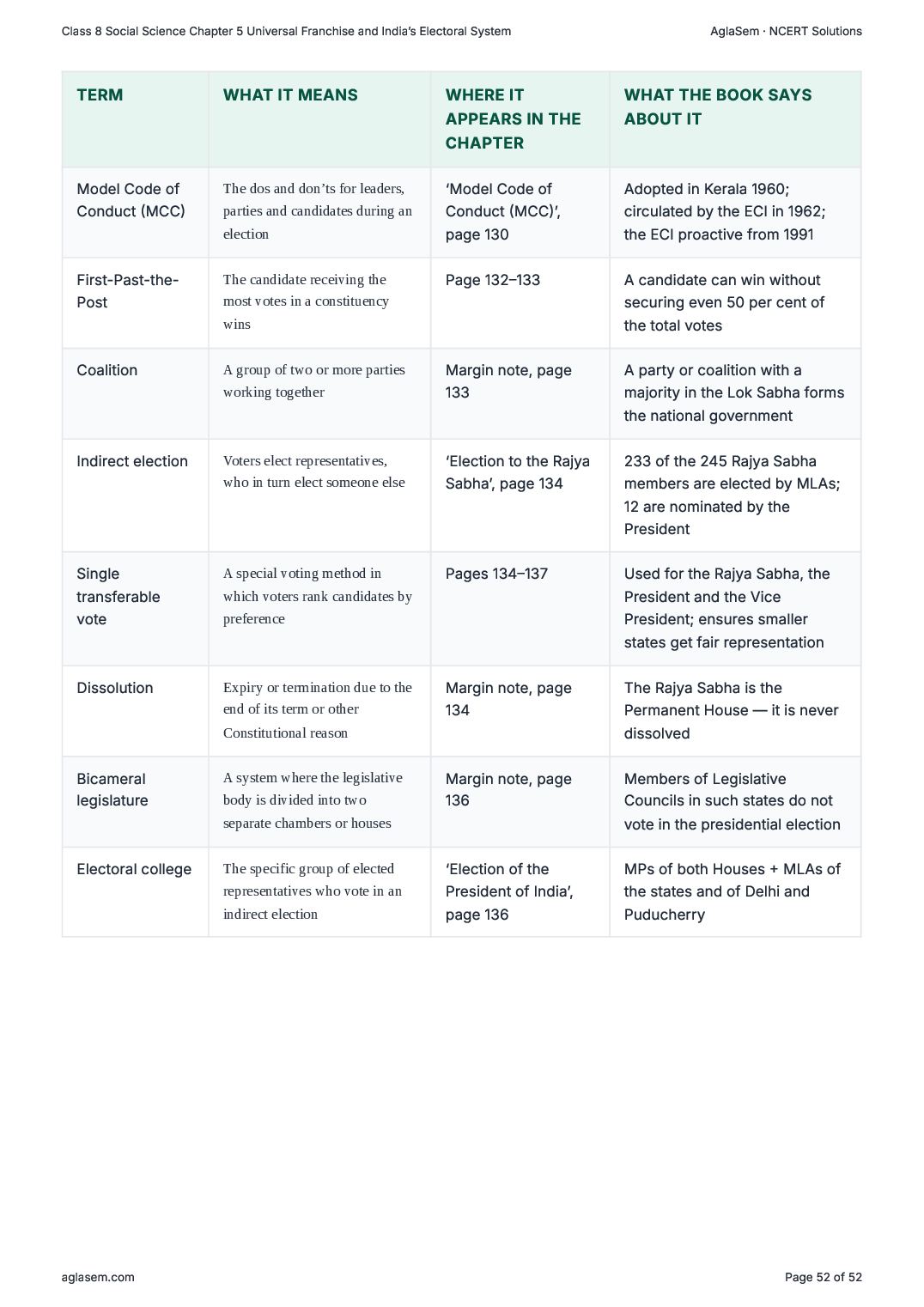
- India uses ‘First-Past-the-Post’ for the Lok Sabha and the assemblies. The candidate with the most votes in a constituency wins, even without 50 per cent of the votes — exactly as Gurmat won the class election with 12 of 33 votes. Members elected to the Lok Sabha are MPs , those elected to state assemblies are MLAs . 84 Lok Sabha seats are reserved for the scheduled castes and 47 for the scheduled tribes, leaving 412 general seats. The party or coalition with a majority forms the government, and its leader becomes prime minister (or chief minister in a state).
- Not every election is direct. Of the Rajya Sabha’s 245 members, 233 are elected by the elected MLAs of the state assemblies and 12 are nominated by the President; it is a permanent house that is never dissolved, a member serves six years, and one-third retire every two years. The President is chosen by an electoral college of MPs of both Houses plus MLAs of the states and of Delhi and Puducherry; the Vice President by an electoral college of the elected and nominated members of both Houses. All three use the single transferable vote system .
- Safeguards, and the challenges that remain. The secret ballot, the indelible ink, the NOTA option, the EVM with its VVPAT paper slip, and the Model Code of Conduct (adopted in Kerala in 1960, circulated by the ECI in 1962, actively enforced from 1991) all exist to keep elections free and fair; T.N. Seshan, CEC from 1990, added voter IDs and strict checks on campaign spending. Even so the chapter names three live problems — the growing influence of money , a significant proportion of candidates with criminal records , and voter apathy , particularly in urban areas. About 34 per cent of eligible voters did not vote in 2024. The chapter’s answer is an informed and vigilant voter.
How to Download NCERT Solutions for Class 8 Social Science Chapter 5 PDF
Follow these simple steps to get the Universal Franchise and India’s Electoral System questions-and-answers PDF from Exploring Society: India and Beyond.
- Search NCERT Solutions for Class 8 Social Science Chapter 5 aglasem and open this page.
- Read the exercise questions with answers for Universal Franchise and India’s Electoral System shown above.
- Click the Download PDF link to save the Universal Franchise and India’s Electoral System solutions to your device.
NCERT Solutions for Class 8 Social Science – All Chapters
There are more chapters to study besides Universal Franchise and India’s Electoral System in Social Science. Here are the NCERT Solutions for all chapters of Class 8 Social Science.
- Chapter 1 Natural Resources and Their Use
- Chapter 2 Reshaping India’s Political Map
- Chapter 3 The Rise of the Marathas
- Chapter 4 The Colonial Era in India
- Chapter 5 Universal Franchise and India’s Electoral System
- Chapter 6 The Parliamentary System Legislature and Executive
- Chapter 7 Factors of Production
- Chapter 8 World Geography Some Glimpses
- Chapter 9 India’s Long Road to Independence
- Chapter 10 A Journey Through Indian Architecture
- Chapter 11 The Role of the Judiciary in Our Society
- Chapter 12 Citizenship Rights and Duties
- Chapter 13 Dynamics of Population
- Chapter 14 India’s Urban Landscape
- Chapter 15 Cultural Currents 13th to 17th Centuries
NCERT Solutions for Class 8 – All Subjects
Just like Chapter 5 of Social Science, you can get the exercise questions with answers for every other subject of Class 8. Here are the NCERT Solutions for all subjects of Class 8.
NCERT Solutions for Class 8 Social Science Chapter 5 – An Overview
The key highlights of this study material are as follows.
| Aspects | Details |
|---|---|
| Class | Class 8 |
| Subject | Social Science |
| Chapter Number | Chapter 5 |
| Chapter Name | Universal Franchise and India’s Electoral System |
| Book Name | Exploring Society: India and Beyond |
| Book By | NCERT (National Council of Educational Research and Training) |
| Educational Resource Here | NCERT Solutions of Class 8 Social Science Chapter 5 for all exercises |
| More Questions Answers of This Subject | NCERT Solutions for Class 8 Social Science |
| Download Book Chapter | NCERT Book Class 8 Social Science |
| All Questions Answers For This Class | NCERT Solutions for Class 8 |
| Complete Solutions | NCERT Solutions |
NCERT Solutions for Class 8 Social Science Chapter 5 Universal Franchise and India’s Electoral System – FAQs
What are the NCERT Solutions for Class 8 Social Science Chapter 5 Universal Franchise and India’s Electoral System?
They are the complete, step-by-step answers to all the exercise and in-text questions of Chapter 5 Universal Franchise and India’s Electoral System from the NCERT Class 8 Social Science textbook Exploring Society: India and Beyond, written by experts as per the latest NCERT syllabus.
How can I download the Class 8 Social Science Chapter 5 solutions PDF for free?
Open this page on aglasem, read the Universal Franchise and India’s Electoral System questions with answers, and click the “Download Solutions PDF” link. The Class 8 Social Science Chapter 5 NCERT Solutions PDF is completely free to download.
Are these NCERT Solutions as per the latest 2026-27 syllabus?
Yes. The NCERT Solutions for Class 8 Social Science Chapter 5 are based on the latest NCERT textbook Exploring Society: India and Beyond and the current 2026-27 CBSE syllabus, so the questions and answers match what you study in class.
Where can I get NCERT Solutions for the other chapters of Class 8 Social Science?
You can find the answers to every chapter on the NCERT Solutions for Class 8 Social Science page, and solutions for every subject on the NCERT Solutions for Class 8 page.
How do NCERT Solutions help in exam preparation?
They show the correct method to solve each question, help you write answers the way they are expected in exams, let you check and correct your own work, and save revision time — which together improve your marks in Class 8 Social Science.
If you have any queries on NCERT Solutions for Class 8 Social Science Chapter 5 Universal Franchise and India’s Electoral System, then please ask in the comments below.
