NCERT Solutions for Class 8 Social Science Chapter 3 The Rise of the Marathas provide clear, step-by-step answers to every exercise and in-text question from the chapter The Rise of the Marathas of the NCERT textbook Exploring Society: India and Beyond. Prepared by subject experts as per the latest NCERT (CBSE) syllabus for 2026-27, these NCERT Solutions for Class 8 Social Science help you understand each concept, write exam-ready answers, and check your own solutions. You can read them online below or download the free Class 8 Social Science Chapter 3 question-answer PDF.
NCERT Solutions for Class 8 Social Science Chapter 3 The Rise of the Marathas
- Class: Class 8
- Subject: Social Science
- Chapter: Chapter 3 – The Rise of the Marathas
- Textbook: Exploring Society: India and Beyond (NCERT)
- Study material: NCERT Solutions – questions with answers, free PDF
These solutions answer all the exercise questions of Chapter 3 The Rise of the Marathas — including the in-text questions, short-answer and long-answer questions, and activities — with complete explanations so you can follow the method, not just the final answer. Read the full solutions below.
NCERT Solutions Class 8 Social Science Chapter 3 the Rise of the Marathas View Download
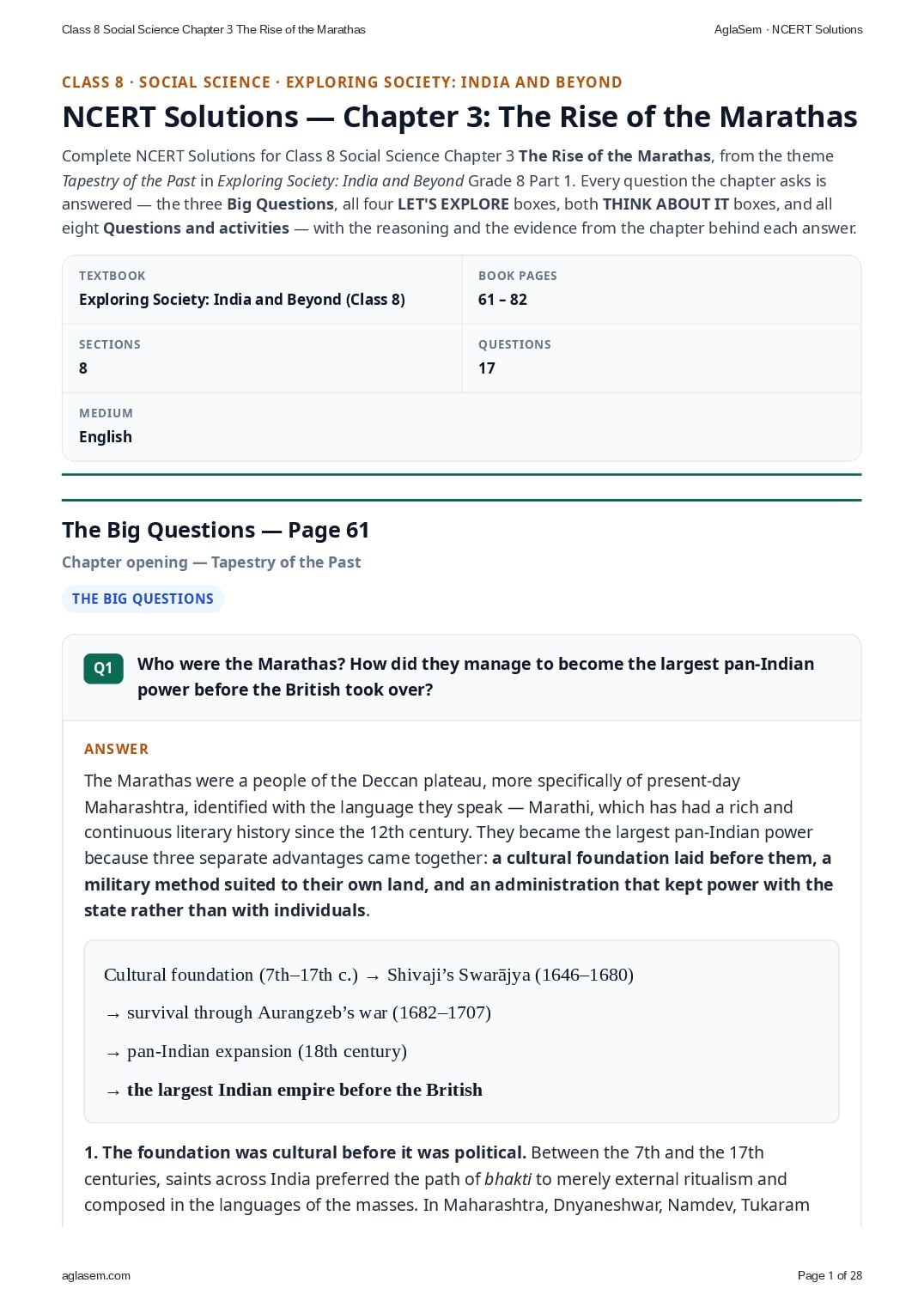
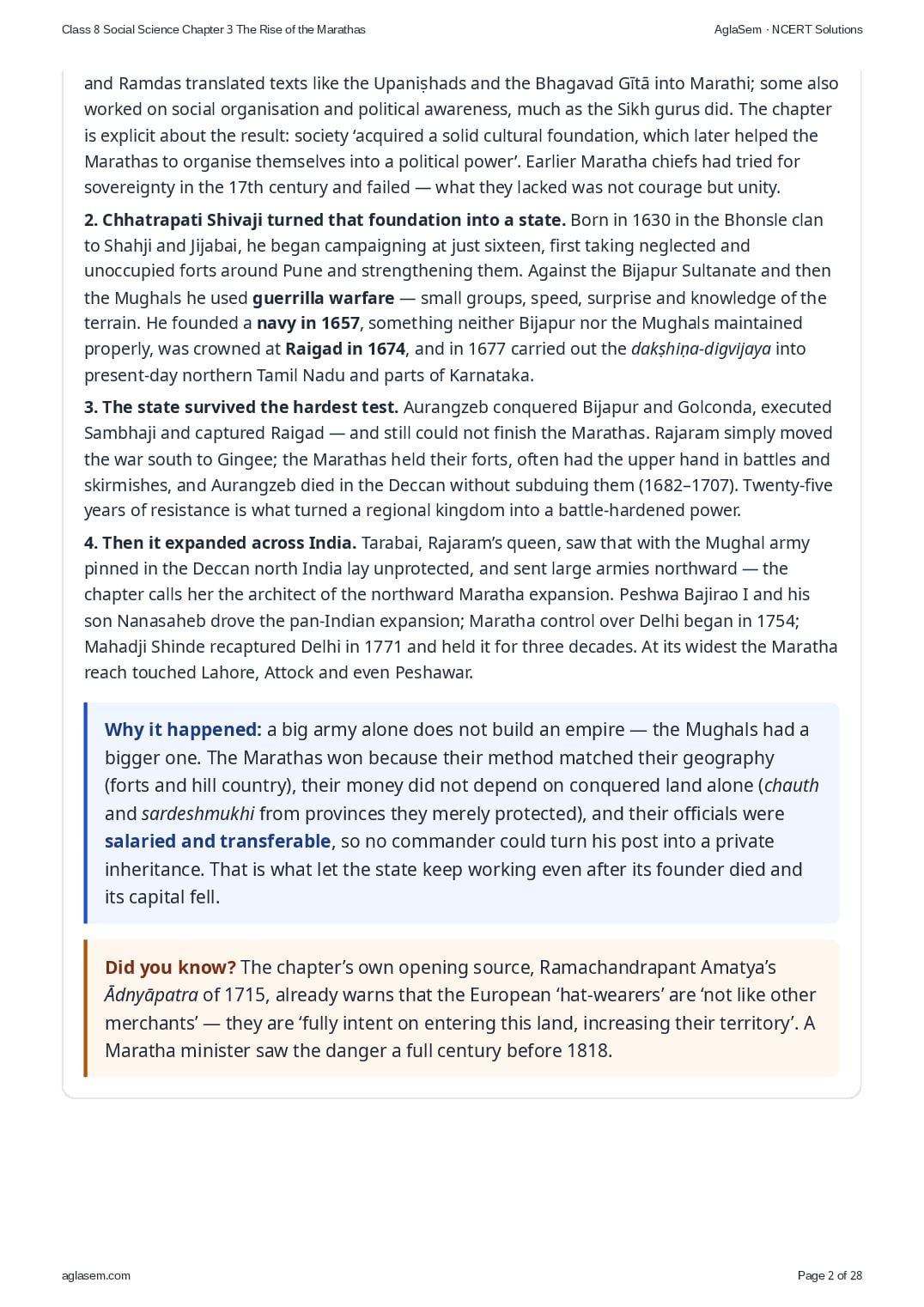
NCERT Solutions for Class 8 Social Science Chapter 3 PDF Download
You can read the NCERT Solutions for Class 8 Social Science Chapter 3 online above, or download the complete question-answer PDF to study The Rise of the Marathas offline at any time.
NCERT Solutions for Class 8 Social Science Chapter 3 PDF Download Link – Click Here to Download Solutions PDF
Questions Covered in This Chapter
These NCERT Solutions answer all 17 questions of this chapter. The questions solved are:
- Who were the Marathas? How did they manage to become the largest pan-Indian power before the British took over?
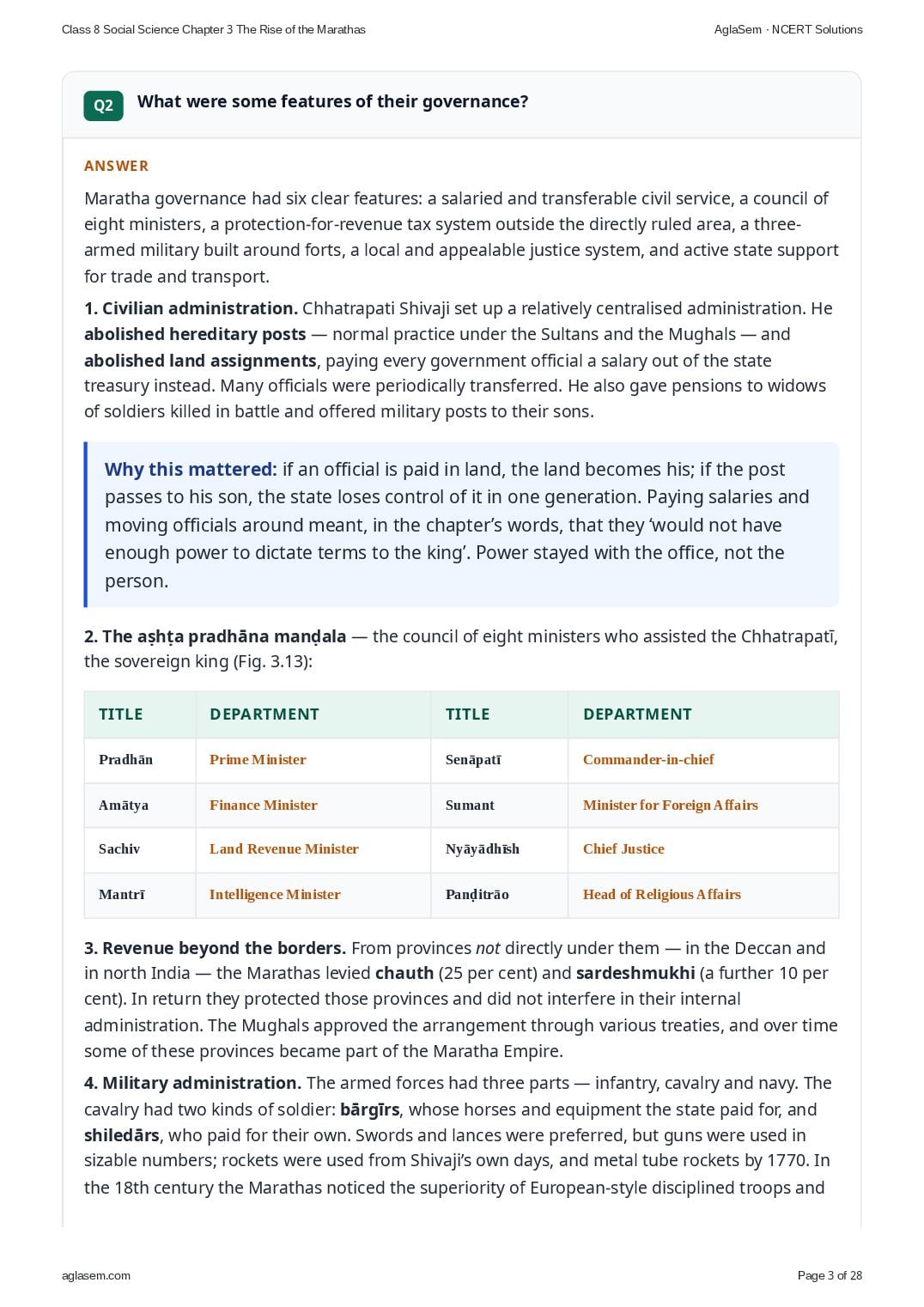
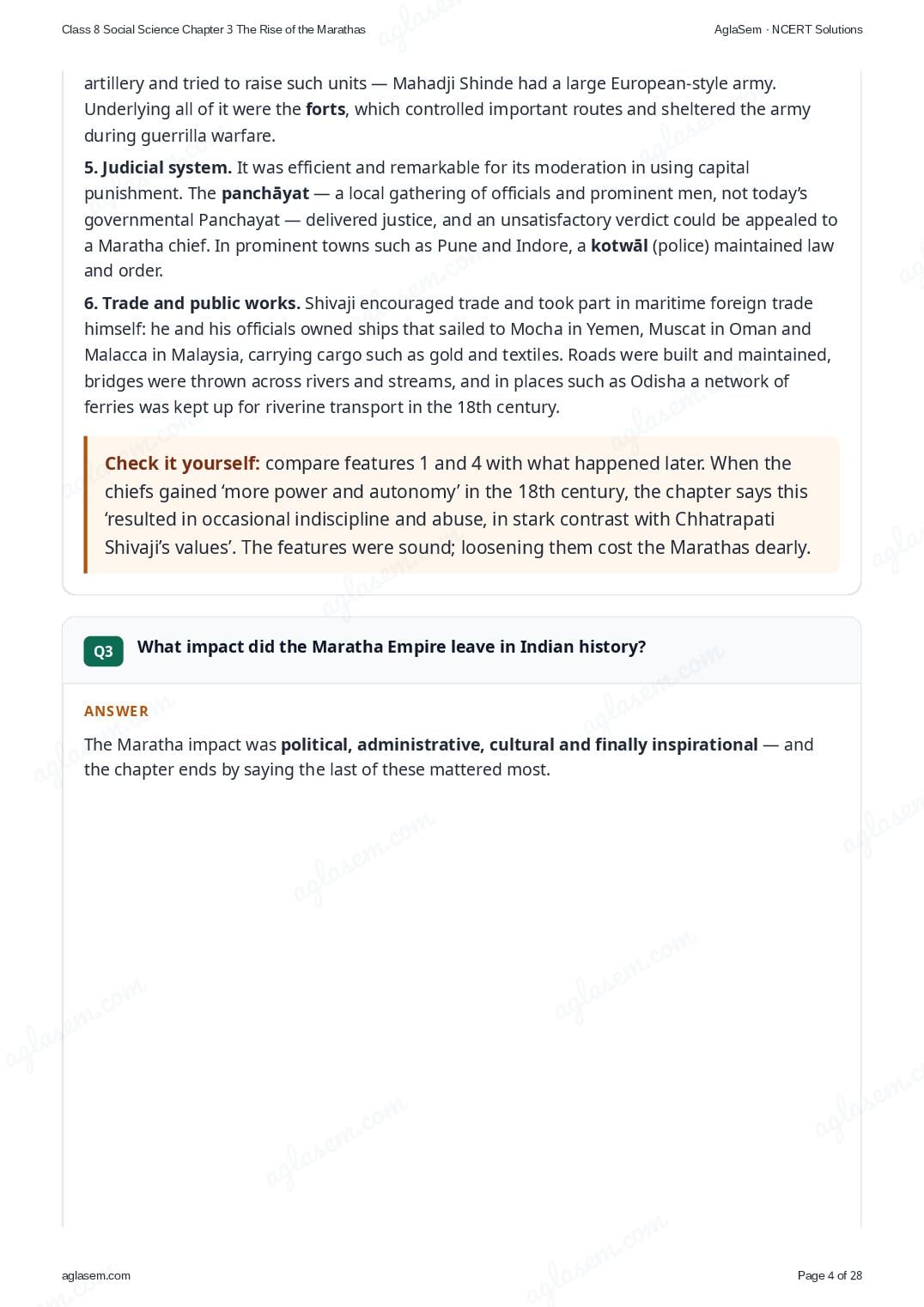
- What were some features of their governance?
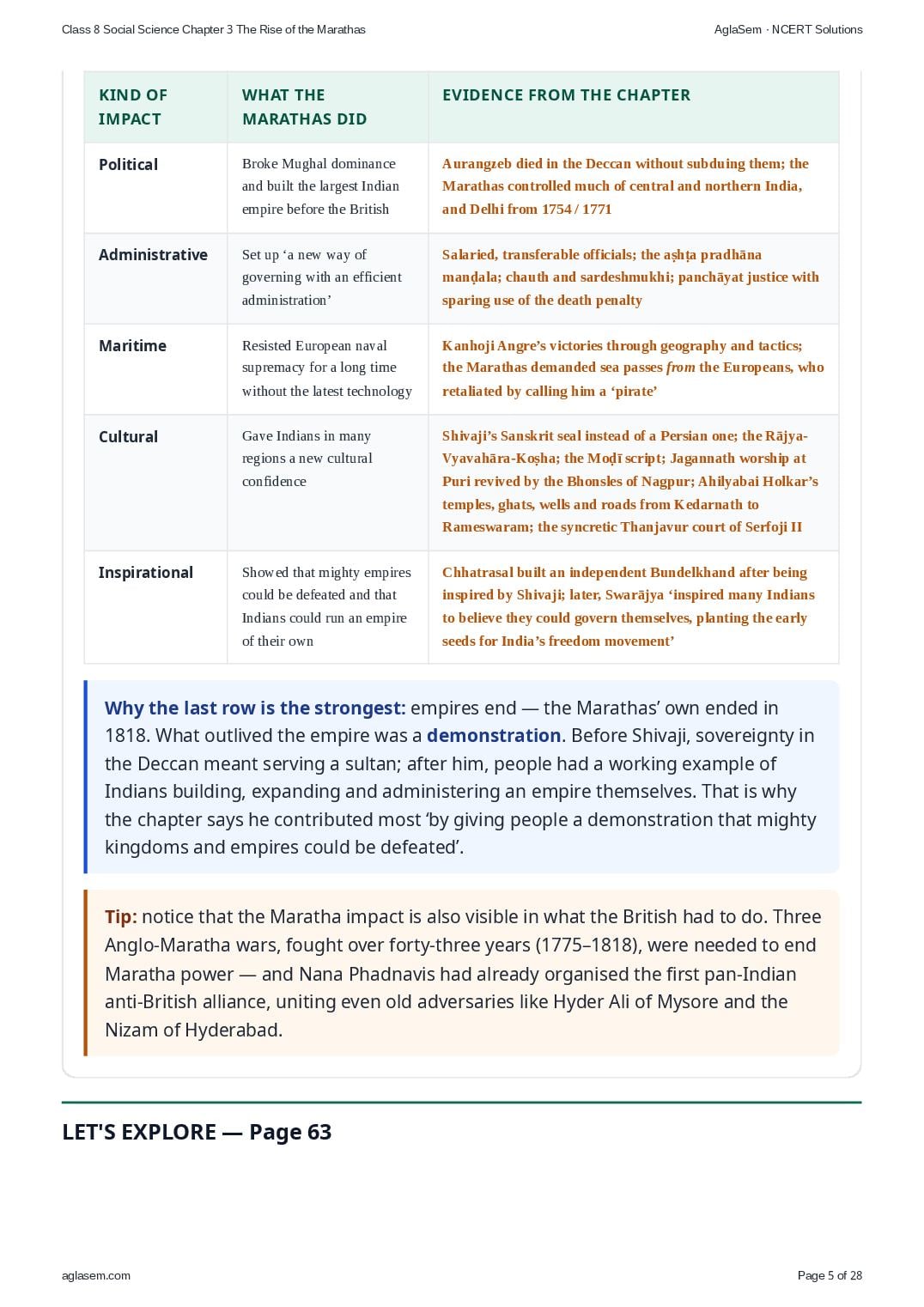
- What impact did the Maratha Empire leave in Indian history?
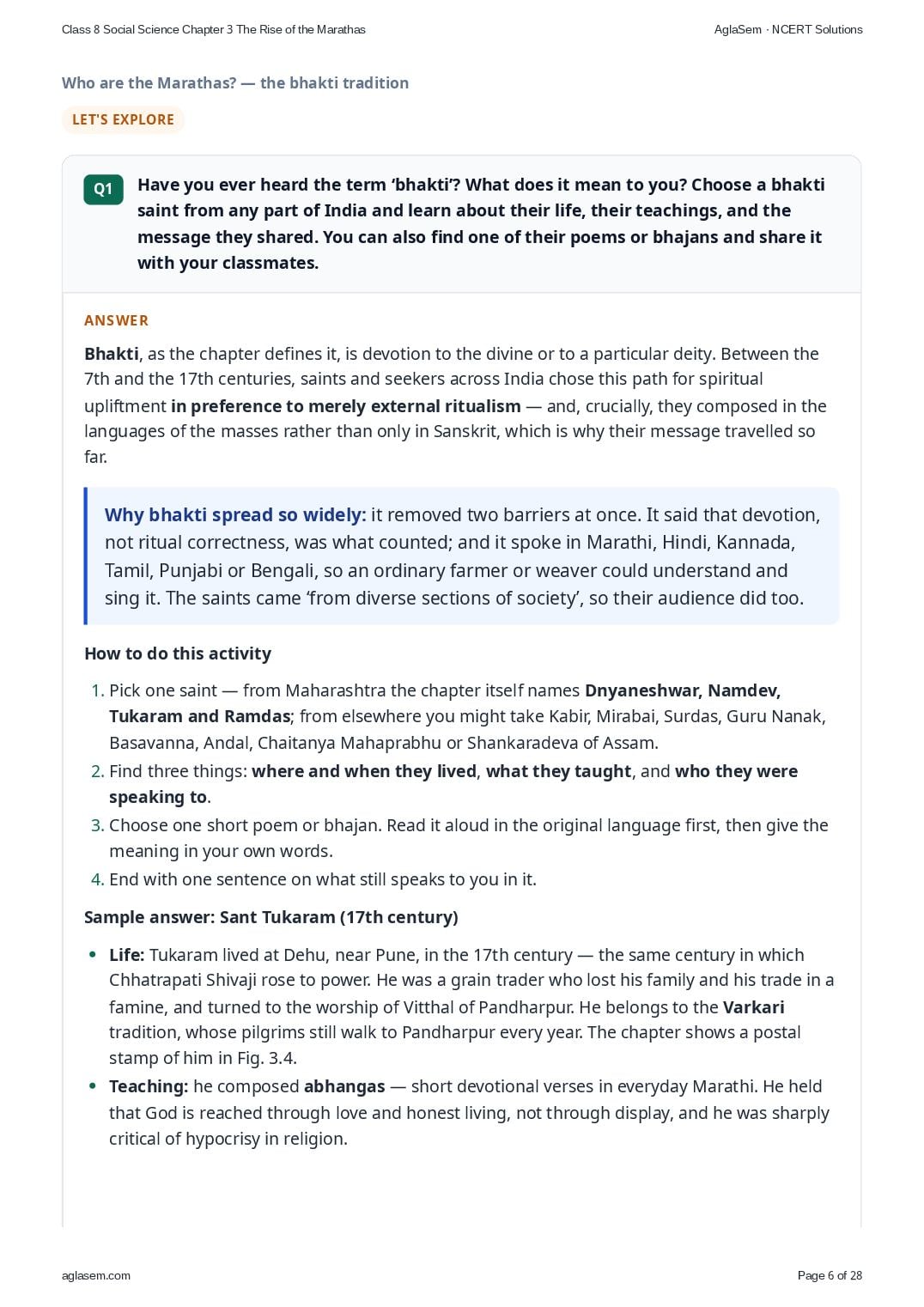
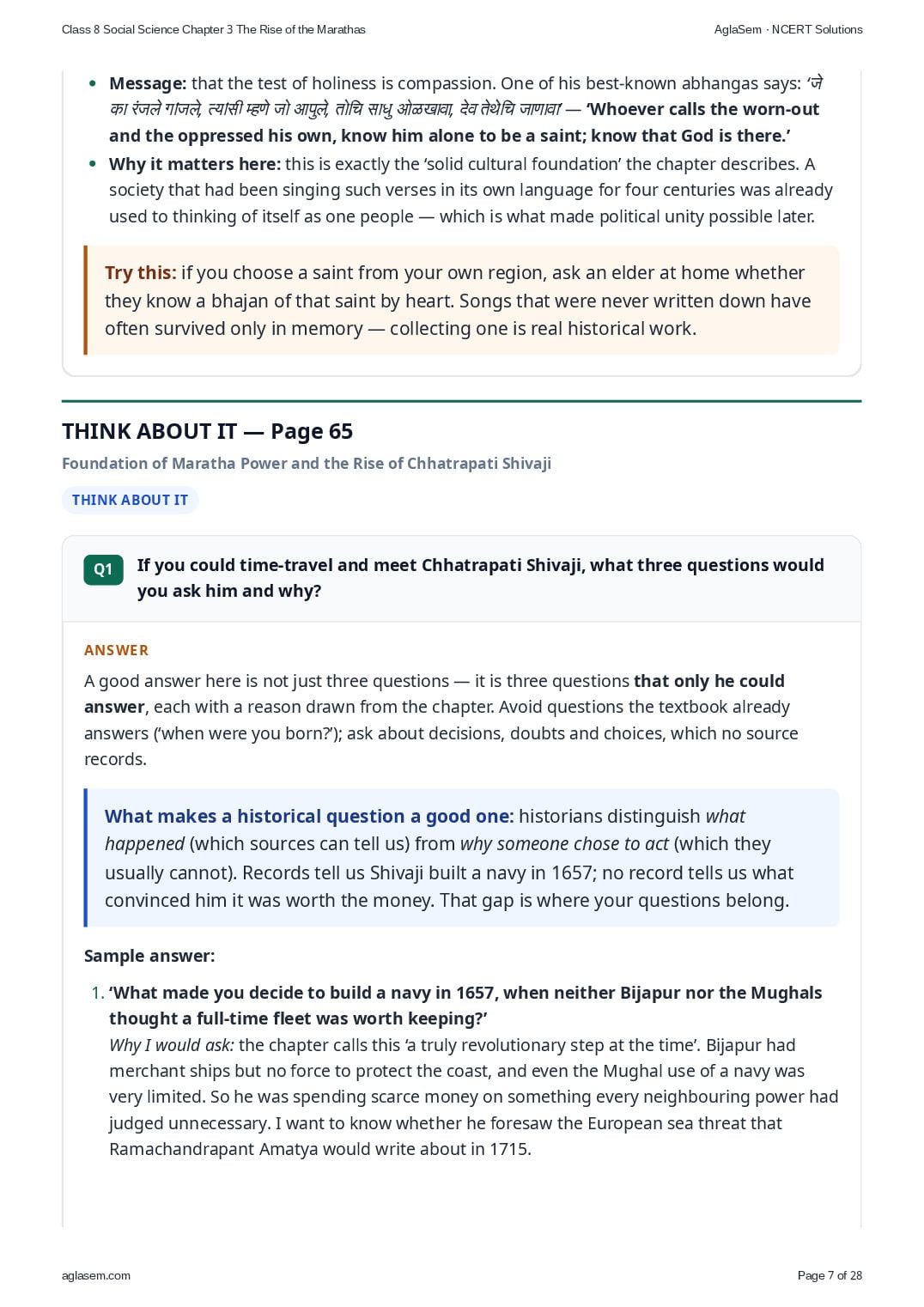
- Have you ever heard the term ‘bhakti’? What does it mean to you? Choose a bhakti saint from any part of India and learn about their life, their teachings, and the message they shared. You can also find one of their poems or bhajans and share it with your classmates.
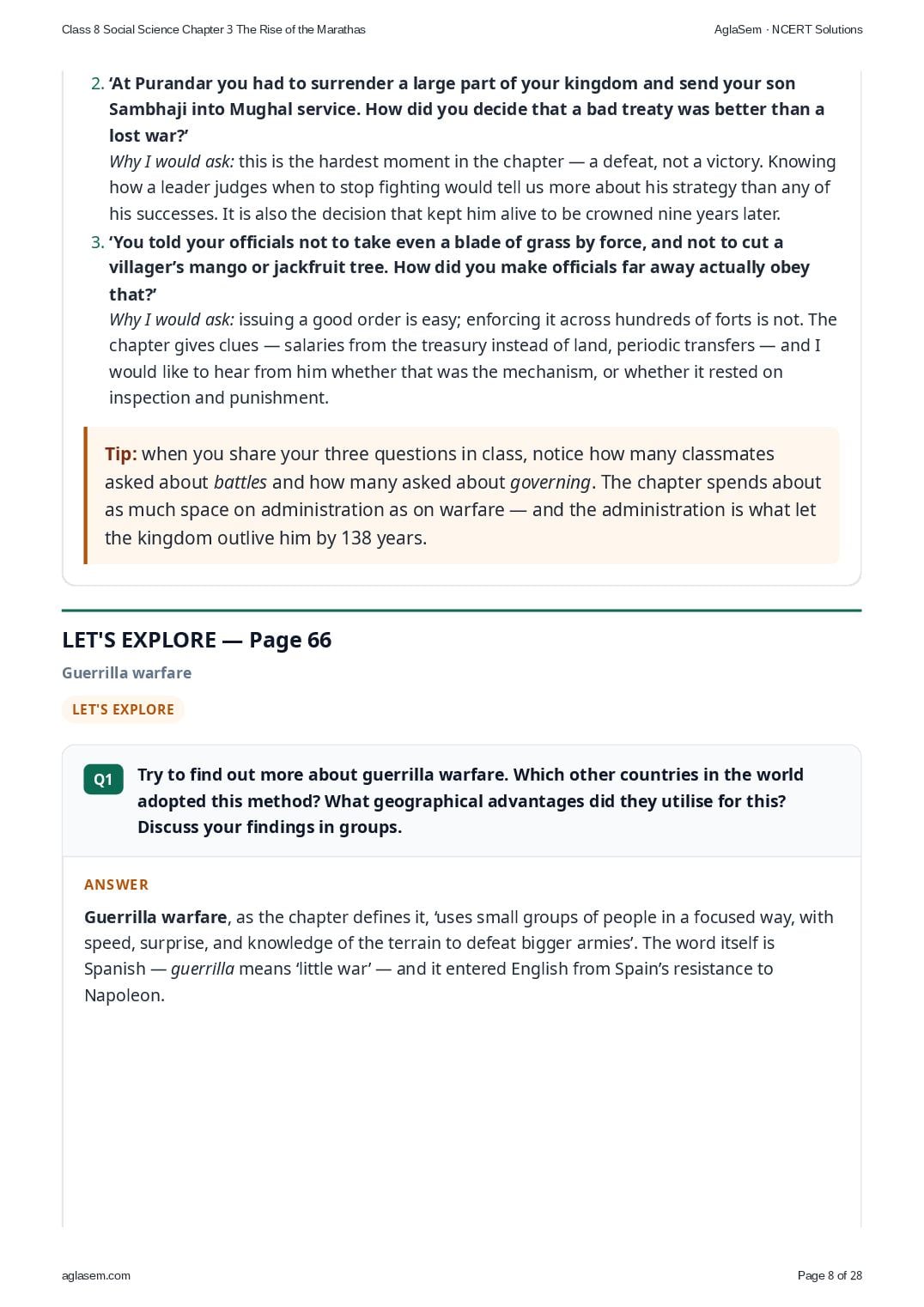
- If you could time-travel and meet Chhatrapati Shivaji, what three questions would you ask him and why?
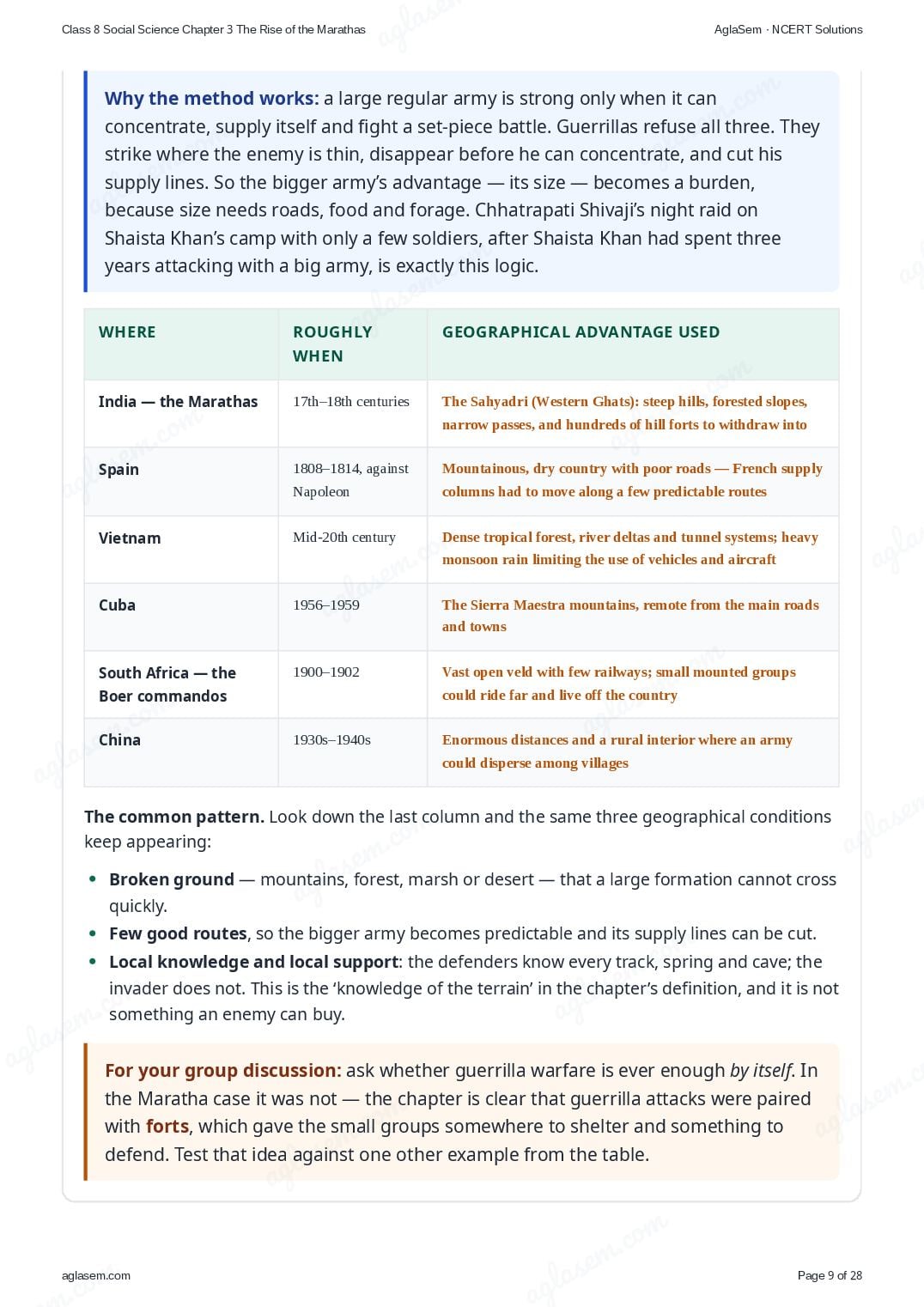
- Try to find out more about guerrilla warfare. Which other countries in the world adopted this method? What geographical advantages did they utilise for this? Discuss your findings in groups.
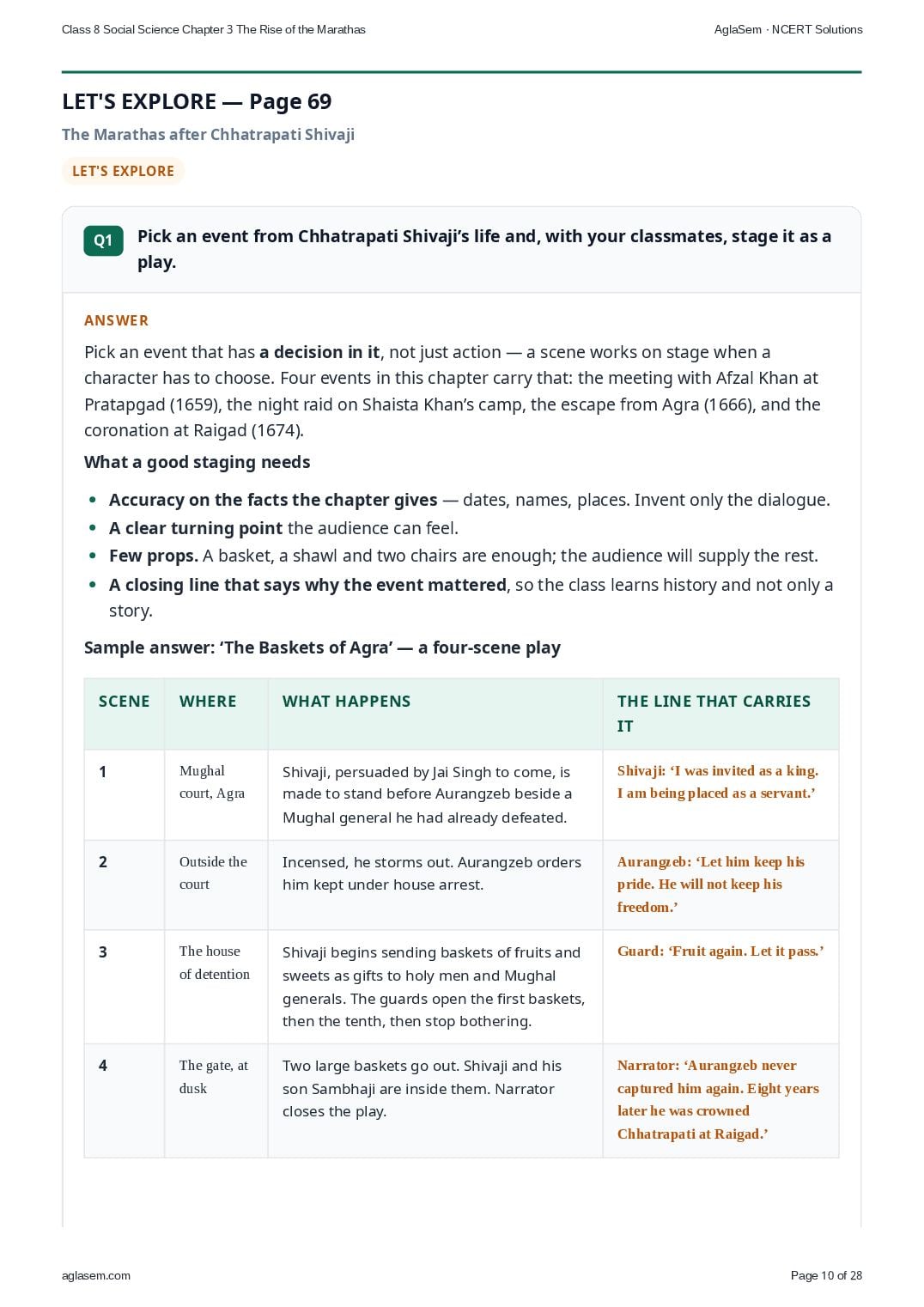
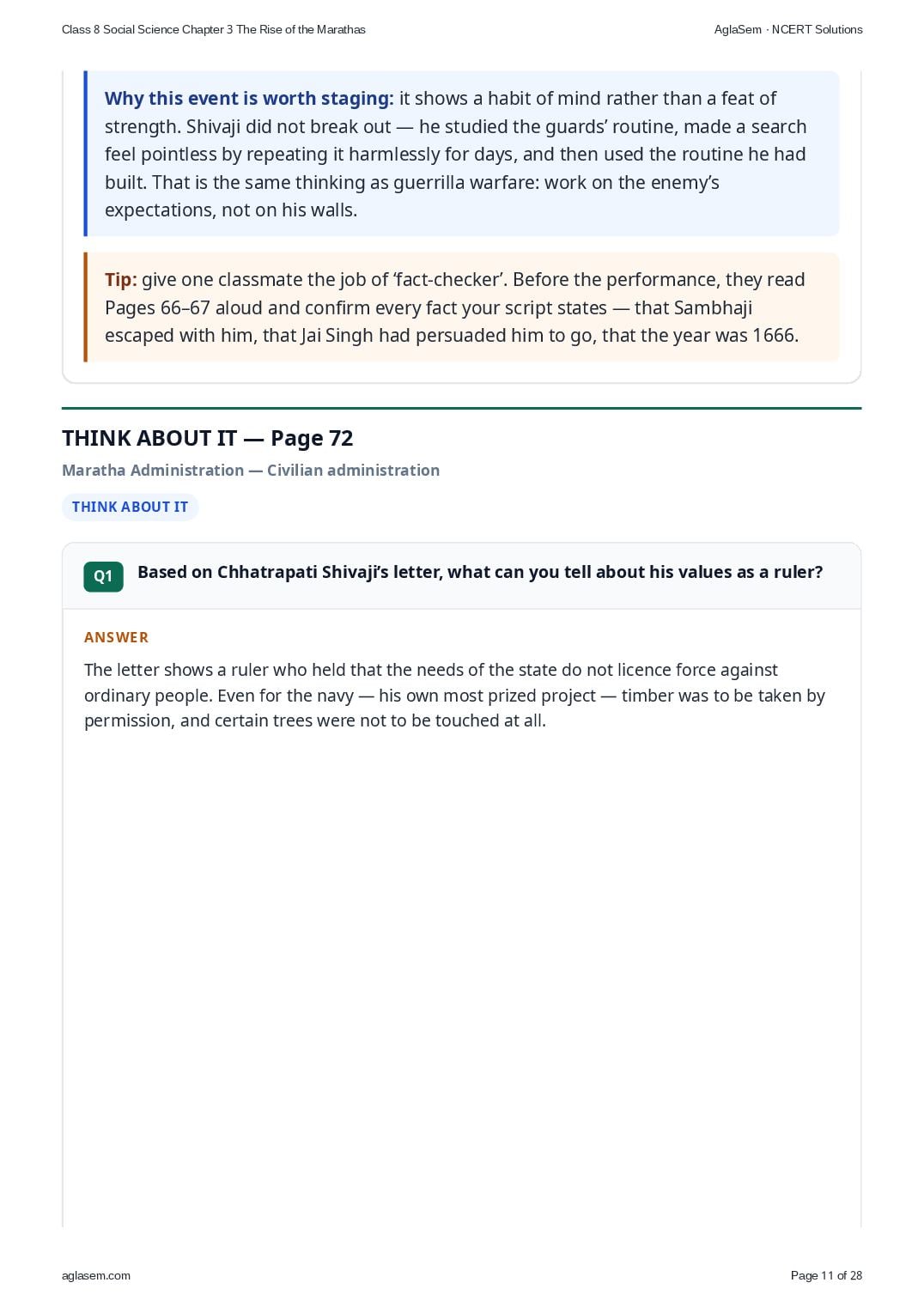
- Pick an event from Chhatrapati Shivaji’s life and, with your classmates, stage it as a play.
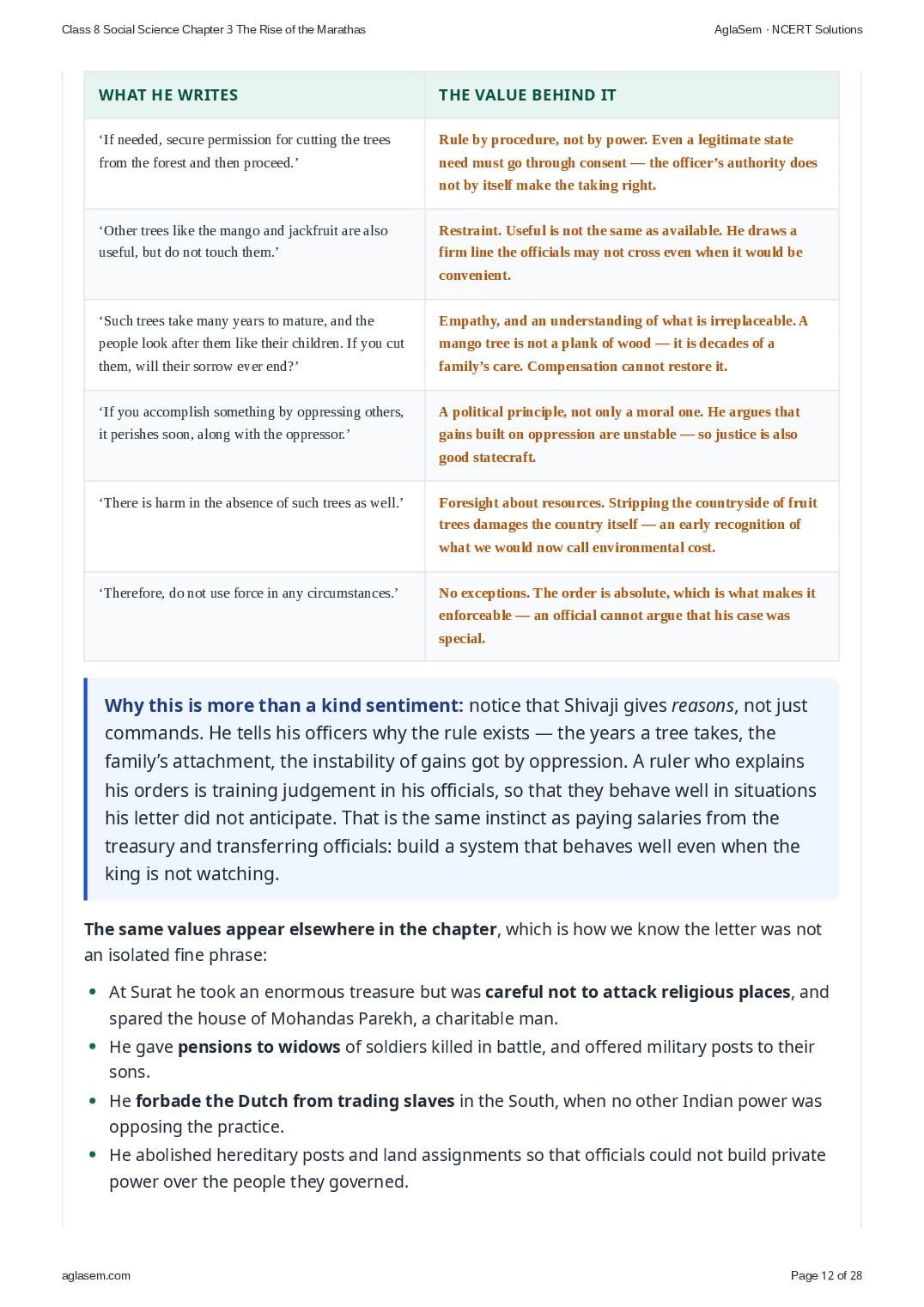
- Based on Chhatrapati Shivaji’s letter, what can you tell about his values as a ruler?
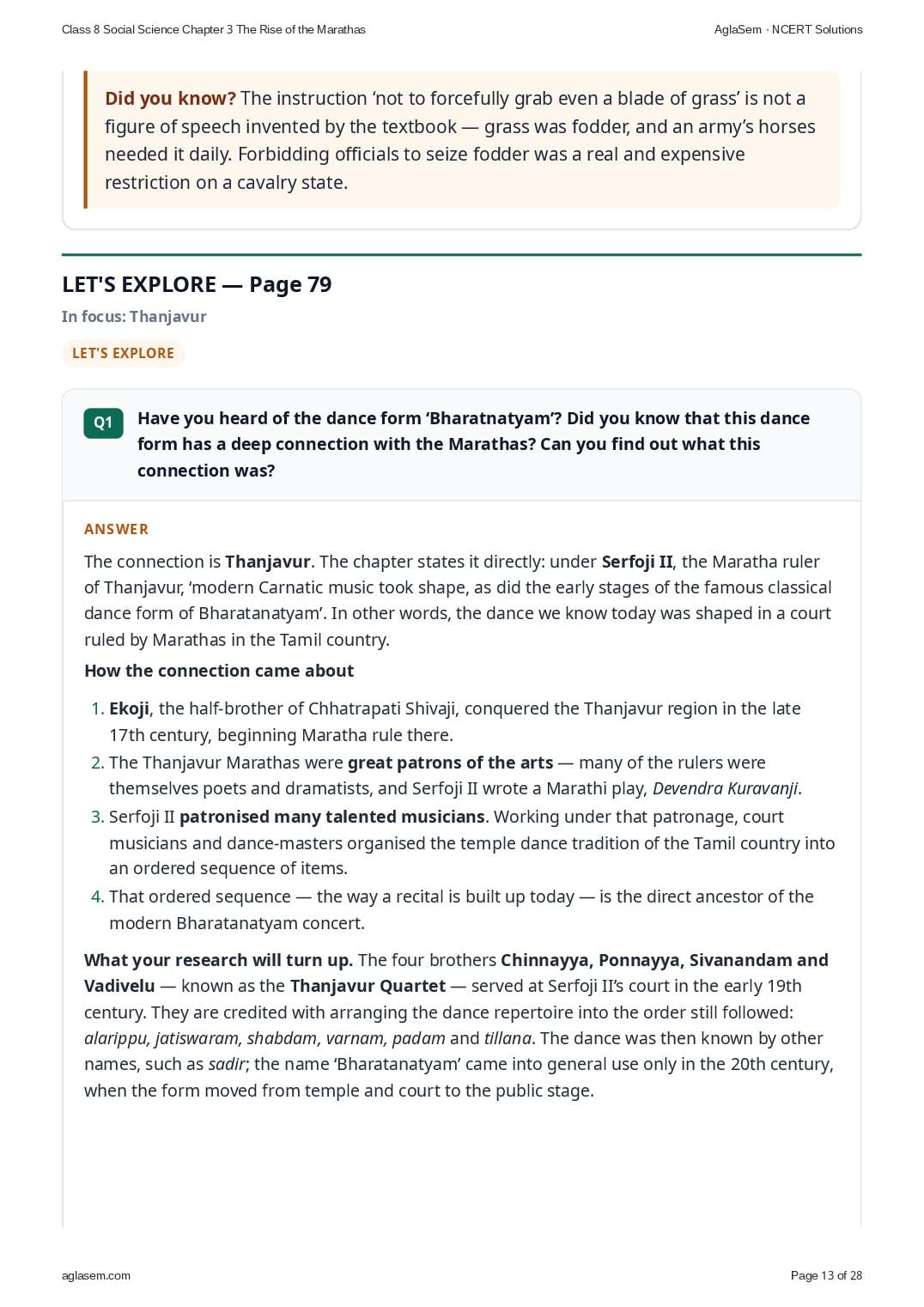
- Have you heard of the dance form ‘Bharatnatyam’? Did you know that this dance form has a deep connection with the Marathas? Can you find out what this connection was?
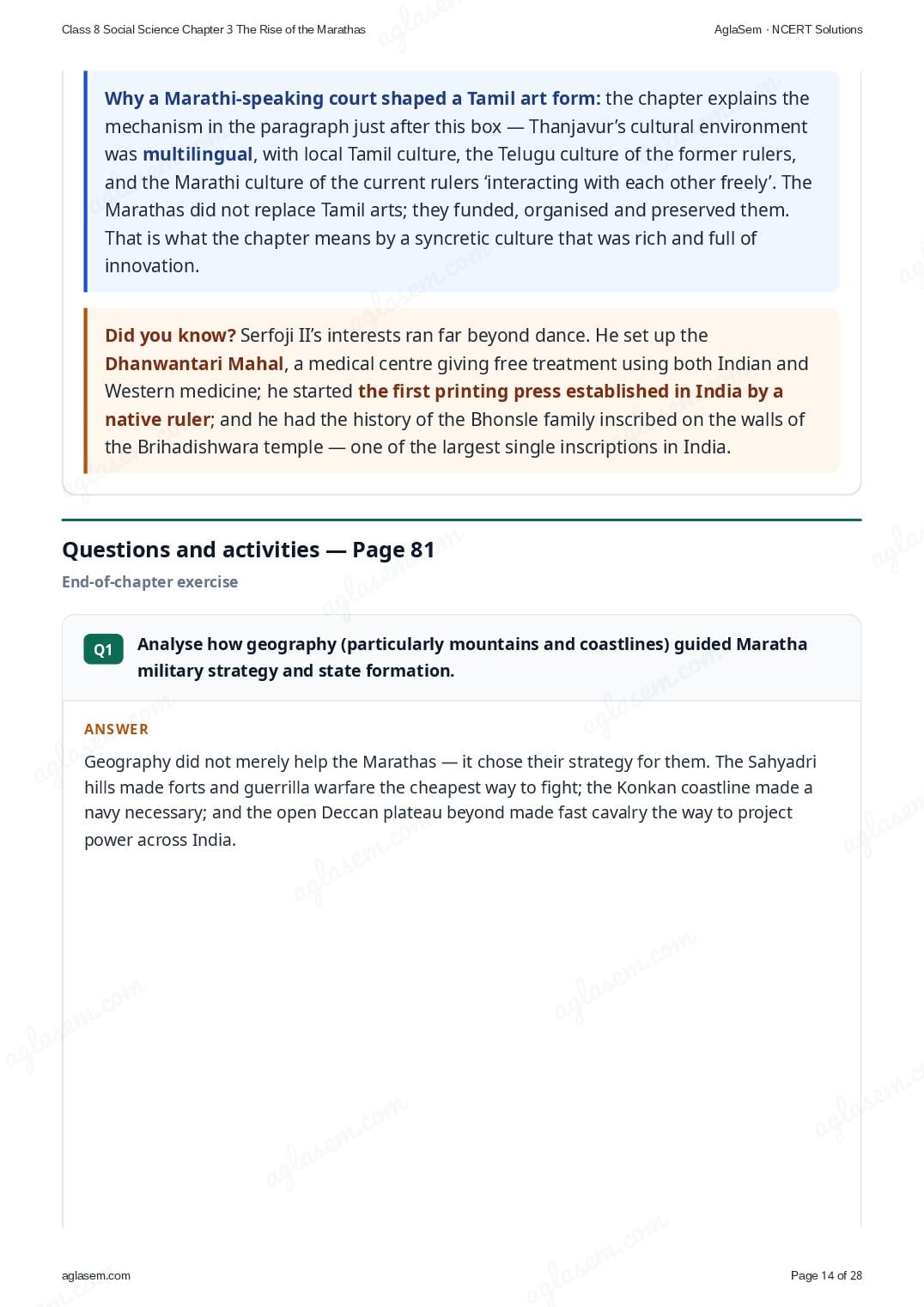
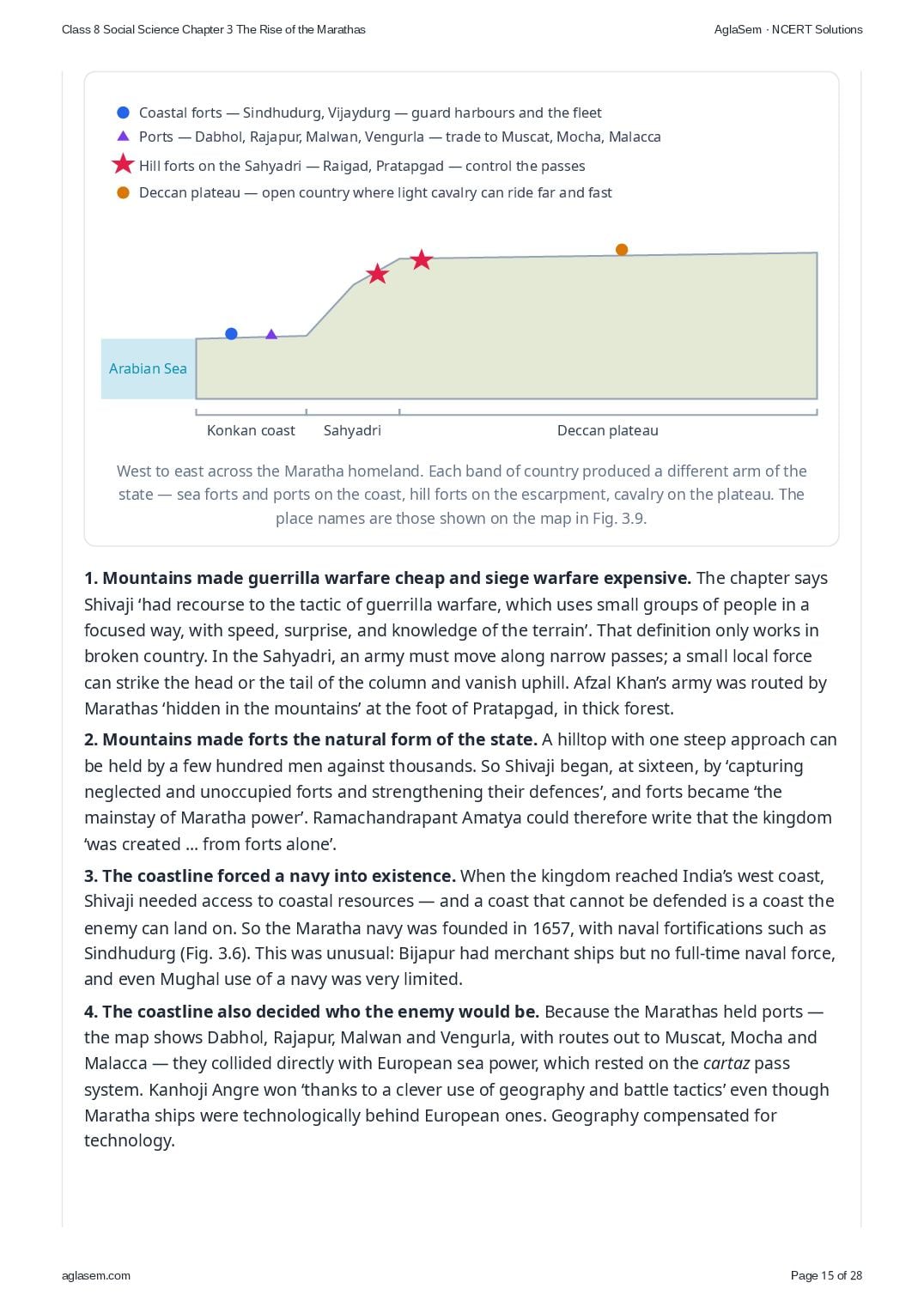
- Analyse how geography (particularly mountains and coastlines) guided Maratha military strategy and state formation.
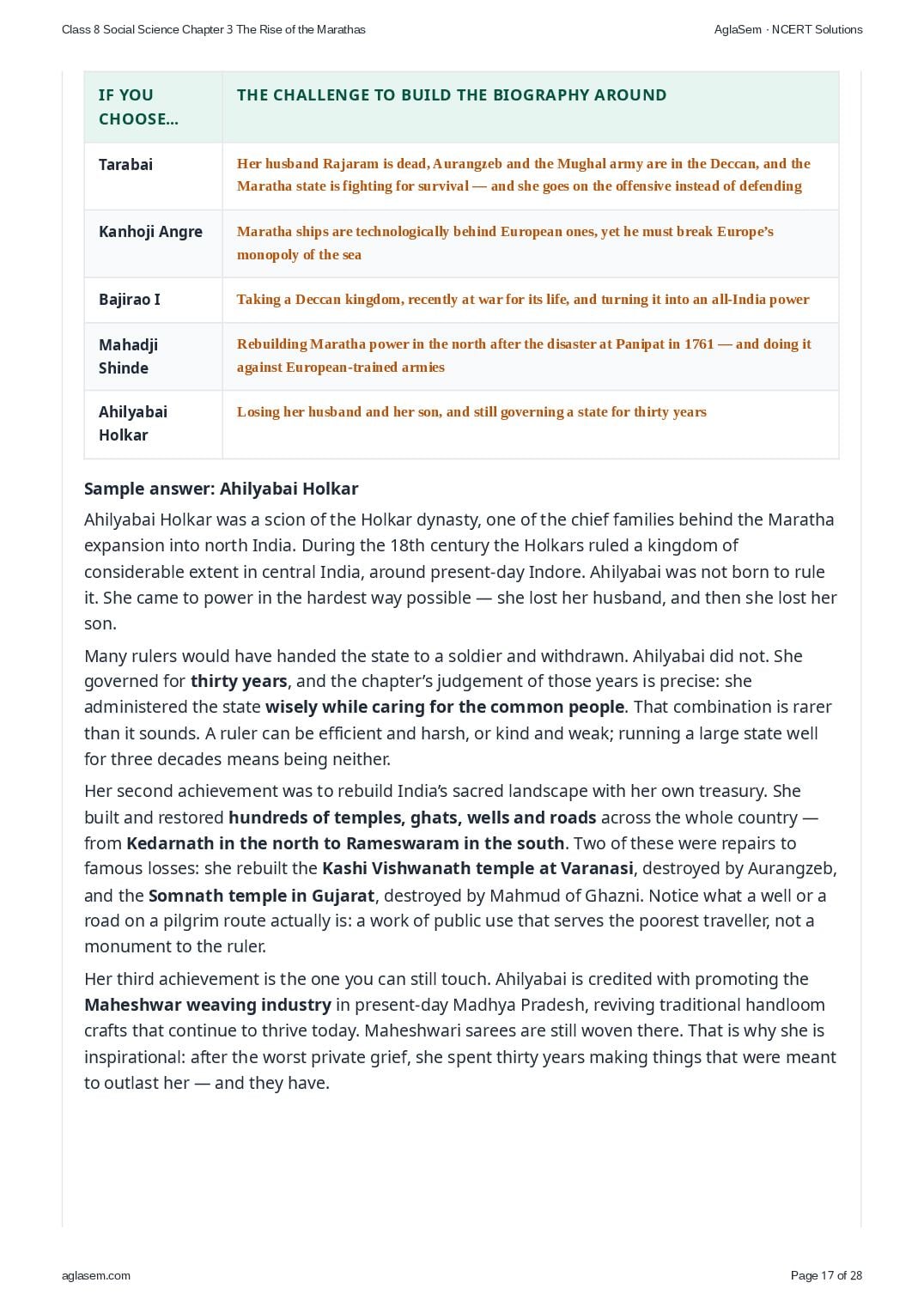
- Imagine you are creating a short biography of a Maratha leader for younger students. Choose one personality (Kanhoji Angre, Bajirao I, Mahadji Shinde, Ahilyabai Holkar or Tarabai) and write 3–4 paragraphs highlighting what makes them inspirational. Include at least one challenge they overcame.
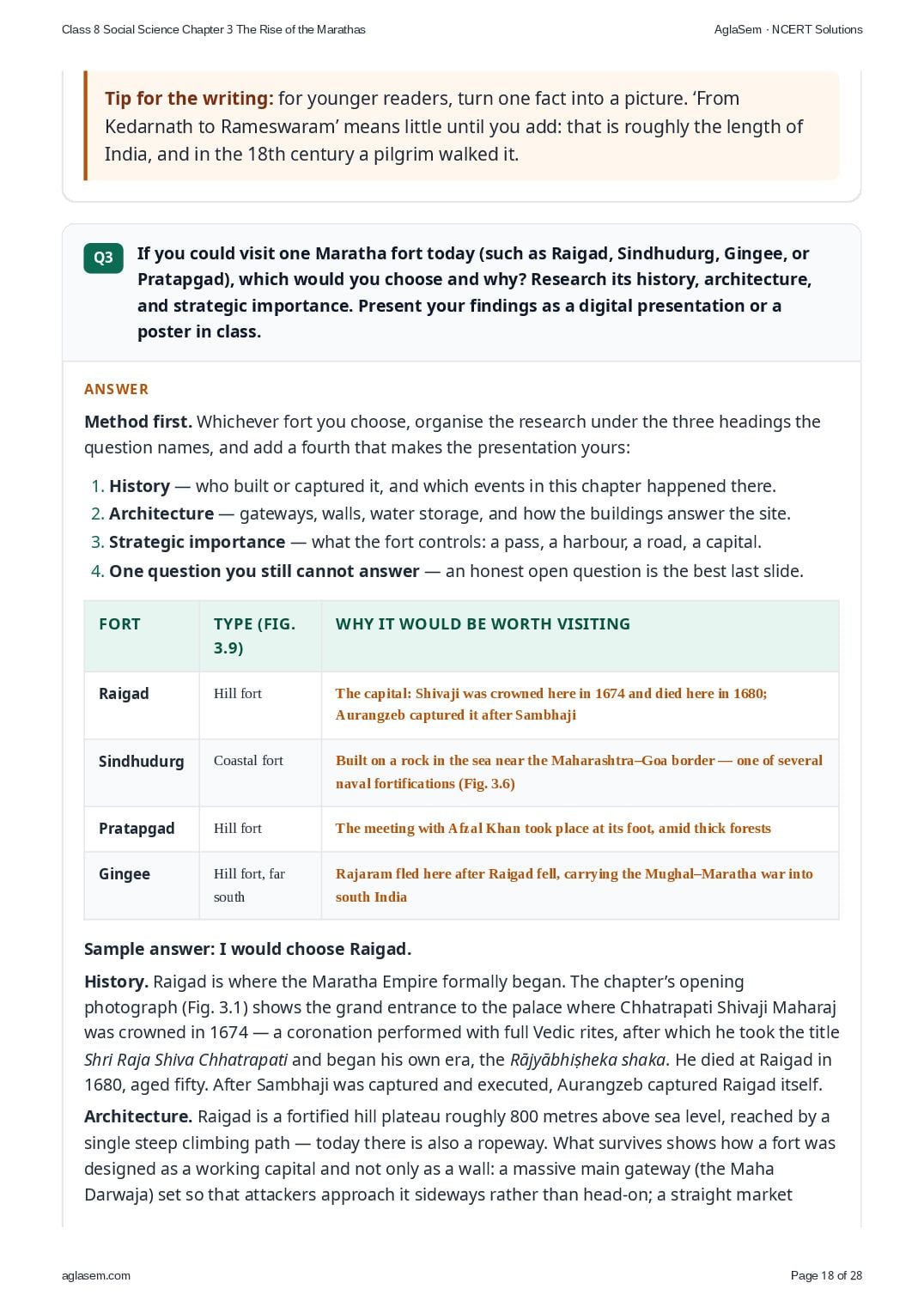
- If you could visit one Maratha fort today (such as Raigad, Sindhudurg, Gingee, or Pratapgad), which would you choose and why? Research its history, architecture, and strategic importance. Present your findings as a digital presentation or a poster in class.
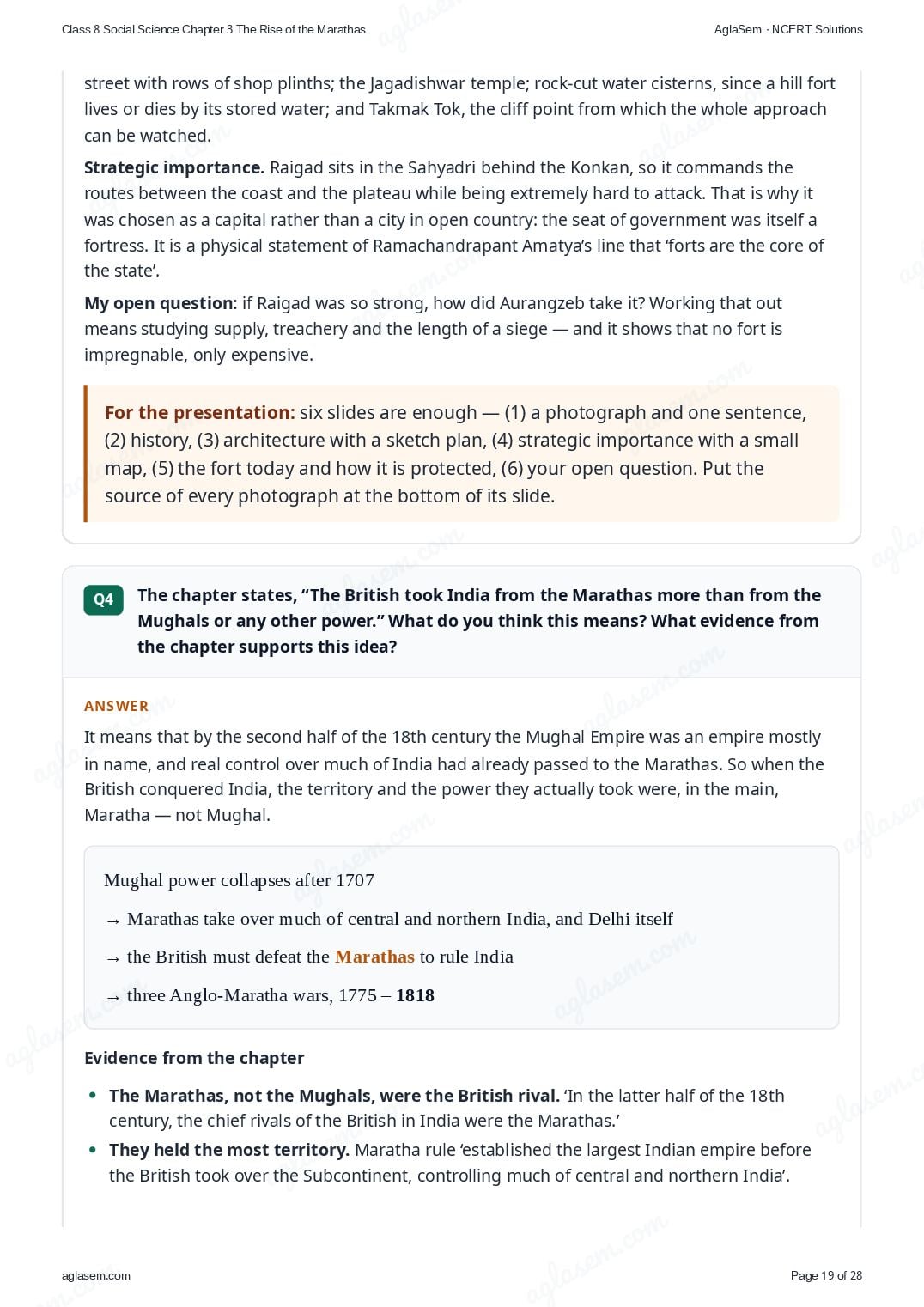
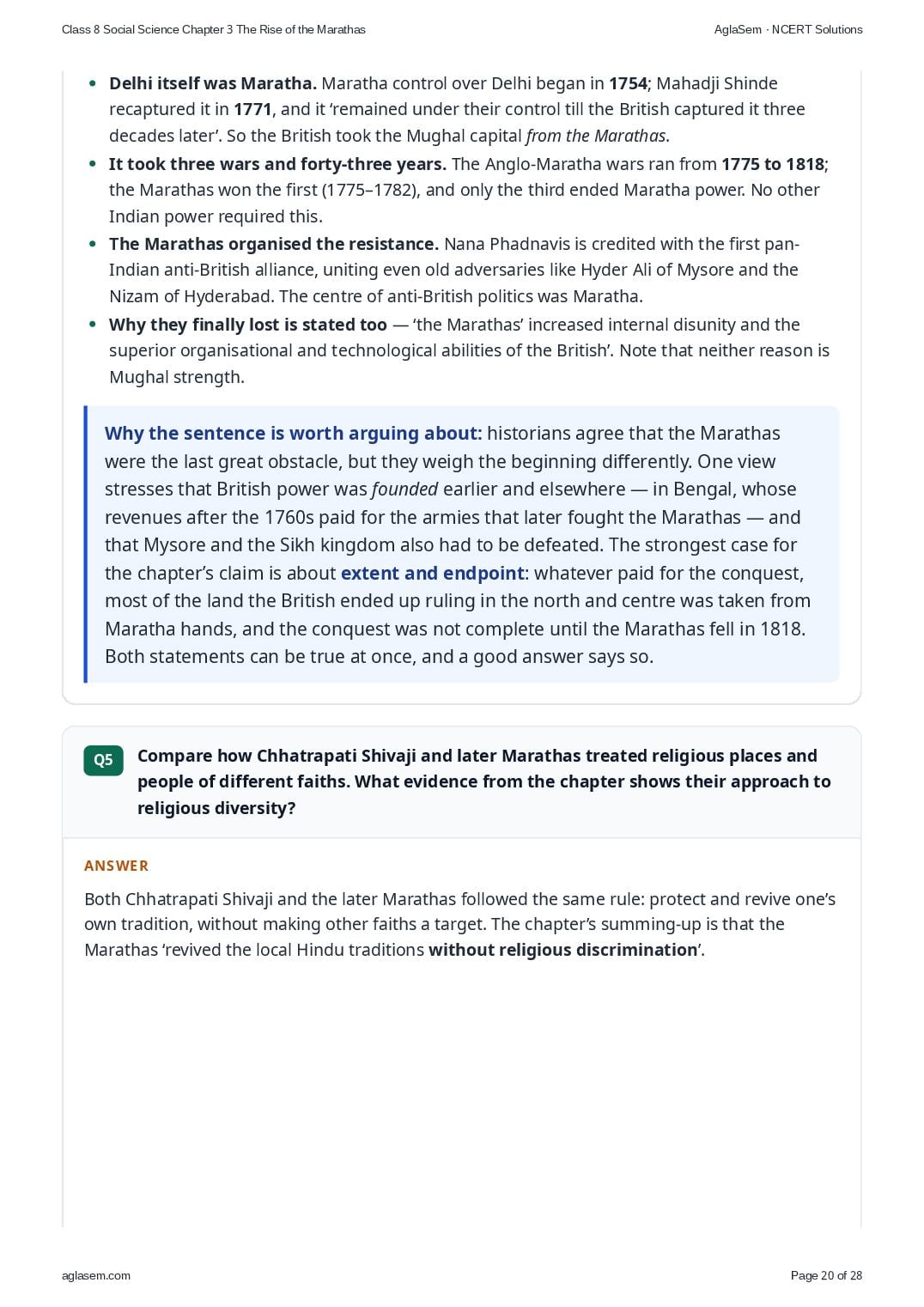
- The chapter states, “The British took India from the Marathas more than from the Mughals or any other power.” What do you think this means? What evidence from the chapter supports this idea?
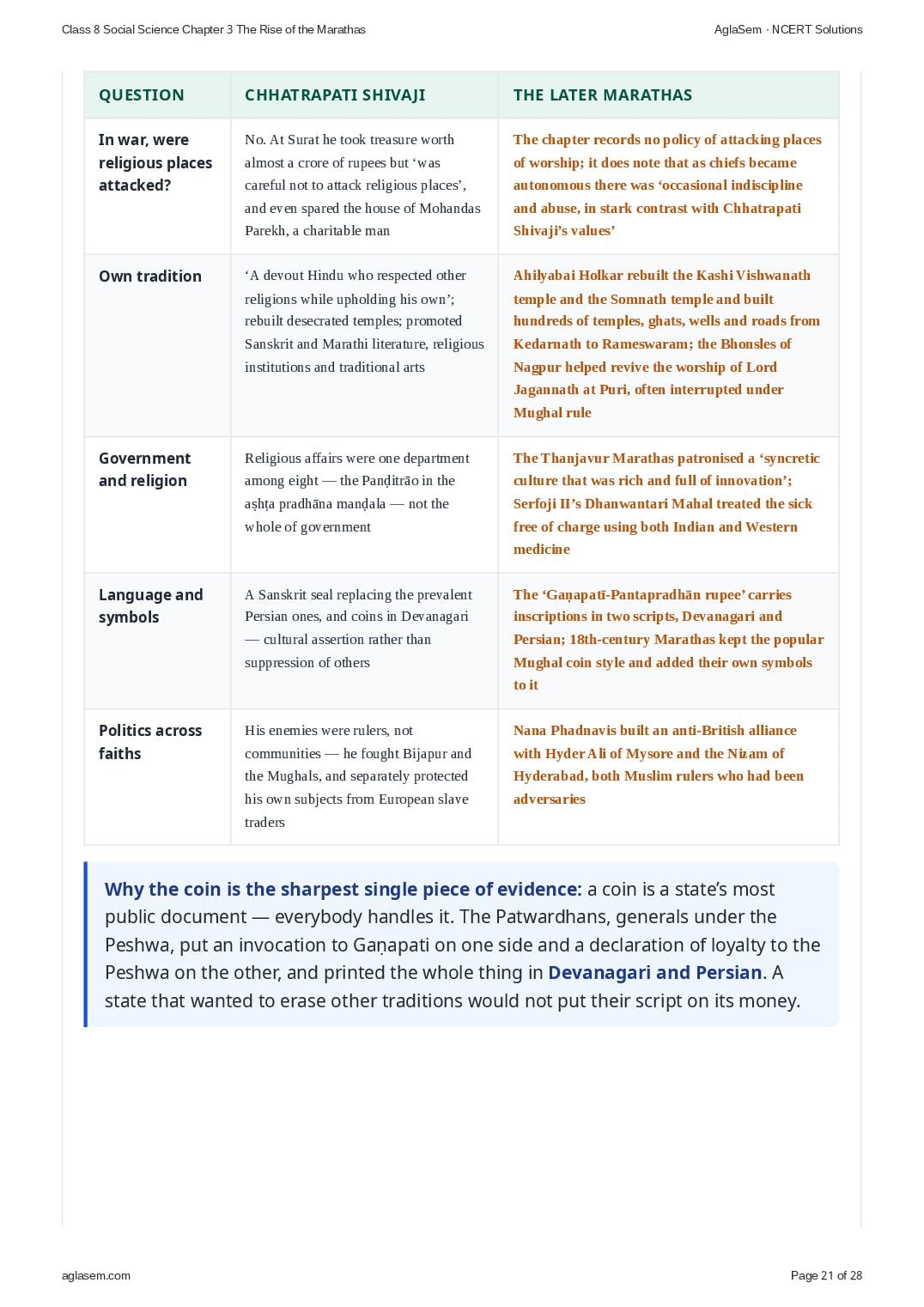
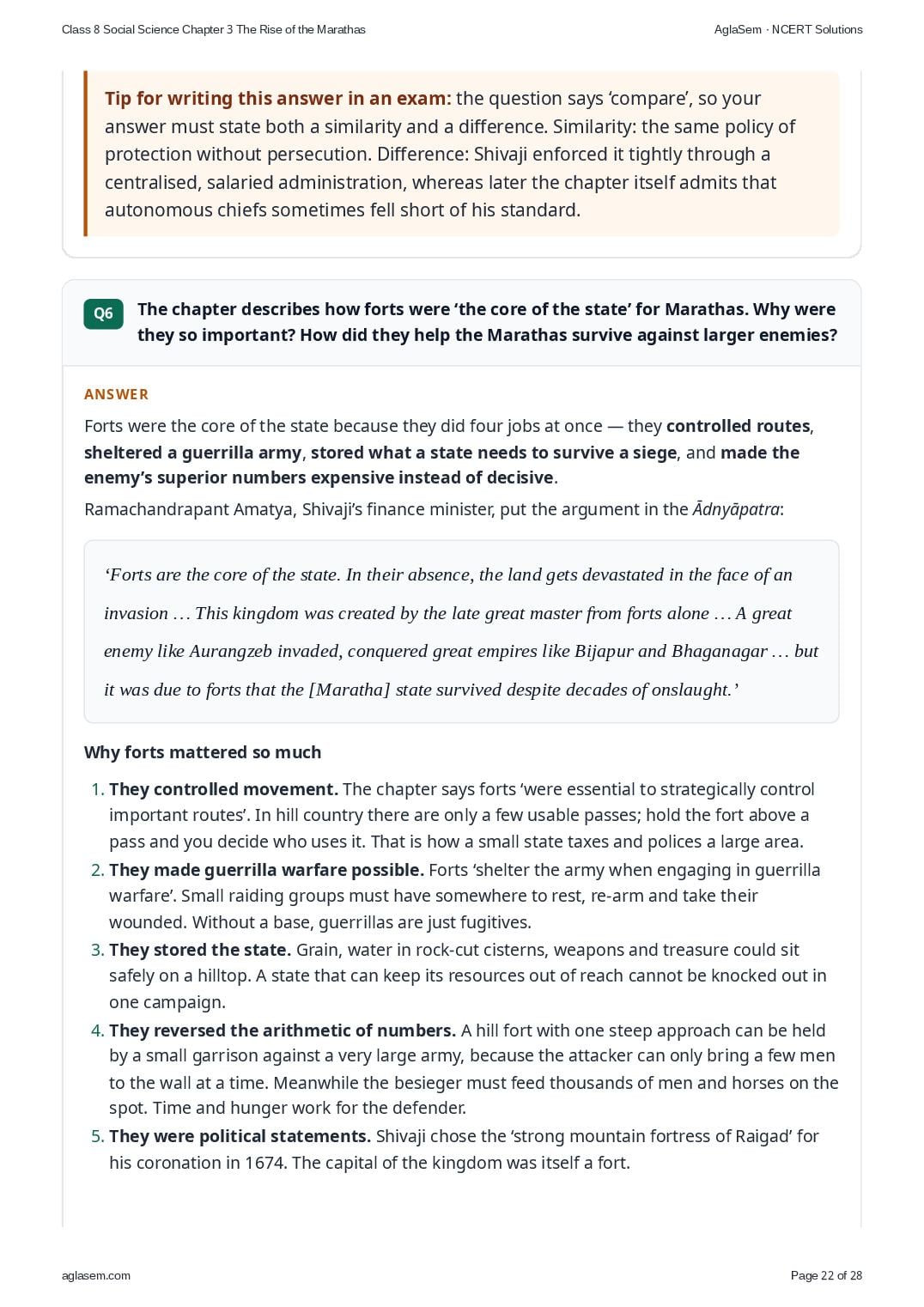
- Compare how Chhatrapati Shivaji and later Marathas treated religious places and people of different faiths. What evidence from the chapter shows their approach to religious diversity?
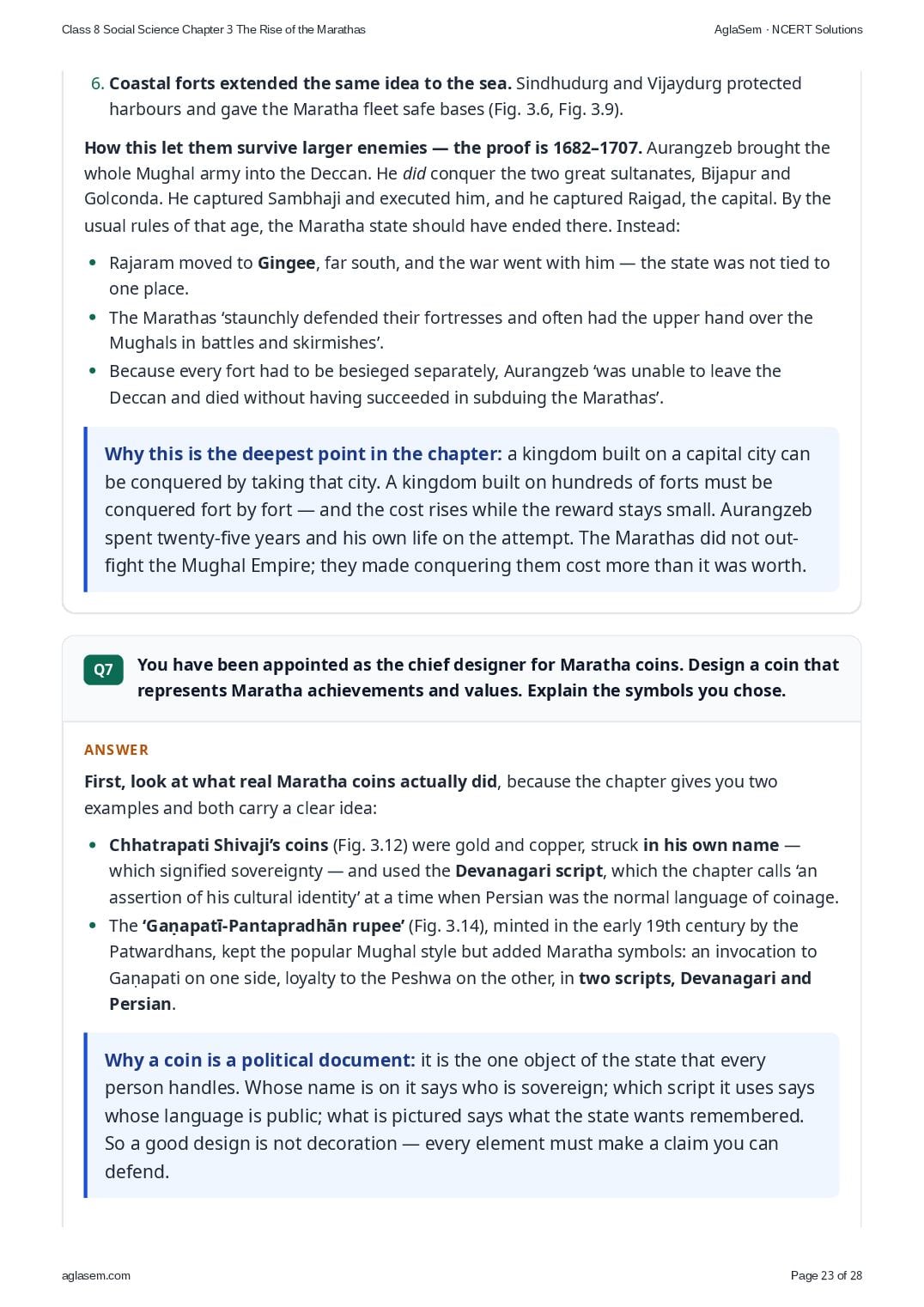
- The chapter describes how forts were ‘the core of the state’ for Marathas. Why were they so important? How did they help the Marathas survive against larger enemies?
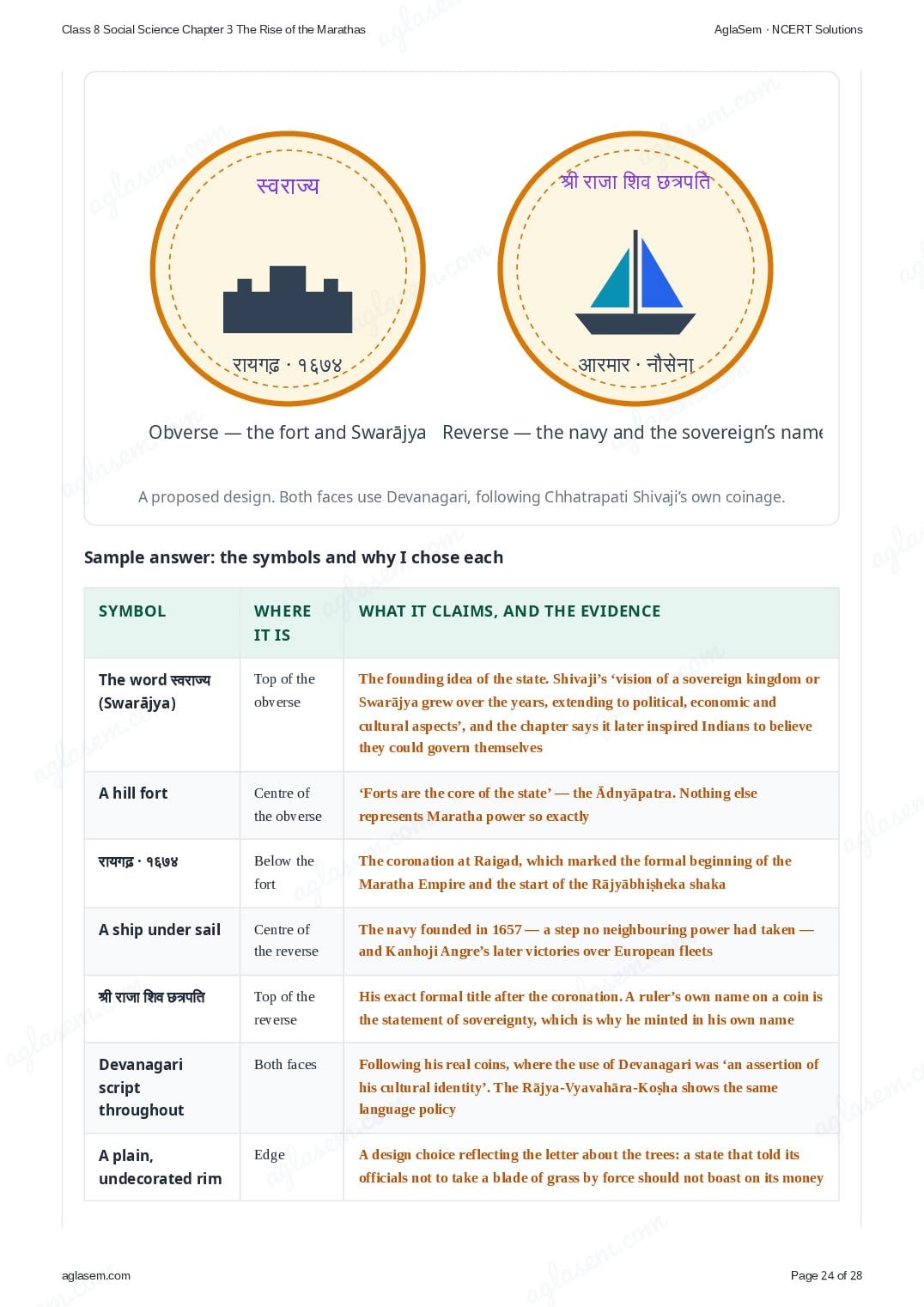
- You have been appointed as the chief designer for Maratha coins. Design a coin that represents Maratha achievements and values. Explain the symbols you chose.
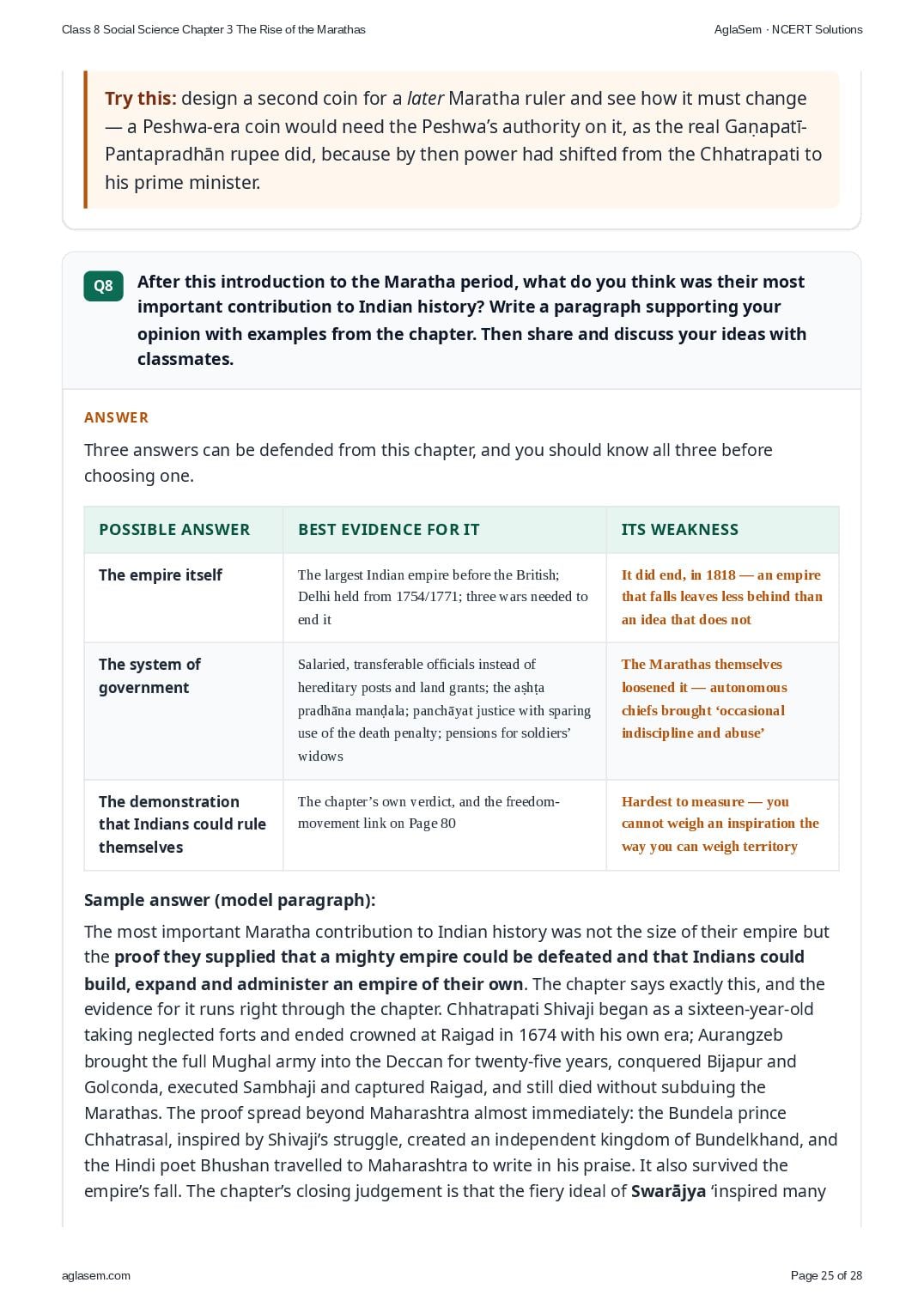
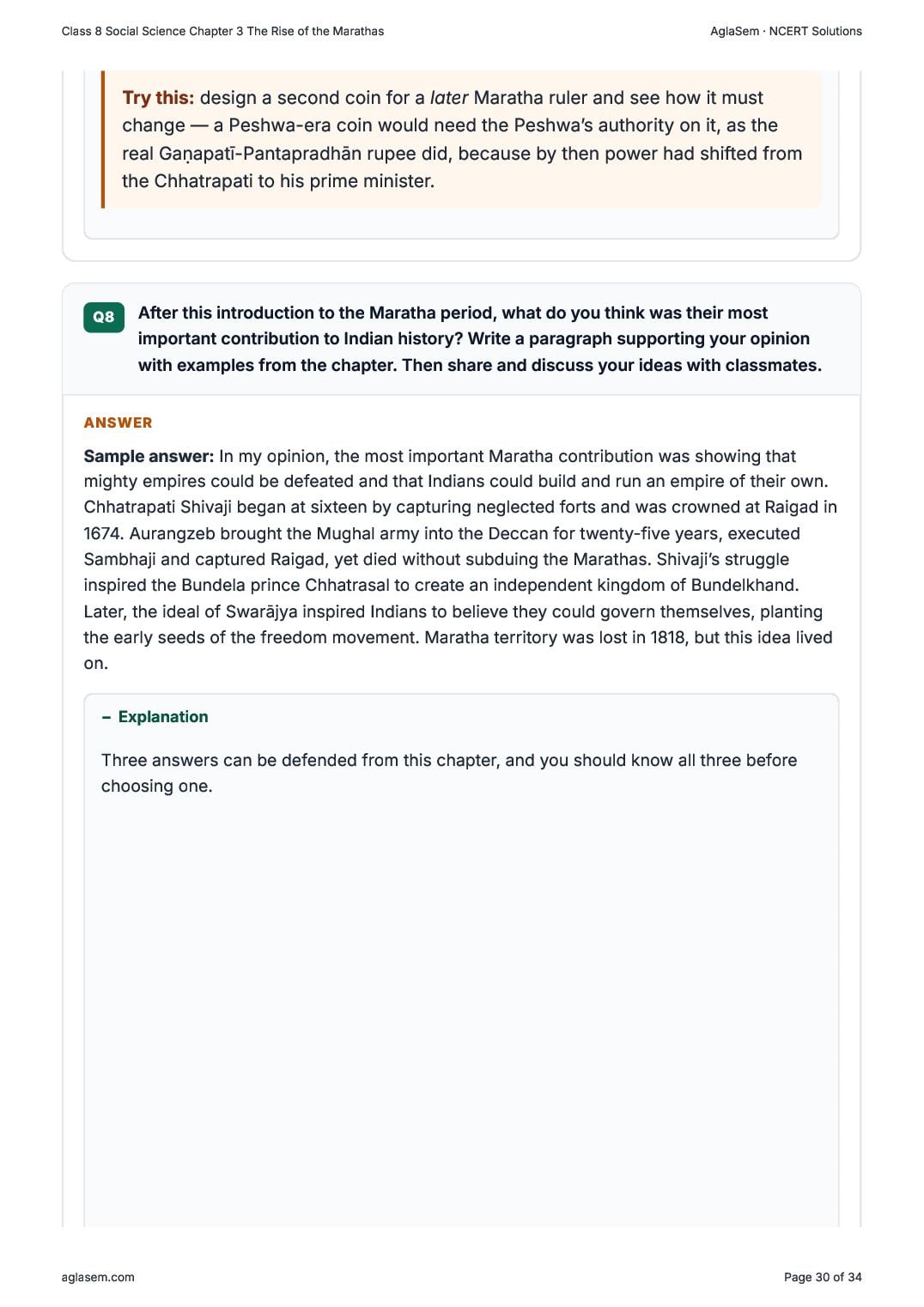
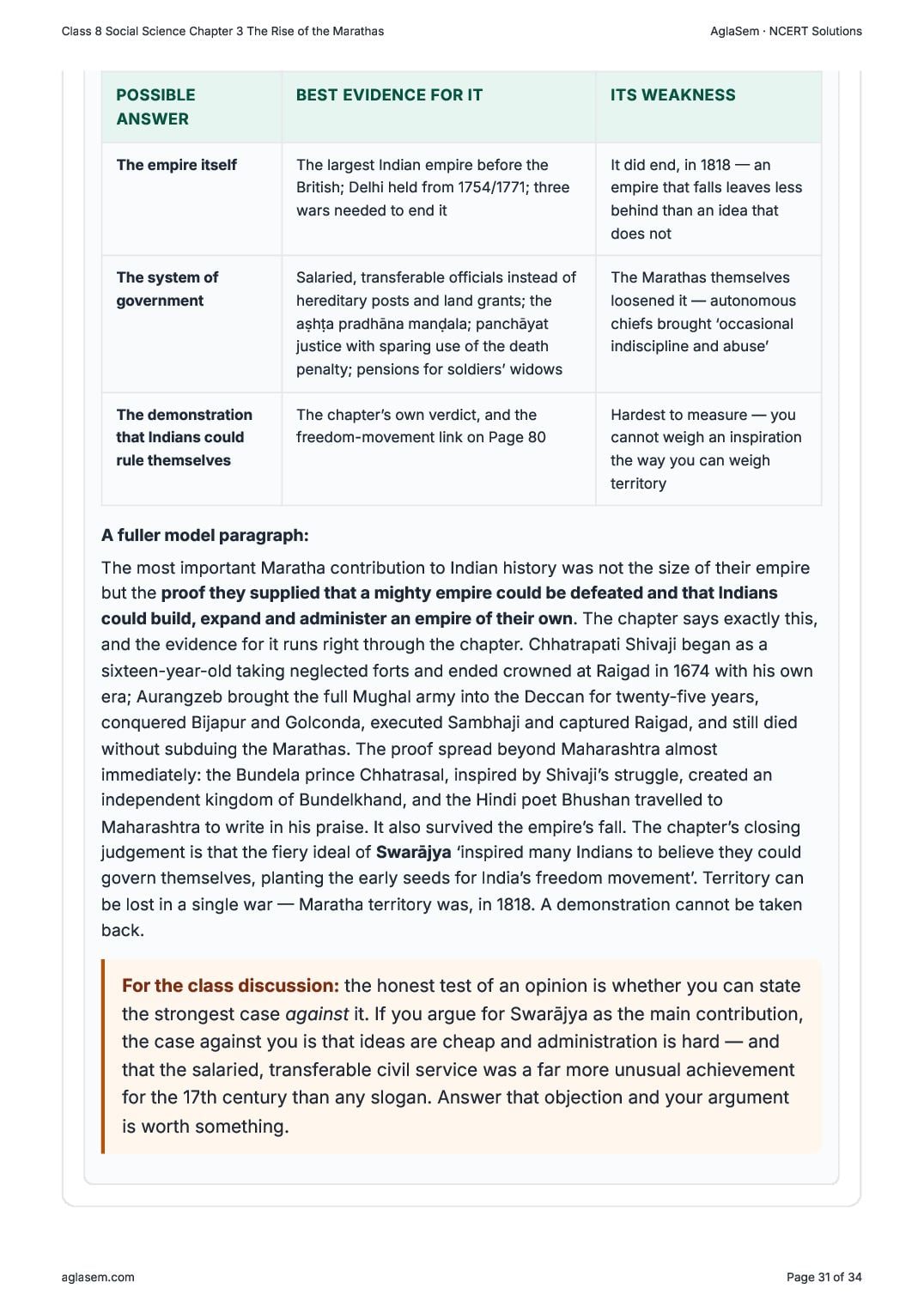
- After this introduction to the Maratha period, what do you think was their most important contribution to Indian history? Write a paragraph supporting your opinion with examples from the chapter. Then share and discuss your ideas with classmates.
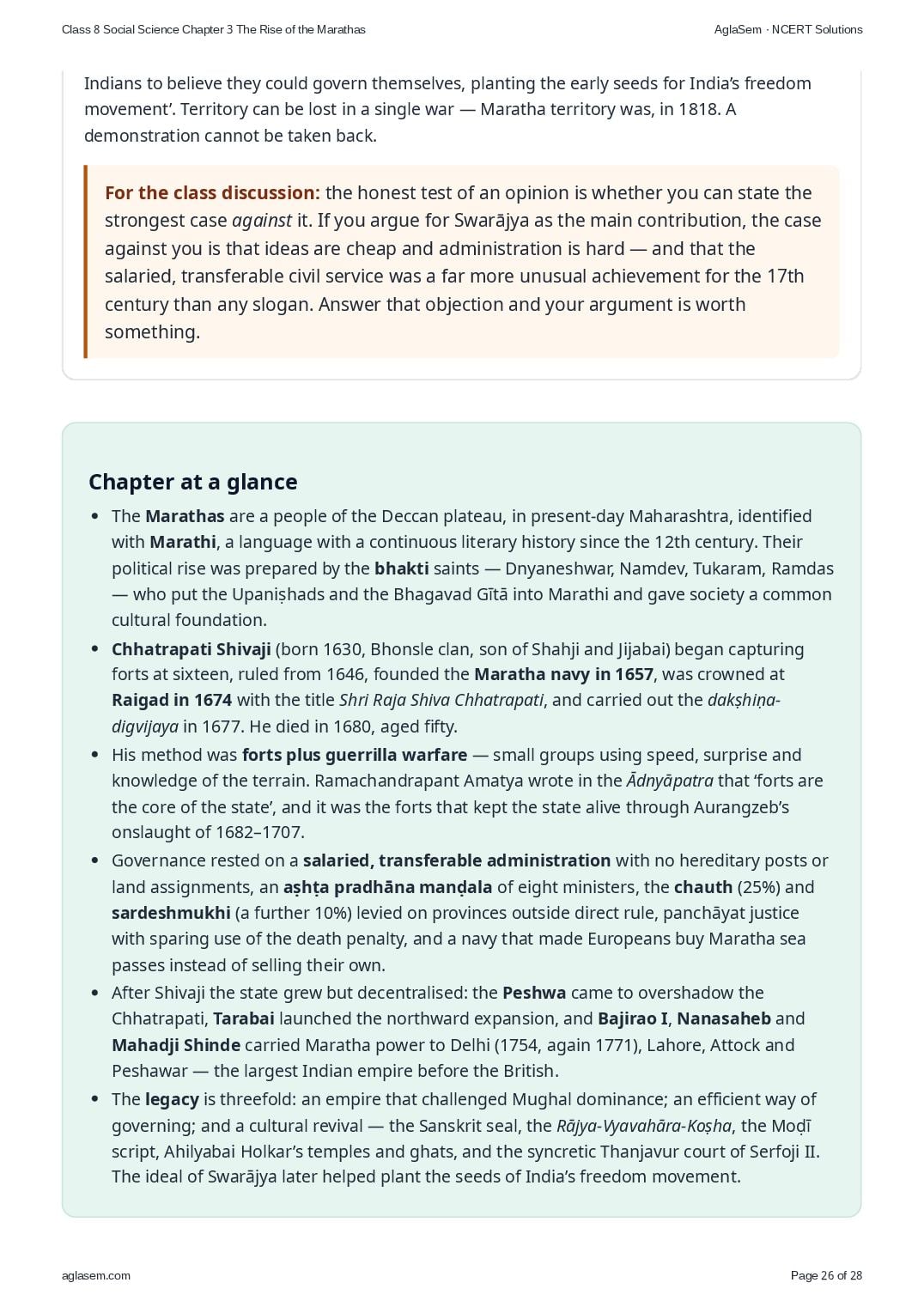
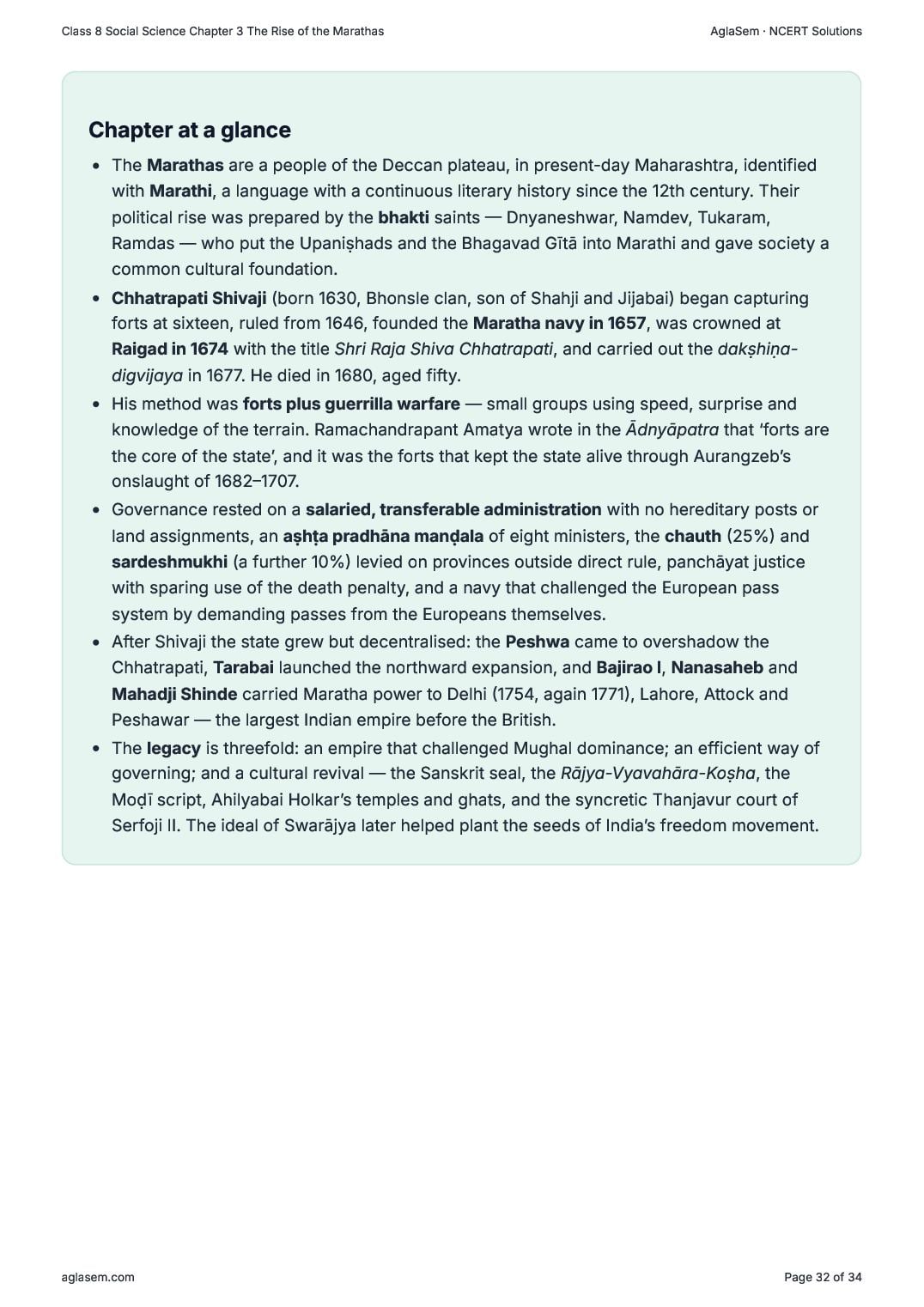
Chapter at a Glance
- The Marathas are a people of the Deccan plateau, in present-day Maharashtra, identified with Marathi , a language with a continuous literary history since the 12th century . Their political rise was prepared by the bhakti saints — Dnyaneshwar, Namdev, Tukaram, Ramdas — who put the Upaniṣhads and the Bhagavad Gītā into Marathi and gave society a common cultural foundation.
- Chhatrapati Shivaji (born 1630, Bhonsle clan, son of Shahji and Jijabai) began capturing forts at sixteen, ruled from 1646, founded the Maratha navy in 1657 , was crowned at Raigad in 1674 with the title Shri Raja Shiva Chhatrapati , and carried out the dakṣhiṇa-digvijaya in 1677. He died in 1680, aged fifty.
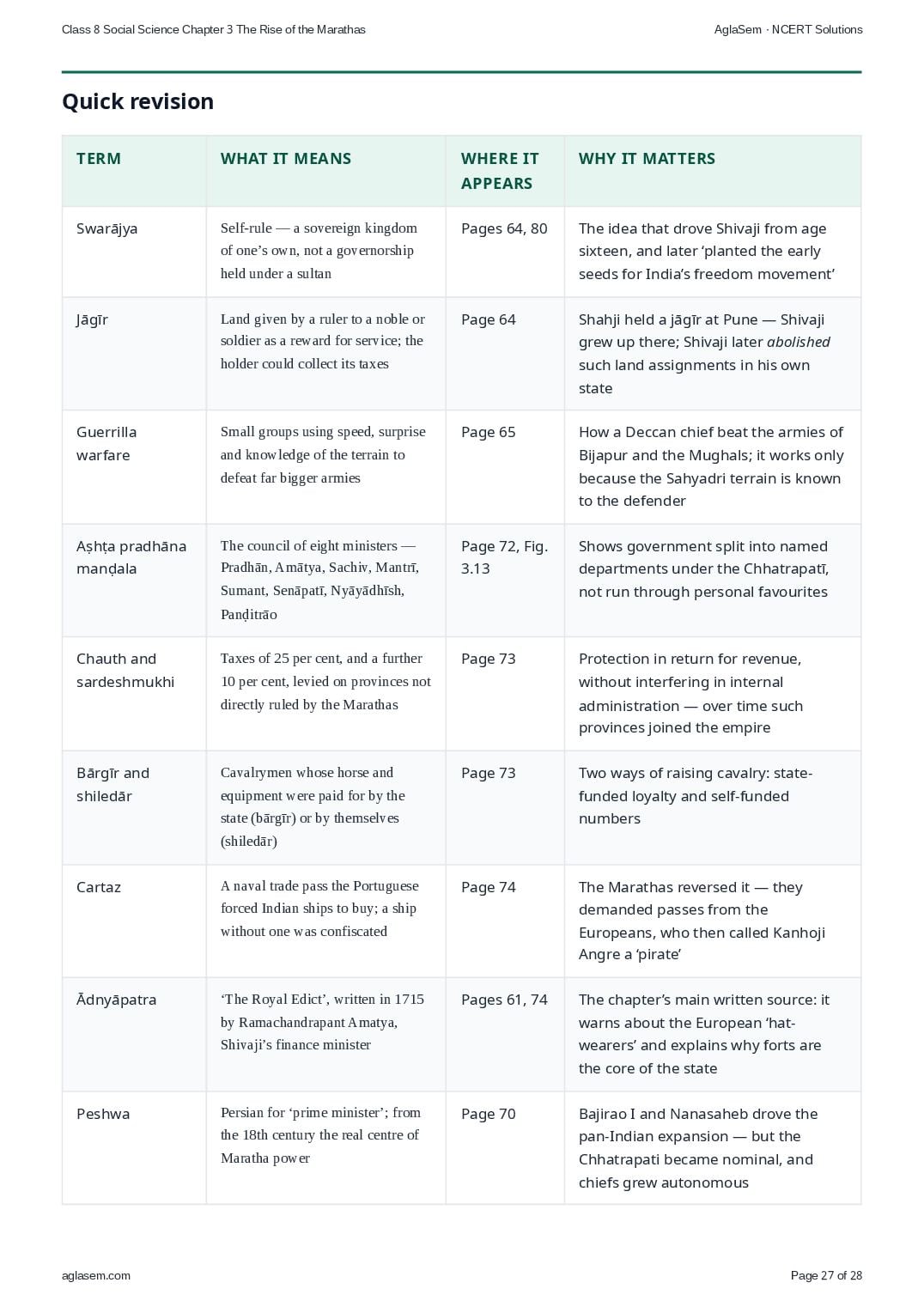
- His method was forts plus guerrilla warfare — small groups using speed, surprise and knowledge of the terrain. Ramachandrapant Amatya wrote in the Ādnyāpatra that ‘forts are the core of the state’ , and it was the forts that kept the state alive through Aurangzeb’s onslaught of 1682–1707.
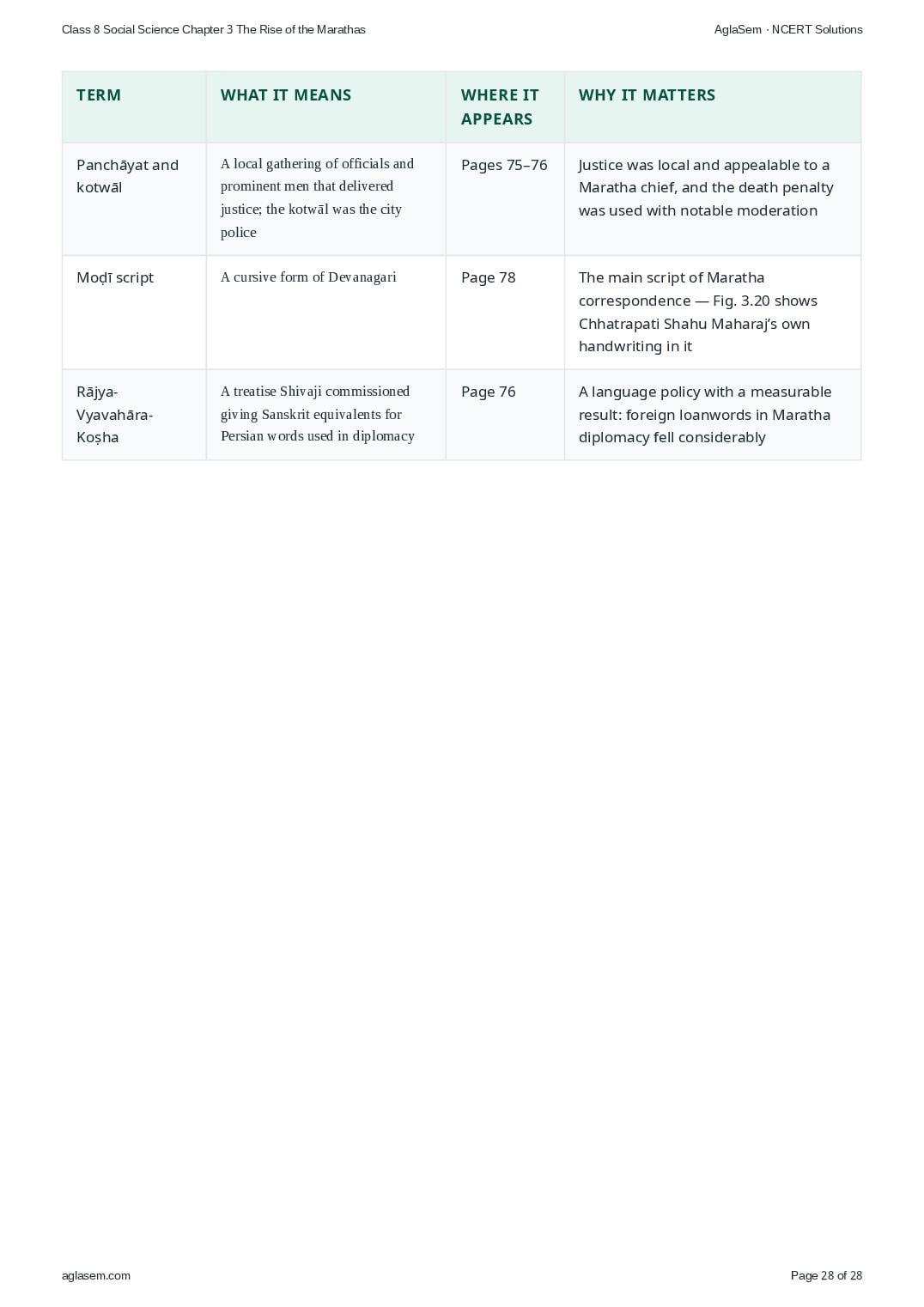
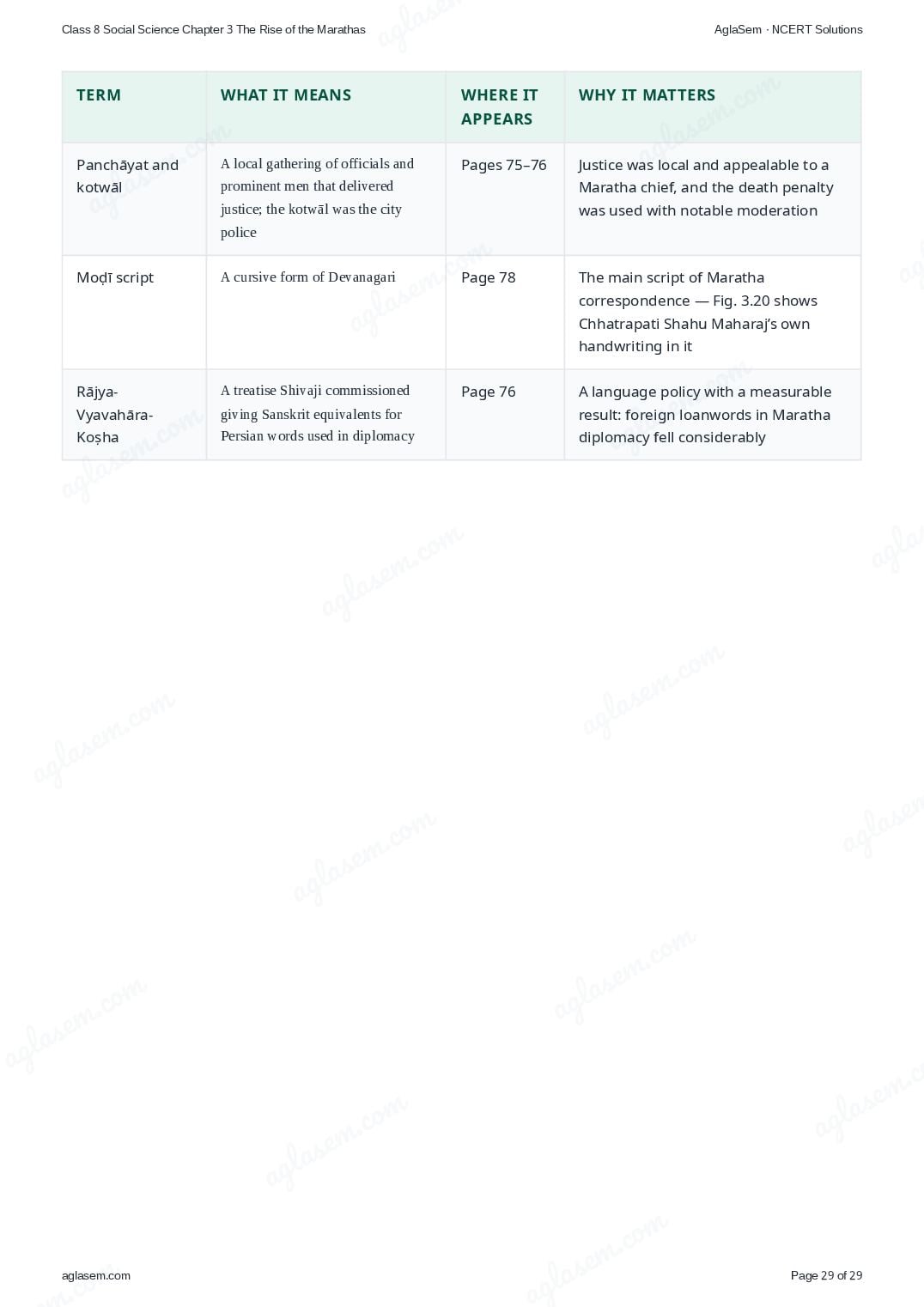
- Governance rested on a salaried, transferable administration with no hereditary posts or land assignments, an aṣhṭa pradhāna manḍala of eight ministers, the chauth (25%) and sardeshmukhi (a further 10%) levied on provinces outside direct rule, panchāyat justice with sparing use of the death penalty, and a navy that made Europeans buy Maratha sea passes instead of selling their own.
- After Shivaji the state grew but decentralised: the Peshwa came to overshadow the Chhatrapati, Tarabai launched the northward expansion, and Bajirao I , Nanasaheb and Mahadji Shinde carried Maratha power to Delhi (1754, again 1771), Lahore, Attock and Peshawar — the largest Indian empire before the British.
- The legacy is threefold: an empire that challenged Mughal dominance; an efficient way of governing; and a cultural revival — the Sanskrit seal, the Rājya-Vyavahāra-Koṣha , the Moḍī script, Ahilyabai Holkar’s temples and ghats, and the syncretic Thanjavur court of Serfoji II. The ideal of Swarājya later helped plant the seeds of India’s freedom movement.
How to Download NCERT Solutions for Class 8 Social Science Chapter 3 PDF
Follow these simple steps to get the The Rise of the Marathas questions-and-answers PDF from Exploring Society: India and Beyond.
- Search NCERT Solutions for Class 8 Social Science Chapter 3 aglasem and open this page.
- Read the exercise questions with answers for The Rise of the Marathas shown above.
- Click the Download PDF link to save the The Rise of the Marathas solutions to your device.
NCERT Solutions for Class 8 Social Science – All Chapters
There are more chapters to study besides The Rise of the Marathas in Social Science. Here are the NCERT Solutions for all chapters of Class 8 Social Science.
- Chapter 1 Natural Resources and Their Use
- Chapter 2 Reshaping India’s Political Map
- Chapter 3 The Rise of the Marathas
- Chapter 4 The Colonial Era in India
- Chapter 5 Universal Franchise and India’s Electoral System
- Chapter 6 The Parliamentary System Legislature and Executive
- Chapter 7 Factors of Production
- Chapter 8 World Geography Some Glimpses
- Chapter 9 India’s Long Road to Independence
- Chapter 10 A Journey Through Indian Architecture
- Chapter 11 The Role of the Judiciary in Our Society
- Chapter 12 Citizenship Rights and Duties
- Chapter 13 Dynamics of Population
- Chapter 14 India’s Urban Landscape
- Chapter 15 Cultural Currents 13th to 17th Centuries
NCERT Solutions for Class 8 – All Subjects
Just like Chapter 3 of Social Science, you can get the exercise questions with answers for every other subject of Class 8. Here are the NCERT Solutions for all subjects of Class 8.
NCERT Solutions for Class 8 Social Science Chapter 3 – An Overview
The key highlights of this study material are as follows.
| Aspects | Details |
|---|---|
| Class | Class 8 |
| Subject | Social Science |
| Chapter Number | Chapter 3 |
| Chapter Name | The Rise of the Marathas |
| Book Name | Exploring Society: India and Beyond |
| Book By | NCERT (National Council of Educational Research and Training) |
| Educational Resource Here | NCERT Solutions of Class 8 Social Science Chapter 3 for all exercises |
| More Questions Answers of This Subject | NCERT Solutions for Class 8 Social Science |
| Download Book Chapter | NCERT Book Class 8 Social Science |
| All Questions Answers For This Class | NCERT Solutions for Class 8 |
| Complete Solutions | NCERT Solutions |
NCERT Solutions for Class 8 Social Science Chapter 3 The Rise of the Marathas – FAQs
What are the NCERT Solutions for Class 8 Social Science Chapter 3 The Rise of the Marathas?
They are the complete, step-by-step answers to all the exercise and in-text questions of Chapter 3 The Rise of the Marathas from the NCERT Class 8 Social Science textbook Exploring Society: India and Beyond, written by experts as per the latest NCERT syllabus.
How can I download the Class 8 Social Science Chapter 3 solutions PDF for free?
Open this page on aglasem, read the The Rise of the Marathas questions with answers, and click the “Download Solutions PDF” link. The Class 8 Social Science Chapter 3 NCERT Solutions PDF is completely free to download.
Are these NCERT Solutions as per the latest 2026-27 syllabus?
Yes. The NCERT Solutions for Class 8 Social Science Chapter 3 are based on the latest NCERT textbook Exploring Society: India and Beyond and the current 2026-27 CBSE syllabus, so the questions and answers match what you study in class.
Where can I get NCERT Solutions for the other chapters of Class 8 Social Science?
You can find the answers to every chapter on the NCERT Solutions for Class 8 Social Science page, and solutions for every subject on the NCERT Solutions for Class 8 page.
How do NCERT Solutions help in exam preparation?
They show the correct method to solve each question, help you write answers the way they are expected in exams, let you check and correct your own work, and save revision time — which together improve your marks in Class 8 Social Science.
If you have any queries on NCERT Solutions for Class 8 Social Science Chapter 3 The Rise of the Marathas, then please ask in the comments below.