NCERT Solutions for Class 8 Social Science Chapter 1 Natural Resources and Their Use – step-by-step answers to every exercise and in-text question of the chapter, as per the latest NCERT syllabus for 2027. Read them online or download the free question-answer PDF.
Answers to every question in Chapter 1, Natural Resources and Their Use, of Exploring Society: India and Beyond, Grade 8 Part 1 — the opening chapter of the theme India and the World: Land and the People: The Big Questions, both DON’T MISS OUT questions, both THINK ABOUT IT boxes, all seven LET’S EXPLORE boxes, the in-text question on page 19, and all five Questions and activities. Each answer shows first what to write; open Explanation for the reasons and examples.
NCERT Solutions for Class 8 Social Science Chapter 1 Natural Resources and Their Use PDF
All the answers are on this page below. The PDF also explains every answer – why it is right and how to check it – so download it for revision.
| Chapter | Download | |
|---|---|---|
| Solutions PDF (English medium) | Natural Resources and Their Use | View PDF |
| Solutions PDF (Hindi medium) | प्राकृतिक संसाधन एवं उनका उपयोग | View PDF |
NCERT Solutions for Class 8 Social Science Chapter 1 Natural Resources and Their Use – Questions and Answers
All 21 questions of the chapter (textbook pages 1 – 20) are answered below, in the order of the book – in-text questions, activities and the end-of-chapter exercises. Each answer is written the way you would write it in the exam.
The Big Questions — Page 1Theme: India and the World: Land and the People
We categorise natural resources by choosing a criterion (a shared characteristic) and grouping the resources by it. The chapter uses two criteria:
- By use: (a) resources essential for life — air, water, soil; (b) resources for materials — wood, marble, coal, gold; (c) resources for energy — coal, water, petroleum, natural gas, sunlight, wind.
- By renewability: (a) renewable — Nature restores and regenerates them, e.g. solar energy, wind energy, flowing water, timber from forests; (b) non-renewable — formed over long periods and not replenished at the rate we use them, e.g. coal, petroleum, iron, copper, gold.
The same resource can fall in both schemes: coal is a resource for energy and also non-renewable.
Natural resources are unevenly distributed, and this shapes many aspects of life:
- Settlement and jobs: industries come up near resources; townships grow around them, bringing employment and better facilities.
- Displacement and conflict: people living in resource-rich areas may be displaced, and their sacred places threatened.
- Trade: national and international trade depend on where resources lie (e.g. Wootz steel); trade helped large empires grow in India.
- Relations and wars: shared resources cause tension between States and countries (Kaveri water); many wars have been fought to control resources.
- Fairness: access even to water and clean air is often unequal.
Unsustainable use means using a resource faster than Nature can restore and regenerate it. Its implications are:
- Renewable resources get used up — forests cut faster than they grow are depleted; over-fishing has caused a steep decline in tuna.
- Groundwater falls — in a large part of Punjab it is now out of reach till about 30 metres, and almost 80% of the State is ‘over-exploited’.
- Soil degrades from misuse of chemical fertilisers and pesticides, and the chemicals pollute groundwater.
- Rivers become poisonous from untreated industrial waste.
- Non-renewables run out (India’s coal may last only about 50 more years).
- Overall: pollution, biodiversity loss and climate change, now happening faster.
Don’t Miss Out — Page 3Nature as sacred in indigenous traditions
Yes. Some practices that treat Nature as sacred, a nurturer and nourisher:
- Tulasī pūja at home for the family’s wellbeing (Fig. 1.6).
- Sacred groves (devrai, kavu, sarna, orans), where no tree may be cut.
- Offering arghyam (water) to Sūrya in gratitude (Fig. 1.9).
- Honouring rivers such as the Gaṅgā and Narmadā as mothers.
- Harvest festivals like Pongal, Bihu and Onam, which thank the sun, soil, rain and cattle.
- Watering the peepal, banyan and neem and tying sacred threads round them.
Think About It — Page 3Tracing everyday things back to Nature
Everything around us can be traced back to Nature, often through several steps:
- Cotton shirt → cotton fibre → cotton plant grown in soil.
- Plastic button → petrochemicals → petroleum from under the ground.
- Notebook → paper → wood pulp from trees.
- Steel compass or cycle → iron ore and coal mined from the earth.
- Glass → silica sand; classroom walls → cement (from limestone), sand and clay.
- Electricity for the fan → coal, flowing water, sunlight or wind.
- Food → soil, water and sunlight.
So every material thing ultimately comes from Nature.
Think About It — Page 4Criteria for categorising natural resources
Natural resources can be categorised using different criteria:
- Use — essential for life, for materials, for energy (the chapter’s first criterion).
- Renewability — renewable and non-renewable (the chapter’s second criterion).
- Origin — from living things (forests, fish, livestock) or non-living things (minerals, rocks).
- Where found — air, water, land and soil, minerals under the ground.
- Ownership — individual, community, national, international.
Each criterion gives a different, equally valid set of categories.
Don’t Miss Out — Page 6Traditional restraint in fishing, and the decline of tuna
Yes. Like the fishing restraint in the box, these practices hold back use while the resource regenerates:
- Sacred groves, where no tree is cut, preserve native plants, animals and water.
- Crop rotation and mixed cropping keep soil fertile (both named in Vṛikṣhāyurveda).
- Cow dung, other natural manure and mulching return nutrients to the soil.
- Traditional water harvesting — ponds, tanks, johads, stepwells — recharges groundwater.
- Fallow land and rotational grazing let soil and pasture recover.
- Protecting certain trees and animals, such as the peepal, or the blackbuck near Bishnoi villages.
Let’s Explore — Page 7Human actions that block Nature’s restoration and regeneration
Human actions that stop Nature from restoring itself, and interventions that can help:
- Untreated sewage and industrial waste let into rivers and drains → treat waste before it is discharged.
- Plastic dumped in open ground and drains → segregate, reduce and recycle waste.
- Cementing every open surface; over-pumping borewells → rainwater harvesting, recharge pits, drip irrigation, reviving ponds.
- Cutting trees and clearing groves → plant native species.
- Burning crop residue and garbage → compost it instead.
- Heavy use of chemical fertilisers → cow dung manure, mulching, multi-cropping.
Let’s Explore — Page 8A research study of renewable resources in your region
Sample answer (short report): Our study covered the four wards around our school. Renewable resources found: sunlight, groundwater, a village pond, trees and farm soil. Change over time: the pond once held water till March but now dries by January; wells that gave water at about 6 metres now need borewells of 55–60 metres; tree cover has shrunk. Reasons: road-widening blocked the pond’s inlet, courtyards were cemented so rain cannot soak in, and water-hungry paddy replaced millets. What may be done: desilt the pond and reopen its inlet, make recharge pits compulsory, plant native trees and promote millets.
Let’s Explore — Page 8Non-renewables in daily use, and their renewable substitutes
Non-renewables we use daily, and their renewable substitutes:
- Coal (most of our electricity) → solar, wind and hydro power.
- Petrol and diesel (buses, autos, transport of goods) → electric vehicles run on renewable power, cycling, walking, public transport, biofuels.
- LPG (cooking) → biogas, solar cookers.
- Metals such as iron, copper, aluminium → no true substitute, so recycle and repair.
- Plastic (from petroleum) → cloth, jute, glass and steel containers.
Steps to transition: cut wasteful use first; install rooftop solar and solar pumps; run vehicles and appliances on renewable electricity; recycle metals; build with less cement; and cooperate with other countries, as India does through the International Solar Alliance.
Let’s Explore — Page 9Fig. 1.11 — Distribution of important minerals
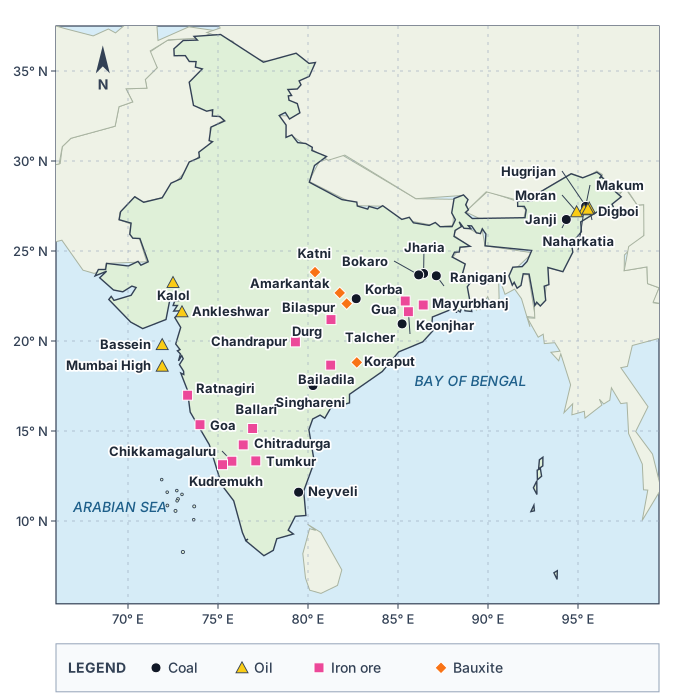
Fig. 1.11 shows that the four minerals are very unevenly distributed:
- Coal — mainly in the east: Jharia, Bokaro, Raniganj, Korba, Talcher; also Singhareni, Neyveli, and Makum and Janji in Assam.
- Oil — only in upper Assam (Digboi, Naharkatia, Moran, Hugrijan) and the west (Kalol, Ankleshwar, Bassein, Mumbai High).
- Iron ore — Jharkhand–Odisha–Chhattisgarh (such as Gua, Keonjhar, Durg, Bailadila) and Karnataka–Goa (such as Ballari, Kudremukh, Goa).
- Bauxite — a few places in central India: Katni, Amarkantak, Bilaspur, Koraput.
Sample answer for your region: ‘My district in the plains has no mineral symbol on the map. Its resources are fertile alluvial soil, river water and groundwater, and sunshine; the best soil and water lie along the river.’
Let’s Explore — Page 10Mapping two natural resources and weighing the cost of extracting them
Sample answer — iron ore and solar energy:
- Iron ore (marked with squares): found only in a few clusters — Odisha (Keonjhar, Mayurbhanj), Jharkhand (Gua), Chhattisgarh (Durg, Bailadila), Karnataka (Ballari, Kudremukh), Goa. Activities: mining, transport by rail and port, steel plants (Bhilai, Bokaro, Rourkela), engineering industries.
- Solar energy (shade the sunniest areas): available almost everywhere, strongest in Rajasthan, Gujarat and Ladakh. Activities: solar parks (Bhadla, Rajasthan), making and installing panels, solar pumps.
Observation: a mineral is concentrated in a few places, so industry gathers there; sunlight is spread widely, so activity can spread too.
Implications of extraction:
- Present generation: jobs, townships and facilities, raw materials for industry — but also displacement of local people, threats to sacred places, and pollution of air, water and land.
- Future generations: exhausted deposits (India’s coal may last only about 50 more years), degraded land and forests, and lower, polluted groundwater.
Responsible ways: use renewables no faster than they renew; use non-renewables judiciously; recycle and reuse; restore mined land with native plants and harvest rainwater; treat waste and follow pollution rules; include local people in decisions; and add value through industries at home.
Let’s Explore — Page 10A resource conflict in the international context
Sample answer — the Brahmaputra: The river rises in Tibet as the Yarlung Tsangpo, flows through India as the Brahmaputra and enters Bangladesh as the Jamuna (Fig. 1.12). Dams built and planned upstream in Tibet worry India and Bangladesh, which depend on its water for farming, drinking and fishing. There is no treaty for the whole river; the countries have shared flood-season river data and hold talks. Other examples: the Indus waters (India–Pakistan), the Ganga at Farakka (India–Bangladesh, 1996 treaty) and the Nile (Ethiopia’s dam versus Egypt and Sudan).
Let’s Explore — Page 11The ‘Paradox of Plenty’
Inputs needed to use natural resources:
- Knowledge and technology to find, extract and process the resource.
- Skilled people — engineers, geologists, technicians.
- Capital (money) for mines, plants and power lines.
- Energy and water for extraction and processing.
- Transport — roads, railways, ports, pipelines.
- Industries that turn raw materials into higher-value products.
- Good governance and strategic planning — fair rules, pollution control, planning for the future.
- Acceptance by the local people.
The inputs vary with geography: a solar park in Rajasthan needs sunny land and power lines; an offshore oil rig needs marine platforms and pipelines.
In-text Questions — Page 19Lokasangraha and stewardship
Yes, the time has come. Many problems in the chapter arise when each person acts only for personal gain: farmers over-pump groundwater (almost 80% of Punjab is ‘over-exploited’), commercial fleets over-fish tuna, and factories release untreated waste into rivers. Each act seems small, but together they harm everyone, including future generations. Pollution, biodiversity loss and climate change are now increasing faster, and access to clean water and air is already unequal. Lokasangraha — acting for the wellbeing of all — asks us to restrain our desires, as Sikkim’s farmers and traditional fishing communities have done.
Questions and activities — Page 19End-of-chapter exercise
A renewable resource becomes non-renewable when we use it faster than Nature can restore and regenerate it. Examples: cutting timber faster than forests grow; pumping groundwater faster than it is recharged (as in Punjab); over-fishing, even in the spawning season; polluting rivers with untreated waste; ruining soil with excess chemicals; and burning fossil fuels, which warms the Earth and melts the glaciers that feed rivers.
Actions to prevent this:
- Use a resource no faster than it renews.
- Give it time to recover — no fishing in the spawning season, fallow land.
- Plant native trees; harvest rainwater; revive ponds and tanks.
- Treat waste before it reaches rivers.
- Use natural manure, mulching and multi-cropping.
- Reduce fossil-fuel use and the cutting of forests.
Five ecosystem functions that serve humans:
- Trees produce oxygen, which we breathe.
- Forests filter water, giving us clean water.
- Forests and plant roots prevent soil erosion, protecting farmland.
- Insects and birds pollinate flowers, so crops give fruit and seeds.
- Forests provide habitat for animals, and decomposers return nutrients to the soil.
When humans benefit from these natural functions, they are called ecosystem services.
Renewable resources are those that Nature restores and regenerates over time, e.g. solar energy, wind, flowing water and forest timber — provided the natural rhythm of regeneration is not disturbed. Non-renewable resources form over very long periods and cannot be replenished at the rate we use them, e.g. coal, petroleum, iron, copper and gold; what is used is gone for good.
To keep renewables available: use them no faster than they renew, give them time to recover, plant native trees, recharge groundwater, keep waste out of rivers and soil, and use natural manure.
Two examples: (1) Sikkim’s organic farming — it became a 100% organic state in 2016, and its soil, biodiversity and farmers’ incomes improved. (2) Recharging groundwater through water harvesting and reviving ponds and tanks.
At home, water used to wash vegetables and rice is poured on the plants, and food is cooked only as needed so none is wasted. Clothes are dried in the sun, old clothes are handed down or made into bags and dusters, and steel utensils are repaired and used for years. We carry a cloth bag to the market, and the kabadiwala takes paper, bottles and metal for recycling. Kitchen peels are fed to cattle or composted. In our neighbourhood the peepal and neem trees are never cut, the community pond is kept clean, and festivals like Pongal and Bihu thank Nature for the harvest.
While producing goods, we should keep in mind:
- Raw materials: use renewables within their rate of renewal and non-renewables judiciously; use recycled materials.
- Pollution: treat waste before release; follow the Central Pollution Control Board’s guidelines (as cement factories must).
- Materials: choose less polluting ones — stone, mud, plant-based and recycled materials.
- Energy: use renewable energy wherever possible.
- Waste: reuse and recycle, as in Nature’s cycles.
- People and place: provide local employment and suit the local climate.
- Fairness and the future: share benefits and costs fairly, without harming future generations.
Chapter 1 of 15 – Social Science
- Next: Chapter 2 Reshaping India's Political Map
- All chapters: NCERT Solutions Class 8 Social Science
Also for This Chapter
NCERT Solutions Class 8 Social Science Chapter 1 Natural Resources and Their Use – Overview
| Class | Class 8 |
| Subject | Social Science |
| Chapter | 1 – Natural Resources and Their Use |
| Textbook pages | 1 – 20 |
| Questions solved | 21 |
| Session | 2027 |
| Format | Full answers on this page + PDF |
NCERT Solutions Class 8 Social Science Chapter 1 – FAQs
Where can I download NCERT Solutions Class 8 Social Science Chapter 1 Natural Resources and Their Use PDF?
Read every answer on this page, or download the free PDF from the table at the top.
Is this for the 2027 session?
Yes, it follows the latest NCERT Class 8 Social Science book for 2027.
How many questions are solved in NCERT Class 8 Social Science Chapter 1?
All 21 questions of the chapter (textbook pages 1 – 20) – the in-text questions, activities and the end-of-chapter exercises.
How should I use these solutions?
Read the chapter in the NCERT book first, attempt the questions yourself, then check your answers here.