NCERT Solutions for Class 8 Social Science Chapter 11 The Role of the Judiciary in Our Society provide clear, step-by-step answers to every exercise and in-text question from the chapter The Role of the Judiciary in Our Society of the NCERT textbook Exploring Society: India and Beyond. Prepared by subject experts as per the latest NCERT (CBSE) syllabus for 2026-27, these NCERT Solutions for Class 8 Social Science help you understand each concept, write exam-ready answers, and check your own solutions. You can read them online below or download the free Class 8 Social Science Chapter 11 question-answer PDF.
NCERT Solutions for Class 8 Social Science Chapter 11 The Role of the Judiciary in Our Society
- Class: Class 8
- Subject: Social Science
- Chapter: Chapter 11 – The Role of the Judiciary in Our Society
- Textbook: Exploring Society: India and Beyond (NCERT)
- Study material: NCERT Solutions – questions with answers, free PDF
These solutions answer all the exercise questions of Chapter 11 The Role of the Judiciary in Our Society — including the in-text questions, short-answer and long-answer questions, and activities — with complete explanations so you can follow the method, not just the final answer. Read the full solutions below.
NCERT Solutions Class 8 Social Science Chapter 11 the Role of the Judiciary in Our Society View Download
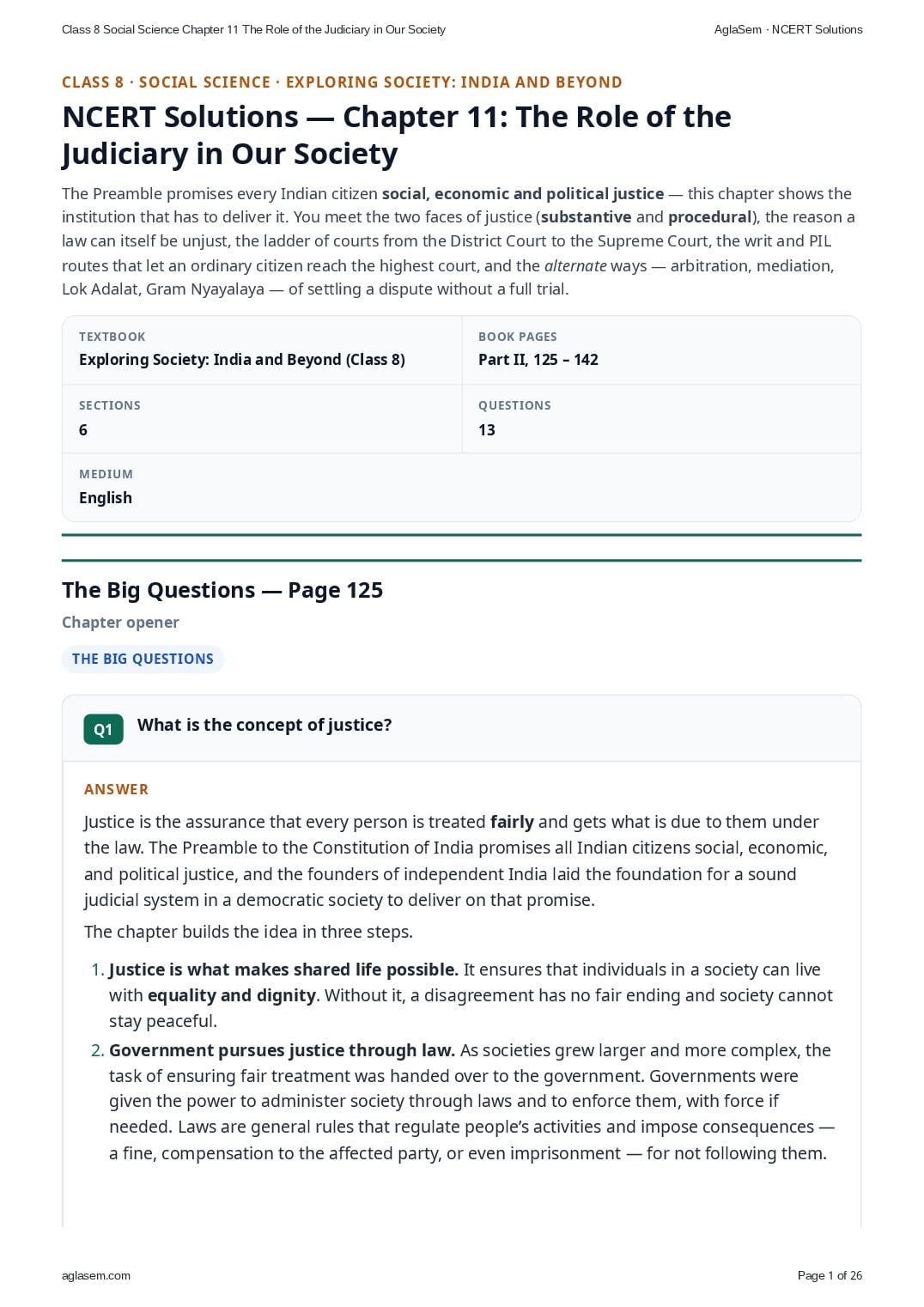
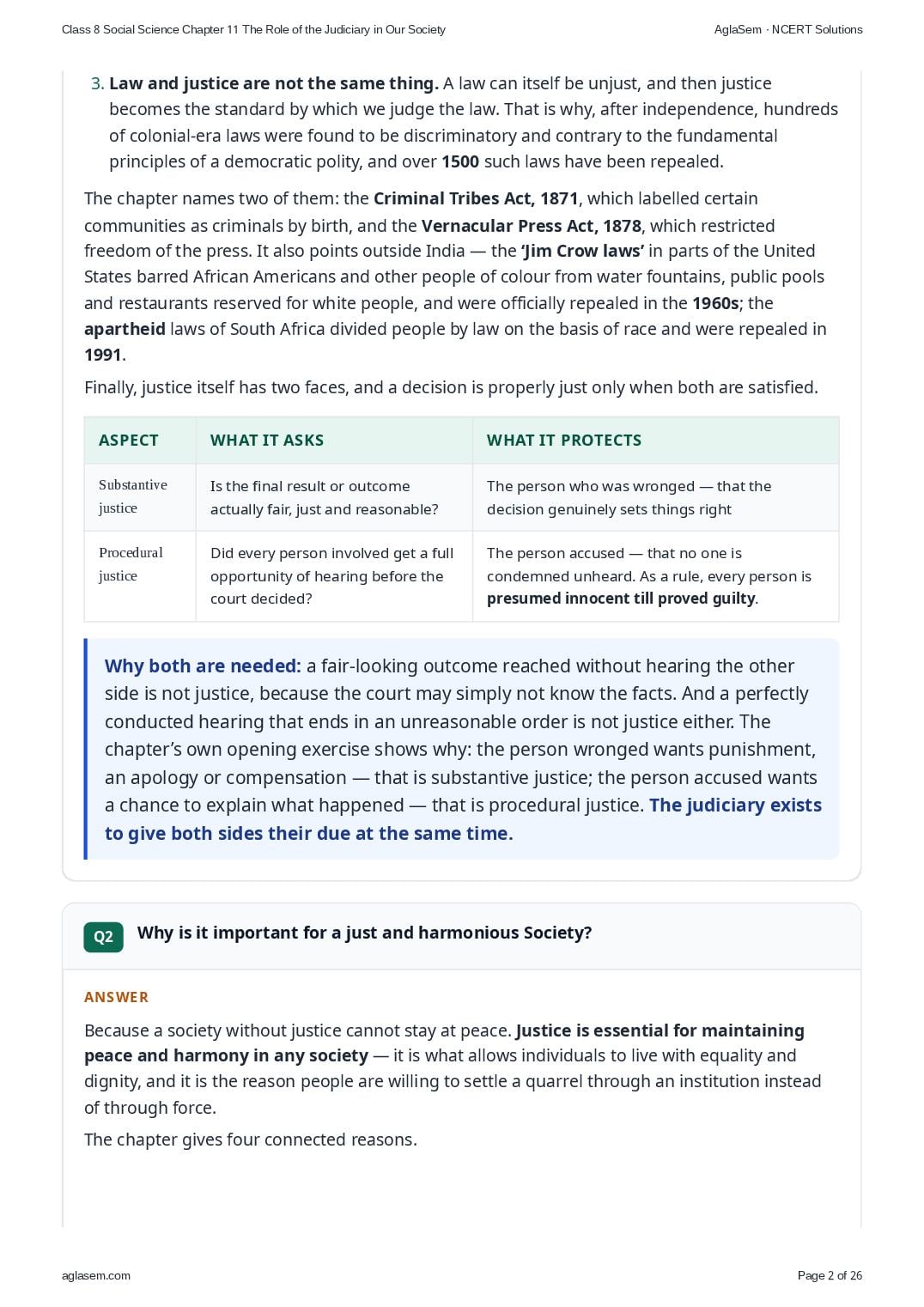
NCERT Solutions for Class 8 Social Science Chapter 11 PDF Download
You can read the NCERT Solutions for Class 8 Social Science Chapter 11 online above, or download the complete question-answer PDF to study The Role of the Judiciary in Our Society offline at any time.
NCERT Solutions for Class 8 Social Science Chapter 11 PDF Download Link – Click Here to Download Solutions PDF
Questions Covered in This Chapter
These NCERT Solutions answer all 13 questions of this chapter. The questions solved are:
- What is the concept of justice?
- Why is it important for a just and harmonious Society?
- What is the structure and role of the judiciary in India?
- What are the alternative modes of dispute resolution?
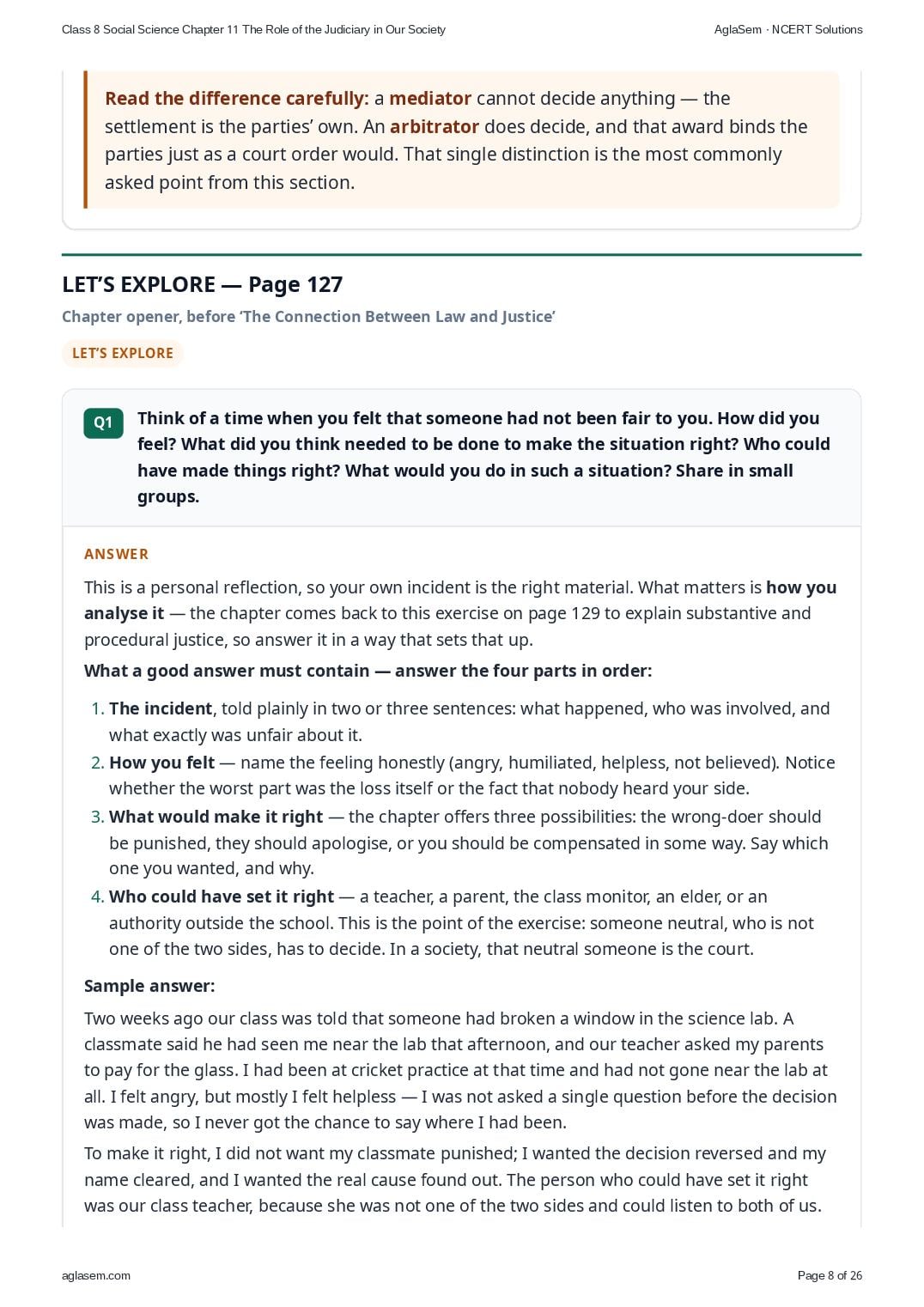
- Think of a time when you felt that someone had not been fair to you. How did you feel? What did you think needed to be done to make the situation right? Who could have made things right? What would you do in such a situation? Share in small groups.
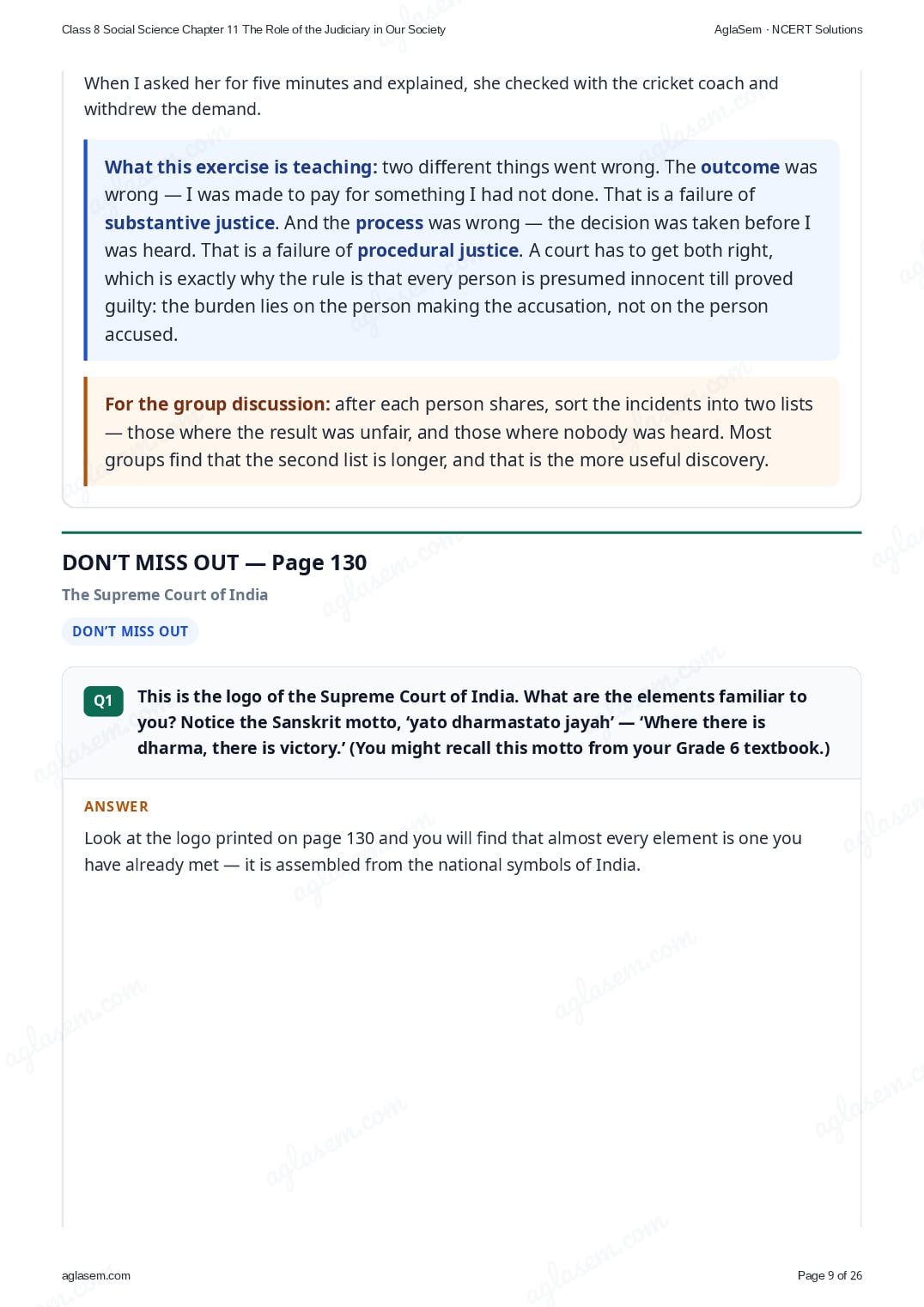
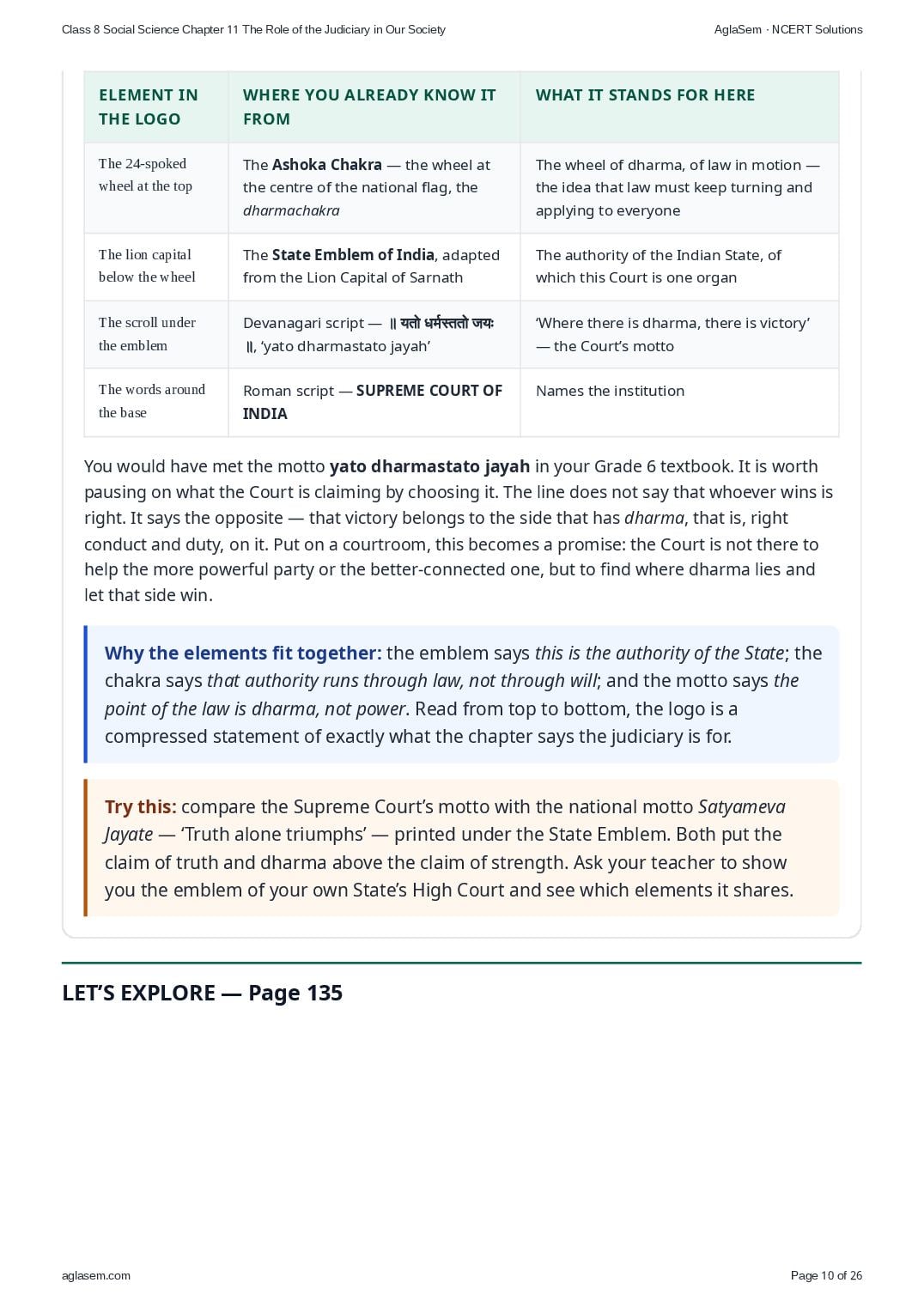
- This is the logo of the Supreme Court of India. What are the elements familiar to you? Notice the Sanskrit motto, ‘yato dharmastato jayah’ — ‘Where there is dharma, there is victory.’ (You might recall this motto from your Grade 6 textbook.)
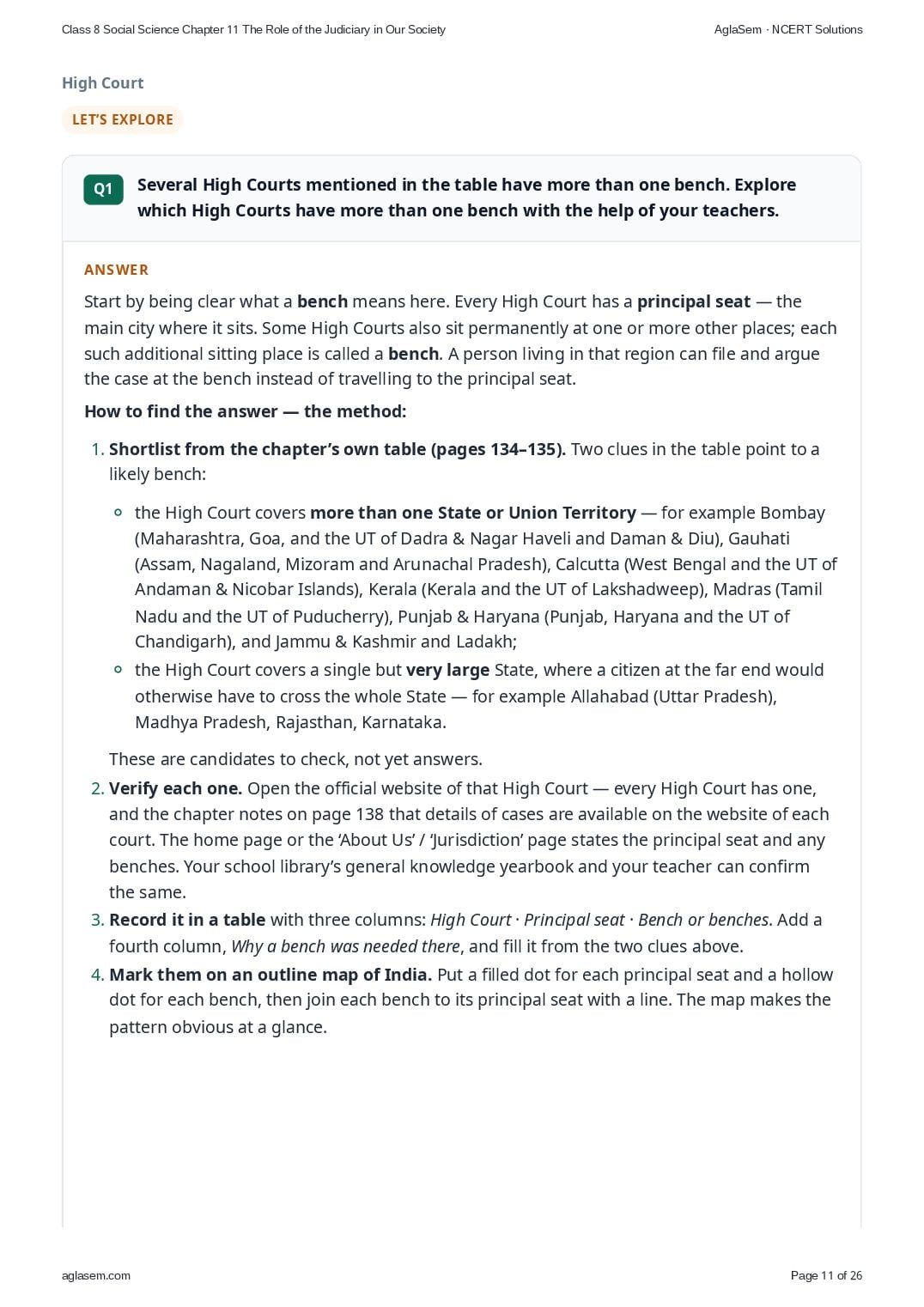
- Several High Courts mentioned in the table have more than one bench. Explore which High Courts have more than one bench with the help of your teachers.
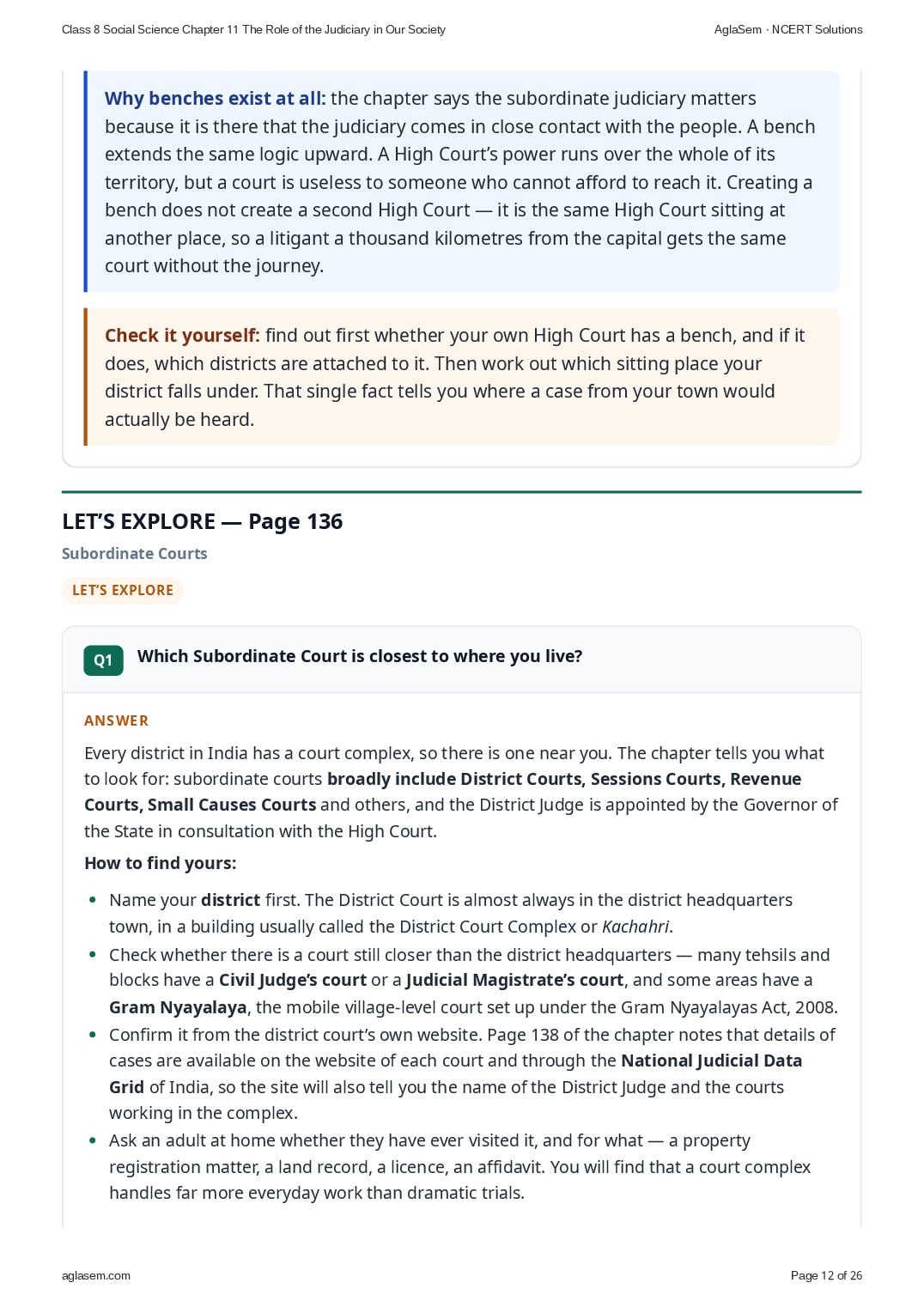
- Which Subordinate Court is closest to where you live?
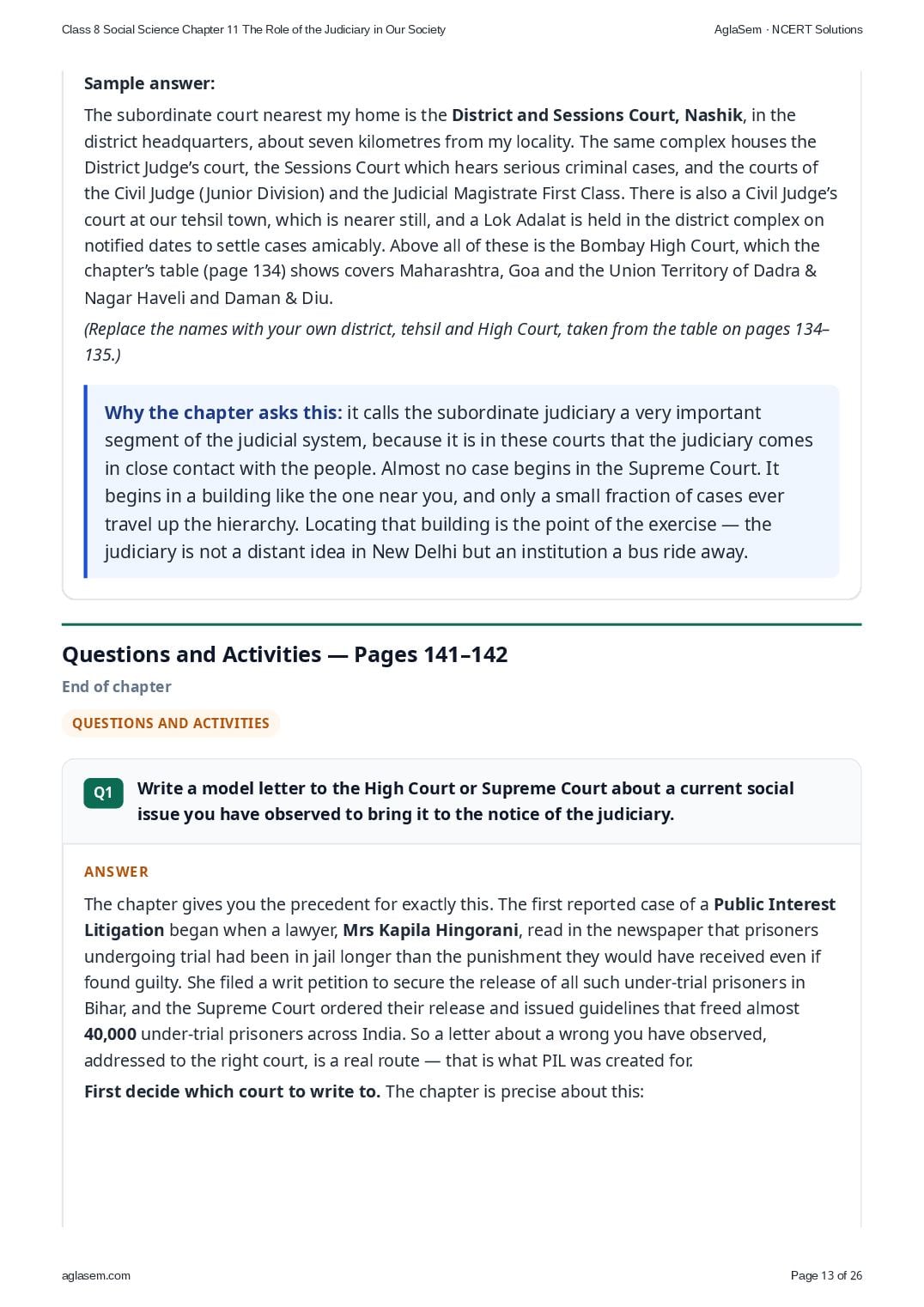
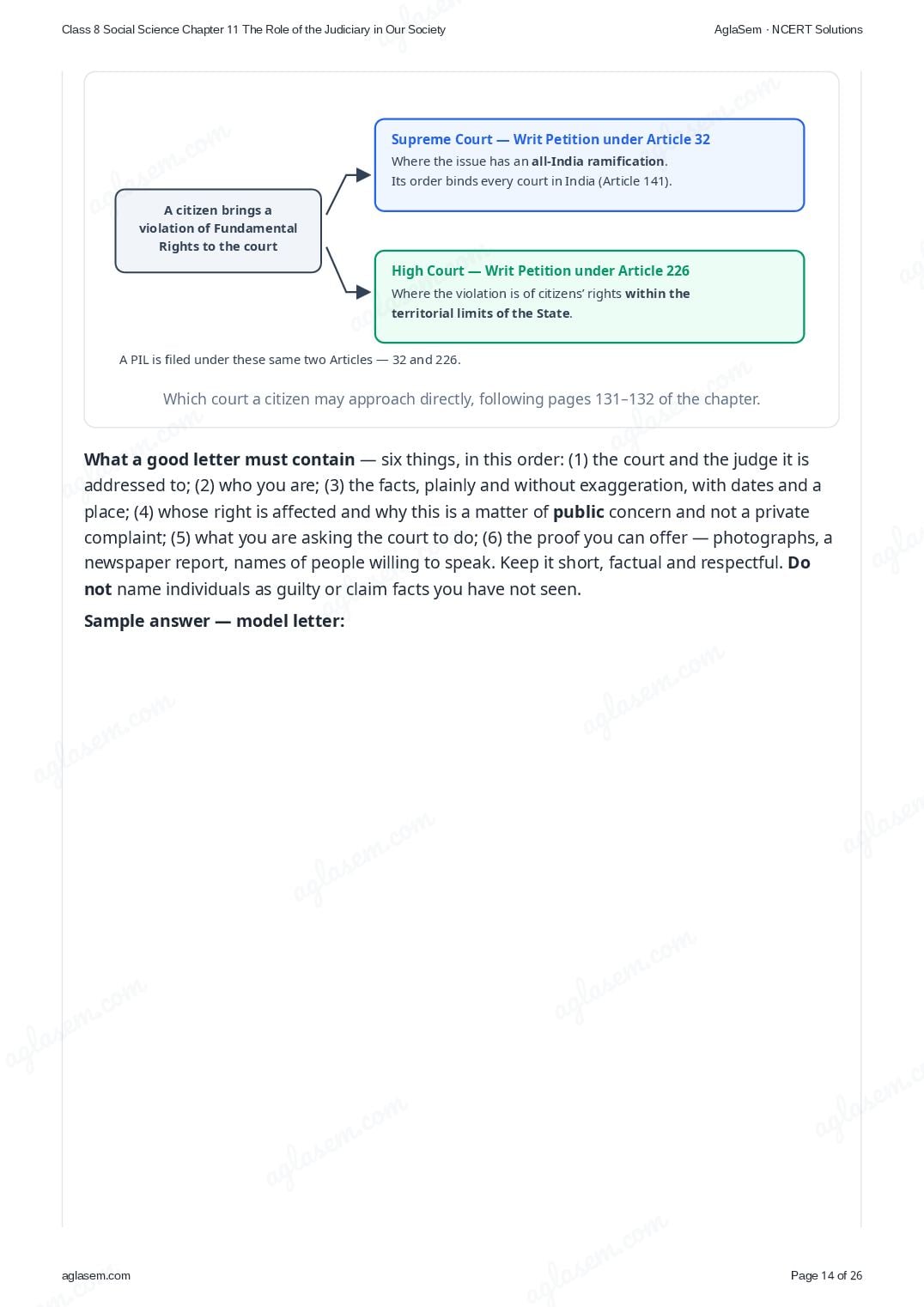
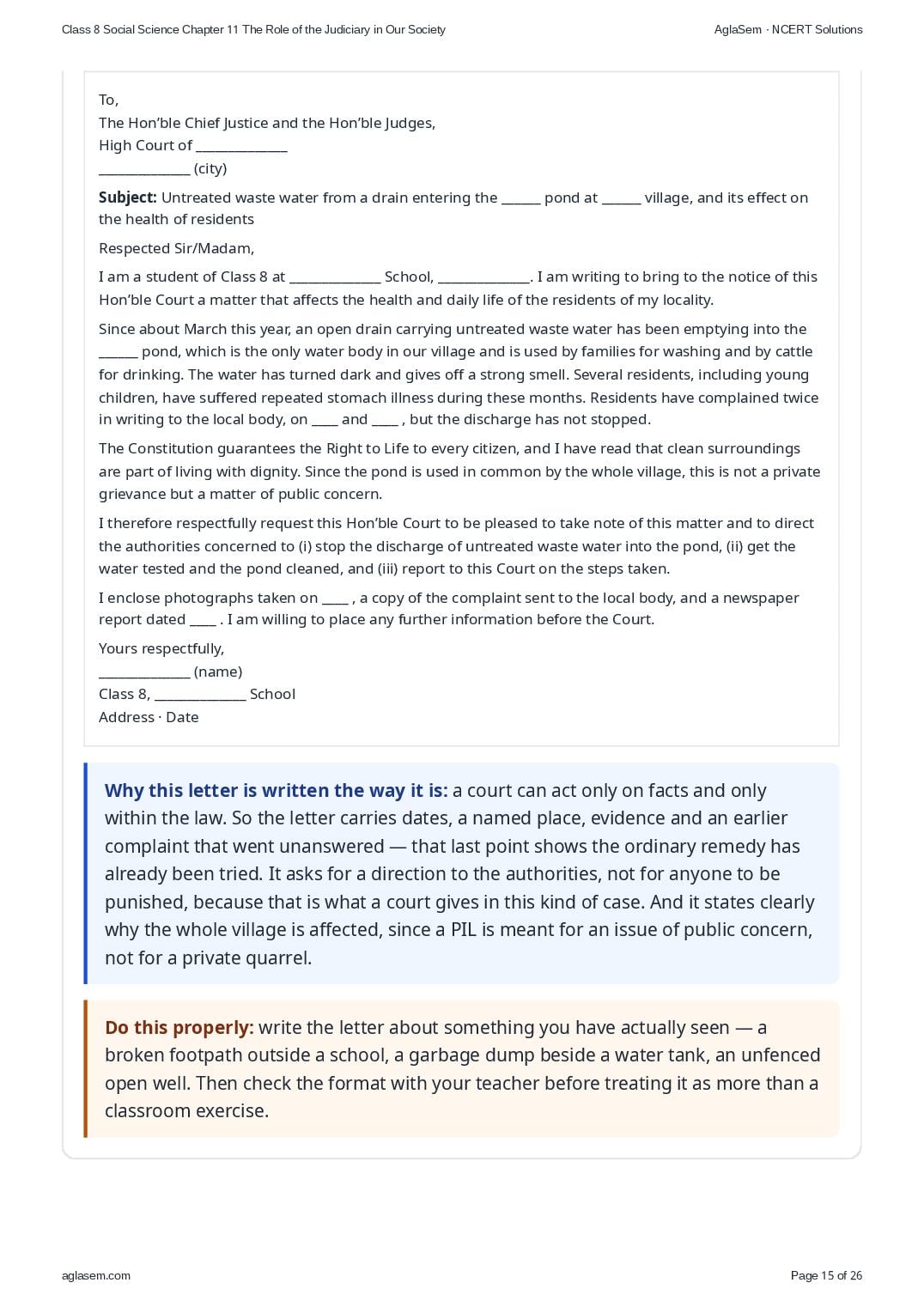
- Write a model letter to the High Court or Supreme Court about a current social issue you have observed to bring it to the notice of the judiciary.
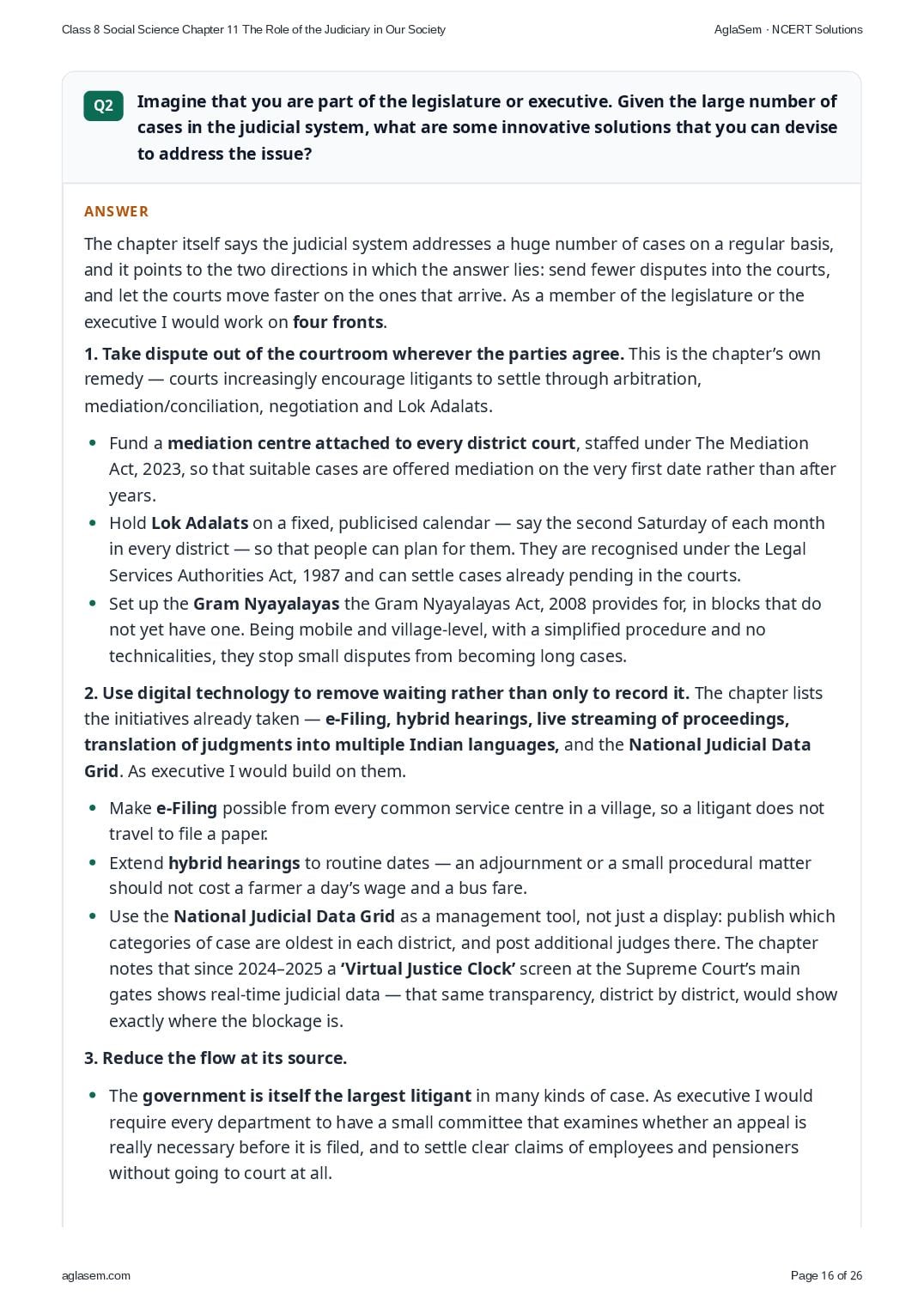
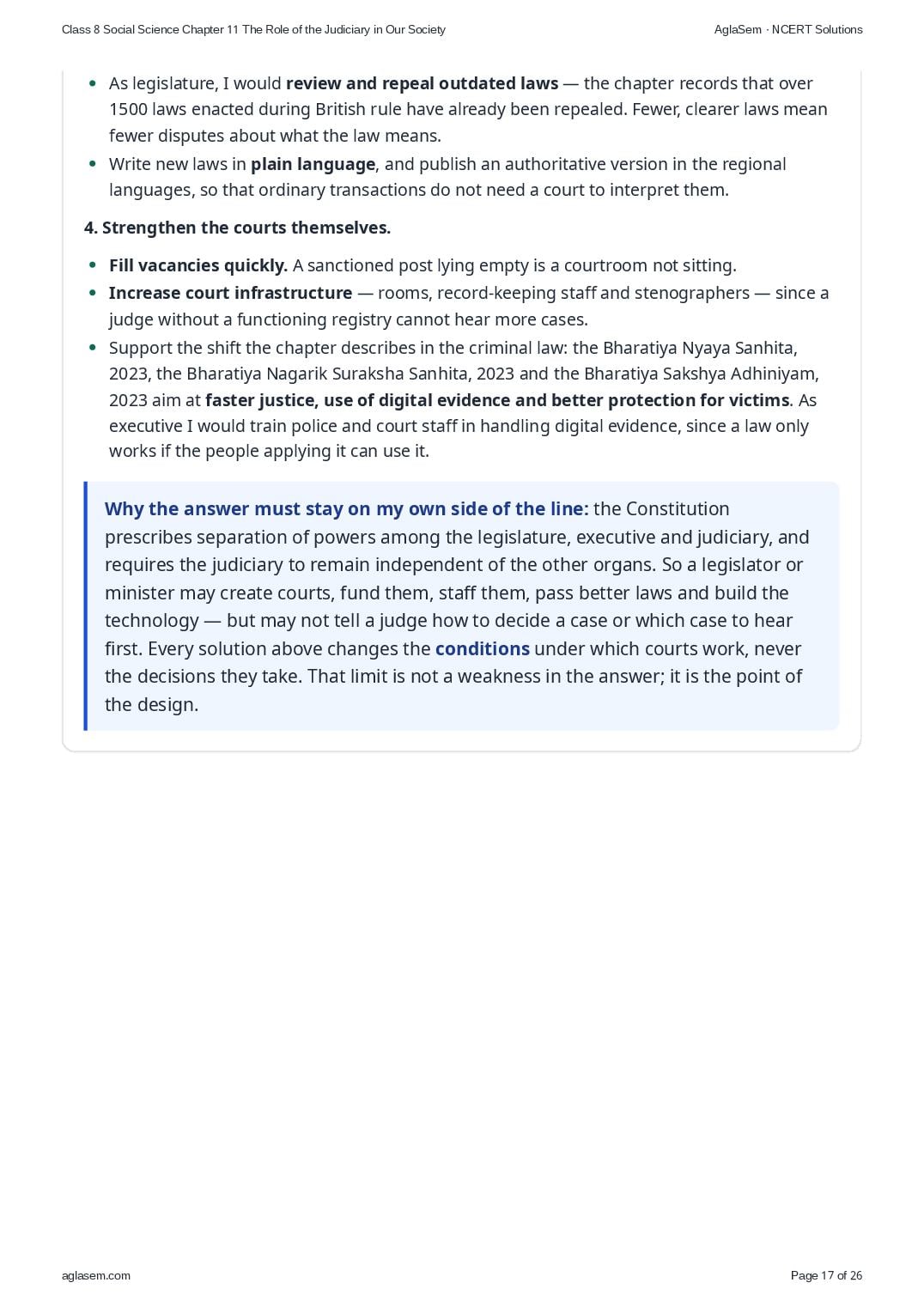
- Imagine that you are part of the legislature or executive. Given the large number of cases in the judicial system, what are some innovative solutions that you can devise to address the issue?
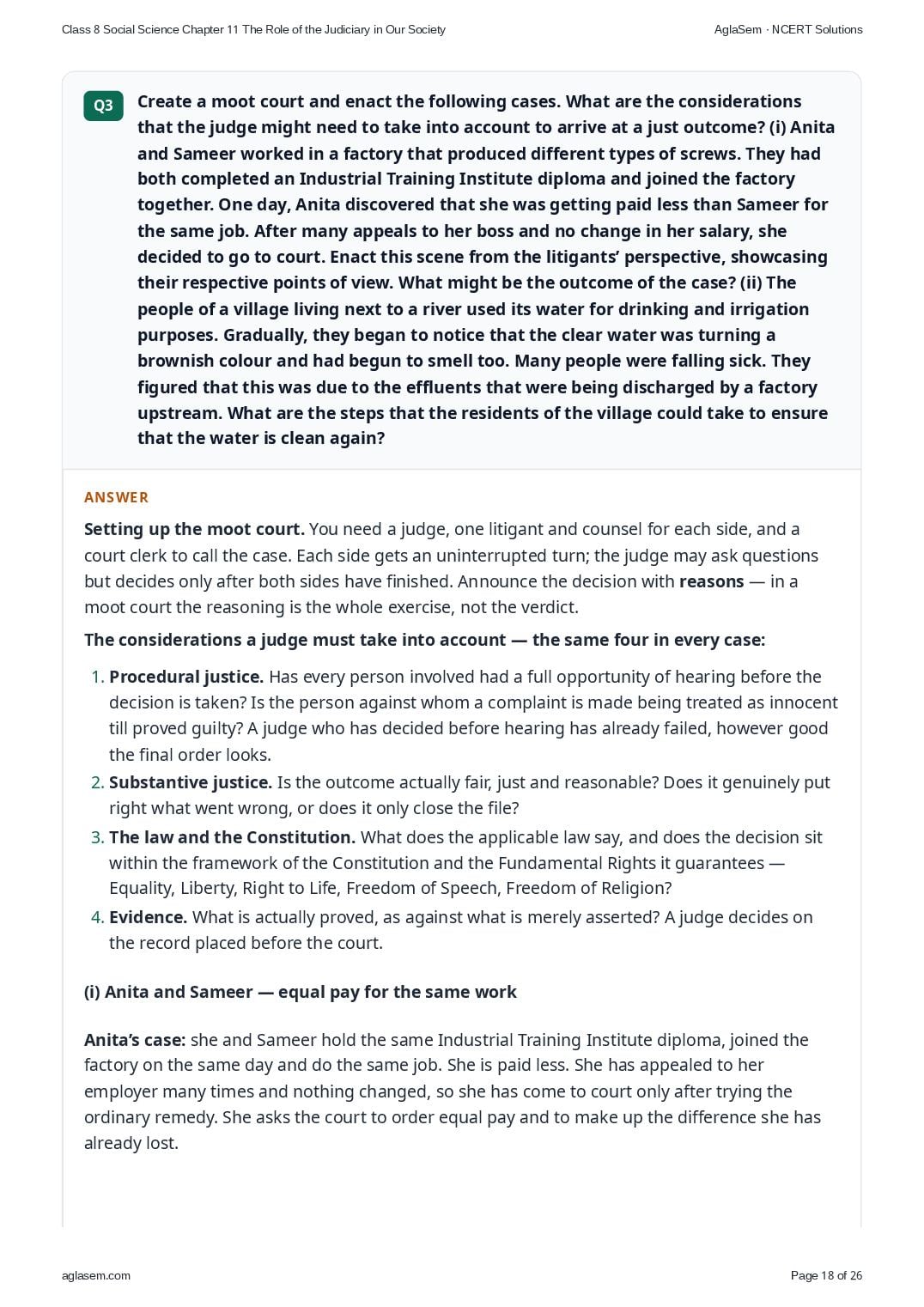
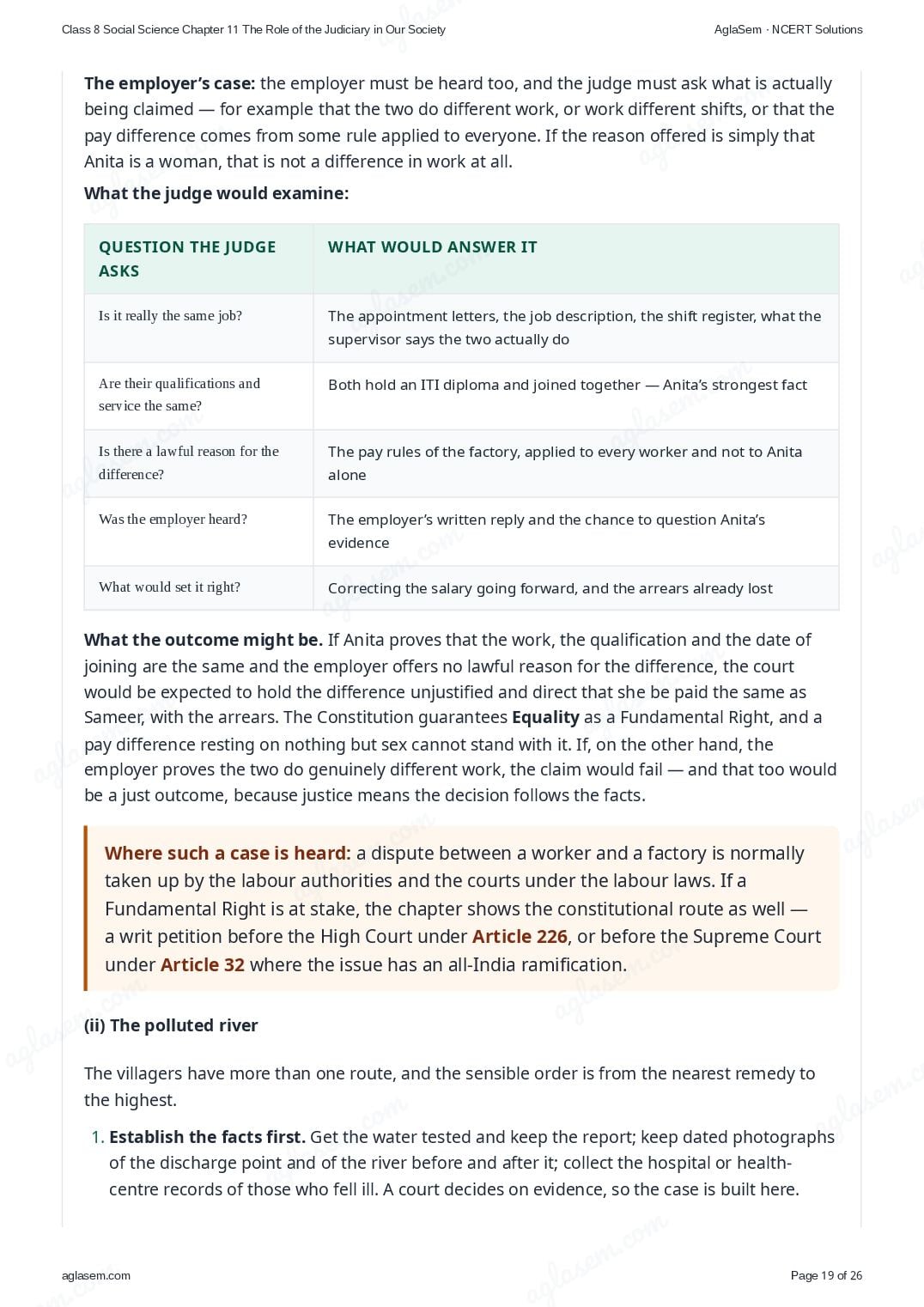
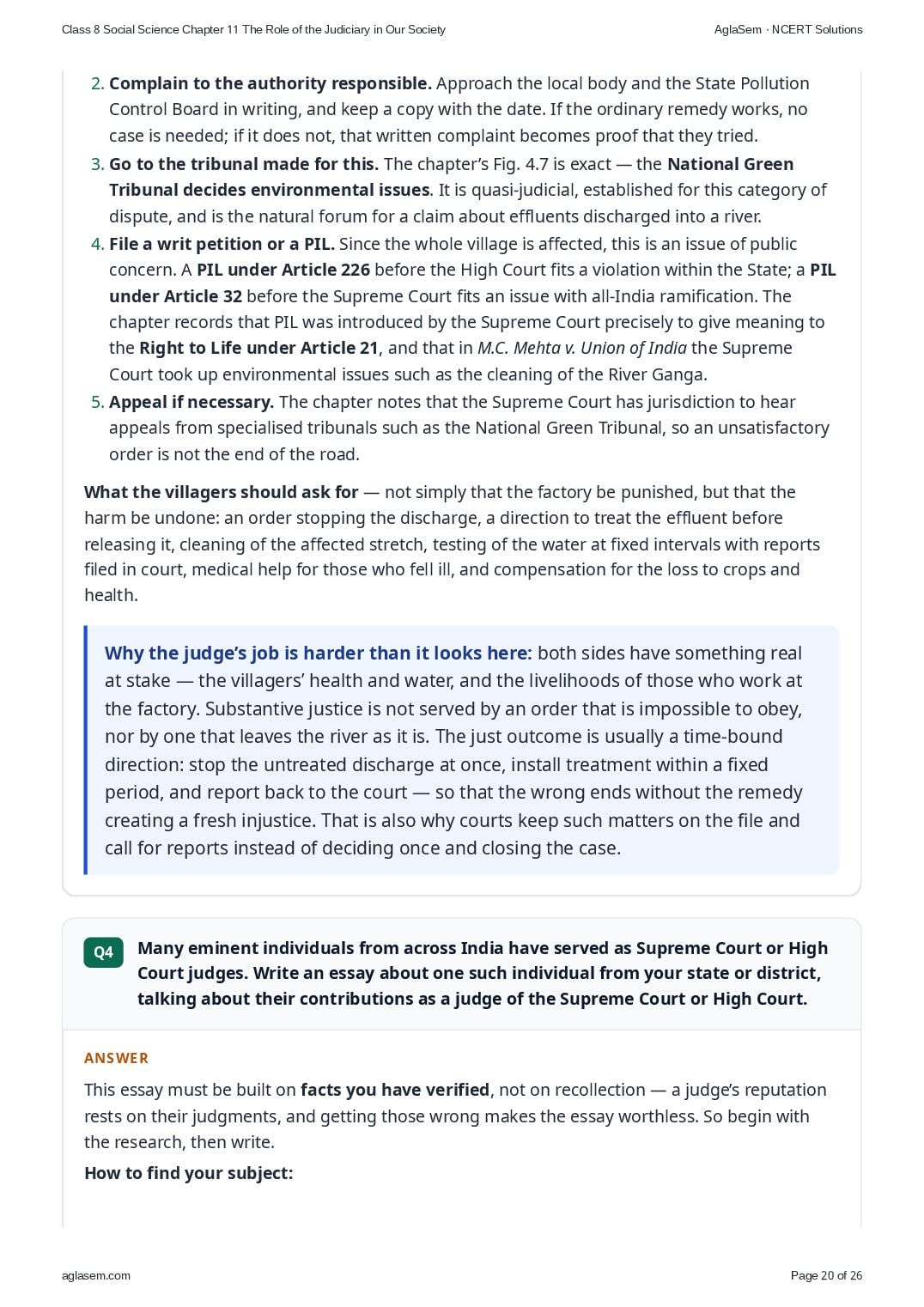
- Create a moot court and enact the following cases. What are the considerations that the judge might need to take into account to arrive at a just outcome? (i) Anita and Sameer worked in a factory that produced different types of screws. They had both completed an Industrial Training Institute diploma and joined the factory together. One day, Anita discovered that she was getting paid less than Sameer for the same job. After many appeals to her boss and no change in her salary, she decided to go to court. Enact this scene from the litigants’ perspective, showcasing their respective points of view. What might be the outcome of the case? (ii) The people of a village living next to a river used its water for drinking and irrigation purposes. Gradually, they began to notice that the clear water was turning a brownish colour and had begun to smell too. Many people were falling sick. They figured that this was due to the effluents that were being discharged by a factory upstream. What are the steps that the residents of the village could take to ensure that the water is clean again?
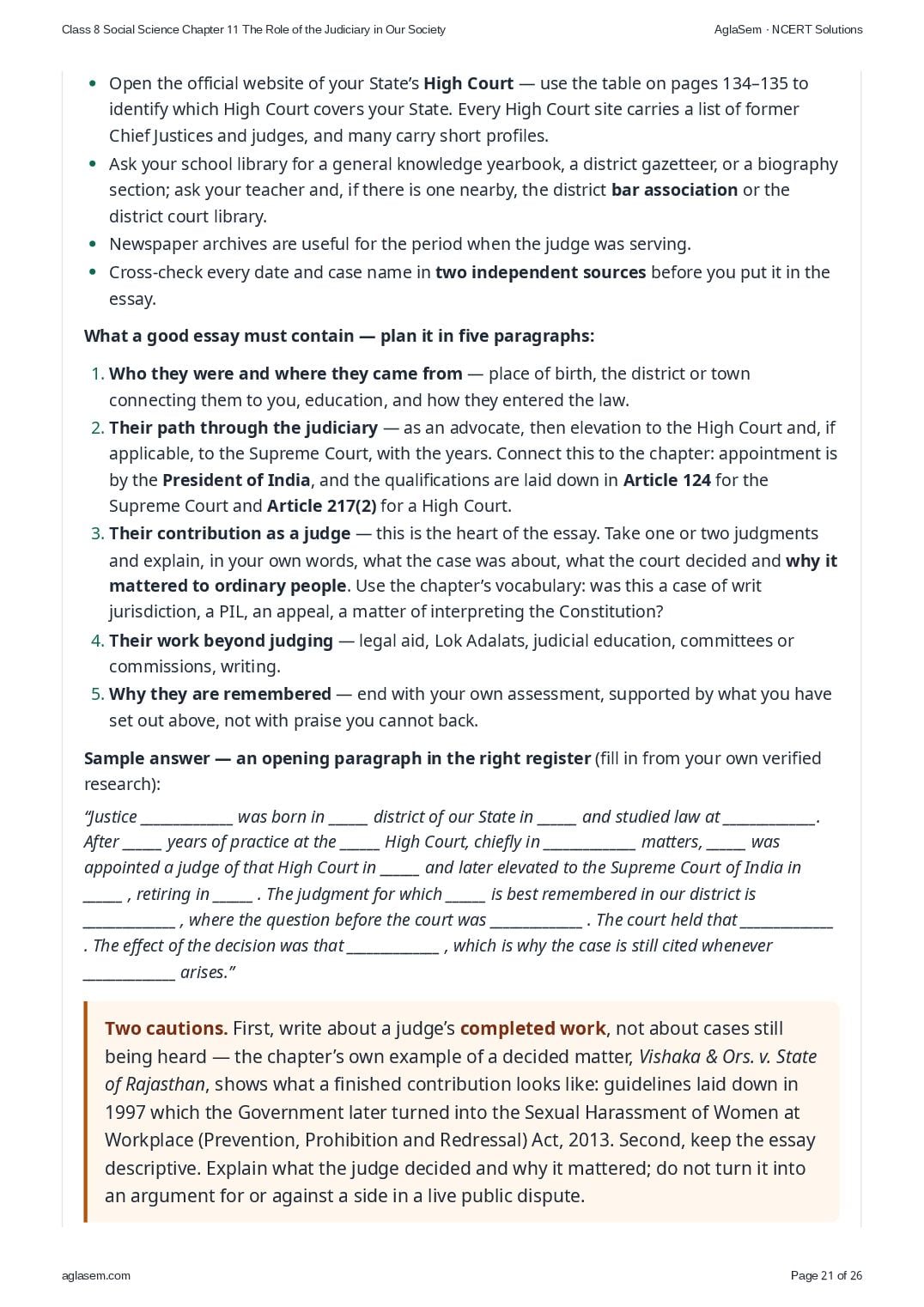
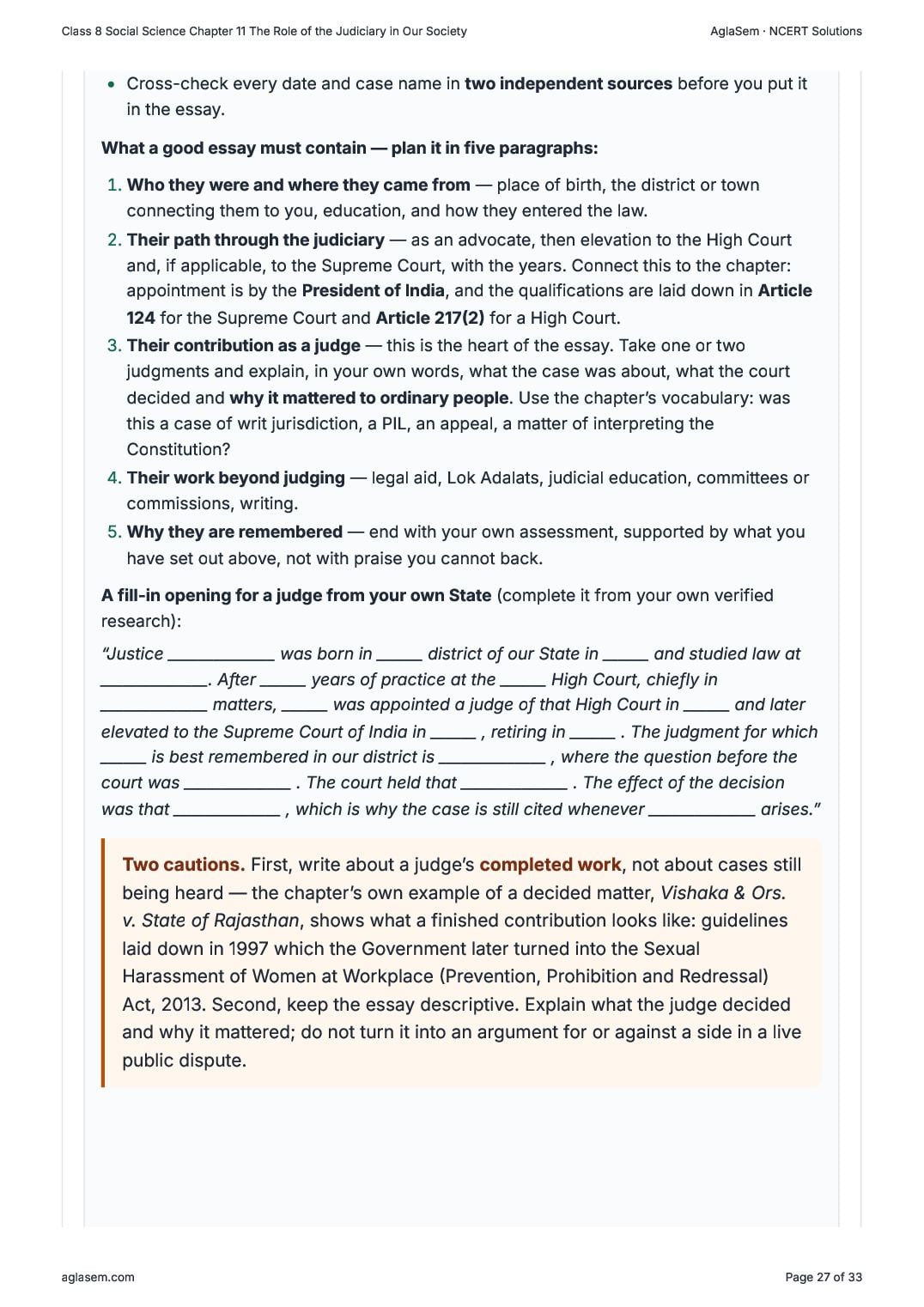
- Many eminent individuals from across India have served as Supreme Court or High Court judges. Write an essay about one such individual from your state or district, talking about their contributions as a judge of the Supreme Court or High Court.
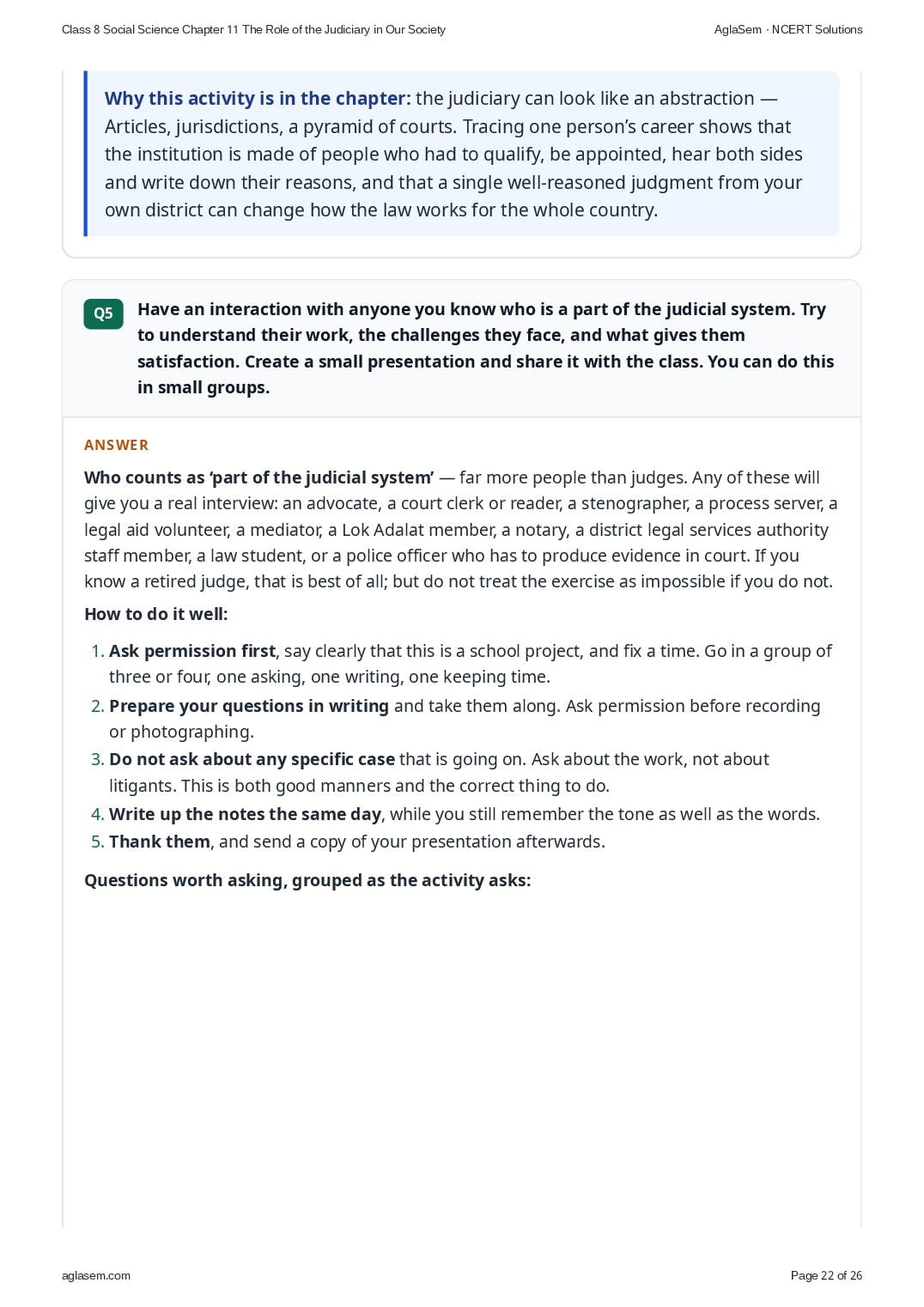
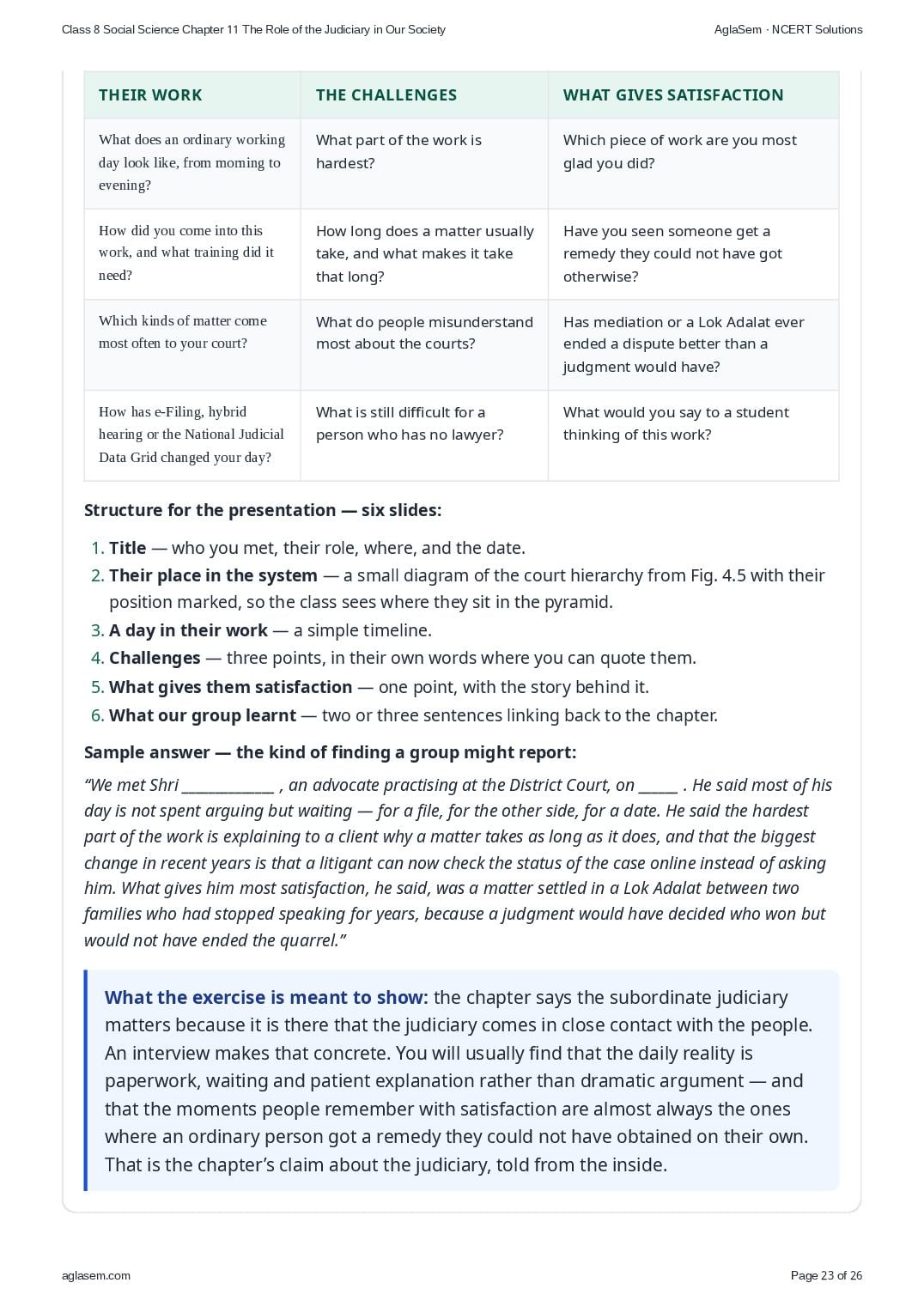
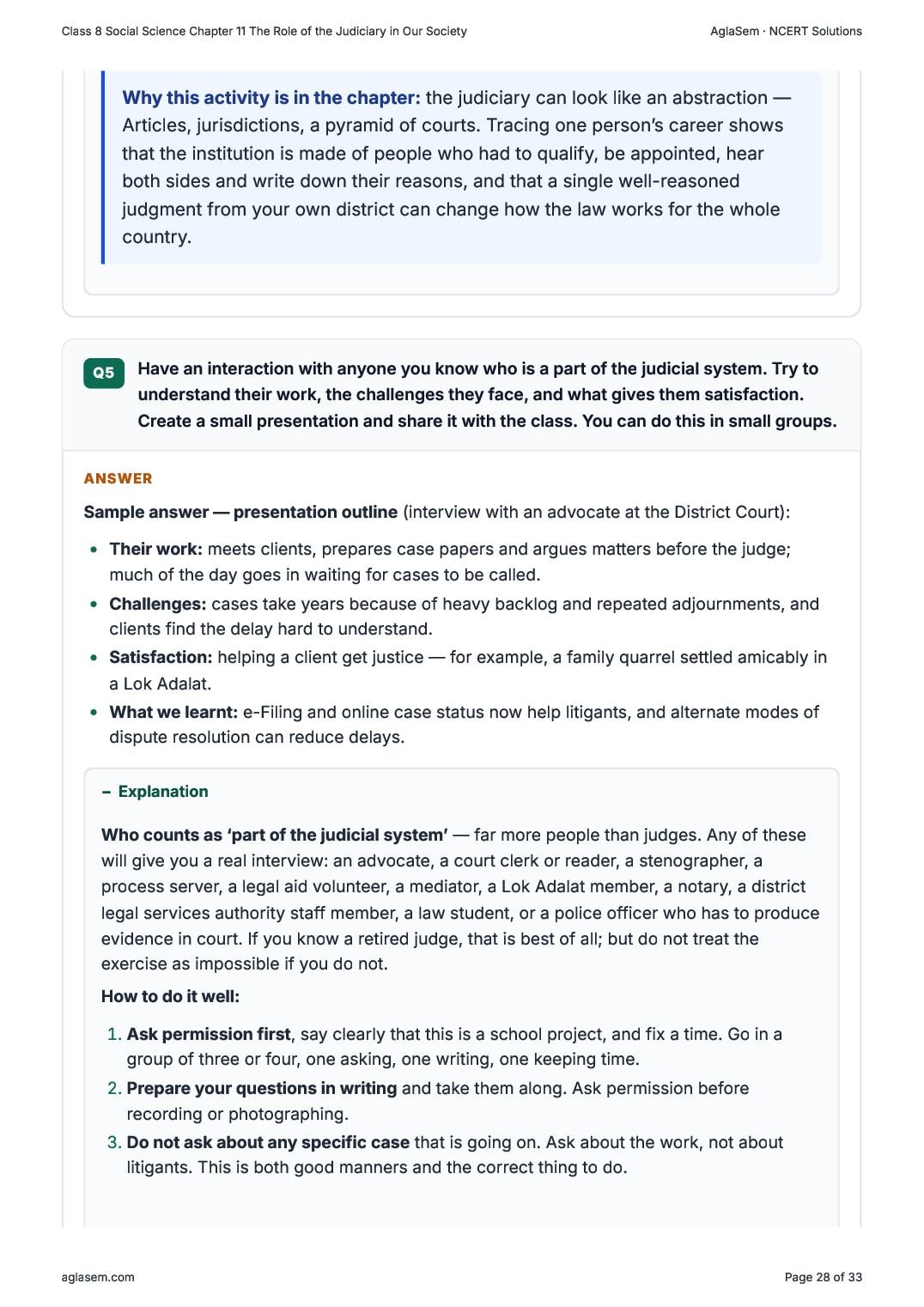
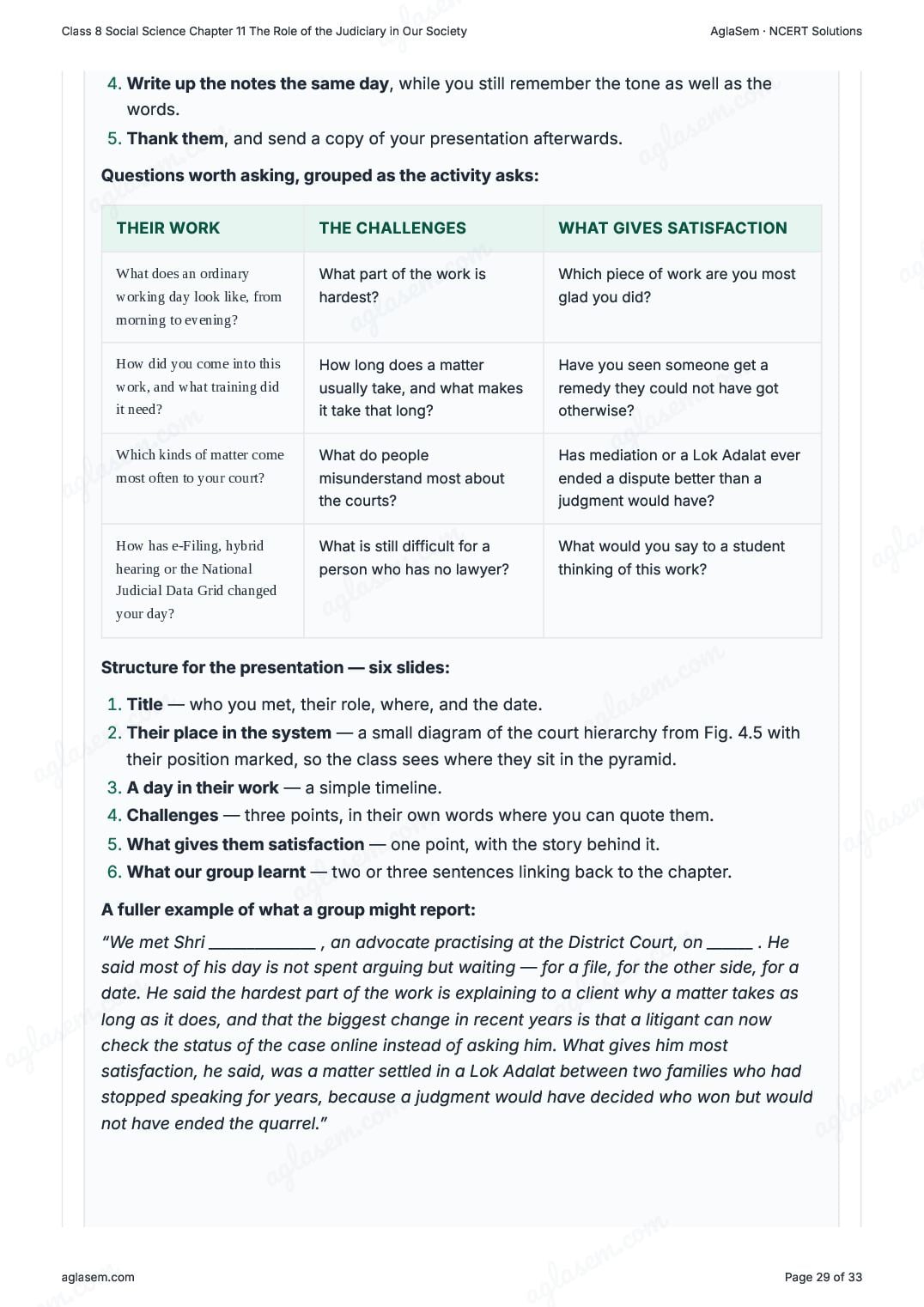
- Have an interaction with anyone you know who is a part of the judicial system. Try to understand their work, the challenges they face, and what gives them satisfaction. Create a small presentation and share it with the class. You can do this in small groups.
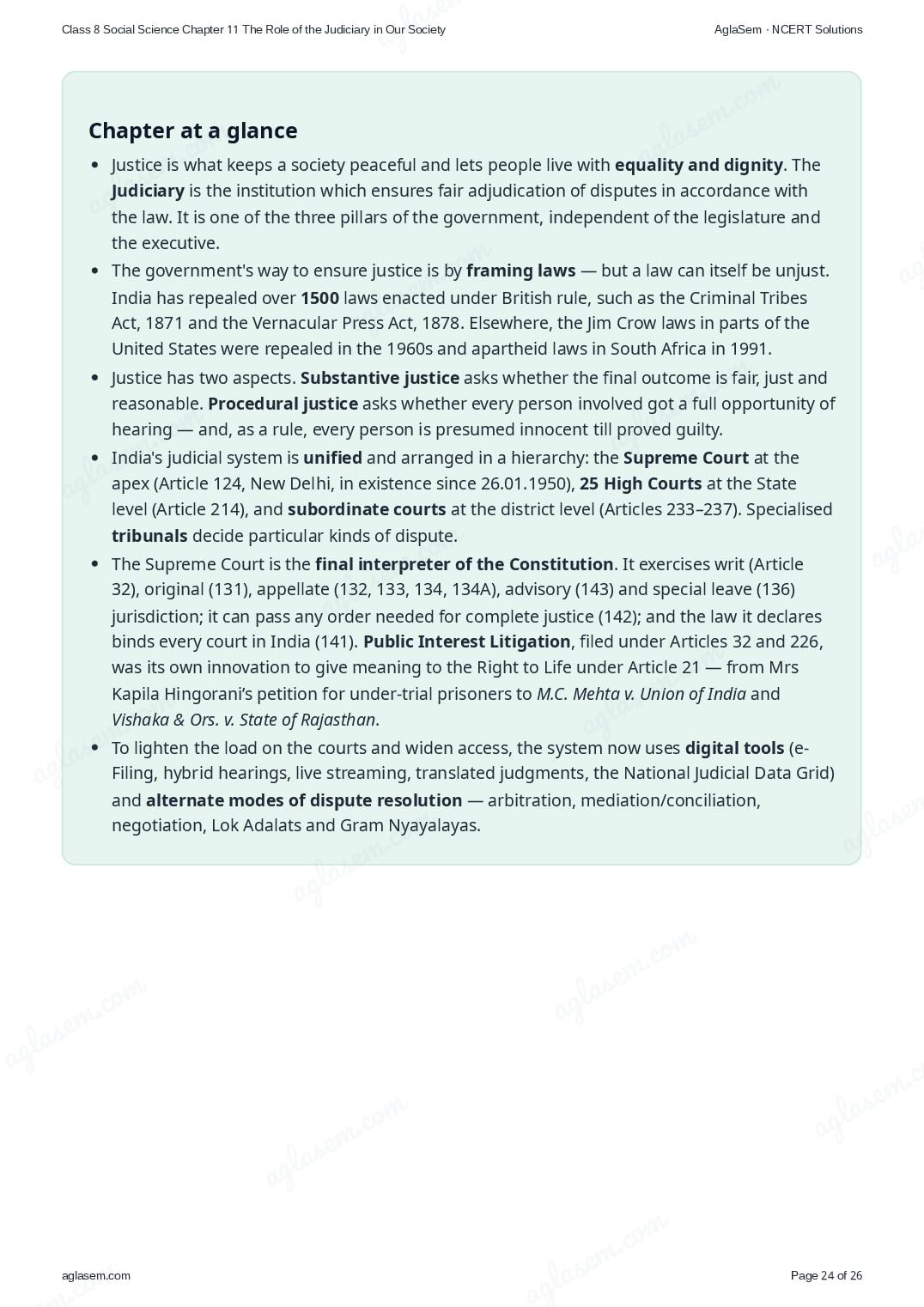
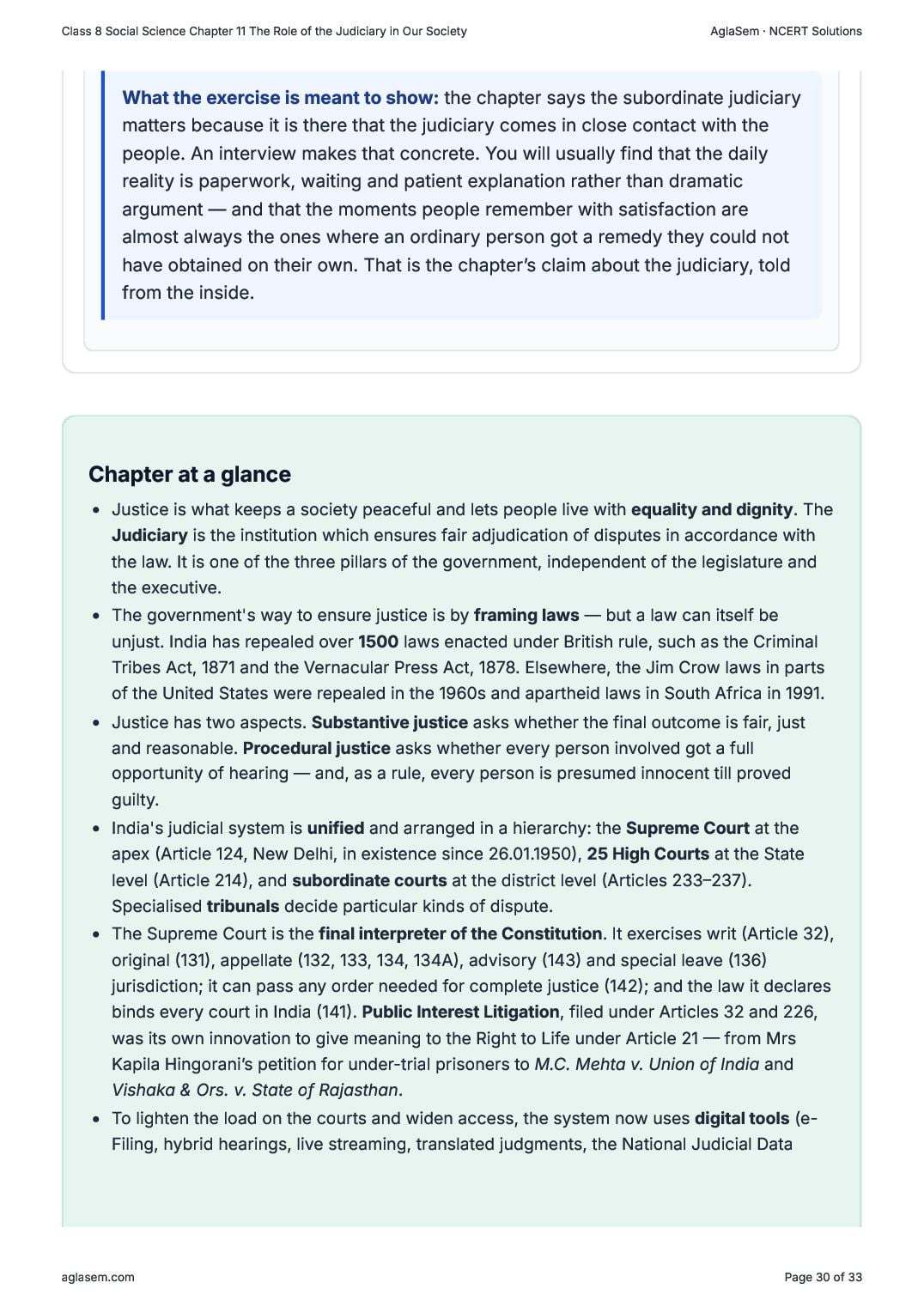
Chapter at a Glance
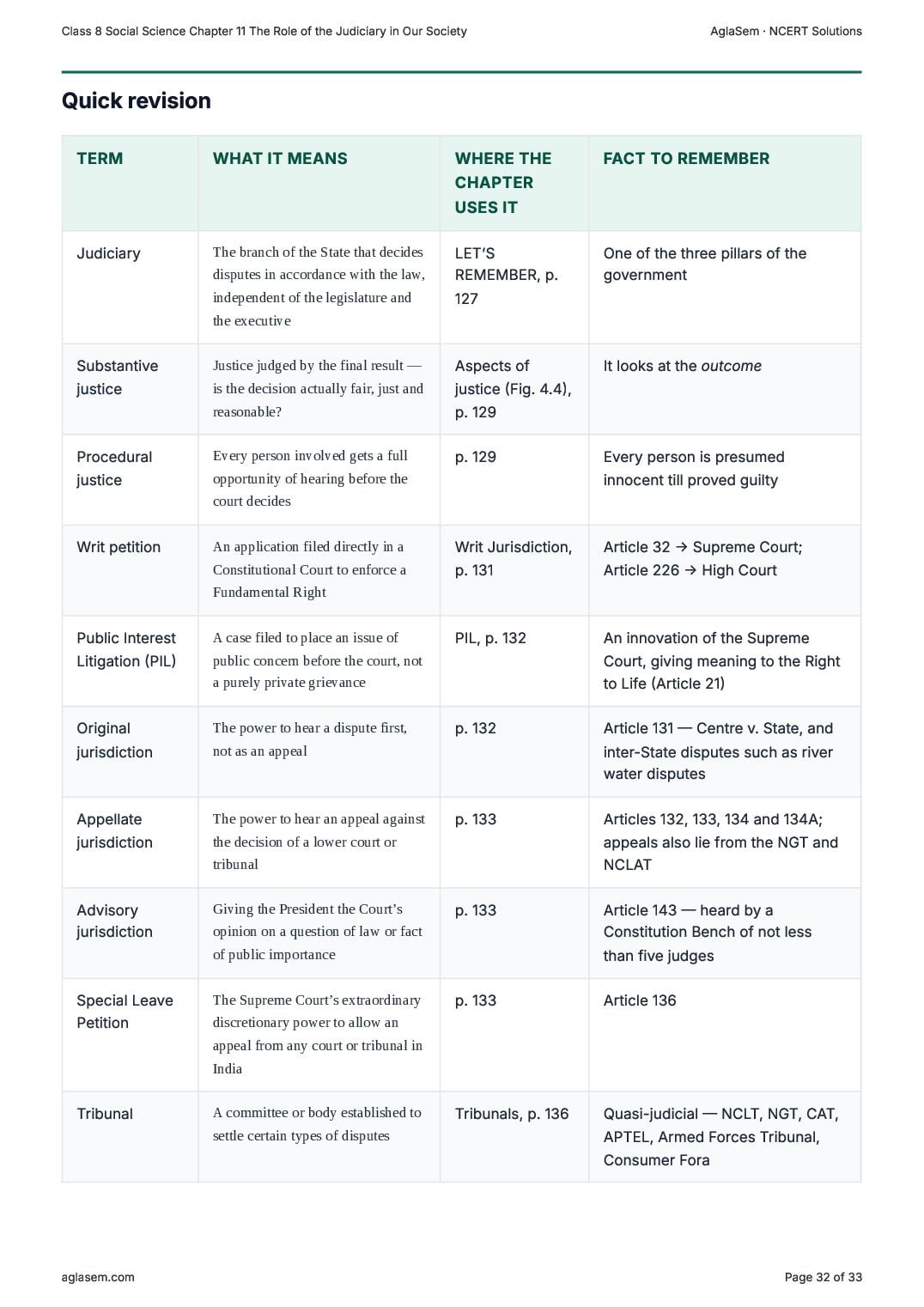
- Justice is what keeps a society peaceful and lets people live with equality and dignity . The Judiciary is the institution which ensures fair adjudication of disputes in accordance with the law. It is one of the three pillars of the government, independent of the legislature and the executive.
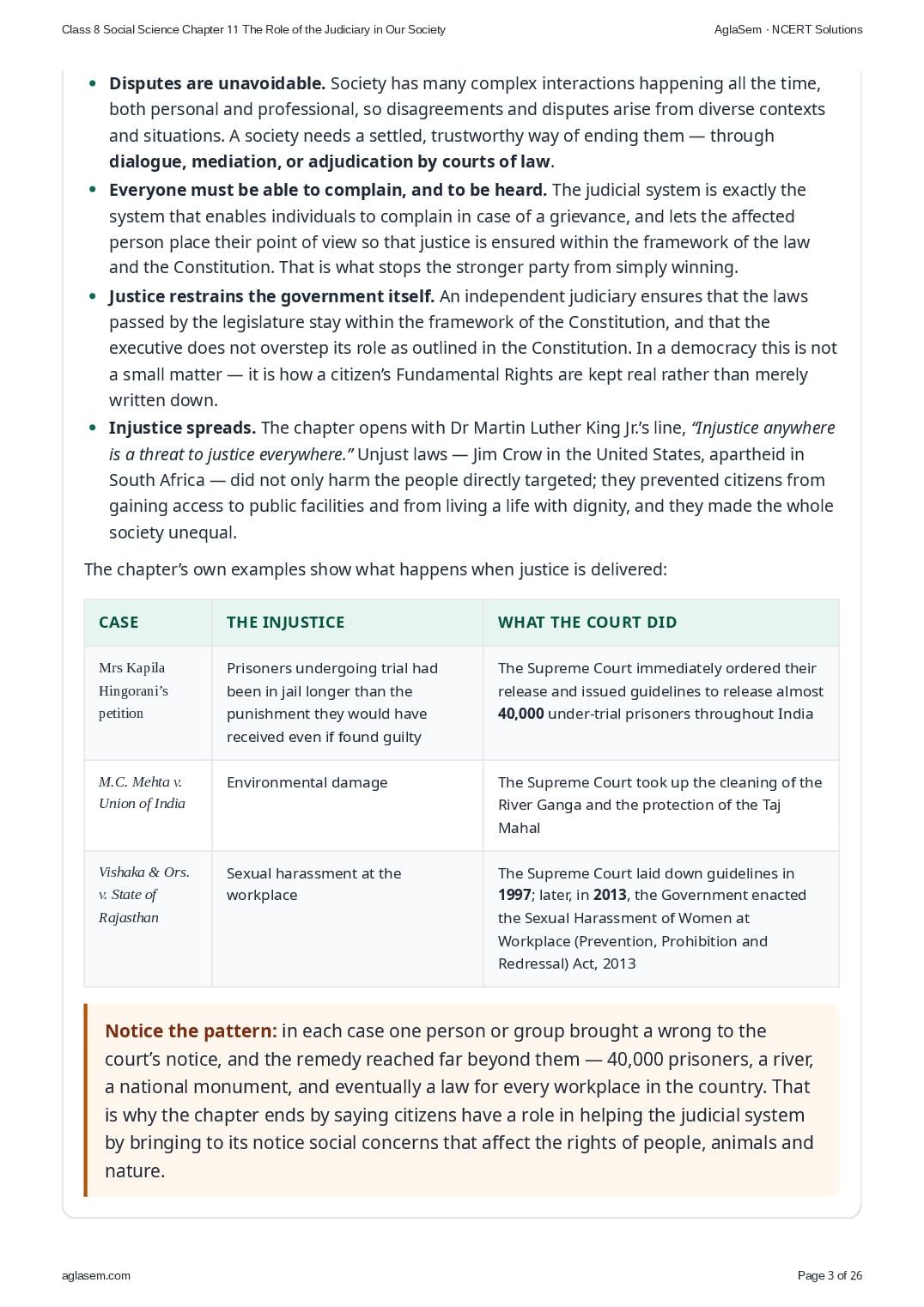
- The government's way to ensure justice is by framing laws — but a law can itself be unjust. India has repealed over 1500 laws enacted under British rule, such as the Criminal Tribes Act, 1871 and the Vernacular Press Act, 1878. Elsewhere, the Jim Crow laws in parts of the United States were repealed in the 1960s and apartheid laws in South Africa in 1991.
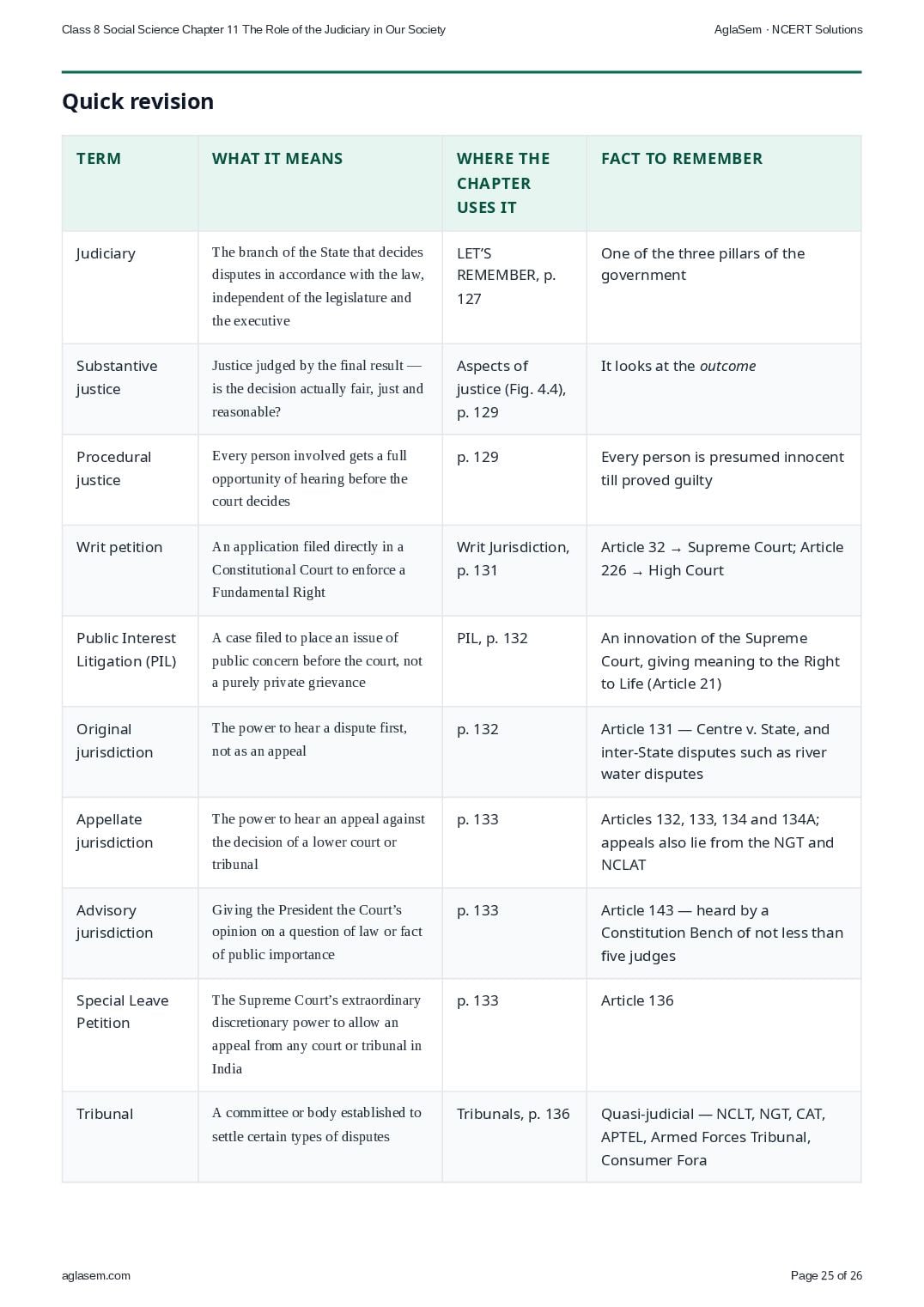
- Justice has two aspects. Substantive justice asks whether the final outcome is fair, just and reasonable. Procedural justice asks whether every person involved got a full opportunity of hearing — and, as a rule, every person is presumed innocent till proved guilty.
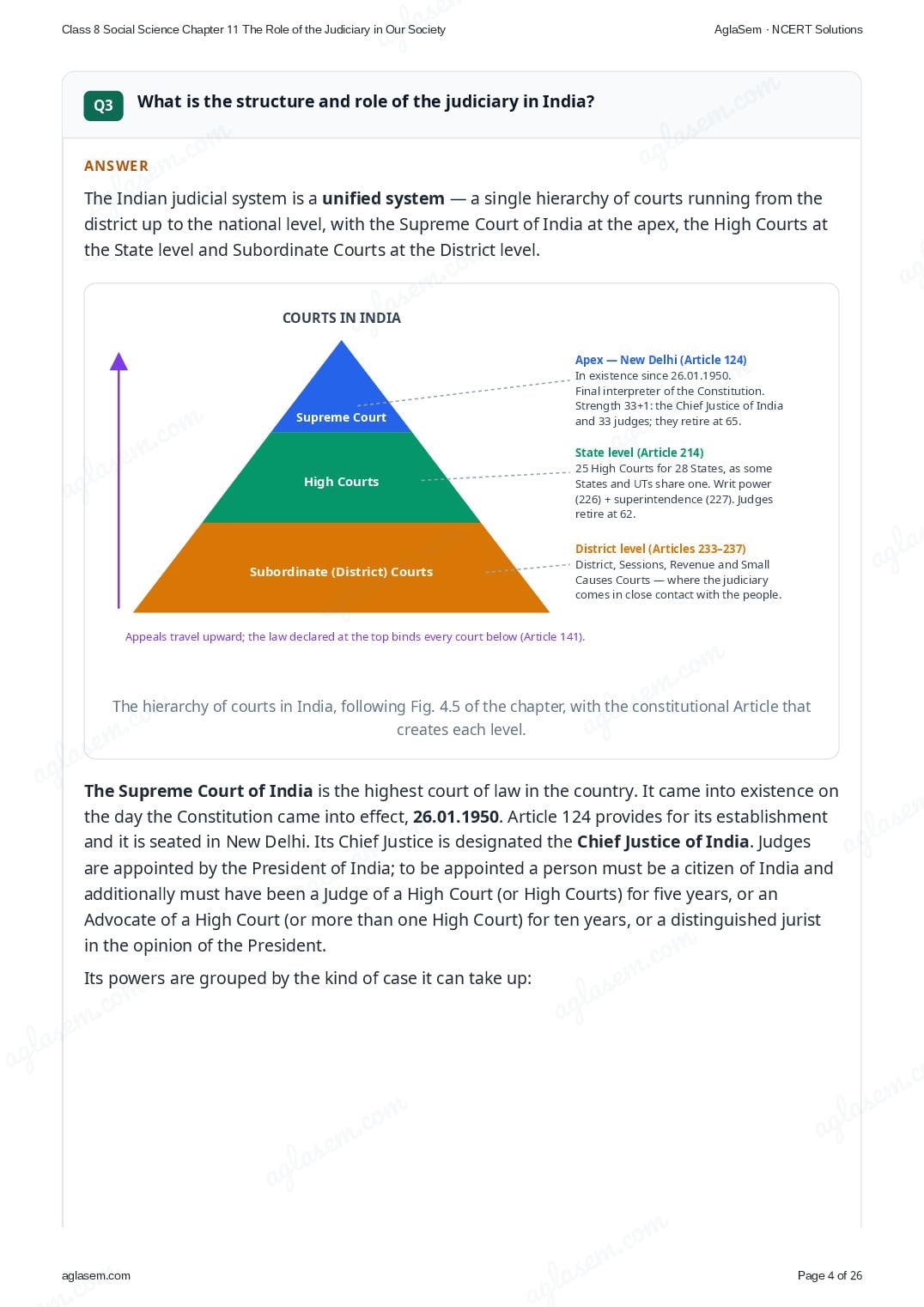
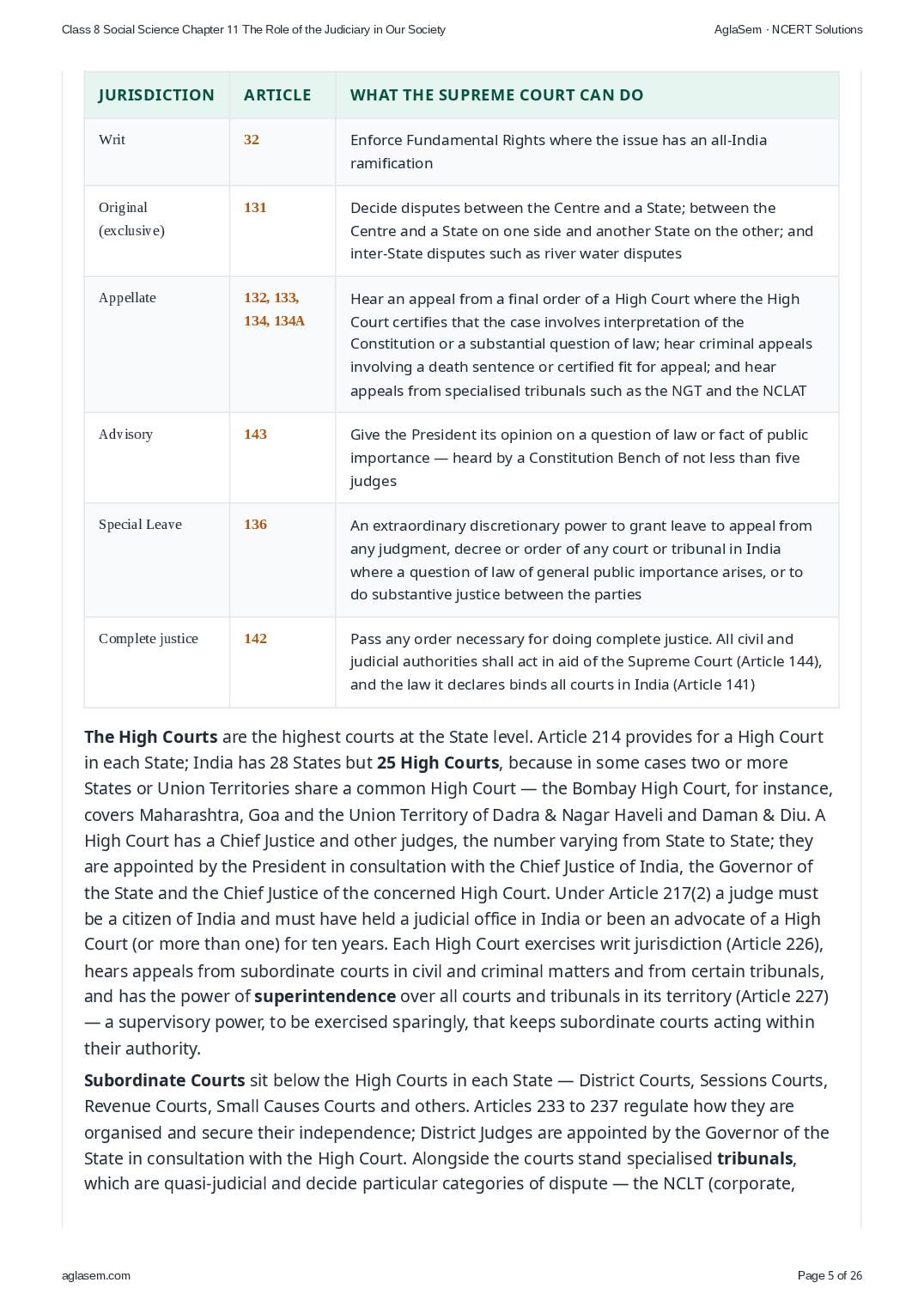
- India's judicial system is unified and arranged in a hierarchy: the Supreme Court at the apex (Article 124, New Delhi, in existence since 26.01.1950), 25 High Courts at the State level (Article 214), and subordinate courts at the district level (Articles 233–237). Specialised tribunals decide particular kinds of dispute.
- The Supreme Court is the final interpreter of the Constitution . It exercises writ (Article 32), original (131), appellate (132, 133, 134, 134A), advisory (143) and special leave (136) jurisdiction; it can pass any order needed for complete justice (142); and the law it declares binds every court in India (141). Public Interest Litigation , filed under Articles 32 and 226, was its own innovation to give meaning to the Right to Life under Article 21 — from Mrs Kapila Hingorani’s petition for under-trial prisoners to M.C. Mehta v. Union of India and Vishaka & Ors. v. State of Rajasthan .
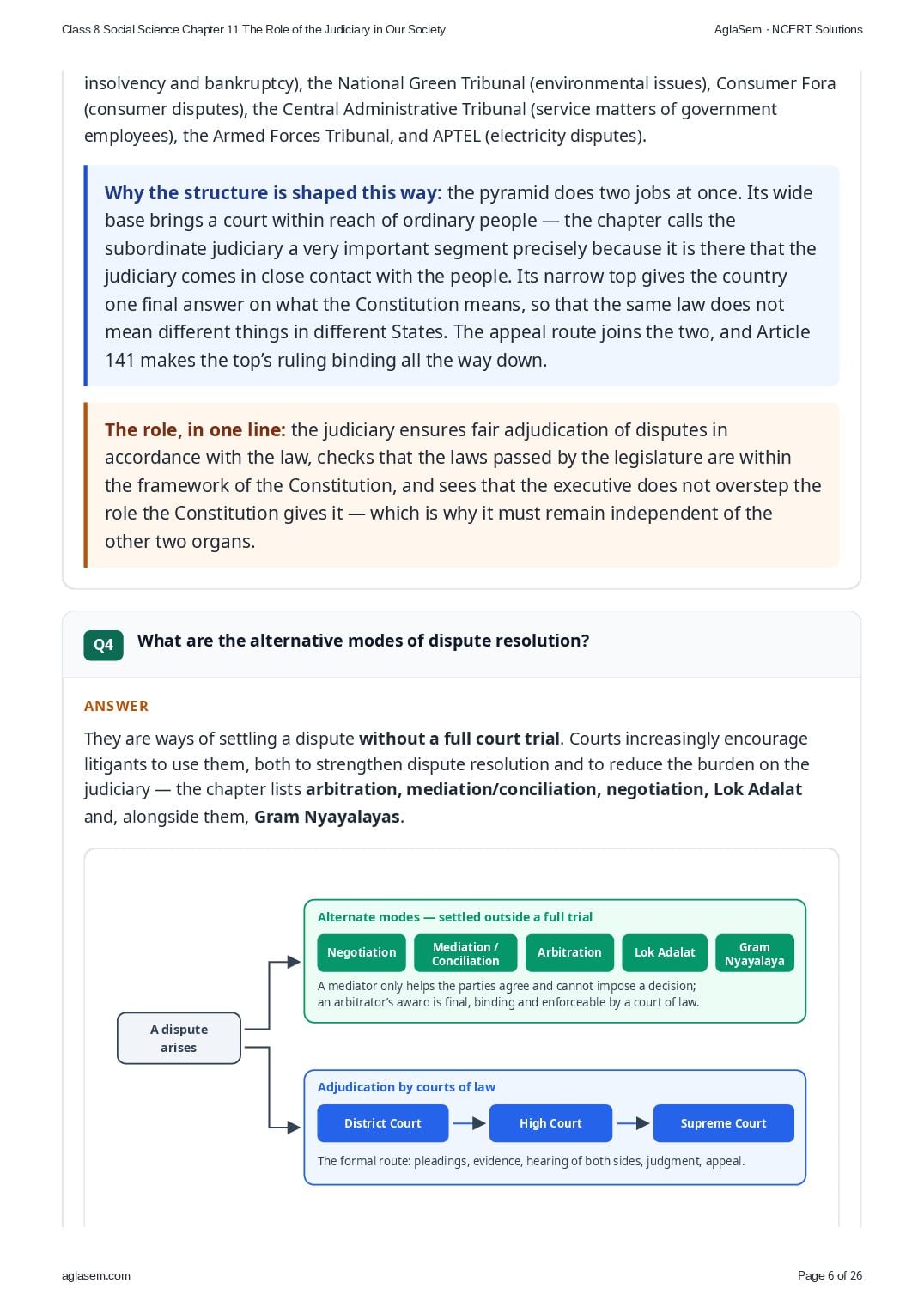
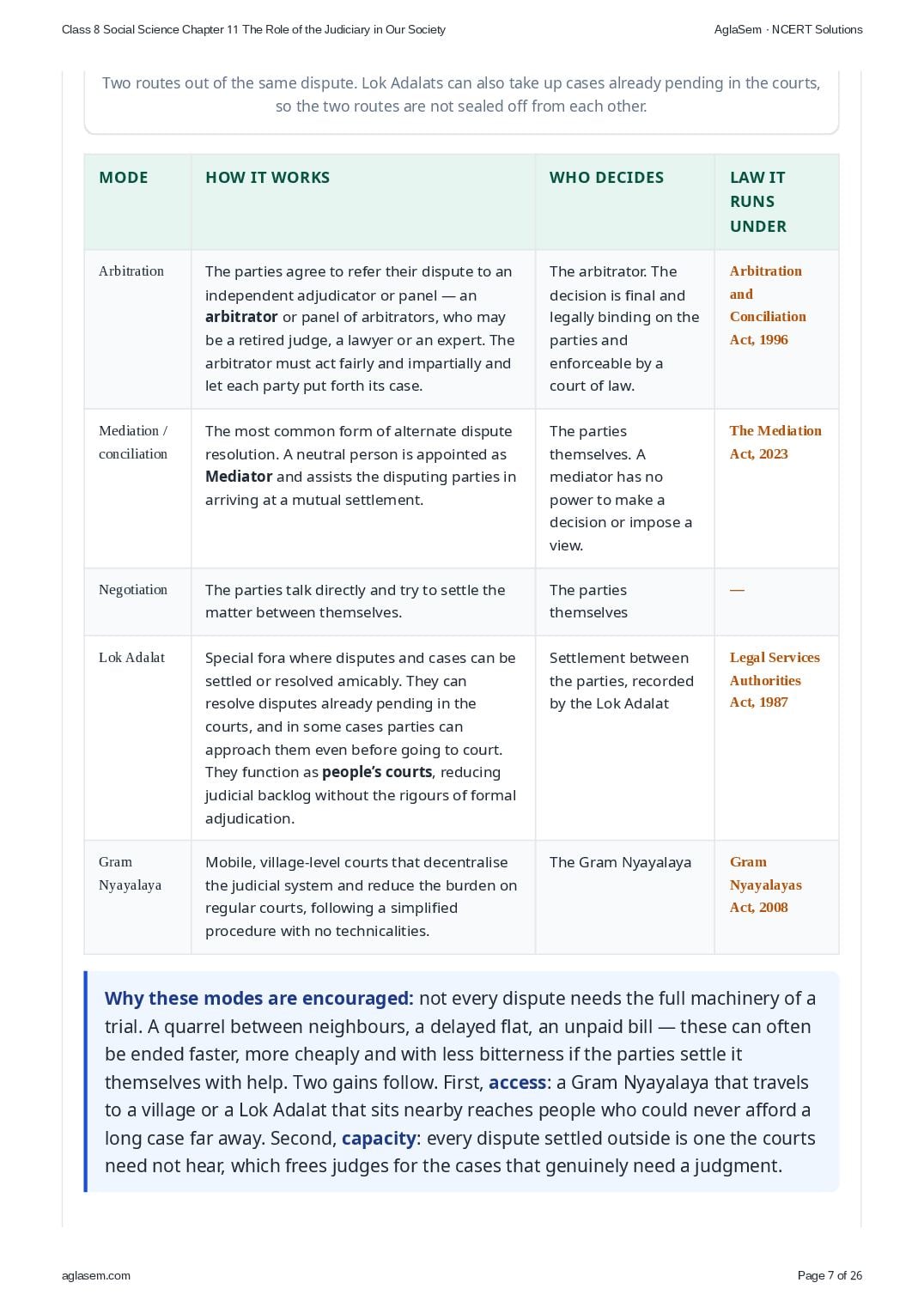
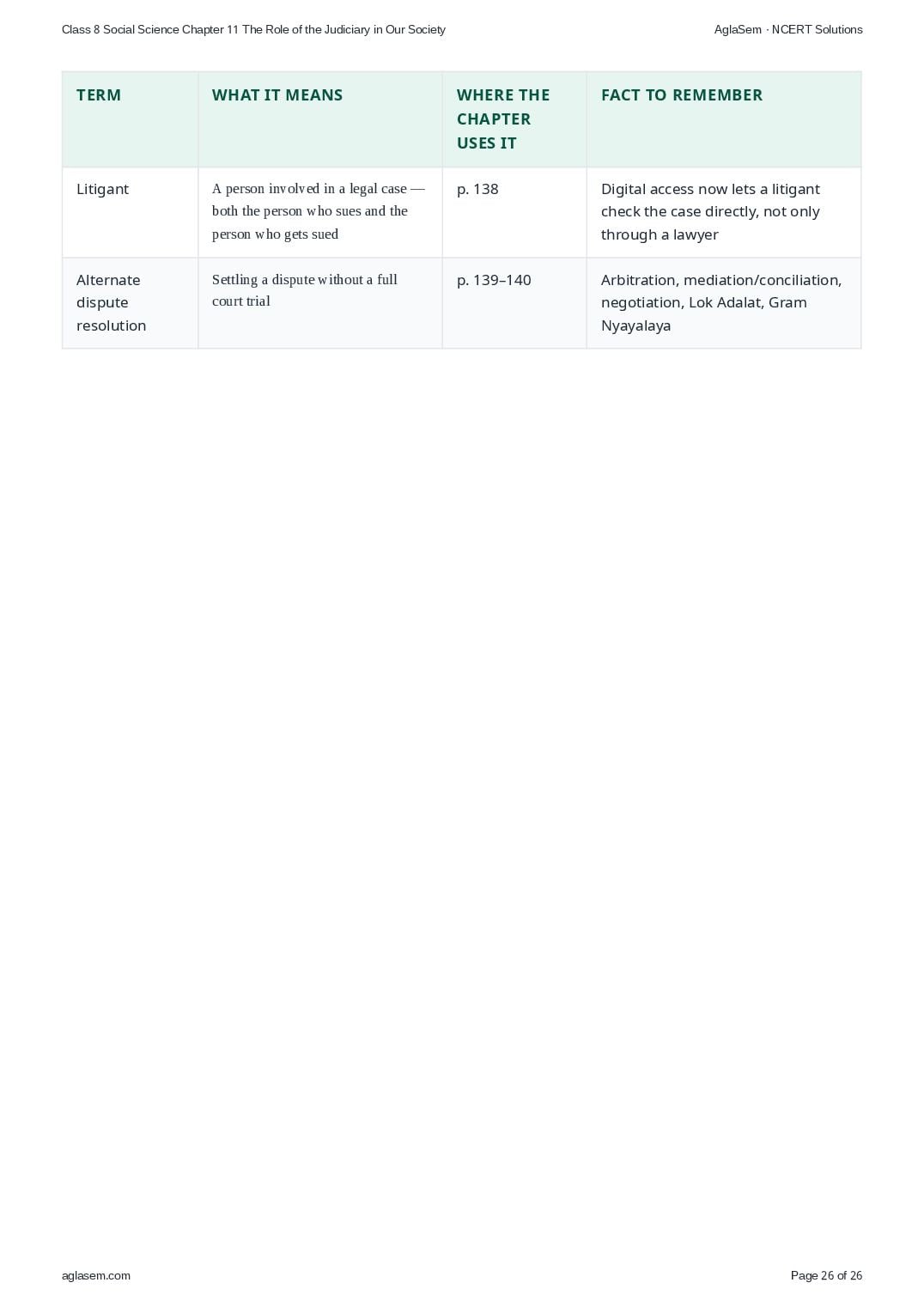
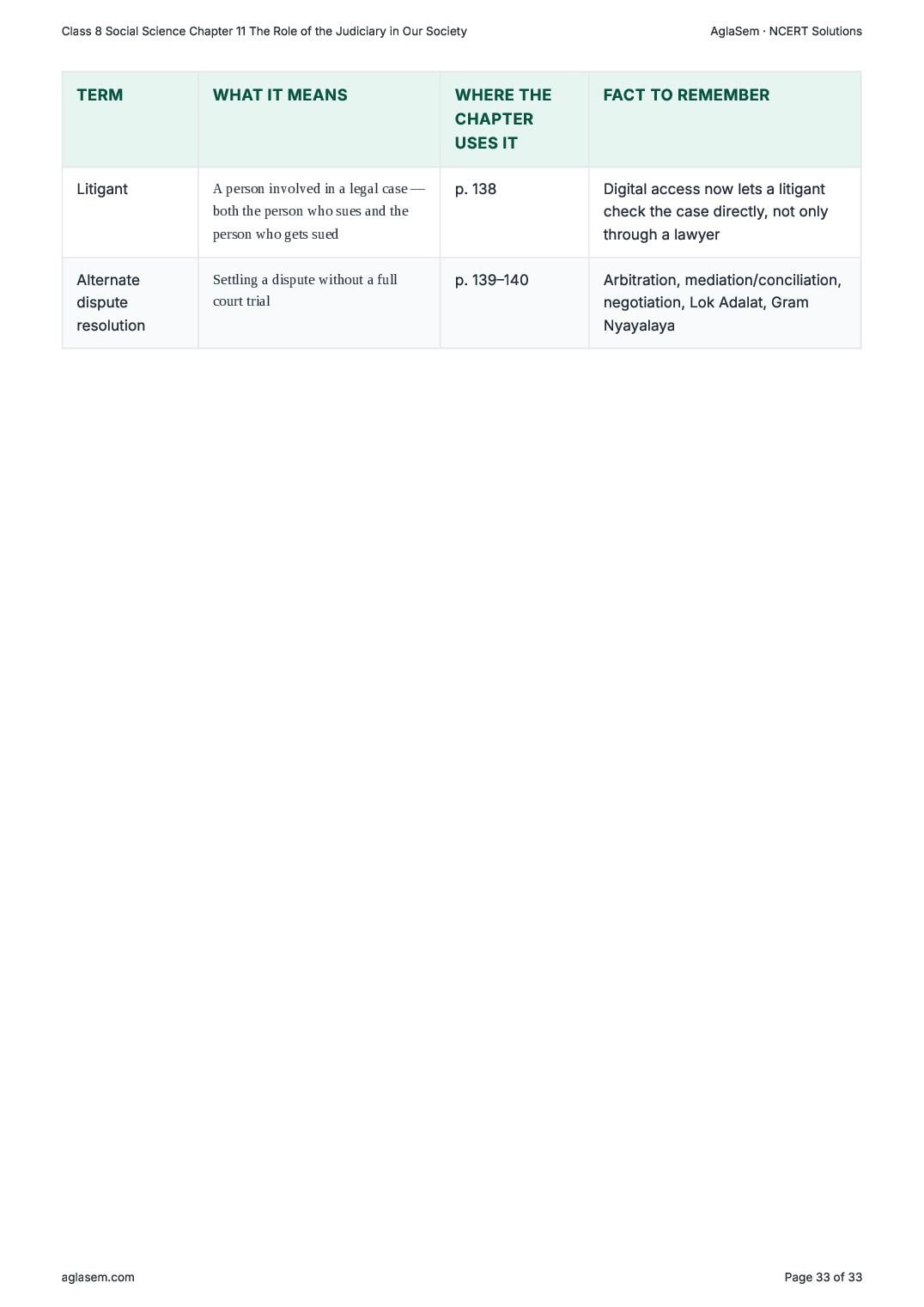
- To lighten the load on the courts and widen access, the system now uses digital tools (e-Filing, hybrid hearings, live streaming, translated judgments, the National Judicial Data Grid) and alternate modes of dispute resolution — arbitration, mediation/conciliation, negotiation, Lok Adalats and Gram Nyayalayas.
How to Download NCERT Solutions for Class 8 Social Science Chapter 11 PDF
Follow these simple steps to get the The Role of the Judiciary in Our Society questions-and-answers PDF from Exploring Society: India and Beyond.
- Search NCERT Solutions for Class 8 Social Science Chapter 11 aglasem and open this page.
- Read the exercise questions with answers for The Role of the Judiciary in Our Society shown above.
- Click the Download PDF link to save the The Role of the Judiciary in Our Society solutions to your device.
NCERT Solutions for Class 8 Social Science – All Chapters
There are more chapters to study besides The Role of the Judiciary in Our Society in Social Science. Here are the NCERT Solutions for all chapters of Class 8 Social Science.
- Chapter 1 Natural Resources and Their Use
- Chapter 2 Reshaping India’s Political Map
- Chapter 3 The Rise of the Marathas
- Chapter 4 The Colonial Era in India
- Chapter 5 Universal Franchise and India’s Electoral System
- Chapter 6 The Parliamentary System Legislature and Executive
- Chapter 7 Factors of Production
- Chapter 8 World Geography Some Glimpses
- Chapter 9 India’s Long Road to Independence
- Chapter 10 A Journey Through Indian Architecture
- Chapter 11 The Role of the Judiciary in Our Society
- Chapter 12 Citizenship Rights and Duties
- Chapter 13 Dynamics of Population
- Chapter 14 India’s Urban Landscape
- Chapter 15 Cultural Currents 13th to 17th Centuries
NCERT Solutions for Class 8 – All Subjects
Just like Chapter 11 of Social Science, you can get the exercise questions with answers for every other subject of Class 8. Here are the NCERT Solutions for all subjects of Class 8.
NCERT Solutions for Class 8 Social Science Chapter 11 – An Overview
The key highlights of this study material are as follows.
| Aspects | Details |
|---|---|
| Class | Class 8 |
| Subject | Social Science |
| Chapter Number | Chapter 11 |
| Chapter Name | The Role of the Judiciary in Our Society |
| Book Name | Exploring Society: India and Beyond |
| Book By | NCERT (National Council of Educational Research and Training) |
| Educational Resource Here | NCERT Solutions of Class 8 Social Science Chapter 11 for all exercises |
| More Questions Answers of This Subject | NCERT Solutions for Class 8 Social Science |
| Download Book Chapter | NCERT Book Class 8 Social Science |
| All Questions Answers For This Class | NCERT Solutions for Class 8 |
| Complete Solutions | NCERT Solutions |
NCERT Solutions for Class 8 Social Science Chapter 11 The Role of the Judiciary in Our Society – FAQs
What are the NCERT Solutions for Class 8 Social Science Chapter 11 The Role of the Judiciary in Our Society?
They are the complete, step-by-step answers to all the exercise and in-text questions of Chapter 11 The Role of the Judiciary in Our Society from the NCERT Class 8 Social Science textbook Exploring Society: India and Beyond, written by experts as per the latest NCERT syllabus.
How can I download the Class 8 Social Science Chapter 11 solutions PDF for free?
Open this page on aglasem, read the The Role of the Judiciary in Our Society questions with answers, and click the “Download Solutions PDF” link. The Class 8 Social Science Chapter 11 NCERT Solutions PDF is completely free to download.
Are these NCERT Solutions as per the latest 2026-27 syllabus?
Yes. The NCERT Solutions for Class 8 Social Science Chapter 11 are based on the latest NCERT textbook Exploring Society: India and Beyond and the current 2026-27 CBSE syllabus, so the questions and answers match what you study in class.
Where can I get NCERT Solutions for the other chapters of Class 8 Social Science?
You can find the answers to every chapter on the NCERT Solutions for Class 8 Social Science page, and solutions for every subject on the NCERT Solutions for Class 8 page.
How do NCERT Solutions help in exam preparation?
They show the correct method to solve each question, help you write answers the way they are expected in exams, let you check and correct your own work, and save revision time — which together improve your marks in Class 8 Social Science.
If you have any queries on NCERT Solutions for Class 8 Social Science Chapter 11 The Role of the Judiciary in Our Society, then please ask in the comments below.