NCERT Solutions for Class 8 Social Science Chapter 15 Cultural Currents 13th to 17th Centuries provide clear, step-by-step answers to every exercise and in-text question from the chapter Cultural Currents 13th to 17th Centuries of the NCERT textbook Exploring Society: India and Beyond. Prepared by subject experts as per the latest NCERT (CBSE) syllabus for 2026-27, these NCERT Solutions for Class 8 Social Science help you understand each concept, write exam-ready answers, and check your own solutions. You can read them online below or download the free Class 8 Social Science Chapter 15 question-answer PDF.
NCERT Solutions for Class 8 Social Science Chapter 15 Cultural Currents 13th to 17th Centuries
- Class: Class 8
- Subject: Social Science
- Chapter: Chapter 15 – Cultural Currents 13th to 17th Centuries
- Textbook: Exploring Society: India and Beyond (NCERT)
- Study material: NCERT Solutions – questions with answers, free PDF
These solutions answer all the exercise questions of Chapter 15 Cultural Currents 13th to 17th Centuries — including the in-text questions, short-answer and long-answer questions, and activities — with complete explanations so you can follow the method, not just the final answer. Read the full solutions below.
NCERT Solutions Class 8 Social Science Chapter 15 Cultural Currents 13th to 17th Centuries View Download
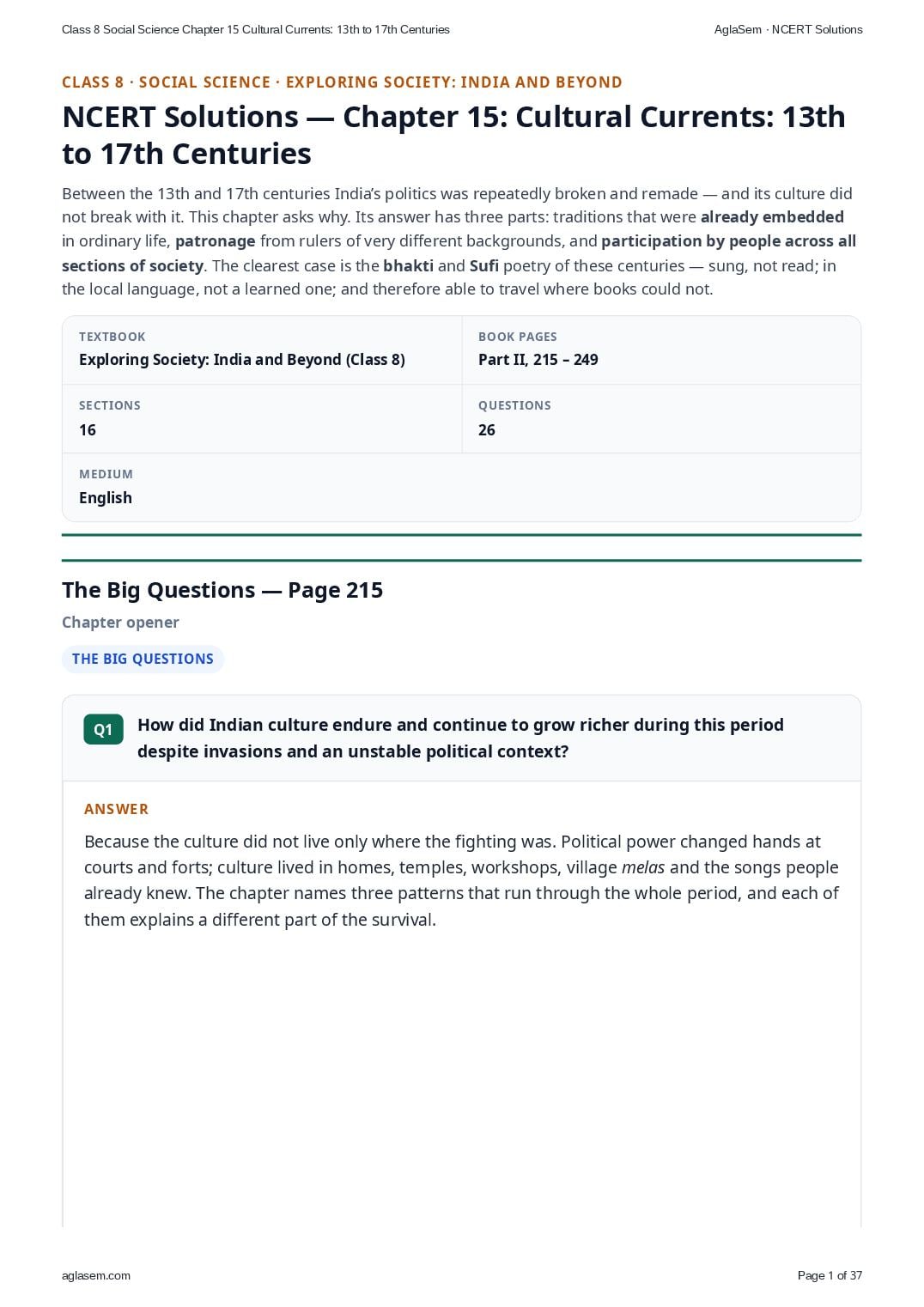
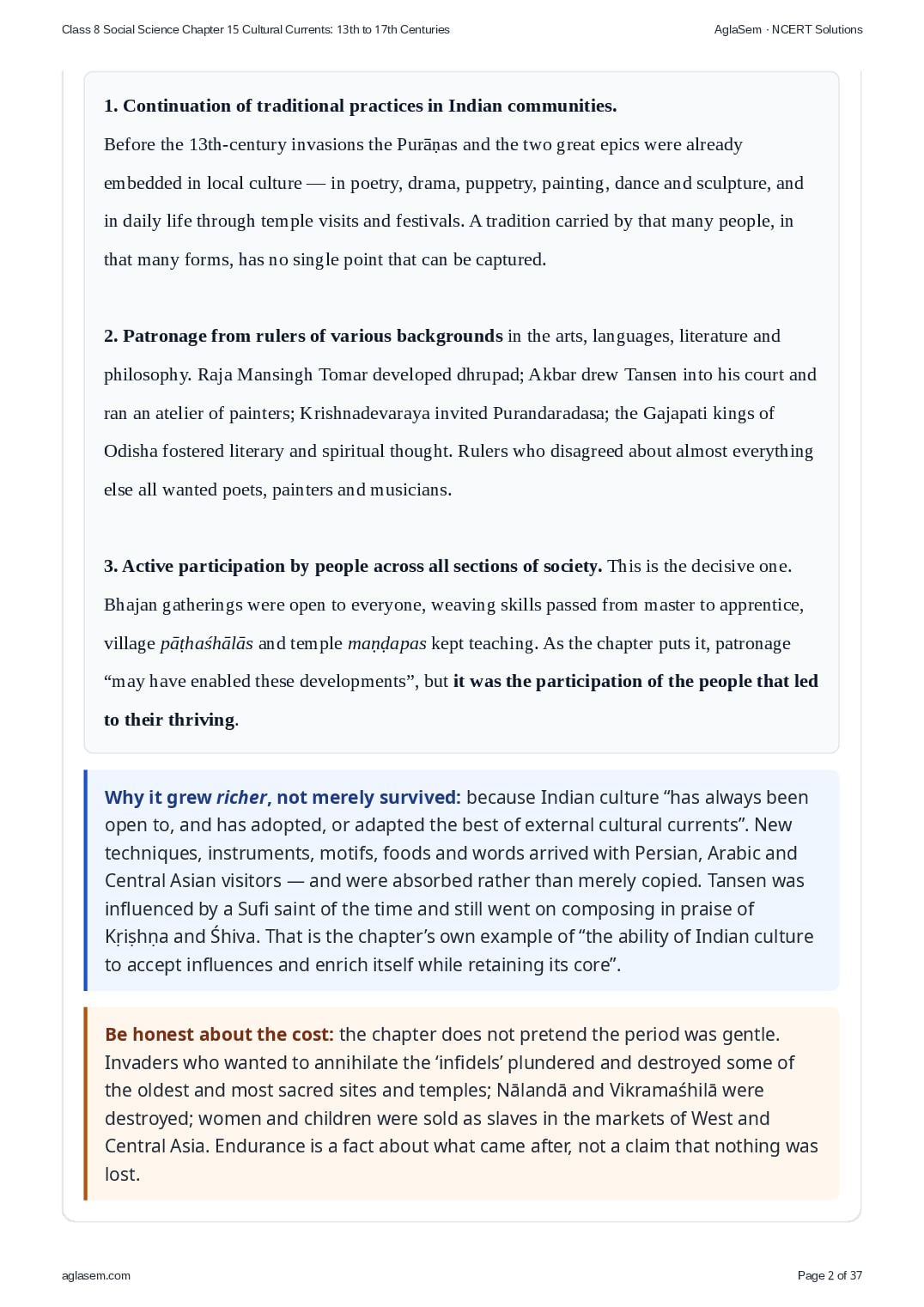
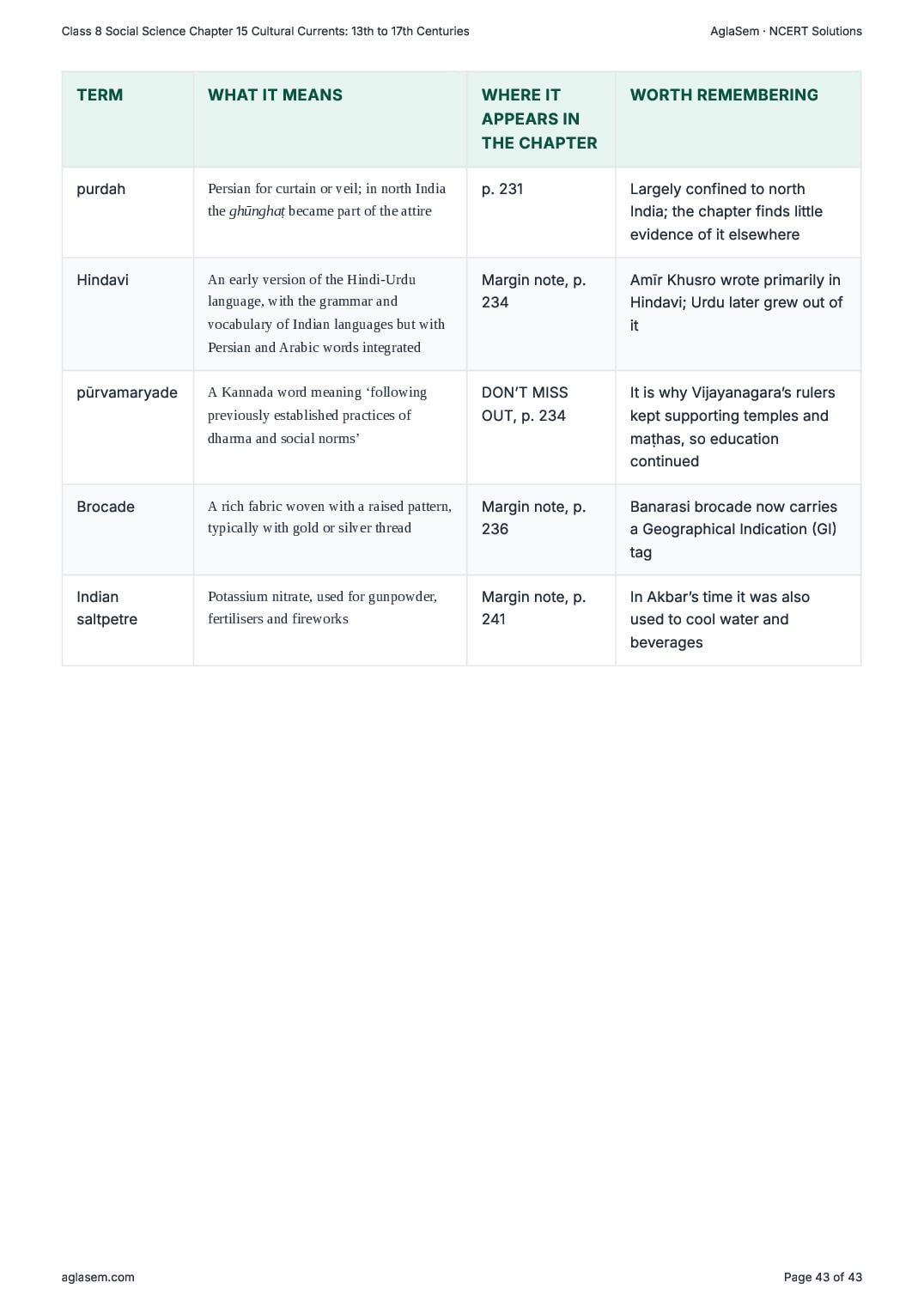
NCERT Solutions for Class 8 Social Science Chapter 15 PDF Download
You can read the NCERT Solutions for Class 8 Social Science Chapter 15 online above, or download the complete question-answer PDF to study Cultural Currents 13th to 17th Centuries offline at any time.
NCERT Solutions for Class 8 Social Science Chapter 15 PDF Download Link – Click Here to Download Solutions PDF
Questions Covered in This Chapter
These NCERT Solutions answer all 26 questions of this chapter. The questions solved are:
- How did Indian culture endure and continue to grow richer during this period despite invasions and an unstable political context?
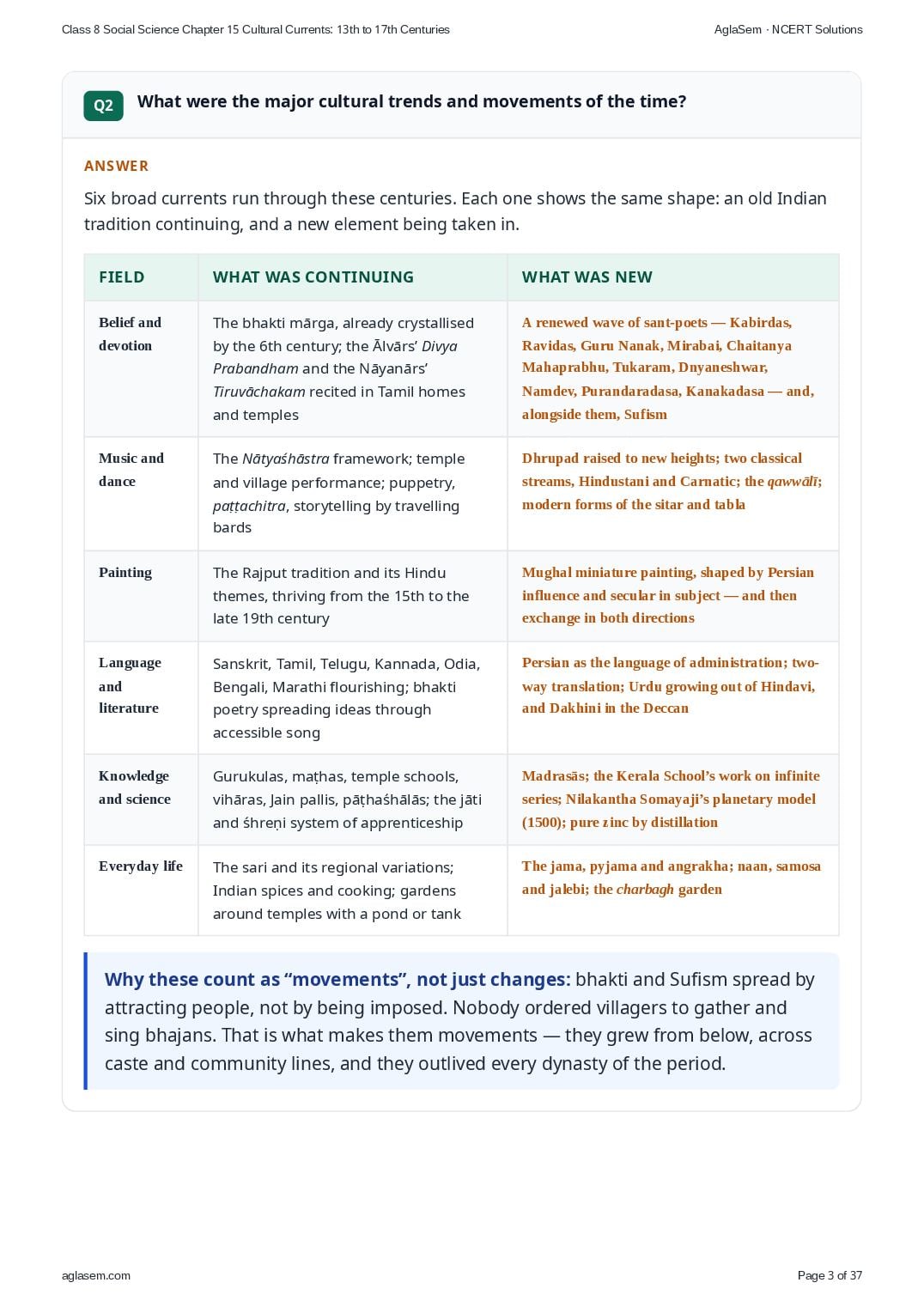
- What were the major cultural trends and movements of the time?
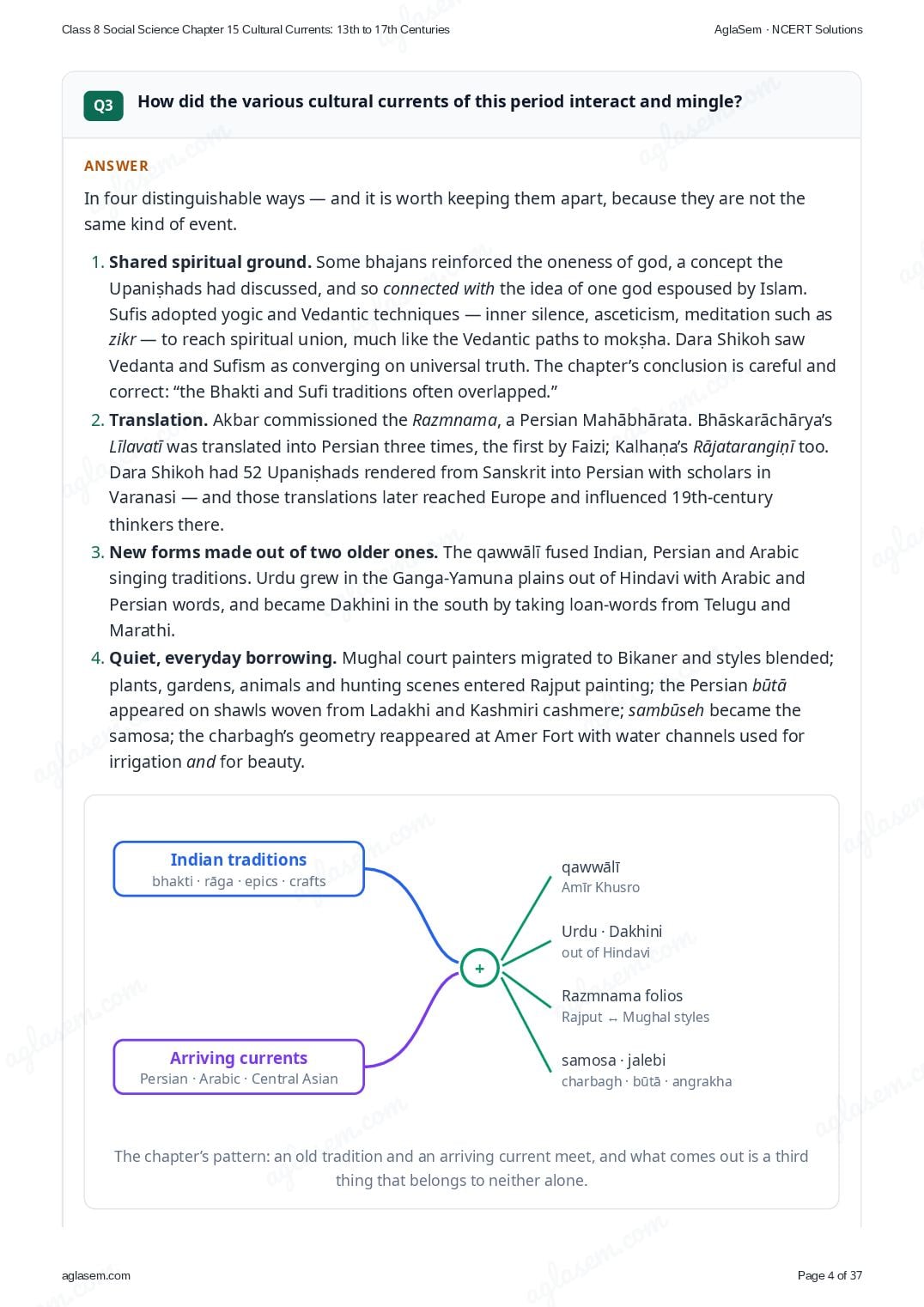
- How did the various cultural currents of this period interact and mingle?
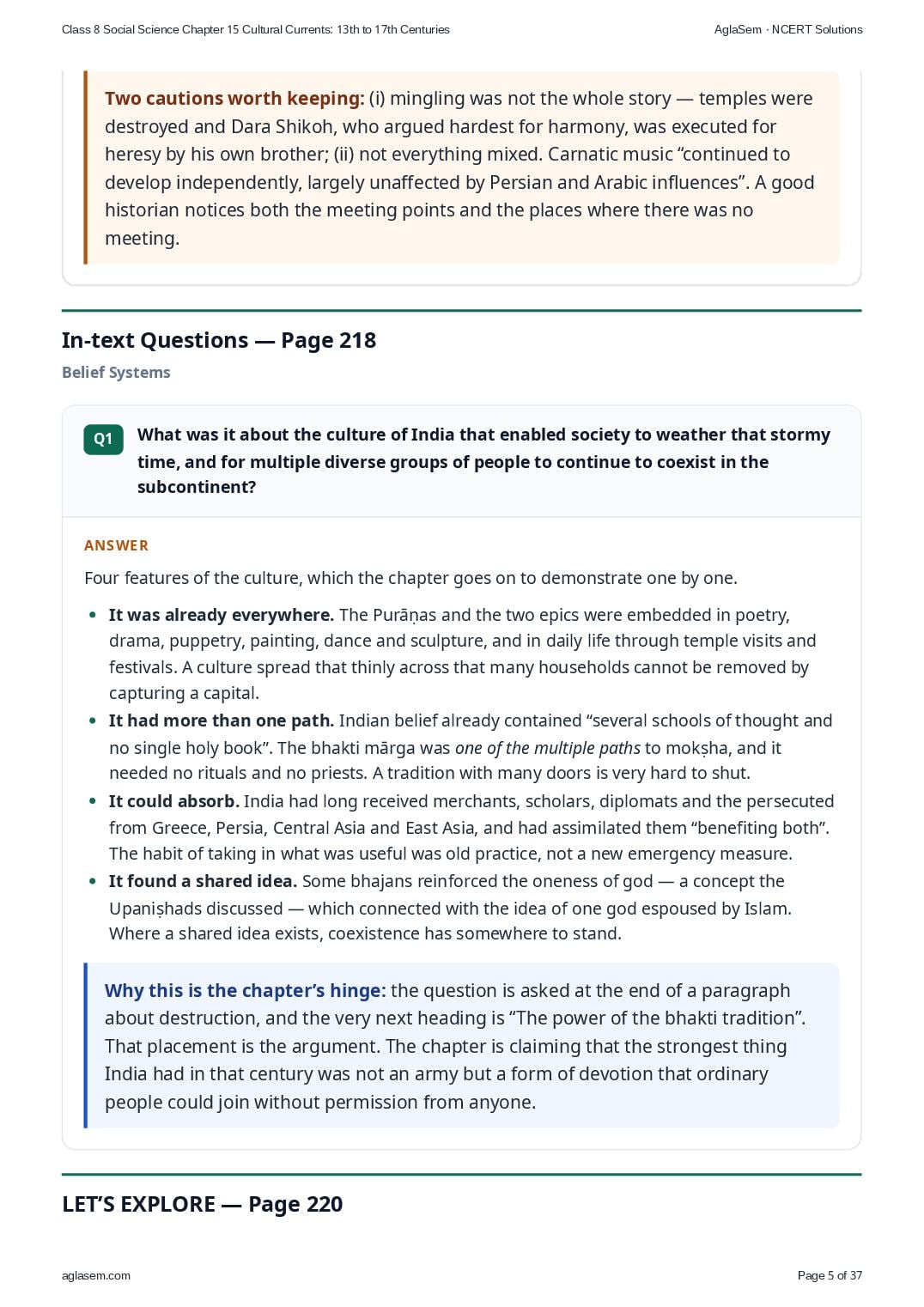
- What was it about the culture of India that enabled society to weather that stormy time, and for multiple diverse groups of people to continue to coexist in the subcontinent?
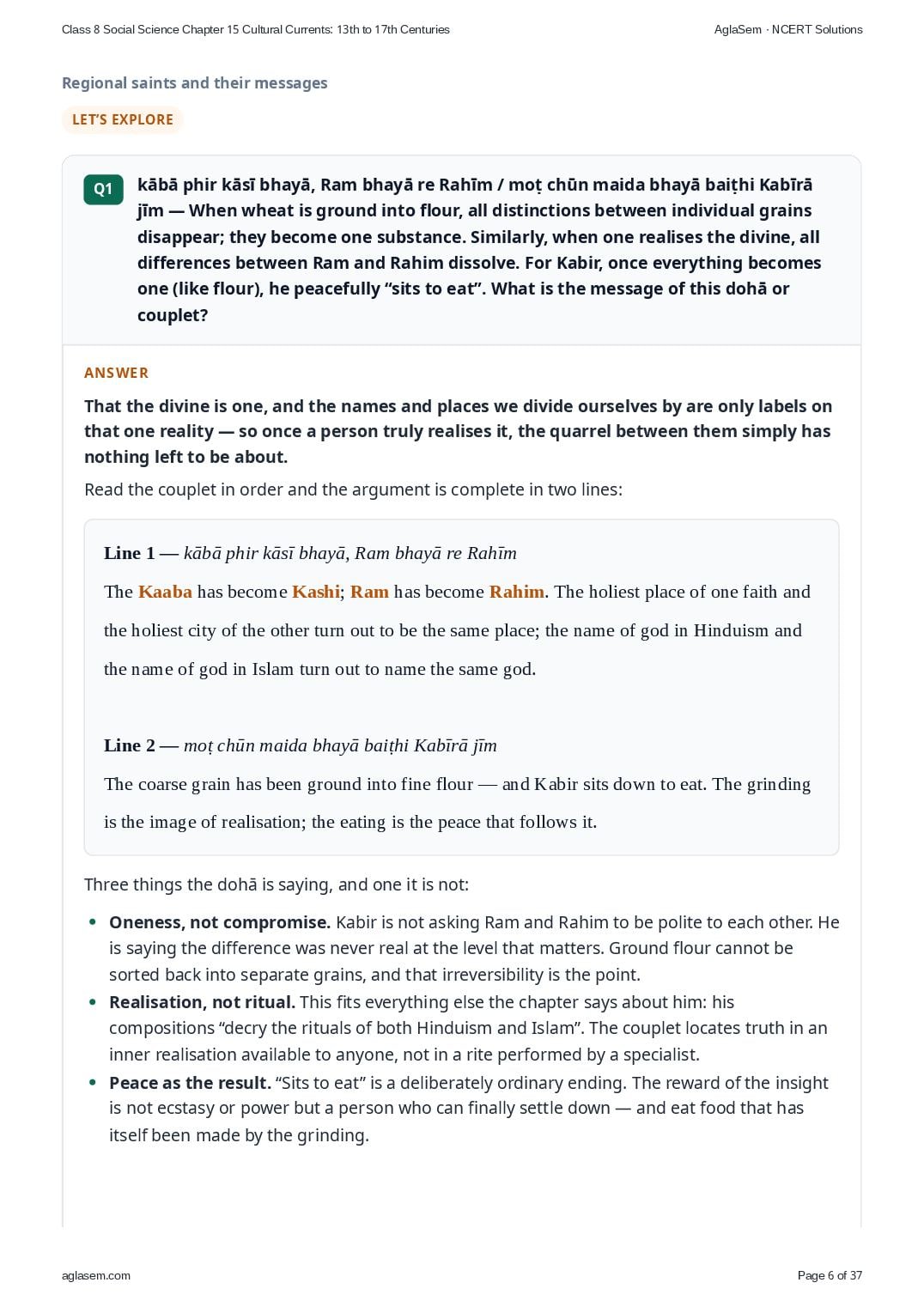
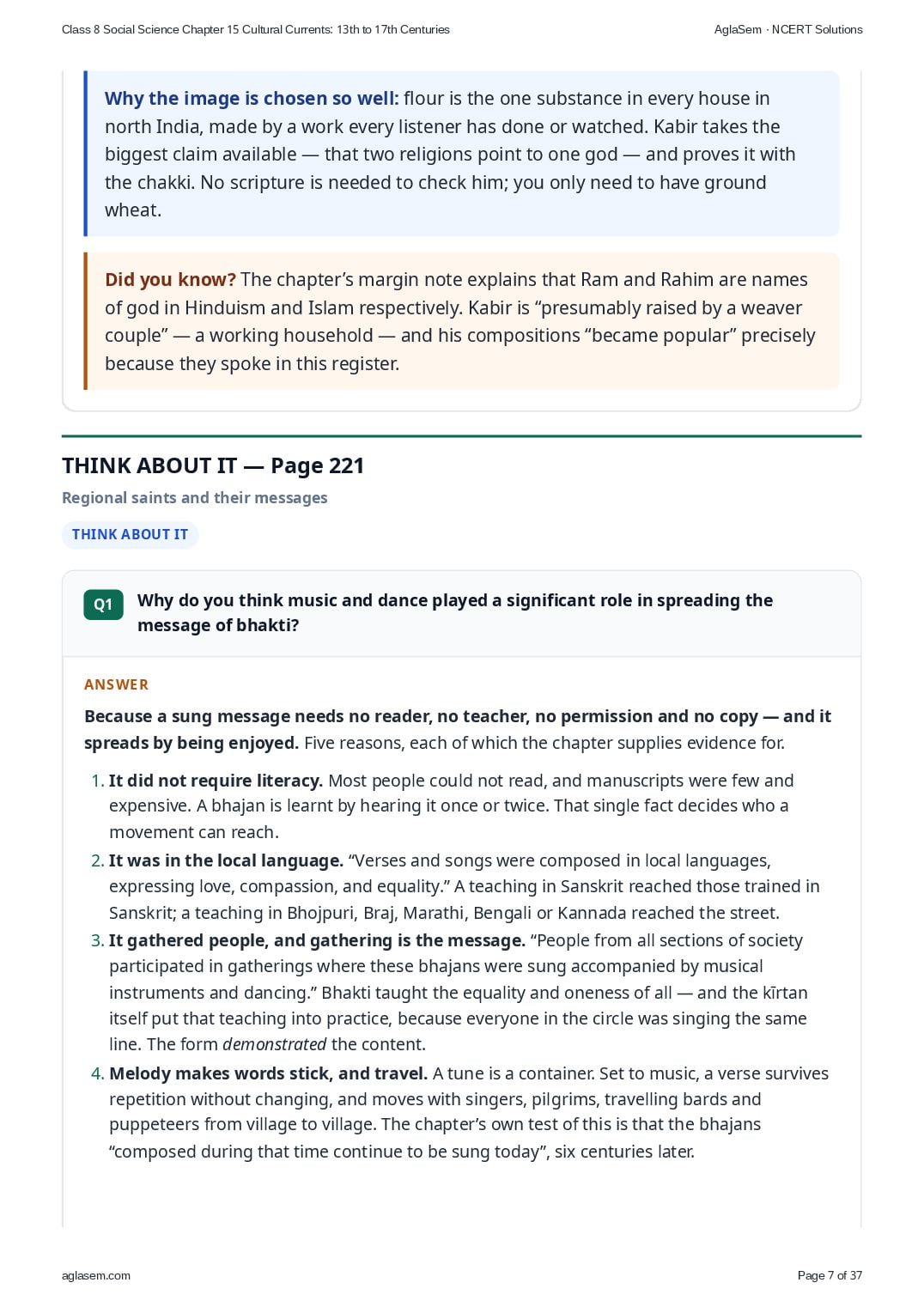
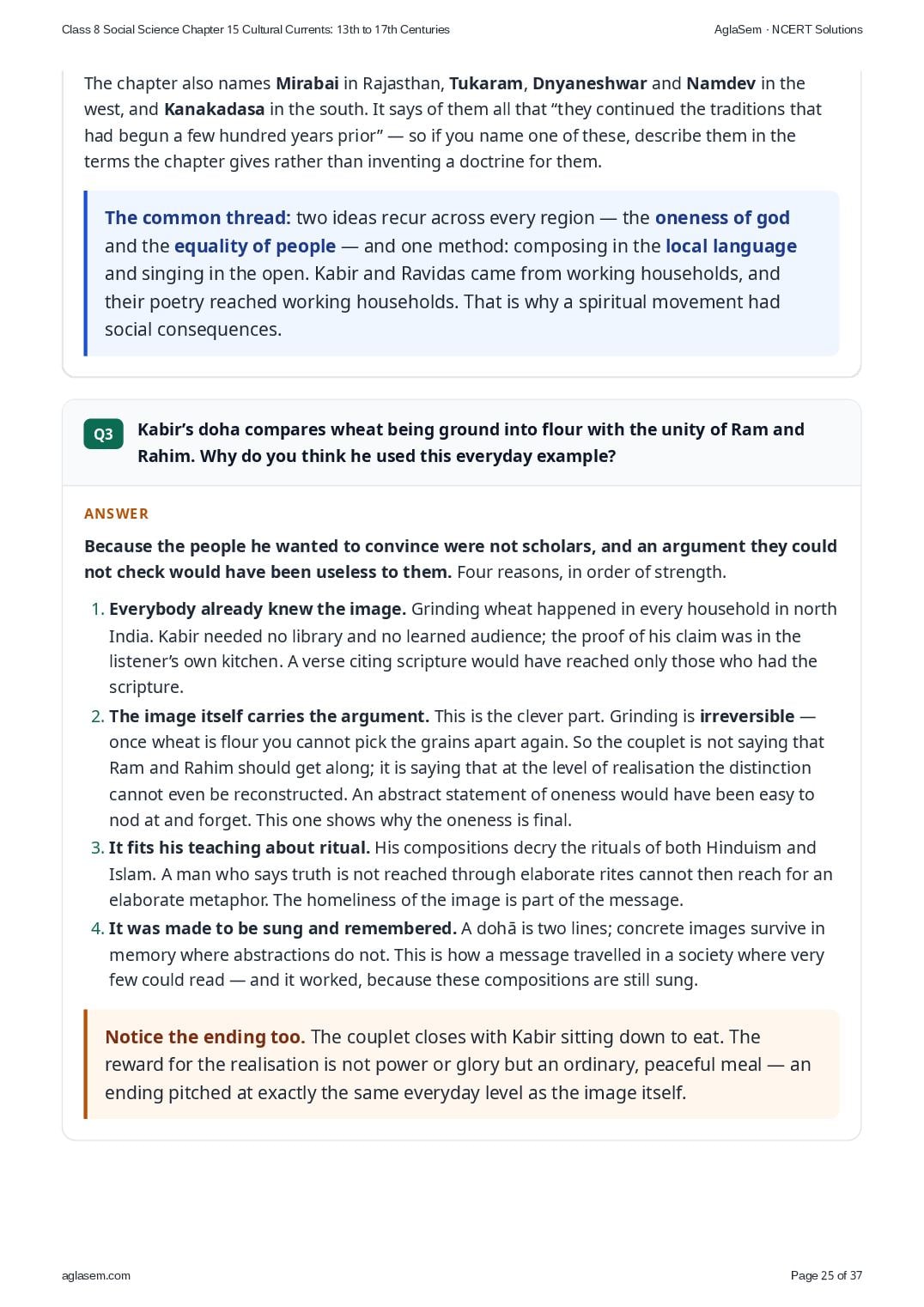
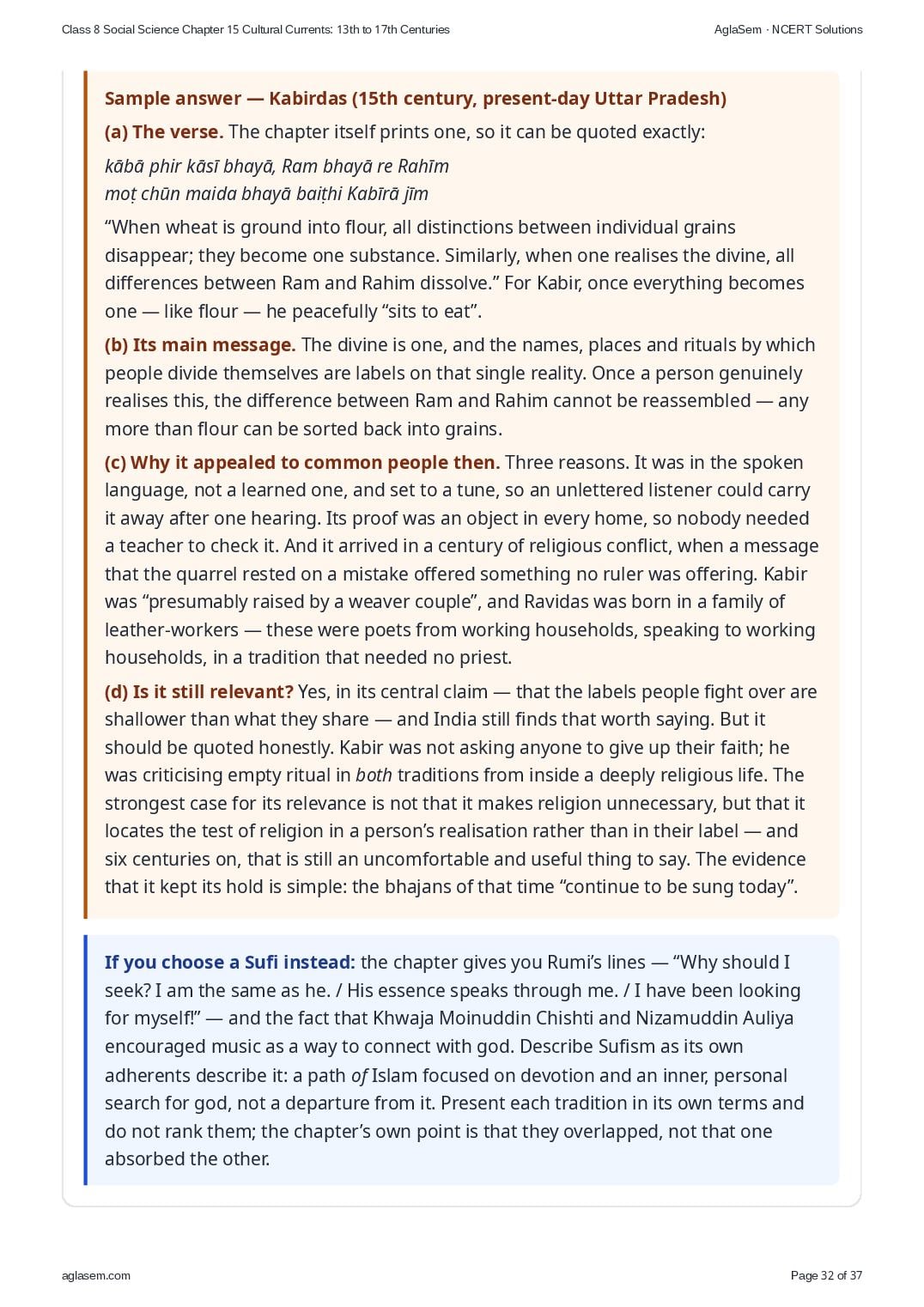
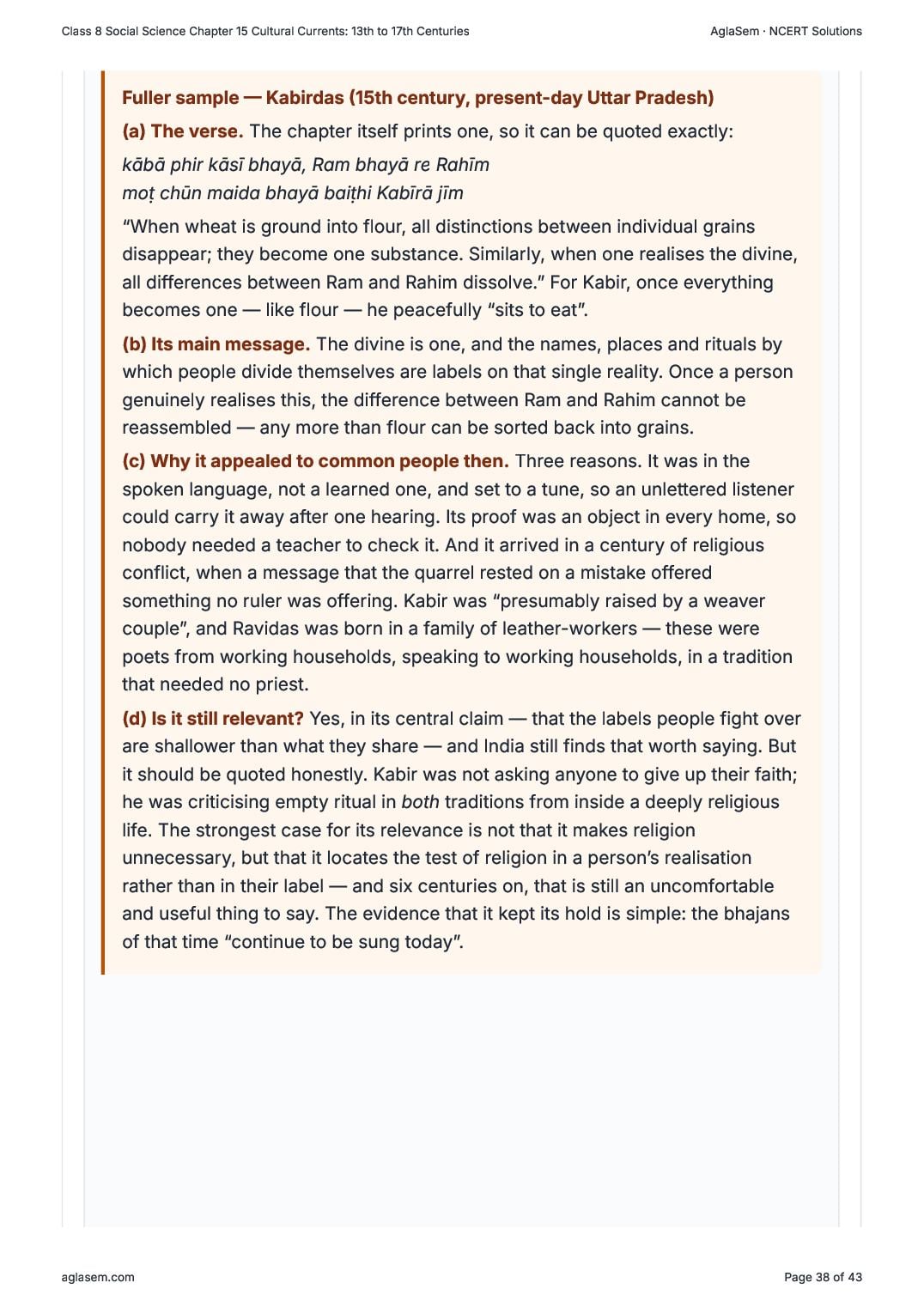
- kābā phir kāsī bhayā, Ram bhayā re Rahīm / moṭ chūn maida bhayā baiṭhi Kabīrā jīm — When wheat is ground into flour, all distinctions between individual grains disappear; they become one substance. Similarly, when one realises the divine, all differences between Ram and Rahim dissolve. For Kabir, once everything becomes one (like flour), he peacefully “sits to eat”. What is the message of this dohā or couplet?
- Why do you think music and dance played a significant role in spreading the message of bhakti?
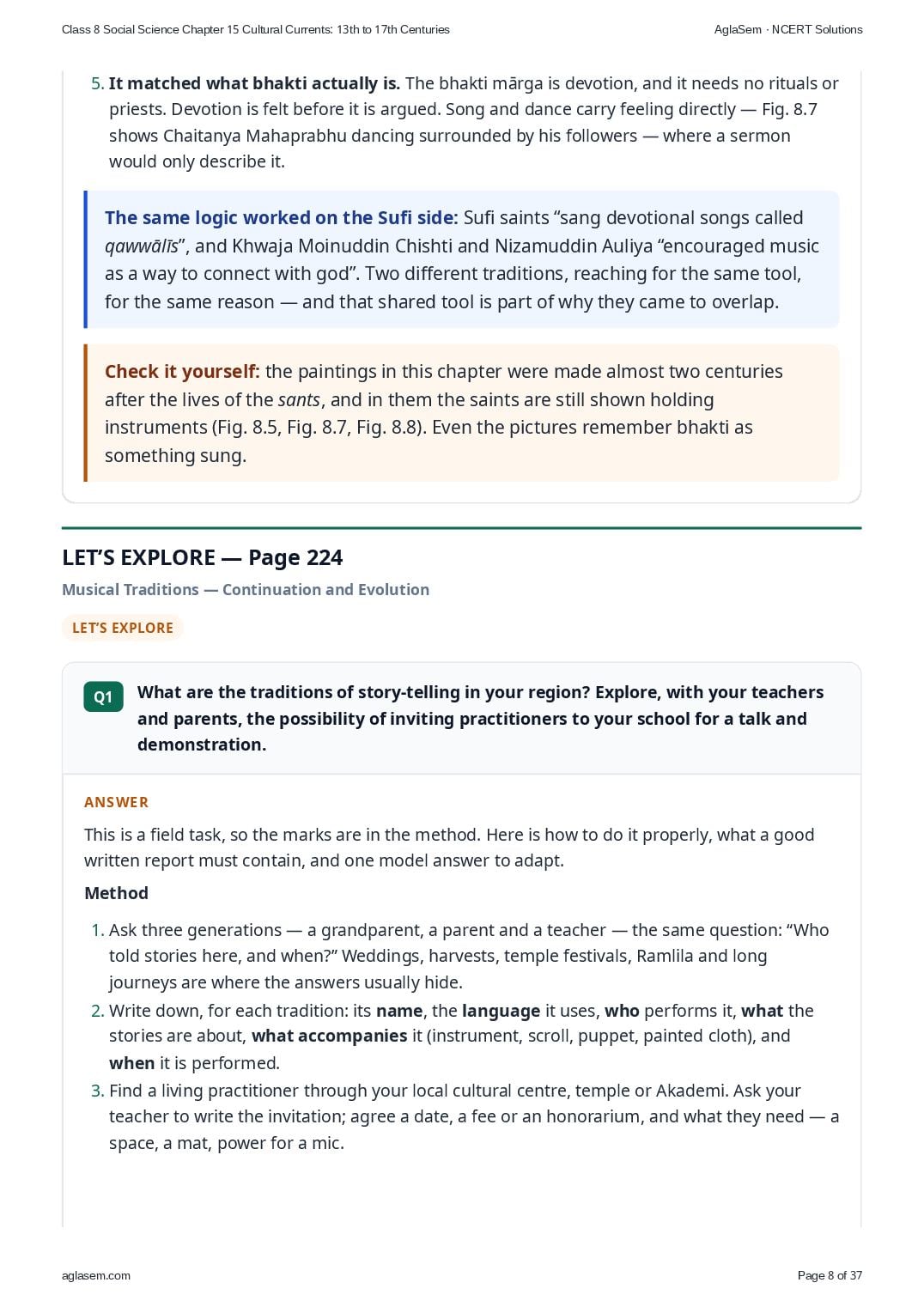
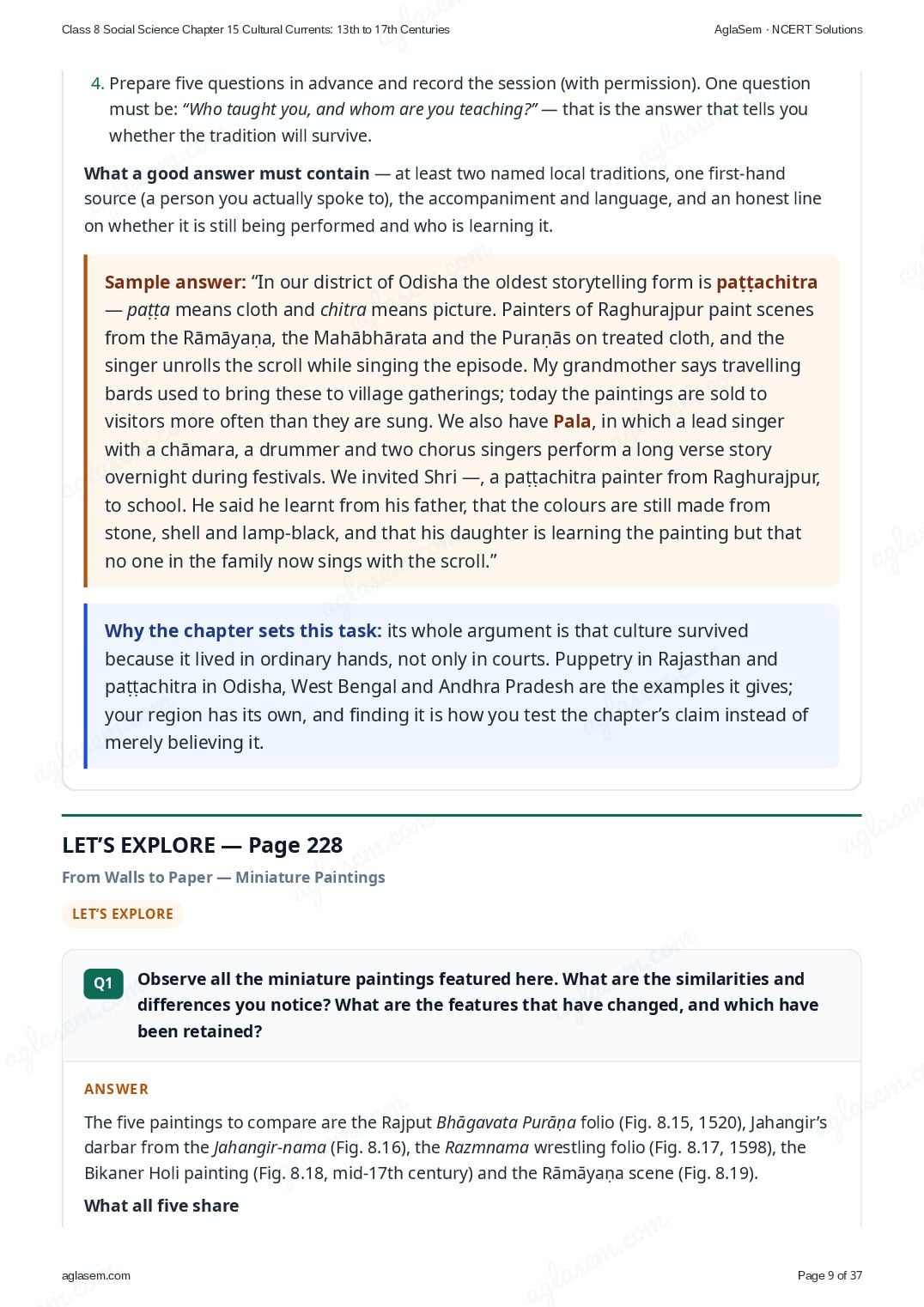
- What are the traditions of story-telling in your region? Explore, with your teachers and parents, the possibility of inviting practitioners to your school for a talk and demonstration.
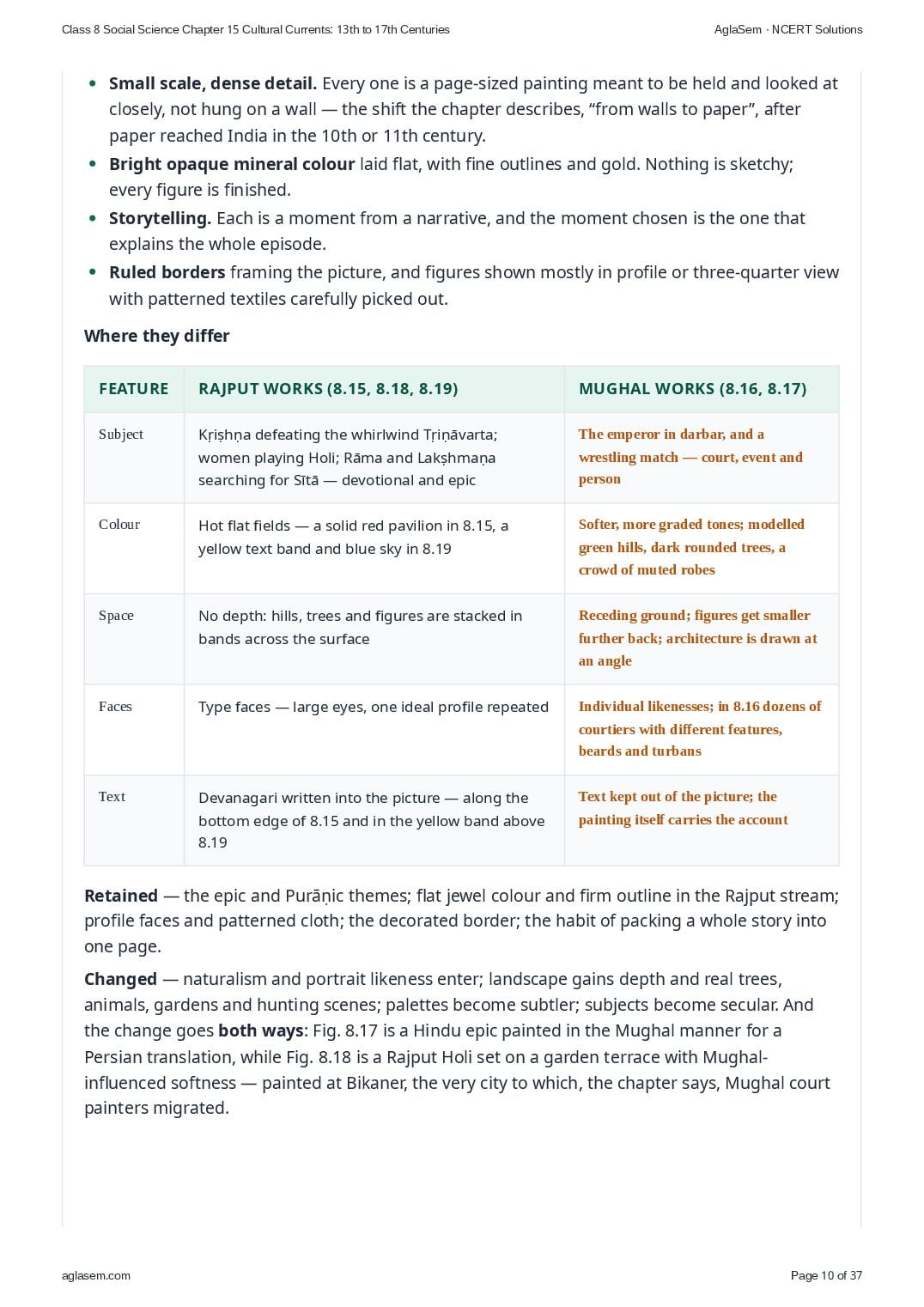
- Observe all the miniature paintings featured here. What are the similarities and differences you notice? What are the features that have changed, and which have been retained?
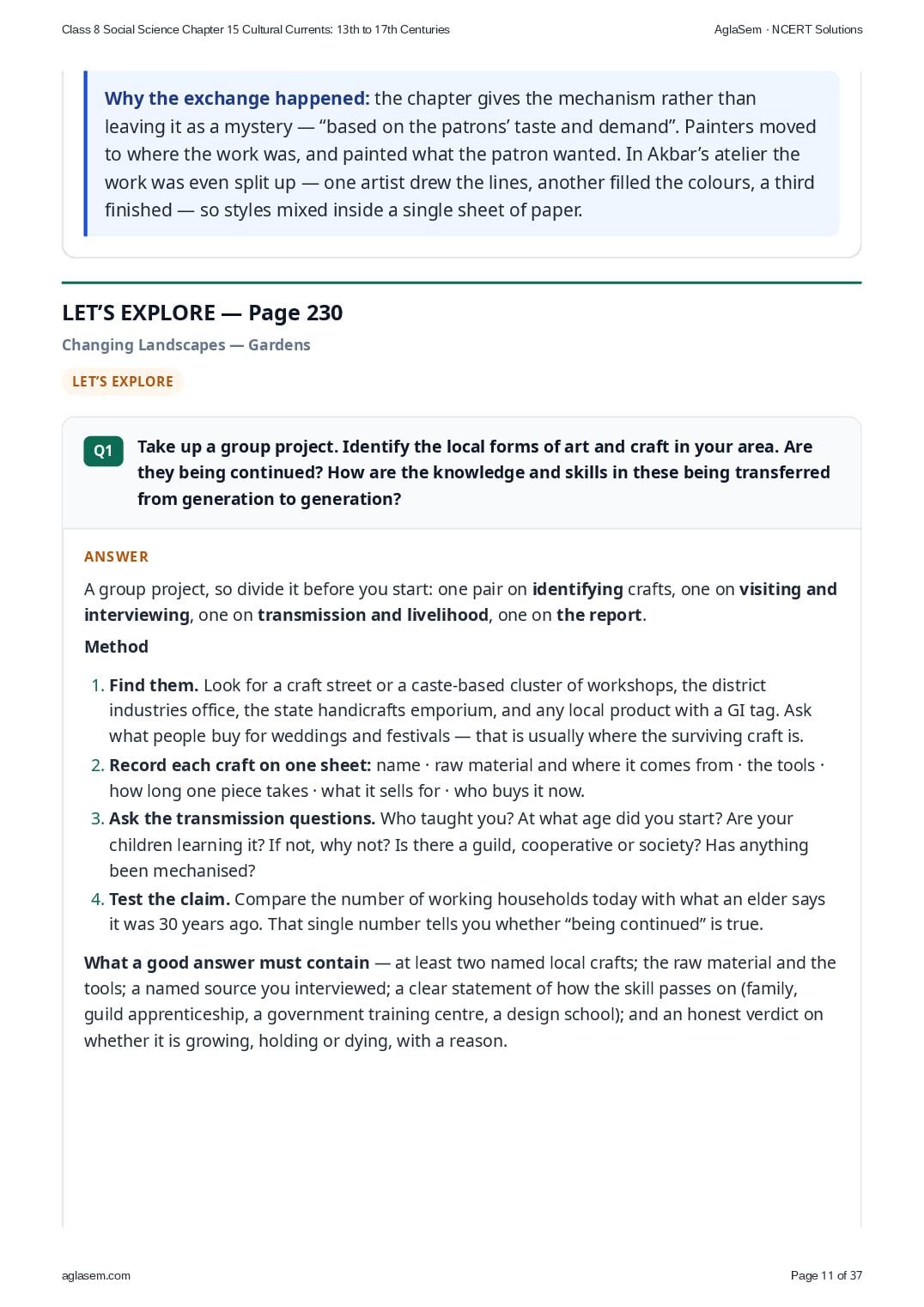
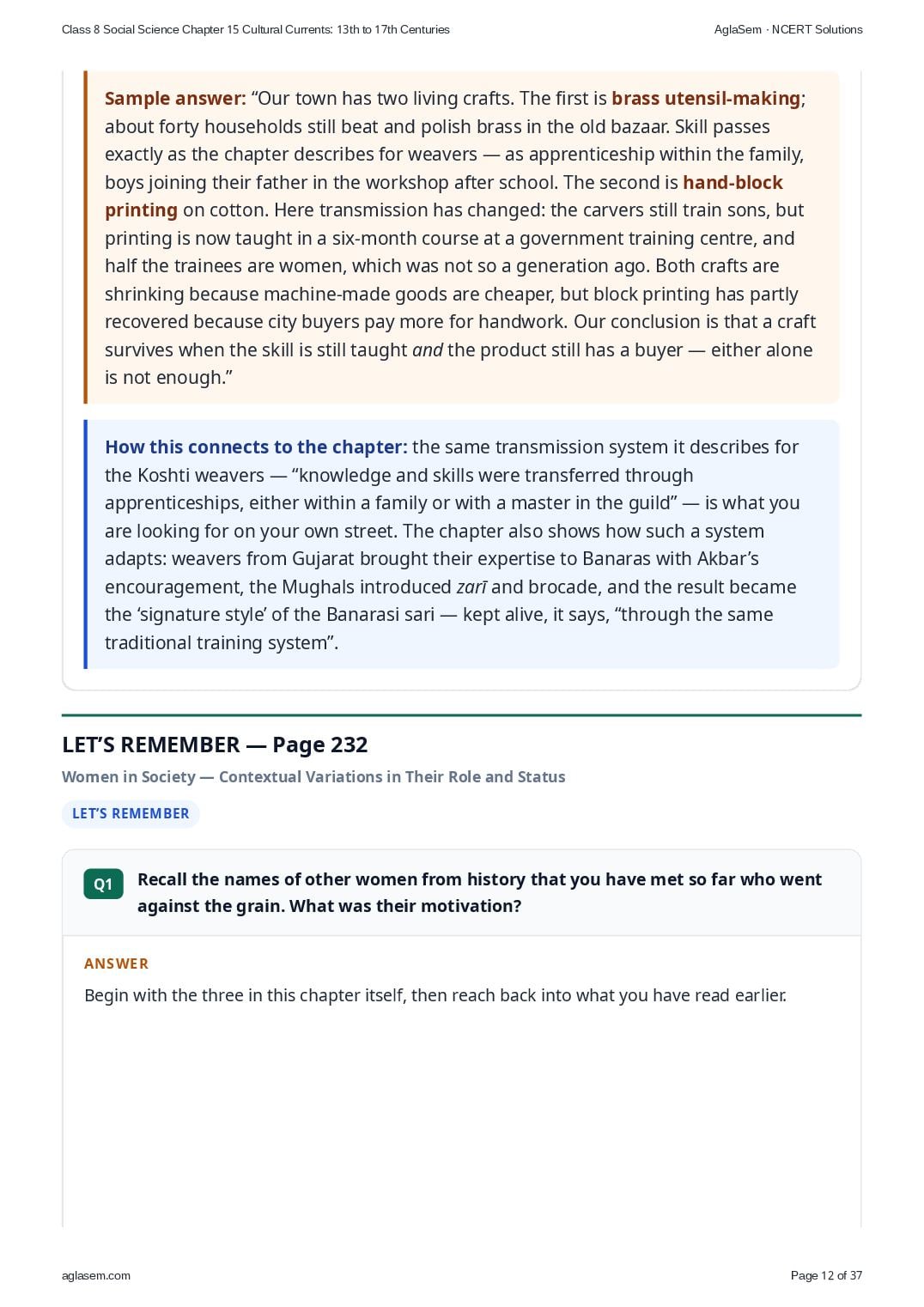
- Take up a group project. Identify the local forms of art and craft in your area. Are they being continued? How are the knowledge and skills in these being transferred from generation to generation?
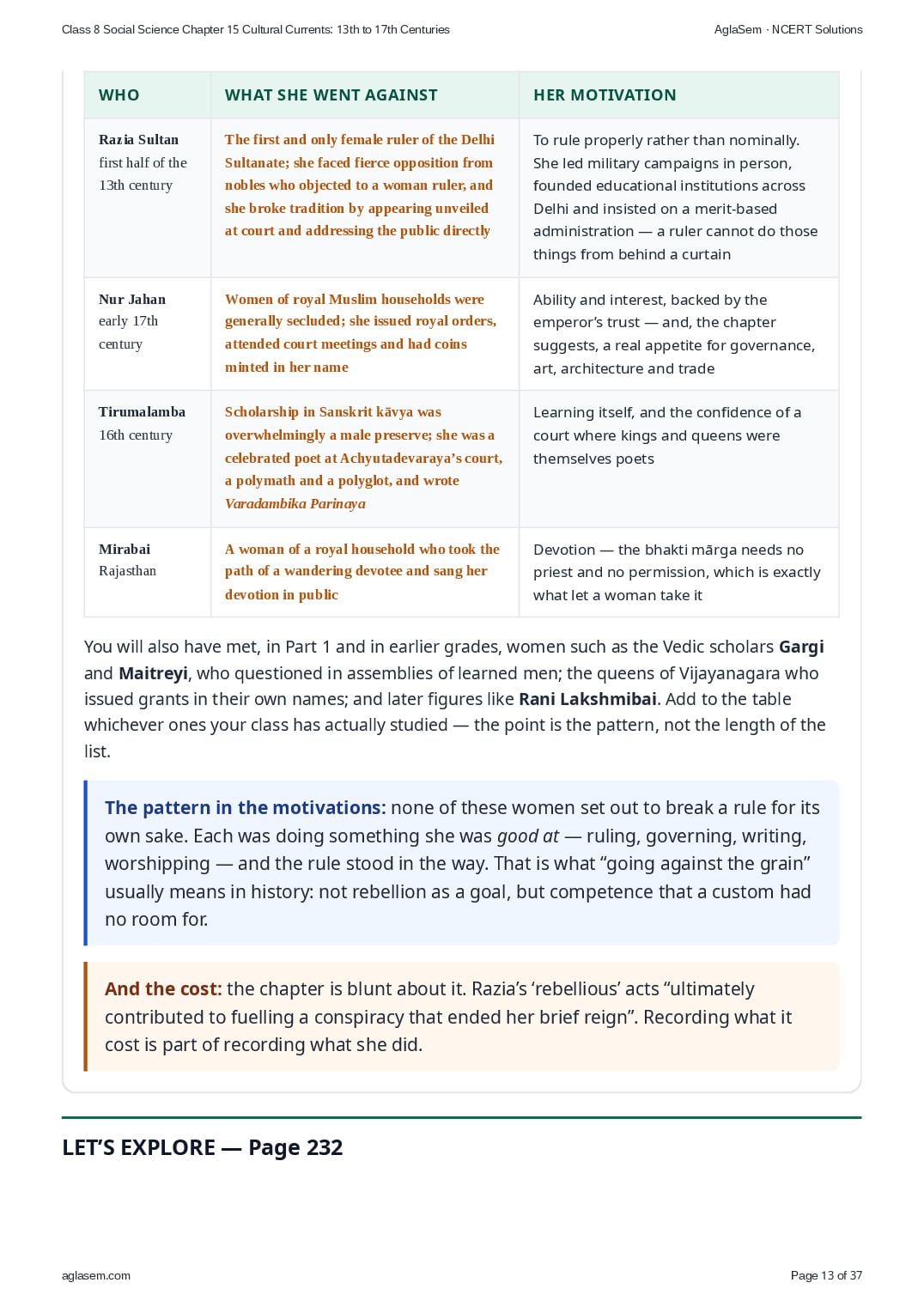
- Recall the names of other women from history that you have met so far who went against the grain. What was their motivation?
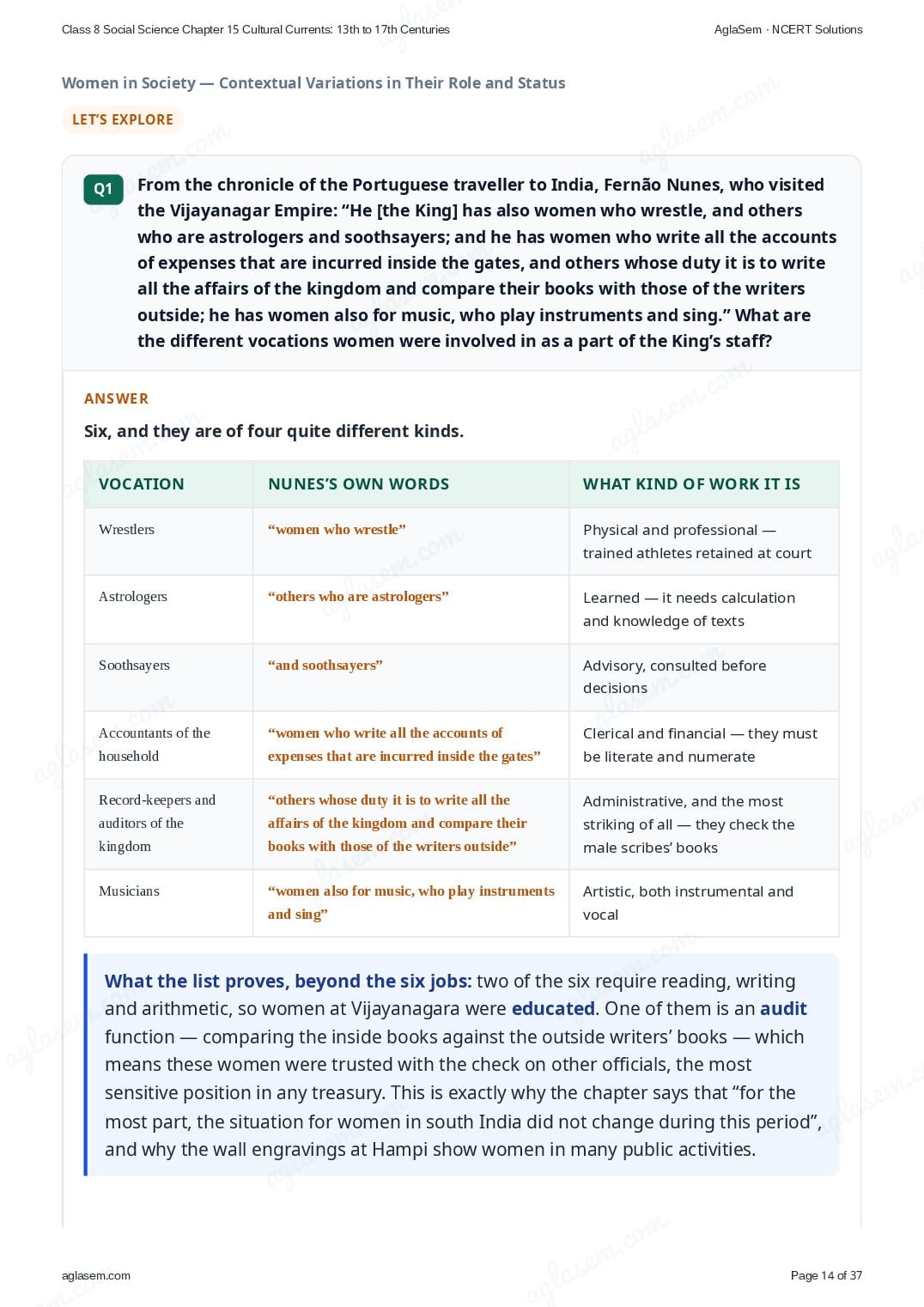
- From the chronicle of the Portuguese traveller to India, Fernão Nunes, who visited the Vijayanagar Empire: “He [the King] has also women who wrestle, and others who are astrologers and soothsayers; and he has women who write all the accounts of expenses that are incurred inside the gates, and others whose duty it is to write all the affairs of the kingdom and compare their books with those of the writers outside; he has women also for music, who play instruments and sing.” What are the different vocations women were involved in as a part of the King’s staff?
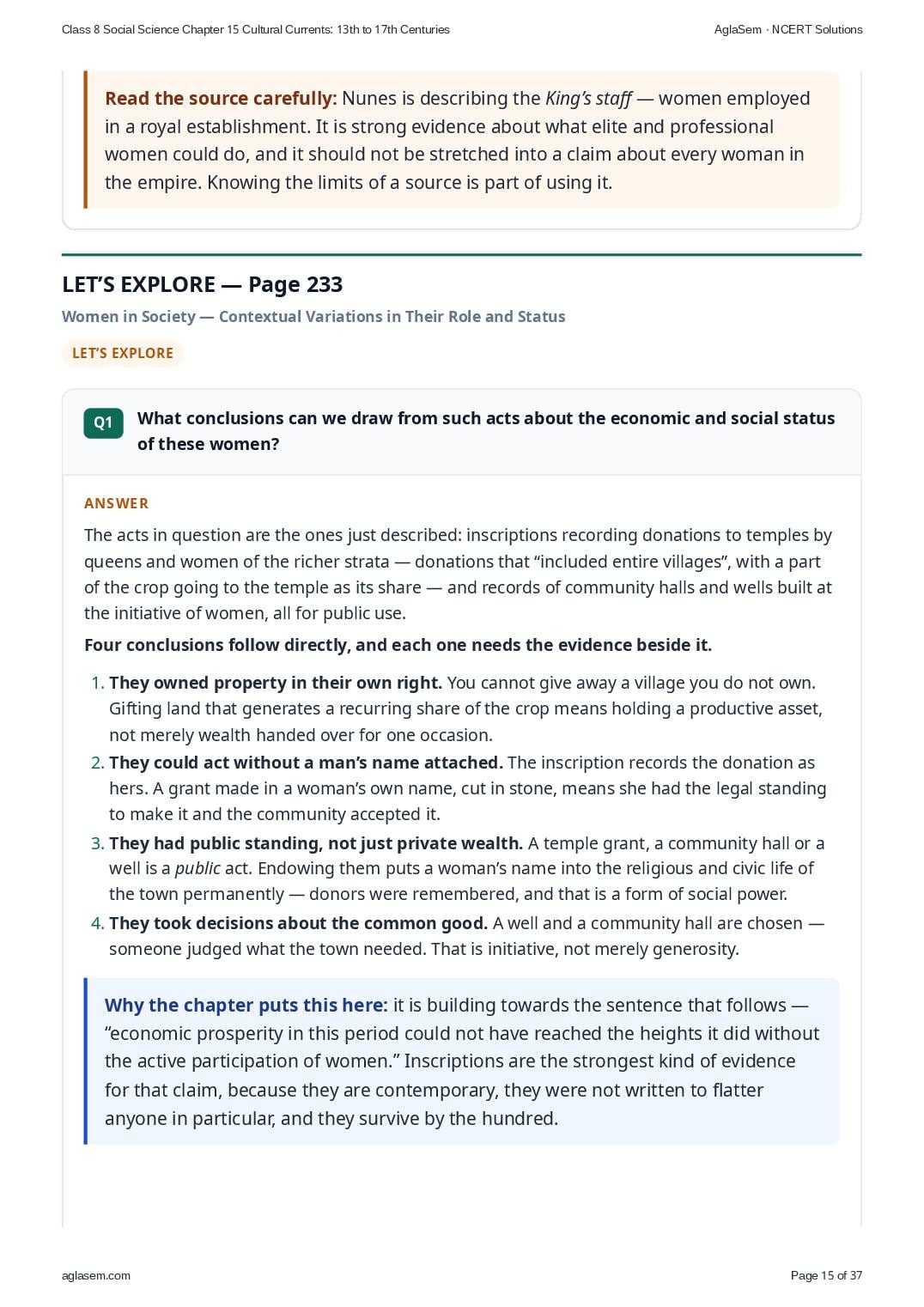
- What conclusions can we draw from such acts about the economic and social status of these women?
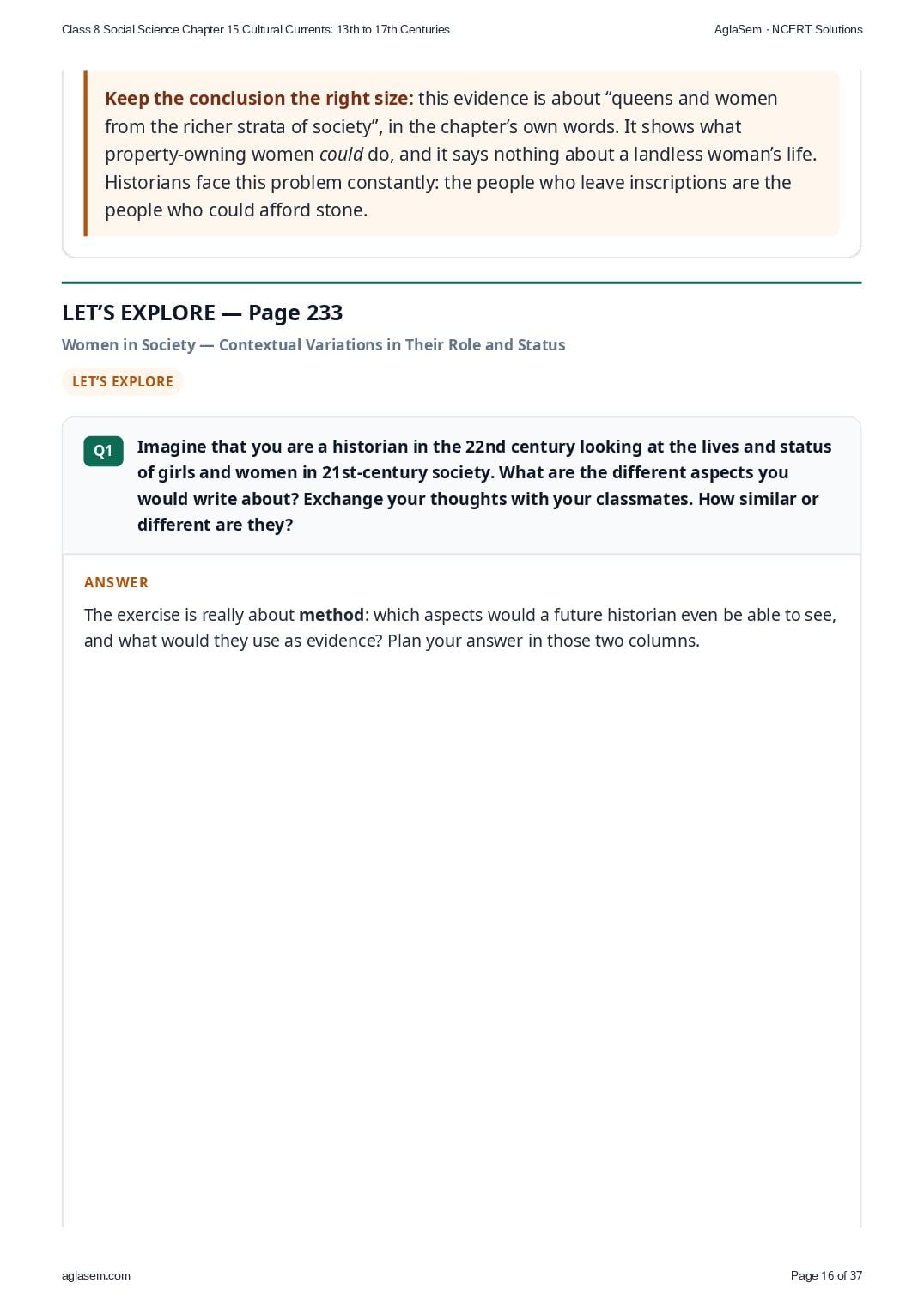
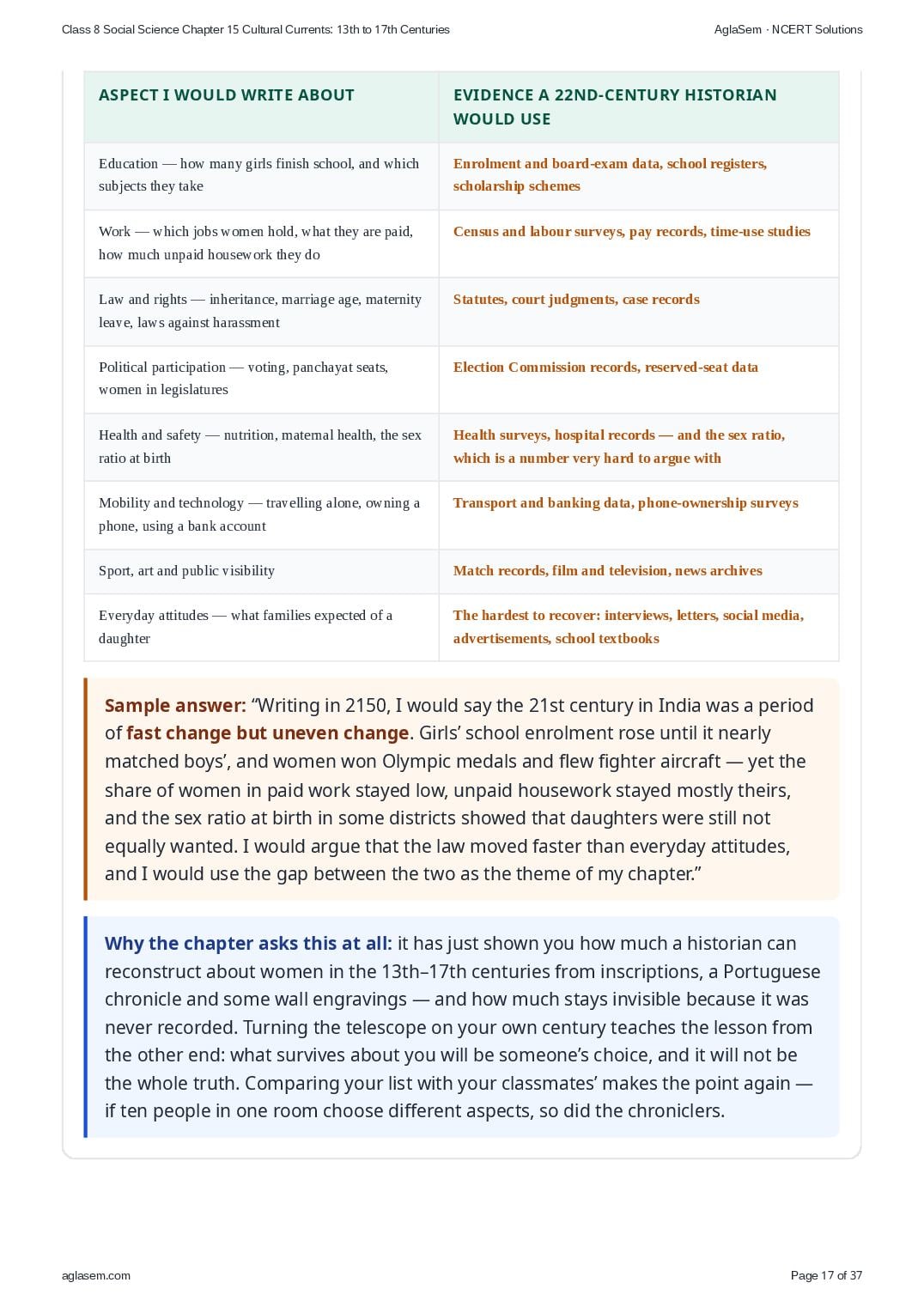
- Imagine that you are a historian in the 22nd century looking at the lives and status of girls and women in 21st-century society. What are the different aspects you would write about? Exchange your thoughts with your classmates. How similar or different are they?
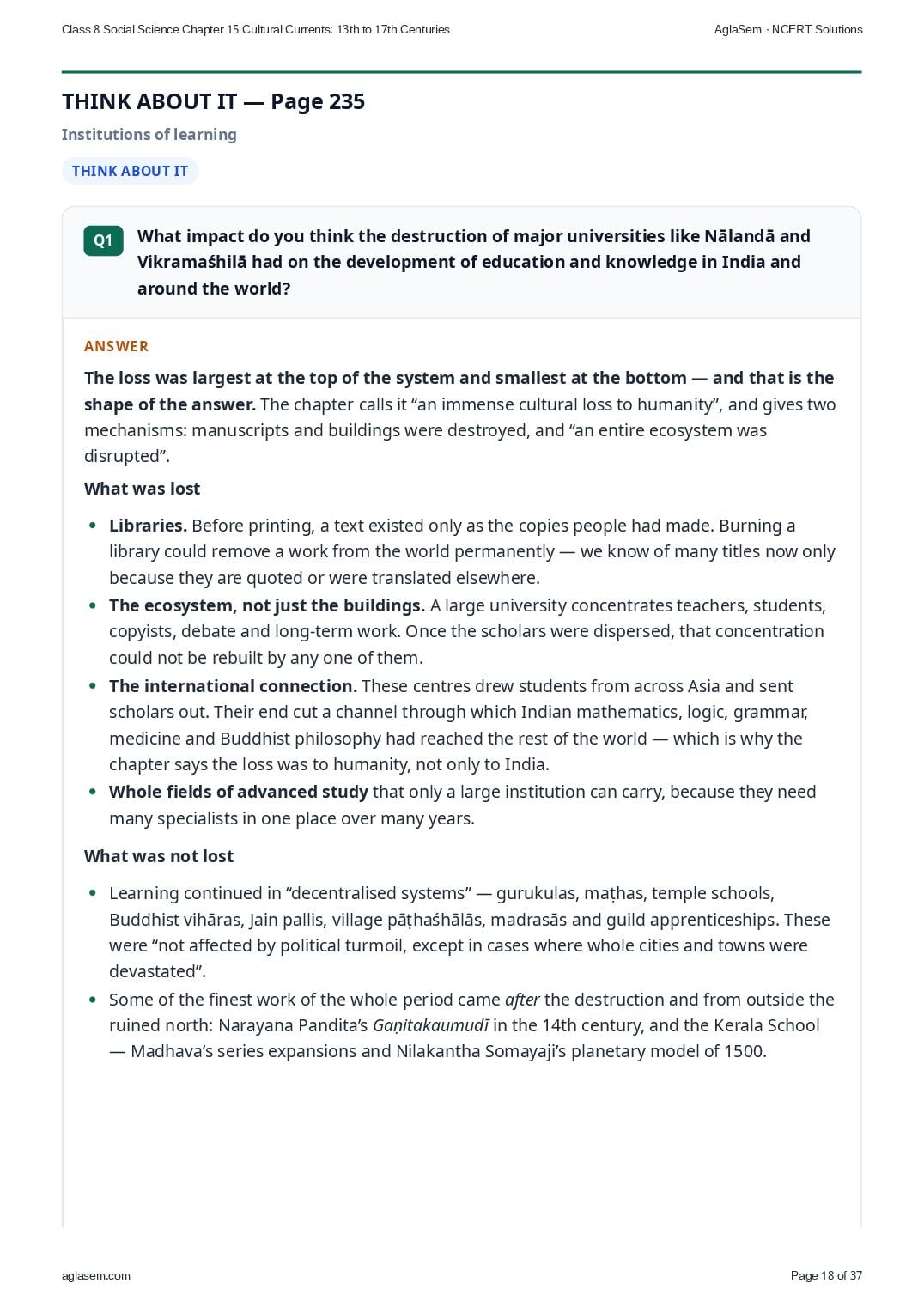
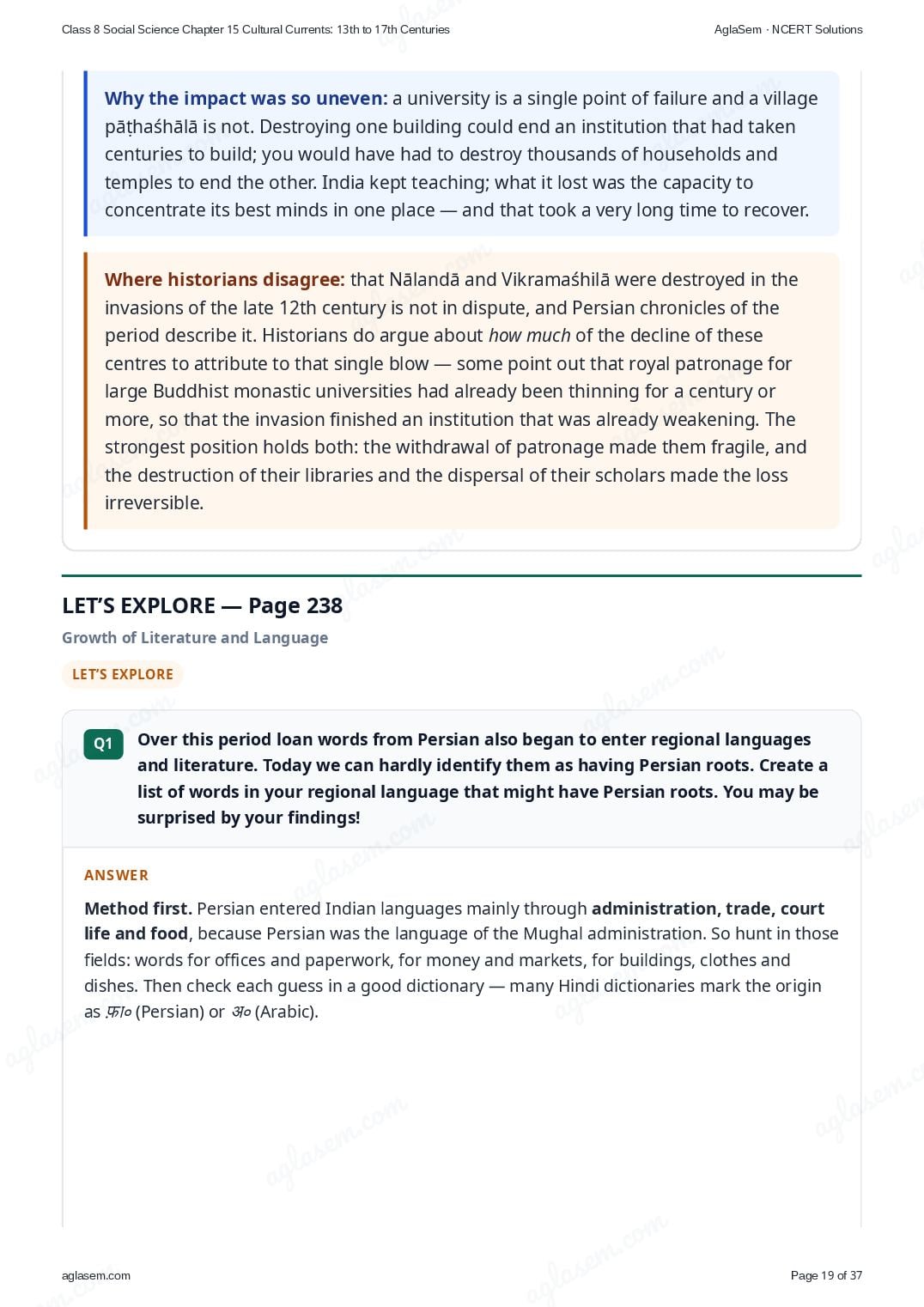
- What impact do you think the destruction of major universities like Nālandā and Vikramaśhilā had on the development of education and knowledge in India and around the world?
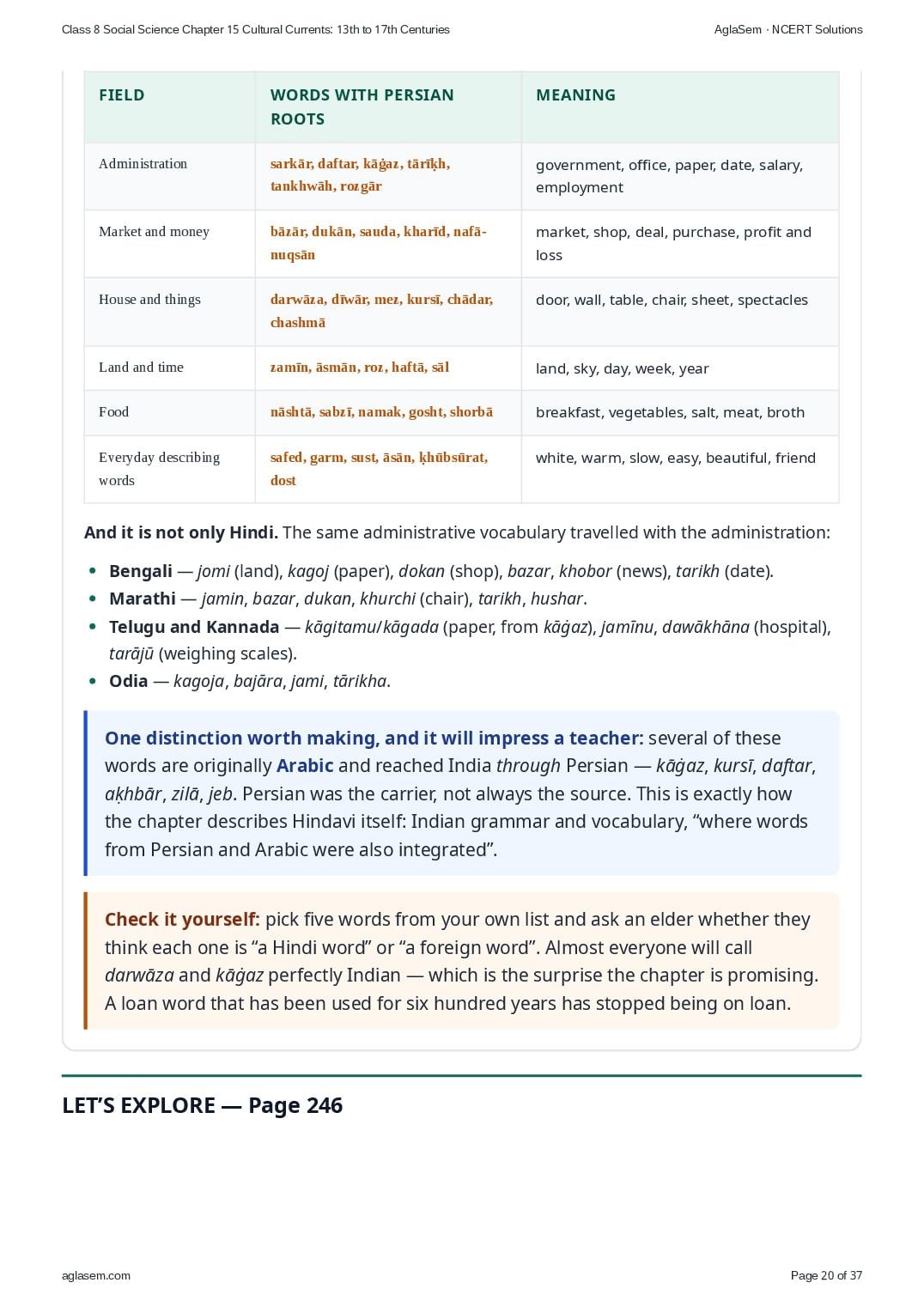
- Over this period loan words from Persian also began to enter regional languages and literature. Today we can hardly identify them as having Persian roots. Create a list of words in your regional language that might have Persian roots. You may be surprised by your findings!
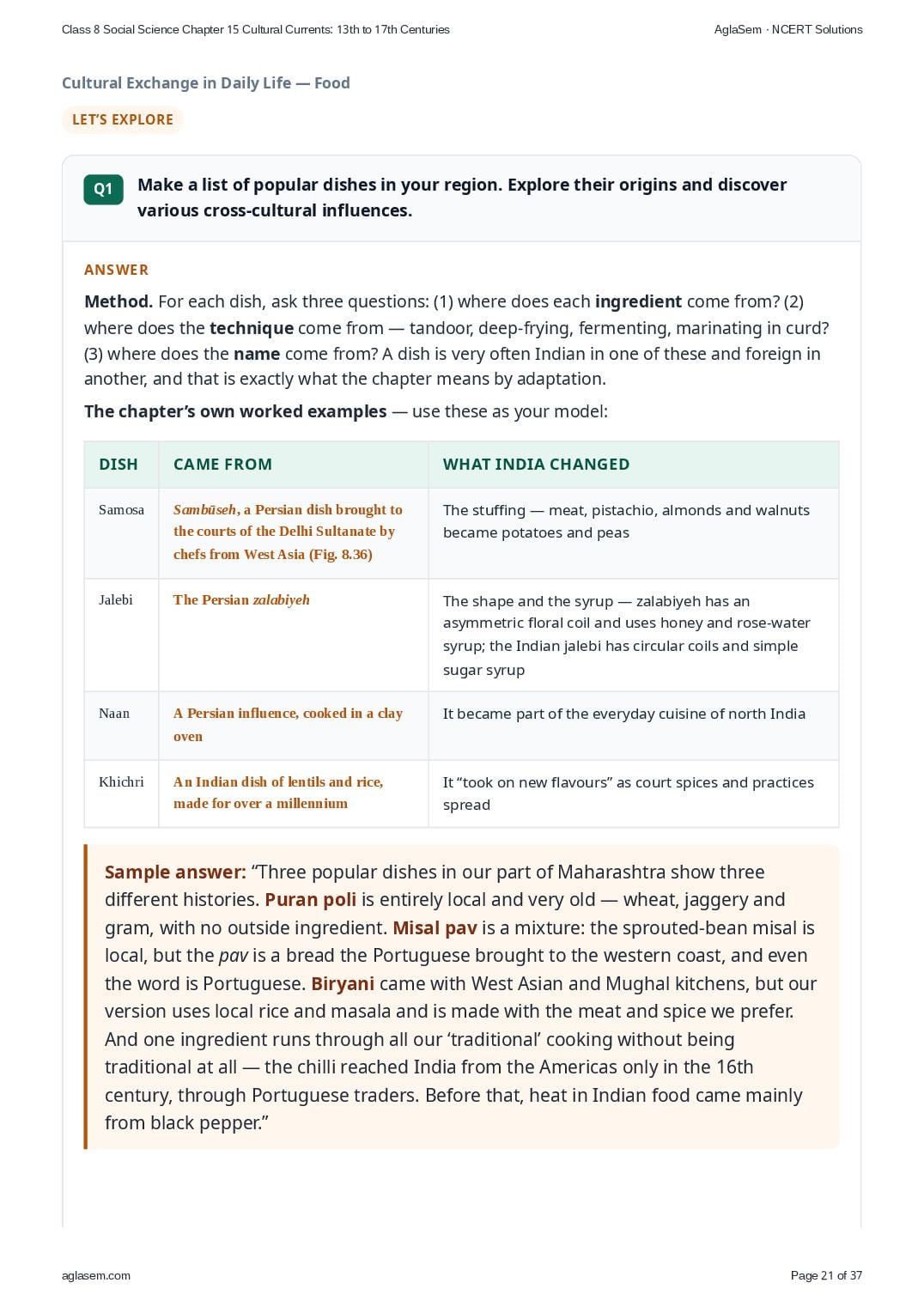
- Make a list of popular dishes in your region. Explore their origins and discover various cross-cultural influences.
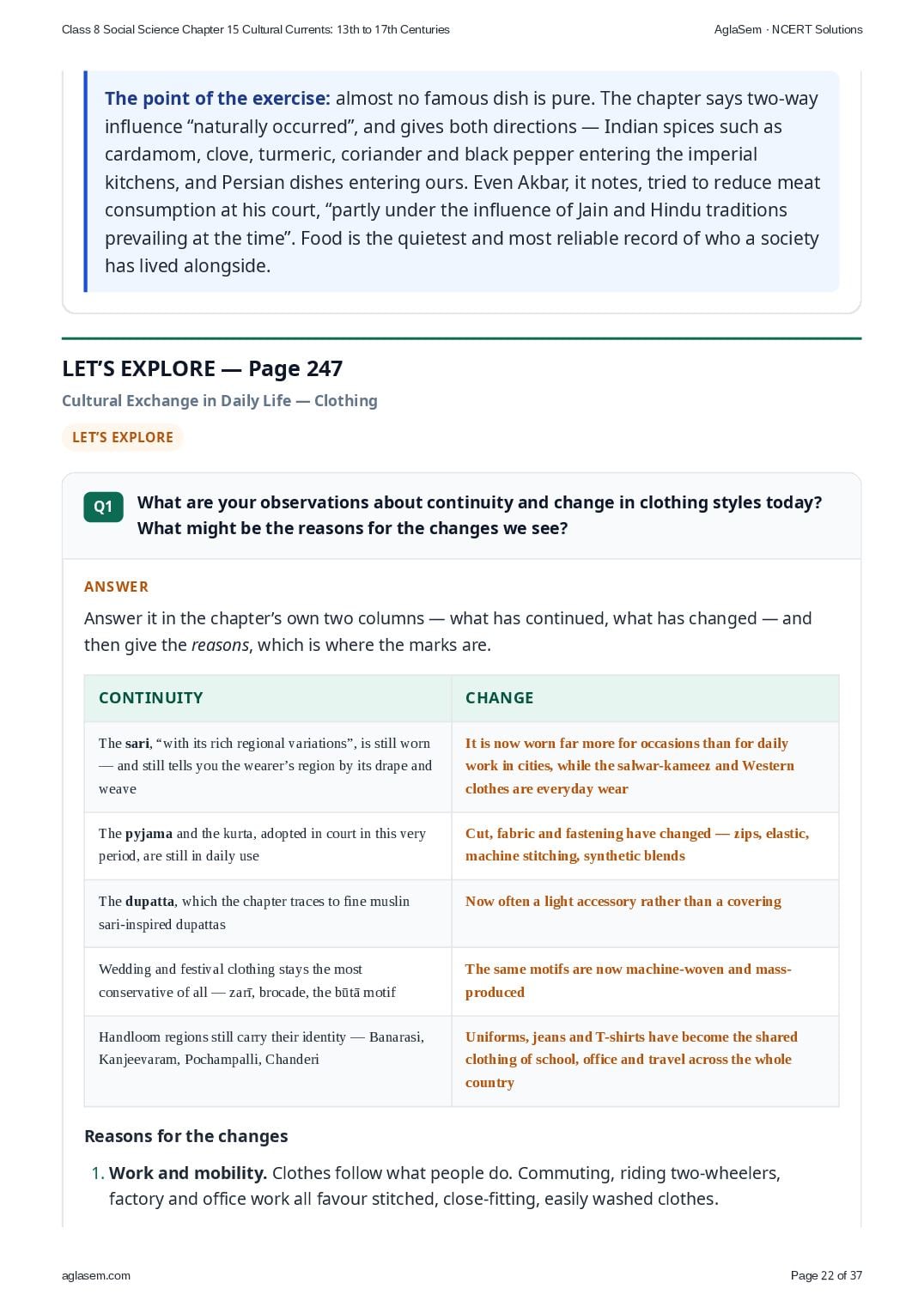
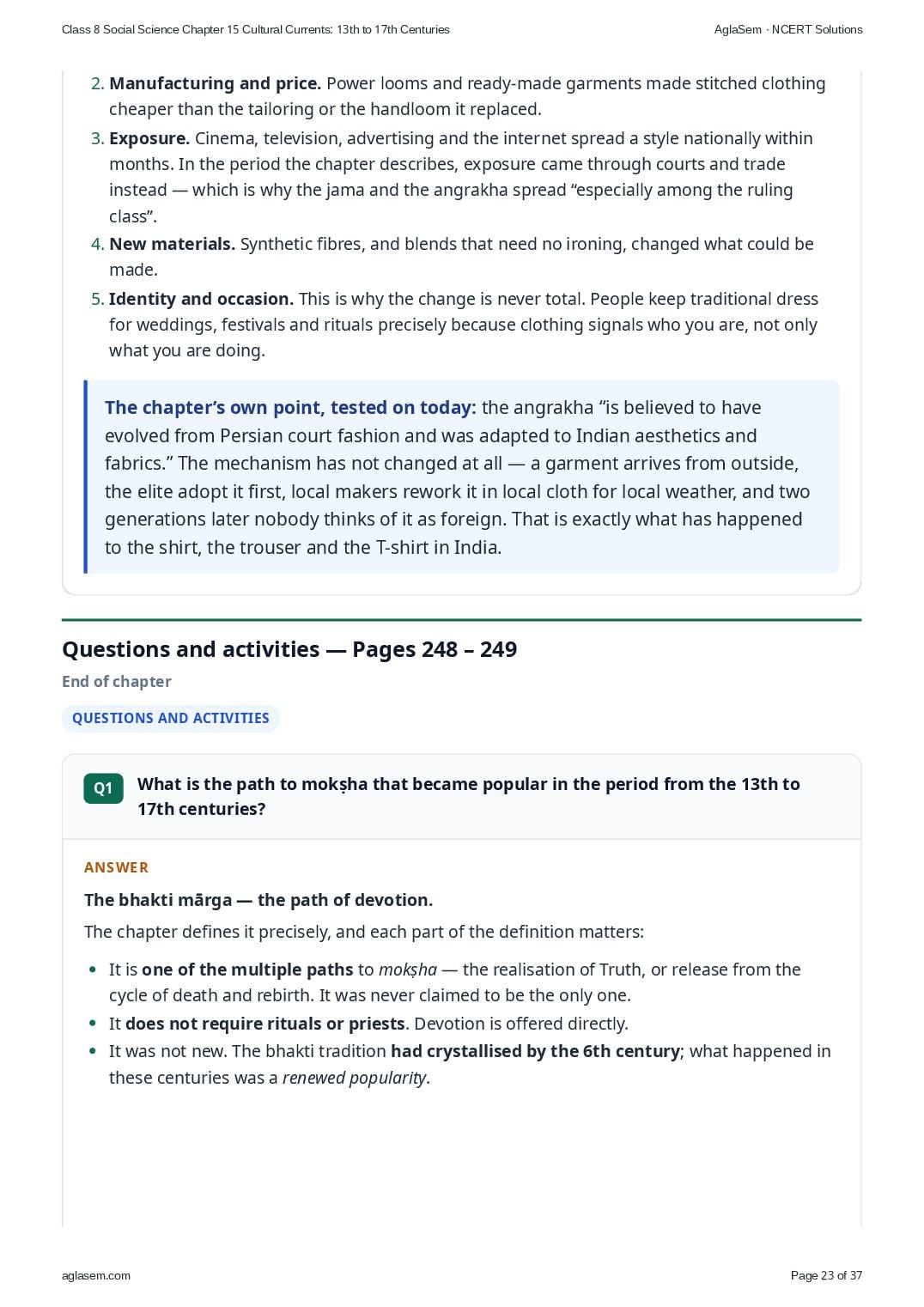
- What are your observations about continuity and change in clothing styles today? What might be the reasons for the changes we see?
- What is the path to mokṣha that became popular in the period from the 13th to 17th centuries?
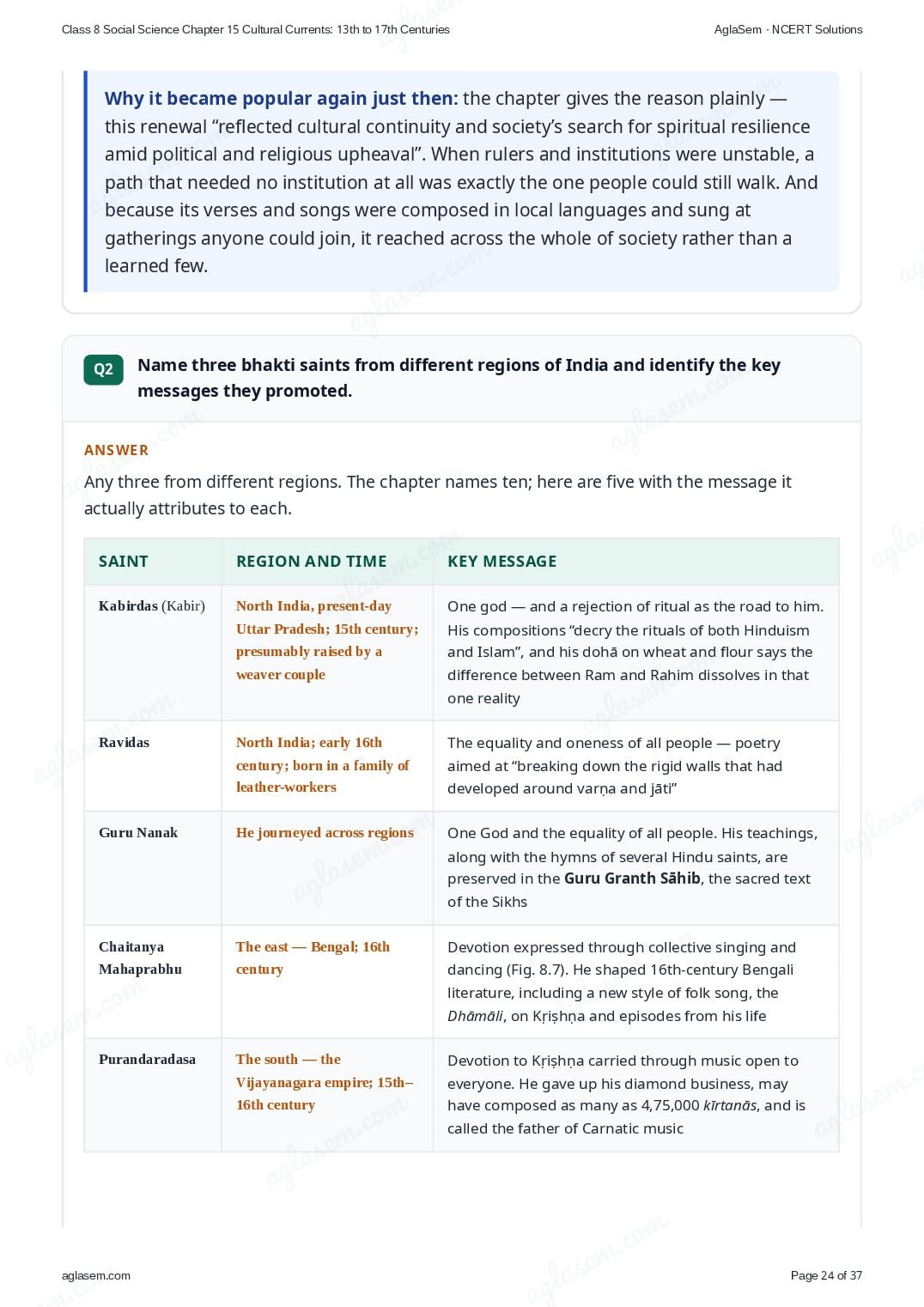
- Name three bhakti saints from different regions of India and identify the key messages they promoted.
- Kabir’s doha compares wheat being ground into flour with the unity of Ram and Rahim. Why do you think he used this everyday example?
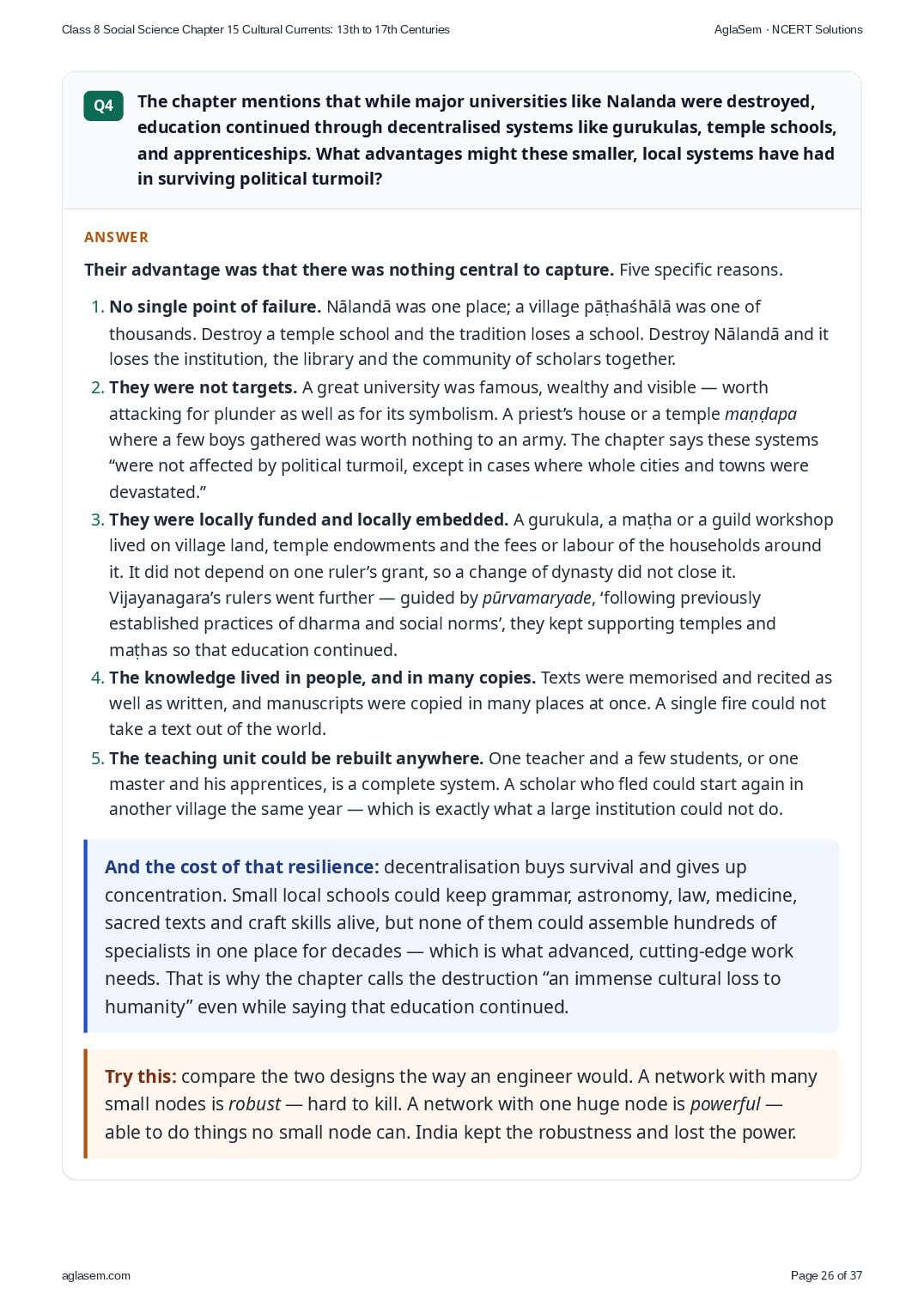
- The chapter mentions that while major universities like Nalanda were destroyed, education continued through decentralised systems like gurukulas, temple schools, and apprenticeships. What advantages might these smaller, local systems have had in surviving political turmoil?
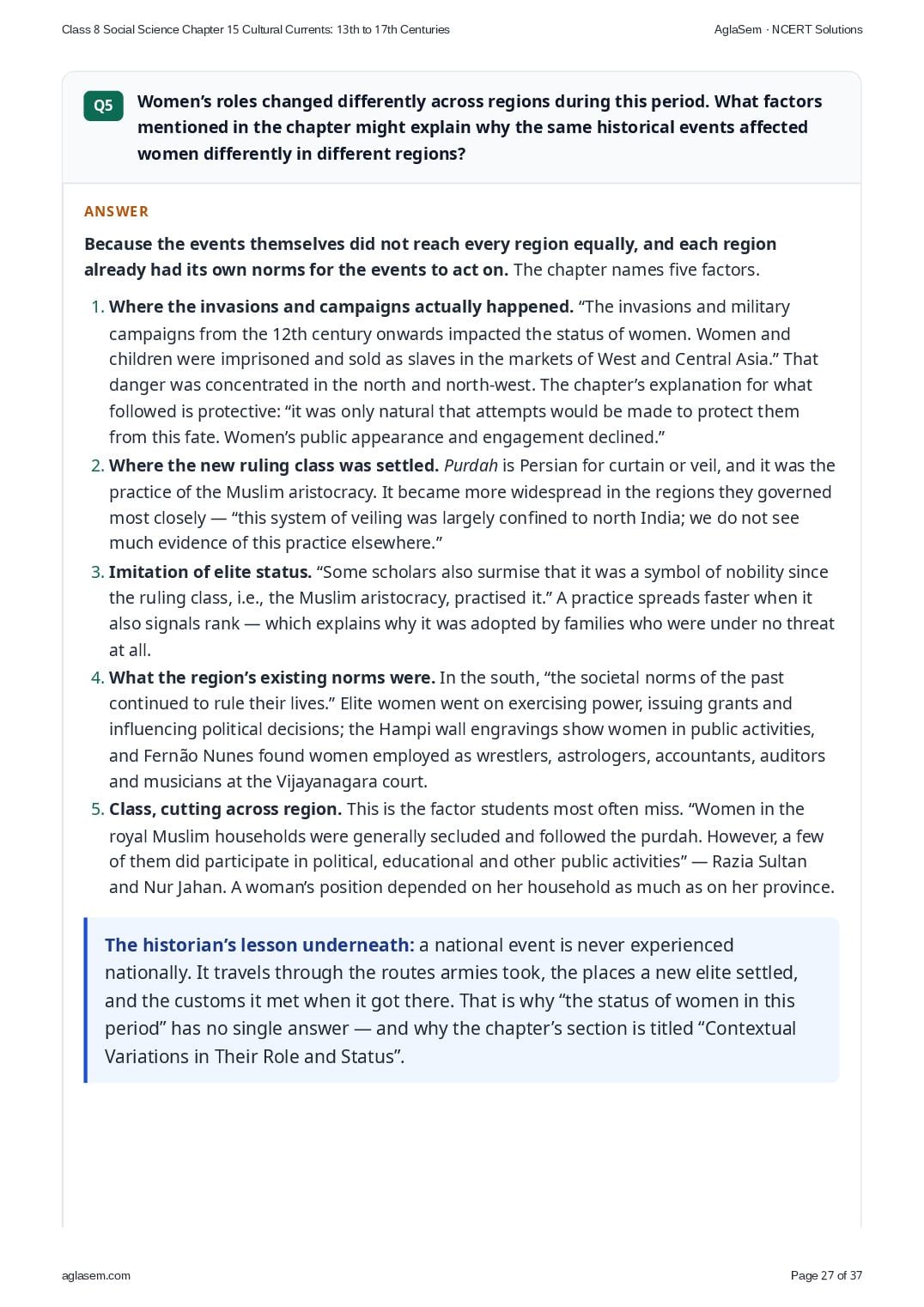
- Women’s roles changed differently across regions during this period. What factors mentioned in the chapter might explain why the same historical events affected women differently in different regions?
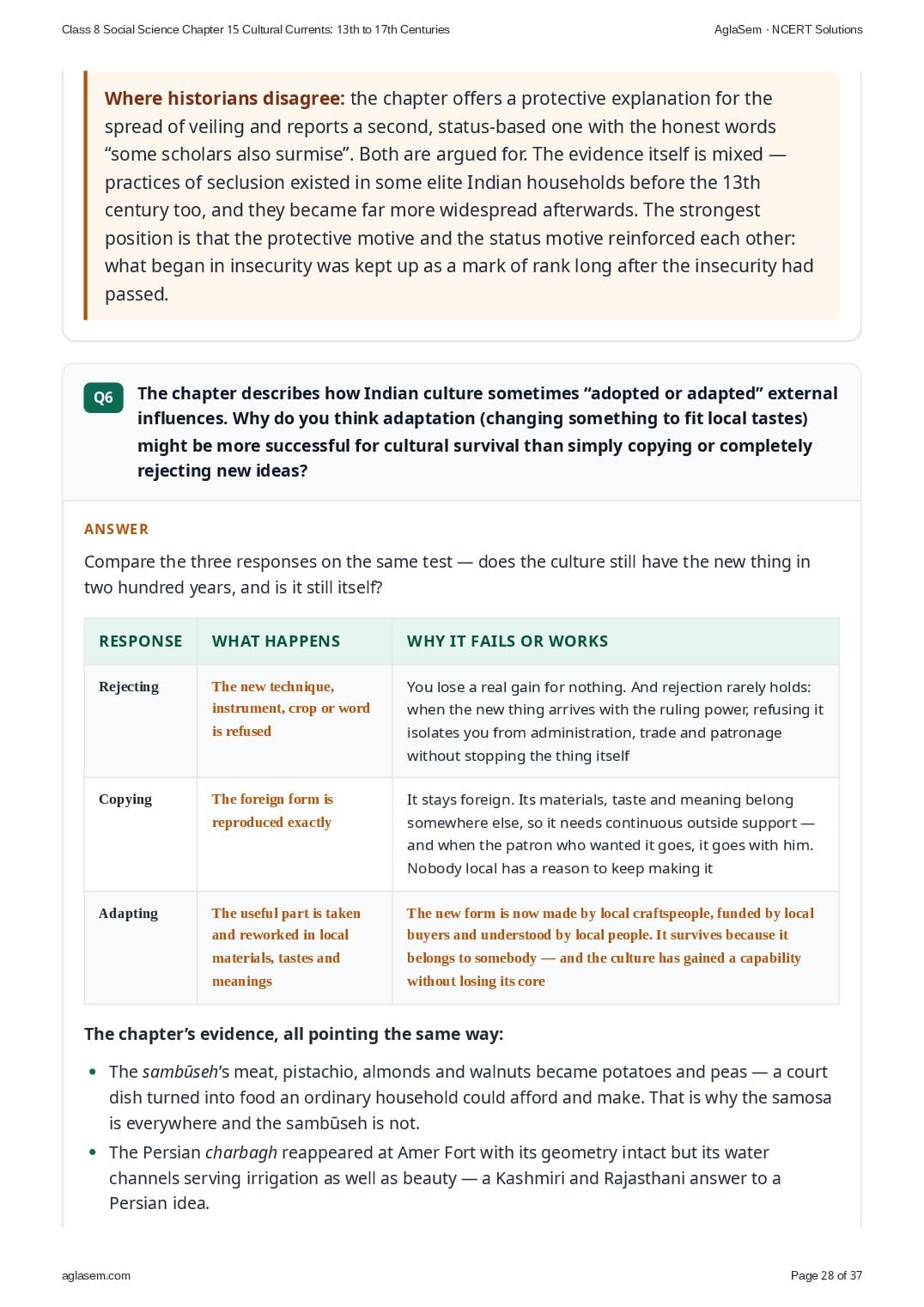
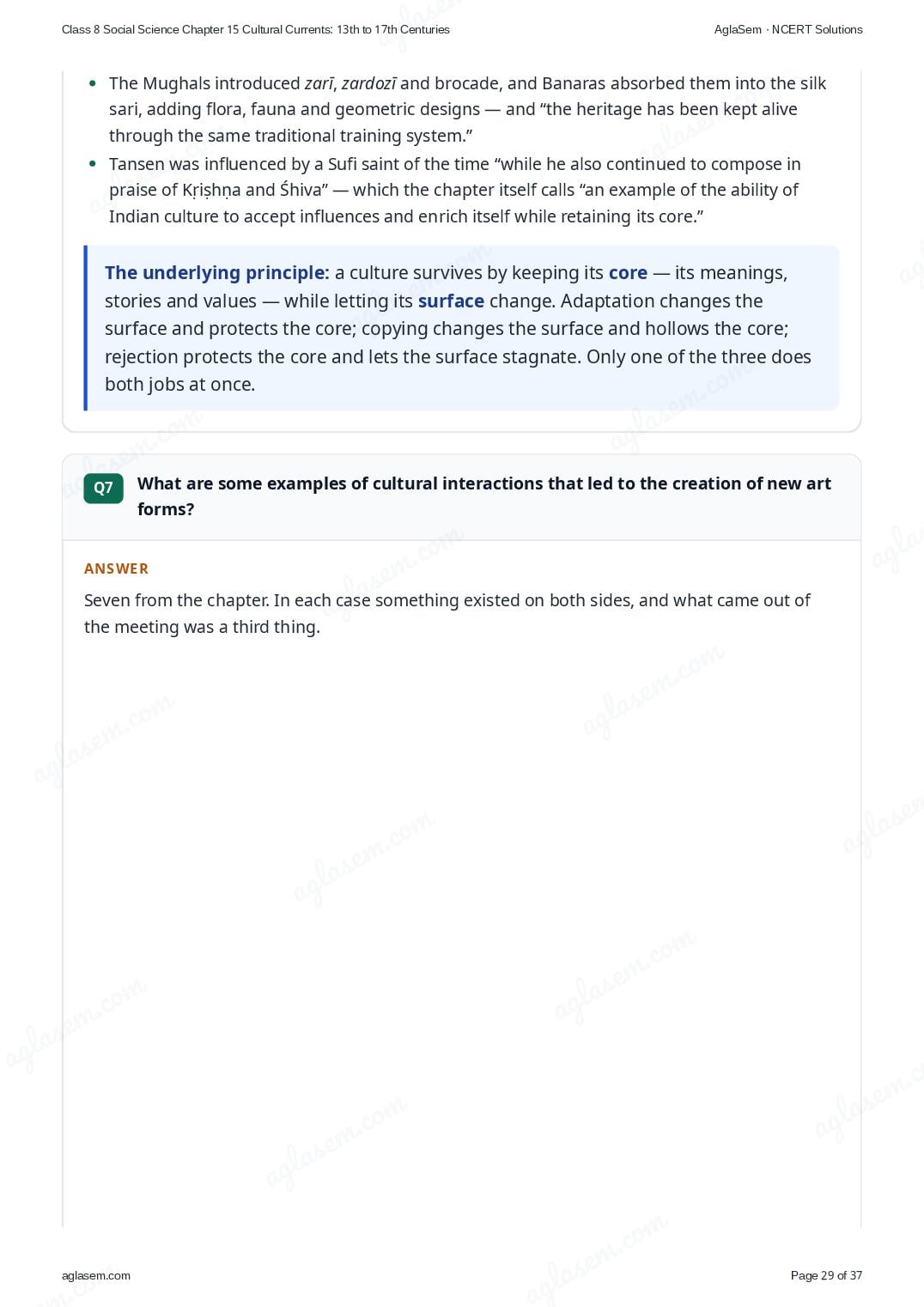
- The chapter describes how Indian culture sometimes “adopted or adapted” external influences. Why do you think adaptation (changing something to fit local tastes) might be more successful for cultural survival than simply copying or completely rejecting new ideas?
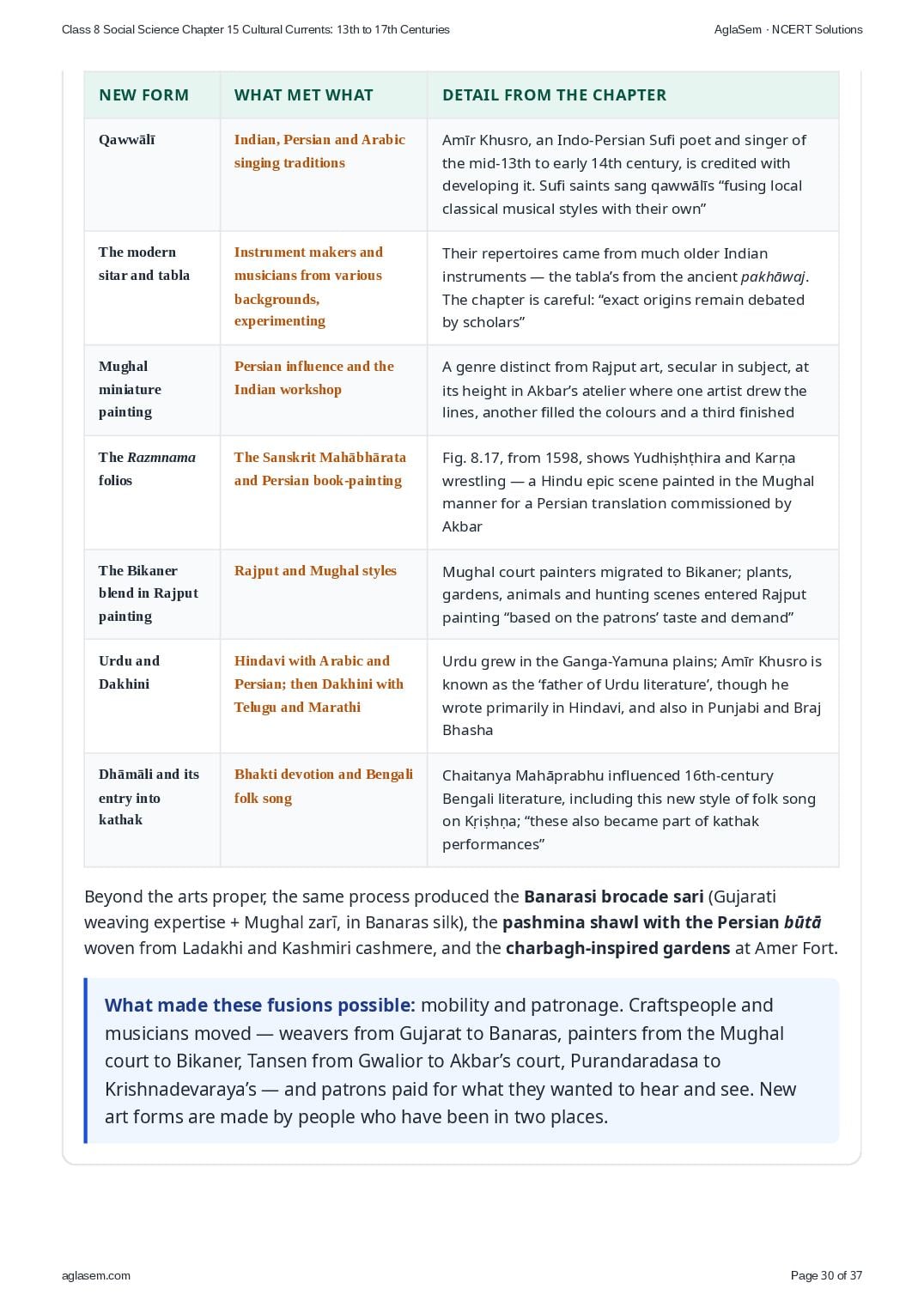
- What are some examples of cultural interactions that led to the creation of new art forms?
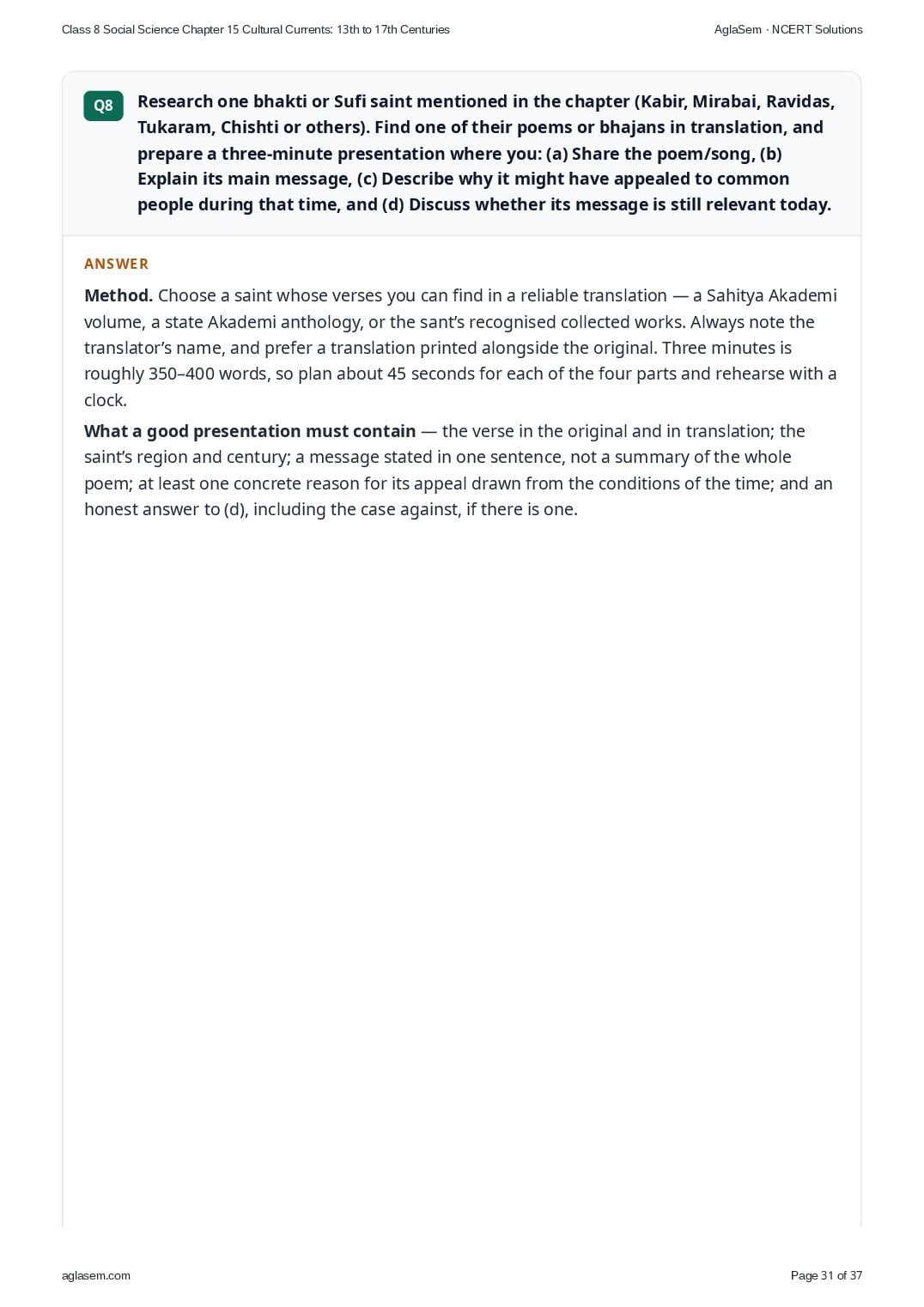
- Research one bhakti or Sufi saint mentioned in the chapter (Kabir, Mirabai, Ravidas, Tukaram, Chishti or others). Find one of their poems or bhajans in translation, and prepare a three-minute presentation where you: (a) Share the poem/song, (b) Explain its main message, (c) Describe why it might have appealed to common people during that time, and (d) Discuss whether its message is still relevant today.
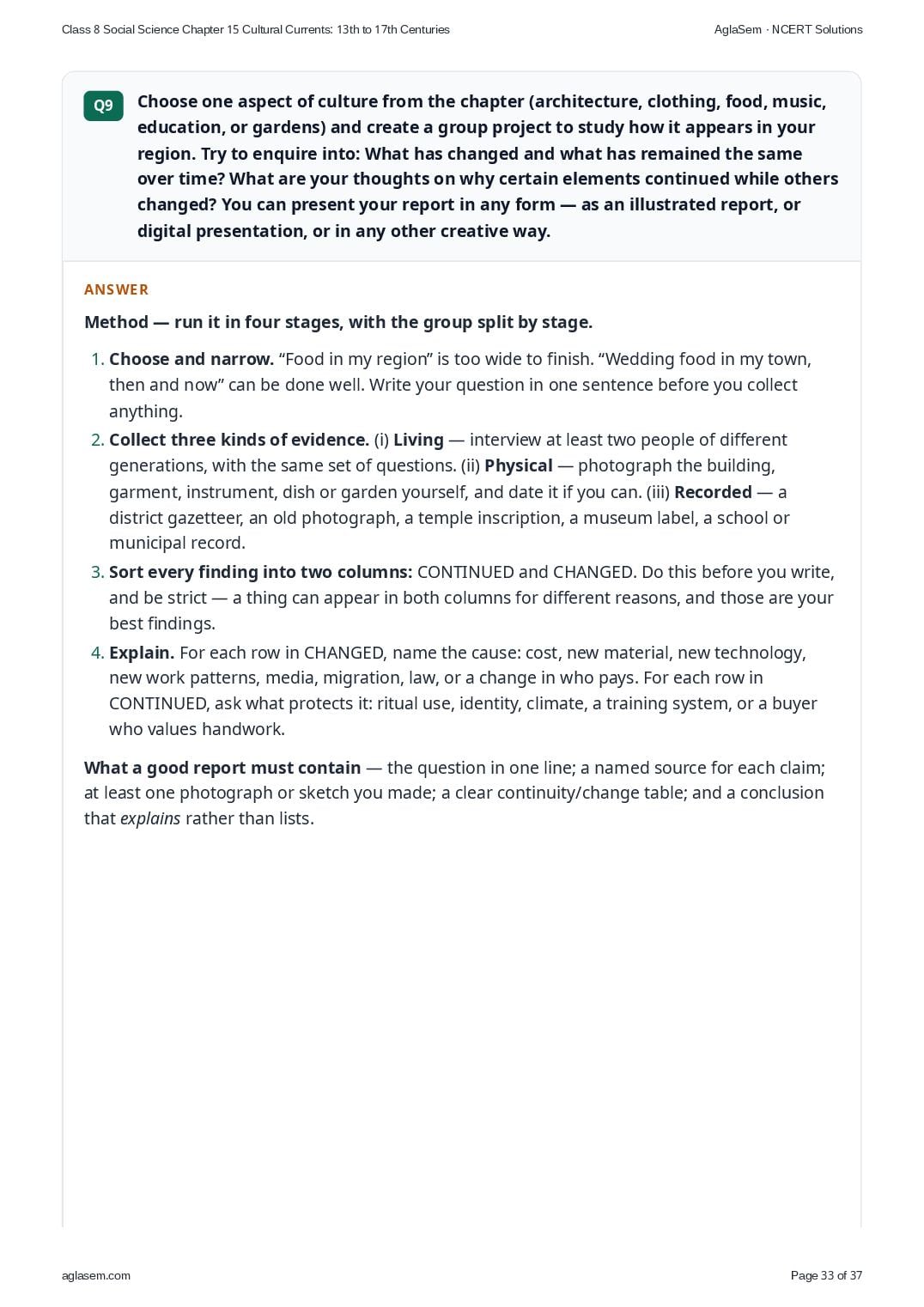
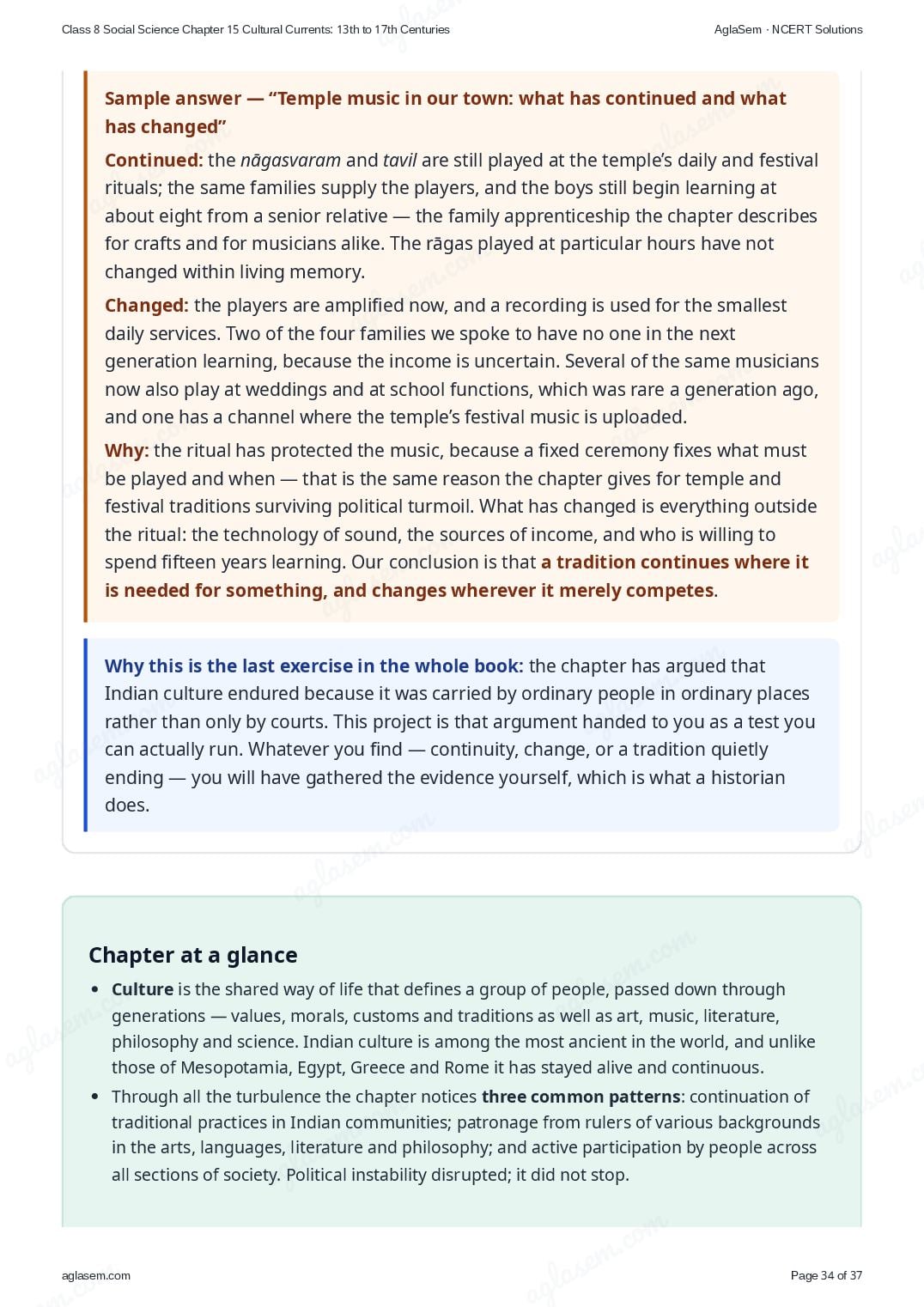
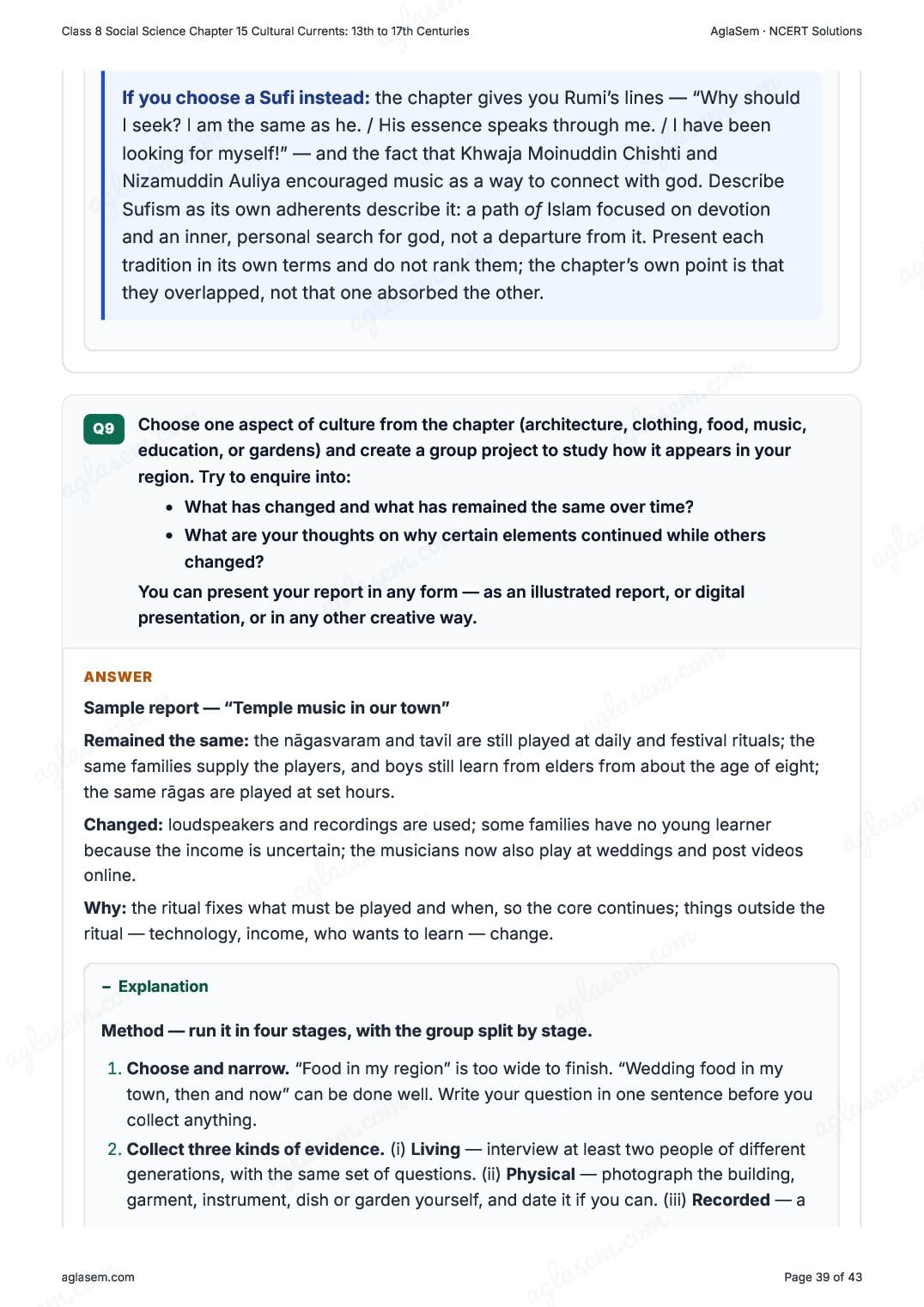
- Choose one aspect of culture from the chapter (architecture, clothing, food, music, education, or gardens) and create a group project to study how it appears in your region. Try to enquire into: What has changed and what has remained the same over time? What are your thoughts on why certain elements continued while others changed? You can present your report in any form — as an illustrated report, or digital presentation, or in any other creative way.
Chapter at a Glance
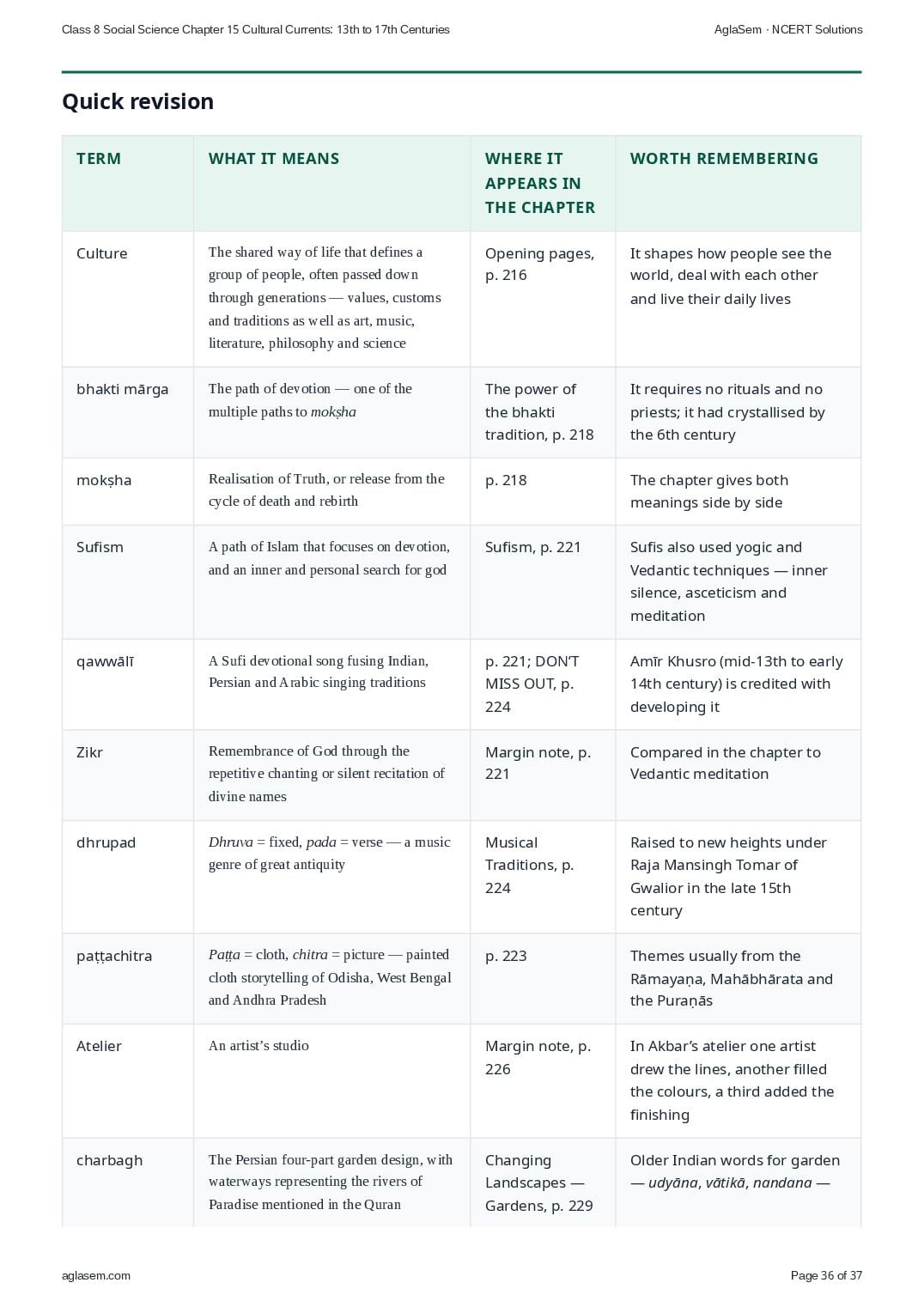
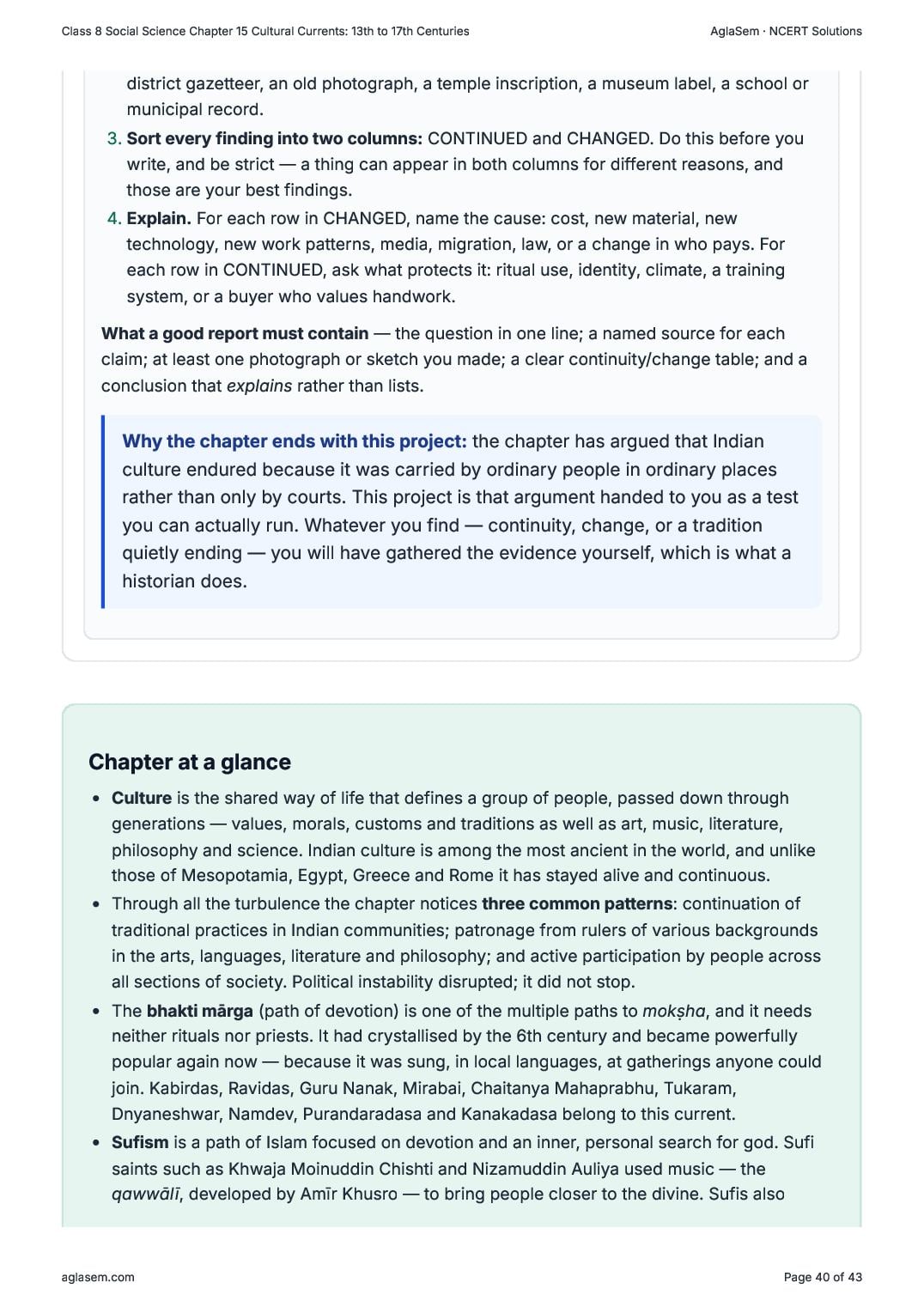
- Culture is the shared way of life that defines a group of people, passed down through generations — values, morals, customs and traditions as well as art, music, literature, philosophy and science. Indian culture is among the most ancient in the world, and unlike those of Mesopotamia, Egypt, Greece and Rome it has stayed alive and continuous.
- Through all the turbulence the chapter notices three common patterns : continuation of traditional practices in Indian communities; patronage from rulers of various backgrounds in the arts, languages, literature and philosophy; and active participation by people across all sections of society. Political instability disrupted; it did not stop.
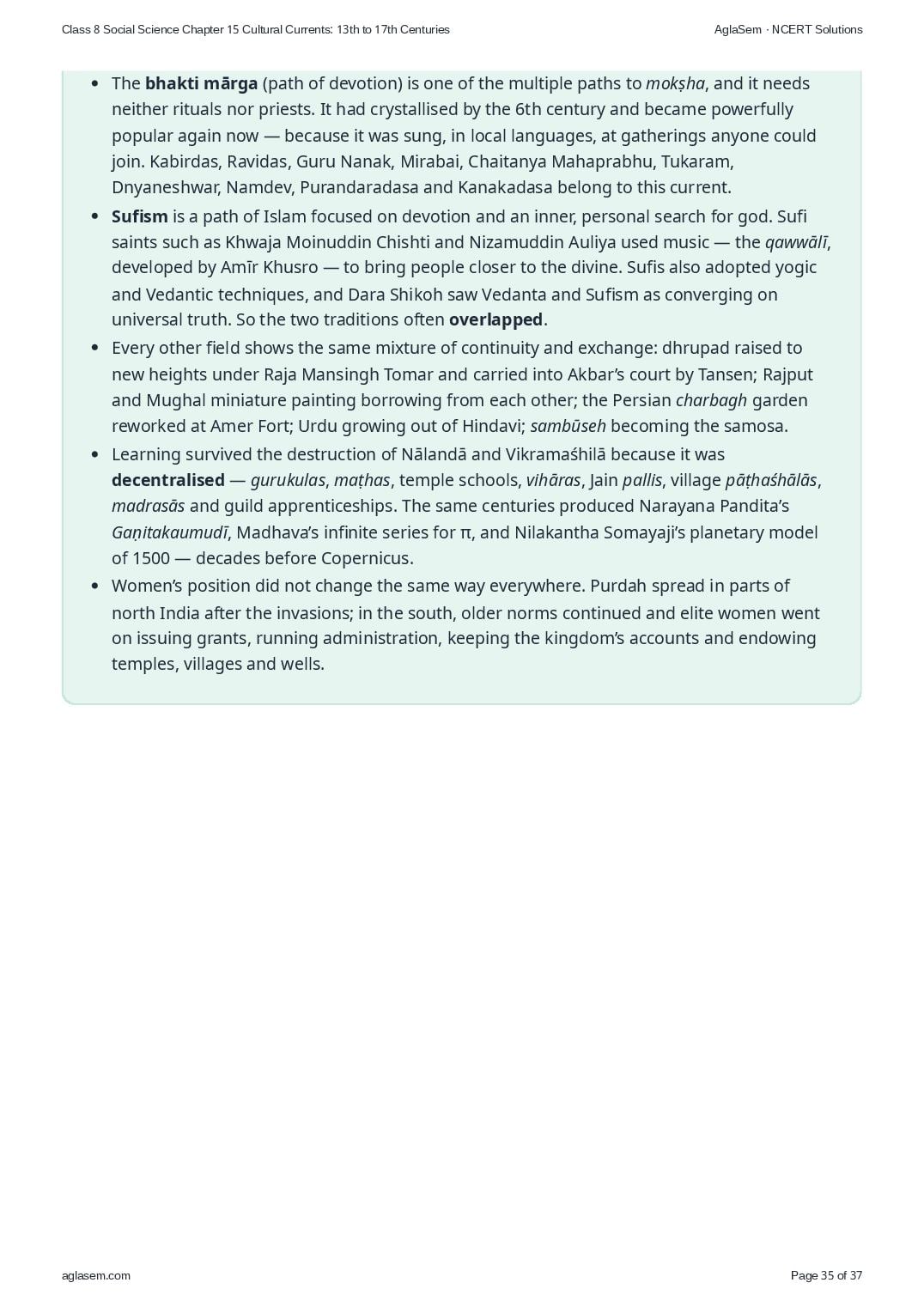
- The bhakti mārga (path of devotion) is one of the multiple paths to mokṣha , and it needs neither rituals nor priests. It had crystallised by the 6th century and became powerfully popular again now — because it was sung, in local languages, at gatherings anyone could join. Kabirdas, Ravidas, Guru Nanak, Mirabai, Chaitanya Mahaprabhu, Tukaram, Dnyaneshwar, Namdev, Purandaradasa and Kanakadasa belong to this current.
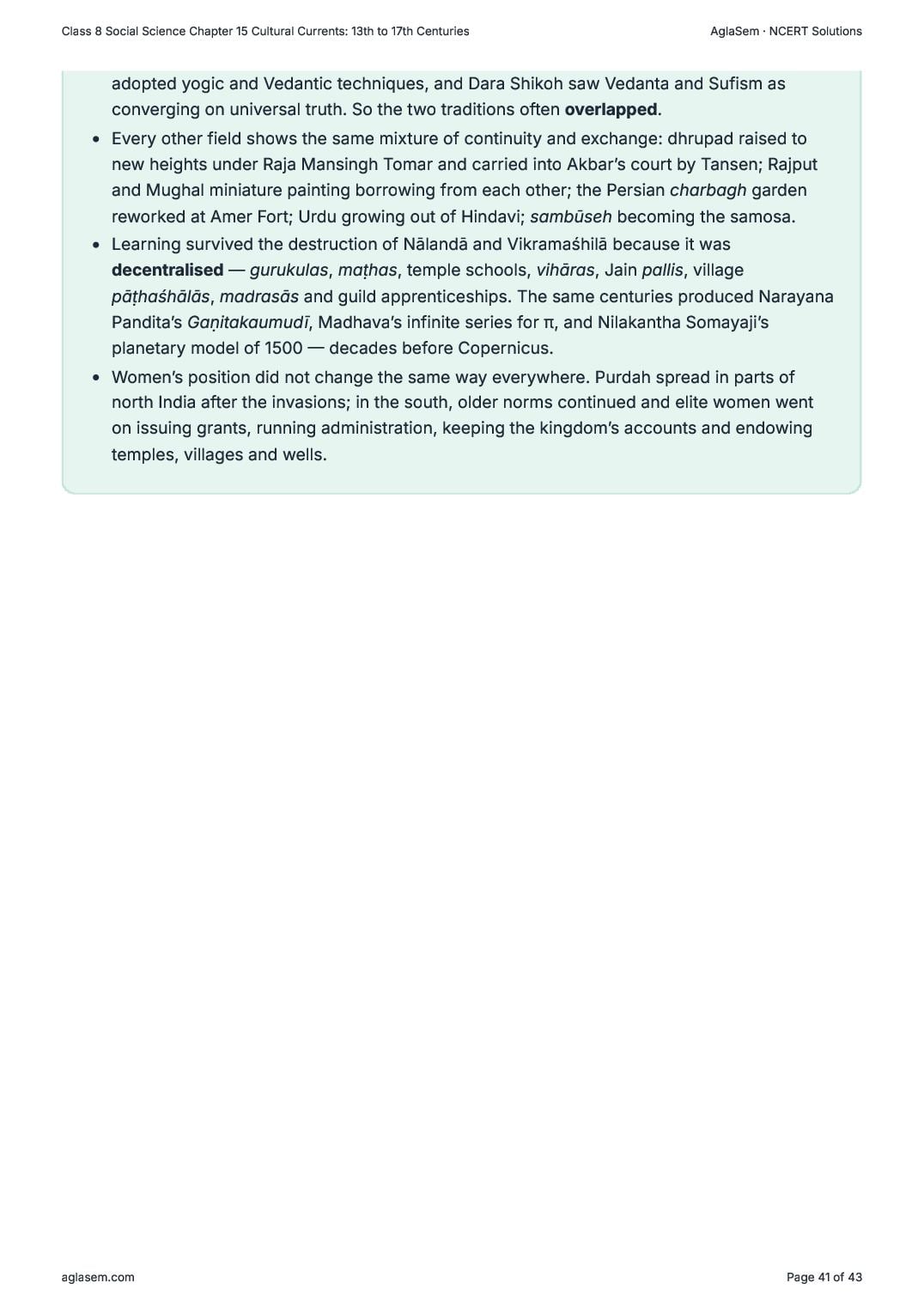
- Sufism is a path of Islam focused on devotion and an inner, personal search for god. Sufi saints such as Khwaja Moinuddin Chishti and Nizamuddin Auliya used music — the qawwālī , developed by Amīr Khusro — to bring people closer to the divine. Sufis also adopted yogic and Vedantic techniques, and Dara Shikoh saw Vedanta and Sufism as converging on universal truth. So the two traditions often overlapped .
- Every other field shows the same mixture of continuity and exchange: dhrupad raised to new heights under Raja Mansingh Tomar and carried into Akbar’s court by Tansen; Rajput and Mughal miniature painting borrowing from each other; the Persian charbagh garden reworked at Amer Fort; Urdu growing out of Hindavi; sambūseh becoming the samosa.
- Learning survived the destruction of Nālandā and Vikramaśhilā because it was decentralised — gurukulas , maṭhas , temple schools, vihāras , Jain pallis , village pāṭhaśhālās , madrasās and guild apprenticeships. The same centuries produced Narayana Pandita’s Gaṇitakaumudī , Madhava’s infinite series for π, and Nilakantha Somayaji’s planetary model of 1500 — decades before Copernicus.
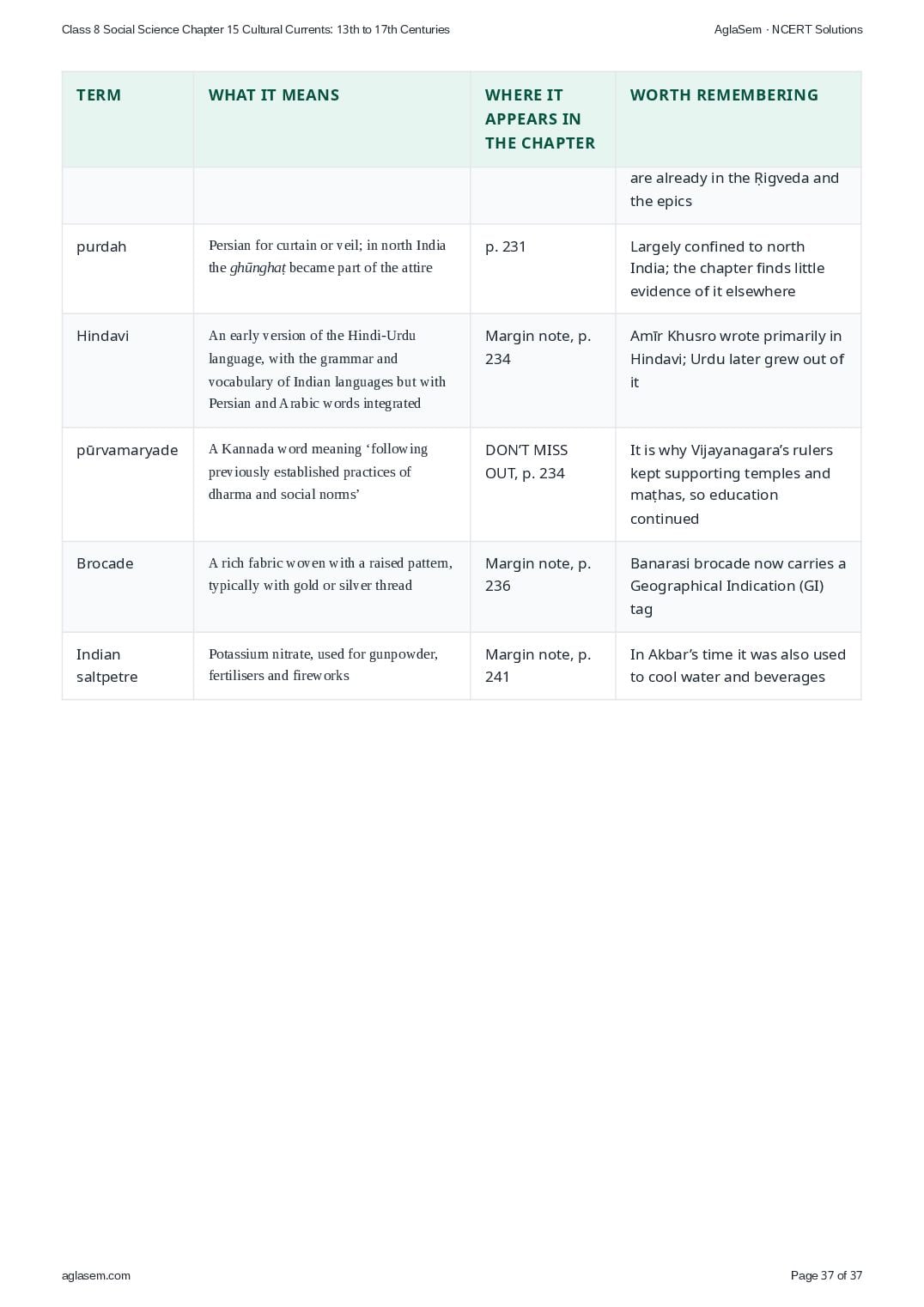
- Women’s position did not change the same way everywhere. Purdah spread in parts of north India after the invasions; in the south, older norms continued and elite women went on issuing grants, running administration, keeping the kingdom’s accounts and endowing temples, villages and wells.
How to Download NCERT Solutions for Class 8 Social Science Chapter 15 PDF
Follow these simple steps to get the Cultural Currents 13th to 17th Centuries questions-and-answers PDF from Exploring Society: India and Beyond.
- Search NCERT Solutions for Class 8 Social Science Chapter 15 aglasem and open this page.
- Read the exercise questions with answers for Cultural Currents 13th to 17th Centuries shown above.
- Click the Download PDF link to save the Cultural Currents 13th to 17th Centuries solutions to your device.
NCERT Solutions for Class 8 Social Science – All Chapters
There are more chapters to study besides Cultural Currents 13th to 17th Centuries in Social Science. Here are the NCERT Solutions for all chapters of Class 8 Social Science.
- Chapter 1 Natural Resources and Their Use
- Chapter 2 Reshaping India’s Political Map
- Chapter 3 The Rise of the Marathas
- Chapter 4 The Colonial Era in India
- Chapter 5 Universal Franchise and India’s Electoral System
- Chapter 6 The Parliamentary System Legislature and Executive
- Chapter 7 Factors of Production
- Chapter 8 World Geography Some Glimpses
- Chapter 9 India’s Long Road to Independence
- Chapter 10 A Journey Through Indian Architecture
- Chapter 11 The Role of the Judiciary in Our Society
- Chapter 12 Citizenship Rights and Duties
- Chapter 13 Dynamics of Population
- Chapter 14 India’s Urban Landscape
- Chapter 15 Cultural Currents 13th to 17th Centuries
NCERT Solutions for Class 8 – All Subjects
Just like Chapter 15 of Social Science, you can get the exercise questions with answers for every other subject of Class 8. Here are the NCERT Solutions for all subjects of Class 8.
NCERT Solutions for Class 8 Social Science Chapter 15 – An Overview
The key highlights of this study material are as follows.
| Aspects | Details |
|---|---|
| Class | Class 8 |
| Subject | Social Science |
| Chapter Number | Chapter 15 |
| Chapter Name | Cultural Currents 13th to 17th Centuries |
| Book Name | Exploring Society: India and Beyond |
| Book By | NCERT (National Council of Educational Research and Training) |
| Educational Resource Here | NCERT Solutions of Class 8 Social Science Chapter 15 for all exercises |
| More Questions Answers of This Subject | NCERT Solutions for Class 8 Social Science |
| Download Book Chapter | NCERT Book Class 8 Social Science |
| All Questions Answers For This Class | NCERT Solutions for Class 8 |
| Complete Solutions | NCERT Solutions |
NCERT Solutions for Class 8 Social Science Chapter 15 Cultural Currents 13th to 17th Centuries – FAQs
What are the NCERT Solutions for Class 8 Social Science Chapter 15 Cultural Currents 13th to 17th Centuries?
They are the complete, step-by-step answers to all the exercise and in-text questions of Chapter 15 Cultural Currents 13th to 17th Centuries from the NCERT Class 8 Social Science textbook Exploring Society: India and Beyond, written by experts as per the latest NCERT syllabus.
How can I download the Class 8 Social Science Chapter 15 solutions PDF for free?
Open this page on aglasem, read the Cultural Currents 13th to 17th Centuries questions with answers, and click the “Download Solutions PDF” link. The Class 8 Social Science Chapter 15 NCERT Solutions PDF is completely free to download.
Are these NCERT Solutions as per the latest 2026-27 syllabus?
Yes. The NCERT Solutions for Class 8 Social Science Chapter 15 are based on the latest NCERT textbook Exploring Society: India and Beyond and the current 2026-27 CBSE syllabus, so the questions and answers match what you study in class.
Where can I get NCERT Solutions for the other chapters of Class 8 Social Science?
You can find the answers to every chapter on the NCERT Solutions for Class 8 Social Science page, and solutions for every subject on the NCERT Solutions for Class 8 page.
How do NCERT Solutions help in exam preparation?
They show the correct method to solve each question, help you write answers the way they are expected in exams, let you check and correct your own work, and save revision time — which together improve your marks in Class 8 Social Science.
If you have any queries on NCERT Solutions for Class 8 Social Science Chapter 15 Cultural Currents 13th to 17th Centuries, then please ask in the comments below.