Download The Parliamentary System: Legislature and Executive – NCERT Class 8 Social Science Chapter 6 PDF from the new NCERT Class 8 Social Science book Exploring Society: India and Beyond (2026-27). Read the chapter online or download the free PDF. India’s Parliament is bicameral — it is composed of the President, the Lok Sabha (House of the People / Lower House) and the Rajya Sabha (Council of States / Upper House). Lok Sabha members are directly elected on universal adult suffrage…
The Parliamentary System: Legislature and Executive PDF – Chapter 6 of Exploring Society: India and Beyond (Part I)
Read the chapter online or download the PDF.
| Chapter | Download | |
|---|---|---|
| Chapter 6 PDF | The Parliamentary System: Legislature and Executive | View PDF |
| Full book | NCERT Class 8 Social Science – Exploring Society: India and Beyond | View Book |
Read Online
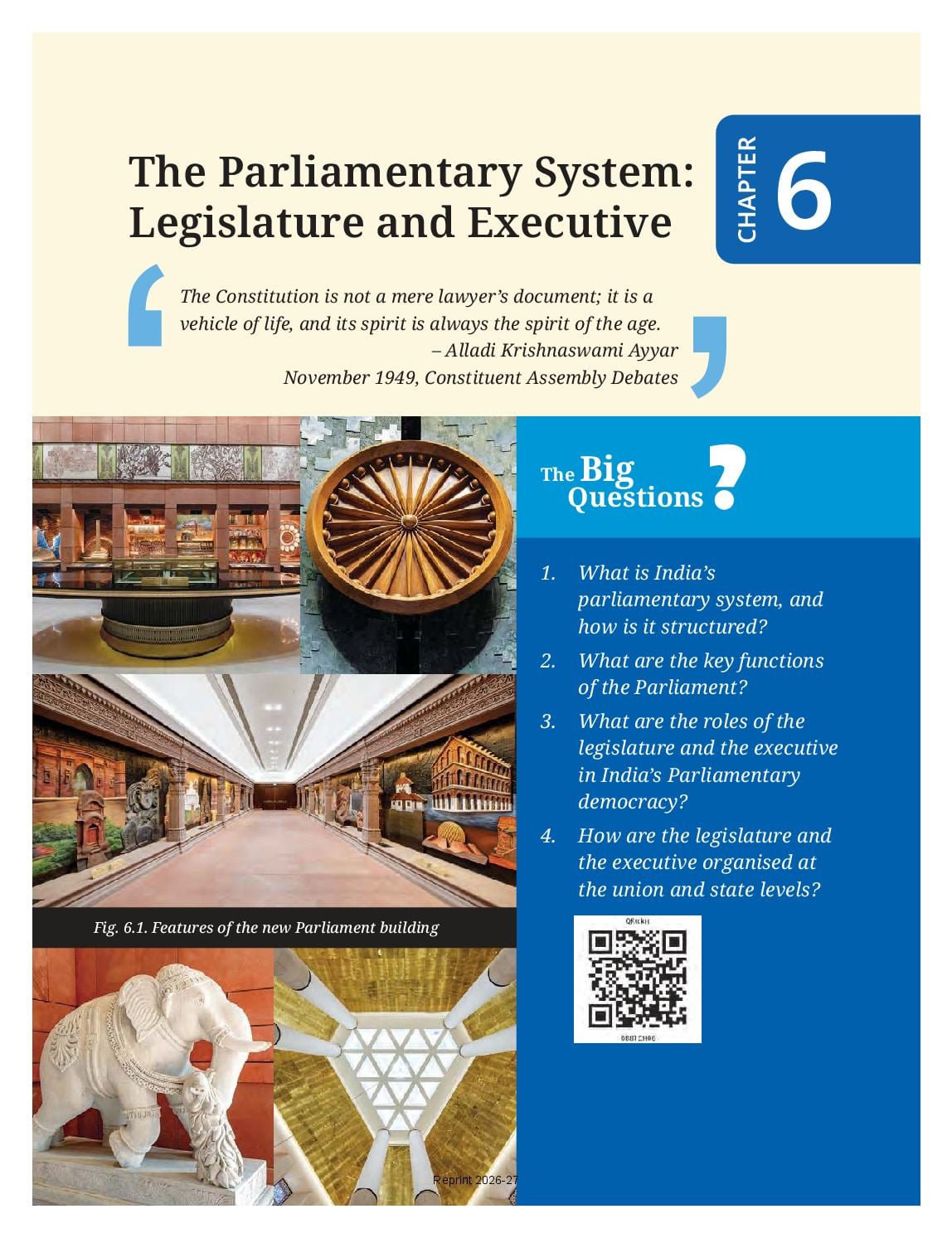
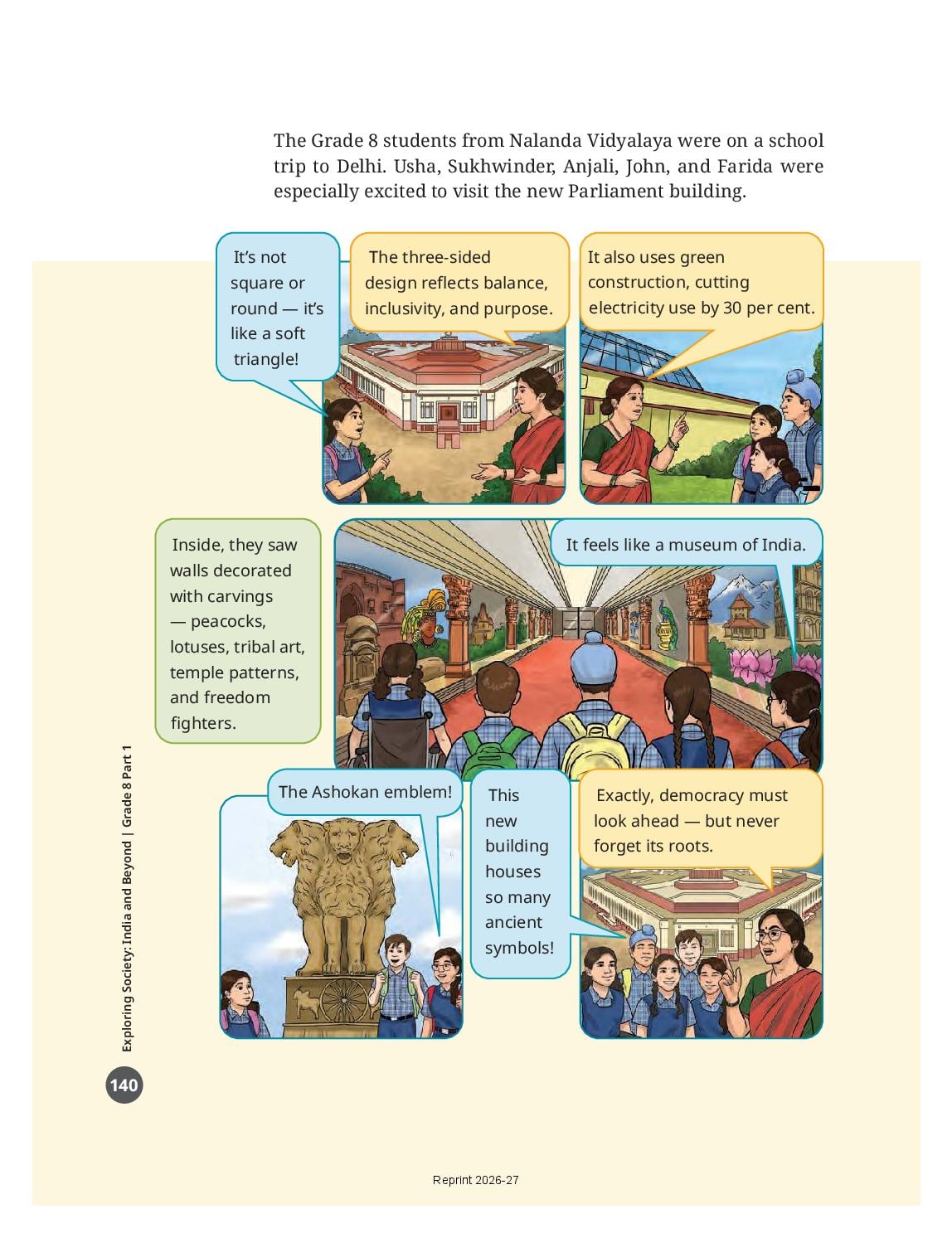
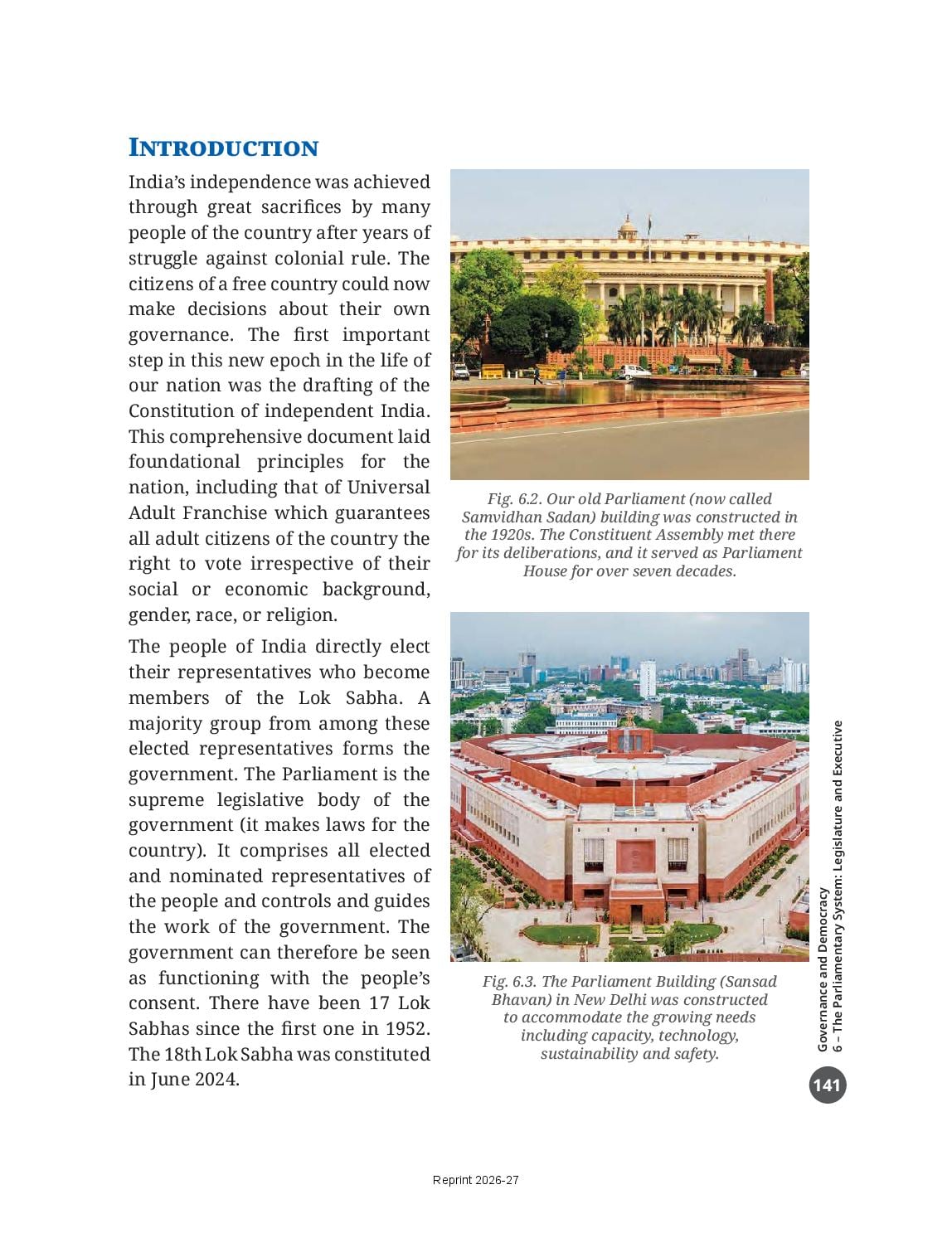
What Is in The Parliamentary System: Legislature and Executive? (Class 8 Social Science Chapter 6)
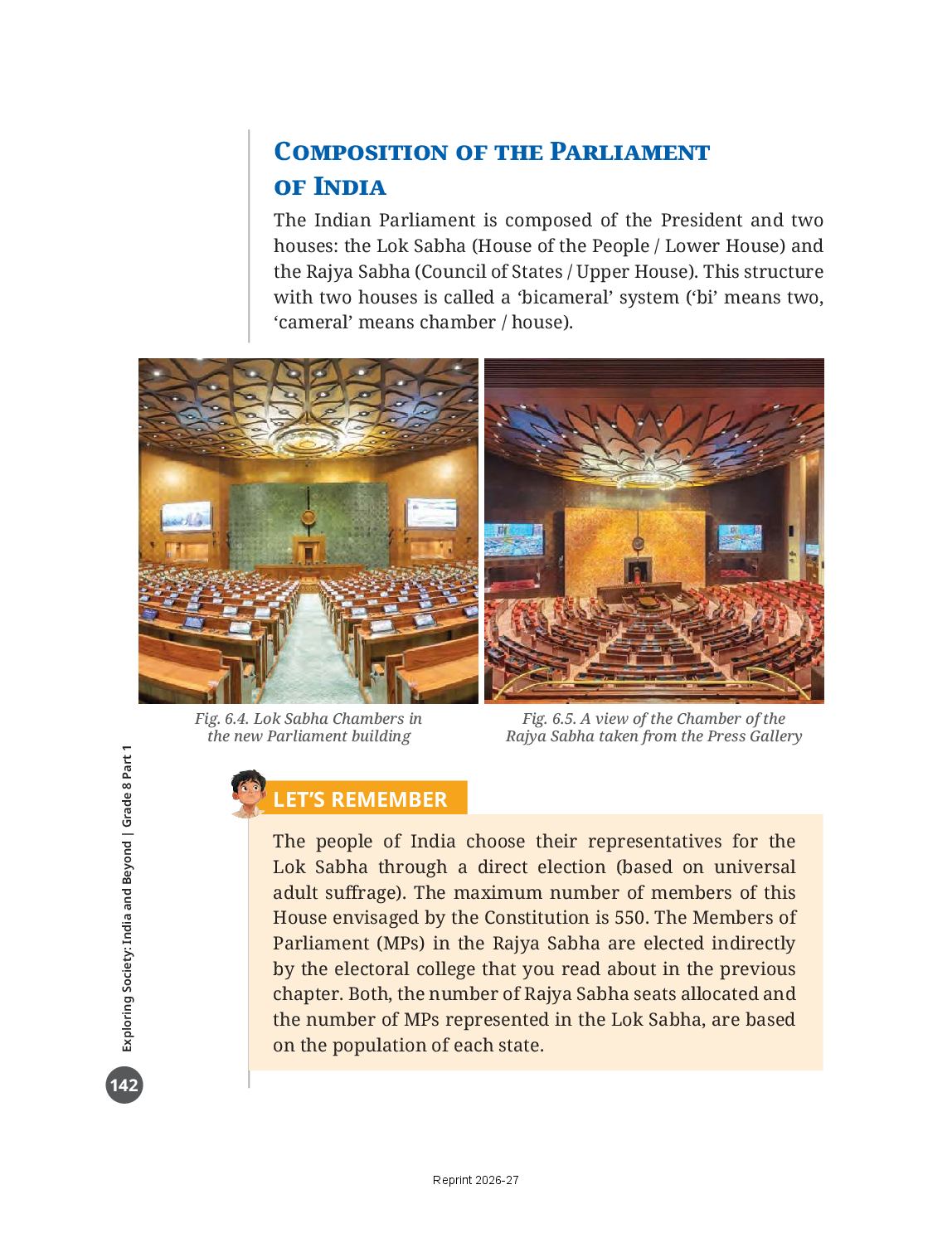
- India’s Parliament is bicameral — it is composed of the President, the Lok Sabha (House of the People / Lower House) and the Rajya Sabha (Council of States / Upper House). Lok Sabha members are directly elected on universal adult suffrage (maximum strength envisaged by the Constitution: 550); Rajya Sabha members are elected indirectly by an electoral college. Both allocations follow each state’s population. There have been 17 Lok Sabhas since 1952; the 18th was constituted in June 2024.
- The Constitution gives Parliament four broad functions — constitutional (electing the President and Vice President, amending the Constitution, upholding universal adult suffrage, separation of powers, federalism, Fundamental Rights and the Directive Principles), lawmaking, executive accountability and financial accountability.
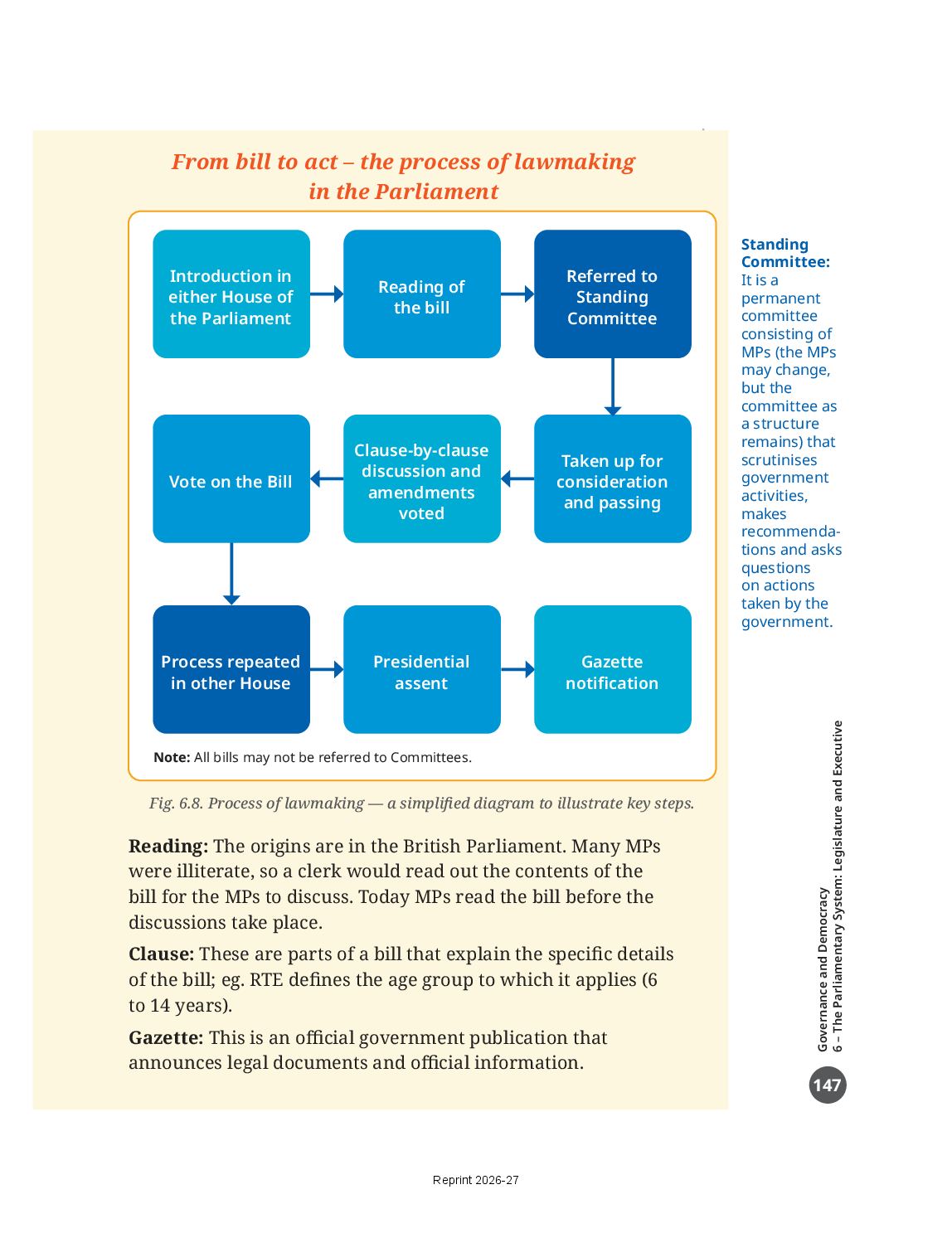
- A bill is a draft law; an act is what it becomes. Fig. 6.8 sets out the journey: introduction in either House → reading → referral to a Standing Committee → taken up for consideration and passing → clause-by-clause discussion with amendments voted → vote on the bill → the whole process repeated in the other House → Presidential assent → Gazette notification. Not all bills go to a committee, and a Money Bill can be introduced only in the Lok Sabha, on the President’s prior recommendation.
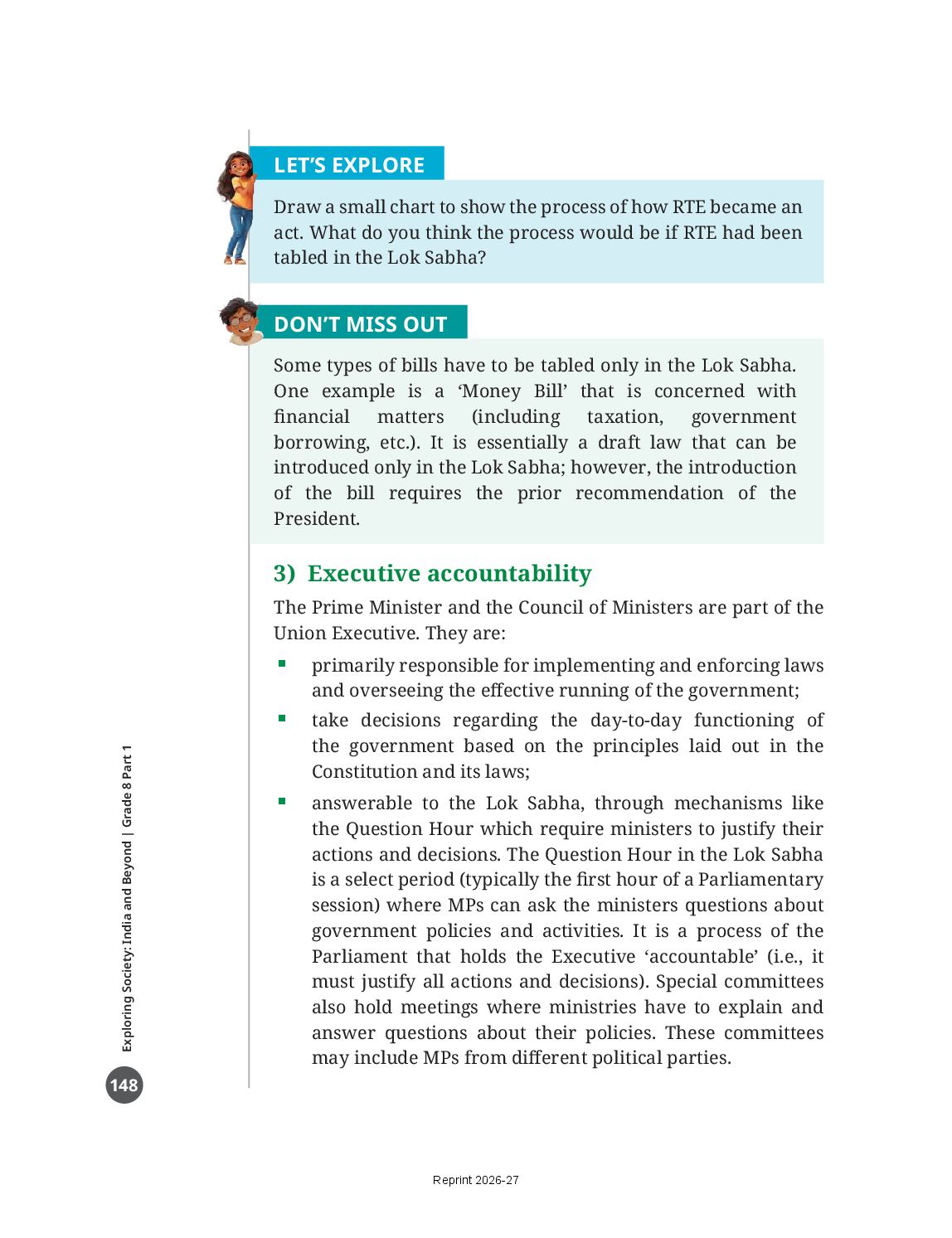
- The Executive is inside the Legislature, and answerable to it. The Union Executive is the President, the Vice President and the Council of Ministers headed by the Prime Minister; ministers are drawn from the MPs of both Houses and are collectively responsible to the Lok Sabha. The Question Hour — typically the first hour of a sitting — and parliamentary committees are how that responsibility is enforced. The President is the nominal head; the Prime Minister is the de facto executive authority.
- The Judiciary is the third organ and the referee. It interprets and applies the law, settles disputes and acts as the custodian of the Constitution — checking that the laws Parliament passes do not violate the constitutional framework, and stepping in if the Executive violates the Constitution while implementing them. Together these arrangements are the separation of powers and the system of checks and balances, so that no one organ becomes too powerful.
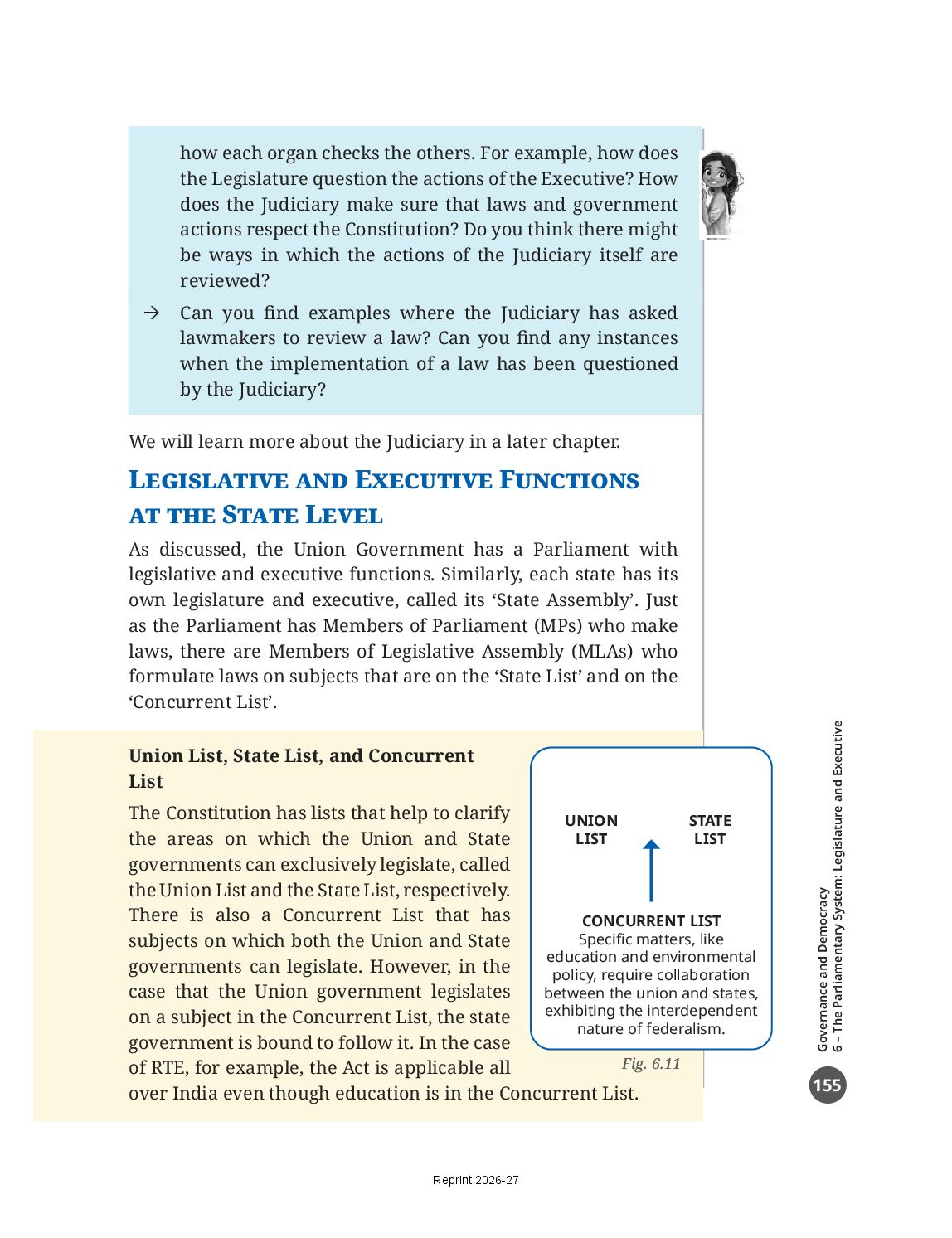
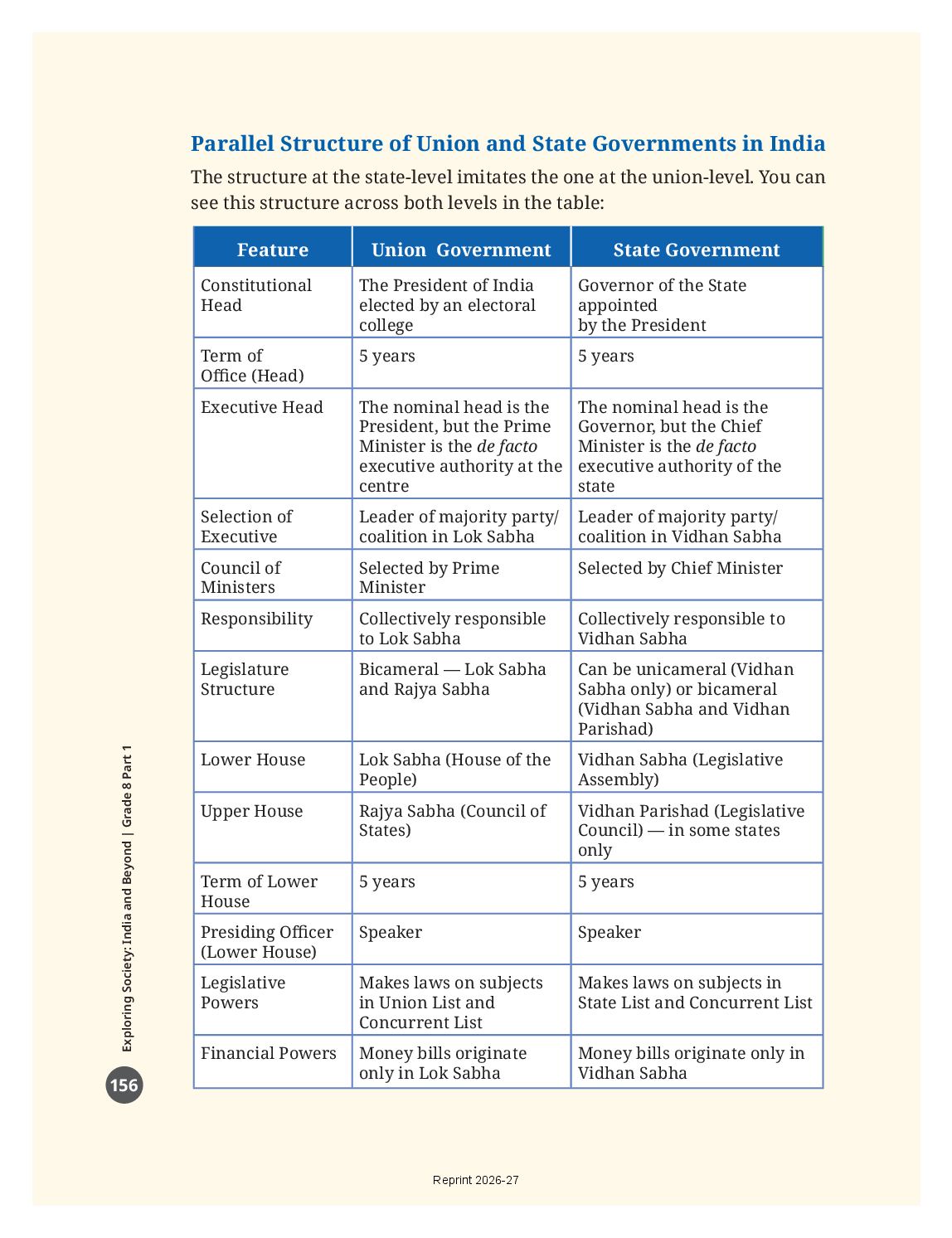
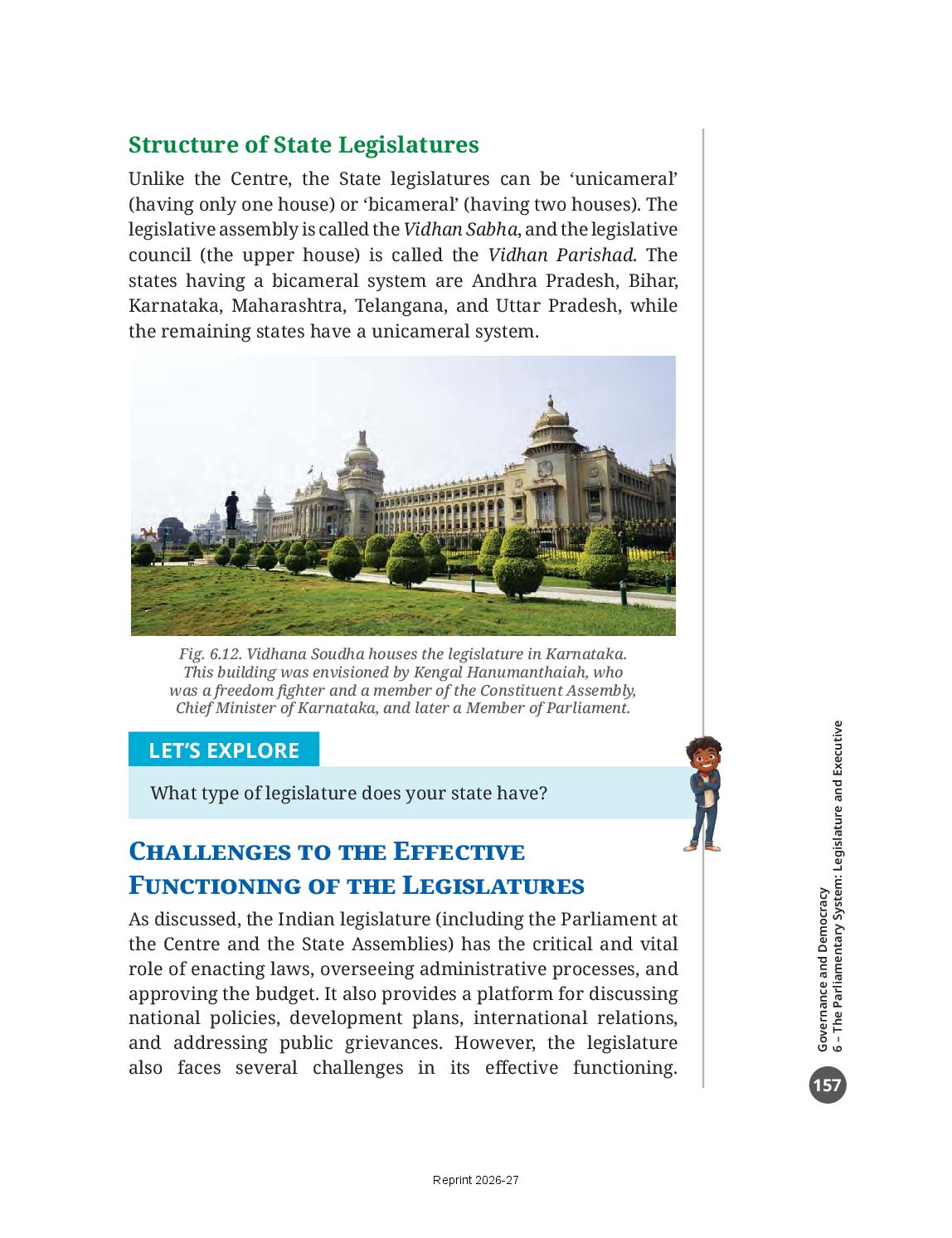
- The state level mirrors the union level. Each state has its own legislature and executive: the Governor as constitutional head, the Chief Minister as de facto executive head, MLAs legislating on the State List and the Concurrent List. State legislatures may be unicameral (Vidhan Sabha only) or bicameral (with a Vidhan Parishad) — only Andhra Pradesh, Bihar, Karnataka, Maharashtra, Telangana and Uttar Pradesh are bicameral.
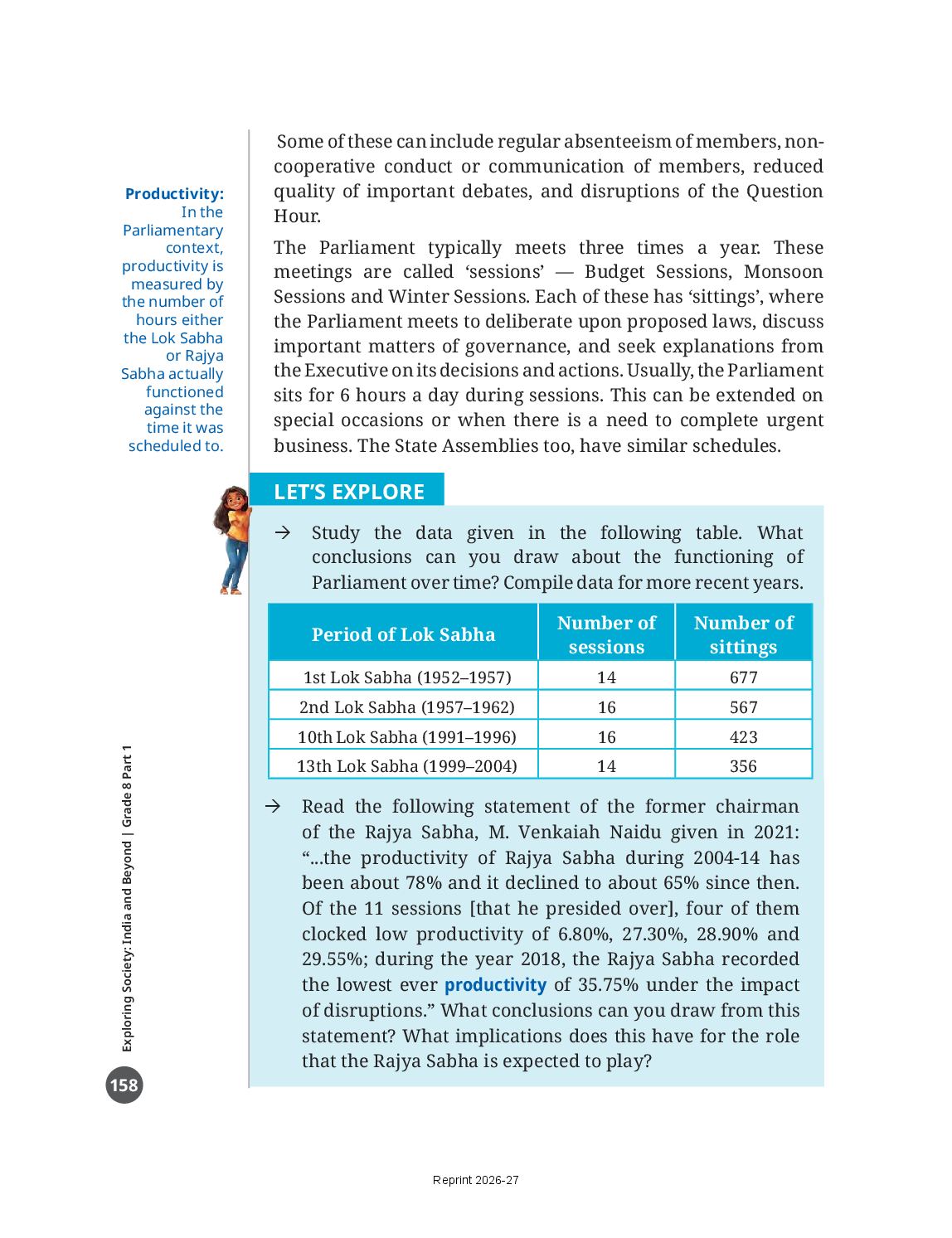
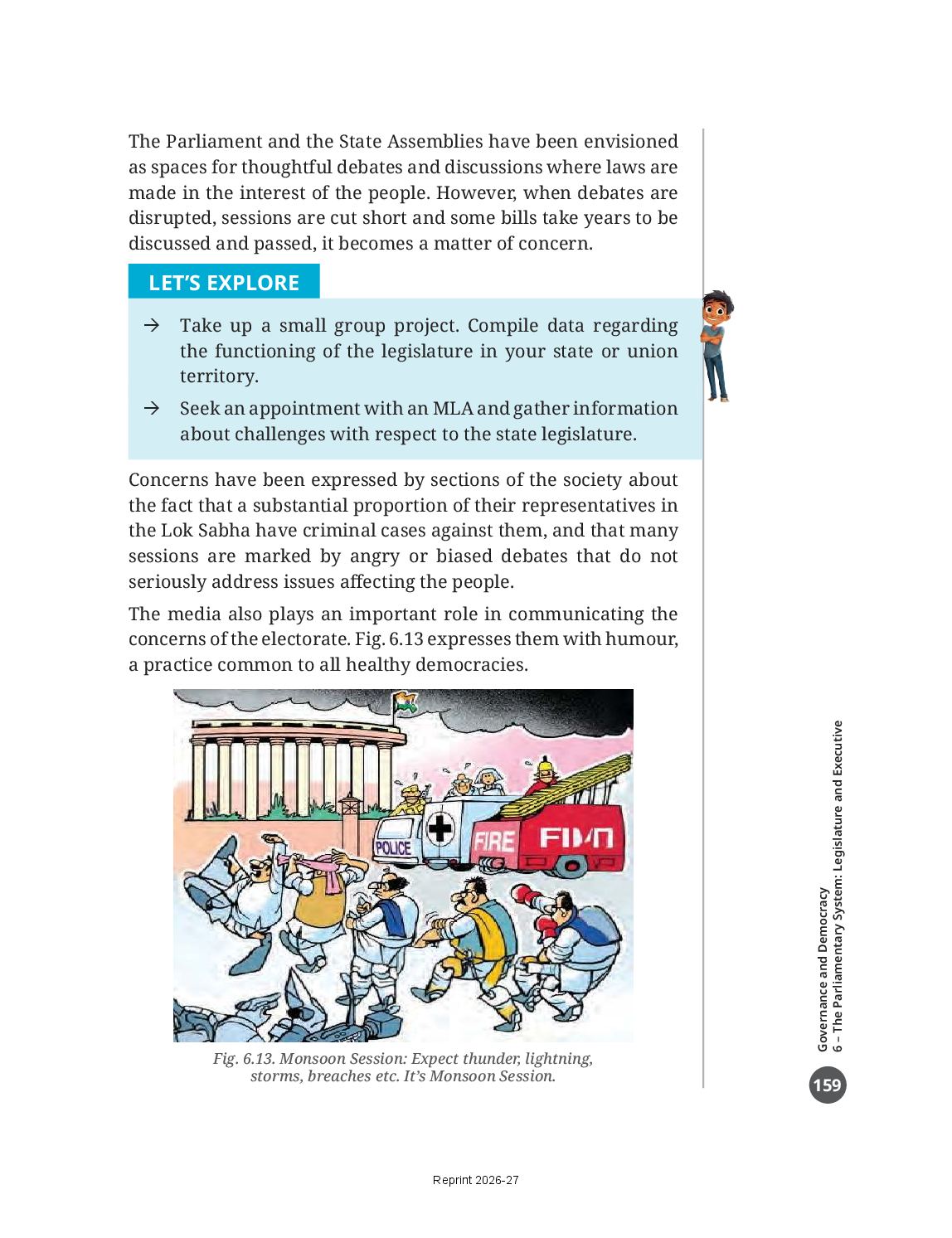
- The system faces real challenges. Absenteeism, non-cooperative conduct, poorer debate and disruption of the Question Hour cut into productivity — the hours a House actually functions against the hours it was scheduled to. Sittings have fallen from 677 in the 1st Lok Sabha to 356 in the 13th. The remedy the chapter offers is not less democracy but more of it: informed, engaged citizens who ask questions, join public consultations and engage constructively with their representatives.
Quick revision – The Parliamentary System: Legislature and Executive
| Term | What it means | Where it appears in the chapter | What the book says about it |
|---|---|---|---|
| Bicameral | A legislature with two houses (‘bi’ = two, ‘cameral’ = chamber / house) | ‘Composition of the Parliament of India’, page 142 | A single directly elected House was felt to be inadequate; in the spirit of federalism a Council of States — the Rajya Sabha — was needed |
| Universal Adult Franchise | Every adult citizen has the right to vote, whatever their social or economic background, gender, race or religion | ‘Introduction’, page 141 | A foundational principle laid down by the Constitution; the Lok Sabha is directly elected on this basis |
| Federalism | A form of government where power is distributed between the centre, the states and local governments | DON’T MISS OUT, page 143 | It “helps to keep the balance between national unity and local interests” |
| Sceptre | A decorated rod carried by a king or queen at ceremonies as a symbol of their power | Margin note, page 144 | The Sengol, handed to Pt. Nehru on 14 August 1947, now stands near the Speaker’s chair; Chola-period practice, with Nandi (justice) at its top |
| Bill | A draft of a proposed law that needs to be approved by Parliament before it can be enacted into law | Margin note, page 146 | A bill “goes through a long and effortful journey” before it becomes an act |
| Act | The instrument through which a law is generally brought into force | ‘Lawmaking’, page 146 | The RTE was tabled as a bill in the Rajya Sabha, passed in the Lok Sabha in August 2009, and became an Act on the President’s assent |
| Reading | MPs read the bill before the discussions take place | Fig. 6.8 note, page 147 | The practice began in the British Parliament, where a clerk read the bill out because many MPs were illiterate |
| Clause | The parts of a bill that explain its specific details | Fig. 6.8 note, page 147 | Example: the RTE defines the age group it applies to — 6 to 14 years |
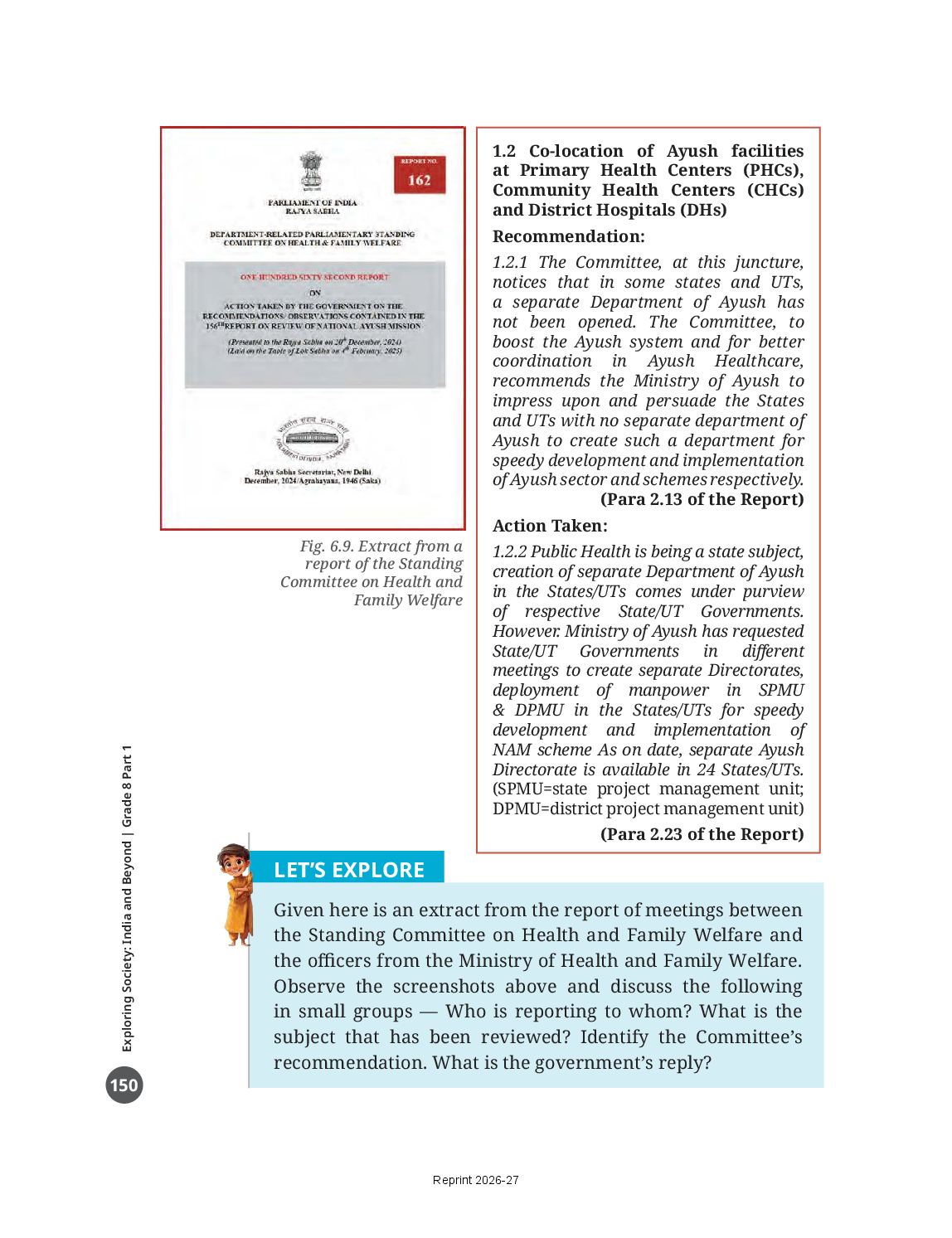
| Standing Committee | A permanent committee of MPs (the MPs may change, the committee remains) that scrutinises government activities, makes recommendations and asks questions | Margin note, page 147 | Fig. 6.9 shows one at work — the Committee on Health and Family Welfare and the Ministry’s ‘Action Taken’ reply |
| Gazette | An official government publication that announces legal documents and official information | Fig. 6.8 note, page 147 | Gazette notification is the last step in the lawmaking flow chart |
| Money Bill | A draft law concerned with financial matters — taxation, government borrowing and the like | DON’T MISS OUT, page 148 | It can be introduced only in the Lok Sabha, and only with the prior recommendation of the President |
| Question Hour | A select period — typically the first hour of a sitting — when MPs question ministers on government policies and activities | ‘Executive accountability’, page 148 | It is the process by which Parliament holds the Executive ‘accountable’, i.e. makes it justify all its actions and decisions |
| Productivity | The number of hours a House actually functioned, measured against the time it was scheduled to | Margin note, page 158 | M. Venkaiah Naidu (2021): Rajya Sabha productivity about 78% in 2004–14, about 65% after; the lowest ever, 35.75%, in 2018 |
| Union / State / Concurrent List | The lists that decide who may legislate on what — Union only, State only, or both | ‘Union List, State List, and Concurrent List’, page 155 | If the Union legislates on a Concurrent List subject, the state is bound to follow it — which is why the RTE applies all over India |
Old NCERT vs New – Class 8 Social Science
This chapter is from Exploring Society: India and Beyond, the new NCERT Class 8 Social Science book (NCF-SE 2023, used from 2025-26). It replaced the old book “Our Pasts, Resources and Development and Social and Political Life”, so chapter numbers and names differ from older PDFs.
Solutions and All Chapters
Answers to the exercises and the full chapter list of Exploring Society: India and Beyond:
The Parliamentary System: Legislature and Executive – Overview
| Class | Class 8 |
| Subject | Social Science |
| Book | Exploring Society: India and Beyond – new NCERT book |
| Part | Part I |
| Chapter | 6 of 15 – The Parliamentary System: Legislature and Executive |
| Book pages | 139 – 162 |
| Edition | NCERT Reprint 2026-27 |
| Session | 2026-27 |
| Free – read online or download |
Class 8 Social Science Chapter 6 – FAQs
Where can I download The Parliamentary System: Legislature and Executive Class 8 PDF?
From the download table on this page – the chapter PDF is free, and the full book is linked too.
What is Class 8 Social Science Chapter 6 about?
India’s Parliament is bicameral — it is composed of the President, the Lok Sabha (House of the People / Lower House) and the Rajya Sabha (Council of States / Upper House). Lok Sabha members are directly elected on universal adult suffrage (maximum strength envisaged by the Constitution: 550); Rajya Sabha members are elected indirectly by an electoral college. Both allocations follow each state’s population. There have been 17 Lok Sabhas since 1952; the 18th was constituted in June 2024.
Is The Parliamentary System: Legislature and Executive from the new NCERT Class 8 Social Science book?
Yes. It is chapter 6 of exploring society: india and beyond (part i), the new NCERT Class 8 Social Science book for 2026-27.
Is this the latest NCERT edition for 2026-27?
Yes – the PDF is NCERT’s latest edition for the 2026-27 session.
Where are the NCERT Solutions for Class 8 Social Science Chapter 6?
Open the NCERT Solutions link above for answers to the exercise questions.