NCERT Solutions for Class 6 Maths Chapter 3 Number Play provide clear, step-by-step answers to every exercise and in-text question from the chapter Number Play of the NCERT textbook Ganita Prakash. Prepared by subject experts as per the latest NCERT (CBSE) syllabus for 2026-27, these NCERT Solutions for Class 6 Maths help you understand each concept, write exam-ready answers, and check your own solutions. You can read them online below or download the free Class 6 Maths Chapter 3 question-answer PDF.
NCERT Solutions for Class 6 Maths Chapter 3 Number Play
- Class: Class 6
- Subject: Maths
- Chapter: Chapter 3 – Number Play
- Textbook: Ganita Prakash (NCERT)
- Study material: NCERT Solutions – questions with answers, free PDF
These solutions answer all the exercise questions of Chapter 3 Number Play — including the in-text questions, short-answer and long-answer questions, and activities — with complete explanations so you can follow the method, not just the final answer. Read the full solutions below.
NCERT Solutions Class 6 Maths Chapter 3 Number Play View Download
NCERT Solutions for Class 6 Maths Chapter 3 PDF Download
You can read the NCERT Solutions for Class 6 Maths Chapter 3 online above, or download the complete question-answer PDF to study Number Play offline at any time.
NCERT Solutions for Class 6 Maths Chapter 3 PDF Download Link – Click Here to Download Solutions PDF
Questions Covered in This Chapter
These NCERT Solutions answer all 78 questions of this chapter. The questions solved are:
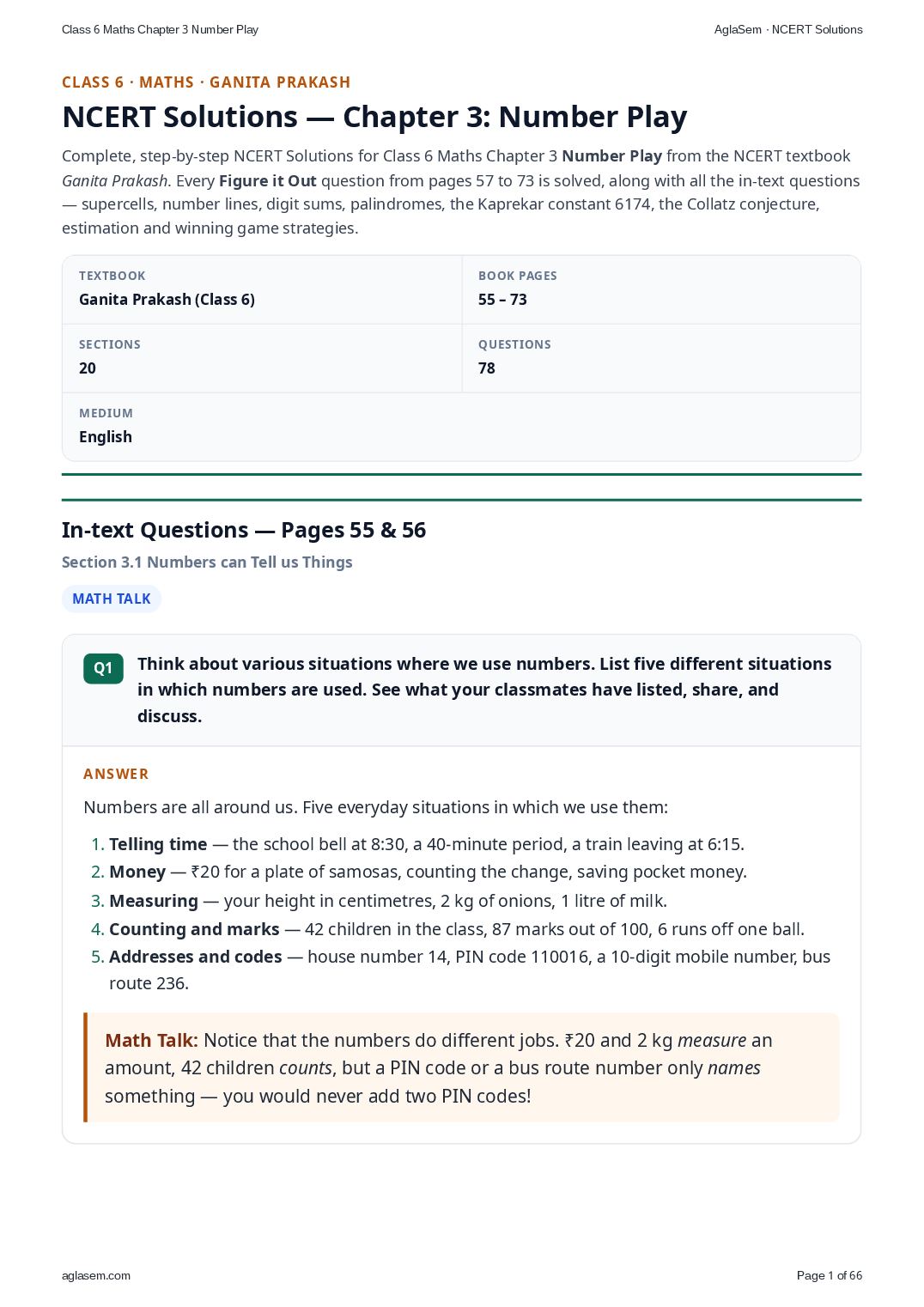
- Think about various situations where we use numbers. List five different situations in which numbers are used. See what your classmates have listed, share, and discuss.
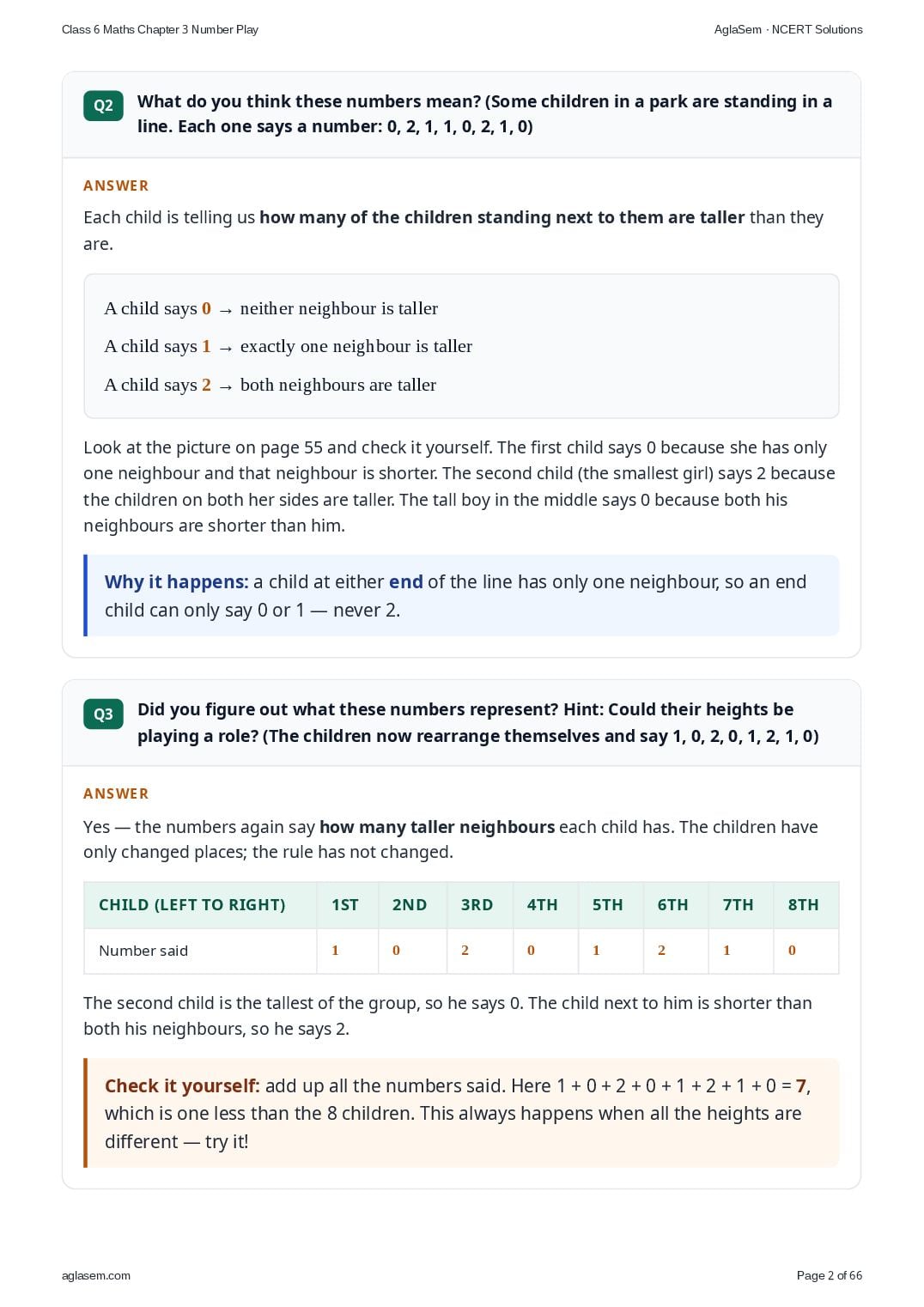
- What do you think these numbers mean? (Some children in a park are standing in a line. Each one says a number: 0, 2, 1, 1, 0, 2, 1, 0)
- Did you figure out what these numbers represent? Hint: Could their heights be playing a role? (The children now rearrange themselves and say 1, 0, 2, 0, 1, 2, 1, 0)
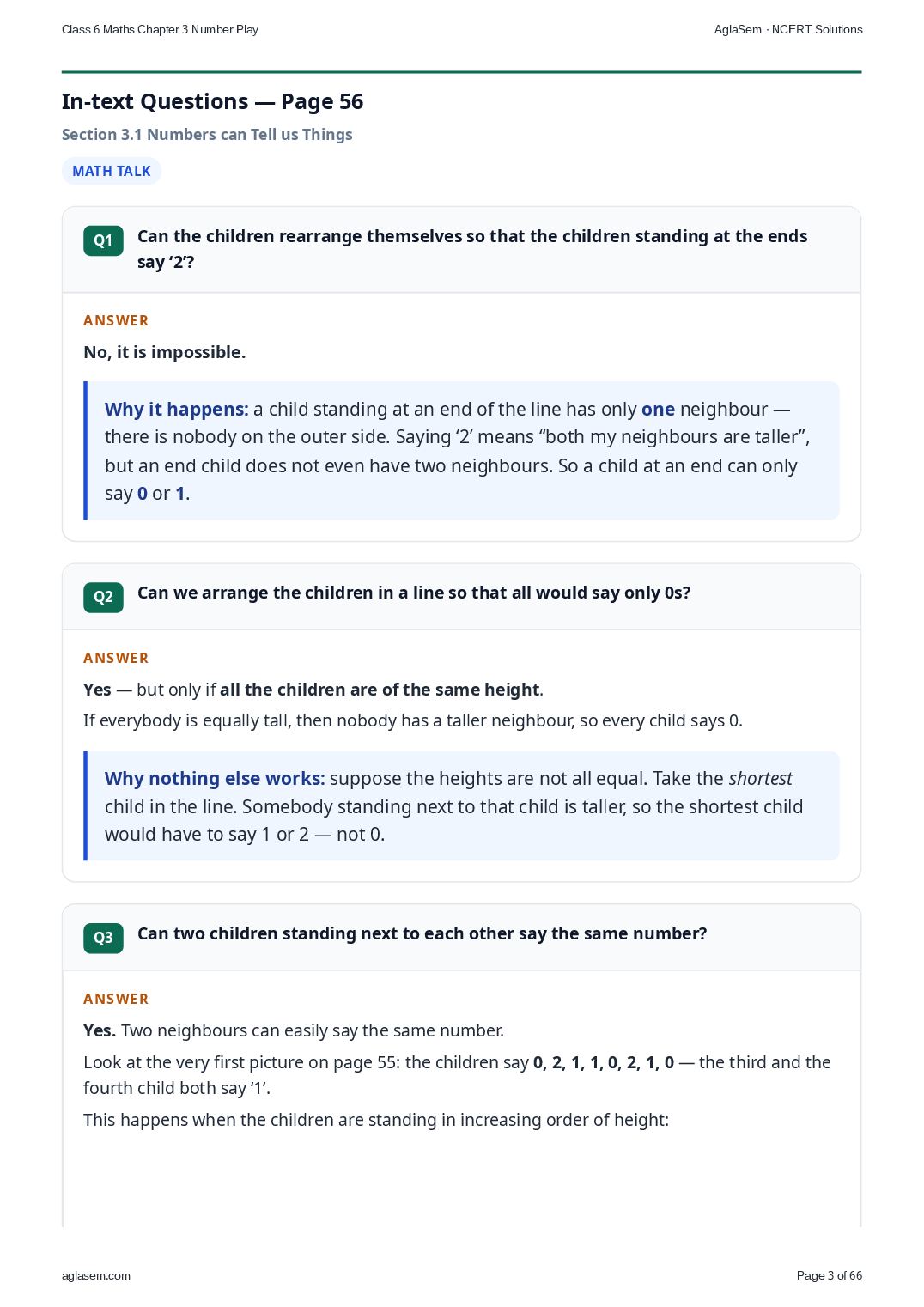
- Can the children rearrange themselves so that the children standing at the ends say ‘2’?
- Can we arrange the children in a line so that all would say only 0s?
- Can two children standing next to each other say the same number?
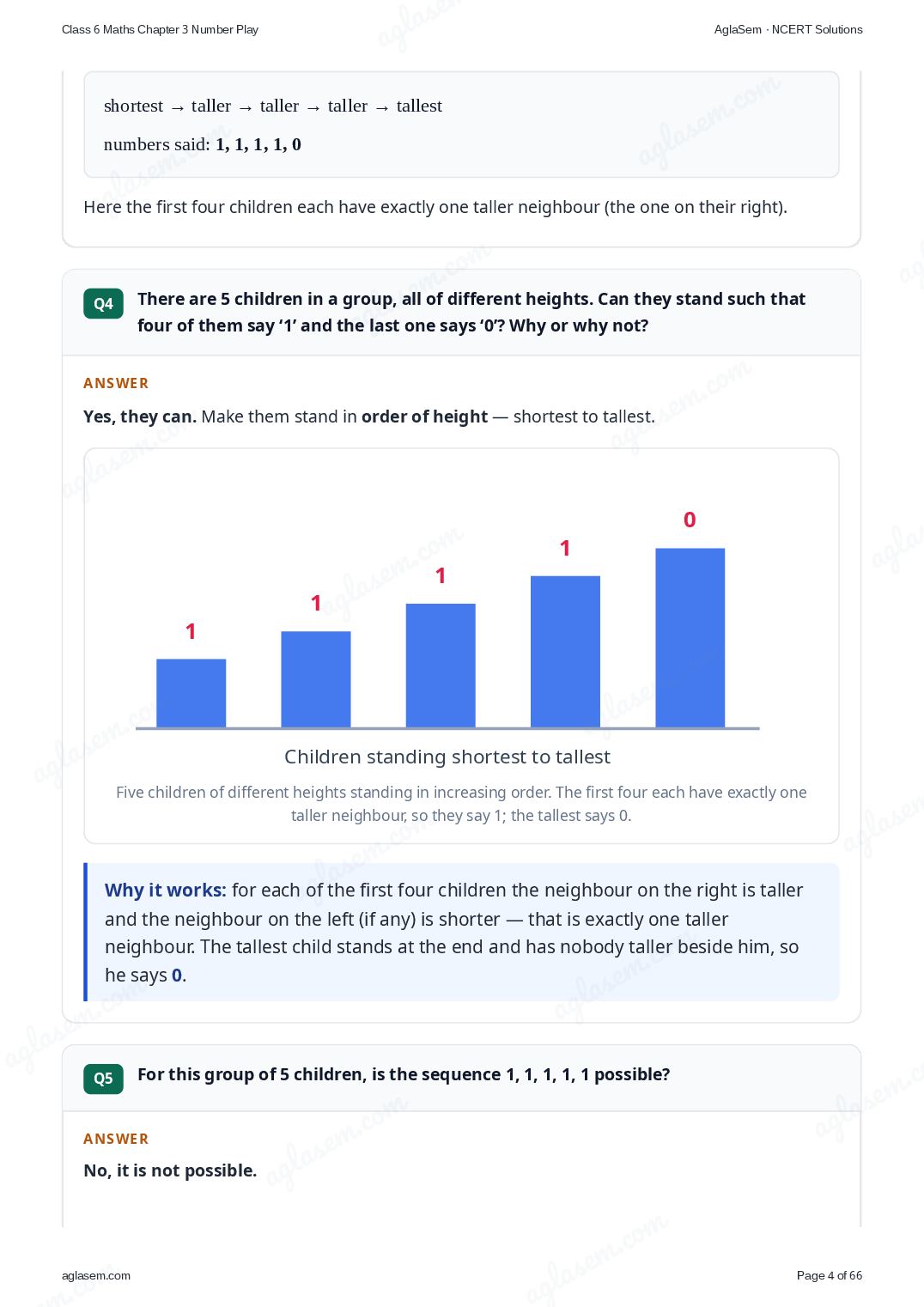
- There are 5 children in a group, all of different heights. Can they stand such that four of them say ‘1’ and the last one says ‘0’? Why or why not?
- For this group of 5 children, is the sequence 1, 1, 1, 1, 1 possible?
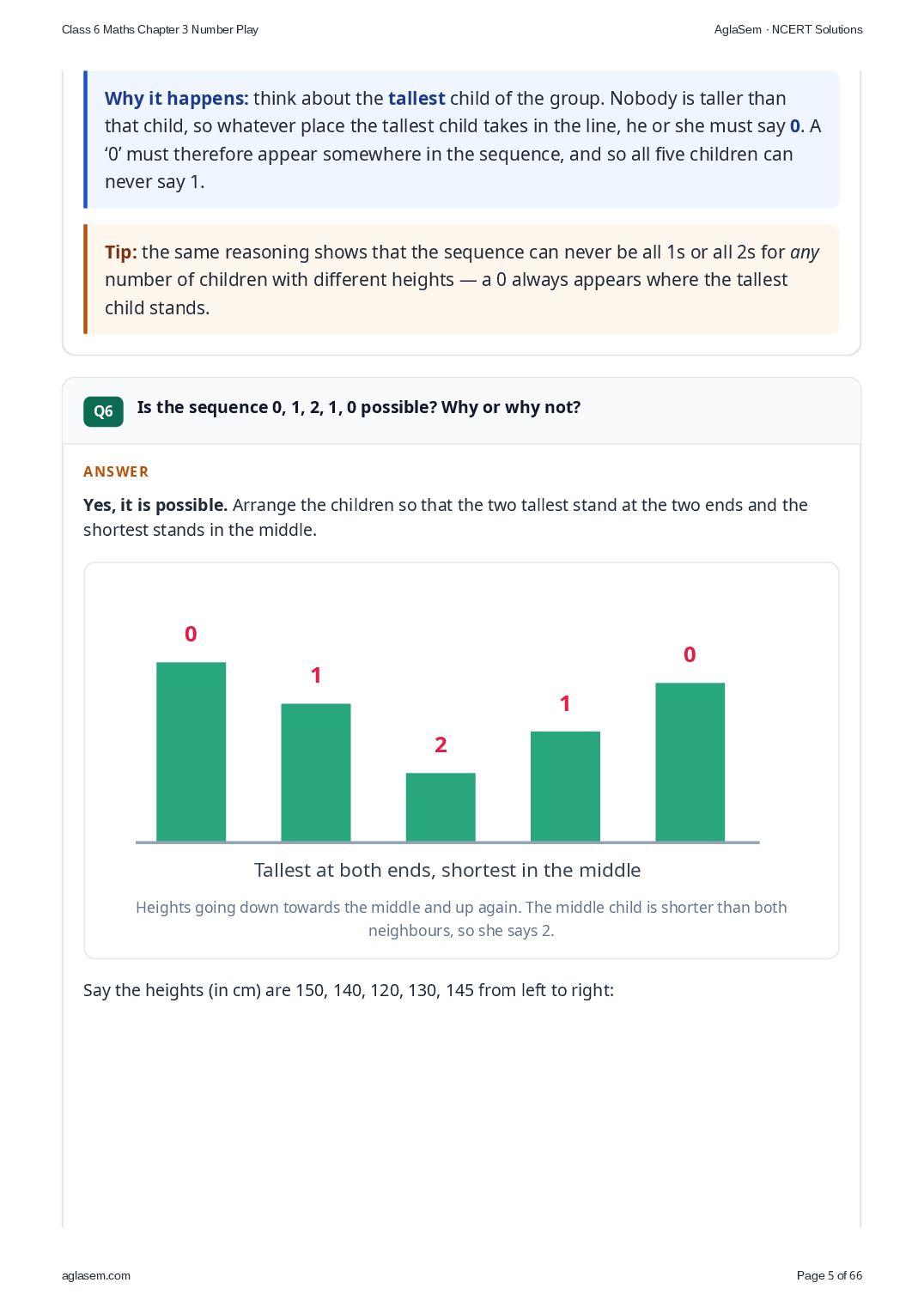
- Is the sequence 0, 1, 2, 1, 0 possible? Why or why not?
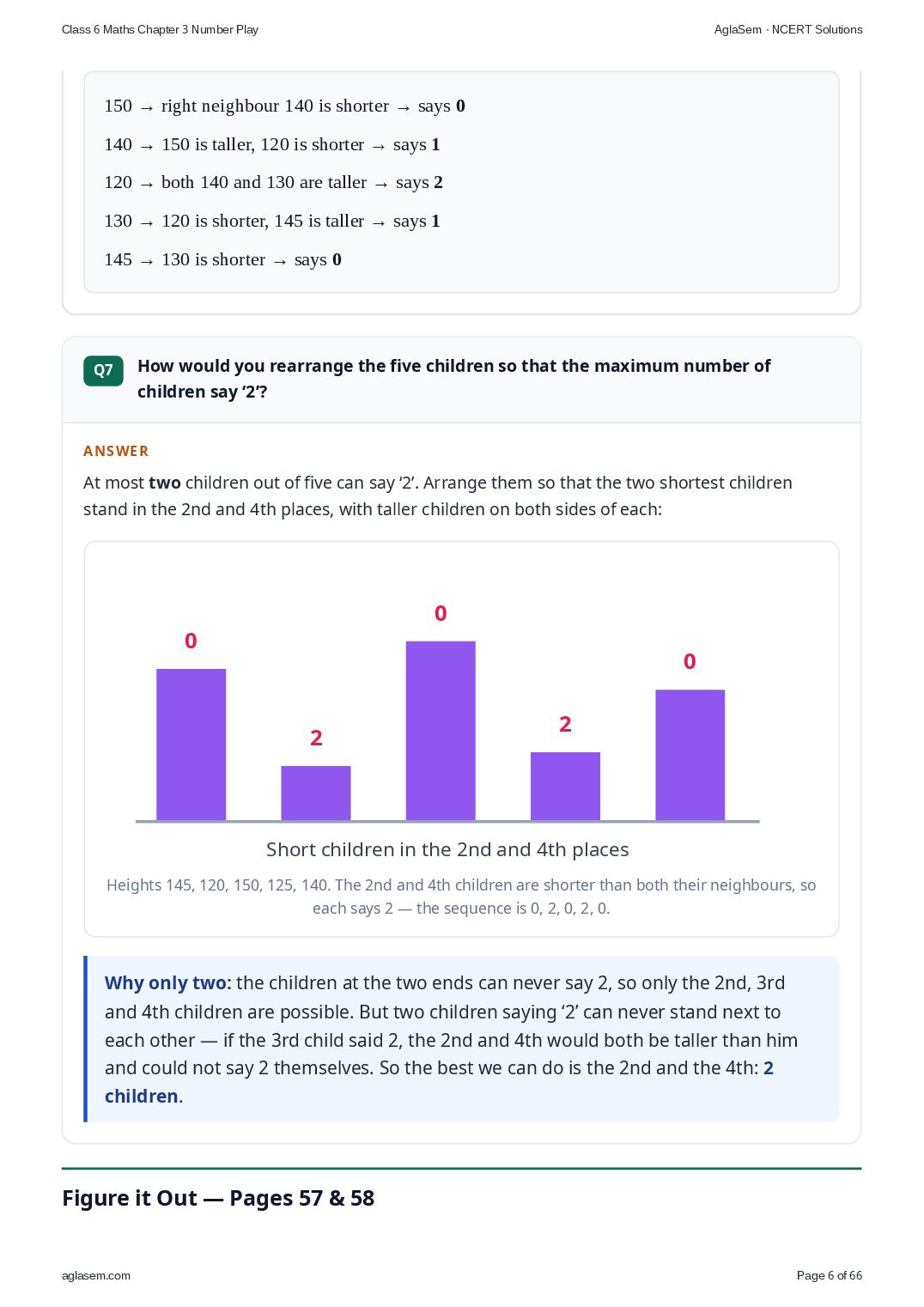
- How would you rearrange the five children so that the maximum number of children say ‘2’?
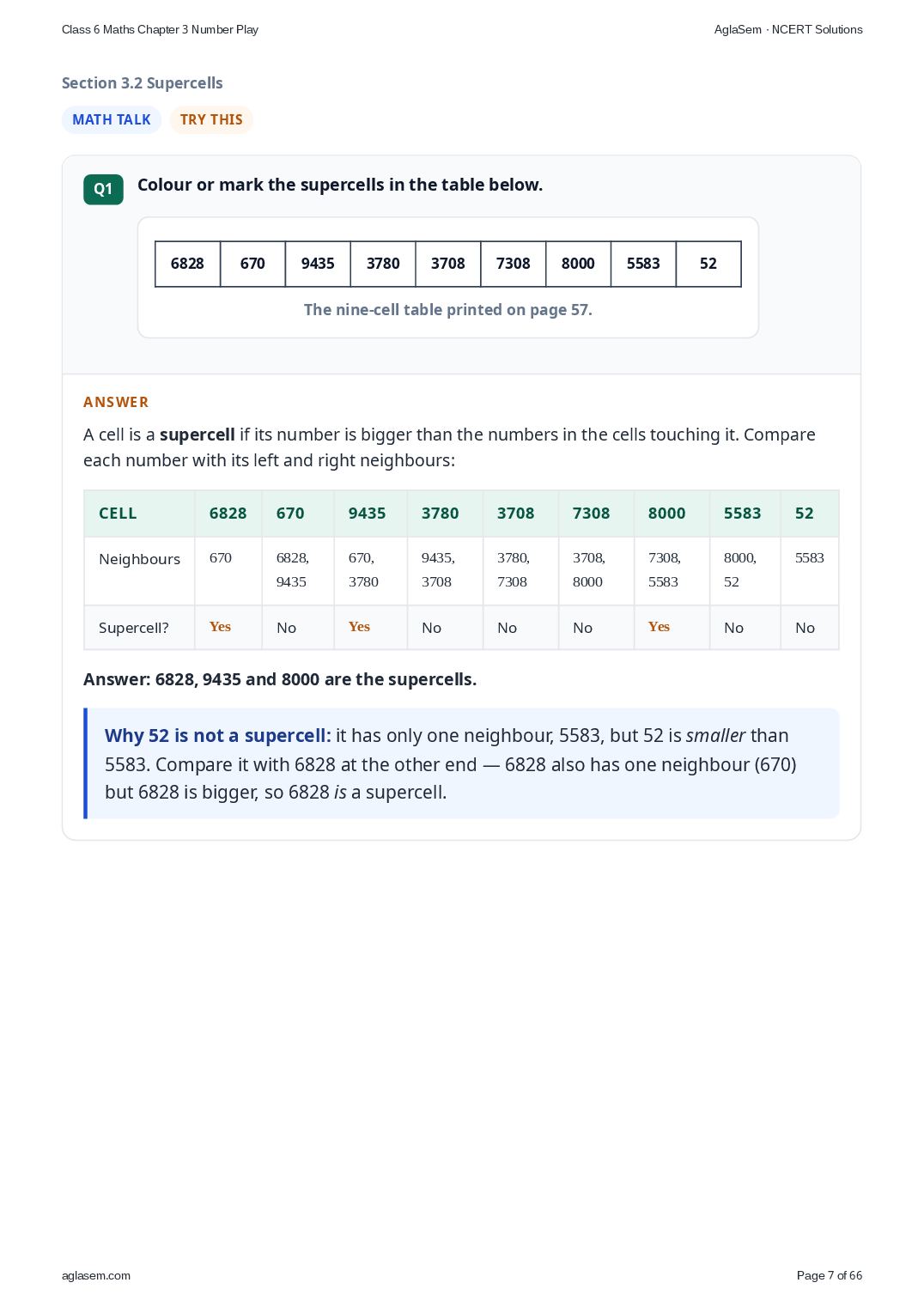
- Colour or mark the supercells in the table below. 6828 | 670 | 9435 | 3780 | 3708 | 7308 | 8000 | 5583 | 52
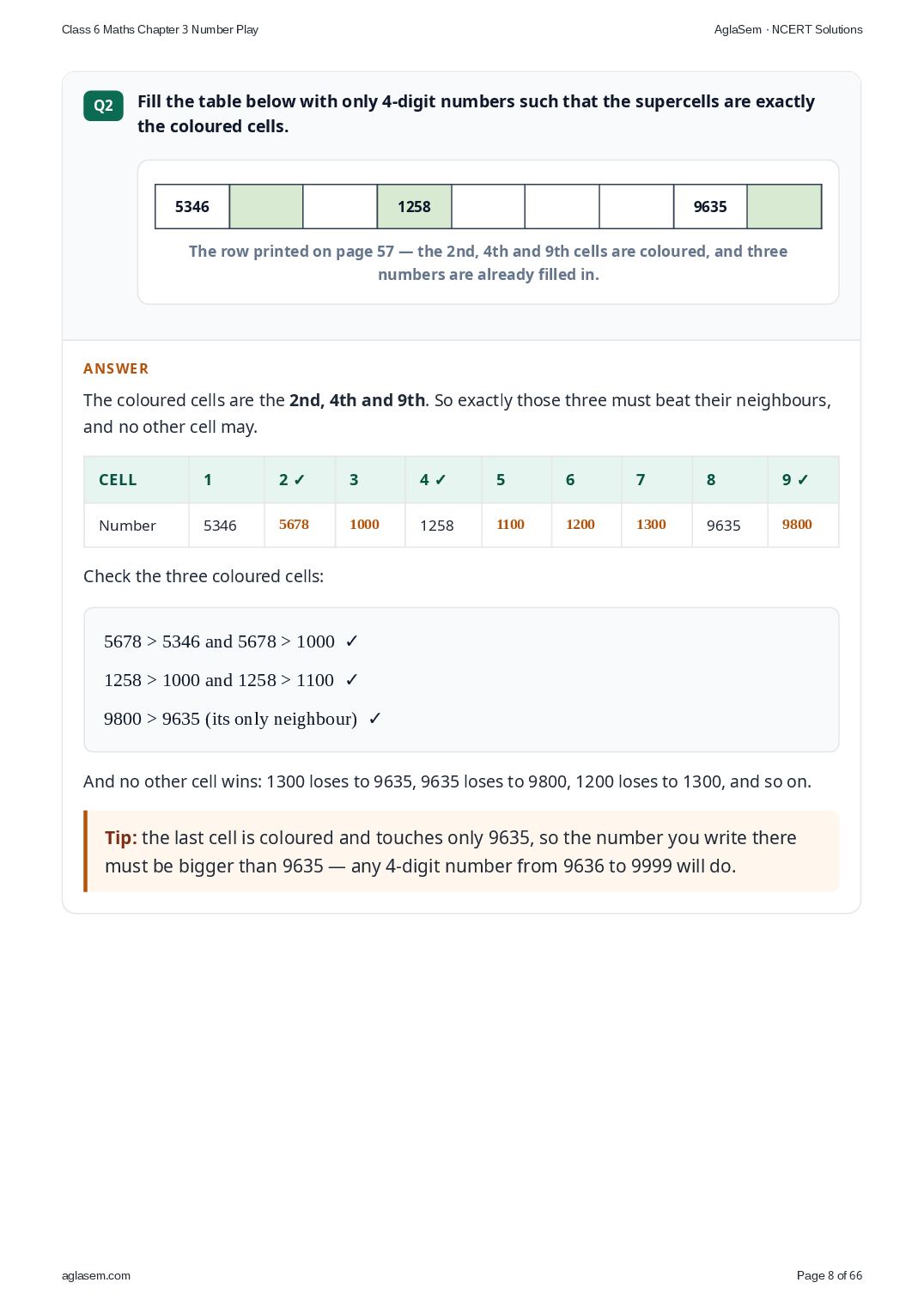
- Fill the table below with only 4-digit numbers such that the supercells are exactly the coloured cells. (The row has 9 cells; 5346 is in the 1st cell, 1258 in the 4th coloured cell and 9635 in the 8th cell; the 2nd, 4th and 9th cells are coloured.)
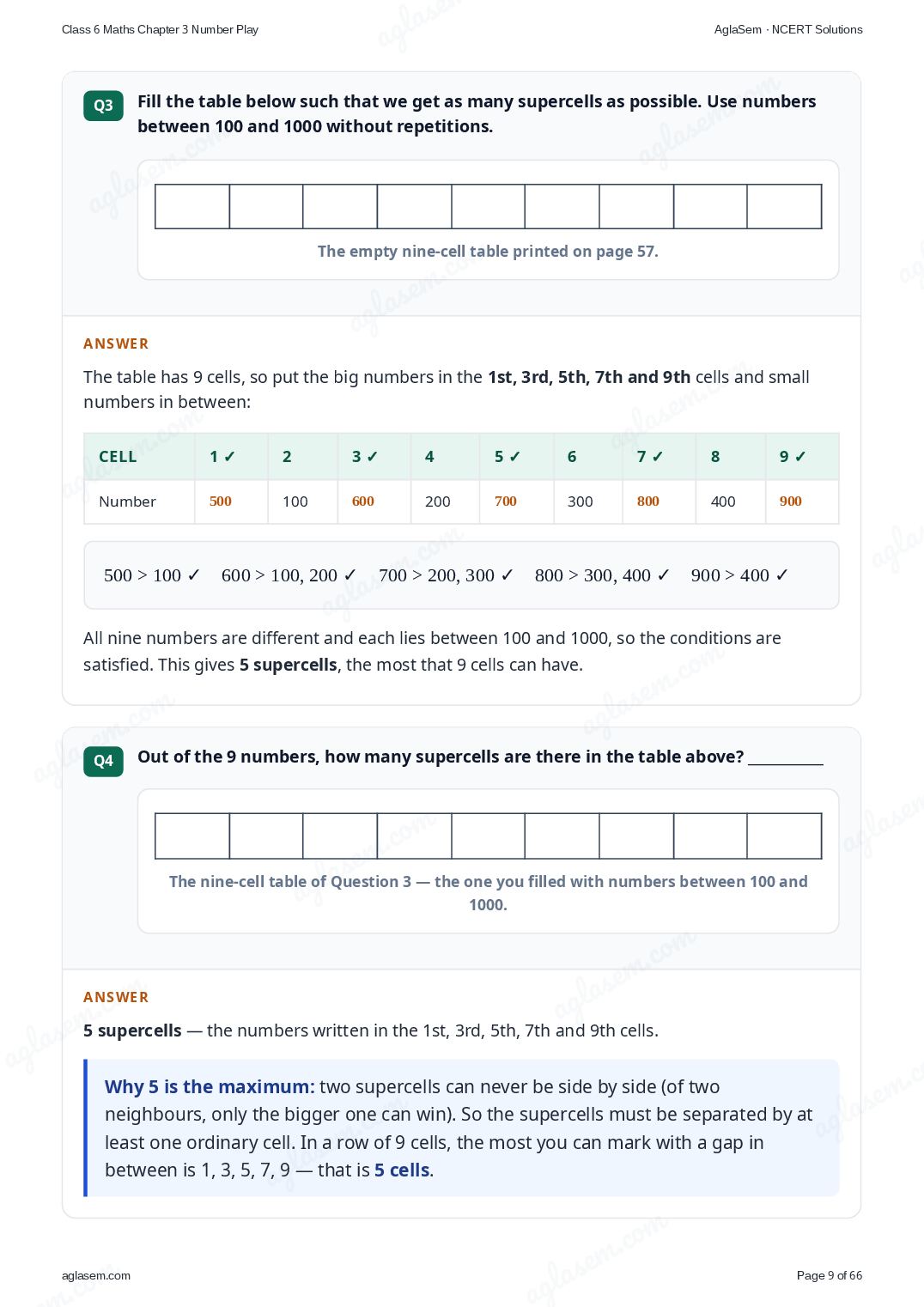
- Fill the table below such that we get as many supercells as possible. Use numbers between 100 and 1000 without repetitions.
- Out of the 9 numbers, how many supercells are there in the table above? ___________
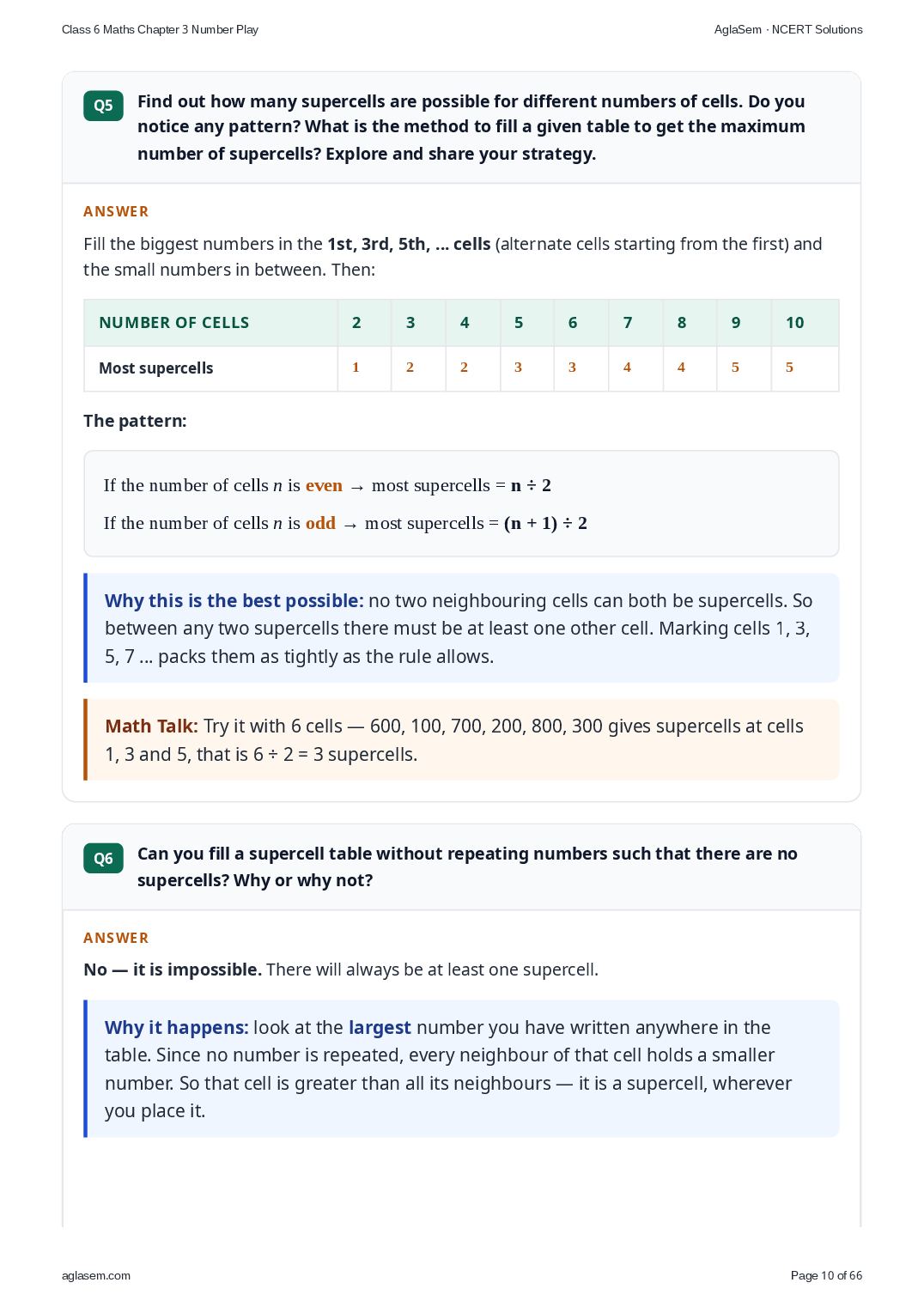
- Find out how many supercells are possible for different numbers of cells. Do you notice any pattern? What is the method to fill a given table to get the maximum number of supercells? Explore and share your strategy.
- Can you fill a supercell table without repeating numbers such that there are no supercells? Why or why not?
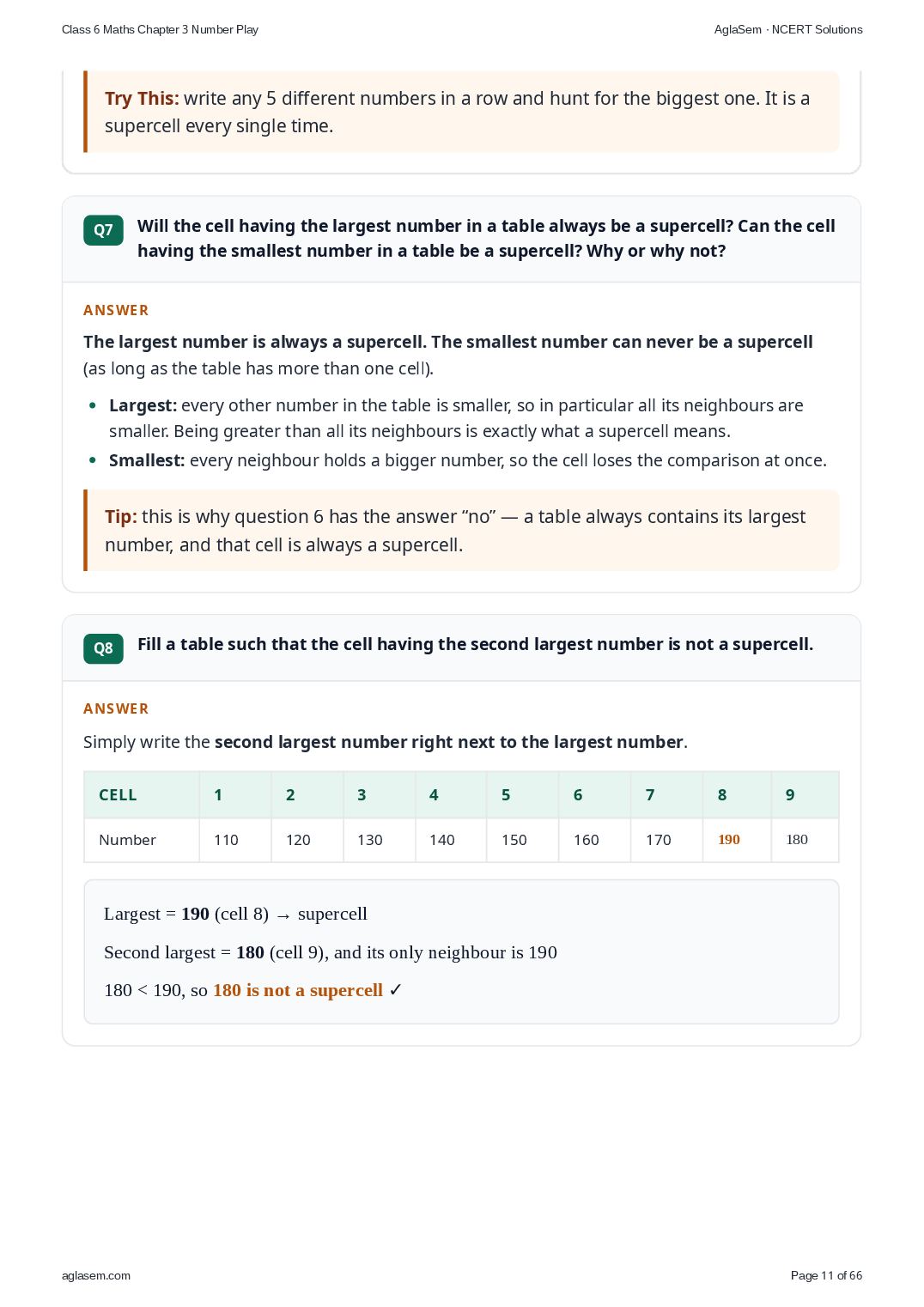
- Will the cell having the largest number in a table always be a supercell? Can the cell having the smallest number in a table be a supercell? Why or why not?
- Fill a table such that the cell having the second largest number is not a supercell.
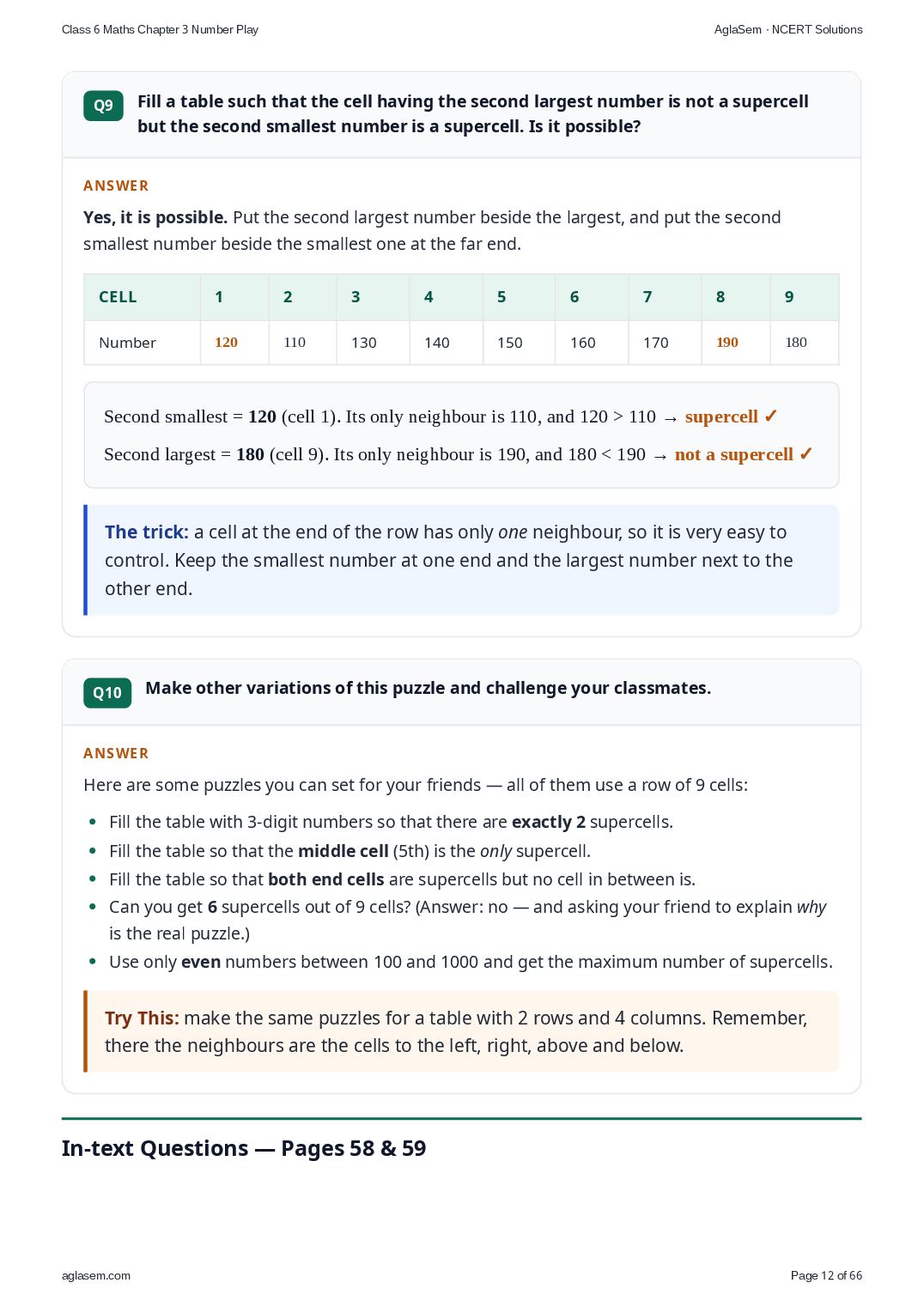
- Fill a table such that the cell having the second largest number is not a supercell but the second smallest number is a supercell. Is it possible?
- Make other variations of this puzzle and challenge your classmates.
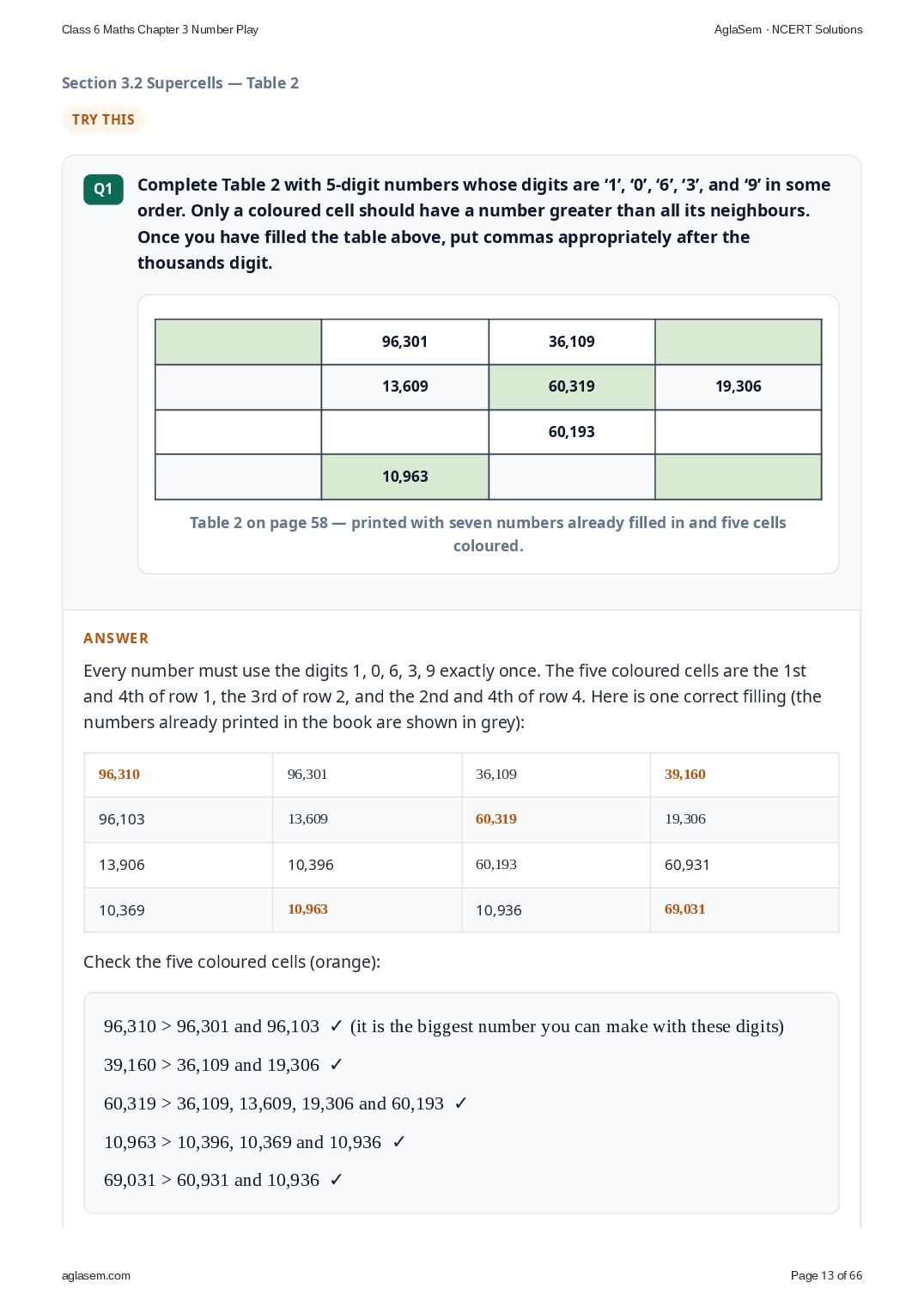
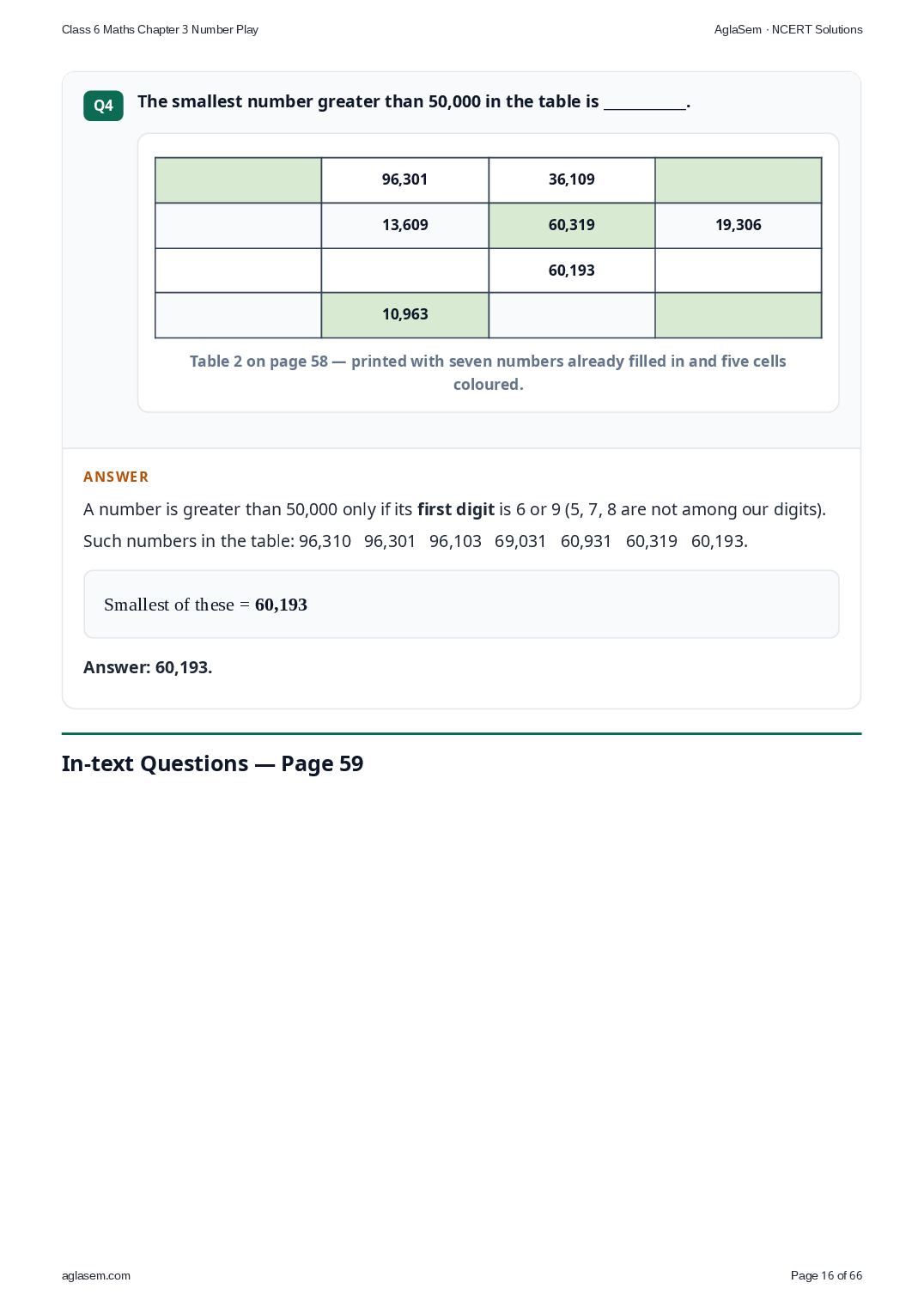
- Complete Table 2 with 5-digit numbers whose digits are ‘1’, ‘0’, ‘6’, ‘3’, and ‘9’ in some order. Only a coloured cell should have a number greater than all its neighbours. Once you have filled the table above, put commas appropriately after the thousands digit.
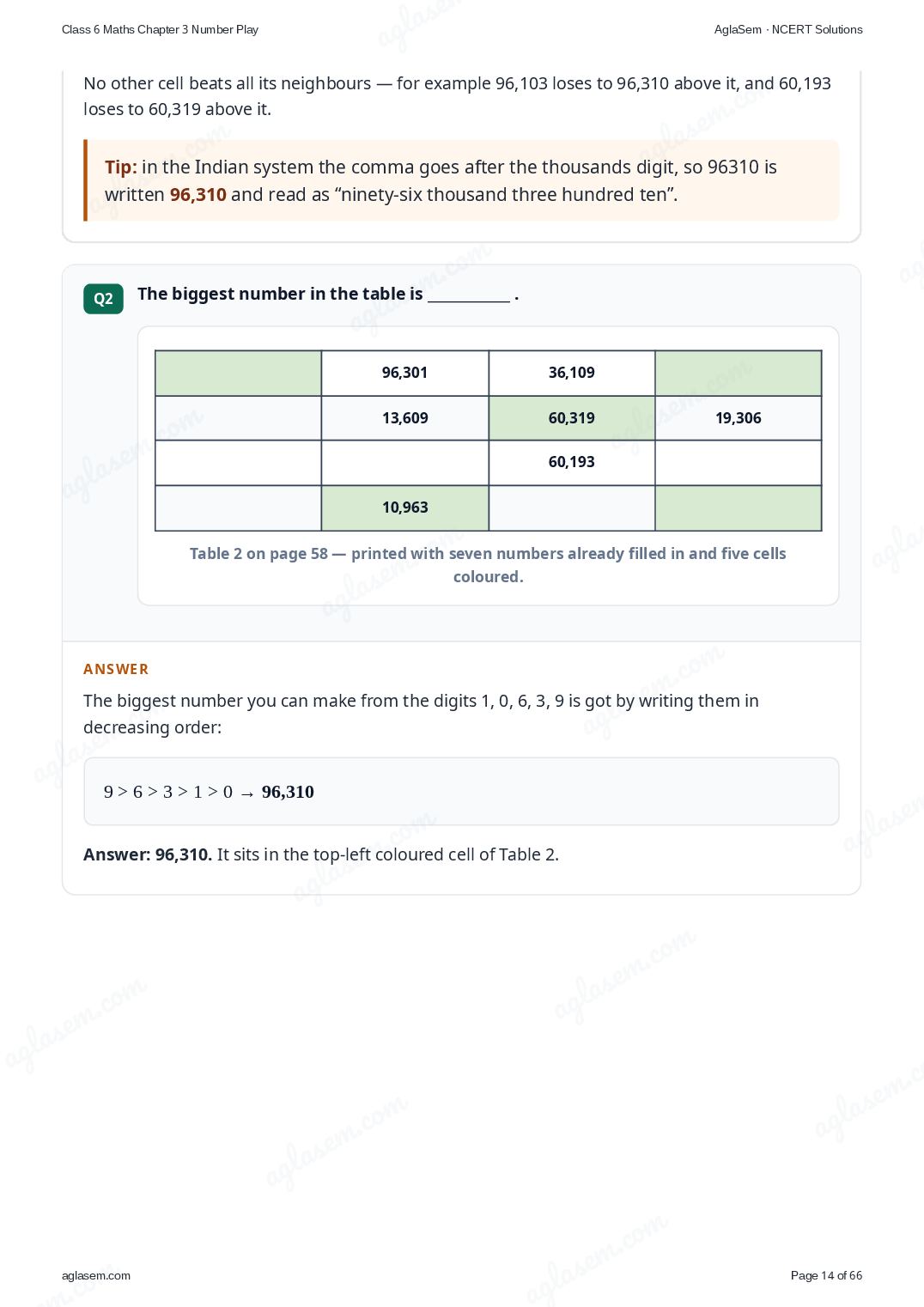
- The biggest number in the table is ____________ .
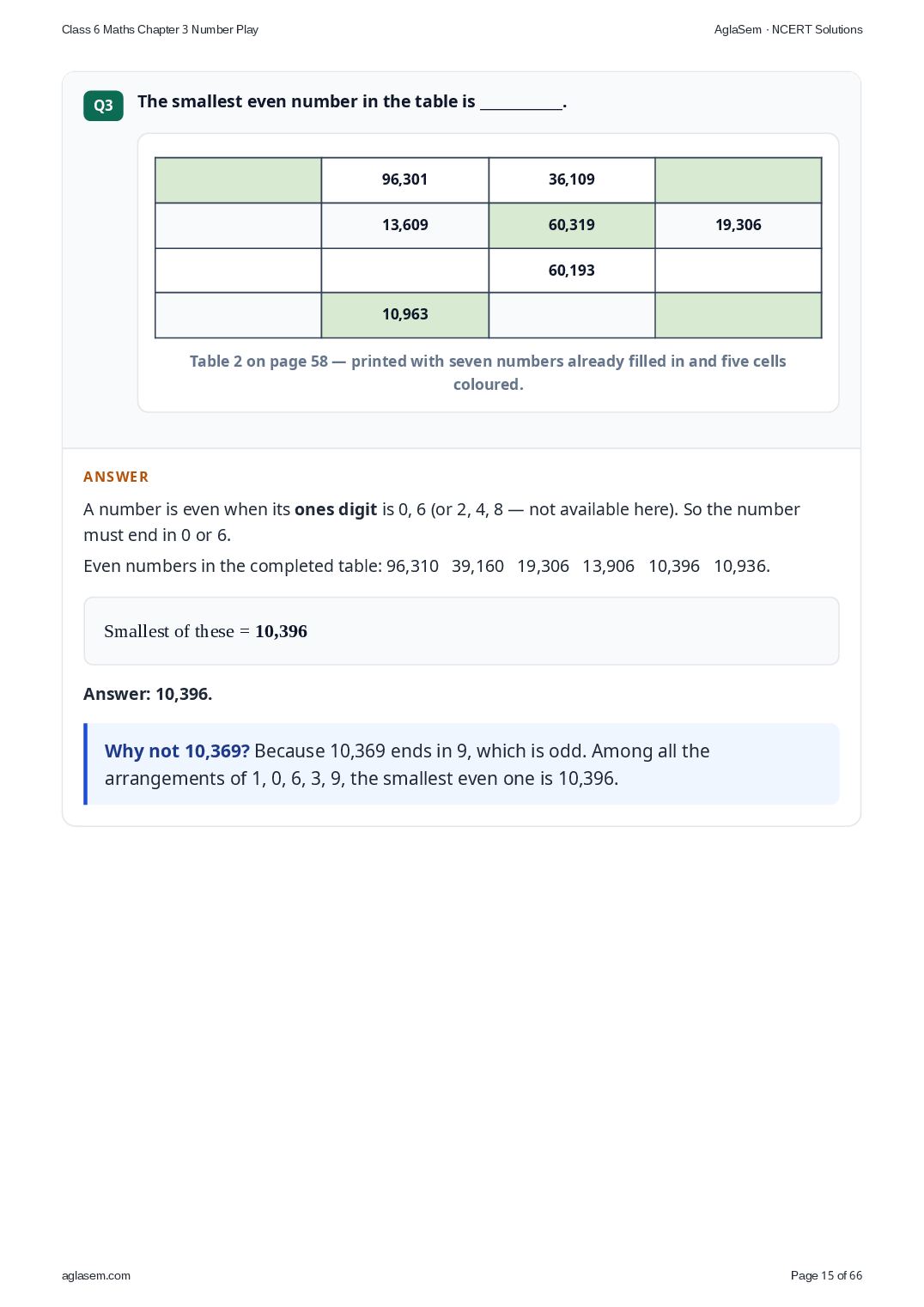
- The smallest even number in the table is ____________.
- The smallest number greater than 50,000 in the table is ____________.
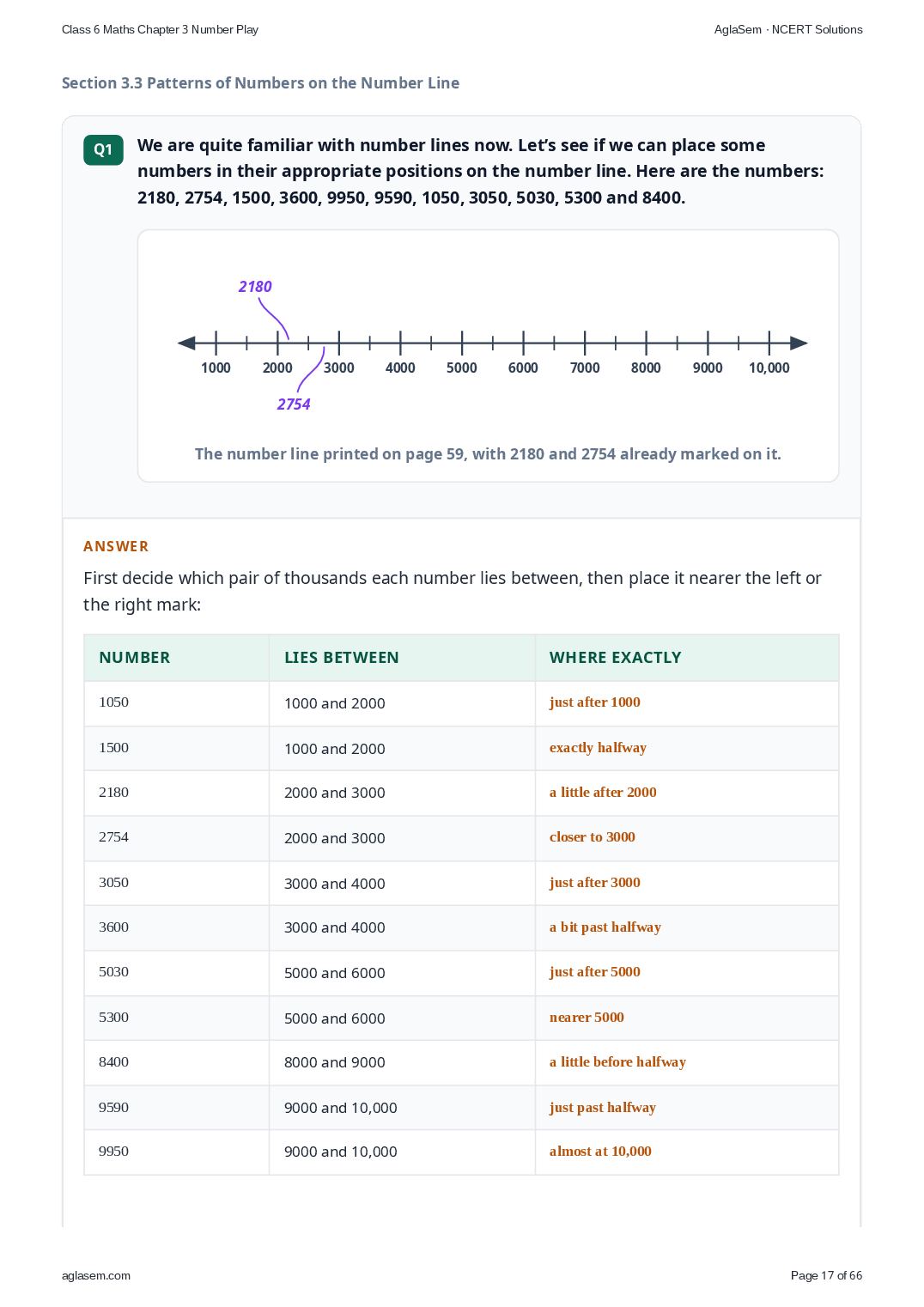
- We are quite familiar with number lines now. Let’s see if we can place some numbers in their appropriate positions on the number line. Here are the numbers: 2180, 2754, 1500, 3600, 9950, 9590, 1050, 3050, 5030, 5300 and 8400.
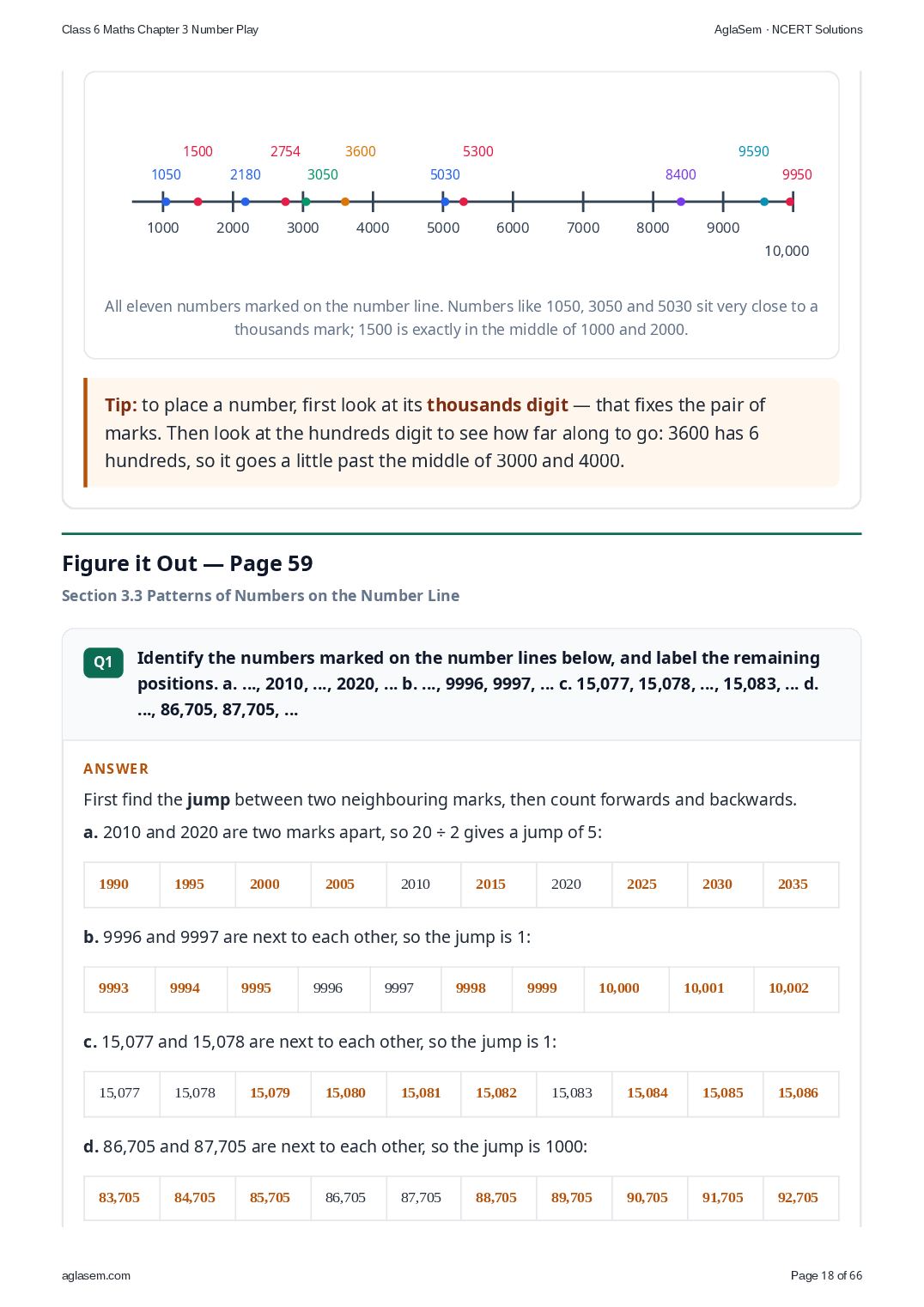
- Identify the numbers marked on the number lines below, and label the remaining positions. a. …, 2010, …, 2020, … b. …, 9996, 9997, … c. 15,077, 15,078, …, 15,083, … d. …, 86,705, 87,705, …
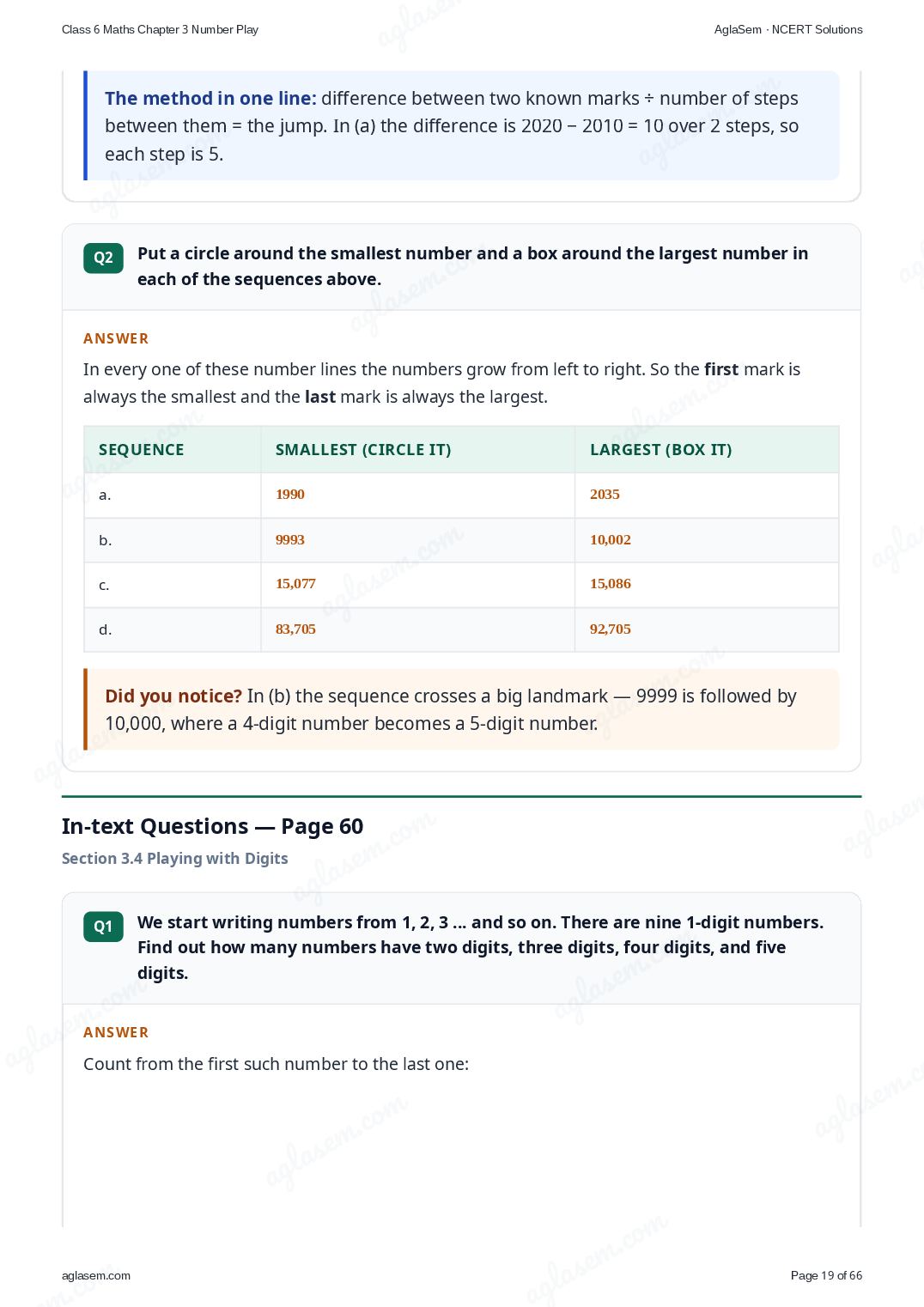
- Put a circle around the smallest number and a box around the largest number in each of the sequences above.
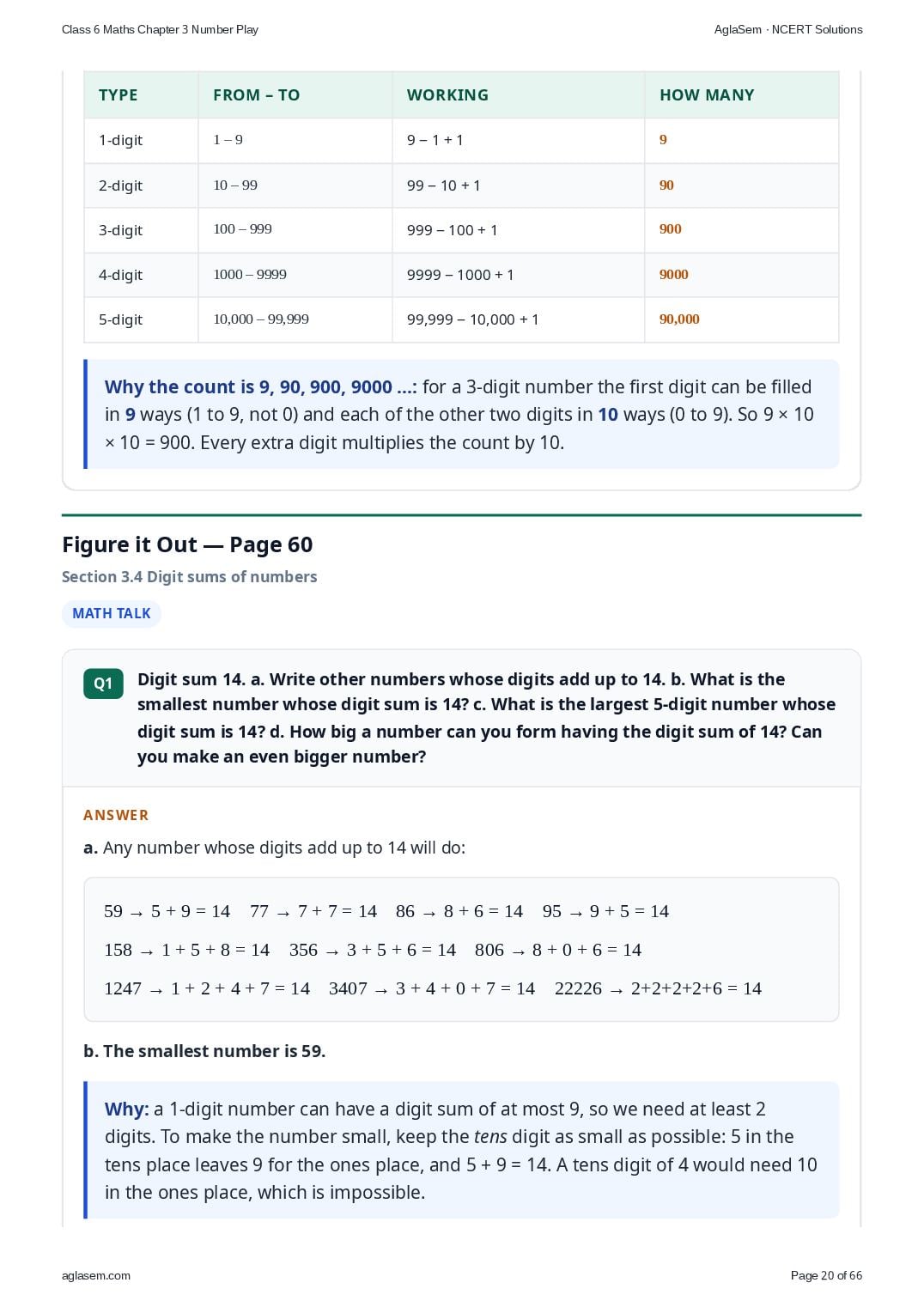
- We start writing numbers from 1, 2, 3 … and so on. There are nine 1-digit numbers. Find out how many numbers have two digits, three digits, four digits, and five digits.
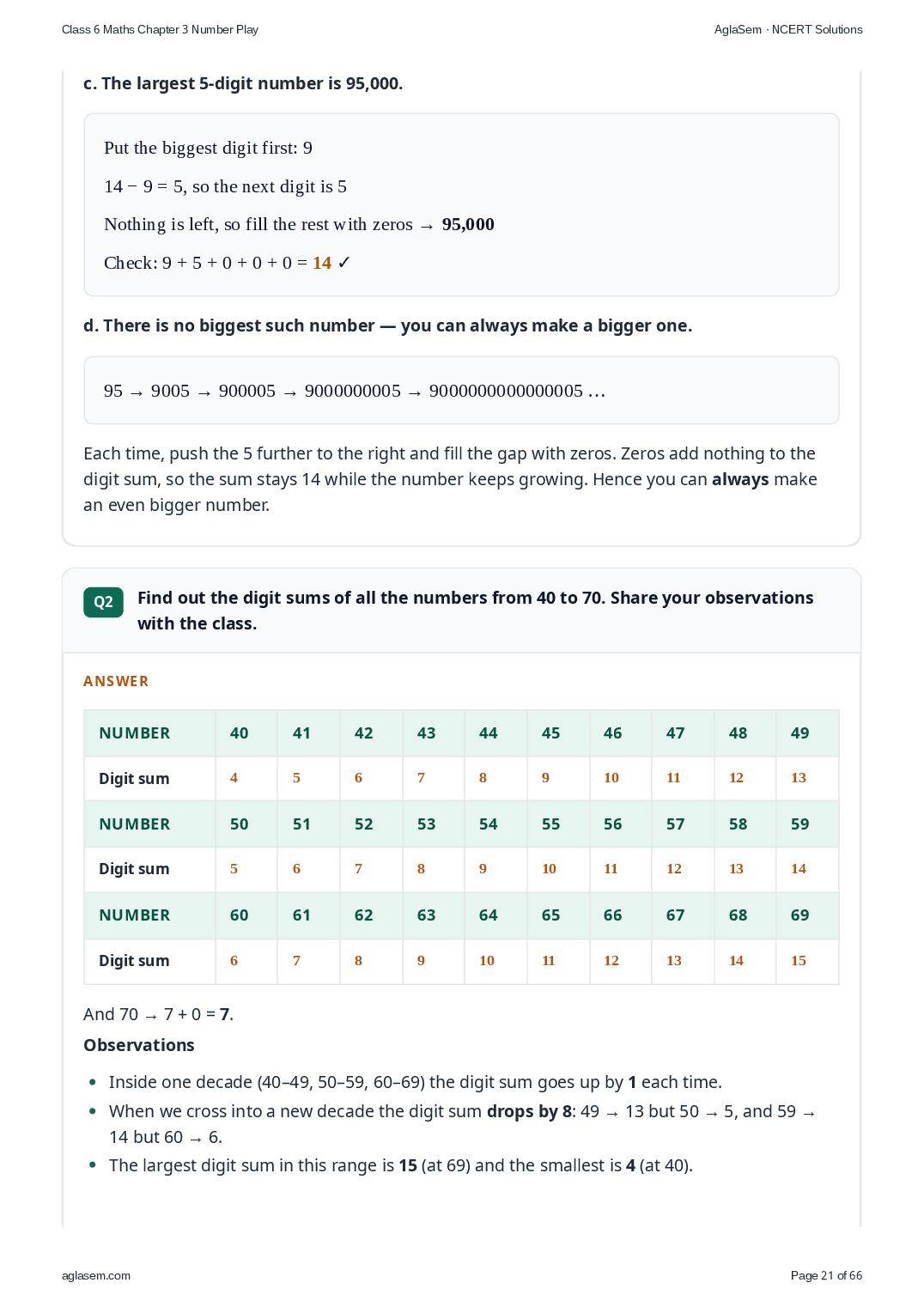
- Digit sum 14. a. Write other numbers whose digits add up to 14. b. What is the smallest number whose digit sum is 14? c. What is the largest 5-digit number whose digit sum is 14? d. How big a number can you form having the digit sum of 14? Can you make an even bigger number?
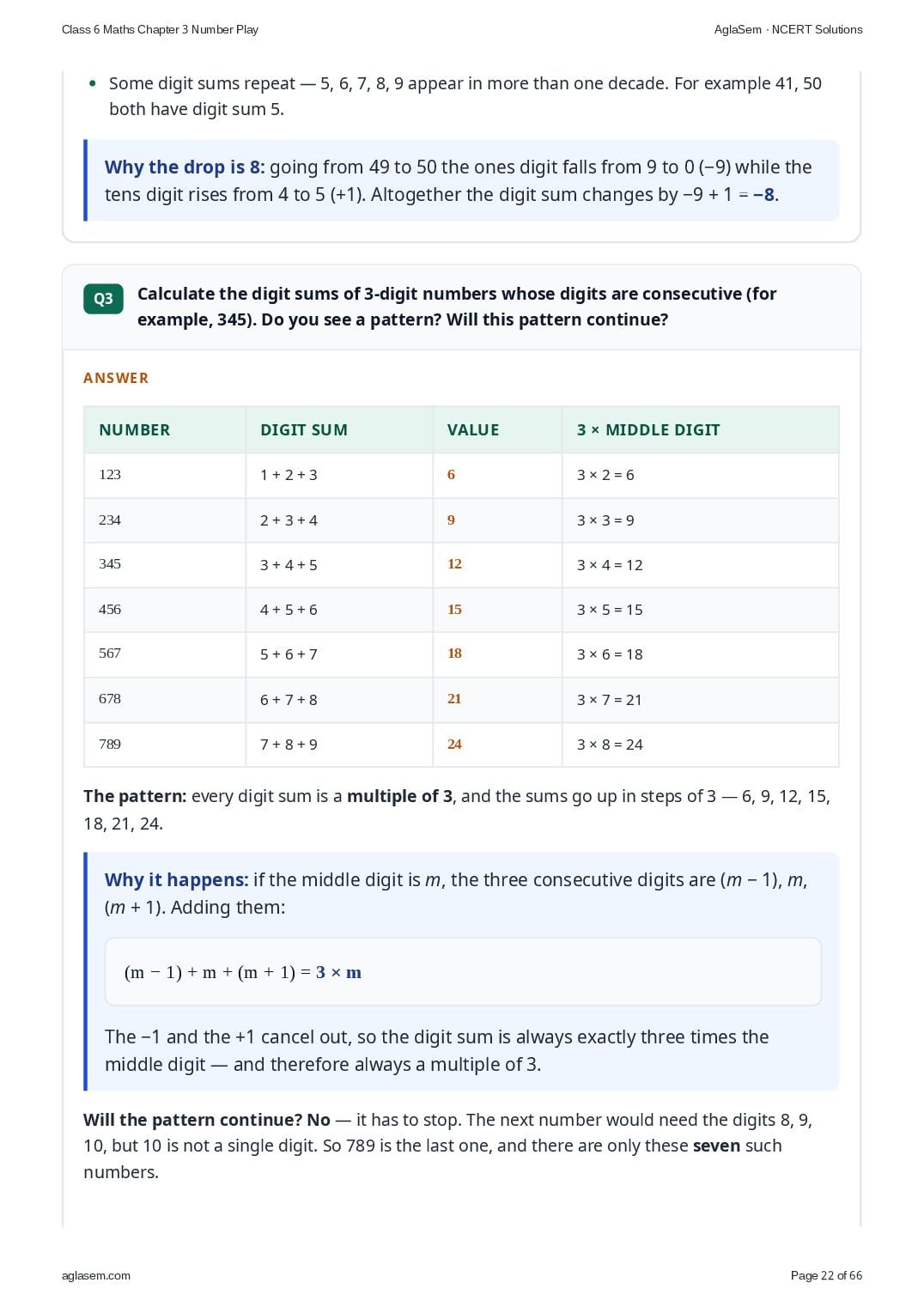
- Find out the digit sums of all the numbers from 40 to 70. Share your observations with the class.
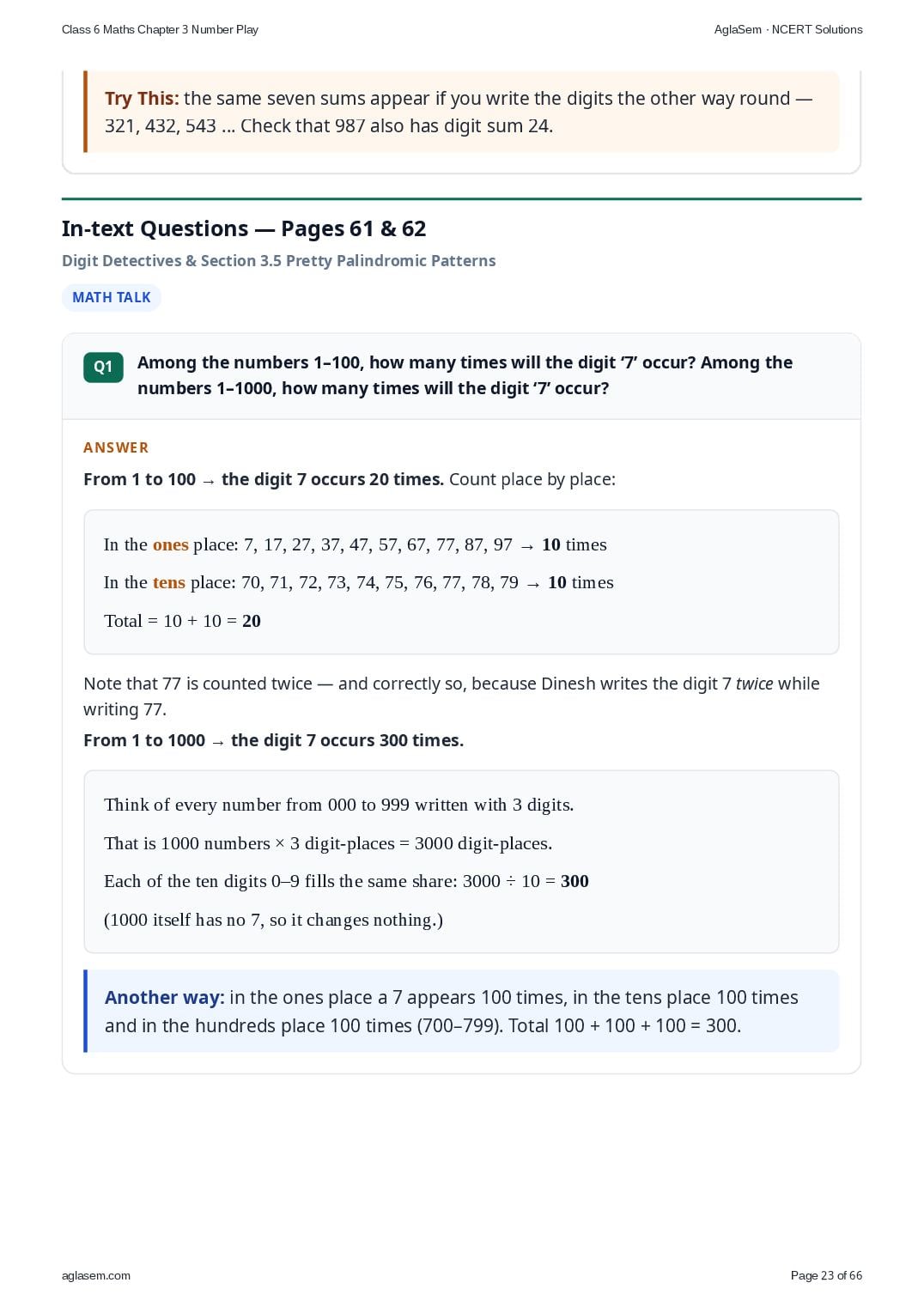
- Calculate the digit sums of 3-digit numbers whose digits are consecutive (for example, 345). Do you see a pattern? Will this pattern continue?
- Among the numbers 1–100, how many times will the digit ‘7’ occur? Among the numbers 1–1000, how many times will the digit ‘7’ occur?
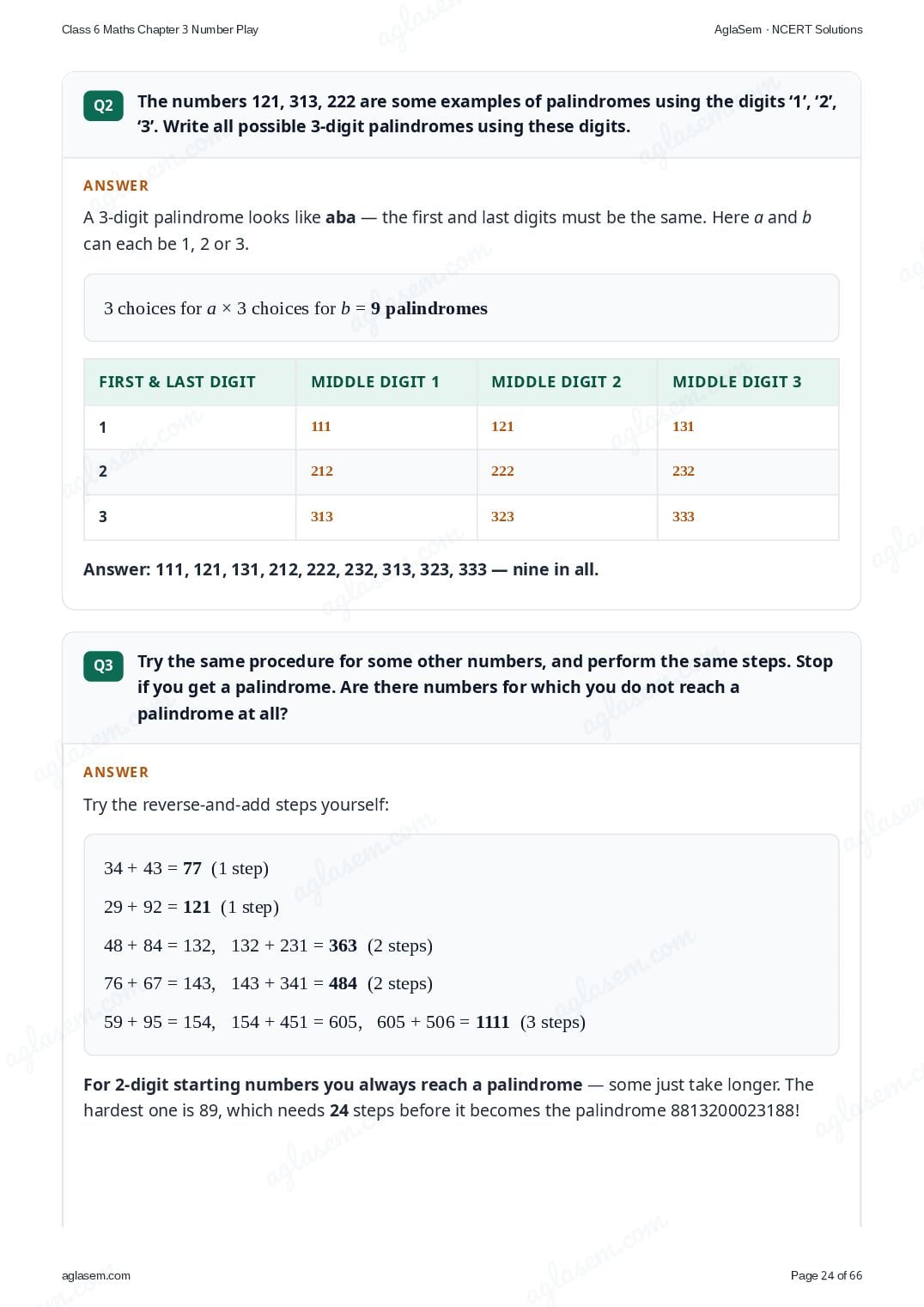
- The numbers 121, 313, 222 are some examples of palindromes using the digits ‘1’, ‘2’, ‘3’. Write all possible 3-digit palindromes using these digits.
- Try the same procedure for some other numbers, and perform the same steps. Stop if you get a palindrome. Are there numbers for which you do not reach a palindrome at all?
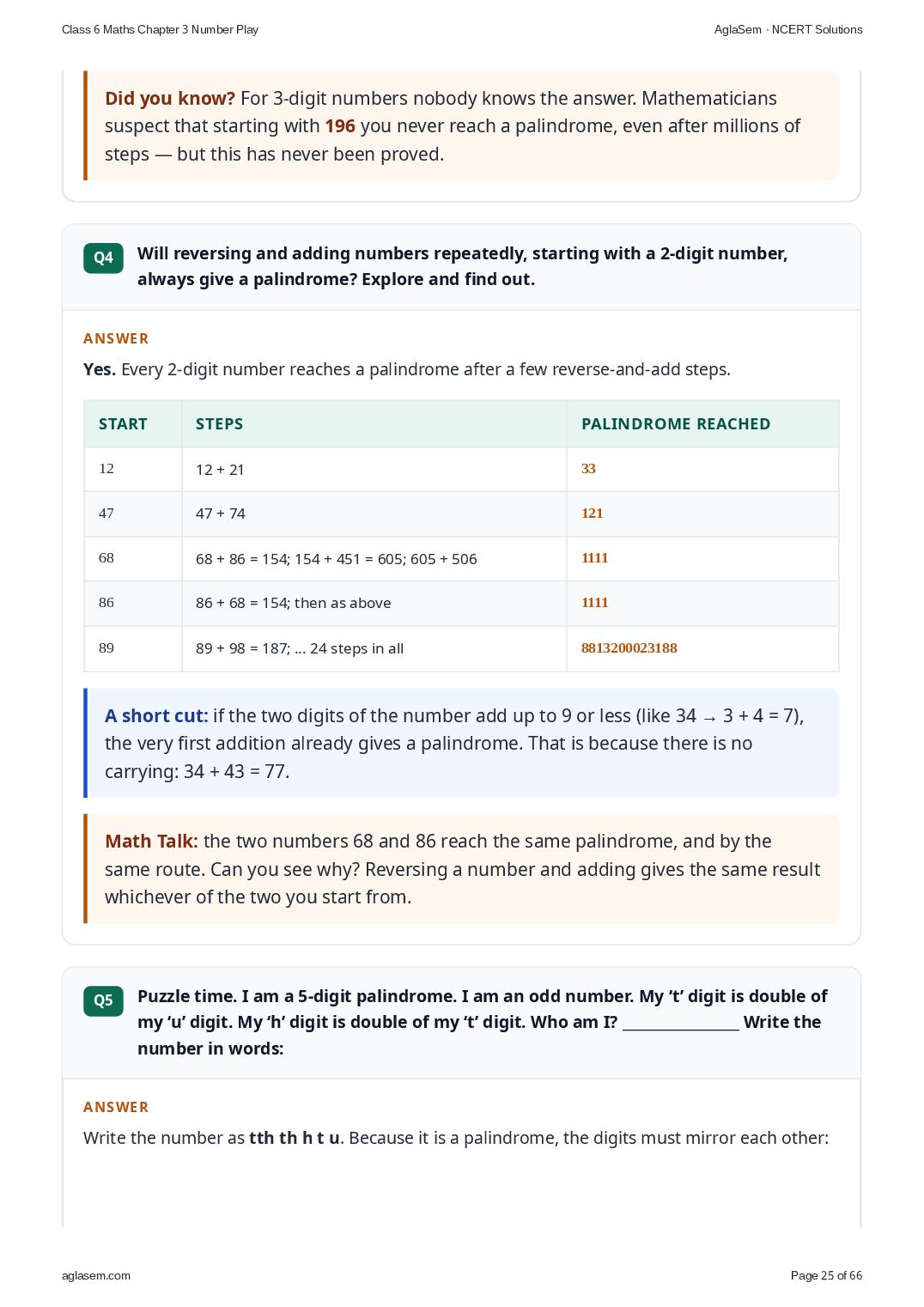
- Will reversing and adding numbers repeatedly, starting with a 2-digit number, always give a palindrome? Explore and find out.
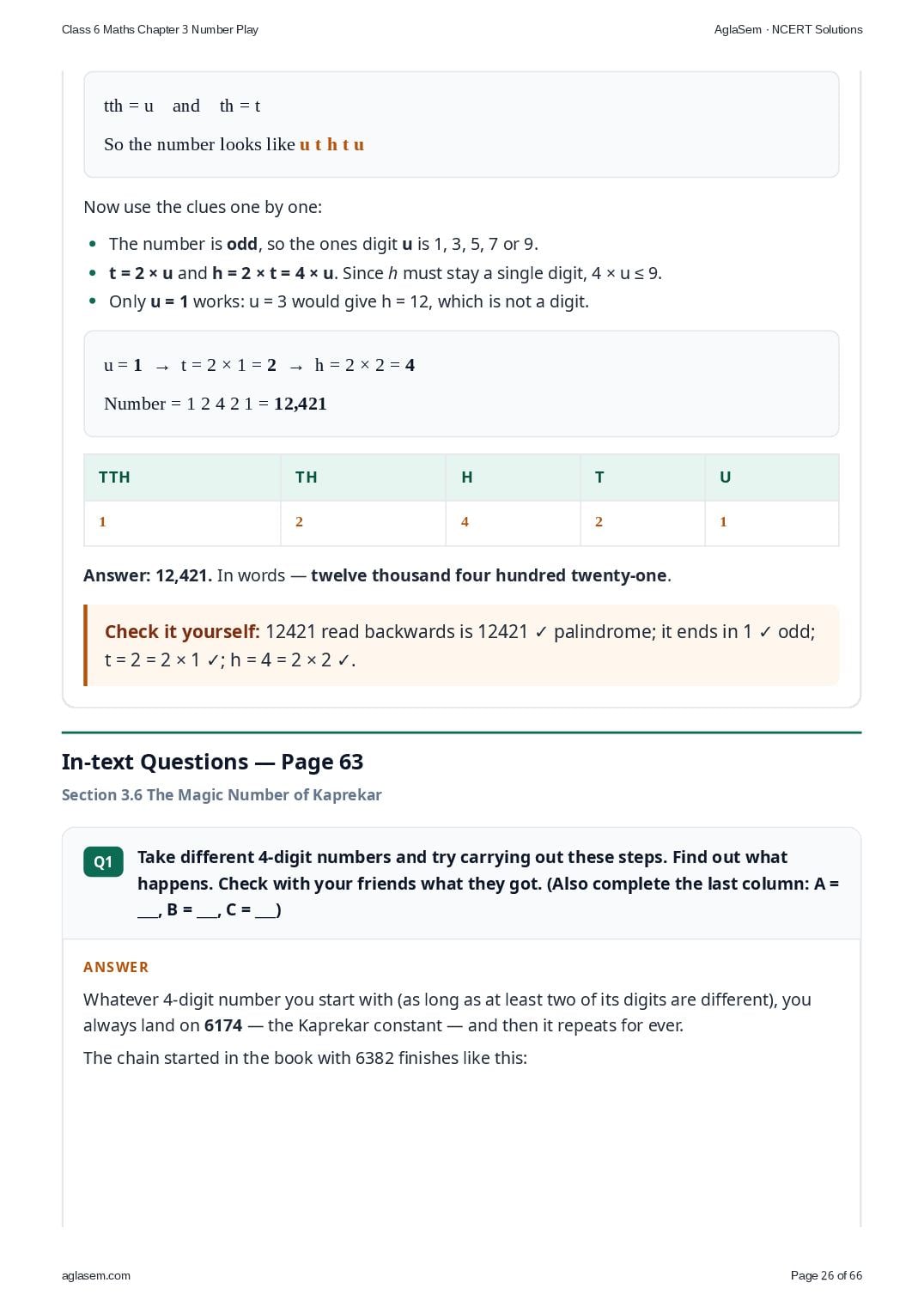
- Puzzle time. I am a 5-digit palindrome. I am an odd number. My ‘t’ digit is double of my ‘u’ digit. My ‘h’ digit is double of my ‘t’ digit. Who am I? _________________ Write the number in words:
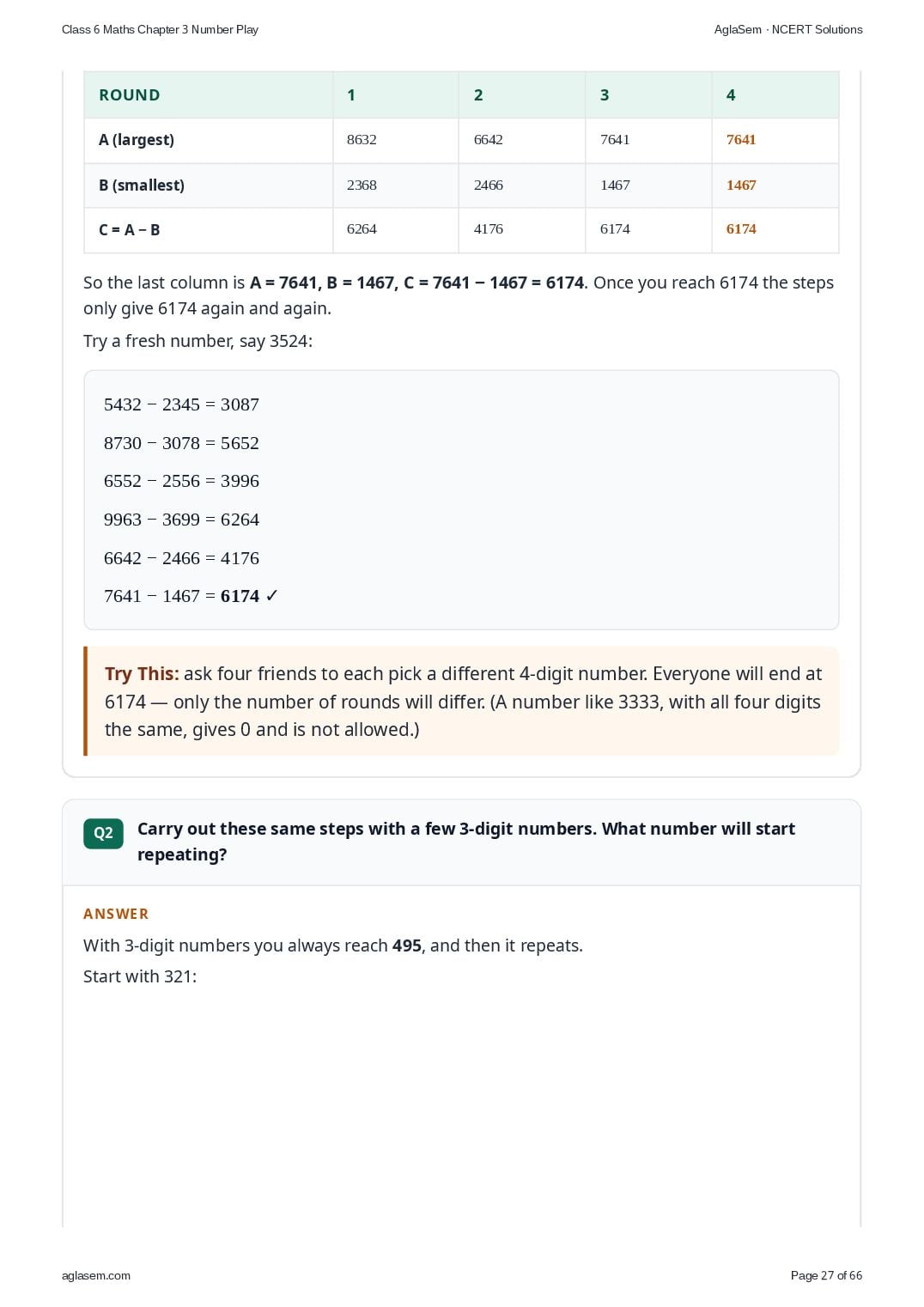
- Take different 4-digit numbers and try carrying out these steps. Find out what happens. Check with your friends what they got. (Also complete the last column: A = ___, B = ___, C = ___)
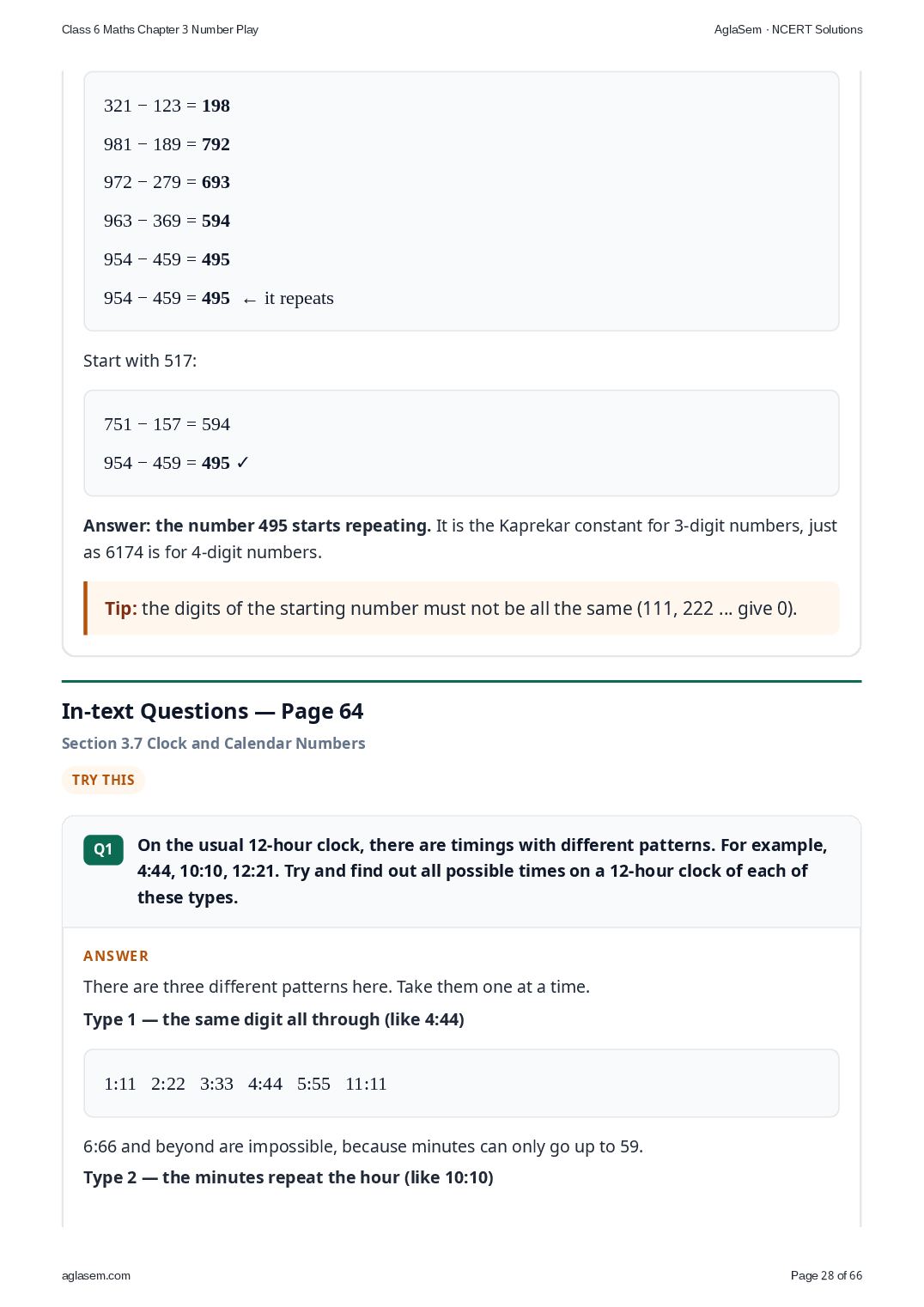
- Carry out these same steps with a few 3-digit numbers. What number will start repeating?
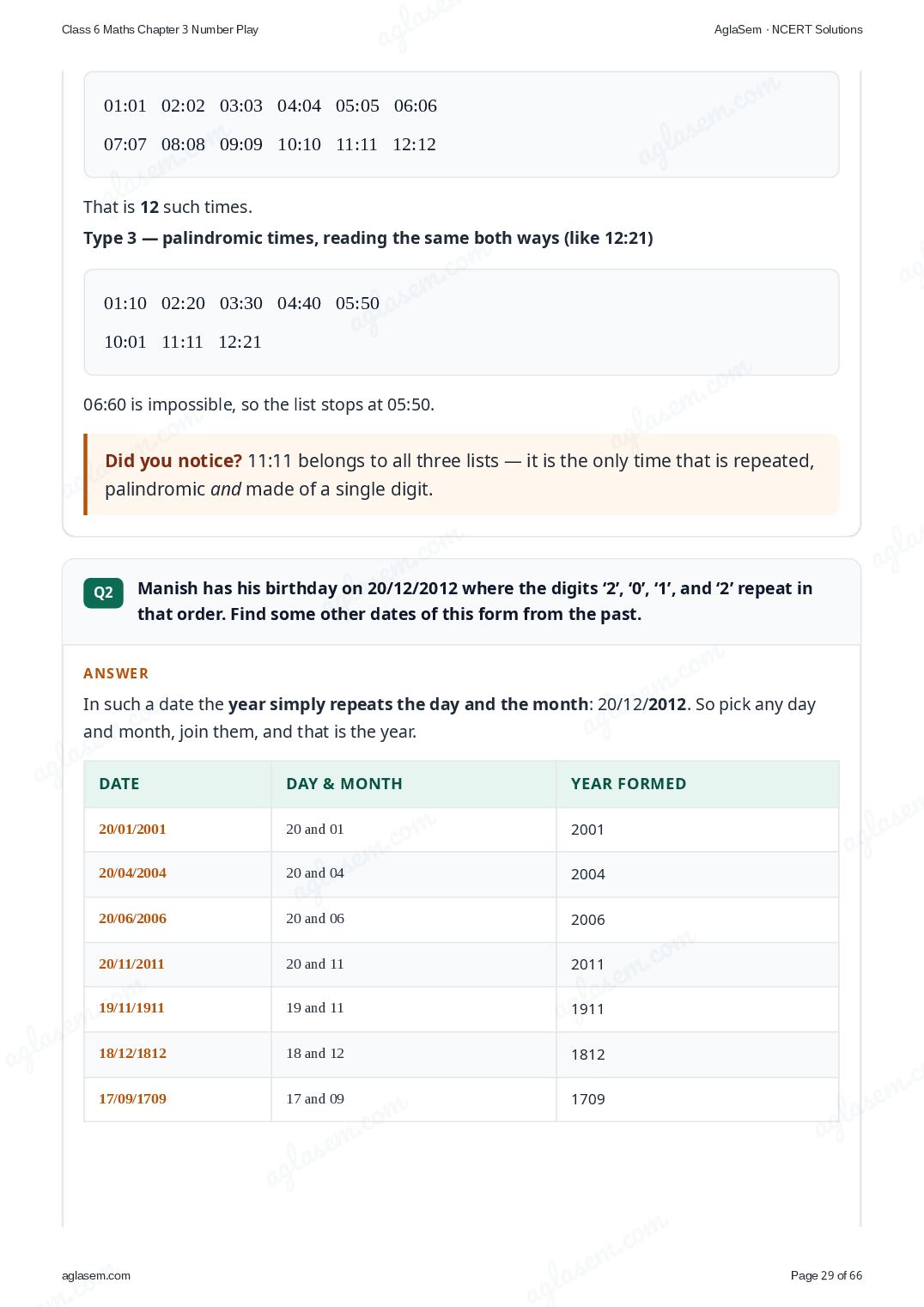
- On the usual 12-hour clock, there are timings with different patterns. For example, 4:44, 10:10, 12:21. Try and find out all possible times on a 12-hour clock of each of these types.
- Manish has his birthday on 20/12/2012 where the digits ‘2’, ‘0’, ‘1’, and ‘2’ repeat in that order. Find some other dates of this form from the past.
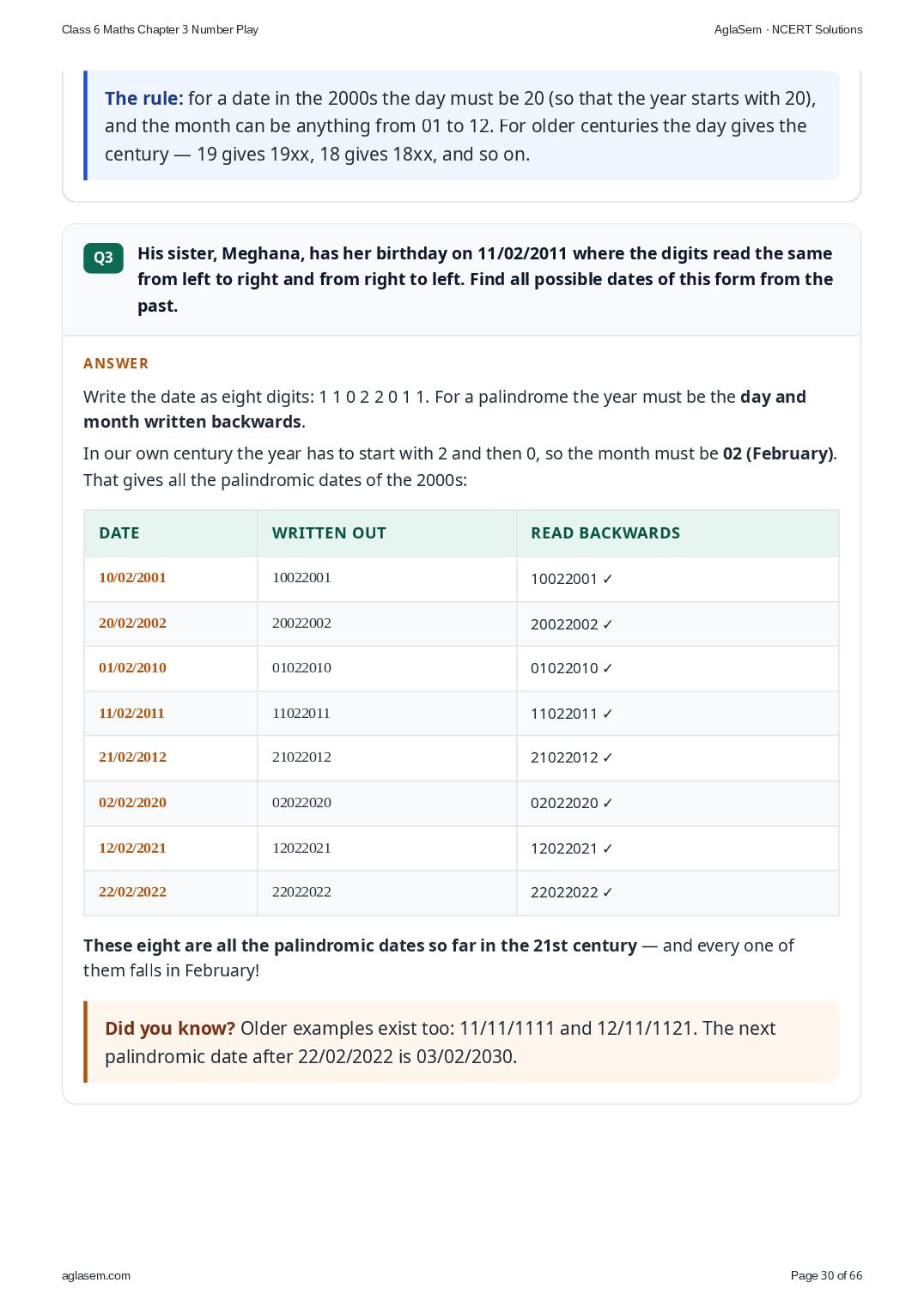
- His sister, Meghana, has her birthday on 11/02/2011 where the digits read the same from left to right and from right to left. Find all possible dates of this form from the past.
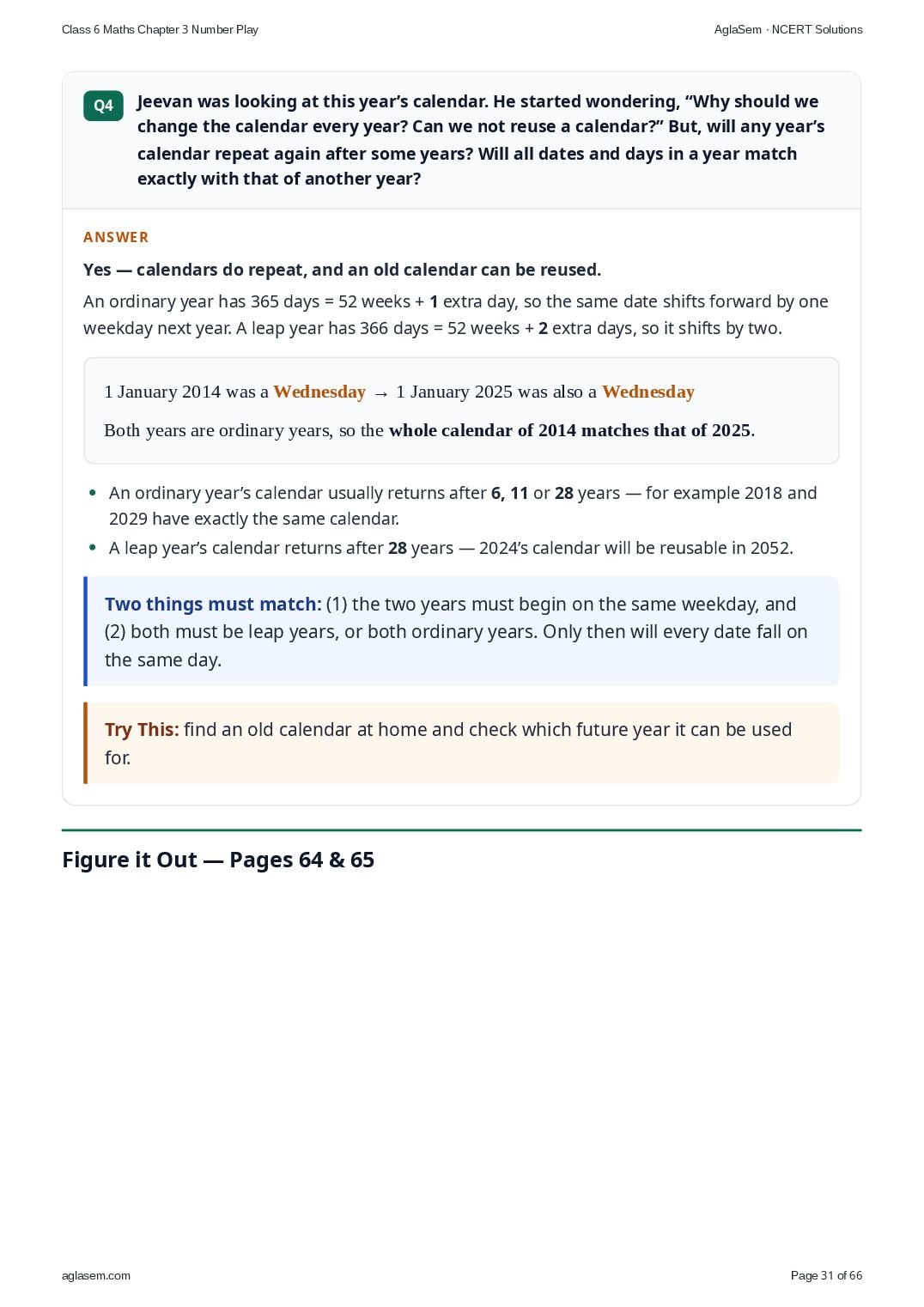
- Jeevan was looking at this year’s calendar. He started wondering, “Why should we change the calendar every year? Can we not reuse a calendar?” But, will any year’s calendar repeat again after some years? Will all dates and days in a year match exactly with that of another year?
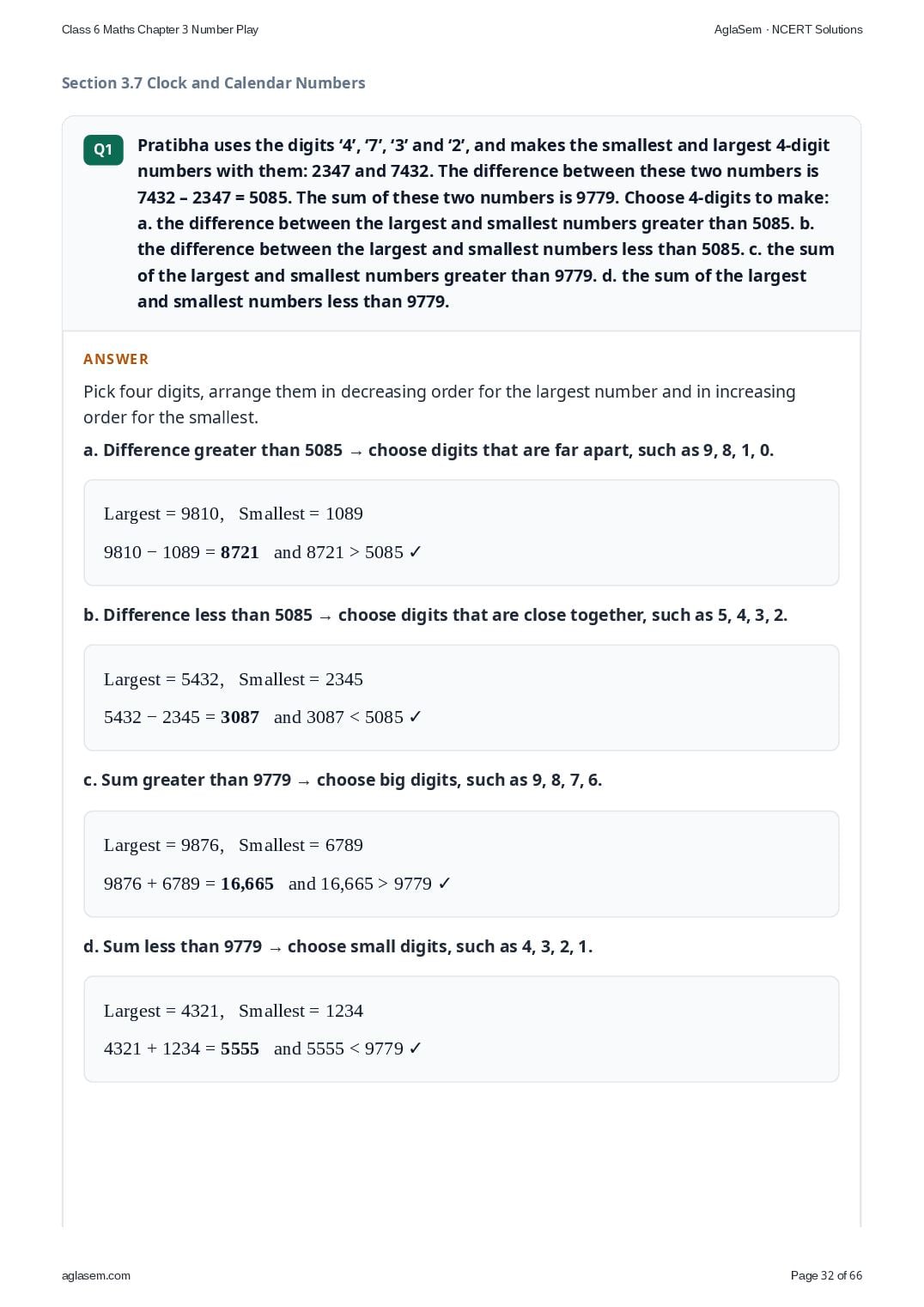
- Pratibha uses the digits ‘4’, ‘7’, ‘3’ and ‘2’, and makes the smallest and largest 4-digit numbers with them: 2347 and 7432. The difference between these two numbers is 7432 – 2347 = 5085. The sum of these two numbers is 9779. Choose 4-digits to make: a. the difference between the largest and smallest numbers greater than 5085. b. the difference between the largest and smallest numbers less than 5085. c. the sum of the largest and smallest numbers greater than 9779. d. the sum of the largest and smallest numbers less than 9779.
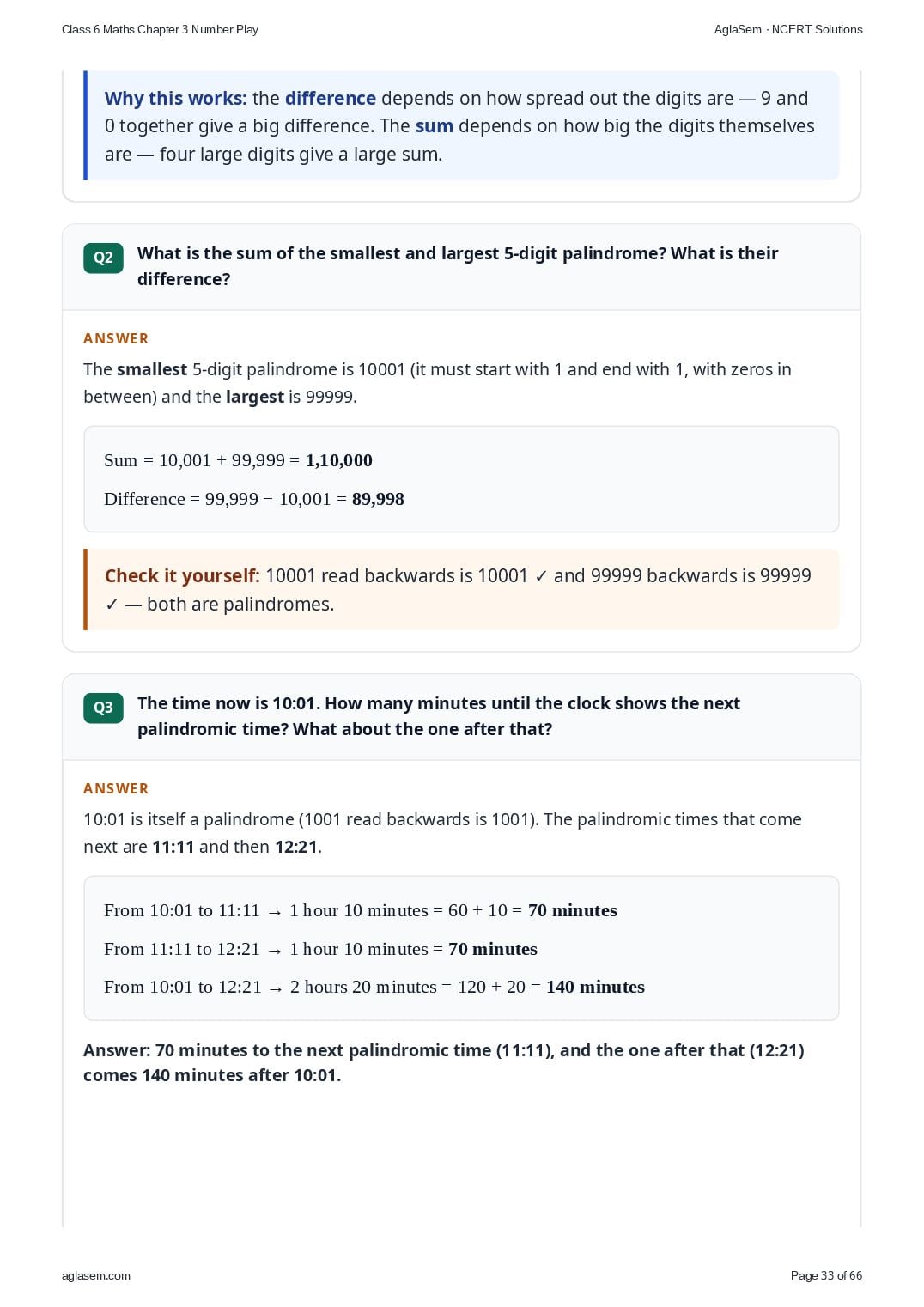
- What is the sum of the smallest and largest 5-digit palindrome? What is their difference?
- The time now is 10:01. How many minutes until the clock shows the next palindromic time? What about the one after that?
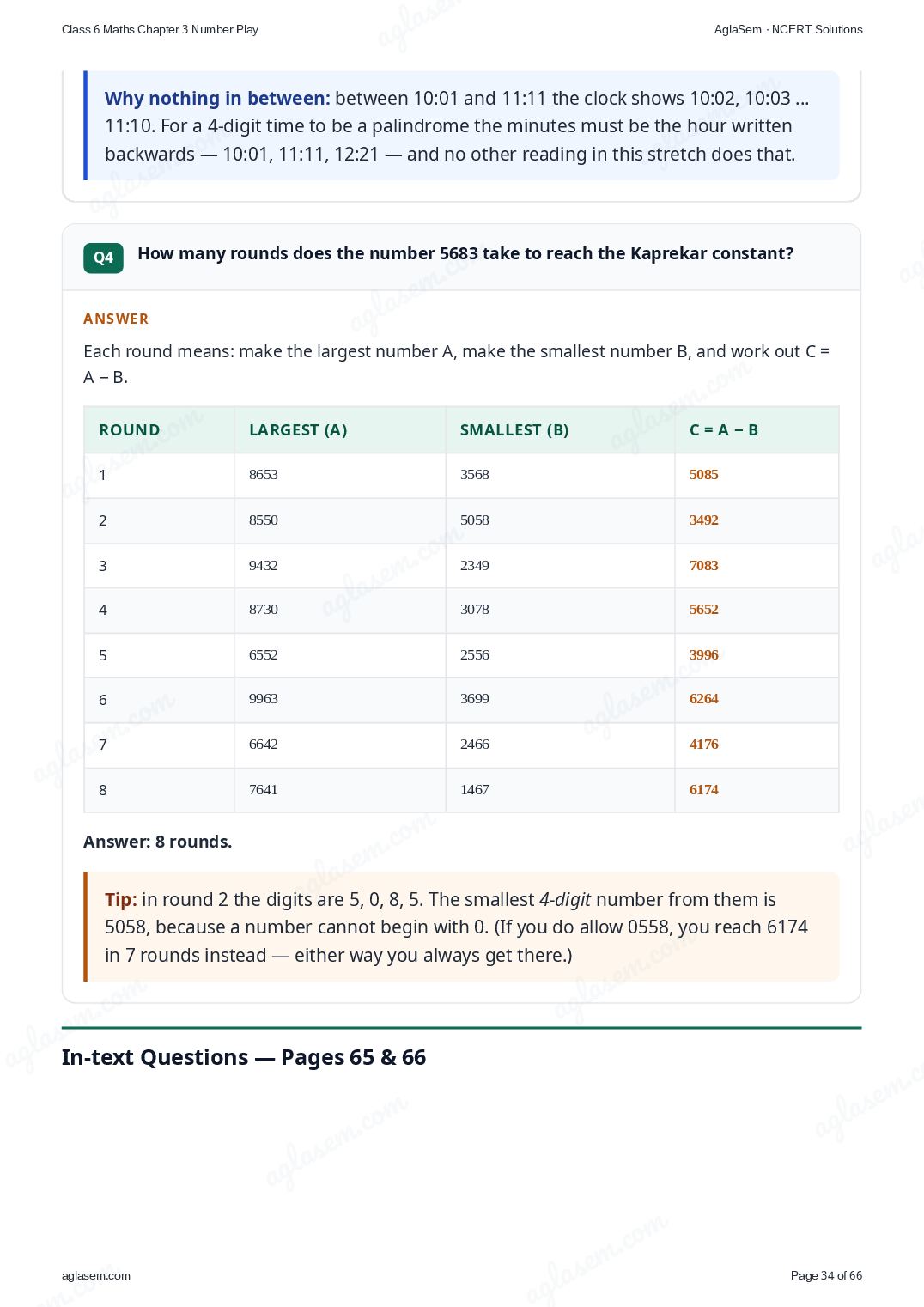
- How many rounds does the number 5683 take to reach the Kaprekar constant?
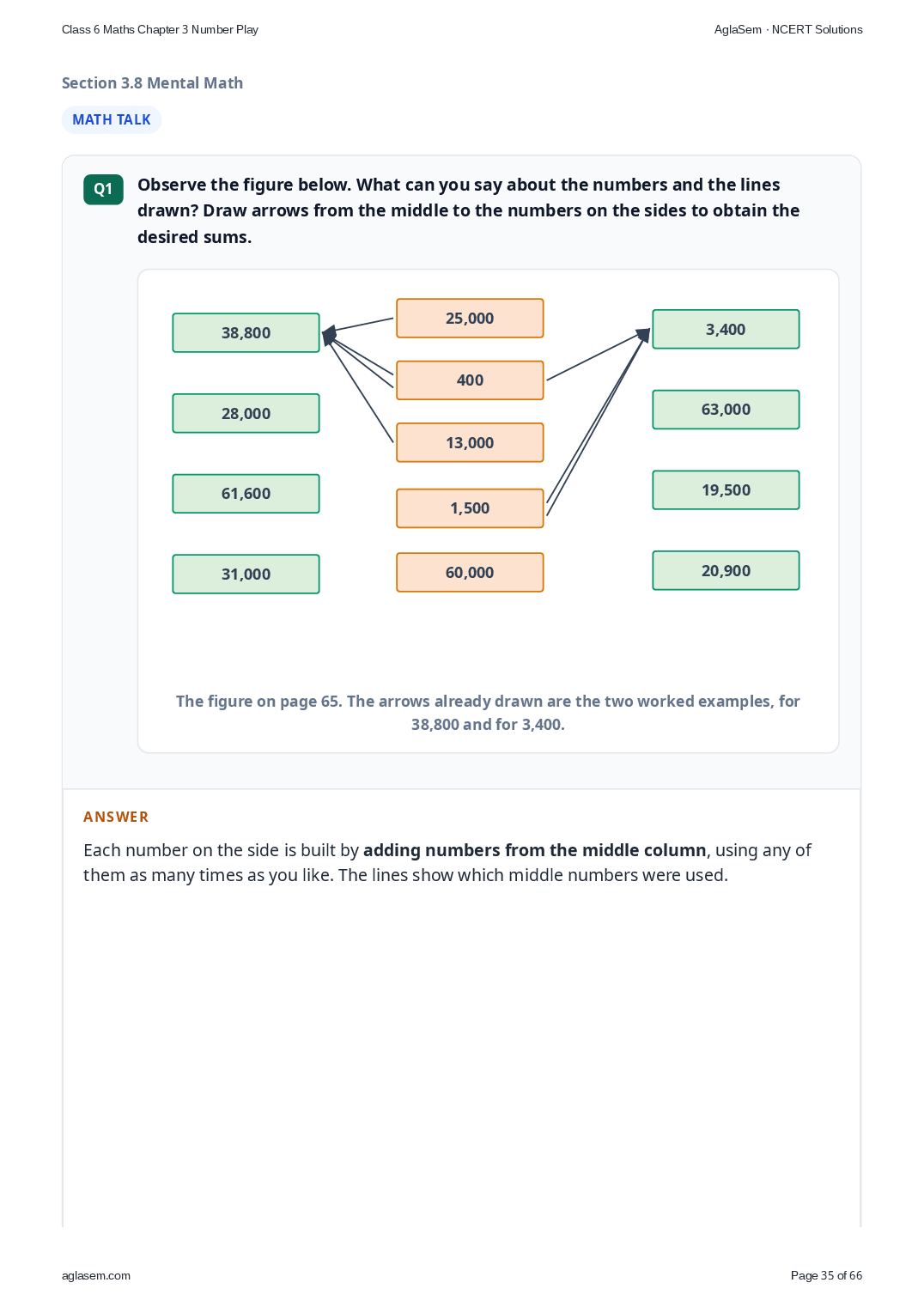
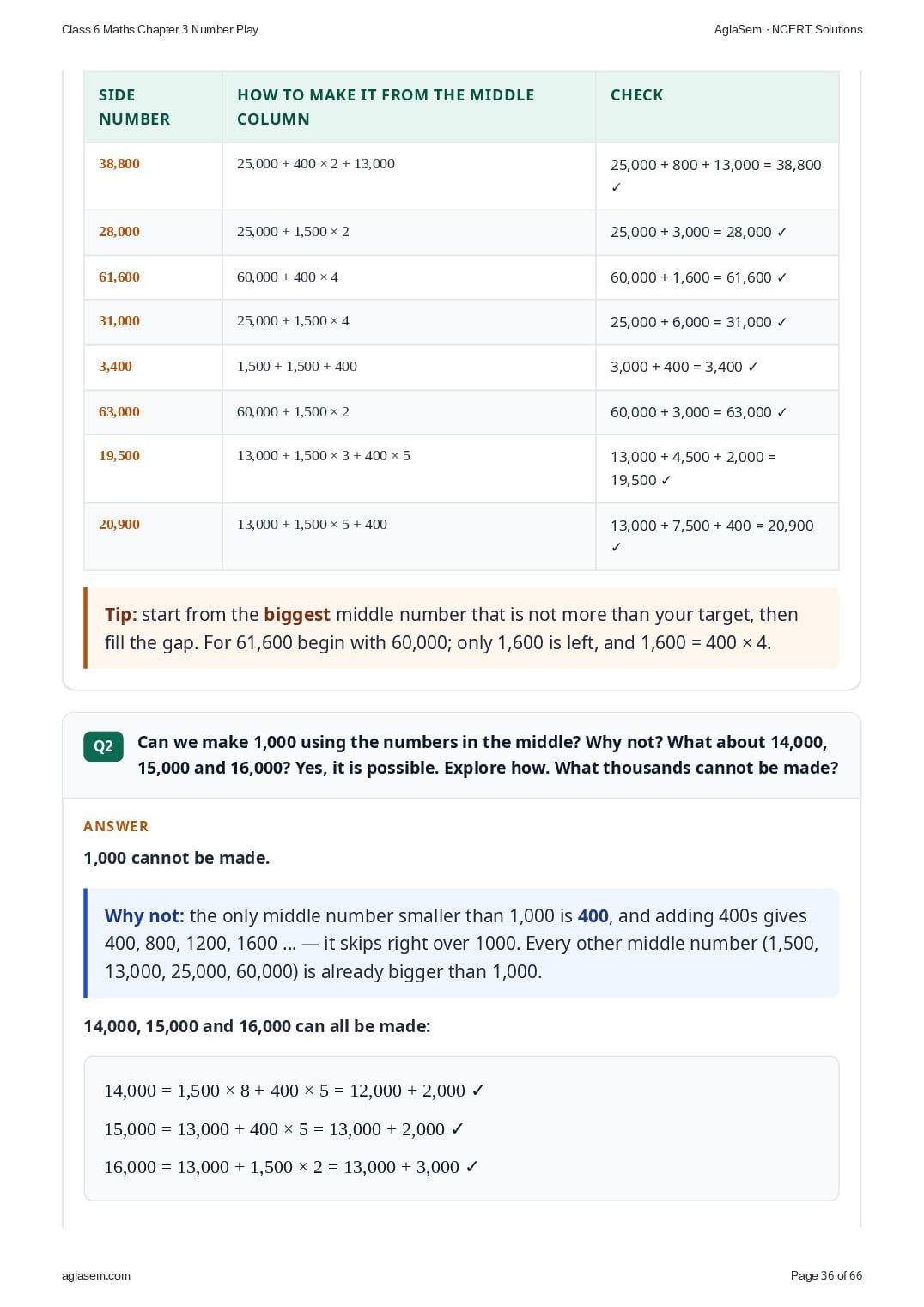
- Observe the figure below. What can you say about the numbers and the lines drawn? Draw arrows from the middle to the numbers on the sides to obtain the desired sums. (Middle column: 25,000; 400; 13,000; 1,500; 60,000. Sides: 38,800; 28,000; 61,600; 31,000; 3,400; 63,000; 19,500; 20,900.)
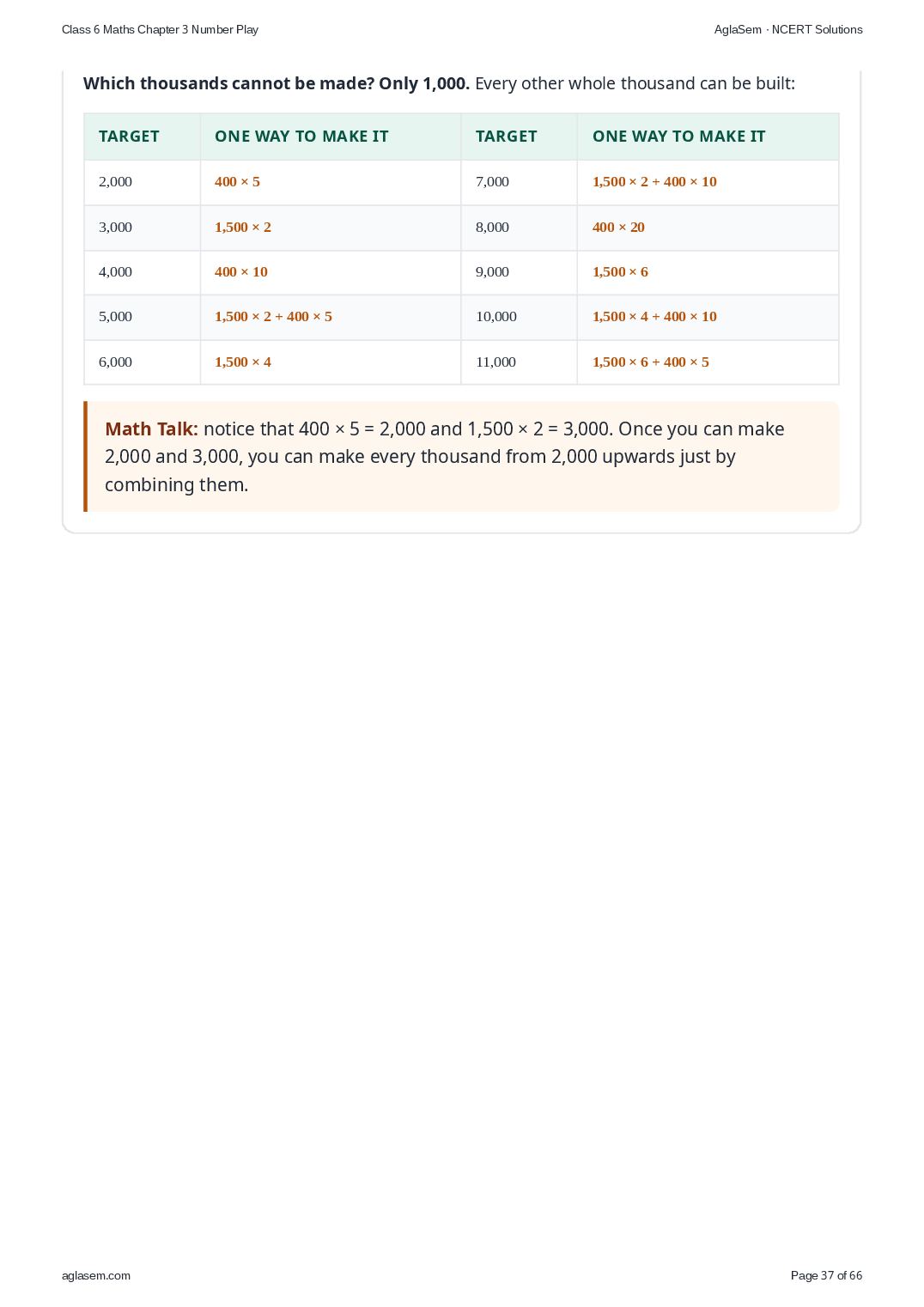
- Can we make 1,000 using the numbers in the middle? Why not? What about 14,000, 15,000 and 16,000? Yes, it is possible. Explore how. What thousands cannot be made?
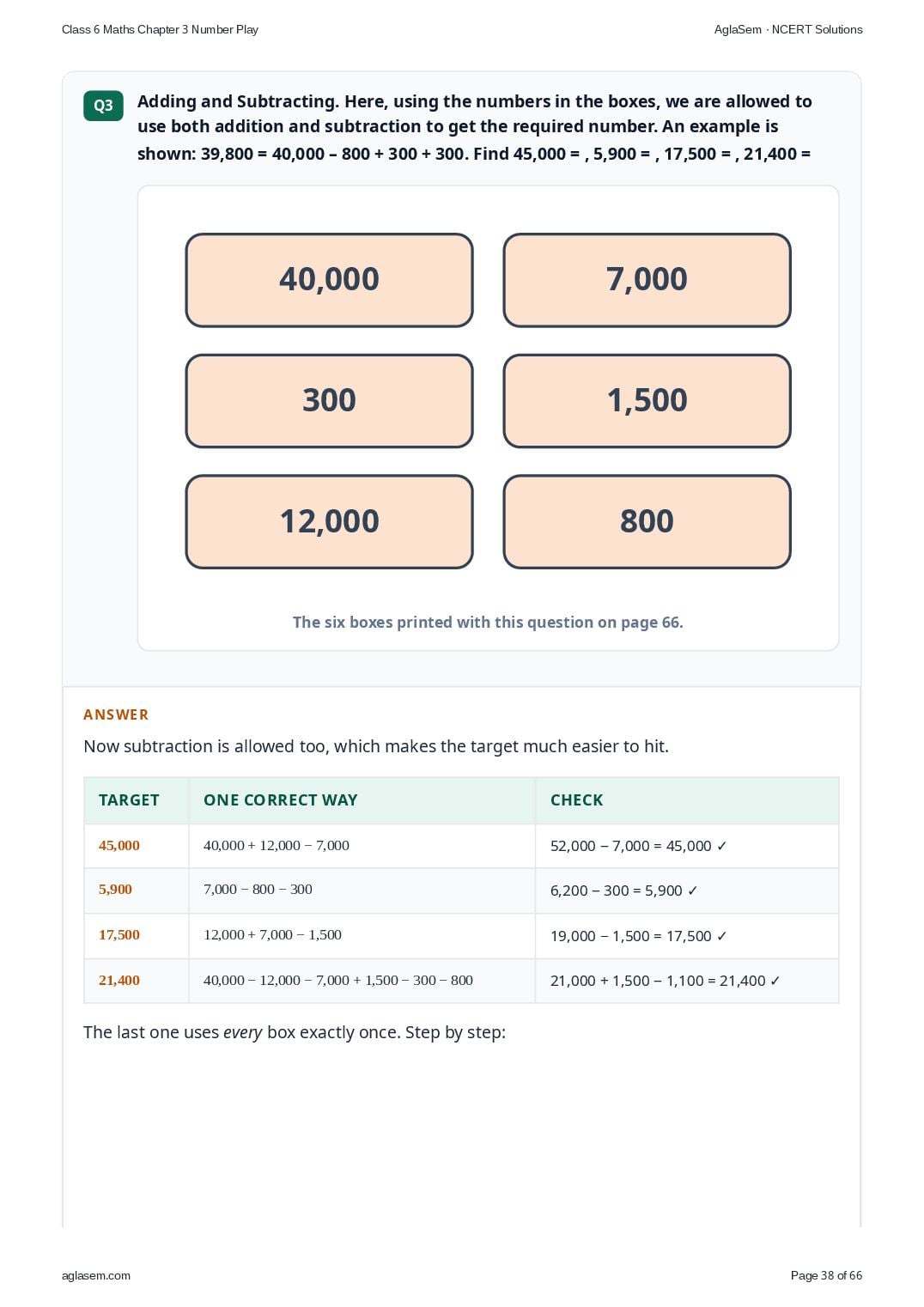
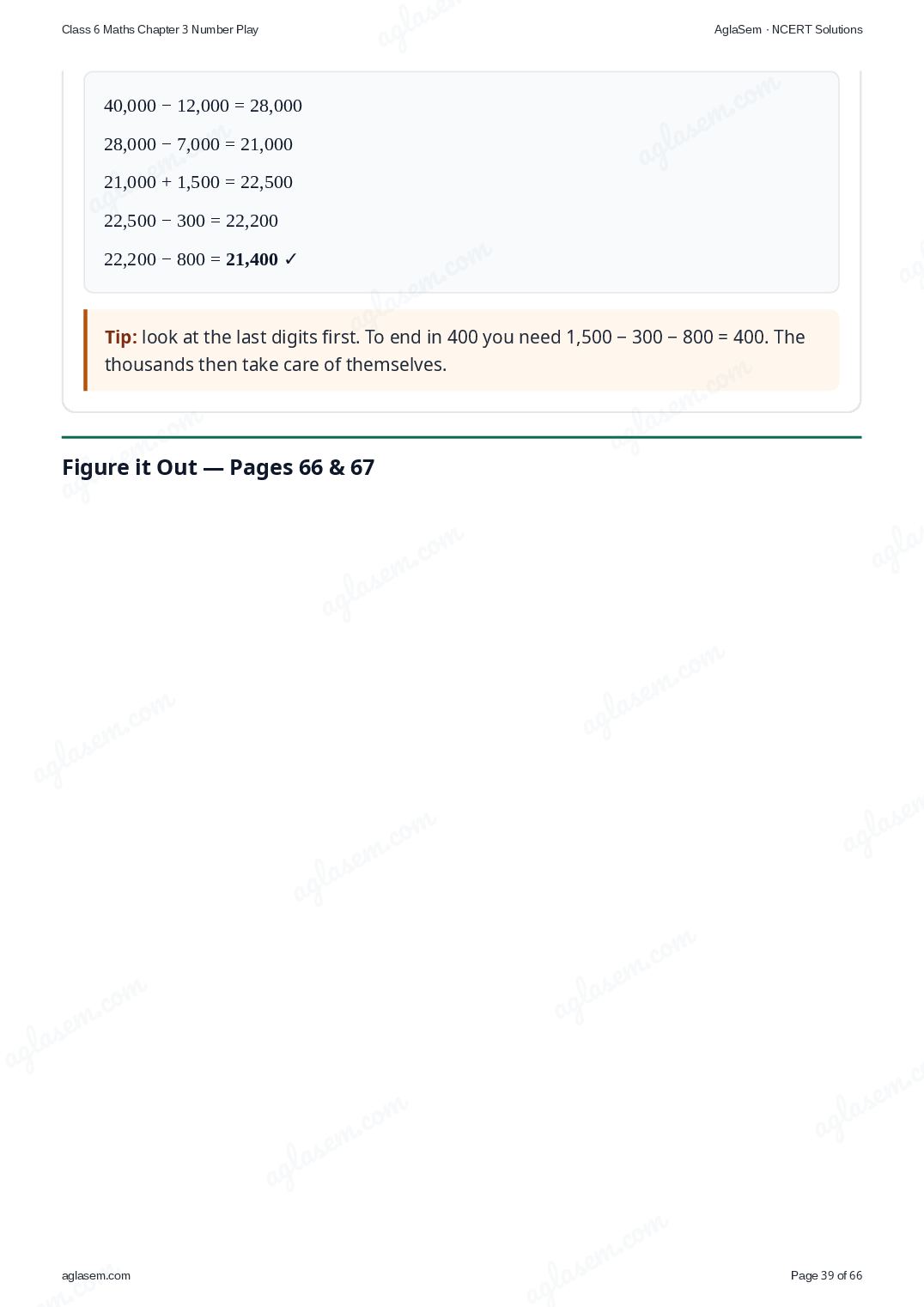
- Adding and Subtracting. Here, using the numbers in the boxes, we are allowed to use both addition and subtraction to get the required number. An example is shown: 39,800 = 40,000 – 800 + 300 + 300. Find 45,000 = , 5,900 = , 17,500 = , 21,400 = (boxes: 40,000; 7,000; 300; 1,500; 12,000; 800)
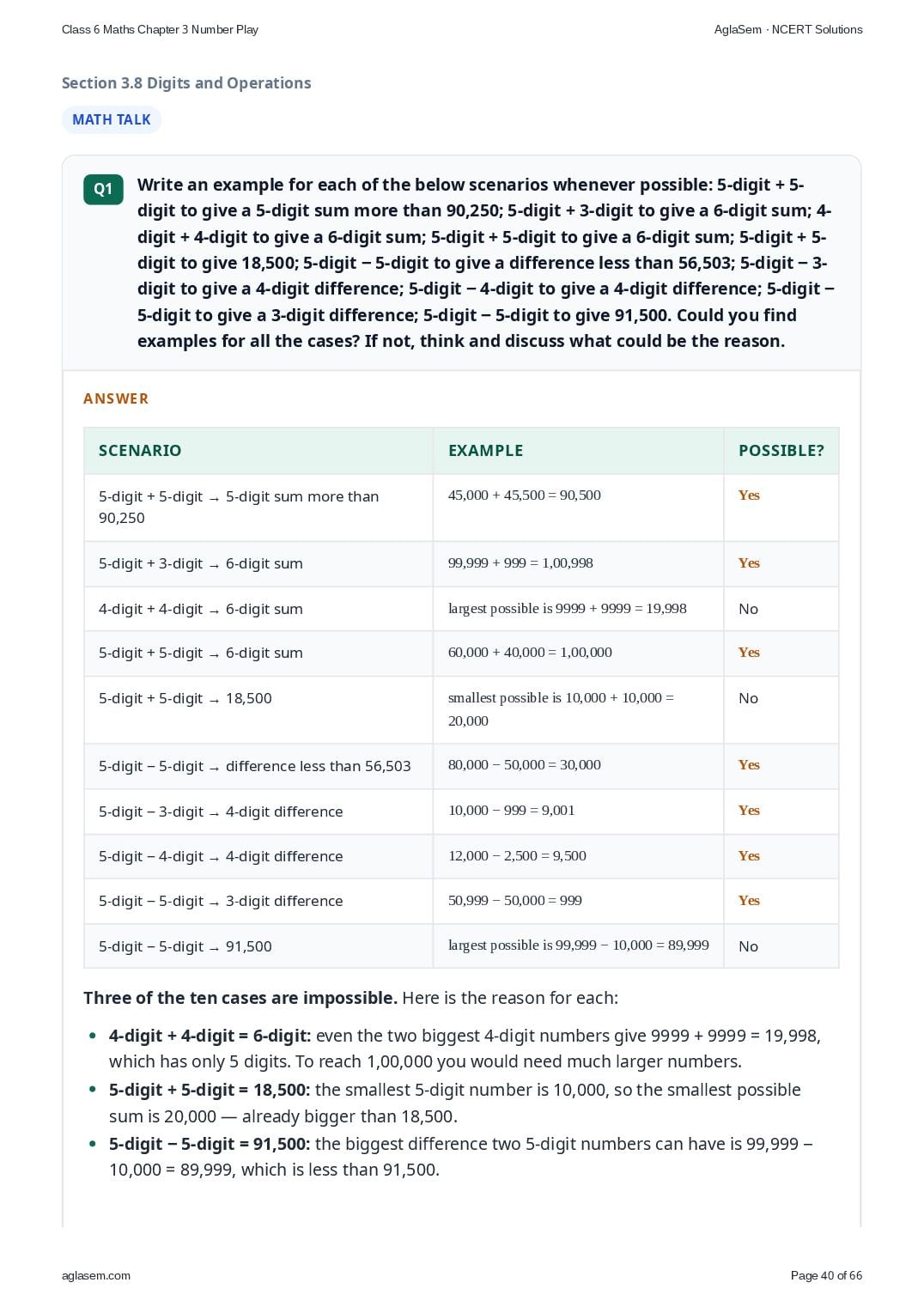
- Write an example for each of the below scenarios whenever possible: 5-digit + 5-digit to give a 5-digit sum more than 90,250; 5-digit + 3-digit to give a 6-digit sum; 4-digit + 4-digit to give a 6-digit sum; 5-digit + 5-digit to give a 6-digit sum; 5-digit + 5-digit to give 18,500; 5-digit − 5-digit to give a difference less than 56,503; 5-digit − 3-digit to give a 4-digit difference; 5-digit − 4-digit to give a 4-digit difference; 5-digit − 5-digit to give a 3-digit difference; 5-digit − 5-digit to give 91,500. Could you find examples for all the cases? If not, think and discuss what could be the reason.
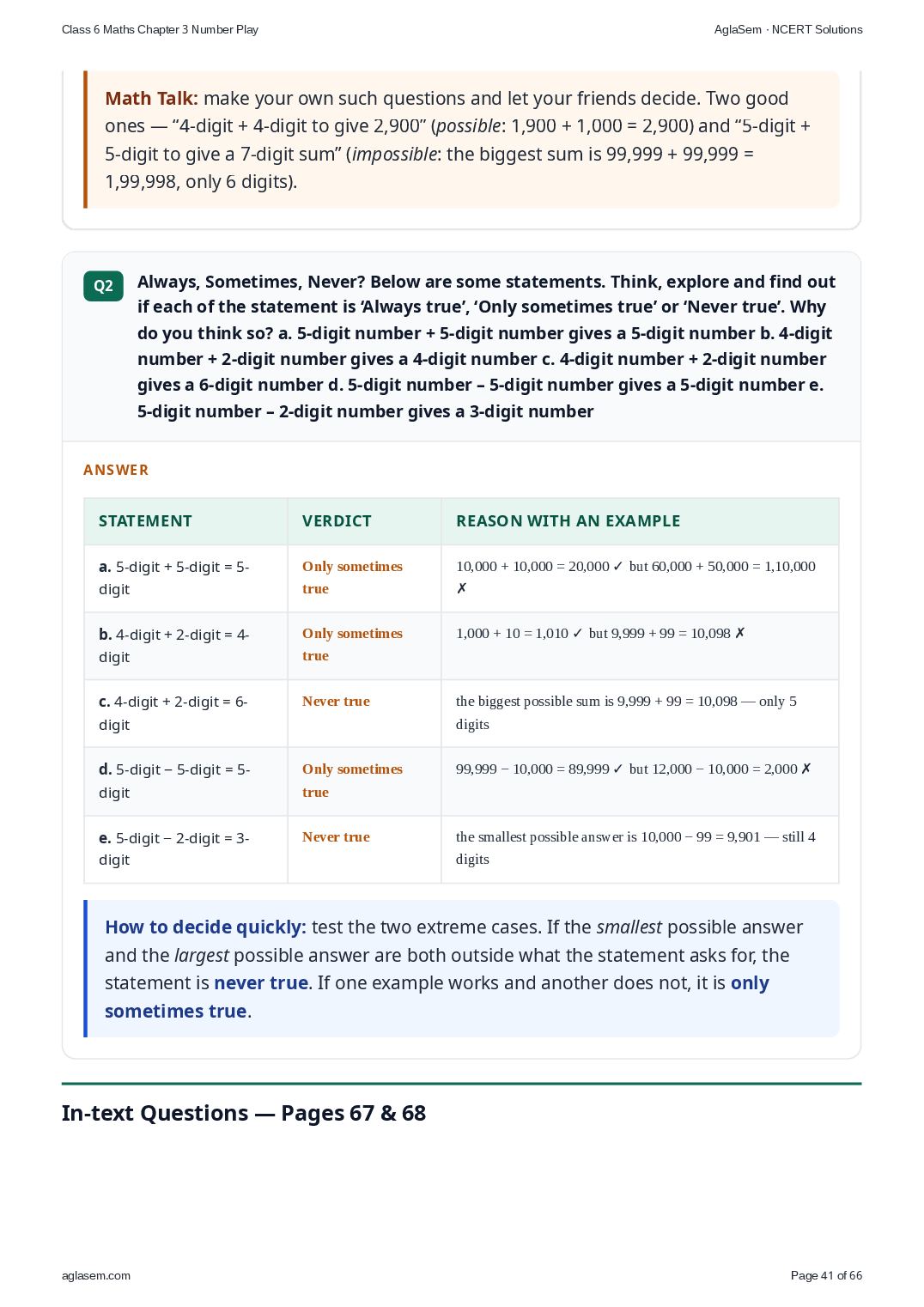
- Always, Sometimes, Never? Below are some statements. Think, explore and find out if each of the statement is ‘Always true’, ‘Only sometimes true’ or ‘Never true’. Why do you think so? a. 5-digit number + 5-digit number gives a 5-digit number b. 4-digit number + 2-digit number gives a 4-digit number c. 4-digit number + 2-digit number gives a 6-digit number d. 5-digit number – 5-digit number gives a 5-digit number e. 5-digit number – 2-digit number gives a 3-digit number
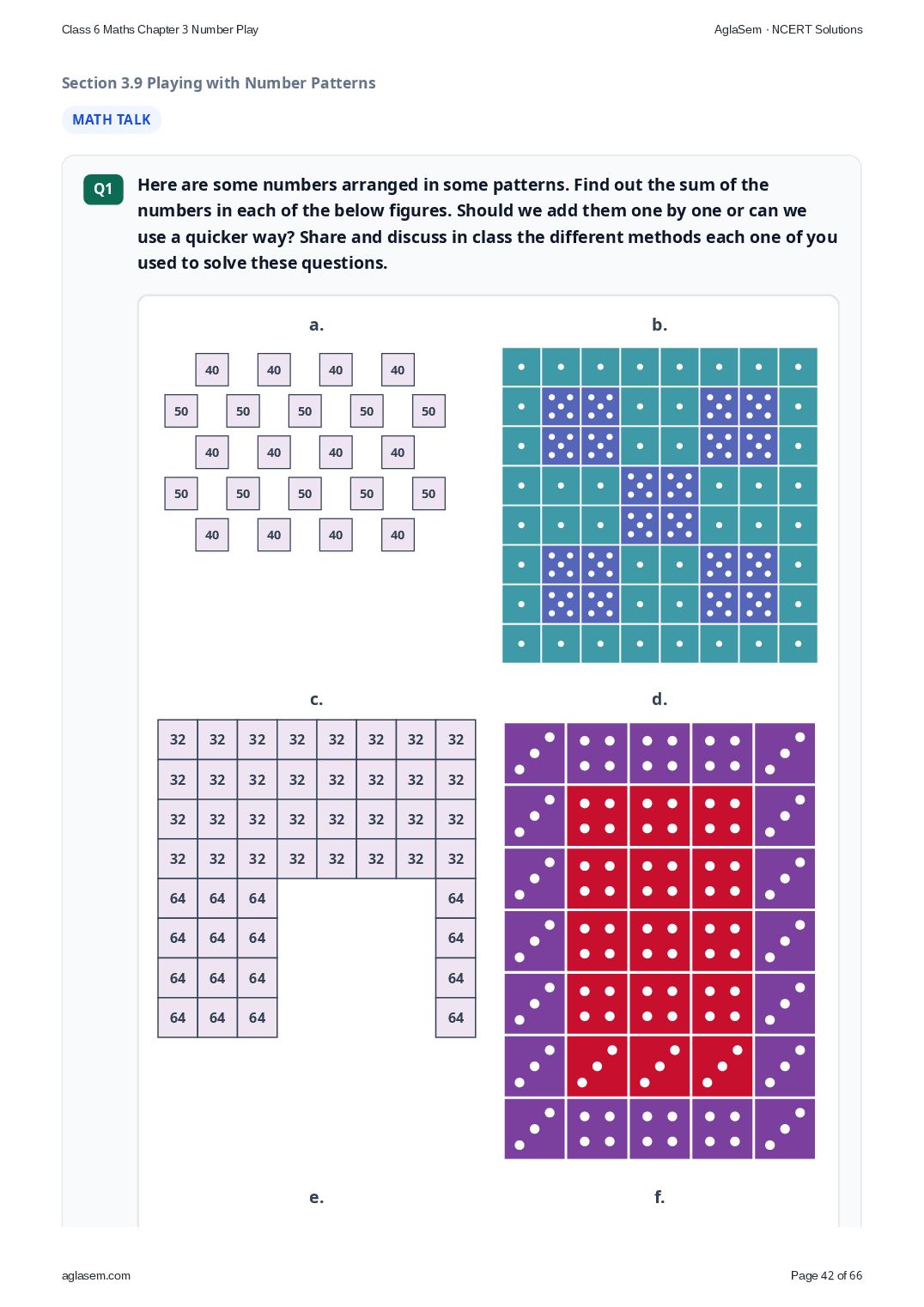
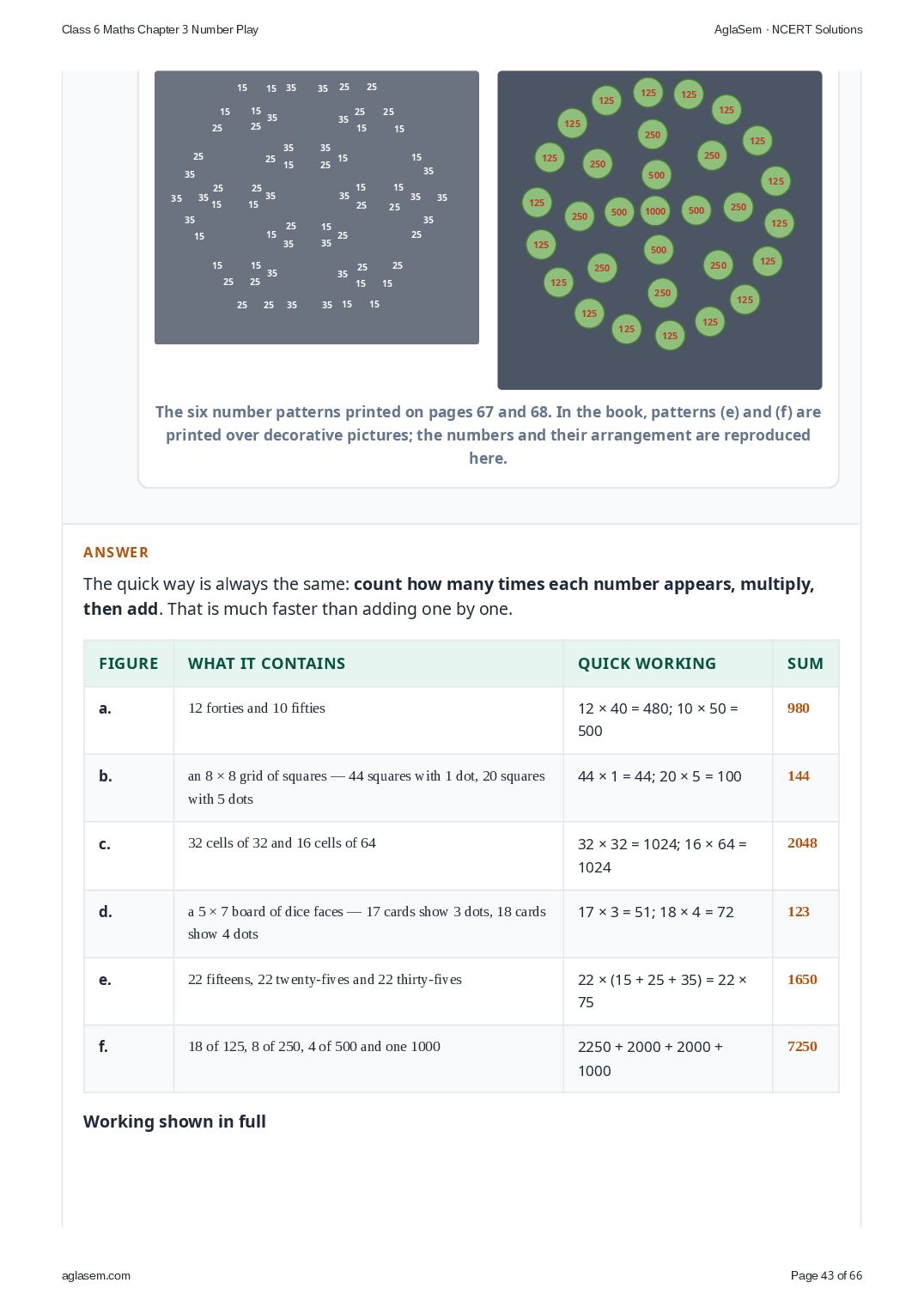
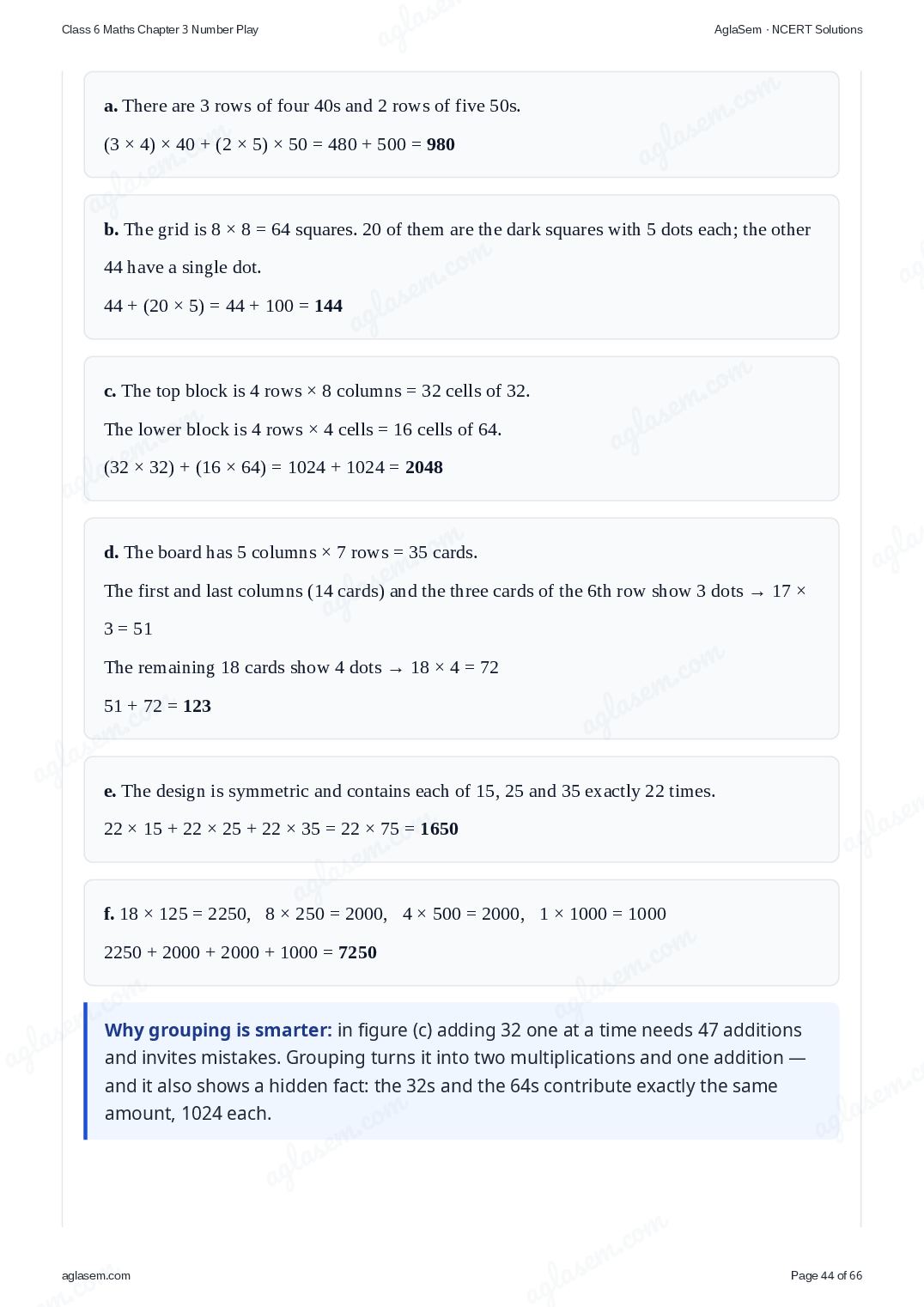
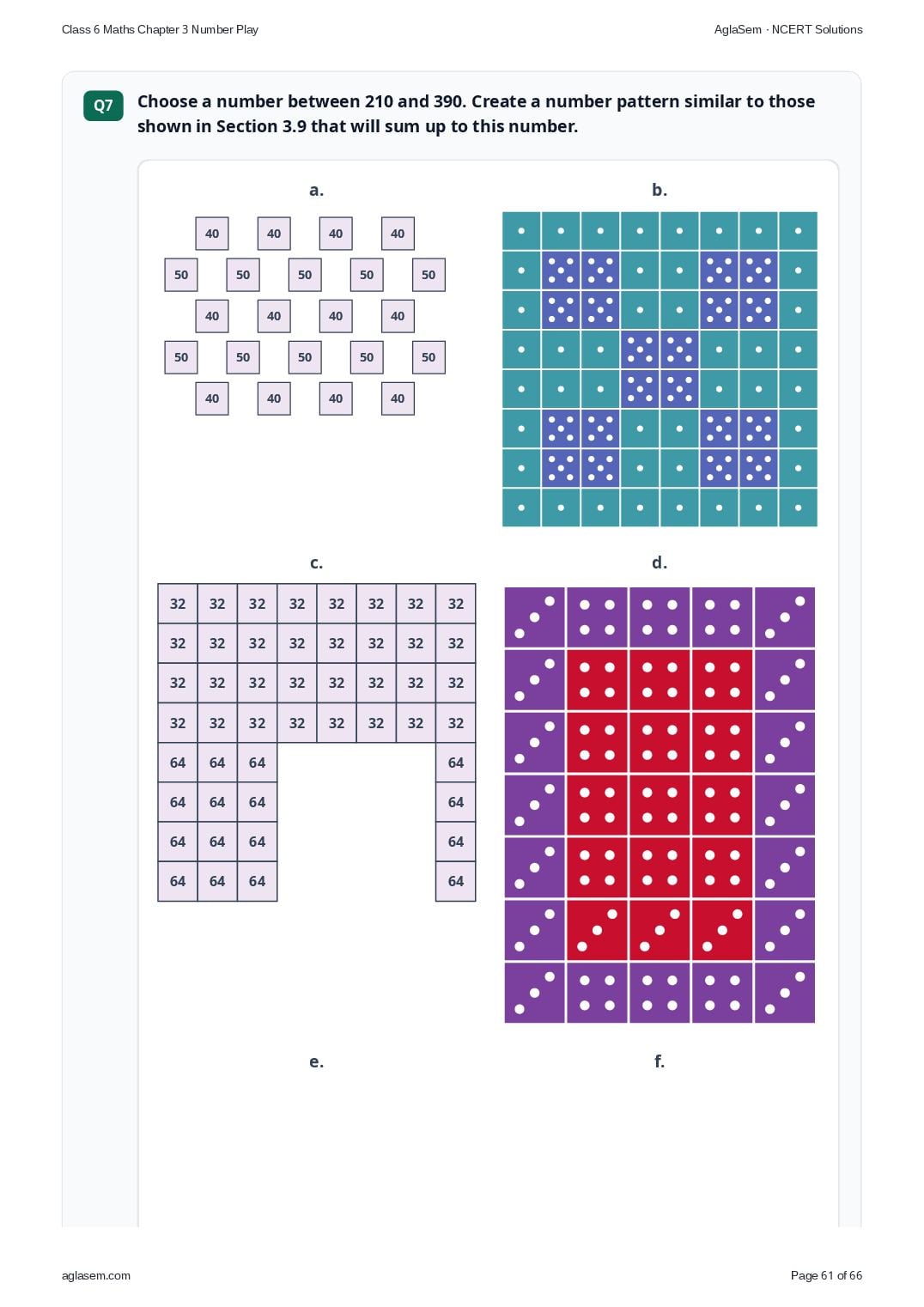
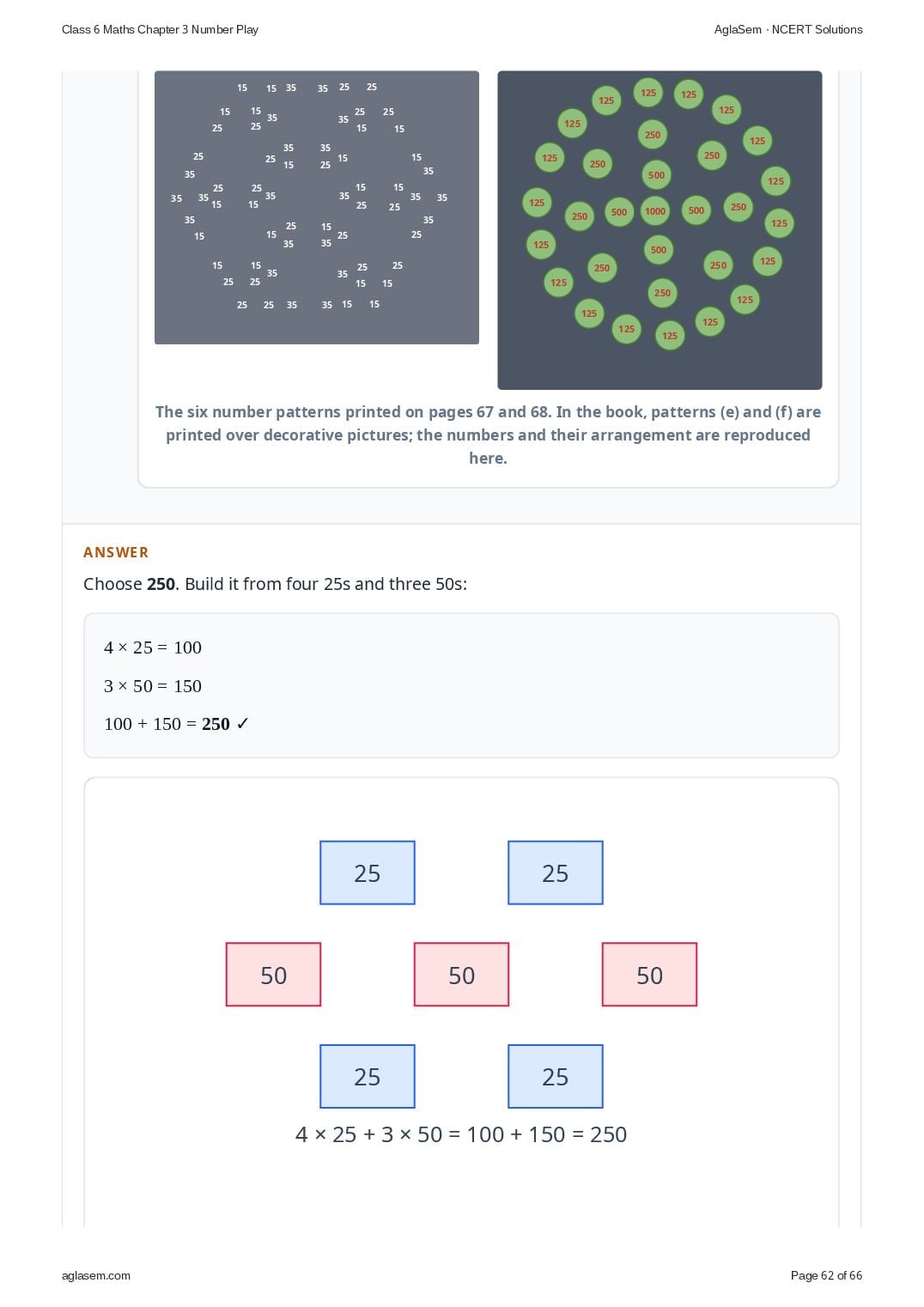
- Here are some numbers arranged in some patterns. Find out the sum of the numbers in each of the below figures. Should we add them one by one or can we use a quicker way? Share and discuss in class the different methods each one of you used to solve these questions.
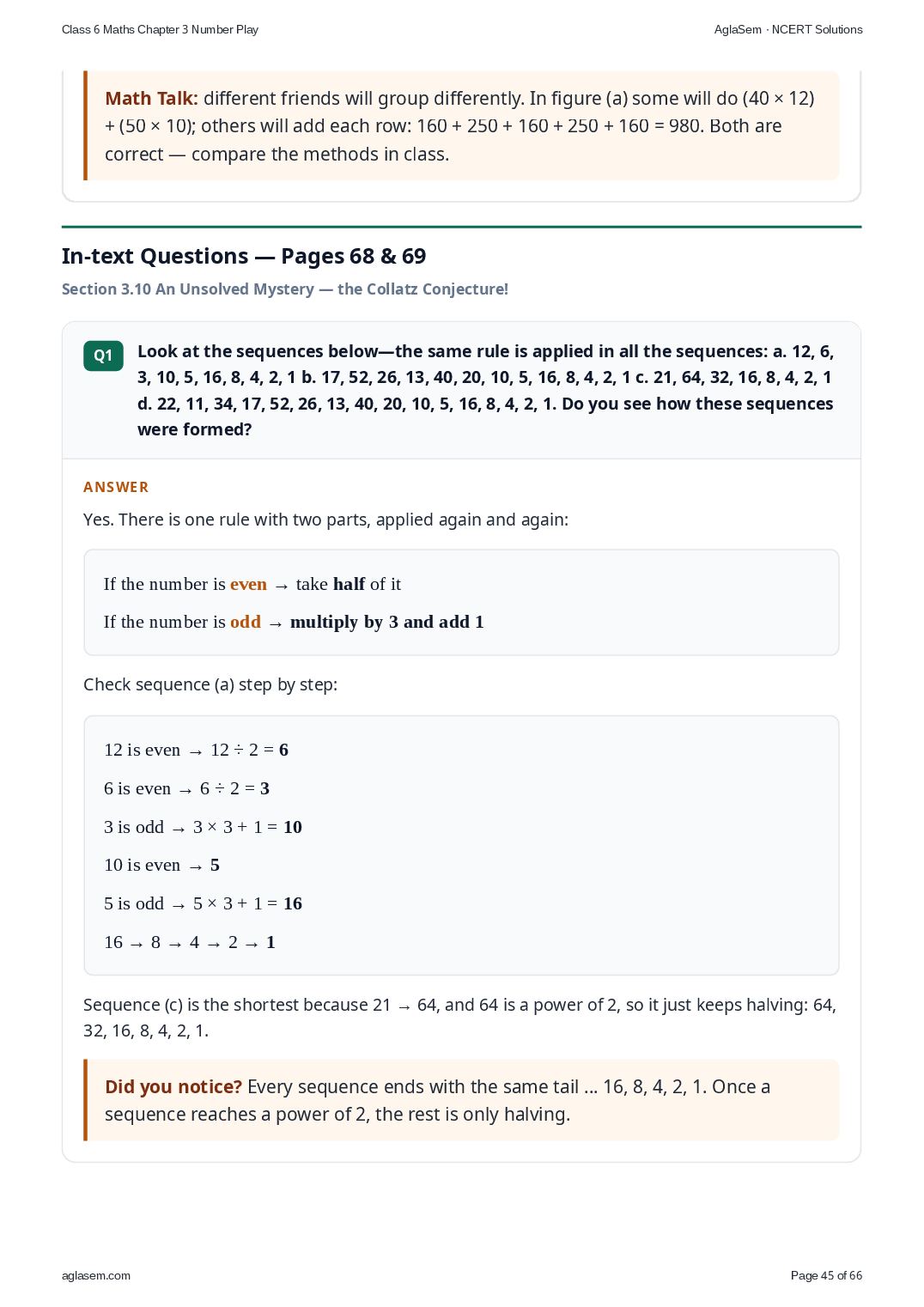
- Look at the sequences below—the same rule is applied in all the sequences: a. 12, 6, 3, 10, 5, 16, 8, 4, 2, 1 b. 17, 52, 26, 13, 40, 20, 10, 5, 16, 8, 4, 2, 1 c. 21, 64, 32, 16, 8, 4, 2, 1 d. 22, 11, 34, 17, 52, 26, 13, 40, 20, 10, 5, 16, 8, 4, 2, 1. Do you see how these sequences were formed?
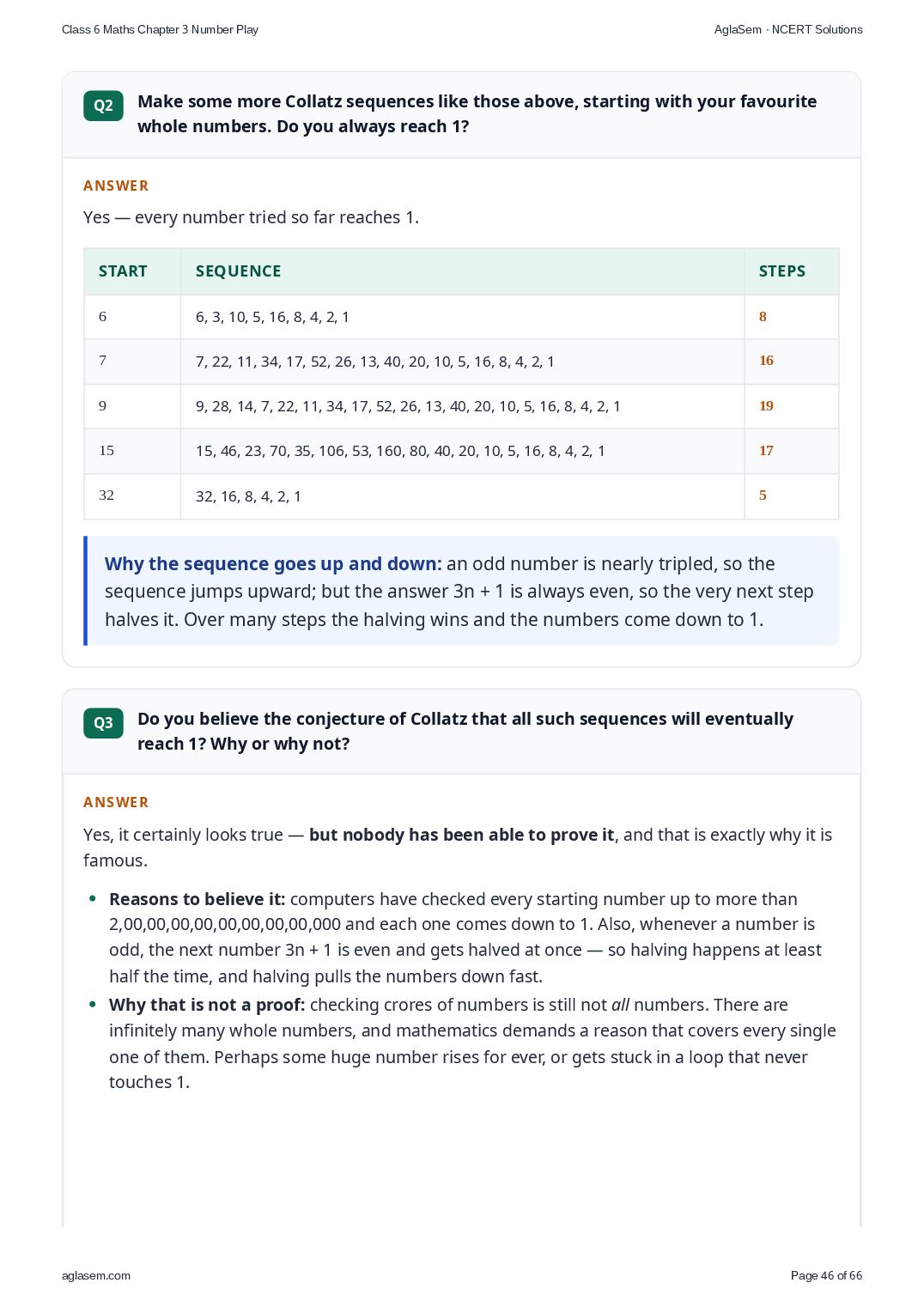
- Make some more Collatz sequences like those above, starting with your favourite whole numbers. Do you always reach 1?
- Do you believe the conjecture of Collatz that all such sequences will eventually reach 1? Why or why not?
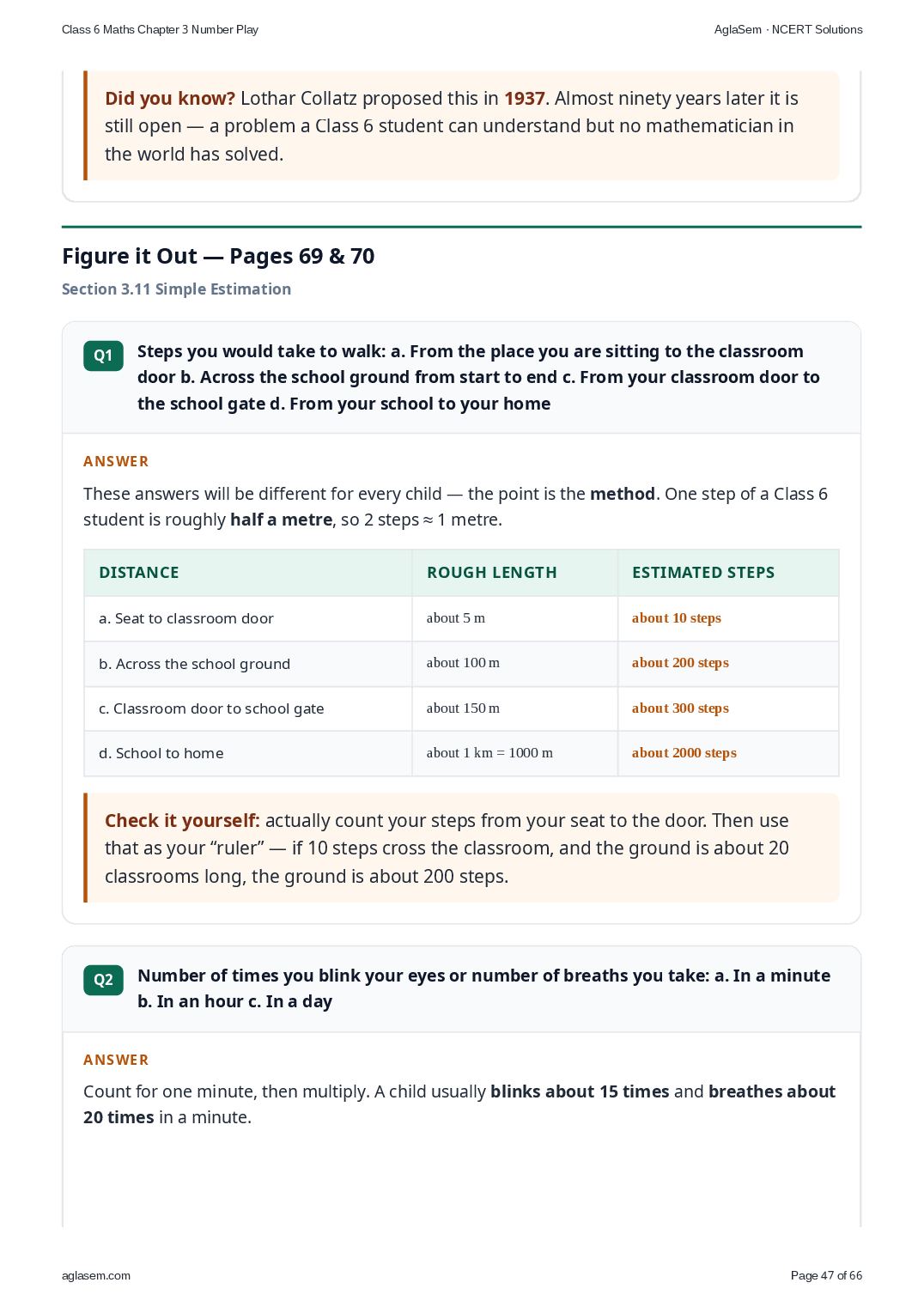
- Steps you would take to walk: a. From the place you are sitting to the classroom door b. Across the school ground from start to end c. From your classroom door to the school gate d. From your school to your home
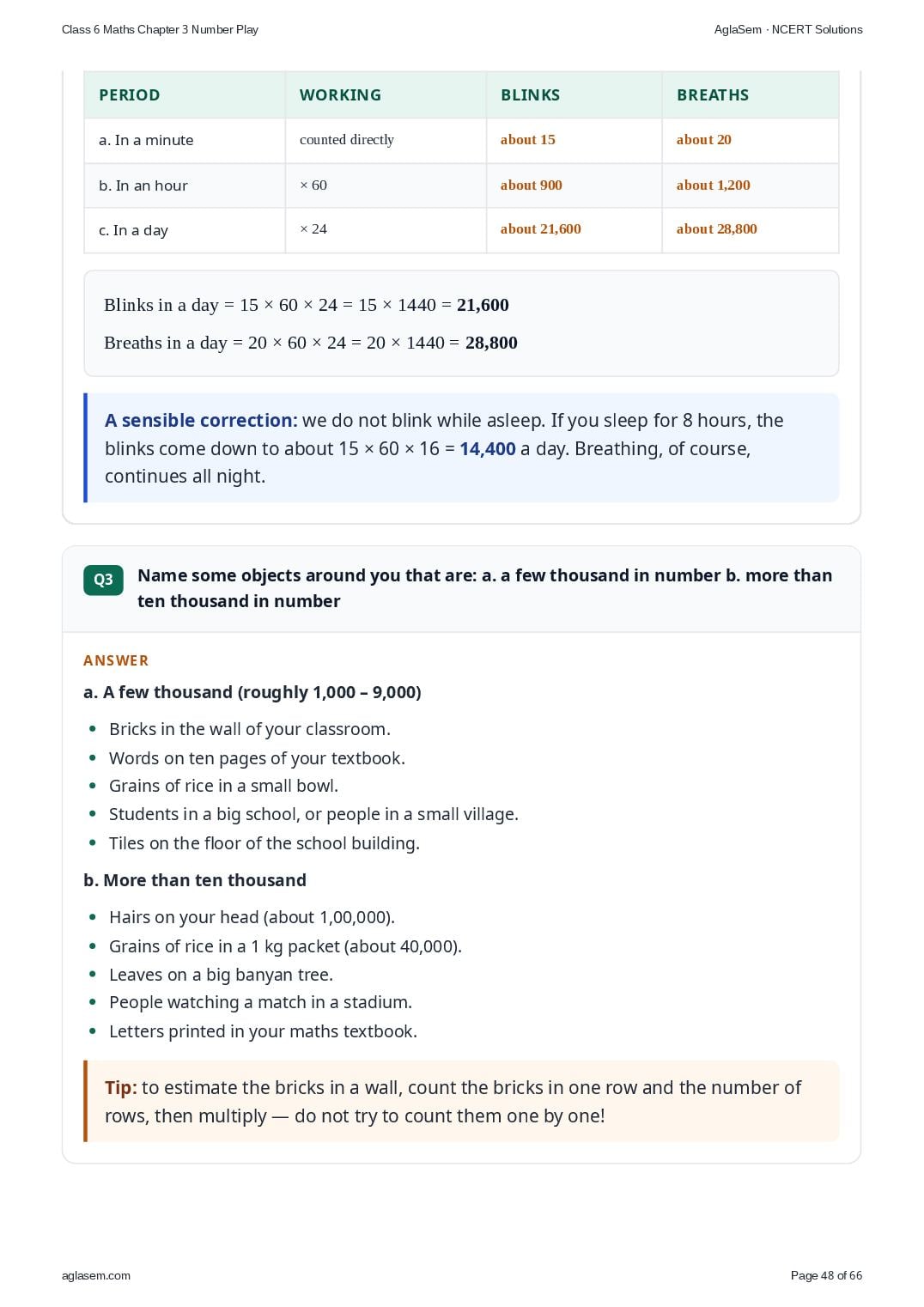
- Number of times you blink your eyes or number of breaths you take: a. In a minute b. In an hour c. In a day
- Name some objects around you that are: a. a few thousand in number b. more than ten thousand in number
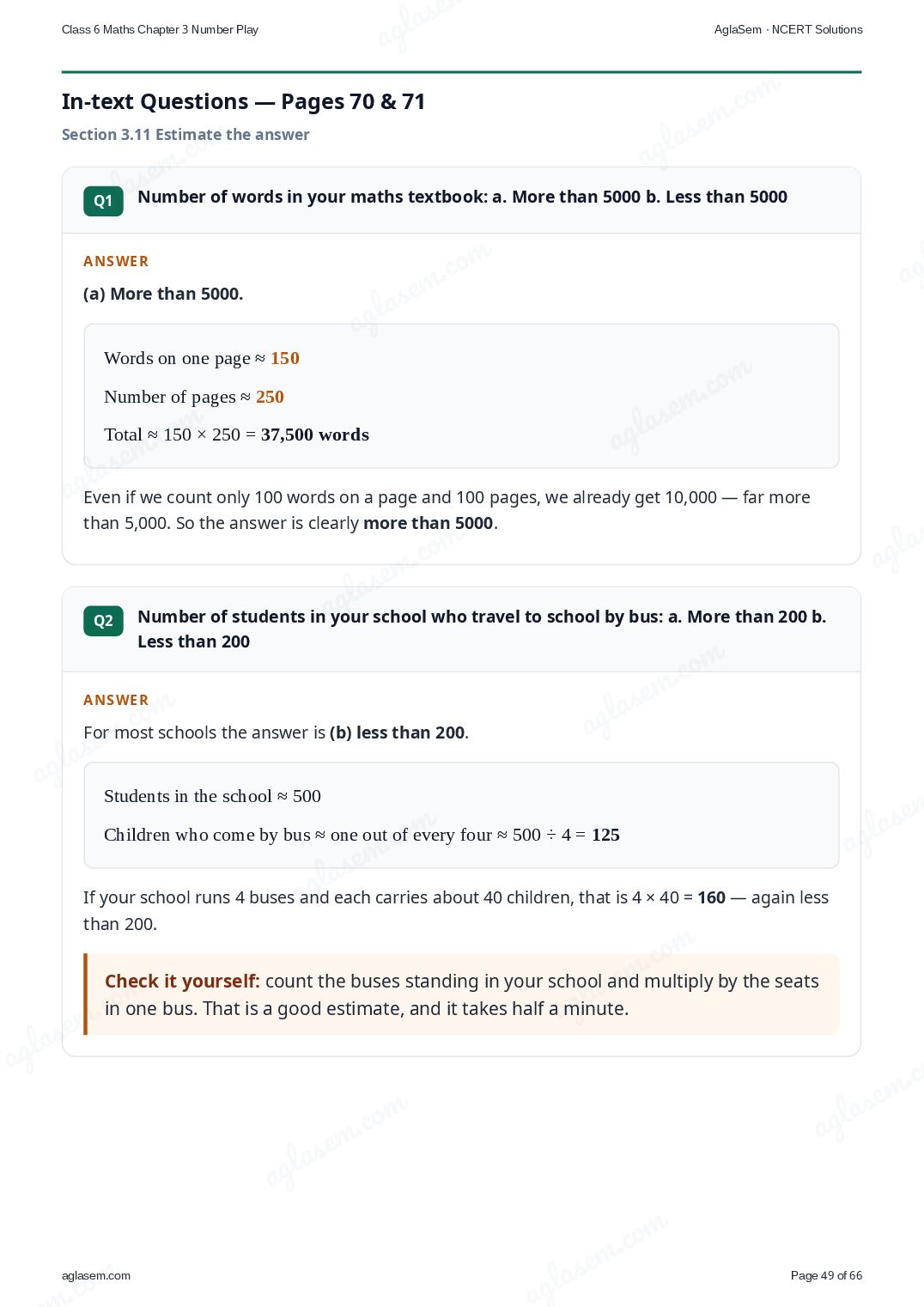
- Number of words in your maths textbook: a. More than 5000 b. Less than 5000
- Number of students in your school who travel to school by bus: a. More than 200 b. Less than 200
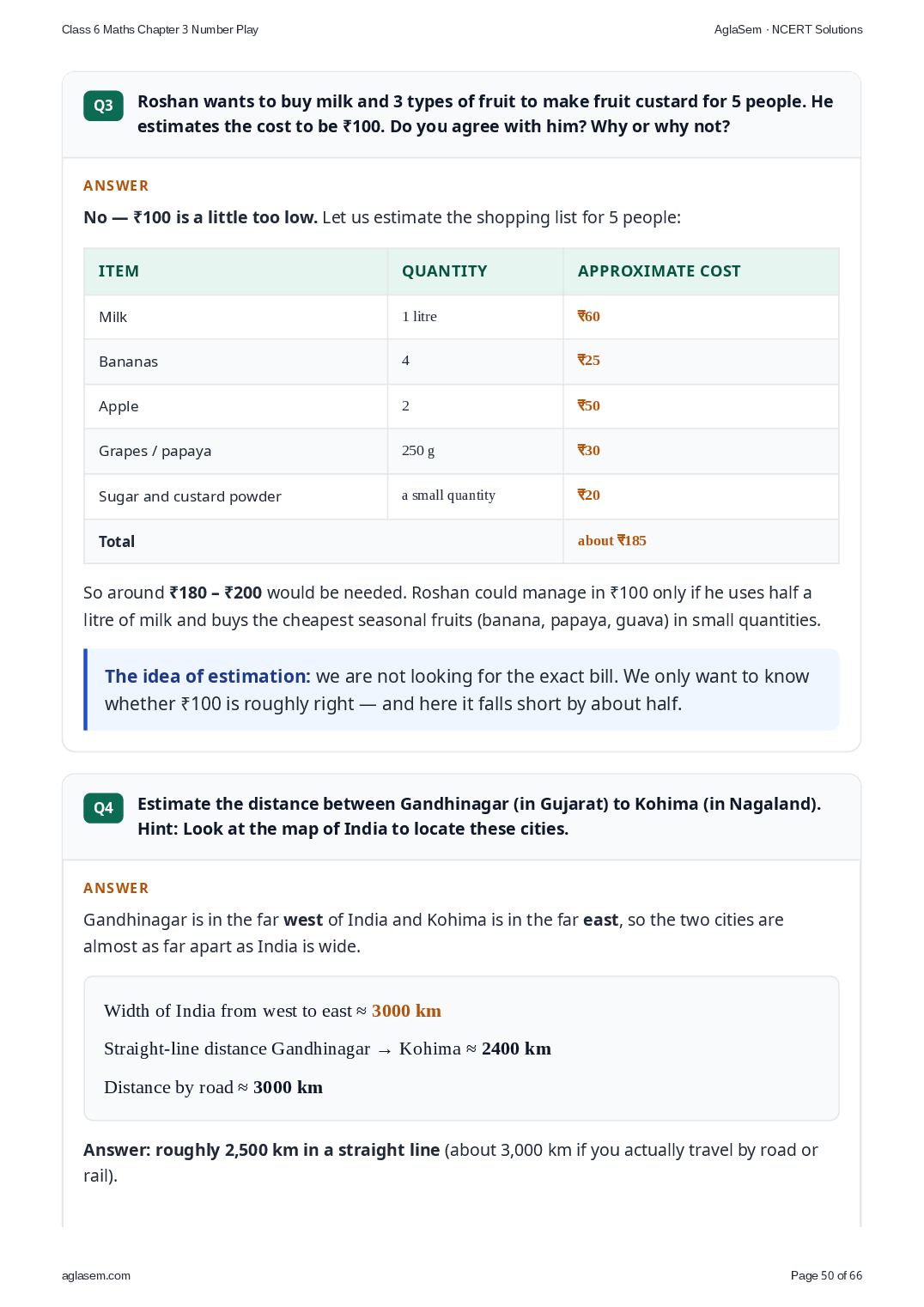
- Roshan wants to buy milk and 3 types of fruit to make fruit custard for 5 people. He estimates the cost to be ₹100. Do you agree with him? Why or why not?
- Estimate the distance between Gandhinagar (in Gujarat) to Kohima (in Nagaland). Hint: Look at the map of India to locate these cities.
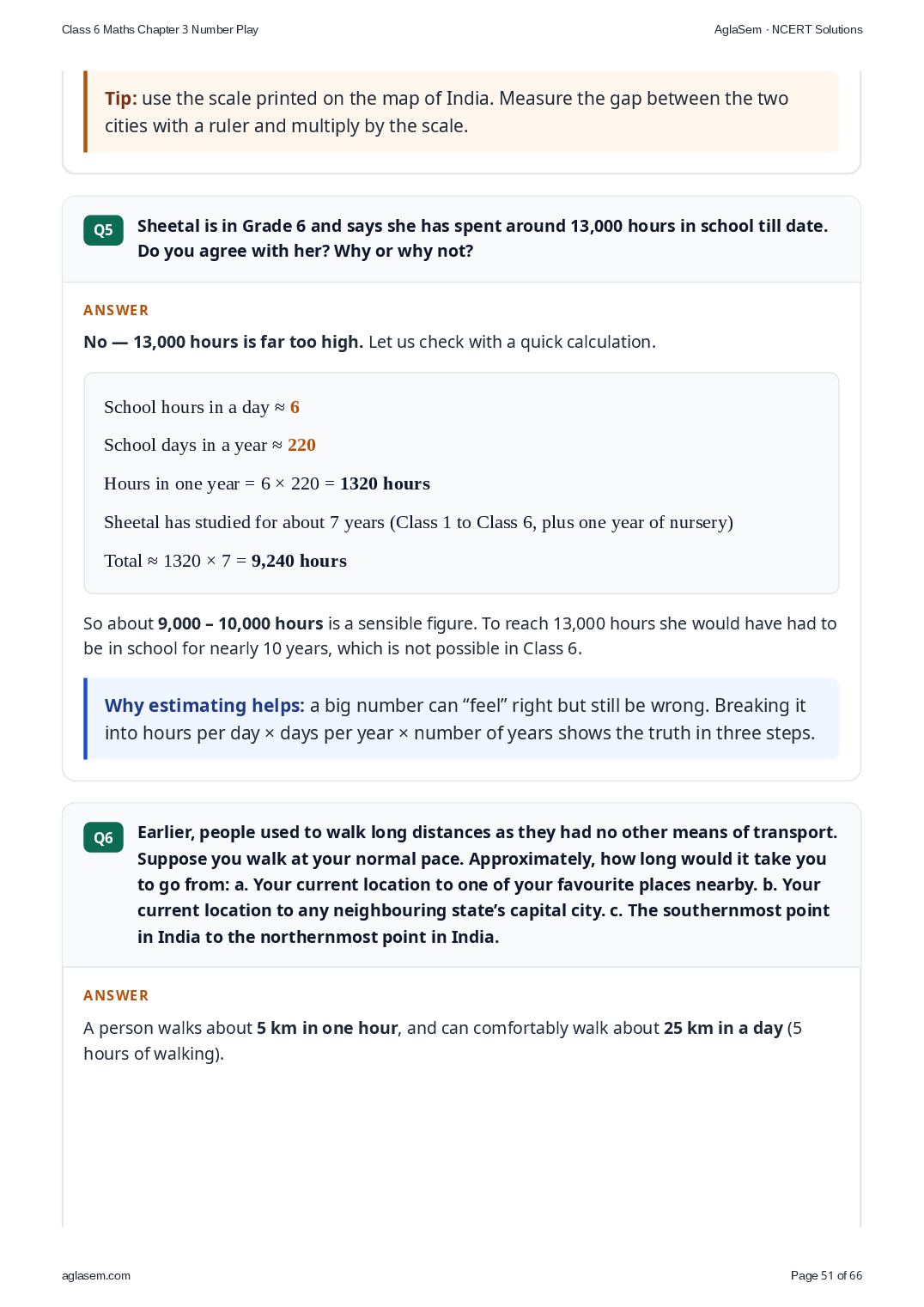
- Sheetal is in Grade 6 and says she has spent around 13,000 hours in school till date. Do you agree with her? Why or why not?
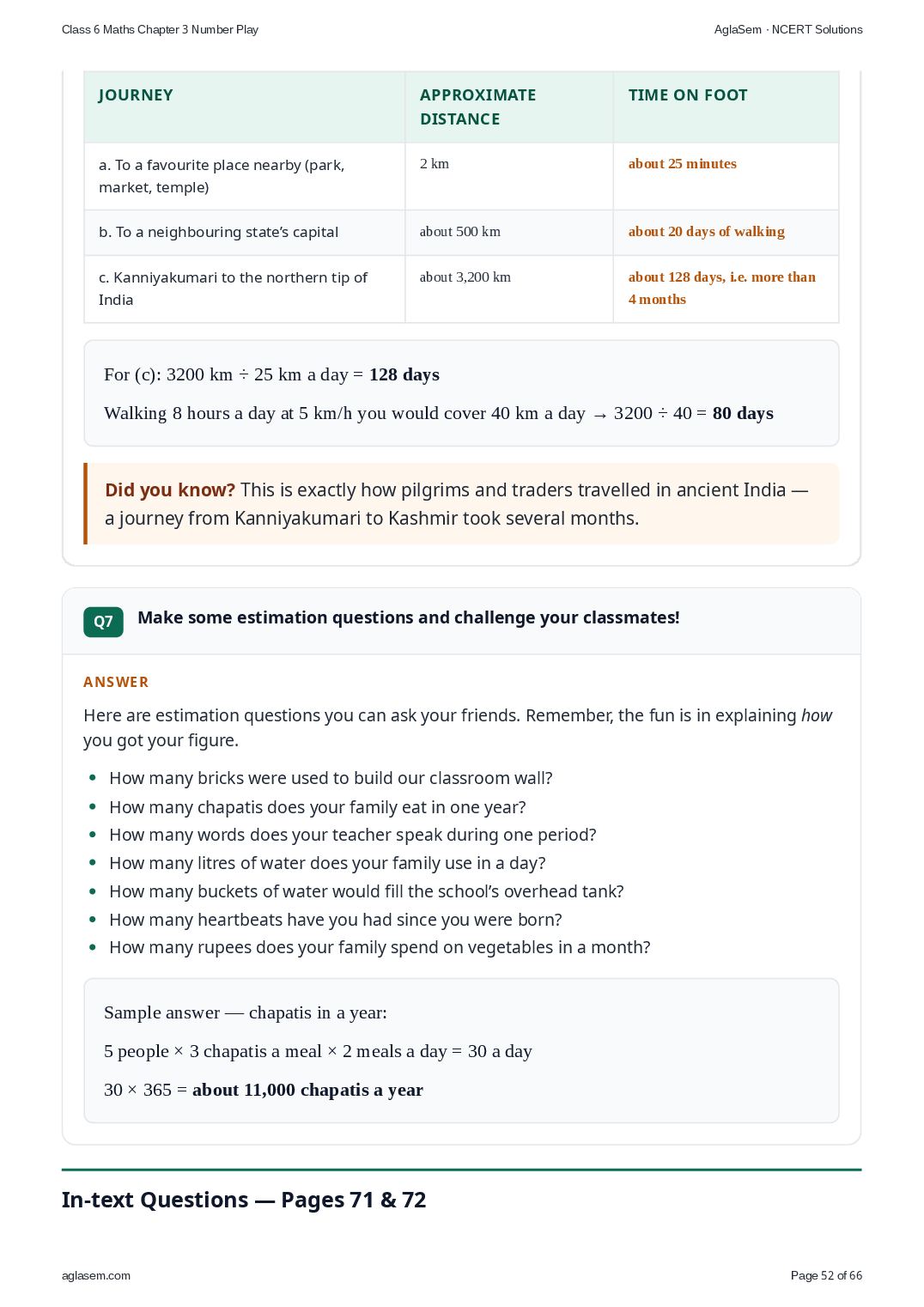
- Earlier, people used to walk long distances as they had no other means of transport. Suppose you walk at your normal pace. Approximately, how long would it take you to go from: a. Your current location to one of your favourite places nearby. b. Your current location to any neighbouring state’s capital city. c. The southernmost point in India to the northernmost point in India.
- Make some estimation questions and challenge your classmates!
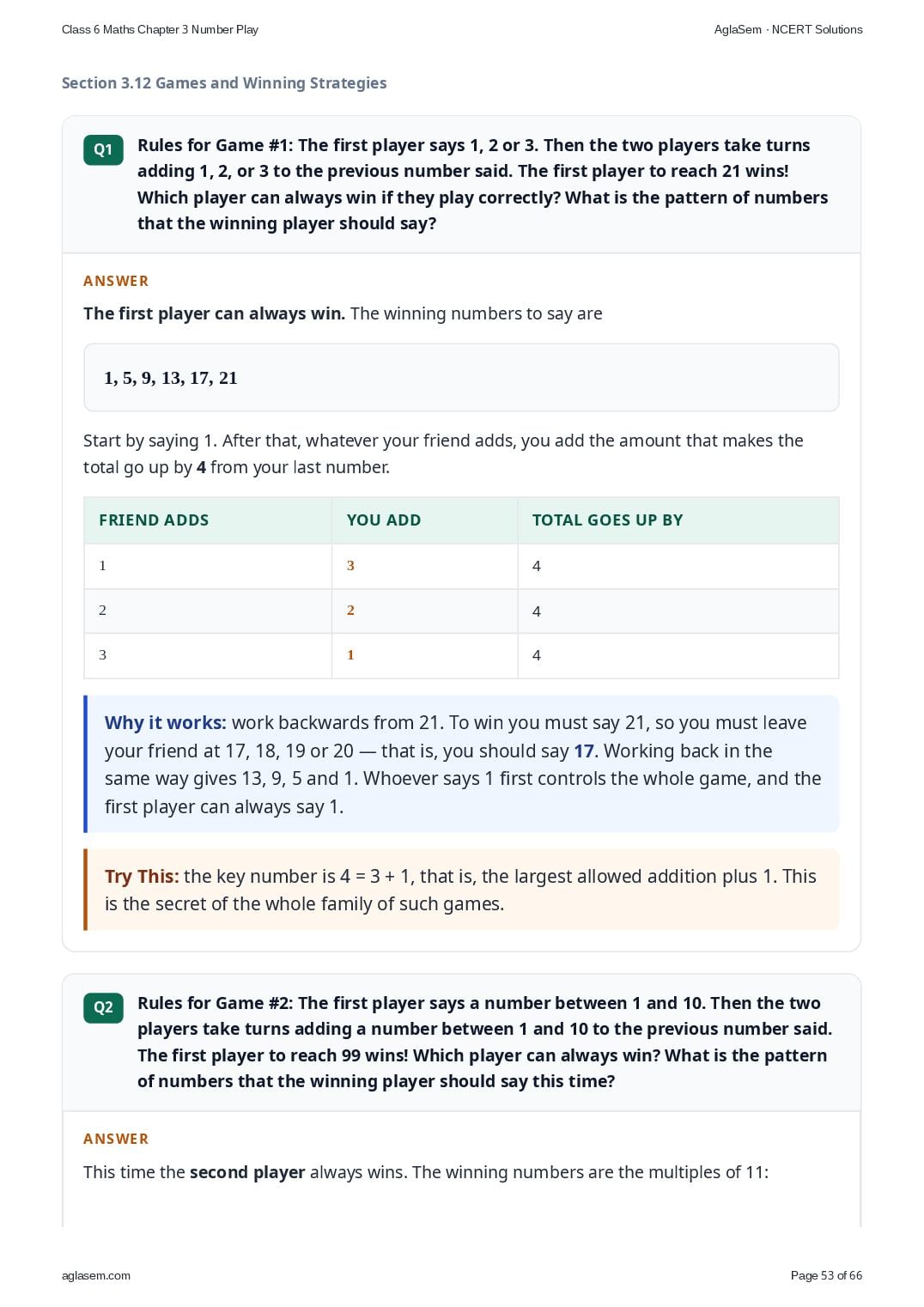
- Rules for Game #1: The first player says 1, 2 or 3. Then the two players take turns adding 1, 2, or 3 to the previous number said. The first player to reach 21 wins! Which player can always win if they play correctly? What is the pattern of numbers that the winning player should say?
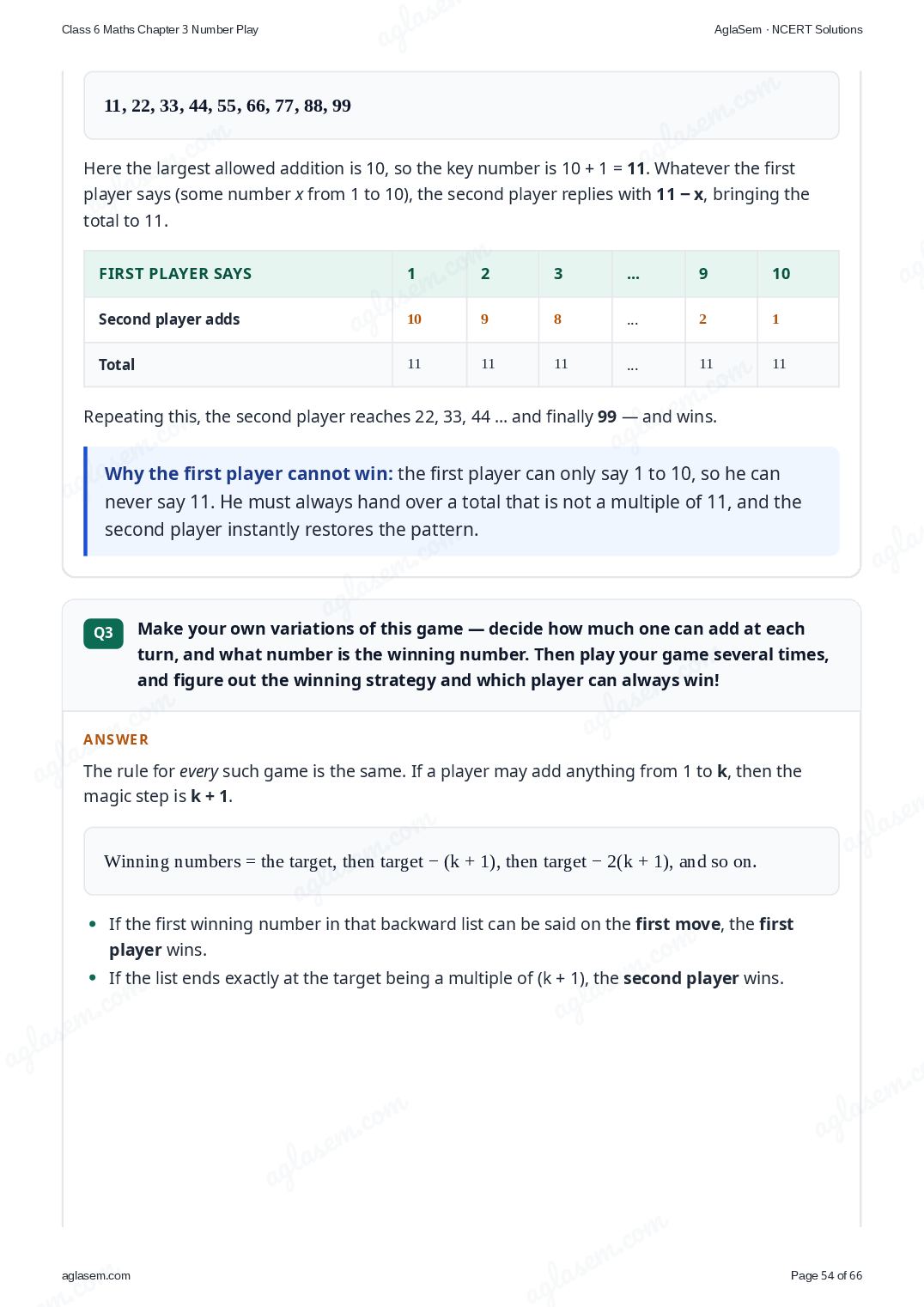
- Rules for Game #2: The first player says a number between 1 and 10. Then the two players take turns adding a number between 1 and 10 to the previous number said. The first player to reach 99 wins! Which player can always win? What is the pattern of numbers that the winning player should say this time?
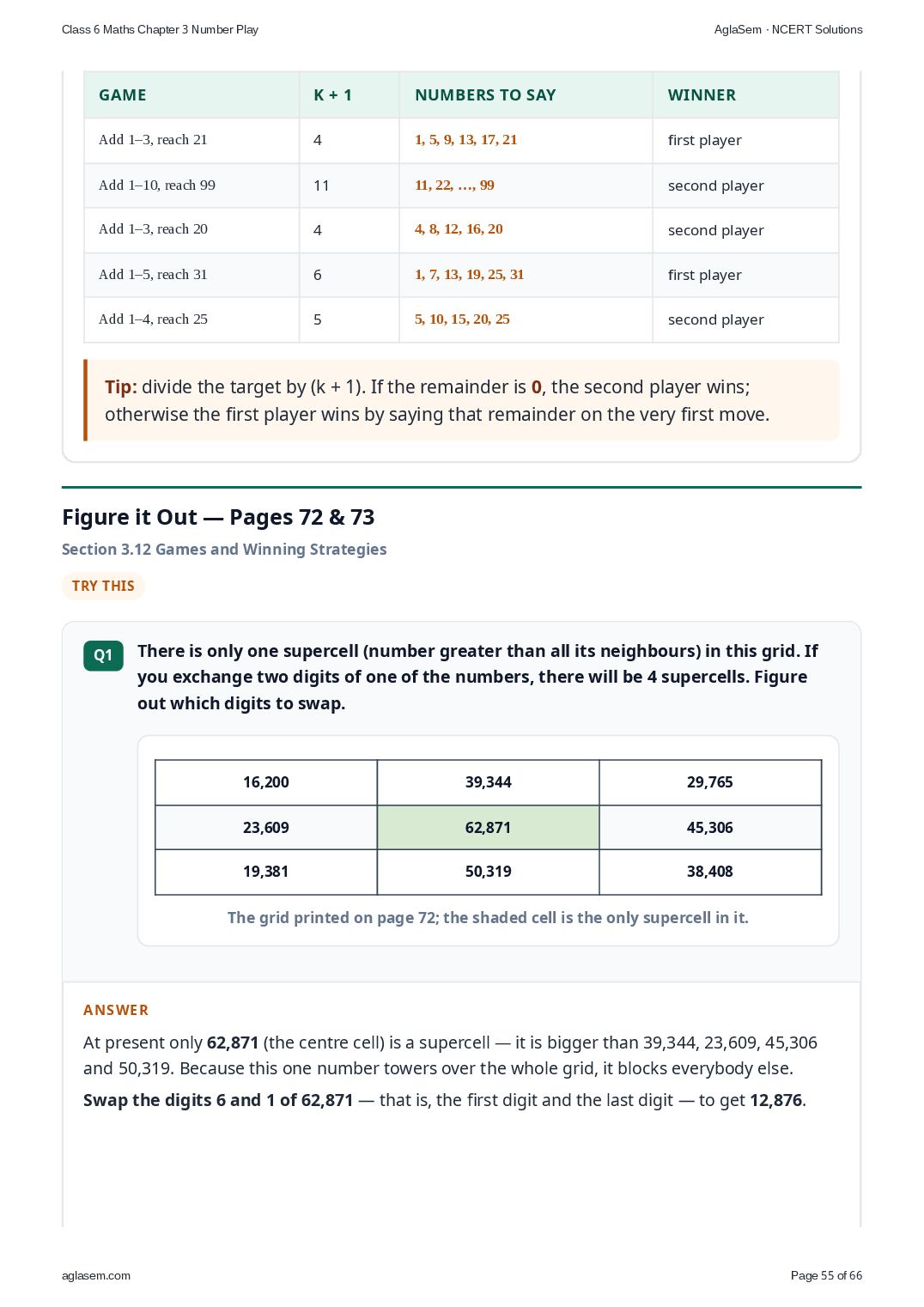
- Make your own variations of this game — decide how much one can add at each turn, and what number is the winning number. Then play your game several times, and figure out the winning strategy and which player can always win!
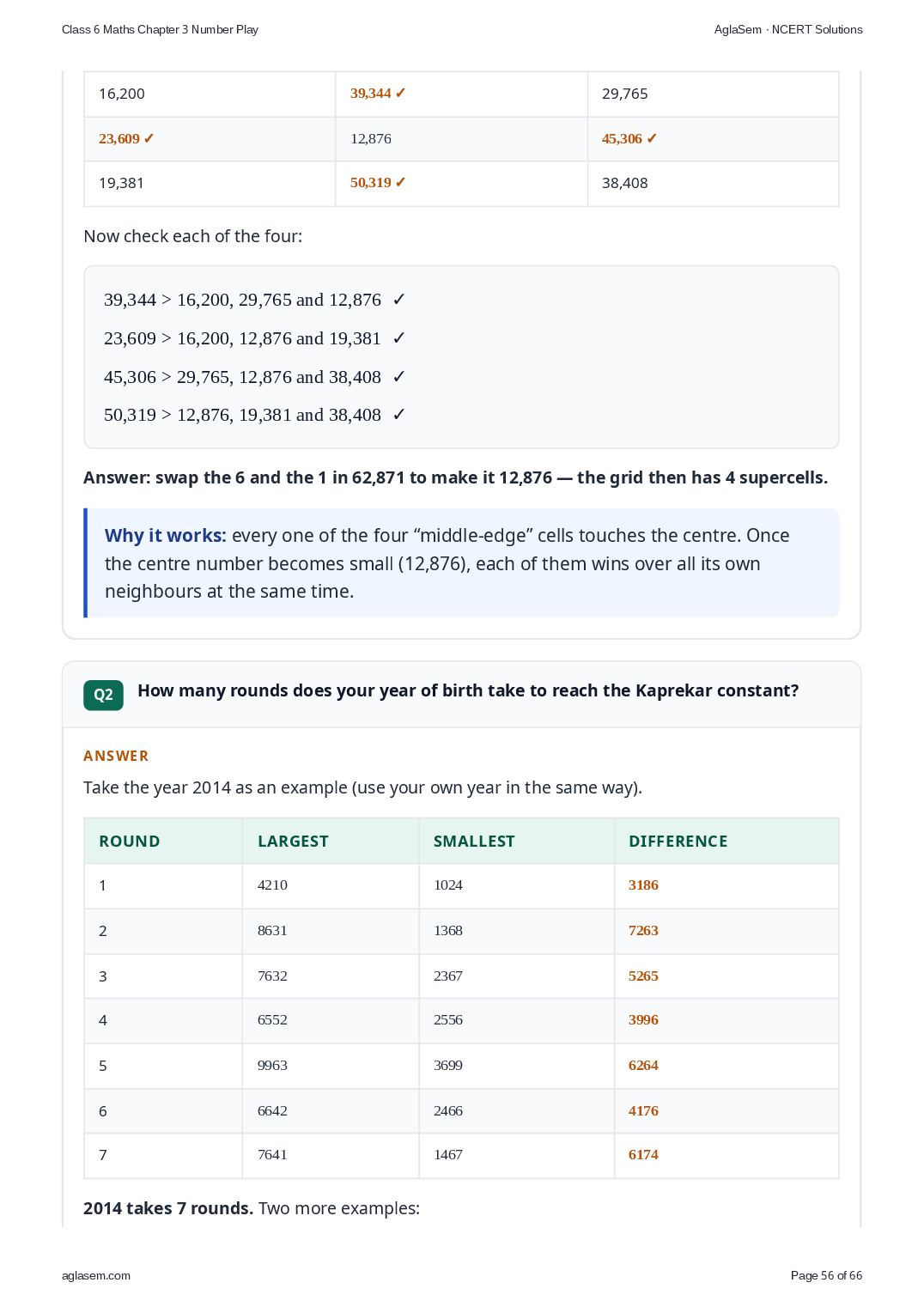
- There is only one supercell (number greater than all its neighbours) in this grid: 16,200 | 39,344 | 29,765 / 23,609 | 62,871 | 45,306 / 19,381 | 50,319 | 38,408. If you exchange two digits of one of the numbers, there will be 4 supercells. Figure out which digits to swap.
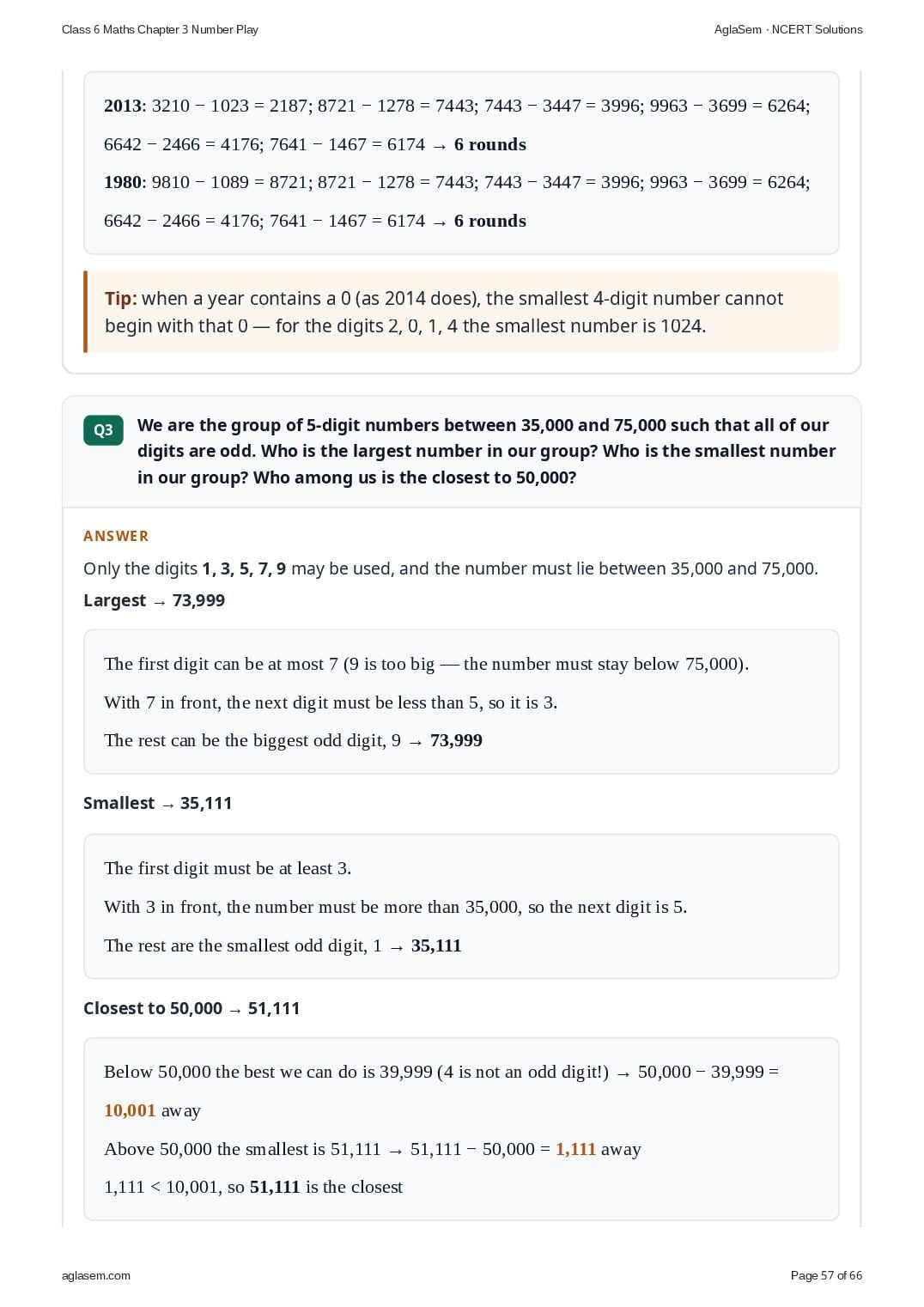
- How many rounds does your year of birth take to reach the Kaprekar constant?
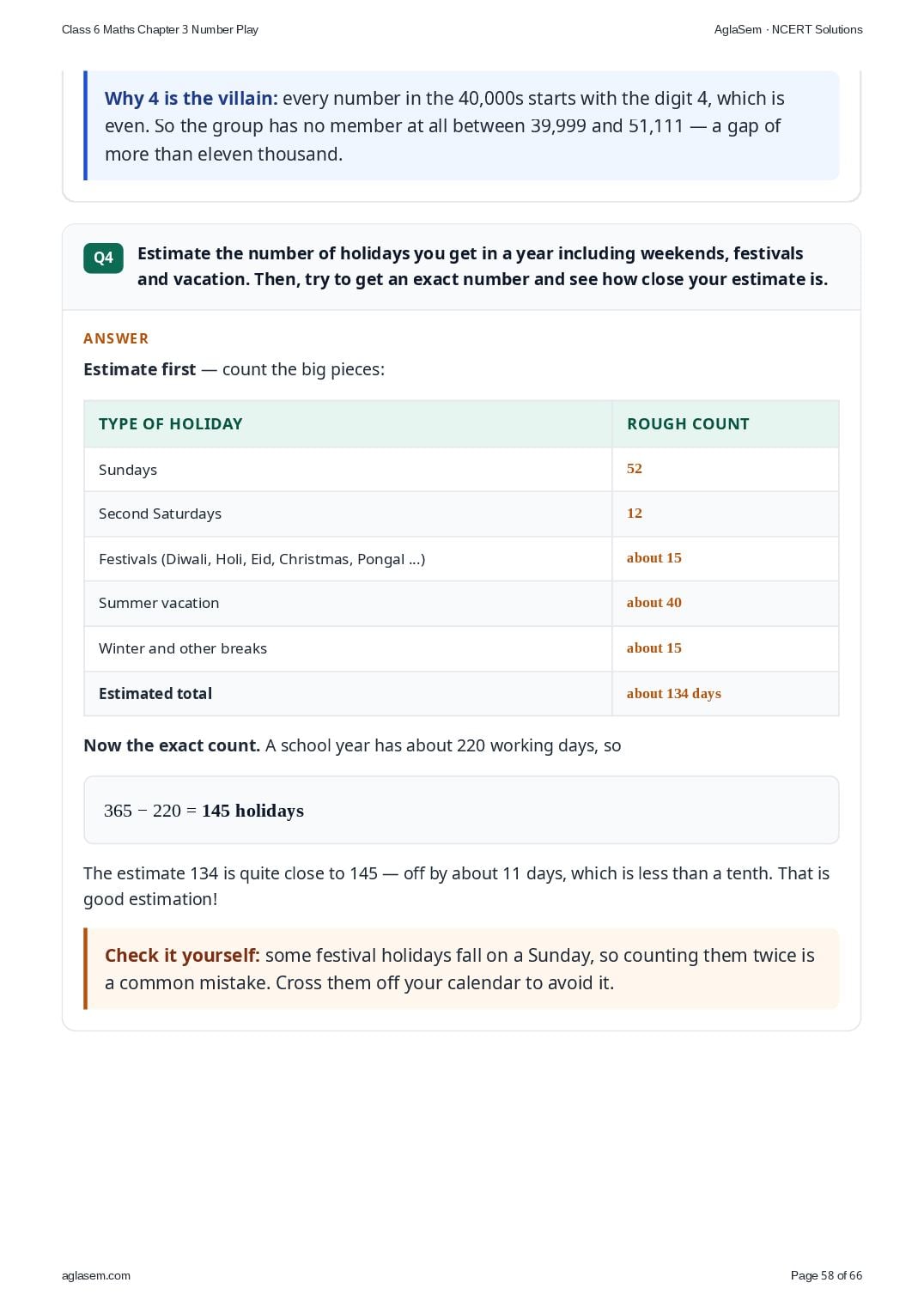
- We are the group of 5-digit numbers between 35,000 and 75,000 such that all of our digits are odd. Who is the largest number in our group? Who is the smallest number in our group? Who among us is the closest to 50,000?
- Estimate the number of holidays you get in a year including weekends, festivals and vacation. Then, try to get an exact number and see how close your estimate is.
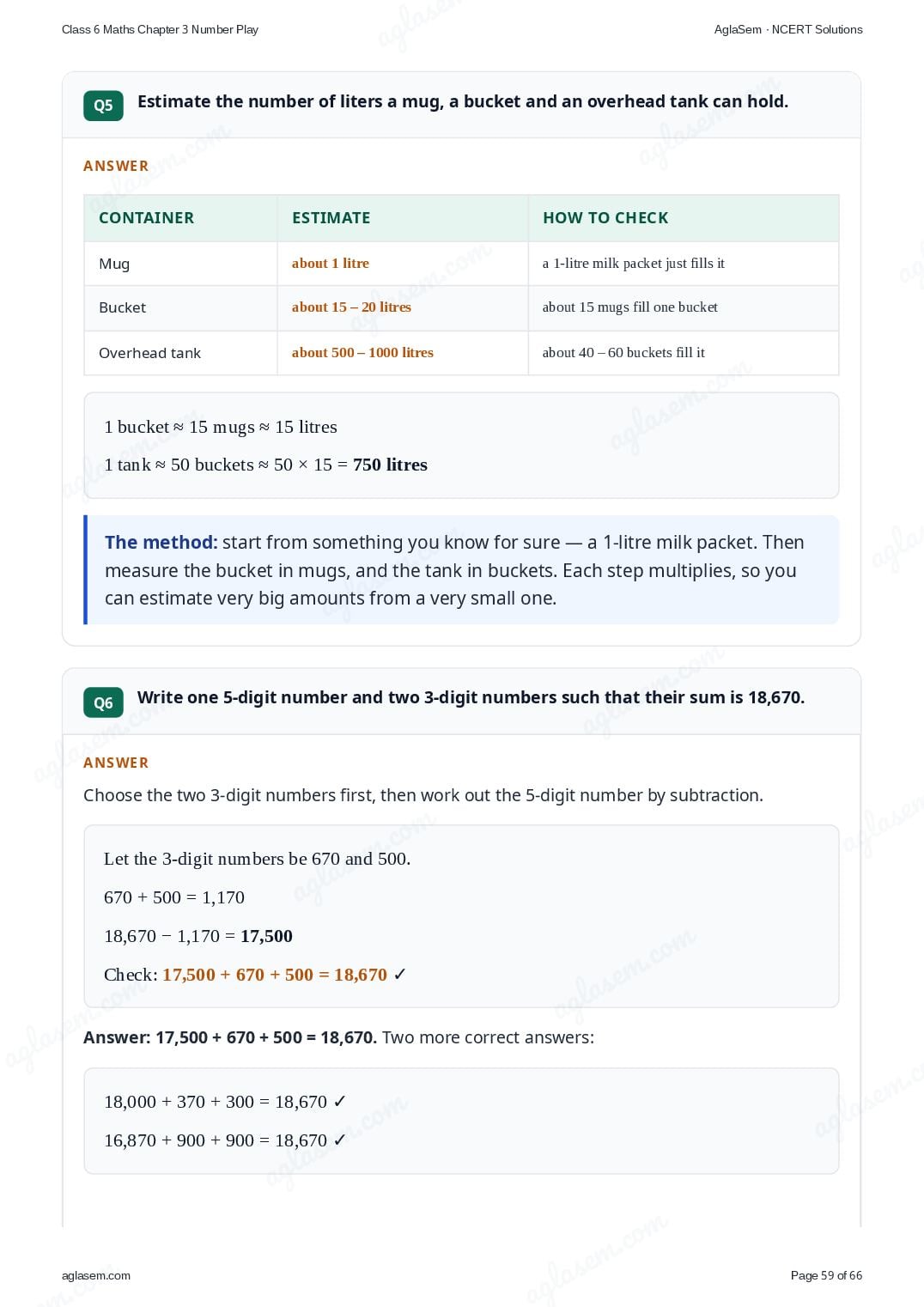
- Estimate the number of liters a mug, a bucket and an overhead tank can hold.
- Write one 5-digit number and two 3-digit numbers such that their sum is 18,670.
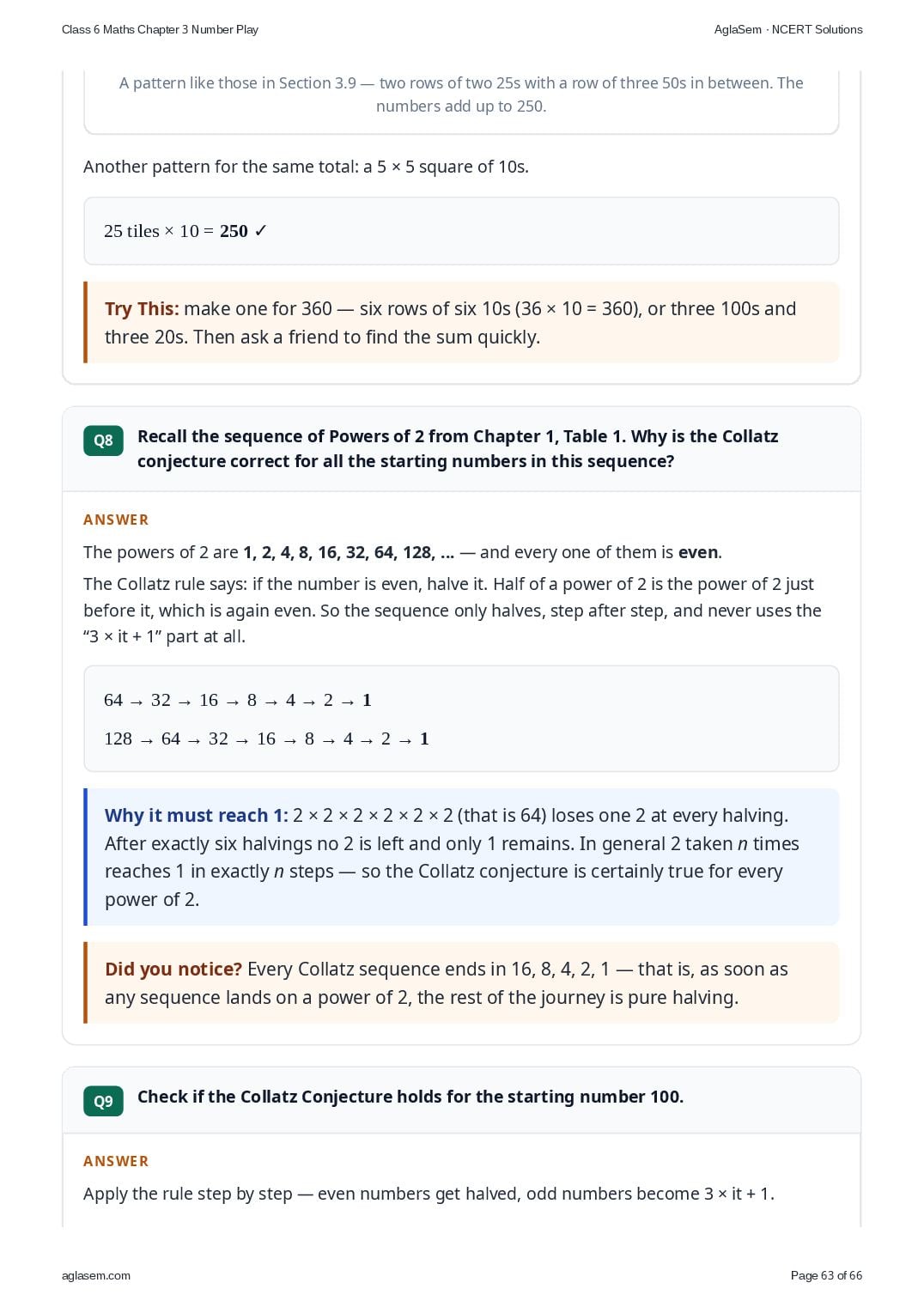
- Choose a number between 210 and 390. Create a number pattern similar to those shown in Section 3.9 that will sum up to this number.
- Recall the sequence of Powers of 2 from Chapter 1, Table 1. Why is the Collatz conjecture correct for all the starting numbers in this sequence?
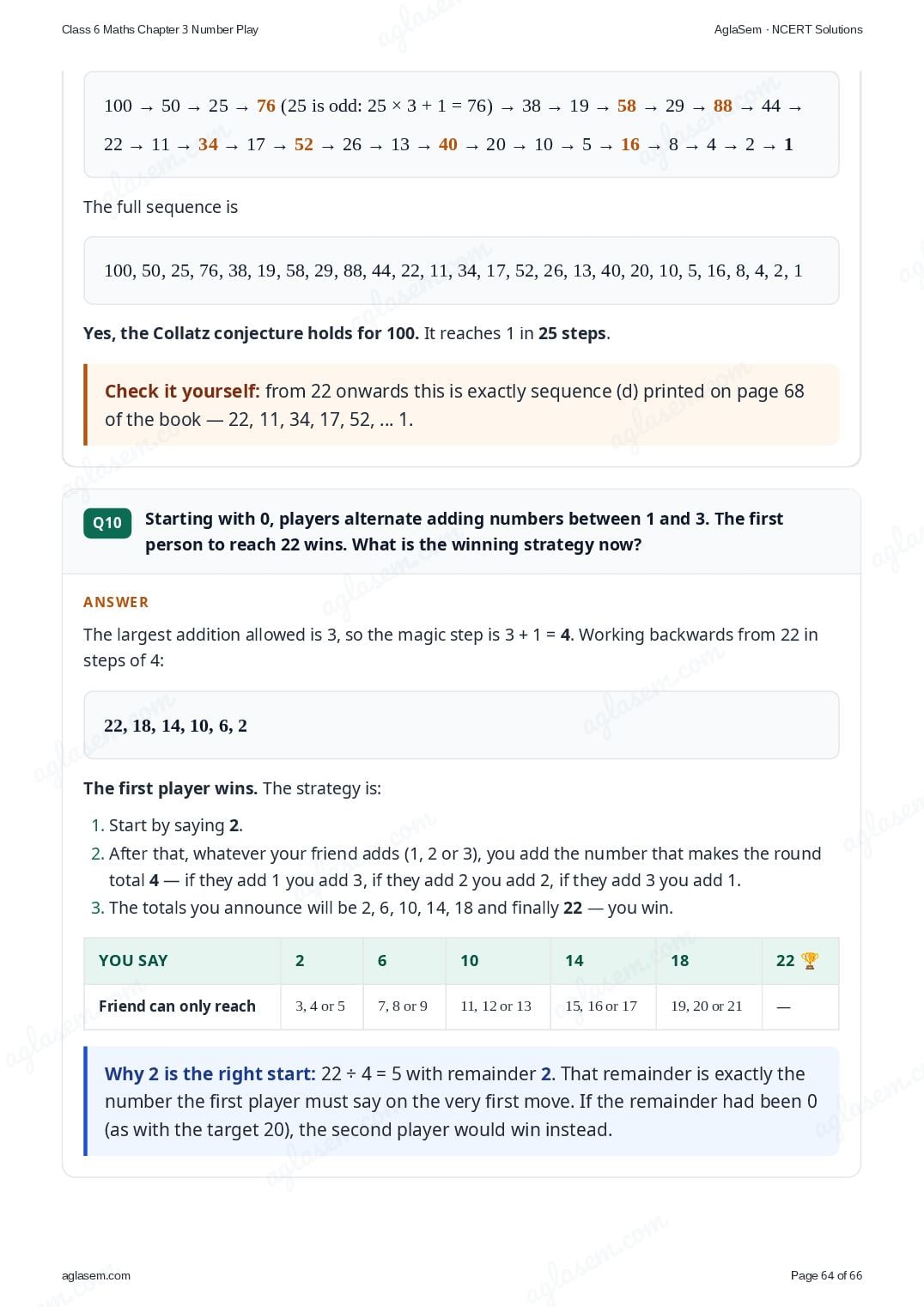
- Check if the Collatz Conjecture holds for the starting number 100.
- Starting with 0, players alternate adding numbers between 1 and 3. The first person to reach 22 wins. What is the winning strategy now?
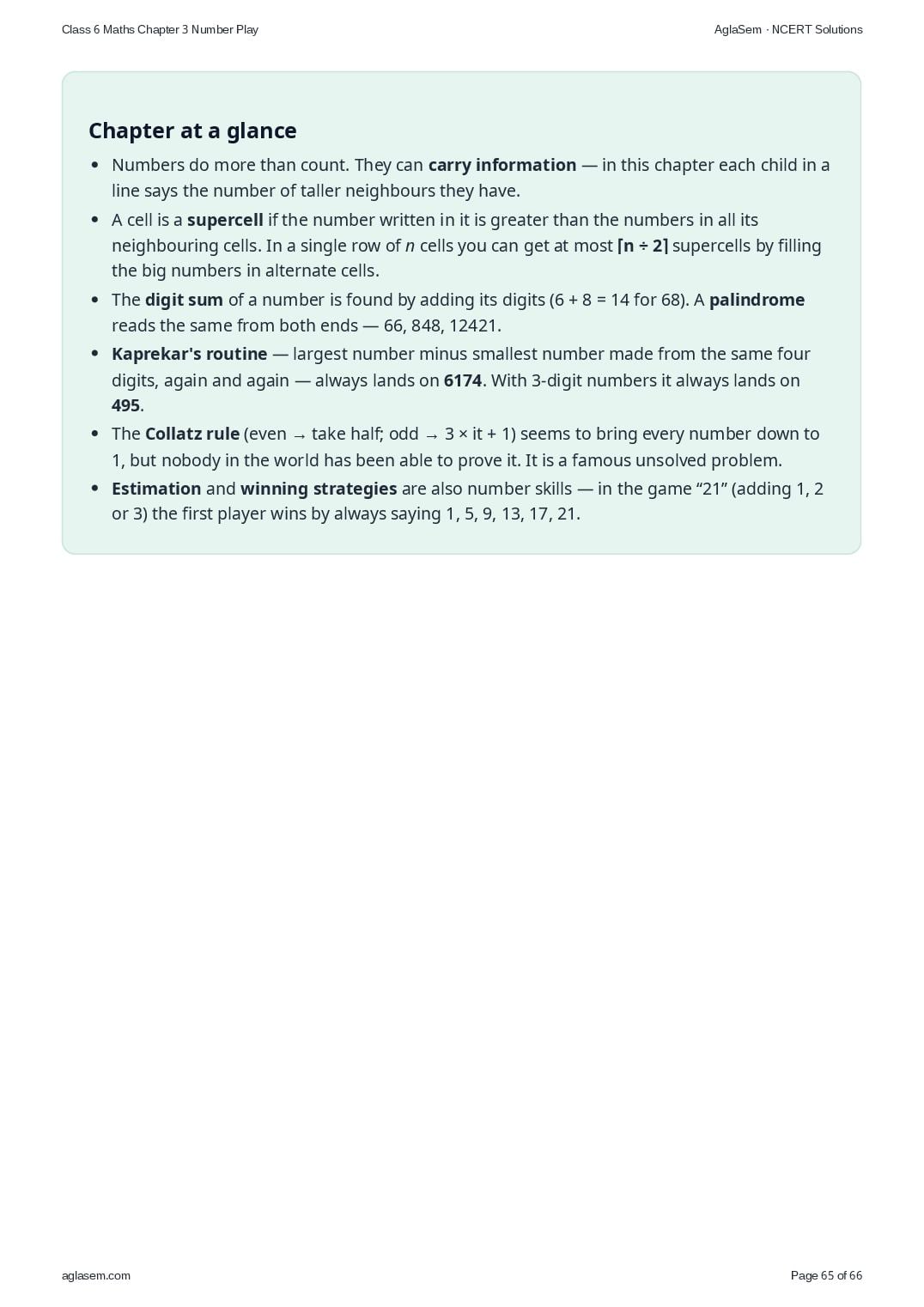
Chapter at a Glance
- Numbers do more than count. They can carry information — in this chapter each child in a line says the number of taller neighbours they have.
- A cell is a supercell if the number written in it is greater than the numbers in all its neighbouring cells. In a single row of n cells you can get at most ⌈n ÷ 2⌉ supercells by filling the big numbers in alternate cells.
- The digit sum of a number is found by adding its digits (6 + 8 = 14 for 68). A palindrome reads the same from both ends — 66, 848, 12421.
- Kaprekar's routine — largest number minus smallest number made from the same four digits, again and again — always lands on 6174 . With 3-digit numbers it always lands on 495 .
- The Collatz rule (even → take half; odd → 3 × it + 1) seems to bring every number down to 1, but nobody in the world has been able to prove it. It is a famous unsolved problem.
- Estimation and winning strategies are also number skills — in the game “21” (adding 1, 2 or 3) the first player wins by always saying 1, 5, 9, 13, 17, 21.
How to Download NCERT Solutions for Class 6 Maths Chapter 3 PDF
Follow these simple steps to get the Number Play questions-and-answers PDF from Ganita Prakash.
- Search NCERT Solutions for Class 6 Maths Chapter 3 aglasem and open this page.
- Read the exercise questions with answers for Number Play shown above.
- Click the Download PDF link to save the Number Play solutions to your device.
NCERT Solutions for Class 6 Maths – All Chapters
There are more chapters to study besides Number Play in Maths. Here are the NCERT Solutions for all chapters of Class 6 Maths.
- Chapter 1 Patterns in Mathematics
- Chapter 2 Lines and Angles
- Chapter 3 Number Play
- Chapter 4 Data Handling and Presentation
- Chapter 5 Prime Time
- Chapter 6 Perimeter and Area
- Chapter 7 Fractions
- Chapter 8 Playing with Constructions
- Chapter 9 Symmetry
- Chapter 10 the Other Side of Zero
NCERT Solutions for Class 6 – All Subjects
Just like Chapter 3 of Maths, you can get the exercise questions with answers for every other subject of Class 6. Here are the NCERT Solutions for all subjects of Class 6.
NCERT Solutions for Class 6 Maths Chapter 3 – An Overview
The key highlights of this study material are as follows.
| Aspects | Details |
|---|---|
| Class | Class 6 |
| Subject | Maths |
| Chapter Number | Chapter 3 |
| Chapter Name | Number Play |
| Book Name | Ganita Prakash |
| Book By | NCERT (National Council of Educational Research and Training) |
| Educational Resource Here | NCERT Solutions of Class 6 Maths Chapter 3 for all exercises |
| More Questions Answers of This Subject | NCERT Solutions for Class 6 Maths |
| Download Book Chapter | NCERT Book Class 6 Maths |
| All Questions Answers For This Class | NCERT Solutions for Class 6 |
| Complete Solutions | NCERT Solutions |
NCERT Solutions for Class 6 Maths Chapter 3 Number Play – FAQs
What are the NCERT Solutions for Class 6 Maths Chapter 3 Number Play?
They are the complete, step-by-step answers to all the exercise and in-text questions of Chapter 3 Number Play from the NCERT Class 6 Maths textbook Ganita Prakash, written by experts as per the latest NCERT syllabus.
How can I download the Class 6 Maths Chapter 3 solutions PDF for free?
Open this page on aglasem, read the Number Play questions with answers, and click the “Download Solutions PDF” link. The Class 6 Maths Chapter 3 NCERT Solutions PDF is completely free to download.
Are these NCERT Solutions as per the latest 2026-27 syllabus?
Yes. The NCERT Solutions for Class 6 Maths Chapter 3 are based on the latest NCERT textbook Ganita Prakash and the current 2026-27 CBSE syllabus, so the questions and answers match what you study in class.
Where can I get NCERT Solutions for the other chapters of Class 6 Maths?
You can find the answers to every chapter on the NCERT Solutions for Class 6 Maths page, and solutions for every subject on the NCERT Solutions for Class 6 page.
How do NCERT Solutions help in exam preparation?
They show the correct method to solve each question, help you write answers the way they are expected in exams, let you check and correct your own work, and save revision time — which together improve your marks in Class 6 Maths.
If you have any queries on NCERT Solutions for Class 6 Maths Chapter 3 Number Play, then please ask in the comments below.