Download the CBSE Class 10 Hindi A Sample Paper 2027 PDF with its marking scheme (solutions) – the official CBSE sample question paper (SQP) for the 2026-27 session, the paper to practise for the CBSE Class 10 board exam 2027. It is an 80-mark, 3-hour paper with 15 questions in 4 sections. The pattern is the same as the 2026 sample paper. The 2026 and 2025 sample papers are also here. Students also call it the CBSE 10th Hindi A model question paper 2027 or model test paper – it is the same official CBSE paper.
CBSE Class 10 Hindi A Sample Paper 2027 PDF Download
Open a paper to read it online or download the PDF. The marking scheme has the answers, with the marks for each step.
| Year | Document | Download |
|---|---|---|
| 2027 | CBSE Class 10 Sample Paper 2027 for Hindi Course A | View PDF |
| 2027 | CBSE Class 10 Sample Paper 2027 Solution (Marking Scheme) for Hindi Course A | View PDF |
| 2026 | CBSE Class 10 Sample Paper 2026 for Hindi Course A | View PDF |
| 2026 | CBSE Class 10 Sample Paper 2026 Solution for Hindi Course A | View PDF |
| 2025 | CBSE Class 10 Sample Paper 2025 for Hindi A | View PDF |
CBSE 10th Hindi A Model Question Paper 2027 – Quick Facts
| Board | Central Board of Secondary Education (CBSE) |
| Class | Class 10 |
| Subject | Hindi A (code 002 (printed as हिंदी (पाठ्यक्रम-अ) विषय कोड 002)) |
| Session | 2026-27 – for the board exam 2027 |
| Marks and time | 80 marks, 3 hours |
| Questions | 15 questions in 4 sections |
| Solutions | Yes – official CBSE marking scheme |
| Older papers | 2026, 2025 |
| Released by | CBSE (cbseacademic.nic.in) |
CBSE Class 10 Hindi A Sample Paper 2027 – Read Online
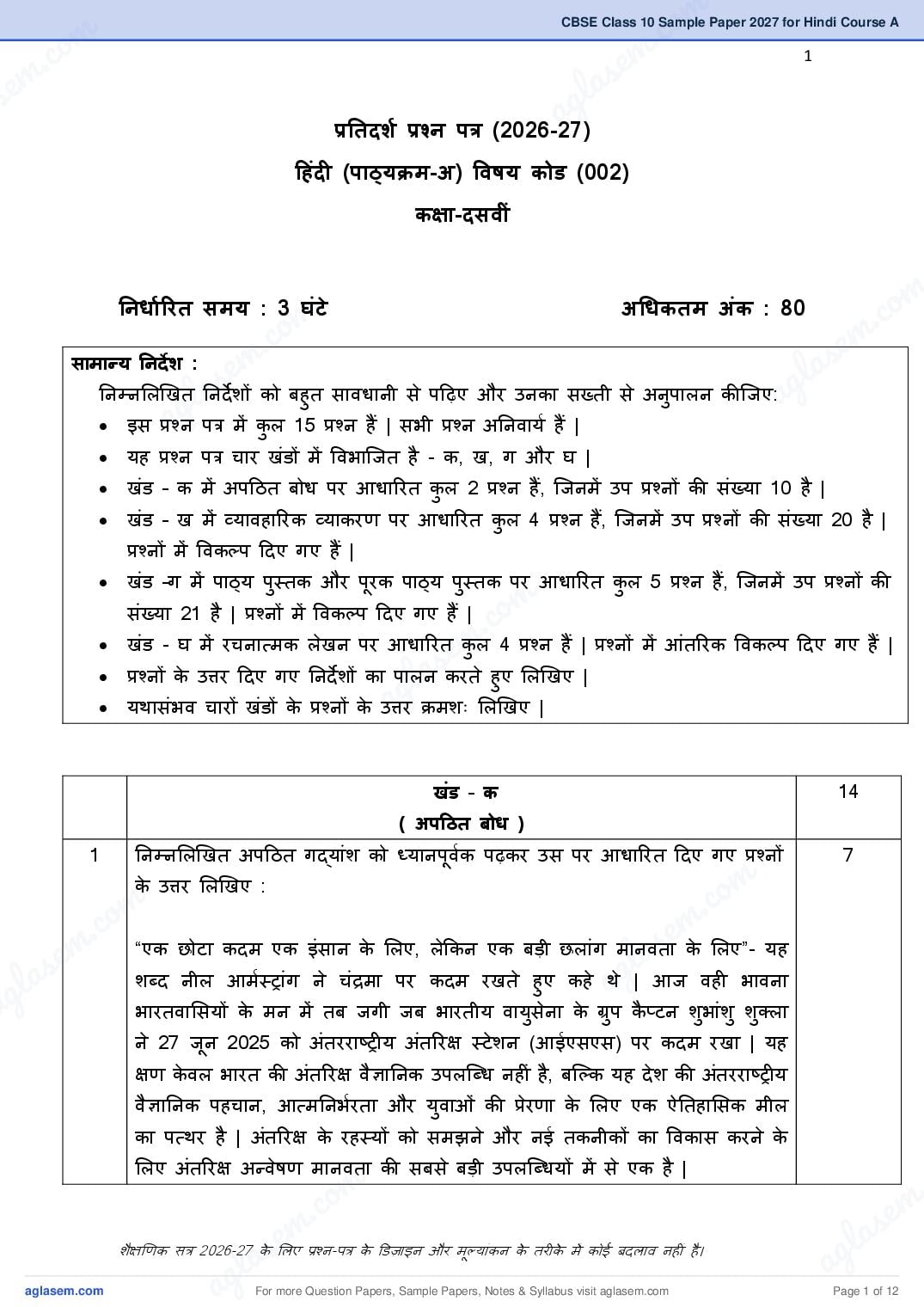
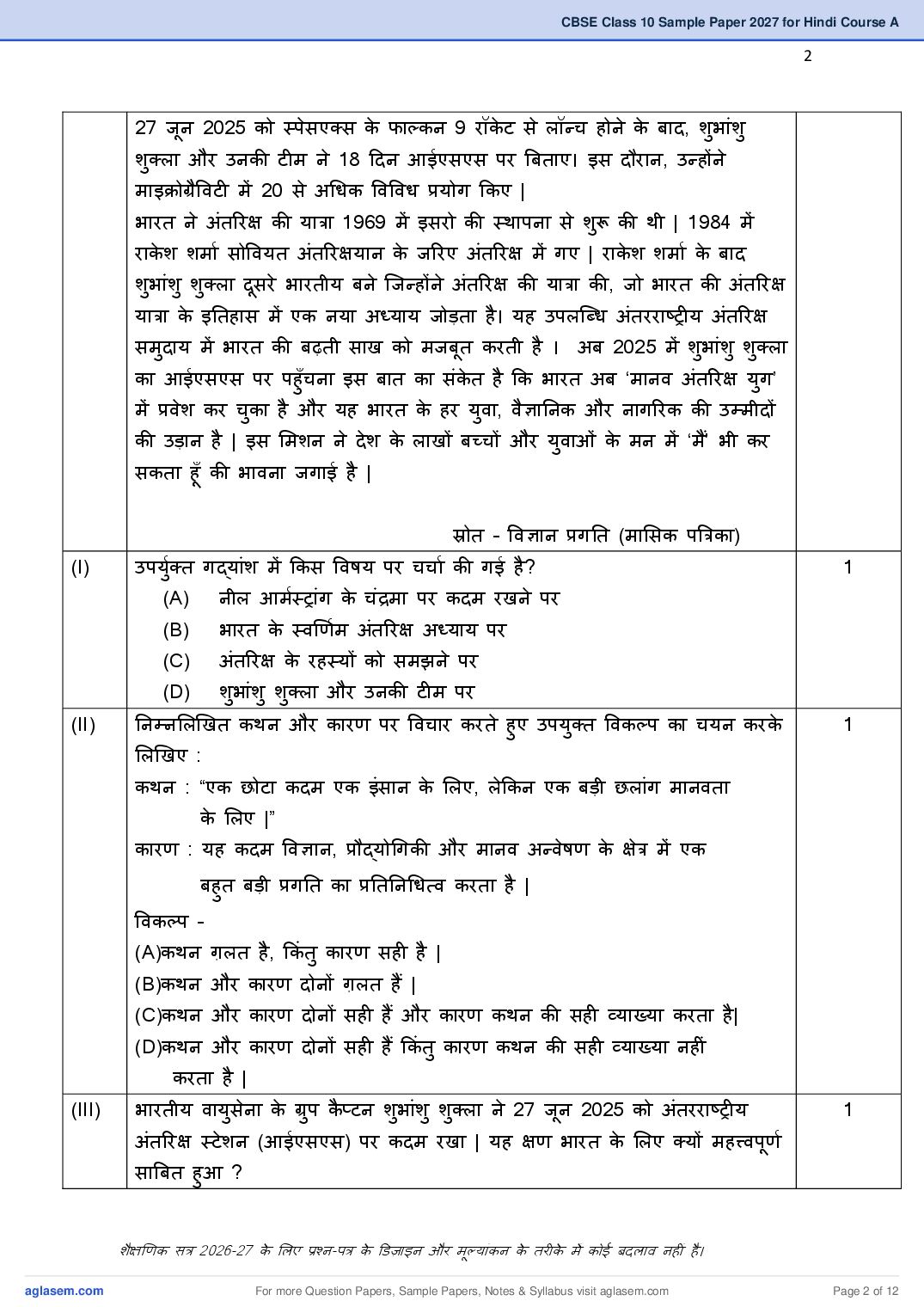
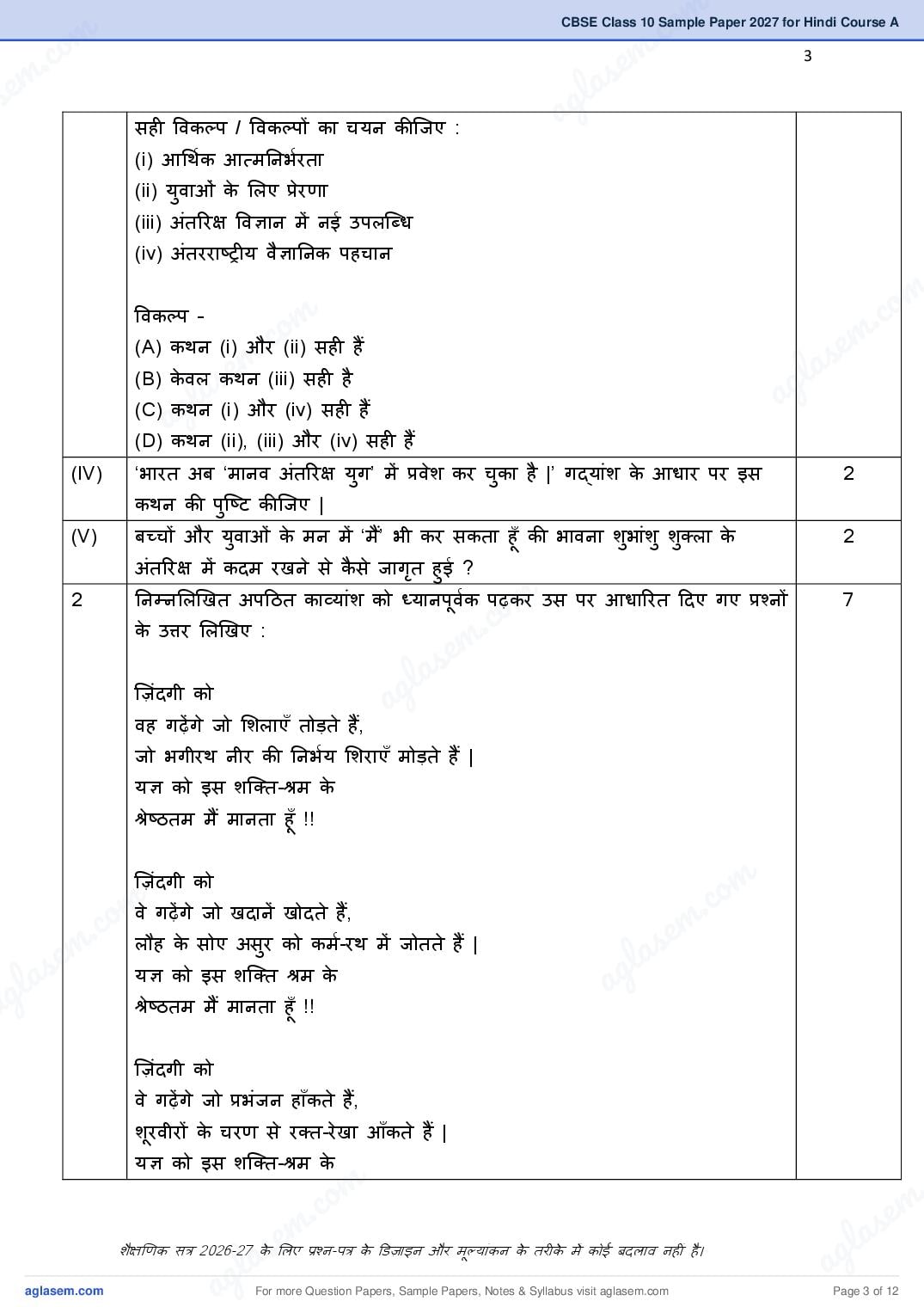
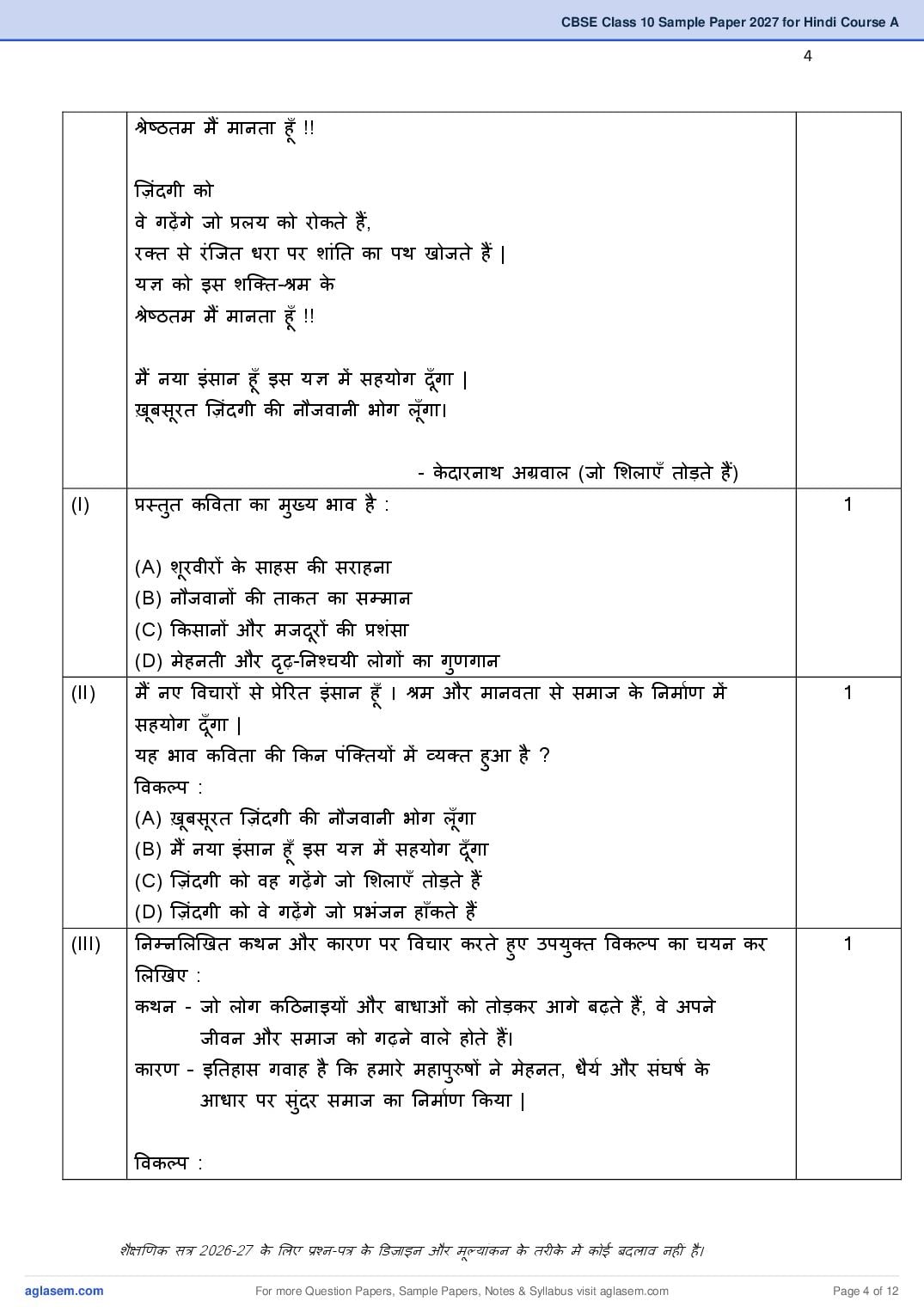
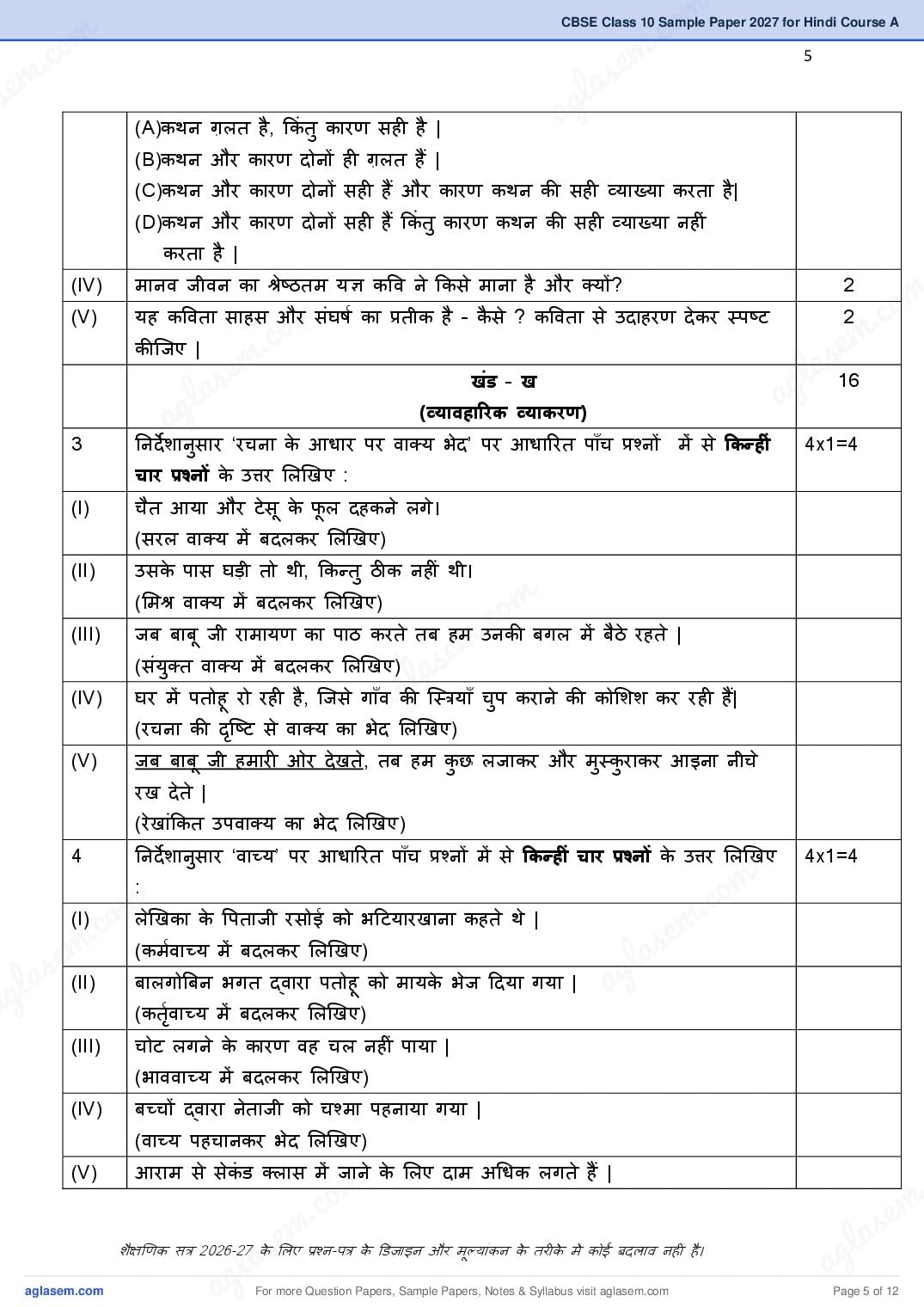
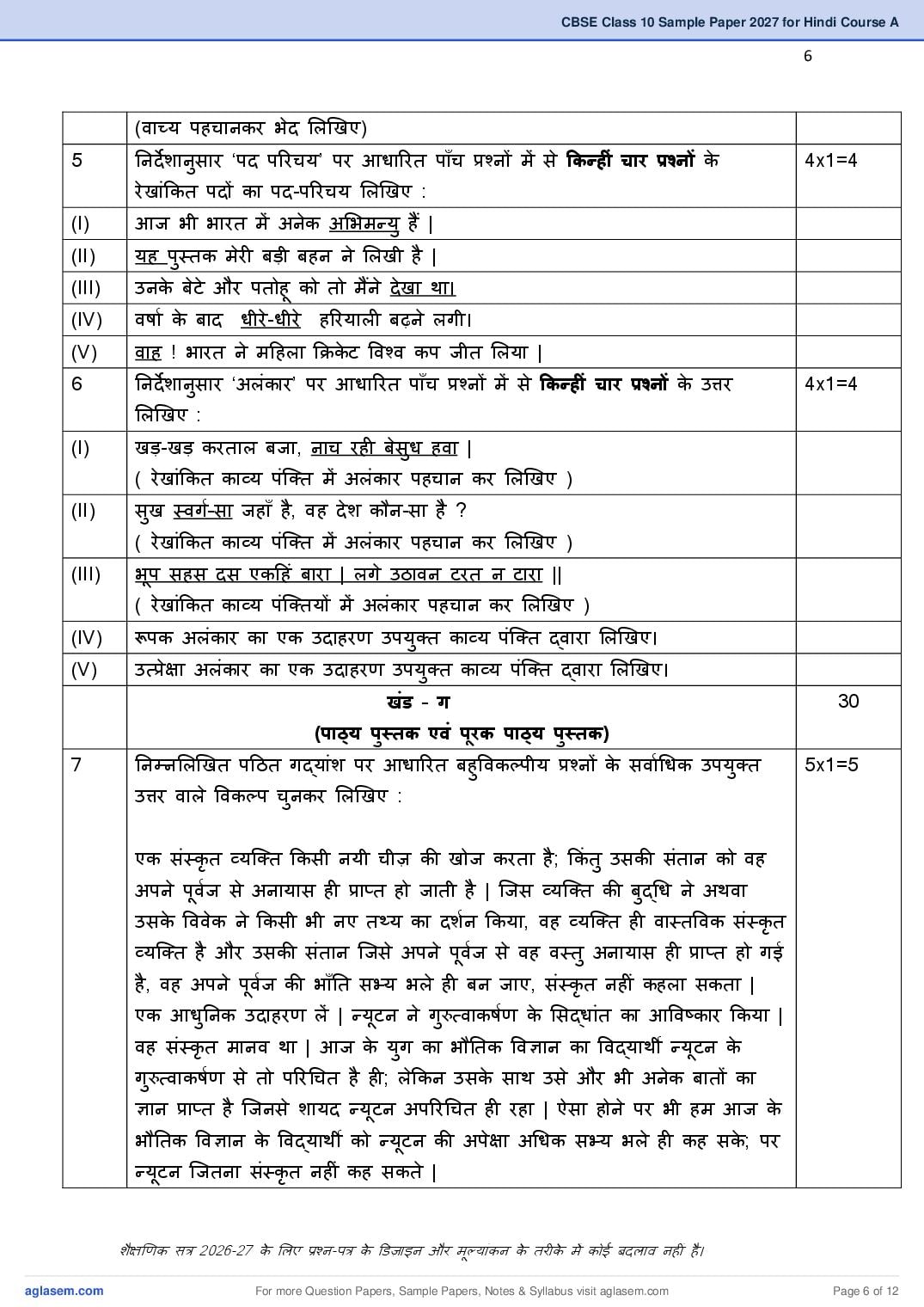
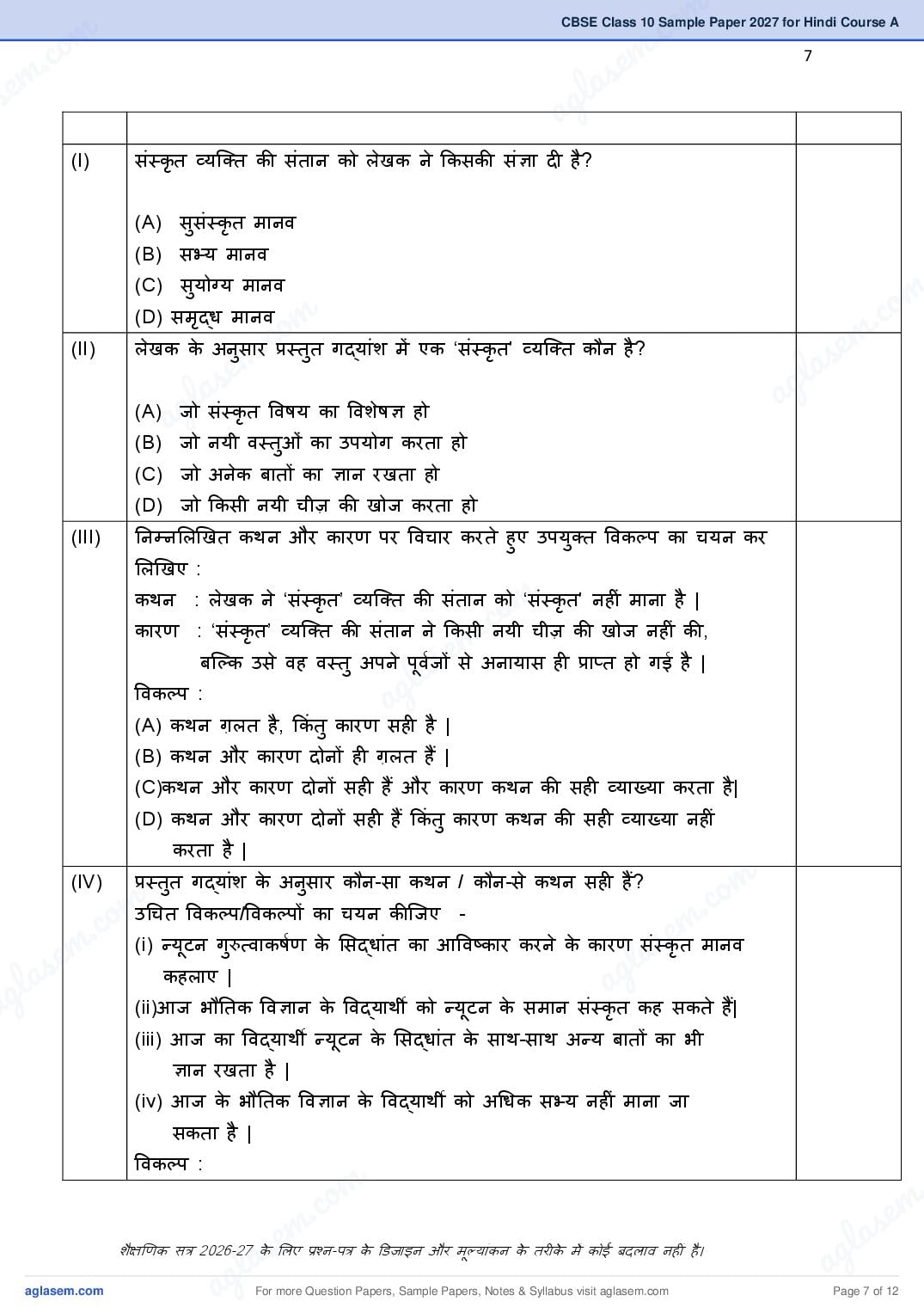
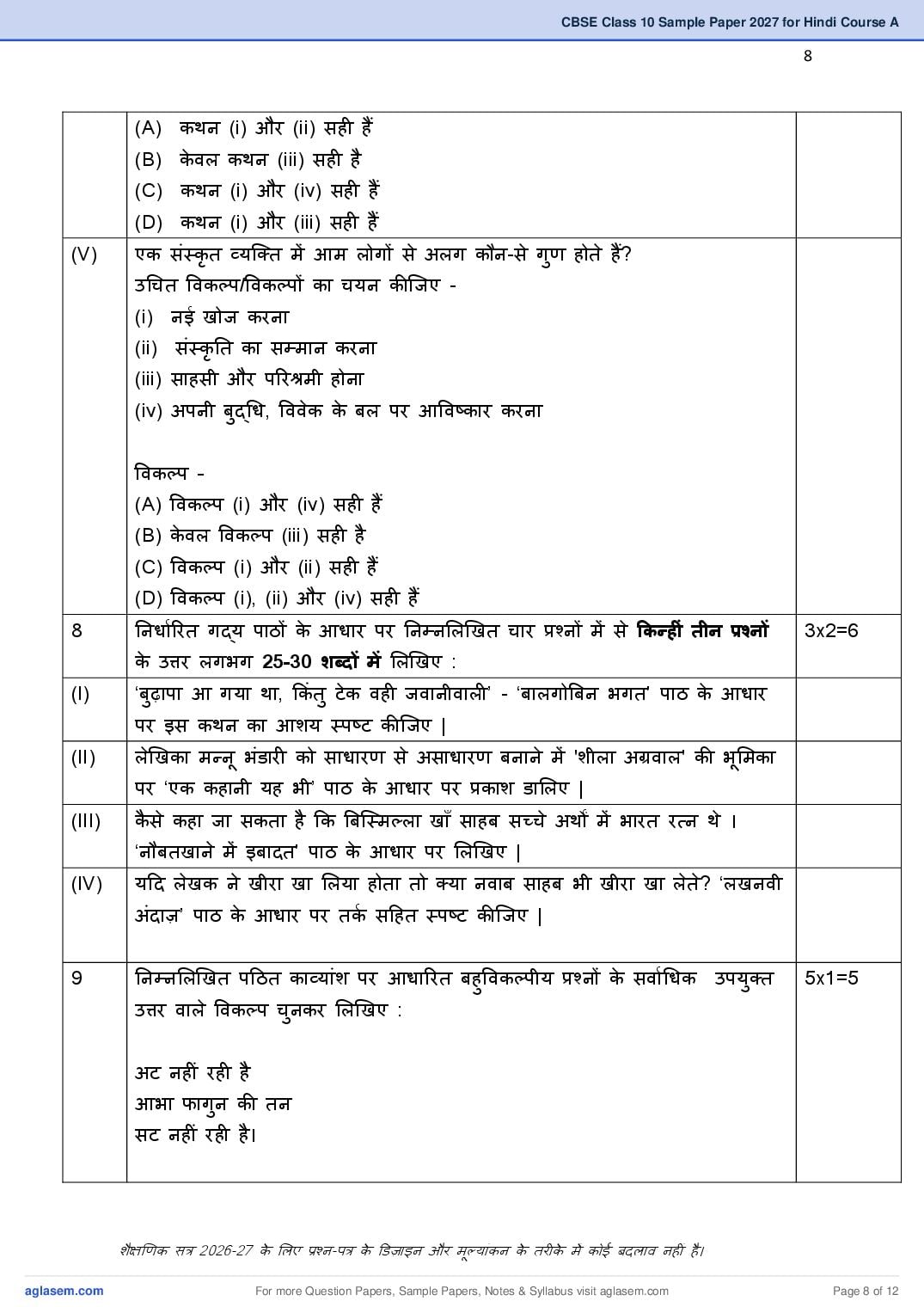
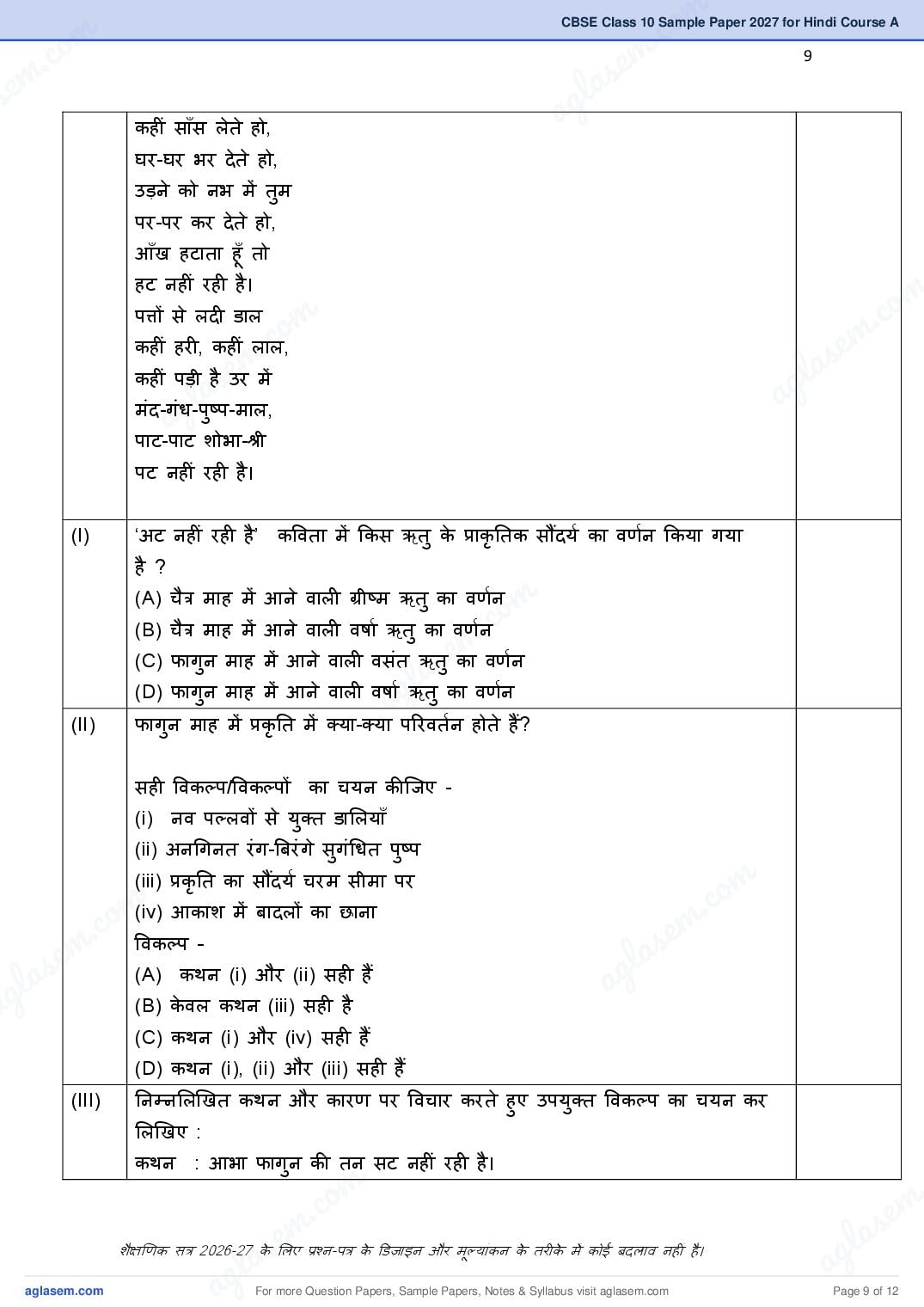
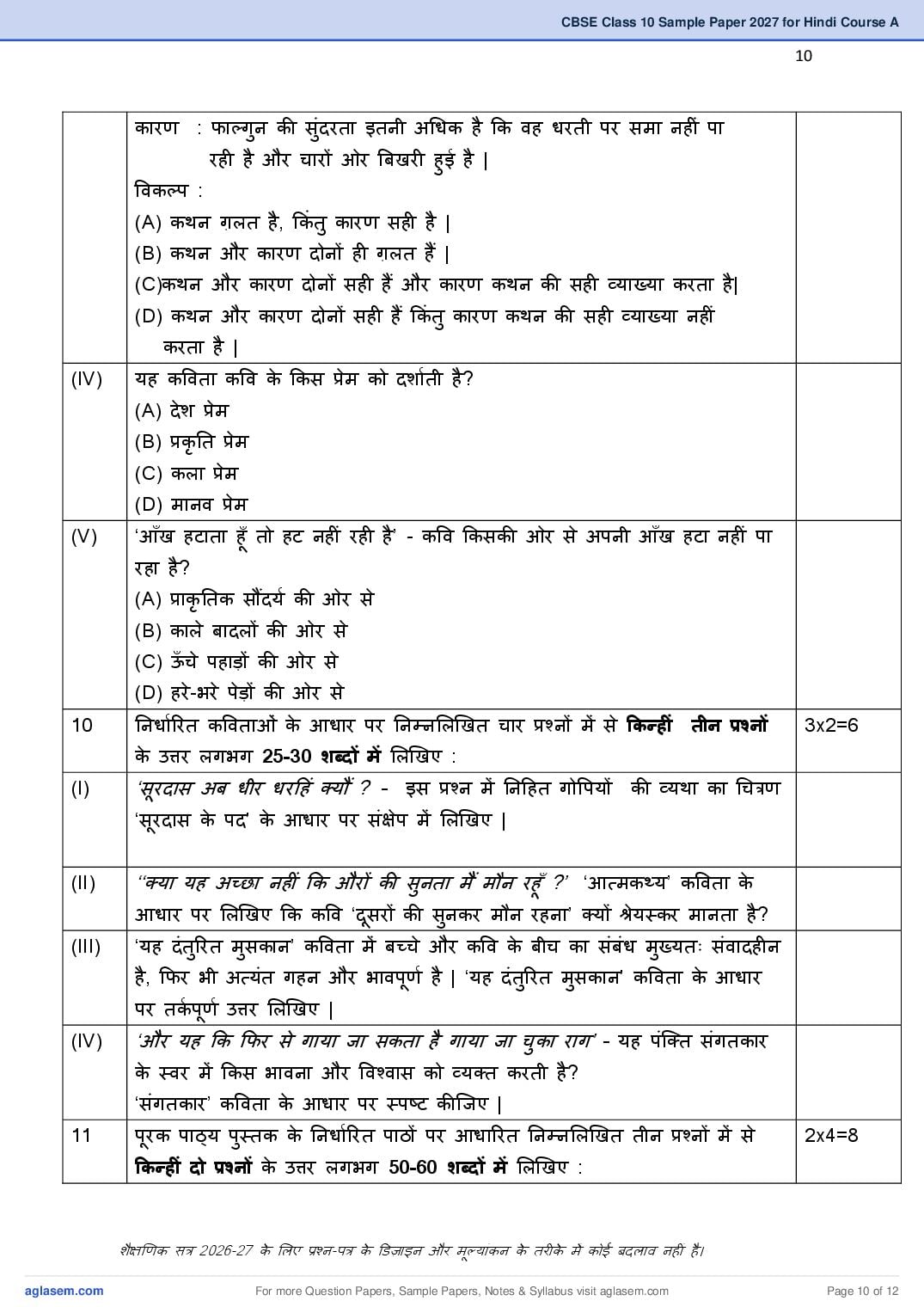
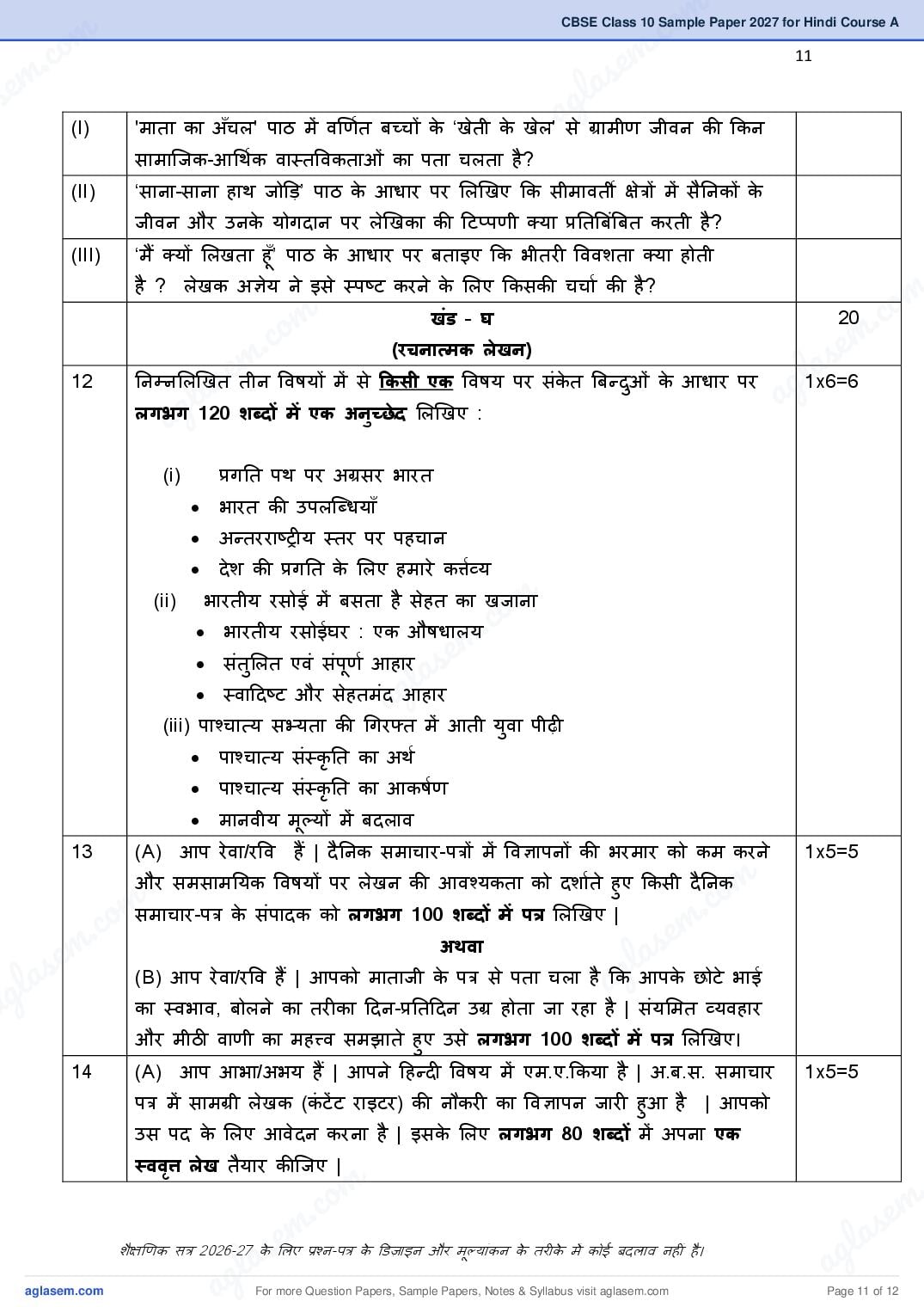
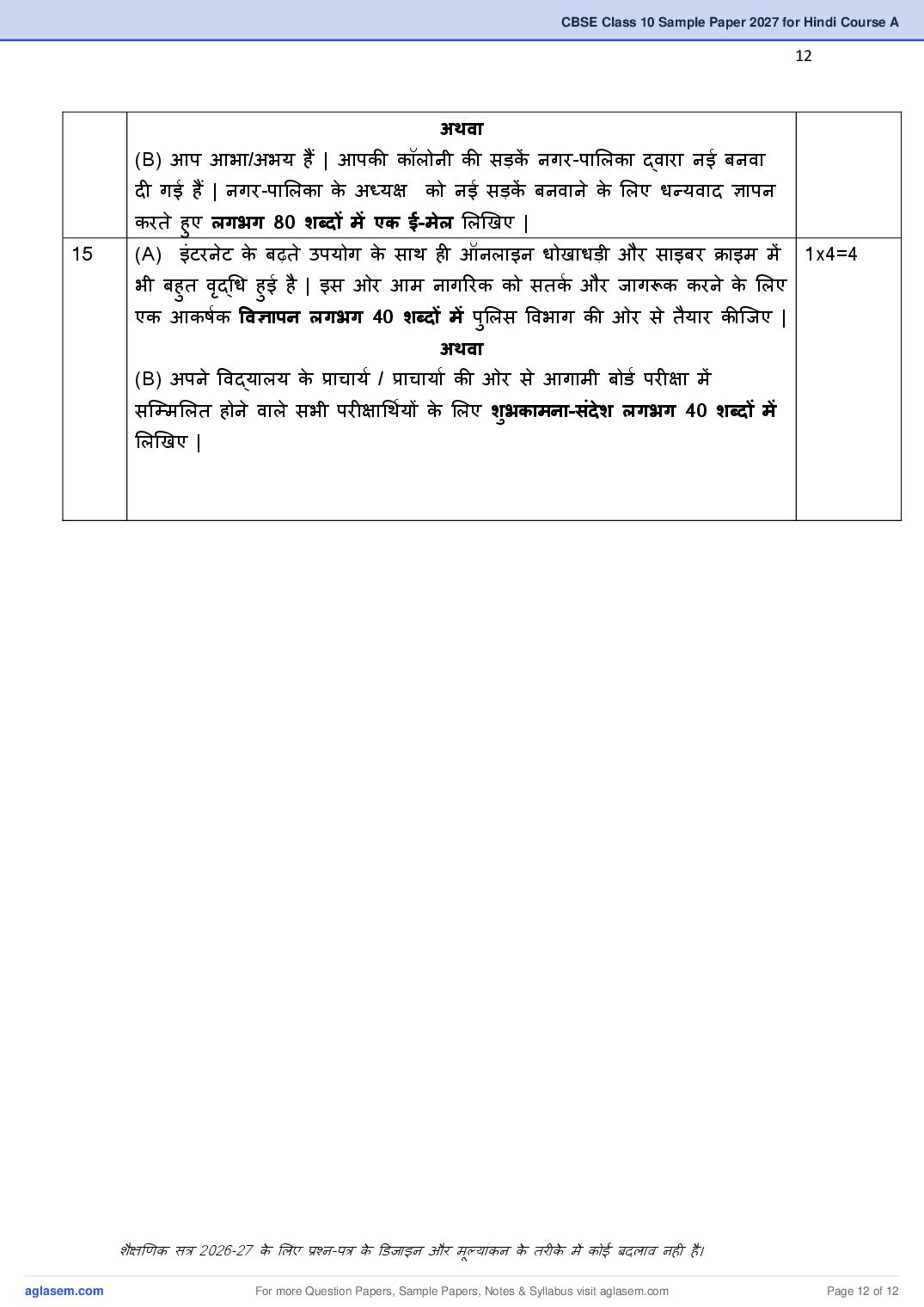
CBSE Class 10 Hindi A Paper Pattern 2027
How the 2027 sample paper is set (from the paper itself) – 80 marks, 3 hours, 15 questions:
| Section | Questions | Type | Marks each | Total |
|---|---|---|---|---|
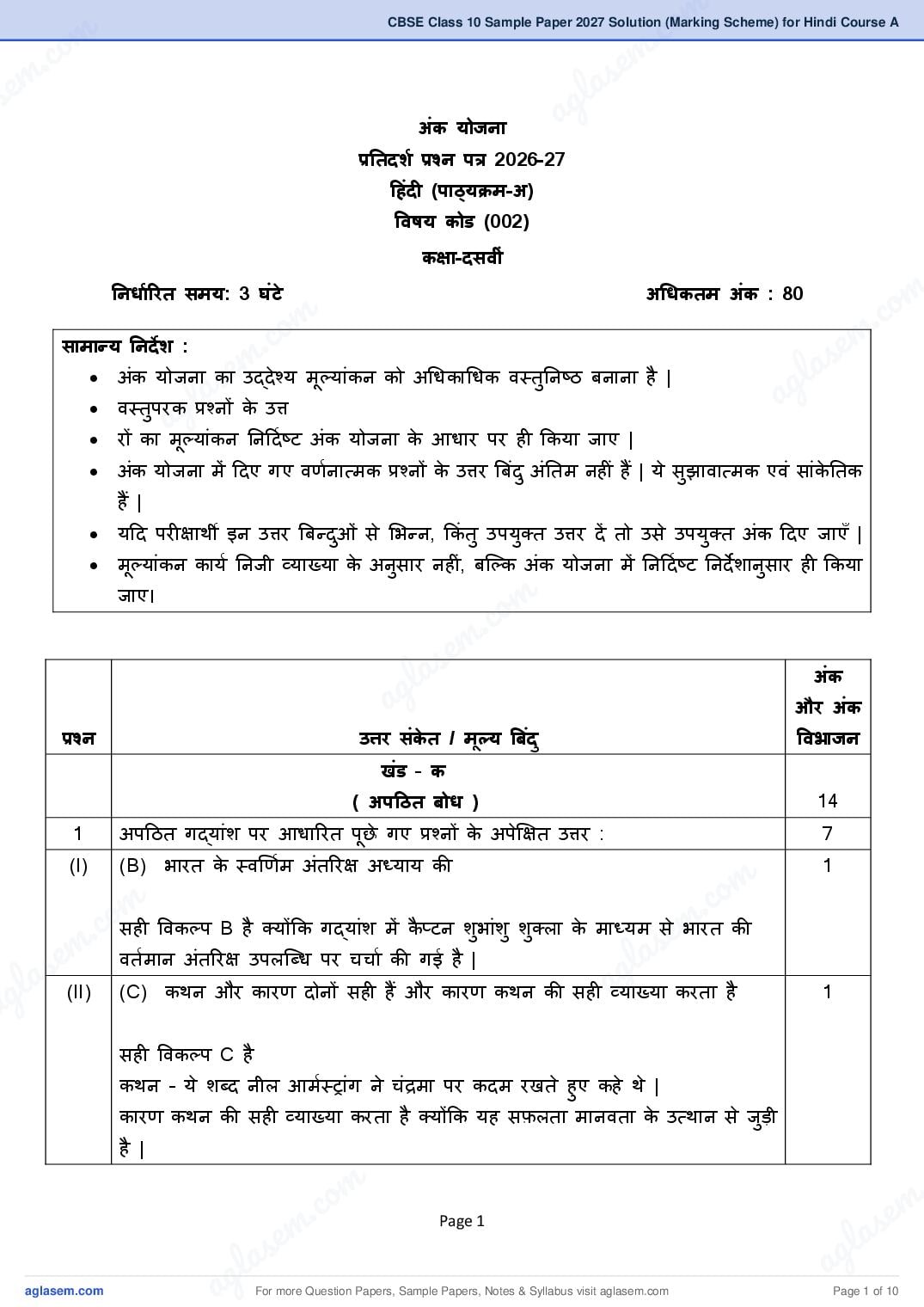
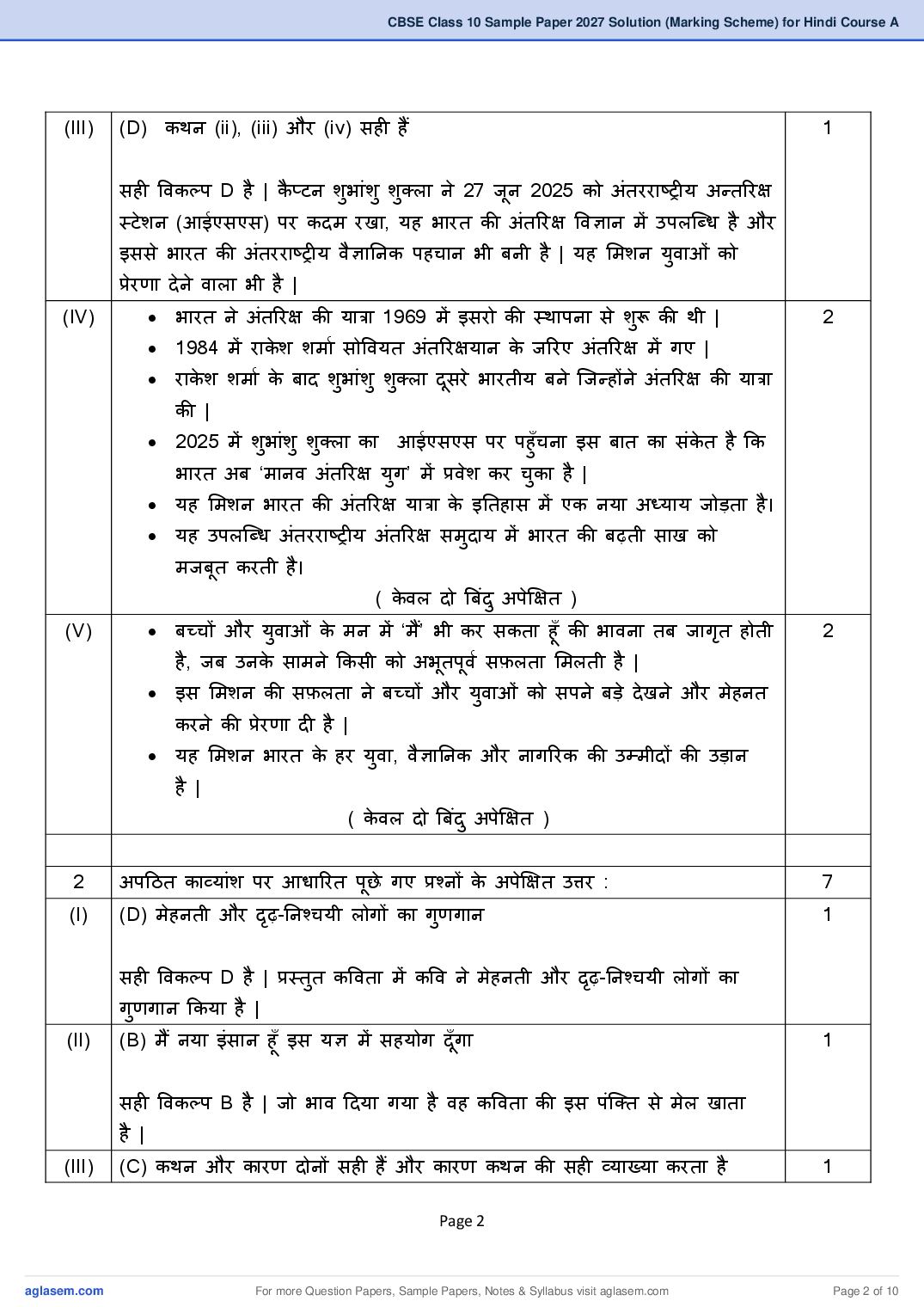
| Section A – Unseen Comprehension (खंड क – अपठित बोध) | 1–2 | Q1 unseen prose passage (on Group Captain Shubhanshu Shukla reaching the International Space Station), Q2 unseen poem (Kedarnath Agarwal, ‘Jo Shilayen Todte Hain’) – each with 3 MCQs (incl. assertion-reason and multi-statement type) and 2 short-answer questions | Q1: 1+1+1+2+2; Q2: 1+1+1+2+2 | 14 |
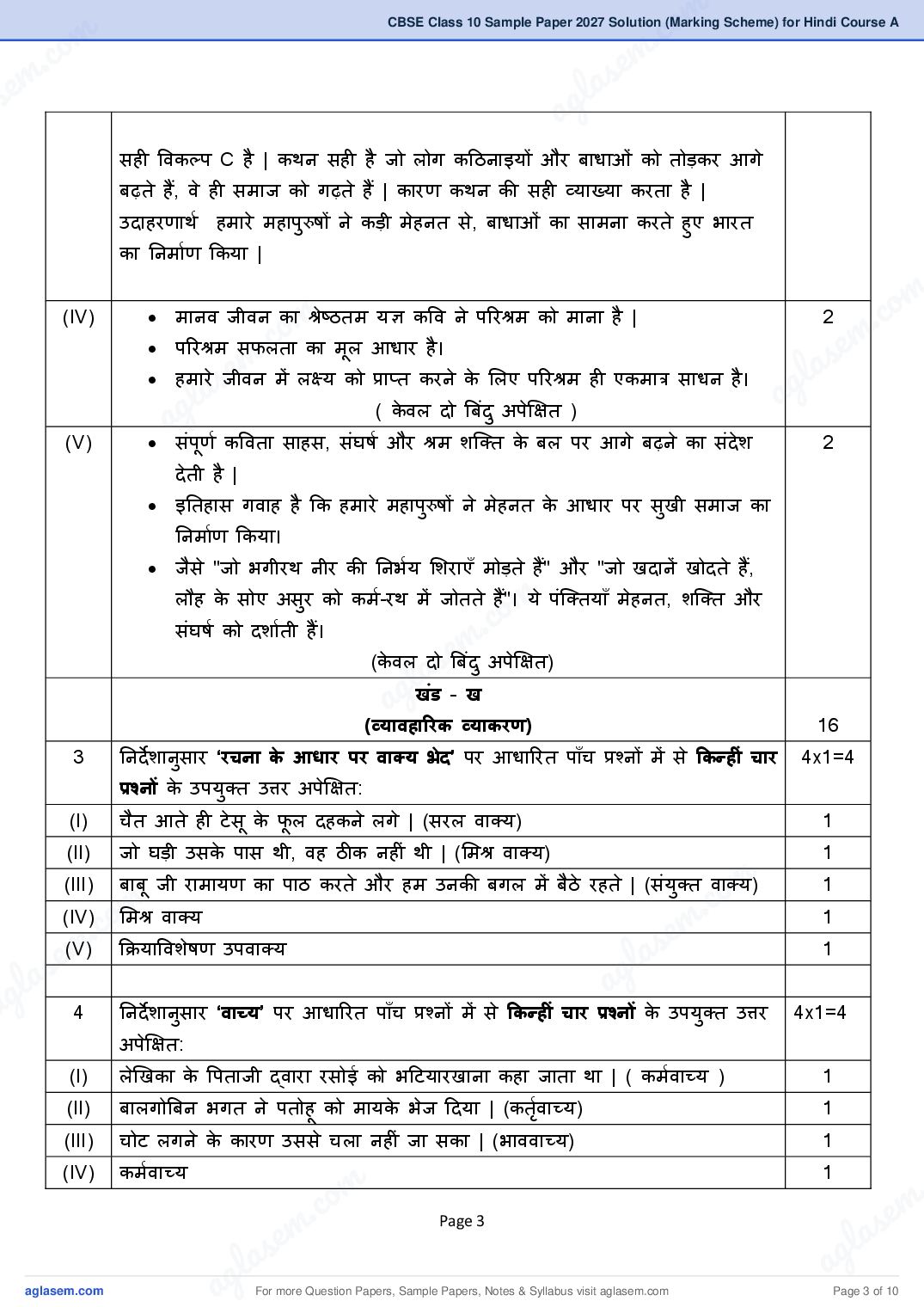
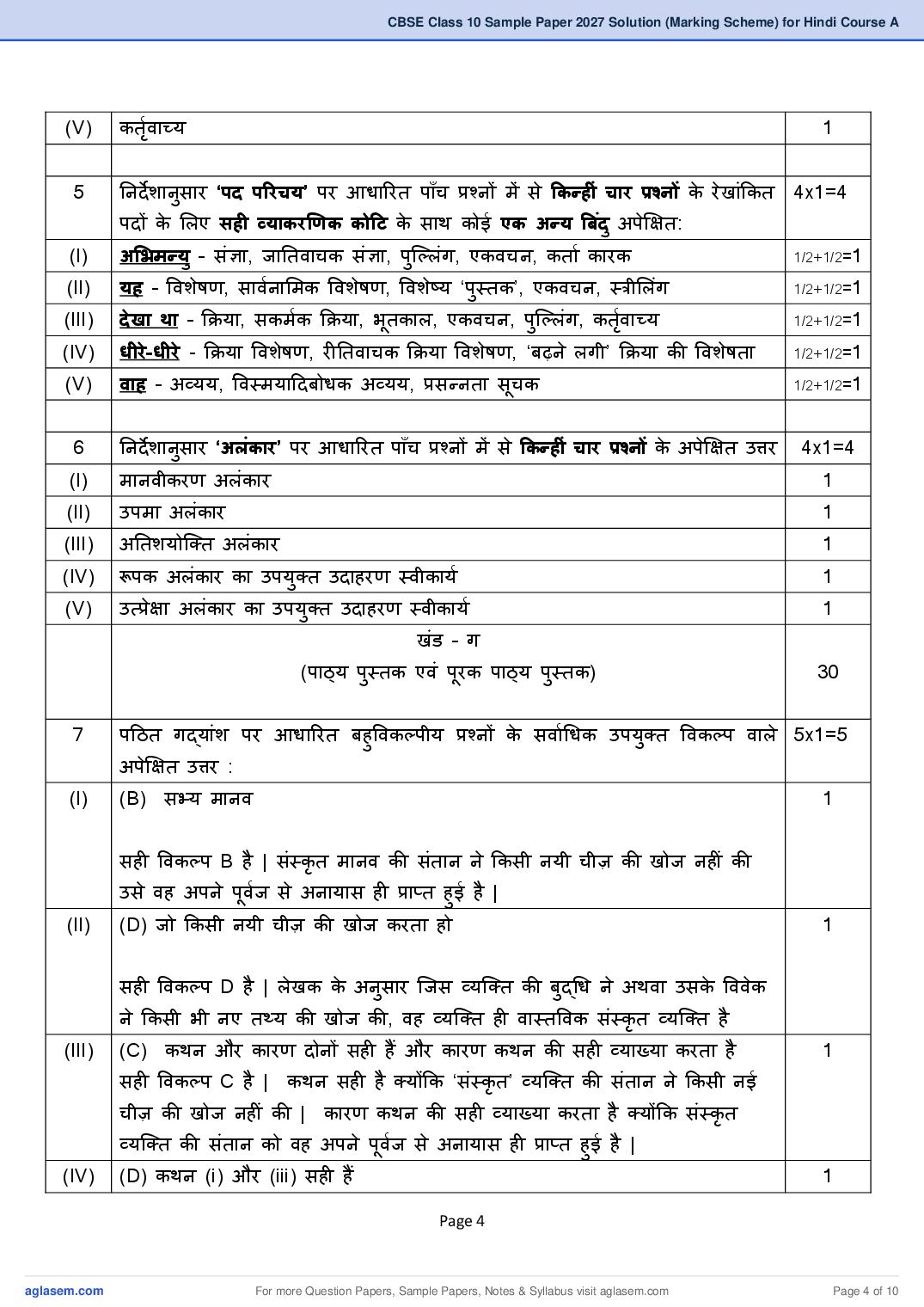
| Section B – Applied Grammar (खंड ख – व्यावहारिक व्याकरण) | 3–6 | Q3 sentence types by structure (रचना के आधार पर वाक्य भेद), Q4 voice (वाच्य), Q5 parsing (पद परिचय), Q6 figures of speech (अलंकार) – any 4 of 5 parts in each | 4×1 per question | 16 |
| Section C – Textbook and Supplementary Textbook (खंड ग – पाठ्य पुस्तक एवं पूरक पाठ्य पुस्तक) | 7–11 | Q7 seen prose extract with 5 MCQs; Q8 prose short answers (any 3 of 4, about 25–30 words); Q9 seen poem extract (‘Ut Nahi Rahi Hai’) with 5 MCQs; Q10 poetry short answers (any 3 of 4, about 25–30 words); Q11 supplementary-reader answers (any 2 of 3, about 50–60 words) | Q7: 5×1; Q8: 3×2; Q9: 5×1; Q10: 3×2; Q11: 2×4 | 30 |
| Section D – Creative Writing (खंड घ – रचनात्मक लेखन) | 12–15 | Q12 paragraph of about 120 words on 1 of 3 topics (outline points given); Q13 letter of about 100 words (formal letter to an editor OR informal letter to a younger brother); Q14 résumé (स्ववृत्त) for a content-writer job OR an e-mail, about 80 words; Q15 advertisement OR message (शुभकामना संदेश), about 40 words | Q12: 6; Q13: 5; Q14: 5; Q15: 4 | 20 |
| Total | 15 | 80 |
Choice: All 15 questions are compulsory. Choice is given inside questions: any 4 of 5 parts in each grammar question (Q3–Q6), any 3 of 4 in Q8 and Q10, any 2 of 3 in Q11, 1 of 3 paragraph topics in Q12, and an (A)/(B) OR choice in Q13, Q14 and Q15. Section A (Q1–Q2) and the MCQ extracts Q7 and Q9 have no choice.
- The General Instructions give the number of sub-questions in each section: Section A has 2 questions with 10 sub-questions, Section B has 4 questions with 20 sub-questions, Section C has 5 questions with 21 sub-questions, and Section D has 4 questions with internal choice.
- Write answers following the given instructions, and as far as possible answer the four sections in order.
- Word limits printed: Q8 and Q10 about 25–30 words, Q11 about 50–60 words, paragraph about 120 words, letter about 100 words, résumé/e-mail about 80 words, advertisement/message about 40 words.
Unit-wise Marks in the Hindi A Sample Paper 2027
Marks for each unit (as printed in the paper):
| Unit | Questions | Marks |
|---|---|---|
| Reading – unseen prose passage + unseen poem (अपठित बोध) | Q1, Q2 | 14 |
| Grammar – sentence types, voice, parsing, figures of speech (व्यावहारिक व्याकरण) | Q3, Q4, Q5, Q6 | 16 |
| Literature – textbook prose (extract from ‘Sanskriti’ – lesson not named in the paper; ‘Balgobin Bhagat’, ‘Ek Kahani Yah Bhi’, ‘Naubatkhane Mein Ibadat’, ‘Lakhnavi Andaz’) | Q7, Q8 | 11 |
| Literature – textbook poetry (‘Ut Nahi Rahi Hai’, ‘Surdas ke Pad’, ‘Atmakathya’, ‘Yah Danturit Muskan’, ‘Sangatkar’) | Q9, Q10 | 11 |
| Literature – supplementary reader (‘Mata ka Anchal’, ‘Sana-Sana Hath Jodi’, ‘Main Kyon Likhta Hoon’) | Q11 | 8 |
| Writing – paragraph, letter, résumé/e-mail, advertisement/message (रचनात्मक लेखन) | Q12, Q13, Q14, Q15 | 20 |
What Is New in the Hindi A Sample Paper 2027?
Compared with the 2026 sample paper (session 2025-26):
- No change in pattern – same 15 questions in 4 sections (Reading 14, Grammar 16, Textbook 30, Writing 20) with the same marks per question, the same choices and the same word limits. The 2027 paper itself states that there is no change in design or evaluation for 2026-27.
- The General Instructions are more detailed. The 2026 paper had 4 short instructions; the 2027 paper gives the number of questions and sub-questions in each section and asks students to answer the sections in order.
- Labels changed: sub-questions are now (I)–(V) instead of (क)–(ङ), MCQ options are (A)–(D) instead of (i)–(iv), and the OR options in Section D are (A)/(B) instead of (क)/(ख).
- New unseen passages: 2026 had a prose passage on millets and a poem about a rose and a farmer; 2027 has a prose passage on Shubhanshu Shukla’s ISS mission and the poem ‘Jo Shilayen Todte Hain’ by Kedarnath Agarwal.
- New seen extracts: Q7 changed from ‘Balgobin Bhagat’ (2026) to an extract from ‘Sanskriti’ (on Newton and the ‘cultured’ person), and Q9 changed from ‘Sangatkar’ (2026) to ‘Ut Nahi Rahi Hai’. Q11 still uses the same three supplementary-reader chapters.
- Writing topics changed. 2026: online gaming / healthy lifestyle / film or play review; letters on power cuts or a book-launch invitation to grandmother; a B.Ed. teacher résumé or an e-mail on sanitation; a solar-energy advertisement or congratulations to a teacher. 2027: India on the path of progress / health in the Indian kitchen / youth under Western influence; a letter to an editor on too many advertisements or a letter to a younger brother on polite speech; a content-writer résumé or a thank-you e-mail to the municipality for new roads; a cyber-fraud awareness advertisement or a principal’s good-luck message for board exams.
Questions from the Hindi A Sample Paper 2027
Two questions from the 2027 paper, to show the level:
- Section B – Grammar (Q3 I), 1 mark: चैत आया और टेसू के फूल दहकने लगे। (सरल वाक्य में बदलकर लिखिए) [Rewrite as a simple sentence.]
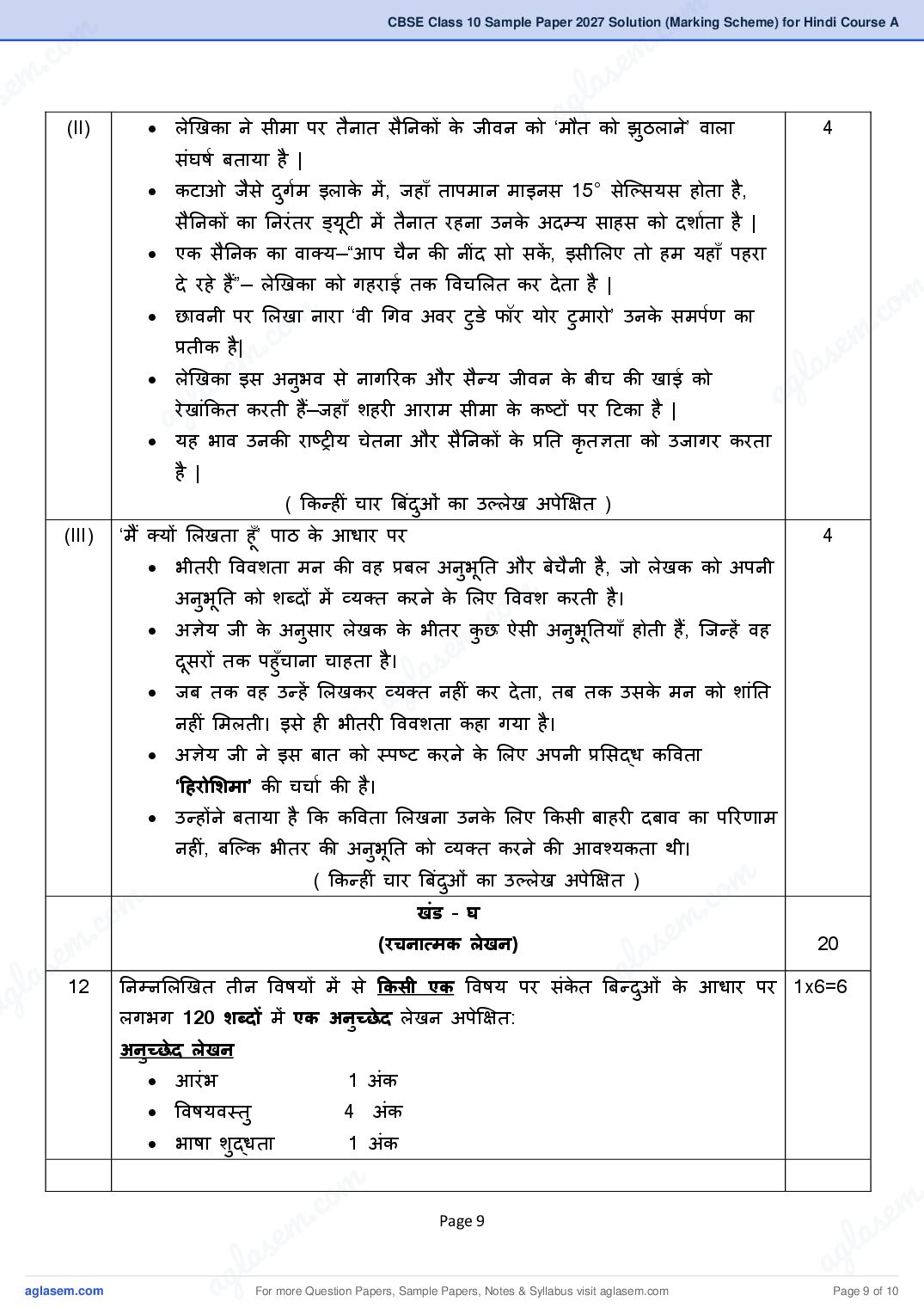
- Section C – Supplementary reader (Q11 III), 4 marks: ‘मैं क्यों लिखता हूँ’ पाठ के आधार पर बताइए कि भीतरी विवशता क्या होती है? लेखक अज्ञेय ने इसे स्पष्ट करने के लिए किसकी चर्चा की है? [Based on ‘Main Kyon Likhta Hoon’, explain what ‘inner compulsion’ is and what Agyeya discusses to illustrate it; about 50–60 words.]
CBSE Class 10 Hindi A Marking Scheme 2027 (Solutions)
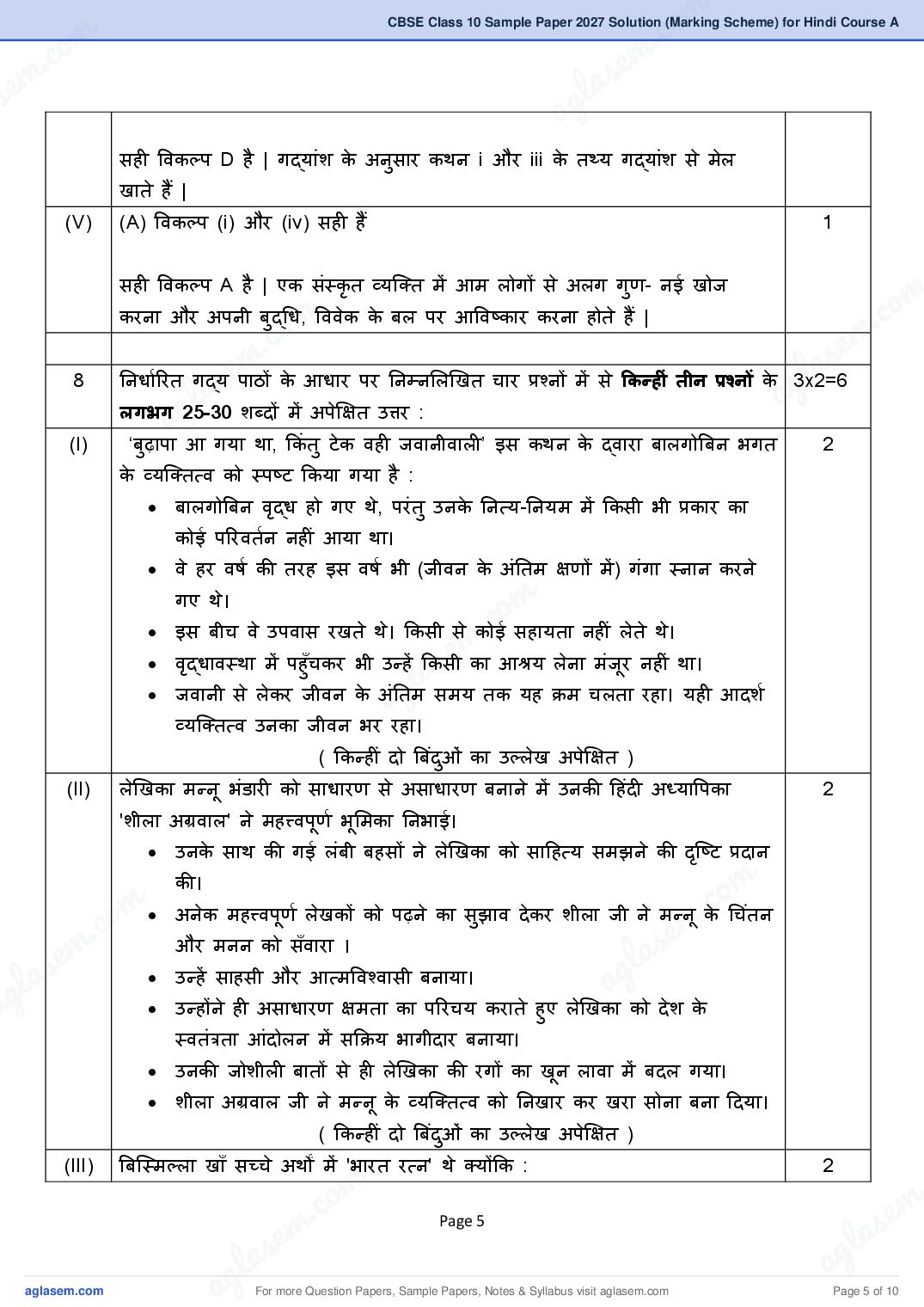
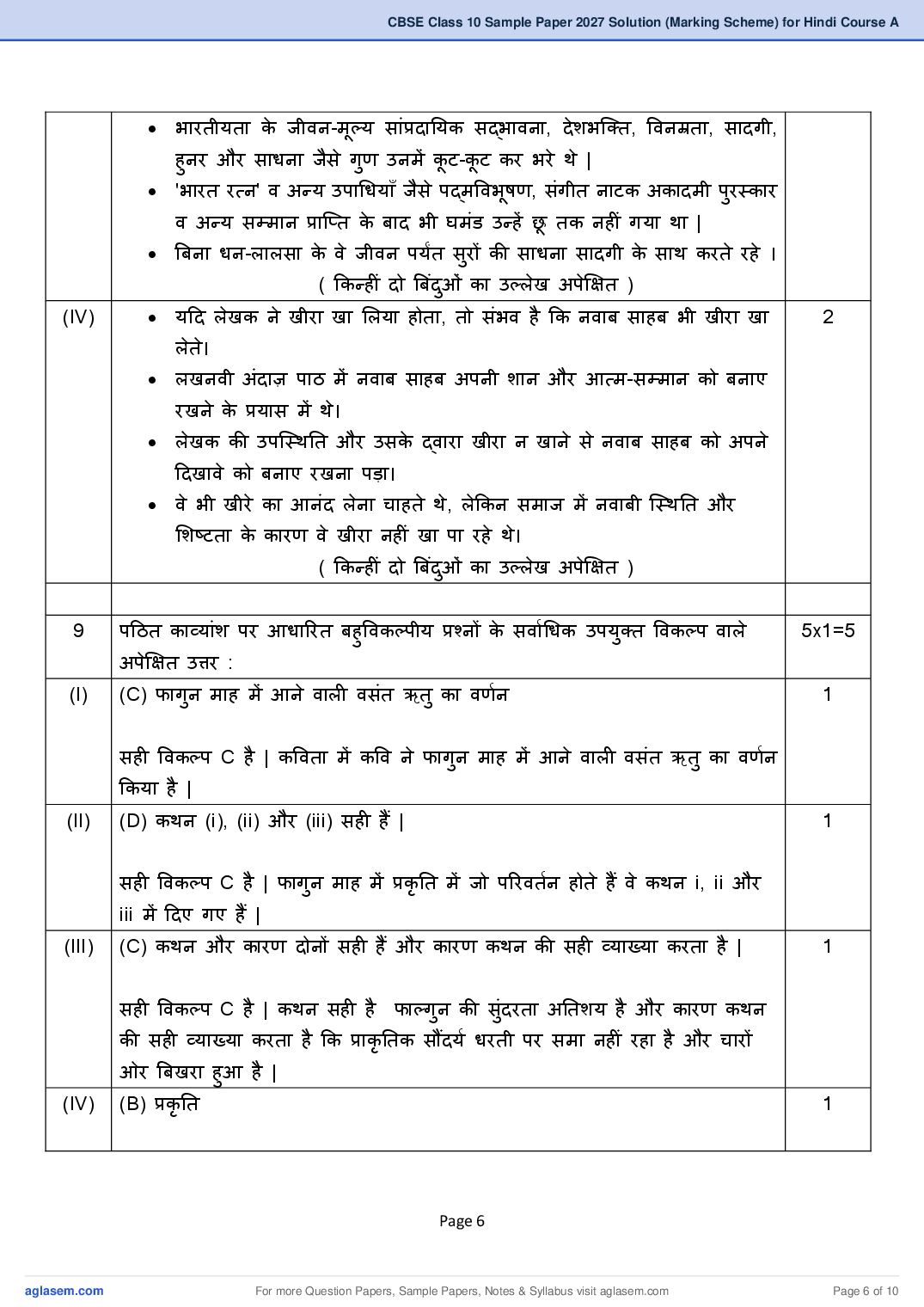
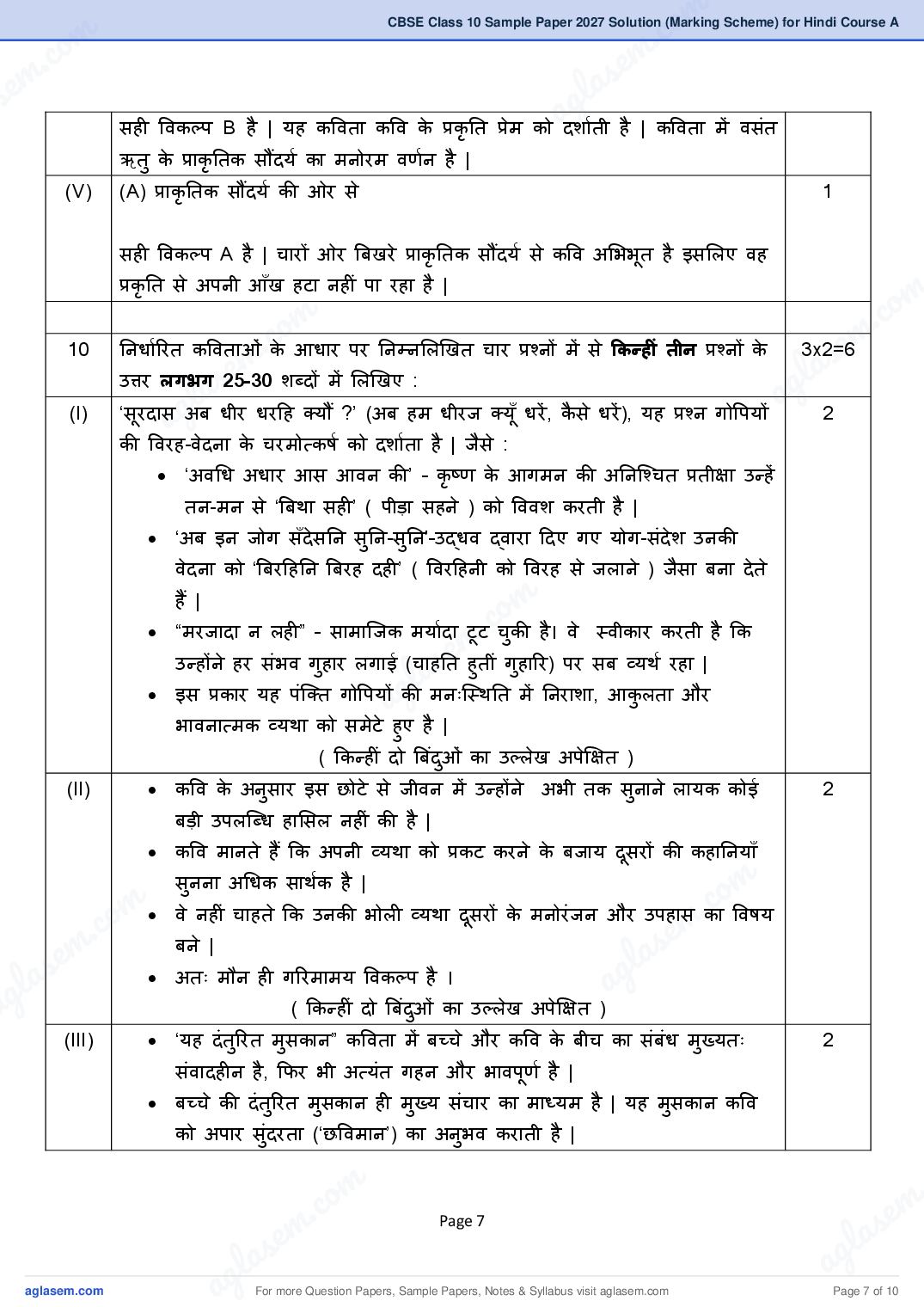
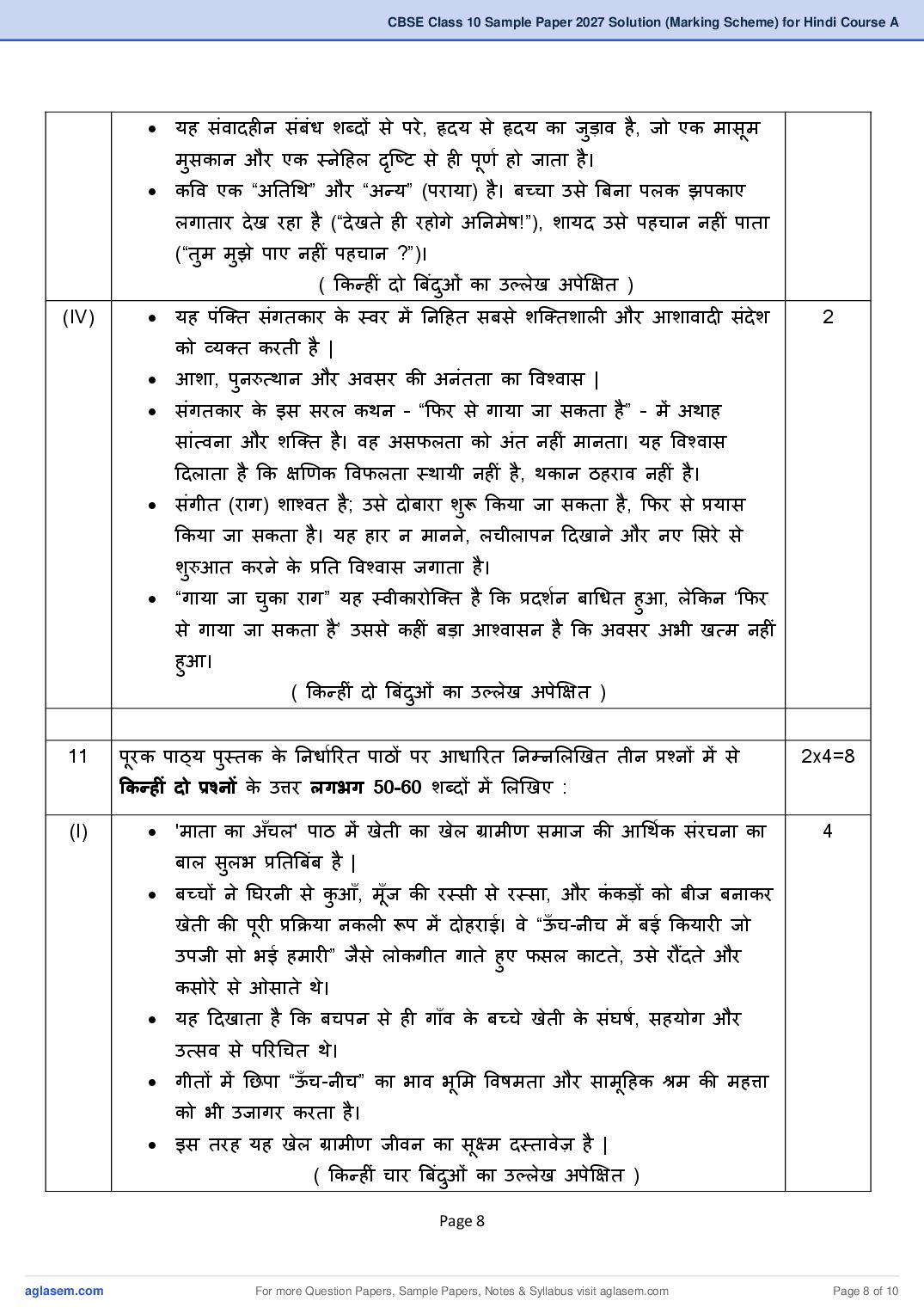
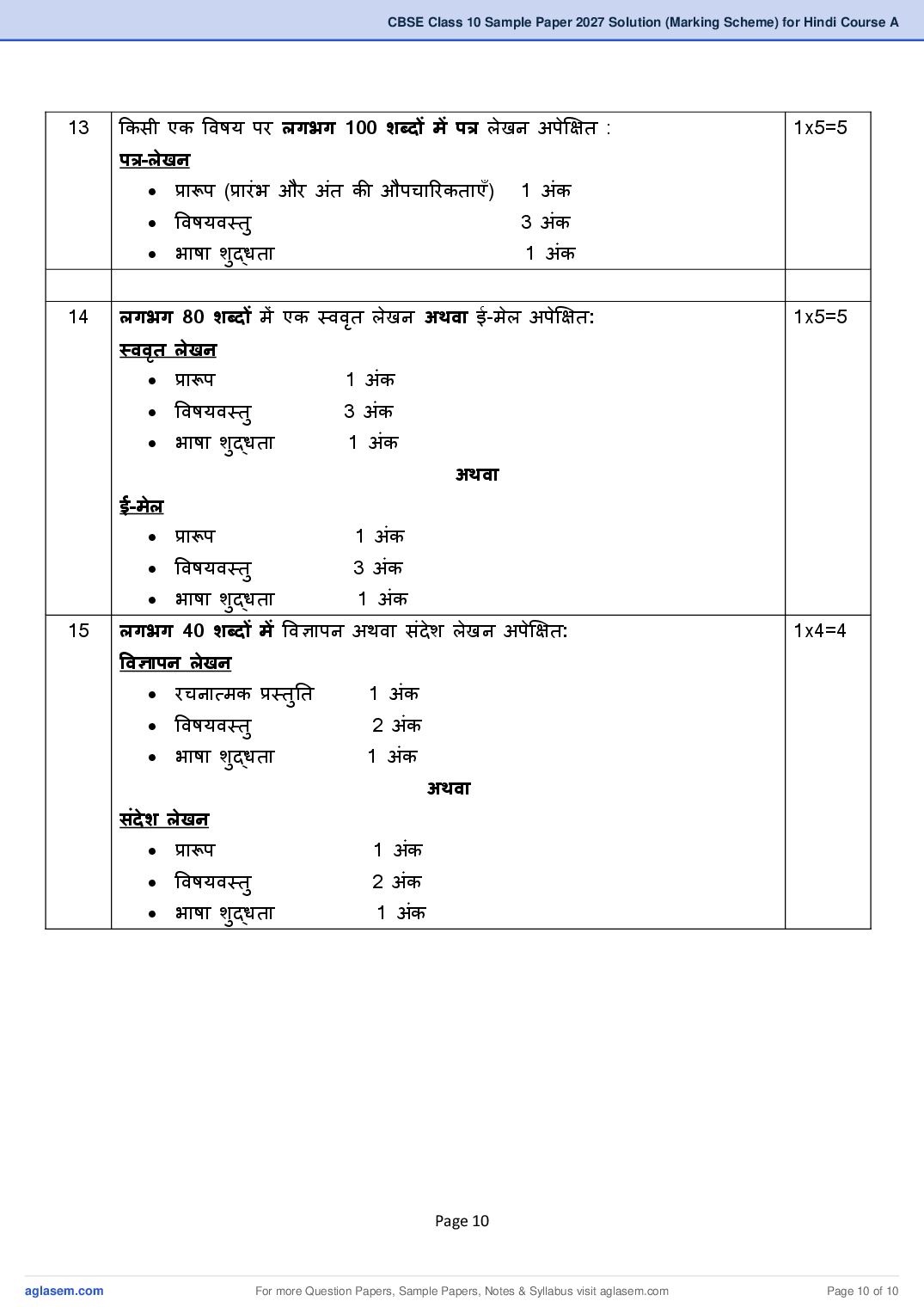
The 2027 marking scheme gives the correct option for every MCQ with a one-line reason (‘सही विकल्प B है क्योंकि…’), answers for all grammar items (parsing at ½+½), and value points for the descriptive answers, usually noting that only two points are expected. It says the value points are suggestive, so other suitable answers should be accepted. It also prints mark splits for the writing tasks: paragraph – beginning 1, content 4, language 1; letter, résumé and e-mail – format 1, content 3, language 1; advertisement – creative presentation 1, content 2, language 1; message – format 1, content 2, language 1. Check your answers against it after you solve the paper.
Hindi A Marking Scheme 2027 – Read Online
How to Score Well – Tips from the 2027 Paper
- Literature is 30 of 80 marks. The questions name exact lessons (Balgobin Bhagat, Ek Kahani Yah Bhi, Naubatkhane Mein Ibadat, Lakhnavi Andaz, Surdas ke Pad, Atmakathya, Sangatkar, Mata ka Anchal, Sana-Sana Hath Jodi, Main Kyon Likhta Hoon), so revise every prescribed chapter.
- Practise assertion-reason and ‘which statements are correct’ MCQs. They appear in Q1, Q2, Q7 and Q9.
- For 2-mark answers the marking scheme expects only two points, so write two clear points in about 25–30 words instead of long answers.
- In grammar you attempt only 4 of 5 parts in each question. For parsing (पद परिचय) give the grammatical category plus one more detail, because each part is marked ½+½.
- In writing, format carries 1 mark in letters, résumés and e-mails, and language accuracy carries 1 mark in every task. Learn the formats and keep to the word limits.
- Solve the 2027 paper in one sitting with a timer, check it with the marking scheme, then solve the 2026 paper a few days later.
More Class 10 Hindi A Papers and Study Material
Practise past board papers, or plan your revision with the syllabus and important questions for Class 10 Hindi A:
CBSE Class 10 Hindi A Sample Paper 2027 – FAQs
Is the CBSE Class 10 Hindi A Sample Paper 2027 out?
Yes. CBSE has released the Class 10 Hindi A sample paper 2027 for the 2026-27 session with its marking scheme – both are in the table on this page, free.
Is the CBSE Class 10 Hindi A Sample Paper 2027 available with solutions?
Yes. The official CBSE marking scheme is the solution – it gives the answers and the marks for each step. Download it from the table above or read it online on this page.
Has the CBSE Class 10 Hindi A paper pattern changed for 2027?
No. CBSE says there is no change in the question paper design for 2026-27. The 2027 sample paper keeps the 2026 pattern – 80 marks, 3 hours, 15 questions in 4 sections. Small changes: The General Instructions are more detailed. The 2026 paper had 4 short instructions; the 2027 paper gives the number of questions and sub-questions in each section and asks students to answer the sections in order.; Labels changed: sub-questions are now (I)–(V) instead of (क)–(ङ), MCQ options are (A)–(D) instead of (i)–(iv), and the OR options in Section D are (A)/(B) instead of (क)/(ख)..
How many marks and questions are in the CBSE Class 10 Hindi A Sample Paper 2027?
It is a 80 marks, 3 hours, 15 questions paper – Section Section A – Unseen Comprehension (खंड क – अपठित बोध): 1–2 (14 marks); Section Section B – Applied Grammar (खंड ख – व्यावहारिक व्याकरण): 3–6 (16 marks); Section Section C – Textbook and Supplementary Textbook (खंड ग – पाठ्य पुस्तक एवं पूरक पाठ्य पुस्तक): 7–11 (30 marks); Section Section D – Creative Writing (खंड घ – रचनात्मक लेखन): 12–15 (20 marks).
Which units carry the most marks in the Hindi A sample paper 2027?
In the 2027 sample paper: Writing – paragraph, letter, résumé/e-mail, advertisement/message (रचनात्मक लेखन) (20 marks), Grammar – sentence types, voice, parsing, figures of speech (व्यावहारिक व्याकरण) (16 marks), Reading – unseen prose passage + unseen poem (अपठित बोध) (14 marks).
Is the CBSE 10th Hindi A model question paper 2027 the same as the sample paper?
Yes. CBSE calls it the sample question paper (SQP); students also search for it as the 10th Hindi A model question paper or model test paper – it is the same official paper on this page.
Will the board exam paper be the same as the sample paper?
No – the CBSE Class 10 board exam 2027 has different questions, but it follows the same pattern as the sample paper: the same sections, marks and question types.