Download the CBSE Class 10 Kannada Sample Paper 2027 PDF with its marking scheme (solutions) – the official CBSE sample question paper (SQP) for the 2026-27 session, the paper to practise for the CBSE Class 10 board exam 2027. It is an 80-mark, 3-hour paper with 15 questions in 2 parts. The pattern is the same as the 2026 sample paper. The 2026 and 2025 sample papers are also here. Students also call it the CBSE 10th Kannada model question paper 2027 or model test paper – it is the same official CBSE paper.
CBSE Class 10 Kannada Sample Paper 2027 PDF Download
Open a paper to read it online or download the PDF. The marking scheme has the answers, with the marks for each step.
| Year | Document | Download |
|---|---|---|
| 2027 | CBSE Class 10 Sample Paper 2027 for Kannada | View PDF |
| 2027 | CBSE Class 10 Sample Paper 2027 Solution (Marking Scheme) for Kannada | View PDF |
| 2026 | CBSE Class 10 Sample Paper 2026 for Kannada | View PDF |
| 2026 | CBSE Class 10 Sample Paper 2026 Solution for Kannada | View PDF |
| 2025 | CBSE Class 10 Sample Paper 2025 for Kannada | View PDF |
CBSE 10th Kannada Model Question Paper 2027 – Quick Facts
| Board | Central Board of Secondary Education (CBSE) |
| Class | Class 10 |
| Subject | Kannada (code 015 (MS title: NAME KANNADA (015))) |
| Session | 2026-27 – for the board exam 2027 |
| Marks and time | 80 marks, 3 hours |
| Questions | 15 questions in 2 parts |
| Solutions | Yes – official CBSE marking scheme |
| Older papers | 2026, 2025 |
| Released by | CBSE (cbseacademic.nic.in) |
CBSE Class 10 Kannada Sample Paper 2027 – Read Online
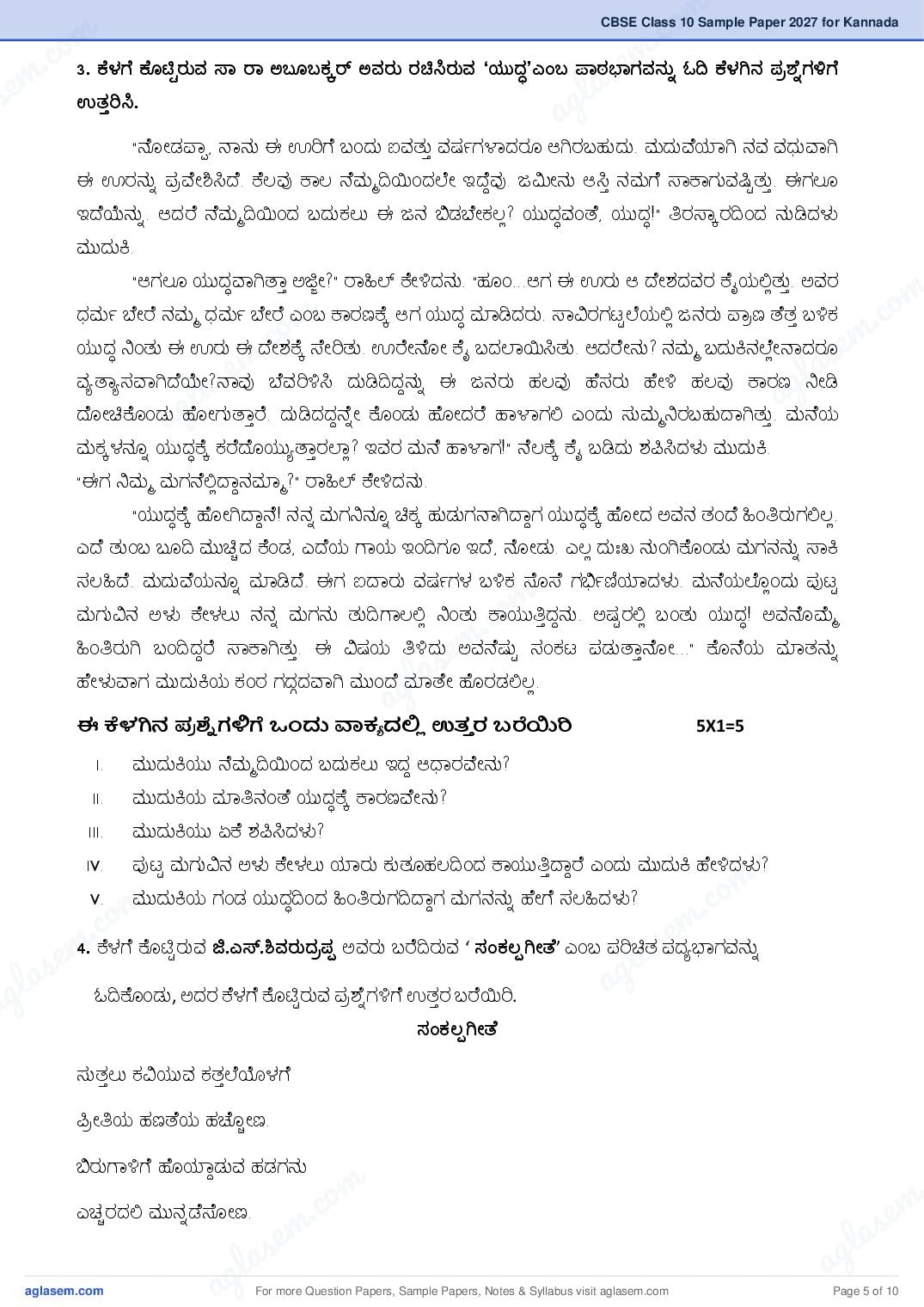
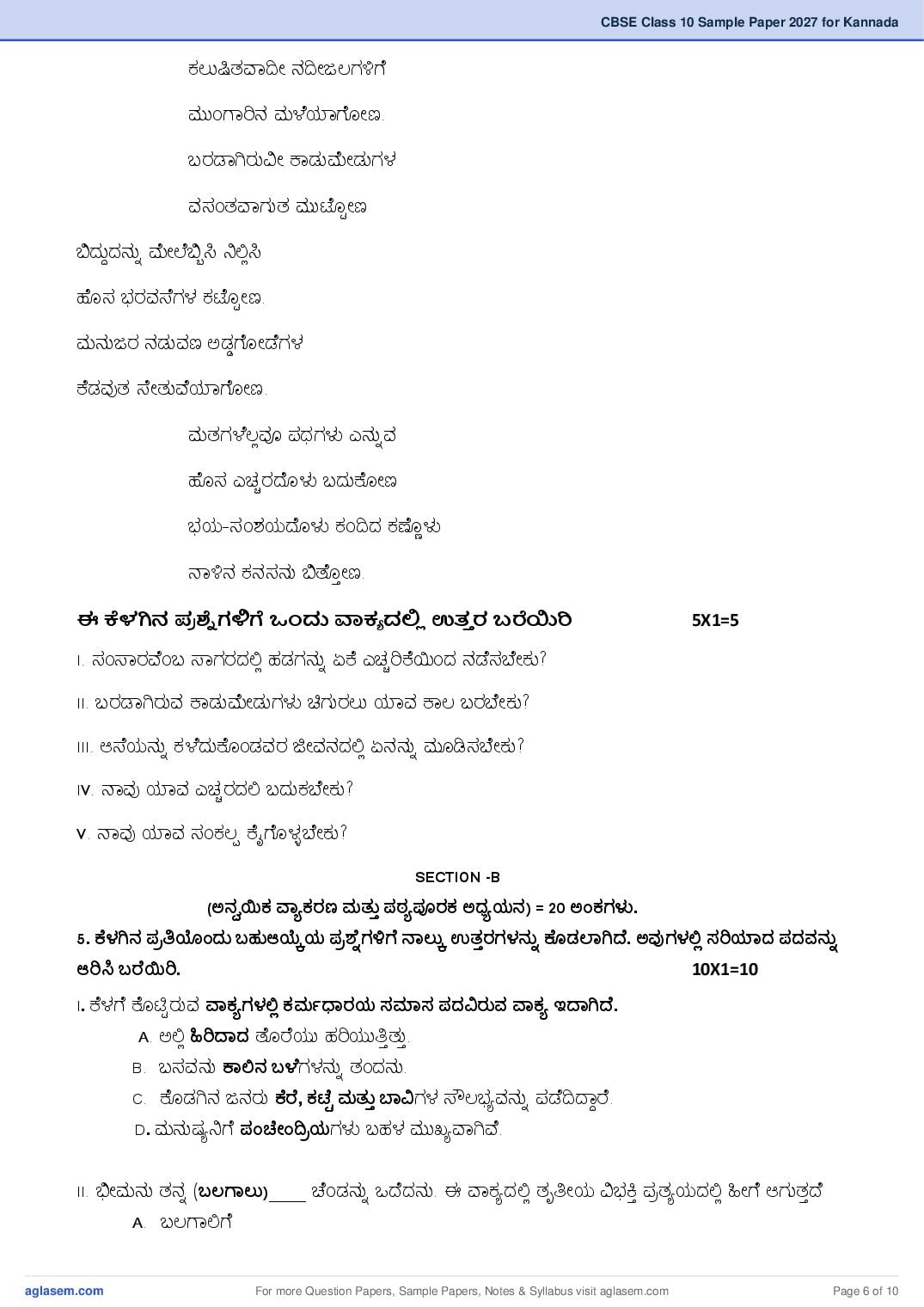
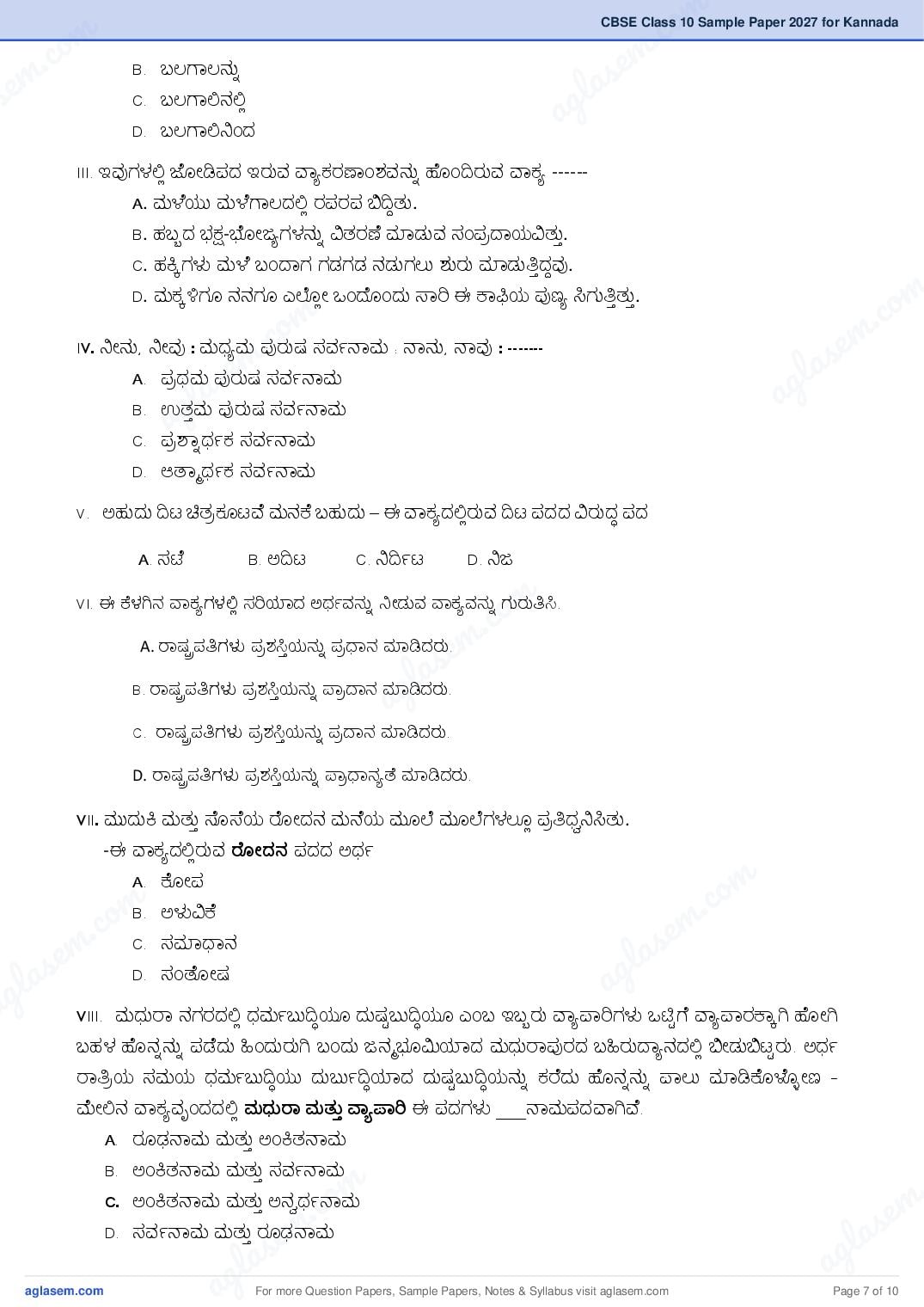
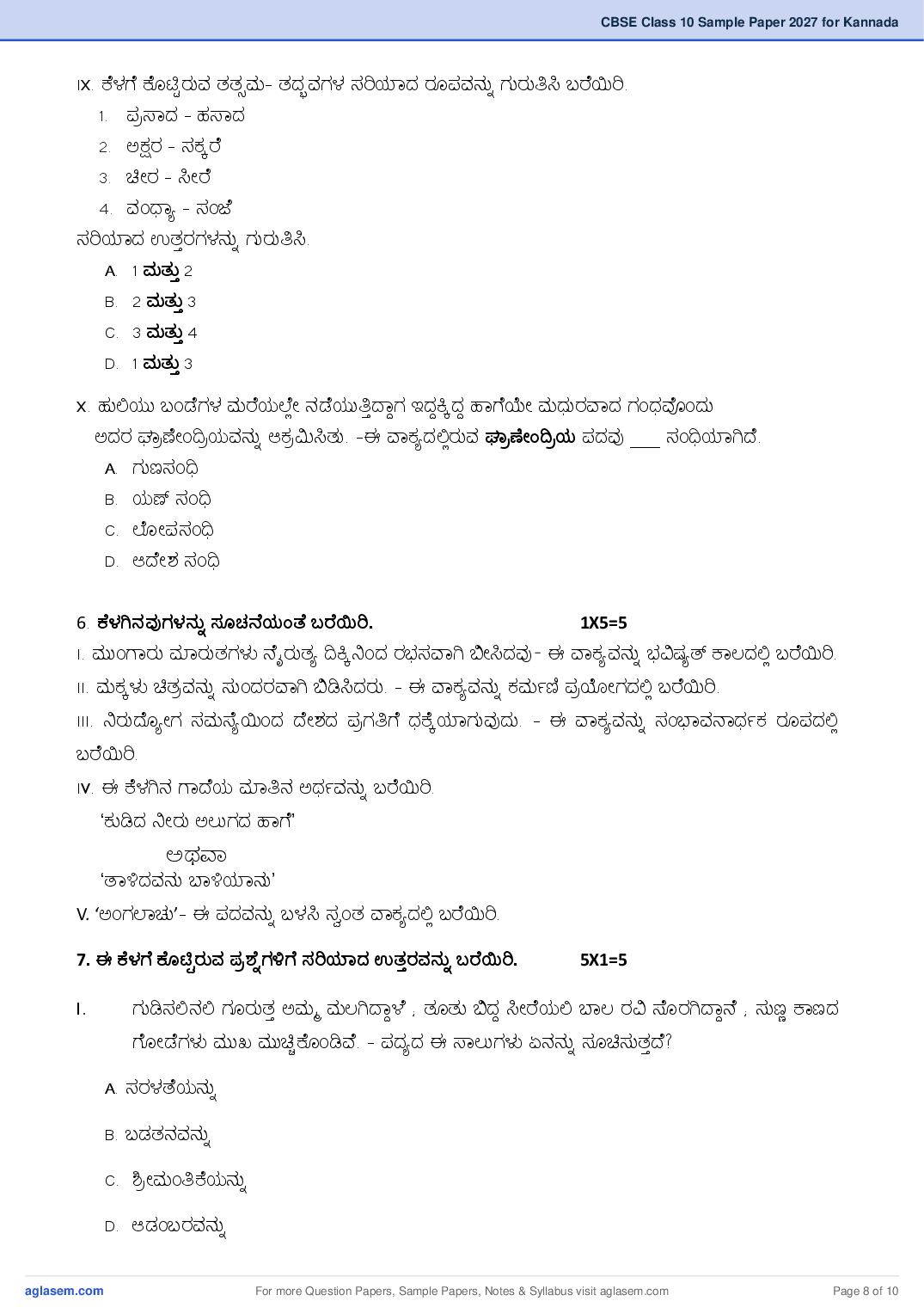
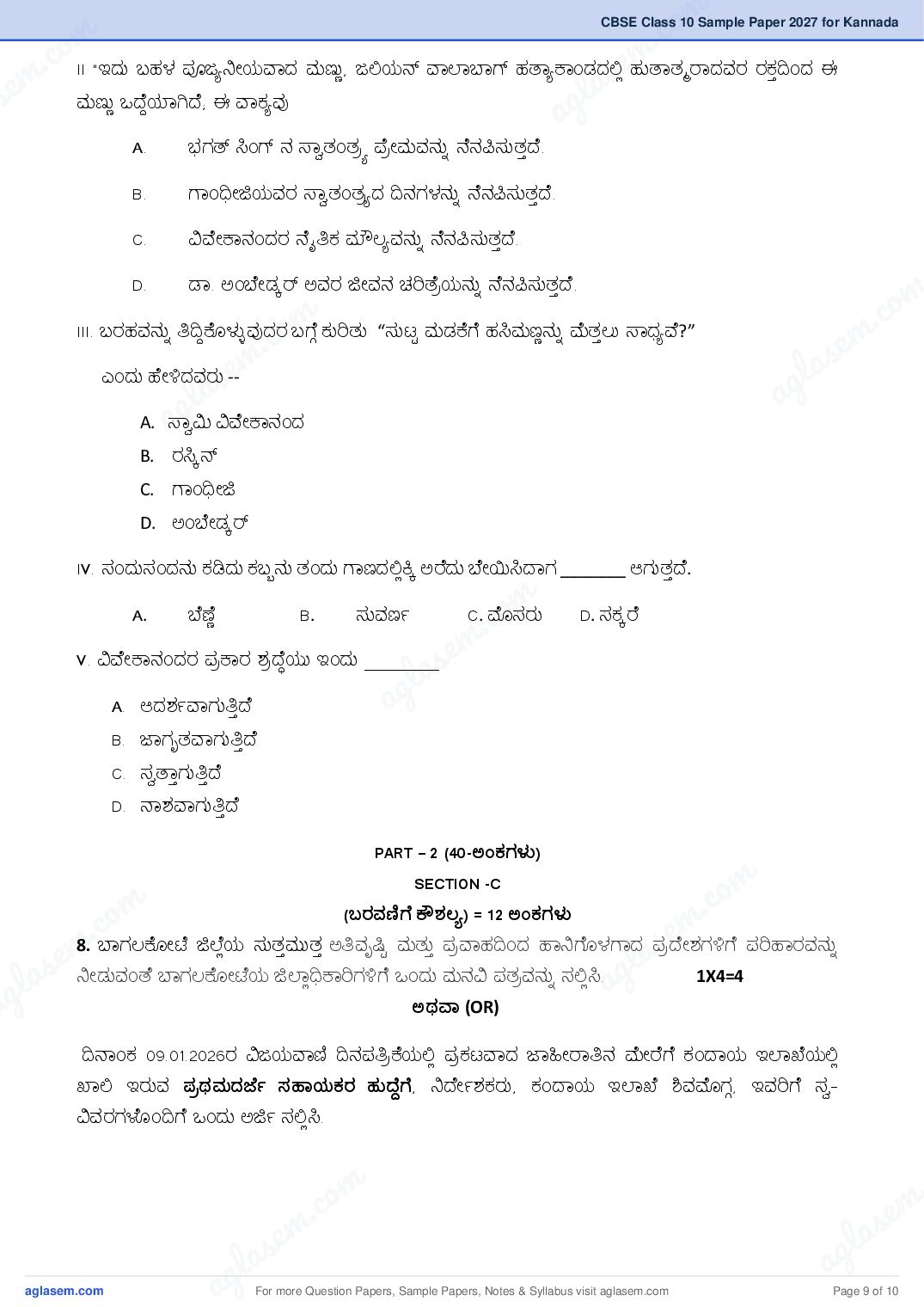
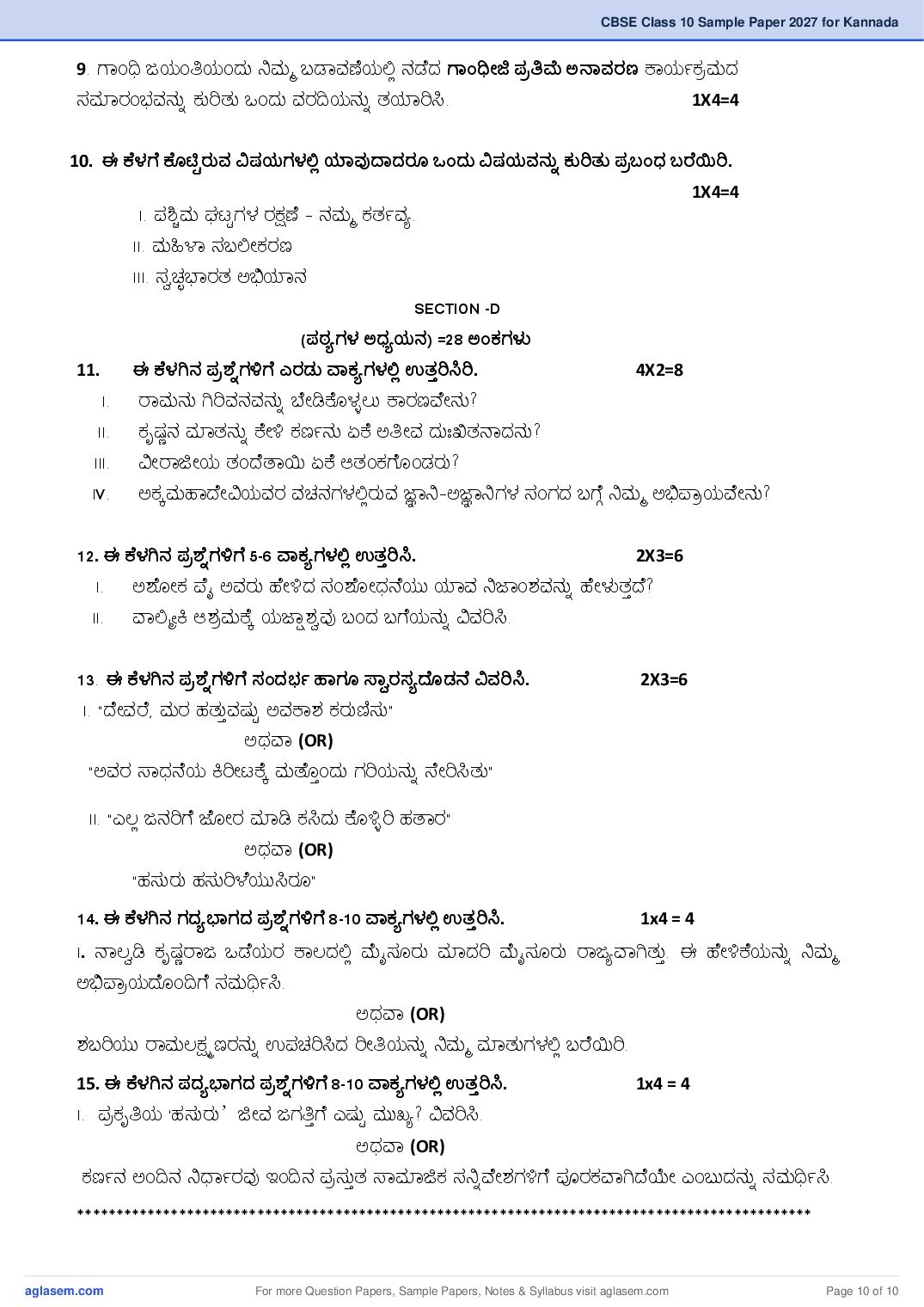
CBSE Class 10 Kannada Paper Pattern 2027
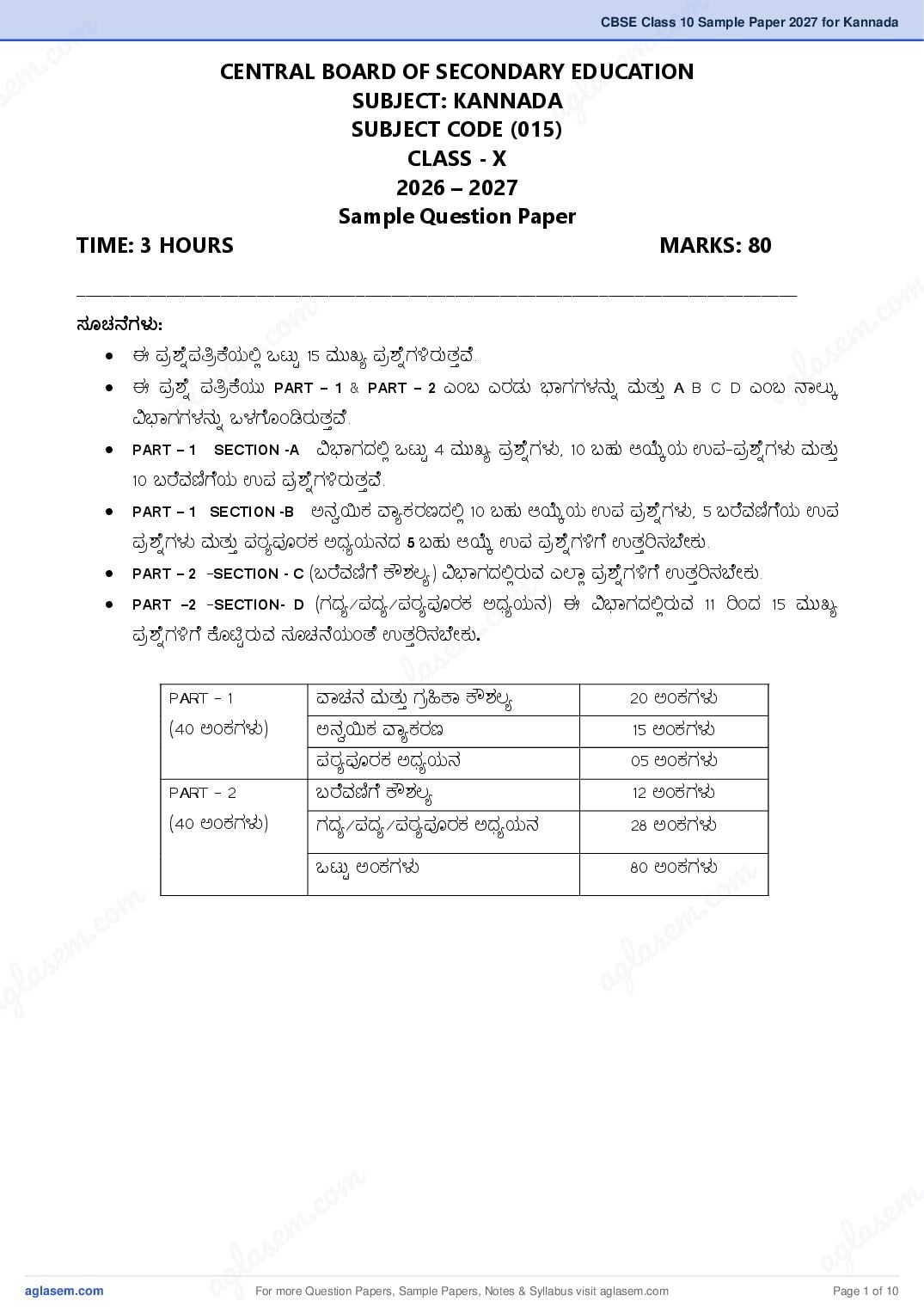
How the 2027 sample paper is set (from the paper itself) – 80 marks, 3 hours, 15 questions:
| Section | Questions | Type | Marks each | Total |
|---|---|---|---|---|
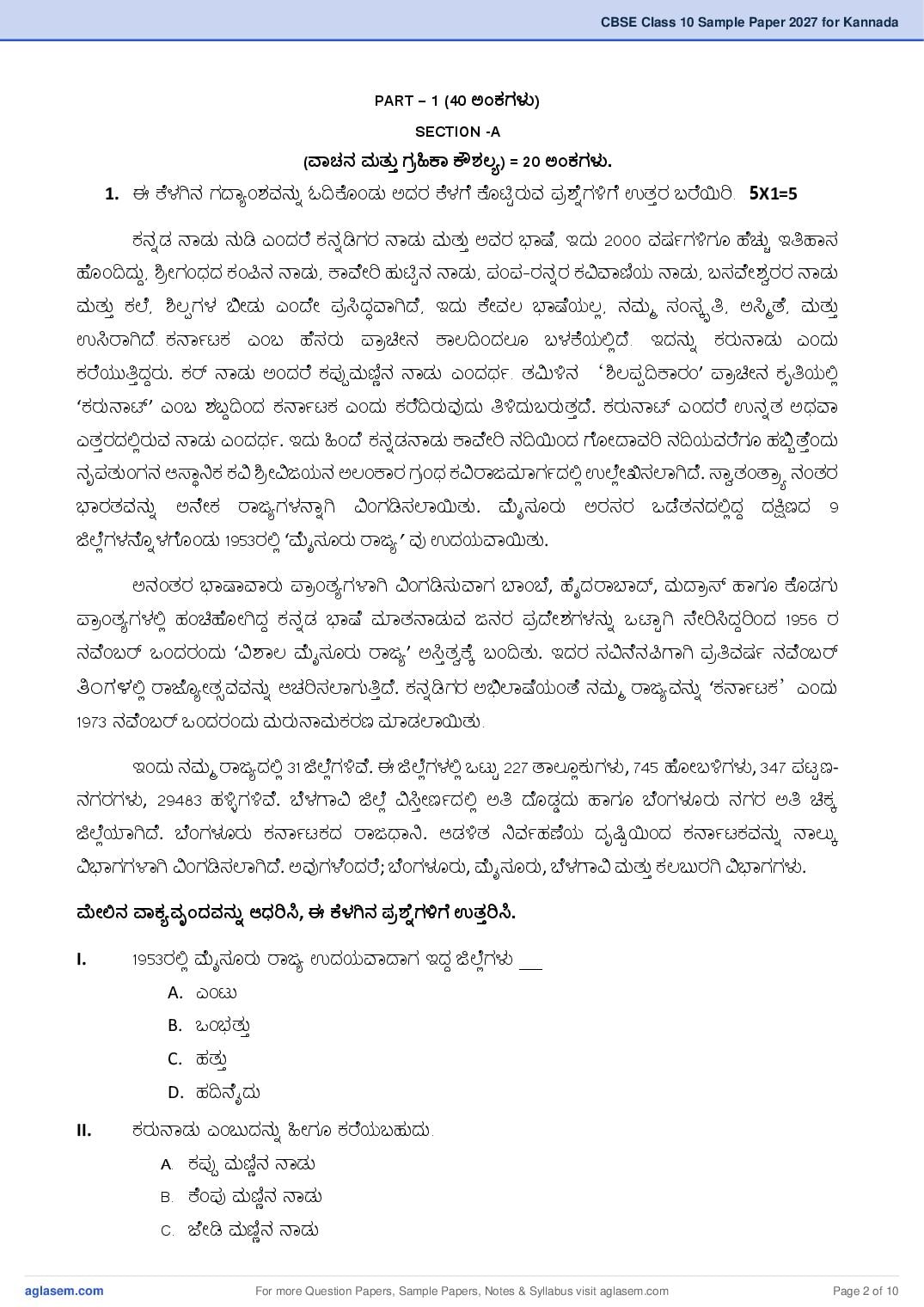
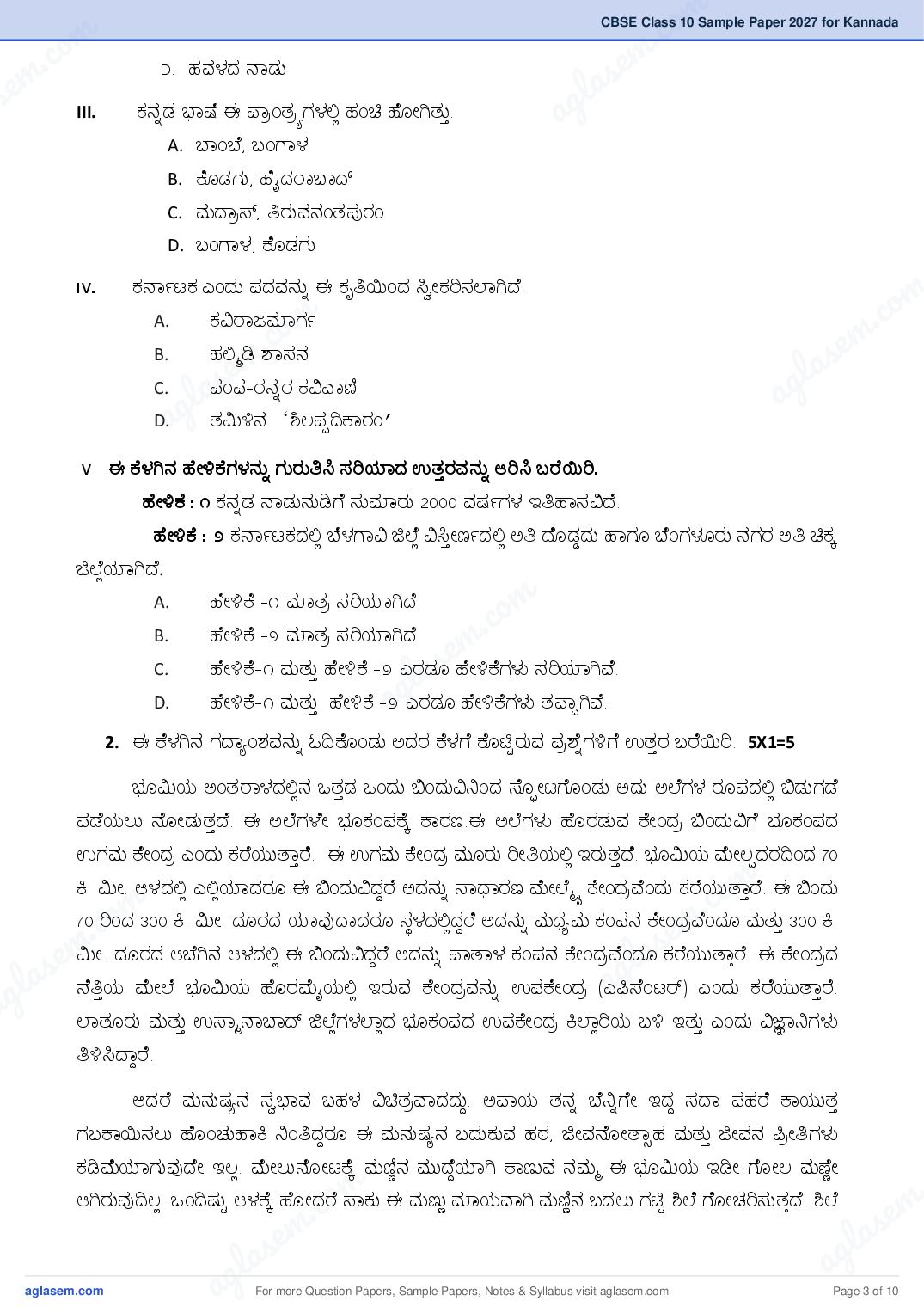
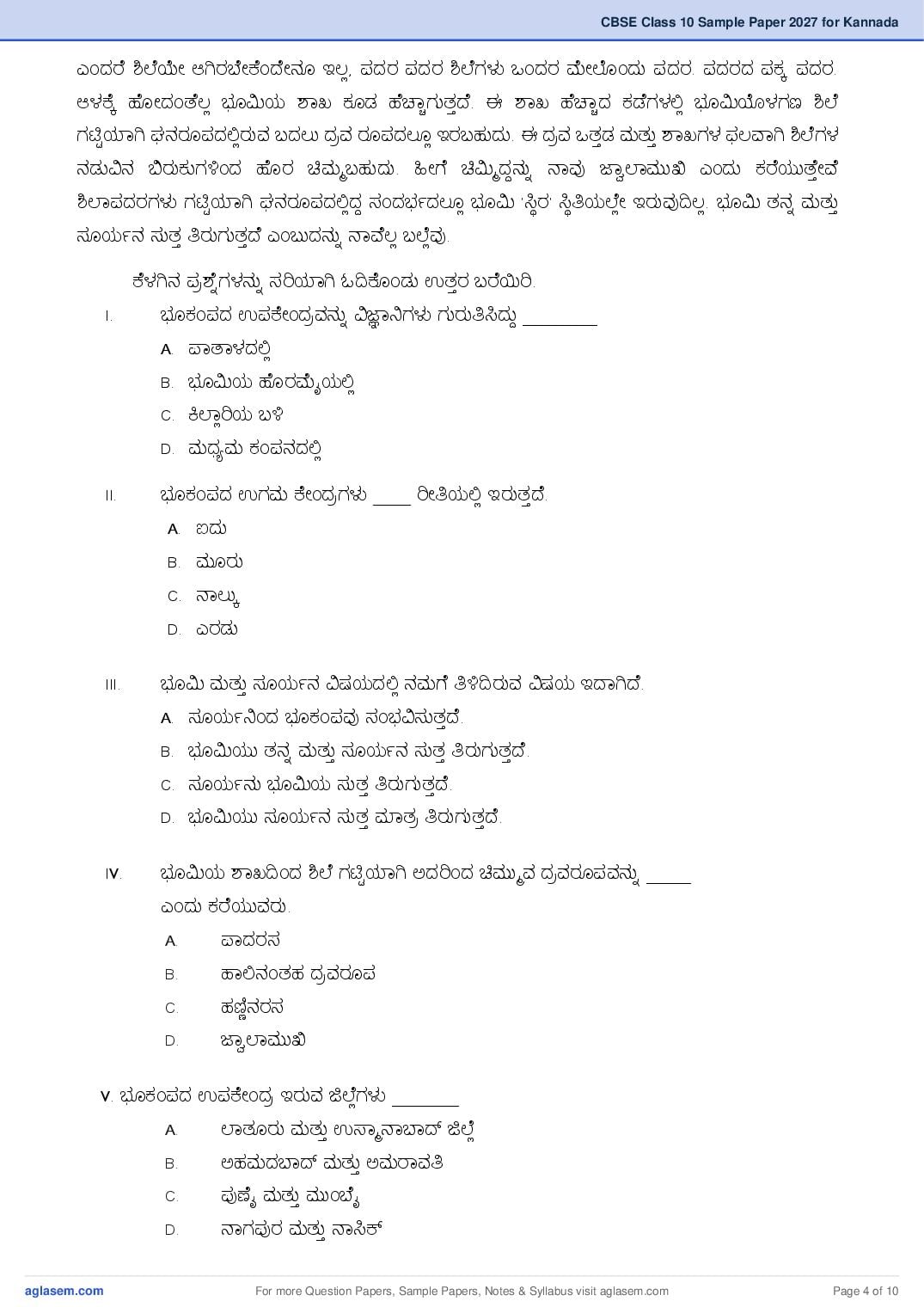
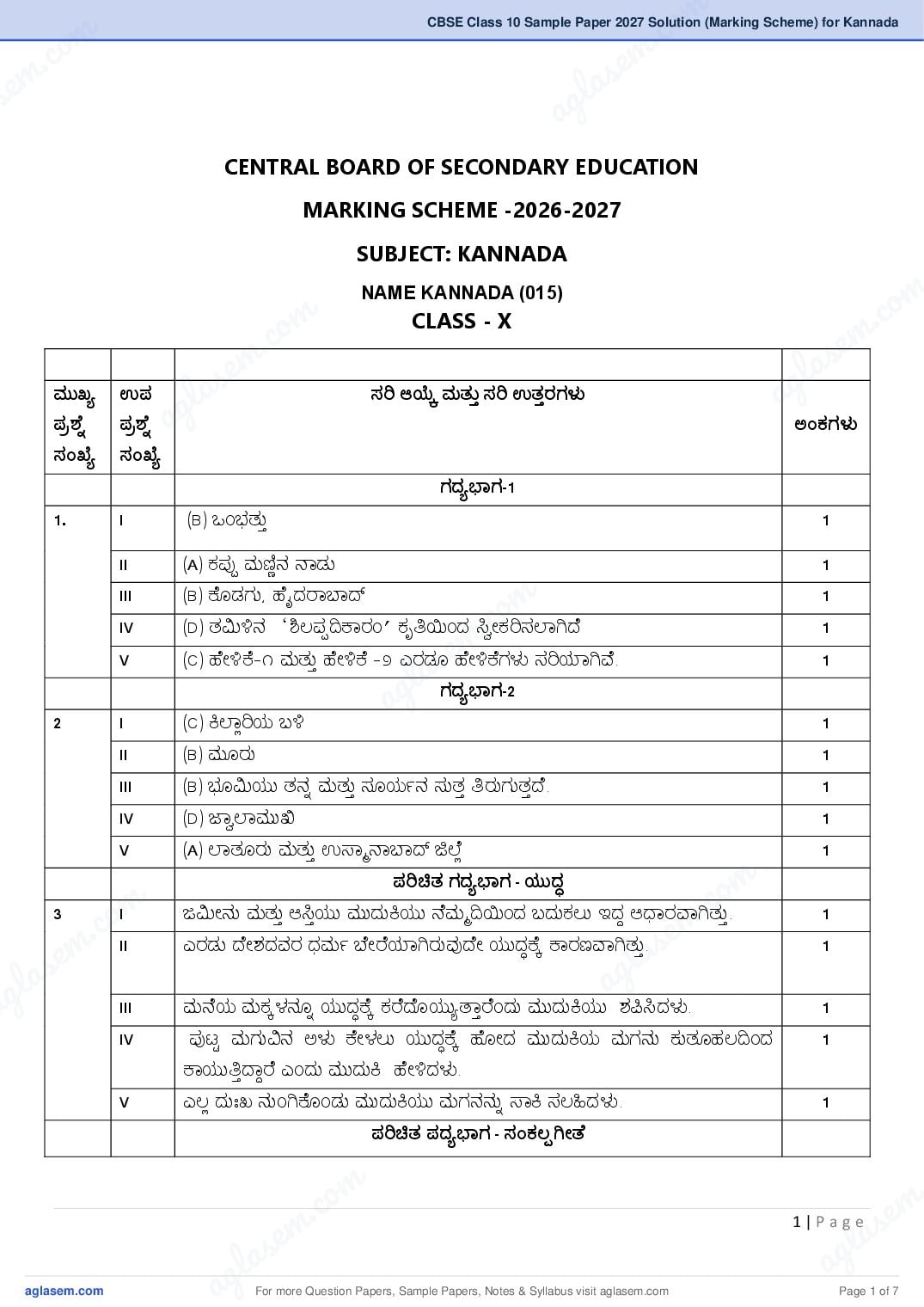
| Part 1 – Section A: Reading and comprehension (ವಾಚನ ಮತ್ತು ಗ್ರಹಿಕಾ ಕೌಶಲ್ಯ) | 1–4 | Q1 unseen prose passage on Karnataka’s name, history and formation – 5 MCQs; Q2 unseen prose passage on earthquakes and volcanoes – 5 MCQs; Q3 seen textbook prose extract ‘Yuddha’ (Sa. Ra. Abubakkar) – 5 one-sentence answers; Q4 seen textbook poem ‘Sankalpageethe’ (G.S. Shivarudrappa) – 5 one-sentence answers | Q1–Q4: 5×1 each | 20 |
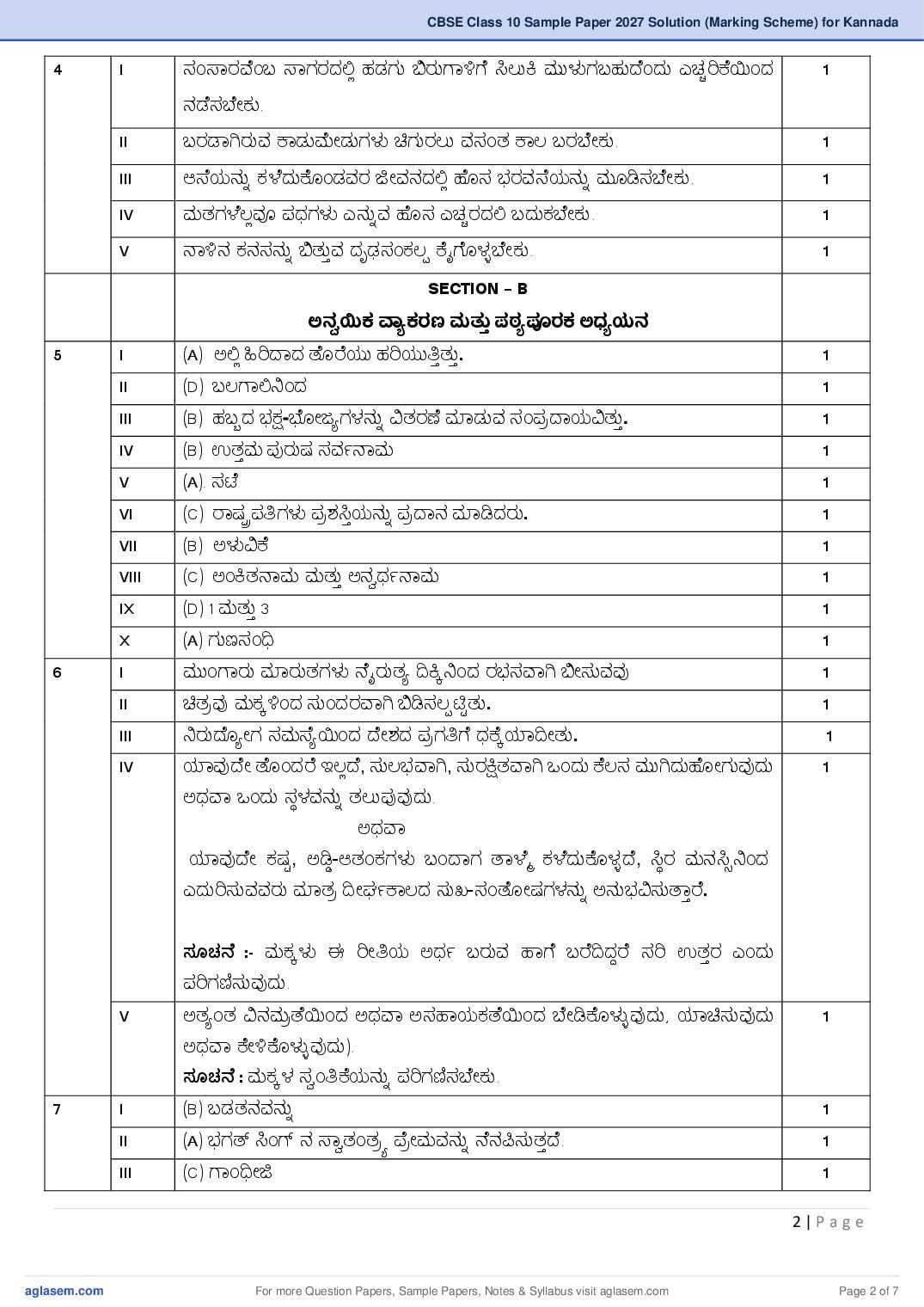
| Part 1 | 5–7 | Q5 grammar MCQs (compounds, case suffixes, pronouns, antonyms, usage, noun types, tatsama–tadbhava, sandhi); Q6 grammar written tasks (change tense, passive/karmani, probability form, meaning of a proverb, use a word in a sentence); Q7 supplementary-reader MCQs | Q5: 10×1; Q6: 5×1; Q7: 5×1 | 20 |
| Part 2 – Section C: Writing skills (ಬರವಣಿಗೆ ಕೌಶಲ್ಯ) | 8–10 | Q8 letter – petition to the Bagalkot Deputy Commissioner for flood relief OR job application for a First Division Assistant post (Revenue Department, Shivamogga); Q9 report on a Gandhi-statue unveiling on Gandhi Jayanti; Q10 essay on 1 of 3 topics | Q8: 4; Q9: 4; Q10: 4 | 12 |
| Part 2 | 11–15 | Q11 four answers in two sentences; Q12 two answers in 5–6 sentences (one prose, one poem); Q13 two quotations to explain with context and appreciation (ಸಂದರ್ಭ ಮತ್ತು ಸ್ವಾರಸ್ಯ), each with an OR; Q14 prose long answer in 8–10 sentences (OR); Q15 poetry long answer in 8–10 sentences (OR) | Q11: 4×2; Q12: 2×3; Q13: 2×3; Q14: 1×4; Q15: 1×4 | 28 |
| Total | 15 | 80 |
Choice: Choice only in Part 2: two options (OR) in Q8, 1 of 3 essay topics in Q10, an OR for each quotation in Q13, and an OR in Q14 and Q15; Q6(IV) offers a choice of two proverbs. All of Part 1 (Q1–Q7, except that proverb) and Q9, Q11, Q12 are compulsory.
- The paper has 15 main questions in two parts (Part 1 and Part 2, 40 marks each) and four sections A–D.
- Section C (writing) – all questions must be answered; Section D (Q11–Q15) to be answered as per the instructions given with each question.
- Answer-length limits printed: Q3/Q4 one sentence each, Q11 two sentences, Q12 5–6 sentences, Q14/Q15 8–10 sentences.
Unit-wise Marks in the Kannada Sample Paper 2027
Marks for each unit (as printed in the paper):
| Unit | Questions | Marks |
|---|---|---|
| Reading – unseen prose passages (MCQs) | Q1, Q2 | 10 |
| Reading – seen textbook extracts: prose ‘Yuddha’ (Sa. Ra. Abubakkar) and poem ‘Sankalpageethe’ (G.S. Shivarudrappa) | Q3, Q4 | 10 |
| Applied grammar | Q5, Q6 | 15 |
| Supplementary reading (MCQs – extracts on poverty in a hut, Bhagat Singh and the Jallianwala Bagh soil, Gandhiji on improving handwriting, Akka Mahadevi’s sugarcane image, Vivekananda on shraddha) | Q7 | 5 |
| Writing (letter/application, report, essay) | Q8–Q10 | 12 |
| Textbook study – prose and poetry (questions on Rama and Shabari, Karna and Krishna, Veeraji/Bhagat Singh, Akka Mahadevi’s vachanas, Dr. Ashok Pai’s research, the sacrificial horse at Valmiki’s ashram, Nalwadi Krishnaraja Wodeyar, Sir M. Visvesvaraya; MS names ‘Vyaghrageethe’ – A.N. Murthy Rao, ‘Bhagyashilpigalu’ – D.S. Jayappagowda, folk song ‘Halagali Bedaru’ – ed. B.S. Gaddagimath, a Kuvempu poem from ‘Pakshikashi’) | Q11–Q15 | 28 |
What Is New in the Kannada Sample Paper 2027?
Compared with the 2026 sample paper (session 2025-26):
- No change in pattern – same 15 questions, two parts and four sections with the same marks as the 2026 sample paper (Reading 20, Applied grammar 15, Supplementary reading 5, Writing 12, Textbooks 28; same per-question marks, answer lengths and OR choices).
- Unseen passages changed: 2026 – Kolar district/KGF and Yoga; 2027 – Karnataka’s name, history and formation, and earthquakes/volcanoes.
- Seen extracts rotated within the same textbook: 2026 Q3/Q4 used ‘Edege Bidda Akshara’ (Devanur Mahadeva) and Kuvempu’s ‘Hasuru’; 2027 uses ‘Yuddha’ (Sa. Ra. Abubakkar) and ‘Sankalpageethe’ (G.S. Shivarudrappa), while Dr. Ashok Pai’s research and ‘Hasuru’ now appear in Section D.
- Q6 grammar tasks changed: 2026 – present tense, standard written (granthika) form, negative form; 2027 – future tense, passive (karmani prayoga), probability form (sambhavanarthaka).
- Writing tasks changed: letter (2026: ban plastic at tourist spots / application for assistant engineer at the Bhadravathi paper factory; 2027: flood relief petition to the Bagalkot DC / application for First Division Assistant, Revenue Dept. Shivamogga) and report (2026: slum development visit; 2027: Gandhi-statue unveiling); the three essay topics are unchanged (Western Ghats protection, women empowerment, Swachh Bharat Abhiyan).
- Some textbook questions repeat almost word for word from 2026: Q12(II) on the sacrificial horse reaching Valmiki’s ashram, the Q13 quotation ‘Devare, mara hattuvashtu avakasha karunisu’, and the Q7 Jallianwala Bagh/Bhagat Singh MCQ.
Questions from the Kannada Sample Paper 2027
Two questions from the 2027 paper, to show the level:
- Section B (Q5 IV), 1 mark: neenu, neevu : second-person pronoun :: naanu, naavu : ____ (A) third-person pronoun (B) first-person pronoun (C) interrogative pronoun (D) reflexive pronoun
- Section D (Q14 I), 4 marks: ‘In the time of Nalwadi Krishnaraja Wodeyar, Mysuru was a model state.’ Support this statement with your opinion (8–10 sentences).
CBSE Class 10 Kannada Marking Scheme 2027 (Solutions)
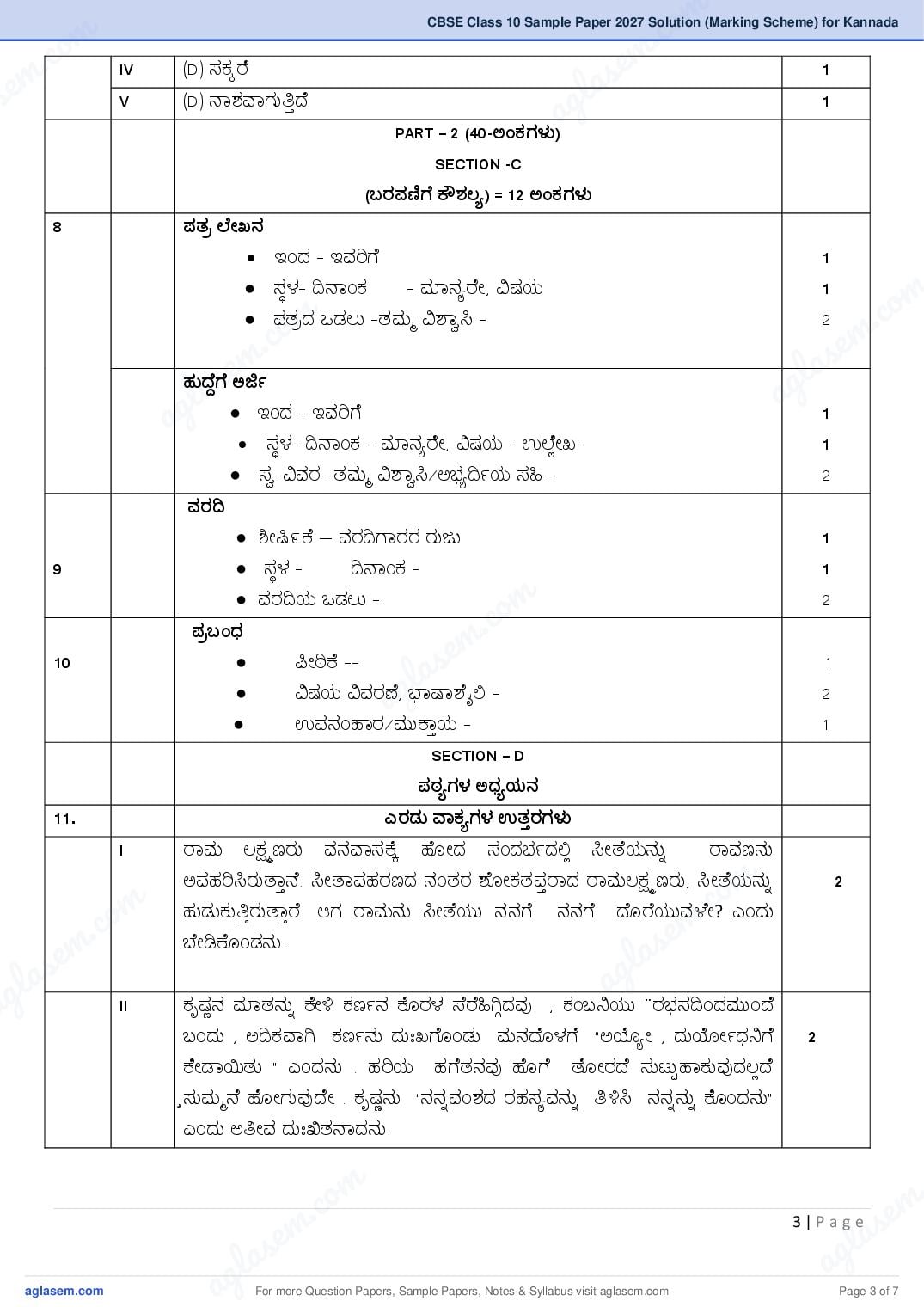
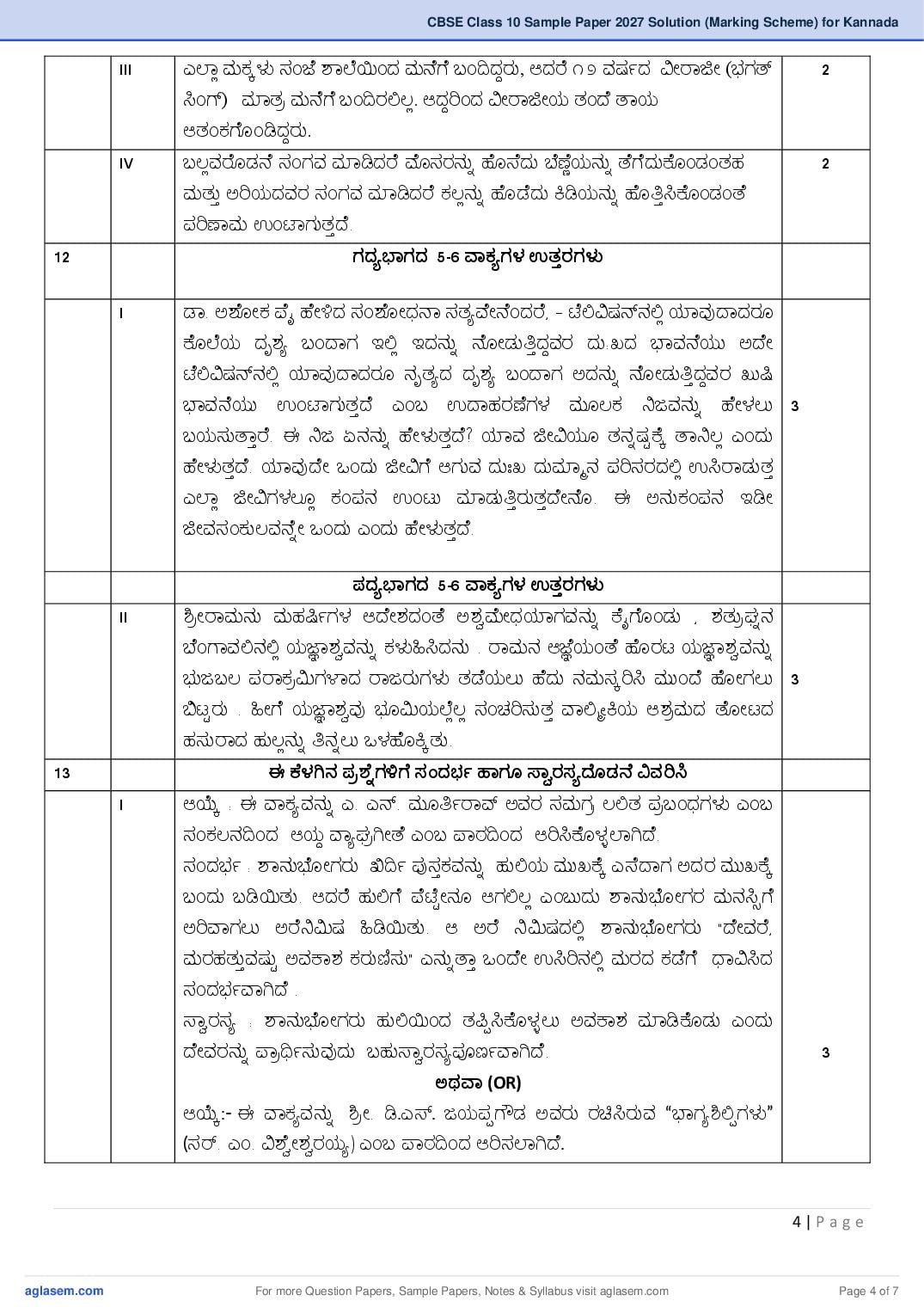
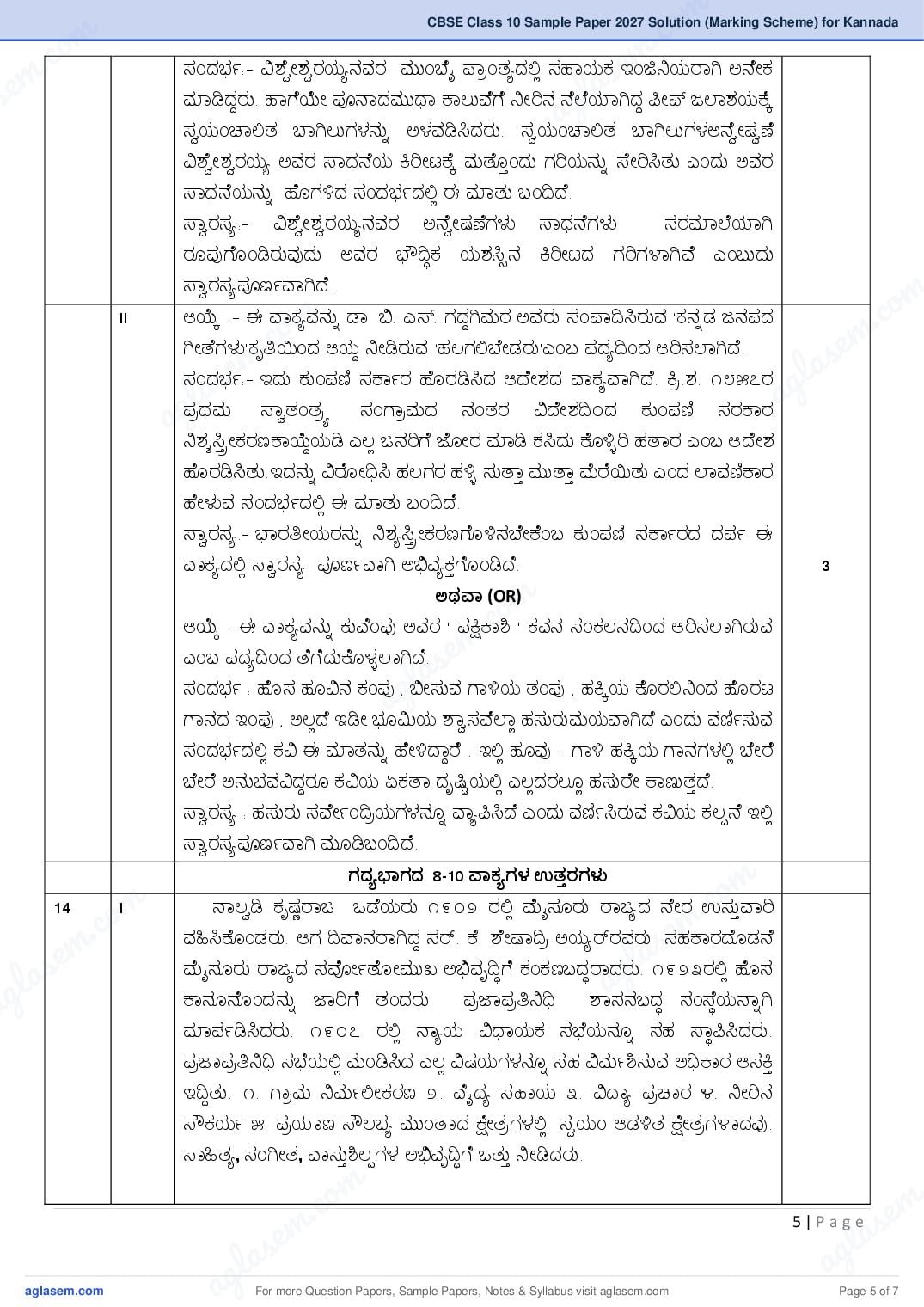
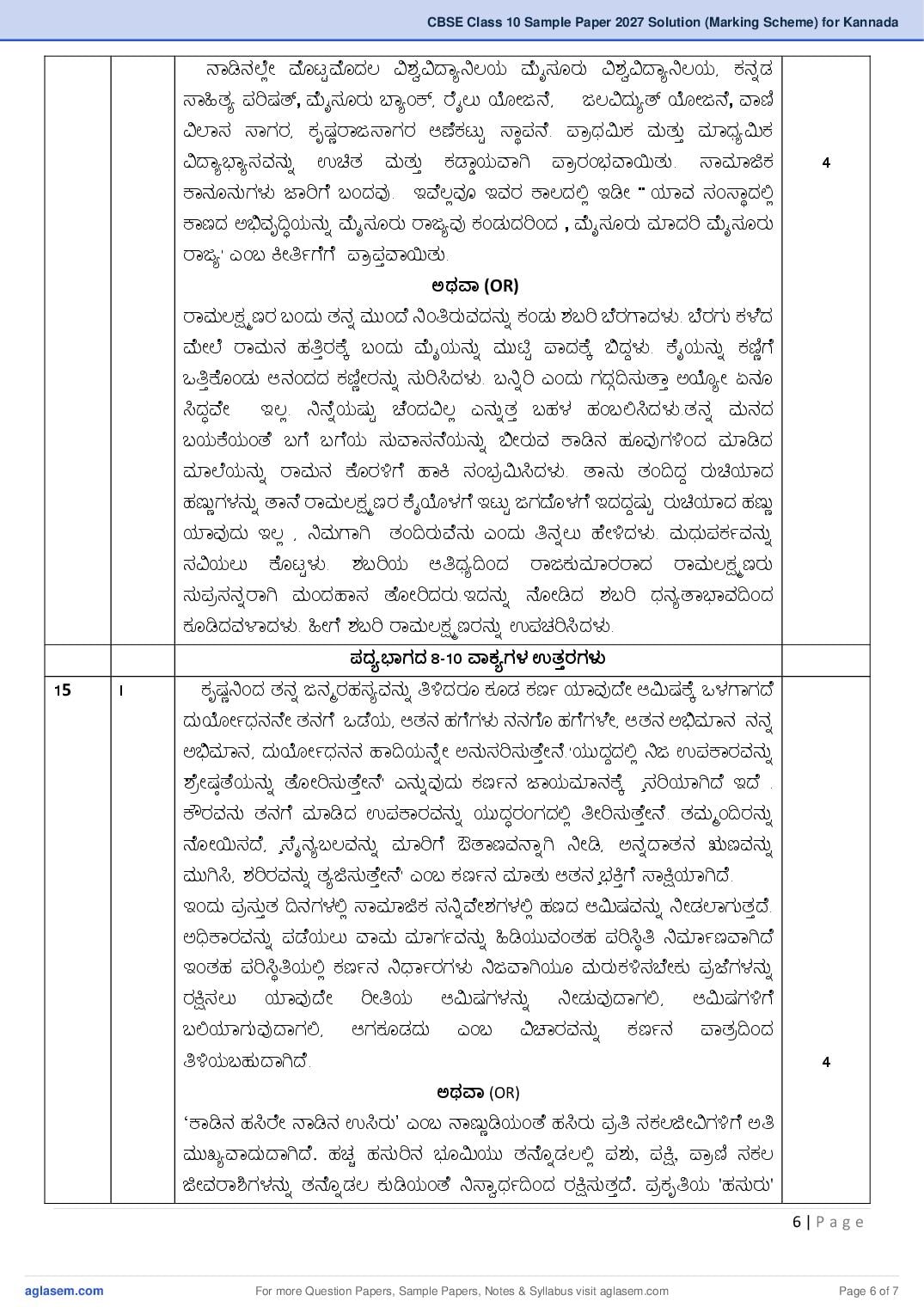
The 2027 marking scheme gives the correct option for all MCQs (Q1, Q2, Q5, Q7), one-sentence model answers for Q3–Q4 and Q6, and full model answers for Q11–Q15, with Q13 answers set out as source (ಆಯ್ಕೆ – lesson and author), context and appreciation. It prints mark splits for the letter/application (from–to 1, place/date/salutation/subject 1, body and closing 2), the report (headline/reporter 1, place/date 1, body 2) and the essay (introduction 1, content and style 2, conclusion 1), and allows answers in the student’s own words where the meaning is right. Check your answers against it after you solve the paper.
Kannada Marking Scheme 2027 – Read Online
How to Score Well – Tips from the 2027 Paper
- Revise the textbook thoroughly – besides Section D (28 marks), Q3 and Q4 (10 marks) are seen extracts from textbook lessons, and several 2027 questions repeat 2026 ones.
- For Q13 always write three parts – source (lesson and author), context and appreciation – as the marking scheme does.
- Learn both formal-letter and job-application layouts; format points (from/to, place, date, salutation, subject, signature) carry half the marks in Q8 and Q9.
- Practise grammar transformations (tense, karmani prayoga, probability/negative forms), sandhi and samasa types and tatsama–tadbhava pairs – grammar is 15 marks with no choice.
- Keep to the printed lengths: one sentence for Q3/Q4, two sentences for Q11, 5–6 for Q12 and 8–10 for Q14/Q15.
- Solve the 2027 paper in one sitting with a timer, check it with the marking scheme, then solve the 2026 paper a few days later.
CBSE Class 10 Kannada Sample Paper 2027 – FAQs
Is the CBSE Class 10 Kannada Sample Paper 2027 out?
Yes. CBSE has released the Class 10 Kannada sample paper 2027 for the 2026-27 session with its marking scheme – both are in the table on this page, free.
Is the CBSE Class 10 Kannada Sample Paper 2027 available with solutions?
Yes. The official CBSE marking scheme is the solution – it gives the answers and the marks for each step. Download it from the table above or read it online on this page.
Has the CBSE Class 10 Kannada paper pattern changed for 2027?
No. CBSE says there is no change in the question paper design for 2026-27. The 2027 sample paper keeps the 2026 pattern – 80 marks, 3 hours, 15 questions in 2 parts. Small changes: Unseen passages changed: 2026 – Kolar district/KGF and Yoga; 2027 – Karnataka’s name, history and formation, and earthquakes/volcanoes.; Seen extracts rotated within the same textbook: 2026 Q3/Q4 used ‘Edege Bidda Akshara’ (Devanur Mahadeva) and Kuvempu’s ‘Hasuru’; 2027 uses ‘Yuddha’ (Sa. Ra. Abubakkar) and ‘Sankalpageethe’ (G.S. Shivarudrappa), while Dr. Ashok Pai’s research and ‘Hasuru’ now appear in Section D..
How many marks and questions are in the CBSE Class 10 Kannada Sample Paper 2027?
It is a 80 marks, 3 hours, 15 questions paper – Section Part 1 – Section A: Reading and comprehension (ವಾಚನ ಮತ್ತು ಗ್ರಹಿಕಾ ಕೌಶಲ್ಯ): 1–4 (20 marks); Section Part 1 – Section B: Applied grammar and supplementary reading (ಅನ್ವಯಿಕ ವ್ಯಾಕರಣ ಮತ್ತು ಪಠ್ಯಪೂರಕ ಅಧ್ಯಯನ): 5–7 (20 marks); Section Part 2 – Section C: Writing skills (ಬರವಣಿಗೆ ಕೌಶಲ್ಯ): 8–10 (12 marks); Section Part 2 – Section D: Textbook study – prose/poetry (ಪಠ್ಯಗಳ ಅಧ್ಯಯನ): 11–15 (28 marks).
Which units carry the most marks in the Kannada sample paper 2027?
In the 2027 sample paper: Textbook study – prose and poetry (questions on Rama and Shabari, Karna and Krishna, Veeraji/Bhagat Singh, Akka Mahadevi’s vachanas, Dr. Ashok Pai’s research, the sacrificial horse at Valmiki’s ashram, Nalwadi Krishnaraja Wodeyar, Sir M. Visvesvaraya; MS names ‘Vyaghrageethe’ – A.N. Murthy Rao, ‘Bhagyashilpigalu’ – D.S. Jayappagowda, folk song ‘Halagali Bedaru’ – ed. B.S. Gaddagimath, a Kuvempu poem from ‘Pakshikashi’) (28 marks), Applied grammar (15 marks), Writing (letter/application, report, essay) (12 marks).
Is the CBSE 10th Kannada model question paper 2027 the same as the sample paper?
Yes. CBSE calls it the sample question paper (SQP); students also search for it as the 10th Kannada model question paper or model test paper – it is the same official paper on this page.
Will the board exam paper be the same as the sample paper?
No – the CBSE Class 10 board exam 2027 has different questions, but it follows the same pattern as the sample paper: the same sections, marks and question types.