Download the CBSE Class 10 Hindi B Sample Paper 2027 PDF with its marking scheme (solutions) – the official CBSE sample question paper (SQP) for the 2026-27 session, the paper to practise for the CBSE Class 10 board exam 2027. It is an 80-mark, 3-hour paper with 16 questions in 4 sections. The pattern is the same as the 2026 sample paper. The 2026 and 2025 sample papers are also here. Students also call it the CBSE 10th Hindi B model question paper 2027 or model test paper – it is the same official CBSE paper.
CBSE Class 10 Hindi B Sample Paper 2027 PDF Download
Open a paper to read it online or download the PDF. The marking scheme has the answers, with the marks for each step.
| Year | Document | Download |
|---|---|---|
| 2027 | CBSE Class 10 Sample Paper 2027 for Hindi Course B | View PDF |
| 2027 | CBSE Class 10 Sample Paper 2027 Solution (Marking Scheme) for Hindi Course B | View PDF |
| 2026 | CBSE Class 10 Sample Paper 2026 for Hindi Course B | View PDF |
| 2026 | CBSE Class 10 Sample Paper 2026 Solution for Hindi Course B | View PDF |
| 2025 | CBSE Class 10 Sample Paper 2025 for Hindi B | View PDF |
CBSE 10th Hindi B Model Question Paper 2027 – Quick Facts
| Board | Central Board of Secondary Education (CBSE) |
| Class | Class 10 |
| Subject | Hindi B (code 085 (printed as हिंदी ‘ब’ कोड 085)) |
| Session | 2026-27 – for the board exam 2027 |
| Marks and time | 80 marks, 3 hours |
| Questions | 16 questions in 4 sections |
| Solutions | Yes – official CBSE marking scheme |
| Older papers | 2026, 2025 |
| Released by | CBSE (cbseacademic.nic.in) |
CBSE Class 10 Hindi B Sample Paper 2027 – Read Online
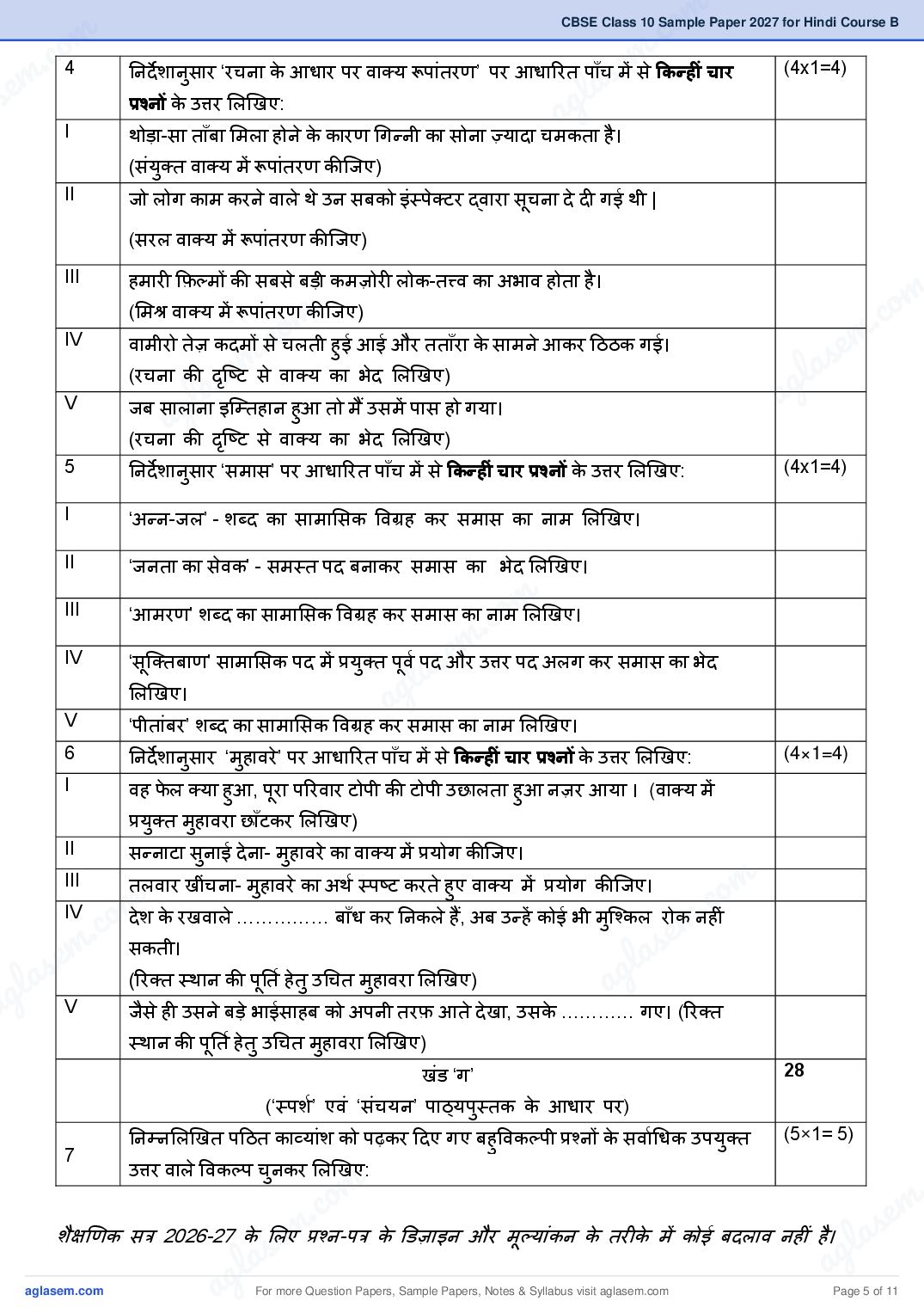
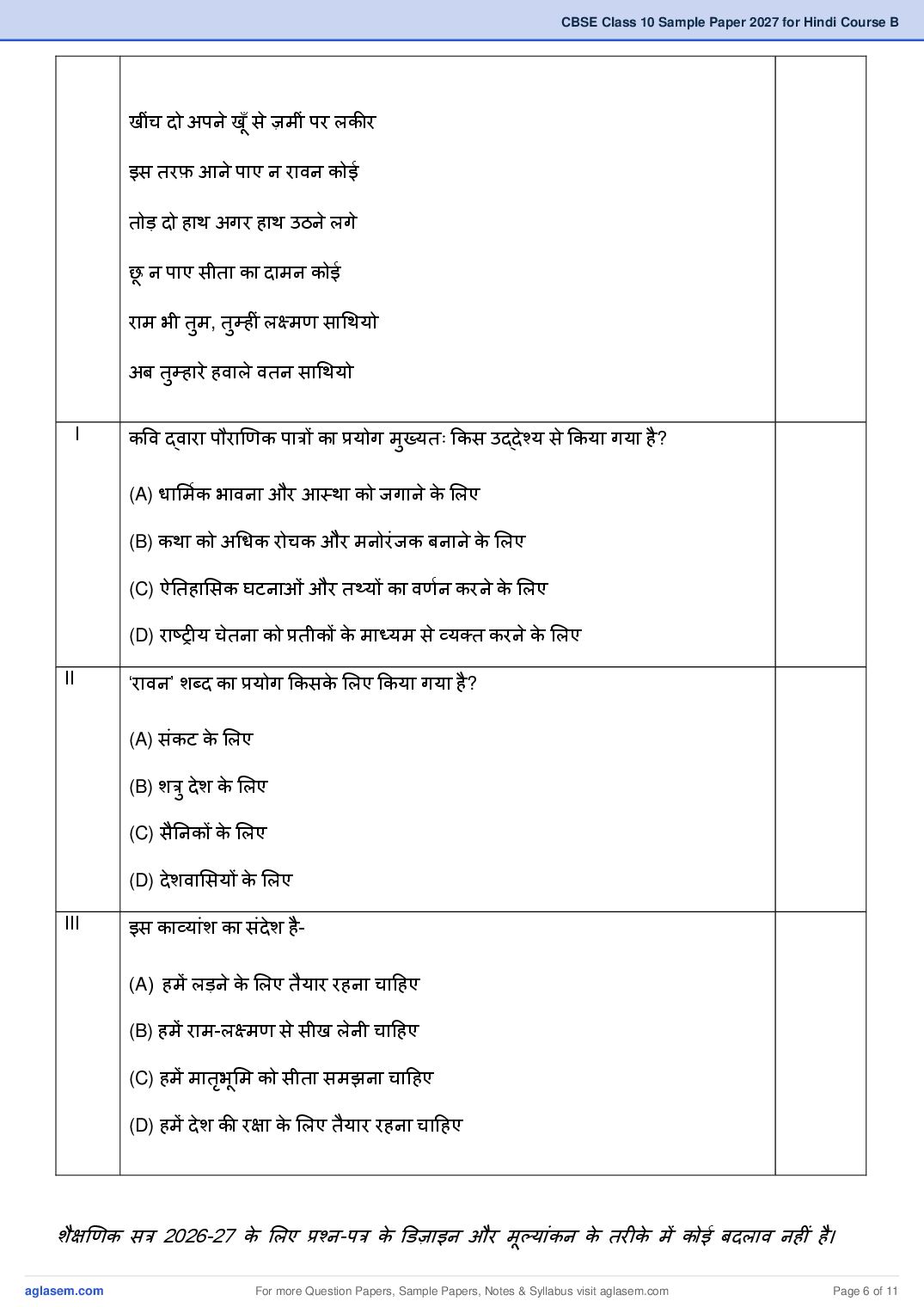
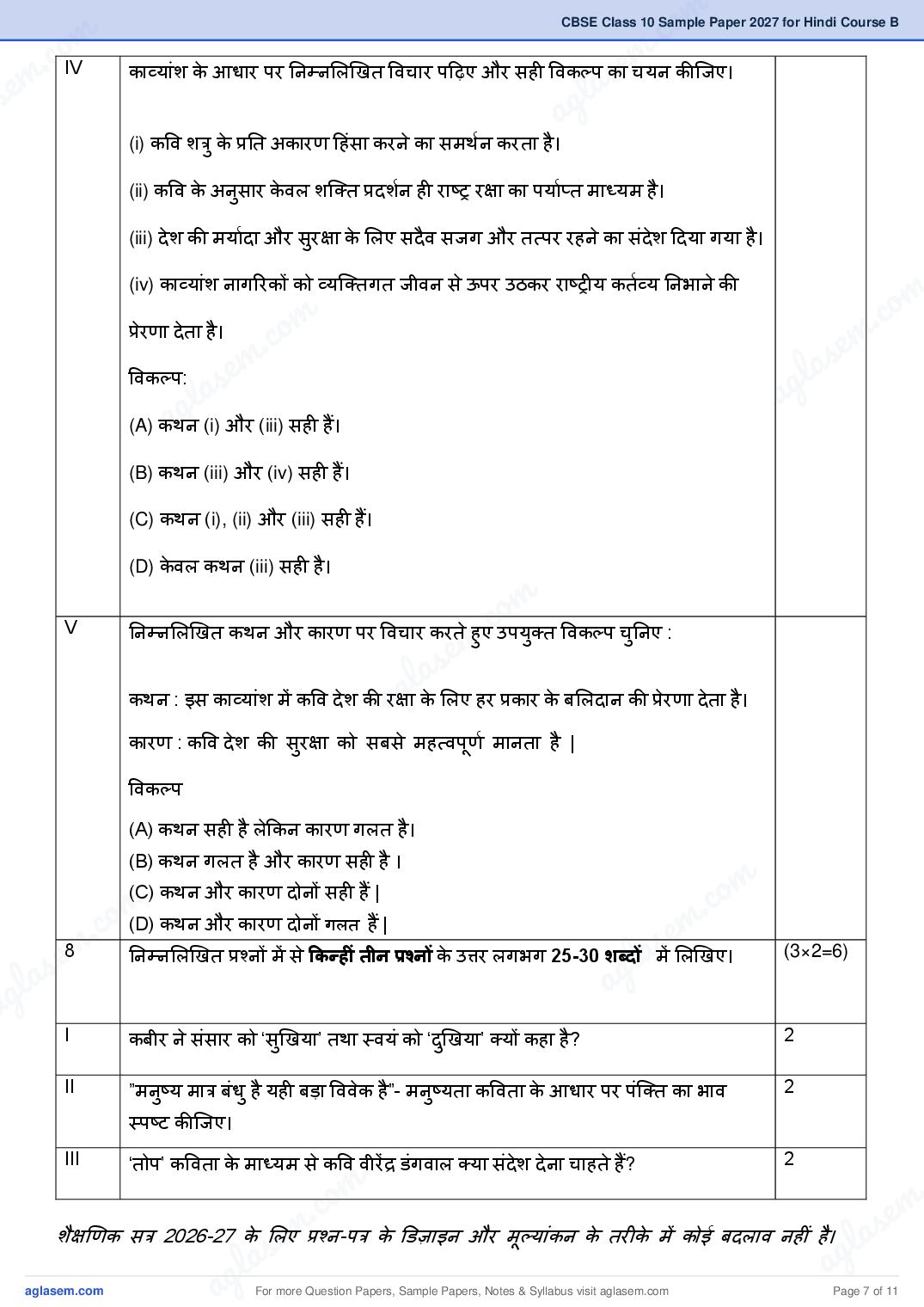
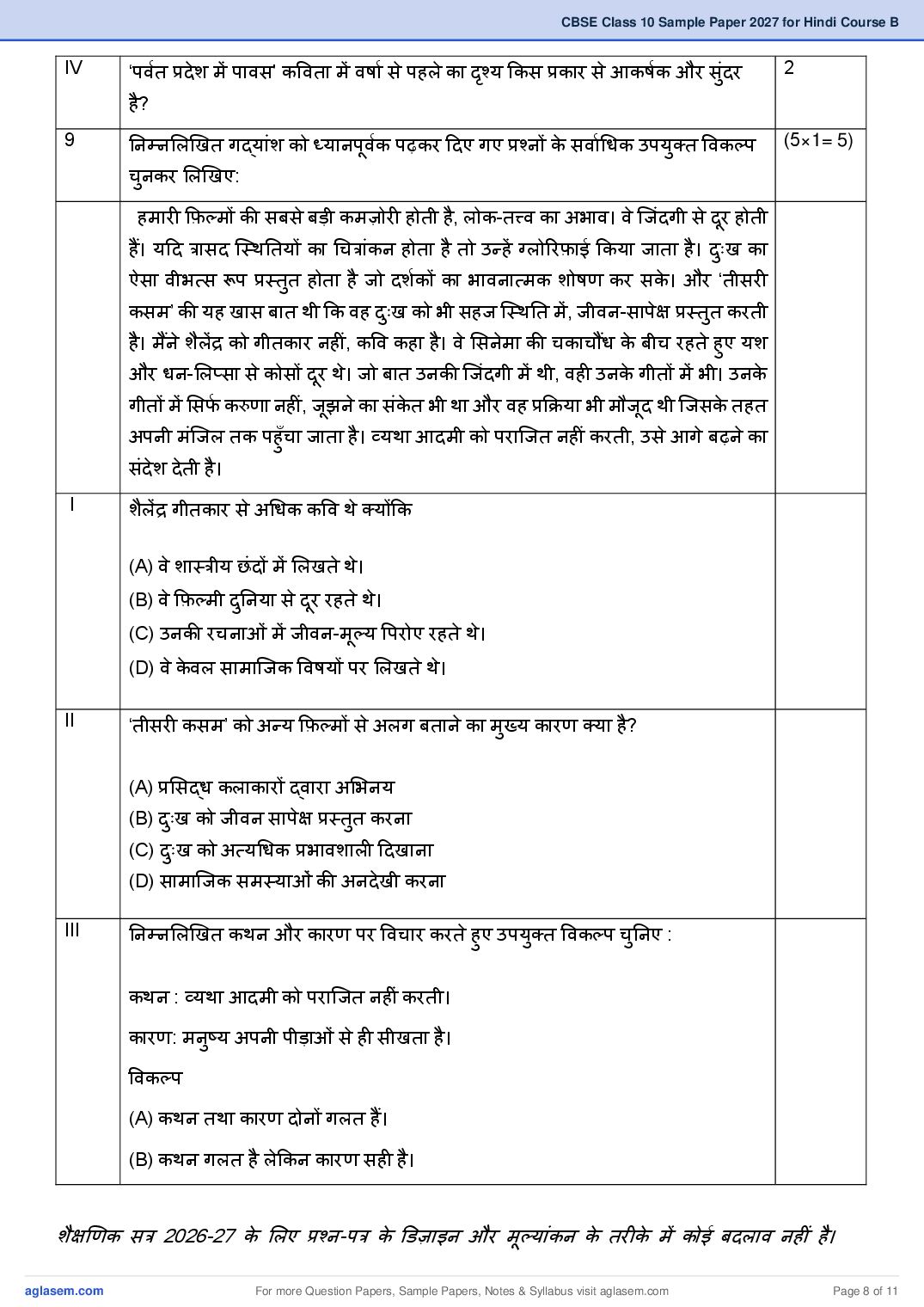
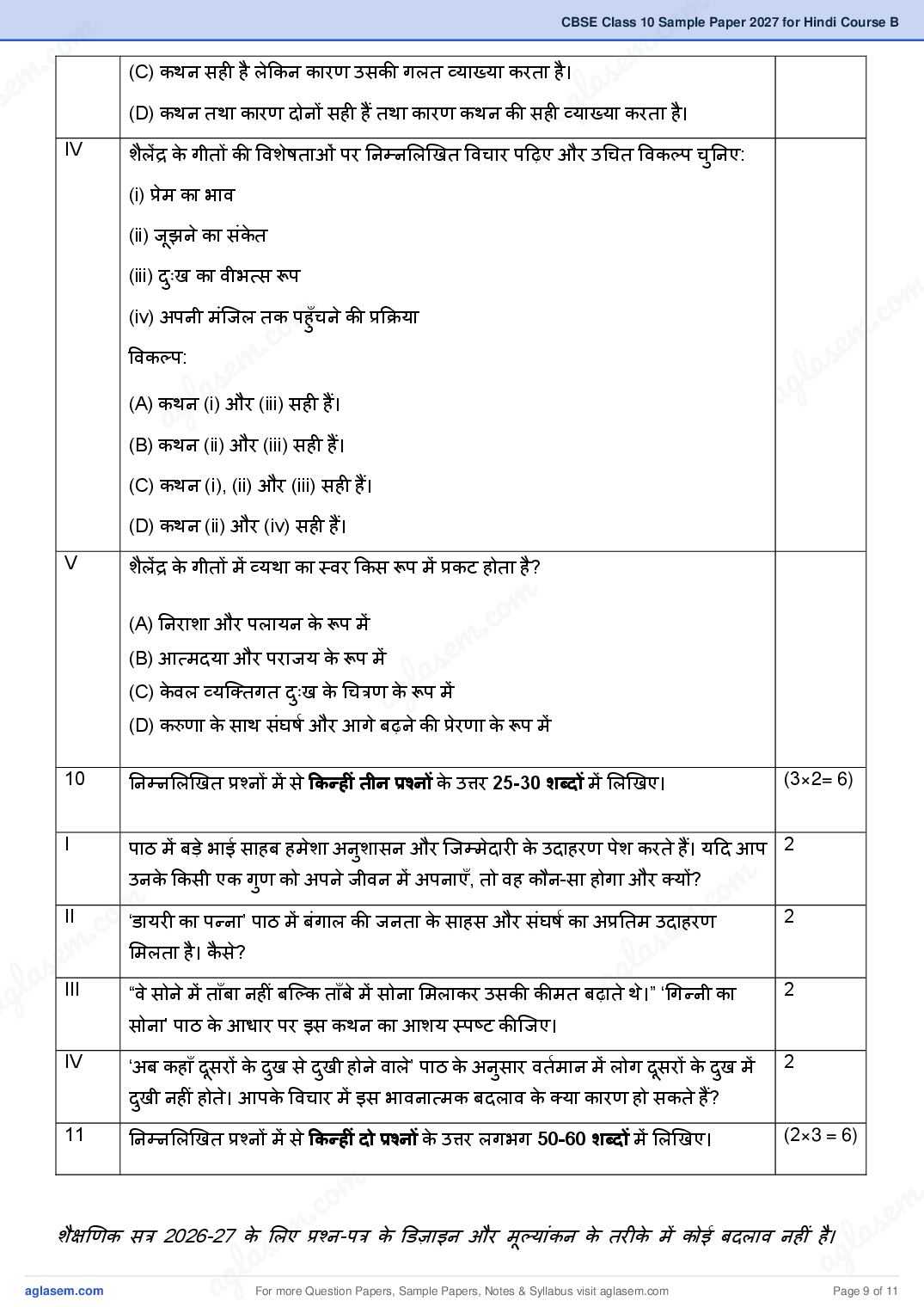
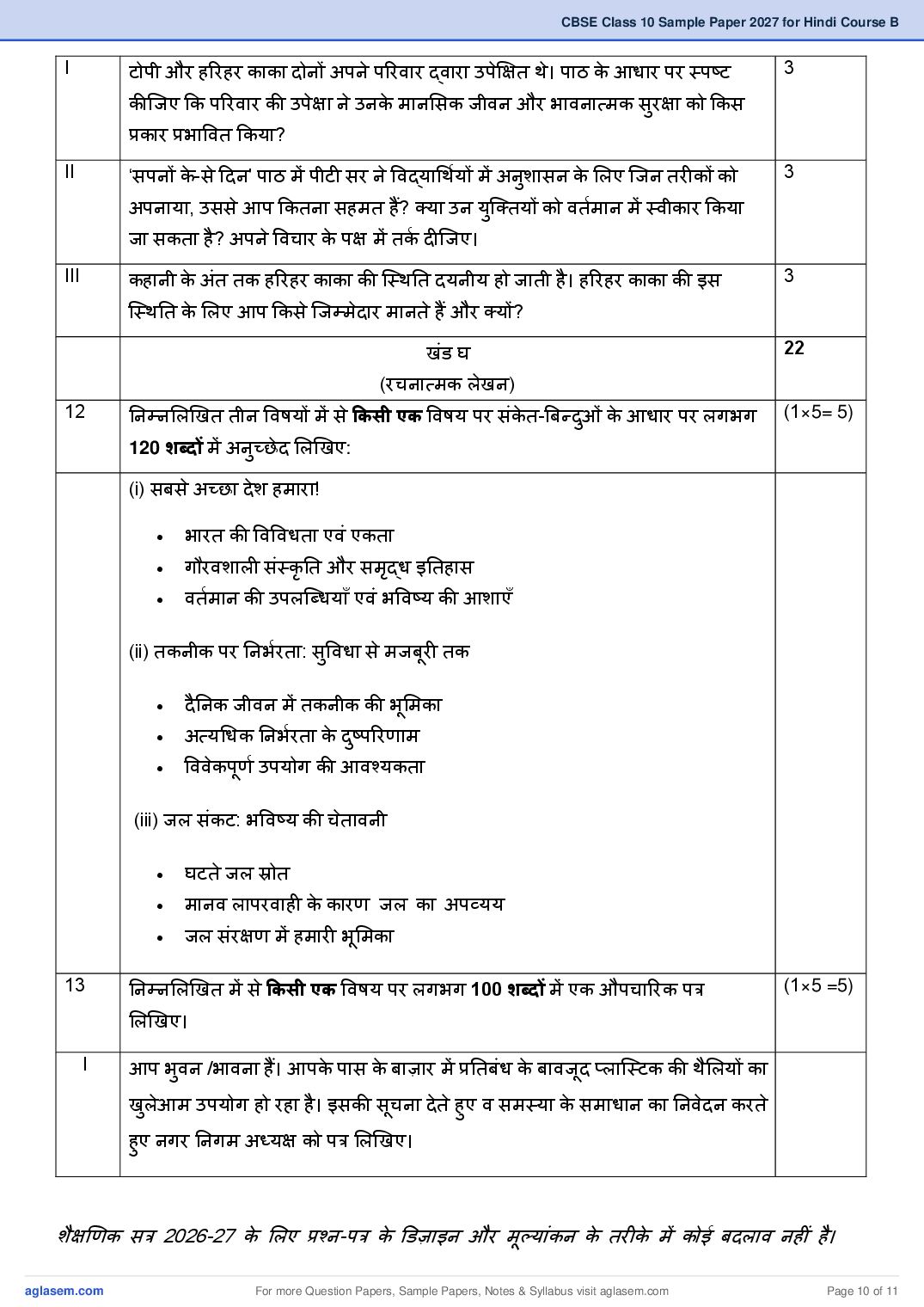
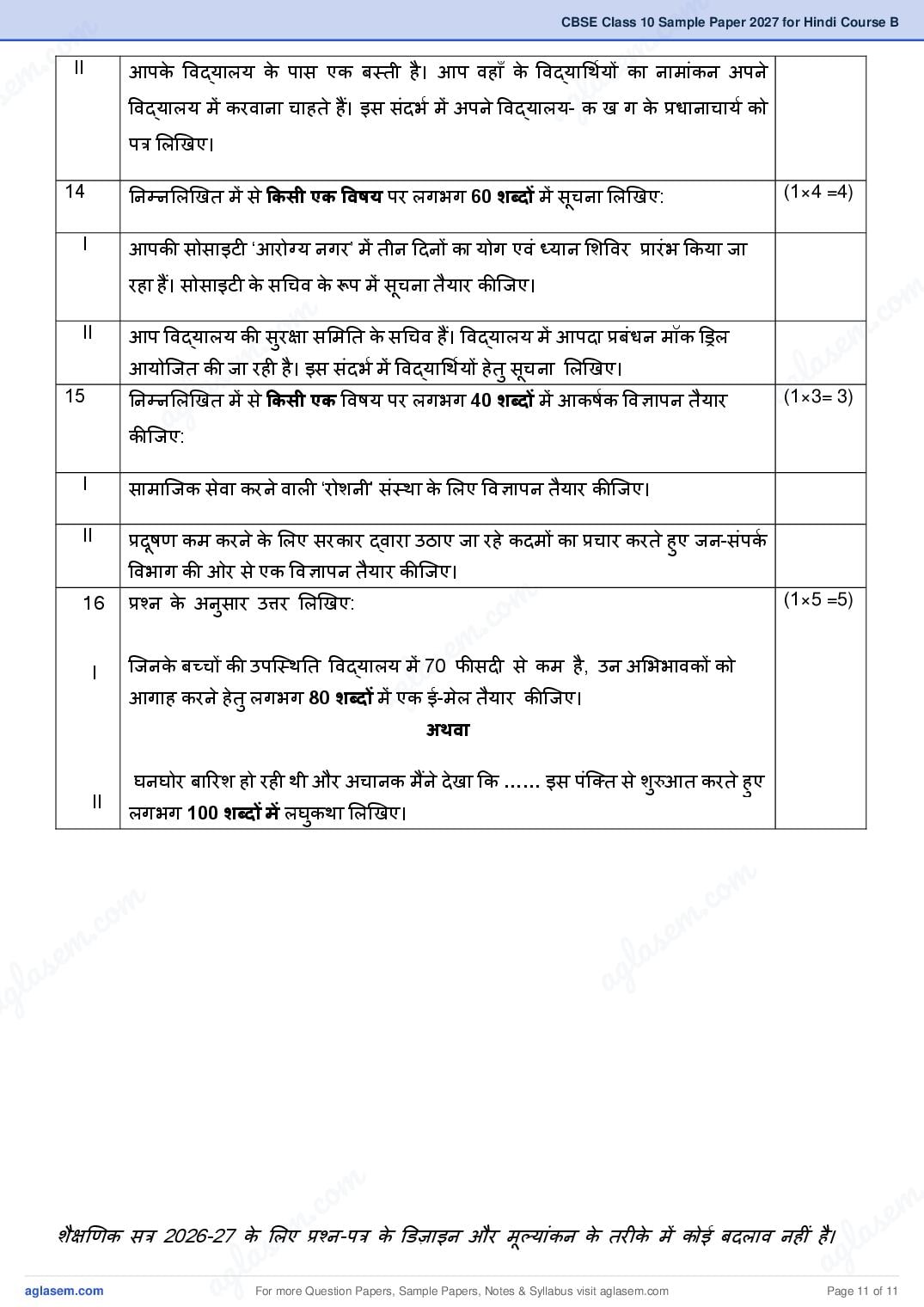
CBSE Class 10 Hindi B Paper Pattern 2027
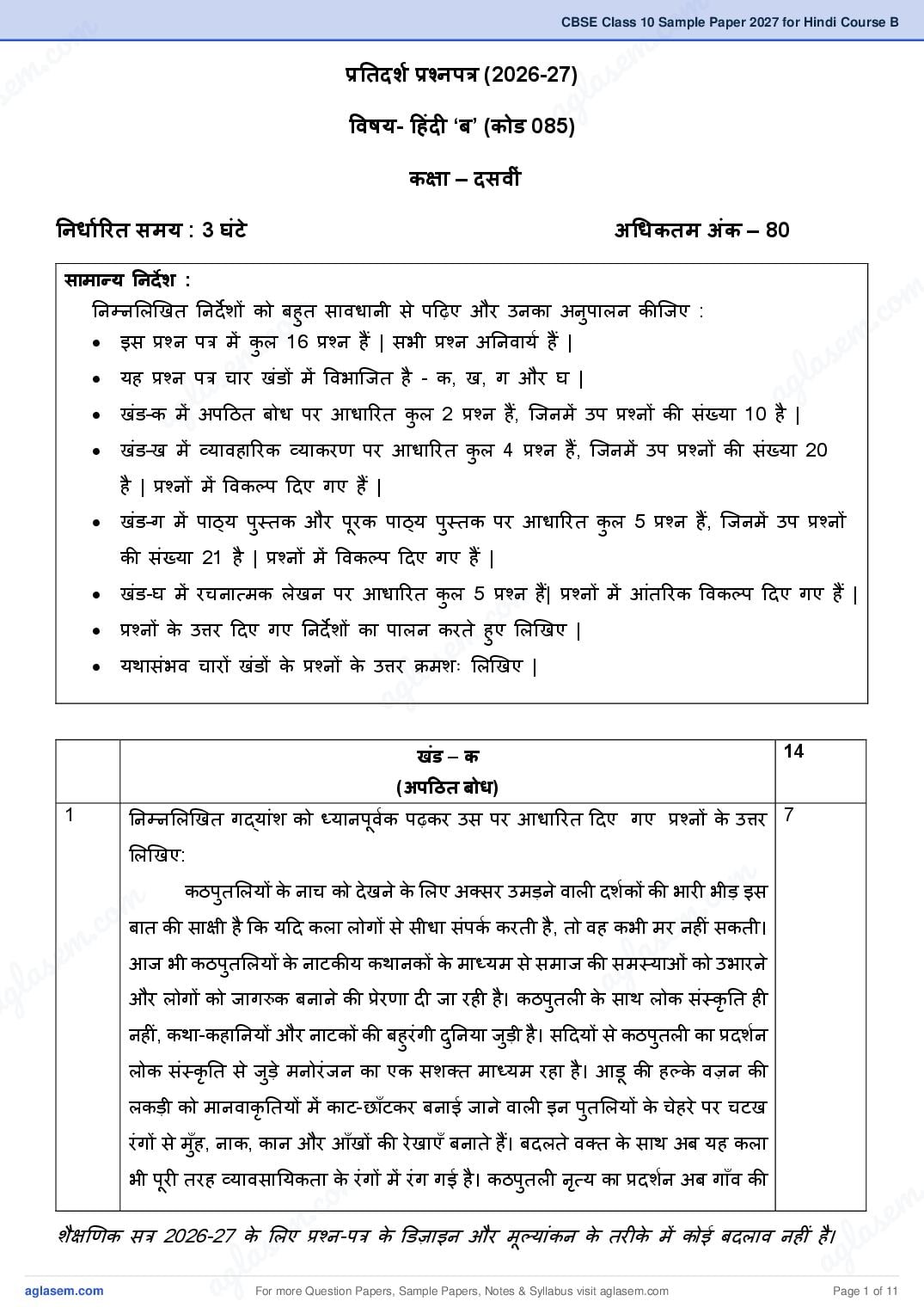
How the 2027 sample paper is set (from the paper itself) – 80 marks, 3 hours, 16 questions:
| Section | Questions | Type | Marks each | Total |
|---|---|---|---|---|
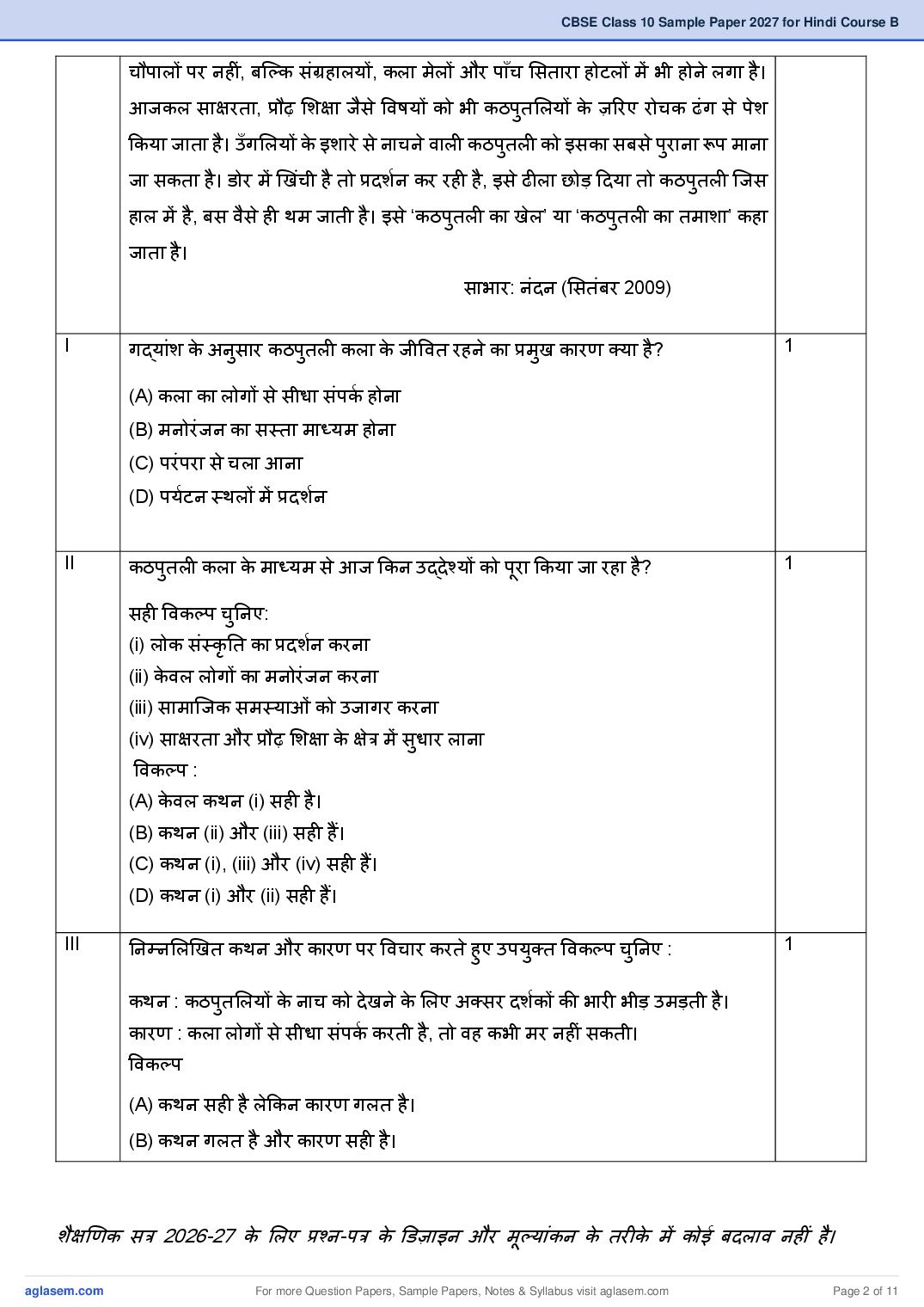
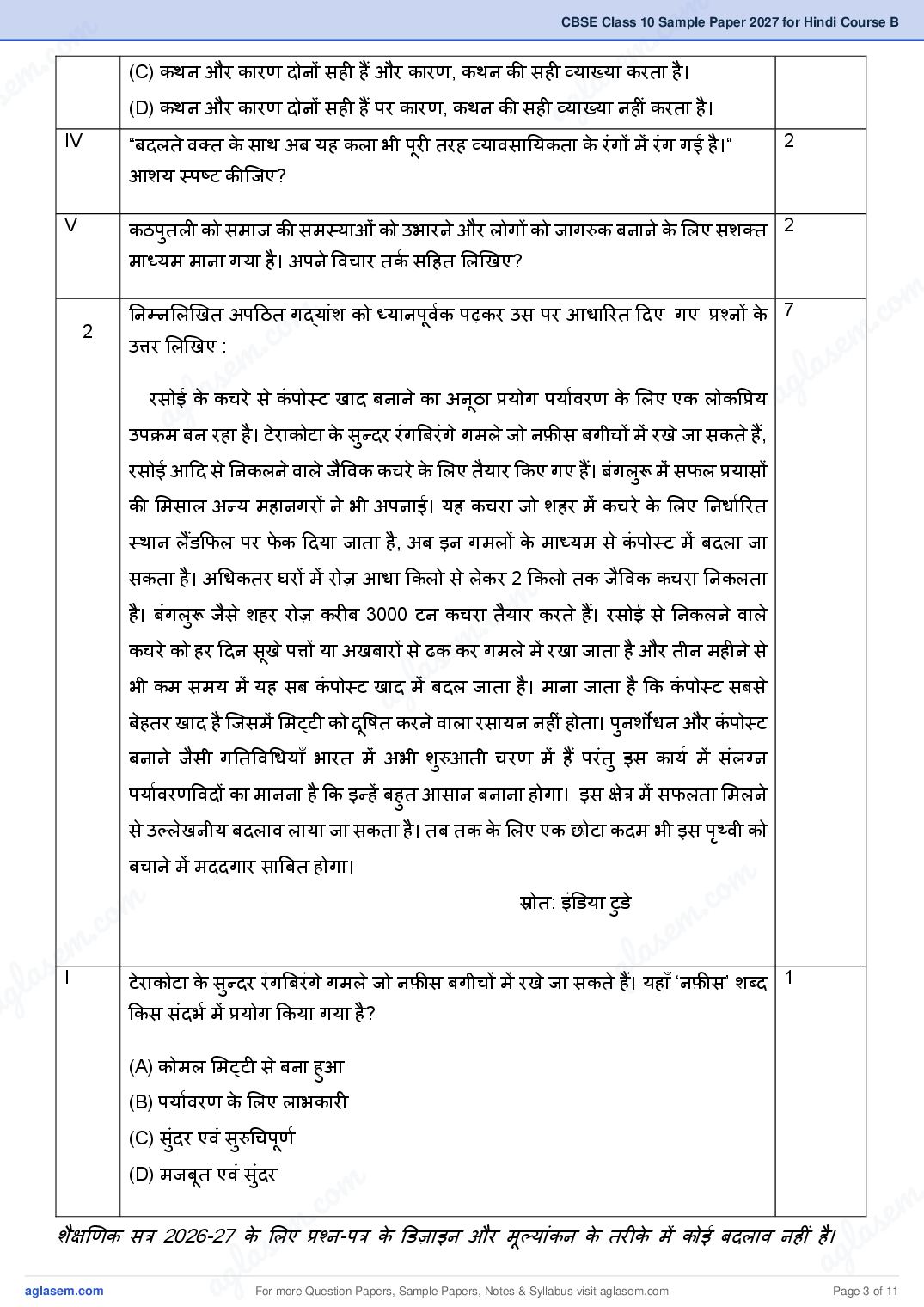
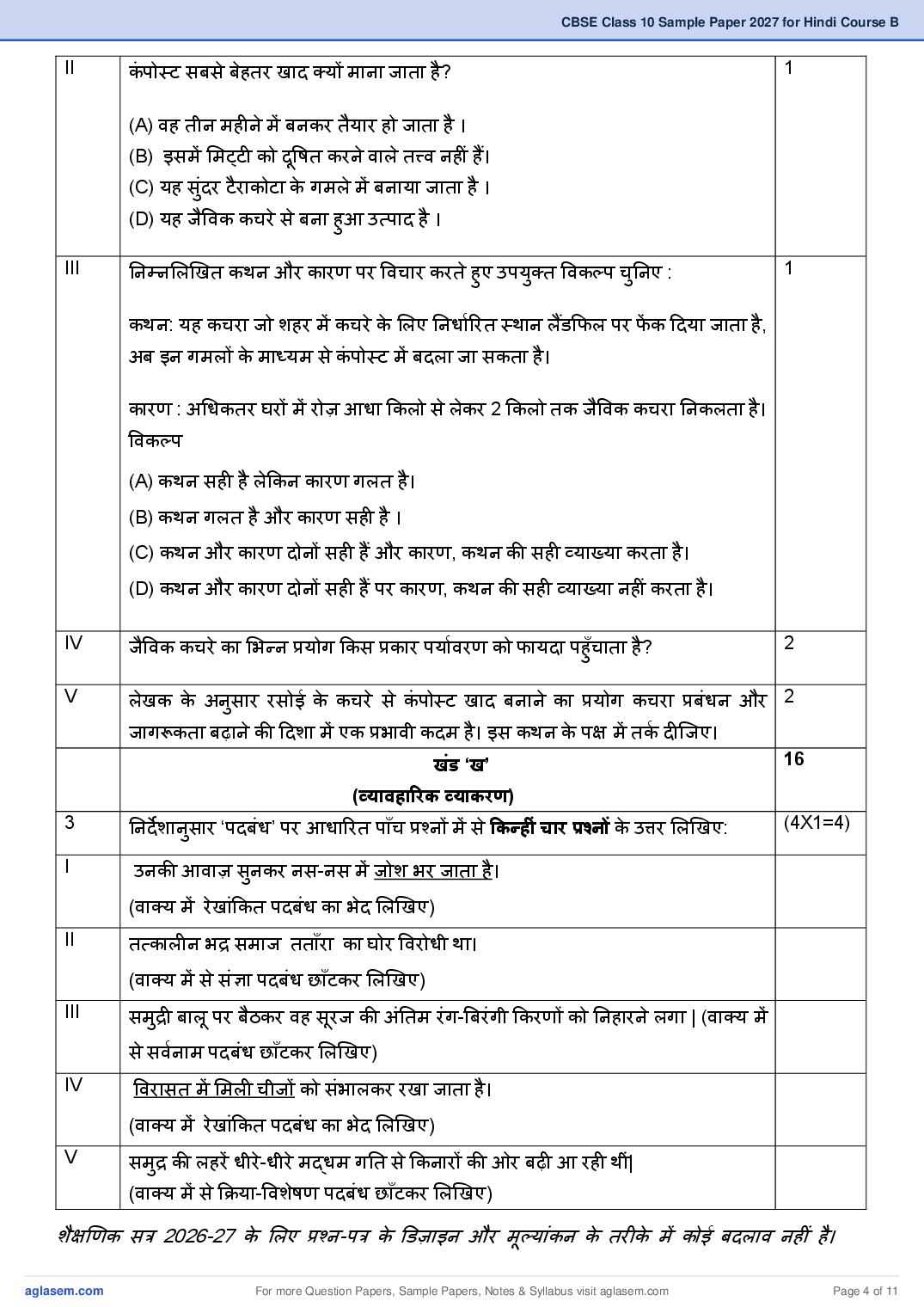
| Section A – Unseen Comprehension (खंड क – अपठित बोध) | 1–2 | Two unseen prose passages – Q1 on puppetry (कठपुतली कला, from Nandan, Sept 2009) and Q2 on composting kitchen waste – each with 3 MCQs (incl. assertion-reason and multi-statement type) and 2 short-answer questions | Q1: 1+1+1+2+2; Q2: 1+1+1+2+2 | 14 |
| Section B – Applied Grammar (खंड ख – व्यावहारिक व्याकरण) | 3–6 | Q3 phrases (पदबंध), Q4 sentence transformation by structure (रचना के आधार पर वाक्य रूपांतरण), Q5 compounds (समास), Q6 idioms (मुहावरे) – any 4 of 5 parts in each | 4×1 per question | 16 |
| Section C – Textbooks ‘Sparsh’ and ‘Sanchayan’ (खंड ग – ‘स्पर्श’ एवं ‘संचयन’ पाठ्यपुस्तक के आधार पर) | 7–11 | Q7 seen poem extract (‘Kar Chale Hum Fida’) with 5 MCQs; Q8 poetry short answers (any 3 of 4, about 25–30 words); Q9 seen prose extract (on Shailendra and ‘Teesri Kasam’) with 5 MCQs; Q10 prose short answers (any 3 of 4, 25–30 words); Q11 Sanchayan answers (any 2 of 3, about 50–60 words) | Q7: 5×1; Q8: 3×2; Q9: 5×1; Q10: 3×2; Q11: 2×3 | 28 |
| Section D – Creative Writing (खंड घ – रचनात्मक लेखन) | 12–16 | Q12 paragraph of about 120 words on 1 of 3 topics (outline points given); Q13 formal letter of about 100 words (1 of 2); Q14 notice (सूचना) of about 60 words (1 of 2); Q15 advertisement of about 40 words (1 of 2); Q16 e-mail of about 80 words OR short story (लघुकथा) of about 100 words from a given opening line | Q12: 5; Q13: 5; Q14: 4; Q15: 3; Q16: 5 | 22 |
| Total | 16 | 80 |
Choice: All 16 questions are compulsory. Choice is given inside questions: any 4 of 5 parts in each grammar question (Q3–Q6), any 3 of 4 in Q8 and Q10, any 2 of 3 in Q11, 1 of 3 paragraph topics in Q12, 1 of 2 in Q13, Q14 and Q15, and e-mail OR short story in Q16. Q1, Q2, Q7 and Q9 have no choice.
- The General Instructions give the number of sub-questions in each section: Section A has 2 questions with 10 sub-questions, Section B has 4 questions with 20 sub-questions, Section C has 5 questions with 21 sub-questions, and Section D has 5 questions with internal choice.
- Write answers following the given instructions, and as far as possible answer the four sections in order.
- Word limits printed: Q8 and Q10 about 25–30 words, Q11 about 50–60 words, paragraph about 120 words, letter about 100 words, notice about 60 words, advertisement about 40 words, e-mail about 80 words, short story about 100 words.
Unit-wise Marks in the Hindi B Sample Paper 2027
Marks for each unit (as printed in the paper):
| Unit | Questions | Marks |
|---|---|---|
| Reading – two unseen prose passages (अपठित बोध) | Q1, Q2 | 14 |
| Grammar – phrases, sentence transformation, compounds, idioms (व्यावहारिक व्याकरण) | Q3, Q4, Q5, Q6 | 16 |
| Literature – Sparsh poetry (‘Kar Chale Hum Fida’ extract – poem not named in the paper; Kabir’s sakhi, ‘Manushyata’, ‘Top’, ‘Parvat Pradesh Mein Pavas’) | Q7, Q8 | 11 |
| Literature – Sparsh prose (extract on Shailendra/‘Teesri Kasam’; ‘Bade Bhai Sahab’, ‘Diary ka Ek Panna’, ‘Ginni ka Sona’ (Patjhar Mein Tooti Pattiyan), ‘Ab Kahan Doosre ke Dukh se Dukhi Hone Wale’) | Q9, Q10 | 11 |
| Literature – Sanchayan (‘Harihar Kaka’, ‘Sapnon ke-se Din’, ‘Topi Shukla’) | Q11 | 6 |
| Writing – paragraph, formal letter, notice, advertisement, e-mail/short story (रचनात्मक लेखन) | Q12, Q13, Q14, Q15, Q16 | 22 |
What Is New in the Hindi B Sample Paper 2027?
Compared with the 2026 sample paper (session 2025-26):
- No change in marks pattern – same 16 questions, same section totals (14/16/28/22) and the same marks per question; the 2027 paper states that there is no change in design or evaluation for 2026-27. One structural change: in Section C, poetry now comes first. Q7–Q8 are poetry and Q9–Q10 are prose; in 2026, Q7–Q8 were prose and Q9–Q10 were poetry.
- The word limit for Q11 (Sanchayan, 3 marks each) rose from about 40–50 words (2026) to about 50–60 words (2027).
- The General Instructions are more detailed: they now give the question and sub-question count per section. The Section C heading now names both books, ‘Sparsh’ and ‘Sanchayan’; in 2026 only Q11 named ‘Sanchayan’.
- Labels changed: sub-questions are now I–V instead of (क)–(ङ), and MCQ options are (A)–(D).
- Q16 order swapped: 2026 had the short story first and the e-mail (education-loan request) as the alternative; 2027 has the e-mail (to parents about attendance below 70%) first and the short story as the alternative.
- New passages and topics. Unseen: 2026 on ability/योग्यता and a lamp/light-themed passage; 2027 on puppetry and on composting. Seen: 2026 Q7 ‘Ab Kahan Doosre ke Dukh se Dukhi…’ and Q9 ‘Parvat Pradesh Mein Pavas’; 2027 Q7 ‘Kar Chale Hum Fida’ and Q9 Shailendra/‘Teesri Kasam’. Paragraph topics: 2026 panchayat elections / health and millets / clean air in metros; 2027 ‘our country is the best’ / dependence on technology / water crisis.
Questions from the Hindi B Sample Paper 2027
Two questions from the 2027 paper, to show the level:
- Section B – Grammar (Q5 I), 1 mark: ‘अन्न-जल’ शब्द का सामासिक विग्रह कर समास का नाम लिखिए। [Split the compound ‘anna-jal’ and name the type of samas.]
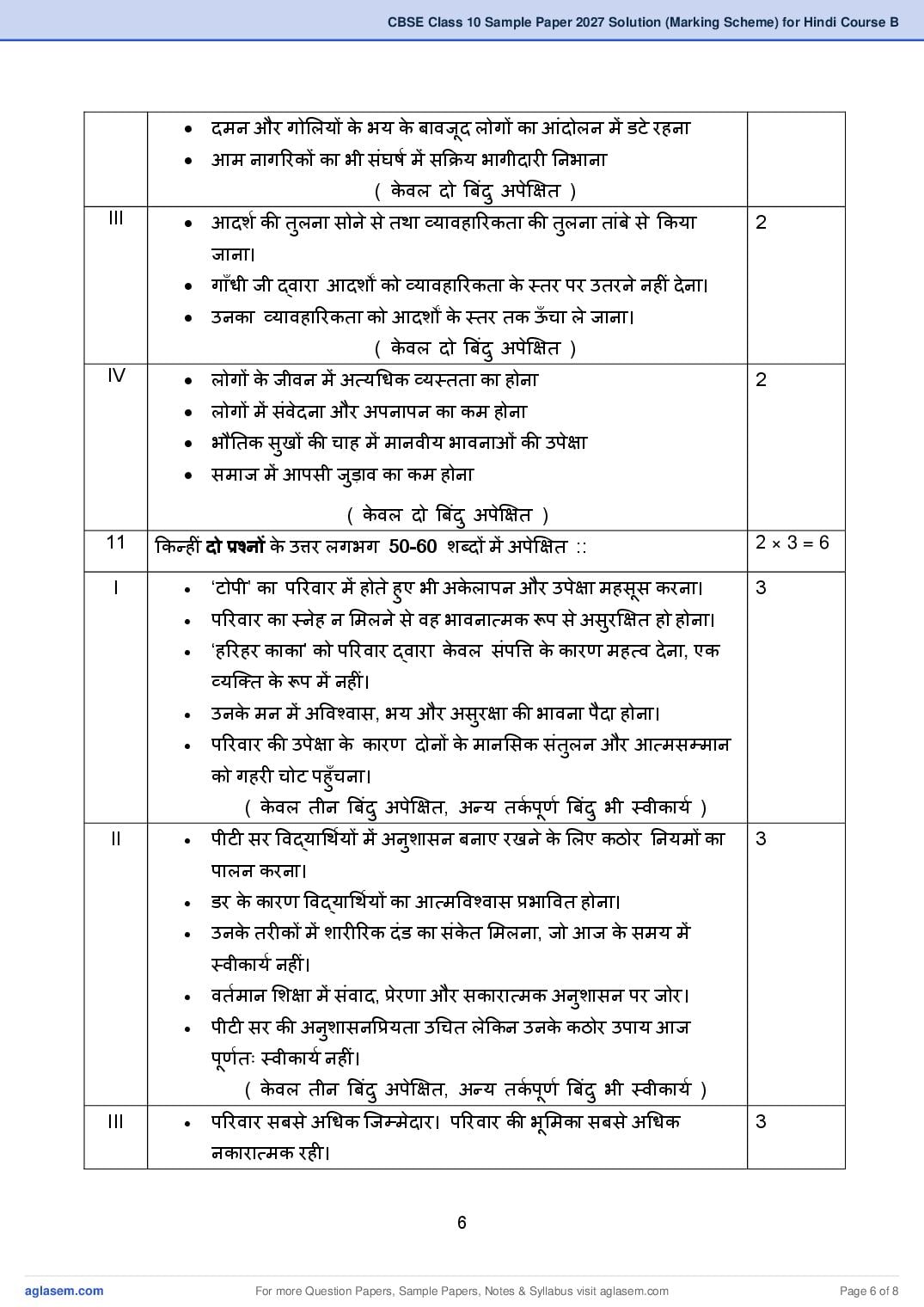
- Section C – Sanchayan (Q11 III), 3 marks: कहानी के अंत तक हरिहर काका की स्थिति दयनीय हो जाती है। हरिहर काका की इस स्थिति के लिए आप किसे जिम्मेदार मानते हैं और क्यों? [By the end of the story Harihar Kaka’s condition is pitiable – whom do you hold responsible and why? About 50–60 words.]
CBSE Class 10 Hindi B Marking Scheme 2027 (Solutions)
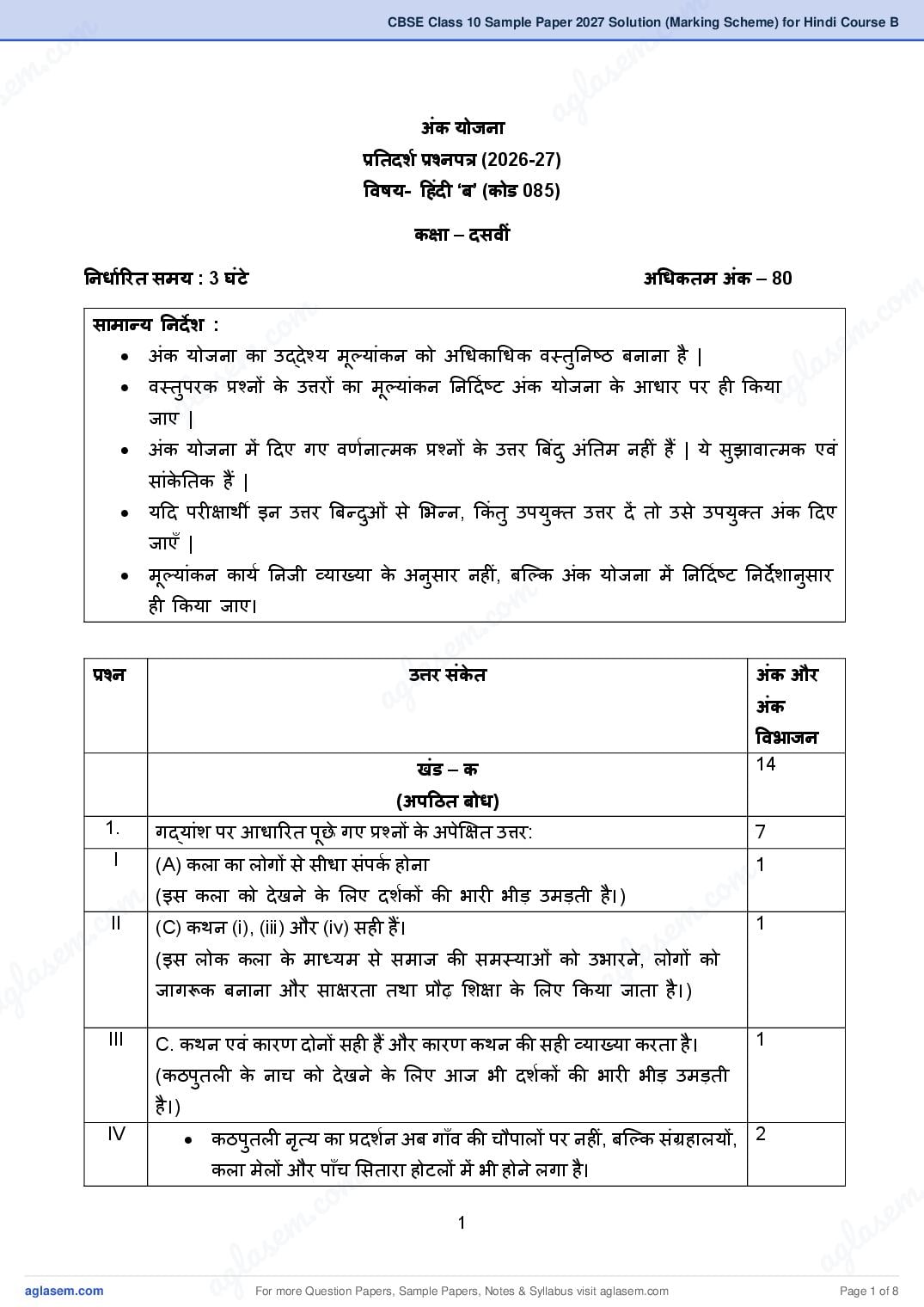
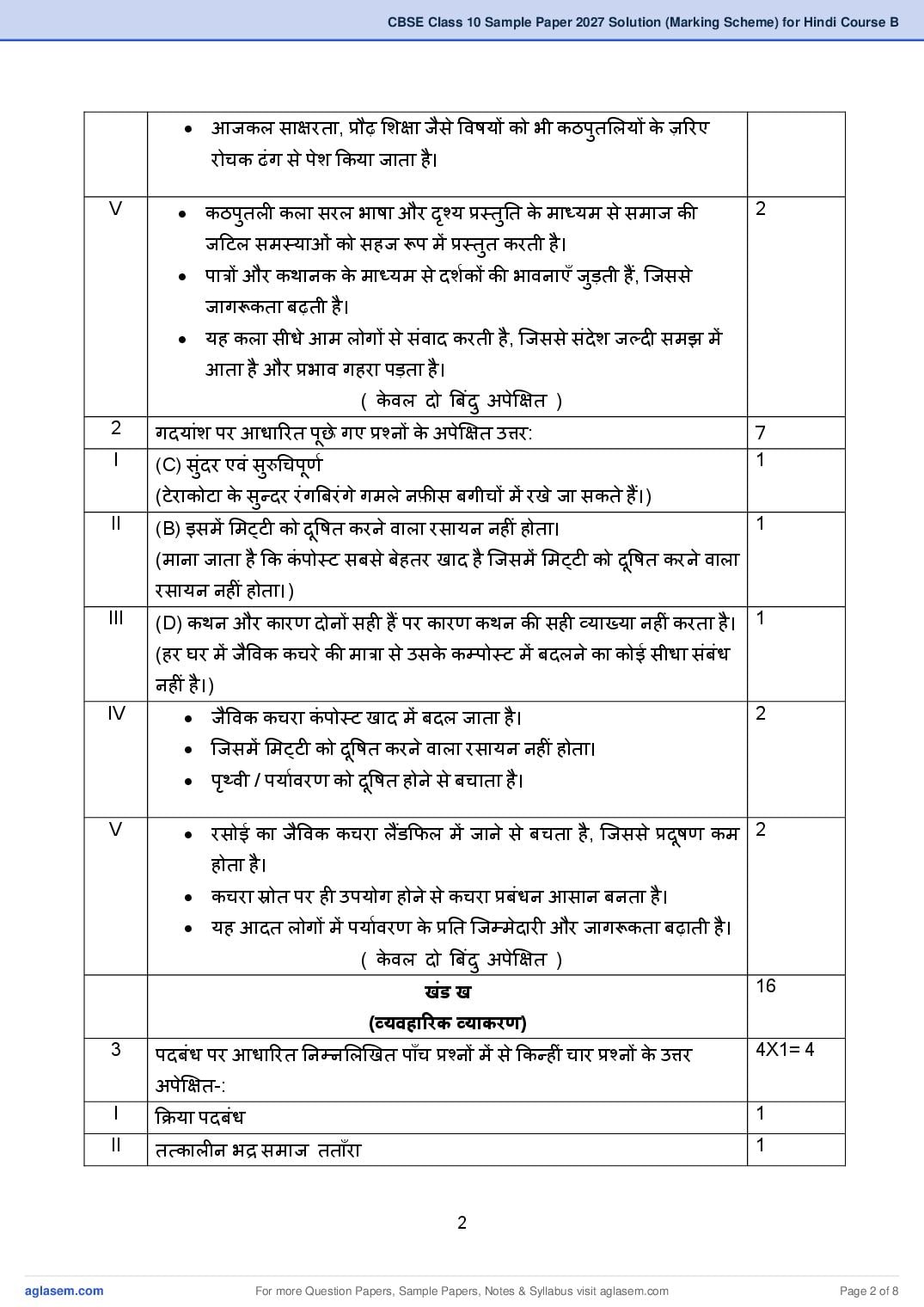
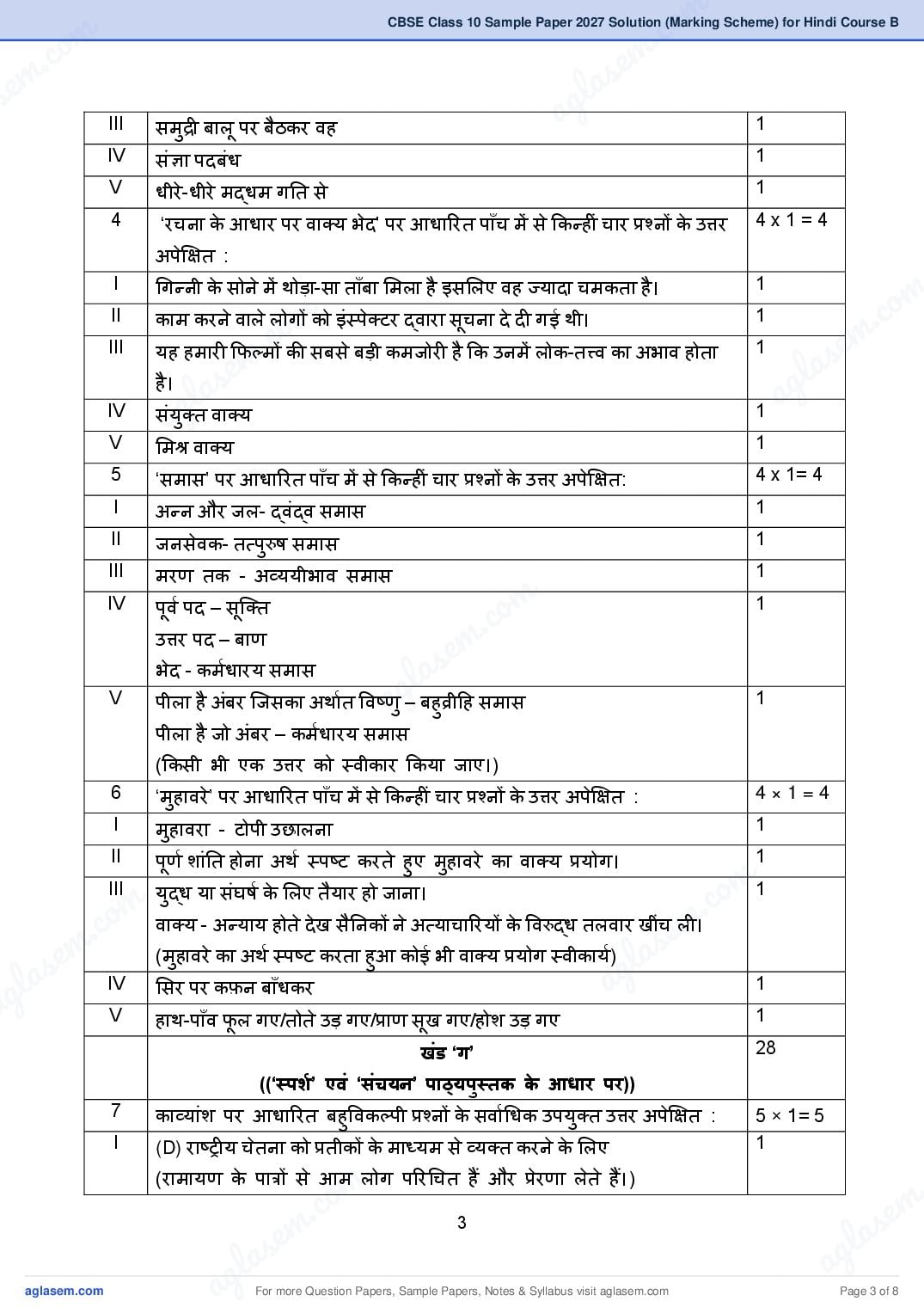
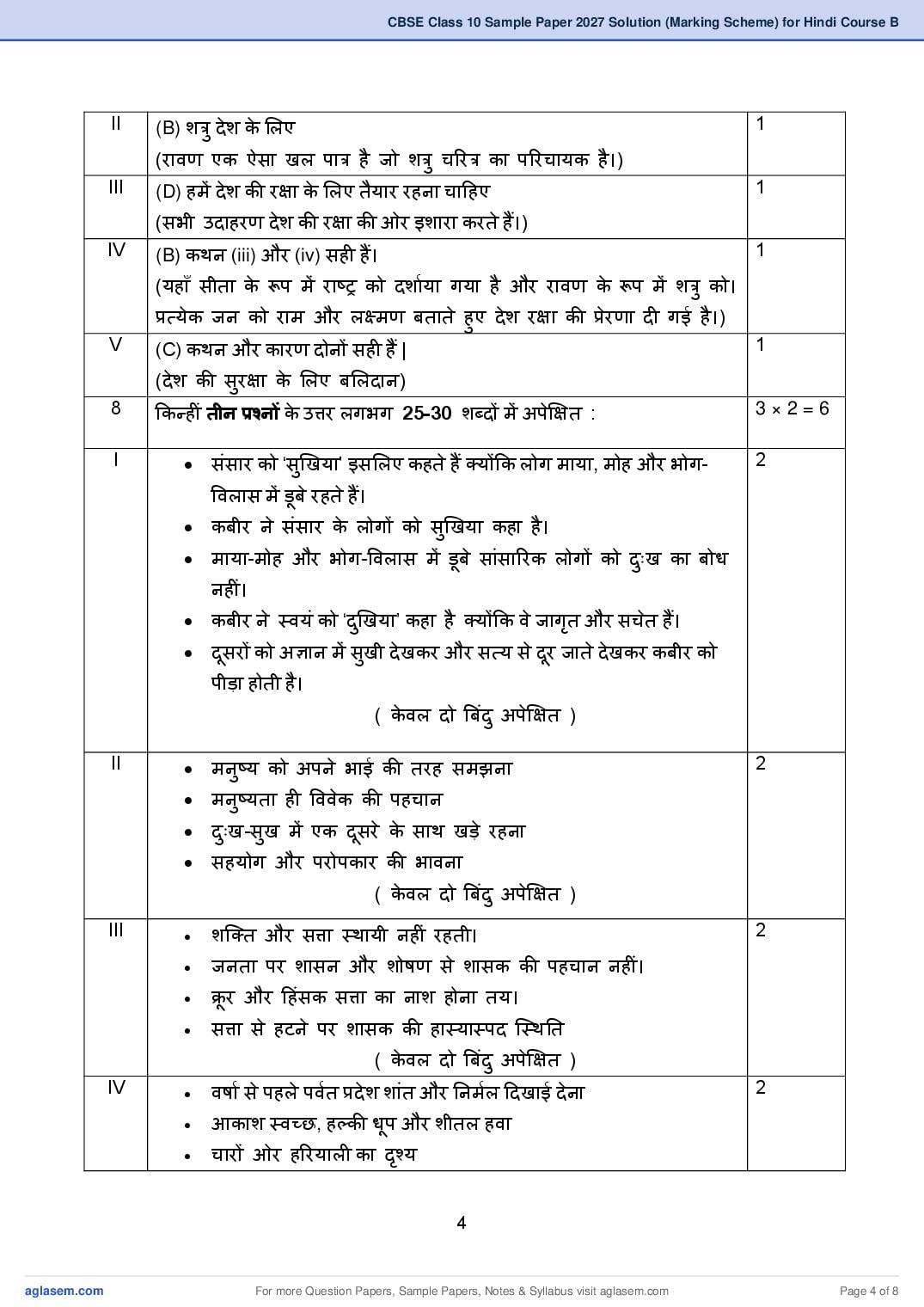
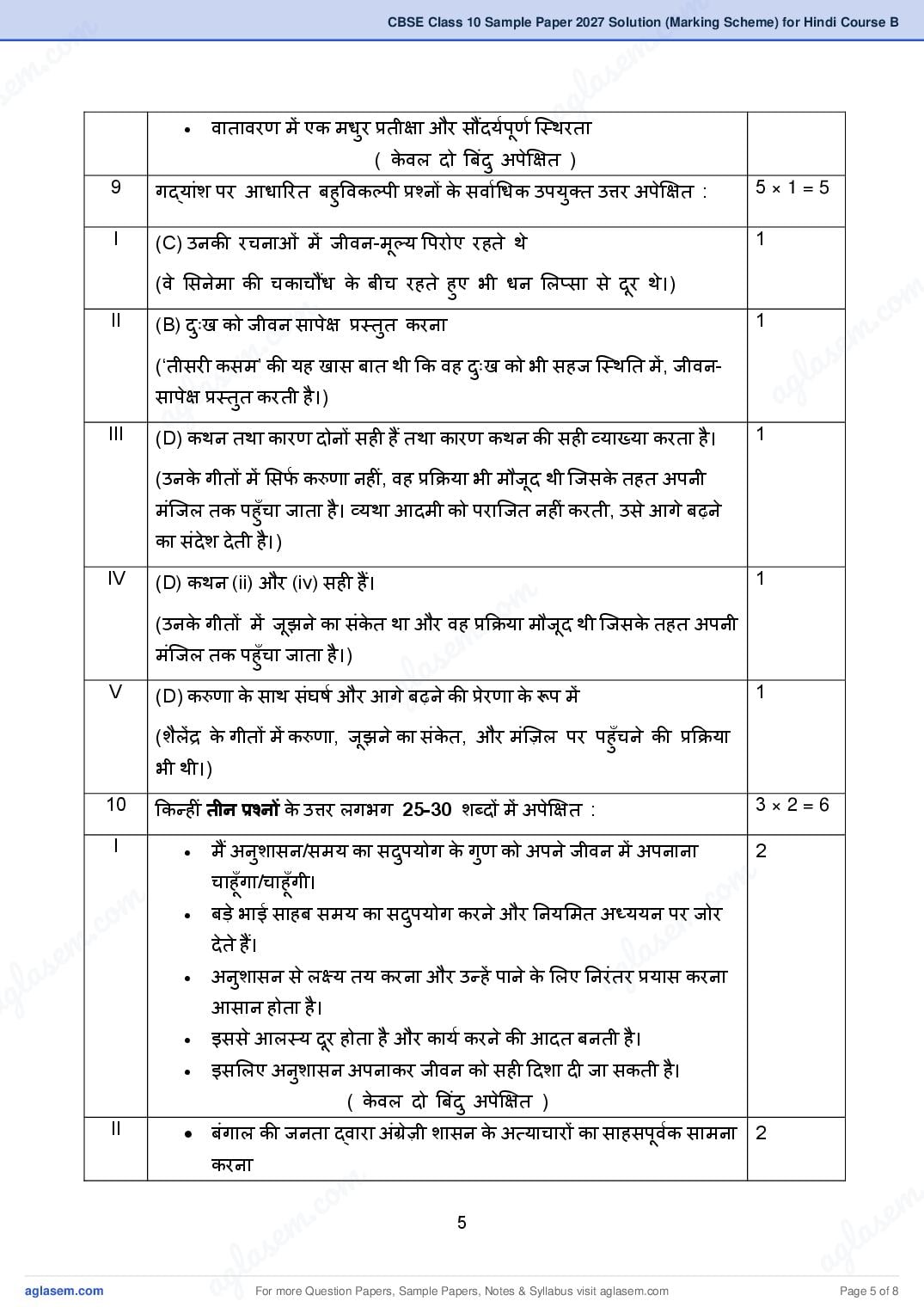
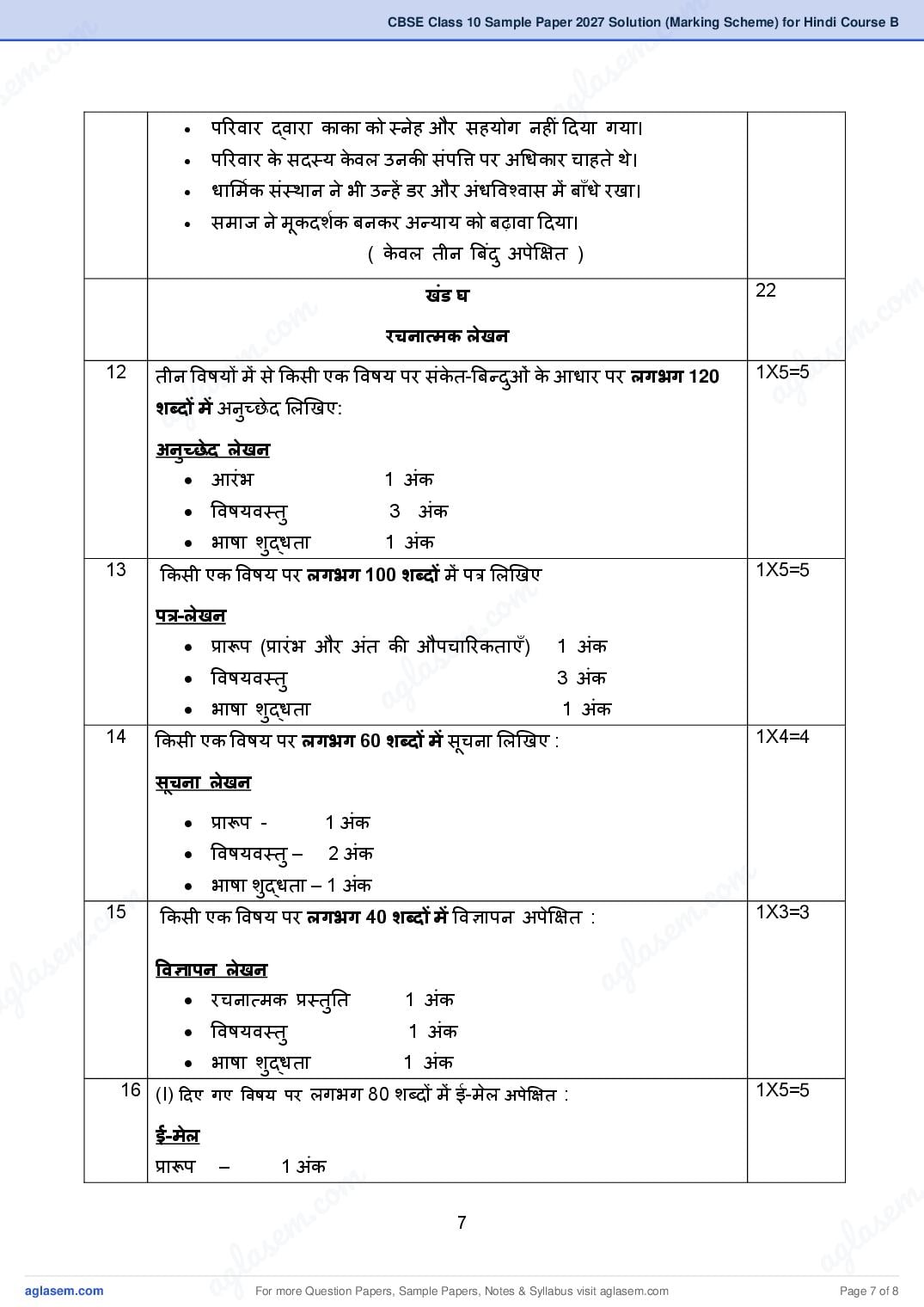
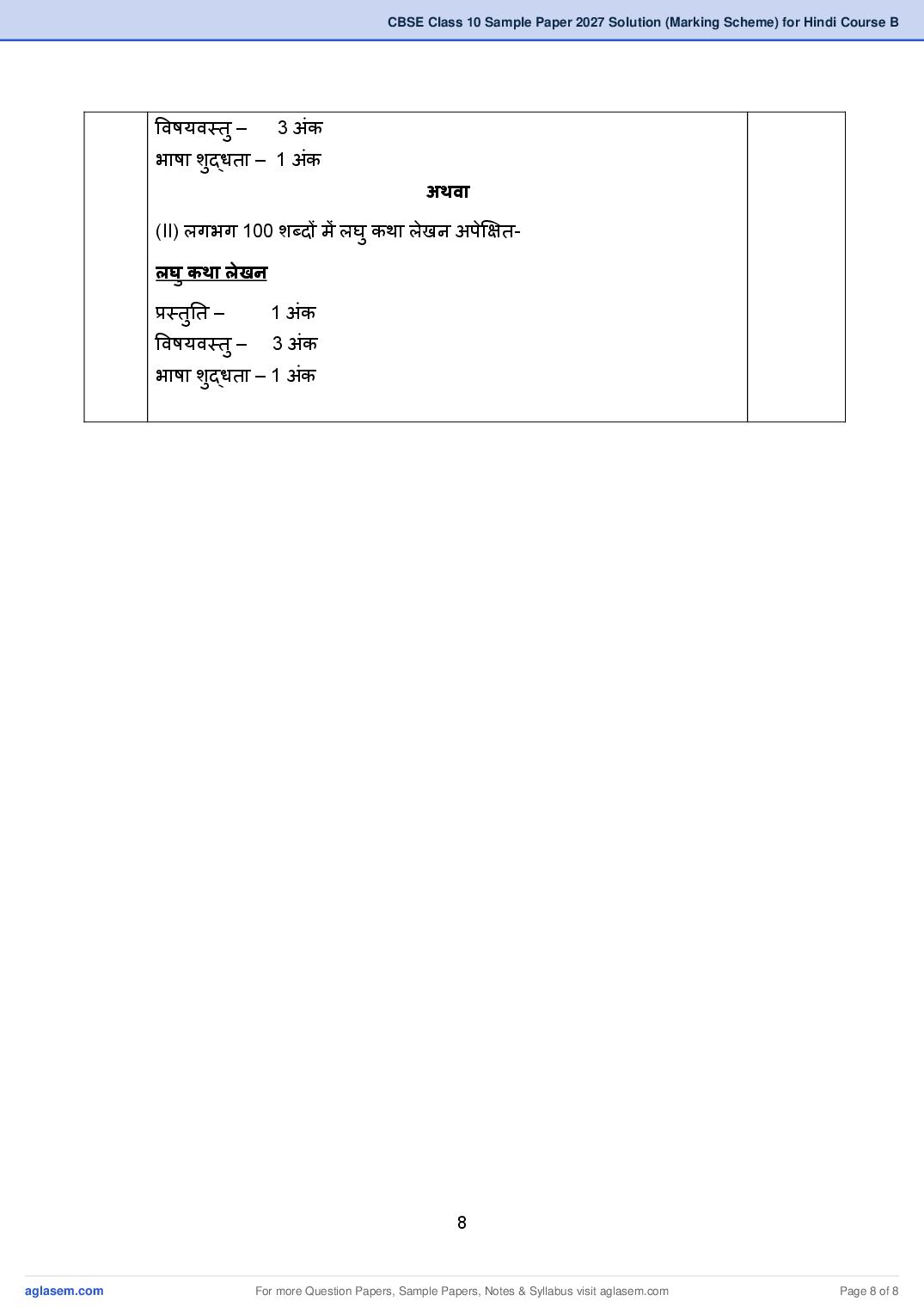
The 2027 marking scheme gives the correct option for every MCQ (often with a one-line reason), answers for all grammar items, and value points for the descriptive questions. It says these points are indicative, so other suitable answers should be accepted. Mark splits for writing: paragraph – beginning 1, content 3, language 1; letter and e-mail – format 1, content 3, language 1; notice – format 1, content 2, language 1; advertisement – creative presentation 1, content 1, language 1; short story – presentation 1, content 3, language 1. Check your answers against it after you solve the paper.
Hindi B Marking Scheme 2027 – Read Online
How to Score Well – Tips from the 2027 Paper
- Section C now opens with a poetry extract (Q7). Revise Sparsh poems such as ‘Kar Chale Hum Fida’, ‘Manushyata’, ‘Top’ and ‘Parvat Pradesh Mein Pavas’, and Kabir’s sakhi, alongside the prose lessons.
- Sanchayan answers (Q11) now need about 50–60 words for 3 marks. Prepare ‘Harihar Kaka’, ‘Sapnon ke-se Din’ and ‘Topi Shukla’, including opinion questions (‘whom do you hold responsible and why?’).
- In grammar, practise picking out and naming phrases (noun, pronoun, verb and adverb phrases), samas vigrah with the type of compound, and idioms in fill-in-the-blank sentences.
- Section D has 5 writing tasks worth 22 marks. Practise all formats (formal letter, notice, advertisement, e-mail, short story); format or presentation carries a separate mark in each.
- Several assertion-reason MCQs use non-standard options (e.g. Q7 V only offers ‘both correct’ without the ‘explains / does not explain’ split), so read every option carefully.
- Solve the 2027 paper in one sitting with a timer, check it with the marking scheme, then solve the 2026 paper a few days later.
More Class 10 Hindi B Papers and Study Material
Practise past board papers, or plan your revision with the syllabus and important questions for Class 10 Hindi B:
CBSE Class 10 Hindi B Sample Paper 2027 – FAQs
Is the CBSE Class 10 Hindi B Sample Paper 2027 out?
Yes. CBSE has released the Class 10 Hindi B sample paper 2027 for the 2026-27 session with its marking scheme – both are in the table on this page, free.
Is the CBSE Class 10 Hindi B Sample Paper 2027 available with solutions?
Yes. The official CBSE marking scheme is the solution – it gives the answers and the marks for each step. Download it from the table above or read it online on this page.
Has the CBSE Class 10 Hindi B paper pattern changed for 2027?
No. CBSE says there is no change in the question paper design for 2026-27. The 2027 sample paper keeps the 2026 pattern – 80 marks, 3 hours, 16 questions in 4 sections. Small changes: The word limit for Q11 (Sanchayan, 3 marks each) rose from about 40–50 words (2026) to about 50–60 words (2027).; The General Instructions are more detailed: they now give the question and sub-question count per section. The Section C heading now names both books, ‘Sparsh’ and ‘Sanchayan’; in 2026 only Q11 named ‘Sanchayan’..
How many marks and questions are in the CBSE Class 10 Hindi B Sample Paper 2027?
It is a 80 marks, 3 hours, 16 questions paper – Section Section A – Unseen Comprehension (खंड क – अपठित बोध): 1–2 (14 marks); Section Section B – Applied Grammar (खंड ख – व्यावहारिक व्याकरण): 3–6 (16 marks); Section Section C – Textbooks ‘Sparsh’ and ‘Sanchayan’ (खंड ग – ‘स्पर्श’ एवं ‘संचयन’ पाठ्यपुस्तक के आधार पर): 7–11 (28 marks); Section Section D – Creative Writing (खंड घ – रचनात्मक लेखन): 12–16 (22 marks).
Which units carry the most marks in the Hindi B sample paper 2027?
In the 2027 sample paper: Writing – paragraph, formal letter, notice, advertisement, e-mail/short story (रचनात्मक लेखन) (22 marks), Grammar – phrases, sentence transformation, compounds, idioms (व्यावहारिक व्याकरण) (16 marks), Reading – two unseen prose passages (अपठित बोध) (14 marks).
Is the CBSE 10th Hindi B model question paper 2027 the same as the sample paper?
Yes. CBSE calls it the sample question paper (SQP); students also search for it as the 10th Hindi B model question paper or model test paper – it is the same official paper on this page.
Will the board exam paper be the same as the sample paper?
No – the CBSE Class 10 board exam 2027 has different questions, but it follows the same pattern as the sample paper: the same sections, marks and question types.