Download the CBSE Class 10 Sanskrit Sample Paper 2027 PDF with its marking scheme (solutions) – the official CBSE sample question paper (SQP) for the 2026-27 session, the paper to practise for the CBSE Class 10 board exam 2027. It is an 80-mark, 3-hour paper with 18 questions in 4 sections. The pattern is the same as the 2026 sample paper. The 2026 and 2025 sample papers are also here. Students also call it the CBSE 10th Sanskrit model question paper 2027 or model test paper – it is the same official CBSE paper.
CBSE Class 10 Sanskrit Sample Paper 2027 PDF Download
Open a paper to read it online or download the PDF. The marking scheme has the answers, with the marks for each step.
| Year | Document | Download |
|---|---|---|
| 2027 | CBSE Class 10 Sample Paper 2027 for Sanskrit | View PDF |
| 2027 | CBSE Class 10 Sample Paper 2027 Solution (Marking Scheme) for Sanskrit | View PDF |
| 2026 | CBSE Class 10 Sample Paper 2026 for Sanskrit | View PDF |
| 2026 | CBSE Class 10 Sample Paper 2026 Solution for Sanskrit | View PDF |
| 2025 | CBSE Class 10 Sample Paper 2025 for Sanskrit | View PDF |
CBSE 10th Sanskrit Model Question Paper 2027 – Quick Facts
| Board | Central Board of Secondary Education (CBSE) |
| Class | Class 10 |
| Subject | Sanskrit (code 122 (printed as संस्कृतम् (कोड-सङ्ख्या – 122))) |
| Session | 2026-27 – for the board exam 2027 |
| Marks and time | 80 marks, 3 hours |
| Questions | 18 questions in 4 sections |
| Solutions | Yes – official CBSE marking scheme |
| Older papers | 2026, 2025 |
| Released by | CBSE (cbseacademic.nic.in) |
CBSE Class 10 Sanskrit Sample Paper 2027 – Read Online
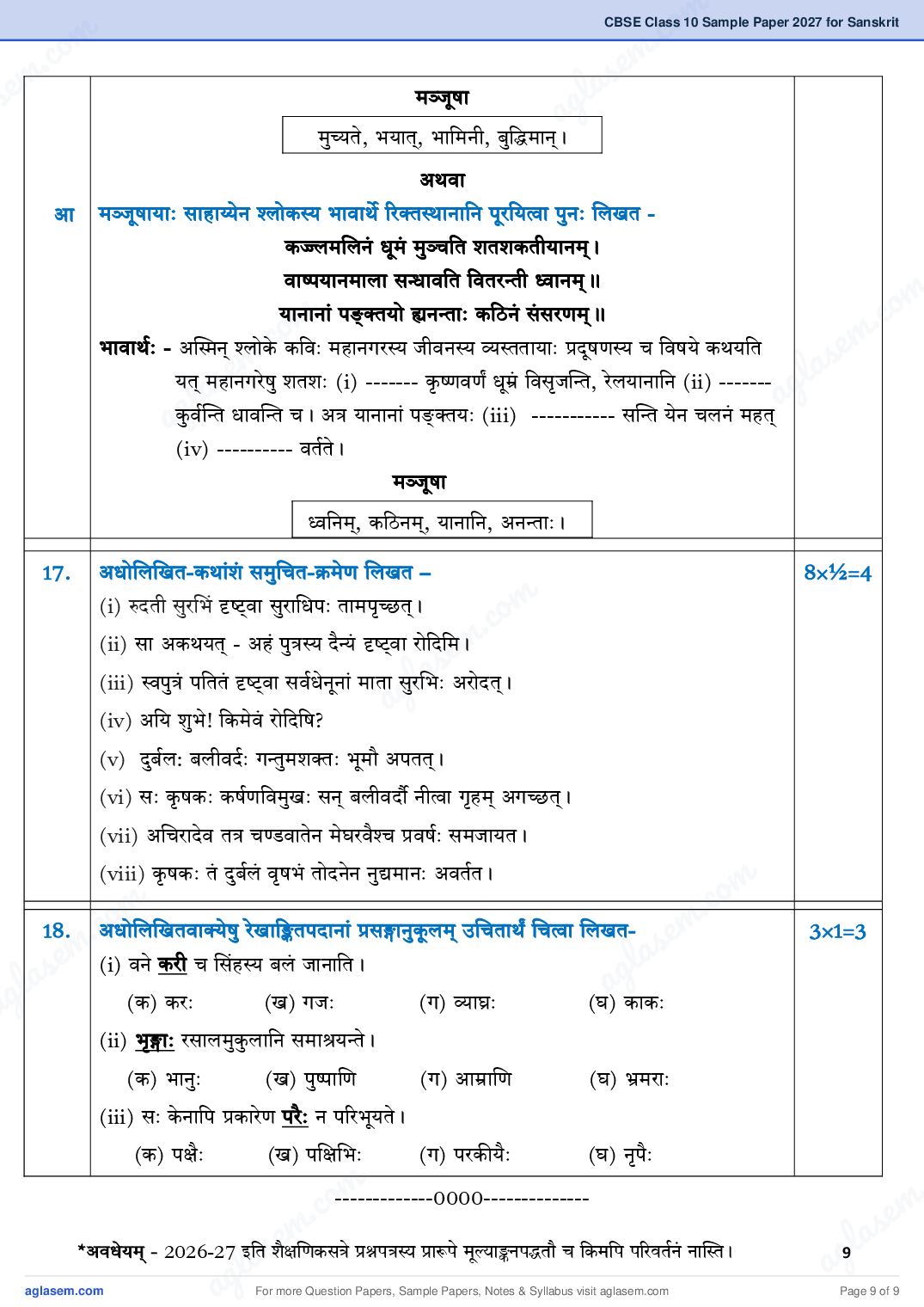
CBSE Class 10 Sanskrit Paper Pattern 2027
How the 2027 sample paper is set (from the paper itself) – 80 marks, 3 hours, 18 questions:
| Section | Questions | Type | Marks each | Total |
|---|---|---|---|---|
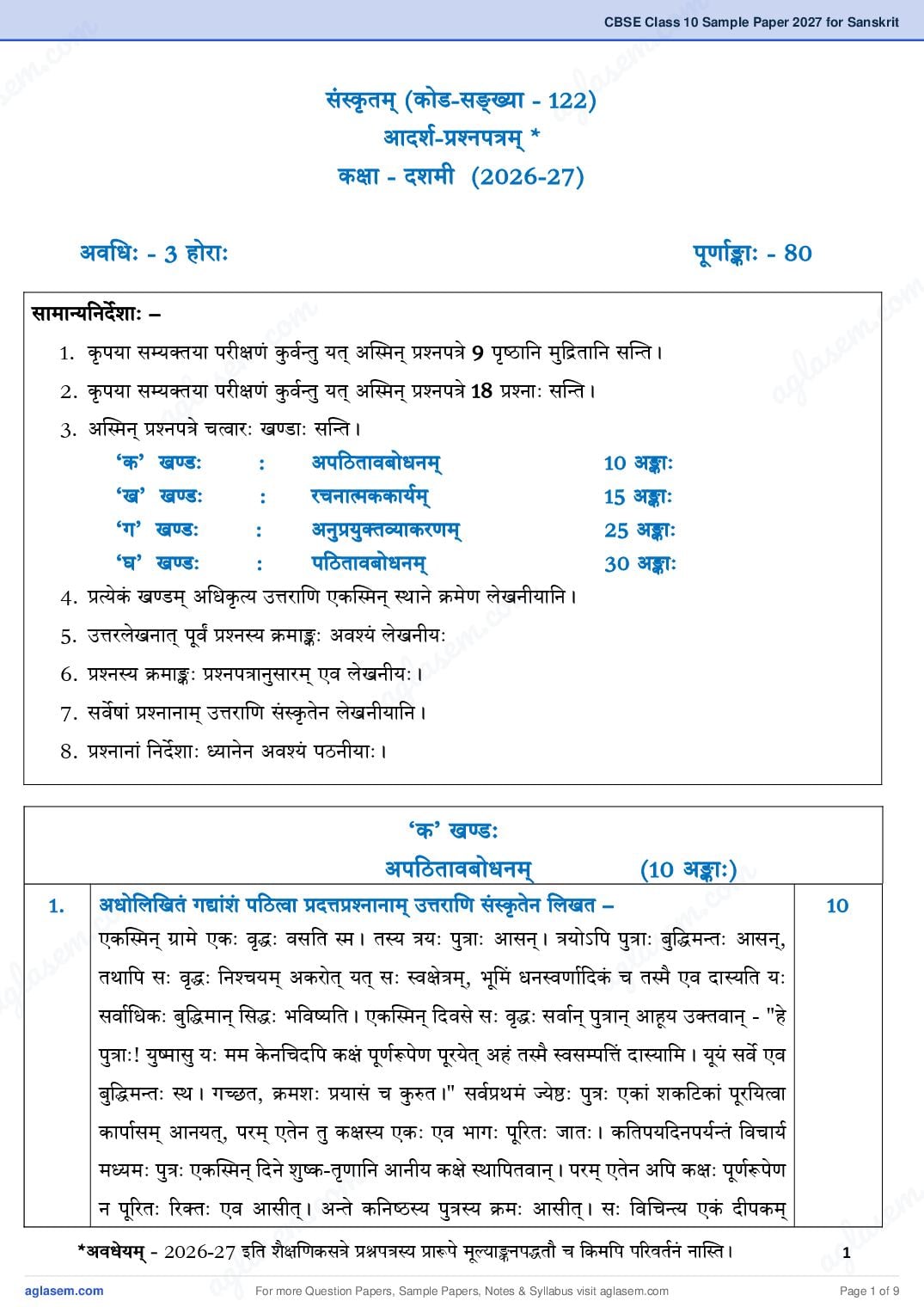
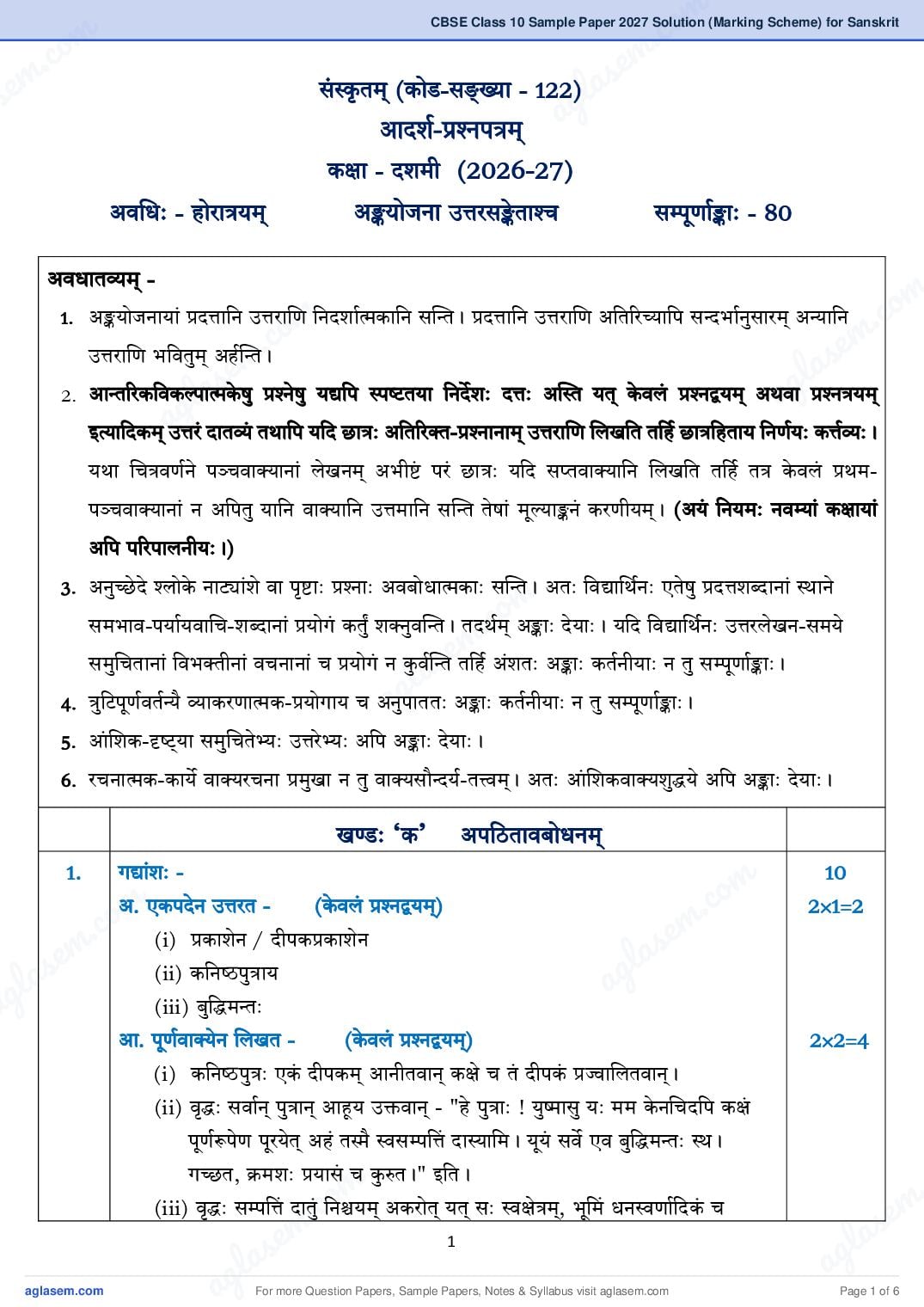
| Section A – Unseen Comprehension (‘क’ खण्डः – अपठितावबोधनम्) | 1 | One unseen prose passage (an old man tests which of his three sons is wisest; the youngest fills a room with lamplight): one-word answers (any 2 of 3), full-sentence answers (any 2 of 3), a title, and 3 MCQs on synonym, pronoun reference and subject of a verb | 2×1 + 2×2 + 1 + 3×1 | 10 |
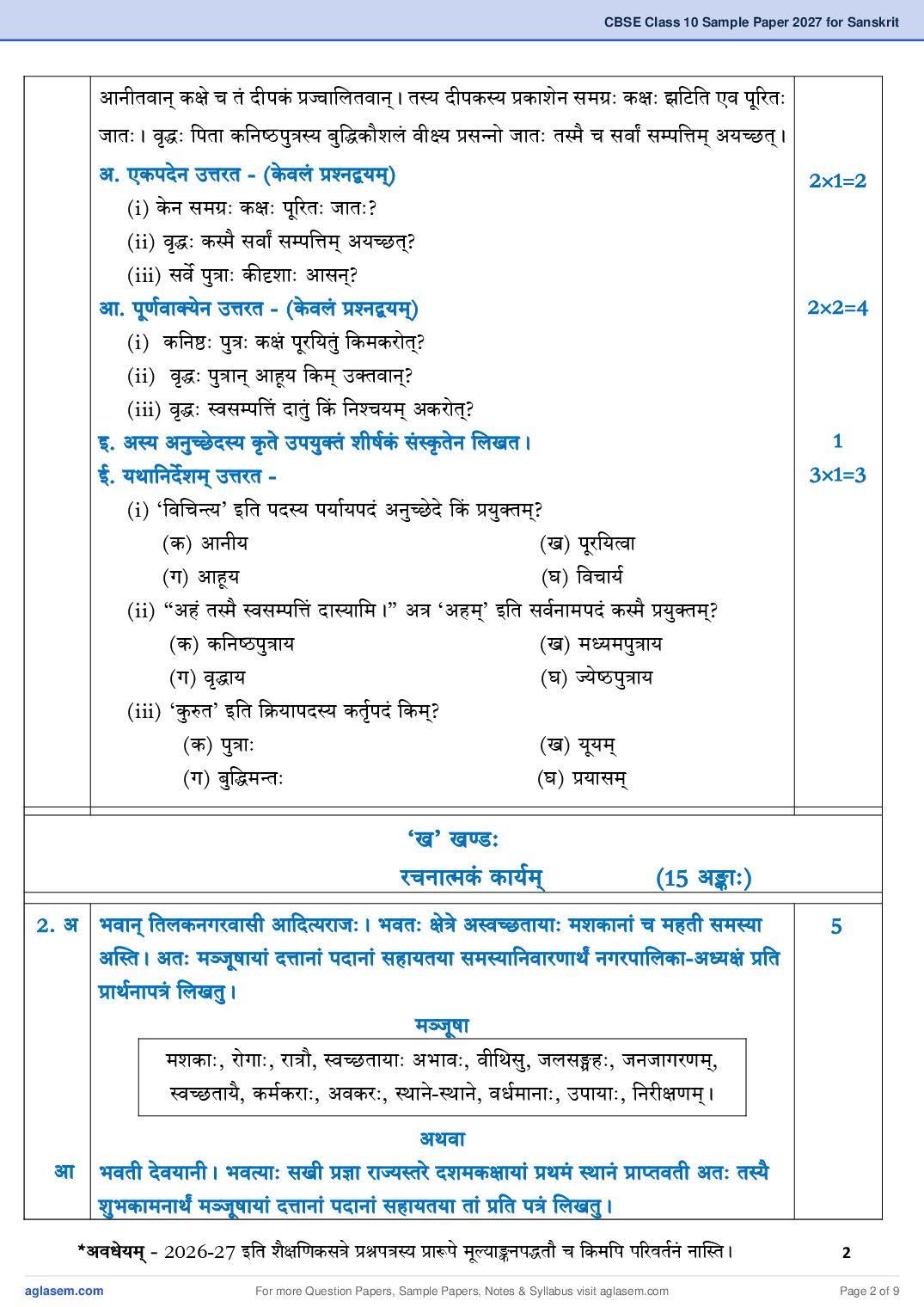
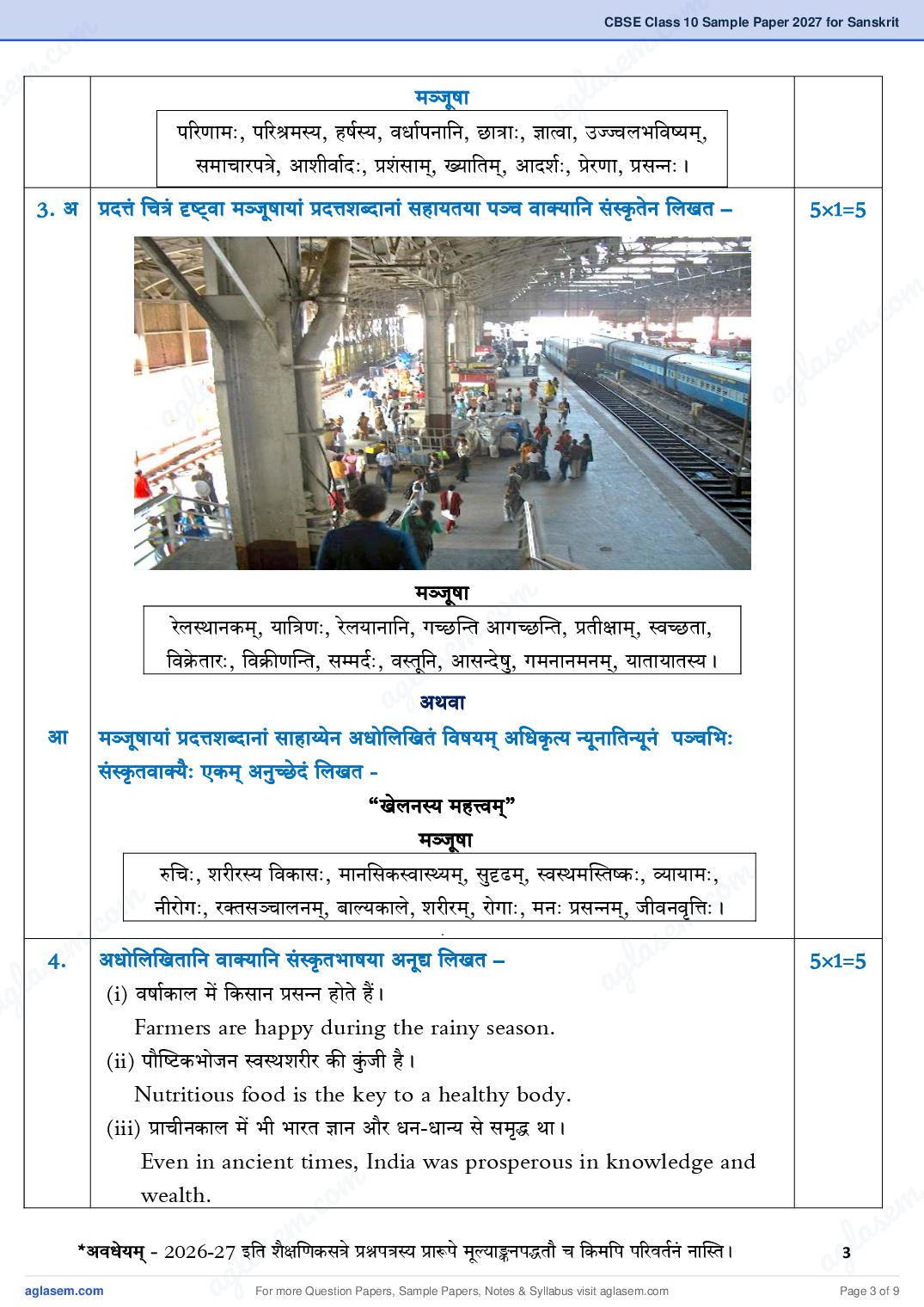
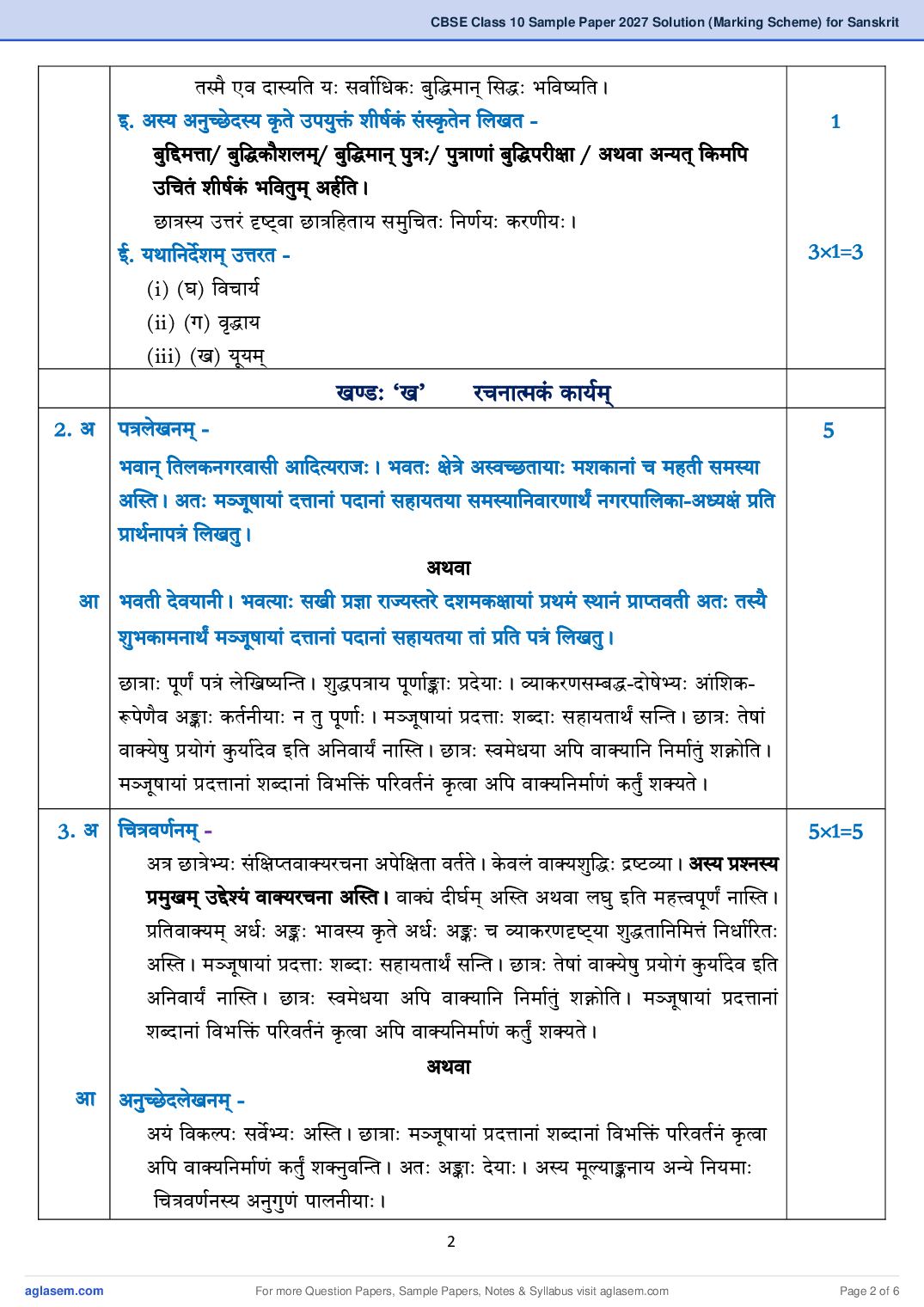
| Section B – Composition (‘ख’ खण्डः – रचनात्मकं कार्यम्) | 2–4 | Q2 letter using words from a word box (मञ्जूषा) – formal request to the municipal chairman about mosquitoes and lack of cleanliness OR a letter congratulating a friend who topped the state; Q3 five sentences on a picture (railway platform) OR a paragraph of at least five sentences on ‘खेलनस्य महत्त्वम्’ (importance of sports), with word box; Q4 translate 5 Hindi/English sentences into Sanskrit | Q2: 5; Q3: 5×1; Q4: 5×1 | 15 |
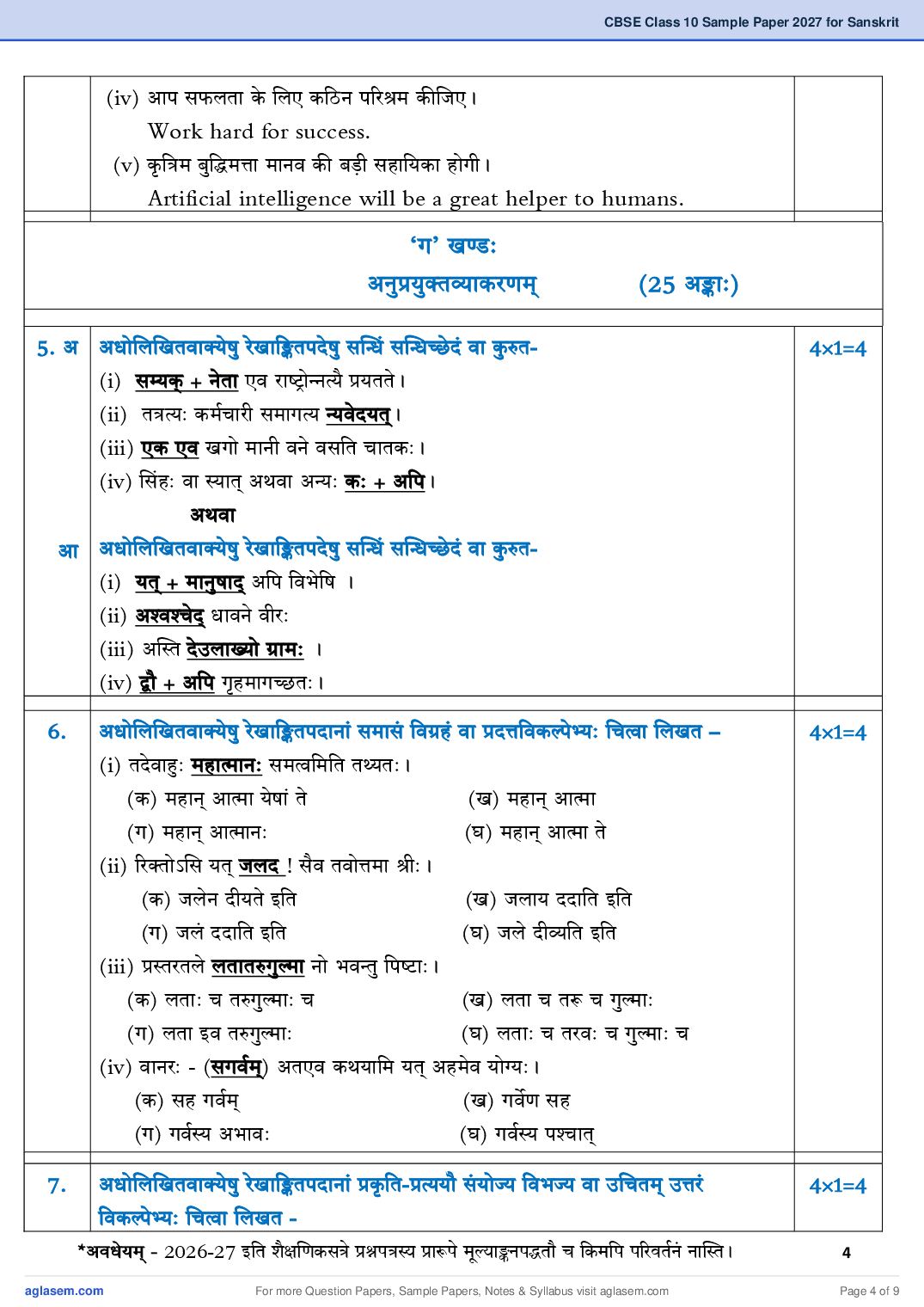
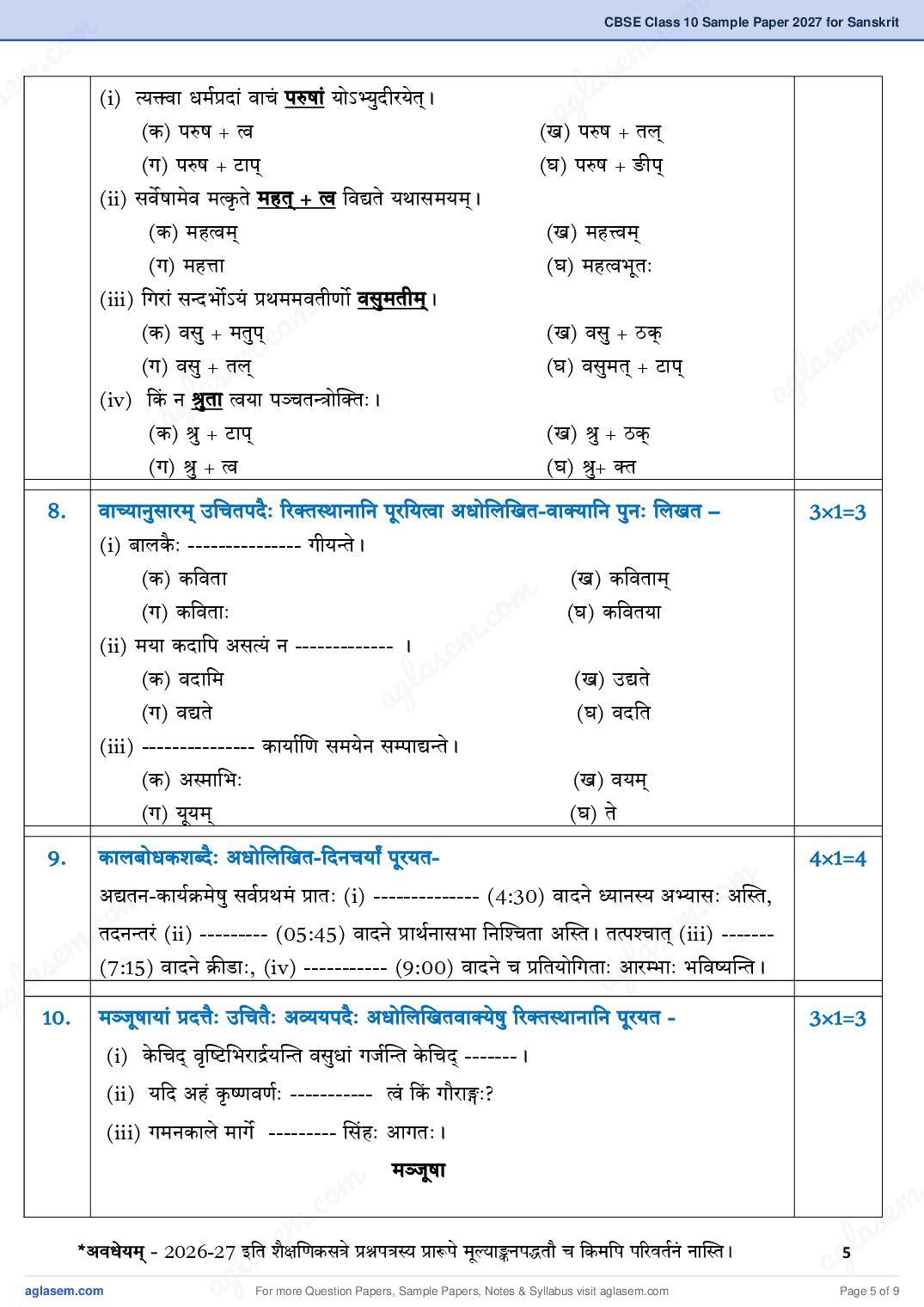
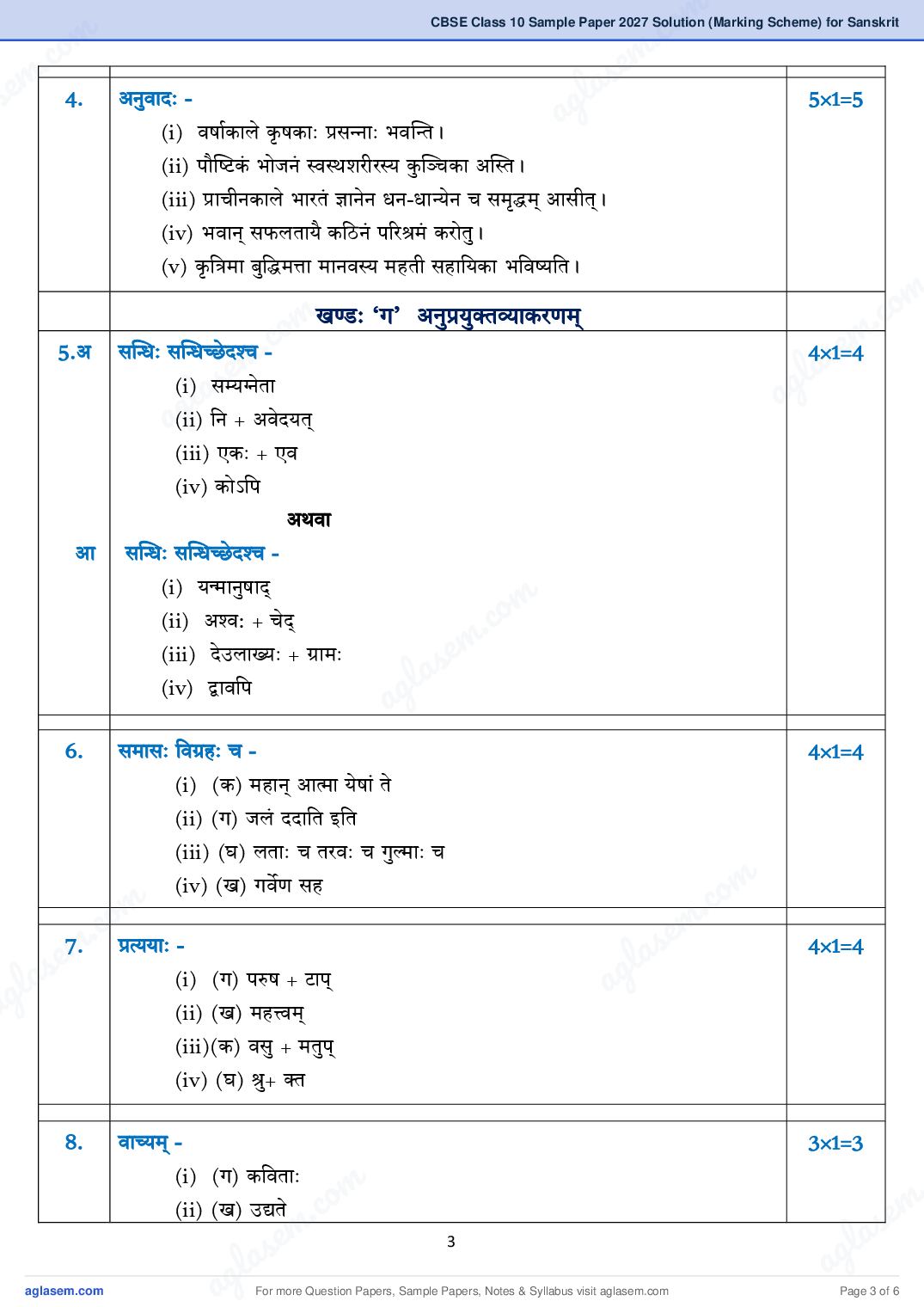
| Section C – Applied Grammar (‘ग’ खण्डः – अनुप्रयुक्तव्याकरणम्) | 5–11 | Q5 sandhi / sandhi-split (4 items; set अ OR set आ); Q6 compounds (समास / विग्रह, MCQ); Q7 suffixes (प्रकृति-प्रत्यय, MCQ); Q8 voice (वाच्य) fill-in, MCQ; Q9 time in words (कालबोधक शब्द – 4:30, 5:45, 7:15, 9:00) in a timetable; Q10 indeclinables (अव्यय) from a word box; Q11 error correction (अशुद्धि-संशोधन, MCQ) | Q5: 4×1; Q6: 4×1; Q7: 4×1; Q8: 3×1; Q9: 4×1; Q10: 3×1; Q11: 3×1 | 25 |
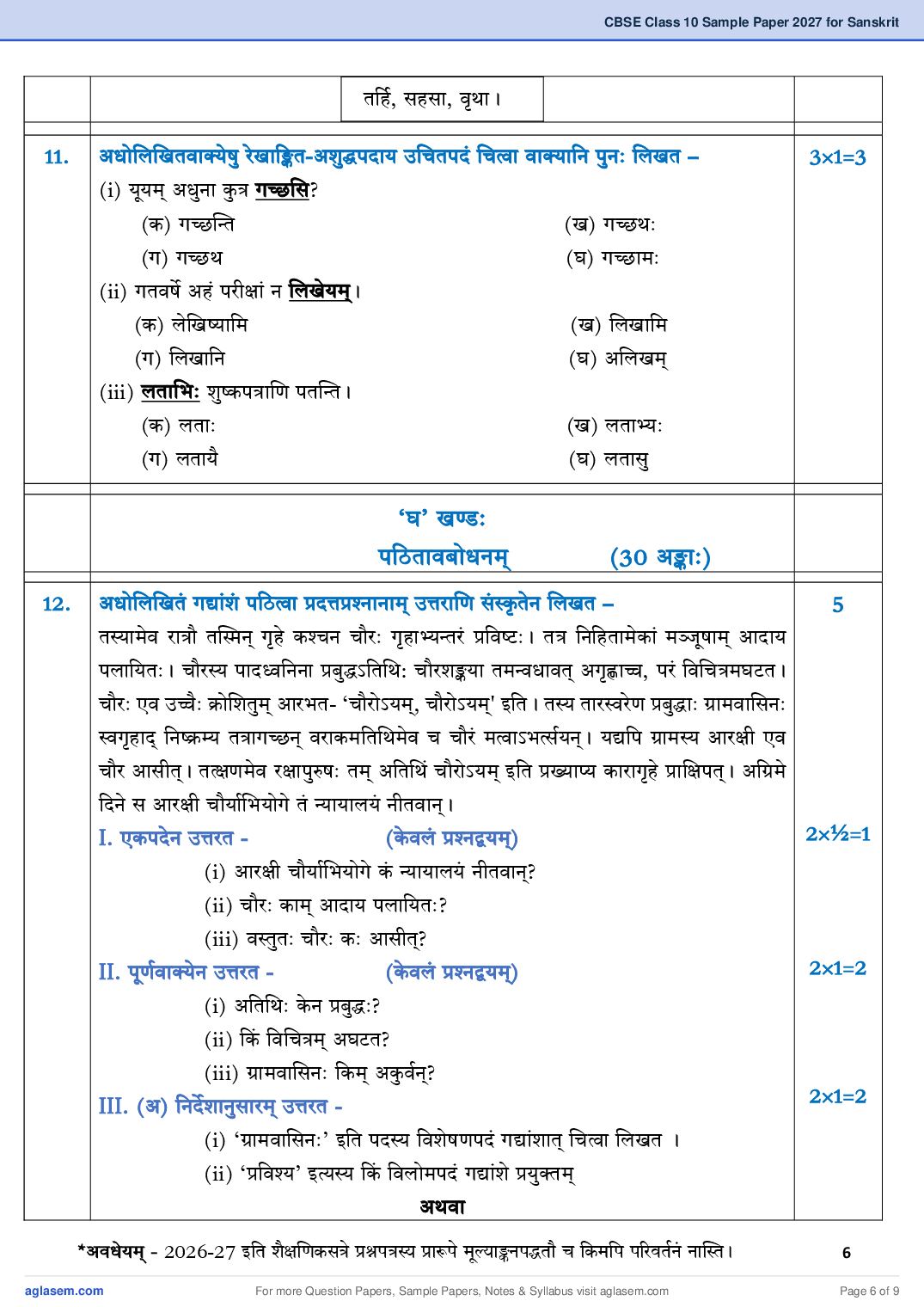
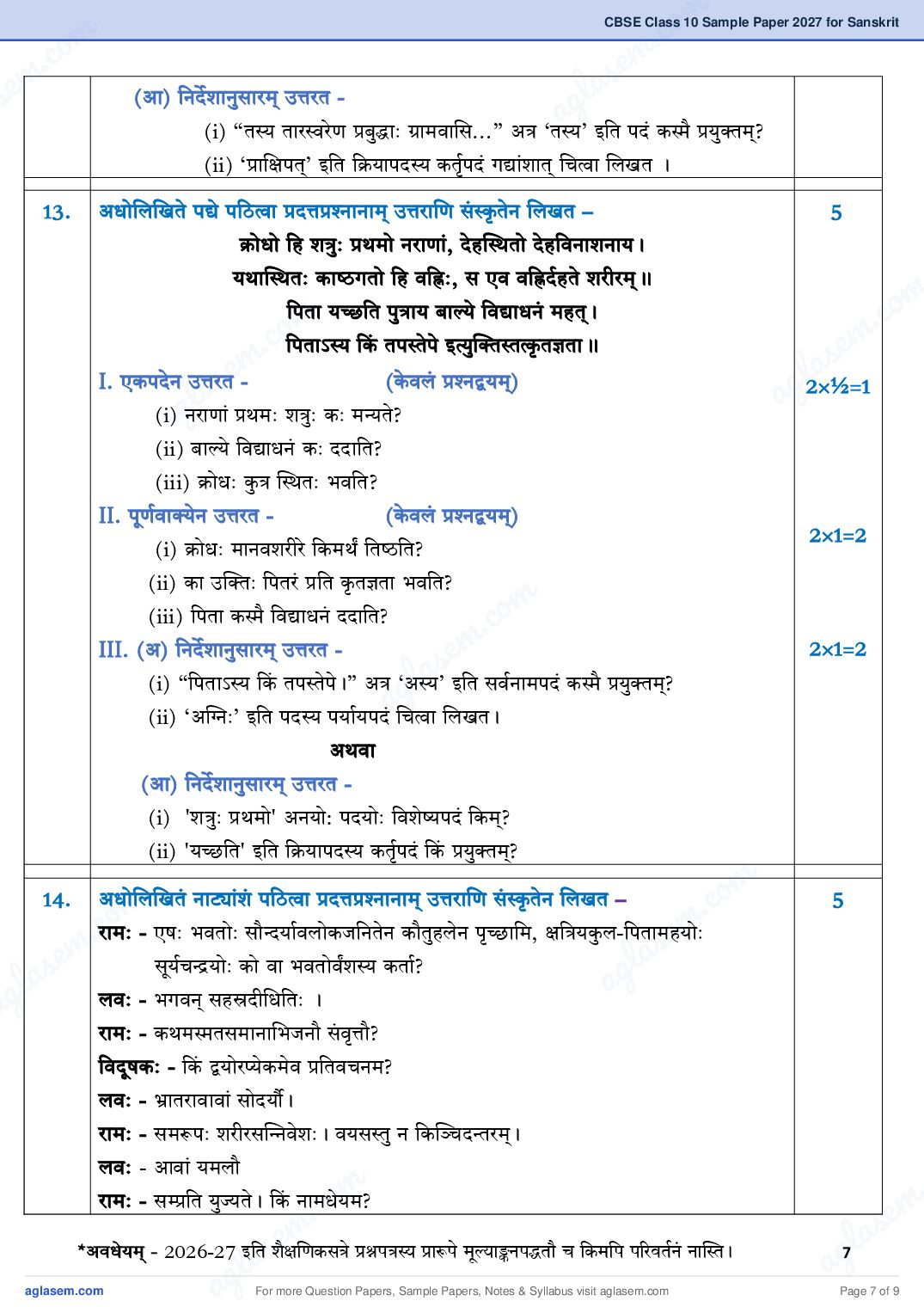
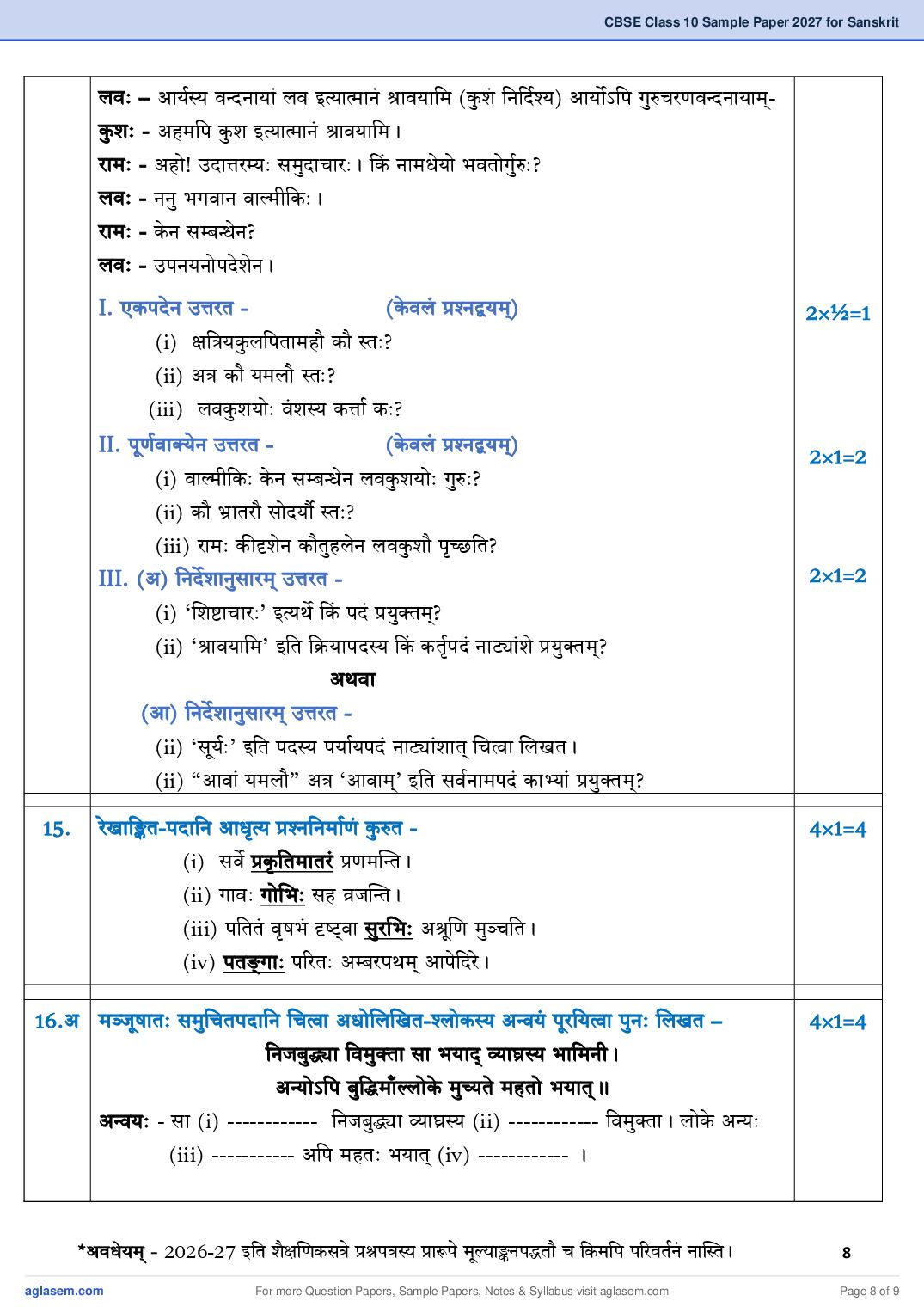
| Section D – Textbook Comprehension (‘घ’ खण्डः – पठितावबोधनम्) | 12–18 | Q12 prose extract, Q13 verses, Q14 drama extract – each with one-word answers (2×½), full-sentence answers (2×1) and language-in-context items (2×1, set अ OR आ); Q15 frame questions on underlined words; Q16 complete the prose order (अन्वय) of a verse OR fill in a verse’s meaning (भावार्थ) from a word box; Q17 put 8 story sentences in order; Q18 contextual meaning of underlined words (MCQ) | Q12: 5; Q13: 5; Q14: 5; Q15: 4×1; Q16: 4×1; Q17: 8×½; Q18: 3×1 | 30 |
| Total | 18 | 80 |
Choice: Answer only 2 of 3 in each one-word and full-sentence block (Q1, Q12–Q14). Choice of set (अ) OR (आ) in Q5 and in the language items of Q12–Q14. OR choice in Q2 (two letters), Q3 (picture description or paragraph) and Q16 (अन्वय or भावार्थ).
- All answers must be written in Sanskrit (सर्वेषां प्रश्नानाम् उत्तराणि संस्कृतेन लेखनीयानि).
- Answer each section’s questions together, in order, in one place; write the question number before every answer, exactly as numbered in the paper.
- Check that the paper has 9 printed pages and 18 questions.
- Q4 gives each sentence in both Hindi and English.
Unit-wise Marks in the Sanskrit Sample Paper 2027
Marks for each unit (as printed in the paper):
| Unit | Questions | Marks |
|---|---|---|
| Reading – unseen passage (अपठितावबोधनम्) | Q1 | 10 |
| Composition – letter, picture description/paragraph, translation (रचनात्मकं कार्यम्) | Q2, Q3, Q4 | 15 |
| Grammar – sandhi (सन्धिः) | Q5 | 4 |
| Grammar – compounds (समासः) | Q6 | 4 |
| Grammar – suffixes (प्रत्ययाः) | Q7 | 4 |
| Grammar – voice (वाच्यम्) | Q8 | 3 |
| Grammar – time (समयः) | Q9 | 4 |
| Grammar – indeclinables (अव्ययपदानि) | Q10 | 3 |
| Grammar – error correction (अशुद्धिसंशोधनम्) | Q11 | 3 |
| Textbook comprehension (पठितावबोधनम्) – lessons recognisable from the extracts though not named in the paper: ‘Vichitrah Sakshi’ (Q12), ‘Subhashitani’ (Q13, Q18 i), ‘Shishulalanam’ (Q14), ‘Buddhirbalavati Sada’ (Q16 अ), ‘Shuchiparyavaranam’ (Q16 आ), ‘Janani Tulyavatsala’ (Q15 iii, Q17), ‘Anyoktayah’ (Q15 iv, Q18 ii) | Q12–Q18 | 30 |
What Is New in the Sanskrit Sample Paper 2027?
Compared with the 2026 sample paper (session 2025-26):
- No change in pattern – same 18 questions, 4 sections (10/15/25/30), the same question types and the same marks per question, including the same internal choices. The 2027 footer explicitly states there is no change in pattern or evaluation for 2026-27.
- The paper is now 9 printed pages instead of 10, and the General Instruction is updated to match.
- New content in Section A and B. Unseen passage: pollution (2026) became the wise youngest son (2027). Letters: 2026 asked for a letter to a friend about a new Delhi school or a fee-concession request to the principal; 2027 asks for a complaint to the municipal chairman about mosquitoes and filth, or congratulations to a friend who topped the state. Picture: Red Fort (2026) became a railway platform (2027). Paragraph: ‘मार्ग-सुरक्षा’ (road safety, 2026) became ‘खेलनस्य महत्त्वम्’ (importance of sports, 2027). All five translation sentences are new.
- Marking-scheme general instructions are unchanged. They still say that if a student answers extra internal-choice parts, the best answers are marked in the student’s favour (also applicable to Class 9).
Questions from the Sanskrit Sample Paper 2027
Two questions from the 2027 paper, to show the level:
- Section B – Translation (Q4 v), 1 mark: कृत्रिम बुद्धिमत्ता मानव की बड़ी सहायिका होगी। (Artificial intelligence will be a great helper to humans.) – translate into Sanskrit
- Section D – Drama extract (Q14 II ii), 1 mark: कौ भ्रातरौ सोदर्यौ स्तः? (Which two are brothers born of the same mother?) – full-sentence answer from the Rama–Lava–Kusha extract
CBSE Class 10 Sanskrit Marking Scheme 2027 (Solutions)
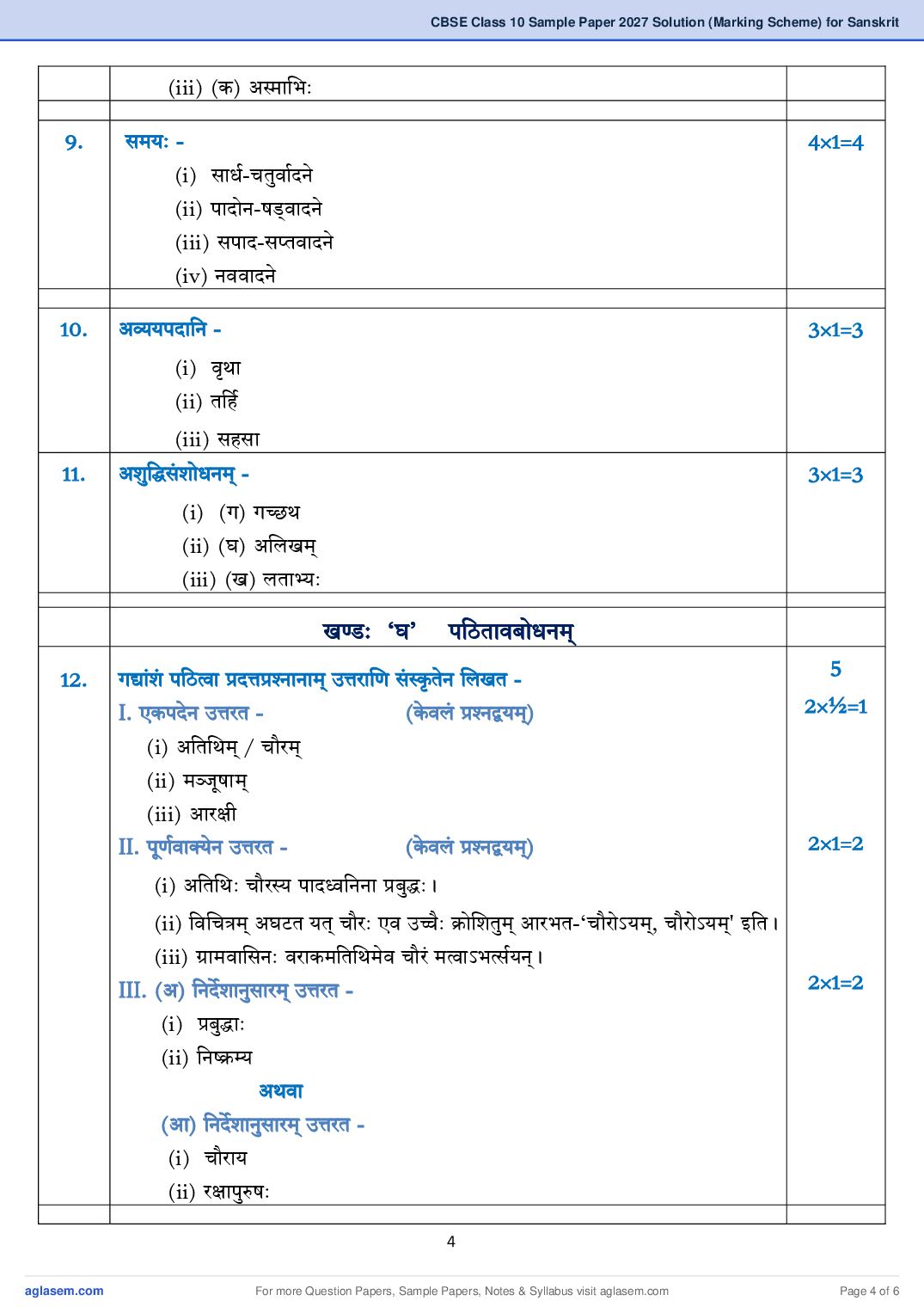
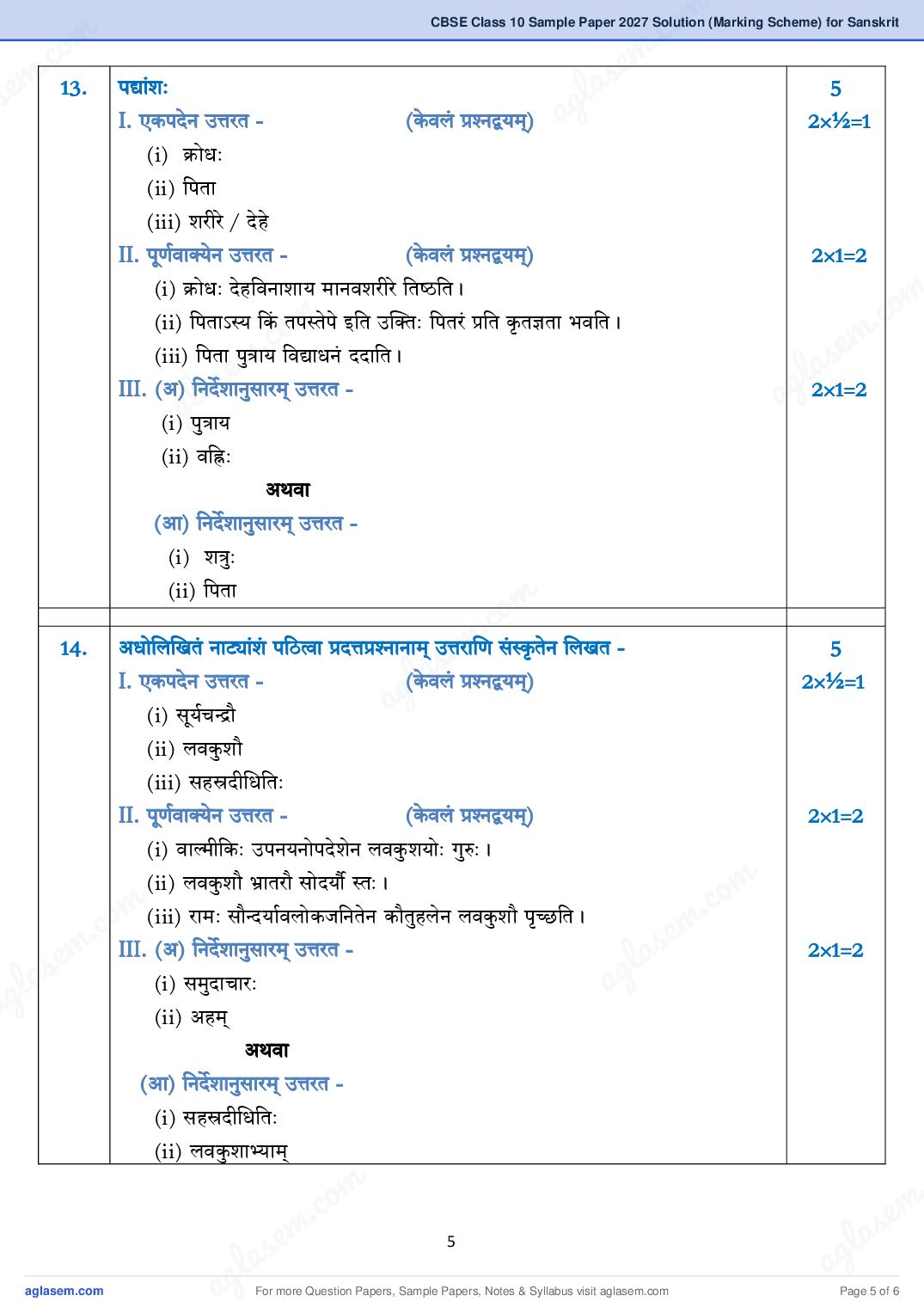
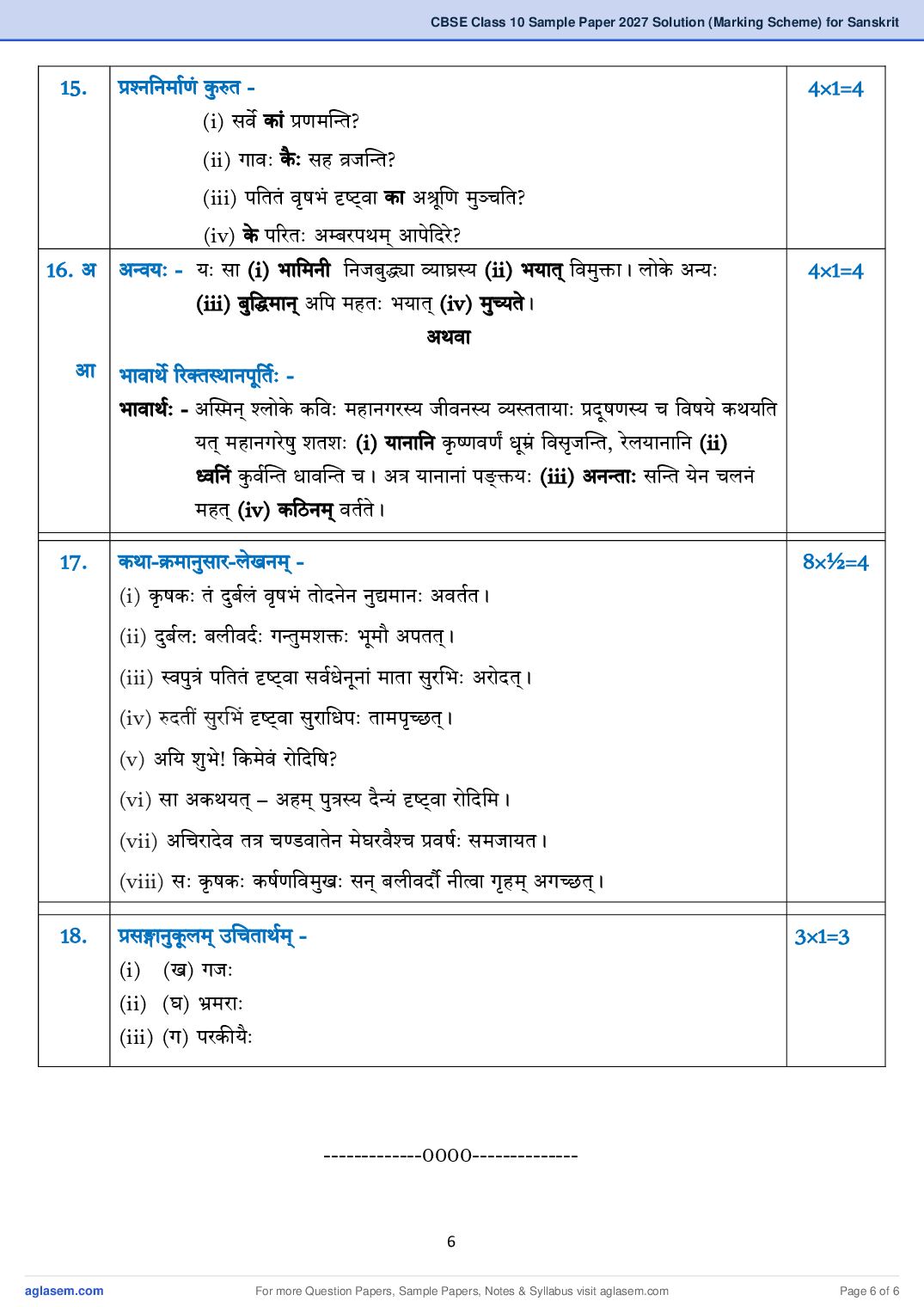
The 2027 marking scheme (अङ्कयोजना उत्तरसङ्केताश्च) gives the answer to every item: one-word and full-sentence Sanskrit answers, the MCQ options, sandhi/time/indeclinable answers, Sanskrit translations, question frames and the full story order. It says the answers are only indicative; synonyms are accepted; marks are reduced, not all lost, for wrong case endings or spelling; and in composition sentence construction matters more than style. If a student attempts extra choice items, the best answers are marked. Check your answers against it after you solve the paper.
Sanskrit Marking Scheme 2027 – Read Online
How to Score Well – Tips from the 2027 Paper
- Write every answer in Sanskrit. In full-sentence answers use correct case endings (vibhakti) and number (vachana), because the marking scheme deducts marks for errors in them.
- Grammar (25 marks) is mostly objective. Drill sandhi, samasa vigraha, pratyaya, vachya, time in Sanskrit (सार्ध-, पादोन-, सपाद-), avyayas and error correction.
- Learn to say clock times in Sanskrit: Q9 asks for 4:30, 5:45, 7:15 and 9:00 (सार्धचतुर्वादने, पादोनषड्वादने, सपादसप्तवादने, नववादने).
- In the letter, picture and paragraph questions, use the word box (मञ्जूषा) but change the case endings to fit your sentence. The marking scheme gives credit for correct sentence building even with your own words.
- Section D extracts come from lessons such as Vichitrah Sakshi, Subhashitani, Shishulalanam, Janani Tulyavatsala, Buddhirbalavati Sada, Shuchiparyavaranam and Anyoktayah. Practise अन्वय, story-sequencing and contextual word meanings.
- Solve the 2027 paper in one sitting with a timer, check it with the marking scheme, then solve the 2026 paper a few days later.
More Class 10 Sanskrit Papers and Study Material
Practise past board papers, or plan your revision with the syllabus and important questions for Class 10 Sanskrit:
CBSE Class 10 Sanskrit Sample Paper 2027 – FAQs
Is the CBSE Class 10 Sanskrit Sample Paper 2027 out?
Yes. CBSE has released the Class 10 Sanskrit sample paper 2027 for the 2026-27 session with its marking scheme – both are in the table on this page, free.
Is the CBSE Class 10 Sanskrit Sample Paper 2027 available with solutions?
Yes. The official CBSE marking scheme is the solution – it gives the answers and the marks for each step. Download it from the table above or read it online on this page.
Has the CBSE Class 10 Sanskrit paper pattern changed for 2027?
No. CBSE says there is no change in the question paper design for 2026-27. The 2027 sample paper keeps the 2026 pattern – 80 marks, 3 hours, 18 questions in 4 sections. Small changes: The paper is now 9 printed pages instead of 10, and the General Instruction is updated to match.; New content in Section A and B. Unseen passage: pollution (2026) became the wise youngest son (2027). Letters: 2026 asked for a letter to a friend about a new Delhi school or a fee-concession request to the principal; 2027 asks for a complaint to the municipal chairman about mosquitoes and filth, or congratulations to a friend who topped the state. Picture: Red Fort (2026) became a railway platform (2027). Paragraph: ‘मार्ग-सुरक्षा’ (road safety, 2026) became ‘खेलनस्य महत्त्वम्’ (importance of sports, 2027). All five translation sentences are new..
How many marks and questions are in the CBSE Class 10 Sanskrit Sample Paper 2027?
It is a 80 marks, 3 hours, 18 questions paper – Section Section A – Unseen Comprehension (‘क’ खण्डः – अपठितावबोधनम्): 1 (10 marks); Section Section B – Composition (‘ख’ खण्डः – रचनात्मकं कार्यम्): 2–4 (15 marks); Section Section C – Applied Grammar (‘ग’ खण्डः – अनुप्रयुक्तव्याकरणम्): 5–11 (25 marks); Section Section D – Textbook Comprehension (‘घ’ खण्डः – पठितावबोधनम्): 12–18 (30 marks).
Which units carry the most marks in the Sanskrit sample paper 2027?
In the 2027 sample paper: Textbook comprehension (पठितावबोधनम्) – lessons recognisable from the extracts though not named in the paper: ‘Vichitrah Sakshi’ (Q12), ‘Subhashitani’ (Q13, Q18 i), ‘Shishulalanam’ (Q14), ‘Buddhirbalavati Sada’ (Q16 अ), ‘Shuchiparyavaranam’ (Q16 आ), ‘Janani Tulyavatsala’ (Q15 iii, Q17), ‘Anyoktayah’ (Q15 iv, Q18 ii) (30 marks), Composition – letter, picture description/paragraph, translation (रचनात्मकं कार्यम्) (15 marks), Reading – unseen passage (अपठितावबोधनम्) (10 marks).
Is the CBSE 10th Sanskrit model question paper 2027 the same as the sample paper?
Yes. CBSE calls it the sample question paper (SQP); students also search for it as the 10th Sanskrit model question paper or model test paper – it is the same official paper on this page.
Will the board exam paper be the same as the sample paper?
No – the CBSE Class 10 board exam 2027 has different questions, but it follows the same pattern as the sample paper: the same sections, marks and question types.