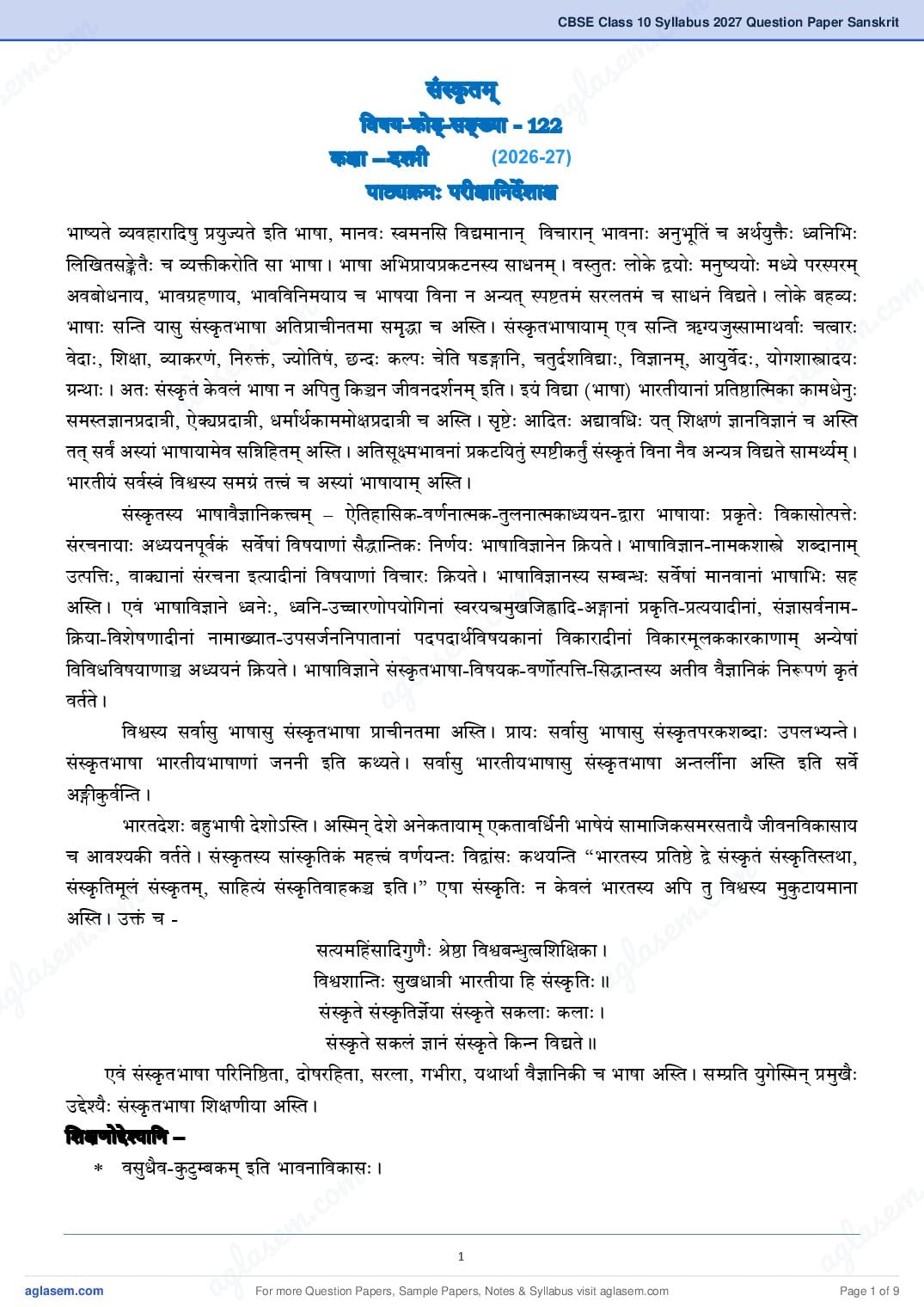
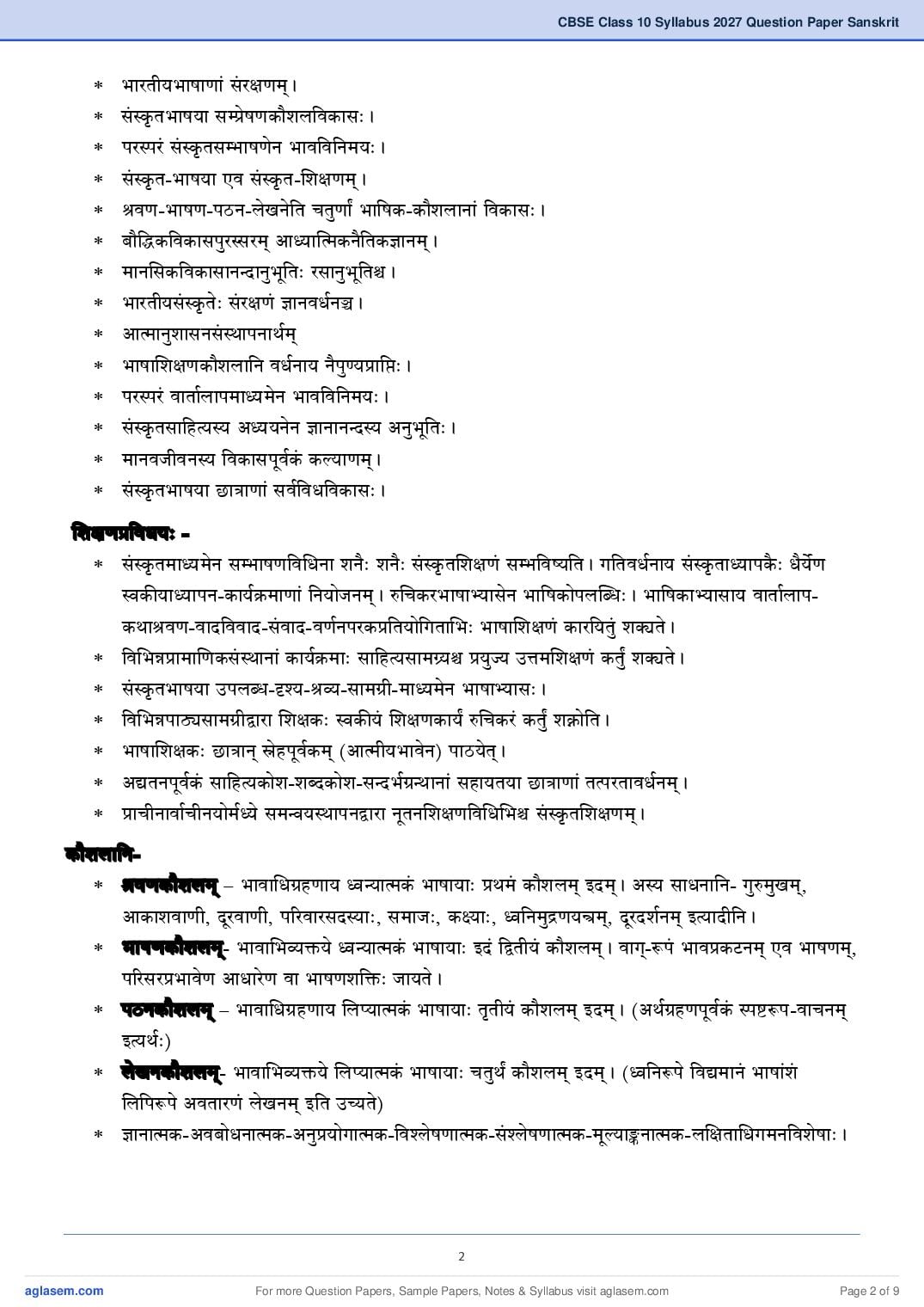
CBSE Class 10 Sanskrit Syllabus 2027 (Subject Code 122) has been released by the Central Board of Secondary Education for the 2026-27 academic session. It is a 100-mark course – 80 marks theory (Apathit Avbodhan/Unseen Comprehension 10, Rachnatmak Karya/Composition 15, Anuprayukt Vyakaran/Applied Grammar 25, Pathit Avbodhan/Textual Comprehension 30) across a 3-hour exam, plus 20 marks Internal Assessment. Download the official CBSE Class 10 Sanskrit Syllabus PDF and see the full unit-wise breakdown below.
CBSE Class 10 Sanskrit Syllabus 2027 PDF
The complete curriculum is as follows.
CBSE Class 10 Syllabus 2027 Sanskrit View Download
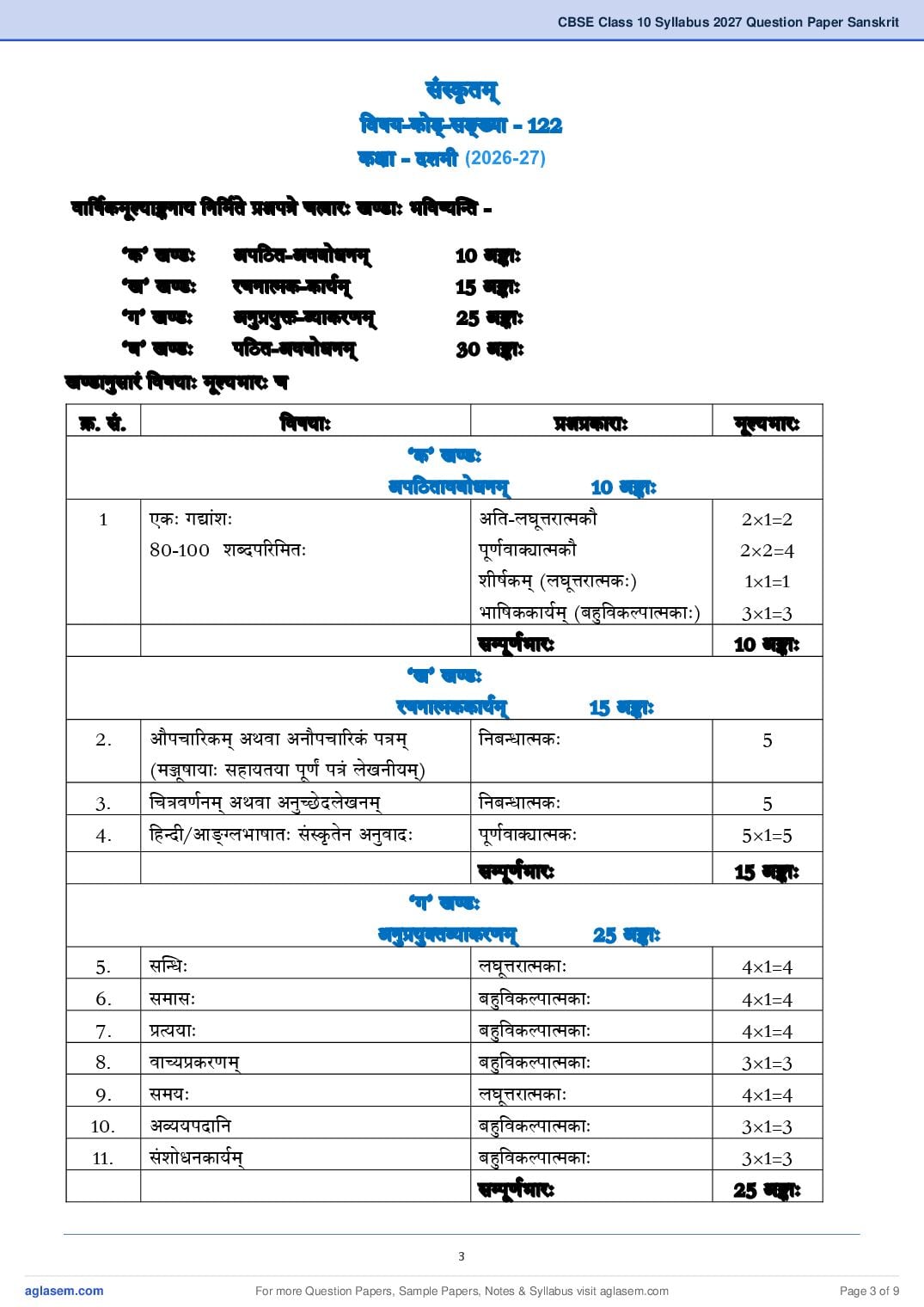
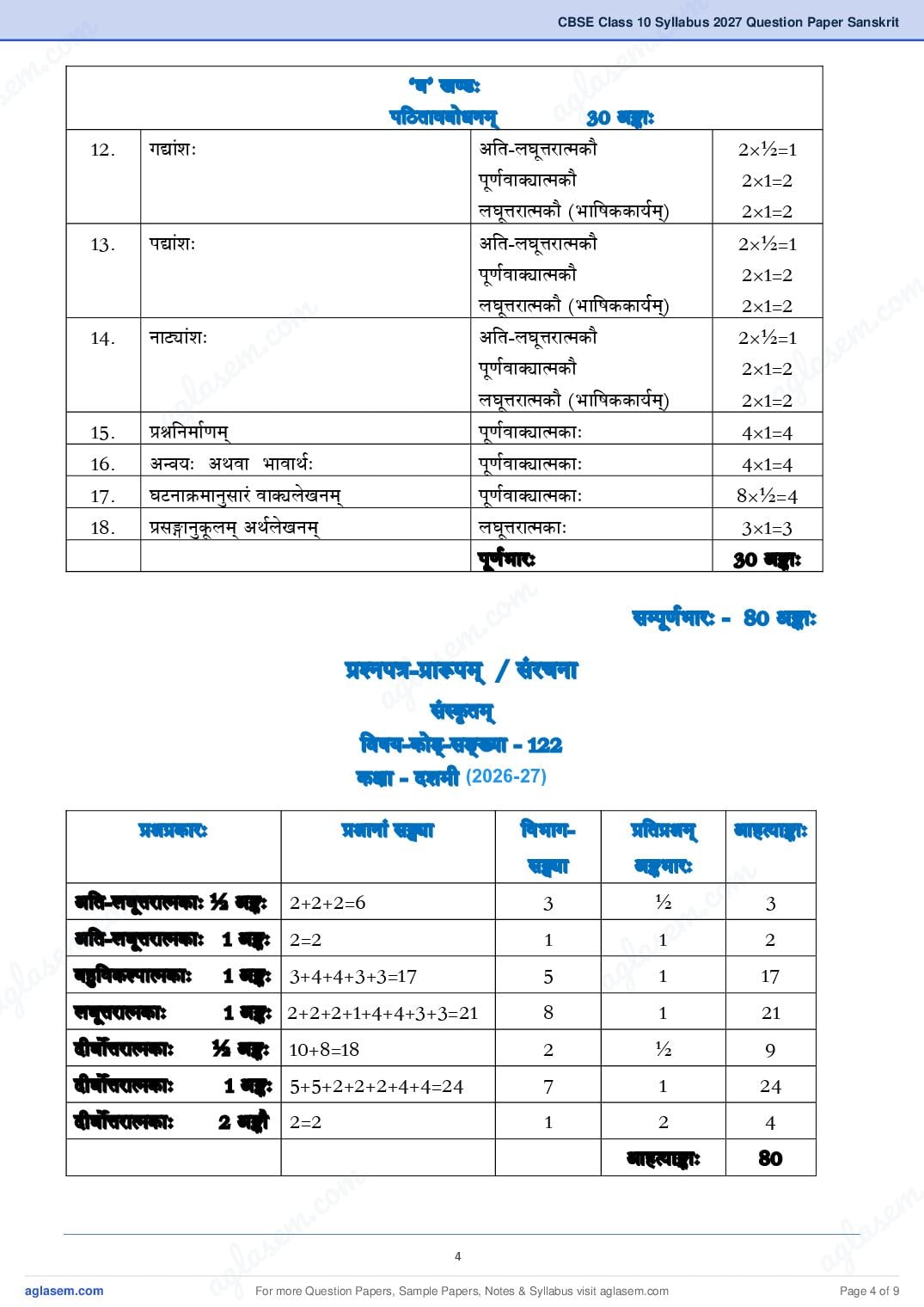
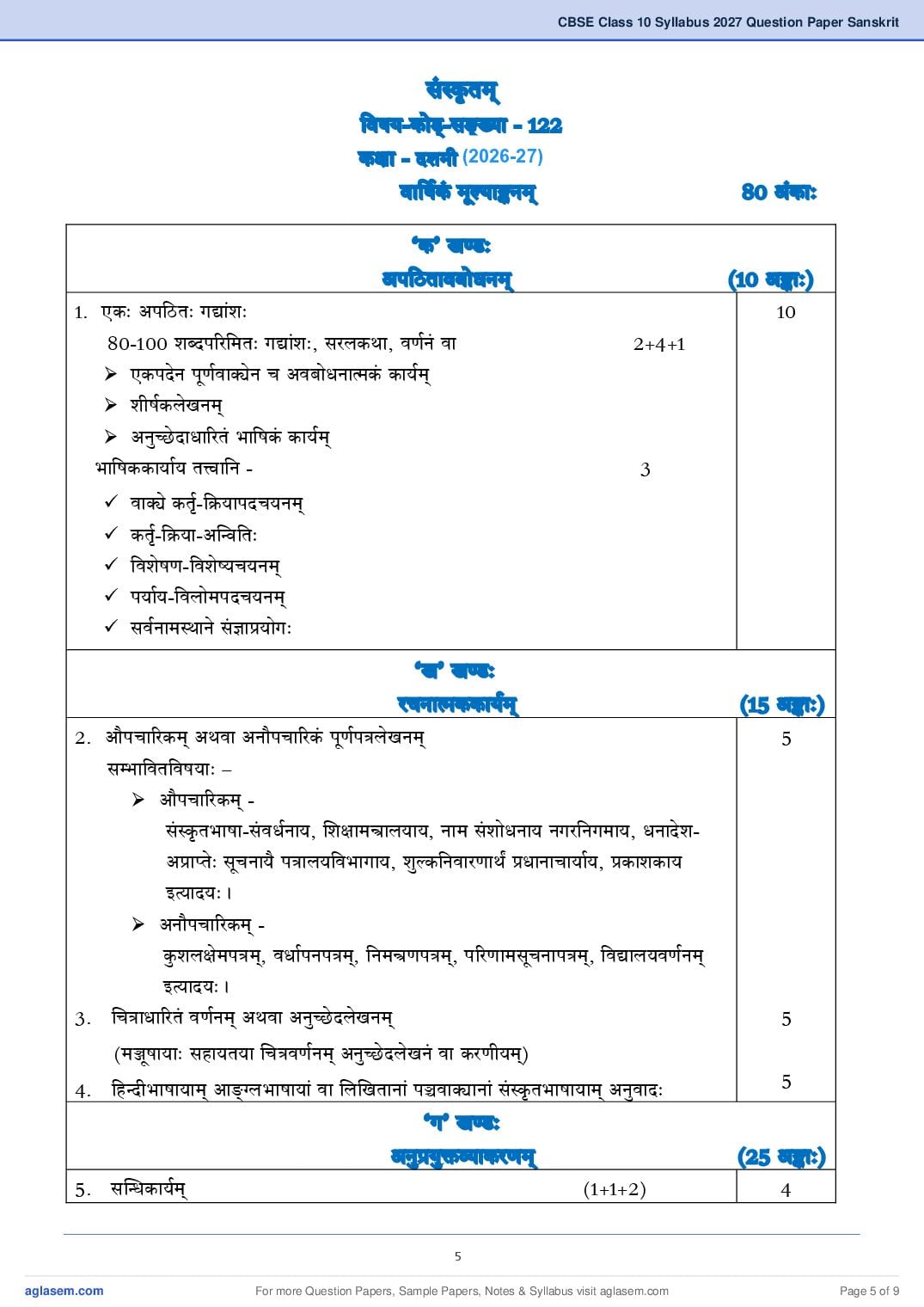
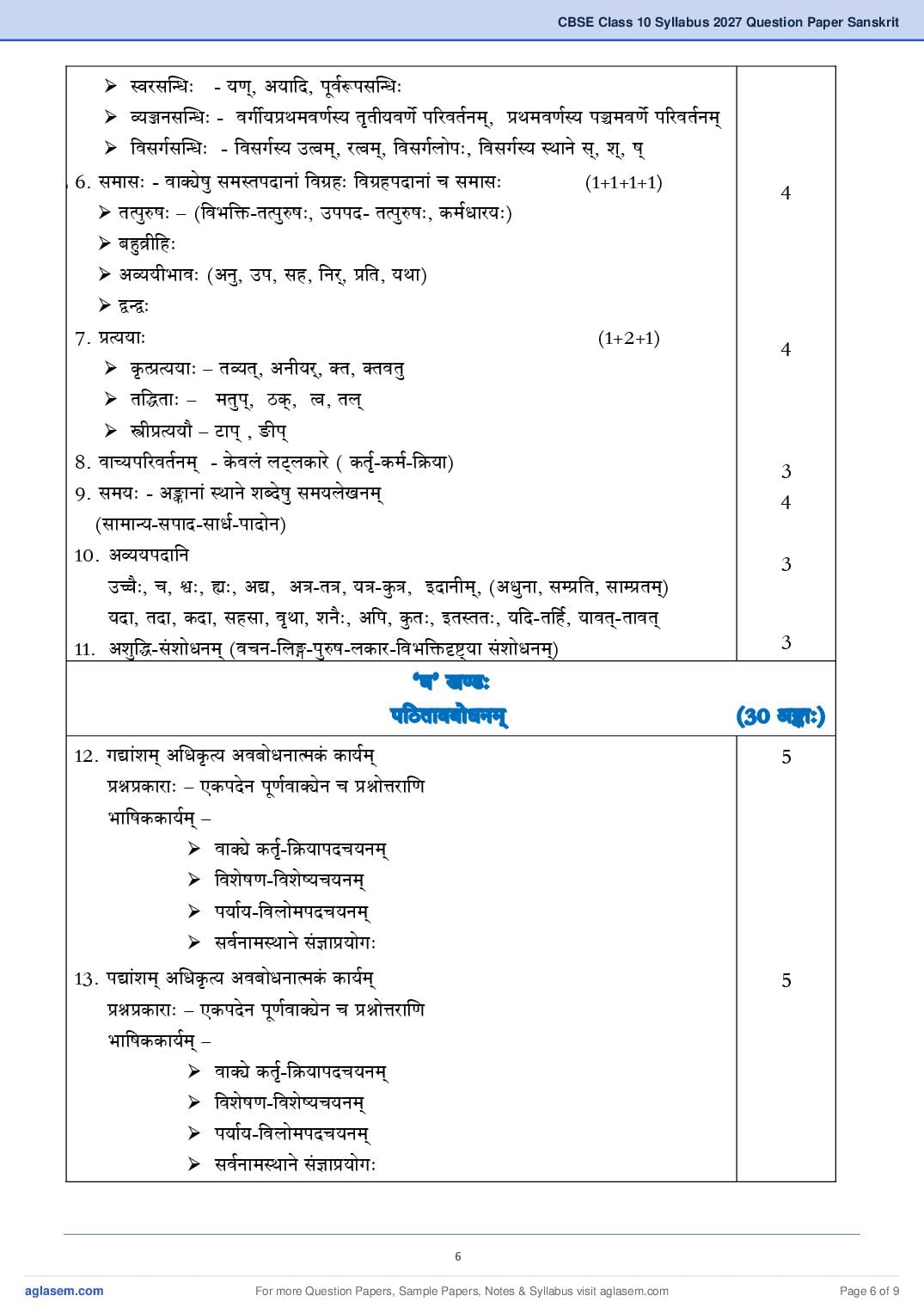
CBSE Class 10 Sanskrit Syllabus 2027 – Marks Weightage (Section-wise)
The CBSE Class 10 Sanskrit exam carries 100 total marks – 80 for the theory paper and 20 for Internal Assessment.
| Section | Topic | Marks |
|---|---|---|
| A – Apathit Avbodhan | Unseen passage (80-100 words) with comprehension and language work | 10 |
| B – Rachnatmak Karya | Formal/informal letter, picture/paragraph writing, translation (Hindi/English to Sanskrit) | 15 |
| C – Anuprayukt Vyakaran | Sandhi, Samas, Pratyaya, Vachya Parivartan, Samay, Avyaya Padani, Ashuddhi Samshodhan | 25 |
| D – Pathit Avbodhan | Prose, poetry, drama extracts, question formation, story and reason-based writing from prescribed lessons | 30 |
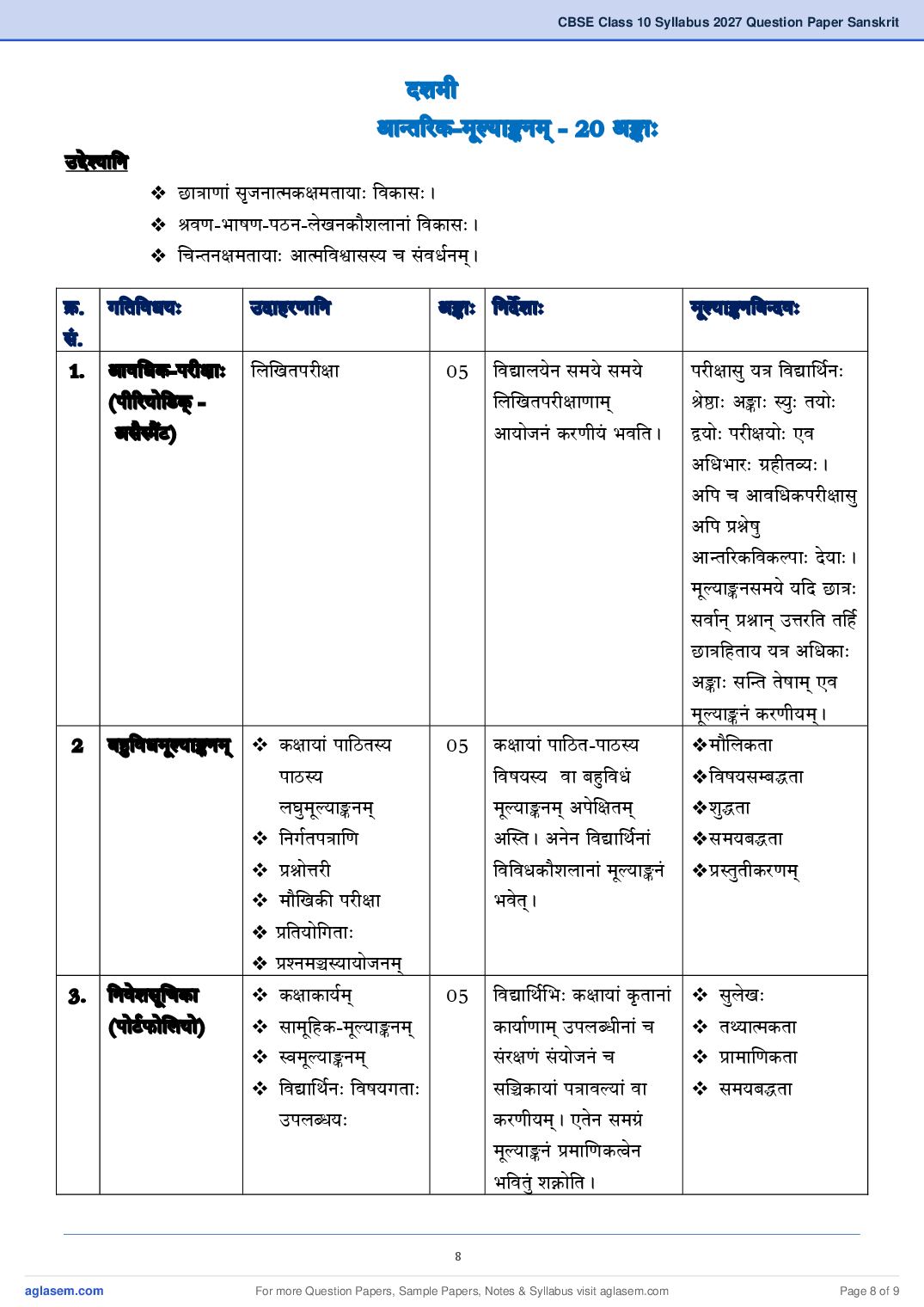
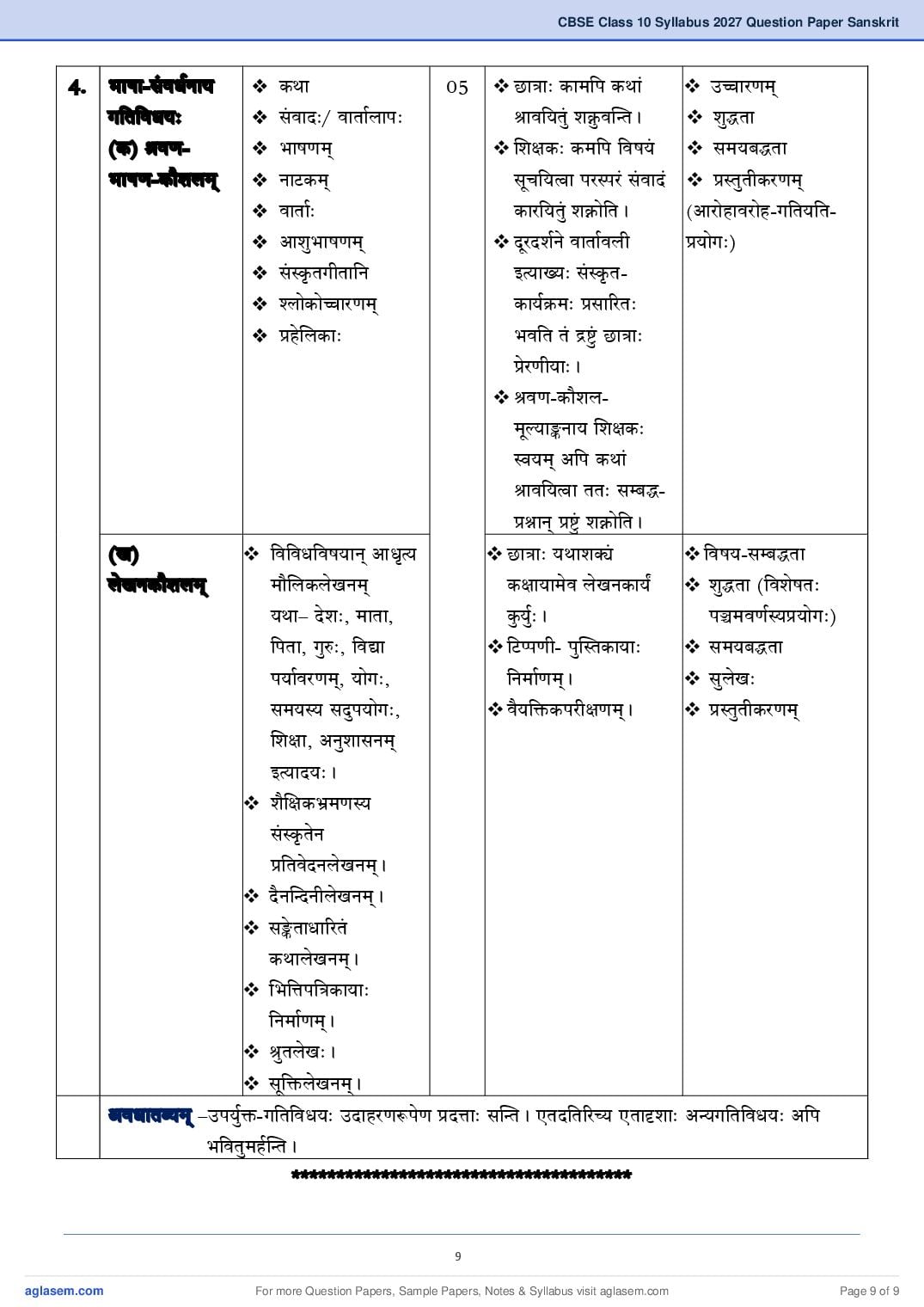
| Internal Assessment | Periodic tests, multiple assessment, portfolio, language-enrichment activities | 20 |
| Total | 100 |
CBSE Class 10 Sanskrit Syllabus 2027 – Grammar Topics Covered
Under Anuprayukt Vyakaran (25 marks), the following topics are prescribed for CBSE Class 10 Sanskrit.
CBSE Class 10 Sanskrit Syllabus 2027 – Prescribed Lessons (Pathit Avbodhan)
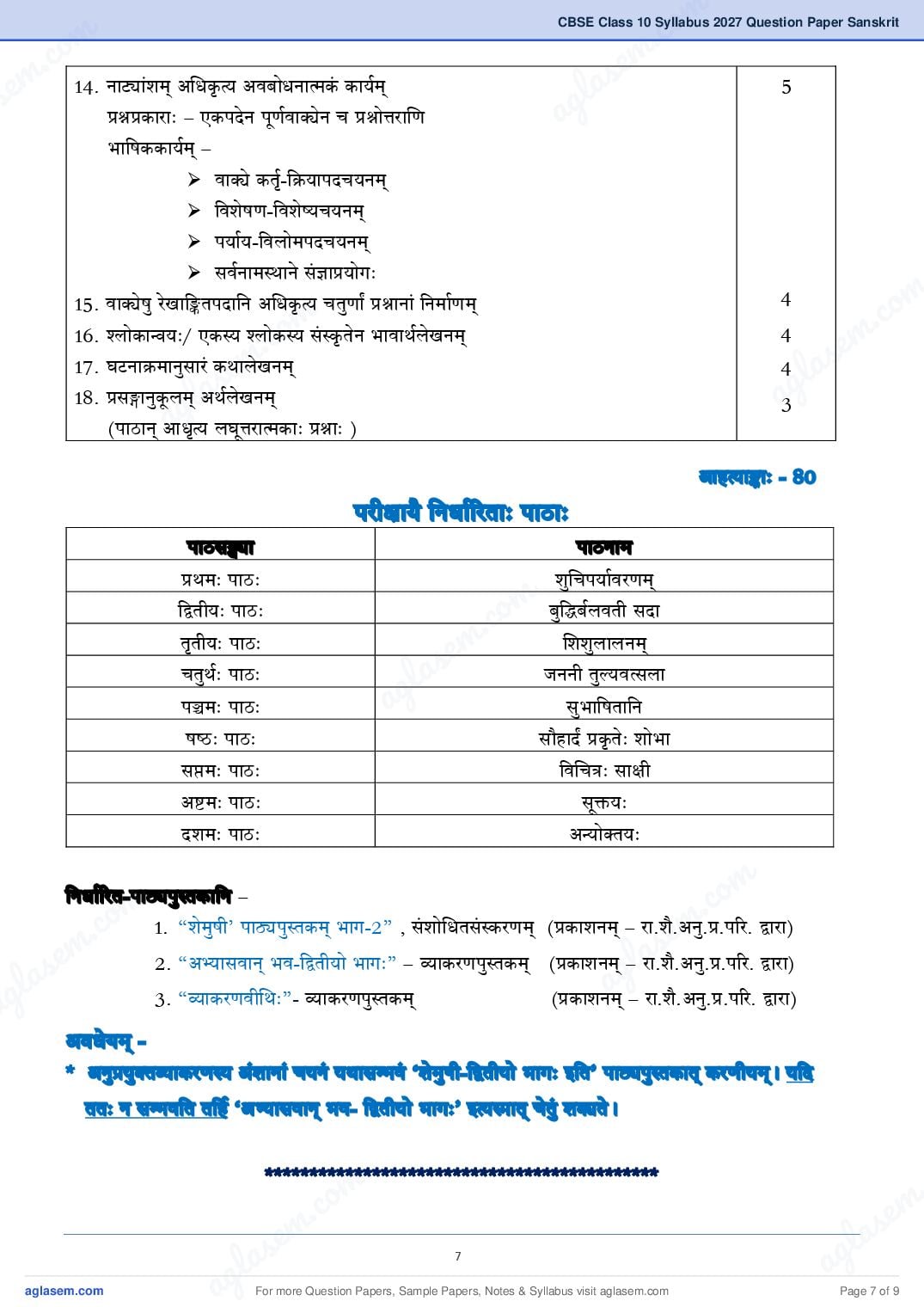
Pathit Avbodhan carries 30 marks, drawn from the 9 prescribed lessons in the Shemushi textbook.
Prescribed Textbooks: Shemushi Part 2 (revised edition), Abhyasvan Bhav Part 2 (grammar workbook) and Vyakaran Vithi (grammar book), all published by NCERT/CBSE’s Rashtriya Shaikshik Anusandhan aur Prashikshan Parishad.
CBSE Class 10 Sanskrit Syllabus 2027 – Exam Pattern (Question-wise Breakdown)
The CBSE Class 10 Sanskrit question paper is divided into four Khands (sections). The detailed scheme and weightage to content is as follows.
| Section | Topic | Question Type | No. of Questions | Marks |
|---|---|---|---|---|
| A – Apathit Avbodhan | Unseen passage (80-100 words) – title, one-word/full-sentence answers, language work | Very Short/Short Answer | 1 passage | 10 |
| B – Rachnatmak Karya | Formal/informal letter writing | Long Answer | 1 | 5 |
| B – Rachnatmak Karya | Picture description or paragraph writing | Long Answer | 1 | 5 |
| B – Rachnatmak Karya | Translation of 5 sentences (Hindi/English to Sanskrit) | Short Answer | 5 | 5 |
| C – Anuprayukt Vyakaran | Sandhi Karya | Short Answer | 4 | 4 |
| C – Anuprayukt Vyakaran | Samas | MCQ | 4 | 4 |
| C – Anuprayukt Vyakaran | Pratyaya | MCQ | 4 | 4 |
| C – Anuprayukt Vyakaran | Vachya Parivartan | MCQ | 3 | 3 |
| C – Anuprayukt Vyakaran | Samay (Time expressions) | Short Answer | 4 | 4 |
| C – Anuprayukt Vyakaran | Avyaya Padani | MCQ | 3 | 3 |
| C – Anuprayukt Vyakaran | Ashuddhi Samshodhan | MCQ | 3 | 3 |
| D – Pathit Avbodhan (Gadyansh) | Comprehension-based questions and language work | Short Answer | 1 extract | 5 |
| D – Pathit Avbodhan (Padyansh) | Comprehension-based questions and language work | Short Answer | 1 extract | 5 |
| D – Pathit Avbodhan (Natyansh) | Comprehension-based questions and language work | Short Answer | 1 extract | 5 |
| D – Pathit Avbodhan | Question formation from underlined words | Long Answer | 4 | 4 |
| D – Pathit Avbodhan | Anvaya/Bhavartha of a shloka | Long Answer | 1 | 4 |
| D – Pathit Avbodhan | Story writing as per sequence of events | Long Answer | 1 | 4 |
| D – Pathit Avbodhan | Context/reason-based writing from lessons | Short Answer | 1 | 3 |
CBSE Class 10 Sanskrit Syllabus 2027 – Continue Your Preparation
Once you have reviewed the syllabus, practice with the CBSE Class 10 Sample Papers and previous years’ CBSE Class 10 Question Papers to prepare for your board exam. Refer to the NCERT Books for Class 10 and NCERT Solutions for Class 10 for other subjects as well.
Frequently Asked Questions
The CBSE Class 10 Sanskrit Syllabus 2027 (Subject Code 122) is the official curriculum released by CBSE for the 2026-27 academic session. It covers Apathit Avbodhan (Unseen Comprehension), Rachnatmak Karya (Composition), Anuprayukt Vyakaran (Applied Grammar), and Pathit Avbodhan (Textual Comprehension), for a total of 100 marks (80 theory plus 20 Internal Assessment).
The subject code for Sanskrit in CBSE Class 10 is 122.
The CBSE Class 10 Sanskrit theory exam is of 80 marks (3 hours), plus 20 marks for Internal Assessment, making a total of 100 marks.
The prescribed textbooks are Shemushi Part 2 (revised edition) for the main course, along with Abhyasvan Bhav Part 2 and Vyakaran Vithi for grammar, all published under CBSE’s Rashtriya Shaikshik Anusandhan aur Prashikshan Parishad.
Anuprayukt Vyakaran (Applied Grammar) carries 25 marks out of 80 in the theory exam, covering Sandhi, Samas, Pratyaya, Vachya Parivartan, Samay, Avyaya Padani and Ashuddhi Samshodhan.
CBSE Class 10 Syllabus 2026-27 (All Subjects)
You study more subjects besides Sanskrit in 10th class. The subject-wise syllabus for CBSE Class 10 students is as follows.
CBSE Syllabus 2026-27 (Class-wise)
The class-wise syllabus for CBSE board students is as follows.
CBSE Class 10 Sanskrit Syllabus 2027 – An Overview
The important things to know about this curriculum are as follows.
| Aspects | Details |
|---|---|
| Education Board | CBSE |
| Class | Class 10 |
| Subject | Sanskrit |
| Study Material Here | CBSE Syllabus for Class 10 Sanskrit |
| All Curriculum for This Class | CBSE Syllabus for Class 10 |
| All Curriculum for This Board | CBSE Syllabus |
| Full Name of CBSE | Central Board of Secondary Education |
| NCERT Books | NCERT Books for Class 10 |
| NCERT Solutions | NCERT Solutions for Class 10 |
If you have any queries on CBSE Class 10 Sanskrit Syllabus 2027, then please ask in comments below.