NCERT Solutions for Class 8 Social Science Chapter 9 India’s Long Road to Independence provide clear, step-by-step answers to every exercise and in-text question from the chapter India’s Long Road to Independence of the NCERT textbook Exploring Society: India and Beyond. Prepared by subject experts as per the latest NCERT (CBSE) syllabus for 2026-27, these NCERT Solutions for Class 8 Social Science help you understand each concept, write exam-ready answers, and check your own solutions. You can read them online below or download the free Class 8 Social Science Chapter 9 question-answer PDF.
NCERT Solutions for Class 8 Social Science Chapter 9 India’s Long Road to Independence
- Class: Class 8
- Subject: Social Science
- Chapter: Chapter 9 – India’s Long Road to Independence
- Textbook: Exploring Society: India and Beyond (NCERT)
- Study material: NCERT Solutions – questions with answers, free PDF
These solutions answer all the exercise questions of Chapter 9 India’s Long Road to Independence — including the in-text questions, short-answer and long-answer questions, and activities — with complete explanations so you can follow the method, not just the final answer. Read the full solutions below.
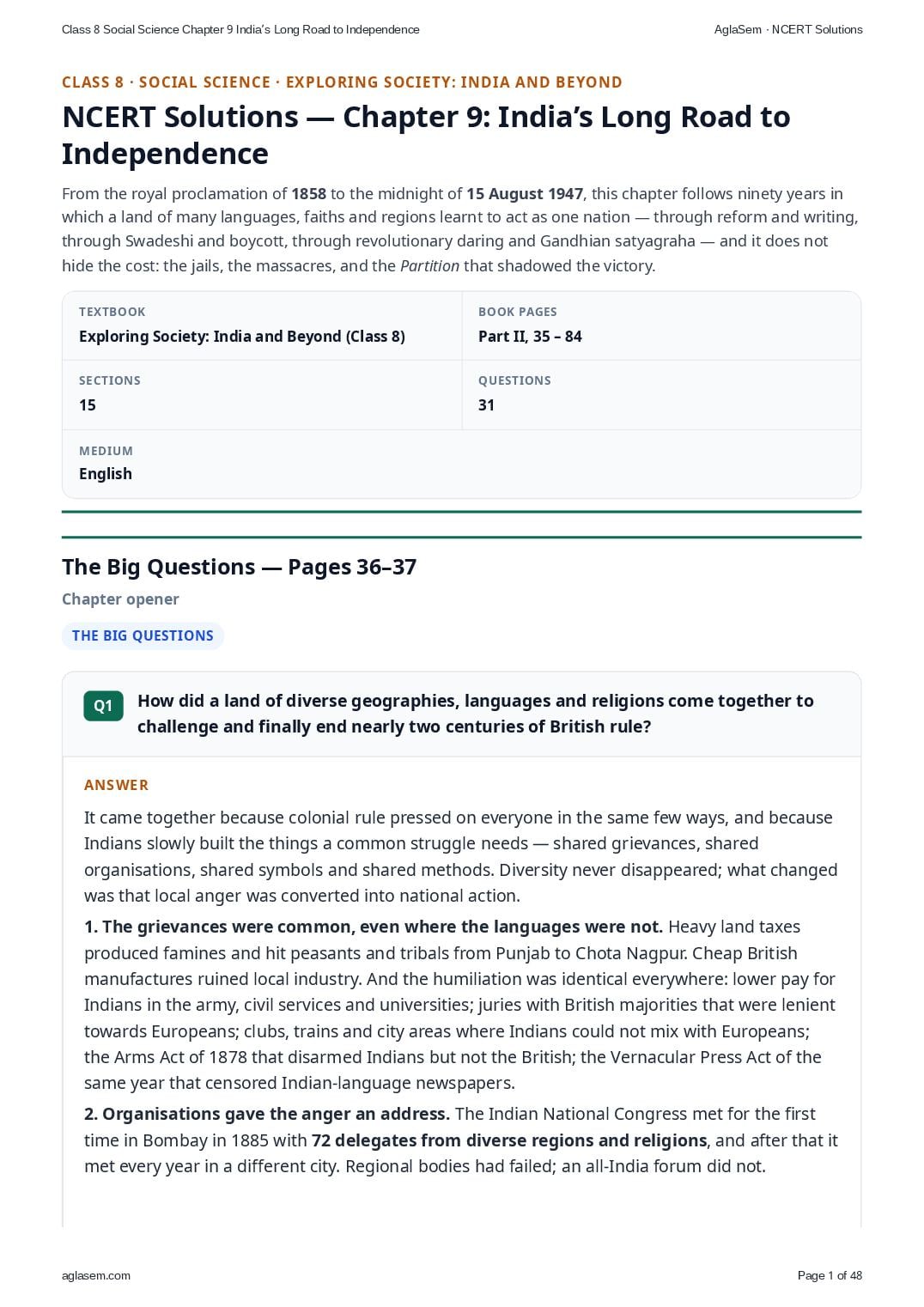
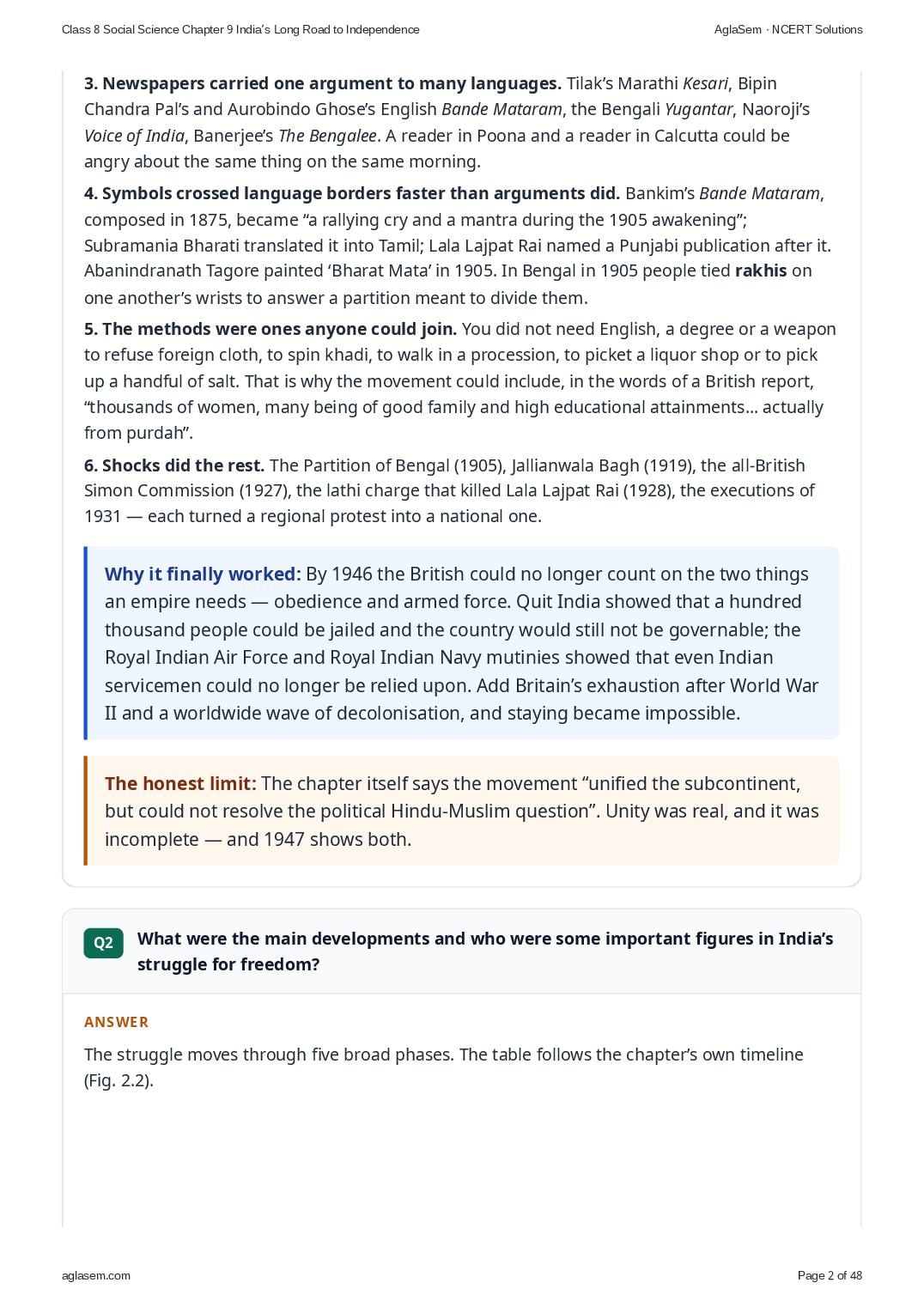
NCERT Solutions Class 8 Social Science Chapter 9 India s Long Road to Independence View Download
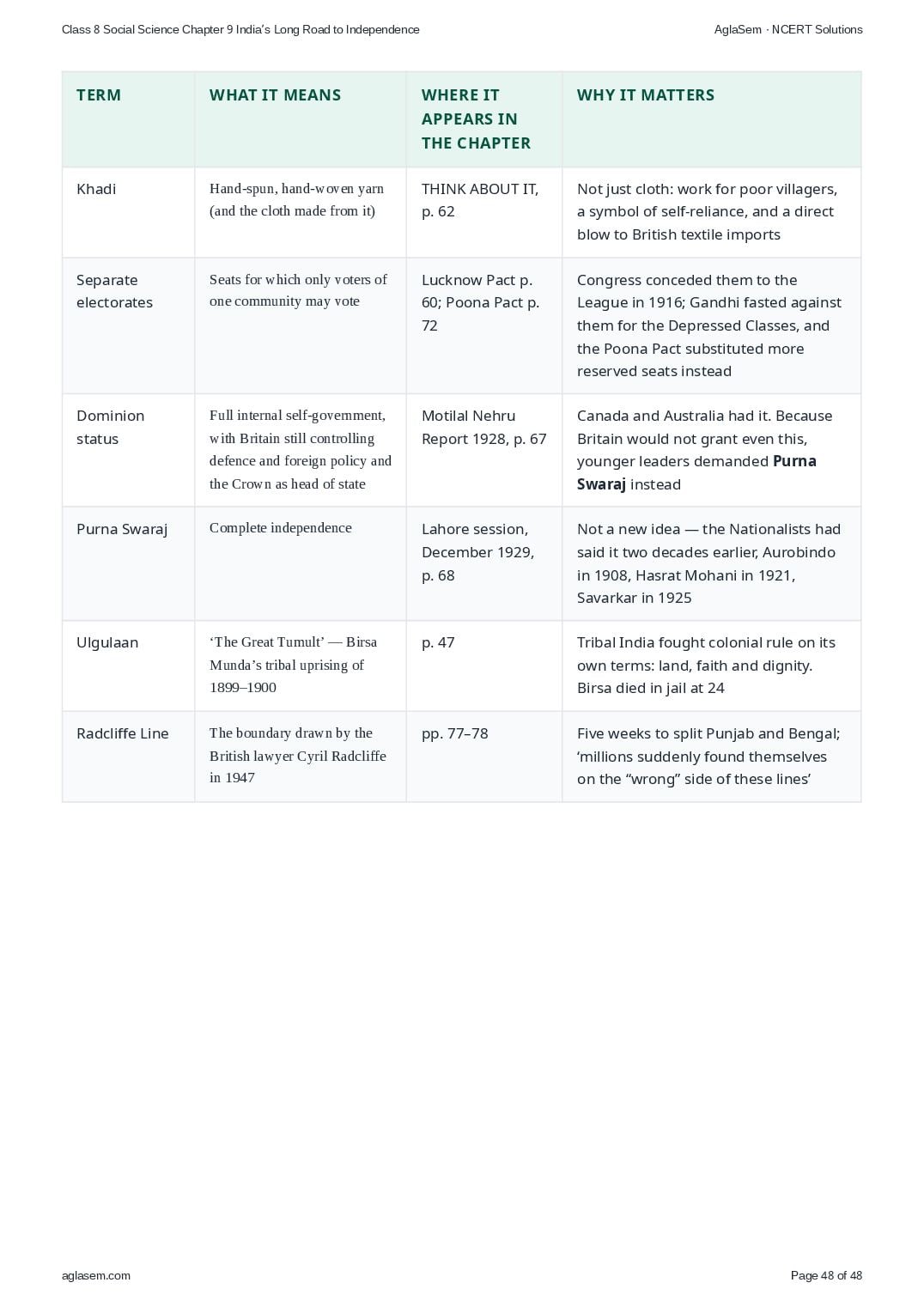
NCERT Solutions for Class 8 Social Science Chapter 9 PDF Download
You can read the NCERT Solutions for Class 8 Social Science Chapter 9 online above, or download the complete question-answer PDF to study India’s Long Road to Independence offline at any time.
NCERT Solutions for Class 8 Social Science Chapter 9 PDF Download Link – Click Here to Download Solutions PDF
Questions Covered in This Chapter
These NCERT Solutions answer all 31 questions of this chapter. The questions solved are:
- How did a land of diverse geographies, languages and religions come together to challenge and finally end nearly two centuries of British rule?
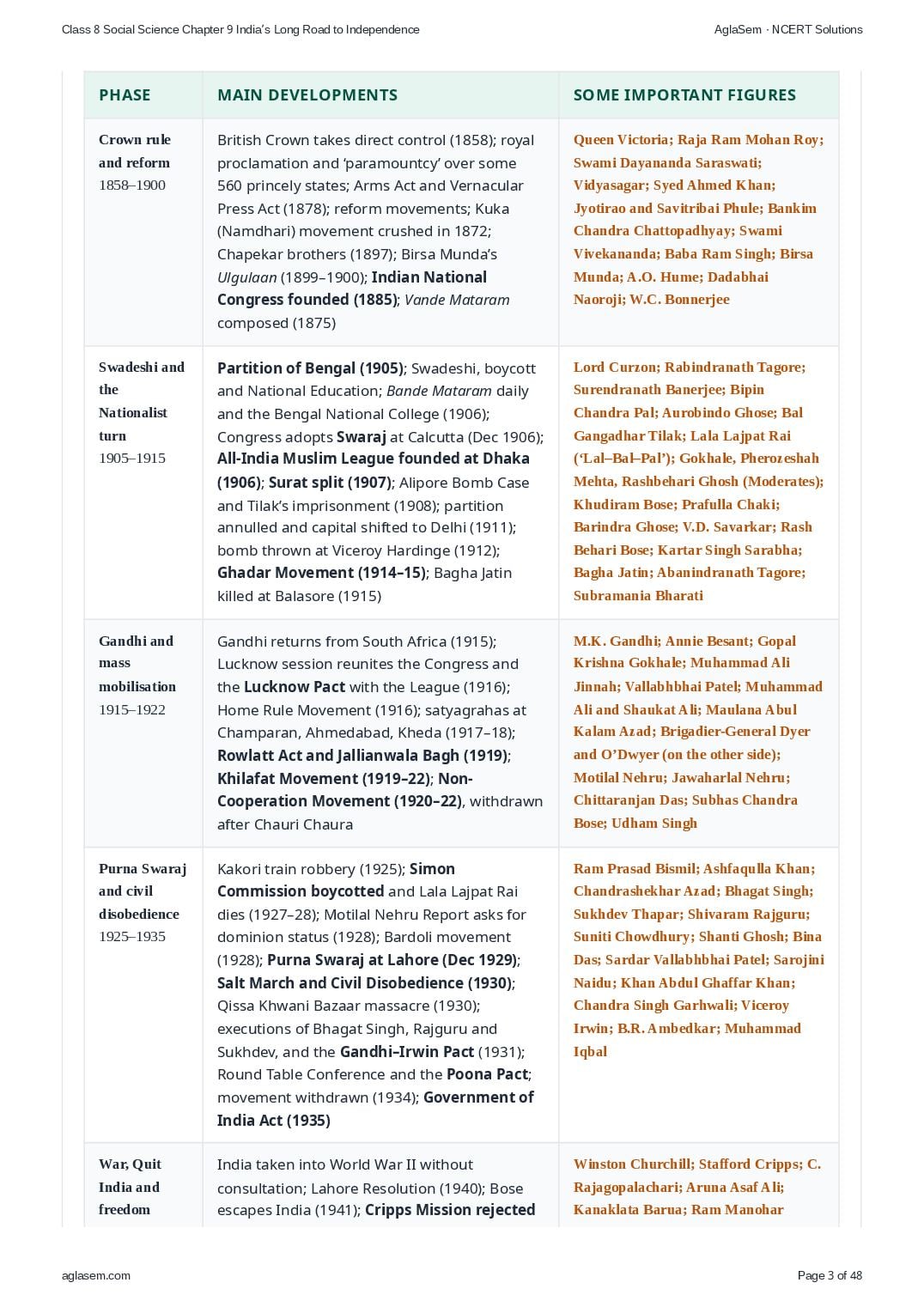
- What were the main developments and who were some important figures in India’s struggle for freedom?
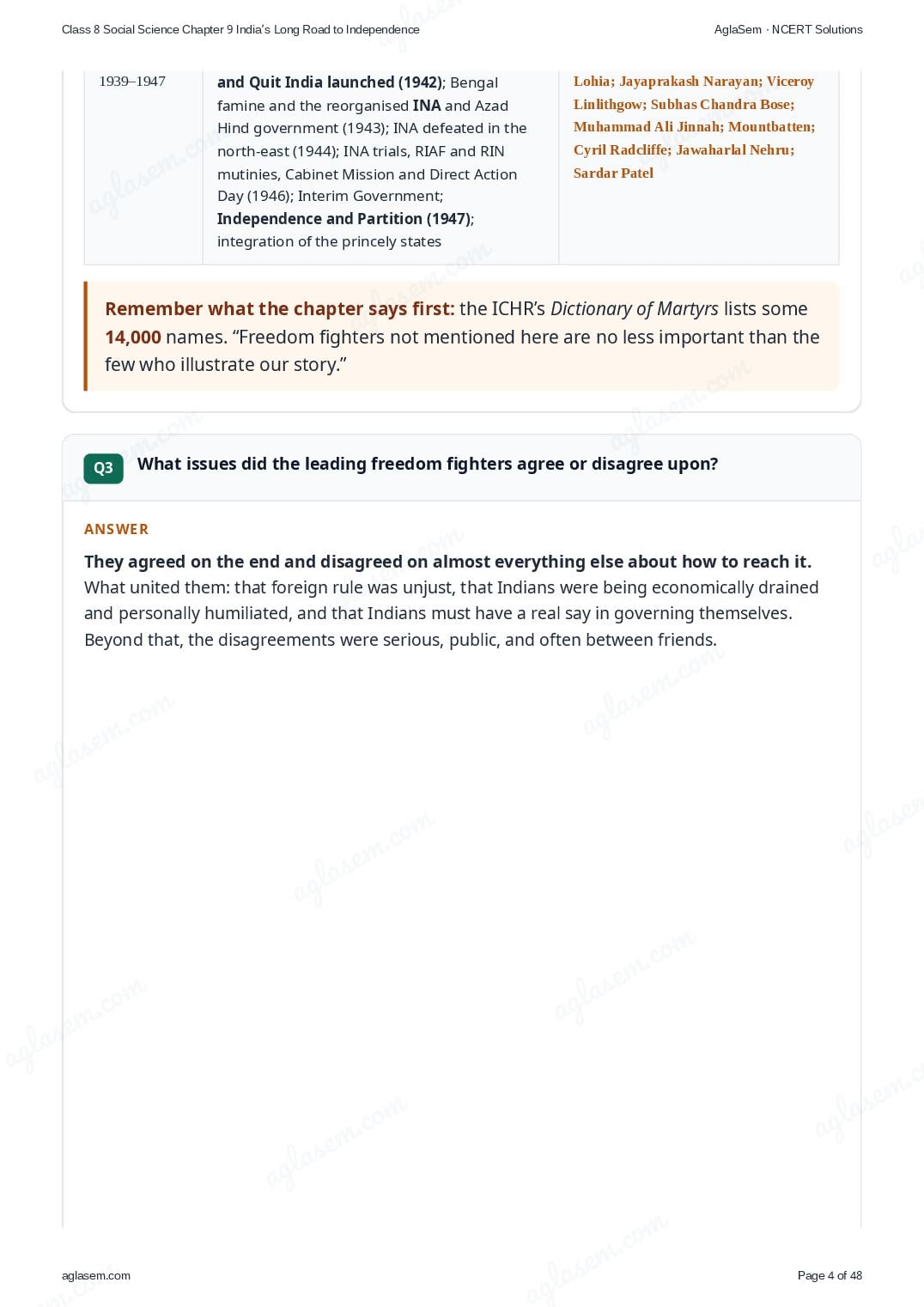
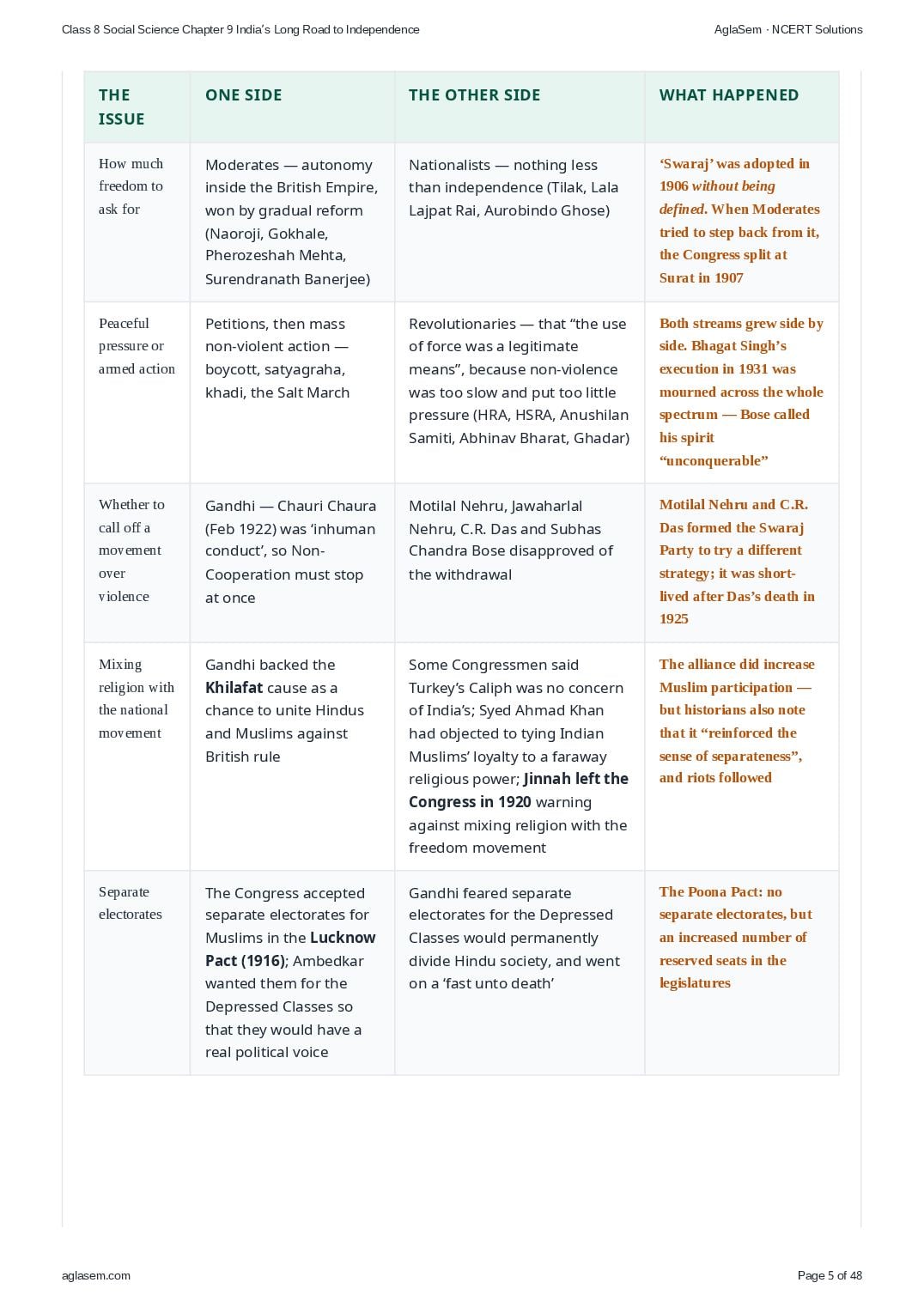
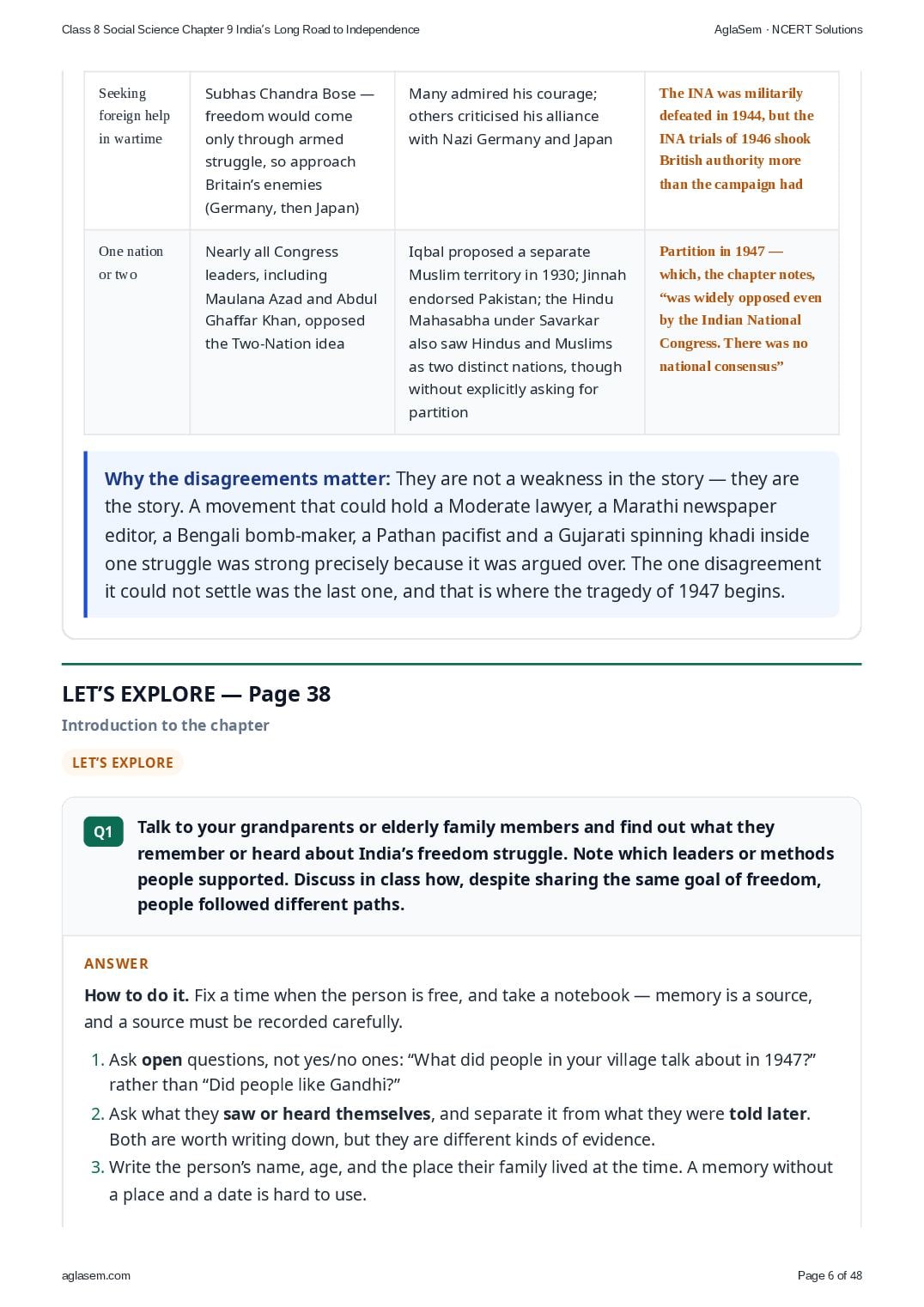
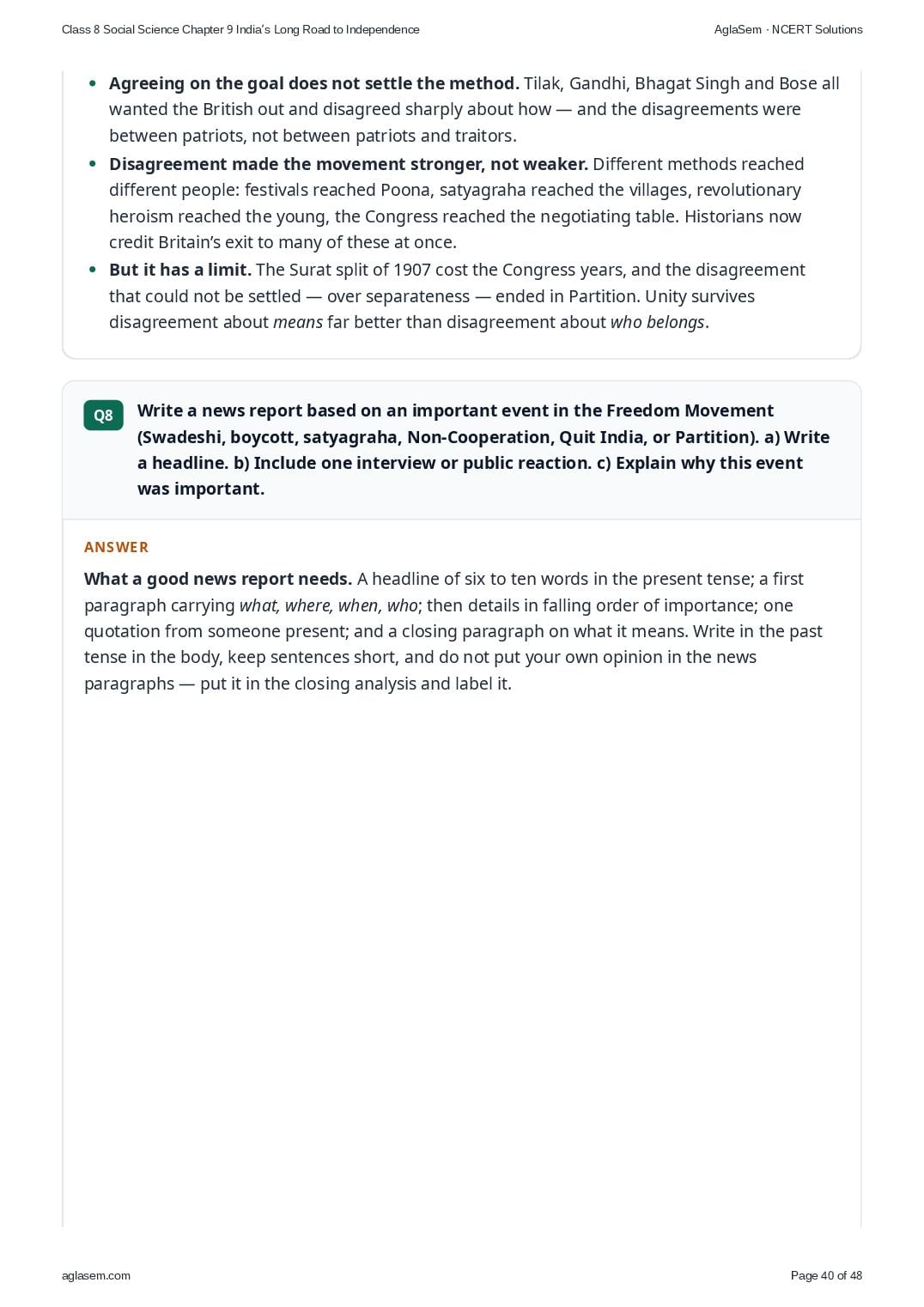
- What issues did the leading freedom fighters agree or disagree upon?
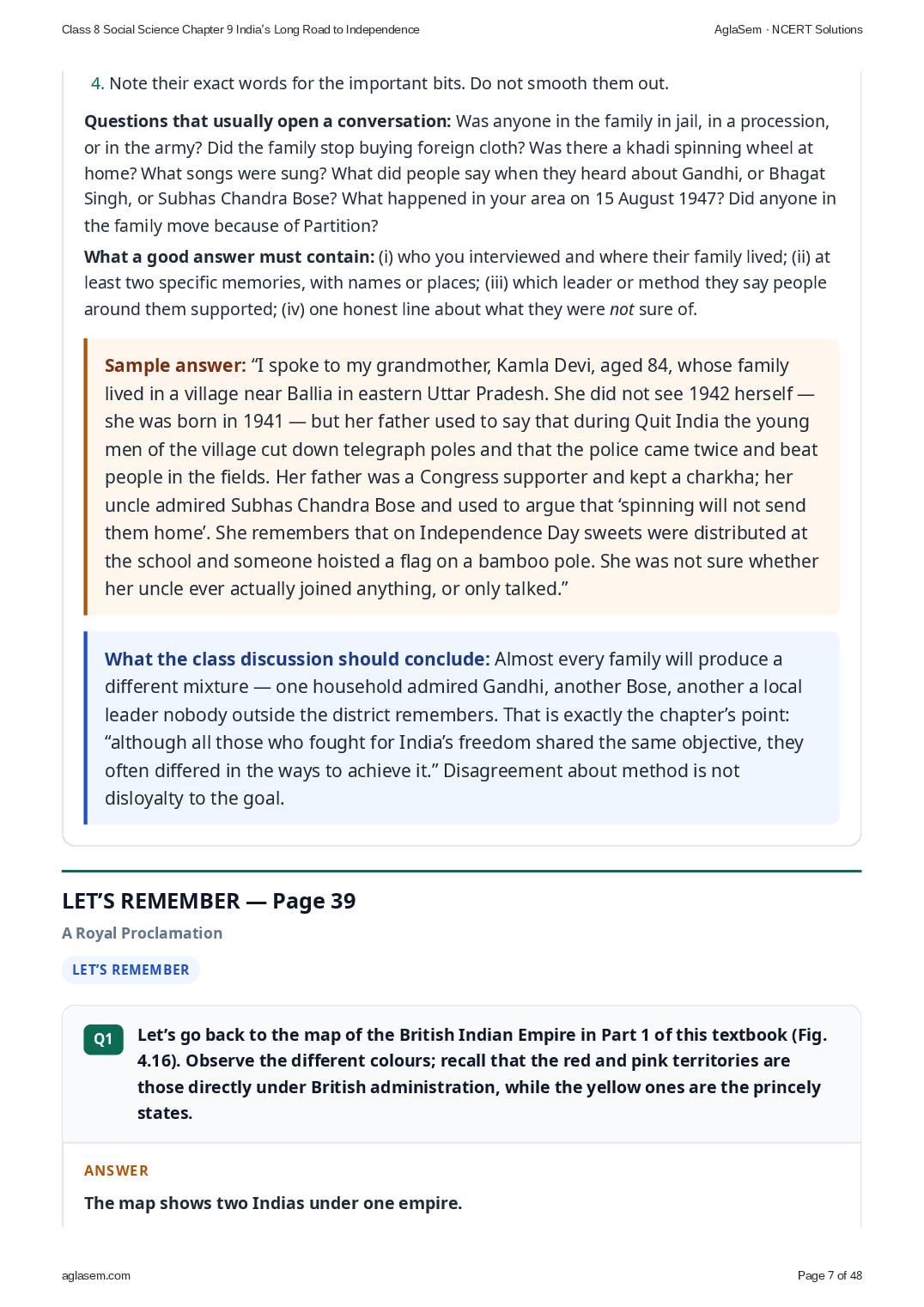
- Talk to your grandparents or elderly family members and find out what they remember or heard about India’s freedom struggle. Note which leaders or methods people supported. Discuss in class how, despite sharing the same goal of freedom, people followed different paths.
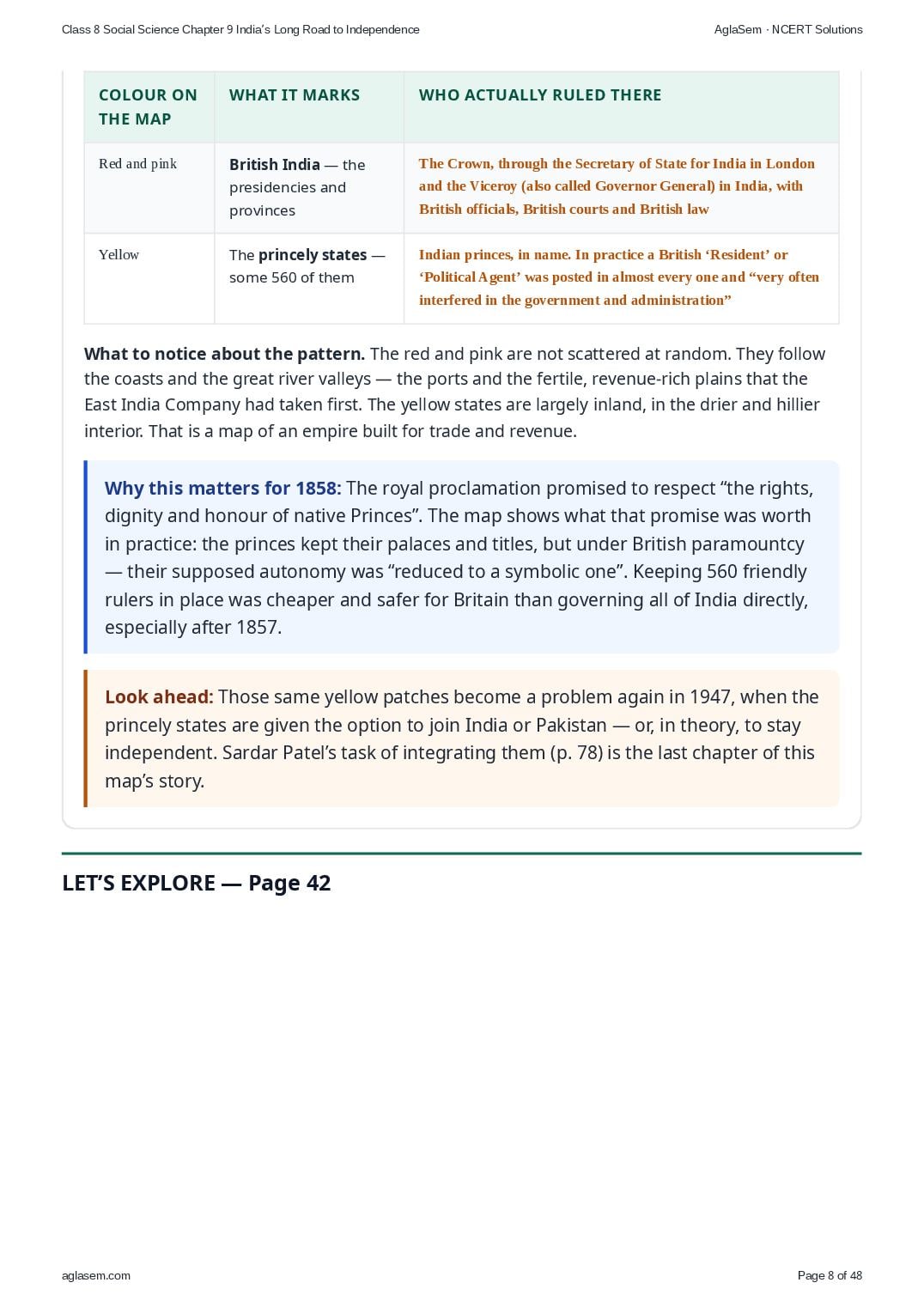
- Let’s go back to the map of the British Indian Empire in Part 1 of this textbook (Fig. 4.16). Observe the different colours; recall that the red and pink territories are those directly under British administration, while the yellow ones are the princely states.
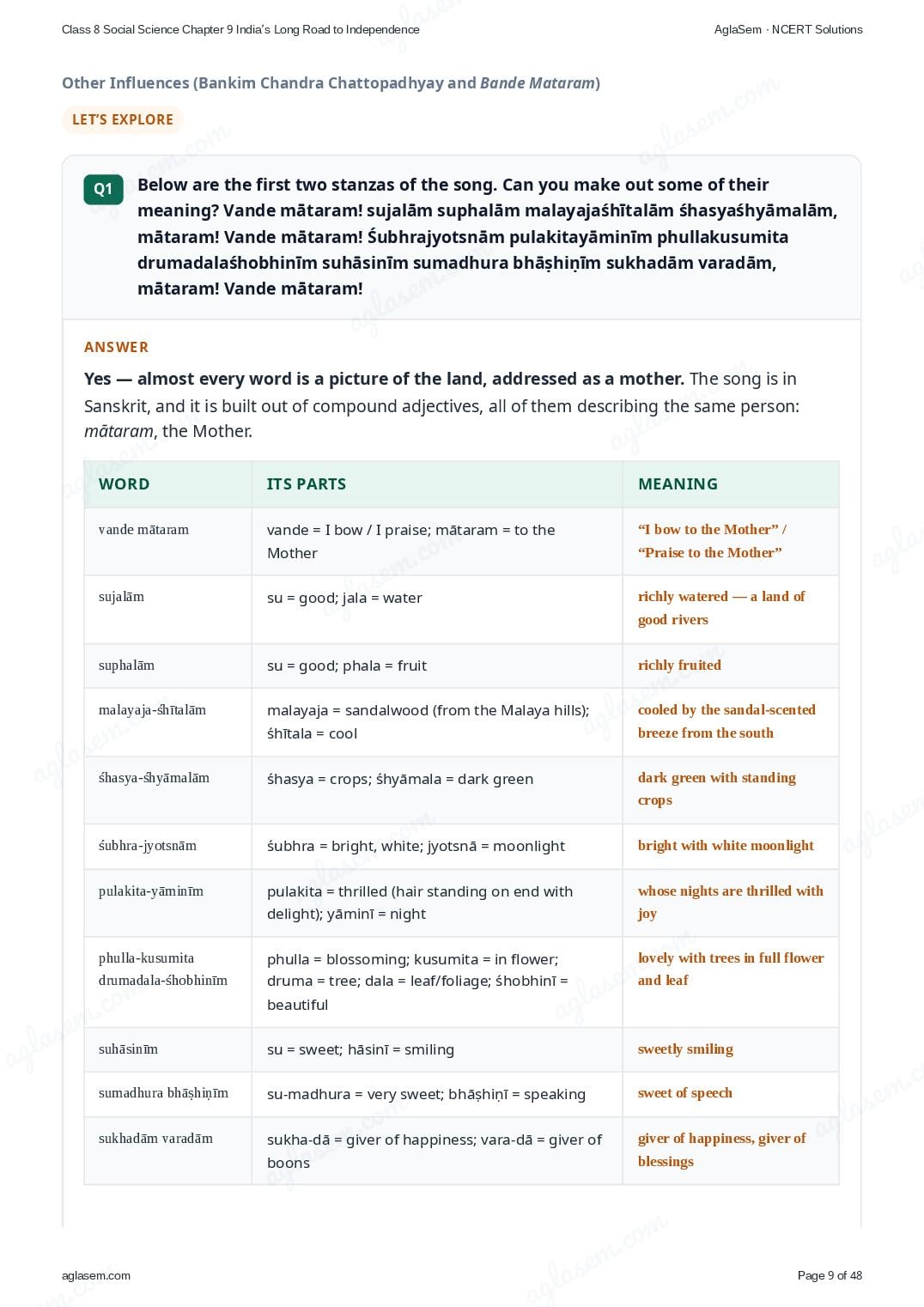
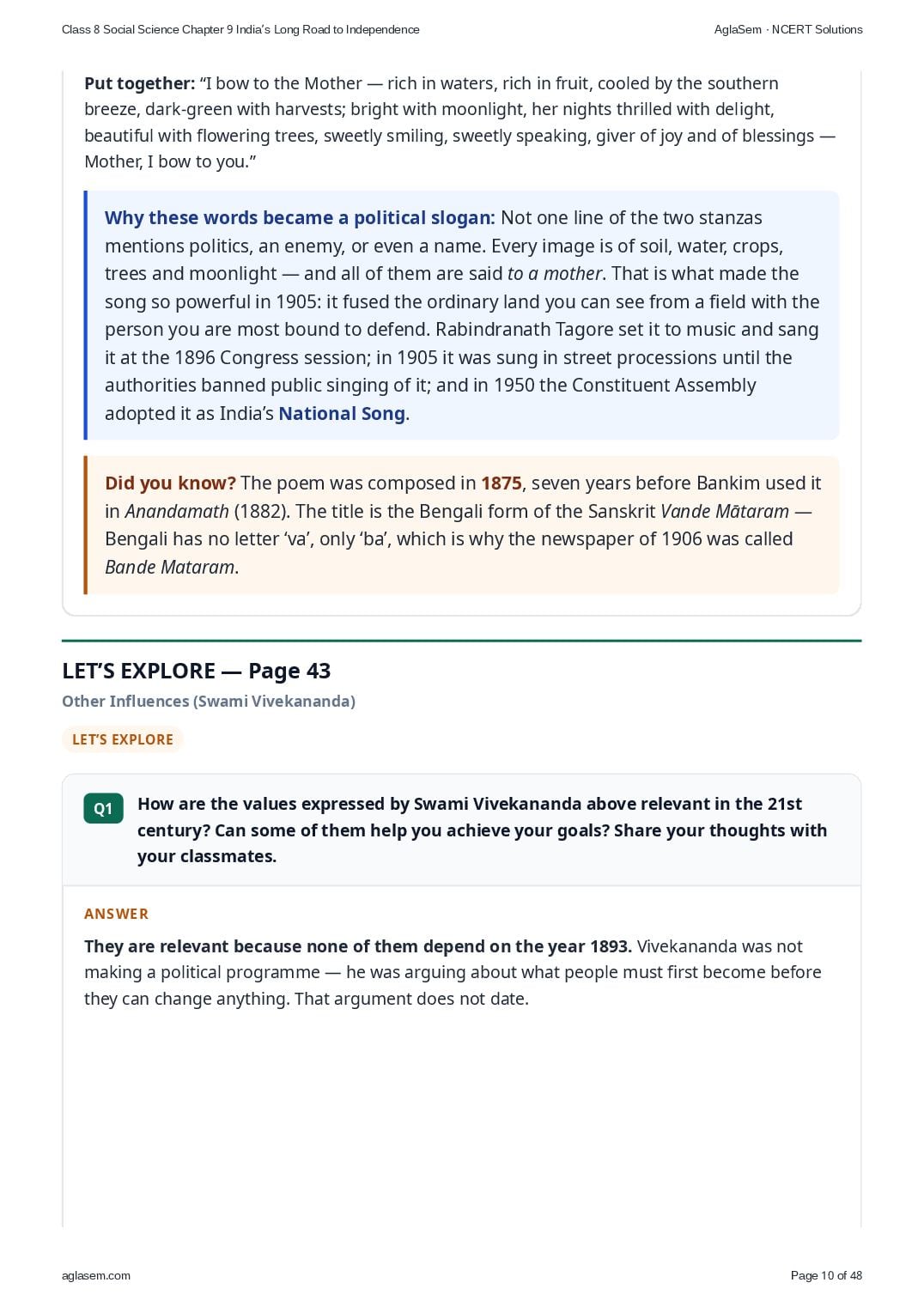
- Below are the first two stanzas of the song. Can you make out some of their meaning? Vande mātaram! sujalām suphalām malayajaśhītalām śhasyaśhyāmalām, mātaram! Vande mātaram! Śubhrajyotsnām pulakitayāminīm phullakusumita drumadalaśhobhinīm suhāsinīm sumadhura bhāṣhiṇīm sukhadām varadām, mātaram! Vande mātaram!
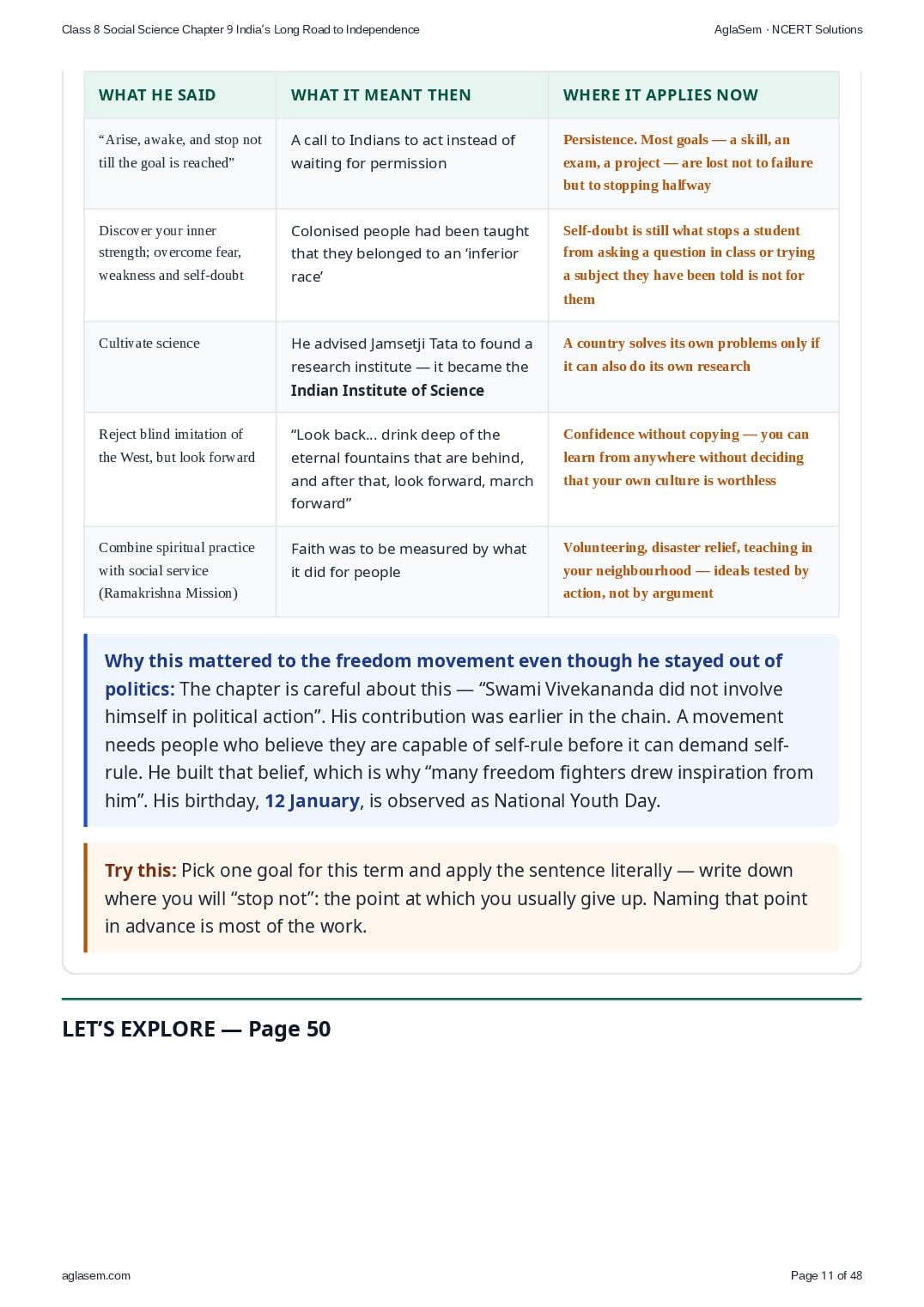
- How are the values expressed by Swami Vivekananda above relevant in the 21st century? Can some of them help you achieve your goals? Share your thoughts with your classmates.
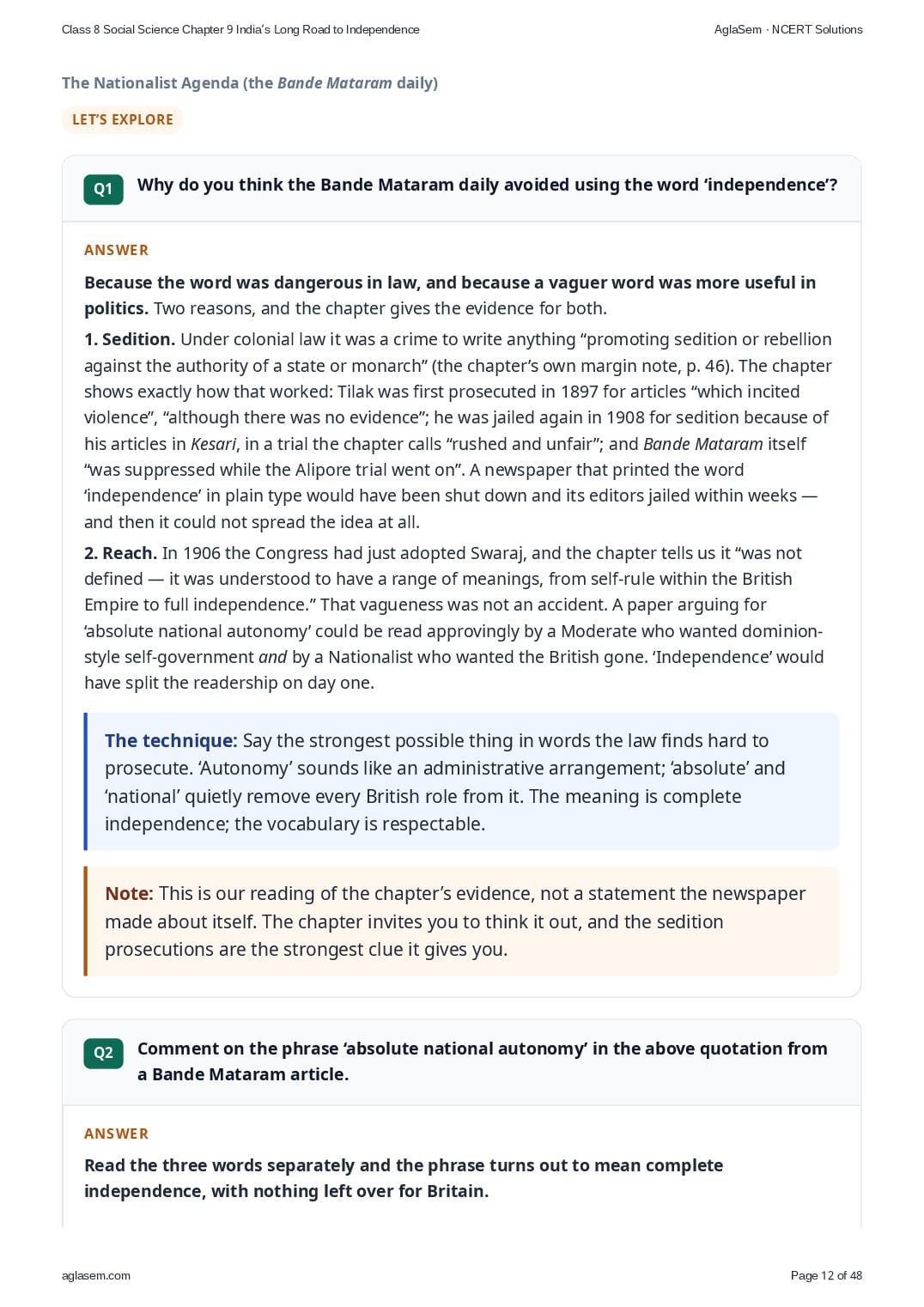
- Why do you think the Bande Mataram daily avoided using the word ‘independence’?
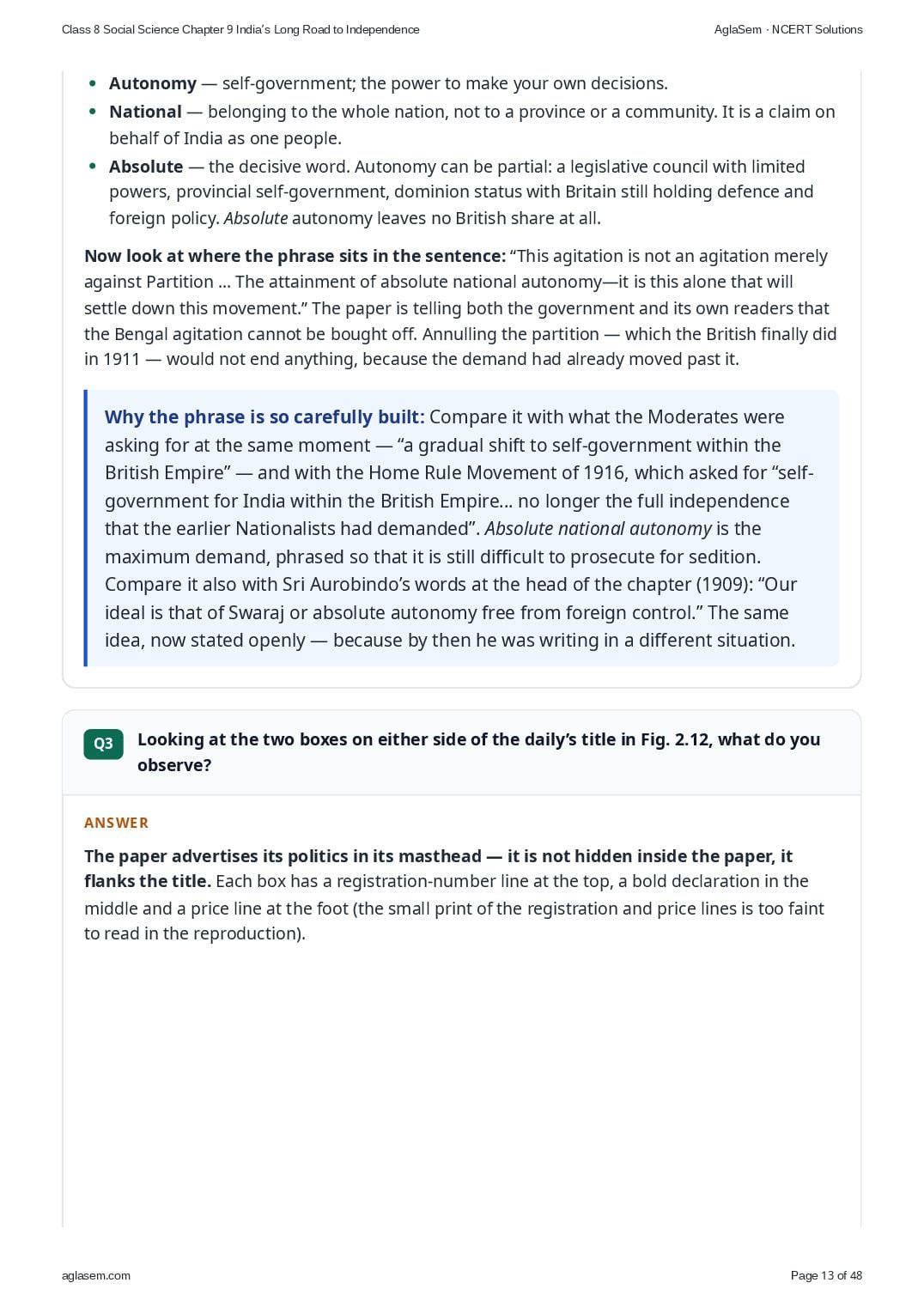
- Comment on the phrase ‘absolute national autonomy’ in the above quotation from a Bande Mataram article.
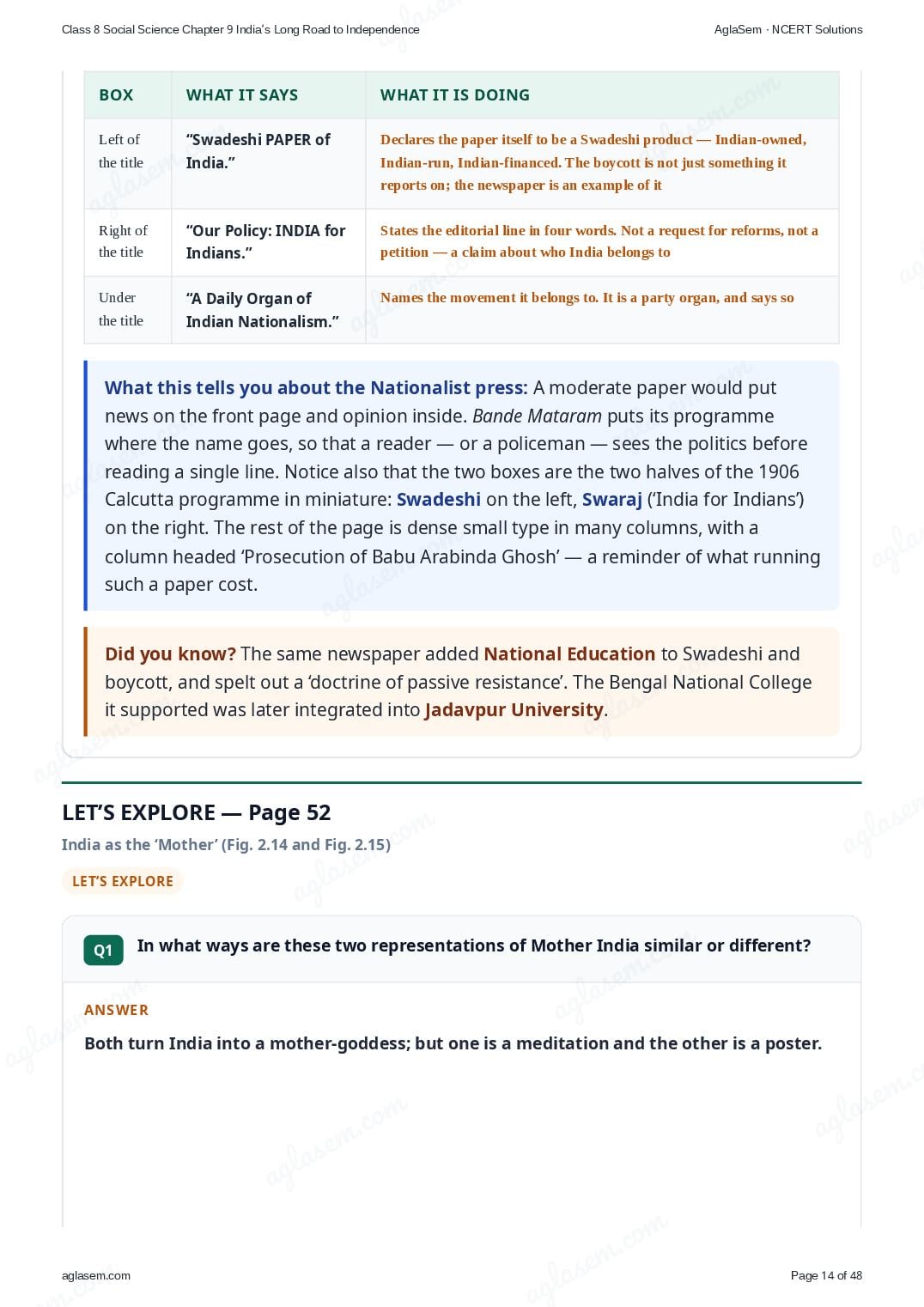
- Looking at the two boxes on either side of the daily’s title in Fig. 2.12, what do you observe?
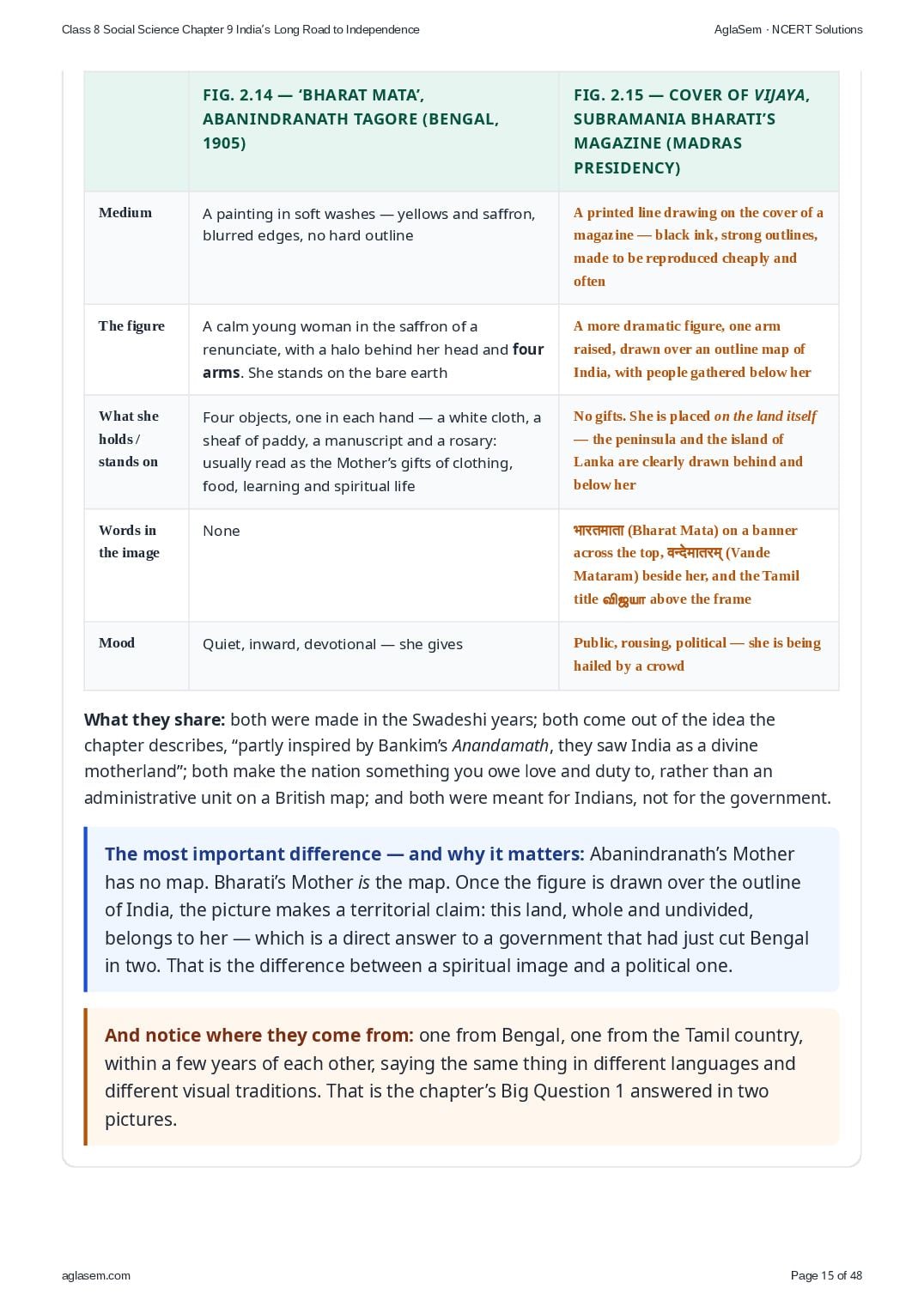
- In what ways are these two representations of Mother India similar or different?
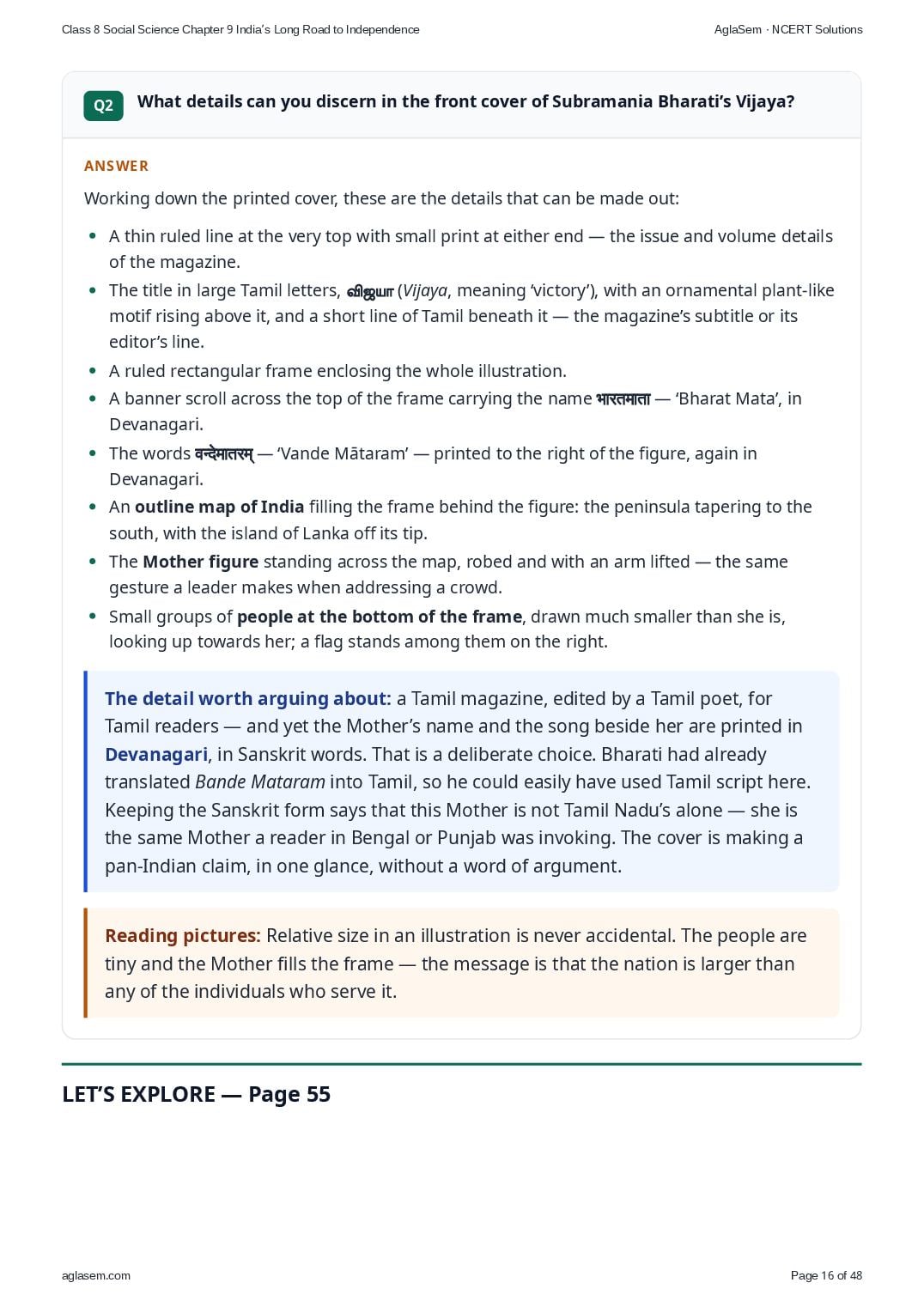
- What details can you discern in the front cover of Subramania Bharati’s Vijaya?
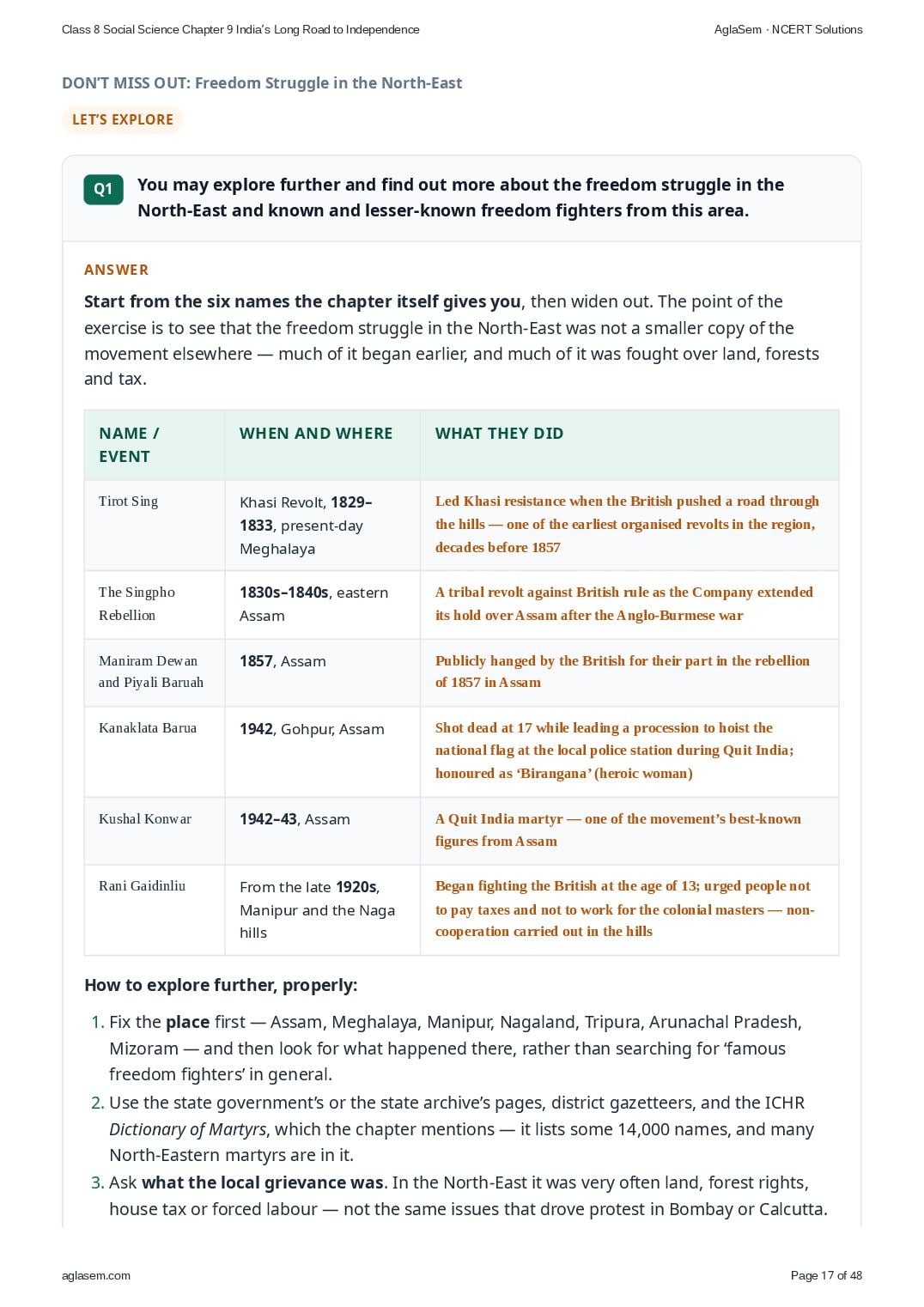
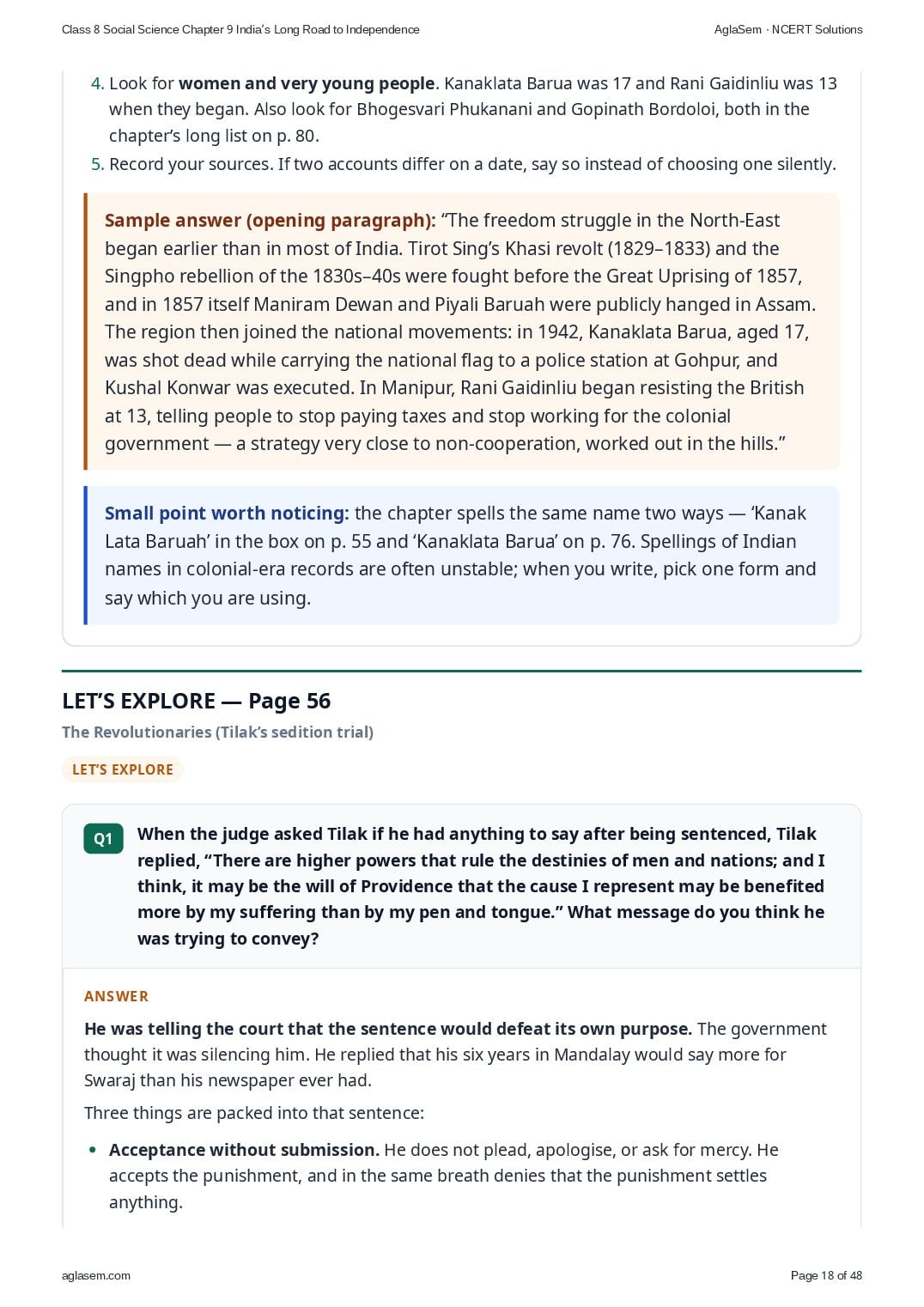
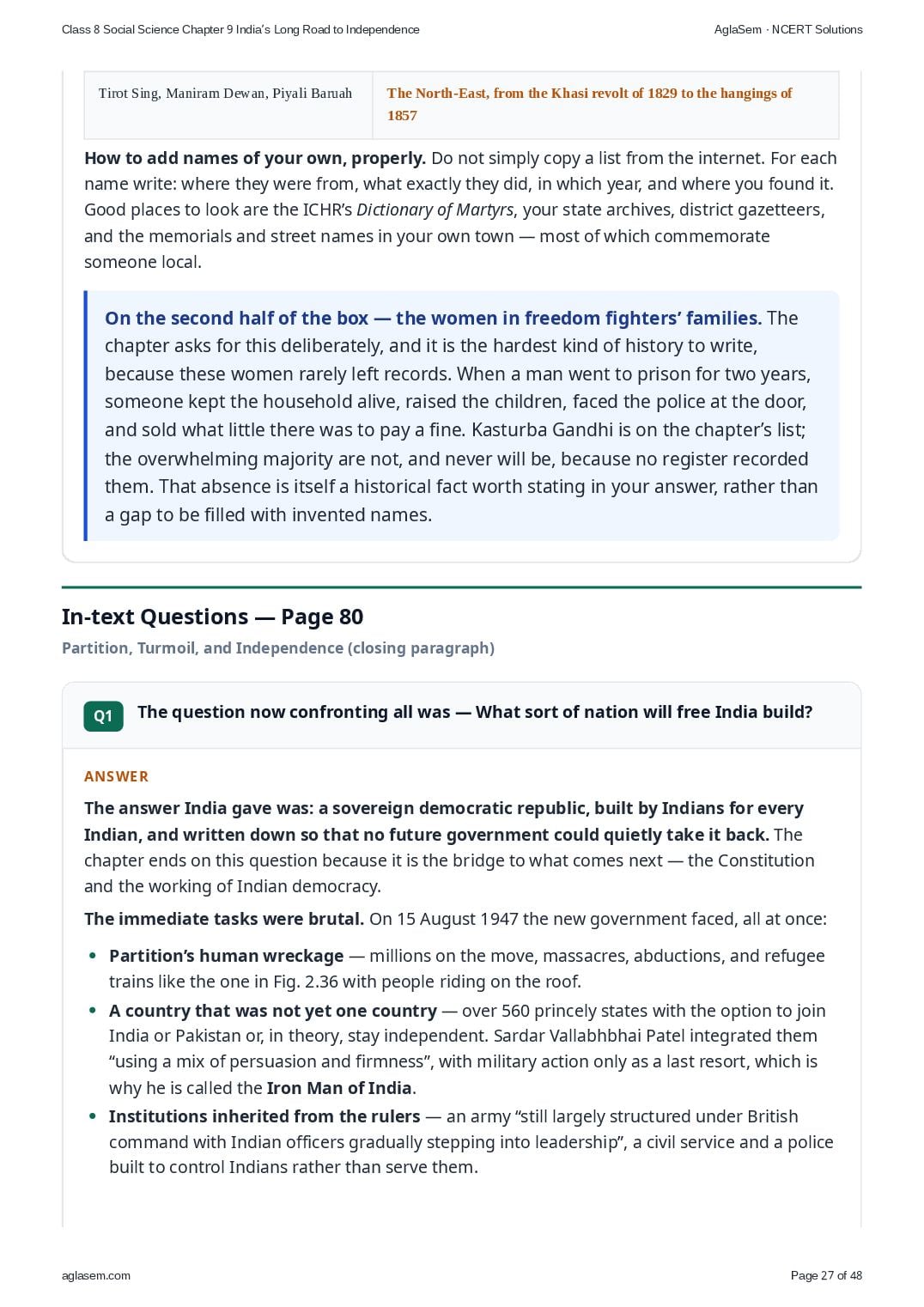
- You may explore further and find out more about the freedom struggle in the North-East and known and lesser-known freedom fighters from this area.
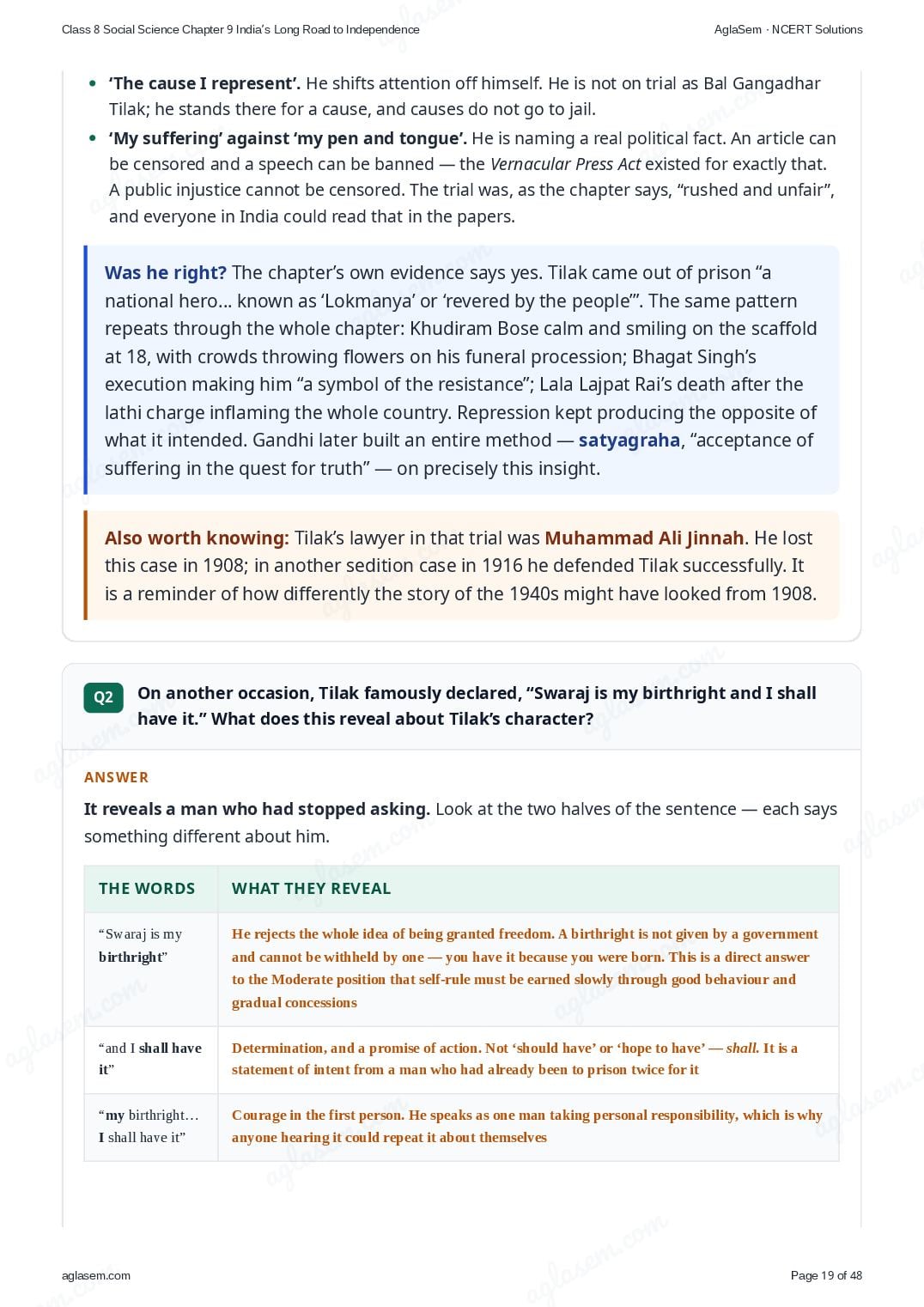
- When the judge asked Tilak if he had anything to say after being sentenced, Tilak replied, “There are higher powers that rule the destinies of men and nations; and I think, it may be the will of Providence that the cause I represent may be benefited more by my suffering than by my pen and tongue.” What message do you think he was trying to convey?
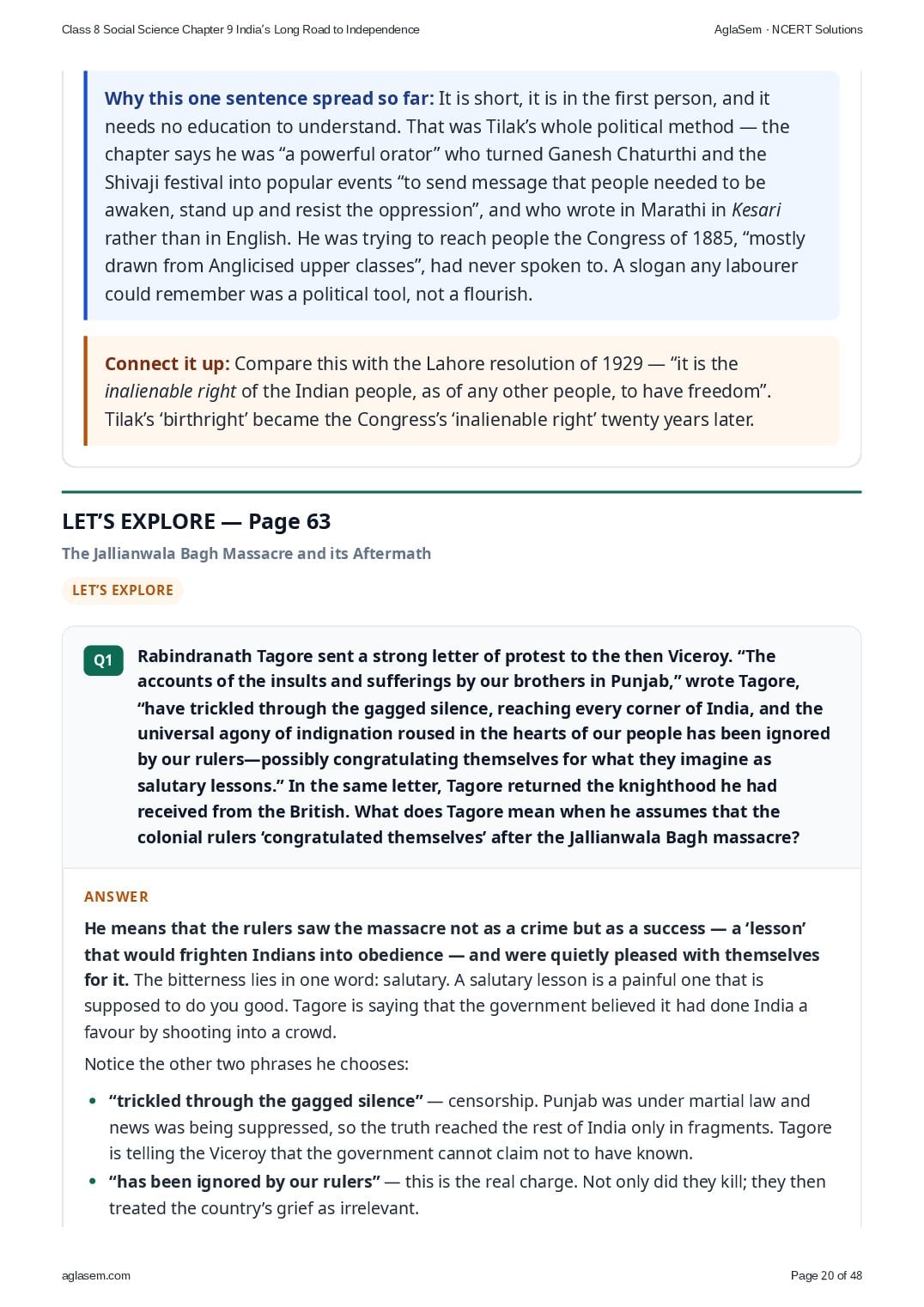
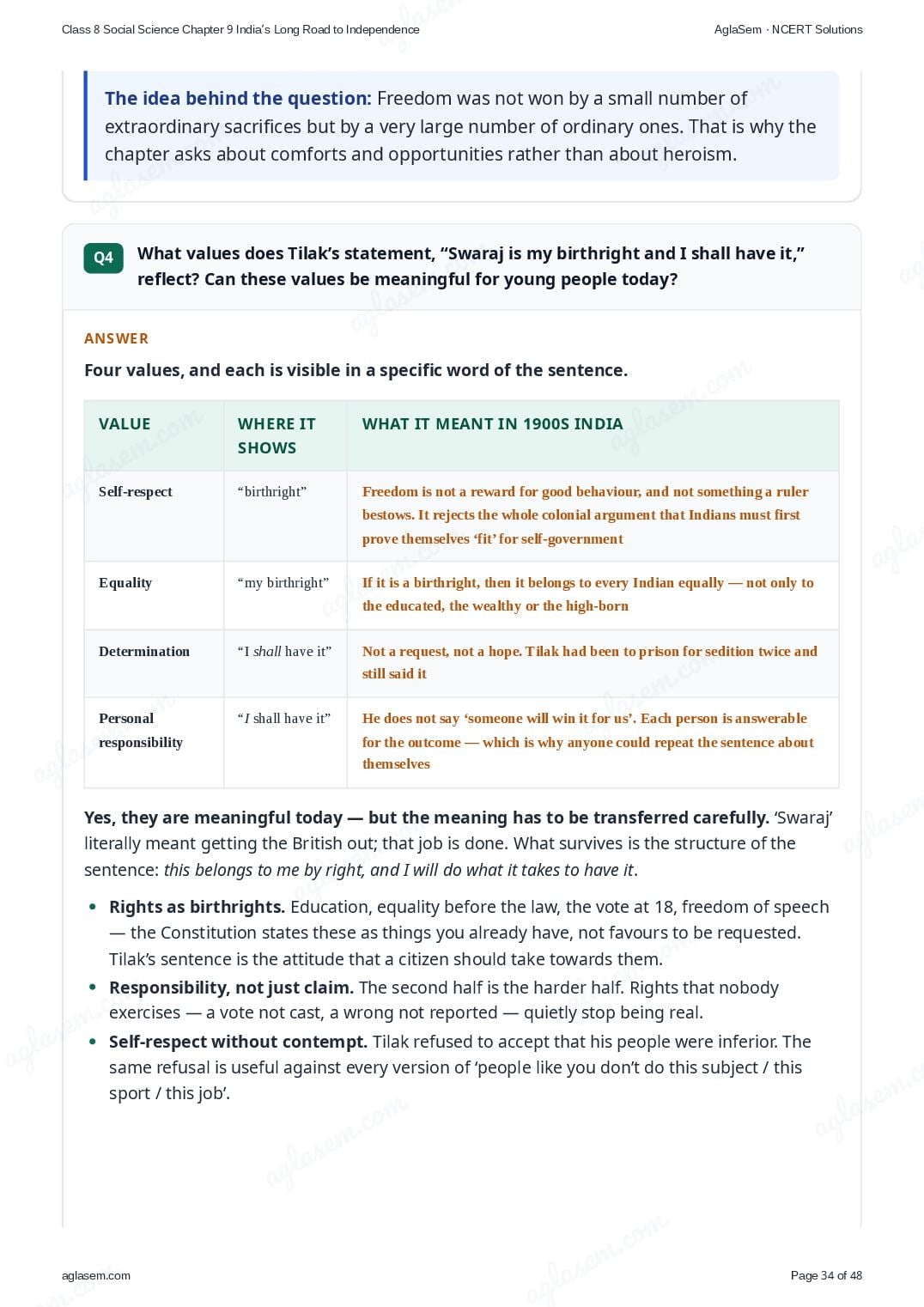
- On another occasion, Tilak famously declared, “Swaraj is my birthright and I shall have it.” What does this reveal about Tilak’s character?
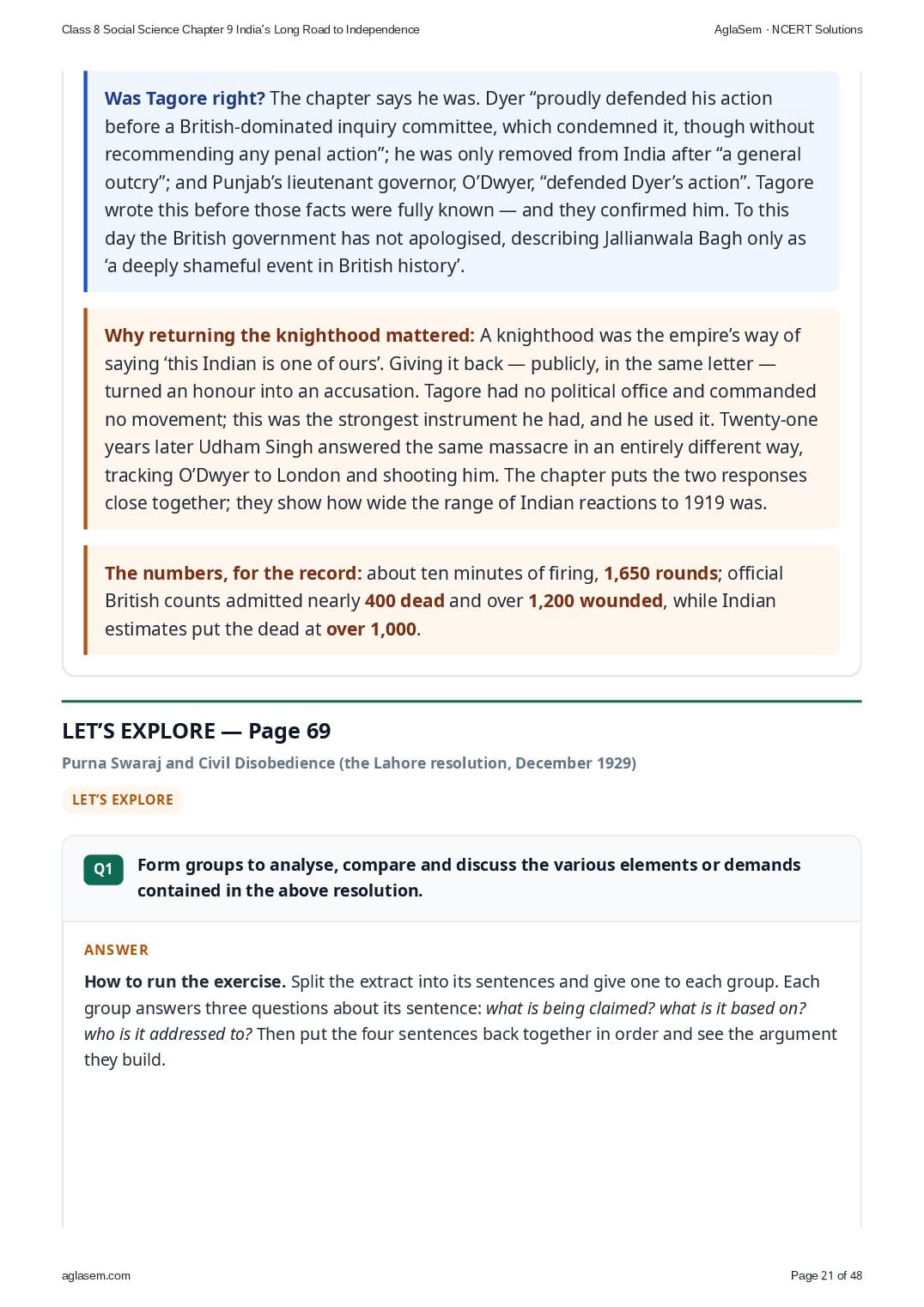
- Rabindranath Tagore sent a strong letter of protest to the then Viceroy. “The accounts of the insults and sufferings by our brothers in Punjab,” wrote Tagore, “have trickled through the gagged silence, reaching every corner of India, and the universal agony of indignation roused in the hearts of our people has been ignored by our rulers—possibly congratulating themselves for what they imagine as salutary lessons.” In the same letter, Tagore returned the knighthood he had received from the British. What does Tagore mean when he assumes that the colonial rulers ‘congratulated themselves’ after the Jallianwala Bagh massacre?
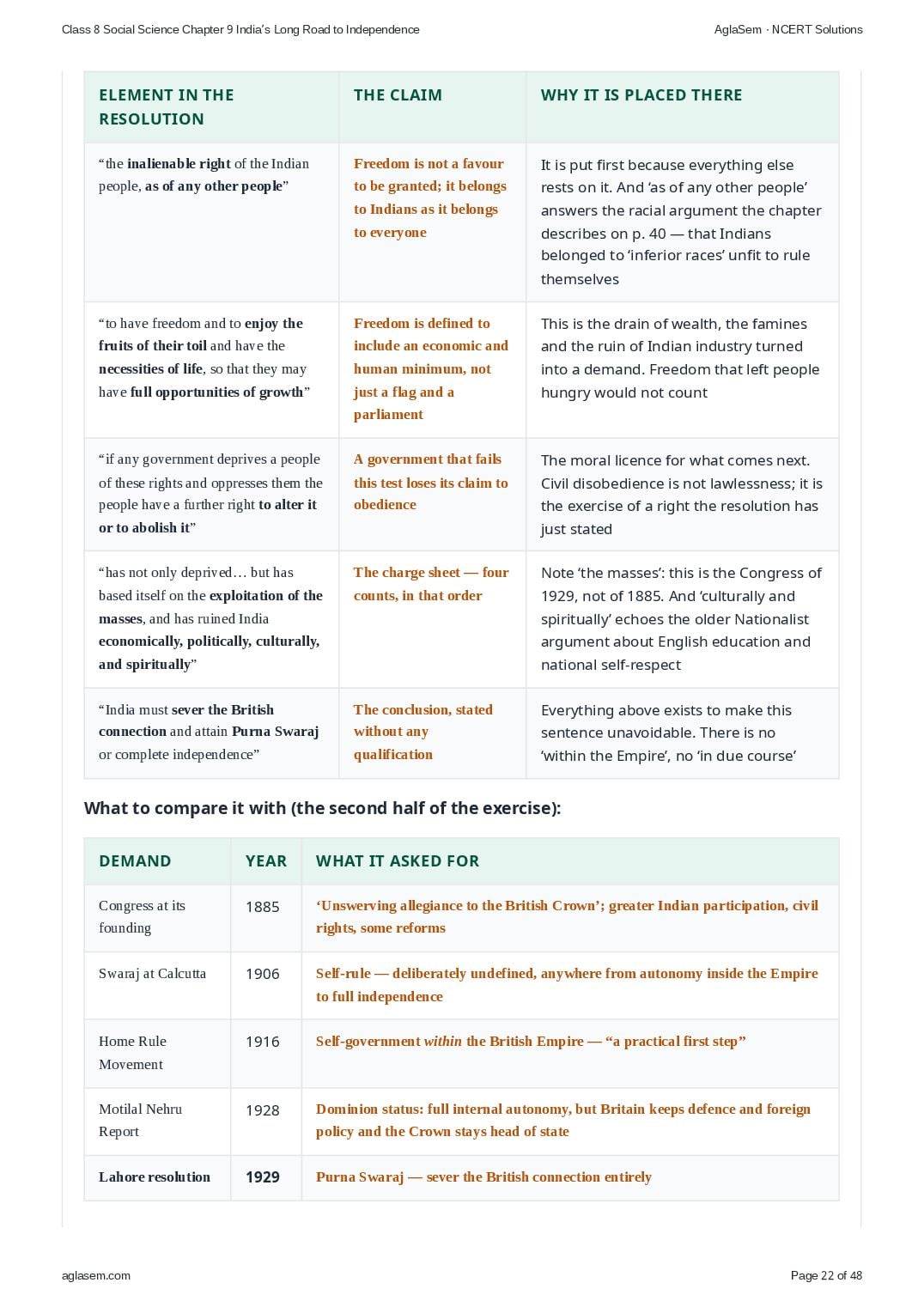
- Form groups to analyse, compare and discuss the various elements or demands contained in the above resolution.
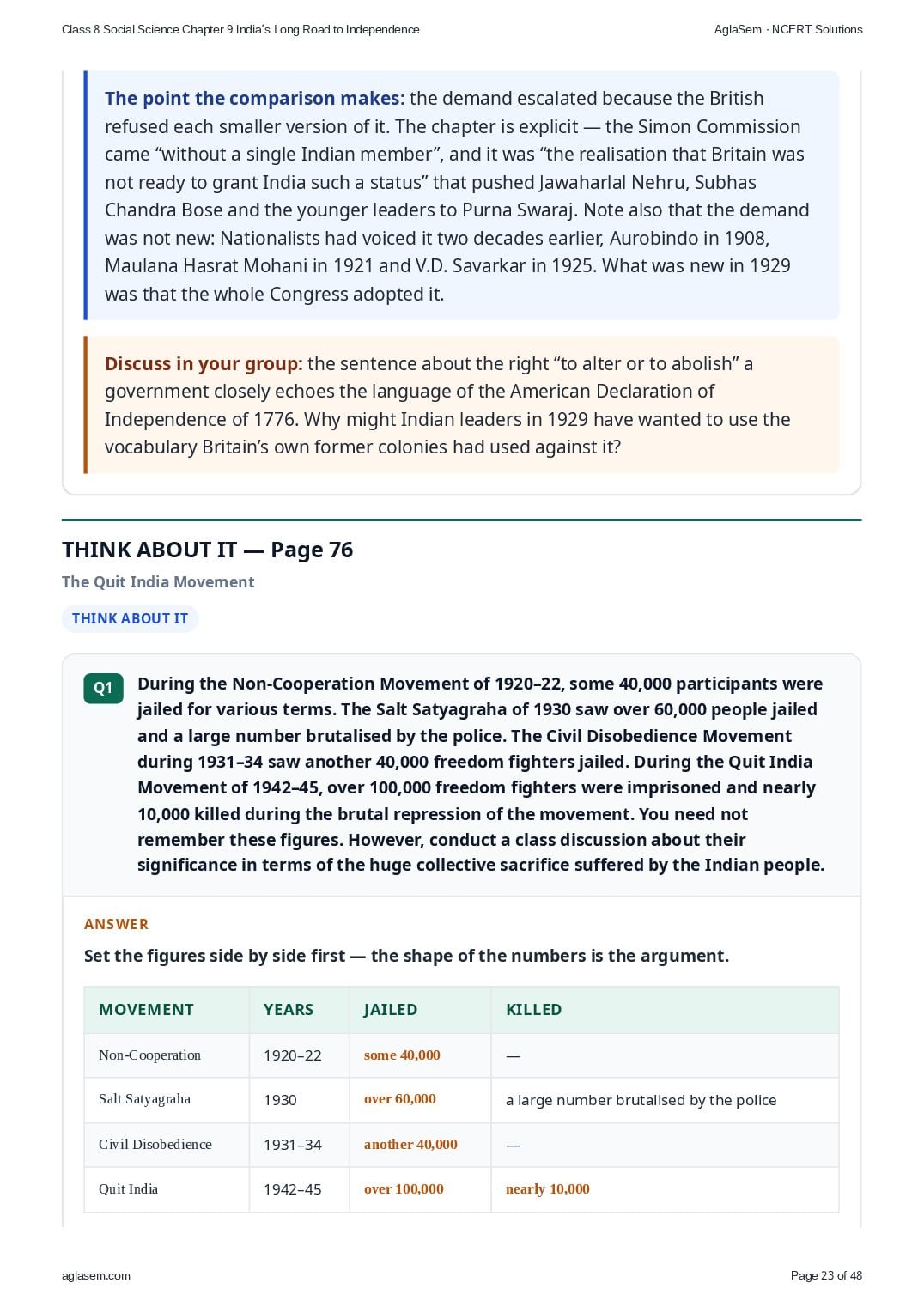
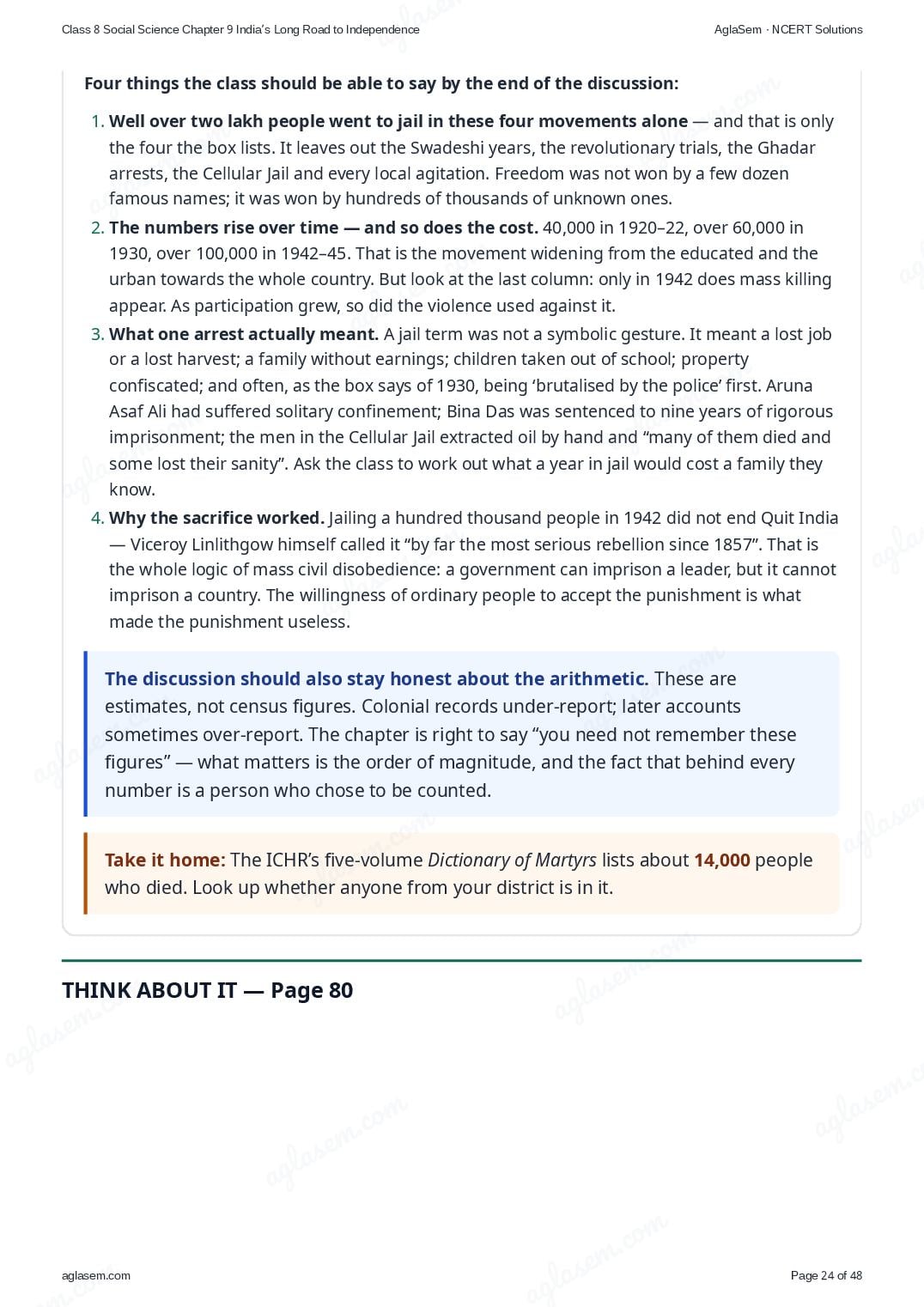
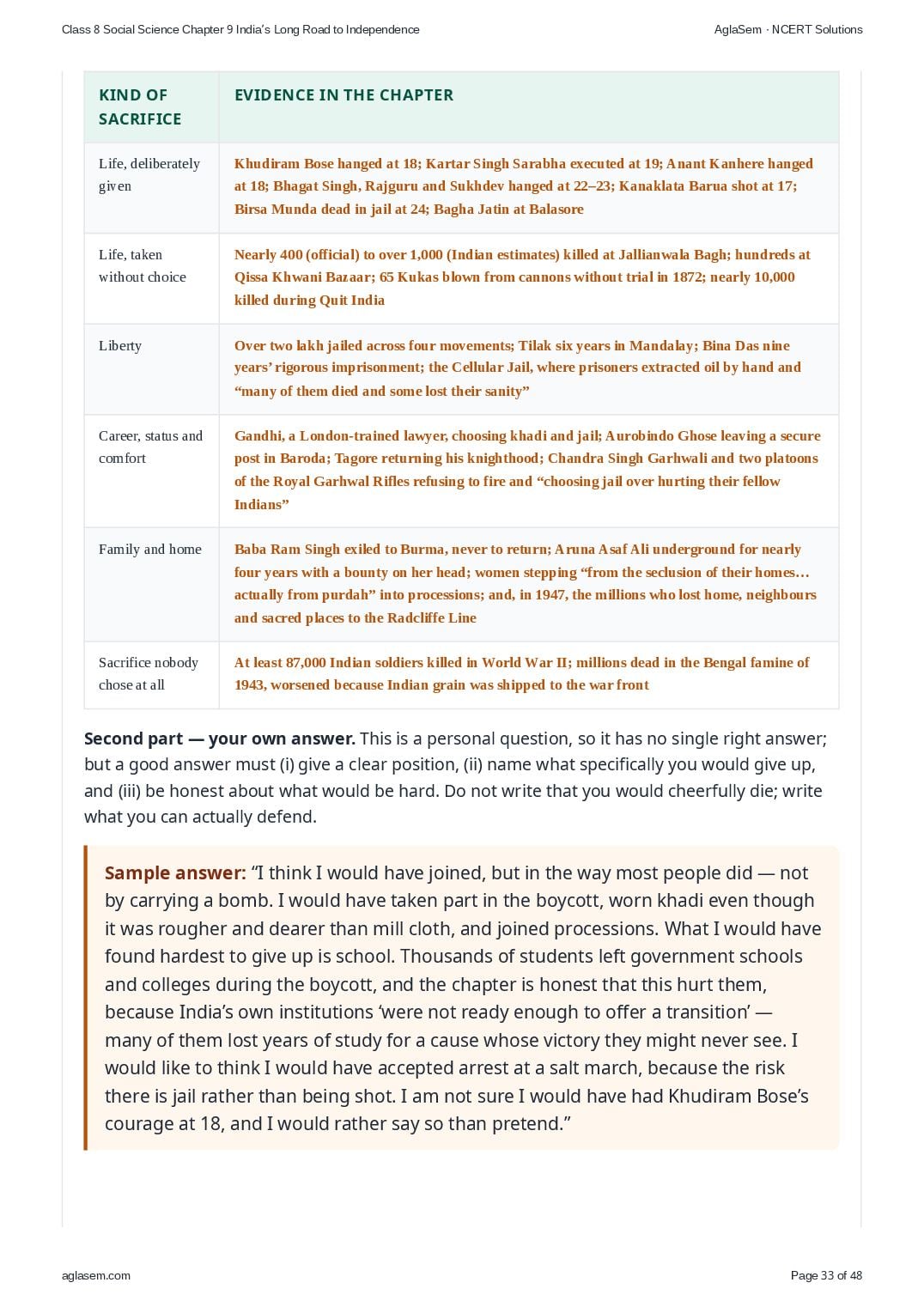
- During the Non-Cooperation Movement of 1920–22, some 40,000 participants were jailed for various terms. The Salt Satyagraha of 1930 saw over 60,000 people jailed and a large number brutalised by the police. The Civil Disobedience Movement during 1931–34 saw another 40,000 freedom fighters jailed. During the Quit India Movement of 1942–45, over 100,000 freedom fighters were imprisoned and nearly 10,000 killed during the brutal repression of the movement. You need not remember these figures. However, conduct a class discussion about their significance in terms of the huge collective sacrifice suffered by the Indian people.
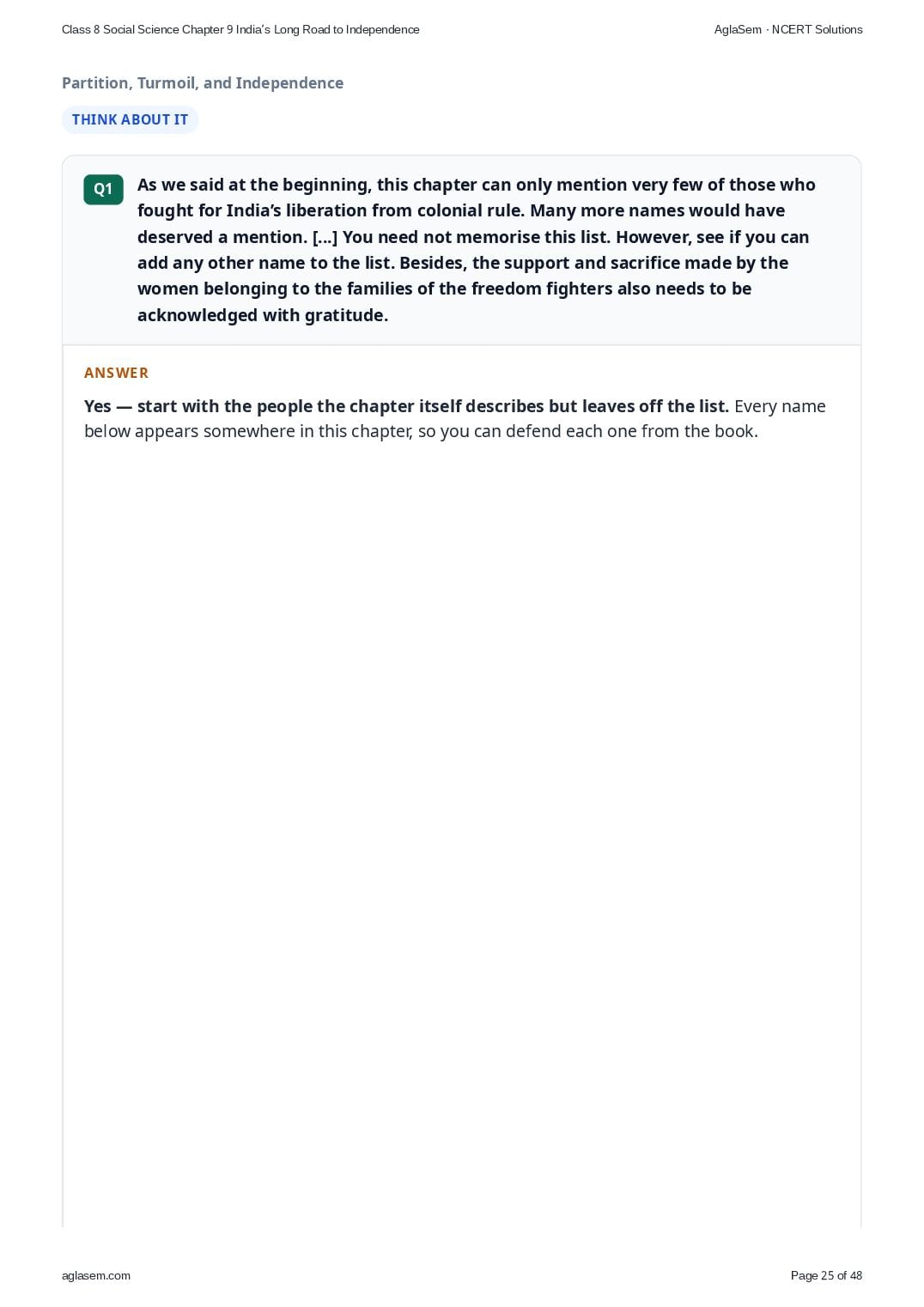
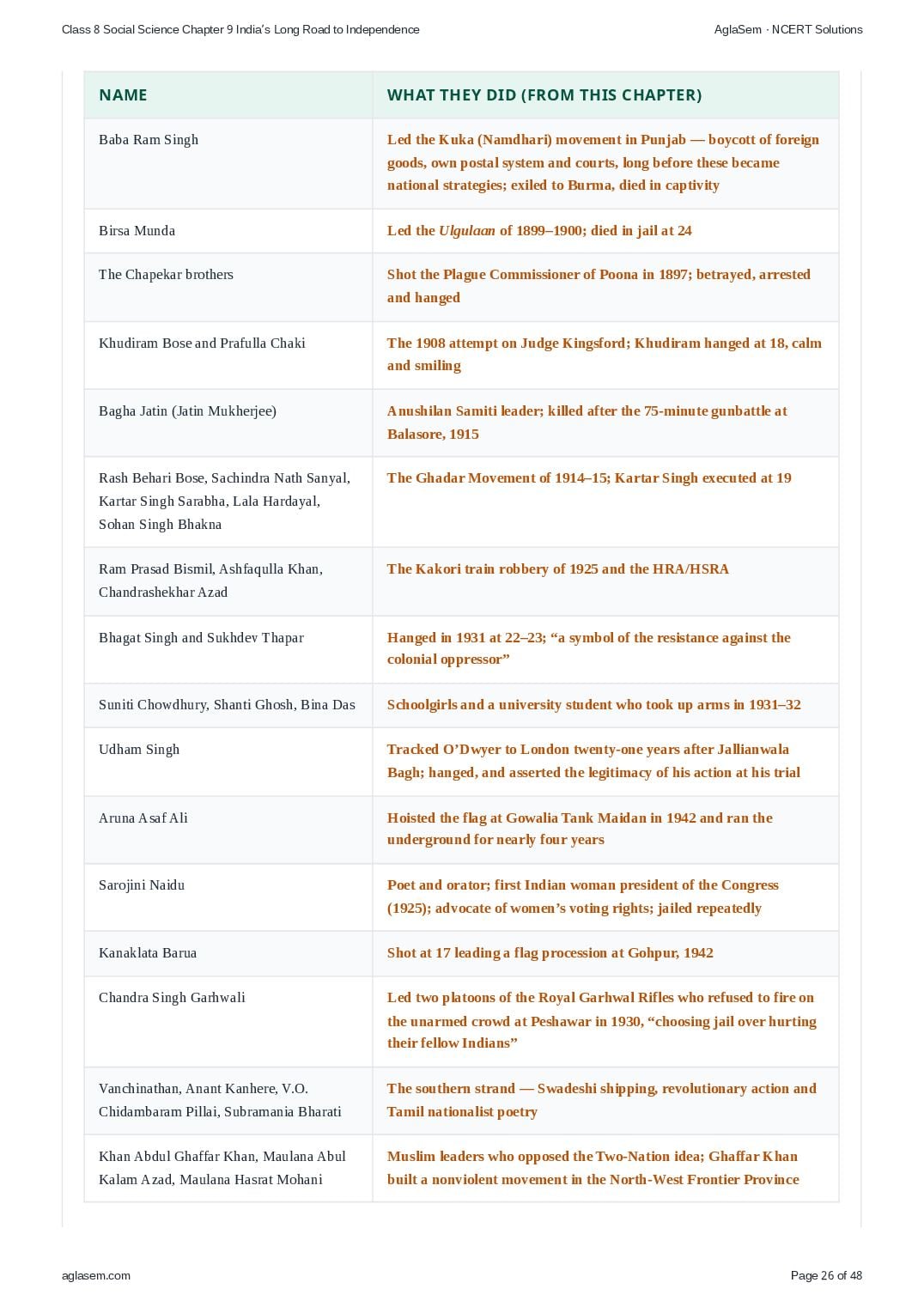
- As we said at the beginning, this chapter can only mention very few of those who fought for India’s liberation from colonial rule. Many more names would have deserved a mention. […] You need not memorise this list. However, see if you can add any other name to the list. Besides, the support and sacrifice made by the women belonging to the families of the freedom fighters also needs to be acknowledged with gratitude.
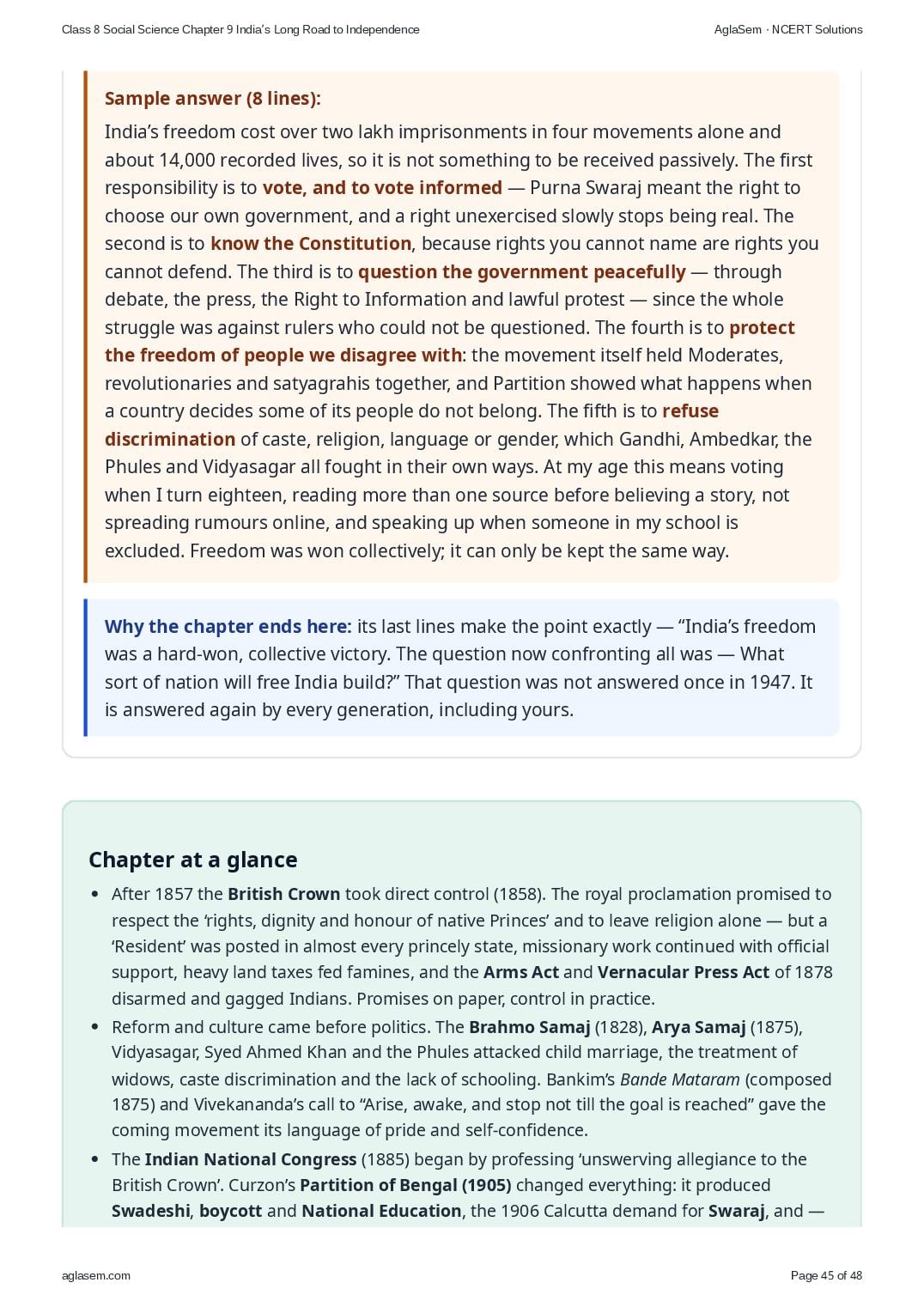
- The question now confronting all was — What sort of nation will free India build?
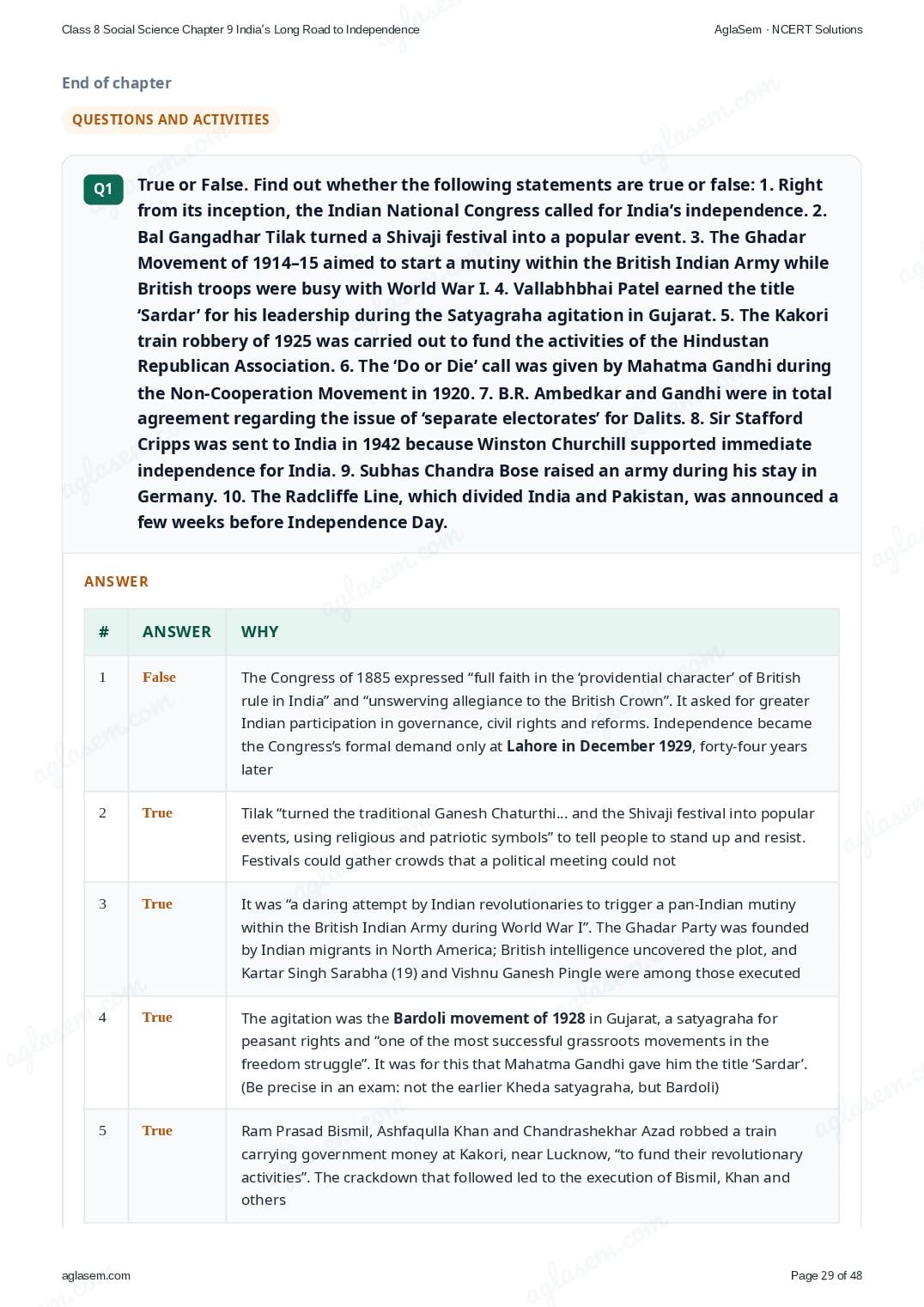
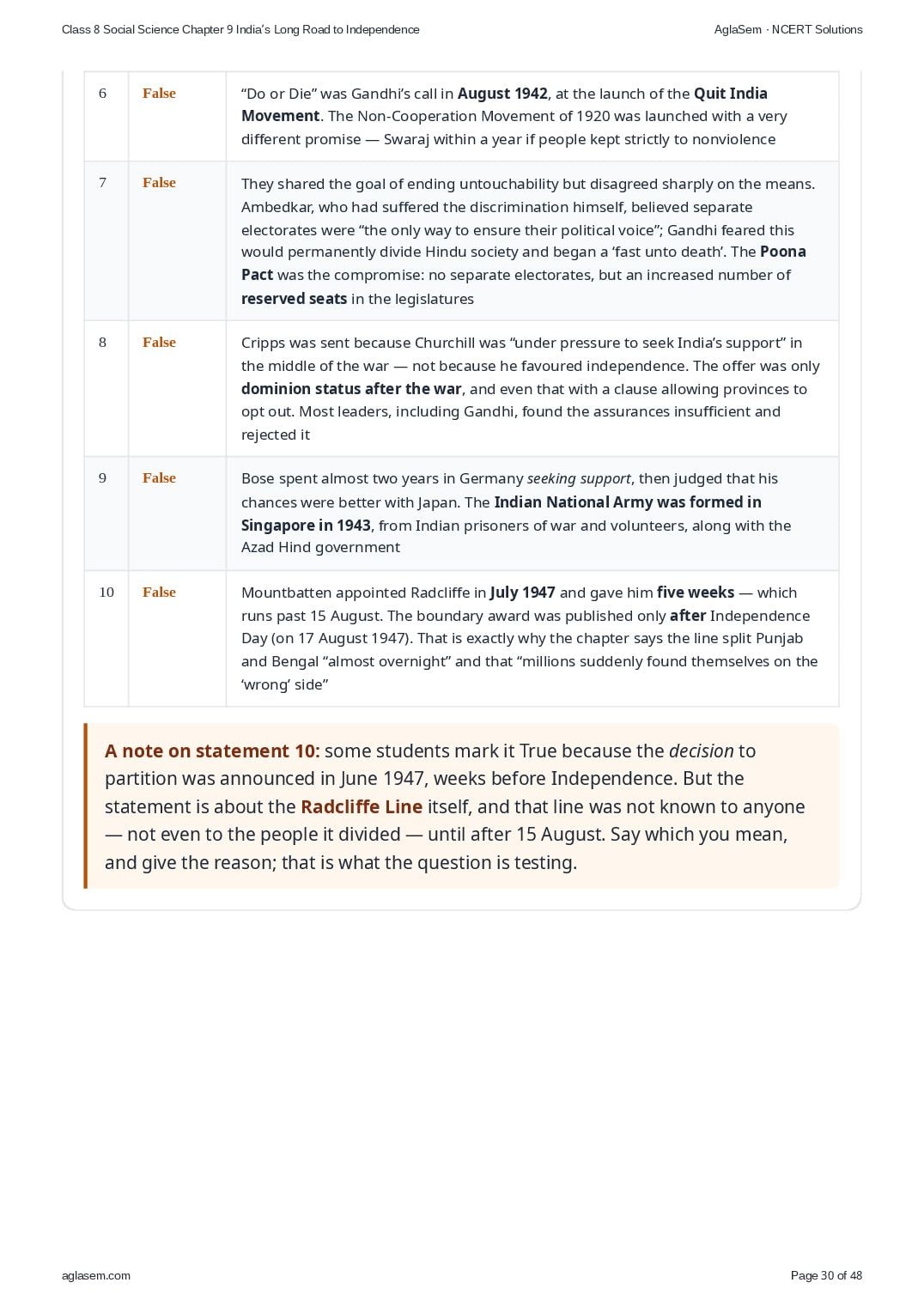
- True or False. Find out whether the following statements are true or false: 1. Right from its inception, the Indian National Congress called for India’s independence. 2. Bal Gangadhar Tilak turned a Shivaji festival into a popular event. 3. The Ghadar Movement of 1914–15 aimed to start a mutiny within the British Indian Army while British troops were busy with World War I. 4. Vallabhbhai Patel earned the title ‘Sardar’ for his leadership during the Satyagraha agitation in Gujarat. 5. The Kakori train robbery of 1925 was carried out to fund the activities of the Hindustan Republican Association. 6. The ‘Do or Die’ call was given by Mahatma Gandhi during the Non-Cooperation Movement in 1920. 7. B.R. Ambedkar and Gandhi were in total agreement regarding the issue of ‘separate electorates’ for Dalits. 8. Sir Stafford Cripps was sent to India in 1942 because Winston Churchill supported immediate independence for India. 9. Subhas Chandra Bose raised an army during his stay in Germany. 10. The Radcliffe Line, which divided India and Pakistan, was announced a few weeks before Independence Day.
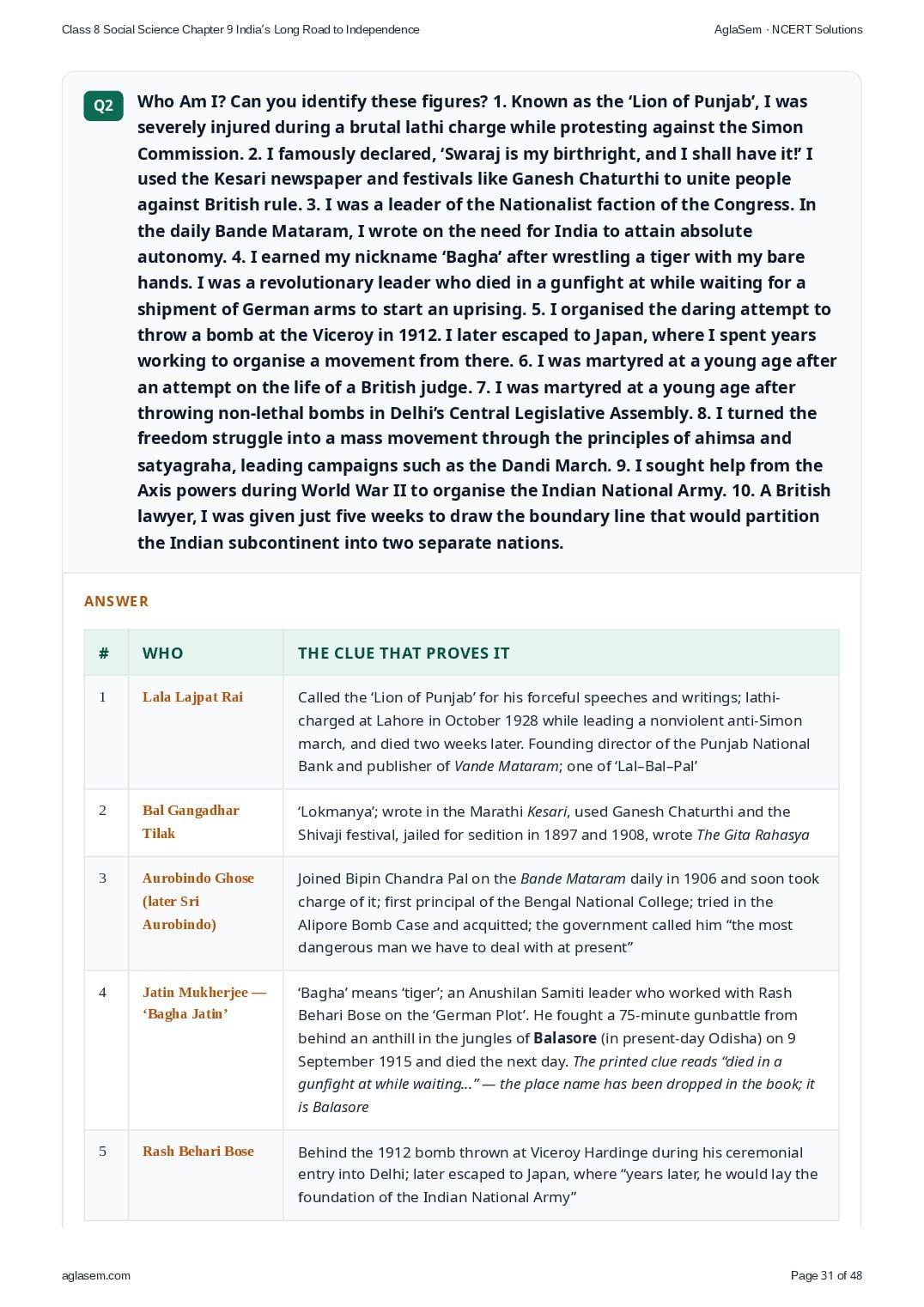
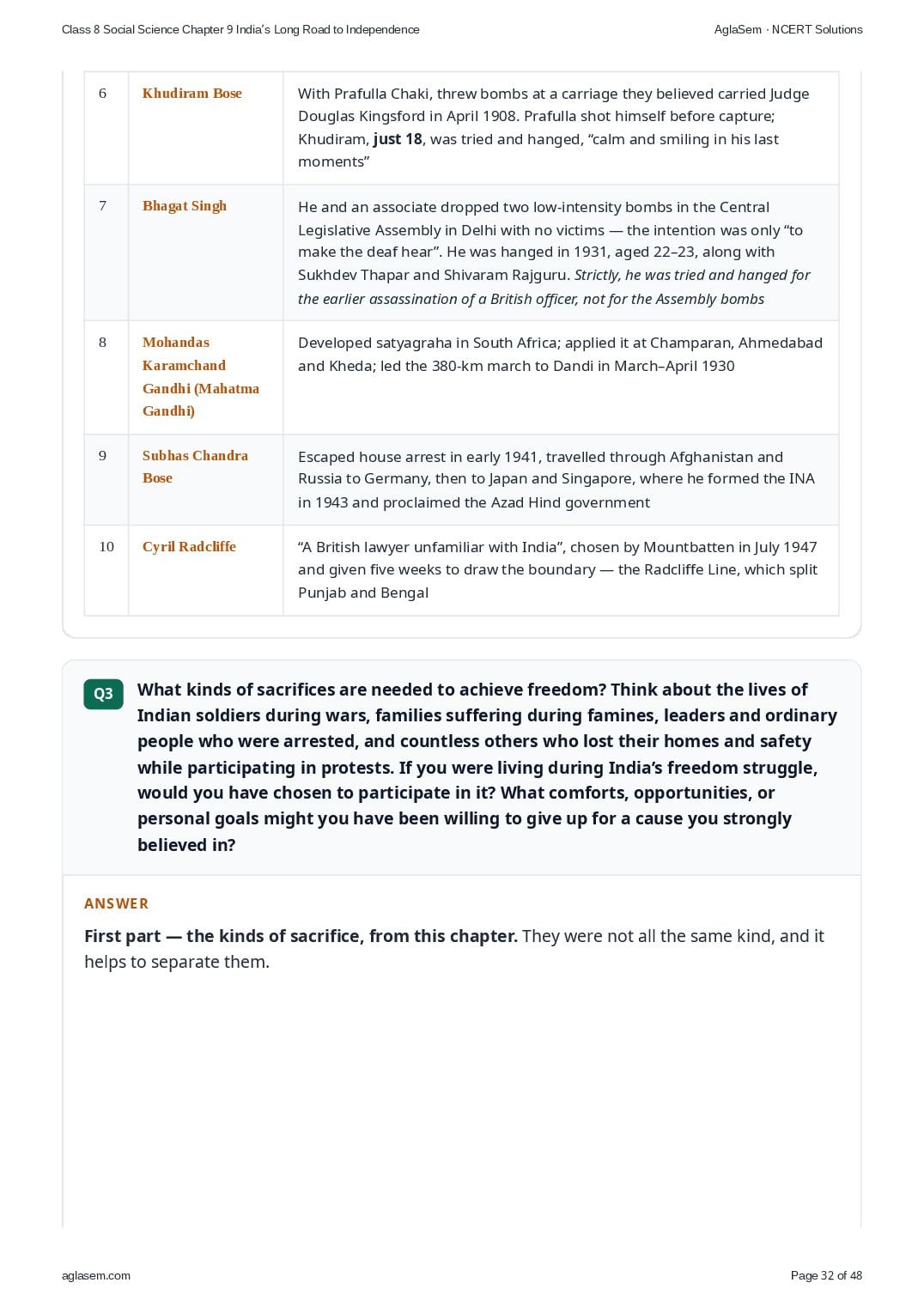
- Who Am I? Can you identify these figures? 1. Known as the ‘Lion of Punjab’, I was severely injured during a brutal lathi charge while protesting against the Simon Commission. 2. I famously declared, ‘Swaraj is my birthright, and I shall have it!’ I used the Kesari newspaper and festivals like Ganesh Chaturthi to unite people against British rule. 3. I was a leader of the Nationalist faction of the Congress. In the daily Bande Mataram, I wrote on the need for India to attain absolute autonomy. 4. I earned my nickname ‘Bagha’ after wrestling a tiger with my bare hands. I was a revolutionary leader who died in a gunfight at while waiting for a shipment of German arms to start an uprising. 5. I organised the daring attempt to throw a bomb at the Viceroy in 1912. I later escaped to Japan, where I spent years working to organise a movement from there. 6. I was martyred at a young age after an attempt on the life of a British judge. 7. I was martyred at a young age after throwing non-lethal bombs in Delhi’s Central Legislative Assembly. 8. I turned the freedom struggle into a mass movement through the principles of ahimsa and satyagraha, leading campaigns such as the Dandi March. 9. I sought help from the Axis powers during World War II to organise the Indian National Army. 10. A British lawyer, I was given just five weeks to draw the boundary line that would partition the Indian subcontinent into two separate nations.
- What kinds of sacrifices are needed to achieve freedom? Think about the lives of Indian soldiers during wars, families suffering during famines, leaders and ordinary people who were arrested, and countless others who lost their homes and safety while participating in protests. If you were living during India’s freedom struggle, would you have chosen to participate in it? What comforts, opportunities, or personal goals might you have been willing to give up for a cause you strongly believed in?
- What values does Tilak’s statement, “Swaraj is my birthright and I shall have it,” reflect? Can these values be meaningful for young people today?
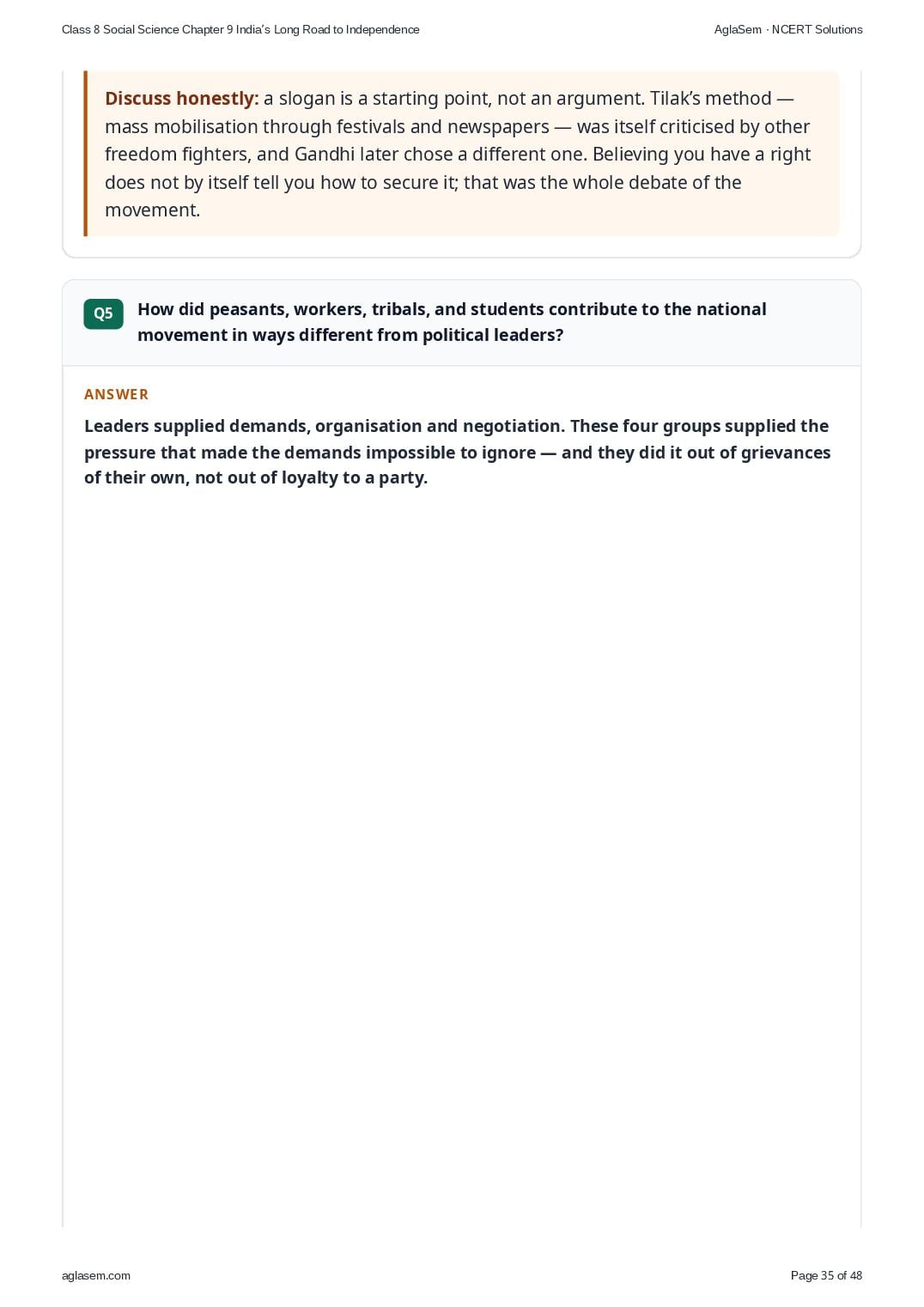
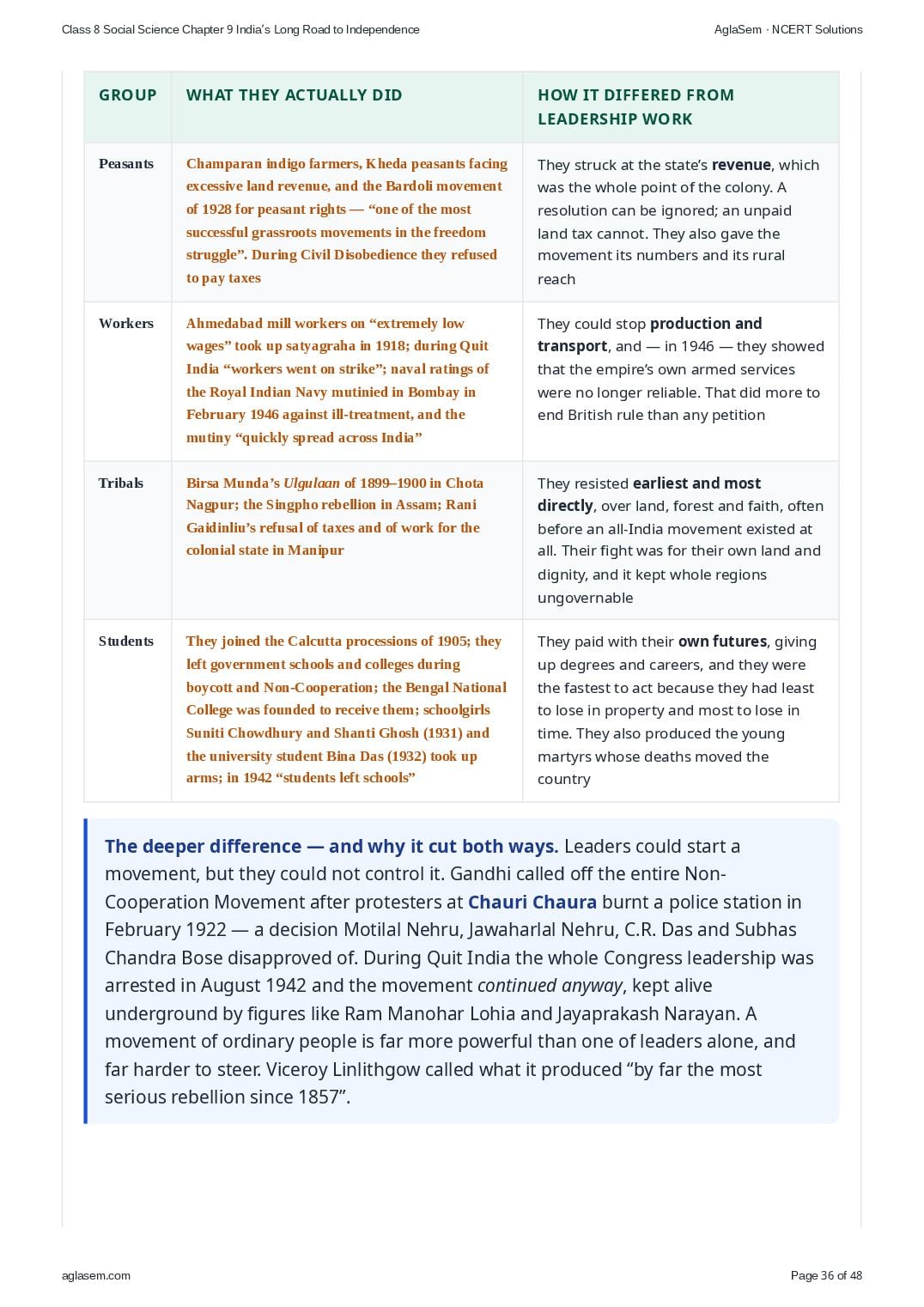
- How did peasants, workers, tribals, and students contribute to the national movement in ways different from political leaders?
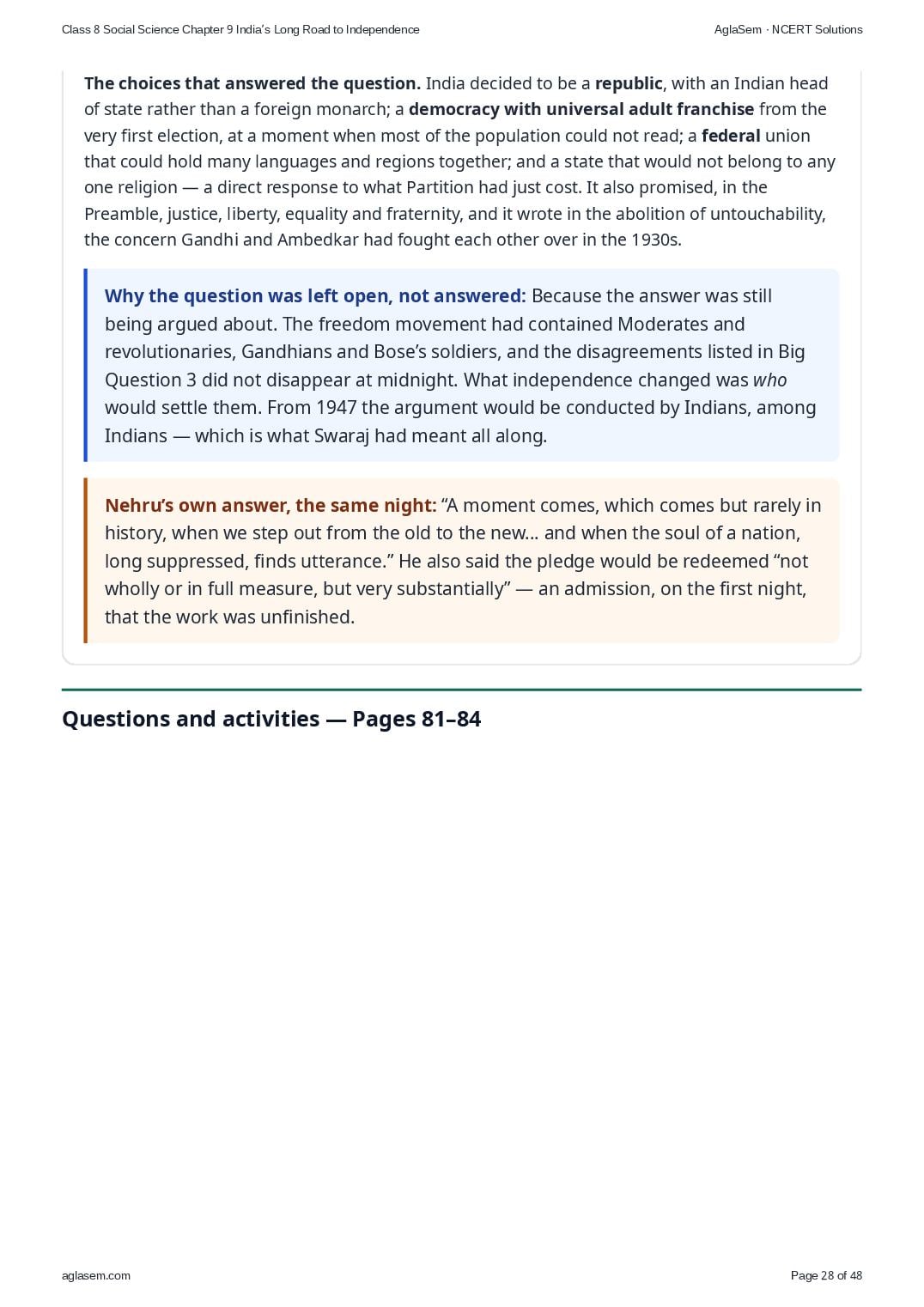
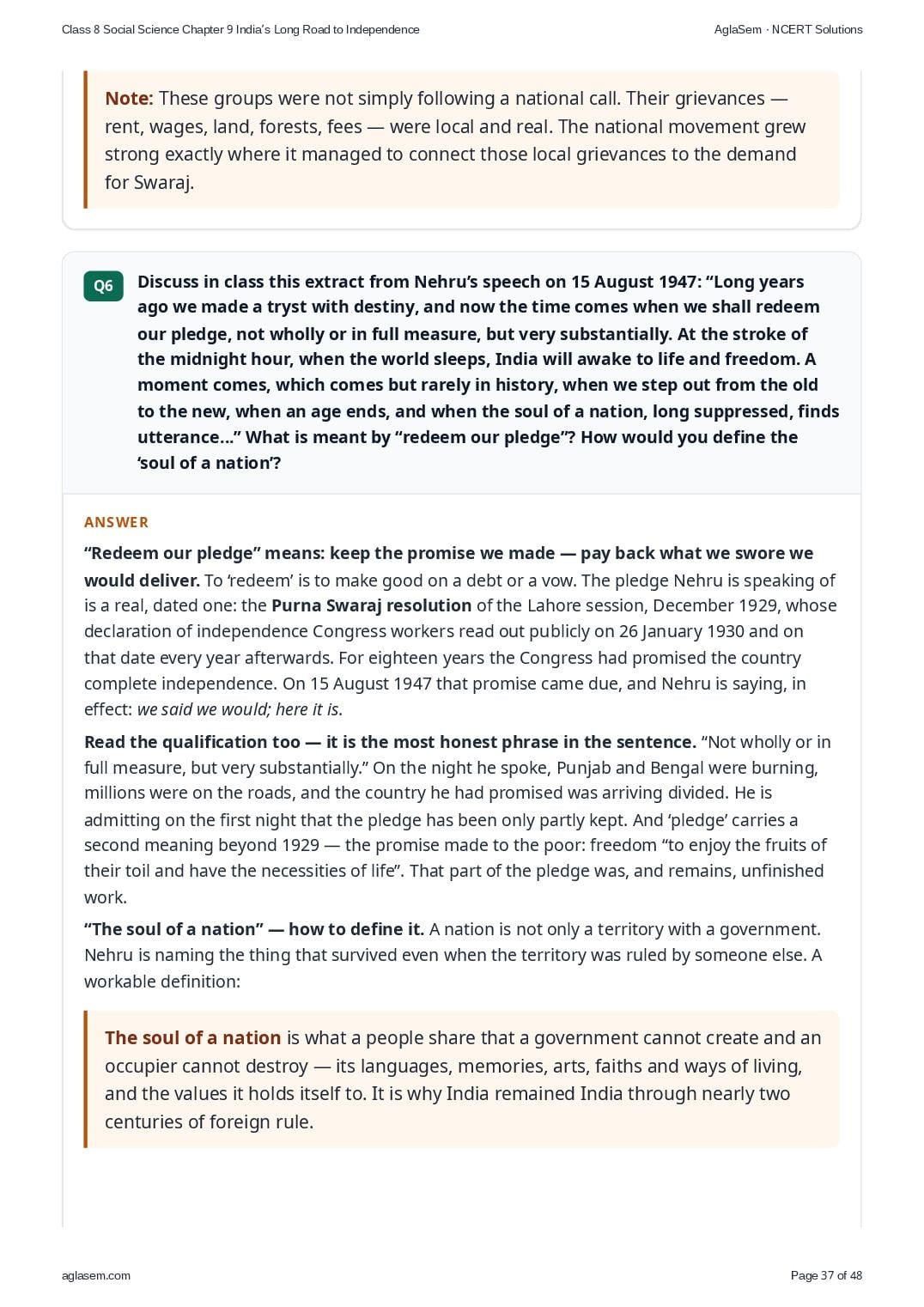
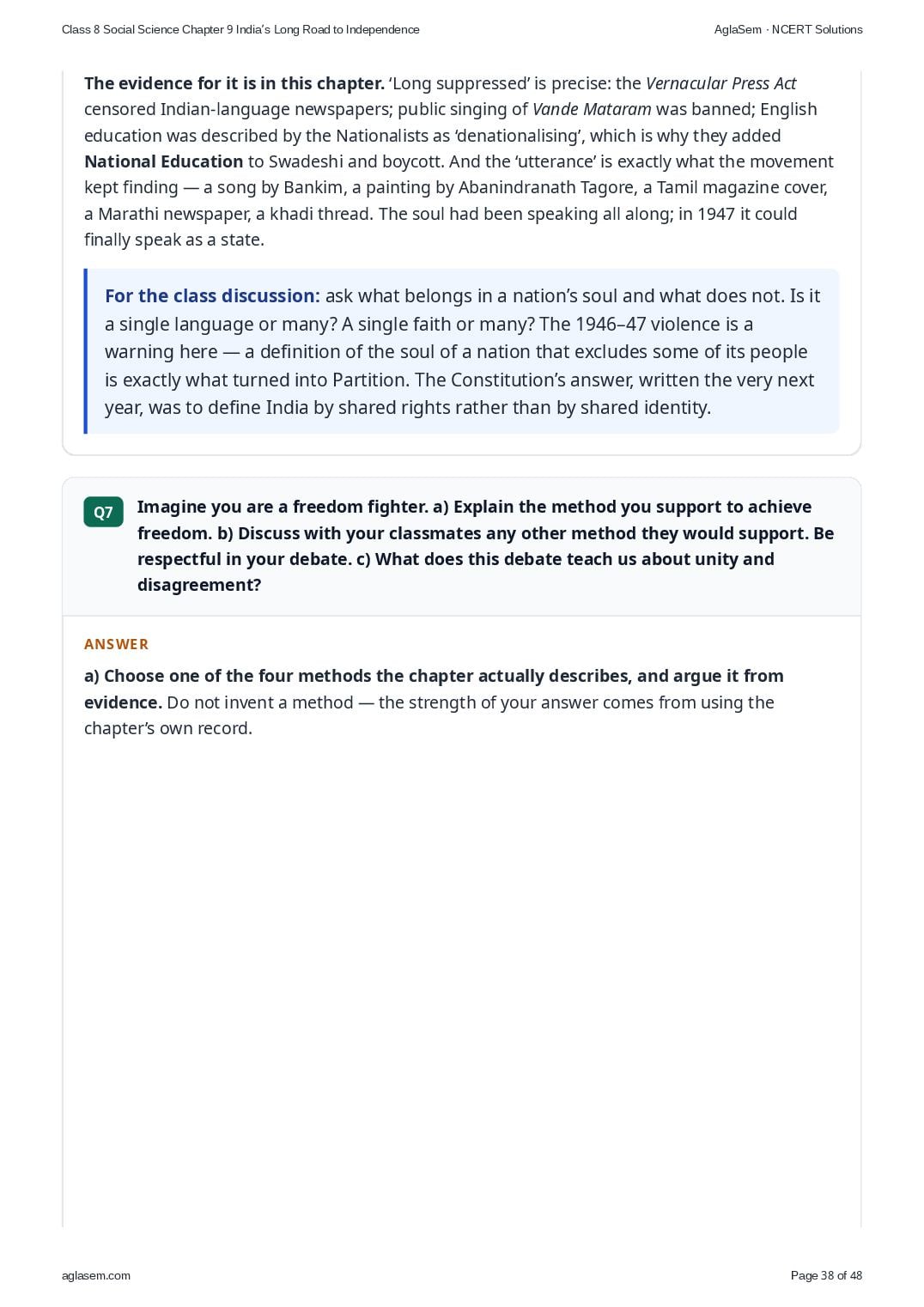
- Discuss in class this extract from Nehru’s speech on 15 August 1947: “Long years ago we made a tryst with destiny, and now the time comes when we shall redeem our pledge, not wholly or in full measure, but very substantially. At the stroke of the midnight hour, when the world sleeps, India will awake to life and freedom. A moment comes, which comes but rarely in history, when we step out from the old to the new, when an age ends, and when the soul of a nation, long suppressed, finds utterance…” What is meant by “redeem our pledge”? How would you define the ‘soul of a nation’?
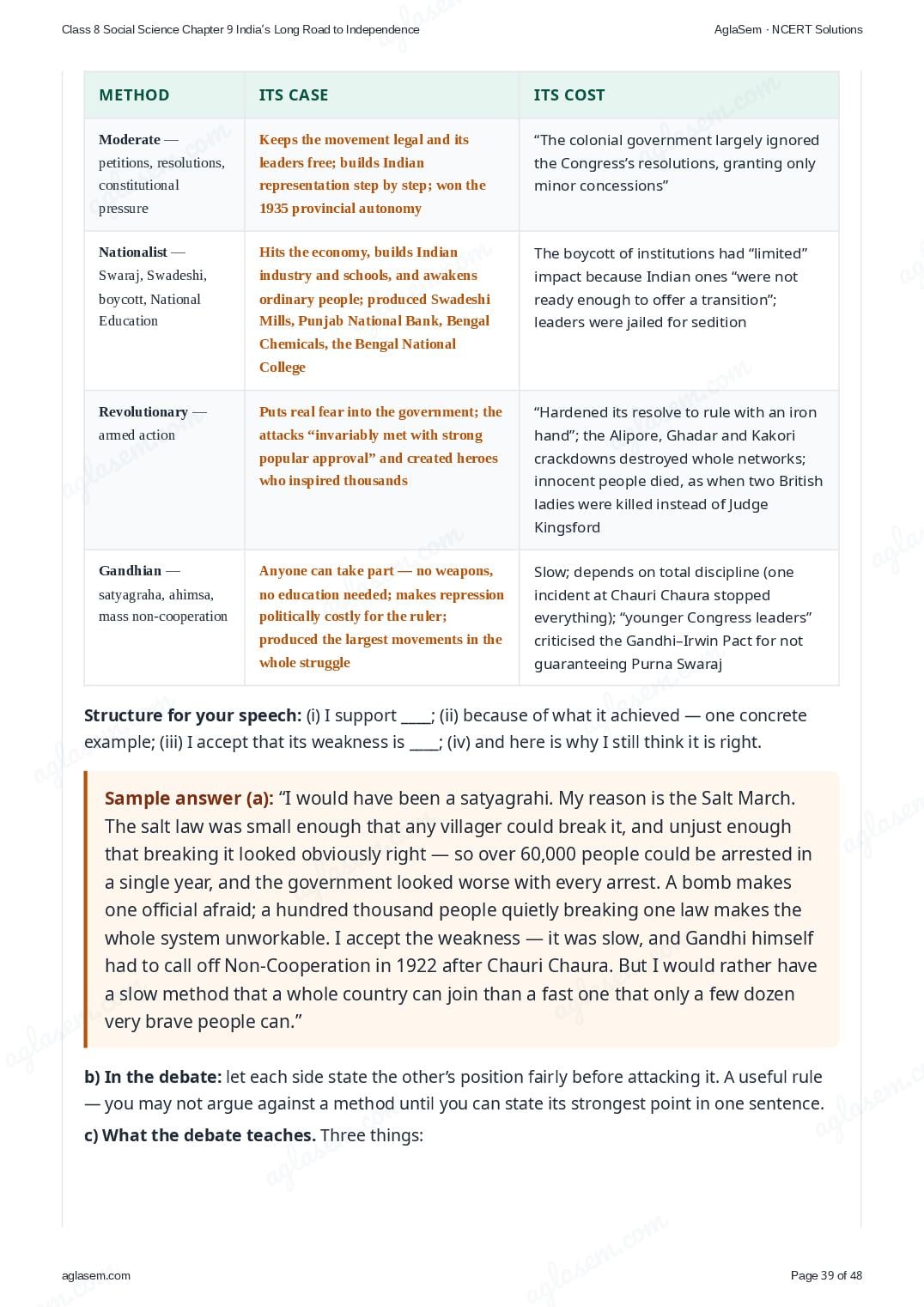
- Imagine you are a freedom fighter. a) Explain the method you support to achieve freedom. b) Discuss with your classmates any other method they would support. Be respectful in your debate. c) What does this debate teach us about unity and disagreement?
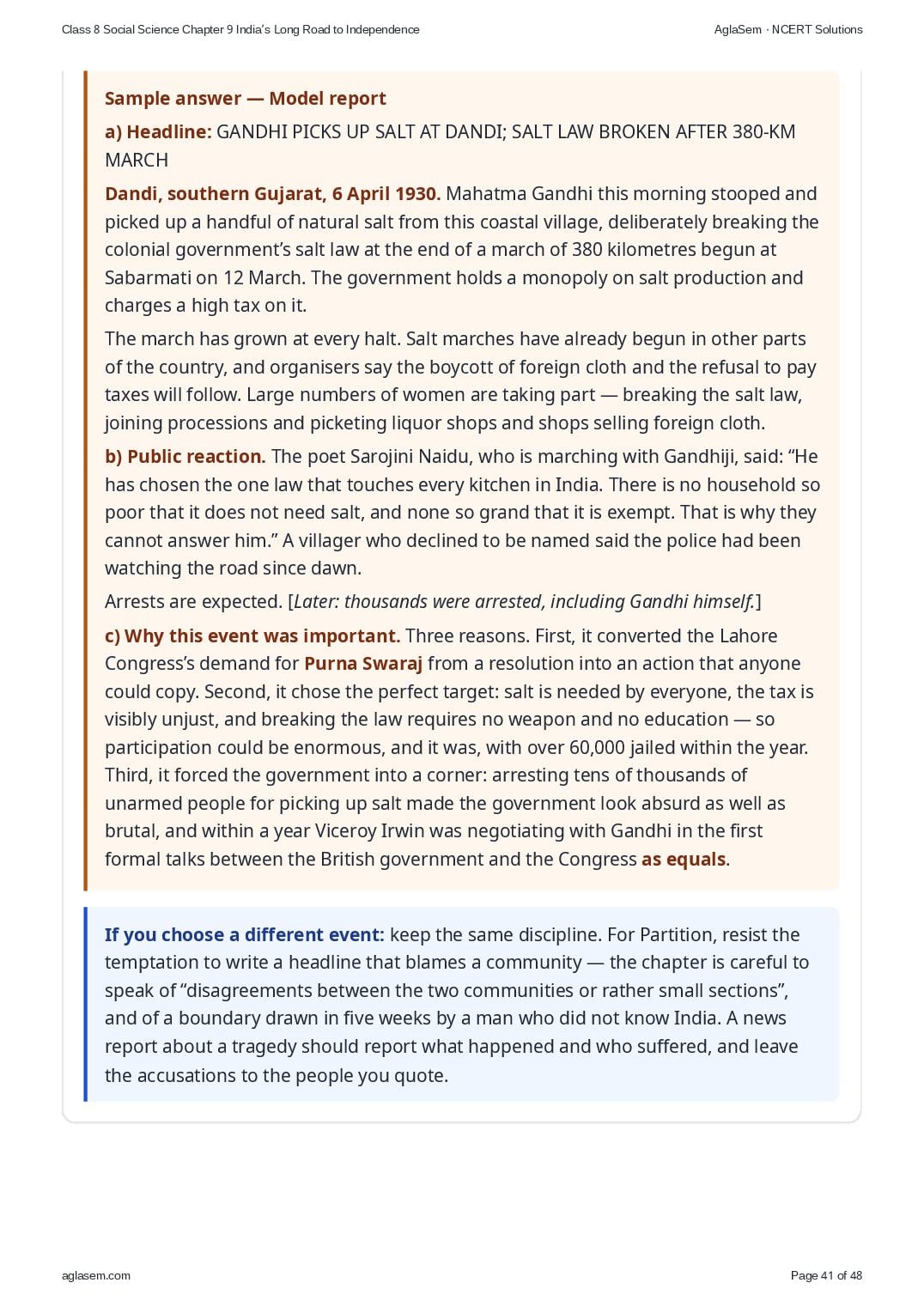
- Write a news report based on an important event in the Freedom Movement (Swadeshi, boycott, satyagraha, Non-Cooperation, Quit India, or Partition). a) Write a headline. b) Include one interview or public reaction. c) Explain why this event was important.
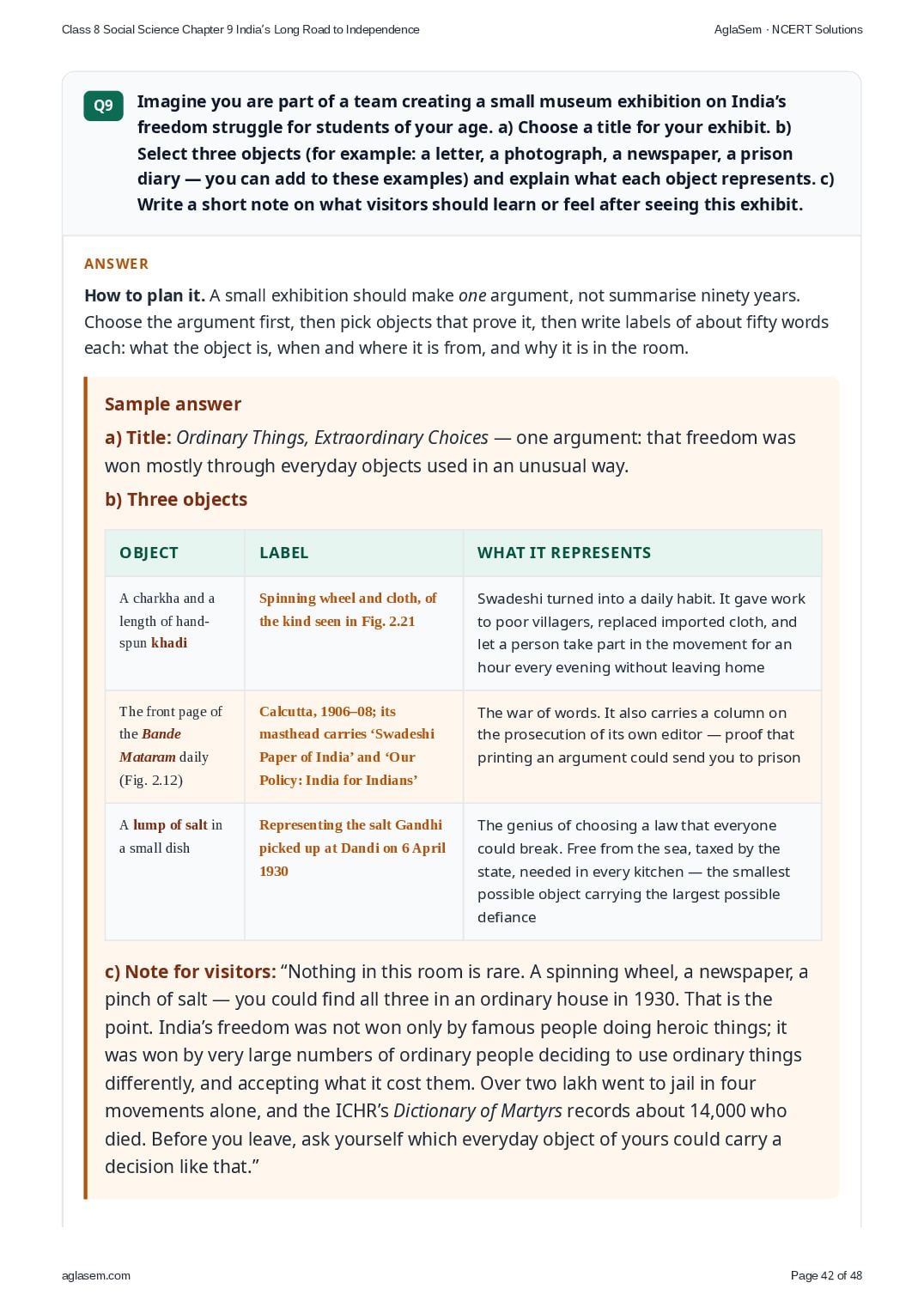
- Imagine you are part of a team creating a small museum exhibition on India’s freedom struggle for students of your age. a) Choose a title for your exhibit. b) Select three objects (for example: a letter, a photograph, a newspaper, a prison diary — you can add to these examples) and explain what each object represents. c) Write a short note on what visitors should learn or feel after seeing this exhibit.
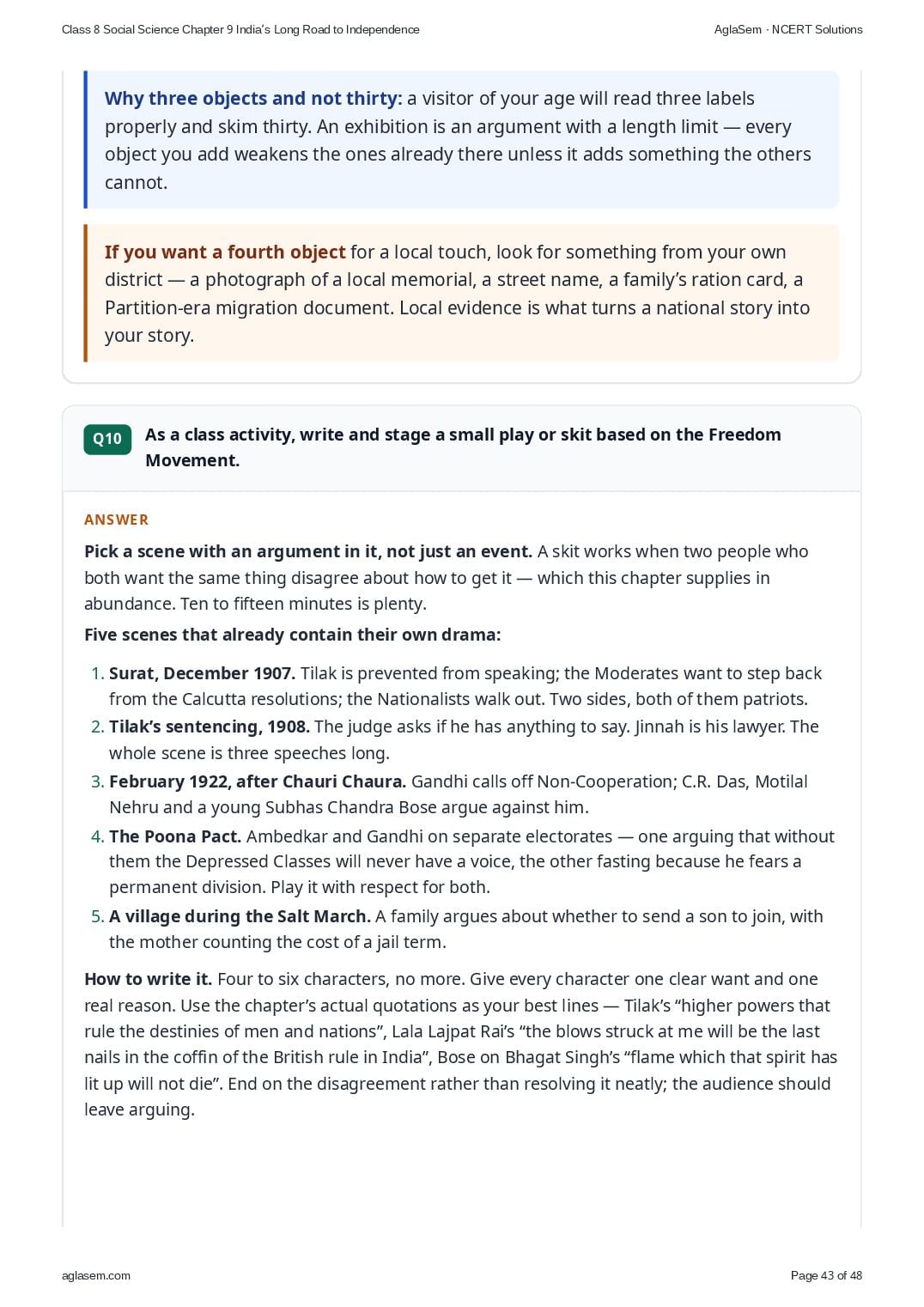
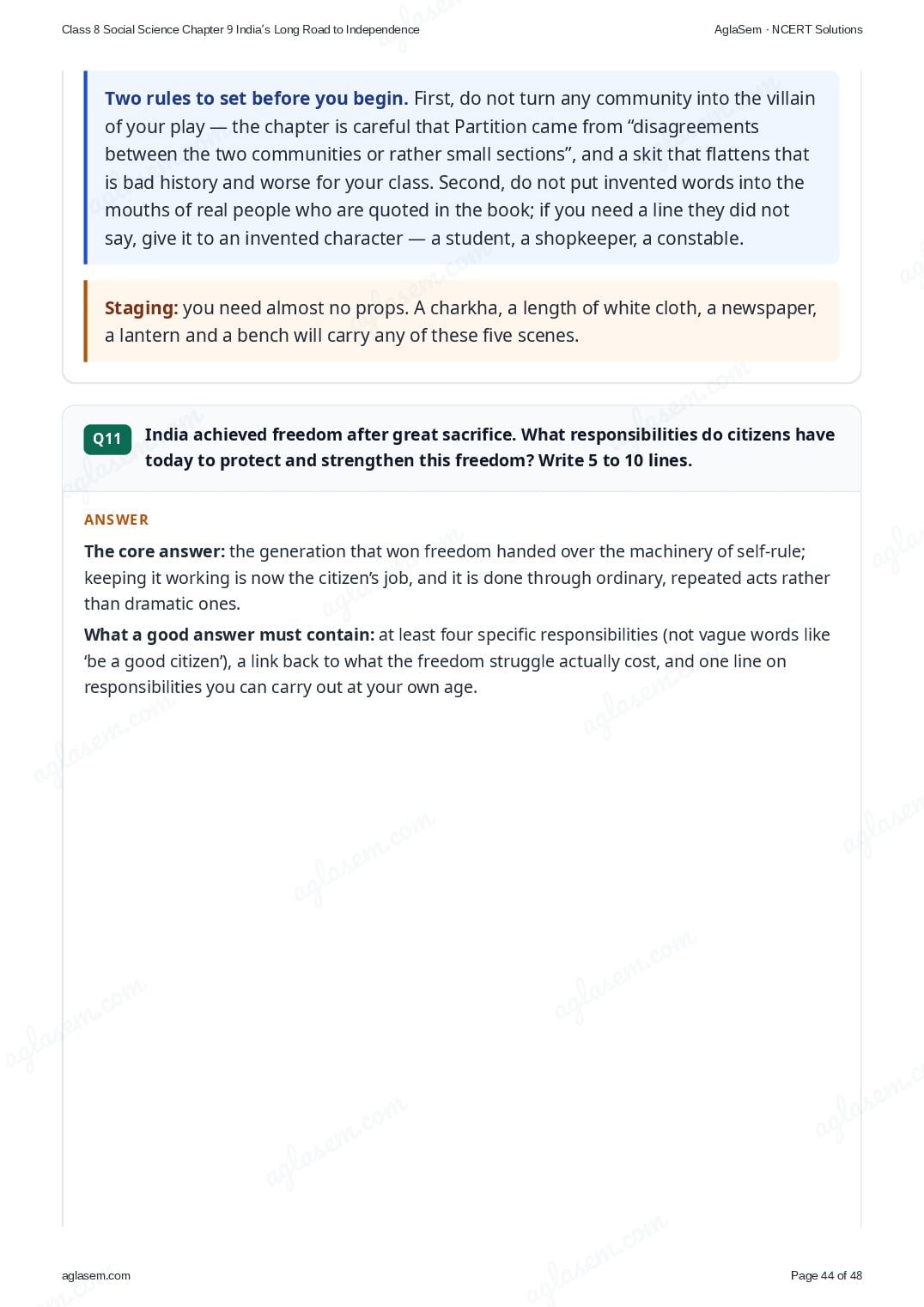
- As a class activity, write and stage a small play or skit based on the Freedom Movement.
- India achieved freedom after great sacrifice. What responsibilities do citizens have today to protect and strengthen this freedom? Write 5 to 10 lines.
Chapter at a Glance
- After 1857 the British Crown took direct control (1858). The royal proclamation promised to respect the ‘rights, dignity and honour of native Princes’ and to leave religion alone — but a ‘Resident’ was posted in almost every princely state, missionary work continued with official support, heavy land taxes fed famines, and the Arms Act and Vernacular Press Act of 1878 disarmed and gagged Indians. Promises on paper, control in practice.
- Reform and culture came before politics. The Brahmo Samaj (1828), Arya Samaj (1875), Vidyasagar, Syed Ahmed Khan and the Phules attacked child marriage, the treatment of widows, caste discrimination and the lack of schooling. Bankim’s Bande Mataram (composed 1875) and Vivekananda’s call to “Arise, awake, and stop not till the goal is reached” gave the coming movement its language of pride and self-confidence.
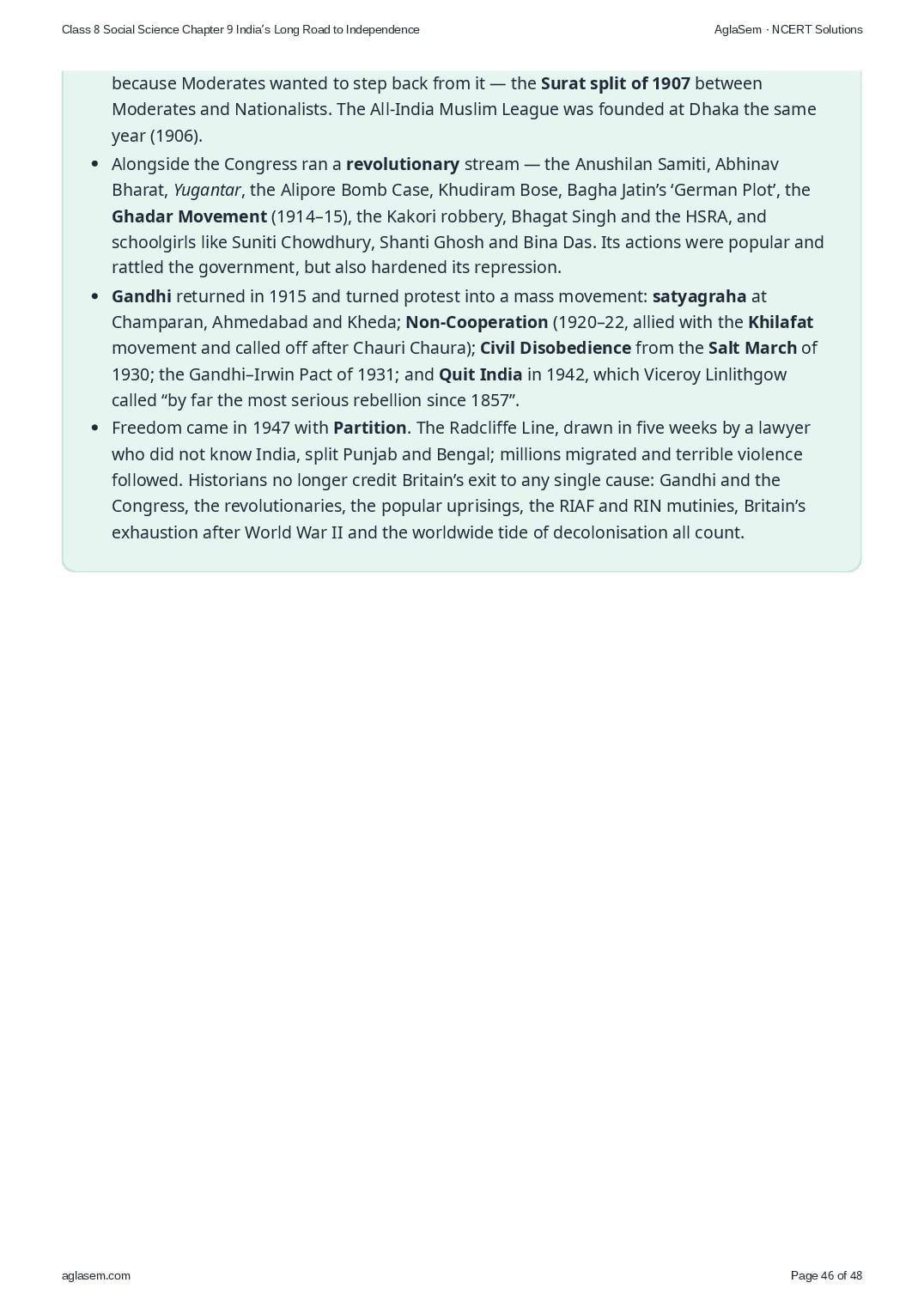
- The Indian National Congress (1885) began by professing ‘unswerving allegiance to the British Crown’. Curzon’s Partition of Bengal (1905) changed everything: it produced Swadeshi , boycott and National Education , the 1906 Calcutta demand for Swaraj , and — because Moderates wanted to step back from it — the Surat split of 1907 between Moderates and Nationalists. The All-India Muslim League was founded at Dhaka the same year (1906).
- Alongside the Congress ran a revolutionary stream — the Anushilan Samiti, Abhinav Bharat, Yugantar , the Alipore Bomb Case, Khudiram Bose, Bagha Jatin’s ‘German Plot’, the Ghadar Movement (1914–15), the Kakori robbery, Bhagat Singh and the HSRA, and schoolgirls like Suniti Chowdhury, Shanti Ghosh and Bina Das. Its actions were popular and rattled the government, but also hardened its repression.
- Gandhi returned in 1915 and turned protest into a mass movement: satyagraha at Champaran, Ahmedabad and Kheda; Non-Cooperation (1920–22, allied with the Khilafat movement and called off after Chauri Chaura); Civil Disobedience from the Salt March of 1930; the Gandhi–Irwin Pact of 1931; and Quit India in 1942, which Viceroy Linlithgow called “by far the most serious rebellion since 1857”.
- Freedom came in 1947 with Partition . The Radcliffe Line, drawn in five weeks by a lawyer who did not know India, split Punjab and Bengal; millions migrated and terrible violence followed. Historians no longer credit Britain’s exit to any single cause: Gandhi and the Congress, the revolutionaries, the popular uprisings, the RIAF and RIN mutinies, Britain’s exhaustion after World War II and the worldwide tide of decolonisation all count.
How to Download NCERT Solutions for Class 8 Social Science Chapter 9 PDF
Follow these simple steps to get the India’s Long Road to Independence questions-and-answers PDF from Exploring Society: India and Beyond.
- Search NCERT Solutions for Class 8 Social Science Chapter 9 aglasem and open this page.
- Read the exercise questions with answers for India’s Long Road to Independence shown above.
- Click the Download PDF link to save the India’s Long Road to Independence solutions to your device.
NCERT Solutions for Class 8 Social Science – All Chapters
There are more chapters to study besides India’s Long Road to Independence in Social Science. Here are the NCERT Solutions for all chapters of Class 8 Social Science.
- Chapter 1 Natural Resources and Their Use
- Chapter 2 Reshaping India’s Political Map
- Chapter 3 The Rise of the Marathas
- Chapter 4 The Colonial Era in India
- Chapter 5 Universal Franchise and India’s Electoral System
- Chapter 6 The Parliamentary System Legislature and Executive
- Chapter 7 Factors of Production
- Chapter 8 World Geography Some Glimpses
- Chapter 9 India’s Long Road to Independence
- Chapter 10 A Journey Through Indian Architecture
- Chapter 11 The Role of the Judiciary in Our Society
- Chapter 12 Citizenship Rights and Duties
- Chapter 13 Dynamics of Population
- Chapter 14 India’s Urban Landscape
- Chapter 15 Cultural Currents 13th to 17th Centuries
NCERT Solutions for Class 8 – All Subjects
Just like Chapter 9 of Social Science, you can get the exercise questions with answers for every other subject of Class 8. Here are the NCERT Solutions for all subjects of Class 8.
NCERT Solutions for Class 8 Social Science Chapter 9 – An Overview
The key highlights of this study material are as follows.
| Aspects | Details |
|---|---|
| Class | Class 8 |
| Subject | Social Science |
| Chapter Number | Chapter 9 |
| Chapter Name | India’s Long Road to Independence |
| Book Name | Exploring Society: India and Beyond |
| Book By | NCERT (National Council of Educational Research and Training) |
| Educational Resource Here | NCERT Solutions of Class 8 Social Science Chapter 9 for all exercises |
| More Questions Answers of This Subject | NCERT Solutions for Class 8 Social Science |
| Download Book Chapter | NCERT Book Class 8 Social Science |
| All Questions Answers For This Class | NCERT Solutions for Class 8 |
| Complete Solutions | NCERT Solutions |
NCERT Solutions for Class 8 Social Science Chapter 9 India’s Long Road to Independence – FAQs
What are the NCERT Solutions for Class 8 Social Science Chapter 9 India’s Long Road to Independence?
They are the complete, step-by-step answers to all the exercise and in-text questions of Chapter 9 India’s Long Road to Independence from the NCERT Class 8 Social Science textbook Exploring Society: India and Beyond, written by experts as per the latest NCERT syllabus.
How can I download the Class 8 Social Science Chapter 9 solutions PDF for free?
Open this page on aglasem, read the India’s Long Road to Independence questions with answers, and click the “Download Solutions PDF” link. The Class 8 Social Science Chapter 9 NCERT Solutions PDF is completely free to download.
Are these NCERT Solutions as per the latest 2026-27 syllabus?
Yes. The NCERT Solutions for Class 8 Social Science Chapter 9 are based on the latest NCERT textbook Exploring Society: India and Beyond and the current 2026-27 CBSE syllabus, so the questions and answers match what you study in class.
Where can I get NCERT Solutions for the other chapters of Class 8 Social Science?
You can find the answers to every chapter on the NCERT Solutions for Class 8 Social Science page, and solutions for every subject on the NCERT Solutions for Class 8 page.
How do NCERT Solutions help in exam preparation?
They show the correct method to solve each question, help you write answers the way they are expected in exams, let you check and correct your own work, and save revision time — which together improve your marks in Class 8 Social Science.
If you have any queries on NCERT Solutions for Class 8 Social Science Chapter 9 India’s Long Road to Independence, then please ask in the comments below.