NCERT Solutions for Class 6 Science Chapter 7 Temperature and Its Measurement provide clear, step-by-step answers to every exercise and in-text question from the chapter Temperature and Its Measurement of the NCERT textbook Curiosity. Prepared by subject experts as per the latest NCERT (CBSE) syllabus for 2026-27, these NCERT Solutions for Class 6 Science help you understand each concept, write exam-ready answers, and check your own solutions. You can read them online below or download the free Class 6 Science Chapter 7 question-answer PDF.
NCERT Solutions for Class 6 Science Chapter 7 Temperature and Its Measurement
- Class: Class 6
- Subject: Science
- Chapter: Chapter 7 – Temperature and Its Measurement
- Textbook: Curiosity (NCERT)
- Study material: NCERT Solutions – questions with answers, free PDF
These solutions answer all the exercise questions of Chapter 7 Temperature and Its Measurement — including the in-text questions, short-answer and long-answer questions, and activities — with complete explanations so you can follow the method, not just the final answer. Read the full solutions below.
NCERT Solutions Class 6 Science Chapter 7 Temperature and Its Measurement View Download
NCERT Solutions for Class 6 Science Chapter 7 PDF Download
You can read the NCERT Solutions for Class 6 Science Chapter 7 online above, or download the complete question-answer PDF to study Temperature and Its Measurement offline at any time.
NCERT Solutions for Class 6 Science Chapter 7 PDF Download Link – Click Here to Download Solutions PDF
Questions Covered in This Chapter
These NCERT Solutions answer all 50 questions of this chapter. The questions solved are:
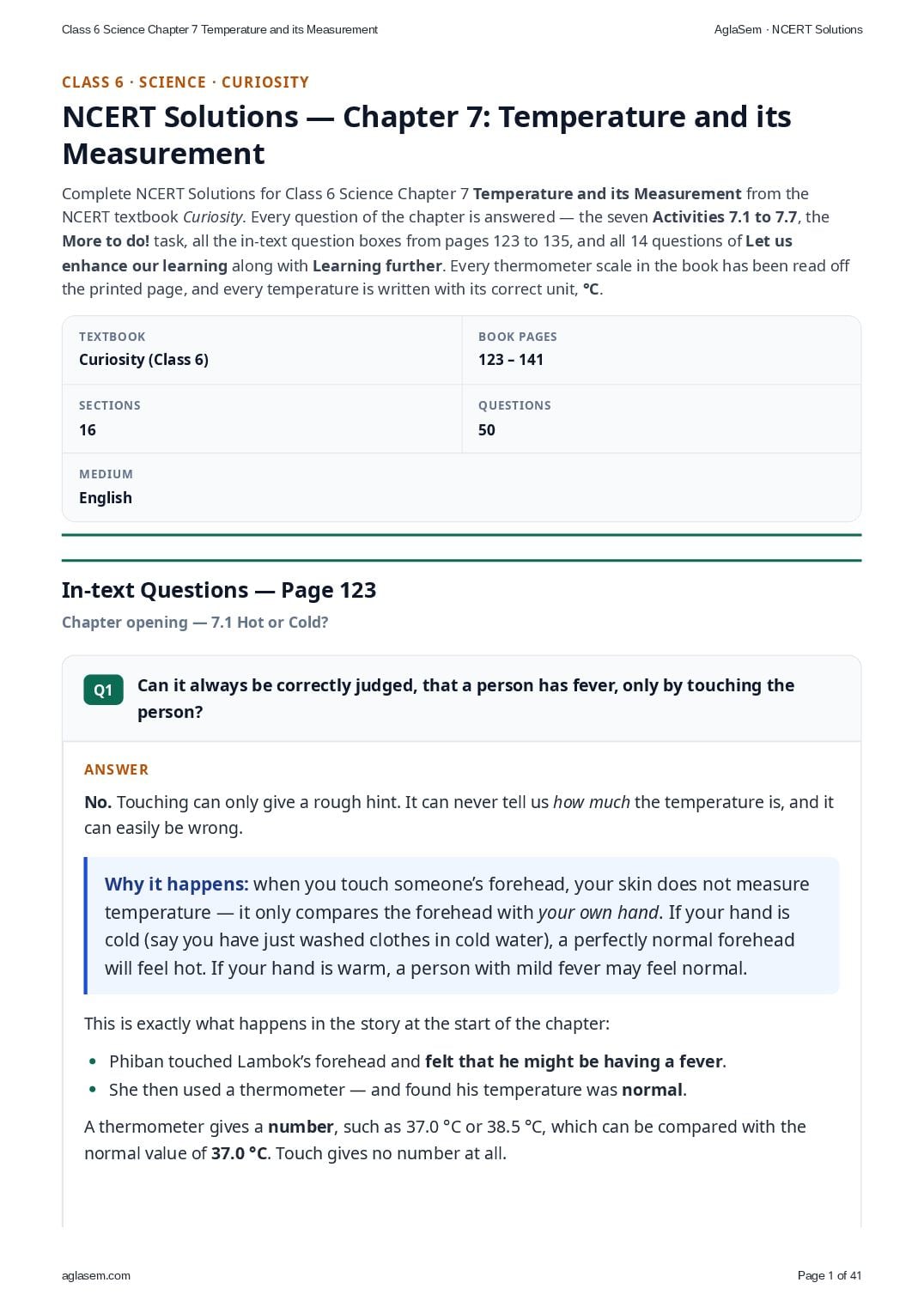
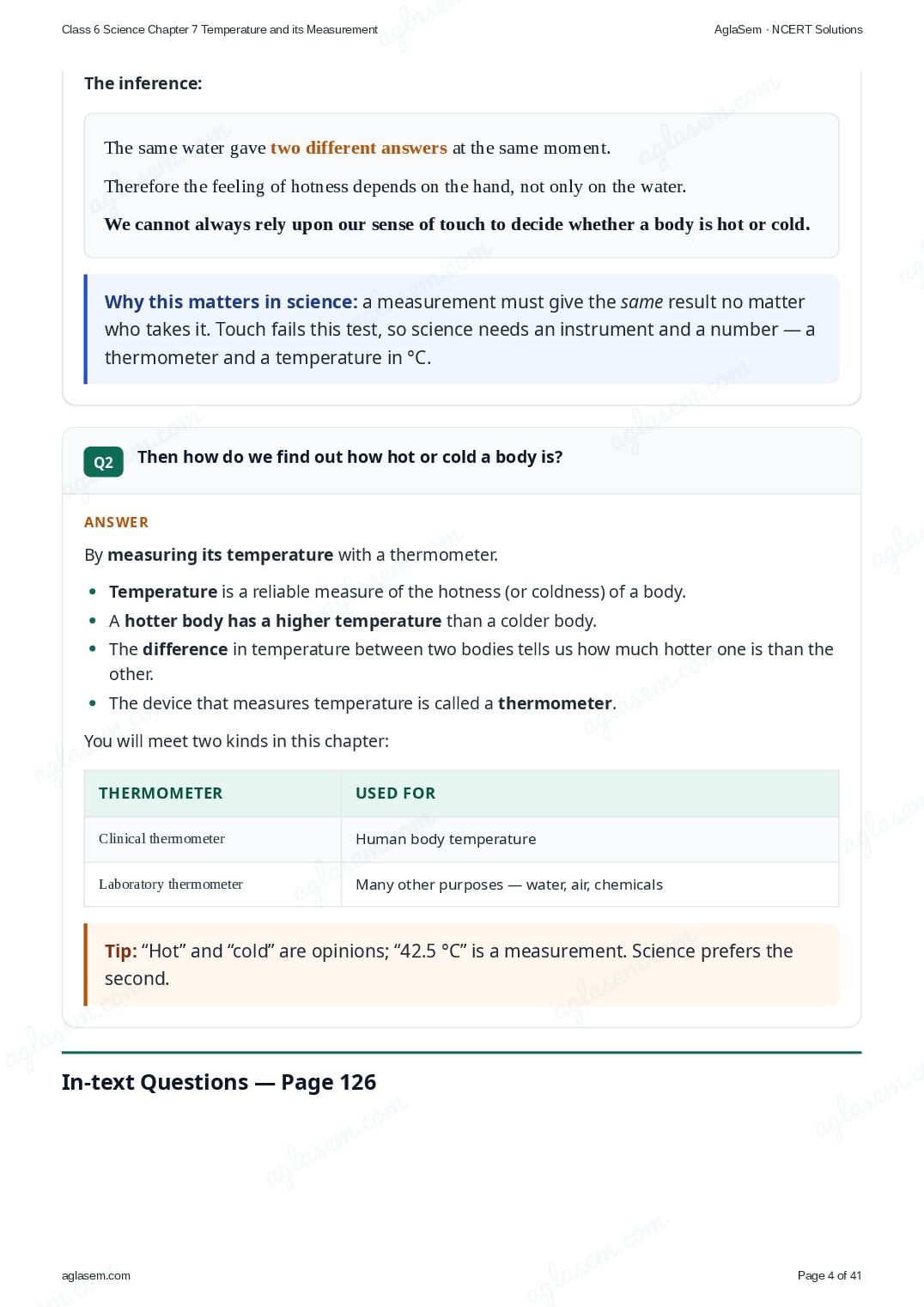
- Can it always be correctly judged, that a person has fever, only by touching the person?
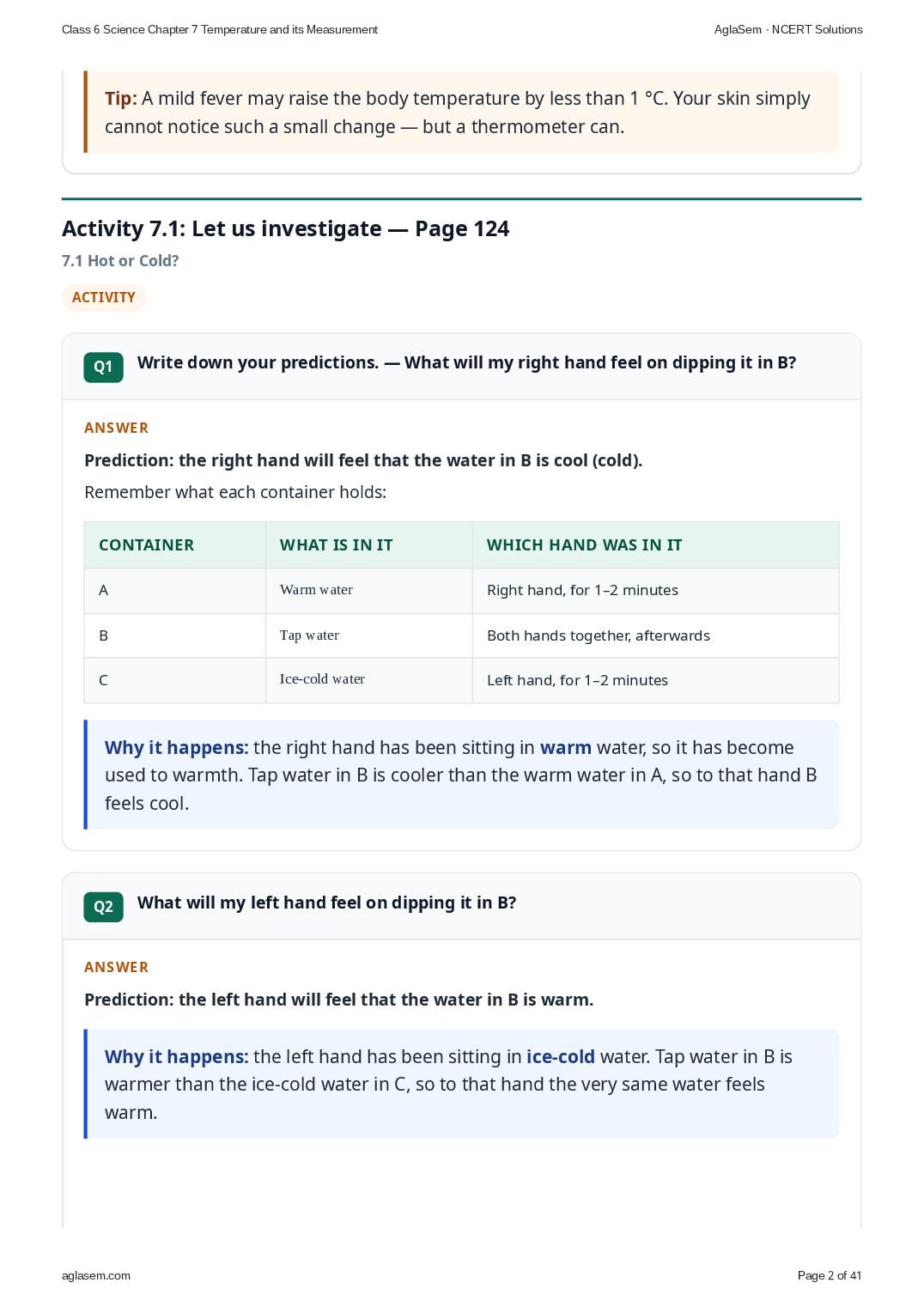
- Write down your predictions. — What will my right hand feel on dipping it in B?
- What will my left hand feel on dipping it in B?
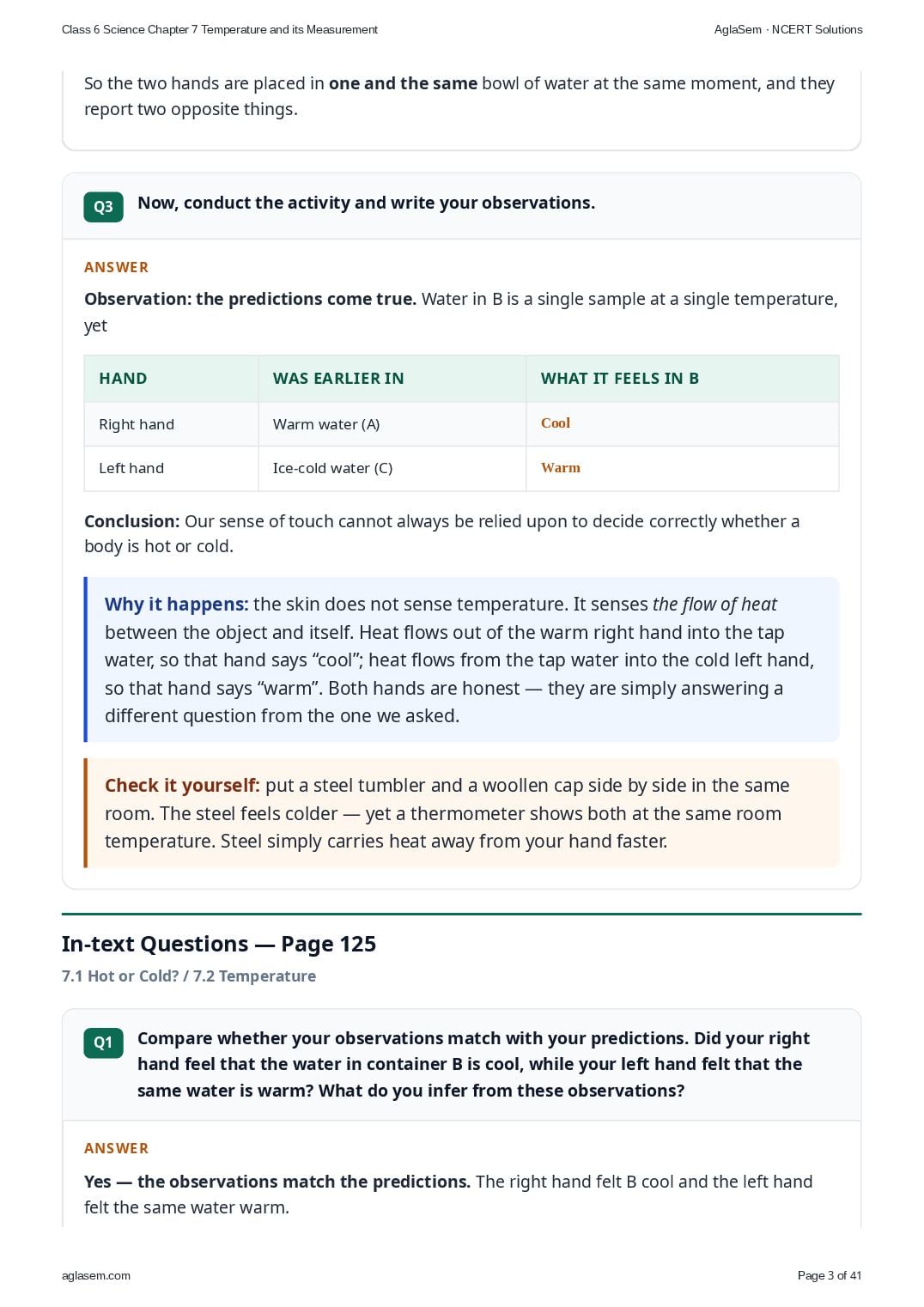
- Now, conduct the activity and write your observations.
- Compare whether your observations match with your predictions. Did your right hand feel that the water in container B is cool, while your left hand felt that the same water is warm? What do you infer from these observations?
- Then how do we find out how hot or cold a body is?
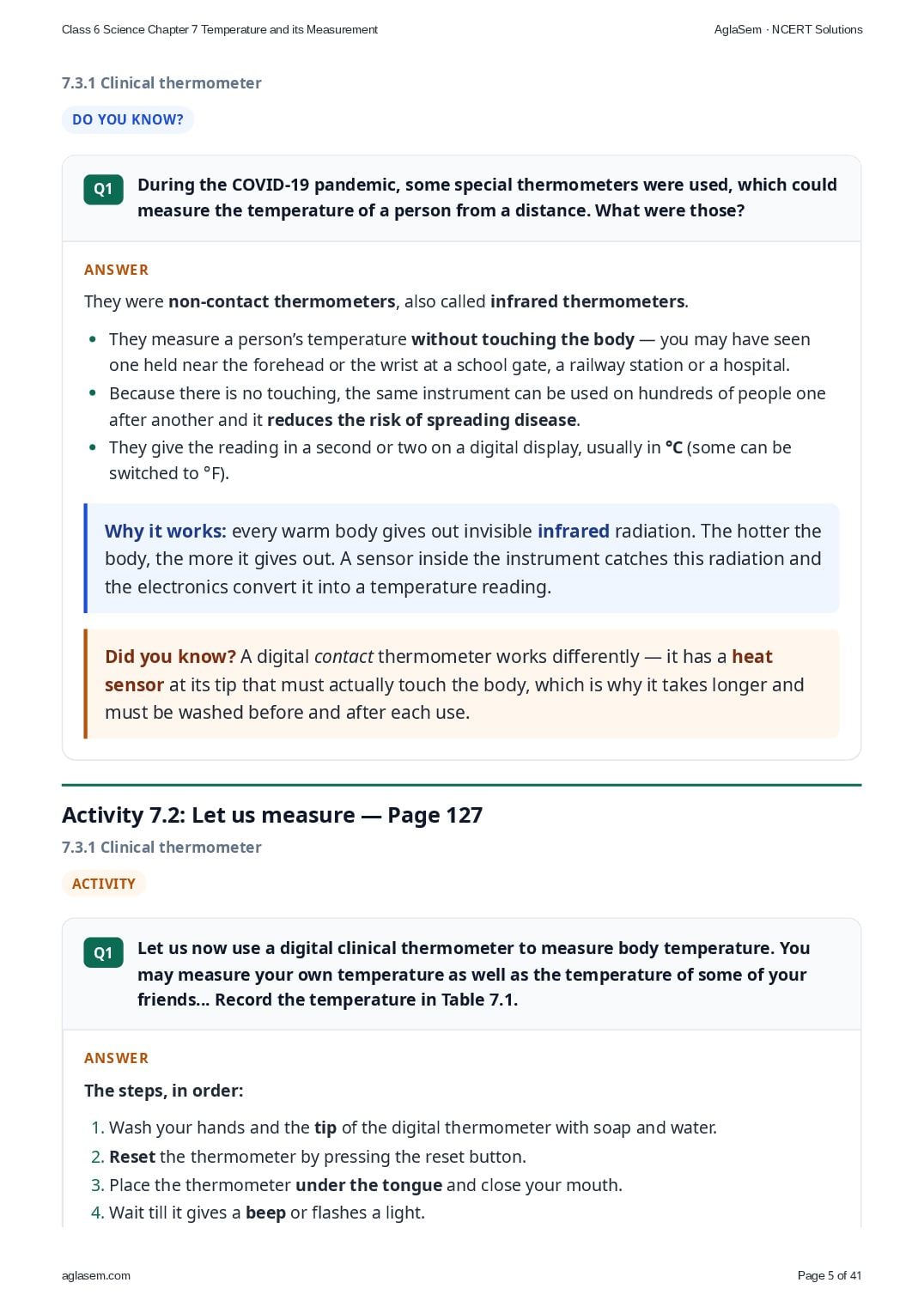
- During the COVID-19 pandemic, some special thermometers were used, which could measure the temperature of a person from a distance. What were those?
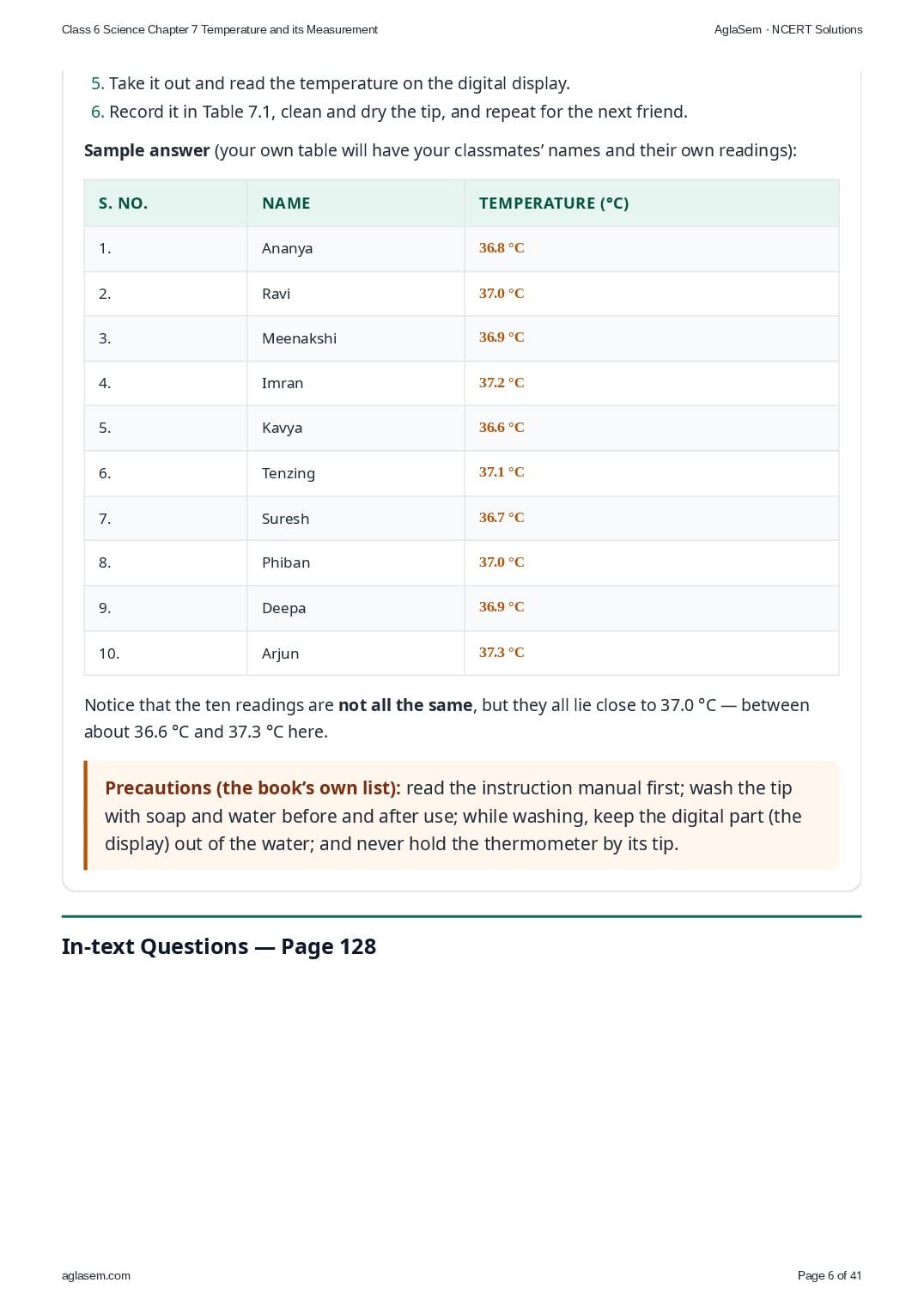
- Let us now use a digital clinical thermometer to measure body temperature. You may measure your own temperature as well as the temperature of some of your friends… Record the temperature in Table 7.1.
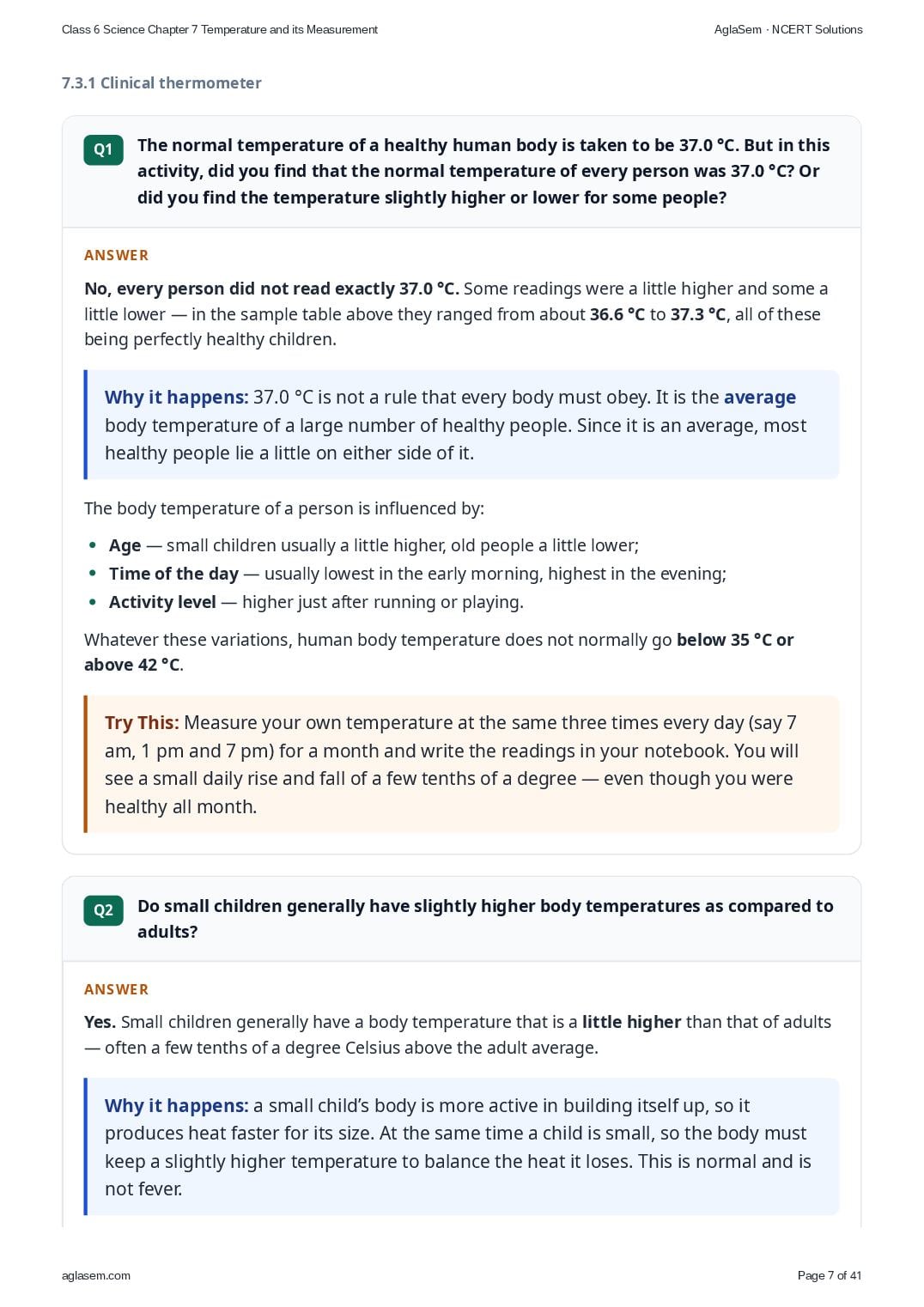
- The normal temperature of a healthy human body is taken to be 37.0 °C. But in this activity, did you find that the normal temperature of every person was 37.0 °C? Or did you find the temperature slightly higher or lower for some people?
- Do small children generally have slightly higher body temperatures as compared to adults?
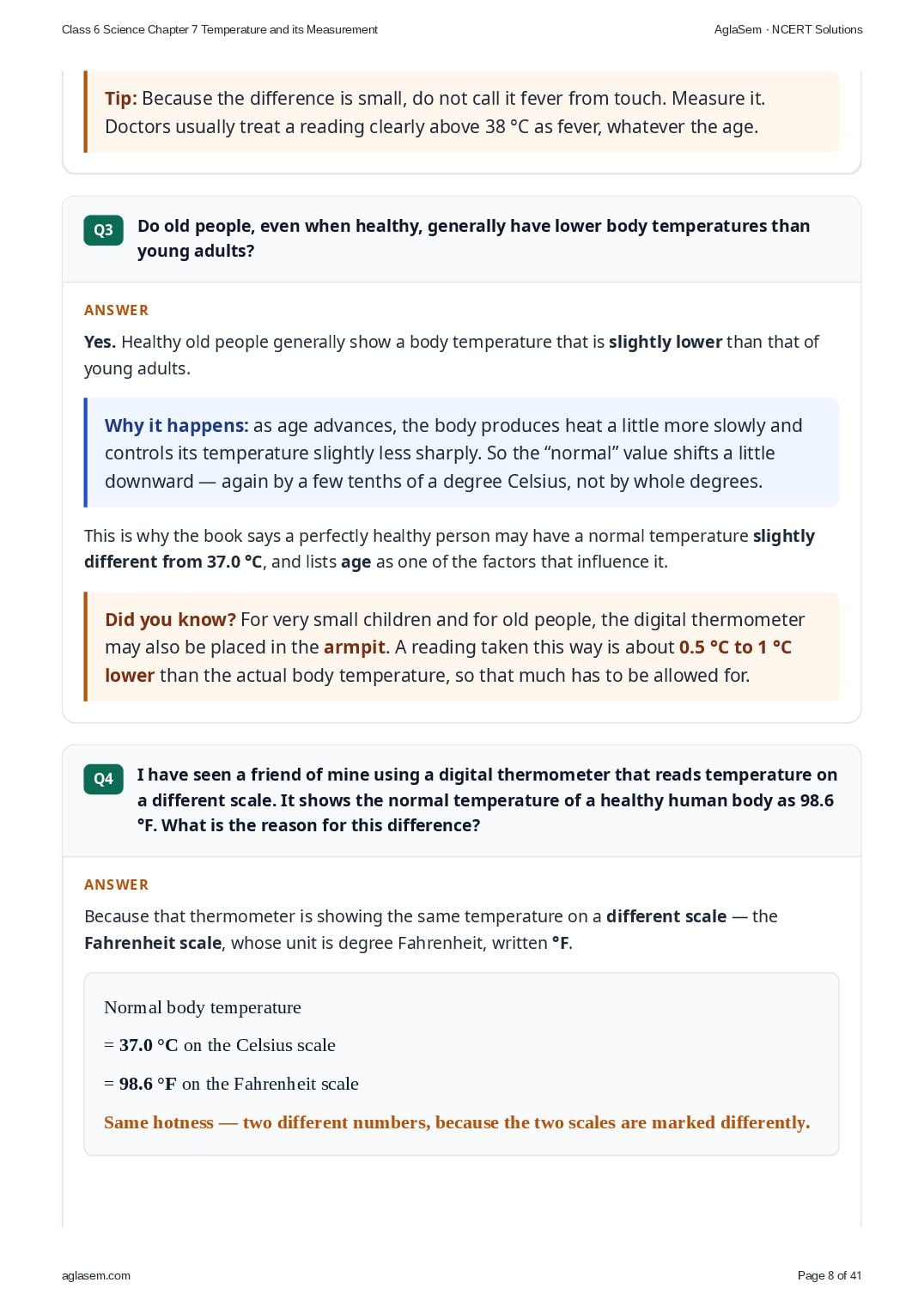
- Do old people, even when healthy, generally have lower body temperatures than young adults?
- I have seen a friend of mine using a digital thermometer that reads temperature on a different scale. It shows the normal temperature of a healthy human body as 98.6 °F. What is the reason for this difference?
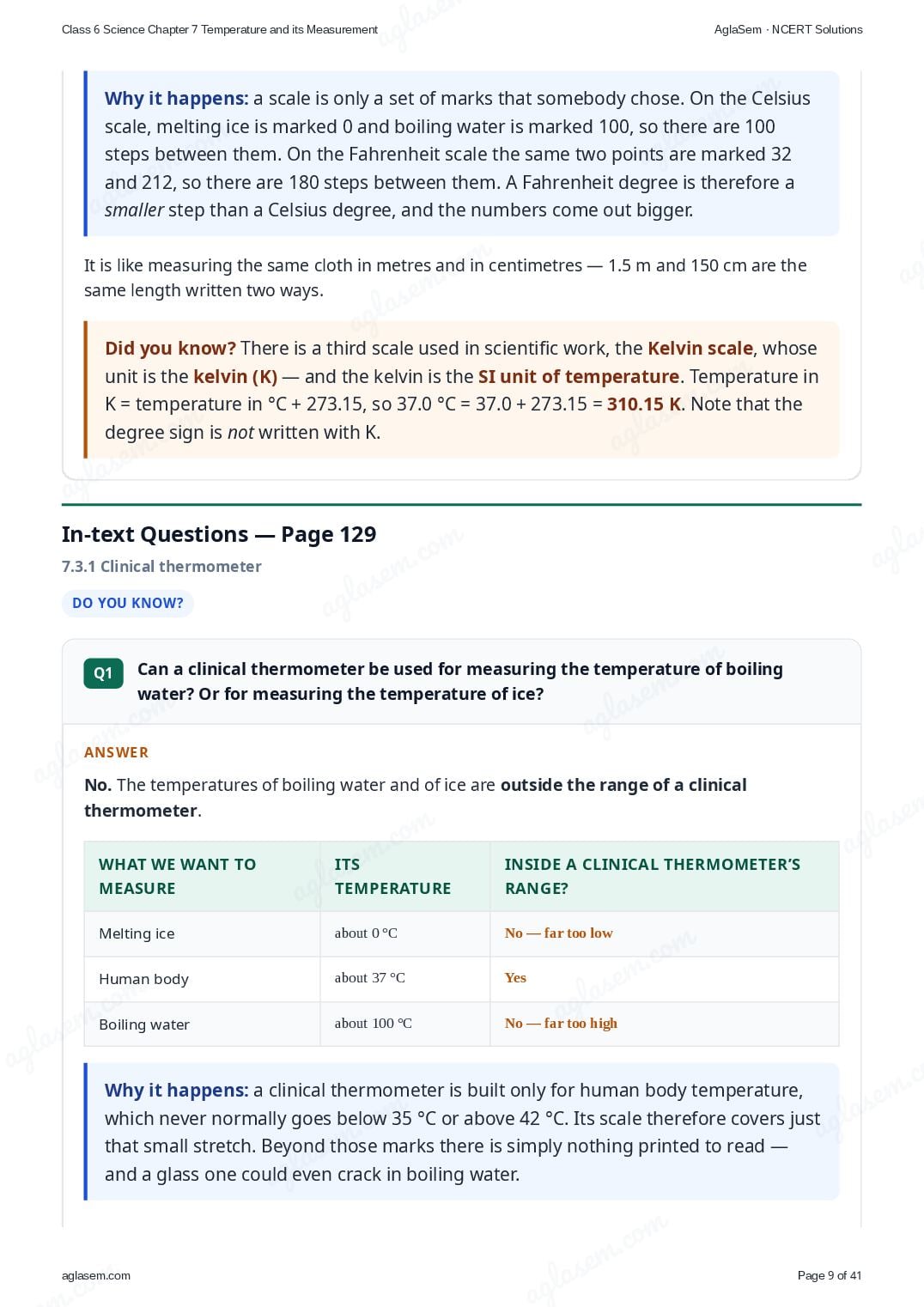
- Can a clinical thermometer be used for measuring the temperature of boiling water? Or for measuring the temperature of ice?
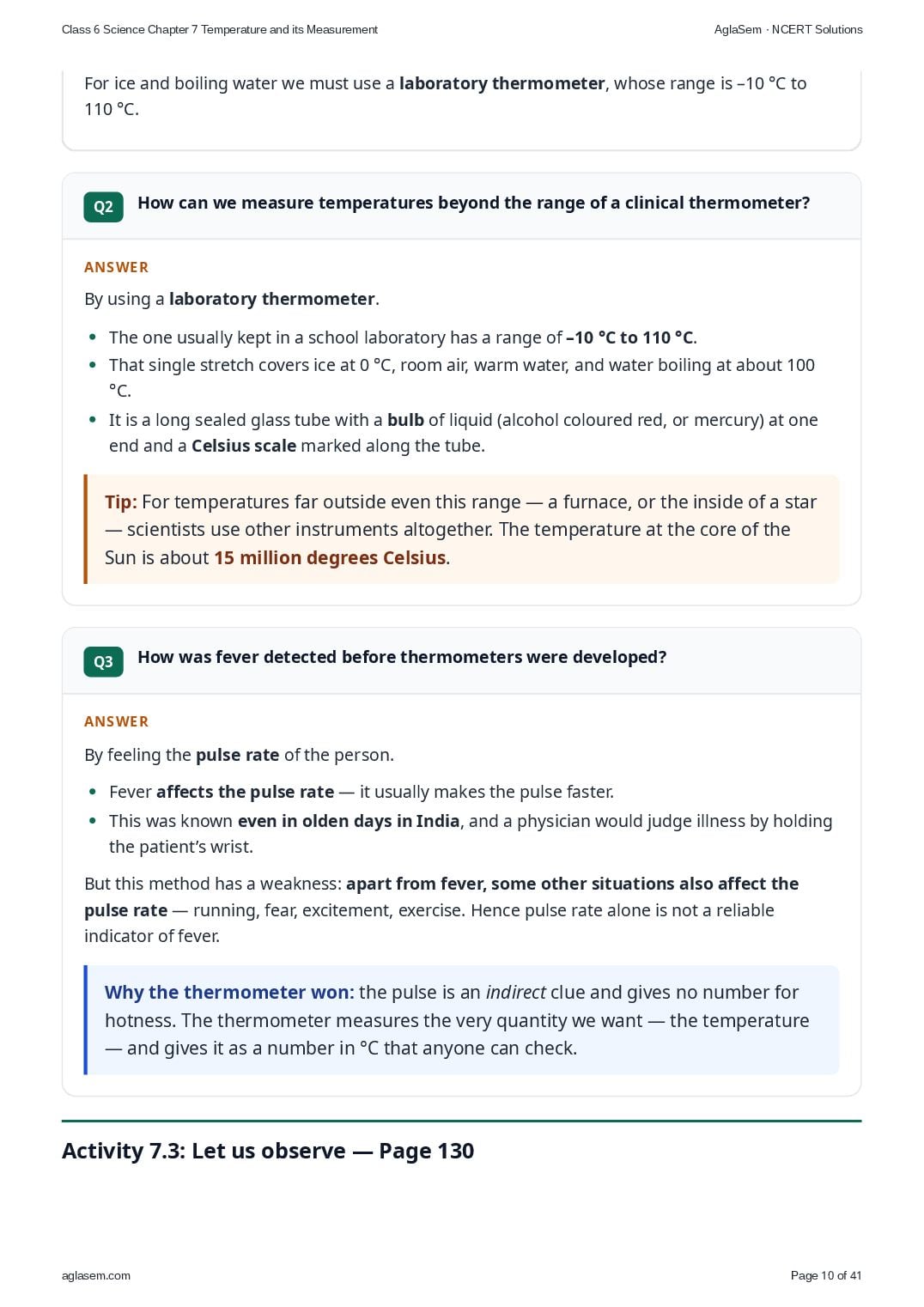
- How can we measure temperatures beyond the range of a clinical thermometer?
- How was fever detected before thermometers were developed?
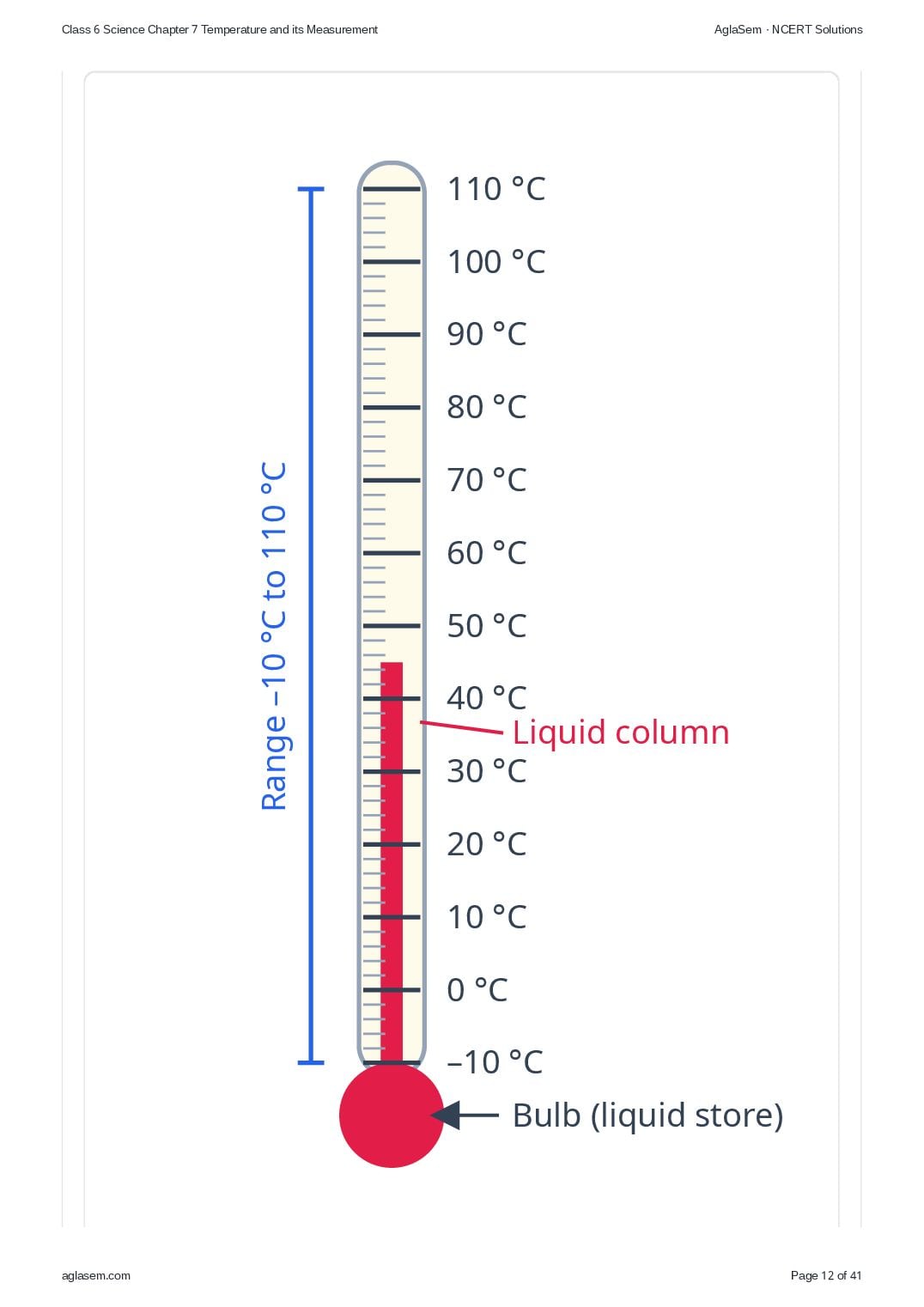
- Note down the following: — What is the lowest temperature it can measure?
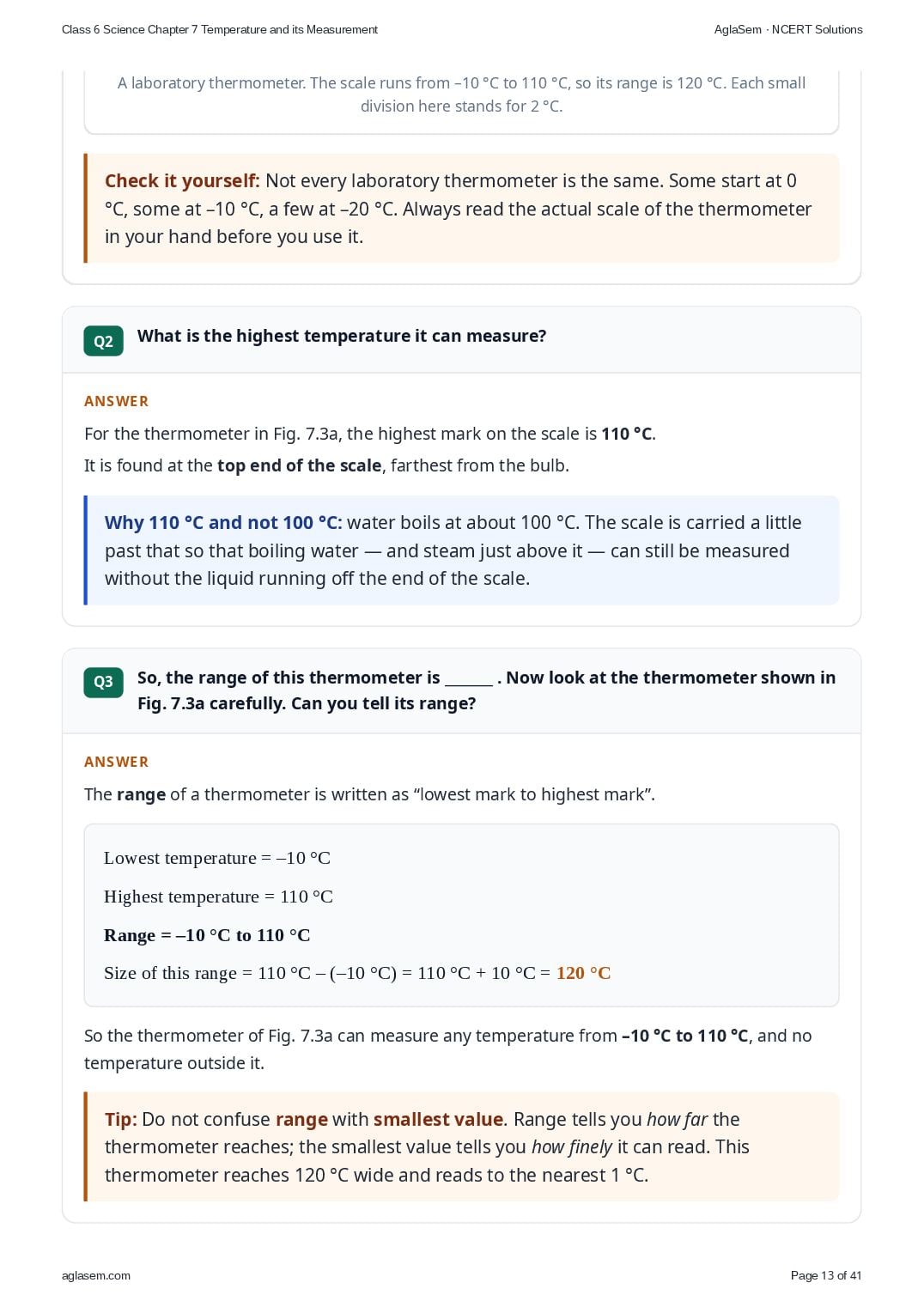
- What is the highest temperature it can measure?
- So, the range of this thermometer is _______ . Now look at the thermometer shown in Fig. 7.3a carefully. Can you tell its range?
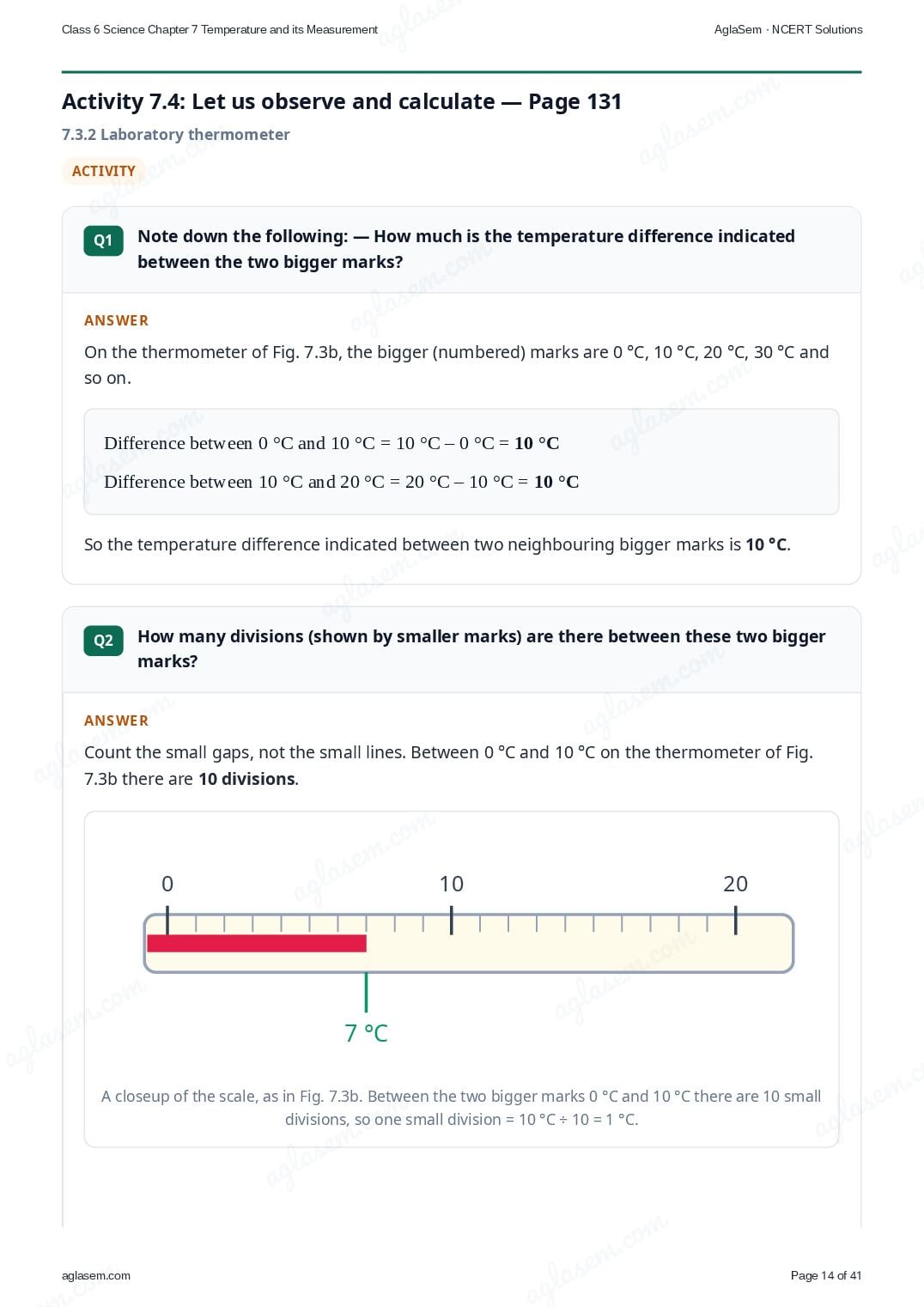
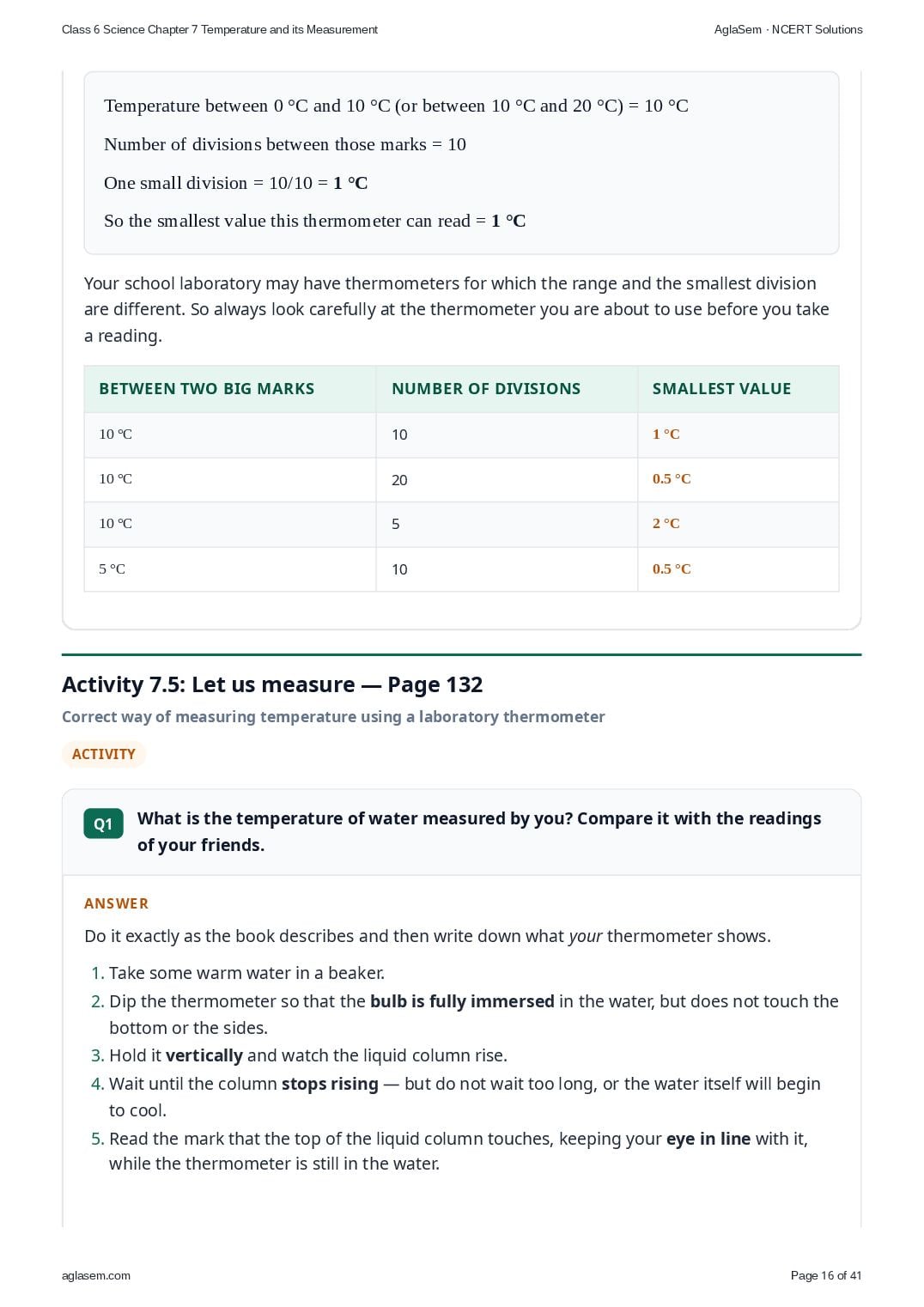
- Note down the following: — How much is the temperature difference indicated between the two bigger marks?
- How many divisions (shown by smaller marks) are there between these two bigger marks?
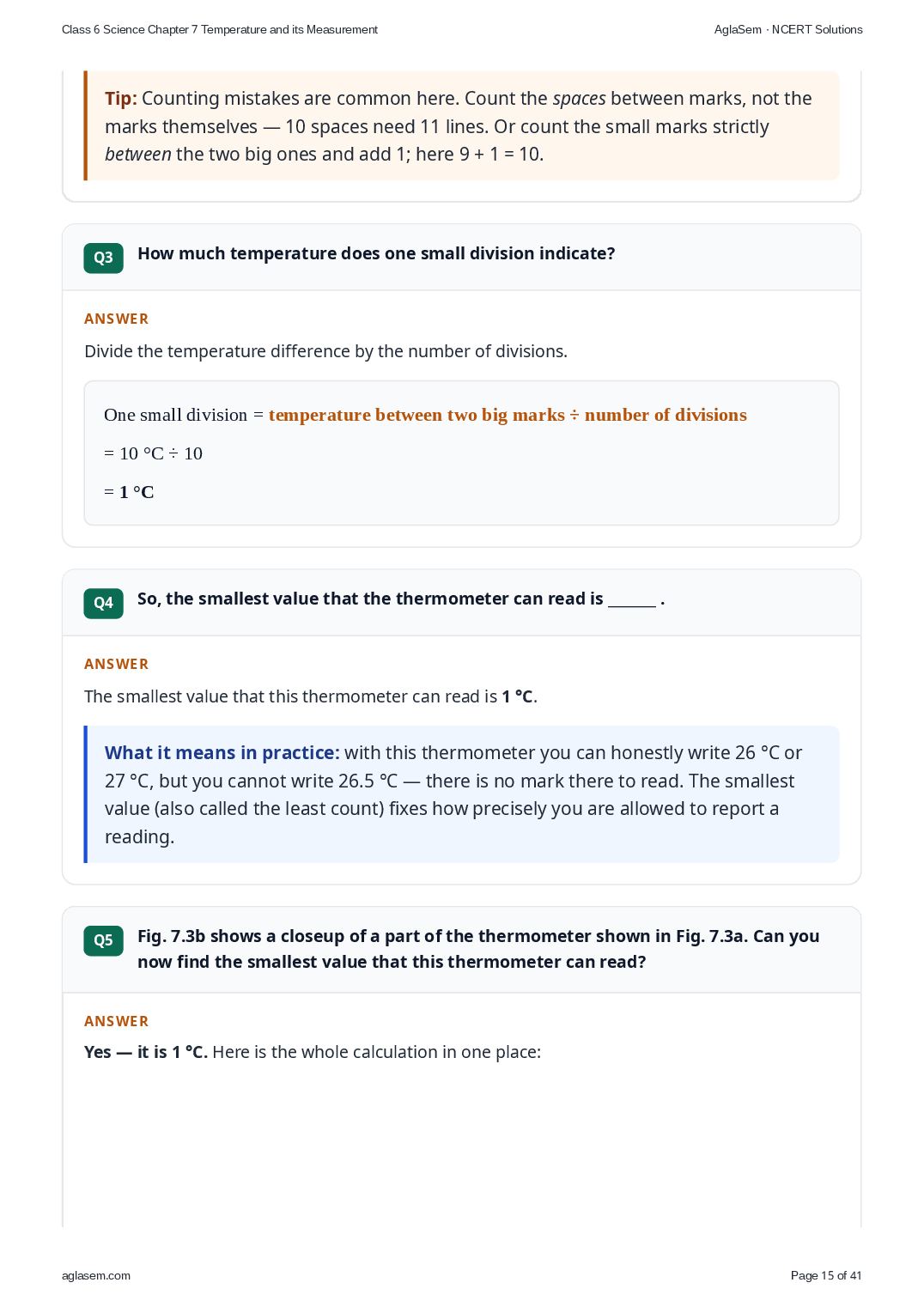
- How much temperature does one small division indicate?
- So, the smallest value that the thermometer can read is _______ .
- Fig. 7.3b shows a closeup of a part of the thermometer shown in Fig. 7.3a. Can you now find the smallest value that this thermometer can read?
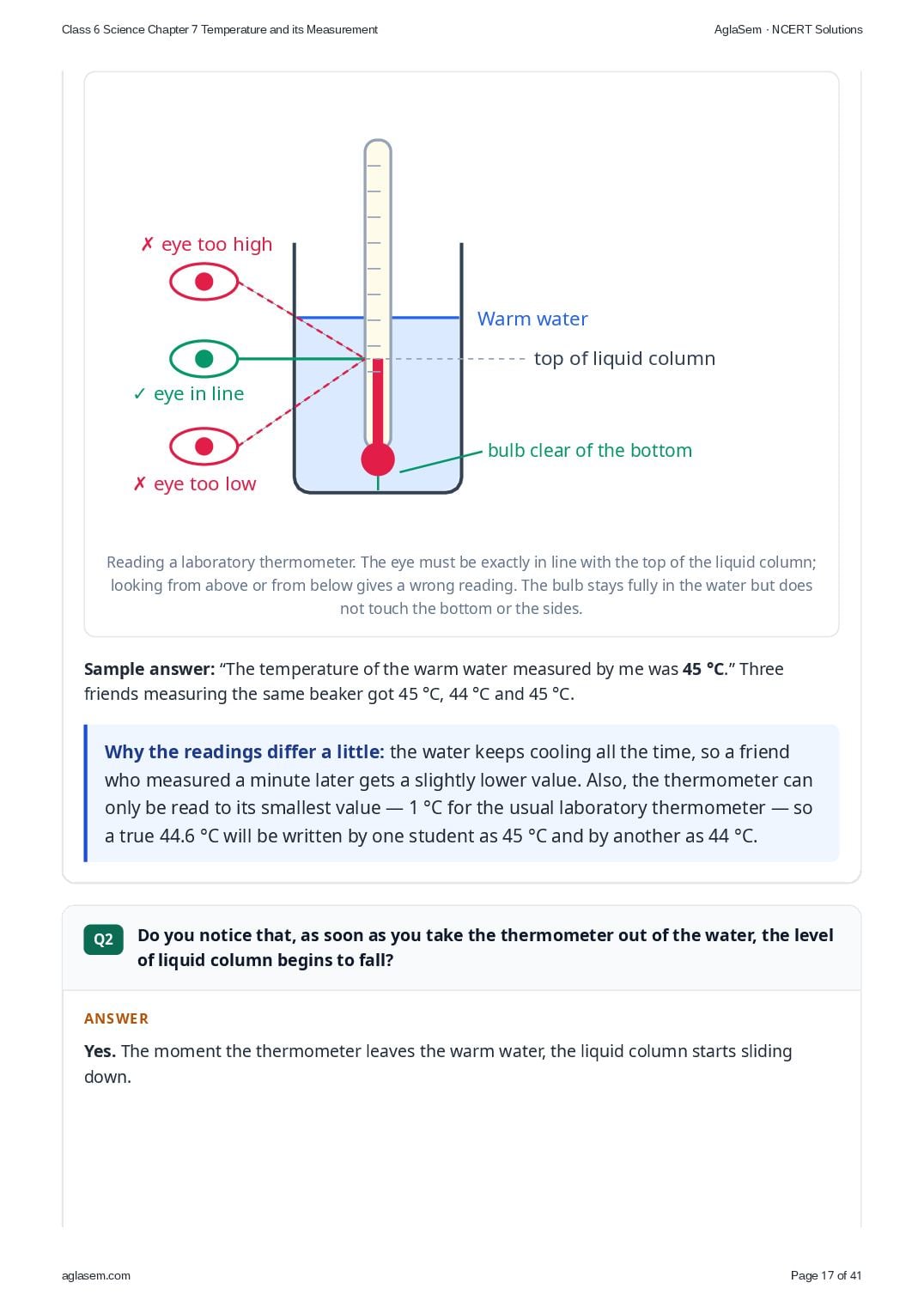
- What is the temperature of water measured by you? Compare it with the readings of your friends.
- Do you notice that, as soon as you take the thermometer out of the water, the level of liquid column begins to fall?
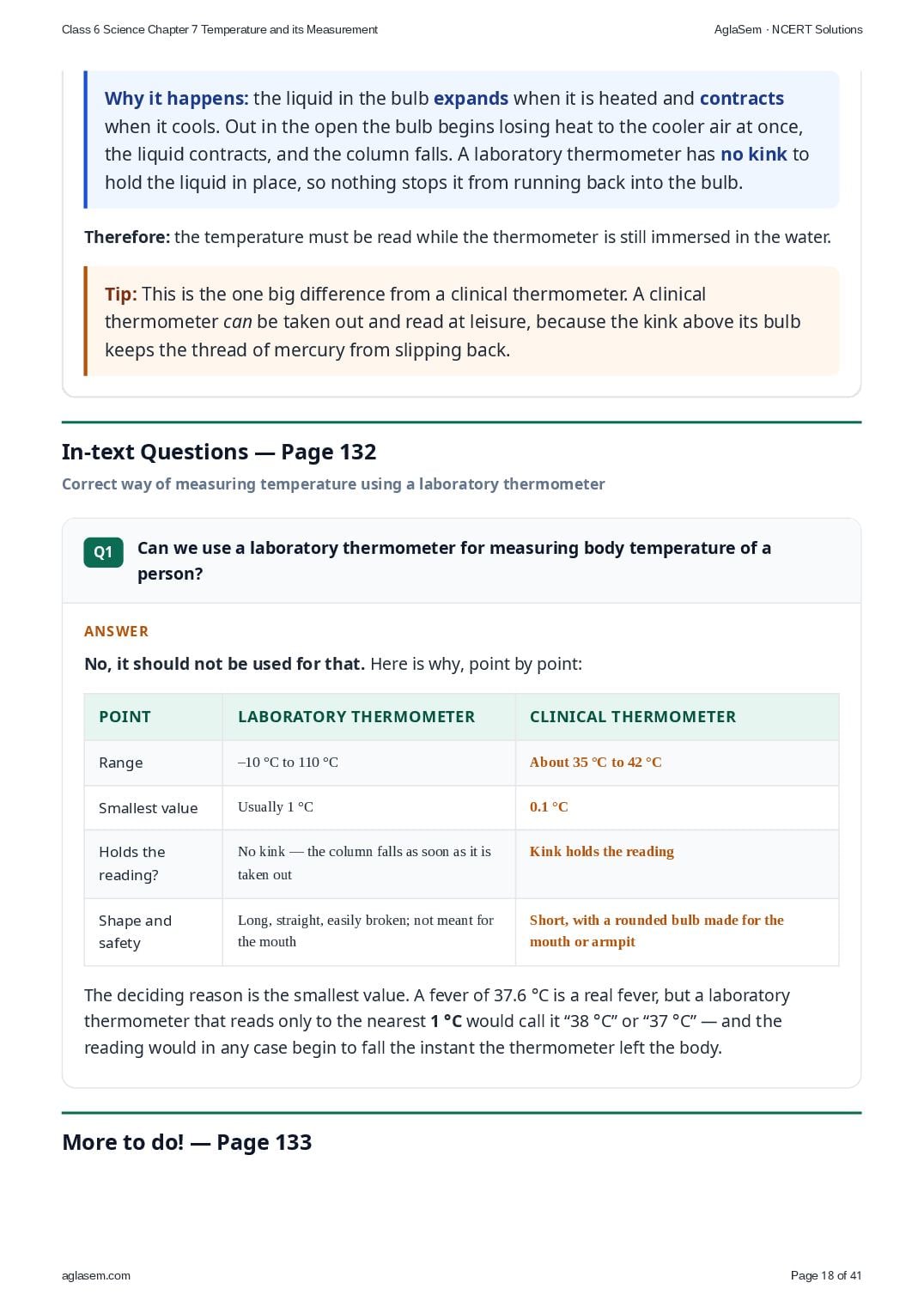
- Can we use a laboratory thermometer for measuring body temperature of a person?
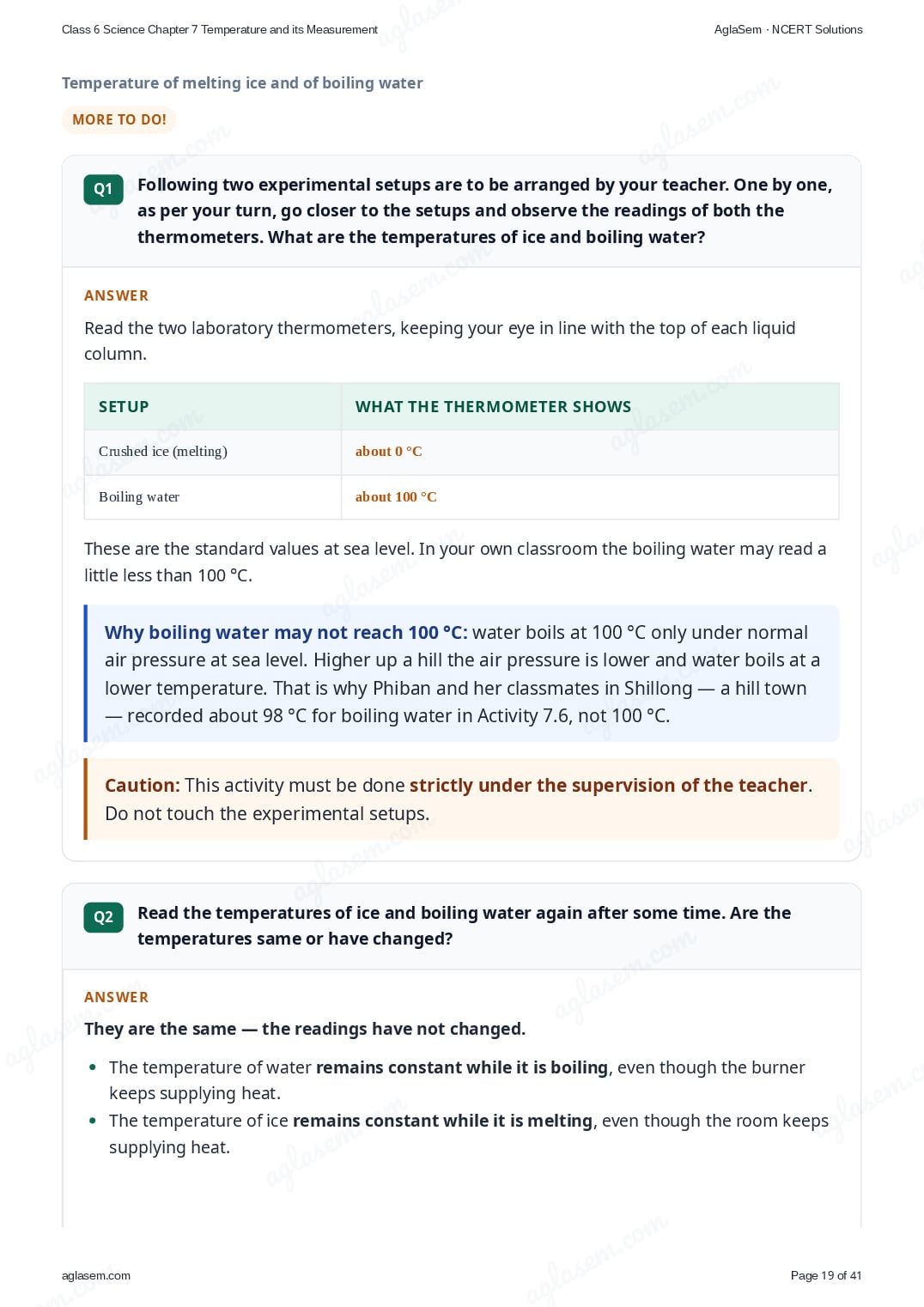
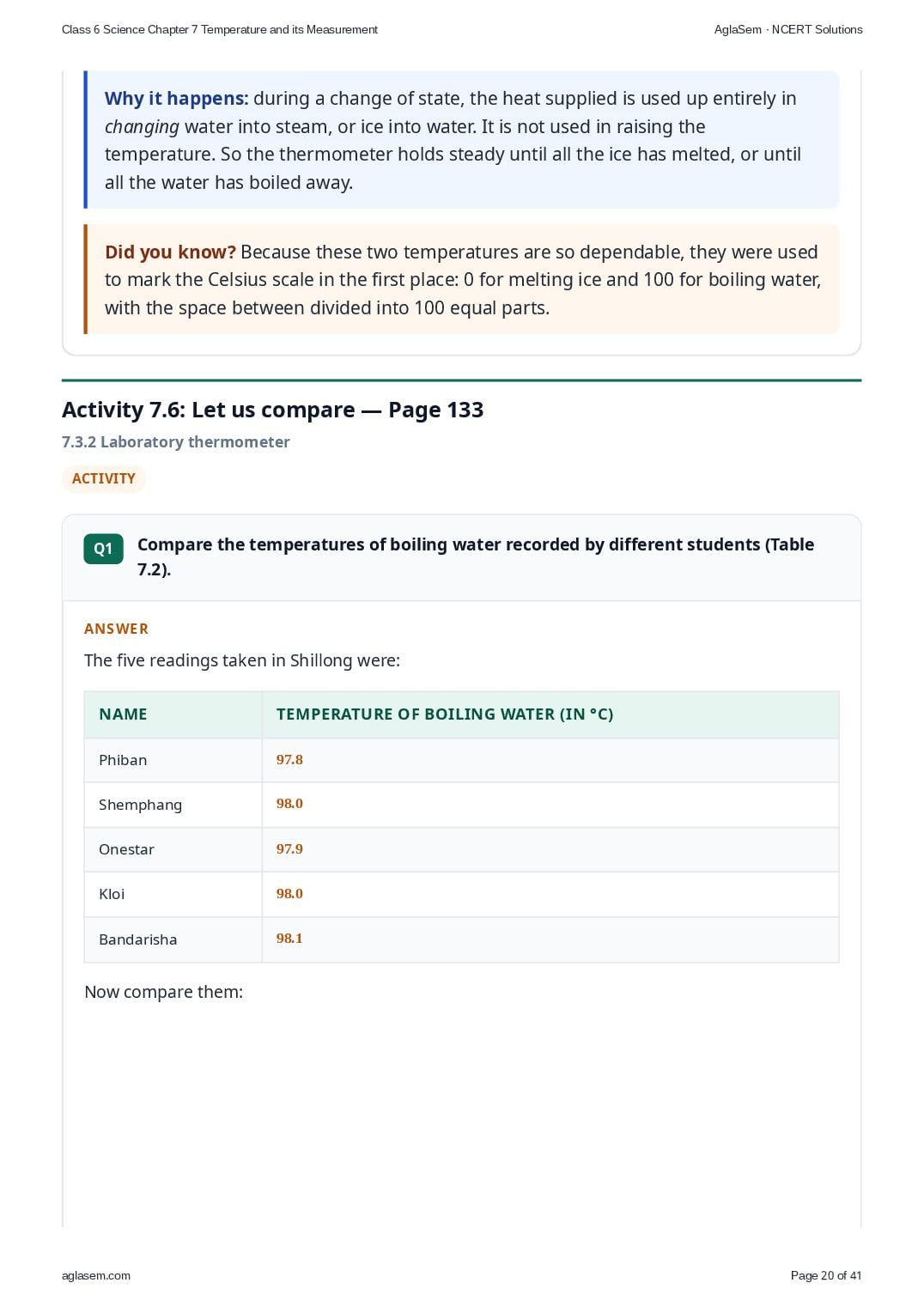
- Following two experimental setups are to be arranged by your teacher. One by one, as per your turn, go closer to the setups and observe the readings of both the thermometers. What are the temperatures of ice and boiling water?
- Read the temperatures of ice and boiling water again after some time. Are the temperatures same or have changed?
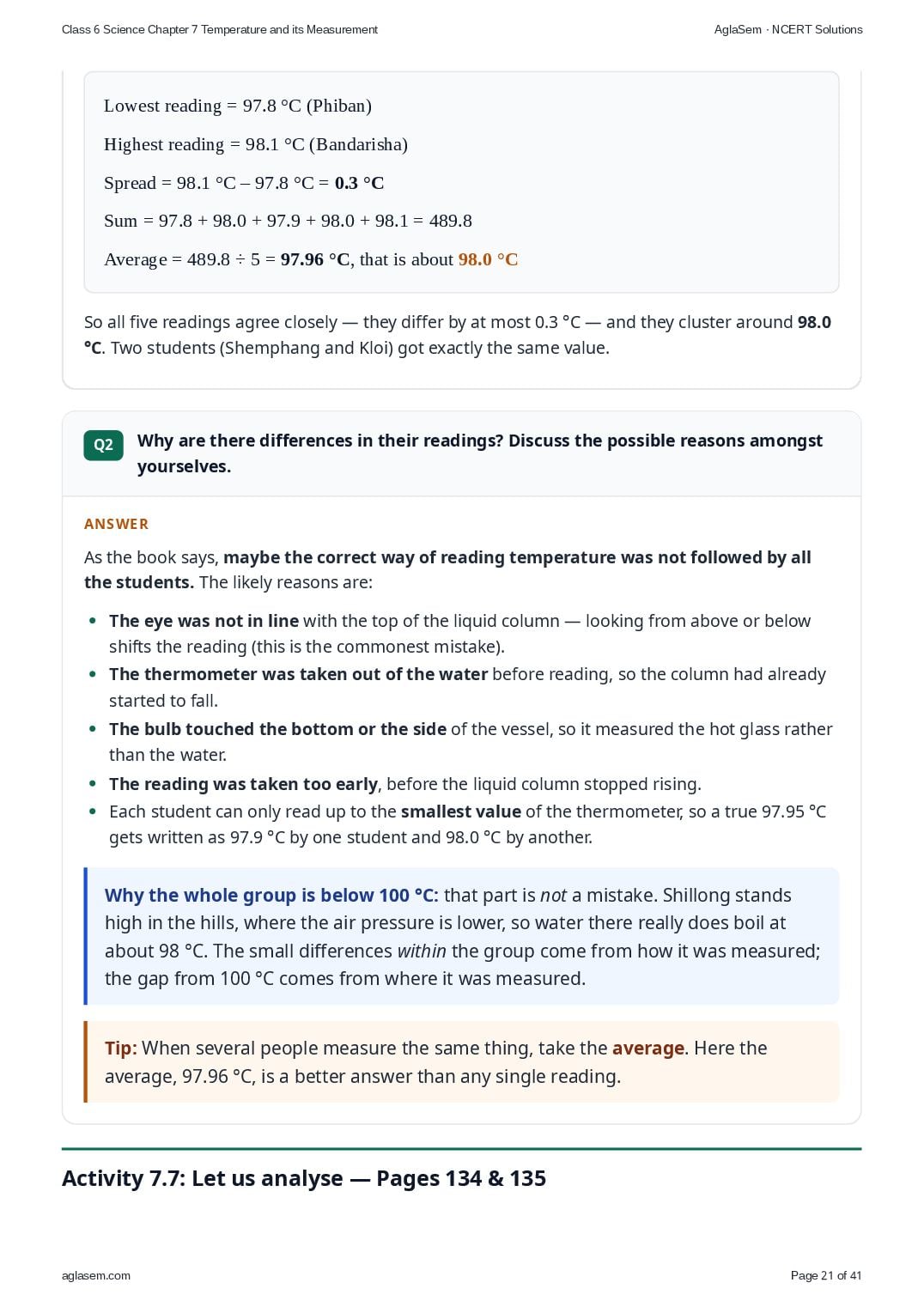
- Compare the temperatures of boiling water recorded by different students (Table 7.2).
- Why are there differences in their readings? Discuss the possible reasons amongst yourselves.
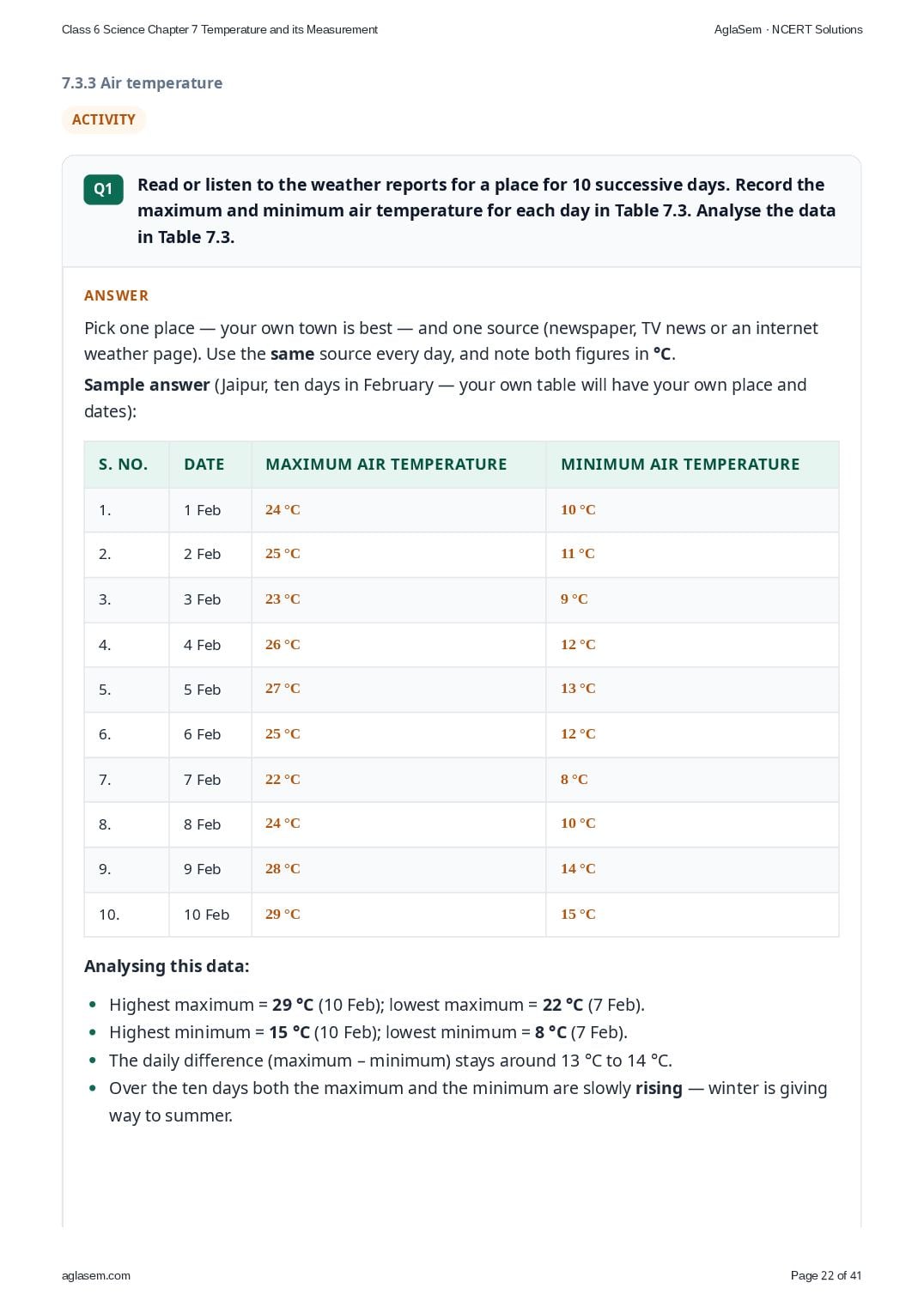
- Read or listen to the weather reports for a place for 10 successive days. Record the maximum and minimum air temperature for each day in Table 7.3. Analyse the data in Table 7.3.
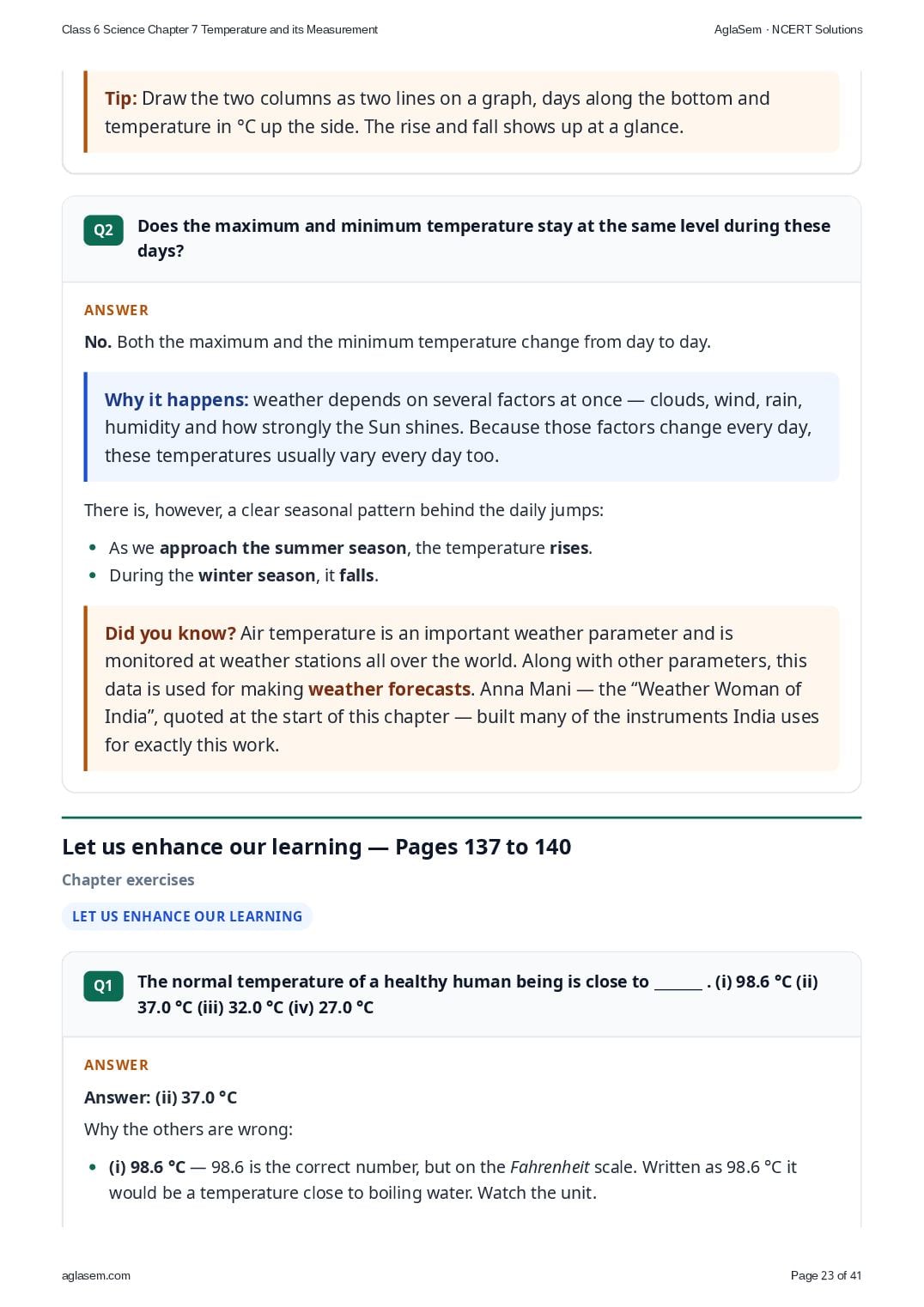
- Does the maximum and minimum temperature stay at the same level during these days?
- The normal temperature of a healthy human being is close to _______ . (i) 98.6 °C (ii) 37.0 °C (iii) 32.0 °C (iv) 27.0 °C
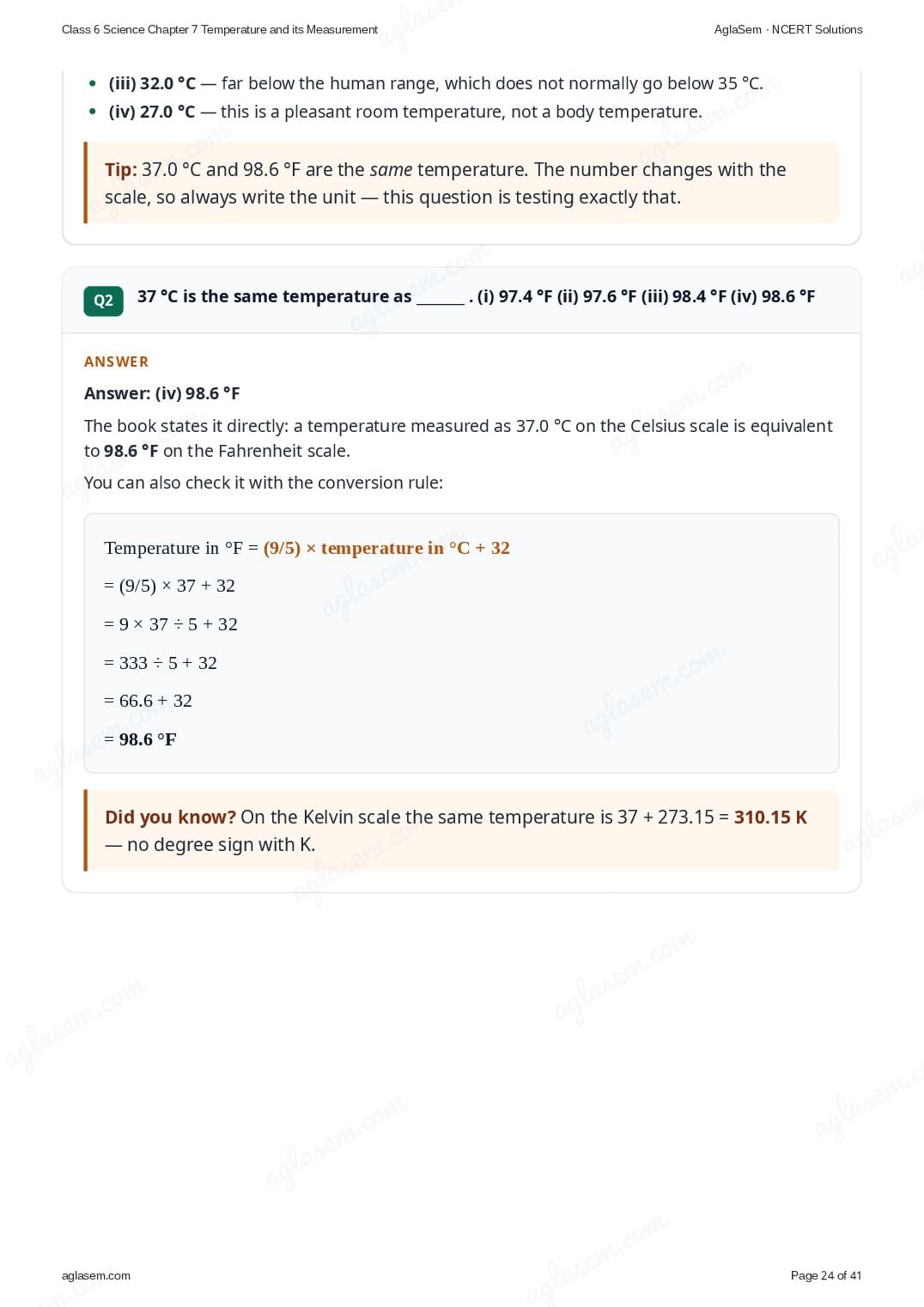
- 37 °C is the same temperature as _______ . (i) 97.4 °F (ii) 97.6 °F (iii) 98.4 °F (iv) 98.6 °F
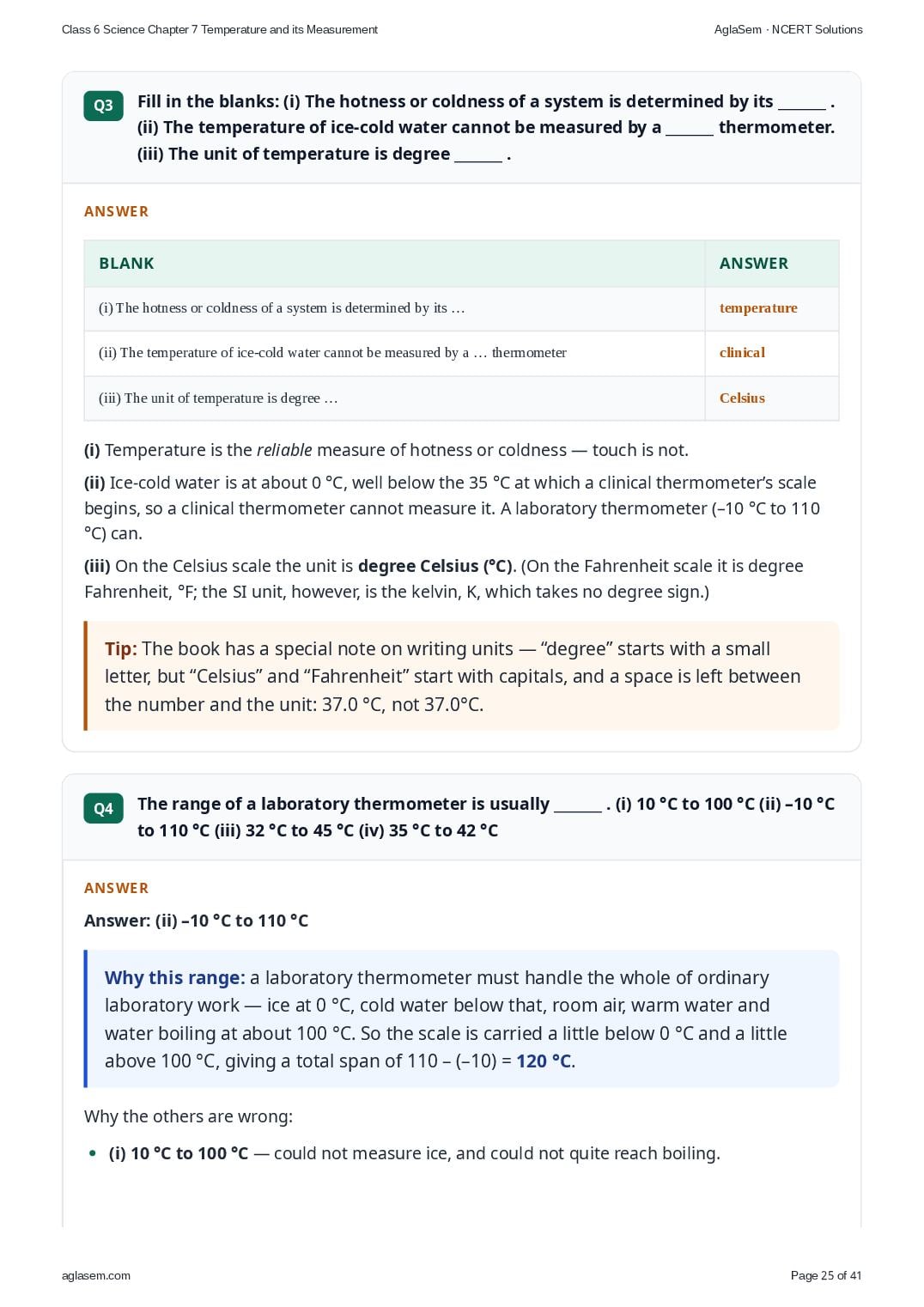
- Fill in the blanks: (i) The hotness or coldness of a system is determined by its _______ . (ii) The temperature of ice-cold water cannot be measured by a _______ thermometer. (iii) The unit of temperature is degree _______ .
- The range of a laboratory thermometer is usually _______ . (i) 10 °C to 100 °C (ii) –10 °C to 110 °C (iii) 32 °C to 45 °C (iv) 35 °C to 42 °C
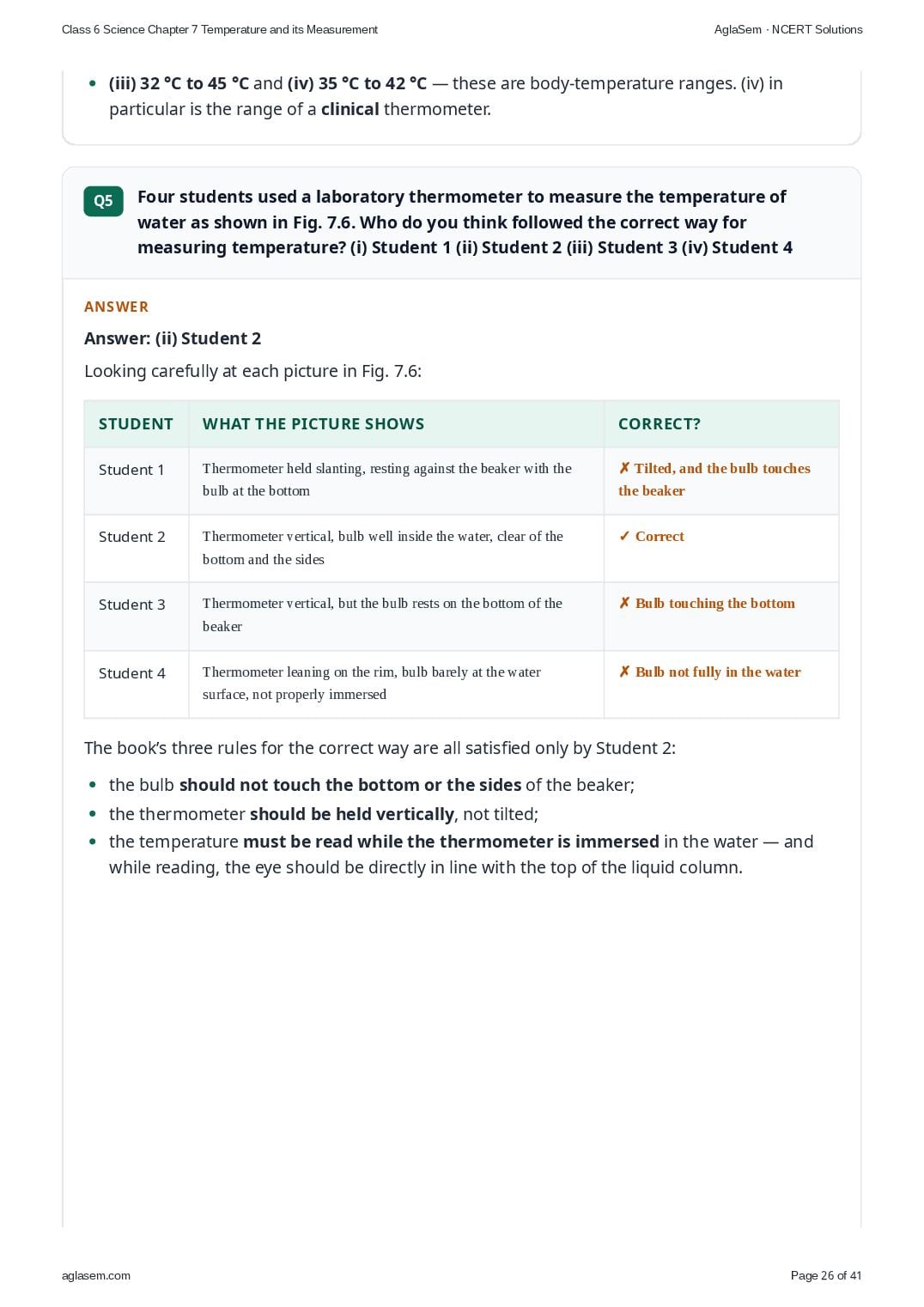
- Four students used a laboratory thermometer to measure the temperature of water as shown in Fig. 7.6. Who do you think followed the correct way for measuring temperature? (i) Student 1 (ii) Student 2 (iii) Student 3 (iv) Student 4
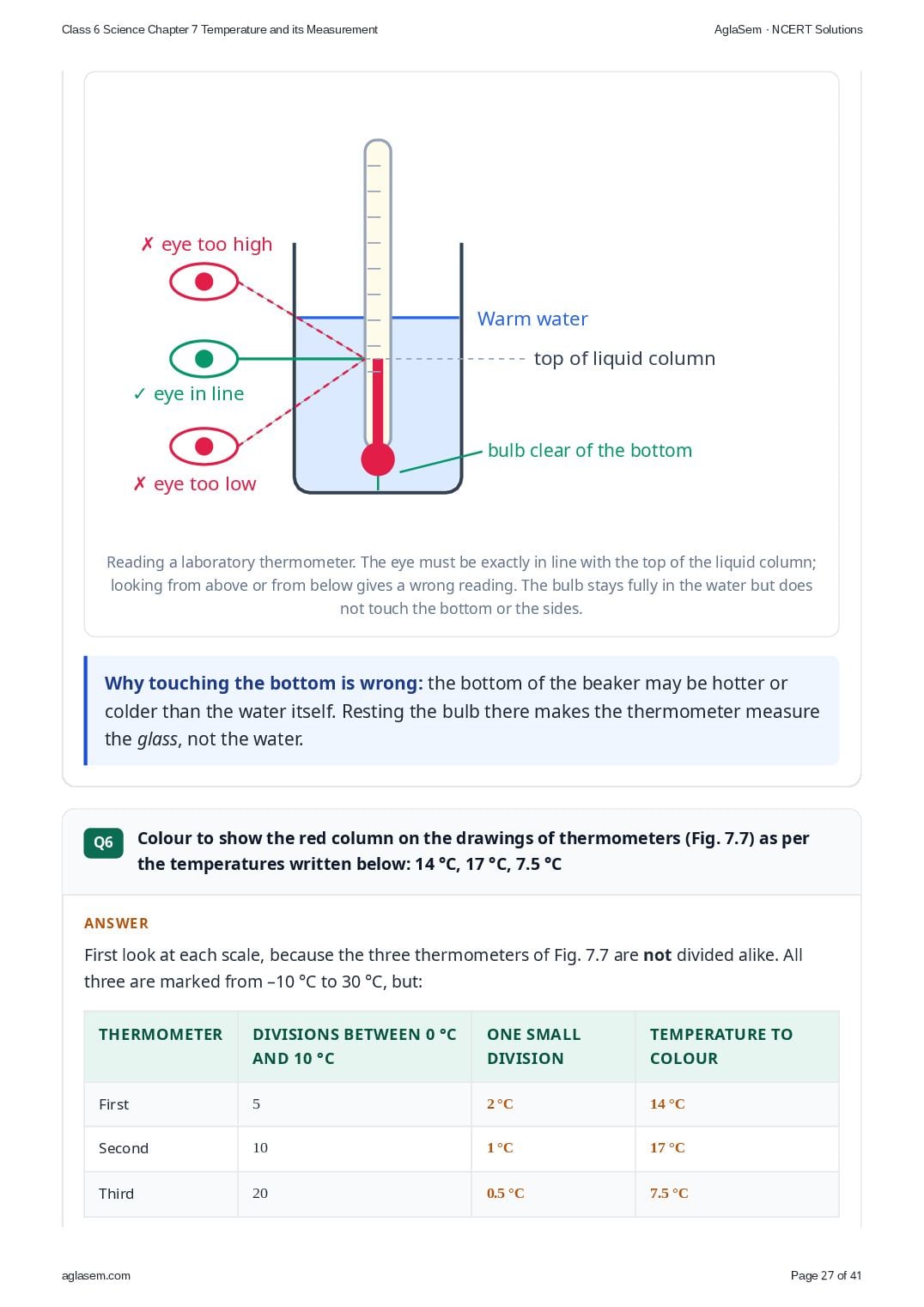
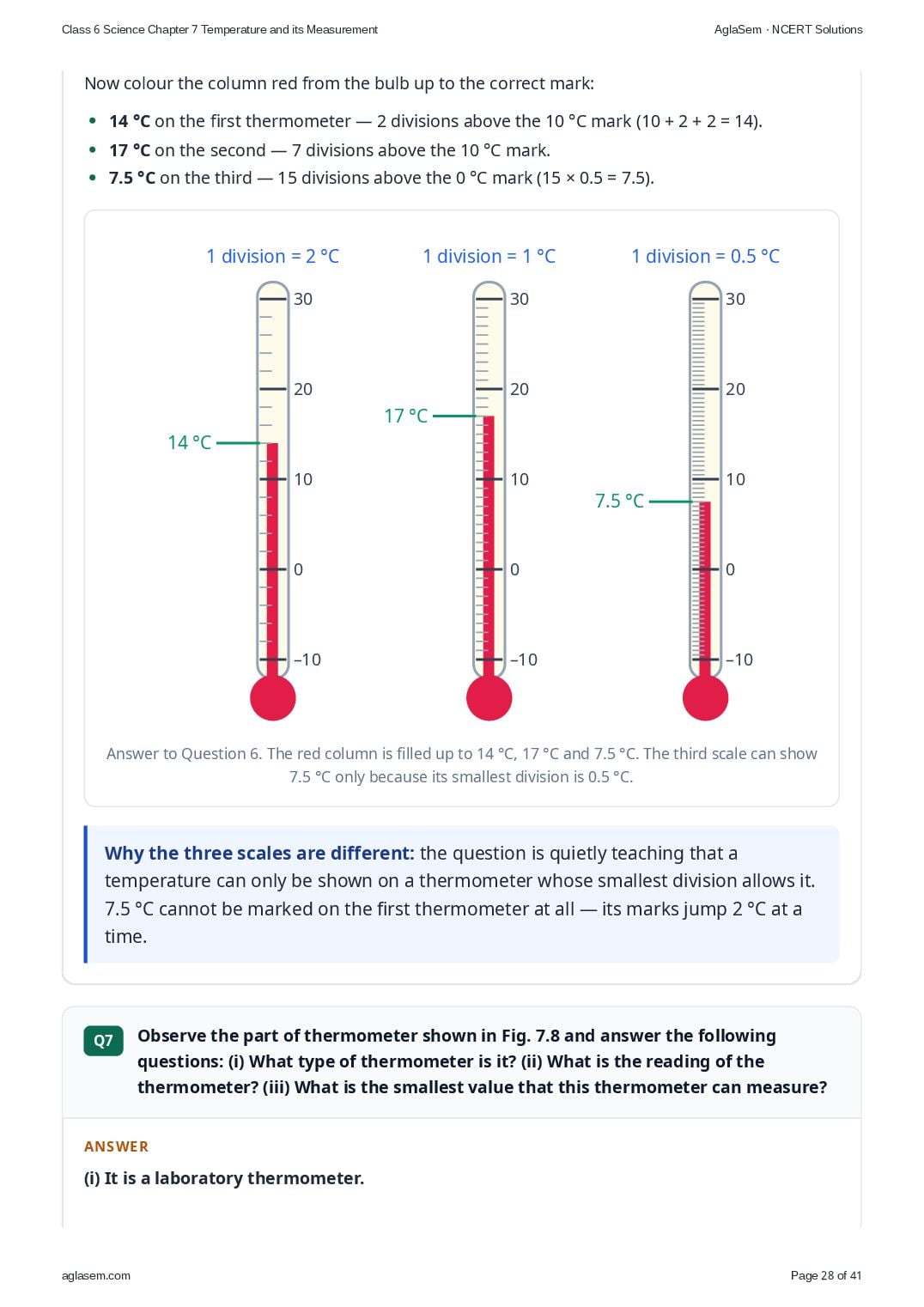
- Colour to show the red column on the drawings of thermometers (Fig. 7.7) as per the temperatures written below: 14 °C, 17 °C, 7.5 °C
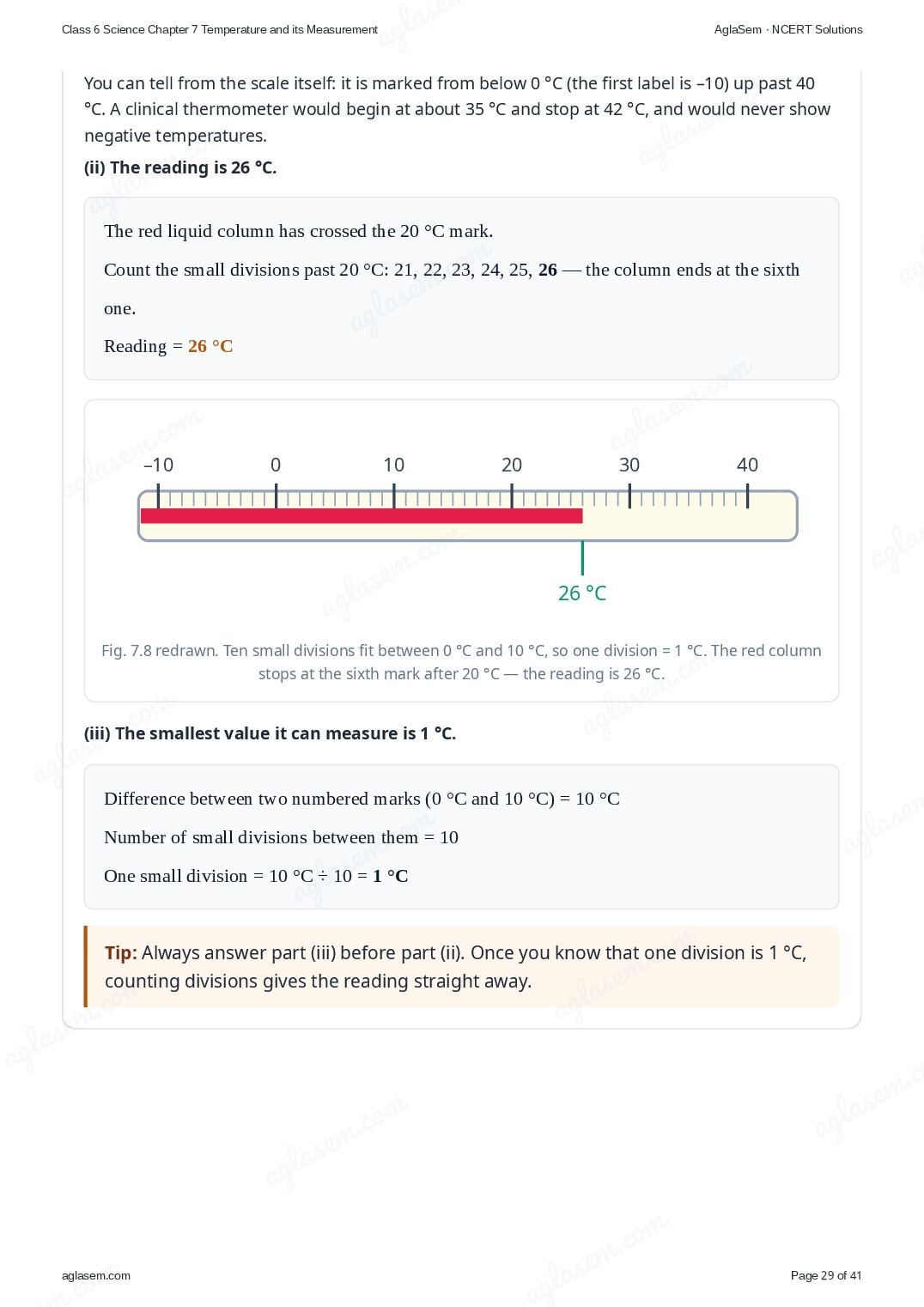
- Observe the part of thermometer shown in Fig. 7.8 and answer the following questions: (i) What type of thermometer is it? (ii) What is the reading of the thermometer? (iii) What is the smallest value that this thermometer can measure?
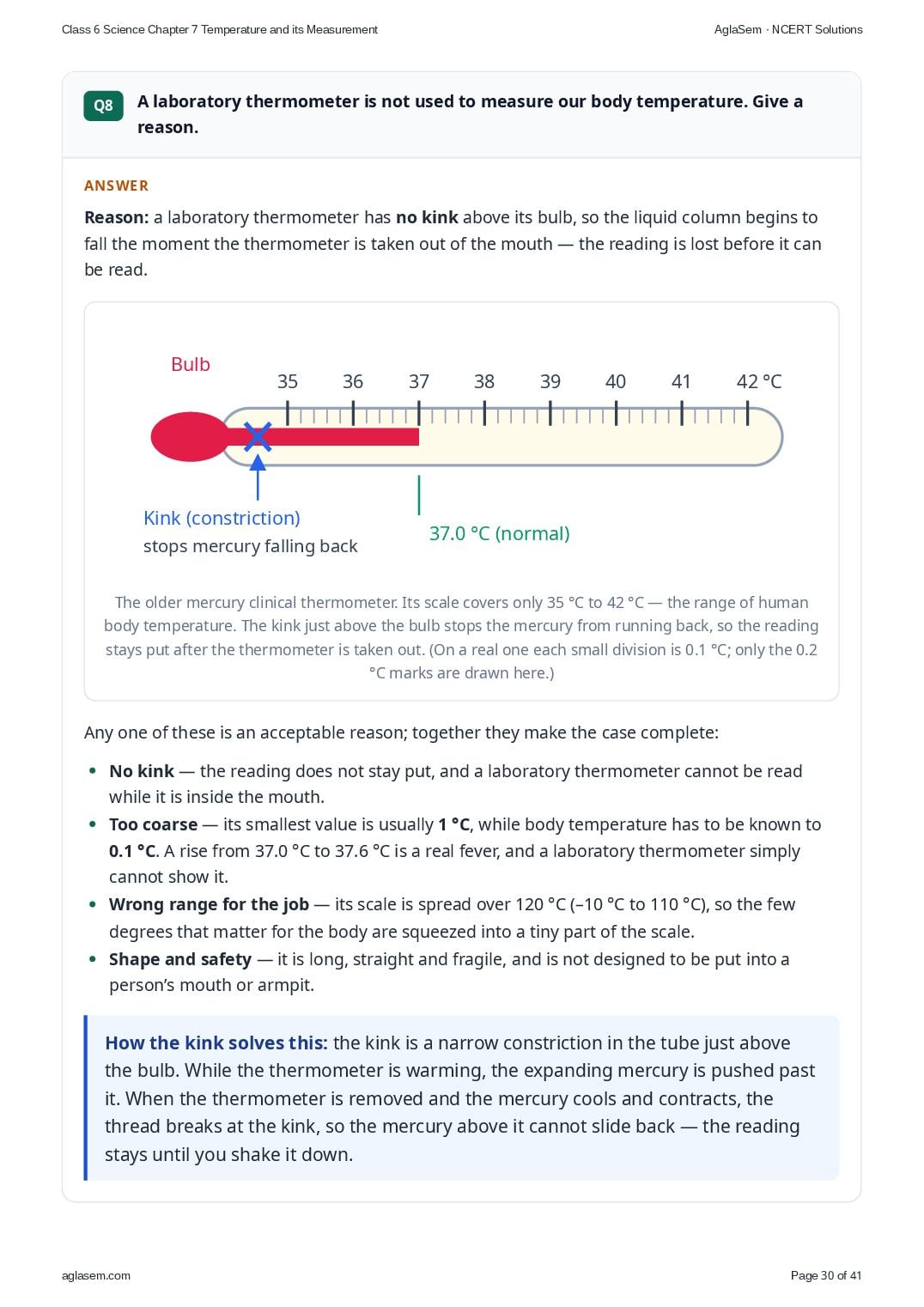
- A laboratory thermometer is not used to measure our body temperature. Give a reason.
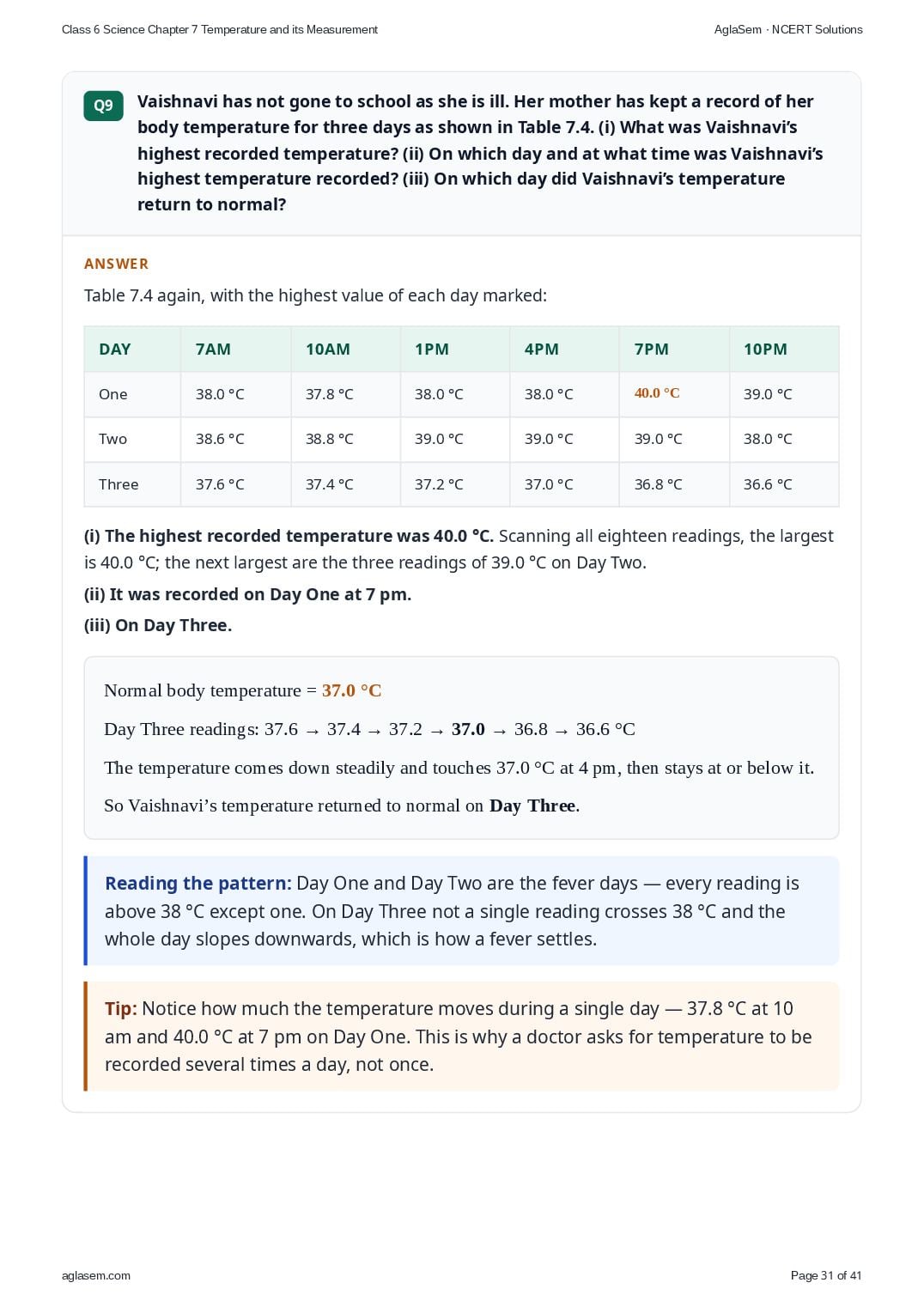
- Vaishnavi has not gone to school as she is ill. Her mother has kept a record of her body temperature for three days as shown in Table 7.4. (i) What was Vaishnavi’s highest recorded temperature? (ii) On which day and at what time was Vaishnavi’s highest temperature recorded? (iii) On which day did Vaishnavi’s temperature return to normal?
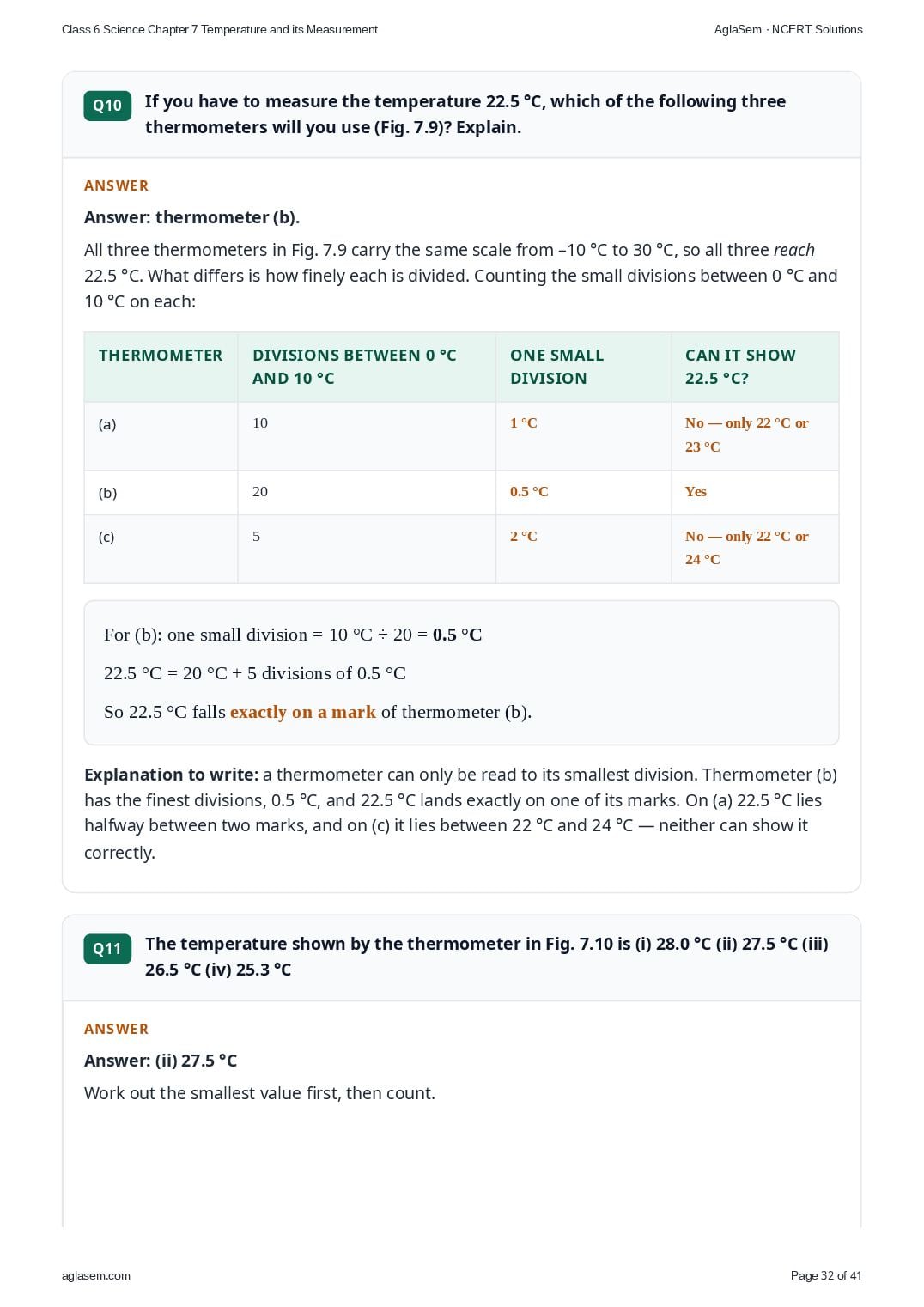
- If you have to measure the temperature 22.5 °C, which of the following three thermometers will you use (Fig. 7.9)? Explain.
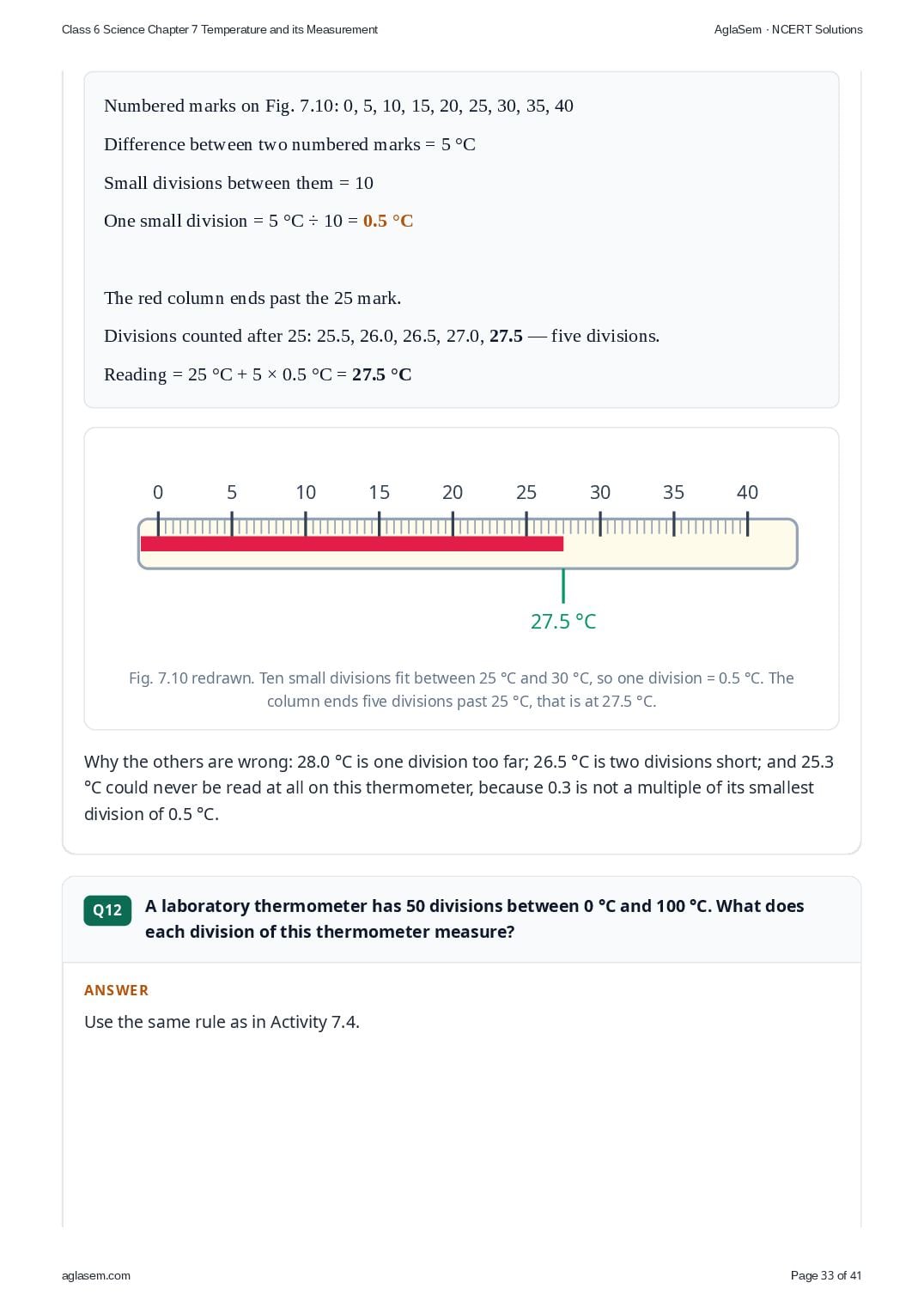
- The temperature shown by the thermometer in Fig. 7.10 is (i) 28.0 °C (ii) 27.5 °C (iii) 26.5 °C (iv) 25.3 °C
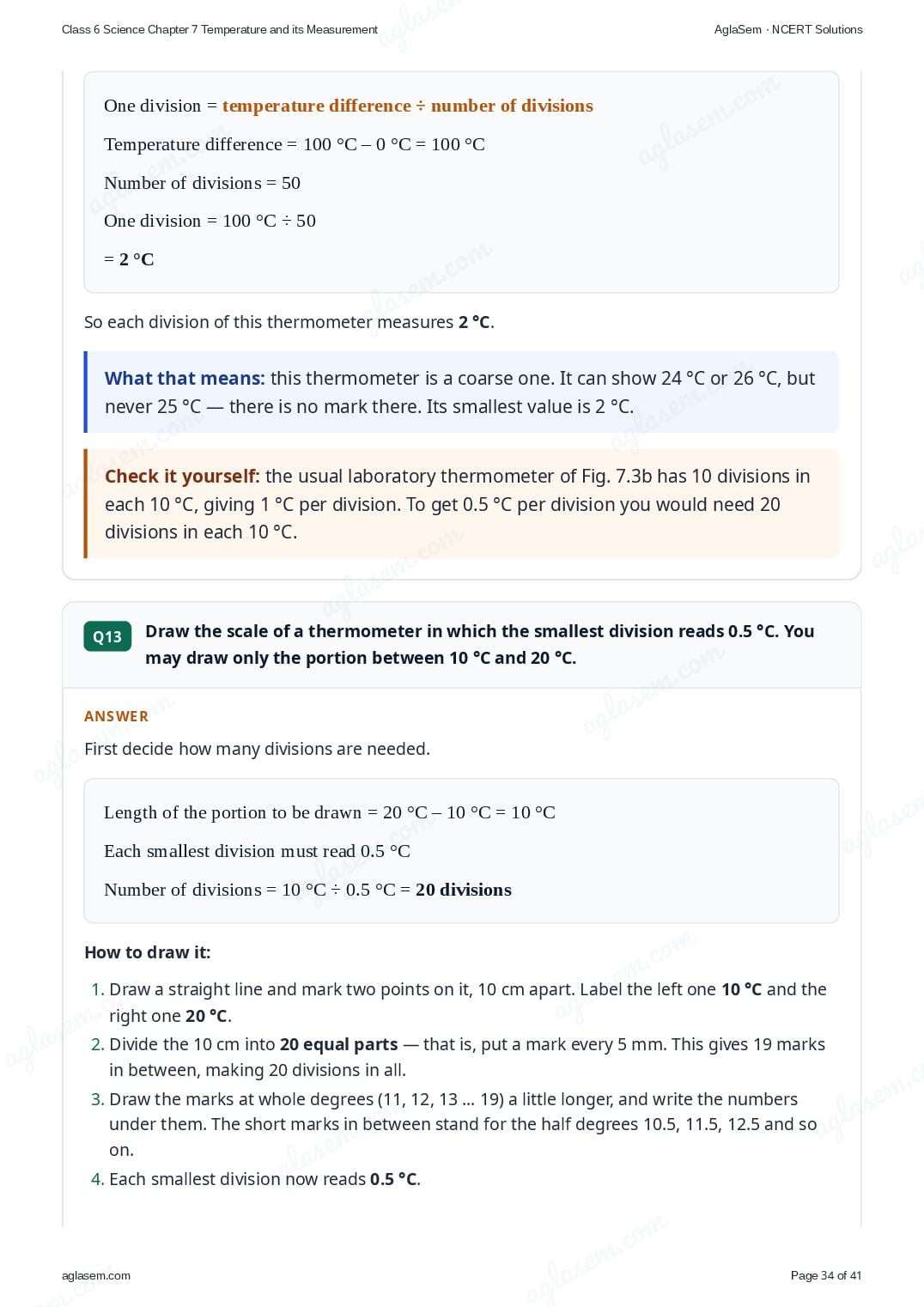
- A laboratory thermometer has 50 divisions between 0 °C and 100 °C. What does each division of this thermometer measure?
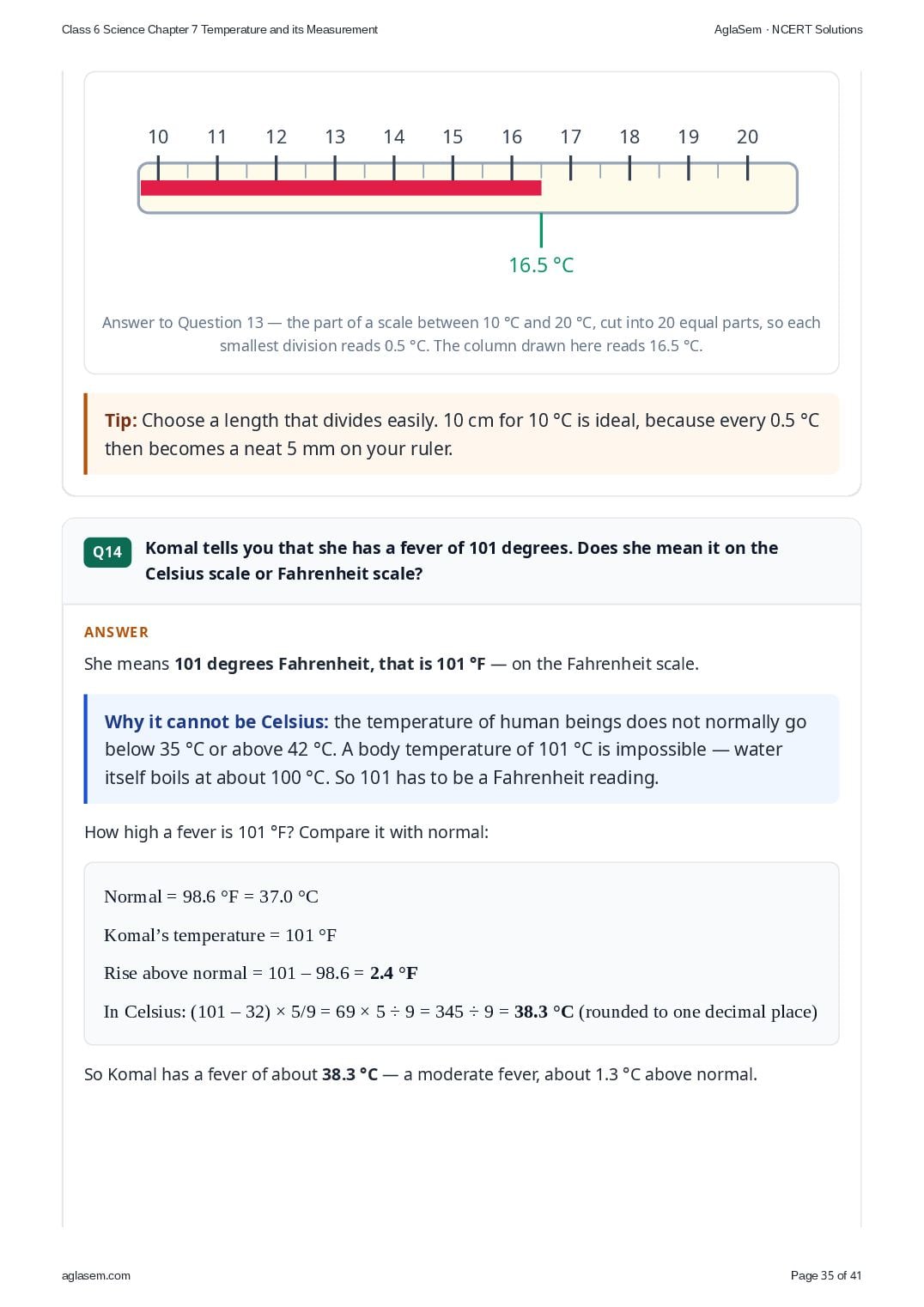
- Draw the scale of a thermometer in which the smallest division reads 0.5 °C. You may draw only the portion between 10 °C and 20 °C.
- Komal tells you that she has a fever of 101 degrees. Does she mean it on the Celsius scale or Fahrenheit scale?
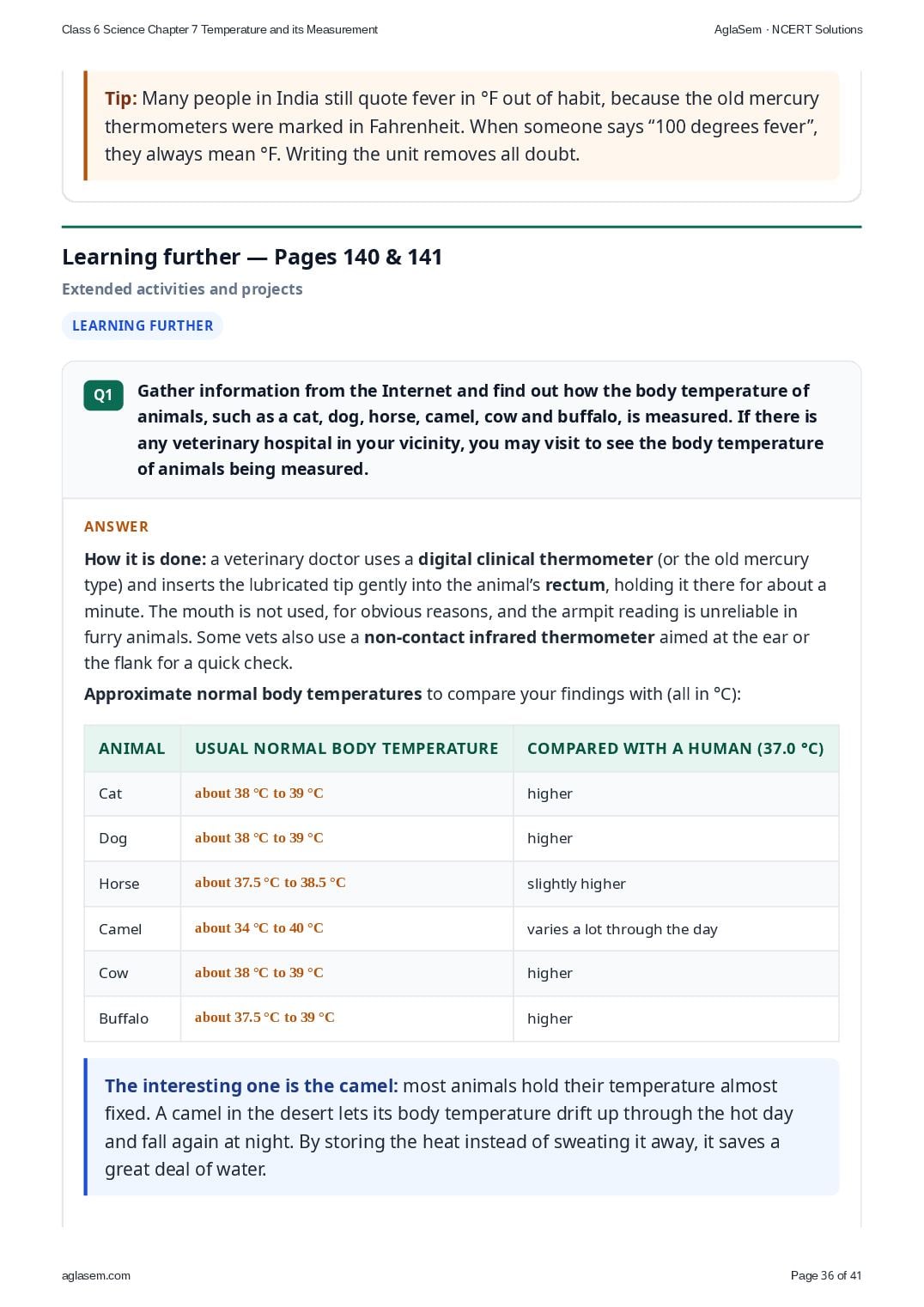
- Gather information from the Internet and find out how the body temperature of animals, such as a cat, dog, horse, camel, cow and buffalo, is measured. If there is any veterinary hospital in your vicinity, you may visit to see the body temperature of animals being measured.
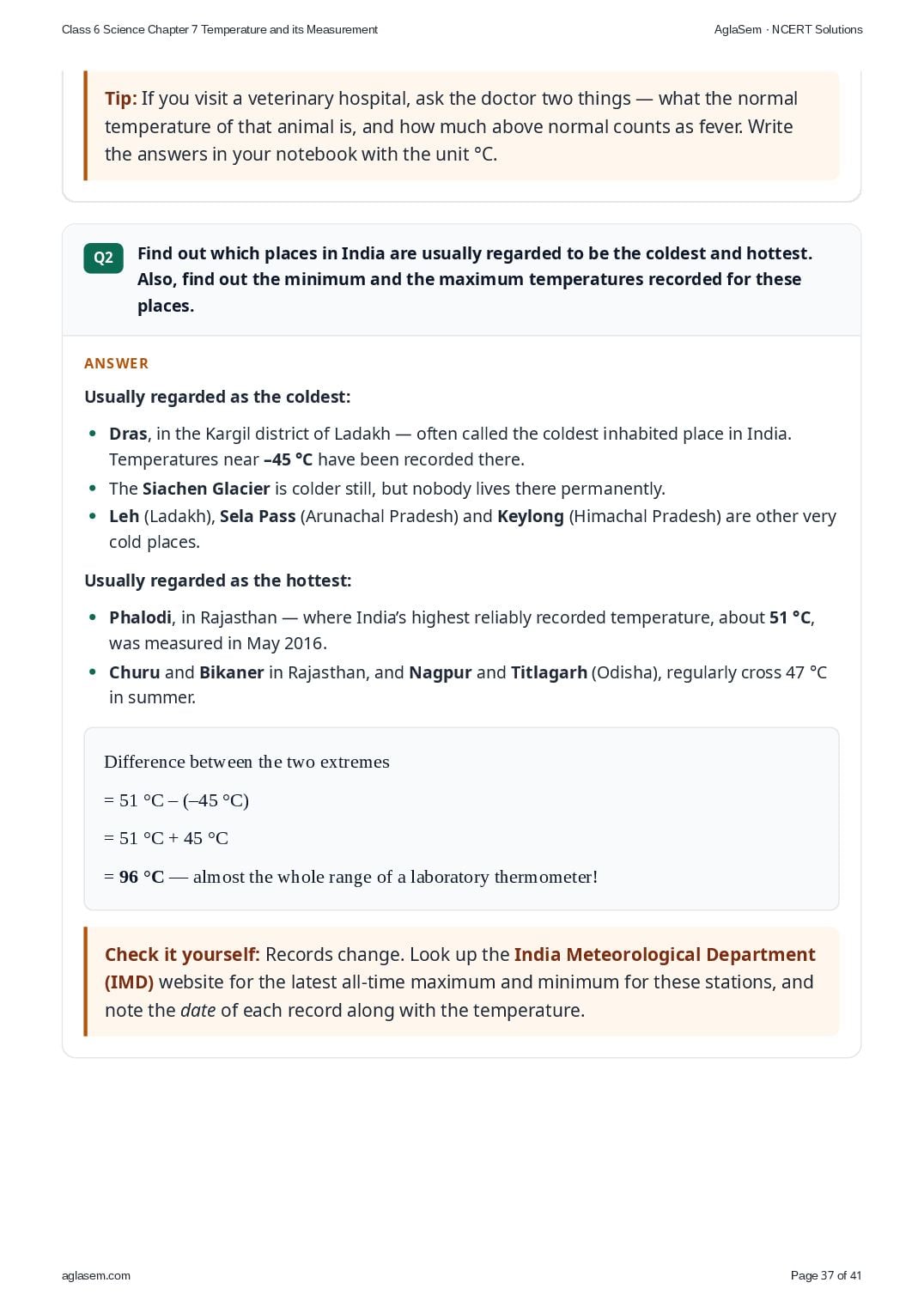
- Find out which places in India are usually regarded to be the coldest and hottest. Also, find out the minimum and the maximum temperatures recorded for these places.
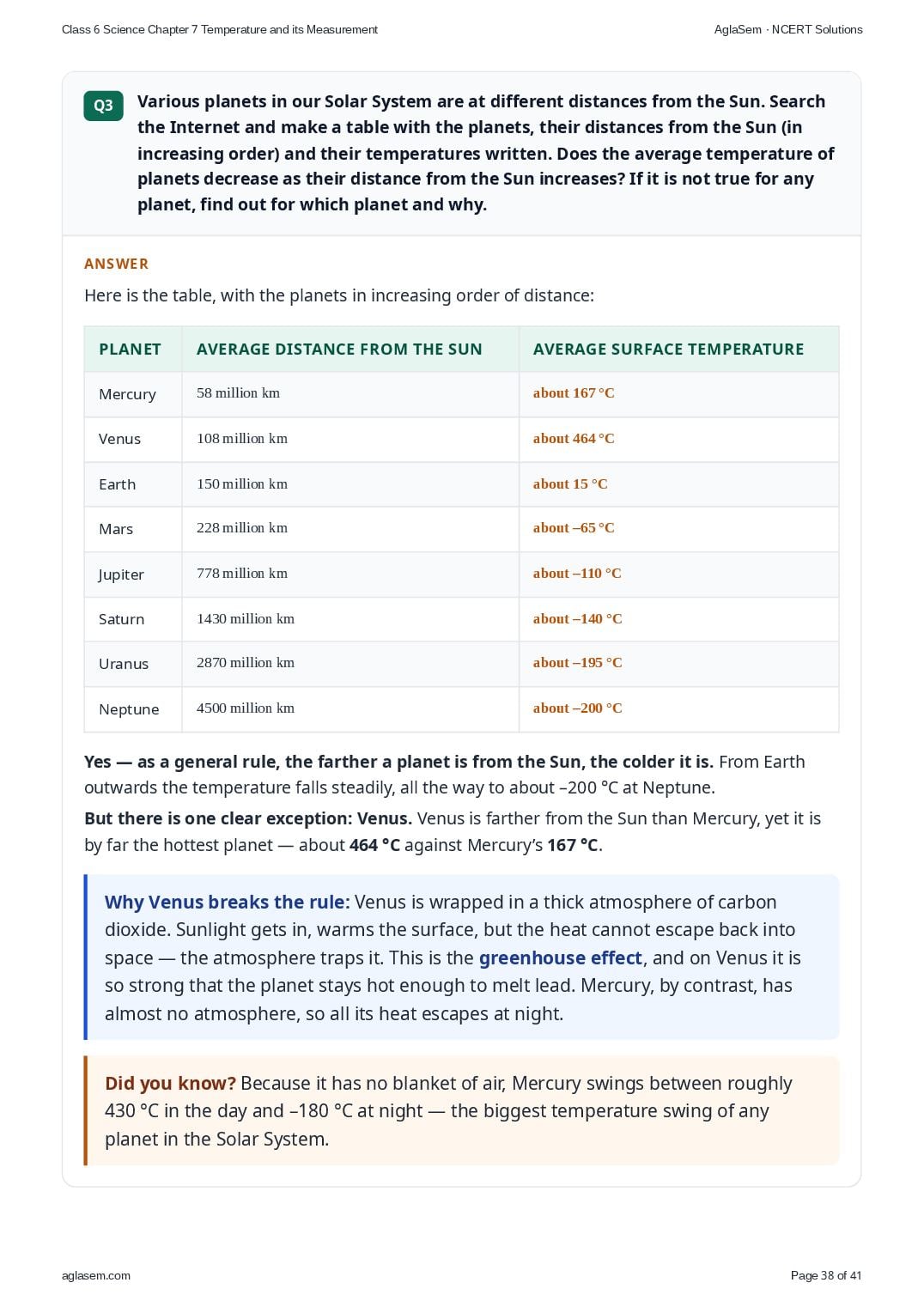
- Various planets in our Solar System are at different distances from the Sun. Search the Internet and make a table with the planets, their distances from the Sun (in increasing order) and their temperatures written. Does the average temperature of planets decrease as their distance from the Sun increases? If it is not true for any planet, find out for which planet and why.
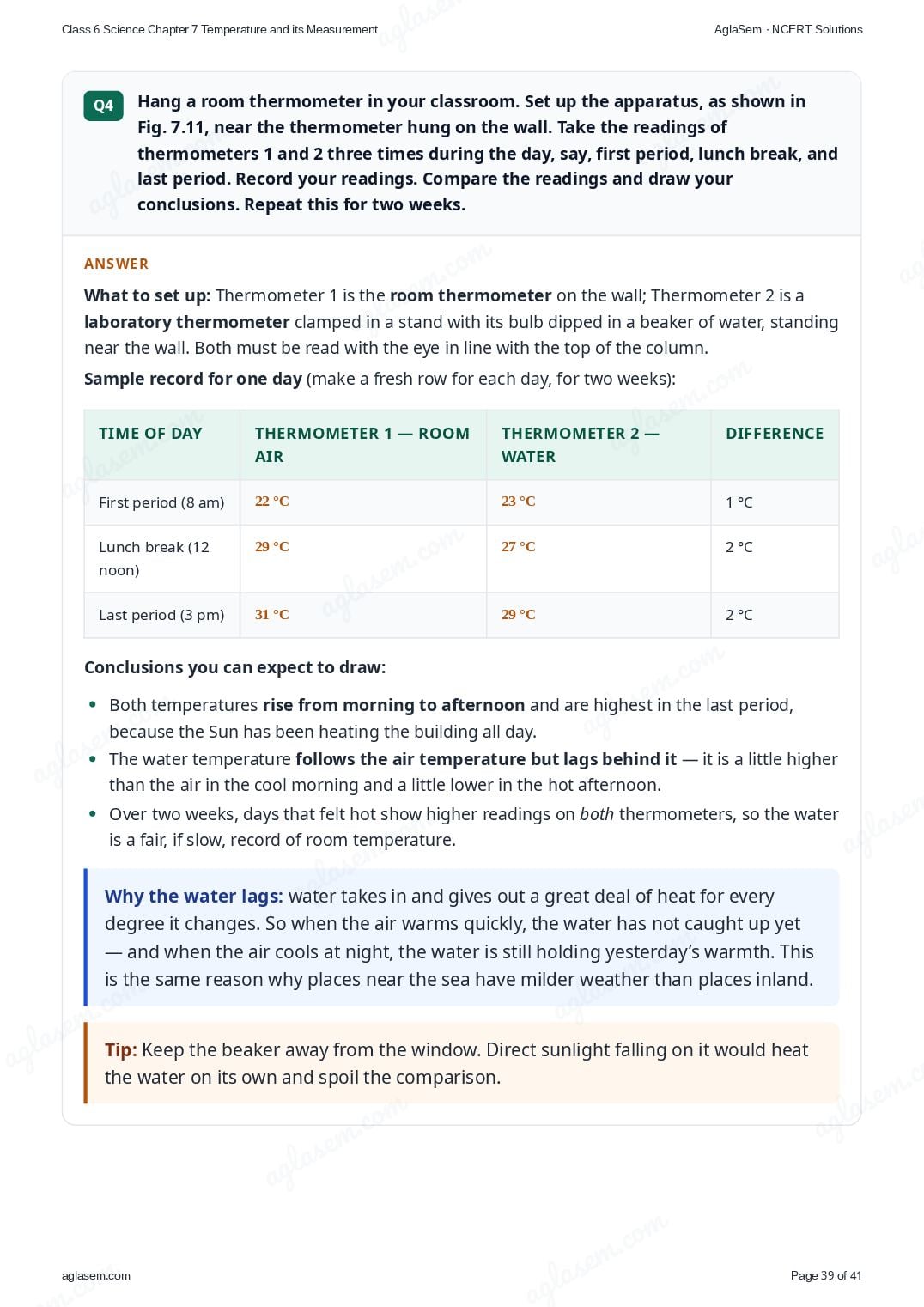
- Hang a room thermometer in your classroom. Set up the apparatus, as shown in Fig. 7.11, near the thermometer hung on the wall. Take the readings of thermometers 1 and 2 three times during the day, say, first period, lunch break, and last period. Record your readings. Compare the readings and draw your conclusions. Repeat this for two weeks.
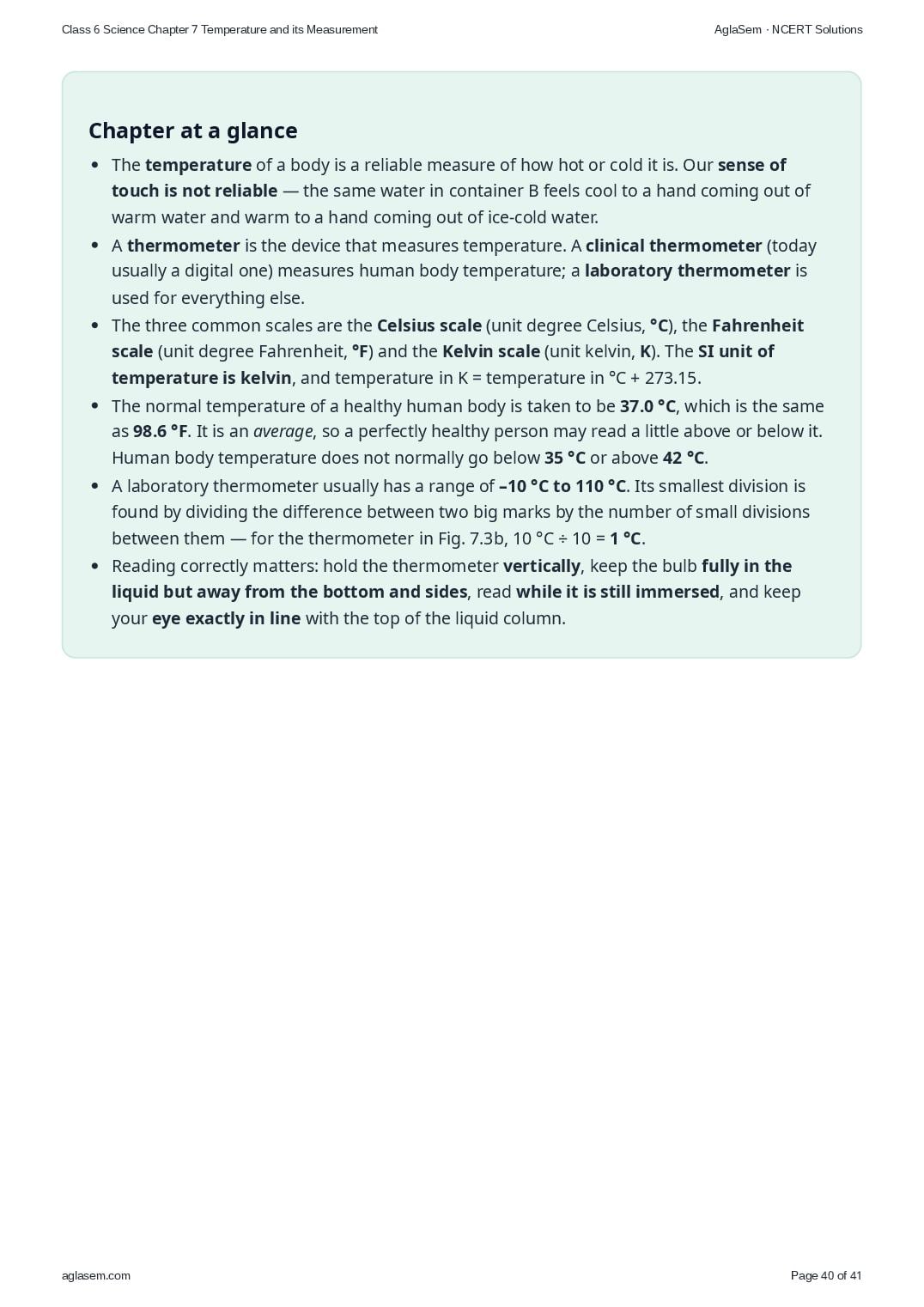
Chapter at a Glance
- The temperature of a body is a reliable measure of how hot or cold it is. Our sense of touch is not reliable — the same water in container B feels cool to a hand coming out of warm water and warm to a hand coming out of ice-cold water.
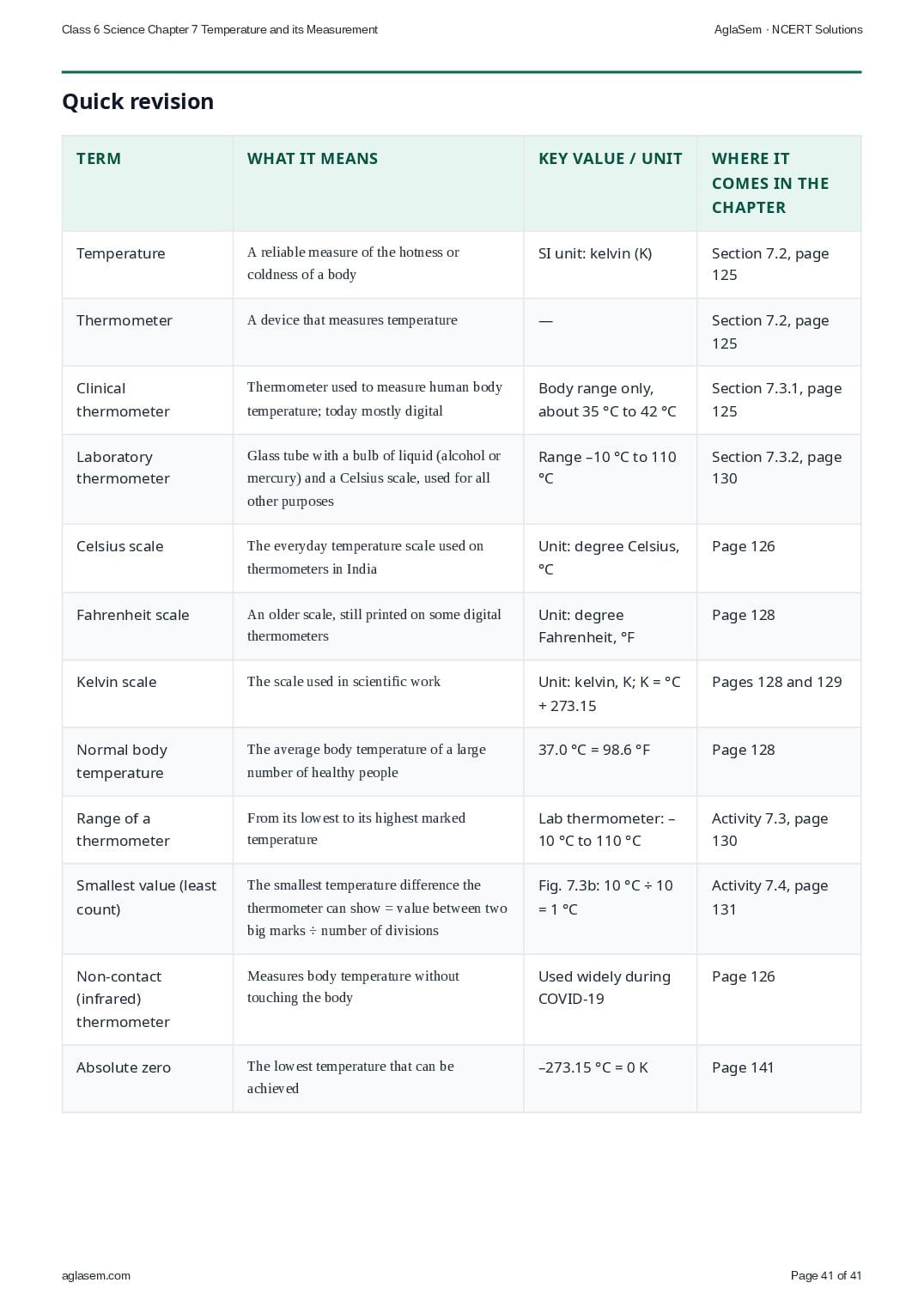
- A thermometer is the device that measures temperature. A clinical thermometer (today usually a digital one) measures human body temperature; a laboratory thermometer is used for everything else.
- The three common scales are the Celsius scale (unit degree Celsius, °C ), the Fahrenheit scale (unit degree Fahrenheit, °F ) and the Kelvin scale (unit kelvin, K ). The SI unit of temperature is kelvin , and temperature in K = temperature in °C + 273.15.
- The normal temperature of a healthy human body is taken to be 37.0 °C , which is the same as 98.6 °F . It is an average , so a perfectly healthy person may read a little above or below it. Human body temperature does not normally go below 35 °C or above 42 °C .
- A laboratory thermometer usually has a range of –10 °C to 110 °C . Its smallest division is found by dividing the difference between two big marks by the number of small divisions between them — for the thermometer in Fig. 7.3b, 10 °C ÷ 10 = 1 °C .
- Reading correctly matters: hold the thermometer vertically , keep the bulb fully in the liquid but away from the bottom and sides , read while it is still immersed , and keep your eye exactly in line with the top of the liquid column.
How to Download NCERT Solutions for Class 6 Science Chapter 7 PDF
Follow these simple steps to get the Temperature and Its Measurement questions-and-answers PDF from Curiosity.
- Search NCERT Solutions for Class 6 Science Chapter 7 aglasem and open this page.
- Read the exercise questions with answers for Temperature and Its Measurement shown above.
- Click the Download PDF link to save the Temperature and Its Measurement solutions to your device.
NCERT Solutions for Class 6 Science – All Chapters
There are more chapters to study besides Temperature and Its Measurement in Science. Here are the NCERT Solutions for all chapters of Class 6 Science.
- Chapter 1 the Wonderful World of Science
- Chapter 2 Diversity in the Living World
- Chapter 3 Mindful Eating a Path to a Healthy Body
- Chapter 4 Exploring Magnets
- Chapter 5 Measurement of Length and Motion
- Chapter 6 Materials Around Us
- Chapter 7 Temperature and Its Measurement
- Chapter 8 a Journey Through States of Water
- Chapter 9 Methods of Separation in Everyday Life
- Chapter 10 Living Creatures Exploring Their Characteristics
- Chapter 11 Nature’s Treasures
- Chapter 12 Beyond Earth
NCERT Solutions for Class 6 – All Subjects
Just like Chapter 7 of Science, you can get the exercise questions with answers for every other subject of Class 6. Here are the NCERT Solutions for all subjects of Class 6.
NCERT Solutions for Class 6 Science Chapter 7 – An Overview
The key highlights of this study material are as follows.
| Aspects | Details |
|---|---|
| Class | Class 6 |
| Subject | Science |
| Chapter Number | Chapter 7 |
| Chapter Name | Temperature and Its Measurement |
| Book Name | Curiosity |
| Book By | NCERT (National Council of Educational Research and Training) |
| Educational Resource Here | NCERT Solutions of Class 6 Science Chapter 7 for all exercises |
| More Questions Answers of This Subject | NCERT Solutions for Class 6 Science |
| Download Book Chapter | NCERT Book Class 6 Science |
| All Questions Answers For This Class | NCERT Solutions for Class 6 |
| Complete Solutions | NCERT Solutions |
NCERT Solutions for Class 6 Science Chapter 7 Temperature and Its Measurement – FAQs
What are the NCERT Solutions for Class 6 Science Chapter 7 Temperature and Its Measurement?
They are the complete, step-by-step answers to all the exercise and in-text questions of Chapter 7 Temperature and Its Measurement from the NCERT Class 6 Science textbook Curiosity, written by experts as per the latest NCERT syllabus.
How can I download the Class 6 Science Chapter 7 solutions PDF for free?
Open this page on aglasem, read the Temperature and Its Measurement questions with answers, and click the “Download Solutions PDF” link. The Class 6 Science Chapter 7 NCERT Solutions PDF is completely free to download.
Are these NCERT Solutions as per the latest 2026-27 syllabus?
Yes. The NCERT Solutions for Class 6 Science Chapter 7 are based on the latest NCERT textbook Curiosity and the current 2026-27 CBSE syllabus, so the questions and answers match what you study in class.
Where can I get NCERT Solutions for the other chapters of Class 6 Science?
You can find the answers to every chapter on the NCERT Solutions for Class 6 Science page, and solutions for every subject on the NCERT Solutions for Class 6 page.
How do NCERT Solutions help in exam preparation?
They show the correct method to solve each question, help you write answers the way they are expected in exams, let you check and correct your own work, and save revision time — which together improve your marks in Class 6 Science.
If you have any queries on NCERT Solutions for Class 6 Science Chapter 7 Temperature and Its Measurement, then please ask in the comments below.