NCERT Solutions for Class 7 Social Science Chapter 7 the Gupta Era an Age of Tireless Creativity – step-by-step answers to every exercise and in-text question of the chapter, as per the latest NCERT syllabus for 2027. Read them online or download the free question-answer PDF.
Solutions for Class 7 Social Science Chapter 7 The Gupta Era: An Age of Tireless Creativity, from Theme B Tapestry of the Past of the textbook Exploring Society: India and Beyond (Grade 7, Part 1). Every question in the chapter is answered — The Big Questions, all six LET’S EXPLORE boxes, THINK ABOUT IT, the two DON’T MISS OUT boxes that ask something, Before we move on … and all seven Questions and activities.
NCERT Solutions for Class 7 Social Science Chapter 7 the Gupta Era an Age of Tireless Creativity PDF
All the answers are on this page below. The PDF also explains every answer – why it is right and how to check it – so download it for revision.
| Chapter | Download | |
|---|---|---|
| Solutions PDF (English medium) | The Gupta Era an Age of Tireless Creativity | View PDF |
| Solutions PDF (Hindi medium) | गुप्त काल— अथक सृजनशीलता का युग | View PDF |
NCERT Solutions for Class 7 Social Science Chapter 7 the Gupta Era an Age of Tireless Creativity – Questions and Answers
All 22 questions of the chapter (textbook pages 145 – 166) are answered below, in the order of the book – in-text questions, activities and the end-of-chapter exercises. Each answer is written the way you would write it in the exam.
The Big Questions — Page 145Chapter opening — Theme B, Tapestry of the Past
Who they were: The Guptas were a dynasty that rose in the 3rd century CE, as the Kuṣhāṇa Empire weakened. Starting as regional rulers near present-day Uttar Pradesh, they built the strongest empire of the time, with its capital at Pāṭaliputra (Patna). Famous rulers: Chandragupta I, Samudragupta and Chandragupta II.
Why ‘classical age’: A long period of peace and stability let the state support scholars and artists, so literature, science, mathematics, medicine, metallurgy and art reached very high standards. So some historians call it India’s ‘classical age’.
While the Guptas ruled the north, other kingdoms flourished: the Vākāṭakas in central India (capital Nandivardhana, near Nagpur), who were allies of the Guptas; the Pallavas in the south (capital Kānchipuram); and the Kāmarūpa kingdom of the Varman dynasty in the Brahmaputra valley (Assam). Samudragupta defeated the Pallava and Kāmarūpa rulers but let them keep their thrones as tribute-payers. Art and learning grew in all these kingdoms.
Great figures: Samudragupta (warrior king who also played the veena), Chandragupta II ‘Vikramāditya’ (patron of scholars; the Iron Pillar), Prabhāvatī Gupta (regent ruler of the Vākāṭakas), Āryabhaṭa (the Earth spins on its axis; eclipses explained), Varāhamihira (Bṛihat Samhitā) and Kālidāsa (Meghadūtam).
Why they matter today: their work in science, literature, art and government is still studied and admired, and their stories show the value of knowledge, hard work and support for talent.
DON’T MISS OUT — Page 149Why Chandragupta II carries a ‘II’ after his name
Yes. Historians added the ‘II’ because there was an earlier Gupta king with the same name — his grandfather, Chandragupta I. The number simply helps us tell the two apart. (Both are different from Chandragupta Maurya of the Maurya dynasty.)
THINK ABOUT IT — Page 150Fig. 7.5, an inscription by Harisena — the prayāga praśhasti
Kings used inscriptions because:
- stone and metal last for centuries, so their fame would be remembered;
- a pillar in a public place announced their victories and good deeds to everyone who passed by;
- a list of defeated kings warned rivals and showed the king’s right to rule.
For example, Harisena’s prayāga praśhasti still tells us about Samudragupta.
LET’S EXPLORE — Page 151Looking back at the Grade 6 chapter ‘Timeline and Sources of History’
Sources used so far, and what each tells us:
- Iron Pillar, Mehrauli — advanced metallurgy; set up in Chandragupta II’s reign.
- Its inscription — a king ‘Chandra’ (Chandragupta II), a devotee of Viṣhṇu.
- Prayāga praśhasti by Harisena — Samudragupta’s wars and his support for art, learning and trade.
- Gold coins — Chandragupta I with Kumāradevī; Samudragupta playing the veena; the aśhvamedha horse.
- Viṣhṇu Purāṇa — the main regions ruled by the Guptas.
LET’S EXPLORE — Page 151Fig. 7.8 — the extent of the Gupta Empire on a modern political map
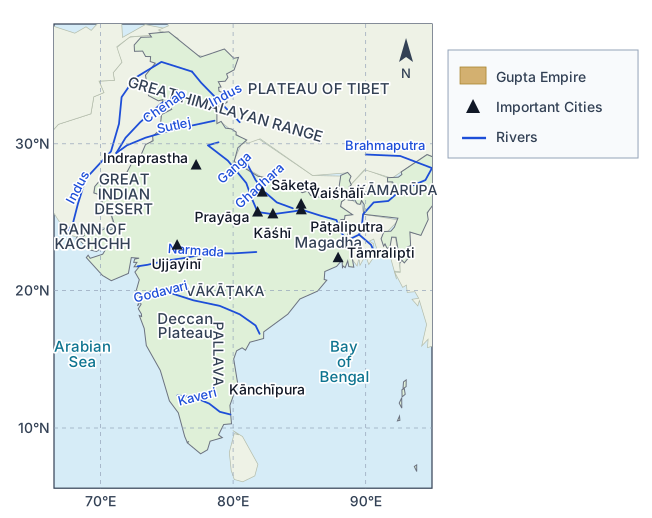
Using the cities marked on Fig. 7.8 and the chapter’s words (‘most of present-day north and west India, along with parts of central and east India’), I marked 15: 13 states — Punjab, Haryana, Himachal Pradesh, Uttarakhand, Uttar Pradesh, Rajasthan, Gujarat, Madhya Pradesh, Chhattisgarh (part), Bihar, Jharkhand, West Bengal, Odisha (part) — and 2 Union territories, Delhi and Chandigarh. Friends’ counts may differ a little, because ancient frontiers do not match modern state borders.
LET’S EXPLORE — Page 153A Traveller’s Account of Indian Society in the Gupta Age — Faxian’s travelogue
Key features of the society Faxian describes:
- people were many and happy, with little interference from officials (no need to register households);
- farmers of royal land paid a share of their grain as tax, and the king’s guards were paid salaries;
- cities were large, rich and well kept, with wealthy Vaishya and foreign merchants;
- charity houses gave free food and medicine to the poor, orphans and the sick.
But it is one visitor’s view: elsewhere he records the harsh treatment of the chanḍālas.
LET’S EXPLORE — Page 155Fig. 7.10, an artist’s reimagination of Prabhāvatī Gupta sitting in her court
What Fig. 7.10 shows — an artist’s colour illustration of Prabhāvatī Gupta in her court:
- On the left, Prabhāvatī Gupta sits on a carved dark-wood throne with a rounded back, a magenta cushion and a bolster; her feet rest on a round yellow-and-orange rug.
- Her attire: a red-orange bodice and a long red skirt, a gold sunburst crown on her hair, which is tied up high, two gold necklaces, armlets, broad bangles, a jewelled waistband, anklets, red slippers and large earrings.
- Her posture: seated upright and calm, looking across towards the visitors on the right. A small child — a young prince in a white dhoti with a gold necklace — sits on her lap, held by her arm.
- Behind the throne a woman attendant in a white sari and gold jewellery stands holding a white chauri (fly-whisk).
- On the right, a court official in a grey robe and turban stands reading from a sheet in his hands, and below him two bearded elders in turbans and plain robes kneel on the floor with folded hands.
- The setting: heavy carved pillars, a pink canopy overhead and a tall ornate archway on the right — the pillared audience hall of a court.
Sample observations: Prabhāvatī Gupta wears a gold crown and rich jewellery and sits on a high carved throne — she is a royal ruler. A small prince sits on her lap: after her husband’s early death she ruled as regent for her young son. An attendant waves a chauri, an official reads out a document and elders kneel with folded hands, so her authority was accepted. The rich hall shows a wealthy court. In her time, a woman could hold real political power.
LET’S EXPLORE — Page 159Meeting Āryabhaṭa and Varāhamihira with Bhavisha and Dhruv’s time machine
Sample questions — Group 1 (Āryabhaṭa):
- How did you work out that the Earth spins on its axis?
- How did you measure the length of the year without a clock?
- How did you explain solar and lunar eclipses?
Group 2 (Varāhamihira):
- Why does your Bṛihat Samhitā cover so many subjects, from astronomy to farming?
- How did you forecast the weather?
- What advice did you give for planning a town?
DON’T MISS OUT — Page 160The codification of Āyurveda in the Gupta period
Yes. Āyurveda is much older — its roots go back several centuries BCE — but it was codified (written in an organised, systematic way) in the Gupta period, when the Charaka Saṃhitā and Suśhruta Saṃhitā were compiled and given their final shape. They deal with diseases and their diagnosis, treatment, diet, medicines and surgery, and stress holistic healing of mind, body and nature.
LET’S EXPLORE — Page 160Fig. 7.15.1 and 7.15.2, ‘Various aspects of Gupta art’ (page 162)
What Fig. 7.15.1 and Fig. 7.15.2 show — two photographs of Gupta-period sculpture:
- Fig. 7.15.1 — a tall rounded shaft of dark red sandstone standing on a white base. On the front, one human face is carved: half-closed eyes, a calm half-smile, long ear-lobes with earrings and a bead necklace at the throat. Above the forehead the matted hair (jaṭā) is piled up in thick rolls, and a crescent moon is set in it.
- Fig. 7.15.2 — a standing male figure carved in sandstone, with four arms and a large circular halo behind the head, its rim covered with bands of carved ornament. He wears a tall crown, heavy earrings, necklaces, armlets, a dhoti tied with a sash, and a long garland looping down past the knees on both sides. The upper arms are broken; the lower left hand still holds a rounded object.
Fig. 7.15.1 — Śhiva: the crescent moon in the matted hair (jaṭā), the mark of a third eye and the liṅga shape are Śhiva’s attributes (a mukha-liṅga).
Fig. 7.15.2 — Viṣhṇu: a four-armed god with a tall crown, a large halo, a long garland and a conch in one hand — all attributes of Viṣhṇu.
Before we move on … — Page 165The chapter in three points, with the timeline of Fig. 7.19 (page 164)
The Guptas used three methods: military campaigns (Samudragupta defeated many kings and then reinstated them as tribute-payers); land grants to local rulers, priests and chieftains, recorded on copper plates, which ensured proper tax collection; and marriage alliances (Prabhāvatī Gupta, daughter of Chandragupta II, married a Vākāṭaka prince). Together these kept the empire stable.
Main contributions: literature — Kālidāsa’s Sanskrit works (Meghadūtam) and many Purāṇas; mathematics and astronomy — Āryabhaṭa (the Earth spins on its axis; eclipses explained) and Varāhamihira (Bṛihat Samhitā); medicine — Āyurveda codified in the Charaka and Suśhruta Saṃhitās; metallurgy — the rust-free Iron Pillar; art — Sārnāth sculptures, the Ajanta caves, Udayagiri caves and the Deogarh temple.
Besides the Guptas: the Vākāṭakas in central India (allies of the Guptas; the Ajanta caves were carved with their support), the Pallavas in the south (Kānchipuram, the ‘city of a thousand temples’, a centre of learning with its ghaṭikās), and the Varmans of Kāmarūpa in the Brahmaputra valley (temples and monasteries as hubs of learning). Their rule overlapped in time (Fig. 7.19), so culture and learning flourished across the subcontinent.
Questions and activities — Pages 165–166End-of-chapter exercise
Sample answer (about 270 words):
“Greetings from Pāṭaliputra! Life here is vibrant and full of excitement. Just yesterday, I witnessed a procession of the king’s guards riding down to the river ghat, and behind them a line of carts loaded with bales of cotton cloth, sacks of pepper and small sealed boxes of gemstones, all bound for Tāmralipti. From there, my uncle says, the goods sail to the Mediterranean, to Southeast Asia and to China. A Roman-looking merchant argued with a dyer in three languages and finally paid in gold.
Our lane is swept every morning and the drains run clear. At the corner stands the charity house built by the elders of our Vaishya quarter; anyone who is ill may go in, and the physician gives food and medicine without asking for money. My mother took our neighbour’s orphaned son there last month.
Father farms land belonging to the king outside the city, so at harvest he gives a portion of the grain as tax; the officials who come to measure it are paid a salary, and they do not trouble us. Yesterday a scribe let me watch him hammer letters into a copper plate — a grant of land the king has given to a village priest, he said, so that no one can argue about it a hundred years from now.
In the evenings a teacher recites Kālidāsa in the square, and an astronomer from Kusumapura told us that the Earth itself turns, which is why the Sun seems to move! Not everyone here is fortunate, though — the chanḍālas must live outside the walls, and I think of that too. Write soon.”
Chandragupta II was also known as ‘Vikramāditya’. He was the son of Samudragupta and a devotee of Viṣhṇu, and the Iron Pillar of Delhi was set up in his reign.
The statement is largely true for the Gupta Empire. A long period of peace and stability strengthened the economy, so the state could support scholars, artists and scientists:
- Social life: prosperous, well-kept cities and charity houses (Faxian); support for Buddhist institutions like Nālandā.
- Literature: Kālidāsa and many Purāṇas.
- Science and technology: Āryabhaṭa, Varāhamihira, Āyurveda codified, the rust-free Iron Pillar.
- Art: Ajanta, Sārnāth, Udayagiri, Deogarh.
But this peace was won through Samudragupta’s wars, and not everyone gained — the chanḍālas were treated as outcastes.
Sample script — Roles: King Chandragupta II, a herald, chief minister, merchant, physician, court poet and scribe.
Herald: Hail the mahārājadhirāja, Chandragupta Vikramāditya!
Minister: Mahārāja, the land tax has come in well this year.
Merchant: If the roads stay safe, our cloth and spices will reach the Mediterranean and China.
Physician: Help us copy the Charaka Saṃhitā, so that our knowledge of healing is not lost.
Poet: And let your deeds be carved on a pillar, as Harisena did for your father.
King: The roads shall be guarded and the scholars supported. Scribe, record this grant on a copper plate.
| Column A | Column B |
|---|---|
| (1) Kānchipuram | (a) Known for vibrant cave paintings that depict the Jātaka tales. |
| (2) Ujjayinī | (b) Famous for rock-cut caves featuring intricate carvings of Hindu deities, especially Viṣhṇu. |
| (3) Udayagiri | (c) Capital of the Guptas. |
| (4) Ajanta | (d) Known as ‘a city of a thousand temples’. |
| (5) Pāṭaliputra | (e) A prominent centre of learning in ancient India. |
Answer: (1) Kānchipuram → (d); (2) Ujjayinī → (e); (3) Udayagiri → (b); (4) Ajanta → (a); (5) Pāṭaliputra → (c).
The Pallavas were a dynasty of south India. Their origins are not clearly known; they seem to have been a tributary power under the Sātavāhanas and rose as the Sātavāhanas declined, ruling till the latter half of the 9th century CE. They ruled parts of present-day Tamil Nadu, Karnataka, Telangana and Andhra Pradesh, with their capital at Kānchipuram. Mostly devotees of Śhiva, they built magnificent temples and rock-cut caves.
Sample report (short): Our visit to a Gupta-period temple and its site museum.
Historical significance: built about 1,500 years ago, it shows how temples were built in the Gupta age.
Architecture: red sandstone blocks on a raised platform; a carved doorway with river goddesses — Ganga on a makara.
Artefacts: terracotta plaques, a carved stone panel, and small gold coins with a king on one side and a seated goddess on the other.
Interesting fact: the coins were only about the size of a one-rupee coin.
Reflection: seeing real carvings and coins made history feel real and showed me why historians check many sources.
Chapter 7 of 12 – Social Science
- Previous: Chapter 6 the Age of Reorganisation
- Next: Chapter 8 How the Land Becomes Sacred
- All chapters: NCERT Solutions Class 7 Social Science
Also for This Chapter
NCERT Solutions Class 7 Social Science Chapter 7 the Gupta Era an Age of Tireless Creativity – Overview
| Class | Class 7 |
| Subject | Social Science |
| Chapter | 7 – the Gupta Era an Age of Tireless Creativity |
| Textbook pages | 145 – 166 |
| Questions solved | 22 |
| Session | 2027 |
| Format | Full answers on this page + PDF |
NCERT Solutions Class 7 Social Science Chapter 7 – FAQs
Where can I download NCERT Solutions Class 7 Social Science Chapter 7 the Gupta Era an Age of Tireless Creativity PDF?
Read every answer on this page, or download the free PDF from the table at the top.
Is this for the 2027 session?
Yes, it follows the latest NCERT Class 7 Social Science book for 2027.
How many questions are solved in NCERT Class 7 Social Science Chapter 7?
All 22 questions of the chapter (textbook pages 145 – 166) – the in-text questions, activities and the end-of-chapter exercises.
How should I use these solutions?
Read the chapter in the NCERT book first, attempt the questions yourself, then check your answers here.