NCERT Solutions for Class 8 Social Science Chapter 1 Natural Resources and Their Use provide clear, step-by-step answers to every exercise and in-text question from the chapter Natural Resources and Their Use of the NCERT textbook Exploring Society: India and Beyond. Prepared by subject experts as per the latest NCERT (CBSE) syllabus for 2026-27, these NCERT Solutions for Class 8 Social Science help you understand each concept, write exam-ready answers, and check your own solutions. You can read them online below or download the free Class 8 Social Science Chapter 1 question-answer PDF.
NCERT Solutions for Class 8 Social Science Chapter 1 Natural Resources and Their Use
- Class: Class 8
- Subject: Social Science
- Chapter: Chapter 1 – Natural Resources and Their Use
- Textbook: Exploring Society: India and Beyond (NCERT)
- Study material: NCERT Solutions – questions with answers, free PDF
These solutions answer all the exercise questions of Chapter 1 Natural Resources and Their Use — including the in-text questions, short-answer and long-answer questions, and activities — with complete explanations so you can follow the method, not just the final answer. Read the full solutions below.
NCERT Solutions Class 8 Social Science Chapter 1 Natural Resources and Their Use View Download
NCERT Solutions for Class 8 Social Science Chapter 1 PDF Download
You can read the NCERT Solutions for Class 8 Social Science Chapter 1 online above, or download the complete question-answer PDF to study Natural Resources and Their Use offline at any time.
NCERT Solutions for Class 8 Social Science Chapter 1 PDF Download Link – Click Here to Download Solutions PDF
Questions Covered in This Chapter
These NCERT Solutions answer all 21 questions of this chapter. The questions solved are:
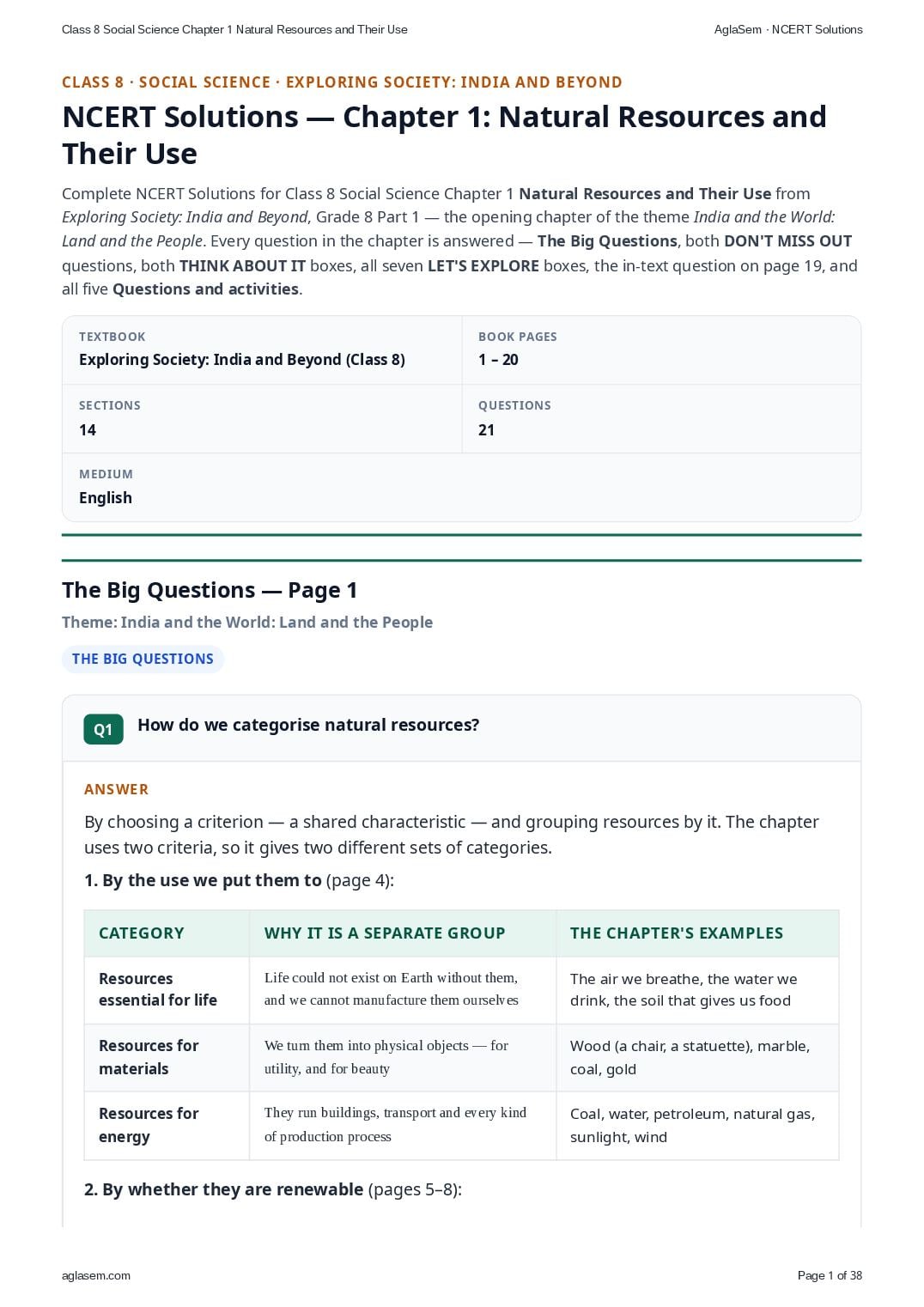
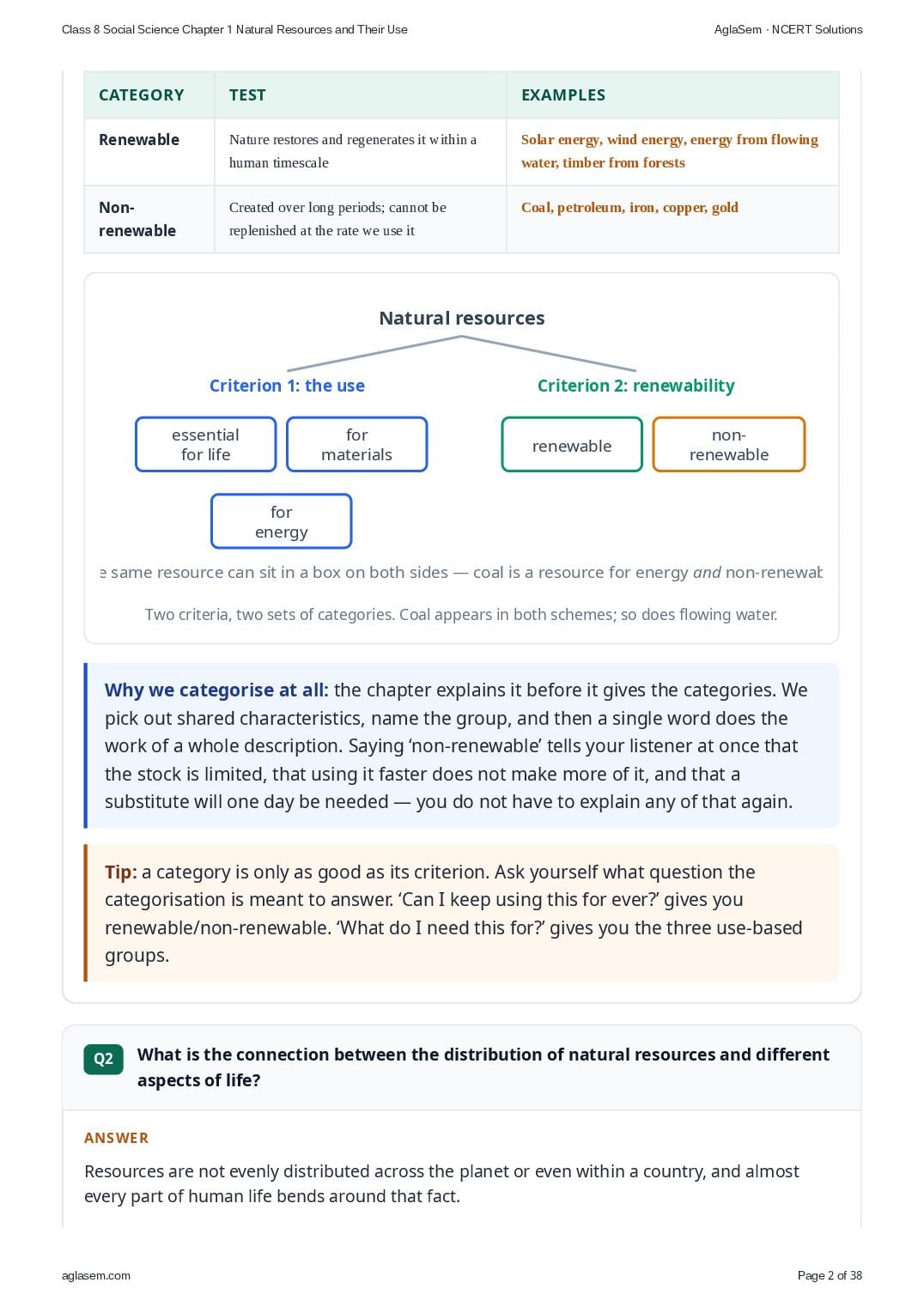
- How do we categorise natural resources?
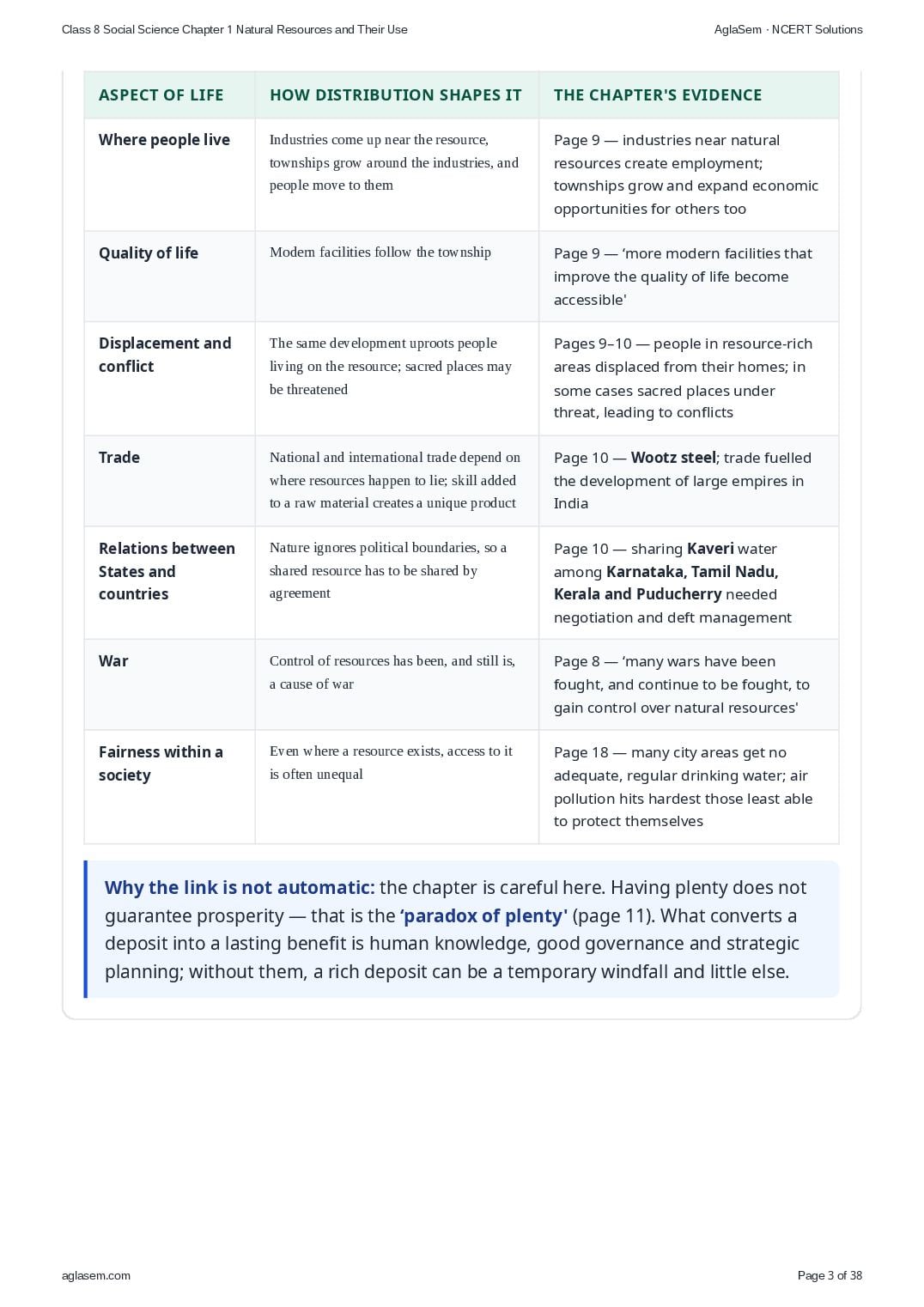
- What is the connection between the distribution of natural resources and different aspects of life?
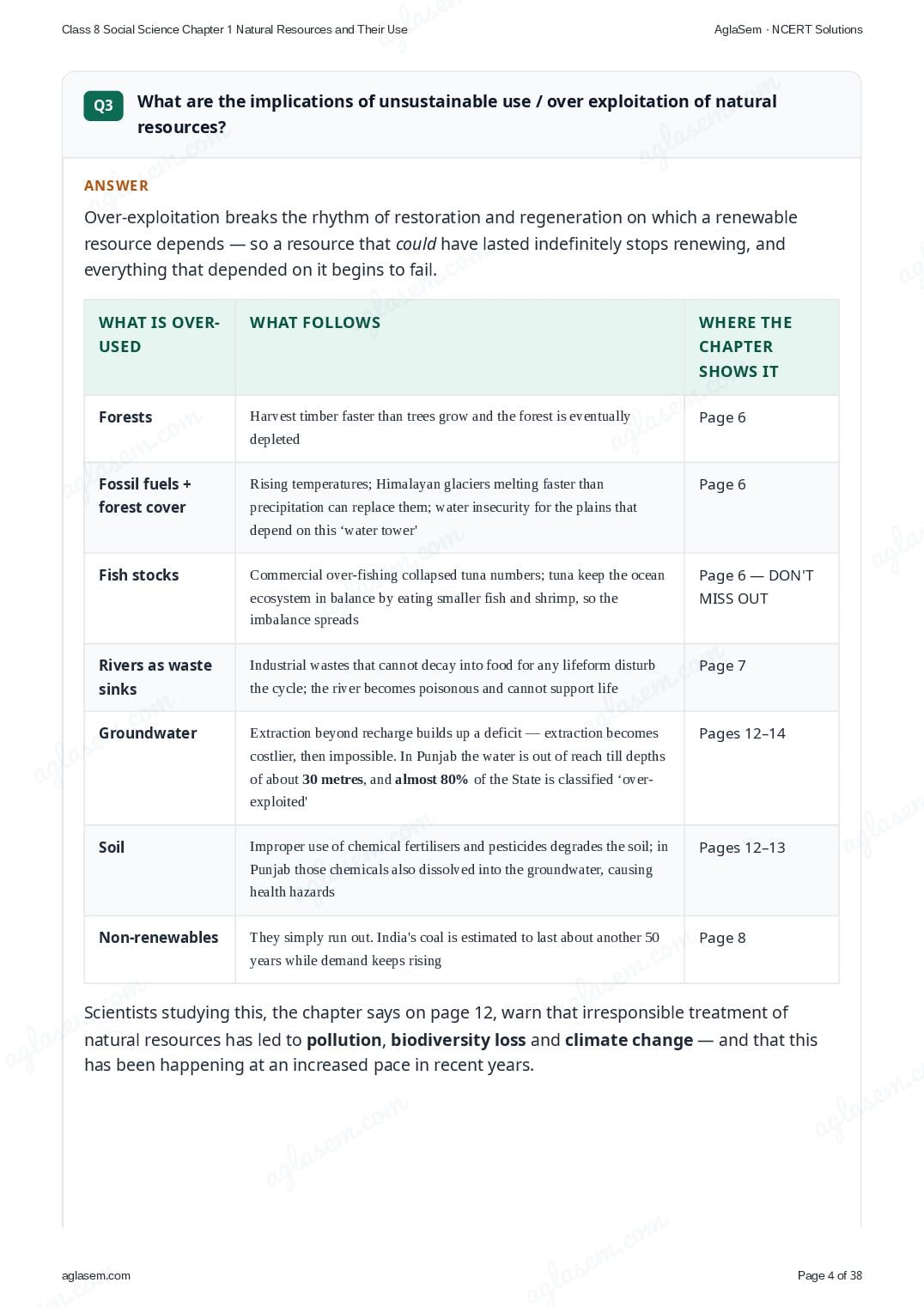
- What are the implications of unsustainable use / over exploitation of natural resources?
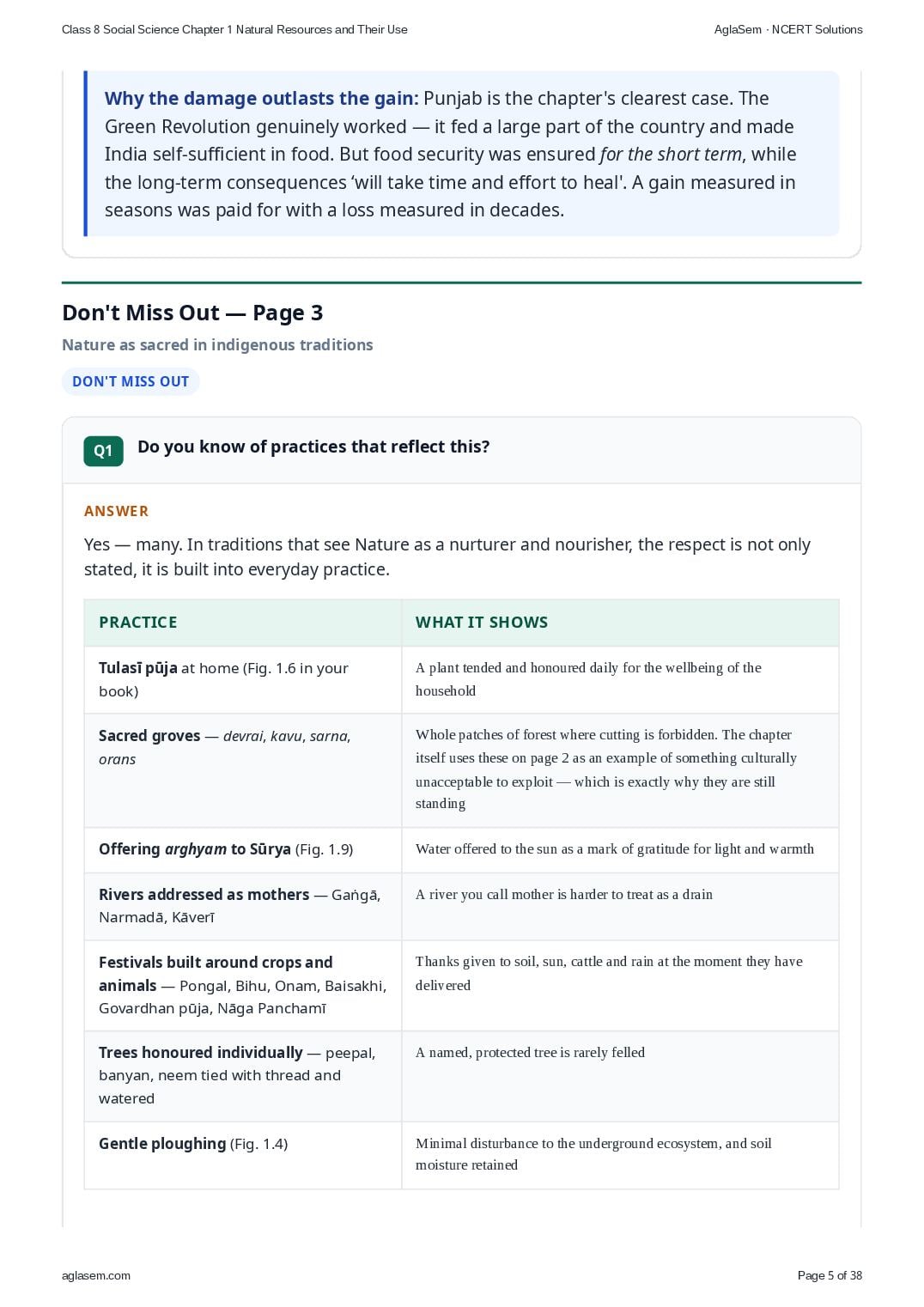
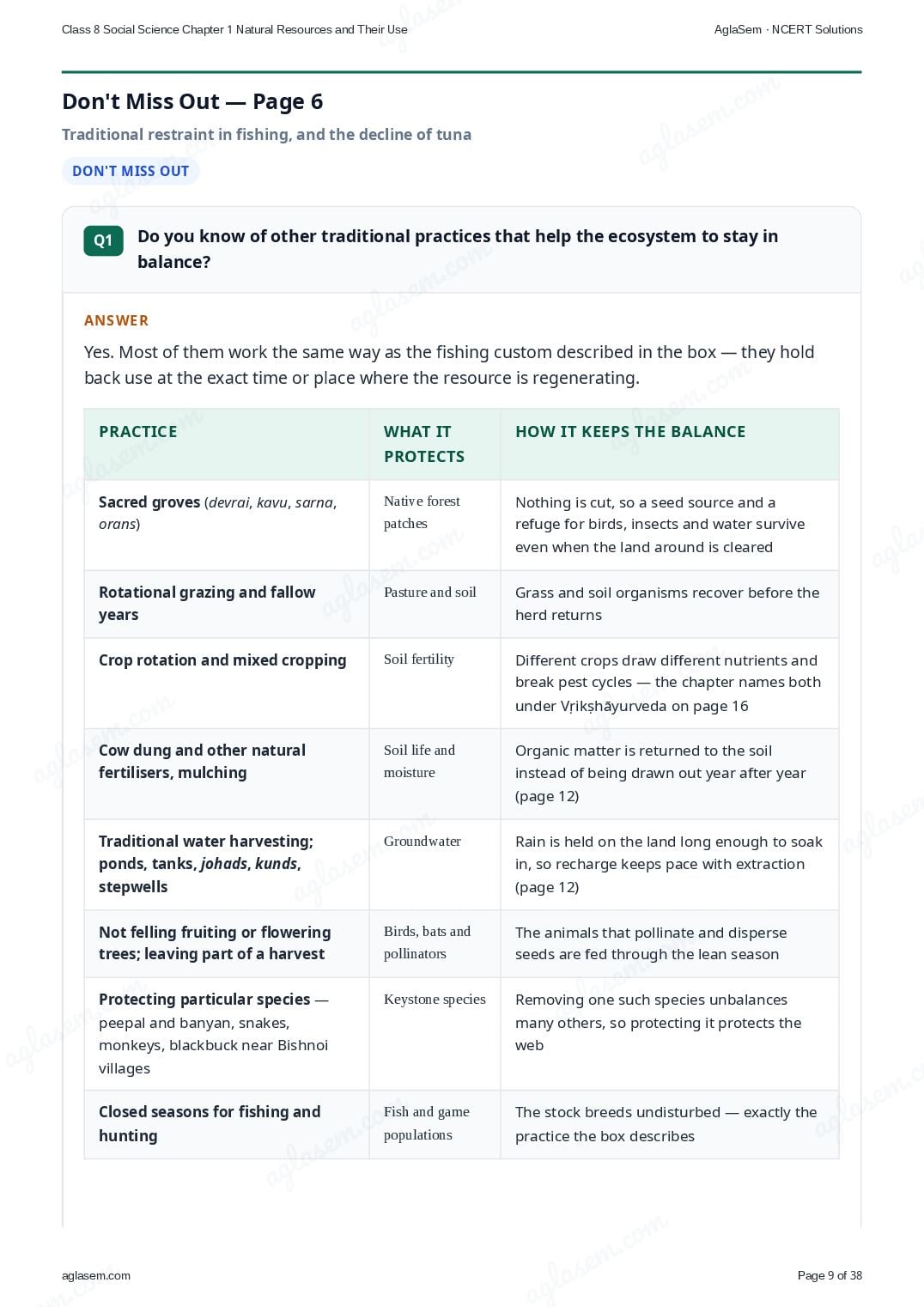
- Do you know of practices that reflect this?
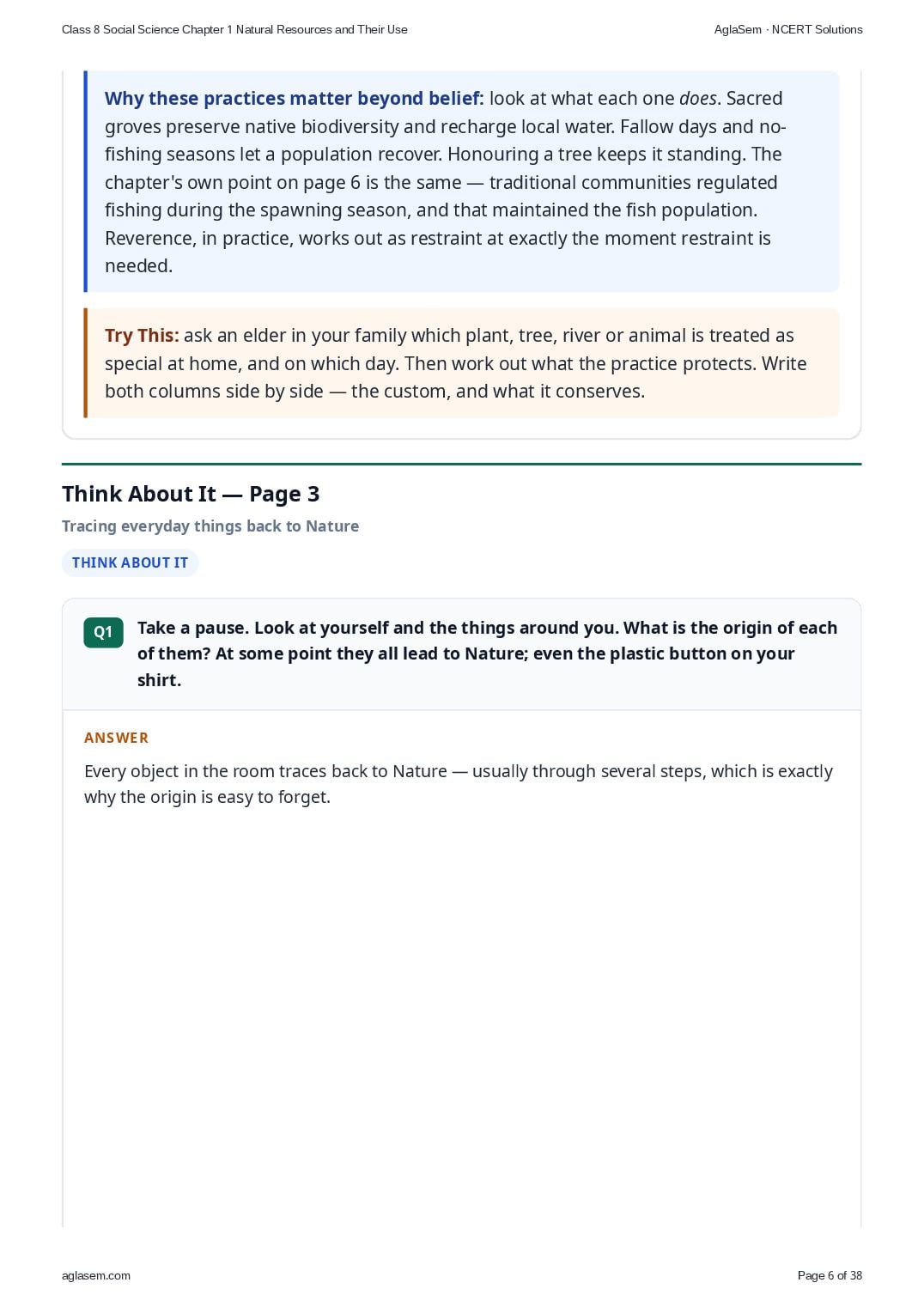
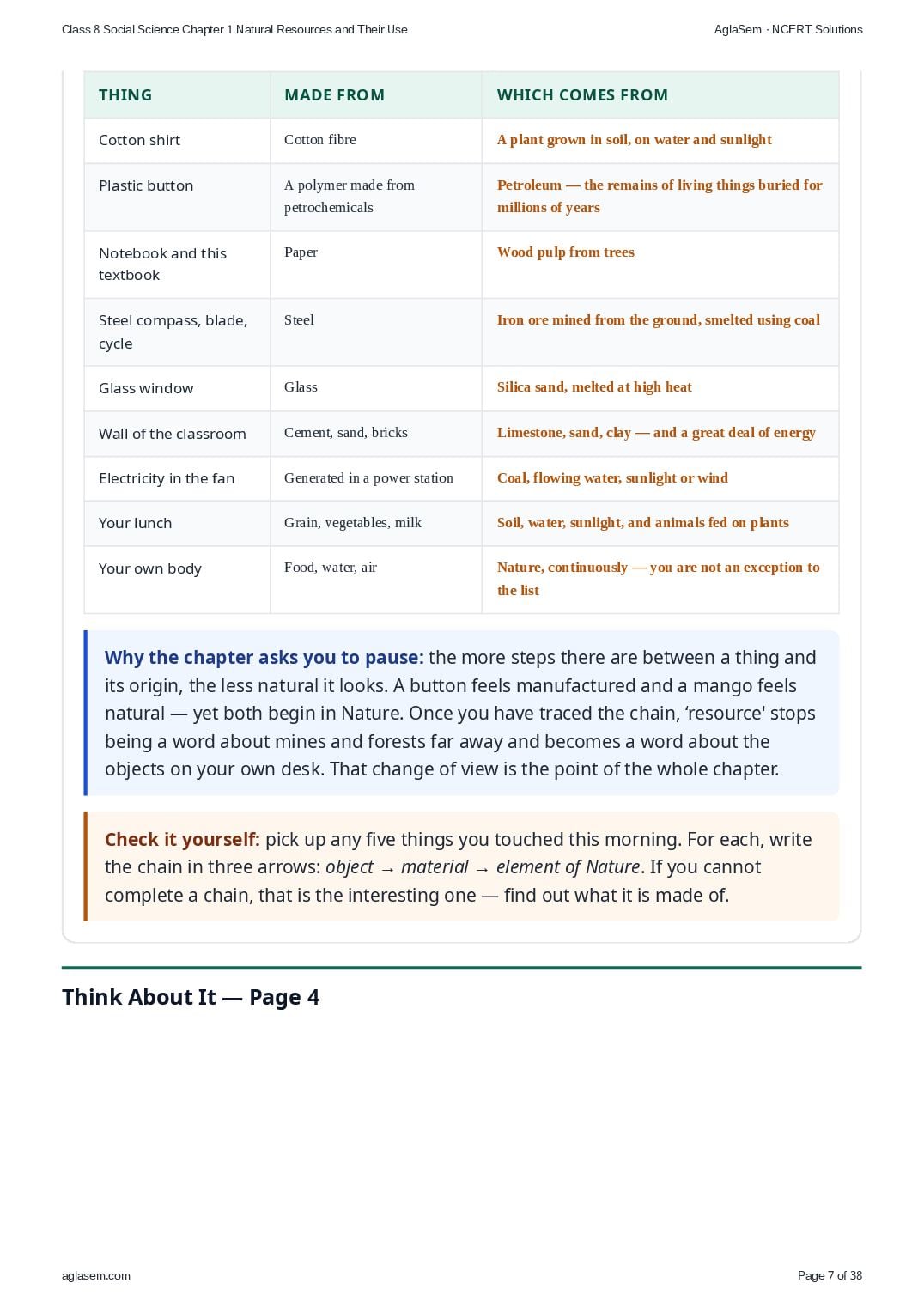
- Take a pause. Look at yourself and the things around you. What is the origin of each of them? At some point they all lead to Nature; even the plastic button on your shirt.
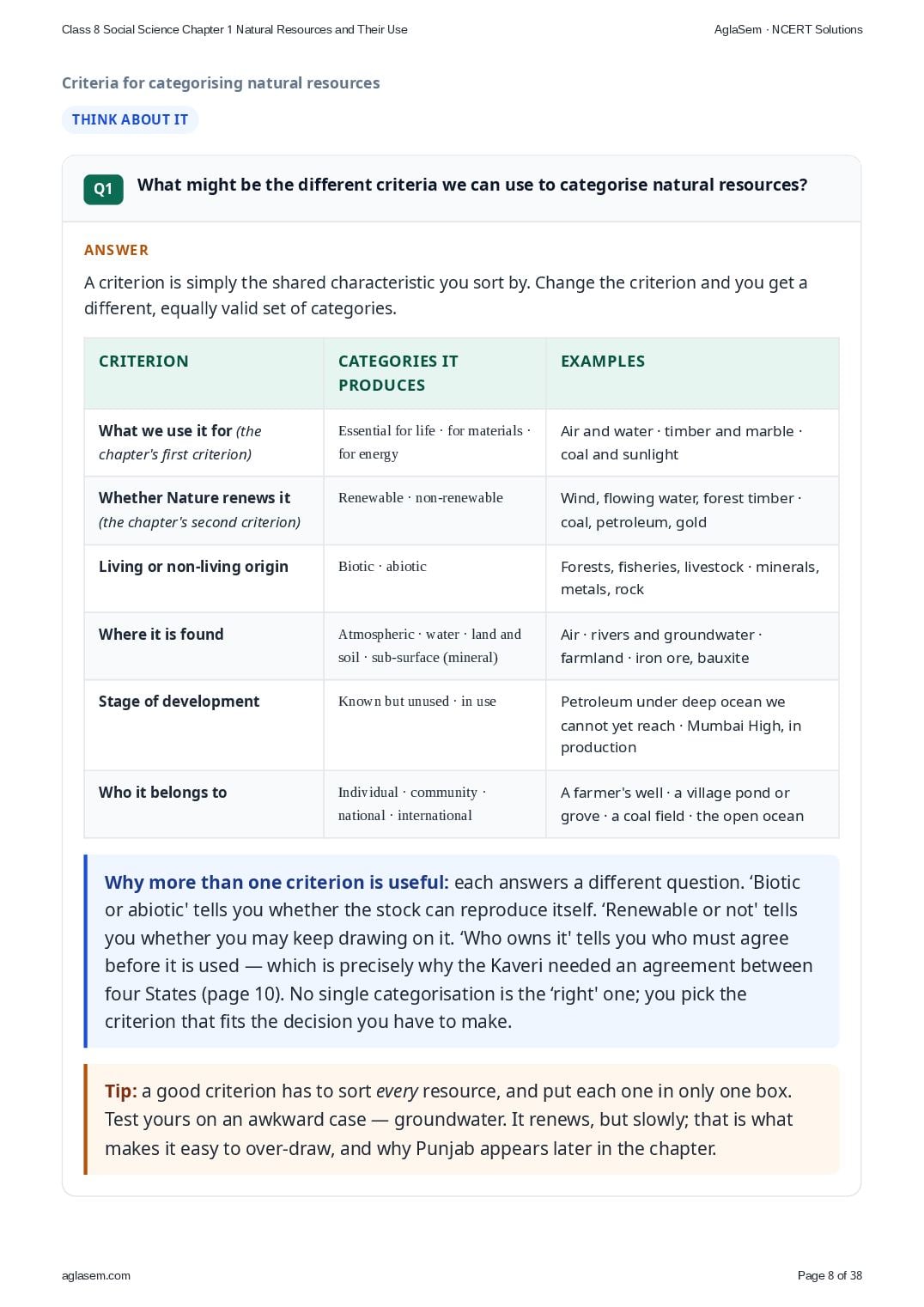
- What might be the different criteria we can use to categorise natural resources?
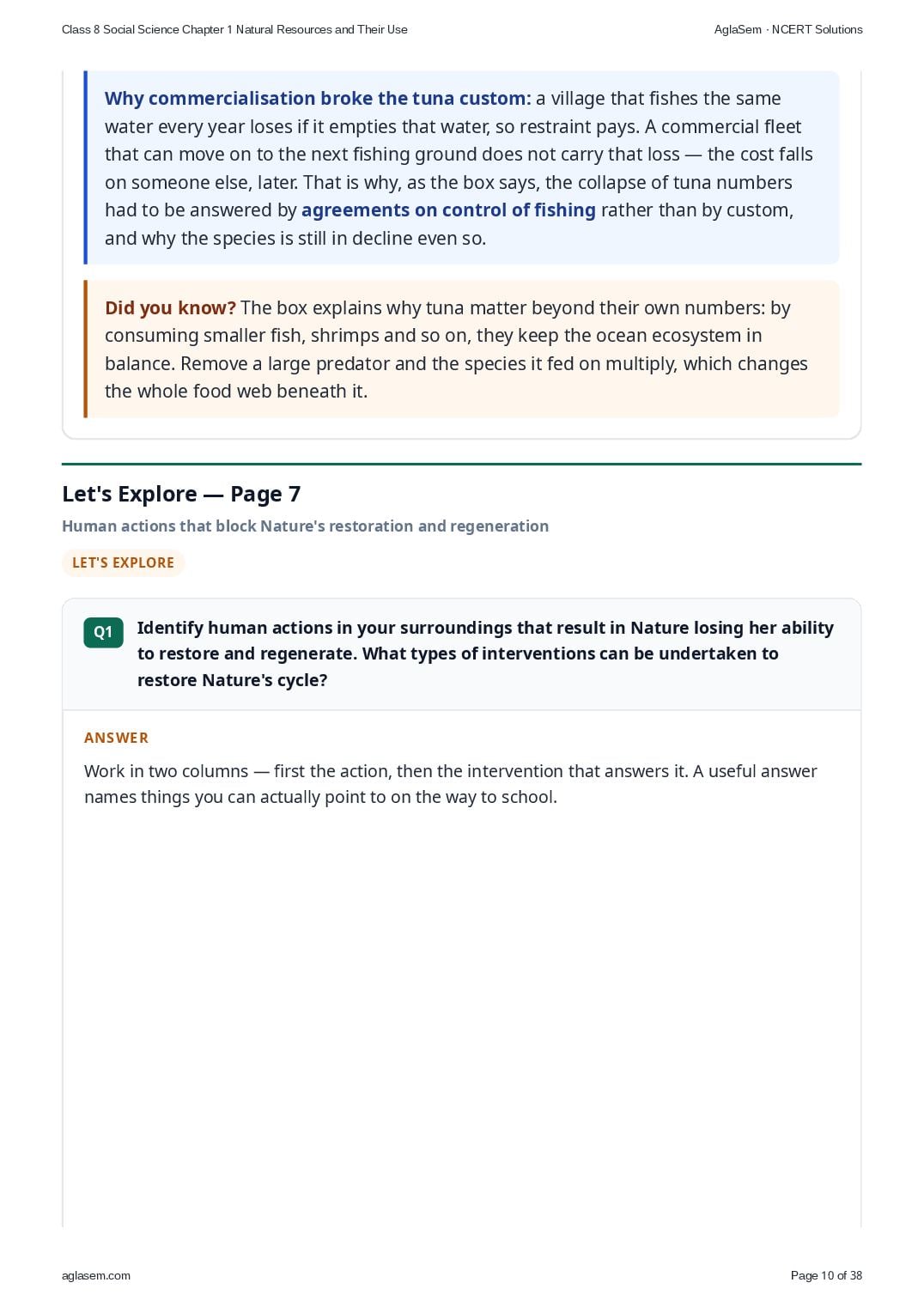
- Do you know of other traditional practices that help the ecosystem to stay in balance?
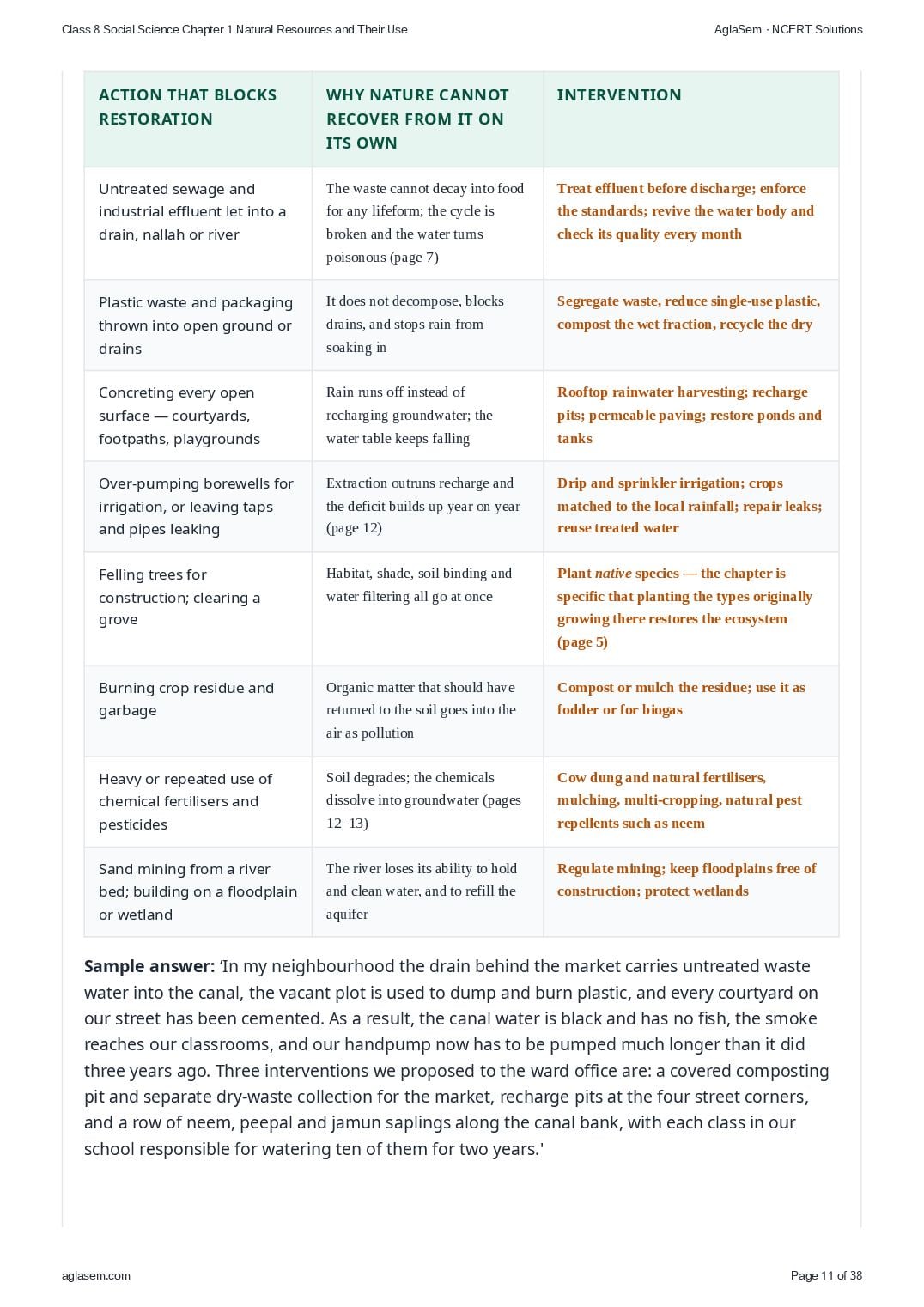
- Identify human actions in your surroundings that result in Nature losing her ability to restore and regenerate. What types of interventions can be undertaken to restore Nature's cycle?
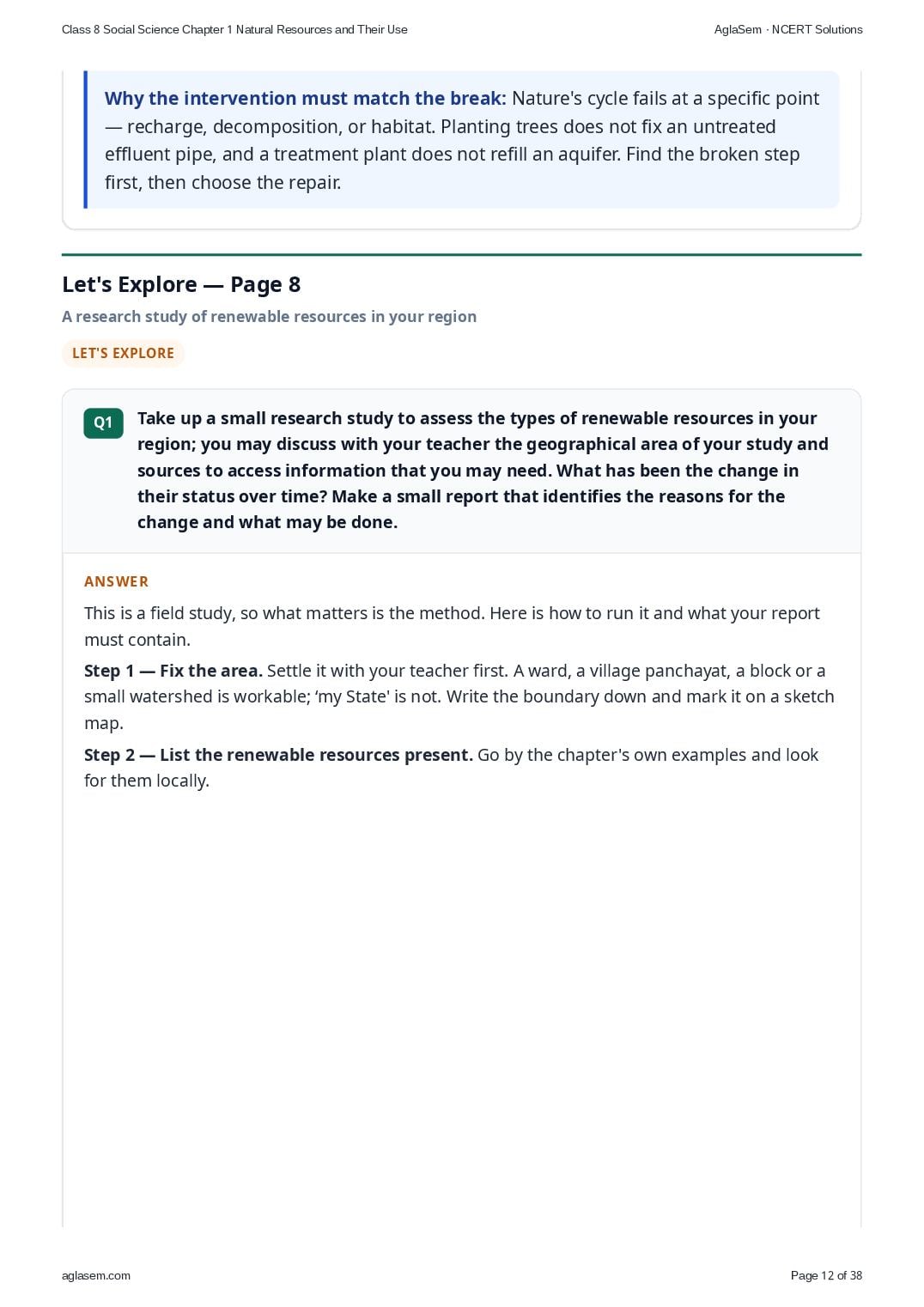
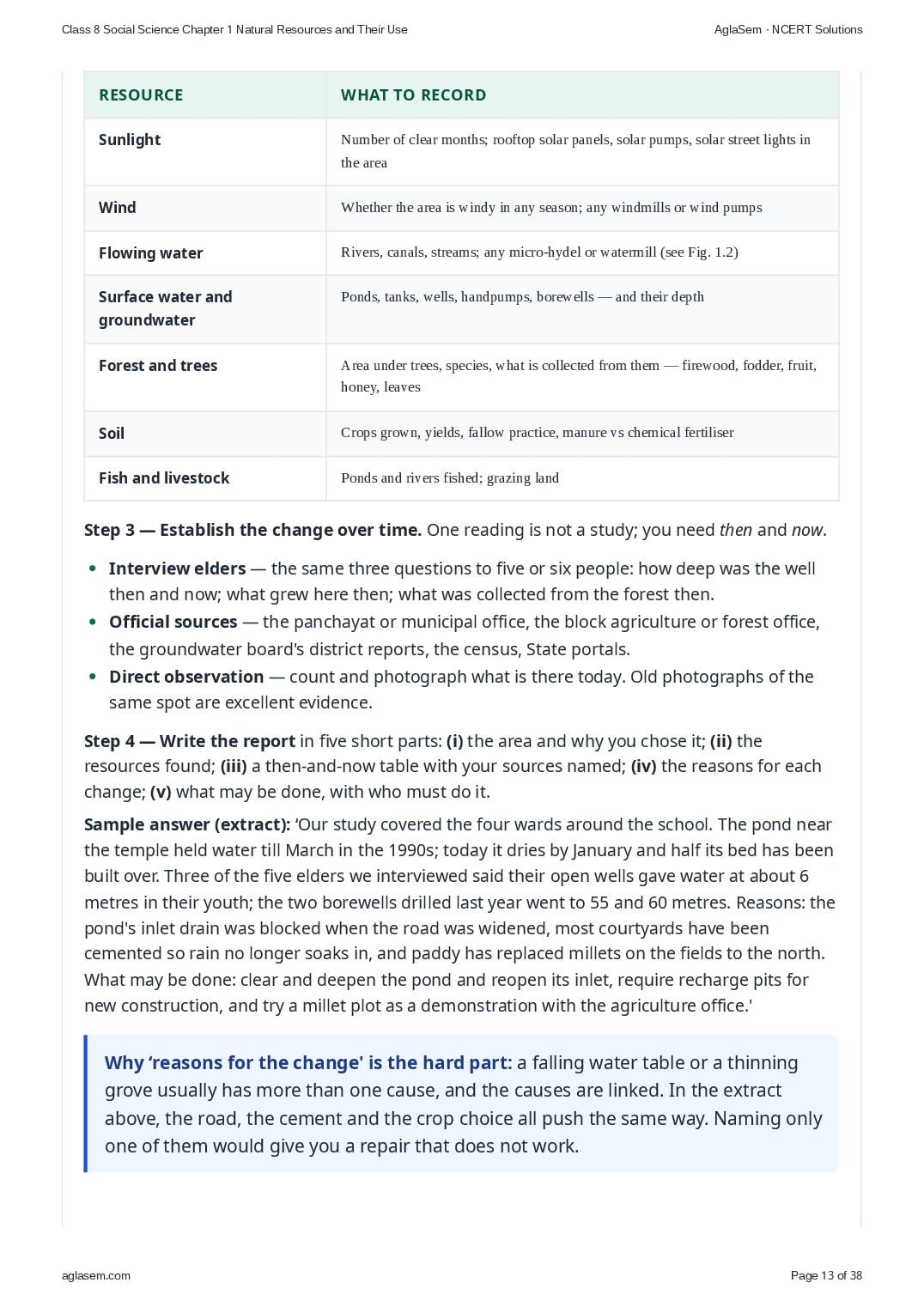
- Take up a small research study to assess the types of renewable resources in your region; you may discuss with your teacher the geographical area of your study and sources to access information that you may need. What has been the change in their status over time? Make a small report that identifies the reasons for the change and what may be done.
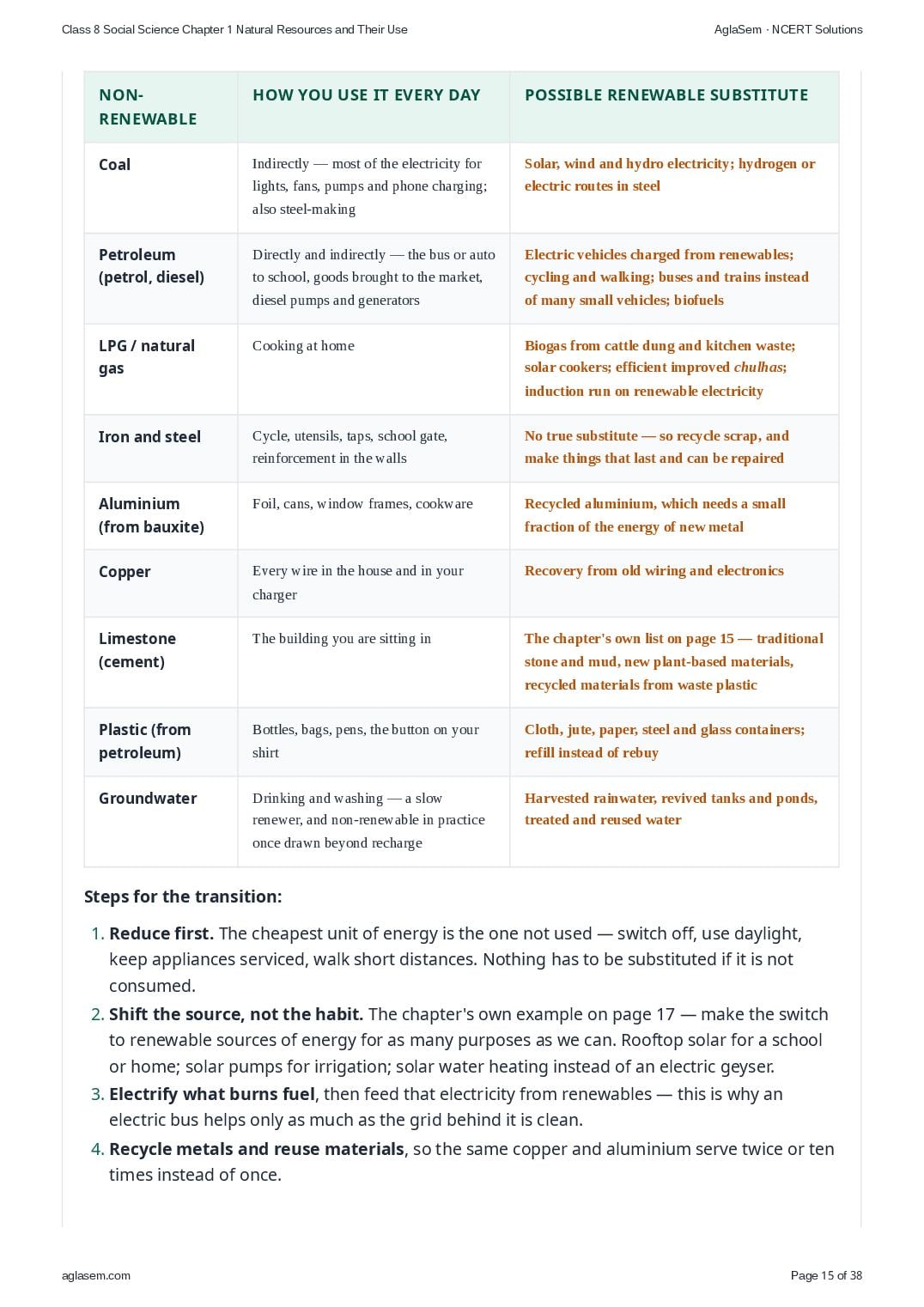
- What are the non-renewable resources that you use daily, directly or indirectly? What are the possible renewable substitutes? What are some of the steps we can take to transition to renewables?
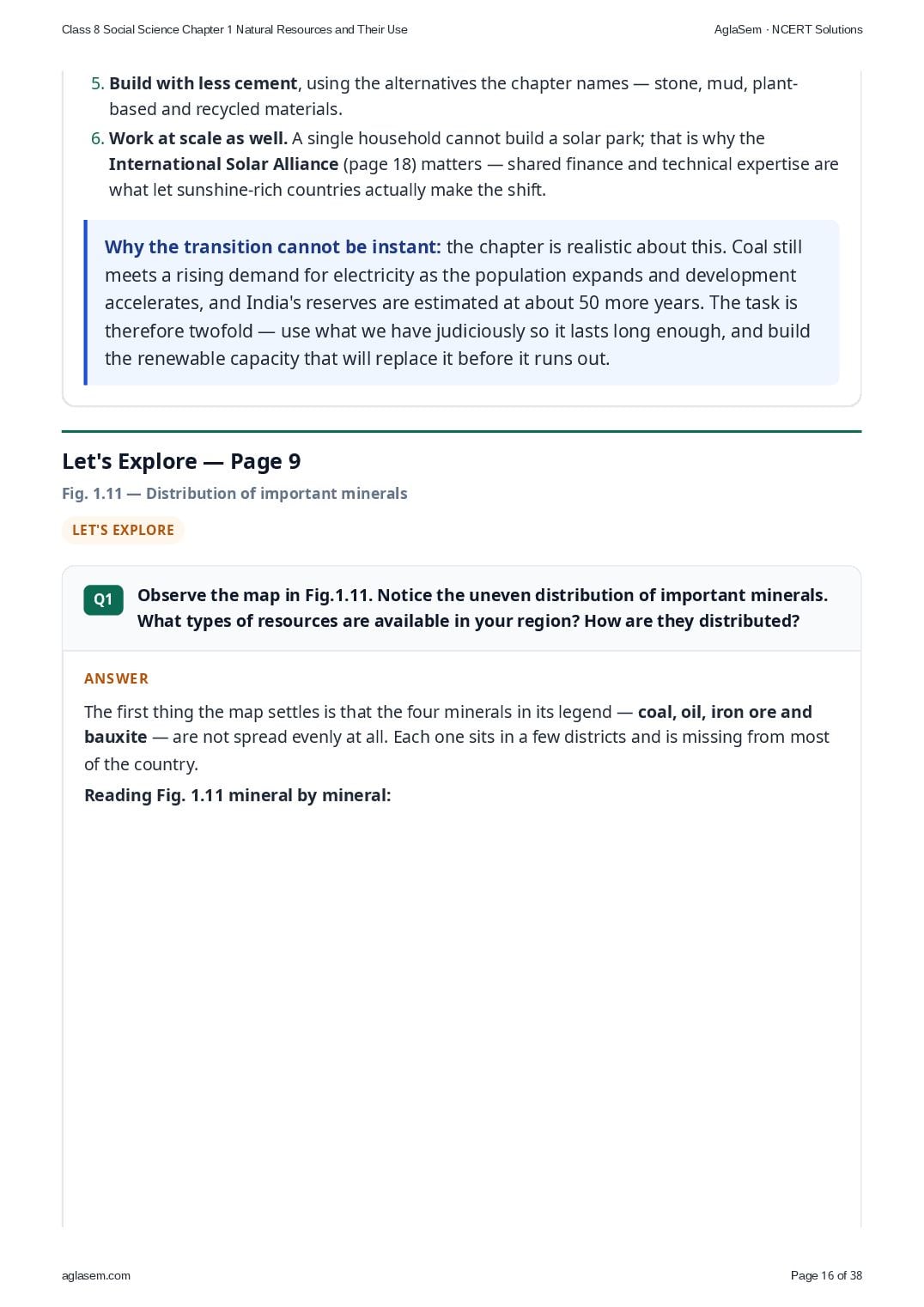
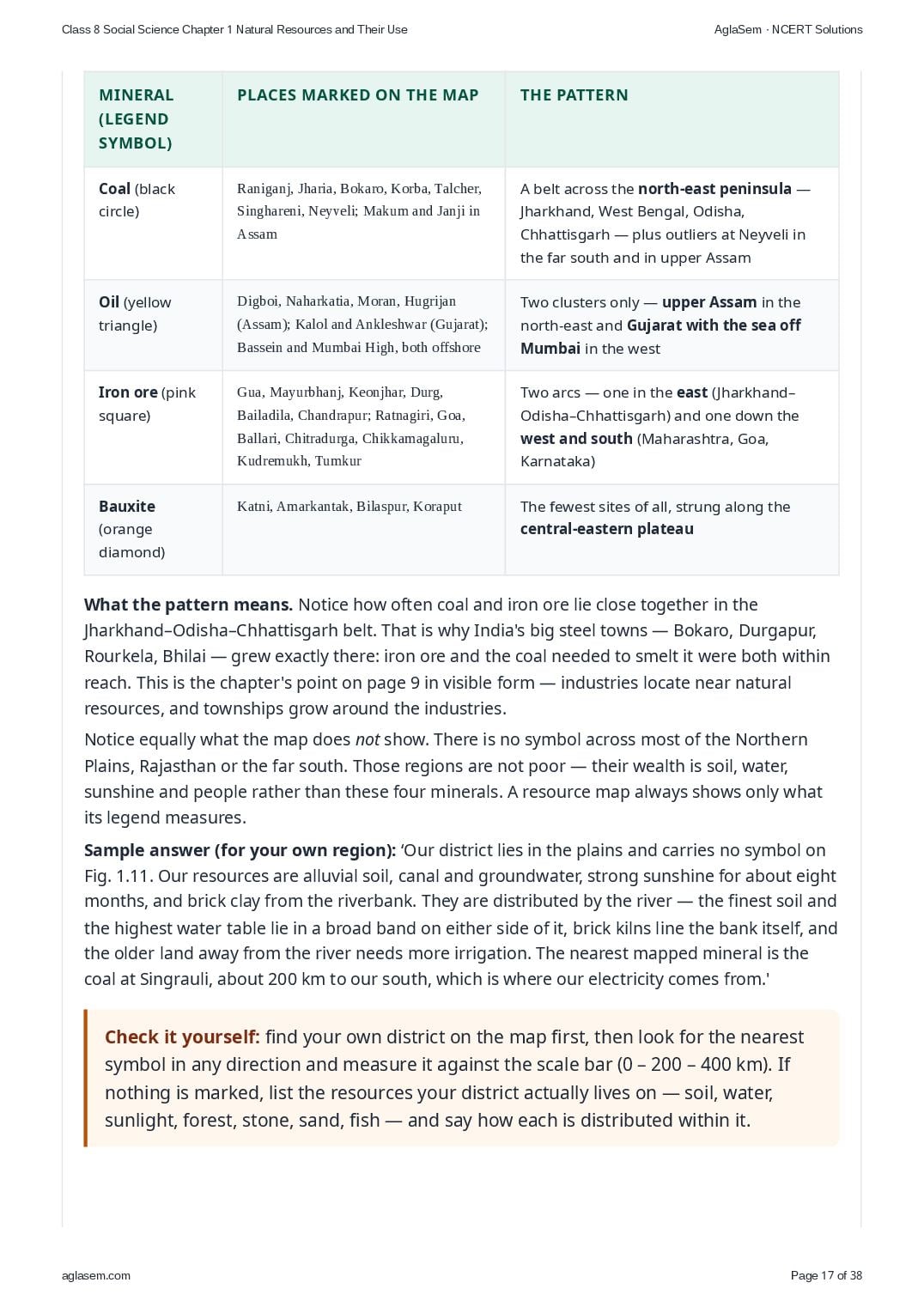
- Observe the map in Fig.1.11. Notice the uneven distribution of important minerals. What types of resources are available in your region? How are they distributed?
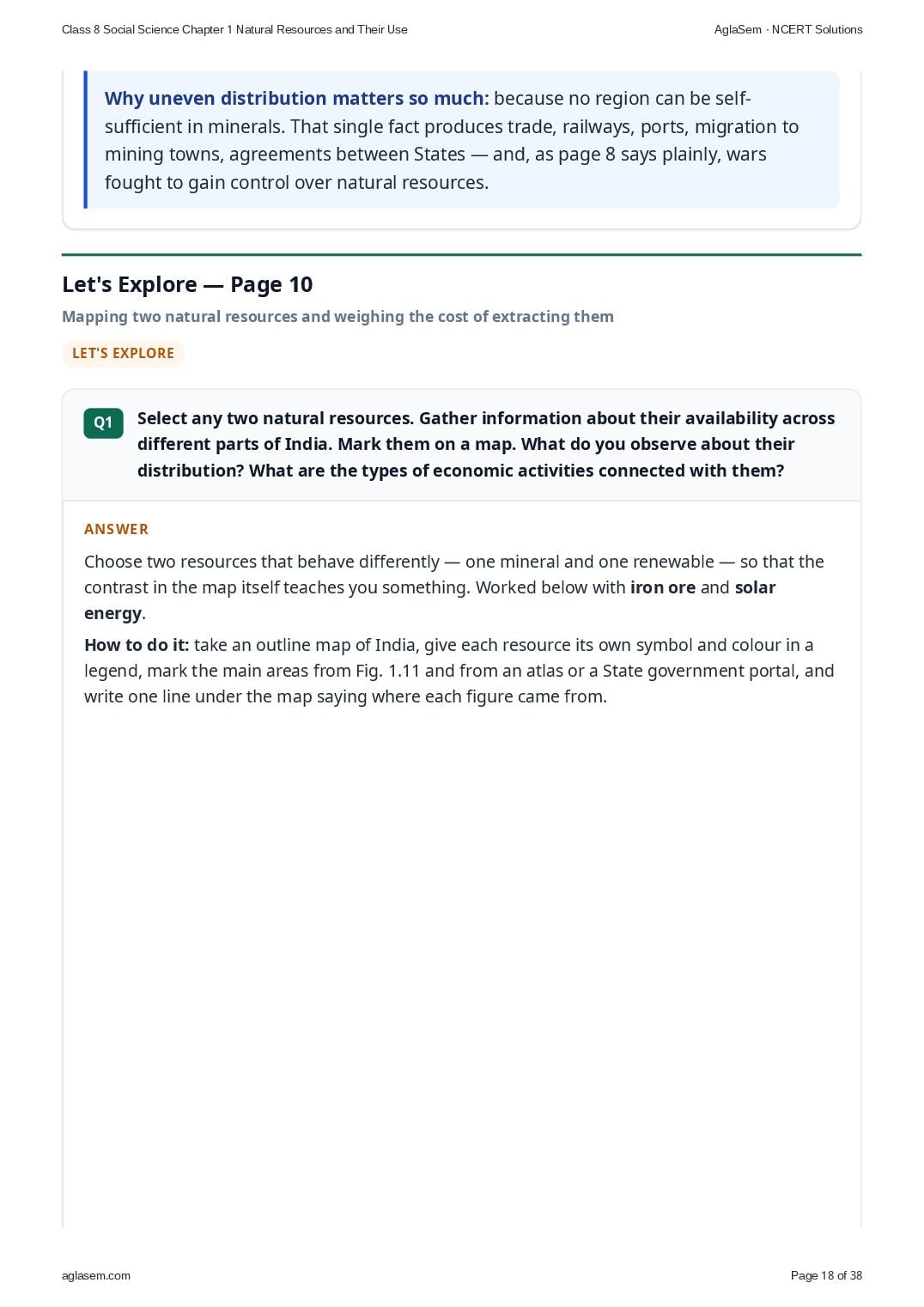
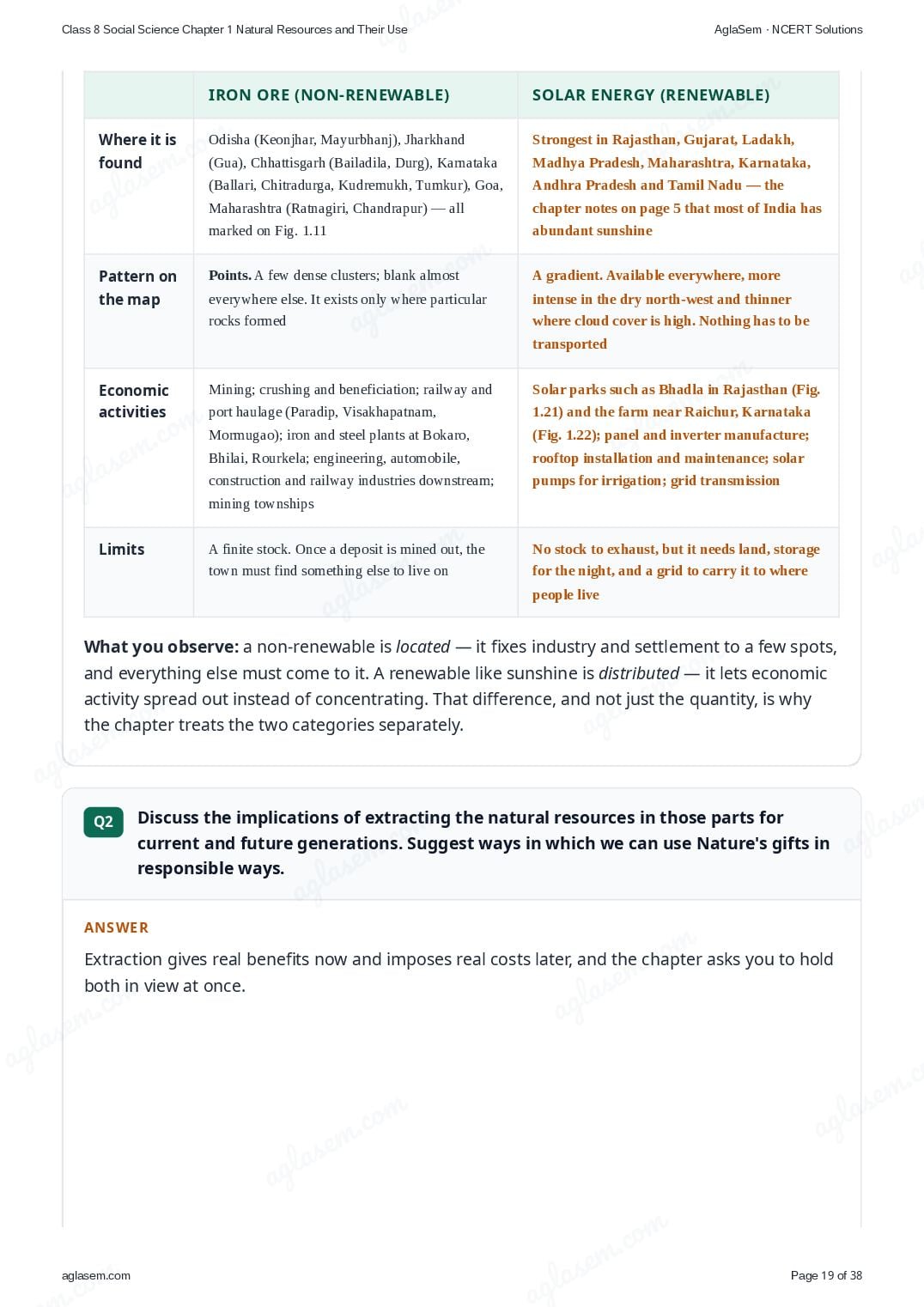
- Select any two natural resources. Gather information about their availability across different parts of India. Mark them on a map. What do you observe about their distribution? What are the types of economic activities connected with them?
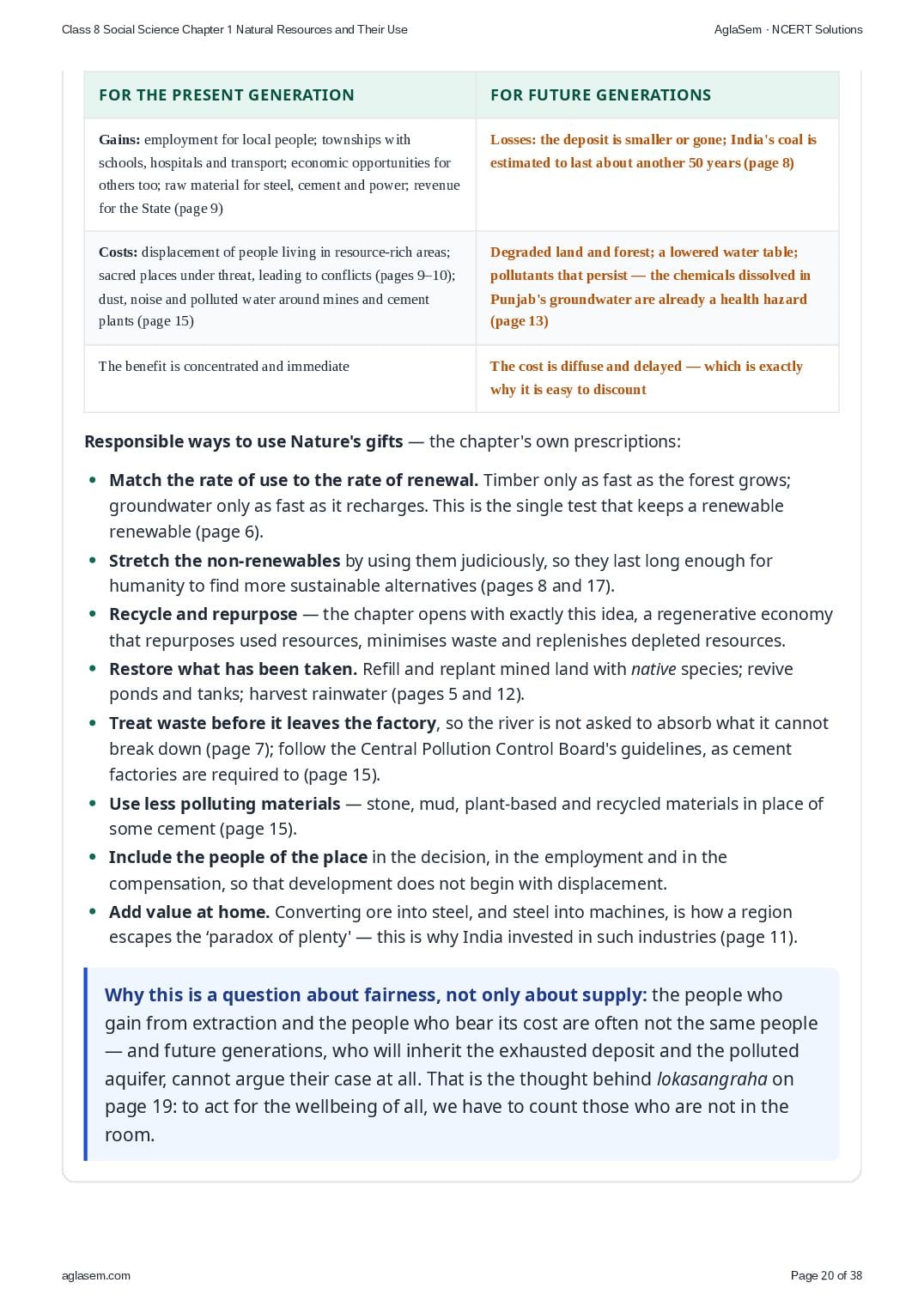
- Discuss the implications of extracting the natural resources in those parts for current and future generations. Suggest ways in which we can use Nature's gifts in responsible ways.
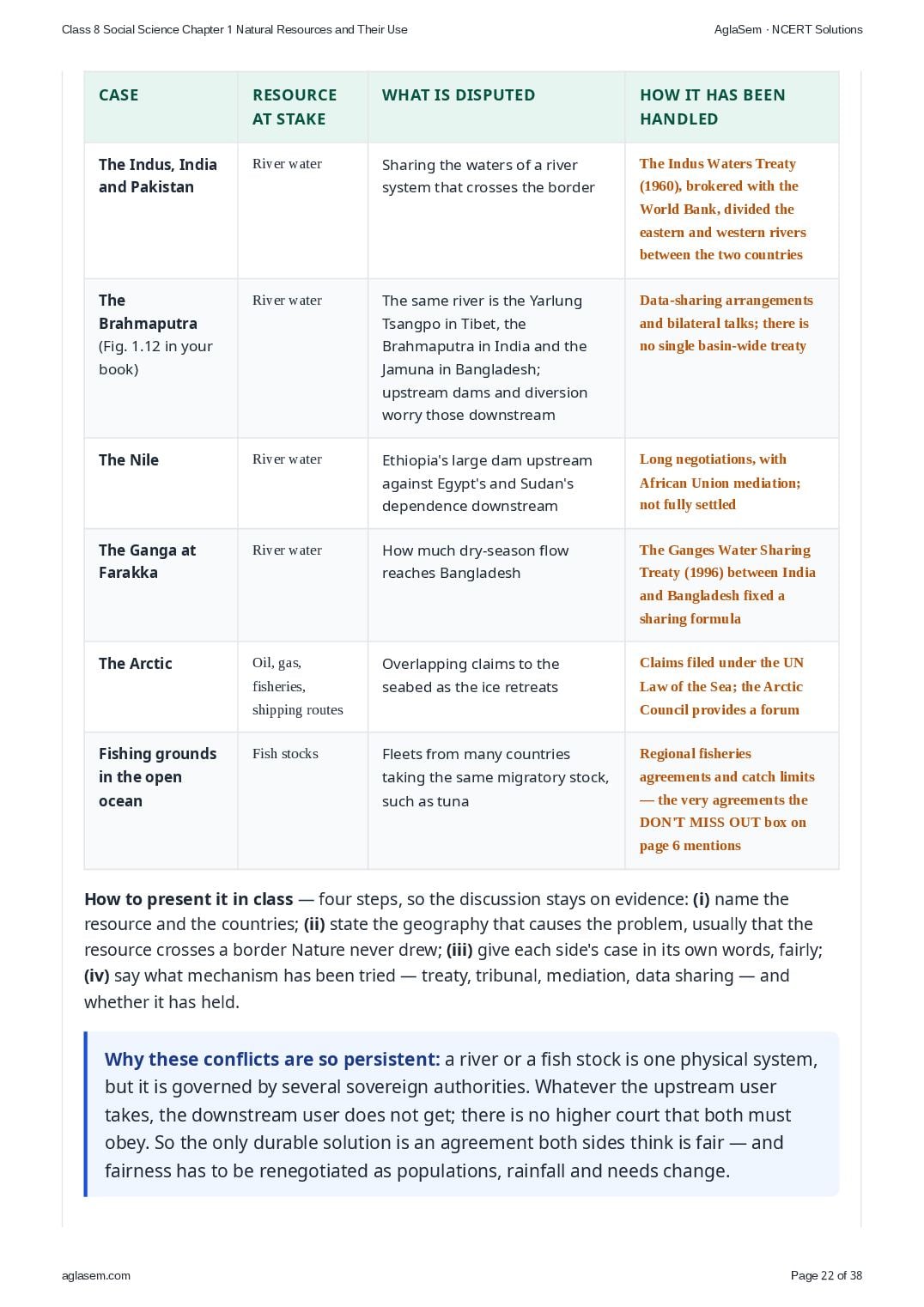
- Find out about such a conflict in the international context. Discuss your findings in the class.
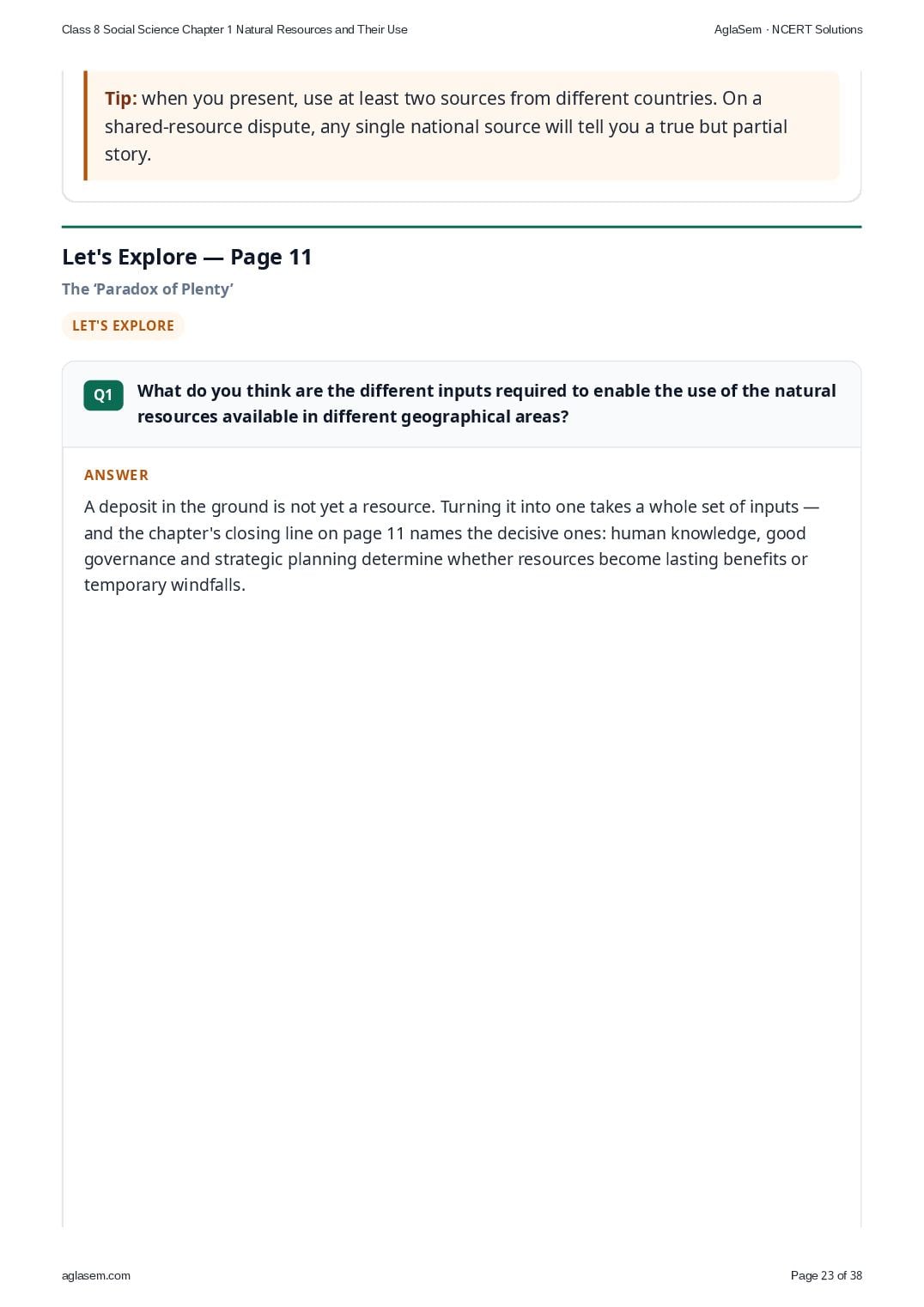
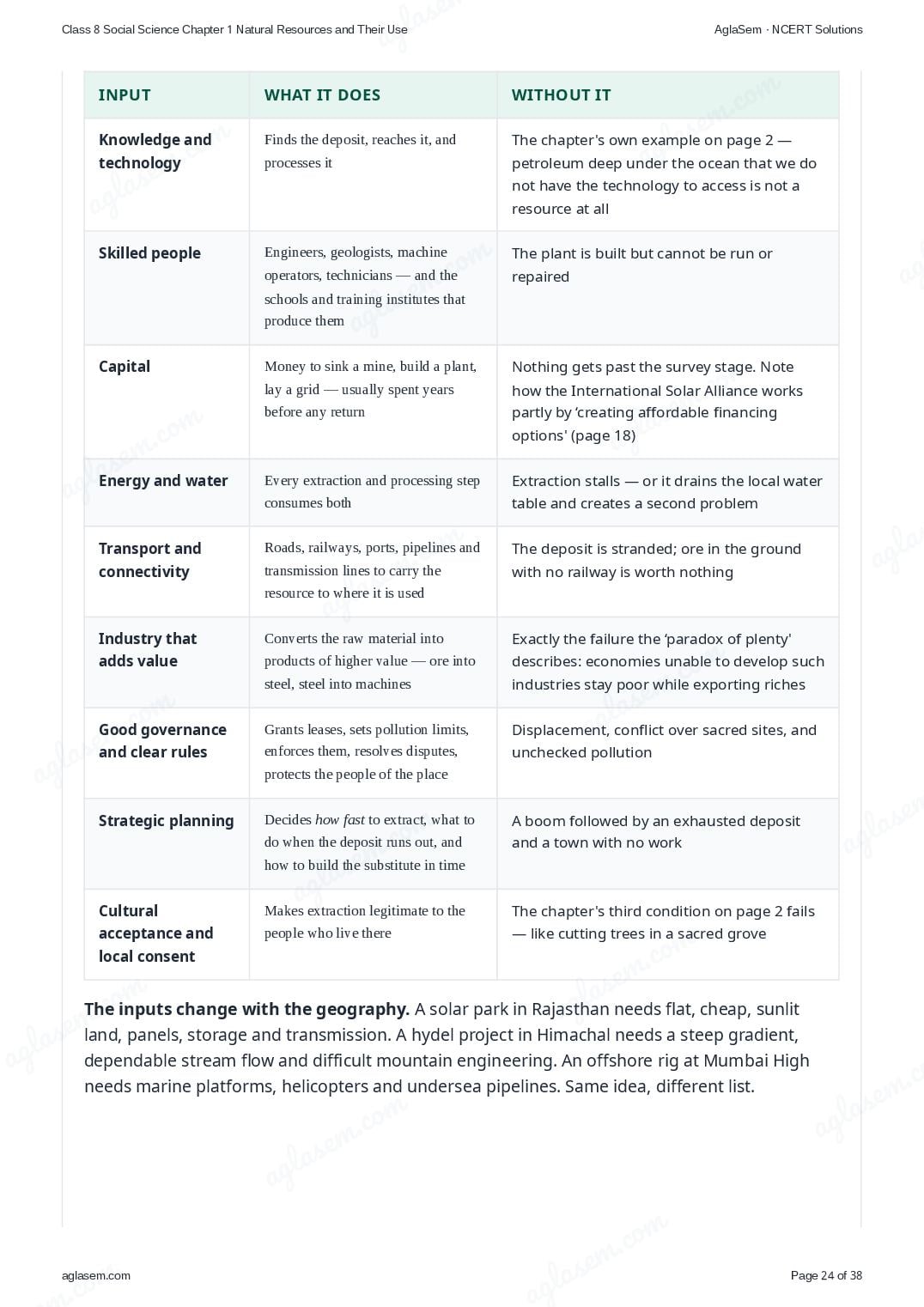
- What do you think are the different inputs required to enable the use of the natural resources available in different geographical areas?
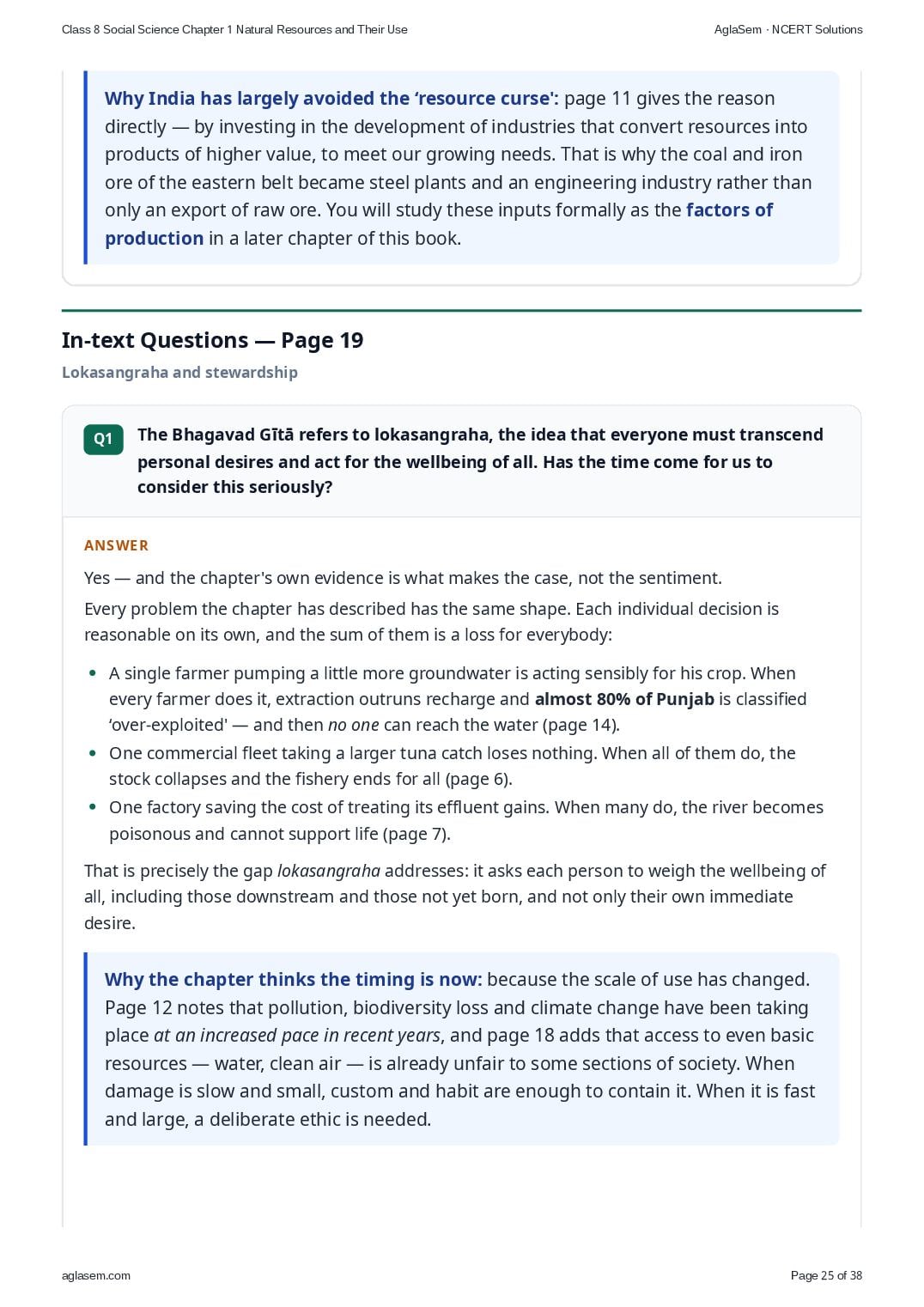
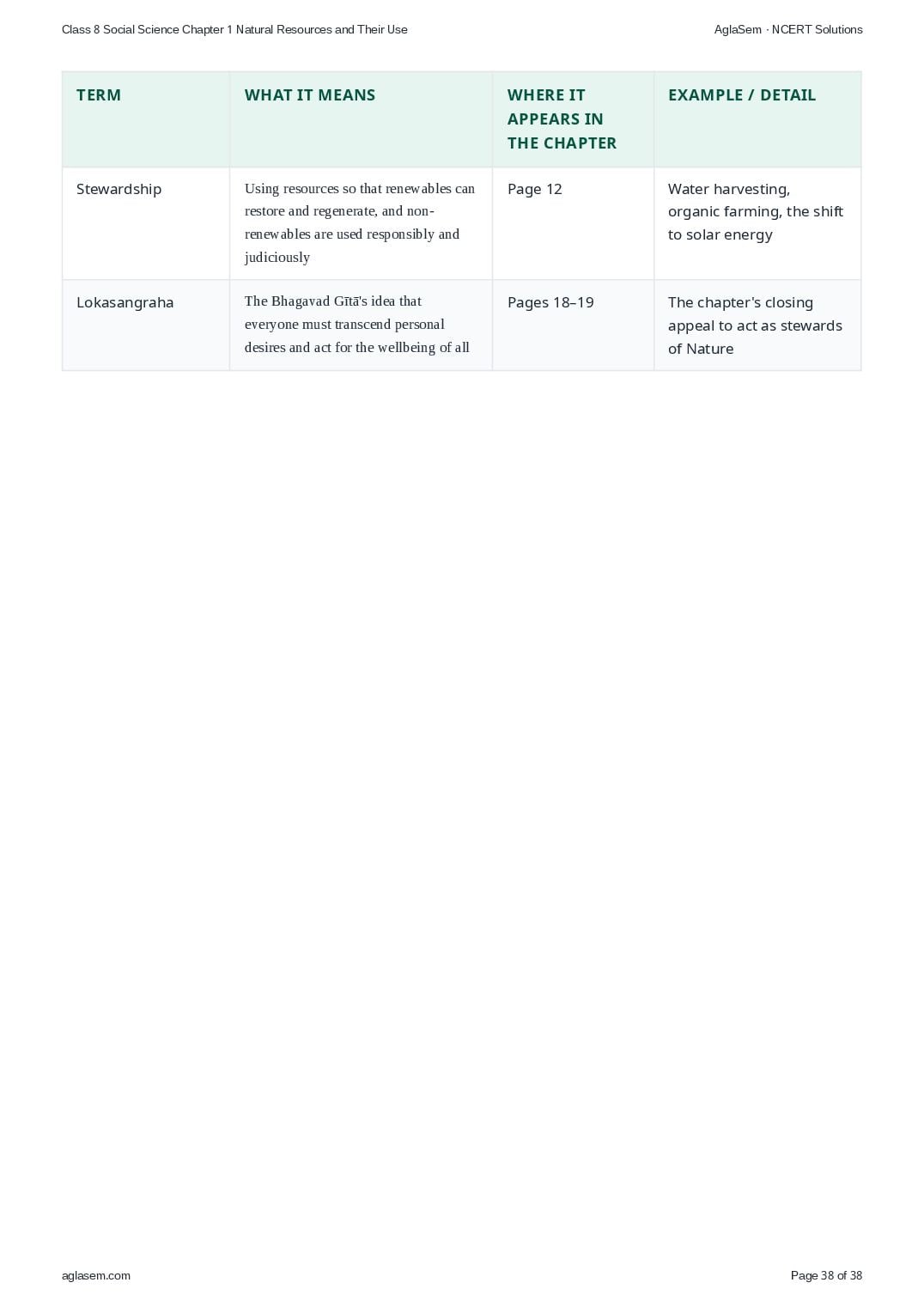
- The Bhagavad Gītā refers to lokasangraha, the idea that everyone must transcend personal desires and act for the wellbeing of all. Has the time come for us to consider this seriously?
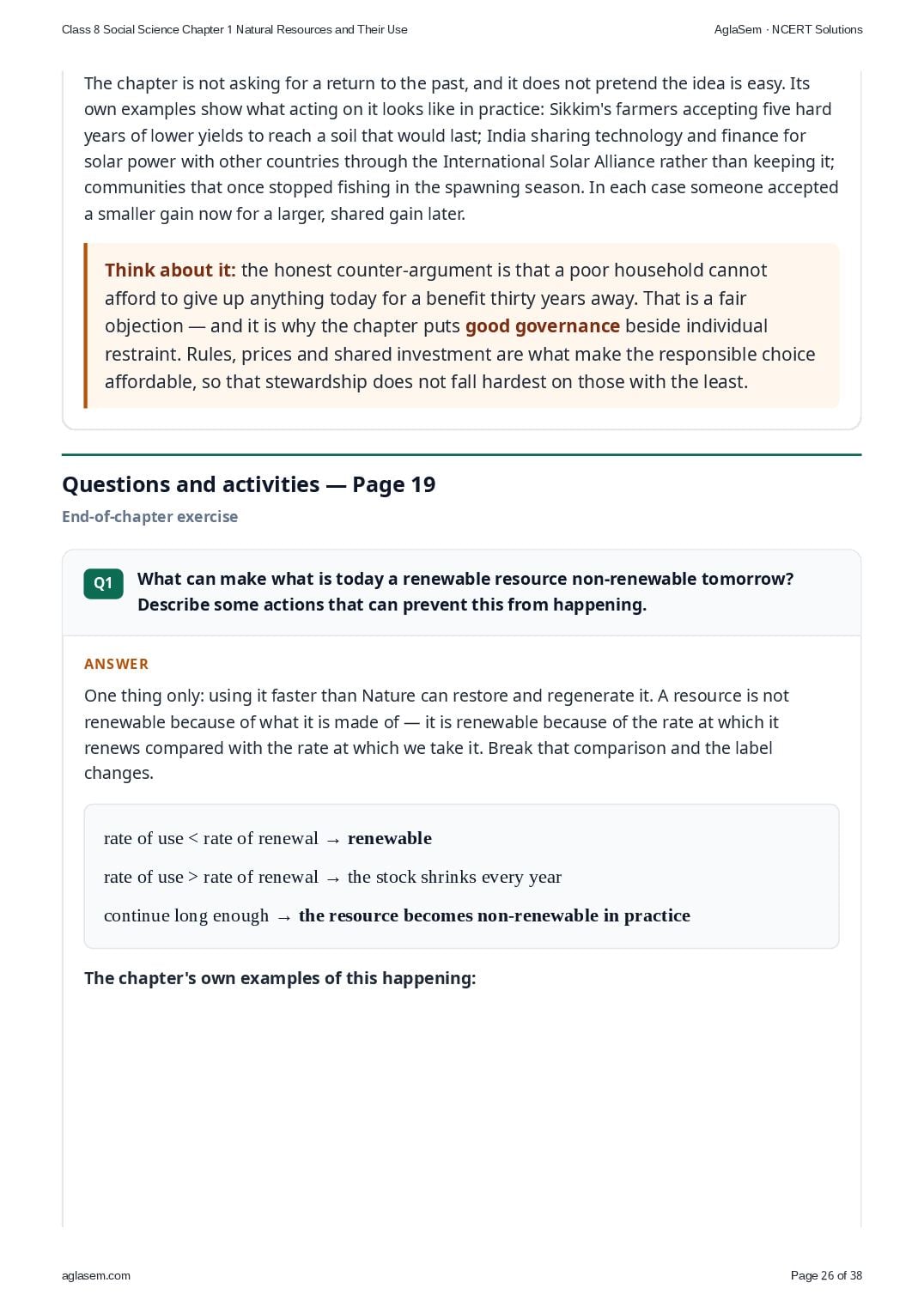
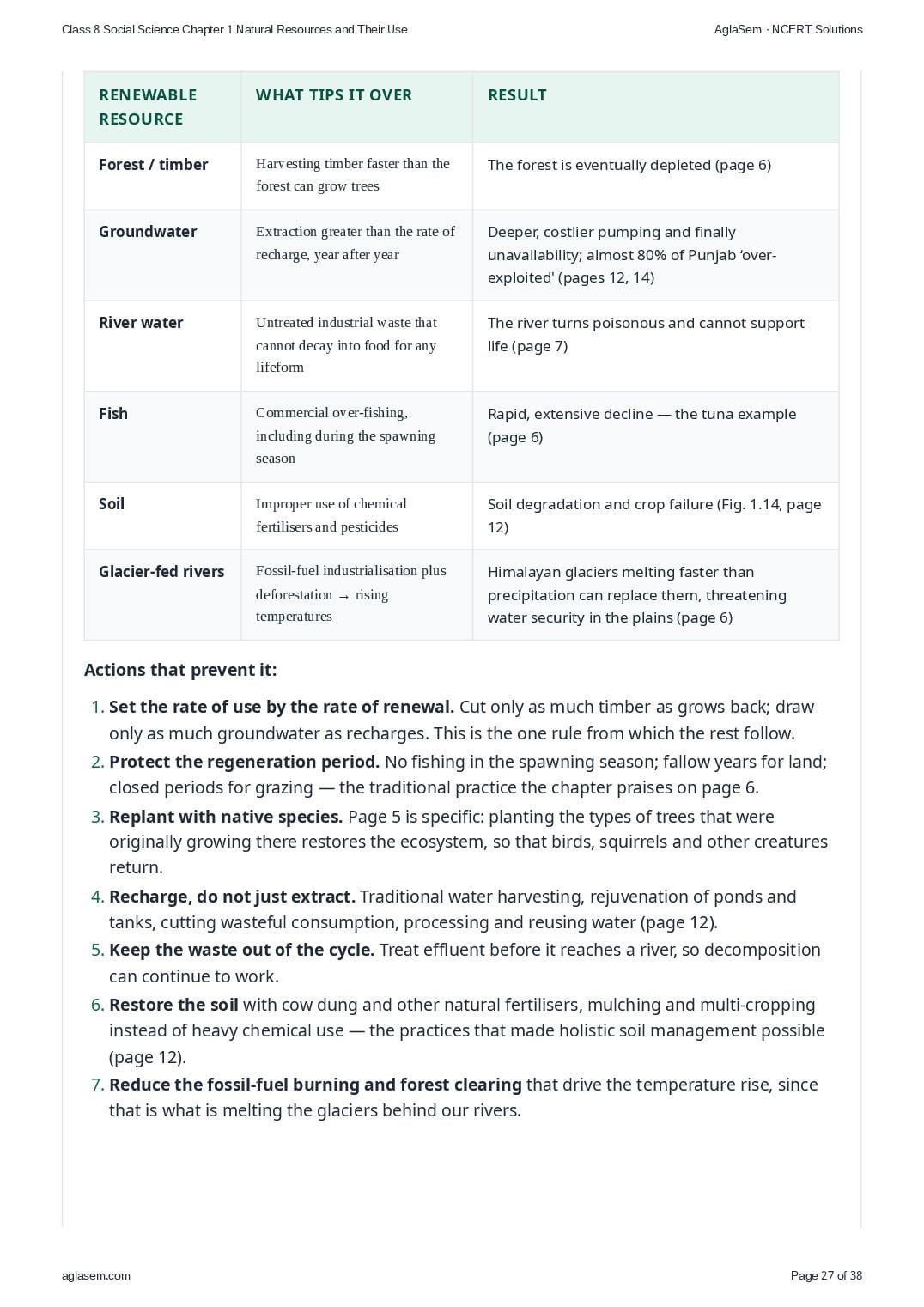
- What can make what is today a renewable resource non-renewable tomorrow? Describe some actions that can prevent this from happening.
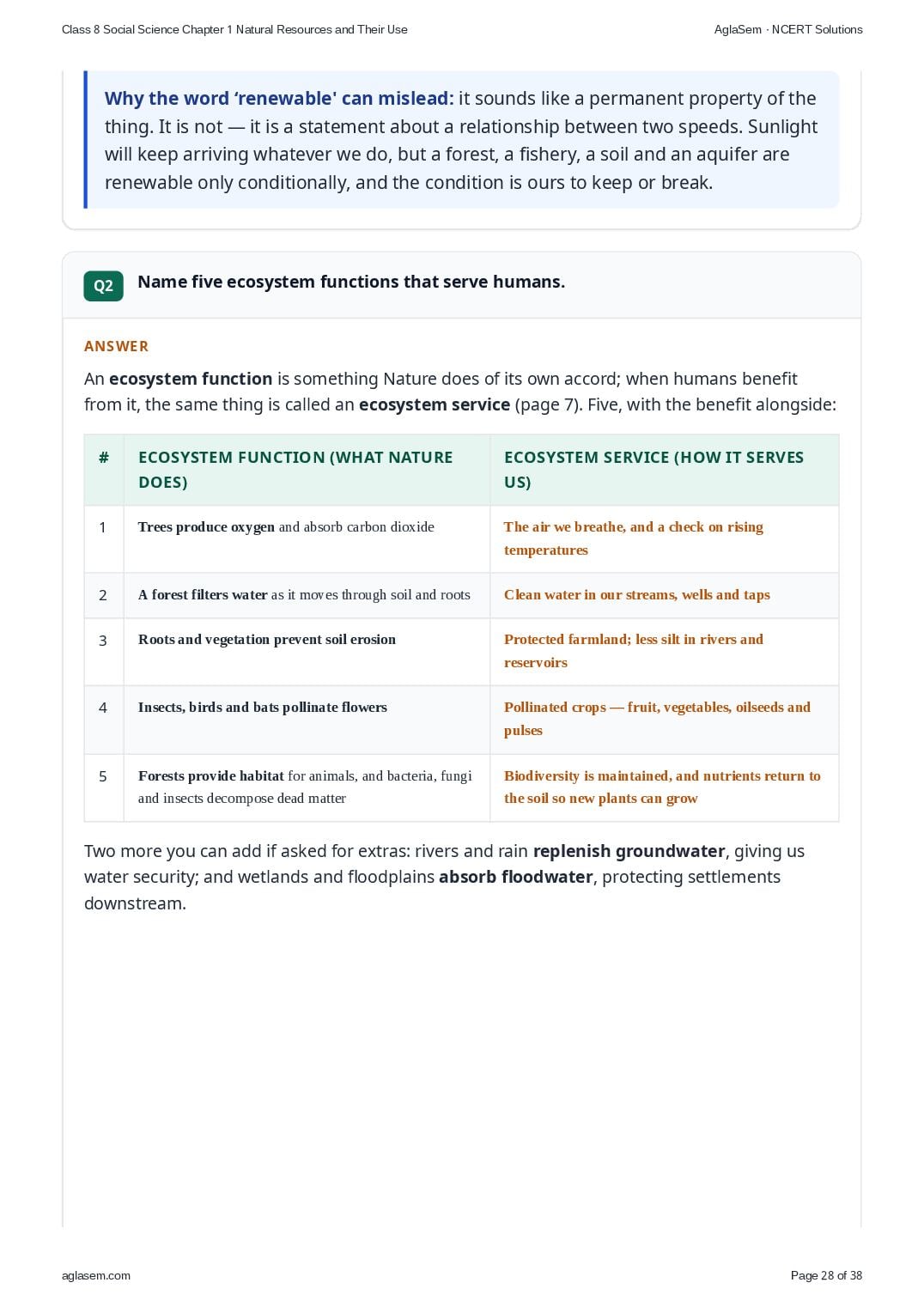
- Name five ecosystem functions that serve humans.
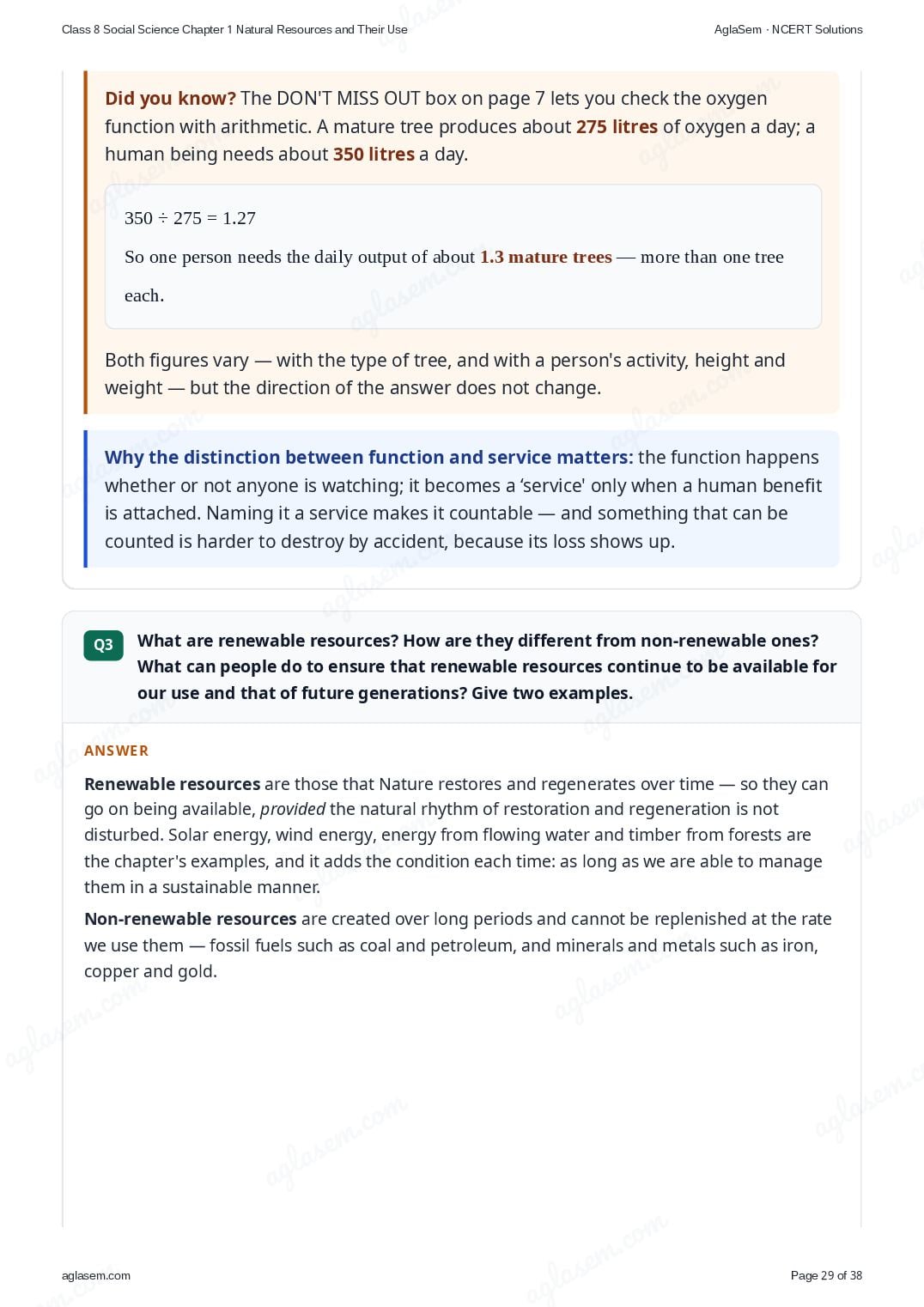
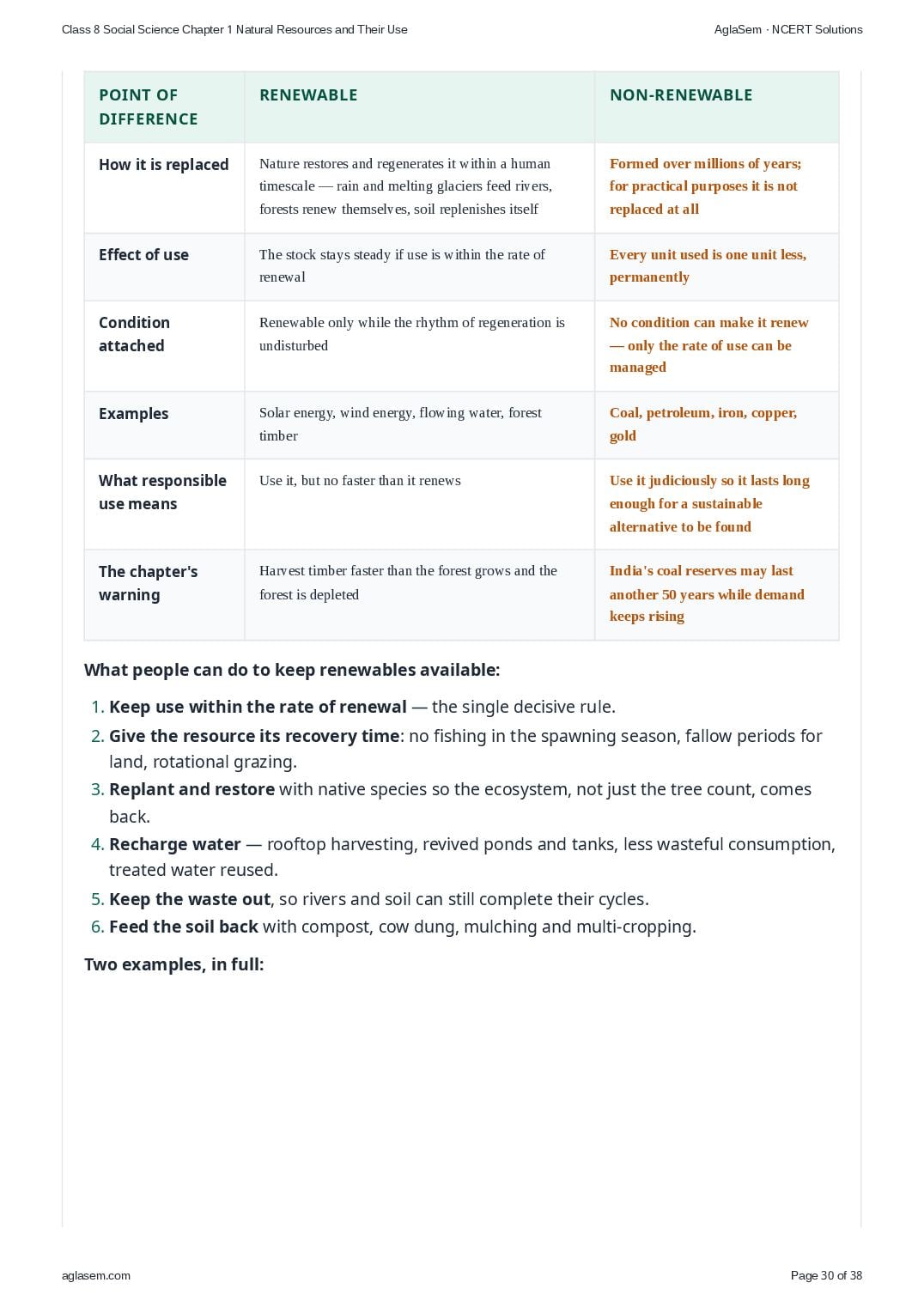
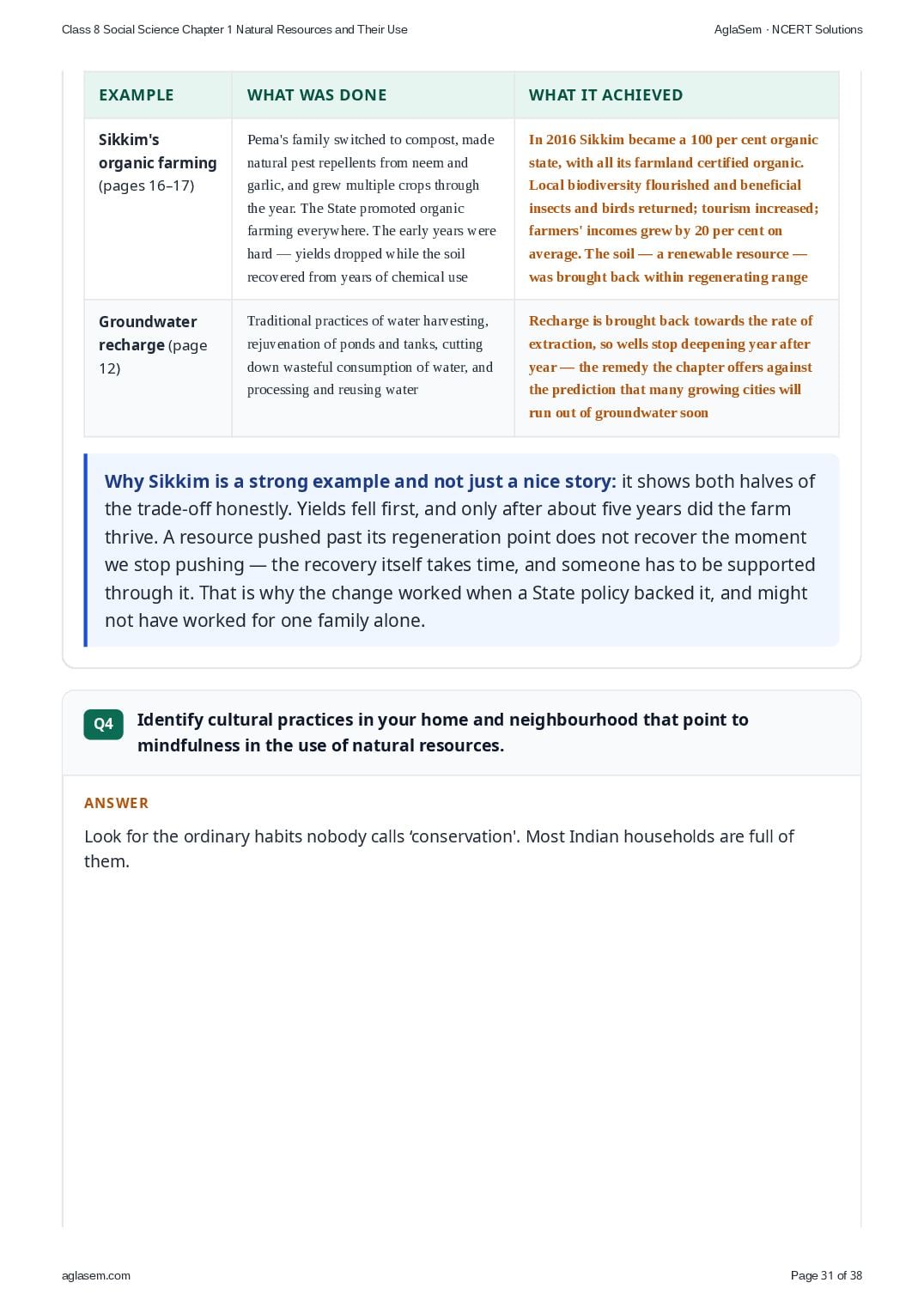
- What are renewable resources? How are they different from non-renewable ones? What can people do to ensure that renewable resources continue to be available for our use and that of future generations? Give two examples.
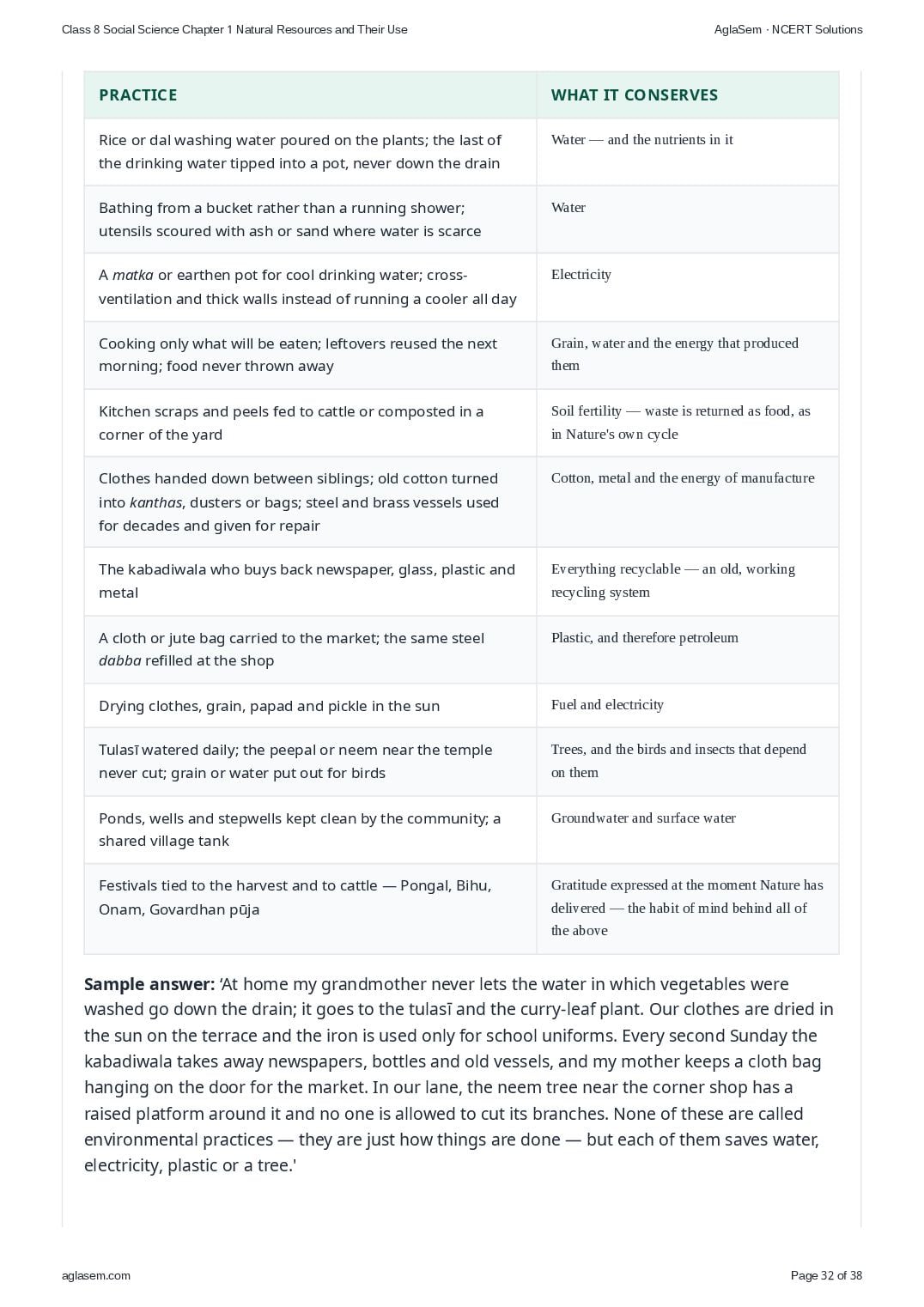
- Identify cultural practices in your home and neighbourhood that point to mindfulness in the use of natural resources.
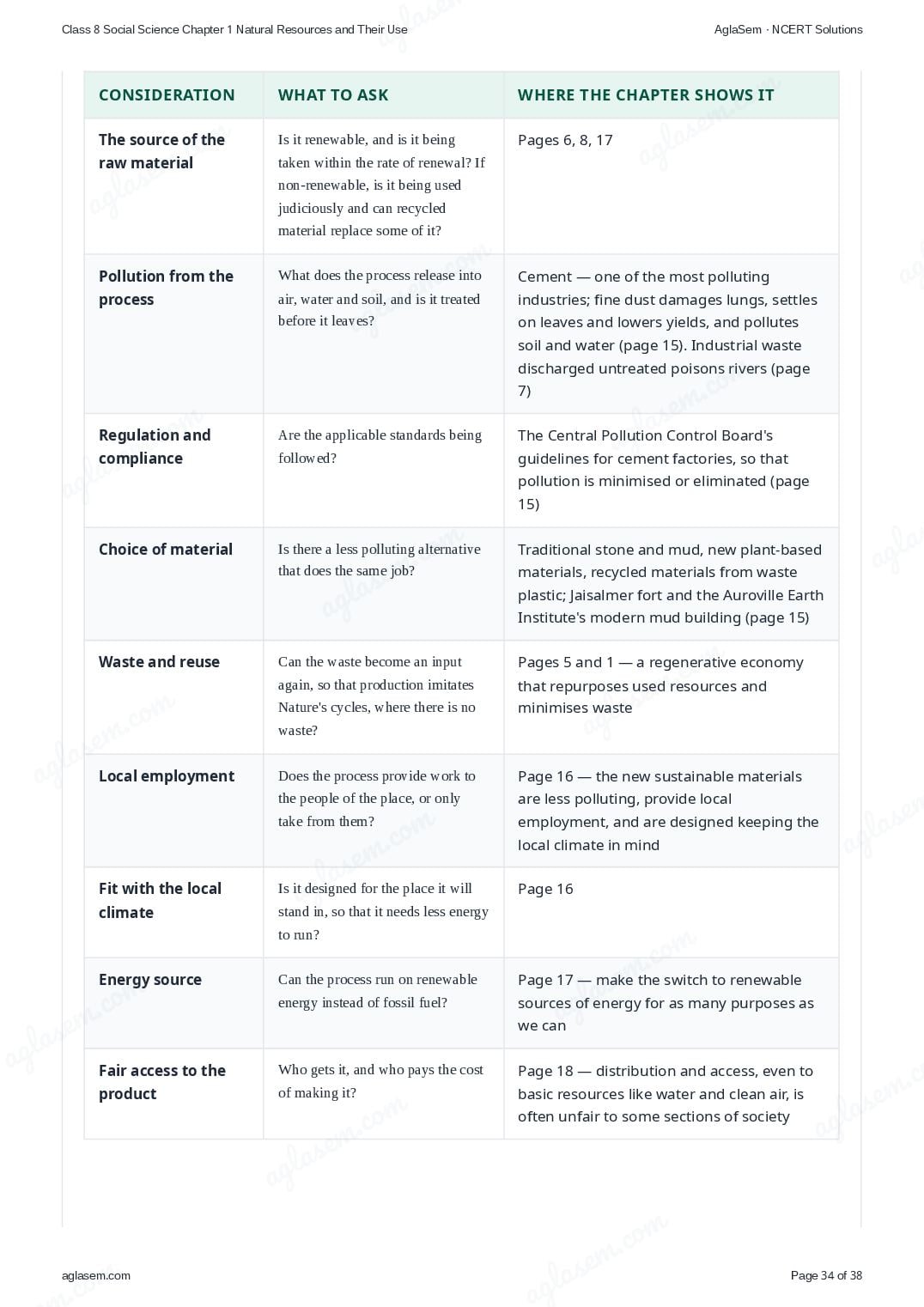
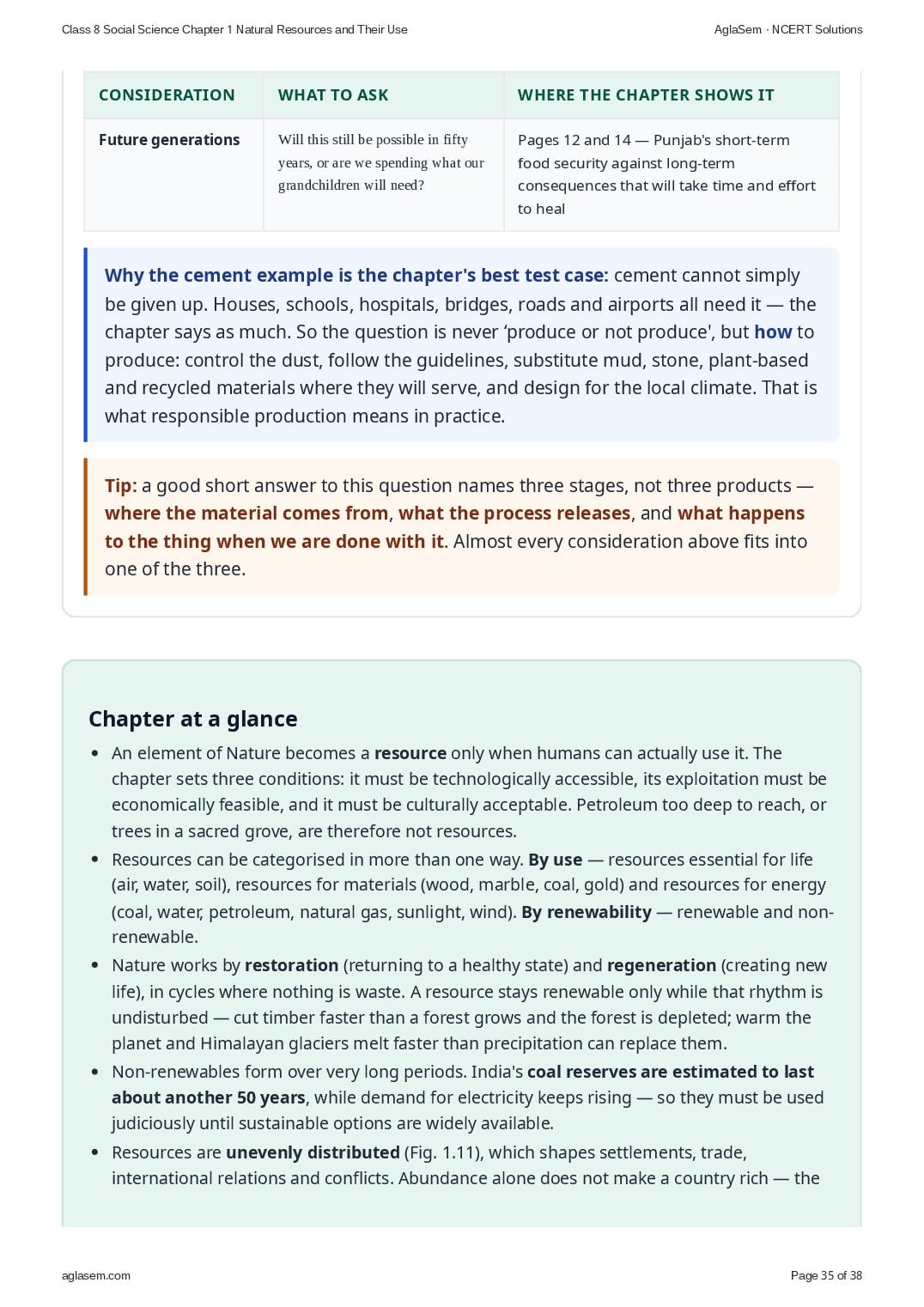
- What are some considerations to keep in mind in the production of goods for our current use?
Chapter at a Glance
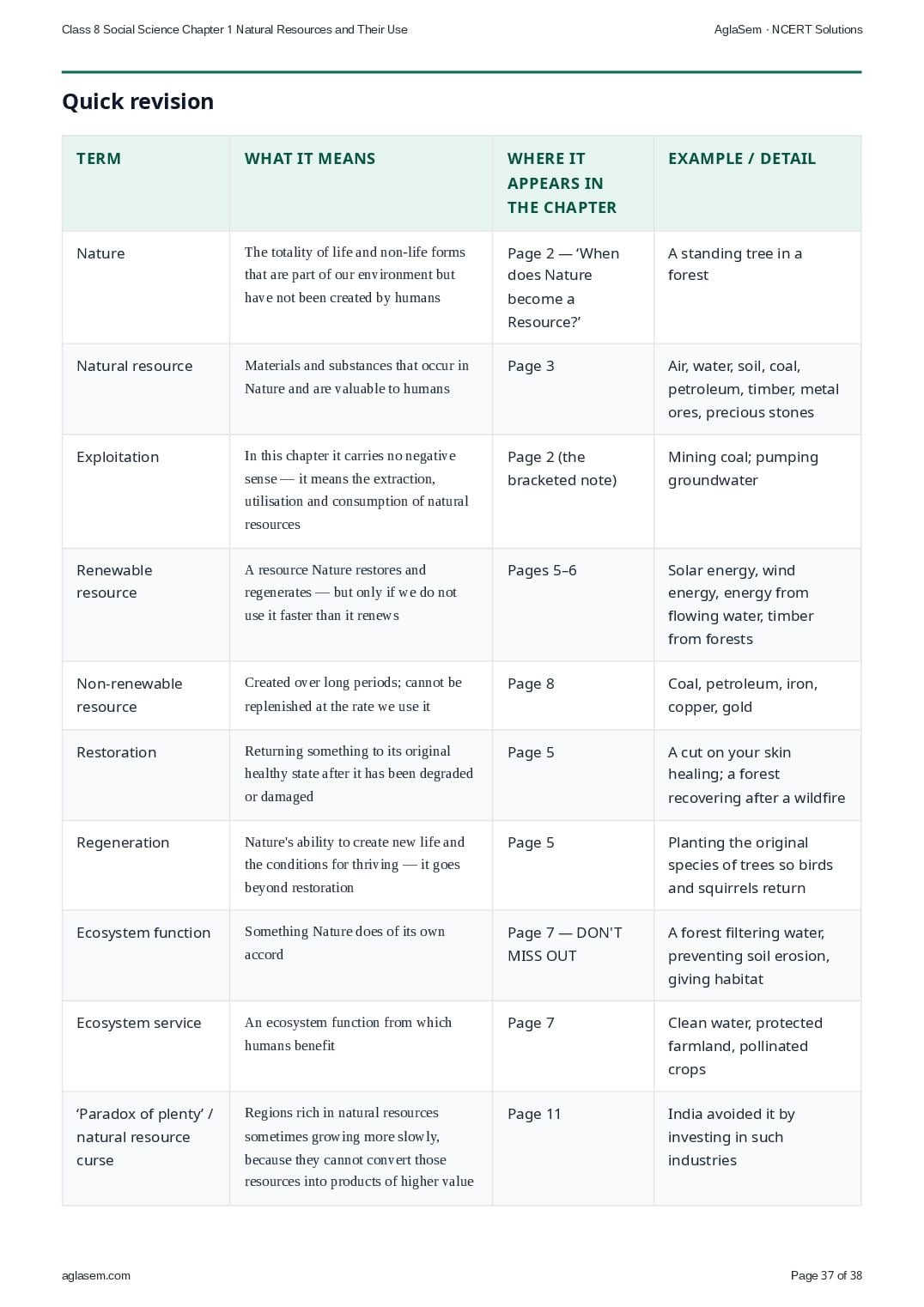
- An element of Nature becomes a resource only when humans can actually use it. The chapter sets three conditions: it must be technologically accessible , its exploitation must be economically feasible , and it must be culturally acceptable . Petroleum too deep to reach, or trees in a sacred grove, are therefore not resources.
- Resources can be categorised in more than one way. By use — resources essential for life (air, water, soil), resources for materials (wood, marble, coal, gold) and resources for energy (coal, water, petroleum, natural gas, sunlight, wind). By renewability — renewable and non-renewable.
- Nature works by restoration (returning to a healthy state) and regeneration (creating new life), in cycles where nothing is waste. A resource stays renewable only while that rhythm is undisturbed — cut timber faster than a forest grows and the forest is depleted; warm the planet and Himalayan glaciers melt faster than precipitation can replace them.
- Non-renewables form over very long periods. India's coal reserves are estimated to last about another 50 years , while demand for electricity keeps rising — so they must be used judiciously until sustainable options are widely available.
- Resources are unevenly distributed (Fig. 1.11), which shapes settlements, trade, international relations and conflicts. Abundance alone does not make a country rich — the ‘paradox of plenty’ or ‘natural resource curse’; India has largely avoided it by investing in industries that raise the value of what it extracts.
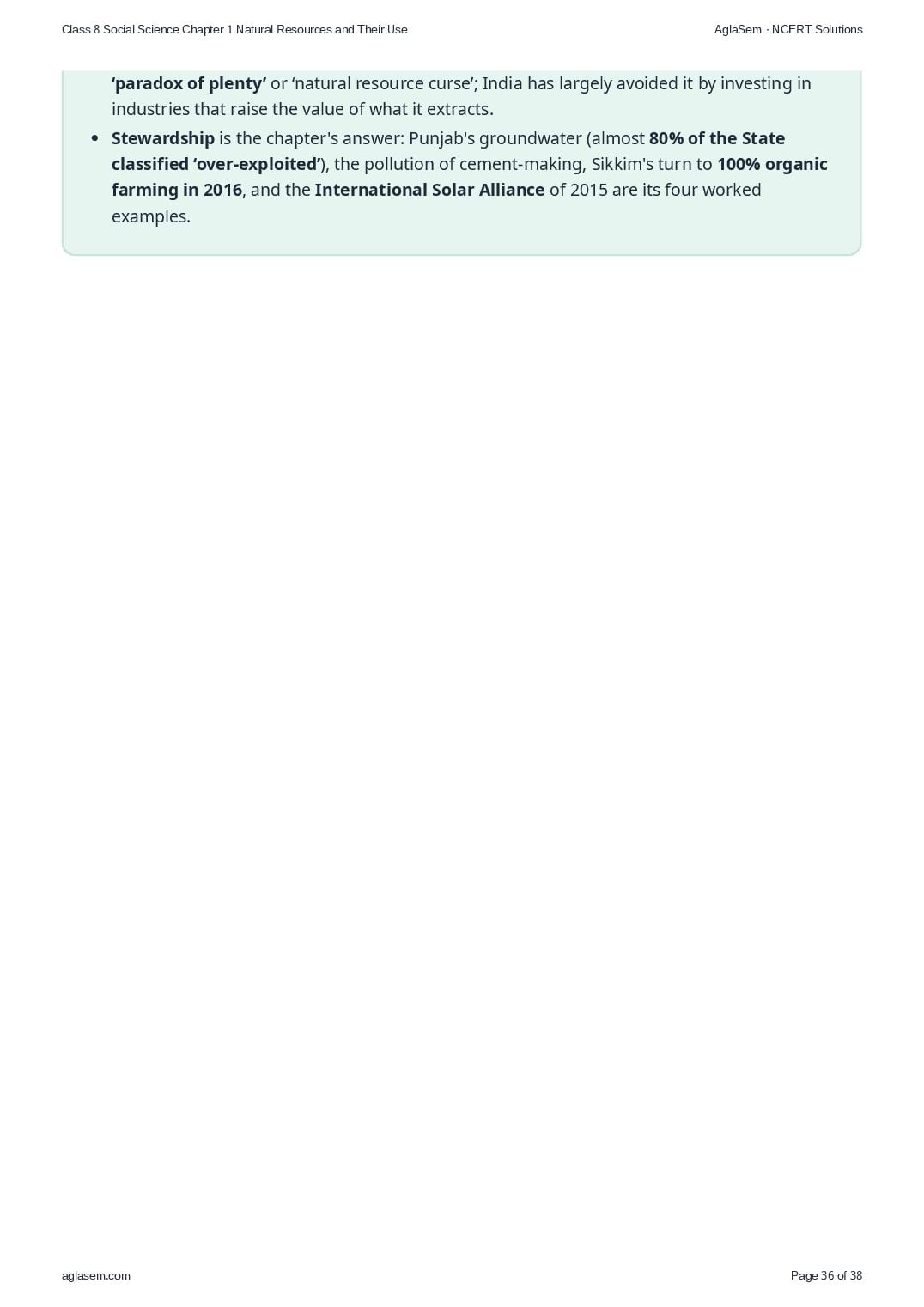
- Stewardship is the chapter's answer: Punjab's groundwater (almost 80% of the State classified ‘over-exploited’ ), the pollution of cement-making, Sikkim's turn to 100% organic farming in 2016 , and the International Solar Alliance of 2015 are its four worked examples.
How to Download NCERT Solutions for Class 8 Social Science Chapter 1 PDF
Follow these simple steps to get the Natural Resources and Their Use questions-and-answers PDF from Exploring Society: India and Beyond.
- Search NCERT Solutions for Class 8 Social Science Chapter 1 aglasem and open this page.
- Read the exercise questions with answers for Natural Resources and Their Use shown above.
- Click the Download PDF link to save the Natural Resources and Their Use solutions to your device.
NCERT Solutions for Class 8 Social Science – All Chapters
There are more chapters to study besides Natural Resources and Their Use in Social Science. Here are the NCERT Solutions for all chapters of Class 8 Social Science.
- Chapter 1 Natural Resources and Their Use
- Chapter 2 Reshaping India’s Political Map
- Chapter 3 The Rise of the Marathas
- Chapter 4 The Colonial Era in India
- Chapter 5 Universal Franchise and India’s Electoral System
- Chapter 6 The Parliamentary System Legislature and Executive
- Chapter 7 Factors of Production
- Chapter 8 World Geography Some Glimpses
- Chapter 9 India’s Long Road to Independence
- Chapter 10 A Journey Through Indian Architecture
- Chapter 11 The Role of the Judiciary in Our Society
- Chapter 12 Citizenship Rights and Duties
- Chapter 13 Dynamics of Population
- Chapter 14 India’s Urban Landscape
- Chapter 15 Cultural Currents 13th to 17th Centuries
NCERT Solutions for Class 8 – All Subjects
Just like Chapter 1 of Social Science, you can get the exercise questions with answers for every other subject of Class 8. Here are the NCERT Solutions for all subjects of Class 8.
NCERT Solutions for Class 8 Social Science Chapter 1 – An Overview
The key highlights of this study material are as follows.
| Aspects | Details |
|---|---|
| Class | Class 8 |
| Subject | Social Science |
| Chapter Number | Chapter 1 |
| Chapter Name | Natural Resources and Their Use |
| Book Name | Exploring Society: India and Beyond |
| Book By | NCERT (National Council of Educational Research and Training) |
| Educational Resource Here | NCERT Solutions of Class 8 Social Science Chapter 1 for all exercises |
| More Questions Answers of This Subject | NCERT Solutions for Class 8 Social Science |
| Download Book Chapter | NCERT Book Class 8 Social Science |
| All Questions Answers For This Class | NCERT Solutions for Class 8 |
| Complete Solutions | NCERT Solutions |
NCERT Solutions for Class 8 Social Science Chapter 1 Natural Resources and Their Use – FAQs
What are the NCERT Solutions for Class 8 Social Science Chapter 1 Natural Resources and Their Use?
They are the complete, step-by-step answers to all the exercise and in-text questions of Chapter 1 Natural Resources and Their Use from the NCERT Class 8 Social Science textbook Exploring Society: India and Beyond, written by experts as per the latest NCERT syllabus.
How can I download the Class 8 Social Science Chapter 1 solutions PDF for free?
Open this page on aglasem, read the Natural Resources and Their Use questions with answers, and click the “Download Solutions PDF” link. The Class 8 Social Science Chapter 1 NCERT Solutions PDF is completely free to download.
Are these NCERT Solutions as per the latest 2026-27 syllabus?
Yes. The NCERT Solutions for Class 8 Social Science Chapter 1 are based on the latest NCERT textbook Exploring Society: India and Beyond and the current 2026-27 CBSE syllabus, so the questions and answers match what you study in class.
Where can I get NCERT Solutions for the other chapters of Class 8 Social Science?
You can find the answers to every chapter on the NCERT Solutions for Class 8 Social Science page, and solutions for every subject on the NCERT Solutions for Class 8 page.
How do NCERT Solutions help in exam preparation?
They show the correct method to solve each question, help you write answers the way they are expected in exams, let you check and correct your own work, and save revision time — which together improve your marks in Class 8 Social Science.
If you have any queries on NCERT Solutions for Class 8 Social Science Chapter 1 Natural Resources and Their Use, then please ask in the comments below.