CBSE Class 12 Bhutia Syllabus 2027 (Subject Code 195) has been released by the Central Board of Secondary Education for the 2026-27 academic session. Class 12 is the final year of Senior Secondary education and a CBSE board exam class, so this Bhutia curriculum defines exactly what will be tested in your Class 12 board examination. It is an 80-mark theory paper across a 3-hour exam – split into Part A objective (MCQ) and Part B descriptive questions covering Reading & Comprehension, Applied Grammar, Literature, Writing Composition, Grammar, Poetry and Rapid Reader – plus 20 marks Internal Assessment. Download the official CBSE Class 12 Bhutia Syllabus PDF and see the full course structure below.
CBSE Class 12 Bhutia Syllabus 2027 PDF
The complete curriculum is as follows.
CBSE Class 12 Syllabus 2027 Bhutia View Download
CBSE Class 12 Bhutia Syllabus 2027 – Course Structure (Marks Weightage)
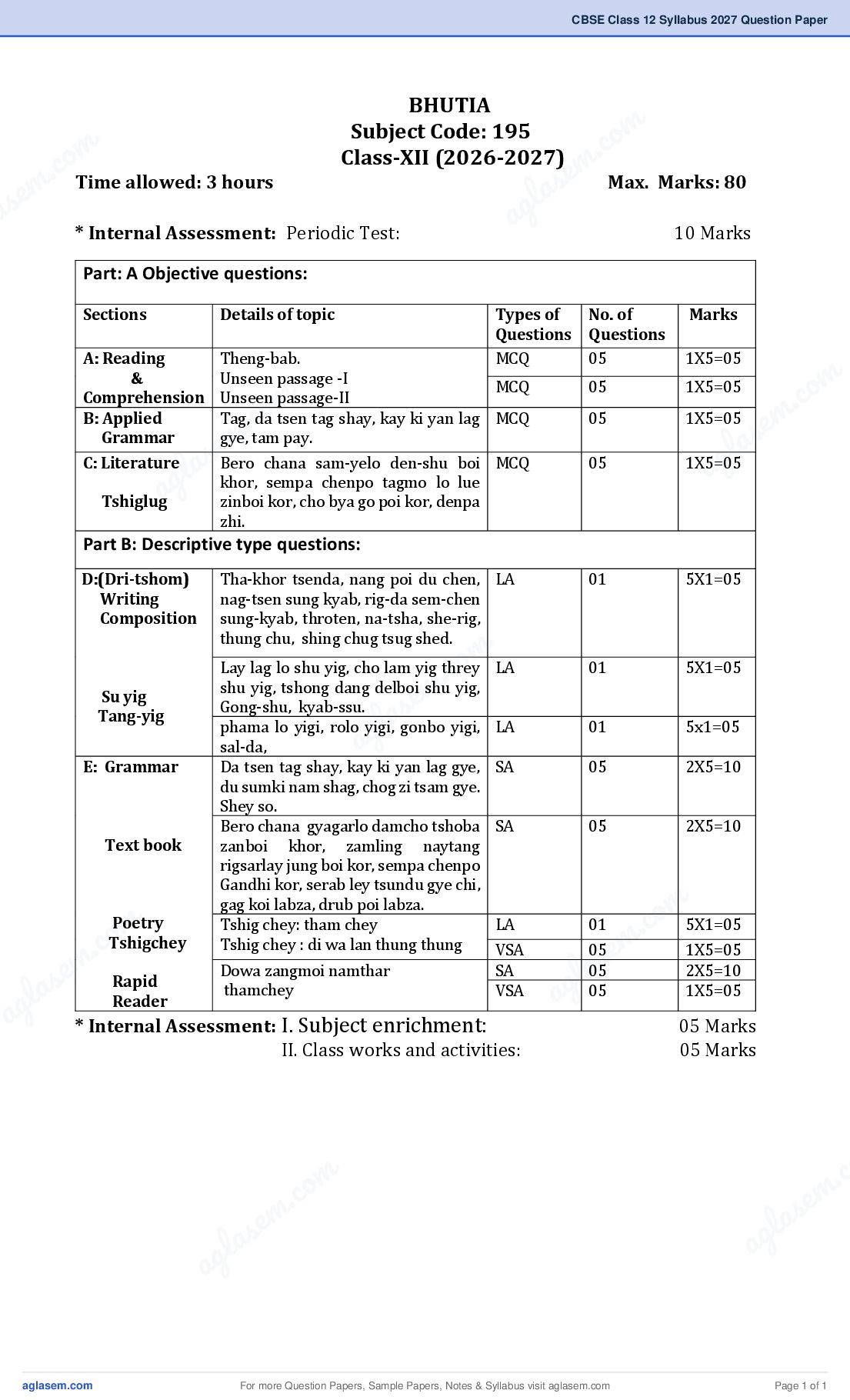
The CBSE Class 12 Bhutia exam carries 80 marks for the theory paper, plus 20 marks for Internal Assessment, for a total of 100 marks. The theory paper is organised into Part A objective (MCQ) and Part B descriptive questions across the sections below.
| Part | Section | Marks |
|---|---|---|
| A – Objective | A: Reading & Comprehension | 10 |
| A – Objective | B: Applied Grammar | 5 |
| A – Objective | C: Literature (Tshiglug) | 5 |
| B – Descriptive | D: Writing Composition (Dri-tshom) | 15 |
| B – Descriptive | E: Grammar, Poetry, Text Book & Rapid Reader | 45 |
| – | Internal Assessment (Periodic Test 10 + Subject Enrichment 5 + Class Work & Activities 5) | 20 |
| Total | 100 |
CBSE Class 12 Bhutia Syllabus 2027 – Topics Covered
Across Applied Grammar and the Grammar component of Part B, the following topics are prescribed for CBSE Class 12 Bhutia.
CBSE Class 12 Bhutia Syllabus 2027 – Literature, Poetry & Rapid Reader
Part B carries the bulk of the descriptive marks, drawing on the Text Book (prose), Poetry (Tshigchey) and Rapid Reader components alongside Writing Composition.
Literature (Tshiglug) in Part A and the Text Book prose in Part B cover themes such as Bero chana sam-yelo den-shu boi khor, sempa chenpo tagmo lo lue zinboi kor, cho bya go poi kor and denpa zhi, along with pieces on zamling naytang rigsarlay jung boi kor and sempa chenpo Gandhi kor. Poetry (Tshigchey) is assessed through explanation and short-answer questions, while the Rapid Reader draws on Dowa zangmoi namthar.
CBSE Class 12 Bhutia Syllabus 2027 – Exam Pattern (Question-wise Breakdown)
The CBSE Class 12 Bhutia question paper is divided into Part A (objective) and Part B (descriptive). The detailed scheme and weightage to content is as follows.
| Part | Section | Question Type | No. of Questions | Marks |
|---|---|---|---|---|
| A | A: Reading & Comprehension (Theng-bab, Unseen passages I & II) | MCQ | 2 × 5 | 10 |
| A | B: Applied Grammar | MCQ | 5 | 5 |
| A | C: Literature (Tshiglug) | MCQ | 5 | 5 |
| B | D: Writing Composition (Dri-tshom) – Su yig, Tang-yig, letters | LA | 3 (5 × 1 each) | 15 |
| B | E: Grammar (Text Book) | SA | 5 (2 × 5) | 10 |
| B | E: Text Book (prose themes) | SA | 5 (2 × 5) | 10 |
| B | E: Poetry (Tshigchey) – tham chey | LA | 1 (5 × 1) | 5 |
| B | E: Poetry (Tshigchey) – short answers | VSA | 5 (1 × 5) | 5 |
| B | E: Rapid Reader (Dowa zangmoi namthar) – SA | SA | 5 (2 × 5) | 10 |
| B | E: Rapid Reader (Dowa zangmoi namthar) – VSA | VSA | 5 (1 × 5) | 5 |
| Total (Theory) | 80 |
Note: The Bhutia course structure above is presented exactly as stated in the official CBSE Class 12 (2026-27) document. The 45-mark Part B, Section E total combines the Grammar, Text Book, Poetry and Rapid Reader components listed.
CBSE Class 12 Bhutia Syllabus 2027 – Continue Your Preparation
Once you have reviewed the syllabus, practise with the CBSE Class 12 Bhutia Sample Paper and previous years’ CBSE Class 12 Question Papers to prepare for your board exam.
Frequently Asked Questions
The CBSE Class 12 Bhutia Syllabus 2027 (Subject Code 195) is the official curriculum released by CBSE for the 2026-27 academic session. Since Class 12 is a board exam class, this syllabus defines the full scope of the board exam. It covers Reading & Comprehension, Applied Grammar, Literature (Tshiglug), Writing Composition (Dri-tshom), Grammar, Poetry (Tshigchey) and Rapid Reader, for a total of 100 marks (80 theory plus 20 Internal Assessment).
The subject code for Bhutia in CBSE Class 12 is 195.
The CBSE Class 12 Bhutia theory exam is of 80 marks and is 3 hours long, plus 20 marks for Internal Assessment (Periodic Test 10, Subject Enrichment 5, and Class Work & Activities 5), making a total of 100 marks.
The Class 12 Bhutia paper has two parts. Part A is objective (MCQ) covering Reading & Comprehension, Applied Grammar and Literature. Part B is descriptive, covering Writing Composition, Grammar from the Text Book, Poetry (Tshigchey) and the Rapid Reader through long, short and very short answer questions.
You can download the CBSE Class 12 Bhutia Syllabus 2027 PDF for free from this page. Click the Download PDF button near the top, or use the embedded official document, to view or save the complete Class 12 (2026-27) Bhutia course structure.
CBSE Class 12 Syllabus 2026-27 (All Subjects)
You study more subjects besides Bhutia in Class 12. The subject-wise syllabus for CBSE Class 12 students is as follows.
CBSE Syllabus 2026-27 (Class-wise)
The class-wise syllabus for CBSE board students is as follows.
CBSE Class 12 Bhutia Syllabus 2027 – An Overview
The important things to know about this curriculum are as follows.
| Aspects | Details |
|---|---|
| Education Board | CBSE |
| Class | Class 12 (Senior Secondary – Board Exam) |
| Subject | Bhutia |
| Subject Code | 195 |
| Session | 2026-27 |
| Study Material Here | CBSE Syllabus for Class 12 Bhutia |
| All Curriculum for This Class | CBSE Syllabus for Class 12 |
| All Curriculum for This Board | CBSE Syllabus |
| Full Name of CBSE | Central Board of Secondary Education |
| NCERT Books | NCERT Books for Class 12 |
| NCERT Solutions | NCERT Solutions for Class 12 |
If you have any queries on CBSE Class 12 Bhutia Syllabus 2027, then please ask in comments below.