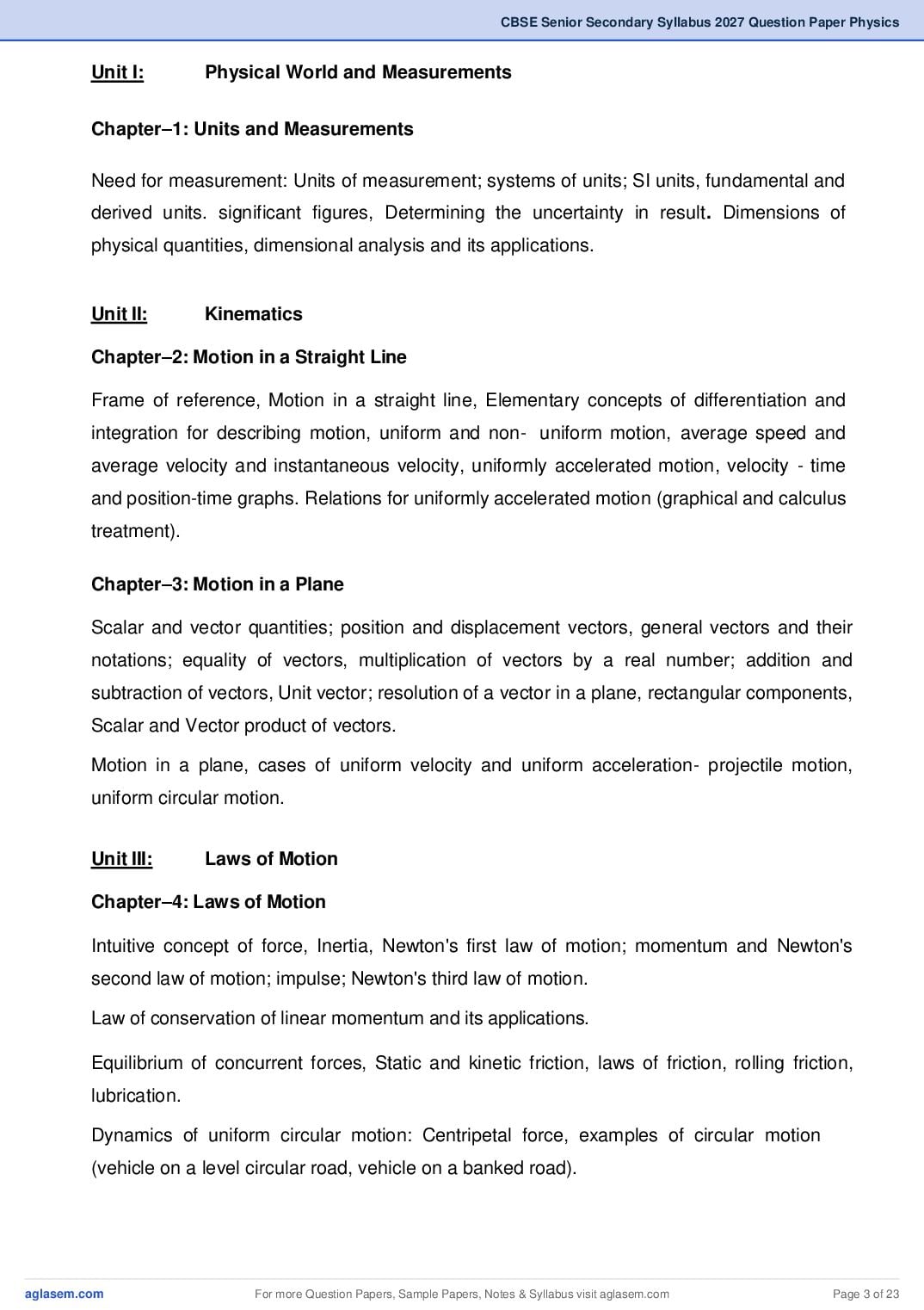
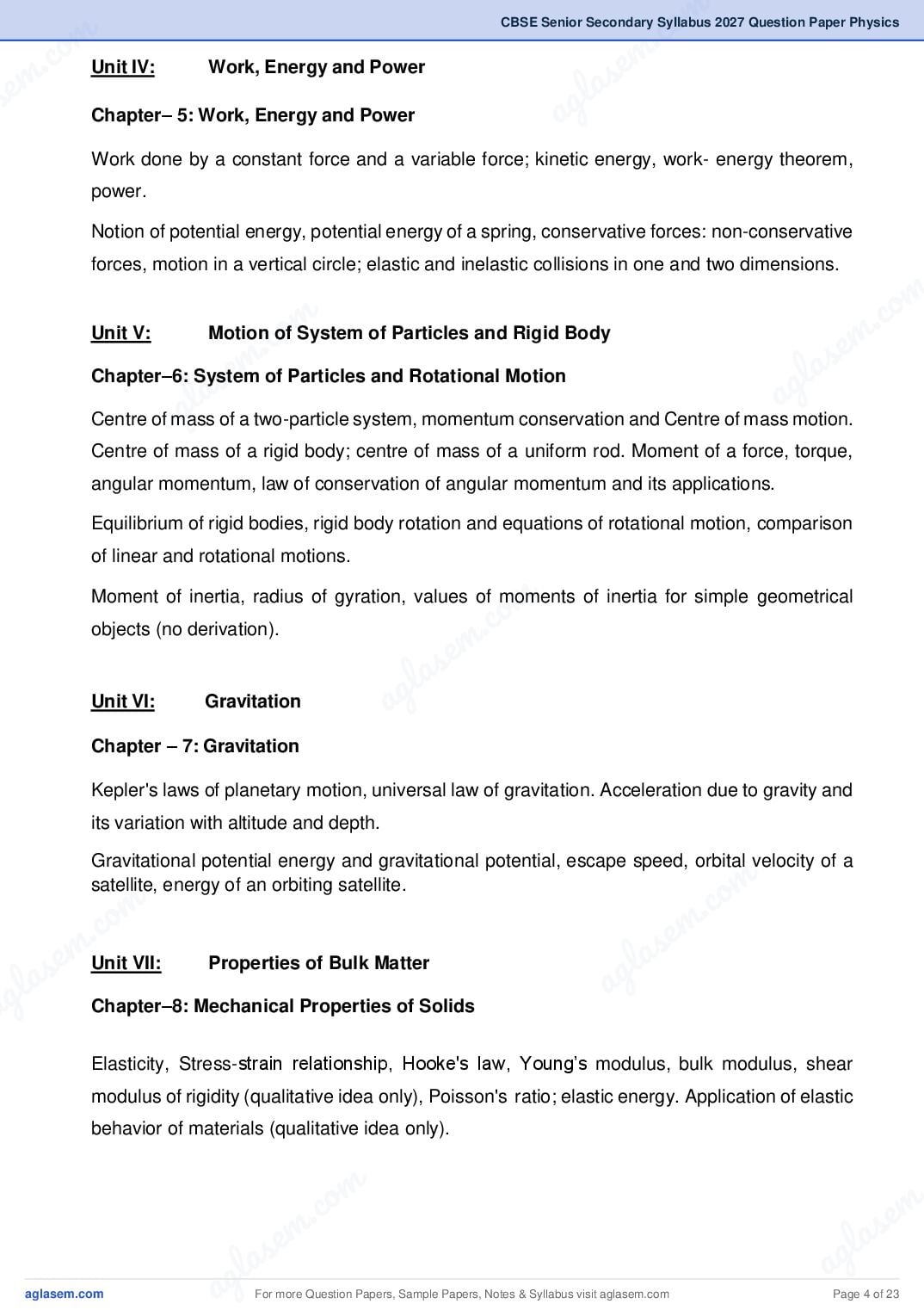
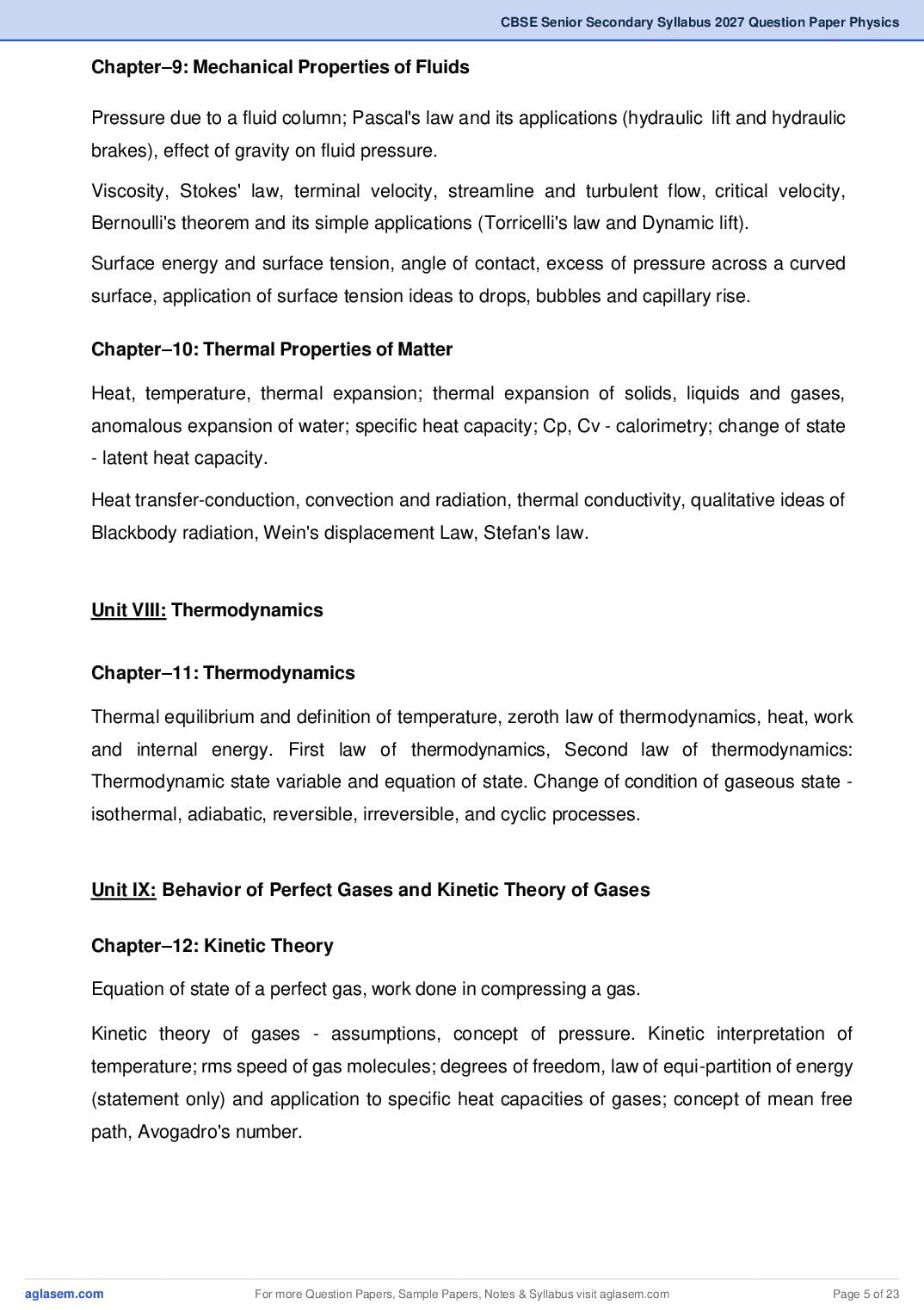
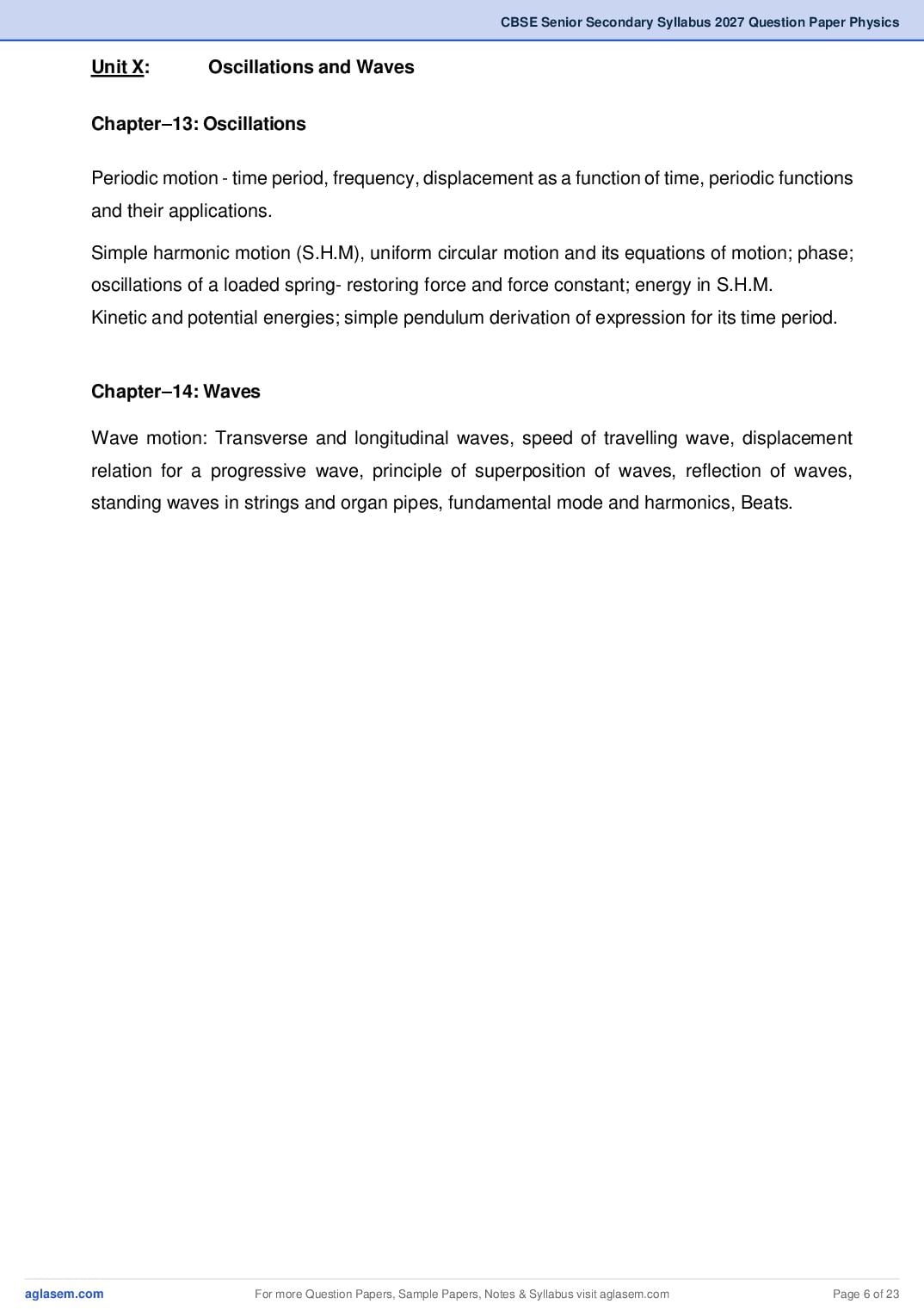
CBSE Class 12 Physics Syllabus 2027 (Subject Code 042) has been released by the Central Board of Secondary Education for the 2026-27 academic session. It is a 100-mark course – 70 marks theory spread across 9 units (Electrostatics, Current Electricity, Magnetic Effects of Current and Magnetism, Electromagnetic Induction and Alternating Currents, Electromagnetic Waves, Optics, Dual Nature of Radiation and Matter, Atoms and Nuclei, Electronic Devices) in a 3-hour exam, plus 30 marks Practicals. Download the official CBSE Class 12 Physics Syllabus PDF and see the full unit-wise breakdown below.
CBSE Class 12 Physics Syllabus 2027 PDF
The complete curriculum is as follows.
CBSE Senior Secondary Syllabus 2027 Physics View Download
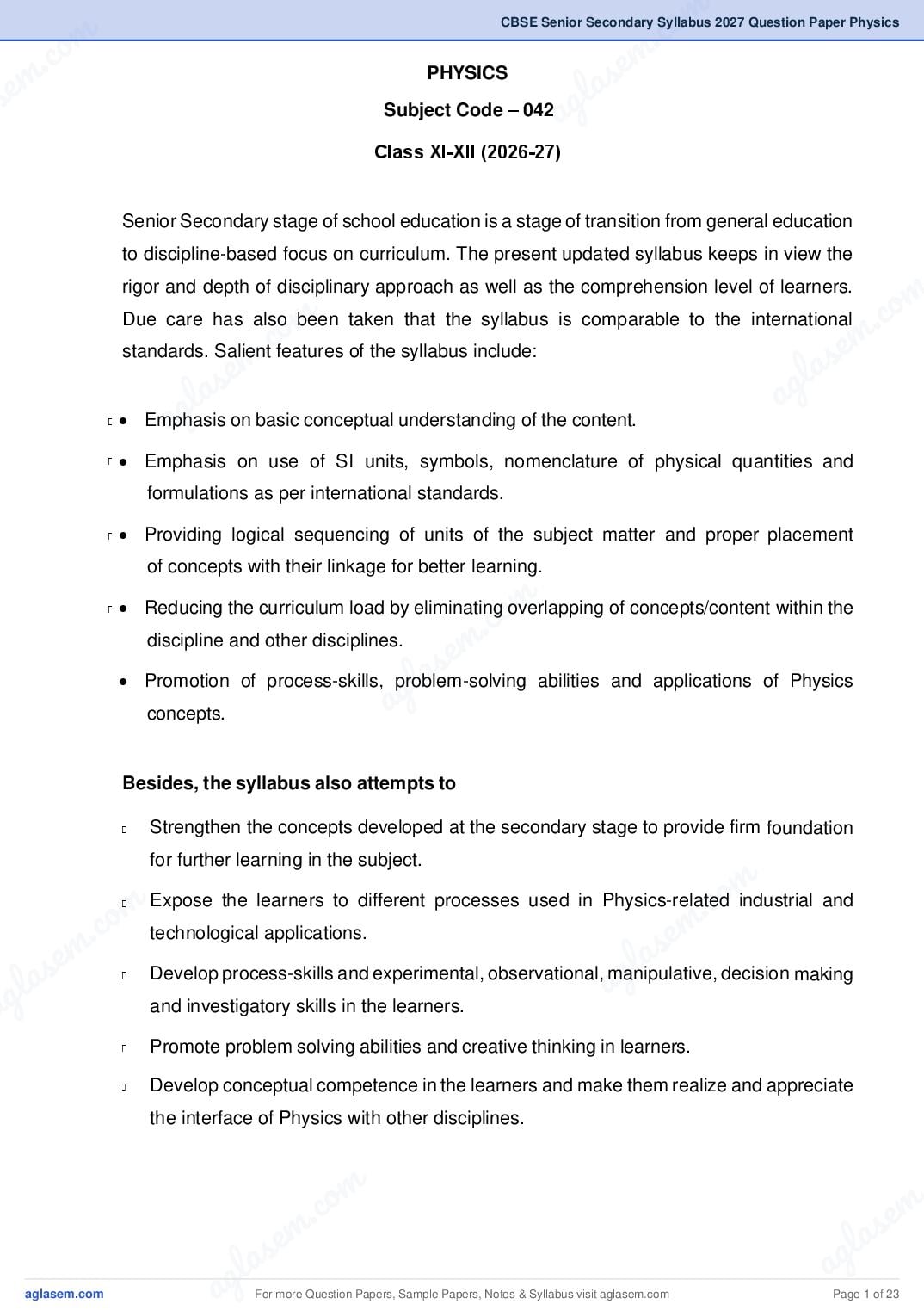
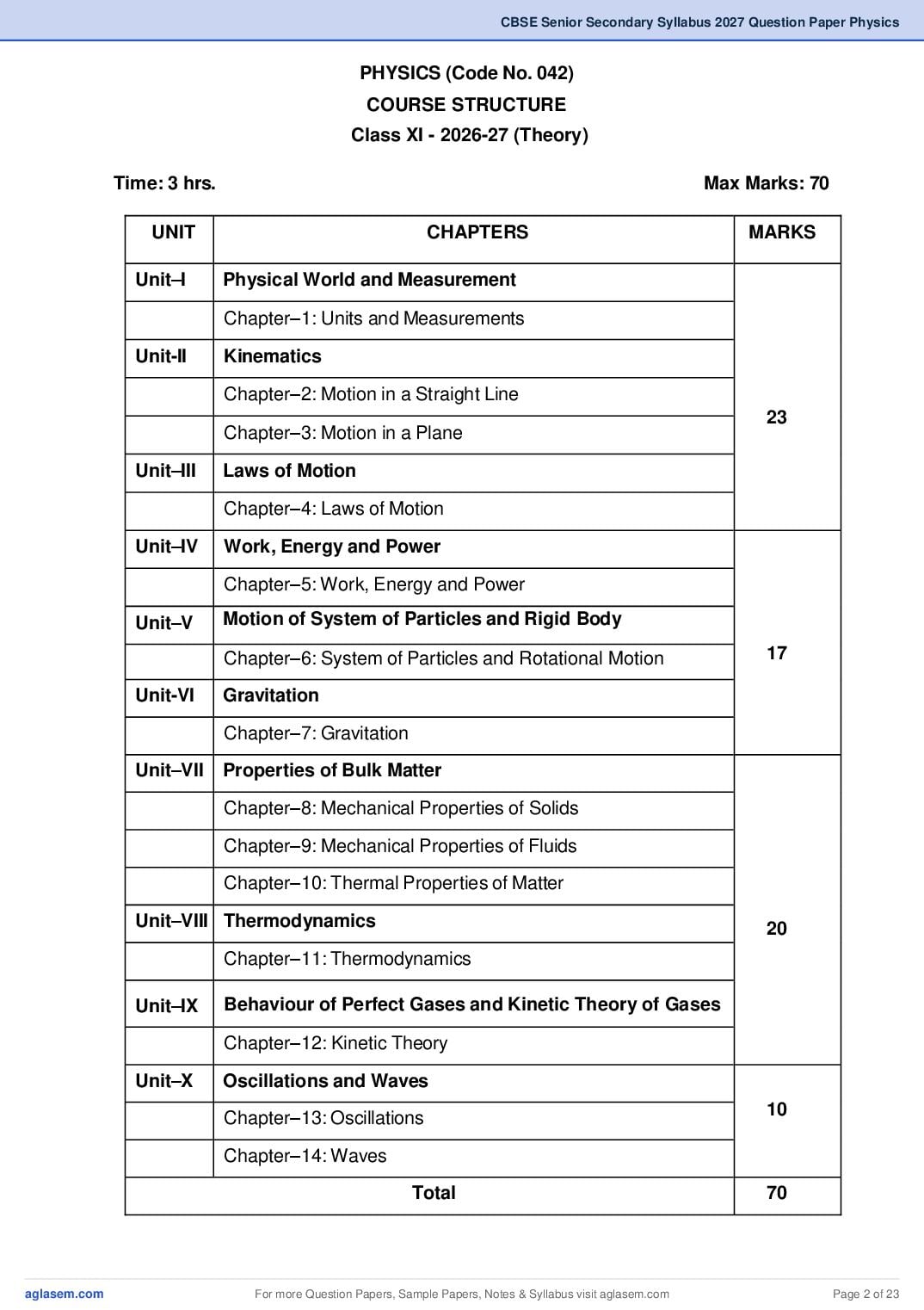
CBSE Class 12 Physics Syllabus 2027 – Marks Weightage (Unit-wise)
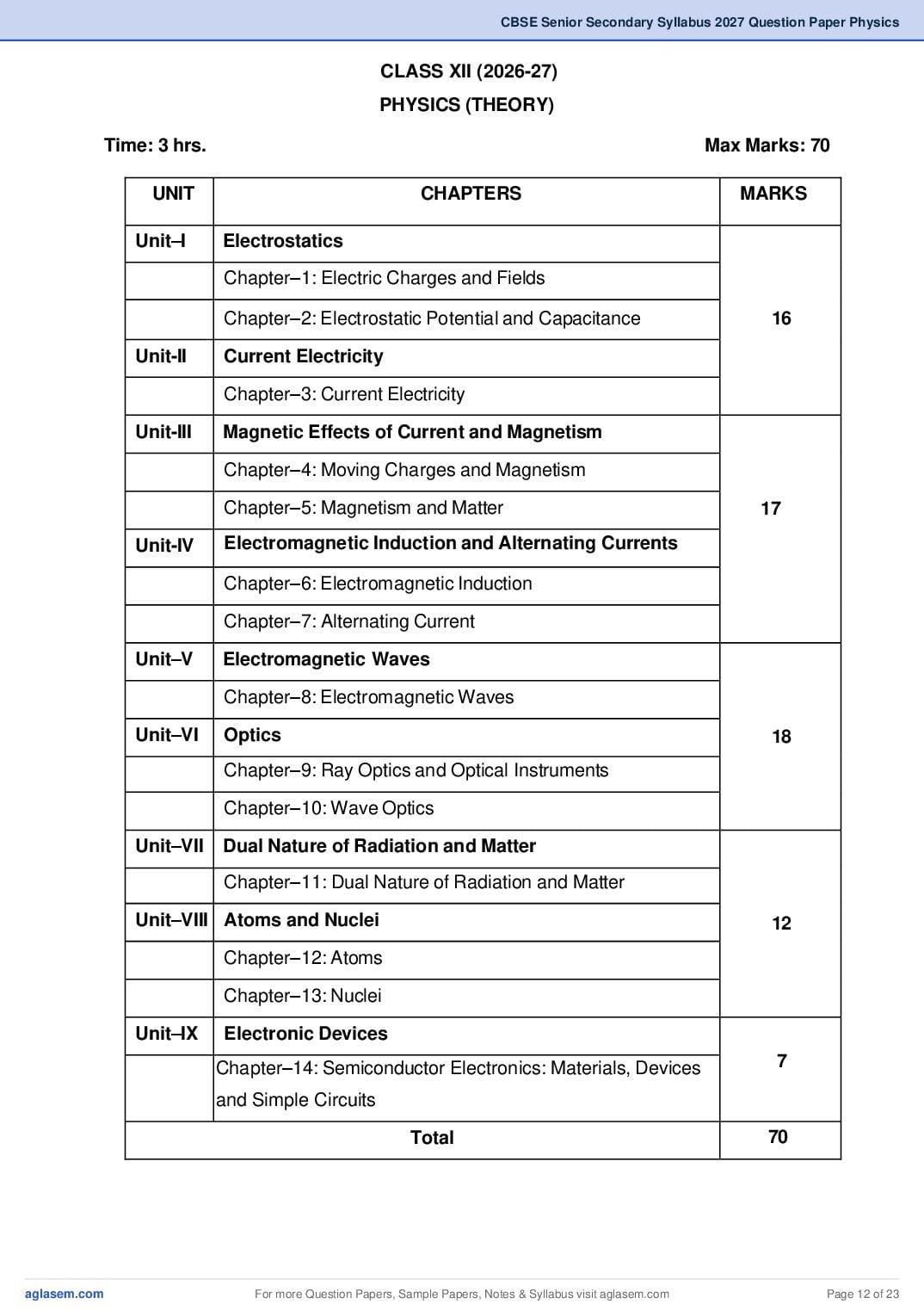
The CBSE Class 12 Physics exam carries 100 total marks – 70 for the theory paper (across 9 units) and 30 for Practicals.
| Unit | Chapters | Marks |
|---|---|---|
| Unit I – Electrostatics | Electric Charges and Fields; Electrostatic Potential and Capacitance | 16 |
| Unit II – Current Electricity | Current Electricity | |
| Unit III – Magnetic Effects of Current and Magnetism | Moving Charges and Magnetism; Magnetism and Matter | 17 |
| Unit IV – Electromagnetic Induction and Alternating Currents | Electromagnetic Induction; Alternating Current | |
| Unit V – Electromagnetic Waves | Electromagnetic Waves | 18 |
| Unit VI – Optics | Ray Optics and Optical Instruments; Wave Optics | |
| Unit VII – Dual Nature of Radiation and Matter | Dual Nature of Radiation and Matter | 12 |
| Unit VIII – Atoms and Nuclei | Atoms; Nuclei | |
| Unit IX – Electronic Devices | Semiconductor Electronics: Materials, Devices and Simple Circuits | 7 |
| Theory Total | 70 | |
| Practicals | Experiments, Activities, Practical Record, Investigatory Project, Viva | 30 |
| Total | 100 |
CBSE Class 12 Physics Syllabus 2027 – Unit-wise Topics
The CBSE Class 12 Physics theory paper (70 marks) is divided into 9 units covering the following key topics.
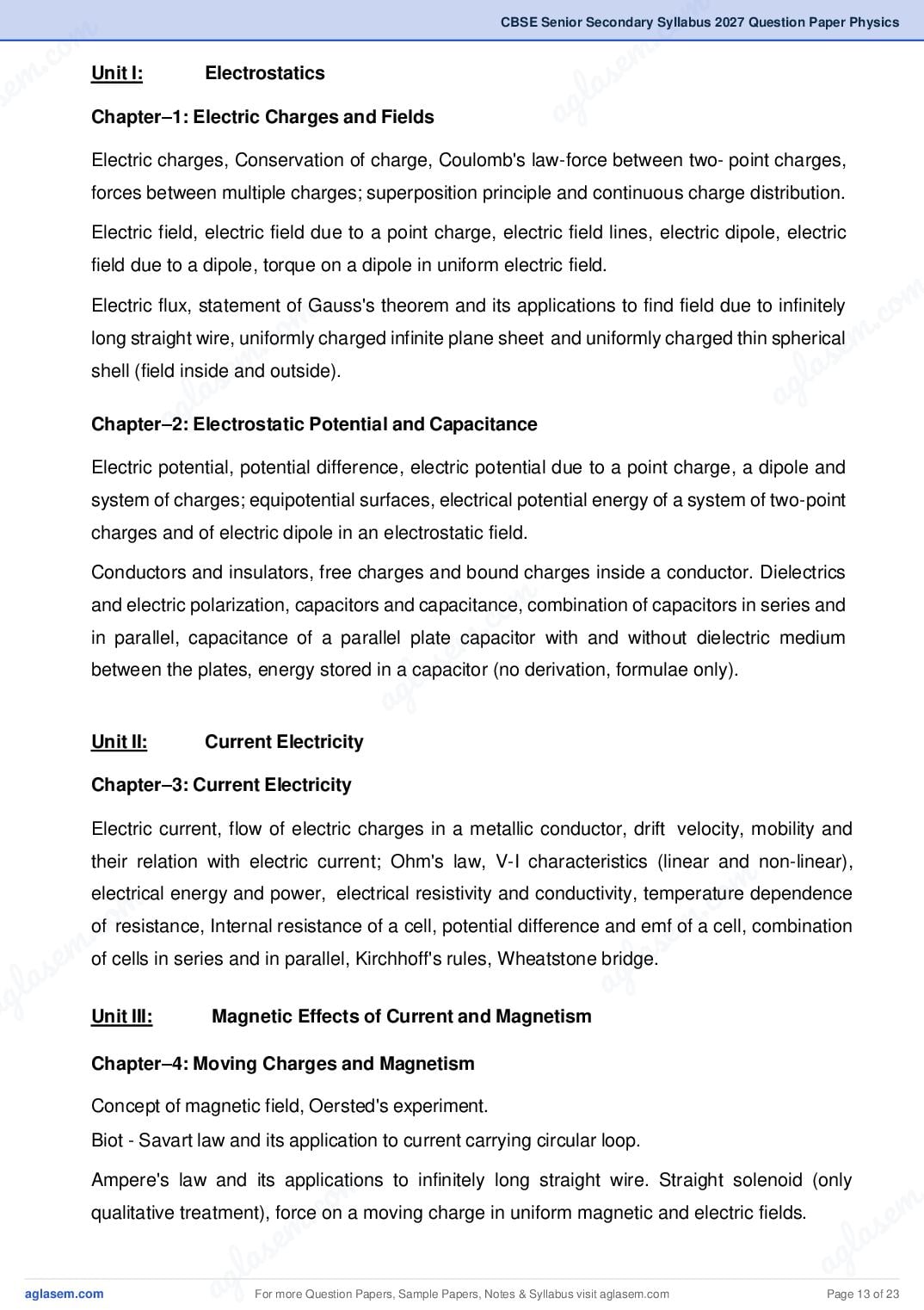
Unit I – Electrostatics: Electric charges, Coulomb’s law, superposition principle, electric field and field lines, electric dipole, Gauss’s theorem and applications; electric potential, equipotential surfaces, capacitors and capacitance, combination of capacitors, energy stored in a capacitor.
Unit II – Current Electricity: Drift velocity, Ohm’s law, resistivity and conductivity, internal resistance, combination of cells, Kirchhoff’s rules, Wheatstone bridge.
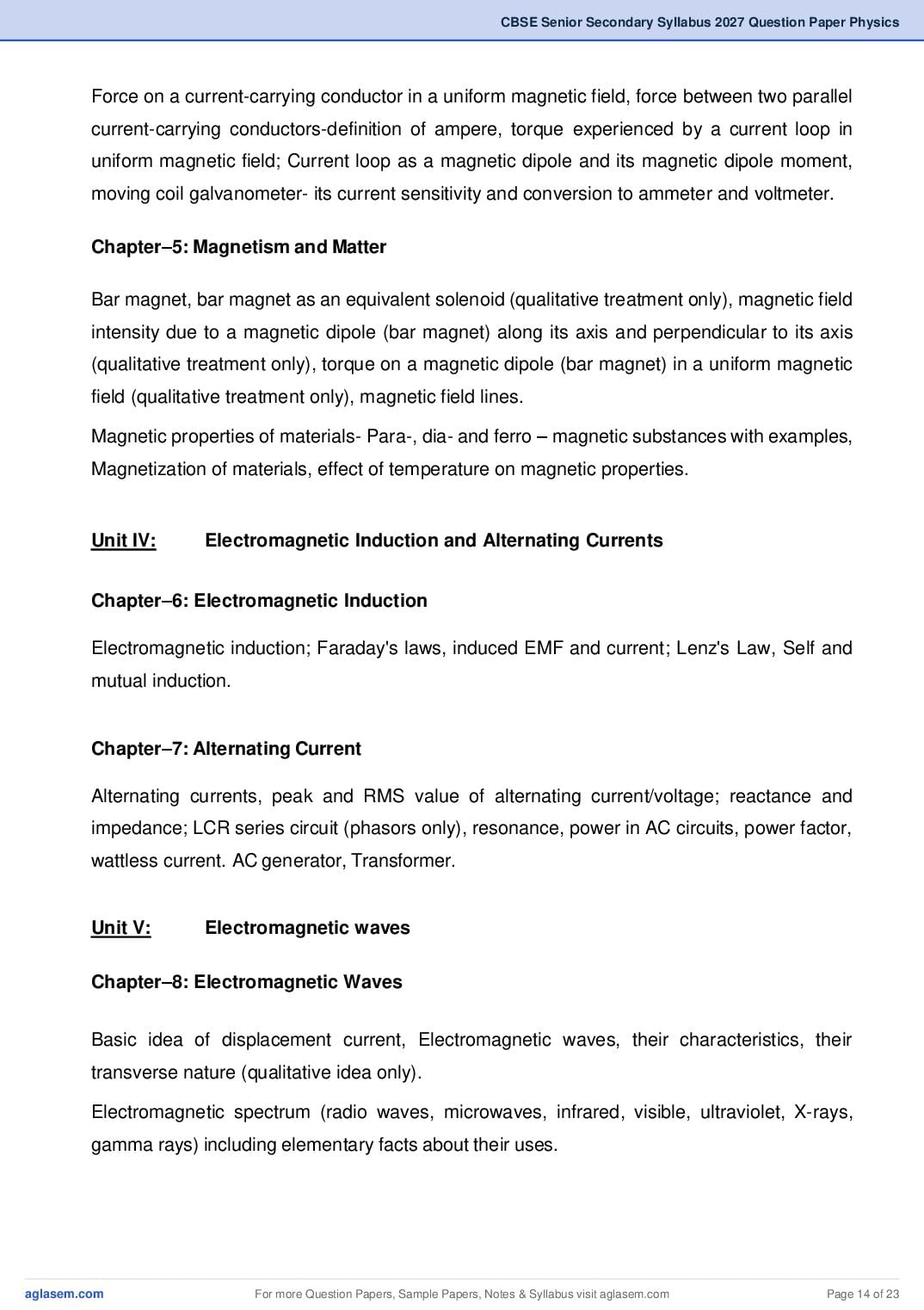
Unit III – Magnetic Effects of Current and Magnetism: Oersted’s experiment, Biot-Savart law, Ampere’s law, force on a moving charge and current-carrying conductor, moving coil galvanometer, bar magnet, magnetic field lines, Para-, dia- and ferro-magnetic substances.
Unit IV – Electromagnetic Induction and Alternating Currents: Faraday’s laws, Lenz’s law, self and mutual induction; AC peak and RMS values, LCR series circuit, resonance, power factor, AC generator, transformer.
Unit V – Electromagnetic Waves: Displacement current, characteristics of electromagnetic waves, electromagnetic spectrum (radio waves, microwaves, infrared, visible, ultraviolet, X-rays, gamma rays) and their uses.
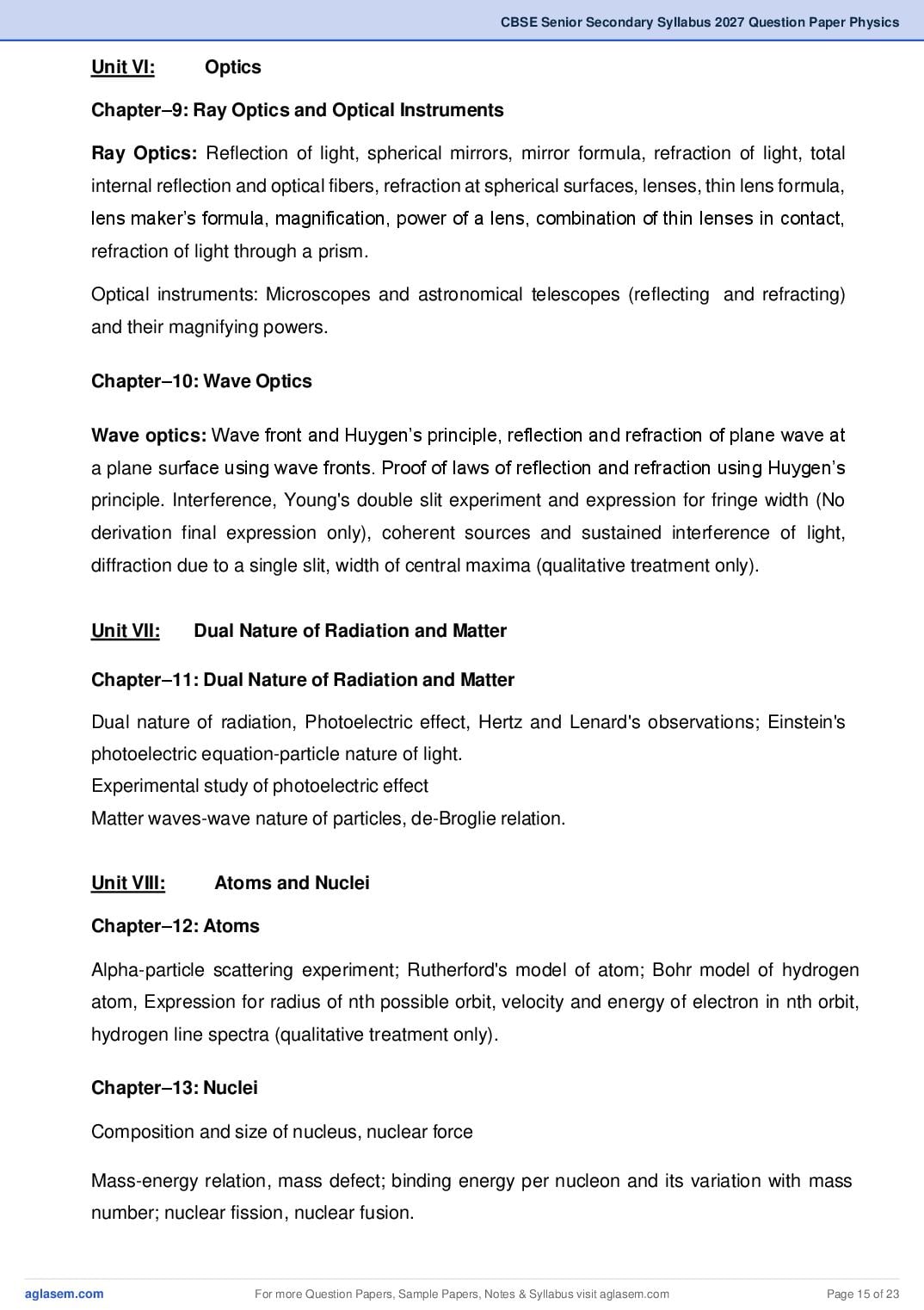
Unit VI – Optics: Reflection, spherical mirrors, refraction, total internal reflection, lenses, lens maker’s formula, microscopes and telescopes; wave optics – Huygens’ principle, Young’s double slit experiment, diffraction due to a single slit.
Unit VII – Dual Nature of Radiation and Matter: Photoelectric effect, Einstein’s photoelectric equation, matter waves and de-Broglie relation.
Unit VIII – Atoms and Nuclei: Alpha-particle scattering, Rutherford’s and Bohr’s models of the atom, hydrogen spectrum; composition of the nucleus, mass-energy relation, binding energy, nuclear fission and fusion.
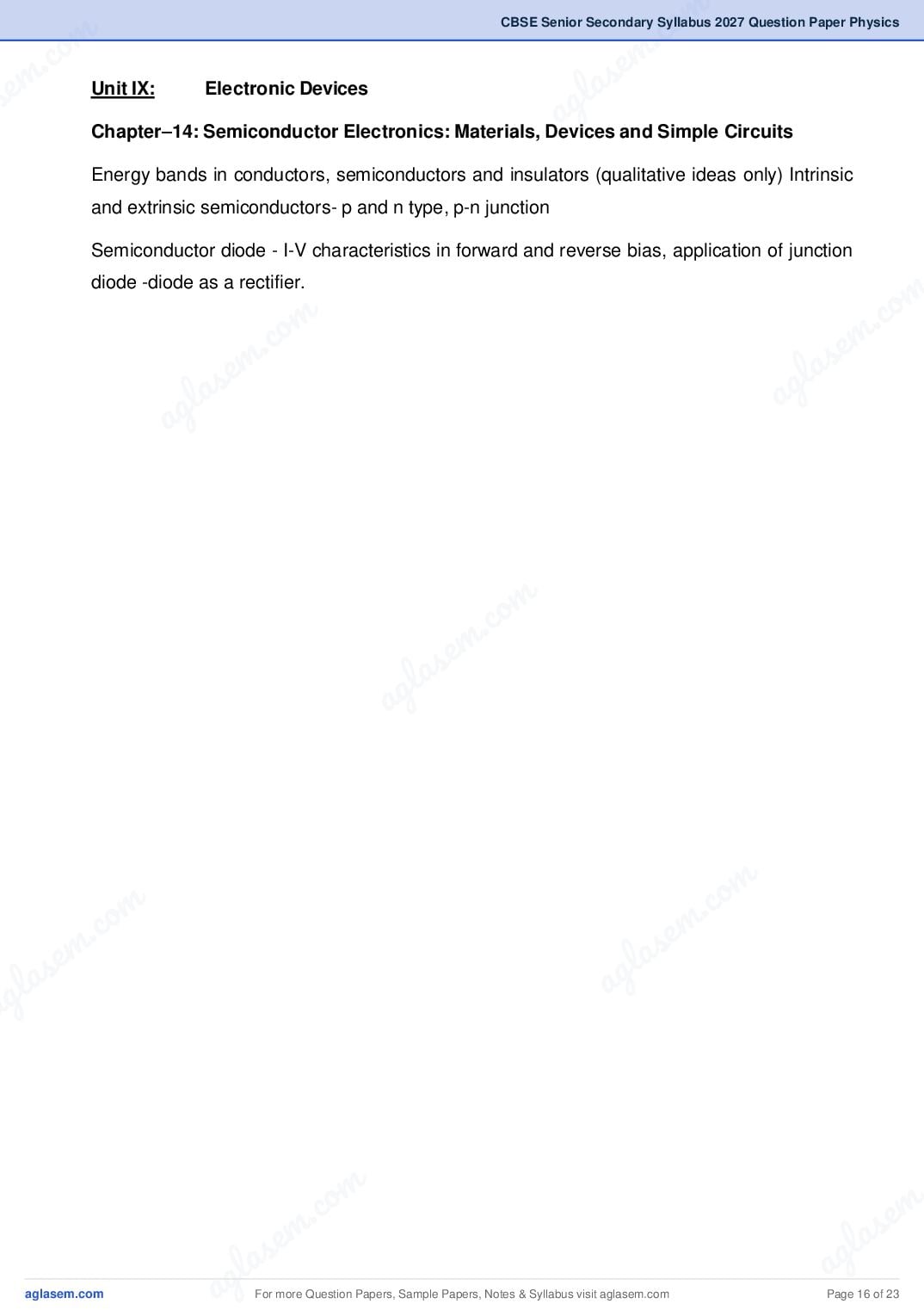
Unit IX – Electronic Devices: Energy bands in conductors, semiconductors and insulators; intrinsic and extrinsic semiconductors, p-n junction, semiconductor diode I-V characteristics, diode as a rectifier.
CBSE Class 12 Physics Syllabus 2027 – Prescribed Textbook & Practicals
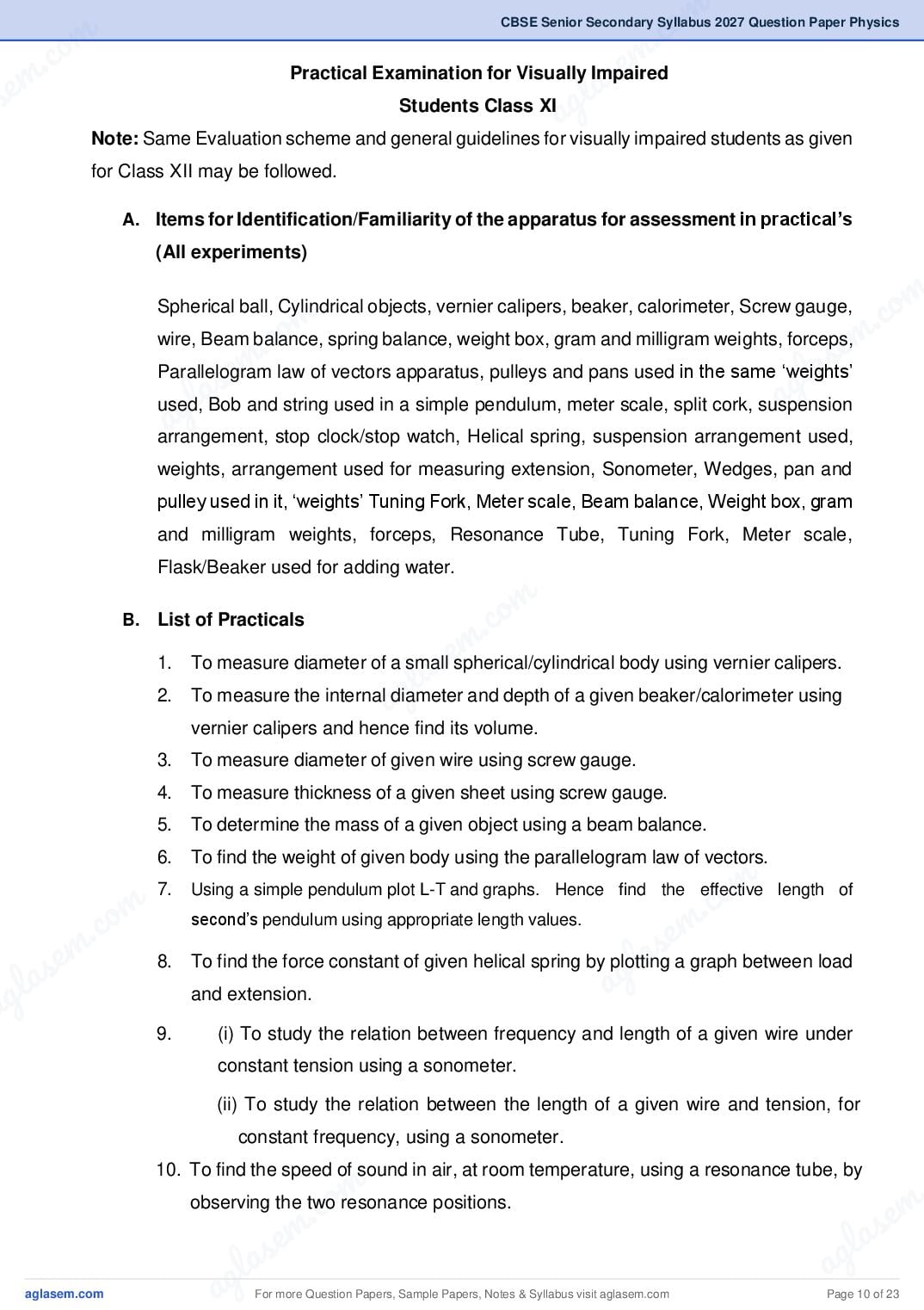
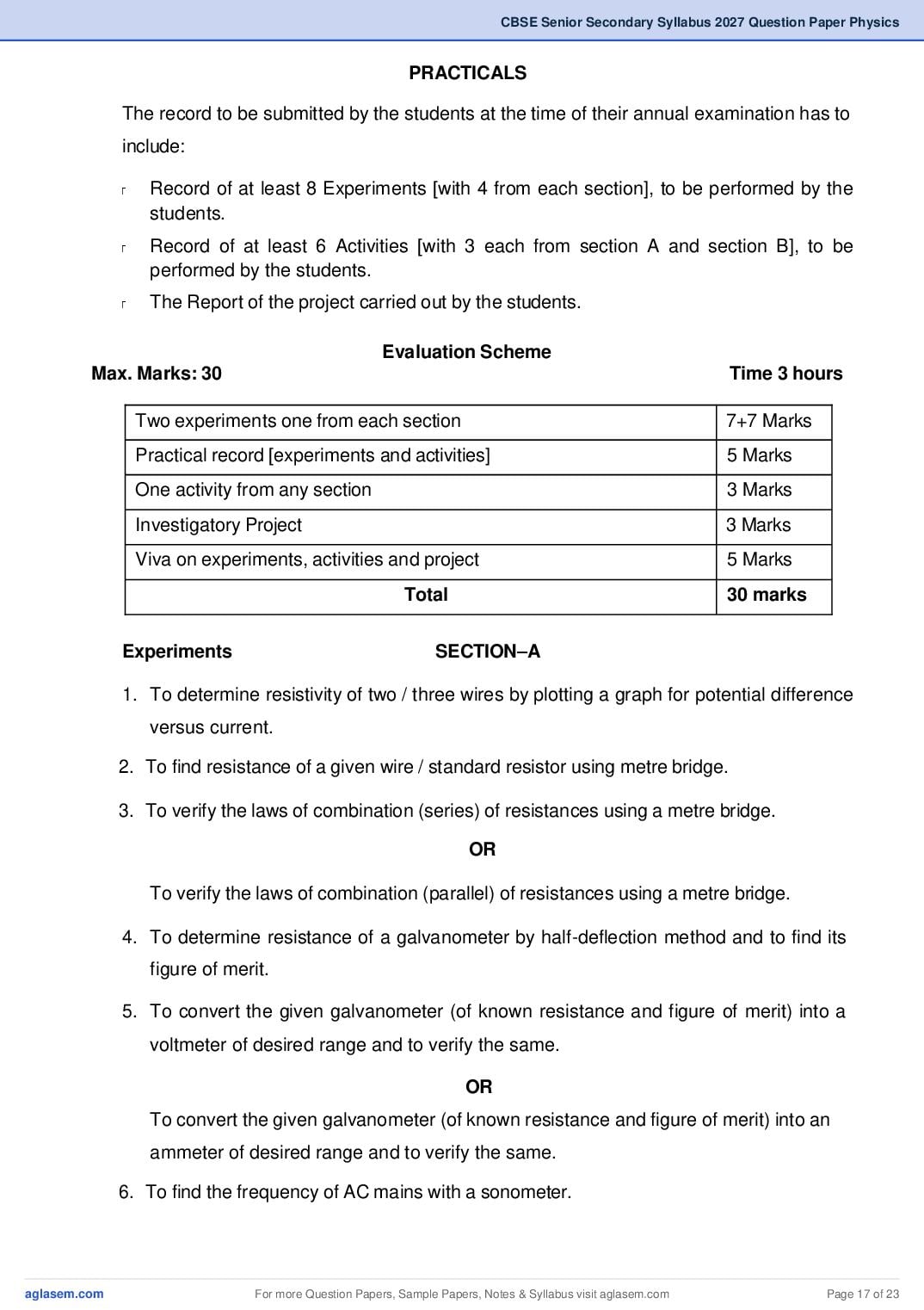
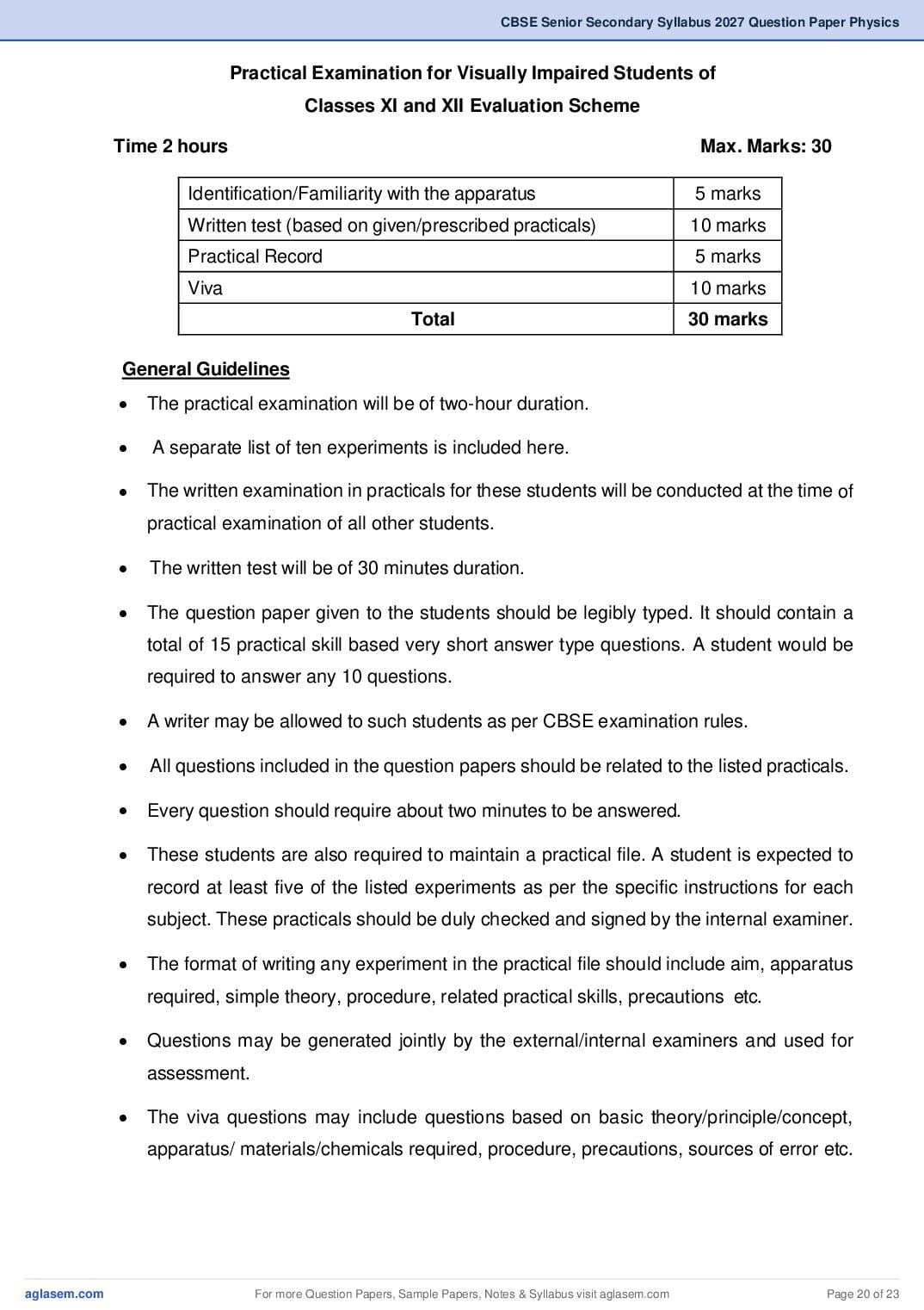
Besides the 70-mark theory paper, CBSE Class 12 Physics has a 30-mark Practical examination based on experiments, activities and a project.
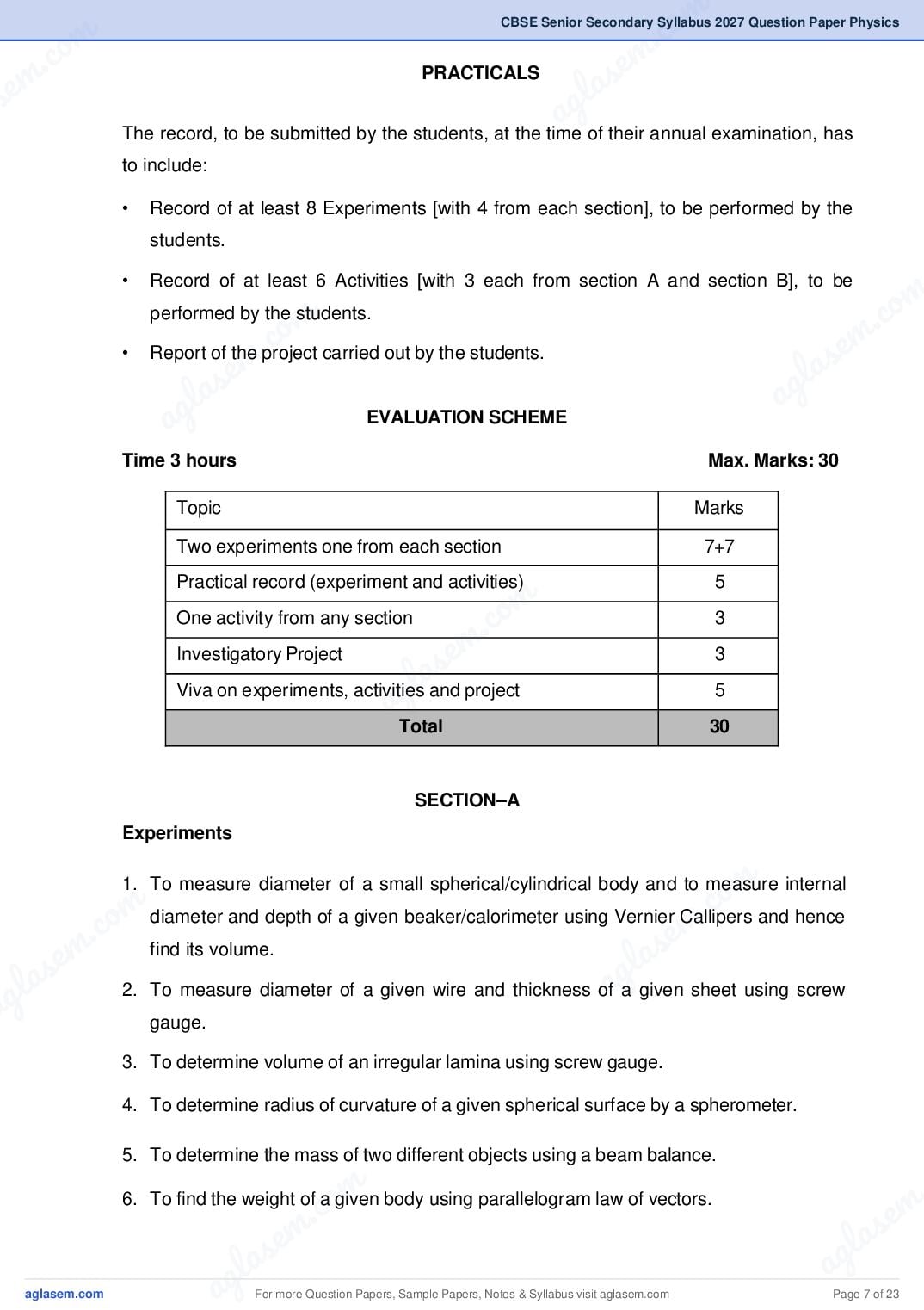
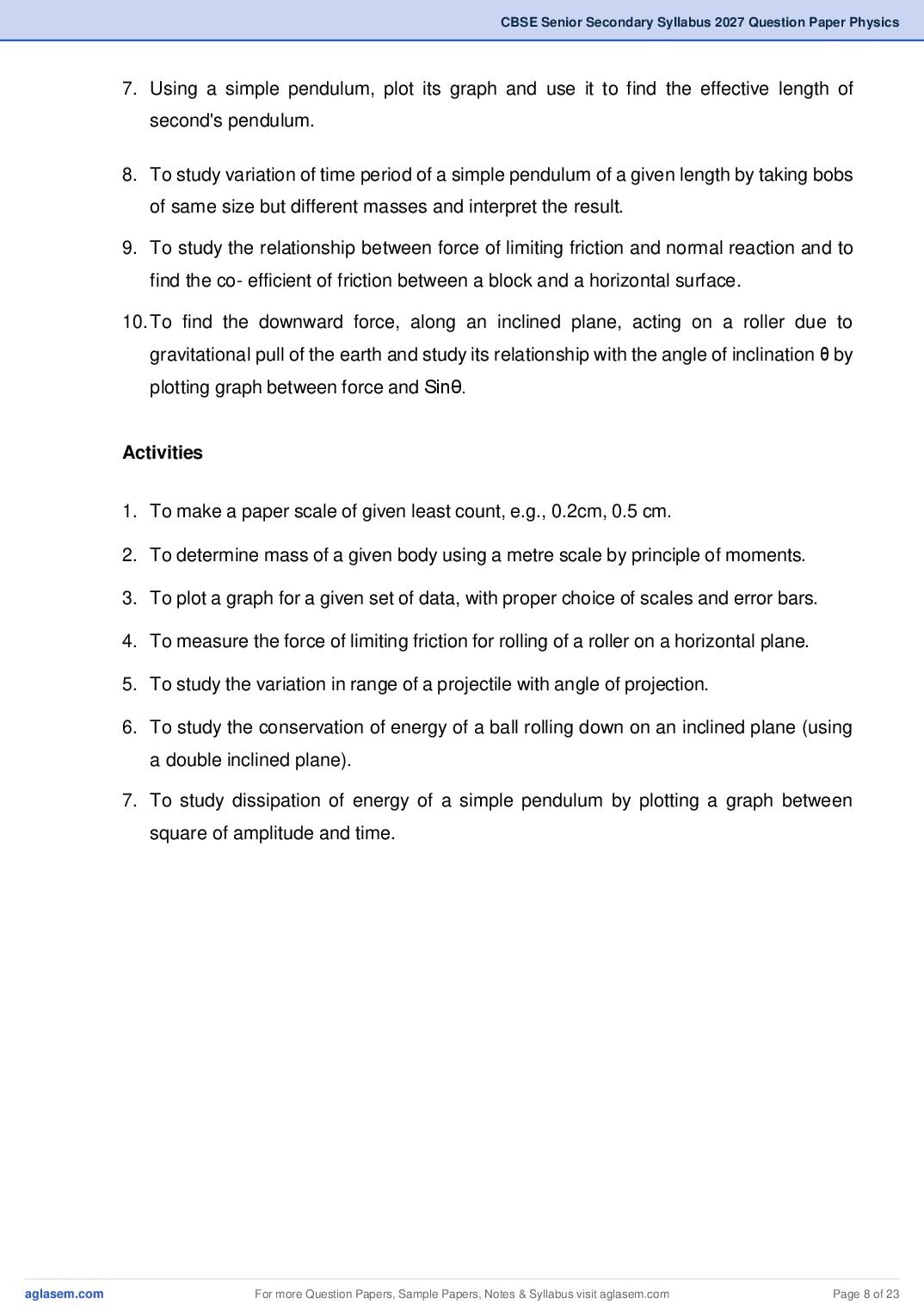
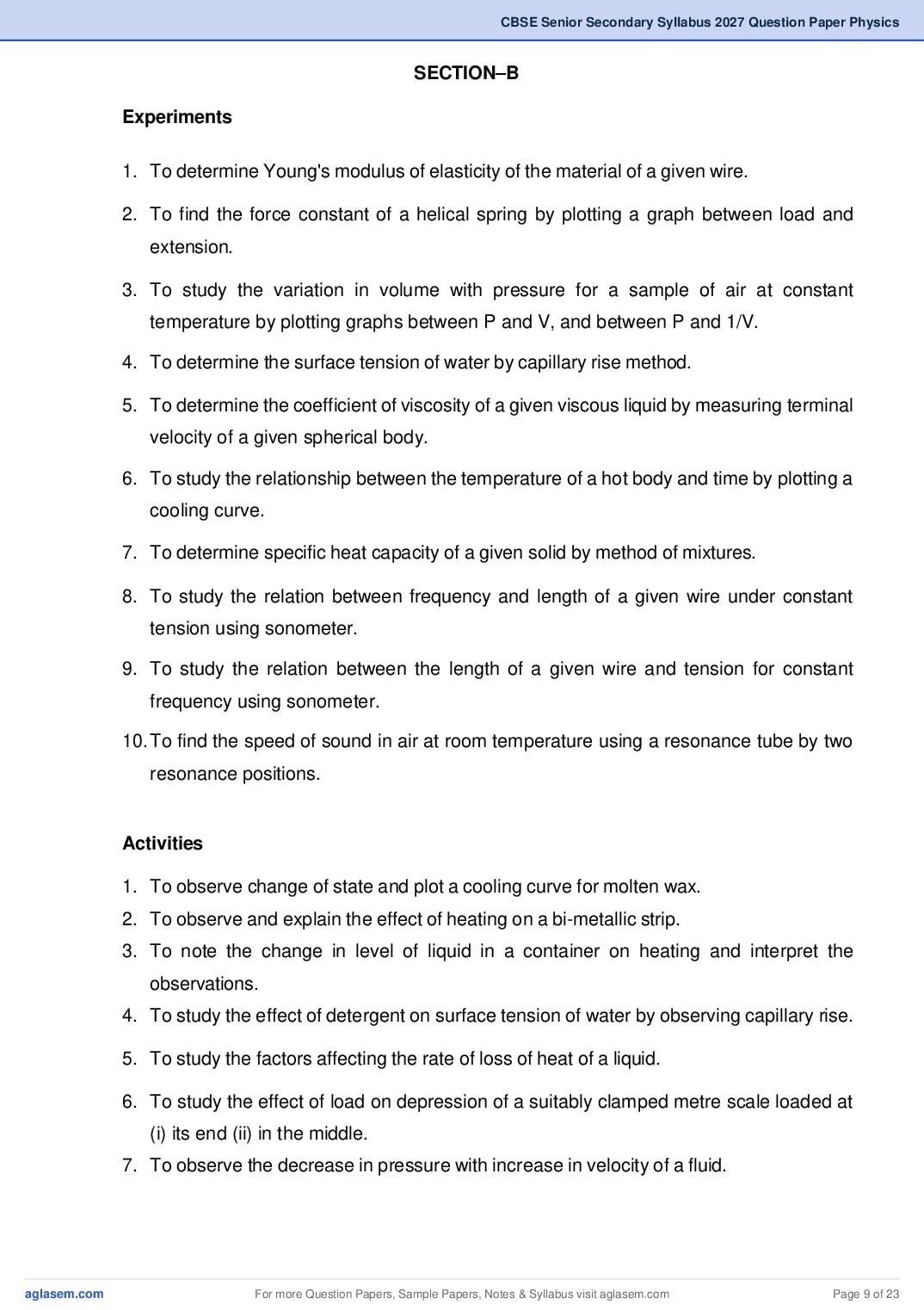
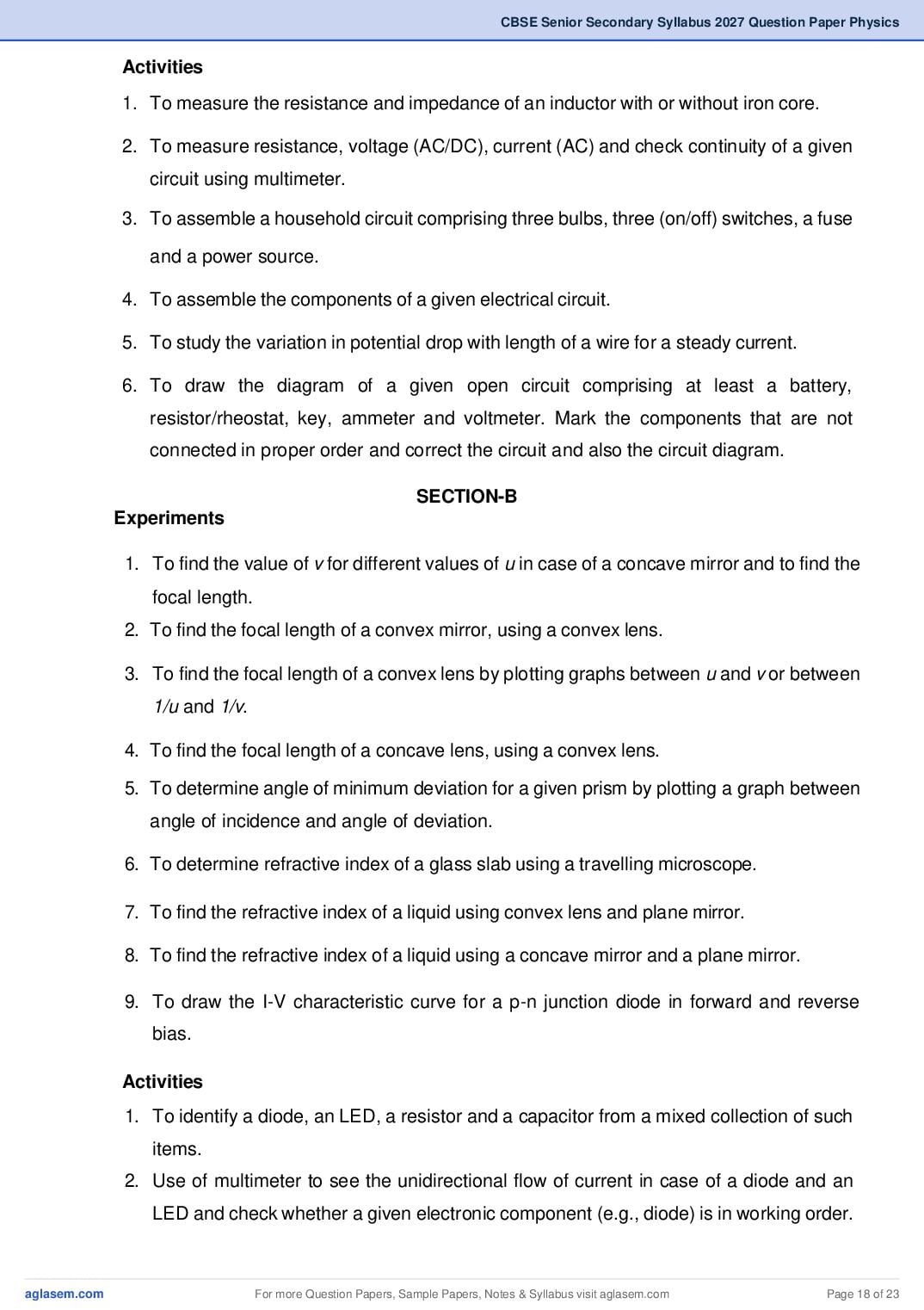
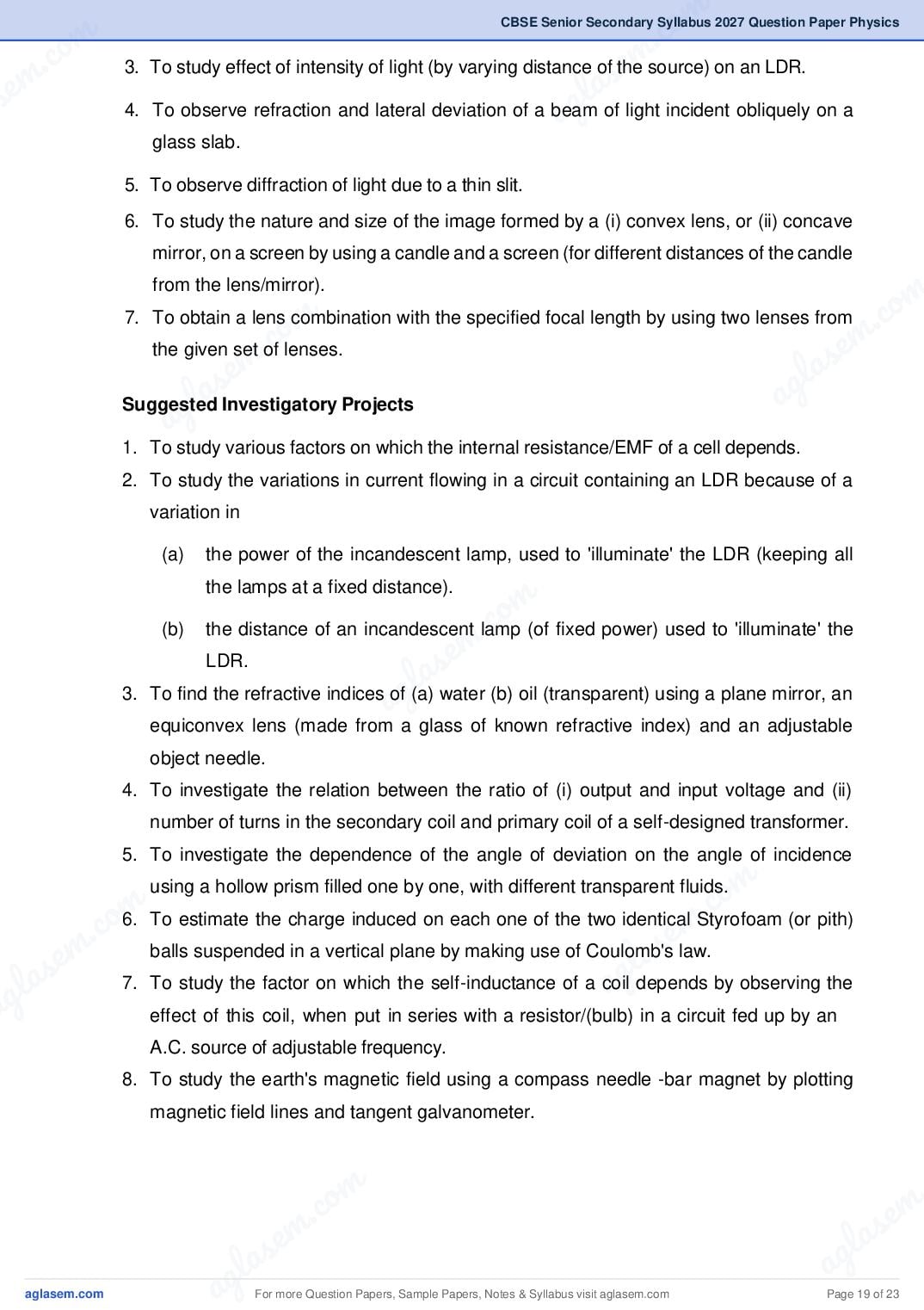
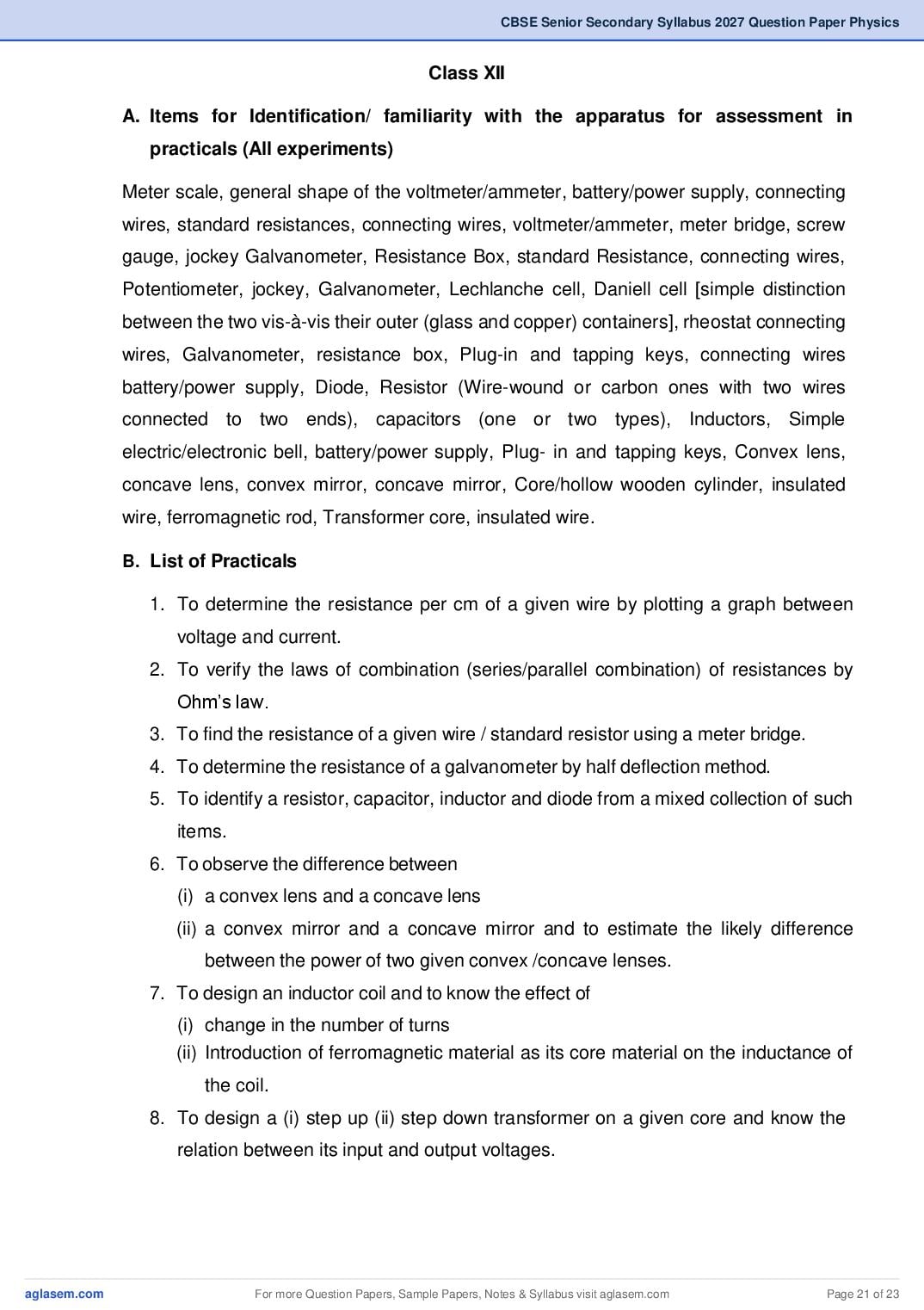
The practical record must include at least 8 experiments (4 from each section), 6 activities (3 from each section) and a project report. Key practicals include: resistance per cm of a wire, verifying laws of combination of resistances (Ohm’s law), resistance of a wire/standard resistor using a metre bridge, resistance of a galvanometer by half-deflection method, identifying a resistor, capacitor, inductor and diode, comparing convex/concave lenses and mirrors, designing an inductor coil, and designing step-up/step-down transformers.
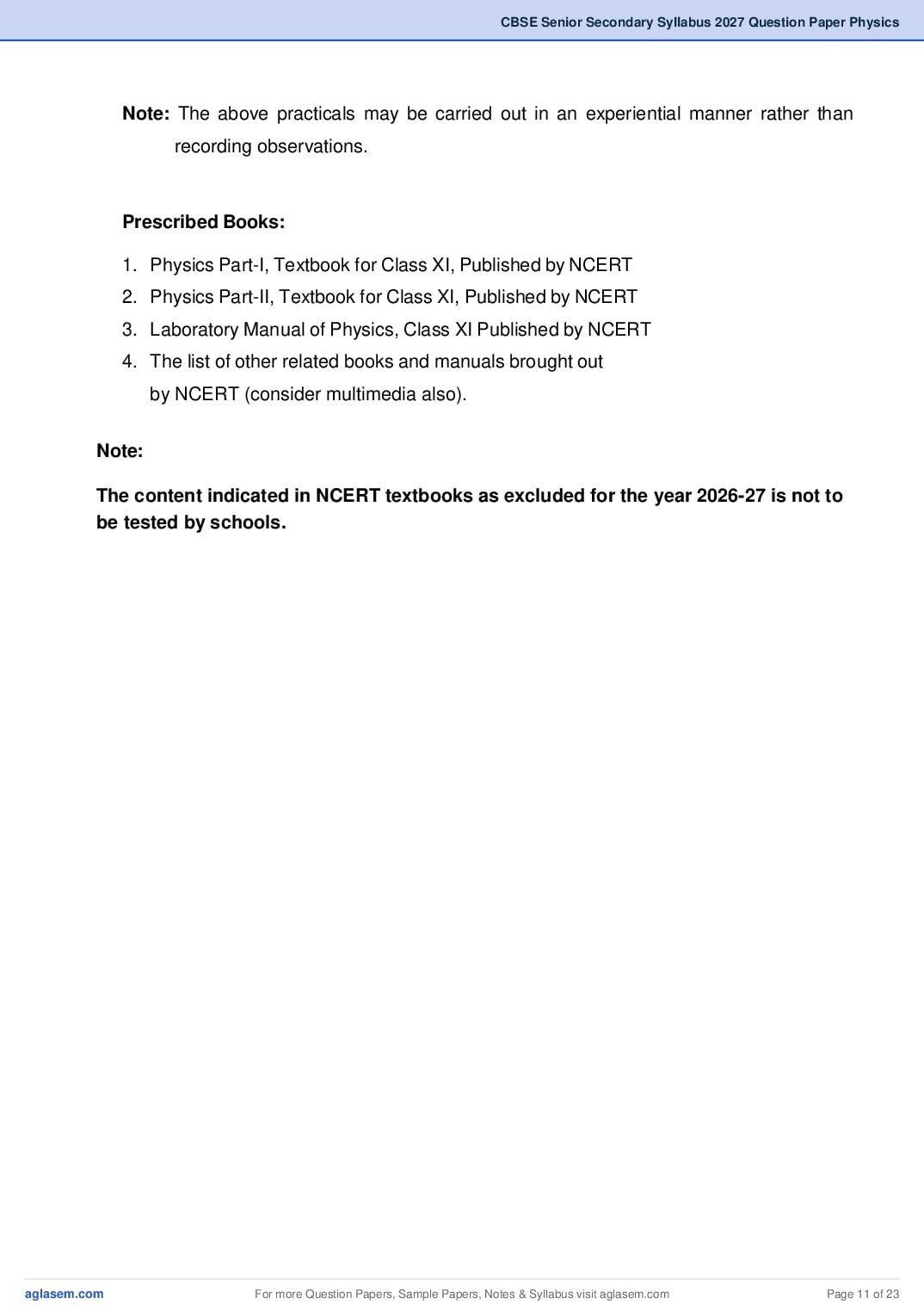
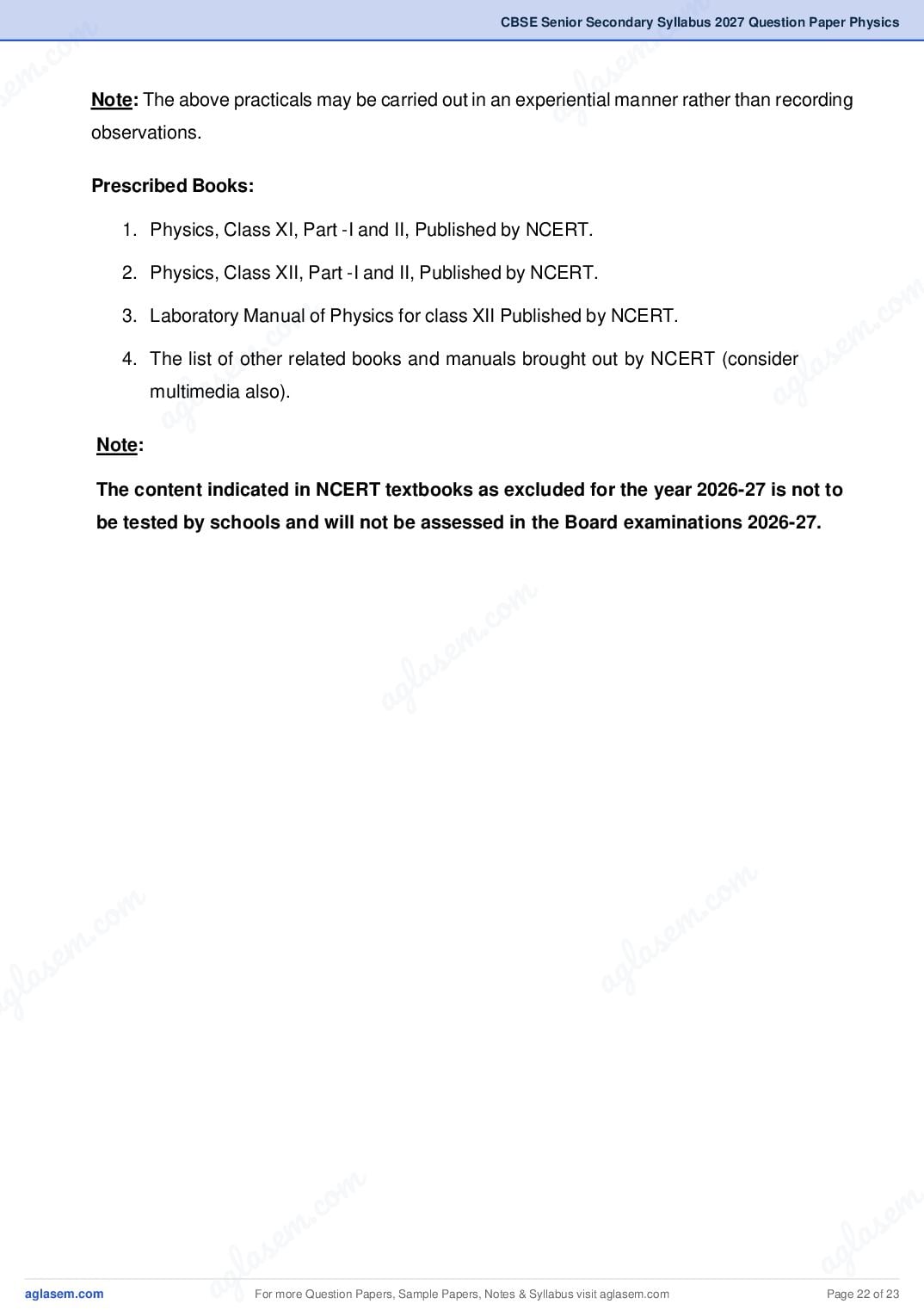
Prescribed Textbook: Physics, Class XI, Part-I and II, Published by NCERT; Physics, Class XII, Part-I and II, Published by NCERT; Laboratory Manual of Physics for Class XII, Published by NCERT.
CBSE Class 12 Physics Syllabus 2027 – Exam Pattern (Question-wise Breakdown)
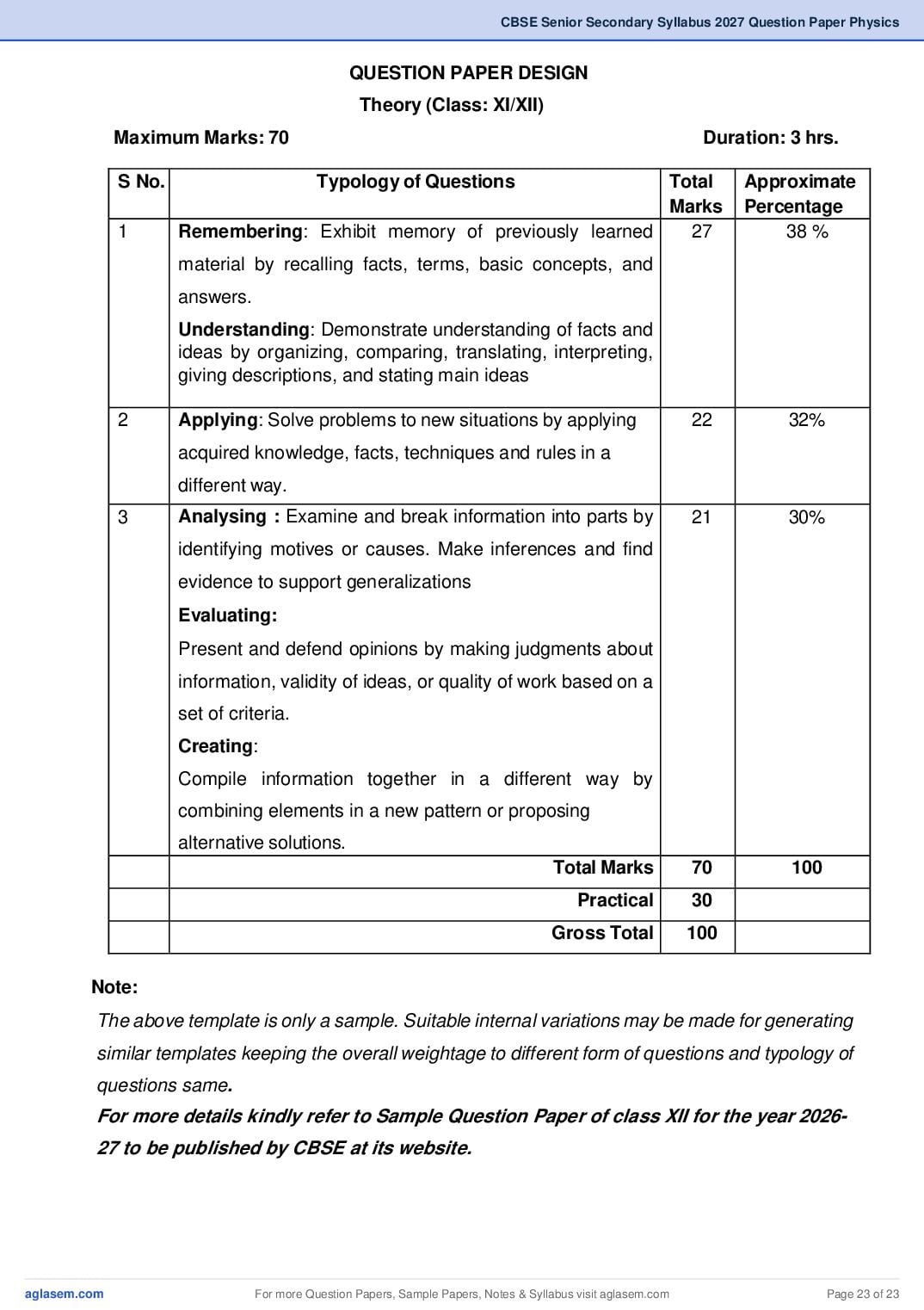
The CBSE Class 12 Physics theory question paper (70 marks, 3 hours) is designed as per the typology of questions below.
| S.No. | Typology of Questions | Total Marks | Approx. Percentage |
|---|---|---|---|
| 1 | Remembering and Understanding: Exhibit memory of previously learned material by recalling facts, terms, basic concepts and answers; demonstrate understanding of facts and ideas | 27 | 38% |
| 2 | Applying: Solve problems in new situations by applying acquired knowledge, facts, techniques and rules in a different way | 22 | 32% |
| 3 | Analysing, Evaluating and Creating: Examine and break information into parts, make inferences, present and defend judgments, and compile information in a new pattern | 21 | 30% |
| Total Marks | 70 | 100% | |
| Practical | 30 | ||
| Gross Total | 100 |
CBSE Class 12 Physics Syllabus 2027 – Continue Your Preparation
Once you have reviewed the syllabus, practice with the CBSE Class 12 Physics Sample Paper and previous years’ CBSE Class 12 Question Papers to prepare for your board exam.
Frequently Asked Questions
The CBSE Class 12 Physics Syllabus 2027 (Subject Code 042) is the official curriculum released by CBSE for the 2026-27 academic session. It covers 9 units – Electrostatics, Current Electricity, Magnetic Effects of Current and Magnetism, Electromagnetic Induction and Alternating Currents, Electromagnetic Waves, Optics, Dual Nature of Radiation and Matter, Atoms and Nuclei, and Electronic Devices – for a total of 100 marks (70 theory plus 30 Practicals).
The subject code for Physics in CBSE Class 12 is 042.
The CBSE Class 12 Physics theory exam is of 70 marks (3 hours), plus 30 marks for Practicals, making a total of 100 marks.
The prescribed textbooks are Physics Part-I and Part-II for Class XI and Class XII, published by NCERT, along with the Laboratory Manual of Physics for Class XII published by NCERT.
Practicals carry 30 marks out of 100 – students must record at least 8 experiments (4 from each section) and 6 activities (3 from each section), plus an investigatory project.
CBSE Class 12 Syllabus 2026-27 (All Subjects)
You study more subjects besides Physics in 12th class. The subject-wise syllabus for CBSE Class 12 students is as follows.
CBSE Syllabus 2026-27 (Class-wise)
The class-wise syllabus for CBSE board students is as follows.
CBSE Class 12 Physics Syllabus 2027 – An Overview
The important things to know about this curriculum are as follows.
| Aspects | Details |
|---|---|
| Education Board | CBSE |
| Class | Class 12 |
| Subject | Physics |
| Study Material Here | CBSE Syllabus for Class 12 Physics |
| All Curriculum for This Class | CBSE Syllabus for Class 12 |
| All Curriculum for This Board | CBSE Syllabus |
| Full Name of CBSE | Central Board of Secondary Education |
| NCERT Books | NCERT Books for Class 12 |
| NCERT Solutions | NCERT Solutions for Class 12 |
If you have any queries on CBSE Class 12 Physics Syllabus 2027, then please ask in comments below.